

The Regional Organization for the
Conservation of the Environment of the Red
Sea and Gulf of Aden
Regional Action Plan for the
Conservation of Coral Reefs in the
Red Sea and Gulf of Aden
PERSGA Technical Report Series No. 3
PERSGA Jeddah 2003
PERSGA - `The Regional Organization for the Conservation of the Environment of the Red
Sea and Gulf of Aden' is an intergovernmental organisation dedicated to the conservation of
the coastal and marine environments in the region.
The Regional Convention for the Conservation of the Red Sea and Gulf of Aden Environment
(Jeddah Convention) 1982, provides the legal foundation for PERSGA. The Secretariat of the
Organization was formally established in Jeddah following the Cairo Declaration of
September 1995. The PERSGA member states are Djibouti, Egypt, Jordan, Saudi Arabia,
Somalia, Sudan, and Yemen.
PERSGA, P.O. Box 53662, Jeddah 21583, Kingdom of Saudi Arabia
Tel.: +966-2-657-3224. Fax: +966-2-652-1901. Email: persga@persga.org
The "Regional Action Plan for the Conservation of Coral Reefs in the Red Sea and Gulf of Aden" was
prepared at PERSGA directly from the "Regional Action Plan for the Conservation of Coral Reefs in the
Arabian Seas Region." The original document was prepared by Dr. Lyndon DeVantier, (Australian Institute
of Marine Science, Townsville, Australia) under contract to PERSGA and with the co-operation of the
National Commission for Wildlife Conservation and Development (NCWCD), the Regional Organization
for the Protection of the Marine Environment (ROPME) and the United Nations Environment Programme
Regional Office for Western Asia (UNEP-ROWA). Additional funding was provided by the Islamic
Development Bank (IDB).
The work was carried out under the Habitat and Biodiversity Conservation Component of the Strategic
Action Programme for the Red Sea and Gulf of Aden, a Global Environment Facility (GEF) funded project
implemented by the United Nations Development Programme (UNDP), the United Nations Environment
Programme (UNEP) and the World Bank.
The comments expressed in this document represent the opinion of the author(s) acting in their own capacities and do
not necessarily represent the views of PERSGA or the agencies that assisted with funding the preparation of the report.
Any outlines or descriptions presented do not imply the expression of any opinion, on the part of PERSGA or any
funding agency, concerning the legal boundaries of any state, territory, city limit, frontier or boundary.
© 2003 PERSGA, P.O. Box 53662, Jeddah 21583, Kingdom of Saudi Arabia
This publication may be reproduced in whole or in part and in any form for educational or non-profit purposes without
the permission of the copyright holders provided that acknowledgement of the source is given. PERSGA would
appreciate receiving a copy of any publication that uses this material as a source.
This publication may not be copied, or distributed electronically, for resale or other commercial purposes without prior
permission, in writing, from PERSGA.
Photographs: F. Krupp.
This publication may be cited as:
PERSGA/GEF. 2003. Regional Action Plan for the Conservation of Coral Reefs in the Red Sea and Gulf of Aden.
PERSGA Technical Series No. 3. PERSGA, Jeddah.
TABLE OF CONTENTS
LIST OF ACRONYMS AND ABBREVIATIONS......................................................................... ii
EXECUTIVE SUMMARY.............................................................................................................. 1
SCOPE OF THE PLAN................................................................................................................... 3
INTRODUCTION ........................................................................................................................... 4
FRAMEWORK FOR ACTION....................................................................................................... 8
USING THIS DOCUMENT............................................................................................................ 8
COMPONENT 1: INTEGRATED COASTAL ZONE MANAGEMENT (ICZM) ...................... 10
COMPONENT 2: EDUCATION AND AWARENESS................................................................ 11
COMPONENT 3: MARINE PROTECTED AREAS .................................................................... 12
COMPONENT 4: ECOLOGICALLY SUSTAINABLE REEF FISHERIES ............................... 19
COMPONENT 5: IMPACT FROM SHIPPING AND MARINE POLLUTION.......................... 21
COMPONENT 6: RESEARCH, MONITORING, AND ECONOMIC VALUATION ................ 24
INTEGRATION OF THE RAP..................................................................................................... 29
ACTIONS REQUIRING BUDGET SUPPORT............................................................................ 30
ACKNOWLEDGEMENTS ........................................................................................................... 32
LITERATURE............................................................................................................................... 33
APPENDIX 1. Key goals for effective reef management.............................................................. 40
APPENDIX 2. Major issues to be addressed for successful reef management.............................. 41
APPENDIX 3. Integration of the RAP with other Programmes and Conventions ........................ 42
APPENDIX 4. International collaboration with ICRI and ICRAN ............................................... 43
APPENDIX 5. Principles of implementation of the RAP in the Red Sea and Gulf of Aden......... 44
APPENDIX 6. Indicators of success of the RAP........................................................................... 45
APPENDIX 7. Techniques for raising awareness of coral reefs.................................................... 46
APPENDIX 8. Criteria for demonstration MPA site selection ...................................................... 47
APPENDIX 9. Assessing management effectiveness in MPAs..................................................... 48
i
LIST OF ACRONYMS AND ABBREVIATIONS
CBD
Convention on Biological Diversity
CITES
Convention on International Trade in Endangered Species of Wild Fauna
and Flora
EEAA
Egyptian Environmental Affairs Agency
EIA
Environmental Impact Assessment
FAO
Food and Agriculture Organization of the United Nations
GCRMN
Global Coral Reef Monitoring Network
GEF Global
Environment
Facility
GIS
Global Information System
ICLARM
The WorldFish Center (formerly the International Center for Living
Aquatic Resources Management)
ICRAN
International Coral Reef Action Network
ICRI
International Coral Reef Initiative
ICRIN
International Coral Reef Information Network
ICZM
Integrated Coastal Zone Management
IDB
Islamic Development Bank
IOC
Intergovernmental Oceanographic Commission
IUCN
The World Conservation Union
MARPOL
International Convention for the Prevention of Pollution from Ships
MEMAC
Marine Emergency Mutual Aid Centre
MPA
Marine Protected Area
MOOPAM
Manual of Oceanographic Observations and Pollutant Analysis Methods
NCWCD
National Commission for Wildlife Conservation and Development
NOAA
National Oceanic and Atmospheric Administration
NESDIS
National Environmental Satellite, Data, and Information Service
PERSGA
Regional Organization for the Conservation of the Environment of the
Red Sea and Gulf of Aden
Ramsar
International Wetlands Convention
RAP
Regional Action Plan
ROPME
Regional Organization for the Protection of the Marine Environment
RSGA
Red Sea and Gulf of Aden
SAP
Strategic Action Programme for the Red Sea and Gulf of Aden
UNCED
United Nations Conference on Environment and Development
UNCLOS
United Nations Convention on the Law of the Sea
UNDP
United Nations Development Programme
UNEP
United Nations Environment Programme
UNEP-ROWA
UNEP - Regional Office for Western Asia
UNESCO
United Nations Educational, Scientific and Cultural Organization
WHC
World Heritage Convention
WWF
World-Wide Fund for Nature
ii
EXECUTIVE SUMMARY
This Plan, specific to the Red Sea and
disturbances may cause major disruptions in
Gulf of Aden, was drafted directly from the
reef function and the loss of associated
Regional Action Plan for the Conservation
resources for human use.
of Coral Reefs in the Arabian Seas Region
that was prepared as an outcome of the
This RAP for the PERSGA region
"International Symposium on the Extent
defines a set of priority actions pertaining to
and Impact of Coral Bleaching in the
six major objectives aimed at ameliorating
Arabian Seas Region" hosted by NCWCD
the predicted impacts to reefs:
under the patronage of H.R.H. Prince
Salman bin Abdulaziz Al-Saud, with the
1. Integrated Coastal Zone Management
participation of ROPME and UNEP-
(ICZM): Many of the region's reefs fringe
ROWA, and the valuable assistance of
the coastline and are particularly sensitive
IUCN, IDB and all participating countries.
to changes in coastal land-use patterns
including development, land-fill, raw
This Regional Action Plan (RAP)
sewage, other forms of pollution and
provides a set of priority actions for the
alterations to wadi or mersa drainage
conservation and sustainable development
patterns. Most nations have taken important
of coral reefs in the Red Sea and Gulf of
steps towards effective ICZM, developing
Aden. The region supports a wide variety of
national strategies, plans, policies and
reefs and coastal habitats, much of high
legislation. The Priority Objective is the
ecological value, and globally significant
implementation by all participating nations
levels of endemism and biodiversity.
of Integrated Coastal Zone Management
Additionally, it provides a wide range of
Planning for conservation of coastal reefs,
renewable resources for human use.
supported by appropriate legislation, land-
use planning, participatory approaches,
The Plan was developed in recognition
socio-economic and environmental impact
of the great economic, ecological, and
assessment, monitoring and enforcement.
aesthetic importance that these ecosystems
2. Education and Awareness: To be
provide and in response to the serious
most effective, the priority actions require
threats posed by increasing human and
dedicated and continued support across all
natural impacts. These threats range from
governmental and inter-governmental levels
local to global events and include
and from the public at large. The Priority
uncontrolled coastal development, various
Objective is to increase government and
forms of coastal and marine pollution,
public awareness through the
destructive fishing methods, over-fishing,
implementation of education and awareness
unnatural increase in predator numbers,
programmes; these are to be disseminated
impacts from shipping and disturbances
through communication networks
associated with predicted future climate
(electronic mail) to decision-makers, the
change. Many of the region's reefs are
mass media, schools, universities and local
growing near the climatic extremes of reef
communities.
development and are particularly vulnerable
to any increase in disturbance. The
3. Marine Protected Areas (MPAs):
seriousness of the threat was demonstrated
Establishment of a biologically
by major coral reef bleaching in 1997 and
interconnected network of MPAs is crucial
1998, causing massive death of corals and
to the long-term maintenance of reef
other reef organisms in the Gulf of Aden
ecosystems and viability of populations of
and parts of the Red Sea. Over the next
endemic, rare, threatened or endangered and
several decades, predicted increases in these
1
harvested species. Most nations in the
global markets. As reef fish stocks are
region have taken important steps towards
particularly prone to over-fishing, a
developing MPAs, although considerable
precautionary approach to the continued
national differences in management exploitation of the resource-base is essential
capacity exist and capacity-building in all
for stock protection and replenishment. The
aspects of MPAs is a priority. The Priority
Priority Objective is the implementation by
Objective is the development of 'flag-ship'
participating nations of accurate stock
demonstration MPA sites as examples of
assessment and monitoring, effective
effective coral reef management practices in
regulation of fishing effort through
the region (north to south):
licensing and other methods, protected
areas with "no take" zones, seasonal
· Aqaba Marine National Park, (Gulf
closures to protect spawning stocks,
of Aqaba, Jordan)
surveillance and enforcement.
· Straits of Tiran, (Northern Red Sea,
Saudi Arabia/Egypt)
5. Impacts of Shipping and Marine
·
Pollution: The region is one of the major
Ras Mohammed National Park,
global thoroughfares for international
(Northern Red Sea, Egypt)
maritime traffic and is also the world's
· Giftun Islands and Straits of Gubal,
largest producer and exporter of oil, most of
(Northern Red Sea, Egypt)
which is transported by sea. These factors
· Dungonab Bay and Mukawwar
place the region's reefs and other coastal
Island, (Central Red Sea, Sudan)
and marine ecosystems at high risk from
· Sanganeb Atoll, (Central Red Sea,
major ecological disruption through ship
Sudan)
groundings or collisions, the introduction of
·
alien species in uncontrolled ballast water
Farasan Islands Marine Park,
discharges and other forms of marine
(S-central Red Sea, Saudi Arabia)
pollution. The Priority Objective is the
· Belhaf - Bir Ali, (Gulf of Aden,
implementation by participating nations of
Yemen)
obligations under regional and international
· Iles des Sept Frères, (Gulf of Aden,
conventions, adoption of Port State Control,
Djibouti)
improved navigation systems and oil spill
· Socotra Islands, (Gulf of Aden,
response capacities (particularly in sensitive
Yemen)
reef areas), surveillance and enforcement.
· Aibat and Saad ad Din, (Gulf of
6. Research, Monitoring and Economic
Aden, NE Somalia).
Valuation: Effective integrated coastal zone
and MPA management, and sustainable reef
See map page 7.
fisheries, require accurate information on
status and trends collected through
As MPA management capacity management-related research and
increases during the RAP, other MPAs will
monitoring. A second crucial element of
join these initial sites.
monitoring is an assessment of the
4. Ecologically Sustainable Reef
effectiveness of the management itself.
Fisheries: Reef fisheries provide essential
Effective lobbying for conservation and
sustenance to artisanal fisherman and their
development of coral reefs at government
communities throughout the region. Reef
and inter-government levels benefits by
fisheries also play an increasingly important
providing realistic comparisons of the
role in supplying commercial quantities of
various costs and benefits of different
high value reef fish and other products for
courses of action, be they development
export to expanding national, regional and
proposals or conservation plans. The
2
Priority Objective is the implementation by
analysis and reporting, using regional
participating nations of standardised
(PERSGA) and international
methods of biophysical and socio-economic
(e.g. ReefCheck, GCRMN) protocols.
survey and monitoring, data-storage,
SCOPE OF THE PLAN
For each of the six priority actions,
a level of urgency to each specific priority
regional and national priority actions are
action in the major objectives allows a
identified, expected results, desired phased approach to implementation, such as
outcomes and time frames are defined and
budget and capacity building. The levels of
performance indicators and methods of
urgency do not necessarily indicate the
quality assurance are outlined. Each
sequence of priority.
component will be co-ordinated at the
regional level through PERSGA in liaison
To assist effective implementation, a
with other national and international
Steering Committee will be formed to co-
agencies. In individual countries, ordinate the RAP over its initial period of
implementation will occur through implementation. This committee will be
integrated networks of national and local
composed of representatives from each
working groups, Task-Force members,
participating nation and the major regional
government departments, agencies and
and national organizations. The committee
personnel, non-governmental organisations
will act as the interface between
and other stake-holders. The designation of
government, major donor agencies and
other international coral reef initiatives.
Overall Objective: The conservation and sustainable development of coral reefs of
the Red Sea and Gulf of Aden to maintain their intrinsic biodiversity, ecological,
aesthetic and other values. Safeguarding the viability of the reefs will also ensure the
continued use (fishing) and enjoyment (tourism) of reefs by future generations of
mankind.
3
INTRODUCTION
Human and natural impacts on coral
document. The RAP-RSGA involves
reefs and associated habitats and biota have
commitment from a large number of coral
continued to escalate, both globally and
reef professionals, national and regional
within the Red Sea and Gulf of Aden.
environmental organisations and other
Increasing habitat destruction, over-
stake-holders representing the public and
exploitation, pollution, bleaching and
private sectors. It indicates regional
climate change threaten the continued
commitment, which, to be effective,
functioning of the coral reef ecosystem.
requires dedicated support across all
This became evident in 1997 and 1998,
governmental and inter-governmental levels
when elevated sea surface temperatures
and from the public at large. The process
caused mass coral bleaching and mortality
will be facilitated through co-ordination and
in many parts of the Arabian Seas Region
integration with other programmes and
(Fig. 1), with serious adverse effects to
conventions (see Appendix 3).
humans through declining fisheries, tourism
and other ecosystem services.
Reefs in the RSGA region face
increasing levels of threat at local, regional
Recent research on the extent and
and global scales. As many reefs are
effects of coral bleaching and other reef
growing near the extremes of reef
impacts alerted reef scientists, managers
development, they are particularly
and political decision makers to the urgency
vulnerable to increases in disturbance.
of protecting these ecosystems. Localised threats include various forms of
Subsequently, under the patronage of
pollution from shipping, urban, industrial
H.R.H. Prince Salman bin Abdulaziz Al-
and tourism developments, raw sewage,
Saud, a major international symposium was
dredging and land-fill. Uncontrolled coastal
organised by the National Commission for
development adjacent to fringing reefs and
Wildlife Conservation and Development
reef-based tourism have already damaged or
(NCWCD) to review the extent and impact
destroyed reefs in some areas.
of bleaching and other threats to the
Region's reefs. The meeting initiated the
At the regional level, threats to reefs
`Regional Action Plan for the Conservation
include destructive fishing methods and
of Coral Reefs in the Arabian Seas Region'
over-fishing, with direct physical impacts
from which this PERSGA-specific Regional
and indirect impacts to trophic structure and
Action Plan for the Red Sea and Gulf of
ecological function. Over-fishing and major
Aden (RAP-RSGA) was derived.
pollution events, such as those associated
with massive oil spills, have serious trans-
At a regional workshop addressing
boundary implications.
conservation and development issues in the
Arabian Seas, held in Aqaba, Jordan in
Predicted climate changes over the next
1997 under the auspices of the International
several decades are expected to cause
Coral Reef Initiative (ICRI), key goals for
substantial coral death and lower the
achieving effective reef management were
capacity of reefs to recover. This loss of
identified. They are listed in Appendix 1.
resilience is linked with projected increases
Major issues to be addressed, if success is
in sea surface temperature, causing
to be achieved, are listed in Appendix 2.
continued coral bleaching and death. Under
These issues have provided the basis for
worse case scenarios, the synergistic
both the `RAP for Coral Reefs in the
combination of impacts threatens the
Arabian Seas Region' and this subregional
continued existence of reef ecosystems in
the region.
4
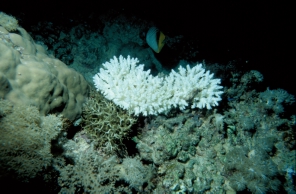
Figure 1. Images of sea surface temperature (SST) anomalies for the Arabian Region in May and
August 1998, from the NOAA/NESDIS WWW site. Colours indicate degrees Celsius above 20 year
averages. Most reef areas with elevated SSTs experienced intense coral bleaching and subsequent
mortality, notably the Yemeni island of Socotra and NE Gulf of Aden, the ROPME Sea Area (Arabian
Gulf) and parts of the Red Sea.
Bleached coral
5
Fortunately, through a unique
Capacities to implement the priority
combination of natural and human factors,
actions vary greatly among countries within
some of the region's reefs (Fig. 2) remain in
the region; there is a pressing need to build
good to excellent condition at the beginning
capacity in aspects of ICZM, MPAs,
of the 21st century. According to the WORLD
fisheries, navigation, research and
RESOURCES INSTITUTE (BRYANT et al. 1998)
monitoring. Thus capacity-building and
the Arabian Seas Region as a whole
training programmes to improve the
harbours some of the best remaining reefs
national human resource bases, from which
globally. However, a large-scale risk
the RAP-RSGA will be implemented, are
analysis has indicated that about two-thirds
crucial to its overall success. It has been
of the Region's reefs are at medium or high
designed as a dynamic approach towards
risk from human activities.
coral reef conservation, which requires
regular evaluation and updating as
The regional, national and local
conditions on regional reefs change. If fully
approach developed here, focusing on a
implemented, the actions identified here
common goal and responsibility throughout
will help to ensure that coral reefs continue
the region, will benefit from collaboration
to provide valuable ecological, social and
and information sharing, particularly with
economic resources to future generations.
the ICRI partnership (Appendix 4).
6
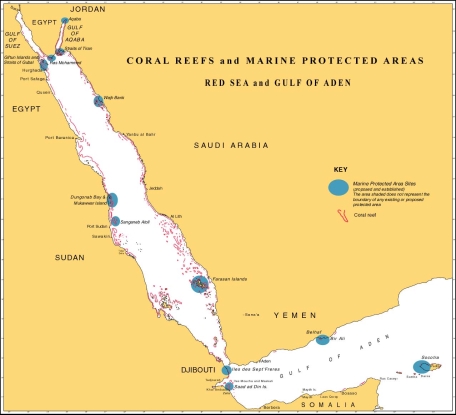
Figure 2. Map of the Red Sea and Gulf of Aden showing coral reefs and marine protected areas.
7
FRAMEWORK FOR ACTION
To be most effective, actions need to be
indicators and methods of quality assurance
prioritised and integrated into a logical
outlined. Several of the priority actions are
framework (Fig. 3), where strong already well advanced in parts of the
interconnections and positive feedback
region. Designation of an urgency level to
among the key components enhance the
each specific priority action allows a phased
likelihood of overall success.
approach to implementation, as budget and
capacity allow. The effectiveness of
This framework for action is implementation of the priority actions can
constructed of six key components:
be optimised through adherence to 12
1.
Integrated coastal zone management,
general principles (see Appendix 5).
Although focusing on coral reefs, the Plan
2.
Education and awareness,
is also applicable to associated coastal and
3.
Marine protected areas,
marine ecosystems, particularly mangroves
4.
Ecologically sustainable reef fisheries,
and seagrass beds, in light of the strong
degree of biological and ecological
5.
Impact of shipping and marine
interconnectedness among them.
pollution,
6.
Research, monitoring and economic
Objective independent assessment of the
valuation.
success of implementation of the RAP-
RAGA is crucial for adaptive management.
These components were identified
This can be achieved through a co-
through extensive consultation both ordinated approach based on the use of
nationally and regionally. For each
performance indicators for results,
component, priority actions are identified,
outcomes and impact of the RAP. Indicators
expected results, desired outcomes and time
are listed in Appendix 6.
frames are defined and performance
USING THIS DOCUMENT
The RAP-RSGA addresses complex
species, communities or ecosystems of
problems with complex solutions. The
regional or global importance;
Executive Summary and Introduction
* - priority action, where there is an
provide a general overview of the
institutional set-up or there are on-going
background and long-term approach.
projects and opportunities for co-operation
Operational principles and conservation are
with existing efforts.
outlined under each component of the RAP.
The level of urgency for each action is
Time frames under "expected results
indicated as:
and outcomes" indicate the number of
months required to achieve the result or
*** - very urgent action, where
outcome, starting from the launching of the
immediate action or intervention is
corresponding activity.
required, as for example to protect habitats
and ecosystems under severe threat;
Additional details can be found in tables
** - urgent action, where intervention is
and appendices. For further reading, a list of
required to ensure the continued viability of
literature is provided.
8
Integrated Coastal Zone Management
1. Legislative frameworks - land-use planning
2. Socio-economic and environmental impact
assessment
Marine Protected Areas
Ecologically-sustainable Reef Fisheries
1. Demonstration sites
1. Stock & effort assessment &
2. Assessment - biodiversity,
monitoring
-
socio-economics,
2. Licensing systems
-
biological connectivity,
-
status
3. MPA zonings, surveillance &
policing
3. Legislative frameworks
4. Integrated network
Research, Monitoring & Economic
Education & Awareness
Valuation
Targeting government &
1. Bio-physical & socio-economic
public through:
assessments
Shipping & Marine
1. Multi-media publications
Pollution
2. Biological connectivity
oceanography - genetics
2. Public presentations
1. Legislation
3. Ecosystem `health'
3. National regional
2. Surveillance &
seminars
policing
Figure 3. Set of Priority Action components for conservation and ecologically sustainable
development of coral reefs and associated ecosystems in the Red Sea and Gulf of Aden.
Overlapping ellipses indicate the strong level of interconnection and feedback among the different
components.
9
COMPONENT 1: INTEGRATED COASTAL ZONE MANAGEMENT (ICZM)
The high degree of connectedness
Priority Objective: Implementation by
among coastal and marine ecosystems is
all participating nations of Integrated
well known (e.g. KENCHINGTON 1990,
Coastal Zone Management Planning for
KELLEHER ET AL. 1995). Land-based
conservation of coral reefs and associated
sources (industrial, agricultural and ecosystems and species, supported by
municipal wastes and run-off) account for
appropriate legislation, land-use planning,
ca. 70 % of coastal and marine pollution
participatory approaches, socio-economic
and are particularly problematic in estuaries
and environmental impact assessment,
and other partially-enclosed waters monitoring and enforcement.
(GESAMP 1990).
Actions:
Most nations in the Red Sea and Gulf of
i. For each country, identify the relative
Aden (RSGA) region have recognized that
importance of different types of coastal
effective management for conservation of
and catchment development and their
reefs requires successful management of
impact on coral reefs (***);
adjacent coastal areas. As many reefs fringe
the coastline, they are particularly sensitive
ii. Where not already completed, develop
to changes in coastal land-use patterns
national ICZM plans incorporating
(PERSGA 1998a). Their conservation
requirements for reef conservation in
requires appropriate integrated land-use planning, socio-economic and
management, based on sound legislative
environmental impact assessments
frameworks, land-use planning,
(***);
participatory approaches, a priori socio-
iii. Where not already completed, develop
economic and environmental impact
policy and legislation relevant to coastal
assessments (EIA) and, where necessary,
reefs (***);
remedial actions.
iv. For each country, identify and develop
Some nations in the region have taken
consultative processes with the key
major steps towards managing their coastal
stake-holders with relevance to reefs
zones, with implementation of ICZM plans
(**);
and their integration into national
v.
Develop regional and national
development plans. For example, the
Guidelines for ICZM assessment with
Kingdom of Saudi Arabia has prepared an
regards to environmental impacts on
ICZM plan for its coastal areas and a
reefs (**);
National Biodiversity Strategy and Action
Plan; Egypt has developed a Coastal Zone
vi. Train national teams to conduct EIA on
Management Plan for the Red Sea coast
reefs (*);
defining areas for urban and tourism
vii. Develop key demonstration sites using
development and other major
best practice ICZM of reefs within the
infrastructures, and EIA is obligatory for
region (*).
any development project. ICZM plans for
Sudan are under preparation through the
Expected results outcomes and time
Strategic Action Programme (SAP). At the
frame:
regional level, PERSGA and ROPME have
i. National meetings among the key
organized several ICZM workshops and
stakeholders to identify the relative
ROPME has published "Integrated Coastal
importance of different types of coastal
Area Management Guidelines for the
and catchment development and their
ROPME Region" (March 2000).
impact on reefs (after 12 months);
10
ii. Consultative meetings among the key
vi. Training courses for national teams to
stake-holders to develop national ICZM
carry out EIA on reefs (after 18
plans covering coastal reefs (where not
months).
already completed) and to build
capacity and co-ordination (after 18
Performance Indicators and Quality
months);
Assurance:
iii.
Review of ICZM plans and i. Publication of regional and national
recommendations on amendments
guidelines for ICZM, socio-economic
(where necessary) to national ICZM
and environmental impact assessments;
policy and legislation regarding reefs
ii. Development of policy and enactment
(after 18 months);
of legislative amendments;
iv. Publication of regional guidelines for
iii. Implementation of ICZM and EIA in
socio-economic and environmental
decision making;
impact assessment (after 12 months);
iv.
Independent assessment of the
v. Publication of national socio-economic
effectiveness of ICZM.
and EIA guidelines (after 12 months);
COMPONENT 2: EDUCATION AND AWARENESS
The raising of public and government
decision makers, the mass media, schools,
awareness of the importance of reefs and of
universities and local communities.
their current threats is crucial to their long-
term conservation. PERSGA has already
Actions:
taken important steps in raising awareness,
i. Produce, publish and disseminate
through regular publication of its newsletter
education and awareness materials,
`Al Sanbouk' and other material and
using electronic media, information
through the development and enhancement
sheets, brochures, booklets, videos, CDs
of regional and national communication
and other media (***);
networks.
ii. Make results of research, surveys,
There are many approaches to education
monitoring and economic valuations
and raising awareness (see Appendix 7),
available, in suitable format, to decision
ranging from talks in remote coastal
makers and the general public (***);
communities to the WorldWideWeb.
iii. Liase with ICRI (ICRIN) regarding the
Several of these methods are already
development of public awareness
employed routinely within the region (see
materials and campaigns for the region
e.g. FLEMING 1996), notably by NCWCD in
(*);
Saudi Arabia and by the Egyptian
Environmental Affairs Agency (EEAA) as
iv.
Develop strong links with key
an integral part of management of the Ras
government departments to provide
Mohammed National Park in Egypt.
important findings to decision-makers
(***);
Priority Objective:
Increased
v. Develop strong links with the mass
government and public awareness through
media for the dissemination of major
the implementation of education and
newsworthy items (**).
awareness programmes to be disseminated
through communication networks to
11
Expected results outcomes and time
iv. Improved media skills through training
frame:
courses in media presentation (after 6
i. Production of a wide range of education
months).
and awareness materials within the next
Performance Indicators and Quality
10 years;
Assurance:
ii. Development of teaching materials for
i. Production of education and awareness
schools and universities (after six
materials;
months);
ii. Demonstrable increase in government
iii.
Improved links with government
and public awareness and in mass
agencies and mass media (after 18
media coverage of reef issues.
months);
COMPONENT 3: MARINE PROTECTED AREAS
The value of marine protected areas
along the Gulf of Aqaba, Egypt is now
(MPAs) in conservation and the sustainable
considering that a balance between
development of coral reefs is well
protected areas and development along the
established, both from the perspectives of
coast of the Red Sea is the only opportunity
conserving biodiversity and of sustaining
for long-term sustainability of tourism.
nutritional, economic and other benefits to
Measures implemented to date to protect
humans (Box 1, DIXON & SHERMAN 1990,
reefs include entrance fees for protected
KENCHINGTON 1990, DIXON 1993,
areas and user fees for mooring
AGARDY 1994a, b, DE FONTAUBERT ET AL.
installations. Additional means of
1996). For example, numerous case-studies
generating revenue include the
have conclusively demonstrated the `flow-
establishment of non-profit conservation
on' and `spill-over' benefits to reef fisheries
funds and private-sector grants.
of even small `no-take' reserves, provided
such reserves are not themselves exploited
Conservation of biodiversity is more
or suffer through ineffective policing (e.g.
complex, requiring the long-term
RUSS 1985, RUSS & ALCALA 1996a, b).
maintenance of overall ecological integrity,
community structure and viable populations
Other economic benefits best obtained
of the species of interest (SOULÉ 1987).
from MPAs include the generation of
This may prove particularly challenging in
employment and sustainable finances
the region, where globally significant levels
through well-managed reef tourism. Such
of endemism, complex biogeographic
tourism-based revenue has proven a viable
patterns and the presence of partial barriers
source of funding for reef management and
to gene flow (SHEPPARD ET AL. 1992,
research on Australia's Great Barrier Reef,
DEVANTIER ET AL. 2000c) pose significant
and there is great potential for and unique challenges to the development
implementation of similar systems of
of an effective regional MPA network (also
`users-pay' in the region (also see HOOTEN
see ROBERTS 1998 and Convention on
& HATZIOLOS 1995). Following the
Biological Diversity (CBD), Articles 2 and
successful integration of environmental
8).
protection and sustainable development
12
BOX 1. Major reef conservation objectives achievable through MPAs (after DE
FONTAUBERT ET AL. 1996):
1.
Protection of endangered reef species,
2.
Maintenance or restoration of viable populations of reef species,
3.
Maintenance or restoration of reef communities, habitats, nesting and breeding
areas and genetic diversity,
4.
Exclusion of species introductions by humans,
5.
Provision of space to allow species distributions to shift in response to
environmental or climate changes,
6.
Provision of examples of the social, economic and ecological benefits that can
accrue from well managed reef resources.
Over the past decade, most nations in
iii. Develop capacities for day-to-day
the region have taken important initial steps
management, monitoring, surveillance
towards establishing MPAs, encompassing
and enforcement, through training
a wide variety of reef types and other
courses (***;)
marine and coastal habitats (CHIFFINGS
iv. Assist in developing or improving
1995, KELLEHER ET AL. 1995, PERSGA
performance of demonstration MPAs
1998a). Most reef MPAs in the region (Fig.
using best management practice
2) follow the IUCN multiple-use model,
(***);
where different reefs or reef areas are
afforded various levels of protection and
v. Create a regional network of MPA
use through the application of a zoning plan
managers and researchers in regular
(see CHILD & GRAINGER 1990).
communication for information-
sharing (***);
Priority Objective: Development of
vi. Develop policy and legislation (where
marine protected areas which are
required) to safeguard reef MPAs in
representative of the major sub-regional sea
sound legislative frameworks (**);
areas, into 'flag-ship' demonstration MPA
sites, as examples of effective MPA
vii. Draft regional and national guidelines
management practices in the region.
for achieving sustainable sources of
funding for MPAs with important
Actions:
reefs (**);
i.
Identify and/or upgrade key MPAs to
viii. Develop regional and national
develop integrated regional and
guidelines for assessment of MPA
national MPA networks with adequate
management effectiveness in
representation of coral reefs (***);
conserving coral reefs (**).
ii. Develop specific management and,
where applicable, zoning plans for all
MPAs (***);
13
Proposed 'Flag-ship' Demonstration MPA Sites
An initial set of key demonstration MPA sites has been identified for the region (north-
south):
· Aqaba Marine National Park, (Gulf of Aqaba, Jordan)
· Straits of Tiran, (Northern Red Sea, Saudi Arabia/Egypt)
· Ras Mohammed National Park, (Northern Red Sea, Egypt)
· Giftun Islands and Straits of Gubal, (Northern Red Sea, Egypt)
· Dungonab Bay and Mukawwar Island, (Central Red Sea, Sudan)
· Sanganeb Atoll, (Central Red Sea, Sudan)
· Farasan Islands Marine Park, (S-central Red Sea, Saudi Arabia)
· Belhaf - Bir Ali, (Gulf of Aden, Yemen)
· Iles des Sept Frères, (Gulf of Aden, Djibouti)
· Socotra Islands, (Gulf of Aden, Yemen)
· Aibat and Saad ad Din, (Gulf of Aden, NE Somalia).
Selection of these sites was based on
7.
Development of day-to-day
their relative similarity with the selection
management capacity, including
criteria (Appendix 8 and Table 1),
staffing and infrastructure;
following comparison with the large
8. Establishment of bio-physical,
number of existing and proposed MPAs in
ecological and socio-economic
the region (see Table 2). Each of the sites
monitoring programmes;
provides relevant models for specific stages
in the development of MPAs, including:
9. Development of surveillance and
enforcement capacities;
1.
Initial biodiversity and socio-
10. Development of sustainable funding
economic assessment and habitat
mechanisms.
mapping;
2.
Involvement of local stake-holders in
The proposed demonstration MPAs are
all stages of the planning process,
in different stages of planning and
including protection of traditional
implementation (Table 1). Thus, they will
uses where these are compatible with
require different levels of support to supply
the overall objectives of the MPA;
adequate management capacities for the
effective implementation of management
3.
Selection of appropriate zones;
plans and zoning plans, day-to-day
4.
Development of draft zoning plans;
monitoring, surveillance, enforcement and
5. Public and government consultation
sustained finance. Each country is
re draft zones;
encouraged to nominate additional MPAs as
demonstration sites as these become
6.
Development of management plans;
functional.
14
Expected results outcomes and time
appropriate policy and practice (after
frame:
30 months);
i. Development of a protocol for
viii. Demonstrated assistance in the
sustained funding for MPAs (to be
development of at least one additional
published after 18 months);
demonstration reef MPA in each
ii. Development of a protocol for
signatory country using best
assessment of MPA management
management practice (after five
effectiveness (after 18 months);
years);
iii. Identification of key MPAs and
ix. Demonstrated assistance in the
boundaries within the region, with
development of an integrated network
recommendations for additional sites
of reef MPAs at national and regional
based on reef complexity,
levels supported by best management
biodiversity, fisheries, oceanography,
practice (after 10 years).
habitat distribution or other
considerations, to be published as a
Performance Indicators and Quality
regional report (after 12 months);
Assurance:
iv. Demonstrated assistance towards
i.
Demonstrable advances in
refinement and /or development of
management of the six initial
sound legislative frameworks for
demonstration MPAs;
MPAs (after 12 months, including
ii. Independent evaluation of the
published legislative amendments);
management effectiveness of the
v. Demonstrated enhancement of
demonstration MPAs (see Appendix
capacity in the various aspects of reef
9);
MPA management, through the
iii. Publications on advancements in
provision of training courses (after 12
research and management of the
months);
demonstration sites in the regional
vi. Demonstrated enhancement of
reef MPA network, legislative
communication networks and
frameworks and sustained funding
information sharing among reef
protocols;
managers and scientists in the region,
iv. Demonstrable improvements in
through fostering both formal
information-sharing among MPA
information exchange (workshops or
managers, scientists and other stake-
conferences) and via electronic
holders through workshops and
mailing lists (after 18 months);
publication of proceedings.
vii. Demonstrated assistance towards
improving management effectiveness
and performance of the six
demonstration MPAs, including
15
Table 1. Summary statistics for four of the proposed demonstration sites
Attribute
Ras Mohammed National
Farasan Islands Marine
Socotra Islands
Belhaf - Bir Ali
Park
Park
Location
Southernmost tip of Sinai
South - Central Red Sea,
Gulf of Aden/Arabian Sea,
NE Gulf of Aden coast,
Peninsula,
Saudi Arabia
Yemen
Yemen
Northern Red Sea, Egypt
Area
sea area: 672 km2
3,310 km2
sea area: ca 12,000 km2
Undefined
land area: 233 km2
land area: ca 3,600 km2
Reef types
Coastal fringing reefs, patch
Island fringing reefs, patch
Extensive and diverse non-
Mainly non-reefal coral
reefs, coastal lagoons
reefs, coral cays
reefal coral communities
communities fringing
island, patchy coral
communities in coastal
area
Significant
Highly diverse reef
Key location in transition
Unique biogeographic
Highly diverse coral
features
assemblages,
area between central and
position, very high coral
communities with unique
major tourism destination,
southern Red Sea, large
diversity, minimal human
biogeographic affinities,
strong management,
range of reef communities,
disturbance, key
"stepping stone" for
research and training
key monitoring site for
monitoring site for local -
dispersal of reef-associated
capacity for MPAs
local - global threats
global threats
fauna
Country with
Egypt Saudi
Arabia
Yemen Yemen
management
responsibility
Management
Egyptian Environmental
National Commission for
Environment Protection
Environment Protection
agency
Affairs Agency (EEAA)
Wildlife Conservation and
Authority (EPA)
Authority (EPA)
Development
Designation
1983, extended to Strait of
1996 2000 Proposed
date
Tiran in 1992
Specific MPA
Yes (law 102 of 1983)
Yes
Yes
To be developed
legislation
Type of MPA
National Park/Marine Park
Multiple-use, zoned MPA
Multiple-use, zoned MPA
To be decided
Management
Yes Yes Yes To
be
developed
plan
16
MPA
Yes
Yes
Yes (under construction)
To be developed
headquarters
MPA staff
Yes Yes Yes To
be
developed
Surveillance & Yes
Minimal
No
To be developed
enforcement
Research &
Yes
Yes
Yes
To be developed
monitoring
Funding
Gov. of Egypt,
Gov. of Saudi Arabia -
Gov. of Yemen (EPA),
Potential GEF - UNDP
sources
European Union
NCWCD
GEF-UNDP Project,
support
Socotra Conservation Fund
(being established)
Major stake-
Gov. of Egypt, local
Gov. of Saudi Arabia, local Gov. of Yemen, local
Gov. of Yemen, local
holders
community, tourism
community, particularly
communities particularly
communities, fisherman
industry incl. hotels and
fishermen, tourism
fishermen and fishermen
dive operators
operators
co-operatives, national and
international fish buyers,
tourism agencies
Uses
SCUBA-diving and shore-
Commercial and artisanal
Artisanal and expanding
Fishing, tourism to be
based tourism, research
fishing, diving tourism
commercial fisheries,
developed
research, tourism under
development
Impacts
Tourism, crown-of-thorns
Fishing, coral bleaching,
Coral bleaching, increasing Fishing, anchor damage,
starfish outbreak 1994-
tourism
fishing pressure
coral bleaching
1998
17
Table 2. Existing and proposed MPAs that may form part of an integrated regional MPA network. The
table includes coastal, island and marine parks conserving reefs and/or associated habitats and biota
for all PERSGA member nations and Eritrea. * indicates strong potential for trans-boundary parks
fostering international co-operation in management.
Country
Functioning MPAs
Location of proposed MPAs
Djibouti 1. Maskali Sud Integral Reserve
1. Iles des Sept Frères and Ras Siyyan
2. Musha Territorial Park
2. Godoriya
Egypt 1. Ras Mohammed National Park
1. Red Sea Marine Protected Area from
2. Nabq Managed Resource, Protected
Hurghada to Gebel Elba
Area MNPA
3. Abu Gallum MNPA
4. Gabal Elba Conservation Area *
5. Giftun Islands
6. El-Akhawein / Brothers Islands
7. Abu el-Kizan / Dedalus Island
8. Zabargad / St John Island
9. Rocky Island
Eritrea
1. Dahlak Islands (partially)
2. Dur Gaam & Dur Gella Islands
3. Fatuma Islands
4. Museri Islands
Jordan 1. Aqaba National Park
Saudi
RED SEA:
RED SEA:
Arabia
1. Farasan Islands
1. Strait of Tiran *
2. Yanbu Royal Commission Protected
2. Ras Suwayhil (Gulf of Aqaba)
Area
3. Sharm Zubayr
3. Umm al-Qamari
4. Ghubbat Bal'Aksh
5. Sharm Dumagyh Sharm Antar
6. Al-Wajh Bank Qalib Islands Sharm
Habban & Sharm Munaybirah
7. Al-Hasani, Libanah Islands Ras Abu
Madd Sharm Hasi
8. Ras Baridi Sharm al-Khawr
9. Sharm Yanbu
10. Shi'b al-Qirin reef
11. Marsa al-Usalla, Marsa Tawil
12. Marsa as-Sarraj
13. Ras Hatiba
14. Ash-Shu'aybah Masturah
15. Marsa Umm Misk
16. Haramil Island
17. Jeddah Salt March
18. Qishran
19. Inner Farasan Bank
20. Outer Farasan Bank
21. Marka Island
22. Ra's Tarfa
23. Khawr Amiq, Khawr Raqa
24. Khawr Nahoud
25. Khawr Itwad
26. Shi'b Abu al-Liqa Shi'b al-Kabir
27. Khawr Wahlan
28. Duwayyimah
18
Somalia
1. Aibat & Saad ad-Din Islands, Saba
Wanak
2. Daloh Forest Reserve and Maydh
Island
Sudan 1. Sanganeb Marine National Park
1. Shuab Rumi
2. Dungonab Bay & Mukkawar Island
2. Suakin Archipelago
3. Khor Kilab Bird Sanctuary
4. Abu Hashish Recreational Park
Yemen 1. Socotra Islands
1. Ras Sharma
2. Dhobbab (Shihr)
3. Belhaf and Bir Ali
4. Ras Isa and Kamaran Island
5. Khor Umaira
6. Aden Wetland
7. Bab al-Mandeb and Perim Island
8. Al-Urg
9. Al-Luhaiyah
COMPONENT 4: ECOLOGICALLY SUSTAINABLE REEF FISHERIES
Reef fisheries provide essential market is expanding in the region and has
sustenance to artisanal fisherman and their
already caused serious damage to reefs in
families throughout the region. They also
some areas.
play an increasingly important role in
supplying commercial quantities of high
The region's demersal reef fish,
value products for expanding national,
holothurian, molluscan and crustacean
regional and global markets.
stocks are particularly prone to over-fishing
(see Box 2) and careful stewardship of these
Levels of fishing pressure on reefs in
resources is necessary to ensure their
the region vary from virtually non-existent
sustainable utilization. For this to be
to severe, providing a complex management
achieved, reef fisheries management must
challenge, with important links to the
shift from the traditional focus on stocks,
application of MPAs in stock methods and increasing catches to
replenishment. Although destructive fishing
concentrate on sustaining both the fisheries
activities such as dynamite and poison
and the ecosystems on which they depend
fishing are less widespread than in other
(KENCHINGTON 2000). This requires both
reef areas, dumping of litter, lost or
reliable stock assessment and monitoring
abandoned nets and anchor damage are
and improved understanding of the
already causing problems to some reefs.
population biology of the target species.
Benthic trawling occurs in close proximity
There is a large potential for well-planned
to reefs with direct adverse effects on
mariculture of some ornamental and food
community structure and by-catch species, with an urgent need for the
(PERSGA 1998a, GLADSTONE ET AL. 1999).
simultaneous development of appropriate
Collecting of ornamental reef fishes and
legislation and guidelines.
other organisms for the global aquarium
19
BOX 2. Over-fishing on coral reefs
Recent evidence has changed the once widespread belief that reef fisheries were
virtually inexhaustible. Many reef areas, both in the region and elsewhere, have been
chronically and heavily over-fished over the past several decades, with major loss of
production and serious adverse 'cascading' effects to other components of the
ecosystems (JACKSON 1997, CARLTON 1998). For example, destructive population
outbreaks of crown-of-thorns starfish in the region may be linked with over-fishing of
fish predators (ORMOND ET AL. 1990). The level of understanding of these effects, or
indeed of many of the target fish species' population dynamics, remains rudimentary.
JACKSON (1998) strongly recommends the adoption of a precautionary approach to reef
fisheries and notes that:
"... virtually all fisheries ... models and data are inadequate to reliably predict the
responses of low population levels to any subsequent manipulation or to chance ...".
Sustainable reef fisheries are a major
MPAs (e.g. Socotra Islands, Yemen, see
corner-stone of the Convention on
CHEUNG ET AL. in press).
Biological Diversity (CBD Articles 6b, 8c,
Priority Objective: Maintenance of
8j, 10b, 10c and 11). This provides several
sustainable reef fisheries through the
recommendations for action, which are very
implementation of accurate stock
applicable to the RSGA region (after DE
assessment and monitoring, effective
FONTAUBERT ET AL. 1996):
regulation of fishing effort, protected areas
1.
Set ecologically sustainable levels of
with "no-fishing" zones, seasonal closures
use,
to protect spawning stocks, surveillance and
2. Manage the ecosystems as a unit,
enforcement.
rather than single harvested stocks,
Actions:
3. Minimize by-catch and incidental
i. Conduct surveys and interview
impacts on non-target species and
fishermen to identify important
habitats,
spawning aggregation sites of reef
4. Eliminate subsidies that encourage
fishes (***);
over-fishing,
ii.
Develop `no-fishing' zones in MPAs
5. Protect traditional sustainable
for the protection of important
management systems through legal
reproductive stocks, particularly in
recognition of the systems and any
areas of spawning aggregations (***);
associated sea tenure rights.
iii. Introduce closed fishing seasons
during spawning periods of reef fishes
Traditional artisanal reef fisheries are of
to protect reproductive stocks (***);
great importance in many parts of the
region. They deserve high priority for
iv. Assist in increasing national
sustainability and should over-ride any
capacities for the assessment and
competing commercial exploitation. This
monitoring of reef fish stock, by
has added benefits in building co-operation
organizing training courses (***);
among local stake-holders and managers,
v.
Assist in building national capacities
particularly important where the artisanal
for surveillance and enforcement of
fisheries are developed in multiple-use
20
reef fisheries regulations, particularly
surveillance and enforcement,
in relation to MPA zonings (***);
particularly in relation to MPA
vi. Develop regional and national
zonings (after 18 months);
guidelines for responsible and iii. Demonstrated improvement in
ecologically sustainable collecting of
assessment capacity for catch and
ornamental reef species for the
effort, monitoring, surveillance and
aquarium trade (**);
enforcement (after 18 months);
vii.
Through liaison with other iv. Publication of regional and national
programmes and agencies, develop
guidelines for collecting reef
relevant national policy and
ornamentals and for mariculture (after
legislation (where necessary), based
18 months).
on FAO and CBD recommendations
for sustainable reef fisheries Performance Indicators and Quality
management (*);
Assurance:
viii.
Develop regional and national i. Incorporation of `no-fishing'
guidelines for responsible and
replenishment areas in MPA zoning
ecologically sustainable reef
or other regulations, included in each
mariculture operations for ornamental
specific MPA management plan;
and food fishes and other organisms
(*).
ii. Relevant fisheries regulations, based
on FAO and CBD recommendations
for sustainable reef fisheries
Expected results outcomes and time
management, incorporated in national
frame:
and local policy and legislation;
i.
Continued implementation of MPA
iii. Demonstrable improvement in local
zoning and other regulations
and national capacities for reef
incorporating `no-fishing' fisheries assessment, monitoring,
replenishment areas and seasonal
surveillance and enforcement;
spawning closures (after four years);
iv. Independent review of the status of
ii. Organization of training courses in
the reef fisheries, through stock
reef fisheries management, including
assessment and monitoring.
stock assessment and monitoring,
COMPONENT 5: IMPACT FROM SHIPPING AND MARINE POLLUTION
The RSGA region forms one of the
1. Extensive risk of ship collision and
major thoroughfares for international
grounding in major traffic lanes,
maritime traffic between Asia-Pacific and
2.
Discharge of sewage from vessels,
Europe. It is also the world's largest
producer and exporter of oil, most of which
3.
Ship discharge of solid waste,
is transported by sea. These factors place
4. Oil spills from exploration,
the region's reefs at high risk. PERSGA
production and transport,
(1998a) identified five major regional
5.
Illegal disposal of toxic wastes.
threats associated with shipping, navigation,
petroleum transport and production:
The sometimes-complex mazes of reefs,
narrow navigation channels, insufficient
navigational markers and human error have
21
all contributed to the numerous ship
v. Develop, upgrade and implement
groundings that have already caused
local, national and regional
damage to reefs in the region.
contingency plans and assure their
adequacy for reef protection (***);
Several important measures to minimize
the impact to reefs and other coastal
vi. Foster the development of relevant
ecosystems from oil spills have already
national legislation to define safe
been implemented, including the
shipping routes and passages and, if
development of local and national oil spill
necessary, compulsory pilotage of
contingency plans. At the national level
vessels carrying high risk cargo
several countries, including Egypt, Jordan
through critical reef areas (**);
and Saudi Arabia, have developed national
vii. Assist in building national capacities
oil spill response plans, and a national oil
for surveillance and enforcement of
spill contingency plan for Sudan is awaiting
regulations, ensuring legislation has
government approval. In Egypt three oil
appropriate punitive clauses for
spill response units are operational.
legislative breaches on reefs (**);
The threat from introduced species is
viii.
Ensure ratification of relevant
less obvious, but perhaps more insidious in
conventions, such as UNCLOS,
the medium to long term, given the
MARPOL, Civil Liability
enormous amount of ship traffic, loading
Convention, Convention on
and unloading of cargo and associated
Hazardous and Noxious Substances
ballast flushing, the major source of alien
and Limitation of Liability, and
species introductions worldwide (U.S.
Convention on the Prevention of
N
Marine Pollution by Dumping of
ATIONAL RESEARCH COUNCIL 1995).
Wastes and Other Matter (**).
Priority Objective: Implementation by
participating nations of obligations under
Expected results outcomes and time
regional and international conventions,
frame:
adoption of Port State Control, improved
i.
Implementation of Port State Control
navigation systems and oil spill response
procedures throughout the region
capacities, surveillance and enforcement.
(after three years);
Actions:
ii. Contribution to the development of
i.
Support implementation of Port State
the regional Navigation Risk
Control throughout the region (***);
Assessment and Management Plan
(after six months);
ii.
Contribute to the development of the
regional Navigation Risk Assessment
iii. Upgrading of existing marine
and Management Plan (***);
navigation aids in the region,
particularly in narrow reef passages
iii. Support the development and
and other high risk reef areas (after 18
implementation of regional and sub-
months);
regional vessel traffic systems, with
special emphasis on reef protection
iv. Completion of desk-top studies and
(***);
liaison with other programmes and
government agencies to ensure
iv. Upgrade existing marine navigation
standardization of regional protocols
aids, particularly in the vicinity of
and regulations for shipping and
sensitive reef areas (***);
ballast water discharge (after 18
months);
22
v. Preparation (where necessary) of
Performance Indicators and Quality
national oil spill contingency plans
Assurance:
(after 18 months);
i. Demonstrable improvements in
vi. Development of relevant national
response capacity to shipping
legislation defining safe shipping
accidents and emergencies on reefs by
routes and passages and, if necessary,
the end of 2003;
compulsory pilotage of vessels
ii. Demonstrated improvements in
carrying potentially high risk cargo
national capacities for surveillance
through critical reef areas (after 18
and enforcement of shipping
months);
regulations with relevance to reefs by
vii. Development of emergency and
the end of 2003;
contingency plans incorporating iii. Notable reduction in the number of
trans-boundary co-operation in the
ship groundings, pollution spills,
event of ship grounding, collision,
collisions or species introductions on
pollution spill or accidental release of
reefs through demonstrable
alien species on reefs (after three
compliance with relevant regulations.
years);
viii.
Ratification of all relevant
conventions (after three years).
23
COMPONENT 6: RESEARCH, MONITORING, AND ECONOMIC VALUATION
Effective reef management needs the
4. Assessing health status of the
provision of accurate information on the
ecosystems in terms of global-scale
present status of the ecosystems, both for
disturbances, such as occurred with
ICZM and MPA planning and for the
coral bleaching in 1997 and 1998;
assessment and monitoring of reef status
5. Reef fisheries stock assessment and
and reef fisheries and of the effectiveness of
monitoring.
management itself. To be most effective,
research and monitoring are integrated into
a logical overall framework of action
Most nations in the region have initiated
(Fig.
3) providing scientifically robust
reef research and monitoring programmes
management-oriented information (Fig. 4),
(WILKINSON 2000, ABUZINADA in press),
including data for:
although major differences exist in national
logistics capacities in relation to different
1.
Planning and development of MPAs,
levels of finance, manpower and expertise.
such as distribution of habitats,
Until recently, there had been only limited
biodiversity and socio-economics;
success in pooling national data to provide
regional insights. This is being addressed
2.
Monitoring ecosystem properties and
through regional initiatives to develop
the status of biological, ecological,
standard protocols linked with extensive
oceanographic and socio-economic
training programmes (see Box 3). These
parameters for ICZM and MPA
methods are as simple and inexpensive as
management;
practicable (ARONSON ET AL. 1994), to be
3. Environmental
and
socio-economic equally applicable in all nations of the
impact assessment, both before and
region. Consistent application of standard
after development takes place, and
methods will provide scientifically robust
economic valuations of different
information on reef status to local and
courses of action;
national management agencies, and
facilitate regional and global comparisons.
24
ENVIRONMENT &
BIODIVERSITY
ECOSYSTEM PROPERTIES
· Corals
· Remote sensing
· Fish
·
Rapid ecological assessment
· Other benthos
· Algae and sea-grasses
· Marine mammals
· Turtles
MONITORING
· Birds
· corals and other sessile benthos
· Coastal vegetation
· fish
· Other attributes
· other fauna
· algae and sea-grasses
ENVIRONMENTAL IMPACTS
FISHERIES
· human
· stock assessment
· natural
· monitoring
ECONOMIC VALUATION
MANAGEMENT
· ICZM, MPA planning
· Stake-holder consultation involvement
· Education & awareness
· Multi-media and publications
Figure 4. Flow-chart of survey and monitoring designed to provide suitable management support on coral
reefs (adapted from DEVANTIER ET AL. in press).
25
BOX 3. Standardized research and monitoring protocols
Application of standard protocols has already facilitated national and regional
comparisons, both within the region and elsewhere (CARICOMP - OGDON ET AL. 1997,
the ASEAN-Australia Living Coastal Resources Project - CHOU & WILKINSON 1992,
ReefCheck - HODGSON 1999, and the Global Coral Reef Monitoring Network GCRMN -
WILKINSON 1998, 2000, ABUZINADA in press). These programmes have each produced
status reports that have proved highly valuable in informing management agencies and
raising awareness at government and inter-government levels.
In the RSGA region, PERSGA is standardizing biological and ecological survey and
monitoring methods. The core survey methods for coral reefs include those
recommended by ReefCheck and the Global Coral Reef Monitoring Network (GCRMN),
as adapted for maximum utility in the region.
Remotely sensed data from satellite-borne sensors are also being used in interpreting
large-scale climatic and oceanographic phenomena affecting reefs of the region.
Graphical interpretation of anomalies in sea surface temperature are now routinely
available on the World Wide Web (e.g. Fig. 1 from NOAA-NESDIS:
http://psbsgi1.nesdis.noaa.gov:8080/psb/eps/sst/climohot.html) and have proven highly
valuable in predicting coral reef bleaching.
Data generated from the protocols will be stored and analysed at PERSGA. The
organization will bear responsibility for data quality assurance, archiving and reporting.
Monitoring data will be valuable in
requires making realistic comparisons of the
alerting governments to disturbances
various financial costs and benefits that can
affecting reefs of the region (Fig. 1). A
accrue from different courses of action.
wide range of recently launched satellite-
Such analyses of the various economic
borne sensors should provide understanding
values of reefs are at a preliminary stage
of regional and global effects.
(e.g. see Box 4, DIXON & SHERMAN 1990,
DIXON
1993,
CESAR
1996).
Most
Effective lobbying for reef conservation
governments rely on economic valuations in
at government and inter-government levels
prioritising development options.
26
BOX 4. Economic valuation of reefs
Conventional economic procedures for modelling cost-effectiveness can result in
sub-optimal policy choices when applied to complex systems such as reefs, where non-
linear responses to various kinds and levels of human impact are common. However, the
application of fuzzy logic and non-linear economic analysis proved useful in optimising
economic policies and maintaining reef quality in a Caribbean reef MPA (RUITENBEEK &
CARTIER 1999, RUITENBEEK ET AL. 1999, and http://www.island.net/~hjr).
Standard economic evaluation methods for coral reefs are also being developed
within the ICRAN partnership by ICLARM. The RSGA region can benefit from this
standard approach, adapting the ICLARM protocols as appropriate.
General concepts, methods and applications of economic valuation of ecosystems are
available on the WWW at: http://www.ecosystemvaluation.org, a website developed by
the U.S. Natural Resources Conservation Service (U.S. Department of Agriculture) and
the National Oceanographic and Atmospheric Administration (NOAA U.S.
Department of Commerce). The website provides information on different valuation
methods, their various strengths and weaknesses, and provides links to other relevant
websites.
Priority Objective: Implementation by
collaboration with ReefCheck and
participating nations of standardized
GCRMN (***);
methods of biophysical and socio-economic
iv. Establish a regional node in the
survey and monitoring, data-storage,
RSGA for ReefCheck and GCRMN
analysis and reporting, using regional
co-ordination (***);
(PERSGA and ROPME) and international
protocols (e.g. ReefCheck and GCRMN).
v. Establish national and regional
reporting guidelines, linked to
Actions:
GCRMN schedules (**);
i. Conduct biodiversity, socio-
vi. Establish sustainable sources of
economic, oceanographic and genetic
funding to maintain the monitoring
assessments of key sites, including
network (**);
likely larval sources and sinks, in
vii. Develop capacity for economic
support of an interconnected network
valuations (*);
of MPAs (***);
viii. In liaison with other agencies,
ii. Develop national survey and
develop standard regional and
monitoring capacities, by organizing
national guidelines, policy and
training courses in collaboration with
legislation regarding bio-prospecting
ReefCheck, GCRMN, ICRI and
and other forms of research in reef
ICRAN (***);
areas, in terms of ethical
iii. Establish and maintain a network of
considerations and benefit-sharing
long-term monitoring sites, in
(see Box 5) (*).
27
BOX 5. Biodiversity and bio-prospecting
Biodiversity research and monitoring form a key component of national obligations
under the CBD (Articles 7a, 7b) and a crucial initial step in the development of effective
MPAs. In conjunction with biodiversity surveys, the CBD identifies protection of
traditional knowledge, the rights of local stake-holders and the equitable sharing of
benefits derived from exploitation of biodiversity (CBD Articles 7a, 7b, 8j) through bio-
prospecting or other means (also relevant under CITES).
Parts of the RSGA region have already been subjected to uncontrolled bio-
prospecting by unscrupulous international pharmaceutical companies. There is an urgent
need for the development of standard policies and legislation regarding ethical
considerations and benefit-sharing from any future bio-prospecting, or indeed from
research generally (see DE FONTAUBERT ET AL. 1996 for further information).
Expected results outcomes and time
v. Establishment of regional node for
frame:
ReefCheck and GCRMN (after 18
i. Survey and monitoring training
months);
courses (after 18 months);
vi. Demonstrable improvement in
ii. Demonstrable increase in national
national contributions to regional and
capacities in research, survey and
global reef status reporting, such as
monitoring (after 18 months);
GCRMN reports (after nine months);
iii. Completion of site assessments for
vii. Establishment of sustained funding
MPAs (after 18 months);
for monitoring network (after three
years);
iv. Establishment of regional monitoring
network (after 18 months);
viii. Establishment of regional node for
remote sensing data (after 18 months).
28
INTEGRATION OF THE RAP
The Plan has both `top-down' and
representatives from each participating
`bottom-up' aspects to its structure and
nation and the major international, regional
operation. It represents a regional approach
and national organisations will be formed to
co-ordinated and supported by the regional
co-ordinate the RSGA RAP over its initial
Organization but mostly conducted at local
period of implementation. The committee
and national levels by all countries within
will also act as the interface between
the RSGA region.
government, major donor agencies and
international coral reef initiatives.
The Plan also aims to fulfil the regional
goals of larger global initiatives for the
Effective communication among these
conservation and sustainable use of coral
various bodies in relation to recent
reefs, including those of the various United
advances in methods and findings, and in
Nations Organisations, major non-
the presentation of a co-ordinated consistent
government organisations (e.g. IUCN and
`picture' of reef status to the global
WWF) and, more recently, ICRI and
community will help to achieve the overall
ICRAN.
objective of the Plan.
To assist effective implementation, a
steering committee composed of
29
ACTIONS REQUIRING BUDGET SUPPORT
1. Integrated Coastal Zone Management
Budget
Budget item
code
ICZM-1
Publication of regional and national guidelines for ICZM and EIA
ICZM-2
Organization of national meetings among key stake-holders
Review of existing laws and regulations; development of
ICZM-3
recommendations on policy and legislative amendments
ICZM-4
Assistance in development of key demonstration ICZM sites
ICZM-5
Independent assessment of the effectiveness of ICZM
2. Education and Awareness
Budget
Budget item
code
Production, publication and dissemination of education and
EAW-1
awareness materials
EAW-2
Coral reef awareness campaigns
EAW-3
Organization of mass-media training courses
3. Marine Protected Areas
Budget
Budget item
code
Establishment and upgrading of regional demonstration reef MPA
MPA-1
sites
MPA-2
Establishment/upgrading of national demonstration reef MPA
MPA-3
Support for integrated network of reef MPAs
MPA-4
Production of publications relevant to key reef MPA sites
Review and refinement of policy and legislative frameworks for
MPA-5
MPAs
MPA-6
Information exchange and meetings
30
4. Ecologically sustainable reef fisheries
Budget
Budget item
code
ESF-1
Review and upgrading of relevant laws and regulations
Training in reef fisheries assessment, monitoring, surveillance and
ESF-2
enforcement
ESF-3
Reef fish stock assessment and monitoring in MPAs
Production of guidelines for management of ornamental fishery and
ESF-4
mariculture
ESF-5
Independent review of MPA effectiveness in relation to reef fisheries
5. Impact of Shipping and Marine Pollution
Budget
Budget item
code
SMP-1
Support for implementation of Port State Control
Development of regional navigation risk assessment and management
SMP-2
plan for reefs
Establishment of regional and sub-regional vessel traffic systems
SMP-3
around reefs
SMP-4
Upgrading of navigational aids near sensitive reef areas
SMP-5
Preparation / upgrading of oil spill contingency plans
SMP-6
Review and upgrading of relevant legislation
Building national capacities for surveillance and enforcement of
SMP-7
shipping regulations around reefs
6. Research, Monitoring and Economic Valuation
Budget
Budget item
code
RME-1
Surveys and site assessments, especially in MPA areas
RME-2
Establishment of a monitoring network
Establishment of regional nodes for monitoring, GIS and remote
RME-3
sensing
RME-4
Training in economic valuation techniques
31
ACKNOWLEDGEMENTS
This PERSGA-specific Regional Action
Nations Development Programme (UNDP)
Plan (RAP-RSGA) was prepared directly
participated in the process. Valued
from the Regional Action Plan for the
assistance in the preparation of the Plan was
Conservation of Coral Reefs in the Arabian
provided by the World Conservation Union
Seas Region, (RAP) initiated during an
(IUCN) and representatives of all the
"International Symposium on the Extent
participating countries.
and Impact of Coral Bleaching in the
Arabian Seas Region", hosted by NCWCD.
The RAP (Arabian Seas Region) builds
The patron of the Symposium, H.R.H.
on the substantial base of previous work by
Prince Salman Bin Abdulaziz Al-Saud, is
the regional and national organizations, and
gratefully acknowledged for his outstanding
covers the coral reefs and associated
support. In response to the disastrous coral
habitats of all member nations of PERSGA,
bleaching events of 1997 and 1998, H.E.
ROPME plus Eritrea.
Prof. Dr. Abdulaziz H. Abuzinada
developed the idea of preparing such a
The RAP (Arabian Seas Region) was
Regional Action Plan. He guided the
prepared by Dr. Lyndon DeVantier, AIMS,
Regional Drafting Committee through all
Australia, and reviewed by the following:
stages of the RAP process.
Dr. Fareed Krupp and Dr. Eugene Joubert,
NCWCD, Riyadh, Saudi Arabia;
The RAP (Arabian Seas Region) was
Dr.
Richard Kenchington, Jamison,
prepared with financial support from the
Australia; Dr.
Clive Wilkinson, AIMS,
`Strategic Action Programme (SAP) for the
Australia; Dr. Gregor Hodgson, ReefCheck,
Red Sea and Gulf of Aden', which is being
USA; Dr. Hassan Mohammadi, ROPME,
executed by the Regional Organization for
Kuwait; Mr.
Abdullah Alsuhaibany,
the Conservation of the Environment of the
PERSGA, Jeddah; Dr. Abu Gassem Al-
Red Sea and Gulf of Aden (PERSGA) and
Assiri, UNEP-ROWA, Bahrain; Dr. Abdul-
the Islamic Development Bank (IDB). The
Majeid Haddad, UNDP, Riyadh;
National Commission for Wildlife Dr.
Mohammed Abu Zaid, Alexandria,
Conservation and Development, the Egypt; Dr.
Salim Al-Moghrabi, Aqaba
Regional Organization for the Protection of
Marine Science Station, Aqaba, Jordan and
the Marine Environment (ROPME), the
Dr. Mohammed Abu Bakr, PERSGA-SAP,
United Nations Environment
Sana'a, Yemen.
Programme/Regional Office for Western
Asia (UNEP-ROWA) and the United
32
LITERATURE
ABOU ZAID, M. 2000. Overview of the status
Shelf, Saudi Arabia. In: Proceedings of the
of Red Sea coral reefs in Egypt. Unpublished
International Workshop on the Extent and
report. 39 pp.
Impact of Coral Bleaching in the Arabian
A
Seas Region. Abuzinada, A.H. ed: NCWCD,
BOU ZAID, M.M., KOTB, M.M. & HANAFY,
M.H. 1999. The impact of corallivore
Riyadh.
gastropod Coralliphilia violacea, Kiener on
ANTONIUS, A., SCHEER, G. & BOUCHON, C.
coral reefs at El-Hamrawain, Egyptian Red
1990. Corals of the Eastern Red Sea. Atoll
Sea Coast. Egyptian Journal of Biology 1:
Research Bulletin 334: 1-22.
124-132.
ARONSON, R. B., EDMUNDS, P.J., PRECHT,
ABUZINADA, A.H. (ed) in press. Proceedings
W.F., SWANSON, D.W. & LEVITAN, D.R.
of the International Workshop on the Extent
1994. Large scale, long-term monitoring of
and Impact of Coral Bleaching in the Arabian
Caribbean coral reefs: simple, quick,
Seas Region. NCWCD, Riyadh.
inexpensive techniques. Atoll Research
A
Bulletin 421: 1-19.
BUZINADA, A.H. & DEVANTIER, L.M. 2000.
Conserving Arabia's coral reefs. Ahlan wa
AWAD, H.E. in press. Oil pollution and coral
Sahlan. February 2000.
reef diseases. In: Proceedings of the
A
International Workshop on the Extent and
GARDY, T. 1994a. Advances in marine
conservation: The role of marine protected
Impact of Coral Bleaching in the Arabian
areas. Trends in Ecology and Evolution 9:
Seas Region. Abuzinada, A.H. ed: NCWCD,
267-270.
Riyadh.
A
BENITEZ, M., DURON, G., ERAZO, M.,
GARDY, T. (ed) 1994b. The Science of
Conservation in the Coastal Zone: New
GAMMAGE, S. & MACHADO, M. 2000. A
insights on how to design, implement and
platform for action: Sustainable management
monitor marine protected areas. A Marine
of mangroves, Gulf of Fonseca, Central
Conservation and Development Report.
America. InterCoast Network International
Gland, IUCN.
Newsletter of Coastal Management 37: 16-17.
A
BRODIE, J. & TURAK, E. 1999. Threats to
LDER, J. 1996. Have tropical marine
protected areas worked? An initial analysis of
marine organisms and habitats of Yemen's
their success. Coastal Management 24: 97-
Red Sea. In: Ecosystems of the Red Sea coast
114.
of Yemen. DouAbul, A., Rouphael, T.S. &
Marchant, R. eds: Protection of Marine
AL-MOGHRABI, S.M. in press. The status of
Ecosystems of the Red Sea Coast of Yemen.
coral reefs in Jordan (Gulf of Aqaba). In:
Hassell & Assoc., AMSAT and UNOPS.
Proceedings of the International Workshop
on the Extent and Impact of Coral Bleaching
BRODIE, J., AL-SORIMI, M. & TURAK, E.
in the Arabian Seas Region. Abuzinada, A.H.
1999. Fish and fisheries of Yemen's Red Sea.
ed: NCWCD, Riyadh.
In: Ecosystems of the Red Sea coast of Yemen.
DouAbul, A., Rouphael, T.S. & Marchant, R.
AL-QASEER, J.A. & UWATE, K.R. in press.
eds: Protection of Marine Ecosystems of the
Bahrain coral reefs: Recent bleaching events,
Red Sea Coast of Yemen. Hassell & Assoc.,
anthropogenic impacts and long term
AMSAT and UNOPS.
monitoring using volunteer divers and Reef
Check. In: Proceedings of the International
BROWN, B.E. 1987. Worldwide death of
Workshop on the Extent and Impact of Coral
corals - natural cyclical events or man-made
Bleaching in the Arabian Seas Region.
pollution? Marine Pollution Bulletin 18: 9-13.
Abuzinada, A.H. ed: NCWCD, Riyadh.
BRYANT, D., BURKE, L., MCMANUS, J. &
A
SPALDING, M. 1998. Reefs at Risk. A map-
L-YAMI, H.M. & ROUPHAEL, A.L. in press.
Patterns of coral mortality across the Farasan
based indicator of threats to the world's coral
33
reefs. World Resources Institute, Washington
coral communities of the north-east Gulf of
D.C. 56 pp.
Aden, with reference to the 1998 bleaching
C
event. In: Proceedings of the International
ARLTON, J.T. 1998. Apostrophe to the
Ocean. Conservation Biology 12: 1165-1167.
Workshop on the Extent and Impact of Coral
Bleaching in the Arabian Seas Region.
CESAR, H. 1996. Economic Evaluation of
Abuzinada, A.H. ed: NCWCD, Riyadh.
Indonesian Coral Reefs. Work in Progress
Series. Environment Dept., The World Bank,
DEVANTIER, L.M., TURAK, E., AL-SHAIKH,
Washington, D.C. 86 pp.
K.A., CHEUNG, C.P.S., ABDUL-AZIZ, M.,
DE'ATH, G. & DONE, T.J. 2000a. Ecological
CHEUNG, C.P.S., SAEED, F.N. & ABDAL-
indicators of status of coral communities for
AZIZ, M. in press. Management of the marine
Marine Protected Areas Planning: Case
biodiversity and resources of the Socotra
studies from Arabia. In: Information
Archipelago, Yemen. In: Proceedings of the
Management and Decision Support for
International Workshop on the Extent and
Marine Biodiversity Protection and Human
Impact of Coral Bleaching in the Arabian
Welfare: Coral Reefs. Lloyd, D., Done, T.J. &
Seas Region. Abuzinada, A.H. ed: NCWCD,
Diop, S. eds: Australian Institute of Marine
Riyadh.
Science - United Nations Environment
C
Programme.
HIFFINGS, A.W. 1995. Marine Region 11
Arabian Seas. In: A Global Representative
DEVANTIER,
L.M.,
CHEUNG,
C.P.S.,
System of Marine Protected Areas. Volume III
ABDULAZIZ, M., SAEED, F.N., ZAJONZ, U. &
Central Indian Ocean, Arabian Seas, East
APEL, M. 2000b. Monitoring Corals in
Africa and East Asian Seas. Kelleher, G.,
Socotra (Yemen). In: Status of Coral Reefs of
Bleakley, C. & Wells, S. eds: pp. 39-70. Great
the World: 2000. Wilkinson, C.R. ed: Global
Barrier Reef Marine Park Authority, The
Coral Reef Monitoring Network and
World Bank, The World Conservation Union
Australian Institute of Marine Science.
(IUCN).
DEVANTIER, L.M., REINICKE, G., AL-
CHILD, G., & GRAINGER, J. 1990. A System
MOGHRABI, S. & ABDULAZIZ, M. in press.
Plan for Protected Areas for Wildlife
Monitoring coral communities around the
Conservation and Sustainable Rural Socotra Islands. In: Marine Habitat,
Development in Saudi Arabia. NCWCD -
Biodiversity and Fisheries Surveys and
IUCN, Gland.
Management Progress Report of Phase IV.
C
GEF-UNDP Socotra Biodiversity Project.
HOU, L.M. & WILKINSON, C.R. (eds) 1992.
Third ASEAN Science and Technology Week
Senckenberg Research Institute, Frankfurt;
Conference Proceedings, Marine Science:
Hariri & Associates, Sana'a.
Living Coastal Resources. National DEVANTIER,
L.M.,
CHEUNG,
C.P.S.,
University of Singapore and National Science
ABDULAZIZ, M., & KLAUS, R. in press. Coral
and Technology Board, Singapore.
bleaching in the Socotra Archipelago, Yemen,
C
May-June 1998. In: Proceedings of the
LARK, J. 1996. Coastal Zone Management
Handbook. New York, Lewis publishers.
International Workshop on the Extent and
Impact of Coral Bleaching in the Arabian
DE FONTAUBERT, A.C., DOWNES, D.R. &
Seas Region. Abuzinada, A.H. ed: NCWCD,
AGARDI, T.S. 1996. Biodiversity in the Seas
Riyadh.
Implementing the Convention on Biological
Diversity in Marine and Coastal Habitats.
DEVANTIER, L.M., TURAK, E., AL-SHAIKH,
IUCN Environmental Policy and Law Paper
K.A. & DE'ATH, G. 2000c. Coral
No. 32. A Marine Conservation and
communities of the central-northern Saudi
Development Report. IUCN Gland and
Arabian Red Sea. Fauna of Arabia 18: 23-66.
Cambridge. 82 pp.
DIXON, J. 1993. Economic benefits of marine
D
protected areas. Oceanus 36: 35-40.
EVANTIER, L.M. & HARIRI, K. in press.
Preliminary ecological assessment of the
34
DIXON, J. & SHERMAN, P. 1990. Economics of
GLADSTONE, W. 1994. Draft Management
Protected Areas. Washington D.C., Island
Plan for the Farasan Islands Marine
Press.
Protected Area. NCWCD, Riyadh.
ENGLISH, S., WILKINSON, C. & BAKER, V.
GLADSTONE,W., TAWFIQ, N., NASR, D.,
1997. Survey Manual for Tropical Marine
ANDERSEN, I., CHEUNG, C., DRAMMEH, H.,
Resources 2nd Edition. Australian Institute of
KRUPP, F. & LINTNER, S. 1999. Sustainable
Marine Science. 390 pp.
use of the renewable resources and
F
conservation in the Red Sea and Gulf of
LEMING, R.M. 1996. The role of education
in marine sanctuary management. In: A
Aden: issues, needs and strategic actions.
Marine Wildlife Sanctuary for the Arabian
Ocean and Coastal Management 42: 671-697.
Gulf. Environmental Research and GLYNN, P.W. 1991. Coral bleaching in the
Conservation Following the 1991 Gulf War
1980s and possible connections with global
Oil Spill. Krupp, F., Abuzinada, A.H. &
warming trends. Trends in Ecology and
Nader, I.A. eds: Senckenberg Research
Evolution 6: 175-179.
Institute, Frankfurt & NCWCD, Riyadh.
HOOTEN, A. & HATZIOLOS, M. 1995. (eds)
FOOD AND AGRICULTURE ORGANIZATION OF
Sustainable Financing Mechanisms for Coral
THE
UNTIED NATIONS (FAO). 1992.
Reef Conservation, Proceedings of a
Integrated Management of Coastal Zones.
Workshop. Environmentally Sustainable
FAO Fisheries Technical Paper 327, Rome,
Development Proceedings Series 9. The
FAO.
World Bank, Washington D.C.
FOOD AND AGRICULTURE ORGANIZATION OF
HEAD, S.M., 1980. The Ecology of Corals in
THE UNTIED NATIONS (FAO). 1995a. Draft
the Sudanese Red Sea. Ph.D. Thesis,
Code of Conduct for Responsible Fisheries.
University of Cambridge.
Rome, FAO.
HODGSON, G. 1999. A global assessment of
FOOD AND AGRICULTURE ORGANIZATION OF
human effects on coral reefs. Marine
THE UNTIED NATIONS (FAO). 1995b.
Pollution Bulletin 38: 345-355.
Precautionary Approach to Fisheries, Part I.
H
FAO Fisheries Technical Paper 350/1. Rome,
OEGH-GULDBERG,
O. 1999. Climate
change, coral bleaching and the future of the
FAO.
world's coral reefs. Marine and Freshwater
FOUDA, M.M. 1983. Oil pollution in the Red
Research 50: 839-866.
Sea. Cairo Today, 33-34.
ITMEMS. 1999. Proceedings: Tropical
GATTUSO,
J.P.,
ALLEMAND,
D.
&
Marine Ecosystem Management Symposium
FRANKIGNOULLE, M. 1999. Photosynthesis
(ITMEMS). Great Barrier Reef Marine Park
and calcification at cellular, organismal and
Authority, Townsville, Australia.
community levels in coral reefs: A review on
IUCN.1997.
Preliminary ecological
interactions and control by carbonate
assessment of the Saardin Islands, Awdal
chemistry. American Zoologist 39: 160-183.
Region. IUCN EARO Report. 47 pp.
GESAMP (JOINT GROUP OF EXPERTS ON THE
J
S
ACKSON, J.B.C. 1997. Reefs since Columbus.
CIENTIFIC
ASPECTS OF MARINE
Coral Reefs 16: S23-S32.
POLLUTION). 1990. The State of the Marine
Environment. UNEP Regional Seas Reports
JACKSON, J.B.C. 1998. Reply to J.L. Monroe
and Studies 115, UNEP, Nairobi.
(Coral Reefs 17: 191-192). Coral Reefs 17:
193-194.
GINSBURG, R. (compiler) 1994. Proceedings
of the colloquium on global aspects of coral
JAMESON S.C., AMMAR, M.S.A., SAADALLA,
reefs: health, hazards and history. Rosenstiel
E., MOSTAFA, H.M. & REIGL, B. 1999. A
School of Marine and Atmospheric Science,
coral damage index and its application to
University of Miami. 420 pp.
diving sites in the Egyptian Red Sea. Special
35
issue on The Science of Coral Reef
analysis of biota and habitats in littoral and
Management. Coral Reefs 18: 333-339.
sublittoral waters of the Sudanese Red Sea,
K
based on the study of marine fauna and flora.
ELLEHER, G., BLEAKLEY, C. & WELLS, S.
(eds)
Report for the period of April 1991 to
1995. A Global Representative System of
Marine Protected Areas. Volume III Central
December 1993. Forschungsinstitut
Indian Ocean, Arabian Seas, East Africa and
Senckenberg, Frankfurt and Faculty of
East Asian Seas. Great Barrier Reef Marine
Marine Science and Fisheries, Sudan. 89 pp.
Park Authority, The World Bank, The World
KRUPP, F., PAULUS, T. & NASR, D.H. 1994.
Conservation Union (IUCN). 147 pp.
Coral Reef Fish Survey. In: Comparative
K
ecological analysis of biota and habitats in
ENCHINGTON, R. 1990. Managing Marine
Environments. Taylor & Francis, New York.
littoral and shallow sublittoral waters of the
248 pp.
Sudanese Red Sea, based on the study of
marine fauna and flora. Krupp, F., Türkay,
KENCHINGTON,
R. 2000. Fisheries M., El Hag, A.G.D. & Nasr, D. eds. pp. 63-
management and marine protected areas - A
82. Forchungsinstitut Senckenberg, Frankfurt.
2000 perspective. InterCoast Network
International Newsletter of Coastal KRUPP, F., ABUZINADA, A.H. & NADER, I.A.
Management 37: 4-5.
(eds) 1996. A Marine Wildlife Sanctuary for
the Arabian Gulf. Environmental Research
KENCHINGTON, R. In press. Elements for a
and Conservation Following the 1991 Gulf
Regional Action Plan. In: Proceedings of the
War Oil Spill. Senckenberg, Frankfurt &
International Workshop on the Extent and
NCWCD, Riyadh. 511 pp.
Impact of Coral Bleaching in the Arabian
Seas Region. Abuzinada,
LINTNER, S.F., ARIF, S. & HATZIOLOS, M.
A. ed: NCWCD,
Riyadh.
1996. The experience of the World Bank in
the legal, institutional and financial aspects
KIMBALL, L. 1996. An international regime
of Regional Environment Programs: Potential
for managing land-based activities that
application of lessons learned for the ROPME
degrade marine and coastal environments. In:
and PERSGA programs. The World Bank,
Earth Summit Implementation: Progress
Washington, D.C. 27 pp.
Achieved on Oceans and Coasts. Ocean and
Coastal Management. Center for the Study of
MACCLANAHAN, T. 1999. Is there a future for
Marine Policy, University of Delaware,
coral reef parks in poor tropical countries?
Newark, DE, USA.
Coral Reefs 18: 321-325.
K
MIEREMET, B. 1998. (ed) Report on the
LAUSWITZ, 1989. Evolutionary history and
zoogeography of the Red Sea ichthyofauna.
Middle East Seas Regional Strategy
Fauna of Saudi Arabia 10: 310-337.
Workshop for the International Coral Reef
Initiative. Aqaba, Jordan 25-27 September
KLEYPAS, J.A., BUDDEMEIER, R.W., ARCHER,
1997. US National Ocean Service, NOAA,
D., GATTUSO, J-P., LANGDON, C. & OPDYKE,
Silver Spring Maryland, USA. 257 pp.
B.N. 1999. Geochemical consequences of
increased atmospheric carbon dioxide on
MISHRIGI, S.Y. 1993. Identification Study for
coral reefs. Science 284: 118-120.
Sudan Red Sea Fisheries. Ministry of
Economic Planning and Investment (MEPI),
KOTB, M.M.A., ABOU ZAID, M.M. &
Project Preparation Unit. Khartoum. 240 pp.
HANAFY, M.H. 2000. Overall evaluation of
the coral reef status along the Egyptian Red
MOORE, R.J. 1978. Is Acanthaster planci an
Sea coast. Proceedings of the 31st Congress of
r-strategist? Nature 271: 56-57.
the Italian Society for Marine Biology 13-20
NASR, D. & AL-SHEIKH, K. in press.
April, Sharm El-Sheikh, Egypt. Biologia Mare
Assessment of coral reefs in the Sudanese
Mediterraneo 8(1): 15-32.
Red Sea in the context of coral bleaching. In:
K
Proceedings of the International Workshop
RUPP, F., TÜRKAY, M., EL HAG, A.E. &
N
on the Extent and Impact of Coral Bleaching
ASR, D.H. 1994. Comparative ecological
36
in the Arabian Seas Region Abuzinada, A.H.
Regional Organization for the Conservation
ed: NCWCD, Riyadh.
of the Environment of the Red Sea and Gulf
O
of Aden. 14 pp.
BURA D. & DJAMA, N. in press. Coral reef
survey in Djibouti post bleaching. In:
PERSGA. 1998a. Strategic Action
Proceedings of the International Workshop
Programme for the Red Sea and Gulf of Aden.
on the Extent and Impact of Coral Bleaching
World Bank, Washington, D.C. 98 pp.
in the Arabian Seas Region Abuzinada, A.H.
PERSGA. 1998b. Surveys of Natural Habitats
ed: NCWCD, Riyadh.
and Plans for their Protection in Sudan.
OGDEN, J. & 32 OTHERS. 1997. Caribbean
Hunting Aquatic Resources, London, Draft
coastal marine productivity (CARICOMP): A
Final Report to PERSGA.
research and monitoring network of marine
PERSGA.
laboratories, parks and reserves. Proceedings
in prep. Manual of Standard
Survey Methods for Coastal and Marine
8th International Coral Reef Symposium 1:
Habitats.
641-646.
P
O
ILCHER, N., WILSON, S., ALHAZEEM, S.H. &
RMOND, R.F.G., DAWSON-SHEPPARD, A.,
S
P
HOKRI, M.R. 2000. Status of coral reefs in
RICE, A. & PITTS, R.G. 1984. Report on the
the Arabian/Persian Gulf and Arabian Sea
distribution of habitats and species in the
Region (Middle East). Status of Coral Reefs
Saudi Arabian Red Sea.
of the World: 2000: 55-64. Australian
IUCN/MEPA/PERSGA, Kingdom of Saudi
Institute of Marine Science.
Arabia. 123 pp.
P
O
ILCHER, N. & ALSUHAIBANY, A. 2000.
RMOND, R.F.G. & CAMPBELL, A.C. 1974.
Regional status of coral reefs in the Red Sea
Formation and breakdown of Acanthaster
and the Gulf of Aden. Status of Coral Reefs of
planci aggregations in the Red Sea.
the World: 2000: 35-54. Australian Institute
Proceedings 2nd International Coral Reef
of Marine Science.
Symposium 1: 595-619.
R
O
EIGL, B. & LUKE, K.E. 1998. Ecological
RMOND,
R.F.G.,
BRADBURY,
R.H.,
parameters of dynamited reefs in the northern
BAINBRIDGE, S., FABRICIUS, K., KEESING,
Red Sea and their relevance to reef
J.K., DEVANTIER, L.M., MEDLEY, P. &
rehabilitation. Marine Pollution Bulletin 37:
STEVEN, A.D.L. 1990. Test of a model of
488-498.
regulation of crown-of-thorns starfish by fish
predators. In: Acanthaster and the Coral Reef:
ROBERTS, C.M. 1998. Connectivity and
A Theoretical Perspective. Bradbury, R.H. ed:
management of Caribbean coral reefs. Science
Lecture Notes in Biomathematics 88, 189-
278: 1454-1457.
207.
ROUPHAEL, T., OLIVER, J. & AL SAFANI, M.
PERNETTA, J. & ELDER, D. 1993. Cross-
1999. A monitoring programme for Yemen's
sectoral, Integrated Coastal Area Planning
Red Sea. In: Ecosystems of the Red Sea Coast
(CICAP): Guidelines and Principles for
of Yemen. Protection of Marine Ecosystems of
Coastal Area Development. A Marine
the Red Sea Coast of Yemen. DouAbul, A.,
Conservation and Development Report,
Rouphael, T., Marchant, S. & R. Hannah eds:
Gland, IUCN.
Hassell & Assoc., AMSAT and UNOPS.
PERSGA. 1997a. Draft Country Report:
RUITENBEEK, H.J. & CARTIER, C.M. 1999.
Somalia. Strategic Action Programme for the
Issues in applied coral reef biodiversity
Red Sea and Gulf of Aden. Regional
valuation: results from Montego Bay,
Organization for the Conservation of the
Jamaica. World Bank Research Committee
Environment of the Red Sea and Gulf of
Final Report, World Bank, Washington, D.C.
Aden. 19 pp.
RUITENBEEK, J., RIDGLEY, M., DOLLAR, S. &
PERSGA. 1997b. Draft Country Report:
HUBER, R. 1999. Optimization of economic
Republic of the Sudan. Strategic Action
policies and investment projects using a fuzzy
Programme for the Red Sea and Gulf of Aden.
logic based cost-effectiveness model of coral
37
reef quality: empirical results for Montego
SORENSEN, J. & MCCREARY, S. 1990.
Bay, Jamaica. Coral Reefs 18: 381-392.
Institutional Arrangements for Managing
R
Coastal Resources and Environments.
USHDI, A.I., BA'ISSA, A.A. & BABAGI, A.
1991. Preliminary investigations of oil
Renewable Resources Information Series,
pollution along the Red Sea coast of Yemen.
Coastal Management Publication 1, National
Proceedings of the Seminar on the Status of
Parks Service, U.S. Department of Interior,
the Environment in the Republic of Yemen.
Washington D.C.
EPC.
SOULÉ, M.E. 1987. Viable Populations for
R
Conservation. Cambridge University Press,
USS, G. 1985. Effects of protective
management on coral reef fishes in the central
Cambridge.
Philippines. Proceedings 5th International
TIMMERMANN, A., OBERHUBER, J., BACHER,
Coral Reef Congress 4: 219-224.
A., ESCH, M., LATIF, M. & ROECKNER, E.
R
1999. Increased El Nino frequency in a
USS, G. & ALCALA, A. 1996a. Marine
reserves: rates and patterns of recovery and
climate model forced by future greenhouse
decline in abundance of large predatory fish.
warming. Nature 398: 694-697.
Ecological Applications 6: 947-961.
TURAK, E. & BRODIE, J. 1999. Coral and reef
R
habitats. In: Ecosystems of the Red Sea coast
USS, G. & ALCALA, A. 1996b. Do marine
reserves export adult fish biomass? Evidence
of Yemen. DouAbul, A., Rouphael, T.S. &
from Apo Island, central Philippines. Marine
Marchant, R. eds: Protection of Marine
Ecology Progress Series 132: 1-9.
Ecosystems of the Red Sea Coast of Yemen.
Hassell & Assoc., AMSAT and UNOPS.
SCHLEYER, M. & BALDWIN, R. 1999.
Biodiversity assessment of the northern
UNITED
NATIONS
ENVIRONMENT
Somali coast east of Berbera. IUCN EARO
PROGRAMME. 1986. Action Plan for the
Report EARO/75561/417. 42 pp.
conservation of the marine environment and
coastal areas of the Red Sea and Gulf of
SHEPPARD, C.R.C. 1995. The shifting base-
Aden. UNEP Regional Seas Reports and
line syndrome. Marine Pollution Bulletin 30:
Studies No. 81. 12 pp.
766-767.
U.S.
NATIONAL
RESEARCH
COUNCIL,
SHEPPARD, C.R.C., PRICE, A. & ROBERTS, C.
COMMITTEE ON BIOLOGICAL DIVERSITY IN
1992. Marine Ecology of the Arabian Region
MARINE SYSTEMS. 1995. Understanding
- Patterns and processes in extreme tropical
Marine Biodiversity: A Research Agenda for
environments. Academic Press, London.
the Nation. National Research Council,
359 pp.
Washington D.C.
SHEPPARD, C.R.C. & SHEPPARD, A.L.S. 1991.
VERON, J.E.N. 2000. Corals of the World. 3
Corals and coral communities of Arabia.
Vols. M. Stafford-Smith ed: Australian
Fauna of Saudi Arabia 12: 3-170.
Institute of Marine Science.
SHEPPARD, C.R.C. & WELLS, S. 1988.
WATT, I. 1996. Coastal habitat survey of the
Directory of Coral Reefs of International
Gulf of Aden. Final Report Phase II: South
Importance. Volume 2: Indian Ocean Region.
Coast of Yemen. European Union
IUCN, Gland and UNEP, Nairobi. 389 pp.
(ALA/91/22). MacAlister Elliott & Partners,
SHOKRI, M.R., HAERI-ARDAKANI, O.,
UK.
SHARIFI, A., ABDOULLAHI, P. & NAZARIAN,
WELLS, S. 1999. Tackling the Paper Parks
M. in press. Status of Coral Reefs around the
problem. Reef Encounter 26: 24-26.
Iranian Kish Island in the Persian Gulf. In:
Proceedings of the International Workshop
WHITE, A.T., HALE, L.Z., RENARD, Y. &
on the Extent and Impact of Coral Bleaching
CORTESI, L. 1994. Collaborative and
in the Arabian Seas Region. Abuzinada, A.H.
Community-based Management of Coral
ed: NCWCD, Riyadh.
Reefs. Lessons from Experience. Kumarian
Press, USA.
38
WILKINSON, C.R. 1992. Coral reefs of the
Climate Change on Coral Reefs. IUCN,
world are facing widespread devastation: can
Gland, Switzerland. 124 pp.
we prevent this through sustainable
W
management practices? Proceedings 7th
ILKINSON, C.R., LINDEN, O., CESAR, H.,
H
International Coral Reef Symposium 1: 11-21.
ODGSON, G., RUBENS, J. & STRONG, A.E.
1999. Ecological and socioeconomic impacts
WILKINSON, C.R. 1998. Status of Coral Reefs
of 1998 coral mortality in the Indian Ocean:
of the World: 1998. Global Coral Reef
An ENSO impact and a warning of future
Monitoring Network and Australian Institute
change? Ambio 28: 188-196.
of Marine Science. 184 pp.
WILSON, S.C. & CLAEREBOUDT, M.R. 2000.
WILKINSON, C.R. 2000. Status of Coral Reefs
Seawater temperatures and bleaching events
of the World: 2000. Global Coral Reef
in Oman. In: Proceedings of the International
Monitoring Network and Australian Institute
Workshop on the Extent and Impact of Coral
of Marine Science. 363 pp.
Bleaching in the Arabian Seas Region
W
AbuZinada, A.H. ed: NCWCD, Riyadh.
ILKINSON, C.R. & BUDDEMEIER, R.W.
1994. Global Climate Change and Coral
WORLD BANK 1993. Noordwijk Guidelines:
Reefs: Implications for People and Reefs.
For Integrated Coastal Management. The
Report of the UNEP-IOC-ASPEI-IUCN
World Bank, Washington D.C.
Global Task Team on the Implications of
39
APPENDIX 1. Key goals for effective reef management
(After MIEREMET 1998, PERSGA 1998, KENCHINGTON in press)
1.
Integrated coastal zone management, ensuring ecologically sustainable development
of the region's coastlines;
2.
A functional integrated network of MPAs;
3.
Sustainable reef fisheries;
4. Strong national capacities for effective ICZM, MPA and fisheries management,
including legislative frameworks;
5.
A strong unified regional position in the implementation of global programmes such
as those of ICRI, UNEP, UNDP and IUCN, and with major funding agencies,
partners and stake-holders such as the World Bank (see e.g. LINTNER ET AL. 1996),
Global Environment Facility (GEF) and Islamic Development Bank (IDB);
6.
An effective network of managers and scientists with common goals, in regular
communication through electronic mail and other media events (e.g. workshops,
training courses);
7.
Efficient, focused training and education programmes;
8.
Standard management-focused approaches to research and monitoring of biological,
ecological, socio-economic parameters and performance indicators of management
effectiveness;
9. Efficient sharing and publicizing (including use of mass media) of relevant
information, to raise public and governmental awareness both within the region and
globally.
40
APPENDIX 2. Major issues to be addressed for successful reef management
(After MIEREMET 1998, PERSGA 1998, KENCHINGTON in press)
1.
Rapid uncontrolled tourism development is causing degradation of reef resources in
some areas;
2.
Poorly controlled or uncontrolled commercial fishing, including poaching, is rapidly
depleting the once rich fishery stocks and damaging reefs in some areas;
3.
Inadequate operational standards for oil exploration, production and transportation
are causing chronic pollution and can threaten the long-term viability of coral reefs
and associated ecosystems;
4.
Ship traffic and marine pollution threatens the function and structure of reefs;
5.
Land-based pollution threatens the function and structure of reefs;
6.
Many of the region's reefs fringe the coastline, placing them in particular jeopardy
from poorly planned coastal developments and pollution;
7.
Environmental Impact Assessment is rarely used a priori in the planning of coastal
developments in the region;
8. With a few important exceptions, there is a critical shortage of trained reef
researchers and associated lack of monitoring activities for provision of accurate
information to managers, other government agencies and the public;
9. With a few important exceptions, there is a critical shortage of trained MPA
managers in the region, resulting in low management capacity;
10. There is inadequate regional capacity to respond to reef degradation at both
government and non-governmental levels;
11. Likely future climate changes will place increasing stress on the resilience of the
ecosystems, manifested through increases in coral bleaching and death;
12. Local differences in oceanographic and other factors provide some reef areas with a
degree of natural protection against these predicted changes - key sites for
establishment of MPAs;
13. Key MPA sites have been identified in most countries, although gaps in knowledge
remain, and development of a fully-functional integrated regional MPA network will
require additional research;
14. There is an urgent need to ensure adequate and on-going resources and funding for
development of the above capacities in research, monitoring and management.
41
APPENDIX 3. Integration of the RAP with other Programmes and Conventions
The RAP for the RSGA is in accord with major international Conventions including:
· Regional Convention for the Conservation of the Red Sea and Gulf of Aden
Environment (Jeddah Convention),
· Convention on Biological Diversity (CBD),
· World Heritage Convention (WHC),
· Convention on International Trade in Endangered Species of Wild Fauna and Flora
(CITES),
· United Nations Convention on the Law of the Sea (UNCLOS),
· International Convention for the Prevention of Pollution from Ships (MARPOL),
· International Wetlands Convention (Ramsar).
The RAP is also in accord with inter-governmental and non-governmental initiatives
including those of:
· The United Nations Environment Programme (UNEP - Regional Seas),
· The United Nations Development Programme (UNDP),
· The United Nations Educational, Scientific and Cultural Organization -
Intergovernmental Oceanographic Commission (UNESCO-IOC),
· The World Conservation Union (IUCN),
· The World-wide Fund for Nature (WWF),
· The International Coral Reef Initiative (ICRI) and Action Network (ICRAN).
42
APPENDIX 4. International collaboration with ICRI and ICRAN
Increasing impacts to reef ecosystems worldwide have focused international efforts for
their conservation, with the formation of the International Coral Reef Initiative (ICRI, and see
the ICRI "Call to Action" at http://coral.aoml.noaa.gov/icri/icri95.html and ITMEMS 1999).
As part of the ICRI partnership, an Action Network (ICRAN) is being developed to assist in
regional reef conservation efforts.
In its initial Action Phase ICRAN will focus on reefs of the Wider Caribbean, Eastern
Africa, East Asian Seas and the South Pacific, but the overall approach also has applicability
in the RSGA region. ICRAN proposes a three component regional approach in its Action Plan
Implementation, Assessment and Communication and information dissemination - founded
in effective Integrated Coastal Management and development of Marine Protected Area
networks. It is composed of the following major actions:
1.
Assessment of threats through regional `Reefs at Risk' analysis;
2.
Assessment of reef distribution through regional reef mapping;
3.
Assessment of larval dispersal among reefs;
4.
Coral reef valuation by country;
5.
Coral reef fisheries and mariculture analysis;
6.
Coral reef policy analysis by country;
7.
Coral reef monitoring and assessment;
8.
Data storage and dissemination;
9.
Communication and information dissemination;
10. Information networking, action and diplomacy.
Collaboration and information-sharing should enable rapid assimilation and application of
technical and other advances, developed through ICRI, ICRAN and the RAP, and facilitate
linkages with key partners as opportunities allow.
43
APPENDIX 5. Principles of implementation of the RAP in the Red Sea and Gulf of
Aden
Successful implementation will benefit from the application of 12 general principles (after
DE FONTAUBERT ET AL. 1996, BENITEZ ET AL. 2000):
1. Involve all stake-holders (from local communities to central government) in
consultation and decision-making;
2.
Harmonize resource use among stake-holders;
3.
Strengthen institutions and implement appropriate legal instruments;
4.
Alleviate poverty to reduce environmental degradation;
5.
Collect and evaluate appropriate data on environmental and socio-economic status;
6.
Develop flexible and adaptive management systems that respond quickly to new
information;
7.
Maintain consistency of approach across all spatial scales of implementation - local
and national actions should be consistent with regional and global actions and co-
operation;
8.
Ensure high levels of information-sharing and technology-transfer across all scales
of implementation, and among all participants;
9.
Foster widespread education and awareness;
10. Ensure adequate and sustained financing;
11. Ensure effective integration of all Priority Action components and specific actions,
making full use of positive feed-backs among components;
12. Adopt a precautionary approach to any future development issues affecting reefs and
the coastal zone.
44
APPENDIX 6. Indicators of success of the RAP
The following set of indicators are based on those proposed in the ICRAN Strategic Plan,
with the addition of several others with high applicability to the RSGA region:
1. Outcome Indicators
1. Demonstrable expansion in human resources capacity increased numbers of
managers and project staff;
2.
Policy and legislative changes relevant to ICZM, MPAs, reef fisheries, shipping and
marine pollution;
3. Demonstrable improvements in management efficiency in ICZM, MPAs, reef
fisheries, shipping and marine pollution;
4.
Expanded infrastructure and capital equipment;
5.
Implementation of ICZM and EIA in planning;
6.
Effective management of MPAs, concentrating initially on the demonstration sites;
7.
Demonstrable sustainability of reef fisheries stocks;
8.
Demonstrable minimization of threats from shipping and marine pollution, including
improved navigation aids and pilotage, surveillance and enforcement capacities;
9.
Demonstrable increase in research and monitoring capacity, through conduction of
surveys, establishment of long-term monitoring sites and of regional "nodes" for
data storage, analysis and dissemination;
10. Publications manuals, atlases, multi-media kits, education and awareness materials
etc.
11. Demonstrable increase in education, government and public awareness.
2. Impact indicators
1.
Demonstrable improvement in stake-holder involvement in decision-making;
2.
Stake-holder and user conflict resolution;
3.
Demonstrable improvement in standard of living of coastal communities and other
socio-economic benefits within the sphere of influence of the RAP;
4.
No further degradation of reef condition, and improvement of degraded reefs;
5.
Achievement of sustained financing from government and other sources.
45
APPENDIX 7. Techniques for raising awareness of coral reefs
1.
Development and provision of teaching materials to schools, targeting different age
groups;
2.
Talks at schools and other interest groups;
3.
Addition of coral reef subjects in school and college curricula;
4.
Production of newsletters, information sheets and booklets;
5.
Production of specific information materials for individual MPAs, provided to all
visitors as part of the fee structure for MPA entry;
6.
Development of public awareness campaigns (with potential for collaboration with
ICRI, ICRAN and ICRIN);
7.
Widespread use of the mass media newspapers, radio, television and the WWW,
with development of strong links with various mass media;
8.
Production of videos and CDs several excellent videos and CDs are already in
wide circulation;
9.
Production of target materials for the SCUBA diving communities and resort hotels
near reefs;
10. Organization of seminars, workshops and conferences with invitations to the mass
media, key government representatives and the general public;
11. Talks at coastal villages and towns with provision of free lectures, meetings and
question-answer sessions;
12. Development of strong links and information networks with key government
departments and agencies, with regular supply of updated materials;
13. Employment of public relations `extension' officers particularly useful where local
communities are major stake-holders in MPAs (e.g. local fishing communities
Socotra Islands, Yemen, CHEUNG ET AL. in press).
46
APPENDIX 8. Criteria for demonstration MPA site selection
The ICRAN Strategic Plan provides 16 criteria to be used in the selection of MPA
demonstration sites. These are appropriate for the region and are paraphrased below:
1.
Representation of coral reefs and associated ecosystems;
2.
Regional significance in providing habitat for a wide diversity of species, or of
migratory, endemic or threatened species;
3.
Presence of local coastal communities that make direct or indirect subsistence use of
the reefs;
4.
Presence of current or resolved issues and stake-holder conflicts;
5. Examples of participatory approaches to management, including planning and
zoning;
6. Sites with well designed zoning plans or management plans that are being
implemented;
7.
Presence of investments and possibilities for partnerships with the private sector;
8.
Accessibility to visitors (location, transport and communications infrastructure and
facilities) and capacity for training and demonstrations;
9.
Sites where the success of management has high potential for replication in other
areas;
10. Sites that are contributing (or have potential to contribute) to the economy through
their conservation and management (e.g. refuge, replenishment or nursery areas,
tourism, subsistence for locals);
11. Sites reflecting different environmental and management challenges (e.g.
biogeographic boundaries or areas on international boundaries);
12. Sites where social, political and community support are high;
13. Sites with a strong institutional and management framework;
14. Sites with available information and data relevant to management including
monitoring, assessment or evaluation;
15. Sites with established monitoring programmes particularly those demonstrating
success in biodiversity protection, increased fisheries, tourism or other benefits to
the communities;
16. Sites that have cultural or traditional importance.
47
APPENDIX 9. Assessing management effectiveness in MPAs
The IUCN World Commission on Protected Areas has established a `Management
Effectiveness Task Force' to develop a system for verifying or assessing management
effectiveness including on-going management of existing MPAs and the location and design
of new MPAs. The Task Force recommends use of generic `outcome' indicators (e.g.
measuring biodiversity conservation and socio-economic effectiveness). Principles for
assessment of MPA effectiveness include the following (after WELLS 1999):
1. Assessment systems should be participatory at all stages, involving all relevant
organizations and stake-holders;
2.
Assessment should be `transparent' and comprehensible to all participants, and be
based on appropriate environmental and social science;
3.
Management objectives must be clearly defined and understood by both managers
and assessors;
4.
Assessment should focus on the most important issues, threats and opportunities
affecting achievement of management objectives;
5.
MPA design, results and outcomes should all be considered;
6. MPA Effectiveness Indicators should identify critical aspects of ecological-
environmental, socio-economic and other management issues, including the
relationship of the MPA with its surroundings;
7. The assessment system must be able to demonstrate trends in management
effectiveness over time, through repeated assessments;
8.
Strengths and weaknesses should be identified and issues clearly separated into
those within and outside the control of management;
9. Recommendations for improved management, including prioritisation of
conservation effort, and limitations of the evaluation should be clearly identified.
Another approach is the assessment of overall MPA performance by scoring success in
each of five broad categories:
1.
Maintenance of living and non-living resources;
2.
Market value of the MPA and its resources;
3. Social
expectations;
4.
Maintenance of ecosystem functions;
5. Management.
The use of standard MPA evaluation data-sheets and statistical software provides a
standard means of comparison of management effectiveness among MPAs.
48
; ; ;
; ; ; ; ; ; ; ; ;
; ;
. ; ; ; 1995 .(1
)
982
.
2
1
583 53662
:
persga@persga.org : (
652
)
2
966
1901 : (
:
6573224
)
2
966
O O O O O O O O O
"
O O O O O O O O O" O O O "
O O O O
) ."
O OO OO OO OO OO OO OO O OO OO OO (O OO
OO OO OO OO OO OO OO OO OO OO OO OO OO OO
.
O O O O O O O O O O O
OO OO OO OO OO O OO OO OO O OO OO OO OO
.
:
O O
. O O O O O
.
O O O O
O O O
. O O O O O O O O
.
O
.
O
O O O O
O O
" O
"
OO OO OO OO O OO O OO OO OO O OO
OO OO OO OO O OO OO OO OO OO
. OO O
O O O O O
OO OO OO OO OO OO OO OO OO OO OO OO
O O O O O
OO OO OO OO OO OO OO OO OO OO OO O OO
.
OO OO O OO O OO OO O OO O
O O O O
. O O O O
O O O O O O O O O
.
.
OO OO OO OO OO OO OO OO OO OO OO OO
OO OO O OO OO OO OO OO OO OO OO OO
OO O
. OO OO OO OO OO OO OO O O
O O O O O O O O O O
OO OO OO O OO O OO OO OO O O
O O O O O O O O
O O O
.
O O O O O O O O O O
OO O OO
. OO OO OO OO OO OO OO
OO OO OO OO OO OO 1
998 1
997 OO OO OO OO OO
O O
O O O O O O O
.
.
O O O O
OO O O
OO OO OO OO OO OO OO OO
:
OO OO OO OO OO OO OO : ;; ;; ;;
1
.
O O O O O
O O O O O
O O O O
. O O O O O O
OOOOO OOOOO OOOO OOOOO OOOOO OOOO
OOOOO OOOO
O O O O
. O O
OOO OOO OOO O OO OO OOO OOO OOO
OOOO OOOO OOOO OOOO OOOO OOOO OOOO
O/ O O O O
.
OO OO OO OO OO OO : ;; ;; ;;
2
.
O O O
O O O O O O O
OO OO OO OO OO OO OO OO
. OO OO
O O O O
O O
(
)
.
O O O O :
3
.
O O O O O O
O O O
.
OO OO OO OO OO O OO OO OO OO OO OO
OO OO OO OO OO OO OO OO OO O
OO OO OO OO OO
. OO OO OO OO O
O O O O O
O O O O
:(
)
(
)
·
/
(
)
·
(
)
·
(
)
·
(
)
)
(
·
(
)
·
(
) ·
(
) -
·
(
)
·
(
)
·
(
)
·
.
O O O
:
O ; ;
4
.
O O
. O O
O O O O O O O O O
O O
.
OO OO OO OO OO OO OO OO OO OO OO
OO
. O OO OO OO OO O OO OO
O O O O O O O O O
OO O OO O OO O OO O OO O
O O O O O O O O O O O
.
O
O
:
5
.
O O
O O O O O O
.
OO OO OO OO OO OO OO OO OO OO
O O O O
OO OO OO OO
. OO O OO OO OO OO
O O O O O O
O O O O
(
O O
)
.
OO OOO : ;;; ;;; ;;; ;;; ;
;;
6
.
O O O O O O O O O
OO OO OO OO O OO OO OO OO OO OO
O O O O O O
.
O O
O O O O
.
O O O O O O O
O O O O O O O O O O
O O O O O O O O O
.
O O/ O O/ O
O
O
O O O
.
Document Outline
- TS3 CR RAP Arabic Exec Summ.pdf