The Regional Organization for the
Conservation of the Environment
of the Red Sea and Gulf of Aden
(PERSGA)
National Oil Spill Contingency
Plan
for Sudan
PERSGA Technical Series No. 6
PERSGA Jeddah 2003
PERSGA - `The Regional Organization for the Conservation of the Environment of the Red Sea
and Gulf of Aden' is an intergovernmental authority dedicated to the conservation of the coastal
and marine environments in the region.
The Regional Convention for the Conservation of the Red Sea and Gulf of Aden
Environment (Jeddah Convention) 1982, provides the legal foundation for PERSGA. The
Secretariat of the Organization was formally established in Jeddah following the Cairo
Declaration of September 1995. The PERSGA member states are Djibouti, Egypt, Jordan,
Saudi Arabia, Somalia, Sudan, and Yemen.
PERSGA, P.O. Box 53662, Jeddah 21583, Kingdom of Saudi Arabia
Tel.: +966-2-657-3224. Fax: +966-2-652-1901. Email: persga@persga.org
Website: http://www.persga.org
This document was prepared following a consultative meeting at PERSGA headquarters in
Jeddah (7-8 May, 1997). The meeting was held in the framework of the preparatory phase
of the Strategic Action Programme for the Red Sea and Gulf of Aden (SAP) and attended
by UNEP, UNDP, the World Bank and the PERSGA Secretariat. The document is an output
of a joint project between PERSGA and UNEP titled "Protection of the Red Sea and Gulf of
Aden Environment: Initiation of Marine Pollution Control Policies and Development of
Tools for Coastal Area Management and Capacity Building" Project Number FP/0401-95-
08.
The first draft of this document was prepared in 1998 by Haywood Environmental Ltd.
(Jersey, C.I.) under contract to PERSGA and in cooperation with the Sudanese government
authorities. In July 2003, following translation of the document and its review by the
Sudanese government authorities, it was edited and printed by PERSGA.
This publication may be reproduced in whole or in part and in any form for educational or non-profit purposes
without the permission of the copyright holders provided that acknowledgement of the source is given. PERSGA
would appreciate receiving a copy of any publication that uses this material as a source. This publication may not be
copied, or distributed electronically, for resale or other commercial purposes without prior permission, in writing,
from PERSGA.
Cover photo: skimming oil from the sea ITOPF.
Photographs kindly provided by the International Tanker Owners Pollution Federation Limited (ITOPF), NEXEN
Petroleum, and Captain R. Facey.
This publication may be cited as:
PERSGA/UNEP. 2003. National Oil Spill Contingency Plan for Sudan. PERSGA Technical Series No. 6. PERSGA,
Jeddah.
TABLE OF CONTENTS
THE NATIONAL OIL SPILL CONTINGENCY PLAN (ENGLISH)
PART A: NATIONAL STRATEGY.......................................................................................1
Introduction ................................................................................................................................ 1
Legal Framework........................................................................................................................ 4
Institutional Arrangements ......................................................................................................... 7
Tiered Response Concept and Initial Response Procedures..................................................... 12
Incident Command Procedures................................................................................................. 14
National Combat Strategy ........................................................................................................ 16
Policy of the Use of Dispersants............................................................................................... 19
Sensitive Areas: Priorities for Protection ................................................................................. 25
Oil Spill Risks........................................................................................................................... 28
PART B: OPERATIONAL PROCEDURES .......................................................................31
PART C: DATA DIRECTORY.............................................................................................45
Protection of the Marine Environment of Sudan from Oil Pollution -
Notes and Recommendations
Executive Summary (English)........................................................................................................ 49
Administrative and Institutional Framework.................................................................................. 53
Legal Framework for the Prevention and Control of Marine Pollution.......................................... 59
Pollution Risks to Sudan's Marine and Coastal Environment........................................................ 77
Resources at Risk from Oil Pollution ............................................................................................. 87
Appendix 1 Oil Pollution Combating Equipment........................................................................... 91
PERSGA Publications .................................................................................................................... 95
Executive Summary (Arabic)
THE NATIONAL OIL SPILL CONTINGENCY PLAN (ARABIC)
i
ABBREVIATIONS AND ACRONYMS
AASTMT
Arab Academy of Science, Technology and Maritime Transport
CLC
Civil Liability Convention
COLREG
Convention on the International Regulations for Preventing Collisions at
Sea
Dwt Dead
weight
tonnage
EEZ
Exclusive Economic Zone
EIA
Environmental Impact Assessment
GEF
Global Environmental Facilities
GNPOC
Greater Nile Petroleum Operating Company
GPC
General Petroleum Company
GRT Gross
Registered
Tonnage/Tons
HCENR
Higher Council for Environment and Natural Resources
IMO
International Maritime Administration
IOPC
International Oil Pollution Compensation Fund
IPIECA
International Petroleum Industry Environmental Conservation Association
ITMD
International Tyre Manufacturing and Distribution
ITOPF
International Tanker Owners' Pollution Federation
LPG
Liquefied Petroleum Gas
MAD
Maritime Administration Directorate
MARPOL
International Convention for the Prevention of Pollution from Ships
NC National
Coordinator
NCPC
National Contingency Planning Committee
NOSCP
National Oil Spill Contingency Plan
OILPOL
Oil Pollution Reporting Format
OPRC
International Convention on Oil Pollution Preparedness, Response and
Co-operation
OSC
On Scene Commander
OSRL
Oil Spill Response Limited, Southampton, UK
P & I
Protection and Indemnity Association
PERSGA
Regional Organization for the Conservation of the Environment of the
Red Sea and Gulf of Aden
SAU
Convention for the Suppression of Unlawful Acts against the Safety of
Maritime Navigation
SDR
Special Drawing Right
SITREPS Situation
Reports
SOLAS
International Convention for the Safety of Life at Sea
SPC
Sea Ports Corporation
STCW
International Convention on Standards of Training, Certification and
Watch Keeping for Seafarers
UNDP
United Nations Development Programme
ii
PART A: NATIONAL STRATEGY
1 INTRODUCTION
1.1
PURPOSE AND OBJECTIVES
At present, the Sudan has no capacity to respond to oil spills in its territorial waters
which could threaten its coastline and related interests. With the gradually increasing
volume of shipping using Port Sudan, and the plans for the development of a new oil
terminal at Gezirat Abdalla, it is important that the Sudanese authorities should establish a
national system for responding to oil spills.
The purpose of this National Oil Spill Contingency Plan (NOSCP) is to provide such a
national framework for responding to oil spills and protecting the coastal resources of the
Sudan. The Government of the Sudan has approved responsibilities for action as follows:
· The Sudanese Maritime Administration Corporation (SMAC) is the national
authority to be responsible for oil pollution preparedness and response;
· The new coastal Earth Station of the Sea Ports Corporation (SPC) is the
national contact point to be responsible for the receipt and transmission of
oil pollution reports;
· The SMAC is the authority which is entitled to act on behalf of the State to
request international assistance and to decide whether to render assistance to
another State when requested.
1.2
SCOPE AND CONTENT
This contingency plan describes the policy and procedures for the response to oil spills
in the coastal waters of the Sudan, including the organisational relationship of the various
bodies involved. The scope of this plan includes internal waters including ports, harbours,
estuaries, bays and lagoons. On land, it includes the foreshore and any adjacent land
affected by an oil spill.
The contingency plan is divided into three parts:
Part A: National Strategy
Part B: Operational Procedures
Part C: Data Directory
1
1.3 DEFINITIONS
In this Contingency Plan:
"Overall command" means the full responsibility for the direction of counter-pollution
operations, both at sea and on land, during an oil pollution incident.
"Incident commander" means the person exercising overall command of an oil
pollution incident. Depending on the circumstances, he may be the General Manager of the
Sea Ports Corporation, the National Coordinator (i.e. the Captain in charge of the Maritime
Administration Directorate) or the local On Scene Commander.
"Marine emergency" means any casualty, incident, occurrence or situation, however
caused, resulting in substantial pollution or the imminent threat of substantial pollution to
the marine environment by oil or other harmful substances including collisions, groundings
and other incidents involving ships, including tankers, and including the presence of oil or
other harmful substances in the marine environment arising from the failure of industrial
installations or oil handling facilities.
"National Coordinator" (NC) means the Captain in charge of the Maritime
Administration Directorate of SPC. He will be the Incident Commander in a Tier Two oil
pollution incident and will assist the General Manager of SPC in a Tier Three oil pollution
incident. He is responsible for nominating an On Scene Commander (OSC) to take
command of response actions at the scene of the incident. Depending on the circumstances
and location of the spill, the NC may in some circumstances act as the OSC himself. The
NC will coordinate the activities of the various organisations involved in the response
action including the subsequent clean-up operations. The NC has overall decision making
responsibility in a Tier Two incident and will be supported by appropriate operational,
administrative and scientific personnel. Where necessary, the NC will convene the National
Contingency Planning Committee to assist him in the decision making process.
"On Scene Commander" (OSC) means the person named in the local oil pollution
emergency plan, or the person nominated by the NC in the event of a Tier Two or Tier
Three spill, to take command of response actions at the scene of the incident, both at sea
and on land. The OSC has overall decision making responsibility for the tactical response to
an oil pollution incident and should be supported by appropriate operational, scientific and
administrative personnel.
"Oil pollution incident" means an occurrence or series of occurrences having the same
origin, which results or may result in a discharge of oil and which poses or may pose a
threat to the marine environment, to the coastline or related interests of the Republic of the
Sudan, and which requires emergency action or other immediate response.
"Oil" means petroleum in any form including crude oil, fuel oil, sludge, oil refuse and
refined products.
"Counter pollution operations" means any action taken to prevent, monitor, reduce or
combat pollution or the threat of an oil pollution incident at sea and any action to clean-up
the shoreline which is contaminated by an oil pollution incident.
2
1.4
DISTRIBUTION OF THE NOSCP
All government bodies and private companies which have a role to play or which could
be affected by an oil spill incident will receive a copy of the contingency plan. A list of the
holders of the NOSCP is in Part C.
1.5 PLAN
REVISION
The Maritime Administration Directorate of the Sea Ports Corporation will be
responsible for issuing revisions to this plan whenever necessary and distributing
amendments to all plan holders. Revisions to Parts A and B will only be issued when the
amendments have been approved by the National Contingency Planning Committee.
Amendments to Part C will be issued whenever there is a need to update the information
therein.
It is the responsibility of all plan holders to notify the Maritime Administration
Directorate of any changes in the telephone and fax numbers of the contact points listed in
Part C.
1.6 FUNDING
A "Pollution Fund" will be established to fund the purchase of equipment, and to
implement the necessary training programmes and other requirements of the Plan.
The Federal and State Ministries of Finance will contribute to the "Pollution Fund"
beside all agencies participating in the implementation of the Plan.
The contribution will be designated by the National Contingency Planning Committee
(NCPC).
3
2 LEGAL
FRAMEWORK
The Sudan has no national legal framework for implementing this contingency plan.
However, the Sudan is a Contracting Party to the "Emergencies" Protocol of the 1982
Jeddah Convention for the Conservation of the Red Sea and Gulf of Aden Environment.
The measures described in this contingency plan will in effect honour the Sudan's
obligations under the Protocol of the Jeddah Convention.
2.1
THE REGIONAL CONVENTION FOR THE CONSERVATION OF THE
RED SEA AND GULF OF ADEN ENVIRONMENT
The Regional Convention for the Conservation of the Red Sea and Gulf of Aden
Environment (the Jeddah Convention) was signed by the Democratic Republic of the Sudan
on 14 February 1982. The Convention includes a Protocol concerning Regional Co-
operation in Combating Pollution by Oil and Other Harmful Substances in Cases of
Emergency.
Under this Protocol, the Contracting Parties agree to co-operate in taking the necessary
and effective measures to protect the coastline and related interests of one or more of the
Parties from the threat and effects of pollution due to the presence of oil or other harmful
substances in the marine environment resulting from marine emergencies (Article II (1)).
The Contracting Parties also endeavour to maintain and promote, either individually or
through bilateral or multilateral co-operation, their contingency plans and means for
combating pollution in the Red Sea and Gulf of Aden by oil and other harmful substances.
These means shall include, in particular, available equipment, ships, aircraft and manpower
prepared for operations in cases of emergency (Article II (2)).
2.2
OBLIGATION TO INFORM
There is also an obligation (Article V) on each Contracting Party to provide the Marine
Emergency Mutual Aid Centre (the Centre) (not yet established), and the other Contracting
Parties, with information concerning:
(a) its appropriate authority (or authorities) responsible for:
· Combating or otherwise operationally responding to marine emergencies;
· receiving and coordinating information on marine emergencies;
· coordinating available national capabilities for dealing with marine
emergencies in general within its own Government and with other
Contracting Parties.
(b) its laws, regulations and other legal instruments relating generally to matters
addressed in the Protocol, including those concerning the structure and operation of the
designated "appropriate authority" referred to above.
(c) its national marine emergency contingency plans.
4
Furthermore, the Contracting Parties have agreed (Article VI) to provide each other with
information concerning:
· existing and new methods, techniques, materials and procedures relating to
marine emergency response,
· existing and planned research, their results and development in the above-
mentioned areas.
2.3 REPORTING
OBLIGATIONS
Article VII places an obligation on each Contracting Party to direct its appropriate
officials to require masters of ships, pilots of aircraft and persons in charge of offshore
platforms and other similar structures operating in the marine environment and under its
jurisdiction to report the existence of any marine emergency to the appropriate national
authority (and to the Centre). This includes the substantial pollution of the marine
environment by oil or other harmful substances, and the imminent threat of such pollution.
Any Contracting Party receiving such a report should promptly inform the following
authorities:
1.
the Marine Emergency Mutual Aid Centre (when it is established);
2.
all other Contracting Parties;
3.
the flag State of any foreign ship involved in the marine emergency
concerned.
It is open to any Contracting Party which transmits information to the Centre or other
Contracting Parties to specify that the information should not be divulged to any other
person, government, public or private organisation without the specific authorisation of the
former Contracting Party (Article IX).
2.4
OBLIGATION TO RESPOND
Article X requires that any Contracting Party faced with a marine emergency situation
shall:
(a) take every appropriate measure to combat pollution and/or rectify the situation;
(b) immediately inform all other Contracting Parties (either directly or through the
Centre) of any action which it has taken or intends to take to combat the pollution;
(c) make an assessment of the nature and extent of the marine emergency (either directly
or with the assistance of the Centre);
(d) determine the necessary and appropriate action to be taken with respect to the marine
emergency in consultation with other Contracting Parties, affected States and the
Centre.
2.5
ASSISTANCE BETWEEN CONTRACTING PARTIES
Any Contracting Party requiring assistance in a marine emergency response may call for
assistance directly from any other Contracting Party (or through the Centre). The
5
Contracting Parties to whom a request is made shall use their best endeavours within their
capabilities to render the assistance requested (Article XI).
The assistance may include:
· personnel, material and equipment, including facilities or methods for the
disposal of the recovered pollutant;
· surveillance and monitoring capacity;
· facilitation of the transfer of personnel, material and equipment into, out of
and through the territories of the Contracting Parties.
2.6
OBLIGATIONS ON CONTRACTING PARTIES TO COOPERATE AND
COORDINATE ACTIVITIES
Each Contracting Party has an obligation to establish and maintain an appropriate
authority to carry out fully its obligations under the Emergencies Protocol and to co-operate
and coordinate its activities with counterparts in the other Contracting Parties (Article XII).
The Protocol defines the following as matters to which co-operation and coordination
should be directed:
· distribution and allocation of stocks of materials and equipment;
· training of personnel for marine emergency responses;
· marine pollution surveillance and monitoring activities;
· methods of communication in respect of marine emergencies;
· facilitation of the transfer of personnel, equipment and materials involved in
marine emergency responses into, out of and through the territories of the
Contracting Parties;
· other matters to which the Protocol applies.
6
3 INSTITUTIONAL
ARRANGEMENTS
3.1
ROLE OF SEA PORTS CORPORATION
The Sudanese Maritime Administration Corporation (SMAC), acting on behalf of the
Government of the Republic of Sudan as a Contracting Party to the Jeddah Convention, will
have responsibility for establishing a national system for responding promptly and
effectively to oil pollution incidents. In particular:
· SMAC shall be the competent national authority for combating or otherwise
operationally responding to marine emergencies including responsibility for
oil pollution preparedness and response, designated in accordance with
Article I of the Protocol to the Jeddah Convention.
· SMAC shall be the national operational contact point responsible for the
receipt and transmission of oil pollution reports and coordinating
information on marine emergencies.
· SMAC shall be the authority which is entitled to act on behalf of the
Government of the Sudan to request assistance from external sources or to
decide whether to render assistance when requested by a neighbouring State
with whom it has bilateral or multilateral agreements.
· SMAC shall be the government agency responsible for the coordination of
the Sudan's policy on oil spill response in international affairs.
· SMAC shall be responsible for preparing and implementing the National Oil
Spill Contingency Plan for the Sudan.
3.2
NATIONAL CONTINGENCY PLANNING COMMITTEE
To assist it in its task, the SMAC shall be advised by a National Contingency Planning
Committee (NCPC) composed of the following members:
· Secretary General of the Federal Higher Council for Environment and
Natural Resources (Chairman)
· General Manager of the Sudanese Maritime Administration Corporation
(Rapporteur)
· Captain in charge of Maritime Administration Directorate (ex officio the
National Coordinator (NC))
· Secretary General of the Higher Council for Environment and Natural
Resources Red Sea Governorate
· The General Manager of SPC
· The Manager of Maritime Administration Directorate
· Chief of Port Police
· Chief of Civil Defence - SPC
· A representative of the Red Sea State
· A representative of the Red Sea Province
7
· Operations Manager of Port Sudan refinery
· General Manager of General Petroleum Company (GPC) representing the
Ministry of Energy and Mining
· A representative of the petroleum products distribution companies in Port
Sudan, to be elected from among themselves
· The Harbour Master of Suakin Port
· The General Manager of the oil terminal at Bashayer Port
· The Dean of the Marine Science Faculty, Red Sea University
· General Manager of Sudan Line
· Representative of the Navy
· Representative of Economic Security
· Representative of the Department of Environment
· General Directorate of Custom Police
· Director of Red Sea Fisheries Research
· Director of Fisheries
· Representative of each of the Petroleum and Petroleum Products Producing
Companies
Terms of Reference
The terms of reference of the National Contingency Planning Committee shall be as
follows:
1. To assist the SPC to develop and implement a comprehensive National Oil Spill
Contingency Plan for Sudan's coastal waters;
2. To advise, cooperate and take any other action which may be appropriate in order to
achieve the long term objective, viz. to enable the SPC, and other entities involved in
the NOSCP, to respond appropriately to oil spills in Sudanese coastal waters;
3. To keep under review on a permanent basis the procedures of the NOSCP and make
appropriate recommendations to SPC for keeping it up to date.
4. To define the responsibility of the polluter and to take the necessary measures for
compensation and to follow the process of compensation.
5. To follow the training necessary for implementing the Plan.
6. To follow-up purchase of the equipment necessary for implementing the Plan.
7. To meet at least twice every year, except in emergency cases, at the invitation of the
chairman or with the agreement of two third of the members.
8
3.3
RESPONSIBILITIES OF SUPPORT AGENCIES
3.3.1 Higher Council for Environment and Natural Resources
Because of its responsibility for coordinating national plans and policies on the
environment, the Secretary General of HCENR will be the Chairman of the NCPC.
3.3.2 Ministry of Transport
The responsibilities of the Ministry of Transport will be carried out by the Sudanese
Maritime Administration Corporation (SMAC).
3.3.3 Sea Ports Corporation
SPC will be responsible for formulation of contingency plans in its ports and provision
of necessary equipment.
(3.3.4) General Maritime Operations Directorate
The General Maritime Operations Directorate will implement the formulated plans for
oil combating.
(3.3.5) The Coastal Station of the Sea Ports Corporation
The SPC Coastal Station will play the role of the focal point and its responsibility lies in
receiving reports of oil pollution incidents and transmission to relevant agencies in
accordance with the communication plan shown in the attached map.
3.3.6 Port
Police
The Port Police will be responsible for reporting any oil pollution observed in Sudan's
territorial waters, in particular incidents occurring in the Wingate anchorage area, the
Towartit anchorage area, the territorial waters out to the Sanganeb lighthouse, and the
approaches to Suakin. The chief of police will ensure that the skippers of the police launch
are aware of these surveillance responsibilities and will inform SPC immediately of any
observed oil pollution using the appropriate OILPOL reporting format (Chapter B.1).
3.3.7 Civil Defence SPC
The Civil Defence will be responsible for all onshore response and clean-up operations
within the areas of jurisdiction of SPC in the ports of Port Sudan and Suakin and any port
that will be established in future.
3.3.8 Sudan Shipping Line
The Sudan Shipping Line will be responsible for reporting any oil pollution observed in
Sudan's territorial waters or on the high seas which might affect Sudan's coastline or
related interests. The management of the Sudan Shipping Line will ensure that the masters
of all vessels in its fleet are aware of these surveillance responsibilities and will inform SPC
immediately of any observed oil pollution using the appropriate OILPOL reporting
procedures and format (Chapter B.1).
9
3.3.9 The
Navy
The Navy will be responsible for reporting any oil pollution observed in Sudan's
territorial waters or on the high seas which might affect Sudan's coastline or related
interests. The Navy command will ensure that its ships' captains are aware of these
surveillance responsibilities and that they will inform naval headquarters immediately of
any observed oil pollution. Naval HQ will inform SPC using the appropriate OILPOL
reporting procedures and format (Chapter B.1).
3.3.10 The Customs Police
The Customs Police will be responsible for ensuring that all customs duties and import
taxes will be waived in respect of the temporary importation of oil spill combating
equipment which is brought into the Sudan to assist the SPC in mounting an effective
response operation to a major oil spill.
3.3.11 Red Sea Province and Red Sea Governorate
In the event of oil pollution coming ashore outside the area of jurisdiction of the SPC,
responsibility for dealing with clean-up operations when oil reaches the shoreline will rest
primarily with the Red Sea Province, under the overall command of the Incident
Commander (Chapter A.5). The Red Sea Province, in close co-operation with the Health
Inspectorate of Port Sudan Town Council, will also be responsible for determining the sites
for disposal of used oil and contaminated beach material which is not capable of being
delivered to Port Sudan refinery for treatment.
A major oil spill will have political implications and it may then be necessary to
mobilise political action at the highest level in order to ensure an effective national response
and clean-up action. In such an event, the Commissioner or his Deputy should be co-opted
on to the NCPC.
3.3.12 Port Sudan Town Council
The municipal authorities are responsible for waste disposal within the area of their
jurisdiction. The final disposal of oil contaminated debris following an oil spill, e.g. oily
beach sand, will need to be resolved in co-operation with the Health Inspectorate of Port
Sudan Town Council and the Red Sea Province.
3.3.13 Port Sudan Refinery
Crude oils and oil-in-water emulsions which are recovered from the sea will usually be
capable of being processed at the Port Sudan refinery. It will be necessary to liase with the
refinery on the acceptability of recovered oils for processing.
The Operations Manager will be a member of the NCPC.
3.3.14 Faculty of Marine Science, Red Sea University
The Faculty of Marine Science will fulfil the role of providing scientific advice to the
NOSCP, especially advice on environmental matters in the event of a major oil spill.
The Dean of the Marine Science Faculty will be a member of the NCPC.
10
3.3.15 Marine Fisheries Administration and Red Sea Research Centre
The Marine Fisheries Administration and Red Sea Research Centre should be consulted
on any fisheries related activities, in particular concerning the location of fish spawning
grounds, shellfish culture areas and local fishing practice.
3.3.16 The Sudanese Petroleum Agency
The Sudanese Petroleum Agency (SPA) represents the Ministry of Energy and Mining
in Port Sudan, Suakin and Bashayer Ports and supervises all oil activities. As such, SPA
will be an important member of the NCPC and will represent the interests of the State
petroleum sector, especially in the important decisions which will have to be taken on an
equipment procurement programme. The General Manager will represent General
Petroleum Company (GPC) on the NCPC.
3.3.17 Petroleum Products Distribution Companies
There are a number of petroleum companies based in Port Sudan with responsibilities
for distributing refined petroleum products within the Sudan. Such companies have an
important role to play in the NOSCP since it is likely that their refined products, or the
crude oils from which they are produced, will be responsible for many of the oil pollution
incidents in Sudanese waters. In particular, a major oil pollution incident involving a laden
oil tanker may require the assistance of the oil industry's stockpile of equipment based at
Southampton, UK. Both Mobil and Shell are shareholders in Oil Spill Response Ltd
(OSRL) at Southampton and consequently have the authority to call on the resources of
OSRL.
The petroleum products distribution companies will be invited to elect a representative
to serve on the NCPC. The distribution companies will also be requested to contribute to the
purchase of the national stockpile of equipment for the NOSCP.
3.3.18 Higher Council for Environment and Natural Resources - Red Sea Province
For its supervisory status on environmental affairs in the Ministry in the Red Sea
Province, the Secretary General of the HCENR Red Sea Governorate will be a member of
the NCPC.
11
4
TIERED RESPONSE CONCEPT AND INITIAL RESPONSE
PROCEDURES
A number of factors need to be taken into account in mounting the initial response
action to an oil spill:
· the origin (or source) of the spill
· the geographical location of the spill
· the size of the spill
· the sensitivity of the areas threatened by the spill.
These factors, and in particular their relative importance to each other, can all be taken
into account in the "tiered response" concept. This is a widely accepted operational concept
that provides a convenient categorisation of response levels and a practical basis for oil spill
contingency planning. Tiered response recognises three levels.
4.1 TIER
ONE
Tier One is concerned with preparedness and response to a small spill within the
capabilities of an individual facility or port authority. The type of incident typically
involved would generally be associated with ship transfer of oil or bunkering operations at a
jetty, pier or mooring and around waterside storage tanks. The response will be controlled
by the company's or the port's operating procedures in accordance with its own site-specific
oil pollution emergency plan. The response will be mounted using company or port
authority personnel and company-owned or port-owned (or shared) oil spill combating
equipment.
The Tier One emergency plan should recognise the need for local operators and port
authorities to control events and to establish a rapid response capability aimed at quickly
containing and, if possible, recovering the spilled oil. If this is achieved there will be no
need to involve other parties apart from meeting any legal, information or notification
requirements.
The upper limit - in terms of spill size - to a Tier One response for the purposes of the
Sudanese National Oil Spill Contingency Plan will vary and will be specified in each site
specific plan. The Tier One oil pollution emergency plans will form the foundation of the
National Oil Spill Contingency Plan. It is likely that they will provide the first response in
over 80% of oil pollution incidents. They will be site specific plans and will necessarily
vary depending on the type and location of the facility concerned. It is envisaged that there
will be three Tier One oil pollution emergency plans in Sudan:
1. the Port Sudan oil pollution emergency plan
2. the Suakin harbour oil pollution emergency plan
3. the oil terminal oil pollution emergency plan at Gezirat Abdallah.
The detailed arrangements for the three Tier One oil pollution emergency plans must be
compatible with the NOSCP.
12
4.2 TIER
TWO
By definition, Tier Two is concerned with preparedness and response to a spill that
requires the coordination of more than one source of combating equipment and personnel
(strike teams). In the Sudan, incidents necessitating a Tier Two response would typically be
associated with shipping accidents (collisions and groundings) in ports and harbours, or in
estuaries or coastal waters, or at the new terminal.
The concept of Tier Two recognises that an individual company or port authority has
limited control over events (apart from mounting the initial response if the incident occurs
within their area of jurisdiction) and the geographical area affected by the spill will
necessarily be larger than in a Tier One case. In many cases, public amenities will be
threatened.
In principle, SPC will take responsibility for coordinating the response to a Tier Two
incident as soon as it has been alerted that the response action is beyond the capability of
the Tier One oil pollution emergency plan.
4.3 TIER
THREE
Tier Three is concerned with a major spill - in excess of 1,000 tonnes - requiring the
mobilisation of all available national resources and, depending on the circumstances, may
involve the mobilisation of assistance through sub-regional cooperation agreements with
neighbouring countries or international assistance from the oil industry's support
organisation at Southampton, UK (Oil Spill Response Limited) or other industry
arrangements. In most cases the spill will involve a major accident involving a laden oil
tanker.
Major oil pollution incidents often become high profile and politically sensitive. SPC
will assume control of any Tier Three incident occurring within the Sudan's area of
jurisdiction. To assist it in its task, SPC will convene the National Contingency Planning
Committee to provide relevant assistance and advice.
13
5
INCIDENT COMMAND PROCEDURES
5.1
TIER ONE INCIDENT
The Incident Commander in a Tier One oil pollution incident will be the On Scene
Commander (OSC) designated in the local oil pollution emergency plan of the respective
port authority or oil terminal at which the incident originates.
He will be responsible for managing the response to the incident, and reporting to SPC,
in accordance with the Notification Procedures of this Contingency Plan (Chapter B.1).
5.2
TIER TWO INCIDENT
The Incident Commander in a Tier Two oil pollution incident will be the National
Coordinator (NC).
In the absence of the designated National Coordinator, his duties will be performed by
the most senior official available in the Maritime Administration Directorate. In any
particular incident the Captain in charge of the Maritime Administration Directorate may
delegate his responsibilities as NC to a named official in writing and this decision should be
promulgated to all concerned in the incident.
The NC will coordinate the national response to the incident from the SPC in Port
Sudan. He will designate an On Scene Commander (OSC) to take charge of the response
actions at the scene of the incident. In certain circumstances, he may decide to fulfil the role
of OSC himself.
In the case of an incident which has originated within the area of responsibility of a
local oil pollution emergency plan but has escalated beyond the capability of that facility to
respond from its own resources, the NC will normally designate the local OSC to continue
to direct operations for combating the pollution at sea and preparing shoreline protection.
The NC will be responsible for mobilising additional resources from within the Sudan to be
placed at the disposal of the OSC.
In the case of an oil pollution incident of unknown origin which has been reported to
SPC, the NC will normally designate the facility nearest the scene of the observed pollution
to respond to the spill and nominate its local OSC to direct counter pollution operations.
5.3
TIER THREE INCIDENT
The Incident Commander in a Tier Three oil pollution incident will be the General
Manager of the Sea Ports Corporation or, in his absence, the National Coordinator.
In particular, the Incident Commander will be responsible for taking the decisions to
mobilise resources (personnel and equipment) from outside the Sudan, either from
neighbouring countries in the context of the Sudan's membership of the Jeddah Convention
or, in close consultation with the petroleum sector in the Sudan, from the oil industry's
stockpile of equipment based at Southampton, UK.
14
The Incident Commander will be responsible for briefing the Minister for the
Environment and for all political ramifications of the incident. Ministers will not have an
operational role.
The Incident Commander will chair the meetings of the National Contingency Planning
Committee which will always be convened in the event of a Tier Three oil pollution
incident.
The Incident Commander will be assisted by the NC who will take responsibility, in
particular, for coordinating the operational response actions along the lines indicated in
section 5.2. The NC will also act as Incident Commander in the absence of the General
Manager of SMAC.
15
6
NATIONAL COMBAT STRATEGY
6.1
THE FATE OF OIL SPILLED AT SEA
When oils are spilt on the surface of the sea they undergo a series of changes which are
collectively known as weathering. The following paragraphs summarise the characteristics
of weathering for the purposes of defining Sudan's national combat strategy.
Most oils will initially spread rapidly. The rate of spread will be determined by the
volume of oil spilt and the rate of its release. A large, sudden release of oil will spread more
rapidly than a slow seepage. In the longer term, the rate of spread and the thickness of the
oil film will be determined by the type of oil. The area of sea affected can be considerable
as theoretically the oil will spread until its thickness is about 0.1 mm or less, depending on
the pour point and viscosity of the weathered oil. This means that a spill of 1 tonne of oil
2
will eventually result in a slick covering 14,000 m (equivalent to a circle with a diameter of
130 m). In contrast, some oils which are carried in tankers as heated cargoes or waxy crude
oils may solidify in contact with the sea and relatively thick layers of oil, or even lumps,
may occur.
As the oil spreads, the lighter fractions evaporate, causing the viscosity of the oil to
increase. During the process of evaporation and spreading, many oils will absorb sea water
and, through wave action, this forms a viscous water-in-oil emulsion known as "chocolate
mousse".
Some of the spilt oil will disperse naturally and the rate at which this occurs will depend
on the oil type and the sea state. For example, light oils in heavy seas may disperse
completely in a few days. Conversely, viscous oils, or those which form viscous emulsions
when weathered, will not disperse to any great extent and may persist on the sea surface for
weeks.
Evaluation of these factors, and in particular the properties of the oil which has been
spilled, all have to be taken into account by the On-Scene Commander when deciding the
most appropriate response action in an individual case. Nevertheless, certain broad
statements concerning the Sudan's national combat strategy can be made.
6.2 COMBAT
STRATEGY
The national combat strategy will be based on the following principles:
1. Terminate or reduce the outflow of oil from the source.
2. Where marine or coastal resources are not threatened, monitor the oil slick.
3. Attempt control and recovery of the oil at sea by use of mechanical means.
4. Apply dispersants only in accordance with the national policy for dispersant use.
5. Protect sensitive areas.
6. Shoreline clean-up.
16
6.3
ACTION TO TERMINATE OR REDUCE THE OUTFLOW OF OIL
FROM THE SOURCE
The first priority of a ship's captain or the operator of an onshore oil handling facility
must be to terminate the outflow of oil as rapidly as possible. In the case of port authorities
or oil handling facilities, it is their responsibility:
· to identify the likely sources of oil pollution incidents in their operations and
quantify the "most likely" and "worst case" spill scenarios in their Tier One
oil pollution emergency plans;
· to ensure that the most efficient equipment is installed and environmental
management systems are in place to minimise the likelihood of incidents
occurring and in order to reduce their impact if they do occur.
The objective must be to recover the oil as close to the discharge source as possible in
order to prevent widespread dispersal and to ensure maximum recovery.
6.4
MONITORING THE OIL SLICK WHERE MARINE OR COASTAL
RESOURCES ARE NOT THREATENED
If no marine or coastal resources are threatened, the decision may be taken to leave the
oil to disperse naturally. This is only an option where vessel-source pollution is involved or
an oil slick is observed where the pollution source is unknown. Responsibility for
monitoring and coordinating the response to such incidents will rest with SPC.
6.5
MECHANICAL RECOVERY OF OIL AT SEA
As a general principle, the mechanical recovery of oil at sea is the most favoured
response action on the grounds that it causes the least damage to the environment. However,
the feasibility of recovering oil by mechanical means will depend on the type and amount of
recovery equipment available, weather conditions, the nature of the oil (e.g. its viscosity), as
well as local conditions such as ease of access or the presence of debris. In practice,
mechanical recovery will only be worthwhile if the depth of the oil layer can be increased
by containing the spillage by the use of booms, thereby allowing equipment to operate at
acceptable recovery rates.
6.6
APPLICATION OF DISPERSANTS
Natural dispersion is a slow process and cannot be relied upon to remove the threat from
large oil slicks. The process can, however, be accelerated by the addition of certain
chemicals (dispersants) to the oil. The dispersants work in two ways: they speed up the rate
at which small droplets are formed in the water column and they reduce the tendency for the
droplets to re-combine and rejoin the slick.
The process of weathering affects both the ability of oil to disperse naturally into the sea
and the effectiveness of dispersants. The onset of resistance to dispersion could appear
within hours of release or could be delayed by one or more days. As a general rule, fresh,
free-flowing crude oils disperse most easily. However, chemical dispersion becomes
increasingly difficult, if not impossible, with weathering. (Colour can be a useful indicator
17
of weathering: fresh oil is black whereas emulsions are usually brown, orange or yellow).
Most oils form emulsions which are not amenable to dispersants after 48 hours.
It is not possible to apply dispersants to some of the medium grades or any of the heavy
grades of fuel oils. Such oils are viscous even when fresh and dispersants will have no
effect. These oils will not spread over the surface of the sea but will form sharply defined
patches or lumps.
Attempts should not be made to use dispersants on iridescent oil sheens. Such slicks are
extremely thin and attempts to apply dispersants will result in excessive overdosing.
Although a nuisance because of their appearance and smell, such slicks are harmless and
will disappear rapidly in moderate to rough weather. In ports and harbours they will be
broken up by normal shipping activity.
Because dispersing oil plumes are hazardous to marine life, and dispersants can
themselves damage marine organisms if not used appropriately, the use of dispersants will
be strictly controlled by SPC under the NOSCP. Specific guidelines governing the use of
dispersants in specific situations are set out in Chapter A.7.
6.7
PROTECTION OF SENSITIVE AREAS
Surveys of the entire Sudanese coastline should be carried out with the purpose, inter
alia, of identifying areas of ecological sensitivity as well as areas of economic importance.
It would then be possible to categorise the coastline into areas of high, medium and low
sensitivity and create a ranking system to aid contingency planning.
Such a ranking system could be used as the basis for identifying appropriate protection
strategies, including the provision of adequate and appropriate equipment and trained
personnel. Further work may then be needed to identify those areas where floating booms or
shoreline barriers could be used to good effect. This is likely to involve detailed current
studies. Where it can be shown that booms can be deployed successfully, consideration
could be given to installing fixed boom mooring points in order to protect highly sensitive
resources.
6.8 SHORELINE
CLEAN-UP
The priority of the national combat strategy is to deal with the oil at sea, preferably by
mechanical recovery means but, where appropriate, by the use of chemical dispersants. The
cost and length of time taken to complete beach cleaning and the time for recovery of the
coastal environment will all be lessened if the spillage can be dealt with while still on the
water.
Nevertheless, it is inevitable that in many cases oil spills will reach the shore. In such
cases, it is highly desirable to minimise the amount of oil that reaches the shore and to limit
the area of coastline affected. A sensitivity mapping survey, such as that described above
could be used to identify "sacrificial beaches", i.e. parts of the coastline where beach clean-
up activities can be managed more successfully. Where feasible, floating oil should be
deflected to such beaches in order to protect more sensitive resources.
18
7
POLICY ON THE USE OF DISPERSANTS
NATIONAL COMBAT STRATEGY
As a general principle, mechanical containment and recovery of oil at sea is the most
favoured response action on the grounds that it causes the least damage to the environment.
However, it is also the option most limited by wind, current and sea conditions. In some
cases, therefore, the application of dispersants may be a viable response option. The
following paragraphs define those circumstances and conditions under which the use of
dispersants will be allowed in Sudanese coastal waters and clarifies those situations when
dispersant use will be prohibited.
ADVANTAGES AND DISADVANTAGES OF USING DISPERSANTS
Some of the advantages and disadvantages of using dispersants in oil spill response are
listed below.
ADVANTAGES DISDAVANTAGES
In contrast to containment and By introducing the oil into the water
mechanical recovery, dispersants can be
column, the process may adversely
used in stronger currents and greater sea
affect some marine organisms which
states.
would not otherwise be reached by oil.
Dispersants are often the quickest
If dispersion of oil is not achieved, the
response method.
effectiveness of other response methods
on oil treated by dispersants may
decrease.
By removing the oil from the surface,
Dispersants are not effective on all types
dispersants help to stop the wind effect
of oil under all conditions.
on the oil slick's movement that may
otherwise push the surface slick towards
the shoreline.
Use of dispersants reduces the There is a limited time window when
possibility of contamination of sea birds
dispersants can be used effectively.
and mammals.
Dispersants inhibit the formation of
If used on shore, dispersants may
water-in-oil emulsions ("chocolate increase the penetration of oil into the
mousse").
sediments.
Dispersants increase the surface area of
Use of dispersants introduces an
oil that is available for natural additional quantity of extraneous
degradation.
substances into the marine environment.
19
Water Depth Limits and Distance from the Shoreline
A number of field studies on the fate of oil and dispersed oil have been carried out
internationally. These indicate that hydrocarbon concentrations beneath untreated oil slicks
measure in the ppb (parts per billion). Under dispersed oil slicks, concentrations can be 20 -
50 ppm (parts per million) in the top 5 metres and at depths below approximately 10 metres
hydrocarbon concentrations are < 1 ppm.
Mesocosm experiments indicate that the most significant effect of dispersants is an
immediate increase in the hydrocarbon exposure to plankton. Acute effects have been
observed, but many experiments involved long exposure times. In the open sea, dispersed
oil would be diluted much more rapidly than it was in these experiments. Corals, seagrasses
and invertebrates can be significantly affected by dispersed oil and full recovery of corals
affected by dispersed oil may take up to 10 years.
It can be assumed that the use of dispersants will alter the fate of oil so that there is a
greater initial effect in the water column than leaving the oil alone, and dispersed oil will
also induce impacts in the nearshore subtidal zone.
In order to minimise environmental damage in shallow waters and the nearshore zone,
SPC will not generally allow the use of dispersants:
· in water depths less than 10 metres;
· within 1 nautical mile (1.852 km) of the coastline or an area where the use
of dispersants is prohibited (excluding the 10 metre water depth limit).
However, SPC reserves the right to assess each application to use dispersants on its
merits.
NET ENVIRONMENTAL BENEFIT
The Sudanese authorities need to be satisfied that the use of dispersants will give the
greatest overall benefit to the environment compared with other response options. The
environmental effects of dispersed oil versus untreated oil have been analysed on the basis
of recorded international field experiments comparing chemically dispersed and untreated
oil. The conclusions, which form the basis of Sudanese policy on dispersant use, are
summarised below for each ecological resource and economic activity (listed in alphabetical
order). This covers both present activities and future activities that might be developed in
the coastal region.
Aquaculture
It is undesirable for either untreated oil or dispersed oil to enter aquaculture ponds.
Access can be temporarily shut off by closing pipes or sluice gates and the oil spill response
should concentrate on removing oil from near the water intakes as quickly as possible. The
priority should be for mechanical recovery but dispersant spraying may be an option
provided that there is good potential for rapid dilution and removal of dispersed oil by water
movements.
20
Birds
It is clear that the oiling of birds is disastrous for them, either because the oil destroys
the insulating and water repelling properties of their plumage, or because of the toxic effects
of the ingestion of oil, or because of the indirect effects of the destruction of habitats or
food resources. However, the susceptibility of various groups of birds differs considerably.
It is generally assumed that dispersion of oil slicks must be beneficial because it reduces the
risk of direct fouling and the risk of birds ingesting oil. However, it is also known that
dispersants increase the "wet-ability" of feathers which can lead to death by hypothermia.
This suggests that direct accidental spraying of wildlife with undiluted dispersants will be
harmful. As a general rule, dispersant spraying will not be allowed in areas of national and
international importance for birds. However, decisions will be taken on a case by case basis
taking into account all the relevant factors including the season of the year.
Coral reefs
Coral reefs are highly productive areas which support a diverse group of organisms,
including many commercial fish species. Coral reefs are easily damaged if oiled, may take
several decades to recover if killed, and are difficult or impossible to clean.
The susceptibility of coral reefs to oil damage depends on a number of factors: e.g. size
of spill, type of oil, type and depth of coral reef, the local wave energy, the current stress of
the corals, and others. In many cases oil slicks will float over reefs without causing damage
to the submerged corals and associated organisms. The use of dispersants will not be
allowed in shallow water over and near coral reefs because this would increase the exposure
of the corals to oil droplets in the water column.
Fish
There is no evidence that oil slicks floating in the open sea above free-swimming fish
have ever caused declines in fish populations. The net environmental benefit of using
dispersants in open water conditions is neutral: dispersant spraying will not provide any
advantages for the fish but neither are there likely to be deleterious effects if the dispersed
oil is rapidly diluted in deep water. In shallow water, however, dispersed oil in the water
column is more likely to reach concentrations where it may harm or taint fish, particularly
young ones.
Dispersant spraying may be an option in open sea conditions. Dispersant spraying will
not be allowed in shallow-water spawning and nursery areas.
Mangroves
Mangrove stands are highly productive areas and they provide habitats for a large
variety of organisms as well as serving as a nursery ground for many fish and crustacean
species. Mangrove trees commonly die when oiled thus resulting in loss of habitats for
dependent species. Chemically dispersed oil has minor effects on mangroves compared with
their sensitivity to more toxic undispersed crude oils. Damage is effected either through the
coverage of breathing spores on the aerial root systems or through oil penetration of the
sediments. Mangroves are often associated with coral reef ecosystems and these could be
damaged by dispersed oil.
21
In general, dispersants will not be allowed within the vicinity of mangrove stands unless
the Incident Commander judges that there will be a net environmental benefit taking all
circumstances into account.
Marine mammals and turtles
Marine mammals are scarce in Sudanese waters and there is no documented evidence of
oil spill impacts on dolphins or dugongs, whose main habitats are seagrass beds (see
below). Turtles are vulnerable to oil, eggs laid in sandy beaches and juveniles swimming in
surface waters being their most sensitive stages. Depending on the season and
circumstances, dispersants will not be allowed close to known turtle nesting beaches
because of the increased likelihood of oil being incorporated in sediments.
Ports and harbours
Sea conditions in ports, harbours and docks in industrial areas are generally calm.
Conditions are therefore relatively good for containment and physical removal of the oil.
Furthermore, most oil spills in port areas deriving from normal shipping activities will be of
marine diesel (gas/oil), heavy fuel oil (e.g. bunker 6) or intermediates. Spills of gas/oil
(commonly used in new vessels) will evaporate or disperse naturally; heavy fuel oils cannot
be dispersed; and intermediate products will either evaporate or are not amenable to
dispersion.
Dispersants will not be allowed within the confines of port areas. Consideration will be
given to the use of dispersants in anchorage areas on a case by case basis.
Saltmarshes
Saltmarshes are extremely productive and are valuable habitats for many species,
especially birds. Saltmarshes are oil traps and recovery times from oiling vary widely, from
one or two years to decades. Thus the protection of saltmarshes (where they occur) is a high
priority. The emphasis should be on booming the inlets to protect threatened marsh areas.
Decisions on the applicability of dispersants as a response option will be taken on a case by
case basis.
Seagrass beds
Seagrass beds are important nursery areas for reef fish and shrimps and are also feeding
grounds for many fish, for Green Turtle and for dugong. They occur both intertidally and in
shallow sub-tidal areas. Seagrass beds have not been mapped systematically in the Sudan.
There is a possibility that dispersed oil in the water column could affect submerged
seagrasses more than oil slicks floating on the surface above. Dispersants will not be
allowed in the vicinity of seagrass beds in shallow waters.
Shellfish
Oil slicks floating above shellfish areas are unlikely to harm them but exposure to oil -
and possible tainting - are likely to increase if dispersed oil enters the water column.
Dispersant application will not be allowed for the treatment of oil slicks in near-shore
waters with shellfishery activities.
22
Tourist resources and amenity areas
Where they occur, recreational areas, such as bathing beaches and boat marinas, are
important economically. Such areas are usually of low importance from the biological point
of view. The appropriate response option, including the use of dispersants, will be evaluated
on a case by case basis.
Water intakes
Water intakes for desalination plants or cooling systems may be damaged by the intake
of oil-contaminated water. The use of dispersants close to water intakes of industrial
facilities will increase the risk of oil passing under protective booms and entering the water
intakes. The use of dispersants will not be allowed within the vicinity of water intakes.
Summary
A summary of the policy on the use of dispersants, based on its net environmental
benefit analysis, is set out in Table 7.1.
Resource at risk
Acceptability of
Resource at risk
Acceptability of
dispersants
dispersants
Aquaculture
Case by case
Ports and harbours No
Anchorage areas
Case by case
Bird areas
Generally no but on
Salt-marshes
Case by case
case by case basis
Coral reefs
No
Seagrass beds
No
Fishing grounds
Open sea: case by
Shellfish beds
No
case
Spawning grounds
No
Mangroves
Generally no but on
Tourist resources
Case by case
case by case basis
Marine mammals
Generally no
Water intakes
No
Table 7.1: Summary of the acceptability of the use of dispersants
Decision checklist on the use of dispersants
Due to weathering of the oil, there is a short "window of opportunity" for effective
dispersant spraying. Its duration depends on a number of factors, notably the oil type, but is
generally in the order of 24 hours and rarely lasts beyond 2 or 3 days. Most oils (with the
important exceptions of heavy crude oils and fuel oils) can be successfully treated with
dispersants in the first 4 to 6 hours of a spill. In order that dispersant spraying can begin as
soon as possible, it is essential that the dispersant response option is decided quickly. A
decision checklist is given overleaf.
23
DECISION CHECKLIST ON THE USE OF DISPERSANTS
No. Question
Decision
1 Will the oil slick abate as a result of
evaporation or natural dispersion?
2 Is containment and mechanical recovery
practicable?
· Sea state?
· Wind speed and strength?
· Current speed and direction?
· Equipment available?
3
Is the oil of a type and in a condition which
is amenable to chemical dispersion?
4
Is the slick in or approaching a "dispersant
prohibition zone"?
5 Will chemical dispersion be more
detrimental than leaving alone and
concentrating on shoreline protection?
6 How effective is dispersant application
likely to be?
· Amount of oil spilled?
· Amount of dispersant available?
· Delivery method?
· Response time?
· Number of runs available per 24 hrs?
· Estimated application coverage?
7 Is spotter aircraft available to monitor
situation?
8 Will there be simultaneous action on
mechanical recovery (in a different part of
the oil slick)?
9 Have shoreline protection measures been
initiated?
24
8
SENSITIVE AREAS: PRIORITIES FOR PROTECTION
8.1 CORAL
REEFS
Coral reefs should be considered priority areas for protection from oil spills due to their
very high species diversity, their uniqueness and their considerable potential economic
importance for the tourist industry and also for fisheries.
Extensive coral reefs are found the length of the Sudanese coast. The dominant reef type
is the fringing reef extending almost continuously along the coast and which acts as a
breakwater. Sanganeb Atoll has been designated as a national marine park.
Coral reefs are threatened by small chronic oil spills in particular, but larger acute oil
spills may also affect coral reefs; the observed biological impacts of oil spills on reefs range
from mass mortality of fish and invertebrates to apparently no ill effects. Generally oil
floats over the reef. However oil components may come in contact with corals in a number
of ways:
· Some reefs are exposed to the air during low tides. Oil can come in contact
with corals and cause severe damage on such reefs
· Waves breaking on the reefs may create droplets of oil that are distributed
into the water-column
· Weathering processes cause oil to sink
· Oil components can dissolve in water to some extent which exposes the
corals to potentially toxic compounds. However, toxic concentrations are
only encountered in the uppermost part of the water-column.
· Sand landing on an oil slick during sand storms can cause the oil to sink
· The use of chemical oil dispersants will increase the dispersion of the oil
into the water, thus increasing the potential for contact with the corals.
Based on these considerations coral reefs can be ranked with respect to sensitivity as
indicated in Table 8.1.
Degree of
Reef Type
vulnerability
A. Reefs on very shallow water where the reef edge and reef flats may be
Very vulnerable reefs
exposed to air during low tide. There is a high risk of direct contact between
corals and oil and the reef can be severely damaged.
B: Reefs in sheltered shallow waters where high concentrations of dissolved
oil may persist for quite a long time.
C. Reefs on shallow waters which are already stressed by pollution,
sedimentation, tourism etc.
Reefs of medium
Reefs on shallow water. High concentrations of dissolved toxic oil
vulnerability
components may be encountered in the water around the corals beneath large
fresh oil slicks on such reefs.
Reefs of low
Reefs on deeper waters. Oil floats over the reef and dilution reduces oil
vulnerability
concentrations around the corals to below acute toxic levels.
25
8.2 MANGROVES
Mangroves (Avicennia marina) are well known for being particularly sensitive to oil
spills and should be considered priority areas for protection.
An FAO study carried out in 1995 identified a total of 13 mangrove areas along the
Sudanese Red Sea coast, in particular along bays, lagoons and sheltered coastlines and on
nearshore islets. Each area comprises several small stands, often less than 50 metres in
width. The total area of mangroves is estimated to be in the region of 500 ha. The 13 areas
identified are:
1. Halaib
9. Guwab / Marsa
2. Mohamed Qol
Haidoub
3. Arakiay
10. Eirim
4. Halut
11. Ashat
5. Kilo Tammania
12. Tokar
6. Kalaneib
13. Agig
7. Hoshiri
8. Kuwai
Mangroves are highly productive ecosystems providing food and shelter for a large
number of species. Over 30 different fish species are reported from the mangrove areas of
the Sudan, several of them of commercial importance and dependent on the mangroves for
at least part of their lifecycle. Mangroves are also essential habitats for numerous birds.
Mangroves typically grow in more or less anaerobic sediments. They receive oxygen
through aerial roots protruding from the sediment surface. There are pores on the aerial
roots through which oxygen passes. This root system makes mangroves highly susceptible
to oiling. Oil slicks may enter mangroves when the tide is high and are deposited on the
aerial roots and sediment surface as the tide recedes. The pores in the aerial roots become
clogged by the oil and if many roots are oiled, the respiratory system collapses and the trees
die. Mangroves can also be killed due to toxic effects of oil components, especially low
boiling aromatics. The toxicity of oil gradually decreases because the toxic aromatics
evaporate. Toxic effects therefore mainly arise from newly spilled oil.
Oil easily gets trapped in the mangroves and usually persists for a very long time. The
oil is subject to microbial degradation which may be a rapid process in aerobic
environments but if the oil is buried within fine anaerobic sediments, biodegradation
proceeds very slowly.
8.3 SALTMARSHES
Saltmarshes are also sensitive to oil pollution. There are various types of saltmarsh
vegetation. Reed marshes are dominated by Phragmites australis and Typha domingensis.
Marshes are extremely productive and are valuable habitats for many species. They are
essential habitats for numerous birds, both as roosting and breeding sites for resident
species and stopover and feeding grounds for migrants.
26
8.4
FISHING AND SPAWNING GROUNDS
In general, all the shallow water areas (mersas) along the Sudanese coast are potential
spawning grounds and this should be recognised in the event of an oil spill.
The only spawning ground for oysters is Dongonab Bay. The only mariculture activity
in the Sudan is at Mohamed Qol where there are 8 oyster farms producing mother of pearl
for export.
The coastline from about 50 km south of Suakin to the border with Eritrea is subject to
high rainfall and is a good area for shrimp.
The two areas where trawl fishing is carried out - the Tokar delta in the south and Ofoul
Bay in the north - are also priority areas for protection in the event of an oil spill.
8.5
HUMAN USE RESOURCES
Human use resources may also be at risk from oil spills. Primarily these will be the port
facilities and other human use activities in the region of the most likely spill locations, i.e.
Port Sudan harbour, Suakin port, the new oil terminal when it is built.
The position of all seawater intakes should be identified and mapped. Discussions
should be held with the owners of the water intakes about the vulnerability to oil spills and
the need for protection measures to prevent contamination.
27
9
OIL SPILL RISKS
9.1
IDENTIFICATION OF ACTIVITIES AND RISKS
The Sudan has no offshore oil development so all the oil spill risks are associated with
shipping activities and notably tanker traffic, including that which will be associated with
the new oil terminal.
According to statistics analysed by the International Tanker Owners' Pollution
Federation (ITOPF), during the period 1974-96 the major causes of oil spills worldwide
were as follows:
· loading and discharge operations from tankers:.................................................70.7%
· bunkering operations:.........................................................................................12.5%
· groundings:...........................................................................................................9.3%
· collisions: .............................................................................................................7.5%
In global terms, less than 20% of recorded oil spills greater than 7 tonnes are more than
1,000 tonnes in size (Tier Three). Only 5% of recorded oil spills are greater than 10,000
tonnes.
9.2
TYPICAL SPILL SIZE: SHIPPING SECTOR
The different causes of oil spills are likely to result in different spill sizes. Table 9.1
shows the typical spill size arising from incidents involving ship operations.
Type of spill
Typical spill size
(tonnes)
Operational spill (emptying of bilge water, oily waste
< 2
water or ballast water)
Accidents during loading or unloading of oil cargo
< 10
Accidents during terminal operations of bunker oil
2 - 20
Accidents during terminal operations of crude oil
< 100
Ship collision with rupture of one bunker oil tank in cargo
500
or bulk carrier (20,000 DWT)
Ship wreckage of cargo / bulk carrier (20,000 DWT) with
1,500
release of all bunker oil
Ship collision with rupture of one tank in oil tanker
7,500
(100,000 DWT)
Ship wreckage of oil tanker with release of total load
100,000
Table 9.1: Typical Spill Size: Shipping Sector
This indicates that the most probable spill size of an incident in Port Sudan or Suakin is
unlikely to exceed 20 tonnes.
28
A major Tier Two or Tier Three oil spill in Sudan will therefore almost certainly
involve a laden oil tanker. Table 9.2 shows the impact of tanker size on credible spill
potential.
Typical tonnage
Slight grounding
Grounding with
Bunker fuel
(deadweight)
or collision
rupture of tanks
(one wing tank)
(2 wing tanks + 1
centre tank)
30,000
700
3,000
1,350
50,000
1,100
5,000
5,200
70,000
3,000
12,500
2,300
100,000
5,500
21,000
7,000
200,000
10,500
45,000
8,300
240,000
15,000
60,000
12,000
Table 9.2: Impact of tanker size on credible spill potential (tonnes)
(Source: IPIECA)
It should be noted that oil spills can happen almost anywhere and at any time. There is
no miracle cure and a major near-shore spill from a tanker will invariably have an impact on
shorelines, unless winds and currents carry the oil out to sea where it can disperse and
degrade naturally. Given Sudan's climatic regime and comprehensive reef system, this is
unlikely to happen to a spill in near-shore waters. Although large instantaneous spills from
tankers are exceptional, there are geographical areas that can be identified as higher risk and
these are identified below:
1.
The approaches to Port Sudan
2.
The Wingate Reef anchorage area
3.
The Towartit Reef channel
9.3
TYPES OF OIL LIKELY TO BE SPILLED
The most likely types of oil to be spilled are those which are imported at Port Sudan:
· Arabian light crude oil
· Iranian light crude oil
· Qatar marine crude oil
· Basra crude oil
· Libyan crude oil
· gas oil (diesel)
· mogas (petrol or gasoline)
· bunker fuel oils
29
9.4
PROBABLE FATE OF SPILLED OIL
Oceanography of the Red Sea
The Red Sea is characterised by its high salinity levels, which decrease southwards. The
dissolved salts in the surface waters range between 38 and 41 parts per thousand (compared
to 35 parts per thousand in the open oceans). Much higher values can be found in shallow
lagoons and coastal depressions which trap high tides. This high salinity is due to the hot
climate, which increases the rate of evaporation, and the absence of any rivers adding fresh
water.
The surface sea temperatures in the northern part of the Red Sea range from
approximately 20 oC to 26 oC. At Port Sudan the temperature range is between 26 oC to
30 oC, depending on the time of the year.
Tidal movements along the Red Sea coast in the Sudan are very small but are relatively
easily affected by local winds due to the narrowness of the Red Sea compared with larger
seas. The normal tides occur on a semi-diurnal basis with the whole sea oscillating around a
point approximately at the latitude of Port Sudan. The maximal tidal ranges of only 50 cm
are noted at the northern end of the Red Sea. In the central part (Sudan) there are virtually
no daily tides.
However, seasonal variations in the water level of the Red Sea occur. In the summer, the
mean water level in the central region is nearly a metre lower than in winter due to the
influence of the change between summer and winter monsoon in the Indian Ocean.
The prevailing winds in the Red Sea coastal area are the trade winds that normally blow
from a northerly or north-easterly direction. These winds are intensified in winter. At Port
Sudan the average velocity of the North and Northwest trade winds is between 7-11 km/h,
but during the winter the maximum velocity can be as high as 120 km/h.
In summer, however, the central and southern parts of the Red Sea fall under the
influence of the south-westerly trade winds. Strong winds are uncommon in summer.
The currents of the Red Sea are more easily influenced by local and monsoon winds
than those in large bodies of water. This is due to the narrowness of the Red Sea (only 306
km wide) and its irregular coastline. From November to April, surface currents flow
northwards; for the rest of the year, surface currents flow southward.
The consequences of this oceanographic and meteorological situation are that any oil
spills which occur in the southward moving shipping lane of the Red Sea, if they do not
disperse naturally, are likely to be taken by wind and current in the direction of the
Sudanese coast.
30
PART B: Operational Procedures
1 NOTIFICATION
PROCEDURES
Reports of oil pollution at sea - and reports of marine accidents which have caused, or
which threaten to cause, pollution - can come from a number of sources:
· as a result of planned surveillance activities
· through the observations of government agencies (e.g. port authorities, the
navy, port police)
· from passing shipping or over-flying commercial aircraft
· from those responsible for the incident
· from the general public.
The Coastal Station of the Sea Ports Corporation is on call 24 hours a day. The radio
operations room of the Marine Administration Directorate of SPC is the designated national
contact point responsible for the receipt and transmission of oil pollution reports.
In order to operate effectively, the SMAC must:
· be alerted promptly to any spillages of oil or threatened spillages of oil
· be given adequate and accurate information
· have effective lines of communication with support agencies and the
petroleum sector.
Reports from shipping
The International Maritime Organization (IMO) has a standard reporting format and
procedures for reporting incidents on ships involving the loss - or likely loss - of dangerous
goods, harmful substances and marine pollutants, including oil. Such reports should be
submitted to the nearest coastal State.
Reports using the format in Chapter B.2 should be made to SPC, in accordance with this
Contingency Plan, whenever oil (or other harmful substance) is observed at sea or whenever
any ship is seen to be discharging oil (or other harmful substances). Ships of the Sudan
Shipping Line are particularly requested to undertake surveillance responsibilities in this
respect.
Reports from the Navy and Port Police
Both the Navy and the Port Police undertake regular surveillance patrols in Sudanese
coastal waters. Reports using the format in Chapter B.2 should be made to SPC, in
31
accordance with this Contingency Plan, whenever oil (or other harmful substance) is
observed at sea or whenever any ship is seen to be discharging oil (or other harmful
substances).
Reports from aircraft
Arrangements should be made with Sudan Airlines to require pilots of aircraft to report
to the appropriate air traffic control authority when substantial patches of oil are observed
on the surface of the sea. Such reports will then be referred to the SMAC.
32
2
OILPOL: OIL POLLUTION REPORTING FORMAT
EXPLANATORY NOTE
This format is to be used by the reporting agency to inform SPC about an oil pollution
incident, or the threat of an oil pollution incident. Every effort should be made to provide all
the information requested. However, the notification of an incident to SPC should not be
delayed simply because not all information is immediately available.
Identity Information to be provided
Explanation
code
A
CLASSIFICATION of Report:
- Doubtful
Delete as appropriate
- Probable
- Confirmed
B
DATE & TIME
Date and time pollution observed
IDENTITY
Identity of observer/reporter
C
POSITION & EXTENT OF
If possible, state range and bearing of
POLLUTION
some prominent landmark or Decca
position and estimated amount of
pollution, e.g. size of polluted area;
number of tonnes of oil spilled. When
appropriate, give position of observer
relative to pollution.
D
TIDE & WIND
Indicate speed and direction
E
WEATHER CONDITIONS &
Indicate as appropriate
SEA STATE
F CHARACTERISTICS
OF
Give type of pollution, e.g. crude oil or
POLLUTION
otherwise.
Give visual appearance, e.g. liquid oil;
semi-liquid sludge; tarry lumps;
weathered oil; discolouration of sea
G
SOURCE & CAUSE OF
e.g. from vessel or oil handling facility.
POLLUTION
If from a vessel, say whether as a result
of apparent deliberate discharge or a
casualty. If the latter, give a brief
description.
Where possible, give name, type, size,
nationality and Port of Registry of
polluting vessel.
If vessel is proceeding on its way, give
course, speed and destination (if known).
33
H
VESSELS IN THE AREA
Details of vessels in the area to be given
if the polluter cannot be identified and
the spill is considered to be of recent
origin.
J
PHOTOGRAPHS & SAMPLES
State whether photographs have been
taken and/or samples for analysis.
K
REMEDIAL ACTION
State any remedial action taken, or
intended, to deal with the spillage.
L
POLLUTION FORECAST
Forecast of likely effect of pollution, e.g.
arrival on beach with estimated timing.
M
OTHERS INFORMED
Name other individuals or agencies
informed other than SPC.
N
OTHER INFORMATION
Give any other relevant information, e.g.
names of other witnesses.
CONTACTING SMAC
SMAC should be contacted immediately by telephone:
Tel: 25660
or
Mobile: 012310997
Written confirmation, using the OILPOL format, should be faxed as soon as possible to:
Fax:
31276
34
OILPOL REPORT FORMAT
This format is to be used to inform SMAC about an oil pollution incident, or the threat
of an oil pollution incident. Every effort should be made to provide all the information
requested. However, the notification of an incident to SMAC should not be delayed
simply because not all information is immediately available.
Id code
Information to be provided
A
CLASSIFICATION of Report:
- Doubtful
- Probable
- Confirmed
B
DATE & TIME
IDENTITY
C
POSITION & EXTENT OF
POLLUTION
D TIDE
WIND
E
WEATHER CONDITIONS &
SEA STATE
F CHARACTERISTICS
OF
POLLUTION
G
SOURCE & CAUSE OF
POLLUTION
35
H
VESSELS IN THE AREA
J
PHOTOGRAPHS & SAMPLES
K REMEDIAL
ACTION
L POLLUTION
FORECAST
M OTHERS
INFORMED
N OTHER
INFORMATION
CONTACTING SMAC
SMAC should be contacted immediately by telephone:
Tel: 25660
or
Mobile: 012310997
Written confirmation, using the OILPOL format, should be faxed as soon as possible to:
Fax:
31276
36
3. RESPONSIBILITIES OF THE MEMBERS OF THE OIL
SPILL RESPONSE TEAM
The following is a checklist of duties required of the oil spill response team. It defines
the responsibilities of the National Coordinator in the event of a Tier Two or Tier Three oil
pollution incident. It also constitutes a checklist for organisations establishing their own
local oil pollution emergency plans.
National Coordinator
The National Coordinator (NC) means the Captain in charge of the Maritime
Administration Directorate of SPC. He will be the Incident Commander in a Tier Two oil
pollution incident and will assist the General Manager of SPC in a Tier Three oil pollution
incident. He is responsible for nominating an On Scene Commander (OSC) to take
command of response actions at the scene of the incident. Depending on the circumstances
and location of the spill, the NC may in some circumstances act as the OSC himself. The
NC will coordinate the activities of the various organisations involved in the response
action including the subsequent clean-up operations. The NC has overall decision making
responsibility in a Tier Two incident and will be supported by appropriate operational,
administrative and scientific personnel. Where necessary, the NC will convene the National
Contingency Planning Committee to assist him in the decision making process.
The duties of the NC include:
1. To assess the spill in the light of information received by telephone or the OILPOL
reporting format, and define its potential impact and the probable spill area.
2. When he is not fulfilling the duties of On Scene Commander (OSC) himself, to
nominate an OSC to take command of response actions at the scene of the incident.
3. To activate the procedures for mobilising SPC's resources.
4. To consider requests for assistance from the OSC and to coordinate the mobilisation
of additional resources (personnel and equipment), if necessary from outside the
Sudan.
On Scene Commander
The On Scene Commander (OSC) is the person named in the local oil pollution
emergency plan, or is nominated by the NC in the event of a Tier Two or Tier Three spill, to
direct the overall response operation both at sea and on land. The OSC has overall decision
making responsibility for the tactical response to an oil pollution incident and should be
supported by appropriate operational, scientific and administrative personnel. In some cases
the duties of the OSC will be carried out by the National Coordinator. The duties of the
OSC are:
1. To assess the spill and define its potential impact and the probable spill area.
2. To determine the level of response and the scale of the response team required (the
potential explosive and fire hazard should also be considered).
37
3. To notify SPC by telephone or fax in accordance with the NOSCP notification
procedures and to keep SPC informed of developments by means of regular Situation
Reports (see below).
4. If the origin of the spill is unknown, to arrange for the collection of samples for
identification.
5. To appoint Team Leaders to take command of the response actions at sea and for
shoreline protection respectively.
6. To set up an Emergency Operations Centre (EOC).
7. To initiate and direct response measures to stop and contain the spill and to recover
oil (both within and outside containment areas).
8. To determine whether to use dispersants in accordance with the NOSCP policy for
the use of dispersants.
9. To activate the aerial application of dispersants if this is part of the response strategy.
10. To arrange for shoreline protection measures if the spill is likely to impact the
coastline.
11. To ensure that the original spill area is recorded on a marine survey chart with date,
time, wind velocity and direction, tides, and equipment mobilised (booms, vessels, et
cetera). This chart should be updated as required.
12. To arrange for survey of the spill area by marine or aerial observations, including
photographic or video records.
13. To arrange for a photographic record of:
· the origin of the spill
· the spill area
· property damaged through the spill (boats, fishing nets, tourist
amenities, and similar.)
· impacted shorelines (beaches, rocks, walls, etc.)
· the EOC action boards
· spill clean-up equipment in use
This record may be needed as evidence in support of claims for compensation.
14. To initiate the appropriate level of documentation needed for effective cost recovery
action. This will include the accurate logging of quantities of recovered oil and removed
oily sand and beach material. The condition of all oil spill combating equipment should
be known and recorded before the spill; the condition of the equipment on completion
of the recovery operations should be recorded.
15. To organise daily debriefing sessions with all key members of the response team.
16. To ensure that situation reports (SITREPs) are provided at regular intervals (at least
every 24 hours during response actions) and are transmitted by fax to SPC.
17. To ensure timely release of press notices through the Media Liaison Officer.
18. To prepare daily work plans, shift rosters for personnel, etc. with the Team Leaders.
38
19. To decide when to scale down and/or terminate the response activity. These decisions
may be different for the marine and shoreline operations.
20. To ensure cleaning up and return of equipment in good order.
21. To prepare a report covering all aspects of the spill and response operation and submit a
copy to SPC.
Marine Team Leader
The Marine Team Leader (MTL) is responsible for all waterborne activities undertaken
in connection with the spill. His tasks will be related to the containment of the oil at sea, the
spraying of dispersants from vessels where this has been approved by SPC, and the
protection of the coastline by the deployment of booms. The duties of the MTL are:
1. To provide advice and recommendations to the OSC on offshore response tactics
within the spill area.
2. To make recommendations to the OSC on the appropriate vessels and offshore oil
spill response equipment needed. This may require the OSC or the NC seeking
assistance from other equipment stockpiles.
3. To allocate boat crews and ensure the safety of personnel.
4. To advise the OSC regularly on the progress of the offshore operations and make
recommendations on developments as they occur.
5. To ensure that adequate information is provided to the Administrative Supervisor
who will maintain a documentary record of the spill.
6. To prepare for refuelling and servicing of equipment throughout the day and, after
use, at night.
7. To regularly check that the deployment of vessels and equipment is being used to
best possible effect.
8. To participate in the daily debriefing sessions.
39
Shore Team Leader
The Shore Team Leader (STL) is responsible for all activities undertaken on the
foreshore for the protection of sensitive resources. He is also responsible for the
coordination of shoreline clean-up activities, including the temporary and ultimate disposal
of collected oil and waste materials. The duties of the STL are:
1. To provide advice and recommendations to the OSC on foreshore response tactics
within the area affected by the spill.
2. To make recommendations to the OSC on the appropriate shoreline clean-up
equipment needed, including manpower resources. This may require the OSC or the
NC seeking assistance from other equipment stockpiles and response teams.
3. To organise shoreline clean-up teams and ensure the safety of personnel.
4. To ensure that all clean-up measures are undertaken with environmental
considerations in mind. This means taking into account any clean-up guidelines
(including prohibited techniques) issued by the appropriate authorities.
5. To ensure that temporary arrangements are made for the separate collection of oil
which may be reprocessed and oil contaminated material.
6. To arrange for the transfer of oil to Port Sudan refinery for processing.
7. To arrange for the final disposal of any oil contaminated material in consultation
with SPC, the Red Sea Province and Port Sudan Town Council.
8. To advise the OSC regularly on the progress of clean-up operations and make
recommendations on developments as they occur.
9. To ensure that adequate information is provided to the Administrative Supervisor
who will maintain a documentary record of the spill.
10. To prepare for refuelling and servicing of equipment throughout the day and, after
use, at night.
11. To regularly check that the deployment of personnel and equipment is being used to
best possible effect.
12. To participate in the daily debriefing sessions.
40
Administrative Supervisor
The Administrative Supervisor (AS) is responsible to the OSC for the provision of
financial, record keeping, procurement and clerical services required in connection with the
oil spill response. The AS will direct a team specifically tasked to provide clerical and
administrative support. The size and complexity of the team will depend on the size and
complexity of the spill. The duties of the AS are:
1. To keep account of all manpower, equipment and materials used in the response. He
should ensure that he receives all necessary information for record keeping purposes
from the MTL and the STL. He should compile daily record sheets of the manpower
resources and equipment used at each separate location where personnel and
equipment are deployed.
2. To maintain the action boards in the EOC with updated information on personnel
and equipment deployed, etc.
3. To consult the NOSCP for information on additional equipment and resources which
may be available if requested.
4. To arrange the delivery point for equipment and manpower resources brought in
from outside. To arrange for the issue of all security passes and accommodation for
assisting external personnel.
5. To check the condition of equipment brought in from outside on arrival and arrange
storage area.
6. To arrange security protection for all equipment overnight where necessary.
7. To ensure that all business agreements are formalised (purchases, hiring, leases,
etc.).
8. To set up a system for processing claims for damages, taking account of any advice
from the appropriate authorities.
9. To obtain names and addresses of property owners affected by the spill (water
frontages, boat owners, etc.) and details of the damage incurred.
10. To arrange entry to private or military property if required for shoreline protection or
clean-up purposes.
11. To ensure that adequate medical resources are on hand and that the location of the
nearest hospital and ambulance station are known.
12. To arrange fresh water supplies, food and drink facilities for all combating
personnel.
13. To participate in the daily debriefing sessions.
41
Communications Supervisor
The Communications Supervisor (CS) is responsible for the coordination of all
communications aspects connected with the spill. The duties of the CS are:
1. To obtain adequate communications equipment for distribution to personnel at sea
and on shore and ensure that personnel know how to use them.
2. To appoint a VHF radio operator(s) at the EOC.
3. To ensure that effective communications links are maintained between the EOC and
the on-scene coordination units.
4. To transmit and receive all radio messages as required by EOC personnel.
5. To ensure that all information is being logged.
6. To set up a communications network board.
7. To arrange radio battery replacement and overnight charging and repairs.
8. To ensure that the EOC radio is manned during all marine and onshore operations.
9. To participate in the daily debriefing sessions.
42
Scientific Adviser
The Scientific Adviser (SA) is responsible for providing the OSC with scientific
expertise in respect of environmental issues and priorities. The duties of the SA are:
1. To assess the spill's potential impact on environmental resources.
2. To provide the OSC with a balanced assessment of environmental priorities within
the area under threat.
3. To coordinate any external information received from outside scientific and
environmental interests.
4. To assist in the designation of suitable disposal sites, taking account of
environmental considerations.
5. To coordinate the cleaning of any birds and wildlife that are injured by the spill.
6. To compile a report on the environmental implications of the spill for inclusion in
the spill report to be compiled by the OSC.
7. To coordinate any post-spill environmental monitoring studies that are required.
8. To participate in the daily debriefing sessions.
43
Media Liaison Officer
In the case of a large oil spill where public interest will be aroused, it will be necessary
to appoint a Media Liaison Officer (MELO) to act as the focal point for all communications
with the media. He will be responsible for coordinating all media statements and the issue
of press releases. The duties of the MELO are:
1. To obtain SITREPs from the OSC and prepare a draft press release.
2. To arrange a press room for media representatives to work equipped with tables,
telephones, fax machines and support information.
3. To ensure with the site security staff that the arrival of media representatives is
reported to the MELO and that they are escorted to the press room.
4. To prepare material for press conference listing:
· all desirable points for publication
· points of doubtful value (note positive aspects)
· undesirable points (questions to be avoided)
5. To arrange participants for press conference.
6. To keep OSC informed of scope of press briefings and report back on questions
raised.
7. To arrange personal contact with and the release of information to private
organisations (e.g. hotels threatened by the incident) and public bodies concerned.
8. To arrange for recorded copies of radio and television bulletins or comments on the
incident.
9. To keep a press record book of all published reports on the incident in newspapers or
journals.
10. To ensure that public warning notices are erected where necessary.
44
PART C: DATA DIRECTORY
CONTACT POINTS
Organisation
Responsible Official
Tel & Fax Nos.
Agip
Depot Superintendent
Tel: 23805
Fax: 29943
Customs Red Sea
Director
Tel: 22609
Fax: 24559
Economic Free Zone
Manager
Tel: 26155
Fax: 29853
Electricity Power Station
General Manager
Tel: 22672
Civil Defence, (SPC)
Director
Tel (HQ): 24444
Tel (South Harbour): 25000
General Petroleum
General Manager
Tel: 22472
Company
Higher Council of
Secretary General
Tel: 784 279
Environment & Natural
Fax: 787617
Resources
ITMD Tyre Manufacturing
Deputy General Manager
Tel: 22185
Company
Marine Fisheries
Director Tel:
26162
Administration
Ministry of Environment & Secretary General
Tel: 773832
Rural Development
Fax: 471 437
Ministry of Agriculture,
The Minister
Tel. 26922
Animal Wealth & Irrigation
Ministry of Transport,
Secretary General
Tel.: 776855
Khartoum
Mobil
Terminal Manager
Tel: 24218/22619/23639
Fax: 24218
Navy
Navy Commander
Tel: 23776/23016/23035
P & I Club Representative
Manager
Tel: 27656/27641
Fax: 17660
Port Police
Director
Tel. 22128
45
Port Sudan Refinery
Operations Manager
Tel.: 23994/5
Fax: 24669
Environment and Food
Director Tel:
23205
Health Department
Red Sea Province
Commissioner
Tel: 22768
Red Sea Fisheries Research Director Tel:
24667/29043
Centre
Red Sea University,
Dean Tel:
22509
Faculty of Marine Science
Fax: 27778
Sea Ports Corporation
General Manager
Tel: 24103/20400
Fax: 22258
Sea Ports Corporation
Head, Maritime
Tel: 20554
Administration Directorate
Fax: 31276
Sea Ports Corporation
Deputy General Operation
Tel: 22625
Manager
Fax: 22258
Shell
Installation Manager
Tel: 23129
Fax: 25261
Sudan Shipping Line
General Manager
Tel: 25323
Fax: 25778
General Tourism
Director Tel.:
31724
Directorate,-Red Sea
Ministry of Energy and
Secretary General
Tel.: 774946
Mining
LIST OF RECIPIENTS OF THE NOSCP
AGIP
Port Police
Customs
Port Sudan Refinery
Civil Defence (SPC)
Environment and Food Health
General Petroleum Company
Department
Higher Council for Environment and
Red Sea Province
Natural Resources
Red Sea Fisheries Research Centre
Marine Fisheries Administration
Faculty of Marine Science Red Sea
Ministry of Environment and Rural
University
Development
Sea Port Corporation
Ministry of Agriculture, Animal Wealth
Shell Port Sudan
and Irrigation
Sudan Shipping Line
Ministry of Transport Khartoum
Maritime Safety
Mobil
Economic Directorate Khartoum
Navy
Bashayer Port for Oil Export
El Neil Petroleum Company
Suakin Port
Ministry of Energy and Mining
General Directorate for Tourism
46
Protection of the Marine
Environment of Sudan from
Oil Pollution
Notes and Recommendations
May 2003
47
TABLE OF CONTENTS
EXECUTIVE SUMMARY (ENGLISH)...............................................................................................................49
ADMINISTRATIVE AND INSTITUTIONAL FRAMEWORK..........................................................................53
LEGAL FRAMEWORK FOR THE PREVENTION AND CONTROL OF MARINE POLLUTION.................59
POLLUTION RISKS TO SUDAN'S MARINE AND COASTAL ENVIRONMENT.........................................77
Installations....................................................................................................................................................77
Port Reception Facilities................................................................................................................................82
Maritime Traffic and Navigation Risk...........................................................................................................84
RESOURCES AT RISK FROM OIL POLLUTION.............................................................................................87
APPENDIX 1. OIL POLLUTION COMBATING EQUIPMENT........................................................................91
This section was prepared by:
Peter Hayward of Hayward Environmental Ltd., Jersey in 1998 (revised by PERSGA in 2003). All
opinions expressed are the author's alone and their printing here does not necessarily imply the approval
or acceptance of PERSGA or the Government of Sudan.
48
Executive Summary
Notes
THE ADMINISTRATIVE AND INSTITUTIONAL FRAMEWORK
In principle, there is no reason why the existing institutional framework in the Sudan
should not be adequate for implementing the country's present regional commitments
relating to marine pollution (i.e. the Jeddah Convention). The new draft law on the
environment acknowledges that other Government Ministries with particular competence in
certain fields may be responsible for developing environmental measures within their areas
of competence. For example, the Ministry of Transport may be the appropriate Ministry to
implement measures to prevent pollution from ships. A significant weakness in the present
administrative and institutional framework is the lack of a strong, independent marine
administration to undertake all the regulatory/inspection tasks that would be required if the
Sudan were to accede to the MARPOL 73/78 Convention.
LEGAL FRAMEWORK FOR THE PREVENTION AND CONTROL OF MARINE POLLUTION
Although the Sudan has ratified a number of international Conventions and Protocols
which are relevant to the protection of the environment in general, none - apart from the
regional Jeddah Convention for the Conservation of the Red Sea and Gulf of Aden
Environment - are concerned with protection of the marine environment. Although a new
framework "umbrella" law for the protection of environment was signed in 2001, there is no
comprehensive maritime law. Recommendations to strengthen the Sudan's legal framework
by accession to a number of international treaties are suggested. However, the acceptance of
international obligations is meaningless without national implementation and enforcement
and, in order to be effective, there must be adequate institutional resources with trained
personnel in sufficient numbers to enforce the legislation.
POLLUTION RISKS TO SUDAN'S MARINE AND COASTAL ENVIRONMENT
Installations
Port Sudan is the Sudan's largest port and accounts for the bulk of the country's import
and export trade with about 1,000 ship calls per annum. Apart from ship-related pollution
risks (e.g. discharges of garbage and oily wastes; bunkering activities), Port Sudan handles
approximately 1.5 million tonnes of petroleum products annually and accidents involving
tankers together with discharges from unloading operations constitute a continual and
serious pollution risk. Other pollution sources include the oily discharges from Port Sudan
refinery. A major source of oil pollution has been power station A which is situated in the
innermost part of Port Sudan harbour. The ITMD tyre manufacturing company has evident
problems with the management of its solid wastes, in particular the disposal of carbon
black. Loose discharges constitute a significant health hazard and also pollute the beach.
49
Two recent developments pose potential pollution risks. The first is the new oil terminal
at Gezirat Abd Alla (Bashayer Port for crude oil export) and the second is the new
Economic Free Zone covering an area of 600 km2 between Port Sudan and Suakin.
Port Reception Facilities
There are no port reception facilities in Port Sudan or Suakin. In the absence of such
facilities, it seems likely that ship wastes are discharged outside the harbour areas, either in
the anchorage area off Wingate Reef or in the Red Sea. Although it is the responsibility of
the port authority to ensure that adequate reception facilities are provided, operational
matters such as collection and disposal could be managed by private contractors, or could
be handled by the Sea Ports Corporation (SPC), or by a combination of both. In brief, a
complete waste management strategy for the ports needs to be prepared.
Maritime Traffic and Navigation Risk
Maritime traffic is the major commercial activity in the Red Sea coastal area of the
Sudan. Port Sudan receives about 1,000 ship calls per annum, 11 % of which are laden oil
tankers. There is a steady increase in container traffic and this activity is likely to increase
with the implementation of a major expansion of Port Sudan's container handling capacity
with the latest state of the art equipment. Suakin port is the base for regular passenger traffic
to Jeddah (and occasionally to Suez) with about 250 ship calls per annum (1998) and a
throughput of approximately 180,000 passengers. The trade is conducted by five roll on/roll
off ferries.
The positioning and number of navigational aids on the approaches to Port Sudan are
judged to be sufficient. The clearly marked, straight channel approaching Osman Digna
Port at Suakin also presents no navigational hazards. In principle, there are no navigational
problems with the Towartit Reef channel which is 3 miles wide, provides deep water and a
sheltered environment. The Marine Operations Department of the SPC have identified a
number of proposals to improve navigational safety most of which have been implemented
as planned.
RESOURCES AT RISK FROM OIL POLLUTION
The Sudan's extensive coral reef system should be considered priority areas for
protection from oil spills due to their very high species diversity, their uniqueness and their
considerable potential economic importance, potentially for the tourist industry and also for
fisheries. Mangroves are particularly sensitive to oil spills and the 13 areas on the Sudanese
coast must be considered as priority areas for protection. Other resources which are
sensitive to oil pollution are saltmarshes and the shallow water areas (mersas) along the
Sudanese coast which are potential and actual fish spawning grounds.
There is, as yet, no active tourist industry which would be at risk from oil pollution. Of
human use resources, the port facilities at Port Sudan and, to a lesser extent, Suakin are at
risk from oil pollution incidents as are all seawater intakes.
OIL SPILL RESPONSE
The National Oil Spill Contingency Plan has been completed. Procedures for reporting
the presence of oil spills in Sudanese coastal waters are now established as are the
notification and reporting procedures.
50
The national response strategy for the Sudan is based on the "tiered response" concept
with each oil handling facility being responsible for developing its own local "oil pollution
emergency plan". The lead agency for developing the NOSCP and responding to major oil
spills is the Sea Ports Corporation with the Maritime Administration Directorate (MAD). A
National Coordinator has been designated who will be given standing authority to
coordinate the national response to a major oil spill.
Several organisations have stressed the need for adequate training if they are to be able
to carry out their responsibilities under the NOSCP effectively. It is suggested that suitable
training should be given by the Arab Academy of Science, Technology and Maritime
Transport (AASTMT) at Alexandria.
In addition to the procedures and responsibilities described in the NOSCP, it is also
necessary for the Sudan to establish an adequate level of pre-positioned oil spill combating
equipment. Proposals for such an equipment stockpile are contained in Appendix 1.
Recommendations
The Government of the Sudan, and other bodies as appropriate, are invited to consider
the following recommendations to reduce the occurrence and/or impact of oil pollution
incidents:
·
The Government of the Sudan should accede to the International Convention
for the Prevention of Pollution from Ships (MARPOL 73/78). Although this
would entail obligations in establishing an effective marine administration and
the provision of waste reception facilities in Sudan's ports, it would also give
the Government authorities greater control over pollution from ships, especially
foreign ships.
·
The Government of the Sudan should accede to Civil Liability Convention as
amended by the Protocol of 1992. This would be without cost to the
Government but would provide a substantial level of compensation in the event
of an oil spill from a tanker.
·
The Government of the Sudan should accede to the International Oil Pollution
Compensation Fund as amended by the Fund Convention Protocol of 1992.
This would greatly enhance the level of compensation payable in the event of
an oil spill from a tanker. The annual contributions to the Fund would be paid
by the persons (normally oil companies) that receive imports of crude oil and
heavy fuel oil in a quantity exceeding 150,000 tonnes in a calendar year.
·
The Government of the Sudan should accede to the International Convention on
Oil Pollution Preparedness, Response and Co-operation (OPRC), 1990 after
adoption of the National Oil Spill Contingency Plan.
·
The Government of the Sudan should accede to the International Convention
Relating to Intervention on the High Seas in Cases of Oil Pollution Casualties,
1969, and its Protocol of 1973. This would give the Government of the Sudan
the right to intervene on the high seas when necessary to protect Sudan's
coastline and related interests from oil spills or pollution from other hazardous
substances.
51
·
The Ministry of Transport should take action to strengthen the resources and
status of the Maritime Administration Directorate in order to fulfil more
effectively the functions of a National Maritime Administration.
·
The Ministry of Transport should consider carefully the possibility of
separating the Maritime Administration Directorate from SPC in order to avoid
possible conflicts of interest - as was originally envisaged in the Maritime Act
of 1961.
·
Action should be taken during the rehabilitation of the main electricity power
station (power station A) to prevent oil discharges, by adding a separator unit.
·
The Ministry of Environment and Physical Development should ensure that the
development of the Economic Free Zone is subject to strict Environmental
Impact Assessment to ensure that all risks to the terrestrial and marine
environment are clearly identified and that pollution control and other
abatement measures are properly implemented.
·
The ITMD tyre manufacturing company should address the problems with the
management of its solid wastes, in particular the handling of carbon black, to
remove the hazards to occupational health and pollution of adjacent beaches.
·
The Sea Ports Corporation (SPC) should prepare a complete waste management
strategy for the ports of Port Sudan and Suakin with a view to providing
adequate reception facilities for ship-generated oily wastes, garbage and
sewage.
·
The Government of the Sudan is recommended to seek international funds to
enable a comprehensive sensitivity survey to be carried out of the entire
Sudanese coastline at intervals of approximately 5 km and as a separate but
related task, to map comprehensively all known data about fishing activities.
·
It is recommended that initial training provided under the NOSCP should focus
on the following 3 components:
1.
basic training in the principles of oil spill combating and the
use of equipment, to be provided by the supplier of
equipment purchased;
2.
a management level course for representatives of all
organisations which are concerned in the NOSCP, especially
team leaders and On-Scene Commanders;
3.
a "train the trainers" course aimed at those who will be
responsible for training operatives in the use of equipment.
·
It is recommended that the Arab Academy for Science, Technology and
Maritime Transport (AASTMT) in Alexandria should be invited to conduct the
management level course and the "train the trainers" course.
·
The Government of the Sudan is invited to consider procuring a basic package
of oil spill combating equipment on the lines proposed in Appendix 1 and to
agree upon a formula for sharing the purchase costs between the public and the
private sector and between the shipping and the petroleum industries.
52
Administrative and Institutional
Framework
Ministry of Environment and Physical Development
The Ministry of Environment and Physical Development was established in 1995 and is
based in Khartoum. It is the Ministry ultimately responsible for all environmental affairs.
Higher Council of Environment and Natural Resources
The Higher Council of Environment and Natural Resources was founded in 1992, as
part of the Sudan's follow-up to the Rio Conference, with the task of coordinating national
plans and policies on the environment. The HCENR is not an implementing body.
Originally chaired by the President, the HCENR is officially chaired by the Prime
Minister. However, with the creation of the Ministry of Environment and Physical
Development, the Minister of Environment now acts as Chairman. The Council's
membership is composed of 9 Government Ministers and is served by a Secretary-General
and his department.
The HCENR's objectives are the sustainable utilisation, rational development and
conservation of natural resources, undertaken through line Ministries and public bodies.
Apart from steering through the new environment law, the HCENR has coordinated major
projects on Strategic Planning (funded by UNDP, 1996-1999), on Climate Change (funded
by GEF, 1998-2001) and on a Biodiversity Action Plan (funded by GEF, 1999-2000 [phase
1], and 2003 [phase 2]).
In view of its responsibilities, the HCENR is represented on the national committee
established to oversee the implementation of the National Oil Spill Contingency Plan
(NOSCP).
Ministry of Transport
The Ministry of Transport has responsibility inter alia for:
· sea ports
· river ports
· railways
· the Sudan Shipping Line (100% State owned)
· road transport
53
Sea Ports Corporation
The Sea Ports Corporation (SPC) is responsible for managing the ports of Port Sudan,
Suakin and a jetty some 280 km to the north of Port Sudan at Oseif which is used for the
export of iron ore. It is also responsible for a number of smaller jetties at mersas along the
Sudanese coast which are used by small fishing boats. SPC is based in Port Sudan and has a
total staff of over 5,000 excluding the Port Police and the Civil Defence Brigade.
In addition to the commercial operations of the ports, the SPC is also responsible for:
· marine operations
· Maritime Administration Directorate.
Marine Operations
The Director of the Marine Department also fulfils the role of Harbour Master. He has
under his command the coastal radio station, the pilotage department and the marine
operations department, which covers responsibility for tugs, the berthing of vessels, and
lights and navigation aids.
Maritime Administration Directorate
The Directorate has a staff of four officers (plus two administration personnel and one
staff in the Ministry of Transport, Khartoum) whose duties are:
· the inspection of ships for safety aspects (SOLAS Convention);
· the registration of Sudanese vessels (the ships of the Sudan Shipping Line,
the port craft and fishing vessels);
· responsibilities for pollution;
· the certification of seafarers (signing on and signing off; issue of Seamen's
Book);
· investigation of marine casualties.
There are no classification societies based in Sudan and consequently no surveys of
vessels done in Sudan; these are carried out in Jeddah for Sudanese ships.
The absence of the Sudan as a Contracting Party to the MARPOL Convention has
already been addressed. However, it is widely acknowledged that the prevention of marine
pollution is closely linked with other standards governing the regulation of international
shipping. In this respect, it is worth mentioning that the Sudan has only ratified the
following international conventions relating to maritime transport:
· IMO Convention 1948 (but not the amendments of 1978)
· IMO Convention 1948, amendments 1993
· SOLAS Convention 1974 (but not the Protocols of 1978 and 1988)
· Load Lines Convention of 1968 (but not the Protocol of 1988)
· STCW Convention of 1978/1995
· COLREG Convention of 1972
· Tonnage Convention of 1965
54
· SAU Convention and Protocol of 1998
The duties of a marine administration (which are applicable to a number of marine
conventions) can be summarised as follows:
Flag State duties (Sudanese registered vessels)
· defined duties under international conventions by own surveyors and by
classification society surveyors
· non-convention duties including non-compulsory inspections, surveys and
issue of certificates for domestic ships and ships below convention size
Port State duties (foreign ships)
· issue convention certificates on request
· Port State control by own surveyors and inspectors
Coastal State duties
· pollution: detect violations, prosecute, punish, clean-up
· safe operation of ships in port
· search and rescue
It is recommended that the Ministry of Transport take action to strengthen the resources
and status of the Maritime Administration Directorate in order to fulfil more effectively the
functions of a national marine administration.
Sudan Shipping Line
The Sudan Shipping Line is 100% government owned. The Sudan Shipping Line's fleet
consists of:
· 4 general cargo vessels
· 2 roll on/roll off cargo vessels
· 1 passenger roll on/roll off ferry operating out of Suakin
· 1 livestock carrier
· 1 bunkering barge kept in Port Sudan harbour (now under repair)
Travelling beyond territorial waters, the ships of the Sudan Shipping Line are well
placed to report on any observed floating oil, or any illegal discharges from other vessels,
which could threaten Sudan's coastal interests with oil pollution. The Sudan Shipping Line
undertakes a surveillance role and reports any observed oil pollution (see NOSCP 3.3.8).
Port Police
The Port Police has one launch which is used to patrol the Wingate anchorage area, the
Towartit anchorage area, the territorial waters out to the Sanganeb lighthouse and Suakin.
The Port Police are responsible for reporting any oil pollution observed in Sudan's
territorial waters, in particular incidents occurring in the Wingate anchorage area, the
55
Towartit anchorage area, the territorial waters out to the Sanganeb lighthouse, and the
approaches to Suakin (NOSCP 3.3.6).
Fire Brigade
The Fire Brigade is a component of the Civil Defence Force. It has pollution combating
within its remit but it has experience or training in this field. There are over 100 Fire
Brigade personnel trained in fire fighting; 15 are stationed at Suakin.
The Civil Defence are responsible for all onshore response and clean-up operations
within the areas of jurisdiction of SPC in the ports of Port Sudan and Suakin and any port
that will be established in future (NOSCP 3.3.7).
The Fire Brigade is always standing by whenever there is a tanker loading or unloading
in the port. Twelve staff undertake the supervision of the unloading operation as regards
having fire fighting apparatus ready and available.
The Navy
The Sudanese naval base operates out of Marsa Gwiyai, to the north of Port Sudan. The
navy is equipped with small patrol boats which have a limited range within territorial
waters. The Navy is responsible for reporting any oil pollution observed in Sudan's
territorial waters or on the high seas which might affect Sudan's coastline or related
interests. They inform naval headquarters immediately of any observed oil pollution. Naval
HQ informs SPC using the appropriate OILPOL reporting format (NOSCP 3.3.9).
The navy can also supply manpower for clean-up operations in the event of a major
spill.
The Customs
The full and active co-operation of the Customs authorities is necessary if there is a
major oil spill incident and it is decided to call upon assistance from abroad, such as the
petroleum industry stockpile held at Oil Spill Response Ltd, (OSRL) Southampton, UK.
OSRL has the capability to mount a response to two 30,000 tonnes spills simultaneously.
The Customs Police are responsible for ensuring that all customs duties and import
taxes will be waived in respect of the temporary importation of oil spill combating
equipment which is brought into the Sudan to assist the SPC in mounting an effective
response operation to a major oil spill (NOSCP 3.3.10).
Red Sea Province
A major oil spill will have political implications. In the event of oil pollution coming
ashore outside the area of jurisdiction of the SPC, responsibility for dealing with clean-up
operations when oil reaches the shoreline will rest primarily with the Red Sea Province,
under the overall command of the Incident Commander (NOSCP 3.3.11).
56
Port Sudan Town Council
The municipal authorities are responsible for waste disposal within the area of their
jurisdiction. The final disposal of oil contaminated debris following an oil spill, e.g. oily
beach sand, will be resolved in co-operation with the Health Inspectorate of Port Sudan
Town Council and the Red Sea Province.
Faculty of Marine Science, Red Sea University
The Faculty of Marine Science, Red Sea University, has about 9 staff including those in
related disciplines and between 200-250 students in five classes (1998).
The Faculty of Marine Science fulfils the role of providing scientific advice to the
NOSCP, especially advice on environmental matters in the event of a major oil spill. The
Dean of the Marine Science Faculty is a member of the NCPC (NOSCP 3.3.14).
Marine Fisheries Administration and Red Sea Research Centre
The Marine Fisheries Administration and Red Sea Research Centre have much
knowledge about fish spawning grounds, shellfish culture areas and local fishing practice.
They will be consulted on any fisheries related activities in the event of a major oil spill
(NOSCP 3.3.15).
Assessment of Sudan's Capability to Implement International and
Regional Agreements relating to Marine Pollution
At present the only relevant regional Agreement to which Sudan is a Contracting Party
is the 1984 Jeddah Convention for the Protection of the Red Sea and Gulf of Aden
Environment and its Protocol Concerning Regional Cooperation in Combating Pollution by
Oil and other Harmful Substances in Cases of Emergency. In order to give effect to its
obligations under the Protocol to the Jeddah Convention Sudan has prepared a national
contingency plan.
As is evident from chapter 2, there are many other international agreements to which the
Sudan could become a party in the future, the ratification of which would provide benefits
for the Sudan. In most cases, the consequences of ratification for the administration would
be relatively minor and should be able to be accommodated without difficulty within the
present institutional framework. The major problem would be the drafting of relevant
national law to implement the international obligations and passing it through the necessary
procedures in good time.
The most significant omission is the failure to ratify the MARPOL 73/78 Convention,
the reason being that there are no port reception facilities in the Sudan. It is suggested that
this current lack of reception facilities should not be used as a reason not to accede to
MARPOL provided that there is good intention to remedy the deficiency in short time. A
57
more significant obstacle is the lack of a strong, independent, marine administration to
undertake all the regulatory/inspection tasks of MARPOL and other IMO conventions.
It is strongly recommended that the Ministry of Transport:
1. take steps to strengthen the existing Maritime Administration
Directorate;
2. consider carefully the possibility of separating the Maritime
Administration from SPC in order to avoid possible conflicts of
interest - as was originally envisaged in the Maritime Act of 1961.
58
Legal Framework for the Prevention
and Control of Marine Pollution
International Conventions Ratified by the Sudan
The Sudan has ratified the following international Conventions and Protocols which are
relevant to the protection of the environment, either as regards controlling potential sources
of pollution or because they are aimed at the preservation of species or aspects of the
environment:
· Convention Concerning the Protection of the World Cultural and Natural
Heritage, 1974
· Convention on International Trade in Endangered Species of Wild Fauna
and Flora, 1982
· Regional Convention for the Conservation of the Red Sea and Gulf of Aden
Environment (the Jeddah Convention), 1984
· Protocol to the Jeddah Convention Concerning Regional Cooperation in
Combating Pollution by Oil and Other Harmful Substances in Cases of
Emergency, 1984
· United Nations Convention on the Law of the Sea, 1985
· Bamako Convention on the Ban of the Import into Africa and the Control of
Transboundary Movement and Management of Hazardous Wastes within
Africa, 1993
· Convention on Biological Diversity, 1995
· Convention on Climate Change, 1992
· Rotterdam Convention, Prior Informed Consent, 1998
· Stockholm Convention on Persistent Organic Pollutants 2nd Convention,
2001
· Basel Convention for Noxious Waste, 2002
However, apart from the Jeddah Convention, none of the above treaties is primarily
concerned with the protection of the marine environment. The international conventions
summarised below provide obligations and benefits that are specifically focussed on the
marine environment.
The Government of the Sudan is strongly recommended to consider the advantages
of ratifying these conventions.
59
The International Convention for the Prevention of Pollution from Ships 1973/78
The International Convention for the Prevention of Pollution from Ships 1973, as
modified by the Protocol of 1978, is commonly referred to as MARPOL 73/78. In addition
to the obligations placed on Contracting Parties in the body of the Convention, there are
five additional Annexes with their associated Regulations, two of which are compulsory
(Annexes I and II) whereas the others are optional. The Annexes cover:
Annex I:
Regulations for the Prevention of Pollution by Oil containing Regulations
1-26.
Annex II:
Regulations for the Control of Pollution by Noxious Liquid Substances in
Bulk, containing 14 Regulations.
Annex III: Regulations for the Prevention of Pollution by Harmful Substances
Carried by Sea in Packaged Form (optional), containing 7 Regulations.
Annex IV: Regulations for the Prevention of Pollution by Sewage from Ships
(optional), containing 11 Regulations.
Annex V: Regulations for the Prevention of Pollution by Garbage from Ships
(optional), containing 7 Regulations.
Annex VI: Regulation for Prevention of Air Pollution from ships (optional).
As its title implies, the aim of the MARPOL Convention is to prevent pollution from
ships. It does not (in general) deal with the preparation for and response to pollution
incidents from ships; these aspects are covered comprehensively by OPRC 1990.
Nevertheless, ratification of MARPOL 73/78 is an important prerequisite to oil spill
contingency planning in that the overall aims of MARPOL are to achieve the complete
elimination of intentional or negligent pollution of the marine environment by oil and other
harmful substances and the minimisation of the accidental discharge of such substances.
Those countries which have ratified the Convention are required to implement, in
respect of their flagships and all other flagships in their waters and ports, the requirements
of the Convention. It should be recognised that whereas Parties to MARPOL 73/78 have
obligations, they also have privileges. Parties accept the obligation not to allow their ships
to discharge wastes into the sea, in return for which they have the privilege of not being
polluted by the ships of other Parties. If they are, and if the pollution occurs within their
territorial waters, they can prosecute the offender. Even the ships of a non-Party to
MARPOL 73/78 can be prosecuted for failing to comply with the Convention if
apprehended in the territorial waters of a Contracting Party.
Article 4 of MARPOL 73/78 requires Contracting Parties to prohibit violations of the
Convention and to take proceedings against offenders. They are required to:
· apply these to their own flagships wherever they may be;
· take proceedings against their own flagships if sufficient information and
evidence of a violation is provided by another Party and inform that Party
and IMO of the actions taken;
· take proceedings against other ships which commit a violation within their
jurisdiction or inform the flag Administration and provide information and
evidence of the violation; and
60
· make penalties adequate in severity to discourage violations of the
Convention. The penalties shall be equally severe irrespective of where the
violations occur (Article 4(4)).
In general, the MARPOL 73/78 provisions provide an important legal basis on which to
prevent deliberate or negligent discharges of polluting substances from ships. However, the
success or failure of the MARPOL provisions depends upon effective enforcement.
The Red Sea Special Area
One of the most significant features of MARPOL Annex I is the designation of certain
enclosed or semi-enclosed sea areas as "special areas" in which discharges of oil or oily
mixtures are totally prohibited. (It is also possible to designate special areas for the purposes
of Annex II (Bulk Chemicals) and Annex V (Garbage), and the new Annex on Air Pollution
will also contain provisions for special areas.)
The total prohibition of discharges of oil or oily mixtures in special areas implies that oil
tankers operating within such areas must retain on board oil and oily mixtures, such as dirty
ballast and tank washing water, and discharge it to shore facilities for subsequent treatment
and disposal. In a 1987 amendment of Annex I, the Red Sea was designated as a "special
area" under Regulation 10(7)(b) of that Annex.
In order to achieve this objective, there is a requirement that oil loading terminals and
repair ports within special areas should be provided with reception facilities of adequate
capacity. In the case of the Red Sea, Regulation 10(7)(b)(i) of Annex I of MARPOL 73/78
stipulates that such facilities should be provided as soon as possible. The actual text is as
follows:
"The Government of each Party the coastline of which borders on the special
areas undertakes to ensure that as soon as possible all oil loading terminals and
repair ports within these special areas are provided with facilities adequate for
the reception and treatment of all the dirty ballast and tank washing water from
tankers. In addition all ports within the special area shall be provided with
adequate reception facilities for other residues and oily mixtures from all ships.
Such facilities shall have adequate capacity to meet the needs of the ships using
them without causing undue delay."
Regulation 10(7)(b)(iii) is concerned with the procedure to be followed in establishing
the date on which the requirements of Regulation 10(7)(b)(i) will enter into effect. This
requires that the Parties concerned shall notify IMO of the measures they have taken. Upon
receipt of sufficient notifications, IMO will establish the date from which the requirements
of this Regulation in respect of the Red Sea shall take effect. Since IMO has not yet
received any notifications of measures taken in the Red Sea, it is impossible to estimate
when the date will be established on which the full benefits of Regulation 10 in terms of
prohibition of discharges of oil or oily mixtures from any tankers and from ships over
400 GRT (Gross Registered Tonnage) will take effect. In the meantime, ships navigating in
the Red Sea area, or loading in ports where reception facilities are not available, shall, until
such time as the "Special Area" restrictions of Regulation 10 enter into force, comply with
the requirements of Regulation 9 of Annex I; that is the discharge criteria generally
applicable to ships and tankers when outside special areas.
61
However, even in the absence of an established date for the provision of "special area"
reception facility requirements, requirements are contained in Regulation 10(7)(b)(vii) that
States which are party to MARPOL bordering the Red Sea must comply with the
Convention's general requirements for reception facilities, viz:
"at least the reception facilities as prescribed in Regulation 12 of this Annex
shall be provided by 1 January 1977 or one year after the date of entry into force
of the present Convention, whichever occurs later."
Since the Convention formally entered into force in October 1983, the reception
facilities prescribed in Regulation 12 should have been available within the Red Sea area by
October 1984. The principal requirements of Regulation 12 can be summarised as follows.
Reception facilities shall be provided in:
· all ports and terminals in which crude oil is loaded into oil tankers where
such tankers have, immediately prior to arrival, completed a ballast voyage
of not more than 72 hours or not more than 1,200 nautical miles;
· all ports and terminals in which oil, other than crude oil in bulk, is loaded at
an average quantity of more than 1,000 metric tonnes per day;
· all ports having ship repair yards or tank cleaning facilities;
· all ports and terminals which handle ships provided with the sludge tank(s)
required by Regulation 17 of Annex I;
· all ports in respect of oily bilge-waters and other residues which cannot be
discharged in accordance with Regulation 9 of Annex I; and
· all loading ports for bulk cargoes in respect of oil residues from combination
carriers which cannot be discharged in accordance with Regulation 9 of
Annex I.
Regulation 12 also stipulates that the capacity for reception facilities which must be
provided at the various ports and terminals shall be sufficient to receive oil and oily
mixtures and residues, including oily bilge-waters, which cannot be legally discharged in
accordance with the provisions of Regulations 9 and 17. The reception facilities should be
made available no later than one year from the date of entry into force of the Convention,
i.e. by October 1984. Regulation 12 also provides that IMO should be informed of all cases
where the provision of reception facilities is alleged to be inadequate.
The International Convention on Oil Pollution Preparedness, Response and Co-
operation, 1990
The International Convention on Oil Pollution Preparedness, Response and Co-
operation, 1990 (OPRC) provides the international legal framework for establishing
national and multinational response systems to oil pollution incidents. The Convention
entered into force on 13 May 1995.
The OPRC Convention was the response of the international community to the severity
of oil pollution incidents in the 1980s, notably the Exxon Valdez spill. The aim of the
Convention is to provide the framework for international co-operation for combating major
oil pollution incidents. It recognises, inter alia, the importance of effective preparation for
62
combating oil pollution incidents, including the preparation of oil pollution contingency
plans.
Article 6 of the Convention places a number of specific obligations on Contracting
Parties as follows:
"Each Party shall establish a national system for responding promptly and
effectively to oil pollution incidents. The system shall include as a minimum:
(a) the designation of:
(i) the competent national authority or authorities with responsibility
for oil pollution preparedness and response;
(ii) the national contact point or points, which shall be responsible for
the receipt and transmission of oil pollution reports as referred to in
article 4;
(iii) an authority which is entitled to act on behalf of the State to
request assistance or to decide to render the assistance requested;
(b) a national contingency plan for preparedness and response which
includes the organisational relationship of the various bodies involved,
whether public or private, taking into account guidelines developed by
the Organization."
(The Organization referred to is the International Maritime Organization (IMO)).
In addition Article 6(2) imposes the following additional obligations:
"In addition, each Party, within its capability either individually or
through bilateral or multi-lateral co-operation and, as appropriate, in co-
operation with the oil and shipping industries, port authorities and other relevant
entities, shall establish:
(a) a minimum level of pre-positioned oil spill combating equipment,
commensurate with the risk involved, and programmed for its use;
(b) a programme of exercises for oil pollution response organisations and
training of relevant personnel;
(c) detailed plans and communication capabilities for responding to an oil
pollution incident. Such capabilities should be continuously available;
and
(d) a mechanism or arrangement to co-ordinate the response to an oil
pollution incident with, if appropriate, the capabilities to mobilize the
necessary resources."
There is a requirement that information concerning, inter alia, the designation of the
competent authorities and contact points, the pollution response equipment and the national
contingency plan should be provided to IMO (Article 6(3)).
In addition to the comprehensive obligations to establish national systems for
preparedness and response, as set out in Article 6, Article 3 identifies a number of potential
pollution sources all of which are required to have "local" oil pollution emergency plans
which are to be co-ordinated with the national system. These are:
63
· ships flying the flag of the Contracting Party, which are required to have on
board a shipboard oil pollution emergency plan as required by and in
accordance with the provisions adopted by IMO for this purpose (this refers
to regulation 26 of Annex I of MARPOL 73/78, as amended);
· operators of offshore units. This means any fixed or floating offshore
installation or structure engaged in gas or oil exploration, exploitation or
production activities or loading or unloading of oil;
· port authorities;
· operators in charge of oil handling facilities, which includes oil terminals
and pipelines.
Furthermore, Article 4 of the Convention specifies the procedures which shall be
established for reporting without delay any event involving a discharge or probable
discharge of oil from ships, offshore units, seaports and oil handling facilities to "the
competent national authority". These reporting obligations are to be placed on the masters
of vessels or those persons in charge of the offshore units, seaports and oil handling
facilities regarding discharges or probable discharges from their own activities.
In addition, the masters of vessels and persons in charge of offshore units are required to
report without delay any observed event at sea involving a discharge of oil or the presence
of oil. The Contracting Party's maritime inspection vessels and aircraft, or other appropriate
services, are also required to report such incidents and the pilots of civil aircraft should be
requested to report any such observed events.
The OPRC Convention recognises the importance of mutual assistance and international
co-operation in responding to oil pollution incidents. Consequently Article 5 stipulates that
whenever a Contracting Party receives an oil pollution report, it shall assess the nature,
extent and possible consequences of the incident and, without delay, inform all States
whose interests are affected or are likely to be affected by such an incident.
The Convention (Article 10) also encourages Contracting Parties to conclude bilateral or
multi-lateral agreements for oil pollution preparedness.
In conclusion, therefore, the OPRC Convention provides a comprehensive framework to
prepare for and respond to an oil pollution incident. In particular it places obligations on the
Contracting Parties:
· to establish national and regional systems for preparedness and response
(Article 6);
· to require potential sources of pollution to prepare site-specific and vessel-
specific oil pollution emergency plans (Article 3);
· to establish oil pollution reporting procedures (Article 4);
· to take appropriate action on receiving an oil pollution report.
64
The International Convention Relating to Intervention on the High Seas in Cases
of Oil Pollution Casualties, 1969
The International Convention relating to Intervention on the High Seas in Cases of Oil
Pollution Casualties, 1969 - commonly called the Intervention Convention - entered into
force on 6 May 1975. A Protocol Relating to Intervention on the High Seas in Cases of
Marine Pollution by Substances Other than Oil was done in 1973 and entered into force on
30 March 1983.
The Convention provides important powers to a Contracting Party to take such measures
on the high seas as may be necessary to prevent, mitigate or eliminate grave and imminent
danger to its coastline or related interests from pollution, or the threat of pollution, of the
sea by oil following a maritime casualty and which may reasonably be expected to result in
major harmful consequences. The 1973 Protocol extends these powers to other harmful
substances.
The term "related interests" is widely drawn and includes:
· maritime coastal, port or estuarine activities, including fisheries activities,
constituting an essential means of livelihood of the persons concerned;
· tourist attractions of the area concerned;
· the health of the coastal population and the well-being of the area
concerned, including conservation of living marine resources and of
wildlife.
The absence of a definition as to what "measures" may be necessary gives the
intervening State extensive flexibility and powers to take whatever measures it deems
appropriate in the circumstances, and this could include such extreme measures as scuttling
the casualty. Normally, before taking any measures, the intervening State will consult other
States affected by the casualty, particularly the flag State, and also with the vessel owners
where known. However, in cases of extreme urgency, the intervening coastal State may take
measures immediately without prior notification or consultation. The IMO maintains a list
of experts who can assist coastal States in assessing the need for intervention and in the
determination of the appropriate courses of action.
An important restraint is that the measures taken by the coastal State shall be
proportionate to the actual or threatened damage. Such measures shall not go beyond what
is reasonably necessary to achieve the end of preventing, mitigating or eliminating the
danger of pollution or the threat of pollution by oil. The measures shall cease as soon as that
end has been achieved.
Provided the measures taken by the intervening State are within the scope of the
Convention, no compensation shall be payable by the State concerned. However,
compensation may be paid to the extent that the intervening State takes measures which
exceed those reasonably necessary to achieve the end and which cause damage to others,
notably the owner of the casualty. The Convention does provide for a conciliation and
arbitration procedure to be followed in the event of a dispute as to whether the measures
taken by the intervening State were in contravention of the Convention.
65
The Convention provides that no measures may be taken against warships or other ships
owned and operated by a State and used only on government non-commercial service.
The Intervention Convention and its related Protocol were prepared in recognition of the
need to protect the interests of coastal States against the grave consequences of a maritime
casualty resulting in danger of oil pollution of the sea and shorelines. It was recognised that,
under such circumstances, measures of an exceptional character to protect such interests
might be necessary on the high seas and that these measures do not affect the principle of
freedom of the high seas.
Intervention in national waters
Many administrations have enacted legislation giving the relevant Government authority
the right to intervene in the event of a marine casualty occurring in national waters. In such
cases the authority must have assessed the situation and concluded that the nature or degree
of actions taken by the shipowner or his agents is not satisfactory. The authority can then
either issue instructions or advice to the shipowner and his agents as to how they should
proceed, or it can take direct operational control.
In all cases the master of the casualty vessel should take immediate action to ensure the
safety of the crew and the preservation of the ship and cargo and will make arrangements, if
necessary, for salvage. Arrangements for salvage are normally made with a professional
salvage company. It should be recognised that the salvor's aim is to salvage the casualty
successfully, whereas the administration must give priority to protection of the coastal
environment and commercial resources.
Civil Liability Convention 1969
The International Convention on Civil Liability for Oil Pollution Damage, 1969 (CLC)
lays down the principle of strict liability for shipowners and provides for a system of
compulsory insurance.
General Principles
Scope of application
The CLC applies to oil pollution damage resulting from spills from tankers and suffered
in the territory (including the territorial sea and exclusive economic zone (EEZ)) of a
Contracting State. The only criterion for its applicability is where the damage occurred. The
Flag State of the tanker and the nationality of the shipowner are irrelevant for determining
the scope of application of the CLC.
The CLC also applies to measures ("preventive measures"), wherever they are taken, to
prevent or minimise pollution damage in the territory, including the territorial sea, of a
Contracting State.
Only damage caused by persistent oil such as crude oil, fuel oil, heavy diesel oil,
lubricating oil and whale oil is covered by the Convention. Spills of non-persistent oil, such
as gasoline, light diesel oil, kerosene, etc., do not fall within the scope of the CLC.
Spills of bunker oil from ships other than tankers are not covered by the CLC.
66
The CLC (and also the Fund Convention) only deal with oil pollution from ships.
Pollution resulting from offshore operations fall outside the scope of both Conventions and
compensation for such pollution damage would have to be governed by national law.
Similarly, compensation for oil pollution damage not covered by the CLC (i.e. damage
caused by ships other than tankers and damage caused by non-persistent oil) would have to
be governed by national law.
Strict liability
The principle on which compensation is paid under the CLC (and also the Fund
Convention) is based on "strict liability"; i.e. those parties who have suffered pollution
damage from an incident do not have to prove that the shipowner/master/crew of the tanker
was at fault in order to obtain compensation promptly. The shipowner may be exempted
from liability only in a few particular cases (Article III):
· the damage resulted from an act of war or a grave natural disaster;
· the damage was wholly caused by sabotage by a third party; or
· the damage was wholly caused by the failure of authorities to maintain
navigational aids.
The grounds for exemption are very limited and the shipowner will, therefore, be liable
for pollution damage in almost all incidents which occur under normal circumstances.
Limitation of liability and compulsory insurance
The shipowner is, under certain conditions, entitled to limit his liability to an amount of
133 SDR (US$ 200) per ton of the ship's tonnage or 14,000,000 SDR (US$ 21 million),
whichever is the less (SDR: Special Drawing Rights). In order to be entitled to limit his
liability, the shipowner must establish a limitation fund by depositing the limitation amount
with a court or by providing a guarantee for that amount acceptable to the court.
However, if a claimant proves that the incident occurred as the result of the personal
fault of the shipowner, the owner will be deprived of the right to limit his liability.
Claims for pollution damage under the CLC can be made only against the registered
owner of the tanker concerned. This does not preclude victims from claiming compensation
outside the CLC from persons other than the owner. No claim can, however, be made
against the servants or agents of the owner.
The owner of a tanker carrying more than 2,000 tonnes of persistent oil as cargo is
obliged to maintain insurance to cover his liability under the CLC. When entering or
leaving a port or a terminal installation of a State party to the CLC, a certificate of insurance
is required and is required also for ships flying the flag of a State which is not party to the
CLC.
Revision of the Civil Liability Convention and the Fund Convention
In 1984 a Diplomatic Conference held in London under the auspices of IMO adopted
two Protocols to amend the CLC and the Fund Convention respectively. These Protocols
provide higher limits of compensation and a wider scope of application than the
Conventions in their original versions. By 1990, however, it had become clear that the 1984
Protocols would not enter into force since the required number of ratifications would not be
obtained.
67
Consequently, another Diplomatic Conference, held in London in 1992, adopted two
new Protocols amending the Conventions in order to ensure the viability in the future of the
system of compensation established by these Conventions. The Diplomatic Conference
based its activities on two draft Protocols elaborated within the IOPC Fund (International
Oil Pollution Compensation Fund). The new Protocols retained the substantive provisions
of the 1984 Protocols, but with lower entry into force provisions.
The entry into force requirements were fulfilled on 30 May 1995 and the 1992 Protocols
therefore came into force with effect from 30 May 1996.
Higher limits for shipowners' liability
Under the 1992 Protocol to the CLC the limits of the shipowner's liability are changed
by the introduction of the special liability limit for small vessels and by a substantial
increase of the limitation amounts. The new limitation figures are:
· for a ship not exceeding 5,000 gross tonnage, 3 million SDR (US$ 4.7
million);
· for a ship with a tonnage between 5,000 and 140,000 gross tonnage, 3
million SDR (US$ 4.7 million) plus 420 SDR (US$ 655) for each additional
unit of tonnage;
· for a ship exceeding 140,000 gross tonnage, 59.7 million SDR (US$ 93
million).
Other amendments effected by the 1992 Protocols
The 1992 Conference did not adopt new measures from those adopted in 1984; it simply
made the entry into force conditions more achievable. In addition to the higher limits for
shipowners' liability and higher compensation limits described above, the main amendments
adopted by the 1992 Conference were the following:
· A simplified procedure for increasing the limitation amounts to the two
Conventions.
· The geographical scope of application of both Conventions was extended to
the exclusive economic zone (EEZ) established under the UN Convention
on the Law of the Sea.
· Pollution damage caused by a spill of persistent oil from an unladen tanker
will be compensated under the 1992 CLC and the Fund Convention.
· Reasonable expenses incurred for preventive measures are recoverable
under the 1992 Conventions even when there is no spill of oil as a result of
the incident, provided that there was a grave and imminent danger of
pollution damage.
The 1992 Protocol to the CLC contains a new definition of the notion of "pollution
damage". This retains the basic wording of the original definition but a phrase has been
added to clarify that only the costs of reasonable measures to reinstate the contaminated
environment are included in the concept of pollution damage.
68
Definition of "Pollution Damage" in the Civil Liability Convention and the Fund
Convention
The 1992 Protocol to the CLC contains an amended wording of the definition of
"pollution damage". A proviso was added to the effect that compensation for impairment of
the environment (other than loss of profit from such impairment) should be limited to costs
of reasonable measures of reinstatement actually undertaken or to be undertaken. The
definition in the 1992 Protocol reads as follows:
""Pollution damage" means:
(a) loss or damage caused outside the ship by contamination resulting from the
escape or discharge of oil from the ship, wherever such escape or discharge may
occur, provided that compensation for impairment of the environment other than
loss of profit from such impairment shall be limited to costs of reasonable
measures of reinstatement actually undertaken or to be undertaken;
(b) the costs of preventive measures and further loss or damage caused by
preventive measures."
An Intersessional Working Group was established in 1994 to examine the criteria for the
admissibility of claims for compensation and the procedures to be applied by the IOPC
Fund. With regard to environmental damage claims, the Working Group agreed that, in
order to be admissible for compensation, measures for reinstatement of the marine
environment would have to fulfil the following criteria:
· the cost of the measures should be reasonable;
· the cost of the measures should not be disproportionate to the results
achieved or the results which could reasonably be expected; and
· the measures should be appropriate and offer a reasonable prospect of
success.
The Working Group considered that it would normally be necessary to carry out an in-
depth study before any measures for reinstatement were undertaken. It also took the view
that the admissibility of claims relating to costs for reinstatement of the environment would
have to be kept under review by the IOPC Fund.
Many States have introduced a system of criminal or civil penalties for oil pollution
from ships (including Egypt under Law No. 4 of 1994), as is their sovereign right. However,
criminal and civil penalties for oil pollution from ships do not constitute compensation and
do not therefore fall within the scope of the CLC and the Fund Convention. Damages of a
punitive character, calculated on the basis of the degree of fault of the wrong-doer and/or
the profit earned by the wrong-doer, are not admissible claims under the Conventions.
In summary, projects to reinstate the environment after an oil spill are eligible for
reimbursement under the Conventions provided that the IOPC Fund agrees that they are
reasonable. In practice, the IOPC Fund secretariat often relies on the staff of the
International Tanker Owners Pollution Federation (ITOPF) to help them in determining
reasonableness. There is a longstanding IOPC Fund policy that monetary damages
calculated by theoretical formulae are not eligible for compensation.
69
The International Oil Pollution Compensation Fund
The Fund Convention was elaborated as a supplementary convention to the CLC. The
International Convention on the Establishment of an International Fund for Compensation
for Oil Pollution Damage, 1971 (the Fund Convention) set up an international organisation -
the International Oil Pollution Compensation Fund (the IOPC Fund) - to administer the
system of compensation created by that Convention. Only those States which have become
Parties to the CLC can become Members of the IOPC Fund.
The main functions of the Fund Convention are to provide supplementary compensation
to those who cannot obtain full and adequate compensation for oil pollution damage under
the CLC, and to indemnify the shipowner for a portion of his liability under the CLC.
The IOPC Fund is financed by contributions from persons who receive crude oil and
heavy fuel oil in Fund Member States.
Supplementary compensation
The IOPC Fund pays compensation to any person suffering oil pollution damage in
IOPC Fund Member States if that person is unable to obtain full and adequate compensation
under the CLC for one of the following reasons:
· No liability for pollution damage arises under the CLC because the owner
can invoke one of the exemptions under that Convention.
· The owner is financially incapable of meeting his obligations under the CLC
and his insurance is insufficient to satisfy the claims for compensation for
pollution damage.
· The damage exceeds the owner's liability under the CLC.
Experience has shown that in most cases, the IOPC Fund becomes involved for the third
reason, i.e. the damage exceeds the shipowner's limit under the CLC.
Of over 70 incidents dealt with by the IOPC Fund, only a few have given rise to claims
in excess of the limit of compensation that applied to the incident (e.g. the Tanio incident in
France in 1980, the Haven incident in Italy in 1991 and the Braer in 1993).
Contributions to the IOPC Fund
The payments of compensation and indemnification, as well as the administrative
expenses of the IOPC Fund, are financed by contributions levied on any person who has
received crude oil and heavy fuel oil ("contributing oil") in a quantity exceeding 150,000
tonnes in one calendar year in a Contracting State to the Fund Convention.
Contributing oil is counted for contribution purposes each time it is received at ports or
terminal installations in a Fund Member State after carriage by sea. The term "received"
refers to receipt into tankage or storage immediately after carriage by sea. The place of
loading is irrelevant in this context; the oil may be imported from abroad, carried from
another port in the same State, or transported by ship from an offshore production rig. Also
oil received for trans-shipment to another port or received for further transport by pipeline
is considered as received for contribution purposes.
70
There are both initial and annual contributions to the IOPC Fund. Initial contributions
are payable when a State becomes a Member of the IOPC Fund. Annual contributions are
levied to meet the anticipated payments of compensation by the IOPC Fund during the
coming year (including administrative expenses). The amount of annual contributions is
decided each year by the IOPC Fund Assembly. Every contributor pays a specified amount
per tonne of contributing oil received.
Each Member State is required to report every year to the IOPC Fund the name and
address of any person (normally an oil company) in that State who is liable to contribute to
the IOPC Fund, as well as the quantity of contributing oil received by any such person.
After the Assembly's decisions on the levy of annual contributions, the IOPC Fund issues
an invoice to each contributor, normally due on 1 February of the following year. The
contributions are payable by the individual contributors directly to the IOPC Fund; a State
is not responsible for the contributions levied from contributors in that State unless it has
voluntarily assumed such responsibility.
The level of contributions varies from one year to another since the payments of
compensation will vary. In the past, contributions have varied from 0 to £28,701 for each 1
million tonnes of received contributing oil.
When the Fund Convention was adopted in 1971, the concept of an international fund
was something new. There was no experience of the functioning of a system of this kind.
Fears were expressed that the Fund Secretariat would have difficulties in collecting the
money required for compensating victims. These fears have proved to be unjustified.
Contributions are generally paid on time and there is only a negligible amount in arrears.
Higher limit of 1992 Fund's compensation
The limit of compensation payable by the IOPC Fund under the 1992 Fund Convention
is increased to 135 million SDR (US$ 210 million), including the compensation payable by
the shipowner under the 1992 CLC Protocol.
The limit of compensation would be increased to 200 million SDR (US$ 312 million) if
there were three Member States of the 1992 Fund whose combined quantity of contributing
oil received during a given year in their respective territories exceeded 600 million tonnes.
This situation is unlikely to happen, however, as it would require the USA to become a
member and this, in turn, is unlikely.
Claims against the IOPC Fund
The Fund can pay compensation to a claimant only to the extent that his claim is
justified and meets the criteria laid down in the Fund Convention. To this end, a claimant is
required to prove his claim by producing explanatory notes, invoices, receipts and other
documents to support the claim. The IOPC Fund has issued a "Claims Manual" which gives
basic information on how to present a claim against the IOPC Fund.
Usually payment will be made without recourse to the courts provided that the claims
and documentary supporting evidence are clearly made. Compensation can only be paid to
the extent that the claim is justified and meets certain criteria. Claims are acceptable for:
· clean-up operations at sea or on the beach, e.g. deployment of vessels, use
of booms and dispersants and absorbents;
71
· reasonable preventive measures, e.g. placing booms along a threatened
coast, use of dispersants at sea;
· damage to property for clean-up of such things as dirtied boats, fishing gear,
piers, or their replacement if cleanup is impossible;
· economic loss for those who depend directly on earnings from coastal or
sea-related activities, e.g. loss of earnings of fishermen, hoteliers,
contamination of shellfish beds, etc;
· reasonable costs of measures taken to reinstate the environment.
P&I Clubs
Under the Civil Liability Convention, the owner of a tanker carrying more than 2,000
tonnes of persistent oil as cargo is obliged to maintain insurance to cover his liability under
the CLC. When entering or leaving a port or terminal installation of a State Party to the
CLC, a certificate of insurance is required. This certificate is required also for ships flying
the flag of a State which is not Party to the CLC. This is because the Convention covers
pollution damage suffered in the territory (including the territorial sea and EEZ) of a State
party to the Convention. The Flag State of the tanker and the nationality of the shipowner
are irrelevant for determining the scope of application of the CLC.
In practically every case, the shipowner takes his pollution liability insurance through a
Protection and Indemnity Association, commonly called a P&I Club. Investigations,
evaluations and settlement of claims for pollution damage are carried out by the shipowner's
P&I Club.
In the event of a major incident, the investigation and evaluation of damage is carried
out jointly by the IOPC Fund and the P&I Club. Surveyors are normally employed jointly
by the P&I Club and the IOPC Fund for the survey of the incident and the cleanup
operations. In most cases, the staff of the International Tanker Owners Pollution Federation
Limited (ITOPF) is used for surveying purposes.
The surveyors appointed by the IOPC Fund and the P&I Club attend the spill as early as
possible. They monitor the cleanup operation and report to the Director of the Fund and to
the P&I Club on the manner in which the operations are carried out. They also advise
authorities dealing with the spill response on the best methods of preventive measures or
cleanup operations, to the extent that such advice is requested or appreciated by the
authorities responsible for responding to the incident. The surveyors discuss with the
authorities the procedures that have to be observed in order to facilitate the presentation of
claims against the P&I Club and the IOPC Fund quickly and in a meaningful manner (e.g.
accounting of expenses in a systematic way). Finally, the surveyors advise the authorities
whether certain measures taken - or to be taken - may later be regarded by the IOPC Fund
as not being "reasonable". This gives the opportunity of discussing the merits of certain
measures before they are actually taken. In this way, disputes on the question of recovery of
expenses incurred can often be avoided.
In the case of a major spill, the first part of any claim for compensation for pollution
damage is settled by the P&I Club; the IOPC Fund makes up the balance subject to the
ceiling on the limit of compensation. In practice, the victims of pollution damage seldom
notice the difference because the negotiation and settlement of claims are carried out in very
close co-operation between the P&I Club and the IOPC Fund.
72
International Convention on Hazardous and Noxious Substances and Limitation of
Liability, 1996
Although this chapter concentrates on the international regime for compensation in
relation to oil pollution, mention should be made of recent developments by the
international community to develop:
· a draft international convention on liability and compensation for damage in
connection with the carriage of hazardous and noxious substances by sea;
· a draft protocol to amend the Convention on Limitation of Liability for
Maritime Claims 1976.
An International Conference on this subject was held at IMO Headquarters, London, in
April 1996.
Convention on the Prevention of Marine Pollution by Dumping of Wastes and
Other Matter
The Convention on the Prevention of Marine Pollution by Dumping of Wastes and
Other Matter, commonly called the London Convention (LC), entered into force in 1975.
The policy towards sea disposal has shifted markedly in recent years and implementation of
the LC by Contracting Parties is moving away from the controlled disposal of wastes at sea
towards integrated land-based solutions for most wastes, although sea disposal is still
acceptable for a few remaining categories of waste.
In accordance with these principles, and the priorities reflected in Agenda 21 adopted at
the UN Conference on Environment and Development in Rio, the LC Contracting Parties
are increasingly focusing on:
· guidance and assistance regarding waste disposal at sea for those substances
and materials where land-based options are lacking (e.g. for dredged
material and sewage sludge);
· improving the effectiveness of the Convention within the broader context of
good waste management practice;
· promoting technical co-operation to actively assist States to deal with the
transition problems of treating wastes on land which were formerly dumped
at sea and, more importantly, assisting the much larger group of countries
which are establishing their waste management policies without having
resort to the sea disposal option.
In order to reflect these developments, the Contracting Parties embarked in 1992 on a
full review of the provisions of the 1972 London Convention. As a first step, the
Contracting Parties adopted in 1993 a few crucial amendments to the Annexes to the
Convention, which entered into force on 20 February 1994. As a result, the list of materials
which are no longer allowed to be disposed of at sea has been extended to:
· the dumping of industrial waste, with effect from 1 January 1996;
· the incineration at sea of industrial waste and sewage sludge;
73
· the dumping of low- and intermediate-level radioactive waste or other
radioactive matter (the dumping of high-level radioactive waste had always
been prohibited under the Convention).
The review process was completed at a Special Meeting of Contracting Parties held in
London in November 1996 at which a 1996 Protocol to the London Convention was
adopted. The main new elements of the 1996 Protocol, and their importance from the
perspective of global protection of the marine environment, can be identified as follows:
1. Agreement in principle that Contracting Parties, according to their scientific,
technical and economic capabilities, not only aim at prevention, but also at
reduction and, where practicable, elimination of pollution of the sea from
dumping and incineration activities. (Some States will take this to limit dumping
activities; others will use this as a basis for remedial action following past dumping
activities).
2. Agreement to include, as a basic provision, a precautionary approach to dumping
and incineration at sea.
3. Acknowledgment of the value of the "polluter pays" principle as a cost allocation
instrument when implementing the Protocol.
4. Acceptance
of
"reverse listing" instead of the traditional division into "black" and
"grey" lists of substances. The consequence is that all dumping is strictly prohibited,
with the exception of clearly defined waste categories.
5. Agreement to extend the area to which the Convention applies to the "sea-bed and
the sub-soil thereof". (It has been agreed that internal marine waters will not be
included in the Convention).
6. Inclusion of the so-called Waste Assessment Framework as an Annex to the
Convention. The Waste Assessment Framework is a practical and comprehensive
procedure for managing waste in compliance with the Convention.
7. Agreement that Parties "...shall not permit the export of wastes or other matter
to other countries for dumping or incineration at sea", thereby enhancing the
compatibility between the London Convention and the Basel Convention.
8. Broad agreement to strengthen implementation, (non-)compliance and enforcement
provisions as a whole, thereby enhancing the credibility of the LC as an effective
instrument to protect the marine environment.
9. Agreement to a substantial strengthening of the technical co-operation provisions,
thereby providing incentives to developing countries and countries in transition to
benefit from improved access to environmentally sound technologies and the
transfer of know-how.
10. Agreement to offer a so-called "grace period" of a maximum of 5 years to new
Parties to the Protocol to achieve full compliance with its specific provisions.
11. Agreement to include the Settlement of Disputes arrangements which were
already accepted in 1978 but have never entered into force.
The Contracting Parties have agreed that the 1996 Protocol will supersede the existing
Convention and a low threshold of ratifications is required for the 1996 Protocol to enter
into force.
74
Ramsar Convention on Internationally Important Wetlands
The Sudan is not a signatory to the Ramsar Convention. This means that it is deprived
access to the Wetlands Convention Fund which would provide some financial support for
the management and conservation of Sudan's wetlands. Accession to the Convention would
also entail certain obligations, viz. it would be necessary to draw up national inventories
and to define the wetland areas by legislation.
Sudanese National Legal Framework for Environmental Protection
The national legal framework for protection of the environment in Sudan is
acknowledged by all concerned to be weak. A study carried out with the help of UNEP in
1994 discovered over 120 references to environmental legislation over a wide range of
topics (e.g. soils, pesticides, wildlife, etc.) and with authority spread among over 30
government bodies. Furthermore, there was no national coordination of environmental
policy.
In an effort to remedy this situation, particularly in the light of obligations taken at the
1992 Rio Conference, the Higher Council of Environment and Natural Resources (HCENR)
(see chapter 3) has taken the lead in drafting a new framework law for the environment.
This is an "umbrella" law that clarifies the role of the Ministry of Environment and Physical
Development as the competent Ministry responsible for coordinating all matters concerning
the environment. However, the new law also acknowledges that other Government
Ministries with particular competence in certain fields are responsible for developing
environmental measures within their areas of competence, e.g. the Ministry of Transport as
the appropriate Ministry to implement measures to prevent pollution from ships.
The law-making procedure is as follows: after drafting by the HCENR (or other
appropriate body) the draft law is submitted to the Attorney General at the Ministry of
Justice; after which it is submitted to the Council of Ministers; after which it is examined by
the National Assembly; and finally it becomes law when it has been signed by the
President. The draft law on the environment was signed by the President and came into
force in 2001.
Maritime law: The Maritime Act of 1961 provides the legal basis for the registration of
Sudanese ships and general regulations and control of merchant shipping. Article 2(4) of the
Act states that a Maritime Administration Department shall be established directly under the
supervision of the Ministry of Transport. This was not acted upon until 1989 when the
Maritime Administration Directorate was established by a decree from the Minister of
Transport, not as an independent body but under the authority and budget of the Sea Ports
Corporation. The Maritime Act has no provisions concerning marine pollution.
The deficiencies of the Maritime Act are acknowledged by the Sudanese authorities.
Back in 1978 an adviser from IMO recommended the establishment of a Maritime
Administration under the Ministry of Transport and in 1983 a mission from an IMO legal
adviser resulted in a draft legal instrument for a national maritime law. A meeting of
concerned authorities was convened by the Sea Ports Corporation in 1992 and a draft law
was prepared in 1997. This draft was reviewed in 2000 and submitted under the title "
Sudanese Maritime Law 2000" to the Council of Ministers. However, even this draft law,
even has no direct provisions concerning the prevention of pollution or implementation of
75
the MARPOL Convention, but it gave the Maritime Directorate the responsibility to prepare
a separate `Act for the Protection of the Marine Environment'.
The Port Sudan harbour uses the 1937 Port Regulations which were substantially
amended in 1979 and have since been modified slightly. The Port Regulations touch upon
pollution matters to a very limited degree. For example, it is forbidden to discharge kitchen
wastes from vessels into the port's waters; the penalty for violation is 250 US dollars plus
expenses incurred in clean-up which amount to 10 dinar per ton for normal cargo and
20 dinar per ton for dangerous and hazardous substances.
The Marine Fisheries Act (1937), administered by the Marine Fisheries Department,
was amended in 1975 to ensure that no waste in any form which may be harmful to humans
or animals should be discharged into the sea or near the coast. The Regulation also forbids
the use of spear guns as well as prohibiting coral and shell collecting.
There is no legislation governing land use planning in the Sudan although the HCENR
is trying to formulate a national land use policy. Such a policy, backed up by legislation, is
necessary especially for the sustainable management of Sudan's coastal zone.
Evaluation of the Sudanese Legal Framework
Although there is evidence that the Government of the Sudan is politically willing to
adopt new international obligations concerning the environment, particularly those
emerging from the 1992 Earth Summit in Rio de Janeiro, it is also evident that there are
significant gaps in the legal framework, particularly as regards measures to protect the
marine environment.
The most important step that the Government could take would be to accede to the
MARPOL 73/78 Convention. Although this would also entail obligations in the provision of
waste reception facilities in Sudan's ports, it would also give the Government authorities
greater control over pollution from ships, especially foreign ships.
The other international conventions which the Government could accede to would be
the 1969 Intervention Convention, the 1992 Civil Liability Convention and the 1992 Fund
Convention. Accession to the Intervention Convention would give the Government of the
Sudan the right to intervene on the high seas when necessary to protect Sudan's coastline
and related interests from oil spills.
Accession to the CLC would be without cost to the Government but it would provide a
substantial level of compensation in the event of an oil spill from a tanker. Furthermore, this
level of "insurance" could be enhanced still further by accession to the 1992 Fund
Convention although there would be a small price to pay on the basis of "contributing
receipts", calculated on imports of oil. Nevertheless, many States have found the
contribution well worth paying and, given the huge quantities of oil which are transported
through the Red Sea, the assurance for Sudan's coastal interests would surely be worth the
price of membership of the Fund.
The process will not stop with the passage of the legislation. To be effective there must
be adequate institutional resources with trained personnel in sufficient numbers to enforce
the legislation.
76
Pollution Risks to Sudan's Marine
and Coastal Environment
This chapter attempts to identify the different types and sources of pollution which
threaten Sudan's coastal and marine environment. Most information is available about the
oil sector.
Port Sudan Port
Port Sudan is the Sudan's largest port and accounts for the bulk of the country's import
and export trade. Further details of the shipping characteristics are contained in chapter 5.
Port Sudan has 10 berths in the Main Quays on the northern shore of which 7 are for
general cargo; 2 are multi-purpose but also have provision for the export of bulk liquids
(berth No. 5A is used for the export of molasses which are pumped in from outside the
perimeter of the port and berth No. 9 is used for the export of vegetable oils); and one berth
for the import of cement into a silo.
On the Southern Quays of the port is a grain silo (berth No. 15) where wheat is imported
and sorghum is exported.
Berth No. 16 is the berth for receiving petroleum products which are unloaded directly
to pipelines taking the products to the petroleum companies' storage tanks and to the Port
Sudan refinery. There are separate pipelines for gas oil (diesel fuel), gasoline (petrol), jet
aviation fuel and liquid petroleum gas (LPG).
Oil products are exported at berths Nos. 18 and 19, taken directly by two pipelines from
the tank farm of Port Sudan refinery. Berth Nos. 18/19 are multi-purpose: new container-
handling cranes and equipment commenced operations in late 1997 and were officially
opened by the President on 1 March 1998. Because of this competitive use, the SPC intends
to extend the berth by 140 metres to the west.
Bunkering facilities
The bunkering station for fuel oil is between berth No. 16 and berth No. 18/19.
Bunkering services are provided either by barge operated by the Sudan Shipping Line or by
road tanker, a service offered by Mobil. (The bunkering vessel operated by the Sudan
Shipping Line is currently out of service.) The Fire Brigade stands by during all bunkering
operations.
Dammar Dammar Petroleum Terminal
This is a new construction, about 2 miles to the southeast of Port Sudan harbour. It is
specialised for the export of petroleum products, mainly LPG, gas oil (diesel) and gasoline
77
(petrol).The terminal consists of one jetty connected through a pipeline with the main
storage tank farms at the southern end of the town of Port Sudan. The pipeline lies on a pier
700 metre long. At the end is the jetty and the berth which can accommodate tankers up to
50 000 dwt. The terminal is planned to be operational by mid 2003.
Port Sudan Refinery
The Port Sudan refinery is situated about 5 km to the south of the tank farm at Port
Sudan. It was built by Shell in the 1930s who withdrew in 1991 and the refinery is now
government owned. It is the only coastal refinery in the Sudan and was originally built with
the intention of refining all Sudan's imported crude oil to meet the national need for
petroleum products. However, the refinery currently (1998) supplies about 80% of the
country's needs for mogas (fuel for motor vehicles) and only about 50% of the demand for
gas oil (diesel fuel). Similarly there is a shortfall in the supply of jet aviation fuel. These
shortfalls are made good by imports authorised by the General Petroleum Company (GPC).
The refinery has been modified to process Sudanese crude oils. In the past it was
processing Arabian, Iranian light, Qatar Marine, Basra and Libyan crude.
With the discovery and exploitation of Sudan's own crude oilfields at Heglig and
Adariel, a small refinery has already been built at Al Obayyid and a major new refinery is
being constructed at El-Gaily on the outskirts of Khartoum. As well as being constructed to
modern standards, the new refinery will be more centrally placed to supply the Sudan's
distribution network.
The long term future of the Port Sudan refinery is not settled, although there must be
strong doubts as to its continuing viability especially given its age, condition and alleged
production problems. However, one possibility mentioned was that it could export refined
products based on continuing imported crude supplies. There is an intention to link the Port
Sudan refinery by pipeline with the Heglig and Adariel oilfields.
Oily discharges
Although the refinery apparently operates a closed cooling water system based on town
water supplies, there are considerable volumes of highly contaminated drainage water
around the site. These drain ultimately to a lagoon which operates only on a gravity
separation system. Surface oil is intended to be skimmed off but the skimmer system has
been broken for a considerable time. Water is pumped out from the bottom of the lagoon on
to the beach without further treatment or analysis.
A further problem is that during the rainy season (mid-November - February) the
refinery site is subject to flooding. The oil in the lagoon and drainage ditches is then spread
all over the flood plain leading to the sea. The refinery has taken steps to improve flood
protection by building a small wall to protect the lagoon from flood waters which come
down from the mountains in the hinterland.
The refinery is involved in the national contingency plan. Crude oils and oil-in-water
emulsions which are recovered from the sea will usually be capable of being processed at
the Port Sudan refinery. It will be necessary to liase with the refinery on the acceptability of
recovered oils for processing (NOSCP 3.3.13).
78
Electricity power stations
The power station (power station A) for Port Sudan is situated on the southern shore at
the innermost part of the harbour. It was intended to produce 30 megawatts but has had
considerable production problems. The power station runs on oil and used to consume 6
tonnes of fuel a day. It is currently being refurbished.
There is a longstanding history of oil pollution from the power station dating back to the
1980s when oily waste was discharged directly into the port. The waste oil was then
collected in a 98 m3 holding tank, backed up by a second tank of 12 m3 and a third, covered
tank of 4 m3. The waste oil was collected at no cost on either side by private collectors.
Three 7 m3 tank trucks remove the oily waste each day. The oil was supplied to other
industries as low grade fuel oil.
The problem of waste oil entering the harbour needs to be solved. The main holding
tank has a plug at the bottom which is intended to allow the separated water to be
discharged to the sea. There was no separator equipment with the result that considerable
quantities of oil were discharged. The bay adjacent to the power station fronting the
Institute of Marine Research is heavily polluted by oil which is of longstanding duration.
The power station has a seawater intake and consumed about 100 m3 per day. The
seawater intake would normally be a high priority for protection in an oil spill contingency
plan; in this case the power station is itself a likely cause of oil pollution.
The seawater, which is used for cooling purposes, used to reach a temperature of 87 °C
maximum and was discharged at between 50-60 °C. As the ambient seawater temperature is
in the region of 24 °C this constituted a source of thermal pollution to the marine
environment.
There is a small power station immediately adjacent to the refinery (power station C)
which receives its fuel oil from the refinery. Apparently waste oil is collected and removed
by road tanker. However, it is evident that untreated waste water contaminated with oil is
discharged by ditches to the beach.
Oil Distribution Companies
The Sudanese Petroleum Agency (SPA) represents the Ministry of Energy and Mining
in Port Sudan, Suakin and Bashayer Ports and supervises all oil activities. As such, SPA is
an important member of the NCPC and represents the interests of the State petroleum
sector, especially in the important decisions which have to be taken on an equipment
procurement programme.
There is one State-owned company, The General Petroleum Company (GPC), and a
number of privately owned distribution companies with storage tanks for their products
situated immediately outside the port. They receive supplies of petroleum products either
directly by pipeline from berth No. 16 (imports) or from Port Sudan refinery after
processing.
General Petroleum Company
GPC was responsible for ordering all crude oil imports, based on advice from Port
Sudan refinery, and it also sells the refined products to the distribution companies. GPC
79
does not sell directly to consumers; only to distributors. The General Manager of SPA
represents the General Petroleum Company on the NCPC.
Mobil
Mobil is engaged in both general distribution of petroleum products and the bunkering
of ships at Port Sudan and Suakin. It has authority from GPC to import its own bunkering
fuel and has a trade of 1,500-2,000 metric tonnes per annum. Bunkering is undertaken by
road tanker on the quayside or inside the vessel in the case of ro-ro passenger ferries.
Shell
Shell is in the business of marketing fuels and lubricants. It receives its supplies from
the Port Sudan refinery and by imports (about 3 shipments per annum). It has recently
started a joint venture with Mobil to import jet aviation fuel (5 shipments of 3,000 metric
tonnes). It also imports products on behalf of other authorised organisations (e.g. the UN).
Shell is also engaged in bunkering operations in Port Sudan but less extensively than
Mobil. Shell has a direct pipeline to the jetty.
Company Regular Gas oil
Jet A1 fuel
Fuel oil e.g.
Kerosene LPG
petrol
(diesel)
ships
Shell 4,155
18,830
9,227
4,400
0 0
Mobil 2,800
10,500
5,925
4,450 0 0
Nile
1,900 4,500 0 3,000 1,900 150
Agip 1,750
8,200
0 105
1,000
120
Totals
10,605 42,030 15,152 11,955 2,900 270
The total storage tank capacity for the petroleum companies in Port Sudan by product
New Oil Terminal at Gezirat Abd Alla (Bashayer)
The site for the new oil terminal is at Gezirat Abd Alla, a bay in the O'Sheeri district
about 24 km south of Port Sudan. The bay has a fine-grained sandy beach with shell
particles and is backed by low-lying saltmarshes with camel-grazing scrubland. To seaward,
the site has a shallow reef flat for about 150 m to the edge of the reef where it falls away
steeply to deep water. Anchorage is afforded by the 3-mile wide channel between the
shoreline and Towartit Reef. It has deep water and is sheltered from prevailing winds. The
prevailing current is southwards. A risk assessment of operations has been carried out and a
local oil pollution emergency plan prepared.
A new joint venture company, the Greater Nile Petroleum Operating Company
(GNPOC), has been formed to manage the pipeline which will transport crude oil 1,500 km
from the Heglig and Adariel oil fields to the Sudanese coast for export. (The joint venture
consortium is made up of 50 % Chinese investment, 35 % Malaysian, 10 % State Petroleum
Canada, and 5 % Government of Sudan).
GNPOC engaged a third party, internationally recognised consultancy firm to carry out
an environmental impact assessment (EIA) of the pipeline project and to recommend
appropriate environmental controls. The pipeline route crosses a national park as well as the
Nile in two places.
80
Economic Free Zone
An Economic Free Zone is being established covering 600 km2 between Port Sudan and
Suakin. The first stage involves the development of a coastal strip measuring 20 km long
and 1.8 km inland from the coast with sea access at Mersa Kuwai.
There are also ambitious plans to develop a huge container port for the Far East and
Europe based on Mersa Kuwai. In the longer term, the developers plan for other industrial
uses including a petrochemical works.
As these plans come to fruition, there are significant risks to both the terrestrial and
marine environment. The development should therefore be subject to a strict EIA to ensure
that all such risks are clearly identified and that pollution control and other abatement
measures are properly implemented. Likely sources of pollution would include, at the least,
thermal pollution from any freezer plants and power supplies, pollution from ships using the
free zone port, garbage and dumping of waste materials, as well as destruction of habitat.
Other Industrial Uses
There are other industrial activities in the vicinity of Port Sudan which either have - or
have the potential - to impact the marine environment. Most of this industrial development
is located in the east town of Port Sudan.
ITMD tyre manufacturing company
ITMD is a Korean-owned company established in 1980 for the manufacture of motor
vehicle tyres for the Sudanese market. It has constructed a pier about one half kilometre
long at the end of which is a seawater intake. Consumption is 800 tonnes/day for cooling
water purposes and, in addition, 270 tonnes/day to a desalination unit which is used for the
production machines. The cooling water is an open system and the water is discharged to
the sea at temperatures up to about 45 °C thus constituting a potential thermal pollution
problem. There is evidence of oil pollution from discharge points which indicates that oil
leaks are being picked up in the cooling process and discharged to the sea.
The company has problems with the management of its solid wastes. The most serious
concerns the manual handling of carbon black, which is now delivered in containers having
previously been a problem when handled loose at the port. Loose powder is a significant
health hazard and also causes chronic pollution in the vicinity of the factory which is
surrounded by residues of carbon black which also pollute the beach.
Tannery
A neighbouring tannery used to discharge its untreated wastes by means of a discharge
pipeline directly to the sea. Tannery wastes contain many substances which are blacklisted
in the international conventions owing to their toxicity and persistence in the marine
environment. The tannery closed several years ago.
81
Port Reception Facilities
There are no port reception facilities in Port Sudan or Suakin.
Oily Wastes
The requirements for the provision of reception facilities for oily wastes as specified in
the MARPOL 73/78 Convention have been described. However, it must be recalled that the
Sudan, at present, is not a Party to this convention and is not therefore bound by its rules.
Oily wastes from ships can be divided into the following main groups:
· used lubricating oil
· fuel residues
· sludge
· oily bilge water
· dirty ballast water
· oily tank washings
All ships need to dispose of oil residues and oil sludge. At present it is understood that
some vessels calling at Port Sudan engage a private contractor who collects the oily wastes
in a road tanker. The final destination of the wastes is not known.
There is no known collection of oil residues and sludge at Suakin.
Oil tankers having dirty ballast water to dispose of will require a fixed reception facility.
There is no need for ballast water reception facilities in Port Sudan as, on the whole, tankers
are arriving with crude oil or refined petroleum products. In the past there was some
flushing of cargo tanks using clean water from the harbour; but apparently this practice has
been forbidden for a number of years.
Ships of the Sudan Shipping Line are equipped with oily water separators. The
separated oil can be incinerated on board with the ship's fuel.
Bulk Chemicals
There is no trade in bulk chemicals in Port Sudan and thus no need for MARPOL Annex
II reception facilities.
Garbage and Sewage
There is no authorised collection of garbage or sewage in either Port Sudan or Suakin
although it is understood that some vessels engage private contractors to dispose of their
garbage.
A potential problem in establishing a cost effective collection and disposal system for
both oily wastes and garbage in the port is that, if the waste materials are to be used for
commercial purposes (such as recycling), customs duty will be levied on the value of the
material (the levy depends on the material but would normally be about 2 % of the value).
82
Inadequacy of Reception Facilities in the Sudan
In the absence of any port reception facilities, it seems likely that ships' wastes are
discharged outside the harbour area, either in the anchorage area off Wingate Reef or in the
Red Sea, and there is much anecdotal eye witness evidence to confirm this.
For a harbour, or oil terminal, to be fully provided with reception facilities which satisfy the
requirements of MARPOL 73/78 it is not sufficient simply to provide some facilities. The
facilities provided must be of sufficient capacity and appropriate design to enable all ships
which may be expected to use the port to be able to do so without suffering any undue
delay.
The reception facilities can be fixed installations or mobile conveyances, as appropriate.
In assessing the type and capacity of the facilities needed, the port authority must take into
account the number, type and sizes of vessels, and the trades they are engaged in. It is also
necessary to take account of prospective changes; both changing ship designs and port
operating practices will have an effect on the requirements for reception facilities.
The final disposal of the wastes and residues also needs to be carefully considered. It
needs to be assessed whether ship generated wastes should be disposed of within the
customs area of the port, or whether the question of waste disposal should be examined in
the wider context of waste management for the town of Port Sudan, thus involving the
municipal authorities. If the wastes are to be disposed of outside the port, the question of
customs duty on the value of the waste needs to be examined to see whether it would be
appropriate to exempt such wastes from duties if this leads to environmentally sound
solutions.
The role of the SPC needs to be considered. Although it must be the responsibility of the
port authority to see that adequate reception facilities are provided, operational matters such
as collection and disposal could be managed by private contractors, or could be handled by
SPC itself, or by a combination.
In brief, it is necessary to prepare a complete waste management strategy for the ports of
Port Sudan and Suakin.
83
Maritime Traffic and Navigation Risk
Port Sudan
Maritime transport is the major commercial activity in the Red Sea coastal area of
Sudan. In 1994/95 a total of 920 vessels called at Port Sudan harbour. In 1996, the number
increased to 997 ship calls. Approximately 11 % of ship calls are laden oil tankers.
In addition, there was a total of 22,618 TEU (twenty equivalent units = TEU) containers
imported in 1996 (266,341 tons) and 14,409 TEU exported (183,100 tons). (Note:
containers are either 20 ft or 40 ft; the TEU unit is a means of compiling comparable
statistics.)
Suakin
Suakin port is the base for a regular passenger traffic to Jeddah and, occasionally, to
Suez. Suakin receives 250 ship calls per annum and handles about 180,000 passengers.
The trade is conducted by 5 roll on/roll off ferries ranging in size between 2,700 GRT
and 6,400 GRT. The bulk of the trade is carried out by five ships:
Al Aboud
4,051 GRT
Al Salam
5,485 GRT
Al Barakat
6,390 GRT
Al Judi (Sudan Line)
6,419 GRT
Al Rasheed II
3,873 GRT
In addition to passengers, Suakin handles the following trade (exports to Saudi Arabia)
in fresh produce:
Meat and fish:
240 tonnes
Fruit and vegetables:
360 tonnes
Livestock:
One temporary berth has been constructed for exporting livestock.
This is planned to be operational in the second half of 2003.
LPG:
A temporary berth has been constructed at the entrance of the
Suakin Channel for exporting LPG. The product is taken by LPG
trucks and directly discharged through a jetty to the tankers.
There are also some imports from Saudi Arabia, notably motor vehicles (mostly of
Japanese origin).
There are no official facilities for the collection of ships' wastes although it is
understood that there is some collection by a private collector. The ultimate destination of
the collected waste is not known.
84
Most ships take on their bunker fuel in Jeddah where it is cheaper. Occasionally ships
use Mobil's services. As the ferries are ro-ro, the bunkering operation is carried out by road
tankers discharging fuel into the vessels' fuel tanks from inside the vessel, thus more or less
eliminating the risk of accidental marine pollution.
Approaches to Port Sudan
The immediate approach to Port Sudan is on a bearing of 305° which is marked by
leading lights marking the mid-channel. The entrance to the harbour is marked by a fixed
green light at Berth No. 1 and a flashing red at Berth No. 15. The approach to the inner
harbour is on a bearing of 314° 18'. All vessels are guided by one of the SPC's thirteen
pilots.
The outer approaches are marked, to port, by the automatic Port Sudan lighthouse
followed by the solar beacon at Dammar Dammar. To starboard, the approach is marked by
the Demitery beacon which has now been moved from its previous position on land to the
edge of the shallow water, thus improving navigational safety. The beacons are visible at
3-4 miles.
Further offshore, the approach to Port Sudan is signalled by the manned lighthouse on
Sanganeb Reef. The light is 50 m high and is visible for 19 miles.
Port Sudan is a naturally protected harbour sheltered from the winds and with no
current. There is a 300 m turning space which is sufficient even for the larger vessels using
the port. Manoeuvring of vessels is assisted by two tugs, with two tugs standing-by.
There are two anchorage areas for Port Sudan. The official area is the channel
approximately 20 km to the south sheltered by North Towartit Reef. In practice, most
vessels use the closer anchorage area to the north-east of Port Sudan at Silayet (Wingate
Reefs). This can accommodate up to 11 ships in shallow water of between 11-33 m. Larger
vessels sometimes anchor in the deeper waters of the channel to the west of the anchorage
area which is still afforded protection by the reef. Most of the calling tankers and larger
vessels do not use the anchorage area but heave-to offshore. They also tend to pick up the
pilot further offshore than at the designated position.
Approaches to Suakin
The approaches to Osman Digna Port at Suakin were dredged in 1994. The previous
zigzag channel has been replaced by a straight channel 190 m wide dredged to a depth of
12 m up to 40 m before the berth.
The approach to Suakin is marked by four beacons to starboard and five beacons to port.
The clearly marked straight channel presents no navigational hazards.
The manoeuvring of vessels is assisted by one tug at Suakin. All vessel movements are
advised by the pilot. It has already been noted that the bulk of the traffic at Suakin is just
from five vessels which regularly use the port; this intimate knowledge of the port's
navigational situation by the ships' officers reduces the likelihood of ship accidents.
85
The Towartit Reefs
The channel between the Towartit reef system and the shore is a designated anchorage
area for Port Sudan although less frequently used than Wingate Reef. It is also the location
for the oil loading terminal constructed at Gezirat Abd Alla.
In principle, there are no navigational problems with the Towartit Reef channel. It is
3 miles wide, provides deep water and a sheltered environment.
In order to improve safety of navigation, the Department of Marine Operations of SPC
has placed four solar beacons to mark the Towartit Reef.
Risk Assessment
It would be reasonable to classify navigational risk in Sudanese waters into 3 potential
risk areas:
· risk for ships in transit through the Red Sea shipping lanes
· risk for ships entering and leaving the ports of Port Sudan and Suakin
· risks where ships are joining or leaving traffic lanes
Historically the risk of a navigational accident in the Red Sea shipping lanes is low. The
risk will increase where ships are joining or leaving the Red Sea traffic lanes. However, the
greatest navigational risk must concern ships entering or leaving Port Sudan and, to a much
lesser extent, Suakin. The risks of accident are, of course, reduced by the presence of pilots.
It is important to consider the types of accident which could occur. In brief, these are:
1. Powered grounding due to:
· loss of control due to incapacitation of navigator
· loss of control due to Less Than Adequate execution of navigation
· loss of rudder control
· loss of engine control
2. Ship collision
3. Drifting grounding
In the case of drifting or powered grounding, global statistics show that, where shipping
lanes are close to coral reefs or islands, in about 70 % of incidents the hull is not penetrated.
However, powered grounding on to coral reefs is likely to cause bottom penetration even
with double hull tankers.
In the case of ship collisions, the cargo tanks of a single hull tanker will be penetrated if
the colliding ship is above 70 m length and is travelling at 12 knots. A double-hulled tanker
will be penetrated if the colliding ship is above 150 m length and travelling at 12 knots.
86
Resources at Risk from Oil Pollution
The position of all seawater intakes should be identified and mapped. Discussions
should be held with the owners of the water intakes about the vulnerability to oil spills and
the need for protection measures to prevent contamination.
Biological Resources
Coral Reefs
Coral reefs should be considered priority areas for protection from oil spills due to their
very high species diversity, their uniqueness and their considerable potential economic
importance for the tourist industry and also for fisheries. Extensive coral reefs are found the
length of the Sudanese coast. The dominant reef type is the fringing reef extending almost
continuously along the coast and which acts as a breakwater. Sanganeb atoll has been
designated as a marine park.
Coral reefs are threatened by small chronic oil spills in particular, but larger acute oil
spills may also affect them. Observed biological impacts of oil spills in reef areas range
from mass mortality of fish and invertebrates to apparently no effects. Generally oil floats
over the reef. However oil components may come in contact with corals in a number of
ways:
· Some reefs are exposed to the air during low tides. Oil can come in contact
with corals and cause severe damage on such reefs.
· Waves breaking on the reefs may create droplets of oil that are distributed
into the water-column.
· Weathering processes cause oil to sink.
· Oil components can dissolve in water to some extent which exposes the
corals to potentially toxic compounds. However, toxic concentrations are
only encountered in the uppermost part of the water-column.
· Sand landing on an oil slick during sand storms can cause the oil to sink.
· The use of chemical oil dispersants will increase the dispersion of the oil
into the water column, thus increasing the potential for contact with the
corals.
Based on these considerations coral reefs can be ranked with respect to sensitivity as
shown overleaf:
87
Degree of vulnerability
Reef Type
Very vulnerable reefs
A. Reefs in very shallow water where the reef edge and reef flats may be
exposed to air during low tide. There is a high risk of direct contact
between corals and oil and the reef can be severely damaged.
B: Reefs in sheltered shallow water where high concentrations of
dissolved oil may persist for long periods of time.
C. Reefs in shallow waters which are already stressed by pollution,
sedimentation, tourism etc.
Reefs of medium
Reefs in shallow water. High concentrations of dissolved toxic oil
vulnerability
components may be encountered in the water around the corals beneath
large fresh oil slicks on such reefs.
Reefs of low vulnerability
Reefs in deeper waters. Oil floats over the reef and dilution reduces oil
concentrations around the corals to below acute toxic levels.
Mangroves
Mangroves are well known for being particularly sensitive to oil spills and should be
considered priority areas for protection.
An FAO study carried out in 1995 identified a total of 13 mangrove areas along the
Sudanese Red Sea coast, in particular along bays, lagoons and sheltered coastlines and on
nearshore islets. Each area comprises several small stands, often less than 50 metres in
width. The total area of mangroves is estimated to be in the region of 500 ha. This is
estimated to be about half the extent of mangroves in former times, due to excessive
browsing by camels. The only species of mangrove tree in the Sudan is Avicennia marina.
Mangroves are highly productive ecosystems providing food and shelter for a large
number of species. Over 30 different fish species are reported from the mangrove areas of
the Sudan, several of them of commercial importance and dependent on the mangroves for
at least part of their lifecycle. Mangroves are also essential habitats for numerous birds.
Mangroves typically grow in more or less anaerobic sediments. They receive oxygen
through aerial roots protruding from the sediment surface. There are pores on the aerial
roots through which oxygen passes. This root system makes mangroves highly susceptible
to oiling. Oil slicks may enter mangroves when the tide is high and are deposited on the
aerial roots and sediment surface as the tide recedes. The pores in the aerial roots become
clogged by the oil and if many roots are oiled, the respiratory system collapses and the trees
die. Mangroves can also be killed due to toxic effects of oil components, especially low
boiling aromatics. The toxicity of oil gradually decreases because the toxic aromatics
evaporate. Toxic effects therefore arise mainly from newly spilled oil.
Oil easily gets trapped in the mangroves and usually persists for a very long time.
Although the microbial degradation of oil is a rapid process in aerobic environments, oil
buried within the typically anaerobic sediments of mangroves biodegrades very slowly.
88
Saltmarshes
Saltmarshes are also very sensitive to oil pollution. There are various types of salt marsh
vegetation. Reed marshes are dominated by Phragmites australis and Typha domingensis.
Marshes are extremely productive and are valuable habitats for many species. They are
essential habitats for numerous birds, both as roosting and breeding sites for resident
species and stopover and feeding grounds for migrants.
The full distribution of saltmarshes in the Sudan has not yet been mapped.
Fishing and Spawning Grounds
In general, all the shallow water areas (mersas) along the Sudanese coast are potential
spawning grounds and this should be recognised in the event of an oil spill.
The only spawning ground for oysters is Dongonab Bay. The only mariculture activity
in the Sudan is at Mohamed Gol where there are 8 oyster farms producing mother of pearl
for export.
The coastline from about 50 km south of Suakin to the border with Eritrea is subject to
high rainfall and is a good area for shrimp. In this region, the Tokar delta, the shrimp
potential has been estimated at 30 tonnes/annum although it is currently under-exploited.
Following a joint venture with Saudi Arabia to build about one hundred small five-
metre fishing boats (3 crew), fish is exported from Port Sudan to Saudi Arabia every ten
days or so. In all, there are estimated to be about 400 small fishing boats in Sudan and about
300 slightly larger boats of 9-10 m (with 4-5 crew).
A DANIDA (Danish International Development Assistance) study in 1989 estimated
that there were about 1,500 artisanal fishermen living in 22 separate fishing communities
along the coast. Eighty percent of fish are caught on hand-lines. The only areas where trawl
fishing is carried out are the Tokar delta in the south and Ofoul Bay in the north.
Sensitivity Mapping Survey
Apart from coral reefs, mangroves and saltmarshes with their high biological
productivity and ecological significance, it is also important to identify other beach types
for the purpose of comprehensive oil spill contingency planning. Different beach types have
different characteristics and stranded oil on the shorelines will therefore pose different
clean-up problems and will warrant different priorities for protection.
It is recommended that international funds should be sought to enable a comprehensive
sensitivity survey to be carried out of the entire Sudanese coastline at intervals of
approximately 5 km. The objective would be to classify the beach types and identify
priorities for protection. The survey would record all areas of biological significance and
would also, as a separate but related survey, record all changes in land use along the coast.
(A similar survey has been completed in Egypt for the purposes of the Egyptian National
Oil Spill Contingency Plan). The opportunity would also be taken to carry out a
simultaneous survey of any evidence of oil pollution to determine the extent to which the
89
coastline of the Sudan is affected by discharges of oil from passing tanker traffic engaged in
washing their cargo tanks or other activities.
Such a task would greatly enhance the knowledge and resources of those responsible for
the National Oil Spill Contingency Plan of the Sudan. It could also be of value to the State
Ministry of Tourism (especially the information on beach types) in helping to identify sites
of potential tourist developments.
A separate, but related, task is to map all known data about fishing activities to
determine priorities for protection. The data would also be of assistance to the Maritime
Fisheries Department. It is therefore recommended that international funding should be
sought for this task also.
Tourist Resources
The tourist industry in the Sudan has yet to be developed. There are no hotels in Port
Sudan which are developed to modern standards for the tourist trade, although the Red Sea
Hotel is currently under reconstruction with this in mind.
There are inherent problems in developing the tourist trade: the lack of direct flights to
Port Sudan from European destinations; unreliability of scheduled flights; difficulties in
obtaining flight tickets without a visa; the difficulty in obtaining entry visas in advance; the
lack of specially designed tourist resorts; inflated prices compared with alternative tourist
destinations (e.g. Egypt's Red Sea coast). The State Ministry of Tourism is working on
these problems and trying to achieve a coordinated approach with other government
departments which are involved.
A designated tourist village has been established at Arousa about 200 km north of Port
Sudan. It is understood that the tourist village is currently fairly dormant as regards foreign
tourists although there may be some local tourist trade.
There is a limited season when the climate would be acceptable to European tourists:
probably from October to May with the peak period being from December to February.
Diving
The activity which perhaps offers the greatest tourist potential is diving. Of all the Red
Sea which can be toured by dive boats, the Sudan probably offers the greatest sensations of
adventure as it still conceals most of its secrets. Sudan offers a seascape which is
unquestionably one of the most beautiful and complete in the world.
There are two cruise routes for boats leaving Port Sudan. To the north: the wreck of the
Umbria on Wingate Reef; Sanganeb; the wreck of the Blue Bell at Sha'ab Su'adi; Sha'ab
Rumi (the location in underwater living pioneered by Jacques Cousteau in 1963). To the
south there are the reefs and islets in the Suakin group.
However, attempts in the past to develop the diving potential have not been very
successful.
90
Appendix 1: Oil Pollution Combating
Equipment
For the purposes of the national contingency plan, it is proposed that the Sudanese
authorities should plan for a national response capability of 1,000 tonnes. This would be the
likely spill size in the event of a slight grounding or collision involving a 50,000 dwt oil
tanker (such tankers visit Port Sudan approximately twice per month) and resulting in the
rupture of one wing tank. Alternatively, the 1,000 tonne capability would be sufficient to
respond to the total loss of bunker fuel from a 30,000 dwt vessel.
The 1,000 tonne capability should be regarded as the basic national stockpile which
could be based at Port Sudan. It should be reinforced by supplementary equipment
stockpiles at Suakin and at the new terminal at Gezirat Abd Alla.
The equipment proposals also assume that the response operation should be focused on
the following operating environments:
unsheltered waters:
20%
200 tonnes
sheltered waters:
40%
400 tonnes
shoreline clean-up:
40%
400 tonnes
Unsheltered waters
The complete oil spill response unit for unsheltered waters (such as the approach to Port
Sudan) would consist of the following equipment:
· one tug from Port Sudan SPC deploying a sweep boom system.
· one barge/working platform (reinforced glass-fibre or aluminium
construction) to carry a minimum of 30m3 of recovered oil.
· four storage bladders suitable for towing (floating collapsible oil bags) of
30 m3 capacity each.
· one sweep boom system of approximately 200 m in length suitable for
operation in the unsheltered water environment.
· one weir-type screw skimmer (nameplate capacity of 60 tonnes per hour)
adaptable to a wide variety of oil viscosities. The pump should be versatile
and must be able to be adapted as an offloading pump. The skimming unit
must also be equipped with all hoses for successful operation and recovery.
· power pack: minimum 25 kW.
· two dispersant spraying arm sets for installation on board two of the SPC
tugs at Port Sudan.
91
The rationale for the use of only one recovery unit is based on the use of a weir-type
screw skimmer that has a nameplate capacity of 60 tonnes per hour, based on a skimmer
derating formula of 20 % of the nameplate capacity:
Nameplate rating x 20 % x 12 hours would result in a 2 day capacity for recovery as
follows:
60 x 20 % = 12 x 12 hours = 144 tonnes x 2 days = 288 tonnes.
In the open waters of the approach to Port Sudan, the fast application of dispersants may
be a viable response option to a spill involving quantities of crude oil that is amenable to
dispersant application. Hence the proposal that the SPC tugs should be equipped with sets
of dispersant spraying arms.
Sheltered waters
The booming formula for containing oil in sheltered waters is calculated as follows:
B = 1.25 H
Where:
B = the amount of boom required to contain free-floating oil
H = the quantity of oil in sheltered waters.
Based on this formula, the quantity of boom required is: 500 metres.
H = 400 tonnes; therefore B = 400 x 1.25 = 500 metres.
The complete oil recovery unit for operation in sheltered waters would consist of the
following equipment:
· one 12 metre sea truck equipped for skimming operations.
· one screw skimmer system with floating weir to adapt to a wide variety of
oil viscosities. The pump should be versatile and must be able to be adapted
as an offloading pump. The skimming unit must also be equipped with all
hoses for successful operation and recovery.
· one barge/working platform (reinforced glass-fibre or aluminium
construction) to carry a minimum of 30 m3 of recovered oil.
· four storage bladders suitable for towing (floating collapsible oil bags) of
30 m3 capacity each.
· power-pack: minimum 25 kW.
Shoreline clean-up
The booming formula for containing oil near the shoreline is calculated as follows:
B = 0.625 H
Where:
B = the amount of boom required to contain oil near the shoreline.
92
H = the quantity of oil in sheltered waters.
Based on this formula, the quantity of boom required is: 250 metres.
H = 400 tonnes; therefore B = 400 x 0.625 = 250 metres.
The resources required for cleaning up the contaminated shoreline is based on the
following formula. One tonne of oil will contaminate 45 metres of shoreline and one spill
responder can treat 6 metres of shoreline per day. On the basis of these assumptions, 400
tonnes of oil-contaminated shoreline would cover 18,000 metres. This would take a team of
30 responders approximately 100 days to clean. Shoreline clean-up activity may be reduced
if the impacted area is protected by materials such as absorbents and shoreline protection
carpets, thus reducing the amount of contaminated shoreline to be cleaned. This is reflected
in the equipment proposal below.
A complete set of shoreline treatment equipment would consist of the following:
· 250 metres of intertidal barrier boom to prevent recontamination of cleaned
beaches.
· 3,000 metres of shore protection boom.
· 2,000 metres of absorbent boom.
· 2,000 metres of shoreline protection carpet.
· 1 beach cleaner of conveyor belt type with rubber scrapers and pre-settling
tank.
· 1 hydraulic one-man operated rock cleaner with rotating brush, together
with portable power pack.
· one pressure washer.
· 20 flexible storage tanks each of 15 m3 capacity.
· one trash-type pump, 3" diesel driven, plus hose sets.
· one peristaltic pump, diesel driven, plus hose sets.
· 30 sets of rakes, spades, sand shovels, forks and buckets.
· 1,000 PVC refuse sacks (100 litres capacity).
· 30 sets of protective clothing.
93
94
PERSGA Publications
1. PERSGA/UNESCO. 1980. Proceedings of Symposium on the Coastal and Marine Environment
of the Red Sea, Gulf of Aden and Tropical Western Indian Ocean, Vol. I, II and III. Khartoum, 9-
14 January 1980. (English).
2. PERSGA. 1982. Final Act of Jeddah Plenipotentiary Regional Conference on the Conservation
of the Marine Environment and Coastal Areas in the Red Sea and Gulf of Aden. (English &
Arabic).
3. IUCN/MEPA/PERSGA. 1984. Report on the distribution of habitats and species in the Saudi
Arabian Red Sea. Parts 1 & 2 - Saudi Arabia Marine Conservation Programme, Report No. 4.
Tropical Marine Resources Unit, University of York. (English).
4. IUCN/MEPA/PERSGA. 1984. Management of Red Sea Coastal Resources: Recommendations
for Protected Areas Saudi Arabia Marine Conservation Programme, Report No. 5. Tropical
Marine Resources Unit, University of York. (English).
5. IUCN/MEPA/PERSGA. 1985. Distribution of habitats and species along the southern Red Sea
coast of Saudi Arabia - Saudi Arabia Marine Conservation Programme, Report No. 11. Tropical
Marine Resources Unit, University of York. (English).
6. IUCN/PERSGA. 1987. Distribution of habitats and species along the YAR coastline. Yemen
Arab Republic Marine Conservation Survey Volume 1. IUCN, Gland, PERSGA, Jeddah,
Tropical Marine Resources Unit, University of York. (English).
7. IUCN/PERSGA. 1987. Preliminary coastal zone management recommendations for the Yemen
Arab Republic. Yemen Arab Republic Marine Conservation Survey Volume 2. IUCN, Gland,
PERSGA, Jeddah, Tropical Marine Resources Unit, York. (English).
8. ALECSO-PERSGA/UNESCO. 1990. Red Sea, Gulf of Aden and Suez Canal: A Bibliography
on Oceanographic and Marine Environmental Research. (Morcos, S.A. & A. Varley, eds),
UNESCO, Paris. (English).
9. PERSGA. 1991. Red Sea and Gulf of Aden Environment Programme. Brochure.
PERSGA/ALECSO. (English & Arabic).
10. BEHAIRY, A.K.A., SHEPPARD C.R.C. & M.K. EL-SAYED. 1993. A Review of the Geology of
Coral Reefs in the Red Sea. UNEP Regional Seas Reports and Studies No. 152, prepared in co-
operation with PERSGA. (English)
11. UNEP/PERSGA. 1994. Legal Protection for the Environment of the Red Sea and Gulf of Aden.
UNEP Regional Seas Reports and Studies No. 163. UNEP. (Arabic).
12. PERSGA/UNEP/ACOPS/ROPME. 1995. Background papers 'Sea to Sea Conference'.
Regional Conference on Sustainable Use of the Marine Environment of the Red Sea and Gulf of
Aden (PERSGA) and the ROPME Sea Area. Jeddah, 9-12 October 1995. (English & Arabic).
13. IOC/PERSGA. 1995. A Report on the IOC-PERSGA-ACOPS Workshop on Oceanographic
Input to Integrated Coastal Zone Management in the Red Sea and Gulf of Aden. (Halim, Y. & S.
Morcos, eds). Jeddah, 8 October 1995. IOC Workshop Report No. 126. IOC/UNESCO.
(English).
14. UNEP/PERSGA. 1997. Assessment of land-based sources and activities affecting the marine
environment in the Red Sea and Gulf of Aden. UNEP Regional Seas Reports and Studies
No. 166, UNEP. (English).
15. PERSGA/GEF. 1998. Strategic Action Programme (SAP) for the Red Sea and Gulf of Aden.
Volume 1. Main Report. World Bank, Washington, D.C. (English, French & Arabic).
16. PERSGA/GEF. 1999. Strategic Action Programme (SAP) for the Red Sea and Gulf of Aden:
Project Implementation Plan. (English, French & Arabic).
95
17. PERSGA/GEF. 2000. The Regional Organization for the Conservation of the Environment of
the Red Sea and Gulf of Aden (PERSGA) incorporating the Strategic Action Programme (SAP)
for the Red Sea and Gulf of Aden. A Brochure. (English/Arabic and French).
18. PERSGA/IOC. 2000. A Report on the PERSGA/ALECSO/IOC/GLOSS-GOOS Workshop on
Sea-level Data Analysis for the Red Sea and Gulf of Aden Region. Jeddah, 15-19 April 2000.
(English).
19. PERSGA/GEF. 2001. Strategic Action Programme (SAP) for the Red Sea and Gulf of Aden:
Volume 2. Country Reports. World Bank, Washington, D.C. (English).
20. PERSGA/GEF. 2001. Strategic Action Programme (SAP) for the Red Sea and Gulf of Aden:
Volume 3a. Navigation Risk Assessment and Management Plan. World Bank, Washington, D.C.
(English).
21. PERSGA/GEF. 2002. Strategic Action Programme (SAP) for the Red Sea and Gulf of Aden:
Volume 3b. Living Marine Resources in the Red Sea and Gulf of Aden and Their Management.
World Bank, Washington, D.C. (English).
22. PERSGA/GEF. 2002. The Red Sea and Gulf of Aden Regional Network of Marine Protected
Areas. Regional Master Plan. PERSGA Technical Series No. 1. PERSGA, Jeddah. (English).
23. PERSGA/GEF. 2002. A Bibliography of Oceanographic and Marine Environmental Research
1985-1998. Red Sea and Gulf of Aden Region. PERSGA Technical Series No. 2. PERSGA,
Jeddah. (English).
24. PERSGA/GEF. 2002. Standard Survey Methods for Intertidal and Mangrove Biotopes.
PERSGA Training Workshop Report 2002 No. 1. PERSGA, Jeddah. (English).
25. PERSGA/GEF. 2002. Guidelines for Ornamental Fish Sampling, Data Collection and Analysis
of the Aquarium Fish Trade. PERSGA Training Workshop Report 2002 No. 2. PERSGA,
Jeddah. (English).
26. PERSGA/GEF. 2002. Survey Designs for Marine Protected Areas. PERSGA, Jeddah. (English).
27. PERSGA/GEF. 2003. Regional Action Plan for the Conservation of Coral Reefs in the Red Sea
and Gulf of Aden. PERSGA Technical Series No. 3. PERSGA, Jeddah. (English).
28. PERSGA/GEF. 2003. Status of the Living Marine Resources in the Red Sea and Gulf of Aden
and Their Management. PERSGA Technical Series No. 4. PERSGA, Jeddah. (Arabic).
29. PERSGA/ALECSO. 2003. Survey of Habitats in Djibouti and Plans for their Protection.
PERSGA Technical Series No. 5. PERSGA, Jeddah. (English).
30. PERSGA/ALECSO. 2003. Combating Oil Pollution. PERSGA Training Workshop Report 1998
No. 1. PERSGA, Jeddah. (English).
96
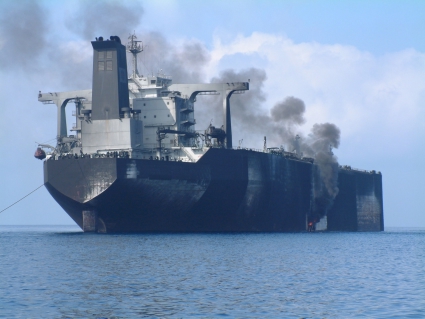
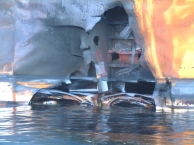
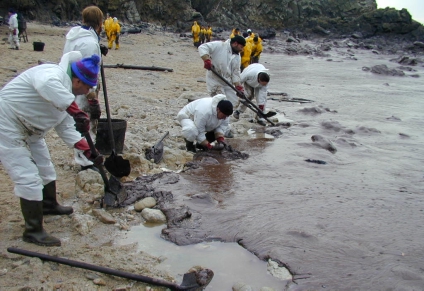
MV Limburg burning off the southern coast of
Yemen, October 2002; the hole opens through the
double skin of the tanker (NEXEN Petroleum,
Capt. R. Facey)
Manual shoreline clean-up of spilled oil (ITOPF)
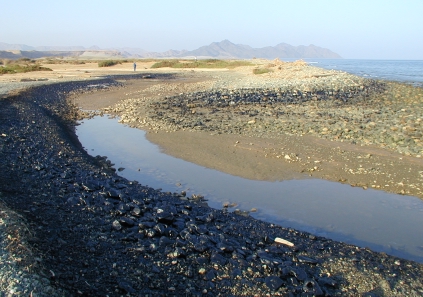
(ITOPF)
(ITOPF)
Document Outline