This report was compiled by:
Susan Taljaard (CSIR, Stellenbosch)
This report was reviewed by:
Dr Pedro M S Monteiro (CSIR, Stellenbosch)
Dr Des Lord (D. A. Lord & Associates Pty Ltd, Perth, Australia)
This report also includes feedback that was received from key stakeholders attending the work
sessions that were held in each of the three countries:
Namibia: January and August 2005
Angola: February and November/December 2005
South Africa: February and August 2005
The Desktop Assessment Studies (referring to Appendices A C) were prepared by:
Angola: Marina Paulina Paulo (Ministry of Urban Affairs and Environment, Angola) and Olivia
Fortunato Torres (Instituto de Investigação Marinha, Ministério das Pescas, Angola)
Namibia: Aina Iita (Minsitry of Fisheries and Marine Resources)
South Africa: Susan Taljaard (CSIR, Environmentek)
CSIR Report No CSIR/NRE/ECO/ER/2006/0010/C
EXECUTIVE SUMMARY
The United Nations Office for Project Services ("UNOPS") commissioned the CSIR (South
Africa) to conduct a baseline assessment of sources and management of land-based marine
pollution in the Benguela Current Large Marine Ecosystem (BCLME) Region.
The primary purpose of this project was to standardize the approach and methodology by
which land-based marine pollution sources in the BCLME region are managed. This was
achieved through the preparation of a generic (draft) management framework, including
protocols for the design of baseline measurement and long-term monitoring programmes.
An important secondary objective of this project was to initiate the establishment of a
BCLME coastal water quality network to provide a legacy of shared experience, awareness
of tools, capabilities and technical support. This network had to be supported by an
updatable web-based information system that could provide guidance and protocols on the
implementation of the management framework. The web-based information system also
had to contain a meta-database on available information and expertise.
The main outputs of this project, therefore, included:
· A proposed (or draft) framework for managing a land-based source of marine pollution,
U
U
including guidance on the implementation of such a framework
· Proposed protocols for the design of baseline measurement and long-term monitoring
U
programmes related to the management of land-based marine pollution sources in the
U
BCLME region
· An inventory and critical assessment of available information and data related to the
U
U
management of (land-based) marine pollution sources in Angola, Namibia and South
Africa
· Work sessions and training workshops in each of the three countries to which key
U
U
stakeholders, involved in the management of marine pollution, were invited
· Updatable web-based information system that provides guidance on the application of
U
U
the generic management framework, as well as a meta-database on available
information and expertise in the BCLME region.
BCLME Project BEHP/LBMP/03/01
Page i
Final
January 2006
The proposed framework is largely based on a process that was developed for the
Department of Water Affairs and Forestry (South Africa) as part of their Operational Policy
for the Disposal of Land-derived Wastewater to the Marine Environment of South Africa
(RSA DWAF, 2004) which, in turn, is based on a review of international best practice and
own experience in the South African context.
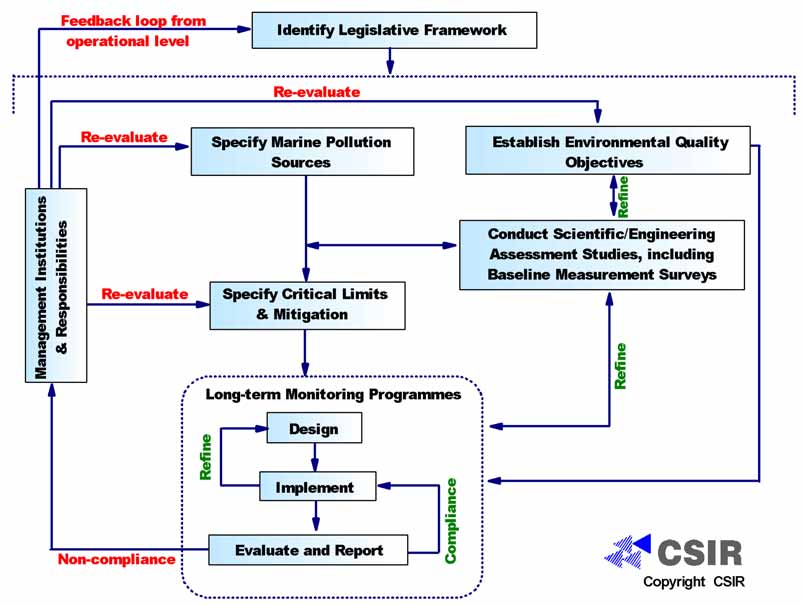
The proposed framework promotes an ecosystem-based approach, identifying different
components that need to be addressed as well as linkages between components. The
following are considered to be key components of such a management framework:
· Identification of legislative framework
· Establishment of management institutions and their responsibilities
· Determination of environmental quality objectives
· Specification of marine pollution sources
· Scientific assessment studies
· Specification of critical limits and mitigation measures
· Design and implementation of long-term monitoring programmes.
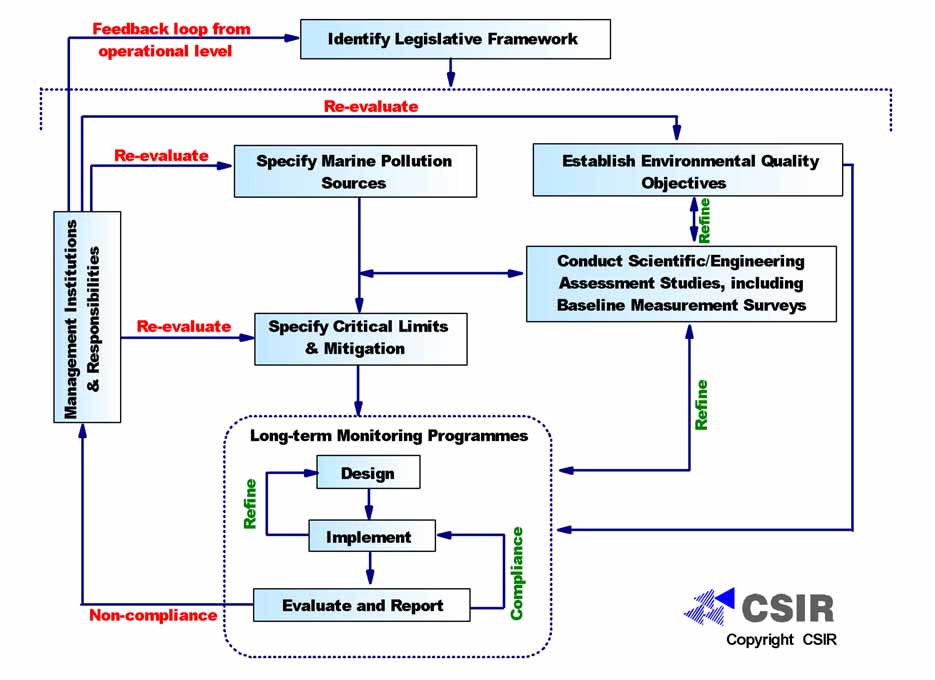
A schematic illustration of the inter-linkages between these components is provided below.
Each of the components is discussed in more detail in the document, with guidance on
implementation.
BCLME Project BEHP/LBMP/03/01
Page ii
Final
January 2006
An integral part of the management framework is baseline measurement and long-term
monitoring programmes. As a result, this report also considers proposed protocols in the
design of such programmes. In this regard it is important to note the difference between
baseline measurement programmes (usually part of Scientific Assessment Studies) and
U
U
monitoring programmes (implemented as part of Long-term Monitoring Programmes):
U
U
· Baseline measurement programmes (or surveys) usually refer to shorter-term or once-
off, intensive investigations on a wide range of parameters to obtain a better
understanding of ecosystem functioning
· Long-term monitoring programmes refer to ongoing data collection programmes (using
selected indicators) that are done to continuously evaluate the effectiveness of
management strategies/actions designed to maintain a desired environmental state so
that responses to potentially negative impacts, including cumulative effects, can be
implemented in good time.
The successful implementation of the proposed management framework relies on good
cooperation, not only between responsible government departments and industries, but also
with the scientific community (which plays a key role in providing the sound scientific base
for decision-making). It is for this reason, therefore, that key stakeholders in each of the
three countries should include members from:
· National and regional government departments
· Nature conservation authorities
· Local authorities
· Scientific
community
· Industries utilizing the marine environment.
The inventory and critical assessment of available data and information relevant to the
management of land-based marine pollution sources in the BCLME region focused on main
development nodes in the area, as listed below:
ANGOLA
NAMIBIA
SOUTH AFRICA
Cabinda
Henties Bay
St Helena Bay
Soyo
Walvis Bay/Swakopmund
Saldanha Bay/Langebaan Lagoon
Ambriz
Luderitz
Cape Peninsula (western section)
Luanda
Oranjemund (diamond mining areas)
False Bay
Lobito
Walker Bay (Hermanus)
Namibe
Mossel Bay
Knysna Estuary
BCLME Project BEHP/LBMP/03/01
Page iii
Final
January 2006
The following points relate to the way forward:
· The proposed framework for the management of land-based sources of marine pollution
in the BCLME region still needs to be officially approved and adopted by responsible
government authorities in the different countries.
· The management framework developed as part of this project is closely linked to the
recommended water and sediment quality guidelines for the coastal areas of the
BCLME region (developed as part of another BCLME project BEHP/LBMP/03/04).
In the interim, until such time as a management framework and quality guidelines have
been incorporated in official government policy, it is proposed that the management
framework developed as part of this project, together with the recommended water and
sediment quality guidelines, be applied as preliminary tools towards improving the
management of the water quality in coastal areas of the BCLME region.
· The updatable web-based information system (temporary web address
www.wamsys.co.za/bclme), developed as part of this project, can be a very useful
H
T
U
U
T
H
decision-support and educational tool provided that it is maintained and updated
regularly. In the short to medium term, it is recommended that one or more of the
BCLME offices within the three countries take on this responsibility.
· To facilitate wider capacity building in the BCLME region of the management of marine
pollution in coastal areas, it is strongly recommended that the output of this project be
included in a training course. In this regard, the Train-Sea-Coast/Benguela Course
Development Unit is considered the ideal platform from which to develop and present
such training (www.ioisa.org.za/tsc/index.htm).
H
T
U
U
T
H
BCLME Project BEHP/LBMP/03/01
Page iv
Final
January 2006
RESUMO EXECUTIVO
O Gabinete das Nações Unidas para Prestação de Serviços (United Nations Office for
Project Services - "UNOPS") contratou o CSIR (África do Sul) para conduzir uma avaliação
primária das fontes terrestres e gestão da poluição marinha na região do Grande
Ecossistema Marinho da Corrente de Benguela (Benguela Current Large Marine
Ecosystem) (BCLME).
O objectivo primario deste projecto foi o de padronizar a abordagem e metodologia pelo
qual as origens de poluição marinha na região BCLME são geridas. Isto foi alcançado
através da preparação de uma estrutura genérica (rascunho) de gestão, incluindo
protocolos para a delineação de programas de monitorização a longo prazo.
Um segundo objectivo importante deste projecto foi dar início ao estabelecimento de uma
rede de comunicações sobre a qualidade da água costeira no BCLME, de modo a
providenciar uma partilha de experiência, conhecimentos sobre o tipo de instrumentos,
capacidades e apoio técnico. Esta rede tinha de ser apoiada por um sistema de informação
actualizável e apoiado na Internet que pudesse providenciar orientação e criasse protocolos
na implementação da estrutura de gestão. Este sistema de informação apoiado na Internet
deveria também incluir uma metabase de dados sobre informação disponível e experiência
técnica.
Os principais produtos deste projecto incluíam assim:
· Uma proposta (ou rascunho) da estrutura para gerir fontes terrestres de poluição
U
U
marinha, incluindo orientações quanto à implementação dessa mesma estrutura
U
U
· Proposta de Protocolos para a delineação de programas de monitorização a longo
prazo relacionadas com a gestão de fontes terrestres de poluição marinha na região do
U
U
BCLME
· Um inventário e availaç
BCLME Project BEHP/LBMP/03/01
Page v
Final
January 2006
· Um inventário e uma avaliação crítica da informação e dos dados disponíveis
U
relacionados com a gestão das fontes terrestres de poluição marinha em Angola,
U
Namíbia e África do Sul
· Sessões de trabalho e workshops de treino em cada um dos três paises aos quais os
"stakeholders" no campo de gestão de poluição marinha foram convidados
· Um sistema de informação actualizável com apoio na Internet que proporcione
U
U
orientação quanto à aplicação da estrutura de gestão genérica, bem como uma
metabase de dados sobre informação disponível e experiência técnica na região do
BCLME.
A estrutura proposta é largamente baseada num processo desenvolvido pelo Ministério dos
Assuntos de Água e Florestas (Department of Water Affairs and Forestry), da África do Sul,
como parte da sua Política Operacional para o Tratamento de Águas Residuais Oriundas de
Terra para o Ambiente Marinho da África do Sul (RSA DWAF, 2004), a qual por sua vez
assenta numa revisão do código de boa conduta internacional e na própria experiência no
contexto da África do Sul.
A estrutura proposta estimula uma aproximação com base no ecossistema, identificando
componentes diferentes que devem ser estudados, bem como ligações entre as
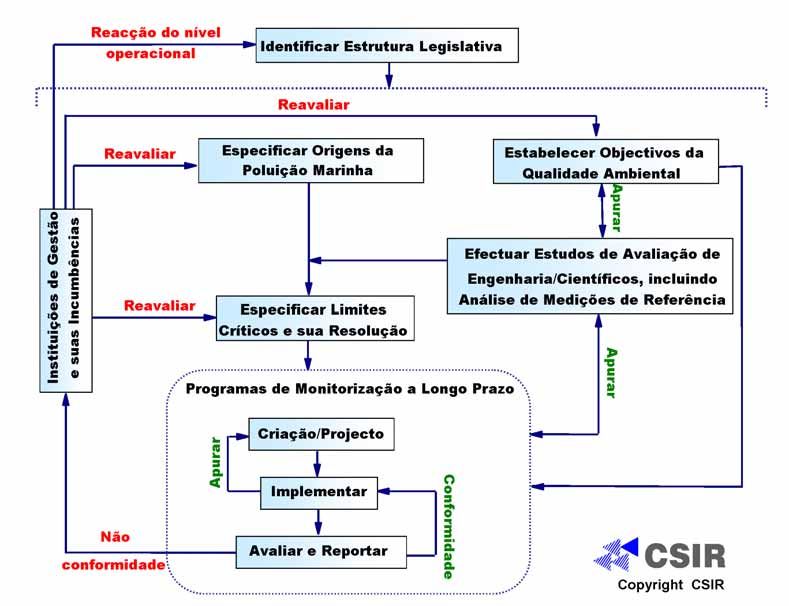
componentes. Abaixo identificam-se aqueles considerados como os componentes-chave
dessa estrutura de gestão:
· Identificação de uma estrutura legislativa
· Estabelecimento de instituições de gestão e suas incumbências
· Determinação de objectivos de qualidade ambiental
· Especificação das origens da poluição marinha
· Estudos de avaliação científica
· Especificação de limites críticos e medidas de atenuação
· Criação e implementação de programas de monitorização a longo prazo.
Uma ilustração esquemática das interligações entre estes componentes é dada abaixo.
Cada um dos componentes é discutido com maior pormenor no documento, com
orientações para execução.
BCLME Project BEHP/LBMP/03/01
Page vi
Final
January 2006
Uma parte integrante da estrutura de gestão é a medição de base e programas de
monitorização a longo prazo. Como consequência, este relatório contempla igualmente os
protocolos da criação desses mesmos programas. Quanto a este aspecto, torna-se
importante salientar a diferença entre programas de estudos de referência (habitualmente
U
U
fazendo parte de Estudos de Avaliação Científica) e programas de monitorização
U
(desenvolvidos como fazendo parte de Programas de monitorização a Longo Prazo):
U
· Programas de estudos básicos (ou pesquisa) referem normalmente a investigações
intensivas de um conjunto de parâmetros de curto-prazo ou realizadas de uma só com
a finalidade de um melhor entendimento do funcionamento do ecossistema.
· Programas de monitorização a longo prazo referem-se a programas em curso de
recolha de dados (usando indicadores seleccionados), feitos para avaliar continuamente
a eficácia das estratégias/acções de gestão criadas para manter um estado ambiental,
de modo a que as respostas aos impactos potencialmente negativos, incluindo os
efeitos cumulativos, possam ser implementadas em devido tempo.
A implementação com sucesso da estrutura de gestão proposta assenta numa boa
cooperação, não só entre os vários departamentos governamentais e indústrias, mas
também na comunidade científica (que desempenha um papel chave no fornecimento de
BCLME Project BEHP/LBMP/03/01
Page vii
Final
January 2006
uma base científica sólida para uma tomada de decisão). É por esta razão, por isso, que os
investidores potenciais em cada um dos três países devem incluir membros de:
· Departamentos governamentais nacionais e regionais
· Autoridades de conservação da natureza
· Autoridades locais
· Comunidade
científica
· Indústrias que utilizam o meio ambiente marinho.
O inventário e a avaliação crítica dos dados e da informação disponíveis relevantes para a
gestão das fontes terrestres de poluição marinha na região do BCLME focalizados nos
principais nós de desenvolvimento na área, são apresentados de seguida:
ANGOLA
NAMÍBIA
ÁFRICA DA SUL
Cabinda
Henties Bay
St Helena Bay
Soyo
Walvis Bay/Swakopmund
Saldanha Bay/Langebaan Lagoon
Ambriz
Luderitz
Cape Peninsula (secção ocidental)
Luanda
Oranjemund (áreas das minas de
False Bay
Lobito
diamantes)
Walker Bay (Hermanus)
Namibe
Mossel Bay
Knysna Estuary
Os pontos seguintes definem o caminho a seguir:
· A estrutura proposta para a gestão das fontes terrestres de poluição marinha na região
do BCLME necessita ainda de ser oficialmente aprovada e adoptada pelas
autoridades governamentais responsáveis nos diferentes países.
· A estrutura de gestão desenvolvida como parte deste projecto está intimamente ligada
às linhas mestras da qualidade da água e dos sedimentos para as áreas costeiras
do BCLME (desenvolvidas como parte de um outro projecto BCLME o
BEHP/LBMP/03/04).
Neste entretanto, até que uma estrutura de gestão e as linhas mestras da qualidade da
água tenham sido incorporadas numa política governamental oficial, é proposto que a
estrutura de gestão desenvolvida como parte deste projecto, juntamente com as
orientações recomendadas para água e sedimentos, sejam aplicadas como
ferramentas preliminares com vista a melhorar a gestão da qualidade da água nas
áreas costeiras da região do BCLME.
BCLME Project BEHP/LBMP/03/01
Page viii
Final
January 2006
· O sistema de informação actualizável com suporte na Internet (endereço web
temporário: www.wamsys.co.za/bclme) desenvolvido como parte deste projecto pode
H
T
U
U
T
H
ser útil para apoiar a tomada de decisão e como ferramenta educativa, desde que
mantido e actualizado com regularidade. A curto e médio prazo, recomenda-se que um
ou mais escritórios do BCLME no âmbito dos três países seja por esse facto
responsável.
A fim de facilitar uma maior e mais vasta capacidade de construção no seio da região do
BCLME no que respeita à gestão da poluição marinha nas áreas costeiras, é fortemente
recomendado que os resultados deste projecto sejam incluídos num curso de formação.
Assim sendo, a Unidade de Desenvolvimento do Curso(Train-Sea-Coast/Benguela Course
Development Unit) é tido como a plataforma ideal para desenvolver e apresentar essa
formação (www.ioisa.org.za/tsc/index.htm).
H
T
U
U
T
H
BCLME Project BEHP/LBMP/03/01
Page ix
Final
January 2006
TABLE OF CONTENTS
EXECUTIVE SUMMARY.......................................................................................................................................... i
T
U
U
T
TABLE OF CONTENTS .......................................................................................................................................... x
T
U
U
T
LIST OF TABLES ...................................................................................................................................................xii
T
U
U
T
LIST OF FIGURES.................................................................................................................................................xii
T
U
U
T
ACRONYMS, SYMBOLS AND ABBREVIATIONS ................................................................................................xiii
T
U
U
T
INTRODUCTION ______________________________________________________________________ 1
T
U
U
T
1. SCOPE OF WORK ____________________________________________________________________ 2
T
U
U
T
T
U
U
T
2. APPROACH AND METHODOLOGY ______________________________________________________ 4
T
U
U
T
T
U
U
T
3. INTRODUCTION TO PROPOSED MANAGEMENT FRAMEWORK ______________________________ 7
T
U
U
T
T
U
U
T
SECTION 1. GUIDANCE ON IMPLEMENTATION OF PROPOSED FRAMEWORK FOR
T
U
MANAGEMENT OF LAND-BASED SOURCES OF MARINE POLLUTION________ 1-1
U
T
1.1
LEGISLATIVE FRAMEWORK _______________________________________________________ 1-2
T
U
U
T
T
U
U
T
1.2
MANAGEMENT INSTITUTIONS & RESPONSIBILITIES___________________________________ 1-4
T
U
U
T
T
U
U
T
1.3
ENVIRONMENTAL QUALITY OBJECTIVES____________________________________________ 1-8
T
U
U
T
T
U
U
T
1.4
MARINE POLLUTION SOURCES ___________________________________________________ 1-12
T
U
U
T
T
U
U
T
1.4.1 Municipal Wastewater (including Sewage) ________________________________________ 1-16
T
U
U
T
T
U
U
T
1.4.2 Fishing industry _____________________________________________________________ 1-18
T
U
U
T
T
U
U
T
1.4.3 Oil Refineries _______________________________________________________________ 1-19
T
U
U
T
T
U
U
T
1.4.4 Coastal Mining______________________________________________________________ 1-19
T
U
U
T
T
U
U
T
1.4.5 Power Stations ______________________________________________________________ 1-19
T
U
U
T
T
U
U
T
1.4.6 Urban Stormwater Run-off_____________________________________________________ 1-20
T
U
U
T
T
U
U
T
1.4.7 Agricultural Runoff___________________________________________________________ 1-23
T
U
U
T
T
U
U
T
1.4.8 Atmospheric Pollution ________________________________________________________ 1-24
T
U
U
T
T
U
U
T
1.4.9 Dredging___________________________________________________________________ 1-24
T
U
U
T
T
U
U
T
1.4.10 Offshore Exploration and Production ____________________________________________ 1-25
T
U
U
T
T
U
U
T
1.4.11 Maritime Transportation ______________________________________________________ 1-27
T
U
U
T
T
U
U
T
1.5
SCIENTIFIC & ENGINEERING ASSESSMENT STUDIES_________________________________ 1-29
T
U
U
T
T
U
U
T
1.6
CRITICAL LIMITS AND MITIGATING ACTIONS ________________________________________ 1-32
T
U
U
T
T
U
U
T
1.7
LONG-TERM MONITORING PROGRAMMES __________________________________________ 1-33
T
U
U
T
T
U
U
T
BCLME Project BEHP/LBMP/03/01
Page x
Final
January 2006
SECTION 2. PROPOSED PROTOCOLS FOR BASELINE MEASUREMENT AND
T
U
LONG-TERM MONITORING PROGRAMMES ______________________________ 2-1
U
T
2.1
INTRODUCTION __________________________________________________________________ 2-2
T
U
U
T
T
U
U
T
2.2
BASELINE MEASUREMENT PROGRAMMES __________________________________________ 2-2
T
U
U
T
T
U
U
T
2.2.1
Physical Data ________________________________________________________________ 2-3
T
U
U
T
T
U
U
T
2.2.2 Biogeochemical Data _________________________________________________________ 2-10
T
U
U
T
T
U
U
T
2.2.3 Biological data ______________________________________________________________ 2-14
T
U
U
T
T
U
U
T
2.3
LONG-TERM MONITORING PROGRAMMES __________________________________________ 2-15
T
U
U
T
T
U
U
T
2.3.1 Source Monitoring ___________________________________________________________ 2-16
T
U
U
T
T
U
U
T
2.3.2 Environmental Monitoring _____________________________________________________ 2-17
T
U
U
T
T
U
U
T
SECTION 3. PRELIMINARY IDENTIFICATION OF KEY STAKEHOLDERS INVOLVED
T
U
IN MANAGEMENT OF LAND-BASED MARINE POLLUTION SOURCES IN THE
BCLME REGION _____________________________________________________ 3-1
U
T
SECTION 4. DESKTOP ASSESSMENT STUDIES ON EXISTING INFORMATION
T
U
PERTAINING TO MANAGEMENT OF LAND-BASED SOURCES OF MARINE
POLLUTION _________________________________________________________ 4-1
U
T
SECTION 5. THE WAY FORWARD ______________________________________ 5-1
T
U
U
T
SECTION 6. REFERENCES ____________________________________________ 6-1
T
U
U
T
Appendix A
Desktop Assessment of Available Information and Initiatives: South Africa
Appendix B
Desktop Assessment of Available Information and Initiatives: Namibia
Appendix C
Desktop Assessment of Available Information and Initiatives: Angola
Appendix D
User Manual for Web-based Information System
BCLME Project BEHP/LBMP/03/01
Page xi
Final
January 2006
LIST OF TABLES
TABLE 2.1: Checklist for selection of measurement parameters (from ANZECC, 2000b) ............................2-21
T
U
U
T
T
U
U
T
TABLE 3.1: Preliminary list of key stakeholders in Angola ..............................................................................3-3
T
U
U
T
T
U
U
T
TABLE 3.2: Preliminary list of key stakeholders in Namibia ............................................................................3-3
T
U
U
T
T
U
U
T
TABLE 3.3: Preliminary list of key stakeholders in South Africa......................................................................3-4
T
U
U
T
T
U
U
T
TABLE 4.1: Development nodes selected for the BCLME region....................................................................4-2
T
U
U
T
T
U
U
T
LIST OF FIGURES
Figure 1:
Boundaries of the Coastal Zone of the BCLME region.................................................................... 2
T
U
U
T
T
U
U
T
Figure 2:
Proposed framework for the design and implementation of marine water quality management
T
U
U
T
T
U
programmes in the BCLME region .................................................................................................. 7
U
T
Figure 1.1: Mapping of important marine aquatic ecosystems and designated (beneficial uses in Saldanha
T
U
U
T
T
U
Bay/Langebaan along the west coast of South Africa (adapted from Taljaard & Monteiro,
2002) 1-10
U
T
Figure 1.2: Mapping of potential marine pollution sources in Saldanha Bay/Langebaan along the west coast
T
U
U
T
T
U
of South Africa (adapted from Taljaard & Monteiro, 2002) .........................................................1-15
U
T
Figure 1.3:
A schematic illustration of the different treatment processes for municipal wastewater (sewage)
T
U
U
T
T
U
(taken from RSA DWAF, 2004b)................................................................................................1-17
U
T
Figure 1.4:
A schematic illustration of components to be addressed as part of scientific and assessment
T
U
U
T
T
U
studies, highlighting key engineering aspects (e.g. related to the design of marine wastewater
disposal scheme) (adapted from RSA DWAF, 2004b)...............................................................1-31
U
T
Figure 2.1:
Example of bathymetric contour map and typical profile (taken form RSA DWAF, 2004b)..........2-4
T
U
U
T
T
U
U
T
Figure 2.2:
Typical diurnal land- sea breeze variations (taken from RSA DWAF, 2004b)..............................2-5
T
U
U
T
T
U
U
T
Figure 2.3:
Time series data showing current velocities, directions and vectors (taken from RSA DWAF,
T
U
U
T
T
U
2004b) ..........................................................................................................................................2-7
U
T
Figure 2.4: Spatial plot of the distribution of particle size in Saldanha Bay (South Africa) (Monteiro et al.,
T
U
U
T
T
U
1999) ............................................................................................................................................2-9
U
T
Figure 2.5:
Sub-bottom profile derived from a seismic trace (taken form RSA DWAF, 2004b) ......................2-9
T
U
U
T
T
U
U
T
Figure 2.6:
Dissolved oxygen variability (m/) in the bottom water layer in Saldanha Bay, South Africa (from
T
U
U
T
T
U
Monteiro et al., 1999) .................................................................................................................2-12
U
T
Figure 2.7:
Key aspects to be addressed as part of long-term monitoring programmes ..............................2-18
T
U
U
T
T
U
U
T
Figure 4.1:
Development nodes selected for the BCLME region....................................................................4-2
T
U
U
T
T
U
U
T
BCLME Project BEHP/LBMP/03/01
Page xii
Final
January 2006
ACRONYMS, SYMBOLS AND ABBREVIATIONS
ANZECC
Australia and New Zealand Environment and Conservation Council
ANZFA
Australia New Zealand Food Authority
BCLME
Benguela Current Large Marine Ecosystem
CCME
Canadian Council of Ministers of the Environment
CEC
Council of the European Community
CTD
Conductivity-Temperature-Depth
DEAT
Department of Environmental Affairs and Tourism (RSA)
DWAF
Department of Water Affairs and Forestry (RSA)
Group of Experts on the Scientific Aspects of Marine Pollution
GESAMP
(United Nations)
Global Programme of Action for the Protection of the Marine
GPA
Environment from Land-Based Activities
IMO
International Maritime Organization
PAH
Polycyclic aromatic hydrocarbons
PCB
Polychlorinated biphenyls
RSA
Republic of South Africa
SBWQFT
Saldanha Bay Water Quality Forum Trust
UNCLOS
United Nations Convention on the Law of the Sea
UNEP
United Nations Environmental Programme
US FDA
United States Food And Drug Administration
US-EPA
United States Environmental Protection Agency
WSSD
World Summit on Sustainable Development
WWTW
Wastewater Treatment Works
BCLME Project BEHP/LBMP/03/01
Page xiii
Final
January 2006
INTRODUCTION
BCLME Project BEHP/LBMP/03/01
Page 1
Introduction
January 2006
Final
1. SCOPE
OF
WORK
The United Nations Office for Project Services ("UNOPS") commissioned the CSIR to
conduct a baseline assessment of sources and management of land-based marine pollution
in the Benguela Current Large Marine Ecosystem (BCLME) Region.
The primary purpose of this project was to standardize the approach and methodology by
which land-based marine pollution sources in the BCLME region are managed. This was
achieved through the preparation of a generic (draft) management framework for the
management of such sources, including protocols for the design of baseline measurements
and long-term monitoring programmes. It is important to realize that, although it is possible
to put forward a generic management framework for such a large region, the implementation
of the management framework will ultimately be more site-specific.
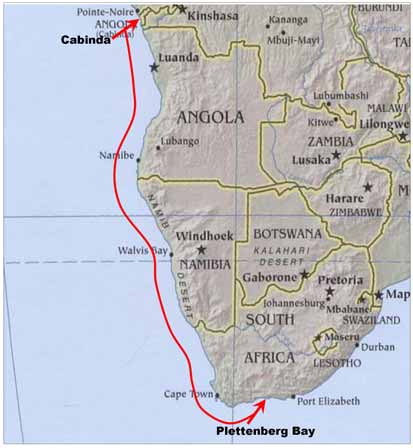
The BCLME region is situated along the coast of south- western Africa, stretching from east
of the Cape of Good Hope in the south (Plettenberg Bay) northwards to Cabinda in Angola,
and encompassing the full extent of Namibia's marine environment (Figure 1).
Figure 1:
Boundaries of the Coastal Zone of the BCLME region
BCLME Project BEHP/LBMP/03/01
Page 2
Introduction
January 2006
Final
An important secondary objective of this project was to initiate the establishment of a
BCLME coastal water quality network to provide a legacy of shared experience, awareness
of tools, capabilities and technical support. This network had to be supported by an
updatable web-based information system, providing guidance and protocols on the
implementation of the generic management framework. The web-based information system
also had to contain a meta-database on available information and expertise.
The main outputs of this project, therefore, are:
· A proposed (or draft) framework for managing a land-based source of marine pollution,
U
U
including guidance on the implementation of such a framework
· Propose protocols for the design of baseline measurement and long-term monitoring
U
programmes related to the management of land-based marine pollution sources in the
U
BCLME region
· A preliminary list of key stakeholders involved in the management of marine pollution in
U
U
each of the three countries
· An inventory and critical assessment of available information and data related to the
U
U
management of (land-based) marine pollution sources in Angola, Namibia and South
Africa
· Updatable web-based information system that provides guidance on the application of
U
U
the generic management framework, as well as a meta-database on available
information and expertise in the BCLME region.
In the Introduction to this Report, the Scope of Work (Chapter 1) is followed by a chapter
describing the Approach and Methodology (Chapter 2) that were used in the development of
the proposed management framework, followed in turn by a short Introduction to the
Proposed Management Framework (Chapter 3).
Thereafter the layout of the report is as follows:
· Section 1: Guidance on the implementation of the proposed management framework,
highlighting key aspects that need to be addressed within each of the identified
components
· Section 2: Proposed protocols (or guidance) for consideration in the design of baseline
measurement and long-term monitoring programmes
BCLME Project BEHP/LBMP/03/01
Page 3
Introduction
January 2006
Final
· Section 3: Preliminary list of key stakeholders involved in the management of marine
pollution sources in the BCLME region
· Section 4: Introduction to the Desktop Assessment Studies on existing information
pertaining to Land-based Sources of Marine Pollution in the BCLME region
· Appendices A, B and C: Detailed desktop assessment studies on existing information
pertaining to land-based sources of marine pollution for South Africa, Namibia and
Angola.
· Appendix D: User Manual for the Web-based Information System (temporary web
address: www.wamsys.co.za.
H
T
U
U
T
H
2. APPROACH
AND
METHODOLOGY
The challenge in ecosystem management is to ensure sustainable development, which is
defined as:
".. development which fulfils the needs of the present generation without jeopardizing the possibilities
of future generations to fulfill their needs."
This definition is echoed by the consensus agreement that was formed at the United
Nation's Conference on Environmental Development, which was held in Rio de Janeiro
(1992):
· The overall aim of the development of any society should be sustainable development
· Sustainable development encompasses environmental, economic, and social
dimensions
· Sustainable development demands not only a governmental effort, but also an effort
from all levels of society, from the global to the local perspective
· International co-operation is a prerequisite for sustainable development.
BCLME Project BEHP/LBMP/03/01
Page 4
Introduction
January 2006
Final
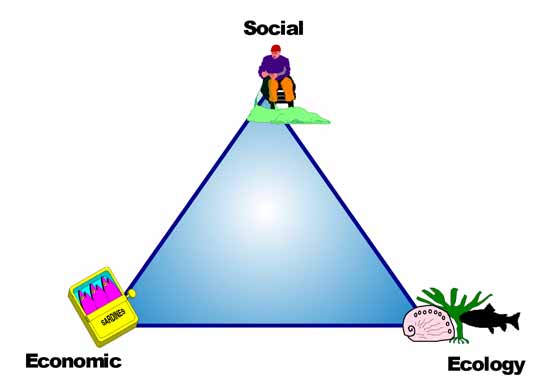
Thus, in order to be sustainable, development must be economically profitable, ecologically
proper, and socially acceptable. These three considerations are described as the
`sustainability triangle':
Since nature is a complex of dynamic processes, sustainable management of any
ecosystem implies that emphasis on the three priorities (i.e. various economic, ecological
and social considerations) over time may not always be equal. However, as long as the
management of the system does not go beyond the bounds of the `sustainability triangle',
the management and development of the system could be characterized as sustainable.
In this context, the ultimate goal in the management of coastal water resources is to keep the
environment suitable for all designated uses both existing and future uses. To achieve this
goal, is important to protect the biodiversity and functioning of marine aquatic ecosystems
U
U
(i.e. ecology) so as to support important (beneficial) uses of the marine environment (i.e.
U
U
social and economic values).
Land-based sources of marine pollution, amongst others, are posing an increasing threat to
the sustainability of the ecological, social and economic functions of the marine environment,
even though the associated activities and developments may create social and economic
benefits elsewhere. Towards combating this threat, the Global Programme of Action for the
Protection of the Marine Environment from Land-Based Activities (GPA), was adopted in
November 1995. It is designed to assist states in taking action individually or jointly within
their respective policies, priorities and resources that will lead to the prevention, reduction,
control or elimination of the degradation of the marine environment, as well as to its recovery
from the impacts of land-based activities (www.gpa.unep.org/).
T
T
H
T
U
U
T
H
T
BCLME Project BEHP/LBMP/03/01
Page 5
Introduction
January 2006
Final
In 2004, the CSIR assisted the South African Department of Water Affairs and Forestry with
the Development of an Operational Policy for the Disposal of Land-derived Wastewater to
the Marine Environment of South Africa (RSA DWAF, 2004a). As part of this operational
policy, a management framework was proposed for the management of land-based disposal
to the marine environment. The framework proposed for the management of land-based
sources of marine pollution in the BCLME region, as part of this project, is largely based on
this management framework, the motivation for this approach being:
· that the framework developed as part of South Africa's operational policy in 2004 was
already based on a review of international best practice and own experience in the
south(ern) African context
· rather adapt successful management practices that already exist in one or more
countries within the BCLME region, than `re-invent the wheel'.
The proposed management framework promotes an ecosystem-based approach, rather than
managing pollution sources on an individual basis. It identifies key components to be
addressed in the management of marine pollution sources, as well as the linkages between
such components. Baseline measurement and long-term monitoring programmes form an
integral part of the framework.
South Africa's operational policy also includes detailed guidance on the implementation of a
management framework, particularly aimed at managers, responsible authorities and
scientists who typically form part of such a process (RSA DWAF, 2004b). For the same
reasons as listed above, the guidance on implementation was also largely based on
approach and methods of this policy.
Also incorporated was the CSIR's experience in applying a similar framework in Saldanha
Bay, when it assisted local authorities with the development of a marine water quality
management plan for the area. Saldanha Bay is situated along the west coast of South
Africa, within the BCLME region (Taljaard & Monteiro, 2002; Monteiro & Kemp, 2004). A
similar exercise has also been conducted in False Bay, a large bay just south of Cape Town,
also within the BCLME region (Taljaard et al., 2000).
The framework proposed for the management of marine pollution in the BCLME region, as
part of this project, is also similar to the Framework for Marine and Estuarine Water Quality
Protection that forms part of the Coastal Catchments Initiative, which has been launched in
Australia to improve coastal water quality (Australian Government, 2005).
BCLME Project BEHP/LBMP/03/01
Page 6
Introduction
January 2006
Final
3. INTRODUCTION
TO
PROPOSED MANAGEMENT
FRAMEWORK
Based on a review of international practice and own experience in the South African context,
the following key components should be included in a management framework for marine
pollution (including land-based sources):
· Identification of legislative framework
· Establishment of management institutions and responsibilities
· Determination of environmental quality objectives
· Specification of marine pollution sources
· Scientific/engineering assessment studies
· Specification of critical limits and mitigation measures
· Design and implementation of long-term monitoring programmes.
A schematic illustration of the inter-linkages between these components is provided in
Figure 2. Each of the components is discussed in more detail in Section 2, including
guidance on implementation.
Figure 2:
Proposed framework for the design and implementation of marine water quality
management programmes in the BCLME region
BCLME Project BEHP/LBMP/03/01
Page 7
Introduction
January 2006
Final
SECTION 1.
GUIDANCE ON IMPLEMENTATION OF
PROPOSED FRAMEWORK FOR MANAGEMENT
OF LAND-BASED SOURCES OF MARINE
POLLUTION
BCLME Project BEHP/LBMP/03/01
Page 1-1
Section 1
January 2006
Final
1.1 LEGISLATIVE
FRAMEWORK
A marine water quality management programme needs to be designed and implemented
within the statutory framework governing marine pollution, taking into account international
and national legislation. Assessments of the current legislative framework governing such
matters in each of the three countries in the BCLME region are provided in Appendix A
(South Africa), Appendix B (Namibia) and Appendix C (Angola).
Although the national legislative framework differs from one country to another, key
international programmes, treaties and conventions relating to the management of land-
based marine pollution sources that may apply, depending on whether a country is a
signatory to such agreements, include:
· Agenda 21, the internationally accepted strategy for sustainable development decided
upon at the United Nations Conference on Environment and Development (UNCED) held
in Rio de Janeiro in 1992. Agenda 21 is a plan for use by governments, local authorities
and individuals to implement the principle of sustainable development contained in the
Rio Declaration. This document has significant status as a consensus document adopted
by about 180 countries. Agenda 21 is, however, not legally binding on states, and merely
acts as a guideline for implementation (www.un.org/esa/sustdev/agenda21text.htm).
H
T
U
U
T
H
· Global Programme of Action for the Protection of the Marine Environment from
Land-Based Activities (GPA), which was adopted in November 1995 and which is
designed to assist states in taking action individually or jointly within their respective
policies, priorities and resources that will lead to the prevention, reduction, control or
elimination of the degradation of the marine environment, as well as to its recovery from
the impacts of land-based activities. The GPA builds on the principles of Agenda 21.
The GPA identifies the Regional Seas Programme of UNEP as an appropriate
framework for delivery of the GPA at the regional level (www.gpa.unep.org/).
H
T
U
U
T
H
· World Summit on Sustainable Development (WSSD) (2002) - the Johannesburg
summit formulated two new principles that are central to the philosophy of managing
marine water quality at the system scale (www.gpa.unep.org/news/gpanew.html):
H
T
U
U
T
H
- Firstly, the call for a shift away from individual resources towards ecosystem-based
management of coastal systems
BCLME Project BEHP/LBMP/03/01
Page 1-2
Section 1
January 2006
Final
- Setting of wastewater emission targets (WET), which limit the upper boundary of
land-based discharge fluxes into coastal systems to a level in which ecosystem
impacts are not measurable.
· United Nations Environmental Programme (UNEP), which was initiated in 1972 and
which contains several programmes considering marine pollution, e.g. the Ocean and
Coastal Areas Programmes and the Regional Sea Programmes (www.unep.org/).
H
T
U
U
T
H
· United Nations Convention on the Law of the Sea (UNCLOS) (1982) which lay down,
first of all, the fundamental obligation of all states to protect and preserve the marine
environment. It further urges all states to cooperate on a global and regional basis in
formulating rules and standards and to otherwise take measures for the same purpose.
It addresses six main sources of ocean pollution: land-based and coastal activities,
continental-shelf drilling, potential seabed mining, ocean dumping, vessel-source
pollution, and pollution from or through the atmosphere
(www.un.org/Depts/los/index.htm).
H
T
U
U
T
H
· United Nations Convention on Biological Diversity (1992), which came into force in
December 1993 and which has three main objectives, namely, the conservation of
biological diversity; the sustainable use of biological resources; and the fair and
equitable sharing of benefits arising from the use of genetic resources (www.biodiv.org).
H
T
U
U
T
H
Important international conventions that relate to marine pollution, but that are not
necessarily directly linked to land-based sources, include:
· London Convention for the Prevention of Marine Pollution by Dumping of Wastes
and Other Matter (1972, amended 1978, 1980, 1989). In November 1996, the
contracting parties to the London Convention of 1972 adopted the 1996 Protocol, which,
when entered into force, replaces the London Convention
(www.londonconvention.org/London_Convention.htm) (related to dumping at sea)
H
T
U
U
T
H
· International Convention for the Prevention of Pollution from Ships (MARPOL
convention) (1973/1978), which is the main international convention covering
prevention of pollution of the marine environment by ships from operational or accidental
causes and includes regulations aimed at preventing and minimizing pollution from ships
- both accidental pollution and that from routine operations (www.imo.org/home.asp)
H
T
U
U
T
H
(related to maritime transportation).
BCLME Project BEHP/LBMP/03/01
Page 1-3
Section 1
January 2006
Final
Effective legislation (together with practical operational policies and protocols) is a key
requirement for the successful management of marine pollution in a particular country. A
sound legislative framework, for example, empowers responsible authorities to legally
challenge offenders, provided that such legislation is supported by sufficient resources (both
human and financial).
1.2 MANAGEMENT
INSTITUTIONS & RESPONSIBILITIES
A key driving factor in the successful operation of any management programme is the
establishment of the appropriate management institution/s, which includes identifying the
roles and responsibilities of the different parties. Again, the legislative framework within a
particular country should provide specifications and guidance in this regard.
In the management and control of marine pollution sources (including land-based sources),
responsibilities traditionally resided with the responsible government authorities as well as
the impactors (e.g. municipalities, industry and developers). Although these traditional
management structures are still important, the value of also involving other local interested
and affected parties through stakeholder forums or local management institutions, has
proved to add great value to the overall management process (Henocque, 2001; Van Wyk,
2001; Taljaard & Monteiro, 2002; Cape Metropolitan Coastal Water Quality Committee,
2003).
Not only do these local management institutions provide an ideal platform through which to
consult interested and affected parties on, for example, designated uses and environmental
quality objectives for a specific area, but they also fulfil the important role of `local
watchdogs' or `custodians'. Although such institutions usually do not have executive
powers, they have shown themselves to be very successful mechanisms through which to
empower (and often pressurize) responsible authorities to execute their legal responsibilities,
e.g. ensuring that licence agreements are issued or that corrective action is taken timeously
in instances of non-compliance.
The key to the success of local management institutions is a sound scientific information
base, containing explicit scientific assumptions and outcomes, by which authorities, and also
local stakeholders, are empowered to partake in the decision- making process.
BCLME Project BEHP/LBMP/03/01
Page 1-4
Section 1
January 2006
Final
It is also essential that local management institutions include all relevant interested and
affected parties in order to facilitate a participatory approach to decision-making. The
inclusion of responsible local, regional and national government authorities is also important,
as these usually form the routes through which local management institutions have/hold
executive powers. Local management institutions should therefore include representatives
from, for example:
· National and regional government departments
· Nature conservation authorities
· Local authorities
· Industries
· Tourism boards and recreation clubs
· Local residents, e.g. through ratepayers' association
· Non-government
organizations.
Where more than one source is responsible for pollution in a particular area (e.g. a bay
area), it is usually extremely difficult and financially uneconomical to manage marine
pollution issues in isolation because of potential cumulative or synergistic effects. In such
instances, collaboration is also best achieved through a joint local management institution.
A local management institution, being actively involved in the management of marine
pollution matters at local level, is also ideally positioned to test the effectiveness and
applicability of legislation and policies, which are normally developed at national or regional
levels. It is therefore also important that these institutions be utilized by higher tiers of
government as a mechanism for improving legislative frameworks related to the
management of marine pollution. Such practice supports the principle of Adaptive
Management.
For the BCLME region, the coastal water quality network group, initiated as part of this
study, will assist in empowering authorities in the different countries to fulfil their role as
national manager of marine water quality. Furthermore, it is envisaged that the web- based
information system will provide to all concerned easy access to guidance and protocols on
the implementation of the generic management framework, as well as a meta-database on
available information and expertise.
Within the BCLME region, the Saldanha Bay Water Quality Forum Trust (SBWQFT) is an
example of an existing local management institution that works very well. The forum was
BCLME Project BEHP/LBMP/03/01
Page 1-5
Section 1
January 2006
Final
established in June 1996 through the efforts of individuals with an interest in Saldanha Bay
who created an awareness of the need to address the deteriorating water quality in the Bay.
The SBWQFT is a voluntary organization comprising officials from local (municipality, Nature
conservation), regional (regional office of the Department of Water Affairs and Forestry) and
national authorities (Department of Environmental Affairs and Tourism), representatives from
all major industries in the area (e.g. National Ports Authority, seafood processing industries,
marine aquaculture farmers) and other groups who have a common interest in the area (e.g.
tourism).
The main purpose of the SBWQFT is to work towards maintaining water quality and
ecosystem functioning so as to keep Saldanha Bay fit for all its designated uses. Although
the Trust does not have legislative powers, it acts as an advisory body to legislative
authorities that are also members of the forum (e.g. Department of Water Affairs and
Forestry, Department of Environmental Affairs and Tourism, National Ports Authority,
Saldanha Bay Municipality). Through this route the Trust can thereby influence the decision-
making process. A quote from Bay Watch, the publication of the Trust (SBWQFT, 2004)
probably explains this best: `This is a most unique forum in that, as far as I am aware, it is a
the only non-government body that is totally successful in melding the private sector with
their contributions and the government with their overseeing capacity, to form a unit that is
ultimately functional and effective.'
The
organizational
structure of the
Trust is
illustrated below
(SBWQFT,
2004):
BCLME Project BEHP/LBMP/03/01
Page 1-6
Section 1
January 2006
Final
The SBWQFT raises funding by applying the principle of `Polluter Pays' whereby major
industries contribute. These financial resources are utilized towards:
· Commissioning scientific investigation to make informed decisions on the management
of the area, albeit through advising the relevant government authorities (e.g. CSIR was
commissioned to assist them with developing a management plan)
· Commissioning coordinated joint monitoring programmes in the area (e.g. CSIR was
commissioned to conducting a sediment monitoring programme, while the Trust
conducts its own microbiological programme)
· Producing communication tools to inform the wider community, such as the Bay Watch
publication.
Because the Trust has a mechanism in place to generate its own funds it can commission
scientific investigations (e.g. the development of the management plan for Saldanha Bay
was commissioned through a tender process). The Trust within itself also has water quality
management expertise, e.g. one of the members is responsible for running the
microbiological programme in the Bay. Local expertise is also sourced, e.g. at a recent
public meeting a local resident with experience in oil spill contingency planning provided his
services.
Analysis of the manner in which the SBWQFT operates highlights key success factors of a
local management institution that include:
· An enthusiastic executive chairperson who will keep things going!
· Active involvement of relevant government authorities (e.g. with executive powers in the
domain of marine pollution and related matters)
· A mechanism in place to generate funds to, for example:
- commission joint scientific investigations
- produce communication tools to inform the wider local community (e.g. local news-
letters
· Ensuring that all role players are on board, either actively through being members of the
Trust or by involving them through regular public feedback meetings (at least annually or
U
U
bi-annually).
BCLME Project BEHP/LBMP/03/01
Page 1-7
Section 1
January 2006
Final
1.3 ENVIRONMENTAL
QUALITY
OBJECTIVES
Environmental quality objectives must be set as part of the management framework to
provide a basis from which to assess and evaluate management strategies and actions.
This can be achieved through a four-step approach:
· Define geographical boundaries of study area
· Define important aquatic ecosystems and designated uses within area
· Define management goals for important aquatic ecosystems and designated use areas
· Determine site-specific (measurable) environmental quality objectives, pertaining to
sediment and water quality requirements.
A first and very important step in setting environmental quality objectives is to determine the
geographical boundaries of the area within which the management framework is to be
U
U
implemented. The anticipated influence of all major human activities and developments,
both in the near and far field, must be taken into account, including the location of and inputs
from different marine pollution sources. Important issues that need to addressed, include:
· Proximity of depositional areas in which pollutants introduced from one or more pollution
sources can accumulative these can be at distant locations for specific sources,
particularly where the source discharges into a very dynamic environment, but then gets
transported to an area of lower turbulence
· Possible synergistic effects in which the negative impacts from a particular source could
be aggravated through interactions with pollutants introduced by other pollution sources
in the area, or even through interaction with natural processes.
The ultimate goal in the management of the marine waters is to keep the environment
suitable for all designated uses both for existing and future uses (this includes the `use' of
designated areas for biodiversity protection and ecosystem functioning). The second step,
therefore, is to identify and map important aquatic ecosystems and designated uses within
U
U
the study area.
BCLME Project BEHP/LBMP/03/01
Page 1-8
Section 1
January 2006
Final
For the BCLME region, it has been proposed that three designated uses of the coastal
marine environment be recognised, namely:
· Marine aquaculture (including collection of seafood for human consumption)
· Recreational use
· Industrial uses (e.g. seawater intakes for seafood processing, cooling water intakes,
harbour and ports).
Management goals should be defined for each of the above uses. In the case of the
U
U
protection of the aquatic marine ecosystem, these can be quantified in terms of the level of
species diversity that needs to be maintained, while in the case of recreational or marine
aquaculture areas, the management goal could be to achieve a certain rating or
classification. Similar to the European Union's approach, it is proposed that, for the
BCLME region, in contrast to designated use areas where protection is required only in the
specific area where such a use occurs (e.g. popular recreation beach), protection of marine
aquatic ecosystems should be striven for in all waters (CEC, 2003). ,the exception to this
being perhaps in approved sacrificial zones (e.g. in proximity to wastewater discharges and
U
U
certain areas within ports) the rationale being that the natural environment needs to be
protected to a high level in its entirety.
Agreement on the designated uses and management goals of a particular area should be
obtained in consultation with local interested and affected parties (or stakeholders) through,
for example, the local management institutions. An example of a designated (beneficial) use
map is that for the Saldanha Bay/Langebaan Lagoon area along the west coast of South
Africa (Figure 1.1). This map was compiled in consultation with local stakeholders, using the
Saldanha Bay Water Quality Forum Trust (local management institution) as vehicle.
Once agreement has been obtained on important aquatic ecosystems and designated uses,
their location, as well as the management goals for each particular area, site-specific
U
environmental quality objectives pertaining to sediment and water quality requirements need
U
to be derived. The rationale here is that, although management goals are the real
management end-points, the goals will only be achieved if certain sediment and water quality
targets are maintained, as the proximal causes in the causeeffect relationship (Ward and
Jacoby, 1992).
BCLME Project BEHP/LBMP/03/01
Page 1-9
Section 1
January 2006
Final
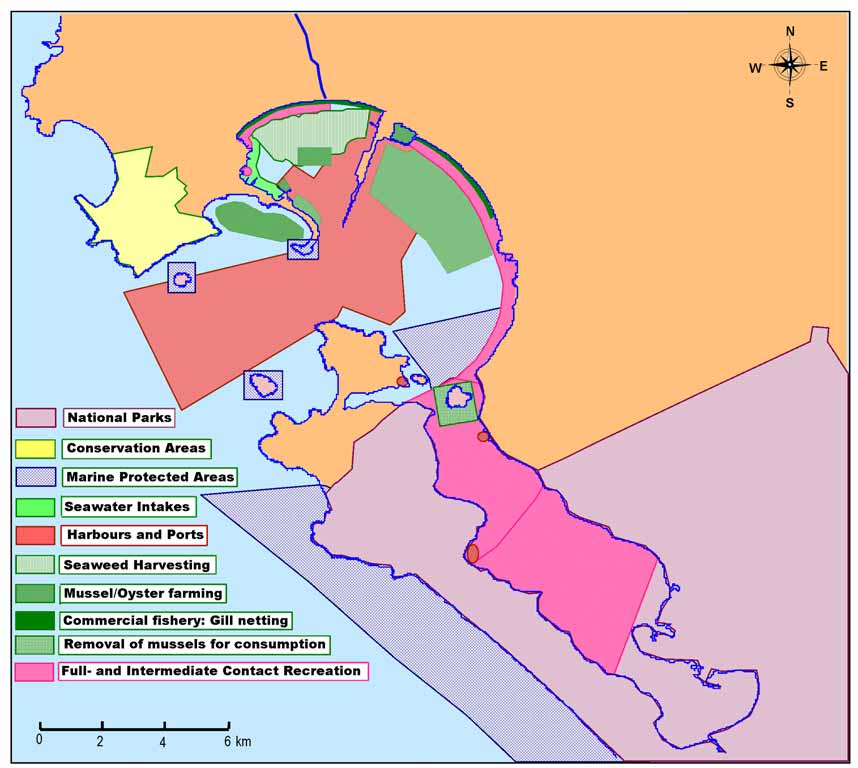
Figure 1.1:
Mapping of important marine aquatic ecosystems and designated (beneficial
uses in Saldanha Bay/Langebaan along the west coast of South Africa
(adapted from Taljaard & Monteiro, 2002)
It is in setting these site-specific environmental quality objectives that the national (or
regional) water and sediment quality guidelines provide valuable guidance to managers and
U
U
local governing authorities.
NOTE:
Recommended water and sediment quality guidelines for the coastal zone of the BCLME regions and its
beneficial uses are addressed as part of another BCLME project, namely The development of a common set
of water and sediment quality guidelines for the coastal zone of the BCLME region Project
BEHP/LBMP/03/04)
BCLME Project BEHP/LBMP/03/01
Page 1-10
Section 1
January 2006
Final
Quality objectives could also be prescribed in legislation. For example, the concentration of
U
U
pathogens and toxicants in seafood (which will be relevant to areas used for the culture of
shellfish) are typically prescribed in national legislation, such as in:
· South Africa, where limits for chemical and pathogens are specified under the
Foodstuffs, Cosmetics and Disinfectants Act (No. 54 of 1972) (Department of Health,
1973, 1994)
· European Union, where limits for shellfish flesh are specified in the Shellfish Hygiene
Directive (CEC, 1991).
· Australia and New Zealand, where these limits are specified under the Food Standards
Code (ANZFA 1996, and updates)
· United States Food and Drug Administration which specifies such limits for the United
States see website on Seafood Information and Resources (US FDA, 2004) and
National Shellfish Sanitation Program (US FDA, 2003)
· Canada, where the Canadian Food Inspection Agency specifies action levels (Canadian
Food Inspection Agency, 2004).
Development of site-specific environmental quality objectives requires knowledge of the
chemical, physical, and biological properties of a water body, as well as the social and
economic conditions of an area.
As a minimum, environmental quality objectives should protect the existing and potential
uses of a water body. Where water bodies are considered to be of exceptional value, or
where they support valuable biological resources, degradation of the existing water quality
should always be avoided. Similarly, site-specific objectives should not be made on the basis
of aquatic ecosystem characteristics that have arisen as a direct result of previous human
activities (CCME, 1995).
Social and economic factors need to be evaluated to determine if the environmental quality
objectives can realistically be attained. For example, when setting critical limits for pollution
sources (e.g. wastewater emission standards) so as to meet quality objectives, social and
economic factors can be factored in by giving longer deadlines to smooth out the transition
period. Periodic re-evaluations and refinements of environmental quality objectives are then
implemented to ensure that the desired water quality is ultimately maintained.
BCLME Project BEHP/LBMP/03/01
Page 1-11
Section 1
January 2006
Final
1.4 MARINE
POLLUTION
SOURCES
The United Nation's Group of Experts on the Scientific Aspects of Marine Pollution defines
marine pollution as the (GESAMP, 1999):
Introduction by man, directly or indirectly, of substances or energy into the marine
environment (including estuaries) resulting in such deleterious effects as to cause(?) harm to
living resources, hazard to human health, hindrance to marine activities including fishing,
impairment of quality for use of seawater, and reduction of amenities.
Effective management of marine pollution in a particular area requires, amongst other things,
quantitative data on marine pollution sources, as well as on other activities or developments
that directly (or indirectly) affect water and sediment quality. Although human perturbations
of marine water and sediment quality are usually perceived to be the result of marine
pollution sources, it is important to realize that developments that modify circulation
dynamics in the marine environment, such as harbour and marina structures, can also
modify these quality characteristics.
Marine pollution sources can broadly be categorized into the following groups of activities,
which occur either at sea or on land:
· Pollution or waste originating from land-based sources, including sewage effluent
U
U
discharges, industrial effluent discharges, stormwater run-off, agricultural and mining
return flows, contaminated groundwater seepage
· Pollution or waste entering the marine environment through the atmosphere, e.g.
U
U
originating from vehicle exhaust fumes and industries
· Maritime transportation (which includes accidental and purposive oil spills, and dumping
U
U
of ship garbage etc.)
· Dumping at sea (e.g. dredge spoil)
U
U
· Offshore exploration and production (e.g. oil exploration platforms).
U
U
BCLME Project BEHP/LBMP/03/01
Page 1-12
Section 1
January 2006
Final
Of the different sources of marine pollution, land-based sources are considered to be the
largest - based on studies by the International Maritime Organisation (IMO, 1977):
NOTE:
Depending on the type of impact on the aquatic organisms, communities, and ecosystems, pollutants can
further be grouped in the following order of increasing hazard (Patin, 2004):
· substances causing mechanical impacts (suspensions, films, solid wastes) that damage the respiratory
organs, digestive system, and receptive ability;
· substances provoking eutrophic effects (e.g., mineral compounds of nitrogen and phosphorus, and
organic substances) that cause mass rapid growth of phytoplankton and disturbances of the balance,
structure, and functions of the water ecosystems;
· substances with saprogenic properties (sewage with a high content of easily decomposing organic
matter) that cause oxygen deficiency followed by mass mortality of water organisms, and appearance
of specific microphlora;
· substances causing toxic effects (e.g., heavy metals, chlorinated hydrocarbons, dioxins, and furans)
that damage the physiological processes and functions of reproduction, feeding, and respiration;
· substances with mutagenic properties (e.g., benzo(a)pyrene and other polycyclic aromatic compounds,
biphenyls, radionuclides) that cause carcinogenic, mutagenic, and teratogenic effects.
Focusing on land-based marine pollution sources shows that these can be sub-divided into:
· Point sources (i.e. sources of which the volume and quality can be readily controlled)
· Non-point (or diffuse) sources (i.e. sources of which the volume and quality are difficult to
control).
Point sources mainly comprise:
· Municipal (or sewage) wastewater discharges
BCLME Project BEHP/LBMP/03/01
Page 1-13
Section 1
January 2006
Final
· Industrial wastewater discharges from industries these also include discharging of
contaminated seawater that was used for industrial purposes on land, e.g. coastal mining
activities and seafood processing industries.
Diffuse pollution sources include:
· Contaminated stormwater run-off, usually associated with urban areas
· Agricultural and mining return flows
· Contaminated groundwater seepage.
Within the BCLME region, contaminated urban stormwater runoff is probably the most
important diffuse source of marine pollution to the coastal areas.
Waste loads for point source (or controlled waste disposal practices), such as those
discharged through marine outfalls, can usually be measured quite easily. However, it is
much more difficult to quantify waste loads for non-point (or diffuse) sources, such as urban
storm-water run-off, mining return flows and contaminated groundwater seepage. Spatial
and temporal quantification and establishing of variation in waste loads from diffuse sources
are usually best achieved through application of appropriate statistical or mathematical
predictive models, although field measurements are required for calibration and verification
purposes.
Land-based activities potentially causing marine pollution are often situated in the coastal
U
zone, in which case waste or pollutants are directly disposed of into the coastal zone, e.g.
U
through marine outfalls or stormwater drains. However, land-based marine pollution sources
can also originate from activities and developments in adjacent river catchments in which
case the pollutant is routed to the marine environment via rivers.
U
U
As part of a management programme, specifications that are typically required for marine
pollution sources include:
· A description of the source, activity or development, including information on the manner
in which it will affect the quality of the marine environment, as well as a map indicating
the location of such sources
· Volume of waste - it is of particular importance to understand typical flow distribution
patterns, whether these are, for example, continuous flows, whether there are distinct
daily, monthly or seasonal patterns or whether the flow is determined by specific events
BCLME Project BEHP/LBMP/03/01
Page 1-14
Section 1
January 2006
Final
· Composition of waste this refers to the concentration of biogeochemical and
microbiological pollutants, including information on diurnal, seasonal or event-driven
variations in composition
· In the case of effluents, it is also important to have information on physical properties,
such as density, viscosity and temperature, including specification on diurnal and or
seasonal variations (e.g. for engineering design of marine disposal schemes).
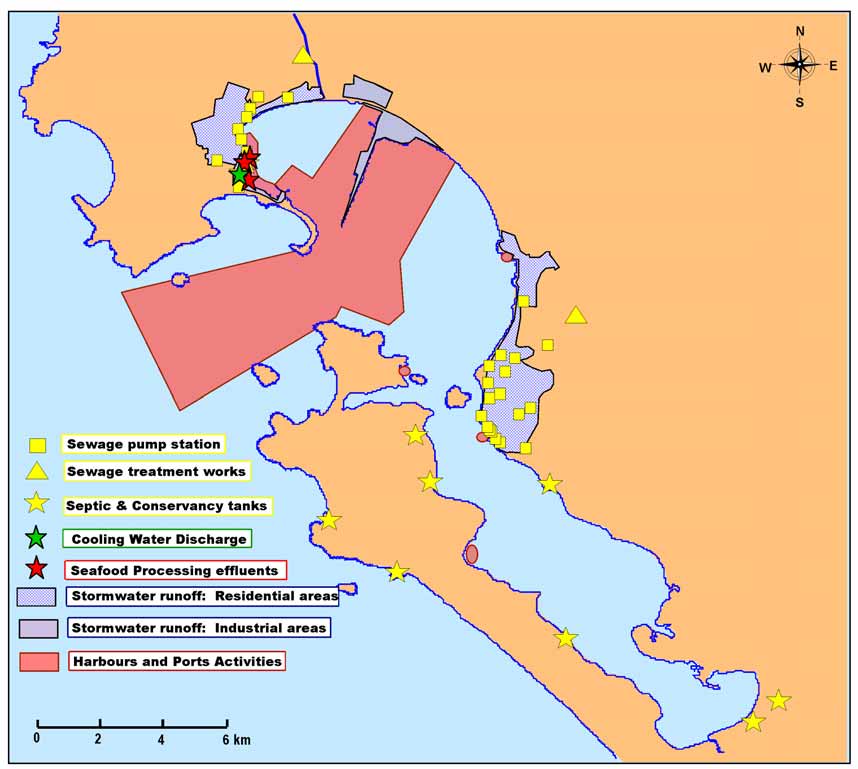
An example of a map indicating the location of potential marine pollution sources is that for
the Saldanha Bay/Langebaan Lagoon area along the west coast of South Africa (Figure 1.2).
Figure 1.2:
Mapping of potential marine pollution sources in Saldanha Bay/Langebaan
along the west coast of South Africa (adapted from Taljaard & Monteiro, 2002)
Ultimately, the management of land-based pollution sources cannot be isolated from other
marine pollution sources or other activities or developments that contribute to the
BCLME Project BEHP/LBMP/03/01
Page 1-15
Section 1
January 2006
Final
modification of water and sediment quality in the marine environment. Not taking other
sources into account may result in severe negative impacts due to, for example, cumulative
or synergistic effects not being accounted for. Also, although atmospheric sources of
marine pollution are traditionally categorized separately from land-based sources of
pollution, a large proportion of the former category originate from land, e.g. emissions from
land-based industries and vehicle exhaust fumes.
Therefore, although the focus of this project is on the management of land-based sources of
U
marine pollution, potential interactions with other categories of marine pollution sources, as
U
indicated above, cannot be ignored. The extent to which these need to be incorporated will
depend on site-specific conditions and will therefore need to be evaluated on a case-by-case
basis.
As a guide, a brief overview of the pollutant composition of major marine pollution sources in
the BCLME region is provided in the following sections (also included are a number of non
land-based sources that are considered important in the BCLME region).
1.4.1 Municipal Wastewater (including Sewage)
Municipal wastewater typically consists of:
T
· domestic wastewater (sewage) and/or
· industrial wastewater (also referred to as trade effluent) and/or
· urban storm-water run-off routed through wastewater treatment works (WWTW).
Municipal wastewater volumes tend to show diurnal variation with peaks during the morning,
midday and late afternoon. However, each area will have its own characteristic flow pattern,
depending on socio-economic factors, as well as the physical layout of the reticulation
systems and taking into account retention times. Volume and flow rates may also show
strong seasonal variation, particularly in small coastal towns where flows usually peak during
the summer holidays. Also, infiltration (due to damaged pipes) during the wet season or
during a rainstorm can also influence flow patterns (i.e. event driven).
The composition of municipal wastewater is largely dependent on the level of treatment, as
well as the composition of trade effluents entering the WWTW. The composition of
municipal wastewater (in particular the domestic sewage component) could contain
(although the actual concentrations are dependent on the level of treatment):[keep u/c in list]
BCLME Project BEHP/LBMP/03/01
Page 1-16
Section 1
January 2006
Final
· high suspended solids
· organic matter
· inorganic nutrients, particular nitrogen and phosphate
· microbiological contaminants (e.g. bacteria and viruses).
Different treatment levels of municipal wastewater (sewage) are schematically illustrated in
Figure 1.3 (RSA, DWAF, 2004b).
Treatment
Preliminary
Primary
Secondary
Tertiary
Potential effluent
Offshore
disposal option
Offshore
Offshore
Surf zone
Estuary
Effluent SS
300 - 400 mg/l
120 - 200 mg/l
30 - 40 mg/l
quality
BOD
300 - 500 mg/l
180 - 240 mg/l
30 - 40 mg/l
Effluent
Effluent
Effluent
Coarse
Fine
screens
screens
OR
OR
OR
Treatment
Solids
processes
To landfill
Aeration
tanks
Sedimentation
Sand filters
tanks
Reed beds
Ponds
Biological
filter
Sludge
To Sludge treatment
Figure 1.3:
A schematic illustration of the different treatment processes for municipal
wastewater (sewage) (taken from RSA DWAF, 2004b)
Treatment processes of municipal wastewater (sewage) include (RSA DWAF, 2004b):
· Primary treatment which removes settleable organic and inorganic solids by
sedimentation, and materials that will float (scum) by skimming. Approximately 25% to
50% of the organic matter (or biochemical oxygen demand) in the incoming wastewater,
50% to 70% of the SS, and 65% of the oil and grease are removed during primary
treatment. Some organic nitrogen, organic phosphorus, and heavy metals associated
with solids are also removed during primary sedimentation but colloidal and dissolved
constituents are not affected.
BCLME Project BEHP/LBMP/03/01
Page 1-17
Section 1
January 2006
Final
· Secondary treatment which removes 85% to 95% of the suspended solids and the
organic matter (or biochemical oxygen demand) and includes treatment processes such
as trickling filters or rotating biological filters and aeration.
· Tertiary treatment refers to further removal of specific constituents either not permitted to
be discharged or that need to be reduced to meet environmental quality objectives. This
includes filtration (e.g. sand filters or reed-beds), phosphorus removal, ammonia
stripping or other special treatment.
· Disinfection includes chemical (e.g. chlorination and ozonation) or physical (e.g.
ultraviolet radiation and micro-filtration) or biological, (e.g. detention ponds) disinfection
processes (usually the required pre-treatment to ensure that disinfection of an effluent is
effective is secondary treatment)
1.4.2 Fishing
industry
Fishing is a major industry within the BCLME region with numerous fish and other seafood
processing factories situated along its coast. These include canning industries, white fish
processing industries, fishmeal plants and packaging of rock lobsters (Binnie & Partners,
1983, 1986; Danish Technological Institute, 2004). Sources of marine pollution associated
with the fishing industry include:
· Fishing vessels, activities ranging from deck washing to disposal of bilge water,which
often occur in sheltered waters next to jetties
· Offloading and storage of fish prior to processing during which liquids need to be
separated from fish - referred to as blood water
· Processing of fish during which stick water is generated in the dewatering and pressing
of fish after cooking
· Wash-water, usually associated with packaging of white fish and rock lobster
· Plant and floor washing
· Fish oil polishing process during which hot water is added to fish oil prior to
centrifugation, generating a concentrated effluent.
· Cooling
water.
Although the quality of wastewater from the above-mentioned sources obviously varies
depending on the type of industry and the production technologies, generic pollutants
associated with fishing industries include:
· Suspended
solids
BCLME Project BEHP/LBMP/03/01
Page 1-18
Section 1
January 2006
Final
· Biodegradable organic matters (dissolved and particulate organic carbon and nitrogen)
these include fats, oils and grease
· Inorganic nutrients, particularly ammonia and phosphate
· Microbiological
contaminants.
1.4.3 Oil
Refineries
A large variety of pollutants may be present in the wastewaters of oil or petroleum refineries.
Pollutants can originate from a large number of sources in the plant (Rudolfs, 1953; UNEP,
1982). Pollutants generally can be grouped as follows:
· Oils (e.g. petroleum hydrocarbons, volatile organic compounds, poly-aromatic
hydrocarbons) which could be present as free oil floating on the surface or as an oil
emulsion which is suspended in the water. Although free oils can usually be separated
from wastewater by gravity or by means of differential oil-water separators, emulsions
are usually not that easily removed
· Condensate waters, which originate from distillation processes, contain high organic
loads and reducing chemicals. They can also contain ammonia, heavy metals, cyanides
and phenols
· Acid wastes, which originate from processes in which sulphuric acid is used as a treating
agent. Not only are these wastewaters acidic but they also contain high organic loads
· Caustic wastes which originate from washing of certain oils to remove acidic materials
naturally occurring in crude oil. These wastes are very alkaline (i.e. high pH) with a high
organic content
· Cooling water which typically is very hot.
1.4.4 Coastal
Mining
Wastewater or return flow seawater used in coastal mining activities, e.g. the diamond
mining industries in the BCLME region, usually contains high levels of suspended and
settleable matter.
1.4.5 Power
Stations
Both fossil fuel and nuclear power stations, in some cases, use large amounts of cooling
water. If such water is not re-cycled but discharged into the marine environment, it can result
BCLME Project BEHP/LBMP/03/01
Page 1-19
Section 1
January 2006
Final
in thermal pollution (i.e. high water temperature), especially if discharged in sheltered areas
such as estuaries and harbours.
1.4.6 Urban Stormwater Run-off
Urban stormwater run-off is probably one of the most important diffuse sources of marine
pollution in coastal metropolitan (or urban) areas. Rapid development of informal townships
is occurring along the coast of the BCLME region. In most of these areas, a low level of
sanitary services is provided, with the result that the pollution from urban storm-water run-off,
which usually drains directly into the surf zone, becomes even more serious than in formally
developed areas (Miles, 1984).
It is, however, very difficult to characterize storm-water run-off because of the widely varying
contaminant concentrations. The quality and quantity of storm-water run-off is determined to
a large extent by catchment characteristics, rainfall characteristics and antecedent moisture
conditions. In this regard, urban storm-water run-off is typically divided into three broad
categories (Kloppers, 1989):
· Run-off from residential areas, either formal or informal developments
· Run-off from industrial zones
· Run-off from commercial areas (e.g. shops and restaurants).
The first flush effect, which is evident as a peak of highest pollutant concentrations at the
beginning of a storm event, is the result of accumulated materials being washed from the
catchment surface. This effect seems to increase in frequency and intensity as the degree
of urbanization increases (Brown et al., 1979; Simpson, 1986). In general, highly urbanized
catchments produce the greatest concentration of pollutants in storm-water run-off and rural
catchments the least (Green et al., 1986).
Pollutants in storm-water runoff, therefore, depend on the characteristics of the catchment
area and may include:
· Suspended
solids
· Biodegradable
organic
matter
· Nutrients
· Heavy
metals
· Toxic organic compounds (e.g. petroleum hydrocarbons)
BCLME Project BEHP/LBMP/03/01
Page 1-20
Section 1
January 2006
Final
· Pathogenic organisms (e.g. bacteria and viruses)
· Plastics and other litter.
Concern about the pollution impacts of contaminated urban storm-water run-off has
increased dramatically over the past years. However, available data on the quantity, and
especially the quality, of such run-off are very limited. Although there are means of
calculating and measuring the volumes and composition of such diffuse sources (e.g.
Pegram & Görgens, 2001), controlling such sources, once they reach the marine
environment (or any other water resource), is extremely difficult. The vast volumes and run-
off characteristics of urban storm-water make treatment prior to disposal extremely difficult
and expensive. Mitigating treatment at source, i.e. preventing pollution rather than
treatment, is usually a more cost-effective route to follow in the case of these non-point
sources of pollution. An approach that appears to be effective in this regard is the
establishment of Stormwater Management Programmes, as implemented for example in
Scotland and the United States of America (SEPA, 2001; United States, Los Angeles
County, 1996; United States, Virginia, City of Norfolk, 2004).
The policy of the Scottish Environment Protection Agency (SEPA) with regard to surface
water run-off was designed to protect water quality from pollution caused by surface water
run-off through active legislation (SEPA, 2001). In 1997, the Sustainable Urban Drainage
H
H
Scottish Working Party was established and has been instrumental in changing attitudes
towards sustainable urban drainage systems in Scotland. Positive results have been
achieved through Sustainable Urban Drainage Systems (SUDS), which allow water to be
treated prior to release in surface waters and also allow water to soak away into soil. The
Sustainable Urban Drainage Systems - Design Manual for Scotland and Northern Ireland
(Martin, 2000) provides a guide to the design of SUDS within the confines of existing
legislation, and SEPA considers this manual as its primary source of authoritative
information. SEPA also promotes SUDS as the preferred solution for drainage of surface
water run-off, including roof water, for all proposed developments.
An example of a stormwater management programme in the USA is that of the Los Angeles
County in California, formally known as the Order for Waste Discharge Requirements for
Municipal Stormwater and Urban Run-off Discharges within the County of Los Angeles
(United States, Los Angeles County, 1996), of which the key objectives are as follows:
· Map stormwater reticulation systems, including discharge points into water resources
BCLME Project BEHP/LBMP/03/01
Page 1-21
Section 1
January 2006
Final
· Identify and eliminate illicit connections and illicit discharges to the stormwater drainage
system and facilitate the public's ability to report illicit connections and discharges.
· Reduce stormwater impacts associated with development and redevelopment projects
(i.e. ensure that stormwater management considerations are integrated into planning,
permitting and construction of development projects).
· Reduce stormwater quality impacts associated with public agency activities through:
- Procedures to prevent and respond to spills or leaks from sewage system operations
- Proper management, design and practices to prevent stormwater impacts from public
construction projects
- Pollution prevention plans and best management practices for public vehicle
maintenance/material storage facilities that may discharge pollutants into storm-water
- Procedures to minimize stormwater pollution associated with landscaping activities
pools, and recreation areas
- Best management practices for catch basin and stormwater drainage maintenance
- Street sweeping and road maintenance programmes
- A programme to reduce pollutants from municipal parking lots
- Procedures to implement best management practices at municipal facilities or
operated industrial facilities.
· Increase public knowledge and understanding of the quality, quantity, sources and
impacts of stormwater run-off and of actions that can be taken to prevent pollution
through education and outreach programs targeting specific audiences, such as
residents, industrial facility operators, commercial businesses, school children and public
agency employees.
· Develop a stormwater quality monitoring programme that will:
- Track water quality status and trends
- Identify watershed specific pollutants of concern
- Improve understanding of the relationship between land uses and pollutant loads
- Identify sources of pollutants and evaluate significant stormwater quality problems
- Evaluate the effectiveness of stormwater management programmes, including
pollutant reductions achieved by best management practices
BCLME Project BEHP/LBMP/03/01
Page 1-22
Section 1
January 2006
Final
- Increase knowledge about the impacts of run-off on receiving waters.
· Report and evaluate the effectiveness of implementing stormwater management
programmes.
Initiatives that have been launched within the BCLME region, towards the effective
management and control of urban stormwater runoff, include:
· A framework for implementing non-point source management under the South Africa's
National Water Act (RSA DWAF, 1999a)
· Guidelines for human settlement planning and design - The Red Book (CSIR, 2001)
· Set of documents on Managing the Water Quality Effects of Settlements (RSA DWAF,
1999b).
The Framework for implementing non-point source management under the National Water
Act of South Africa states that non-point source management is largely focused on land use,
rather than water use, and should be conducted within the context of catchment
management. The document proposes that a national non-point source strategy be put
forward for South Africa as part of the national water resource strategy.
Guidelines for human settlement planning and design - The Red Book, also strongly reflect
international trends in terms of stormwater management (CSIR, 2001). For example, the
Stormwater Management Master Drainage Plans dealt with in detail in this manual are
strongly aligned with the Stormwater Management Programmes applied in the United States.
The Red Book also stresses that such plans be contemplated on a catchment-wide basis,
irrespective of urban and other man-made boundaries.
Managing the Water Quality Effects of Settlements (RSA DWAF, 1999b; RSA DWAF, 2002)
presents South Africa's Department of Water Affairs and Forestry's strategy for managing
waste streams from dense settlements, including the control and management of stormwater
and should also be taken into account in the development of a proposed stormwater
operational policy for South Africa.
1.4.7 Agricultural
Runoff
Run-off from agricultural areas is largely characterized by the type of farming activities and
agricultural practices. Pollutants typically include:
BCLME Project BEHP/LBMP/03/01
Page 1-23
Section 1
January 2006
Final
· Suspended solids (associated with erosion in the catchment due to bad agricultural
practices)
· Inorganic nutrients such as nitrate and phosphate (as a result of over-fertilization)
· Pesticides and herbicides.
1.4.8 Atmospheric
Pollution
There are many man-made, or anthropogenic, sources of atmospheric pollution. Driving
cars, operating power plants, spraying pesticides and emissions from industries all release
pollutants into the atmosphere. In both developed and developing countries, the major
threat is posed by traffic emissions. Petrol- and diesel-engined motor vehicles emit a wide
variety of pollutants, principally carbon monoxide (CO), oxides of nitrogen (NOx), volatile
B
B
organic compounds (VOCs) and particulates, which are having an increasing impact on
atmospheric quality (US-EPA, 2004).
There a number of categories of air pollutants with the greatest potential to harm water
quality:
· Nitrogen and sulphur compounds
· Mercury, other metals
· Combustion emissions (pollutants released by incineration of waste, e.g. polycyclic
aromatic hydrocarbons (PAHs) and polychlorinated biphenyls (PCBs)
· Pesticides.
Pollution from the air may deposit into water bodies and affect water quality in these
systems, either by falling to the ground in raindrops, in dust or simply due to gravity. To
assist in the study of atmospheric deposition, researchers have developed the concept of an
air shed. Similar to a watershed, an air shed is a geographical area responsible for emitting
the air pollutants reaching a particular water body (US-EPA, 2004).
1.4.9 Dredging
The dredge spoil from regular maintenance dredging, for example to maintain the depth of
entrance channels, in areas such as harbours and estuaries is often dumped at sea.
Pollution associated with dredged material often depends on the activities associated with
the dredged area. A common pollutant associated with all dredged spoil, based on its
inherent character, is formed by suspended and settleable solids. Harbour sediments are
U
U
BCLME Project BEHP/LBMP/03/01
Page 1-24
Section 1
January 2006
Final
often heavily contaminated with toxic chemicals such as trace metals and hydrocarbons.
U
U
When dumped at sea these may be released, under suitable chemical conditions, to the
receiving marine environment. On the other hand, dredged material from ecologically
productive areas such as estuaries may contain high concentrations of biodegradable
U
organic matter and nutrients.
U
U
U
1.4.10 Offshore Exploration and Production
Offshore petroleum exploration and production (E&P) consists of a number of activities that
could result in the introduction of pollutants into the marine environment. Exploration
consists of two main activities, namely geophysical (seismic) surveys and exploration drilling,
generally of short duration (up to three months in the case of exploration drilling). Production
consists of intensive production drilling and the installation of infrastructure (production
platforms, pipelines, floating terminals, etc.), and the operation of the facilities over long
periods (20+ years).
i.
Exploration
The survey vessels are usually crewed by 30-40 personnel and the surveys are of 3-5 weeks
duration in a limited area e.g. a "box" 100 km x 100 km. The quantities of wastes produced
by such a survey vessel are typical of vessels of such size. The wastes include engine
exhaust emissions, treated (macerated) sewage and galley wastes, and bilge waters treated
to a maximum of 15 ppm hydrocarbons before discharge. Other wastes such as packaging
materials, scrap metals and used lubricating oils and hydraulic fluids are stored aboard the
vessels for disposal at suitable onshore waste disposal facilities. Almost all geophysical
survey vessels comply with the requirements of the International Association of Geophysical
Contractors and with MARPOL and have no more impact in terms of pollution than any other
vessel of a similar size.
Exploration drilling consists of positioning the drilling unit at a pre-determined location and
then drilling through the sea-floor to a target formation considered likely to contain oil.
Drilling units may be jack-up units standing on the sea-floor, semi-submersible units kept in
position by an anchor array, or dynamically positioned vessels kept in position by GPS-
controlled motors. The latter type of unit is used in deep (500+m) water where anchoring
would be impractical.
BCLME Project BEHP/LBMP/03/01
Page 1-25
Section 1
January 2006
Final
Depending on the depth below the sea-floor to be drilled and the difficulties encountered, a
drilling operation for a single exploration well is usually of 60-90 days duration. With the
exception of the drilling operation itself, the wastes produced by a drilling unit are similar to
those of any vessel with a crew of 80-90.
In the drilling operation, specially formulated drilling muds are pumped down the hollow drill
shaft to lubricate the drilling bit, transport the cuttings to the surface and to replace ("weight")
the rock removed from the well-bore. In the past, drilling muds were often mineral oil-based
but present practice is to use water-based muds or, in difficult drilling conditions, low-toxicity
synthetic oil-based muds. Depending on the depth drilled below the sea-floor, up to 600 m3
P
P
of muds and cuttings (rock fragments) may be discharged into the sea from the drilling unit.
These muds and cuttings are discharged continuously during the drilling operation. The fine
materials are distributed widely by the currents and the coarse material (cuttings) tends to be
deposited in the immediate vicinity of the well-head. The slow rate of deposition usually
means that benthic organisms are able to cope with the small amount of material deposited
at any one time (see Coats, 1994).
ii. Production
Once a commercially exploitable hydrocarbon deposit (oil or gas or both) has been proven,
production may commence. The first phase is to drill a number of production wells to exploit
the find. Each well is exactly the same as an exploration well in terms of potential pollutants
produced with the exception of the cumulative effect of the discharged drilling muds and
cuttings. The "footprints" of these discharges may overlap and create areas that are re-
colonized by benthic organisms only after some time has elapsed. To date, the majority of
exploration wells drilled in the BCLME region have been in depths of 200 m or less in which
benthic organisms are active components of the ecosystem and appear to have been able to
handle the discharge of drilling muds and cuttings. However, the impact of overlapping
discharge footprints in the deep water (1000 m-2000 m) oilfields now being brought into
production in Angola is not known. It is probable, however, that recovery and re-colonization
in these deep water environments will be considerably slower than on the continental shelf.
The production wells are linked to a production platform/facility which regulates the flow from
the wells and separates the formation water (water which occurs in association with the oil)
and gas from the oil. In the past, it was normal practice to burn ("flare") the gas at the
production platform. In all the new fields in Angola, for example, the gas has to be re-
injected into the formation until such time as a liquefied natural gas plant is built, which can
BCLME Project BEHP/LBMP/03/01
Page 1-26
Section 1
January 2006
Final
process the gas. In the older oilfields, such as on the continental shelf of Angola, the gas is
flared, thereby adding to greenhouse gases.
The produced water separated from the oil may contain small amounts of oil, BTX
(benzene/toluene/xylene) and PAHs. The water is treated through an oily water separator to
not more than 40 ppm residual hydrocarbons before discharge overside.
The oil is either piped to a shore terminal or is sent to an offshore (floating) facility such as a
single point mooring (SPM) for loading into tankers. In both cases there is a risk of spillage
of small amounts of oil when connecting and disconnecting the pipeline between the tanker
and the SPM or shore terminal.
In summary, the discharge of drilling muds and cuttings from both exploration and production
drilling and the discharge of produced water from production facilities are the two activity-
specific potential sources of pollution. All other waste-generating activities aboard drilling
units and production facilities do not differ from those of other vessels and can be effectively
managed by good housekeeping.
1.4.11 Maritime Transportation
Numerous source of pollution are associated with maritime transportation or shipping traffic,
including:
i.
Oil spills
Although oils spills are typically associated with large spills due to a collision or severe
structural damage to oil tankers or other vessels while at sea, pollution of this nature also
occurs as a result of operational discharges associated with day-to-day shipping activities at
sea, accidental spillages during transfer of oil in ports or at offshore moorings and
continuous diffuse spillages (owing to illegal dumping, bad operational practices, etc.)
(Taljaard & Rossouw, 1999).
The input from operational and accidental spillages is typically diffuse and sporadic, which
makes realistic quantification extremely difficult. Major oil spills, in contrast, occur on a
different scale, being massive instantaneous events of which the impact is largely dependent
on the magnitude and location of the spill and the type of oil spilled.
BCLME Project BEHP/LBMP/03/01
Page 1-27
Section 1
January 2006
Final
Chemical constituents associated with oil pollution consist mainly of petroleum hydrocarbons
(including poly-aromatic hydrocarbons) and trace metals (Neff, 1979; Swann et al., 1984).
The type and concentration of trace metals and hydrocarbons in oils depend on the fuel
product and crude oil source. In crude oils, vanadium, nickel and lead are typically the most
common trace metals.
In addition to the harmful chemicals released into the sea during an oil spillage, the oil slick
also causes physical damage by creating aesthetically unpleasant conditions, clogging water
intake systems and smothering benthic marine fauna and flora (Taljaard & Rossouw, 1999).
ii.
Ballast water discharges
Ships take on ballast water at sea to increase their stability. Up to 125 000 tonnes per
vessel are taken from the coastal waters of the world. As South Africa is a net exporter of
raw materials, such as coal and mineral ores, it receives a large amount of ballast water
from overseas sources. It is estimated that the annual discharge of ballast water into South
African harbours is in the order of 20 million tonnes, compared with about 66 million tonnes
in Australia. The risk associated with ballast water discharges from ships is mainly the
introduction of exotic organisms, which occurs when ballast water taken from one part of the
ocean is discharged into another. In this way the natural ecological balance is upset,
resulting in a variety of secondary problems. There is increasing concern, both nationally
and internationally, that a wide variety of marine plants and animals (including pathogens)
are being transported in the ballast water of ships and introduced into foreign countries.
iii. Harbour
activities
Activities in harbour that could result in marine pollution are numerous, including:
· Dry dock activities
· Cleaning and maintenance of vessels within harbours (e.g. dust from sand blasting), as
well as emptying of toilets into harbour areas
· Dumping of blood water into harbours, as well as off-cuts and offal from fish cleaning
operations being washed down into stormwater drains and eventually ending up in the
harbours
· Poor waste disposal practices during the scraping and cleaning of ships, which
eventually results in chemical pollution of harbour waters, e.g. by antifouling paints
BCLME Project BEHP/LBMP/03/01
Page 1-28
Section 1
January 2006
Final
· Litter which ends up in harbour basins as a result of wind, stormwater discharges or by
being directly discarded from ships
· Oil originating from an accidental spill from a vessel in harbour.
Harbour water is particularly prone to pollution because harbours are sheltered basins, often
with poor water circulation and pollutants entering harbours tend to accumulate. Because the
sources of pollution entering harbours are diffuse and often intermittent, it is very difficult to
quantify such contaminant loading, in contrast to sewage or industrial point discharges. An
understanding of operational practices, and regular monitoring of the water and sediments
quality in harbours constitute the best means of assessing site-specific pollution
characteristics of this nature.
1.5 SCIENTIFIC
&
ENGINEERING ASSESSMENT STUDIES
Scientific assessment studies are required to assess whether the marine environment is able
to support important ecosystems and designated beneficial uses (as defined in terms of the
environmental quality objectives) in a sustainable manner, in addition to being subject to
marine pollution inputs and other modifications associated with developments in the study
area.
These assessments need to take into account environmental process complexities and
natural variability, which require data, understanding and information on physical,
biogeochemical and biological characteristics and process scales.
Depending on the availability of scientific data and information in the study area, scientific
assessments may also include baseline field measurement programmes. Proposed
U
U
protocols for consideration in the design of baseline measurement programmes in relation to
the management of marine pollution sources are provided in Section 2.
The level of detail required for scientific assessment studies largely depends on the type of
investigation and the purpose for which it is intended. For example, a preliminary
investigation into the viability of a wastewater discharge may, for example, be based on only
available data and information together with professional judgement. On the other hand,
where the output from a scientific assessment study is to be used to set design criteria for
expensive structures, such as marine outfalls, or where the implications of non-compliance
with environmental quality objectives in the study area can have serious socio-economic
BCLME Project BEHP/LBMP/03/01
Page 1-29
Section 1
January 2006
Final
consequences, a detailed investigation is required. Detailed investigations usually require
extensive baseline field measurement programmes and sophisticated assessment tools,
such as numerical models.
Numerical modelling techniques have proven to be powerful tools in the management of
marine pollution (Monteiro, 1999) in that:
· Models provide a workable platform for incorporating the complexity of spatial and
temporal variability in the marine environment
· Model assumptions and inputs provide a means of synthesizing existing understanding
of the key processes and, in doing so, provide a means of stimulating stakeholder
discussion on their relevance to achieving environmental quality objectives
· Modelling assists in defining the most critical spatial and time scales of potential negative
impacts on the receiving system
· Model outputs provide quantitative results which can be used, together with field data, to
check the quality of assumptions and insights.
The aim of using numerical modelling, therefore, is to assess, through sensitivity analyses,
the consequences of uncertainty in relation to system variability, key processes and most
importantly, how these influence the transport and fate of pollutants. By reducing
uncertainty, modelling provides greater confidence in the reliability of the predicted outcomes
and can therefore be used to focus investment in, for example, monitoring programmes, to
critical parameters at critical time and spatial scales. Quality data on the volumes (in
particular flow rates) and contaminant composition are crucial input data to the above-
mentioned approach.
However, in the application of numerical modelling techniques, the following must be
complied with:
· The model chosen must be appropriate to the situation in which it is utilized
· The model must be calibrated and validated against a full field data set adequately
describing the site-specific physical and biogeochemical oceanographic conditions
(`ground truthing')
· A sensitivity analysis must be conducted to demonstrate the effect of the uncertainties of
estimates of key parameters, based on the variation in input data and controlling
assumptions
BCLME Project BEHP/LBMP/03/01
Page 1-30
Section 1
January 2006
Final
· The reporting of model outputs must include a clear description of assumptions, a
summary of numerical outputs, and confidence limits and sensitivity analyses.
In addition to scientific assessment studies that are aimed at understanding the physical,
biogeochemical and biological processes and assessing potential impacts from marine
pollution sources and other anthropogenic disturbances, engineering studies may also be
required. An example is the engineering studies that are linked to the design of
environmentally acceptable offshore marine outfall schemes. More details on such studies
are provided by the Department of Water Affairs and Forestry (South Africa) as part of their
Operational policy for the disposal of land-derived wastewater to the marine environment of
South Africa (DWAF, 2004b).
Key engineering aspects that need to be addressed in the design of, for example, an
offshore marine disposal scheme, within the context of the proposed management
framework, is highlighted in Figure 1.4.
Figure 1.4:
A schematic illustration of components to be addressed as part of scientific
and assessment studies, highlighting key engineering aspects (e.g. related to the design of
marine wastewater disposal scheme) (adapted from RSA DWAF, 2004b)
BCLME Project BEHP/LBMP/03/01
Page 1-31
Section 1
January 2006
Final
Key outcomes of the scientific (and engineering) assessment studies include:
· Refinement of environmental quality objectives, based on an improved understanding of
site-specific physical, biogeochemical and biological characteristics, processes and scale
complexity (where and if applicable)
· Recommendations on critical limits in terms of the volumes and pollutant composition of
marine pollution sources so as to ensure compliance with environmental quality
objectives (e.g. wastewater emission targets [WET])
· Design criteria and construction considerations for marine structures related to the
effective management of land-based pollution sources (e.g. marine outfalls), where and if
applicable
· Recommendations on modifications to structural designs of developments (e.g. marinas
and harbour structures can modify circulation patterns in the marine environment which
may also negatively impact on water and sediment quality) so as to ensure compliance
with environmental quality objectives, if and where applicable.
· Recommendations on mitigating actions (and/or contingency plans) to be implemented
during the construction and/or operations of specific developments and activities related
to the management of marine pollution from land-based sources so as to minimise any
risks to marine water and sediment quality.
1.6 CRITICAL LIMITS AND MITIGATING ACTIONS
The outcome of scientific and engineering assessment studies provides responsible
authorities and local management institutions with the information to make informed (final)
decisions regarding:
· Critical limits for developments and activities (critical limits on waste volumes and
pollutant composition are typically written into licence agreements for waste disposal
practices)
· Design criteria and construction considerations, e.g. for marine wastewater disposal
schemes, where relevant
· Modifications to the structural design of developments, where relevant
· Mitigating actions (e.g. contingency plans) to be implemented during the construction
and/or operations of relevant developments and activities.
BCLME Project BEHP/LBMP/03/01
Page 1-32
Section 1
January 2006
Final
In the confirmation of, for example, the critical limits for land-based pollution sources (e.g.
wastewater emission standards), broader social and economic factors also need to be
evaluated to determine if the environmental quality objectives can realistically be attained.
Ultimately, the challenge is to ensure sustainable utilization of resources, where
developments should be economically profitable, ecologically proper and socially
acceptable.
1.7 LONG-TERM
MONITORING PROGRAMMES
Long term monitoring programmes refer to ongoing data collection programmes, which are
designed to continuously evaluate:
· Effectiveness of management strategies and actions to comply with critical limits and the
implementation of mitigating actions, e.g. limits on volume and composition of the
wastewater discharges (i.e. source monitoring)
· Trends and status of changes in the environment in terms of the health of important
ecosystems and designated beneficial uses in order to respond, where appropriate, in
good time to potentially negative impacts, including cumulative effects (i.e. environmental
monitoring).
Long-term monitoring programmes can also be used to assess whether predicted
environmental responses, made during the initial scientific assessment studies, match actual
responses, as well as to test whether the starting assumptions remain valid such as, the
geographical boundaries selected for a particular area's boundary conditions and the
pollutant loads specified for particular sources.
It is also important to remember that long-term monitoring programmes should be dynamic,
iterative processes that need to be adjusted continuously to incorporate new knowledge,
thereby supporting the principle of adaptive management.
Proposed protocols for the design of long-term monitoring programmes related to the
management of marine pollution sources are provided in Section 2.
BCLME Project BEHP/LBMP/03/01
Page 1-33
Section 1
January 2006
Final
SECTION 2.
PROPOSED PROTOCOLS FOR BASELINE
MEASUREMENT AND LONG-TERM MONITORING
PROGRAMMES
BCLME Project BEHP/LBMP/03/01
Page 2-1
Section 2
January 2006
Final
2.1 INTRODUCTION
It is important to note the differences between baseline measurement programmes (usually
U
U
part of Scientific Assessment Studies) and monitoring programmes (implemented as part of
U
U
Long-term Monitoring Programmes):
· Baseline measurement programmes (or surveys) usually refer to shorter-term or once-
U
U
off, intensive investigations on a wide range of parameters to obtain a better
understanding of ecosystem functioning
· Long-term
monitoring programmes refer to ongoing data collection programmes that are
U
U
done to evaluate continuously the effectiveness of management strategies/actions
designed to maintain a desired environmental state so that responses to potentially
negative impacts, including cumulative effects, can be implemented in good time (using
selected indicators).
Proposed protocols (or guidance) for the design of baseline measurement and long-term
monitoring programmes related to the management of marine pollution sources are provided
in Sections 2.2 and 2.4, respectively.
2.2 BASELINE
MEASUREMENT
PROGRAMMES
The main purpose of baseline measurement programmes is to gain knowledge and
understanding on the physical, biogeochemical and biological processes within a particular
study area, as well as the interrelationships between these processes, so as to understand
ecosystem functioning.
It is also important to understand and, where applicable, to measure processes in adjacent
U
aquatic domains that influence ecosystem functioning in the study area, as illustrated below:
U
BCLME Project BEHP/LBMP/03/01
Page 2-2
Section 2
January 2006
Final
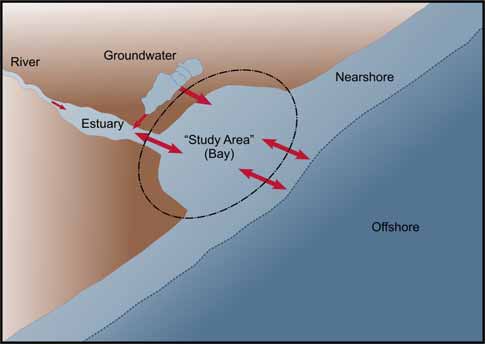
Together with the data and information on marine pollution sources (as discussed in
Section 1.3), baseline measurement programmes are crucial for quantitatively assessing or
predicting the impact of human activities within a particular study area, and subsequently, for
deciding on appropriate management actions that will ensure sustainable utilization of the
resource.
2.2.1 Physical
Data
Data on physical parameters are required to quantify hydrodynamic (or water circulation)
processes and sediment dynamics (i.e. the transport, deposition and re-suspension of
sediment particles), which include data on:
· Bottom topography or bathymetry of a particular area
· Winds
· Currents
· Tides
· Waves
· Water column stratification
· Geomorphology.
Both hydrodynamic and sediment dynamic processes are key aspects of the transport and
fate of pollutants in the marine environment. Information on these processes is also
important for engineering studies, e.g. the structural design of offshore marine wastewater
disposal schemes.
BCLME Project BEHP/LBMP/03/01
Page 2-3
Section 2
January 2006
Final






i. Bathymetry
The bottom topography or bathymetry of a particular area strongly influences both its
hydrodynamic and sediment dynamic processes (Figure 2.1). During a bathymetric survey,
seawater depths at a large number of sites are determined using an echo-sounder operated
from a survey boat. Integrative survey software packages are available that provide
accurate position fixing, capturing of bathymetric data and corrections for tides and swells
(RSA DWAF, 2004b). Bathymetric surveys are usually once-off unless there is evidence
that the bathymetry of an area has been markedly modified, e.g. large floods are known to
have a major influence on the bathymetry of estuaries.
0
2000
4000m
0m
-5m
-10m
Depth (m to MSL)
Profile
-15m
10
Mean sea level
0
-20m
-10
-20
-25m
-30
-30m
-40
0
1,000
2,000
3,000
4,000
5,000
Distance from shore (m)
-35m
Figure 2.1:
Example of bathymetric contour map and typical profile (taken form RSA
DWAF, 2004b)
ii. Winds
Winds can play an important role in the behaviour of surface currents, and subsequently
influence the transport and fate of pollutants. In the absence of strong ocean currents, wind-
driven currents usually dominate.
BCLME Project BEHP/LBMP/03/01
Page 2-4
Section 2
January 2006
Final
To obtain representative wind data, wind recordings are typically collected from a particular
study area for a limited period (e.g. one year) using an automatic weather station. The
limited data set is then correlated with long-term wind data from a nearby weather station to
predict long-term wind patterns for the study area.
Wind data records need to reflect natural variability. Usually wind patterns show strong
seasonal variability, influenced by remote climatological conditions. However, a local
phenomenon can also affect wind patterns. For example, near the coast changes in the
temperature differences between land and sea can change the direction of winds (breezes),
resulting in a strong diurnal signal (Figure 2.2) (RSA DWAF, 2004b).
SUMMER
Wind speed (m/s)
2
1
Land breeze
0
-1
Sea breeze
-2
-3
-4 0
5
10
15
20
Time of day (hr)
WINTER
Wind speed (m/s)
2
1.5
1
Land breeze
0.5
0
-0.5
Sea breeze
-1
-1.5 0
5
10
15
20
Time of day (hr)
Figure 2.2:
Typical diurnal land- sea breeze variations (taken from RSA DWAF, 2004b)
BCLME Project BEHP/LBMP/03/01
Page 2-5
Section 2
January 2006
Final
iii. Waves
Wave data are particularly important for understanding or predicting the deposition and
redistribution of sediment or other solid phase particles. Also, waves are an important factor
in determining the sediment dynamics in shallower water and in the shoreline
geomorphology. In the surf zone, the mixing, transport and dispersion of pollutants in the
water column are controlled by the breaking waves and the currents generated by waves
approaching the shoreline (RSA DWAF, 2004b).
To obtain representative wave data, wave recordings are usually collected at a particular
study area for a limited period (e.g. one year) using, for example, a wave buoy. The limited
data set is then correlated with a nearby long-term wave data recording location to predict
long-term wave patterns for the study area.
Wave data typically need to include time-series plots of wave height and period, occurrences
and exceedances for wave height and period and persistence of calms and storms.
iv. Currents
The speed and direction of currents are the main oceanographic processes that influence
the transport and fate of pollutants in the marine environment.
In the offshore zone, the net (resultant) current is the result of a complex of numerous driving
forces: the local wind forcing, ambient continental currents (for example the Benguela
current), and surf zone long-shore and rip currents generated by waves, tidal currents and
density differences. In the near-shore zone, the circulation is strongly influenced by the
seabed topography and the configuration of the coastline. Currents in the surf zone are
usually wave-dominated. Long-shore transport is driven by the momentum flux of shoaling
waves approaching the shoreline at an angle, cross-shelf transport is driven by the shoaling
waves, while water is transported out of the surf zone by rip currents. In open estuaries,
currents are primarily influenced by the state of the tide, the size (cross-sectional area) of the
estuary mouth and the volume and timing of river inflow (RSA DWAF, 2004b).
Eulerian measurements are continuous recordings of current data collected at pre-
determined time intervals by the use of moored current meters at fixed points in the study
area. Eulerian data provide the basis for statistical estimates of occurrence and persistence
of current speed and direction. Lagrangian measurements include spatial studies with
drogues, drifters, or dye, in which the path and velocity of a particle are determined.
BCLME Project BEHP/LBMP/03/01
Page 2-6
Section 2
January 2006
Final
Continuous current measurements, preferably taken throughout the water column (i.e.
current profiles) are ideally required, using, for example, an acoustic Doppler Current Profiler
(ADCP). A baseline measurement programme must be arranged to reflect adequately
seasonal and other cyclical current trends and should have a typical duration of between 12
and 18 months if previous data are not available (Figure 2.3). The output of a calibrated
numerical model could be used to supplement the limited current measurements, i.e. provide
more extensive spatial information.
Current velocity (cm/s)
80
60
40
20
0
1
Time (days)
Direction (deg to N)
N
360
NW
W
270
SW
S
180
SE
E
90
NE
N
0
1
Time (days)
SCALE
0
50
100 cm/s
1
2
3
4
5
6
7
Time (days)
Figure 2.3:
Time series data showing current velocities, directions and vectors (taken from
RSA DWAF, 2004b)
BCLME Project BEHP/LBMP/03/01
Page 2-7
Section 2
January 2006
Final
vii. Stratification
In the marine environment, vertical density gradients develop as a result of differences in the
water temperature and salinities throughout the water column. Density stratification affects
the transport and fate of pollutants, for example, it is one of the major factors that determine
whether a buoyant effluent discharge from an ocean outfall remains beneath the surface as
a submerged field or continues to rise to become a surface field.
In order to detect stratification in the water column, both temperature and salinity profiles
should be measured since seawater density is a function of both these properties.
Measurements should also be done on a similar scale as that used for the current
measurements. For example, temperature and salinity probes could be attached to current
profilers so as to maximize the information obtained from each measured profile.
Conductivity-Temperature-Depth (CTD) profilers can also be used for measurements from a
survey boat.
ix. Geomorphological
data
The purpose of geomorphological measurement programmes is to obtain data on the
sediment characteristics of the study area. These data, together with information on the
hydrodynamic processes, are used to assess and predict sediment processes (i.e. transport
deposition and re-suspension).
Important aspects that need to be measured as part of geomorphological surveys are
particle size distribution and organic content (deposited particles in the marine environment
are not only of lithogenous origin but can also be of an organic nature - breakdown of marine
fauna and flora or introduced from land sources such as rivers, stormwater and wastewater
streams) (Figure 2.4). Samples can either be collected as grab samples (which essentially
provide data on surface sediments) or sediment cores (which provide a `history' of the
geomorphology of the sediments). Traditionally, samples were collected along uniform
sampling grids across the study area, but it has been shown that an understanding of the
hydrodynamic processes (e.g. using numerical modelling) greatly assists in optimizing these
spatial grids (RSA DWAF, 2004b).
BCLME Project BEHP/LBMP/03/01
Page 2-8
Section 2
January 2006
Final
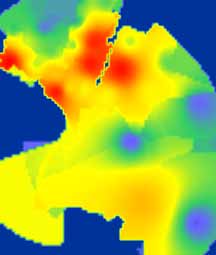



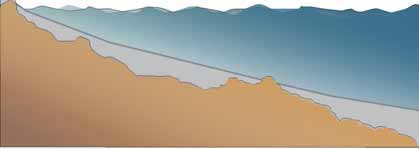


Mud Fraction
1999 Dataset
Small Bay
Big Bay
Figure 2.4:
Spatial plot of the distribution of
particle size in Saldanha Bay (South Africa)
(Monteiro et al., 1999)
% mud
90
80
70
60
50
40
30
20
10
0
0m
1500m 3000m 4500m 6000m
file: mud99bw
In terms of the engineering studies, the design of structures such as offshore marine outfalls
usually requires more detailed, site-specific geomorphological studies, including:
· Seismic surveys, which are conducted to obtain information from beneath the sea-floor,
using a sound source or transducer towed behind the survey vessel either on a surface
float or below the surface (Figure 2.5)
· Detailed geotechnical reports to support the seismic interpretation (soil classification,
cohesive and shear strength of soils, internal angle of friction, soil density characteristics,
rock classification and hardness, seismic activities)
Depth (m to MSL)
10
Mean sea level
0
-10
-20
Bedrock
-30
Unconsolidated rock
-40
0
1,000
2,000
3,000
4,000
5,000
Distance from shore (m)
Figure 2.5:
Sub-bottom profile derived from a seismic trace (taken form RSA DWAF, 2004b)
BCLME Project BEHP/LBMP/03/01
Page 2-9
Section 2
January 2006
Final
2.2.2 Biogeochemical
Data
Biogeochemical characterization of the marine environment requires data on the spatial and
temporal variability of biogeochemical parameters, both in the water column and in the
sediments, as well as an understanding of the key processes that govern such variability. It
is important that data used in the characterization reflect the present status of the receiving
U
U
marine environment, i.e. any modifications to the biogeochemical characteristics and
processes as a result of existing human activities need to be taken into account. This is
particularly relevant when assessing the suitability of historical data sets.
Information from the physical process study programme can be used to assist in the design
of the biogeochemical data collection programme, particularly in terms of setting the critical
time and space scales.
In addition to gaining knowledge on biogeochemical processes in the study area,
biogeochemical data are also required for the calibration and validation of numerical
modelling platforms (where applicable), as well as to provide a benchmark (baseline) for
future monitoring programmes.
It is important, therefore, that the manner in which biogeochemical data are collected is
appropriate to the different purposes. For example, numerical model calibration and
validation usually require time series data collected over a pre-determined time-scale.
i.
Receiving marine environment
The selection of measurement parameters to be sampled in the receiving environment is
site-specific. A key determining factor in the selection of such parameters is the composition
of pollution sources as well as the anticipated effects on the biogeochemical characteristics
of, and processes in, the receiving environment.
Essential, therefore, to the design of the biogeochemical measurement programme is the
preparation of a preliminary conceptual model of the key biogeochemical processes
governing the `cause-and-effect' linkages between the wastewater discharge and the
receiving environment.
BCLME Project BEHP/LBMP/03/01
Page 2-10
Section 2
January 2006
Final
Biogeochemical parameters (e.g. pH, dissolved oxygen, turbidity, particulate organic carbon
and nitrogen, dissolved nutrients, toxin concentrations and microbiological parameters) can
be measured in the water column and/or the sediments, including interstitial waters.
Depending on the nature of the investigation, sediment data should be collected from sub-
tidal and/or inter-tidal sediments. An understanding of the physico-chemical characteristics
of the inter-tidal area is particularly relevant where, for example, a wastewater discharge to
the surf zone is under investigation.
The spatial scales at which data need to be collected vary. For example, time series data
collected from the water column may require only one or two pre-selected locations,
whereas data on spatial distribution patterns require more intensive sampling.
A guiding principle is that the initial sampling should cover the near and far field scales (e.g.
an entire bay), making no assumptions on the locations of, for example, depositional areas.
This typically requires a high resolution, unbiased grid.
The temporal scale at which biogeochemical data need to be collected, as part of the
measurement programme, largely depends on:
· The variability in the load of contaminants from waste inputs
· The variability in processes driving transport and fate of the wastewater plume in the
receiving environment
· The temporal sensitivity of the ecosystem to contaminant loading, i.e. exposure time
versus negative impact.
The temporal scale of sampling should at least resolve the main source of natural variability
of the constituent under investigation. Scales of temporal variability are very different in the
water column (minutes days) compared with sediments (days seasons decades). Non-
periodic events, such as storms, can also have a dramatic influence that needs to be taken
into account where appropriate. Therefore, a sampling frequency that is too low relative to
the underlying natural variability will result in biased data that will make it difficult, for
example, to separate anthropogenic impact from natural water quality anomalies. This is
illustrated in dissolved oxygen concentrations measured in Saldanha Bay (South Africa):
With an hourly data record (automated) it was possible to show that variability in oxygen was
linked to variability in upwelling, and that the low oxygen concentrations were brought into
the system by upwelled waters rather than by any localised anthropogenic effects. Weekly
BCLME Project BEHP/LBMP/03/01
Page 2-11
Section 2
January 2006
Final
sampling, for example, would have resulted in an apparently random variability of high and
low concentrations. This illustrates the importance of characterising natural variability prior
to interpreting the impacts of pollutant sources on the biogeochemistry of a receiving water
body.
Saldanha Bay Monitoring Programme
Oxygen
Spring-Summer 1999/2000
Temperature
5.00
24.00
4.00
20.00
)
l/l
e
m 3.00
(
a
t
ur
e
n
16.00
er
p
2.00
x
y
g
O
Tem
12.00
1.00
0.00
8.00
/
0
9
/
14
/
0
9
/
21
/
0
9
/
28
/
1
0
/
05
/
1
0
/
12
/
1
0
/
19
/
1
0
/
26
/
1
1
/
02
/
1
1
/
09
/
1
1
/
16
/
1
1
/
23
/
1
1
/
30
/
1
2
/
07
/
1
2
/
14
/
1
2
/
21
/
1
2
/
28
99
99
99
99
99
99
99
99
99
99
99
99
99
99
99
99
19
19
19
19
19
19
19
19
19
19
19
19
19
19
19
19
Figure 2.6:
Dissolved oxygen variability (m/) in the bottom water layer in Saldanha Bay,
South Africa (from Monteiro et al., 1999)
In summary, data required for the characterization of biogeochemical processes include:
· A contour map showing the distribution of relevant chemical constituents in the marine
sediments of the study area, including details on sediment particle size distribution and
particulate organic carbon and nitrogen. Expected variability, both temporally and
spatially, needs to be addressed.
Geochemical ratios of trace metals can be used to determine whether the trace metals
are of natural or anthropogenic origin. It is possible for conditions to arise in which the
total trace metal concentration in the sediment is high (particularly in depositional areas)
but completely linked to the natural structure of clay minerals, in which case the trace
metals will not be bio-available. This condition would be characterized by geochemical
ratios very similar to those of unpolluted sediments typical of the area. The geochemical
ratio of each trace metal relative to aluminium (TM [µg/g]: Al [%]) is used, usually
allowing a conservative two-fold natural variation in the geochemical ratios. Natural
geochemcial ratios are site specific for different geographical regions and need to be
sourced from the literature (Monteiro & Scott, 2000).
BCLME Project BEHP/LBMP/03/01
Page 2-12
Section 2
January 2006
Final
· Graphs showing the temporal (and, where applicable, spatial) variability of system
variables (temperature, salinity, dissolved oxygen and suspended solids/turbidity),
inorganic nutrients (nitrate, ammonia, reactive phosphate and reactive silicate), and
organic nutrients (dissolved organic carbon, particulate organic carbon and particulate
organic nitrogen) in the water column.
ii.
Behaviour of pollutants
To be able to interpret biogeochemical data, it is also important to collect data on the
behaviour of pollutants immediately after entering the marine environment. A description of
the expected interaction of pollutants with biogeochemical processes in the receiving marine
environment is therefore also important. On entering the marine environment, pollutants can
either (WHO, 1982):
· Remain in solution (i.e. remain in the `dissolved phase'). Pollutants associated with the
`dissolved' phase can either behave conservatively (i.e. their behaviour reflects only the
advective and dispersive characteristics of the water body) or non-conservatively (i.e.
they are rapidly transformed on entering the marine environment as a result of system
variables, such as pH, salinity and temperature, being different from those in the
wastewater).
· Adsorb onto solid phase particles. On entering the marine environment, toxic
compounds, such as trace metals and poly-aromatic hydrocarbons, poly-nuclear
aromatics and pesticides, tend to adsorb onto `solid' phase particles present either in the
wastewater or in the receiving environment. `Solid' phase particles comprise cohesive
(non-biological) particles and organic particles. Cohesive (non-biological) particles
represent very fine sediment particles (< 60 µm) on which adsorption phases such as
aluminium hydroxides, manganese hydroxides and iron hydroxides are common. The
B
B
origin of the organic particles can be natural (e.g. phytoplankton) or introduced through
anthropogenic activities (e.g. sewage disposal).
Adsorption to `solid' phase particles is typically described by means of equilibrium
partitioning, on the basis of partition coefficients, which are different for each `solid'
phase particle.
The transport and fate of chemical constituents associated with the `solid' phase are
largely determined by the flux and sedimentation/re-suspension behaviour of solid
phase particles. The sedimentation/re-suspension behaviour of solid phase particles is
a sensitive indicator of the potential fate of toxic compounds in the receiving marine
environment (Luger et al., 1999; Monteiro, 1999).
BCLME Project BEHP/LBMP/03/01
Page 2-13
Section 2
January 2006
Final
· Precipitate from the water column. A rise in pH and oxygen content promotes the
formation of metal hydroxides, carbonates and other metal precipitates. Under such
conditions, if the concentration of a trace metal is higher than the solubility of the least
soluble compounds that can be formed between the metal and available anions in the
receiving water, precipitation will occur.
Where appropriate, solubility products and stability constants, which describe
precipitation processes and which are specific to the metal/anion complex, need to be
sourced from the literature in order to quantify such transformations (Stumm & Morgan,
1970; Faust & Aly, 1984). However, most metals, with the exception of iron (Fe) and
manganese (Mn) that readily precipitate their hydroxides, will usually remain in solution
in seawater at concentrations that are much higher than those occurring naturally
(Solomons & Förstner, 1984; WHO, 1982).
Another type of transformation is that of certain poly-aromatic hydrocarbons, in particular
volatile organics (e.g. benzene, toluene and xylene). On entering marine waters, such
compounds do not follow the conventional `dilution' behaviour. It is thought that these
substances are actually extracted out of the aqueous phase and into the buoyant
hydrophobic fraction that results in concentration as a film at the water's surface (referred to
as the surface micro-layer), which subsequently evaporates to the atmosphere, rather than
diluting. It will be extremely difficult to predict the transport and fate of such volatile
substances in the receiving environment. Removing such compounds from the wastewater
before discharging to sea best mitigates their potential risk to the marine ecosystem and
other beneficial uses.
2.2.3 Biological
data
To characterize the biology of a particular marine environment requires data on the
following:
· Identification of habitat types, e.g. reefs, kelp beds, sandy and rocky bottoms
· Community structure within each of the habitat types
· Community composition and list of species (and abundance) associated with the
different habitat types, focusing on dominant species, species of particular conservation
importance and species targeted for exploitation.
The high mobility of pelagic and planktonic organisms in the water column makes
representative sampling nearly impossible and particular care should be taken when
BCLME Project BEHP/LBMP/03/01
Page 2-14
Section 2
January 2006
Final
interpreting data on such organisms. In addition, the distribution and abundance of marine
organisms often show strong diurnal and/or seasonal variability, depending on numerous
climatic, physical and biogeochemical factors. It is important, therefore, to ensure such
information is collected simultaneously and is taken into account when interpreting the
ecological data. Ecological data should be adequate to perform valid statistical and
community analyses as proposed below.
In summary, data required to characterize biological processes include:
· A geo-referenced map showing the distribution of the various habitat types and their
associated biological resources (i.e. to refine the beneficial use map in terms of the
distribution of marine ecosystems), highlighting areas with:
- Biological resources of conservation importance
- Biological resources targeted for exploitation
- Biological resources that have been lost or are stressed, as a result of anthropogenic
influence
· For each of the habitat types, a listing of the key species and their abundance and
community composition, as well as expected temporal and spatial variability (this may be
expensive to obtain and it may therefore be more realistic to focus on selected indicator
species and community structure)
· Data on biological resources that are potentially sensitive to anthropogenic (existing or
proposed) influences, including information on cause-and-effect relationships.
2.3 LONG-TERM
MONITORING PROGRAMMES
NOTE
This section provides protocols or guidance on key aspects to be taken into account in the design of long-
term monitoring programmes or plans. It has been largely extracted from the Operational policy for the
disposal of land-derived wastewater discharges of the Department of Water Affairs and Forestry South
Africa (RSA DWAF, 2004b) It is by no means exhaustive and the reader is referred to the following
additional reading for further detail:
· NATIONAL RESEARCH COUNCIL (1990), ANZECC (2000a), ANZECC (2000b), NZWERF
(2002), US-EPA (1994) and US-EPA (2003) design of monitoring programmes
· UNESCO/WHO/UNEP (1992), Devore and Farnum (1999), Spiegel (1972) and US-EPA (2002) -
statistical analysis of numerical data
· Clarke and Green (1988) - complexity in statistical design and analysis for biological studies.
BCLME Project BEHP/LBMP/03/01
Page 2-15
Section 2
January 2006
Final
Long-term monitoring programmes relevant to the management of land-based sources of
marine pollution consist mainly of three components:
· Source monitoring, to determine the effectiveness with which facilities, aimed at
managing and controlling marine pollution, are operated, as well as to determine the
effectiveness of management strategies and actions to meet wastewater emission
targets or standards (i.e. the critical limits that were defined for a specific marine pollution
source)
· Environmental monitoring, to determine the trends and status of changes in the receiving
marine environment, in terms of the health of important ecosystems and designated
beneficial uses. Also, to evaluate whether the actual environmental responses match
those predicted during the assessment process. This evaluation is necessary in order
to respond, where appropriate, in good time to potentially negative impacts, including
cumulative effects.
2.3.1 Source
Monitoring
Source monitoring programmes are primarily focused on continuously assessing whether
wastewater emission targets (or critical limits) are being met by potential marine pollution
U
U
sources. For point source discharges (e.g. municipal wastewater or industrial effluents), the
implementation of source monitoring programmes is often a legal requirement, as part of
their licence agreements. Parameters to be monitored include:
· Flow: The sampling frequency needs to be sufficient to resolve the actual variability in
the wastewater volume.
· Composition of wastewater: The list of constituents to be monitored will depend on the
composition of the wastewater, while the frequency of monitoring needs to reflect the
actual variability in wastewater composition.
Urban/municipal wastewater discharges, consisting mainly of domestic sewage, have a
characteristic wastewater composition. Key pollutants that need to be included in the
monitoring programme of discharges to the marine environment are:
- Biochemical oxygen demand/Chemical oxygen demand
- Total suspended solids
- Particulate organic carbon and nitrogen
- Inorganic nitrogen and phosphate
- Microbiological
indicators.
BCLME Project BEHP/LBMP/03/01
Page 2-16
Section 2
January 2006
Final
In the case of industrial wastewater discharges, or where industrial wastewater
discharges enter a municipal WWTW, the constituents included in the monitoring
programme will depend on the constituents present in the wastewater and their potential
to impact negatively on the receiving marine environment and its designated beneficial
uses.
Although systems performance monitoring (also a form of source monitoring) primarily refers
U
U
to performance monitoring of effluent disposal schemes (e.g. offshore marine outfalls), a
monitoring programme can easily also be designed for other facilities aimed at preventing
marine pollution, such as artificial wetlands constructed to improve the quality of urban
stormwater runoff, or monitoring the effective implementation of certain agricultural practices
so as to the prevent contamination of river runoff.
In the case of effluent disposal schemes, system performance monitoring programmes
typically include
· Regular physical inspections of the system to identify malfunctioning or system failures
· Hydraulic performance (e.g. offshore marine outfalls) inspections, which should be
conducted at any stage during the lifetime of the outfall when physical changes or
alterations, which may have an effect on the hydraulic characteristics, are introduced or
when there is a substantial change to the wastewater quantity or composition.
2.3.2 Environmental
Monitoring
Key elements of a successful monitoring programme include (ANZECC, 2000b; US-EPA
2003):
· Monitoring
objectives
· Selection of monitoring parameters (indicators)
· Refinement of spatial and temporal scales
· Appropriate sampling and analytical techniques
· Evaluation and Reporting
However, the design of long-term monitoring programmes should be a dynamic, iterative
process to be adjusted continuously to incorporate new knowledge, thereby supporting the
BCLME Project BEHP/LBMP/03/01
Page 2-17
Section 2
January 2006
Final
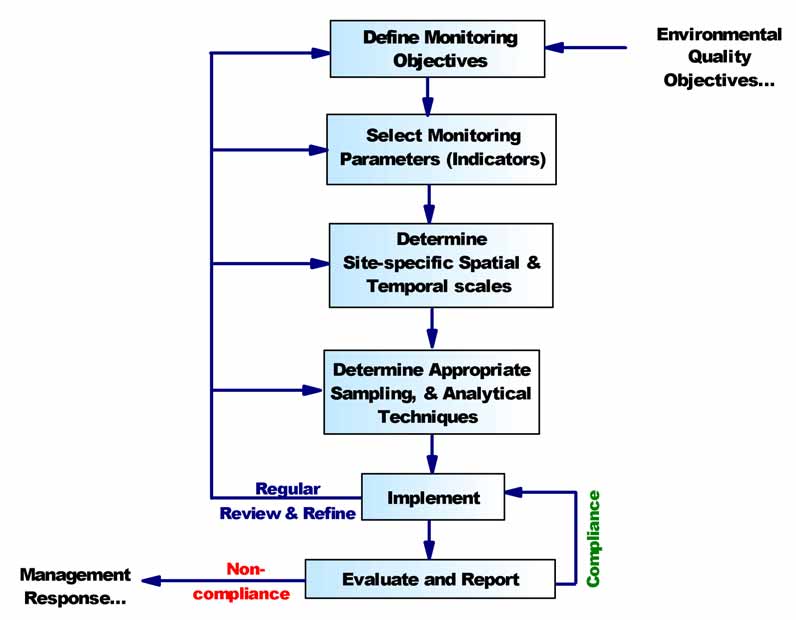
principle of adaptive management. The key aspects to be addressed as part of long-term
monitoring programmes are schematically illustrated in Figure 2.7.
Figure 2.7:
Key aspects to be addressed as part of long-term monitoring programmes
i. Monitoring
Objectives
Measurable site-specific monitoring objectives are a key component of a sound long-term
environmental monitoring programme. Such clear objectives make it possible to design a
focused and cost-effective monitoring programme. These objectives can also be translated
into hypotheses that could be proved statistically.
Usually, monitoring objectives are distilled from the environmental quality objectives which,
in turn, are based on site-specific management goals for the protection of marine aquatic
ecosystems and designated uses in a particular area in many instances these objectives
will have been derived using national (or regional) water and sediment quality guidelines.
BCLME Project BEHP/LBMP/03/01
Page 2-18
Section 2
January 2006
Final
Monitoring objectives can also be specified in terms of biological parameters (e.g. species
diversity, abundance and community composition) that incorporate some `acceptable
change' from a baseline data set and/or an appropriate control site.
ii.
Selection of Monitoring Parameters
The selection of measurement parameters (or indicators) is site-specific and should be able
to quantify whether monitoring objectives (as defined above) are being complied with. Key
determining factors in the selection of monitoring parameters are, for example:
· characteristics of marine pollution sources
· anticipated impacts on water and sediment quality, and subsequently on the health of
aquatic ecosystems and other beneficial uses.
Depending on the anticipated impacts, monitoring can be conducted either in the water
column, in sediments and/or in biological components. Selecting monitoring parameters in
an environmental component in which there is usually high natural variability, such as the
water column, may require high resolution sampling frequency, often with high cost
implications. It is therefore usually more appropriate (and cost effective) to focus on those
environmental components that tend to integrate or accumulate impacts or change over
U
U
U
U
time, such as sediments and organisms. For example, filter feeders (such as mussels and
oysters) are internationally recognized as suitable indicators for trace metal and hydrocarbon
accumulation in the marine environment (Cantillo, 1998). These organisms filter food from
the water in which they live and tend to retain contaminants that often accumulate to high
concentrations in their tissues, thus reflecting changes in water quality over time. Their
sedentary nature also prevents confusion about where a filter feeder might have
accumulated a particular chemical compound.
However, an instance in which monitoring of the water column is considered to be the most
appropriate, is the monitoring of microbiological indicators (e.g. Enterococci or E. coli) at
recreational or marine aquaculture areas. Management of such areas requires near real
time data to ensure that potential risks to human health are mitigated timeously. As a result,
data need to be collected at weekly or two-weekly intervals, and even daily during the peak
holiday season.
Monitoring parameters can also include marine organisms, by means of which species
diversity, relative abundance, and community structure and composition of the biological
BCLME Project BEHP/LBMP/03/01
Page 2-19
Section 2
January 2006
Final
communities in a study area are monitored. As it is often very expensive to conduct detailed
biological monitoring programmes that measure entire biotic communities, indicator species
are often selected as proxies for evaluating ecosystem health. In studies throughout the
world and also in South Africa, macroinvertebrate communities have been used successfully
in assessing ecosystem health (ANZECC, 2000b). Meiofauna distribution patterns, in
conjunction with related biogeochemical parameters, have also been used successfully in
this regard, e.g. in intertidal areas along sandy beaches (Skibbe, 1991; Skibbe, 1992). In
South African estuaries, macrophytes have also been used successfully as long-term
indicators of ecosystem health (CSIR, 2003). Other biotic parameters that have also been
used are fish (ANZECC, 2000b), particularly in areas that support resident populations, such
as estuaries, shoals, reefs and settlements on moored substrates.
Where the boundaries of the study area include areas that support biotic species of
economic importance (e.g. the prawn populations on the Thukela banks off the KwaZulu-
Natal coast), the distribution and abundance of these species are also effective monitoring
parameters as part of ongoing long-term monitoring programmes.
It is, however, important that scientifically sound reasons are provided for the selection of
specific biotic indicator species in a particular study area. Before choosing a particular
taxonomic group(s) as a monitoring parameter of ecosystem health, it is important to also
test it against the following criteria (ANZECC, 2000a &b):
· Sensitivity to potential impacts for waste inputs
· Response will reflect the overall ecological condition or integrity of the study area
· Approaches to sampling and data analysis can be highly standardised
· Response can be measured rapidly, cheaply and reliably
· Response has some diagnostic value.
A useful checklist that can be used to assist in the selection of suitable measurement
parameters, in general, is provided in Table 2.1 (ANZECC, 2000b).
BCLME Project BEHP/LBMP/03/01
Page 2-20
Section 2
January 2006
Final
TABLE 2.1:
Checklist for selection of measurement parameters (from ANZECC, 2000b)
Relevance
Does the measurement parameter reflect directly on the issue of concern?
Does the measurement parameter respond to changes in the environment and
Validity
have some explanatory power?
The measurement parameter must be able to detect changes and trends in
Diagnostic value conditions for the specified period. Can the amount of change be assessed
quantitatively or qualitatively?
Does the measurement parameter detect changes early enough to permit a
Responsiveness management response, and will it reflect changes due to the manipulation by
management?
The measurement parameter should be measurable in a reliable, reproducible
Reliability
and cost-effective way.
Is the measurement parameter appropriate for the time and spatial scales that
Appropriateness need to be resolved?
iii.
Refinement of spatial and temporal scales
Setting spatial boundaries for a monitoring programme is important because inappropriate
boundaries might focus efforts away from driving or consequential factors (ANZECC,
2000b). The anticipated influence of marine pollution sources therefore needs to be taken
into account in the specification of the spatial boundaries of a long-term monitoring
programme. This influence, in turn, depends on the transport and fate of pollutants, both in
the near and far field, as well as potential synergistic effects associated with other
anthropogenic activities that may affect water and sediment quality in the study area.
Sampling locations can also be dictated by the location of designated beneficial use areas.
For example, recreational beaches and marine aquaculture farms will be logical sampling
locations if located in areas where marine pollution sources, and associated pollutants, pose
potential risks to human health.
The temporal scale of a monitoring programme (i.e. sampling frequency) largely depends on
the:
· variability in the load of contaminants from marine pollution sources
· variability in processes driving transport and fate in the receiving environment
· temporal sensitivity of the ecosystem to pollutant loading, i.e. exposure time versus
negative impact.
BCLME Project BEHP/LBMP/03/01
Page 2-21
Section 2
January 2006
Final
The sampling interval or frequency should at least resolve the main source of natural
variability of the constituent under investigation. Scales of change over time differ widely in
the water column (minutes days) compared, for example, with sediments (days seasons
decades). Non-periodic events, such as storms, can also have a dramatic influence that
needs to be taken into account where appropriate.
In the water column, high frequency physical processes, such as tides, currents, wind and
waves, mainly control variability. A sampling frequency that is too low relative to the
underlying natural variability will, therefore, result in biased data that will make it difficult to
separate a human-derived impact from a natural anomaly. In the same way, sampling at a
frequency that is too low relative to the variability in waste inputs may result in marked
negative impacts being missed. In order to resolve the problem of the variability in the water
column, sampling frequencies generally have to be high (e.g. hourly-daily-weekly). As a
result, the use of water column measurement parameters as part of monitoring programmes
is usually not cost-effective.
Sediment sampling frequency is strongly linked to the time-scale within which the sediments
act as `particle traps'. As with sampling of the water column, sediment sampling at a
frequency that is lower than the periodic re-suspension events will make trends difficult to
interpret and could lead to spurious conclusions. Therefore, where cost constraints
necessitate limitations on sampling frequencies, it will be inappropriate to select sampling
locations that are situated in areas reflecting short-term variability. In such instances,
longer-term depositional areas should rather be targeted. For example, because sediment
processes often show strong seasonal trends, sampling is often confined to a particular
season. Depositional sites can be designated both long- and short-term. For example, an
open coast site may be a depositional site for a period of days to weeks whereas an estuary
may be such for a period of months to years. The ecological impact of both does not have to
be linearly related to the persistence. Both provide important insights into the sediment and
pollutant dynamics of the coastal and estuarine environments and are key to the design of
optimal monitoring programmes, particularly in terms of sampling frequency.
Another commonly used technique to partially overcome the problem of high frequency
variability is to measure seasonal variability of pollutants in biological tissue (e.g. flesh of
filter feeders). It is, however, important to realise that the body mass of these organisms
also has a strong seasonal variability related to spawning cycles. Natural variability
BCLME Project BEHP/LBMP/03/01
Page 2-22
Section 2
January 2006
Final
therefore needs to be separated from potential long-term signals caused by human
interference. To address this issue, the following are required as a minimum:
· Samples need to be taken at regular six-monthly intervals
· Long-term sampling needs to be undertaken within a narrow time window each year to
reduce seasonal uncertainty.
Traditionally, long-term monitoring programmes included intensive sampling grids to
overcome the inherent uncertainties of the spatial (and temporal) variability of a system.
However, with the use of numerical modelling, many of the inherent problems of the
traditional approach can be overcome. Numerical modelling has proven to be very useful in
enhancing the design of long-term monitoring programmes and improving the interpretation
of the results of monitoring. Such numerical models provide the process links that enhance
the ability to diagnose problem areas, as well as anticipating problems through their
predictive capacity. The benefits of numerical modelling in the design of long-term
monitoring programmes include:
· Definition of the most critical space- and time-scales of impact in the system: Important
insights are provided by the combination of the synthesis of the existing understanding of
the key processes and the model assumptions and inputs
· Improved interpretation and understanding of the monitoring results in the context of a
dynamic environment that determines the transport and fate of pollutants.
The aim, therefore, is to use the capability of numerical models to reduce uncertainties in
relation to system variability, key processes and how these influence the transport and fate
of contaminants. Because this increased understanding provides greater confidence in the
predicted outcomes, the investment in the monitoring can be limited to only a number of
critical parameters measured on critical time and spatial scales.
Although long-term monitoring programmes may, initially, still require relatively intensive
spatial (and temporal) scales to address uncertainties in a system's response, over a
number of years, these can be reduced to only a few selected points through an iterative
process, as the predicted responses of the system are verified. These high sensitivity
points, however, need to be justified on the basis of specific criteria, such as high
concentrations of mud and silt that indicate a long-term depositional area.
BCLME Project BEHP/LBMP/03/01
Page 2-23
Section 2
January 2006
Final
iv.
Sampling and analytical techniques
The choice of sampling and analytical techniques to apply in a monitoring programme is
largely dependent on the selection of monitoring parameters and the output that is required
to properly evaluate whether monitoring objectives are complied with.
Key requirements that need to be stipulated in a sampling programme include:
· Sampling
technique
· Number of replicates (determined by the statistical technique used in analysis)
· Sample handling and storage.
It is strongly recommended that an appropriately accredited analytical laboratory conduct
chemical analyses of marine biogeochemical parameters.
v.
Data Evaluation and Reporting
In the evaluation of monitoring data, the following are important aspects that need to be
considered:
· Data qualification. The required accuracy and precision of data need to be clearly
defined before embarking on data acquisition exercises. Rounding-off and the number
of significant figures must be defined for each type of data. A high level of confidence
with regard to data accuracy is essential for any further analysis.
· Appropriate (Statistical) techniques. Computers and statistical software are valuable
tools for the evaluation of environmental data. However, they are only tools: the ultimate
assessment depends on scientific expertise, as well as a proper understanding of
statistical procedures and their applicability to environmental data. Where statistical
expertise is limited, commercially available software packages (or the techniques
described in the following section) must be used cautiously. Statistical techniques that
are applied inappropriately can result in erroneous results or interpretations.
To be useful from a management perspective, it is crucial that monitoring results be reported
in a clear format to provide the appropriate scientific (and engineering) knowledge for
informed and effective decision-making. Often the most effective manner in which to
communicate environmental data and information is through graphical presentation, in that
large data sets can be illustrated effectively. Graphical presentation is also effective in
showing qualitative aspects (such as correlations and trends) and quantitative aspects (such
BCLME Project BEHP/LBMP/03/01
Page 2-24
Section 2
January 2006
Final
as outliers). It is also a user-friendly means of communicating complex numerical and
statistical outputs.
The frequency of reporting is also important. For example, compliance monitoring (referring
to monitoring of composition and volumes of marine pollution sources) requires near `real-
time' (i.e. as close as possible to the time of sampling) reporting to ensure that mitigating
measures are implemented timeously. Environmental monitoring programmes require less
frequent reporting, e.g. usually six-monthly or annually.
In general, a Monitoring Report needs to include:
· A list of monitoring objectives (or hypotheses) and how these relate to the overall
Environmental Quality Objectives specified for the study area
· Details of the design and implementation of the monitoring programme (also indicating
the relationship between selected measurement parameters and monitoring objectives)
· An evaluation of the monitoring data in relation to the monitoring objectives (or
hypotheses). This evaluation should make use of data summaries and graphical
presentations in order to enhance readability
· A statement on whether the monitoring objectives have been met
· In the event of non-compliance, possible reasons for the non-compliance
· Management strategies and actions required to address non-compliance
· Recommendations on refinements to the monitoring programme
· Appendices containing cruise and laboratory reports, raw data tables and other relevant
background information.
Various other communication routes can be utilised to communicate findings to wider
stakeholder groups, which may not have the relevant scientific or engineering background,
such as Pamphlets, Stakeholder meetings, Internet websites and Media reporting.
Monitoring data are expensive to collect and require substantial investments of both human
and financial resources. As a result, such data must be made as usable, useful and
retrievable as possible. The sheer volume of data generated as part of ongoing monitoring
programmes dictates that computer-based data management systems must provide the
BCLME Project BEHP/LBMP/03/01
Page 2-25
Section 2
January 2006
Final
basis for data storage and management. A good data management system should have
(ANZECC, 2000b):
· Reliable procedures for the recording of analytical and field observations
· Procedures for systematic screening and validation of data (quality control)
· Secure storage of information
· Simple retrieval system
· Simple means of analysing data
· Flexibility to accommodate additional information.
BCLME Project BEHP/LBMP/03/01
Page 2-26
Section 2
January 2006
Final
SECTION 3.
PRELIMINARY IDENTIFICATION OF KEY
STAKEHOLDERS INVOLVED IN MANAGEMENT
OF LAND-BASED MARINE POLLUTION SOURCES
IN THE BCLME REGION
BCLME Project BEHP/LBMP/03/01
Page 3-1
Section 3
January 2006
Final
An important secondary objective of this project was to initiate the establishment of a
BCLME coastal water quality network that will provide a legacy of shared experience,
awareness of tools, capabilities and technical support. This network will be supported by an
updatable web-based information system that provides guidance and protocols on the
implementation of the generic management framework, as well as a meta-database on
available information and expertise.
This network should include managers/government officials and scientists who are:
· Involved in the management of land-based pollution sources to the marine environment
· Knowledgeable on potential effect of water and sediment quality on the biota and
beneficial uses in the coastal waters of the BCLME region
· Responsibilities in terms of setting legislative policies and procedures related to waste
disposal to the marine environment as well as protection of the Namibian marine
environment.
Preliminary lists of key stakeholders who are involved in the management of marine
pollution, in each of the three countries, are provided in Table 3.1 to 3.3 respectively.
The list of key stakeholders will be captured in an updatable, web-based information system
(another deliverable on this project), accessible to users in the BCLME. It is envisaged that
these lists will grow as the coastal networks expand in the different countries.
BCLME Project BEHP/LBMP/03/01
Page 3-2
Section 3
January 2006
Final
TABLE 3.1:
Preliminary list of key stakeholders in Angola
NAME
AFFILIATION
TELEPHONE
E-MAIL
José da Paixão
National Institute for Fishery Research
+244 912 528613
paixao-vieira@yahoo.com.br
U
U
Domigas Piam
National Institute for Fishery Research
+ 244 912 228395
+244 222 309078
entis@netangola.com
H
T
U
U
T
H
Anabeila Leitão
University Agostinho Neto
+244 923 400273
Grilo Antonio
Ministério do Urbanismo e Ambiente
+244 912 242012
grilotonito@yahoo.com.br griloantonio@yahoo.com.br
H
T
U
U
T
H
U
U
Josefa Epifania Da Cruz
Ministério do Urbanismo e Ambiente
+244 923 536060
Lia Sousa
National Institute for Fishery Research
+244 923 608610
liasousaneto@yahoo.com.br
H
T
U
U
T
H
Miranda Kiala
Ministério do Urbanismo e Ambiente
+244 923 825808
mirandakiala@yahoo.com
H
T
U
U
T
H
Manuel Narciso
Capitanía do Porto de Luanda
+244 923 562943
manuel_narciso2000@yahoo.com.br
U
U
Maria Beatriz Henriques
Ministério da Saúde (INSP)
+244 912 212508
+244 222 393247
goveiaemanuela@hotmail.com (temporary)
H
T
U
U
T
H
Anacleta Paixão
Nova Cimangola
+244 923 416351
anacleta.paixao@novacimangola.com
U
U
Antonio dos Santos
Governo Provincial de Luanda
+244 923 542058
safiga@hotmail.com
U
U
Natalino Mateus
Departmento do Ambiente do Porto de Luanda
+244 923 469959
+244 912 208040
mmateus@portoluanda.co.ao
H
T
U
U
T
H
Olívia Torres
National Institute for Fishery Research
+244 923 656464
oliviafortunato@yahoo.com.br
H
T
U
U
T
H
Maria Paulina Paulo
Ministério do Urbanismo e Ambiente
+244 924 100952
emaria_paulina@hotmail.com
U
U
Livio Mercurio
BCLME Office, Luanda
+244 222 309330
livio.mercurio@undp.org
U
U
Maria de Lourdes Sardinha
BCLME Office Luanda
+244 222 309330
bclme.behp@nexus.ao
U
U
Francisco M D Cosme
Governo Provincial de Luanda
+244 923 605354
TABLE 3.2:
Preliminary list of key stakeholders in Namibia
NAME
AFFILIATION
TELEPHONE
E-MAIL
Dr Gunter Lempert
Aqua Services & Engineering (Pty) Ltd
+264 61-261143 lempertg@ase.com.na
H
T
U
U
T
H
Dr Hashali Hamukuaya
BCLME Project
+264 64 4101106/7 hhamukuaya@benguela.org
H
T
U
U
T
H
Dr. Moses Maurihungirire
BCLME Project
+264 64-4101106 mmaurihungirire@benguela.org
U
U
Dr Kirsten Manasterny
Hangana Seafood (Pty) Ltd
+264 64 218 407 kirsten.manasterny@olfitra.com.na
H
T
U
U
T
H
Dr Neville Sweijd
BENEFIT Project
+264-64-4101162 nsweijd@benguela.org
H
T
U
U
T
H
Dr Stephen Frindt
Ministry of Mines and Energy (Geological Survey of Namibia)
+ 264 61 284 8115 sfrindt@mme.gov.na
H
T
U
U
T
H
Dr G Schneider
Ministry of Mines and Energy
+264 61 2848111/2
gschneider@mme.gov.na
T
T
H
T
U
U
T
H
Andre Goosen
De Beers Marine (Environ Management)
+264 061 2978240 andre.goosen@debeersgroup.com or
U
U
enviro.dbmnam@debeersgroup.com
U
U
Arnold Köllmann
Town Council of Lüderitz
+264 63 202041 v51bi@iway.na
H
T
U
U
T
H
Calie Jacobs
Midwater Trawling Association
+264 64 219200 cjacobs@erongo.co.za
H
T
U
U
T
H
Ferdinand Hamukwaya
Ministry of Fisheries and Marine Resources
+264 64 4101151 fhamukwaya@mfmr.gov.na
H
T
U
U
T
H
James West
Aquaculture Association
+264 64 200747 jimjameswest@hotmail.com or namoyster@mweb.com.na
U
U
H
T
U
U
T
H
ltd@ltdoxford.com
H
T
U
U
T
H
Jan J. Gei-khaub
Ministry of Fisheries and Marine Resources
+264 64 4101140 jgeikhaub@mfmr.gov.na
H
T
U
U
T
H
Johannes Hamukwaya
Ministry of Fisheries and Marine Resources
+264 64 4101140 jhamukwaya@mfmr.gov.na
H
T
U
U
T
H
Riaan Lottering
Midwater Trawling Association
+264 64 219900 riaanlot@namsov.com.na
H
T
U
U
T
H
Rod Braby
Ministry of Environment and Tourism
+264 64 405610 iczmenv@iafrica.com.na
H
T
U
U
T
H
BCLME Project BEHP/LBMP/03/01
Page 3-3
Section 3
January 2006
Final
NAME
AFFILIATION
TELEPHONE
E-MAIL
Roland Roeis
Ministry of Agriculture, Water and Forestry
+264 61 2087167 RoeisR@mawrd.gov.na
H
T
U
U
T
H
Stefan de Wet
Ministry of Agriculture, Water and Forestry
+264 64 405610 wets@mawrd.gov.na
H
T
U
U
T
H
Alan Jenneker (Roy)
EnviroSolutions cc
+264 64 404438 envirosl@iafrica.com.na
H
T
U
U
T
H
Clive Lawrence
Municipality of Swakopmund
+264 64 4104325 clawrence@swkmun.com.na
H
T
U
U
T
H
David Uushona
Municipality of Walvis Bay
+264 64 214304 duushona@walvisbaycc.org.na
H
T
U
U
T
H
Fiona Olivier
Namdeb (Environmental Manager)
+264 63-235067 fiona.olivier@namdeb.com
U
U
J. Khaiseb
Municipality of Henties Bay
+264 64 502005 hbaytc@iway.na
H
T
U
U
T
H
Jo Leitz
Namport (Walvis Bay)
+264 64 2082283 Jo@namport.com.na
H
T
U
U
T
H
Theofilus Nghitila
Ministry Environment and Tourism
+264 61 249015 nghitila@dea.met.gov.na
H
T
U
U
T
H
Tim Eiman
Namport (Walvis Bay)
+264 64 2082339 Tim@namport.com.na
H
T
U
U
T
H
Timo Mufeti
NACOMA Project
+264 64 403905 tmufeti@iway.na
H
T
U
U
T
H
Sanel Visser
Etosha Fishing Corporation Walvis Bay
+264-64-215602 SVisser@etoshafish.co.za
H
T
U
U
T
H
Anja van der Plas
Ministry of Fisheries and Marine Resources
+264 64 410111 avanderplas@mfmr.gov.na
H
T
U
U
T
H
Josef Wedeinge
Ministry of Fisheries and Marine Resources
Anna-Lusia Mukumangeni
Ministry of Fisheries and Marine Resources
+264 64 4101140 amukumangeni@yahoo.com
U
U
Janine Basson
Ministry of Fisheries and Marine Resources
+264 64 4101174 jbasson@mfmr.gov.na
H
T
U
U
T
H
Justine Tjimune
Hangana Seafood (Pty) Ltd
+264 64 218 449 justine.tjimune@olfitra.com.na
H
T
U
U
T
H
Kathie Peard
Ministry of Fisheries & Marine Resources, Luderitz
264-63-202415 kpeard@mfmr.gov.na
H
T
U
U
T
H
Paloma Ellitson
Ministry of Fisheries and Marine Resources (Aquaculture
Dept)
+264 64 4101000 pellitson@mfmr.gov.na
H
T
U
U
T
H
Sue Roux
Merus Seafood Process
+264 64 216900 sue@merlusseafood.com
H
T
U
U
T
H
Aina Iita
Ministry of Fisheries and Marine Resources
+263644101000 aiita@mfmr.gov.na
H
T
U
U
T
H
Bronwen Currie
Ministry of Fisheries and Marine Resources (Aquaculture
Dept)
+264 64 4101139 bcurrie@mfmr.gov.na
H
T
U
U
T
H
Denise Van Bergen/ Noleen Green)
Pelagic Association
+264 64 203291 vanfish@mweb.com.na
H
T
U
U
T
H
(noleen.green@olfitra.com.na)
H
T
U
U
T
H
Rikka Hatutale
Ministry of Fisheries and Marine Resources
+264 64 4101140 ndali9@webmail.co.za
U
U
Marthinus Kooitjie
University of Namibia (Student)
mnkooitjie@yahoo.com
H
T
U
U
T
H
Heinrich Lesch
Hangana Seafood (Pty) Ltd
+264 64 218407 heinrich.lesch@olfitra.com.na
H
T
U
U
T
H
Lydia Mutenda
Municipality of Swakopmund
+264 64 4104321 lmutenda@swkmun.com.na
H
T
U
U
T
H
Vazembua Muharukua
Walvis Bay Salt Refiners
+264 64 202305 vazembua@wbsalt.com
U
U
TABLE 3.3:
Preliminary list of key stakeholders in South Africa
NAME
AFFILIATION
TELPHONE
E-MAIL
Abe Abrahams
Provincial Department of Environmental Affairs (North Cape)
+ 27 53 8074800
abeabrahams@half.ncape.gov.za
H
T
U
U
T
H
Asanda Njobeni
Dept of Environmental Affairs and Tourism (MCM)
+ 27 21 402 3347
anjobeni@deat.gov.za
U
U
Audrey Murphy
Oceana Operations (St Helena Bay)
+27 22 7428000
audreym@sardinops.co.za
H
T
U
U
T
H
Bryan Nicolson
City of Cape Town (Catchment, Stormwater & River
Management)
+27 21 487 2674
Bryan.Nicolson@capetown.gov.za
H
T
U
U
T
H
Cathy Bill
Provincial Department of Environmental Affairs (Western
Cape)
+27 21 - 483 2760
cbill@pawc.wcape.gov.za
H
T
U
U
T
H
Colleen Smith
Overstrand Municipality (Walker Bay)
fernkloof@overstrand.gov.za
H
T
U
U
T
H
Craig Spencer
Overstrand Municipality (Walker Bay)
+27 28 271 81 04
cspencer@overstrand.gov.za
H
T
U
U
T
H
BCLME Project BEHP/LBMP/03/01
Page 3-4
Section 3
January 2006
Final
NAME
AFFILIATION
TELPHONE
E-MAIL
Danie Klopper
City of Cape Town (Scientific Services)
+27 21 590 1488
danie.klopper@capetown.gov.za
H
T
U
U
T
H
Dr Alan Boyd
Dept of Environmental Affairs and Tourism (MCM)
+27 21-4423307
ajboyd@deat.gov.za
H
T
U
U
T
H
Dr Carl Wainman
Institute for Maritime Technology, Simons Town
+27 21 786 8248
ckw@imt.co.za
H
T
U
U
T
H
Dr Dirk van Driel
City of Cape Town (Scientific Services)
Dirk.vanDriel@capetown.gov.za
H
T
U
U
T
H
Dr Grant Pitcher
Dept of Environmental Affairs and Tourism (MCM)
+27 21 430 7016
gpitcher@deat.gov.za
H
T
U
U
T
H
Dr Henry Abbott
Dept of Water Affairs and Forestry (Northern Cape)
+ 27 54-3340201
whitec@dwaf.gov.za
H
T
U
U
T
H
Dr James Drabowski
Dept of Water Affairs and Forestry (Resource Quality
Services)
+27 12 336 7549
dabrowj@dwaf.gov.za
H
T
U
U
T
H
Dr Neil Malan
Dept of Environmental Affairs and Tourism (MCM)
dmalan@deat.gov.za
H
T
U
U
T
H
Dr Pedro Monteiro
CSIR
+27 21 888 2400
pmonteir@csir.co.za
H
T
U
U
T
H
Dr Phillip Schreuder
Transhex Operations
+27 21 937 2000
phillips@transhex.co.za
H
T
U
U
T
H
Dr Sebastiaan Jooste
Dept of Water Affairs and Forestry (Resource Quality
Services)
joostes@dwaf.gov.za
U
U
Dr Suzan Oelofse
Dept of Water Affairs and Forestry (Resource Protection &
Waste)
+27 12 336 7549
OelofseS@dwaf.gov.za
U
U
Dr Trevor Probyn
Dept of Environmental Affairs and Tourism (MCM)
+27 21 430 7014
tprobyn@deat.gov.za
H
T
U
U
T
H
Dr Yazeed Peterson
Dept of Environmental Affairs and Tourism (MCM)
+27 21 402 3158
ypeterson@deat.gov.za
H
T
U
U
T
H
Elize van der Watt
Dept Minerals & Energy ( Western - Cape Regional office)
+27 21 419 6105
Elizabeth.vanderwatt@dme.gov.za
H
T
U
U
T
H
Feroza Albertus-Stanley
Dept of Environmental Affairs and Tourism (MCM)
+27 21 4023346
Feroza@deat.gov.za
H
T
U
U
T
H
Frank Hickley
Sea Harvest, Saldanha
+27 22 7014137
frankh@seaharvest.co.za
H
T
U
U
T
H
Gareth Kiviets
Dept of Environmental Affairs and Tourism (MCM)
+ 27 21-4023315
gkiviets@deat.gov.za
H
T
U
U
T
H
Gareth McConkey
Dept of Water Affairs and Forestry (Western Cape)
+ 27 21-9507100
gem@dwaf.gov.za
H
T
U
U
T
H
Greg McCulloch
Knysna Municipality
+27 44 302-6330
gmcculloch@knysna.gov.za
H
T
U
U
T
H
Gregg Oelofse
City of Cape Town (Environmental Management)
+27 21 487 2284
gregg.oelofse@capetown.co.za
H
T
U
U
T
H
Hannes Steyn
Mossel Bay Municipality
+27 44 6065007
wvanwyk@mosselbaymun.co.za
T
H
U
U
T
H
T
Henry Carelse
Oceana Operations
+27 21 4175600
hcarelse@lbfc.co.za
H
T
U
U
T
H
Ian Gildenhuys
City of Cape Town
+27 21 710 9383
Ian.Gildenhuys@capetown.gov.za
H
T
U
U
T
H
Ivan Groenewald
District Municipality (Northern Cape)
+ 27 27-7128000
ivang@namakwa-dm.gov.za
H
T
U
U
T
H
James Ndou
Dept Minerals & Energy
+27 21 419 6105
Ndouj@yahoo.com
H
T
U
U
T
H
Jan Briers
Dept Minerals & Energy ( Western - Cape Regional office)
+ 27 21-4196105
jan.briers@dme.gov.za
H
T
U
U
T
H
Jana Klopper
Koeberg NPS
+27 21 550 4310
jana.klopper@eskom.co.za
H
T
U
U
T
H
Jasper Hoon
St Helena Bay Water Quality Forum Trust
+ 27 22 7831103
marinelp@mp.co.za
H
T
U
U
T
H
Jennifer Kadiaka
National Department of Health
+27 12 312 3142
kadiaj@health.gov.za
H
T
U
U
T
H
Joe Esau
City of Cape Town
+27 21 465 2029
Joe.Esau@capetown.gov.za
H
T
U
U
T
H
Johan Goosen
Provincial Government of Health (Western Cape)
027-213 4070
jgoosen@pgwc.gov.za
U
U
Johan Snyman
PetroSA
+27 21 417 3108
johan.snyman@petrosa.co.za
H
T
U
U
T
H
Judy St Leger
Caltex Refinery, Milnerton
+27 21 5083412
jgstleger@chevrontexaco.com
H
T
U
U
T
H
Jurgo van Wyk
Dept of Water Affairs and Forestry (Water Resource Planning)
Jurgo@dwaf.gov.za
U
U
Kavita Pema
Dept of Water Affairs and Forestry (Industries)
pemak@dwaf.gov.za
U
U
LeBeau LaBuschagne
Dept Minerals & Energy (Head Office)
+27 12 - 317 8300
Lebeau.Labuschagne@dme.gov.za
U
U
Leticia Greyling
National Ports Authority
leticiag@npa.co.za
H
T
U
U
T
H
Mandisa Mondi
National Ports Authority
mandisam@npa.co.za
H
T
U
U
T
H
Mark Obree
City of Cape Town (Catchment, Stormwater & River
Management)
+27 21 487 2205
Mark.Obree@capetown.gov.za
H
T
U
U
T
H
Mike Copeland
Oceana Operations
+27 214175600
mikec@oceana.co.za
H
T
U
U
T
H
Nadia Heyns
De Beers Groups
+27 27 807 3250
nadia.heyns@debeersgroup.com
H
T
U
U
T
H
BCLME Project BEHP/LBMP/03/01
Page 3-5
Section 3
January 2006
Final
NAME
AFFILIATION
TELPHONE
E-MAIL
Pamela Mqulwana
Dept of Water Affairs and Forestry (Industries)
+ 27 12 336 7560
mqulwap@dwaf.gov.za
U
U
Peet Joubert
South African National Parks (Knysna)
+27 44 3822095
peetj@sanparks.org
T
H
U
U
T
H
T
Peter King
City of Cape Town (Wastewater Department)
+27 21 487 2603
Peter.King@capetown.gov.za
H
T
U
U
T
H
Peter Wilkinson
City of Cape Town
Peter.Wilkinson@capetown.gov.za
H
T
U
U
T
H
Piet Fabricius
Saldanha Bay Water Quality Forum Trust
+27 22 7135950
pietf@saldanhabay.co.za
H
T
U
U
T
H
Pieter Viljoen
Dept of Water Affairs and Forestry (Water Resource Planning)
+2712-3367514
viljoen@dwaf.gov.za
H
T
U
U
T
H
Rafiek Khan
City of Cape Town
+27 21-8568051
Rafiek.Khan@capetown.gov.za
H
T
U
U
T
H
Russel Mehl
Provincial Department of Environmental Affairs (Western
Cape)
021-4832752
Rmehl@pgwc.gov.za
H
T
U
U
T
H
Susan Taljaard
CSIR
+27 21 888 2494
staljaar@csir.co.za
H
T
U
U
T
H
Vincent Marincowitz
Argosy Projects
+27 21 788 3011
ctn@argosyprojects.co.za
H
T
U
U
T
H
Warren Joubert
CSIR
+27 21 888 2400
wjoubert@csir.co.za
H
T
U
U
T
H
Wayne Barnes
Gansbaai Marine
+27 21 785 1477
barnes@mweb.co.za
H
T
U
U
T
H
Wilna Kloppers
Dept of Water Affairs and Forestry (Western Cape)
+ 27 21-9507141
wilna@dwaf.gov.za
H
T
U
U
T
H
Zain Jumat
Dept of Environmental Affairs and Tourism (MCM)
+ 27 21 402 3030
mzjumat@deat.gov.za
H
T
U
U
T
H
BCLME Project BEHP/LBMP/03/01
Page 3-6
Section 3
January 2006
Final
SECTION 4.
DESKTOP ASSESSMENT STUDIES ON EXISTING
INFORMATION PERTAINING TO MANAGEMENT
OF LAND-BASED SOURCES OF MARINE
POLLUTION
BCLME Project BEHP/LBMP/03/01
Page 4-1
Section 4
January 2006
Final
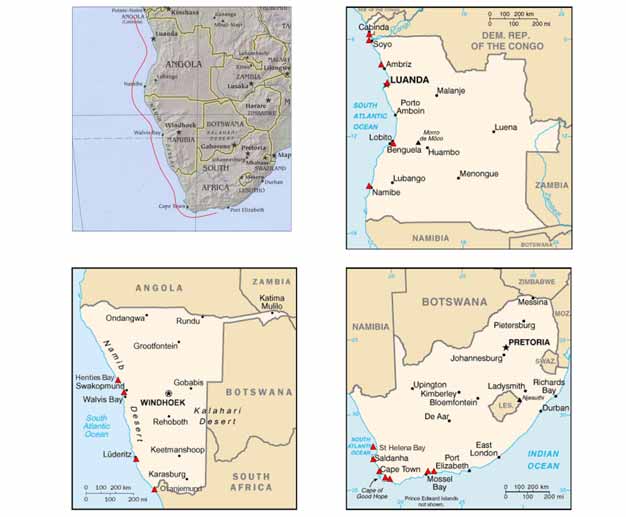
Another key objective of this project was to prepare an inventory and critical assessment on
the available data and information relevant for the management of land-based pollution
sources in the BCLME region. To conduct such desktop assessments in the time and
budgetary constraints of this project, effort was focused on the main development nodes in
the BCLME region. The nodes that were included in the desktop assessment studies are
listed in Table 4.1 (also indicated in Figure 4.1)
TABLE 4.1:
Development nodes selected for the BCLME region
ANGOLA
NAMIBIA
SOUTH AFRICA
Cabinda
Henties Bay
St Helena Bay
Soyo
Walvis Bay/Swakopmund
Saldanha Bay/Langebaan Lagoon
Ambriz
Luderitz
Cape Peninsula (western section)
Luanda
Oranjemund (diamond mining areas)
False Bay
Lobito
Walker Bay (Hermanus)
Namibe
Mossel Bay
Knysna Estuary
Figure 4.1:
Development nodes selected for the BCLME region
BCLME Project BEHP/LBMP/03/01
Page 4-2
Section 4
January 2006
Final
The desktop assessment reports provide inventories on:
· Existing legislation, policies and management strategies related to the management and
control of land-based marine pollution (these are usually set by national or regional
government authorities)
· Known marine pollution sources (particularly focusing on the land-based sources), for
which available and easily accessible estimates on waste loads will also be provided.
· Important marine aquatic ecosystems, as well as the designated beneficial uses of the
marine environment. Beneficial use areas that should be identified are mainly related to:
- Tourism and recreation areas
- Marine aquaculture (including important fisheries)
- Industrial uses of seawater (e.g. for fish processing and cooling water intake)
· Available or published information sources on physical, biogeochemical, and biological
characteristics and functioning of the marine environment adjacent to the development
nodes (relevant to understanding and predicting the transport and fate of pollutants)
· Inventory of existing monitoring initiatives related to the management of land-based
pollution sources.
The desktop assessment studies for South Africa, Namibia and Angola are provided in
Appendices A, B and C, respectively.
The inventories of information, generated as part of the above-mentioned desktop
assessment studies will be captured in the updatable, web-based information system
(another deliverable on this project), accessible to users in the BCLME (temporary web
address: www.wamsys.co.za/bclme).
H
T
U
U
T
H
BCLME Project BEHP/LBMP/03/01
Page 4-3
Section 4
January 2006
Final
SECTION 5.
THE WAY FORWARD
BCLME Project BEHP/LBMP/03/01
Page 5-1
Section 5
January 2006
Final
The primary purpose of this project was to standardize on the approach and methodology
with which land-based pollution sources in the BCLME region are managed. This was
achieved through the preparation of a generic (draft) management framework for the
management of such sources, including protocols for the design of baseline measurements
and long-term monitoring programmes.
It is important to realize that, although it is possible to put forward a generic management
framework for such a large region, the implementation of the management framework will
ultimately be more site-specific.
An important secondary objective of this project was to initiate the establishment of a
BCLME coastal water quality network to provide a legacy of shared experience, awareness
of tools, capabilities and technical support. The establishment of this network was facilitated
through work sessions held in each of the three countries to which key stakeholders were
invited. At the work sessions, the proposed management framework was introduced and
participants were given the opportunity to provide their input. This was followed by training
workshops in each of the three countries, where key stakeholders were given preliminary
training in the application of the management framework. The updatable web-based
information system, which was also developed as part of this project, should be a valuable
tool supporting the BCLME coastal water quality network in future, provided that it is
maintained and updated regularly.
The following points relate to the way forward:
· The proposed framework for the management of land-based marine pollution sources in
the BCLME region is largely based on a framework that was developed for the
Department of Water Affairs and Forestry (South Africa) as part of their Operational
Policy for the Disposal of Land-derived Wastewater to the Marine Environment of South
Africa (RSA DWAF, 2004a&b). However, the proposed framework still needs to be
officially approved and adopted by responsible government authorities in Namibia and
Angola. It may well be that individual countries require further refinement or adjustment
of the management framework to meet requirements specific to their own countries.
· The management framework developed as part of this project is closely link to the
recommended water and sediment quality guidelines for the coastal areas of the
BCLME Project BEHP/LBMP/03/01
Page 5-2
Section 5
January 2006
Final
BCLME region (developed as part of another BCLME project BEHP/LBMP/03/04). In
particular, the guidelines will assist in the initial establishment of environmental quality
objectives.
In the interim, until such time as a management framework and quality guidelines have
been incorporated in official government policy, it is proposed that the management
framework developed as part of this project, together with the recommended water and
sediment quality guidelines (referring to Project BEHP/LBMP/03/04), be applied as
preliminary tools towards improving the management of the water quality in coastal
areas of the BCLME region.
· The updatable web-based information system (temporary web address
www.wamsys.co.za/bclme), developed as part of this project, can also be a very useful
H
T
U
U
T
H
decision-support and educational tool for marine pollution management in the coastal
areas of the BCLME region. However, its usefulness in the future will strongly rely on the
system being maintained and updated regularly. It is therefore important that a
dedicated `administrative home' for the system be provided once this project is
terminated. In the short to medium term, it is recommended that one or more of the
BCLME offices within the three countries take on this responsibility.
· Although training workshops did form part of this project, they targeted only a limited
number of stakeholders in each of the three countries. To facilitate wider capacity
building in the BCLME region on management of marine pollution in coastal areas, it is
strongly recommended that the output of this project be included in a training course.
In this regard, the Train-Sea-Coast/Benguela Course Development Unit is considered
the ideal platform through which to develop and present such training
(www.ioisa.org.za/tsc/index.htm).
H
T
U
U
T
H
BCLME Project BEHP/LBMP/03/01
Page 5-3
Section 5
January 2006
Final
SECTION 6.
REFERENCES
BCLME Project BEHP/LBMP/03/01
Page 6-1
References
January 2006
Final
AUSTRALIA AND NEW ZEALAND ENVIRONMENT AND CONSERVATION COUNCIL
(ANZECC) 2000a - Australian and New Zealand guidelines for fresh and marine water
quality. National Water Quality Management Strategy No 4. Canberra, Australia.
(www.deh.gov.au/water/quality/nwqms/introduction/).
H
T
U
U
T
H
AUSTRALIA AND NEW ZEALAND ENVIRONMENT AND CONSERVATION COUNCIL
(ANZECC) 2000b - Australian guidelines for water quality monitoring and reporting. National
Water Quality Management Strategy No 7. Canberra, Australia.
(www.deh.gov.au/water/quality/nwqms/monitoring.html).
H
T
U
U
T
H
AUSTRALIAN GOVERNMENT 2005 - The Coastal Catchments Initiative. Department of the
Environment and Heritage, Canberra. (www.deh.gov.au/coasts/pollution/cci/).
H
T
U
U
T
H
AUSTRALIA NEW ZEALAND FOOD AUTHORITY (ANZFA) 1996 - Food standards code.
Australian Government Publishing Service, Canberra (including amendments to June 1996)
(www.foodstandards.gov.au/).
H
T
U
U
T
H
BINNIE AND PARTNERS 1983 A survey of water and effluent management in the fish
processing industry of South Africa. Report to the Water Research Commission, South
Africa.
BINNIE AND PARTNERS 1986 - Guide to water and waste-water management in the
pelagic fishing industry. WRC Project No. 97, TT 28/87. 42 pp.
BROWN, R C, PIERSE, R H and RICE, S A 1985 - Hydrocarbon contamination in sediments
from urban stormwater run-off. Mar. Poll. Bull. 16(6): 236-240.
CANADIAN COUNCIL OF MINISTERS OF THE ENVIRONMENT (CCME) 1995 - Protocols
for the derivation of Canadian sediment quality guidelines for the protection of aquatic life.
(www.ec.gc.ca/ceqg-rcqe/English/Ceqg/Sediment/default.cfm).
H
T
U
U
T
H
CANADIAN FOOD INSPECTION AGENCY 2004 - Fish, seafood and production
(www.inspection.gc.ca/english/anima/fispoi/fispoie.shtml).
H
T
U
U
T
H
CANTILLO, A Y 1998 - Comparison of results of mussel watch programmes of the United
States and France with worldwide mussel watch studies. Marine Pollution Bulletin 36(9):
712-717.
BCLME Project BEHP/LBMP/03/01
Page 6-2
References
January 2006
Final
CAPE METROPOLITAN COASTAL WATER QUALITY COMMITTEE. 2003 Annual
Report 2003. Catchment Stormwater and River Management, City of Cape Town, South
Africa.
CLARKE, K R and GREEN, R H 1988 - Statistical design and analysis for a `biological
effects' study. Mar. Ecol. Prog. Ser. 46: 213-226.
COATS, D A 1994 - Deposition of drilling particulates off Point Conception, California.
Marine Environmental Research 37: 95-127.
COUNCIL OF EUROPEAN COMMUNITY (CEC) 1991 - Council Directive of 15 July 1991
laying down the health conditions for the production and the placing on the market of live
bivalve molluscs (91/492/EEC). Published in Official Journal of the European Communities
(//europa.eu.int/comm/food/fs/sfp/mr/mr02_en.pdf)
H
T
U
U
T
H
COUNCIL OF EUROPEAN COMMUNITY (CEC) 2003 - Introduction to the new EU Water
Framework DirectiveHT
(europa.eu.int/comm/environment/water/water-framework/overview.html).
H
U
U
H
CSIR 2001 - Guidelines for human settlement planning and design - The Red Book. CSIR
Report BOU/E2001. Pretoria, South Africa.
CSIR 2003 - Great Brak Estuary Management Programme. Review Report March 2003.
CSIR Report No. ENV-S-C 2003-092. CSIR Environmentek, Stellenbosch, South Africa.
DANISH TECHNOLOGICAL INSTITUTE 2004 Cleaner production in the fishing industry
reducing the environmetnal impact of the South African fish processing industry. Report
produced on behalf of the South African Fishing Industry.
DEVORE, J L and FARNUM, N R 1999 - Applied statistics for engineers and scientists.
Duxbury Press. ISBN 053435601X.
DEPARTMENT OF HEALTH 1973 - Regulations of Marine Foods. Government Notice No
R. 2064 of 2 November 1973. Pretoria, South Africa
DEPARTMENT OF HEALTH 1994 - Regulations related to metals in foodstuffs. Government
No t ice No R. 1518 of 9 September 1994. Pretoria, South Africa.
BCLME Project BEHP/LBMP/03/01
Page 6-3
References
January 2006
Final
FAUST, S D and ALY, A M 1981 - Chemistry of natural waters. Ann Arbor Science
Publishers Inc, Michigan.
GROUP OF EXPERTS ON THE SCIENTIFIC ASPECTS OF MARINE POLLUTION
(GESAMP) 1999 - Updated memorandum of 1994 on the joint Group of Experts on the
Scientific Aspects of Marine Environmental Protection (GESAMP)
(//gesamp.imo.org/gesamp.htm).
H
U
U
H
GREEN, I R A, STEPHENSON, D and LAMBOURNE, J J 1986 - Urban hydrology and
drainage: Stormwater pollution analysis. Report to the Water Research Commission. WRC
Report No. 115/10/86.
HENOCQUE, Y 2001 - Urban communities and environmental management in France: The
example of the Toulon Bay Contract. Ocean & Coastal Management 44: 371-377.
INTERNATIONAL MARITIME ORGANIZATION (IMO) 1977 - The evolution of the
Convention on the Prevention of Marine Pollution by Dumping of Wastes and Other Matter.
KLOPPERS, W S 1989 - Urban stormwater runoff - A water quality study. CSIR Research
Report 685. Stellenbosch, South Africa.
LUGER, S., VAN BALLEGOOYEN R. and MONTEIRO P M S 1999 - A Modelling-driven
environmental baseline assessment for the proposed New Hood Point outfall in East
London: Hydrodynamic and water quality modelling study. CSIR Report ENV-S-C 99109B.
CSIR Environmentek, Stellenbosch, South Africa.
MARTIN 2000 - Sustainable Urban Drainage systems - Design Manual for Scotland and
Northern Ireland. Copies of the manual are available from: http://www.ciria.org.uk/.
H
U
U
H
MILES, LC 1984 - Stormwater drainage for low-income group townships. In: Municipal
engineer July/August. pp 29-39.
MONTEIRO, P M S 1999 - A Modelling-driven environmental baseline assessment for the
proposed new Hood Point outfall in East London: Sediment biogeochemistry baseline study.
CSIR Report ENV-S-C 99109C. CSIR Environmentek, Stellenbosch, South Africa.
BCLME Project BEHP/LBMP/03/01
Page 6-4
References
January 2006
Final
MONTEIRO, P M S, PASCALL, A and BROWN, S 1999 - The biogeochemical status quo of
sediments in Saldanha Bay in 1999. CSIR Report ENV-S-C 99093A. CSIR Environmentek,
Stellenbosch, South Africa.
MONTEIRO, P M S and SCOTT, D 2000 - Sediment assessment programme for the Port of
Cape Town: 2000. CSIR Report ENV-S-C-117. CSIR, Environmentek, Stellenbosch,
South Africa.
MONTEIRO, P M S and KEMP, A 2004 - Water quality Management Plan for Saldanha
Bay. Phase III: Setting of critical loads using a modelling-based ecosystem approach.
CSIR Report ENV-C-S 2004-083. CSIR Environmentek, Stellenbosch, South Africa.
NATIONAL RESEARCH COUNCIL 1990 - Managing troubled waters: The role of
environmental monitoring. National Academy of Sciences. Marine Board. Committee on a
Systems Assessment of Marine Environmental Monitoring. National Academy Press,
Washington DC. (www.nap.edu/catalog/1439.html).
H
U
U
H
NEFF, JR 1979 - Polycyclic aromatic hydrocarbons in the aquatic environment. Applied
Scientific Publishers Ltd, London.
NEW ZEALAND WATER ENVIRONMENT RESEARCH FOUNDATION (NZWERF) 2002 -
New Zealand Municipal wastewater monitoring guidelines. Ray, D (Ed.) New Zealand
Water Environment Foundation, Wellington. ISBN 1-877134-40-6.
(www.mfe.govt.nz/publications/waste/wastewater-monitoring-oct02.html).
H
U
U
H
PATIN, S 2004 Anthropogenic impact in the sea and marine pollution (www.offshore-
H
U
environment.com/anthropogenicimpact.html).
U
H
PEGRAM, G C and GöRGENS, AHM 2001 - A guide to non-point source assessment.
Water Research Commission Report No. TT 142/01. Pretoria.
REPUBLIC OF SOUTH AFRICA DEPARTMENT OF WATER AFFAIRS AND FORESTRY
(RSA DWAF) 1991 - Water quality management policies and strategies in the RSA.
Pretoria, South Africa.
BCLME Project BEHP/LBMP/03/01
Page 6-5
References
January 2006
Final
REPUBLIC OF SOUTH AFRICA DEPARTMENT OF WATER AFFAIRS AND FORESTRY
(RSA DWAF) 1995a - South African Water Quality Management Series. Procedures to
assess effluent discharge impacts. First Edition. Water Research Commission Report TT
64/94. Pretoria, South Africa.
REPUBLIC OF SOUTH AFRICA DEPARTMENT OF WATER AFFAIRS AND FORESTRY
(RSA DWAF) 1995b - South African water quality guidelines for coastal marine waters.
Volume 1. Natural Environment. Volume 2. Recreation. Volume 3. Industrial use. Volume
4. Mariculture. Pretoria.
REPUBLIC OF SOUTH AFRICA DEPARTMENT OF WATER AFFAIRS AND FORESTRY
(RSA DWAF) 1999a - A framework for implementing non-point source management under
the National Water Act. DWAF Report No. WQP 0.1. Water Research Commission Report
No. TT 115/99. Pretoria, South Africa.
REPUBLIC OF SOUTH AFRICA DEPARTMENT OF WATER AFFAIRS AND FORESTRY
(RSA DWAF) 1999b - Managing the water quality effects of settlements (Edition 1). The
national strategy (Policy document U 1.1), Guidelines for implementation (Operational
guideline U 1.2), A guide to problem analysis (Operational guideline U 1.3), Information
booklet to support community efforts to minimise water pollution from their settlements -
Working towards a clean and healthy community (www.dwaf.gov.za/Documents/)
H
U
U
H
REPUBLIC OF SOUTH AFRICA DEPARTMENT OF WATER AFFAIRS AND FORESTRY
(RSA DWAF) 2002 - Managing the water quality effects of settlements. Directorate Water
Quality Management Pretoria.
REPUBLIC OF SOUTH AFRICA DEPARTMENT OF WATER AFFAIRS AND FORESTRY
(RSA DWAF) 2004a - Water Quality Management Series Sub-Series No. MS 13.2.
Operational policy for the disposal of land-derived water containing waste to the marine
environment of South Africa. Edition 1. Pretoria (www.dwaf.gov.za/Documents).
H
U
U
H
REPUBLIC OF SOUTH AFRICA DEPARTMENT OF WATER AFFAIRS AND FORESTRY
(RSA DWAF) 2004b - Water Quality Management Series Sub-Series No. MS 13.3.
Operational policy for the disposal of land-derived water containing waste to the marine
environment of South Africa Guidance on Implementation. Edition 1. Pretoria
(www.dwaf.gov.za/Documents).
H
U
U
H
BCLME Project BEHP/LBMP/03/01
Page 6-6
References
January 2006
Final
RUDOLFS W (Ed.) 1953 - Industrial wastes: Their disposal and treatment. Reinhold
Publishing Corporation, New York, USA.
SALDANHA BAY WATER QUALITY FORUM TRUST 2004 - Bay Watch, the publication of
the Trust. September 2004.
SCOTTISH ENVIRONMENTAL PROTECTION AGENCY (SEPA) 2001 - Regulations of
Urban Drainage (Policy No. 15 [Version 2]). SEPA ENV12-E01/Policy
(www.sepa.org.uk/policies/index.htm).
H
U
U
H
SIMPSON, DE 1986 - A study of run-off pollution from an urban catchment. M.Sc.(Ing)
Thesis, Department of Civil Engineering, University of Natal. 188 pp.
SKIBBE, E 1991 - Impact assessment of the sewage effluent at Zeekoevlei, False Bay.
Transactions of the Royal Society of South Africa 47 (4/5): 717-730.
SKIBBE, E 1992 - Pollution assessment of several beaches along the South-Western Cape
Coast. CSIR Research Report 702. CSIR Environmentek, Stellenbosch, South Africa.
SOLOMONS, W and FöRSTNER, U 1984 - Metals in the hydrocycle. Springer-Verlag
Berlin. .
SPIEGEL, M R 1972 - Theory and problems of statistics. Schaum's Outline Series. McGraw-
Hill Book Company.
STUMM, W and MORGAN, J J 1970 - Aquatic chemistry: An introduction emphasising
chemical equilibria in natural waters. Wiley-Interscience, New York.
SWANN, J M, NEFF, J M and YOUNG, P C (Eds.) 1994 - Environmental implications of
offshore oil and gas development in Australia. Australian Petroleum Exploration Association
Limited, Sydney, Australia.
TALJAARD, S and ROSSOUW, M 1999 - Environmental Impact Assessment for the
commercialisation of the SFF Milnerton Tank Farm. Specialist study S6: Marine Water
Quality. CSIR Report ENV-S-C 99038. CSIR Environmentek, Stellenbosch, South Africa.
BCLME Project BEHP/LBMP/03/01
Page 6-7
References
January 2006
Final
TALJAARD, S, VAN BALLEGOOYEN, RC and MORANT, PD 2000 - False Bay Water
Quality Review. Volume 2: Specialist Assessments and Inventories of Available Literature
and Data. Report to the False Bay Water Quality Advisory Committee. CSIR Report ENV-
S-C 2000-086/2. CSIR Environmentek, Stellenbosch, South Africa.
TALJAARD, S and MONTEIRO, PMS 2002 - Saldanha Bay marine water quality
management plan. Phase I: Situation Assessment. Report to the Saldanha Bay Water
Quality Forum Trust. CSIR Report ENV-S-C 2002-115/1. CSIR Environmentek,
Stellenbosch, South Africa.
UNITED NATIONS ENVIRONMENTAL PROGRAMME (UNEP) 1982 - Waste discharge into
the marine environment: Principles and guidelines for the Mediterranean action plan.
Published under the joint sponsorship of the World Health Organisation and the United
Nations Environment Programme. Pergamon Press.
UNITED NATIONS EDUCATIONAL, SCIENTIFIC AND CULTURAL ORGANIZATION,
WORLD HEALTH ORGANISATION & UNITED NATIONS ENVIRONMENTAL
PROGRAMME (UNESO/WHO/UNEP) 1992 - Water Quality Assessments - A Guide to Use
of Biota, Sediments and Water in Environmental Monitoring. Second Edition.
(www.who.int/docstore/water_sanitation_health/wqassess/begin.htm#Contents)
H
U
U
H
UNITED STATES ENVIRONMENTAL PROTECTION AGENCY (US-EPA) 1994 - Amended
Section 301(h) Technical support document. EPA842-B-94-007. Office of Water
(www.epa.gov/owow/oceans/regulatory/sec301tech/).
H
U
U
H
UNITED STATES ENVIRONMENTAL PROTECTION AGENCY (US-EPA) 2002 - Statistical
primer. www.epa.gov/bioindicators/primer/.
H
U
U
H
UNITED STATES ENVIRONMENTAL PROTECTION AGENCY (US-EPA) 2003 - Elements
of a State water monitoring and assessment program. Assessment and Watershed
Protection Division. Office of Wetlands, Oceans and Watershed. United States
Environmental Protection Agency. EPA 841-B-03-003
(www.epa.gov/owow/monitoring/repguid.html)
H
U
U
H
UNITED STATES ENVIRONMENTAL PROTECTION AGENCY (US-EPA) 2004 Air
pollution and water quality (www.epa.gov/owow/oceans/airdep/index.html).
H
U
U
H
BCLME Project BEHP/LBMP/03/01
Page 6-8
References
January 2006
Final
UNITED STATES FOOD AND DRUG ADMINISTRATION (FDA) 2004 - Seafood Information
and Resources (vm.cfsan.fda.gov/seafood1.html).
H
U
U
H
UNITED STATES FOOD AND DRUG ADMINISTRATION (FDA) 2003 - National Shellfish
Sanitation Program Model Ordinance. 2003 Revision. U.S. Department of Health and
Human Services (www.cfsan.fda.gov/~ear/nss2-toc.html).
H
U
U
H
UNITED STATES, LOS ANGELES COUNTY 1996 - Order for Waste Discharge
Requirements for Municipal Stormwater and Urban Run-off Discharges within the County of
Los Angeles (http://lacounty.info/environment.htm).
H
U
U
H
UNITED STATES, VIRGINIA, CITY OF NORFOLK 2004 - Stormwater fees
(www.norfolk.gov/publicworks/stormwater.asp#fees).
H
U
U
H
VAN WYK CF 2001 - Die Saldanha Baai Water Gehalte Forum Trust: 'n instrument vir
beplande geintegreerde monitering en bestuur van water gehalte. MSc Thesis, University of
Stellenbosch, South Africa.
WARD T J and JACOBY CA 1992 - A strategy for assessment and management of marine
ecosystems: Baseline and monitoring studies in Jervis Bay, a temperate Australian
embayment. Marine Pollution Bulletin 25: 163171.
WATER RESEARCH CENTRE (WRc) 1990 - Design guide for marine treatment schemes.
Volume I: Introduction, Volume II: Environmental design and data collection, Volume III:
Materials, construction and structural design, and Volume IV: Operations and maintenance
and cost functions. Report No. UM 1009. Swindon, UK.
WORLD HEALTH ORGANISATION (WHO) 1982 - Waste discharge into the marine
environment: Principles and guidelines for the Mediterranean Action Plan. Published under
the joint sponsorship of the World Health Organisation and the United Nations Environment
Programme. Pergamon Press, Oxford.
BCLME Project BEHP/LBMP/03/01
Page 6-9
References
January 2006
Final
Document Outline