UNDP/GEF Danube Regional Project
Strengthening the Implementation Capacities for Nutrient
Reduction and Transboundary Cooperation in the Danube River
Basin
Workshop on Developing Pilot Projects for
the Promotion of Best Agricultural Practice
in the Danube River Basin
Project Output 1.3:
Pilot Projects on Agricultural Pollution Reduction
19 20 January 2004, Bucharest, Romania
GFA Terra Systems
in co-operation with Avalon
Contents
Introduction to the Workshop.................................................................................................................. 1
Workshop Objectives and Approach ................................................................................................... 1
Conclusions from Preceding Workshop in Zagreb (October 2003) .................................................... 2
Summary of Workshop Presentations ..................................................................................................... 4
Introduction to the Concept of Using Pilot Projects for the Promotion of BAP.................................. 4
Agricultural Management Systems in the Floodplains of the River Leine.......................................... 5
Previous Experiences with Pilot Projects in the Danube River Basin ................................................. 6
Best Agricultural Practice and Extension Services in Romania .......................................................... 7
Presentation of Proposed BAP Pilot Projects ...................................................................................... 7
Workshop Results.................................................................................................................................... 8
Discussion and Agreement of Selection Criteria ................................................................................. 8
Preliminary BAP Pilot Project Proposals - Consolidated Matrix ........................................................ 9
Refining Project Proposals ................................................................................................................ 10
Conclusions and Recommendations from Workshop ........................................................................... 13
Annex 1: Final Workshop Programme................................................................................................. 14
Annex 2: LANDCARE Pilot Project (case study from the UK) .......................................................... 16
Annex 3: Workshop Evaluation ........................................................................................................... 22
Annex 4: List of Workshop Participants .............................................................................................. 23
Acknowledgements
The organisers are very grateful for the generous support of the Romanian Academy of Agricultural
and Forestry Sciences in providing the location and facilities for the workshop, and especially for the
kind assistance of Dr Cristian Kleps
Workshop "Developing Pilot Projects for the Promotion of Best Agricultural Practice in the Danube River Basin" 1
Introduction to the Workshop
This 2 day workshop was organised within the framework of Output 1.3 of the UNDP/GEF Danube
Regional Project (DRP). The specific aim of Output 1.3 is the "development of pilot projects on
reduction of nutrients and other harmful substances from agricultural point and non-point sources".
This is closely linked to Output 1.2, which aims to promote the "reduction of nutrients and other
harmful substances from agricultural point source and non-point sources through agricultural policy
changes". Both outputs have therefore been undertaken by the same consortium - GFA Terra Systems
(Germany) in co-operation with Avalon (Netherlands).
The GFA Terra Systems/Avalon consultancy team consists of 6 international consultants and a
network of 35 national experts in the 11 central and lower DRB countries eligible for UNDP/GEF
assistance. The main focus of their work during the first phase of Output 1.3 was the identification
and preparation of potential pilot projects for demonstrating at catchment level various aspects of the
general concept of Best Agricultural Practice (BAP) developed in Output 1.2.
Selected pilot projects will be implemented in Phase 2 of the Danube Regional Project during the
period 2004 2006. The 7 priority countries of the central and lower DRB that will be eligible for
pilot project activities are:
· EU Pre-accession Countries (accession after 2004) - Romania, Bulgaria and Croatia (currently
preparing its application for EU membership)
· EU Non-accession Countries - Bosnia & Herzegovina (including Republica Srpska), Serbia and
Montenegro, Moldova and Ukraine
This workshop was a key activity in the development of BAP pilot project proposals. It brought
together agricultural and environmental policy-makers, representatives of agricultural extension
services and environmental NGOs from the 7 priority countries, together with the GFA national
experts and consultants, to participate in the discussion and elaboration of pilot projects.
Workshop Objectives and Approach
The final workshop programme is in Annex 1. The specific objectives of the workshop were to:
· Raise awareness of the potential role of pilot projects and extension services in promoting the
reduction of agricultural pollution in the DRB (priority countries)
· Define the function of pilot projects as a "tool" for a) building the capacity of extension services
and b) supporting policy reform for agricultural pollution control
· Discuss and agree on clear selection criteria for pilot projects
· Present outlines of the proposed BAP pilot projects for review and discussion
· Refine proposed pilot projects.
The workshop was structured to balance a number of presentations from keynote speakers and
consultants with the opportunity for discussion and feedback at a national level. There was one
"break-out" session during which the national representatives were divided into 2 working groups
according to geographical location as follows:
· Break-out Group 1: Bulgaria, Moldova, Romania and Ukraine
· Break-out Group 2: Bosnia & Herzegovina (including Republica Srpska), Croatia and Serbia &
Montenegro
The purpose of the "break-out" session was to consolidate and refine a series of pilot project proposals
presented to the workshop by the GFA national experts, including discussions and agreement of:
· Pilot areas
· Changes in management practice to promote
· Direct beneficiaries (advisory)
· Related actors (project implementation)
· National activities (capacity building/advisory)
· Trans-boundary activities (dissemination etc.).
Workshop "Developing Pilot Projects for the Promotion of Best Agricultural Practice in the Danube River Basin" 2
Conclusions from Preceding Workshop in Zagreb (October 2003)
The concept of Best Agricultural Practice (BAP) was introduced and discussed at a previous workshop
organised by the GFA Terra Systems/Avalon consultancy team in Zagreb in October 2003.
The conclusions from the Zagreb workshop were briefly introduced again in Bucharest, including the
definition of GFP as "...the highest level of pollution control practice that any farmer can reasonably
be expected to adopt when working within their own national, regional and/or local context in the
Danube River Basin" and the associated hierarchy of BAP (see example of BAP for manure
application below).
It was stressed again that BAP is not a fixed or prescriptive concept, but provides a framework for
understanding that the level of pollution control/environmental management that we can reasonably
expect from farmers in different DRB countries will vary according to:
· Agronomic, environmental and socio-economic context
· Available know-how and technology etc. to support farmers to adopt higher levels of BAP
· Available policy instruments/tools to "push/pull" farmers up to higher levels of BAP including
regulatory, economic and informative/advisory policy instruments.
Finally the conclusions of the Zagreb workshop were repeated as follows:
· The concept of BAP must be flexible and adaptable to address the considerable diversity of the
DRB countries
· The concept is appropriate is appropriate to the DRB, but requires further development and
elaboration
· It is important to consider the pre-conditions for BAP consolidation of land ownership, greater
co-operation between farmers, increased institutional capacity and policy-making experience
Workshop "Developing Pilot Projects for the Promotion of Best Agricultural Practice in the Danube River Basin" 3
· There remains a significant lack of information on the causes of agricultural pollution in the
DRB and the practical measures for farmers to reduce the risk of pollution
· It is necessary to target awareness-raising and information at all stakeholders levels from farmers
to policy-makers
· The promotion of BAP must be linked to economic benefits for the farmer such as improvements
in yield and savings in the cost of agrochemical inputs
· There should be more emphasis upon a "farming systems" approach to agricultural pollution
control rather than simply an "input reduction" approach
Workshop "Developing Pilot Projects for the Promotion of Best Agricultural Practice in the Danube River Basin" 4
Summary of Workshop Presentations
Introduction to the Concept of Using Pilot Projects for the Promotion of BAP
Dr Mark Redman, GFA Terra Systems, Hamburg
Within Output 1.3 of the Danube Regional Project (DRP), seven countries of the central and lower
DRB region (the EU Pre-accession Countries Romania, Bulgaria and Croatia; the EU Non-accession
Countries - Bosnia & Herzegovina including Republica Srpska, Serbia and Montenegro, Moldova and
Ukraine) have been identified as a priority for the development and implementation of pilot projects to
promote the concept of Best Agricultural Practice.
The pilot projects will be implemented in Phase 2 of the DRP (2004 2006) and it is anticipated that
they will involve, for example:
· 3 months preparation
· 18-24 months implementation
· 3-6 months evaluation and dissemination.
The direct beneficiaries of the pilot projects will be the agricultural advisers/extension services in the
priority DRB countries.
The specific objective of the pilot projects is to "demonstrate how improvements can be made in the
capacity/effectiveness of agricultural advisers/extension services to provide appropriate information
and advice that supports the highest level of pollution control practice by farmers according to local
context". The potential impact of improving the effectiveness of agricultural advisers/extension
services in the central and lower DRB countries is:
a) raised
awareness amongst farmers of pollution risks
b) increased avoidance of bad practice including improved compliance with relevant legislation
c) increased
adoption of good practice including utilisation of economic incentives
Most advisory services are traditionally concerned with agronomic advice and it was stressed that
providing information and advice to farmers on the environmental impact of their farming activities is
a notoriously difficult issue. Consequently, all advice/information provided for farmers must be
communicated effectively in terms of content, format and delivery. Where possible, environmental
messages about the need for reducing agricultural pollution should also appeal to the "self-interest" of
farmers i.e. improved income/profit.
There is also much potential for the development of more innovative approaches to working with
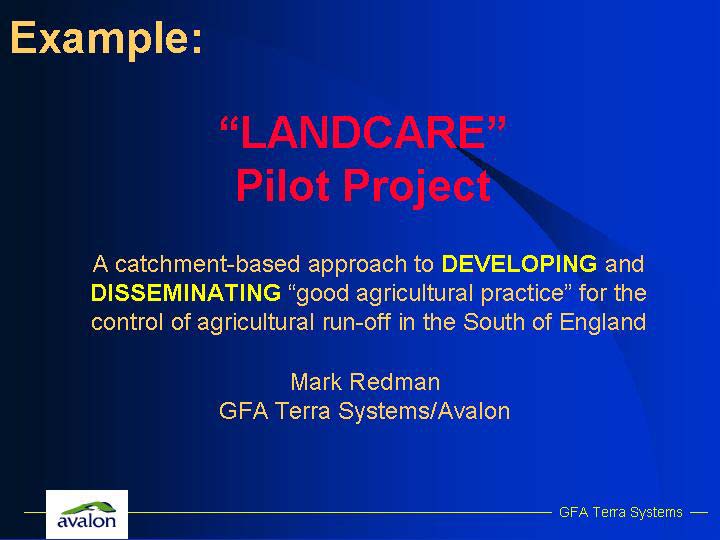
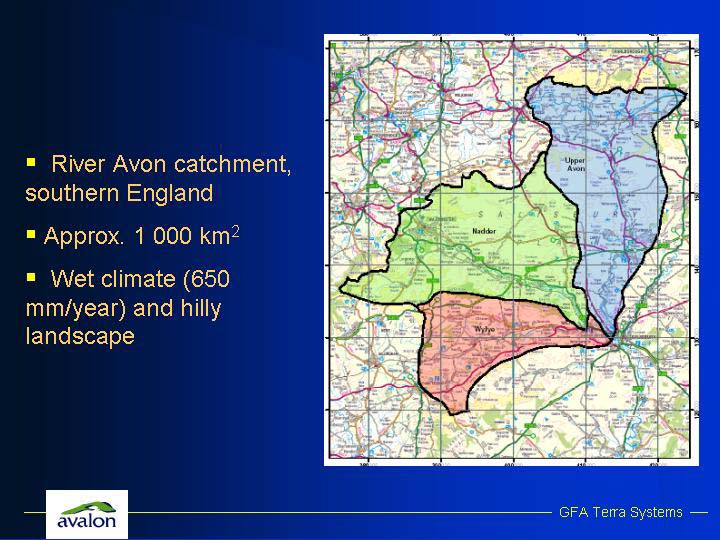
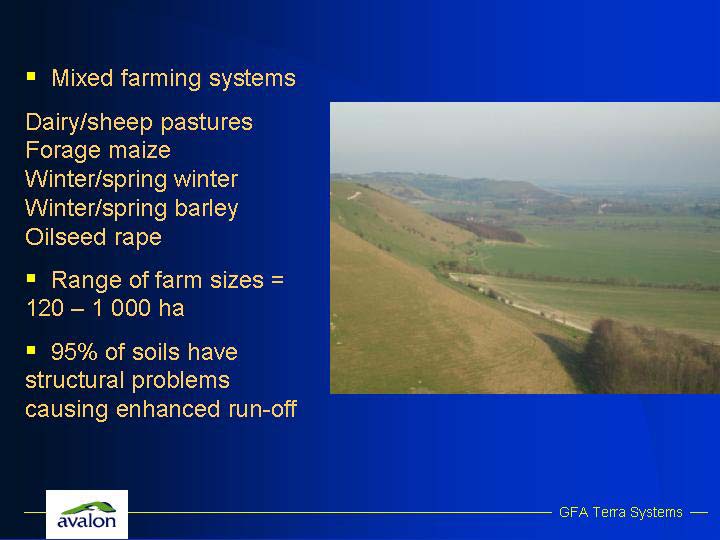
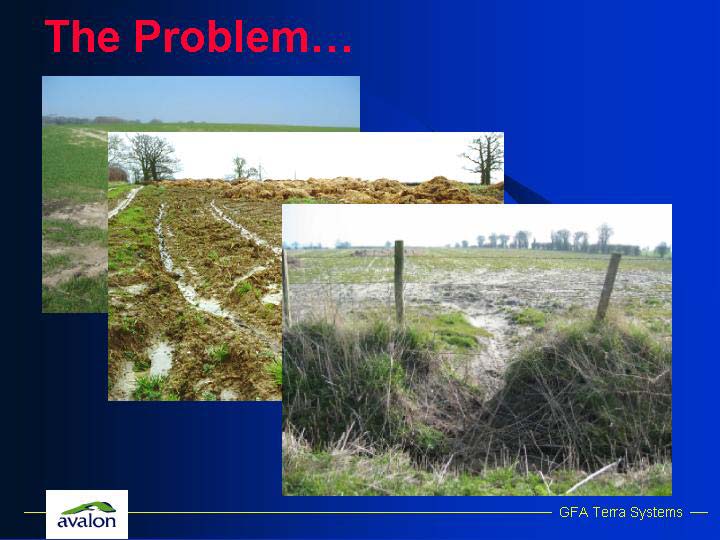
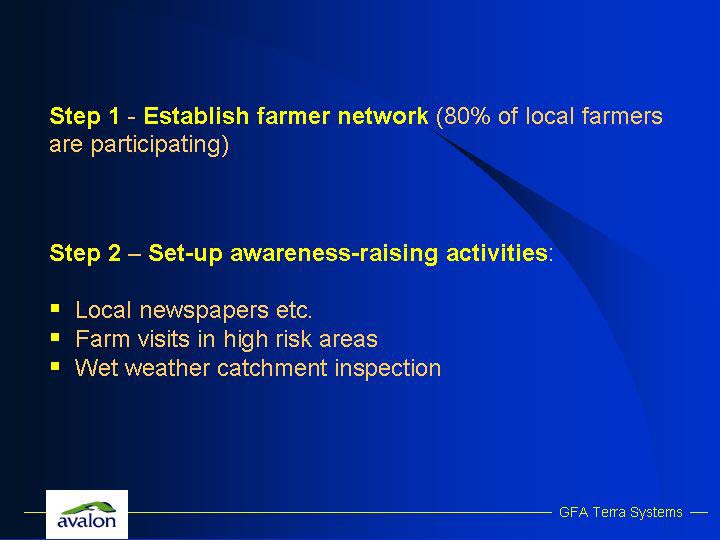
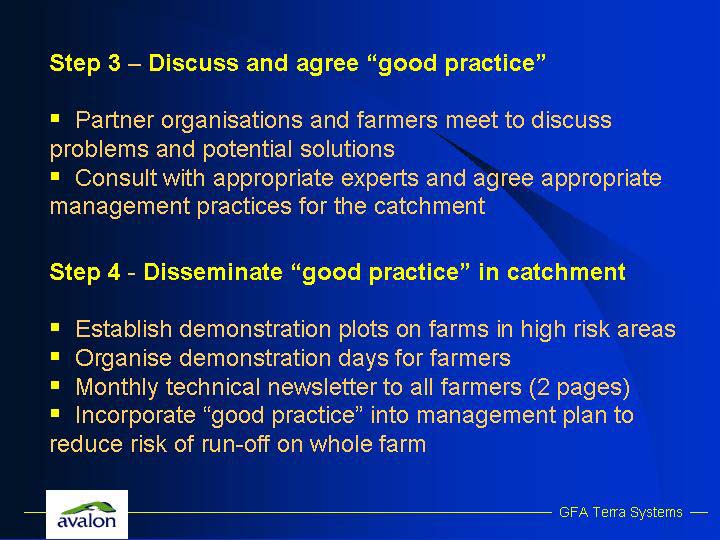
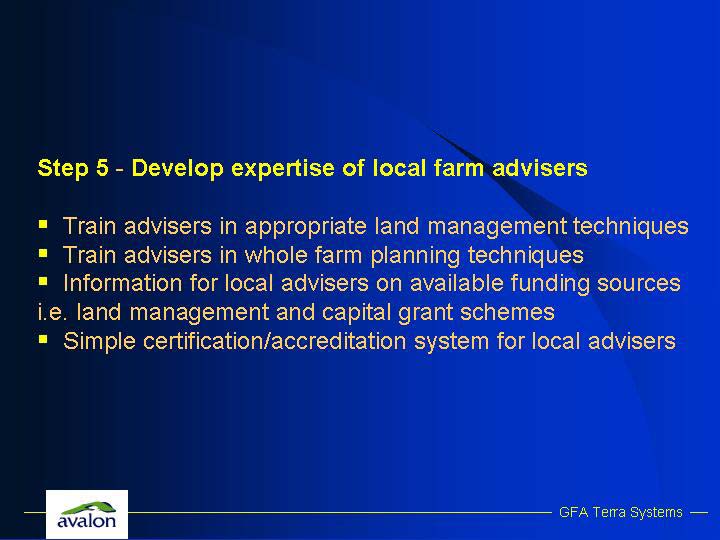
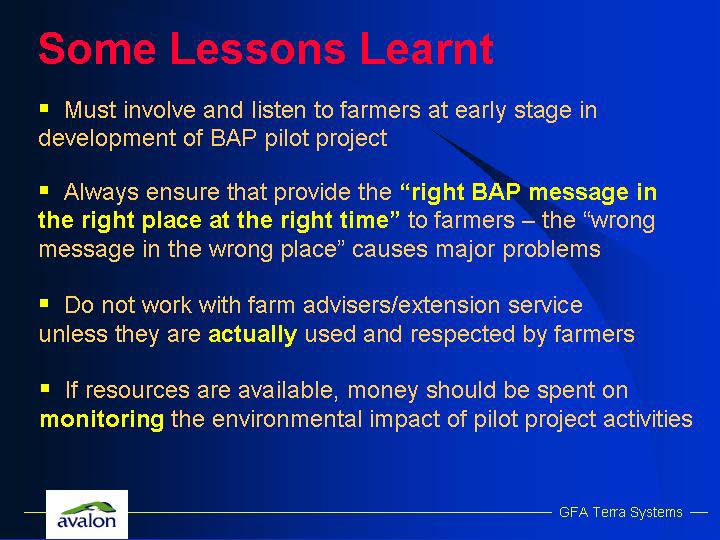
farmers in areas of high pollution risk. To illustrate these points, a case study from the UK was
presented (see Annex 2 LANDCARE Pilot Project).
Preliminary criteria for the selection of BAP pilot projects were also presented to the workshop for
discussion these were:
1. Clearly defined activities targeted at capacity building/activation of providers of advice to farmers
2. Limited to a specific geographical region and/or priority agricultural pollution issue - fertilisers,
pesticides, manure handling or agricultural run-off
3. "Experimental" for example:
· "Testing the introduction of new principles and practices"
· "Incubating/developing new and innovative approaches"
4. Good potential for replication at regional, national or international level
5. Responds to the comparative need of different countries
6. Includes transboundary co-operation where this is appropriate to specific pollution issues within
specific catchments
7. Management practices that are promoted have good potential for reducing the risk of water
pollution
8. Promotes co-operation with existing international and bilateral donors where appropriate
Workshop "Developing Pilot Projects for the Promotion of Best Agricultural Practice in the Danube River Basin" 5
9. Reinforcement of other existing interventions by the UNDP/GEF Danube Regional Project
10. Includes effective participation of relevant NGOs (environmental, producer groups, community-
based etc.) where appropriate.
See the results and conclusions of the discussion about these selection criteria under "Workshop
Results".
Agricultural Management Systems in the Floodplains of the River Leine
Dr. Josef Strotdrees, Chamber of Agriculture, Province of Lower Saxony, Germany
Preface
The agricultural development of the Leine (rural district of Hildesheim and southern part of the rural
district of Hannover, Lower Saxony, Germany) is part of a waters development plan. Binding
legislature under which the plan falls is the EU-Water Framework Directive and the National Soil
Protection Law.
Situation
The Leine is a river in Thuringhia and Lower Saxony, Germany and a tributary of the Aller river,
which belongs to the Weser river basin. The Leine is 241 km in length and has no dikes. Its basin
contains 6,526 km².
Where the Leine is coming out from the middle mountains into the lowlands of northern Germany, the
floodplains become wide. This changing part from the lower mountains to the flat areas was subject of
performing a river development plan.
A high water level in the Leine will be reached after heavy rainfalls and during snowmelt in the
middle mountains. According to weather records from several decades this can be expected mostly
between the middle of October and the middle of March.
In the floodplains of the discussed area around 70 % of the land is farmland (51 % arable land, 19 %
meadows). The rest of 30 % are bodies of standing waters (11%), settlement areas (5%), forests (3%)
and others. The nitrogen level in the water of the Leine ranges between 5 7 mg NO3-N. The critical
value is 2,5 mg NO3-N.
The structural grade is a parameter to define the quality and suitability of the living area for typical
plants and animals in waters in the river and their side ranges. The Leine has no section which is
unchanged or little unchanged. Moderately changed are 9 % of the river stretch, the rest of the river is
more than moderately changed.
The soil grade for farmland is very high in the floodplains. The drainage of water-influenced soils is
mostly well organized. Due to this situation the soils were historically mostly used as arable land. The
standard crop rotation in this region is sugar beet, followed by winter wheat, followed by winter
wheat. For all crops the farmers usually prepare the soil by deep tillage. Livestock farming is receding
due to higher milk-yields per cow and a reduced number of dairy farms.
Aims
In the future, agriculture will be based on a more liberal trading system. Subsidies will more and more
decrease. By consequence the best agricultural practice has to be developed on self-supporting
systems.
The regional development concept consists of the different subjects like farming, water management,
nature protection and different uses (recreation, fishery, construction industry). The waters
development plan was created as a public participation process. Before discussing problems in detail,
the mediators focussed the working groups on a basic consent. This included the ecological
connectivity along the river, buffer strips, best practice in landscape use and best practice in arable
land use. The latter includes stopping soil erosion in floodplains.
Indicators
By now, the most discussed alternative to stop soil erosion is to set up meadows. An economical
review shows that the change in the production system from the actual crop rotation towards using
farmland by meadows would extremely decrease the income per hectare. During discussions the local
Workshop "Developing Pilot Projects for the Promotion of Best Agricultural Practice in the Danube River Basin" 6
agricultural working groups are looking for other farming systems. Up to now one result is to apply a
crop between harvesting winter wheat in the summer and seeding the sugar beet in spring. Living
plants in the wintertime on the farmland prevent erosion during high water levels.
Another result of the discussion is to harvest sugar beet early enough to apply winter wheat with well
developed plants before a possible flood is coming. In this way the leaves of winter wheat stop soil
erosion. The economic calculation shows that the reduction in income due to this agricultural strategy
are not so severe than after changing to meadows. The farmers can grow what they want on their fields
but they need to know how they can grow without damaging the environment. The explained
management is a possibility to keep naturally highly productive soils under agricultural cultivation.
Action
To implement the best agricultural practice in floodplains, several conditions should be considered. At
first it will be useful to have a discussion with farmers about what is best agricultural practice. A
mediator or advisor could help to set up and lead the discussion process. Volunteer agreements like
supporting reduced tillage systems through the EU-CAP are useful. Development funds to buy out
farmland or a field clearing can help to develop nature protection in areas with no interest in
agriculture. An important project could be a change in the farm business. Sometimes a combination
between farming and tourism could be a profitable alternative.
It is more important to guide farmers in developing their own decisions than to use only the
point of facts from the advisor.
For developing a farm advisory concept, a system of model farms (multiplication) and a super and / or
special advisor is useful.
Previous Experiences with Pilot Projects in the Danube River Basin
Martien Lankester, Avalon Foundation, Netherlands
The information provided in the presentation was based on experiences of a project carried out by
Avalon and partners in the period 1995-1999. This project (part of the Environmental Programme for
the Danube River Basin) was implemented in three countries: Hungary, Romania and Bulgaria. Aim
was to establish Demonstration Centres each combining:
1) Demo farm (DF) for sustainable farming, training and marketing, demonstrate organic agriculture
(OA) and low input sustainable agriculture (LISA)
2) Research and education centre (REC) (research, collect and disseminate information, prepare
strategy recommendations)
3) Regional study on economic and environmental performance.
Lessons learned were (in the field of):
1) Aim: set realistic aims and objectives, don't be too ambitious (better take small steps);
2) Activities: identifiable for farmers; fit to local/regional circumstances; preferably have a
multidisciplinary appeal;
3) Selection: build on existing experience; suitable location;
4) Organization: be transparent; commercially-oriented; select committed farmers; form local
advisory groups
5) Stakeholder involvement: examples of stakeholders participating are farmer unions, agricultural
advisory services, environmentalists, nature conservationists, processing industry, consumers
6) Technical Assistance: include both technical aspects (farming, agri-environment, processing, and
marketing) and organisational aspects (institution building, communication, financial
administration and project management). Preference for local expertise (by training trainers)!!
7) Results: clear language; professional outlook; good translation; arousing discussion (among local
stakeholders); multimedia (to reach more target groups)
8) Sustainability: Sound business plan is more important than international funding; show internal
sustainability based on production, extra funding for extra activities.
Workshop "Developing Pilot Projects for the Promotion of Best Agricultural Practice in the Danube River Basin" 7
Effects of projects are positively influenced by:
1) Local ownership
2) Broad stakeholder dissemination
3) Special events (conferences, fairs, etc.)
Be aware of the quality of the process, it is of equal importance like the technical achievements.
Communication is a key issue!
Best Agricultural Practice and Extension Services in Romania
Dr. Cristian Kleps, GFA Terra System, Romania
Main ideas of the presentation:
· Over 90% of the Romanian inland rivers are in the Danube River Basin;
· The importance of agriculture in the Romanian land cover (62% is agricultural land from the total
country surface of 23.839 million ha);
· Diversity of the agro-ecological zones; natural and anthropogenic causes of soil degradation
(including types of soil degradation);
· A decreasing trend in the use of pesticides and fertilizers since 1990; some pollution problems of
the groundwater by nitrates in Oltenia region (sandy soils);
· Finalization by researchers and distribution of the "Code of good agricultural practices", a book
for professional working on agri-environment issues;
· The diversity of users in the frame of the Romanian Agricultural Knowledge Information System
(AKIS), and the need of their education on agri-environmental issues, using target groups and
different means of result dissemination;
· The good experience of the A.A.F.S. research-development institutes in specific technologies for
the control of agricultural run-off and manure management;
· The main points of the Romanian pilot project proposals entitled: "Vocational guidance in
environmental issues for local county agricultural advisers";
· Establishment of locations and technical data for new joint project proposals using the new
ICPDR selection criteria: (1) Communal manure management in the Danube River Flood Plains
(in cooperation with Bulgaria), and (2) Reduced nutrient pollution by control of agricultural run-of
(in cooperation with Moldova).
Presentation of Proposed BAP Pilot Projects
Proposed BAP pilot projects for each of the priority DRB countries were presented (10 min each) by
the GFA national experts and/or the representatives of national partner organizations as follows:
· Ukraine Natalia Pogozheva
· Moldova Corneliu Eftodi
· Romania Christian Kleps
· Bulgaria Stela Valchovska
· Serbia & Montenegro Vlade Zaric
· Bosnia & Herzegovina / Republic Srpska Hamid Custovic/Mihajlo Markovic
· Croatia Ramona Franic
Workshop "Developing Pilot Projects for the Promotion of Best Agricultural Practice in the Danube River Basin" 8
Workshop Results
Discussion and Agreement of Selection Criteria
Facilitator: Dr Mark Redman, GFA Terra Systems, Hamburg
The preliminary criteria for the selection of BAP pilot projects that were presented to the workshop
were discussed extensively. It was proposed to develop them under three headings pre-requisites (i.e.
essential characteristics of a pilot project), selection criteria and guiding principles for the design of
pilot projects.
Pre-Requisites
1. There must be a counterpart organisation prepared to accept co-responsibility for project
implementation
2. The counterpart organisation must have experience as a "service provider" of agricultural advice
and be acceptable/credible to the agricultural community
3. The pilot project activities must be compatible with the policy recommendation under the UNDP
DRP Output 1.2
4. The pilot project proposal should be considered favourably by the relevant national government(s)
Selection Criteria
1. The pilot project should include clearly defined activities targeted at capacity building/ activation
of providers of advice to farmers
2. The pilot project should be limited to a specific geographical region and/or priority agricultural
pollution issue - fertilisers, pesticides, manure handling or agricultural run-off
3. There should be good potential for replication of pilot activities at regional, national and/or
international level
4. Pilot projects should respond to the comparative need of different countries
5. The management practices that are proposed must have good potential for reducing the risk of
water pollution
6. There should be an appropriate national policy environment for implementation of the pilot project
7. The development of the proposed pilot project activities should be participatory (bottom-up!)
8. The pilot project must be suitable for evaluation with clearly defined objectives that can be
monitored and evaluated within the available timeframe (2004-2006).
Guiding Principles
1. Where possible, pilot projects should be of an "experimental" nature for example:
· "Testing the introduction of new principles and practices"
· "Incubating/developing new and innovative approaches"
2. Pilot projects should promote co-operation with existing international and bilateral donors where
appropriate
3. Pilot projects should reinforce other existing interventions by UNDP/GEF Danube Regional
Project where appropriate
4. Pilot projects should include trans-boundary co-operation where this is appropriate to specific
pollution issues within specific regions
5. Pilot projects should include effective participation of all stakeholders, including relevant NGOs
where appropriate
6. Pilot projects should ideally add value where possible in a broader rural development context.
Workshop "Developing Pilot Projects for the Promotion of Best Agricultural Practice in the Danube
River
Basin"
9
Preliminary BAP Pilot Project Proposals - Consolidated Matrix
Initial application of the pre-requisites, selection criteria and guiding principles to the pilot projects proposed by the GFA national experts and/or the representatives of national
partner organizations led to the following 6 consolidated project proposals of which 4 proposals include trans-boundary co-operation that appropriate to specific pollution issues
within specific regions
Country
BAP Topics, Management Practices of ...
Project Title
Pilot Area
Agricultural
HR BA CS BG RO MD UA Fertilizer Manure Pesticide Run-off
1. Communal
Manure
Rousse/Silistra
Management in the
County (BG)
Danube River Flood
Plains
Calarasi County
(RO)
2. Control of Agricultural
Iasi County (RO)
Run-off in the Prut River
Basin
Edinet Rayon (MD)
3. Introduction of Good
Odessa Oblast
Agricultural Practice in
Odessa Oblast
4. Non-chemical
Weed
HR: Zagreb Region
Control in the Sava River
(existing organic
Basin
farm)?
CS: ?
BA: Lower Vrbas
sub-basin
5. Upland
Manure
Sarajevo Region,
Management in the Sava
and Bosna River Basins
Sava basin of
Central Serbia
6. Good
Agricultural
Vojvodina
Practice in the Intensive
Agricultural Region of
Vojvodina
Workshop "Developing Pilot Projects for the Promotion of Best Agricultural Practice in the Danube River Basin" 10
Refining Project Proposals
Working Group 1: Bulgaria, Moldova, Romania and Ukraine
"Communal Manure Management in the Danube River Flood Plains" Bulgaria & Romania
Facilitator: Merit Mikk, Avalon, The Netherlands
1. Proposals were discussed for a project on communal manure management in the Danube River
floodplain involving trans-boundary co-operation between Moldova and Romania. The potential
pilot areas are:
· Bulgaria - counties: Slivopole (Rousse) and Tutrakan (Silistra)
· Romania - counties: Calarasi and Girgiu
Such a project could be replicated easily in other counties and districts.
2. There are similar pollution problems in Bulgaria and Romania and the aim of the pilot project will
be to introduce the BAP in manure management to prevent water pollution (surface water and
groundwater). This will involve better management of livestock manure, including the
elimination of direct discharges to surface water, proper manure storage and application
technologies.
3. Direct beneficiaries include either the state or private extension services in Bulgaria (not fixed at
the time of the workshop) and NAAC, local advisors, AE advisors working under local authorities
etc. in Romania.
4. Related actors include local authorities, regional environmental inspectorates/County
Environmental Agencies, Ministries of agriculture and environment, agricultural NGOs, research
and development institutes, WB project co-ordination units and protected area administrations.
5. Various types of national activities are proposed, including:
· Theoretical training of trainers in the topics such as manure storage requirements, construction
of storage facilities for solid and liquid manure, composting, cost benefit considerations
· Practical training of advisors (in established sites and in research institutes)
· Development of guidelines for manure management and development of software for
preparation of farm manure management plans
· Establishment of demonstration sites
· Demonstration days (open day) for pilot area farmers.
6. Proposed trans-boundary activities include:
· Exchange of information
· Study-tours for trainers and advisors to visit other country's demonstration sites
· Common workshops (in both countries) for both countries advisors
· Exchange of lecturers in the frame of theoretical courses
"Control of Agricultural Run-off in the Prut River Basin" Moldova & Romania
Facilitator: Dr Mark Redman, GFA Terra Systems, Hamburg, Germany
1. Proposals were discussed for a project on the control of agricultural run-off in the Prut River
catchment area, involving trans-boundary co-operation between Moldova and Romania. The
potential pilot areas are:
· Moldova - Edinet Rayon with demo sites at Horodiste, Gordinesti and Lopatnic total of 3
villages
Workshop "Developing Pilot Projects for the Promotion of Best Agricultural Practice in the Danube River Basin" 11
· Romania - Vaslui County with demo sites at Husi (the Lohan tributary), Perieni (the Tutova
tributary), and the third one located along the Vaslui tributary (to be further selected) total of
approx. 10 villages
Both pilot areas are within the Prut catchment, but are NOT geographically adjacent.
2. The proposed changes in management practice that should be promoted are similar in both
countries:
· Integrated cropping management: crop rotation and strip cropping
· Cover and green manure crop
· Critical area planting
· Vegetative filter strips
· Grassed waterways
· Contour farming.
3. Direct beneficiaries (advisory) potentially include ACSA (the extension service) in Moldova and
NAAC (local advisors), COSCA and its network in Romania.
4. Related actors include local authorities, target farmers' groups, research and educational units,
EPAs, environmental NGOs (Danube Environmental Forum member organizations if existing in
the area), Prut River basin Committee, Ministries of Agriculture, the "Romanian Waters" National
Authority, the Moldovan Waters Consortium, Farmers' Associations and local media.
5. Proposed national activities include:
· Training, awareness raising and demonstration pilot activities
· Training of trainers, of local advisors, and of demo site farmers;
· Development of guidelines and info materials
· Development of methodology and extension techniques.
6. Proposed trans-boundary activities include:
· Exchange of Information Programme
· Joint study-tours (field trips) for trainers and advisors
· Common workshops
· Exchange of lecturers
· Results' dissemination on the occasion of the international topic related events
· Development of guidelines and supporting info materials.
"Introduction of Good Agricultural Practice in Odessa Oblast" - Ukraine
Facilitator: Dr Heinz Strubenhoff, GFA Terra Systems, Hamburg, Germany
The Ukrainian delegation reported some problems with the development of an appropriate pilot
project proposal particularly since there is no experience of similar projects and no government
institutions to participate as counterparts. Discussions will continue after the workshop.
Workshop "Developing Pilot Projects for the Promotion of Best Agricultural Practice in the Danube River Basin" 12
Working Group 2: Bosnia & Herzegovina (including Republica Srpska), Croatia and
Serbia and Montenegro
Discussions in the working group confirmed the relevance and feasibility of the three pilot projects
proposed:
· Non-chemical Weed Control in the Sava River Basin
· Upland Manure Management in the Sava and Bosna River Basins
· Good Agricultural Practice in the Intensive Agricultural Region of Vojvodina
Because of the significant trans-boundary co-operation proposed the working group did not split into
smaller groups but continued with a roundtable discussion elaborating the proposals according to the
following format:
· Pilot areas
· Changes in management practice to promote
· Direct beneficiaries (advisory)
· Related actors (project implementation)
· National activities (capacity building/advisory)
· Trans-boundary activities (dissemination etc.)
Workshop "Developing Pilot Projects for the Promotion of Best Agricultural Practice in the Danube River Basin" 13
Conclusions and Recommendations from Workshop
The workshop successfully brought together a cross-section of relevant policy-makers and
representatives of agricultural extension services and NGOs from the 7 priority central and lower DRB
countries to participate in discussions on the development of pilot projects for promotion of BAP in
the region.
The workshop was evaluated favourably by participants with the majority considering that the
workshop's objectives had been met namely to:
1. raise awareness of the potential role of pilot projects and extension services in promoting the
reduction of agricultural pollution in the DRB (priority countries)
2. define the function of pilot projects as a "tool" for a) building the capacity of extension services
and b) supporting policy reform for agricultural pollution control
3. discuss and agree on clear selection criteria for pilot projects
4. present outlines of the proposed BAP pilot projects for review and discussion
5. refine the proposed pilot projects.
The workshop also provided an excellent opportunity for the GFA Terra Systems/Avalon consultancy
team to receive feedback on their work-to-date and to make relevant corrections/contributions to
existing project outputs.
Recommendations
The key recommendations to arise from the workshop are to:
· accept the pre-requisites (i.e. essential characteristics of a pilot project), selection criteria and
guiding principles for the design of pilot projects that were discussed and amended by the
workshop participants and apply them appropriately
· accept the consolidated pilot project proposals and elaborate them accordingly.
Workshop "Developing Pilot Projects for the Promotion of Best Agricultural Practice in the Danube River Basin" 14
Annex 1: Final Workshop Programme
UNDP/GEF Danube Regional Project - Project RER/01/G32
"Policies for the Control of Agricultural Point and Non-point Sources of Pollution"
and "Pilot Projects on Agricultural Pollution Reduction" (Project Outputs 1.2 and
1.3)
FINAL WORKSHOP PROGRAMME
"Developing Pilot Projects for the Promotion of Best Agricultural
Practice in the Danube River Basin (DRB)"
Workshop Dates
19 20 January, 2004
Workshop Location Academy of Agricultural and Forestry Sciences (ASAS), Mrti Avenue 61,
Bucharest
Organised by
GFA Terra/Avalon Consultants
Workshop
· Raise awareness of the potential role of pilot projects and extension services in
Objectives
promoting the reduction of agricultural pollution.
· Define more precisely the function of BAP pilot projects as a "tool" for buildng the
capacity of extension services and related organisations to suport the necessary
policy reforms for reducing agricultural pollution in priority DRB countries.
· Discusse and agree on clear selection criteria for pilot projects.
· Present outlines of the proposed BAP pilot projects for review and discussion.
· Refine proposed BAP pilot projects, including agreement and elaboration of
objectives, partners, activities, implementation arrangements etc.
Sunday, 18 January 2004
Arrive in Bucharest accommodation at Best Western Parc Hotel, 3-5 Poligrafifei Avenue
Monday, 19 January
09:00
Coffee
9:30
Welcome and Introduction to the Aims and Context of the Project and Workshop
9:45
Opening speech by Prof. Dr. Hera, President of the Academy of Agriculture and Forestry Science
10:15
Introduction from all participants
SESSION 1: Setting the Scene
10:30 Conclusions
from the Zagreb BAP Workshop (October 2003) Dr Mark Redman, GFA Terra
Systems
10:45
Introduction to the Concept of Using Pilot Projects to Promote BAP Dr Mark Redman, GFA
Terra Systems
11:15 Questions
11:30
Coffee Break
11:45
The Concept of BAP in the Floodplains of the River Leine Dr Josef Strotdrees, German
Chamber of Agriculture
12:05
Previous Experiences with Pilot Projects in the DRB Martien Lankester, Avalon
12:25
BAP and Extension Services in Romania Dr Cristian Kleps, ASAS
12:45 Questions
13:00
Lunch
Workshop "Developing Pilot Projects for the Promotion of Best Agricultural Practice in the Danube River Basin" 15
SESSION 2: Introducing the Pilot projects
14:30
Presentation of Proposed BAP Pilot Projects for Priority DRB Countries by representatives of the
National Partner Organisations/National Consultants (10 min each)
Ukraine
Natalia Pogozheva
Moldova
Corneliu Eftodi
Romania
Christian Kleps
Bulgaria
Stela Valchovska
Serbia & Montenegro Vlade Zaric
Bosnia & Herzegovina / Republic Srpska Hamid Custovic/Mihajlo Markovic
Croatia
Ramona Franic
15:30 Questions
16:00
Coffee Break
16:15
Presentation and Discussion of Selection Criteria and Guiding Principles for Pilot Projects
18:00 Close
20:00
Dinner
Tuesday, 20 January 2003
08:45
Arrival and coffee
SESSION 3: Discussing the Concept of Proposed Pilot Projects and Refining Projects
09:00
Recap on the previous day and briefing for Working Groups
10:15
Coffee Break
10:15
Working Groups Further development of individual project proposals
Coffee and refreshments available in the Working Groups
Working Groups Continue discussion and prepare short group presentations
Breakout Group 1: Ukraine, Moldova, Romania, Bulgaria
Breakout Group 2: Serbia & Montenegro, Bosnia & Herzegovina (incl. Republic Srpska), Croatia
11:45
Feedback from working groups conclusions and recommendations on pilot projects
12:30
Concluding session etc.
13:00
Lunch
Depart from Bucharest
Workshop "Developing Pilot Projects for the Promotion of Best Agricultural Practice in the Danube River Basin" 16
Annex 2: LANDCARE Pilot Project (case study from the UK)
Workshop "Developing Pilot Projects for the Promotion of Best Agricultural Practice in the Danube River Basin" 17
Workshop "Developing Pilot Projects for the Promotion of Best Agricultural Practice in the Danube River Basin" 18
Workshop "Developing Pilot Projects for the Promotion of Best Agricultural Practice in the Danube River Basin" 19
Workshop "Developing Pilot Projects for the Promotion of Best Agricultural Practice in the Danube River Basin" 20
Workshop "Developing Pilot Projects for the Promotion of Best Agricultural Practice in the Danube River Basin" 21
Workshop "Developing Pilot Projects for the Promotion of Best Agricultural Practice in the Danube River Basin" 22
Annex 3: Workshop Evaluation
(handed out to all participants 27 sheets returned)
Workshop title
Workshop on "Developing Pilot Projects for the Promotion of BAP
in the Danube River Basin"
Date of workshop
From 19to 20 January 2003 in Bucharest (RO)
How long before the workshop start did you receive the invitation?
1-6 weeks
With the invitation, did you receive the agenda and the
agenda 27 yes ..0 no
objectives?
objectives
25
yes 2 no
background material 17 yes 10 no
Were the objectives spelled out at the beginning of the
27 yes 0 no
workshop?
Did the workshop fully meet its predefined objectives?
19 yes 8 partly
0 no
If not, please tell us, why. ...;
Please score the following criteria with 5 being the
5 4 3 2 1
best and 1 being the lowest mark
Did the workshop achieve all its objectives?
fully
10 15 1 1
Not at all
very
How was the level of participation?
very high
12 12 3
low
very
How was the moderation of the workshop?
excellent
19 7 1
poor
How would you rank the quality of results?
very good 10 14 2 1 very
poor
What is the applicability of the results to your
very appli-
not at all
11 13 3
working context?
cable
applicable
Please give us some
Be careful with selection of the venue (theatre style not suitable for the
recommendations of what
workshop, acoustic of the room bad ); Accommodation and working hall
could be improved next
should be closer together; Background information should be sent early
time such a workshop is
enough (2x);Less presentations, more work in groups; More time for
held.
discussions; Criteria for pilot project proposals should be defined at the
beginning of the project; More information relating methodological approach
of the project; Better preparation of the process; Mark is great facilitator
Workshop "Developing Pilot Projects for the Promotion of Best Agricultural Practice in the Danube
River
Basin"
23
Annex 4: List of Workshop Participants
Name Country/Organizatio
n
Address
Contacts
Tel: +387 51 309678
Agricultural Institute of Republic
B & H
Fax: +387 51 309 678
1
Milos NOZINIC
of Srpska-Banja Luka
e-mail: milosn@blic.net
Kujaza Milosa 17, B & H
mobile: +387 65624 458
Tel: +3732 222465
9 Cosmonautilor Street, Office
2
Corneliu EFTODI Moldova
Fax: + 3732 244469
544, Chisinau, Moldova, MD-2005 e-mail: ceftodi@dapmu.md
3
Rodica TEPORDEI Romania
Tel: +380482 269557 2695 59
34, Preobrazhenska Str. Odessa
4
Tamara PODVYSOTSKA Ukraine
Fax: +380482 269557, 269559
65045
e-mail: podvysotska@tm.odessa.ua
Ministry of Agriculture
Fax: + 40 21 - 410 20 32
5
Valeriu ROSIOARA
Romania
e-mail: valer@mappm.ro
6
Zornitza DIMOVA Bulgaria
e-mail:
bd_dr_pl@yahoo.com
7
Radion BAJUREANU Moldova
e-mai:
salvaeco@salvaeco.org
Tel: +38048 715 8454
Odessa 65037
8
Volodymur ONISCHUK Ukraine
Fax: +380482408 271
Laboratornaya 19
e-mail: odessa egb@Faxlep.net
Butmirska Cesta 40
Tel: + 387 33 623 203
9
Nezir TANOVIC B
&
H
Sarajewo
Fax: + 387 33 637 601
Bosna i Hercegovina
e-mail: p.institut@smartnet.ba
10 Andrej CANARACHE Croati
a
11 Cristian HERA
Romania
52 Popudrenka Str. 94
Tel: +38044 552 5075
12 Oxana DZUBA Ukraine
Kiev, UA
13 Alexander JOLONDOVSCHI Moldov
a
e-mail:
alexjol@capmu.md
14 Leonid VOLOSCIUC Moldov
a
e-mail:
gtomisi@Eunet.yu
Tel: +40214110403
15 Valentin ALEXANDRESCU Romani
a
e-mail: alexandrescu@apcp.ro
alexandrescu@mappm.ro
Workshop "Developing Pilot Projects for the Promotion of Best Agricultural Practice in the Danube
River
Basin"
24
Name Country/Organization Address
Contacts
P.M.U. Agricultural Pollution
Tel: +40 788 321 370
Control Project Ministry
Fax: + 40 242 331 619
26, Prelungirea Bucharest
16 Stefan NICOLAU
ofAgriculture, Forestry and
e-mail: snicolau@apcp.ro
Bl. D3 Room 20 Calarasi Romania
Environment
Romania
P.M.U. Agricultural Pollution
Tel: +40 242 331614
Control Project Ministry
26, Prelungirea Bucharest
Fax: +40 242 331 619
17 Naiana ZESTRAN
ofAgriculture, Forestry and
Bl. D3 Room 20 Calarasi
e-mail: nzestran@apcp.ro
Environment
Romania
Romania
P.M.U. Agricultural Pollution
Tel: +40 242 331614
Control Project Ministry
26, Prelungirea Bucharest
Fax: +40 242 331 619
18 Monica UDREA
ofAgriculture, Forest and
Bl. D3 Room 20 Calaras
e-mail: monica.udrea@apcp.ro
Environment
Romania
Tel: +359 2 940 65 51; 940 66 10
Ministry of Enviroment and
22, Maria Liuse Blvd., room 408
Fax: + 359 2 980 87 34
19 Christina NICOLOVA
Water
Sofia 1000
e-mail: Wetlands_ppu@moew.government.bg
Bulgaria
Bulgaria
web: www.worldbank.bg /wetlands
20 Mihai DIMITRU Romani
a
e-mail:
mdumitru@icpa.ro
21 Petruta MOISI Romani
a
22 Sevastel MIRCEA Romani
a
23 Marilena TEODORESCU Romani
a
Hansaallee 29 G
Tel: +49 69 150 57 7 81 (mailbox)
Senior Advisor
24 Joachim BENDOW
60322 Frankfurt/Main
+ 43 664 912 25 01 (on mission)
Environment - Development
Germany
e-mail: joachim.bendow@t-online.de
Tel: +49 30 219 684 49
BeraterKompetenz
Fax: + 49 30 219 684 50
25 Holger NAUHEIMER Consulta
nt
Rosenheimer Strasse 5
email: h. nauheimer@snafu.de
10781 Berlin
web: www.beraterkompetenz.de/nauheimer
Tel: + 381 11 302 34 42
European Agency for
Vasina 2 4, P.O. Box 717
Fax: + 381 11 302 34 55
26 Simon DAVIES
Reconstruction
YU 11000 Belgrade
email: simon.davies@ear.eu.int
web: www.ear.eu.int
Workshop "Developing Pilot Projects for the Promotion of Best Agricultural Practice in the Danube
River
Basin"
25
Name Country/Organization Address
Contacts
Technical Expert
Tel: +43 1 26060 4502
Vienna International Centre,
27 Mihaela POPOVICI ICPDR
+ 43 1 26060
DO 416
email: Michaela.Popovici@unvienna.org
PO Box 500, A-1400 Vienna
Zinke Environment Consulting for
Tel: +43 1 924 11 96
CEE
Fax: +43 1 924 11 99
28 Alexander ZINKE Consultant
Kalksburgerstr, 6/4
e-mail: zinke.enviro@vienna.at
1230 Vienna
www.zinke.at
Austria
Project Manager
Tel: + 43 1 26060 5767
Vienna International Centre,
Fax: + 43 1 26060 5837
29 Ivan ZAVADSKY UNDP/GEF
DO 419
email: ivan.zavadsky@unvienna.org
PO Box 500
A-1400 Vienna
Project Assistant
Vienna International Centre,
Tel: +43 1 26060 - 5767
30 Sylvia KOCH UNDP/GEF
DO 418
+ 43 1 26060 5837
PO Box 500
email: Sylvia.koch@unvienna.org
A-1400 Vienna
UK
e-mail: daimawr1@yahoo.co.uk
31 David REEDER
WWF
Agricultural Faculty
Tel: +387 61 775 211
GFA Terra System
University of Sarajevo, Bosnia &
Fax: +387 51 460 832
32 Prof. Hamid CUSTOVIC
Federation B & H
Hercegovina
e-mail: hcustovic@smartnet.ba
71000 Sarajevo
Faculty of Agriculture
e-mail: markovic@urc.bl.ac.yu
GFA Terra System
Institute of Agro-Ecology and Soil
33 Dr. Mihajlo MARKOVIC
Republic Srpska
78000 Banja Luka, RS
B&H
Tel:+ 359 2 981 34 16
GFA Terra System
34 Stela VALCHOVSKA
e-mail: valchovska@yahoo.com
Bulgaria
Faculty of Agriculture
Tel: +385 1 2393757
GFA Terra System
Univ. of Zagreb
Fax: +385 1 2393745
35 Ramona FRANIC
Croatia
Svensiimunska c. 25
e-mail: ramonaf@agr.hr
10000 Zagreb
Workshop "Developing Pilot Projects for the Promotion of Best Agricultural Practice in the Danube
River
Basin"
26
Name Country/Organization Address
Contacts
GFA Terra System
e-mail: aprisacari@yahoo.com
36 Alexandru PRISACARI
Moldova
GFA Terra System
e-mail: ckleps@kappa.ro
37 Dr. Cristian KLEPS
Romania
GFA Terra System
e-mail: vzaric@eunet.yu,
38 Dr. Vlade ZARIC
Serbia & Montenegro
vzaric@agrifaculty.bg.ac.yu
Tel: +380844 269 2707
3 Glazunova Str, 39, Kiev
39 Natalia POGOZHEVA
GFA Terra System
Fax: +380844 269 2707
Ukraine
Ukraine
e-mail: pogozheva@mprconsult.com.ua
GFA Terra System
e-mail: mredman@delta-agro.co.uk
40 Dr. Mark REDMAN
UK
GFA Terra System
e-mail: hafflerbach@gfa-terra.de
41 Holger AFFLERBACH
Germany
AVALON
e-mail: Merit@ceet.ee
42 Merit MIKK
Estonia
AVALON
e-mail: martien.lankester@avalon.nl
43 Martien LANKESTER
Netherlands
GFA Terra System
e-mail: hwstrubenhoff@gfa-terra.de
44 Dr. Heinz STRUBENHOFF
Germany
Chamber of Agriculture
Hagenbeckstr. 151
Tel: +49511 4005-2462 040-41347603
45 Dr. Josef STROTDREES
Lower Saxony
22527 Hamburg
Fax: +49511 4005-2468
Germay
e-mail: Strotdrees.Josef@Lawikhan.de
Document Outline