REPORT
to
Danube - Black Sea Basin Stocktaking Meeting
Bucharest, 11-12 November 2004
Policy and legal reforms and
implementation of investment projects for
pollution control and nutrient reduction in
the Danube River Basin Countries
This report has been prepared by Mihaela Popovici, using information from the results of the ICPDR
Expert Groups, DABLAS report 2002 and preliminary results of the on going reporting to the ICPDR
Joint Action Program within the frame of EU DABLAS project, 2004.
Overall supervision: Philip Weller, Executive Secretary of the ICPDR
ICPDR Document IC WD 197
International Commission for the Protection of the Danube River
Vienna International Centre D0412
P.O. Box 500
A-1400 Vienna, Austria
Phone: +(43 1) 26060 5738
Fax:
+(43 1) 26060 5895
e-mail: icpdr@unvienna.org
web: http://www.icpdr.org/DANUBIS
Date: October 2004
PREFACE
The Danube is the most international river in the world. Thirteen countries together comprise 99% of
the territory of the basin and a further five countries have small amounts of land area in the basin.
These thirteen major countries and the European Union signed the Danube River Protection Convention
in 1994, that committed them to coordinated management of water resources.
To coordinate the work under the Convention the International Commission for the Protection of the
Danube River (ICPDR) was founded. The ICPDR has established a secretariat based in Vienna and
developed a work group structure involving the input of experts from each of the countries.
This report summarizes achievements that have been realized through work of the countries under the
ICPDR. A focus of this analysis is on identifying the challenges that remain in order to streamline and
target the implementation of the Strategic Partnership towards its objectives and indicators for further
reinforcement of cooperation in the Danube Black Sea Region.
In elaborating this report, emphasis has been given to the role of the ICPDR as a legal platform of
cooperation among Danube countries. The report also presents activities and results of the ICPDR work
relevant to D-BS Strategic Partnership objectives. In particular the report addresses the status of
implementation of the ICPDR Joint Action Programme (JAP), the ICPDR-BSC Memorandum of
Understanding (MoU), introduction of policy and legal reforms and implementation of investment
projects in the municipal, industrial and agricultural sectors for pollution control and nutrient reduction
in the Danube basin including cooperation with donor organizations and International Financing
Institutions.
TABLE OF CONTENTS
1
MANDATE, ROLE AND OBJECTIVES OF THE ICPDR.................................... 11
1.1
Background .................................................................................................................. 11
1.2
Activities for transboundary cooperation in water management and
pollution control .......................................................................................................... 11
2
MEMBERS OF THE ICPDR, REGULAR CONTRIBUTIONS AND
SPECIAL FUNDS ....................................................................................................... 13
2.1
Members of the ICPDR............................................................................................... 13
2.1.1
ICPDR Membership..................................................................................... 13
2.1.2
ICPDR Observership.................................................................................... 13
2.2.
Annual contribution to the budget of the ICPDR since 1998 by
contracting parties....................................................................................................... 13
3
INSTITUTIONAL MECHANISMS OF BASIN WIDE
COOPERATION......................................................................................................... 15
3.1
Background .................................................................................................................. 15
3.2
Activities of selected ICPDR Expert Groups ............................................................ 15
3.2.1 MLIM EG........................................................................................................ 15
3.2.2 EMIS
EG......................................................................................................... 15
3.2.3 APC
EG........................................................................................................... 15
3.2.4 RBM
EG.......................................................................................................... 16
3.2.5 ECO
EG .......................................................................................................... 16
4
MECHANISMS FOR REGIONAL COOPERATION WITH THE
BSC - DANUBE BLACK SEA JOINT TECHNICAL WORKING
GROUP (DBS JTWG) ................................................................................................ 17
5
DEVELOPMENT OF POLICIES AND REGULATORY
MEASURES IN IMPLEMENTING THE DRPC.................................................... 18
5.1
Steps forward in adapting policy instruments to new challenges ........................... 18
5.1.1
Strategic Action Plan....................................................................................... 18
5.1.2 Transboundary
Analysis.................................................................................. 18
5.1.3
Joint Action Programme of the ICPDR........................................................... 19
5.1.4
Implementation of the EU WFD (RBM Plan) ................................................ 20
5.2
New policy guidelines for pollution control and nutrient reduction in
the DRB ........................................................................................................................ 21
5.3
New instruments of environmental policies in the DRB .......................................... 24
5.4
Barriers to the implementation .................................................................................. 24
6
REPORTING ON THE JOINT ACTION PROGRAM
IMPLEMENTATION................................................................................................. 25
6.1
Progress of implementing policy and regulatory measures at national
level in relation to JAP requirements........................................................................ 25
6.2
Policy objectives, priorities and general principles for water
management and pollution control and reduction................................................... 25
6.3
Status of legislation dealing with water management and pollution
control and reduction.................................................................................................. 27
6.4
Pollution reduction from point sources of pollution................................................. 29
6.4.1 Emission
inventories ....................................................................................... 29
6.4.2 Achieved and expected pollution reduction from point sources ..................... 30
6.5
Pollution reduction from diffuse sources................................................................... 31
6.6
Wetlands restoration and floodplain management. Inventory of
protected areas............................................................................................................. 34
6.7
Improvement of water quality monitoring and upgrading TNMN ........................ 35
6.7.1 Upgrading
TNMN ........................................................................................... 35
6.7.2
Joint Danube Survey ....................................................................................... 36
6.7.3
Analytical Quality Control (AQC) in the DRB............................................... 36
6.7.4
Load assessment programme .......................................................................... 37
6.8
Definition of basin wide priority substances and water quality
standards (ICPDR list of priority substances).......................................................... 37
6.9
Revision of the Accident warning system and definition of preventive
measures....................................................................................................................... 37
6.9.1
Operation and upgrade of the Danube Accident Emergency
Warning System .............................................................................................. 37
6.9.2
Inventory of accident risk spots in the Danube River Basin........................... 37
6.9.3
Inventory of contaminated sites in flood-risk areas ........................................ 37
6.10
Country progress in policy reforms ........................................................................... 38
7
IMPLEMENTATION OF THE EU WATER FRAMEWORK
DIRECTIVE ................................................................................................................ 40
7.1
Progress in developing the Danube River Basin Management Plan in
line with the WFD ....................................................................................................... 40
7.1.1
Harmonization of methodologies and reference conditions (i.e.
criteria for significant pressure and impact).................................................... 41
7.1.1.1 Characterisation of surface waters types and harmonised system
for reference conditions................................................................................... 41
7.1.2
Identification of significant pressures ............................................................. 42
7.1.2.1 Definition of significant point source pollution on the basin-
wide level ........................................................................................................ 42
7.1.3
Development of DRBD Overview map and preparation of
thematic maps.................................................................................................. 45
7.1.4
Development of public participation strategy ................................................. 45
7.1.5
Development of economic indicators.............................................................. 45
7.2
Progress on National reports ...................................................................................... 46
7.3
Response to bilateral an multilateral agreements..................................................... 46
8
IMPLEMENTATION OF THE JAP / NATIONAL INVESTMENT
PROGRAMMES ......................................................................................................... 47
8.1
National investments for pollution reduction and nutrient control in
the DRB since 1998 and efficiency of funding mechanisms .................................... 47
8.1.1
Estimation of total investment since 1997 for all Danube River
Basin countries ................................................................................................ 47
6
8.1.2
Estimation of financial requirements for identified priority
projects (up to 2009) ....................................................................................... 48
8.1.3. Achieved and expected results for above existing and proposed
projects in terms of reduced pollution in BOD, COD, N and P...................... 49
8.1.3.1 Implementation of the JAP, national investment programmes
municipal sector .............................................................................................. 50
8.1.3.2 Implementation of the JAP, national investment programmes
industrial sector .............................................................................................. 52
8.1.3.3 Implementation of the JAP, national investment programmes
agro-industrial sector....................................................................................... 52
8.1.3.4 Implementation of the JAP, national investment programmes
land use sector ................................................................................................. 52
8.1.3.5 Implementation of the JAP, national investment programmes
wetlands and floodplain restoration ................................................................ 52
8.2
Efficiency of existing mechanisms to facilitate funding of investment
projects ......................................................................................................................... 53
8.3
Role and mandate of DABLAS................................................................................... 54
8.4
Role and mandate of Danube (and Black Sea) Investment Facilities ..................... 55
8.5
Cooperation with other IFIs ....................................................................................... 55
8.6
Development and management of project data base and selection of
priority projects........................................................................................................... 55
9
PROGRESS AND EFFECTIVENESS OF IMPLEMENTING THE
WORK PROGRAMME OF THE MOU .................................................................. 57
9.1
Achieving mid - and long term goals.......................................................................... 57
9.1.1
Monitoring and evaluation indicators ............................................................. 58
9.1.1.1 Environmental status indicators ..................................................................... 62
9.1.2
Coastal zone part of the Danube river basin district .................................... 62
9.1.3 Reporting mechanisms in place/under discussion........................................... 62
10
SUSTAINABILITY OF THE PROJECT RESULTS REFLECTED
IN THE ICPDR ACTIVITIES AFTER UNDP GEF CO-
FINANCING ENDS .................................................................................................... 64
10.1
Building long term sustainability in the participation of Danube
countries ....................................................................................................................... 64
10.2
Further EC support to build national capacities for implementation of
EU directives and regulations for water quality control and pollution
reduction ...................................................................................................................... 64
10.3
Estimates on the cost for reforms and investments .................................................. 65
11
CONCLUSIONS .......................................................................................................... 68
7
EXECUTIVE SUMMARY
The report summarizes achievements that have been realized through work of the countries under the
ICPDR. A focus of this analysis is on identifying the challenges that remain in order to streamline and
target the implementation of the D-BS Strategic Partnership towards its objectives and indicators for
further reinforcement of cooperation in the Danube Black Sea Region.
In elaborating this report, emphasis has been given to the role of the ICPDR as a legal platform of
cooperation among Danube countries. Despite the difficulties of cooperation among the large number of
states within the Danube region there has been important progress in establishing the necessary
mechanisms for coordination and cooperation under the framework of the Danube River Protection
Convention. The main objective of the Convention is the sustainable and equitable use of surface waters
and groundwater and includes the conservation and restoration of ecosystems. To coordinate the work
under the Convention the International Commission for the Protection of the Danube River (ICPDR)
was founded. The ICPDR has established a secretariat based in Vienna and developed a work group
structure involving the input of experts from each of the countries.
From the early 1990s the European Commission and the United Nations Development
Programme/Global Environment Facility (UNDP/GEF) have supported the building of capacity at the
regional and national levels to develop mechanisms for cooperation under the DRPC. Currently
UNDP/GEF is providing 17 million USD financing under the Danube Regional Project to support the
countries of the region and the ICPDR in adopting new policies and measures for nutrient reduction and
for sustainable river basin management. Specific projects have been targeted at industrial pollution,
agriculture and supporting river basin management planning.
The first part of the report is presenting the mandate, role and objectives of the International ICPDR.
The ICPDR Contracting Parties are: European Union, Germany, Austria, Czech Republic, Slovakia,
Hungary, Slovenia, Croatia, Bulgaria, Romania, Moldova, Ukraine and Serbia & Montenegro. Bosnia
and Herzegovina is a participant with consultative status. 10 organisations have observership status to
the ICPDR.
A second substantial section of the report addresses the status of implementation of the ICPDR Joint
Action Programme (JAP), with particular attention to the introduction of policy and legal reforms and
implementation of investment projects in the municipal, industrial and agricultural sectors for pollution
control and nutrient reduction in the Danube basin.
The JAP 2001-2005 reflects the general strategy for the implementation of the DRPC for the respective
period. It deals i.a. with pollution from point and diffuse sources, wetland and floodplain restoration,
priority substances, water quality standards, prevention of accidental pollution, floods prevention and
control and river basin management. Important successes of Danube countries in implementing the JAP
include: Trans-national Monitoring Network (TNMN) operational with 79 sampling stations, Analytical
Quality Control (AQC) programme to ensure quality and comparability of data, Emissions Inventories
updated for point and diffuse sources of pollution, AEWS operational and upgraded, Action Plan for
Sustainable Flood Protection in the Danube River Basin developed, Accident prevention system in
place, Habitat and species protection areas defined and measures to restore and protect wetlands and
floodplains under implementation..
There has been substantial legislative reform and in particular the implementation of EU community
law within the DRB countries. The key challenge Danube countries face in the policy field is to identify
the most effective ways of transposing EU environmental directives. Country's choice on how to
achieve compliance with EU directives will have a significant influence on compliance costs.
The total investment foreseen in the JAP period 2001-2005 to respond to priority needs is estimated to
be about 4.404 billion , with priority projects mainly being:
· Municipal waste water collection and treatment plants: 3.702 billion
· Industrial waste water treatment: 0.267 billion
· Agricultural projects and land use: 0.113 billion
· Rehabilitation of wetlands: 0.323 billion
Recent reviews of activities conducted under ongoing EU DABLAS project highlight that many
investment and actions are happening. The DABLAS project has, however, highlighted both the
implementation efforts and deficits. This is especially the case for those EU Directives that require
substantial administrative reform and financial investments.
It is expected that the EU Danube Black Sea Task Force (DABLAS) shall play a coordinator and
facilitator role to foster political commitment and to assure implementation of the program and projects
for pollution reduction and sustainable management of water resources and ecosystems in the wider
Black Sea region. Political support and commitment are already mobilized to facilitate the
implementation of investment projects and to enhance the cooperation between participating countries
and the financing instruments of the EU, bilateral donors and International Financing Institutions (in
particular EBRD, EIB, WB etc).
Considerable attention is given in the report to the implementation of EU Water Framework Directive.
The WFD places obligations on member states to implement measures to achieve specific
environmental objectives for water bodies including rivers, lakes, groundwater and estuaries. The EU as
well as ICPDR member countries have agreed that the ICPDR will provide the platform for the
coordination necessary to develop and establish the River Basin Management Plan for the Danube
Basin. Required under the WFD are a series of reports which document the responsible authorities for
water management in each country, analyse and determine baseline and reference information to
achieve a characterisation of the waters, a pressure and impact analysis, and a programme of measures
which will eliminate or reduce those pressures and impacts. The final product is the Basin Management
Plan. The Danube River Basin Management Plan has been divided into two parts. Part A (roof of the
DRBMP) gives relevant information of multilateral or basin-wide importance, whereas Part B (national
input to DRBMP) gives all relevant further information on the national level as well as information
coordinated on the bilateral level. "River Basin Management Plans" (RBMPs) will provide the context
for setting out a comprehensive programme of measures designed to achieve the objectives that have
been set for water bodies.
This report is also reviewing the progress and effectiveness of implementing the work programme of
the Memorandum of Understanding between the ICPDR and BSC in achieving the mid and long term
goals. Indicators relevant for the assessment of the environmental status of the Black Sea, indicating
changes over time in Black Sea ecosystems due to nutrient inputs from the Danube River are agreed by
the DBS JTWG.
Building long term sustainability in the participation of Danube countries is the focus of the last part of
the report. The major measure of success to assure long-term sustainability of the ICPDR activities is
the country's commitment to continue to financially and technically support the Expert Groups
activities. The financial support for the ICPDR activities by the countries and strong commitment to the
work indicates a positive attitude for sustainability. Success will depend on thorough implementation of
actions and commitments of the countries and on effective and coordinated contribution of the
international community.
10
1 Mandate, role and objectives of the ICPDR
"The Danube is a river that binds and connects people. It is also a river that connects important parts of
Europe. Irrespectively of their relations with the EU, all peoples of the Danube share in the celebration
of being part of the Danube basin and at the same time share the responsibility to protect this river and
its ecosystems".
Catherine Day, ICPDR President
1.1 Background
The Danube River Basin is by far the most transboundary river basin in the world in terms of number of
interconnected countries - 18 countries contribute with small or large land areas. Initiatives, with a view
to finding appropriate solutions to the common pursuit of the long-term development and management
of Danube waters have been developed over recent decades.
The Environmental Programme for the Danube River Basin was established in 1991, with the aim to
build regional cooperation for water management and to initiate high priority actions, which would
support the finalisation and implementation of the Danube River Protection Convention (DRPC). The
DRPC is a legally binding instrument, which provides a substantial framework and a legal basis for
cooperation between the contracting parties. Austria, Bulgaria, Croatia, Czech Republic, Germany,
Hungary, Moldova, Romania, Slovakia, Slovenia, Serbia and Montenegro, Ukraine and the European
Union have signed the DRPC. The ratification process is currently under way in Bosnia and
Herzegovina.
The main objective of the Convention is the protection and sustainable use of ground and surface waters
and ecological resources, directed at basin-wide and sub-basin-wide cooperation with transboundary
relevance.
In order to achieve substantial progress in implementing the Convention the following overall strategic
goals and targets have been agreed:
· maintain and improve the status of water resources;
· prevent, reduce and control water pollution;
· improve the environmental conditions of the aquatic ecosystems and biodiversity;
· contribute to the protection of the Black Sea from land-based sources of pollution.
1.2
Activities for transboundary cooperation in water management and pollution control
The ICPDR is acting as a platform coordinates joint activities and actions focused on enhancement of
policies and strategies aiming at sustainable use of the water and the natural resources of the Danube
Basin.
The Signatories to the Convention agreed on `conservation, improvement and the rational use of surface
and groundwater in the catchment area', to `control the hazards originating from accidents' and `to
contribute to reducing the pollution loads of the Black Sea from sources in the catchment area'. They
also agreed to cooperate on fundamental water management issues by taking `all appropriate legal,
administrative and technical measures to at least maintain and improve the current environmental and
water quality conditions of the Danube River and of the waters in its catchment area and to prevent and
reduce as far as possible adverse impacts and changes occurring or likely to be caused'. The Danube
River Protection Convention (Article 8) also foresees the need to develop `joint action programmes
aimed at the reduction of pollution loads both from industrial and municipal point sources as well as
from non-point sources'.
11
In response to challenges posed by DRPC, the Danube countries have established the International
Commission for the Protection of the Danube River (ICPDR) to strengthen regional cooperation. It is the
institutional frame not only for pollution control and the protection of water bodies but it also sets a
common platform for sustainable use of ecological resources and coherent and integrated river basin
management. International organizations such as UNDP, GEF, UNEP, the World Bank and UNOPS as
implementing agency, as well as the European Union (who is contracting party to the ICPDR) are
providing significant support to the ICPDR and to the individual member states to fulfil their obligations
under the DRPC.
Fig. 1. Organisational structure under the Danube River Protection Convention
Of current major importance is the GEF UNDP Danube Regional Project (17,2 million US$ for a 5 year
period) which is reinforcing the activities of the ICPDR to provide a regional approach to the
development of national policies and legislation and the definition of priority actions for pollution
control with particular attention to achieving sustainable ecological effect within the Danube River
Basin and the Black Sea Region.
A similar project (total investment 9 million US$) has been developed for the Black Sea, which will
reinforce the actions for nutrient reduction in the Black Sea and to strengthen the cooperation between
the Danube and the Black Sea Commissions. The actions of both projects are reinforced by the GEF-
World Bank Partnership Program, which is providing financial support for investment projects (70
million in GEF Grants and 210 million in loans).
The ICPDR set up a Secretariat based in Vienna, which coordinates the work of the countries under the
Convention and the work of the Expert Groups in particular. Expert Groups for Monitoring, Laboratory
and Information Management Systems (MLIM), Emissions (EMIS), Accident Prevention and Control
(APC), Ecology (ECO), Flood Protection (FP), and River Basin Management (RBM) have been
created. The organisation chart of the ICPDR can be seen in Figure 1. Each Expert Group is composed
of at least one expert from each country and meets twice or perhaps three times a year to undertake the
work needed. Of importance, it is the experts from the countries who do most of the work needed in
each of the groups. The Expert Groups report regularly to the ICPDR on their work progress and/or
seek guidance from the ICPDR on issues of policy.
12
2 Members of the ICPDR, regular contributions and special funds
2.1
Members of the ICPDR
2.1.1 ICPDR Membership
The ICPDR Contracting Parties are: European Union, Federal Republic of Germany, Republic of
Austria, Czech Republic, Slovak Republic, Republic of Hungary, Republic of Slovenia, Republic of
Croatia, Republic of Bulgaria, Romania, Republic of Moldova, Ukraine and Serbia & Montenegro.
Bosnia and Herzegovina is a participant with consultative status.
2.1.2 ICPDR Observership
The following organisations are observers to the ICPDR: Danube Commission, World Wide Found for
Nature, International Association for Danube Research, RAMSAR Convention, Danube Environmental
Forum, Regional Environmental Centre for Central and Eastern Europe, Black Sea Commission, Global
Water Partnership - Central and Eastern Europe, United Nations Educational, Scientific and Cultural
Organization International Hydrological Programme and International Association for Water Works
in the Danube Basin.
2.2.
Annual contribution to the budget of the ICPDR since 1998 by contracting parties
The contribution keys for the period 2001 to 2005 were agreed upon at the 1st Plenary Session of the
ICPDR (Vienna, Austria on 29 October 1998) taking into account whether a Contracting Party (CP) is
an EU member state, in the process of accession to the EU or none of both as the criterion for the CP´s
capability to contribute to the budget.
Furthermore a two-stage development of contribution keys (2001 to 2005 and 2006 to 2010) was agreed
anticipating a revision of the keys for the period 2006 to 2010 prior to 2006. The payments of first year
contribution of new a CPs was set to 5%. It was agreed that these contributions would be transferred
into the Working Capital Fund.
In 2004, the ICPDR has received payment for all countries with exception of Ukraine (which has
promised payment by the end of the year).
The ad-hoc Strategic EG of the ICPDR has revised the structure of budgetary contributions for the
period 2006 to 2010. Consideration was given to:
the criterion whether a CP is an EU member state by 2006;
a group of four countries that are not yet EU member states or in the next wave of accession
and their economic circumstances do not allow an equal share to the budget;
the request of Moldova that a 1% contribution is realistic for the foreseeable future, and since
the economic situation in Ukraine is similar, a 1% contribution was also proposed for Ukraine.
The contributions from these two CPs would be kept at this low level up to 2008, and then be
raised to 3% in 2009 and 5% in 2010;
the acknowledgement that the contribution from the EC remains at 2.5%.
In 2007 the contribution keys for Moldova and Ukraine for the years 2009 and 2010 shall be revised. In
the event of a new CP joining ICPDR the contribution keys will be reduced in an amount equal to the
additional contribution from the new CP. From the year 2006 onwards, for a transitional period of five
years, modified contribution keys as specified in the Table 1.
13
Table 1. Proposal on the contribution keys for the period 2005-2010
Proposed Development of Contribution Keys for the Period 2005 to 2010 [ % ]
2005
2006
2007
2008
2009
2010
CPs
Proposed
Contribution Keys
Germany
12.8233
11.2500
10.8250
10.4000
9.7341
8.7500
Austria
12.8233
11.2500
10.8250
10.4000
9.7341
8.7500
Czech Republic
10.6875
11.2500
10.8250
10.4000
9.7341
8.7500
Slovakia
9.2636
11.2500
10.8250
10.4000
9.7341
8.7500
Hungary
10.6875
11.2500
10.8250
10.4000
9.7341
8.7500
Slovenia
10.6875
11.2500
10.8250
10.4000
9.7341
8.7500
Croatia
9.2636
7.0000
7.6375
8.2750
8.2739
8.7500
Bosnia-Herzegovina
Serbia and Montenegro
5.00
7.0000
7.6375
8.2750
8.2739
8.7500
Bulgaria
5.00
7.0000
7.6375
8.2750
8.2739
8.7500
Romania
9.2636
7.0000
7.6375
8.2750
8.2739
8.7500
Moldova
1.00
1.00
1.00
1.00
3.00
5.00
Ukraine
1.00
1.00
1.00
1.00
3.00
5.00
EC
2.50
2.50
2.50
2.50
2.50
2.50
Total
100.00
100.00
100.00
100.00
100.00
100.00
Fig. 2. The ICPDR Budgetary contributions and Special Funds
ICPDR Budgetary Contributions
and Special Funds
1,500,000
] 1,000,000
[
500,000
Funds
0 1998 2000 2002 2004 2006
Total Annual Income
Special Funds [ ]
UA and CS [ ]
Contributions of CPs [ ]
14
3 Institutional mechanisms of basin wide cooperation
3.1 Background
In the ten years since the signing of the Convention, the International Commission for the Protection of
the Danube River (ICPDR) has been established and matured as the forum for cooperation among the
Danube countries. All the countries of the Danube have been actively participating in the Expert Groups
of the ICPDR and achieved important progress in their joint efforts to manage this shared river system.
The work undertaken under the DRPC has been reinforced by the adoption of a commitment to utilise
the EU Water Framework Directive (WFD) as a basis for organising water management efforts. All the
Contracting Parties of the Convention have committed themselves to implement the WFD although less
than half the parties are currently EU Member States. This commitment has been made with a political
objective of legally harmonising the countries of the Danube more closely with the European Union,
and in recognition of the value of this comprehensive legislation in providing (i) a regional approach to
the development of national policies and legislation and, (ii) a framework for further assessment and
identification of measures needed by Danube countries to ensure the basis for sustainable water
management.
These existing mechanisms have been supported by the UNDP GEF Danube Regional Project.
3.2
Activities of selected ICPDR Expert Groups
3.2.1 MLIM EG
The Laboratory and Information Management Expert Group is responsible for co-ordinating and
evaluating the Trans-National Monitoring Network (TNMN) for water quality in the Danube River
Basin. It is responsible for setting up programmes aimed at improving the laboratory analytical quality
assurance. It facilitates the preparation and exchange of (in-stream) water quality and quantity
information among the Contracting Parties.
The DRP has provided assistance to Danube countries to develop, upgrade and reinforce capacities
monitoring of water quality, laboratory and information management. In addition, the results of the
Joint Danube Survey (JDS), carried in 2001-2002 has provided comparable biological and chemical
characteristic data along the Danube in the main river bed as well as in the major tributaries.
3.2.2 EMIS
EG
The Emission Expert Group is responsible for developing actions to control pollution from point and
diffuse sources through regularly updating emission inventories. It establishes action programmes to
reduce pollution, e.g., from municipalities, industry and agriculture.
Several activities concerning industrial sector were successfully undertaken: (i) revision of policies and
relevant existing and future legislation for industrial pollution control and identification enforcement
mechanisms on a country level, (ii) discussion on existing ICPDR BAT concepts and relevant
complementary measures for the introduction of BAT, in addition to the experience of the introduction
of cleaner technologies to reduce the emissions of toxic substances and nutrients in particular in various
Danube countries, (iii) up-dating the basin-wide inventory on industrial and mining sectors, and (iv)
improvement of methodology of collecting information on discharges to facilitate the combined
approach of screening pressures and impacts basin-wide.
An important output is the Recommendations on Best Available Techniques at Agricultural Point
Sources.
3.2.3 APC
EG
The Accident Prevention and Control Expert Group is responsible for steering and evaluating the
effectiveness of the Accident Emergency Warning System (AEWS) for the Danube River Basin. The
15
Danube AEWS is activated in the event of transboundary water pollution danger or if warning threshold
levels are exceeded.
To facilitate the assessment of risk of (i) industrial sites (ongoing activities), and of (ii) contaminated
sites (closed-down waste disposal sites and industrial installations in flood-risk areas) reported by the
Danube countries, a specific methodology was developed to (i) identify potential ARS and (ii) establish
a ranking system to evaluate a real risk. This methodology will allow countries to take prompt actions at
priority ranked old contaminated sites.
The APC EG has also been supported by the DRP to (i) reinforce operational conditions of PIACs, and
for (ii) the maintenance and calibration of the Danube Basin Alarm Model (concept for calibration
options for the DBAM and the outline for the DBAM calibration manual), in order to predict the
propagation of the accidental pollution and evaluate temporal, spatial and magnitude characteristics in
the Danube river system and to the Black Sea. The assessment of definition of messaging formats of
AEWS has been completed as well as the concept and definition of detailed software requirements
(application design). The new communication software was developed and successfully tested by
national PIACs.
3.2.4 RBM
EG
The work of the River Basin Management Expert Group focuses on facilitating the implementation of
the EC Water Framework Directive, in particular on the preparation of the Danube River Basin
Management Plan.
All Danube countries stated their firm political commitment to support the implementation of the WFD
in their countries, and to cooperate in the framework of the ICPDR to achieve a single, basin-wide
coordinated Danube RBM Plan. Consequently, the ICPDR decided that it would provide the platform
for the coordination necessary to develop and established the River Basin Management Plan for the
Danube River Basin.
The implementation of the WFD is a demanding process for the Danube countries due to its extremely
challenging timetable, complexity of possible solutions to scientific, technical and practical questions.
Support was given by the UNDP GEF DRP for capacity building in specific countries and overall for
the development of standardized methodologies and guidelines for sub-river basin management plans
and for the methodology for the aggregation of the sub-river basin management plans to a basin wide
management concept.
The existing results prove the benefit of a close link between basin wide environmental objectives and
an appropriate legislative framework provided by the EU WFD. It provides an excellent basis for the
implementation of the Danube River Basin Management Plan given commonly shared principles such
as a basin-wide holistic approach.
3.2.5 ECO
EG
The main tasks of the ECO/EG are linked to the preparation of an inventory of protected areas that are
part of the riverine ecosystem in the DRB in line with WFD, and to provide guidance for the monitoring
of habitat and species protection areas according to EC Habitats Directive and WFD.
The ECO EG supervised the development of an inventory of protected areas, starting from a core data
set that was developed in 2003. The draft inventory from October 2003 lists around 250 sites officially
nominated to ICPDR by Danube countries. This list served to select 55 "Water-related Protected Areas
for Species and Habitats of basin-wide Importance" for the WFD Roof Report 2004/2005, i.e. national
parks, biosphere reserves, Ramsar sites and other internationally important national protected areas.
ECO EG has evaluated progress in implementation of the ICPDR Joint Action Programme 2001-2005
for restoration/rehabilitation and management of wetlands and floodplains.
16
4 Mechanisms for regional cooperation with the BSC - Danube Black Sea
Joint Technical Working Group (DBS JTWG)
The Memorandum of Understanding between the ICPDR and the BSC was signed by the Presidents of
the two Commissions on 26 November 2001 in Brussels at the occasion of the Ministerial Conference
convened for the creation of the DABLAS Task Force.
The ICPDR and the BSC Secretariats in cooperation with the UNDP GEF Regional Projects for the
Danube and the Black Sea have convened, until now, four meetings of the DBS JTWG, which was
established to the MoU.
The purpose of the first meeting was to discuss new terms of reference, the work programme, and the
composition of the Working Group. The modalities to assess nutrient inputs and hazardous substances
into the Black Sea, the establishment of a monitoring system for measuring input loads and for the
evaluation of the ecological status of the Black Sea have been discussed. The second meeting focused
on the selection of indicators relevant for the assessment of the environmental status of the Black Sea ,
indicating changes over time in Black Sea ecosystems due to nutrient inputs from the Danube River. At
the occasion of the 3rd DBS JTWG meeting, the Work Programme has been revised to respond to the
tasks related to the "Implementation of WFD requirements in regard to achieving the good status of
coastal waters in the Black Sea". The Work Programme has been approved by the ICPDR 1st StWG
meeting (June 2003, Prien). The most recent group meeting assessed the availability of the information
on the indicators on state of the Black Sea agreed by JTWG, revision of the work program, and
information on the progress with development monitoring and assessment in both Commissions.
Taking into account that the ICPDR has already developed major tools for monitoring and assessment
for water quality control (TNMN, AQC), it has been recognized that the BSC needs to deploy special
efforts to reach similar conditions of monitoring and emission control in the Black Sea Convention area.
Only then, joint reporting as required by the MoU can successfully be implemented.
In the course of the implementation of the WFD, JAP and MoU, the necessity of strengthening and the
further development of ties between the ICPDR and BSC was often underlined. In this connection the
ICPDR and the UNDP GEF DRP expressed readiness to render where appropriate overall assistance
and aid in enhancing the efficiency of cooperation with the Black Sea Commission.
17
5 Development of policies and regulatory measures in implementing the
DRPC
5.1
Steps forward in adapting policy instruments to new challenges
Since 1992 the European Community (PHARE and TACIS programs) and the UNDP/GEF (Danube
Pollution Reduction Program-1997 to 1999) have supported the efforts of the Danube countries to
develop the necessary mechanisms for effective implementation of the DRPC. The Danube
Environmental Program Investments 1992 2000 has included 27 million USD from the EU
Phare/Tacis, and 12.4 million USD were provided by the UNDP/GEF.
This support has enabled the elaboration of a regional Strategic Action Plan (SAP) based on national
contributions and the development of a Transboundary Analysis to define causes and effects of
transboundary pollution within the DRB and on the Black Sea.
Assistance has been provided to the Danube countries, the ICPDR EGs, and the ICPDR Secretariat to
reinforce the national capacities in terms of policy/legislative reforms and enforcement of environmental
regulations (with particular attention to the reduction of nutrients and toxic substances). An important
goal was to assure a coordinated, harmonised and transferable approach basin wide of policy and
legislative measures introduced at the national level of the participating countries.
5.1.1 Strategic Action Plan
The Strategic Action Plan provides guidance concerning policies and strategies in developing and
supporting the implementation measures for pollution reduction and sustainable management of water
resources enhancing the enforcement of the DRPC.
According to the Strategic Action Plan, the main problems in the Danube River Basin that affect water
quality use are: (i) high loads of nutrients and eutrophication, (ii) contamination with hazardous
substances, including oils, (iii) microbiological contamination, (iv) contamination with substances
causing heterotrophic growth and oxygen-depletion; and (v) competition for available water.
The SAP outlined regional policies and strategies for pollution reduction and environmental protection
in response to the Danube River Protection
The objectives and target of the SAP considered (i) the development of national policies, regulations
and actions, (ii) the development of coherent approaches to pollution reduction and transboundary
cooperation, (iii) reinforcing of coordination of interventions in relation to sub basin area, (iv)
encouraging transboundary cooperation for pollution reduction in Significant Impact Areas.
5.1.2 Transboundary Analysis
The Transboundary Report (TAR) provide a scientific analysis of the root causes of environmental
pollution in the DRB, identifying causes and effects of pollution with particular attention to
transboundary issues and nutrient transport to the Black Sea. TAR defined priorities for control and
management strategies at the regional and national levels.
Regional assessments such as the Black Sea Transboundary Diagnostic Analysis have indicated that the
Danube River Basin is the largest pollution contributor to the Black Sea in general and the Western part
of the Black Sea in particular. A significant fraction of the nutrients (58%-nitrogen, 66%-phosphorus)
received by the Black Sea come from the Danube River and these loads have resulted in the occurrence
of severe eutrophication problems.
Based on the National Review Reports more than 500 hot spots, in three sectors (municipal, industrial
and agricultural) have been identified and ranked.
In association with the work on the Danube Water Quality Model (DWQM) updated comprehensive
estimates of N and P emissions to surface waters of the Danube Basin were made for 1996 - 1997. The
sums of these estimates are:
· 898 kt/y of N - i.e., approximately 246 kt/y from point sources and 652 kt/y from diffuse sources.
· 108 kt/y of P - i.e., approximately 47.5 kt/y from point sources and 60.1 kt.y from diffuse sources
18
Updated estimations of point source emissions of N and P by country, were available for the TDA (May
1999) for (i) storm weather overflow, (ii) industry with and without treatment, (iii) municipal waste
water management and (iv) effluents from agricultural WWTPs as follows:
Table 2. N and P from point sources, 1999
Country D AT CZ SK H SI HR BA FRY RO BG MD UA Total
N
20 24 13 14 19 12 8 8 32 74 18 1 3 246
P
1.2 2.2 2.6 3.0 5.4 1.5 1.4 3.2 9.8 12.0 3.6 0.2 1.1 85
Updated estimations of diffuse source emissions of N and P by country (May 1999) for (i) base flow, (ii)
direct discharges from private households, (iii) erosion, runoff, (iv) discharge of untreated manure, (v)
surface runoff / forests and others and (vi) N fixation were as follows:
Table 3. N and P from diffuse sources , 1999
Country D AT CZ SK H SI HR BA FRY RO BG MD UA Total
N
100 72 19 40 63 12 27 29 74 157 16 12 31 652
P
5.8 4.6 0.8 2.6 7.8 1.3 2.7 1.9 7.9 15.6 2.5 2.0 4.6 133
Based on the Causal chain analyses of the three main sectors, the core problems that emerged for the
middle Danube basin were as follows:
· for the agricultural sector - "unsustainable agricultural practices"
· for the municipal sector - "inadequate management of municipal sewage and waste"
· for the industrial sector - "ecologically unfriendly industry".
For the lower Danube region, the corresponding core problems were considered as follows:
· for the agricultural sector - "missing implementation of sustainable agriculture"
· for the municipal sector - "inefficient management of waste waters and solid waste"
· for the industrial sector - "pollution prevention and abatement from industry not achieved"
Over the last 200 years, many floodplains have been cut-off from the river systems as to allow human
uses, such as energy and agricultural production, river transport or settlements development. Today, only
a fraction of the Danube basin floodplains continues to fulfil their natural functions because more than
80% of the original floodplain along Danube and its tributaries have been destroyed. The UNDP/GEF-
PRP analysis on wetland areas and floodplains 1999 has shown that a total of 350,000 ha of floodplains
are still existing with a potential to restore additional 300, 000 ha. To focus attention on the effects of
water pollution and other human interventions, 51 "Significant Impact Areas" have been identified in
1999 in the Danube River Basin, which were in particular affected by industrial pollution, COD and
toxic substances as well as from excessive nutrient loads.
5.1.3 Joint Action Programme of the ICPDR
The ICPDR developed a first Joint Action Programme (JAP) for the years 2001 - 2005, which was
adopted at the ICPDR Plenary Session in November 2000. The ICPDR Joint Action Programme 2001-
2005 reflects the general strategy for the implementation of the DRPC for the respective period. The
JAP deals i.a. with pollution from point and non-point sources, wetland and floodplain restoration,
priority substances, water quality standards, prevention of accidental pollution, floods prevention and
control and river basin management.
In the frame of the Danube Pollution Reduction Program 1999, based on the results of the
Transboundary Analysis, an investment portfolio has been developed with particular attention to
nutrient reduction. All the measures, projects and programs proposed to reduce emissions from both
point and non-point sources of pollution will improve water quality, considering a reduction of 50 % in
Chemical Oxygen Demand (COD) emissions and 70 % in Biological Oxygen Demand (BOD)
emissions and other toxic elements, and thus reduce transboundary effects within the Danube River
Basin. Once implemented, these measures would further substantially contribute to reducing nutrient
transport (Phosphorus by 27 % and Nitrogen by 14 %) to the Black Sea to further improve, over time,
environmental status indicators of Black Sea ecosystems of the western shelf. A total of 421 projects for
19
5.66 billion USD, primarily addressing hot spots have been identified for municipal, industrial and
agricultural projects.
In the frame of the ICPDR Joint Action Programme, 243 committed investment projects and strategic
measures have been identified out of which 156 are in the municipal sector and only 44 in the industrial
sector. This reflects the situation in most transition countries where industries are not operational or
using mostly outdated technologies. Most of these projects, listed generally as "hot spots" or point
sources of emission, are representing national priorities and taking equally into account the obligation to
mitigate transboundary effects. Particular attention was also given to the identification of sites for
wetland restoration, which play an important role not only as natural habitats but also for flood
protection and as nutrient sinks.
The total investment foreseen in the JAP period 2001-2005 to respond to priority needs is estimated to
be about 4.404 billion , with priority projects mainly being:
· Municipal waste water collection and treatment plants: 3.702 billion
· Industrial waste water treatment: 0.267 billion
· Agricultural projects and land use: 0.113 billion
· Rehabilitation of wetlands: 0.323 billion
From the total amount of investment of 4.4 billion for point sources reduction, 3.54 billion are
earmarked as national contributions.
It is expected that the EU Danube Black Sea Task Force (DABLAS) shall play a coordinator and
facilitator role to foster political commitment and to assure implementation of the program and projects
for pollution reduction and sustainable management of water resources and ecosystems in the wider
Black Sea region. Political support and commitment are already mobilized to facilitate the
implementation of investment projects and to enhance the cooperation between participating countries
and the financing instruments of the EU, bilateral donors and International Financing Institutions (in
particular EBRD, EIB, WB etc). In this frame, the two Commissions for the protection of the Danube
and the protection of the Black Sea will play a vital role in protecting transboundary waters and
ecosystems in the wider Black Sea Region.
5.1.4 Implementation of the EU WFD (RBM Plan)
On December 22, 2000 the Water Framework Directive 2000/60/EC (WFD) came into force. The EU
Member States (at the time this was Germany and Austria in the Danube basin) are obliged to fulfil this
Directive. The WFD brings major changes in water management practices. Most importantly, it:
· sets uniform standards in water policy throughout the European Union and integrates different
policy areas involving water issues,
· introduces the river basin approach for the development of integrated and coordinated river
basin management for all European river systems,
· stipulates a defined time-frame for the achievement of the good status of surface water and
groundwater,
· introduces the economic analysis of water use in order to estimate the most cost-effective
combination of measures in respect to water uses,
· includes public participation in the development of river basin management plans encouraging
active involvement of interested parties including stakeholders, non-governmental
organizations and citizens.
The WFD places obligations on member states to implement measures to achieve specific
environmental objectives for water bodies including rivers, lakes, groundwater and estuaries. The WFD
requires that for most surface water bodies, the target of "good ecological status" should be achieved
within 15 years of adoption of the Directive. For water bodies that already achieve this status and those
at "high ecological status" the objective is to maintain this. Some water bodies may not be capable of
achieving "good status", simply because they have been heavily physically modified, for example, in
the case of engineered river channels or flood defence measures. If so, a more appropriate ecological
quality objective may be set "good ecological potential". In case of disproportionate costs to achieve a
specific goal, a derogation of the timetable could be acceptable.
20
"River Basin Management Plans" (RBMPs) will provide the context for setting out a comprehensive
programme of measures designed to achieve the objectives that have been set for water bodies. One of
the key features of the Directive is its incorporation of economic considerations. For example, adequate
cost recovery for water services, and economic analysis of water use and review of the environmental
impact of human activity to support the development of the River Basin Management Plans are
included. Consequently, public consultation plays an important part in their preparation.
The EU as well as ICPDR member countries have agreed that the ICPDR will provide the platform for
the coordination necessary to develop and establish the River Basin Management Plan for the Danube
Basin.
What makes the implementation process in the Danube River Basin a particular challenge is the fact
that only some countries are EU Members and therefore obliged to fulfil the EU WFD. Besides Austria
and Germany, four additional Danube countries have become EU Members States on May 1, 2004.
Three other Danube countries are in the process of accession and are preparing to conform with the
complete body of EU legislation in order to become EU Members. Others have not initiated a formal
process to join the EU.
The ICPDR RBM EG is responsible for coordinating the technical work amongst the 13 participating
countries and according to the implementation time frame as set by the EU. All Contracting Parties
have agreed to make all efforts to arrive at a coordinated international River Basin Management Plan
for the Danube River Basin.
The work of the International Commission for the Protection of the Danube River is concentrated on the
development of a joint basin management plan and a harmonization of methodologies and approaches
for conducting the analysis needed. The first major step in that work which has been greatly benefiting
of UNDP GEF DRP support the characterization of the basin is completed and forms the basis for
identifying the problems and additional efforts and actions needed to reduce pollution, and minimize
other pressures negatively influencing the quality of water in the basin.
5.2
New policy guidelines for pollution control and nutrient reduction in the DRB
A fundamental objective of regulatory reforms in the Danube countries is to foster high quality
regulation that will improve the efficiency of national economies and environmental actions, and will
eliminate the substantial compliance costs generated by low quality regulations. By helping countries to
revise their legal and institutional arrangement, the ICPDR and the UNDP GEF DRP have contributed
to long-term economic prosperity and increased opportunities for investments to reduce pollution and
protect natural resources.
Countries in the DRB have increasingly recognised that developing and implementing regulation (at the
national, regional and local level) is a precondition for effectively responding to a range of key
challenges. Further assistance and efforts are still needed to building institutional capacity at central and
local government level to address the broad challenges of legal reforms.
In addressing environmental concerns, the Danube countries share certain principles: the precautionary
principle, best available technology (BAT), best environmental practice (BEP), control of pollution at
Following a challenging and demanding period the source, the "polluter pays" principle and the
of transition, all DRB countries have in the last
related "user pays" principle, the principle of
years developed a comprehensive hierarchic integrated river basin management approach, the
system of short, medium and long-term principle of shared responsibilities, respectively
environmental policy objectives, strategies and the principle of subsidiarity.
principles which reflect the political context of In addition to the WFD, there has been a high
each country, key country-specific environmental
level of transposition of the EU Directives into
problems and the sector priorities on national and
the national legislations of the DB countries.
regional levels.
The Urban waste water treatment and IPPC
Directives are considered as the most
challenging areas for compliance. This is reflected in the negotiated derogation periods and agreed long
transition periods.
21
With regard to agricultural policies it is worth mentioning that the current low use of agricultural
pesticides in the countries of the DRB presents a unique opportunity to develop and promote more
sustainable agricultural systems before farmers become dependent again upon the use of agro-chemical
inputs. There is concern that with EU enlargement and the expansion of the Common Agricultural
Policy (CAP) into the DRB countries joining the EU there is a risk of increasing fertilisers and pesticide
use due to (i) increasing areas cultivated with cereals and oilseeds due to the availability of EU direct
payments for farmers growing these crops in the new Member States, (ii) increased intensification of
crop production, including the greater use of mineral fertilisers and pesticides, particularly in the more
favourable areas with better growing conditions, and (iii) a reduction in mixed cropping and an increase
in large-scale cereal monocultures in some areas dependent upon agro-chemicals for crop protection.
The selection of the most appropriate policy instruments to control diffuse pollution coming from
agricultural activities, including nutrient and pesticide pollution of the DRB countries will depend also
upon the establishment of a clear policy strategy for controlling pollution, together with clear policy
objectives in line with DRPC and JAP.
In response to this concern, the UNDP GEF DRP has assisted the DRB countries in providing guidance
on the development of policies and legal and institutional instruments for the agricultural sector to
assure reduction of nutrients and harmful substances with particular attention to the use of fertilizers
and pesticides. Inventories of agricultural pesticide use and of fertilizer and manure use have been
completed in 2003. A concept of BAP and opportunities for promoting it through agricultural policy
changes has been also proposed in early 2004.
The following section summarizes the policy and legislation achievements in the countries.
In general terms, the 13 DRB countries can be categorized and characterized as follows: Germany and
Austria have substantially reformed their regulatory regimes to assure the functioning of their
democracies and market-based economies, with all legislation in compliance with the "highest
environmental standards". Significant efforts are also required for EU member states for reaching an
acceptable level of implementation. The experience of the new Member States having joined EU in
May 2004 is an important information for other Danube countries.
The core of water legislation in Austria is the Water Right Act, which was revised in 2003 to
accommodate the EU Directives principles. Austria is currently engaged in developing an Ordinance
defining water quality objectives for rivers as well as for lakes and an Ordinance for the management of
the Austrian Water Data Register.
In March 2004, the Czech Ministry of Environment prepared the updated State Environmental Policy
for 2004 2010. Considerable attention is paid to wetland ecosystems, to rehabilitation of aquatic
biotopes, to effective and sustainable protection of surface and ground water bodies, to harmful
contaminants, to integrated water protection and management. Through river basin management plans,
measures to protect wetlands and floodplains shall be implemented. The use of wetlands and water
resources should be sustainable in view of economic pressures and global changes, and this includes
principles referring to landscape and environmentally sound agricultural practice, wetland and
floodplain uniqueness, restoration, remediation and rehabilitation of damaged wetlands areas.
Slovenia has developed appropriate legislative tools that outline the objectives and strategies for
environmental regulation and water management. The lately approved Environmental Protection Act
(May 2004) primarily focuses on pollution from point sources and is consistent with EU environmental
requirements. The 1999 National Environmental Action Programme (NEAP) established a more
balanced relationship between the environment and economic sectors and introduced a system of
economic incentives to encourage manufacturers and consumers to use resources in a more
"environmentally successful" manner. The Water Act considers the whole water policy such as
protection of water, water use, management of water and protection of water depending ecosystems.
The National Environmental Programme of Hungary includes substantial provisions and measures for
the conservation and management of surface and groundwater resources. Some of the key targets and
approved policy directions are: regulation development to encourage sustainable and economical water
use; improvement of water quality for the main water bodies (Danube and Tisza Rivers, Lake Balaton);
gradual increase (to a level of 65%) of the number of settlements with sewers; at least biological
22
treatment of wastewater from sewers; nitrate and phosphorous load reductions for highly protected and
sensitive waters. By 2003 the Hungarian legislation on water quality protection was fully harmonized
with the EU regulations, including the appropriate institutional setup.
The implementation of the Slovak water management and protection policy is in compliance with EU
water policy, i.e the WFD, aiming at achieving of good water status for all waters by 2015. The
legislative tools for achieving policy objectives have been prepared. All EC directives have been
transposed into the national law system. The transposition was finished in 2004 through an updated
version of the Water Act (no. 364/2004). Main priority in relevant sectors (urban wastewater, industrial
wastewater, land use, wetlands) is the implementation of EC directives' requirements (urban and
industrial wastewater during the transition periods), namely reduction of nutrients and priority
substances and creation of effective water management that will be able to promote sustainable water
use based on long - term protection of available resources.
The need to implement a unified policy on the environment and the use of natural resources, which
integrates environmental requirements into the process of national economic reform, along with the
political desire for European integration, has resulted in the review of the existing environmental
legislation in Moldova. The current priorities for water management include the strengthening of
institutional and management capability through improvement of economic mechanisms for
environmental protection and the use of natural resources, setting internal environmental performance
targets and controls, self-monitoring, review of current legislation in line with European Union
legislation, and the adjustment or elaboration on a case-by-case basis of implementation mechanisms.
Bosnia and Herzegovina is faced with major challenges in the environmental and water management
area. Among specific objectives for environment is the development of an environmental framework in
Bosnia and Herzegovina based on the Acquis. The most important issues in the environment sector will
be identified in the Environmental Action Plan, which is being developed with World Bank support.
The EU is supporting a Water Institutional Strengthening Programme, which is complemented by two
Memoranda of Understanding (2000, 2004) between both Entities and the EC.
The proposed schedule for approximation with EU indicates a new Water Law and a Law on
Environment, compatible with the Acquis, to enter into force by January 2005.
Since the WFD was adopted, numerous and diverse activities were initiated in Serbia & Montenegro
to further develop and implement the Directive. The water management is faced with serious tasks that
require, above all: (i) the creation of a system of stable financing for water management, (ii) the
reorganization of water management sector, and (iii) the revision of water legislation and related
regulations, in compliance with requirements of European legislation.
The remaining accession countries Romania, Bulgaria, Croatia as well as those non accession countries
are experiencing the historic opportunity of European integration, which is the most important driver of
reforms but brings great challenges at the same time:
The adoption in 1999 of the Strategy for the Integrated Water Management marked the beginning of the
reforms in the water sector in Bulgaria in line with the WFD and assumed obligations under
international instruments. Several other programs such as Environmental Strategy to implement the
ISPA objectives, the Program for the UWWT Directive implementation or the National Strategy for
Management and Development of the Water Sector until 2015 complete the picture of on going efforts
in Bulgaria towards complying with EU legislation.
In Croatia, the current basic environmental and water legislation and regulations (such as the Water
Act, Water Management Financing Act, State Water Protection Plan) will be revised to meet the EU
directives requirements within the frame of two CARDS projects expected to start at the end of 2004.
Romania is about to close Chapter 22 on harmonisation of environmental legislation with EU
requirements. Basic water legislation (Water Law) and implementing regulations, standards and
ordinances regulations have already been fully harmonised with the EU directives.
Ukraine has not yet updated the environmental policy act (the Principal Direction, 1998). The update
version of the Sustainable Development Strategy, however, has been recently submitted for approval by
the Parliament. The Program of the Development of Water Economy is in force but still specific
23
legislation on water management is missing. The current Governmental Action Plan is a comprehensive
document which integrates economic, social and environmental concerns. Efforts are currently
undertaken to finalise in 2005 the revision of the Protocol on the Protection of the Black Sea Marine
Environment against Pollution from Land-Based Sources, in line with WFD principles. The Water Code
of Ukraine harmonised with EU Directives is submitted as well for approval.
5.3
New instruments of environmental policies in the DRB
The environmental policy of the past can be described as source, substance, and media - orientated.
Recent approaches try to connect isolated instruments such as directive based regulations - by
integrating existing measures into a comprehensive framework for sustainable development (market
based instruments and/or voluntary agreements). The main instruments used in the DRB countries today
are often grouped into three main clusters: (i) directive based regulations, (ii) market based
instruments and (iii) voluntary agreements.
According to the JAP, a joint decision for a voluntary agreement (Detergent industry (AISE) and the
ICPDR) on promoting the introduction and use of phosphate-free detergents to the market of the
Danube countries should be formulated. There are several voluntary agreements between governments
and industry to limit the use of phosphates in detergents by the detergent industry. In some countries
such as Germany the voluntary agreement is in effect equivalent to a "ban" of phosphates in household
laundry detergents.
The UNDP GEF DRP has already started to provide support to the ICPDR on the identification of best
alternative to introduce voluntary agreements instruments. As this process can only be successful in a
partnership with all relevant stakeholders, the detergent industry is actively involved in the dialogue.
5.4
Barriers to the implementation
Regulatory challenges facing Danube Countries are significant. Progress is slow but the governments
are gradually adopting modern regulatory and policies instruments to improve the quality of the
regulatory environment and management practices to send a clear signal to the foreign and national
financing institutions on their needs for investments.
Enforcement and compliance are considered as the main barriers to the effective implementation of the
EU Directives and the ICPDR JAP. The difference between high regulatory standards and compliance
capacity of the regulated bodies, without having designed flexible compliance schedules prevent
authorities from effectively enforcing their regulatory instruments. Lack of a unifying concept on
policies instruments choice and implementation across various levels of government still exist in some
countries (e.g Moldova, Ukraine, Serbia & Montenegro) where decentralization and democratization of
structures has not yet taken place. In some countries, problems with decentralization are associated with
absence of subsidiarity principle approach (clarifying of competencies by all authorities in
government, in regions, districts and municipalities).
Additionally, costs for fulfilment of EU directives requirements will increase of water services prices.
Implementation of Directive 76/464/EEC cost requires education of state water administration
concerning new permits for discharging of waste waters. Sometimes, weak enforcement is associated
with ineffective penalties system or with inconsistencies between the current structure/content of the
laws, and the conflicts and overlapped provisions in various other laws.
Other barriers impeding the implementation are linked to the insufficient capacity building, lack of
access to water and environmental relevant information, absence of public participation mechanisms in
the environmental decision-making process. High investment needs, sometimes more demanding
national legislation than that at the EU, administrative burdens, and insufficient co-operation between
governmental institutions can complete the barriers picture.
24
6 Reporting on the Joint Action Program implementation
6.1
Progress of implementing policy and regulatory measures at national level in relation to
JAP requirements
Responding to the DRPC requirements, the Danube countries have developed the Joint Action Program
(JAP), which includes policies and strategies for improvement of water quality, pollution reduction and
wetland restoration. Particular attention is given to both structural/investment and non structural/policy
reforms measures that address nutrient reduction and protection of transboundary waters and
ecosystems:
· Coordinating and developing the River Basin Management Plan for the Danube River Basin in
implementing the EU Water Framework Directive;
· Maintaining and updating emission inventories and implementing proposed measures for
pollution reduction from point sources and non point sources;
· Restoring wetlands and floodplains to improve flood control, to increase nutrient absorption
capacities and to rehabilitate habitats and biodiversity;
· Operating and further developing the Transnational Monitoring Network (TNMN) to assess the
ecological and chemical quality status of rivers, including establishing respective water quality
standards;
· Developing and introducing recommendations on BAT and BEP to assure prevention or
reduction of hazardous and dangerous substances;
· Operating and upgrading the Accidental Emergency Warning System (AEWS), considering its
use also for flood warnings, establishing classified inventories of accidental risk spots and
developing preventive measures.
6.2
Policy objectives, priorities and general principles for water management and pollution
control and reduction
Danube countries face substantial challenges in establishing and strengthening the policy and
institutional framework required for functioning market-based and democratic societies. Today,
progress can be reported with all Danube countries in redesigning policies, programs and regulations, in
establishing an appropriate incentive structures, redefining partnerships with stakeholders, and
strengthening financial sustainability of environmental services. Still the key challenge Danube
countries face in the policy field is to identify the most effective ways of transposing EU environmental
directives. Country's choice on how to achieve compliance with EU directives will have a significant
influence on compliance costs.
The water legislation was amended, or is under revision, according to the EU Directives in most of the
countries. All DRB countries currently have now in place more or less comprehensive systems of
environmental and water sector-related policies and strategies, which reflect:
· country's commitment to respond to EU requirements and international agreements obligations
· the need to incorporate general principles for sustainable development, environmental,
economic and social concerns into the national development strategies
· capability of the country to contribute to the solution of transboundary problems
· the significance and evidence of country-specific environmental problems.
In this context, all countries have developed a hierarchic system of short, medium and long-term
objectives and principles which usually reflect the need to ensure preservation of a sound environment
for the future generations, protection of drinking water resources, conservation of biodiversity and
reducing environmental pollution. The specific water management and pollution reduction related
objectives are differentiated by sectors (municipal, industrial, agricultural) and impacted area
(significant impact areas). In all DRB countries the legal framework for environmental management of
water resources and ecosystems consists of a hierarchic system of decrees, laws, directives, ordinances,
regulations and standards on different administrative levels.
25
The key principles for water management and water pollution that have formed the basis for the
revision of legal and institutional arrangements adopted by Danube countries include:
· Consider water as a finite and vulnerable resource, a social and economic good
· Use of the integrated river basin management approach
· Implement precautionary principle
· Introduction and use of BAT, BAP and BEP
· Control of pollution at the source and creation of cleaner production centres
· Apply polluter pays principle and the beneficiary pays principle
· Implement principle of shared responsibilities, respectively the principle of subsidiarity
· Use market based instruments
· Implement good international practices in managing environmental expenditures
· Strengthen international partnership and transboundary cooperation
The status of water-related policy and programmes in the DRB countries can be assessed in general
terms as follows:
Table 4 Status of water-related policy, programmes and National Environmental Action Plans in
the DRB countries
Country Explicitly
formulated Programmes especially dealing
Programmes
policy objectives for water
with water management and
especially dealing with
management and pollution
pollution control
WFD implementation
control
DE
Appropriate system of policy Action Programs
Strategy for WFD
objectives completely in line Environmental Statute Book
implementation
with the requirements of the
relevant EU Directives
AT
Appropriate system of policy Action Programme to control diffuse Strategy for WFD
objectives completely in line pollution
implementation
with the requirements of the Austrian Programme of
relevant EU Directives
Environmental Friendly Agriculture
Austrian Water Protection
Policy
Water Right Act
CZ
Appropriate system of policy Program for adequate implementation The State Environmental
objectives
of municipal WWTPs
Policy 2004 2010
Resolution 339, 2004
SK
Satisfactory system of policy National Environmental Action
Strategy for WFD
objectives in the Strategy for Program Codex of Good Agricultural implementation
National Environmental Action Practices
Inter sectoral Strategic
Program, 1993; National
State Water Protection Plan
Group
Strategy for Sustainable
Action Plan for the protection of Coordinating office
Development, 2000 and Water biological and landscape diversity
Working Groups
Management policy
HU
Appropriate system of policy National Environmental Program
Strategy for WFD
objectives
National waste water collection and implementation
treatment programs
National agro-environmental
protection program
Other programmes (lake, oxbow lake,
low land, etc.)
SI
Satisfactory system of policy National Environmental Action Plan, Strategy for WFD
objectives
1999
implementation
New Environmental Action Plan in
preparation
Operative program for wastewater
collection and treatment
HR
Satisfactory system of policy State Water Protection Plan
Strategy
for
WFD
26
Country Explicitly
formulated Programmes especially dealing
Programmes
policy objectives for water
with water management and
especially dealing with
management and pollution
pollution control
WFD implementation
control
objectives in the current
Strategy and Action Plan
implementation
legislation:
National Strategy for
Environmental Protection, 2002
State Water Protection Plan,
1999
Environmental protection Plan
Nature Protection Act, 1999
Water Act, 1995
BA
Limited number of policy EU CARDS Program
New Water Law in line
objectives
USAID, WB, GEF programmes
with WFD, expected 2005
National Environmental Action Plan,
2003
CS
Insufficient system of policy No explicit programmes
Harmonisation with EU
objectives and focussed
legislation
programs
BG
Satisfactory system of policy Environmental Strategy to implement Strategy for WFD
objectives
ISPA objectives
implementation
Program for UWWT Directive
implementation National Strategy for
Management and development of the
water sector until 2015 Programme
for construction of municipal WWTPs
RO
Satisfactory system of policy National Environmental Action Plan
Strategy for WFD
objectives
Strategy for environmental protection implementation
Strategy for water resources
management
Series of nutrient-related programmes
to be carried out during the
forthcoming period 2000-2010
MD Reduced
policy
objectives. National Water resources
Strategy for WFD
National Strategy for
management Strategy, 2003
implementation
sustainable development, 2000
Water Supply and Sewage program,
Concept of the Environmental 2002
Policy, 2001
National Action Plan on Health and
Environment, 1995
UA
Under the revision system of Program of the Development of Water Water Code of Ukraine
policy objectives within the Economy
harmonised with EU
frame of the update version of Governmental Action Plan
Directives (expecting
the Sustainable Development
approval)
Strategy
6.3
Status of legislation dealing with water management and pollution control and reduction
Except for Germany and Austria, the adequacy of the legal framework for water resources management
has to be viewed against the background of political, economic, administrative and social changes
which have taken place in the particular DRB countries during the previous years of transition. The
legal framework consists of a hierarchic system of decrees, laws, directives, ordinances, regulations and
standards on different administrative levels. In a number of countries, numerous laws and regulations
were adopted a long time ago and have been frequently amended during the years of transition. A
fundamental reform and modernization in line with EU Directives has not been undertaken. Due to the
complexity of this task it can be anticipated that the completion of the ongoing reform process will take
several years before the relevant legislation has reached an acceptable level of compliance with
international requirements.
Danube countries in which the legal framework for environmental management of water resources and
ecosystems has to be considered as fully adequate and in consistence with international requirements
27
are the EU members and the accession countries. In the non accession countries there are still essential
deficits and problems that are mainly linked to the historical structures and the lack of streamlining and
compatibility of interacting legislation on the various administrative levels. The improvement of the
respective legislation is an essential prerequisite for accession and current efforts of the respective
countries indicate this commitment.
The status of water-related legislation in the DRB countries is presented in the Table 5.
Table 5 Status of water related legislation in the DRB countries
Country Main existing legal provisions for water Proposed measures regarding water management
management and pollution control
and pollution control
DE
Fully appropriate legislation
Implementation
The Water Resources Policy Act, Fertilizer Act,
Fertilizer Ordinance, etc.
AT
Fully appropriate legislation
Implementation and ordinances for enforcement
Water act, and Acts on the adoption of EU
Directives UUWT, IPPC, etc.
CZ
Complete set of legislation, such as:
Remaining Directives to be implemented
State Environmental Policy, 2004
Enforcement of legislation
Act on Environmental Protection, 1992
Ownership transfer in agricultural sector
Water Act, 2002
Clarification of competencies among all parties
Act on Agriculture, etc.
SK
Appropriate legislation fully harmonized with Implementation of updated legislation
EU
Finalize harmonization of legislation under the
Water Act, 2004-
competencies of local authorities
Natura Protection Act, 2003
Increase share of population connected to sewage
Environmental Protection Act, 1999
and wastewater treatment plants
GD No 491/2002 Coll.
Increase water quality for drinking water
MO 249/2003
Implement Program of measures against flooding
Act No on IPPC No 245/2003 Coll.
HU
Appropriate legislation fully harmonised with Improve the institutional structures and clarify
EU directives
responsibilities
Act LIII of 1995 on the General Rules of the Implement the adopted legislation
Protection of the Environment
Ministerial decree on the observation and monitoring
Act LVII of 1995 on Water Management
of ground waters
Nature Protection Act
Ministerial decree on the observation and monitoring
Government Decree No. 221/2004. (VII. 21.) on of surface waters
certain rules of river basin management
Government Decree No. 220/2004. (VII. 21.) on
the rules of the protection of the quality of
surface waters
Government Decree No. 119/2004. (VII. 21.) on
the protection of groundwater
SI
Environmental Law, 2004; Water Act, 2002; Regulations for enforcement and compliance
Nature Conservation Act, 2002; IPPC; UWWT
HR
Law on Environmental protection, 1999;
Compliance plans
Nature Protection Act; Water Act; Water Water quality standards by water classes;
Management Financing Act
Standards on hazardous substances;
Effluent standards: maximum allowed concentration
of hazardous substances
BA
Explicit legal provisions in the Water Laws (RS, New Water Law, expected 2005
2002 and F BiH, 2003)
New Environmental Law, expected 2005
CS
Legislation not fully satisfactory.
Harmonisation with EU water and environmental
Law on water and Law on water management legislation
financing under preparation
Involvement in transboundary cooperation within the
Law on Environmental Protection, 1991 frame of international conventions
28
Country Main existing legal provisions for water Proposed measures regarding water management
management and pollution control
and pollution control
(Serbia) and 1996 (Montenegrin)
BG
Explicit policy objectives and appropriate Implementation rules for complying with EU
legislation in place
legislation
Environmental protection Act
Water Law, amended 2003
RO
Explicit policy objectives and appropriate Implementation rules for complying with EU
legislation in place
legislation
Environmental Protection Law
Water Law
Environmental protection strategy
MD
Law on Biological Security
Revision of system of standards, including water
Law on Environmental Protection
quality standards, emission standards, and effluent
Law on payment for environmental pollution
standards
Water Code
Strengthening capacity building
Ecological Funds
Restructuring institutional arrangements
UA
The specific legislation on water management is Water Code, harmonised with EU Directives
under revision
expecting approval
6.4
Pollution reduction from point sources of pollution
6.4.1 Emission
inventories
to assess emissions a multitude of input parameters have to be collected at a specific investigation areas
and including all potential sources of pollution to water and types of sectors (municipal, industrial and
agro-industrial). In addition to their international reporting requirements, the national authorities use the
emission information for tasks such as water resources planning and management to permitting
processes. Therefore, collection of input data needs to be performed in such a way that supports any
emission relevant decision. Emission inventories are developed by Danube countries based on a
systematic approach which can facilitate compiling emission inventories basin wide and delivering of
results in an easily accessible and user-friendly form. Assistance is foreseen from the UNDP GEF DRP
on the design a new methodology to collect and process emissions in line with EU regulations.
Regulation of point sources and diffuse sources is achieved through emission limits and best practices.
The Danube countries use a number of methods to tackle the task of controlling emissions:
· Preparing emissions inventories of municipal, industrial and agricultural point sources. Based
on these inventories, the reduction of water pollution that can be achieved by implementing the
various measures and the amount of investment needed and other costs involved are calculated.
· The elaboration of Best Available Techniques (BAT) for municipal and industrial wastewater
discharges, including the setting up of a timetable for their step-by-step implementation.
· The elaboration of the common principles regarding the minimum monitoring required for
wastewater discharges.
· Preparing regular progress reports on the Joint Action Programme implementation tasks.
· Preparing a list of priority pollutants and/or groups of pollutants, relevant for the Danube River
Basin, which should be urgently eliminated or stringently reduced
· Estimating and evaluating pollution loads from diffuse sources, and developing strategies and
proposals for Best Environmental Practice (BEP) that aim to reduce these loads with associated
timetable.
29
The EMIS inventory developed in the ICPDR has expanded in scope to collect data from all settlements
having more than 10,000 inh., on industrial pollution-prevention activities as well agricultural
discharges. Therefore, the emission inventories include:
Municipal Emissions
- all municipal sources with more than 10,000 PE (waste water treatment plants, irrespective of the
type of treatment, as well the municipal sources without treatment, discharging into the riverine
environment. Discharges of substances from the ICPDR List of priority substances were also
considered.
Industrial Emissions
- all direct industrial discharges which are bigger than 2 ton/a COD or 1 ton/a BOD are reported
according to EPER. Additionally, reporting to the ICPDR List of priority substances is included.
Agricultural emissions
- all agricultural emissions from agricultural sources (farms) with more than 2000 pigs, more than 30
000 chicken, more than 2000 dairy cows, and more than 1000 sheep. Food industry sources were
reported under the industrial inventory. Additionally, reporting to the ICPDR List of priority
substances is included.
A comparative analysis shows for example that Austria reported in 2000 a number of 79 municipal
discharges and 13 industrial plants. For 2002, Austria reports 240 municipal wastewater treatment
plants and the same number of industrial units. Likewise, Romania registered 53 municipal wastewater
treatment plants in 2000 and 116 in 2002, while for industrial plants, 100 were reported in 2000 and 87
in 2002.
6.4.2 Achieved and expected pollution reduction from point sources
A review of reporting on point sources of pollution in 1997, 2000 and 2002, for municipal and
industrial sources, and 2000 and 2002, for agro-industrial sources, such as the reduction of BOD, COD,
N and P loads in the discharges is quite considerable (Fig.4). For municipal discharges, 160,408 t/a
BOD, 131,585 t/a COD, 2,240 t/a TOT-N, and 6,575 TOT-P t/a have been reduced in the period 1997-
2002. The first graph shows the number of sources reported in the years 1997, 2000 and 2002. Hungary,
Moldova, Slovakia registered more than 50% reduction of Tot-P from 1997 to 2000. Yugoslavia (Serbia
& Montenegro) reported only few sources (Fig 3).
Fig. 3 Number of point sources reported
Fig.4 TOT-P from municipal point sources
For industrial discharges, 26,877 t/a BOD; 29,534 t/a COD; 3, 437 t/a TOT-N; and 1,575 TOT-P t/a
have been reduced in the period 1997-2002.
30
Table 6. Estimated compliance costs for UWWT and IPPC Directives Directive
Danube country Population
Estimated cost for UWWT (mill.)
Estimated cost for IPPC
2000, mil inh
(mill )
Bulgaria 8
2,056
(65%)
3,261 (300-400 facilities)
Czech Republic
10 1,164 (74.9%) 3,725
(1,088
facilities)
Hungary
10 1,678 (60% sewage and 22% treatment)
1,761 (970 facilities)
Romania
22 1,385 (sewage)
806 (2,900 facilities)
Slovak
5 499 (54.7%)
1596(540 facilities)
Republic
Slovenia
2 914 (sewage)
50 (108 facilities)
The progress with respect to wastewater treatment varies widely. Each Danube accession country made
estimates of the cost of implementing the more demanding directives (Table 6), particularly the Urban
Wastewater Treatment Directive (UWWT) and Integrated Pollution prevention and Control (IPPC).
The UWWT Directive is expected by all countries to be the most expensive, with a total investment
cost of around 15 billion , and an average per capita cost of 235 .
Pollution coming from point industrial units is partly addressed by the IPPC (Integrated Pollution
Prevention Control), and partly by a number of specialised directives covering specific sectors. The
closure of many heavily polluting industrial activities has contributed to a decrease of industrial
pollution. Meeting the requirements of the IPPC Directive by the deadline of 2007, is one of the more
demanding parts of EU environmental legislation, and requires high investment for technology and
clean production processes.
Several Danube countries have already been granted a longer transition period for the IPPC Directive,
justified by relatively high investments required for outdated equipment.
In Czech Republic, the Act on IPPC came into force on 1 January 2003, and progress has been made
with the establishing of an IPPC Agency. Implementation of IPPC Directive in Hungary had
challenged the country's environmental administration, as the permitting system is revised. Effort is still
required to transform the Slovakia's infrastructure to comply with the EU Drinking Water and UWWT
Directives. With regard to IPPC, the Slovak Republic still has to introduce integrated permits and
strengthen IPPC permitting capacity. Slovenia requested an extension to 2015 for implementation of the
Urban Waste Water Treatment Directive to provide adequate collection and treatment of waste waters
in the 135 agglomerations with p.e.> 2,000. A four year transition period has been granted so that 15
facilities can meet the requirements of the IPPC Directive. Integrated permitting under IPPC came into
force in January 2003 in Romania, which has until 2015 to achieve compliance for all facilities.
6.5
Pollution reduction from diffuse sources
The estimation of the nutrient emissions into surface water of Danube river basins, by point sources and
various diffuse emissions has been calculated using a harmonized inventory for point and diffuse
sources of pollution based on the model MONERIS (MOdelling Nutrient Emissions in RIver Systems).
Whereas point emissions from waste water treatment plants and industrial sources are directly
discharged into the rivers, diffuse emissions into the surface waters reflect the sum of different
pathways. Seven pathways (Fig. 5) are considered: point sources; atmospheric deposition; erosion;
surface runoff; groundwater; tile drainage; urban surface water runoff. The model allows estimation of
nutrient emissions to the surface water on a very large geographical scale and provides quantification of
nutrient emissions to the surface water at the catchments level (rather than administrative units), in
order to optimally support the river basin approach. Large data limitations, however, impeded a realistic
simulation of reality. Therefore, it expected that future MONERIS calculation will be based on an
updated and complete set of data, distributed among river basins identified as in the overview map of
the Danube RBM Plan (Map1).
The share of different human sources compared to the total nutrient pollution is provided by Fig. 6.
In many Danube countries, the increasing importance of non-point sources is connected with decreasing
pollution from point sources, due to the reducing of economical activity. The total pollution from
31
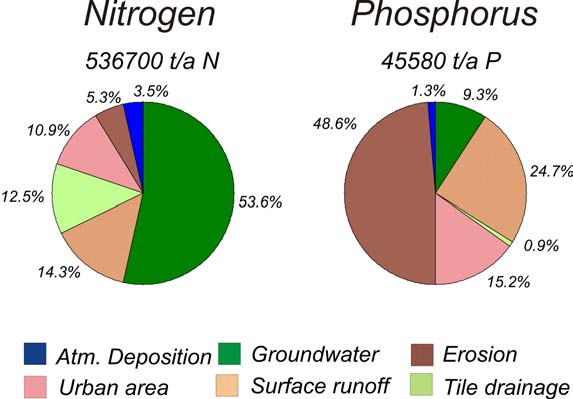
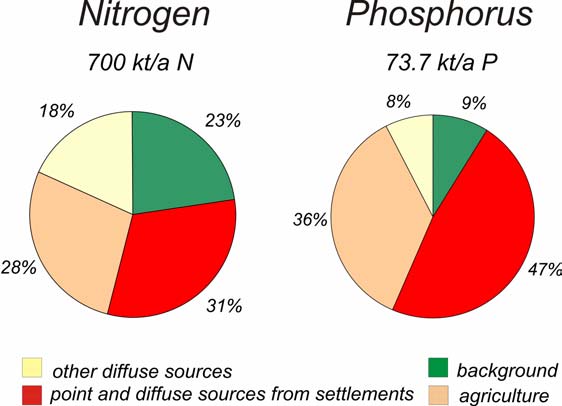
nitrates and acidification is significant, less for phosphorus, and is diverse in different regions of the
DRB. The inputs are dependent on population density, percentage of treated wastewater disposal,
intensity and way of farming and the level of atmospheric deposition. The Nitrates Directive requires
development and application of codes of good agricultural practices, identification of zones vulnerable
to nitrate pollution, and implementation of special action programmes in these zones.
The ICPDR EMIS EG has developed in line with Article 7 of the DRPC a Recommendation on BAT at
Agro-industrial Units including (i) technical in-plant measures for the reduction of wastewater volume
and abatement of pollution load, (ii) reduction of pollution load by end-of-pipe measures, and (iii)
environmental management improvement actions. The Contracting Parties will implement the
recommendation from January 2006 and report each 2 years from 2007.
To ensure significant nutrient loads reduction from diffuse sources of pollution, the Danube countries
have identified measures that address policy and legislation-related actions, institutional strengthening
and capacity building, raising public awareness and strengthening public participation in nutrient
reduction initiatives.
Fig 5 Diffuse nutrient pollution by pathways for the total Danube river systems (1998-2000)
Fig 6. Diffuse nutrient pollution by sources for the total Danube river systems (1998-2000)
32
The Danube countries have introduced various legal, financial and economic measures to control
diffuse pollution. To facilitate the understanding of progress of implementing policy and regulatory
measures at national level to the JAP requirements, various country measures to control diffuse
pollution are presented below:
In accordance with EU-regulation 1257/99 Austria has elaborated the programme-planning document
"Rural Development". A precondition for participation in the different subsidy-programmes is the
fulfilment of minimum demands regarding environment, hygienic and animal protection and the
integration of "good agricultural practice". The main part of this programme-planning document is the
agro-environmental programme "ÖPUL". Austria applies ÖPUL not only in certain sensitive areas but
as horizontal approach in the whole agricultural area. To promote progressive environmental practices
in regions with intensive agricultural land use, various regional subsidy programmes against nitrates
were included into the nation-wide programme "ÖPUL 2000". The regional programmes and some co-
operative agreements were negotiated between the Federal Government, the Länder, farmers
associations and water suppliers. As a result, a first success of the preventive water protection
programmes can be seen: the concentration of nitrate in groundwater is decreasing.
The main principles of the Austrian water protection programs in the framework of ÖPUL 2000 include:
(i) interdisciplinary co-operation between representatives of water management and agriculture, (ii) the
practicability of the measures, (iii) a fair financial compensation of the services of the farmers, (iv)
appropriate conditions for farmers with high intensities of livestock, (v) an additional control of the
farmers not participating in the programme, (vi) comprehensive public information and consultation,
and (vii) permanent direct contact to the concerned communities and involved farmers through
information, guidance and educational campaigns.
The arable area is more than 66% of the total territory of Hungary and a further 19% are covered by
forests. In Hungary, the main portion of diffuse pollution comes from agriculture. The most important
pollutants are nitrogen and phosphorus, and out of the total inputs in the Danube Basin, about 60% of N
and 40% of P originate from diffuse sources. The investigation of the sources and pathways of nitrogen
has shown that on river basin level, the importance of agriculture for N emissions into surface waters is
evident: about half of the input is from agriculture. The main existing national programs in connection
with the reduction of diffuse pollution refer to the reduction of nutrient pollution, agro-environmental
practices and environmental program of site remediation.
The government in Romania has introduced BAP, including erosion control and clean manure handling
and Low Input Sustainable Agriculture (LISA) as to achieve an effective integration of ecological
techniques, with lowest possible input levels. It is expected that in future the content of nutrients will
continue to decrease.
Efforts are already taken in Romania to implement the following measures: (i) elaboration or
improvement of national laws, regulations and normative regarding agricultural production in line with
environmental requirements, (ii) organisation of an informational and monitoring system concerning
agricultural activities, (iii) organisation of pilot demonstration farms, (iv) organisation of training
courses, seminars and workshops for farmers, (v) development of the dry farming and irrigation within
the areas affected by droughts, (vi) develop animal husbandry outside of villages and rural settlements,
etc.
The most important non-point sources that affect Slovenian surface and ground waters are: agriculture,
dispersed settlement and atmospheric depositions (mostly caused by transport & traffic). According to
NEAP complex measures to reduce this are implemented or in preparation. Slovenia has introduced the
Code of Good Agricultural Practice. Some measures are: (i) since January the 1st 2003 the limit value
for annual input of organic nitrogen disposed with animal manure is limited to 170 kg/ha, (ii) the whole
Slovenian territory is claimed to be vulnerable area, (iii) annual input of phosphorus is limited to 120 kg
per/ha while annual input of phosphorus is limited to 300 kg/ha, and each individual farm has to have a
fertilisation plan made by Agricultural Advisory Office.
33
For Czech Republic, the main part of diffuse pollution comes from agriculture, atmospheric
depositions and soil erosion. The increasing importance of non-point sources is connected with the
decrease of pollution from point sources. The share on the total pollution is essential in nitrates and
acidification, less in phosphorus, and is diverse in different regions of the Czech Republic, in
dependence on population density, percentage of treated wastewaters disposal, intensity and farming
practices and the level of atmospheric deposition.
Recent results of research on demarcation of vulnerable regions threatened by nitrates in compliance
with the Council Directive 91/676 EEC show, that the area of surface and ground waters afflicted by
nitrate pollution occupies 42,5 % of the total agricultural land, which represents 36% of the whole
Czech Republic territory. For vulnerable regions special action programmes comprising measures for
nitrate pollution reduction from the agricultural sources are under implementation.
The main source of diffuse pollution influencing water quality in the Slovak Republic is agriculture.
Studies have indicated that agriculture can contribute as much as 40% of the nitrate pollution of water
bodies. The following three factors were found to be the major causes of agriculturally related diffuse
pollution: (i) high, and often unnecessary, applications of mineral and organic fertilisers to the soil
(especially before 1989), (ii) water erosion on arable land caused not only by unsuitable soil type and
topography, but also by inappropriate choice of crops, plant rotation and soil cultivation, and (iii)
incorrect crop choice and rotation in the vicinity of potable water sources. Three codes which embrace
the current legislation have been produced by the Ministry of Soil Management (Agriculture) of the SR:
Code of Soil Protection (1996), Code of Good Application of Fertilisers (2000), and Code of Good
Agricultural Practice for the Protection of Water Resources (2002).
The economic transition process has caused significant reduction of industrial and agricultural
production, thus temporarily reducing production-related pollution loads as well in Croatia.
6.6
Wetlands restoration and floodplain management. Inventory of protected areas
Wetlands, in particular floodplains connected to rivers, act as nutrient filters and a significant
proportion of the projected N and P removal in the Danube River Basin is assigned to this sector in the
JAP (Table 7).
Table 7 Expected nutrient reduction from wetlands
Expected Nutrient Reduction in the Danube River Basin
Nitrogen Phosphorus
Sector
tons/year %
tons/year
%
Wetlands 29,872 36,8
2,989
14,7
Among the 13 Danube River Basin countries, a total of 323 million investment projects have been
listed in the wetlands sector. Measures include 23 projects: floodplain restoration, revitalisation of river
banks, reactivation of former flow channels, and conservation of endangered species and habitats.
17 wetlands projects, representing a total of 200,000-300,000 ha of potential area to be restored are
estimated to achieve N and P reductions of up to 29,872 tons/year and 2,989 tons/year, respectively.
Compared to nutrient reduction attained through municipal wastewater treatment investments, the cost
efficiency of the wetlands restoration efforts is quite high, considering that the 158 municipal projects
evaluated in the DABLAS (2002) program were estimated to achieve N and P reductions of 35,406
tons/year and 7,050 tons/year, respectively, for a total investment of 3,189 million . In addition come
other (economic) benefits as a result of floodplain restoration (flood retention, recreation, genetic
diversity, biomass production for agriculture and forestry etc.). The favourable cost effectiveness of
wetlands restoration versus municipal wastewater treatment is further evident in the following
comparison of 2 investment projects achieving similar nutrient reduction:
34
Table 8. Estimated reduction for case studies
Estimated Nutrient Reduction
Est. Cost
Project Sector
(t/a)
mio
N P
Zagreb, HR
Municipal 4305* 876*
27*
Nutrient Reduction
Gemenc, HU
Wetlands 4050** 405** 5***
Wetlands restoration
*DABLAS project, 2002/03
**UNDP/GEF, Danube River Basin Pollution Reduction Programme Report, June 1999
***ECO EG, Midterm report on the status of implementation of the JAP wetlands projects, June 04
The planned nutrient removal upgrade of the Zagreb (HR) municipal wastewater treatment plant is
estimated to cost 27 million to achieve an annual reduction of 4,305 tons of N and 876 tons of P. For
comparable nutrient reduction results, restoration of the wetlands in the Gemenc (HU) area will require
ca. 5 million .
Besides nutrient removal, municipal wastewater treatment projects achieve many other societal and
environmental benefits, such as improved sanitation and decreased organic matter loading (BOD).
ICPDR has also been supporting the development of a regional inventory of protected areas. Following
the decisions of the ECO EG a core data set (with connections to Natura 2000/Emerald and Ramsar
inventories) was compiled in 2003, listing about 250 sites. Out of these, 55 sites are of basin-wide
importance.
6.7
Improvement of water quality monitoring and upgrading TNMN
6.7.1 Upgrading
TNMN
The Danube countries have decided to upgrade TNMN to reflect the requirements of the Article 8 of the
WFD and to take into account the WFD CIS process. The TNMN shall be revised to provide a coherent
and comprehensive overview of ecological and chemical status within the Danube River Basin. For
TNMN, the Danube countries have considered 79 sampling stations, 52 determinands in water and 33 in
sediment. The revision will be done gradually with the aim to have the TNMN upgrade functional by
2006. Figure 7 provides information on the annual loads of inorganic nitrogen at monitoring stations
along the Danube.
45
)
40
.
km
(
163 r
35
sza
Ti
tons)3
30
25
ogen (x 10
)
)
20
.
km
.
km
)
)
(
300 r
15
.
km
(
729 r
.
km
r
ava
ganic nitr
(
79 r
D
S
ava
10
(
195 r
inor
n
o
rava
In
M
0
6
R
5
3
0
1
1
8
D0
CZ
Sl0
H0
S
I
02+H
0
0
2800
2600
2400
2200
2000
1800
1600
1400
1200
1000
800
600
400
200
distance from the m outh (km )
Fig 7 Annual loads of inorganic nitrogen at monitoring stations on selected Danube tributaries,
year 2000
35
6.7.2 Joint Danube Survey
An expedition, referred to as Joint Danube Survey (JDS) was launched in August 2001 to investigate
the quality of the Danube River along its 2,581-kilometer-long stretch from Regensburg in Germany to
its mouth in the Black Sea. JDS was initiated by the ICPDR to improve the validity and comparability
of water quality data received from its regular monitoring programme- TNMN. The mission of the ten
scientists from Germany, Austria, Slovakia, Hungary, Yugoslavia, Bulgaria and Romania was to collect
and analyze samples taken from the Danube River for 140 different parameters ranging from biological
indices and chemical pollutant levels to indicators about the state of aquatic flora, fauna, and micro-
organisms. The main objectives of the JDS were to: (i) produce a homogenous data set for the Danube
River based on a single laboratory analysis of selected determinands, (ii) identify and confirm specific
pollution sources, (iii) screen the pollutants as specified in the EU Water Framework Directive, (iv)
provide a forum for riparian/river basin country participation for sampling and inter-comparison
exercises, (v) facilitate specific training needs and improve in-country experience, and (vi) promote
public awareness.
The results of the JDS include: surface water, sediment, mussels and biological samples collected from
98 sampling sites, suspended solids samples collected from 63 sections of the Danube, and fifteen
parameters (e.g., conductivity, dissolved oxygen, nitrites, nitrates, total coliforms, faecal coliforms)
analysed on-board. All samples were sent in regular intervals to the JDS Reference Laboratories for
analyses of more than 80 additional determinands
6.7.3 Analytical Quality Control (AQC) in the DRB
Efforts have been undertaken in order to harmonise analytical activities within the DRB countries
related to TNMN, as well as
implementation and operation of an
Analytical Quality Control (AQC)
programme to ensure quality and
comparability of data. As a
consequence, 36 TNMN laboratories
reported results that provided
information on their analytical
performance: in general, the analytical
results for synthetic samples were
better than the results for the real water
samples (results influenced by the
matrix effect). For most of the general
parameters and nutrients a good
performance was observed. Problems
were reported for analysis of cyanides.
Similarly, performance for the organic
pollutants (e.g. COD, BOD, MBAS,
TOC, AOX) was relatively good.
Analyses of BOD have improved
significantly and AOX results were
excellent.
Fig. 8 BOD variation in the reported values
The analytical performance in case of heavy metals was moderate. The analyses of arsenic and mercury
have improved significantly in comparison with the results from previous years.
36
The area where improvement is still required is the analysis of organic micropollutants. Especially in
the analysis of sediments the data could not be evaluated. The most probable reason was a poor sample
pre-treatment. Fig. 8 shows variation in the reported values of BOD in AQC water samples.
6.7.4 Load assessment programme
The load assessment program, initiated in 2000, is integrated in the TNMN efforts with the view to
produce reliable and consistent trend analysis of concentrations and loads of substances diluted in water
or attached to sediments. Danube countries have agreed to use the Standard Operational Procedure
(SOP) developed in the frame of EU Phare Project "Transboundary Assessment of Pollution Loads and
Trends" (1998) for its operation in the Danube River Basin. Loads are calculated for BOD5, inorganic
nitrogen, ortho-phosphate-phosphorus, dissolved phosphorus, total phosphorus, suspended solids and
chlorides (voluntary). Minimum sampling frequency is at least 24 per year.
6.8
Definition of basin wide priority substances and water quality standards (ICPDR list of
priority substances)
The ICPDR EMIS EG prepared a proposal for the List of Priority Substances consisting of 2 separate
annexes: Annex A, 33 substances, in accordance with the Annex X of the EU WFD (Article 16 of the
WFD requires the Commission to establish a list of priority substances and to identify the priority
hazardous substances) and Annex B, divided into two groups B1: General Parameters (COD, NH4-N,
Total N, Total P) and B2: Danube Specific Priority Substances (As, Co, Zn, Cr). In line with WFD, for
priority substances, the `combined approach' has to be applied, i.e. harmonised European emission
controls and water quality standards will be elaborated for all substances. Therefore, with support of the
UNDP GEF DRP, the work of EMIS EG will be directed to identification of harmonised emission
control strategies, while MLIM EG will follow the development of quality standards for priority
substances.
6.9
Revision of the Accident warning system and definition of preventive measures
6.9.1 Operation and upgrade of the Danube Accident Emergency Warning System
A substantial upgrade in terms of effectiveness and cost-efficiency of the AEWS was carried out in 2003
with support of the UNDP GEF Danube Regional Project. The satellite-based communication was
replaced by a web-based communication using Internet and SMS messages to become an integral part of
the ICPDR information system (Danubis). A series of tests of the web-based system were performed in
summer/autumn 2003 in all Danube countries to debug the software, to check the technical setup of
national GSM operators and to train staff of Principle International Alert Centres. The final test of the
upgraded system performed on 14 June 2004 proved that the system is perfectly working. The
implementation of the new system necessitated a revision of basic AEWS documents.
6.9.2 Inventory of accident risk spots in the Danube River Basin
Experiences with consequences due to several accidental spills has shown that inadequate application of
precautionary measures at accident risk spots (ARS) could lead to harmful effects to humans as well as
to the environment. For this reason the ICPDR APC EG elaborated in 2001 a basin-wide inventory of
potential accident risk spots. For estimation of a real risk at a particular site a set of checklists was
elaborated and made available to the Danube countries. In 2003 the existing potential ARS Inventory
was supplemented by data from Austria and Bosnia and Herzegovina. To advance with the risk
estimation a pilot project on demonstration of ARS checklists application is expected to start during
phase 2 of the UNDP GEF DRP.
6.9.3 Inventory of contaminated sites in flood-risk areas
During heavy rainfall, floods can create pollution and health risks, if precautions are not taken to
minimize them. Nitrogen and other non - point-source pollutants may leach from agricultural lands, and
the resulting nutrient load may severely stress aquatic ecosystems. It is extremely important to
determine the actual risks of polluted floodplain sediments and to predict changes in this ecological risk
when sediment is displaced. The 2002 severe flood events in the DRB countries have led to re-
37
examinations of traditional approaches to flood management. The response of the ICPDR to this
problem was elaboration of an inventory of contaminated sites in flood-risk areas in the Danube River
Basin which was finalised in 2003 (261 contaminated sites). The ICPDR 6th Ordinary Meeting in
December 2003 approved the Safety Requirements for Contaminated Sites in Flood-risk Areas and
recommended their application at national level. In addition to the adoption of the Safety Requirements
and taking into account the relevance of a general precautionary principle, the ICPDR also encouraged
the Danube countries to establish the policy framework and take the necessary measures to prevent any
future contamination of sites in flood-risk areas.
For an initial risk assessment of all submitted "candidate" sites a so called M1 methodology was
developed. This methodology is based on assessment of toxic potentials of soil or waste taking into
consideration harmful substances to be expected in a certain type of waste or in a specific industrial
branch, correlated with the size of the contaminated area. The M1 methodology also served to rank the
contaminated sites identified in the national inventories. The results of this evaluation provide the final
list of contaminated sites which are considered that passed through the M1 methodology. The
appropriate methodology for flood risk assessment (M2) is under development. After finalization of M2
step a list of sites posing a high risk of contamination of water bodies during floods will be available.
6.10
Country progress in policy reforms
Development and enforcement of environmental law and policy, economic instruments, strengthening
of public participation and capital investments are main tasks of the GEF Strategic Partnership on the
Danube Black Sea basin over the period of 2001-2007. Through the formulation process, six objectives
with indicators of success were adopted for the entire 6 year period.
The indicators and the measurable results in terms of policy reform for participating countries in the
DRB are described in Table 9. The number of countries for each concept/approach introduced was
considered as a basis of measurement. For indicator C), the measures were divided in four groups: (i)
integrated river sub-basin management of land, water and ecosystems, (ii) biodiversity projects for
wetlands and floodplain conservation, (iii) enforcement by legal authorities and, (iv) holistic approaches
to water quality, quantity and biodiversity of aquatic ecosystems.
Table 9 shows that most countries started related policy reforms and concrete projects, and that a
substantial progress is already achieved after 4 of the 5 years of the JAP, even if this is yet not the case
for all countries.
38
Table 9.Country progress in policy reforms
Country
AT BA BG HR
CZ
DE HU MD RO CS SK SI UA
A) Indicator By 2007, 100% of the participating countries introduce one or X X X X X X
X X X X X X X
more policy or regulatory measures (including P-free detergents) to reduce
nutrient discharges in the agricultural, municipal, or industrial sectors, to restore
nutrient sinks (wetlands, flood plains), and to prevent and remediate toxics "hot
spots"
Measure: number of countries:13
Result 2004: 100%
B) Indicator By 2007, 50% adopt multiple policy measures, towards goals of X X X X X X X X X
maintaining the 1997 levels of nutrient inputs to the Black Sea, and reducing
toxics contamination in the basin
Measure: number of countries: 9
Result 2004: 69%
C) Indicator: By 2007, all countries in the basin begin nutrient sink restoration X X X X X X X X X
(wetland restoration) and non-point source discharge reduction through (i)
integrated river sub-basin management of land, water and ecosystems, (ii)
biodiversity projects for wetlands and floodplain conservation, (iii) enforcement
by legal authorities and, (iv) holistic approaches to water quality, quantity and
biodiversity of aquatic ecosystems
Measure: number of countries: 9
(i) integrated river sub-basin management
X X X X X X X X X X X
Result 2004: 69%
Measure: number of countries: 11
(ii)
biodiversity
projects
X X X X X X X X X
Result 2004: 84%
Measure: number of countries: 9
(iii)
enforcement
X
X X X X X X X X X X X
Result 2004: 69%
Measure: number of countries: 12
(iv)
holistic
approaches
X
X X X X X X X X X X X
Result 2004: 92%
39
7 Implementation of the EU Water Framework Directive
7.1
Progress in developing the Danube River Basin Management Plan in line with the WFD
The Water Framework Directive ensures integrated water resources management on river basins. River
basin authorities will be required to monitor water quality and quantity, set quality standards, establish
rules for water abstraction and waste water discharge permits, and develop action plans to ensure that
agreed quality objectives will be met. Public participation in the process is essential. The Directive is
particularly demanding in requiring Member States to achieve "good ecological status" and "good
chemical status" for all surface and ground water, by 2010. Implementing the water policy legislation
will be very demanding and costly for all new members, in administrative, financial and political terms.
In addition to preparing a roof report, the 6th Ordinary Meeting of the ICPDR concluded that all
countries should send their national reports to the ICPDR as the platform for coordination. The ICPDR
has not yet received the national reports from the EU-Member States: Germany, Austria, Czech
Republic, Slovak Republic, Hungary and Slovenia.
The first main output of the joint efforts to implement the EU Water Framework Directive in the
Danube River Basin are the Roof Reports 2003 and 2004. The work related to WFD implementation is
coordinated by the RBM EG.
The WFD Roof report 2003 (Art. 3.8 and Annex I) was finalised on April 16, 2004 and sent to the
European Commission as an informal information on June 22, 2004. In addition, the national reports of
the Non-EU-Member States (Croatia, Serbia and Montenegro, Bulgaria, Romania and Moldova) were
sent to the Commission. Bosnia i Herzegovina has recently sent its National WFD Report 2003 to the
European Commission. Ukraine is currently not in a position to report on WFD implementation.
The WFD Roof report 2004 has been prepared in line with Art. 5, 6 and Annexes II, III, IV of the WFD.
The report having reporting deadline at March 22, 2005 deals with the characterisation of surface
waters and groundwater, with the assessment of significant pressures and impacts, and with the
economic analysis of water uses. The UNDP GEF DRP has provided financial support for the drafting
of the Roof report.
Each state will deliver the roof report (Part A) together with its own national report (Part B). In addition,
the ICPDR will informally send the European Commission a copy of the roof report and a copy of the
national reports (Part B) of those countries not obligated to report to the European Commission. The
final report will be presented at the Ministerial Meeting in December 2004.
One of the objectives of the Water Framework Directive is specifically to make sure that different
objectives are achieved through a cost effective and comprehensive decision-making process.
The Danube River Basin Management Plan has been divided into two parts. Part A (roof of the
DRBMP) gives relevant information of multilateral or basin-wide importance, whereas Part B (national
input to DRBMP) gives all relevant further information on the national level as well as information
coordinated on the bilateral level (Fig 9).
Part A Roof report
The Roof report deals with information of basin-wide importance. This includes, in particular, an
overview of the main driving forces of multilateral or basin-wide relevance and the related pressures
exerted on the environment. The analysis is based on available data resulting from past and ongoing
programmes and projects. The overview will include effects on coastal waters of the Black Sea as far as
they are part of the DRBD, since their status could be a reason for designating the whole DRBD as a
sensitive area.
40
Fig 9. Structure of the report for the Danube River Basin District
Part A: Roof report coordinated by the ICPDR
2
3
1
Part B: National reports
Germany
Austria
Czech Republic
Slovak Republic
Hungary
Slovenia
Croatia
Bosnia i Herzegovina
Serbia and
Montenegro³
Bulgaria
Romania
Moldova
Ukraine
including bilateral coordination: 1 with Switzerland and Italy, 2 with Poland, 3 with Albania and Macedonia
EU-Member States
Accession
States
Others
Part B National reports
The National reports give all relevant further information on the national level as well as information
coordinated on the bilateral level. Transboundary issues not covered by the ICPDR are solved at the
appropriate level of cooperation e.g. in the frame of bilateral/multilateral river commissions.
The Danube states cooperating under the DRPC report regularly to the ICPDR on the progress of WFD
implementation in their own states. These national reports serve as a means for exchanging information
between the states and for streamlining the implementation activities on the national level.
7.1.1 Harmonization of methodologies and reference conditions (i.e. criteria for significant
pressure and impact)
7.1.1.1 Characterisation of surface waters types and harmonised system for reference conditions
According to Annex II 1.1 WFD "Member States shall identify the location and boundaries of bodies of
surface water and shall carry out an initial characterisation of all such bodies ...".
The first step in the analysis is the identification of the surface water categories. It has been agreed that
the following surface waters are potentially of basin-wide importance and are therefore dealt with in the
Roof report:
· all rivers with a catchment size of > 4 000 km²
· all lakes and lagoons with an area of > 100 km²
· the main canals.
These surface waters are shown on the Danube River Basin District overview map (Map 1).
The surface water body categories have been identified on the national level. For each surface water
category, the relevant surface water bodies within the river basin district need to be differentiated
according to type (Annex II 1.1 (ii) WFD). The state of implementation of WFD varies strongly
between the countries in the Danube River Basin, especially for the development of surface water
typologies and the definition of their reference conditions.
With support from UNDP GEF DRP, the typology of the Danube River has been developed in a joint
activity by the countries sharing the Danube River. The Danube typology therefore constitutes a
harmonised system used by all Danube countries. On the basin-wide level, the Danube countries have
agreed on general criteria as a common base for the definition of reference conditions. These have then
been further developed on the national level into type-specific reference conditions. The Danube flows
through or borders on territories of 10 countries (Germany, Austria, Slovak Republic, Hungary, Croatia,
Serbia and Montenegro, Bulgaria, Romania, Moldova and Ukraine) and crosses four ecoregions (9
Central Highlands, 11 Hungarian Lowlands, 10 Carpathians, and 12 Pontic Province). The
41
Danube typology was based on a combination of abiotic factors of System A and System B. The most
important factors are ecoregion, mean water slope, substratum composition, geomorphology and water
temperature. The typologies of the Danube tributaries were developed by the countries individually.
Workshops enhanced the exchange of information between the countries and allowed for a streamlining
of approaches. In addition, stream types relevant on transboundary water courses were bilaterally
harmonised with the neighbours. The common factors used in all DRB typologies are ecoregion,
altitude, catchment area and geology.
7.1.2 Identification of significant pressures
The WFD requires information to be collected and maintained on the type and magnitude of significant
anthropogenic pressures, and indicates a broad categorisation of the pressures into:
- point sources of pollution,
- diffuse sources of pollution,
- effects of modifying the flow regime through abstraction or regulation, and
- morphological alterations.
In addition, there is a requirement to consider land use patterns (e.g. urban, industrial, agricultural,
forestry) as these may be useful to indicate areas, in which specific pressures are located.
The pressures and impacts assessment follows a four-step process:
1. describing the driving forces, especially land use, urban development, industry, agriculture
and other activities which lead to pressures, without regard to their actual impacts;
2. identifiying pressures with possible impacts on the water body and on water uses, by
considering the magnitude of the pressures and the susceptibility of the water body;
3. assessing the impacts resulting from the pressures; and
4. evaluating the likelihood of failing to meet the objective.
The analysis is based on screening of emissions (pressures) according to certain criteria, which
determine what `significant pressure' means.
The ICPDR Emission inventory is the key data base for the assessment of emissions from point sources
on the basin-wide level. It includes the major municipal, industrial and agricultural point sources and
identifies the total population equivalents of the municipal waste water treatment plants, the industrial
sectors of the industrial waste water treatment plants, and the types of animal farms for the agricultural
point sources. In addition, it includes information on the receiving water and data on some key
parameters of the effluent such as BOD, COD, P and N.
The criteria defined by the ICPDR EMIS EG consider pressures from point sources, especially from
substances referred to in Annex VIII WFD, to the Urban Waste Water Treatment Directive
(91/271/EEC), to the Integrated Pollution Prevention and Control Directive (96/61/EC) and to the
Dangerous Substances Directive (76/464/EEC).
7.1.2.1 Definition of significant point source pollution on the basin-wide level
A comparison of the significant point source emissions with the complete list of point sources in the
emission inventory illustrates that only few point sources are responsible for about half of the point
discharges into the Danube River system. From this it can be concluded that reduction of emissions
(organic substances and nutrients) from these sources would lead to a remarkable reduction of the total
point source pollution. This also visible in the results of the DABLAS 2002 estimates of municipal
investments in the DRB. (Table 21).
42
Table 10. Discharges from significant point source according to the criteria, per sub basins.
COD BOD N
P
t/a
t/a
t/a
t/a
Municipal sources
01 Upper Danube
11584
1741
7756
313
02 Inn
1316
206
474
33
03 Austrian Danube
604
130
248
14
04 Morava
898
100
189
20
05 Váh-Hron
14899
4248
2102
349
06 Pannonian Central Danube
94759
32304
11618
1495
07 Drava-Mura
14970
5802
2291
418
08 Sava
83649
37102
6005
1358
09 Tisza
37507
14327
4883
1029
10 Banat-Eastern Serbia
13261
4247
2679
619
11 Velika Morava
0
0
0
0
12 Mizia-Dobrudzha
64057
29149
5064
1254
13 Muntenia
59917
29861
15602
1844
14 Prut-Siret
25314
9869
2751
215
15 Delta-Liman
744
272
50
4
16 Romanian Black Sea Coast
10297
2801
910
87
Total Danube river basin district
433775
172159
62622
9053
Industrial sources
01 Upper Danube
7346
49
20
8
02 Inn
8469
375
305
20
03 Austrian Danube
4825
196
12
9
04 Morava
1911
136
130
19
05 Váh-Hron
8294
2681
96
4
06 Pannonian Central Danube
16424
3515
352
13
07 Drava-Mura
29718
6083
185
52
08 Sava
33965
6772
310
374
09 Tisza
16622
3315
331
32
10 Banat-Eastern Serbia
1158
120
20
2
11 Velika Morava
0
0
0
0
12 Mizia-Dobrudzha
9244
0
0
13 Muntenia
16173
5166
2312
5
14 Prut-Siret
4456
903
136
1
15 Delta-Liman
982
0
24
15
16 Romanian Black Sea Coast
842
242
390
Total Danube river basin district
160427
29555
4625
555
Agricultural sources
07 Drava-Mura
2
1
1
08 Sava
191
41
107
3
09 Tisza
2263
579
749
10 Banat-Eastern Serbia
357
104
57
16
13 Muntenia
2040
1085
881
57
14 Prut-Siret
285
1074
326
5
15 Delta-Liman
901
206
Total Danube river basin district 6039
3089
2121
82
43
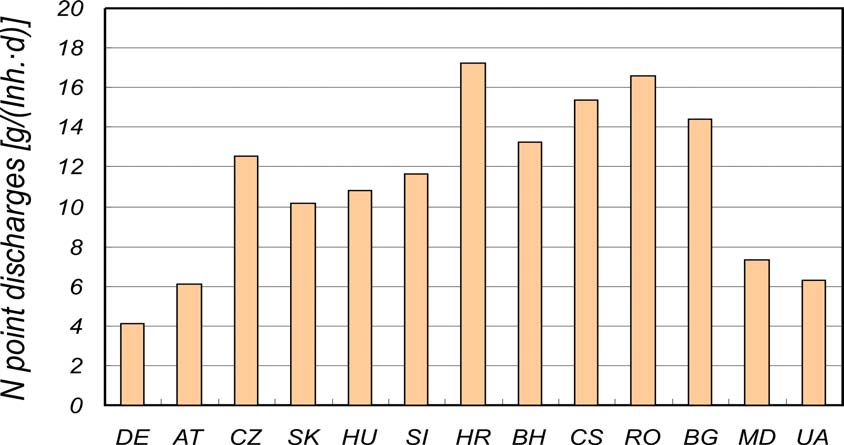
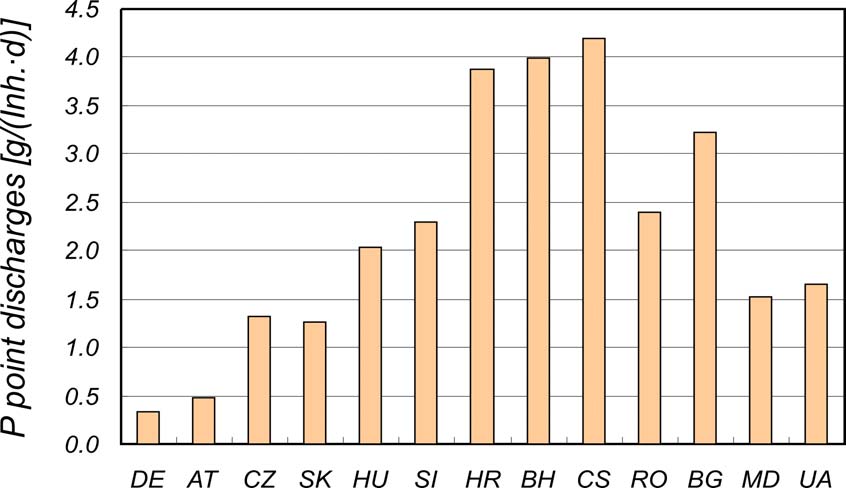
In 2000, the total nutrient point discharges into the Danube was about 163 kt/a nitrogen and 28.1 kt/a
phosphorus. Fig 10 and Fig 11 show the difference in the present state of the nutrient point source
discharges within the Danube countries. For nitrogen it is shown that the lowest point N discharges are
in Germany with 4 g/(Inh.·d) per connected inhabitant followed by Austria, Ukraine and Moldova. The
picture for phosphorus presented in Fig 11 is similar to that for nitrogen Fig 10, but the differences
between the countries are much larger. This is due to the fact that the specific P point discharges reflect,
not only the state of the P elimination in waste water treatment plants, but also the existing use of
phosphorus in detergents, and discharges from direct industrial sources. For this reason the specific P
emissions are above 4 g/(Inh.·d) for Bosnia i Herzegovina, Croatia and Serbia and Montenegro. The
medium level P emissions for Czech Republic and Slovak Republic result from the fact that some
WWTPs have additional P elimination.
Fig 10 Inhabitant specific N discharges from point sources 1998 to 2000 (2004).
Fig 11 Inhabitant specific P discharges from point sources 1998 to 2000 (2004).
44
7.1.3 Development of DRBD Overview map and preparation of thematic maps
The main objective of WFD implementation is the development of a Danube River Basin Management
Plan. The Danube River Basin covers 801,463 km² and territories of 18 states including EU-Member
States, Accession States and other states that have not applied for EU Membership. According to
Article 3.3 of the WFD "Member States shall ensure that a river basin covering the territory of more
than one Member State is assigned to an international river basin district".
In addition to the Danube River Basin, the small coastal basins of the Black Sea tributaries lying on
Romanian territory between the eastern boundary of the DRB and the coastal waters of the Black Sea
have been included in the Danube River Basin District.
Table 11 Area of the Danube River Basin District
Territory Official
area
Digitally determined
(km2)
area (km2)
Danube River Basin (DRB)
18 countries
801,463
Black Sea coastal river basins
Romania
5,198
5,122
Black Sea coastal waters
Romania and Ukraine
1,242
Danube River Basin District
807,827
(DRBD)
The Danube River Basin District covers: the Danube River Basin, the Black Sea coastal catchments on
Romanian territory, and the Black Sea coastal waters along the Romanian and partly the Ukrainian
coast.
7.1.4 Development of public participation strategy
Active involvement in planning procedures leads to shared responsibilities and higher acceptance of
measures in the WFD implementation process. The ICPDR being the co-ordination platform for the
implementation of the WFD on issues of basin-wide or multilateral concern - has taken this new
challenge as a basis to reviewing its ongoing practice. The ICPDR started an active process towards
defining a "Danube River Basin Strategy for Public Participation in River Basin Management Planning
2003-2009" and consequently developing an "ICPDR Operational Plan". The basic principles of the
"Danube River Basin Strategy for Public Participation in River Basin Management Planning 2003-
2009" were approved in June 2003.
Based on Article 14 of the WFD, the objectives of this strategy are to (i) ensure public participation in
the implementation of the WFD, especially concerning the development of the Danube River Basin
Management Plan, (ii) facilitate the establishment of effective structures and mechanisms for public
participation that will continue operating beyond the first cycle of river basin management planning, (iii)
provide guidance to national governments on how to comply with their obligations under the WFD by
providing practical support and guidance in addressing public participation, and (iv) inform key
stakeholders about the structures for public participation and public involvement at the various levels.
The activities at ICPDR level were developed in detail and summarized in the "ICPDR Operational
Plan", adopted in December 2003, which provides a description of the activities at the roof level,
including a timetable and a workplan. The Operational Plan is seen as a planning tool, which is
regularly adjusted to the needs of the ICPDR.
7.1.5 Development of economic indicators
According to Article 5 and Annex III of the WFD, an economic analysis of water uses has to be carried
out with the aim of assessing the importance of water use for the economy and assessing the socio-
economic development of the river basin.
45
The Roof report deals with (i) the assessment of the economic importance of water uses, and (ii)
projection of trends of key economic indicators and drivers up to 2015. The report contains basic
information regarding the characteristics of water services and illustrates the differences in terms of the
connection rates of the population to public water supply. Discussions on the characteristics of water
uses was based on the economic structure of the Danube countries, which show differences mainly
aroused from the varied importance of the agricultural sector. While in Bulgaria, Croatia and Romania
around 10 percent of GDP is generated from agriculture, this share is between 1 and 3.7 percent in the
remaining countries. The share of industry and electricity generation is more consistent between the
countries which reported these data. To facilitate understanding of the projecting trends in key
economic indicators and drivers up to 2015, assessment of key economic variables for developing
baseline scenario was concluded. The UNDP GEF DRP offered support for the Danube countries in
undertaking the economic analysis for the WFD.
7.2
Progress on National reports
The WFD Roof report 2003 (Art. 3.8 and Annex I) was finalised on April 16, 2004 and sent to the
European Commission as an informal information on June 22, 2004.
7.3 Response
to
bilateral
an multilateral agreements
Bilateral agreements are in place between almost all states in the Danube River Basin District. Most of
them have been adapted as to respond to issues related to WFD implementation. In few occasions, in
the absence of formally approved bilateral agreements and commissions, regular meetings are
organised to facilitate cooperation.
The ICPDR serves as the platform for coordination in the implementation of the WFD in the Danube
River Basin District on issues of basin-wide importance. Transboundary issues not covered by the
ICPDR are solved at the appropriate level of cooperation e.g. in the frame of bilateral/multilateral river
commissions.
46
8 Implementation of the JAP / National Investment Programmes
8.1
National investments for pollution reduction and nutrient control in the DRB since 1998
and efficiency of funding mechanisms
8.1.1 Estimation of total investment since 1997 for all Danube River Basin countries
Within the frame of Joint Action Program, both structural/investment and legal/policy reforms projects
that address nutrient reduction are being introduced for the period 2001 2005. According to the JAP,
the total investment required for the 245 priority point source projects for all 13 DRB countries amounts
to about 4,404 million . The structure of the identified investment requirements by sector is as follows:
Table 12. Total investments per sectors, 2001-2005.
Municipal Industrial Agricultural
Wetlands Total
No of Projects 157
44
21
23
245
Million
3,702
267 113 323 4,404
(%)-Structure
84% 6% 3% 7% 100
Table 13. Projects and investments per country in the DRB
DE AT CZ SK HU SI HR BA CS BG RO MD UA TOT
No of
11 4 12 20 24 24 11 12 40 21 25 31 10 245
Proj.
Mill.
231 264 147 118 687 384 433 176 785 125 493 493 67 4,404
(%) 5 6 3 3 16 9 10
4 18 3 11 11 1 100
The total investments required for structural projects for 2001--2005 is 3.9 billion while for non
structural measures only 0.9 billion .
An evaluation is currently carried out within the frame of EU DABLAS II project, based on the
implementation of the ICPDR Joint Action Programme, addressing municipal, industrial, agro-
industrial, wetland restoration, and agricultural & land use projects. The project is assisting the ICPDR
in reporting and evaluating the accomplishments realised in the countries in the Danube River Basin, in
terms of policies, legislation, regulations, and investment projects, which have been implemented in line
with the ICPDR Joint Action Programme and taking into account EU water related directives, in
particular the EU Water Framework Directive. The compiled information will provide a clear picture of
the results achieved by the individual Danube countries, the policy and legal reforms under preparation,
the gaps to be filled and the investment projects, which need further technical and financial support.
The results will also be used as a baseline for evaluating subsequent progress at the national and
regional levels.
Considering preliminary results of the on-going DABLAS II project, a total of 292 projects are reported
(completed and proposed) in the 11 Danube countries (without Germany and Austria). 71 projects will
be completed by 2005. The structure per sectors and total costs for these projects are provided in Table
14 and Fig. 12.
Table 14. Summary table of completed and proposed projects, per sectors
Municipal Industrial Agricultural Land
use
Wetlands Total
No of Projects
185
55
18
11
23
292
Million
3,768.6
81.4 80.9 6.2 30.8 3,966.7
47
Total Investments
1000
other
900
800
2005 - 2009
700
until 2005
600
500
Mio.
400
300
200
100
0
a
tia
y
a
o
lic
ia
vina
blic
lgari
oa
ngar
ania
egr
ub
raine
ego
m
Bu
Cr
epu
oldov
oven
Hu
M
en
ep
Sl
Uk
h R
Ro
ont
Herz
ec
M
nd
snia-
Cz
Slovak R
Bo
rbia a
Se
Fig 12. Total investment costs per country, for all sectors, DABLAS 2004
8.1.2 Estimation of financial requirements for identified priority projects (up to 2009)
The anticipated composition of the funding of the identified priority projects in the JAP across the DRB
countries is as follows:
Table 15. JAP funding schemes
Funding component
Million
(%) Structure
National funding contribution
1,716
39 (%)
International loans:
1,163
26 (%)
International grants:
663
15 (%)
Not secured funding components:
862
20 (%)
Total: 4,404
100
(%)
National and local sources accounted for just under half of the funding for 45 fully-financed municipal
wastewater treatment projects in Czech Republic, Hungary, Slovakia, and Slovenia.
EU funding sources represented 23% of the financing for the 45 secured projects, while international
financial institutions (including EBRD, EIB, WB, GEF) contributed 12%. Approximately 21% of the
funding was from unspecified sources.
More than 2,500 Million are estimated for an additional 113 municipal projects in 11 countries (BA,
BG, CS, CZ, HR, HU, MD, RO, SK, SI, UA). These projects have partial funding secured or are in the
planning stages. At the time of compiling the DABLAS municipal data in 2002, 40% of project
financing was allotted to EU sources and 29% from national/local funds. An additional 6% was
indicated from IFIs, and 25% of the funding was unspecified.
48
Table 16 Funding sources schemes
Breakdown of Funding Sources, DABLAS Municipal Sector
45 Projects
113 Projects
Funding Source
fully financed
partial or no financing
623 Million
2,567 Million
National, Local
44%
29%
EU 23%
40%
IFIs (EBRD, WB, EIB, GEF)
12%
6%
Unspecified 21%
25%
Source: DABLAS project, 2002
According to the last report (DABAS, 2004), the total investment cost for 198 projects proposed to be
completed by the end of 2009 is 2,351 million , of which only 911.5 million are secured.
8.1.3. Achieved and expected results for above existing and proposed projects in terms of reduced
pollution in BOD, COD, N and P
The estimates of the nitrogen and phosphorus reduction for point sources and diffuse sources as
presented in the JAP for 2001-2005 are summarized below:
Table 17. Estimates of JAP expected reduction for the period 2001-2005
Country Nutrient
loads
Anticipated national emission
Expected
(DWQM 1994/98)
reductions in JAP
national load
Point Sources
Diffuse sources
reduction
N (t/y)
P (t/y)
N (%)
P (%)
N (%)
P (%)
N (t/y)
P (t/y)
Germany
68,000 3,700 6.0 2.0 10.0 3.0
10,891 185
Austria
77,000 3,800 5.1 10.6 10.0 3.0
11,650 518
Czech Republic
15,000
1,100
7.3 5.6 10.0 3.0 2,591 95
Slovakia
30,000 1,700 8.6 8.6 15.0 10.0 7,074 318
Hungary
31,000 3,800 21.6 40.1 15.0 10.0 11,358 1,902
Slovenia
20,000 1,300 26.2 62.6 15.0 10.0 8,233 944
Croatia
23,000 2,200 6.6 10.9 15.0 10.0 4,959 459
Bosnia and
36,000 2,200 13.1 38.8 10.0 10.0 8,300 1,073
Herzegovina
Serbia and
72,000 7,000 9.4 69.5 10.0 10.0 13,993 5,563
Montenegro
Bulgaria
23,000 4,000 11.7 15.0 10.0 10.0 4,983 999
Romania
121,000 12,700 9.8 12.5 10.0 10.0 23,960 2,861
Moldova
8,000 1,400 86.3 64.6 5.0 5.0 7,298 975
Ukraine
28,000 4,000 1.7 1.6 10.0 5.0 3,286 265
Total
552,000 48,900 10.3 23.8 10.9
8.2
118,576 16,156
The results in the table indicate that with the implementation of structural (projects) and non-structural
measures (policies and legislation), the total annual nutrient reduction will be about 119,000 tons for
nitrogen (22%) and 16,000 tons for phosphorus (33%). It has been assumed that about half of the
nitrogen reduction will come from the rehabilitation of point sources (waste water treatment) and the
other part from nutrient reduction from diffuse sources, in particular from change of agricultural
practices (Tables 18 and 19).
The total pollution reduction as a result of the implementation of the JAP proposed priority point source
projects including waste water from urban areas, which are not connected to WWTP, is anticipated to
be in the following ranges:
49
Table 18. Estimates of JAP expected reduction N and P per sectors for the period 2001-2005
Expected Nutrient Reduction in the Danube River Basin point and diffuse sources of pollution
Nitrogen Phosphorus
Sector
tons/year %
tons/year %
Municipal
38,770 47,7 11,348 55,7
Industrial
6,933 8,5 5,000 24,5
Agriculture
5,697 7,0 1,034 5,1
Wetlands 29,872
36,8
2,989
14,7
Total
81,272 100
20,371 100
Table 19. Estimates of JAP expected reduction per sector and total projects JAP 2001-2005
Expected Nutrient Reduction in the Danube River Basin point sources
Municipal
Industrial
Agricultural
Wetlands
Total
point
sources
No of Projects
157
44
21
23
245
N (t/y)
33 300
3 400
6 700
15 100
58 500
P (t/y)
5 500
3 700
1 100
1 800
12 100
BOD (t/y)
221 000
39 700
9 500
5 900
276 100
COD (t/y)
398 900
78 700
15 000
32 400
525 000
The updated (DABLAS, 2004) list of total investments completed and proposed in 11 Danube countries,
for all sectors, with the achieved and expected pollution reduction is presented in the Table 20.
Table 20 Summary table of load reduction from completed and proposed projects, per country
for all sectors
Total Total cost
Pollution Reduction (t/a)
Country projects
Mio
Red BOD
Red COD
Red Tot-N Red Tot-P
BA 16
186.5 15,140
25,226
2,054
533
BG 59
225.8 18,678
25,250
1,934
396
HR 15 217
7,390
14,976
5,052 1,041
CZ 42
283.6
-239
-3,293
1,432
131
HU 17
930.7
6,059
29,618
4,266
584
MD 43 62.5
279
-2,107
556
11
RO 23
680.6
9,495
14,361
3,412
744
CS 10
804.1 129,879
190,221
12,508 3,243
SK 42
308.6
5,424
12,277
1,584
65
SI 16
223.6
131
0
70
77
UA 9
43.5 1,217
217
913
177
Total 292
3,959.10 193,453
306,746
33,781
7,002
8.1.3.1 Implementation of the JAP, national investment programmes municipal sector
Extensive municipal wastewater development is under implementation throughout the basin. In many of
the upper Danube countries, tertiary upgrades (nutrient removal) have been made or are planned. At the
same time, sewerage coverage and baseline wastewater treatment (primary and secondary/biological)
are increasing in the middle and lower Danube countries. Nutrient removal technologies are expanding
in the region, in response to the Urban Wastewater Treatment Directive, and the overall wastewater
flow will continue to increase for a number of years.
The first selection of priority projects at a regional scale carried out by the ICPDR within the frame of
EU DABLAS project was carried out in 2002. The revision of lists of national projects of the Joint
Action Programme and selection of municipal priority projects has shown that among the 158 projects,
50
45 are fully funded with a total of 622 mil. . The investment need for the remaining 113 projects is
2,567 mil. , of which 2,121 mil. are not yet secured.
Among the 11 Danube River Basin countries (excluding Austria and Germany), approximately 625
million were invested by 2002 in 45 municipal wastewater projects, achieving reductions of 7,246
tons N/year and 1,259 tons P/year, which represent 19% for N and 11% for P of the total expected
nutrient reductions (Table 21). These completed projects are situated in the four recent EU: Czech
Republic, Hungary, Slovakia, and Slovenia. Roughly 2,500 million are estimated to realise more than
100 other municipal projects throughout the basin.
The projects differ in size from >1,000,000 population equivalent (Belgrade, Bucharest, Budapest,
Sarajevo, Zagreb) to ca. 10,000 PE. Project preparedness is also highly variable, ranging from projects
that are missing <10% of the total investment demand, to projects that have outdated or non-existent
plans and no funding secured (Table 22).
Table 21. Emission reduction in selected Danube countries, DABLAS 2002
Country Total
Total
Red. BOD
Red. COD
Red. Tot-
Red. Tot-
Projects
Investments
(t/a)
(t/a)
N(t/a)
P(t/a)
(Mio. EUR)
CZ
14
156.0
170
106
856
47
HU 9
142.3
9,231
20,126
1,802
442
SK 7
41.6
1,143
1,650
295
61
SI 15
282.7
25,265
42,461
4,293
709
Total
45 622.6
35,809
64,343
7,246 1,259
Sum
Table 22 Summary of Municipal Priority Projects, reported in 2002
Country Projects
Funding (mil. )
Pollution Reduction (tons/a)
PE of
Total
Not
Tota
Fully
Secured
WWTP's
Total
Total
158
Secured
l
Financed
113 pr.
158 proj.
BOD COD N
P
pr.
113 pr.
BA 6
0
145.2
0.6 144.6
1,680,000
15,190
26,559
3,727
593
BG 26
0
203.2
0 203.2
1,998,193
18,681
27,822
1,936
396
HR 15
0
217.0
0 217.0
2,576,800
7,198
15,302
4,820
983
CZ 18
14 178.9
0 22.8 1,431,520
170 106 872
56
HU 17
9
879.7
105.5
631.8
4,964,765
34,792
66,198
6,001
1,447
MD 12
0
32.4
0.9 31.3 778,000
604 438 543 11
RO 18
0
674.5
168.8
505.7
5,708,000
9,495
14,418
3.412
744
CS 7
0
350.1
89.7 260.4
3,080,000
71,574
54,223
7,050
1,749
SK 15
7
164.3
80.2 42.5 1,688,780
4,832
7,096
1,748
132
SI 16
15 300.8
0 18.1
1,022,100
25,755
43,261
4,383
723
UA 8
0
43.5
0.4 43.1 1,278,400
1,218
1,968
914
216
Total 158
45
3,189
446 2,121 26,206,55
189,509
257,397
35,406
7,050
According to the preliminary reporting to the JAP (DABLAS, 2004), for 56 completed and proposed
municipal projects, a total of 668.9 mil were spent or are required until 2005. The total reduction
(achieved and expected) of pollution load, for municipal wastewater treatment plants is: 15,675 t/a
BOD; 21,372 t/a COD; 5,390 t/a Tot-N and 920 t/a Tot-P.
From the same reporting source, the total municipal wastewater treatment plants included in the
database (completed and proposed) is 185 investments, with a total cost of 3,768.6 mil , and with an
achieved and expected reduction of 190,847 t/a BOD; 297,650 t/a COD; 33,299 t/a Tot-N and 6,904 t/a
Tot-P.
From the national reports on the JAP implementation, Austria and Germany reported:
In Austria, between 1959 and 1999 investment in wastewater treatment plants and sewerage totalled to
about 25.000 Mio. (price level 2000). Financial promotion by the State had an important role in
51
fostering waste water treatment and in-plant water protection measures of communities and industry.
The annual BOD-load of the total wastewater is reduced by 95 %, the annual COD-load by 91 %, and
the nutrient loads of P by 83 % and of N by 68 % (2001). Committed investments concern raising the
degree of service by central wastewater treatment facilities in the reach < 15.000 PEQ and upgrading of
large sewerage and treatment facilities (e.g. the city of Vienna).
Germany has significantly achieved high standards of emission reduction und water pollution control.
Current investment in the water sector in the German part of the Danube River Basin is at the level of
about 1,8 billion per year of which 1,5 billion is spend for communal wastewater treatment facilities
(including 3rd stage for nutrient removal). With these investment Germany responds to EU Water
Directives and in particular the Urban Waste Water Directive. Concerning the ongoing projects
indicated in the ICPDR JAP, further investments of 234 million for Germany are foreseen for the
period from 2001 to 2005.
8.1.3.2 Implementation of the JAP, national investment programmes industrial sector
A total of 55 projects are preliminarily reported as complete or proposed for industrial wastewater
treatment plants, with a total cost of 79.8 million . Until 2005, 9 investments in the industrial sector
will require 18.8 million .
The total reduction (achieved and expected) of pollution load, for total (55) industrial wastewater
treatment plants is: 2,606 t/a BOD; 9,096 t/a COD; 43 t/a Tot-N and 2 t/a Tot-P.
8.1.3.3 Implementation of the JAP, national investment programmes agro-industrial sector
A total of 18 projects are reported as complete or proposed for agro-industrial wastewater treatment
plants, with a total cost of 81.383 million . 337 t/a Tot-N and 61 t/a Tot-P expected to be reduced.
8.1.3.4 Implementation of the JAP, national investment programmes land use sector
A total of 11 land use projects are reported as complete or proposed, with a total cost of 6.2 million .
8.1.3.5 Implementation of the JAP, national investment programmes wetlands and floodplain
restoration
Based on the available data, the assessment of the anticipated nutrients reduction from agricultural non
point sources of pollution shows values ranging between 10 and 25 % for nitrogen and between 3 and
25 % for phosphorus.
Among the 13 Danube River Basin countries, a total of 23 investment projects have been listed in the
wetlands sector; including floodplain restoration, revitalisation of river banks, reactivation of former
flow channels, and conservation of endangered species and habitats with a total cost of 323 million .
According to the most recent estimates (DABLAS, 2004) 17 projects are reported as complete or
proposed for wetlands and floodplain measures in the 11 Danube countries. Until 2005, 5 projects are
reported as complete or proposed for wetlands and flood plain, with a total cost of 0.5 million . Still
for 79 on going projects (257,262 ha) an amount of 137.850 mil are assured.
National Progress, Wetlands Sector
Nearly 23,000 ha of wetlands area are under restoration in Austria at a total estimated cost of
approximately 28 mio . Among the 10 Austrian wetlands projects, 4 are completed and the other 6 are
under construction. The projects were started between 1999 and 2004, and the latest date of completion
is set at 2009. The majority of the projects are co-funded with the EU Life Nature program and various
Austrian public budgets. The WWF is co-financing a few of the projects, and there is one transboundry
project (Lafnitz River Valley), shared between Austria and Hungary.
61.8 million are earmarked to realise 13 wetlands and floodplain projects in Germany, covering a
total of 7946 ha. The 13 projects were each started in 2001-2002, one project is completed, and the
other ones are schedule to finish between 2005 and 2020. The Bavarian government is fully or partially
financing the projects, and only 2 of the 13 are co-financed with EU funds.
52
27,500 ha of wetlands and floodplain restoration is planned for two areas in Bosnia-Herzegovina for a
estimated total investment of 11.4 million , which also includes costs for de-mining the sites prior to
implementation. Project financing has not yet been secured for these investments. In the Republic of
Srpska, integrated management of the Bardaca wetland was implemented in January 2002 with an
investment budget of 0.506 million , partially financed by the EU Life Third Countries fund. The
Bardaca project is to be completed in 2005.
The World Bank financed a pre-feasibility study in 2001-2002 for wetlands and floodplain restoration
in Bulgaria. In July 2002, a 13.28 million USD project was begun to restore more than 2,200 ha in 2
project areas. This project, scheduled for completion in 2008, consists of wetlands restoration, protected
area management, and promotion of environmentally friendly economic activities. There is a
transboundry component with Romania.
Serbia-Montenegro has identified 4 projects covering a total of 16,862 ha. The total estimated
investment demand for the wetlands and water regime restoration projects is 2.652 million , and a 1.56
million project to restore the wetlands within the Obedska Bara Special Nature Reserve started in
2001 with Stability Pact (REReP) co-financing. One other restoration project commenced in 2003 and
the other 2 are in the planning stage. There are 24 wetlands and floodplain restoration projects under
implementation in the Czech Republic, for a total investment of more than 8 million . The projects,
scheduled for completion between 2004 and 2008, are primarily financed with national funds (State
Program for the Revitalisation of River Systems).
There is a large, transboundary (Croatia with Hungary) project at the Kopacki Rit wetland (Danube-
Drava region). In September 2002, a feasibility study was financed from the Hungarian Government
(20%) and GEF (80%) to evaluate restoration of the Gemenc wetland (Danube-Drava Region). The
estimated restoration cost of this expansive wetland is 5 million . Restoration of the Hanság area
wetland started in 2001 with financing with national funds and the Dutch government (20%). One other
wetland has been nominated (Bodrogzug-Tisza area).
Based on a May 2003 assessment, two restoration EU Life Nature funded projects in Moldova were
scheduled to start in 2004. These 2 areas cover an area of 2,250 ha and the total combined investment is
estimated at 2.1 million .
Partial funding for project development was secured for two restoration projects in Romania: Lower
Prut (620 ha) and Calarasi (3,000 ha). Three other, considerably larger projects are also included on the
nominated list. The total area of wetland and floodplain restoration covers nearly 80,000 ha.
Three projects, covering approximately 18,000 ha, have been nominated in Slovenia. Under Natura
2000, financed from the EU Life Nature fund, one of the projects was implemented in 2000-2003:
preparation of a management plan for the Triglav National Park peat bogs. Proposals have been
submitted to EU Life Nature for the other two projects, which are planned for 2005.
Two of the eight Slovakia restoration projects have been completed, and the other six are under
implementation. The eight projects cover 7,850 ha and a total of 2.6 million have been allocated.
Financing has been obtained from a variety of sources, including the UNDP/GEF project, GEF/World
Bank, EU Life Nature, Slovak-Swiss Revolving Fund, Dutch MATRA Pre-Accession Program, and
SAPARD.
8.2
Efficiency of existing mechanisms to facilitate funding of investment projects
The distribution of funding sources for municipal investments reported in 2002 is presented in the
following table.
Table 23. Project Financing, Municipal Sector, reported in 2002
Breakdown of Funding Sources, DABLAS Municipal Sector
45 Projects
113 Projects
Funding Source
fully financed
partial or no financing
623 million
2,567 million
National 44% 29%
EU 23%
40%
IFIs (EBRD, WB, EIB, GEF)
12%
6%
Unspecified 21% 25%
DABLAS project, 2002
53
The most recent estimates of funding have been assessed within the frame of DABLAS II project: only
55 projects are fully financed from the total of 384 projects completed and proposed.
8.3
Role and mandate of DABLAS
At the occasion of the Ministerial Conference on 26 November 2001 in Brussels a joint declaration on
the "Protection of Water and Water related ecosystems in the wider Black Sea Region" has been signed.
To implement the Declaration, the DABLAS Task Force has been created to reinforce cooperation
between countries of the Danube-Black Sea Region and to bring them together with donors and
international financial institutions. The mandate of the DABLAS Task Force is to facilitate financial
arrangements for the implementation of projects for pollution reduction and rehabilitation of
ecosystems. During its first meeting on 1 March 2002, the Terms of Reference, the Work Programme
and other key issues as project database, project prioritization, project financing etc. have been
discussed. A "Working Group on Prioritization" has been created.
To reinforce the capacities of the Danube and the Black Sea Secretariats, the DG Environment has
provided financial support to carry out revisions of the database and selection and update of project files
of priority projects. In 2002 an update of municipal investment projects in the DRB addressing nutrient
reduction goals has been achieved within the frame of EU DABLAS project. A total of 158 investments
projects for municipal wastewater treatment for the 11 Danube River Basin countries were identified of
which 45 are fully funded with a total of EUR 622 mil . The total investment required for the
remaining 113 projects is 2,567 .
An on going second EU DABLAS project "Evaluation of policies, regulation, and investment projects
implemented in the last five years in DRB in line with EU directives and regulations" has been
developed with the view to compile information and to provide a clear picture of the results achieved by
the individual Danube countries, the policy and legal reforms under preparation, the gaps to be filled
and the investment projects, which need further technical and financial support. The results (available
December 2004) will also be used as a baseline for evaluating subsequent progress at the national and
regional levels.
The existing ICPDR-DABLAS database is currently being revised to include municipal, industrial,
agro-industrial, wetland restoration, and agricultural & land use projects. The project will include two
main tasks:
(i) The implementation of policies, regulations and measures of compliance in line with the provisions
of the ICPDR Joint Action Plan be evaluated at the national level, taking into account:
· the transfer of EU water related directives (Nitrates Directive, Urban Waste Water Directive,
IPPC Directive, Water Framework Directive, etc) into national policies, regulations, and
compliance mechanisms,
· the estimated cost for reforms concerning institutional and legal measures and direct
investments that have been carried out to respond to new water related regulations (pollution
reduction targets).
(ii) The implementation of investment projects, for municipal, industrial and agro-industrial projects,
measures for wetland restoration, agricultural reforms and land use planning will be analyzed, taking
into account:
· projects implemented in the past five years taking into account type of project (technical
description), investment cost, financing modalities and achieved results in terms of compliance
with EU directives and pollution reduction (BOD, COD, N and P)
· projects under implementation or in pipeline, which are well prepared and do not need any
further technical or financial support, taking into account same description as above, indicating
expected results
· projects in preparation, which need further technical and financial support; these projects are
described as above, indicating the needs for technical and financial support for project
preparation and/or project implementation and the expected results.
54
8.4
Role and mandate of Danube (and Black Sea) Investment Facilities
The idea to develop a fund or a facility that could facilitate the implementation of priority projects on
pollution reduction in the Danube River Basin came to reality. Two such facilities were created, one for
the Danube and one for the Back Sea. For Danube Basin, creation of such facility is the logical and
viable consequence of the donors financial efforts to assess the water environment of the and of the lists
of priority investment objects. Such a fund was conceived to promote project preparation to the status
"bankable" and to furnish investment funds for their realization. Background of such a concept is the
weakness of the transition countries of the Danube Basin in investment planning and fund raising.
Since the number of EU countries in the DRB has increased, it is expected that there will be less
economic difficulties for these countries, but still severe budgetary restraints will remain with non
accession countries. In total, progress in environmental investments might be still be slow as the largest
burden will be still borne by countries.
The Danube Investment Support Facility (CARDS) and the Black Sea Investment Facility (TACIS)
have started working. The aim of these investment facilities is to assist the international financing
institutions with the definition and preparation of priority projects in the Balkan and Black Sea
countries, with particular attention to the DABLAS priority projects. Furthermore the Commission has
identified funds for a Project Broker to work on further developing the priority projects in the Black Sea
Region.
8.5
Cooperation with other IFIs
At the occasions of DABLAS Task Force meetings and as well as during joint DABLAS/PPC events,
the IFIs and Donors have expressed their high level of interest in the DABLAS priority projects.
Interest from the IFIs and Donors has been shown in providing finance for 20 of the DABLAS projects.
The type of financial or technical assistance foreseen to be offer within the DABLAS region are
generally grant financing, loan financing and project preparation assistance.
Generally IFIs and Donors provided an indication of the funds available, either as designated in budgets
(e.g. EuropeAid) or based on past lending trends or future business plans (e.g. EBRD).
Up to now, the projects which were at a concept stage did not attract significant interest from IFI and
Donors. 10 of the projects presented did not attract any interest from the IFIs and Donors as they had
not been developed beyond the early stages but also because they originated from the countries in early
stages of transition. Currently IFI and Donor mechanisms are aimed at supporting projects that have
already reached a pre-feasibility stage from the more credit worthy countries. Countries with limited
experience in carrying out projects or who do not have any projects at a more developed stage will need
help in identifying sources of technical assistance to identify and developing projects to a pre-feasibility
stage.
8.6
Development and management of project data base and selection of priority projects
To select priority projects at a regional scale, the ICPDR Secretariat carried out the project
"Development of an Operational Framework for Prioritisation of Projects", in 2002. One of the tasks
was to design, develop and make operational the Danube database for prioritisation of municipal
investment projects. The database is further extended with other priority sectors and will be developed
as an interactive tool to be used for evaluating remaining needs for investments and policy measures on
a regional, national, and sector basis. The current DABLAS database for investment projects in the
Danube River Basin countries is accessible under www.icpdr.org.
Prioritisation criteria for municipal projects were developed and grouped into the following five
categories: Environmental impact, Black Sea impact, Finance-ability, Technology efficiency and
Compliance. Project data and prioritisation criteria were programmed into the database.
Prioritisation ranking was made for 113 projects (Table 24). The regional ranking results include the total
score ranking for the first 20 projects and for the other projects, and the ranking for each of the 5 criteria
categories. The DABLAS project is a regional undertaking, so regional ranking was considered to be an
important first step (Map 2). The ranking results were also separated on a country basis to evaluate the
prioritisation results at the national level. Of the 113 projects evaluated, only 20 are reasonably well
prepared and have secured partial financing.
55
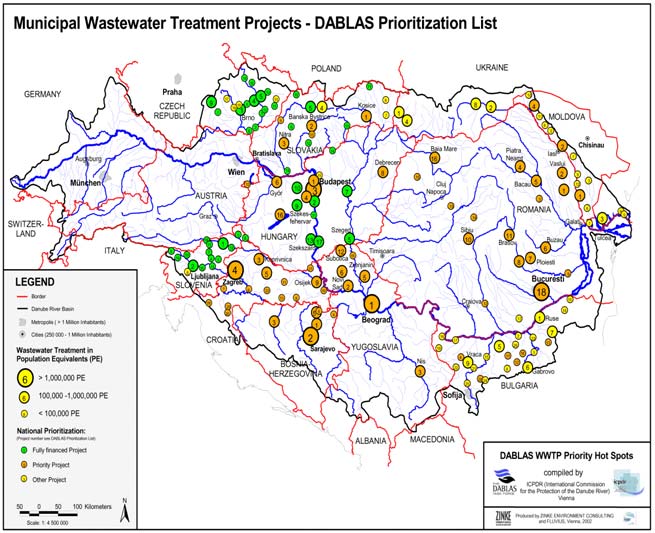
Table 24. Municipal priority investment projects in the DRB, 2002.
SUM M ARY OF RESULTS
Proje cts
Funding for 113 proje cts (mil. EUR )
C ountry
Total
Fully
Inve s tme nt
Inve s tme nt
Total
Inve s tme nt
Finance d
Se cure d
N ot Se cure d
re quire d
Bosnia & Herzegovina
6
0
145.2
0.6
144.6
Bulgaria
26
0
203.2
0
203.2
C roatia
15
0
217
0
217
C zech Republic
18
14
22.8
0
22.8
Hungary
17
9
737.3
105.5
631.8
Moldova
12
0
32.2
0.9
31.3
Romania
18
0
674.5
168.8
505.7
Slovak Republic
15
7
122.7
80.2
42.5
Slovenia
16
15
18.1
0
18.1
Ukraine
8
0
43.5
0.4
43.1
Yugoslavia
7
0
350.1
89.7
260.4
Totals
158
45
2,567
446
2,121
Map2. DABLAS municipal investments prioritisation map
56
9 Progress and effectiveness of implementing the work programme of the
MoU
9.1
Achieving mid - and long term goals
As part of the MoU, the ICPDR and BSC have agreed to the following common goals:
· The long-term goal in the wider Black Sea Basin is to take measures to reduce the loads of
nutrients and hazardous substances discharged to such levels necessary to permit Black Sea
ecosystems to recover to conditions similar to those observed in the 1960s.
· As an intermediate goal, urgent measures should be taken in the wider Black Sea Basin in order
to avoid that the loads of nutrients and hazardous substances discharged into the Seas exceed
those that existed in the mid 1990s.
An analysis of the load of P and N along the Danube River and for the main tributaries was calculated
for the period 1950 2000 with MONERIS ("Modelling Nutrient Emissions in the Danube River
System"). Based on MONERIS calculation and results of the Project Nutrient Management in the
Danube River Basin and its impact on the Black Sea" (DANUBS), it can be concluded that the nitrogen
load in the fifties was between 200 and 250 kt/a N and for phosphorus the load was in a range of about
15 kt/a P. The highest load of nitrogen was estimated for the period of 1988 to 1992 (550 kt/a N) and
was only 2.5 times higher than in the fifties. For phosphorus the highest load was about 42 kt/a P, which
was 2.9 times higher than in the fifties. This highest level was realized in the period 1983-1987.
The present load in the Danube of both P and N is below the values of the early seventies and reduced
by about 20 to 30 % (N) and 40 to 50 % (P), respectively, compared to the maximum values. The
causes for the changes of the nutrient loads are change of wastewater treatment for N (Fig. 13) and P
(Fig. 14), changes of N-surplus in agriculture and phosphorus use in detergents.
Based on analysis of the past, possible changes for the future are calculated. This analysis shows that a
potential for further reduction of nutrient loads exists at least for P. For nitrogen this potential is lower.
Fig. 13 Historical development Danube river basin N load 1949-2001
57
Fig. 14. Historical development Danube river basin P load 1949-2001
9.1.1 Monitoring and evaluation indicators
Three groups of indicators are selected to track the short and long-term impacts of nutrient reduction
actions and measures within the Danube river basin: process (Table 25), stress reduction (Table 26) and
environmental status (chapter 9.1.1.1).
58
Table 25. Monitoring and evaluation: Process Indicators
Process indicator in
Description
Measure
place
Target Actual
Target 2007
13
3 more countries
Number of countries agreed to implement DRPC, WFD,
UWWTD, IPPC, ND, CAP, etc
Number of partners involved in ICPDR BSC MoU 3 Danube countries
implementation
ICPDR Secretariat
Development and
EGs Chairperson
implementation of new Number of implementing mechanisms in place
JAP
Not set
policies, legislation,
Inter ministerial mechanisms in place
framework for
Set up of DBS JTWG and development of its
cooperation and
Work program
mechanism for
Number of regulations, recommendations, guidelines, plans of BAT for 5 industries developed and Implementation secured
compliance
actions, methodologies, reporting formats, etc in place or implemented
adapted
BAP concept developed
Voluntary agreement on the use of
TNMN methodology
phosphate free detergent proposed
M1 for pollution during floods
and in place
Formats for data collection and reporting on
JAP, emission inventories, TNMN and
DABLAS
Number of requirements introduced in the DBS JTWG work Requirements on coastal zone management Implementation secured
program
introduced
Introduction of new
challenges in response Number of driving forces, principles and approaches considered Political (accessions, reforms, etc),
to international
in various scenarios
economical, social driving forces considered
requirements
River basin management approach
Dialogue with policy makers to define scenarios for nutrient Contact with HoDs representatives of Intensification of dialogue
reduction and bridge the gap between the scientific and technical agricultural sector, detergent industry, Involve all stakeholders in the
and policy dimensions
scientists and researchers
making decision process with
clarified responsibilities
59
Process indicator in
Description
Measure
place
Target Actual
Target 2007
Response from countries, involvement of stakeholders as to Participation in the EGs, DBS JTWG, Continue
Communication,
improve achievements of the expert groups and working group
workshops, regional projects (MONERIS,
involvement,
daNUbs, DABLAS), joint efforts (JDS,
information
TNMN, etc)
Flow of information and transfer within the administrative Access to the ICPDR databases available
Improve data relevance, credibility,
bodies and to the public
Information partially supplied in the JTWG
reliability and collection
Level of expertise
Expertise improved from scientific and Expertise in various fields need to
technical point of view
be improved (economic
instruments, cost effectiveness,
environmental accounting systems,
etc)
Capacity building
Level of knowledge and understanding of the processes and of Enhanced knowledge and understanding of Continue to improve knowledge
technical and operational tools
processes related to nutrient input,
transformation, losses and reduction effects
Understanding of the water quality needs of Objectives for Protected Areas met
Natura 2000 wetlands, including inter-actions
with relevant water bodies.
Use of information provided by the implementing tools
Training of staff on the use of the ICPDR Increase quality of monitoring and
tools: TNMN, Emission inventories, improve emission data collection
Accidental risk inventories, inventory of and processing
fertilisers etc.
Demonstration,
Number of replications or demonstrative actions using lessons Shared experience with other international Improve and disseminate practices
transferability,
learned from various case studies, workshop, Roof report work, river basins
Monitor and evaluate progress
replicability
etc.
60
Table 26. Monitoring and evaluation: Stress Reduction Indicators
Stress reduction
Description
Measure
indicator
Target 2001
Target Actual
Target 2007
513 124
300
Number of hot spots - point sources reduced from total of
513
Number of municipal wastewater treatment plants achieved 156 plants
45 plants
158 plants
Reduc
Quantiti
tion of es of organic loads and phosphorus from municipal N: 31,500 (t/a)
N: 7,246 (t/a)
N: 31,500 (t/a)
discharges from point wastewater treatment plants reduced
P: 7,400 (t/a)
P: 1,259 (t/a)
P: 7,400 (t/a)
sources of pollution
BOD: 181,000 (t/a) BOD: 35,809 (t/a)
BOD: 181,000 (t/a)
COD: 64,343 (t/a)
COD: 351,000 (t/a)
COD: 351,000 (t/a)
Number of rehabilitation / upgrading of existing WWTP and 21 plants
9
21
new construction of WWTP for agro-industrial units.
Quantities of nutrients reduced from agro-industrial N: 6,700 (t/a)
N: 2,806 (t/a)
N: 6,700 (t/a)
wastewater treatment plants
P: 1,100 (t/a)
P: 0,700 (t/a)
P: 1,100 (t/a)
BOD: 9,500 (t/a)
BOD: 5,800 (t/a)
BOD: 9,500 (t/a)
COD: 14,900 (t/a)
COD: 6,440 (t/a)
COD: 14,900 (t/a)
Number of countries having no significant untreated 13 6
13
discharge into the water from agro-industrial units
Reduction of pollution % of area specific diffuse pollution loads reduced
Not set
40
100
from diffuse sources
Application of
% of reduction of application of fertilisers
Not set
50
Not set
fertilisers
Effect of wetlands
% of efficiency of wetlands against nutrient reduction
23 proposed wetland Low efficiency in reducing Continue
projects
nutrients
Avoided cost for alternative solution for environmental Not set
7.2 mill $ /a
Increase number of wetlands
services benefits offered by wetlands
providing environmental services
Number of objectives for protected areas achieved
Not set
Relevant
conservation Complying with all objectives of
objectives for wetland sites the protected areas
in the Natura 2000 met
Amounts of
% of reduction of phosphorus transported to the Black Sea
Not set
50 comparing with 1990
phosphorus
61
9.1.1.1 Environmental status indicators
The ICPDR has developed its monitoring and evaluation system and has identified the indicators for
pollution reduction (emission inventories) and environmental status (TNMN).
Indicators relevant for the assessment of the environmental status of the Black Sea, indicating changes
over time in Black Sea ecosystems due to nutrient inputs from the Danube River are agreed by the DBS
JTWG:
· Nutrient concentrations in the water column - [N, P, Si (total/available)]
· Secchi depth
· Turbidity
· Chlorophyll-a
· Macro-algae (indicative species) presence/absence
· Oxygen content
· Phytoplankton (key groups in numbers, biomass, and average volume of cells)
· Zooplankton ( biomass and percentage of key groups, number of Noctiluca)
· Macro - zoobenthos (biomass, percentage of key groups)
· Pollutants inorganic and organic
The results of daNUbs project in the Danube and Black Sea show improvement of water quality status.
Considering the objective for Black Sea to return to nutrient values of the 60s, the assessment shows
that the situation of the Black Sea has significantly improved since the 1980s.
9.1.2 Coastal zone part of the Danube river basin district
The primary goal of the Water Framework Directive is to establish a framework for the protection of
inland surface waters, transitional waters, coastal waters and groundwater in order to prevent further
deterioration and to protect and enhance the status of aquatic ecosystems. For this purpose it introduces
the river basin approach and stipulates the development of integrated and co-ordinated river basin
management plans. The `river basin district' is the main unit for the management of river basins and
means "the area of land and sea together with their associated groundwaters and coastal waters" (Art. 2
(15) WFD). `Coastal water' are defined as "surface water on the landward side of a line, every point of
which is at a distance of one nautical mile on the seaward side from the nearest point of the baseline
from which the breadth of territorial waters measured" (Art. 2 (7) WFD).
The Danube river basin district will include the coastal waters of Romania along the full length of its
coastline as well as the Ukrainian coastal waters extending along the hydrological boundaries of the
Danube river basin. The coastal waters of Bulgaria have been assigned to another district.
The workprogram of the DBS JTWG was revised to accommodate the requirements of the EU WFD
regarding coastal waters.
9.1.3 Reporting mechanisms in place/under discussion
The ICPDR Water Quality Yearbook contains data for year 2002, 2001 and 1997 as reference year
according to the intermediate objective of not exceeding level of nutrients observed in 1997. The annual
reports shall feed the five years reports and follow the same structure of data. The five years report shall
reflect trends, natural variability, target values and reference condition. Information contained in the
five years report would serve for JAP reporting.
The Trans National Monitoring Network of ICPDR is well established and provides high quality data at
the same time it shall be refined in order to meet the requirements of WFD in particular for coastal
waters. The system of quality insurance and quality control is in place. All ICPDR countries are
committed to report necessary information according to requirements of WFD. The information for
coastal waters in line with WFD is to be provided by Romania and Ukraine as it was agreed within the
RBM/EG. The Danube is considered as point pollution source therefore loads to the Black Sea
calculated at the last station in Danube (near Reni) are of particular interest for the Black Sea.
62
The ICPDR proposed two ways of reporting for the Danube pollution loads to the DBS JTWG. The
standard way is to use the results from the ICPDR load assessment programme at the Reni sampling site.
In case that these data are not available, the loads can be calculated using the average annual discharge
values and the average annual concentration of a particular determinand at the Reni sampling site. The
existing results from the load assessment programme (i.e. from 1996 2004) can be used while the
alternative load assessment method (calculation using average monitoring values from Reni profile)
would be applicable only to nutrients and not for heavy metals.
For future reporting to the DBS JTWG, the ICPDR agreed to include all parameters proposed by BSC
into the ICPDR load assessment programme starting from 2005 (for the sampling site Reni). An
inevitable precondition for this upgrade is the availability of AQC results in the responsible laboratory.
For the assessment of heavy metals both filtered and non-filtered samples should be analyzed. Silicate
can be included into the reporting procedure provided the satisfactory AQC results will be achieved.
In response to the reporting obligations, analysis and synthesis of data will be undertaken by the BSC
and presented to the ICPDR by the end of September 2004. The BSERP has analyzed the quality of data
and applicability of information on indicators collected. This information will be used to assist in
further development of the monitoring system of the Black Sea. The BSC will prepare a statement on
historical data and on the methodology for the development of the Black Sea monitoring system
necessary for collecting the data on 10 agreed indicators. Analytical quality control system for the
Black Sea monitoring programme has to be developed.
The DBS JTWG is further assisted by the UNDP GEF DRP in identifying appropriate modalities for the
implementation and developing of a monitoring system for commonly agreed process, stress reduction
and environmental status indicators for the Black Sea.
63
10 Sustainability of the project results reflected in the ICPDR activities after
UNDP GEF co-financing ends
10.1
Building long term sustainability in the participation of Danube countries
Sustainability is the focus of attention in all activities of the ICPDR. The UNDP GEF Danube Regional
Project has the intent of capacity building that will strengthen Danube institutions' ability to maintain
the water sector in a state of constant upgrading, to reduce water pollution and assure integrated river
basin management and transboundary cooperation.
After UNDP GEF support ends, deliverables will be in nation's hands.
The major measure of success to assure long-term sustainability of the ICPDR activities is the country's
commitment to continue to financially and technically support the Expert groups activities. The
financial support for the ICPDR activities by the countries and strong commitment to the work indicates
a positive attitude for sustainability. An important contribution to sustainability would come from the
development of national institutional mechanisms such inter-ministerial structures to control nutrients,
where project beneficiaries gradually assumed increasing responsibilities for project activities during
implementation, and particularly following completion in implementing legal reforms (CAP, Nitrates
Directive, WFD, etc).
10.2
Further EC support to build national capacities for implementation of EU directives and
regulations for water quality control and pollution reduction
The European Union, which provides the most important direct assistance to former and current
accession countries as Czech Republic, Hungary, Slovenia, Slovakia, Bulgaria and Romania, has put in
place the following financing mechanisms:
EU Stability Pact : Presently 2.2 to 2.5 billion are pledged and 700 millions for emergency
assistance are available, out of which about 2 billions will be available for Danube countries;
ISPA Funds : For the period 2000 to 2006 a total of 7 billion are programmed out of which about 50
% are foreseen for Danube accession countries;
SAPARD Funds are available specially for agricultural development; Danube accession countries might
be eligible for about 1,8 mil ;
PHARE Fund : For the period 2000 to 2006 a total of 10,56 billion are programmed, out of which
50% will be available for Danube accession countries.
The total commitments from the European Union for environmental measures, in particular for water
management and waste water treatment for accession countries in the Danube River Basin can be
estimate to reach at least 12,5 billions for a period of 7 years. Considering a total population of about
50 million people in the central and lower Danube River Basin, the per capita investment would be
36 per year or 250 per inhabitant for the total planning period of seven years.
The high cost of achieving EU environmental compliance is a formidable challenge for the new
member states, Bulgaria and Romania, and non accession countries.
Since the beginning of accession negotiations, the EU has stressed that at least 90% of the cost of
environmental compliance must be borne from countries' own sources, representing 2-3% of GDP for
many years to come (Communication from the European Commission on the Challenge of
Environmental Financing in the Candidate Countries, COM (2001) 304 Final). Mechanisms of
financing include contributions from national environmental funds, national and local budgets,
commercial financing, and public-private partnerships.
64
In the past few years, the EU has provided an overall amount of 2.5 billion EUR per year in assistance
to the 10 new member states, and this amount is expected to increase three-fold following accession.
PHARE was originally created in 1989 to support Hungary and Poland in developing their economies,
but was quickly expanded to cover all the CEE countries and the CIS. With an annual budget of 1.56
billion EUR for the period 2000-2006, the Phare programme is split between technical assistance (30%),
and support for economic development in the more impoverished regions of the accession countries
(70%).
The annual ISPA budget of approximately 1 billion EUR is divided between environmental (50%) and
transport (50%) infrastructure projects. ISPA has been instrumental in providing financial assistance in
project development of municipal wastewater investments among the recent accession countries (CZ,
HU, SI, SK) and Bulgaria and Romania. ISPA is designed to phase into the Structural Funds that will
be available following entry of the 10 new member states. For the period 2004-2006, 21.7 billion EUR
have been allocated in the Structural and Cohesion Funds. As with the ISPA during the pre-accession
process, 50% of the Cohesion Funds are earmarked for environmental investment.
The Special Programme for Agricultural and Rural Development (SAPARD) manages an annual
budget of 0.52 billion EUR, to finance rural community projects such as management of manure storage
facilities for complying with the Nitrates Directive, agricultural water resource management, forestry,
and land improvement. Distribution of SAPARD funds, managed by the individual countries, has come
under some criticism for not providing more assistance to organic farming, rural development, and
agro-friendly projects.
Even with EU support, the accession countries will be faced with funding gaps for achieving
environmental compliance. International Financial Institutions (IFIs), such as EIB, EBRD, WB, and
GEF will continue to play an important role in financing environmental investment projects. Many of
the new member states have implemented programmes for creating incentives to further engage the
private sector, and these efforts will likely expand in the subsequent years.
10.3
Estimates on the cost for reforms and investments
The 10 recent new member states have fully transposed their regulatory frameworks in line with EU
environmental requirements, but realising actual compliance will require significant time and financial
resources. The total environmental investment needed by all of the 10 new member states is between
80 and 100 billion . Among the Danube River Basin countries, the total environmental costs range
from 2,723 mil for Slovenia to 10,000 mil for Hungary and the Czech Republic. The second tier of
accession countries, Bulgaria and Romania, require even more to achieve compliance: 11,000 mil and
17,000 mil , respectively:
Table 27 Estimated total environmental costs to meet EU standards
Country
Population
Total environmental costs to meet EU standards
Bulgaria 8.2
million
11,000 mil
Czech Republic
10.4 million
10,000 mil
Hungary 10
million
10,000 mil
Romania 22.4
million
17,700 mil
Slovak Republic
5.4 million
4,005 mil
Slovenia 1.99
million
2,723 mil
The Urban Wastewater Treatment Directive is expected to be the most expensive water quality
requirement to implement, accounting for 8% (Slovenia) to over 45% (Romania) of the total estimated
environmental compliance investment. The new member states have been granted transitional periods
for implementing the UWWT, as much as 10 years beyond the 2005 deadline stipulated in the directive.
65
Shorter transition periods were reached for complying with the IPPC Directive, the most significant
challenge facing the industrial sector. Industrial restructuring has been underway in the region for
several years, but meeting the IPPC Directive requirements by the 2007 deadline will be a major
challenge for many CEE enterprises. Estimated
Nobody can deny that the Common costs complying with the IPPC Directive among the
Agricultural Policy, with excessive subsidies,
Danube River Basin countries ranges from 50 mil
have also created a lot of environmental for Slovenia to 3,725 mil in the Czech Republic:
problems including the nitrates problem," In the agricultural sector, the Nitrates Directive is
admits Margot Wallström. "It is important to
the most relevant EU environmental legislation.
reform the Common Agricultural Policy in Agricultural nitrate pollution is generally much
such a way that we do not invite the new lower in CEE than in intensely farmed portions of
member states to repeat the mistakes by the
western EU countries, primarily because the CEE
old member states so to say. And of course,
agricultural sector is still recovering from the
they have an advantage in that they have not
collapse of former Soviet Union markets and the
been using so much pesticides or fertilisers
break-up of former communal farms. However,
and they have not had a very intensive many intensive animal husbandry operations
agricultural sector."
throughout CEE are faced with significant financial
burdens for improving manure storage and handling facilities.
The new member states did not receive transition periods for nature conservation compliance. The
Birds and Habitats directives are usually not considered as investment-heavy legislation, but balancing
conservation efforts with infrastructure improvements is paramount. For example, many transportation
projects in the region threaten potential Natura 2000 sites. There is an agreed need to accelerate the
process of identifying areas to be protected.
The high cost of achieving EU environmental compliance is a formidable challenge for the new
member states, Bulgaria and Romania, and several Balkan countries that have negotiated Stabilisation
and Association Agreements (SAAs) with the EU to bring their countries closer to EU standards.
Since the beginning of accession negotiations, the EU has stressed that at least 90% of the cost of
environmental compliance must be borne from countries' own sources, representing 2-3% of GDP for
many years to come.
The reforms should concern institutional and legal measures. For Czech Republic, for the water sector,
it will be required for 5 years period 1,130 1,500 million , and for 10 years period 2,260 3,000
million .
Values related to the direct investments within the Morava River which have to be carried out to
respond to new water related regulations are estimated to reach a total amount of 200 250 million
for period of 5 years. Cost assessment for implementation of the WFD is about 10 mil. for years 2003
2015, of which for years 2004 2006 is presupposed amount 2.6 mil . State budget is the main
source of finance. No additional institutions are requested. In the 19922002 period, the State
Environmental Fund of the Czech Republic spent 1.1 billion and supported the various environmental
and water related investments, of which construction or reconstruction of 1,115 waste water treatment
plants and sewer systems and 1,295 projects to decrease the burden on nature and the landscape.
Moldova is committed to implement the WFD and the ICPDR JAP. A detailed revision of needs in
terms of legislation to respond to WFD is not yet done. The needed investments for JAP
implementation is: 296.7 Mio. for municipal wastewater treatment plants, including sewerage systems,
111.2 Mio. for industrial wastewater treatment plants, and 85.0 Mio. for restoring and protecting the
wetlands.
For Bosnia, the financial allocation for 2002-2004 is 25,6 mil .
66
From Slovene EcoFund 0,211 million were spent on wastewater treatment and 1,875 million for
wastewater collection systems as part of the NEAP priorities only in 2002.
Romania is the recipient of funding from the EU-ISPA Programme that provides support for the
transport and environment sectors, with an annual allocation of EUR 208-270 million for the period
2000-06.
The two first Danube EU member countries Germany and Austria have significantly achieved high
standards of emission reduction and water pollution control. In 1997 and 1998 Germany invested more
then 2.88 billion for pollution reduction measures to respond to EU Water Directives and in particular
the Nitrate Directive. Current investment in the water sector in the German part of the Danube River
Basin is at the level of about 1.8 billion per year of which 1.5 billion is spent for communal
wastewater treatment facilities (including 3rd stage for nutrient removal). From 1993 to 1999 Austria
invested about 936 million per year for municipal wastewater treatment including nutrient removal
facilities. Concerning the ongoing projects indicated in the ICPDR JAP, further investments of 234
million for Germany and 264 million for Austria are foreseen for the period from 2001 to 2005.
67
11 Conclusions
Despite the difficulties of cooperation among the large number of states within the Danube region there
has been important progress in establishing the necessary mechanisms for coordination and cooperation
under the framework of the Danube River Protection Convention. The EU Water Framework Directive
has added strength to the efforts to coordinate actions in support of integrated river basin management
and pollution control and reduction.
Added to these elements has been the support provided by the UNDP /GEF Danube Regional Project.
The mechanisms for cooperation exist and agreement on the nature of the problems has been reached. It
will nonetheless be important that many individual actions are taken that in total will add up to a cleaner
and healthier Danube.
Recent reviews of activities conducted under ongoing DABLAS project highlight that many investment
and actions are happening. In addition there has been substantial legislative reform and in particular the
implementation of EU community law within the DRB. The DABLAS project has, however,
highlighted both the implementation efforts and deficits. This is especially the case for those EU
Directives that require substantial administrative reform and financial investments.
Sustainable development in the DRB requires continue and enhanced international cooperation. Success
will depend on thorough implementation of actions and commitments of the countries and on effective
and coordinated contribution of the international community.
The International Commission for the Protection for the Danube River is assisting in providing a forum
for the necessary dialogue, understanding and action needed to meet the challenges that exist.
68
Document Outline