

September 2004
ASSESSMENT AND DEVELOPMENT OF
MUNICIPAL WATER AND WASTEWATER
TARIFFS AND EFFLUENT CHARGES IN
THE DANUBE RIVER BASIN.
Volume 2: Country-Specific Issues and
Proposed Tariff and Charge Reforms:
The Czech Republic National Profile

AUTHORS
Lenka Camrova / IREAS, o. p. s.
TARIFFS AND CHARGES VOLUME 2

PREFACE
The Danube Regional Project (DRP) consists of several components and numerous
activities, one of which was "Assessment and Development of Municipal Water and
Wastewater Tariffs and Effluent Charges in the Danube River Basin" (A grouping of
activities 1.6 and 1.7 of Project Component 1). This work often took the shorthand
name "Tariffs and Effluent Charges Project" and Phase I of this work was undertaken
by a team of country, regional, and international consultants. Phase I of the
UNDP/GEF DRP ended in mid-2004 and many of the results of Phase I the Tariffs and
Effluent Charges Project are reported in two volumes.
Volume 1 is entitled An Overview of Tariff and Effluent Charge Reform Issues and
Proposals. Volume 1 builds on all other project outputs. It reviews the methodology
and tools developed and applied by the Project team; introduces some of the
economic theory and international experience germane to design and performance of
tariffs and charges; describes general conditions, tariff regimes, and effluent
charges currently applicable to municipal water and wastewater systems in the
region; and describes and develops in a structured way a initial series of tariff,
effluent charge and related institutional reform proposals.
Volume 2 is entitled Country-Specific Issues and Proposed Tariff and Charge
Reforms. It consists of country reports for each of the seven countries examined
most extensively by our project. Each country report, in turn, consists of three
documents: a case study, a national profile, and a brief introduction and summary
document. The principle author(s) of the seven country reports were the country
consultants of the Project Team.
The authors of the Volume 2 components prepared these documents in 2003 and
early 2004. The documents are as up to date as the authors could make them,
usually including some discussion of anticipated changes or legislation under
development. Still, the reader should be advised that an extended review process
may have meant that new data are now available and some of the institutional detail
pertaining to a specific country or case study community may now be out of date.
All documents in electronic version Volume 1 and Volume 2 - may be read or
printed from the DRP web site (www.undp-drp.org), from the page Activities /
Policies / Tariffs and Charges / Final Reports Phase 1.
TARIFFS AND CHARGES VOLUME 2

We want to thank the authors of these country-specific documents for their
professional care and personal devotion to the Tariffs and Effluent Charges Project.
It has been a pleasure to work with, and learn from, them throughout the course of
the Project.
One purpose of the Tariffs and Effluent Charges Project was to promote a structured
discussion that would encourage further consideration, testing, and adoption of
various tariff and effluent charge reform proposals. As leaders and coordinators of
the Project, the interested reader is welcome to contact either of us with questions
or suggestions regarding the discussion and proposals included in either volume of
the Project reports. We will forward questions or issues better addressed by the
authors of these country-specific documents directly to them.
Glenn Morris: glennmorris@bellsouth.net
András Kis: kis.andras@makk.zpok.hu
TARIFFS AND CHARGES VOLUME 2
National Profile of Municipal Water and Wastewater Management in the Czech Republic
3
Table of Contents
Executive Summary ...................................................................................................................7
1. Introduction ............................................................................................................................9
1.1. Overview of the Morava River Basin .............................................................................9
1.2. Origins of the Municipal Water and Wastewater Industry ...........................................10
1.3. Future Direction ............................................................................................................11
2. Legal and Institutional Setting .............................................................................................13
2.1. National Laws and Regulations ....................................................................................13
2.1.1. Common Provision ................................................................................................13
2.1.2. Self Service............................................................................................................15
2.2. Management Units ........................................................................................................15
2.2.1. Administrative Unit ...............................................................................................15
2.2.2. Operating Units......................................................................................................15
2.2.3. Ownership of Facilities..........................................................................................16
2.3. Service Users ................................................................................................................16
2.3.1. Classification of Users...........................................................................................16
2.3.2. Special Legal Consideration by User ....................................................................17
2.4. Regulatory Units ...........................................................................................................17
2.4.1. The Overview of the Environmental Regulation...................................................18
2.4.2. The Overview of the Economic Regulation ..........................................................19
3. Data ......................................................................................................................................20
3.1. Water Production ..........................................................................................................20
3.1.1. Abstraction of Surface Water ................................................................................20
3.1.2. Abstraction of Groundwater ..................................................................................22
3.2. Water Processing/Cleaning ...........................................................................................24
3.3. Water Distribution ........................................................................................................24
3.4. Water Purchased ...........................................................................................................25
3.5. Water Consumption ......................................................................................................25
3.5.1. General Consumption of Water in the Czech Republic.........................................25
3.5.2. Water Consumption of PWSS&S..........................................................................26
3.6. Wastewater Production .................................................................................................26
3.7. Wastewater Collection and Processing .........................................................................28
3.8. Wastewater Effluent Discharge ....................................................................................28
4. Economic Data .....................................................................................................................29
4.1. Tariffs, Fees and Charges..............................................................................................29
4.1.1. Tariffs for PWSS&S Services ...............................................................................29
4.1.2. Payments to Cover Watercourse and River Basin Administration........................30
4.1.3. Charges for the Withdrawal of Groundwater ........................................................31
4.1.4. Fees for the Discharge of Wastewater into Surface Water (Effluent Charges) .....31
4.1.5. Fee for a Permitted Discharge of Wastewater into Groundwater ..........................31
4.2. Sales to Particular Service Users ..................................................................................31
4.3. Costs on Purchased Inputs ............................................................................................31
4.3.1. Effluent Charges ....................................................................................................33
4.4. Grants or Transfers........................................................................................................34
5. Infrastructure ........................................................................................................................35
5.1. Production, Processing and Distribution of Water........................................................35
5.2. Collection and Treatment of Wastewater......................................................................36
6. Management Units ...............................................................................................................37
6.1. Types of Management Units .........................................................................................37
6.2. Management Units Service Areas.................................................................................38
6.3. Population Served .........................................................................................................38
4
UNDP/GEF Danube Regional Project
6.4. Special Obligations .......................................................................................................38
6.5. Financial Conditions .....................................................................................................38
6.6. Current Plans for Expansion and Investment................................................................39
7. Regulatory Units ..................................................................................................................40
7.1. National and Local Planning and Permitting ................................................................40
7.1.1. Data Collection ......................................................................................................40
7.1.2. Planning and Development....................................................................................40
7.2. Economic Regulations or Limitations...........................................................................41
7.2.1. Pricing (tariffs) ......................................................................................................41
7.2.2. Grants and Subsidies..............................................................................................41
7.3. Environmental Regulations and Restrictions ................................................................42
8. Service Users........................................................................................................................44
8.1. MU Customers ..............................................................................................................44
8.2. Self Supply Users..........................................................................................................44
9. Reform Proposals Connected with Tariffs and Charges ......................................................45
9.1. Tariff Structure..............................................................................................................45
9.2. Economic Regulation....................................................................................................45
9.3. Economic Sustainability ...............................................................................................46
9.5. Summary of Reforms ....................................................................................................46
10. References ..........................................................................................................................48
Lenka Camrova/IREAS
National Profile of Municipal Water and Wastewater Management in the Czech Republic
5
Abbreviations
Act on PWSS&S
Act No. 274/2001 Coll. on Public Water Supply Systems and Sewers
CSSR
Czech and Slovak Socialistic Republic
CZSO
Czech Statistical Office
CR
Czech Republic
CZK
Czech currency (1 Euro is about 32 CZK)
EU
European Union
MU
Management Units - municipalities or companies established or hired by
municipalities to run the system
PWSS&S
Public Water Supply Systems and Sewers - the official title for the MU in the
Czech Republic
RU
Regulatory Units, e.g. the government, Ministries and other offices of the public
administration, which impose some regulation on the MU
SU
Service Users are households and businesses
VaK
Vyskov Public Water Supply System and Sewerages in Vyskov (selected case
site)
VAT
Value Added Tax
Water Act
Act No. 254/2001 Coll. on Water
WWTP
Wastewater treatment plant
National Profile of Municipal Water and Wastewater Management in the Czech Republic
7
Executive Summary
The purpose of the National Profile is to analyse the current situation and future development in the
field of water and wastewater management in the Czech Republic, with a strong focus on providing
public water supply and sewerage. As a result of describing the historical consequences, the current
and future development, possible tariff and effluent charges reforms have been suggested.
The text is divided into 9 chapters, which are focused on different entities of the system, following the
basic division into three main groups: regulatory units, management units and service users. This
division facilitates defining the individual competences and obligations as well as mutual interactions
throughout the whole system.
Whenever possible the stated data and information are related to the Morava River basin the part of
the Czech territory, which belongs to the Danube river basin.
An integral part of the National Profile of Municipal Water and Wastewater Management in the Czech
Republic is A Case Study of Municipal Water System Management and the Impacts of Tariff and
Effluent Charges: Vyskov. The case study describes the situation of a particular management unit and
explores some hypothetical development and policy scenarios.
National Profile of Municipal Water and Wastewater Management in the Czech Republic
9
1. Introduction
This report is, first of all, a compilation of information and data that describes the institutions and
conditions that shape and characterize the provision of municipal water and wastewater service in the
Czech Republic. The purpose of this compilation is to provide a background and inspiration for
proposals to reform both the current system of water and wastewater tariffs and effluent charges and
coincident proposals to adjust or modify the legal and regulatory system within which the these tariffs
and effluent charges function in the Czech Republic.
Indeed, some chapters include brief analyses suggesting such reforms and Chapter 9 concludes this
report with preliminary proposals for reforms in the institutional setting and the design of these tariffs
and charges. The aim of these proposals is to improve the management of water and wastewater
resources used in the municipalities of the Czech Republic generally and including protecting water
resources from nutrient loading and toxic substances originating from municipal systems.
1.1. Overview of the Morava River Basin
The Czech Republic is a democratic state in Central Europe which was established in 1993 after the
federation ,,Czechoslovakia" split up into two republics: the Czech Republic and Slovak Republic. The
country is politically stable under the governance of the social democratic party since 1998. The Czech
Republic is joining the European Union in May 2004 in the first wave of enlargement.
The state is divided administratively into self-governing units, which are as follows:
a) municipalities in the first level of public administration (more than 6 000),
b) municipalities with enlarged competences (,,small districts") which administrate the territory
of more municipalities and also have some special competences under the government
administration, e.g. in the field of water management (about 200),1
c) regions as the highest level of public administration (13 regions).
For the purpose of administering watercourses, there is another division of the Czech Republic based
on the ,,river basin" approach. According to that, there are 5 main river basin territories: Elbe, Vltava,
Ohre, Odra and Morava. For the purpose of the report, only the Morava River has any relevance as a
part of the Danube river basin. The administrative units' borders do not correspond with particular
river basins, which causes some problems in data collection (see Chapter 3).
1 ,,small districts" partly replaced the competences of about 73 districts units of government administration - that were
abolished in 2002
































10
UNDP/GEF Danube Regional Project
Map 1.
River Basins in the Czech Republic
Ohre river basin
Vltava river basin
Elbe river basin
Morava River basin
Odra river basin
Source: www. povodi.cz
The Morava River basin covers about 21 423 km2, which is about 25% of the Czech territory. It covers
the area of 4 regions (South-Moravian, Zlin, Vysocina, Olomouc) and encompasses parts of another 3
regions (Pardubice, Moravskoslezsky, South-Bohemia). There are about 1 900 municipalities of
different size in the Morava River Basin, from which about 100 serve as a ,,small district".
The population living in the Morava River basin is about 3 mil., which is about 30% of the total
population.
1.2. Origins of the Municipal Water and Wastewater Industry
In the Czech Republic, the fundamental change in water legislation, in general, took place after the
political shift in 1948 (beginning of the socialist period). This change was based on a unified approach
to the whole territory and fixed the principles of planned management of the national economy.
Watercourses of major importance were declared as a national property. Water management was
directed by the Ministry of Public Works, which was responsible for canalising rivers, dams, public
water supply systems and sewers (PWSS&S) in selected industrial towns and spas. The Ministry of
Agriculture was responsible for the other watercourses, technical drainage, PWSS&S in the villages.
According to Act. No. 138/1974 Coll. on waters, the structure of water management used to have 4
hierarchical levels: the central authority at the national level (Ministry of Water Management and
Wood Industry of the CSSR), at the provincial level (the provincial national committee), at the
Lenka Camrova/IREAS
National Profile of Municipal Water and Wastewater Management in the Czech Republic
11
municipal or city level (municipal or city national committee) and at the local level (local national
committee). Most decisions were carried out at the municipal level, i.e. permissions to construct
waterworks, agreements on water management authorities, ... etc.
A significant step was the establishment of 6 basin administrations in 1966, which were linked to the
General Directorate for Watercourses. In 1970 the general directorate was closed down, and 5 River
Authority Companies were set up, together with the Water Management Development and Structures
Company.
In the period between 1971 and 1977 the district and provincial authorities responsible for drinking
water supplies and sewerage were fused into 7 provincial drinking water-sewerage system companies
(Central Bohemian, South Bohemian, West Bohemian, North Bohemian, East Bohemian, South
Moravian and North Moravian Water Supplies and Sewerage). However in Prague two independent
companies were kept, Prague Water Supplies and Prague Sewerage. This structure lasted until
practically 1989. In 1989, the Ministry of Water Management and Wood Industry was closed down
After 1990, the Ministry of the Environment was delegated to oversee water management at the
central level to play the role of Central Water Management Authority. Since 1990 some of the
responsibility for water management has also gradually been taken over by the Ministry of
Agriculture, including the function of setting up water management companies. This situation played a
significant role in their privatisation process. Most of the formerly centralised water management
companies were dissolved and new private companies have been established. On the basis of a
decision of the minister of agriculture, the River Basin Boards were converted into joint-stock
companies, where the only shareholder is the Czech State. This decision (which wasn't legally
justified) has been changed by Act No. 305/2000 Coll. on River Basin Administrators.
Currently, the Ministry of Agriculture plays the most significant role in the water sector as the central
water authority with regions and "small districts" at lower stages of administration. The Ministry also
co-finances and drive particular River Basin Boards as administrators of large watercourses.
Major changes have taken place in water supply and sewerage. The transformation followed the basic
principle of transferring ownership and responsibility from the state to the new owners, in this case to
self-administrating towns and villages. The transformation of public drinking water and sewer systems
took place within the second wave of coupon privatisation. Legislatively, this did not take the form of
a special act. A governmental decision was issued, which established the following conditions for the
approval of privatisation on projects:
a) the owners of the infrastructure may be only communities, groups of communities and/or joint
stock companies in which the communities are major shareholders (with a holding of 80 -
100% of the shares),
b) the so-called operational property of the former provincial water supply and sewerage
companies (buildings, transport and construction machinery) could be privatised using the
standard methods of privatisation,
c) each privatisation project should also take into account the standpoints of the communities
involved with respect to the process of privatisation.
1.3. Future Direction
The Czech Republic has become a member state of the EU, which brings the obligation to adopt and
enforce all environmental legislation according to European Union directives. The implementation has
been in process and for each directive an ,,Implementation Plan" has been adopted.
There is a amendment of the Water Act in the Czech Parliament, which should ensure the total
implementation of the EU Water Framework Directive into Czech legislation.
For the purpose of this study, two significant changes are suggested:
12
UNDP/GEF Danube Regional Project
1) Municipalities that cause water pollution in excess of 2000 population equivalent are obliged
to ensure a functional sewage system and water treatment by the end of 2010. The limits of
discharged pollution will be set by a special Government Order. A system of grants and
subsidies has also been suggested (see Chapter 7.2.2.).
2) 50% of Charges for the Withdrawal of Groundwater will accrue to regional budgets (at present
all charges are revenues of the Czech State Environmental Fund). Therefore, central state
resources face a reduction of about 350 mil. CZK, but the position of Regional Offices as the
second level of the water administration will be stabilized. (for charges see Chapter 4.1.)2
In keeping with EU regulations, an amendment of the Law on Public Orders is being prepared. This
law is going to regulate investments of PWSS&S, because there is a tendency to over-invest in some
territories of particular PWSS&S, where the efficiency of such investments is very low and the
subsequent operating costs would be a big burden on the public. To support this regulation, regional
plans for development of PWSS&S have been elaborated. Recommendations are to be made by
independent experts and the main goal is to choose the economically and technically best option for
future development. The water administration should not allow construction other than that identified
in the plans.
Regarding municipal water and wastewater services in the Czech Republic generally, we can consider
them functioning systems on the whole but posing some potential risks in the future. These are
mostly analyzed in the following chapters. One of these risks is the current trend of municipalities
selling the infrastructure to private firms which are enormously interested in towns or agglomerations
over 10 000 inhabitants where running the system is profitable. The municipality often does not realize
the real value of its property (which is often formally depreciated, but will serve another 20 years
without any investment) and prefers the immediate revenues that come with possibly precipitous
privatisation. This behaviour is also promoted by the particular privatisation process used in the Czech
Republic in the early 90s' (for further information on MUs behaviour see Chapter 6.1.).
2 As further explained in Chapter 2.4., there is a hierarchy of water authorities in CR: Ministry of Agriculture regions
"small districts", through which the water sector is managed. All other institutions and organisation (River Basin Boards,
PWSS&S of particular municipalities) do not have executive power and are established only for purposes of better
administration or for ensuring basic needs of public.
Lenka Camrova/IREAS
National Profile of Municipal Water and Wastewater Management in the Czech Republic
13
2. Legal and Institutional Setting
The chapter introduces the main actors playing roles in municipal water management in the Czech
Republic and presents their position and power as stated in Czech legislation. These actors are divided
into 3 categories: regulatory units (RU), management units (MU) and service users (SU). An overview
of the Czech water management legislation is provided, too.
2.1. National Laws and Regulations
2.1.1. Common Provision
For a better orientation in the requirements and definitions set by the legislation, the area of water
management in the Czech Republic has been divided into 2 key parts:
1. General use of surface water and groundwater for different purposes.
2. Area of Public Water Supply Systems and Sewers.
2.1.1.1. General Use of Water
The area of the general use of surface water and groundwater (including drinking water) is addressed
by Act No. 254/2001 Coll. on Water (The Water Act). Granting of permits to extract water and to
discharge wastewater is described, and payments (fees, charges) for particular users are established.
The law also covers the area of planning in water management and defines the administrators of
watercourses. It implements parts of the requirements of the Water Framework Directive into Czech
legislation.
Scope: The law covers any withdrawals and discharges of/to surface water and groundwater which
exceed a volume of 6 000 m3 in one calendar year or 500 m3 of water in one calendar month.
Conditions of Use: Surface water and groundwater are not subject to ownership (administrators of
these watercourses are established by the law). Any water withdrawn from these sources is no longer
considered to be surface water or groundwater. In the Water Law, there is a list of activities for which
special permission from the water authority is required. The lowest level of water authority is
considered the ,,small district". The next grade up in water management is represented by the regions.
Both, municipal and regional offices operate with two types of power: independent activities (e.g.
cooperation with Ministry of Agriculture in creating River Basin Plans) and government transferred
activities (e.g. decision-making, permissions, controlling municipalities...etc.). The central water
management administration is represented by particular Ministries (see Chapter 2.4).
Reporting Requirements: For the purpose of water balance, the consumers of surface water and
groundwater and those discharging wastewater (= holders of permits) are obliged to report to the river
basin administrators (Act No. 305/2000 Coll. on River Basin Administrators) or the relevant
Ministries. This reporting is done annually and includes the quantity and quality of water
withdrawn/discharged. Also the Czech Environmental Inspection is authorised to ask for needed
information within its activities.
2.1.1.2. Public Water Supply Systems and Sewers
According to Act No. 274/2001 Coll. on Public Water Supply Systems and Sewers (Act on
PWSS&S), the service area of PWSS&S has been legally established as a special network branch
14
UNDP/GEF Danube Regional Project
(public utilities subject the regulation, e.g. electricity, telecommunications). For clear understanding,
the expression PWSS&S means the entity (public, private or mixed) responsible for ensuring that
system operators (that operate the public, municipal water infrastructure) meet the basic needs of the
population (while subject to economic, including tariff, regulation. This entity can, but does not have
to be interconnected with the municipal bodies or the actual operation of the infrastructure. Various
legal status of PWSS&S will be discussed in Chapter 2.2.
Service Area: Historically particular PWSS&S were public companies operating the public
infrastructure, established and built as a decision of government or public administration (towns before
the Socialist period, the Central Government from 1948). From the 50s', particular construction and
supply systems mostly were organized according to districts.
Condition of service: In the legislation, three main categories of subjects are described: the owner of
the infrastructure, the service provider and the user of the system. Municipalities are usually the
owners of the infrastructure. The service provider is a legal person receiving the permission to do a
business from the regional office in a form of concession.
The owner or the service provider has to enable connection into the network (pipelines, sewers) for all
users without any discrimination. It is responsible for the reliable and safe operation of the system 24
hours a day. The quantity of the water consumed is usually measured by water meters in households
and the quantity of wastewater services estimated based on drinking water consumption. The price for
the service (water and sewage tariff) is under price regulation according to Act No. 526/1990 Coll. on
prices. The calculation has to be published every year. This means that before the given period (year),
PWSS&S itself has to estimate its costs and propose water and sewage tariffs per m3. These prices are
invoiced over the whole period. Subsequently, PWSS&S compares the real operating cost with the
previous calculation. If there are some differences, the surplus or the shortage has to be given back (or
invoiced) to consumers. In practice, an annual water account is sent to consumers with calculated
overcharge or surcharge. In some cases, the total of the estimate calculation per m3 and the real
calculation is the same.
The quality of the drinking water and harmful substances in wastewater has to be regularly measured
and reported to the water authorities.
The customers pay to PWSS&S per measured m3 and they can be disconnected if the invoice is not
paid in 30 days. If a new customer wants to join the system he has to pay costs for building the
distribution and collection lines on his property and he is an owner of this end part of the
infrastructure.
Reporting Requirements: The owner of the infrastructure has to do the record-keeping of his pipelines
and sewers (value of the property, sources and quality of used water, price calculations... etc.). This
information has to be submitted annually to the regional water authority. This regional authority
aggregates the data and sends it to the Ministry of Agriculture. The owner (or the service provider) has
to inform the user about the price calculation whenever asked.
Ownership of infrastructure: During the process of privatisation, most of the infrastructure was
transferred directly to associations of municipalities or joint-stock companies formed by
municipalities, according to their privatisation project (plan for operation of the business) that had to
be presented. About 16% of shares of particular companies (their operational property) went to the
voucher privatisation and could have been bought by any citizen. Within associations, shares were
distributed among municipalities according to two rules: No. of inhabitants or value of the
infrastructure, according to a decision of the constituent members. The large towns were mostly
agreeable to the process in which small municipalities were favoured (e.g. municipalities with no
infrastructure on their territory got some shares, too).
Originally, in most joint-stock companies, the Central Government held one ,,golden share" with
special rights, e.g. the right to block selling the infrastructure. At present, this share exists in about
20% of companies and there is a strong pressure to inconspicuously lower the power of the Central
Government in decision-making.
Lenka Camrova/IREAS
National Profile of Municipal Water and Wastewater Management in the Czech Republic
15
2.1.2. Self Service
According to the Water Act, any person can withdraw surface water without a permit if such a use
does not require special technical facilities.
In other cases (listed in Section 8 of the Water Act) the Permission for the Use of Surface Water or
Groundwater is required from the water authority. Every person holding this permit has to measure the
quantity and quality of the water used and submit the results to the river basin administrator. There is
an exception for small users withdrawing a volume of up to 6 000 m3 in one calendar year or 500 m3
of water in one calendar month or less.
According to the Act on PWSS&S, all water used for drinking purposes has to meet given hygienic
standards. The frequency and the process of controls is regulated by a special law from the Ministry of
Health.
Most of the self-supplying units in the Czech Republic are exempted from any reporting (especially
houses in small villages), therefore the quality of drinking water is very difficult to control. It is
assumed, that most of there resources (pump-wells) do not meet hygienic standards.
2.2. Management Units
2.2.1. Administrative Unit
In the Czech Republic, municipalities are responsible by law for providing the water supply and
sewage services for the population. Particular municipalities can contract service providers or establish
self-operating companies. The price for using the infrastructure depends on local policy.
2.2.2. Operating Units
Water supply and wastewater treatment is primarily organised in combination. There are about 1 400
1 600 registered PWSS&S in the Czech Republic and about 800 1 000 small municipal MUs running
the system without concession. There are about 120 large companies, which are covered by the central
records of the Ministry of Agriculture. About 22 of them operate in the Morava River basin.
These companies cover mainly district areas and are characterized by one large ,,compound" pipeline,
which usually determines the territory of the system (company).
There are many types of PWSS&S in the Czech Republic which can be organized into the following 3
groups:
1. Joint-stock companies which own the infrastructure and the operational property (so operates
the system themselves) and where a municipality (or Association of municipalities) has got a
majority ownership of the stock. In this case every municipality has some directly control of
the operations of the system. This control may be limited if a private firm has an ownership
position in the company and is responsible for providing services as the operator of the
system.
2. Association of municipalities, which owns the infrastructure and a separate private company
as a service provider which owns the operational property. The association of municipalities
hires the infrastructure to a service provider and indirectly controls operator's policies, prices
of services etc. through the terms of the contract or concession to provide service or any
oversight provisions included in that contract.
16
UNDP/GEF Danube Regional Project
3. Small single municipalities, which own the infrastructure and the operational property and
run the system themselves or contract a service provider (if it has no own staff to do it). This
type is often similar to the first one, but it is established in small isolated villages in
mountains.
2.2.3. Ownership of Facilities
As mentioned before, the ownership of the property has been transferred from the Central Government
to a more diversified share-holder basis in the privatisation process. Originally, the state kept a
,,golden share" in most companies through which it could regulate important decisions.
At present, the owner of the infrastructure (pipelines, sewers) is mostly the municipality (or
association of municipalities). Other functional buildings, cars and other property necessary for
providing services belongs to the service provider. Pumping stations, water treatment and wastewater
treatment plants are considered as a part of infrastructure. The service provider can be the same entity
as the infrastructure owner.
Particular distributaries and collection lines on private property are the private property of the owner
of the connected land/building.
2.3. Service Users
2.3.1. Classification of Users
There are the following water users in the Czech Republic:
- PWSS&S,
- agriculture,
- industry and electricity producers,
- others.
Within the category of PWSS&S, a further sub-classification of Service Users can be made:
- households (consuming about 63 % of water invoiced in 20013),
- agriculture (1.3 %),
- industry (7.4%),
- others (28%).
All categories of users show a decreasing trend in surface water and groundwater withdrawals.
Of the total amount of wastewater annually discharged into the sewage system about 59% is domestic
wastewater and about 41% industrial and other wastewater.4
3 Source: Smrný vodohospodáský plán vstník, 2001, Ministry of the Environment
4 Source: Czech Statistical Office, www.czso.cz
Lenka Camrova/IREAS
National Profile of Municipal Water and Wastewater Management in the Czech Republic
17
2.3.2. Special Legal Consideration by User
The user (customer) of PWSS&S is the owner of the property or building connected to the water
supply or sewerage network. If there is more than one private independent owner of apartments in the
building, the user of PWSS&S is always an association of these owners.
In the case of national or municipal property, the user is an organizational constituent of the Czech
state, which administers the property.
2.4. Regulatory Units
Ministry of Agriculture is the major water authority in the Czech Republic and it shares its
responsibility with other central bodies. Its domain is:
- To control drainage systems on agricultural and forest land, irrigation networks, ponds and
small water reservoirs, if they serve agriculture and forestry,
- To administer watercourses important in water management via the River Board State
Companies,
- To develop the conceptual framework, international cooperation and centralize the PWSS&S
records (in practise done only for the large PWSS&S).
Other Ministries responsible for particular parts of water management are as follows:
- Ministry of the Environment in the field of natural water accumulation and water sources
protection (surface and underground water) and providing the central control for flood
protection ,
- Ministry of Health in the field of drinking water hygiene and quality,
- Ministry of Transport in the field of water transport,
- Ministry of Defence as a watercourse authority inside military training areas,
- Ministry of Finance in the field of distributing State Budget funds to selected water
construction works and the price regulation of MUs.
Watercourses are subject to administration. They are classified into significant watercourses and minor
watercourses. In a decree the Ministry of Agriculture, in co-operation with the Ministry of the
Environment, stipulates a list of significant watercourses.
Administrators of significant watercourses are 5 legal entities called River Boards State Companies
established by a special Act (River Board Elbe, River Board Vltava, River Board Ohre, River Board
Odra and River Board Morava).
Administrators of small watercourses belong to the following institutions:
a) Forests of the Czech Republic State Company in mountains where forests are the major part
of the territory;
b) Agricultural Water Management Administration;
c) Ministry of Interior in military zones;
d) Administration of national parks in the territory of national parks;
e) Municipalities through whose territory minor watercourses flow or a natural person of legal
entities using minor watercourses or to whose activity the minor watercourse is related and
they are permitted to do so by the Ministry of Agriculture.
18
UNDP/GEF Danube Regional Project
The Ministry of Agriculture will appoint small watercourse administrators based on application. The
administrators established by this Ministry (River Boards State Companies, Forests of the CR State
Company and Agricultural Water Management Administration) cover about 95% of the entire length
of rivers in the CR.
According to the Water Act and the Act on PWSS&S, there is a general 3-level hierarchy of the
central and local water authorities driving the Czech water management as a whole (including the field
of PWSS&S): Ministry of Agriculture regions ,,small districts".
The Czech Environmental Inspection is the main controlling body in protecting the water
environment (as well as other folders of the environment, e.g. air, wastes). According to the Water
Act, the Inspection controls the use of surface water and groundwater, monitors accidents endangering
water quality, supervises compliance with the provisions on fees for discharging wastewater ... etc.
The superior body of the Inspection is the Ministry on the Environment. Inspectors are entitled to enter
into objects controlled and required all relevant documents.
Other ministries and local offices or citizens can announce their suspicions of the environmental risks
or failures against laws directly to the Inspection. In practice, there are not enough people and
resources in the Inspection that is why its power is limited.
The Czech State Environmental Fund represents an important resource for long-term financing in
water management. It was established in 1991 by Act No. 388/1991 Coll. as a supplementary financial
source to support environmental improvement. The Minister of the Environment is responsible for the
distribution of resources. Charges and fees related to water abstraction are important revenue for the
Fund. Its granting priorities are stated for the each year.
2.4.1. The Overview of the Environmental Regulation
Act No. 254/2001 Coll. on Water (The Water Act)
- general use, permissions and protection of watercourses,
- river basin district plans and protected and sensitive areas,
- supporting fish life, minimum residual flow, minimum level of groundwater,
- harmful substances, obligations in the case of accident.
Act No. 258/2000 Coll. on the protection of public health
- drinking water analyses,
- standards for drinking water and water in swimming pools.
Decree No. 376/2000 on drinking water standards and volume and frequency of controls.
Decree No. 20/2001 on the frequency of measuring the amount and quality of water.
Government order No. 103/2003 on protected zones.
Decree No. 241/2002 on watercourses where using boats with combustion engines is prohibited.
Decree No. 336/2002 on creating flood plain maps.
Government order No. 103/2003 on sensitive areas and using fertilizers, rotating agriculture and
carrying out anti-erosion measures.
Government order No. 71/2003 on establishing watercourses suitable for fish life.
Lenka Camrova/IREAS
National Profile of Municipal Water and Wastewater Management in the Czech Republic
19
2.4.2. The Overview of the Economic Regulation
Act No. 254/2001 Coll. on Water (The Water Act)
- water management structures,
- obligations of owners of water management structures,
- charges, fees and sanctions.
Act. No. 274/2001 Coll. on Public Water Supply Systems and Sewers
- determining the field of doing business in drinking water supply and sewerages generally,
- a region's public water supply and sewers plan,
- a region's permission to provide water supply services and sewers,
- delivering, measuring and pricing,
- sanctions.
Act. No. 305/2000 Coll. on River Basin Administrators
Act No. 200/1990 Coll. on Misdemeanours (with amendments)
- withdrawal or discharge of water without permission
Act No. 388/1991 Coll. on the State Environmental Fund of the Czech Republic
- fees for discharging wastewater,
- transfers for the area of water supply and sewerage systems.
Act No. 526/1990 Coll. on Prices
- regulation of water and sewage tariff.
Act No. 265/1992 Coll. on recording the property right belonging to real estates
- the obligation of the owner of the infrastructure to make a property record.
Decree No. 293/ 2002 on fees for the discharge of wastewater into surface water.
Decree No. 292/2002 on the river boards territories.
Decree No. 274/2001 on PWSS&S.
Financial Bulletin of the Ministry of Finance (rules for calculating prices).
20
UNDP/GEF Danube Regional Project
3. Data
There is a general problem with data collection at river basins in the Czech Republic, which must be
separate from national statistics done according to municipalities, district and regions, especially for
all socio-economic indicators and PWSS&S. Both the regional division of the country and the borders
of particular PWSS&S, do not respect the river basins' borders. This problem affects the consistency
of the separate statistics made by River Boards Companies and (according to Water Framework
Directive requirements) it must be solved in the near future.
3.1. Water Production
About 98% of surface water and 80% of groundwater withdrawals are registered in the National Water
Statement. Other withdrawals are below the minimum level for registration (a volume of 6 000 m3 in
one calendar year or 500 m3 of water in one calendar month).
3.1.1. Abstraction of Surface Water
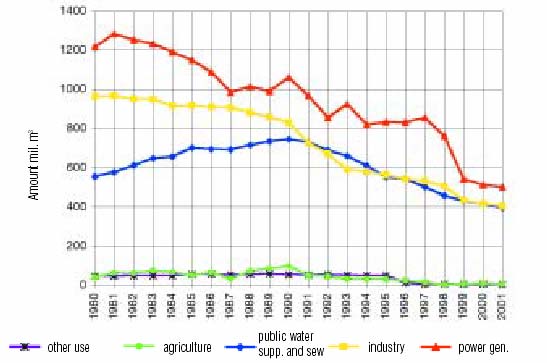
The structure of abstraction of surface water presented over time in Figure 1 and for 2001 and 2002 in
Table 1. From the national time series, the overall substantial downward trend in the abstraction of
surface water is emphatic, especially in light of the higher water tariffs for industry and households.
The total abstraction of surface water diminished from 1 342.7 mil.m3 in 2000 to 1 300.1 mil.m3 in
2001. The Morava River basin represents the only exception to this trend: total surface water
abstraction increased by 2.5% in comparison with 2000, although the decrease in the category of
PWSS&S withdrawal in 2001 was the most significant in the CZR (about 91.9% of the previous year
2000). There was a large increase in water consumption by industry in the Morava Basin.
Agricultural withdrawals decreased in all river basins. Industrial consumption accelerated to 106.8%
in 2001 (in comparison with the year 2000)5.
PWSS&S represented about 24% of the total amount of surface water withdrawn in the Morava River
basin in 2001.
5 Source: Smrný vodohospodáský plán vstník, 2001, Ministry of the Environment
Lenka Camrova/IREAS
National Profile of Municipal Water and Wastewater Management in the Czech Republic
21
Figure 1 Abstraction of Surface Water in the Czech Republic in 1980 2001
Source: Report of the State Water Management in the Czech Republic 2001
Table 1 Abstraction of Surface Water in Millions of m3
River
River Board
CR
Board
Morava in 2002*
in 2001
Morava
in 2001
Public water supply and sewers
-
amount in mil. m3
41.9
49.7
394.6
-
number of users
33
39
157
Agriculture
-
amount in mil. m3
4.3
4.4
6.9
-
number of users
19
15
58
Electricity generation
-
amount in mil. m3
98.5
96.3
500.0
-
number of users
3
2
19
Industry
-
amount in mil. m3
26.1
24.9
403.1
-
number of users
94
127
457
Other
-
amount in mil. m3
0.5
0.1
4.4
-
number of users
8
9
45
Total
-
amount in mil. m3
171.3
175.4
1 300.0
-
number of users
157
192
730
Source: Report of the State Water Management in the Czech Republic 2001
*Source: Recent statistics of River Board Morava
In Table 2, the difference between abstraction and consumption of water indicates the amount of
sewage water. In 2001, this consumption is about 20% in the category of PWSS&S, 100% in
agriculture and 12% in industry.
22
UNDP/GEF Danube Regional Project
Table 2 Total Recorded Abstraction and Consumption of Surface Water (mil.m3/year, %) in
2001
River
Year
PWSS&S Agriculture
Industry
+
others Total
Basin
Abstract. Consump. Abstract. Consump. Abstract. Consump. Abstract. Consump.
1990
91.1 18.2 52.0 52.0 262.9 31.5 406.0 101.7
1995
53.8 10.8 11.2 11.2 164.0 19.7 229.0 41.7
Morava 2000
45.6 9.1 4.4 4.4 117.1 14.1 167.1 27.6
2001
41.9 8.4 4.3 4.3 125.1 15.0 171.3 27.7
01/00
91.9% 92.3% 97.7% 97.7% 106.8% 106.4% 102.5% 100.4%
01/95
77.9% 77.8% 38.4% 38.4% 76.3% 76.1% 74.8% 66.4%
1990
739.6 147.9 114.5 114.5 1
913.5 229.6 2
767.6 492.0
1995
544.4
108.8
28.4
28.4
1 408.6
169.1
1 981.4
306.3
CR
2000 408.3
81.6
8.8
8.8
925.6 111.1 1
342.7 201.5
2001 384.1
76.9
7.4
7.4
908.6 109.0 1
300.1 193.3
01/00
94.1% 94.2% 84.1% 84.1% 98.2% 98.1% 96.8% 95.9%
01/95
70.6% 70.7% 26.1% 26.1% 64.5% 64.5% 65.6% 63.1%
Source: Smrný vodohospodáský plán vstník, 2001, Ministry of the Environment
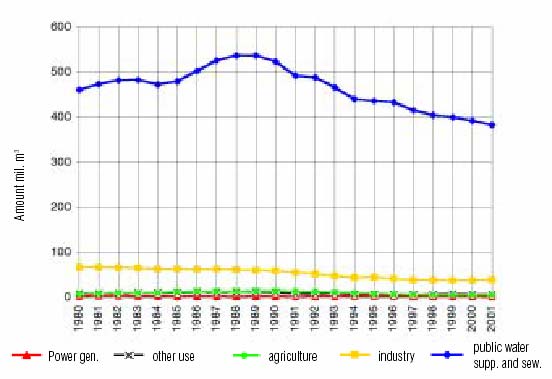
3.1.2. Abstraction of Groundwater
In the Czech Republic, the amount of abstracted groundwater dropped slightly in all the river basins in
comparison with the year 2000. Abstraction in the Morava River basin accounted for 34.2% of the
total amount groundwater withdrawn in the CR.
Withdrawing groundwater for the purpose of PWSS&S represented more than 90% of the total of
groundwater extracted in 2001. The reason is that the Water Act regulates use of groundwater
primarily for drinking water production. In addition, there was no abstraction payments levied on
PWSS&S for this sort of withdrawal in the past (see Chapter 4.1.3.).
In the Morava River basin, there are about 400 withdrawals in the category of PWSS&S, of which
about 20% exceeded production of 1,000 thous. m3.
Lenka Camrova/IREAS
National Profile of Municipal Water and Wastewater Management in the Czech Republic
23
Figure 2 Abstraction of Groundwater in the Czech Republic in 1980 2001
Source: Report of the State Water Management in the Czech Republic 2001
Table 3 Abstraction of Groundwater in the year 2001 in millions of m3
River Board River Board
CR in
Morava in
Morava in
2001
2001
2002*
Public water supply and sewers
-
amount in mil. m3
137.9
126.8
382.3
-
number of users
373
502
1 618
Agriculture
-
amount in mil. m3
2.2
1.6
5.1
-
number of users
68
87
156
Electricity generation
-
amount in mil. m3
0.0
0.0
1.1
-
number of users
0.0
0.0
3
Industry
-
amount in mil. m3
8.8
9.7
38.9
-
number of users
124
214
393
Other
-
amount in mil. m3
1.1
2.8
6.5
-
number of users
21
37
85
Total
-
amount in mil. m3
150
140.9
433.8
-
number of users
586
840
2 255
Source: Report of the State Water Management in the Czech Republic 2001
*Source: Recent statistics of River Board Morava
24
UNDP/GEF Danube Regional Project
3.2. Water Processing/Cleaning
For the use of PWSS&S, the sources for the drinking water produced in the Czech Republic in 2001
were as follows:
· 48.9% groundwater
· 51.1% surface water.
According to the Act on PWSS&S, the service provider can withdraw surface water or groundwater if
the quality of the resource is satisfactory and the costs of processing and cleaning are not exorbitant. If
there is any uncertainty, the regional office (as a water authority at the second stage of approval)
decides.
The process of transforming raw water into drinking water (including methods, frequency of analysis,
...etc.) is described in Decree No. 274/2001 on PWSS&S. The requirement related to ensuring the
minimal quality of drinking water is included in Act No. 258/2000 Coll. on the protection of public
health.
3.3. Water Distribution
In Table 4, shows basic delivery information from the stated River Board Morava statistics. From the
time series, the following aspects can be emphasized:
- the Dukovany nuclear power station is situated in the Morava River basin, so that is why the
surface water consumption of industry is so high,
- the extraction of surface water for agricultural purposes (e.g. irrigation... etc.) became free of
charge,
- the extraction of groundwater for purposes of PWSS&S was free of charge until 2001.
Lenka Camrova/IREAS
National Profile of Municipal Water and Wastewater Management in the Czech Republic
25
Table 4 River Board Morava Basic Water Delivery Information in 1997 - 2001
1997 1998 1999 2000 2001
DELIVERY OF SURFACE WATER (thous. m3)
Total
205 819
187 546
165 541
167 158
171 303
Charged
201 655
171 842
156 247
141 902
132 680
Of this: - for PWSS&S
40 833
38 086
36 499
38 768
39 398
- for industry
156 612
133 731
119 566
103 134
93 282
Of that: - power stations and heat. Plant
130 093
111 105
48 783
43 518
43 269
- once-through water cooling
77 267
59 991
50 698
41 632
31 927
- for agriculture
4 210
25
182
0
0
EXTRACTION OF GROUNDWATER (thous. m3)
Total
x
161 804
156 750
152 770
147 752
Charged
x
3 608
3 890
3 935
3 646
PAYMENTS FOR ABSTRACTION OF SURFACE
WATER (thous. CZK)
Total
273 329
264 284
269 989
276 996
287 368
Of this: - for PWSS&S
78 397
79 982
86 406
98 083
105 006
- for industry
186 885
184 251
183 201
178 913
182 362
Of that: - power stations and heat. plant
136 096
107 339
110 738
110 101
115 095
- once-through water cooling
35 543
29 396
26 870
23 314
19 156
- for agriculture
8 047
51
382
0
0
PAYMENTS FOR EXTRACTION OF
x
7 216
7 779
7 871
7 294
GROUNDWATER (thous. CZK)
Payments for using water bodies for the electricity
15 324
15 176
15 153
15 215
15 602
production (thous.CZK)
Source: T. G. Masaryk Water Research Institute, 2002
3.4. Water Purchased
For particular price calculation items see Chapter 4.3.
3.5. Water Consumption
3.5.1. General Consumption of Water in the Czech Republic
Table 5 represents reconstructed data of water withdrawals according to final users as stated in the
National Water Statement in 2000 and 2001. This data represents all water withdrawals in the Czech
Republic in the given period. There are always several problems with gathering and reprocessing these
data (see notes under line).6
6 Problems with data reprocessing:
a) Public water supply systems and sewers cover only water produced, technological water (water delivered in lower quality
not for drinking purposes) is shown separately, that is why it is only partly included in the National Water Statement. River
Boards State Companies represent a higher number of withdrawals of surface water for public water supply than public
water supply systems and sewers, which only deal with produced drinking water.
b) Statistics of River Boards State Companies do not cover the area of other river basin administrators therefore their
numbers are lower than in the National Water Statement.
c) There are no data on private well withdrawal.
d) There is no data on small enterprises under the withdrawal limit established by the Water Act.
26
UNDP/GEF Danube Regional Project
Table 5 Reconstructed Data of Water Withdrawals According to Final Users in CR (mil. m3)
Users
Total
Surface water
Ground water
2000 2001 2000 2001 2000 2001
Households
- public supply systems*)
808 779 404 399 404 380
- private wells (assumption)
48
48
-
-
48
48
- industry and services from public supply
-60 -56 -30 -29 -30 -27
systems**) ***)
- agriculture from public supply systems**)
-12 -13 -6 -5 -6 -8
***)
- others*) ***)
-218 -212 -109 -112 -109 -100
Households
-
total
566 546 259 253 307 293
Industry and services
-
from
private
sources
971 948 933 908 38 40
- from public supply systems**)
60 56 30 29 30 27
Industry and services total
1 031
1 004
963
937
68
67
Agriculture
-
irrigation
9 7 9 7 - -
- animal production from private sources
15
15
-
-
15
15
- agriculture from public supply systems**)
12 13 6 5 6 8
Agriculture
total
36 35 15 12 21 23
Others
- others from public supply systems*)
218 212 109 112 109 100
-
global
(assumed)
12 12 6 6 6 6
Others
-
total
230 224 115 118 115 106
TOTAL
1 863
1 809
1 352
1 320
511
489
National Water Statement - Total
1 804
1 744
1 363
1 310
441
434
Source: Smrný vodohospodáský plán vstník, 2001, Ministry of the Environment
*) including non-invoiced and technological water
**) including non-invoiced water
***) part of the amount of surface and groundwater were derived from the first row
3.5.2. Water Consumption of PWSS&S
In 2001, about 87% of the total number of inhabitants of the CR were supplied by water from
PWSS&S. A total of 753.8 mil.m3 of drinking water was produced in all companies. Losses of
drinking water for the main operators were about 25% of the water produced.
3.6. Wastewater Production
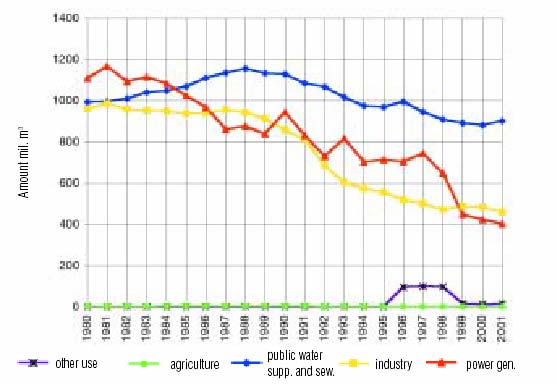
As stated in Table 6, the wastewater discharge of PWSS&S represented about 67% in 2001 in the
Morava River basin which is above the national average (50% in CR).
The total water abstraction of PWSS&S (groundwater + surface water) is lower than stated wastewater
discharge of PWSS&S in Morava River basin and the Czech Republic, too. This comparison
highlights the problems of data inconsistency.
Lenka Camrova/IREAS
National Profile of Municipal Water and Wastewater Management in the Czech Republic
27
Figure 3 Discharges into Surface Water in the Czech Republic in 1980 2001
Source: Report of the State Water Management in the Czech Republic 2001
Table 6 Discharges of Waste and Mine Water into Surface Water in Millions of m3
River Board River Board
CR in
Morava in
Morava in
2001
2001
2002*
Public water supply and sewers
-
amount in mil. m3
204.2
194.4
902.5
-
number of users
397
508
1 561
Agriculture
-
amount in mil. m3
0.1
0.0
1.7
-
number of users
2
0
12
Electricity generation
-
amount in mil. m3
69.3
66.6
403.4
-
number of users
3
2
41
Industry
-
amount in mil. m3
28.7
32.0
460.4
-
number of users
134
142
674
Other
-
amount in mil. m3
1.6
5.4
15.8
-
number of users
26
48
140
Total
-
amount in mil. m3
304
298.4
1 783.9
-
number of users
562
700
2 428
Source: Report on the State of Water Management in the Czech Republic 2001
*Source: Recent statistics of the River Board Morava
28
UNDP/GEF Danube Regional Project
3.7. Wastewater Collection and Processing
In 2001, there were 7 706 200 inhabitants connected to public sewers in the Czech Republic, which is
about 74.9%. There is an increasing trend in this area. The difference between inhabitants supplied
with drinking water and inhabitants connected to public systems was about 12 % (1 275 mil.) and it is
stable over time. The portion of storm water in total wastewater treated is about 36% in 2001.
In regions, which are situated in the Morava River basin, the percentage of inhabitants connected to
public sewerages was about 75% in the South-Moravian Region and 75.5 % in the Zlin Region in
2001.
Table 7 Population and Public Sewers in CR between 1995 2001
Indicator Unit
1995
2000
2001
No. of population living in houses connected to
thous.
7 559.1
7 685.2
7 706.2
public sewers
Population living in connected houses in
% 73.2 74.8 74.9
relation to the total population of CR
No. of inhabitants connected to public sewers,
thous.
6 708.1
7 028.9
7 060.7
of which:
- No. of population connected to sewer with
thous.
5 784.2
6 571.2
6 692.8
sewage plant
Amount of discharged water, of which:
mil. m3 649.7 576.0 570.7
- sewage
%
56.0
64.0
66.9
- industrial
%
44.0
36.0
33.1
Amount of wastewater treated (including storm
mil. m3 866.3 854.3 886.2
water)
Amount of wastewater treated
mil. m3 581.3 546.1 544.8
Source: Smrný vodohospodáský plán vstník, 2001, Ministry of the Environment
3.8. Wastewater Effluent Discharge
Regarding Table 6 and Table 7, the total amount of wastewater discharged after processing in 2001
was between 886.2 mil. m3 and 902.5 mil. m3 in the Czech Republic.
Lenka Camrova/IREAS
National Profile of Municipal Water and Wastewater Management in the Czech Republic
29
4. Economic Data
In the following sub-chapters, the system of different payments for water and wastewater in the Czech
Republic will be analysed. This system includes fees and charges for using water (as national natural
wealth) and the amount is set by law. Apart from these there are also prices (tariffs) for the service of
water supply and wastewater discharge, as set by the MU. These prices are based on the cost
conditions of particular companies, but their amount is also regulated by the Act No. 526/1990 Coll.
on Prices. The RU is the Ministry of Finance and controls are done by its network of regional and
municipal Financial Offices (which are mostly focus on tax revenues of the state).
4.1. Tariffs, Fees and Charges
4.1.1. Tariffs for PWSS&S Services
Up until the end of 1990, tariffs for water supply and sewerage services were centralized by the
Government. For households the water tariff was 0.60 CZK/m3 and the sewage tariff was 0.20
CZK/m3, for other users these tariffs were about 3.70 CZK/m3 and 2.35 CZK/m3.
At present, in the field of drinking water treatment, the PWSS&S calculates ,,factually rectified" or
,,regulated" prices for the following types of services provided:
- drinking water and service water delivered directly to the customer;
- drinking water and service water delivered to the water network of another supplier;
- wastewater coming into the public sewers.
These tariffs are calculated per m3 and there was a possibility to distinguish between households and
other users according to the regulatory scheme as set out by the law. From the 1 January 2001 the
price levels for both categories were united, so each company is obliged to use only one level of tariffs
for all customers.
The price regulation imposed by the law is based on the notion that water and sewage tariffs can only
reflect economically eligible costs of production and an adequate "profit". It also has to consist of
"given" items (see Chapter 4.3.) and it has to be published annually and provided to customers
whenever requested. As mentioned in Chapter 2.1.1.2., every PWSS&S estimates the cost calculation
for the coming year and subsequently re-calculates real costs. That is the reason for the small
differences between calculated and realised prices in Table 8.
From 2002, tariffs can be charged as 2-component prices with a fixed component (for the privilege of
getting some minimal level of service) and floating part (a consumption charge or tariff per unit of
additional water consumed). The fixed part's maximum is 20% of the tariff and in the Act on
PWSS&S, there are strict rules for its calculation (e.g. metering of consumption). The main purpose of
creating this possibility is to impose some minimal charge on users with extremely low consumption
(e.g. cottages) and high charges for customers who are larger consumers of water (or wastewater)
services. Some PWSS&Ss have a problem with seasonal residences or cottages, because if such a
residence is connected into the network, the invoicing, checking the water meter and other services
have to be done throughout the year, even if the consumption is only a few m3 per year.
The PWSS&S can decide which type of tariff (1-component or 2-component) to use. The 2-
component price is not connected to the cost calculation, which means: the fixed component of the
price is not derived from fixed cost of the company, but from the formula given by the Ministry of
Agriculture.
As shown in Table 8 (maximum and minimum values), there are huge differences in water and sewage
tariffs between particular PWSS&S because of the different local cost conditions. The average water
tariff was about 18 CZK/m3 and the average sewage tariff was about 15 CZK/m3 in 2000.
30
UNDP/GEF Danube Regional Project
Table 8 Water and Sewage Tariffs in the CR in 2000
CZK/m3
Water supply
Sewerages
Average Households Others Average Households Others
Calculated prices
17.19 16.68 18.04 14.45 13.62 15.40
(without VAT)
Calculated prices
18.05 17.52 18.94 15.17 14.30 16.17
(with VAT)
Realised prices
17.15 16.61 18.05 14.39 13.52 15.39
(without VAT)
Realised prices
18.00 17.44 18.96 15.11 14.20 16.16
(with VAT)
Minimum value
7.73 7.28 8.00 6.09 5.16 7.56
Maximum value
28.04 28.04 31.28 25.95 19.78 31.27
Source: T. G. Masaryk Water Research Institute, 2002
4.1.2. Payments to Cover Watercourse and River Basin Administration
According to the Water Act, any person authorised to withdraw surface water is obliged to pay for the
administration of the watercourse depending on the purpose for which the surface water is withdrawn.
The price for withdrawal differs according to the following purposes of withdrawal:
- single use cooling water for stream turbines;
- agricultural irrigation (free of charge from 2000);
- filling during artificial terrain activities (pits following raw material excavation ) in cases
requiring water pumping or transfer ;
- other withdrawals.
The payment for the withdrawal of surface water is assessed by the River Board Company in
accordance with a special act7. If the quantity of the water does not exceed 6 000 m3 per calendar year
or 500 m3 per calendar month, the subject is not obliged to make any payment. The payment accrues
directly to the River Board Morava and it is an important part of its revenues.
According to the legislation, this payment is also defined as a ,,factually rectified" or ,,regulated"
price. This means that (as in the case of PWSS&S) the River Basin Boards are obliged to develop a
price calculation of their operational costs per m3 withdrawn. This calculation can be controlled by the
Ministry of Finance. In practice, this payment is calculated by dividing the total assumed operational
cost by assumed number of m3 withdrawn in future period. The payment differs between river basins
according to the amount of water withdrawn for industrial, drinking and other purposes. Agricultural
withdrawn are free of charge. In the Morava River basin the payment is 2.66 CZK/m3. This is nearly
the highest level in the CR and is due to the large number of farmers in the territory.
7 Section 6 of Act 526/1990 Coll. on Prices
Lenka Camrova/IREAS
National Profile of Municipal Water and Wastewater Management in the Czech Republic
31
Table 9 River Board Morava: Payments for Surface Water Abstraction in Morava River Basin
in 1997 - 2001
CZK/m3
1997 1998 1999 2000 2001
without VAT
Single use 0.46 0.49 0.53 0.56 0.60
water cooling
Others
1.92 2.10 2.27 2.53 2.66
Source: T. G. Masaryk Water Research Institute, 2002
4.1.3. Charges for the Withdrawal of Groundwater
An authorized person withdrawing groundwater is obliged to pay charges for the actual quantity
according to the purpose of the water withdrawal. For drinking water supply, there is a rate of 2 CZK/
m3 and for other uses there is a rate of 3 CZK/ m3. Until 2001, PWSS&S were exempted and were not
subject to any payment. PWSS&Ss began paying the full for withdrawal charge in 2004.
Groundwater withdrawals from one resource not exceeding 6,000 m3 per calendar year or not
exceeding 500m3 per month are exempt from payment. The charges go to the Czech State
Environmental Fund and the State Budget as revenues.
4.1.4. Fees for the Discharge of Wastewater into Surface Water (Effluent Charges)
There is a fee for the level of the discharged wastewater's pollution and its volume. These fees are
imposed on individual sources of pollution. The charges go to the Czech State Environmental Fund as
revenues. For more detailed information see Chapter 4.3.1.
4.1.5. Fee for a Permitted Discharge of Wastewater into Groundwater
The authorised person shall pay a fee in respect of a permitted discharge of wastewater into
groundwater. The permission is given by the water authority (small districts), the quality of
wastewater is judged. If wastewater from a family dwelling is purified by a domestic treatment plant,
no fee applies to the discharge. In other cases, the permitted discharge is subject to a fee of 3 500 CZK
per year.
The fee is payable to the municipality in the area where the discharge takes place.
No national statistics on permitted discharges into groundwater are published.
4.2. Sales to Particular Service Users
---
4.3. Costs on Purchased Inputs
32
UNDP/GEF Danube Regional Project
Due to large differences in tariffs between particular PWSS&S (see Table 8), the concrete calculation
of VaK Hodonin is used as an example. The calculation of PWSS&S Hodonin includes the main cost
categories as stated in the Financial Bulletin of the Ministry of Finance in which certain price
regulation conditions are regularly up-dated.
The Value Added Tax (VAT) is paid as a percentage from the price of PWSS&S services (see the last
row in Table 10). At present, VAT is 5%, but in the future we can assume an increase because of the
fiscal harmonization with EU requirements (VAT should vary from 15 to 25% for all goods and
services in all European countries). The current discussion in the Czech Parliament is to offset water
and wastewater services to the group of 19% VAT.
Lenka Camrova/IREAS
National Profile of Municipal Water and Wastewater Management in the Czech Republic
33
Table 10 Calculation of Prices in Vak Hodonin in 2002
CZK/m3
Water rate
Sewage charge
1. Direct material 2.37
1.24
1.1 Unprocessed water
0.42
0.00
1.2 Chemicals
0.25
0.44
1.3 Other material
1.70
0.80
2. Direct salaries
2.87
2.50
3. Other direct material
9.81
12.62
3.1 Depreciation
4.42
5.25
3.2 Reparations and services
0.89
1.82
3.3 Social cost
1.01
0.87
3.4 Fees for the discharge of wastewater
0.00
0.86
3.5 Charges for the withdrawal of groundwater
0.89
0.00
3.6 Energy
1.51
1.52
3.7 Others
1.09
2.32
Company's cost TOTAL
15.05
16.38
4. Manufacturing overheads
0.91
0.64
5. Administrative overhead expenses
2.20
2.19
TOTAL COSTS
18.16
19.21
Profit 0.72
0.77
PRICE (without VAT)
18.88
19.98
Source: http://www.vak-hod.cz
All categories must be in harmony with the price regulation schemes. The "Profit" represents the
allowed category above costs which can be used as a dividend for shareholders or for the investments.
4.3.1. Effluent Charges
As mentioned above, there are 2 components to the effluent charges in the Czech Republic which are
called:
a) Fee for the Pollution of Discharged Wastewater: The polluter must pay a fee for the pollution
of discharged wastewater if it exceeds both the quantity and the concentration limit for paying the
fee of the respective pollution indicator (see the Table 11)
b) Fee for the Volume of the Discharged Wastewater into Surface Water: The polluter must pay
a fee if the volume of wastewater exceeds 30 000 m3 in one calendar year. Than, the fee shall be
calculated as a multiple of the discharged wastewater volume at the rate of 0.1 CZK per m3.
This means 2-composit effluent charges: amount of water discharged (e.g. 45 000 m3) multiplied by
the 0.1 CZK and if there is a phosphorus in that amount of 6 mg/l, the second component is calculated
as follows: 45 000 m3 x 6 mg of phosphorus = 0.27 kg of phosphorus discharged x 70 CZK/kg = 18.9
CZK. The total effluent charge is: 18.9 + 4500 = 4518.9 CZK.
34
UNDP/GEF Danube Regional Project
Table 11 Rates for the Fee Calculation and the Quantity and Concentration Limits for the fee
Imposition
POLLUTION INDICATOR
Rate
LIMITS FOR THE PAYMENT
CZK/kg
Quantity
Concentration
kg/year
mg/l
1.
a) chemical oxygen demand non-purified wastewater,
until 31 December 2004
16
20 000
40
from 1 January 2005
16
8 000
40
b) chemical oxygen demand purified wastewater
8
10 000
40
c) chemical oxygen demand for purified wastewater
used in the production of pulp and refining of cotton
and flax textiles
3
10 000
40
2. dissolved inorganic salts
0.5
20 000
1 200
3. non-dissolved substances
2
10 000
30
4. total phosphorus
until 31 December 2004
70
13 000
3
from 1 January 2005
70
3 000
3
5. ammonium nitrogen
until 31 December 2001
40
15 000
15
6. nitrogen Ninorg
from 1 January 2001
20
20 000
20
7. AOX from 1 January 2002
300
15
0.2
8. mercury
20 000
0.4
0.002
9. cadmium
4 000
2
0.01
Source: Water Act
In 2002, the average effluent charge per m3 was about 0.48 CZK, which can be considered as a
negligible cost. In the tariff calculation, this cost is usually included in the category ,,Other Direct
Materials/Cost".
4.4. Grants or Transfers
Due to the decreasing trend in water consumption, there have been no requests for installing new
capacity to ensure the water supply. There are no plans for the construction of new dams and other big
water management structures. The dominant focus of investments is nowadays on the construction of
new sewage treatment plants according to EU Directives. Sources of financing include: municipality
resources, the State Budget via the Ministry of Agriculture, the Czech State Environment Fund and
international institutions. After 1996, the elimination of damages due to the catastrophic floods on the
Morava and Odra rivers was the dominant investment. For particular sources see chapter 7.2.2.
There are concern that the PWSS&S's investments should be directed to the maintenance and
reconstruction of existing installations for which no grants and subsidies are available. But in reality,
most of PWSS&S do not seem to make a priority of these investments.
Lenka Camrova/IREAS
National Profile of Municipal Water and Wastewater Management in the Czech Republic
35
5. Infrastructure
As mentioned above, water and wastewater infrastructure and other operational property was
privatised in 1993 1995 and most became the property of municipalities. The residual value of these
assets had to be estimated because during Socialism, the recording of the company's depreciation and
reserves for future investment was not done properly.
At present most of the infrastructure built in the 60s' and 70s` has been completely depreciated
although estimates are that it will serve another 10 15 years without large investments. This is the
reason why the problem of the system's sustainability is sometimes neglected, especially in small
municipalities (local MUs), which are under the pressure from inhabitants to ensure cheap water and
wastewater services. Unfortunately the data on the age, repairs and the current quality of the
infrastructure are spread among MUs, so it is very difficult to get accurate and useful numbers.
This problem will be further discussed in Chapter 6.1.
5.1. Production, Processing and Distribution of Water
Table 12 shows the data about PWSS&S development in the Czech Republic between 1995 and 2001.
As you can see, in the past decade, there were no essential investments in building new pipelines. The
existing system has sufficient water resources and transport capacity to meet the demand.
Generally, the high percentage of losses during transport (about 27%) is a characteristic feature of the
Czech water supply system.
In the water tariff, usually only the current (annual) depreciation is included. This sum depends on the
assumed residual value in privatisation.
Table 12 Development of the Public Water Supply between 1995 2001
Indicator Unit
1995
2000
2001
No. of population supplied from public water
thous.
8 377.9
8 681.5
8 702.0
supply
No. of public water supplies
2 011
2 037
2 091
Length of pipelines
km
46 071
53 288
54 736
Length of pipelines per connected inhabitant
m
5.50
6.14
6.29
No. of distributaries
thous.
1 214.4
1 367.5
1 396.3
No. of inhabitants per 1 distributary
6.90
6.35
6.23
No. of water meters
thous.
1 207.5
1 385.5
1 409.4
Water invoiced, from which:
mil. m3 624.8 538.0 519.7
- share of households
%
59.8
63.4
63.4
- share of agriculture
%
1.6
1.5
1.3
- share of industry
%
18.3
7.5
7.4
- others
%
20.3
27.7
28.0
Non-invoiced water, from which:
mil m3 302.2 212.9 206.5
- losses in pipelines
mil m3 275.2 189.3 182.6
- share of losses in pipelines
%
29.7
25.2
25.1
Source: Smrný vodohospodáský plán vstník, 2001, Ministry of the Environment
36
UNDP/GEF Danube Regional Project
5.2. Collection and Treatment of Wastewater
In comparison with pipelines the evolution of investments in sewers is a little more dynamic. This fact
is related to the requirement of the European Union Directive (91/271/EHS) according to which every
municipality or town up to 2 000 inhabitants (population equivalent of 2000) has to build or ensure the
connection of the local sewerage system to a WWTP.
The current situation in the Czech Republic is as follows: towns up to 10 000 inhabitants usually have
their own WWTP (according to requirements of the previous regulation and investments). Sometimes,
thought, the quality of the water treated doesn't meet the nitrogen standards, so the plant has to be
upgraded in the future. Municipalities and towns of 2 000 10 000 inhabitants have to build a
sufficient WWTP by the year 2010. In this category, there is one town of 5 000 inhabitants (Senov)
and about 23 other municipalities without any sewers. About 49% of municipalities with sewers are
not connected to any WWTP.
In the field of the municipal wastewater treatment, the Czech Republic has been given a transition
period from the EU until 2010 and these particular investments by PWSS&Ss are strongly supported
by financing from the Ministry of Agriculture and the Czech State Environmental Fund. This sources
of financing have being used for development of sewerages since the early 90s'. The financial aid is
focused on the "rehabilitation" of the WWTPs as well as on new construction of WWTPs and new
sewage networks if needed. There is no support for any (future) operating cost of the sewerages and
repairs of existing infrastructure (for financial resources see Chapter 7.2.2.).
Table 13 Development of Public Sewers between 1995 2001
Indicator Unit
1995
2000
2001
Length of sewers (without collection lines)
km
18 295.0
21 615.0
22 253.0
No. of collection lines
thous.
590.3
726.8
741.8
No. of WWTP, of which:
783
1 055
1 122
- with mechanical treatment
61
42
41
- with bio-mechanical treatment
722
1 013
1 081
Amount of wastewater treated, of which:
mil. m3 832.7 808.8 841.4
- share of sewage water
%
37.1
39.0
39.3
- share of industrial and other wastewater
%
28.7
22.9
20.2
- share of storm water treated
%
34.2
38.1
40.6
Amount of wastewater treated in WWTP with
mil. m3 660.0 751.7 783.6
the adequate level of treating (according to
standards)
- share of sufficiently treated wastewater
% 79.3 92.9 93.1
(according to standards)
Sludge produced by sewerage plants, of which:
thous. tons
146.4 206.7 205.6
of solid
- disposed of in landfills
thous. tons
60.9 44.3 37.9
of solid
Source: Smrný vodohospodáský plán vstník, 2001, Ministry of the Environment
Lenka Camrova/IREAS
National Profile of Municipal Water and Wastewater Management in the Czech Republic
37
6. Management Units
Thanks to the different size, historical development of a particular territory, structure of ownership and
other features it is difficult to describe the situation of MUs in the Czech Republic in general.
Therefore, conditions of specific PWSS&S (VaK Vyskov) are analysed in the Case Study.
The regulation of the PWSS&Ss (although it seems to be strict) still gives a lot of latitude in decision
making to the PWSS&Ss owners and operators. PWSS&S are not a subject of direct regulation from
the Ministry of Agriculture, so only municipalities (as owners) or the Ministry of Finance can
somehow influence their behaviour. Suspicions of unreasonable pricing policies are very difficult to
detail and prove.
The position of the municipal government is determined by the size of the municipality population,
the value of the infrastructure in its territory, and which type of PWSS&S provides local service. To
identify the main possible conflicts between customers, the municipality, and the operators of the
PWSS&S we will discuss particular types of MUs again.
6.1. Types of Management Units
The distinctions between the 3 main categories of MU organizations were made in Chapter 2.2.2.
Here, we would like to focus on the relative positions of the municipality, the service provider (or
operator) and customers under different types of MU organizations.
A. The position of a small municipality (as an owner of the infrastructure), which contracts with a
service provider, is very problematic. The control of water service prices is done through
political pressure on the municipality. In this type of organization, the municipality is usually
pushing the provider not increase prices very often because this is not popular with the
municipal governments constituency the water customers.. Often there is no independent
economic analysis of the real cost of providing service., The municipality does not have the
technical or financial expertise at its disposal to characterize the situation of its water and
wastewater system. A common result in such a situations is that costs of the real depreciation
are not covered in order to keep prices down but keep net revenues up for the operator. Cuts in
management (providers') wages is the last saving to be accepted. Degradation of the of the
infrastructure used through depreciation is preferred. The system is running "unsustainably",
which the municipality does not know or does not care about.8
B. Another mode of organizing the elements of the MU is a joint-stock company with
municipalities as the majority share-holders (e.g. VaK Vyskov from the Case Study), where
Mayors and the management of the company are both in the Board. This type of company
enables the municipalities to more directly manage the system and to have a control of
management policies implemented by the operators. There may, however, be some lack in
motivation to produce water efficiently (cost savings to increase profits is not the driving
force). Sometimes the tariffs of services are derived from the average of the Czech Republic,
which is regularly published according to an analysis of data from the 120 largest service
providers, and the cost calculation is done retroactively.
C. According to some water management officials, large association of municipalities (or joint-
stock companies) as infrastructure owners with separate companies for conducting operation
is the most effective organizational form (e.g. Severoceske VaK). The reasoning is that the
service provider runs the real business and both the provider and the association of
8 These conclusions result from the consultation with officials at the Ministry of Agriculture (Mr. Chaloupka)
who are requiring the change of the system of the control. They ask the direct responsibility of their Ministry to
achieve the effective (not only formal) price regulation.
38
UNDP/GEF Danube Regional Project
municipalities have their own experts reviewing the tariff setting, cost conditions, and the
quality and sustainability of the services provided. Very often there is international capital in
these types of MUs. The main difference between A and C type is in the power of
municipality/municipalities to monitor the behaviour of service providers and get an
independent and transparent evaluation of the condition of the water and wastewater systems.
Broadly considering the behaviour of Czech municipalities and their elected representatives, the 5-
year electoral period there is a lot of time for corruption and lobbying with respect to PWSS&Ss,
especially in the following areas:
a) selling the infrastructure,
b) controls of the system's sustainability (accumulation of resources for reconstruction),
c) over-investment from government resources when the rate of return and cost of operation are
neglected.
All these cases are common thanks to the ineffective price regulation, which rests with the Ministry of
Finance (regional financial offices with lack of experiences in PWSS&S) and also on particular
municipalities renting out the infrastructure. When it comes to monitoring and economic regulation,
the Ministry of Agriculture has no legal status to ensure proper record keeping and planning at the
PWSS&Ss.
6.2. Management Units Service Areas
See section 2.1.1.2.
6.3. Population Served
See Table 7 for sewerages and Table 12 for water supply.
6.4. Special Obligations
---
6.5. Financial Conditions
Before 1990, the centralized system of prices did not allow the specific regional costs of water
production and treatment to be dealt with. The difference between operational costs and revenues of
particular PWSS&S (if necessary) was covered by subsidies from the State Budget. The investments
were planned and financed by the Government.
From 15 May 1993, no additional subsidies to cover operation costs of PWSS&S were available. The
reimbursements for drinking water delivery and sewage service are fully included in the receipts of
PWSS&S and these are set in order to repay the operational costs and have a ,,reasonable profit". The
current depreciation and repairs are included in the calculations. The category of reasonable profit is
not specified by the regulation and there is no cost limitation for it (i.e. the % of the cost...etc.).
Lenka Camrova/IREAS
National Profile of Municipal Water and Wastewater Management in the Czech Republic
39
In reality, PWSS&S mainly covers operational costs, but only partly covers the investment costs.
Because of the danger of the high social burden, the full cost is not transferred to the final users
(households), which could be a problem in the future, because the costs of reconstruction and
operation of new facilities will not be covered from Central Government resources. A significant part
of new constructions is covered in the State Budget, loans from the European Investment Bank and
other international resources. The repayment of any of this external debt will place more pressure on
future tariffs and burden customers.
6.6. Current Plans for Expansion and Investment
There are some investments of PWSS&S financed by their internal resources, but the capacity for
doing this believed to be very limited. Loans are sometimes used as a support for these investments
done without public financial support (usually repairs) and, as noted above, must be repaid with
interest.
40
UNDP/GEF Danube Regional Project
7. Regulatory Units
Considering and describing the position of a particular RUs again, the focus will be mainly on the
grants and subsidies provided from public resources (the state budget and other funds). In water
management of the CR, there a two main areas granted:
1) development of PWSS&S,
2) investments of River Board Companies.
Subsidies represent the essential source of their long-term financing, although in some cases PWSS&S
has started to behave as a private sector. The reason for the importance of using public resources
resides in the taxation power of the Central Government and the general acceptance of this source of
financing since it is often thought to limit a rapid or high tariff increase.
7.1. National and Local Planning and Permitting
There are several sources of data related to water management in the Czech Republic according to the
different institutional needs. These data are aggregated and published annually. The main institutions
dealing with data collection are:
7.1.1. Data Collection
Czech Statistical Office (CZSO) collects data from almost 200 of the
largest PWSS&S and therefore describes the situation of about 97% of
the population served. This information (populations connected, water
and wastewater production, length of pipelines, ... etc.) is structured
according to regions and published on the Internet pages of the Office
under Chapter 2 Environment and Agriculture. Also the quality of water
in particular watercourses is monitored.
Czech Hydro meteorological Institute (CHMI) is a central state institute
of the Ministry of the Environment for monitoring and collecting data in
the field of hydrology and water quality. It runs a national network for
water monitoring and analyses the collected data. It carries out
hydrological studies and forecasts and, recently, it has focused on flood
prevention.
T. G. Masaryk Water Research Institute is an organization working under the Ministry of the
Environment. It annually publishes data on river basins and PWSS&S, where about 120 of the largest
companies are included. Data on PWSS&S is aggregated for the whole country.
7.1.2. Planning and Development
Lenka Camrova/IREAS
National Profile of Municipal Water and Wastewater Management in the Czech Republic
41
The grant policy of the Czech Government has the following 3 main priorities:
a) to finish the construction of the large water supply systems,
b) to support the construction of sewage treatment plans,
c) to support building the water supply infrastructure in small municipalities.
In the future (generally 10 15 years), the subsidies from public sources should be totally replaced by
loans and construction costs should became a part of water and sewage tariffs. The factor of social
acceptability is still a significant limitation.
7.2. Economic Regulations or Limitations
7.2.1. Pricing (tariffs)
The operational expenses (surface water delivery, management and maintenance of watercourses) of
the River Boards State Companies are mainly covered by payments for abstracting surface water,
which go to their budget. The present prices of water withdrawal mainly cover the current costs and do
not play the role of economic tools because the development costs and environmental costs are not
included. Payments differ between particular river basins from 1.5 to 3 CZK/m3 according to the
amount of total water withdrawn and the status of users in the territory (industry, agriculture...etc.).
The payment is an important income item of River Board State Companies and it has to cover their
operational cost. The level of payment for surface water abstraction represents a cost for PWSS&S.
The construction of tariffs is under the price regulation of the Ministry of Finance, however the real
pressure to keep reasonable prices fails. During controls of calculation if conducted - it is very
difficult to prove if the tariff is too high (some waste cost are included) or too low (it causes the
degradation of the system). For the efficient financial control, experts with the knowledge of local
conditions and technical knowledge are needed. They are usually not available for the task of the
Ministry of Finance (e.g. at local financial offices).
The problem of the actual independence of PWSS&S and the consequences was discussed above and
will be further discussed in Chapter 9.
7.2.2. Grants and Subsidies
In the Czech Republic, the following sources of grants and subsidies are available for PWSS&S:
a) Czech State Environmental Fund as a tool of relatively stable financing for WWTP
construction. In 2001, the total revenues of the Fund were about 3 242 bil.CZK, from which 1
213 bil.CZK came from the water management of the CR. Charges for the withdrawal of
groundwater and fees for wastewater discharge into surface water are important revenues of
the Fund (about 43%).
b) State Budget via grant programmes of particular Ministries (Ministry of Agriculture, Ministry
of the Environment... etc.), through which large investments into WWTP are realised.
c) Budgets of Regional Offices can become an important source of money in future when
delegated competences will be followed by incomes from taxes and various fees (e.g. 50% of
charges for the withdrawal of groundwater).
d) European Investment Bank, which (through the Czech Government as a guarantee) offers
favourable long-term loans.
e) Structural Funds of the EU.
42
UNDP/GEF Danube Regional Project
River Board Companies are not a source of money for PWSS&S. They are responsible for the
administration of watercourses and their only interconnection with PWSS&S is through withdrawals
of water and subsequent payments for that. River Boards themselves get grants and subsidies from
various sources and they use them for building anti-flood measures, dams ... etc.
As already mentioned, the main issue in the current grant policy is investments into constructing
sewers and WWTP in towns over 2000 population-equivalent. In Table 14, the main resources of
money coming to this area between 1995 and 2001 are shown. In Table 15, the future requirements on
public resources are estimated.
Table 14 Subsidies to Investment in Constructing PWSS&S and Wastewater Treatment Plants
in 1995 2001 (in mil. CZK)
From the State Budget
From the Czech State
Total
Year
Environmental Fund
Total
Of which,
Total
Of which,
Total
Of which,
Subsidies
loans
Subsidies
loans
Subsidies
loans
1995
3 250
1 064
2 200
1 000
5 450
2 064
1996
3 101
1 366
1 947
854
5 048
2 220
1997
2 154
838
1 892
747
4 046
1 585
1998
1 648
435
1 083
512
2 731*
947
1999
1 718
473
1 069
414
2 787**
887
2000
1 340
422
1 130
438
2 106***
859
2001
700 219 1
604 656
2
304****
875
Source: Ministry of Agriculture, Czech State Environmental Fund
* plus additional resources from the European Investment Bank: 798 mil. CZK
** plus additional resources from the European Investment Bank: 568 mil. CZK
*** plus additional resources from the European Investment Bank: 164 mil. CZK
**** plus additional resources from the European Investment Bank: 222 mil. CZK
Table 15 Assumed Financial Resources for the Implementation of Directive No. 91/271/EHS (in
mil. CZK)
Year
2003 2004 2005 2006
State Budget
1 797
974
1 075
1 075
State Environmental Fund
948
1 699
859
859
ISPA 4
197
0
0
0
Cohesion Fund
0
2 962
3 162
3 162
Phare CBC
188
0
0
0
Structural Funds
0
256
436
436
Other international grants
93
93
0
0
Own (private) resources
3 480
3350
3 485
3 485
Average annual resources
9 518
Source: Amendment of the Water Act, Draft No. 352/2003
7.3. Environmental Regulations and Restrictions
The quality of water withdrawn and discharged is regularly monitored. This monitoring includes:
- quality of extracted surface water and groundwater for water supply purposes,
- quality of drinking water delivered,
- quality of wastewater before treatment,
- quality of wastewater discharged.
Lenka Camrova/IREAS
National Profile of Municipal Water and Wastewater Management in the Czech Republic
43
The current system of monitoring and controls should ensure the appropriate quality of all the
categories mentioned. In the field of drinking water the Czech Environmental Inspection and the
Ministry of Health (of the hygienic service) perform the controls (double checks).
Regarding effluent charges in the Czech Republic (fees for the discharge of wastewater into surface
water), the average payment for the discharge of wastewater is about 0.48 CZK/m3, which is
considered a nearly negligible cost. The effluent charges are stated as a fixed amount of money, so any
incentive they might provide to reduce effluent discharge may be eroded by inflation. For
municipalities (or service providers), there is no economic incentive to build a WWTP to avoid these
effluent charges. So, the only way how to ensure the implementation of the EU directives is to push
municipalities of greater than 2000 PE to construct a WWTP and to find some public resources for
such investments and local resources to support operating costs..
In the future, effluent charges should become the revenue of River Basin Administrators according to
the philosophy of the Water Framework Directive.
44
UNDP/GEF Danube Regional Project
8. Service Users
Information on service users is very complicated to get and analyse. In the available statistics, the total
amount of inhabitants in the Czech Republic connected to networks is expressed, as is a list of towns
and municipalities with their own pipelines, sewers and a WWTP connection. The following chapter
therefore does not answer all the questions posed.
8.1. MU Customers
Information on MU customers is mostly distributed among particular PWSS&S.
As mentioned in the Czech Case Study, people that are not connected to public pipelines and sewers
mostly live in small villages of 400 700 inhabitants. The possibility of their being connected in the
future depends on the activity of the Municipal Office, its investing and grant-searching ability and
communication with the local PWSS&S (if any exists).
At present, the annual payment for PWSS&S services is about 2 500 4 000 CZK per household per
year given the average level of consumption and level of tariffs. This sum of money represents 1 3%
of the net average income of the average household and 5 7% of the net average income of the first
decile of households (the low-income households). Regarding the continual increase in all costs (e.g.
energy, gas, rent... etc.), the room for tariff increase is therefore limited.
8.2. Self Supply Users
The majority of self supply users in the Czech Republic extract water from their private or small
municipal wells. The statistics on these users are weak and based on general assumptions, because the
amount of water withdrawn usually does not exceed the minimum volume established by the Water
Act.
The population continuously supplied by their private wells is about 1.5 mil. (14% of all inhabitants).
In comparison with 1990, there is an increasing number of people using this source as a service water,
which is a consequence of the growth in prices.9
As mentioned in Chapter 2.1.2., the lack of the self supply statistics represents a serious problem in the
Czech Republic. It is assumed that about 95 98% of private and public well water does not meet
health standards (due to bacterial contamination), because owners and users of wells do not carry out
regular testing, cleaning, ... etc. A large number of wells are poorly situated and protected from
contamination.
9 Source: ,,Voda v Ceské republice", document of the Ministry of the Environment from 18. 10. 2002
Lenka Camrova/IREAS
National Profile of Municipal Water and Wastewater Management in the Czech Republic
45
9. Reform Proposals Connected with Tariffs and Charges
Generally, the situation in public water supply and sewerages can be evaluated as more stable after the
dynamic changes in the beginning of 90s'. The Czech Republic has got sufficient water resources to
meet current and future demand. There is a new legislation (Water act, Act on PWSS&S) establishing
basic rules and main actors.
About 89% of population is connected to pipelines and about 77% of population connected to sewers,
which can be considered as a high percentage. Most MUs are metered. An average consumption is
about 90 l/person/day and slowly decreasing because of higher prices of water every year.
Therefore the only problem visible while analyzing general numbers in quite high loss in pipelines
about 23% (and slowly increasing due to the lack of maintenance). Following sub-chapters will
discuss further problematic areas related to pricing policies and the structure of charges.
9.1. Tariff Structure
At present and in the future, one price within each PWSS&S is considered for all consumers,
neglecting the idea of cost-based pricing. In the past (up to 2001), there were 2 levels of prices for
businesses and households, regarding the social issue. The goal was to redistribute the profit of
PWSS&S from the prices for households to the prices for businesses. But in many cases, the operating
costs were also redistributed, so the price began to be very unfavourable for business. They started to
disconnect from the system, which enormously increased the prices for households. That is, why this
approach is not used any more.
It is necessary to emphasize, that about 50 80% of the costs for water and wastewater services are
originally from capital (fixed) costs. This fact means that when large service users disconnect in
conjunction with splitting up the large PWSS&S into small ones always has a strong impact on prices.
To save money while running the system, maintenance was often passed over as mentioned in
previous chapters.
In order to ensure sustainable pricing of PWSS&S services, price regulation is imposed by the
Ministry of Finance, although the real power to control tariffs is on particular municipality as the
owner of the infrastructure or a share-holder of PWSS&S. To reform the current practices in pricing
systems toward higher sustainability, we recommend investigation of the possibility of 2-component
pricing based on following covering of costs of PWSS&S:
a) fixed payment per year to cover capital cost,
b) payment per m3 to cover operational cost.
This option and its impact on particular MUs is investigated in the Pilot Case Study.
9.2. Economic Regulation
The price regulation of the Ministry of Finance is inefficient, although regular controls of calculations
are conducted. The cost categories stated in the Financial Bulletin of the Ministry of Finance, as well
as the definitions of ,,economically eligible costs" and ,,adequate profit" are very weak. There is no
percentage limitation of the profit at all.
The PWSS&S always has a monopoly on financially data, so it is very difficult for controllers to
detect if the price is reasonable or if the system is sustainable. To improve the sustainable or
unsustainable situation of the company, there is a special tool called "technical audit" in the Act on
PWSS&S. This means large technical control done by special inspectors of Ministry of Agriculture if
46
UNDP/GEF Danube Regional Project
asked by the municipality or other institutions. The institution ordering the audit has also to pay the
bill, so it is not widely used.
It is necessary to say that officials (especially at the Ministry of Agriculture) know about the only
"formal" power of the Czech price regulation. The reason why it is not abolished is expressed by the
opinion, that at least somebody has a right to get full financial data from companies and check their
bills. In the future, Ministry of Agriculture is going to amend the Act on PWSS&S to create the direct
responsibility of PWSS&S to the Ministry.
9.3. Economic Sustainability
As mentioned, in the Czech Republic there is unsustainable pricing of services done by PWSS&S
which could cause large problems with the money shortage for reconstructions of the infrastructure in
the next 10 15 years. To avoid that, following measures has to be done:
a) to include the real depreciation of the property into tariff calculations by the law or by the
change of the system of the price regulation,
b) to establish stable rules of the ownership (e.g. by the Act on public-private partnership),
which creates better conditions of the long-term using of the property in the sector, where
public and private capital is usually in combination.
9.4. Effluent Charges
As mentioned, effluent charges in Czech Republic are very low only about 0.48 CZK per m3, which
is about 3% of the average sewage tariff. They are stated in CZK/unit, so they erode by the inflation.
According to Ministry of the Environment officials, the increase of these charges is desirable in future
(although any proposal is prepared yet). Still, their level will not influence the behaviour of PWSS&S
in the near future (e.g. decisions between charges and new investment in treatment).
9.5. Summary of Reforms
In the Table 16 problematic issues and possible future changes of the public water supply and
sewerages in the Czech Republic are gathered. Some of these reforms has been already investigated or
discussed at Ministries.
Lenka Camrova/IREAS
National Profile of Municipal Water and Wastewater Management in the Czech Republic
47
Table 16 Summary of Reforms
Strategy Name
Strategy Description
Comments/Concerns
This will be done by the change of the Act on
The control of tariff calculations of
PWSS&S.
Financial control
PWSS&S will be done directly by
Ministry of Agriculture.
The reform is pushed by Ministry of
Agriculture.
This will be probably done by the
The absolute levels of effluent charges
Effluent charges
amendment of Water Act.
(e.g. CZK/kg) in Water Act will be
increase
increased.
The reform is pushed by Ministry of the
Environment.
The monitoring of water withdrawals is on
river basin authorities (if exceeds a given
The goal is to ensure the appropriate
amount of m3) or on Czech Environmental
monitoring of about 14% of self-supplied
Monitoring of self
Inspection (dealing with water in general).
population (e.g. wells) this means at
supply users
The monitoring of quality of drinking water
least the location of SUs and the quality
is on Ministry of Health.
of water used.
So far no information about reform
proposal.
The goal is to established strict and clear
rules for hiring the infrastructure own by
municipalities (= public property). These
rules should ensure the long-term
This could be done by the Law of Public-
Stable rules of the
perspective of doing business for the
Private Ownership which has to be amended
ownership
leaseholder and the sustainable
according to EU legislation.
management of the property for the renter
(e.g. the obligation to give the property
back to owner in the same condition as
get it).
The first step of the institutional change
According to EU Water Framework
could be done by giving the financial
Directive, the management of water
independency to River Boards (e.g. to let
should be done by river basins through
them cover not only operational, but also
Institutional reform independent River Basin Administrators.
capital cost from charges, to shift effluent
In CR these bodies only administers
charges to their budget,... etc.). But this
watercourses and financially and legally
independency would have to be done through
depends on the Ministry of Agriculture.
the establishing their new legal status, too.
48
UNDP/GEF Danube Regional Project
10. References
Act No. 254/2001 Coll. on Water.
Act No. 258/2000 Coll. on the Protection of Public Health.
Act. No. 274/2001 Coll. on Public Water Supply Systems and Sewers.
Act. No. 305/2000 Coll. on River Basin Administrators.
Act No. 526/1990 Coll. on Prices.
Czech Statistical Office, www.czso.cz, on-line statistics.
Czech Statistical Office, 2003, Census on Public Water Supply Systems and Sewers 2002.
Czech University of Agriculture, 1998, Institutional Framework for Water Management in the Czech
Republic, Eurowater-CEC.
Decree No. 274/2001 on Public Water Supply Systems and Sewers.
Chave, P., 2001, EU Water Framework Directive implementation, IWA Publishing.
Ministry of Finance, 2002, Financial Bulletin, December.
Parliament of the Czech Republic, 2003, Novelisation of the Water Act, Draft No. 352.
Povodí Ceské Republiky, www.povodi.cz, on-line information.
Smekál, V., 2002, Pehled o vývoji vodného a stocného, rozbor náklad na základ kalkulací
provozních spolecností, T.G.M. Water Research Institute.
T.G.M. Water Research Institute, 2002, Smrný vodohospodáský plán, publikace SVP c. 51.
T.G.M. Water Research Institute, 2001, Soubor vybraných ukazatel vodního hospodáství a ochrany
vod ve stedndobých casových adách.
VaK Vyskov, www.vak.vyskov.cz, on-line statistics.
Vak Hodonin, www.vak-hod.cz, on-line information.
Valentová, J., 2002, Ekonomické dopady legislativních úprav v oblasti voda, T.G.M. Water Research
Institute.
Lenka Camrova/IREAS
Document Outline