

September 2004
ASSESSMENT AND DEVELOPMENT OF
MUNICIPAL WATER AND WASTEWATER
TARIFFS AND EFFLUENT CHARGES IN
THE DANUBE RIVER BASIN.
Volume 2: Country-Specific Issues and
Proposed Tariff and Charge Reforms:
Croatia National Profile

AUTHORS
Dubravka Mokos, B.Sc. / Croatian Waters, Zagreb
Ivan Klakocer / Croatian Waters, Zagreb
TARIFFS AND CHARGES VOLUME 2

PREFACE
The Danube Regional Project (DRP) consists of several components and numerous
activities, one of which was "Assessment and Development of Municipal Water and
Wastewater Tariffs and Effluent Charges in the Danube River Basin" (A grouping of
activities 1.6 and 1.7 of Project Component 1). This work often took the shorthand
name "Tariffs and Effluent Charges Project" and Phase I of this work was undertaken
by a team of country, regional, and international consultants. Phase I of the
UNDP/GEF DRP ended in mid-2004 and many of the results of Phase I the Tariffs and
Effluent Charges Project are reported in two volumes.
Volume 1 is entitled An Overview of Tariff and Effluent Charge Reform Issues and
Proposals. Volume 1 builds on all other project outputs. It reviews the methodology
and tools developed and applied by the Project team; introduces some of the
economic theory and international experience germane to design and performance of
tariffs and charges; describes general conditions, tariff regimes, and effluent
charges currently applicable to municipal water and wastewater systems in the
region; and describes and develops in a structured way a initial series of tariff,
effluent charge and related institutional reform proposals.
Volume 2 is entitled Country-Specific Issues and Proposed Tariff and Charge
Reforms. It consists of country reports for each of the seven countries examined
most extensively by our project. Each country report, in turn, consists of three
documents: a case study, a national profile, and a brief introduction and summary
document. The principle author(s) of the seven country reports were the country
consultants of the Project Team.
The authors of the Volume 2 components prepared these documents in 2003 and
early 2004. The documents are as up to date as the authors could make them,
usually including some discussion of anticipated changes or legislation under
development. Still, the reader should be advised that an extended review process
may have meant that new data are now available and some of the institutional detail
pertaining to a specific country or case study community may now be out of date.
All documents in electronic version Volume 1 and Volume 2 - may be read or
printed from the DRP web site (www.undp-drp.org), from the page Activities /
Policies / Tariffs and Charges / Final Reports Phase 1.
TARIFFS AND CHARGES VOLUME 2

We want to thank the authors of these country-specific documents for their
professional care and personal devotion to the Tariffs and Effluent Charges Project.
It has been a pleasure to work with, and learn from, them throughout the course of
the Project.
One purpose of the Tariffs and Effluent Charges Project was to promote a structured
discussion that would encourage further consideration, testing, and adoption of
various tariff and effluent charge reform proposals. As leaders and coordinators of
the Project, the interested reader is welcome to contact either of us with questions
or suggestions regarding the discussion and proposals included in either volume of
the Project reports. We will forward questions or issues better addressed by the
authors of these country-specific documents directly to them.
Glenn Morris: glennmorris@bellsouth.net
András Kis: kis.andras@makk.zpok.hu
TARIFFS AND CHARGES VOLUME 2
National Profile for Municipal Water and Wastewater Management in the Republic of Croatia
3
Table of Contents
1
INTRODUCTION ......................................................................................................................... 5
1.1
GENERAL SCOPE OF THE REPORT............................................................................................ 5
1.2
GENERAL INFORMATION ON THE REPUBLIC OF CROATIA....................................................... 5
1.3
PURPOSE OF THE NATIONAL PROFILE FOR MUNICIPAL WATER AND WASTEWATER ............. 6
1.4
FUTURE DIRECTION................................................................................................................. 7
2
LEGAL AND INSTITUTIONAL SETTING ............................................................................. 9
2.1
NATIONAL LAWS AND REGULATIONS GOVERNING PROVISIONS OF MUNICIPAL WATER AND
WASTEWATER SERVICE....................................................................................................................... 9
2.1.1
Common Provision .......................................................................................................... 9
2.1.2
Self Service .................................................................................................................... 12
2.2
MANAGEMENT UNITS............................................................................................................ 13
2.2.1
Administrative Units...................................................................................................... 14
2.2.2
Operating Units............................................................................................................. 14
2.2.3
Ownership of Facilities ................................................................................................. 14
2.3
SERVICE USERS ..................................................................................................................... 15
2.3.1
Classification of Users .................................................................................................. 15
2.3.2
Classification of Waters ................................................................................................ 16
2.4
REGULATORY UNITS ............................................................................................................. 16
2.4.1
The State Water Directorate.......................................................................................... 17
2.4.2
The Ministry of Public Works........................................................................................ 18
2.4.3
The Ministry of Environment and Physical Development ............................................. 18
2.4.4
Counties......................................................................................................................... 18
2.4.5
Croatia Waters .............................................................................................................. 18
2.4.6
Local Governments........................................................................................................ 20
2.5
ENVIRONMENTAL REGULATION............................................................................................ 21
2.6
ECONOMIC REGULATION....................................................................................................... 21
2.6.1
The Water Protection Charge ....................................................................................... 22
2.6.2
Central Financing of Infrastructure Development........................................................ 23
3
PRODUCT QUANTITY AND QUALITY ............................................................................... 25
4
ECONOMIC DATA.................................................................................................................... 28
4.1
PRICES AT VARIOUS POINTS IN THE PRODUCTION ................................................................ 28
4.2
WATER PRICE STRUCTURE - TARIFFS ................................................................................... 28
4.3
WATER PROTECTION CHARGE .............................................................................................. 29
4.4
CONCESSION CHARGE............................................................................................................ 31
5
INFRASTRUCTURE.................................................................................................................. 32
6
MANAGEMENT UNITS............................................................................................................ 35
6.1
TYPES OF MANAGEMENT UNITS............................................................................................ 35
6.2
MANAGEMENT UNIT SERVICES AREAS................................................................................. 35
6.3
POPULATION SERVED ............................................................................................................ 36
6.4
SPECIAL OBLIGATIONS .......................................................................................................... 39
6.5
FINANCIAL CONDITIONS........................................................................................................ 39
7
NATIONAL AND LOCAL REGULATION ............................................................................ 40
7.1
NATIONAL AND LOCAL PLANNING AND PERMITTING........................................................... 40
7.1.1
Data Collection ............................................................................................................. 40
4
UNDP/GEF Danube Regional Project
7.1.2
Activity Permitting......................................................................................................... 40
7.2
ECONOMIC REGULATIONS OR LIMITATIONS ......................................................................... 40
7.3
ENVIRONMENTAL REGULATIONS AND RESTRICTIONS.......................................................... 43
8
SOURCE USERS ........................................................................................................................ 45
9
POLICY ISSUES......................................................................................................................... 47
9.1
POLICIES ................................................................................................................................ 47
9.2
POLICY EVALUATION ............................................................................................................ 47
10
LIST OF REFERENCES ....................................................................................................... 53
Dubravka Mokos, B.SC. & Ivan Klakocer/Croatian Waters
National Profile for Municipal Water and Wastewater Management in the Republic of Croatia
5
1 INTRODUCTION
1.1 General Scope of the Report
This report is, first of all, a compilation of information and data that describing the institutions and
conditions that shape and characterize the provision of municipal water and wastewater service in
Croatia. The purpose of this compilation is to provide background and inspiration for proposals to
reform both the current system of water and wastewater tariffs and effluent charges and coincident
proposals to adjust or modify the legal and regulatory system within which the these tariffs and
effluent charges function in Croatia. Indeed, some chapters include brief analyses suggesting such
reforms and Chapter 9 concludes this report with preliminary proposals for reforms in the institutional
setting and design of these tariffs and charges. The aim of the these proposals is to improve the
management of water and wastewater resources used in the municipalities of Croatia generally and,
including protection of water resources from nutrient loading and toxic substance originating from
municipal systems.
1.2 General Information on the Republic of Croatia
The Republic of Croatia is one of the youngest Europian countries and democratic parlamentary
republic. The total area of the country is 87,609 sq.km (land area is 56,542 sq.km and surface area at
teritorial sea and interior sea waters is 31,067 sq.km).
It consists of two geographic parts: Danube basin (Black Sea catchment area - 60%), and the
Mediterranean part (40%). Today's total population of Croatia is 4,437 milion inhabitans according to
the 2001 census (population density 78.5 inhabitants per sq.km). In the territorial and administrative
sense Croatia is divided into 20 counties and the capital Zagreb (which also enjoys the status of the
county. The counties are further divided into towns (122) and municipalities (424).
Croatian GDP was 19,536 million USD (at current prices) in 2001 (4,403 USD per capita). The end
year inflation rate (for the same year) was 3.8%, while the average net monthly salary amounted to
3,541 HRK (425 USD).
With respect to its natural resources and the existing economic potential, Croatia is an export-oriented
country. The major features of the Croatian economy are the geographic strategic position, the
potential of agriculture and food-processing industry, tourism and educated and qualified population.
The gross national product is realised 55 percent in tertiary, service sector, 32 percent in industry, and
less than 13 percent in agriculture.
Traffic and communications contribute 8 percent of gross national product, which is the result of the
exceptional position of Croatia in the centre of the European communication area and on the crossroad
of routes leading to various directions - northern Europe, south-eastern Europe, Middle East and the
Adriatic Sea. The power production in Croatia is based on coal, oil, natural gas and water. Croatian
agricultural land covers a large area, out of which 48.0 percent are ploughland and gardens, 33.0
percent are pastures, and 19.0 percent are meadows, orchards and vineyards. The major industrial
branches are textile, food-processing, chemical industry, shipyards, wood processing, metal-
processing industry, tobacco production and processing.
The Danube basin is rather urbanised, with developed industry and valuable agricultural land.
International communications also pass through this area.
The Mediterranean region includes the Adriatic coast (islands, coast and hinterland). In addition to
transport and industry, tourism and service activities are developed in this area. The mountain area
separates the Mediterranean from the Danube basin catchment area. Through this area important
6
UNDP/GEF Danube Regional Project
transport communications pass towards the North and South, and the area is also covered with
valuable forests and with corresponding industry.
1.3 Purpose of the National Profile for Municipal Water and Wastewater
On the state level, depend on size and type of project, main role in the decision making process for
investments in water sector and water pricing have:
State Water Directorate is in charge of all the activities related to water management. It plans,
monitors and co-ordinates development of the water management system, while accommodating for
the needs of the overall economic development.
Within its legal powers, Croatian Waters, a Government agency for water management, passes
administrative and other acts and makes decisions on issues important to water management. These
include preparing of basic plans for water management, maintenance of water-related structures,
protection from detrimental effects of water, water use, water pollution control, etc.
There are more about 130 water utilities in Croatia, that a usually organised as public companies, as
far the ownership structure 99% of these are companies with limited liability where local government
units hold at least 51% of the shares.
These 130 companies, mainly located in larger urban areas, provide water supply and wastewater
treatment services. They were either founded by local government units, or have emerged in the
process of transformation of former public enterprises under the Municipal Services Act of 1995., all
of these activities provide by the Ministry of Zoning, Construction and Housing.
Participation of private capital in these companies may ot exceed 49% of the shares, and there are still
no examples of fully privatised companies providing municipal services in the water sector.
Very often, specially in smaller municipalities water supply and sewerage are only one among many
other responsibilities of the utilities, but in bigger cities of which Croatia have eleven there are
dedicated companies for water and wastewater management.
Table 1
Population of the Largest Cities in Croatia
Cities Inhabitants
Zagreb 770,085
Split 173,692
Rijeka 143,395
Osijek 91,046
Zadar 69,239
Pula 58,342
Slavonski Brod
57,199
Karlovac 49,228
Varazdin 41,252
Sisak 37,491
Sibenik 36,886
Total 1,527,855
Dubravka Mokos, B.SC. & Ivan Klakocer/Croatian Waters
National Profile for Municipal Water and Wastewater Management in the Republic of Croatia
7
The City political bodies are
City assembly
Mayor
City government
The assembly of the city yields the statute, general acts, resolutions, and elects and relieves of the
mayor and the members of the city government. The city assembly established the public institutions
and other legal institutions for performing economic, social and other activities in the interest of the
city.
City government conducts the executive works of the city. City government manages the properties in
the city ownership, as well as the city incomes and expenses, and also prepares the prepositions of the
general acts. City government executes or insures the exectuion of the city assembly's general acts.
The City assembly on the Mayor's preposition elects City government. The members of the City
government are, as a rule, also principals of the City government's administrative departments.
The incomes and expenses of the City are defined by the annual budget.
The quality of life of every citizens, first of all, depends on the communal services. For that reason,
there are several corporations fulfilling the communal needs citizens.
Corporation low defines the work of those corporations.
One of the corporations in the City ownerships is Water Supply and Sewerage. Water supply and
sewerage is working according to corporations low, and the only member of that corporation is City.
The highest level of the conducting the corporation is:
Assembly, which, by authorization of the Assembly of City makes all relevant business decisions,
from future investments to the nomination of the management.
In addition to the assembly, other management organs are: Supervisory board, which is appointed by
the Corporation Assembly, as an organ of the Corporation's transactions control and the Director,
which is also appointed and revoked by the Corporation Assembly. The Director represents the
Corporation and preforms other activities according to the Corporation low. Director of water
company suggest changing the prize of water but City government must accept it.
State plan for water protection requires building of Treatment plants for wastewater for cities bigger
than 50 000 inhabitants.
Croatian lows allowed concession and BOT public - private partnership models, but there is one pilot
project known till now - Treatment plant of Zagreb.
A strategy from the government could be to combine and organisations engaged in utility water
supply, wastewater collection and treatment. This can be done either by laws or setting conditions,
which can only be fulfilled by large organisations.
1.4 Future Direction
Starting from the above, it will be necessary to review all legislation related to water management,
adjust it to EU requirements and define the possible deadlines for fulfilment of commitments towards
EU, because the Republic of Croatia is oriented towards joining the EU. At present, the major problem
in meeting these objectives is lack of funds.
The most important objective of water management system in Croatia is to provide adequate quantity
of water of required quality for the needs of population and the economy. The development plan
developed to meet this objective included: defining of objectives, analysis of technical and
technological issues included implementation of effective systems of water polution charges, the
method of managing of water supply systems, application of market principles with policy reform and
legislation measures for the development of cost covery concepts for water and wastewater tariffs,
8
UNDP/GEF Danube Regional Project
environment protection, implementation schedule and investment requirements.
The general water supply development program for the period up to 2015 was based on the elements
and objectives of the social and economic development plan. The objective of this program is to
achieve the level of 95 percent of population supplied from public water supply systems, and to meet
the requirements of industry.
Dubravka Mokos, B.SC. & Ivan Klakocer/Croatian Waters
National Profile for Municipal Water and Wastewater Management in the Republic of Croatia
9
2 LEGAL AND INSTITUTIONAL SETTING
2.1 National Laws and Regulations Governing Provisions of Municipal
Water and Wastewater Service
The orientation of the Government of the Republic of Croatia is adjusting of all the regulations with
EU legislation, including regulations related to water management. In line with this strategic goal, the
Republic of Croatia has ratified numerous international conventions, and taken part in the
implementation of the EU Water Framework Directive which is adopted by the EU Parliament
In this context, the documents of particular importance for water management are Convention on the
Protection of Trans-boundary Watercourses and International Lakes, and Convention on Cooperation
for the Protection and Sustainable use of the Danube River. In connection with these documents,
Water Act and Water Management Financing Act have been amended accordingly. In addition to the
two laws, over 40 by-laws from the field of water management have been passed. These by-laws
regulate numerous issues such as preparing of water management plans, defining of water related
structures, determining the areas of water management activities, issuing of water management
documents (conditions, consents, and permits), determining of the water estate, issuing of concessions
on water and water estate, organising water management and water management inspection.
Water management plans both at the national (Water Master Plan of Croatia) and at the local level
(catchment area master plans or water management plans) are under preparation. These are long-term
plans containing the data on distribution, resources and properties of water, water requirements,
provision of adequate quantities of water, water protection from pollution, regulation of watercourses
and flood protection. They also determine other measures and activities for establishing the integrated
water regime in the given planning area. The plans are being developed based on the water
management documentation kept by Croatian Waters, and on the annual plans of Croatian Waters.
They include the use of revenues from the charges transferred to the account of Croatian Waters.
From the collected charges, construction of water use and water pollution prevention facilities is
partially financed. These funds are used either in the form of loans, or as participation in the costs of
construction, in which case Croatian Waters also obtains property rights. Since such funds are, in
principal, insufficient, construction of such facilities is also planned at the local level, where the loans
from foreign financial institutions (World Bank and others) are sought.
At present, priority is given to ensuring adequate water supply for population, while investments
aimed to reduce water pollution are given less attention, mainly due to lack of available funds. The
objective of water supply planning is to provide sufficient water quantities and adequate quality for all
uses. Water Master Plan of Croatia and the water supply plan as a part there for, are elements of the
wider physical planning and protection of aquatic environment, and thus of the environment as a
whole.
2.1.1 Common Provision
Funding for the activities of municipal service companies is provided from various sources, but in the
case of water supply and wastewater disposal and treatment, the funds are provided through the price
of the service.
The price and the method of payment for the provision of water supply and sewerage services are
determined by the service providers, i.e. municipal service companies, and there are no administrative
or legal limitations regarding the level of the price. In practice, however, the price set by the municipal
service companies is under control of the company's founders - local government units.
10
UNDP/GEF Danube Regional Project
The Municipal Service Act allows privatisation of water supply and wastewater sector, through its
provisions that any legal entity or private person can get a concession for performing municipal
services.
2.1.1.1 Service Area
The territory of Croatia is divided into 4 major water management areas which makes specific units:
Sava water area, water area of the rivers Drava and Danube, water area of the Primorje and Istria and
the water area of the Dalmatia area.
River Sava is used as a water resource for drinking for thousands of people living along the river or
nearby, as well as rivers Drava and Danube.
It is estimated that 12% of the total water reserves in Croatia belongs to the underground waters but
the significance of that source is very important which can be shown by the fact that more then 90% of
all cities (settlements) use underground water for drinking purposes. Generally, the quality of
underground waters is rather good, especially in comparasion with other European countries which
means that this is a very important resource for Croatia.
The biggest consumers of surface waters for drinking purposes are Osijek (partly - Drava river),
Vukovar (Danube) and Sisak (Kupa river).
Some 73% of the population of Croatia is supplied from public water supply systems. Out of the total
wastewater - municipal and industrial - only 20% is treated before being discharged into watercourses.
The water supply penetration through public networks increased from 53% in 1991 to 68% in 1995
and to 73% in 2000 and should reach 95% in 2015.
In spite of slow development during recent years, there is still a considerable back in sewerage
services. Only half ot he country's households are connected to a sewerage network - 51%.
Wastewater production in cu.m. (total) are 287.803,000, and treated only 88,000,000 cu.m.
Percentage of treated wastewater with
a
mechanical
treatment
stage
85%
a biological treatment stage 4%
a mechanical-biological treatment stage 11%
Major problems facing water management and water demand in the Slavonia region of Sava
catchment area is that only c/a 25% of the inhabitants are connected to the public supply system of
drinking water and that the demand for water is high and water resources are limited. It means that
more investigation for more water resources must be organized. In the middle and western part of
Sava catchment area, especially in Zagreb and in its vicinity, there is heavy water demand. On
average, c/a 75% of the demand is satisfied by the public water supply, even the ratio range between
40% to 90%. Problems related to the water supply must be solved in the combination of regional and
central public water systems with the limited use of local water systems as transitory solution.
Major problems facing water supply in the catchment areas of Drava and Danube rivers are that only
(on average) 53% of the population is supplied with public water supply system which means that the
rest of population use water from its own wells as well as industry.
2.1.1.2 Conditions of Service
Companies with limited liabilities where local government units (one or several) are founders and
owners of the company are still the predominant form of the organisation of service providers.
Participation of private capital in these companies may not exceed 49% of the shares, and there are
still no examples of fully privatised companies providing municipal services in the water sector.
In case when there is more than one founder of the company, their share in the company's property is
determined based on:
Dubravka Mokos, B.SC. & Ivan Klakocer/Croatian Waters
National Profile for Municipal Water and Wastewater Management in the Republic of Croatia
11
corresponding part of company property in a particular local government unit (municipality);
share of services provided to a particular municipality;
population.
Municipal activities are carried out as a public service.
Pursuant to Municipal Services Act and special regulations, local self-government units and legal and
physical persons who carry out municipal activities are obligated to:
ensure permanent and quality conducting of municipal activities,
ensure the maintaining of municipal facilities and installations in a functional state,
take measures to conserve and protect environment.
Pursuant, municipal activities are the following:
drinking water supply,
collection and wastewater treatment,
Drinking water supply includes the activities of abstraction, purification and delivery of drinking
water.
Sewerage and wastewater treatment include collection and wastewater treatment, drainage of
atmospheric water, and pumping, removal and disposal of faecal matter from septic tanks, sump pits
and black pits.
Apart from the activities stated, the representative body of the local self-government unit can by
decision determine the activities of local interest which are considered municipal activities pursuant to
the provisions.
2.1.1.3 Reporting Requirements
The price of the municipal service is paid to the service provider on the basis of monthly bills and of
the act proposed by the company performing the service and approved by the company founder.
The water user charge is determined by the decree of Croatian Waters based on level of tarrif
approved by the Government of the Republic of Croatia, and on the Regulations on calculation and
payment of the water user charge, determined annually (or for the shorter periods of time) by the State
Water Directorate. Croatian Waters determines the user charge for all the entities abstracting or
drawing water directly from its natural sources. Companies supplying water to the consumers through
public water supply systems collect the charge (part of the monthly water bills), and transfer the
revenues to the account of Croatian Waters.
The water protection (pollution) charge is determined by a decree of Croatian Waters vode, based on
level of tarrif approved by the Government of the Republic of Croatia, for the period of one year or
less. In the case of direct discharge, Croatian Waters collects water protection charge, based on the
measurements of pollution levels. Water supply companies collect the water protection charge from
the users that discharge wastewater through the public sewage systems, and transfer it to the account
of Croatian Waters.
The concession charge is determined by the concession contract. In the cases when the decision on
awarding the concession is made by Parliament, Government or the State Water Directorate, the
contracting authority is State Water Directorate. If the decision on awarding concession is made by
county authorities, the contracting authority is Croatian Waters. The agreed amount of the concession
charge is paid in favour of the Government budget, if the concession contract is signed by the State
Water Directorate, and in favour of the county budget if the concession contract is signed by Croatian
Waters.
12
UNDP/GEF Danube Regional Project
2.1.1.4 Ownership of Infrastructure
Public ownership of the water supply and wastewater treatment facilities prevails in Croatia. Since
local government units are the majority owners of all the existing service providers, Municipal
Assemblies have the key role in the management of infrastructure. In the case of new investments,
Croatian Waters may acquire property rights, provided that it participates in financing the given
development.
2.1.2 Self Service
For the purpose of conducting of activities Municipal Services Act, local self-government units can
establish self-services.
Self-services do not have characteristics of a legal person.
Self-services can also conduct municipal activities for other local self-government units in the area of
the same or other counties, on the basis of a written contract.
In case the contracts of entrusting the conducting of municipal activities are made by the
administration of local self-government units.
Self-services are independent in conducting of municipal activities pursuant, regulations based on
foundation forms.
A local self-government unit establishes self-services by the decision of its representative body in the
manner and following the procedure stipulated, and regulations.
The decision to establish self-services contains, in particular, the provisions related to:
municipal activities to be conducted by the self-services,
the area in which municipal activities shall be conducted,
internal structure, business organization and management of the self-services,
funds necessary to start the operation of the self-services, and the manner of their obtaining or
securing,
business acts of the self-services,
reporting about business efficiency,
limitations related to acquiring, burdening and alienation of real estate and other forms of special
property of the local self-government unit, in which the business of the self-services is conducted,
manner of supervision of the self-services' business by the local self-government unit,
appointing and relieving of the manager of the self-services,
termination of the self-services.
Internal structure of the self-services is regulated by the decision on the establishment of the self-
services, and elaborated in more detail in the business statute of the self-services
The self-services are managed by the manager.
The manager is appointed and relieved by the administration of the local self-government unit.
The manager organizes and manages the business of the self-services, is accountable to the
administration of the local self-government unit for material and financial business of the self-services,
and lawfulness of the business of the self-services.
Based on the authorization by the administration of the local self-government unit, the manager enters
into contracts with other physical or legal persons.
The Water Act, the Water Management Financing Act and the Municipal Services Act define the
payers of municipal services, water user charge and water protection charge.
Dubravka Mokos, B.SC. & Ivan Klakocer/Croatian Waters
National Profile for Municipal Water and Wastewater Management in the Republic of Croatia
13
Table 2
Charges Paid for Water Use and Wastewater Discharge
1. Price of municipal service
Paid by the end users.
2. Water use charge
Paid by legal entities and persons that abstract or
pump water from watercourses, lakes, storage
reservoirs ground aquifers and other natural
sources.
3. Water protection charge
Paid by legal entities and persons that discharge
wastewater or other substances that pollute
water.
4. Concessions on water
Paid by concession holder for:
and water-related estate
· water abstraction for public water supply;
· use of water power for electricity generation
of electric energy;
· water abstraction for technological purposes
in industrial and similar activities;
· pumping of mineral and thermal waters -
water abstraction for irrigation;
· fish farming in enclosed water bodies.
2.1.2.1 Limitations on Self Service
The sanctions related to non-payment of the water user charge, water protection charge or concession
charge are defined by the Water Management Financing Act, including fines ranging from HRK
10,000 to HRK 500,000 (EURO 1,300 to EURO 65,000) in the following cases:
if the water supply company fails to account and remit in due time the funds of the water user
charge,
if the company using water power for electricity generation fails to account and to remit in due
time the water user charge,
if the liable company fails to account and to remit water protection charge.
In the above cases, the law envisages fines for the responsible person in the company, ranging from
HRK 1,000 to 10,000 (130 EURO to 1,300 EURO).
2.2 Management Units
The conducting of municipal activities can be jointly organized by several local self-government units
in a manner stipulated.
The local self-government unit incapable of independently providing the conducting of municipal
activities can by the decision of its representative body entrust the conducting of such activities to
another local self-government unit in the area of the same or other county, on the basis of a written
contract.
If the municipal infrastructure system covers the area of more local self-government units within one
or more counties, and forms a unitary, indivisible functional unit, the local self-government units are
obligated to organize joint conducting of municipal activities by means of jointly-owned companies.
If the local self-government unit has not organized a permanent, quality conducting of certain
municipal activities, or maintaining of individual facilities and installations of municipal infrastructure
in the functional state pursuant to provisions, the county in whose area the local self-government unit
is located shall organize the conducting of certain or all municipal activities, i.e. the maintenance of
facilities and installations of municipal infrastructure in the functional state, at the cost of the local
self-government unit.
14
UNDP/GEF Danube Regional Project
Any disputes that may arise from the implementation are resolved by arbitration, which consists of
representatives of the ministry responsible for municipal services, the county and the local self-
government unit.
In accordance with the Municipal Services Act (NN 36(95) which defines the municipal activities,
these services include among others water supply and wastewater treatment and disposal. municipal
services may be performed by:
1. a company founded by one or several local government units
2. a public institution founded by a local government unit
3. a service - plant, established by one or several local government units
4. a legal entity or a person, subject to concession agreement
Regulations influencing the price of water and the application of economic instruments in water sector
are, as follows:
Municipal Services Act (NN 36/95).
Decree on municipal service price determined by the Assembly of the municipal company, and other
decisions of the company regarding development of municipal infrastructure and loan obligations.
· Water Management Financing Act (NN 107/95, 19/96 and 88/98) .
· Ordinance on the level of water user charge (NN 62/00).
· Regulations on calculation and payment of water use charge (NN 94/98).
· Ordinance on the level of water protection charge (NN 58/00).
· Regulations on calculation and payment of the water protection charge (NN 62/00).
· Decree on conditions and procedures for awarding of concessions on water and public water-
related estate (NN 99/96).
2.2.1 Administrative Units
The management bodies of the municipal companies are the Assembly, Supervising Committee and
the management. The company founder, which is at the same time majority owner (city council or city
authorities), passes regulations governing the activity of the company.
Based on the required financial resources and the way of financing the municipal infrastructure, the
municipal services company has the right to decide what will be the level of the investment costs to be
covered by the end users through the water price.
In theory, there are no limitations on the level of the prices municipal companies charge for their
services. However, since the company's founders i.e. local government units decide the pricing policy,
strong economic and social concerns are often incorporated in it. Although the information indicating
regional variations in the collection efficiency exists, there is no data on the impact of municipal
service prices on the rate of the payment of water bills in Croatia.
2.2.2 Operating Units
The price and the method of payment for the provision of water supply and sewage services are
determined by the service providers, i.e. municipal service companies, and there are no administrative
or legal limitations regarding the level of the price. In practice, however, the price set by the municipal
service companies is under control of the company's founders - local government units.
2.2.3 Ownership of Facilities
Full privatisation of municipal service companies in Croatia is a desired direction, although the
awareness that there are positive and negative sides of the process exists. Participants pointed out that
Dubravka Mokos, B.SC. & Ivan Klakocer/Croatian Waters
National Profile for Municipal Water and Wastewater Management in the Republic of Croatia
15
the positive effects of privatisation of municipal services would not be an automatic result, but would
require numerous preconditions, such as:
adhering to the rules of competition;
market prices of water, i.e. elimination of the mechanisms that keep the water prices low in order to
safeguard the living standard of the users, practice that is currently achieved through the right of
the company's founder to control the prices;
clear contractual relations on the quality of services between the user and the provider of the
services (private partner);
the contract with the private partner must include a time limit in order to provide the possibility of
competition in case the provider of the service does not fulfil contractual obligations;
in case of bankruptcy of the private partner, the service user must be able to protect assets given to
the private partner for use;
the control over the private partner's cost and the possibility of their reduction must be permanent
and efficient.
Only professional application of the above-mentioned conditions and of the international experience of
more developed societies (including privatisation of municipal companies in transition countries) may
give the desired results.
2.3 Service Users
2.3.1 Classification of Users
In accordance with the Municipal Services Act defines the principles, manner of conducting and
financing of municipal services and other issues aimed at the efficient carrying out of municipal
activities.
Pursuant to this Act, municipal services include the conducting of municipal activities, in particular
the providing of municipal services of interest to physical and legal persons, and financing of the
construction and maintenance of facilities and installations of the municipal infrastructure as a
complete system in the areas of municipalities, towns and the City of Zagreb (hereinafter: local self-
government units) as well as in the counties, provided that it is so stipulated.
The funds for conducting of the following municipal activities are secured from the price of the
municipal service, as follows:
1. drinking water supply,
2. collection and wastewater treatment, excluding atmospheric water,
The price amount and method of payment of the municipal service are determined by the service
provider.
The price of the municipal service for provided municipal service is paid to the service provider.
The payer of the price for provided municipal service is the owner of the real estate, or the user when
the owner has transferred it by contract to the user.
If the reasons occur to introduce direct supervision of prices of municipal services, pursuant to a
special Act, the measure of direct supervision of prices is introduced by the competent body of the
local self-government unit in whose area the seat of the service provider is located.
The construction of facilities and installations of municipal infrastructure for:
1. drinking water supply,
2. sewerage and wastewater treatment
is financed from:
16
UNDP/GEF Danube Regional Project
1. municipal contributions,
2. budgets of the local self-government unit,
3. grants, and
4. other sources determined by special regulations.
The decision which determines the amount of the municipal tax is made by the administrative
department of the local self-government unit competent for municipal services.
The decision contains, in particular:
1. the amount of funds which the owner of the building site is obligated to pay at one time, or in
installments,
2. deadline for the construction of the municipal facility or installations,
3. fine and a reimbursement of paid funds, if the local self-government unit does not fulfill its
obligation.
The decision which does not contain the obligatory elements prescribed is null and void.
The decision is made after the determination of the amount of municipal taxes, at the latest by the
issuing of the building permit.
The municipal tax is paid per [M1] m2 gross of the developed surface of the building which can be
built on the building lot.
A municipal tax payer who demolishes or restores the existing facility already connected to the
municipal infrastructure is obligated to participate in construction financing of facilities and
installations of municipal infrastructure proportionally to the increase in the surface of the building in
comparison to the previous structure.
The owner of the building is obligated to connect his building to the municipal infrastructure under the
conditions prescribed by the decision of the representative body of the local self-government unit.
The owner of the building site pays the costs of the connection of the building site to the facilities and
installations of municipal infrastructure directly to the connection provider.
The representative body of the local self-government unit can by decision determine the areas in
which the owner of the building can be exempt from the obligation to connect to municipal
infrastructure, if the person has in a satisfactory manner individually fulfilled his needs.
The buildings built without a building permit cannot be connected to municipal infrastructure.
2.3.2 Classification of Waters
In the Republic of Croatia, water is classified according to the quality into categories from I to V, on
the basis of criteria defined in the Ordinance on Water Classification (NN 77/98). Category I refers to
drinking quality waters, and surface waters suitable for trout farming. Bathing and waters suitable for
recreation and growing of lower quality fish fall into the second category, Water suitable for the use in
industry and agriculture are classified as category III, while waters that can be used only after the
purification and in the areas with severe water shortages are classified as category IV. Finally,
category V refers to waters that cannot be used for any purposes.
2.4 Regulatory Units
The water sector has linkages with other Ministries, and State Directorates in such matters as
organization and scope, public health, improvements in municipal services and general policy on
protection of the environment etc.
The Government of Croatia (GOC), through its House of Representatives, has established a National
Water Council for the purpose of discussing essential issues of water management, coordination of
Dubravka Mokos, B.SC. & Ivan Klakocer/Croatian Waters
National Profile for Municipal Water and Wastewater Management in the Republic of Croatia
17
various needs and interests, and proposing measures for the development and improvement of the
water system in the Republic of Croatia.
The National Water Council consists of the Chairman and ten members appointed for the period of
four years by the House of Representatives of the Parliament of the Republic of Croatia. The
Chairman and members are nominated from among the representatives in Parliament, eminent
scientists and professionals in the field of water management and related fields.
The administrative supervision of the Water Act and its regulations is carried out by the State Water
Directorate, which also carries out inspection over the implementation of the provisions of the Water
Act and its Regulations, in collaboration with county offices.
"Croatian Waters" is the government agency for water management. The task of Croatian Waters is to
ensure permanent and unimpeded carrying out of public services and other tasks in water management
in the scope defined by plans and in accordance with the available funds provided for the purpose
under corresponding legislation.
The government bodies are organised in accordance with the Act on Organisation and Scope of
Ministries and other Government Administration Bodies (NN 48/99 and 15/00). The Act defines their
scope of work and competencies. The Ministries, State Directorates, and other bodies having direct
influence on water sector policies through regulations proposed to the government of the Republic of
Croatia are, as follows:
2.4.1 The State Water Directorate
The State Water Directorate is in charge of all the activities related to water management. The State
Water Directorate monitors and co-ordinates development of the water management system, while
allowing for the needs of the overall economic development. It is also in charge of the measures for
regulation of watercourses and other water bodies, protection from floods and ice, erosion and
torrents, irrigation and drainage. Other competencies of the State Water Directorate include
management and use of water-related estate, protection of water and sea from pollution, provision of
adequate water supplies for population and industry, use of water power, planning and co-ordination
of development and construction of public water supply and sewage systems, and inspection in the
field of water pollution control. The State Water Directorate proposes to the Government of the
Republic of Croatia the level of water use charge and water protection charge (tariff), which are the
constituent parts of the total price of water delivered.
(1)
Organization
As a Directorate, the SWD is headed by a Director and does not have a seat in the Cabinet of
Ministers, but may participate if requested to do so.
SWD has four divisions and its prime responsibility is directing the long-term development of water
resources, management of water resources, and supervision over implementation of the provisions of
the Water Act (NN 107/95).
The SWD carries out administrative supervision over Croatian Waters regarding its performance of
administrative tasks entrusted to it under the Water Act, carries out inspection over the implementation
of the provisions of the Water Act, and its organization is structured accordingly.
(2)
Jurisdiction
The Water Act defines the responsible bodies and the sharing of responsibilities and water inspection.
The SWD develops laws and regulations and ensures the administrative supervision of the
implementation of the legislation on water.
In particular, it exercises control over water quality standards and pollution levels, and is the principal
International Alert Centre for early warning in the case of accidents on Trans National waters.
18
UNDP/GEF Danube Regional Project
SWD controls Croatian Waters and arbitrates on any problems between it and the county offices in
charge of water management.
SWD through its State Water Inspectorate is responsible for inspection of national waters (12
inspectors) and acts together with county water management inspectors (40 inspectors located at
county offices) who are responsible for local waters. The State Inspectorate is responsible for the
monitoring of water quality.
The State Water Inspectorate is also responsible for international commitments, the preparation and
implementation of the National Plan for the Defense Against Floods, and other sub-plans under the
National Water Management Master Plan of Croatia (yet to be issued).
2.4.2 The Ministry of Public Works
The Ministry of Public Works is in charge of the activities related to the application of instruments and
measures of the economic policy in construction, housing and housing policy, and implementation of
special programs for improvement of the situation in municipal services.
2.4.3 The Ministry of Environment and Physical Development
The Ministry of Environment and Physical Development carries out administrative and other tasks
related to the general policy of environmental protection, providing of conditions for sustainable
development, protection of air, water, sea, flora and fauna in integrated interaction.
2.4.4 Counties
In addition to the above-mentioned Ministries, at the local level, there are 21 counties and the
metropolitan administration of the City of Zagreb, which influence the price of water by their
respective decisions.
2.4.5 Croatia Waters
"Croatian Waters" is a Government agency for water management. The task of Croatian Waters is to
ensure permanent and unimpeded carrying out of public services and other tasks in water management
in the scope defined by plans and in accordance with the available funds provided for the purpose
under corresponding legislation. Within its legal powers, Croatian Waters passes administrative and
other acts and makes decisions on issues important to water management. These include preparing of
basic plans for water management, maintenance of water-related structures, protection from
detrimental effects of water, water use, water pollution control, managing of public water estate,
professional supervision and engineering in construction of water-related structures, and collection of
funds for financing of such works and activities.
(1)
Organization
The governing body of Croatian Waters is the Management Council. The Management Council has
seven members, appointed (and dismissed) by the government. The members are nominated primarily
from among public officials and professionals in the field of water management, economy and public
finance.
The leader of operations of Croatian Waters is the General Manager. He is appointed (and dismissed)
by the government (GOC) upon proposal by the Director of the State Water Directorate, for a period
of five years.
Dubravka Mokos, B.SC. & Ivan Klakocer/Croatian Waters
National Profile for Municipal Water and Wastewater Management in the Republic of Croatia
19
The internal organization of Croatian Waters for the purpose of operative management has established
five Water Management Departments as follows:
1. Sava Basin, with the seat in Zagreb
2. City of Zagreb, with the seat in Zagreb
3. Drava Basin, with the seat in Osijek
4. Littoral and Istrial Basin, with the seat in Rijeka
5. Dalmation Basin, with the seat in Split
Water management branch offices of catchment areas are formed within the departments.
The internal organization of Croatian Waters is defined by a separate general document passed by the
management council with the consent of the Director of SWD. The internal organization is determined
in accordance with the principles of internal organization defined by the Statute. There is an Act on
Organization and Scope of Ministries and other Government Administration Bodies (NN 48/99 and
15/00).
Operational management of the water system is carried out by four Water Management Departments
for each of the main basin catchment areas, and one special department for the City of Zagreb
catchment area. Each department has sections dealing with the basic components of water
management (water use, water protection, and protection from water). The main four water
management departments also control the branch offices for the 31 individual river catchment areas.
Water management activities as defined by the Water Act are carried out by a number of separate
sectors responsible for:
Preparing studies and development plans
Pollution control
Ensuring of water resources
Protection from the harmful effects of water
Operation of public authority in the water sector
The main office of Croatian Waters is located in Zagreb, and includes the water management
departments of the Sava river basin and the City of Zagreb basin (other basin departments are located
elsewhere).
Croatian Waters has a staff of about 700, with approximately 60% being the holders of University
Degrees.
(2)
Jurisdiction
Croatian Water has responsibility for State and local water management. Its principle duties are to
manage Croatia's waters according to the adopted water management plans and schemes, issue
administrative and other orders and make decisions on matters of importance. In terms of water
management, it has jurisdiction over the following:
Preparation of water management plans, water management schemes of catchment areas and other
plans for water management
Regulation of watercourses and other water bodies and protection from the adverse effects of water
- monitoring of the situation and control of watercourses and other water bodies, organization of
protection from floods and ice, protection from erosion and torrents, organization of construction,
technical and economic maintenance of watercourses and water works
Water protection-monitoring and determination of water quality, organizing of implementation of
the National Water Protection Master Plan, coordination of water protection plans of the local
20
UNDP/GEF Danube Regional Project
administrative units and other plans for investment in water protection, and control over their
implementation, measures for prevention and elimination of water pollution
Supervision over implementation of terms and conditions of water management acts and
concession agreements (water management supervision)
Tasks related to implementation of plans for water management
2.4.6 Local Governments
(1)
Organization
Most but not all of the companies providing water supply and sewerage system services are joint stock
companies owned by the municipalities they serve. In some places the services are operated by
municipal departments.
In general terms, the organization of these private (municipal) companies is similar, with an
Assembly, a Supervising Committee and a Manager (or Director). The organization beyond this level
depends on the total municipal services provided (some companies provide solid waste disposal,
cemetery maintenance etc.), the size of the population and industries served, and the level of facilities
to be operated and maintained. Hence, all companies have different departments and sections to suit
their particular needs.
Regulations governing the activities of the company are passed by the company founder and majority
stockholder who are usually a city council, town council or municipality.
The Assembly is the highest authority of the company like Board through which the founder makes
decisions on the following matters:
Tariff setting
Contents of the contract with the company
Election (and dismissal) of the members of the supervising committee
Appointment (and dismissal) of the manager
Appointment of members of the arbitration committee
Acceptance of new members into the company
Awarding of concessions for municipal activities following the previous decision of the city,
town or municipal council - (the founder of the company) for water source
Adopting regulation on financing of development of municipal activities
Development program of water supply and wastewater disposal
The Supervising Committee supervises the operation of the company and acts on behalf of the
company towards the management. The Supervising Committee in particular:
Supervises the use of company funds, the operation of the company, the implementation of
contracts and decisions of the Assembly
Discusses the reports on Operations and Finance
Submits to the Assembly the reports on supervision etc.
(2)
Jurisdiction
With regard to water quality management, Municipal and Town Councils, and the City of Zagreb, are
responsible for the drawing up and issuing of the following regulations under the Water Act:
Sanitary protection zones around sources of water used for public supply
Dubravka Mokos, B.SC. & Ivan Klakocer/Croatian Waters
National Profile for Municipal Water and Wastewater Management in the Republic of Croatia
21
Use of the public water estate for rest and recreation
The method of wastewater disposal, the obligation to connect to the public sewerage system,
the conditions and manner of wastewater disposal in areas where such systems do not exist,
particular measures for the disposal and elimination of hazardous and other substances, and
the obligation to maintain the public sewerage system
Maintenance of the amelioration drainage system
The municipal companies have jurisdiction over the operation and maintenance of the water supply,
wastewater treatment and disposal.
2.5 Environmental Regulation
Pursuant to the Croatia's foreign policy objectives, the process of European integration has been
recognized as one of the top priorities. In order to decrease differences between Croatia and the EU
member states in the field of environmental monitoring and reporting, it will be necessary to adopt the
EU/European Environmental Agency (EEA) standards and guidelines in the process of association.
Without a doubt, the harmonization of indicator sets and environmental reporting with the EU
accepted norms and standards is one of the most important steps in achieving the sound environmental
management. The implementation of these standards will make the data comparable and ready for
exchange on both, the national and international level. This in turn, will allow the EU and the
international community in general, to provide a better assistance to Croatia both in terms of
consultancy and technology transfer.
In Croatia today, the collection of environmental data is carried out on different levels and it is most
financed from the State budget. Various governmental bodies, research and academic institutions as
well as other organizations/companies have competence to gather information and meta-data of a vital
enviromental importance.
According to the provisions of the Law on Environmental Protection of the Ministry of Environmental
Protection and Physical Planning has the obligation to prepare the State of the Environment Report
every four years. The preparation of the State of the Environment Report heavily relies on the data
available while its quality depends on the quality of the data used.
The Ministry of Environmental Protection, and Physical Planning, is responsible for water bodies
inside protected areas, and deals with environmental protection information. It is responsible for the
maintenance of the Environmental Pollution/Emission Cadastre created in 1997, which includes
emissions into waters. The Ministry of Health looks at the health impact of water (drinking water) and
water uses.
2.6 Economic Regulation
The basic economic regulators influencing the price of water, and corresponding legislation are the
following.
22
UNDP/GEF Danube Regional Project
Table 3
Basic Economic Regulations Influencing the Price of Water
1. Price of municipal
Source of revenue for municipal service determined by the
service
Municipal Services Act (includes the service, repayment of
loans for construction of facilities and municipal
infrastructure). It is determined by the provider of the
municipal service, with the consent of the founder of the
municipal company.
2. Water use tariff
Source of revenue for financing of water management
defined by the Water Management Financing Act (NN
107/95). The charge (tariff) is determined by the
Government of the Republic of Croatia
3. Water protection tariff
Source of revenue for financing of water management
defined by the Water Management Financing Act (NN
107/95). The charge level (tariff) is determined by the
Government of the Republic of Croatia.
4. Concessions on water
Concession provides the right of use of water and water-
and water estate
related estate, i.e. the right to perform economic and other
activities on water and water-related estate.
Other important laws that may directly influence the price of water are:
Islands Act (NN 34/99)
Investment Promotion Act (NN 73/00)
The above laws provide certain alleviations in financing of infrastructure works, which results in
lower loan repayment instalments and directly affects the price of water.
In accordance with the Islands Act, the Program of Sustainable Development is prepared. On the basis
of this Program, it is possible to obtain loans at more favourable terms than those at the market. In
addition, the Government prepares national development programs for the islands, which among other
things include water supply and disposal of island wastewater.
The Investments Promotion Act provides the possibility of using tax and customs privileges for newly
established companies carrying out specific activities (such as new companies holding the concession
rights for municipal service activities, for example).
Also, in the areas of particular national concern, in accordance with the program of reconstruction of
such areas, it is possible to implement more favourable investments in infrastructure, which may
influence the final price of water in such areas.
2.6.1 The Water Protection Charge
The Water Protection Charge is fully defined in the Water Management Finance Act (NN 107/95, as
amended by NN 19/96 and NN 88/98), and summarized below:
Payments for water protection are made for contamination and pollution of water resources. The funds
collected by these payments are used for financing of protection of water resources, as follows:
Preparation of Water Protection Plans and their implementation
Recording and establishing the quality of water resources and undertaking measures for their
protection
Building of water protection facilities
In addition, the funds are used for proportional participation in financing the expert, administrative and
other activities in water system management, considered as public service.
Dubravka Mokos, B.SC. & Ivan Klakocer/Croatian Waters
National Profile for Municipal Water and Wastewater Management in the Republic of Croatia
23
Payments for water protection are made by legal and physical persons discharging wastewater or other
substances contaminating water or deteriorating their quality and usability. The water protection
payments are accounted by legal persons performing water supply activities as per the quantity of
distributed water, and these payments are made by the owners and users of apartments and business
premises with a connection to the water supply system, except by those discharging contaminated
industrial wastewater. These legal persons keep the collected payments on an internal transfer account
and remit them to Croatian Waters as determined by the State Water Directorate. The legal persons
collecting payments for transfer to Croatian Waters are entitled to a fee in the amount not exceeding
5% of the payment collected in accordance with a contract entered into with Croatian Waters.
The payments for water protection are made as per the quantity of discharged wastewater and by the
degree of impact on deterioration of quality and usability of the water (quantity of discharged
dangerous substances, impact on the deterioration of quality, etc.).
The amount of payment for water protection is determined by the government of Republic of Croatia.
The unit charge in principle cannot be less than the price of wastewater purification (except for the
payments made by the users purifying the water with their own purifiers), but in practice this principle
is rarely applied.
The water protection payments from the persons discharging contaminated (polluted) industrial
wastewater and from the users of apartments and business premises without a connection to the water
supply system are accounted by and made to Croatian Waters.
Water Protection charge payments made to Croatian Waters in year 2000 were as follows:
Table 4
Payments of Water Protection Charge in Croatia
Source
Billed HRK
Collected HRK
Balance HRK
W & S Companies
161,442,448
139,252,758
22,189,690
Industrial & Other Users
95,282,849
46,311,536
48,971,313
Total 256,725,297
185,564,294
71,161,003
As can be seen from the foregoing, the collection efficiency for payments through the W & S
Companies was 86%, that of the industrial and other users paying directly to Croatian Waters was only
49 %, giving an overall collection efficiency of 72%.
Contributions of W & S Companies amounted to about 60% of the total billed and 75% of the amount
collected. Although the balances are, in theory, collectable and subject to penalties for late payment,
the Croatian Waters recorded the amount outstanding at the end of year 2000 to be HRK 448,083,966.
However, the figures given are running totals and do not necessarily reflect the true collection
efficiency, although the figures may be considered indicative since the debt to Croatian Waters is
increasing on year.
Figures for the Sava Basin, excluding Zagreb for year 2000 were as follows:
Table 5
Payments of Water Protection Charge in the Sava River Basin
Source
Billed HRK
Collected HRK
Balance HRK
W & S Companies
20,886,471
18,872,089
2,014,382
Industrial & Other Users
25,443,999
12,832,465
12,611,533
Total 46,330,470
31,704,554
14,625,915
2.6.2 Central Financing of Infrastructure Development
The users of sewerage collector mains, wastewater treatment plants, submarine collectors with
corresponding facilities, retention basins, collector overflows, pumping stations, etc. may use
24
UNDP/GEF Danube Regional Project
preferential loans (with a lower interest rate than commercial loans) from Croatian Waters provided
for water pollution control and included in the annual Water Management Plan, under the conditions
that that they provide their own contribution of minimum:
(i) 25% in areas of particular national concern
(ii) 30% on Adriatic Islands
(iii) 35% in towns and municipalities where the development of public sewerage is less
than
30%
(iv) 50% in other towns and municipalities
The burden of the local cost contribution is shared between the local government and the company
providing water and sewerage services, in accordance with the affordability of the parties. The amount
of contribution from the town and municipal companies must be considered separately for each
individual case in accordance with the ability of each municipal authority to obtain a long-term loan.
Since the companies are wholly owned by the local authorities, there is no distinction between local
government and the municipal company when considering the percentage of the local budget
contribution to project financing.
Dubravka Mokos, B.SC. & Ivan Klakocer/Croatian Waters
National Profile for Municipal Water and Wastewater Management in the Republic of Croatia
25
3 PRODUCT QUANTITY AND QUALITY
Table 6
Water Use in Croatia
Average annual water use in Croatia from 1990-1999
635 million m3
- public water supply
278 million m3
- industrial purposes - company executed abstraction
75 million m3
- cooling water
205 million m3
- other
77 million m3
Population connected to public water supply
3,286 million m3
Specific water consumption from public water supply systems
232l/per capita/day
Total leakages in water supply systems
46%
Percentage of groundwater in water quantities abstracted for water
86 %
supply
Percentage of surface waters in water quantities abstracted for water
14 %
supply
Population supplied from public water supply systems
- in 1990
62 %
- in 1992 (decrease due to war-related destruction)
51 %
- in 2000
75 %
Amelioration areas
- with favourable natural conditions for amelioration
620,000 ha
- with constructed amelioration systems
13,290 ha
Surface of freshwater fisheries in the Sava, Drava and Danube
13.110 ha
catchment areas
Available, technically usable hydropower potential of the Republic of
12.00 TWh/year
Croatia
- used hydropower potential in 17 conventional hydropower plants
5.5 TWh/year
- economically and ecologically profitable portion of unused hydropower
potential 3.50
TWh/year
- hydropower potential without economical or ecological profitability
3.00 TWh/year
Table 7
Protection of Water and Sea from Pollution and Contamination
Total number of locations for monitoring the quality of sufrace waters,
groundwater and the sea
704
- surface waters
239
- groundwater
183
- sediment
8
26
UNDP/GEF Danube Regional Project
- coastal waters
68
- special programs
206
Surface waters and sea water quality trends
Due to the reduced industrial production since 1999 a trend of quality improvement of surface waters
has become evident. Water quality of large watercourses complies with the majority of key parameters
prescribed for the category, with the exception of segments downstream of largest sources of
pollution. Small local watercourses in their upstream segments are mostly satisfactory with regards to
prescribed category, which is not the case with lowland watercourse sections.
In karst regions water quality in spring areas is satisfactory for prescribed category, except in
unfavourable hydrologic conditions. Sea water quality is mostly satisfactory for prescribed water
categories I and II, except for areas along wastewater discharges of large polluters. Measured average
values of BOD5 are mostly satisfactory for water quality categories II and III.
Table 8
Monitoring and Level of Wastewater Treatment
Total number of locations for monitoring wastewater and point source pollution
1730
- municipal wastewater
201
- industrial wastewater
1529
Constructed municipal wastewater treatmet plants (2.230.820 PE)
67
- mechanical treatment
17
- mechanical - biological treatment
27
- mechanical treatment with long submarine outfall
22
- constructed wetlands
1
Households connected to public sewerage systems
40-50%
- percentage of mechanically treated wastewater
10.5%
- percentage of mechanically-biologically treated wastewater
3.8 %
Some importat ecosystems in water basins
- Plitvice Lakes National Park
- Krka River National Park
- Lonjsko Polje and Mokro Polje
- Kopacki Rit
- Lower Neretva River
- Crna Mlaka Fish Ponds
Dubravka Mokos, B.SC. & Ivan Klakocer/Croatian Waters
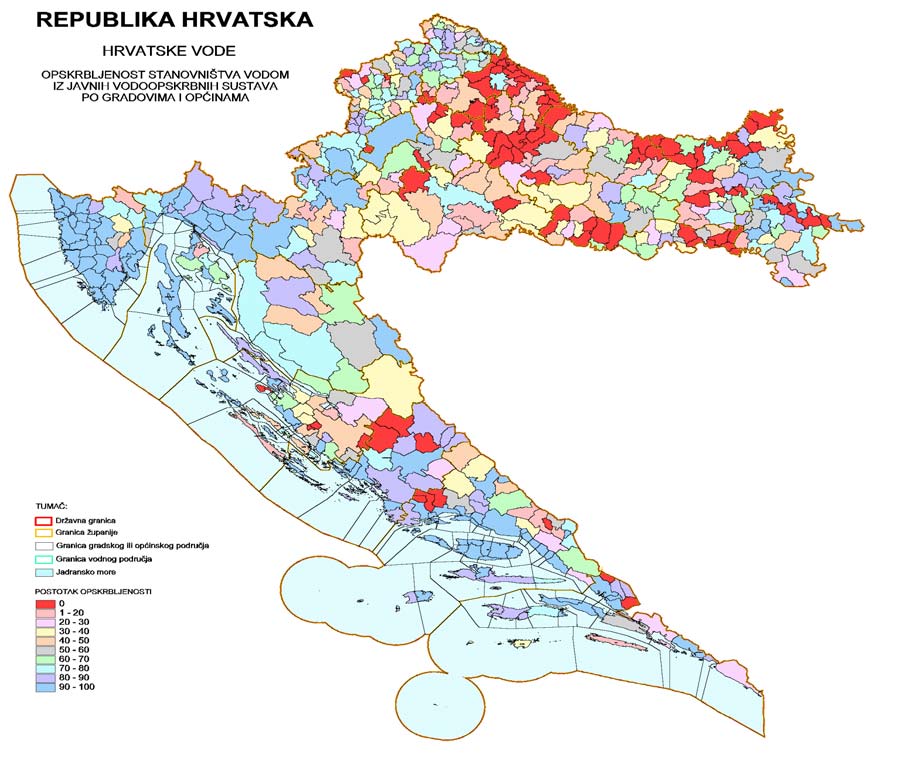
National Profile for Municipal Water and Wastewater Management in the Republic of Croatia
27
28
UNDP/GEF Danube Regional Project
4 ECONOMIC DATA
4.1 Prices at Various Points in the Production
Water use charges are calculated based on the tariffs (No) set by the Government of the Republic of
Croatia, quantity of water used, and a series of correction factors that reflect the intended use of water.
Charges (No) per 1 m3 of water (depending on category) are given below:
Category
I HRK
0.80,
EURO
0.10
Category II HRK 0.72, EURO 0.09
Category III HRK 0.56, EURO 0.07
Category IV and V HRK 0.32, EURO 0.04
Mineral and thermal waters HRK 1.60, EURO 0.21
Since it's introduction in 1990 until recently, basic tariff of water use charges was linked to Deutsche
Mark, so the currency change (from former Yugoslav dinars into Croatian kunas) and inflation did not
affect the relative amount of the tariff. Water Management Financing Act from 1995 confirmed
previous regulations on the basic charge tariffs, so they in fact did not change during the past 10 years.
With the low inflation rates in the recent years (since the tariff is no longer linked to German
currency), and due to generally low purchasing power and weak economy, there were no attempts to
raise the level of the tariff.
4.2 Water Price Structure - Tariffs
Based on the above data, the following table illustrates structure of water prices paid by consumers
connected to the public water supply and sewerage system in several Croatian cities.
Table 9
Water Price Structure in Selected Cities in Croatia (2000)
Water
price
component
1 2 3 4 5 6 7
municipal service for water supply 2.41 1.15 1.10 2.04 2.90 1.81 1.17
VAT
22%
0.53 0.26 0.24 0.45 0.63 0.40 0.26
municipal
service
for
sewerage
0.61 0.50 0.33 0.68 0.30 0.61 0.46
VAT
22%
0.13 0.11 0.07 0.15 0.07 0.13 0.10
development
of
infrastructure
0.57 0.42 0.94 3.44 - 0.16 1.70
water
user
charge
0.80 0.80 0.80 0.80 0.80 0.80 0.80
water
protection
charge
0.90 0.90 0.90 0.90 0.90 0.90 0.90
water
use
concession
charge
0.08 0.08 0.08 0.08 0.08 0.08 0.08
TOTAL
per
1
cu.m.
HRK
6.03 4.22 4.46 8.54 5.68 4.89 5.47
TOTAL
per
1
cu.m.
EURO
0.78 0.55 0.58 1.11 0.74 0.64 0.71
Cities: 1 Rijeka, 2 Zagreb, 3 Varazdin, 4. Osijek, 5 Gospi, 6 Đakovo, 7 Split.
(1 EURO =7.7 HRK)
Source: Survey of the State Water Directorate
Dubravka Mokos, B.SC. & Ivan Klakocer/Croatian Waters
National Profile for Municipal Water and Wastewater Management in the Republic of Croatia
29
4.3 Water Protection Charge
The basic tariff (T) for 1 m3 of discharged wastewater is 0.90 HRK (0.12 EURO). The amount of
water protection charge for discharged water is calculated according to the following formulae:
a) For wastewater discharged into public sewerage system (communal and/or industrial wastewater),
or into natural recipient:
N = T × V × k1 × k2 (1)
b) For discharged wastewater, which was used in the cooling process, into natural recipient:
N = Tt × Vt × t (2)
c) For wastewater discharged into natural recipient when communal and industrial wastewater is
mixed with wastewater used in the cooling process:
N = ( T × V × k1 × k2 ) + ( Tt× Vt × t )
(3)
The factors in equations (1), (2) and (3) mean:
N = amount of charge
T = charge level or tariff per cu.m. of discharged wastewater, set by the Ordinance of the Government
of Republic of Croatia (0,9 HRK, EURO 0.12)
Tt= charge level or tariff per cu.m. of wastewater used for cooling, as determined by the Ordinance of
the Government of Croatia (0,0009 HRK, EURO 0.00012)
V = annual quantity of discharged wastewater in cu.m.
Vt = annual quantity of discharged wastewater used for cooling, in cu.m.
k1 = coefficient reflecting the level of deterioration of water quality and suitability for use, calculated
according to the formula:
n
B
OTi 0,5
k = (
× R +
)
1
B
OT
d
i 1
=
di
Where:
B = annual arithmetic mean of all measured values of five-day biochemical oxygen demand in mg O2
/l in discharged wastewater
Bd = permissible value of five-day biochemical oxygen demand in mg O2/l, determined by the water
management permit
R = factor of biodegradability of released wastewater, calculated according to the formula CODcr/ (2.5
x B), which is introduced only if higher than 1, and when wastewater is discharged into the public
sewerage system. Exceptionally, it may be introduced in the case when wastewater is discharged into
the natural recipient, and in accounting of the charge B = 250.
CODcr = the annual arithmetic mean of all measured values of chemical oxygen demand in released
wastewater, in mg O2/l,
OTi = annual arithmetic mean of all measured concentrations of i-th dangerous substance in mg/l in
discharged wastewater
OTdi = permissible concentration of i-th dangerous substance in discharged wastewater, determined by
the water management permit
k2 = coefficient applied only when wastewater is discharged through the wastewater treatment plants
into the natural recipient, which is:
30
UNDP/GEF Danube Regional Project
0.70 - For wastewaters discharged through a wastewater treatment plant with the first stage of
treatment, or through plants with a corresponding level of treatment with a submarine outfall
0.30 - For wastewaters discharged through a second stage treatment plant with sludge processing
and disposal, or through a first stage treatment plant with submarine outfall and disposal of
sludge
0.20 - For wastewaters discharged through a third stage treatment plant, with sludge treatment and
disposal
t = Difference of arithmetic means of measured values of wastewater temperature at discharge and
measured values of temperature at the intake, during one year.
Coefficient k1 is a cost-recovery instrument, and its value is proportional to the actual level of
pollution of the discharged wastewater. K1 is equal to 1 for communal wastewater and other effluents
that are not subject to wastewater permits. The coefficient is calculated based on the actual (measured)
values of water pollutants against their values given in the effluent permit1.
Coefficient k2 on the other hand is an incentive instrument, aimed to stimulate polluters to discharge
wastewater thorough the plants with full-scale treatment - mechanical, biological and chemical.
However, incentive function of the coefficient may be fulfilled only if the basic water protection tariff
(currently 0,9 HRK/m3) is set on a realistic level and if it represents the actual costs of necessary water
treatment.
By being the subject to the same regulations as water use charge, the relative amount of the water
protection charge has not changed during the last decade.
Following formulas are used in calculating water user charges:
For water delivered through water supply system, for technological purposes with user's own
abstraction, and for abstraction of water for cooling processes
N = No × V1
Where:
N = the amount of charge
No = tariff depending on water category
V1= quantity of water in cu.m. used in the accounting period
a) For water abstraction or pumping by the user's plant, when water is used for fish-farming
N = 0.05 × No × V2
Where:
N = amount of charge
No = tariff depending on water category
V2 = quantity of water used expressed as the volume of fishpond, in cu.m.
b) For irrigation:
N = N1 × V3 × k
Where:
N = amount of charge
1 The permissible concentrations of dangerous substances are defined in the effluent permit, which is issued by
either county authorities or Hrvatske vode, with the consent of State Water Directorate.
Dubravka Mokos, B.SC. & Ivan Klakocer/Croatian Waters
National Profile for Municipal Water and Wastewater Management in the Republic of Croatia
31
N1 = tariff determined, in this case, by the municipal assembly
V3 = quantity of water used in the accounting period
k = correction coefficient determined by the county assembly;
Correction factor k is designed in such a way as to reflect the level of development of the irrigation
system. Its rationale is to stimulate the application of more efficient irrigation systems, and thus the
more efficient use of water. However, due to bad conditions in the agricultural sector, and low
collection efficiency, a number of municipal assemblies decided not to implement this charge.
c) For water used for electricity generation
N = N2 × E
Where:
N = amount of charge
N2 = level of charge per 1 KW h (7.5% of the price of KWh at plant gate)
E = quantity of electric energy produced in the accounting period
d) For water which is used as plant driving power
N = N2 × S
Where:
N = amount of charge
N2 = level of charge per 1 KWh
S = total plant power in KW
4.4 Concession charge
The annual charge paid for concession is:
1. for water abstraction for public water supply - 10 percent of the water user charge, which is 0.08
HRK (EURO 0.01) per cu.m. of water;
2. for water abstraction for selling on the market - 2.5 percent of revenues from water sale;
3. for pumping of mineral and thermal waters, 10 percent of charge for use of such waters which is
0.16 HRK (EURO 0.02) per cu.m;
4. for pumping of mineral waters for the market, 2.5 percent of revenues from the sales;
5. for irrigation, 10 percent of the water user charge;
6. for the use of water power for generating of electric energy, the annual charge is 1 percent of actual
average price of energy at plant gate;
7. for the use of water power for plant driving, 1 percent of revenues from the activity for which the
plant is used;
8. for fish-farming, 15 percent of estimated value of total fish catch in one year.
Concession charges described above were set in 1996, and have not changed since.
32
UNDP/GEF Danube Regional Project
5 INFRASTRUCTURE
Data referring to water consumption in Croatia exists within official data of Croatian Waters. These
data are collected for the purpose of calculating the water management charges (water protection,
water use and concession charges). The second source of the data related to the water consumption is
official statistical data of the National Statistical institute.
Prior to 1998, municipalities were not obliged to report data on total abstracted water, so water supply
statistics were kept in a different way. Since two years ago, municipalities report data related to
abstracted water (volume of water metered on the actual place of the water intake, or volume of water
which enters water supply system), but the data collection is still not entirely smooth and efficient.
According to the present calculations, leakages from the public water supply system were estimated at
46% in 1998, and at 43% in 1999. The figures represent difference between abstracted and delivered
water, and are mainly attributed to the old age of the water supply pipelines and equipment. Another
factor influencing high leakages is a considerable number of illegal connections to the water supply
network. War damages of the water supply facilities, poor maintenance and low-quality materials also
play a role in the water losses accounting to nearly half of the abstracted water.
When all the categories of water supply are taken into account (PWS, industry's own abstraction,
cooling water and others), leakages are estimated at 25%.
The percentage of population with the access to PWS was 62% in 1991. Over the last 10 years,
Percentage of population with the access to PWS rose steadily and reached 73% in 2000. However the
level of water supply is still not satisfactory. The reasons for this can be found in water supply
constraints such as inadequate capacity of water sources, and incomplete or non-satisfactory
development of water supply system. Damages caused by the war additionally worsened the existing
problems in water supply.
When the data on the water delivered through the PWS is compared with the share of population with
access to PWS, two opposite trends are observed: decrease in the consumption of water delivered
through PWS (311 mill m3 in 1991, 276 mill m3 in 1999), and an increase in the percentage of
population with the access to PWS (62% in 1991, 73% now). The main explanation for this is
drastically reduced water consumption of the industrial sector, due to reduced level of industrial
operations in the country. At the same time, a slight trend in the reduction of per capita domestic water
consumption is observed. Both of these two factors are offsetting the effects of the increased share of
population connected to PWS, and resulting in decreased total water consumption during the last 10
years.
Equipment for metering of the water delivered to households exist in 59 out of 130 Croatian
municipalities that have registered service companies dealing with water supply and wastewater (data
from 1998).
Water consumption is mainly metered by block of flats, or by single-family houses. The bill paid by
block of flats is divided by number of persons in the block, and does not reflect the actual water use of
the individual household. In the case of the single-family houses the bill is paid by the house and in the
some cases can reflect the actual water use of the individual household.
In the last few years, municipalities in larger cities allow installation of meters in each flat. There is no
particular official standpoint related to this issue, and if there are specific requests for installation of
individual metering equipment, there are usually approved. Generally speaking, individual metering
equipment in the big apartment building is still rare. The metering system is volumetric.
Some of the municipalities where there is no metering equipment, for example, determine minimal
volume of water per inhabitant, which is used for further calculations (for example 5 m3/inh/month).
Dubravka Mokos, B.SC. & Ivan Klakocer/Croatian Waters
National Profile for Municipal Water and Wastewater Management in the Republic of Croatia
33
The following table presents the share of population with access to sewerage and public wastewater
treatment facilities. It also gives share of population (in different regions) with access to primary and
secondary wastewater treatment for 1996 and 1999.
Table 10 Share of Population with Access to Sewerage and Public Wastewater
Treatment Facilities
Number of
Connected to
Connected to
Connected to
inhabitants
public sewer
primary
secondary
River basin
Year
network
treatment plants
treatment plants
(rough
figures)
No.
inh. % No.
inh. % No.
inh. %
1996. 1,169,700
50.0
20,700
0.9 80,300 3.4
Sava 2,340,000
1999. 1,239,900
53.0
20,700
0.9 80,300 3.4
1996. 425,000
46.7
25,000
2.7 49,300 5.4
Drava and
910,000
Danube
1999. 427,000
46.9
25,000
2.7 65,300 7.2
1996. 320,000
53.4
230,000
38.4 13,500 2.3
Littoral and
599,000
Istrian
1999. 344,900
57.6
252,000
42.1 22,000 3.7
1996. 380,000
40.6
180,000
19.2 9,500 1.0
Dalmatian 937,000
1999. 468,500
50.0
205,600
21.9 12,000 1.3
1996. 2,294,700
47.9
455,700
9.5 152,600 3.2
Total
4,786,000
Croatia
1999. 2,480,300
51.8
503,300
10.5 179,600 3.8
Source: Croatian Waters
The typical sewage system is combined. Only a few smaller cities and residential districts of bigger
towns have separate systems. Industrial wastewater is often discharged into the sewerage system, in
many cases without adequate pre-treatment. In terms of treatment facilities, Croatia is under-equipped.
The bulk of the wastewater undergoes primary treatment only. Since construction of wastewater
treatment plants was made priority a few years ago, many municipal facilities have been or are being
built.
As shown in Table 10, the share of population connected to public sewerage and wastewater
treatment plants is considerably higher in Littoral and Istrian river basin, than in any other region of
Croatia. This is due to the fact that boundaries of this river basin coincide with the most developed
part of Croatia, which has long developed a systematic approach in dealing with wastewater. At the
same time, the price of water paid in the counties of this river basin is significantly higher than the
average price of Croatia, i.e. more funds are available for the investment in wastewater treatment
plants/sewage system.
Due to the already mentioned weaknesses in keeping water statistics in Croatia, and relatively low
penetration of metering equipment, data on per capita (or household) water consumption is not readily
available. This report therefore looks into couple of different methods for calculating average water
consumption
As already explained, water consumption has a decreasing trend due to the large decrease of water
consumption by the industrial sector. Based on the above calculation method, this in fact means that
the total quantity of consumed/abstracted water fell from 232 m3 per person per year in 1985, to 170
m3 in 1995. The downward trend continued in the second half of the 90's, with the following average
consumption figures: 1996 - 167 m3 per person; 1997 - 165 m3 per person; 1998 - 166 m3 per person.
34
UNDP/GEF Danube Regional Project
Another method takes into account domestic water consumption, and divides the quantity of invoiced
water with the number of users. The average consumption calculated in this way is 60 m3 per user per
year, where user is not a single person, but the holder of the water bill.
Dubravka Mokos, B.SC. & Ivan Klakocer/Croatian Waters
National Profile for Municipal Water and Wastewater Management in the Republic of Croatia
35
6 MANAGEMENT UNITS
6.1 Types of Management Units
The Municipal Services Act (NN No. 36/95), which defines the municipal activities, includes, among
others, water supply and wastewater disposal services. Municipal services may be carried out by either
or among the following entities:
1) A company founded by one or several local administration units
2) A public institution founded by a local administrative unit
3) A service plant, established by one or several local administration units
4) A legal entity or a person subject to concession agreement
Presently, private companies provide most of the municipal services (wastewater disposal). There are
about 130 such companies located in the larger urban areas. Privatization of municipal service
companies has been carried out under the Municipal Services Act.
When municipal companies are formed, they are usually established as limited liability companies
(d.o.o.), with local administration unit(s) as founders and owners.
Local Administration Units must hold at least 51% of the shares, with the remaining shares available
for other private entities. No one from the private sector has yet bought into these companies since
their financial situations are unattractive to investors.
The municipal companies are the owners of the assets, and if others buy in, their ownership would be
in proportion to their shareholdings.
It is essential to ensure that the water and sewerage companies have the institutional as well as the
financial capacity for the operation and maintenance of the enhanced sewerage systems.
The formation of private municipal companies has lead to many municipal services,in addition to
water supply and sewerage, being transferred to the new limited liability companies (d.o.o.) There are
some comapnies that provide water, and sewerage services only. The remaining companies are
communal service companies that provide a range of other services from gas supply and solid waste
disposal to open air markets and cementery maintenance.
In the interest of economy, there is logic to the sharing of financial and management services, and to
group together environmental and other services, which can share both labor and transport. However,
as the sewerage network expands and the treatment plants come on stream, there will be need for a
dedicated management team and labor force for the water supply and sewerage services.
It is recommended that the whole policy regarding the services to be provided by a municipal
company be re-assessed nationally, particularly where large sewerage (and water supply) projects are
planned.
6.2 Management Unit Services Areas
Due to the increasing standard of living and the reflashing of tourism we see and expect a further
increasing water demand. The water supply penetration through public networks increased from 53%
in 1991 to 68% in 1995 and to 73% in 1999 and should reach 95% in 2015. The network length in
1998 was 24,596 km.
36
UNDP/GEF Danube Regional Project
Table 11 Basic Data of Water Supply (2000)
Indicator Unit
Value
Population supplied with piped water
Thousand
3,125
Population supply penetration 1999 (% of total population)
%
73
Specific water demand
L / capita, day
205
Total water consumption household
Mil m3 / y
190.317
Total water consumption industry
Mil m3/ y
139.006
Length of water supply networks
km
24,596
Water losses
%
43
It is recommended that the municipal companies that provide a variety of services, form a separate
water supply and sewerage department to cope with the proposed expansion to the sewerage system
and the construction of treatment plants. Water and sewerage form and integral system and their
operation, maintenance and development must be compatible.
Such a department should have one (1) manager for the technical and financial operations of both the
water supply and sewerage sections, sharing the services of plant and vehicles, the laboratory, etc. The
sewerage section should have units for drainage, the sewerage network, and the treatment plant.
There must be a Management/Finance/Administration structure to support the technical services of the
water supply and sewerage units within the new combined department. Whereas it is desirable for the
department to have its own finance and administration section, this may not always be possible,
particularly in the smaller companies.
However, it is essential that any finance department providing services to a number of departments has
a separate cost center for water supply and sewerage accounts, a sound billing system and be able to
provide essential statistical information.
6.3 Population Served
It is important to point out that the war (1991-1995) had a tremendous impact on the population
distribution and the number of inhabitants (forced migrations, refugees, displaced persons, ethnic
cleansing, etc). Population movements particularly affected Eastern part of the country, but the
demographic situation changed for the whole country as well. For example, mid-year population
estimate of the Statistical Information 2001 gives a figure of 4,437,000 inhabitants.
Share of agricultural population in 1991 was 8.,56% (409,647 inhabitants), while there is no precise
data on the ratio of rural/urban population. A 1997 estimate stated that rural population in Croatia
accounted for 20-30 % of the country's population.
Data referring to water consumption in Croatia exists within official data of Croatian Waters. These
data are collected for the purpose of calculating the water management charges (water protection,
water use and concession charges). The second source of the data related to the water consumption is
official statistical data of the National Statistical institute.
Although the data on water consumption is fairly well kept, some estimates are still necessary. These
estimates are included in Table 12, presenting total water supply in Croatia for the year 1985, and the
period 1990-1999.
Dubravka Mokos, B.SC. & Ivan Klakocer/Croatian Waters
National Profile for Municipal Water and Wastewater Management in the Republic of Croatia
37
Table 12 Total Water Supply in Croatia (in mill m3)
Years
Type of
consumption 1985 1990 1991 1992 1993 1994 1995 1996 1997 1998 1999
Public water
368 338 311 319
315
276
272
296
292 289 276
supply system
Industry (not
connected to
129 111 87 79
69
97
86
56
54 55 52
public supply
system)
Cooling
water 310 251 127 203
205
210
215
210
210 212 211
Other
80 79 75 77
77
78
78
77
77 78 77
Total
887 779 600 678
666
661
651
639
633 634 616
Source: Gradjevinski godisnjak; dr.sc. Dragutin Geres + Croatian Waters data
Figures given for public water supply (PWS) system refer to delivered (i.e. invoiced) water, both for
domestic consumption and industry. Leakages (estimated as a difference between abstracted and
delivered water) are not included.
Industry (not connected to public supply system) gives data on the water consumption of the industrial
sector through own abstraction of groundwater and surface water). Once again, leakages are not
included.
Volume of the cooling water is derived form the data used for calculation of water management
charges.
Finally, category others gives an estimated volume of water used for domestic or industrial purposes
that does not fall under any of the previous categories.
As presented in the next table, domestic consumption accounted for 56 (59)% of the PWS in 1998 and
1999 respectively. The share of the domestic consumption has risen significantly in comparison with
the early `90s, when it accounted for some 40% of the PWS.
Table 13 Domestic Water Consumption in the Total Public Water Supply (mill m3)
1998
1999
Total public water supply
289
276
Domestic consumption
162
162
Share of domestic consumption in PWS (in %)
56.06
58.7
Source: Gradjevinski godisnjak, Croatian Waters, dr.sc. Dragutin Geres
Prior to 1998, municipalities were not obliged to report data on total abstracted water, so water supply
statistics were kept in a different way. Since two years ago, municipalities report data related to
abstracted water (volume of water metered on the actual place of the water intake, or volume of water
which enters water supply system), but the data collection is still not entirely smooth and efficient.
Due to the already mentioned weaknesses in keeping water statistics in Croatia, and relatively low
penetration of metering equipment, data on per capita (or household) water consumption is not readily
available. This report therefore looks into couple of different methods for calculating average water
consumption
38
UNDP/GEF Danube Regional Project
Household water price consists from the following items: basic price of water - price of municipal
service, water use charge, water protection charge, concession charge, and tax. Both basic price of
water and water management charges (water use, water protection and concession charges) are based
on volume rates.
VAT rate of 22% is only applied to the basic price of water (price of municipal services).
Structure of the average price for household for 1m3 of delivered water is presented in the following
table:
Table 14 Average Price for Household for 1m3 of Delivered Water (incl. Sewerage)
Price component
Charge
Municipal service for water supply
A
VAT 22%
22% A
Development of infrastructure
B
Municipal service for sewerage
C
VAT 22%
22% C
Water user tariff
D
Water protection tariff
E
Water use concession charge
F
TOTAL per 1 cu.m.
A+22%A+B+C+22%C+D+E+F
The above scheme applies to consumers connected to the public water supply and sewerage system.
Decreasing or increasing block schedule does not exist at the moment, and is not planned in the near
future.
The exact data on the relation between the average water expanses paid by Croatian households and
their income and other expenditures does not exist. Nevertheless, some comparison of water prices
and household income can be made, based on the figures presented in this report so far, and official
statistic.
If the annual consumption of 60m3 per user and the price of water are taken into account, an average
domestic user in Croatia paid 293 HRK (or 38 EURO) water bill in the year 2000. According to the
National Statistics Institute, the average net monthly salary for the same year was 3,055 HRK (397
EURO).
Data on the annual water consumption for industrial use is given below.
Table 15 Industrial Water Consumption in the Total Water Supply (mill m3)
1998
1999
Total water supply
634
616
Industry* 181
162
Share of industry (%)
28.55
26.3
Source: Construction Yearbook, Croatian Waters, dr.sc. Dragutin Geres
Figures refer both to the industrial water supplied through the public supply system, and own
abstraction
Dubravka Mokos, B.SC. & Ivan Klakocer/Croatian Waters
National Profile for Municipal Water and Wastewater Management in the Republic of Croatia
39
6.4 Special Obligations
The State Water Directorate, Croatian Waters, and the Counties have the responsibility for the
organization of physical and financial planning with respect to the detailed plans within their areas of
jurisdiction. The operation and maintenance of water and sewerage facilities, and the setting of tariffs
rest with the municipal companies under the jurisdiction of the local governments.
In order to avail themselves of the loans provided by Croatian Waters, the municipal companies
should have both the institutional and financial capacity to operate and maintain the facilities. Further,
they should have the financial resources to contribute to the project finance and service the loans from
Croatian Waters.
For the success of the project, there is a need to amend the regulations in order to ensure that Loan
Agreements between SWD/Croatian Waters and the Local governments/W&S Companies will
contains conditions to ensure due performance of sewerage development contracts by the municipal
companies.
6.5 Financial Conditions
The water supply and sewerage companies (W&S companies) collect water pollution charges from
customers and remit the amount collected to (Croatian Waters) Croatian Waters is required to return
50% of this amount to the W&S companies for the construction of pollution control facilities (sewer
networks and treatment plant). This is given in the form of an interest free loan over 50 years.
Generally, the Local Government (LG) and the W&S company must match this amount with funds
from their own budget. If the loan is not repaid, Croatian Waters becomes the owner of that proportion
of the assets financed.
Since the National Water Master Plan is still under preparation, and the counties have not yet
completed their Water Pollution Control Plans, there is no national financing strategy at present.
40
UNDP/GEF Danube Regional Project
7 NATIONAL AND LOCAL REGULATION
7.1 National and Local Planning and Permitting
Water Management Master Plan
Medium and long term planning of sewerage facilities is difficult without a corresponding master plan
fot he development of water supply systems. The Water Management Master Plan of Croatia is
scheduled for completion by the end of 2004., and it should provide the basis for planning of all water
related facilities. It is recommended that the Water Management Master Plan be completed as soon as
possible.
County Water Polution Control Plan
The National Pollution Control Plan has been completed, and it introduces measures to ensure that
Croatia's natural water bodies are protected from polution by both municipal and industrial
wastewaters. The plan sets time horizons for the building of facilities and plant for wastewater
treatment. However, the plan only sets the framework for general policy.
County plans for the construction of wastewater treatment plants are incomplete and it is
recommended that the State Water Directorate and Croatian Waters take action to assist the counties
with this task, on a basin-by-basin framework. This should include a strategy for the drawing upo of
master plans with implementation schedules and financing mechanisms.
7.1.1 Data Collection
Each municipality periodically monitors sewage effluent and each industry periodically monitors
industrial wastewater according to the government regulations, including frequency and parameters of
analysis. Licensed laboratories perform the laboratory analyses and the results are submitted to
Croatian Waters.
7.1.2 Activity Permitting
The permissible limits of major parameters of industrial wastewater discharged into natural receiving
waters and public sewerage systems one prescribed in NN No 40/99 as amended by NN No 6/01
7.2 Economic Regulations or Limitations
Water Management Financing Act
This Act defines the source of funds and purposes for which they may be used and funds from each
source may only be used for specific purposes. For example, the water protection tariff may only be
used for the protection of water resources (including construction of sewerage system), and the water
use tariff, on exploitation of water resources (including construction of water supply system).
Water Management Fund
Dubravka Mokos, B.SC. & Ivan Klakocer/Croatian Waters
National Profile for Municipal Water and Wastewater Management in the Republic of Croatia
41
The Water Management Fund forms part of the consolidated central government budget, and the
financial plan is drawn up annualy by Croatian Waters (Croatian Waters) in consultation with the
municipal companies providing water and sewerage services. The financial plan for the year 2000
shows the following major features:
Table 16 Income of the Water Management Fund (2000)
Amount
Income
Rate (%)
(103 HRK)
1. Income From Fees Water Use Tariff
210,000
14.5
Water Protection Tariff
235,000
16.3
Extraction of Sand & Gravel
3,000
0.2
River Basin Fee
310,000
21.5
Power Generation Charges
40,000
2.8
Sub-total 798,000
55.3
2. Income from Government Budget
390,794
27.1
3. Income from Towns & Municipalities
27,000
1.9
4. Min. of Public Works Reconstruction & Development
33,500
2.3
5. Income from Power Generation
15,000
1.0
6. Sale of Croatian Privatization Fund Stock
85,000
5.9
7. Other Income
94,910
6.6
Total Income
1,444,204
100.00
Source: Croatian Waters
42
UNDP/GEF Danube Regional Project
Table 17 Expenditures of the Water Management Fund (2000)
Amount
Expenditure
Rate (%)
(103 HRK)
1. Running Costs
Operating Expenditure
203,000
13.5
Carrying out of Obligations
545,650
36.2
Sub-total 748,650
49.6
2. Capital
Investment for Tangible/Intangible Assets
25,000
1.7
Expenditures &
Investment for Pollution Control
Transfers
Facilities
77,600 5.1
- National Waters
Investment for Water Supply
357,694 23.7
Reconstruction & Development
Investment for Water & Sea Pollution
238,265 15.8
Control Facilities
Investment for Water Management
61,000 50.4
Design
Sub-total 759,559
50.4
Total
Expenditure 1,508,209
100.00
Source: Croatian Waters
Source of funds for government is the 22% VAT paid on the amount billed for water supply and
sewerage services. This government source would not be enhaned by an increase in collection
efficency. However, the municipal companies would benefit as they currently pay the tax on
uncollected bills.
Source of funds for Croatian Waters is the Water Protection Tariff, which would be increased by
improved collection efficiency. In addition, the level of the water pollution tariff should not be lower
than the cost of wastewater treatment in accordance with the Water Management Financing Act. This
tariff should be determined annually and enforced within the limitations of affordability.
Source of funds for the municipal companies is the chare, which should be set to cover the cost of
operation, maintenance and development. Realistic charges should be set, again within the limitations
of affordability. The sources of funds to the companies could be increased immediately by improved
collection efficiencies, which would increase revenue for water supply as well as sewerage and also,
increase the amount of water use tariff payable to Croatian Waters.
In order to improve collection, it is necessary for all municipalities to have by-laws to enforce
disconnection for none payment. It also appears to be necessary to simplify the legal process to reduce
time and costs for any neccessary court action.
To ensure the financial viability of projects, it is recommended that Croatian Waters should review its
policy on the percentage of loans made available to municipal companies for development projects to
minimize the loan charges to the municipal companies.
In addition, loan agreements between Croatian Waters and the municipal companies should include
provisions for the attainment of collection efficiency targets for the setting of tariff levels necessary to
meet financial obligations, and for the achievement of the appropriate wastewater effluent quality, etc.
Dubravka Mokos, B.SC. & Ivan Klakocer/Croatian Waters
National Profile for Municipal Water and Wastewater Management in the Republic of Croatia
43
The owners of the companies are the LG authorities, which decide policy and approve the charges
proosed by the company. Hence, the companies are responsible to the LG and not Croatian
Waters,with development being in line with LG aims and objectives.
Profit and Loss accounts usually show that income and expenditure is balanced, except when loan-
financing charges are included which usually leads to a loss situation. O&M is generally limited to the
amount of finance available rather than to a rational plan.
7.3 Environmental Regulations and Restrictions
National Water Protection Plan
The National Water Protection Plan issued in January 1999 (NN No. 8/99) includes definitions, plans,
measures and others; namely, (i) Necessary research and monitoring of water quality; (ii)
Categorization of water; (iii) Measures for water conservation; (iv) Measures for contamination
emergencies of water; (iv) Plan to build sewerage facilities and sewage treatment plant; (b) Source and
manner of financing the plan; and (vi) A list of legal and natural persons charged with carrying out the
plan.
(a) Water Quality Monitoring
Water quality monitoring programs for national waters (national monitoring program) are drawn up
and carried out by Croatian Waters. National waters are as listed in NN No. 8/99 and local waters are
all other waters. A county water protection plan lays down the program for monitoring the quality of
local water. The results of the monitoring are delivered to Croatian Waters and published together with
the report on monitoring of the national water.
(b) Categorization of Water
The Plan contains the categorization of national waters, while categorization of local waters are
contained in the county water protection plan.
The receiving waters for effluent are categorized in the Decree on Water Classification (NN No.
77/98) whose prescribed conditions have to be met. Water is clasified into five (5) types according to
its quality that corresponds to the established conditions of its general ecological function and to the
conditions of water use. The categorization of national waters has been completed, and that for local
waters will be contained in the county water protection plans when issued.
(c) Limit Values of Wastewater Effluent Quality
For the protection of water quality and the environment, limit values of hazardous and other
substances in the effluents of industrial wastewater and sewage tratment plant are prescribed by the
Decrees issued by the State Water Directorate (NN No. 40/99, as amended by NN No. 6/01 for
industrial wastewater and NN No. 40/99 for effluent from sewage treatment plant).
(d) Measures for Contamination Emergencies
The Plan contains measures for cases of exstraordinary water contamination and contamination
emergencies. For Threat Level 1 (minor quantities of dangerous substance) and Level 2 (major
quantities of dangerous substance), measures laid down in the county water protection plan are
applied. In the case of Threat Level 3 (quantities of dangerous substances with possible cross-border
consequence), the provisions of the National Water Protection Plan are applied.
44
UNDP/GEF Danube Regional Project
(e) Sewerage Development Plan
The Plan sets up the implementation program in three (3) stages for the construction of public
sewerage system and wastewater treatment plant; namely, short-term program up to 2005, medium
term program up to 2010 and long term program up to 2025.
(f) International Agreements
Trans-boundary water issues are very important to Croatia. The National Water Protection plan
includes water quality monitoring programs for cross-border watercourses, and these are subjet to
treaties between the Republic of Croatia and neighboring states in connection with water industry
relationships.
The national monitoring program on the Trans-National Monitoring Network (TNMN) for the Danube
Drainage Basin is the program of the Permanent Commission f the Danube Protection Convention.
Dubravka Mokos, B.SC. & Ivan Klakocer/Croatian Waters
National Profile for Municipal Water and Wastewater Management in the Republic of Croatia
45
8 SOURCE USERS
The water of water supply system and the wastewater of sewerage system includes domestic,
institutional and industrial (including commercial) wastewater, and groundwater infiltration. The
wastewater of large industries is estimated individually. The wastewater of the remaining small
industries is dealt as part of the municipal wastewater, as well as domestic and institutional
wastewater.
(1) Design Unit Municipal Wastewater Quantity
(a) Unit Municipal Water Consumption
The existing domestic water consumption (household use only) ranges from 80 l/capita/day (lcd) to
170 lcd, mostly less than 150 lcd. It is nearly constant irrespective of the population size of town.
However, domestic water consumption in the urban centers is larger than the above average value.
Hence, the existing domestic water consumption in the objective sewerage development areas is
assumed to be 170 lcd.
On the other hand, the unit municipal water consumption (including domestic, institutional and small
industry uses) increases according to the population size of town. The unit municipal water consuption
is classified into 190 lcd for towns with less than 10,000 inhabitants and 230 lcd for towns with 10,000
population or more.
The future unit municipal water consumption will increase according to the improvement of living
standards. The annual growth rate is assumed at 2%.
(b) Unit Municipal Wastewater
Most of the consumed municipal water returns to the sewerage system. The unit municipal wastewater
is estimated from the unit municipal water consumption on the assumption that the return rate is 80%.
(c) Municipal Wastewater Fluctuation
The wastewater flow seasonally fluctuates throughout the year. Therefore, the capacity of treatment
plant is usually designed to meet the daily maximum wastewater flow in the month when the largest
water consumption occurs. The daily maximum ratio (ratio of the daily maximum in the largest
consumption month to the daily average) in the towns is in the range of 1.10 and 1.30. The daily
maximum ratio is assumed at 1.30 for safety. The wastewater flow also hourly varies. Therefore, the
capacity of sewer and pump is designed to meet the maximum hourly wastewater flow.
(d) Groundwater Infiltration
Groundwater infiltration is usually expressed as a ratio of the infiltrated groundwater to the municipal
wastewater quantity.
46
UNDP/GEF Danube Regional Project
Table 18 Public Water Supply
Unit of measure
1998.
1999.
2000.
Volume of water used
`000 m3 356,664
323,701
314,089
Length of watermains
km
7,312
7,335
7,335
Length of distribution network
km
24,596
24,689
24,792
Water connections
number
874,703
877,668
878,499
WATER QUANTITIES 1992-2000
PUBLIC WATER SUPPLY SYSTEMS AND COMPANY EXECUTED ABSTRACTION
390.000.000
380.000.000
370.000.000
3 m 360.000.000
ME
U
VOL 350.000.000
340.000.000
330.000.000
320.000.000
1992. year
1993. year
1994. year
1995. year
1996. year
1997. year
1998. year
1999. year
2000. year
Total m3 385.092.134 370.532.725 374.707.383 358.957.293
359.614.116
346.827.797
343.522.331
360.430.000
365.000.000
Source: Croatian Waters
Table 19 Public Sewage System
Unit of measure
1998.
1999.
2000.
Wastewater - total
`000 m3 287,803
258,608
257,901
Purified wastewater
`000 m3 87,796
88,785
86,579
Unpurified wastewater
`000 m3 200,007
169,823
171,322
Total length of sewage network
km
5,093
5,236
5,368
Length of main sewer
km
1,121
1,201
1,069
Sewage connections number
294,210
303,532
318,658
Source: Statistical Yearbook of Republic of Croatia
Systematic control of water quality in all well fields, inflow area and water supply structures guarantee
quality portable water supply in compilance with appplicable regulations in the future.
Dubravka Mokos, B.SC. & Ivan Klakocer/Croatian Waters
National Profile for Municipal Water and Wastewater Management in the Republic of Croatia
47
9 POLICY ISSUES
9.1 Policies
The economic and political processes in the country were also reflected on municipal water
management, in particular in the field of water pollution control. Stopping on reduction of operation of
some industrial plants resulted in reduced pollution in temporary improvement of surface water
quality. At present the main problem in water pollution control is the insufficient number of treatment
plants for municipal wastewater from public sewerage systems. Such problems are at present the
priority in solving of water pollution control issues in the Republic of Croatia, and for this purpose it is
necessary to provide large financial means to cover the requirements from its own sources but before
that it will be to look for funds through International loans, will be necessary to prepare tariff reforms
and effluent charge reforms which we use in case study with spread sheet modul.
The strategy of water and water protection from pollution is defined by document State Water
Protection Plan (NN8/99). The Plan contains:
required research and analysis to water quality;
water categorisation (planned water quality in a given area - sensitivity of the area);
water protection measures;
emergency measures for cases of sudden and accidental pollution;
plan of construction of wastewater treatment plants larger than 50,000 population equivalent (PE);
sources of financing;
list of persons and entities in charge of enforcement of the Plan, their rights and responsibilities.
At the county level, water protection plans are also prepared. The county plans have the same
contents, and are adjusted with the state plan, elaborating in detail parts of procedures in cases of
emergency or accidental pollution, as well as provision of financial resources for construction of water
protection facilities. While State Water Protection Plan is a strategic document, county plan is an
implementation document for the territory of the particular County.
The funds for water protection and, consequently, for the implementation of the above plans, come
exclusively from the water pollution charges which are, with respect to the problems of water
pollution in Croatia, insufficient.
For the purpose of water protection against pollution, the law provides that the charge (tariff) for water
protection should not be lower than the costs of wastewater treatment. However, a recent assessment
carried out by Croatian Waters experts indicated that the presently paid tariff is four times lower than
the actual costs of wastewater treatment. Yet the existing level of basic tariff (and resultant water
protection charge) is maintained, mainly due to the general status of the national economy.
The underrated and unrealistic level of water protection charge is also the cause of the prevailing
attitudes towards the wastewater treatment. Given the fact that levied charges are several times lower
then full economic and environmental costs of water pollution, everybody is motivated to maintain the
status quo, rather then to invest into new wastewater treatment plants. In addition, small number of
existing wastewater treatment plants considerably increases the water price for those connected to
them. The other users who have not built any treatment plants enjoy considerably lower price of water,
and it is more convenient for them to pay the unrealistically low charge.
9.2 Policy Evaluation
Starting from the above, it will be necessary to review all legislation related to water management,
adjust it to EU requirements and define the possible deadlines for fulfilment of commitments towards
48
UNDP/GEF Danube Regional Project
EU, because the Republic of Croatia is oriented towards joining the EU. At present, the major problem
in meeting these objectives is lack of funds. Also, it will be necessary, through international
workshops, to educate young professionals for working in accordance with EU requirements, and to
adjust water management to new approaches, in particular with regard to the environment and
sustainable economic development.
In the EU, economic principles and the use of economic instruments have been gradually but clearly
embedded into environmental policies. The Treaty now integrates the Polluter Pays Principle as a
foundation of all European environmental policies. The Fifth Environmental Action Programme of the
European Commission ending in 2000 has the broadening of the range of policy instruments as one of
its top priorities. However, progress in the actual appliciation of economis instruments remains limited
so far.
The Commission has advocated an increased role for pricing in enhancing the sustainability of water
resources in the context of the proposed Directive establishing a framework for Community action in
the field of water policy (or Water Framework Directive).
(1) Efficient water pricing acts as an incentive to reduce pollution and improve the efficiency of water
use. Thus, it reduces the pressure on water resources and the environment, and it ensures available
resources are efficiently allocated between water uses.
(2) As a result, water supply and treatment infrastructure can be more adequately sized. This means
providing water services and protecting the environment more cost-effectively.
(3) It mobilises financial resources to ensure the financial sustainability of water infrastructure and
service suppliers, and to pay for environmental protection.
It is argued that the lack of importance given to economic and environmental issues in designing
existing water pricing policies, as opposed to more general social or development objectives, has led
to current situations of inefficent use, over-exploitation and degradation of surface and groundwater
resources.
Over the last few years, Croatia has put a lot of effort into enacting laws and regulations in the area of
water management a special for these strategis:
Dubravka Mokos, B.SC. & Ivan Klakocer/Croatian Waters
National Profile for Municipal Water and Wastewater Management in the Republic of Croatia
49
Strategy name
Srategy Description
Comments/Concerns
1. Price of municipal service
The economic analisys should be undertaken to aid decision-
Source of revenue for municipal service determined by the Municipal
making in selecting programmes of measures for achieving the
Services Act (includes the service, repayment of loans for construction environmental objectives as well as to ensure transparency and
of facilities and municipal infrastructure). It is determined by the
informed decisions on the recovery of costs.
provider of the municipal service, with the consent of the founder of
Economics has to provide enough information to make assesment
the municipal company.
and justification of objective derogation, because of sustainable
2. Water use tariff
socio-economic activities and restrictions. In the case of Croatia,
Source of revenue for financing of water management defined by the
such derogations could be of special importance, due to less
Economic
Water Management Financing Act (NN 107/95). The charge (tariff) is
developed water uses and watere services, that need to be
regulation
determined by the Government of the Republic of Croatia
improved.
3. Water protection tariff
Source of revenue for financing of water management defined by the
Water Management Financing Act (NN 107/95). The charge level
(tariff) is determined by the Government of the Republic of Croatia.
4. Concessions on water and water estate
Concession provides the right of use of water and water-related estate,
i.e. the right to perform economic and other activities on water and
water-related estate.
The strategy of water and water protection from pollution is defined by Reduction of water consumption by increase in use efficency and
document State Water Protection Plan (NN8/99) which contains:
reduction in quantity of wastewater leads to the protection of water
- required research and analysis to water quality
rscources.
- water categorisation (planned water quality in a given area
sensitivity of the area)
Environmental - water protection measures
regulation
- emergency measures for cases of sudden and accidental pollution
- plan of construction of wastewater treatment plants larger than
50,000 population equivalent (PE)
- sources of financing
- list of persons and entities in charge of enforcement of the Plan, their
rights and responsibilities
50
UNDP/GEF Danube Regional Project
Strategy name
Srategy Description
Comments/Concerns
The Ministries and State Directorates having direct influence on water
The integratedwater resources management ensures sustainable
sector policies through regulations proposed to the government of the
management of the water demand and development of water
Republic of Croatia are:
resources.
The State Water Directorate
In charge of all the activities related to water management Monitors
and co-ordinates development of the water management system, while
allowing for the needs of the overall economic development
In charge of the measures for regulation of watercourses and other
water bodies, protection from floods and ice, erosion and torrents,
irrigation and drainage
Other competencies include management and use of water-related
estate, protection of water and sea from pollution, provision of
adequate water supplies for population and industry, use of water
power, planning and co-ordination of development and construction of
Policy
public water supply and sewage systems, and inspection in the field of
regulation
water pollution control
Proposes to the Government of the Republic of Croatia the level of
water use charge and water protection charge (tariff), which are the
constituent parts of the total price of water delivered
The Ministry of Environment and Physical Development The Ministry
carries out administrative and other tasks related to the general policy
of environmental protection, providing of conditions for sustainable
development, protection of air, water, sea, flora and fauna in integrated
interaction
Agency for water management
"Hrvatske vode" is a Government agency for water management
The task of Hrvatske vode is to ensure permanent and unimpeded
carrying out of public services and other tasks in water management in
the scope defined by plans and in accordance with the available funds
provided for the purpose under corresponding legislation
Dubravka Mokos, B.SC. & Ivan Klakocer/Croatian Waters
National Profile for Municipal Water and Wastewater Management in the Republic of Croatia
51
Strategy name
Srategy Description
Comments/Concerns
Within its legal powers, Hrvatske vode passes administrative and other
acts and makes decisions on issues important to water management:
preparing of basic plans for water management, maintenance of water-
related structures, protection from detrimental effects of water, water
use, water pollution control, managing of public water estate,
professional supervision and engineering in construction of water-
related structures collection of funds for financing of such works and
activities
The seat of Hrvatske vode is in Zagreb - there are five water
management departments: in Zagreb, for the Sava river basin, in
Osijek for the Drava and Danube river basin, in Rijeka for the Istrian
and Littoral basin, in Split for the Dalmatian basin and a further
department in Zagreb for the catchment area of the City of Zagreb
52
UNDP/GEF Danube Regional Project
According to the strategy acts and the ensuing regulations, every municipality is responsible for
provide tariff and charges effluents reforms with next evaluations:
Advantages Disadvantages
Strategy name
Advantages Evaluation
Disadvantages
Evaluation
· large revenues
· economic analsys
Economic
· new investment
· unpaid tariff
SUFFICIENT
regulation
· determined
· large water
purpose
consume
· data (quality,
· lack of
quantity)
monitoring
Environmental
save resource
PROPORTIONATE
lack of project
regulation
·
·
documentation
· transbounders
effect
· pollution
· political
· water management
decisions
the integrated
Policy
·
· EU water
water resource
PRACTICAL
regulation
framework
managament
· determine
· planing
priority
Recommendation:
There are enough resources all over the country, but there are lot of problems with water losses and
old water network.
Due to this, big investments are needed and increase of tariffs and charges is necessary in the next
years. However, they will not cover all investments so other founds will have to be included.
Dubravka Mokos, B.SC. & Ivan Klakocer/Croatian Waters
National Profile for Municipal Water and Wastewater Management in the Republic of Croatia
53
10 LIST OF REFERENCES
1. Water act (NN 107/95)
2. Act on Water Management Financing (NN 107/95)
3. Companies Act (NN 98/94)
4. Act on National Classification of Activities (NN 98/94)
5. Municipial Service Act (NN 36/95)
6. Regulations on special conditions for performing of water supply activity (NN 82/96)
7. Regulations on special conditions to be met by legal entities performing the wastewater disposal
activity (NN 93/96)
8. Island Act (NN 34/99)
9. Investment Promotion Act (NN 73/00)
10. Decree on municipal service price determined by Assembly of the municipal company, and other
decisions of the company regarding development of municipal infrastructure and loan
obligations
11. Ordinance on the level of water user charge (NN 62/00)
12. Regulations on accounting and payment of water user charge (NN 94/98)
13. Ordinance on the level of water protection charge (NN 58/00)
14. Regulations on accounting and payment of water protection charge (NN 62/00)
15. Decree on conditions and procedures fow awarding of concessions on water and public water -
related astate (NN 99/96)
16. State Water Protection Plan (NN 8/99)
17. Ordinance on Water Classification (NN 2/98)
18. Hrvatska vodoprivreda, special edition 1997. Water Use and Water Management - dr.sc. Dragutin
Geres
19. Hrvatska vodoprivreda, 1991. Water Supply program of Republic of Croatia
20. Hrvatska vodoprivreda, 1993. Vode Hrvatske
21. Seminar within the frame of Environmental Program for the protection of the Danube River Basin -
Nasice 1997. - "Possibility of water management organisation on the market basis"
22. Annexes for Strategy for Environmental Protection of the Republic of Croatia and National Action
Plan - Water Management and Water Resources - dr.sc. Dragutin Geres
23. Gradjevinski godisnjak - Economical Water Balances in Republic of Croatia, dr.sc. Dragutin Geres
24. State Water Directorate - documentation
25. Croatian Waters - documentation
26. Household Water Pricing in OECD Countries (1999)
27. Industrial Water Pricing in OECD Countries (1999)
28. Agricultural Water Pricing in OECD Countries (1999)
29. REC - Water pricing in Croatia, current practicis and trends (2001)
54
UNDP/GEF Danube Regional Project
30. Source: Statistical Information (2001/2002)
31. DPRP - National Reviews 1998 - Croatia
32. Source: Environmental Performance Reviews - Croatia - United Nations
33. JAWD - Walter Tariff Study - Final Report (2002)
Dubravka Mokos, B.SC. & Ivan Klakocer/Croatian Waters
Document Outline