

September 2004
ASSESSMENT AND DEVELOPMENT OF
MUNICIPAL WATER AND WASTEWATER
TARIFFS AND EFFLUENT CHARGES IN
THE DANUBE RIVER BASIN.
Volume 2: Country-Specific Issues and
Proposed Tariff and Charge Reforms:
Bosnia i Herzegovina National Profile

AUTHORS
Ms. Ramiza Alic / Hydro-engineering Institute, Sarajevo
TARIFFS AND CHARGES VOLUME 2

PREFACE
The Danube Regional Project (DRP) consists of several components and numerous
activities, one of which was "Assessment and Development of Municipal Water and
Wastewater Tariffs and Effluent Charges in the Danube River Basin" (A grouping of
activities 1.6 and 1.7 of Project Component 1). This work often took the shorthand
name "Tariffs and Effluent Charges Project" and Phase I of this work was undertaken
by a team of country, regional, and international consultants. Phase I of the
UNDP/GEF DRP ended in mid-2004 and many of the results of Phase I the Tariffs and
Effluent Charges Project are reported in two volumes.
Volume 1 is entitled An Overview of Tariff and Effluent Charge Reform Issues and
Proposals. Volume 1 builds on all other project outputs. It reviews the methodology
and tools developed and applied by the Project team; introduces some of the
economic theory and international experience germane to design and performance of
tariffs and charges; describes general conditions, tariff regimes, and effluent
charges currently applicable to municipal water and wastewater systems in the
region; and describes and develops in a structured way a initial series of tariff,
effluent charge and related institutional reform proposals.
Volume 2 is entitled Country-Specific Issues and Proposed Tariff and Charge
Reforms. It consists of country reports for each of the seven countries examined
most extensively by our project. Each country report, in turn, consists of three
documents: a case study, a national profile, and a brief introduction and summary
document. The principle author(s) of the seven country reports were the country
consultants of the Project Team.
The authors of the Volume 2 components prepared these documents in 2003 and
early 2004. The documents are as up to date as the authors could make them,
usually including some discussion of anticipated changes or legislation under
development. Still, the reader should be advised that an extended review process
may have meant that new data are now available and some of the institutional detail
pertaining to a specific country or case study community may now be out of date.
All documents in electronic version Volume 1 and Volume 2 - may be read or
printed from the DRP web site (www.undp-drp.org), from the page Activities /
Policies / Tariffs and Charges / Final Reports Phase 1.
TARIFFS AND CHARGES VOLUME 2

We want to thank the authors of these country-specific documents for their
professional care and personal devotion to the Tariffs and Effluent Charges Project.
It has been a pleasure to work with, and learn from, them throughout the course of
the Project.
One purpose of the Tariffs and Effluent Charges Project was to promote a structured
discussion that would encourage further consideration, testing, and adoption of
various tariff and effluent charge reform proposals. As leaders and coordinators of
the Project, the interested reader is welcome to contact either of us with questions
or suggestions regarding the discussion and proposals included in either volume of
the Project reports. We will forward questions or issues better addressed by the
authors of these country-specific documents directly to them.
Glenn Morris: glennmorris@bellsouth.net
Andrįs Kis: kis.andras@makk.zpok.hu
TARIFFS AND CHARGES VOLUME 2
National Profile of Municipal Water and Wastewater Management in Bosnia and Herzegovina
3
TABLE OF CONTENT
1
Introduction .................................................................................................................................. 7
1.1
Relevant Country Background............................................................................................... 7
1.2 Characteristics
of River Basins .............................................................................................. 7
2
Administrative Units .................................................................................................................. 11
2.1 State
Level ........................................................................................................................... 11
2.2
Entity Level (F B&H and RS).............................................................................................. 11
2.3 Cantonal
Level ..................................................................................................................... 11
2.4 Brcko
District....................................................................................................................... 12
2.5
Municipality in F B&H and RS ........................................................................................... 12
3
Legislation Framework .............................................................................................................. 14
3.1 State
Level ........................................................................................................................... 14
3.2
Federation of B&H .............................................................................................................. 14
3.3 Cantons ................................................................................................................................ 15
3.4
Republic of Srpska............................................................................................................... 16
3.5 District Brcko....................................................................................................................... 17
4
Institutional Framework ............................................................................................................ 18
4.1
Institutional Framework in the Federation of Bosnia and Herzegovina .............................. 18
4.2
Institutional Framework in the Republika Srpska................................................................ 21
4.3
Inter-Entity Steering Committees ........................................................................................ 23
5
Management Units...................................................................................................................... 24
5.1
Water and Wastewater Utilities ........................................................................................... 24
5.1.1 General
Situation......................................................................................................... 24
5.1.2 Legislative
Framework................................................................................................ 24
5.1.3 Characteristics
of Reviewed Utilities .......................................................................... 25
5.2
Ownership of Facilities ........................................................................................................ 31
6
Service User................................................................................................................................. 32
6.1
Classification of Users ......................................................................................................... 32
6.2 Population
Served ................................................................................................................ 32
7
Product Quantity and Quality................................................................................................... 33
7.1 Water
Production ................................................................................................................. 33
7.2 Water
Processing ................................................................................................................. 33
7.3 Water
Distribution ............................................................................................................... 33
7.4 Water
Consumption ............................................................................................................. 33
7.5 Wastewater
Production and Collection................................................................................ 34
7.6 Wastewater Processing ........................................................................................................ 34
7.7 Wastewater Effluent............................................................................................................. 35
7.8
Description of Present Standards and Pollution Thresholds for Water Pollutants in
FB&H 36
7.9
Description of the Formula by Which Person-Equivalent Pollutant Load is Calculated
for Industrial Installations ................................................................................................................. 37
8
Economic Data ............................................................................................................................ 39
8.1 Pricing/Tariffs ...................................................................................................................... 39
8.2 Sales ..................................................................................................................................... 45
8.3
Costs or Purchased Inputs.................................................................................................... 45
8.4 Donations ............................................................................................................................. 46
9
Infrastructure Plant and Equipment ..................................................................................... 47
9.1 Production............................................................................................................................ 47
9.2 Distribution .......................................................................................................................... 47
9.3
Collection of Wastewater for Treatment.............................................................................. 47
9.4
Processing and Discharge of Wastewater ............................................................................ 49
4
UNDP/GEF Danube Regional Project
10
Economic Regulations or Limitations .................................................................................. 52
10.1 Taxation ............................................................................................................................... 52
10.2
Special Water Charges in FB&H:........................................................................................ 52
10.3
General Water Management Charges in RS ........................................................................ 52
10.4
Special Water Charges in RS............................................................................................... 53
11
Service Users........................................................................................................................... 53
11.1 Customer
Types ................................................................................................................... 54
11.2
Levels of Use ....................................................................................................................... 54
11.3 Financial
Conditions ............................................................................................................ 54
11.3.1
Meter Reading and Billing Frequency ........................................................................ 54
11.3.2
Overview of Collection Problems ............................................................................... 54
11.3.3
Collections from Multi-Family Buildings................................................................... 54
11.3.4
Collections from Public Customers............................................................................. 55
12
Status of National Sector Reform ......................................................................................... 56
12.1
Current Efforts at Providing Direction for National Reform of the Sector.......................... 56
12.2
Comments on Current Programs for National Sector Reform ............................................. 56
13
Recommendations for Institutional Strengthening of W&WW Utilities ......................... 58
13.1
Increase the Autonomy of the Water Utilities ..................................................................... 58
13.2
Implement an Effective Metering Program ......................................................................... 58
13.3
Develop Demand Management and UFW Reduction Programs ......................................... 58
13.4
Develop and Implement a Program to Facilitate Shutoffs ................................................... 59
13.5
Increase the Rate of Revenue Collections............................................................................ 59
13.5.1
Developing Policies on Payment of Bills for Services................................................ 59
13.5.2
Developing Strategies for Billing Customers in Multi-Family Buildings................... 59
13.5.3
Evaluate the Effects of More Frequent Billing ........................................................... 59
14
Recommendations for Financial Strengthening of W&WW Utilities ............................... 60
14.1
Develop and Implement an Effective Accounting System .................................................. 60
14.2
Develop and Implement an Effective Budget ...................................................................... 60
14.3
Establish More Realistic Tariff Rates .................................................................................. 60
Ramiza Alic / Hydro-Engineering Institute, Sarajevo, Bosnia and Herzegovina
National Profile of Municipal Water and Wastewater Management in Bosnia and Herzegovina
5
Abbreviations and Acronyms
B&H
Bosnia and Herzegovina
BOD
Biological Oxygen Demand
DW
Directorate for Waters
EC European
Commission
ESC
Environmental Steering Committee (Inter-Entity)
EU European
Union
FBiH
Federation of Bosnia and Herzegovina
GB&H
Government of Bosnia and Herzegovina
GDP
Gross Domestic Product
GWh
Gigawatthour
KM Convertible
Mark
MoAFW
Ministry of Agriculture, Forestry and Water Management (RS)
MoAWF
Ministry of Agriculture, Water and Forestry (FBiH)
MoPPE Ministry for Physical Planning and Environment (FBiH)
MW
Megawatt
PCWA
Public Company for Watershed Area
PE Population
Equivalent
RBB
River
Basin
Body
RS Republika
Srpska
UFW
Unaccounted for Water
WEC
Water Engineering Company
WMI
Water Management Institute
WSC
Water Steering Committee (Inter-Entity)
W&WWU
Water and Wastewater Utility
WWTP
Wastewater Treatment Plant
6
UNDP/GEF Danube Regional Project
Ramiza Alic / Hydro-Engineering Institute, Sarajevo, Bosnia and Herzegovina
National Profile of Municipal Water and Wastewater Management in Bosnia and Herzegovina
7
1 Introduction
"This report is, first of all, a compilation of information and data that describing the institutions and
conditions that shape and characterize the provision of municipal water and wastewater service in
B&H. The purpose of this compilation is to provide background and inspiration for proposals to
reform both the current system of water and wastewater tariffs and effluent charges and coincident
proposals to adjust or modify the legal and regulatory system within which the tariffs and effluent
charges function in B&H. Indeed, some chapters include brief analyses suggesting such reforms and
Chapter 9 concludes this report with preliminary proposals for reforms in the institutional setting and
design of these tariffs and charges. The aim of the these proposals is to improve the management of
water and wastewater resources used in the municipalities of B&H generally and, including protection
of water resources from nutrient loading and toxic substance originating from municipal systems."
1.1 Relevant Country Background
The Socialist Republic of Bosnia and Herzegovina declared its independence in March 1992, in the
course of the disintegration of the former Federal Republic of Yugoslavia. The results of referendum
were internationally recognized on 6 April 1992. This consequently resulted in the war (1992), which
continued for more than three and a half years.
The war lasted until 21 November 1995 when the conflicting parties met in Dayton, Ohio, USA and
initialed the Bosnian Peace Agreement, which was later signed in Paris on 14 December 1995, ending
the war. The Dayton Peace Accords, as they later became known, contained a general framework
agreement for peace in Bosnia and Herzegovina. They establish two highly autonomous Entities in
Bosnia and Herzegovina (the Federation of Bosnia and Herzegovina (FB&H) and the Republika
Srpska (RS)), while maintaining Bosnia's currently recognized borders.
In March 1999, the enclave of Brcko was given the status of a "State District" of Bosnia and
Herzegovina, following arbitration by the international community. However, it remains a part of the
State of Bosnia and Herzegovina.
The Federation of Bosnia and Herzegovina is further along the road to economic recovery than is the
Republika Srpska. This is primarily a consequence of an uneven distribution of foreign aid flowing
into the region: such aid has been withheld from the Republika Srpska following its reluctance to
comply with the Dayton Agreement. Nevertheless, in both Entities there continues to be very high
unemployment and insufficient primary industry to maintain a sustainable economy. Attempts to
pinpoint areas with the potential for significant industrial development have so far been futile.
However, unemployment is falling slowly. There is growth in the small business sector, which may
extend into larger enterprises as experience is gained. The World Bank is predicting a real growth in
gross domestic product (GDP), and slow but steady progress is expected as a result of privatization.
Unfortunately, the present infrastructure and the base of skills are insufficient to run the country. This
is a significant factor in determining the rate of legislative development and economic recovery.
1.2 Characteristics of River Basins
Territory of B&H extends over the area between 420 26' and 450 15' northern latitude and 150 45' and
19 0 41' eastern longitude. In the hydro-geographical sense, B&H water streams belong to the Black
Sea and Adriatic Sea catchment areas of 51,129 km2, which is the total area of B&H, 38,719 km2 or
75.7% belongs to the Blacks Sea, that is, Sava river catchment area, while 12,410 km2 or 24.3%
belongs to the Adriatic sea catchment area.
8
UNDP/GEF Danube Regional Project
Four rivers, Una, Vrbas, Bosna and Drina flow to the Sava River, which drains into the Danube. The
importance of the rivers is acknowledged in irrigation, hydropower, fishing, water supply, recreation
etc.
The rivers are characterized by high gradients and relatively high runoff (22 l/s/km2). All these rivers
flow through mountainous areas in upper parts, while in downstream sections close to the river mouths
or confluence they flow through plains where they are liable to flooding.
The characteristics of the major river basins are summarized in Table 1
Table 1
Hydrological Characteristics of Major River Basins
Area
Mean
Minimum
Population
Basin
(km2)
flow
flow
in 1991
BiH
(m3/s)
(m3/s)
Sava (immediate basin)
5 506
635 353
63
1.5
Una-Sana (in B&H)
9 130
620 373
240
41.9
Vrbas
6 386
514 038
132
26.3
Bosna
10 457
1 820 080
163
24.2
Drina (in BiH)
7 420
422 422
124
24.1
Sava catchment
38 719
4 012 266
722
118
Due to the discharge of mainly untreated wastewater, the river water quality is generally very low. The
most polluted rivers are Vrbas, Bosna and the lowest part of Sana. Only the most upstream sections of
the Una and Drina maintain high water quality.
Una-Sana River Basin
The Una with the Sana is the river with a mean flow (MQ) of 240 m3/s. The quality of the water in the
river is quite high. The population in the river basin is 620,000. The biggest municipalities are
Prijedor (population 112,000), Bihac (71,000), Sanski Most (60,000) and Krupa (58,000). The
biggest polluters are a pulp mill in Prijedor, a coal mine in Ljubija and metal and meat industries in
Bihac.
There is a potential to construct 19 hydropower plants with the total power capacity of 390 Megawatt
(MW) and the annual production of 1,560 Gigawatthour GWh. Only one plant, "Slapovi na Uni", has
been constructed. The Una river basin is the least developed river basin in terms of hydropower
(1.7%).
Vrbas River Basin
The Vrbas river basin is in the central part of the Dinaric area. The population in the basin is 514,000,
and the population density is the second highest (after the Bosna river basin) in BiH. The most
populated municipalities are Banja Luka (195,000), Jajce (45,000), and Bugojno (47,000).
The river Vrbas falls from its main source, karst springs, at the elevation of 590 meters to its
confluence into the Sava at 83 meters above the sea level. The Vrbas is polluted along the whole
course, but the water quality in the lowest part, downstream of Banja Luka, is below the lowest class.
The biggest water users and polluters, pulp and viscose industries, are located in Banja Luka. The
leather industry in Bugojno and electro-chemical industry in Jajce are other major polluters.
Three hydropower plants: "Jajce II" and "Bocac" on Vrbas river, and "Jajce I" on Pliva river have
been constructed with the total power of 189 MW and annual production of 694 GWh. The
construction rate (28.5%) is relatively high in BiH.
Ramiza Alic / Hydro-Engineering Institute, Sarajevo, Bosnia and Herzegovina
National Profile of Municipal Water and Wastewater Management in Bosnia and Herzegovina
9
Bosna River Basin
The area of the Bosna river basin (MQ 163 m3/s) covers the central part of Bosnia, which is the most
populated and industrialized area in BiH. The river basin area is 10,500 km2, and the population is
1,820,000 and the population density 180 persons/km2. The biggest cities are Sarajevo (510,000),
Zenica (146,000), Tuzla (132,000) and Doboj (municipality - 103,000).
The biggest industries and mines as well as the biggest settlements are located in this basin, and their
wastewater discharges have seriously affected the water quality. The river is polluted downstream of
Sarajevo, which is located close to the source "Vrelo Bosne" at the altitude of 494 meters. Three
quarters of the total industrial effluent is discharged into the Bosna and its tributaries. The main
industrial polluters are:
- metal industry in Sarajevo, Zenica, Vares and Ilijas;
- leather industry in Visoko;
- polyurethane and coke industry in Tuzla;
- pulp mill in Maglaj;
- food industry in Sarajevo; and
- thermal power plants in Kakanj and Tuzla.
Despite heavy pollution, many big towns and industrial plants have to rely on raw water supply from
the river. The water demand for water supply is the highest in the Bosna river basin area (8 m3/s in
1991).
Only one hydropower plant, Bogatici, has been constructed in a tributary (Zeljeznica) with the
production of 0.7 GWh (2.9% of the potential).
Drina River Basin
The Drina river basin covers 19,900 km2 (MQ 401 m3/s), out of which only 7,200 km2 belongs to BiH
(MQ 124 m3/s). The population in the basin is 420,000. The biggest municipalities are Zvornik
(81,000), Srbinje (Foca) (41,000) and Gorazde (38,000).
The Drina lies on the border between BiH and the Federal Republic of Yugoslavia. The altitude at the
source is 945 meters and at the mouth to the river Sava 74 m. The water quality upstream of Srbinje
(Foca) is within the criteria of the first class, whereas in the other sections it falls into Class II. The
amount of water intake for water supply was 1.1 m3/s in 1991, covering only 43% of the population
(the lowest among all main basins). The pollution is limited to the vicinity of bigger towns: Srbinje
(Foca) (pulp and paper industry), Visegrad, Gorazde (chemical factory), Zvornik (aluminum
industry) and the river mouth of Lim (pollution from Montenegro).
The Drina has the highest hydropower potential in BiH. However only six plants have been
constructed with the total capacity of 610 MW (33% of the overall potential within BiH) and 2,640
GWh (37%).
Sava River Basin
The Sava River (MQ 1,216 m3/s at Brcko) is a border river between BiH and the Republic of Croatia.
The rivers Una-Sana, Vrbas, Bosna and Drina are tributaries of Sava. The immediate catchment area
of the Sava in the BiH territory is 5,500 km2, while the population totals 635,000. The biggest
municipalities are Bijeljina (97,000) and Brcko (87,000).
The main polluters in the Sava river basin are food industries in Brcko, Bijeljina, Nova Topola and
Gradiska. The Sava river basin is affected by flooding, especially after the war, due to inoperative
flood control facilities and lack of regular maintenance. The Sava was navigable along the border
before the war.
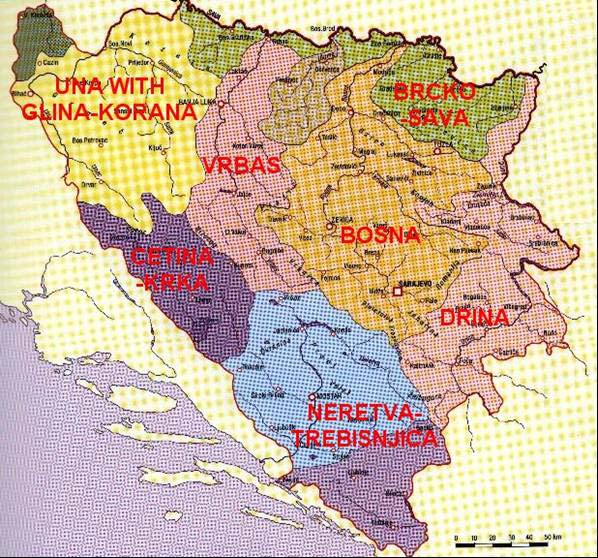
10
UNDP/GEF Danube Regional Project
Figure 1
River Basins in Bosnia and Herzegovina
Ramiza Alic / Hydro-Engineering Institute, Sarajevo, Bosnia and Herzegovina
National Profile of Municipal Water and Wastewater Management in Bosnia and Herzegovina
11
2 Administrative Units
2.1 State Level
Constitution of Bosnia and Herzegovina
Article III of the Constitution defines the responsibilities of and the relations between the institutions
of B&H and its two constituent Entities: the Federation of B&H (FB&H) and Republika Srpska (RS).
The water sector is not expressly mentioned in the Constitution, neither in the competencies of the
State of B&H, nor in those of the Entities. However, according to Article III.3c, "functions and powers
not expressly assigned...to the institutions of B&H shall be those of Entities". Thus, the water sector
belongs to the Entities. Moreover, Article III.2c of the Constitution entrusts the Entities with the
responsibility for a "safe and secure environment for all persons in their respective jurisdiction".
2.2 Entity Level (F B&H and RS)
Constitution of F B&H
The Constitution was voted on by the Constituent Assembly of the FB&H on March 30 1994, and has
since been amended three times: on July 23, 1994 (amendment I), on June 5, 1996 (amendments II to
XXIV), and on May 8, 1997 (amendments XXV and XXVI).
The Constitution establishes the sharing of competencies between the Federation and the constituent
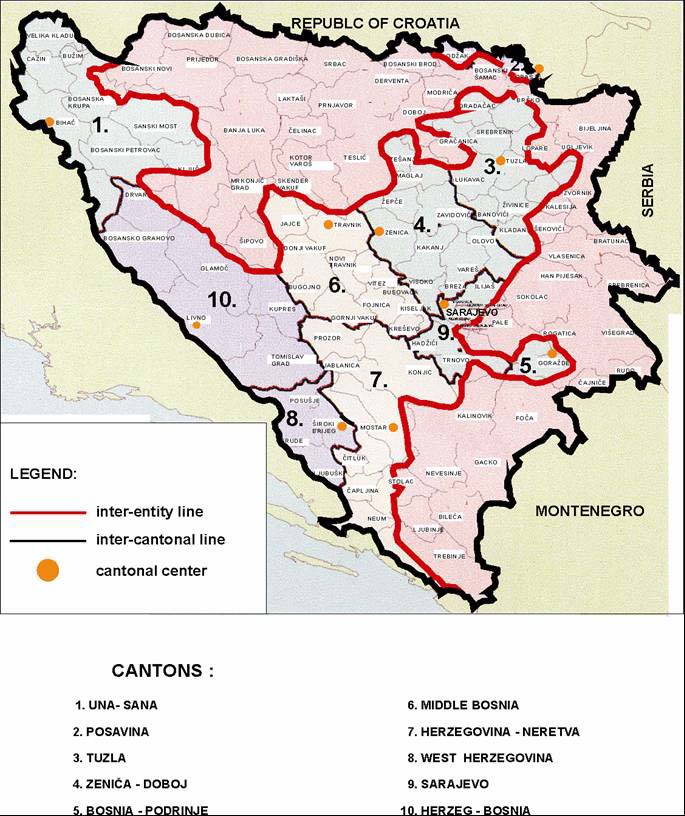
10 cantons as follows:
- exclusive competencies of the Federation are the general economic, energetic, fiscal and land
use policies (Art III.1, b, f and I);
- joint competencies of the Federation and the cantons are, e.g., health, environmental policies,
tourism, and use of natural resources (Art III.2): in these fields, the powers of the Federation
and the cantons can be executed "jointly or separately, or by the Cantons as co-coordinated by
the Federation Government" (Art III.3.1); and cantons have all responsibilities not expressly
granted to the Federation (Art III.4.1); matters likely to concern the water sector are public
services, local land use, local energy production facilities, and cantonal tourism.
Each canton may confer some of its responsibilities, for example tourism and local business, to the
municipalities in its territory (Art V.2)
Constitution of the Republic of Srpska
The Constitution was voted on by the Assembly of Serbian People of BiH on February 28, 1992.
Afterwards the basic text was amended several times, between May and December 1992 (amendments
I to XXV) and on November 11, 1994 (amendments XXVI to XLIII). The Constitution contains, as
usual, provisions related to fundamental political, economic and social rights, stipulations concerning
the organization of Entity institutions and the division of competencies between the RS and
Municipalities, as well as responsibilities of RS judicial power.
2.3 Cantonal Level
Constitutions of Cantons
In all cantonal constitutions, joint responsibilities of the Federation and the cantons include local land
use, health, tourism and environmental protection.
12
UNDP/GEF Danube Regional Project
Regarding the water sector, some cantonal constitutions grant certain competencies to municipalities,
e.g. to "construct and maintain water supply facility...take measures ensuring health and hy-
giene...manage local public goods in local use".
2.4 Brcko District
In accordance with final decisions of Arbitrage Tribunal for Brcko District, related to conflict on inter-
entity boundaries in Brcko area, from 5th March 1999 and Annex on Arbitrage Decision from 18th
August 1999, and by prescription of Supervisor, the Brcko District was established.
The Government is composed of 10 Departments, of which environmentally related are:
i) Department for communal affairs and
ii) Department for agriculture, water management and forestry
iii) Department for communal affairs is composed from three sub-department:
- water and wastewater
- electrical energy
- waste collection
2.5 Municipality in F B&H and RS
Arguably the most important subdivisions of FBiH and RS are the "municipalities". The municipality
is a true geo-political subdivision, with defined borders and a defined governing body. A "Municipal
Council" (or Parliament) governs municipalities. The voters of the municipality elect the members of
the parliaments. They also have an executive body headed by a mayor.
Municipalities are very important to the water and wastewater sector because they essentially own and
control the Water Utilities. The municipality has responsibility for the provision of public services to
all the people within its borders, and the responsibility for the provision of water and wastewater
services to all citizens within the municipal borders presumably now lies with the Water Utilities.
However, the Water Utilities rarely provide such services to outlying communities. When the lines
between FBiH and RS were drawn at Dayton, they resulted in a situation in which many
municipalities lie partly in FBiH and partly in RS.
Ramiza Alic / Hydro-Engineering Institute, Sarajevo, Bosnia and Herzegovina
National Profile of Municipal Water and Wastewater Management in Bosnia and Herzegovina
13
Figure 2
Administrative Units Map of Bosnia and Herzegovina
14
UNDP/GEF Danube Regional Project
3 Legislation Framework
List of applicable laws and other legal instruments related to the water and environment in
Bosnia and Herzegovina
3.1 State Level
Constitution of BiH
Law on the Ministries and Civil Service of B&H (Official Gazette of the B&H 5/03)
Law on Free Access to the Information in B&H ("Official Gazette of the B&H", No. 28/00)
3.2 Federation of B&H
Constitutions of FB&H (Official Gazette of the FB&H, No. 1/94, 13/97, 16/02, 22/02, 52/02, 60/02,
18/03, 63/03)
Law on Ministries and Other Administrative Bodies of FB&H (Official Gazette of the FB&H 19/03)
Law on Free Access to the Information in the Federation B&H ("Official Gazette of F B&H", No.
32/01)
Law on Concession (Official Gazette of the B&H, No. 32/02)
Law on Administrative Dispute (Official Gazette of the B&H, No. 19/02)
Law on Administrative Procedure (Official Gazette of the B&H, No. 29/02)
Law on Public Companies (Official Gazette of the R B&H, No. 4/92, 21/92, 13/94)
Environmental Framework Law (Official Gazette of the F B&H, No. 33/03)
Law on Water Protection (Official Gazette of the F B&H, No. 33/03)
Law on Waste Management (Official Gazette of the F B&H, No. 33/03)
Law on Nature Protection (Official Gazette of the F B&H, No. 33/03)
Law on Air Protection (Official Gazette of the F B&H, No. 33/03)
Law on Fund for Environmental Protection (Official Gazette of the F B&H, No. 33/03)
Water Law (Official Gazette of the F B&H, No. 18/98)
Law on Agriculture (Official Gazette of the F B&H, No. 2/98)
Law on Physical Planning (Official Gazette of the F B&H, No. 52/02)
Law on Construction (Official Gazette of the F B&H, No. 55/02)
Law on construction land (Official Gazette of the F B&H, No. 25/03)
Law on Forests (Official Gazette of the F B&H, No. 20/02; 29/03)
Law on Mining Proposal
Law on Public Utility Services (Official Gazette of the SR B&H, No. 20/90))
Law on Collecting, Producing and Trafficking Raw and Waste Materials (Official Gazette of the F
B&H, No. 35/98)
Ramiza Alic / Hydro-Engineering Institute, Sarajevo, Bosnia and Herzegovina
National Profile of Municipal Water and Wastewater Management in Bosnia and Herzegovina
15
3.3 Cantons
Constitutions of cantons
Water and environmental legislation of the cantons
1. Canton Una-sana
- Law on forests («Official Gazette», No. 5/97)
- Law on Agriculture Land («Official Gazette», No. 5/97)
- Law on Physical Planning («Official Gazette», No. 9/02)
- Law on Concessions («Official Gazette», No. 10/03)
2. Canton Posavina
- Law on Physical Planning («Official Gazette», No. 5/99; 7/00)
- Law on Agriculture Land
- Law on Environmental Protection («Official Gazette», No. 4/00)
- Water law («Official Gazette», No. 2/00)
- Law on Agriculture Land («Official Gazette», No. 2/00)
3. Canton Tuzla
- Law on Environmental Protection («Official Gazette», No. 6/98; 15/00)
- Law on Nature Protection («Official Gazette», No. 10/99)
- Water law («Official Gazette», No. 15/99; 9/03)
- Law on Forests («Official Gazette», No. 10/99; 7/02)
- Law on Agriculture Land («Official Gazette», No. 11/00)
- Law on Air Protection («Official Gazette», No. 6/00)
- Law on Waste («Official Gazette», No. 17/00)
- Law on Physical Planning («Official Gazette», No. 16/00; 10/02)
- Law on Construction («Official Gazette», No. 10/02)
- Law on Concessions («Official Gazette», No. 9/01)
4. Canton Zenica - Doboj
- Law on Environmental Protection («Official Gazette», No. 1/00)
- Water law («Official Gazette», No. 8/00)
- Law on exploration and use of mineral raw materials («Official Gazette», No. 13/00)
- Law on Concessions («Official Gazette», No. 5/03)
5. Canton Bosansko - Podrinjski
- Law on Physical Planning («Official Gazette», No. 17/00)
- Law on Concessions («Official Gazette», No. 5/03)
6. Canton Central Bosnia
- Water law («Official Gazette», No. 14/02)
- Law on Air Quality («Official Gazette», No. 11/00)
- Law on Noisy Protection («Official Gazette», No. 11/00)
- Law on Concessions («Official Gazette», No. 12/00; 13/03)
16
UNDP/GEF Danube Regional Project
7. Canton Herzegovina - Neretva
- --------------------------------------
- Law on Concessions («Official Gazette», No. 2/03)
8. Canton West Herzegovina
- Law on Environmental Protection («Official Gazette», No. 5/00)
- Law on Physical Planning («Official Gazette», No. 4/99; 10/03)
- Law on mining («Official Gazette», No. 2/99
- Law on construction («Official Gazette», No. 4/99; 15/01)
- Law on Concessions («Official Gazette», No. 7/01; 7/03)
9. Canton Sarajevo
- Water law («Official Gazette», No. 16/00)
- Law on Forests («Official Gazette», No. 4/99)
- Law on Noisy Protection («Official Gazette», No. 10/99)
- Law on Air Quality («Official Gazette», No. 10/99)
- Law on Physical Planning («Official Gazette», No. 13/99)
- Law on communal cleaning («Official Gazette», No. 11/97)
- Law on Concessions («Official Gazette», No. 21/03)
10. Canton Herzegovina - Bosnia
- Law on Agriculture Land («Official Gazette», No. 10/98)
- Law on Physical Planning («Official Gazette», No. 14/98)
- Law on Forests («Official Gazette», No. 4/98; 13/98; 15/99)
- Law on Construction («Official Gazette», No. 14/98)
- Law on mining («Official Gazette», No. 12/01)
- Law on Concessions («Official Gazette», No. 14/03)
3.4 Republic of Srpska
Constitution of Republic Srpska (Official Gazette of the RS, No. 6/92, 8/92, 15/92, 19/92, 21/92,
28/94, 8/96, 13/96, 15/96, 16/96 and 21/96
Law on Ministries of RS (Official Gazette of RS, No. 70/02)
Law on Free Access to the Information in RS (Official Gazette of RS, No. 20/01)
Law on Concession (Official Gazette of the RS, No. 25/02)
Law on Administrative Dispute (Official Gazette of the B&H, No. 12/94)
Law on Administrative Procedure (Official Gazette of the B&H, No. 13/02)
Law on State Enterprises (Official Gazette of the RS, No.3/95)
Environmental Framework Law (Official Gazette of RS, No. 53/02)
Law on Water Protection (Official Gazette of RS, No. 53/02)
Law on Waste Management (Official Gazette of RS, No. 53/02)
Law on Nature Protection (Official Gazette of the RS, No. 50&02)
Law on Air Protection (Official Gazette of RS, No. 53/02)
Law on Fund for Environmental Protection (Official Gazette of RS, No. 51/02)
Water Law (Official Gazette of RS, No. 10/98; 51/01)
Law on Agriculture (Official Gazette of RS, No. 13/97)
Law on physical planning (Official Gazette of RS, No. 84/02)
Law on construction land (Official Gazette of RS, No. 86/03 ili 41-03)
Law on forest (Official Gazette of RS, No. 66/03)
Law on communal activities (Official Gazette of RS, No. 11/95; 51/02)
Ramiza Alic / Hydro-Engineering Institute, Sarajevo, Bosnia and Herzegovina
National Profile of Municipal Water and Wastewater Management in Bosnia and Herzegovina
17
3.5 District Brcko
Statute of District Brcko (Official Gazette of the B&H, No. 9/00, 23/00)
Law on Administrative Dispute (Official Gazette of the DB, No. 4/00, 1/00)
Law on Administrative Procedure (Official Gazette of the DB, No. 3/00, 9/02)
Law on Physical Planning (Official Gazette of the DB, No. 9/03, 23/03)
Regulations which are overtaken from Socialistic Republic of B&H and ex Yugoslavia and still
in force in F BH
1. Law on Hydro- Meteorological Activities of Entire Country's Interest (Official Gazette of
SFRJ, No. 10/88)
2. Law on Hydro- Meteorological Activities of Republic Interest (Official Gazette of SR B&H,
No. 10/76)
3. Decree on Water Classification in inter-Republic Water Streams, inter-State Waters and
Yugoslavia Coastal Seawaters (Official Gazette of SFRY, No. 6/78).
4. Decree on Water Classification and Yugoslavia Coastal Seawaters within the Border of SR
B&H (Official Gazette of SR B&H, No. 19/80).
5. Decree on Water Categorization (Official Gazette of SR B&H, No. 42/67).
6. Regulation on Hazardous Substances that do not Need to be Imported into Water (Official
Gazette of SFRJ, No. 3/66, 7/66)
7. Decision on Maximum Permitted Concentration of Radionuclide and Hazardous Matters, in
inter-Republic Water Streams, inter-states Waters and Waters of Coastal Sea (Official Gazette
of SFRY, No. 8/78).
8. Regulation on Hygienic Accuracy Potable Water (Official Gazette of SFRY, No. 33/87;
23/91).
18
UNDP/GEF Danube Regional Project
4 Institutional Framework
4.1 Institutional Framework in the Federation of Bosnia and Herzegovina
Water resources management and water protection are primarily under the jurisdiction of the
Federation Ministry of Agriculture, Water Management and Forestry (MoAWF), but the Federation
Ministry for Physical Planning and Environment (MoPPE) is involved in other environmental aspects
of water and wastewater facilities. The main responsibilities for water management (regulatory
functions in general and management of flood control and environmental protection in particular) are
at the Federation level and with the Public Company for Watershed Areas (PCWAs).
The responsibilities of the authorities are not shared according to the functions, but are mainly divided
according to the ownership or "Federal and/or cantonal importance". The ownership of some water
facilities remains unclear in the Law. The Federation and cantonal water sector organizations and
institutions defined in the Water Law are not completely operational because only a fraction of plans,
decrees, by-laws and statutory acts for the implementation of the Water Law have been enacted.
Cantonal water authorities are still embryonic.
The main functions and tasks of the MoAWF are:
- definition of rules for the preparation of Federation water strategies and policies;
- issuing water management requirements, agreements, and permits;
- setting of standards and regulations;
- maintaining of compliance with laws and regulations through licensing and inspections;
- overall control of Public Companies for Watershed Areas; and
- proposals to Parliament/Government of procedures for awarding concessions.
There are six professionals working for water management in the MoAWF.
There are two Public Companies for Watershed Areas (PCWAs) in the Federation executing water
management in their respective watersheds. One, located in Sarajevo, is competent for the watershed
of the Sava River while the other, located in Mostar, is in charge of the watershed of the Adriatic Sea.
The Water Law entrusts the PCWAs with the following main responsibilities:
- preparation of all strategic decisions and planning (watershed and basin long-term plans, all
regulations, decrees and by-laws necessary for the application of the Water Law);
- administration of principal (owned by the Federation) water facilities;
- management and monitoring of all water resources;
- investment, exploitation and maintenance of various (non-specified) water facilities;
- research, expertise and consulting;
- management of concession matters, e.g., procurement and bid evaluation;
- ownership of public property; and
- flood control.
Ramiza Alic / Hydro-Engineering Institute, Sarajevo, Bosnia and Herzegovina
National Profile of Municipal Water and Wastewater Management in Bosnia and Herzegovina
19
The PCWAs are engaged in commercial activities through a Business Association of Public Water
Management Companies of the Federation of Bosnia and Herzegovina. Its activities and assignments
include, inter alia, participation in the execution and co-ordination of water management development
works at watershed area, participation in and co-ordination of investigation works, co-ordination and
maintenance of flood protection systems on regional water streams, regional water supply systems and
water treatment plants, and pricing, i.e., defining with the agreement of the Federation Government the
rates and amounts of water fees.
The distribution of General and Special Water Fees in the Water Law indicates the true respective
power of the institutions: 70% of the collected water fees (100% of concessions) are directed to
PCWAs, 10% to the Federation Ministry of Finance and 20% to the Cantons. Financial management
lacks transparency and external auditing.
20
UNDP/GEF Danube Regional Project
FEDERATION B&H
SIMPLIFIED INSTITUTIONAL ARRANGEMENTS
ENTITY LEVEL
Ministry for Agriculture,
Ministry for physical
water management and
planning & Environment
Forestry
Other ministries: health,
justice etc
-
Physical planning
-
Water protection
-
Water
-
Issue of water
strategy/policy
permit
-
Issue agreement
permits &
licensing
-
Standards
/regulation
-
Control of PCWA
-
concession
-
Prep. Strategy &
2 Public companies for watershed Areas
planning
Adriatic watershed Sava watershed
-
Adm. Water Facilities
PCWA
of the F B&H
-
Monitoring of water
resources
-
Consulting & expertise
-
Management of
concession
-
Flood control
CANTONAL LEVEL (10)
10 Ministries of Agriculture, Water
Management & Forestry
+
10 ministries for physical planning &
Environment
Licensing, allocation of W resources, for
irrigation, hydro power and W protection
MUNICIPAL LEVEL (..)
Municipality
-
Set water tariff
Operation and
-
Appoint board
Water utilities / Multi
maintenance
of WU
Ramiza Alic
dro-Engineering
/ Hy
Institute, Sarajevo, Bosnia and Herzegovina
utilities
National Profile of Municipal Water and Wastewater Management in Bosnia and Herzegovina
21
4.2 Institutional Framework in the Republika Srpska
The water sector management in the RS is highly centralized. The Ministry of Agriculture, Forestry
and Water Management (MoAFW) is the main authority in charge of administrative and technical
matters in water management. The Ministry, inter alia, issues most water management guidelines,
approvals, and permits, is in charge of the enforcement of Water Law and other laws related to water
management, prepares various plans (such as long-term plan for water management development and
water protection plan), organizes, through the Directorate for Waters, the application of long-term,
medium-term and annual plans for development of water management, defines conditions for
wastewater discharge, defines conditions (staff, equipment etc.) for companies authorized to control
surface and groundwater quality, and proposes to the Government the basis of and rates for the general
and specific water management fees and a method for their calculation.
The financial resources for water management are largely distributed through the Directorate for
Waters (DW) and its subordinate Water Engineering Companies (WEC). The DW is subordinated to
the MoAFW. This is likely to result in situations with conflict of interest. The WECs have
administrative competencies that, although of limited nature, involve exercise of public power.
The Water Management Institute (WMI) has the competence to prepare guidelines for various water
management undertakings, in other words the WMI may authoritatively confirm the project plans.
Besides preparing the guidelines, the WMI is engaged in other consultant activities in the private
sector. On the other hand, through submitting expert opinions, the WMI has in practice a decisive role
in water management licensing. The administrative duties of the WMI are incompatible with its
commercial interests.
General water fee is an earmarked income tax (1.5% of the gross salary) to be shared between the
government (80%) and municipality (20%). Special water fees are collected to the Water Management
Fund of the MoAFW. Revenues generated through general and special water fees are high with limited
justification in terms of the needs of and use for the water sector. Democratic control of the allocation
of funds is diminished by earmarking the tax revenues for the needs of one particular field of
administration.
22
UNDP/GEF Danube Regional Project
REPUBLICA SRPSKA
Simplified Institutional arrangements
RS GOVERNMENT
-
Master plan
Ministry of agriculture, forestry and
-
Fees for water
water management
-
Classfication
of water +
master plan &
w balance
9 Wa
ter Engineering Cies
Water management
(WEC)
Institute (WMI)
-
Flood control
-
Assist MAFWM
-
Maintenance/rehab. Of
in master plan
facilities Gal interest + inter
-
Provide technical
regional facilities
opinion on w
-
O&M +engineering &
management
control
permit
-
Collection of data
-
Has other actvities
-
Control of w use
with private sector
-
Has private business (70%
of income)
Institute for water
(Share Cie Mix private/public sector)
-
Scientific research work
-
Consulting activities incl.
Tendering & superv.
-
Perform test requality of water
MUNICIPAL LEVEL
MUNICIPALITIES
-
Appoint board
of Directors +
Operation &
Tariff issues
Water utilities / Multi utilities
Maintenance of
municipal facilities
Ramiza Alic / Hydro-Engineering Institute, Sarajevo, Bosnia and Herzegovina
National Profile of Municipal Water and Wastewater Management in Bosnia and Herzegovina
23
4.3 Inter-Entity Steering Committees
The Constitution requires under Article III 5 b that the Entities begin negotiations with a view to
including in the responsibilities of the institutions of Bosnia and Herzegovina matters not included
under their responsibilities within six months of its entry into force. The Entities have then the
possibility to transfer part or the whole of their responsibility for, e.g., water resources and other
environmental matters to the state level. This could ensure the unity of the relevant actions that could
be undertaken at a larger scale and avoid inconsistencies. This article could have been the legal basis
for the definition of a water resources or environmental programme at state level. However, the
Entities have not yet started any negotiation to include these matters in the responsibility of the state
and at present are not willing to transfer their responsibility to the state.
Article III 4 of the Constitution provides for the possibility of co-ordination between the Entities. The
Presidency may decide to facilitate inter-Entity co-ordination on matters not within the responsibilities
of Bosnia and Herzegovina, with the full agreement of both Entities. In practice, the Presidency has
not decided to facilitate inter-Entity co-ordination for the adoption of a water resources or
environmental programme for Bosnia and Herzegovina.
There are two relevant steering committees; the Water Steering Committee (WSC) and Environmental
Steering Committee (ESC). Both of them were established in mid 1998. There are some overlapping
duties referred to in the Memoranda of understanding on the establishment of these steering
committees. However, the co-chairmen of both committees have resolved to work closely together in
order to co-ordinate their actions.
WSC is in charge of co-operation between the competent ministries of the Entities in water matters,
aiming to eliminate eventual conflicts in water management. ESC deals with all issues related to the
environment, coordinating between the competent ministries of the Entities.
24
UNDP/GEF Danube Regional Project
5 Management Units
5.1 Water and Wastewater Utilities
5.1.1 General Situation
Water production and supply such as sewerage services, considered by the Water Law as activity
demanding technical and technological unity, can be given exclusively to a public company.
Municipal service suppliers must ensure permanent service, good functioning of facilities and agreed
service quality, healthy and hygienic accuracy.
Water and wastewater services are now generally provided in municipalities either by a "Water and
Wastewater Utility", a company that usually provides only water and sewerage services, or as part of a
public utilities company in the municipality. In earlier years and in smaller towns, water and sewerage
were included along with many other municipal services, such as street maintenance, central heating,
care of parks and cemeteries, solid waste collection and other services. Some municipalities still
operate that way. All these services were provided by a public company under the municipality called
a communal services company.
W&WWU have during the past decade experienced a number of changes in their working
environment which have weakened their performance capability drastically. Even before the war
(1992 1995) there was a serious disrepair of municipal services caused by strictly controlled and
non-cost recovering pricing that did not allow proper investment and maintenance. The situation was
compounded by serious operational deficiencies and outdated managerial practices. The sector was
highly centralized and was operated in accordance with socialistic principles. The four-year war led to
significant destruction and deterioration of facilities. It also caused major disruptions in operation and
maintenance of utility systems, from both neglect and from extensive dislocation of population,
including management and operators of the utilities. In some of the utilities practically none of the
present management or staff has experience from a "normally" operating utility. To great extent utility
know-how, maps and records are lost. Continuing poor financial situation in the country is effectively
hampering efforts to improve water and wastewater services.
5.1.2 Legislative Framework
Water production and supply, considered by the Water Law as activity demanding technical and
technological unity, can be given exclusively to a public company.
Federation of Bosnia and Herzegovina and Republika Srpska have its own laws that impact the
delivery of water and wastewater services, affecting most aspects of technical, administrative and
financial matters.
The cantons in the F B&H also have their own governments, and they also impact on the activities of
most W&WWUs.
The Law on Utility Activities regulates "utility activities of special social interest", such as:
· water production and distribution by water network, up to the user's measuring instrument
including the instrument
· purification and evacuation of wastewater
· cleaning of public transport infrastructures and
· storm water drainage
Ramiza Alic / Hydro-Engineering Institute, Sarajevo, Bosnia and Herzegovina
National Profile of Municipal Water and Wastewater Management in Bosnia and Herzegovina
25
The municipal activities can be performed by a public municipal company, some other company, the
local community or an individual worker.
The user of municipal services has to pay a fixed price for the service. If he neglects paying for the
service for two consecutive months, the service can be cut if this does not threaten other users.
Disputes between users and the service provider are to be resolved in court.
The Municipal Assembly defines the method of service pricing, but the service provider defines the
price of the service.
5.1.3 Characteristics of Reviewed Utilities
This review and assessment of water utilities in this Section is mainly based on findings from the pilot
components of the Project carried out with the water utilities of the 10 municipalities (Cajnice, Banja
Luka, Srbac, Bijeljina, Konjic, Zenica, Tuzla, Gradacac, Orasje and Celi) included in the proposed
Institutional Strengthening of Ten Selected Pilot Vodovods, 1999/2000, tentatively to be financed by
USAID. The Konjic W&WWU does not belong to the Sava watershed area.
Service Areas
The actual "service areas" of most W&WWU include the central city of the municipality that controls
it, and parts of one or several populated areas within the municipality. Some provide services to
communities outside their municipality. Those populated areas may be contiguous or several
kilometers away. They may be served by a single water system, or by several systems.
Table 2
Total Population and Population Served by Water and Wastewater Systems1
Population
Total
Central
Served by Piped Water
Served by Sewers
Municipality
Munici-
Town plus
pality
Others2
Pop'n Percent3 Pop'n
Percent4
Konjic
35 000
23 000
14 000
60%
7 000
30%
Caijnice
7 000
5 000
4 500
90%
3 600
72%
Zenica
145 000
100 000
91 000
91%
77 000
77%
Banja Luka
280 000
250 000
240 000
96%
132 000
53%
Srbac
24 000
13 300
11 000
83%
4 000
30%
Tuzla
150 000
140 000
130 000
93%
60 000
43%
Gradacac
45 000
16 000
15 000
94%
6 000
38%
Orasje
28 000
6 000
5 500
92%
5 000
83%
Bijeljina
120 000
84 000
75 000
89%
No sewers
0%
200m of
Celic
18 000
7 600
6 000
79%
<5%
sewers
46%-
Total
852 000
644 900
502 000
78%-59%5
299 600
35%6
1 Data are rounded, and represent the best estimate available on the basis of field interviews, data reported earlier
by the 8 of 10 vodovods which attended the USAID Workshops for which they provided information, and
follow-up phone calls to try to resolve contradictions or questionable data.
2 Includes the estimated total population of the central town of the municipality (the principal town or municipal
center), plus that of the other populated areas served by the vodovod's water systems.
3 Percent of the estimated population of the central town and surrounding communities it purports to serve.
4 Percent of the estimated population of the central town and surrounding communities it purports to serve.
5 While the utilities serve 78% of their central town and nearby populated areas, they serve only 59% of the
population of all the municipalities.
26
UNDP/GEF Danube Regional Project
Type and Adequacy of Sources and Collecting Sewers
Springs and wells serve as the only sources for seven of the W&WWU and they are significant sources
for two others. Sources appear to be adequate to meet current needs in eight of the W&WWU, but are
seriously deficient in two (which only operates about 12 hours per day).
Sewers are also generally old, and generally given little maintenance until a blockage occurs. Very few
W&WWU have the equipment or capacity to deal with serious blockages. The alternatives were to
hire at quite a high cost a truck with a high-pressure pump, or to physically excavate, break into
the pipe, manually remove the blockage, then rebuild the sewer and refill the excavation. Bijeljina and
Celic have no sewers, four systems are at least partly combined (meaning they carry storm water flows
as well as sewage), and Cajnice has an antiquated system built largely of stones.
6The estimated total sewered population amounts to 46% of the population of the central town and surrounding
populated areas, and only 35% of the total population of the ten municipalities.
Ramiza Alic / Hydro-Engineering Institute, Sarajevo, Bosnia and Herzegovina
National Profile of Municipal Water and Wastewater Management in Bosnia and Herzegovina
27
Table 3
Summary Description of Sector Facilities
Water Facilities
Wastewater Facilities
Munici-
pality
Sources of
Treatment/
Collection
Water
Chlorination
Comments
System
Treatment
Comments
5 systems
Yes
None
8 pump sta.,
Separate
To River
Konjic
Springs
None
Chlorination
HP zones
9 km
Neretva
Yes (Old)
Springs
None
Excess capacity
Separate
To River
Cajnice
None
Gravity fed
Chlorination
Stone Sewer
Drina
Yes
Springs 2/3
Rapid sand
Separate
To River
Zenica
WTP 1/3
None
Chlorination
(Mostly)
Bosna
9 wells
Wells sur-
Yes
4/10
Rapid Sand
charged by river
50%
To River
Banja Luka
Surcharged
None
Chlorination
water
Combined
Vrbas
WTP 6/10
Yes
None
Built 1980
To River
Srbac
2 wells
None
Chlorination
Separate
Sava
Sources
Yes
5 springs
Tuzla
None
inadequate for
Partly
To River
7 wells
None
Chlorination
needs
Combined
WTP
3 reservoirs
Yes
Yes
served by
Rapid Sand
multiple re-
Mostly
(See Note
To River
Gradacac
lake behind
Chlorination
pumping
Separate
A)
dam
3 wells
Includes PS and
Yes
1 new,
None
hydro-
Combined
To River
Orasje
None
2 old
Chlorination
pneumatic tk
Sava
8 wells plus
Booster PS
7 wells in
None
Elevated
Bijeljina
None
None
clusters
Chlorination
Storage
Two (soon 3
Deep wells
None (only
None
Separate
Celic
Dug wells
200 meters)
None
Chlorination
systems
Note A:
A new activated sludge wastewater treatment plant was built with USAID assistance, and was
completed in autumn 1998. It operated for about 3 months and was ordered shut down by the
municipality to save on energy costs. It has not operated since about the beginning of 1999.
Management
Most of the W&WWU suffer from the lack of programs designed to assist those in key responsible
positions in becoming effective managers, and by being forced to operate and manage their work in a
restrictive environment, lacking autonomy and control over basic decision making.
Administration
W&WWU administrative capacity suffers from a lack of logical organization of their functions,
unclear identification of duties and responsibilities of departments and employees, poor systems for
reporting, and a serious lack of adequate office equipment and supplies.
28
UNDP/GEF Danube Regional Project
Mapping
Mapping capabilities varied considerably. Few had good quality maps of their overall facilities, and
most of those had been prepared some time ago by others. These were often one-of-a-kind maps that
could not be reproduced, and were out of date. Many directors complained that they had no idea where
their water pipes and valves were (covered over by decades of paving programs), and were unable to
isolate much of their system in case of main breaks.
Staffing Levels
Many W&WWU officials reported that their current staffs are from 30% to 50% lower than pre-war
levels, and therefore consider themselves understaffed. However, analysis indicates that almost all
W&WWU are more heavily staffed than those of efficient western utilities (which often have four
employees or less per thousand connections).
Personnel affairs are frequently assigned to a department called "legal and other services". Human
resource development (HRD), under the direction of a trained professional, in terms of evaluations,
incentives, training, goal-setting or other HRD functions, does not appear to be a high priority activity
among the W&WWU.
Customer Relations
Almost universally, the W&WWU' programs for dealing with customers are aimed at reacting to
complaints. Very few utilities take any positive actions to improve customer relations through the
program of preparing and inserting small informational pamphlets in their customers' bills, every other
billing period, and setting up a dedicated phone line for customers to contact the utility. Some also
have a program that offers to send specialists to customer's houses or apartments to repair leaks inside
their dwellings.
Separation of Services
Unless the W&WWU operated solely as a water and/or wastewater entity, the activities and costs were
not separated from all other public services. Five of the ten pilot W&WWUs were part of a municipal
entity that provided other services such as solid waste collection. Generally, the water and wastewater
revenues and costs were not reported separately when they were combined with other services. Thus,
donors and lending agencies that need to review the W&WWU financials cannot determine the ability
of the W&WWU to maintain the investments donated or repay monies borrowed.
Uniform Chart of Accounts
The W&WWU' water and wastewater activities do not have a separate uniform chart of accounts. The
chart of accounts currently used by the W&WWUs is an adaptation of the accounts used by all public
entities in either the FBiH or RS. There is no uniform chart of accounts that separate water and
wastewater functions from all other public service functions
Budgeting
Current practice among the pilot program W&WWUs studied does not include the establishment of
budgets by department, with a comparison to actual by department. The budgets as referenced by
several W&WWUs are part of a business plan, which could be expanded into a more comprehensive
document serving as both an operational planning and management tool as well as a document for
capital improvement management and planning.
Rate Structures
Most W&WWUs have rate structures that need to be changed in order to cover costs.
A common practice for most W&WWUs is that charged a volume rate that was uniform for all water
sold. None of the W&WWUs used a declining rate structure (reduced costs per cubic meter for larger
Ramiza Alic / Hydro-Engineering Institute, Sarajevo, Bosnia and Herzegovina
National Profile of Municipal Water and Wastewater Management in Bosnia and Herzegovina
29
amounts of water used by a given class of customer). On the other hand, none used an inclining rate
structure, either (increased costs per cubic meter for larger amounts of water used by a given class of
customer). Several W&WWUs used a form of inclining rate structure in which larger users, such as
industrial customers, are charged a higher (but still uniform within their class) rate per cubic meter
than the smaller users such as residential customers.
Almost all W&WWUs in the pilot program metered most of the consumption of large
commercial/industrial customers. For residential customers, if the W&WWU did not have working
meters for residential homes or apartment buildings, the amounts charged were based on estimates.
The bills were based on either an estimate of use based on historical usage (before the war), a lump
sum per person estimated at the connection, or an amount based on an estimated per capita
consumption (often very low) for an estimated number of persons at that connection.
Summary of W&WWU Expenses
An approximate comparison of expenditures in 1998 for major items for nine of the ten W&WWU is
presented in Table 4
30
UNDP/GEF Danube Regional Project
Table 4
Summary of 1998 Expenditures of Selected Vodovods (KM 1,000)
Type of
Gradacac Bijeljina Zenica
Srbac
Konjic
Expenditure
Cost % Cost % Cost % Cost % Cost %
Materials
296 17 320 20 505 9 56 12 148 19
Electricity
275 16
120 7
137 2 70 15 12 2
Spare parts,
19 1 19 1
159 3 12 3 1 0
stores
Depreciation
340 19 180 11
2
050 38 63 14 400 52
Personnel
490 28 406 25
1
200 22 150 33 180 23
Transportation 90 5 13 1 1 0 1 0 0 0
Maintenance,
166 9 65 4
465 8 5 1 0.5 0
repair
Rent
0 0 0 0 1 0 4 1 6 1
Taxes
4 1
125 8 4 1 5 1 0 0
Miscellaneous 77 4 59 4 930 17 89 20 28 3
Capital
0 0
302
19 0 0 0 0 0 0
investments
TOTAL
1 757
100 1 609
100 5 452
100
455
100
775
100
Banja Luka
Tuzla
Orasje
Celic
Type of
Average %
Expenditure
of Cost
Cost % Cost % Cost % Cost % Items
Materials
306 5
652 9 24 6 50 14
10
Electricity
630 11
1
313 17 90 24 27 7
11
Spare parts,
40 1 11 0 1 0 3 1
1
stores
Depreciation
1 244
22 2 800
35
82
22
12
3
29
Personnel
1
500 26
2
200 28 100 27 58 16
26
Transportation 5 0 4 0 2 1 8 2
0.5
Maintenance,
97 2
106 1 5 2 0.1 0
3.5
repair
Rent
0 0
100 1 0 0 0 0
0.5
Taxes
0 0 29 0 1 0 1 0
0.5
Miscellaneous 1
912 33 605 8 67 18 140 39
16
Capital
0 0 74 1 0 0 64 18
1
investments
TOTAL
5
734 100 7
894 100 372 100 363 100
100
Notes:
1. "Taxes" does not include major new taxes imposed effective 1 January 1999
2. "Personnel" includes wages and benefits
3. "Miscellaneous" includes advertising, insurance, entertainment, telephone, interest, and other costs.
4. In Zenica, Miscellaneous includes DM 561,000 in accounts receivable that were written off in 1998.
5. In Banja Luka, the large amount under "Miscellaneous" may represent a re-assessment charge.
Overview of Collection Problems
Collection rates range from 10% to 82%, with an average of about 40%. The collection rate is
determined by dividing the annual collections by annual revenue billed.
Most W&WWUs did have a specific payment period that they adopted, but the date due was not noted
on the customer's bill. In most W&WWUs, the customers' bills display only the current amount due.
Previous amounts owed were not presented on current bills issued by most of the W&WWUs, so
customers could not tell the total amount they owed.
Collection rates from public customers are significantly lower than those from other customers. All
W&WWUs in the pilot study do not shut-off multi-family buildings for non-payment because the
customers that do pay would be punished because of those who do not.
Ramiza Alic / Hydro-Engineering Institute, Sarajevo, Bosnia and Herzegovina
National Profile of Municipal Water and Wastewater Management in Bosnia and Herzegovina
31
Profitability Ratios
The profitability ratios measure the W&WWU financial success as it relates to revenues and expenses
Table 5, presents the ratios used to determine the pilot W&WWU's ability to generate enough revenue
to cover their expenses. The two ratios used to measure profitability are the Operating Margin and the
Assets to Net Worth Ratio. Profitability is important because profits are currently the only source,
outside of international donations, of meeting the W&WWUs' needs
Table 5
Profitability Ratios, 1998
Banja
Konjic
Zenica
Srbac Tuzla Gradacac Orasje Bijeljina
Luka
Operating
-97% -13% -14% 0% -16% 0% -2% 0%
Margin
Net Worth
9 46 33 1 72 7 2 8
Assets/Net
0.9 0.8 0.9 0.9 0.9 0.9 0.95 0.9
Worth
Conclusion on Profitability Ratios
The results of the data from Table 5. indicate that none of the W&WWUs are profitable, and most are
seriously in the red. The situation is compounded because the data are based on billed revenues, so the
losses are even worse than indicated. On the other hand, the Assets to Net Worth Ratios are all close to
the optimum level of 1.0, an indicator of zero debt. This is understandable since the W&WWU's have
never been in a position to borrow money for their capital investment programs
5.2 Ownership of Facilities
According Federal WL (Art. 19 and 22) Water supply facilities which are used for the water supply for
the territory of the Federation and of other countries (sources, water intakes or impounding reservoirs,
pump stations, water treatment plants and main transport pipelines up to the distribution reservoirs on
the Federation territory) and water management facilities used for water supply of the area covering
two or more cantons (sources, water intakes or impounding reservoirs, pump stations, water treatment
plants and a main transport pipelines up to the distribution reservoirs) are of importance to the
Federation.
Water supply facilities are the property of the cantons, unless otherwise defined by the cantonal water
law.
Water supply facilities are managed by legal persons registered for performing public utility services
relating to the water supply, if the rights and obligation are not delegated to another legal person.
Water supply facilities being constructed by other legal persons and citizens are of their importance
and are the property of those legal persons and citizens who operate them.
In RS the ownership is determined by the RS legislation that transformed the so-called social
ownership, dominant in the ex-Yugoslavia, into RS ownership. Although all public companies are
State companies, some of them operate "in the interest of" one or more municipalities. The division
between companies "of State interest" and "of municipal interest" is based on the amount of company
capital, and on the field and geographical territory of company activities. In companies of municipal
interest, the Municipal Assembly elects the members of the governing bodies, representing the owner.
32
UNDP/GEF Danube Regional Project
6 Service User
6.1 Classification of Users
Most Water Utilities classified customers in following categories:
· Residential all consumers in individual houses and in multi-family building.
· Industry special users of services that are using water in production process in larger
quantity.
· Institutions hospitals, schools, churches, retirement homes, museums, army, building of
administrations etc.
· Commercial Handcrafts company, usually smaller users,
· Whole sale customer - customer that buy a water in large quontity from other water utility
and selling water to customers.
6.2 Population Served
Share of supply from public sources
In F B&H 56% of population are supplied with public water supply system.
- cities with population over 100.000 have 80% supply coverage
- towns with population between 10.000 and 100.000 have 59% supply coverage
- municipalities with population below 10.000 have 43 % supply coverage.
In RS 48% of population are supplied with public water supply system.
In urban areas water supply coverage is 87 % and 52% of population rely on village water supply
systems, their own wells or on possible springs or surface water sources. The low average coverage of
urban water supply in the RS is partly explained by a few towns where the coverage is very low.
Water used by business and industry
According to the pre war data business and industries where used about 147 l/cp/day (35%), and
average water consumption for households was 420 l/cp/day. i.e., 134 l/cp/day (32%), and 139
l/cp/day (33%) where water losses.
As industry capacities where mostly destroyed during the war it is estimated that industry water
consumption is much less at present.
Ramiza Alic / Hydro-Engineering Institute, Sarajevo, Bosnia and Herzegovina
National Profile of Municipal Water and Wastewater Management in Bosnia and Herzegovina
33
7 Product Quantity and Quality
7.1 Water Production
Water supply in the Federation of B&H area is mainly based on the use of groundwater (in 1985 about
89%). In areas where groundwater supply is insufficient to satisfy water demand, surface water is also
used. It is abstracted from a lake or a river and treated before distribution.
The last available data on water production is based on research of Hydro-engineering institute in
1999. Data shows that water production in 51 water utilities (out of total 106) has been 275,320,532
m3/year.
Half of the water utilities have no meters on their sources. Where no meters exist, they estimate the
flow based on pump nameplate capacity data and hours of operation, or other systems as appropriate.
Despite the deficiencies in source metering, estimates of water produced are probably within about
80% accuracy.
7.2 Water Processing
The quality of treated water is affected by economizing on the use of chemicals (virtually all water
chemicals have to be imported) and the poor condition of surface water treatment plants (most of them
are old and in need of rehabilitation). Disinfections are often the only applied treatment. However,
disinfections at the source may not be sufficient to ensure the hygienic quality of water at the
consumer's tap because of high leakage in the distribution system.
The quality control of water is sometimes difficult because of the lack of laboratory equipment and
material. Bacteriological tests of water received were performed by hospitals, a veterinary institute,
and some health institutes.
7.3 Water Distribution
Water distribution is in many places based on gravity, but most systems involve pumping stations.
Pumps, where used, are often inefficient, resulting in high-energy use and high operation costs.
Because of the insufficient storage capacity, pumping stations often operate 24 hours a day. Due to the
lack of maintenance during the war, the pumping stations and other distribution facilities have been
deteriorated.
Water losses are between 50 and 70% of total water production. Water losses can be broken down to
three categories: leakage, unrecorded and unbilled. Physical leakage represents approximately 30% of
total production.
Water distribution networks are generally old and in bad condition.
7.4 Water Consumption
The last available data on water consumption is based on research of hydro-engineering institute in
1999. 51 water utilities served 1,557,429 consumers. Those consumers consumed totally 90,388,894
m3/year.
34
UNDP/GEF Danube Regional Project
In Study "Institutional Strengthening of Water Sector in F B&H" (Final Report, Authors: Plancenter
Ltd. Finland, BCEOM, France and Hydro-Engineering Institute, Sarajevo, April 1999.) the required
investments in water supply within the next 30 years are estimated to include:
· new water meters to be installed to all customers within 5 years;
· 50% of all groundwater plants to be provided with filtration unit within 10 years in order to
ensure potable water of high quality in all circumstances;
· all surface water treatment plants to be renovated within 10 years;
· 50% of all existing distribution systems to be reconstructed within 15 years and the remaining
50% within 30 years in order to reduce physical leakage and to maintain the systems
operational; and
· distribution systems to be extended to cover all urban population and 80% of rural population
within 20 years.
7.5 Wastewater Production and Collection
Most municipalities in the B&H have sewer systems but they only discharge the collected sewage
directly to a surface water channel or a river. Almost all municipal sewer systems are gravity systems
with no pumping stations.
Before the war (1992 1995) average daily production of wastewater in B&H was 29.85 m3s-1 , out of
which the largest part generates from industries (79,7%). The largest concentrated pollution sources
were placed within river basins that belong to Danube River Basin- about 90% of the total pollution
load in B&H. As it could be expected due to concentration of population and industry, the highest
production is situated in Bosna river basin (flow 68,8%, suspended solids 56,5% and organic loading
35,0%). Emission of the total organic pollution was high enough in Vrbas river basin (2,604,725
population equivalent (PE)), Una river basin (1,656,608 PE) and nearby Sava river basin (973,033
PE).
The relation between settlements and industry in organic pollution emission differed from one river
basin to the other. Within the river basins of Bosna, Drina, Sava and particularly Una and Vrbas the
participation of industrial wastewater was dominant.
Overall emission of organic pollution, then nitrogen and phosphorus generating out of diffused sources
in B&H amounts 5.6 tons of BOD5 per day< 25.2 tons of nitrogen per day and 1.6 tons of phosphorus
per day (average per dry year). The highest emission originates within Bosna river basin (20%).
Current observations and changes in quality of surface, underground waters and sources have not been
systematized yet, and have been carried out from case to case, for have not yet regulated by law.
7.6 Wastewater Processing
The service level in wastewater services in the Federation is far from the European level: connection
rates are 35% against the European average of 75%. The most dramatic difference is in wastewater
treatment: only seven municipalities in the B&H have a wastewater treatment plant. Pollution from
municipal wastewater is significant.
Current situation regarding of population connected to sewage system with wastewater treatment plant
(WWTP) is more difficult than before the war. Population connected to sewage system with
wastewater treatment plant in B&H is 1.2% in relation to total population in B&H (about 4,200,000
inhabitants).
Ramiza Alic / Hydro-Engineering Institute, Sarajevo, Bosnia and Herzegovina
National Profile of Municipal Water and Wastewater Management in Bosnia and Herzegovina
35
Table 6
Wastewater Treatment Plants
Approximately
Approximately
Operation
Operation
population
population
Current
Town
before the
during the
connected on
connected on
operation
war
war
WWTP after
WWTP
the war
Bos.
0
-
0
0
-
Grahovo
Celinac
x
3 400
0
x
5 500
Gradacac
x
10 000
0
x
10 000
Grude 0
-
0
x
2
000
Ljubuski
x
2 000
x
x
2 000
Neum
x
1 000
0
x
1 000
Odzak 0
-
0
0
-
Sarajevo x
454
000
0
0
-
Siroko
0
-
0
0
-
Brijeg
Trebinje
x
12 000
x
x
12 200
Trnovo x
2
200
0
0
-
Srebrenik 0
-
0
x
18
000
Total 7
484
600
2
7
50
500
In Study "Institutional Strengthening of Water Sector in F B&H" (Final Report, Authors: Plancenter
Ltd. Finland, BCEOM, France and Hydro-Engineering Institute, Sarajevo, April 1999.) the required
investments in wastewater collection and treatment within the next 30 years are estimated and include:
· purchase of urgent maintenance equipment within 5 years;
· construction of sewer collectors in order to collect sewage to one discharge point within 10
years;
· construction of wastewater treatment plants within 15 years;
· 50% of all existing sewerage systems to be reconstructed within 15 years and the remaining
50% within 30 years; and
· sewerage systems to be extended to cover all urban population within 20 years
7.7 Wastewater Effluent
Current status of water quality is very hard to assess. Namely, assessments can be raw enough, as
necessary monitoring is very slowly setting by. There is not enough number of quantified observations
to be relevant in determination of surface water status.
In 1996 proposed Program of identification zero state water quality after the war was not realized for
lack of financial means. Recent setting up monitoring at the streams has small and unsatisfactory
number of data to enable presentation of current water quality status assessment in general.
Current status of streams water quality now is still better than before the war. It can be stated that there
exists an improving trend in general status of surface water quality.
At the other side, although industrial sources pollution is reduced, negative trend in water pollution
generates from sewage waters, due to the fact that most of municipal sewage treatment plants are out
of operation.
36
UNDP/GEF Danube Regional Project
Monitoring of discharged water quality and quantity, either permanent or periodic, was not legal
obligation and was not carried out. Such examinations, so called "self monitoring", were done by user
itself, irregularly and occasionally, if was done at all.
7.8 Description of Present Standards and Pollution Thresholds for Water
Pollutants in FB&H
The current standards and pollution thresholds in FB&H are set by the Water Law and the
corresponding secondary legislation.
According to the Article 121. of the Water Law, water protection is carried out by banning, limiting
and preventing hazardous and harmful substances to be discharged into water, as well as by regulating
and undertaking other measures aimed to maintain and improve water quality.
By the Water Law, hazardous substances are those matters, energy and the other constituents that have
such physical, chemical and biological composition, quantity and other properties that can endanger
people's lives and health, survival of flora and fauna and environmental situation (Article 121. of the
Water Law). Harmful substances are those matters that can cause changes of chemical, physical and
biological properties of water, resulting in a restricting or preventing water usage for beneficial
purposes.
The FB&H authorities are responsible to enact a by-law defining substances that are considered
hazardous or harmful.
It is forbidden to discharge the hazardous and harmful substances into water or on the land from where
the pollution may reach the water (Article 122. of the Water Law).
Legal and physical entities, which discharge hazardous or harmful substances that might pollute water
during their activities, are required to treat the water partially or completely prior to the discharge, in
accordance with the water permission.
To prevent deterioration of water quality and protect the environment as a whole, limiting values for
hazardous and harmful matters are issued:
· for technological waters prior to their discharge into the public sewage system or other
recipient, and
· for waters that are, after being treated, discharged from the public sewage system into a
natural recipient.
The Minister of agriculture, water management and forestry is responsible to enact a by-law setting the
limiting values (Article 124. of the Water Law). This by-law has not been enacted so far.
Water protection is carried out in accordance with the water management master plan and the water
protection plan against pollution.
The water protection plan against pollution particularly focuses on the required investigations and
water quality testing, water protection measures, including measures in the case of accidental water
pollution. The FB&H Government is responsible to prepare this plan (Article 125. of the Water Law).
For legal entities that discharge wastewater or other waste substances into water, public water
facilities, construction site, agricultural or other land and into atmosphere and thereby pollute water,
authorized laboratories, upon a request of a legal entity, perform measuring of wastewater and other
hazardous and harmful substances. The Minister of agriculture, water management and forestry is
responsible to enact a by-law defining the conditions that must be fulfilled by an authorized
laboratory, as well as the content and the procedure of issuing the authorization (Article 132. of the
Water Law).
Ramiza Alic / Hydro-Engineering Institute, Sarajevo, Bosnia and Herzegovina
National Profile of Municipal Water and Wastewater Management in Bosnia and Herzegovina
37
7.9 Description of the Formula by Which Person-Equivalent Pollutant
Load is Calculated for Industrial Installations
Until the regulation from Article 124. of the Water Law is enacted, the regulations that have been used
in FB&H before the enforcement of the Water Law are still in force. One of those regulations is the
Decision on the Maximum Concentration Levels of Radio Nuclide and Hazardous Substances in Inter-
Republic Water Streams, Inter-State Water Streams and Waters of the Coastal Sea (Official Gazette of
SFRY, No. 8/78). This decision is an FB&H by-law, and is enforced in FB&H according to the Water
Law.
A systematic monitoring of water quality generated from point sources has been performed for
industrial effluents only. Municipal wastewater examination is not carried out at all. The exceptions
are the discharge points from municipal wastewater treatment plants, where the user is required to
make systematic water quality analyses of the effluent.
The by-law entitled the "Regulation on types, methods and range of measurements and testing of used
and discharged wastewater and excavated material from the rivers" (hereinafter called the Regulation
on wastewater testing) sets the organization and manner, range and type of measurements of industrial
wastewaters, and defines methods of measurement to determine the effluent quality. According to this
Regulation, the following activities have to be undertaken in order to define and control water quality:
· Questionnaires for all plants producing wastewaters have to be filled out,
· Pollution load for the wastewater discharge have to be measured,
· Pollution load expressed in Population Equivalents (PE) has to be calculated, following the
methodology given in the Regulation on Wastewater Testing.
The determination of PE has to be carried out once in two years at each wastewater outlet (Article 13.
of the Regulation on Wastewater Testing).
Measuring and testing of physical and chemical characteristic of the effluent is performed according to
the "Methods for measuring and testing of physical and chemical characteristic of wastewater effluent,
calculation of Population Equivalent and calculation of coefficient of water pollution for particular
water polluters" (hereinafter called the Methods of testing wastewater effluent). Those Methods are an
integral part of the Regulation on Wastewater Testing (Article 12. of the Regulation on Wastewater
Testing).
If after the calculation of PE in a particular industry, there are some subsequent changes in the
technological process and increase or decrease in PE, the industry is required to provide the new
calculation of PE immediately (Article 13. of the Regulation on Wastewater Testing).
An enterprise or other legal entity that either produces small amounts of wastewater in its
technological process or discharges only sanitary wastewater (a smaller water polluter) in sewer
network or recipient is exempted from the previous rule. The duty of this entity is to determine the
coefficient of water pollution according to the table for the determination of the coefficient of water
pollution given in the Methods. That value of PE has to be presented in a monthly report on PE
(Article 14. of the Regulation on Wastewater Testing).
Enterprises and other legal entities that use water (or discharge wastewater) are required to provide the
"Public Water Management Enterprise" with data important for the use of water and discharge of
wastewater, and to include the data in the "Questionnaire for users and polluters of water", (Article 19.
of the Regulation on Wastewater Testing).
Entities required to keep the records on the quantity of discharged wastewater, which are defined in
Article 13 of the Regulation on Wastewater Testing, have to provide the PCWAs with a study on the
results of the wastewater testing and calculation of PE, within 15 days from the day of the receipt of
the study (Article 22. of the Regulation on Wastewater Testing).
The PCWA has the authority under Article 26. of the Regulation on Wastewater Testing to check the
results provided by the study.
Methods for the Calculation of PE and Calculation of the Coefficient of Water Pollution for
Particular Water Polluters
38
UNDP/GEF Danube Regional Project
The formula for the calculation of PE is given as follows:
PE = {E ;E
+ E + R , (1)
SS
OS }
tox
T
where the notation is:
T
E
SS
=
PE
(
) (2)
SS
55
T
E
OS
=
K
PE
(
) (3)
OS
40
1
n COD
K =
i (4)
7
,
1 n
i 1
=
BOD
5
1000
E
=
q
PE
(
) (5)
tox
50
hLC
48
4
q T
10
max
R =
(6)
T
56
,
1
TD
Ess
harmfulness equivalent due to suspended solids (PE)
Eos
harmfulness equivalent due to organic substances (PE)
Etox
harmfulness equivalent due to toxic substances (PE)
RT
parameter of thermal pollution (PE)
TSS
daily organic wastewater suspended solid load (g/day)
TOS
daily organic wastewater load expressed as BOD5 (g/day)
K
the ratio of HOD/BOD5
n COD
i
sum of ratios COD and BOD5 in mg/L for all tested samples
i=1 BOD5
48hLC50
lethal concentration (volume %) of wastewater that kills 50 % of the
test organisms in 48 hours
n
number of samples
q
wastewater flow (m3/sec)
q
wastewater flow (m3/day)
Tmax
maximum temperature of wastewater (oC)
TD
maximum permitted temperature of wastewater (TD= 30ŗC)
Correction factors K and RT
are not used in formulae (1) to (6) when:
for K
when K < 1
for RT
when the maximum temperature of wastewater is < 30 ŗC
In expression (1), either the value for ESS or EOS is applied, taking the one that is higher. The
measurements are to be done during the average normal production process with respect to the
quantity and quality of wastewater, and are to last 48 hours. PE is calculated for both days of
measurement separately and the higher of two calculated values is reported as the basis for the
collection of the wastewater discharge fees.
In case the production of the plant during the measurement was lower than the actual capacity, PE is
calculated applying linear extrapolation to the maximum capacity. For the production during the
measurements higher than the actual capacity of the plant, the calculated PE is the one to be reported.
Ramiza Alic / Hydro-Engineering Institute, Sarajevo, Bosnia and Herzegovina
National Profile of Municipal Water and Wastewater Management in Bosnia and Herzegovina
39
8 Economic Data
8.1 Pricing/Tariffs
According to the Federal Law on Municipal activities (Official Gazette of Socialist Republic of B&H
No. 20, July 26, 1990) and Law on Municipal activities of RS (Official Gazette of RS, No. 11/95), the
Municipal Assembly defines the method of service pricing, but the service provider defines the price
of the service.
The water utilities used several different rate structures, which were quite diverse. Some water
utilities charged a lump sum fee per person per month for all residential customers and a uniform
metered rate for commercial and industrial customers. Another water utilities had different charges
per cubic meter sold for each classification of customer plus a monthly customer charge that increased
based on the size of the meter serving the customer. Most of the water utilities had one thing in
common: revenues from their existing tariff rates would not cover annual expenses even if all bills
were paid.
Rate Structures
Most water utilities have rate structures that need to be changed and rates that need to be increased, in
order to cover costs. Several water utilities had alternative rate structures, whereby, if a meter
replacement program was in effect, the rate structure had two components:
1) A fixed customer or meter charge, and
2) A volume related charge.
The customer charges varied, based on the size of the meter or type of service. Other water utilities
charged a volume rate that was uniform for all water sold (a common practice for most water utilities).
Several water utilities used a form of inclining rate structure in which larger users, such as industrial
customers, are charged a higher (but still uniform within their class) rate per cubic meter than the
smaller users such as residential customers.
Almost all water utilities metered most of the consumption of large commercial/industrial customers.
For residential customers, if the water utility did not have working meters for residential homes or
apartment buildings, the amounts charged were based on estimates. The bills were based on either an
estimate of use based on historical usage (before the war), a lump sum per person estimated at the
connection, or an amount based on an estimated per capita consumption (often very low) for an
estimated number of persons at that connection.
Ancillary Service Charges
Most of the water utilities were charging a connection fee. No other fees for special services were
noted. Special services are those services that incur additional costs to provide but that benefit or
punish only the few customers for whom such services apply. Examples include fire protection, turn-
on/turn-off fees and late payment charges.
Water and wastewater prices by different Service Users in some Water Utilities are shown in Table 7
and Table 8 (in KM ).
40
UNDP/GEF Danube Regional Project
Table 7
Water Prices by Different Service Users in Some Water Utilities
Municipality
Water Prices - 2001 year
Household Industry
Institution
Commercial
Special
users
Banja Luka
0.25 KM/m3
1.60 KM/m3
0.70 KM/m3
1.6 KM/m3
Bihac
0.60 KM/m3
0.90 KM/m3
0.90 KM/m3
Capljina
0.30 KM/m3
0.60 KM/m3
Celic
0.95 KM/m3
0.95 KM/m3
Lump sum: 5 KM/household
Citluk
0.80 KM/m3
1.80 KM/m3
Doboj
0.30 KM/m3
1.16 KM/m3
Included sewerage services Included sewerage services
Gradacac
0.8 KM/m3
1.5 KM/m3
Lump sum: 3.5 m3/member
Grude
0.5 KM/m3
1 KM/m3
Ljubuski
0.73 KM/m3
1.21 KM/m3
Maglaj
0.45 KM/m3
1.86 KM/m3
Lump sum 3 KM/member
Mostar-E
0.5 KM/m3
1.12 KM/m3
0.9
KM/m3
Mostar-W
0.4 KM/m3
0.8 KM/m3
0.7
KM/m3
Neum
0.55 KM/m3
0.85 KM/m3
Pale
0.70 KM/m3
1.7 KM/m3
Sarajevo
0.7 KM/m3
2.6 KM/m3
Srbinje
0.2 KM/m3
0.61 KM/m3
Lump sum 1.00 KM/member
Tuzla
0.80 KM/m3
1.5 KM/m3
1 KM/m3
1.2 KM/m3
Vares
Zenica
0.3 KM/m3
0.8 KM/m3
Zivinice
4.5 KM/mo./member
0.8 KM/m3
0.8 KM/m3
Ramiza Alic / Hydro-Engineering Institute, Sarajevo, Bosnia and Herzegovina
National Profile of Municipal Water and Wastewater Management in Bosnia and Herzegovina
41
Banovici
0.47 KM/m3
1.1 KM/m3
Busovaca
0.6 KM/m3
1.2 KM/m3
Donji Vakuf
0.1 KM/m3
0.3 KM/m3
0.2 KM/m3
0.1 KM/m3
Gorazde
0.6 KM/m3
1.8 KM/m3 i 1.36 KM/m3
Gradiska
0.237 KM/m3
1.131 KM/m3
Gracanica
0.5 KM/m3
2 KM/m3
1.00 KM/m3
Jajce
0.45 KM/m3
0.45 KM/m3
Kalesija
0.70 KM/m3
2 KM/m3
Konjic
0.45 KM/m3
0.9 KM/m3
0.9 KM/m3
1.3 KM/m3
Lump sum: 3 KM/person
Kladanj
0.70 KM/m3
1.40
KM/m3 (state companies)
1.45 KM/m3 (private companies)
0.70 KM/m3 (schools)
Lopare
0.22 KM/m3
1.45 KM/m3
1.12 KM/m3
Lump sum: 1.78 KM/member
Posusje
0.8 KM/m3
1.6 KM/m3
1.2
KM/m3
Orasje
10 KM /mo/household
1.3 KM/m3
Prijedor
2.60 KM/mo./member
1.7 KM/m3
1.7 KM/m3
Prozor
0.83 KM/m3
1.66 KM/m3
Samac
0.35 KM/m3
0.53 KM/m3
4 KM / mo/household
Sokolac
0.45 KM/m3
1.66 KM/m3
Srebrenik
Up to 15 m3 0.77 KM/m3
3.025 KM/m3
1.3 KM/m3 3.025 KM/m3
3.87 KM/m3
Over 15 m3 1.30 KM/m3
Tomislavgrad
0.58 KM/m3
0.96 KM/m3
SFOR
Lump sum 3.5 m3/member
Usora
1 KM/m3
2 KM/m3
Zavidovici
0.35 KM up to 12 m3/mo.
0.4 KM/m3
42
UNDP/GEF Danube Regional Project
0.7 KM from 12m3 to 20 m3 mo.
1.00 KM/m3 over 20 m3/mo.
Zepce
0.5 KM/m3
2 KM/m3
1.00 KM/m3
Rogatica
0.3 KM/m3
1.1 KM/m3 0.55 KM/m3 (ambulance)
0.30 KM/m3 (schools)
Han Pijesak
0.83 KM/m3
2.5 KM/member
4.16 KM/m3
Bugojno
0.2 KM/m3
1.5 KM/member
0.4 KM/m3
Bratunac
0.28 KM/m3
1.19 KM/m3
Derventa
0.25 KM/m3
0.80 KM/m3
Ramiza Alic / Hydro-Engineering Institute, Sarajevo, Bosnia and Herzegovina
National Profile of Municipal Water and Wastewater Management in Bosnia and Herzegovina
43
Table 8
Wastewater Prices by Different Service Users in Some Water Utilities
Municipality
Wastewater Prices - 2001 year
Household
Industry
Institution
Commercial
Special users
Banja Luka
0.10 KM/m3
0.80 KM/m3 0.20
KM/m3 0.80 KM/m3
Bihac
0.15 KM/m3
0.20 KM/m3
Capljina
0.05 KM/m3
0.10 KM/m3
Citluk
0.10 KM/m3
0.20 KM/m3
Doboj
Included in water price
Included in water price
Gradacac
0.20 KM/m3
0.33 KM/m3
Ljubuski
0.36 KM/m3
0.53 KM/m3
Maglaj
0.15 KM/m3
Mostar-W
0.24 KM/m3
0.32 KM/m3
Pale
0.25 KM/m3
0.85 KM/m3
Sarajevo
0.30 KM/m3
Tuzla
0.25 KM/m3
0.50 KM/m3 0.30
KM/m3 0.60 KM/m3
Zenica
0.15 KM/m3
0.50 KM/m3
Zivinice
0.20 KM/m3
Banovici
0.08 KM/m3
0.50 KM/m3
Busovaca
0.30 KM/m3
0.60 KM/m3
Donji Vakuf
0.05 KM/m3
0.15 KM/m3 0.10
KM/m3 0.05 KM/m3
Gorazde
0.20 KM/m3
0.60 KM/m3 and 0.46 KM/m3
Gradiska
0.12 KM/m3
0.57 KM/m3
Gracanica
0.02 KM/m3
Jajce
0.18 KM/m3
0.18 KM/m3
44
UNDP/GEF Danube Regional Project
Konjic
0.15 KM/m3
0.30 KM/m3 0.30
KM/m3 0.30 KM/m3
Lopare
0.11 KM/m3
0.73 KM/m3 0.56
KM/m3
Orasje
Included in water price
Prozor
0.08 KM/m3
0.16 KM/m3
Samac
0.15 KM/m3
0.26 KM/m3
40% from water price - lump sum
40% from water price - lump sum
Zavidovici
0.15 KM/m3
0.15 KM/m3
Zepce
0.30 KM/m3
Rogatica
0.15 KM/m3
0.55 KM/m3 0.27
KM/m3
Bratunac
0.08 KM/m3
0.28 KM/m3
Derventa
0.18 KM/m3
0.40 KM/m3
Source: Hydro engineering Institute, Sarajevo 2001
Ramiza Alic / Hydro-Engineering Institute, Sarajevo, Bosnia and Herzegovina
National Profile of Municipal Water and Wastewater Management in Bosnia and Herzegovina
45
8.2 Sales
Data about sales (billed based on metered water consumption) with various SU are available only for
Republic Srpska in 1996 year in the 23 municipalities over 10.000 inhabitants.
Table 9
Water and Wastewater Sales in 23 Municipalities of RS 1996
Domestic water use in m3/y
Industrial water use in m3/y
32 890 000
12 640 000
Average Tariffs (KM/m3) (1 EURO = 1.95 KM)
Water Wastewater Water Wastewater
0.210 0.100 1.049 0.434
Sales KM/y
6 906 900
2 960 100
13 259 360
4 937 184*
Source: Institutional strengthening of the water sector in the Republic of Srpska, Draft Final Report,
February 2000, Plancenter LTd, ODP Zavod za vodoprivredu Srpsko Sarajevo RS
In Federation B&H are available data about water consumption in 1999 year in 37 municipalities with
1,073,034 consumers.
Table 10 Water Sales in 37 Municipalities of FBiH 1999
Water consumption in 37 municipalities
73 096 609 m3/y
Tariffs (KM/m3) (1 EURO = 1.95 KM)
Domestic
Industry
0.28 0.75
Sales of water in KM/y
20 467 050
54 882 456
Source: Hydro engineering Institute, Sarajevo 1999,
8.3 Costs or Purchased Inputs
According to available data on running costs in 1999 year in (including 51 water utilities out of totally
106 in B&H) total costs are KM 103,982,456 or EURO 53,324,336.
Assumed that 90% wastewater was discharged.
46
UNDP/GEF Danube Regional Project
8.4 Donations
Table 11 The Total Amount of Water and Sanitation Sector Reconstruction Project
(Identified and Pledged-Fnanced Pojects) in B&H in KM
Identified
Pledged/fin.
Covered
%
Water supply
508 220 000
319 588 722
62.88
Wastewater
231 224 000
27 072 193
11.71
TOTAL
739 444 000
346 660 915
46.88
Donors' participation in financing is shown Table 12 and Table 13.
Table 12 Donor Participation in Water Financing (million KM)
Water Amount in KM
supply
1995 - 2000
4%
EC
EC
67 366 869
21%
WB
WB
31 930 020
29%
USAID
USAID
61 019 938
ECHO
ECHO
22 305 790
10%
ICRC
30 562 518
ICRC
Bilateral D
92 754 950
10%
Bilateral D
19%
7%
Others
13 648 637
Others
Total
319 588 722
Table 13 Donof Participation in Wastewater Financing (million KM)
Amount in KM
Wastewater
1995 - 2000
3% 6%
EC
1 750 645
EC
WB
6 711 650
30%
WB
25%
USAID
8 215 545
USAID
ECHO
ECHO
737 000
ICRC
ICRC
760 751
3%
Bilateral D
Bilateral D
8 098 590
3%
Others
30%
Others
798 010
Total
27 072 191
Source: B&H emergency water reconstruction program, November 2000, European Commission
International Management Group
Ramiza Alic / Hydro-Engineering Institute, Sarajevo, Bosnia and Herzegovina
National Profile of Municipal Water and Wastewater Management in Bosnia and Herzegovina
47
9 Infrastructure Plant and Equipment
9.1 Production
Many of the facilities in the water and wastewater systems were constructed and financed under the
then Government of Yugoslavia, and most of them date back more than 25 years. The facilities are
generally relatively simple, in that most water systems consist of springs and wells.
Half of the water systems have no meters on their sources.
9.2 Distribution
Most water utilities have some type of distribution storage, frequently coupled with booster pumps, as
multi-pressure zones are common in this very mountainous country. Storage as a percentage of
average daily water use is generally low, and there is limited use of elevated storage, largely because
the hilly nature of most areas makes it unnecessary. Distribution piping is a weak link in the water
systems of most water utilities. Much of the installed water mains consist of asbestos cement material
and extensive use is made of galvanized iron for customer connections to the system. Leakage is
believed to be high, and the number of repairs reported varied from 20 to 200 per month, depending on
condition and total length of mains. Many MUs complained that they had no idea of where their
valves are located, as records are poor and frequent repaving has occurred, without regard to raising
the valve covers. The fairly high pressures resulting from the often-significant differences of elevation
within systems exacerbates the problem of leakage and breaks.
During war years maintenance of networks was highly reduced, if any activities were done at all.
Leakage was not prevented; water meters were not calibrated or at least basically maintained. That all
leaded to present situation in which most of water utilities have more than 50% of distribution losses
and many water meters out of function.
9.3 Collection of Wastewater for Treatment
F B&H
Most municipalities in the FB&H have sewer systems but they only discharge the collected sewage
directly to a surface water channel or a river. Almost all municipal sewer systems are gravity systems
with no pumping stations. This greatly facilitates maintenance but many of the municipalities lack the
necessary sewer cleaning equipment and also vacuum trucks for emptying of septic tanks. Most sewer
systems are combined systems (conveying both wastewater and stormwater drainage), and the most
common pipe materials used are asbestos cement and concrete. In 1996, ten municipalities were
identified as having no sewer system.
Overflow of sewage during flooding is a problem in about 65% of municipalities. About 80 km of
sewers are badly damaged and need replacement, and about 850 km of sewers require desilting and
cleaning.
48
UNDP/GEF Danube Regional Project
Republic of Srpska
The total length of sewers in the RS is 1,254 km (2.6 m/capita), but there is only one wastewater
treatment plant. The replacement value7 of the fixed assets is estimated to be about KM 600 million.
Most of the combined sewerage systems have inadequate capacity to accommodate and discharge peak
storm water flows, resulting in sewage discharges onto the streets. Networks as well as pumping
stations (where they exist) are in bad condition. As a conclusion it can be estimated that the present
value of fixed assets is much lower than the replacement value. Before the war in B&H were 122
industrial Wastewater Treatment Plant, but now is only little in function.
7 Replacement value is the present construction costs of the fixed assets (pipeline, treatment plant etc.)
Ramiza Alic / Hydro-Engineering Institute, Sarajevo, Bosnia and Herzegovina
National Profile of Municipal Water and Wastewater Management in Bosnia and Herzegovina
49
9.4 Processing and Discharge of Wastewater
Table 14 Industrial Wastewater Treatment Plants in B&H and Their Status in 1991
No.
Enterprise
Type of the Process
Evaluation of the Process
RIVER BOSNIA CATCHMENT AREA
Oxidation of CN-, reduction of Cr6+,
"FAMOS" - HRASNICA, METAL
Except Cr, other parameters are within
1
neutralization, sedimentation, filtration of
PLATTING
Maximum Concentration Levels (MCL)
sludge
Oil removal, oxidation of CN-, reduction
2
"UNIS" UTL PRETIS VOGOSCA
of Cr6+, neutralization, sedimentation of
High effects, effluent satisfactory
metals
Oxidation of CN-, reduction of Cr6+,
3
"UNIS" BICYCLE FACTORY, ILIDZA
Effluent not satisfactory
neutralization, sedimentation of metals
Oil removal, oxidation of CN-, reduction
4
"UNIS" TAS VOGOSCA
of Cr6+, neutralization, sedimentation of
Effluent satisfactory
metals
REPAIRS COMPANY, HADZICI, METAL
Oxidation of CN-, reduction of Cr6+,
5
Effluent satisfactory
PLATTING
neutralization, sedimentation, filtration
50
UNDP/GEF Danube Regional Project
Oxidation of CN-, reduction of Cr6+,
TECHNICAL-REPAIRS COMPANY,
High effects of treatment, effluent
6
neutralization, sedimentation of metals,
TRAVNIK
satisfactory
filtration of sludge
"ENERGOINVEST" - "ENKER" MOTOR
Oxidation of CN-, sedimentation of
Low pH, low effects, high
7
SPARK PLUGS FACTORY TESANJ
metals, neutralization, filtration of sludge concentrations of metals in the effluent
Oxidation of CN-, reduction of Cr6+,
"ENERGOINVEST" LOW STRESS
Low effects, high concentrations of
8
neutralization, sedimentation of metals,
EQUIPMENT, DOBOJ
metals in the effluent
filtration of sludge
Oxidation of CN-, reduction of Cr6+,
9 "STROLIT"
ODZAK
Tests have not been made
neutralization, sedimentation, filtration
RIVER VRBAS CATCHMENT AREA
Oxidation of CN-, reduction of Cr6+,
"UNIS" SPRING FACTORY, GORNJI
1
neutralization, sedimentation, filtration of
Effluent satisfactory
VAKUF
sludge
Oxidation of CN-, reduction of Cr6+,
AIRPLANE FACTORY "KOSMOS",
2
neutralization, sedimentation, filtration of
High effects, pH from 1.9 to 9.9
METAL PLATTING, BANJA LUKA
sludge
Oxidation of CN-, reduction of Cr6+,
"RUDI CAJAVEC", ELEKCTRO-
Considerable effects, but metals higher
3
neutralization, sedimentation, filtration of
MECHANICS, BANJA LUKA
then MCL
sludge
RIVER SAVA CATCHMENT AREA
Ramiza Alic / Hydro-Engineering Institute, Sarajevo, Bosnia and Herzegovina
National Profile of Municipal Water and Wastewater Management in Bosnia and Herzegovina
51
Oxidation of CN-, reduction of Cr6+,
"STANDARD" METAL INDUSTRY,
All parameters satisfactory except
1
neutralization, sedimentation, filtration of
BOSANSKA GRADISKA
cuprum and nickel
sludge
Oxidation of CN-, reduction of Cr6+,
low concentration of metals, high
2
FAMOS MOTOR PARTS GRADACAC neutralization, sedimentation, filtration of concentration of oils, suspended and
sludge
organic matters very high
RIVER UNA CATCHMENT AREA
"ENERGOINVEST" CABLE HEADS
Oxidation of CN-, reduction of Cr6+,
1
Effluent satisfactory
FACTORY BIHAC
neutralization, sedimentation
RIVER DRINA CATCHMENT AREA
Oxidation of CN-, reduction of Cr6+,
Low effects, high concentrations of Cu,
1 "UNIS-POBJEDA"
GORAZ
DE
neutralization, sedimentation, sludge
Zn, Cr, low pH
filtration
Oxidation of CN-, reduction of Cr6+,
"UNIS" METAL FURNITURE PARTS
2
neutralization, sedimentation, sludge
Small effects, effluent satisfactory
"FON", SEKOVICI
filtration
52
UNDP/GEF Danube Regional Project
10 Economic Regulations or Limitations
10.1 Taxation
Government of the FB&H and RS has determined the taxes on sewerage service of 10% which is
added on total price on the bill for used water.
Water consumers bills also consists a special water charges for water use and protection.
10.2 Special Water Charges in FB&H:8
Charges for water use.
- Special water fee for usage of water is to be accounted and paid in amount of KM 0.10 on
basis that is 1 m3 of used (billed) water;
- 1% of average production price of electricity in thermo-electric plant on the payment day for 1
kWh of produced electricity in thermo electric plant.
- 2% of average production price of electricity in hydro-electric plant on the payment day for 1
kWh of produced electricity in hydro-electric plant;
Water protection charges
- Charges for water protection are calculated and are being paid in the amount of KM 2.00 for
unit of pollution (1PE).
Charges for extracted material from water streams
- A base for charge payment for exploited material from water streams is 1 m3 of dug out
material from water stream, regardless the quality of dug out material. Level of this charge is
KM 1/m3.
Out of the funds collected from water billing and special water charges to water management on the
canton area, the funds belong to:
1. the Federation budget allocated to water management 10%
2. the canton 20%
3. the Public company in charge of water area 70%
10.3 General Water Management Charges in RS
By decision of the Government9 the rate of 1,5% of general water management charge was determined
from gross salary and/or gross earnings from copyright and patent rights.
From collected general payment water management charges, 80% is transferred into budget of RS,
actually into budget of Ministry for Agriculture, Forestry and Water management, and 20% is being
granted to community of city.
8 Decision on rates and amounts of special water compensations Official Gazette of Federation of B&H No.
46/98
9 Official gazette RS No. 19/98 and 29/98
Ms. Ramiza Alic / Hydro-Engineering Institute, Sarajevo, Bosnia and Herzegovina
National Profile of Municipal Water and Wastewater Management in Bosnia and Herzegovina
53
10.4 Special Water Charges in RS
Specific water management fees are paid for the following activities:
- for agriculture and processing of agricultural products: 0.01 KM/m3
- for irrigation: 0.006 KM/m3
- for fish farming in artificial reservoirs: 0.013 KM/m3
- for industry, construction, mining, energy (except hydropower plants), forestry, water
management, transport, hotel trade, commerce and tourism: 0.045 KM/m3
- for financial, technical and professional services; for activities related to education, science,
culture, information, social protection and health: 0.040 KM/m3
- for water exploitation activities (public and other companies), municipal water supply
companies: 0.035 KM/m3
- for power generation (except thermal plants), besides the special fee for their own water
consumption, also 0.00015 KM/kWh of produced energy; and
- producers of mineral drinking water pay 0.03 KM per liter of produced water.
Charges for water protection.
The Decision determines water protection fee for 1 population equivalent (p.e.), based on the average
24 hours discharge of wastewater, according to the number of population. This varies from 1,0 KM per
p.e. for less than 10,000 p.e. to 14,700 KM plus 0.00483 KM per p.e. for more than 2,000,000 p.e.
(Art. 4).
Charges for material extracted from water stream
Charge for material extracted from water stream is determined 1.0 KM/m3 for gravel and 1.5 KM/m3
for sand.
Of the actually collected general water management fee (according to the Water Law RS, Art 100/2,
100/3):
1. 80% belongs to the RS budget revenue, allocated to the budget of the Ministry of Agriculture,
Forestry, Water management (MoAFW) (20% of this sum must be invested in water
development); while
2. The remaining 20% of the fee belongs to the municipal/town resources.
All specific water management fees are revenue of the Ministry (MoAFW) for the needs of the
Directorate for Waters according to the Water Law of RS (Official Gazette RS No. 10/98).
11 Service Users
54
UNDP/GEF Danube Regional Project
11.1 Customer Types
· Residential all consumers in individual houses and in multi-family building.
· Industry special users of services that are using water in production process in larger
quantity.
· Institutions hospitals, schools, churches, and retirement homes, museums, army, building of
administrations etc.
· Commercial Handcrafts company, usually smaller users,
· Whole customer - customer that buys water in large quantity from other water utility and
sells water to own customers.
11.2 Levels of Use
In Federation B&H data are available about water consumption in 1999 for 51 municipalities.
1,557,429 consumers consumed 90,388,894 m3 per year or 159 l/cap/day.
11.3 Financial Conditions
Table 15 Financial Performance of Water Utilities
Number
Number of
Water
Water billed
Costs in
Income in KM
of Water
consumers
production
m3/year
KM
utilities
m3/year
51
1 557 429
275 320 532
90 388 894
103 982 456
55 594 031
Source: Hydro engineering Institute, Sarajevo 1999.
11.3.1 Meter Reading and Billing Frequency
Currently all water utilities read meters and prepare bills on a monthly basis only for commercial and
industrial customers. Most water utilities read meters and bill their residential customers on a
quarterly, semi-annual or annual basis. Each water utilities have an established schedule for
commercial/industrial customers and for residential customers. The frequency used by a water utility
appears related to the number of residential customers and the number of meter readers available to
accomplish the job.
11.3.2 Overview of Collection Problems
The most serious financial problem is inability to collect customer bills. Collection rates range from
10% to 82%, with an average of about 40%. The collection rate is determined by dividing the annual
collections by annual revenue billed. These collection rates were calculated by the water utilities.
11.3.3 Collections from Multi-Family Buildings
Ms. Ramiza Alic / Hydro-Engineering Institute, Sarajevo, Bosnia and Herzegovina
National Profile of Municipal Water and Wastewater Management in Bosnia and Herzegovina
55
All water utilities do not shut-off multi-family buildings for non-payment because the customers that
do pay would be punished because of those who do not. They also believe that it is impracticable to
install individual meters for each flat.
11.3.4 Collections from Public Customers
Collection rates from public customers are significantly lower than those from other customers. The
largest category of accounts receivable was the military and/or hospitals. The water utilities appear
unable to collect this money from the government, and they lack municipal and government support to
collect the amounts owed. Several water utilities also maintain on their books large amounts owed
since before the war, which probably are uncollectible.
56
UNDP/GEF Danube Regional Project
12 Status of National Sector Reform
12.1 Current Efforts at Providing Direction for National Reform of the
Sector
Background The first study of countrywide reform of the water and wastewater was commissioned by
EU Phare, titled "Water Sector Institutional Strengthening in the Federation of Bosnia and
Herzegovina". That study, prepared by Plancenter Ltd. (Finland), BCEOM (France), and HEIS
(Sarajevo, BiH) was completed in April 1999. A companion study, "Institutional Strengthening of the
Water Sector in the Republic of Srpska", was completed 2000. The Ministry of Foreign Affairs,
Finland, is funding it and the lead consultant once again is Plancenter.
Summary Recommendations of the April 1999 Report The report sets forth two main reasons for
implementing reforms: (1) to overcome massive problems in the sector which are estimated to require
KM 6.9 billion in improvements, and (2) to allow the GBiH to become a member of the European
Union (EU). The report cited seven key recommendations, paraphrased as follows:
- Delegate sector responsibilities to the cantonal level, to the extent feasible
- Establish River Basin Boards (and Bodies) (RBBs) to facilitate inter-cantonal co-ordination,
and to conform to EU practices.
- Encourage delegation of sector tasks from the cantons to the RBBs so as to (a) integrate
environmental and water matters, (b) permit co-ordination between cantons sharing river
basins, and with counterpart RBBs in the RS, and (c) respond to EU-related obligations.
- Limit the responsibilities of the water management organizations (PCWAS) issues of
ownership of water resources.
- Limit the role of Ministries in the sector to policy setting and financial issues.
- Adopt EU principles related to water management and administration, and
- Establish the principle that water utilities (at the municipal level) should be owned by
the municipalities, but should be autonomous and financially independent.
Directions for the Companion Study for Republika Srpska The basic intent is to conduct a parallel
study for Republika Srpska, with the goal of development and implementation of a new national sector
policy that is essentially the same in both entities. Plancenter completed an Inception Report in
August 1999 for the RS study. The report proposed four priorities for the study, paraphrased as
follows:
- Define the role and responsibilities of the public sector in water management
- Organize water sector management activities of public enterprises on the basis of river basins
- Organize public enterprises responsible for water supply and wastewater services at the
district level, and
- Establish a system for the administration of, and the assignment of responsibilities for (water
sector activities) within the RS.
12.2 Comments on Current Programs for National Sector Reform
Overview of Recommendations and Type of Reforms Proposed The reforms are based on European
models, which stress allocation of responsibilities in accordance with areas defined by river basins. As
one of the country's goals is to become more closely associated with Europe, this is quite appropriate.
Ms. Ramiza Alic / Hydro-Engineering Institute, Sarajevo, Bosnia and Herzegovina
National Profile of Municipal Water and Wastewater Management in Bosnia and Herzegovina
57
At this stage, it is also probably appropriate to treat the subject in the broadest of terms. The European
model can be used to fill in the details later. The recommendations are a bit vague, however, on just
what those ministerial responsibilities will be in "policy setting" and "financial issues". At the other
end of the spectrum, there is quite a gap to be bridged between the current stifling control of sector
utilities by the municipalities, and the recommendation that the utilities be "owned by the city", but
also be "autonomous and financially independent".
Initial Reaction to the BiH Sector Reform Recommendations If implemented, the reforms would
diminish the powers (and all the attributes that go with these powers) of some very important
constituencies. These include some ministries, probably most municipalities, certainly the PCWAs10
(two offices in FBiH and one in RS) and quite possibly some political parties. Most of these parties
appear to benefit from the status quo. The PCWAs have been unenthusiastic from the start, as the
reforms seriously diminish their role and the benefits they enjoy, and place them far from the very
powerful position they had in pre-war days. Nevertheless, the donor community is well aware of the
absolutely fundamental need for sector reform, and continues to be supportive of reform.
10 The PCWAs (Vodoprivreda) are public water management enterprises. The Banja Luka organization is
responsible for water management in Republica Srpska. The Mostar organization is responsible for water
management for the drainage area of the Adriatic Sea, and the Sarajevo organization for the drainage area of the
Sava River in the Federation. They receive most of the taxes the Government levies on the water utilities, and
these funds are intended to be used for such tasks as water pollution control, water quality monitoring and flood
protection. They are relatively small organizations and essentially are departments of the Ministry of
Agriculture, Water Management and Forestry.
58
UNDP/GEF Danube Regional Project
13 Recommendations for Institutional Strengthening of W&WW
Utilities
Many of the problems found in the Water utilities relate to the lack of control they have over how they
operate. Some form of increased autonomy is absolutely essential if basic institutional and financial
strengthening efforts are to have a reasonable chance of success. One of the most critical problems is
billing and collection of revenues. Achieving an effective metering program has to be a second
priority. Most Water utilities have such weak programs of metering of either their sources or their
customers, that they have no means of reliably estimating their water losses. In the few Water utilities
that have reasonably reliable metering of sources and customers, unaccounted-for-water (UFW) rates
appear to be in the order of 50%. It seems likely that conditions are considerably worse in those Water
utilities with less effective metering. Uniformly, Water utilities personnel equate UFW with leakage,
but with high rates of non-payment of bills, and the large number of non-functioning meters in many
places, wastage is probably a major component of UFW, together with water diverted through illegal
connections. Water utilities cannot effectively attack the problem of UFW until they develop the
capability to more reliably determine its components. Accordingly, the third suggested priority
program is to develop and implement programs of demand management to assist the Water utilities in
reducing UFW levels. The fourth and final priority program is to develop and implement a means of
improving the Water utilities' shutoff capabilities, both technically and administratively, to allow the
Water utilities to more effectively cut off the supply of water to its non-paying users, with emphasis on
industrial, commercial and public sector customers. A credible threat of loss of service will do more
for the improvement of the rate of revenue collection than any other action. This need is directly tied
to the first financial priority of increasing revenue collection, so it should be linked with that effort in
determining overall priorities.
Priorities are the following:
13.1 Increase the Autonomy of the Water Utilities
It is proposed that the Prime Ministers of the two Entities allow willing Vodovods and municipalities
to enter into a management agreement. The proposed management agreement will provide the degree
of autonomy water utility need to perform effectively, while still protecting the rights of the
municipality and the customers.
13.2 Implement an Effective Metering Program
It will be need to prepare guidelines for water utility for a comprehensive, effective metering program
that will address such issues as the importance of an effective program and a description of the actions
required, including: (1) the type of organization required, (2) the physical facilities and support, (3)
staffing needs, (4) procurement of meters, (5) meter sizing and installation, (6) a description of typical
activities of a meter department, (7) guidelines for testing large meters in place, and (8) guidelines for
meter reading and recording of results.
13.3 Develop Demand Management and UFW Reduction Programs
It would be needed to develop guidelines for reducing UFW and adapt them to the needs of water
utility. The guidelines for UFW would include: (1) definitions, components, goals and impacts of
UFW, (2) the need to focus on larger water-using customers, and (3) recommendations for dealing
with the components of UFW. It would be considered UFW through following components: (1) low
estimates or under metering of sources, (2) low estimates or under metering of customers, (3)
inaccurate or incomplete record keeping, (4) leaks from distribution piping, (5) leaks from building
connection piping, (6) un-metered or under-estimated uses for fire fighting, line flushing, construction
sites, street washing, water for public buildings and parks, and, and (7) so-called "administrative"
Ms. Ramiza Alic / Hydro-Engineering Institute, Sarajevo, Bosnia and Herzegovina
National Profile of Municipal Water and Wastewater Management in Bosnia and Herzegovina
59
losses, which may include water theft (by dishonest water utility employees from the meter reading
through the collections phases) and unauthorized use (illegal connections or re-connections).
13.4 Develop and Implement a Program to Facilitate Shutoffs
It would be needed to develop a Program to Physically Facilitate Shutoffs. Water utilities staff should
make an inventory of all customer connections to determine either the location or absence of shutoff
valves or other means of disconnecting the non-paying user, whether the valves or other means
function, and whether the valves or other means of interruption can be protected against unauthorized
reconnection by others.
13.5 Increase the Rate of Revenue Collections
One of the reasons for the low collection rates is the lack of a clear and formal payment policy that all
customers are aware of, and the lack of enforcement actions against customers for non-payment. It
would be needed to prepare action plan on:
13.5.1 Developing Policies on Payment of Bills for Services
The policy would considered such matters as: (1) the most reasonable number and types of customer
categories, (2) relationship between billing frequency and due dates for payments, (3) consideration of
rewards or penalties for early or late payment, (4) the magnitude of any penalties or interest charges
for late payment, (5) shutting off or reducing the level of service for repeated non or late payments, (6)
the use of the courts to enforce payment, (7) special problems of dealing with late or non-payment by
customers in multi-family buildings, (8) effect of the extent of metering on the payment policy.
13.5.2 Developing Strategies for Billing Customers in Multi-Family Buildings
A single meter serves most multi-family apartment buildings in BiH. Past studies indicate per capita
water usage in such buildings is from 10% to 20% higher than for people living in single-family
homes.
It would be needed to develop a strategy for billing customers in multi-family buildings.
13.5.3 Evaluate the Effects of More Frequent Billing
The water utility bills their customers every three months.
It would be needed to develop a model to assist the water utility to determine such factors as: (1) the
number of total days from the date the meter is read until the date the bill is due (this includes time for
reading the meter, preparing the bill, delivering the bill and allowing the customer about 2-weeks [say]
to pay the bill), (2) the cost of delays in billing beyond a reasonable period, (3) the cost of more
frequent billing (cost of extra meter readers, billers and deliverers, extra equipment), (4) alternatives
such as outsourcing of some of these services or installing automatic meter reading equipment, and
such other factors as may be appropriate.
60
UNDP/GEF Danube Regional Project
14 Recommendations for Financial Strengthening of W&WW
Utilities
Critical financial related problems are the lack of a reliable and comprehensive system of accounting;
the failure to generate realistic budgets and the failure to follow them when they are prepared; the
heavy tax burdens levied on the water utilities billings (not just the collected revenues); and the
relatively low user charges and the difficulty they have in increasing them.
14.1 Develop and Implement an Effective Accounting System
The accounting laws (for both entities) specify the use of an existing, standard chart of accounts that
are very general for all public entities, and the laws set strict requirements for the use of account
numbers. These official charts of accounts, because they were designed for use by all public
organizations, are considered inadequate, and not sufficiently transparent, for use by water and
wastewater utilities. It would be needed to prepare a Chart of Accounts for water utility that conforms
to international and EU practices for water sector utilities, while still conforming to the account
numbers established by BiH laws, by using a flexible coding structure, and through the adoption of
cost-center accounting.
14.2 Develop and Implement an Effective Budget
Current practices among the BiH water utilities generally do not include the establishment of budgets
by departments, or the comparison of budgeted to actual costs by departments.
It would be necessary to prepare procedures for water utility for a budgeting process for operating and
capital costs to be based on department responsibilities. This would provide a more accurate estimate
of the water utility's revenues and expenditures. Responsibility for development of their portions of
the framework would be assigned to major department or sector managers.
It will be necessary to develop budget-reporting procedures for water utility that will include necessary
reporting requirements and assign appropriate responsibilities for the budgeting process.
14.3 Establish More Realistic Tariff Rates
It will be necessary to prepare specific tariff models for water utility for both its water and wastewater
services. The models will address such factors as: (1) the number and type of customer classifications,
(2) the volume of water (wastewater) used by each classification over the most recent complete year,
(3) data on the size and cost of customer meters to allow allocation of meter costs, (4) basic expense
data for operation of the water and wastewater systems (and for recovery of capital costs, as
appropriate), (5) possible cross-subsidies among or within customer classifications to allow lower
charges for customers using limited amounts of water, and (6) other factors to be determined, some of
which will be specific to water utility.
It will be necessary to prepare guidelines for water utility. The guidelines will include sections in the
areas of Revenue Requirements, Cost-of-Service Allocation, and Rate Design. Under Revenue
Requirements, the guidelines will compare existing revenues with needed revenues, as determined
from the preparation of the budgets. Revenue requirements will include those to pay the operating
costs, and those required paying for capital improvements. Under Cost-of-Service Allocations, the
guidelines will determine the actual costs (operating and capital) required to provide water and
Ms. Ramiza Alic / Hydro-Engineering Institute, Sarajevo, Bosnia and Herzegovina
National Profile of Municipal Water and Wastewater Management in Bosnia and Herzegovina
61
wastewater services to each of the customer categories. For B&H water utilities, the preferred water
service cost allocation method probably will be the "Base-Extra Capacity" method, which evaluates
costs separately for average and peak conditions. Under Rate Design, the guidelines will have
separate sub-sections for water and wastewater. These sections will set forth directions for
determination of the actual rates. Using the information from the other two sections, this section will
determine the unit (usually per cubic meter) charges for water and wastewater, by customer category.
The guidelines will present step-by-step procedures for the calculation of water and wastewater rates
for water utility.
62
UNDP/GEF Danube Regional Project
REFERENCES:
1. WATER SECTOR INSTITUTION STRENGTHENING of F B&H, Final Report, March
1999, Plancenter Ltd, BCEOM, Hydro Engineering Institute Sarajevo
2. WATER SECTOR INSTITUTION STRENGTHENING REPUBLIC OF SRPSKA, Final
Report, February 2000, Plancenter Ltd in association with ODP Zavod za Vodoprivredu
Srpsko Sarajevo, Republic of Srpska.
3. PLAN OF INSTITUTIONAL STRENGTHENING 10 PILOT WATER UTILITIES, Final
Report, October 1999, CDM USA and Hydro Engineering Institute Sarajevo
4. INSTITUTION STRENGTHENING OF WATER SECTOR IN FEDERATION B&H-
WATER QUALITY ASPECT", Final Report, Hydro Engineering Institute Sarajevo,
November 1999.
5. URGENT STRENGTHENING OF ENVIRONMENTAL INSTITUTIONS IN BOSNIA AND
HERZEGOVINA, Hydro Engineering Institute Sarajevo, December 2002
6. WATER LAW OF F B&H ("Official gazette F BiH", no 18/98).
7. WATER LAW OF REPUBLIC OF SRPSKA ("Official gazette of RS", no.10/98)
8. PLAN OF LONG-TERM WATER PROTECTION, DPI "Zavod za Vodoprivredu" Sarajevo,
1991.
9. Case Study of Hydro Engineering Institute Sarajevo in association with World Learning
Center USAID, 1999.
Ms. Ramiza Alic / Hydro-Engineering Institute, Sarajevo, Bosnia and Herzegovina
Document Outline