



United Nations
Environment Programme
Chemicals
Indian Ocean
REGIONAL REPORT
Regionally
Based
Assessment
of
Persistent
Available from:
UNEP Chemicals
11-13, chemin des Anémones
CH-1219 Châtelaine, GE
Switzerland
Phone : +41 22 917 1234
Fax : +41 22 797 3460
Substances
E-mail: chemicals@unep.ch
December 2002
http://www.chem.unep.ch
UNEP Chemicals is a part of UNEP's Technology, Industry and
Printed at United Nations, Geneva
Economics Division
GE.03-00153January 2003500
UNEP/CHEMICALS/2003/6
G l o b a l E n v i r o n m e n t F a c i l i t y
UNITED NATIONS
ENVIRONMENT
PROGRAMME
CHEMICALS
Regional y Based Assessment
of Persistent Toxic Substances
Bahrain, Bangladesh, Bhutan, India, Iran (Islamic Republic of),
Iraq, Kuwait, Maldives, Nepal, Oman, Pakistan, Qatar, Saudi
Arabia, Sri Lanka, United Arabic Emirates, Yemen
INDIAN OCEAN
REGIONAL REPORT
DECEMBER 2002
GLOBAL ENVIRONMENT FACILITY
This report was financed by the Global Environment Facility (GEF) through a global project with co-
financing from the Governments of Australia, France, Sweden, Switzerland and the United States of
America.
This publication is produced within the framework of the Inter-Organization Programme for the Sound
Management of Chemicals (IOMC).
This publication is intended to serve as a guide. While the information provided is believed to be
accurate, UNEP disclaim any responsibility for the possible inaccuracies or omissions and
consequences, which may flow from them. UNEP nor any individual involved in the preparation of
this report shall be liable for any injury, loss, damage or prejudice of any kind that may be caused by
any persons who have acted based on their understanding of the information contained in this
publication.
The designations employed and the presentation of the material in this report do not imply the
expression of any opinion whatsoever on the part of the Secretariat of the United Nations of UNEP
concerning the legal status of any country, territory, city or area, or of its authorities, or concerning
the delimitation of its frontiers or boundaries.
The Inter-Organization Programme for the Sound Management of Chemicals (IOMC), was
established in 1995 by UNEP, ILO, FAO, WHO, UNIDO and OECD (Participating
Organizations), following recommendations made by the 1992 UN Conference on
Environment and Development to strengthen cooperation and increase coordination in the
field of chemical safety. In January 1998, UNITAR formally joined the IOMC as a Participating
Organization. The purpose of the IOMC is to promote coordination of the policies and
activities pursued by the Participating Organizations, jointly or separately, to achieve the
sound management of chemicals in relation to human health and the environment.
Material in this publication may be freely quoted or reprinted but acknowledgement is requested
together with a reference to the document. A copy of the publication containing the quotation or
reprint should be sent to UNEP Chemicals.
UNEP
CHEMICALS
UNEP Chemicals11-13, chemin des Anémones
CH-1219 Châtelaine, GE
Switzerland
Phone: +41 22 917 8170
Fax:
+41 22 797 3460
E-mail: chemicals@unep.ch
http://www.chem.unep.ch
UNEP Chemicals is a part of UNEP's Technology, Industry and Economics Division
TABLE OF CONTENTS
PREFACE ............................................................................................................................VI
EXECUTIVE SUMMARY.....................................................................................................VII
1
INTRODUCTION ........................................................................................................ 1
1.1
Overview of the RBA PTS Project........................................................................1
1.1.1 Objectives................................................................................................................................................ 1
1.1.2 Results ..................................................................................................................................................... 1
1.2
Methodology..........................................................................................................2
1.2.1 Regional divisions ................................................................................................................................... 2
1.2.2 Management structure ............................................................................................................................. 2
1.2.3 Data processing ....................................................................................................................................... 2
1.2.4 Project funding ........................................................................................................................................ 2
1.3
SCOPE OF THE INDIAN OCEAN REGIONAL ASSESSMENT......................3
1.4
EXISTING ASSESSMENTS ................................................................................3
1.5
OMISSIONS/WEAKNESSES ..............................................................................3
1.6
METHODOLOGY ................................................................................................4
1.7
EXISTING ASSESSMENTS ................................................................................4
1.8
OMISSIONS/WEAKNESSES ..............................................................................4
1.9
GENERAL DEFINITIONS OF CHEMICALS ....................................................4
1.9.1 Pesticides ................................................................................................................................................. 4
1.9.2 Industrial compounds .............................................................................................................................. 7
1.9.3 Unintended by-products .......................................................................................................................... 7
1.9.4 Regional specific ..................................................................................................................................... 8
1.10 DEFINITION OF THE INDIAN OCEAN REGION .........................................11
1.11 PHYSICAL SETTING ........................................................................................14
1.11.1
Freshwater Environment ................................................................................................................... 14
1.11.2
Marine Environment ......................................................................................................................... 14
1.11.3
Pattern of Development/Settlement .................................................................................................. 14
2
SOURCE CHARACTERISATION ............................................................................ 15
2.1
BACKGROUND INFORMATION ON THE SOURCES OF PTS ...................15
2.2
DATA COLLECTION AND QUALITY CONTROL ISSUES .........................15
2.3
PRODUCTION, USE AND EMISSION ............................................................15
2.3.1 POPs Pesticides ..................................................................................................................................... 15
2.3.2 Industrial Chemicals.............................................................................................................................. 16
2.3.3 Unintended By-Products ....................................................................................................................... 16
2.3.4 Other PTS of Emerging Concern .......................................................................................................... 17
2.4
HOT SPOTS ........................................................................................................18
2.4.1 PAHs in oil lakes in Kuwaiti desert....................................................................................................... 18
2.4.2 PCBs in old transformers....................................................................................................................... 18
2.5
DATA GAPS .......................................................................................................19
2.6
PRIORITISATON OF PTS CHEMICALS FOR SOURCES.............................19
2.7
CONCLUSIONS .................................................................................................20
2.8
REFERENCES ....................................................................................................21
3
ENVIRONMENTAL LEVELS, TOXICOLOGICAL AND ECOTOXICOLOGICAL
CHARACTERIZATION............................................................................................. 23
3.1
ENVIRONMENTAL LEVELS OF PTS.............................................................23
3.1.1 Air 23
3.1.2 Water ..................................................................................................................................................... 24
3.1.3 Soil and Sediment.................................................................................................................................. 25
3.1.4 Aquatic Biota......................................................................................................................................... 27
3.1.5 Terrestrial Biota..................................................................................................................................... 30
3.1.6 Food commodities ................................................................................................................................. 31
3.1.7 Human Tissue........................................................................................................................................ 34
3.1.8 Special Issues......................................................................................................................................... 36
3.2
TOXICOLOGY ...................................................................................................36
3.2.1 Overview ............................................................................................................................................... 36
3.2.2 National Reports on Toxicology and Ecotoxicology of PTS in Humans .............................................. 37
3.3
ECOTOXICOLOGY OF PTS OF REGIONAL CONCERN .............................39
3.3.1 Domestic Animal Poisonong................................................................................................................. 39
3.3.2 Wild Life and Birds Poisoning .............................................................................................................. 39
3.3.3 Loss in Biodiversity............................................................................................................................... 39
3.4
DATA GAPS .......................................................................................................39
3.5
CONCLUSIONS .................................................................................................40
3.6
REFERENCES ....................................................................................................41
4
MAJOR PATHWAYS OF CONTAMINANT TRANSPORT....................................... 50
4.1
INTRODUCTION ...............................................................................................50
4.1.1 General Features.................................................................................................................................... 50
4.1.2 Regionally Specific Features................................................................................................................. 50
4.1.3 Persistence and Long-Range Transport Potential.................................................................................. 51
4.2
OVERVIEW OF EXISTING MODELLING PROGRAMS ..............................52
4.2.1 Introduction ........................................................................................................................................... 52
4.2.2 Atmospheric modelling ......................................................................................................................... 52
4.2.3 Freshwater systems................................................................................................................................ 53
4.2.4 Marine system modelling ...................................................................................................................... 53
4.3
ATMOSPHERE...................................................................................................54
4.3.1 General features..................................................................................................................................... 54
4.3.2 Single and multi-hop pathways ............................................................................................................. 54
4.3.3 Atmospheric transport ........................................................................................................................... 54
4.3.4 Atmospheric-surface exchange.............................................................................................................. 55
4.4
OCEANS .............................................................................................................55
4.4.1 Introduction ........................................................................................................................................... 55
4.4.2 Rivers Discharge .................................................................................................................................. 56
4.4.3 Atmospheric deposition......................................................................................................................... 56
4.5
FRESHWATER...................................................................................................57
4.5.1 Introduction ........................................................................................................................................... 57
4.5.2 Atmospheric deposition......................................................................................................................... 57
4.5.3 Local wastewater discharges ................................................................................................................. 57
4.5.4 Regional wastewater sources................................................................................................................. 57
4.5.5 Snow-pack and snowmelt...................................................................................................................... 57
4.5.6 Hydrology.............................................................................................................................................. 58
4.5.7 Ice 58
4.6
DATA GAPS .......................................................................................................58
4.7
CONCLUSIONS .................................................................................................59
4.8
REFERENCES ....................................................................................................59
5
PRELIMINARY ASSESSMENT OF THE REGIONAL CAPACITY AND NEED TO
MANAGE PTS.......................................................................................................... 63
5.1
INTRODUCTION ...............................................................................................63
5.2
MONITORING CAPACITY ..............................................................................63
5.2.1 Regional................................................................................................................................................. 63
5.2.2 National ................................................................................................................................................. 64
5.2.3 Human health ........................................................................................................................................ 64
5.3
EXISTING REGULATIONS AND MANAGEMENT STRUCTURE..............64
5.3.1 Regional................................................................................................................................................. 64
5.3.2 National ................................................................................................................................................. 66
5.4
STATUS OF ENFORCEMENT .........................................................................74
5.5
ALTERNATIVES ...............................................................................................74
5.5.1 Pesticides ............................................................................................................................................... 74
5.5.2 Industrial chemicals and unintentional by-products.............................................................................. 75
5.6
TECHNOLOGY TRANSFER ............................................................................75
5.7
IDENTIFICATION OF NEEDS .........................................................................75
5.7.1 Capacity Building.................................................................................................................................. 75
5.7.2 Establishment of Efficient PTS Management Systems ......................................................................... 76
5.8
CONCLUSIONS .................................................................................................80
5.9
REFERENCES ....................................................................................................81
6
CONCLUSIONS AND RECOMMENDATIONS ........................................................ 82
6.1
SOURCES OF PTS .............................................................................................82
6.2
LEVELS AND EFFECTS ...................................................................................83
6.3
TRANSBOUNDARY MOVEMENT .................................................................83
6.4
CAPACITY TO MANAGE PTS ........................................................................83
6.5
INTER-COUNTRY COLLABORATIVE EFFORTS........................................85
6.6
CONCLUDING REMARKS ..............................................................................85
ANNEX I.............................................................................................................................. 87
ANNEX II............................................................................................................................. 88
ANNEX III............................................................................................................................ 91
ANNEX IV ........................................................................................................................... 93
PREFACE
The enhanced agricultural and industrial activities have significantly helped in meeting the requirement of food,
thereby providing comfort and better quality of life. However, this has led to an increase in the number of
chemicals being released in the environment, many of which persist in nature due to their low biodegradability
and are termed as Persistent Toxic Substances (PTS). Reports of their accumulation, biomagnification in the
ecosystem and their possible adverse effects on human health have aroused great concern among the
ecotoxicologists and health scientists all over the world. This report for the Indian Ocean is one of twelve
regional reports compiled to assess selected PTS across the globe.
I am extremely grateful to my Regional Team Members, Dr. M.U. Beg, (Research Scientist, Kuwait Institute
for Scientific Research, Kuwait), Dr. M. Yousaf Hayat Khan (Senior Scientist/National Project Director,
National Agricultural Research Centre, Pakistan), Dr. G.K. Manuweera (Registrar of Pesticides, Department of
Agriculture, Sri Lanka) and Dr. M. Sengupta (Adviser, Ministry of Environment and Forests, India) without
whom it would not have been possible to put this report together. I am thankful to the country experts who have
provided information from their countries. My thanks are due to my colleagues, Dr. Kr. P. Singh, Scientist,
ITRC and Dr. P.N. Viswanathan, Former-Senior Deputy Director of this institute who both worked very closely
with me throughout this project.. The secretarial assistance of Mr. B.K. Jha, ITRC is highly appreciated. I
would also like to acknowledge the support of Er. K.K. Gupta, Deputy Director, ITRC in dealing with
substantive matters, administration, accounts and other departments in running the project.
I feel privileged and honoured for the opportunity given to me to serve as the Regional Coordinator. I thank
Director General, CSIR and Ministry of Environment and Forests for their support in running the project. I
extremely enjoyed working with Mr. Paul Whylie, Project Manager, who always guided, encouraged and
helped me and the team throughout the implementation of the project. I take great pleasure in acknowledging
his support and guidance. I am also thankful to the GEF and other donors for the financial assistance.
I sincerely hope that this regional report will go a long way in serving the cause of humanity and in assessing
the risk of PTS and guide the concerned governments, UNEP and other agencies to take further action to reduce
risks to chemical exposure.
P.K. Seth
Regional Coordinator, Indian Ocean Region
and Director, Industrial Toxicology Research Centre
Lucknow, India
EXECUTIVE SUMMARY
Introduction
This is the final report of the Regionally Based Assessment of Persistent Toxic Substances, under GEF/UNEP
terms of reference, for region VI (Indian Ocean). A regional team with Dr. P.K. Seth (Ph.D., FNA, Director,
Industrial Toxicology Research Centre, Lucknow, India) as Coordinator, Dr. M. Sengupta (Adviser, Ministry of
Environment and Forests, New Delhi, India), Dr. Gamini Manuweera (Registrar of Pesticides, Office of the
Registrar of Pesticides, Department of Agriculture, Peradeniya, Sri Lanka), Dr. M. Yousaf Hayat (Senior
Scientist/National Project Director, Ecotoxicology Research Institute, National Agricultural Research Centre,
Islamabad, Pakistan) and Dr. M.U. Beg (Research Scientist, Department of Environmental Sciences, Kuwait
Institute for Scientific Research, Safat, Kuwait) as members was constituted for the preparation of the report.
The committee had the 1st Regional Team Members meeting from July 31 to August 01, 2001 at Lucknow
India; 2nd Regional Team Members meeting from August 1-2, 2002 at Colombo, Sri Lanka; 1st Technical
Workshop on Sources and Environmental Levels of Persistent Toxic Substances (PTS) from March 10-13,
2002 at Kuwait; 2nd Technical Workshop on "Impacts and Transboundary Transport of Persistent Toxic
Substances" from July 29-31, 2002 at Colombo, Sri Lanka; and Priority Setting Meeting at New Delhi, India
from September 18-21, 2002. In these meetings, the information collected by the team and inputs kindly
provided by representatives of all the 16 countries of the region were evaluated and compiled. Based on further
suggestions and inputs by the country experts, and discussions during the regional meeting at New Delhi and
the final round of discussions at Lucknow on Oct. 26-27, 2002, the draft was modified and the present stage
was possible only through the commendable inputs by various experts.
The countries grouped under the region are: Bahrain, Bangladesh, Bhutan, India, Iran, Kuwait, Maldives,
Myanmar, Nepal, Oman, Pakistan, Qatar, Saudi Arabia, Sri Lanka, United Arab Emirates and Yemen. The
following 21 compounds, or groups of compounds, were identified as priority PTS when magnitude of use,
environmental levels and human and ecological effects were taken into account: aldrin, chlordane, DDT,
dieldrin, endrin, heptachlor, hexachlorobenzene, mirex, toxaphene, PCBs, dioxins, furans, atrazene, endosulfan,
lindane, phthalates, PAHs, pentachlorophenol, organotin, organolead and organomercury compounds
The region has, in addition to the concerns of global nature, specific localised factors influencing the sources,
levels and effects of PTS. These include geoclimatic, socioeconomic, and ethnic factors and the recent trends in
industrial and agricultural development, urbanisation and activities aimed at a better quality of life . Personal
predisposition of the individuals due to genetic and health status, vulnerability of rich biodiversity to
ecotoxicity, petroleum production and transport, refuse burning, biomass fuels adding to PTS load are also
existing. Further, even though most of the PTS are regulated, their residues are still measured.
Sources
The need for further development and the continued dependence on some chlorinated pesticides for disease
vector control also make PTS problems distinct in the region. A detailed appraisal of the sources of PTS in the
various countries of the region has been presented on the basis of data collected through over 1650
questionnaire responses from all the countries, inputs from country experts, write ups and our own literature
search. From the amounts and potential of exposure, PAHs, dioxins and furans, appear to be the priorities in the
region. Due to past agricultural use and present restricted use in vector control, organochlorine pesticide-based
PTS may remain a local concern for some countries for some time, but not for the long-term. The pattern is
different between countries with petroleum based and those with agriculture based economies. However, most
of the direct sources of the PTS are already banned, being phased out or regulated so that further buildup may
be unlikely. Several data gaps were found in most countries regarding information on some or all of the PTS.
Generally, production of secondary PTS components through incineration or other sources or environmental
degradation is not yet quantified and there is no systematic inter-country collaborative surveillance programme.
Among the hot spots for quick remedial measures, the major ones are stockpiles of banned/outdated pesticides;
build up in marine food chains and sediment, discarded transformers, incineration sites and the areas of high
petroleum transport e.g. Gulf. A system of grouping different PTS by matrix and semi-quantitative scoring
based on sources and data gaps was developed. Based on this, 3 categories of PTS were identified for each
country and appended in the report (score 0 no concern, score 1 - local concern, score 2 - regional concern).
Consequently recommendations are made for further monitoring of sources and regulatory content.
vii
Environmental levels
Considerable information is available on PTS levels in various environmental compartments and matrices,
especially in countries such as India, Pakistan and Sri Lanka. Airborne levels of PTS, at present do not appear
to be a serious issue in any of the situations excepting perhaps localised sites of production, storage, use or
disposal. However, information is needed on transboundary migration in air and water for which monitoring
and modelling are suggested.
The levels of the organochlorine pesticide-based PTS, in surface and ground water in various countries,
especially those of agrarian and rural backgrounds could cause concern, including long-term low exposure
effects on man and livestock and wildlife. The build up of organochlorine pesticide residues in marine and fresh
water fauna and flora and wildlife, have also been reported in low levels. In food commodities like dairy
products and poultry, the levels also could be of concern. However, the levels of organochlorine pesticides
show declining trends. Since man is at the top of the food chain, human adipose tissue, blood, breast milk and
placenta show critical levels of PTS in the light of specific toxicity like carcinogenicity, mutagenicity,
immunotoxicity and endocrine toxicity. This situation deserves detailed systematic ecoepidemiological
assessment. The above problems with pesticide-based PTS are not serious in the Gulf countries. With the
present restrictions in use, further buildup may be unlikely. However, PCBs and PAHs appear of concern. The
oil lakes created after the war, wherein a lot of secondary chemical weathering is taking place, are considerd a
regional hot spot.
Ecotoxicological and Toxicological Characterisation
As expected, all the issues regarding toxicity of PTS, are reported in the region as in other regions. Due to the
large-scale use in the past for agriculture, several epidemiological surveys are available in India, Pakistan and
Sri Lanka and long-term low dose effects are also evident. Apart from the well recorded neuromuscular and
other target effects, endocrine desruption cases also have been known suggesting reproductive and
developmental toxicity. Cases of non-occupational and non-environmental exposure such as
intentional/accidental ingestion cause a large number of victims in many countries. This is much higher than in
temporate regions and low levels of awareness could be a factor, along with the lack of adequate medical
management facilities nearby in rural/agricultural areas. Also, chronic and sub-acute effects are very seldom
attended to and there is very little information on long-term low dose exposure in humans. Sprayers and cotton
pickers are considered major exposure groups.
In Pakistan, India and Sri Lanka several detailed epidemiological surveys and compilations of hospital records
are available on pesticide effects. Serious ecotoxicological effects have also been reported in most countries
due to chlorine containing PTS. Domestic animals in small agricultural situations are common targets of
pesticide toxicity due to contaminated fodder and water. With larger land holdings and organized agricultural
and animal husbandry, the problem is not serious. Adverse effects in other production avenues such as poultry,
apiary and aquaculture are also reported in isolated situations and wild life especially migrating birds are also
affected. However more detailed systematic survey based information on cause-effect-species relation are
needed. Data gaps are even more serious with PAHs, PCBs and Dioxin, excepting some study by the Regional
Organization for the Protection of the Marine Environmental (ROPME). The marine ecotoxicology component
in territorial and international water is virtually unstudied and potential hot spots like Gulfs, major riverine
estuaries, glaciers and coral reefs need coordinated international efforts.
Transboundary Pathways for PTS
Even when the sources are well characterised, the actual environmental burden is decided by the mechanism
and pathways of transport of the fugitative chemicals. Like sunlight, air or water, pollutants also are not
segregated by political or geographical boundaries. A clear partition in sources in the region is observed with
the Gulf countries having petroleum based development and the others being agriculture oriented. As a
consequence, major sources of PAH, PCBs, and pesticides are somewhat separated. This makes detailed
assessment of the intra-regional transport pathways essential and also its contribution to global pathways.
Atmospheric and hydrospheric transport are considered far more important in the region than biotic (migratory
birds, aquatic fauna) transport or import/export/dumping of chemicals/wastes. Residential kinetics of PTS in
different regions especially sensitive ones like Gulf, are not understood and so also are factors influencing
persistence. The contribution of monsoon turbulence, large inter-country rivers and ocean transport are not
quantified. However, observations after the gulf war show considerable widespread marine pollution by PTS.
The mechanisms of transport of chemicals depend on their chemical reactivity, solubility, volatilisation,
persistence and meteorological factors. So the situation in the region has been modelled based on earlier
viii
models. For this the special features of the Indian Ocean are complex such as monsoon patterns, cyclones, sea
currents and the geochemical characteristics of pollutant laden water, sludge and sediment have to be
quantified. Even though contribution by riverine discharges can be assessed, the contribution by localised waste
discharges/burning, and snow melt, water harvesting projects etc. are unknown. The need to develop models
suitable for the region and validation of these through field studies are considered priorities. The localised
efforts done in this direction by Industrial Toxicology Research Centre, Lucknow and in the Gulf countries can
be integrated in the light of other models and a suitable model developed for the region as a priority for
capacity building.
Capacity and Needs to manage PTS
After assessing the magnitude of sources, levels and effects of the priority PTS in the region, it was logical to
appraise the existing capacity and need to manage such problems. Based on questionnaires and other inputs,
detailed appraisal of the existing capacities for monitoring PTS as well as regulatory structures were made. The
existing laboratory capabilities are adequate by international state of the art standards to handle local problems
of general pollutants and pesticides. But for the specialised contaminants, the task of monitoring over 20 PTS,
using ultrasensitive, sophisticated equipment based monitoring in thousands of matrices regularly is not
currently possible. With additional facilities, financial support and human resource development in the
countries where facilities are inadequate at present, some improvement is possible. For intra-regional
collaborations a centralised facility specifically for PTS is desirable. Also networking of present organizations
along with their upgrading is suggested.
In this context, it is pertinent to mention that in the Indian Ocean region, ITRC, a constituent laboratory of
Council of Scientific and Industrial Research, has been in forefront in monitoring, assessment and managing
health effects of pesticides, heavy metals and other environmental pollutants which include the PTS. The
Institute has active collaborative research programmes with several countries including human resource
development. A network between ITRC (India), KISR (Kuwait), Pesticide Institute (Sri Lanka) and ERI
(Pakistan) can be evolved.
The existing regulations in the management of PTS during their entire life cycle, have been collected from all
the countries and discussed in the report. Wherever there is lacunae, they have been pointed out and a uniform
policy in approach to PTS is generally evident. It is hoped that recommendations in the present report will
greatly help in furthering efforts to reduce the build up and impact of PTS and to remediate any hstorical
damage that has occurred.
ix
1 INTRODUCTION
1.1 Overview of the RBA PTS Project
Following the recommendations of the Intergovernmental Forum on Chemical Safety1, the UNEP Governing
Council decided in February 1997 (Decision 19/13 C) that immediate international action should be initiated to
protect human health and the environment through measures which will reduce and/or eliminate the emissions
and discharges of an initial set of twelve persistent organic pollutants (POPs). Accordingly an
Intergovernmental Negotiating Committee (INC) was established with a mandate to prepare an international
legally binding instrument for implementing international action on certain persistent organic pollutants. To
date three2 sessions of the INC have been held. These series of negotiations have resulted in the adoption of the
Stockholm Convention in 2001. The initial 12 substances fitting these categories that have been selected under
the Stockholm Convention include: aldrin, endrin, dieldrin, chlordane, DDT, toxaphene, mirex, heptachlor,
hexachlorobenzene, PCBs, dioxins and furans. Besides these 12, there are many other substances that satisfy
the criteria listed above for which their sources, environmental concentrations and effects are to be assessed.
Persistent toxic substances can be manufactured substances for use in various sectors of industry, pesticides, or
by-products of industrial processes and combustion. To date, their scientific assessment has largely
concentrated on specific local and/or regional environmental and health effects, in particular "hot spots" such as
the Great Lakes region of North America or the Baltic Sea. In response to the long-range atmospheric transport
of PTS, instruments such as the Convention on Long-Range Trans-boundary Air Pollution (LRTAP) under the
auspices of the UN Economic Commission for Europe (UNECE) have been developed. The Basel Convention
regulates the trans-boundary movement of hazardous waste, which may include PTS. Some PTS are covered
under the recently adopted Rotterdam Convention on the Prior Informed Consent Procedure for Certain
Hazardous Chemicals and Pesticides in International Trade. FAO has initiated a process to identify and
manage the disposal of obsolete stocks of pesticides, including PTS, particularly in developing countries and
countries with economies in transition.
1.1.1 Objectives
There is a need for a scientifically-based assessment of the nature and scale of the threats to the environment
and its resources posed by persistent toxic substances that will provide guidance to the international community
concerning the priorities for future remedial and preventive action. The assessment will lead to the
identification of priorities for intervention, and through application of a root cause analysis will attempt to
identify appropriate measures to control, reduce or eliminate releases of PTS, at national, regional or global
levels (Annex D).
The objective of the project is to deliver a measure of the nature and comparative severity of damage and
threats posed at national, regional and ultimately at global levels by PTS. This will provide the GEF with a
science-based rationale for assigning priorities for action among and between chemical related environmental
issues, and to determine the extent to which differences in priority exist among regions.
1.1.2 Results
The project relies upon the collection and interpretation of existing data and information as the basis for the
assessment. No research will be undertaken to generate primary data, but projections will be made to fill
data/information gaps, and to predict threats to the environment. The proposed activities are designed to obtain
the following expected results:
1) Identification of major sources of PTS at the regional level;
2) Impact of PTS on the environment and human health;
3) Assessment of trans-boundary transport of PTS;
4) Assessment of the root causes of PTS related problems, and regional capacity to manage these
problems;
1
Conclusions of the IFCS sponsored Experts Meeting on POPs and final Report of the ad hoc working group on POPs, Manila, 17-
22 June 1996, "Persistent Organic Pollutants: Considerations for Global Action".
2
At the time of the submission of the project proposal, October 1999.
1
5) Identification of regional priority PTS related environmental issues; and
6) Identification of PTS related priority environmental issues at the global level.
The outcome of this project will be a scientific assessment of the threats posed by persistent toxic substances to
the environment and human health. The activities to be undertaken comprise an evaluation of the sources of
persistent toxic substances, their levels in the environment and consequent impact on biota and humans, their
modes of transport over a range of distances, the existing alternatives to their use and remediation options, as
well as the barriers that prevent their good management.
1.2 Methodology
1.2.1 Regional
divisions
To achieve these results, the globe is divided into 12 regions namely: Arctic, North America, Europe,
Mediterranean, Sub-Saharan Africa, Indian Ocean, Central and North East Asia (Western North Pacific), South
East Asia and South Pacific, Pacific Islands, Central America and the Caribbean, Eastern and Western south
America, Antarctica. The twelve regions were selected based on obtaining geographical consistency while
trying to reside within financial constraints.
1.2.2 Management
structure
The project is managed by the project manager situated at UNEP Chemicals in Geneva, Switzerland. Each
region is controlled by a regional coordinator assisted by a team of approximately 4 persons. The co-ordinator
and the regional team are responsible for promoting the project, the collection of data at the national level and
to carry out a series of technical and priority setting workshops for analysing the data on PTS on a regional
basis. Besides the 12 POPs from the Stockholm Convention, the regional team selects the chemicals to be
assessed for its region with selection open for review during the various workshops undertaken throughout the
assessment process. Each team writes the regional report for the respective region.
1.2.3 Data
processing
Data is collected on sources, environmental concentrations, human and ecological effects through
questionnaires that are filled at the national level. The results from this data collection along with presentations
from regional experts at the technical workshops, are used to develop regional reports on the PTS selected for
analysis. A priority setting workshop with participation from representatives from each country results in
priorities being established regarding the threats and damages of these substances to each region. The
information and conclusions derived from the 12 regional reports will be used to develop a global report on the
state of these PTS in the environment.
The project is not intended to generate new information but to rely on existing data and its assessment to arrive
at priorities for these substances. The establishment of a broad and wide- ranging network of participants
involving all sectors of society was used for data collection and subsequent evaluation. Close cooperation with
other intergovernmental organizations such as UNECE, WHO, FAO, UNPD, World Bank and others was
obtained. Most have representatives on the Steering Group Committee that monitors the progress of the project
and critically reviews its implementation. Contributions were garnered from UNEP focal points, UNEP POPs
focal points, national focal points selected by the regional teams, industry, government agencies, research
scientists and NGOs.
1.2.4 Project
funding
The project costs approximately US$4.2 million funded mainly by the Global Environment Facility (GEF) with
sponsorship from countries including Australia, France, Germany, Sweden, Switzerland and the USA. The
project runs between September, 2000 to April, 2003 with the intention that the reports be presented to the first
meeting of the Conference of the Parties of the Stockholm Convention projected for 2003/4.
Results from the project will be used by the GEF and other funding agencies to provide priorities for future
remedial action to reduce or eliminate these substances from the environment. In addition, the project will
provide support to international conventions such as the Rotterdam Convention, the UNECE LRTAP
Convention, the Regional Seas Agreement and the Stockholm Convention. It will present opportunities for
2
bilateral or multilateral action, network building and co-operation within and between regions and stimulate
research through the identification of data gaps.
1.3 SCOPE OF THE INDIAN OCEAN REGIONAL ASSESSMENT
The Indian Ocean region has several special features, unique in the context of persistent toxic substances (PTS)
and their long-term impact on man and environment. The high population density, increasing agricultural and
industrial activities, urbanisation and health care, have led to large-scale utilisation of energy and chemicals.
This adds to the possibility of gradual accumulation of PTS in the region. The tropical/sub tropical location is
conducive to large-scale proliferation and infestation by pests and disease vectors, which necessitates the use of
large amounts of pesticides. DDT and related compounds are still used in many countries in the region. It is
natural that many of the residues could persist in original form or as recalcitrant derivatives. Monsoon-fed
rivers and recurring floods also lead to runoff from fields and, in addition to air turbulence or ocean currents,
pour out large amounts into the ocean. The ocean itself comprises the most active route of oil tanker and
mineral transport enhances the chances of accumulation of fossil fuel related pollutants. Coastal wetland
agriculture, aquaculture and petrochemical and other coastal industries further aggravates the problem. The
common practice of burning industrial, municipal, agricultural and other waste without adequate safe
incineration facilities and pollution control leads to the generation of unintentional byproducts. Traditional use
of biomass for cooking in rural areas, cultural practices, accidental oil spillage and issues such as the Gulf War,
have also contributed to the problems specific to this region.
As with the diversity of sources of PTS, the factors influencing persistence are also unique to the region. The
hot humid climate, in many places and seasons, influence bio-availability, biological uptake, persistence and
effect different from other climate regions. Evapouration and photochemical transformation are also more
important and the native biota involved in primary conversion is also more diverse. The environmental half-
lives in this region could be much different than in temperate regions. Very little data from field studies are
available on this issue.
Transboundary rivers are a common feature in the region and water pollutant movement assumes serious
proportion e.g. the rivers of Punjab and Indus (India-Pakistan), Ganga, Brahmaputra systems (India-Nepal-
Bangladesh) and Shattalarab in northern Gulf region. The monsoon-fed rivers show wide variation in water
flow in various seasons and this also affects pollutant transport and sediment/soil bound PTS.
The vast literature on the sources, environmental levels, toxicological and ecotoxicological risks, transport and
persistence pathways were collected, appraised and compiled in this report. Regional capacity for the
management of PTS has also been evaluated and viable conclusions offered. This report covers the general
issues comprehensively followed by specific chapters. Source characterisation is described in Chapter II;
Chapter III is in two parts, one covering environmental levels and the other toxicological and ecotoxicological
characteristics. The major transport pathways of contaminants are discussed in Chapter IV. A critical appraisal
of regional capacity and the need to manage PTS is presented in Chapter V, with conclusions and
recommendations in Chapter VI.
1.4 EXISTING
ASSESSMENTS
So far only a few country specific assessments of some PTS have been carried out, except for an exhaustive
sub-regional assessment in the ROPME sea area. Due to the regional importance of pesticide residues, most of
the surveys have been done on this group of PTS. Information on PTS sources in many countries is either not
available or incomplete.
1.5 OMISSIONS/WEAKNESSES
Many of the country surveys done earlier, suffer from statistical limitations, lack of uniform standard
methodology and GLP as per today's requirement and lack correlation of residues with sources and effects.
Long-term effect monitoring through epidemiological and ecotoxicological field studies has been limited. Also
the bulk of data are on pesticides with very little information on other PTS.
3
1.6 METHODOLOGY
The methodology used is generally the same as in other regions, however, in some cases it is with region
specific details like preservation of samples, transport under local conditions etc. modified. Quality assurance
data is lacking in many studies.
1.7 EXISTING
ASSESSMENTS
So far only a few country specific assessments of some PTS have been carried out, except for an exhaustive
sub-regional assessment in the ROPME sea area. Due to the regional importance of pesticide residues, most of
the surveys have been done on this group of PTS. Information on PTS sources in many countries is either not
available or incomplete.
1.8 OMISSIONS/WEAKNESSES
Many of the country surveys done earlier, suffer from statistical limitations, lack of uniform standard
methodology and GLP as per today's requirement and lack correlation of residues with sources and effects.
Long-term effect monitoring through epidemiological and ecotoxicological field studies has been limited. Also
the bulk of data are on pesticides with very little information on other PTS.
1.9 GENERAL DEFINITIONS OF CHEMICALS
The description of the PTSs of concern to the Indian Ocean Region in terms of persistence, exposure
concentrations, toxicity and ecotoxicity including the twelve Stockholm Convention chemicals (aldrin, endrin,
dieldrin, chlordane, DDT, heptachlor, mirex, toxaphene, hexachlorobenzene, PCBs, dioxins and furans) and
other regionally specific chemicals including HCH, PAHs, endosulphan, pentachlorophenol, organic mercury
compounds, organic tin compounds, organic lead compounds, phthalates and atrazine are presented below. For
further information the MSDs (Material Safety Data sheets) and IPCS documents may be referred to.
1.9.1 Pesticides
1.9.1.1 Aldrin
Chemical Name: 1,2,3,4,10,10-Hexachloro-1,4,4a,5,8,8a-hexahydro-1,4-endo,exo-5,8-dimethanonaphthalene
(C12H8Cl6). CAS Number: 309-00-2
Properties: Solubility in water: 27 µg/L at 25°C; vapour pressure: 2.3 x 10⁻⁵ mm Hg at 20°C; log KOW: 5.17-
7.4.
Discovery/Uses: It has been manufactured commercially since 1950, and used throughout the world until the
early 1970s to control soil pests such as corn rootworm, wireworms, rice water weevil, and grasshoppers. It has
also been used to protect wooden structures from termites.
Persistence/Fate: Readily metabolised to dieldrin by both plants and animals. Biodegradation is expected to be
slow and it binds strongly to soil particles, and is resistant to leaching into groundwater. Aldrin was classified
as moderately persistent with half-life in soil and surface waters ranging from 20 days to 1.6 years.
Toxicity: Aldrin is toxic to humans; the lethal dose for an adult has been estimated to be about 80 mg/kg body
weight. The acute oral LD50 in laboratory animals is in the range of 33 mg/kg body weight for guinea pigs to
320 mg/kg body weight for hamsters. The toxicity of aldrin to aquatic organisms is quite variable, with aquatic
insects being the most sensitive group of invertebrates. The 96-h LC50 values range from 1-200 µg/L for
insects, and from 2.2-53 µg/L for fish. The maximum residue limits in food recommended by FAO/WHO
varies from 0.006 mg/kg milk fat to 0.2 mg/kg meat fat. Water quality criteria between 0.1 to 180 µg/L have
been published.
1.9.1.2 Dieldrin
Chemical Name: 1,2,3,4,10,10-Hexachloro-6,7-epoxy-1,4,4a,5,6,7,8,8a-octahydroexo-1,4-endo-5,8-
dimethanonaphthalene (C12H8Cl6O). CAS Number: 60-57-1
Properties: Solubility in water: 140 µg/L at 20°C; vapour pressure: 1.78 x 10⁻⁷ mm Hg at 20°C; log KOW:
3.69-6.2.
Discovery/Uses: Production began in 1948 after World War II and it was used mainly for the control of soil
insects such as corn rootworms, wireworms and catworms.
4
Persistence/Fate: It is highly persistent in soils, with a half-life of 3-4 years in temperate climates, and
bioconcentrates in organisms. Its persistence in air has been estimated as 4-40 hrs.
Toxicity: The acute toxicity for fish is high (LC50 between 1.1 and 41 mg/L) and moderate for mammals (LD50
in mouse and rat ranging from 40 to 70 mg/kg body weight). However, a daily administration of 0.6 mg/kg to
rabbits adversely affected the survival rate. Aldrin and dieldrin mainly affect the central nervous system but
there is no direct evidence that they cause cancer in humans. The maximum residue limits in food
recommended by FAO/WHO varies from 0.006 mg/kg milk fat to 0.2 mg/kg poultry fat. Water quality criteria
between 0.1 to 18 µg/L have been published.
1.9.1.3 Endrin
Chemical Name: 3,4,5,6,9,9-Hexachloro-1a,2,2a,3,6,6a,7,7a-octahydro-2,7:3,6-dimethanonaphth[2,3-
b]oxirene (C12H8Cl6O). CAS Number: 72-20-8
Properties: Solubility in water: 220-260 µg/L at 25 °C; vapour pressure: 2.7 x 10⁻⁷ mm Hg at 25°C; log KOW:
3.21-5.34.
Discovery/Uses: It has been used since the 1950s against a wide range of agricultural pests, mostly on cotton
but also on rice, sugar cane, maize and other crops. It has also been used as a rodenticide.
Persistence/Fate: Is highly persistent in soils (half-lives of up to 12 years have been reported in some cases).
Bioconcentration factors of 14 to 18,000 have been recorded in fish, after continuous exposure.
Toxicity: Endrin is very toxic to fish, aquatic invertebrates and phytoplankton; the LC50 values are mostly less
than 1 µg/L. The acute toxicity is high in laboratory animals, with LD50 values of 3-43 mg/kg, and a dermal
LD50 of 5-20 mg/kg in rats. Long-term toxicity in the rat has been studied over two years and a NOEL of 0.05
mg/kg bw/day was found.
1.9.1.4 Chlordane
Chemical Name: 1,2,4,5,6,7,8,8-Octachloro-2,3,3a,4,7,7a-hexahydro-4,7-methanoindene (C10H6Cl8). CAS
Number: 57-74-9
Properties: Solubility in water: 56 µg/L at 25°C; vapour pressure: 0.98 x 10⁻⁵ mm Hg at 25 °C; log KOW: 4.58-
5.57.
Discovery/Uses: Commercial production of chlordane began in 1945 and it was used primarily as an
insecticide for control of cockroaches, ants, termites, and other household pests. Technical chlordane is a
mixture of at least 120 compounds. Of these, 60-75% are chlordane isomers, the remainder being related to
endo-compounds including heptachlor, nonachlor, diels-alder adduct of cyclopentadiene and penta, hexa and
octachloro-cyclopentadienes.
Persistence/Fate: Chlordane is highly persistent in soils with a half-life of about 4 years. Its persistence and
high octanol-water partition coefficient promote binding to aquatic sediments and bioconcentration in
organisms.
Toxicity: LC50 from 0.4 mg/L (pink shrimp) to 90 mg/L (rainbow trout) have been reported for aquatic
organisms. The acute toxicity for mammals is moderate with an LD50 in rat of 200-590 mg/kg body weight
(19.1 mg/kg body weight for oxychlordane). The maximum residue limits for chlordane in food are, according
to FAO/WHO between 0.002 mg/kg milk fat and 0.5 mg/kg poultry fat. Water quality criteria of 1.5 to 6 µg/L
have been published. Chlordane has been classified as a substance for which there is evidence of endocrine
disruption in an intact organism and possible carcinogenicity to humans.
1.9.1.5 Heptachlor
Chemical Name: 1,4,5,6,7,8,8-Heptachloro-3a,4,7,7a-tetrahydro-4,7-methanoindene (C10H5Cl7). CAS
Number: 76-44-8
Properties: Solubility in water: 180 µg/L at 25°C; vapour pressure: 0.3 x 10⁻⁵ mm Hg at 20°C; log KOW: 4.4-
5.5.
Production/Uses: Heptachlor is used primarily against soil insects and termites, but also against cotton insects,
grasshoppers, and malaria mosquitoes. Heptachlor epoxide is a more stable breakdown product of heptachlor.
Persistence/Fate: Heptachlor is metabolised in soils, plants and animals to heptachlor epoxide, which is more
stable in biological systems and is carcinogenic. The half-life of heptachlor in soil is in temperate regions 0.75
2 years. Its high octanol-water partition coefficient provides the necessary conditions for bioconcentration in
organisms.
Toxicity: The acute toxicity of heptachlor to mammals is moderate (LD50 values between 40 and 119 mg/kg
have been published). The toxicity to aquatic organisms is higher and LC50 values down to 0.11 µg/L have been
5
found for pink shrimp. Limited information is available on the effects in humans and studies are inconclusive
regarding heptachlor and cancer. The maximum residue levels recommended by FAO/WHO are between 0.006
mg/kg milk fat and 0.2 mg/kg meat or poultry fat.
1.9.1.6 Dichlorodiphenyltrichloroethane (DDT)
Chemical Name: 1,1,1-Trichloro-2,2-bis-(4-chlorophenyl)-ethane (C14H9Cl5). CAS Number: 50-29-3.
Properties: Solubility in water: 1.2-5.5 µg/L at 25°C; vapour pressure: 0.2 x 10⁻⁶ mm Hg at 20°C; log KOW:
6.19 for pp'-DDT, 5.5 for pp'-DDD and 5.7 for pp'-DDE.
Discovery/Use: DDT appeared for use during World War II to control insects that spread diseases like malaria,
dengue fever and typhus. Following this, it was widely used on a variety of agricultural crops. The technical
product is a mixture of approx. 85% pp'-DDT and 15% op'-DDT isomers.
Persistence/Fate: DDT is highly persistent in soils with a half-life of up to 15 years and of 7 days in air. It also
exhibits high bioconcentration factors (in the order of 50000 for fish and 500000 for bivalves). In the
environment, the product is metabolised mainly to DDD and DDE.
Toxicity: The lowest dietary concentration of DDT reported to cause egg-shell thinning is 0.6 mg/kg for the
black duck. LC50 of 1.5 mg/L for largemouth bass and 56 mg/L for guppy have been reported. The acute
toxicity of DDT for mammals is moderate with an LD50 of 113-118 mg/kg body weight in rats. DDT has been
shown to exhibit oestrogen-like activity, and possible carcinogenic activity in humans. The maximum residue
level in food recommended by WHO/FAO ranges from 0.02 mg/kg milk fat to 5 mg/kg meat fat. The maximum
permissible DDT residue level in drinking water (WHO) is 1.0 µg/L.
1.9.1.7 Toxaphene
Chemical Name: Polychlorinated bornanes and camphenes (C10H10Cl8). CAS Number: 8001-35-2
Properties: Solubility in water: 550 µg/L at 20°C; vapour pressure: 3.3 x 10⁻⁵ mm Hg at 25°C; log KOW : 3.23-
5.50.
Discovery/Uses: Toxaphene has been in use since 1949 as a non-systemic insecticide with some acaricidal
activity, primarily on cotton, cereal grains fruits, nuts and vegetables. It was also used to control livestock
ectoparasites such as lice, flies, ticks, mange, and scab mites. The technical product is a complex mixture of
over 300 congeners, containing 67-69% chlorine by weight.
Persistence/Fate: Toxaphene has a half-life in soil of 100 days up to 12 years. It has been shown to
bioconcentrate in aquatic organisms (BCF of 4247 in mosquito fish and 76000 in brook trout).
Toxicity: Toxaphene is highly toxic to fish, with 96-hour LC50 values in the range of 1.8 µg/L in rainbow trout
to 22 µg/L in bluegill. Long-term exposure to 0.5 µg/L reduced egg viability to zero. The acute oral toxicity is
in the range of 49 mg/kg body weight in dogs to 365 mg/kg in guinea pigs. In long-term studies NOEL in rats
was 0.35 mg/kg bw/day, LD50 ranging from 60 to 293 mg/kg bw. Strong evidence exists of the potential of
toxaphene for endocrine disruption. Toxaphene is carcinogenic in mice and rats and is of carcinogenic risk to
humans, with a cancer potency factor of 1.1 mg/kg/day for oral exposure.
1.9.1.8 Mirex
Chemical Name: 1,1a,2,2a,3,3a,4,5,5a,5b,6-Dodecachloroacta-hydro-1,3,4-metheno-1H-cyclobuta-
[cd]pentalene (C10Cl12). CAS Number: 2385-85-5
Properties: Solubility in water: 0.07 µg/L at 25°C; vapour pressure: 3 x 10⁻⁷ mm Hg at 25°C; log KOW: 5.28.
Discovery/Uses: The use of Mirex in pesticide formulations started in the mid 1950s largely focused on the
control of ants. It is also a fire retardant for plastics, rubber, paint, paper and electrical goods. Technical grade
preparations of mirex contain 95.19% mirex and 2.58% chlordecone, the rest being unspecified. Mirex is also
used to refer to bait comprising corncob grits, soya bean oil, and mirex.
Persistence/Fate: Mirex is considered to be one of the most stable and persistent pesticides, with a half-life is
soils of up to 10 years. Bioconcentration factors of 2600 and 51400 have been observed in pink shrimp and
fathead minnows, respectively. It is capable of undergoing long-range transport due to its relative volatility
(VPL = 4.76 Pa; H = 52 Pa m 3 /mol).
Toxicity: The acute toxicity of Mirex for mammals is moderate with an LD50 in rat of 235 mg/kg and dermal
toxicity in rabbits of 80 mg/kg. Mirex is also toxic to fish and can affect their behaviour (LC50 (96 hr) from 0.2
to 30 mg/L for rainbow trout and bluegill, respectively). Delayed mortality of crustaceans occurred at 1 µg/L
exposure levels. There is evidence of its potential for endocrine disruption and possibly carcinogenic risk to
humans.
6
1.9.1.9 Hexachlorobenzene (HCB)
Chemical Name: Hexachlorobenzene (C6Cl6) CAS Number: 118-74-1
Properties: Solubility in water: 50 µg/L at 20°C; vapour pressure: 1.09 x 10⁻⁵ mm Hg at 20°C; log KOW: 3.93-
6.42.
Discovery/Uses: It was first introduced in 1945 as fungicide for seed treatments of grain crops, and used to
make fireworks, ammunition, and synthetic rubber. Today it is mainly a by-product in the production of a large
number of chlorinated compounds, particularly lower chlorinated benzenes, solvents and several pesticides.
HCB is emitted to the atmosphere in flue gases generated by waste incineration facilities and metallurgical
industries.
Persistence/Fate: HCB has an estimated half-life in soils of 2.7-5.7 years and of 0.5-4.2 years in air. HCB has
a relatively high bioaccumulation potential and long half-life in biota.
Toxicity: LC50 for fish varies between 50 and 200 µg/L. The acute toxicity of HCB is low with LD50 values of
3.5 mg/g for rats. Mild effects of the [rat] liver have been observed at a daily dose of 0.25 mg HCB/kg bw.
HCB is known to cause liver disease in humans (porphyria cutanea tarda) and has been classified as a possible
carcinogen to humans by IARC.
1.9.2 Industrial
compounds
1.9.2.1 Polychlorinated biphenyls (PCBs)
Chemical Name: Polychlorinated biphenyls (C12H(10-n)Cln, where n is within the range of 1-10). CAS Number:
Various (e.g. for Aroclor 1242, CAS No.: 53469-21-9; for Aroclor 1254, CAS No.: 11097-69-1);
Properties: Water solubility decreases with increasing chlorination: 0.01 to 0.0001 µg/L at 25°C; vapour
pressure: 1.6-0.003 x 10⁻⁶ mm Hg at 20°C; log KOW: 4.3-8.26.
Discovery/Uses: PCBs were introduced in 1929 and were manufactured in different countries under various
trade names (e.g., Aroclor, Clophen, Phenoclor). They are chemically stable and heat resistant, and were used
worldwide as transformer and capacitor oils, hydraulic and heat exchange fluids, and lubricating and cutting
oils. Theoretically, a total of 209 possible chlorinated biphenyl congeners exist, but only about 130 of these are
likely to occur in commercial products.
Persistence/Fate: Most PCB congeners, particularly those lacking adjacent unsubstituted positions on the
biphenyl rings (e.g., 2,4,5-, 2,3,5- or 2,3,6-substituted on both rings) are extremely persistent in the
environment. They are estimated to have half-lives ranging from three weeks to two years in air and, with the
exception of mono- and di-chlorobiphenyls, more than six years in aerobic soils and sediments. PCBs also have
extremely long half-lives in adult fish, for example, an eight-year study of eels found that the half-life of PCB
153 was more than ten years.
Toxicity: LC50 for the larval stages of rainbow trout is 0.32 µg/L with a NOEL of 0.01 µg/L. The acute toxicity
of PCB in mammals is generally low and LD50 values in rat of 1 g/kg bw. IARC has concluded that PCB are
carcinogenic to laboratory animals and probably also for humans. They have also been classified as substances
for which there is evidence of endocrine disruption in an intact organism.
1.9.3 Unintended
by-products
1.9.3.1 Polychlorinated dibenzo-p-dioxins (PCDDs) and Polychlorinated dibenzofurans (PCDFs)
Chemical Name: PCDDs (C12H(8-n)ClnO2) and PCDFs (C12H(8-n)ClnO) may contain between 1 and 8 chlorine
atoms. Dioxins and furans have 75 and 135 possible positional isomers, respectively. CAS Number: Various
(2,3,7,8-TetraCDD: 1746-01-6; 2,3,7,8-TetraCDF: 51207-31-9).
Properties: Solubility in water: 0.43 0.0002 ng/L at 25°C; vapour pressure: 2 0.007 x 10⁻⁶ mm Hg at 20°C;
log KOW: in the range 6.60 8.20 for tetra- to octa-substituted congeners.
Discovery/Uses: They are by-products resulting from the production of other chemicals and from combustion
and incineration processes. They have no known use.
Persistence/Fate: PCDD/Fs are characterised by their lipophilicity, semi-volatility and resistance to
degradation (half life of TCDD in soil of 10-12 years). They are also known for their ability to bioconcentrate
and biomagnify under typical environmental conditions.
Toxicity: The toxicological effects reported refer to the 2,3,7,8-substituted compounds (17 congeners) that are
agonist for the AhR. All the 2,3,7,8-substituted PCDDs and PCDFs plus coplanar PCBs (with no chlorine
substitution at the ortho positions) show the same type of biological and toxic response. Possible effects include
dermal toxicity, immunotoxicity, reproductive effects and teratogenicity, endocrine disruption and
7
carcinogenicity. At the present time, the only persistent effect associated with dioxin exposure in humans is
chloracne. The most sensitive groups are fetus and neonatal infants.
Effects on the immune systems in the mouse have been found at doses of 10 ng/kg bw/day, while reproductive
effects were seen in rhesus monkeys at 1-2 ng/kg bw/day. Biochemical effects have been seen in rats down to
0.1 ng/kg bw/day. In a re-evaluation of the TDI for dioxins, furans (and planar PCB), the WHO decided to
recommend a range of 1-4 TEQ pg/kg bw, although more recently the acceptable intake value has been set
monthly at 1-70 TEQ pg/kg bw.
1.9.4 Regional
specific
1.9.4.1 Atrazine
Chemical Name: 2-Chloro-4-(ethlamino)-6-(isopropylamino)-s-triazine (C10H6Cl8).
CAS Number: 19-12-24-9
Properties: Solubility in water: 28 mg/L at 20°C; vapour pressure: 3.0 x 10⁻⁷ mm Hg at 20°C; log KowPartition
Coefficient: 2.3404.
Discovery/Uses: Atrazine is a selective triazine herbicide used to control broadleaf and grassy weeds in corn,
sorghum, sugarcane, pineapple, christmas trees, and other crops, and in conifer reforestation plantings. It was
discovered and introduced in the late 50's. Atrazine is still widely used today because it is economical and
effectively reduces crop losses due to weed interference.
Persistence/Fate: The chemical does not adsorb strongly to soil particles and has a lengthy half-life (60 to
>100 days)., Aatrazine has a high potential for groundwater contamination despite its moderate solubility in
water.
Toxicity: The oral LD50 for atrazine is 3090 mg/kg in rats, 1750 mg/kg in mice, 750 mg/kg in rabbits, and
1000 mg/kg in hamsters. The dermal LD50 in rabbits is 7500 mg/kg and greater than 3000 mg/kg in rats.
Atrazine is practically nontoxic to birds. The LD50 is greater than 2000 mg/kg in mallard ducks. Atrazine is
slightly toxic to fish and other aquatic life. Atrazine has a low level of bioaccumulation in fish. Available data
regarding atrazine's carcinogenic potential are inconclusive.
1.9.4.2 Hexachlorocyclohexanes (HCH)
Chemical Name: 1,2,3,4,5,6-Hexachlorocyclohexane (mixed isomers) (C6H6Cl6). CAS Number: 608-73-1 (-
HCH, lindane: 58-89-9).
Properties: -HCH: solubility in water: 7 mg/L at 20°C; vapour pressure: 3.3 x 10⁻⁵ mm Hg at 20°C; log KOW:
3.8.
Discovery/Uses: There are two principle formulations: "technical HCH", which is a mixture of various
isomers, including -HCH (55-80%), -HCH (5-14%) and -HCH (8-15%), and "lindane", which is essentially
pure -HCH. Historically, lindane was one of the most widely used insecticides in the world. Its insecticidal
properties were discovered in the early 1940s. It controls a wide range of sucking and chewing insects and has
been used for seed treatment and soil application, in household biocidal products, and as textile and wood
preservatives.
Persistence/Fate: Lindane and other HCH isomers are relatively persistent in soils and water, with half-lives
generally greater than 1 and 2 years, respectively. HCH are much less bioaccumulative than other
organochlorines because of their relatively low liphophilicity. On the other hand, their relatively high vapour
pressures, particularly of the -HCH isomer, make them susceptible to long-range transport in the atmosphere.
Toxicity: Lindane is moderately toxic to invertebrates and fish, with LC50 values of 20-90 µg/L. Acute toxicity
to mice and rats is moderate with LD50 values in the range of 60-250 mg/kg. A number of studies on Lindane
have not been found to have any mutagenic potential in but endocrine disrupting activity.
1.9.4.3 Endosulfan
Chemical Name: 6,7,8,9,10,10-Hexachloro-1,5,5a,6,9,9a-hexahydro-6,9-methano-2,4,3-benzodioxathiepin-3-
oxide (C9H6Cl6O3S). CAS Number: 115-29-7.
Properties: Solubility in water: 320 µg/L at 25°C; vapour pressure: 0.17 x 10⁻⁴ mm Hg at 25°C; log KOW: 2.23-
3.62.
Discovery/Uses: Endosulfan was first introduced in 1954. It is used as a contact and stomach insecticide and
acaricide in a great number of food and non-food crops (e.g. tea, vegetables, fruits, tobacco, cotton) and it
8
controls over 100 different insect pests. Endosulfan formulations are used in commercial agriculture and home
gardening and for wood preservation. The technical product contains at least 94% of two pure isomers, - and
-endosulfan.
Persistence/Fate: It is moderately persistent in the soil environment with a reported average field half-life of
50 days. The two isomers have different degradation times in soil (half-lives of 35 and 150 days for - and -
isomers, respectively, in neutral conditions). It has a moderate capacity to adsorb to soils and it is not likely to
leach to groundwater. In plants, endosulfan is rapidly broken down to the corresponding sulfate, on most fruits
and vegetables, 50% of the parent residue is lost within 3 to 7 days.
Toxicity: Endosulfan is highly to moderately toxic to bird species (Mallards: oral LD50 31 - 243 mg/kg) and it
is very toxic to aquatic organisms (96-hour LC50 rainbow trout 1.5 µg/L). It has also shown high toxicity in rats
(oral LD50: 18 - 160 mg/kg, dermal LD50: 78 - 359 mg/kg). Female rats appear to be 45 times more sensitive to
the lethal effects of technical-grade endosulfan than male rats. The -isomer is considered to be more toxic than
the -isomer. There is strong evidence of its potential for endocrine disruption.
1.9.4.4 Pentachlorophenol (PCP)
Chemical Name: Pentachlorophenol (C6Cl5OH). CAS Number: 87-86-5.
Properties: Solubility in water: 14 mg/L at 20°C; vapour pressure: 16 x 10-5 mm Hg at 20°C; log KOW: 3.32
5.86.
Discovery/Uses: It is used as insecticide (termiticide), fungicide, non-selective contact herbicide (defoliant)
and, particularly as wood preservative. It is also used in anti-fouling paints and other materials (e.g. textiles,
inks, paints, disinfectants and cleaners) as inhibitor of fermentation. Technical PCP contains trace amounts of
PCDDs and PCDFs
Persistence/Fate: The rate of photodecomposition increases with pH (t1/2 100 hr at pH 3.3 and 3.5 hr at pH
7.3). Complete decomposition in soil suspensions takes >72 days; other authors report a half-life in soils of 23-
178 days. Although enriched through the food chain, it is rapidly eliminated after discontinuing exposure (t
1/2 =
10-24 h for fish).
Toxicity: The 24-h LC50 values for trout were reported as 0.2 mg/L, and chronic toxicity effects were observed
at concentrations down to 3.2 µg/L. Mammalian acute toxicity of PCP is moderate-high. Oral LD50 in rats
ranging from 50 to 210 mg/kg bw have been reported. LC50 ranged from 0.093 mg/L in rainbow trout (48 h) to
0.77-0.97 mg/L for guppy (96 h) and 0.47 mg/L for fathead minnow (48 h).
1.9.4.5 Polycyclic Aromatic Hydrocarbons (PAHs)
Chemical Name: PAHs are a group of compounds consisting of two or more fused aromatic rings. CAS
Number:
Properties: Solubility in water: 0.00014 -2.1 mg/L at 25ºC; vapour pressure: from 0.0015 x 10⁻⁹ to 0.0051
mmHg at 25°C; log KOW: 4.79-8.20
Discovery/Use: Most of these are formed during incomplete combustion of organic material and the
composition of PAHs mixture vary with the source(s) and also due to selective weathering effects in the
environment.
Persistence/Fate: The persistence of PAHs varies with molecular weight. The low molecular weight PAHs are
most easily degraded. The reported half-lives of naphthalene, anthracene and benzo(e)pyrene in sediment are 9,
43 and 83 hours, respectively, whereas for higher molecular weight PAHs, their half-lives are up to several
years in soils/sediments. The BCFs in aquatic organisms range between 100-2000 and increase with increasing
molecular size. Due to their widespread distribution, environmental pollution by PAHs has aroused global
concern.
Toxicity: The acute toxicity of low molecular weight PAHs is moderate with an LD50 of naphthalene and
anthracene in rat of 490 and 18000 mg/kg body weight respectively. The higher molecular weight PAHs exhibit
higher toxicity and LD50 of benzo(a)anthracene in mice is 10mg/kg body weight. In Daphnia pulex, LC50 for
naphthalene is 1.0 mg/L, for phenanthrene 0.1 mg/L and for benzo(a)pyrene is 0.005 mg/L. The critical effect
of many PAHs in mammals is their carcinogenic potential. The metabolic action of these substances produces
intermediates that bind covalently with cellular DNA. IARC has classified benz[a]anthracene, benzo[a]pyrene,
and dibenzo[a,h]anthracene as probably carcinogenic to humans. Benzo[b]fluoranthene and indeno[1,2,3-
c,d]pyrene were classified as possibly carcinogenic to humans.
9
1.9.4.6 Phthalates
Chemical Name: They encompass a wide family of compounds. Dimethylphthalate (DMP), diethylphthalate
(DEP), dibutylphthalate (DBP), benzylbutylphthalate (BBP), di(2-ethylhexyl)phthalate (DEHP)(C24H38O4) and
dioctylphthalate (DOP) are some of the most common. CAS Nos.: 84-74-2 (DBP), 85-68-7 (BBP), 117-81-7
(DEHP).
Properties: The physico-chemical properties of phthalic acid esters vary greatly depending on the alcohol
moieties. Solubility in water: 9.9 mg/L (DBP) and 0.3 mg/L (DEHP) at 25°C; vapour pressure: 3.5 x 10⁻⁵
(DBP) and 6.4 x 10⁻⁶ (DEHP) mm Hg at 25°C; log KOW: 1.5 to 7.1.
Discovery/Uses: They are widely used as plasticisers, insect repellents, solvents for cellulose acetate in the
manufacture of varnishes and dopes. Vinyl plastic may contain up to 40% DEHP.
Persistence/fate: They have become ubiquitous pollutants, in marine, estuarine and freshwater sediments,
sewage sludges, soils and food. Degradation (t1/2) values generally range from 1-30 days in soils and
freshwaters.
Toxicity: The acute toxicity of phthalates is usually low: the oral LD50 for DEHP is about 25-34 g/kg,
depending on the species; for DBP reported LD50 values following oral administration to rats range from 8 to
20 g/kg body weight; in mice, values are approximately 5 to 16 g/kg body weight. In general, DEHP is not
toxic to aquatic communities at the low levels usually present. In animals, high levels of DEHP damage the
liver and kidneys and affect the ability to reproduce. There is no evidence that DEHP causes cancer in humans
but phthalates have been reported as endocrine disrupting chemicals. The EPA proposed a Maximum
Admissible Concentration (MAC) of 6 µg/L of DEHP in drinking water.
1.9.4.7 Organotin compounds
Chemical Name: Organotin compounds comprise mono-, di-, tri- and tetrabutyl and triphenyl tin compounds.
They conform to the following general formula (n-C4H9)nSn-X and (C6H5)3Sn-X, where X is an anion or a
group linked covalently through a hetero-atom. CAS Number: 56-35-9 (TBTO); 76-87-9 (TPTOH)
Properties: Solubility in water: 4 mg/L (TBTO) and 1 mg/L (TPTOH) at 25°C and pH 7; vapour pressure: 7.5
x 10-7 mm Hg at 20°C (TBTO) 3.5 x 10⁻⁸ mmHg at 50ºC (TPTOH); log KOW: 3.19 - 3.84. Under normal
conditions, TBT exists as three species in seawater (hydroxide, chloride, and carbonate).
Discovery/Uses: They are mainly used as antifouling paints (tributyl and triphenyl tin) for underwater
structures and ships. Minor identified applications are as antiseptic or disinfecting agents in textiles and
industrial water systems, such as cooling tower and refrigeration water systems, wood pulp and paper mill
systems, and breweries. They are also used as stabilisers in plastics and as catalytic agents in soft foam
production. It is also used to control shistosomiasis in various parts of the world.
Persistence/Fate: Under aerobic conditions, TBT takes 1 to 3 months to degrade, but in anaerobic soils may
persist for more than 2 years. TBT binds strongly to suspended material and sediments due to its low water
solubility. TBT is lipophilic and tends to accumulate in aquatic organisms; oysters exposed to very low
concentrations exhibit BCF values from 1000 to 6000.
Toxicity: TBT is moderately toxic and its breakdown products are less toxic. Its impact on the environment
was discovered in the early 1980s in France with harmful effects in aquatic organisms, such as shell
malformations of oysters, imposex in marine snails and reduced resistance to infection (e.g. in flounder).
Molluscs react adversely to very low levels of TBT (0.06-2.3 ug/L). Lobster larvae show a nearly complete
cessation of growth at just 1.0 ug/L TBT. In laboratory tests, reproduction was inhibited when female snails
exposed to 0.05-0.003 ug/L of TBT developed male characteristics. Large doses of TBT have been shown to
damage the reproductive and central nervous systems, bone structure, and the liver bile duct of mammals.
1.9.4.8 Organomercury compounds
Chemical Name: The main compound of concern is methyl mercury (HgCH3). CAS Number: 22967-92-6
Properties: Solubility in water: 0.1 g/L at 21°C (HgCH3Cl) and 1.0 g/L at 25ºC (Hg(CH3)2); vapour pressure:
8.5 x 10⁻³ mm Hg at 25°C (HgCH3Cl); log KOW: 1.6 (HgCH3Cl) and 2.28 (Hg(CH3)2).
Production/Uses: There are many sources of mercury release to the environment, both natural (volcanoes,
mercury deposits, and volatilisation from the ocean) and human-related (coal combustion, the chloralkali
process, waste incineration, and metal processing). It is also used in thermometers, batteries, lamps, industrial
processes, refining, lubrication oils, and dental amalgams. Methyl mercury has no industrial uses; it is formed
in the environment by methylation of the inorganic mercurial ion mainly by microorganisms in the water and
soil.
10
Persistence/Fate: Mercury released into the environment can either stay close to its source for long periods, or
be widely dispersed on a regional or even world-wide basis. Not only are methylated mercury compounds
toxic, but highly bioaccumulative as well. The increase in mercury as it rises in the aquatic food chain results in
relatively high levels of mercury in fish consumed by humans. Ingested elemental mercury is only 0.01%
absorbed, but methyl mercury is nearly 100% absorbed from the gastrointestinal tract. The biological half-life
of mercury is 60 days.
Toxicity: Long-term exposure to either inorganic or organic mercury can permanently damage the brain,
kidneys, and developing foetus. The most sensitive target of low level exposure to metallic and organic
mercury following short or long-term exposure appears to be the nervous system.
1.9.4.9 Organolead compounds
Chemical Name: Alkyllead compounds may be confined to tetramethyllead (TML, Pb(CH3)4) and
tetraethyllead (TEL, Pb(C2H5)4). CAS Number: 75-74-1 (TML) and 78-00-2 (TEL).
Properties: Solubility in water: 17.9 mg/L (TML) and 0.29 mg/L (TEL) at 25°C; vapour pressure: 22.5 and
0.15 mm Hg at 20°C for TML and TEL, respectively.
Discovery/Uses: Tetramethyl and tetraethyllead are widely used as "anti-knocking" additives in gasoline. The
release of TML and TEL have been drastically reduced with the introduction of unleaded gasoline in the late
1970's in the USA followed by other countries. However, leaded gasoline is still available which contribute to
the emission of TEL, and to a lesser extent TML, to the environment.
Persistence/Fate: Under environmental conditions such as in air or in aqueous solution, dealkylation occurs to
produce the less alkylated forms and finally to inorganic lead. However, there is limited evidence that under
some circumstances, natural methylation of lead salts may occur. Minimal bioaccumulation was observed for
TEL in shrimps (650x), mussels (120x) and plaice (130x) and for TML in shrimps (20x) , mussels (170x), and
plaice (60x).
Toxicity: Lead and lead compounds has been found to cause cancer in the respiratory and digestive systems of
workers in lead battery and smelter plants. However, tetra-alkyllead compounds have not been sufficiently
tested for evidence of carcinogenicity. Acute toxicity of TEL and TML are moderate in mammals and high for
aquatic biota. LD50 (rat, oral) for TEL is 35 mg Pb/kg and 108 mg Pb/kg for TML. LC50 (fish, 96hrs) for TEL is
0.02 mg/kg and for TML is 0.11 mg/kg.
1.10 DEFINITION OF THE INDIAN OCEAN REGION
Countries in the Southern Asia region with coast lines on the Red sea, Arabian sea, Gulfs of Arabia/Iran and
Oman, the Bay of Bengal, the Indian ocean, the island countries in the northern Indian ocean and land locked
countries adjacent to these coastal countries are included. The countries range from East longitude 37o to 90o
and North latitude 6o to 37o (Encyclopedia Britanica Atlas 1979).
The climatic boundaries can be broadly differentiated into (1) Arabian desert, with dry and extreme
temperatures, Hindu Kush Karakoram Himalaya mountains and hill regions nearby (2) Indus Ganga-
Brahamputra sub-tropical plains with extreme winter and summer and monsoon rain, (3) Coastal India, Burma,
Maldives and Sri Lanka with tropical forests and rain pattern with hot humid weather (4) The Deccan plateau
and (5) Myanmar plains with more moderate climate. The temperature rises as high as 48°C in the desert and as
low as -20°C in the mountains. Rainfall also is extreme with the wettest region in Assam and the driest in
Arabia.
Ecosystems are also markedly different in location and nature. Tropical evergreen forests and subtropical
deciduous forests, shrub vegetation plains and rich mangrove forests predominate in the region with rainfall.
Both in the extreme situation of the desert and the barren frosted mountains, biodiversity is less, but the
Himalayan region has rich forest resources. It is well known that the Indian Ocean region accounts for the
major proportion of species diversity in the world. Many floral and fauna species and declared heritage sites are
considered unique and have protected status. The ecological details of the region have been widely described in
several authoritative monographs.
11
Description of each country (Source: Turner, B. The Statesman's Year Book, 2002 and inputs from country
experts).
Bahrain
The State of Bahrain forms an archipelago of 36 low-lying islands in the Arabian (Persian) Gulf, between the
Qatar peninsula and the mainland of Saudi Arabia. The total area is 706.6 km2. and the total population in 1996
was 98600. The climate is pleasantly warm between December and March but from June to September the
conditions are very hot and humid. The period, June to November is virtually rainless. Temperature Jan: 19oC,
July: 36oC. Annual rainfall: 130 mm..
Bangladesh
Bangladesh is bounded in the west and north by India, east by India and Myanmar and south by the Bay of
Bengal. The area is 148393 km2. The estimated population in 1997 was 125430000. Bangladesh has a tropical
monsoon climate with heat, extreme humidity and heavy rainfall in the monsoon season, from June to October.
The short winter season (November February) is mild and dry. Rainfall varies between 1250 mm in the west
to 2500 mm in the southeast and up to 5000 mm in the northeast. The temperature ranges from 19oC in January
and 28.9oC in July.
Bhutan
Bhutan is situated in the eastern Himalayas, bounded in the north by Tibet and on all other sides by India. The
area is about 46500 km2; population estimate: 698950 (2001). The mountains in the north are cold, with
perpetual snow on the summits, but the centre has a more moderate climate, though winters are cold, with
rainfall under 1000 mm. In the south, the climate is humid, sub-tropical and rainfall approaches 5000 mm..
India
India is bounded in the northwest by Pakistan, north by China, Tibet, Nepal and Bhutan, east by Myanmar, and
southeast, south and southwest by the Indian Ocean. The Far Eastern states and territories are almost separated
from the rest by Bangladesh. The population is about 1 billion according to UN calculations (1999). India has a
variety of climatic sub-divisions. In general, there are four seasons. The cool season lasts from December to
March, the hot season is in April and May, the rainy season is June to September, followed by a further dry
season until November. Rainfall, however, varies considerably, from 100 mm in the NW. desert to over 10000
mm in parts of Assam.
Range of temperature and rainfall: New Delhi, January: 13.9oC, July: 31.1oC, Annual rainfall: 640 mm.
Iran
Iran is bounded in the north by Armenia, Azerbaijan, the Caspian Sea and Turkmenistan, east by Afghanistan
and Pakistan, south by the Gulf of Oman and the Persian Gulf, and west by Iraq and Turkey. It has an area of
1629807 km2, but a vast portion is desert. Population (1996 census): 60055488 (1998). Iran has mainly a desert
climate, but with more temperate conditions on the shores of the Caspian Sea. The seasonal temperature range
is considerable, as is rain (ranging from 2" in the southeast to 78" in the Caspian region). Winter is normally
the rainy season for the whole country.
Kuwait
Kuwait is bounded in the east by the Persian Gulf, north and west by Iraq and south and southwest by Saudi
Arabia, with an area of 17818 km2. The population at the census of 1995 was 1590013. Kuwait has a dry, desert
climate, which is cool in winter but very hot and humid in summer. Rainfall is extremely light. Kuwait, January
13.50C, July 36.60C. Annual rainfall 125 mm.
Maldives
The Republic, some 400 miles the south west of Sri Lanka, consists of 1200 low-lying (the highest point is 6
feet above sea level) coral islands, grouped into 26 atolls, 199 are inhabited. Area 115 sq. km. As per the 2000
census the population was 269010. Capital, Male (1999 population, 72000). The islands are hot and humid, and
affected by monsoons. Male: average temperature 270C, annual rainfall 1500 mm.
Myanmar
Myanmar is bounded in the east by China, Laos and Thailand and in west by the Indian Ocean, Bangladesh and
India. Three parallel mountain ranges run from north to south; the Western Yama or Rakhine Yama, the Bagu
12
Yama and the Shaun Plateau. The total area of the Union is 676577 km2. The estimated population in 1996 was
45.92 m. The climate is equatorial in coastal areas, changing to tropical monsoon over most of the interior,
with humid conditions and a dry season lasting from November. to April. In coastal parts, the dry season is
shorter. Very heavy rains occur in the monsoon months (May to September).
Nepal
Nepal is bounded in the north by China and the east, south and west by India. Area 147181 km2; population
(1997), 21.02 million. Climate varies from cool summers and severe winters in the north to sub-tropical
summers and mild winters in the south. The rainfall is high, with maximum amounts from June to September,
but conditions are very dry from November to January. Kathmandu, January 10oC, July 25oC. Average annual
rainfall, 1424 mm.
Oman
Situated at the southeast corner of the Arabian Peninsula, Oman is bounded in the northeast by the Gulf of
Oman and southeast by the Arabian Sea, southwest by Yemen and northwest by Saudi Arabia and the United
Arab Emirates. The Sultanate of Oman occupies a total area of 309500 km2 and includes different terrains that
vary from plain to highlands and mountains. The coastal plain overlooking the Gulf of Oman and the Arabian
Sea forms the most important and fertile plain in Oman. Estimated population (1999), 2325000.
Oman has a desert climate with exceptionally hot and humid months from April to October, when temperatures
may reach 47oC. Light monsoon rains fall in the south from June to September with highest amounts in the
western highland region. Muscat, January 28oC, July 46oC; Annual rainfall 101 mm. Salalah, January 29oC,
July 32oC. Annual rainfall 98 mm.
Pakistan
Pakistan is bounded in the west by Iran, northwest by Afghanistan, north by China, east by India and south by
the Arabian Sea. The area is 796095 km2. Population (1998 census), 130579571. A weak form of tropical
monsoon climate occurs over much of the country, with arid conditions in the north and west, where the wet
season is only from December to March. Elsewhere, rain comes mainly in the summer. Summer temperatures
are high everywhere, but winters can be cold in the mountainous north.
Qatar
Qatar is a peninsula running north into the Gulf. It is bounded in the south by the United Arab Emirates. The
territory includes a number of islands in the coastal waters of the peninsula. Area. 11437 km2. Population
census (1997) 522023. The climate is hot and humid. Doha. January 16.7oC. July 36.7oC. Annual rainfall 62
mm.
Saudi Arabia
Saudi Arabia, which occupies nearly 80% of the Arabian peninsula, is bounded in the west by the Red Sea, in
east by the Gulf and the United Arab Emirates, in north by Jordan, Iraq and Kuwait and in south by Yemen and
Oman. The total area is 2.2 million km2. The total estimated population in 1995 was 17.88 million. A desert
climate, with no or very little rain from June to December. The months May to Sept are very hot and and
humid but winter temperatures are quite pleasant . Riyadh, January 14.4 oC. July 142 oC. Annual rainfall 100
mm in Jeddah. January 22.8 oC Annual rainfall 81mm.
Sri Lanka
Sri Lanka is an island in the Indian Ocean, south of the Indian peninsula from which it is separated by the Palk
Strait. Total area is 62028 km2; Estimated population (1997) 18 million. Sri Lanka which has an equatorial
climate is affected by the North-east Monsoon (December to February) the South-west Monsoon (May to July)
and 2 inter-monsoons (March to April and August to November) Rainfall is heaviest in the southwest highlands
while the northwest and southeast are relatively dry.
United Arab Emirates
The Emirates are bounded in the north by the Gulf, northeast by Oman, east by the Gulf of Oman and Oman,
south and west by Saudi Arbia, and northwest by Qatar. The area is approximately 83657 km2, excluding over
100 offshore islands. The toal population in 1995 was 2377453. The country experiences desert conditions,
with rainfall both limited and erratic. The period May to September is generally rainless.
13
Yemen
Yemen is bounded in the north by Saudi Arabia, east by Oman, south by the Gulf of Aden and west by the Red
Sea. A desert climate, modified by relief. Sana'a, January 13.9oC, July 21.7oC. Aden, January 24oC, July 32oC.
Annual rainfall, 508 mm in the north but very low in coastal areas: 46 mm.
1.11 PHYSICAL SETTING
1.11.1 Freshwater Environment
In spite of fairly high rainfall in some countries, in many parts of the region there is often an acute shortage of
fresh water. This is due to permanently frozen lakes, mountain ice caps and glaciers in the Hindu Kush
Karakoram Himalayan region as well as to the inadequate rain water harvesting practices and desert conditions
elsewhere. In several plateaus as well as hill regions, the storage and availability of fresh water is a problem. In
the plains, monsoon-fed rivers get flooded in the rainy season and go dry in the lean months. Water resource
management and resource sharing is a major socio-political need because all the countries are agriculture
oriented. River systems are the major sources of sea pollution, due to highly polluted agricultural runoffs and
urban and industrial sewage. The rich fish resources of the Ocean make bioaccumulation of PTS a major issue.
Compared to other regions there are few big lakes, and these are mostly on the Indian subcontinent. The coastal
lakes, backwaters and lagoons are big repositories of biodiversity and the Sunderbans (India, Bangladesh) is
one of the most unique mangrove habitats of the royal Bengal tiger, itself a protected species. Due to a lack of
adequate potable water supply, and traditional dependence on dug wells, storage tanks and ponds which dry up
in lean flow period, the rich underground water resources are increasingly being utilised. Aquifer pollution by
PTS is not well studied.
1.11.2 Marine Environment
The Arabian Sea has been one of the main avenues of human activities, interaction and progress right from the
time of Emperor Solomon. It was the main trade route in addition to the golden silk route through the
mountains. In recent times, the oil transport boom has further exploited this sea. The gulfs of Iran and Oman are
also the major avenues of oil transport and this has implications on water quality and ecology. The Bay of
Bengal is also influenced by cargo transport, especially of minerals, and the islands therein are subject to
pollution effects. The Gulf of Mannar and Palk strait and the equatorial Indian Ocean are also major routes of
marine transport. The northern part of the Gulf of Iran has undergone many changes which affect the
persistence of petroleum based PTS. The Shatal Arab Marsh is a very unusual ecosystem and is considered a
vulnerable situation regarding the levels of PTS and effects.
1.11.3 Pattern of Development/Settlement
This region includes countries with very high and low per capita incomes. Also, health and nutrition levels,
health care programmes, agricultural production and industrial development all vary. The extent of urban/rural
distribution also varies. Whether these differences affect exposure risks of PTS is not clear.
14
2 SOURCE
CHARACTERISATION
2.1 BACKGROUND INFORMATION ON THE SOURCES OF PTS
In general, the major PTS source(s) are: (i) industrial production, import, use and subsequent release to the
environment; (ii) stockpiles of industrial chemicals; (iii) unintentional formation during the synthesis/
manufacture of other chemicals; (iv) re-mobilisation from contaminated or dumping sites and (v) generation
during natural processes, e.g. methyl-mercury. Sources of PTS in the Indian Ocean Region are not well
documented. In most cases, these are the results of spills from small manufacturing/formulation units, storage,
excessive agricultural application (non-point pollution sources), abuse, and inappropriate disposal of the waste
generated from manufacturing units. The combustion of municipal solid wastes and bio-medical wastes are
potential sources of dioxin and furan emissions.
2.2 DATA COLLECTION AND QUALITY CONTROL ISSUES
UNEP guidelines were followed for data collection. As data bases were available with different agencies,
enquiries were made to Government organisations, research organisations industry, the Regional Network on
Production and Safe Use of Pesticides in Asia Pacific RENPAP, UNIDO and from various experts from this
region. Reports and published literature were also searched.
2.3 PRODUCTION, USE AND EMISSION
The available information and data gaps observed in the Indian Ocean Region are discussed in the following
paragraphs:
2.3.1 POPs
Pesticides
2.3.1.1 Aldrin
Aldrin is banned in all the Indian Ocean Region countries (Annexure-I). Import of this chemical for use in
agriculture particularly, in India (622 MT 1995-2000, DGCIS, 2001), Sri Lanka (1500 MT, 1996) and Pakistan
(13500 MT 1970-92) has been reported. In other countries, information on import was not available. Small
stockpiles have been reported from India, (Aldrin dust- 0.8 MT), Nepal (2 MT) and Bhutan (0.4 kL). which
need proper treatment and disposal.
2.3.1.2 Chlordane
Except Bhutan and Yemen, where statutory status is not known, all the other countries have banned its
manufacture, use, import and export (Annexure-I). Small quantities of chlordane were imported and exported
(31 MT, 1995-99 and 65 MT, 1995-2000, DGCIS respectively) by India for use in agriculture. No production
data was available from any country. Obsolete chlordane stock of 1.35 MT has been reported from Nepal.
2.3.1.3 DDT
DDT has been completely banned for manufacture, use, import and export in Bahrain, Bhutan, Kuwait, Oman,
Pakistan, Qatar, Iran, Saudi Arabia, UAE and Sri Lanka. India banned DDT for agricultural use in 1989.
However, it is allowed in public health sectors for Malaria Control to a maximum of 10000 MTPA until an
economically viable alternative is available. During 1996-98 imports of 12 MT of DDT were reported in India
whereas about 554 MT of DDT was exported during 1995-2000 (DGCIS, 2001). The average annual
production of DDT, was 4190 MT (199596 to 2000-2001) by a single manufacturing unit in India (Ministry of
Agriculture Report, 2002). Pakistan, Bangladesh, Myanmar, Nepal and Iran have also restricted use of DDT to
Malaria control. However, no figures are available on the quantities used for this purpose. Stockpiles of 3.0
MT from Bhutan and 5.3 MT from Nepal have been reported. DDT stockpiles figures are not available for
India (a FAO inventory, 2001 has indicated about 3346 tonnes of pesticides, both POPs and Non-POPs).
2.3.1.4 Dieldrin
Dieldrin is banned in Bahrain, Iran, Kuwait, UAE, Oman, Pakistan, Qatar, Saudi Arabia and Sri Lanka for
manufacture, use, import and export. In India, its manufacture and import are banned, but marketing and
restricted use (locust control) is permitted for a period of 2 years or the date of expiry, whichever is earlier.
15
Restricted use of Dieldrin is reported from Bangladesh, Myanmar and Nepal. No import of dieldrin by any of
the countries has been reported during the last five years. Stockpiles of dieldrin have been reported in India
(Tech-19.5 MT & 18-EC 17.0 KL), which are expected to be exhausted within 2 years. About 0.155 MT of
Dieldrin (DP) has been identified as old stock in Nepal.
2.3.1.5 Endrin
All countries in the region have banned endrin. A stockpile of 1.2 kL of endrin has been reported from Nepal.
In the Gulf, endrin was detected at low concentrations without any reported source (ROPME, 1999).
2.3.1.6 Heptachlor
Heptachlor is banned for manufacturing, use, import and export in Indian Ocean Region countries. Pakistan
and India imported heptachlor until 1996. No data on the release of heptachlor is available.
2.3.1.7 Mirex
This chemical is banned or not registered in the Indian Ocean Region countries. No other sources of release of
this chemical have been reported.
2.3.1.8 Toxaphene
Toxaphene has been banned for manufacture, use, import and export in all the countries in this region. No
source of release of toxaphene is reported.
2.3.1.9 Hexachlorobenzene (HCB)
India produced 42612 MT (tech. grade) hexachlorobenzene during 1995-97 (Ministry of Chemicals &
Fertilizers, 2000). About 15390 MT of HCB was imported by Pakistan during 1970-92 and 12162 MT was
used (1979-1988). Bhutan reported stockpiles of insignificant quantity of HCB (approx. 118 kg) whereas 7.9
MT of HCB and 22.5 MT of mixed Aldrin and HCB were reported from Nepal. No information is available to
support any other sources of release in this region. However, at present all the countries in the region have
banned manufacture, use, import and export of hexachlorobenzene.
2.3.2 Industrial
Chemicals
2.3.2.1 Polychlorinated biphenyls (PCBs)
A World Bank Report (1996) has estimated a total burden of 2000-4000 MT PCBs in India. The ship-breaking
industry is considered as a source of PCBs in India, Pakistan and Bangladesh. According to an estimate (Hess
et. al., 2001), a merchant ship scrapping generates about 0.25-0.80 MT of PCBs. Re-rolling of paint-
contaminated scrap metal is also a source for emission of PCBs in this region. Used oil imported in bulk in the
region is also a potential source of PCBs.
Bahrain, Kuwait, Qatar, Iran and UAE, have identified PCBs in dielectric fluid in electrical equipments.
Kuwait and Iran have replaced PCB-containing oil in this equipment. In Qatar, 25 tonnes of PCBs have been
identified in transformers and capacitors in their dielectric fluid. No definite information was available about
PCBs sources and their release in countries like Sri Lanka, Bhutan, Myanmar and Bangladesh. In Nepal, about
2000 L of PCBs from transformers were identified during a case study conducted in 2001. No environmentally
sound destruction facilities for PCBs exist in any country of this region.
2.3.3 Unintended
By-Products
2.3.3.1 Dioxins and Furans (PCDD/Fs)
The most notable sources are the burning of hospital, municipal and hazardous waste, emissions from
automobiles, and the burning of peat, coal and wood. Furans, along with dioxins, are common by-products of
PCB manufacture, waste incinerators, and auto emissions.
2.3.3.1.1 Waste Incinerators
In India, 50000 60000 MT/day of Municipal Solid Waste (MSW) is generated from 299 class-I cities with an
overall per capita contribution of 0.40 kg/day (CPCB, 2000). The quantity of medical waste generated from
hospitals in India is between 0.25 and 0.5 million kg/day (HPC Report, 2001). In addition, 4.4 million tonnes of
hazardous waste are generated from 13000 hazardous waste generating units in the country of which 4.1% are
incinerable (HPC Report, 2001). There are about 120 incinerators operating for the management of industrial
16
wastes in India. However, no quantitative data on the number and conditions of incinerators and PTS generated
are available. The same situation exists in Bangladesh, Sri Lanka and Nepal.
In Gulf Region countries namely; Bahrain, Kuwait, Oman, Qatar and UAE, annual Municipal Solid Waste
generation is 510, 511, 551, 430 & 750 kg per capita respectively. Yemen generates about 200 kg per capita
per year Municipal Solid Waste (Kanbour, 1997, Mashaa'n and Ahmed, 1997, WHO, 1995). No information is
available about the quantity of wastes incinerated in the Gulf sub-region. There is no reliable information on
the production of hazardous waste as a whole. The per capita generation of hazardous wastes in the oil-
producing countries in the Gulf region is anywhere from 2 to 8 times more then in the USA producing 16-28
kg/year (UNEP, 1999). In absence of any monitoring system, the waste could not be assessed for PTS sources.
2.3.3.1.2 Other Sources
Major chlorine-based industries such as paper, pulp and PVC manufacture, and sintering process in the iron and
steel industry are potential sources of PCDD/Fs in India. Howewer, no quantitative data are available. Other
sources include tanneries, open burning of garbage, crematoria and waste oil burning. In the Gulf Region
countries, release of PCDD/F has been identified from aluminium plants, chlor-alkali plants, municipal waste
burning, PVC plants, refineries, the steel industry and waste incinerators, both medical and municipal. Hardly
any information is available from Bhutan, Bangladesh, Myanmar and Nepal on PCDD/F sources (Reazuddin,
2002).
2.3.4 Other PTS of Emerging Concern
2.3.4.1 Atrazine
Atrazine is currently produced and used in India and there may be some possibilities of atrazine emissions
during the manufacturing and use of this chemical. Demand for this herbicide is limited. In India, about 128
MT of Atrazine was manufactured during 1999-2000 (MC&F, 2000). The consumption data indicates that
about 1486 MT of Atrazine was used during 1995-2000 (Ministry of Agriculture Report, 2002). Atrazine is not
currently used in Bangladesh, Nepal, Bhutan and Pakistan. However, Nepal has reported obsolete Atrazine
stock of 400 L in the country. This herbicide is banned for manufacture and use in the Gulf countries and in Sri
Lanka.
2.3.4.2 Endosulfan
Endosulfan is a broad-spectrum insecticide-cum-miticide which is extensively used on many important crops.
It is relatively toxic to aquatic fauna. Misuse of endosulfan for fish capturing has also been reported. Use of
endosulfan in India on agricultural crops has been permitted under the Insecticides Act, 1968. However, this
insecticide is under review. Endosulfan has been manufactured in India since 1996-97 at an average of 8206
MTPA (i.e., total 41033 MT, 1995-2000, MC&F, 2000). Export (1995-2000) and import (1999-2000) of
endosulfan were reported as 12180 MT and 62 MT respectively (DGCIS, 2001). The average consumption of
these pesticides was around 3599 MTPA. Endosulfan is used in Bangladesh and Nepal. Very limited use of
endosulfan has been reported in Iran. This pesticide is banned in Sri Lanka, Pakistan, Bahrain and other Gulf
countries. However, it was imported in Sri Lanka until 1999 for agricultural use. The consumption data
indicate that about 133-140 kL (1996-98) and 592 MT (1985-89) of endolsulfan were used in Sri Lanka and
Pakistan respectively.
2.3.4.3 Lindane
The demand pattern differs according to requirement and availability from country to country. Use of lindane
was reported in India mostly for specific applications in agriculture (paddy, sugarcane, vegetables, seed
treatment etc.) and very little in forestry (timber treatment). Use of lindane formulation generating smoke for
indoor use was prohibited in India in 1992. About 4462 MT of technical grade lindane was manufactured in
India during 1995-2000 (MC&F, 2000) whereas consumption and export of this pesticide during the same year
was about 2411MT and 1954 MT (DGCIS, 2001) respectively. Restricted use of Lindane HCH has been
reported from Bangladesh and Nepal. This product is not formulated in Sri Lanka but imported in a `ready for
use' form. In other countries this chemical is totally banned. Stockpiles of HCH, 10 DP (234.5 MT), HCH 80
Tech (27.50 MT) and HCH 50 WP (3.12 KL) have been reported in India. However, very limited data are
available from the concerned countries regarding the release of this chemical to the environment.
17
2.3.4.4 Organo-metallic Compounds
Org-Tin, Org-Hg and Org-Lead Compounds are banned in Bahrain, Kuwait, Oman, Qatar, Saudi Arabia and
UAE. Org-tin compounds are not registered in Bangladesh, India and Nepal. Unauthorised offshore use of 84
MT per year of organotin compounds is reported in Sri Lanka. Nepal has partially banned org-Hg compounds.
Org-Lead compounds are used in Bangladesh, India, Nepal, and Pakistan but partially banned in Iran. This
compound is banned in Gulf Countries. Some stockpiles of Org-Hg fungicides (44 MT and 8.1 MT) have been
reported from India and Nepal respectively. In countries like Bangladesh, India, Pakistan, Org-Tin compounds
have been identified in the paints of old ships as an antifouling agent. Bhutan has reported having 160 kg Org-
Hg Compounds as stockpile.
2.3.4.5 Pentachlorophenol {PCP}
Manufacture, use, import and export of PCP are banned in all the countries in the region, except Sri Lanka,
where it is used for non-agricultural purposes.
2.3.4.6 Phthalates
As far as the plastic industry is concerned, the total annual polymer production (including LDPE, HDPE, PVC)
in India, during the year 1999-2000, was around 2707000 MT. Some phthalate-based pesticides; capatan and
captafol are manufactured in the country. The total production of capatan and captaful during 1995-2000 was
4983 MT (MC&F, 2000). Phthalates are also used in Bangladesh, Sri Lanka and Nepal in the plastic industry.
Sri Lanka imports 5232 MT of phthalates every year for use in their plastic industry.
2.3.4.7 Polycyclic Aromatic Hydrocarbons (PAHs)
PAHs are considered one of the by-products of combustion process, automobiles exhausts, biomass and fuel
burning in all the countries in the Indian Ocean Region. No quantitative estimates of PAHs released in the
environment are available.
2.4 HOT
SPOTS
While identifying the hot spots in the region, levels of PTS, geographical location, country size, population, and
capacity to handle the PTS were considered.
Stockpiles of obsolete pesticides in India, Pakistan, Sri Lanka, Nepal, Bhutan, Myanmar, Iran and Bangladesh.
Waste incinerators, the pulp and paper industry and chlorine-based manufacturing units as a source of emission of
PCDD/F in India, Pakistan and the Gulf Region countries.
Ship-dismantling sites in coastal areas of India (300 ships per year), Bangladesh and Pakistan for PCB contamination.
2.4.1 PAHs in oil lakes in Kuwaiti desert
During the Gulf War, gushing of oil and accumulation in natural depressions created oil lakes of between 50-
100 million barrels spread over an area of 27-50 km2. Most of the oil has been removed from the lakes but
thickened oil and oil saturated sand (sludge) in the lake bed was left that is undergoing a natural weathering
processes. The PAHs concentrations measured in oil lakes in 1992 were 52-426 mg/kg and after 21 months of
weathering the levels rose to 60-617 mg/kg (Saeed, 2002). Saeed (2002) calculated that a total of 372 MT PAH
remains in the oil lake beds assuming the PAH content of oil is 240 mg/kg.
2.4.2 PCBs in old transformers
During the Gulf war many transformers in urban areas and power desalination plants in Kuwait were damaged
and oil was spread to adjoining areas. The Environment Protection Department conducted an extensive survey
of PCB pollution in 10 areas around 65 transformers and soil samples from the surface and different depths
were collected and analysed. It was observed that except for 4 locations there was no PCB contamination (Al-
Shatti and Ahmad, 1995). In Qatar a stock of old transformers and capacitors containing 25 MT PCB exist and
have been approved for safe disposal through a company in France (Qatar Report, 2002). However, old
transformers remain a hot spot in other sites in the region.
18
2.5 DATA GAPS
A number of pesticides have been banned in many countries of the region however, data gaps exist on unused
quantities/stockpiles and their disposal. Emission estimates for PCDD/Fs and PAHs from open burning,
incinerators (bio-medical waste/hazardous waste) are lacking for all the countries of this region.
· Phthalates have been identified as oestrogenic chemicals. Detailed information on their production and use
is not available in the region.
· Absence of information on PCB contaminated materials used in various sectors, their quantity, stockpiles
and disposal practices in all the countries of this region.
· Absence of information on quantities of PTS released from waste disposal sites and contaminated sites in
India, Pakistan and Gulf Region Countries.
· Absence of information on PTS releases namely, PCBs and old Organo-chlorine pesticides, from
hazardous waste disposal sites in India, Pakistan, Sri Lanka and Bangladesh .
· Absence of a data base on PTS sources namely, PCBs, PCDD/Fs and PAHs in major oil producing
countries (Gulf Region Countries) even though a comprehensive survey of Land-Based Sources and
activities affecting the Marine Environment in ROPME sea area have been conducted by UNEP.
2.6 PRIORITISATON OF PTS CHEMICALS FOR SOURCES
The PTS chemicals have been grouped by matrix and scoring technique for prioritising the chemicals for
sources and data gaps. Each country has scored the chemical based on their experience and available
information on production, import, use and legislative action taken in the respective country. The project
guidelines agreed upon by the region have also been consulted.
Scores are interpreted as follows: -
Score
=
0
chemical is of no concern
Score
=
1
chemical has local concern
Score
=
2
chemicals has regional concern
Sources have an accompanying column of scoring the degree of data gaps experienced. The score sheet of each
country except the Maldives is summarized in Annexure-IIA. Data clearly reveal the following:-
PTS pesticides that are banned and not produced, imported/exported or used at present may cause local concern due to
their use in the past or due to spillage from small stockpiles. Endosulfan and Atrazine are of local concern because of
evidence of small imports, existing stockpiles in all the above countries and production in India. Endosulfan may be
grouped as a chemical of regional concern whereas Atrazine is of local concern due to amounts involved. Pesticide
PTS in terms of source and data gaps are of no concern in Gulf countries and Yemen. DDT, although a restricted
chemical, is manufactured in India and is used in India, Bhutan, Pakistan and Nepal for vector control and is of local
as well as regional concern. But it was noted this will be phased out in due course.
In all the countries of this region, the presence of undefined sources of PCBs in old transformers/capacitors, used oils,
probable release and presence of limited stockpiles have created concern locally. There is need for detailed
monitoring to establish a database. Phthalates are either widely manufactured or used in most of the countries, which
indicate that the chemical is of local and regional concern. The scoring also reveals that some of the organo-metallic
compounds, e.g. org-Hg and org-Pb compounds are of local concern in the Indian Ocean Region countries.
Unintended by-products from combustion-related process namely, PCDD/Fs and PAHs, while scoring for each
country, show different priorities for sources, as there are serious data gaps observed due to a lack of capability and
capacity in monitoring these compounds in emissions from various sources in all the countries of this region.
19
The prioritisation of chemicals having regional, local and of least concern is summarized in Annexure-III. According
to the priority PCDD/Fs, PAHs, DDT, Phthalates and Endosulfan are the PTS of regional concern. PCBs and organo-
metallics are of moderate regional concern because of their local concern in most of the countries in the region.
2.7 CONCLUSIONS
In India, Pakistan, Sri Lanka, Nepal, Bhutan, Bangladesh, Myanmar and 6 countries of the Gulf Region, PTS
pesticides such as, aldrin, chlordane, DDT, dieldrin, endrin, heptachlor, HCB toxaphene, mirex are either
banned or not registered (Annexure-IA; IB). Therefore, the presence of these pesticides in the environment may
be due to excessive use in the countries in the past.
The sources of industrial chemicals and unintended by-products e.g. PCBs, phthalates, PCDD/Fs and PAHs
have been qualitatively identified from some major industrial sectors e.g. chlor-alkali, pulp-paper, metal
processing, plastic, power, exhausts from automobiles, incinerators/wastes dump sites & waste oil in this
region. But the extent of the problem is not known. In the absence of systematic monitoring, lack of analytical
capability and quality assurance/control, there are information gaps on PCBs, PCDD/Fs, PAHs and phthalates.
Moreover, no regulatory standards have yet been developed (or if at all, are treated as optional parameters and
non-priority chemicals) for emission or effluents or solid wastes. The main reason for this is a lack of
awareness of the dangerous impact of these chemicals, in the industrial sector, and among regulatory
authorities. Exorbitant monitoring costs are also considered a deterrent to building up a database.
During data collection exercises on source characterisation by various Government agencies, regulatory
organizations and industries, only information on the production, import and quantity of stockpiles of a few
chemicals were available from only a few countries. No information on the release of pesticides at the
manufacturing stage, and on industrial chemicals, is available. Therefore, it was not possible to correlate
environmental residues with nearby sources of release of these chemicals. There are also serious constraints to
predicting the transfer of contaminants to neighbouring countries. However, pesticides released from excess
use in agriculture and the run off contaminating the various national river basins may be of local concern in this
region. The import and export of low quality pesticides and banned pesticides have also been reported by
countries like Bhutan, Nepal andYemen.
The chemicals have been grouped by matrices and scoring has been done for sources and data gaps for
prioritising the PTS chemicals. Firstly, prioritisation has been carried out for each country. Finally, the
chemicals have been grouped based on their potential future concern in the region. According to the priority,
PCDD/Fs and PAHs are the PTS of severe regional concern with respect to sources and data gaps because of
the evidence of production, import/export and use in the region. Organochlorine insecticides, especially DDT
and HCH residues are of local concern only. PCBs and Organo-metallics are of moderate regional concern
because they are considered of local concern in most of the countries in the region
Very low quantities of PTS pesticides are used in the region, which would be eliminated in coming years when
eco-friendly and economically viable alternatives are available. The present stockpiles of PCBs and PTS
pesticides need to be eliminated over the next few years. Priority should be given to remediation of the
numerous hazardous waste dumps/contaminated sites in this region. Additional funds are needed to deal with
this problem. Action needs to be taken at the national level to build up the capacity and capability to assess the
significant emissions of PCDD/Fs and to minimize these emissions. There is an urgent need to address the
information gaps identified above and to establish a database on the presence of PTS chemicals in consumer
and industrial products.
20
2.8 REFERENCES
Annual Report (2001-2002), Alkali Manufacturer's Association of India, New Delhi.
Barrie L.A. et. al (1997), Canadian Arctic Contaminants Assessment Report. Indian and more than affairs
Canada, Ottawa.
Country paper on Sources of Environmental Levels of Persistent Toxic Substances, Ministry of Agricultural
and Irrigation, Government of Union of Myanmar.
CPCB-2000 Status of MSW Generation, Collection, Treatment and Disposal in Class-I Cities.
Directorate General of Commercial Intelligence and Statistics (DGCIS), 2001, Calcutta.
Disposal of obsolete pesticides: Problems and Issues in Nepal, 2001.
Chandorkar P.S. (2002), Overview of the
PTS Pesticides Presented in Priority Setting Meeting held at New Delhi on 18-21, Sept. 2002.
FAO, (June, 2001) Inventory: Obsolete, unwanted and/or banned pesticide stocks in India,.
Hess. R. Rushworth. D. Hynes, M.V. & Peters (2001), Disposal Options for Ships. MR-1377-NAVY,
prepublication copy. http://www.rand.org/publications. MR/MR1377/MR1377.ch4.pdf.
IAPMA (2000-2001), Report from Indian Agro-Paper Mill Association, New Delhi.
Information from Plan Protection Directorate, Nepal, 2002.
Md. Reazuddin (2002), Communication from Ministry of Environment, Government of Bangladesh.
Ministry of Chemicals & Fertilizers (MC&F) (2000), Information complied by Plant Protection, Adviser,
Department of Agriculture & Corporation, Ministry of Agriculture and Corporation, New Delhi.
Palikhe, B.R. (2002), Sources and Environmental Levels of PTS in Nepal Country Paper Presented in the
Technical Workshop at Kuwait, March, 2002.
Environmental Department (1999), Persistent Organic Pollutants National Survey Volume II, State of Qatar.
Beg, M.U. and Al-Ghadban, A.N. (2002), Persistent Toxic Substances in Gulf States KISR, Kuwait.
POPs: current situation in Nepal, 1999.
Proceedings of National Conference on Science and Technology, April 24-29, 1998, Kathmandu, Nepal.
Production and Availability of Pesticides prepared by Ministry of Chemicals and Fertilizers (2002).
Wichramasinghe, M.B. (2002), Regional Assessment of Persistent Toxic Substances in Indian Ocean Region:
country status report, Sri Lanka.
Registrar of Pesticides, P.O. Box 49, Peradeniya, Sri Lanka.
Report on PCBs case Study in Nepal, 2001.
Review Pesticides in Use at Present to consider the continued use or otherwise in the country report of the
Expert Group, Volumes-I, II & III R. B. Singh (1999) prepared by Ministry of Agriculture, Department of
Agriculture and Cooperation, Government of India.
Report of the Scientific and Technical Advisory Panel, Brainstorming on Persistent Toxic Substances,
Barbados, 2000 [GEF/C.15/INF.18].
Report of the High Power Committee on Management of Hazardous Wastes, Chairman, Prof. M.G.K. Menon,
Wp-657/95.
RFI, 2002: Status report and need assessment: Stockholm Convention of Persistent Organic Pollutants [POPs]
implementation in India [Draft report, 2002] prepared by RFI Canada.
Khorlo T. (2002), Status of Persistent Toxic Substances in Bhutan, National Environment Commission, Bhutan.
Sources of Persistent Toxic Substances [PTS] country paper presented in the First Technical Workshop at
Kuwait, 2002.
Study on pesticides pollution in Nepal, IUCN, 1995.
21
The World Bank, 1996, The Management of PCBs-India by Sinclair Knight, Merz Pty Ltd., Australia.
United Nations Environment Programme (UNEP), "Global Environmental Outlook, 2000", GEO-2000, 1999.
22
3 ENVIRONMENTAL LEVELS, TOXICOLOGICAL AND
ECOTOXICOLOGICAL CHARACTERIZATION
3.1 ENVIRONMENTAL LEVELS OF PTS
The data presented in this section on the levels of PTS especially chlorinated pesticides in the environment,
animal and human tissues have been mostly generated in India (Beg et al., 1989; Sarkar and Everaarts, 1998;
Agnihotri, 1999; Bhatnagar, 2001; ICAR, 2002) and Pakistan (Hayat et al., 2001). In general, multiple residues
have been determined and reported, therefore, chlorinated pesticides like aldrin, dieldrin, chlordane, DDT,
endosulfan, endrin, heptachlor, HCH and HCB are dealt with together in this section. There were almost no
regular studies and follow-ups in most of the countries of the region, therefore it was not possible to observe
any meaningful trends. Other sources of information were the reports from the Gulf countries generated by the
organised surveys conducted by the Regional Organization for the Protection of Marine Environment
(ROPME) to determine the baseline data on POPs (Al-Majed et al., 2000). In general, the data indicates low
levels of chlorinated hydrocarbon contamination in Gulf as compared to other regional seas (Beg and Al-
Ghadban, 2002). For PTS chemicals other than pesticides, such as PCDD/Fs, only limited facilities for their
measurements are available in a few countries of the region and virtually no monitoring has been done in most
of the other countries. Level of information on environmental levels of PTS in various countries of the region is
given in Annexure-IC.
3.1.1 Air
3.1.1.1 Chlorinated Pesticides
The levels of chlorinated pesticides in air reported from India contained aldrin (1.0-240 µg/m3), DDT (0.076-
528 µg/m3), HCH (10-780 µg/m3), and endosulfan (ND-216 µg/m3) (Chandra, et al. 1992). Levels estimated in
Ahmedabad an industrial city in India showed concentrations of HCH and DDT 8.17 (2.06-18.96 ng/m3) and
37.07 (range 7.21-51.9 ng/m3) during the month of March and June, respectively. Chlorinated pesticide residues
did not differ significantly in residential and industrial areas. Residue levels in summer were higher than winter
and lowest in monsoon season (NIOH, 1984-85).
3.1.1.2 PAHs
While there are a number of sources, data on PAHs are limited in the region. In India and in most of other
countries in the region, a large rural and urban poor population depends on traditional biomass for their source
of cooking energy. An assessment of exposure to PAHs generated from these sources has been made (Raiyani
et al., 1993a). In an indoor environment the airborne levels of benzo(a)pyrene from the burning of cattle dung
were (462 ng/m3), cattle dung mixed with wood (375 ng/m3), wood (399 ng/m3), coal (56 ng/m3), kerosene (17
ng/m3) and LPG (13 ng/m3). The concentration of benzo(a)pyrene in outdoor air of the study area was 12.7
ng/m3. A report on 16 priority PAHs in airborne particles from residential and industrial areas of Ahmedabad in
India showed significantly higher levels in industrial areas compared to industrial areas in other countries.
PAHs of molecular weight >228 were the major constituents. Total PAHs in residential and industrial areas
were 23±15.2 and 89.7±81.6 ng/m3 respectively in summer, 37.1±17.3 and 140.5±95.5 ng/m3 in monsoon
season and 66.3±36.5 and 195.2±195.0 ng/m3 in winter. The yearly average in residential areas was 38.5±29.5
ng/m3 and 141.8±133.3 ng/m3 in industrial areas (Raiyani et al., 1993a). Other work on PAHs in urban air in
India reported levels from 24.5 to 38.8 ng/m3 (Kulkarni and Venkatraman, 2000). As a result of the Gulf crisis
especially during the Kuwait oil fires the concentration of inhalable particulates and associated pollutants was
increased. Levels of PAHs were measured extensively during 1991 in Kuwait and PAHs ranged from 7-387
ng/m3 in ambient air particulates. During same period, the level of PAHs in Bahrain was 2-5 ng/m3.
Subsequently, PAHs in inhalable particulate samples collected from Dahran and Khafji in Saudi Arabia and
Bahrain ranged from ND-2.4, ND-7.2 and 0.42-6.67 ng/m3 respectively (Sadiq and McCain, 1993).
3.1.1.3 Mercury and Methyl Mercury
Appreciable concentrations of mercury were found in ambient air in different areas, where chlor-alkali plants
were located. The level ranged from 7.5 to 391 µg/m3. Out of 24 samples, 9 exceeded the TLV values 50 µg/m3
(Pandya et al., 1996).
23
3.1.1.4 PCDD/Fs
Significant sources of PCDD/Fs exist in the region because of uncontrolled burning practices, however there is
no available emissions data from this source. A report from the two clinical waste incinerators operating in
Bahrain showed PCDD/F emissions from the first incinerator to be 1.43 ng I-TEQ /m3 and from the other
incinerator 0.75 ng I-TEQ /m3 (Al-Shoala, 2002). Monitoring is also underway in parts of UAE and Oman but
the data were not accessible.
3.1.2 Water
3.1.2.1 Chlorinated Pesticides
Surface and Ground Water: From India concentrations of aldrin from ND-391 ng/L; DDT, ND-847 ng/L;
dieldrin, ND-39 ng/L; heptachlor, ND-148 ng/L; HCH, ND-100000 ng/L and endosulfan, ND-98 ng/L were
reported in surface water. Drinking water samples from Lucknow contained DDT (7.5 ng/L) and HCH (7.8
ng/L) (Kaphalia et al., 1985). In samples from Ahmedabad, the levels of total HCH ranged from 23.9 to 2489
ng/L with a mean of 257 ng/L (Jani et al., 1991). All the isomers of HCH were detected and the -isomer was
predominant. The total DDT (sum of pp-DDE, op-DDT and PP-DDT) ranged from 10.9 to 315 ng/L. Some
earlier reports from different cities of India showed higher concentrations of chlorinated pesticides in water
(Dikshit et. al., 1990). The site and time of sampling vis-à-vis local application/release of the compounds,
readily influences the data leading to wide fluctuations.
Groundwater reports in India show low contamination with aldrin concentrations of ND-40 ng/L; DDT ND-
701ng/L; HCH ND-118 ng/L; endosulfan ND-22.1 ng/L (Kumar, et al., 1995), dieldrin ND-18 ng/L (Rao and
Rao, 1999) and heptachlor ND-112 ng/L (Singh, 2001).
Concentrations of HCH isomers mid-stream in the river Ganges in India ranged from 0.11-100 µg/L with an
average of 12 µg/L, which was comparable to those reported for DDT metabolites (Nayak et al., 1995). The
picture of POP pesticides in Indian rivers shows levels of DDT, HCH and Chlordane, in Yamuna at Delhi of
660, 120 and <0.008 ng/L; in Cooum Chennai of 250, 1.6, 1.0 ng/L; in Ulsoor Banglore of 13, 3.1 and 0.54
ng/L; in Mandori Goa of 18, 1.1, 0.035 ng/L; and in Hoogly Calcutta of 6.2, 1.5, 0.180 ng/L respectively
(Anbu, 2002). In studies conducted under ICAR (2002) in an All India Coordinated Research Project on
pesticide residues, extensive monitoring of ground water (open well and tube well) and surface water (canal,
pond, lake, etc) was carried out by 16 coordinated centres. Of 330 ground water samples, 102 were found to be
contaminated with DDT (traces to 0.83 µg/L concentration), 195 were contaminated with HCH (traces-4.22
µg/L) and 58 were contaminated with endosulfan (0.0025-1.3 µg/L). Out of the 280 surface water samples
analysed, 126 were contaminated with DDT (traces2.10 µg/L), 181 with HCH (traces-3.41 µg/L), and 73 with
endosulfan (traces-2.88 µg/L).
In India, rain water samples from the first and second rain of the season were collected and were analysed by
11 centres of ICAR. Of the 67 samples collected, 21% contained DDT (0.01-20.06 µg/L), 36% contained
residues of HCH (0.013-3.92 µg/L) and 30% contained residues of endosulfan (0.01-3.02 µg/L). However, in
Banglore, Bhunaneshwar, Coimbatore and Hyderabad no pesticide residues were detected in rainwater (ICAR,
2002).
In Nepal, the concentration of -HCH residue was determined in water from three lakes of the mid western
region and the levels ranged from 0.01 to 0.10 mg/L (Palikhe, 2002).
Marine Water. Sea water samples were collected along the central west coast of India at a depth of 20 m during
the 1987 ORV Sagar Kanya cruise (Sarkar and Gupta, 1989). The levels of -HCH ranged from 0.26 to 9.4
ng/L whereas aldrin and dieldrin concentrations ranged from 1.4 to 9.8 and 2.1 to 50.9 ng/L respectively. The
levels of t-DDT ranged from 15.8-444.0 ng/L. Among the compounds of the DDT family, pp-DDT was found
to be more abundant (13.3-56.0 ng/L) than others in the southern part of the region, whereas op-DDT was
present in considerable amounts off the Ratnagiri coast (251.0 ±5.6 ng/L). Among DDT metabolites, pp-DDE
was found to be present in every alternate station with increasing concentration (2.5-20.34 ng/L), whereas op-
DDE could be detected occasionally in the northern part of the region. The baseline levels of t-DDT residues in
the coastal waters of the Arabian Sea were established to be 0.1-0.44 ppb (Shailaja et al., 1992). A few
chlorinated pesticides have been detected in marine water analysis in India. The level of aldrin was ND-3.95
ng/L; DDT ND-744 ng/L; HCH 0.1-2.95 ng/L; and endosulfan ND-60.8 ng/L. In the Gulf, organochlorine
pesticides were at undetectable levels (Shunbo and Litherathy, 1984).
24
3.1.2.2 Atrazine
Atrazine residues in ground water from sugarcane growing areas in India where atrazine was used regularly,
were <0.003 mg/L (Sannappa et al., 1997 a,b).
3.1.2.3 Polychlorinated Biphenyls (PCBs)
In the coastal water of Kuwait PCB concentrations were ND-15.1 ng/L (Shunbo and Litherathy, 1984). PCB
levels in Indian rivers and lakes were reported to be 41 ng/L in Yamuna at Delhi; 1.5 ng/L in Cooum at
Chennai; 48 ng/L in Ulsoor at Banglore; 2.6 ng/L in Mandoi at Goa; and 0.45 ng/L in Hoogly at Calcutta
(Anbu, 2002).
3.1.2.4 Mercury and Methyl Mercury
All forms of mercury entering the aquatic environment, either as a result of anthropogenic activities or from
natural geological sources, may be converted to methyl mercury or other organic mercury compounds (Wallace
et al., 1971). Mercury levels in water from 4 stations in Bahrain were 0.1 µg/L (MNR-Bahrain, 2000) and from
13 stations in Kuwait 0.036-0.113 µg/L (MNR-Kuwait, 1999). Data on mercury and methyl mercury levels in
other countries are not available.
3.1.2.5 Organotin Compounds
Though the Arabian Gulf has heavy oil tanker traffic to and from the oil-producing countries along the coast,
organo-tin levels have been only reported from Bahrain where the average concentration was found to be 6 µg/l
with a range from 2.3 to 18 µg/l (Hassan and Juma, 1992). The TBT levels in coastal water at Mumbai,
Marmagao, and Kochi were 10-346, 150-330, and 120-960 ng/L respectively (Anil, 2002).
3.1.2.6 Polycyclic Aromatic Hydrocarbons (PAHs)
In Bahrain, Madany et al. (1998) detected aromatic petroleum hydrocarbons in coastal waters for three years
and at certain locations concentrations as high as 1189 µg/L were observed. In UAE, the PAH concentrations of
0.065-0.41 µg/L as chrysene equivalents were found in surface seawater. Scattered reports are available from
other countries. In drinking water from Ahmedabad, one of the industrial cities in India, PAH residues with a
mean concentration of 2.91 µg/L (range 0.20-14.47 µg/L) were present (Jani et al., 1991). The level of PAHs in
marine water reported from India ranged from ND-156.6 µg/L (ITRC, 1993). In Iran PAH levels in marine
water are reported to be 0.47 24.76 µg/L (Abaee, 2002).
3.1.2.7 PCDD/Fs
PCDD/F levels in the region are not reported. However, emissions estimates have been made in Qatar,
emissions from vinyl chloride monomer production are estimated at 0.1 ng TEQ /m-3 from incinerators, 0.1 ng
TEQ /m-3 from cracker furnaces and 5.9x10⁻² ng TEQ/L from the effluent after final treatment. It is proposed to
discharge this into the sea water through the cooling water discharge channel with a final concentration of
64x10-5 ng TEQ/L with quantity of cooling water 14500 m3 /hr (Qatar Report, 2002).
3.1.3 Soil and Sediment
3.1.3.1 Chlorinated Pesticides
Soil. Monitoring of pesticide residue in soil was carried out by 11 coordinated centres in India (ICAR, 2002).
Soil samples were collected from cotton-wheat cropping systems, rice soil, local orchards and vegetable fields.
A total of 224 samples were analysed and most of the samples contained DDT, HCH and endosulfan at
detectable levels. Contamination of soil samples in different cropping systems ranged from 0.005-0.049 mg/kg
for DDT, 0.03-3.21 mg/kg for HCH, and 0.002-0.03 mg/kg for endosulfan.
River Sediment. Information on river sediment is scarcely available in spite of large-scale deposition from
agricultural sprays and run-offs. A report from India shows the contamination of river sediment to be ND-16.96
mg/kg for aldrin and 0.69-4.85 mg/kg for DDT. A detailed study conducted on the river Ganges all along its
length showed concentrations of DDT metabolites in surface sediments from 0.1-36 ng/g dry wt, HCH isomers
<0.1-8.1 ng/g dry wt, and chlordane compounds <0.1-49 ng/g dry wt. The higher levels of organochlorine
compounds was only at one (Kahalgaon) out of ten stations sampled for sediment analysis. At the other stations
the values obtained were close to lower end of the range (Senthilkumar et al., 1999). In another study,
organochlorine pesticides were determined in the sediment of another important river Yamuna in India at the
segment crossing through Delhi. The concentration of t-DDT was in the range of 63.0-236.0 ng/g during pre-
monsoon and decreased considerably during the monsoon (38.0-197.7 ng/g) and post monsoon (18.4-26.8 ng/g)
25
periods respectively. The levels in pre-monsoon, monsoon and post monsoon were 2.75-14.83, 22.24-36.27,
and 2.63-2.89 ng/g respectively for t-HCH, and 0.047-5.31, 0.71-1.28, and 0.11-1.71 respectively for t-
cyclodienes (Sethi et al., 1999).
Marine Sediment. Reports on the contamination of marine sediment from India showed the following
concentrations: aldrin, ND-0.81 mg/kg; DDT, ND-0.14 mg/kg; HCH, ND-0.254 mg/kg; and endosulfan ND-
0.009 mg/kg (ITRC, 1993). Surface sediment collected from the Arabian Sea at an average depth of 50-250 m
along the west coast of India contained highest the DDT values (32-43 ppb) at Ratnagiri coast. The
concentration of various organochlorine pesticides near the Mormugao coast was very low (0.5-3.0 ppb).
Aldrin was much more prevalent than dieldrin but - and - isomers of HCH were equally abundant (Sarkar
and Sengupta, 1991). In an earlier study, sediment from the central west coast of India contained t-HCH at
0.44-17.9 ng/g and aldrin was detected in a few samples at levels ranging from 0.95 to 35.7 ng/g. Dieldrin was
detected in only one sample at 0.88 ng/g, and t-DDT ranged from ND to 179.1 ng/g (Sarkar and Sengupta,
1987). The sediment samples collected from the Bay of Bengal on the east coast of India contained t-DDT
(0.02-0.79), -HCH (0.01-0.21), aldrin (0.02-0.53), and dieldrin (0.05-0.51 mg/kg wet wt) (Sarkar and
Sengupta, 1988). In later studies, Sarkar et al. (1997) compared the organochlorine pesticide residue levels in
sediments from the mouths of different estuaries (Saraswati, Purna, Netravati, Beypore, Ponnani) with that
from the offshore region (10-15 km away from the shore) along the west coast of India in the Arabian Sea. The
levels at the mouths of estuaries were 0.85-7.87 ng/g t-HCH, 0.10-0.26 ng/g aldrin, 0.70-3.33 ng/g dieldrin,
0.42-0.95 ng/g endrin and 1.47-25.17 ng/g t -DDT, whereas those in the offshore sediments were, 0.10-6.20
ng/g t-HCH, 0.09-0.26 ng/g aldrin, 0.20-1.41 ng/g dieldrin, 0.39-0.78 ng/g endrin and 1.14-17.59 ng/g t-DDT.
Levels of contamination in sediments along the east coast of India at river mouths and coastal regions were, 20-
100 and 15-120 ng/g t-HCH, ND-350 and ND-150 ng/g aldrin, ND-250and ND-175 ng/g dieldrin, 50-220 and
20-400 ng/g T-DDT respectively (Sarkar and Everaarts, 1998). The concentrations of different contaminants in
sediments along the east coast of India were much higher than those along the west coast of India.
The analysis of sediment from the Gulf region showed contamination in a few samples with 2.7 ng/g DDT, 2.2
ng/g lindane and DDE. Concentrations of aldrin and dieldren were <1 ng/g (Shunbo and Litherathy, 1984;
Literathy et al., 1986) and in subsequent analysis detectable values were not obtained (Al-Ghadban et al.,
1998). In a fairly recent repor,t (Al-Majed et al., 2000) HCB, -HCH, -HCH, Lindane, pp'DDE, pp'DDD,
pp'DDT, DDMU, op-DDE, op-DDD, op-DDT, cis-chlordane, trans- chlordane, trans-nonachlor, heptachlor,
aldrin, dieldrin, endrin, -endosulfan, -endosulfan, endosulfan sulfate were also detected at <100 pg/g. In
general, the data indicated higher pesticide concentration in the northwestern region compared to southern
sector. This north-south trend was also evident in t-DDT residues measured in 1997 at four stations (Abadan,
Bushair, Mond and Hormuz) in Iran spanning the entire length of the Gulf from Abadan in the north to Hormuz
in the south (Fowler, 2002). There was an approximately 12-fold difference between the levels at Abadan near
the source (2870 pg/g dry wt) and those at the entrance of the Gulf near Hormuz (231 pg/g dry wt).
3.1.3.2 Atrazine
Atrazine residues have been determined in soil from sugarcane growing areas in Andhra Pradesh, Karnataka
and Tamil Nadu at different depths and the maximum value obtained was 0.014 mg/kg (Sannappa et al., 1997
a,b).
3.1.3.3 Polychlorinated Biphenyls (PCBs)
In coastal sediments of Kuwait, PCBs were either not detected or were below 5 ng/g (Shunbo and
Litherathy,1984; Litherathy et al., 1986; Al-Ghadban et al. 1998). Levels comparable to these ranges have been
reported for Bahrain, Qatar, UAE, and Oman (Fowler, 1985). However, a contaminant screening survey
conducted recently revealed the presence of PCBs in the sediment of Kuwait more than other Gulf States, Saudi
Arabia, Oman and UAE. Concentrations of Aroclor 1254 sediment range from 50-24500 pg/g in Kuwait; <7.8-
190 pg/g in Saudi Arabia, in from 20 pg/g in Qatar, 13-130 pg/g in the UAE (Al-Majed et al., 2000) and 4-139
pg/g dry wt in Oman (Al-Wahebi, 2002). In India, PCBs in surface sediments of the river Ganges was
examined by taking samples from 10 stations spread on its entire length and the average concentration was
found to be 4.1±4.4 ng/g dry wt (Senthilkumar et al., 1999). Sediment samples collected from the east coast of
India were found to contain PCBs at river mouths on a few stations whereas in coastal regions PCBs were not
detected except at 2 locations. The levels ranged from ND-1.4 ng/g in sediment from river mouths and from
ND to 1.09 ng/g in coastal regions (Sarkar and Everaarts, 1998).
26
3.1.3.4 Mercury and Methyl Mercury
In a study conducted in Kuwait in 1993-94 the level of mercury in coastal sediment ranged from 0.01-0.03
mg/kg, except for a hot spot noted near a discharge point from a salt and chlorine plant in Shuwaikh port where
the concentration in sediment ranged from 0.05-0.68 mg/kg (Shunbo and Litherathy, 1984). In subsequent
studies the levels in Bahrain and Kuwait were 0.02- <0.03 mg/kg (MNR-Bahrain, 2000; MNR-Kuwait, 1999).
Al-Majed and Rajab (1998) reported mercury levels in 42 sediment samples collected during Umitaka Maru
Cruises in 1993-1994 after the Gulf War. The level of total mercury in sediment averaged 0.169 mg/kg with a
range of 0.042- 0.375 mg/kg. Al-Majed et al., (2000) reported mercury concentrations of 1.2-39.4 ng/g in
Kuwait, ND- 5.4 ng/g in Saudi Arabia, 0.7-16.7 ng/g in Qatar; and 0.6-2.2 ng/g in UAE. However, the highest
concentration obtained in this study in sediment from Arabian Gulf (39.4 ng/g) falls in the lower end of the
range of values (<100 ng/g) typical of uncontaminated near shore and offshore sediments (Al-Majed et al.,
2000). Data for other countries are not available.
3.1.3.5 Organotin Compounds
The only report on organotin compounds was by Hassan and Juma (1992) who reported TBT in coastal
sediments of Bahrain at 0.13 to 1.93 µg/g dry weight. TBT levels in India at Kochi, Marmagao, and Mumbai
were 244-872, 33-2333, and 93-536 ng/g respectively (Anil, 2002).
3.1.3.6 Polycyclic Aromatic Hydrocarbons (PAHs)
Extensive studies have been conducted on the determination of PAHs in sediment from the Arabian Gulf. The
level in sediment from Kuwait in 1991 was 30.4 µg/kg dry wt; Saudi Arabia 36.4-761 µg/kg dry wt; Bahrain
47.5-97.5 µg/kg dry wt; UAE 10.9-21.8 µg/kg dry wt; and Oman 4.5-36.5 µg/kg dry wt. Recent studies on
PAHs in sediment from Kuwait ranged from 3.7-209 µg/kg dry wt (Saeed et al. 1999; Khan etal., 1999).
However, there were pockets of high contamination in the coastal area receiving industrial effluents where the
levels ranged from 5.6 to 1334 µg/kg dry wt (Beg et al., 2001). The contamination screening survey conducted
in 1998 by ROPME (Al-Majed et al., 2000) revealed PAH concentrations in sediment from Kuwait of 97.7
µg/kg dry wt and from Saudi Arabia, 6.9 µg/kg dry wt. Marine sediment from the Iranian coast was found to
contain 1.63-6.48 mg/kg PAHs (Abaee, 2002).
3.1.4 Aquatic Biota
3.1.4.1 Chlorinated Pesticides
The National Institute of Oceanography, India conducted several studies on chlorinated hydrocarbons in marine
biota from the Indian region. Zooplankton and bottom-feeding fish (four species) from the Bay of Bengal were
studied in the vicinity of the Coleroon River mouth and from the northern Bay of Bengal. t-DDT concentrations
ranging from 1.31 to 115.9 ng/g wet wt in different fish species and 4.0 to 1587.8 ng/g wet wt in zooplankton
were found. Aldrin levels were 0.32 to 4.23 ng/g in the fish tissue and ND to 0.78 ng/g in zooplankton (Shailaja
and Singhal, 1994). Levels of t-DDT in marine fish from different landing centres along the Tamil Nadu and
Pondicherry coasts on southeast coast of India were from ND-2.38 ng/g (Rajendran et al., 1992). Out of four
species of marine fish, the concentration of pesticide residue was highest in black pomfret (Parastromateus
niger) containing 0.20 mg/kg -HCH, 0.003 mg/kg -HCH, 0.0003 mg/kg heptachlor, 0.09 mg/kg aldrin, 0.001
mg/kg heptachlor epoxide, 0.001 mg/kg dieldrin, 0.004 mg/kg endrion, 0.003 mg/kg pp-DDE, 0.002 mg/kg pp-
DDD, 0.007 mg/kg op-DDT and 0.042 mg/kg pp-DDT (Radhakrishnan and Antony, 1989). The concentration
of pesticide increases in marine biota in the monsoon season (Shailaja and Nair, 1997; Shailaja and Sengupta,
1989). In other studies, DDT was reported from 3-128 ng/kg in marine biota (Nigam, et al., 1998). DDT and its
metabolites, HCH isomers, chlordane compounds and HCB were determined in river dolphin blubber and prey
fishes collected during 1993-1996 from the river Ganges in India (Senthilkumar et al., 1999). The DDT
metabolites in blubber (21,000-64,000 ng/g wet wt) were the predominant compounds found in dolphin tissues
and fish that comprise the diet of dolphins. The levels of HCH isomers, chlordane compounds and HCB in
dolphin blubber were 860-1,900, 45-240 and 7.7-19 ng/g wet wt respectively. The concentrations in fishes and
benthic invertebrates were 60-3700 and 250-740 ng/g wet wt for DDT metabolites , 28-110 and 26-96 ng/g wet
wt for HCH isomers and 0.8-18 and 3-13 ng/g wet wt for chlorinated compounds respectively. Compared to the
levels of total DDT, HCH, chlordane and HCB observed during 1988-1992 (Kanan et al., 1994) the levels in
1994-96 were doubled for all the compounds except HCB (Senthilkumar et al., 1999).
In fresh water biota endosulfan residue ranged from 0.89-5.0 mg/kg. In Pomfret from Bombay, India the
muscle contained DDT, lindane and HCH residues of 0.09, 0.03 and 0.01 ppm, respectively (Bhinge and
27
Banerjee, 1981). Analysis of four fish species from a freshwater lake in Jaipur, India revealed that the residues
of HCH, aldrin and DDT were low in musle tissue compared to other tissues (Bakre et al., 1990). The levels of
total HCH and total DDT in the brain averaged 5.44-16.56 and 0.82-12.84 µg/g (Bakre et al., 1990). In 1999,
fresh water fish were analysed for pesticide residues in three ICAR centres in India (Agnihotri, 1999). Out of
36 samples collected from Kerala, none of the samples contained residues of either DDT or endosulfan but the
average HCH concentration was 0.06 mg/kg (Trace to 0.25 mg/kg). All 37 samples collected from Assam were
free from residues of HCH and DDT but 7 samples contained endosulfan at an average concentration of 0.17
mg/kg (Trace to 0.721 mg/kg). Similarly none of the 9 samples collected from Andhra Pradesh contained DDT,
4 contained HCH (Traces-0.05 mg/kg) and one contained endosulfan (0.01 mg/kg). In a follow-up study
conducted at 4 centres of ICAR in India, out of 48 fish samples (murrel and catla catla) collected from
Hyderabad market, 10 samples contained HCH (BDL-0.04 µg/g) and endosulfan (BDL-0.05 µg/g). In Kalyani
48 samples of fish Rohu and Catla collected from Calcutta market were examined and 36 samples (75%) were
contaminated with DDT, HCH and endosulfan residues; 14 samples (29.2%) exceeded the MRL value. In
Coimbatore, out of 12 samples of common small fish 87% contained HCH (4% above MRL), 75% contained
DDT and 45% contained endosulfan. In Vellayani, sea fishes like Mackerel and Salmon from the market were
monitored over a period of 12 months and none of the samples contained any detectable residue (ICAR, 2002).
In Nepal, two fish species (bighead and silver carp) collected from 3 lakes showed 0.040.09 ppm of pesticide
residue whereas plankton from all the lakes did not contain insecticide residue. Only -HCH was detected in the
water and fish muscle tissue but not in plankton (Palikhe, 2002).
In the Gulf, chlorinated pesticides in biota were determined in the early eighties in clams (Cercinita spp.)
collected from Kuwait and the concentration of aldrin was 2.5-6.9 ng/g dry wt and DDD 2.5-10 ng/g dry wt
(Shunbo and Litherathy, 1984). The maximum concentration of lindane was 4.7 ng/g dry wt, DDT 1.3 ng/g dry
wt and DDE 5.0 ng/g dry wt. In another study, DDT levels in clams from Kuwait ranged from 8.8-88 ng/g,
whereas dieldrin values ranged from 2.2-36 ng/g and other compounds were below 1 ng/g (Litherathy et al.,
1986). The levels of DDT ranged from 1-11 ng/g in fish from the northwestern part of the region. Endrin levels
ranged from 1-7 ng/g in most of the fish samples but reached up to 45 ng/g in few cases (Dou Abul et al.,
1987). Concentrations of DDT and its metabolites in bivalves ranged from below the detection limits to 30 ng/g
in oysters from Abu Dhabi (Fowler, 1985). Levels of aldrin, DDD, DDE, DDT, dieldrin, endrin and lindane
were generally below 5 ng/g in the tissue of clams collected from the west coastline, except for a station near a
landfill where relatively higher values were obtained (KFUPM/RI, 1987; c.f. ROPME, 1999).
The recent available data from the contaminant screening survey in the Gulf States (Al-Majed et al., 2000)
showed that the mean concentrations of chlorinated pesticides in fish muscle were less than 1 ng/g dry wt
except DDE and DDD, which exceeded this level, but these were also less than 10 ng/g dry wt. The overall
mean concentration of chlorinated pesticides in bivalves was also <1 ng/g dry wt and most of the samples were
<0.1 ng/g dry wt. The concentration of organochlorine pesticide was more in fish from Kuwait as compared to
Saudi Arabia, Qatar and UAE. In Kuwait, five different fish species were examined and the range of DDE and
DDT was found to be 1.6-26 and 0.03-2.3 ng/g dry wt. respectively. As far as persistence is concerned, the t-
DDT levels in the rock oyster population in Oman, while relatively low, have varied little over a 17-year period
(Fowler, 2002).
3.1.4.2 Polychlorinated Biphenyls (PCBs)
PCB congeners were determined in dolphin blubber, milk and liver tissue and prey fish and benthic invertebrate
from the river Ganges in India collected during 1994-96 (Senthilkumar et al., 1999). The concentrations found
in dolphin blubber were 1100-13000 ng/g wet wt with an average of 4000 ng/g wet wt; in liver tissue 180-390
ng/g wet wt and in one sample of milk 620 ng/g wet wt. The highest blubber concentration observed was in an
immature male dolphin collected near Chhapra area that was considerably higher than those in dolphins
collected from other locations, suggesting a local source of PCB contamination (Senthilkumar et al., 1999).
PCBs in fish from different locations in the river Ganges ranged from 100 to 270 ng/g wet wt, and in benthic
invertebrates 34 to 47 ng/g wet wt. Measured concentrations of PCBs in dolphins and fish in 1994-1996 were
two-fold greater than those reported for the samples during 1988-1992 (Kannan et al., 1994). The TEQs
estimated in river dolphin blubber were greater than those that cause adverse effects in mink. Although
uncertainties are involved in extrapolating effect levels in mink to dolphins, this may suggest vulnerability of
river dolphins to the toxic effects of PCBs. In another report from India PCB concentrations in marine biota
from 4.06-123.5 ng/kg were reported (Kumar et al., 2001).
PCBs in the biota of the Gulf States was also examined. In an early study, the concentrations of PCBs in clams
collected from five stations in Kuwait were between 8.4-14.2 ng/g dry wt (Shunbo and Litherathy, 1984).
28
However in a recent survey, 15 congeners of PCB in fish and bivalves from Kuwait, Saudi Arabia, Qatar and
UAE were present at far lower concentrations compared to earlier findings. However, the level of Aroclor 1254
in fish from Kuwait was 1.7-58 ng/g dry wt as compared to 0.37-1.5 ng/g dry wt, 0.38-0.65 ng/g dry wt and
0.12-2.1 ng/g dry wt in Saudi Arabia, Qatar and UAE respectively. The levels of Aroclor 1254 in bivalves from
Kuwait were 0.5-3.8 ng/g dry wt, which was comparable to 0.08-3.7 ng/g dry wt in bivalves from UAE. The
level was lower in bivalves from other two Gulf States. In Oman, PCBs in rock oyster tissue ranged from 3-32
ng/g and in fish muscles 2.1-4.8 ng/g (Al-Wahebi, 2002).
3.1.4.3 Mercury and Methyl Mercury
In general the concentration of mercury in the edible portions of fish and shrimp from Kuwait marine area
ranged from not detected to 1.57 mg/kg in all the studies conducted between 1982-1987 (Anderlini et al., 1982;
Zarba and Literathy, 1987). Fish from the sea area of other Gulf states had lower mercury content compared to
the highest value detected in some fish species from Kuwait sea area. Levels of mercury in fish from Bahrain
were 0.135-0.397 mg/kg (Fowler, 1985) and 0.004-1.07 mg/kg (Linden et al., 1990); from Oman 0.06-0.213
mg/kg and from UAE 0.055 - 0.332 mg/kg (Fowler, 1985).
In clams, the mercury concentration ranged from 0.02-0.20 mg/kg (Litherathy et al., 1986). However the levels
in clams from Iraq contained fairly high mercury content that ranged from 0.30-1.0 mg/kg (MSC, 1986). The
level of mercury in bivalve species in Bahrain ranged between 0.009-0.18 mg/kg; in Oman from 0.023-0.226
mg/kg and UAE from 0.015-0.041 mg/kg (Linden, 1982; Fowler, 1985). However, a recent contamination
survey using bivalves showed mercury levels of 0.009-0.219 mg/kg in UAE, 0.315 mg/kg in Qatar, 0.037-0.505
in Saudi Arabia and 0.080-0.136 in Kuwait (ROPME 2000).
In some studies methyl mercury was also determined along with total mercury. The level of methyl mercury in
bivalves from Kuwait was 0.045 mg/kg and in Saudi Arabia from 0.011-0.045 mg/kg. Methyl mercury levels
in fish samples from Kuwait and Saudi Arabia were 0.042-1.290 and 0.028-1.300 mg/kg respectively.
During Umitaka Maru Cruises in 1993-1994, after the Gulf War, a total of 72 fish samples of 28 species were
collected and total mercury and methyl mercury were determined in muscle (Al-Majed et al., 1998). The
average concentration of total mercury was found to be 0.80 mg/kg dry weight with a range of 0.250-3.201
mg/kg dry weight. The mean value of methyl mercury was 0.76 mg/kg dry weight with a range of 0.144-2.944
mg/kg dry weight.
Al-Majed and Preston (2000a) determined total and methyl mercury in zooplankton and various fish species
(N=330) collected from Kuwait Bay and the northern area of Kuwait. The total mercury concentration in
zooplankton ranged from 0.004-0.035 mg/kg dry weight with methyl mercury comprising less than 25% of the
total mercury. Total and methyl mercury in fish differed between species and ranged from 0.073 mg/kg in Liza
subviridis to 3.923 mg/kg in Epinephelus coiodes. Data for other countries are not available.
It was estimated that 3.2 kg and 1.9 kg of total mercury and methyl mercury respectively are being removed
yearly by fishing in Kuwait territorial waters and introduction to the local food supply.
3.1.4.4 Organotin Compounds
Watanabe et al. (1998) conducted a study during Umitaka Maru Cruise in 1993-94 on the organotin compounds
in fish tissue captured from the Gulf waters. Fish of seven species caught from the shores of Saudi Arabia,
Bahrain, UAE and the Strait of Hormuz were analysed for TBT and Triphenyltin (TPT) in muscle and liver.
The levels of TBT were BDL-21 ng/g wet weight in muscle and from BDL -50 ng/g wet weight in liver tissue
of various fish species. TPT in muscle ranged from BDL-7 ng/g wet weight and in liver from BDL to 40 ng/g
wet weight. The levels of PCBs in marine biota from India were reported to be 4.06-123.5 ng/kg (Kumar, et al.,
2001). Fish species Bigeye scad was found distributed throughout the Gulf. Therefore, organotin levels found
in this species provided a comparison between the different areas. The distribution of the butyltin compounds in
fish increased along the Arabian shore north from the inner part to the Strait of Hormuz. The concentration of
butyltin compounds on the shores of Saudi Arabia, Bahrain and Qatar was <10 ng/g wet weight whereas close
to UAE it was 10-25 ng/g wet weight. The concentration in liver was 3-4 fold higher than in muscle tissue.
3.1.4.5 Polycyclic Aromatic Hydrocarbons (PAHs)
Soon after the Gulf war the maximum levels of PAHs in fish from Kuwait, Saudi Arabia, Bahrain, UAE and
Oman were 136, 196,135, 18.4, 38.2 µg/kg dry wt respectively (Fowler et. al., 1993). In another study Al-
Yakoob et al., (1993) detected PAHs from 3.2-170 µg/kg dry wt in fish from Saudi Arabia, 2.5-564 µg/kg dry
wt from Qatar and 74-135 µg/kg dry wt. from Oman. Saeed et al. (1995) reported PAHs in the range of 83.8 to
29
358 µg/kg in seafood collected from the Arabian Gulf soon after the Gulf war. Al-Majed et al. (1998) reported
total PAHs in the range of 14.1150 µg/kg dry wt in different fish species collected along the ROPME sea area
as a part of Umitaka Maru Cruise in 1993. A recent contamination screening survey conducted in 1998-2000 by
ROPME (Al-Majed et al., 2000) detected PAHs in fish muscle from 4.7-13.5 µg/kg dry wt from Kuwait, 2.8-
11.9 µg/kg dry wt from Saudi Arabia, 0.74-8.7 µg/kg dry wt from Qatar and 1.5-9.6 µg/kg dry wt from UAE.
Similarly, the levels of PAHs in bivalves were from 11.1-23.2 µg/kg dry wt from Kuwait, 4.0-16.9 µg/kg dry
wt from Saudi Arabia, 5.1 µg/kg dry wt from Qatar and 2.8-54.1 µg/kg dry wt from UAE.
3.1.4.6 PCDD/Fs
A report from India showed the presence of PCDD/Fs in marine biota. The blubber tissue of Ganges river
dolphin collected from Chappra and Patna in India contained 28 (15-35 pg/g fat)dioxins and liver tissue
contained 50 to 220 pg/g fat, whereas, furan concentrations in blubber tissue were 12 (11-19 pg/g fat) and 24 to
200 pg/g fat in liver tissue. Similarly, the dioxin and furan concentrations in freshwater fish (catfish: Clarias
sps.; tilapia: Tilapia nilotica and catla: Catla catla) collected from the Bhavani Sagar dam in Tamil Nadu were
33 pg/g fat and 4 pg/g fat respectively. Fish collected from the Bay of Bengal (Indian sardine: Sardinella
longiceps and golden anchovy, Coittia dussumlerl) contained 9.5 pg dioxins /g fat and 2.9 pg furans / g fat .
Several species of fish collected from the river Ganges at Patna and Farakka contained 82 and 40 pg dioxins /g
fat and 48 and 17 pg furans /g fat respectively (Senthilkumar et al., 2001).
3.1.5 Terrestrial Biota
3.1.5.1 Chlorinated Pesticides
Wild birds. Levels of DDT in crow, kite and vulture caught in Lucknow were 50.8, 67.014 and 95.4 µg/g fat
respectively (Kaphalia et. al., 1981). In another study on resident and migratory birds collected from South
India, the organochlorine contamination pattern varied depending on their migratory behaviour (Tanabe et al.,
1998). Resident birds living in the same region all year for their entire life span contained relatively greater
concentrations of t-HCH (14-8800 ng/g wet wt) than t-DDT (0.3-3600 ng/g wet wt). Chlordane compounds and
HCB ranged from 0.1-4.3 and <0.1-1.2 ng/g wet wt respectively. Local migrant birds who migrate between the
Himalayan and South Indian regions contained 67-13,000 ng t-DDT / g wet wt and 280-4,100 ng t-HCH /g wet
wt. Short distance migrants, those breeding in central China (e.g. common redshank), eastern Russia
(Mongolian plover) and Middle East countries (white-cheeked tern) contained t-DDT and t-HCH
concentrations of 17-1800 and 19-470 ng/g wet wt respectively. Long distance migratory birds, which have
their breeding grounds in Europe, Russia, the Middle East, Papua New Guinea, and Australia (e.g. white
winged tern, terek sandpiper, common sandpiper, curlew sandpiper and lesser crested tern) contained t-DDT
and t-HCH concentrations of 9.2-3300 and 19-5500 ng/g wet wt respectively. Chlordane and HCB residues
were higher in short and long distance migrants (0.3-10 and 0.2-1.8 ng/g wet wt respectively) than in resident
birds (0.1-4.3 and <0.1-1.1 ng/g wet wt respectively). Among various HCH isomers, -HCH was the most
commonly measured contaminant in all the bird species. Some resident and migratory birds contained a
relatively larger proportion of - and -isomers suggesting later exposure. Global comparison of organochlorine
concentrations indicated that resident birds in India had the highest residue of t-HCH isomers and moderate to
high residues of t-DDT predominantly containing pp-DDE. It was considered that migratory birds wintering in
India accumulate considerable amounts of HCH and DDT.
Land based animals. Slaughterhouse samples from Rajasthan and Srinagar contained low levels of t-HCH (Seth
and Kaphalia, 1983). In other studies, levels of lindane, DDT and HCH were higher in chicken (i.e. 162, 50 and
17 µg/kg respectively) than in goat and buffalo. The lindane, HCH and DDT residues in body fat samples from
Goat and buffalo were 0.134, 0.530 and 0.193 µg/g respectively (Kaphalia and Seth, 1981). Meat samples
analysed later in 1985 contained 240µg/kg DDT and 199µg/kg HCH (Kaphalia, et al., 1985). A recent Indian
report measured 10-33 ng/kg DDT and 10-295 µg/kg HCH in food animals (Nigam and Siddiqui, 2001).Recent
analysis of chicken fat indicated an accumulation of 2723 µg HCH /kg, 3 µg DDT /kg and 18 µg aldrin / kg
(Agnihotri, 1999).
Recently, pesticide residue analysis in bovine milk samples was carried out at 14 ICAR centres all over India
and out of 487 samples, 86.5% were contaminated with DDT with 43.2% above MRL value (0.05 µg/g), and
80.3% were contaminated with HCH, with 77.8% above MRL value (0.1 µg/g) (Agnihotri, 1999). A follow-up
study was carried out by 16 cooperative centres of the All India Cooperative Research project on pesticides
(ICAR, 2002). Out of a total of 468 samples, 190 (40.6%) were contaminated with DDT residue (7.7%
exceeding MRL values) and 304 (64.9%) with HCH residues (15.2% samples exceeded the MRL value).
30
Residues of endosulfan were detected in 40 samples (8.5%) and one sample exceeded the MRL value.
(Agnihotri, 1999). The follow-up study revealed a decline in the number of samples contaminated with DDT.
Thus, a decling trend in DDT levels was observed.
Poultry. Egg samples collected from Bombay markets were found to contain appreciable amounts of pesticide
residues. The compounds detected were DDT 0.48-2.1 µg/g, BHC 0.14-11.01 µg/g, lindane 0.12-0.78 µg/g,
dieldrin 0.61-1.04 µg/g, heptachlor 0.05-0.60 µg/g and aldrin 0.14- 0.52 µg/g (Banerjee, 1985). Analysis of
eggs from Lucknow contained DDT (0.972 µg/g) and HCH (0.230 µg/g) (Kaphalia, et al., 1985). However,
recent analysis of eggs did not show any residue of DDT but HCH (4 µg/kg) and aldrin (8 µg/kg) were found
(Agnihotri, 1999). Studies from Pakistan showed traces of aldrin in poultry. Other pesticides found were -
HCH (94 ng/g and 7 ng/g), t-HCH (86 and 11 ng/g), dieldrin (253 and 19 ng/g) and DDT isomers (277-632
and 23-143 ng/g) in poultry and eggs, respectively. Heptachlor and endosulfan were not detected in any sample
(Hayat, 2002).
3.1.5.2 Polychlorinated Biphenyls (PCBs)
A report from India is available on the levels of PCB in land-based animals ranging from 15.12-71.88 ng/kg
and in food animals ranging from ND-273 ng/kg (Senthilkumar, et al., 2001). In resident and migratory birds
collected from South India, the PCB contamination pattern varied depending on their migratory behaviour
(Tanabe et al., 1998). Resident birds living in the same region all year for their entire life span contained PCB
concentrations from <20 to 65 ng/g wet wt. In local migrant birds who migrate between the Himalayan and
South Indian regions the concentrations of PCBs ranged 30-640 ng/g wet wt. Short distance migrants, those
breeding in central China (e.g. common redshank), eastern Russia (Mongolian plover) and Middle East
countries (white cheeked tern) contained 40-4400 ng/g wet wt. Long distance migratory birds, which have their
breeding grounds in Europe, Russia, Middle east, Papua New Guinea, and Australia (e.g. white winged tern and
terek sandpiper, common sandpiper, curlew sandpiper, lesser crested tern) contained 27-1,400 ng PCBs /g wet
wt.
In meat products, the sum of the concentrations of 12 dioxin-like PCBs ranged from 110-270 pg/g fat
(Senthilkumar et al., 2001). An earlier study reported the occurrence of relatively lower concentrations of PCBs
3.6 ng/g wet wt) in meat products from India (Kannan et al., 1992).
3.1.5.3 PCDD/Fs
Wild birds examined in India contained PCDD/Fs in the muscle and liver tissue (Kumar et al., 2001). The
levels of dioxins and furans in the muscle tissue of eagle were 24 and 19 pg/g fat; prairie kite 240 and 130 pg/g
fat; osprey 200 and 150 pg/g fat; black winged kite 97 and 59 pg/g fat; spotted owlet 270 and 9.2 pg/g fat
respectively. Spotted owlet contained very high levels of dioxins (1300-2700 pg/g fat) and furans (620-1000
pg/g fat) in the liver tissue. Concentrations of dioxins and furans in animal-based foods (country chicken, lamb
and goat) ranged from 11 to 19 pg/g fat and from 3.2 to 5.4 pg/g fat respectively (Kumar et al., 2001). In an
Indian report, contamination of dioxin and furans in food animals was found to be ND-270 ng/kg and ND-160
ng/kg respectively (Kumar, et al., 2001).
3.1.6 Food commodities
3.1.6.1 Chlorinated pesticides
Food items have been extensively examined for pesticide residues in India and reports of widespread
contamination were evident. DDT residues estimated in wheat, rice, pulses and ground nut, which are the major
constituents of the diet of the people of Gujarat, were found in the range of 0.8 to 19.12 µg/g and were much
higher than the permissible level, approx. 3 µg/g. (Annual Report NIOH, 1976). Wheat (18 samples) collected
from Bombay market was contaminated with 0.5-0.8 µg/g aldrin residues (KrishnaMurti, 1984). Raw materials
of foodstuffs (390 samples) collected from different markets in Calcutta were analysed for DDT, lindane and
malathion. Cereals and pulses showed mean concentrations of DDT and lindane of 2.1 and 2.6 µg/g
respectively while the concentration of malathion in vegetables was 2.6 µg/g (Mukherjee et al., 1980). Ten
samples each of cereals, pulses, green vegetables and fruits collected from Lucknow markets contained HCH
and DDT residues higher in cereals compared to other food items (Kaphalia et al., 1985).
The residue levels of chlorinated pesticides in vegetables from Ludhiana markets detected as early as 1970
were 0.44 µg/g in brinjals and 0.08 µg/g in tomatoes (Jaglan and Chopra , 1970). A survey in 1972 reported
very high levels of HCH, i.e. 105-200 µg/g, in leafy vegetables collected from Mysore markets. Samples of
vegetables analysed included Chenopodium album, Ameranthus gangetics, Ameranthus peniculatus,
31
Ameranthus polygamous, and Spinacia oleracea (Visveswariah and Jayaram, 1972). Under a nationwide
program of pesticide residue monitoring in vegetables in India, 114 samples were analysed for aldrin and 39
(34.2%) were found to be contaminated at an average of 0.03µg/g (ND-0.08 µg/g). Out of 201 samples
analysed for DDT, 85 (42.3%) contained an average concentration of 0.10 µg/g (ND-1.09 µg/g), and out of 777
samples analysed for HCH, 447 (57.5%) contained an average of 0.37µg/g (0.01-10.86 µg/g). Out of 109
samples analysed for lindane, 105 (96.3%) contained on average 0.15 µg/g (0.01-0.63 µg/g) and out of 422
samples analysed for endosulfan, 332(78.9%) contained on average 0.82 µg/g (ND-18.63 µg/g). In general, the
percentage of samples containing pesticide concentrations above the MRL were 14%for endosulfan, 0.6% for
HCH, and 9.2% for lindane (Agnihotri, 1999). In a more recent survey in India, 16 centres examined 796
samples of vegetables including brinjal, cabbage, cauliflower, okra, chilli, tomato, bitter gourd, beans etc. either
collected from farm gate or from local market (ICAR, 2002). Out of 796 samples, 485 (61%) were found to be
contaminated, including 18 samples with endosulfan and 3 samples with -HCH above the MRL value. In
fruits, pesticides were monitored at 15 centres spread all over India and out of 378 samples, 183 (84.4%) were
contaminated but only one sample of mango and 2 samples of banana contained HCH above the MRL value.
Other PTS compounds detected in fruits were DDT and endosulfan (ICAR, 2002). The DDT levels showed a
declining trend.
Vegetable oils and oilseeds collected from Lucknow markets showed the presence of HCH, DDT and endrin
residues in all the samples. But residues of aldrin and endosulfan were present only in mustard oil and
vegetable oil. DDT and HCH residues were present in all the samples of sesame, mustard and groundnut seeds.
Aldrin and endrin were found in mustard seed but endosulfan was present in both sesame and groundnut seeds.
(Seth,, 1981). Subsequent studies from the same area showed DDT residues of 1.4 -10.9 µg/g and 1.3-1.6 µg/g
in coconut and mustard oil, respectively (Siddiqui and Saxena, 1983). Sixty samples of groundnut oil collected
from the local markets of Lucknow contained HCH, DDT and aldrin at mean concentrations of 1.34, 1.96 and
0.292 µg/g respectively (Srivastava et al., 1983). Samples collected from Delhi markets contained 1-4.1 ppm
and 2.0 -25.7 µg/g DDT in coconut oil and oil seeds, respectively. (Thakare et al., 1969). A 1980 study reported
that DDT residues in mustard oil samples were in the range of 22.1- 25.7 µg/g (Siddiqui et al., 1981). Sixty
samples of groundnut oil collected from markets in Sitapur district of Uttar Pradesh were found to be
contaminated with mean concentrations of HCH, aldrin and DDT at 1.31, 0.89 and 2.96 µg/g respectively
(Srivastava et al,, 1983). Monitoring of pesticide residues in edible oil was carried out by various nationwide
ICAR centres (Agnihotri, 1999). Groundnut oil, cotton seed oil, sesamum oil, rape seed oil, palm oil, castor oil,
hydrogenated oil, safflower oil, linseed oil, sunflower oil, soybean oil and vegetable ghee were examined and in
most of the samples DDT, HCH, and in some samples endosulfan, were detected below the MRL value (0.2
µg/g for -HCH, 1.25 µg/g for DDT and 0.2 µg/g for endosulfan).
Eight samples of butter collected from Delhi markets contained 3.8 µg/g DDT (Agnihotri et al., 1974). The
DDT residues in three commercial brands of butter from Delhi were found to be 2.15 µg/g from Gujarat, 0.42-
11.36 µg/g from Jaipur and 3.62-5.21 µg/g from other parts of Rajasthan and exceeded the FAO/WHO
prescribed limit of 1.25 µg/g (Dhaliwal and Kalra, 1978). Fifty samples of five brands of butter collected from
Lucknow were found to contain DDT and HCH in all the brands. The residue levels were higher than the
FAO/WHO tolerance limit of 0.15 and 1.25 µg/g for HCH and DDT respectively (Takroo et al., 1985). In a
recent study, 16 samples of butter analysed by Ludhiana centre of ICAR 75% were contaminated with DDT at
an average of 0.03 µg/g (ICAR, 2002).
In Pakistan, mutton, milk, butter and cheese have been examined and traces of endrin were detected in milk and
butter but not in other samples. Also heptachlor, DDT, and endosulfan were not detected in any sample (Hayat
et al., 2001). In Bangladesh, DDT production has stopped but its unscrupulous use in the preservation of dry
fish has been observed, however, quantitative data for the residue are not available (Hossain, 2002).
Infant milk of 4 popular brands collected from Bombay, Gujrat and Ludhiana contained DDT residue above the
limits prescribed by FAO/ WHO (Dhaliwal and Kalra, 1978). In the latest ICAR survey, baby milk powder of
five-named brands was analysed for DDT and HCH (Agnihotri, 1999). HCH was the major contaminant in
baby milk powder and ranged from 0.01-3.73 µg/g; DDT concentrations ranged from 0.02-1.47 µg/g. Among
the isomers of HCH, the beta- isomer was was the highest followed by alpha-, gamma-, and delta-HCH. A fear
has been expressed that feeding on contaminated infant milk will exert an increasing burden on growing
children.
In a recent report (Srivastava et al., 2000), widespread contamination with DDT and HCH was detected in
spices produced in India. The maximum value of total HCH was 0.203 µg/g in turmeric and all isomers were
detected. The DDT concentration in fenugreek was 0.086 µg/g. All the samples of fenugreek, corriander, rye,
32
fennel, black peeper and cumin analysed at Jaipur in India contained HCH residues whereas chilli powder
contained endosulfan below the MRL value (ICAR, 2002). Srivastava et al. (2000) detected the presence of 3.4-
23.0 ppb total HCH and 0.8-55.0 ng/g total DDT in various herbal medicines used in India.
A study conducted in 1990-91 for determining the contamination of food commodities in Pakistan revealed a
widespread contamination of vegetables and fruits with DDT and -HCH. The levels in vegetables for DDT
ranged from ND-8.6 µg/g with the highest in spinach whereas -HCH ranged from 0.12-4.3 µg/g with the
highest level in ladyfinger (Hayat et al, 2001). In cotton seed, DDT residues ranged from 0.008-4.91 µg/g,
aldrin residues from 0.03-2.31µg/g, -HCH residues from 0.004-1.22 µg/g and endosulfan residues from 0.007-
1.76 µg/g (Hayat et al., 2001).
In Sri Lanka, chlorinated pesticide residues in tea leaves have been extensively reported, the concentration of
aldrin ranged from 20-79 ng/g averaged from 6 sets from 6 locations; DDT from 11-342 ng/g (5-isomers)for 9
sets of averaged results from 3 locations; dieldrin from 8-319 ng/g for four sets of averaged results from 4
locations; endrin from 27-278 ng/g for 3 sets averaged from 3 locations; heptachlor from 109-155 ng/g and
lindane 10-40 for 4 sets of averaged results from 4 locations (DeSilva and Triemann, 1991). The levels of DDT
in tobacco were 0.004-0.25 ng/g, and canned pineapple contained 0.002-0.016 ng DDT /g, 0.001-0.004 ng
endosulfan /g and 0.001-0.002 ng heptachlor /g. Chillies and onions contained dieldrin from 0.002-0.051 ng/g,
endrin from 0.008-0.090 ng/g, endosulfan from 0.004-0.082 ng/g, heptachlor from 0.001-0.002 ng/g and
lindane 0.001-0.082 ng/g (Ramasunderan et al., 1979). These estimations were done on commodities meant for
export and only very low contamination was permissible.
In Nepal (Palikhe, 2002), about 900 samples of various food materials were analysed between 1981 and 1986.
These samples were collected from retailers at the main markets of the Terai region and Kathmandu valley,
Nepal Food Corporation godowns, Agricultural Farms and Livestock Farms. The samples analysed included
rice, wheat, milk, cereals, legumes, oil seed, fats, vegetables, meat and spices. From 1981 to 1986 residues of
organo-chlorine and organophosphate insecticides were a more serious problem in cereal grains, legumes and
vegetables but have declined in 1986. Residues surpassing legal limits set by HMG/N by the Food
Standardisation Committee were reported in the following products from the Annual Bulletins from 1992/1993
to 1995/1996: tea (malathion, DDT, HCH), grapes (methyl parathion), wheat flour (organophosphate), rice
(HCH), chick pea (DDT), and organophosphates in vegetables such as greens, potato, beans, cabbage, eggplant,
garlic, chickpea and pumpkin. Pesticide residue contamination in various food crops from 1992 to 1996 was
observed and organochlorine pesticide residues in vegetables were reported to be low. Only a few samples of
legumes were detected for DDT, which was found from trace to 7.5 µg/g.
In 14 samples of vegetables collected from the Kathmandu valley in 1998, the residue levels in cauliflower
(0.75 µg/g), brinjal (2.66 µg/g) and red potato (2.66 µg/g) were above the Acceptable Daily Intake (ADI) level
(0.5 µg/g) determined by Central Food Research Laboratory (CFRL). The Ministry of Agriculture studied
pesticide residues in different food articles in Nepal in 1999/2000 to review the trends of DDT and HCH in
food articles; 14 samples of vegetables were found contaminated with pesticides. HCH was detected in one
sample of rape leaf seedling (5.5 µg/g).
In a recent study, the total diet of Kuwait was assessed for the residues of chlorinated pesticides (Saeed et al.,
2001). 140 core samples along with 90 additional samples (collected during 1995-96) were analysed following
US-FDA multiresidue procedures and chlorpyrifos-methyl was detected in 17.6% core samples. Lindane, HCH,
heptachlor, aldrin, endrin, dieldrin, TDE, DDT, endrin aldehyde, heptachlor epoxide residues wre not detected
in any of the samples of vegetable, fruits, wheat flour or total diet . However, residues of chlorpyrifos,
vinclozolin, procymidon and captan were detected in some fresh fruits and vegetables. In general, residue levels
were quite low and were significantly below the maximum residue limits established for these pesticides in
food. In India, monitoring of pesticide residues in total vegetarian and non-vegetarian diet samples was
conducted by 15 national centres (ICAR, 2002). A total of 243 non-vegetarian and 264 vegetarian diet samples
were analysed and 176 non-vegetarian (72.6%) and 197 vegetarian diet samples (74.6%) were contaminated
with DDT, HCH, lindane or endosulfan. In some samples aldrin and other pesticides were also present. In 29
vegetarian diet samples (11%) and 36 non-vegetarian diets sample (14.8%) the residue levels were above ADI
value.
3.1.6.2 PCBs
The concentration of PCBs in tea leaves was observed from 70-96 µg/kg in one study reported from Sri Lanka
(DeSilva and Tiremann, 1991).
33
3.1.7 Human Tissue
3.1.7.1 Chlorinated Pesticides
Breast milk. The Swedish National Food Administration, Uppsala prepared a report under UNEP and WHO
programmes on the contamination of human milk with HCH and DDT residues. The data for India were
provided by NIOH, Ahmedabad. Fifty samples of breast milk from women of 18-30 years, with a history of
occupational or environmental exposure to pesticides were found to contain residues of p,p'-DDT (0.26-7.0
ppm) and ß-HCH (1.4-12.0 ppm). Also twenty of these samples contained p,p'-DDE (1.1-17.0 ppm) (Slorach
and Vaz., 1983). The results of a 1981 survey of pesticide residues in 75 samples of breast milk from
Chandigarh reported up to 0.51 ppm t-DDT residues. The concentrations of p,p'DDE and p,p'-DDT in the
milk were 0.25 and 0.26 ppm respectively (Kalra and Chawla, 1984). In another study, twenty-five samples of
breast milk (from women aged 19 to 35 years) from Lucknow showed residues of DDT, HCH, lindane and
aldrin of 0.127 ppm, 0.108 ppm, 0.040 ppm and 0.030 ppm respectively (Siddiqui et al., 1981). As a follow-up,
fifty samples of breast milk were collected in 1982 and the concentrations of DDT, HCH, lindane and aldrin
were found to 0.523 ppm, 0.20 ppm, 0.063 ppm and 0.044 ppm respectively (Saxena and Siddiqui, 1982). In a
comparative study samples from Banglore, Calcutta and Bombay were simultaneously analysed and the DDT
levels found were 0.053, 0.114 and 0.224 ppm. HCH concentrations in the samples were 0.014, 0.031 and
0.053 ppm (Ramkrishnan et al., 1985). The average level of DDT from 60 samples collected in Delhi was
reported to be 0.344 ppm or 10.2 mg/kg fat (Zaidi et al., 1989). Earlier, Jani et al (1988) reported average
concentrations in 50 samples from Ahmedabad of 0.305 ppm for DDT and 0.224 ppm for HCH. In a
subsequent study on the levels of HCH in 61 breast milk samples from donors of 20-30 years of age from
Delhi, India concentrations of 1.83 (ND-17.8) mg -HCH /kg fat; 8.83 (ND-62.1) mg -HCH /kg fat and 2.31
(ND-14.6) mg -HCH /kg fat were measured (Banerjee et al., 1997). Values in whole milk were - 0.08 (ND-
1.86) ppm HCH; 0.24 (ND-3.22) ppm -HCH and 0.06 (ND-0.80) ppm -HCH. In comparison to the levels
obtained in 1981 for non-occupational exposure in Lucknow, India (Siddiqui et al., 1981) the values reported
from Delhi in 1997 were 3.4 and 1.5 times higher for total and -HCH. That was possibly related to the
continued use of HCH in India and its ultimate translocation to human beings through the food chain. The
highest level of -HCH obtained in human milk also indicated the use of technical HCH since this isomer is the
most persistent in the environment.
In Pakistan, persistent chlorinated pesticides, BHC, DDT, dieldrin and endosulfan were detected in the breast
milk of cotton pickers (Masud and Parveen, 1998). DDT was found in concentrations from 0.76-5.23 ppm, -
HCH from traces to 0.90 ppm, dieldrin from 0.413-1.41 ppm, and endosulfan from traces1.21 ppm (Masud
and Parveen, 1998).
Breast milk samples collected from Tebriz in Iran were found to contain multiple residues of organochlorine
pesticides (Cok et al., 1999). Residues of HCB, HCH, DDT and heptachlor epoxide were detected in 40 donors
of age group 16-26 (n=16), 27-35 (n=18) and 36-40 (n=6) years. The levels of HCB were 0.061± 0.057 with
range from ND-0.273 mg/kg fat and found in 87.5% of samples even though HCB has never been used in Iran
as pesticide. The source of HCB may be its presence as impurity in other pesticides. All the isomers of HCH
were detected in breast milk in Iran with the -isomer in 92.5% of samples, the -isomer in 30% and the -
isomer 42.5%.The level of total HCH was 0.603 + 0.584 (range 0.093-3.43) mg/kg fat. Contamination with
DDE and DDT in 100% of samples. The average concentration of of 00-DDE was 1.701± 0.721 mg/kg fat
(range 0.523-2.993) and pp-DDT 0.302± 0.212 mg/kg fat (range 0.066-0.827). Thus, the total DDT
concentration ranged from 0.680-3.950 mg/kg fat. The concentration of heptachlor epoxide was 0.504± 0.074
(range ND-0.318) mg/kg fat. In an early stiudy conducted in 1974-76 in Iran (Hashemy-Tonkabony and
Fateminassab, 1977), heptachlor was not detected in breast milk and the levels of pp-DDE (1.13 mg/kg fat)
were lower while the levels of pp-DDT (1.01 mg/kg fat) were higher than in 1990-92 (Cok et al. 1999). The
DDE/DDT ratio in 1974-75 was 1.12 compared to 5.67 in 1991-92 indicating that exposure to DDT was not of
a recent nature.
The average levels of DDT and dieldrin in the breast milk of 185 females of 15-39 years of age from Sri Lanka
were 0.087 and 0.025 ppm respectively (Shanthakumar et al., 1981).
A recent report from Kuwait showed persistent chlorinated pesticides in breast milk samples, randomly
collected from 32 Kuwaiti donors (Saeed et al., 2000). DDE residues in breast milk ranged from 127 to 3333
µg/kg averaging 833 µg/kg fat. DDT levels ranged from 0.6 to 67 µg/kg fat and averaged 12.4 µg/kg fat. The
sum of DDE, DDD, and DDT was between 128-3606 µg/kg fat. It was interesting that all 32 samples from
Kuwaiti donors were positive for DDE. High DDE/DDT ratios indicated that the exposure to DDT in most
34
cases happened quite some time ago. In Saudi Arabia 113 samples of breast milk were analysed for chlorinated
hydrocarbons (Al-Saleh et al., 1998) and the average total DDT concentration was 273 µg/kg (range 0-2360
µg/kg fat). The average concentration of DDE present in 94% samples was 183 µg/kg fat (0-2075 µg/kg fat),
DDD in 75% samples was 25.6 µg/kg fat (0-215 µg/kg fat) and DDT in 81% samples was 64.5 µg/kg fat (0-252
µg/kg fat).
Other chlorinated pesticide residues were detected at relatively low levels and the frequency of contamination
was also lower than with DDE/DDT in the samples both from Kuwait and Saudi Arabia. In Kuwait, breast milk
samples contained -HCH (0-7.4 µg/kg fat), -HCH (0-57.4 µg/kg fat), lindane (0-19.9 µg/kg fat), heptachlor
epoxide (0-9.7 µg/kg fat), aldrin (0-45.0 µg/kg fat), dieldrin (0-53.5 µg/kg fat) and endrin (0-28.0 µg/kg fat)
(Saeed et al., 2000). In samples from Saudi Arabia (Al-Saleh et al., 1998) lindane was detected in 23.5% of
samples at an average of 23.3 µg/kg fat (0-440 µg/kg fat); heptachlor in 20.9% of samples, average
concentration 4.7 µg/kg fat (0-53.3 µg/kg fat); heptachlor epoxide in 36.5% of samples, average concentration
20.3 µg/kg fat (0-151 µg/kg fat); dieldrin in 48.7% of samples, average concentration 31.6 µg/kg fat (0-119
µg/kg fat) and endrin in 32.2% of samples, average concentration 14.0 µg/kg fat (0-192 µg/kg fat).
Blood. In an early survey in 1973, the average concentration of DDT in 94 blood samples was approx. 13.8
mg/L. Subsequently, in blood samples from 182 people in Delhi, the average total DDT concentration in the
whole blood ranged from 0.177 to 0.683 mg/L in males and 0.166 to 0.329 mg/L in females. DDE accounted
for most of the total DDT (Agarwal et al., 1976). Later analysis of blood samples from 50 subjects (31 males
and 19 females) from an occupationally unexposed population in Delhi area revealed DDT concentrations from
0.053 to 0.663 mg/L with a mean value of 0.301 mg/L (Saxena et al., 1987).
Workers engaged in the pesticide industry had about 20 times higher levels of DDT than in the general
population and about twice that in agricultural labourers (Balsubramanian and Rajulu, 1978).
DDT and HCH levels in blood from the general urban population of Lucknow were 0.028 ppm and 0.023 ppm
respectively, whereas in local factory workers the concentrations were 0.20 ppm and 0.295 ppm repectively
(Kaphalia and Seth, 1983, 1984). DDT residues in army spraymen were 0.444 ppm, civilian spraymen 1.272
ppm and in unexposed (control) population 0.170 ppm (Annual report, NIOH, 1976). Later in 1978 the residue
levels of HCH and DDT in the formulators were 0.0852 and 0.213 ppm whereas in control subjects the residue
level was 0.0812 ppm and 0.22 ppm respectively (NIOH, 1978). Blood residues in the general population of
rural areas for DDT were 0.048 mg/L and HCH 0.148 mg/L (Bhatnagar, et al., 1992) and for urban areas 0.032
mg DDT /L and 0.039 mg HCH /L (NIOH, 1997). Heptachlor epoxide and HCB were not detected in the blood
samples (Bhatnagar, 2001).
The study from Multan in Pakistan showed that blood was contaminated mostly with HCH isomers from traces
to 1.44 ppm (Perveen and Masud, 1988; Naqvi and Jehan, 1996). Another study from Quetta showed the
concentration of HCH isomers, to be 0.08-1.88 ppb (-isomer), 1.39-6.05 ppb (-isomer) and 0.29-0.56 ppb (-
isomer). Concentrations of DDT and DDE were 0.61-4083 ppb and 8.88-32.61 ppb, respectively (Massud and
Perveen, 1998). Blood samples collected from hospitals in Pakistan showed a great range of differences in
HCH and DDT levels between individuals (Krawinkel et. al., 1989).
Adipose tissue. Several surveys done earlier covering over 1000 samples of human adipose tissue from
different parts of India showed wide fluctuations in DDT and HCH levels, ranging from 0,17-81 ppm and 0.26-
95 ppm, respectively (Dale et al.,1965; NIOH, 1976; Gupta et al., 1984; Gupta et al., 1982; Mukherjee et al.,
1980a; Saigal et al., 1985; Ramchandran et al., 1984; Jani et al 1988). More recently, Jani et al. (1988) did a
nationwide assessment of DDT and HCH and calculated national means for DDT and HCH of 11.1 and 3.5
mg/kg, respectively. The levels in East, West, North , South and Central India were: 6.5 (1.4-37.1 mg/kg); 17.2
(1.3-176 mg/kg); 15.4 (1.9-131.6 mg/kg); 7.8 (0.2-80.7)mg/kg) and 0.2 (1.0-37.1 mg/kg), respectively for
DDT and: 1.6 (0.1-4.84 mg/kg); 3.2 (0.2-20.6 mg/kg); 2.2 (0.2-11.0 mg/kg); 5.1 (0.02-94.5 mg/kg; and 1.1
(0.25-1.9 mg/kg), respectively for HCH. The wide variation in pesticide levels in human fat in India is probably
due to the geographical variations in consumption and use of pesticides and food habbits. (Bhatnagar, 2001).
The residue levels of chlorinated pesticides in human adipose tissue reported from Pakistan ranged from 0.87-
10.1 ppb for DDT, 4.96-81.8 ppb for DDE, 0.06-4.08 -HCH, 0.89-21.0 for - HCH, and ND-0.42 ppb for -
HCH ( Krawinkel et al., 1989). Adipose tissue samples of the general population in Pakistan showed average
levels of total DDT of 25 ppm, total HCH of 0.48 ppm, and dieldrin of 0.047 ppm. Residue levels varied widely
and the frequency distribution was positively skewed (Mughal and Rehman, 1973).
35
From Iran, the residue of chlorinated pesticides in human adipose tissue was reported to be 0.77 mg/kg BHC,
2.45 mg/kg pp-DDE, 0.19 mg/kg pp-DDT and 2.921 mg/kg total DDT (Burgaz et al., 1995). In addition to
DDT and BHC, the human adipose tissue also contained 0.164 mg/kg HCB in samples from Iran. Heptachlor
epoxide was not detected in adipose tissue (Hashemy-Tonkabony and Suleimani-Amiiri, 1978).
3.1.7.2 Mercury and Methyl Mercury
Total mercury and methyl mercury were determined in human hair samples collected from fishermen
considering that they represent the critical group for dietary exposure compared with the control groups (Al-
Majed and Preston, 2000b). The levels of total and methyl mercury in the hair of 78% of the fishermen and
63% of the control group population exceeded 2.0µg/g. In general, the mean concentration was found to be
twice the WHO normal level (2.0µg/g) but was still less than the WHO threshold level (10.0µg/g). Data for
other countries are not available.
3.1.7.3 Polycyclic Aromatic Hydrocarbons (PAHs)
Reports of PAHs in human tissue from India showed that the levels in blood ranged from 2-730 µg/kg, in
placenta 0.2-600 µg/kg, in cord blood 5-2830 µg/kg, and in breast milk 13-600 µg/kg (Madhavan and Naidu,
1995).No data for other countries are available.
3.1.7.4 PCBs
The contamination of human fat with PCBs in India was reported by Senthilkumar (2001). The TEQ
concentrations (estimated using WHO TEFs) in humans were 14-46 pg/g fat in males and 16-56 pg/g fat in
females. Contamination by PCBs is relatively low in India. No data for other countries are available.
3.1.7.5 PCDD/Fs
The concentration of dioxins and furans in 18 adipose fat, one breast fat, one thigh fat, and one shoulder fat
sample from humans from the southern part of India averaged 540 pg/g fat (range 170-1300 pg/g fat). The
concentration of dioxins (520 pg/g fat) were on average 17-fold greater than those of furans (30 pg/g fat) in
human tissues. The average levels of dioxins and furans were 440 pg/g fat (range 160-1200 pg/g fat) and 33
pg/g fat (range 11-80 pg/g fat )in males and 590 pg/g fat (range 220-1300 pg/g fat) and 26 pg/g fat range (9.5-
54 pg/g fat) in females respectively (Kumar et al., 2001). Data for other countries are not available.
3.1.8 Special Issues
3.1.8.1 Draining of Iraqi Marshes
In recent decades, extensive damming of rivers in the Euphrates-Tigris Basin and the ensuing draining of the
extensive marshes in southern Iraq have caused considerable regional and international concerns with respect to
the negative impacts of these activities on the Gulf ecosystem (UNEP, 2000). The marshes were filtering the
sediment load of agrochemicals, sewage and industrial wastes and delivering river water to the Gulf. Draining
of the marshes affects Shatt-al-Arab and Kuwait Bay and may influence the levels of oil based PTS (Khan and
Al-Ghadban, 2001).
3.2 TOXICOLOGY
3.2.1 Overview
In developing countries the use of pesticides has increased rapidly and one fifth of all pesticides are used here.
Although the developed countries consume more pesticides, more pesticide poisoning cases are observed in
developing countries, where health is recognised as one of the most important components of human capital for
rural people, and malnutrition, infections and dehydration are likely to increase susceptibility to pesticide
poisoning (WHO, 1990). Excessive use of pesticides, lack of education, inappropriate labelling, inadequate
agricultural extension services and the discomfort of using protective clothing in hot and humid climates
increase poisoning risks in agricultural workers. Indiscriminate use of pesticides results in health impairment
due to direct or indirect exposure to hazardous chemicals and, in Pakistan alone, 10000 farmers and field
workers annually are poisoned by pesticides. Other countries also have similar serious problems. Health
hazards associated with PTS are not compiled in this regional report since several exhaustive documents are
available.
36
Pesticides are known for poisoning human beings, residues in food and water, resistance problems, destruction
of fishes and wildlife and damage to the environment. Although, health hazards to human beings are receiving
more attention, it is difficult to document these cases. Many poisoning cases are not reported in agriculture due
to the absence of a poisoning registry and poison centres in rural hospitals. Human beings are exposed to
pesticide hazards during the improper use and mishandling of pesticides, which can render harm. Some cases of
severe mass poisonings of pesticides are reported globally, but these are rare occurrences in relation to he
widespread use of pesticides. This may be due to a lack of knowledge or non-recognition of pesticide effects by
workers.
It is estimated that 1-5 million cases of pesticide poisoning occur among agricultural workers each year with
about 20,000 fatalities (WHO, 1986; 1987). The majority occur in developing countries (Pimental et al., 1992).
The incidence of intentional human poisoning by PTS pesticides in Sri Lanka due to suicide or homicide is
reported to be higher than unintentional exposure through occupation or accident (Jeyaratnam et al., 1982).
However, data from other countries are not available.
3.2.2 National Reports on Toxicology and Ecotoxicology of PTS in Humans
3.2.2.1 Pakistan
Reports of human poisoning related to various PTS, except pesticides are not available. There are no
programmes to monitor the impact of chemicals on health on regular basis. There is no regular program for
monitoring the health of the workers involved in handling the pesticides (Inayatullah and Haseeb, 1996).
Extensive, ill-planned and improperly applied pesticides can cause danger to our ecosystem (Junaid, 1988). The
exposure (intentional or accidental) is followed by medical symptoms (Jabbar, 1992). They create
environmental contamination with incidences of occupational and accidental poisonings (Jabbar and Mallick,
1994). Even with pesticides, the information available is limited and the reports lack detailed methodology
(Feenstra et. at., 2000). Acute exposure may be accidental/occupational or intentional and may lead to either
systematic effects or local effects. OC tends to accumulate in the environment and are found in soil (Jabbar et.
al., 1993) water (Ali and Jabbar, 1991; Masud and Parveen, 1998) and foods (Ilahi, 1985) and some of their
metabolites have been found in human milk (Farvar, 1975).
The first outbreak reported was in 1963 with mercury poisoning due to consumption of treated wheat grains.
Four people died and 34 people were affected in that case (Inayatullah and Haseeb, 1996). In summer 1984 an
epidemic of endrin poisoning occurred in Talagang district Attock. Acute convulsions were recorded in 194
affected persons in 18 villages. Seventy-percent of cases were children of 1-9 years of age. Nearly 10% (19 out
of 194) patients died. The epidemiology of the Talagang outbreak suggested that a shipment of food, possibly
sugar was contaminated (Rowley et. at., 1987).
A study of three districts of Bahawalpur, Rahim Yar Khan and Sahiwal consists of a sample of 43 individuals
(22 males and 21 female workers) selected randomly and interviewed. Males were associated with the
application of pesticides whereas the females were engaged in cotton picking. Of those interviewed, 77%
complained of health problems, 16% experienced blisters on their skin, 42% complained of vomiting, 49% had
headaches and 26% had itching or allergic reactions. 10% had occasionally experienced other side effects like
depression, diahorrhea over the last 10 years (Jabbar and Mohsin, 1992).
Mayo Hospital Lahore reported that from May 1971 to June 1972, among the 407 poisoning cases, twelve cases
were due to pesticides, of which four were due to DDT (Sarwar, 1973).
Jinnah Postgraduate Medical Centre in Karachi reports that of the acute poisoning cases admitted to hospital,
39% were due to poisoning with PTS. Another study carried out in the Nishtar Hospital in Multan, reports that
75% were due to poisoning with PTS. Three persons died during this period (Chaudhry et. al., 1992).
A survey conducted on 1016 couples of male cotton field workers indicated a statistically significant reduction
in male fertility and increase in still births, neonatal death and congenital defects as compared to matched
controls (Rupa et al. 1991). Even though giddiness and other nervous disorders were detected no other acute
effects of pesticide exposure were recorded.
3.2.2.2 Gulf Countries
No reports of adverse effects of PTS on human health or ecosystems are available.
37
3.2.2.3 India
Reports of PAHs in human tissues from India showed that the levels in blood ranged from 2-730 µg/kg, in
placenta 0.2-600 µg/kg, in cord blood 5-2830 µg/kg, and in breast milk 13-600 µg/kg (Madhavan and Naidu,
1995). Kashyap et al. (1993) reported 213 and 70 ppb of DDT and HCH respectively in the serum of males and
177 and 65 ppb in females. Adipose levels were 3.9 and 4.0 ppm in males and 3.5 and 3.1 ppm in females.
However, the data showed a decreasing trend as compared to earlier data, which could be attributed to
restricted use.
The National Institute of Occupational Health, Ahmedabad, India has been conducting occupational and
environmental risk surveys regarding organochlorine pesticides and other PTS for over two decades. During the
intensive malaria eradication programme, 248 male workers involved in sprays of 1% technical HCH for 16
weeks, each year were examined for HCH residues in blood serum. A progressive increase was found in all
cases with each season of spraying and levels up to 0.497±0.16 ppm were found. The use of proper personal
protection gear was suggested to reduce it.
Bhatnagar et al. (2002), in a survey of 30 pesticide formulators (who handle a wide variety of pesticides
including HCH) found immunological alterations, along with HCH residues in serum (230 ppb, as compared to
40 in controls). No correlation with other toxic effects was attempted in this study.
In another study, 31 villages not occupationally exposed to pesticides were analysed for organochlorine
residues in blood (Bhatnagar et al. 1992). Total DDT, HCH heptachlor, oxychlordane, aldrin, dieldrin
concentrations were (mean + S.E.), 47.7 + 5.5, 14.8 + 7.0, 0.82 + 0.07, 1.46 + 0.08, 0.200 + 0.045, 2.152 +
0.165. These levels were considered lower than values reported for various urban population groups. The
residue level was not correlated with exposure source or effects.
Direct Exposure related levels of HCH residue in serum of controls and various work room occupants in an
HCH manufacturing unuit, were detected by Nigam et al. (1986). The highest level was found in the handlers
(mean 0.60 ppm, range 0.19 1.15 ppm). This group also showed early symptoms of toxicity such as
paresthesia of the face and extremeties, headache, giddiness and many showed tremors, loss of sleep, impaired
memory and other neurological symptoms. The levels and efects were enhanced with period of exposure.
The same authors in a subsequent study (Nigam et al. 1993), involving 365 workers from all the 4 HCH
manufacturing units in India, confirmed exposure-related blood levels and neurological symptoms. Evidence
for hepatic toxicity, immunological disturbances and abnormal ECG were also highest in the high residue level
group (0.6 ppm and above). Over 80% of the residues were found to be beta which was considered a reliable
indicator for exposure. Simultaenous exposure to other pesticides also could lead to more complicated
symptoms (Kashyap 1986).
Most of the above studies were done during or before the phasing out of the use of DDT and HCH in plant
protection. With restricted use apparently the residue levels may be decreasing, as reported by Kashyap et al.
(1993). In this study, mean levels for DDT and HCH were 213 and 70 ppb for males and 177 and 65 ppb for
females. The levels in adipose tissue were 3.9 and 4.0 ppm in males and 3.5 and 3.1 ppm in females. However,
more recent data in different locations are needed to assess any major decrease in environmental exposure. It is
significant that in a location where organochlorines were not used for disease vector control, the residue levels
were lower than where it was used (Kashyap et al. 1994).
In a comprehensive national review of the Indian situtation regarding organochlorine PTS, Bhatnagar (2001)
recorded that the degree of persistency was in the order HCH>DDT>dieldrin>oxychlordane>hepachlor>aldrin.
Also in many cases, the residue levels show a decreasing trend, along with the progress of phasing out of DDT
and HCH.
Another unusual route of exposure could be traditional cosmetic eye care products, Kajal and Surma, used in
many Asian countries. Possible lead poisoning from these products has been studied, especially in children.
Jani et al. (1988) reported many PAHs in several samples from traditional manufacturers in different parts of
India. Benzo(a)pyrene was found to be as high as 31.5 ug/g in one sample of such product.
A major source of exposure to PAHs in India and many agriculture/rural oriented developing countries is the
use of a wide variety of smoking biomass-based fuels for domestic cooking. In a study by Rajyani et al.
(1993b) various PAHs were detected and the amounts varied with source of fuel, design of stove, local
ventilation etc. with cattle dung causing up to 462 ng/m3 of 3.4 benzo(a)pyrene. The overall implication of this
source of PTS and impact on community health is to be examined. In this perspective, it is significant that the
ambient environment in many industrial and to a lesser extent residential areas, contains the most PAHs
38
(Rajyani et al. 1993b). In Ahmedabad, Benzo(a)pyrene levels up to 12.7 ng/m3 were detected with seasonal
variations. Hence these efforts need following up.
3.2.2.4 Sri Lanka
Lack of monitoring of human exposure levels and proper investigation of reported health effects for possible
causes has prevented an assessment of the extent of the problem.
3.2.2.5 Nepal
There is little hard data available on the health costs of pesticide use in Nepal. An estimated three to five
hundred cases of pesticide poisoning are reported by hospitals each year in both urban and rural areas of Nepal.
In 1997 the Division of Entomology carried out pesticide residue analysis in fish flesh, water and plankton of
the Phewa, Rupa and Begnas lakes in collaboration with the Fishery Research Division. The concentration of
gamma BHC residue in the water of Rupa and Phewa lakes was less (0.01ppm) than that of Begnas lake (0.034
to 0.10ppm).
3.2.2.6 Bangladesh
Poisoning cases have been reported from Bangladesh, however, these are not correlated with PTS.
3.3 ECOTOXICOLOGY OF PTS OF REGIONAL CONCERN
3.3.1 Domestic Animal Poisonong
Pesticide poisoning of domestic animals is prevalent in the region especially in the rural sector. The common
sources of animal poisoning are: (a) feeding fodder sprayed with straw. Farmers with meagre land resources
heavily rely on weeds from standing crops for fodder.
Information on the incidence of pesticide associated sickness in animals was gathered from 27 farmers and 2
farm level veterinary clinics from the Multan district of the cotton zone. Apart from direct exposure through
contaminated fodder, environmental exposure through air and water are also likely.
Major consequences of poisoning on animal health include: loss in milk productivity (40%), loss in vigour
(36%) and mortality (18%). Similar losses were reported for household poultry (32%) and sheep and goats
(23%) kept as domesticated animals. As small farmers live in the close vicinity of sprayed fields and orchards,
the continuing effects on humans and the livestock takes place and the risk becomes cumulative in addition to
financial losses.
3.3.2
Wild Life and Birds Poisoning
The direct toxic effects of pesticides on wildlife and birds have not been studied in detail through field surveys.
About 10% of all birds on arable lands in Pakistan are killed annually by pesticides. An exploratory study by
Kumar et al. (2001) showed various PCDDs, PCDFs and dioxin-like PCBs in a limited number of human, farm
animal and wildlife sources in the range 170-1300 pg/g, but tissue samples were collected at random and too
few to permit quantitative appraisal.
3.3.3 Loss in Biodiversity
The reported prevalence of imposex in certain marine gastropods in the region of Goa (Vishwakiran and Anil,
1999) could be of concern regarding potential ecotoxicity of some PTS. More cause effect studies are needed in
this direction.
3.4 DATA
GAPS
· An extensive literature search revealed paucity of data on environmental levels of PTS other than
pesticide-PTS in most of the countries of Indian Ocean Region.
· There are adequate legislation for the control of pesticide PTS in each country of the region but
systematic, nationwide monitoring programs are lacking in most of the countries.
39
· Data on environmental levels are not available for endrin, mirex, toxaphene, pentachlorophenols,
organolead compounds and phthalates from the region. Limited data are available for chlordane,
endosulfan, atrazine, dieldrin, PCBs, dioxins, furans, organomercury, and organotin compounds.
· Data on PAHs are not available from most of the countries of the Indian Ocean region except Gulf
countries.
· Pesticide residues, especially of DDT and HCH were detected in all the segments of the environment, air,
water, soil, sediment, food commodities, biota and human tissue in all the countries. In most cases follow
up surveys have not been conducted, therefore, no conclusions on trends could be drawn.
· Contamination mainly with DDT and HCH is widely reported in food commodities in India in recent
surveys but current data on body burden is lacking.
· No relationship could be worked out between current environmental levels and the measures taken to ban
or restricted use of several persistent PTS pesticides in various countries of the region.
· There is no information on the half-lives of PTS under the different agro-climatic conditions of Indian
Ocean. Efforts are needed towards data generation in this aspect.
· In spite of the fact that a few countries are determining the levels of dioxins and furans, all the data are not
accessible.
· In spite of a large number of reports of the widespread occurrence of PTS pesticide residues in human
tissues, epidemiological data correlating exposure and effect are available only in India and Pakistan.
Similarly environmental levels are well studied, but there is a need for field surveys.
3.5 CONCLUSIONS
On the basis of environmental levels of various PTS, the Indian Ocean region can be conveniently divided into
subregions with predominant agricultural activity where pesticide PTS were widely detected and the countries
with oil-based activity where PAHs were the main contaminants and pesticide residues were detected at
extremely low levels.
Monitoring in India, Pakistan, Sri Lanka, Iran, Nepal was extensive for DDT and HCH owing to their past
application in agriculture and public health programs. DDT is still used in some of the countries of the region
for the control of vectors.
In India, extensive nationwide monitoring of agricultural produce, vegetables, water and animal product is done
at 16 centres under an All India Coordinated Research Project (AICRP) on pesticide residues. The current
report of ICAR (2002) revealed that about 70% of the total samples analysed contained detectable amounts of
DDT and HCH but the levels only in 11% samples were above ADI values. In general the residue of PTS
pesticides are declining.
In the countries of the Gulf, a Regional Organization for the Protection of Marine Environment (ROPME) is
addressing the issues of common interest to member states. ROPME in collaboration with IAE Monaco and
LTNEP (water Branch) GPA ROWA conducted a pilot study on POPs between 1999-2000. PTS analysed in
tissue or environmental samples revealed that they rarely occurred as single compound. Multiple residues were
detected in most samples. Most of the chlorinated compounds categorised as PTS were detected in sediment
and biota of Gulf waters. However, their concentration was found to be extremely low.
Humans constitute a critical exposure group as they are placed on the top of food pyramid and accumulate
contaminants over many years, therefore the presence of PTS pesticides in breast milk has attracted many
studies in the region. Reports on organochlorine compounds in breast milk are available from India, Pakistan,
Sri Lanka, Iran and also from Saudi Arabia and Kuwait but correlation of levels with maternal exposure is not
conclusive in most cases.
Several organochlorine pesticides were detected in fairly young mothers milk in the Gulf countries though not
at alarming levels but indicating the presence of unknown sources of exposure. However, the residue levels in
breast milk of volunteers from Gulf countries were far less than non-occupational exposure in other countries.
HCH in human milk determined in a span of 20 years in non-occupational subjects in India has not shown a
declining trend and appreciable concentrations of -HCH were observed in a recent survey possibly because of
40
continued usage of technical HCH in the country till 1997. In Iran, a decline in DDT residues in human milk
was obtained during the same time frame.
Organometallic residues have not been monitored in most of the countries of the region. Limited data on
organotin compounds in the biota of the Gulf traced their source to oil tanker movement in the region. The
levels of butyl and phenyl-tin in muscle and liver samples of fish were less than in Tokyo Bay. A localised TBT
contamination of sediment was also found in a ship repair yard in India and a harbour in Goa.
Organic mercury determined in sediment from the Gulf falls in the lower end of the range of values typical of
uncontaminated near-shore and offshore sediments. Of the fish analysed, 20.6% exceeded the WHO limit. It
was estimated that 3.2 kg and 1.9 kg of total mercury and methyl mercury respectively are being removed
yearly by fishing in Kuwait territorial waters and introduction to the local food supply.
ROPME-IAEA contaminant screening surveys (1994) indicated relatively high concentrations of petroleum
hydrocarbons in some of the locations in Kuwait, probably showing the effects of the Gulf war. Samples from
UAE were comparatively uncontaminated and in Bahrain some hot spots were present.
River discharges and highly industrialised areas have the highest levels of PAH contamination. Khor Bubiyan
in Kuwait and Abadan in Iran showed contamination with degraded and fresh oil. PAHs were reported in
sediment from Abadan and Qatar. Fish samples contained low levels of PAHs.
Environmental monitoring of the combustion by-products PCDD/Fs has been initiated in some countries like
Kuwait, Bahrain, UAE and India but limited data are accessible. Reports are not available from any other
country of the region.
Oil hydrocarbons (PAHs) and combustion products are the priority PTS in oil-producing Gulf countries,
whereas, PTS pesticides and obsolete pesticide stockpiles assume significance in other countries of the region.
There are some issues of local concern e.g., remediation of `oil lakes' in Kuwait; monitoring of PTS load in the
northern region of Gulf due to discharges from Shattal-Arabs as a result of drying marshes in Iraq; and safe
disposal of PCB-containing transformer oil stored in few countries.
The quantitative extent of adverse impacts of pesticides, a major source of PTS, on human health, natural
resources, food chain, production losses and domestic animal poisoning shows substantial costs to society. The
cost estimates presented in this chapter provided strong evidence, which shows significant impacts of PTS on
society and strongly support the precautionary approach to the use of pesticides in agriculture. There is an
urgent need to familiarise farmers as well as policy makers with the costs of pesticides at market level and the
indirect costs listed above. Reduced reliance on crop protection products seems inevitable for sustainable and
healthy crop production. The basic structure of the indirect costs of pesticide use, established in this study, help
draw attention to the need for regulation of pesticide use. The imposition of a tax on the import of pesticides
and raw materials is recommended so that the proceeds may be utilised for health care, residue monitoring and
research. Similarly, other steps to discourage the cheap availability of pesticides and other chemicals to users
and strict enforcement of specific regulatory measures are also suggested. Substantial increases in the allocation
of financial resources to promote IPM methods in crop protection needs immediate attention at the planning
and policy levels.
3.6 REFERENCES
Abaee, S. (2002). Sources and Environmental levels of PTS in Iran. In:1st Technical Workshop on Sources and
Environmental Levels of Persistent Toxic Substances. March 10-13, KISR, Kuwait.
Agarwal, H.C., Pillai, M.K.K., Yadav, D.V., Menon, K.G. and Gupta, P.K. (1976) Residues of DDT and its
metabolites in human blood samples in Delhi, India. Bull. WHO. 54:349-51.
Agnihotri, N.P., Dewan, R.S., Jain, H.K. and Pandey, S.Y. (1974). Residues of insecticides in food
commodities in Delhi II. High fat content food material. Indian J. Ent. 36:203-08.
Agnihotri, NP (1999), Pesticide safety evaluation and monitoring. Pub. By All India Coordinated Research
Project on Pesticide residue. Div. of Agril. Chemicals, IARI, New Delhi, India.
41
Al-Ghadban, A.N., Saeed, T., Beg, M.U., Al-Dousari, A.M., Al-Shemmari, H., Al-Hashash, H., Jacob, P.G.,
Al-Mutairi, M., Al-Obaid, T., (1998). Preliminary investigation of textural characteristics and sediment
associated pollutants of Kuwait's northern marine environment. KISR Report No. 5285.
Ali, M. and A. Jabbar. (1991). Effect of pesticides and fertilizer on shallow ground water quality Final
Technical Report, PCRWR, Government of Pakistan, 1-30.
Al-Majed N., Al-Safar, F., Rajab W.A., Farhan, M.S. and Al-Ruqaab, E. (1998). Levels of trace metals and
hydrocarbons in fish from the ROPME sea area. Offshore Environment of the ROPME sea area after the war-
related oil spill. Eds. Otsuki A., Abdulraheem M., Reynolds, M. ISBN No. 4-88704-123-3, 257-279.
Al-Majed N., Preston M. (2000a). An assessment of the total and methyl mercury content of zooplankton and
fish tissue collected from Kuwait territorial waters. Marine Pollution Bulletin, 40, 298-307.
Al-Majed N., Preston M. (2000b). Factors influencing the total mercury and methyl mercury in the hair of the
fishermen of Kuwait. Environmental Pollution, 109, 239-250.
Al-Majed N., Rajab W. A. (1998). Levels of mercury in the marine environment of the ROPME sea area.
Offshore Environment of the ROPME sea area after the war-related oil spill. Eds. Otsuki A., Abdulraheem M.,
Reynolds, M. ISBN No. 4-88704-123-3, 125-147.
Al-Majed, N., Mohammadi, H., and Al-Ghadban, A.N. (2000). Regional report of the state of the marine
environment, ROPME/ GC-10/001/1. Revised by A. Al-Awadi, Regional Organization for the Protection of the
Marine Environment (ROPME), Kuwait.
Al-Saleh, I., Echeverria-Quevedo, A., Al-Dgaither, S., and Faris, R. (1998). Residue levels of
organochlorinated insecticides in breast milk: A preliminary report from Al-Kharj, Saudi Arabia. Journal of
Environmental Pathology, Toxicology & Oncology 17:37-50.
Al-Shoala, A. (2002), Dioxins and furans in clinical waste incinerators in Bahrain. Report presented at
Regional Priority Setting Meeting, Region VI; Indian Ocean Region, New Delhi, Sept. 18-21, 2002.
Al-Wahebi, BK (2002), Management of PTS in the Sultanate of Oman. Report presented at UNEP-GEF First
Tech Workshop on Sources and Environmental Levels of PTS. Region VI; Indian Ocean Region, Kuwait,
March 10-13, 2002.
Al-Yakoob, S., Saeed, T., and Al-Hashash, H. (1993). Polycyclic aromatic hydrocarbons in edible tissue of
fish from the Gulf after the 1991 oil spill. Marine Pollution Bulletin 27: 297-301.
Anbu. M. (2002), Monitoring of POPs: A tough challenge ahead. Report presented at Regional Priority Setting
Meeting, Region VI; Indian Ocean Region, New Delhi, Sept. 18-21, 2002.
Anderlini, V., Mohammad, O.S., Zorba, M., Awayes, R. and Al-Jalili, R. (1982). An assessment of trace metal
and biological pollution in the marine environment of Kuwait. (EES-31) Vol.1, KISR Report No 605.
Anil, AC (2002): Report presented during the Regional Priority Setting Meeting, Indian Ocean Region, New
Delhi, India, Sept. 18-21, 2002.
Bakre, P. P., Misra, V. and Bhatnagar, P. (1990). Residue of organochlorine insecticides in fish from Mahla
water reservoir, Jaipur, India. Bull. Environ. Contam. Toxicol., 45: 394-398.
Balasubramanian, S. and Rajulu, G.S. (1978). A comparative study -of blood levels of DDT and its metabolites
in a rural and an urban population of South lpdia. Nat. Acad. Sci. Letts. 1(11): 429-30.
Banerjee, B. D., Zaidi, S. S. A., Pasha, S. T., Rawat, D. S., Koner, B. C. and Hussain, Q. Z. (1997), Bull.
Environ. Contamn. Toxicol., 59, 403.
Banerjee, S.A. (1985). Pesticide residues in food items available in Bombay markets. Scavenger, 15(2):2-6.
Beg, M.U. and Al-Ghadban, A.N. (2002). Persistent Toxic Substances in Gulf states. In:1st Technical
Workshop on Sources and Environmental Levels of Persistent Toxic Substances. March 10-13, KISR, Kuwait.
Beg, M.U., Al-Muzaini, S. Saeed, T. Jacob, P.G., Beg, K.R., Al-Bahloul, M., Al-Matrouk, K., Al-Obaid, T. and
Kurian, A. (2001). Chemical contamination and toxicity of sediment from a coastal area receiving industrial
effluents. Archives of Environmental Contamination & Toxicology 41:289-297.
Beg, M.U., Saxena, R.P., Kidwai, r.M., Agarwal, s.N., Siddiqui, F., Sinha, r., Bhattacharjee, B.D., Ray, P.K.
(1989). Toxicology Map of India, Vol 1: pesticides. ITRC, Lucknow, India, pp351.
42
Bhatnagar, VK, Patel, JS, Variya, MR, Venkaiah, K., Shah, MP and Kashyap, SK. (1992). Levels of
organochlorine insecticides in human blood from Ahmedabad (Rural), India, Bull. Environ. Contam. Toxicol.,
48, 302.
Bhatnagar, S.K. (2001). Pesticide pollution trends and perspective.ICMR Bulletin. 31(a), 85-93.
Bhatnagar, V. K., Karnik, A. B., Suthar, A. M., Zaidi, S. S. A., Kashyap, R., Shah, M. P., Kulkarni, P. K. and
Saiyed, H. N. (2002), Bull. Environ. Contamn. Toxicol., 68 (In Press).
Bhinge, R. and Banerjee, S.A. (1981). Estimation of organochlorine pesticide residues in different organs of
the Pomfret fish available in Bombay. Scavenger 11(4):25-30.
Burgaz, S., Afkham, B. L., and Karakaya, A. E. (1995), Organochlorine pesticide contaminants in human
adipose tissue collected in Tebriz (Iran), Bull. Environ Contam. Toxicol., 54: 546-553.
Chandra, H., Pangti, BS, Modak, DP, Singh, KP, Gupta, BN, Bharti, RS and Srivastava, SP (1992). Biological
monitoring of chlorinated pesticides among exposed workers of mango orchards: A case study in tropical
climate. Bull. Environ. Contmn. Toxicol., 48, 295-301.
Chaudhry, G. M., Noor, N. A. and Qazi, A. W. (1992). Acute poisoning in adults in Multan. Quarterly.
Specialist 8: 25-33.
Cok, I., Karakaya, AE, Afkham, BL, and Burgaz, S. (1999), Organochlorine pesticide contaminants in human
milk samples collected in Tebriz (Iran), Bull. Environ. Contam. Toxicol., 63, 444-450.
Dale, W.E., Copel, M.F. and Hayes, W.J. (1965). Chlorinated insecticides in the body fat of people of India.
Bull. Wld. Hlth Orq. 33:471-7.
De Silva, MP, and Triemann, W. (1991), Organochlorine pesticide residues in different grades of Sri Lanka
Tea. Chem. Microbiol. Technol. Lebeusm, 13: 89-94.
Dhaliwal, G.S' and Kalra, R.L. (1978). DDT residues in butter and infant formula in India. Pest Monit. J.
12(2), 1978y 91-3.
Dikshit, TSS, Raizada, RB, Kumar, SN, Srivastava, MK, Kulshreshtra, SK and Adholia, UN, (1990), Residues
of DDT and HCH in major sources of drinking water in Bhopal, India. Bull. Environ. Contam. Toxicol., 45;
389.
Dou Abul, A., Al-Saad, H., Al-Obaidy, and Al-Rekabi, H., (1987). Residues of organochlorine pesticides in
fish. Water and Soil Pollution, 35:187-194.
Farvar, M. T. (1975). Pesticide in developing countries. Institute of electrical and Electronic Engineers INC.,
Document No. 75 CH 1004-1. International conference on Environmental Sensing and Assessment (ICESA).
Feenstra, S., A. Jabbar, Mashih, R. and Jehangir, A. W. (2000). Health hazards of pesticides and Pakistan.
Pakistan Agricultural Research Council and Internationa Water Management Institute, Lahore. Rep No. 100.
Fowler S., Readman J., Oregioni B., Villeneuve J. and McKay K. (1993). Petroleum Hydrocarbons and Trace
Metals in Nearshore Gulf Sediments and Biota Beforend After the 1991 War: An Assessment of Temporal and
Spatial Trends. Marine Pollution Bulletin 27:171-182.
Fowler, S. (1985). Coastal baseline studies of pollutants in Bahrain, UAE and Oman. Regional symposium for
the evaluation of marine monitoring and research program, Al-Ain, UAE.
Fowler, S.W. (2002). Agrochemicals. In The Gulf Ecosystem Health and Sustainability, eds. N.Y. Khan, M.
Munawar, and A.R.G. Price, KISR & Backhuys Publisher, Leiden. Pp.193-206.
Gupta SK, Parikh, JR, Shah, MP, Chatterjee, SK and Kashyap, SK. (1982), Changes in serum
hexachlorocyclohexane (HCH) residues in Malaria spraymen after short term occupational exposure, Arch.
Environ. Hlth., 37: 41.
Gupta, S.K., Verghese, S., Shah, M.P., Jani, J.P., Chatterjee, S.K. and Kashyap, S.K. (1984). Organochlorine
insecticide residues in human fat from urban centres of India-111. Pesticides 18(6):14-16.
Hashemy-Tonkabony, SE., and Fateminoss, F. (1977), Chlorinated pesticide residues in milk of Iranian nursing
mothers. J. Dairy Sci., 60, 1858-1862.
Hashemy-T.S.E., and Soleimoni, M. J. A. (1978), Environ. Res., 16, 419-422.
43
Hassan M.A., and Juma, H.A. (1992). Assessment of tributyltin in the marine environment of Bahrain. Marine
Pollution Bulletin 27:408-410.
Hayat, M.Y. (2001). Pesticide residues in fruits and vegetables, In FAO report on Policy and Strategy for
Rational use of Pesticides, Ecotoxicology Research Institute, NARC, Islamabad, Pakistan, p 1-40.
Hayat, M.Y., Ahad, K., and Tahir, S. (2001). Fate of pesticide residue in food chain and their Effect on human
health. FAO Report on Policy and Strategy for National use of Pesticide. Ecotoxicology Research Institute,
NARC, Islamabad, Pakistan, p 1-150.
Hayat, M.Y. (2002). Report presented, First TW: Sources and Environmental Levels of PTS in Indian Ocean
Region, Kuwait, March 10-13, 2002.
Hossain, M. (2002), Management needs of PTS. Report presented at Regional Priority Setting Meeting, Region
VI, Indian Ocean region, New Delhi, India, Sept. 18-21, 2002.
Ilahi, A. (1985). Study of the level of insecticide Residues in Food and Feed stuffs, Final Technical Report
(1981-1984). University of Agricultural, Faisalabad, Pakistan.
ICAR (2002), All India Coordinated Research Project on Pesticide Residue. ICAR, Annual Report, 2001 and
Proc. of the Group Meeting held at Gujarat Agril. University, Anand, Feb. 1-2, 2002.
Inayatullah, C., and M. Haseeb. 1996. Poisoning by pesticides Pakistan Journal of Medical Research 35, (20):
57-58.
ITRC (1993) ITRC Report on Toxicological Evaluations of Marine and Estuarine Environment of the Northeast
coast (India), Department of Ocean Development (DOD), Govt. of India, New Delhi.
Jabbar, A. (1992). Pesticide Poisoning in Humans Journal of Pakistan Medical Association 42(10): 251-255.
Jabbar, A. and Ata-ul-Mohsin. (1992). Pesticide usage patterns and side effects on human health in cotton
growing areas of Punjab. Proceedings of 12th Pakistan congress of zoology. Sindh, J Pakistan: 621-627.
Jabbar, A., and Mallick. S. (1994). Pesticide and environment situation in Pakistan. Working Paper Series, 19.
Jabbar, A., S. Z. Masued, Z. Parveen, and M. Ali. (1993). Pesticide residue in Cropland soils and shallow
Groundwater in Punjab, Pakistan Bulletin of Environmental contamination and Toxicology 51: 268-273.
Jaglan, P.S. and Chopra, S.L. (1970). Residues of DDT in market samples of brinjal and tomatoes in Ludhiana.
Pesticides 4(9):15-16.
Jani, J.P. et al. (1991). Residues of organochlorine pesticide and polynuclear aromatic hydrocarbons in drinking
water of Ahmedabad city, India.Bull. Environ. Contam. Toxicol. 47, 381-385.
Jani, J.P., Patel, J.S., Shah, M.P., Gupta, S.K. and Kashyap, S.K. (1988). Levels of organo-Chlorine pesticides
in human milk in Ahmedabad, India. Intern. Archs. Occup. Environ. Hlth. 60:111-13.
Jeyaratnam, J. et a1. (1982). Survey of pesticide poisoning in Sri-Lanks. Bulletin of the world health
Organization 60: 615-616.
Junaid, A.H.M. (1988). Exposure to pesticide, symptoms, diagnosis and treatment. PAPA Bulletin. June 13-16.
Kalra, R.L. and Chawla, R.P. (1984). Studies on pesticide residues and monitoring of pesticidal pollution. PL-
480 Project, Department of Entomo-, logy, Punjab Agricultural University, Ludhiana.
Kannan, K., Tanabe, S., Ramesh, A., Subramanian, A and Tatsukawa, R. (1992), Persistent organochlorine
residues in food stuffs from India and their implications on human dietary exposure. J. Agri. Food Chem., 40,
518.
Kannan, K., Tanabe, S., Tatsukawa, R., and Sinha , RK. (1994), Biodegradation capacity and residue pattern of
organochlorines in Ganges river Dolphina from India. Toxicol. Environ. Chem., 42:249-261.
Kaphalia, B.S. and Seth, T.D. (1981). DDT and BHC residues in some body tissues of goats, buffalo and
chickens in Lucknow, India. Pest Monit.J. 15(2):103-06.
Kaphalia, B.S. and Seth, T.D. (1983). Chlorinated pesticide residues in blood plasma and adipose tissue of
normal and exposed human population. Indian J. Med. Res. 77:245-7.
Kaphalia, B.S. and Seth, T.D. (1984). Screening of blood serum of food animals, chickens and human beings
for organpchlorine pesticides and electrolytes. Indian J. Anim. Hlth 23(l):23.
44
Kaphalia, B.S. Husain, M.M., Seth, T.D. Kumar, A. and Krishna Murti, C.R. (1981). Organochlorine pesticide
residues in some Indian wild birds. Pest. Monit. J. 15(2):9-12.
Kaphalia, B.S., Siddiqui, F.S. and Seth, T.D. (1985). Contamination levels in different food items and dietary
intake of organochlorine pesticide residues in India. Indian J. Med. Res. 81:71-8.
Kashyap, R., Iyer, L.R., Singh, M.M. and Kashyap, S.K. (1993). Evaluation of human exposure to the
persistent DDT and HCH in Ahmedabad, India. J. Anal. Toxicol. 17, 211-214.
Kashyap, R., Iyer, L.R., Singh, M.M. and Kashyap, S.K. (1994). Assessment of location specific human
exposure of dichloro diphenyl trichloro ethane and benzene hexachlorate in Gujarat, India.
Kashyap, S.K. (1986). Health Surveillance and biological monitoring of pesticide formulation in
India.Toxicology Letters. 33, 107-114.
KFUPM/RI (1987). Marine Studies in Saudi Arabian waters of the Arabian Gulf. Research Institute, King
Fahad University of Petroleum and Minerals, Dhahran, Saudi Arabia (Unpublished).
Khan, N.Y. and Al-Ghadban, A.N. (2001). Ecological consequences of the draining of Iraqi marshes and river
manipulations on the ulf ecosystem. Report of the Workshop held at Kuwait Institute for Scientific Research,
May 22-23, 2001.
Khan, N.Y., Saeed, T., Al-Ghadban, A.N., Beg, M.U., Jacob, P.G., Al-Dousari, A.M., Al-Shemmari, H., Al-
Mutairi, M., Al-Obaid, T. and Al-Matrouk, K., (1999). Assessment of sediment quality in Kuwait's territorial
waters. Phase 1: Kuwait Bay. KISR Report No. 5651.
Krawinkel, M. B., G. Plehn, H. Kruse, and A. M. Kasi. (1989). Organochlorine residues in Baluchistan/
Pakistan: blood and fat concentrations in humans. Bulletin of Environmental Contamination and Toxicology.
43(6): 821-826.
Krishna Murti, C.R. (1984). Pesticide residues in food and biological tissues. New Delhi, INSA.
Kulkarni, P. and Venkataraman, C. (2000) Atmos. Environ., 34(7), 2785-2790.
Kumar, KS, Kannan, K., Paramasibam, ON, Sundaram, SO., Nakanishi, L., and Masunaga, S. (2001).
Polychlorinated dibenzo-p-dioxins, dibenzofurans and polychlorinated biphenyls in human tissues, meat, fish
and wild life samples from India. Environ. Sci. Technol. 35, 3448-3455.
Kumar, S., Singh, KP. and Gopal, K. (1995). Organochlorine residues in rural drinking water sources of
northern and north-eastern India. J. Environ. Sci. Health, A30(6), 1211-22.
Linden O., Abdulraheem M., Gerges M., Alam I., Behbehani M., Borhan M., Al-Kassab F. (1990). State of
marine environment in the ROPME Sea Area. UNEP Regional Seas Reports and Studies No. 112 Rev. 1,
UNEP.
Linden, O., (1982). Report on Marine Pollution and Fisheries in Bahrain. FI:TCP/BAH/001 Field Document 1,
September, 1982, FAO, Rome.
45
Literathy, P., Ali, M., Al-Harmi, L., Joseph, P. and Lee, J. (1986). Monitoring of oceanographic characteristics
and baseline studies of oil and non-oil pollutants in the territorial waters of kuwait. Kuwait Institute of
Scientific Research. KISR. Report No. 1662.
Madany I., Jaffar A., and Al-Shirbini T. (1998). Variations in the concentrations of aromatic petroleum
hydrocarbons in Bahraini coastal waters during the period October 1993 to December 1995. Environment
International, 24, 61-66.
Madhavan and Naidu, KA (1995). Polycyclic aromatic hydrocarbons in placenta, maternal blood, umbilical
cord blood and milk of Indian women. Human and Exptal. Toxicol., 14, 503-506.
Masud, S. Z. and Parveen, Z. (1998). Multiple pesticide residues in cotton ecosystem PAPA Bulletin (9): 22-
26.
MNR-Bahrain (2000). Marine National Report - State of the Marine Environment. Ministry of Housing,
Municipalities and Environment, Environmental Affairs, Directorate of Environmental Assessment and
Planning - Bahrain.
MNR-Kuwait (1999). Marine National Report - National Report on the State of the Marine Environment in
Kuwait. Environment Public Authority - Kuwait.
MSC (1986). The 18-month marine pollution monitoring and research programme in Iraq. Final Report
submitted to the Regional Organization for the Protection of the Marine Environment (ROPME). Marine
Science Centre, University of Basrah, Iraq.
Mughal, H.A . and M. A. Rhman. (1973). Organochlorine pesticides content of human adipose tissue in
Karachi. Arch. Environmental Health 27: 396-398.
Mukherjee, D., Ghosh, B.N., Chakraborty, J. and Roy, B.R. (1980). Pesticide residues in human tissues in
Calcutta. Indian J. Med. Res. 72:583-7.
Mukherjee, D., Roy, B.R., Chakraborty, J. and Ghosh, B.N. (1980).Pesticide residues in human foods in
Calcutta. Indian J. Med. Res. 72:577-82.
Naqvi, S. N. H. and M. Jehan. (1996). Pesticide residues in random blood samples of human population in
Karachi. Journal of College of Physicians and Surgeons of Pakistan 6(3): 15-153.
Nayak, AK., Raha, R., and Das, AK. (1995), Organochlorine pesticide residues in middle stream of the Ganges
river, India. Bull. Environ. Contam. Toxicol., 54: 68-75.
Nigam, S.K. et al. (1986). Serum hexachlorocyclohexane residues in workers engaged at a HCH manufacturing
plant.Arch.Occup. Environ. Hlth. 57, 315-320.
Nigam, S.K. et al. (1993). Clinical and biochemical investigations to evolve early diagnosis in workers
involved in the manufacturing of HCH.Int. Arch. Occup. Environ. Hlth. 65, 5193-5196.
Nigam, U. and Siddiqui, MKJ. (2001). Organochlorine insecticide residues in the dairy milk samples collected
in Lucknow, India. Bull. Environ. Contamn. Toxicol., 66, 678-682.
Nigam, U., Hans, RK, Prakash, S., Seth, TD and Siddiqui, MKJ (1998). Biomagnification of organochlorine
pesticides and metals in biota of an Indian lake. Poll. Res., 17(1), 83-86.
NIOH (1976), Annual Report, National Institute of Occupational Health, Ahmedabad.
NIOH (1978), Annual Report, National Institute of Occupational Health, Ahmedabad.
NIOH (1984-85), Annual Report, National Institute of Occupational Health, Ahmedabad.
NIOH (1997-98), Annual Report, National Institute of Occupational Health, Ahmedabad.
Palikhe, B.R. (2002). Sources and Environmental levels of PTS in Nepal. In:1st Technical Workshop on
Sources and Environmental Levels of Persistent Toxic Substances. March 10-13, KISR, Kuwait.
Pandya, CB, Sadhu, HG, Sathwara, NG, Ghodasara, NB, Shah, GM, Parikh, DJ and Kashyap, SK. (1996),
Indian J. Indust. Med., 42: 11-14.
Parveen, Z. and Masud, S.Z. (1988). Organochlorine pesticide residues in cattle drinking water. Pakistan J. Sci.
Ind. Res., 31 (1): 53-56.
46
Pimental, D., H. Acuar, M. Biltonen, P. Rice, M. Silva, and J. Nelson. (1992). Environmental and economic
costs of pesticide use. Bioscience, 42: 750-760.
Qatar Report (2002), Persistent Toxic Substances in Gulf states. In:1st Technical Workshop on Sources and
Environmental Levels of Persistent Toxic Substances. March 10-13, KISR, Kuwait.
Radhakrishnan, A.G. and Antony, P.D. (1989). Pesticide residues in marine fishes. Fishery Technol. 26:60-61.
Rajendran, R.B., Karunagaran, V.M., Babu, S., and Subramanian, A.N. (1992). Levels of chlorinated
insecticide in fishes from the Bay of Bengal. Mar. Pollut. Bull. 24:567-570.
Rajyani, et. al. (1993a). Assessment of indoor exposure to polycyclic aromatic hydrocarban for poor persons
using various types of cooking fuels.Bull. Env. Contam. Toxicol. 50, 757-762.
Rajyani, C.V. et al. (1993b). Characterisation and problems of indoor pollution due to cooking stove smoke.
Atmos. Environ.. 23, 1643-1655.
Ramachandran, M., Banerjee, B. D., Gulati, M., Grover, A., Zaidi, S. S. A. and Hussain, Q. Z. (1984), Ind. J.
Med. Res., 80, 590.
Ramakrishnan, N., Kaphalia, BS, Seth, TD and Roy, NK. (1985), Organochlorine pesticide residues in
mother's milk; A source of toxic chemical in suckling infants. Hum. Toxicol., 4, 7.
Ramasunderan, N., Nagarajah, S., Nandasiri, WG, and Peiris, HRJT (1979), A survey of organo- chlorine
pesticide residues in Sri Lanka. Tropical Agriculturist, 135:99-110.
Rao, Sreenivasa A. and Rao, Rama Mohan P. (1999). Assessment of drinking water quality in Kolleru lake area
with reference to pesticides, Ind. J. Environ. Protec., 20 (9), 668-673.
ROPME, 1999. Regional report of the state of the marine environment, ROPME/ GC-9/002, Regional
Organization for the Protection of the Marine Environment, Kuwait.
ROPME, 2000. Regional report of the state of the marine environment, ROPME/ GC-9/002, Regional
Organization for the Protection of the Marine Environment, Kuwait.
Rowley, D. L., Rab, M. A., Hardjotanojo, W., Liddle, J., Burse, V. W., Saleem, M., Sokal, D., Falk, H. and
Head, S. L. (1987). Convulsions caused by endrin poisoning in Pakistan. Pediatrics 79: 928-934.
Rupa, D.S., Reddy, P.P. and Reddi, O.S. (1991). Reproductive performance in population exposed to pesticides
in cotton fields in India, Environ. Res. 55:123:128.
Sadiq, M. and McCain, J. (1993). The Gulf war Aftermath: An Environmental Tragedy. Kluwer Academic
Publishers, Pp298.
Saeed, T. Sawaya, W.N., Ahmad, N., Rajgopal, S., Al-Omair, A. and Al-Awadhi, F. (2001). Chlorinated
pesticide residues in the total diet of Kuwait. Food control 12:91-98.
Saeed, T., Al-Ghadban, AN., Al-Shimmari, H., Al-Mutari, M., and Al-Hashash, H. (1999). Preliminary
assessment of the impact of draining Iraqi marshes on Kuwaits northern marine environment. Part II. Sediment
associated pollutants. Wat. Sci. Tech. 40:89-98.
Saeed, T., Al-Yakoob, S., Al-Hashash, H. and Al-Bahloul, M. (1995). Preliminary exposure assessment for
Kuwaitit consumers to polycyclic aromatic hydrocarbons in seafood. Environment International 21: 255-263.
Saeed, T., Sawaya, W.N., Ahmad, N., Rajgopal,S., Dashti, B., and Al-Awadhi, S. (2000). Assessment of the
levels of chlorinated pesticides in breast milk in Kuwait. Food Additives Contaminants. 17:1013-1018.
Saigal, S., Bhatnagar, VK, and Singh, VS, (1985). DDT content in human fat samples in Meerut region,
Environ. Ecol. 3, 117.
Sannappa, H., Pardhasaradhi, V., Natesan, S., and Mithyantha, MS. (1997a), Atrazine residue in soils and
groundwaters from intensive sugar cane growing tract of Karnataka. Pestology, XXI (4):23-30.
Sannappa, H., Rajesh, VN., Kumar, Y., and Mithyantha, MS. (1997b), Atrazine residue in soils and
groundwaters from intensive sugar cane growing tract of Andhra Pradesh. Pestology, XXI (7):8-15.
Sarkar, A. and Sengupta, R. (1987). Chlorinated pesticide residues in sediment from the Arabian sea along the
central west coast of India. Bull. Environ. Contam. Toxicol. 39:1049-1054.
47
Sarkar, A. and Sengupta, R. (1988). Chlorinated pesticide residues in marine sediments. Mar. Pollut. Bull.
19:35-37.
Sarkar, A. and Sengupta, R. (1989). Determination of organochlorine pesticides in Indian Coastal water using a
moored in situ sampler. Wat. Res. 23, 975-978.
Sarkar, A. and Sengupta, R. (1991). Pesticide residues in sediment from the west coast of India. Mar. Pollut.
Bull. 22:42-45.
Sarkar, A. Nagarajan, R., Chaphadkar, S., Pal, S and Singbal, S.Y.S. (1997). Contamination of organochlorine
pesticides in sediments from the Arabian Sea along the west coast of India. Wat. Res. 31, 195-200.
Sarkar, A., and Everaarts, J. M. (1998), Riverine input of chlorinated hydrocarbons in the coastal pollution. In
S.K. Majumdar, EW Miller and F.J. Brenner (Eds.) Ecology of wetlands and associated systems. The
Pennyslyvania Academy of Science.
Sarwar, S. A. (1973). Accidental poisoning in children. Pakistan Journal of Medical Research, 1: 36-40.
Saxena, M.C. and Siddiqui, M.K.J. (1982). Pesticide pollution in India: organo-chlorine pesticides in women,
buffalo and goat milk. J. Dairy Sci. 65(3):430-4.
Saxena, S.P., Khare, C., Farooq, A., Murugesan, K. and Chandra, J. DDT residues in blood of residents of areas
surrounding a DDT manufacturing factory in Delhi. Bull. Environ. Contam. Toxicol. 38, 1987, 392-5.
Senthilkumar, K., Kannan, K., Sinha, RK, Tanabe, S., and Giesy JP (1999), Bioaccumulation profiles of
polychlorinated biphenyls congeners and organochlorine pesticides in Ganges river Dolphins. Environ. Toxicol.
Chem., 18: 1511-1520.
Senthilkumar, K., Kannan, K., Parmasivan, OM: Shanmugan-Sundaram, VP, Nakanishi, J., and Masunaga, S.
(2001), Polychlorinated dibenzo-p-dioxins, dibenzo-furans and polychlorinated biphenyls in human tissues,
meat, fish and wild life samples from India. Environ. Sci. Technol., 35: 3448-3455.
Seth, T.D. and Kaphalia, B.S. Residue levels of DDT in the body tissue of sheep. J. Environ. Biol. 4, 1983,
95-7.
Seth, T.D (1981). Biological monitoring of pesticide. residues: a status report of R&D work. Lucknow, ITRC,
56p.
Sethi, P.K., Bhattacharya, A.K. and Sarkar, A. (1999). Current trends of some organochlorinated pesticides in
Yamuna river sediments around Delhi. Environment Pollution Control Journal, March-April Issue:40-43.
Shailaja, M.S. and Nair, M. (1997). Seasonal difference in organochlorine pesticide concentrations of
zooplankton and fish in the Arabian sea. Mar. Environ. Res. 44:253-274.
Shailaja, M.S. and Sengupta, R. (1989). DDT residues in fishes from the eastern Arabian Sea. Mar. Pollut. Bull.
20:629-630.
Shailaja, M.S. and Singhal, S.Y.S. (1994). Organochlorine pesticides compounds in organism from the Bay of
Bengal. Estuarine, Coastal and Shelf Science, 39:219-226.
Shailja, MS, Sarkar, A., Desai, BN. (1992) Organochlorine pesticides residues in the Northern Indian Ocean In:
Oceanography of Indian Ocean. Oxford & IBH, New Delhi, 379-383.
Shanthakumar, N., Nagarajah, S., Nandasiri, W.G., Pelris, H.R.J.T. and Chandrasekara, A.I. (1981).
Organochlorine pesticide residues in human milk in Srilanka. Central agricultural Research Institute,
Gannoruwa Peradeniya, Registrar of Pesticide, PO Box 49, Peradeniya, Srilanka, pp 6.
Shunbo, F. and Litherathy, P. (1984). Baseline studies of oil and non-oil pollutants in the marine environment
of Kuwait. Kuwait Institute for Scientific Research, KISR Report 1324.
Siddiqui, M.K.J. and Saxena, M.C. (1983) Biological monitoring of environmental contaminants: chlorinated
hydrocarbons in eggs of hens. Sci. Total Eriviron. 32, 29-34.
Siddiqui, M.K.J., Saxena, M.C., Bhargava, A.K., Seth, T.D., Krishna Murti, C.R. and Kutty, D. (1981)
Agrochemicals in the maternal blood, milk and cord blood: a source of toxicants for prenates and neonates.
Environ.-Res. 24, 24-32.
Siddiqui, M.K.J., Saxena, M.C., Misra, U.K. and Krishna Murti, C.R. (1981) Long-term occupational exposure
to DDT. Intern. Arch. Occup. Environ. Hlth. 48, 301-08.
48
Siddiqui, M.K.J., Saxena, M.C., Seth, T.D. and Krishna Murti, C.R. Pesticide pollution in. India III.
Organochlorine -pesticides in edible oils. Pest. Annual 1980-81, 108-10.
Singh, R. P. (2001). Comparison of organochlorine pesticide levels in soil and groundwater of Agra, India.
Bull. Environ. Contamn. Toxicol., 67, 126-132.
Slorach, S.A. and Vaz, R. (1983) Assessment of human exposure to selected organochlorine compounds
through biological monitoring. UNEP/ WHO.
Srivastava, LP, Budhwar, R., and Raizada, RB (2000), Organochlorine pesticide residues in Indian spices. Bull.
Environ. Contam. Toxicol.,67:856-862.
Srivastava, LP, Gupta, KP, and Raizada, RB (2000), Organochlorine pesticide residues in herbal ayurvedic
preparations. Bull. Environ. Contam. Toxicol.,64: 502-507.
Srivastava, S., Siddiqui, M.K.J. and Seth, T.D. (1983). Organochlorine pesticide residues in groundnut oil. J.
Fd. Sci. Tech. 20:25-27.
Takroo, R., Kaphalia, B.S. and Seth, T.D. (1985). Chlorinated pesticide residues in different brands of butter.
J. Fd. Sci. Tech. 22:57-9.
Tanabe, S., Sevithil Kumar, K. Kannan, K. and Subramanyam, A. (1998) Arch. Environ. Contamn. Toxicol.,
34, 387-397.
Thakare, S.K., Dewan, R.S. and Gulati, K.C. (1969). Buildup of DDT in human fat: oils and oilseeds as
possible sources. Pesticides 3(2):13-14.
UNEP (2000). Environmental change in the Tigris-Euphrates Basin: An assessment of upstream-downstream
relationships (Third Draft, 19 December, 2000). A report prepared by DEI & EW/GRID-Geneva and GRID
Sioux-Falls. Issued by UNEP's Regional Office for West Asia, Bahrain.
Vishwakiran, Y. and Anil, A. C. (1999), Mar. Environ. Res., 48, 123-130.
Visveswariah, K. and Jayaram, M. (1972). The effect of processing in lowering the BHC residue in green leafy
vegetables. Pest. Sci. 1:345-9.
Wallace, R.A., Fulkerson, W., Shults, W.D., Lyon, W.S. (1971). Mercury in the environment:The human
element.ORNL-NSF Environ. Prog. Oak Ridge National Lab. Oak Ridge, TN., pp15-20.
Watanabe, M., Hashimoto, S., Fujita, K., and Otsuki, A. (1998). istribution of organotin compounds and the
ratio of phenyltin to total organic tin in the ROPME sea area. Offshore Environment of the ROPME Sea Area
after the war-related oil spill. Eds. Otsuki A., Abdulraheem M., Reynolds, M. ISBN No. 4-88704-123-3, 231-
244.
WHO (1986). Informal consultation on planning strategy for the prevention of pesticide poisoning. Geneva,
Switzerland: WHO/VBC.
WHO (1987). Bibliography on health effects of environmental hazards in developing countries. Unpublished
WHO document PEP/87.6 Available on request from: division of Environmental Health, world Health
Organization, 211 Genea 27 Switzerland.
WHO (1990). Public health impact of pesticide used in agricultural. Geneva: WHO: 51,86.
Zaidi, S.S.A., Bhatnagar, V.K., Banerjee, B.D., Balkrishnan, G. and Shaw, M.P. (1989). DDT residues in
human meet sample from Delhi, India. Bull. Env. Contam. Toxicol. 42, 427-430.
Zarba, M.A. and Literathy, P. (1987). Heavy metals in marine biota of Kuwait. Kuwait Institute for Scientific
Research, KISR Report 2558.
49
4 MAJOR PATHWAYS OF CONTAMINANT TRANSPORT
4.1 INTRODUCTION
Persistent toxic substances are now nearly ubiquitous in their distribution over the globe. They can be found in
remote regions far away from manufacturing and application sites. Their propensity for long-range
environmental transport and the extent of their distribution are evident from their reported levels.
Transboundary transport of chemicals has been observed since the 1960s. DDT residues in Polar Regions
(Bowes and Jonkel, 1975; Peterle, 1969; Sladen et al., 1966; Tatton and Ruzicka, 1967) and DDT and dieldrin
in Sahara dust (Prospero and Seba, 1972; Risebrough et al., 1968; Seba and Prospero, 1971) were found in the
late 1960s and early 1970s.
This chapter discusses some basic facts to understand the physical processes and pathways both within and
between the main environmental compartments, which play an important role towards determining the fate of
contaminants in the Indian Ocean region environment. Although, almost no or very limited information is
available on pathways and transport of contaminants in this region, attempts have been made to discuss the
available information and to identify data gaps.
4.1.1 General
Features
The Indian Ocean Region, representing a tropical climate zone, has high temperatures and humidity for most of
the year. The region also experiences a strong seasonality of rain (monsoon seasons). Heavy and prolonged
rains occur in the eastern part of the region, whereas there is an almost complete absence of rain in the western
part. Transboundary rivers are a common feature in the region e.g. the rivers of Punjab and Indus (India-
Pakistan), Ganga, Brahmaputra systems (India-Nepal-Bangladesh) and Shattalarab in the northern Gulf region.
The monsoon-fed rivers show wide variation in water flow in various seasons.
In the Indian Ocean Region, the common pathways for long-range transport of contaminants are through the
atmosphere, hydrosphere (rivers and oceans), biota (migratory birds, aquatic fauna), import/export of food
items/ commodities and activities relating to the dumping of waste from other countries. Among these, the
atmospheric and hydrospheric pathways of transport are the most important, whereas the others are responsible
for transport of relatively small amounts of contaminants, although they may have a more pronounced impact
on human health. Dumping of huge quantities of various types of wastes containing several hazardous
contaminants (PTS) in this region for reprocessing and recovery purposes, including ship dismantling
(scrapping and repainting, etc.) practices are of considerable concern and have been an important pathway for
the long-range transport of hazardous contaminants.
As a general principle, the chemical contaminants, which are found in the Indian Ocean Region and have long-
range transport potential, are those that have been produced in large quantities and are stable for long periods in
the environment. Common features, such as geographically distributed sources with large scale emissions of
contaminants with properties such as low aqueous solubility, pronounced chemical stability and tendency to
remain in the gas phase or adsorbed onto the particles with a long atmospheric residence time promote the long
range transport of contaminants through the atmosphere in the Indian Ocean region. For long-range transport
through the hydrospheric routes (rivers and marine), higher aqueous solubility and biological stability of the
contaminants also becomes important.
4.1.2 Regionally Specific Features
The chemical contaminants of major concern in the Indian Ocean Region are those which mainly originate in
the region itself as the region experiences high temperatures for most of the year due to being in tropical
climate zone. However, the region may contribute to the transport flux to other, colder regions as contaminants
emitted to the atmosphere remain in the vapour phase for longer periods and move to other regions. Although,
most of the pesticide POPs are banned for manufacture and use in this region, their persistence in
soils/sediments may help them to re-mobilize back to the atmosphere under favourable high temperature
conditions through volatilisation and to the surface waters through run-off during monsoon/flood periods,
50
making these available for atmospheric/hydrospheric transport and depositing back in the colder regions
through condensation. These molecules may be again available for transport through riverine systems to the
estuaries and oceans, either in dissolved form or as an adsorbed fraction on the suspended matter in the aquatic
phase. The ocean currents may take these molecules for wider distribution within or out of the region.
A major fraction of the majority of these contaminants remain in the abiotic environment, whereas, a small
fraction can be transferred to biota by direct exposure through water and/or biomagnification in complex food
webs or by maternal transfer. Although, the total quantities of chemical contaminants in biota are very small
compared to the quantities in the abiotic phase, their levels may be highly elevated in some of the top predators,
including man through significant biomagnification in some parts of the food web.
4.1.3 Persistence and Long-Range Transport Potential
The potential for contaminants to be atmospherically transported depends on their ability to be mobilised into
air and the removal processes that take place. Thus the transport distance of a chemical is inversely related to its
overall removal rate. Removal of gaseous and particulate species from the atmosphere takes place by wet and
dry deposition in the chemical and aerosol phases (Ballschmiter, 1992; Bidleman, 1988; Dickhut and
Gustafson, 1995; Gustafsson and Dickhut, 1997a,b; Hillery et al., 1998; Hoff et al., 1996; Wania et al., 1998b).
For assessment of the long-range transport potential of major contaminants of interest, various groups have
proposed several models. The basic approaches, as adopted and adequacies of output may be a question of
discussion. However, predicted relative long-range transport distances for various chemicals through
atmospheric pathway help us to understand their behaviour and long-range transport in a local, regional and
global perspective.
Goldberg (1975) described the tendency of pesticides to evapourate from warmer regions and condense in
colder ones through the term "global distillation". Global chromatography (Risebrough, 1990) and the
grasshopper effect (Wania and Mackay, 1996) have also been used to describe the tendency of semi-volatile
chemicals to undergo cycles of deposition and re-emission during transport. These concepts have been
quantified through global-scale modelling (Wania and Mackay, 1995; 1996). The model predicts that cycles of
deposition and revolatilisation will lead to fractionation of the semi-volatile chemicals during transport from
warm to cold regions, with the more volatile ones migrating most rapidly and the less volatile ones lagging
behind. Such behaviour depends largely on the physico-chemical properties of the chemicals, especially the
partition coefficients between air and environmental stationary phases, such as soil, vegetation, water, snow and
atmospheric particles.
Recently, the atmospheric transport potential of a chemical has been related to its overall environmental
persistence. Overall persistence is determined by the partitioning among different compartments (water,
sediment, soil, air), degradation rates in each compartment and mode of emission (into water, soil, air)
(Bennett, et al., 1999; Muller-Herold, 1996; Muller-Herold, et al., 1997; Scheringer, 1996; 1997; Wania, 1998;
Webster et al., 1998). When calculating overall persistence for a region, advective transport must also be
considered. The compartmental distribution and overall persistence can be calculated using fugacity-based
multimedia environmental models such as EQC (Macka et al. 1996a,b,c; Wania 1998; Webster et al., 1998).
Scheringer (1996, 1997) set up a one-dimensional model of global circulation to estimate the effect of
atmospheric persistence on spatial range. Van Pul et al., (1998) modelled the atmospheric residence time of
POPs. Transport distances were calculated as distance over which 50% of the chemical is removed. These
ranged from 30-2000 km for pesticides, 500-800 kms for particulate PAHs and 105 km for HCB. Bennett et al.
(1998) formulated a fugacity based multimedia model to calculate the CTD for semi-volatile organic pollutants.
The CTD is defined as the distance it takes for the concentration in a moving air stream to fall to 1/e or 37% of
the initial value due to degradation in air and net transfer to stationary compartments (soil, water, vegetation).
Wania (2000) also developed fugacity- based model for CTD of organic chemicals.
·
51
· However, most previous assessment studies on on persistence and long-range transport potential of
various PTS have been performed in Central Europe and North America, where relatively low
temperatures prevail throughout the year. Higher temperatures in the Indian Ocean Region will likely
result in reduced persistence of PTS due to an enhanced rate of degradation and reduced environmental
half-lives. However, the effect of higher temperature in the region on long-range transport potential of
contaminants is more complex (Bayer, et al., 2002). The region further experiences a strong seasonality
of rain (monsoon seasons), which may have a significant influence on the long range transport potential
of various PTS during monsoon and intermonsoon periods. Heavy and prolonged rains in the eastern
part of the region may lower the atmospheric long range transport of PTS through enhanced atmospheric
removal of contaminants thrugh wet-deposition, whereas, in the western part of the region, an almost
complete absence of rains may enhance the long range transport potential of PTS.
4.2 OVERVIEW OF EXISTING MODELLING PROGRAMS
4.2.1
Introduction
In the Indian Ocean Region, there has been almost no major work done on the development of mathematical
models and modelling of the transport of contaminants as such, except a few studies applying the models
developed elsewhere for some local objectives. Multi-media, multi-compartment models were developed
(Singh, 1989; Singh et al., 1989) for environmental behaviour of industrial chemicals. Water quality modelling
of the Ganga (Singh, 1997) and Gomti river (Singh, 1998) were performed for pollution control. Warren et al.
(2002) applied the QWASI model to the Rihand reservoir (India). It is attempted here to present a brief account
of the models available in the public domain globally for assessment of the behaviour and fate of the chemical
contaminants in the environment and their long-range transport. There are a large number of models available
for various types of chemicals (organic, inorganic, metals, radionuclides, etc.) applicable under different sets of
conditions simulating over defined sets of environmental compartments/phases to achieve the desired goals.
Among these, there are dispersion models with varying dimensionality. The range varies from single to multi-
compartmental models integrating different phases (compartments) together in an interactive mode, however, it
appears that data gaps and data inconsistencies among different compartments remain a limitation for these
kinds of linkages. Further, the high degree of complexity does not permit for integration of all the
compartments in a single model.
4.2.2 Atmospheric
modelling
The atmosphere, being the fastest transport medium for several of the contaminants, has been at the centre stage
of transport modelling studies. Once the modelling system has been validated with measured field data, it can
be used to estimate the relative importance of various emission sources, to evaluate possible effects of new
emissions or reduced sources and to understand the relative importance of various processes involved in the
transport of contaminants. On global level, there are two major types of models generally used for contaminant
transport pathways studies. These include (a) three dimensional atmospheric models suitable for studying the
movement of one-hop contaminants (acids, metals, non-volatile organics) and (b) two dimensional multi-
compartment models suitable for studying the environmental behaviour of multi-hop contaminants (pesticides,
volatile organics, PCBs, Hg). Both types of models are generally used and run on a global domain.
Mackay and Wania developed a multi-compartment model based on the fugacity approach (Wania and
Mackay, 1993; Wania 1994; Mackay and Wania 1995; Wania and Mackay 1995) for simulation of the
dispersion of organic chemicals on a zonally averaged, global scale. Fugacity, f, a measure of the escaping
tendency of a chemical from a phase has units of pressure and can be related to concentration, C of the
contaminant as, f=C.Z, where Z is the fugacity capacity of a phase.
The Bergen model is a two-dimensional, multi-compartment, global model simplified by reducing the vertical
and meridional resolution to six equally spaced latitude zones and four vertical layers and combined with an
oceanic model (Siegenthaler and Joos 1992) and a soil-atmosphere exchange model for trace organics (Jury
et.al., 1983; 1984a; 1984b). Finally, the multi-compartment (4) model includes the atmosphere, ocean water,
cultivated and uncultivated land compartments. It considers the processes of atmospheric advection and
convection, diffusive gas exchange between the atmosphere and soil or water, wet deposition from the
52
atmosphere and chemical degradation. Four different seasons are accounted for through defining the specific
temperatures, precipitation rates and atmospheric transport parameters.
Under the Gulf Regional Air Monitoring Program (GRAMP), to assess the impact of burning oil wells in
Kuwait on air quality in the region several air pollution models were reviewed for a real time prediction of
movement of smoke and to develop an early warning system. Finally, two model packages, one for near field
modelling and other for regional transport modelling were selected.
The RAM model was applied to estimate the pollutant concentration within a 100-150 km radius from the
source of burning wells. RAM, a three-letter designation for the efficient Gaussian Plume, multiple source air
quality algorithm (Novak and Turner, 1976; USEPA, 1978), is applicable for multiple point, as well as area
sources. Industrial Source Complex (ISC) Short Term Dispersion Model, a two-dimensional, multi-source
model is of Gaussian type and uses dispersion coefficients. The model needs input on (a) source iformation
including location, size, oil blowout rate, plume injection height, source strength and (b) meteorological
information including temperature, wind speed, wind direction, mixing height and data related to Pasquill`s
stability classification. For long-range and global transport of pollutants, Air Resources Laboratory-Air
Transport and Dispersion (ARL-ATAD) model was selected and used to estimate concentration and deposition
of the pollutants on a regional basis (Heffter et al., 1975, 1980). Using the "puff" concept, the ARL-ATAD
model can simulate both the short term and long-term dispersion. The concentration levels are determined
through drawing trajectories and followed by computation of dispersion-deposition along the path of the
trajectory.
4.2.3 Freshwater
systems
Rivers constitute one of the most important pathways for long-range transport of contaminants in the region.
The contaminants from the large river basins join the river systems through run-off along with rain/storm water
and after partitioning between the aqueous (dissolved) and the suspended phases (adsorbed) transport to long
distances along with the river discharge. In this region, there have been only a few studies reported on riverine
transport of contaminants. In India, major river systems such as the Ganga and its tributaries have been studied
for their contaminants load and transport to the estuarine system and finally to the ocean. Further, unlike the
atmospheric and oceanic models, which are larger in scale and not confined by the national boundaries,
freshwater transport models tend to be country-specific. Water quality modelling of the Ganga River (Singh,
1997) and Gomti River (Singh, 1998a) were performed for pollution control and Warren et al. (2002) applied
the QWASI model for assessing the behaviour of lindane and benzo(a)pyrene in the Rihand reservoir (India).
Contaminant load and levels in riverine, estuarine (coastal) and ocean (marine) systems including water,
sediments and biota (ITRC, 1992) indicate long-range transport of substantial amounts of various persistent
toxic contaminants (metals and pesticides). The contaminant levels in the coastal regions due to tidal and
oceanic circulation currents suggest their dispersion and transport to distant regions (ITR C, 1993).
4.2.4 Marine system modelling
The complexity of modelling of the oceanic contaminants transport can vary depending on the nature of the
contaminants. For a dissolved contaminant behaving as a passive tracer, transport modelling can be either based
on the Eulerian approach, solving an advection-diffusion equation for the tracer concentration or alternatively,
Lagrangian or particle tracking approach computing the trajectories of passive particles representing the
contaminants. However, the model processes become very complex in case the contaminants adsorb onto the
particles suspended in aquatic column.
In the Indian Ocean region, there are a very few modelling studies conducted on dispersion of contaminants.
53
4.3 ATMOSPHERE
4.3.1 General
features
Among various pathways of contaminant transport, the atmosphere is the most important due to a faster rate of
medium flow and lesser number of interactive resistances. The properties of the PTS contaminants such as
semi-volatility, aqueous solubility and partitioning behavior mainly determine whether the contaminant would
remain in the gas phase in the atmosphere and subsequently, its partitioning between the gas phase and
particles/water droplets in the atmospheric column. Since the region lies in the tropical climate zone with high
atmospheric temperature during most of the year, it facilitates volatilisation of the contaminants present as
residues attached to the soil/sediments/vegetation, helping in long-range transport of such contaminants through
the atmospheric pathway. The atmospheric conditions in the region are favourable both for in and outflow of
airborne contaminants. However, the relative importance of atmospheric transport compared to marine and
terrestrial/freshwater is very contaminant-specific for the chemicals such as organo-chlorine pesticides, PCBs
and Hg, which are categorised as multi-hop contaminants. Transport of these chemicals involves all the
compartments due to the interactive processes of deposition on land and water surfaces through condensation
under low temperature conditions and re-volatilisation back to the atmosphere under higher temperature
conditions followed by long distance movement. The faster transport rate of contaminants through the
atmospheric pathway suggests its importance in global cycling of these types of chemicals. Although, the
atmospheric load of contaminants is relatively small as compared to the total amount present in other
compartments, it becomes important as it provides a significant mode of rapid transport of chemicals from the
source to other regions.
4.3.2 Single and multi-hop pathways
The inherent properties of contaminants usually decide their atmospheric transport mode. Relatively low or
non-volatile contaminants (acids, non-volatile metals, PCBs, non-volatile particle-bound organics, such as
B(a)P, etc.) can be emitted to the atmosphere from their sources, transported to some distance and deposit back
on land, water or vegetation. Their re-mobilisation back into the atmosphere is largely restricted. Such
contaminants are known to follow a one-hop pathway of atmospheric transport and these usually do not move
long distances and are usually confined to short distances in the vicinity of their sources. In this region, their
source regions are simply defined by their source distribution, their residence time in the atmosphere subject to
various removal processes and the atmospheric circulation pattern. In winter, one-hop contaminants have
longer atmospheric residence times compared to summer.
The volatile contaminants such as organochlorine pesticides, PAHs, Hg etc. emitted from their sources enter the
atmosphere, travel a certain distance and deposit in colder places on surfaces and under favourable conditions
of high temperature, are re-mobilised to re-enter the atmosphere and repeat the process several times,
consequently travelling longer distances. For such multi-hop chemicals, the surface processes which control the
re-mobilisation and re-entry of the contaminants into the atmosphere also play a very important role along with
other processes as in the case of single-hop pathway chemicals.
Pesticides are released into the atmosphere by spray drift, post application volatilisation and wind erosion of
soil. A number of physical and chemical factors influence emissions by these different mechanisms such as
application methods, formulations, type of spray cloud, tillage practice, erosion conditions, solar energy input,
atmospheric stability, soil moisture and temperature. Volatilisation can remove a large fraction of pesticide
initially applied to the field (Whang et al., 1993). Emissions from soil and water that were contaminated with
pesticides in the past may be a significant contributor to atmosphere burdens, especially for OC compounds
(Bidleman and Falconer, 1999).
4.3.3 Atmospheric
transport
No systematic studies on the assessment of atmospheric transport of contaminants have been reported for the
region. However, atmospheric circulation patterns in the region play a very important role in contaminant
dissemination and transport. Relatively high atmospheric temperatures in the region with dusty winds, heavy
precipitation in some parts of the region during monsoon and distributed sources and mode of application of
pesticides collectively escalates atmospheric transport processes.
54
4.3.4 Atmospheric-surface
exchange
The contaminants emitted to the atmosphere in the vapour form may be subject to partitioning between the gas
phase and particles and water vapour present in air and deposit back on the surface through dry or wet
deposition processes. These return to the atmosphere through re-suspension from the surface. During the
monsoon, the atmospheric contaminants are usually washed out with the rain depositing on the land, water and
vegetation surfaces. The atmospheric constituents (vapour and particle bound) also interact with vegetation.
However, the process is complex.
Duce et al. (1991) synthesised the results on measurements of OCPs and PCBs in marine air to estimate the
loadings to the world`s oceans. Atmospheric processes accounted for 80-99% of total loadings. Uptake of
chemicals by plants (Calamari et al., 1991; 1994; France et al., 1997; Eriksson et al., 1989; Jensen et al., 1992;
Ockenden et al., 1998a; Tremolada et al., 1996) and tree bark (Simonich and Hites, 1995) have been used to
monitor atmospheric contamination. Plants provide a link between the atmosphere and terrestrial food chain
(Lorber et al., 1994; McLachlan, 1996; Thomas et al., 1998a,b; Welsch-Paulsch and McLachlan, 1998).
Partitioning of TCDD to and degradation within vegetation is important in governing the travel distance in the
atmosphere (Bennett et al., 1998). The forest canopy can be expected to play a key role in the environmental
fate of chemicals by decreasing atmospheric half-lives and transferring chemicals to the forest soil (McLachlan
and Horstmann, 1998). Vapour exchange of pesticides (Woodrow et al,.1997) and PCDD/Fs (Wagrowski and
Hites, 1998) with plants has been correlated with vapour pressure. Kinetic factors are important in controlling
air-plant exchange (Hung and Mackay, 1998; Paterson et al., 1991). Uptake and loss of gaseous chemicals by
plants is a complex process and air-vegetation equilibrium is not always established, particularly for less
volatile chemicals (Komp and McLachlan, 1997b).
4.4 OCEANS
4.4.1 Introduction
The oceans are the ultimate natural sinks for almost all kinds of materials. Substances can be transported into
the oceans by natural land drainage through large continental river systems as well as disposed of intentionally
by humans considering these as a safe disposal site. The ocean resources (water, sediments, biota) have been
reported as contaminated with highly hazardous and toxic chemicals as disposed of earlier (Goldberg, 1975;
Dahlgaard et al., 1986; Krysell and Wallace 1988). The coastal waters and estuarine resources are highly
contaminated in several places, since these are the sites within the reach of continental activities. However,
oceans are huge in volume and experience vigorous water circulation currents, therefore they assimilate these
contaminants/wastes very rapidly distributing them through dispersion, advection and dilution processes.
Advection transports contaminants from one place to another, while dilution reduces its concentration by
mixing (Williams, 1979).
Since oceans are one of the major pathways for long-range transport of contaminants, with subsequent exposure
hazards to the ecosystems including man, it becomes essential to look into the subject in much depth. However,
this requires basic knowledge of ocean processes operating in a particular region so that these could be
integrated to produce a global picture.
The Indian Ocean, a part of this region, is a complex system as it is comprised of different oceans/seas, such as
the Bay of Bengal, Andaman Sea, South and north Indian Oceans, Arabian Sea, etc. Further, the ocean
circulatory phenomena in this region, are still more complicated due to its position in the tropics, extending into
both the north and south hemispheres. Ocean processes are less explored and understood in this region.
The Indian Ocean is unique in that it is limited in the north by the Asian continent. One consequence of this
geography is that the Arabian Sea is forced by intense, annually reversing monsoon winds. This causes the
major currents in the Indian Ocean also to undergo variations on semiannual and annual time scales. The
seasonality is more prominent in the north than in the south. (Shenoi et al., 1999; Shankar, et. al., 2002) These
strong winds force the ocean locally and they excite propagating signals that travel large distances and affect
55
the ocean remotely. Southward flow in the Somali Current (SC) during the Northeast monsoon is limited to the
region south of 10oN. It first occurs in early December near the equator and expands rapidly north in January
with velocities of 0.7-1.0 m/s. The surface flow reverses in April, during the inter-monsoon period. During the
Southwest monsoon, the SC develops into an intense jet with extreme velocities of 2.0 m/s for mid-May and
3.5 m/s and more in June.Due to upwelling of cool subsurface water in the Arabian Sea, there is an annual
mean heat flux into the northern ocean; hence, there must be a meridional circulation cell that carries warm
surface water out of, and cool sub-surface water into the region (Mc Creary et. al., 1993). Annual mean heat
flux into the Arabian Sea is associated with abrupt cooling (decrease in heat content and surface temperature).
Like the Somali Current in the Arabian Sea, the East India Coastal Current reverses direction twice a year,
flowing northeastward from February until September with a strong peal in March-April and Southeastward
from October to January with strongest flow in November. In the Andaman Sea, east of the Bay of Bengal, the
oceanic flow changes the direction twice during the yaer (Potemra, et. al., 1991)
With a complex oceanic phenomena in the region, transport pathways and mechanisms for all the contaminants
are not the same. Some of the contaminants tend to remain in dissolved phase, while others prefer to stay bound
to particles. The latter fraction may undergo the further complex processes of settling or sedimentation under
gravity followed by re-suspension back into the water column, thus taking different pathways than the
dissolved constituent. This signifies the importance of understanding the geochemistry of both phases of
contaminants along with the ocean processes of particle production and their vertical flux of sedimentation and
re-suspension, which substantially govern contaminant transport in the Indian Ocean.
Dachs et al., (1999) assessed the role of monsoons on the vertical flux of particles and adsorbed PTS chemicals
such as PAHs, PCBs, DDT, and DDE in the Western Arabian Sea. The data set of concentrations and fluxes of
these chemicals confirmed a seasonal variability driven by the SW and NE monsoons. Further, the influences of
different masses were evidenced by the occurence of higher concentrations of DDT, PCBs, and PAHs during
the NE monsoon and of fossil hydrocarbons during the SW monsoon. Total annual fluxes to the deep Arabian
Sea represent an important removal contribution of PTS, thus not being available for volatilisation and
atmospheric transport. Therefore, monsoons in the region play a significant role in long-range transport of PTS.
4.4.2 Rivers Discharge
The rivers in the region play an important role in transporting the contaminants from the land to the coastal,
estuarine systems and finally to the ocean. The interboundary nature of the flow of several rivers in the region,
further attaches significance to it. There are several major rivers flowing across the Indian boundary to Pakistan
and Bangladesh and India also receives back, heavy discharges from rivers originating in China and Nepal. The
chemicals used in the agricultural and industrial sectors in the region are drained to the river systems through
natural drainage or disposed of intentionally as industrial and other waste disposal practices into surface water
bodies or to the land surface. The contaminants in a way similar to other hydrospheric pathways, prefer two
routes for transport, the dissolved phase and attached to the particles suspended in the river water column. Both
kinds of constituents experience different types of fate processes during transportation. In some parts of the
region, a major fraction of the contaminants is transported through rivers during the few monsoon months. In
the Ganga river, around 83% of the annual metal and pesticides discharge takes place during the three monsoon
months alone (Modak, et. al., 1991).
4.4.3 Atmospheric
deposition
Atmospheric deposition of contaminants is one of the major processes for their transfer from atmosphere to
land, water (surface, sea) and vegetation. Atmospheric transport is recognised as a major route for the transfer
of contaminants to the ocean (GESAMP, 1985). A contaminant released to the atmosphere on any of the
continent reaches the north waters within a few days to a few weeks whereas it takes years by means of oceanic
circulation (Gaul, 1989). Detection of some persistent chemicals such as DDT in polar bear tissue, where there
is no evidence of use of this chemical, supports the importance of the process.
Contaminants such as organochlorine compounds, DDT and PCBs, emitted into the atmosphere in the vapour
phase are transported as vapour, aerosols and adsorbed to particles (Duce et al., 1983) and the atmospheric
pathway for their overall transport remains significant today. However, more persistent contaminants after
56
cycling through water, biota and sediment may settle with the latter and are considered to be out of the
environmental cycle.
Gas exchange of chemicals across lake and sea surfaces is well described (Ballschmiter, 1992; Bidleman and
McConnell, 1995; Eisenreich et al., 1997; Mackay, 1991; Pacyna et al., 1998). Wania et al. (1998) reviewed
atmospheric deposition and gas exchange processes for POPs, with special attention to some important factors;
temperature effects on physicochemical properties and mass transfer coefficients, sorption of POPs to dissolved
organic matter, vertical transfer in the water column, and the influence of the sea surface microlayer.
4.5 FRESHWATER
4.5.1 Introduction
The Indian Ocean Region, is comprised of a huge land mass and oceans and the area covered by the freshwater
bodies (lakes, rivers, wetlands) is relatively small. However, the freshwater compartment in the region despite
being small in area plays a important role in long-range transboundary transport of contaminants due to the
high discharge, contaminants load and interboundary flow of several rivers. Rivers from India flow into the
territories of Pakistan, Bangladesh, whereas, rivers from China and Nepal flow into Indian Territory, thus
transporting the dissolved and undissolved contaminants across the boarders. Further, the region, being in a
tropical climate zone, has its own significance in view of the distributed sources, emission and transport of
contaminants due to long-range atmospheric processes, such as monsoon with heavy precipitation in several
parts. As a common phenomenon, contaminants emitted from various sources are delivered to the
terrestrial/freshwater compartment through the direct discharge of waste to land and surface water as well as
from atmospheric fall out. Freshwater sources such as lakes and rivers are heavily contaminated in the region.
4.5.2 Atmospheric
deposition
Atmospheric deposition of contaminants to terrestrial compartments is, although a very important process for
the exchange and transport from one compartment to another in the Indian Ocean region, not a major one for
freshwater systems. The reason being, the area covered by freshwater sources is relatively small which
ultimately determines the magnitude.
4.5.3 Local wastewater discharges
Overall, the region witnesses poor wastewater management as a major fraction of the total wastewater and
industrial effluents generated is disposed/discharged into surface water bodies with little or no treatment.
Wastewater disposed of onto the land in major river basins also returns back to surface water bodies as run-off
along with storm water during the monsoon. Further, the wastewater sources are not integrated and usually
remain distributed and diffused. The local wastewater discharges constitute one of the significant sources of
PTS chemicals in the region. Studies (Singh, 1998) revealed that the receiving surface water bodies or the land
are found contaminated with several PTS contaminants.
4.5.4 Regional wastewater sources
In the region, rivers draining to the ocean receive contaminants from various sources within and outside their
catchment areas. Most of the rivers pass through densely populated cities and heavily industrial regions and
receive huge volume of wastewater contaminated with a number of toxic substances. Severely reduced river
discharge due to over-abstraction of water in the upstream of the respective catchments further lowers the
assimilative and self-purification capacity of the rivers turning these into just wastewater drains. However,
control of wastewater discharge into the surface water, especially rivers has considerably lowered the PTS
contaminants levels and load in the freshwater rivers in India (Singh, 1998; 2000).
4.5.5 Snow-pack and snowmelt
In the region, although, there are several snow-fed rivers, flowing throughout the year through plains and
catering to the needs of inhabitants, the role of snow- pack and snowmelt compartment in contaminant transport
is limited. However, Xie et. al., (2000) reported the presence of several organic contaminants in the SW
Himalayan glaciers, demonstrating transport of semi-volatile and volatile contaminants through the atmospheric
57
pathway. Air pollution studies (Mindman and Upadhyay, 2002) and high levels of inorganic contaminants in
high altitude precipitation further suggests atmospheric pathways for transport and their subsequent migration
to the freshwater systems through snowmelt (Shrestha et al., 2000; Shrestha et al., 2002). A very close
proximity of highly populated lowlands, experiencing likely significant emissions of PTS from industry,
agriculture and fuel burning and high mountains in this region intensifies the PTS transport through this
process.
4.5.6 Hydrology
In large river basins, it is both ways, the river influences the basin hydrology and the hydrological regimes of
large river systems influence the climate of the total watershed. Construction of big reservoirs on major rivers
has resulted in significant changes in local hydrological conditions. The region has a large number of reservoirs
for irrigation and power generation.
4.5.7 Ice
Ice cover over water bodies may play a very important role in atmosphere-water exchange and transfer of
contaminants. However, in this region, this phenomenon is of limited relevance.
4.6 DATA GAPS
For assessment of the long-range transport of contaminants in the Indian Ocean Region, there are several issues
to be addressed and explored, as there exists a wide knowledge/data gap.
· For contaminant transport assessment, models are the major tools and in the region, there are very few or
almost no systematic studies on modelling of the transport of contaminants through any of the known
pathways. The region is very lacking in modelling capabilities. There are no specific modelling studies and
model development to address the regional processes, however, a few attempts have been made for
applying the models developed elsewhere. Altogether, this is totally insufficient to address the issue.
Further, the dataset required for modelling transport is not available for the individual countries or whole
of the region.
·
· Transport processes in the region are not systematically studied and their overview gives a totally
incomplete picture for the region.
·
· Contamination transport assessment requires basic data/information on sources with quantitative emissions
estimated for the region. However, these are inappropriately defined and for the region, its own source
contribution to contaminants is not quantified. For contaminants such as PCBs, PAHs, dioxins and furans,
sources and emission data are almost completely lacking .
·
· The physical-chemical processes in the Indian Ocean region are complex due to its position in the tropics
and is not as well studied and understood as oceans in other regions.
·
· For modelling contaminant transport, interactive environmental processes among various compartments
such as air, water, vegetation, sediment, biota, etc. needs to be evaluated in quantitative manner.
·
· Development of integrated models for the region and the development of expertise in this area must be a
priority. Such tools, once validated would help the regulatory agencies in developing future scenarios and
in filling the data gaps.
· In the region, larger-scale studies and monitoring are required to measure more precisely the total mass of
contaminants delivered to oceans and the temporal distribution of this delivery, as well as to characterise
the particulate and dissolved phase contributions.
58
· Emphasis must be given to multi-media modelling and a great deal could be achieved by fully integrating
processes, observed levels, and trends. We should obtain assessment and feedback on; the design and
implementation of future monitoring and process research activities; management and/or mitigation
measures; and the sensitivity of individual or linked processes.
4.7 CONCLUSIONS
In the Indian Ocean region, atmospheric and hydrospheric pathways are the major transport pathways for
contaminants. Atmospheric transport probably plays a more important role in contaminant transport in the
region in comparison to the ocean and terrestrial/freshwater pathways both for one-hop (metals except mercury,
non-volatile organics) and multi-hop chemicals.
The relative importance of atmospheric transport compared to marine and terrestrial/ freshwater is contaminant-
specific for the multi-hop compounds, such as OC pesticides, Hg, and PCBs. While all of the compartments
play a role in transporting these contaminants, the speed of transfer through the atmosphere suggests that this
compartment is particularly important in the global cycling of these types of compounds.
Models and modelling approaches play a very important role, for assessing the quantitative transport of
contaminants in the region or globally. The region lags behind in terms of modelling capabilities and as such
there have been no studies undertaken in this area. Due to being within a tropical climate zone, environmental
processes such as oceanic water circulation, mixing and dispersion become more complex to evaluate. Other
inter-compartmental processes determining behaviour and fate of the contaminants are also less studied and
understood for the region.
The river systems in several parts of the region also play a major role in transporting contaminants from
terrestrial regions with storm water during the monsoon, contaminating the coastal and estuarine eco-systems,
which subsequently find their way into the oceans for long distance transport.
In the region, non-pesticide chemicals are more significant for the Gulf countries due to major activities in the
petroleum sector and limited manufacture and use of pesticides there. In other countries, pesticide chemicals
are more prominent due to major activities in the agricultural sector. However, sources of unintentional by-
product chemicals (PAHs, dioxins, furans, etc.) are commonly present.
To assess the transport pathways of contaminants, the existing knowledge and database are inadequate in the
region and more extensive studies are needed on both measurements/monitoring and modelling. Identification
and source inventories are needed for the whole region. For several of the toxic chemicals (dioxins, furans,
PCBs and organo-metals), analytical facilities need to be developed as these are insufficiently available in the
region.
4.8 REFERENCES
Ballschmiter, K (1992), Angew. Chem. Int. Ed. Engl. 31, 487-515.
Bayer, A, Wania, F, Gouin, T, Mackay, D, and Matthies, M (2002), Environ. Sc. Technol., (submitted)
Bennett, DH, Mckone, TE, Matthies, M and Kastenberg, WE (1998), Environ. Sc. Technol., 32, 4023-4030.
Bennett, DH, Mckone, TE, Matthies, M and Kastenberg, WE (1999), Environ. Sc. Technol., 33, 503-509.
Bidleman, TF (1988), Environ. Sc. Technol. , 22, 361-67.
Bidleman, TF and McConnell, LL (1995), Sci. Total Environ., 159, 101-117.
Bidleman, TF and Falconer, RL (1999), Environ. Sc. Technol., 33, 206A-209A.
Bowes, G. W. and Jonkel, C. J. (1975) J. Fish Res. Board Can., 32, 2111-2123.
59
Calamari, D., Bacci, E, Focardi, S., Gaggi, C., Morosini, M., and Vighi, M.(1991), Environ. Sc. Technol , 25,
1489-1495.
Calamari, D. Tremolada, P., Di Guardo, A., and Vighi, M. (1994) Environ. Sc. Technol., 28, 429-434.
Dachs, J., Bayona, JM, Illekkot, V, and Albaiges, J. (1999), Environ. Sc. Technol., 33(22), 3949-3956.
Dahlgaard, H., A. Aarkrog, Hallstadius, L., Holm, E. and Rioseco, J. (1986). Radiocaesium transport from the
Irish Sea via the North Sea and the Norwegian Coastal Current to East Greenland. Rapp.
Dickhut, RM and Gustafson, KE (1995), Environ. Sc. Technol., 29, 1518-1525.
Duce, R.A., V.A. Mohnen, P.R. Zimmerman, D. Grosjean, W. Cautreels, R. Chatfield, R. and Jaenicke, J.A.
(1993), Organic material in the global troposphere. Rev. Geophys. Space Res., Vol 21, 921-952.
Duce, et. al., (1991), Global Biogeochem. Cycles 5, 193-259.
Eisenreich, SJ., Hornbuckle, KC., and Achman, DR. (1997), (ed.), Atmospheric Deposition of Contaminants to
the Great Lakes and Coastal Water, SETAC Press, Pensacola, Florida, pp. 109-135.
Eriksson, G., Jensen, S., Kylin, H., and Strachan, W. (1989), Nature, 341, 42-44.
France, RL., Muir, DCG, and Segstro, MD (1997), Environ. Sc. Technol. , 31, 1879-1882.
Gaul, H., (1989). Organochlorine compounds in water and sea ice of the European Arctic Sea. In:
R. Shearer and A. Bartonova (eds.). Global significance of the transport and accumulation of polychlorinated
hydrocarbons in the Arctic, The 8th international conference of Comité Arctique International, Oslo, 18-22
September 1989.
Gustafson, KE and Dickhut, RM (1997a), Environ. Sc. Technol., 31, 1623-1629.
Gustafson, KE and Dickhut, RM (1997b), Environ. Sc. Technol., 31, 140-147.
GESAMP (1985). Interchange of pollutants between the atmosphere and the ocean. IMO/FAO/UNESCO/
WMO/WHO/IAEA/UN/UNEP. GESAMP Reports and Studies No. 23, 55p.
Goldberg, E.D. (1975). Synthetic organohalides in the sea. Proc. R. Soc. Lond. Ser.B 189: 277-289.
Heffter, JL, Taylor, AD and Ferber, GJ (1975) A regional continental scale transport diffusion and deposition
model, US National Oceanic and Atmospheric Administration, Techn Memo., Air Resources Labs.., Silver
Spring Maryland, ERL ARL-50.
Heffter, JL (1980). Air Resources Laboratory-Atmospheric Transport and Deposition Model (ARL-ATAD), US
National Oceanic and Atmospheric Administration, Techn Memo., Air Resources Labs.., Silver Spring
Maryland, ERL ARL-81.
Hillery, BR, Simcik, MF, Basu, I, Hoff, RM, Strachan, WMJ, Burniston, D., Chan, CH, Brice, KA, Sweet, C
and Hites, RA (1998), Gustafson, KE and Dickhut, RM (1997a), Environ. Sc. Technol., 32, 2216-2221.
Hindman, EE and Upadhyay, BP (2002), Atmos. Environ., 36 (4), 727-739.
Hoff, RM, Stracha, WMJ, Sweet, CW, Chan, CH, Shackleton, M, Bidleman, TF, Brice, KA, Burniston, DA,
Cussion, S, Gatz, DF, Harlin, K and Schroeder, WH (1996), Atmos. Environ. 30, 3505-3527.
Hung, H and Mackay, D (1998), Chemosphere, 35, 959-977.
ITRC (1992), Ganga Action Plan Report, submitted to NRCD, New Delhi.
ITRC (1993), Toxicological evaluation of marine and eusrarine environment of NE coast, Report submitted to
DOD, New Delhi.
Jensen, S., Eriksson, G and Kylin, H. (1992), Chemosphere, 24, 229-245.
Jury, W.A., Spencer, W.F. and Farmer, W.J. (1983). Behavior assessment model for trace organics in soil. I.
Model description. J. Environ. Qual. 12: 558-566.
Jury, W.A., Spencer, W.F. and Farmer, W.J. (1984a). Behavior assessment model for trace organics in soil. II.
Chemical classification and parameter sensitivity. J. Environ. Qual. 13: 567-572.
Jury, W.A., Spencer, W.F. and Farmer, W.J. (1984b). Behavior assessment model for trace organics in soil. IV.
Review of experimental evidence. J. Environ. Qual. 13: 580-586.
60
Komp, P and McLachlan, MS (1997), Environ. Sc. Technol., 31, 886-890.
Krysell, M. and Wallace, D.W.R. (1988). Arctic ocean ventilation studied with a suite of anthropogenic
halocarbon tracers. Science 242: 746-748.
Lorber, H., Cleverly, D., Schaum, J., Phillips, L., Schweer, G., and Leighton, T. (1994), Sci. Total Environ.,
156, 39-65.
Mackay, D. (1991). Multimedia environmental models: the Fugacity approach. Lewis Publishers, Chelsea,
Michigan.
Mackay, D. and Wania, F. (1995). Transport of contaminants to the Arctic: partitioning, processes and models.
Sci. Total Environ. 160/161: 25-38.
Mackay, D, DiGuardo, A, Paterson, S, Kicsi, G and Cowen, CE (1996a), Environ. Toxicol. & Chem., 15, 1618-
1626.
Mackay, D, DiGuardo, A, Paterson, S, Kicsi, G and Cowen, CE (1996b), Environ. Toxicol. & Chem., 15, 1627-
1637.
Mackay, D, DiGuardo, A, Paterson, S, Kicsi, G and Cowen, CE (1996c), Environ. Toxicol. & Chem., 15, 1638-
1648.
Mc Creary, JP, Kundu, PK and Molinari, RL. (1993), A numerical investigation of dynamics, thermodyanimics
and mixed layer processes in the Indian Ocean., Prog. In Oceanog. Vol 31 No. 3, 181-244.
McLachlan, MS (1996), Environ. Sc. Technol., 30, 252-259.
McLachlan, MS and Horstmann, M (1998), Environ. Sc. Technol., 32, 413--420.
Modak, DP, Singh, KP, Ahmad, S and Ray, PK (1991). Trace metals ions in Ganga water
system.Chemosphere, 21, 275.
Muller-Herold, U (1996), Environ. Sc. Technol ., 30, 586-591.
Muller-Herold, U, Caderal, D. and Funck, P (1997), Environ. Sc. Technol., 31, 3511-3515.
Novak, JH and Turner, DB (1976) An efficient Gaussian plume multiple-source air qualityalgorithm. JAPCA,
26, 570-575.
Ockenden, WA., Steinnes, E., Parker, C., and Jones, KC., (1998a), Environ. Sc. Technol., 32, 2721-2726.
Paterson, S., Mackay, D., Bacci, E., and Calamari, D., (1991), Environ. Sc. Technol., 25, 866-871.
Pacyna, JM., Broman, D., and Lipiatou, E. (1998), Sea-Air Exchange: Processes and Modelling, Scientific
report of workshop on Sea-Air Exchange, Kjeller, Norway, June, 1997.
Peterle, T. J. (1969), Nature, 224, 620.
Potemra, JT, Luther, ME and O'Brien, J. (1991), The seasonal circulation of the upper ocean in the Bay of
Bengal. J. Geophys. Res., vol. 96 No. C7, 12667-12683.
Prospero, JM and Seba, DB (1972), Atmos. Environ., 6, 363-364.
Risebrough, RW, Hugget, RJ, Griffin, JJ and Goldberg, ED (1968), Science, 159, 1233-1236.
Risebrough, RW, (1990), In: Kurtz DA (ed), Long Range Transport of Pesticides, Lewis Pub. Chelsea, MI, pp.
417-426.
Scheringer, M (1996), Environ. Sc. Technol., 30, 1652-1659.
Scheringer, M (1997), Environ. Sc. Technol., 31, 2891-2897.
Seba, DB and and Prospero, JM (1971), Atmos. Environ., 5, 1043-1050.
Shankar, D., Vijaychabdran, PN, and Unnikrishanan, AS (2002), Prog. Oceanog., 52, 63-120.
Shenoi, SSC. Saji, PK, and Almeida, AL (1999), J. Mar. Res., 57, 665-907.
Shrestha, AB, Wake, CP, Dibb, JE, Mayewski, PA, Whitlow, St. and Ferm, M (2000), Atmos. Environ., 34
(20), 3349-3363.
61
Shrestha, AB, Wake, CP, Dibb, JE, Whitlow, St. and Ferm, M (2002), Arosol Science and Technology, 36 (4),
441-456.
Siegenthaler, U. and F. Joos (1992). Use of a simple model for studying oceanic tracer distribution and the
global carbon cycle. Tellus 44B: 186-207.
Simonich, SL and Hites, RA (1995), Science, 269, 1851-1854.
Singh, KP (1989), Mathematical Modelling of Fate of Chemicals in Environment. M.Sc. Thesis Report EE 21,
IHE, Delft, The Netherlands.
Singh, KP, H. A. den Hollander and D. van de Meent (1989), Mathematical Modelling of the Behaviour of
Chemicals in the Environment. RIVM Rep. No. 768803003, The Netherlands.
Singh, KP (1997), Water Quality Modelling of the Ganga River: Cost-Benefits Analysis of Ganga Action Plan.
Report NRCD, New Delhi/DFID, UK.
Singh, KP (1998a), Water Quality Modelling of the Gomti River for Pollution Control. Report NRCD, New
Delhi/DFID, UK.
Singh, KP (1998b), Impact of wastewater toxicants on the health, agricultural and environmental quality in the
receiving areas: Cost Benefit Asalysis of the Ganga Action Plan. Report NRCD, New Delhi/DFID, UK.
Singh, KP (2000), Report on Water Quality Monitoring of the Gomti River, NRCD, New Delhi.
Sladen, WLJ, Mezie; CM and Reichel, WL (1966), Nature, 201, 670-673.
Tatton, JOG and Ruzicka, JHA (1967), Nature, 215, 346-348.
Thomas, GO., Sweetman, AJ., Lohmann, R., and Jones, KC. (1998a), Environ. Sc. Technol., 32, 3522-3528.
Thomas, GO., Sweetman, AJ., Ockenden, WA., Mackay, D., and Jones, KC. (1998b), Environ. Sc. Technol.,
32, 936-942.
Tremolada, P., Burnett, V., Calamari, D., and Jones, KC. ( 1996), Environ. Sc. Technol., 30, 3570-3577.
USEPA (1978) User`s Guide for RAM, Vol I, Algorithm Description and Use, NTIS, PB 229,771.
Van Pul, WAJ, de Leeuw, FAAM, van Jaarsveld, JA, van der Gaag, MA, and Sliggeras, CJ (1998),
Chemosphere, 37, 113-141.
Wagrowski, DM and Hites, RA (1998), Environ. Sc. Technol., 32, 2389-2393.
Wania, F. and Mackay, D. (1993). Modelling the global distribution of toxaphene: a discussion of feasibility
and desirability. Chemosphere 27: 2079- 2094.
Wania, F. (1994). Temperate and chemical behavior in the environment towards an understanding of the global
fate of persistent organic chemicals. Ph.D. Thesis, University of Toronto.
Wania, F. and Mackay, D. (1995). A global distribution model for persistent organic chemicals. Sci. Total
Environ. 160/161: 211-232.
Wania, F. and Mackay, D. (1996), Environ. Sc. Technol ., 30, 390A-396A.
Wania, F., Axelman, J., and Broman, D. (1998), Environ. Pollut., 102, 3-23.
Welsch-Paulsch, K and McLachlan, MS (1998), Environ. Pollut. 102, 129-137.
Webster, E, Mackay, D and Wania, F, (1998), J. Environ. Toxicol. & Chem., 17, 2148-2158.
Whang,, JM, Schomburg, CJ, Glotfelty, DE and Taylor, AW, (1993), J. Environ. Qual., 22, 173-180.
Williams, J. (1979). Introduction to marine pollution control. John Wiley & Sons, New York, 173p.
Woodrow, JE., Seiber, JN., and Baker, LW. (1997), Environ. Sc. Technol., 31, 523-529.
Xie, SC, Yao, TD, Kang, SC, Xu, BQ, and Thompson, LG (2000), Organic Geochemistry, 31(1), 15-23.
62
5 PRELIMINARY ASSESSMENT OF THE REGIONAL CAPACITY AND
NEED TO MANAGE PTS
5.1 INTRODUCTION
Effective management of chemicals needs a multidisciplinary approach with expertise in diverse fields such as
chemistry, physics, toxicology, biology, socio-economic and cultural aspects. Technological competence in the
latest state of the art developments in science and the economic strength of a country determine the depth of the
capacity to manage PTS. Further, the spectrum of issues that need to be addressed vary from country to
country. The ecosystem, focus of industry, climate, social status and cultural identities of a given country
determine the ultimate status of the problem and its management. The Indian Ocean region has a clear
distinction in this respect between the Gulf region countries and the South Asian region countries. The Gulf
countries are mainly petro-chemical based economies while the rest are based on agriculture. Further, there are
clear distinctions in economic strength and environmental aspects in countries of the region.
5.2 MONITORING
CAPACITY
In order to access the monitoring capacity of PTS it is necessary to address both technical and administrative
aspects separately. Though the two aspects are inter-related, it is important that they are taken individually so
that the strengths and weaknesses at the regional and local levels can be easily identified. These two aspects
should further be considered on qualitative and quantitative terms in respect of Monitoring Capacity.
5.2.1 Regional
Of the technical and administrative monitoring aspects, laboratory capabilities in the assessment of PTS levels
released to the environment is the most important. With respect to monitoring capabilities, the strength is
relatively satisfactory with PTS pesticides compared to that of other PTS. The UNEP/GEF actions on POPs and
its convention have significantly contributed to improving monitoring systems.
Capabilities to monitor the levels of PTS are seriously lacking in most parts of the region. The economic
strength in the respective country is one of the key factors determining the extent of laboratory monitoring
capability. Apart from the initial investment of establishing a laboratory, maintenance of the facility and cost of
analyses are also serious drawbacks in upgrading the capacities in the region.
The lapses in quantitative and qualitative monitoring capacity, for instance, of unintentional by-products
prevent justification of the policy makers developing administrative monitoring capacities and vice-versa,
especially in cases where industrial production is involved. Other common problems prevailing in the region
that retard laboratory monitoring capabilities are:
· The laboratory facilities, if available, are mostly self funded or mandated for specific purposes and hence
analytical costs are not met for monitoring purposes.
· The authorities responsible for monitoring industrial or environmental aspects do not have the necessary
funds to obtain the services from outside analytical laboratories because of the very high rates of charges.
· Severe lack of technical backup support and supplies for the maintenance of laboratory equipment as well
as analytical consumables.
· Lack of adequate financial support for sustainability of the facility, especially in weaker economic
countries.
The administrative monitoring capacity of PTS of industrial origin and of unintended by products are relatively
poor in the Indian Ocean region. It reflects the inherent weakness in administrative infrastructure in developing
countries. Further the extra and extensive trade and business protective measures adopted by the industry and
privileges available to the industries under the local settings seriously diminish the effectiveness of already
weak administrative monitoring capacity existing in the region. .
63
5.2.2 National
Facilities in some of the stronger economies in the region such as India, Iran and most of the Gulf countries for
monitoring PTS levels in the environment are exemplary compared with other countries where most of the
latest state of the art facilities are not available. Availability of fully qualified experts is another issue which
could be overcome if the economic status of the country were satisfactory. Though not fully adequate to
address all the issues satisfactorily, India possesses the capacity to monitor all aspects with respect to PTS;
especially levels, environmental and health impacts, whereas in Myanmar, Bhutan, Yeman, Nepal and Sri
Lanka adequate monitoring facilities are not available.
5.2.3 Human
health
Considering the prevailing status in the region with respect to PTS and concerns among experts it is important
to discuss the monitoring capacity of human health effects of PTS as a special case. There is a great potential in
the region for extensive chronic exposure to the PTS causing human health effects because a very poor state of
PTS control and management exists in the region. Lack of monitoring of human exposure levels and proper
investigation of reported health effects for possible causes in routine health care systems has prevented
assessment of the extent of the problem.
On average, the medical facilities in the region, except for a few strong economies, are far below the
international standards. The number of patients per medical officer in most countries in the region is extremely
high and hence detailed investigation of the causes of health problems are seldom done in most of the
developing countries. The geo-climatic conditions in the region also facilitate high incidences of environment-
related health effects such as vector born and other communicable diseases. The end result is that the health
effects arising from PTS are not investigated properly and hence not reported.
5.3 EXISTING REGULATIONS AND MANAGEMENT STRUCTURE
For most of the PTS in the unintended by-product category, there are no proper management or regulatory
structures in the countries of the region. All the countries in the region have regulatory management structures
in place to control PTS pesticides.
5.3.1 Regional
As a region, there is no single regulatory or management structure in place for the entire group of PTS.
However, international and regional activities on related issues such as the implementation of the Stockholm
Convention on Persistent Organic Pollutants (POPs) and Rotterdam convention on Prior Informed Consent for
certain Hazardous Pesticides have covered some of the vital aspects of POPs at regional level in efficient
management of PTS.
In addition, the FAO/IPM program has effectively created awareness and could manage to reduce the use of
hazardous pesticides including some of the PTS pesticides. However, there are some sub-regional activities
coordinated by various UN agencies for reducing adverse environmental impacts originating from chemicals.
Initiatives by the Gulf regional networks are significant, in this context.
5.3.1.1 Regional Network on Pesticide Production in Asia & Pacific (RENPAP)
The organisation is mainly focussing on pesticides production and safe use-related issues in order to reduce
associated adverse effects. The member countries of the RENPAP include China, Pakistan, India, Bangladesh,
Nepal, Myanmar, Bhutan, Thailand, North and South Korea, Sri Lanka and Maldives. RENPAP has facilitated
the establishment of laboratory and technology research facilities in the following countries.
User and Environment Friendly Pesticide Formulation Technology India
Eco-toxicology Pakistan
Biological pesticides China and Thailand
Aquatic toxicology South Korea
64
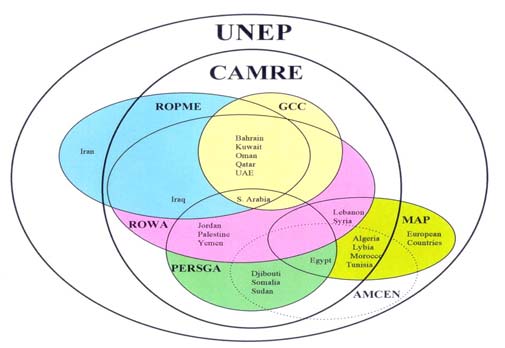
Personal Protection Equipment Technology Thailand
Regional workshops are organized regularly by the RENPAP to disseminate the related technology among the
target groups of the member countries.
5.3.1.2 Regional Organisations in the Gulf countries
The Gulf region has a number of regional organisations affiliated to UN covering different countries through
different networks. Linkages exist between those organisations (Figure 1)
Figure 1 Linkages in the Regional Organizations in Gulf Countries.
(Source: Special Paper presented by Al-Yousifi, Basel; UNEP ROWA at the 1st Technical Workshop of RBAPTS Indian Ocean
region; (March 2002)
5.3.1.2.1 UNEP/Regional Organization of West Asia (ROWA)
The activities undertaken by the ROWA in the region can be summarised under the following headings (Al-
Yousifi, Basel)
· Promote Multi Lateral Environmental Agreements (MEA's)
· Help in developing/implementing NIPs.
· Provide capacity building activities and pilot projects in cooperation with CAMRE, Convention
Secretariats by backstopping support from UNEP Head Quarters out posted offices
Regional Initiatives and Policy Instruments
· 1978: At the Kuwait regional convention eight countries adopted the protocols on combating pollution
by oil and other harmful substances in cases of emergency.
· 1983: Marine emergency mutual aid centre (MEMAC) established
· 1989: Marine pollution resulting from exploration and exploitation of the continental shelf.
· 1990:Protection of the marine environment against pollution from land based sources
· 1998: Control of marine trans-boundary movement and disposal of hazardous wastes and other wastes
5.3.1.3 The Regional Organization for the Protection of the Marine Environmental (ROPME)
The ROPME came into existence after 1978 Regional Conference on the Protection and Development of the
Marine Environment and the coastal Areas of Bahrain, I.R. Iran, Iraq, Kuwait, Oman, Qatar, Saudi Arabia and
United Arab Emirates. Since its establishment, ROPME has provided technical coordination and assisted its
eight member States in the implementation of a number of projects on environmental monitoring and
management. (Beg M.U.; Al-Ghadban A.N)
65
Environmental Agencies in ROPME member States (ROPME, 1999)
Country
Policy Institution
Executing Agency
Bahrain Environmental
Affairs
· Ministry of Housing, Municipality
& Environment
IR Iran
Environmental High Council
Department of the Environment
Iraq
National Council for the Protection &
Ministry of Health
Improvement of Environment
Kuwait
Environment Public Authority
Environment Public Authority
Oman
Council of Ministers
Ministry of Regional Municipalities &
Environment
Qatar
Council of Ministers (Permanent
Ministry of Municipalities & Agriculture
Commission for Environment
Protection)
Saudi Arabia
Ministerial Committee on Environment
Meteorology and environmental Protection
Administration
UAE
Council of Federation
Federal Environmental Agency
ROPME in collaboration with IAEA-Monaco and UNEP (Water Branch, GPA, ROWA) conducted a pilot
study on POPs between 1999-2000. The objectives were:
Carry out survey of Land-Based activities/sources in the ROPME Sea Area (RSA).
Identify POPs more specific to the RSA.
Compile information on production and use of POPs by various sectors.
Assess the amount of POPs unintentional produced by different sectors.
Assess the input of POPs into the marine environment from different point and diffuse sources.
Assess the spatial and temporal distribution of POPs in the RSA
Assess capabilities and constraints for compliance and trend monitoring of POPs.
Review existing national policies, strategies, programmes and measures for the reduction and /or elimination of
emissions and discharges of POPs.
Prepare a regional plan of action for the reduction and /or elimination of emissions and discharges of POPs, as well as
for the regional monitoring programme.
Carry out training workshops on sampling and analyses of POPs, including a quality assurance component.
The data for contaminants screening survey in RSA have been compiled in an exhaustive ROPME report (Al-
Majed et al., 2000).National
At a local level there is a wide variation in existence as well as implementation of regulatory and management
structures. However, there is a common denominator that some awareness and concern is apparent for PTS
pesticides but is very poor in the case of industrial PTS. Regulatory mechanisms for some PTS in place but the
facilities are not there to effectively enforce the relevant laws and regulations.
66
5.3.2.1 Bhutan
5.3.2.1.1 Regulatory Structure
Pesticides Act of Bhutan, 2000 shall be the main law, once implemented, regulating the import and use of
Pesticides in the country. It is implemented by the National Plant Protection Centre of the Ministry of
Agriculture. The Act regulates the safe use and handling of chemicals to prevent public health and
environmental hazards.
The Environment Assessment Act 2000 is implemented by the National Environment Commission Secretariat
(NECS), the highest regulatory body on environmental issues and matters. The Act provides provisions to
establish procedures for the assessment of potential effect of strategic plans, polices, program and projects on
the environment, and for the determination of polices and measures to reduce potential adverse effects and to
promote environment benefits. Similarly, the NECS is also in the process of drafting the National
Environmental Protection Act, which will the be umbrella act
With regard to industrial chemicals/unintended by-products, there is no specific law. However, there are certain
guidelines for industrial discharges, but nothing specific to PTS chemicals. Water and Sanitation Rule 1995
provides provision to prevent dumping of hazardous wastes or chemicals without proper treatment from the
concerned authorities.
5.3.2.1.2 International Agreements
Bhutan is party to the Basel convention on the control of transboundary movement of hazardous wastes and
their disposal and initiatives have been underway to conform to the obligations.
5.3.2.1.3 Current PTS Management Strategy
The Ministry of Agriculture of Bhutan is responsible for the control of pesticides and has been working steadily
to reduce the use of pesticides. From July 1990, onwards they started by removing subsidies on pesticides
gradually in a stepwise manner and by July 1995 subsidy was completely removed. This has led to judicious
use of pesticides and reduced the total consumption. Presently they have introduced pay and carry system, by
which farmer buys according to their needs
Further, they also have started Integrated Pest Management (IPM) on pilot basis with IPM demonstration sites
for several different cash crops with some positive developments.
Since the inception of the Malaria Education Program in Bhutan in 1964, DDT was indiscriminately used for
controlling malaria. However, the use of DDT for malaria vector control was phased out since 1994 due to
resistance and residual effects. It was replace by Synthetic Pyrethroid (Deltamethrine), which is used only
during the focal outbreak.
Further, indirect measures such as the Customs and Excise Act and Sales Tax are also utilised to prevent import
of toxic and hazardous items, without having special and authentic permission from the concerned agencies.
(Khorlo,2002)
5.3.2.2 Bangladesh
5.3.2.2.1 Regulatory Structure
The Acts and regulations pertaining to management of PTS in Bangladesh are:
· The Environment Protection Act 1995
· The Environment Protection Rules 1997
· The Pesticide Ordinance 1971 and Pesticide Rules 1985
· The Customs Act 1969
· The Poison Act 1919
5.3.2.2.2 International Agreements
Bangladesh is party to the Stockholm Convention. A national implementation plan is already underway from
September 2002 for the POPs through the assistance of GEF/UNEP.
67
5.3.2.2.3 Current PTS Management Strategy
The Environment policy (1992) has identified an Environment Action Plan (EAP) for 15 different sectors of the
economy. The environment policy has the backing of the above legislation to regulate production, import,
export, transportation, storage, handling, and use of toxic chemicals and generation and disposal of hazardous
waste in Bangladesh. For the agriculture sector the EAP has defined the following regulations.
· Control use of insecticides and pesticides with due consideration of the prevailing socio-economic
condition of the country,
· Phase out production, import, and use of persistent organic pesticides,
· Use easily biodegradable pesticides and
· Encourage integrated pest management (IPM)
The Pesticide Ordinance has the provision to constitute a Pesticide Technical Advisory Committee (PTAC) to
advice the government on technical matters. The Department of Environment is a member of PTAC. There is a
pesticide registration scheme in Bangladesh. No pesticides and insecticides are registered without reviewing the
available Toxicological and Eco-toxicological information of the candidate pesticide. However, there is no
specific legislation for controlling the production and use of hazardous industrial chemical. (Hossain, 2002)
5.3.2.3 Kuwait
Apart from the activities at sub-regional level individual countries in the Gulf region have specific initiatives
and control measures related to some of the PTS.
5.3.2.3.1 Regulatory Structure
Management of chemical & hazardous substances with respect to the environment are covered by the
provisions of Kuwait Environmental Protection Authority (EPA) Laws No 21 framed in 1995. Authorities
responsible for the management of Chemical Substances in Kuwait is the National Committee for Organizing
and Handling of Chemical Substances in Kuwait established in 1990. For the management and handling of
pesticides, there is a separate permanent committee in Kuwait.
5.3.2.3.2 International Agreements
Kuwait is party to international agreements related to the environment. They include: POPs, PIC, climate
change, desertification, environmental modification, hazardous waste, law of the sea, marine dumping, nuclear
test ban, and ozone layer protection. Signed, but not ratified are biodiversity, endangered species, and marine
dumping.
5.3.2.3.3 Current PTS Management Strategy
The environmental action plan in the country is based on two initiatives. They are the Biodiversity Strategy and
the National Environmental Strategy formulated in 1997. Further, the sustainable development strategies
formulated under the Environmental Impact Assessment Law (1990), esertification and overgrazing (1997), and
Oil contingency plan (1997) also address the issues related to management of PTS.
Kuwait is actively participating in actions related to POPs. The ROPME Secretariat was represented at the Abu
Dhabi Regional Workshop on POPs as well as the Montreal Intergovernmental Negotiating Committee
Meeting for a global legal instrument on POPs with the purpose to coordinate with the delegations of ROPME
Member States the issues of regional concern.
In Kuwait, there is no specific project but some actions have been taken to reduce or eliminate the emission of
POPs. DDT and various similar compounds are banned in Kuwait. The Ministry of Electricity has replaced
PCBs in electric transformers. Major PTS in Kuwait are dioxins and furans released from hospital incinerators.
The PAHs are a major group of POPs (IOMC, 2000). (Beg and Al-Ghadban,2002))
5.3.2.4 Saudi Arabia
5.3.2.4.1 Current PTS Management Strategy
In Saudi Arabia Ministry of Agriculture and Water, Research Department in collaboration with the Ministry of
Commerce (SACO) has undertaken a project on the "Monitoring of Obsolete and banned Agrochemicals in the
Kingdom of Saudi Arabia" with an objective to ban the use and introduction of PTS pesticides.
68
Another program that is on-going in Saudi Arabia deals with the introduction of new safe and environmentally
friendly pesticides to replace the banned pesticides (IOMC, 2000). (Beg and Al-Ghadban, 2002)
5.3.2.5 Iran
5.3.2.5.1 Regulatory Structure
Iran has the following laws related to control and management of PTS related issues
Plant Protection Law and Regulations (in agriculture)
Imports and Exports Law
Safety Regulations of Pesticides and Chemicals
Restriction and Phase Out Program for Pesticides
There is no existing legislation on dioxins and furans or other chlorinated by-products.
5.3.2.5.2 International Agreements
Iran has ratified the Stockholm Convention on POPs in 2001, the Basel Convention, and the Rotterdom
Convention. There is a supreme council for the protection of the environment chaired by the president of the
country. The major objective of the council is to prepare the environmental policies, strategies, regulations and
standards.
5.3.2.5.3 Current PTS Management Strategy
The Department of the Environment enforces the rules and regulations and supervises the protection and
conservation of the environment throughout the country. The vice president of the country heads the
department. Some of the activities include:
Wastewater Effluent Standards
Environmental Impact Assessment Guidelines
Hazardous Waste Management Strategy
Development of regular auditing procedure for activities related to hazardous chemicals and waste management
strategies.
Development of environmental auditing procedure for import and export of hazardous chemicals and wastes.
Iran has already started an activity specifically addressing PTS issues by initiating the preparation of a PTS
profile of the country. It started in September 2002 and is expected to be completed by March 2003.
(Abaee,2002)
5.3.2.6 Myanmar
5.3.2.6.1 Regulatory Structure
The Plant Protection Division of the Myanmar Agriculture Service is mainly responsible for the pesticides
inclusive of Persistent Organic Pollutants. Meanwhile, Persistent Toxic Substances are being considered as a
priority by the Plant Protection Division and it will actively take part to control those pesticides (POPs) and will
also cooperate with other agencies concerned for the control of other PTS other than POPs.
The Government of the Union of Myanmar has enacted the following laws and regulations needed to control
PTS pesticides
Pesticide Law in 1989
69
Plant Pest Quarantine Law in 1993
5.3.2.6.2 Current PTS Management Strategy
The Government of Myanmar has addressed environmental affairs by forming the National Commission for
Environmental Affairs (NCEA) to act as focal point and as a coordinating body for environmental affairs and to
promote environmentally sound and sustainable development.
Another authority by the name of the Pesticide Registration Board (PRB) has been formed to control the
production, marketing and use of pesticides. The board consists of ten members from different government
departments. The Head of the Plant Protection Division of the Myanmar Agriculture Service is the secretary of
the PRB. The PRB has powers and rights to control the use of pesticides in Myanmar. A pesticides technical
sub-committee and bio-efficacy sub-committee were formed under the PRB to support screening of pesticides
to be registered in Myanmar. (Min, 2002)
5.3.2.7 Nepal
5.3.2.7.1 Regulatory Structure
There is a regulatory infrastructure established for the management of pesticides in Nepal. It covers all handling
and use aspects of pesticides. Pesticides are registered and regulated under the Pesticides Act, 1991 and the
Rules 1993. The Act regulates the import, manufacture, sale, transport, distribution and use of pesticides.
There is no regulatory infrastructure for PTS other than pesticides in Nepal.
5.3.2.7.2 International Agreements
Nepal has ratified or signed most of the PTS related international agreements. The Basel Convention,
Stockholm convention on POPs and Montreal Protocol on Ozone layer depleting substances can be specifically
cited.
5.3.2.7.3 Current PTS Management Strategy
In Nepal, as in most of the other developing countries in the region, the capabilities, expertise and resources to
fully implement the regulation are limited. Further, there is a need to strengthen the scientific and technical
base for health and environmental risk assessment.
Illicit/illegal import and trans-boundary issues are of serious concern to Nepal which need to be addressed in a
multilateral approach with neighboring industrialised countries to prevent potential infiltration of banned and
regulated PTS to the country. (Palikhe, 2002)
5.3.2.8 Oman
5.3.2.8.1 Regulatory Structure
In Oman, there is one law and three regulations to control chemical substances
The law of handling and use of chemicals issued by Royal Decree NO. 46/95.
The regulation for Registration of Hazardous Chemicals and issuance of the relevant permits issued by Ministerial
Decision NO. 248/97.
The Ministerial decision No (316/2001) for banning of handling and use of some hazardous chemicals such as DDT,
Atrazine, and PCB's
The Ministerial decision No (317/2001) for issuing the regulations for packing, packaging, tagging and labeling of
hazardous chemicals
The Department of Chemicals substances was established under the Article (6) of the royal decree
Other Governmental authorities within the ministry of environment or by other ministries
70
5.3.2.8.2 Current PTS Management Strategy
Oman has number of programs to address the issues related to some of the PTS (Al-Wahebi, 2002)
Petroleum Hydrocarbons (aliphatic and aromatic components).
Heavy metals in drinking water
Chlorine and phosphorus based Pesticides.
Lead content in paints, inks cosmetics and agrochemicals
Polychlorinated biphenyls (PCBs)
5.3.2.9 Pakistan
5.3.2.9.1 Regulatory Structure
There is no regulatory control over the PTS of industrial use and unintended by-products in Pakistan. However,
pesticides are controlled through number of regulatory initiatives.
Agricultural Pesticide Ordinance of 1971
Agricultural Pesticide Ordinance (Amended) of 1973
Agricultural Pesticide Ordinance (updated) of 1997
All ordinances mentioned above and meant for the rules and regulation of import, manufacture, formulation,
distribution, marketing, quality assurance/control and environmental toxicology are under the Ministry of Food
and Agriculture.
5.3.2.9.2 International Agreements
Pakistan is a signatory of the following international agreements:
Basel Convention.
Rio-de-Janeiro Summit/Agreement.
Rotterdam Convention.
Kyoto Convention
Stockholm Convention.
The country has also identified a Designated National Authority (DNA) of Ministry of Environment to monitor
the pesticides coming under the Prior Informed Consent (PIC) procedure.
5.3.2.9.3 Current PTS Management Strategy
The agricultural pesticide ordinance is now being updated in the light of recommendations made on Policy and
Strategies for the Rational Use of Pesticides
National environmental quality standards are established in Pakistan for rules and regulations of industrial
chemicals and efficient production, marketing and disposal. The mandate is entrusted to the Ministry of
Environment and Urban Affairs. (Hayat,2002)
5.3.2.10 India
5.3.2.10.1 Regulatory Structure
The Insecticide Act, 1968, under the control of the Ministry of Agriculture is the main law regulating
pesticides. The Environment (Protection) Act, 1986 provides for bans/restrictions on the handling of
71
chemicals/wastes. Various rules brought out by the Ministry under the Environment (Protection) Act, 1986 and
other legislations that have a bearing on the POPs convention are as follows: -
Manufacture, Storage and Import of Hazardous Chemicals Rules, 1989 and amendments made there under,
Chemical Accidents (Emergency Planning, Preparedness and Response) Rules, 1996 and amendments made there
under,
Hazardous Wastes (Management and Handling) Rules, 1989 and amendments made there under,
Public Liability Insurance Act, 1991 and Rules,
National Environment Tribunal Act, 1995, and
The Environment (Protection) Rules, 1986.
The EP Rules, 1986 provide Minimal National Standards for the discharge of pollutants under the Environment
(Protection) Act, 1986, which specifies concentration-based regulatory standards for pesticide manufacturing
units. Clause 13 of the Environment (Protection) Rules, 1986 specifically provides for banning and restriction
of hazardous substances that have a potential to cause damage to the environment, human beings, other living
creatures, plants and property. Some of the chemical substances which have so far been banned under these
rules include, hazardous wastes containing: arsenic, cyanide, mercury, beryllium, selenium chromium
(hexavalemt), thallium, pesticides, herbicides, insecticides, PCB, PCT.
The Municipal Solid Waste [Management and Handling] Rules, 2000 and Bio-medical Waste [Management
and Handling] Rules, 2000 stipulate that plastics and waste disinfected with chlorinated disinfectants are not to
be incinerated. This requirement would serve to prevent the formation of PCBs/dioxins/furans from the
burning of solid waste.
5.3.2.10.2 International Agreements
India signed the Basel Convention on the control of Trans-boundary Movement of Hazardous Waste and their
Disposal on 15.03.1990. The Hazardous Waste (Management and Handling) Rules 1989 were amended on
06.01.2000 partly to bring them in compliance with Basel Convention.
India has signed the Stockholm Convention on Persistent Organic Pollutants (POPs) in May 2002. With
UNIDO as the executing agency, India has taken up an Enabling Activities Project, which could form the basis
for developing a fully-fledged National Implementation Plan for POPs.
The Ministry of Environment and Forests is also coordinating the implementation of the London Guidelines for
Exchange of Information on Chemicals in International Trade and Prior Informed Consent (PIC) scheme
brought out by UNEP in 1989 including POPs chemicals. The Ministry of Agriculture is implementing a
similar scheme, namely, FAO International Code of Conduct on the Distribution and Use of Pesticides. As
such, the present legislative framework available is adequate to take care of national obligations under the
Stockholm Convention on POPs.
5.3.2.10.3 Current PTS Management Strategy
India has banned 31 pesticides and pesticide formulations, including six POP pesticides (aldrin, endrin,
chlordane, toxaphene, heptachlor, hexachlorabenzene). Dieldrin and DDT have been put into the specific list in
the register under the Stockholm Convention.
The Hazardous Wastes [Management & Handling] Amendment Rules, 2000, list PCBs as a class `A' waste
substance and set a concentration level of 50 mg/kg. Import and export is in accordance with the Schedule of
the Basel Convention.
No parameter-specific emissions requirements for PCDD/PCDF have been established for the waste treatment
and destruction process approved for use in hazardous waste treatment facilities. The rules also have
provisions for certifying authorities to issue specific guidelines depending on the nature of waste that should be
handled at the facility. Mirex and organo-tin compounds are not registered for manufacture and use in India.
Eight chemicals (aldrin, chlordane, endrin, heptachlor, hexachlorobenzene, toxaphene, PCP, PCBs) are
completely banned for production. Organo-mercury compounds are under a partial ban (as phenyl mercury
72
acetate is banned for use). DDT, dieldrin, and HCH are under restricted use. Atrazine, endosulfan, organo-lead
compound, and phthalates are currently produced and used.
5.3.2.11 Yemen
5.3.2.11.1 Regulatory Structure
Law No 25 for the year 1999 concerning the Regulation of Handling Pesticides for Plant Pests regulates import,
export production and other activities related to PTS pesticides is in force in Yemen. It is enforced through the
Ministry of Agriculture. The government authorities responsible for the management of PTS are the Ministry of
Tourism & Environment, Ministry of Agriculture and Customs.
5.3.2.11.2 Current PTS Management Strategy
There are no management plans enforced in the country for PTS, but a project proposal is being formulated for
monitoring of PTS in the country (Al-Rainee, 2002)
5.3.2.12 Sri Lanka
5.3.2.12.1 Regulatory Structure
Pesticides are regulated in Sri Lanka through the enforcement of the Control of Pesticides Act No 33 of 1980.
The Department of Agriculture of the Ministry of Agriculture has the mandate to implement the Act. There are
regulations of industrial chemicals of PTS except PCB, prohibited for use in electrical transformers.
5.3.2.12.2 International Agreements
Sri Lanka has ratified/signed the international agreements relating to chemicals and the environment. Trans-
boundary movement of Hazardous wastes (Basel), Montreal Protocol on Ozone layer depleting substances,
Stockholm convention on POPs, OPCW. The Rotterdam convention on PIC to be signed but enforced
voluntarily from the early nineties A national implementation plan is already underway in Sri Lanka for the
Stockholm convention with the assistance of GEF/UNEP.
5.3.2.12.3 Current PTS Management Strategy
The regulatory authorities are closely linked up with the relevant international agencies, which had enabled it to
take action on PTS pesticides. London guidelines and the PIC voluntary scheme have paved the way to prohibit
the use of most chlorinated hydrocarbon pesticides more than a decade ago. For those prohibited pesticides,
safer alternatives have been either recommended or found redundant in chemical pest control.
Though it was not considered as a chlorinated hydrocarbon for regulatory actions, endosulfan was banned in
1998 along with some other PTS, because the formulation marketed was in the WHO hazard class Ib, despite
its technical grade being in class II. Sri Lanka has a national policy, implemented in 1995 that no pesticide
formulations of WHO hazard classes Ia and Ib are marketed for regular pest control purposes in agriculture.
(Wickramasinghe, 2002.)
There is no monitoring scheme (or regulation) for the control of unintended by-products. The Central
Environmental Authority (CEA) of the Ministry of Environment regulates industrial emissions through the
provisions of the Environment Act. Environmental Protection Licenses are issued by the CEA after careful
assessment of the industry, its activities and the environmental protection measures adopted to make sure that
they meet the National Emission Standards.
Disposal of Municipal Solid Wastes are regulated according to the directives issued by the CEA to the local
authority, under the legal provisions vested on the them to take necessary action to manage municipal solid
wastes
Although all PCB-containing transformers have been replaced there are no proper monitoring schemes for
prevention of the import of any such PCB-contaminated items into the country. The recovered PCBs are in safe
storage. Organotin compounds are used in the ship industries, which are carried out in Colombo harbour area,
where the items do not have to be legally imported into the country through regular Custom procedures.
5.4 STATUS OF ENFORCEMENT
Regulatory enforcement with respect to pesticides is satisfactory in most of the countries. Banning of some of
the PTS pesticides internationally, UNEP/FAO efforts on promotion of International Code of Conduct on Safe
Use and Distribution of Pesticides, London guideline and voluntary enforcement of the PIC Procedure, IPM
73
programme, and the POPs and Basel activities have contributed significantly to improve the situation. The
prohibitive actions taken against POPs by relatively less industrialised countries where access to technological
expertise is a scarcity appears to be more severe than that of the other countries. It is reasonable to attribute
developments in the field of POPs pesticides to the effort of the international agencies involved in POPs-related
activities on management of those chemicals at grass-roots level. It is also apparent that successful management
can be achieved even in the case of PTS, if similar strategies are employed. Also that the UN agencies could
effectively involve in management of the PTS globally to reach the goals is clearly evident. Most of the
countries in the region, especially of agriculture-based economies have nationally recognized IPM as the best
option for pest control and put this into practice. The success and the extent of the IPM programmes in
individual countries are varied depending on the economic and field infrastructural strengths of the country.
Actions in the region are mainly focussed on chlorinated hydrocarbon insecticides. Regulatory management of
the rest of the PTS pesticides such as endosulfan, atrazine etc and a few chlorinated hydrocarbons needs to be
focussed with respect to their production, distribution, export/import and use.
Due to the fact that there are no major pesticide manufacturing countries in the Indian Ocean region, except
India, they depend upon imports of pesticides. International regulation and banning of PTS pesticides, by most
of the industrialised nations, has significantly contributed to achieve the present status.
There are no satisfactory regulatory or management strategies in place for PTS of industrial uses, such as
organo-lead compounds and phthalates in the Indian Ocean region countries. Even enforcement of the
regulations in existence has been poor. In enforcement of any regulation, especially in relation to an industry, it
is vital that viable alternatives according to the prevailing situation are made available. Lack of availability of
alternative technologies adoptable under local conditions and economic factors have retarded the industry in
taking measures to reduce the use of PTS and thereby the enforcement.
In the case of PTS of unintended by-products, no regulatory or management control measures are in place
except the establishment of standards for levels in environmental compartments by few countries in the region.
The control measures adopted according to the standards are, limited to incineration of certain solid wastes.
Efficient and successful implementation of such limited regulations in respective countries must be carefully
assessed.
The traditional activities in most of the Indian Ocean region countries contribute to the generation of non-point
source release of unintentional by-products of PTS. The use of firewood for cooking and local industries, open
burning of corpses especially in the Indian subcontinent, and disposal of household industrial wastes are
extremely difficult to monitor in terms of their sources and emission levels.
In the Gulf region, it is mostly the petroleum industry that contributes to PTS emissions and the sources are
scattered mostly in the desert areas. These sources are totally under the control of the private sector with little
or no access to PTS related information by the respective local authorities and it makes it extremely difficult to
monitor the activities and thus the sources. Access to these sites by the authorities is limited.
5.5 ALTERNATIVES
The alternatives to PTS should be dealt with according to their respective usage, release to the environment,
transport and exposure routes. In this context, it is appropriate to discuss the subject in the following sub
headings.
5.5.1
Pesticides
There are number of chemical alternative to PTS pesticides now available on the international market. However
their adoption is restricted due to cost, requirement of frequent spraying etc.
One of the most practical and effective measures in the adoption of alternative chemicals is the restriction of
access to PTS pesticides. Banning or phasing out the use of PTS pesticides is the most viable option available
to the developing countries as the first step.
Alternative technologies to PTS chemical pest control options are readily available in both technologically
advanced as well as developing countries. These include biopesticides, genetically engineered pest resistant
plants (eg. Bt Cotton) organic farming and Integrated Pest Management (IPM) practices.
Non-chemical alternative technologies also require special knowledge, extensive involvement/labour and in
some cases advanced technologies which may not be viable under some conditions.
74
In most cases the diversity of cultural, social and political issues are given minimal consideration. However,
such issues play an important role in the rate of success of a given task enforced on large communities or
countries or a particular region.
5.5.2 Industrial chemicals and unintentional by-products
Sustainable development of the industrial sector is the most effective and practical option available to minimise
the use of PTS. This needs the adoption of new chemistry in relevant areas of application of PTS. The cost
involved in technological improvements and access to those technologies by the industries in developing
countries are the key factors which determine the desired improvements. Expertise and knowledge for cleaner
technologies available in some countries in the region could be shared with others through closer R&D
collaboration and technology transfer.
5.6 TECHNOLOGY
TRANSFER
Transfer of technologies is one of the vital aspects in management of PTS especially in the developing
countries where most of the industrial activities are associated with outdated technologies.
The cost, trademark and proprietary rights issues have serious adverse effects on effective technology transfer
to the developing countries. In order to address the problem R&D capabilities for alternative chemicals have to
be enhanced.
The contribution of industry in transferring technologies to the less developed sectors of the societies should
play a much more effective role.
Climatic factors and local skills play an important role in adoption of the newer technologies and hence
attention should be drawn to this.
In effective transfer of technologies, the bilateral, regional, multinational and global networking of activities is
an essential part that is often given less attention. The international agencies can play an effective role in this
aspect.
5.7 IDENTIFICATION OF NEEDS
In order to manage PTS, and thereby minimise or eliminate the associated adverse impacts on human health
and the environment, some activities need to be initiated at a local/national level as well as at regional/global
level. These activities can be broadly classified into two areas to be focussed for capacity building and the need
to develop strategies and regulatory management systems needed, nationally or regionally, to manage PTS
effectively, though the issues are common to the countries of the region, the focus should clearly differentiate
between the Gulf sub-region countries, where the concerns are mainly on petro-chemical related PTS and South
Asian sub region countries where the concerns are mainly focused on agro-based issues. Further there are some
distinct differences in environmental parameters between the two sub-regions.
5.7.1 Capacity
Building
Capacity building should focus on both technological as well as infrastructural (legal, administrative, health and
environmental monitoring) status. The level of capacity among the countries in the region to address the issues
related to PTS is widely varied. The improvement of technical capacity in the industry (to minimize PTS
releases by adopting improved or alternate technologies) and strengthening environmental monitoring facilities
and administrative regulation can be identified as the most important underlying weaknesses, if the situation is
generalised to the regional context.
The key areas where technical and financial assistance is needed are given below.
· Establishment of analytical facilities and monitoring systems/facilities for PCDD/F and PAH levels in
environmental compartments
· Setting up of surveillance systems on PTS associated health problems
· Strengthening the administrative regulatory systems
75
· Training
1. Technical staff on analyses of PTS levels (Skill development)
2. Maintenance of analytical instruments
3. Legislators, policy makers and regulators on associated adverse effects, possible remedial measures
and potential long-term economic impacts.
4. NGOs and other public interest groups
· Technical assistance for development of guidelines, manuals, codes, emergency plans, information
technology and networking
· Adoption of available alternative technologies to suit local conditions
· Adoption of alternative technologies and improved chemistry in the industry (to minimize PTS releases)
· Skill development in risk assessment under local conditions, modelling capabilities
· Development of integrated multimedia models for the Indian Ocean region on transboundary transport of
PTS
· Improvement of facilities and expertise in related research initiatives
· Development of understanding of international trade regime in the context of PTS
· Establishment of regional/sub-regional/national disposal facilities for obsolete stocks of PTS and
improvement of existing disposal facilities to minimize PTS release.
5.7.2 Establishment of Efficient PTS Management Systems
It is vital that there are regulatory systems and proper strategies in place to manage PTS at local and regional
levels. There are number of areas identified in the region where improvements are required
5.7.2.1 National
5.7.2.1.1 High Priorities
National Focal Point or Networking of all Relevant Stake Holders
To coordinate all the relevant agencies to facilitate regulation and reduction of PTS release, while functioning
as a point of access to data, information and relevant sectors/agencies related to PTS by interested parties a
separate authority responsible for PTS related issues would also be an option. It may be more cost effective for
the respective countries to expand the mandates of existing authorities dealing with the other MEAs including
Basel Convention, Stockholm Convention, MARPOL, PIC, Montreal protocol, Pesticide regulatory authority
and integrate PTS related activities. The establishment should:
· Consist of the relevant stakeholders including citizens groups, NGOs, industrial and professional
associations, industrial representatives, regulatory agencies, certification and standardisation agencies,
academic institutions and independent experts and researchers
· Be provided with statutory backup to facilitate effective management of PTS
· Effectively coordinate with relevant stakeholders for efficient and accurate access to data and
information relating to PTS
Accurate assessment of issues relating to PTS in the country
This should include a proper account of data gaps as well as available data, identification of specific
weaknesses in administrative, legal and monitoring systems, and prioritisation of issues according to health and
environmental concerns. It is also important that activity is continued in order to monitor the trends of PTS
releases and progress of management practices. The information generated would be useful as a baseline in
subsequent actions including donor assistance in appropriate areas. The following specific aspects were
identified as important in the assessment exercise:
· Inventories of the hotspots and studies on associated health impacts
76
· Monitoring systems to determine the levels of priority PTS in the Indian Ocean region in all
environmental compartments and health/environmental impacts
· Accurate assessment of the status of organo-metallic compounds, phthalates and endosulfan
· Information from industry, regulators, researchers and law makers should be periodically compiled and
the data should be placed in the public domain
· The data collection and assessment exercise should facilitate management, information systems and
decision support systems.
· The findings of the above exercise should be placed in the public domain in local languages and be
easily understandable.
Strategies and Measures
To promote the adoption of safer alternatives in related industry and agriculture, minimise PTS production and
release, take appropriate remedial measures to prevent pollution and adverse health effects appropriate
strategies and measures are necessary. Banning or phasing out of PTS and PTS generating activities,
when/where possible, would be an especially useful option in cases where effective regulation is not possible.
Health surveillance is a key activity that would trigger the subsequent remedial action with out delay. It is
important to prioritise the issues as well as proposed action with respect to the local situation for optimal and
efficient results. The specific areas of focus include:
· Health surveillance and improvement in hospital records and extensive epidemiological studies
· Cleaner technologies for production, to minimise PTS release
· Minimisation of PTS release by improving pollution control strategies
· Disposal of stockpiles and illegal dumps
· Remediation of contaminated sites (hot spots)
· Control and verification mechanisms on transboundary movements
· Internalisation of PTS in countries' policies, legislation and regulatory framework
· Strengthening the enforcement of prevailing environmental laws and regulations
· Investments in infrastructure to include environmental protection and monitoring facilities (either by
industrial development agencies or by public/private partnership)
· Improvement of technical and human resource capabilities in regulatory and environmental monitoring
agencies
· Carrying out of studies focused at generating information on social, economic, cultural and political
implications enabling political leadership take quick and effective decisions.
· Continuous open dialogue of all stake holders (Industry, NGO, Developed/developing, regulatory and
UN agencies)
· Subsidies or incentives for adoption of alternate technologies by the industry and other PTS users
5.7.2.1.2 Priority Areas
Awareness Creation
This needs to be done on associated issues, potential hazards, and remedial measures, involving a multi-
disciplinary approach. The target groups range from the general public, consumers of pesticide treated
vegetables, and PTS users to industrialists. Special attention needs to be given to increasing mass awareness in
the Indian Ocean region. Proper awareness among the public on potential adverse effects associated with PTS
would necessitate the authorities, policy makers and polluters to be more alert in their activities and social
responsibilities for effective adherence and thereby satisfactory achievement of expected goals. Further, it
would help the public to take proper precautions to ensure the safety in case of potential exposure situations.
The strategies should include:
· Popular newspaper articles
77
· Scientific reviews in journals and the press
· Research papers
· Seminars
· Workshops and training classes
· Websites and e-mail network groups
Appropriate Political Commitment
Such a commitment by respective countries is a key to the success of all efforts in eliminating and managing
adverse consequences of PTS. Proper awareness at relevant entities in the political system, due recognition of
their efforts by the regional and other concerned parties would help improve political commitment. It is
appropriate that all relevant sectors in the political system (eg. Industrial, Economic, Media, Power, Transport,
Scientific Affairs) in addition to the conventional environment, health and agriculture are effectively and
actively involved in PTS related activities in the management of PTS and in policy and awareness initiatives
such as meetings, workshops etc.
To create, build and strengthen required political will, it is necessary that political leadership at various levels
have clarity on:
· Desirability and urgency
· Economic implications at national, state and local levels
· Long-term environmental and social benefits
· Affordability of desired alternatives and action
· Technological feasibility
· Desired infrastructure and institutional mechanism
· Socio-cultural impacts
Interdisciplinary Coordination and Cooperation
This is needed to optimise efficient resource utilisation and enforcement of PTS management strategies.
Signing of MOUs, voluntary and multilateral agreements and participation in inter-sectoral coordinating
committees of all relevant stakeholders are some of the options to be considered. Following specific
interactions, in this context, may be desirable:
· Inter-sectoral industrial cooperation
· Intra-sectoral industrial cooperation
· Industry-Government cooperation
· Industry-NGO cooperation
· Government-NGO cooperation
· Government- academic cooperation
· Intra and inter disciplinary coordination in academic initiatives/activities
· NGO-academic cooperation
Commitment and Active Involvement of the Chemical and Related Industry
This is vital in the management of PTS related issues and problems because the chemical and related industries
play a major role in the subject of PTS including unintended by-products. This could be achieved by direct
interference by respective governments and adopting transparent procedures, protocol and incentives to ensure
the optimal benefits. Following interactions may be desirable:
· Inter-sectoral industrial cooperation
· Intra-sectoral industrial cooperation
78
· Industry-Government cooperation
· Industry-NGO cooperation
5.7.2.2 Regional and Global
5.7.2.2.1 High Priority Areas
Networking
For management, monitoring/surveillance, information gathering (database) and dissemination, technical and
related health aspects networking is essential. In this context, the informal linkages established during the
activities of the regionally based assessment of PTS could be used as a basis for the development of formal
regional and sub-regional networks (authorities or secretariats or centres) and thereby a global network.
A regional network under the patronage of one of the relevant UN agencies is desirable for this purpose. It
should consist of:
· A regional secretariat with appropriate expertise on the subject
· Proper linkages with regional and sub regional UN agencies handling similar activities
· Direct linkages with the local focal points for implementation of regional and global programme at local
levels and facilitation of necessary technical and other backup support for effective management of PTS
and related issues
The secretariat, among others, should focus on:
· Facilitation of disposal of stockpiles
· Establishment of a data collection system and systematic surveys to continuously review the status of
priority PTS
· Establishment of regional information dissemination system such as websites, news bulletins
· Coordination of frequent awareness creation workshops for various stake holders
· Coordinated programmes for monitoring PCDD/Fs and PAHs in the region including burning of
traditional fuels in SAARC countries
· Facilitation of global support services and funding resources to implement regional and national PTS
management programmes and projects
· Development and implementation of strategic regional programme with identified targets for the reduction
and management of PTS
· Identification of testing facilities in the region for necessary improvements in manpower/equipment and
provide required support
· Research and Development
In the Indian ocean region Research and Development efforts are needed to address the issues related to the
technology of manufacturing processes using PTS or resulting in the generation of PTS as well as pollution
control and environmental and health implications. Specific priorities include:
· low cost pollution prevention and cleaner production technologies
· handling of accidental spills
· development and adoption of risk assessment and reduction technologies under regional and local
conditions
· toxicity behavior of PTS under nutritional and other similar parameters specific to the traditional context.
· Development of scientific data based on local climatic conditions and other environmental factors
· Studies on physical-chemical processes in the Indian Ocean region to facilitate transboundary transport
modelling of PTS
· Qualitative evaluation of processes among various environmental compartments
79
· Larger-scale studies and monitoring
Inter-Regional Cooperation
This will help in assisting member countries in developing programmes, projects and standards (e.g., NIPs).
Signing of MOU between regional programmes, to develop, knowledge, information exchange, research
facilities and activities, and establishment of networks of experts. Specific programmes may include:
· Capacity building
· Technology transfer
· Expert exchange programme
· Information exchange
· Political dialogue between region
· Development of strategy to harness trade to promote reduction of PTS
5.7.2.2.2 Priority Areas
Setting up of Regional Priorities, Standards and Regulations
These should conform to a global context for uniform and scientifically comparable results (including QA/QC)
and to strategically reduce impacts of contaminants including PTS on human health and the environment.
Surveillance System
This is needed to monitor the trends in impacts on human health & the environment. This information should
be used as a triggering mechanism for local, regional and global action to curtail interregional transboundary
movement of PTS. Further it could be used as a baseline for research, survey and technical activities in the field
of PTS.
Assurance of Fair Access
This will help in getting financial and technical support among countries in the region.
5.8 CONCLUSIONS
In general, the Indian Ocean region does not have the capacity to efficiently manage PTS. Some capabilities do
exist in a few countries (e.g. India, Kuwait) for determining environmental levels. The levels monitored by
those few countries are also not often action oriented or result in the development of effective management
strategies in the context of minimising PTS release.
The key stakeholders such as the industry, policy makers and other interested/concerned groups are not aware
of the associated health effects and potential release sources. Creation of proper awareness among the different
sectors of society is thus extremely important to have the desired effects of the goals of management of PTS.
There is a serious data gap in all the countries on, a fair account of potential PTS release sources, the magnitude
of release and the extent of contamination of the environment. Therefore, identification of PTS of concern to
the region as well as assessment of the related issues of potential adverse environmental or health effects may
not be indicative of the actual situation. It is important that attention is focused on this need.
Economic constraint is another important factor responsible for the prevailing unsatisfactory conditions.
Efficient resource management and inter sectoral cooperation are therefore very important to optimise effective
utilisation of the limited facilities available. National and regional programmes shall be drawn-up and
implemented for this purpose.
Regulatory management systems are in place in most countries for POPs pesticides. There are no regulatory
management or monitoring systems in place for unintended by-products and hence uncontrolled releases are
anticipated at a high magnitude in all the countries of the region, especially due to the fact that there are a
number of cultural activities and social perceptions responsible for potential non-point source releases of some
PTS.
80
In order to deal with the management, monitoring/surveillance, data gathering, disposal of stockpiles, etc. in the
Indian Ocean Region a regional network/Secretariat needs to be set up under the UN agency.
5.9 REFERENCES
Abaie, M. S.; Country paper on Sources of Environmental Levels of PTS in Iran ; 1st Technical Workshop of
RBAPTS Indian Ocean region; March 2002.
Al-Ghamdi, H.S Country paper on Sources of Environmental Levels of PTS in Saudi Arabia; 1st Technical
Workshop of RBAPTS Indian Ocean region; March 2002.
Al-Jabri, J.A.; Country paper on Sources of Environmental Levels of PTS in UAE; 1st Technical Workshop of
RBAPTS Indian Ocean region; March 2002.
Al-Mohammadi, E.; Country paper on Sources of Environmental Levels of PTS in Qatar; 1st Technical
Workshop of RBAPTS Indian Ocean region; March 2002.
Al-Rainee, M.H.S. Country paper on Sources of Environmental Levels of PTS in Yeman ; 1st Technical
Workshop of RBAPTS Indian Ocean region; March 2002.
Al-Wahebi, B. B.; Country paper on Sources of Environmental Levels of PTS in Oman; 1st Technical Workshop
of RBAPTS Indian Ocean region; March 2002.
Al-Yousifi, Basel; UNEP ROWA, Bahrain; Chemicals regional strategy in west Asia; PTS impacts on human
health & environment, Special Paper, 1st Technical Workshop of RBAPTS Indian Ocean region; March 2002.
Beg M.U.; Al-Ghadban A.N.; Persistent Toxic Substances in Gulf States 1st Technical Workshop of RBAPTS
Indian Ocean region; March 2002.
Dudley, J. L.; Pesticide use in Bhutan, April 1995.
Hayat.Y Country paper on Sources of Environmental Levels of PTS in Pakistan; 1st Technical Workshop of
RBAPTS Indian Ocean region; March 2002.
Hossain, M. M.; Country status report of Bangladesh , Priority Setting Meeting of RBAPTS Indian Ocean
region; September 2002.
Khorlo, T.; Country paper on Sources of Environmental Levels of PTS in Bhutan ; 1st Technical Workshop of
RBAPTS Indian Ocean region; March 2002.
Min U..Z. Country paper on Sources of Environmental Levels of PTS in Myanmar; 1st Technical Workshop of
RBAPTS Indian Ocean region; March 2002.
Palikhe, B.R.; Country Paper on Sources and Environmental Levels of PTS in Nepal , 1st Technical Workshop
of RBAPTS Indian Ocean region; March 2002.
Semtokha, Position paper on the Accumulated Agricultural waste chemicals in Bhutan, NPPC, 26th July 1996.
Wichramasinghe, M.B.; Country status report prepared for the RBAPTS , 1st Technical Workshop of RBAPTS
Indian Ocean region; March 2002.
81
6 CONCLUSIONS AND RECOMMENDATIONS
Out of 21 PTS initially identified for the region, dioxins, furans and PAHs were found to be the priority
ones, due to magnitude of use, sources, environmental levels and possible human and ecological risks
(Annexure-IIA, IIB, IIC and III) .
· The region has, in addition to concerns of a global nature, specific localized factors influencing the
sources, levels and effects of PTS. These include geoclimatic, socioeconomic, and ethnic factors and
the recent trends in industrial and agricultural development.
· Personal predisposition of individuals due to genetic and health status, the vulnerability of rich
biodiversity to ecotoxicity, petroleum production and transport, refuse burning adds to PTS load. In
spite of the fact that most of the PTS are regulated, their residues are still seen. The continued
dependence on some chlorinated pesticides for disease vector control also makes PTS pesticides a
distinct issue in the region.
· Of late, considerable regulation of PTS is underway, including banning or regulating of most
of the sources of PTS. However, there is considerable lacunae in surveillance mechanism and
deterrent action. An effective residue monitoring set up is not in place.
· Further, little attention has been given on restoration of highly contaminated sites, and creation
of awareness of the public, especially users and other exposed persons on safety issues. In
some countries trained human resources also are needed and efforts are to be undertaken at
grassroots levels. Biological pesticides like bacterial proteins and plant products are being
increasingly used and integrated pest management practices are being tried. These efforts will take
some time to show positive effects and reducing the buildup of PTS. Organochlorine pesticides, due to
past agricultural and present regulated use in disease vector control, may remain of local concern in
some countries, but the levels are decreasing .
· Significant potential for dioxins and furans emissions exists in the region, as the burning of solid
waste/biomass is a common practice. Due to lack of analytical facilities exact estimates are however
not available presently. Further, there are no guidelines for dioxins and furans. A proper monitoring
and surveillance system is lacking.
6.1 SOURCES OF PTS
· In all the countries, PTS pesticides such as, aldrin, chlordane, DDT, dieldrin, endrin, heptachlor, HCB
toxaphene, mirex are either banned or not registered, except DDT is used in India, Pakistan, Bangladesh,
and Nepal for vector control in restricted amounts and regulated manner.
· The sources of industrial chemicals and unintended byproducts e.g. PCBs, phthalates, dioxins, furans and
PAHs have been qualitatively identified from some major industrial sectors and incinerators/wastes dump
sites and waste oil in this region. But the quantum of release is a serious data gap.
· In absence of systematic monitoring, lack of analytical capability and the quality assurance/control, there
are data gaps with respect to sources on PCBs, dioxins, furans, PAHs and phthalates. Moreover, no
regulatory standards have yet been developed. High monitoring costs are appearing as deterrent for
building up data base in most countries.
· Information on production, import and quantity of stockpiles on few chemicals were available only from
some countries in the region. No information on release of PTS during manufacturing, usage and other
sources is available. Therefore, correlation of the environmental residues with the source of release of
these chemicals and past usage was not possible.
· According to the priority rating done on matrix based scoring, dioxins, furans, and PAHs, are the PTS of
major regional concern
· PCBs and organo-metallics are of moderate regional concern because of their local concern in most of the
countries in the region. Lindane and Atrazine are of local concern due to their production and use in India
and uses in some other countries. However, the amounts are low.
82
6.2 LEVELS AND EFFECTS
· On the basis of environmental levels of various PTS, the Indian Ocean region can be conveniently divided
in to countries with predominant agricultural activity where pesticide residues are widely detected and the
countries with oil-based activity where PAHs are the main contaminants.
· India has a good nationwide monitoring system of agricultural produce, vegetables, water and animal
products. The current report of ICAR (2002) revealed that 70-75% total diet samples from most parts of
the country contained DDT and HCH residues but the ADI values exceeded only in 11% samples. Further,
there is a declining trend with the present restrictions in use.
· In the Gulf region, most of the chlorinated compounds categorized as PTS were detected in sediment and
aquatic biota but their concentration was found to be extremely low.
· Reports on organochlorine compounds in breast milk are available from India, Pakistan, Sri Lanka, Iran,
Saudi Arabia and Kuwait but no correlation with maternal exposure and levels, are drawn or possible.
· The pesticide residue levels in breast milk from Gulf countries were far less than in other countries. HCH
in human milk determined in a span of 20 years in non-occupational subjects in India has not shown a
declining trend possibly because of continued usage of technical HCH. A declining trend in DDT in blood
and tissues in India and Iran has been reported.
· Organometallic residues have not been monitored in most of the countries of the region. The levels of
butyl and phenyl-tin in muscle and liver samples of fish from Gulf were less than in Tokyo Bay. A
localized TBT contamination of sediment was also found in a ship repair yard in India and a harbor in
Goa.
· Organic mercury determined in sediment from Gulf falls in the lower end of the range of values typical of
uncontaminated near-shore and offshore sediments.
· River discharges from highly industrialized areas have the highest levels of PAH contamination. Khor
Bubiyan in Kuwait and Abadan in Iran showed contamination with degraded and fresh oil. PAH were
reported in sediment from Abadan and Qatar. Fish samples contained low levels of PAHs.
· Environmental monitoring of combustion byproducts dioxins and furans has been initiated in some
countries like Kuwait, Bahrain, UAE and India but limited quantitative data are available.
6.3 TRANSBOUNDARY
MOVEMENT
· For assessment of the long-range transport of contaminants in the Indian Ocean Region, there are several
issues to be addressed and explored, as there exist wide knowledge/data gaps.
· In the region, there are very few or almost no systematic studies on modeling of the transport of
contaminants through any of the known pathways. The region lags much behind in modeling capabilities.
· In the Indian Ocean region, atmospheric and to a lesser extent, hydrospheric pathways are the major
transport pathways for the contaminants, both for the one-hop and multi-hop chemicals (metals except
mercury, non-volatile organics).
· The relative importance of atmospheric transport compared to marine and terrestrial/ freshwater is
contaminant-specific for the multi-hop compounds, such as OC pesticides, Hg, and PCBs.
· The river systems in several parts of the region also play major role in transporting the contaminants from
terrestrial regions with storm water during monsoon, contaminating the coastal and estuarine eco-systems,
which subsequently find way into the oceans for long distance transport.
6.4 CAPACITY TO MANAGE PTS
· Several countries of the Indian Ocean region do not have full administrative capacity to efficiently manage
all PTS. While rules and regulations exist for regulation of PTS, their implementation is generally poor.
This is mainly due to lack of trained manpower in monitoring and administering these rules and
regulations. Therefore, there is a strong need for developing such skills in various countries of the region.
In some countries, nodal agency responsible for PTS is not well identified.
83
· Analytical capabilities with AQC/GLP compliances are needed in most of the countries; although India,
Pakistan, Kuwait and to some extent Sri Lanka have these capabilities.
· Monitoring of the PTS levels has not been done at regular intervals in various countries of the region. At
some places monitoring was done off and on for specific purpose, so no trend could be established. Hence,
no effective management strategies could be evolved in the region.
· The serious data gaps in all the countries on potential PTS sources and magnitude of release and the extent
of contamination of the environment has made identification of PTS of concern to the region difficult in
quantitative terms.
· Regulatory management systems are in place in most countries only for the POP pesticides. There are no
regulatory management or monitoring systems for unintended by products and hence uncontrolled releases
are anticipated in all the countries of the region. There are a number of cultural activities and social
perceptions adding to potential non-point source releases of some PTS, such as biomass fuels, crematoria,
etc.
· The region should have a comprehensive programme for objective awareness creation regarding
environmental issues about PTS. A model for creating awareness needs be designed which can be used in
other countries by various media, languages and situations.
· Development of regulatory capabilities is needed with a well defined nodal agency in each country of the
region and regional networking is also required.
· National health surveillance system should be upgraded to monitor PTS related health risk and their
medical management and prevention in its realm in all the countries of the region.
· Analytical capabilities for pesticide PTS are available in most of the countries, while for PCBs and PAHs
in a few countries and for the unintended by-products, dioxins and furans only in India and Kuwait.
However, it is essential that every country should have a minimum essential set up for monitoring and
analysis of PTS with QC/GLP compliance.
· A higher echelon facility for PTS, involving more sophisticated facilities and trained manpower, should be
created in the major countries. The facility in Kuwait, Pakistan, India and Sri Lanka could be upgraded and
can serve for the needs of other countries also. An estimated cost for one such facility is around US$
2,300,000.
· Specialized analysis like quantification of dioxin and such compounds by Ah locus response and other
designed molecular probe based biological response assay (e.g. estrogen mimics) and chemical
quantification of congeners should be developed in these countries logistically at the advanced research
institutes.
· There exists severe data gap on PTS source, releases, environmental levels, effects, and transboundary
transport. The severe data gaps observed in the region are due to non availability of data, inadequate data,
authenticity of the available data, wide variation in reported data, and unwillingness for disclosure of
information.
· This demands a regional survey using uniform methodology ensuring QA/QC. This can be taken up by the
countries where the capabilities exist currently and the data base so resulted can be maintained and
updated regularly. A regional network can also be established through which all the countries of the region
will have access to the data base.
· Capabilities are to be built for (1) inactivation of stock piles and safe disposition (2) detoxification,
biodegradation of e.g. more recalcitrant prone like ß-HCH, and field studies for clean up operation.
· Also for health monitoring on PTS related effects, epidemiological facilities have to be created at least in
some countries.
· A system with capability, facility and coordinated mobility for monitoring transboundary movement of
PTS needed.
· There are some issues of local concern e.g., remediation of `oil lakes' in Kuwait; monitoring of PTS load
in northern region of Gulf due to discharges from Shattal-Arab as a result of drying marshes in Iraq; and
safe disposal of PCB containing transformer oil stored in a few countries.
84
· Human Resources need to be developed with respect to analytical capabilities for monitoring of PAHs,
PCBs, dioxins and furans. This can be achieved by organizing orientation workshops in the region and
training of the personnel at other institutes within and outside the region. Human resource development is
also needed in the areas of transboundary transport modeling and diposal of PTS.
· Molecular ecoepidemiology for detection of earliest signs of PTS exposure mediated effects on endocrine
and immune system, any carcinogenic, teratogenic effects, cumulative effects and curative and preventive
aspects.
· Data generation capability for understanding genetic predisposition as a determinant in chemical risk in the
population due to PTS and other predisposing factors affecting severity of effects.
· Understanding of the regional factors influencing persistence, such as environmental pathways and half
lives of PTS.
6.5 INTER-COUNTRY COLLABORATIVE EFFORTS
Coordinated inter country based monitoring of PTS residues in various matrices and their health effects are
needed for the region. The accent should be in the first place on the vulnerable sites like ocean, coastal water,
estuaries, special ecosystem, and industrial, agricultural and otherwise hot spots. Of special concern are the
situation of inter-country rivers and the role of ocean currents and monsoon on transboundary transport of PTS.
Regional focal points and national nodal agencies will have to be identified for PTS management and
networking. The countries with more awareness such as Gulf countries, Pakistan, India and Sri Lanka should
impart their database and experience to other countries. This can be achieved by setting up a Regional facility
on lines of ROWA and RENPAP. Such a set up will be able to assist in developing human resource in regional
monitoring and disposal of PTS in countries where expertise is not available presently.
In this context, it is pertinent to mention that in the Indian Ocean region, ITRC, a constituent laboratory of
Council of Scientific and Industrial Research, has been in forefront in monitoring, assessment and managing
health effects of pesticides, heavy metals and other environmental pollutants which include the PTS. The
Institute has active collaborative research programmes with several countries including human resource
development. A network between ITRC (India), KISR (Kuwait), Pesticide Institute (Sri Lanka) and ERI
(Pakistan) can be evolved.
It is hoped that with such a cooperative efforts, the problems due to priority PTS can be nipped in the bud stage
without any disaster built up later.
6.6 CONCLUDING
REMARKS
This project provided a very valuable opportunity for gathering information and knowing the people who are
involved in handling the PTS. Prior to this, even this information was not available and initially a long time was
spent in identifying resource persons. Therefore, it is strongly felt that a mechanism may be developed to
sustain this activity, so in future information on the status on PTS and other environmental issues concerning
human health and ecosystems could be gathered. The data collected so far should be kept in one of the
countries in the region with appropriate facilities for further updating and dissemination and accountability to
others.
85
ANNEX I
Regulatory Status of PTS in Indian Ocean Region Countries
Persistent Toxic Substances (PTS)
Country Aldri
Chlo
End
Hepta
HCB Toxap
PCP PCBs Mire
Org-
Org
DDT Dield HCH PAH Dioxin/
Atra
Endos
Org-
Phtha
n
rdan
chlor
hene
x
tin
Hg
Furans
ulfan
Lead
e
rin
Rin
zine
Lates
Bahrain
B
B
B
B
B
B
B
B
B
B
B
B
B
B
B
P
B
P
B
B
N
A
N
A
Banglade
B
B
B
B
B
B
B
B
B
N
R
P
B
R
B
N
A
B
P
B
P
N
A
P/
U
P/
U
P/
U
sh
Bhutan
N.A.
India
B
B
B
B
B
B
B
B
N
R
N
R
P
B
R
R
R
B
P
B
P
P/
U
P/
U
P/
U
P/
U
Iran
B
B
B
B
B
B
N
A
B
N
R
N
A
B
R
B
R
N
A
N
A
R
R
N
A
N
A
Kuwait
B
B
B
B
B
B
B
B
B
B
B
B
B
B
B
P
B
P
B
B
N
A
N
A
Maldives
Myanmar
B
B
B
B
B
B
B
No
t
N
A
N
A
B
B
B
B
B
P
B
P
N
A
N
A
N
A
N
A
NA
P/U
Nepal
B
B
B
B
B
B
B
B
N
R
N
R
P
B
R
R
R
B
P
B
P
P/
U
P/
U
P/
U
P/
U
Oman
B
B
B
B
B
B
B
B
B
B
B
B
B
B
B
P
B
P
B
B
N
A
N
A
Pakistan
B
B
B
B
B
B
B
B
P
B
B
P
B
B
B
B
P
B
P
P
U
P
U
B
P/
U
-
Qatar
B
B
B
B
B
B
B
B
B
B
B
B
B
B
B
P
B
P
B
B
N
A
N
A
S.
Arabia
B
B
B
B
B
B
B
B
B
B
B
B
B
B
B
P
B
P
B
B
N
A
N
A
Sri
B
B
B
B
B
N
R
R
B
N
R
N
R
N
A
B
B
U
B
P
B
P
B
B
U
U
Lanka
UA.E.
B
B
B
B
B
B
B
B
B
B
B
B
B
B
B
P
B
P
B
B
N
A
N
A
Yemen
N.A.
B= Banned; NR= Not registered; PB= Partially banned, R=restricted use, BP= Unintentional By product; P/U= Produced/Used; NA= Information not available *year of banning/restriction need to be indicated within the bracket.
87
ANNEX II
Available Information on PTS Pesticides
Country
Quantum Aldrin
Chlord.
Endrin
Heptac.
HCB
Toxaphene
PCP
Mirex
Org-
Org-
DDT Dieldrin
HC
H
Atrazine Endosulfan Org-lead
Phthalates
tin
Hg
(MT)
year
Bahrain Productio
n
Import
Export
Stockpiles
Bangladesh Productio
n
Import
Export
Stockpiles
Bhutan Productio
n
Import
Export
Stockpiles
India Productio
--
--
--
--
--
--
--
--
--
--
14,976
NIL
1760
142 MT
40467 MT
--
4461
n
MT
4 MT
77
40 MT
--
50
--
--
--
--
--
--
NIL
(99-01)
NIL
--
MT*
Import
(97-01)
NIL
(95-
(95-99)
--
(95-97)
--
--
--
--
--
--
NIL
NIL
6280
--
(97-01)
Export
99)--
--
NIL
--
--
--
--
--
--
--
--
442
19.5 MT
--
(96-99)
--
Stockpiles
1.13
MT
172
239.5
NIL
--
--
MT
(Tech)
MT
--
--
NIL
(97-
(DD)
99)--
--
27.51
(Tec
h)
Iran Productio
n
Import
Export
Stockpiles
Kuwait Productio
n
Import
Export
Stockpiles
88
Country
Quantum Aldrin
Chlord.
Endrin
Heptac.
HCB
Toxaphene
PCP
Mirex
Org-
Org-
DDT Dieldrin
HCH
Atrazine Endosulfan Org-lead
Phthalates
tin
Hg
(MT)
year
Maldives
Productio
n
Import
Export
Stockpiles
Myanmar Productio
n
Import
Export
Stockpiles
Nepal Productio
n
Import
Export
Stockpiles
Oman Productio
n
Import
Export
Stockpiles
Pakistan Productio
n
Import
Export
Stockpiles
Qatar Productio
n
Import
Export
Stockpiles
S. Arabia
Productio
n
Import
Export
Stockpiles
Sri Lanka
Productio
n
Import
Export
Stockpiles
UA.E. Productio
n
Import
Export
Stockpiles
89
Country
Quantum Aldrin
Chlord.
Endrin
Heptac.
HCB
Toxaphene
PCP
Mirex
Org-
Org-
DDT Dieldrin
HCH
Atrazine Endosulfan Org-lead
Phthalates
tin
Hg
(MT)
year
Yemen Productio
n
Import
Export
Stockpiles
*
Captan & Captafol Phthalate.
**
Needs to be filled-up.
90
ANNEX III
Level of information on environmental levels of pesticide PTS
Country Aldrin
Atra
Chlordane DDT Dield End
Endosulfan Heptachl
HC
H
HCB Mirex PC
P
Toxaphen
e
or
zine
Rin
Rin
Bahrain P
1
P
1
P
I
P
I
P
I
P
I
P
I
P
I
P
I
Bangladesh
Bhutan
India P
1
P
I
P
I
P
I
P
I
P
I
Iran
Kuwait P
1
P
1
P
I
P
I
P
I
P
I
P
I
P
I
P
I
Myanmar
Nepal
P
I
P
I
Oman P
1
P
1
P
I
P
I
P
I
P
I
P
I
P
I
P
I
Pakistan
Qatar P
1
P
1
P
I
P
I
P
I
P
I
P
I
P
I
P
I
S. Arabia
P1
P1
PI
PI
PI
PI
PI
PI
PI
Sri
Lanka
UA.E. P
1
P
1
P
I
P
I
P
I
P
I
P
I
P
I
P
I
Yemen
PI=Partial information available; Blank cell=No information available
91
· Level of information on environmental levels of other PTS cont'd.
Country
Dioxin/Furans
PAHs
PCBs
Org-tin
Org-Hg
Org-lead
Phthalates
Bahrain
PI PI PI PI
Bangladesh
Bhutan
India
PI PI PI PI
Iran
Kuwait PI PI PI PI PI
Myanmar
Nepal
Oman
PI PI PI PI PI
Pakistan
Qatar
PI PI PI PI
S. Arabia
PI PI PI PI PI
Sri Lanka
UA.E.
PI PI PI PI
Yemen
PI=Partial information available; Blank cell=No information available
92
ANNEX IV
PRIORITY PTS FOR THE REGION (SOURCE, LEVEL, EFFECTs & DATA GAPS)
A. Chemicals of Regional Concern
CHEMICALS COMMENTS
Dioxin
All the countries in the region have potential sources of dioxins/furans. There is evidence of possible
release from identified sources. Severe data gaps are due to lack of capacity and capability of
Furan
measurement in the region.
PAHs
Potential sources of PAHs exist in the region. Significant amounts are released from traditional
burning of wastes and biomass in the region. Data Gaps observed in most of the countries of the
region.
B. Chemicals of Severe Local Concern that may be of Future Regional Concern
CHEMICALS COMMENTS
PCBs
Although production and use banned, small to medium stockpiles exists in most of the countries.
Severe data gaps on levels and effects exist in the region.
Org-Hg
Evidence of import and use in some countries. These compounds are banned/partially banned in most
countries of the region. Stockpiles org-Hg compounds in 4 countries exist. Levels of Org-Tin
Org-Tin
observed in in marine water and sediments of Gulf. Severe data gaps exist in the region.
Org-Pb
Phthalates
There is evidence of production and use of phthalate in most of the countries of this region. There are
severe data gaps in levels and effects in the region.
Endosulfan
There is evidence of production, import, export and use of this chemical in India. This is also used in
neighbouring countries. This pesticide is banned in most of the countries. Levels found in
environment in some countries. No significant effects have been reported. There are data gaps.
C. Chemicals of Local Concern
CHEMICALS COMMENTS
Lindane
Limited/restricted use in a few countries in the region. Severe data gaps on levels and effects exist.
Atrazine
Limited production and used in India only. Severe data gaps on levels and effects exist.
DDT
Evidence of production export/use in India, only for vector control, which is to be phased out.
Similar use in other neighbouring countries in the region. Level of DDT residue have been observed
by many countries. Effects of DDT residue observed in Gulf Region countries. There are data gaps
in most of the countries w.r.t. level and effect.
D. Chemicals of Least Concern
Aldrin Chlordane
Dieldrin
Endrin Heptachlor
HCB
Mirex Toxaphene
PCP
93




United Nations
Environment Programme
Chemicals
Indian Ocean
REGIONAL REPORT
Regionally
Based
Assessment
of
Persistent
Available from:
UNEP Chemicals
11-13, chemin des Anémones
CH-1219 Châtelaine, GE
Switzerland
Phone : +41 22 917 1234
Fax : +41 22 797 3460
Substances
E-mail: chemicals@unep.ch
December 2002
http://www.chem.unep.ch
UNEP Chemicals is a part of UNEP's Technology, Industry and
Printed at United Nations, Geneva
Economics Division
GE.03-00153January 2003500
UNEP/CHEMICALS/2003/6
G l o b a l E n v i r o n m e n t F a c i l i t y
Document Outline