United Nations
Global Environment
United Nations
Environment Programme
Facility
Office for Project Services
Addressing Transboundary Concerns in the Volta
River Basin and its Downstream Coastal Area
(Bénin, Burkina Faso, Côte d'Ivoire, Ghana, Mali Togo)
Project Number: 53885
Inception Report
June 2008
First published in Ghana in 2008 By the UNEP-GEF Volta Project.
Copyright © 2008, United Nations Environment Programme
This publication may be reproduced in whole or in part and in any form for educational or
non-profit purposes without special permission from the copyright holder provided
acknowledgement of the source is made. UNEP would appreciate receiving a copy of any
publication that uses this publication as a source.
No use of this publication may be made for resale or for any other commercial purpose
without prior permission in writing from the United Nations Environment Programme.
UNEP-GEF Volta Project
Project Management Unit
No. E3 Leshie Cresent - Labone
c/o UNDP P.O. Box 1423
Accra Ghana
Phone: +233 21763648
Fax: +233 21763649
Mobile: +233 206309775
Website: http://gef-volta.iwlearn.org
DISCLAIMER:
The contents of this report do not necessarily reflect the views and policies of UNEP or the
GEF. The designations employed and the presentations do not imply of any opinion
whatsoever on the part of the UNEP, or of the GEF, or of any cooperating organization
concerning the legal status of any country, territory, city or area, of its authorities, or of the
delineation of its territories or boundaries.
The report was prepared by Mr. Hubert Onibon of the UNEP-GEF Volta River Basin Project
Management Unit with the support of Ms. Virginie Hart from UNEP/DGEF.
For citation purposes this document may be cited as:
UNEP-GEF Volta Project, 2008. Addressing Transboundary Concerns in the Volta River
Basin and its Downstream Coastal Area. Inception Report UNEP/GEF/Volta/IR.1/2008
Table of contents
List of abbreviations and acronyms ii
Executive summary
iv
List of Tables
v
List of figures
v
1. Introduction
6
2. Activities conducted during the inception phase
8
3. Updating of project logframe, activities, work plan and budget 10
3.1
General considerations 10
3.2
Project objectives and expected outcomes 11
3.3
Updated project activities and work plan 13
3.4
Updated project budget and co-financing considerations 14
4. Updated Demo Projects
16
4.1
Demo Project 1
16
4.1.1
Demo Project 1: objective and expected outcomes 16
4.1.2
Demo Project 1: Expected results per specific objective 16
4.2
Demo Project 2
16
4.2.1
Demo Project 2: objective and expected outcomes 16
4.2.2
Demo Project 2: Expected results per specific objective 17
4.3
Demo Project 3
18
4.3.1
Demo Project 3: objective and expected outcomes 18
4.3.2
Demo Project 3: Expected results per specific objective 18
5. Ongoing/planned initiatives and linkage with the project 19
6. Institutional arrangements 22
6.1
Implementing agency 22
6.2
Executing Agency
22
6.3
Project steering committee 23
6.4
Project Management Unit (PMU) 23
6.5
Project Task Force (PTF) 24
6.6
National Project bodies: NFP and NIC 24
6.7
Status and role of the VBA 25
6.8
Role of other stakeholders and partners 25
7. Project Monitoring and Evaluation Plan 27
8. Annexes
28
8.1
Annexe A: Revised Project Log-Frame 29
8.2
Annex B: Revised List of Activities and Work-Plan 40
8.3
Annex C: Revised Project Budget 45
8.4
Annex D: Updated logframe, activities, work plan and budget (Demo Projects) 51
8.5
Annex E: Project Monitoring and Evaluation Plan 70
8.6
Annex F: List of National Focal Points 81
8.7
Annex G: TOR of the National Operational Focal Point 82
8.8
Annex H: TOR of the Task Force 84
8.9
Annex I: MOU drafted for the collaboration/cooperation between UNEP and VBA 87
i
List of abbreviations and acronyms
Abbreviation Definition
ADB African
Development
Bank
AFD Agence
Française
pour le Développement
AMMA
African Monsoon Multidisciplinary Analysis
APNP-VRB
Action Plan for the National Part of the VRB
APR
Annual Project Report
BFP
Basin Focal Project
BOD Biological
Oxygen
Demand
CEO
Chief Executive Officer
CGIAR
Consultative Group on International Agricultural Research
COD
Chemical Oxygen Demand
DE
Direction de l'Environnement (Togo)
Demo Project
Demonstration Project
DGCN
Direction Générale de la Conservation de la Nature (Burkina Faso)
DGEA
Direction Générale de l'Eau et de l'Assainissement (Togo)
DGEau
Direction Générale de l'Eau (Bénin)
DGRE
Direction Générale des Ressources en Eau (Burkina Faso)
DNH
Direction Nationale de l'Hydraulique (Mali)
DP Demonstration
Project
DPEC
Direction des Politiques Environnementales et de la Coopération (Côte d'Ivoire)
DRE
Direction des Ressources en Eau (Côte d'Ivoire)
ECOWAS Economic
Community
Of West African States
ECOWAS/WRCU Economic Community Of West African States/Water Resources Coordination Unit
EPA
Environmental Protection Agency (Ghana)
EQO
Environmental Quality Objective
EQS
Environmental Quality Standard
GCLME
Guinea Current Large Marine Ecosystem
GEF
Global Environment Facility
GEFSEC
Secretariat of the Global Environment Facility
GLOWA
Globaler Wandel WAsserkreislauufes
GVP GLOWA
Volta
Project
GWP
Global Water Partnership
HPR
Half-yearly Progress Report
HYCOS
Hydrological Cycle Observation System
HYP Half
Year
Progress
ICARM
Integrated Coastal Area and River Basin Management
IRB
International River Basin
IRD
Institut de Recherche pour le Développement (France)
IUCN
International Union for Conservation of Nature and Natural Resources
IW International
Water
IWRM
Integrated Water Resources Management
LoU Letter
of
Understanding
LTHE
Laboratoire d'étude des Transferts en Hydrologie et Environnement
M&E
Monitoring and Evaluation
MDGs
Millennium Development Goals
MEPN
Ministère de l'Environnement et la Protection de la Nature (Bénin)
MOU
Memorandum of Understanding
MTR
Mid Term Review
N Nitrogen
NFP
National Focal Point
NGO Non
Governmental
Organisation
NIC National
Implementation
Committee
NIFP
National Institutional Focal Point
NOFP
National Operational Focal Point
OSS
Observatoire du Sahara et Sahel
P Phosphorus
PAGEV
Projet d'Amélioration de la Gouvernance de l'Eau dans le Bassin de la Volta
PIR Project
Implementation
Review
GEF-Volta Project: Inception report
ii
Abbreviation Definition
PMU
Project Management Unit
PSC Project
Steering
Committee
PTF
Project Task Force
RBO
River Basin Organisation
RCU Regional
Coordination
Unit
SAP
Strategic Action Program
SIAAP
Syndicat Interdépartemental pour l'Assainissement de l'Agglomération de Paris
SIDA Swedish
International
Development cooperation Agency
STP/CIGQE
Secrétariat Technique Permanent du Cadre Institutionnel de la Gestion des Questions
Environnementales
TDA
Transboundary Diagnostic Analysis
ToR
Terms of References
TPR Tri-Partite
Review
UCC-Water
UNEP Collaborating Centre on Water and Environment
UEMOA
Union Economique et Monétaire de l'Afrique de l'Ouest
UNEP
United Nations Environment Program
UNEP/DGEF
United Nations Environment Program/ Division of GEF Coordination
UNEP/GEF
United Nations Environment Program/ Global Environment Facility
UNESCO
United Nations Educational, Scientific and Cultural Organisation
UNON
United Nations Office in Nairobi
UNOPS
United Nations Office for Project Services
VBTC
Volta Basin Technical Committee
VRB
Volta River Basin
WAWP
West Africa Water Partnership
WB World
Bank
WMO
World Meteorological Organisation
WRC
Water Resources Commission (Ghana)
WSSD
World Summit on Sustainable Development
GEF-Volta Project: Inception report
iii
Executive summary
The UNEP/GEF Volta River Basin Project for "Addressing Transboundary Concerns in the Volta
River Basin and its Downstream Coastal Area" is a regional initiative of six riparian countries in the
basin, including Benin, Burkina Faso, Côte d'Ivoire, Ghana, Mali and Togo. The project which has
been designed to facilitate the integrated management, sustainable development and protection of
natural resources of the Volta River Basin plans to achieve its objectives by addressing priority
regional transboundary issues and problems as identified through a preliminary transboundary
diagnostic analysis earlier conducted on the basin. The project is expected to promote a more
sectorally-coordinated management approach, based on Integrated Water Resource Management
(IWRM) principles, both at the national and the regional levels, with a strong emphasis on an
expanded role for all stakeholders.
During the inception phase, the Project Management Unit (PMU) was established at the premises of
the Water Resources Commission (WRC Accra, Ghana). PMU staff consists of a Regional
Coordinator, a Science and Information Officer, an Administrative Assistant and a Project Bilingual
Secretary. An inception mission was conducted in the riparian countries to collect additional
information, identify collaboration opportunities, present and discuss with regional and national
partners the initial findings at the inception phase, and share issues relating to the institutional
framework for the project.
Following discussions with different partners, the initial project institutional framework has been
reviewed to ensure effectiveness and efficiency of the project implementation, while taking into
consideration the evolving realities overtime from the project design and its implementation.
Consequently, the Project Steering Committee has been constituted and established and countries
representatives accordingly nominated. Six regional experts have also been identified for consideration
as members of the Project Task Force.
With the aim to take into account developments which occurred after the submission of the project to
Global Environmental Facility (GEF)1, the project's specific objectives have been actualised in
consultation with national and regional institutions, other stakeholders and UNEP/DGEF based on
considerations detailed in Section 3.1. Proposed amendments are accordingly reflected in the revised
logframe, activities, work plan, budget, demonstration projects, and monitoring & evaluation plan.
Of huge significance during the inception phase is the immense support received from all the project's
national and regional partners across the riparian countries, and the ongoing engagement with the
representatives of regional institutions with initiatives across the basin. This trend of relationship and
institutional strengthening is promoting positive circumstances for practical implementation of the
proposed activities with partners and also creating the needed momentum for work on the
transboundary dimension of the project.
This inception report provides information on initial activities undertaken and key achievements of the
inception phase. It includes outcomes of the initial consultation with project partners, agreed and
assigned roles and responsibilities, proposed work programme and timeframes as well as guidelines
for partners to undertake agreed tasks for different project components. This report has been approved
during the 1st Project Steering Committee Meeting in Bamako Mali from 13th to 15th May 2008.
1 Establishment of VBA, Signature of Volta Basin Convention, Implementation of PAGEV Project, etc
GEF-Volta Project: Inception report
iv
List of Tables
Table 1 - Summary of key meetings of the inception mission
9
Table 2 Summary of key expected outcomes 12
Table 3 Summary of main activities par specific objective 13
Table 4a - Summary of Project Financing (US$) 14
Table 4b - Summary of Project budget per object of expenditure (US$) 15
Table 5 - Overview of Ongoing/planned initiatives and linkage with the project 20
List of figures
Figure 1 Hydrographical network of the Volta River Basin
7
Figure 2 - General organizational flow chart of the overall project 26
GEF-Volta Project: Inception report
v
1. Introduction
1. The UNEP/GEF Volta River Basin Project is a regional initiative which has been designed to
facilitate the integrated management, sustainable development and protection of natural resources
of the Volta River Basin within the six riparian countries: Benin, Burkina Faso, Côte d'Ivoire,
Ghana, Mali and Togo. It is developed specifically to address priority regional transboundary
issues and problems as identified through a preliminary Transboundary Diagnostic Analysis
(TDA).
2. The Project has a primary focus on some of the major environmental problems and issues of the
basin leading to the degradation of the environment by human activities. The initial long-term goal
is to enhance the ability of the countries to plan and manage the Volta catchment areas on a
sustainable basis.
3. In the PDF-B document three main components were defined based on associated objectives
identified by the root causes analysis carried out during the project preparation process: (i) Build
capacity and create a regional institutional framework for the effective management of the Volta
Basin; (ii) Develop regional policy, legal and regulatory frameworks for addressing transboundary
concerns in the Volta Basin and its downstream coastal areas; and (iii) Initiate national and
regional measures to combat transboundary environmental degradation in the Volta Basin.
4. The project start up has been delayed and some activities are ongoing/planned through the support
of co-funding agencies like IUCN, French GEF and ECOWAS/WRCU. During the Inception
Phase a number of the specific project elements within its 3 components have been suggested for
amendments.
5. This Inception Report has been approved during the 1st Project Steering Committee Meeting in
Bamako Mali from 13th to 15th May 2008. It is the first report produced by the Project
Management Unit and covers the following issues:
· key activities conducted during the inception phase,
· background information on general considerations explaining the proposed adjustments,
· project logframe, and monitoring and evaluation plan
· project activities, work plan and budget,
· demonstration projects,
· narrative on the institutional roles, responsibilities, activities and feedback mechanisms of project
partners,
· analysis of past, on-going and planned regional initiatives and their linkages with the project.
GEF-Volta Project: Inception report
6
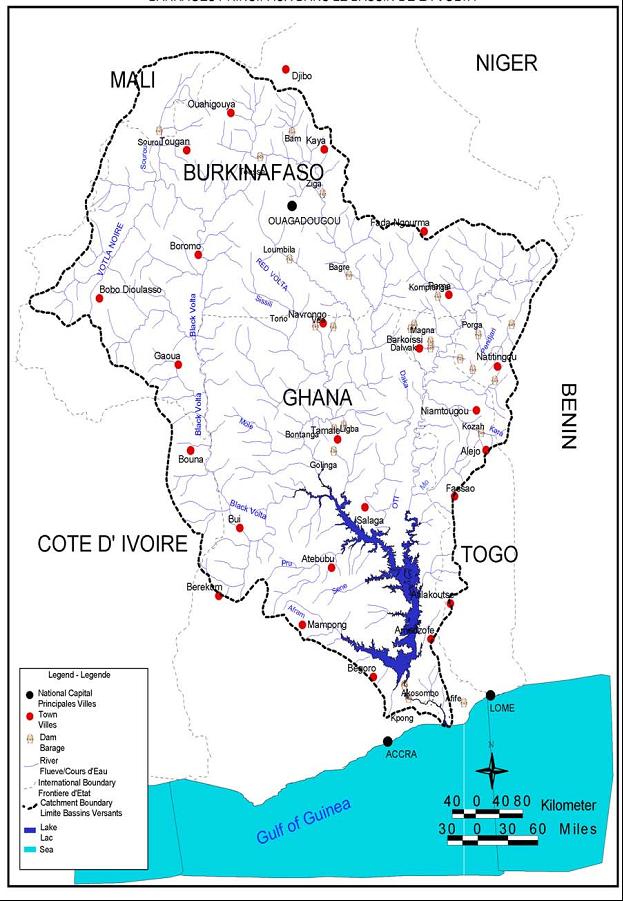
Figure 1 Hydrographical network of the Volta River Basin
GEF-Volta Project: Inception report
7
2. Activities conducted during the inception phase
6. Key achievements of the inception phase are: i-) setting up of administration and implementation
mechanisms and ii-) analysis and updating of the project brief. More specifically:
· Project management and coordination arrangements:
o Project implementation started on November 23rd 2007 when the Regional coordinator was
appointed. The PMU was established on 2nd January 2008 at the premises of the Water Resources
Commission (WRC - Accra Ghana), as part of Ghana's co-financing to the project. The PMU staff
consists of one Regional Coordinator (Mr. Hubert Onibon), one Scientific and Information Officer
(Mr. Olumide Akinsola), and one Administrative Assistant (Mrs. Abigail Sackar) and one Project
Bilingual Secretary (Mrs. Angelika Quaye).
o The Steering Committee for the project has been established and National Focal Points (NFP)
have been nominated by respective Governments (see Annex F)
o Six regional experts have been selected and appointed as members of the Project Task Force (see
Annex F-2)
· Amendment of Project brief (logframe, activities, work plan, budget, etc.) in consultation with
national and regional institutions, other stakeholders and UNEP/DGEF:
o From November 23rd to December 19th 2007, the Regional Coordinator was on mission in Nairobi
to discuss with UNEP and UNOPS, start the review of the project document and discuss
administrative issues
o In January and February 2008, an inception mission was conducted in the riparian countries to
collect additional information, identify collaboration opportunities, present and discuss with
regional and national partners the following (see details in Table 1): i-) the preliminary findings of
the inception phase, ii-) issues relating to the project logframe, work plan, activities, and budget,
iii-) institutional framework and iv-) collaboration opportunities
o Audiences with high level authorities of riparian countries: Minister in charge of Environment,
Water Resources and Forests (Côte d'Ivoire), Honourable Ahizi Aka Daniel, Minister in charge of
Environment (Benin), Honourable Juliette Biaou Koudénoukpo, Minister of Mines, Energy and
Water (Benin), Honourable Sacca Lafia, Minister in charge of Water (Togo), Honourable Damipi
Noukpokou, Minister of Agriculture (Burkina Faso), Honourable Issaka Maiga, Minister of
Environment and Sanitation (Mali), Honourable Aghatam Ag Alhassane and Deputy Minister in
charge of Environment (Togo), Mr Ouro-Djeri Essowê, Executive Director of the Environment
Protection Agency (Ghana),Mr. Allotey Jonathan, Director of Water, Ministry of Water
Resources, Work and Housing (Ghana), Mr. Minta Aboagye.
o The project document has been reviewed and the monitoring and evaluation plan prepared
GEF-Volta Project: Inception report
8
Table 1 - Summary of key meetings of the inception mission
Institution Meeting
objectives/outcomes
i-) clarifications on project specific objectives, expected results and activities, ii-)
updating of project institutional framework, iii-) discussions on VBA role as main
VBA (Burkina Faso)
beneficiary of the project, iv-) discussions on the establishment of mechanism for
ensuring project appropriation by the VBA and national partners (14 to 18 January
2008)
i-) discussions on institutional arrangements and role of ECOWAS/WRCU as co-
ECOWAS/WRCU
funding partner, ii-) review of ECOWAS/WRCU initiatives and identification of
(Burkina Faso)
linkages with project activities - training of national institutions and awareness
raising campaigns/advocacy- (15 January 2008)
review of Volta HYCOS activities and identification of linkages with project
Voltas HYCOS Project activities -hydrometeorological networks and data management, Volta Basin
(Burkina Faso)
Observatory, DP1 and DP3 (15 January 2008)
i-) presentation of GEF Volta project and, ii-) review of UEMOA initiatives and
UEMOA (Burkina Faso)
discussion on possible UEMOA support as new co-funding partner (15 January
2008)
i-) discussions on role of IUCN as co-funding partner and, ii-) review of PAGEV
IUCN/PAGEV (Burkina activities and identification of areas of collaboration -stakeholders' involvement- (15
Faso)
January 2008)
i-) presentation of GEF Volta project, ii-) review of WAWP initiatives and
GWP/WAWP- (Burkina identification of linkages and collaboration opportunities with GEF Volta project at
Faso)
regional and national levels -stakeholders' involvement and communication strategy-
16 January 2008)
i-) presentation of GEF Volta project, ii-) review of IRD Bamako research activities
and identification of linkages and collaboration opportunities with GEF Volta project
IRD (Mali)
-Demonstration Project 1: hydrometric data and networks management, development
of early warning system aiming to mitigate floods impacts, characterization of
hydrological processes, etc.- (25 January 2008)
National Partners (Benin, i-) key findings of the inception phase (review of project document), ii-) institutional
Burkina Faso, Côte
arrangements, iii-) review of the Demo projects submitted by Mali and Burkina
d'Ivoire, Ghana, Mali, Faso, Côte d'Ivoire and Ghana, Togo and Benin, iv-) advocacy for the ratification of
Togo)
Volta Convention (January February 2008)
presentation of GEF-Volta Project and discussions on: institutional arrangements,
link with VBA, additional fund requested, ADB support as co-funding partner, OSS
ADB and OSS (Tunisia)
support for the establishment of the Volta Basin Observatory (27 and 28 March
2008)
i-) collection of additional information on sanitation situation in the City of Kara, ii-)
identification of collaboration opportunity with SIAAP for the implementation of the
SIAAP and UNESCO Demo Project 2, iii-) discussion on UNESCO support for the implementation of
(France)
Demo Project 1 and 2, development of training tools, development of Project on
transboundary aquifer issues (Paris 31 March 2 April 2008)
GEF-Volta Project: Inception report
9
3. Updating of project logframe, activities, work plan and budget
3.1 General considerations
7. The main objective of the project revision is to actualize the project document by taking into
account developments which occurred after the submission of the project to GEF: signature of the
Volta Basin Convention, establishment of the Volta Basin Authority, implementation of
IUCN/PAGEV Project, etc.
8. The proposed amendments described in this document are based on the following general
considerations:
· At Regional level:
o The project rests on two main pillars: i-) support the riparian countries by providing
management tools/instruments (including SAP and APNP-VRB) to address transboundary issues
previously agreed (preliminary TDA) and, ii-) build the capacity of each country to use and
implement these tools/instruments.
o The TDA/SAP process will bring all countries together to reach a common agreement on
transboundary priorities (TDA) and agree on concrete actions and strategies to be implemented
(SAP), in order to better manage the water and related natural resources of the Volta River Basin.
o The SAP and APNP-VRB will be developed in collaboration with the VBA to be integrated into
the VBA work plan
o The TDA/SAP process will provide support and a concrete mechanism for the implementation of
the Convention for the Volta basin (particularly related to transboundary environmental issues).
o The Convention for the Volta basin has been signed by all countries but is yet to enter into force.
The Volta Basin Authority has been established but has as yet no long term strategy. The
convention is focused on water resource issues and the VBA is composed of national water
directorate representatives only
o The project will consist of representatives from both ministry of environment and ministry of
water, thus ensuring that both water resources and environmental issues are addressed in the SAP
and APNP-VRB process.
o The Project will complement, work directly and exchange lessons learned with IUCN and
ECOWAS, French GEF, the Guinea Current Large Marine Ecosystem (GCLME) Project and other
GEF IW Projects.
o Regional/national project database will be established and maintained including all data and
information generated from project activities (TDA, SAP, APNP-VRB, etc.). Key gaps in data will
be identified and national training packages will be developed and implemented.
o The project will support the feasibility study of the regional Volta Basin Observatory as well as
thematic studies on water and related natural resources of the Basin
o Project results/activities will be widely disseminated to stakeholders through publications,
website, newsletter, etc.
o 3 demonstration projects will be executed addressing key transboundary issues and resulting in
measurable stress reduction at the demonstration sites. Lessons learned from the demonstration
projects will be incorporated in the SAP/ APNP-VRB process and a plan for their replication will
be developed and implemented.
· At National level:
o The APNP-VRB will be developed in collaboration with National authorities and VBA, and then
incorporated into national strategies and plans
o To support the incorporation of transboundary elements into national IWRM processes for
harmonisation of the sectoral plans, key inter-sectoral transboundary issues identified will be
discussed with relevant sectors, national IWRM Committees and other stakeholders (industries,
NGOs, decentralised communities, etc.) and a plan for harmonisation will be developed
GEF-Volta Project: Inception report
10
o The project will identify and implement specific training packages (mainly for stakeholders and
technical staff) that address key needs for the successful future implementation of the SAP and
APNP-VRB
o Stakeholders' involvement plan will be developed and implemented to ensure all key
stakeholders' participation in project activities
o The project will identify and implement at the national level specific training packages (i.e. for
technical staff) that address data management and monitoring issues
o The development of six national Demo projects including their funding arrangements
3.2 Project objectives and expected outcomes
9. Project's long-term goal: equitable and sustainable management of water resources and other
connected natural resources in the Volta River Basin and its downstream coastal area.
10. The project's overall objective is to enhance the ability of the riparian countries to plan and
manage the Volta River Basin and its downstream coastal area (including aquatic resources and
ecosystems) on a sustainable basis, by achieving sustainable capacity and establishing regional
institutional frameworks for effective management; developing national and regional priorities;
and effective legal, regulatory and institutional frameworks and management tools as a basis for
action as well as initiating national and regional measures to achieve sustainable ecosystem
management.
11. The broad development objective of this project is to address the perceived major transboundary
problems and issues of the Volta Basin leading to the degradation of the environment as a result of
human activities, by reducing those activities that lead to water scarcity, land and water
degradation , and to integrate environmental concerns with present and future development of the
basin. The broad development objectives are in line with the WWSD recommendations, national
IWRM planning process, and national development and poverty reduction strategies.
12. To achieve the broad development objectives, three major components were proposed in the initial
project document:
· Component 1: Build capacity and create a regional institutional framework for the effective
management of the Volta Basin
· Component 2: Develop regional policy, legal and regulatory frameworks for addressing
transboundary concerns in the Volta Basin and its downstream coastal areas; and
· Component 3: Initiate national and regional measures to combat transboundary environmental
degradation in the Volta Basin
13. Analysis of these major components shows that it is quite difficult to clearly dissociate their
associated objectives, activities, and indicators. In respect to the overall project objective, it is
suggested here to update the project design by considering 3 specific objectives with associated
output, indicators, activities, work plan and budget:
· Specific Objective n° 1: Build capacity, improve knowledge and enhance stakeholders'
involvement to support the effective management of the VRB
· Specific Objective n° 2: Develop river basin legal, regulatory and institutional frameworks and
management instruments for addressing transboundary concerns in the Volta River Basin and its
downstream coastal area
· Specific Objective n° 3: Demonstrate national and regional measures to combat transboundary
environmental degradation in the Volta Basin
14. Based on general considerations highlighted below and Project's overall and specific objectives,
key expected outcomes are presented in Table 2.
15. Expected results per specific objective, objectively verifiable indicators, sources of verification,
assumptions and risks are presented in the updated project logical framework (Annex A).
GEF-Volta Project: Inception report
11
Table 2 Summary of key expected outcomes
Outcomes at Regional level
Outcomes at National level
Final TDA endorsed by the Project Steering committee APNP-VRB finalised and endorsed at country level
SAP endorsed at ministerial level (Water and Key inter-sectoral transboundary issues identified and
Environment Ministers)
plan for sectoral harmonisation developed with relevant
sectors and agreed for inclusion in IWRM process
VBA integrates SAP into its work plan as part of National institutions have the capacity to implement the
mechanism for the implementation of the Volta Basin SAP and APNP-VRB
convention
Ministries of environment and water resources are both Involvement of stakeholder in SAP and APNP-VRB
involved in the preparation and implementation of process and roles detailed in SAP and APNP-VRB
SAP/ APNP-VRB
documents
Project database developed and updated at regional and Institutions have the capacity to manage and monitor data
national levels
in support of the implementation of SAP and APNP-
VRB, and provide coordinated data transfer to VBA
observatory
Feasibility study of the regional Volta Basin Six national replicable demo projects prepared
Observatory completed and approved by the VBA
At least 2 thematic studies carried out on water and
related natural resources of the Volta River Basin
All relevant stakeholders participate in project
activities and have access to project reports,
publications, database, etc.
3 Demo projects executed resulting in stress reduction
and analysed for their replicability
GEF-Volta Project: Inception report
12
3.3 Updated project activities and work plan
16. Required activities and proposed work plan for their implementation are presented in Annex B.
Based on project objectives, outputs, expected outcomes and expected results per specific
objectives, the main set of activities to be conducted during the project implementation are
summarised in Table 3:
Table 3 Summary of main activities per specific objective
Specific objectives
Main activities planned
Specific Objective n° 1: Build · Establish the project management structures at regional and national levels
capacity, improve knowledge,
· Identify linkages and establish cooperation with relevant national and regional
enhance stakeholders' involvement
projects/initiatives, develop and implement collaboration plan
to support the effective management · Identify training gaps and organise at national level, trainings on international
of the VRB
river basins issues for personnel in the key institutions
· Prepare and analyse the stakeholders matrix, develop and implement awareness
raising modules on IRB
· Develop stakeholders' involvement plan
· Inventory and analysis of existing data
· Develop and implement a mechanism for the circulation of the information at
national and regional levels
· Carry out study on the establishment of the Volta basin observatory
· Develop hydrological and coastal hydrodynamic models of the Volta basin and
its Downstream Coastal Area
· Conduct thematic studies on relations between: i-) catchment areas and stream
flow and, ii-) Volta basin and its Downstream Coastal Area, using ICARM
concept
· Develop and update on regular basis project database and website
Specific Objective n° 2: Develop · Gather national and regional documents, data and information and update the
river basin legal, regulatory and situation analysis
institutional frameworks and
· Review, update and complete the transboundary diagnostic analysis document
management instruments for
· Prepare the Strategic Action Programme document including: implementation
addressing transboundary concerns
guideline, monitoring & evaluation system, long term financing strategy
in the Volta River Basin and its · Integrate the SAP into VBA work plan
downstream coastal area
· Prepare the Action Plans for the National Parts of the VRB including:
implementation guidelines, monitoring & evaluation system, long term
financing strategy
· Conduct a sector based assessment on key TDA issues outlining sectoral
actions to be included in the APNP-VRB
· Identify training gaps, develop training package and organise at national level,
trainings on SAP/ APNP-VRB implementation
Specific Objective n° 3: · Review the 3 Demo project (logframe, activities, budget , M&E plan and work
Demonstrate national and regional
plan)
measures to combat transboundary · Implement the Demo project no 1: Joint management by Burkina Faso and
environmental degradation in the Mali of a flow release warning system in the Sourou river valley (tributary of
Volta Basin
Black Volta River or Mouhoun)
· Implement the Demo project no 2: Installing and comparing technological
models of waste water treatment in the Cities of Kara (Togo) and Natitingou
(Benin)
· Implement the Demo project no 3: Restoring and protecting the river beds of
the Black Volta River (Côte d'Ivoire & Ghana) and its tributaries through
participative campaigns of reforestation
· Evaluate the implementation of the 3 Demo projects, document lessons learned
and incorporate them in SAP and APNP-VRB documents
· Develop and incorporate in the SAP document, a plan for the replication of
Demo projects and
· Develop 6 national Demo projects based on TDA/SAP priorities
GEF-Volta Project: Inception report
13
3.4 Updated project budget and co-financing considerations
17. The summary of updated GEF contribution to project budget is presented in Table 4b. A detailed
budget in UNEP format is attached in Annex C. Additional funds are requested to fill the gap
between the initial and updated budget. Co-financing amounts are presented in Table 4a.
Table 4a - Summary of Project co-financing (US$)
Country/Partner
Cash (USD)
In-kind (USD)
Total (USD)
Benin
118 200
300 000
418 200
Burkina Faso
100 000
167 353
267 353
Côte d'Ivoire
183 000
732 000
915 000
Ghana
140 000
550 000
690 000
Mali
214 270
100 000
314 270
Togo
45 456
774 460
819 916
UNEP
60 000
60 000
Hungary
10 000
10 000
Czech Rep.
50 000
50 000
IUCN
620 000
620 000
ECOWAS/EU2
1 962 500
1 962 500
SIAAP3
471 000
471 000
IRD
To be confirmed
Volta HYCOS
To be confirmed
VBA/FEM France
To be confirmed
Total
860 926
5 737 313
6 598 239
2 1,250,000 euros
3 300,000 euros
GEF-Volta Project: Inception report
14
Table 4b - Summary of Project budget per object of expenditure (US$)
BUDGET ALLOCATION BY PROJECT
ALLOCATION BY CALENDAR YEAR **
COMPONENT/ACTIVITY *
UNEP BUDGET LINE/OBJECT OF EXPENDITURE
1
2
3
Total
Year 1
Year 2
Year 3
Year 4
Total
US$ US$ US$ US$ US$ US$ US$ US$ US$
Project personnel component, including consultants,
1
836873 913673 672873
2423418 738020 520181 535373 629844 2423418
Administrative support, Volunteers and travels
Sub-contract component, including MOA, MOU
2
135000 135000 763200
1033200 348030 228390 228390 228390 1033200
and LOA
Training component including workshops,
3
281173 458173 7317
3 812520 139000 301000 9100
0
281520 812520
meetings, conferences
4
Equipment and premises component
26700
22700
22700
72100
50850
10250
5750
5250
72100
Miscellaneous component, including: Operation and
5
maintenance of equip., Reporting costs, Sundry,
162040 259000 189000
610040 8601
0
175010 150010 199010 610040
Evaluation
TOTAL COSTS
1 441 786 1 788 546 1 720 946 4 951 278 1 361 910 1 234 831 1 010 523 1 344 014 4 951 278
Project Execution Costs -UNOPS (8%)
115 343
143 084
137 676
396 102
108 953
98 787
80 842
107 521
396 102
GRAND TOTAL COSTS
1 557 129 1 931 630 1 858 622 5 347 380 1 470 863 1 333 618 1 091 364 1 451 535 5 347 380
GEF-Volta Project: Inception report
15
4. Updated Demo Projects
4.1 Demo Project 1
4.1.1 Demo Project 1: objective and expected outcomes
18. Project's overall objective: prevent/mitigate the risks of flooding in the Sourou catchment
through a joint management system operated by the two riparian countries, Mali and Burkina
Faso. As for the specific objectives and expected outcomes, the following amendments are
suggested:
· Two Specific objectives:
o Specific Objective n° 1: Improve the monitoring of hydrometric data, the characterization of
hydrological processes and the management of Lery dam
o Specific Objective n° 2: Develop a framework convention for the joint management of the Sourou
river valley
· Three expected outcomes:
o Hydrometric and rain gauge networks reinforced and optimized and relevant data collected,
monitored and published on yearly basis
o Tools to mitigate floods impacts and improve Sourou river valley management including Lery
dam, developed and implemented
o Convention for the joint management of the Sourou river valley prepared and signed by the two
countries
4.1.2 Demo Project 1: Expected results per specific objective
· Outputs / Results corresponding to Specific Objective n° 1: Improve the monitoring of
hydrometric data, the characterization of hydrological processes and the management of Lery dam
o Demo project management established, including co-operation mechanisms with national
institutions
o Hydrometric and rain gauge networks of the Sourou river valley reinforced and data management
and publication mechanisms strengthened
o Characterization of hydrological processes and management of the Lery dam improved
· Outputs / Results corresponding to Specific Objective n° 2: Develop a framework convention for
the joint management of the Sourou river valley
o Convention for the joint management of the Sourou river valley developed and signed
o Institutional framework for the implementation of the convention established
4.2 Demo Project 2
4.2.1 Demo Project 2: objective and expected outcomes
19. Project's overall objective: restore the water quality and improve the living and health conditions
of the populations of Kara (Togo) and Natitingou (Benin) through the implementation of
appropriate technology of wastewater treatment
· Two Specific objectives:
o Specific Objective n° 1: Improve knowledge of local administration and other stakeholders on
sanitation issues
o Specific Objective n° 2: Equip the town of Kara with appropriate systems of collection and
treatment plant for wastewater and other effluents and develop similar proposal for the city of
Natitingou
GEF-Volta Project: Inception report
16
· Three expected outcomes:
o Reduction in N, P, BOD, COD etc. and untreated sludge in line with targets4
o Sewage collection increased by at least 50%
o Capacity of local stakeholders and national institutions in charge of sanitation infrastructure
strengthened and population sensitised
4.2.2 Demo Project 2: Expected results per specific objective
· Outputs / Results corresponding to Specific Objective n° 1: Improve knowledge of local
administration and other stakeholders on sanitation issues
o Demo project management established, including co-operation mechanisms with national
institutions and key stakeholders
o Capacity of local stakeholders and national institutions for the promotion of good practices and
behaviour favourable to the protection of water quality and the promotion of human health
strengthened
· Outputs / Results corresponding to Specific Objective n° 2: Equip the town of Kara with
appropriate system of collection and treatment plant for wastewater and other effluents and
develop similar proposal for the city of Natitingou
o Appropriate systems of collection and treatment plants for wastewater and other effluents
produced by inhabitants of Kara in place
o Effects of a better sanitation system on water environment and population monitored
o Proposal for the construction of wastewater treatment plant in the city of Natitingou prepared
o Inhabitants of the two cities are sensitised on sanitation and related health issues
20. Several studies have been conducted on the sanitation situation in the city of Kara, the
construction of wastewater networks and treatment plant. A pilot project funded by SIAAP
(Syndicat Interdépartemental pour l'Assainissement de l'Agglomération de Paris) and aiming to
construct experimental wastewater networks in 2 selected areas is about to start in Kara city. The
main weakness of this project is that sewage will be discharged into the open without treatment.
This is due to the lack of funding for the construction of the treatment plant and also the
construction of the main network connecting the 2 pilot areas to the pond.
21. In the aim to harmonise and optimise their contribution, the Project Management Unit and SIAAP
agree on the following:
· GEF-Volta Project will finance and coordinate the construction of one microphyte lagoon in the
city of Kara
· SIAAP will finance and coordinate the construction of wastewater network in one pilot area and
its connection to the lagoon
· GEF-Volta Project will prepare a methodology for the monitoring of water and wastewater quality
including baseline situation and SIAAP will finance biological and chemical analyses (N, P, BOD,
COD, etc.) accordingly.
22. For the city of Natitingou in Benin, the situation is more complicated: lack of proper situation
analysis, baseline indicators, feasibility study and investment plan. Under these conditions, the
construction of sewage treatment plant will not have good added-value to the restoration of water
quality and the improvement of the living conditions of riparian populations. Based on that, the
GEF-Volta Project will:
· facilitate the preparedness and signature of cooperation agreement between SIAAP and the
4 Statistics (baseline and targets) to be defined during the inception phase of the demonstration project
GEF-Volta Project: Inception report
17
Municipality of Natitingou
· prepare the sanitation monograph of Natitingou
· identify pilot areas and conduct technical/feasibility studies for the construction of wastewater
treatment plant in the city of Natitingou
· prepare detailed proposal for the construction of wastewater treatment plant in the city of
Natitingou and submit the proposal to National partners and UNEP/DGEF for approval
4.3 Demo Project 3
4.3.1 Demo Project 3: objective and expected outcomes
23. Project's overall objective: sustainability of water resources in the Black Volta River basin (Côte
d'Ivoire and Ghana) through participative campaigns of reforestation
· Two Specific objectives:
o Specific Objective n° 1: Reinforce the capacity of stakeholders involved in forest and water
resources issues
o Specific Objective n° 2: Restoration/protection of pilot plots of land through experimental and
demonstrative actions
· Five expected outcomes:
o Sediment yield into selected rivers reduced by 20%
o Water retention in the forest area increased by 25%
o Forest landscapes of the pilot plots targeted by the project are restored and protected
o Surfaces burned by bush fires in selected areas are reduced by 50%
o Capacity of local stakeholder and national institutions in charge of forest and water resources
management strengthened
4.3.2 Demo Project 3: Expected results per specific objective
· Outputs / Results corresponding to Specific Objective n° 1: Reinforce the capacity of stakeholders
involved in forest and water resources issues
o Demo project management established including project monitoring and evaluation plan
o Capacity of national institutions in charge of forest and water resources management strengthened
o Local stakeholders are conscious of forest and water resources issues and involved in their
management/protection
· Outputs / Results corresponding to Specific Objective n° 2: Restoration/protection of pilot plots of
land through experimental and demonstrative actions
o A limited number of hot spots of river beds restored
o The forest landscapes of the pilot plots targeted by the project are restored/protected
o The surfaces burned by bush fires in selected areas are reduced
24. Updated project logframe, activities, work plan and budget of the 3 Demo projects are presented in
Annex D.
25. At the beginning of each Demo project, an inception report will be prepared in collaboration with
key stakeholders (national institutions concerned, decentralised communities, NGOs and if
necessary, Civil Society). It will include baseline situation analysis and detailed project document.
The revised project briefs should include the following sections:
· Background and Justification
· Objectives and expected outcomes
· Activities
· Work plan and Timetable
· Implementation Arrangements
GEF-Volta Project: Inception report
18
· Linkages with ongoing initiatives
· Monitoring and Evaluation Plan
· Financial aspects
· Log-frame (annex)
26. During the implementation of the overall GEF Volta Project, six new national Demo Projects
(including financial plan) will be developed based on TDA/SAP priorities and lessons learned
from the implementation of the 3 Demo projects. The proposals will be prepared in collaboration
with national stakeholders and discussed with UNEP/DGEF as well as regional partners. Project
documents will be prepared following GEF Format and fundraising activities will be conducted
under UNEP/DGEF umbrella.
5. Ongoing/planned initiatives and linkage with the project
27. During this inception phase, ongoing and planned initiatives have been reviewed and linkages
with the GEF Project carried out. Those initiatives are focused on the following activities (see
Table 5):
· Bring the Volta Basin Convention into force and establish the permanent organs of the VBA
· Facilitate a diagnosis of the environmental conditions of the basin in order to develop priority
actions to be implemented for a sustainable management and development of the basin
· Establish a network of national hydrological observing systems that provides coherent quality
information
· Establishment of effective Decision Support System for water and land management
· Contribute to the reduction of poverty, food insecurity and land degradation of the Volta basin
through management of the land and water resources in a sustainable and equitable manner
· Assist Burkina Faso and Ghana to agree on key water management principles and to establish a
framework for collaboration in the management of their shared water resources in the Volta basin.
· Strengthen the relationship between with National Focal Points and VBA.
28. In that regard, links have been established with the following UNEP/GEF Volta Project outputs:
· Appropriation of TDA , SAP and associated documents by VBA
· Establishment of project database and VBA Observatory
· Development and application of hydrological and hydrodynamic models
· Training of national staff and awareness creation
· Implementation of three Demo projects
· Stakeholders' involvement
29. Negotiations are ongoing between VBA, UNEP/GEF and the implementing/executing agencies of
those projects in the aim to establish cooperation/collaboration agreement. Most of those projects
were initially supposed to be part of the UNEP/GEF project and donors considered as co-funding
partners of GEF initiative. Indeed, due to the fact that the GEF project has been delayed for about
four years, the co-funding agencies have decided to implement directly with the VBA some
activities that were supposed to be co-funded in the initial GEF Project.
GEF-Volta Project: Inception report
19
Table 5 - Overview of Ongoing/planned initiatives and linkage with the project
Donor/Implementing
Project Title
Objective
Status
Link with GEF Project
agency
Consolidation of institutional ·
Bring the Volta Basin
· VBA Convention signed by the · Appropriation of TDA , SAP and SIDA/IUCN and
arrangements
Convention into force
riparian countries
associated documents
ECOWAS/WRCU
· Establish the permanent organs of · Convention ratified by two
the VBA
countries out of six: Burkina Faso
· Appoint permanent staff for the
and Mali
VBA
Establishment of Volta Basin · Facilitate a diagnosis of the · A Financial Agreement was · Establishment of project database French GEF,
observatory for water and environmental conditions of the
signed between AFD and VBA · Development and application of SIDA/IUCN
associated environmental
basin in order to develop priority
and the project was expected to
hydrological and hydrodynamic
resources
actions to be implemented for a
start in January 2008.
models
sustainable management and · the starting is delayed due to the · Thematic studies
development of the basin
fact that VBA convention is not
in force
EU Water initiative
· Contribute to the reduction of · Project should have started in · Capacity building (Training )
EU/ ECOWAS/WRCU
poverty, food insecurity and land
January 2008 but delayed as · Establishment of project database
degradation of the Volta basin
process of selection of consultant · Development of hydrological and
through management of the water
is still in progress.
hydrodynamic model
resources in a sustainable and
· Capacity building
equitable manner.
Volta HYCOS
· Establish a network of national · The project has collected some · Establishment of project database ADB, WMO
hydrological observing systems
historic data and provided · Development and application of
that provides coherent quality
training to countries on hydrological and hydrodynamic
information
equipment use and data handling.
models
· Data collection by the countries is · Thematic studies
yet to start
· Implementation of demo projects
· Capacity building (Training )
IUCN/PAGEV
· Assist Burkina Faso and Ghana to · IUCN/PAGEV signed a
· Stakeholders' involvement
SIDA/IUCN
agree on key water management
cooperation agreement with VBA · Establishment of project database
principles and to establish a in January 2007 and has · Development of legal, regulatory
framework for collaboration in
supported the Authority in its
and institutional framework
the management of their shared
basic operational activities.
water resources in the Volta
basin.
GLOWA Volta Project
· Establishment of a scientifically · The GLOWA Volta Project · Establishment of project database Germany
sound Decision Support System
(GVP) signed a MoU with the · Thematic studies
for water and land management
VBA in March 2007.
GEF-Volta Project: Inception report
20
Donor/Implementing
Project Title
Objective
Status
Link with GEF Project
agency
Awareness creation and
· Expanding partnership,
· Ongoing. Following preliminary · Stakeholders' involvement
GTZ, SIDA/IUCN,
involvement of stakeholders relationships and arrangements;
talks with GTZ, a consultant will · Capacity building (Training )
ECOWAS/WRCU
(Submitted to GTZ)
· Collaborating with National Focal
be recruited to assess proposed
Points to increase awareness of
project
VBA and its activities.
CGIAR Challenge Program on · Contribute more effectively to the · Last year of phase 1 (5years). · Establishment of project database World Bank and
Water and Food. Volta basin
delivery of development Second (2009-2013) approved.
· Capacity building (Training )
Developed Countries
Coordination (including BFP-
outcomes (through partnerships
· Thematic studies
Volta project)
with development institutions
· Stakeholders' involvement
such as policymakers and NGOs)
· Development and application of
· Produce more relevant and
hydrological and hydrodynamic
targeted scientific outputs for
models
development
· Foster a more effective and
integrated process of
collaboration in research
GEF-Volta Project: Inception report
21
6. Institutional arrangements
30. The institutional framework proposed for the project implementation is simple and in line with the
context of the Volta River Basin and within key principles of sustainable management of natural
resources. Main components of the proposed institutional framework are (see organogram in
Figure 2):
· VBA and VBA Council of Ministers which will be extended to include the Ministers in charge of
Environment
· Project Implementing Agency: UNEP/DGEF
· Project Executing Agency: UNOPS, UCC
· Project Steering Committee (PSC)
· Project Management Unit (PMU)
· Project Task Force (PTF)
· National Focal Points (NFP)
· National Implementation committees (NIC).
6.1 Implementing agency
31. As implementing Agency, UNEP/DGEF will be responsible for overall project oversight
supervision to ensure consistency with GEF and UNEP policies and procedures, and will provide
guidance on linkages with related UNEP and GEF funded activities. UNEP also has a
responsibility for regular liaison with Executing Agency on substantive and administrative
matters, and for participating in meetings and workshops as appropriate.
32. UNEP/DGEF will provide assistance and advice to the Executing Agency on project management
(e.g. revisions of work plan and budgets) and policy guidance in relation to GEF procedures,
requirements and schedules.
33. UNEP/DGEF will be responsible for clearance and transmission of financial and progress reports
to the Global Environment Facility.
34. UNEP/DGEF will be responsible for review and approval of all the substantive reports produced
in accordance with the schedule of work.
6.2 Executing Agency
35. The United Nations Office for Project Services (UNOPS) will serve as the Executing Agency for
the project to ensure execution of administrative and financial matters. As Executing Agency
UNOPS will have administrative responsibility for the management and the financial
administration of the GEF funds.
36. The UNOPS services can be summarized as follows:
· Recruitment and management of international and local project staff (PMU staff).
· Financial Control and management of project budget and expenditures
· Timely production of financial and progress reports to UNEP/DGEF
· Management of sub-contracts
· Arrangement of training component
· Procurement of equipment
· Periodic reporting to UNEP/DGEF as required
37. The UNOPS staffed Project Management Unit (PMU) will be responsible for monitoring and
reporting of co-financing and any cash or in-kind contributions. The PMU will explore
opportunities for involving the World Bank (WB) and/or the African Development Bank, African
Water Facility and potential investment opportunities will be explored during project
GEF-Volta Project: Inception report
22
implementation to have a partner for follow up investments for on-the-ground activities.
38. UNEP Collaborating Centre on Water and Environment (UCC-Water and Environment) will assist
the PMU in key technical and scientific issues.
39. UNEP Collaborating Centre on Water (UCC Water) will be contracted by UNOPS to facilitate
a smooth and timely execution of the project by drawing upon the experience of the Centre related
to project preparation and implementation from similar projects in the region as well as gaining
access to the network of specialists associated to the Centre.
40. UCC Water and Environment will support and work through the Project Management Unit
(PMU). The assistance of the Centre will address technical and scientific aspects of the project (if
requested) and support the Project Management Unit (PMU). Further, the Collaborating Centre
will identify and propose short-term inputs on specific technical subjects.
6.3 Project steering committee
41. A Project Steering Committee (PSC) is to be established to guide the overall project process. The
Steering Committee will be composed of:
· Two National Institutional Focal Points (NIFP) per country who are nominated by the responsible
ministries in each participating country for this GEF Project:
o One representative of the ministry in charge of environment
o One representative of the ministry in charge of water resources and preferably the VBA national
focal point
· The Executive Director of VBA or his representative
· Representatives from the Implementing agency (UNEP/GEF) and the executing agency, (UNOPS)
and UCC-Water and Environment
42. Representatives from GCLME, GEF Niger Project, UNESCO/PHI, ECOWAS/WRCU and IUCN,
regional or local NGOs and the private sector will be invited as observers at the PSC Meetings
when necessary.
43. The Regional Project Coordinator will serve as the Secretary to the Steering Committee.
44. The PSC will be chaired by a national representative on a rotational basis. The PSC will meet
annually to monitor past progress in project execution, and to review and approve annual work
plans and budgets.
45. The mandate of the PSC will include among others the following:
· review and approve annual rolling work plans and budgets, and provide strategic direction on the
work plan,
· discuss and endorse management reports: inception report, progress reports, annual reports,
completion report and other important reports,
· review and approve the TDA and SAP documents.
46. The steering committee shall develop its own internal rules and procedures in the performance of
its activities
6.4 Project Management Unit (PMU)
47. A Project Management Unit (PMU) headed by a Regional Project Coordinator on UNOPS
contract has been established. The Regional Project Coordinator is assisted by 3 full-time key staff
on UNOPS contract and composed of:
· One Science and Information Officer with direct responsibility for information collection,
exchange and networking between a wide range of participants in the Volta River basin project
including government officials, scientists, non-governmental organizations and the public at large.
· One Administrative Assistant who will manage the day-to-day operations of the PMU, particularly
with respect to finances, technical services, procurement and personnel matters (in close
GEF-Volta Project: Inception report
23
cooperation with the counterpart staff of UNOPS Nairobi).
· One Bilingual Secretary who will have responsibility for a variety of tasks essential to maintaining
the efficient operation of the PMU. These include communications tasks, administrative functions,
assisting with travel arrangements, meetings preparation and general secretarial duties.
48. In accordance with the project document endorsed by the six riparian countries and approved by
GEF, the PMU is hosted by the Government of Ghana as part of its contribution to the project.
According to the project document, the PMU is independent of the host country. It will work
closely with VBA and ECOWAS/WRCU as well as national partners to help develop capacity.
49. The PMU will be responsible for the overall implementation of the project including stakeholder
outreach, overseeing and assisting the National Focal Points and National Implementation
Committees (NIC) and managing international consultants and contractors.
6.5 Project Task Force (PTF)
50. In addition to the PMU staff, a Task Force is being established to support the PMU on technical
issues such as (the detailed TOR of the Task Force is presented in Annex H):
· Preparing of TDA, SAP, APNP-VRB and associated documents
· Review of consultancies TOR and reports
· Review of training and awareness raising campaigns modules
· Provide technical and scientific advice
51. The Task Force will be a group of 6 experts having strong experiences in the fields of:
· Water resources management
· Forestry/Biodiversity
· Environment
· Land management and desertification
· Agronomy and Economy
· Sociology and participatory approaches
6.6 National Project bodies: NFP and NIC
52. At national level, the institutional framework proposed is as follows:
· National Focal Point (NFP)
· National Implementation committee (NIC)
53. The National Focal Point (NFP) is in charge of the project implementation at country level. One
of the two National Institutional Focal Points will be nominated by the country as National
Project Coordinator.
54. In addition to the 2nd National Institutional Focal Point, the National Project Coordinator will be
assisted by one National Operational Focal Point (NOFP) who will be a full-time staff
appointed by the country. In each participating country, the NOFP will support the National
Project Coordinator to manage on a day-to-day basis the proposed activities at the country level
(see TOR in Annex G)
55. A National Implementation Committee (NIC) chaired by the National Project Coordinator will
also be established to guide project implementation at the national level and ensure intersectoral
coordination as a step towards sustainability. Through the establishment of intersectoral dialogue,
it is anticipated that wide involvement of many national/regional educational, research,
governmental and non-governmental agencies and organizations, and other stakeholders will be
assured. This will result in high-level government acceptance of the outcomes of the preparatory
activities and hence approval of the APNP-VRB.
GEF-Volta Project: Inception report
24
6.7 Status and role of the VBA
56. Since one of the key objectives of the project is to support the VBA to develop and implement
management tools at the basin level, the VBA will be involved at each step of the project
implementation. The VBA will:
· function as policy guidance body and provide strategic orientation for the Project
· provide guidance to the PMU on issues pertaining to the VBA mandate and linkages with other
ongoing and planned projects and programs in the basin
· facilitate project coordination and ensure that project activities meet global, regional and national
water and associated resources concerns and priorities
· support the process of endorsement of all key project documents, particularly the SAP and APNP-
VRB.
· facilitate the linkage between the project and VBA Council of Ministers extended to the Ministers
in charge of Environment.
6.8 Role of other stakeholders and partners
57. The development of stakeholders' involvement plan is one of the main activities planned for the
first 2 quarters of the project implementation. Nevertheless, one can notice that the PMU will
work in collaboration and receive support from the following partners:
· IUCN: training of national partners on international river basins management, awareness raising
campaigns and stakeholders' involvement plan, training of national partners on TDA/SAP process
· ECOWAS: data management and capacity building of national partners
· UNESCO: development of training tools, development of hydrological and coastal hydrodynamic
models and associated thematic studies, scientific support for the implementation of Demo
projects, development of project document (PDF-A) on transboundary aquifers management
· GEF-Niger Project, GEF-Senegal Project and GCLME: capacity building, establishment of Volta
Basin Observatory, sector based assessment on key TDA issues and outlining sectoral actions to
be included in the APNP-VRB
· Volta HYCOS: Installation/rehabilitation of hydrometric and rain gauge stations, management of
hydrometric and precipitation data, establishment of Volta Basin Observatory
· SIAAP: implementation of Demo project 2.
GEF-Volta Project: Inception report
25
Ministries of Env.
Ministries of Water
PROJECT STEERING COMMITTEE
VBA
NFP
NFP
NFP
NFP
UNEP/GEF
NFP
NFP
BENIN
TOGO
GHANA
RCI
BF
MALI
PMU
UNOPS
NIC
NIC
NIC
NIC
NIC
NIC
BENIN
TOGO
GHANA
RCI
BF
MALI
UCC
PTF
Other
DP2
DP2
DP3
DP3
DP1
DP1
Projects
BENIN
TOGO
GHANA
RCI
BF
MALI
Regional
Reporting/Guideline
National
Communication
Sub-national
Figure 2 - General organizational flow chart of the overall project
GEF-Volta Project: Inception report
26
7. Project Monitoring and Evaluation Plan
58. The Monitoring & Evaluation plan for the full project needs considerable attention, and
appropriate baselines and indicators need therefore to be developed.
59. In accordance with UNEP/GEF rules and standards, and based on the verifiable indicators
identified in the logical framework, a detailed project monitoring and evaluation plan has been
drafted. It's focused on the following points (see Annex E for details):
· Monitoring Responsibilities and Events
· Project Monitoring Reporting
· Independent evaluation
· Key process, stress and environmental indicators
GEF-Volta Project: Inception report
27
8. Annexes
GEF-Volta Project: Inception report
28
Annexe A: Revised Project Log-Frame
8.1 Annexe A: Revised Project Log-Frame
Intervention Logic
Objectively verifiable indicators
Sources of
Assumptions and risks
Observations
verification
Long-term objective (new
· Increased access to water
· In line with MDGs and WSSD Targets and with the
formulation):
· Reduced land base pollution
aspirations of the riparian countries and ECOWAS
Equitable and sustainable
· Reduced land degradation
management of water resources · Reduced ecosystems degradation
and other connected natural · Reduced loss of biodiversity
resources in the Volta River Basin
and its downstream coastal area
Project's overall objective:
Regional level:
Enhance the ability of the riparian · Final TDA endorsed by the Project Steering · TDA published and · Riparian countr
·
ies or RBO The aim of the project is to support the countries
countries to plan and manage the Committee by end of year 2
broadly
failing to participate fully and by providing management tools/instruments
Volta River Basin and its
disseminated
actively to ensure project (including SAP and APNP-VRB) to address
downstream coastal area
(including aquatic resources and
· Workshop reports
success.
transboundary issues previously agreed
· RBO and Countries will have (preliminary TDA) and to build the capacity of each
ecosystems) on a sustainable ·
Final SAP endorsed at ministerial level · SAP endorsement the ability to implement country to use and implement these
basis, by achieving sustainable (Water and Environment Ministers) by end letters
management plans and
tools/instrum
ents
capacity and establishing a of year 4
· SAP published and
regional institutional frameworks
realize strategies.
broadly
· The TDA/SAP process will bring all countries
for effective management;
· Adequate funding for plans
disseminated
together to reach common agreement on
developing national and regional
and strategies.
· PMU, Task force
transboundary priorities (TDA) and agree on
priorities; and effective legal,
and PSC meeting
concrete actions and strategies to be implemented
regulatory and institutional
reports
(SAP), in order to commonly manage the water
frameworks and management
and related natural resources of the Volta River
tools as a basis for action as well
Basin
as initiating national and regional
measures to achieve sustainable · VBA adopt SAP into their work plan as · VBA and PMU
· The SAP and APNP-VRB will be developed in
ecosystem management
mechanism for the implementation of the reports
collaboration with the VBA and assuming their long
convention by end of year 4
term continuity will be incorporated into the VBA
work plan
· The TDA/SAP process will provide support and a
concrete mechanism for the implementation of the
Convention for the Volta basin (particularly related
to transboundary environmental issues)
GEF-Volta Project: Inception report
29
Annexe A: Revised Project Log-Frame
Intervention Logic
Objectively verifiable indicators
Sources of
Assumptions and risks
Observations
verification
·
Ministries of environment and water
·
Acts of PSC ·
Willingness of national
· The Convention for the Volta basin has been
resources are both represented in the members
governments to integrate signed by all countries but has not entered into
Project Steering Committee by year 1
nomination
both water resources and force. The Volta Basin Authority has been
· Minutes of PSC
environmental issues in the established but has no long term strategy or work
meetings
SAP and APNP-VRB
plan yet. The convention is focused on water
· PMU reports
process
resource issues and the VBA is composed of
national water directorate representatives only
· The project will consist of representatives from
both ministry of environment and ministry of water,
thus ensuring that both water resources and
environmental issues are addressed in the SAP
and APNP-VRB process
· Project database developed by year 1 and · Project database
· Willingness
of
riparian ·
Regional/national project database will be
updated at regional and national levels
countries to share national established and maintained including all data and
data
information generated from project activities (TDA,
SAP, APNP-VRB, etc.). Key gaps in data will be
identified and national trainings packages will be
developed and implemented.
· Feasibility study of the regional Volta Basin · Project and VBA ·
Willingness of VBA to
· The project will support the feasibility study of the
Observatory completed and approved by reports
establish the observatory of regional Volta Basin Observatory as well as
the VBA by end of year 3
the basin
thematic studies on water and related natural
resources of the Basin
· At least 2 thematic studies carried out on · Technical
and · Lack or difficult access to
water and related natural resources of the thematic reports
reliable data and information
Volta River Basin by year 3
· PMU reports
·
All relevant stakeholders participate in · Project
website, ·
Project capacity to
·
Project results/activities will be widely
project activities and have access to project publications and adequately support the disseminated to stakeholders through publications,
reports, publications, database, etc.
reports
needed national and regional website, newsletter, etc.
coordination and
communication frameworks
GEF-Volta Project: Inception report
30
Annexe A: Revised Project Log-Frame
Intervention Logic
Objectively verifiable indicators
Sources of
Assumptions and risks
Observations
verification
· 3 Demo projects executed resulting in · PMU, NFP, NIC, · Demo projects sites selected · 3 Demo projects will be executed addressing key
stress reduction (see demo logframe) and and Task Force through criteria that
transboundary issues and resulting in measurable
analysed for their replicability by year 4
reports
maximises clear
stress reduction at the demonstration sites.
· SAP/APNP-VRB
understanding of
Lessons learned from the Demo project will be
documents
transboundary land and incorporated in the SAP/APNP-VRB process and a
water degradation problems
plan for the replication will be developed and
·
Willingness of key
implem
ented.
stakeholders to participate in
Demo projects
National level:
·
APNP-VRB finalised and endorsed at · APNP-VRB
· Riparian countr
·
ies or RBO The APNP-VRB will be developed in collaboration
country level by end of year 4
published and
failing to participate fully and with National authorities and VBA to be
broadly
actively to ensure project incorporated into nationals strategies and plans
disseminated
success.
· PMU, Task Force, · RBO and Countries will have
NFP and NIC the ability to implement
reports
management plans and
· Minutes
of realize strategies.
meetings
· Adequate funding for plans
and strategies.
· Key inter-sectoral transboundary issues · PMU, Task Force,
·
To ensure transboundary elements are
identified and plan for sectoral
NFP and NIC
incorporated into the national IWRM process for
harmonisation developed with relevant reports
harmonisation of the sectoral plans, key inter-
sectors and agreed for inclusion in IWRM · Minutes
of
sectoral transboundary issues identified will be
process by year 4
meetings
discussed with relevant sectors, IWRM team and
· National
IWRM
other stakeholders (industries, NGOs,
reports
decentralised communities, etc.) and a plan for
harmonisation will be agreed
· National institutions have the capacity to · PMU, Task Force, ·
Willingness of national
· The project will identify and implement specific
implement the SAP and APNP-VRB
NFP and NIC authorities to have the ability training packages at the national level (mainly for
reports
to implement management stakeholders and technical staff) that address key
· Training packages
plans and strategies.
needs for the successful future implementation of
· Training reports
the SAP and APNP-VRB
GEF-Volta Project: Inception report
31
Annexe A: Revised Project Log-Frame
Intervention Logic
Objectively verifiable indicators
Sources of
Assumptions and risks
Observations
verification
· Involvement of stakeholders in SAP and ·
PMU, NFP, NIC ·
Willingness of key
· Stakeholders' involvement plan will be developed
APNP-VRB process and roles detailed in and Task Force
stakeholders to participate in and implemented ensuring all key stakeholders'
SAP and APNP-VRB documents
reports
Demo projects
participation in project activities
· Stakeholder
groups
· Institutions have the capacity to manage · PMU, Task force , · Willingness
of
national · The project will identify and implement specific
and monitor data in support of the NFP and NIC institutions to improve their training packages at the national and regional level
implementation of SAP and APNP-VRB, reports
data management and (i.e. technical staff) that address data management
and provide coordinated data transfer to · Training
monitoring capacities
and monitoring issues
VBA observatory
packages/reports
· Six national Demo projects including their · PMU, Task force , · Capacity of riparian countries · The project will support the development of six
funding arrangements developed by year 4
NFP and NIC to prepare suitable project national Demo projects including their funding
reports
document
arrangements
· Projects briefs
GEF-Volta Project: Inception report
32
Annexe A: Revised Project Log-Frame
Outputs / Results corresponding to Objective n° 1: Build capacity, improve knowledge, enhance stakeholders' involvement to support the effective
management of the VRB
Intervention Logic
Objectively verifiable
Sources of
Assumptions and risks
Observations
indicators
verification
Project management
· Executing agencies · Riparian countries failing ·
To avoid confusion with existing
1.1 Project management and co- bodies established and reports
to participate fully and RCU (mainly the ECOWAS one), it's
ordination established, including functional by year 1:
· Contracts signed by actively to ensure project suggested here to replace project
project monitoring and evaluation · Project Management Unit
personnel
success.
RCU by PMU
plan and co-operation · Pro
ject Task Force
· Acts of nomination
· GEF funds not adequately
mechanisms with other relevant · National Focal Points
· PMU reports
complemented by other
projects/initiatives
· Project Steering Committee · Minutes of meetings
donors and by country
(Ministries of environment · Other
documents commitments
and water resources are produced by the
· Clear line of responsibility
both represented in the project
will ensure project
PSC)
implementation
· National
Implementation
·
Willingness to commit
Committees (key ministries
physical space and other
and other stakeholders are
resources by host nation
represented)
for PMU
· Willingness of national
·
LOUs on project
· Signed LOUs
governments to provide
implementation signed with
space for NIC activities
riparian countries by year 1
·
Project monitoring &
· Monitoring
& ·
Project capacity to
evaluation plan finalised, Evaluation plan
adequately develop and
including projects indicators
implement the M&E plan
(process + stress reduction)
by year 1
·
Project M & E plan
· Monitoring
&
implemented and indicators Evaluation reports
monitored
·
Analysis of all relevant · Projects report
·
Project capacity to
national and regional
· Minutes of meetings
adequately support the
projects and initiatives
needed national and
conducted and
regional coordination and
collaboration plan
communication
developed by year 1
frameworks
GEF-Volta Project: Inception report
33
Annexe A: Revised Project Log-Frame
Outputs / Results corresponding to Objective n° 1: Build capacity, improve knowledge, enhance stakeholders' involvement to support the effective
management of the VRB
Intervention Logic
Objectively verifiable
Sources of
Assumptions and risks
Observations
indicators
verification
· Linkages and cooperation · Minutes of meetings
established with GCLME · Workshops reports
and other GEF IAs by year · Progress reports
1
· Joint documents or
·
reports
Linkages and cooperation
established with other
Sahel basin projects and
other complementary
projects in the region by
year 1
1.2
Enhanced capacity fo · Tra
r ining needs of national · PMU, NFP, NIC and · Countries
and
key
sustainable international basin institutions for IRB
Task Force reports
stakeholders not willing to
management including
managem
ent identified and
participate fully in training
education, training, institutional training plan developed by
and awareness
development
year 2
campaigns
·
Project capacity to
·
Number of replicable
· Course
module adequately develop and
modules, public awareness documents and
implement the needed
material and other training training materials
national and regional
material relevant to train on · Public
awareness training tools
IRB management
material
developed and
disseminated by year 2
· Number of country-based · Workshops
and
workshops on IRB
training sessions
management organized by reports
year 3
· Categories and number of · Workshops
and
staff trained in the key training sessions
institutions by year 3
reports
1.3 Stakeholders fully involved
· Stakeholders' involvement · Involvement Plan
·
Willingness of key
plan developed by year ·
PMU, Task Force, stakeholders to participate
GEF-Volta Project: Inception report
34
Annexe A: Revised Project Log-Frame
Outputs / Results corresponding to Objective n° 1: Build capacity, improve knowledge, enhance stakeholders' involvement to support the effective
management of the VRB
Intervention Logic
Objectively verifiable
Sources of
Assumptions and risks
Observations
indicators
verification
1and implemented
NIC, and NFP report
in project activities
· Willingness of national
· Training
gaps
for · PMU, NFP, NIC and authorities to
stakeholders' involvement
Task Force reports
institutionalize the
in the project activities · Training packages
participation of
(mainly TDA, SAP and ·
stakeholders
Training reports
APNP-VRB process)
identified and national level
training plan developed and
implemented
· Number and categories of · PMU, NFP, NIC and
stakeholders involved in the
Task Force reports
TDA, SAP, APNP-VRB and · Local
stakeholder
other project activities
groups
1.4 Basin wide networking, data · Avail
able
data
and · PMU, NFP and NIC ·
Project capacity to
production and informat
in
ion formation at country level reports and other adequately support the
exchange strategy and
inv
entoried and analyzed technical reports
needed national and
mechanisms developed,
and ga
ps identified by year
regional coordination and
including: (i) thematic studies; (ii) 2
communication
project database and website
frameworks
established and functioning, and,
· Reliability of data.
(iii) hydrological and coastal
· Willingness of national
hydrodynamics models
authorities to share
developed.
national data and
information
·
Training gaps for data · PMU, Task force , · Willingness of national
management and
NFP and NIC reports
institutions their data
monitoring identified by
· Training packages
management and
year 2 and national level · Training reports
monitoring capacities
training packages
developed and
implemented by year 2
GEF-Volta Project: Inception report
35
Annexe A: Revised Project Log-Frame
Outputs / Results corresponding to Objective n° 1: Build capacity, improve knowledge, enhance stakeholders' involvement to support the effective
management of the VRB
Intervention Logic
Objectively verifiable
Sources of
Assumptions and risks
Observations
indicators
verification
· Project
database · Project database
· Reliability of data.
developed by year 1 and
· Willingness of national
updated at regional and
authorities to share
national levels
national data and
information
· Relevant
data
and · PMU, Task force , · Reliability of data.
information collected and NFP and NIC reports · Willingness of national
monitored in all countries ·
TDA, SAP and authorities to share
and included in TDA, SAP APNP-VRB
national data and
and APNP-VRB process
documents
information
· Hydrological and coastal · Technical reports
· Lack or difficult access to
hydrodynamic models
· PMU reports
reliable data to run
developed by year 3 and
developed models
operational
· At least 2 thematic studies · Technical
and · Lack or difficult access to
carried out on water and thematic reports
reliable data and
related natural resources of · PMU reports
information
the Volta River Basin based
on identified gaps (by year
3)
·
Feasibility study of the ·
Project and RBO
regional Volta Basin
reports
Observatory completed and
approved by the VBA by
end of year 3
· Project website developed · Project website
·
Project capacity to
by year 1 and maintained
develop and maintain
website
GEF-Volta Project: Inception report
36
Annexe A: Revised Project Log-Frame
Outputs / Results corresponding to Objective n° 2: Develop river basin legal, regulatory and institutional frameworks, and management instruments for addressing
transboundary concerns in the Volta River Basin and its downstream coastal area
Intervention Logic
Objectively verifiable indicators
Sources of
Assumptions and risks
Observations
verification
2.1
Management tools provided
· VBA and Volta Basin Technical · VBA work plan and ·
Willingness of national ·
An Volta Basin Technical
through project activities to the
Committee established,
reports
authorities to establish a Committee (VBTC) is already
regional coordination mechanism operational with concrete work · SAP/APNP-VRB
regional coordination
established by the six riparian
(Volta Basin Authority)
plan developed incorporating SAP
documents and
mechanism for the
countries (July 2004)
and APNP-VRB
other project reports
sustainable management
of the Volta River Basin.
2.2 Convention for the sustainable · Project meetings at Ministerial ·
Project and RBO ·
At least four countries · Convention developed and signed
management of the Volta River
level advocate importance of reports
among six have to ratify by the six countries on 19 January
Basin ratified and entered in force
ratifying the convention
· Minutes of meetings
the convention before it 2007
·
Convention ratified by RBO · Ratified document
enters in force
· The convention has been ratified by
riparian countries
·
Willingness of national 2 countries (Burkina Faso and Mali)
authorities to establish a
regional coordination
mechanism for the
sustainable management
of the Volta River Basin
2.3 Transboundary Diagnostic Analysis · Final TDA approved by the project · TDA published and · Riparian countries or RBO
(TDA) updated and completed
Steering committee by end of year broadly disseminated
failing to participate fully
2
· Workshop reports
and actively to ensure
project success.
2.4 Strategic Action Programme (SAP) · SAP available and approved by the · SAP published
· RBO and Countries will
for the integrated management of the
Steering Committee by end of year · PMU, Task force and have the ability to
Volta River Basin developed with 4.
PSC meeting reports
implement management
concrete investments identified to ·
Financing strategies for SAP
· PMU, Task Force and plans and realiz
e
address priority transboundary implementation and beyond SAP NIC reports
strategies.
problems
lifespan developed by year 4
·
Adequate funding for
plans and strategies.
· Final SAP endorsed at ministerial · PMU, Task force and ·
Project capacity to
level (Water and Environment Ministerial meeting adequately support the
Ministers) by end of year 4
reports
needed national and
GEF-Volta Project: Inception report
37
Annexe A: Revised Project Log-Frame
Outputs / Results corresponding to Objective n° 2: Develop river basin legal, regulatory and institutional frameworks, and management instruments for addressing
transboundary concerns in the Volta River Basin and its downstream coastal area
Intervention Logic
Objectively verifiable indicators
Sources of
Assumptions and risks
Observations
verification
· VBA adopt SAP into their work plan ·
VBA and PMU regional coordination and
as mechanism for the
reports
communication
implementation of the convention
frameworks
by end of year 4
· Participating
countries
and stakeholders will
· Set of relevant indicators including · PMU and Task Force
·
The project will support the
appreciate the benefits of
monitoring plan based on EQSs reports
establishment of the RBO
EQSs, EQOs and basin
defined and approved at regional · Thematic reports
observatory through the
development indicators
and national levels by year 4
· Minutes of meetings
development of Regionally accepted
· Political will of riparian indicators and monitoring process
countries to continue to
2.5 Action Plans for the National Parts of · APNP-VRB finalised and endorsed · APNP-VRB published enforce EQOs
the VRB (APNP-VRB) to restore and at country level by end of year 4
and broadly
·
Willingness of national
maintain the ecological integrity of
disseminated
authorities to integrate
the national part of the basin
transboundary
· Financing strategies for APNP-VRB · PMU, Task Force and environmental concerns
developed
implementation and beyond APNP-
NIC reports
into the IWRM and
VRB lifespan developed
sectoral plans
· APNP-VRB developed in line with ·
PMU, Task Force,
·
The APNP-VRB process will
IWRM process
NFP and NIC reports
facilitate the integration of
· Minutes of meetings
transboundary environmental
· National
IWRM
concerns considered into the IWRM
reports
and sectoral plans at national level
2.6 Measure in place to harmonise the · Sector based assessment on key ·
PMU, Task Force, · Willingness of national
sectoral plans at national level with TDA issues and outlining sectoral
NFP and NIC reports
authorities to integrate
the SAP/APNP-VRB
actions to be included in the APNP- · Minutes of meetings
transboundary
VRB completed by year 3
· National
IWRM environmental concerns
reports
into the IWRM and
sectoral plans
2.7 Enhanced capacity of governments · Training needs for SAP and APNP- ·
PMU, Task Force, ·
Willingness of national
to implement policies and strategies VRB implementation identified and NFP and NIC reports
authorities to have
that address SAP/APNP-VRB national level training packages · Training packages
adequate capacities to
priorities
developed and implemented by · Training reports
implement management
year 4
plans and strategies.
GEF-Volta Project: Inception report
38
Annexe A: Revised Project Log-Frame
Outputs / Results corresponding to Objective n° 3: Demonstrate national and regional measures to combat transboundary environmental degradation in
the Volta Basin
Intervention Logic
Objectively verifiable
Sources of verification
Assumptions and risks
Observations
indicators
3.1 Three Demo project successfully · MOUs on Demo projects · Signed MOUs
·
Demo projects sites
·
An inception period is
implemented
implementation signed with
selected through criteria recommended for each demo
riparian countries by year 1
that maximises clear project.
understanding of land
· During the inception phase, each
water degradation
demo project will be reviewed
· Three
Demo
projects · PMU, NFP, NIC, and problems
(logframe, activities, budget , M&E
executed resulting in stress Task Force reports
·
Willingness of key
pla
n and work plan)
reduction (see demo
stakeholders to participate
logframe) by year 3
in Demo projects
· Lessons learned from the 3 · PMU, NFP, NIC, and
Demo projects documented Task Force reports
and incorporated in SAP · SAP/APNP-VRB
and APNP-VRB documents documents
by year 4
3.2 Six national Demo projects are · Six Demo project concept · Demo
projects · Riparian countries or RBO
prepared to be submitted to co-
documents developed and documents
failing to participate fully
funding partners
approved at regional and · PMU, NIC, and Task and actively to ensure
national levels by year 4
Force reports
success of Demo projects
· Financing strategies for the · PMU, Task Force and
implementation of the 6 NIC reports
Demo projects developed
and approved at regional
and national levels by year
4
3.3 Replication plan for the Demo · Plan for the replication of · Replication plan
· Riparian countries or RBO
project developed
Demo projects developed · PMU, NFP, NIC, and failing to participate fully
by the project, approved by Task Force reports
and actively to ensure
the six countries
and
success of Demo projects
incorporated in the SAP by
year 3
GEF-Volta Project: Inception report
39
Annexe B: Revised List of Activities and Work-Plan
8.2 Annex B: Revised List of Activities and Work-Plan
Annex B-1: Detailed activities and work plan corresponding to Specific Objective n° 1
Outputs / Results corresponding to Objective n° 1: Build capacity, improve knowledge, enhance stakeholders' involvement to support the effective management of the VRB
200
8
200
9
201
0
201
1
1
2
Code Activitie
s
1
2
3
4
1
2
3
4
1
2
3
4
1
2
3
4
1
R1.1: Project management and co-ordination established, including project monitoring and evaluation plan and co-operation mechanisms with other relevant projects/initiatives
A1.1.1. · Establish the Project Management Unit
X X
A1.1.2. · Prepare and sign LOU with governments on the implementation of the overall project
X
A1.1.3. · Establish the Project Steering committee
X
A1.1.4. · Nominate the Project National Focal Points
X X
A1.1.5. · Establish the Project National Implementation Committees
X
A1.1.6. · Establish the Project Task force
X
A1.1.7. · Develop and implement project monitoring and evaluation plan
X X
X
X
X
X
X
X
X
X
A1.1.8. · Analyse all relevant national and regional projects/initiatives and develop collaboration plan
X X
A1.1.9. · Identify linkages, establish and implement cooperation agreements with: GCLME and other GEF IAs, other Sahel
X X
basin projects and complementary projects in the region
A1.1.10. · Prepare the inception report
X X
A1.1.11. · Submit the inception report to the steering committee for approval
X
A1.1.12. · Training of national coordinators and NOFP on TDA/SAP process
X
A1.1.13. · Document project implementation and communicate results through publications, regional and internal reports, X X X X X X X X X X X X X X X X
X
project newsletter and project website
R1.2: Enhanced capacity for sustainable international basin management including education, training, institutional development and monitoring
A1.2.1. · Prepare the matrix of national institutions concerned by the management of the Volta Basin, analyse their
X
X
mandates and capacities
A1.2.2. · Identify training gaps and prioritise training needs of national institutions for IRB management
X
X
A1.2.3. · Develop replicable modules and other training material on IRB management relevant to the training of personnel
X
in the key institutions
A1.2.4. · Develop national training plans for the training of personnel in the key institutions
X
A1.2.5. · Organise national training sessions on IRB management for personnel in the key institutions (1 session per
X
country)
R1.3: Stakeholders fully involved
A1.3.1. · Prepare and analyse the stakeholders matrix: main activities and mandates, links with the management of the
X
X
Volta Basin, and capacities to address IRB issues
A1.3.2. · Identify training gaps and prioritise training needs for stakeholder involvement in the project activities
X
X
GEF-Volta Project: Inception report
40
Annexe B: Revised List of Activities and Work-Plan
Outputs / Results corresponding to Objective n° 1: Build capacity, improve knowledge, enhance stakeholders' involvement to support the effective management of the VRB
2008 2009 2010 2011
12
Code Activities
1
2
3
4
1
2
3
4
1
2
3
4
1
2
3
4
1
A1.3.3. · Develop stakeholders' involvement plan using the results of A1.3.1 and A1.3.2
X
A1.3.4. · Develop replicable modules and other awareness raising campaigns material relevant to the sensitization and
X
training of stakeholders on IRB management
A1.3.5. · Develop national training plans for the involvement of stakeholders
X
A1.3.6. · Organise at national level, awareness raising campaigns on IRB management for stakeholders using the results of
X
A1.3.3 (1 campaign per country)
A1.3.7. · Support and co-organise the celebration of international water or environment events in riparian countries
X
X
X
X
X
X
X
R1.4: Basin wide networking, data production and information exchange strategy and mechanisms developed, including: (i) thematic studies; (ii) project database and website established and
functioning, and: (iii) hydrological and coastal hydrodynamics models developed.
A1.4.1. · Inventory and analyse existing data (water uses, environmental, social and economic) and information at national
X X
and regional levels and relevant data for addressing transboundary concerns in the Volta River Basin
A1.4.2. · Identify training gaps and prioritise training needs for data management and monitoring (national institutions)
X X
A1.4.3. · Develop training packages on data management and monitoring using the results of A1.4.1 and A1.4.2
X
A1.4.4. · Develop national training plans on data management and monitoring
X
A1.4.5. · Organise national training sessions on data management and monitoring (1 session per country)
X
A1.4.6. · Develop and operate project database at national and regional levels
X
X X
X
X
X
X
X
X
A1.4.7. · Set up a mechanism for the circulation of data and information at national and regional levels
X X
X
A1.4.8. · Collect and analyse relevant data and information and update the project database on regular basis
X X
X X
X X X
X
X
X X X
X X X X
A1.4.9. · Develop hydrological and coastal hydrodynamic models of the Volta basin and its Downstream Coastal Area
X X
X
A1.4.10. · Carry out thematic study on relations between catchments area and stream flow
X
X
X
A1.4.11. · Carry out thematic study on the relations between Volta basin and its Downstream Coastal Area, using ICARM
X
X
X
concept
A1.4.12. · Organize one scientific workshop in collaboration with UNESCO
X
A1.4.13. · Develop and update project website on regular basis
X X
X
X
X
X
X
X
X
X
A1.4.14. · Carry out a study on the establishment of the Volta Basin Observatory
X X
x
GEF-Volta Project: Inception report
41
Annexe B: Revised List of Activities and Work-Plan
Annex B-2: Detailed activities and work plan corresponding to Specific Objective n° 2
Outputs / Results corresponding to Objective n° 2: Develop river basin legal, regulatory and institutional frameworks, and management instruments for addressing transboundary concerns in the
Volta River Basin and its downstream coastal area
200
8
200
9
201
0
201
1
1
2
Code
1
Activitie
s
2 3 4 1 2 3 4 1 2 3 4 1 2 3 4
1
R2.1: Support provided through project activities to the regional coordination mechanism (Just for the record)
A2.1.1.
· Insert the SAP and APNP-VRB into the VBA work plan (just for the record)
R2.2: Support for the ratification of the Convention for the sustainable management of the Volta River Basin (Just for the record)
A2.2.1.
· Advocate at Ministerial level and through project meetings, workshops and reports, the importance of ratifying the basin
convention (just for the record)
R2.3: Transboundary Diagnostic Analysis (TDA) updated and completed
A2.3.1.
· Gather national and regional documents, data and information and update the situation analysis
X X
A2.3.2.
· Review the preliminary TDA document and identify gaps
X
A2.3.3.
· Organize 6 workshops at country level with stakeholders and national institutions
X X
A2.3.4.
· Update and complete the transboundary diagnostic analysis document
X X X X
A2.3.5.
· Organize validation regional workshop with national, regional and international institutions and stakeholders
X
A2.3.6.
· Submit the TDA document to the Steering Committee for approval
X
R2.4: Strategic Action Programme (SAP) for the integrated management of the Volta River Basin developed with concrete investments identified to address priority transboundary problems
A2.4.1.
· Organize starting (commencement) regional workshop with national, regional and international institutions and
X
stakeholders
A2.4.2.
· Organize 6 workshops at country level (with national institutions and stakeholders) as input to the SAP elaboration
X
A2.4.3.
· Prepare the Strategic Action Programme document
X X X X X X
A2.4.4.
· Develop SAP implementation guideline
X X
A2.4.5.
· Develop monitoring & evaluation system for SAP implementation
X X
A2.4.6.
· Develop long term financing strategy for the SAP
X X
A2.4.7.
· Organize validation regional workshop with national, regional and international institutions and stakeholders
X X
A2.4.8.
· Submit the SAP document to the Steering Committee for approval
X
A2.4.9.
· Organize a meeting of the Ministers in charge of Water and Environment for the endorsement of the SAP document
X
(ideally in conjunction with RBO Ministerial meeting)
A2.4.10. · Insert the SAP into VBA work plan
X
R2.5: Action Plans for the National Parts of the VRB (APNP-VRB) to restore and maintain the ecological integrity of the national part of the basin developed
A2.5.1.
· Organize 6 workshops at country level (with national institutions and stakeholders) as input to the APNP-VRB elaboration
X
A2.5.2.
· Prepare the APNP-VRB documents
X X X X
GEF-Volta Project: Inception report
42
Annexe B: Revised List of Activities and Work-Plan
Outputs / Results corresponding to Objective n° 2: Develop river basin legal, regulatory and institutional frameworks, and management instruments for addressing transboundary concerns in the
Volta River Basin and its downstream coastal area
200
8
200
9
201
0
201
1
1
2
Code Activitie
s
1
2
3
4
1
2
3
4
1
2
3
4
1
2
3
4
1
A2.5.3.
· Develop APNP-VRB implementation guideline
X
A2.5.4.
· Develop monitoring & evaluation system for APNP-VRB implementation
X
A2.5.5.
· Develop long term financing strategy for the APNP-VRB
X
A2.5.6.
· Organize APNP-VRB validation workshops in each riparian country
X
A2.5.7.
· Submit APNP-VRB document to national authorities for endorsement
X
R2.6: Measure in place to harmonise the sectoral plans at national level with the SAP/APNP-VRB
A2.6.1.
· Sector based assessment on key TDA issues and outlining sectoral actions to be included in the APNP-VRB
X X X
R2.7: Enhanced capacity of governments to implement policies and strategies that address SAP/APNP-VRB s priorities
A2.7.1.
· Identify training needs for SAP/APNP-VRB implementation (national level)
X X
A2.7.2.
· Develop training packages on SAP/APNP-VRB implementation using the results of A2.7.1
X
A2.7.3.
· Develop national training plans on SAP/ APNP-VRB implementation
X
A2.7.4.
· Organise national high level training sessions on SAP/APNP-VRB implementation (1 session per country)
X
X
GEF-Volta Project: Inception report
43
Annexe B: Revised List of Activities and Work-Plan
Annex B-3: Detailed activities and work plan corresponding to Specific Objective n° 3
Outputs / Results corresponding to Objective n° 3: Demonstrate national and regional measures to combat transboundary environmental degradation in the Volta Basin
200
8
200
9
2010 201
1
1
2
Code Activitie
s
1
2
3
4
1
2
3
4
1
2
3
4
1
2
3
4
1
R3.1: 3 Demo project successfully implemented
A3.3.1. · Sign MOU with governments on the implementation of the Demo projects
X X
A3.3.2. · Review demo project documents (logframe, activities, budget , M&E plan and work plan) and prepare inception report
X X X
A3.3.3. · Implement the Demo project no 1: Joint management by Burkina Faso and Mali of a flow release warning system in the X X X X X X X X X
Sourou river valley (tributary of Black Volta River or Mouhoun)
A3.3.4. · Implement the Demo project no 2: Installing and comparing technological models of waste water treatment in the Cities of X X X X X X X X X
Kara (Togo) and Natitingou (Benin)
A3.3.5. · Implement the Demo project no 3: Restoring and protecting the river beds of the Black Volta River (Côte d'Ivoire & X X X X X X X X X
Ghana) and its tributaries through participative campaigns of reforestation
A3.3.6. · Evaluate the implementation of the three Demo projects
X
X
A3.3.7. · Document lessons learned from the three Demo projects and incorporate them in SAP and APNP-VRB documents
X X
R3.2: Six national Demo projects are prepared to be submitted to co-funding partners
A3.2.1. · Develop six national Demo projects based and TDA/SAP priorities
X X
A3.2.2. · Submit the six national Demo projects to riparian countries for approval
X
A3.2.3. · Develop financial plan and secure co-funding
X
X
R3.3: Replication plan for the Demo project developed
A3.3.1. · Develop a plan for the replication of the Demo projects
X X X
A3.3.2. · Submit the replication plan to riparian countries for approval
X
A3.3.3. · Incorporate the replication plan in the SAP
X X X
GEF-Volta Project: Inception report
44
Annex C: Revised Project Budget
8.3 Annex C: Revised Project Budget
BUDGET ALLOCATION BY PROJECT
ALLOCATION BY CALENDAR YEAR **
COMPONENT/ACTIVITY *
UNEP BUDGET LINE/OBJECT OF EXPENDITURE
1
2
3
Total
Year 1
Year 2
Year 3
Year 4
Total
US$
US$
US$
US$
US$
US$
US$
US$
US$
10 PROJECT PERSONNEL COMPONENT
1100 Project Personnel w/m
(Show title/grade)
1101 Regional Project Coordinator 48 (w/m)
231 817
231 817
231 817
695 450
184 638
163 638
170 184
176 991
695 450
1102 Scientific and Information Officer 48 (w/m)
170 342
170 342
170 342
511 026
149 542
115 801
120 433
125 250
511 026
1199 Sub-Total
402 159
402 159
402 159 1 206 477
334 180
279 439
290 617
302 241 1 206 477
1200 Consultants w/m
(Give description of activity/service)
1201 Consultancy Contract with the members of the
Task Force
128 000
128 000
128 000
384 000
96 000
96 000
96 000
96 000
384 000
1202 Consultants for sub-result R1.1:
4 800
4 800
4 800
0
0
0
4 800
1203 Consultants for sub-result R1.2
25 600
0
0
25 600
25 600
0
0
0
25 600
1204 Consultants for sub-result R1.3
38 800
0
0
38 800
38 800
0
0
0
38 800
1205 Consultants for sub-result R1.4
127 000
127 000
112 300
500
13 700
500
127 000
1206 Consultants for sub-result R2.3
53 600
53 600
44 800
8 800
0
0
53 600
1207 Consultants for sub-result R2.4
60 800
60 800
0
15 840
29 120
15 840
60 800
1208 Consultants for sub-result R2.5
115 200
115 200
0
23 760
31 680
59 760
115 200
1209 Consultants for sub-result R2.6
26 400
26 400
0
0
0
26 400
26 400
1210 Consultants for sub-result R2.7
12 000
12 000
0
0
0
12 000
12 000
1211 Consultants for sub-result R3.1
13 200
13 200
0
0
13 200
0
13 200
1212 Consultants for sub-result R3.2
39 600
39 600
0
0
0
39 600
39 600
1213 Consultants for sub-result R3.3
6 400
6 400
0
0
4 400
2 000
6 400
1299 Sub-Total
324 200
396 000
187 200
907 400
322 300
144 900
188 100
252 100
907 400
1300 Administrative support w/m
(Show title/grade)
1301 Admin. Ass. 48 (w/m)
13 148
13 148
13 148
39 444
6 720
10 483
10 903
11 339
39 444
1302 Secretary Salary 48(w/m)
12 365
12 365
12 365
37 096
6 320
9 859
10 254
10 664
37 096
1399 Sub-Total
25 514
25 514
25 514
76 541
13 040
20 342
21 156
22 002
76 541
GEF-Volta Project: Inception report
45
Annex C: Revised Project Budget
BUDGET ALLOCATION BY PROJECT
ALLOCATION BY CALENDAR YEAR **
COMPONENT/ACTIVITY *
UNEP BUDGET LINE/OBJECT OF EXPENDITURE
1
2
3
Total
Year 1
Year 2
Year 3
Year 4
Total
US$
US$
US$
US$
US$
US$
US$
US$
US$
1400 Volunteers w/m
1499 Sub-Total
0
0
0
0
0
0
0
0
0
1600 Travel on official business (above staff)
1601 Travel of PMU for Result R1.1
50 000
50 000
35 000
15 000
0
0
50 000
1602 Travel of PMU for Result R1.2
10 000
10 000
0
10 000
0
0
10 000
1603 Travel of PMU for Result R1.3
10 000
10 000
0
10 000
0
0
10 000
1604 Travel of PMU for Result R1.4
5 000
5 000
0
0
5 000
0
5 000
1605 Travel of PMU for Result R2.3
8000
8 000
8000
0
0
0
8 000
1606 Travel of PMU for Result R2.4
28000
28 000
0
18000
10000
0
28 000
1607 Travel of PMU for Result R2.5
24000
24 000
0
0
8000
16000
24 000
1608 Travel of PMU for Result R2.6
10000
10 000
0
0
0
10000
10 000
1609 Travel of PMU for Result R2.7
10000
10 000
0
0
0
10000
10 000
1610 Travel of PMU for Result R3.1
38000
38 000
18000
15000
5000
0
38 000
1611 Travel of PMU for Result R3.2
10000
10 000
0
0
0
10000
10 000
1612 Participation to International and regional forum
10000
10000
10000
30 000
7500
7500
7500
7500
30 000
1699 Sub-Total
85 000
90 000
58 000
233 000
68 500
75 500
35 500
53 500
233 000
1999 Component Total
836 873
913 673
672 873 2 423 418
738 020
520 181
535 373
629 844 2 423 418
20 SUB-CONTRACT COMPONENT
2100 Sub-contracts (MoU's/LA's for UN
cooperating agencies)
2199 Sub-Total
0
0
0
0
0
0
0
0
0
2200 Sub-contracts (MoU's/LA's for non-
profit supporting organizations)
2201 MOAs with Benin government
12 167
12 167
12 167
36 500
8 375
9 375
9 375
9 375
36 500
2202 MOAs with Burkina Faso government
12 167
12 167
12 167
36 500
8 375
9 375
9 375
9 375
36 500
2203 MOAs with Côte d'Ivoire government
12 167
12 167
12 167
36 500
8 375
9 375
9 375
9 375
36 500
2204 MOAs with Ghana government
12 167
12 167
12 167
36 500
8 375
9 375
9 375
9 375
36 500
2205 MOAs with Mali government
12 167
12 167
12 167
36 500
8 375
9 375
9 375
9 375
36 500
2206 MOAs with Togo government
12 167
12 167
12 167
36 500
8 375
9 375
9 375
9 375
36 500
2207 MOA with partner for Demo Project 1
0
0
110 100
110 100
44 040
22 020
22 020
22 020
110 100
GEF-Volta Project: Inception report
46
Annex C: Revised Project Budget
BUDGET ALLOCATION BY PROJECT
ALLOCATION BY CALENDAR YEAR **
COMPONENT/ACTIVITY *
UNEP BUDGET LINE/OBJECT OF EXPENDITURE
1
2
3
Total
Year 1
Year 2
Year 3
Year 4
Total
US$
US$
US$
US$
US$
US$
US$
US$
US$
2208 MOA with partner for Demo Project 2
0
0
254 700
254 700
101 880
50 940
50 940
50 940
254 700
2209 MOA with partner for Demo Project 3
0
0
263 400
263 400
105 360
52 680
52 680
52 680
263 400
2210 MOA with LTHE/AMMA
20 000
20 000
20 000
60 000
15 000
15 000
15 000
15 000
60 000
2211 LOA with UCC Water
17 000
17 000
17 000
51 000
12 750
12 750
12 750
12 750
51 000
2212 MOA with International organisation including
GEF/SAHEL Projects
25 000
25 000
25 000
75 000
18 750
18 750
18 750
18 750
75 000
2299 Sub-Total
135 000
135 000
763 200 1 033 200
348 030
228 390
228 390
228 390 1 033 200
2300 Sub-contracts (commercial purposes)
2399 Sub-Total
0
0
0
0
0
0
0
0
0
2999 Component Total
135 000
135 000
763 200 1 033 200
348 030
228 390
228 390
228 390 1 033 200
30 TRAINING COMPONENT
3100 Fellowships (total stipend/fees, travel
costs, etc)
3199 Sub-Total
0
0
0
0
0
0
0
0
0
3200 Group training (study tours, field trips,
workshops, seminars, etc) (give title)
3201 Organise national training sessions on IRB
management for personnel in the key institutions
(1 session per country)
60 000
0
0
60 000
0
60 000
0
0
60 000
3202 Organise at national level, awareness raising
campaigns on IRB management for
stakeholders(1 session per country)
30 000
0
0
30 000
0
30 000
0
0
30 000
3203 Support and co-organise the celebration of
international water or environment events in
riparian countries
40 000
0
0
40 000
10 000
10 000
10 000
10 000
40 000
3204 Organise national training sessions on data
management and monitoring (1 session per
country)
30 000
0
0
30 000
0
30 000
0
0
30 000
GEF-Volta Project: Inception report
47
Annex C: Revised Project Budget
BUDGET ALLOCATION BY PROJECT
ALLOCATION BY CALENDAR YEAR **
COMPONENT/ACTIVITY *
UNEP BUDGET LINE/OBJECT OF EXPENDITURE
1
2
3
Total
Year 1
Year 2
Year 3
Year 4
Total
US$
US$
US$
US$
US$
US$
US$
US$
US$
3205 Organise national high level training sessions on
SAP/NAPs implementation (1 session per
country)
0
48 000
0
48 000
0
0
0
48 000
48 000
3206 Training of national coordinators and their
assistants on TDA/SAP process
48 000
0
0
48 000
48 000
0
0
0
48 000
3299 Sub-Total
208 000
48 000
0
256 000
58 000
130 000
10 000
58 000
256 000
3300 Meetings/conferences (give title)
3301 5 Project Steering committee meetings
65 000
65 000
65 000
195 000
39 000
39 000
39 000
78 000
195 000
3302 Organize one scientific workshop in collaboration
with
UNIESCO
8173
8173
8173
2452
0
0 0 0
2452
0
2452
0
3303 Workshop for sub-result R2.3
0
87 000
0
87 000
42 000
45 000
0
0
87 000
3304 Workshop for sub-result R2.4
0
172 000
0
172 000
0
87 000
0
85 000
172 000
3305 Workshop for sub-result R2.5
0
42 000
0
42 000
0
0
42 000
0
42 000
3306 Workshop for sub-result R2.6
0
36 000
0
36 000
0
0
0
36 000
36 000
3307 Workshop for sub-result R3.2 and 33
0
0
0
0
0
0
0
0
0
3399 Sub-Total
73 173
410 173
73 173
556 520
81 000
171 000
81 000
223 520
556 520
3999 Component Total
281 173
458 173
73 173
812 520
139 000
301 000
91 000
281 520
812 520
40 EQUIPMENT & PREMISES COMPONENT
4100 Expendable equipment (items under
($1,500 each, for example)
4101 Office supplies (including Toners for printers,
Fax, photocopier,...)
5 000
5 000
5 000
15 000
3 750
3 750
3 750
3 750
15 000
4102 Library acquisitions
3 000
3 000
3 000
9 000
4 500
4 500
0
0
9 000
4103 Computer Software
4 000
0
0
4 000
3 000
500
500
0
4 000
4199 Sub-Total
12 000
8 000
8 000
28 000
11 250
8 750
4 250
3 750
28 000
4200 Non-expendable equipment
(computers, office equip, etc)
4201 Computer Hardware ( Inc. 2 Laptop, copier)
12 000
12 000
12 000
36 000
36 000
0
0
0
36 000
4202 Office Equipment
0
0
0
0
0
0
0
0
0
4203 Digital Video/Camera
700
700
700
2 100
2 100
0
0
0
2 100
GEF-Volta Project: Inception report
48
Annex C: Revised Project Budget
BUDGET ALLOCATION BY PROJECT
ALLOCATION BY CALENDAR YEAR **
COMPONENT/ACTIVITY *
UNEP BUDGET LINE/OBJECT OF EXPENDITURE
1
2
3
Total
Year 1
Year 2
Year 3
Year 4
Total
US$
US$
US$
US$
US$
US$
US$
US$
US$
4299 Sub-Total
12 700
12 700
12 700
38 100
38 100
0
0
0
38 100
4300 Premises (office rent, maintenance
of premises, etc)
4301 Office Maintenance
2 000
2 000
2 000
6 000
1 500
1 500
1 500
1 500
6 000
4399 Sub-Total
2 000
2 000
2 000
6 000
1 500
1 500
1 500
1 500
6 000
4999 Component Total
26 700
22 700
22 700
72 100
50 850
10 250
5 750
5 250
72 100
50 MISCELLANEOUS COMPONENT
5100 Operation and maintenance of equip.
(example shown below)
5101 Rental & maint. of computer equip.
1 000
2 000
2 000
5 000
0
2 000
2 000
1 000
5 000
5102 Rental & maint. of copiers
1 000
1 000
1 000
3 000
0
1 000
1 000
1 000
3 000
5103 Repair & maint. of vehicles & insurance
0
0
0
0
0
0
0
0
0
5104 Rental & maint. of other office equip
1 000
1 000
1 000
3 000
0
1 000
1 000
1 000
3 000
5105 Rental of meeting rooms & equip.
0
0
0
0
0
0
0
0
0
5199 Sub-Total
3 000
4 000
4 000
11 000
0
4 000
4 000
3 000
11 000
5200 Reporting costs (publications, maps,
newsletters, printing, etc)
5201 Document project implementation and
communicate results through publications,
regional and internal reports, project newspaper
and project website including translation
100 000
180 000
70 000
350 000
70 000
90 000
90 000
100 000
350 000
5202 Document lessons learned from the 3
demonstration projects documented and
incorporate them in SAP and NAPs documents
0
0
20 000
20 000
0
0
20 000
0
20 000
5299 Sub-Total
100 000
180 000
90 000
370 000
70 000
90 000
110 000
100 000
370 000
5300 Sundry (communications, postage,
freight, clearance charges, etc)
5301 Communication
10 000
20 000
20 000
50 000
12 500
12 500
12 500
12 500
50 000
5302 Auditing
25 000
20 000
20 000
65 000
0
25 000
0
40 000
65 000
5303 Unspecified
4 040
5 000
5 000
14 040
3 510
3 510
3 510
3 510
14 040
GEF-Volta Project: Inception report
49
Annex C: Revised Project Budget
BUDGET ALLOCATION BY PROJECT
ALLOCATION BY CALENDAR YEAR **
COMPONENT/ACTIVITY *
UNEP BUDGET LINE/OBJECT OF EXPENDITURE
1
2
3
Total
Year 1
Year 2
Year 3
Year 4
Total
US$
US$
US$
US$
US$
US$
US$
US$
US$
5399 Sub-Total
39 040
45 000
45 000
129 040
16 010
41 010
16 010
56 010
129 040
5400 Hospitality and entertainment
5499 Sub-Total
0
0
0
0
0
0
0
0
0
5500 Evaluation (consultants fees/travel/
DSA, admin support, etc. internal projects)
5501 Evaluation of the implementation of the 3
demonstration projects
0
0
30 000
30 000
0
10 000
20 000
0
30 000
5502 Evaluation costs (overall project)
20 000
30 000
20 000
70 000
0
30 000
0
40 000
70 000
5599 Sub-Total
20 000
30 000
50 000
100 000
0
40 000
20 000
40 000
100 000
5999 Component Total
162 040
259 000
189 000
610 040
86 010
175 010
150 010
199 010
610 040
TOTAL COSTS
1 441 786 1 788 546 1 720 946 4 951 278 1 361 910 1 234 831 1 010 523 1 344 014 4 951 278
Project Execution Costs -UNOPS (8%)
115 343
143 084
137 676
396 102
108 953
98 787
80 842
107 521
396 102
GRAND TOTAL COSTS
1 557 129 1 931 630 1 858 622 5 347 380 1 470 863 1 333 618 1 091 364 1 451 535 5 347 380
GEF-Volta Project: Inception report
50
8.4 Annex D: Updated logframe, activities, work plan and budget (Demo Projects)
GEF-Volta Project: Inception report
51
Annex D-1: Updated logframe, activities, work plan and budget (DP 1)
Annex D-1a: Updated Logframe of the Demo Project # DP1: Joint management of a flow release warning system in the Sourou river valley (tributary of Black
Volta or Mouhoun)
Intervention Logic
Objectively verifiable indicators
Sources of
Assumptions and risks
Observations
verification
Project's overall objective:
·
Hydrometric and rain gauge · Project reports
· Experience and skills of
To prevent/mitigate the risks of networks reinforced and optimized · Stations installation
national staff
flooding in the Sourou catchment by year 1 and relevant data reports
through a joint management system
collected, monitored and published · Technical reports
operated by the two riparian on yearly basis
countries, Mali and Burkina Faso
· Tools to mitigate floods impacts · Thematic reports
· Experience and skills of
and improve Sourou river valley · Project reports
national staff
management including Lery dam,
developed and implemented by
year 2
·
Convention for the joint
· Signed convention
·
Willingness of national
management of the Sourou river · Project reports
authorities to establish a
valley prepared and signed by the · Meetings report
joint coordination
two countries by year 3
mechanism for the
sustainable management
of the Sourou river
valley.
Outputs / Results corresponding to Specific Objective n° 1: Improve the monitoring of hydrometric data, the characterization of hydrological processes and the
management of Lery dam
Intervention Logic
Objectively verifiable indicators
Sources of
Assumptions and risks
Observations
verification
1.1
Demo project management ·
Demo project management bodies · NFP reports
· The two countries failing
established, including co-
established and functional by year · Contracts signed by
to participate fully and
operation mechanisms with 1
personnel
actively to ensure project
national institutions
· Acts of nomination
success.
· Minutes of meetings
·
Convention of collaboration
· Signed conventions
prepared and signed with DNH
Mali and DGRE Burkina Faso by
year 1
GEF-Volta Project: Inception report
52
Annex D-1: Updated logframe, activities, work plan and budget (DP 1)
Intervention Logic
Objectively verifiable indicators
Sources of
Assumptions and risks
Observations
verification
1.2 Hydrometric and rain gauge ·
Hydrometric and rain gauge · Project reports
· Experience and skills of
networks of the Sourou river stations are installed, rehabilitated · Station installation
national staff
valley reinforced and data or equipped for remote reports
management and publication transmission of data and functional
mechanisms strengthened
by year 1
·
Hydrometric and precipitation · Databases
· Experience and skills of
databases updated on regular
national staff
basis
· Hydrometric and precipitation data · Thematic reports
· Experience and skills of
analysed and published on yearly · Training reports
national staff
basis
1.3 Characterization of hydrological ·
Hydrological model for the · Thematic reports
· Experience and skills of · Sub-model of the overall Volta
processes and management of
Mouhoun and Sourou rivers · Training reports
national staff
River Basin model (Objective 1 of
the Lery dam improved
developed and appropriated by · Hydrological model
the overall VRB)
civil servants in the two countries
by year 3
· Early warning system developed, · Thematic reports
· Experience and skills of
validated and appropriated by civil · Training reports
national staff
servants in the two countries by
year 3
·
Measures to mitigate floods · Thematic reports
· Experience and skills of
impacts and improve the
· Project reports
national staff
management of Lery dam defined
based on probable scenarios
analysis (by year 3)
·
Floods impacts evaluated,
· Thematic reports
· Experience and skills of
compared to baseline situation and · Training reports
national staff
documented by year 3
Outputs / Results corresponding to Specific Objective n° 2: Develop a framework convention for the joint management of the Sourou river valley
2.1
Convention for the joint
· Convention prepared and signed · Signed convention
·
Willingness of national
management of the Sourou river
by the two countries by year 3
authorities to establish a
valley developed and signed
joint coordination
GEF-Volta Project: Inception report
53
Annex D-1: Updated logframe, activities, work plan and budget (DP 1)
Intervention Logic
Objectively verifiable indicators
Sources of
Assumptions and risks
Observations
verification
2.2 Institutional framework for the ·
Bilateral committee established · Minutes of meetings
mechanism for the
implementation of the convention
and functional by year 3
· Project reports
sustainable management
established
· Acts of nomination
of the Sourou river
valley.
GEF-Volta Project: Inception report
54
Annex D-1: Updated logframe, activities, work plan and budget (DP 1)
Annex D-1b: Detailed activities and work plan corresponding to the Demo Project # DP1: Joint management of a flow release warning system in the Sourou
river valley (tributary of Black Volta or Mouhoun)
200
8
200
9
201
0
201
1
12
Code Activities
1
2
3
4
1
2
3
4
1
2
3
4
1
2
3
4
1
Outputs / Results corresponding to Objective n° 1: Improve the monitoring of hydrometric data, the characterization of hydrological processes and the management of Lery
dam
R1.1: Demo project management established, including co-operation mechanisms with national institutions
A1.1.1. · Establish the Demo Project Management Units in Mali and Burkina Faso
X
X
A1.1.2. · Prepare and sign LOU/cooperation agreement with governments of Mali and Burkina Faso on the X X
implementation of the Demo project
A1.1.3. · Establish Demo project bilateral committee
X
A1.1.4. · Organise at least 3 bilateral meetings on project implementation
X
X
X
A1.1.5. · Conduct a study on the baseline situation
X
A1.1.6. · Prepare the inception report
X
A1.1.7. · Submit the inception report to the bilateral committee for approval
X
R1.2: Hydrometric network and rain gauge networks of the Sourou river valley reinforced and data management and publication mechanisms strengthened
A1.2.1. · Installation of a new hydrometric station at Laharisso/Tourouba in Burkina Faso
X
A1.2.2. · Rehabilitation of the hydrometric stations of Kouri along the Mouhoun, Baye and Goré in Mali
X
A1.2.3. · Equip the hydrometric stations of Samendeni, Nwokuy upstream and Nwokuy downstream with a system
X
of data tele-transmission (GSM + readers of scales) in Burkina Faso
A1.2.4. · Install 5 rain gauge stations at Laharisso/Tourouba, Kouri along the Mouhoun, Samendeni, Nwokuy
X
upstream and Nwokuy downstream
A1.2.5. · Collect and analyse hydrometric data (water levels and flow) and precipitation data and update existing
X
X
databases on regular basis
A1.2.6. · Document data analysis through publication of annual reports
X
R1.3: Characterization of hydrological processes and management of the Lery dam improved
A1.3.1. · Carry out study on the characterisation of hydrological processes on the Mouhoun and Sourou rivers
X
X
A1.3.2. · Develop hydrological model for the characterisation of the Mouhoun and Sourou rivers (this activity is
X
X
X
funded under component 1 of the overall VRB Project)
A1.3.3. · Organise national training sessions on the use of the hydrological model
X
A1.3.4. · Develop early warning system aiming to mitigate floods impacts
X
X
A1.3.5. · Carry out study on different probable flooding scenarios based on data analysis and the early warning
X
system
A1.3.6. · Propose measures to mitigate floods impacts and improve the management of Lery dam based on
X
identified scenarios
A1.3.7. · Organise national training sessions on the early warning system and tools developed for the
X
management of the Lery dam
GEF-Volta Project: Inception report
55
Annex D-1: Updated logframe, activities, work plan and budget (DP 1)
2008 2009 2010 2011
12
Code Activities
1
2
3
4
1
2
3
4
1
2
3
4
1
2
3
4
1
A1.3.8. · Organise awareness workshop to inform the local populations about the early warning system for floods
X
and the management of the Lery dam
A1.3.9. · Conduct study on floods that occurred during project life in comparison with the baseline situation
X
Outputs / Results corresponding to Objective n° 2: Develop a framework convention for the joint management of the Sourou river valley
R2.1: Convention for the joint management of the Sourou river valley developed and signed
A1.4.1. · Prepare a convention for the joint management of the Sourou river valley
X
X
X
A1.4.2. · Submit the convention to the two countries for approval
X
A1.4.3. · Organize a meeting of the Ministers in charge of Water and Environment of the two countries for the
X
endorsement of the convention
R2.2: Institutional framework for the implementation of the convention established
A2.2.1. · Prepare the institutional framework of the convention and submit it to the two countries for endorsement
X
X
A2.2.2. · Organize bilateral Committee meetings to discuss the institutional framework of the convention
X
GEF-Volta Project: Inception report
56
Annex D-1: Updated logframe, activities, work plan and budget (DP-1)
Annex D-1c: Budget of Demo Project # DP1: Joint management of a flow release warning system in the Sourou river valley, tributary of Black Volta
or Mouhoun
GEF DP
GEF Core Countrepart Countrepart
Cofinance
Total
Project
1
Cash
Kind
Cash/kind
UNEP BUDGET LINE/OBJECT OF EXPENDITURE
US$ US$ US$ US$ US$ US$
Project personnel component, including consultants,
1
Administrative support, Volunteers and travels
54100 20000 11000 29500
0
114600
Sub-contract component, including MOA, MOU
2
and LOA
0
20000
0
0
0
0
Training component including workshops,
3
meetings, conferences
14000 0
10000
18000 0
42000
4
Equipment and premises component
42000 0
8000
18000
35000
103000
Miscellaneous component, including: Operation and
5
maintenance of equip., Reporting costs, Sundry,
Evaluation
0 10000
0
0
0
10000
TOTAL COSTS
110 100
50 000
29 000
65 500
35 000
269 600
GEF-Volta Project: Inception report
57
Annex D-2: Updated logframe, activities, work plan and budget (DP-2)
Annex D-2a: Updated Logframe Demo Project # DP2: Installing and comparing technological models of wastewater treatment in the cities of Kara
(Togo) and Natitingou (Benin)
Intervention Logic
Objectively verifiable indicators
Sources of
Assumptions and risks
Observations
verification
Project's overall objective:
· Reduction in N, P, BOD, etc. and · Project reports
· Appropriately
skil ed · Statistics (baseline and targets) to
Restore the water quality and untreated sludge in line with targets by · Monitoring
reports: personnel available for be defined during the inception
improve the living and health year 2
sewage collection, establishment and
phase
conditions of the populations of Kara
discharge and
operation of the plants
(Togo) and Natitingou (Benin)
treatment
· Financial
resources
through the implementation of
· Results of biological available
appropriate technology of
and chemical
· Experience and skills of
wastewater treatment
analyses
local NGOs and local staff
·
Project capacity to
· Sewage collection increased by at · Project reports
develop and implement
least 50% at the end of year 2
· Monitoring
reports: successful communication
sewage collection, strategy
discharge and
·
Willingness of local
treatment
authorities and NGOs to
enhance the capacity of
· Capacity of local stakeholders and · raining material
their staff
national institutions in charge of · Training reports
sanitations issues strengthened and · Project reports
population sensitised by year 1
Outputs / Results corresponding to Immediate Objective n° 1: Establish project management bodies and improve knowledge of local administrations and other
stakeholders on sanitation issues
Intervention Logic
Objectively verifiable indicators
Sources of
Assumptions and risks
Observations
verification
1.1
Demo project management
· Demo project management bodies · NFP reports
· Commitment of local &
established, including co-
established and functional by year 1
· Contracts signed by central authorities
operation mechanisms with
personnel
national institutions and key
· Acts of nomination
stakeholders
· Minutes of meetings
GEF-Volta Project: Inception report
58
Annex D-2: Updated logframe, activities, work plan and budget (DP-2)
Intervention Logic
Objectively verifiable indicators
Sources of
Assumptions and risks
Observations
verification
· Conventions of collaboration prepared, · Signed conventions
·
Willingness of nationa
l
approved by the 2 governments and
and local authorities to
signed with local authorities, national
establish a coordination
institutions and relevant NGOs
mechanism
·
Baseline situation and quantified · NFP, NIC reports
targets defined during project
· Inception report and
inception phase
M&E plan (demo
project 3)
· Study reports
1.2 Capacity of local stakeholders · Training needs identified; training plan · Training material
·
willingness of loca
l
and national institutions for the developed and implemented for
· Training reports
institutions, local
promotion of good practices and
technical staff, local councillors and · Project reports
councillors and NGOs to
behaviours favourable to the NGOs in the two countries by year 1
improve their knowledge
protection of water quality and
the promotion of human health · Categories and number of staff trained · Workshops
and
strengthened
in the key institutions and NGOs by training sessions
year 1
reports
Outputs / Results corresponding to Immediate Objective n° 2: Equip the town of Kara with appropriate systems of collection and treatment plant for wastewater
and other effluents and develop similar proposal for the city of Natitingou
2.1
Appropriate systems of · 1 pil
ot macrophyte lagoons installed in · Lagoons designs
· Appropriately
skil ed
collection and treatment plants the city of Kara and used for sewage · Project reports
personnel available for
for wastewater and other treatment by year 2
· Handover reports
establishment and
effluents produced by
operation of the plants
inhabitants of Kara in place
·
Volume of sewage collected and · Project reports
treated per month
· Monitoring reports
· Training gaps to operate and maintain · Training material
·
Willingness of local
macrophytes lagoon identified and · Training reports
authorities and NGOs to
training packages developed and · Project reports
enhance the capacity of
implemented for technical staff and
their staff
NGOs by year 1
GEF-Volta Project: Inception report
59
Annex D-2: Updated logframe, activities, work plan and budget (DP-2)
Intervention Logic
Objectively verifiable indicators
Sources of
Assumptions and risks
Observations
verification
· Appropriate mechanism for long term · Project reports and · Commitment of local &
operation of the lagoon defined and documents
central authorities
approved by local councillors by year 2 · Minutes of meetings
2.2 Effects of a better sanitation ·
Quality of un-treated and treated · Project reports
· Involvement
and
system on water and
w
astewater tested and impacts on · Results of biological capacities of national
environment monitored
groundwater evaluated by certified and chemical
water quality laboratories
laboratories on regular basis
analyses
· Water and wastewater quality (N, P,
BOD, etc.) monitored on regular basis
and compared to baseline situation
2.3 Treated wastewater reused for · At least 5 ha of plantation are irrigated · Project reports
·
Project capacity to
agricultural purposes
by treated wastewater
· Statistics
on facilitate the re-use of
agricultural yields
treated wastewater
2.4 Proposal for the construction of · Sanitation monograph of Natitingou · Project reports
· Involvement
and
wastewater treatment plant in prepared
· Report on baseline capacities of national
the city of Natitingou prepared
situation
partners
· Technical studies for the construction · Approved proposal
of wastewater treatment plant ·
NFP and PMU
conducted
reports
·
Project document prepared and
approved by UNEP/DGEF
2.5 Inhabitants of the 2 cities are · Awareness raising material developed · Awareness raising ·
Project capacity to
sensitised on sanitation and and awareness raising campaigns packages
develop and implement
related health issues
planned and conducted in the 2 cities · Awareness
raising successful communication
by year 1
campaigns reports
strategy
· Project reports
· Experience and skills of
local NGOs
GEF-Volta Project: Inception report
60
Annex D-2: Updated logframe, activities, work plan and budget (DP-2)
Annex D-2b: Detailed activities and work plan corresponding to the Demo Project # DP2: Installing and comparing technological models of
wastewater treatment in the cities of Kara (Togo) and Natitingou (Benin)
2008 2009 2010 20011
12
Code Activities
1
2
3
4
1
2
3
4
1
2
3
4
1
2
3
4
1
Outputs / Results corresponding to Objective n° 1: Establish project management bodies and improve knowledge of local administrations and other stakeholders on
sanitation issues
R1.1: Demo project management established, including co-operation mechanisms with national institutions and key stakeholders
A1.1.1. · Establish the Demo Project Management Units in Togo and Benin
X
X
A1.1.2. · Prepare and sign LOU/cooperation agreement with governments of Togo and Benin on the X X
implementation of the Demo project
A1.1.3. · Negotiate, sign and implement a convention of collaboration with local NGOs exerting respectively in
X
the regions of Kara and Natitingou
A1.1.4. · Negotiate, sign and implement a convention of collaboration with national water quality laboratories
X
A1.1.5. · Establish Demo project bilateral committee
X
A1.1.6. · Organise at least 3 bilateral meetings on project implementation
X
X
X
A1.1.7. · Conduct a study on the baseline situation and prepare project M&E plan
X
A1.1.8. · Prepare a detailed inception report
X
A1.1.9. · Submit the inception rep[ort and M&E plan to the bilateral committee for approval
X
R1.2: Capacity of national institutions for the promotion of good practices and behaviours favourable to the protection of water quality and the promotion of human health
strengthened
A1.2.1. · Identify training needs of national institutions, local councillors and NGOs and develop training material
X
A1.2.2. · Organise national training sessions on the promotion of good practices and behaviours favourable to
X
X
the protection of water quality and the promotion of human health
Outputs / Results corresponding to Immediate Objective n° 2: Equip the town of Kara with appropriate systems of collection and treatment plant for wastewater and other
effluents and develop similar proposal for the city of Natitingou
R2.1: Appropriate systems of collection and treatment plants for wastewater and other effluents produced by inhabitants of Kara in place
A2.1.1. · Update site investigations and construct 1 pilot macrophyte lagoons in the city of Kara
X
X
X
X
X
A2.1.2. · Provide technical support for the connection to the pond of the wastewater network funded by SIAPP
X
X
A2.1.3. · Operate and maintain the treatment plant
X
X
A2.1.4. · Identify training needs of technical staff and develop training material to operate and maintain
X
macrophytes lagoon
A2.1.5. · Organise national training sessions on how to operate and maintain macrophytes lagoon
X
A2.1.6. · Define an appropriate mechanism for long term operation of the lagoons
X
A2.1.7. · Submit the long term mechanism to local councillors for approval
X
GEF-Volta Project: Inception report
61
Annex D-2: Updated logframe, activities, work plan and budget (DP-2)
2008 2009 2010 20011
12
Code Activities
1
2
3
4
1
2
3
4
1
2
3
4
1
2
3
4
1
R2.2: Effects of a better sanitation system on water and environment monitored
A2.2.1. · Identify experimental sites for the monitoring of water and wastewater quality (biological and chemical
X
analyses: N, P, BOD, COD, etc.)
A2.2.2. · Define and implement a protocol for the monitoring of water and wastewater quality
X
A2.2.3. · Document the monitoring of water and wastewater quality
X
X
A2.2.4. · Conduct a study on the evolution of biological and chemical parameters: N, P, BOD, COD, etc.
X
R2.3: Treated wastewater reused for agricultural purposes
A2.3.1. · Conduct a feasibility study on the reuse of treated wastewater for agricultural purposes
X
A2.3.2. · Upon results of A2.3.1, irrigate 5 ha of plantation and monitor agricultural yields
X
R2.3: Proposal for the construction of wastewater treatment plant in the city of Natitingou prepared
A2.4.1. · Facilitate the preparedness and signature of cooperation agreement between SIAAP and the
X
Municipality of Natitingou
A2.4.2. · Prepare the sanitation monograph of Natitingou
X
A2.4.3. · Identify pilot areas and conduct technical/feasibility studies for the construction of wastewater treatment
X
plant
A2.4.4. · Upon results of A2.4.2, prepare detailed proposal for the construction of wastewater treatment plant in
X
the city of Natitingou
A2.4.5. · Submit the proposal to PMU, National partners and UNEP/DGEF for approval
X
R2.3: Inhabitants of the 2 cities are sensitised on sanitation and related health issues
A2.5.1. · Develop replicable modules and other awareness raising campaigns material relevant to sanitation and
X
related health issues
A2.5.2. · Organise at national level, awareness raising campaigns on sanitation and related health issues
X
GEF-Volta Project: Inception report
62
Annex D-2: Updated logframe, activities, work plan and budget (DP-2)
Annex D-2c: Budget of Demo Project # DP2: Installing and comparing technological models of wastewater treatment in the cities of Kara (Togo) and
Natitingou (Benin)
GEF DP
GEF Core Countrepart Countrepart
Cofinance
Total
Project
1
Cash
Kind
Cash/kind
UNEP BUDGET LINE/OBJECT OF EXPENDITURE
US$ US$ US$ US$ US$ US$
Project personnel component, including consultants,
1
Administrative support, Volunteers and travels
58700 10000 8000 32200 10000
108900
Sub-contract component, including MOA, MOU
2
and LOA
126000
0
21000
59600
13000
219600
Training component including workshops,
3
meetings, conferences
40000 0
27500
22000
9000
98500
4
Equipment and premises component
30000 0
7000
16000
5000
58000
Miscellaneous component, including: Operation and
5
maintenance of equip., Reporting costs, Sundry,
Evaluation
0 10000
0
0
0
10000
TOTAL COSTS
254 700
20 000
63 500
129 800
37 000
495 000
GEF-Volta Project: Inception report
63
Annex D-3: Updated logframe, activities, work plan and budget (DP-3)
Annex D-3a: Updated Logframe of the Demo Project # DP3: Restoring and protecting the river beds of the Black Volta and its tributaries through
participative campaigns of reforestation
Intervention Logic
Objectively verifiable indicators
Sources of verification
Assumptions and risks
Observations
Project's overall objective:
· Sediment yield into selected rivers ·
Reports of bathymetric
· Project capacity to develop and
Sustainability of water
reduc
ed by 20% (by year 3)
measures
implement successful
resources in the Black Volta
· Hydrological data
communication strategy
· To be confirmed during the
River basin though participative
· Commitment of local & central inception phase
campaigns of reforestation
authorities
· Water retention in the forest area ·
Reports of hydrological
· Motivation of civil servants
· To be confirmed during the
increased by 25% (by year 3)
measures
· Participation of populations
inception phase
· Forest landscapes of the pilot plots · NFP, NIC, Project and Field
targeted by the project are restored visits reports
and protected by year 3
· Surfaces burned by bush fires in · PMU, NFP, NIC, Project and
selected areas are reduced by 50% Field visits reports
(by year 3)
· Capacity of local stakeholder and · Training packages
national institutions in charge of · Workshops,
Awareness
forest and water resources raising campaigns and
management strengthened
training sessions reports
Outputs / Results corresponding to Immediate Objective n° 1: Establish project management bodies and reinforce the capacity of stakeholders involved in forest and
water resources issues
Intervention Logic
Objectively verifiable indicators
Sources of verification
Assumptions and risks
Observations
1.1 Demo project management · Demo project management bodies · NFP reports
· Commitment of local & central
established including
establ
ished and functional by year 1 ·
Contracts signed by
authorities
project monitoring and
personnel
·
The two countries
failing to
evaluation plan
· Acts of nomination
participate fully and actively to
· Minutes of meetings
ensure project success
·
Convention of collaboration
· Signed conventions
prepared and signed with
governments of Côte d'Ivoire and
Ghana by year 1
-
64 -
Annex D-3: Updated logframe, activities, work plan and budget (DP-3)
Intervention Logic
Objectively verifiable indicators
Sources of verification
Assumptions and risks
Observations
· Baseline situation and quantified · NFP, NIC reports
targets defined during project · Inception report and M&E
inception phase
plan (demo project 3)
· Study reports
1.2
Capacity of national · T
raining needs for forest and water · NFP, NIC reports
· Project capacity to develop and
institutions in charge of resources management identified; · Training packages
implement successful
forest and water resources training plan developed and
· Training reports
communication strategy
management strengthened
implemented for technical staff in the
· Motivation of civil servants
two countries by year 1
· Willingness of national and local
·
authorities to enhance the
Categories and number of staff · Workshops and training capacity of their staff
trained in the key institutions by year sessions reports
1
1.3
Local stakeholders are · Awareness raising material on forest · NFP, NIC reports
· Project capacity to develop and
conscious of forest and and water resources management · Awareness
raising implement successful
water resources issues and
developed and awareness raising packages
communication strategy
involved in their
campa
igns planned and conducted · Awareness
raising · Participation of populations
management/protection
in the two countries by year 1
campaigns reports
·
Number and categories of
· NFP, NIC reports
stakeholders involved in the project · Local stakeholder groups
activities
Outputs / Results corresponding to Immediate Objective n° 2: Restoration/protection of pilot plots of land through experimental and demonstrative actions
2.1 A limited number of hot ·
Volume of sediments removed from · NFP, NIC, Project and Field · Awareness and participation of
spots of river beds restored
the most critical hot spots of river visits reports
populations and local authorities
beds by year 1
· 10 km of river embankment restored · NFP, NIC, Project and Field
by year 1
visits reports
2.2 The forest landscapes of ·
200 hectares of selected plots of · NFP, NIC reports
· Commitment of Forest Companies ·
100 ha financed by Ivorian
the pilot plots targeted by lands reforested and maintained by · Projects reports
· Involvement
of
riparian Forest Companies and 100 ha
the project are
year 3
· Field visits reports
populations and local authorities
financed by GEF: approx. 50 ha
restored/protected
in each Country
· Water retention in the forest area ·
Reports of hydrological
increased by 25% (by year 3)
measures
-
65 -
Annex D-3: Updated logframe, activities, work plan and budget (DP-3)
Intervention Logic
Objectively verifiable indicators
Sources of verification
Assumptions and risks
Observations
2.3 The surfaces burned by ·
50 km of firewalls realized around · NFP, NIC, Project and Field · Awareness and participation of
bush fires in selected areas
plot of yards reforested and forests visits reports
populations and local authorities
are reduced
gallery by year 3
· Number of hectares burned reduced · NFP, NIC, Project and Field
by 50% (by year 3)
visits reports
-
66 -
Annex D-3: Updated logframe, activities, work plan and budget (DP-3)
Annex D-3b: Detailed activities and work plan corresponding to the Demo Project # DP3: Restoring and protecting the river beds of the Black Volta and its
tributaries through participative campaigns of reforestation
2008 2009 2010 20011
12
Code Activities
1
2
3
4
1
2
3
4
1
2
3
4
1
2
3
4
1
Outputs / Results corresponding to Objective n° 1: Establish project management bodies and reinforce the capacity of stakeholders involved in forest and water resources
issues
R1.1: Demo project management established including project monitoring and evaluation plan
A1.1.1. · Establish the Demo Project Management Units in Côte d'Ivoire and Ghana
X
X
A1.1.2. · Prepare and sign LOU/cooperation agreement with governments of Côte d'Ivoire and Ghana on the X X
implementation of the Demo project
A1.1.3. · Establish Demo project bilateral committee
X
A1.1.4. · Organise at least 3 bilateral meetings on project implementation
X
X
X
A1.1.5. · Conduct a study on the baseline situation and prepare project M&E plan
X
A1.1.6. · Prepare the inception report
X
A1.1.7. · Submit the inception rep[ort and M&E plan to the bilateral committee for approval
X
R1.2: Capacity of national institutions in charge of forest and water resources management strengthened
A1.2.1. · Identify training needs of national institutions for forest and water resources management and develop
X
training material
A1.2.2. · Organise national training sessions on forest and water resources management
X
R1.3: Local stakeholders are conscious of forest and water resources issues and involved in their management/protection
A1.3.1. · Develop replicable modules and other awareness raising campaigns material relevant to the
X
sensitization and training of local stakeholders on forest and water resources management
A1.3.2. · Organise at national level, awareness raising campaigns on forest and water resources management
X
X
X
for local stakeholders
Outputs / Results corresponding to Objective n° 2: Restoration/protection of pilot plots of land through experimental and demonstrative actions
R2.1: A limited number of hot spots of river beds restored
A2.1.1. · Select and dredge hot spots of river beds
X
A2.1.2. · Restore 10 km of river embankment
X
A2.1.3. · Monitor water flow duration in selected hot spots of river beds
X
A2.1.4. · Conduct bathymetric campaigns and monitor sediments yield into the river at least once a semester
X
R2.2: The forest landscapes of the pilot plots targeted by the project are restored/protected
A2.2.1. · Reforest 200 hectares usable for fuel wood, construction (100 ha financed by wood industrials and 100
X
X
X
hectares financed by the project with local populations)
A2.2.2. · Maintain the new parcels of forest
X
-
67 -
Annex D-3: Updated logframe, activities, work plan and budget (DP-3)
2008 2009 2010 20011
12
Code Activities
1
2
3
4
1
2
3
4
1
2
3
4
1
2
3
4
1
A2.2.3. · Develop plan for the management of the new parcels of forest
X
A2.2.4. · Select 2 experimental sites per country: 1 in the reforested area and 1 as witness site
X
A2.2.5. · Equip the selected experimental sites and measure hydrologic parameters on regular basis (flow,
X
infiltration, evaporation, precipitation, etc.)
A2.2.6. · Conduct comparative study on the evolution of hydrologic parameters in the experimental sites (flow,
X
infiltration, evaporation, water retention, etc.)
A2.2.7. · Select, adjust and apply soil loss model by using as inputs experimental data
X
R2.3: The surfaces burned by bush fires are reduced
A2.4.1. · Make 50 km of firewalls around the plot of yards reforested and around gallery forests
X
A2.4.2. · Organise at national level, awareness raising campaigns on bush fires impacts
X
A2.4.3. · Establish and train local committees of bush fires control
X
X
-
68 -
Annex D-3: Updated logframe, activities, work plan and budget (DP-3)
Annex D-3c: Budget of Demo Project # DP3: Restoring and protecting the river beds of the Black Volta and its tributaries through participative
campaigns of reforestation
GEF DP
GEF Core Countrepart Countrepart
Cofinance
Total
Project
1
Cash
Kind
Cash/kind
UNEP BUDGET LINE/OBJECT OF EXPENDITURE
US$ US$ US$ US$ US$ US$
Project personnel component, including consultants,
1
Administrative support, Volunteers and travels
87400 20000
0 31700
0
139100
Sub-contract component, including MOA, MOU
2
and LOA
114000
0
84000
41000
0
239000
Training component including workshops,
3
meetings, conferences
23000 0
16000
16000 0
55000
4
Equipment and premises component
39000 0
10000
16000 0
65000
Miscellaneous component, including: Operation and
5
maintenance of equip., Reporting costs, Sundry,
Evaluation
0 10000
0
0
0
10000
TOTAL COSTS
263 400
30 000
110 000
104 700
0
508 100
-
69 -
Annex E: Project Monitoring and Evaluation Plan
8.5 Annex E: Project Monitoring and Evaluation Plan
1.
Project Inception Phase (3 months)
The first meeting of the Project Steering Committee (PSC) will double as the Inception Workshop for
the project and will therefore include the following participants: National focal points from all GEF-
eligible countries (Benin, Burkina Faso, Côte d'Ivoire, Ghana, Mali and Togo) and Focal Points from
the Volta River Basin Authority for the participating countries will both be represented in order to
include experts from both Environment and Water resources ministries within the project.
Also the PSC will include representatives of the implementing agencies (UNEP), representatives of
the executing agencies (UNOPS and UCC-Water). Representatives from GCLME, GEF Niger Project,
UNESCO/PHI, ECOWAS/WRCU and IUCN, regional or local NGOs and the private sector will be
invited to have observers sit at the Steering Committee Meetings. The Regional Project Coordinator
will serve as the Secretary to the Steering Committee. The Committee will be chaired by a national
representative (on a rotational basis).
This Project will have a three month inception period prior to the first Steering Committee/Inception
Meeting. This is due to the extended period of time that lapsed between preparation of the project
document (with activities and demonstrations) and the final CEO Endorsement from GEFSEC. During
this period several additional projects and initiatives have commenced in the region which need to be
addressed in the re-visiting of activities to ensure they are complementary. The outcome of the
Inception period will be the Inception Document to be presented and adopted at the first Steering
Committee/Inception Meeting. The overall objective of the Inception Workshop is to present and
adopt the Inception Document for the project which will include:
i. Revised Log-frame with concrete and measurable Indicators;
ii. Revised List of activities, with particular discussion on the complimentarily and co-ordination of
activities within the project with the work-plan for the Volta Basin Authority, and numerous
other related initiatives (IUCN, ECOWAS/WRCU, French GEF, WMO, etc)
iii. Revised Demo Projects;
iv. The Monitoring and Evaluation Plan of the project, including process and stress reduction
indicators;
v. The revised baseline data for the M&E indicators, and indicate where additional information
may be required;
vi. The revised UNEP budget of the project, including detailed breakdown of co-financing and the
proposed method for their tracking throughout the project life-span;
vii. The Work-plan for the Project and the work-plan and timetable for 2008;
viii. To present and agree on the execution arrangements of the project, the roles of the focal points,
national implementation committees, experts etc;
ix. To provide a detailed overview of UNEP reporting and monitoring and evaluation (M&E)
requirements, with particular emphasis on the Annual Project Implementation Reviews (PIRs)
and related documentation, the Annual Project Report (APR), as well as mid-term and final
evaluations.
The Inception Workshop will also provide an opportunity for all parties to understand their roles,
functions, and responsibilities within the project's decision-making structures, including reporting and
communication lines, and conflict resolution mechanisms. The Terms of Reference for project staff
and decision-making structures will be discussed again, as needed, in order to clarify for all, each
party's responsibilities during the project's implementation phase.
Table 1 provides an indicative monitoring and evaluation work plan for the Volta River Basin project.
Table 2 provides the list of indicators for the project. Baseline data will be finalized during the
inception period of the project.
-
70 -
Annex E: Project Monitoring and Evaluation Plan
The tables 2, 3, 4 and 5 list the principal indicators showing improvements in Process and Stress
Reduction relative to Project activities and deliverables. Process and Stress Reduction tables capture
the primary indicators from the Log-Frame.
These tables and their indicators will be reviewed at the Inception stage and endorsed by the PSC.
Environmental status indicators, reflecting SAP targets and agreements, will also be identified, along
with specific arrangements for their long-term monitoring beyond the lifespan of the project.
Following endorsement, the PMU will develop a national monitoring template for Impact
Measurement which directly relates to the requirements for International Water indicator monitoring
and this will be adopted and implemented within the first six months so as to allow monitoring to
proceed at the national level during or immediately after the Inception Phase. This will provide
measured and verified date for the overall M&E plan which will confirm Project delivery and confirm
successful achievement of International Water Indicator targets in Process and Stress Reduction.
2.
Monitoring Responsibilities and Events
The Inception Workshop will present a Schedule of M&E-related meetings and reports for project.
This will be developed by UNOPS, UCC-Water, and the PMU, with comments provided by
UNEP/DGEF.
Such a schedule will include: (i) tentative time frames for PSC and (ii) project related Monitoring and
Evaluation activities.
Day to day monitoring of implementation progress will be the responsibility of the PMU based on the
Project's Annual Work Plan and its indicators with the support of all responsible co-executing
agencies. The PMU will inform UNOPS and the UNEP/DGEF Task Manager of any delays or
difficulties faced during implementation so that the appropriate support or corrective measures can be
adopted in a timely and remedial fashion.
The PMU will fine-tune the progress and performance/impact indicators of the Project at the Inception
Workshop in consultation with UNOPS and the UNEP/DGEF Task Manager. Specific targets for the
first year implementation progress indicators together with their means of verification will be
developed at this Workshop. These will be used to assess whether implementation is proceeding at the
intended pace and in the right direction and will form part of the Annual Work Plan. Targets and
indicators for subsequent years would be defined annually as part of the internal evaluation and
planning processes undertaken by the PMU, and agreed with the Executing and Implementing
Agency.
Periodic monitoring of implementation progress will be undertaken by UNOPS and the PMU through
the provision of half-yearly reports submitted to UNEP DGEF.
Annual Monitoring will occur through the preparation of the APR to be reviewed by the PSC. The
APR will be drafted by the PMU, based on the activity and demonstration reports by the co-executing
agency.
3.
Project Monitoring Reporting
The Project Manager in conjunction with executing agency will be responsible for the preparation and
submission of the following reports that form part of the monitoring process. Items (a) through (e) are
mandatory and strictly related to monitoring, while (f) and (g) have a broader function and the
frequency and nature is project specific to be defined throughout implementation.
(a) Inception
Report
The project inception report will be revised immediately following the Inception Workshop. It will
include a detailed First Year Work Plan divided in quarterly time-frames detailing the activities and
progress indicators that will guide implementation during the first year of the Project. The Report will
also include the detailed project budget for the first full year of implementation, prepared on the basis
of the Annual Work Plan, and including any monitoring and evaluation requirements to effectively
-
71 -
Annex E: Project Monitoring and Evaluation Plan
measure project performance during the targeted 12 months time-frame.
The Inception Report will include a more detailed narrative on the institutional roles, responsibilities,
coordinating actions and feedback mechanisms of project related partners. In addition, a section will
be included on progress to date on project establishment and start-up activities and an update of any
changed external conditions that may affect project implementation, including and unforeseen or
newly arisen constraints.
When finalized, the report will be circulated to project counterparts who will be given a period of one
calendar month in which to respond with comments or queries. Prior to this circulation of the
inception report, the executing agencies and implementing agency will review the document.
(b)
Half-yearly Progress Report (HPR), Annual Project Report (APR) and Project
Implementation Review (PIR)
The HPR is a self-assessment report by project management to the UNEP Office and provides them
with input to the reporting process as well as forming a key input for the Steering Committee. The PIR
is an annual monitoring process mandated by the GEF, to be conducted by the UNEP/DGEF Task
Manager in consultation with UNOPS, UCC-Water and the PMU. It has become an essential
monitoring tool for project managers and offers the main vehicle for extracting lessons from ongoing
projects. In addition, UNEP DGEF Task Manager, based on the knowledge of the project progress,
will submit to UNEP Evaluation and Oversight Unit an annual project report, which is a UNEP self-
evaluation tool.
An APR/PIR is prepared on an annual basis following the first 12 months of project implementation.
The purpose of the APR/PIR is to reflect progress achieved in meeting the project's Annual Work Plan
and assess performance of the project in contributing to intended outcomes through outputs and
partnership work. The APR/PIR is discussed in the PSC meeting so that the resultant report represents
a document that has been agreed upon by all of the primary stakeholders.
The annual programme/project report (APR) is designed to obtain the independent views of the main
stakeholders of a project on its relevance, performance and the likelihood of its success. The APR
form has two parts. Part I asks for a numerical rating of project relevance and performance as well as
an overall rating of the project. Part II asks for a textual assessment of the project, focusing on major
achievements, early evidence of success, issues and problems, recommendations and lessons learned.
The APR will be prepared by the Project Coordinator, after consultation with the relevant
stakeholders, and will be submitted to UNEP-Nairobi. The stakeholder review will focus on the logical
framework matrix and the performance indicators. Stakeholders could include a letter to the UNEP-
Nairobi that they have been consulted and their views taken into account.
The items in the APR/PIR to be provided by UNEP GEF include the following:
· An analysis of project performance over the reporting period, including outputs produced and,
where possible, information on the status of the outcome;
· The constraints experienced in the progress towards results and the reasons for these;
· The three (at most) major constraints to achievement of results;
· Annual Work Plans and related expenditure reports;
· Lessons learned;
· Clear recommendations for future orientation in addressing key problems in lack of progress.
UNEP analyses the individual APR/PIRs by focal area, theme and region for common issues/results
and lessons. The Reports are also valuable for the Independent Evaluators who can utilise them to
identify any changes in project structure, indicators, work plan, etc. and view a past history of delivery
and assessment.
(d) Periodic Thematic Reports
As and when called for by executing and implementing agencies, the project team will prepare
Specific Thematic Reports, focusing on specific issues or areas of activity. The request for a Thematic
Report will be provided to the project team in written form and will clearly state the issue or activities
-
72 -
Annex E: Project Monitoring and Evaluation Plan
that need to be reported on. These reports can be used as a form of lessons learnt exercise, specific
oversight in key areas, or as troubleshooting exercises to evaluate and overcome obstacles and
difficulties encountered. The executing and implementing agencies are requested to minimize their
requests for Thematic Reports, and when such are necessary will allow reasonable timeframes for their
preparation by the project team.
(e) Project Terminal Report
During the last three months of the project the project team will prepare the Project Terminal Report.
This comprehensive report will summarize all activities, achievements and outputs of the Project,
lessons learnt, objectives met, or not achieved structures and systems implemented, etc. and will be the
definitive statement of the Project's activities during its lifetime. It will also lay out recommendations
for any further steps that may need to be taken to ensure sustainability and replicability of the Project's
activities.
(f) Technical Reports (project specific- optional)
Technical Reports are detailed documents covering specific areas of analysis or scientific
specializations within the overall project. Technical Reports will be prepared by the Project
Management Unit and external consultants and should be comprehensive, specialized analyses of
clearly defined areas of research within the framework of the project and its sites. These technical
reports will represent, as appropriate, the project's substantive contribution to specific areas, and will
be used in efforts to disseminate relevant information and best practices at local, national and
international levels.
(g) Project Publications (project specific- optional)
Project Publications will form a key method of crystallizing and disseminating the results and
achievements of the Project. These publications may be scientific or informational texts on the
activities and achievements of the Project, in the form of journal articles, multimedia publications, etc.
These publications can be based on Technical Reports, depending upon the relevance, scientific worth,
etc. of these Reports, or may be summaries or compilations of a series of Technical Reports and other
research. The project team will determine if any of the Technical Reports merit formal publication,
and will also, in consultation with executing and implementing agencies, the governments and other
relevant stakeholder groups, plan and produce these publications in a consistent and recognizable
format. Any publications need prior clearance from both implementing and executing agencies.
Project resources will need to be defined and allocated for these activities as appropriate and in a
manner commensurate with the project's budget.
4. INDEPENDENT EVALUATION
The project will be subjected to at least two independent external evaluations as follows:
(i)
Mid-term Evaluation and Mid-Term Tripartite Review
An independent Mid-Term evaluation will be undertaken at the end of the second year of
implementation. The Mid-Term evaluation will determine progress made towards the achievement of
outcomes and will identify course correction if needed. It will focus on the effectiveness, efficiency
and timeliness of project implementation; will highlight issues requiring decisions and actions; and
will present initial lessons learned about project design, implementation and management. Findings of
this review will be incorporated as recommendations for enhanced implementation during the final
half of the project's term. The organization, terms of reference and timing of the mid-term evaluation
will be decided after consultation between the parties to the project document. The Terms of
Reference for this Mid-term evaluation will be prepared by UNEP Evaluation and Oversight Unit.
The Volta basin project will be subjected to Tri-Partite Review (TPR) once during the project (just
after the MTR). The Tri-Partite Review (TPR) is a policy-level meeting of the parties directly involved
in the implementation of a project. The participants include the government, UNEP, project
management, the direct beneficiaries, and other stakeholders. On these occasions, the Project
Coordinator will submit an updated work plan (if required) and the latest Annual Project Report
-
73 -
Annex E: Project Monitoring and Evaluation Plan
(APR), and formulate recommendations for eventual adjustments of strategies and activities. A draft
APR shall be prepared at least two months in advance of the TPR to allow review by UNEP prior to
the meeting. The Executing Agency assures that the recommendations of the TPR are carried out.
Annual TPRs are not required as the Steering Committee meetings are expected to address many of
the issues that would normally be addressed in a TPR.
(ii)
Final Evaluation
An independent Final Evaluation will take place three months prior to the end of the project. The final
evaluation will also look at impact and sustainability of results, including the contribution to capacity
development and the achievement of global environmental goals. The Final Evaluation will also
provide recommendations for follow-up activities. The Terms of Reference for this Mid-term
evaluation will be prepared by UNEP-Evaluation and Oversight Unit in line with the GEF evaluation
requirements.
Audit Clause
UNOPS will provide UNEP with quarterly financial reports as well as certified annual financial
statements with an audit of the financial statements relating to the status of UNEP (including GEF)
funds according to the established procedures to be set out in the project document. The Audit will be
conducted by the legally recognized auditor, or by a commercial auditor.
-
74 -
Annex E: Project Monitoring and Evaluation Plan
Table 1: Indicative Monitoring and Evaluation Work Plan and corresponding budget
Activity/Reporting
Time/Frequency
Responsible Partner(s)
Budget USD5
GEF
Other
Inception Workshop
Within the first 3
PMU, executing agencies;
40,000
months of project start
up
Final inception report
Immediately following
PMU and executing
10,000
the IW/Steering
agencies
Committee Meeting
Measurement of initial
Start, middle and end of
PMU, executing agencies,
50,000
baseline and means of
the project
NFPs, NICs, Task Force
verification for project
indicators
Project Implementation Plan
Project Commencement
PMU, executing agencies,
10,000
(PIP) review of work-plan,
NFPs, NICs, Task Force
timetable and budget.
Annual Project Report (APR)
Annually
PMU, executing agencies,
20,000
NFPs, NICs, Task Force
Project Implementation
Annually
UNEP DGEF (with support
20,000
Review (PIR)
of PMU, executing
agencies)
Half-yearly Progress Reports
Half-yearly
PMU, executing agencies,
20,000
(HPR) including activity and
NFPs,
demonstration reports from
each partner
Steering Committee meetings
Annually
PMU, executing agencies,
160,000
and reports
NFPs,
Periodic Thematic Reports,
To be determined by the
Executing/co-executing
45,000
Technical Reports and
PMU, UNEP and co-
agencies, PMU
Project publications
executing agencies
Focal Point reports on
Half-yearly and Annual
National Focal Points
10,000
country activities including
minutes of National
implementation committee
meetings.
Independent Mid-term
Mid-point of project
PMU, executing agencies,
25,000
Project Evaluation
implementation phase
UNEP
Mid-Term Tri-Partite Review
Mid-point of project
PMU, executing agencies,
30,000
(TPR)
implementation phase
NFPs, NICs, UNEP
Final Independent Project
End of project
UNOPS, UNEP
35,000
Evaluation
implementation
Terminal Report
At least one month prior
PMU,
40,000
to project termination
Executing agencies
Lessons learned
Annually
PMU,
20,000
Executing agencies
Quarterly financial reports
Quarterly
UNOPS
40,000
Audit Annually
UNOPS
65,000
TOTAL INDICATIVE COST
640,000
Excluding project team staff time and UNEP staff and travel expenses
5 Excluding Project team salaries
-
75 -
Annex E: Project Monitoring and Evaluation Plan
KEY PROCESS, STRESS REDUCTION AND ENVIRONMENTAL INDICATORS
Table 2. Regional Level Process Indicators
Process Indicators/Activity
Parameters measured
Target and Baseline
Means of
Location of
Verification
Action
TDA revised, finalized and Signed TDA by all countries
Target: TDA endorsed by the PSC Meeting reports
Regional
endorsed by the Project Steering Number of stakeholders participating in TDA project Steering committee by the TDA Workshop Reports
committee
Workshops;
end of year 2
FP, NIC, APR, PIR and
Number of national and regional institutions,
HYP
organizations, NGO's etc informed of the TDA Baseline: Preliminary TDA prepared reports
process
under PDF-B phase of the project.
Number of publications resulting from TDA
SAP drafted, finalized and Signed SAP by all countries
Target: SAP endorsed at ministerial PSC Meeting reports
Regional
endorsed at ministerial level Number of stakeholders participating in SAP level by the end of year 4
FP and NIC reports
(Water and Environment Ministers)
Workshops;
SAP Workshop Reports
Baseline: No SAP exists for Volta
Number of national and regional institutions,
organizations, NGO's etc informed of the SAP River Basin
process
Finance strategy in place for long-term SAP
implementation
Volta Basin Authority (VBA) adopt SAP adopted into VBA work-plan and Target: By end of year 4
Reports of the VBA Regional
SAP into their work plan as
implemented
meetings
mechanism for the implementation
Baseline: Volta River Basin PSC Meeting reports
of the Volta River Basin
Authority established in 2007 but
Convention
with no SAP to implement or other
strategic planning of activities
based on agreed priorities
Ministries of environment and Representatives from both environment and Target: By end of month 6
PSC Meeting reports
Regional
water resources are both water resources represented in the Project
Acts of nomination
represented in the Project Steering
Steering Committee and therefore contribute Baseline: Original project proposed
Committee
to all project activities (TDA, SAP, APNP-VRB, only GEF focal points and did not
demo's etc)
include representatives from
Ministries of Water Resources.
Volta River Basin Authority on the
other hand includes only
representatives from Water
Resource Ministries.
-
76 -
Annex E: Project Monitoring and Evaluation Plan
Process Indicators/Activity
Parameters measured
Target and Baseline
Means of
Location of
Verification
Action
Project database developed and Establishment of database
Target: Project database developed Review of database
Regional
updated at regional and national All data generated by project incorporated
by year 1
levels
Database updated on a regular basis (min.
once per month)
Baseline: No database for project
exists.
Feasibility study of the regional Feasibility study drafted with full participation Target: By end of Year 3
VBA and PMU reports
Regional
Volta Basin Observatory completed
of all relevant stakeholders
PSC Meeting reports
and approved by the VBA
Baseline: Volta Basin Observatory
Feasibility study approved by VBA and funding
HYP reports
secured for establishment
to be established, with funding by
French GEF
At least 2 thematic studies carried
No of stakeholder groups participate in design Target: By year 3
PSC Meeting reports
Regional
out on water and related natural
and implementation of thematic studies
PMU reports
resources of the Volta River Basin
Baseline: Thematic studies to be
No of publications/reports printed and
HYP reports
disseminated
identified will fill in gaps identified Thematic study reports
by TDA and national experts
and publications
All relevant stakeholders
No of stakeholder groups participate in all Target: Throughout project life-
PSC Meeting reports
Regional
participate in project activities and
workshops and meetings
span and beyond
TDA, SAP and APNP-
have access to project reports, No of stakeholder groups with access to all
VRB Workshop Reports
publications, database, etc
reports and outputs of the project (via web- Baseline: None
FP, NIC, APR, PIR and
site, CD's and printed reports)
HYP
reports
Demonstrations
3 Demo projects executed MOUs for Demo projects signed
Target: By year 4
PSC Meeting reports
Regional
resulting in stress reduction (see Stress reduction indicators achieved (see
Demo Reports
demo logframe) and analyzed for
below)
Baseline: None
FP, NIC, APR, PIR and
their replicability
Lessons learned from demos disseminated and
HYP
incorporated into SAP and APNP-VRB
reports
Replication strategies with funding
mechanisms in place developed for all
demonstrations
Demo 1. Joint management of a flow release warning system in the Sourou river valley (tributary of Black Volta or Mouhoun)
Hydrometric and rain gauge Hydrometric and rain gauge stations are Target: By year 1 and ongoing
PSC Meeting reports
Mali and Burkina
networks reinforced and relevant
installed, retrofitted or equipped for remote
Demo Reports
Faso
data collected, monitored and
transmission of data and functional
Baseline: HYDRACCESS (IRD
FP, NIC, APR, PIR and
published on yearly basis
database), Existing data and
Hydrometric and precipitation database
HYP
updated, data analyzed and published
studies on historic floods
reports
Historic floods impacts analysis and
documented
-
77 -
Annex E: Project Monitoring and Evaluation Plan
Process Indicators/Activity
Parameters measured
Target and Baseline
Means of
Location of
Verification
Action
Tools to mitigate floods impacts Hydrological model for the Mouhoun and Target: By year 3
Thematic reports
Mali and Burkina
and improve Sourou river valley
Sourou rivers developed and appropriated by
Demo Reports
Faso
management including Lery dam,
civil servants in the two countries
Baseline: To be clarified during the FP, NIC and APR
developed and implemented by
inception phase of the demo
Early warning system is developed, validated
reports
year 3
and appropriated by civil servants in the two project
countries
Measures to mitigate floods impacts and
improve the management of Lery dam defined
based on probable scenarios analysis
Floods impacts evaluated, compared to
baseline situation and documented
Framework convention for the Convention prepared and signed by the two Target: By year 3
Signed convention
Mali and Burkina
joint management of the Sourou
countries
Bilateral committee
Faso
river valley prepared and signed by
Baseline: None
Bilateral committee established and functional
meetings reports
the two countries
Demo Reports
FP and APR reports
Demo 2. Installing and comparing technological models of wastewater treatment in the cities of Kara (Togo) and Natitingou (Benin)
Capacity of local stakeholder and No of training workshops undertaken, based Target: By year 1
Workshop/training
Togo and Benin
national institutions in charge of
on key training needs identified
Reports
sanitations issues strengthened
Baseline: None
No of people trained
FP, NIC, APR, PIR and
and population sensitised
No of awareness raising campaigns organized
HYP reports
1 pilot macrophyte lagoon installed
Existence and functionality of pilot macrophyte Target: By year 2
Lagoons designs
Togo
in the city of Kara and used for
lagoons in the city of Kara
Project reports
sewage treatment
Baseline: None
Handover reports
Management reports
Demo 3. Restoring and protecting the river beds of the Black Volta and its tributaries through participative campaigns of reforestation
Capacity of local stakeholder and No of training workshops undertaken, based Target: By year 1
Workshop/training
Côte d'Ivoire
national institutions in charge of
on key training needs identified
Reports
and Ghana
forest and water resources
Baseline: None
No of people trained
FP, NIC, APR, PIR and
management strengthened
No of awareness raising campaigns organized
HYP reports
Forest landscapes of the pilot plots
200 hectares of selected plots of lands Target: By year 3
FP, NIC, APR, PIR and Côte d'Ivoire
targeted by the project are
reforested and maintained
HYP reports
and Ghana
restored and protected
Baseline: None
-
78 -
Annex E: Project Monitoring and Evaluation Plan
Table 3. National Level Process Indicators
Process Indicators/Activity
Parameters Measured
Target and Baseline
Means of
Location of
Verification
Action
APNP-VRB finalised and endorsed at Signed APNP-VRB by all countries
Target: By year 4
PSC Meeting reports
All participating
country level
Number of national and regional institutions,
APNP-VRB Workshop
countries
organizations, NGO's etc informed of the Baseline: IWRM plans at various stages of Reports
APNP-VRB process
development for each country. APNP-VRB FP, NIC, APR, PIR and
will work in close collaboration and
Finance strategy for implementation of
HYP reports
APNP-VRB
compliment IWRM process in each country
Key inter-sectoral transboundary No of Sectoral plans harmonised
Target: Harmonization plan for some of the PSC Meeting reports
All participating
issues identified and plan for sectoral
No of consultations meeting with relevant key intersectoral transboundary issues Sectoral meeting
countries
harmonisation developed with sectors
prepared by year 4
reports
relevant sectors and agreed for No of stakeholder groups involved in
FP, NIC, APR, PIR and
inclusion in IWRM process
meetings
Baseline: Inter-sectoral harmonization as HYP reports
part of the IWRM process needed in all
countries and ongoing and substantial work
National institutions have the No of training workshops undertaken, based Target: By year 4
PSC Meeting reports
All participating
capacity to implement the SAP and
on key training needs identified
Workshop Reports
countries
APNP-VRB
Baseline: Training needs to implement SAP
No of people trained
FP, NIC, APR, PIR and
and APNP-VRB to be identified at start of HYP reports
the project
Involvement of stakeholder in SAP Number of stakeholder groups participating Target: By year 4
PSC Meeting reports
All participating
and APNP-VRB process and roles
in APNP-VRB Workshops;
APNP-VRB Workshop
countries
detailed in SAP and APNP-VRB
Baseline: None
No of stakeholder groups with access to all
Reports
documents
reports and outputs of the project (via web-
FP, NIC, APR, PIR and
site, CD's and printed reports)
HYP reports
Institutions have the capacity to No of training workshops undertaken, based Target: By year 4
PSC Meeting reports
All participating
manage and monitor data in support
on key training needs identified
APNP-VRB Workshop
countries
of the implementation of SAP and
Baseline: No database for SAP/APNP-VRB
No of people trained
Reports
APNP-VRB, and provide coordinated
implementation established
FP, NIC, APR, PIR and
data transfer to VBA observatory
HYP reports
Demonstrations
Six national Demo projects are 6 Demo concept documents finalized and Target: By year 4
PSC Meeting reports
prepared to be submitted to co-
approved at national and regional level
National demo meeting
funding partners
Baseline: None
Financing strategy for the 6 Demo projects
reports
developed and approved at national and
FP, NIC, APR, PIR and
regional level
HYP reports
-
79 -
Annex E: Project Monitoring and Evaluation Plan
Table 4. Stress Reduction Indicators
Stress Reduction
Parameters Measured
Target and Baseline
Means of Verification
Location of
Indicators
Action
Demonstration 1. Joint management of a flow release warning system in the Sourou river valley (tributary of Black Volta or Mouhoun)
-
- -
- -
Demonstration 2. Installing and comparing technological models of wastewater treatment in the cities of Kara (Togo) and Natitingou (Benin)
Reduction in N, P, BOD, N, P, BOD, COD, etc.
Target: By year 2
Project reports, Monitoring Togo
COD etc. and untreated
reports: sewage collection,
sludge in line with targets
Baseline: Will be defined during the discharge and treatment,
(Statistics (baseline and
inception phase of the demo project
Results of biological and
targets) to be defined during
chemical analyses
the inception phase)
Demonstration 3. Restoring and protecting the river beds of the Black Volta and its tributaries through participative campaigns of reforestation
Sediment yield into selected
Sediment levels in the river bed
Target: By year 3
FP, NIC, APR, PIR and HYP Côte d'Ivoire and
rivers reduced by 20%
reports
Ghana
Baseline: Will be defined during the Report of hydrometric
inception phase of the demo project
measures
Thematic reports
Water retention in the forest
Water flow and Runoff
Target: By year 3
FP, NIC, APR, PIR and HYP Côte d'Ivoire and
area increased by 25%
Infiltration, Evaporation,
reports
Ghana
Precipitation
Baseline: Will be defined during the Report of hydrometric
inception phase of the demo project
Basin protection and Vegetation
measures
index
Thematic reports
Surfaces burned by bush 50 km of firewalls realized around Target: By year 3
FP, NIC, APR, PIR and HYP Côte d'Ivoire and
fires in selected areas are
plot of yards reforested and
reports
Ghana
reduced by 50%
forests gallery
Baseline: Will be defined during the
inception phase of the demo project
Number of hectares burned
Table 5. Environmental/Water resources Status Indicators
Environmental/Water resources
Parameters Measured
Target and Baseline
Means of
Responsible
Location of
Status Indicators
Verification
agency
Action
To be further developed during the
inception period of the project
-
80 -
Annex F: List of National Focal Points
8.6 Annex F: List of National Focal Points
Country Institution
Name
Address
Remark
Benin
MEPN
Houélékou Jean Pierre
jphouelekou@yahoo.fr
National Coordinator
DG Eau
Félix Azonsi
felixazonsi@gmail.com
Burkina
DGRE Sankara
Sandrine bassonon.sandrine@gmail.com National Coordinator
Faso
DGCN Ouédraogo
Joachim ouederjoachim@yahoo.fr
Côte
DRE N'Guessan
Bi
Tozan
michel_tozan@yahoo.fr;
National Coordinator
d'Ivoire
Michel
mytozan@aviso.ci
DPEC Dibi
Niaghe
Martin
dibmartino@yahoo.fr
Ghana
WRC Ampomah
Benjamin
byampomah@yahoo.com
National Coordinator
EPA Amlalo
Daniel damlalo@epaghana.org
Mali
STP/CIGQE Amalir
Touré
astoure@hotmail.com
National Coordinator
DNH Fatouma
Kane dnh@afribone.net.ml,
dnh2@afribone.net.ml
Togo
DE Djeri-Alassani
K.
bdjeri@yahoo.fr
National Coordinator
Bougonou
DGEA Assouma
Derman cdassouma@yahoo.fr
-
81 -
Annex G: TOR of the National Operational Focal Point
8.7 Annex G: TOR of the National Operational Focal Point
Background:
The Volta River Basin initiative is a UNEP/GEF regional project which is has been designed for
integrated management of the Volta Basin - "Addressing Transboundary Concerns project with
concentration on six countries; Ghana, Benin, Burkina Faso, Cote d'Ivoire, Mali and Togo. The Project
has a primary focus on some of the major environmental problems and issues of the basin leading to
the degradation of the environment by human activities. The long-term goal is to enhance the ability of
the countries to plan and manage the Volta catchment areas within the territories and aquatic resources
and ecosystems on a sustainable basis.
This Project has three main specific objectives identified by the root cause analysis carried out during
the project preparation process and updated during the inception phase: i-) Build capacity, improve
knowledge, enhance stakeholders involvement to support the effective management of the Volta River
Basin, ii-) develop river basin legal, regulatory and institutional frameworks and management
instruments for addressing transboundary concerns in the Volta River Basin and its downstream
coastal area and, iii-) demonstrate national and regional measures to combat transboundary
environmental degradation in the Volta Basin
The full GEF Project will update and expand the Transboundary Diagnostic Analysis (TDA), and
develop a regionally agreed Strategic Action Program (SAP) as well as Action Plans for the National
Parts of the VRB (APNP-VRB), following clarification of some aspects of the environmental status of
the region as well as building grounds for SAP/APNP-VRB implementation.
On a national level, the project will be executed and coordinated by two National Institutional Focal
Points, each from the corresponding Ministries of Water and the Ministries of Environment in each
participating country. One of the two NIFP was nominated as National Project Coordinator.
A National Operational Focal Point (NOFP) will be recruited / appointed by the government of each
riparian country to facilitate a smooth and timely implementation of the project activities at country
level.
Duties:
Under the direction of the National Project Coordinator and in close collaboration with the second
National Institutional Focal Point, the National Operational Focal Point will:
· support the National Project Coordinator to manage on a day-to-day basis the activities relating to
the set-up and the implementation of the project at the country level
· provide link between the Project Management Unit and the National Project Office and with
relevant Government Institutions, Non Governmental Organisations, Community-based
organisations, Projects, media and individuals whose activities are likely to enhance the
implementation of the GEF-Volta Project.
Specific Duties:
As the administrative support officer to the National Project Coordinator, the NOFP will:
· Liaise regularly with members of the National Implementation Committee with a view to
promoting an integrated approach in project management
· Assist the National Project Coordinator in preparing half yearly and annual reports of the project
in the respective country based on agreed template.
· Assist the National Project Coordinator and the PMU in the maintenance of computer-based
statistics regarding the management of the project (particularly contracting), project activities and
use of project outputs
· Assist the National Project Coordinator to prepare budgets for meetings and activities and to
review incoming authorizations to ensure adequate accounting against budget lines (and take
appropriate action to correct and/or revise requests)
-
82 -
Annex G: TOR of the National Operational Focal Point
· Prepare working budgets for funds made available to National Project Office, in consultation with
the National Project Coordinator.
· Regularly brief the National Project Coordinator on the financial status of the project and monitor
projects expenditures with reference to the approved budget.
As the liaison point to the National Implementation Committee and the PMU, the NOFP will:
· Maintain contact with governmental and non-governmental organizations including
organized/informal private sector to facilitate their involvement in project activities.
· Assist, national and international consultants to establish contacts with relevant institutions for
project implementation.
· Be responsible for local organization of project related conferences, workshops and seminar in the
country of appointment.
· Provide any other tasks that may be assigned to him/her by either the PMU or National Project
Coordinator
Qualifications
· Must be a national of the country in which he/she is serving.
· A degree in Environment, Water resources, Natural Sciences, Project management or related
fields
· Experienced in working with government ministries and institutions, UN agencies as well as
with the private sector
· Experienced in project implementation, project monitoring, workshop facilitation and
administrative procedures.
· Should be proficient in English and French
· Excellent ICT skills.
· Previous experience with GEF-project management and implementation at national level will
be an asset.
· Excellent Inter-personal skills.
Duration: 1 year with possible yearly extension up to 4 Years
-
83 -
Annex H: TOR of the Task Force
8.8 Annex H: TOR of the Task Force
Background:
The UNEP/GEF Volta River Basin Project for "Addressing Transboundary Concerns in the Volta
River Basin and its Downstream Coastal Area" is a regional initiative of six riparian countries in the
basin, including Benin, Burkina Faso, Cote d'Ivoire, Ghana, Mali and Togo. The project which has
been designed to facilitate the integrated management, sustainable development and protection of
natural resources of the Volta River Basin plan to achieve its objectives by addressing priority regional
transboundary issues and problems as identified through a preliminary transboundary diagnostic
analysis (TDA) earlier conducted on the basin. The project is expected to promote a more sectorally-
coordinated management approach, based on Integrated Water Resource Management (IWRM)
principles, both at the national and the regional levels, with a strong emphasis on an expanded role for
all stakeholders.
The long-term goal of the project is to enhance the ability of the countries to plan and manage the
Volta catchment areas within the territories and its aquatic resources and ecosystems on a sustainable
basis.
This Project has three main components with associated objectives identified by the root cause
analysis carried out during the project preparation process and updated during the inception phase as
follows:
· Specific Objective n° 1: Build capacity, improve knowledge, enhance stakeholders involvement to
support the effective management of the VRB
· Specific Objective n° 2: Develop river basin legal, regulatory and institutional frameworks and
management instruments for addressing transboundary concerns in the Volta River Basin and its
downstream coastal area
· Specific Objective n° 3: Demonstrate national and regional measures to combat transboundary
environmental degradation in the Volta Basin
The full GEF Project will update and expand the TDA, and develop a regionally agreed Strategic
Action Program (SAP) as well as Action Plan for the National Part of the VRB (APNP-VRB),
following clarification of some aspects of the environmental status of the region as well as building
grounds for SAP/APNP-VRB implementation.
The Project will demonstrate in a replicable manner, integrated land and water management strategies.
The demonstrations will stress the development of cross-sectoral management approaches which will
address the requirements for institutional realignment and appropriate infrastructure; adoption of new
modalities for sectoral participation; enhancement of regional capacity to manage the basin in a
sustainable manner; linkages to the social and economic root causes of environmental degradation;
and the overall need for sustainability.
Activities
A multidisciplinary group of regional experts will be contracted by UNOPS as Project Task Force to
facilitate a smooth and timely implementation of the project by drawing upon their expertise and
experiences in project implementation for similar projects, especially GEF Projects, in the region.
The Project Task Force will provide support and work through the Project Management Unit (PMU)
to address specific technical and scientific aspects of the project including:
1. Review and provide guidance and information for the finalization of the following documents
(and activities leading to their development):
· regional, national and thematic reports;
· training and awareness raising campaigns modules
· Transboundary Diagnostic Analysis including i-) reviewing of the preliminary TDA document to
identify gaps, ii-) support the setting of priorities and, iii-) provide technical inputs and support
the draft of the final TDA
· Terms of reference for specific tasks to be carried out by national, regional or international
consultants (including on Demo projects)
-
84 -
Annex H: TOR of the Task Force
· Selection of consultants and the review of reports from consultants
· Monitoring and Evaluation Plan for demonstrations projects, particularly stress reduction
indicators
· Stakeholder Involvement Plan and its implementation
2. Provide assistance for the preparation of the Strategic Action Program and Action Plan for the
National Part of the VRB:
· Under guidance from the PMU and based on, the methodology developed for the preparation of
the SAP and APNP-VRB, support national and regional partners in gathering and analysing the
necessary data and information for the preparation of the SAP and APNP-VRB,.
· Ensure the quality and support PMU and appointed consultants for the development of SAP and
APNP-VRB documents;
· Develop a guideline for the implementation, monitoring and evaluation of the effectiveness of
SAP and APNP-VRB;
· Provide technical advice and support the development of long term financing strategy for the SAP
and APNP-VRB;
· Support PMU in strengthening capacity of governments to implement policies and strategies that
address SAP/APNP-VRB priorities
· Support PMU for setting up measures to harmonise the sectoral plans at national level with the
SAP/APNP-VRB
· Support PMU, VBA and UCC-Water for the insertion of the SAP into VBA work plan
3. Provide technical advice on the implementation of Demo Projects including:
· the development of new national Demo projects based on TDA/SAP priorities and replication
plan
· specific technical areas relative to the 3 Demo projects
4. Participate and provide support for project meetings and workshops including:
· Project Steering Committee meetings
· Trainings sessions and other technical meetings
Outputs
1. Technical review of project documents consisting of:
· regional, national and thematic reports
· training and awareness raising campaigns modules
· Final Transboundary Diagnostic Analysis
·
Monitoring and Evaluation Plan for the demonstration projects
2. Preparation and finalization of SAP and APNP-VRB:
· Finalized regional vision and strategy document within the context of environmentally sustainable
development;
· Guideline document for the implementation, monitoring and evaluation of the effectiveness of
SAP and APNP-VRB;
· Review comments of the development of long term financing strategy for the SAP and APNP-
VRB;
· Sector based assessment on key TDA issues and outlining sectoral actions to be included in the
APNP-VRB;
3. Demo projects: technical advices provided for the:
· Development of new national Demo projects based on TDA/SAP priorities,
· Development of replication plan for the Demo projects
4. Participate at the initial regional training on TDA/SAP process
Composition of the Project Task Force
The Project Task Force will be composed of regional experts appointed on competitive basis by
-
85 -
Annex H: TOR of the Task Force
UNOPS through the PMU and under the guidance of UNEP/DGEF. It will provide a wide spectrum of
expertise and interests in the fields of:
· Water resources management
· Forestry/Biodiversity
· Environment
· Land management and desertification
· Agronomy and Economy
· Sociology and Participatory approach
The qualifications of the Project Task Force members will include:
· More than 10 years of professional experience in one of the six fields of interest highlighted
above, including extensive working experience gained in the region
· Experienced in working with governments and governmental institutions, regional and
international agencies as well as with the private sector
· Experienced with the preparation and implementation of IWRM concepts at the regional level,
especially in stakeholder participation and capacity building
· Experienced in designing monitoring and evaluation plans for multidisciplinary projects in
developing countries
· Fluent in French and English language
Duration of the assistance from the Task Force:
A maximum of 40 man days per year is foreseen to be provided by each expert of the Project Task
Force. A maximum input of the Project Task Force over the full project period (4 years) will thus be
960 man days. Detailed work plans and intervention periods (time to be spent at PMU Offices, time
allocated for back up and long distance support to PMU and national partners, meetings, etc.) will be
agreed with the PMU, UNOPS and UNEP.
The assistance of the Project Task Force will be provided throughout the project period (August 2008
February 2012).
-
86 -
Annex I: MOU drafted for the collaboration/cooperation between UNEP and VBA
8.9 Annex I: MOU drafted for the collaboration/cooperation between UNEP and VBA
[MOU/2008/XXXX]
MEMORANDUM OF UNDERSTANDING
BETWEEN
THE UNITED NATIONS ENVIRONMENT PROGRAMME (UNEP)
AND
VOLTA BASIN AUTHORITY
(VBA)
WHEREAS the United Nations Environment Programme (hereinafter referred to as UNEP) is the
leading organization within the United Nations system in the field of environment and has as a
major area of focus of its global mandate, the conservation, protection, enhancement and support
of nature and natural resources, including biological diversity, worldwide.
WHEREAS UNEP's mandate is to coordinate the development of environmental policy
consensus by keeping the global environment under review and bringing emerging issues to the
attention of governments and the international community for action.
UNEP is the only United Nations organization with a mandate derived from the General Assembly
to co-ordinate the work of the United Nations in the area of environment. As such it is the only
GEF Implementing Agency whose core business is the environment. The role of UNEP in GEF
was consequently spelled out in the Instrument for the Establishment of the Restructured Global
Environmental Facility, which states:
"UNEP will play the primary role in catalyzing the development of scientific and technical
analysis and in advancing environmental management in GEF-financed activities. UNEP will
provide guidance in relating the GEF-financed activities to global, regional and national
environmental assessments, policy frameworks and plans, and to international environmental
agreements. UNEP will also be responsible for establishing and supporting the Scientific and
Technical Advisory Panel as an advisory body to the GEF."
WHEREAS the Volta Basin Authority, hereinafter referred to as "VBA" has been established by
the Council of Ministers of the six riparian states of the Volta River Basin during their meeting in
Lomé on July 17th, 2006 with the following specific objectives, among others:
· To organise and reinforce cooperation among the riparian Countries of the Volta, on the one
hand, and on the other, between these Countries and all the development stakeholders concerned
with the management and development of natural resources, and in particular, the water resources
of the Volta basin,
· To harmonise national policies on water resources management in the basin, especially by
adopting and implementing, in the whole basin, the "Integrated Water Resources Management"
approach,
· To co-ordinate the studies, research and work, undertaken throughout the basin, for the
development of the basin water resources and, in particular, those dealing with the provision of
water and sanitation to the populations, hydropower production, irrigation, animal husbandry,
fishing and the conservation of aquatic ecosystems,
· To create and/or reinforce the tools and the systems for the collection, processing, storage and
dissemination of the basic data necessary for activities of scientific research, planning and
-
87 -
Annex I: MOU drafted for the collaboration/cooperation between UNEP and VBA
management of the basin natural resources, the water resources in particular,
· To facilitate the mobilisation of the technical, human and financial means necessary for the
implementation of the studies, research and work allowing for sustainable management of natural
resources in the Volta basin,
· To establish and implement Integrated Water Resources Management activities for the Volta
basin,
WHEREAS UNEP and VBA (hereinafter collectively referred to as "Parties") share common
goals and objectives with regard to the conservation, protection, enhancement and support of
nature and natural resources, including biological diversity worldwide and wish to collaborate to
further these common goals and objectives within their respective mandates and governing rules
and regulations.
WHEREAS the Parties intend to conclude this Memorandum of Understanding (hereinafter
referred to as "MOU") with the aim of consolidating, developing and intensifying their
cooperation and their effectiveness to achieve the common goals and objectives in the field of
environment, in particular related to the GEF project "Addressing Transboundary Concerns in
the Volta River Basin and its Downstream Coastal Area".
NOW THEREFORE, UNEP AND VBA HAVE AGREED TO COOPERATE UNDER THIS
MEMORANDUM OF UNDERSTANDING AS FOLLOWS:
Article 1
Interpretation
1. Any Annex to this MOU shall be considered part of this MOU. Unless the context otherwise
requires, references to this MOU shall be construed as a reference to this MOU including the
Annex hereto, as varied or amended in accordance with the terms of this MOU.
2. Implementation of activities/projects/programmes pursuant to this MOU shall necessitate the
execution of appropriate legal agreements between the Parties.
3. This MOU supersedes all prior MOUs, communications and representations, whether oral or
written, concerning the subject matter thereof.
Article 2
Purpose
1. The purpose of this MOU is to provide a framework of cooperation and understanding and to
facilitate collaboration between the Parties to further their shared goals and objectives in
regard to the conservation, protection, enhancement and support of nature and natural
resources, including biological diversity worldwide.
2. The objectives of this MOU will be achieved through:
a. Regular dialogue meetings between UNEP and VBA;
b. Execution of a separate legal instrument between the Parties to define and implement
joint activities, projects and programmes pursuant to Articles 2 and 3.
Article 3
Areas of Cooperation
1. Areas of Cooperation are agreed jointly through the cooperation mechanism in the MOU.
-
88 -
Annex I: MOU drafted for the collaboration/cooperation between UNEP and VBA
Policies and Priorities under this MOU may also be jointly reviewed [annually] by the Parties
pursuant to Article 4.This would allow the Parties to respond to newly emerging issues in the
realm of environment and sustainable development.
2. The Parties have agreed the following preliminary overarching themes for this MOU:
a. Promotion of good governance at all levels in the Volta Basin;
b. Promotion of ecosystem approach and solutions to the integrated management of the
basin for the conservation, sustainable utilization and restoration of fresh water
resources, including the formulation of policies favorable to the conservation and
development covering the whole basin, the formulation and implementation of
concrete projects;
c. Collection, sharing and dissemination of the lessons learned from experience
d. Promotion of better practices of land use in the Volta Basin so as to combat land
degradation and desertification while encouraging community based approaches
which generate tangible revenues to local populations
e. Control of pollution of various origins and invasive species in the Volta basin
f. Building the capacities of relevant conservation professionals (NGOs, community
based organizations and governmental actors) for the protection of nature in the Volta
basin.
g. Promotion of communication and education related to environmental management
with a view of increasing the awareness and sensitization of the larger society to
issues on sustainable development.
h. Promotion of an operational environmental information system to provide the
Executive Secretariat of VBA, member states and other interested parties with
improved tools for decision making.
3. These areas form part of UNEP's mandate and programme of work and have been approved
by UNEP's Governing Council. They are also priorities for VBA. Some activities under these
abovementioned fields are already ongoing, but are in need of additional support.
4. The above list is not exhaustive and should not be taken to exclude or replace other forms of
cooperation between the Parties on other issues of common interest.
Article 4
Organization of the Cooperation
1. The Parties shall hold regular bilateral meetings on matters of common interest, in accordance
with an agenda agreed in advance by the parties, aiming also at the development/monitoring of
a joint project. Such meetings will take place at least once every 6 months to:
a. discuss technical and operational issues related to furthering the objectives of this MOU;
b. review progress of work undertaken by VBA pursuant to a separate legal instrument in the
priority areas of cooperation mentioned in Article 3 above.
2. Within the context defined above, further bilateral meetings at desk-to-desk and at expert level
will be encouraged and set up on an ad hoc basis as deemed necessary by the relevant UNEP
divisions and VBA to address priority matters of common interest regarding the preparation
for implementation of activities in specific areas, countries and regions.
3. In implementing activities/projects/programmes in the agreed priority areas, the Parties shall
execute a separate legal instrument appropriate for the implementation of such initiatives. In
identifying the areas of cooperation under this MOU, due regard shall be given to VBA's
geographic coverage; capacity for implementation and experience in the related field.
4. Where VBA is organizing a meeting with external participation at which policy matters
related to the aims of this MOU will be discussed, VBA shall, where appropriate, invite
UNEP.
-
89 -
Annex I: MOU drafted for the collaboration/cooperation between UNEP and VBA
Article 5
Status of the Partner and its Personnel
1. The Parties acknowledge and agree that VBA is an entity separate and distinct from the
United Nations, including UNEP. The employees, personnel, representatives, agents or
contractors of the Partner, including the personnel engaged by VBA for carrying out any of
the project activities pursuant to this MOU, shall not be considered in any respect or for any
purposes whatsoever as being employees, personnel, representatives, agents, contractors or
other affiliates of the United Nations, including UNEP, not shall any employees, personnel,
representatives, agents and other affiliates of UNEP be considered, for any purposes
whatsoever, as being employees, personnel, representatives, agents or other affiliates of the
Partner.
2. No agents or employees of VBA shall be considered in any respect as agents or staff members
of UNEP. VBA shall advise in writing its personnel that they are solely employees of VBA
and that UNEP shall not be responsible for any salaries, wages, insurance or other benefits due
or payable to the partner's personnel. VBA shall be solely responsible for all such salaries,
wages, insurance and benefits, including without limitation, any severance or termination
payments to such personnel. UNEP shall entertain no claims and have no liability whatsoever
in respect thereof.
Article 6
Fundraising
1. Neither party shall engage in fund raising with third parties for activities to be carried out
within the framework of this MOU in the name of or on behalf of the other.
Article 7
Dispute settlement
1. Any dispute arising out of or in connection with this MOU shall be settled amicably between
the two parties. Should attempts at amicable negotiation fail, any such dispute shall, upon
request by either party, be referred to arbitration in accordance with the UNCITRAL
arbitration rules then prevailing.
Article 8
Official emblems and logos
1. Neither Party shall use the name, emblem or trademarks of the other Party, its subsidiaries,
affiliates, and/or authorized agents, or any abbreviation thereof, in publications and documents
produced by the Parties, without the express prior written approval of the other Party in each
case.
2. In no event will authorization of the UNEP name or emblem, or any abbreviation thereof, be
granted for commercial purposes.
-
90 -
Annex I: MOU drafted for the collaboration/cooperation between UNEP and VBA
Article 9
Intellectual Property Rights
1. The Parties shall consult with each other regarding the Intellectual Property Rights as
appropriate relating to any project or benefits derived thereof in respect of activities carried
out under a separate legal instrument pursuant to this MOU.
Article 10
Notification and Amendments
1. Each Party shall notify one another in writing, within 3 months of any proposed or actual
changes that the Party deems necessary for the execution of this MOU.
2. Upon receipt of such request, the other Parties shall consult each other with a view to reaching
an agreement on any actual or proposed measure(s) suggested by the other Party under Article
10(1).
3. This MOU may be amended only by mutual agreement of the Parties reflected in writing.
Article 11
United Nations Privileges and Immunities
1. Nothing in or relating to this MOU shall be deemed a waiver, express or implied, of any of
the privileges and immunities of the United Nations, including its subsidiary organs.
Article 12
Termination
1. This MOU may be terminated by either party by giving 3 months prior notice to the other
Party in writing.
2. Unless agreed otherwise, upon termination of this MOU, the rights and obligations of the
Parties defined under any other legal instrument pursuant to this MOU, will cease to be
effective.
Article 13
Duration
1. This MOU shall be effective upon the last date of signature of the approving officials and
remain in force until 31st December 2011, unless terminated in accordance with Article 12
above. Its content shall be reviewed every 1 year.
IN WITNESS WHEREOF, the duly authorized representatives of the Parties affix their signatures
below.
For United Nations Environment Programme For VBA
..........................................................
..................................
Name:
Name:
Division
Director
Title:
Date: ............. Date:.... .............
-
91 -
Annex I: MOU drafted for the collaboration/cooperation between UNEP and VBA
-
92 -
Document Outline