REBYC
Reduction of Environmental Impact from Tropical Shrimp Trawling, through the introduction
of By-catch Reduction Technologies and Change of Management
(EP/GLO/201/GEF)
PHILIPPINES
REPORT ON THE PRACTICAL TRAINING/DEMONSTRATION
AND EXPERIMENT ON THE JUVENILE AND TRASHFISH
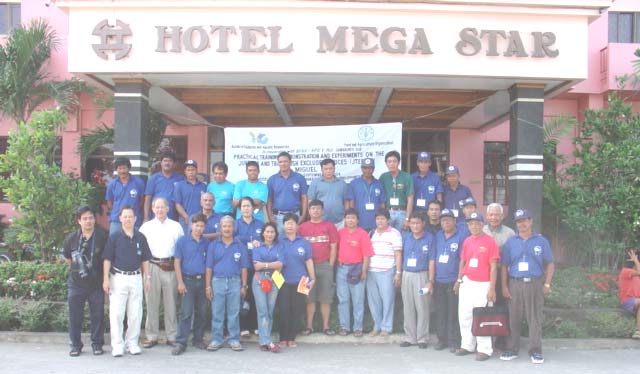
EXCLUDER DEVICES (JTEDs) IN SAN MIGUEL BAY
Hotel Mega Star, Daet, Camarines Norte, Philippines
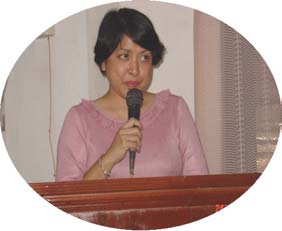
23 August- 01 September 2004
_______________________________________________________________
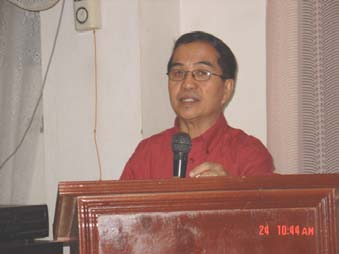
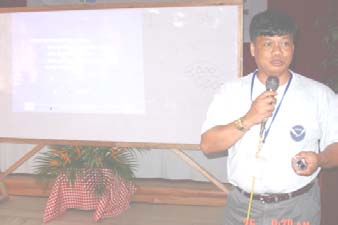
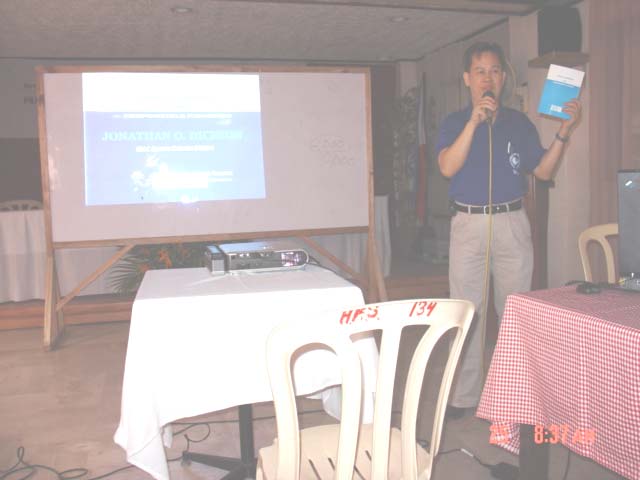
FOOD AND AGRICULTURE ORGANIZATION OF THE UNITED NATIONS
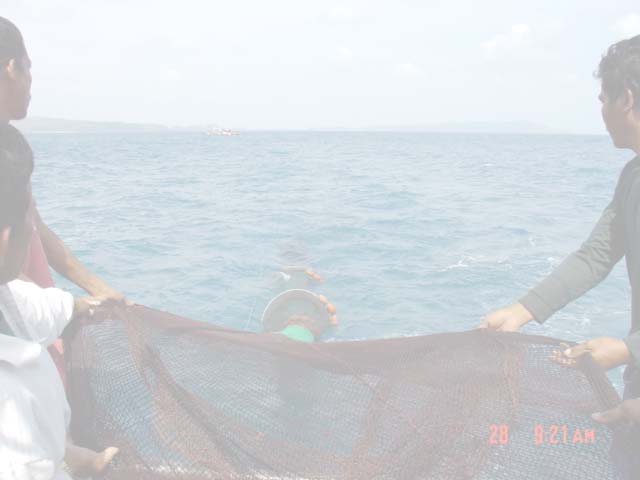
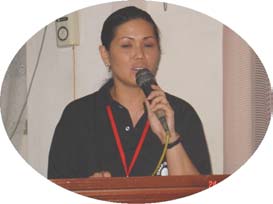
REPORT ON THE
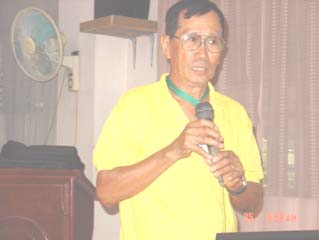
PRACTICAL TRAINING/DEMONSTRATION
AND EXPERIMENT ON THE JUVENILE AND
TRASHFISH EXCLUDER DEVICES (JTEDs)
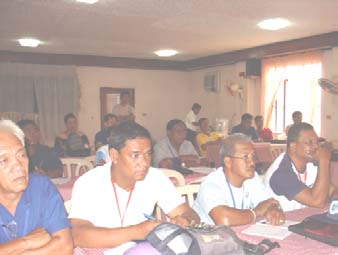
IN SAN MIGUEL BAY
August 23 to September 01, 2004
Hotel Mega Star
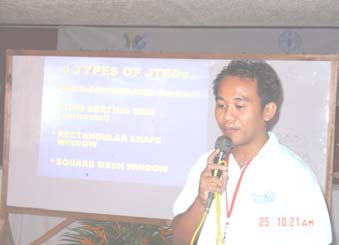
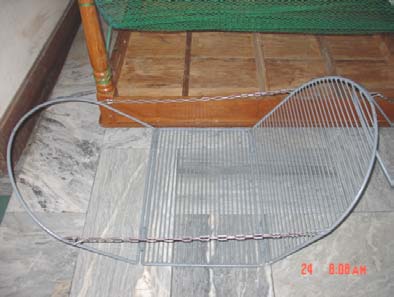
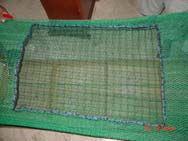
Daet,
Camarines Norte, Philippines
Bureau of Fisheries and Aquatic Resources
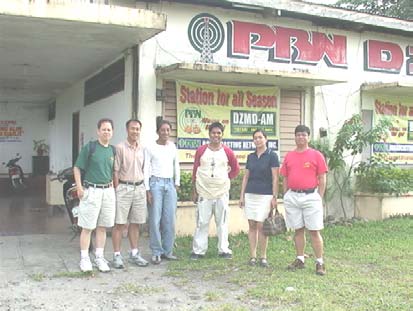
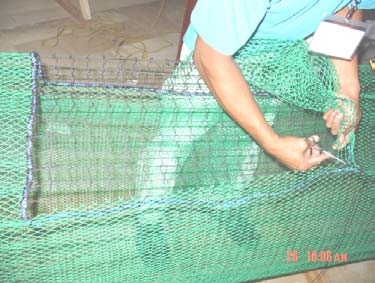
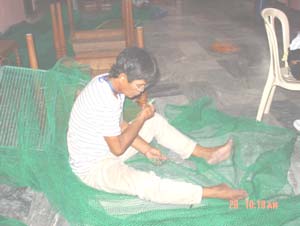
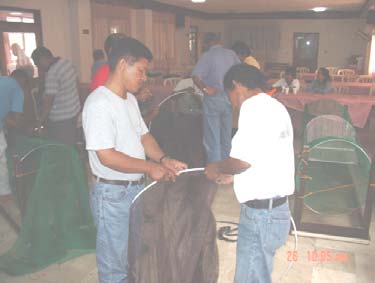
The Food and Agriculture Or
ganization of the United Nations
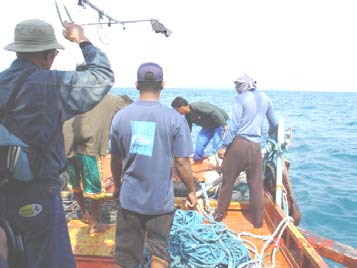
Project EP/GLO/201/GEF
IBM/c/RVR/Tech Reports/San Miguel Bay/JTED proceeding. Daet Camarines -
1
-
PRACTICAL DEMONSTRATION AND EXPERIMENT ON THE
JUVENILE AND TRASH FISH EXCLUDER DEVICES (JTEDs)
IN SAN MIGUEL BAY
INTRODUCTION
1. A collaborative project between FAO/UNEP/GEF and BFAR under
Project EP/GLO/201/GEF entitled "Reduction of Environmental
Impact from Tropical Shrimp Trawling Through the Introduction of
Bycatch Reduction Technologies and Change of Management" was
launched in 2002.
2. The project is being undertaken to address issues and concerns
related to shrimp fisheries in the tropical regions particularly on
bycatch and incidental catches. The Philippines is one of the nine
participating countries; and one of the two countries in Asia,
Indonesia being the other.
3. The practical demonstration and experiment of JTED is one of the
project activities under of the Philippine component and is now on
its second year of implementation. The experimentation at San
Miguel Bay was a follow- up to the previously conducted trials in
Manila Bay, Maqueda Bay/ Samar Sea and Lingayen Gulf.
4. The participants were trawl fishing boat owners/operators,
masterfishermen, fishermen and net cutters. Others were LGU top
level officers in charge of fisheries (Municipal Agriculture Officers),
LGU and BFAR fisheries technicians and extension officers, and
fishermen's council/organization representatives.
5. With the participation of the industry and other stakeholders, the
demonstration and experiments seek to determine the efficiency and
practicability of the technology on JTEDs in reducing the catch of
juveniles and thrashfish. They were also intended to educate and
enlighten them on related global and regional issues and
demonstrate the importance of selectivity devices as a tool in
addressing the problems.
6. The 9-days training/demonstration and experiments was conducted
through a methodology of seminar/ lectures, workshop and practical
construction and rigging of JTEDs, at-sea fishing trials and
observations, presentation and discussion on the preliminary results
of at-sea trials and building up feedback and recommendation from
the participants
IBM/c/RVR/Tech Reports/San Miguel Bay/JTED proceeding. Daet Camarines -
2
-
7. The lectures and workshop were held at Hotel Mega Star, Daet,
Camarines
Norte
while
actual
fishing,
experiments
and
demonstration were carried out in the approaches of San Miguel
Bay. It was attended by twenty nine (29) participants from
Mercedes and Basud, Camarines Norte and Daet, Calabanga, and
Tinambac, Camarines Sur and Tabaco, Albay.
The participants and project staff together with Mr. Thaweesak
Chanloi of SEAFDEC-TD, Mr. Jonathan O. Dickson, National
Coordinator and Mr. Wilfried Thiele of FAO- Rome ((1st, 2nd and 3rd
from left respectively).
8. The opening ceremony was held on August 24, 2004 and graced by
the local executives of Daet and Mercedes, Camarines Norte, BFAR
Regional Director and Assistant Regional Director, the BFAR
Coordinator for the San Miguel Bay Fisheries Resource Management
Program, a number of officers of non-government organizations;
and, the Head of Information and Extension Division of SEAFDEC-
TD and Head of the Audio- visual Section of SEAFDEC- TD,
Thailand.
IBM/c/RVR/Tech Reports/San Miguel Bay/JTED proceeding. Daet Camarines -
3
-
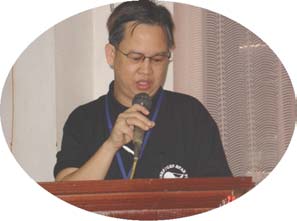
9. The Welcome Remarks of Honorable
Mayor
Elmer
Panotes
of
Daet,
Camarines Norte, was delivered by the
Municipal
Information
Officer,
Ms.
Benjie F. Camino. He recognized the
objectives of the undertaking and
expressed his support to accomplish
the objectives of the JTEDs training/
Ms. Benjie Camino
demonstration and experiments
delivering the speech of
Mayor Elmer Panotes
10. In
his
Opening
Remarks, the Regional Director of BFAR
RFO V, Director Jaime Dela Vega
stressed that using trawl that catches
juveniles, immature and trashfish is a
waste, hence they must reduce catching
them in order to sustain the fisheries
particularly in San Miguel Bay. He
Dir. Jaime Dela Vega during
likewise expressed hope that the fisherfolk
his Opening Remarks.
participants gain significant information on
JTEDs for possible adoption. Moreover, he
reiterated the BFAR RFO V support in providing additional
information on JTED technology.
11. The National Project Coordinator, Mr.
Jonathan O. Dickson, presented the
overview of the project; highlighting on
its rationale and objectives, the
participating countries, agencies as
well as institutions, and a chronology
of the past and planned activities of the
project. He further stressed that the
Mr. Jonathan O. Dickson
presenting the overview of
Bureau is not only looking on trawls,
the Project.
but other fisheries as well including
the
siginificant
landings
of
juvenile/small tunas of purse seiners in General Santos City.
12. Mr. Melchor Ibasco, Administrative Officer and representative of
Mayor Pepito P. Lo of Mercedes, Camarines Norte rendered the
Mayor's message.. He said that there is still a need to know about
JTEDs since it is extremely a new technology. He also stressed his
great desire to protect and conserve the fishery resources and
informed the group that almost 80% of illegal fishing has been
eliminated. He mentioned that there is a notable recovery on the
IBM/c/RVR/Tech Reports/San Miguel Bay/JTED proceeding. Daet Camarines -
4
-
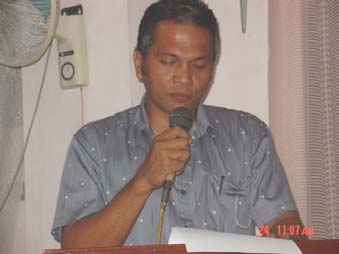
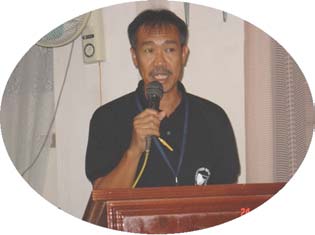
fishery resources as reflected in the
significant increase of fish catch and
depleted species are sprouting back to
life in good measure including their
very own "damus", a rare fish found
only at San Miguel Bay. He likewise
indicated
apprehension
on
the
immediate
application
of
the
technology in his municipality, and
only permits the use of trawl and the
Mr. Melchor Ibasco
delivering the message of
device when the resource has been
Mayor Lo.
replenished.
13. The
Head
of
Information
and
Extension Division of SEAFDEC- TD,
Mr.
Bundit
Chokesanguan
emphasized on the present initiative of
SEAFDEC to introduce the JTED in
Southeast Asia to conserve the fishery
resources by allowing the immature
species to grow. He likewise reported
on similar activities being done by
Mr. Bundit Chokesanguan
other ASEAN countries and that the
of SEAFDEC- TD, Thailand.
implementation in the Philippines is
probably the most significant and
successful. He also conveyed the
commitment
of
SEAFDEC-TD
in
supporting
the
project
implementation in the Philippines particularly on the production of
VCD and other important information and
education materials.
14. In her message, Assistant Regional Director
Josie Delfin of BFAR RFO 5 was very
optimistic that after the activity the
participants will learn to appreciate the
project and further stressed that the apprehensions of Mayor Lo is
not
uncommon,
noting that JTED
Assitant Director Delfin
of BFAR-RFO 5
potentially
upholds
the
operation of trawls which may deter his
current conservation programs.
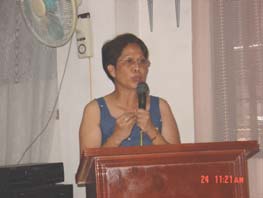
15. Ms. Marisa Lakindanum thanked
Ms. Lakindanum
and commended the BFAR particularly
advocating the benefits
of JTED.
IBM/c/RVR/Tech Reports/San Miguel Bay/JTED proceeding. Daet Camarines -
5
-
for their exemplary efforts towards rationalizing management and
conservation of fisheries. She recounted her negative reactions and
reservations the first time she heard of the technology at the start
of training in Lingayen Gulf. She however gradually appreciated and
recognized the advantages the devices could offer as the training
progressed. She emphasized the potential benefits gained from
JTEDs from the point of view of a Boat Operator. In closing, she
encouraged the participants to actively involve in the daily activities
to appreciate the program.
LECTURE/SEMINAR
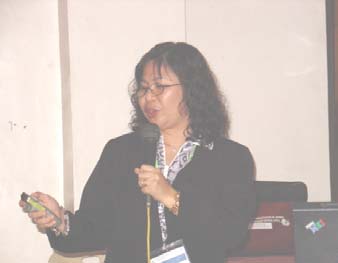
Clockwise: Messrs. Efren Hilario, Rafael Ramiscal, Jess Sanchez, the participants,
Mr. Jonathan Dickson and Ms. Noemi Lanzuela during the lectures.
16. The lecture-seminar focused on providing the necessary
background for the participant to appreciate the foundation and
rationale behind the project. The topics included the Code of
Conduct for Responsible Fisheries and Regional Guidelines for
Responsible Fishing, Issues related to bycatch and discards
(highlighting on juveniles), and the results of selected selectivity
studies and JTED designs.
17. Experiences on trawl fisheries in Manila Bay were likewise
discussed by the Resource Speaker, Mr. Jesus Sanchez. He gave an
overview of the trawl fisheries in Manila Bay in comparison with
trawl fisheries of San Miguel Bay.
IBM/c/RVR/Tech Reports/San Miguel Bay/JTED proceeding. Daet Camarines -
6
-
18. The seminar presented results of selected studies on the reduction
of catches on juveniles and other protected species such as square
mesh windows, JTEDs, and TEDs. It emphasized on the common and
concerted
efforts
of
various
countries
and
international
organizations in finding technical solutions to address related issues
in order to manage and protect fishery resources and marine
ecosystem.
19. The various designs of JTEDs,
as
well
as
step-by-step
construction and rigging were
likewise discussed. This provided
the
participants
better
comprehension on the technical
aspects in the construction and
rigging of the devices. This also
tackled
the
materials
and
equipments
needed
in
the
JTED variations used during the
construction and maintenance of
experiments; inset Square Mesh
the device.
Window and Rigid Sorting Grid
Horizontal Bar.
20. In addition, Status of the
implementation of Regional Project in SEAFDEC Countries was
presented by Mr. Bundit Chokesanguan of SEAFDEC- TD. It
provided the participants a wider perspective on the efforts
conducted by the international community as part of advocacy on
responsible fishing towards the attainment of sustainable fishery
resource.
21. Ms. Marisa Lakindanum also presented her experiences as a trawl
fishing boat operator in Lingayen Gulf. She further gave testimonies
on the benefits of the JTEDs as she herself has been a participant in
of the previous training and experiments in Lingayen Gulf.
22. One of the highlight of the
training was the promotion of the
activities on radio. Messrs. Bundit
Chokesanguan,
Jonathan
O.
Dickson, Rafael V. Ramiscal and
Ms. Marisa Lakindanum were
invited and interviewed live on
PRN- DZMD AM Radio Station-
Daet, Camarines Norte. The one-
hour program provided them with
the opportunity to broadcast the
IBM/c/RVR/Tech Reports/San Miguel Bay/JTED proceeding. Daet Camarines -
7
-
program activities and discuss about the advantages JTEDs and its
importance in the promotion of responsible fishing technologies and
towards the conservation, protection and rational management of
fishery resources..
PRACTICAL WORKSHOP
22. The one and a half- day practical
workshop engaged the participants
in actual rigging of six pre-
fabricated JTED frames under the
supervision and coordination of the
technical staff.
23. Six
codends
corresponding to
each
JTED
variation
were
completed. The
JTEDs were as
follows:
Rigid
Sorting Grids 1
and 1.5 cm vertical bar spacing,
Rigid Sorting Grids 1 and 1.5
horizontal bar spacing, Square
Mesh Window and Rectangular- shaped Window. Furthermore, one
Control (codend without JTED) and two Cover nets were
constructed by the participants. They were also involved in cutting
the pattern of the second frame and subsequently attached at the
rear portion of the Rigid Sorting Grid.
AT-SEA TRIALS/EXPERIMENTS
24. The parallel tow using similar trawl
net design equipped with different
JTEDs was carried out. Participants
were entailed to take part in the
fishing operation activities and in
sampling,
sorting,
weighing
and
measurement of samples.
25. A total of sixteen valid hauls at one The participants preparing
hour per haul were completed, yielding
to shoot the net.
a total catch of about 2,582 kgs. or a
catch per unit effort of 129 kgs./ hour.
IBM/c/RVR/Tech Reports/San Miguel Bay/JTED proceeding. Daet Camarines -
8
-
26. The Project Technical Coordinator, Mr. Wilfried Thiele of FAO- Rome
joined the 2nd day of trials and observed encouraging performance
of some JTED designs.
27. A more comprehensive detail of the experiment is included in a
separate technical report.
PARTICIPANTS' PROFILE
28. There were a total of 29 participants. Average age was 48 years-
with the youngest at 32 and oldest at 60. The majority was males
(86%) and 89% were married).
16%
29. With regard to the Educational
16%
48%
attainment, nearly half (48%) of the
participants
were
college
graduates and 20% graduated from
20%
high school. Participants who are
Col ege Graduate
HS Graduate
Masters degree and Elementary
Graduates both had 16%.
Elem. Graduate
Masteral Grad.
Educational attainment of participants
30. The
majority
of
the
8%
4%
4%
10%
participants were fishermen
4%
(42%),
followed
by
42%
12%
Masterfishermen
with 16%,
16%
Boat Operators with 12%,
Extension officer
Teaching
Fisherman
while 10% and 8% for Fishery
Masterifsherman
Boat Operator
Law Enforcer
Fishery Technician
Municipal Agriculturist
Technicians
and
Municipal
Employment
Agriculturists
respectively.
Extension
Officers,
Law
Enforcers and Teachers had 4% each.
31. Based from fishermen and masterfishermen respondents, they
indicated that low catch was already experienced even before they
were into trawl fishing. Problems encountered were identified as
follows: a) low fish catch due to increasing number of fishing boats
b) banning of trawl operation within municipal waters resulted to
loss of fishing ground and increased fuel cost e) lack of capital;
f) illegal fishing activities such as encroachment of commercial
fishing vessels in municipal waters; g) Increasing fuel cost; h)
fishermen's lack of information on conservation measures; and i)
problems on marketing of catch.
32. Majority of the participants agreed on the importance of using
JTEDs in fishing (93%) as evidenced in the exclusion of juveniles
IBM/c/RVR/Tech Reports/San Miguel Bay/JTED proceeding. Daet Camarines -
9
-
and small fish during the trials and recognized its positive effect on
the management and conservation of the resources in the area. The
remaining 7% were not favor for reasons that all of the catch
including juveniles are being sold even lower price, hence, JTEDs
may only decrease the already low income of fishermen. Similar
number (93%) agrees to use responsible fishing methods while the
remaining 7% abstained from answering the question raised. They
also acknowledged that similar trainings on the JTED technology are
important to reach out the larger part of stakeholders and industry.
33. For the urgent conservation of fishery resources in the area, the
immediate use of JTED in trawl emerged as the primary response
(93%) while the remaining 7% suggested that it should only be
implemented after the conduct of intensive study and consultation/
information dissemination.
34. Overall, 89% of the participants believed that the objectives of the
training were attained. Only 7% considered that not all of the
objectives were attained since not all areas of the Bay was not
covered by the training and experiments. The remaining 4%
abstained from responding to the query.
35. The boat operators-participants own at least fifteen (15) trawl
fishing boats and a total of twenty six (26) trawl fishing nets.
36. During the post-trial discussions and Closing ceremonies, the
salient feedbacks were the following:
a) If JTED is proven effective and practicable, it is important for
the LGU's legislative body like Sangguniang Bayan to
formulate local legislation to put JTED into use.
b) Some of the participants from the LGUs found JTED
conflicting with FAO 201 (Ban on Active Gears in municipal
waters) as many of the trawl operation is being conducted
within municipal waters. Hence JTEDs must be used for
operation outside municipal waters.
c) The use of JTED particularly the Norwegian type will reduce
not only juveniles but also on catch of small but already
matured species. These fishes are likewise being sold, albeit
at lower prices which potentially reduce their income..
IBM/c/RVR/Tech Reports/San Miguel Bay/JTED proceeding. Daet Camarines -
10
-
d) When the JTED is introduced, there may be a need to evaluate
existing minimum mesh size regulation since the gear is
already selective by virtue of the JTED.
e) Concerns were also raised with regard to catch spoilage
caused by the device especially when catch volume is high. .
f) Participants recognized that JTEDs positively exclude
juveniles and small trashfishes as demonstrated during the
trials and that similar demonstration should also be conducted
in other areas to gain wider endorsement and acceptance.
g) The participants anticipated that the technical group
conducting the experiments shall prepare technical papers
with technical terms. However, these materials must be
translated into extension manuals/materials in layman's term
and in local dialect for the fishermen to internalize and
understand.
h) Participants expected that they be provided with VCDs for
film viewing by the local executives and technicians especially
during conduct of meetings of the Sanguguniang Bayan and
local fisherfolk.
i) JTED is a new concept and the success of its implementation
or acceptance by concerned stakeholders also requires
extensive information and education campaign. Posters and
other information dissemination materials are essential tools.
There is likewise a need for intensive training among trawl
fishers and stakeholders. The project implementors were
also challenged to persevere and work hard to achieve its
objectives given the present issues and concerns associated
with the fishery.
j) While JTED certainly excludes the juveniles and small
trashfish, the negative effect of trawl fishing as it scrapes the
bottom of the fishing ground still remains. A participant
reaction noted that there is reduced negative impact when
fishing is appropriately zonified and that there is an on-going
effort to identify and zonify fishing grounds (spawning,
breeding and other vulnerable areas). Hence, fishing like trawl
should be strictly prohibited in identified vulnerable areas.
Moreover, it was also emphasized that JTED is only an option
IBM/c/RVR/Tech Reports/San Miguel Bay/JTED proceeding. Daet Camarines -
11
-
or tool which could be used only when found practicable to
manage existing fisheries..
k) The technology on JTED could be an alternative to eventually
reduce the negative impact of trawl particularly on the
resources. It was also recommended to formulate a Fishery
Administrative Order prescribing the trawl fishing industry to
incorporate JTED in its operation.
l) When appropriate, fisherfolk must initiate to modify or apply a
JTED type which is most applicable considering the size of
their nets and fishing boats.
m) It was likewise recommended that an intensive and massive
consultation must be conducted prior to its implementation
and formulation of appropriate policies/ laws.
n) Other participants requested similar training in their area (i.e.
small boat shrimp trawls). It was likewise expressed that this
could also be an initiative of the concerned authorities to
demonstrate their concern and not to displace small
fisherfolks engaged in the fishery.
o) JTED is a good project and anything which is good does not
fail. Therefore, the participants must cooperate for its
successful implementation.
IBM/c/RVR/Tech Reports/San Miguel Bay/JTED proceeding. Daet Camarines -
12
-

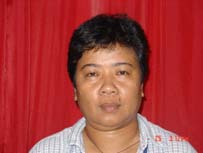
DIRECTORY OF PARTICIPANTS
Wenifredo Abanto, Jr.
Rodel Ablaneda
Mario B. Andayog
Boat Owner/ Masterfisherman
Boat Owner
Extension Officer/ Marine Fisheries
Mercedes, Camarines Norte
Mercedes, Camarines Norte
BFAR RFO V, Pili, Camarines Sur
Edna SJ Balane
Victor C. Bolano
Lope B. Bordeos, Jr.
Municipal Agriculturist
Fishing Gear Technologist
Training Specialist II
Cabusao, Camarines Sur
BFAR RFO V, Pili Camarines Sur BFAR RFTC, Tabaco, Albay
Gil Gabriel H. Burdado III
Juanito B. Cabarle
Amador Candelaria
Municipal Agriculturist
Masterfisherman
Masterfisherman
Calabanga, Camarines Sur
Basud, Camarines Norte
Cabusao, Camarines Sur
Danilo Celeste
Lauro Cervano
Rowelia S. Delos Reyes
Fisherman
Masterfisherman
Fishery Law Enforcer
Cabusao, Camarines Sur
Calabanga, Camarines Sur
LGU-Mercedes, Camarines Norte
IBM/c/RVR/Tech Reports/San Miguel Bay/JTED proceeding. Daet Camarines -
13
-
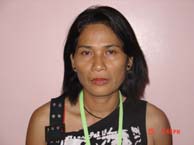
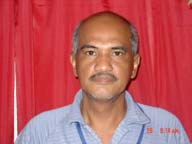
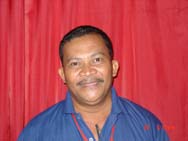
Danilo T. Guevarra
Rosevelinda B. Intia
Benmar I. Mago
OPAg,Marine Fishery Technician
Fishery Technologist
College Instructor
Daet, Camarines Norte
LGU-Calabanga, Camarines Sur
CNSC-IFMS, Camarines
Norte
Tomas Nosil
Nelson SA Olfindo
Jesus Poblete
Boat Owner
College Instructor
Boat Owner/ Operator
Calabanga, Camarines Sur
CNSC-IFMS Mercedes, Camarines Mercedes, Camarines Norte
Norte
Melchor B. Presbitero
Trinidad T. Relloso
Engr. Reynaldo Rivera
LGU Municipal Councilor
Municipal Agriculturist
Municipal Agriculturist
Cabusao, Camarines Sur
LGU- Basud, Camarines Norte
Tinambac, Camarines Sur
Limneo P. Sierra
Rolando P. Tiam
Pedencio Toledo
Boat Owner/ Masterfisherman
Fishery Law Enforcer
Boat Owner/ Masterfisherman
Calabanga, Camarines Sur
BFAR RFO V, Pili, Camarines Sur
Calabanga, Camarines Sur
IBM/c/RVR/Tech Reports/San Miguel Bay/JTED proceeding. Daet Camarines -
14
-
Fernando R. Valeros
Alex A. Toyado
Raul Tusoc
Masterfisherman
Masterfisherman
Fishery Technologist
Mercedes, Camarines Norte
Mercedes, Camarines Norte
BFAR RFO V
Arnel L. Villacater
Jess P. Yarte
Fisherman
PLGU Marine Fishery Technician
Cabusao, Camarines Sur
OPA, Daet, Camarines Norte
IBM/c/RVR/Tech Reports/San Miguel Bay/JTED proceeding. Daet Camarines -
15
-

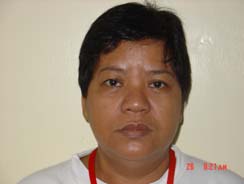
STAFF DIRECTORY
JONATHAN O. DICKSON
RAFAEL V. RAMISCAL
National Project Coordinator
OIC, Fishing Technology Research and
BFAR Central Office
Development Division
BFAR- NFRDI
NAPOLEON J. LAMARCA
ELMER B. ALBA
Researcher
Sr. Fishery Technologist
BFAR Central Office
BFAR- NFRDI
EFREN V. HILARIO
RONNIE O. ROMERO
Researcher
Researcher
BFAR Central Office
BFAR Central Office
BENIGNO O. MAGNO
MYRNA B. RAMOS
Masterfisherman
Technical Staff
M/V DA- BFAR
BFAR Central Office
IBM/c/RVR/Tech Reports/San Miguel Bay/JTED proceeding. Daet Camarines -
16
-
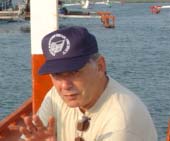
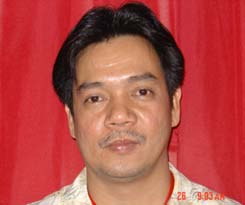
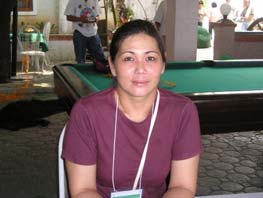
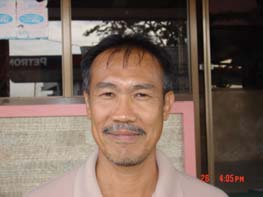
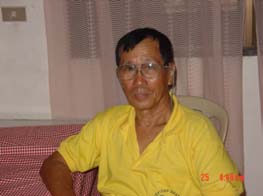
RESOURCE SPEAKERS
AND GUESTS
WILFRIED THIELE
Senior Fishery Industry Officer/ Project Coordinator
Fishery Technology Service, FAO/UN- Rome
BUNDIT CHOKESANGUAN
THAWEESAK CHANLOI
Training Department
Audio Visual Section Head
SEAFDEC- TD, Thailand
SEAFDEC- TD, Thailand
JESUS P. SANCHEZ
MARISA C. LAKINDANUM
Consultant
Resource Person
Private Sector
IBM/c/RVR/Tech Reports/San Miguel Bay/JTED proceeding. Daet Camarines -
17
-
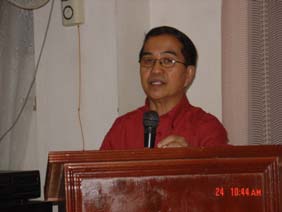
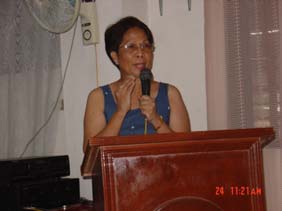
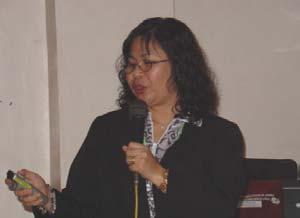
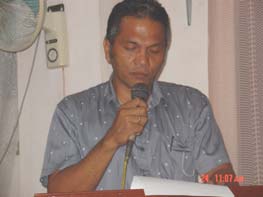
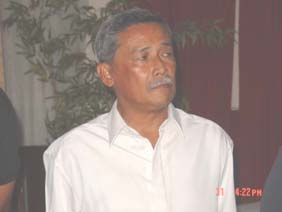
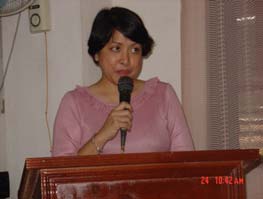
BENJIE CAMINO
MELCHOR IBASCO
Municipal Information Officer
Administrative Officer
Daet, Camarines Norte
Mercedes, Camarines Norte
JAIME C. DELA VEGA
JOSEFINA C. DELFIN
Regional Director
OIC- Assistant Regional Director
BFAR RFO V
BFAR RFO V
Pili, Camarines Sur
Pili, Camarines Sur
NOEMI B. LANZUELA
URBANO LAGRIADA
San Miguel Bay FRMP Coordinator and
Municipal Agriculturist
Resource Person
Mercedes, Camarines Norte
BFAR RFO V
Pili, Camarines Sur
IBM/c/RVR/Tech Reports/San Miguel Bay/JTED proceeding. Daet Camarines -
18
-
STUDY ON THE JUVENILE AND TRASH FISH EXCLUDER DEVICES
(JTEDs) IN SAN MIGUEL BAY
Jonathan O. Dickson, Rafael V. Ramiscal, Napoleon J. Lamarca,
Efren V. Hilario, Ronnie O. Romero, Elmer B. Alba,
Benigno D. Magno and Myrna B. Ramos
Bureau of Fisheries and Aquatic Resources,
National Fisheries Research and Development Institute
860 Quezon Avenue, Arcadia Bldg., Quezon City
Abstract
A series of demonstration and experiment using various designs of
juvenile and trashfish excluder device (JTED) are being conducted in major
trawling grounds in the Philippines with the objective of developing and
determining the most appropriate and practicable design/s for the fishery. The
project is being undertaken by the Philippine Bureau of Fisheries and Aquatic
Resources (BFAR) in collaboration with the Food and Agriculture Organizations of
the United Nations (FAO) under Project FAO/EP/GLO/201/GEF. This paper
covers at-sea trials conducted in the approaches of San Miguel Bay, Philippines.
A total of 16 valid hauls were completed with a total catch of 2,583
kilograms or a catch-per unit-effort (CPUE) of 129 kgs/hr. Commercial fish
comprised the bulk of the catch with 71.5% while non-commercial or trashfish
had the lowest percentage of 0.6%. Jako, or the low-value species and juveniles
had 26% and 1.9% respectively.
Using six variations of JTEDs on an alternate tow experiments, results
indicated better efficiency of rigid sorting grids of different bar spacing and
orientation (SGV1, SGH1, SHV1.5, SGH1.5) to exclude juveniles and retain
commercial and other useful species. The square mesh window (SMW) with 4
cm bar was observed to be unsuitable as it allowed the escapement of
commercial and larger fish. The rectangular shaped window likewise observed
to cause undue loss of larger size fish.
1. INTRODUCTION
Due to overfishing problems in many areas, active fishing gears including
trawls have been prohibited in municipal fishing grounds or within 15 km from
the shoreline. The effectiveness of contemporary measures regulating mesh size
and fishing ground restrictions has largely been acknowledged to be impractical
and inadequate. The Code of Conduct for Responsible Fisheries (CCRF)
enunciates that States should require that fishing methods, gears, methods and
practices, to the extent practicable, are sufficiently selective so as to minimize
discards and catch of non- target species. Given that trawling is a major fishery
and will likely remain an important sector in countries like the Philippines, it is
important that methods or devices to make it more selective and consequently
reduce its adverse effects in view of the article stated in the Code through
reduction on the incidence of juvenile- and trash-fish captured are introduced.
IBM/c/RVR/FAO-GEF Proj/Tech Reports/San Miguel Bay/JTED Techical paper-Daet Camarines
- 1
Several efforts have been made to introduce or study methods or devices
to exclude or dissociate juveniles and other non-target or unwanted catch from
the target of commercially important species thereby reducing the impact to
resources and biodiversity. Among these are the square mesh codend and
Bycatch Reduction Devices (BRDs), including the Turtle Excluder Device (TED)
and Juvenile and Trashfish Excluder Devices (JTEDs). JTEDs are being
promoted by the Southeast Asian Fisheries Development Center (SEAFDEC)
Training Department under its 5-year ASEAN-SEAFDEC Plan of Responsible
Fishing Technologies and Practices. Experiments have been carried out in most
countries in Southeast Asian Region (Thailand, Brunei Darussalam, Vietnam,
Indonesia and Malaysia) where encouraging results in certain designs have been
indicated.
The project implementation started in November 2003, with the first
training and experiments in Manila Bay. Similar procedures have been conducted
in other key trawl areas including Maqueda Bay, Lingayen Gulf and San Miguel
Bay. This paper covers the results of the trials conducted in San Miguel Bay,
Philippines.
2. MATERIALS AND METHODS:
The experiment was a part of the Practical Demonstration and Training
conducted in San Miguel Bay, which was conducted on August 23 to September
01, 2004. Lecture, workshops and actual fishing/ data collections are
methodologies adapted. Workshop where construction of the needed codends
and cover nets were accomplished for two days while actual fishing
demonstration cum experiments were conducted for four-days.
Materials and equipment used in the sampling areas were weighing scales
(15, 20, and 1 kilogram graduation) for obtaining the sample as well as the total
weight of the catch, measuring devices, wrist watch, portable GPS and SONAR
(Echo Sounders). The data collected were taken down in two prepared forms
(JTED Forms 1 and 2) for further analysis.
2.1.1. Fishing Boats and Trawl Nets
For the purpose of the demonstration and experiments, two typical
trawler boats were used for parallel tow procedures. The boats were
traditional outrigerred bancas of about 20 m in length powered by
converted land engines (8DC9/B12 Isuzu engines) of about 320-horse
power (Figure 1) and 43 Gross Tons.
IBM/c/RVR/FAO-GEF Proj/Tech Reports/San Miguel Bay/JTED Techical paper-Daet Camarines
- 2
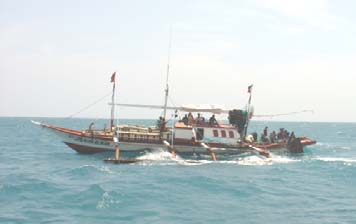
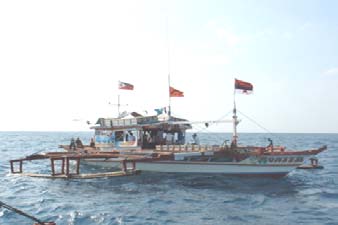
F/B Rosie Monith
F/B Queenie Monith
Figure 1. Trawl Fishing Boats, San Miguel Bay, Camarines Norte.
The net used was Norwegian type, made of nylon material
(polyamide, PA). The structural of trawl used in the experiments
incorporated with Juveniles and Trashfish Excluder Devices (JTEDs) is
shown in Figure 2. Cover nets were provided in the codend to determine
the quantity and composition (species and size) escaping species.
Figure 2. Typical Norwegian Type of Trawl used at San Miguel Bay.
IBM/c/RVR/FAO-GEF Proj/Tech Reports/San Miguel Bay/JTED Techical paper-Daet Camarines
- 3
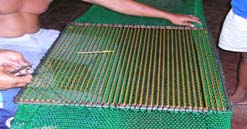
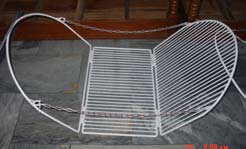
2.1.2. JTED Types
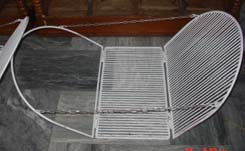
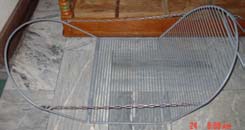
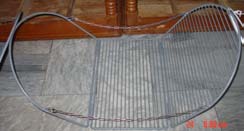
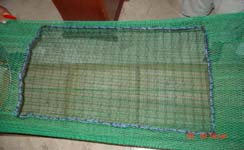
The experiments were conducted using 6
SGV 1.0 cm
variations of JTEDs 1) Sorting Grid 1cm vertical bar
(SGV1), 2) Sorting Grid 1cm
horizontal bar (SGH1), 3)
Sorting Grid 1.5cm vertical
RSW
SGH 1.0 cm
bar (SGV1.5), 4) Sorting Grid
1.5 horizontal bar (SGH1.5),
5) Rectangular-Shaped
Window (RSW) and, 6)
SMW
Square-Mesh Window
RSGV 1.5 cm
(SMW) (Fig 3). The
variations were selected
based from the results and
experience gained from previous runs in other
RSGH 1.5 cm
Figure 3. JTED Types used at San Miguel Bay.
areas.
2.1.3. Fishing Operations and Data Collection
14.30
The trawl fishing gear
with JTEDs were alternately
deployed in parallel, one 14.20
hour standard tows at an
average speed of 5 knots. 14.10
Fishing depth was at an
average of 42m. Hauls of
less than one hour or any
14.00
operation with unfavorable detui
result such as twisting of the Lat
hoops and torn meshes of
13.90
the codend were considered
invalid and were not 13.80
included in the analysis. In
San Miguel Bay, there were
16 valid hauls (Figure 4) 13.70
completed. Control haul
(without JTED) was likewise
performed.
13.60
122.90
123.00
123.10
123.20
123.30
123.40
Longitude
Figure 4. Fishing stations, San Miguel Bay.
IBM/c/RVR/FAO-GEF Proj/Tech Reports/San Miguel Bay/JTED Techical paper-Daet Camarines
- 4
2.1.4. Fish catch categorization
The entire catch of each haul was sorted and weighed according to
group or at species level, whenever possible. The number of individual
fish was also determined by actual counting or raised accordingly when
sampling was done. Fish catch was measured individually in total length
(TL) in mm. Body width (BW) and Body Depth (BD) in mm were also
measured on some occasions to determine the TL-BW- BD relationship.
In consideration of the project objectives of reducing the catch of
juveniles and trashfish while also minimizing the loss of valuable
commercial species, the catch was arbitrarily categorized according to
value and size as follows: commercial, trash fish and other non-
commercial (jako), juveniles and shrimps (Table 1).
The selection of the most appropriate JTED was based on the rate
of escapement according to catch category. Specifically, higher
escapement rate for juveniles and trash fish and vis- a- vis with low
escapement rate for commercial fish and shrimps are the most important
factors to be considered.
2.1.5. Escapement Rate
The rate of escapement attributed to the JTEDs was calculated
using the following equation:
E = (Wcn/(Wcn+Wce))*100
(1)
Where
E
=
Escapement rate by weight in %
Wcn =
Catch in cover net (gm)
Wce =
Catch in codend (gm)
Also,
E = (Ncn/( Ncn + Nce))*100
Where
E
=
Escapement rate by number (%)
Nce
=
Catch in cover net (number)
Nce
=
Catch in codend (number)
2.1.6. Selectivity
In covered codend experiment, when the fraction retained is
plotted against mid-length of corresponding group, the points following a
sigmoid curve called as the "gear selection ogive" resembling a
cumulative normal distribution. However, the easiest expression to
describe the gear selection ogive is the so-called "logistic curve" defined
by the following equation:
IBM/c/RVR/FAO-GEF Proj/Tech Reports/San Miguel Bay/JTED Techical paper-Daet Camarines
- 5
SL = 1/1+ exp(S1-S2*L) (2)
Where,
SL = # of fish of length L in the codend (3)
# of fish of length L in codend and cover net
L = mid-length interval
S1&S2 = constants (Palohaimo and Cadima, 1964;
Kimura,1977, and Hoydal et al, 1982)
And can be rewritten as
Ln(1/
SL - 1) = S1 S2*L
(4)
Where,
S1 = a
S2 = b
By applying a few algebraic manipulations it follows that there is a
one-to-one correspondence between S1 and S2 and L25%, L50% and L75%,
the length at which respectively 25%, 50% and 75% of the fish are retained
in the codend. The length range from L25% to L75% is called "selection
range":
L25%
= (S1 ln 3)/S2
(5)
L50%
= S1/S2
(6)
L75%
= (S1 + ln 3)/S2
(7)
S1 and S2 can be derived fro L75% and L50% as follows:
S1 = L50%*ln(3)/(L75%-50%) (8)
S2 = ln(3)/(L75%-L50%)=S1/L50% (9)
Likewise in a cover net experiment, the probability of escapement
can also be determined using the model to estimate selective ogive as
defined by the following equation :
Ln(1-/SL-1) = S1- S2 * L
Where,
L
= Length
interval
midpoint
SL =
fraction of length group L fish retained in
codend
SL
=
# of fish in the codend
# of fish in the codend and cover net
IBM/c/RVR/FAO-GEF Proj/Tech Reports/San Miguel Bay/JTED Techical paper-Daet Camarines
- 6
3. RESULTS AND DISCUSSION
3.1.
Total catch and composition
A total of 16 valid hauls were completed which yielded a total
catch of 2, 583 kilograms or a catch-per unit-effort (CPUE) of 129 kgs/hr.
Figure 5, shows the overall catch distribution of catch category by
weight. Commercial fish comprised the bulk of the catch with 71.5%
while trash had the lowest percentage of 0.6%. Jako, or the
commercialized trashfish catch and juveniles had 26% and 1.9%
respectively. It is noted that shrimp catch was insignificant given that the
gear used was high opening trawl designed mainly for fish.
TRASH
0.6%
jJAKO
26.0%
JUVENILES
1.9%
COMML
71.5%
Figure 5. Relative catch composition, San Miguel Bay.
The fishing experiments revealed that ponyfish was the most
dominant species group with 35.59% of the total catch followed by
goatfish with 1.2%. (Table 2). It also showed operations using sorting grid
1.5 cm. horizontal bar (SGH1.5) indicated highest CPUE at 351 kgs/hr
while sorting grid 1cm horizontal bar (SGH1) was next at 150.9 kgs./ hr.
Sorting grid 1cm vertical bar spacing and sorting grid 1.5cm vertical
spacing had 54.8 kgs./ hr. and 107.3 kgs./ hr. CPUE respectively.
Table 2. Percentage catch composition by species group (kgs)
SPECIES
SGV1.0 SGH1.0 SGV1.5 SGH1.5
RSW
SMW
CTRL
TOTAL
%
Nemipterids
0.0
0.0
0.2
0.2
0.0
0.0
0.2
0.0
0.0
Hairtail
5.5
0.8
4.0
0.0
0.0
2.5
0.0
0.0
0.5
Anchovy
5.1
1.6
0.6
0.8
0.0
2.5
4.5
0.0
0.9
Apogon
0.0
0.0
0.0
0.0
0.0
0.0
0.0
0.0
0.0
Goatfish
1.0
16.6
3.0
0.0
0.0
5.5
5.2
0.0
1.2
Ponyfish
32.8
98.2
23.6
693.3
1.5
16.2
53.5
0.9
35.6
Squid
0.7
1.3
1.9
2.8
0.0
0.5
0.0
0.0
0.3
Lizardfish
0.0
0.0
0.7
13.3
0.0
0.1
0.1
0.0
0.5
Others
119.3
334.2
295.8
696.0
26.3
50.0
59.8
1.6
60.9
TOTAL (in kgs.)
164.5
452.7
329.8
1406.3
27.8
77.3
123.2
2581.5
100.0
No. of Hauls
3
3
3
4
1
1
1
16
CPUE (kgs./ hr.)
54.8
150.9
109.9
351.6
27.8
77.3
123.2
127.9
IBM/c/RVR/FAO-GEF Proj/Tech Reports/San Miguel Bay/JTED Techical paper-Daet Camarines
- 7
Table 3 shows catch composition by category group according to
weight. Commercial fishes dominated the catch with 71.8% followed by
jako (low-valued species which are usually dried, used for fish paste, fish
sauce and even fish meal) 25.7%. Portions of jako, which are low quality
due to poor handling, are however usually discarded. Juveniles of
commercial fishes including cephalopods (squids) were about 1.9%. Trash
fish (those that are not locally utilized and discarded) only comprised
0.6%.
Table 3. Catch composition by category (kgs)
CATEGORY
SGV1.0 SGH1.0 SGV1.5 SGH1.5
RSW
SMW
CTRL
TOTAL
%
FISH-COMML-LARGE
102.2
436.9
120.7
853.1
27.5
60.3
32.8
1633.5
63.3
FISH-COMML-LARGE-JUV
3.2
5.7
0.1
2.1
0.0
1.1
32.5
44.7
1.7
FISH-COMML-SMALL
36.5
5.2
188.4
23.5
0.3
15.4
57.8
327.1
12.7
FICH-COMML-SMALL-JUV
0.8
0.0
0.0
0.0
0.0
0.0
0.0
0.8
0.0
FISH-NONCOMML (TRAS
6.2
1.1
2.0
6.1
0.0
0.0
0.0
15.4
0.6
FISH-NONCOMML (JAKO
15.0
2.5
16.7
518.6
0.0
0.0
0.1
552.9
21.4
CEPHALOPHOD
0.5
1.2
1.3
0.4
0.0
0.5
0.0
3.9
0.2
CEPHALOPHOD-JUVENIL
0.2
0.1
0.6
2.5
0.0
0.0
0.0
3.4
0.1
TOTAL
164.5
452.7
329.8
1406.3
27.8
77.3
123.2
2581.5
100.0
TRASH
6.2
1.1
2.0
6.1
0.0
0.0
0.0
15.4
0.6
JAKO
51.4
2.5
16.7
518.6
0.3
15.4
57.9
662.8
25.7
JUVENILES
4.2
5.9
0.7
4.6
0.0
1.1
32.5
48.8
1.9
COMML
102.7
443.3
310.5
877.0
27.5
60.8
32.8
1854.5
71.8
SH
0.0
0.0
0.0
0.0
0.0
0.0
0.0
0.0
0.0
TOTAL
164.5
452.7
329.8
1406.3
27.8
77.3
123.2
2581.5
100.0
IBM/c/RVR/FAO-GEF Proj/Tech Reports/San Miguel Bay/JTED Techical paper-Daet Camarines
- 8
3.1.1. Rate of escapement
The mean escapement rates according to JTED variation and catch
category/grouping are shown in Table 4.
Table 4. Rate of Escapement according to JTED variation and catch category.
BY WEIGHT
Catch category/JTED variation
SGV 1.0
SGH 1.0 SGV 1.5
SGH 1.5
RSW
SMW
CTRL
TRASH
73.7
80.0
50.0
90.9 #DIV/0!
#DIV/0!
#DIV/0!
JAKO
22.1
24.9
94.2
32.2
100.0
54.5
6.0
JUVENILES
37.7
56.4
98.2
66.0 #DIV/0!
0.0
0.0
COMMERCIAL
0.0
0.0
8.5
18.2
4.5
31.8
0.0
SH
#DIV/0!
#DIV/0!
#DIV/0!
#DIV/0!
#DIV/0!
#DIV/0!
#DIV/0!
TOTAL
9.8
0.8
39.1
24.1
5.4
35.9
2.8
Bisugo
#DIV/0!
#DIV/0!
#DIV/0!
0.0 #DIV/0!
#DIV/0!
0.0
Dilis
#DIV/0!
#DIV/0!
#DIV/0!
99.3 #DIV/0!
80.0
77.8
Saramulyete
#DIV/0!
0.3 #DIV/0!
#DIV/0!
#DIV/0!
36.4
0.0
Sapsap
21.9
6.7
83.3
24.3
100.0
33.4
0.0
Pusit
36.4 #DIV/0!
#DIV/0!
85.0 #DIV/0!
0.0 #DIV/0!
Kalaso
#DIV/0!
#DIV/0!
#DIV/0!
0.0 #DIV/0!
0.0
0.0
Others
3.7
0.3
32.2
24.0
0.0
36.7
0.0
TOTAL
9.8
0.8
39.1
24.1
5.4
35.9
2.8
In terms of escapement, sorting grids are indicated as the more
efficient among the JTEDs and the rate of escapement apparently is in
direct correlation with bar spacing, i.e. the bigger space bars (1.5cm)
are more efficient (having higher escapement rate) as compared to
smaller space bars (1 cm). A more detail comparison of mean rate of
escapement between SGV1.5 & SGH1.5 indicate that by weight as
much as 98.2% of the juveniles escaped through former while 66%
escaped through the latter. However, In terms of the jako (which are
mainly small-sized ponyfish) categories, catch which are also of value
to fishermen and their exclusion should be minized, SGV1.5 had higher
escapement rates of 94.2% as compared to the SGH1.5 rate of 32.2%.
SGH1.5 however also had a higher escape rate for commercial category
at 18.2% as compared to SGV1.5 of 8.5%. (Table 4, Fig 6). It appears
that the adjustment of the bar orientation in sorting grid (from
vertical to horizontal grid) likely reduced the escapement of small-
sized ponyfish and other fish with small body width but larger body
depth like hairtails. This is significant considering that even if these
species are low value, they generally forms the dominant landing and
augment income for trawl in the country.
It appears that it terms of juveniles, sorting grid with 1 cm bar
space (SGV1 and SGH1) showed escapement rate of 37.7% and 56.4%
with good retention of jako and commercial species while 1.5cm bar
space (SGV1.5 and SGH1.5) had relatively higher juvenile escapement
IBM/c/RVR/FAO-GEF Proj/Tech Reports/San Miguel Bay/JTED Techical paper-Daet Camarines
- 9
of 98.2% and 66% respectively however with relatively higher
escapement rates for jako and commercial species.
In the control net where no JTED was in use, escapement was only
observed on small anchovies (Stolephorus commersonii), which is
around 6% of the jako catch. Escapement of juveniles and trashfish in
the control net was not observed. The difference between the
Fig 6. Rate of scapement according to JTEDs and catch category
(by weight)
100
90
80
70
60
% 50
40
30
20
10
0
SGV 1.0
SGH 1.0
SGV 1.5
SGH 1.5
RSW
SMW
CTRL
juveniles
jako
trash
commercial
all
escapement rates between net with and without JTED can be attributed to
efficiency of the device to allow escapement.
IBM/c/RVR/FAO-GEF Proj/Tech Reports/San Miguel Bay/JTED Techical paper-Daet Camarines
- 10
3.1.2. Multi-factor analysis
Running the mean escapement rate in a multi-variate analysis
indicated only significant difference on the mean escapement rate across
JTED types in the jako and commercial catch component. (Table 5).
Table 5 . Summary of effects on JTED types using percentage escapement,
San Miguel Bay
Main
Effect Catch
component p-level Remarks
JTED
Type
Trashfish 0.315658
Not
significant
Jako
0.014900
Significant
Juvenile
0.863669
Not
Significant
Commercial
0.000034
Significant
Shrimp
1.000000
Not Significant
Total 0.185425
Not
Significant
Table 6. LSD test (Probabilities for Post-Hoc Test) for jako species as
variable
{1} {2} {3} {4} {5} {6} {7}
JTED Type 100.00 54.50 6.00 22.13 24.90 94.23 37.72
RSW {1}
.17783
.01448 .01349 .01609 .82557 .03220
SMW {2}
.17783
.15364 .23475 .27411 .15241 .51260
CTL {3} .01448
.15364
.54137 .47606 .00703 .22948
SGV1 {4} .01349
.23475 .54137
.88104 .00305 .37788
SGH1 {5}
.01609
.27411 .47606 .88104
.00385 .46505
SGV1.5 {6}
.82557
.15241 .00703 .00305 .00385
.00837
SGH1.5 {7}
.03220
.51260 .22948 .37788 .46505 .00837
For the jako (low-valued species) category, the escapement rate for
SGV1.5 is significantly higher than SGH1.5, SGH1, SGV1 and CTL (Table
6). Similarly, the escapement rate for commercial species for RSW is
significantly higher compared to SGV1 SGH1 and SGH1.5. This denotes
that among the JTEDs, SGV1.5 and RSW can cause larger loss of joya
species and can be considered as inappropriate since they may contribute
to a higher loss of income to fishermen.
In the same manner, the square mesh window (SMS) with 4 cm bar
was indicated significantly higher escapement rate in terms of
commercial species. SGV1.5 and SGH1.5 also point to a higher
escapement rate as compared to the rest of the JTED variation. In
addition, SGH1.5 appears to have higher escapement rate as compared to
SGV1.5 (Table 7).
IBM/c/RVR/FAO-GEF Proj/Tech Reports/San Miguel Bay/JTED Techical paper-Daet Camarines
- 11
Table 7. LSD test (Probabilities for Post-Hoc Test) for commercial species as
variable
{1} {2} {3} {4} {5} {6} {7}
JTED Type 4.50
31.80 0.00 0.00 0.03 8.73 15.32
RSW {1}
.00007 .28818 .20017 .20322 .22573 .00745
SMW {2}
.00007
.00002 .00000 .00000 .00005 .00054
CTL {3} .28818
.00002
1.0000 .99205 .02508 .00089
SGV1 {4} .20017
.00000 1.0000
.98876
.00425 .00005
SGH1 {5}
.20322
.00000 .99205 .98876
.00435 .00005
SGV1.5 {6}
.22573
.00005 .02508 .00425 .00435
.01353
SGH1.5 {7}
.00745 .00054 .00089 .00005 .00005 .01353
3.1.3.
Selectivity by JTED type
The retention and releasing efficiency of the various types of
JTEDs experiment and demonstration using Norwegian type of trawl
outside San Miguel Bay is hereunder depicted.
Figure 7 shows the selectivity curve at 50% retention length of
various JTED types using SGH1, SGV1, SGH1.5, SGV1.5, SMW, RSW
including the control net. The L50% selection curve of Leiognathus sp.
were 92.5, 92.5 and 112.5 mm (SGH1.5, SGV1 and SMW); S. leptolepis
were 117.5 and 127.5 mm (SMW and SGH1.5); S. fimbriata were both
117.5 mm (SGH1.5 and SGV1.5), A. mate measured all at 127.5 mm
(HSG1.5, VSG1.5 and SMW) and for the R. kanagurta were 207.5 mm at
SMW. The results of SGH1.5 and SGV1.5 device used had no significant
difference at 50% length retention of S. fimbriata and A. mate with a size
of 117.5 and 127.5 mm respectively
During the three days demonstration of SGH1.5, SGV1.5 and SMW
result can release and retain commercial species with a minimum total
body length of 117.5 mm of the following species like; S. leptolepis, A.
mate, S. fimbriata and R. kanagurta. The Rastrelliger sp. positively
cannot escape or released using 1.5 cm grid but can escape using four (4)
cm square mesh window. The commercial size species using sorting grid
horizontal and vertical one (1) cm (SGH1 and SGV1) definitely cannot pass
thru the small sizes of grid. Hence, small sizes with a minimum of 92.5
mm of ponyfish/ slipmouth can only be released on one (1) cm interval of
grid.
IBM/c/RVR/FAO-GEF Proj/Tech Reports/San Miguel Bay/JTED Techical paper-Daet Camarines
- 12
Figure 7. S election curve of selected commercial species caught in San Miguel Bay.
Selection curve of R. kanagurta for
Selection Curve of Leognathus sp.
Square Mesh Window
1
1
)
)
%
VSG1
( 0.75
(% 0.75
d
d
ine
HSG1.5
ta
e
t
a
ine
0.5
e
0.5
t
ion R
SMW
c 0.25
0.25
a
c
t
ion R
a
Fr
Fr
0
0
0
50
100
150
200
250
300
0
50
100
150
200
Length (mm)
Length (mm)
Selection curve of S. leptolepis
Selection Curve of Atule mate
1
1
)
HSG1.5
VSG1.5
%
)
( 0.75
%
d
( 0.75
d
HSG1.5
e
t
a
ine
0.5
SMW
e
t
a
ine
0.5
R
a
c
t
ion R
0.25
a
c
t
ion
0.25
SMW
Fr
Fr
0
0
0
50
100
150
200
0
50
100
150
200
250
Length (mm)
Length (mm)
Selection Curve of S. fimbriata
1
0.75
VSG1.5
0.5
HSG1.5
0.25
0
0
50
100
150
200
Le n gt h ( m m )
IBM/c/RVR/FAO-GEF Proj/Tech Reports/San Miguel Bay/JTED Techical paper-Daet Camarines
- 13
4. Observations and Recommendations
The trials demonstrated the better efficiency of rigid sorting grids of
different bar spacing and orientation (SGV1, SGH1, SHV1.5, SGH1.5) to
exclude juveniles and retain commercial and other useful species. The
result however is not very certain which among the variation of sorting
grids as best type considering the desired level of escapement on the
catch categories or grouping. It is however apparent that horizontal
positioning of the grid can reduce the exclusion of thin-deep bodied
species like ponyfish and hairtails that should be minimized when using
the device and of significant importance since these species form a
significant landings from the fishery. Further trial should now be focused
on these variations including the use of square mesh in rigid sorting grids.
The square mesh window (SMW) with 4 cm mesh bar and
rectangular-shaped window were observed to be unsuitable due to
observed undue loss of large-size commercial fish.
As requested during the training/experiments, supplementary
training and trials at the local levels to further promote awareness and
acceptance among target users and other stakeholders.
IBM/c/RVR/FAO-GEF Proj/Tech Reports/San Miguel Bay/JTED Techical paper-Daet Camarines
- 14
R E F E R E N C E S:
Chokesanguan, B, S. Ananpongsuk, S. Siriraksohpon and L. Podapol. 2000. Study on
Juvenile and Trash Fish Excluder Devices (JTEDs) in Thailand. SEAFDEC-
TD/RES/47.
Chokesanguan, B, S. Ananpongsuk, S. Siriraksohpon and I. Abdul Hamid. 2001. Study
on Juvenile and Trash Fish Excluder Devices (JTEDs) in Brunei Darussalam.
SEAFDEC-TD/RES/47.
Chokesanguan, B, S. Ananpongsuk, S. Siriraksohpon, W. Wanchana and N. Long. 2002.
Study on Juvenile and Trash Fish Excluder Devices (JTEDs) in Vietnam. SEAFDEC-
TD/RES/ .
Chokesanguan, B, S. Ananpongsuk, et al. 2002. Study on Juvenile and Trash Fish
Excluder Devices (JTEDs) in Malaysia. SEAFDEC-TD/RES/ .
Chokesanguan, B, S. Ananpongsuk, I. Chanrachakij, N. Manajit and G. Tampubolon.
2002. Study on Juvenile and Trash Fish Excluder Devices (JTEDs) in Indonesia.
SEAFDEC-TD/RES/ .
Del Mundo, C., Agasen, E. and Ricablanca, T. 1990. The Marine Shrimp Resources of
Luzon. The Philippine Journal of Fisheries, Vol. 21, pp. 45-66.
Dickson, J., R. Ramiscal, B. Magno, N. Lamarca, M. Chiuco and A. Santiago III. 1997
(unpublished). Experiments on Turtle Excluding Devices (TEDs). BFAR, Quezon
City.
Ingles, J. and Aprieto, V. 1983. A contribution to the Biology of Penaeid Shrimps in the
Visayan Sea. Fish. Res. J. Philipp. Vol.8, No.2 pp. 19-31.
Meemeskul, Y. 1988. Effects of a Partial Increase of Mesh Size in the Multispecies and
Multifleet Demersal Fisheries in the Gulf of Thailand. FAO Fisheries Report 389.
Pope, J.A., et.al. 1969. Manual of Methods for Fish Stock Assessment. FAO Fish. Tech.
Paper No. 41. p.4
Ramiscal, R., B. Magno, M. Chiuco and A. Santiago III. 1996 (unpublished). Shrimp
Selectivity Study using Separator Panel in Manila Bay. BFAR, Quezon City.
Seidel, W.R. 1975. A shrimp separator trawl for the southeast fisheries. Proc. Gulf
Caribb. Fish. Inst. 27:66-76.
Sinoda, M. , S.M. Tan, Y. Watanabe and Y. Meemeskul. 1979. A method for estimating
the best cod end mesh size in the South China Sea area. Bull. Choshi. Mar. Lab.
11:65-80.
Tokai, T. 1997. Methodology of Evaluating Selectivity Performance Two Selective
Process of Trawl Sorting Devices:Fish Encountering and being Sieved. Paper
presented to Regional Workshop on Responsible Fishing, SEAFDEC, Thailand,
p.242-249.
Wardle, C.S. 1983. Fish reactions toward fishing gears, Experimental biology at sea. A G
Macdonald and C G Priede (eds). London, Academic Press, 167-95 pp.
IBM/c/RVR/FAO-GEF Proj/Tech Reports/San Miguel Bay/JTED Techical paper-Daet Camarines
- 15
Table 1. Catch categorization
GROUP/CATEGORY Common
Family/Scientific
COMMERCIAL Cuttlefish
Sepia sp.
Octopus
Octopus
Squid
Loligo sp.
Sepioteuthis
Squid
lessoniana
Potunus
Sand crab
sanguinolentus
Long-eyed swimming
crab
Podopthalmus vigil
swimming crab
Portunus pelagicus
Coral/Christian crab
Charybdis feriata
Mantis shrimp
Squilla sp.
Mullet
Mugilidae
Whiting
Sillaginidae
Terapon
Terapon sp.
Largescaled terapon
Terapon theraps
Fourlined terapon
P. quadrilineatus
Threadfin bream
Nemipterus sp.
Monocle bream
Scolopsis sp
Emperor fish
Lethrinus sp.
Yellow stripe scad
S. leptolepis
Hairtail
Trichiuridae
Indian spiny turbot
Psettodidae
Short-bodied
mackerel
R. brachysoma
Lizardfish
Saurida sp.
Grouper
Epinephelus spp.
Threadfin
Polynemidae
Batfish
Platax sp.
Pomfret
Parastromateus niger
Leiognathus
Splendid ponyfish
splendens
Common ponyfish
Leiognathus equulus
Whipfin ponyfish
L. leuciscus
Ponyfish
Leiognathus spp.
Goldband goatfish
Upeneus moluccensis
Sulphur goatfish
U. sulphureus
Goatfish
Upeneus luzonius
Striped goatfish
Upeneus vittatus
Spotted golden
goatfish
Parupeneus sp
Grunt
Pomadasys sp.
Spadefish
Ephippidae
Unicornfish
Acanthuridae
Jack/Trevally
Caranx xp.
Sardinella
Sardinella spp.
Barracuda
Sphyraena sp.
Wrasse
Labridae
Terapon
Terapon sp.
Mojarra
Gerres sp.
IBM/c/RVR/FAO-GEF Proj/Tech Reports/San Miguel Bay/JTED Techical paper-Daet Camarines
- 16
GROUP/CATEGORY Common
Family/Scientific
White/Indian white
SHRIMP
shrimp
Penaeus indicus
Green tiger prawn
P. semisulcatus
Giant tiger prawn
P. monodon
Western king prawn
P. latisculatus
White/banana shrimp P. merguiensis
Witch prawn
P. canaliculatus
Greasyback shrimp
Metapenaeus ensis
Endeavour shrimp
M. endeavouri
Snapping shrimp
Alpheus sp.
Rough shrimp
Trachypenaeus sp.
JUVENILE Squid
Loligo sp.
Threadfin bream
Nemipterus sp.
Goatfish
Upenaeus sp.
Monocle bream
Scolopsis sp
Whipfin ponyfish
L. leuciscus
Jack/Trevally
Caranx xp.
Rastrelliger
Indian mackerel
kanagurta
Terapon
Terapon sp.
Anchovy
Stolephorus sp.
Short-bodied
Rastrelliger
mackerel
brachysoma
Lizardfish
Saurida sp.
Yellow stripe scad
S. leptolepis
Sardinella
Sardinella spp.
Spinefoot
Siganus sp.
TRASHFISH/ Crablet Charybdis sp.
Trachinocephalus
NON-COMMERCIAL SPECIES Bluntnose lizardfish
myops
Cardinalfish
Apogon spp.
Toadfish/Pufferfish
Tetraodontidae
Tonguesole
Cynoglossidae
Flounder
Paralychtidae
Pugnose ponyfish
Secutor spp.
Ponyfish
Leiognathus spp.
Flathead
Platycepahlus spp
Goby
Gobiidae
Mojarra
Gerridae
Jelly fish
Others
Triggerfish
Balistidae
Eel
Sea snake
File fish
Zebrafish
Stonefish/stargazer
Sea cucumber
Shells
Starfish
IBM/c/RVR/FAO-GEF Proj/Tech Reports/San Miguel Bay/JTED Techical paper-Daet Camarines
- 17
Document Outline
- JTED San Miguel Bay (Daet) Technical paper-Draft1.pdf