





Republic of
Russian
Belarus
Ukraine
Federation
Dnipro Basin Strategic Action Programme
and Implementation Mechanisms
Kyiv, Ukraine 2004
I A E A
UNDP-GEF
1
Agreement on cooperation in the field of use and
Annex 1
protection of the Dnipro basin
Acknowledgements
This project is the result of the collaborative efforts of many people professionals and experts
that contributed their new ideas, suggested improvements, both in shape and substance, produced
the final draft of the SAP document, including tables and graphics, committed to seek
endorsement and approval of the SAP by the respective governments of the three riparian
countries and, last but not least, undertook to disseminate this document among wide stakeholder
circles within the Dnipro Basin.
The list below identifies many of the people who participated in the SAP preparation process.
Much to our regret, this list is far from being exhaustive a great number of other people have
been actively involved in the SAP process, including managers from key ministries and agencies,
scientists, mass media, non-governmental organizations, nature users concerned about the state
of environment, students and their teachers.
On behalf of the UNDP-GEF Dnipro Basin Environment Programme, we would like to express
our thanks and pay honour to all these people for their efforts dedicated to the conservation and
rehabilitation of the Dnipro the great Slavic river.
We extend our special thanks to:
· Prof. Laurence Mee and Dr. Martin Bloxham who provided excellent methodological
guidance throughout the TDA/SAP process and helped to deliver the desired outputs in
accordance with the requirements of the United Nations Development Programme and
Global Environment Facility;
· Nick Hodgson and Andrew Menz, for their valuable comments provided in the course of
the TDA/SAP preparation;
· the IDRC team that includes, without limitation, Jean-H. Guilmette, Ken Babcock,
Myron Lahola, Olena Dronova, Igor Iskra, Jan Barica, Nick Tywoniuk, Darko Poletto;
· the expert team from the SNC-Lavalin Engineers&Constructors Inc., led by John Payne
and Eugeny Dobrovolsky;
· and the international team of experts from the Republic of Belarus, Russian Federation,
and Ukraine, who had to bear the burden of the SAP preparation: Yuri Andriychenko,
Alexander Anischenko, Alexander Apatsky, Sergei Balashenko, Nikolai Bambalov,
Galina Chernogaeva, Eugeny Grigoriev, Anatoliy Hrytsenko, Roman Khimko, Iliya
Komarov, Alexey Kovalchuk, Natalia Levina, Nikolai Mikheev, Victor Omelianenko,
Eduard Reznik, Victor Romanenko, Alexander Stankevich, Nikolai Tsygankov,
Oleksandr Vasenko, Mykola Vedmid, Natalia Zakorchevna.
Strategic Action Programme for the Dnipro Basin
and Mechanisms for its Implementation
2
Agreement on cooperation in the field of use and
Annex 1
protection of the Dnipro basin
Contents
1. Introduction................................................................................................ 4
2 Transboundary Diagnostic Analysis ........................................................... 6
2.1 Physical and Geographical Characteristics ....................................................................6
2.2 Socio-Economic Characteristics....................................................................................8
2.3 Priority Transboundary Issues of the Basin ...................................................................9
2.4 Immediate Causes of Transboundary Issues ................................................................ 10
2.5 Underlying Sectoral Causes of Transboundary Issues.................................................. 11
2.6 Root Causes of Transboundary Environmental Issues ................................................. 12
3 Strategy for Environmental Rehabilitation of the Dnipro Basin .............. 13
3.1 Long-Term Objectives ................................................................................................ 13
3.2 Steps to be Taken to Ensure the Environmental Rehabilitation of the Dnipro Basin..... 15
I Sustainable Nature Use and Environment Protection in the Dnipro Basin.................... 15
II
Environment Quality that is Safe for Human Health ........................................ 21
III
Conservation of Biological and Landscape Diversity ....................................... 25
4 Legal and Institutional Framework of the SAP Implementation............. 29
4.1 Legal Framework........................................................................................................ 29
4.2 Institutional Framework .............................................................................................. 30
4.3 Public Participation..................................................................................................... 31
5 Financing the SAP..................................................................................... 32
5.1 Investment Needs and Estimate of Costs Associated with the SAP Implementation .... 32
5.2 Existing Financing Arrangements ............................................................................... 33
5.2.1
National Sources of Finance ............................................................................ 33
5.2.2
International Sources of Finance...................................................................... 34
5.3 Strengthening the Financing Arrangements ................................................................. 35
5.4 Financing the Incremental Costs ................................................................................. 35
6 Arrangements for Monitoring the Implementation of the SAP................ 36
Annex 1. The GEF approaches to the Dnipro Basin SAP preparation ................. 46
Annex 2. The Dnipro Basin Passport................................................................. 46
Annex 3. The Priority Investments Portfolio. ..................................................... 46
Annex 4. Institutional framework of the SAP implementation............................. 46
Strategic Action Programme for the Dnipro Basin
and Mechanisms for its Implementation
3
Agreement on cooperation in the field of use and
Annex 1
protection of the Dnipro basin
1. Introduction
Progressive degradation of the Dnipro Basin ecosystem became apparent by the early 1990s,
especially in the middle and lower reaches of the Dnipro River. This critical situation is the
direct consequence of large-scale industrialization, uneven development of heavy and chemical
industries, and unsustainable resource uses and practices that completely disregard
environmental values and priorities. The scale of changes that have occurred in the natural
ecosystems of the Basin is so great that many of them cannot be reversed. The effect of these
changes on the habitats and living conditions of the human population has been no less dramatic.
Most of the consequences of environmental degradation in the Dnipro Basin are transboundary
for its riparian countries, and global in the context of their impact on the Black Sea and beyond,
thus affecting the ecosystem and climate of the whole European region.
Having become aware of this, the riparian countries of the Dnipro Basin have committed
themselves to taking decisive action to protect and restore the Basin ecosystem.
In 1995, the Ministers of Environment from the Republic of Belarus, Russian Federation, and
Ukraine signed the Memorandum on Cooperation for the Dnipro Basin Rehabilitation expressing
their intention to work together and pool their resources. On the basis of this document, financial
support and technical assistance was sought from the Global Environment Facility (GEF) for the
development of the international programme for environmental rehabilitation of the Dnipro
Basin.
Strategic Action Programme (SAP) for the Dnipro Basin and the mechanisms for its
implementation were developed within the framework of the UNDP-GEF Dnipro Environment
Programme (`the Programme' hereinafter). This Programme was approved by the GEF Council
and launched in December 1999 in order to provide financial support and technical assistance to
the Republic of Belarus, Russian Federation, and Ukraine. Total GEF contribution was 7 million
USD, with co-financing provided from the following sources:
Source Contribution
International Development Research Centre (IDRC), Canada 1,675,000 USD
UNDP 980,000 USD
Republic of Belarus 300,000 USD
Russian Federation 100,000 USD
Ukraine 4,200,000 USD
Altogether, the total Programme budget was 14,255,000 USD.
The implementation of the Programme is the result of the joint effort of three riparian countries
(Republic of Belarus, Russian Federation, and Ukraine), assisted by international executing
agencies, including UNIDO (United Nations Industrial Development Organisation), IDRC
(International Development Research Centre, Canada), IAEA (International Atomic Energy
Agency), and UNEP (United Nations Environment Programme).
The Strategic Action Programme (SAP) is a policy document, negotiated and endorsed by three
riparian countries, to be implemented at the highest level of executive power. It defines the
priority areas for action to resolve the most urgent issues identified in the Transboundary
Diagnostic Analysis (TDA).
Strategic Action Programme for the Dnipro Basin
and Mechanisms for its Implementation
4
Agreement on cooperation in the field of use and
Annex 1
protection of the Dnipro basin
The overall objective of the SAP implementation is to ensure the Dnipro's environmental
rehabilitation and achieve improvements in the state of environment and natural ecosystems,
both in the region and beyond (i.e. in the Black Sea Basin). To achieve this objective, a number
of tasks have to be resolved. These are:
· to ensure sustainable socio-economic development in the region and integrated
management/protection of the environment;
· to remedy the serious environmental effects of pollution and habitat deterioration in the
Dnipro Basin;
· to ensure sustainable use of its natural resources; and
· to protect biodiversity in the Basin.
The process of preparation of the Strategic Action Programme (SAP) involved the following
steps:
· establishing and ensuring sustainable operation of national and international bodies for
transboundary management of the Dnipro Basin, and international coordinating
mechanisms, to involve and encourage the active participation of various stakeholder
groups and NGO's;
· preparation of the Transboundary Diagnostic Analysis (TDA) that involved identification
of key environmental issues, assessment of their significance and scale, completion of
causal chain analysis to identify root causes of environmental degradation in the Basin;
· identification and evaluation of the Hot Spots, and analysis of their environmental and
economic characteristics, followed by formulation of priority projects, constituting the
Priority Investment Portfolio;
· preparation of the Regional Strategy for Protection and Conservation of Biological and
Landscape Diversity, which forms an integral part of the overall environmental
rehabilitation strategy for the Basin;
· preparation of the State of the Dnipro's Environment Report, establishing a baseline for
measuring the progress of environmental rehabilitation;
· formulation and endorsement of the Strategic Action Programme (SAP), and adoption of
the National Action Plans (NAPs).
The Dnipro Basin SAP has been prepared in accordance with the GEF procedure for conducting
Transboundary Diagnostic Analyses and Strategic Action Programmes (Laurence Mee, Notes 1
on a Proposed Scheme of Best Practice, see also Annex 1).
The SAP defines the long-term Ecological Quality Objectives (LTEQOs), agreed among the
three participating countries, and short-term steps for achieving them. These steps comprise a set
of coherent, logical and complementary actions that constitute a programmatic tool for achieving
the specified objectives. In the process of detailed elaboration of these options, special focus was
placed on the financial resources, legislative and institutional improvements required to ensure
the implementation of priority actions, planned over 5, 10 and 15 years.
National Action Plans (NAPs), prepared by the three riparian countries of the Basin, form an
integral part of the Dnipro Basin SAP. The NAPs identify a suite of measures in the field of
environment protection and sustainable use natural resources that need to be taken in order to
effectively address strategic transboundary issues and the most urgent environmental issues at
the national level.
1 These notes were prepared by Prof. Laurence Mee on the basis of discussions at the GEF TDA/SAP Course Design
and Development Session (DACUM) held at the Division for Ocean Affairs and the Law of the Sea, Office of Legal
Affairs, United Nations from 15 to 19 July 2002.
Strategic Action Programme for the Dnipro Basin
and Mechanisms for its Implementation
5
Agreement on cooperation in the field of use and
Annex 1
protection of the Dnipro basin
The SAP provides a strategic vision statement of the acceptable level of environmental
rehabilitation that can be achieved through the joint effort of the three riparian countries.
During the 5th Pan-European Conference "Environment for Europe", held on 22-24 May, 2003 in
Kyiv, the Ministerial Declaration on Cooperation for Environmental Rehabilitation of the Dnipro
Basin was signed by the three riparian countries. In this Declaration, the Ministers of the
Environment expressed their "willingness and preparedness to develop the international
agreement that will provide a common framework for ensuring the sustainability of international
cooperation between the riparian countries of the Dnipro Basin, and establishing the common
principles, objectives, tasks and obligations of the parties in the field of environmental
rehabilitation of the Dnipro Basin". Thus, the trilateral agreement and SAP should provide a
legal and policy framework for further international cooperation on protection and rehabilitation
of the environment in the Dnipro Basin.
In order to ensure that a consistent approach is applied to address the environmental
rehabilitation issues in the Dnipro Basin, the riparian countries developed and agreed the
SAP endorsement procedure through the signing of the Agreement on Cooperation in the
Field of Management and Protection of the Dnipro Basin between the Council of Ministers of
the Republic of Belarus, the Cabinet of Ministers of the Russian Federation, and the Cabinet
of Ministers of Ukraine. The SAP constitutes an integral part of (Annex to) this Agreement,
and shall not be read and construed otherwise.
By endorsing this document, the Republic of Belarus, Russian Federation, and Ukraine
voluntarily commit themselves to take concrete actions identified in the SAP in order to achieve
the specified objectives. To meet this international commitment, the riparian countries should
take joint and agreed actions to ensure protection of the environment in the Dnipro Basin,
sustainable use of natural resources, conservation of biological diversity and reduction of adverse
anthropogenic impact on the Dnipro Basin, and beyond (i.e. on the Black Sea).
2
Transboundary Diagnostic Analysis
2.1 Physical and Geographical Characteristics
The Dnipro Basin is a diverse economic region of environmental and socio-economic
importance. Not only does it contain natural resources of social value (e.g. water, land and forest
resources) but it is also a valuable asset for various economic developments, medium and small
businesses. It sustains major urban centres, and a large number of small and medium-size towns
(see the Dnipro Basin Passport in Annex 2).
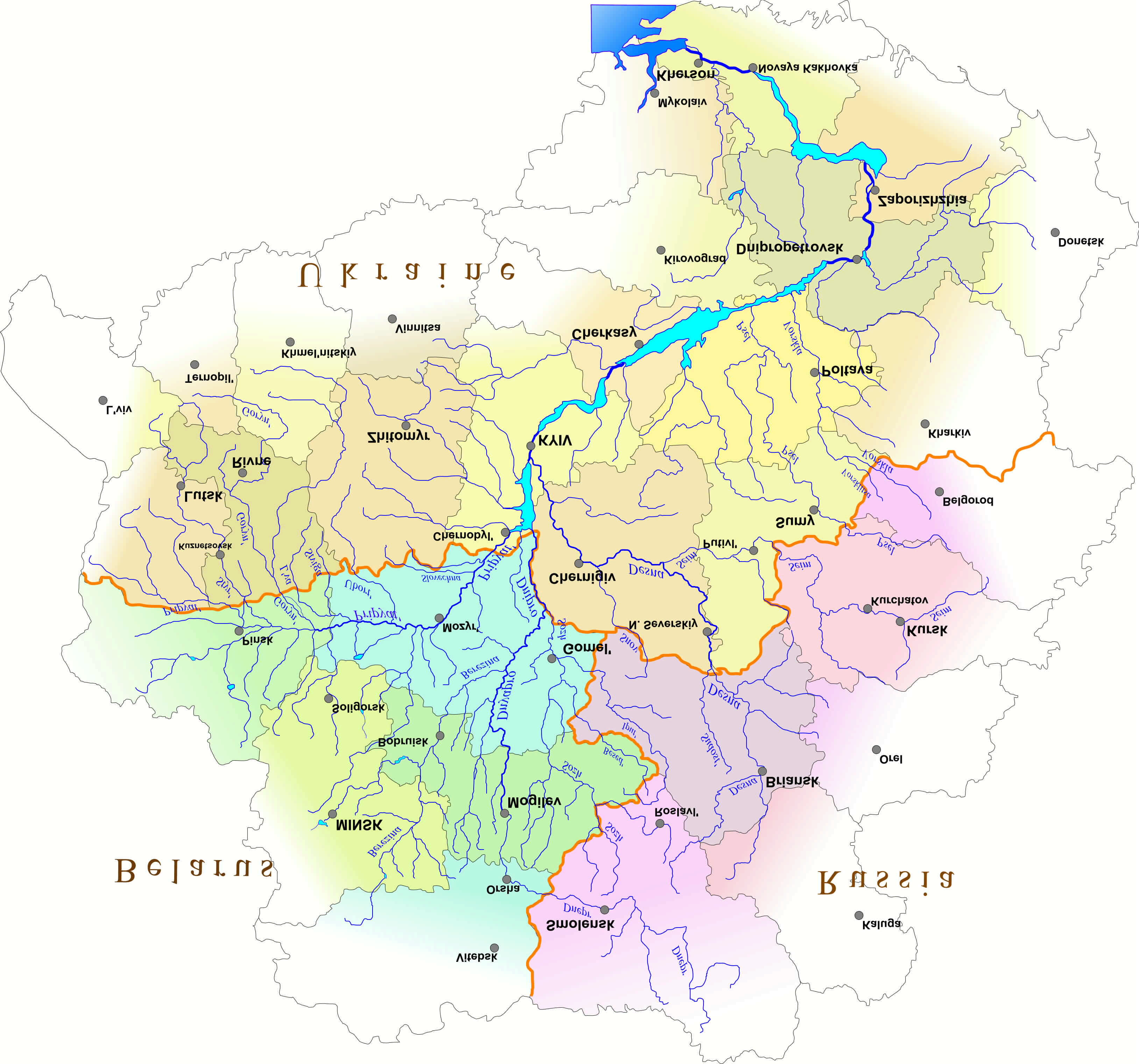
The Dnipro River extends into the territories of three Eastern European countries, the Russian
Federation, the Republic of Belarus and Ukraine. It is the third largest European transboundary
watercourse after the Danube and the Volga, draining a basin of 511,000 km2, and the fourth
longest river in Europe (2,200 km), next to the Ural, the Volga and the Danube. 19.8% of the
Dnipro Basin is within the territory of the Russian Federation, 22.9% in the Republic of Belarus,
and 57.3% is in Ukraine (Figure 2.1).
The river system of the Dnipro Basin has been regulated with a large number of reservoirs,
channels, conduits, ponds, dams and locks/gates. Overall, 564 reservoirs have been constructed
in the Basin with a total area of 775.6 km2 and a capacity of 46.2 km3. The flow of the Middle
and Lower Dnipro (from the Pripyat River inflow to the town of Kakhovka) is regulated by a
chain of huge reservoirs (the Kyiv, Kremenchug, Dniprodzerzhinsk, Dniprovsky and Kakhovka
Strategic Action Programme for the Dnipro Basin
and Mechanisms for its Implementation
6
Agreement on cooperation in the field of use and
Annex 1
protection of the Dnipro basin
reservoirs the latter, along with the Kremenchug reservoir, are among the largest water
reservoirs in the world). Very little of the natural river channel remains, being restricted to a
short length downstream of Dniprodzerzhinsk.
The total projected groundwater resource available in the Basin is approximately 24 km3, with
over 13 km3 being hydraulically isolated from the surface water flow.
The land resource of the Dnipro Basin has been intensively used for a number of different
purposes. Three fifths of the Basin area have lost their original natural landscape features as a
result of highly intensive land use. About 50% of the Basin area is occupied by agricultural land.
Figure 2.1 Map of the Dnipro Basin
Forests occupy about 33.8% of the total Basin area, being mainly concentrated in the upper part
of the basin and less dominant in the lower where forest cover is limited to relatively small
artificial plantations and wind break strips surrounding agricultural fields.
Strategic Action Programme for the Dnipro Basin
and Mechanisms for its Implementation
7
Agreement on cooperation in the field of use and
Annex 1
protection of the Dnipro basin
The mineral resource base of the upper part of the Basin (within the Russian Federation) is rather
scarce and limited to relatively small deposits of low-grade coal, peat, and locally used
construction materials. At the same time, the rich and diverse mineral resource base in the
Belorussian and Ukrainian parts of the Dnipro Basin have driven the large-scale development of
mining and processing industries that dominate these economies.
Large-scale land drainage schemes, covering about 4.5-5 million ha of the Basin territory, have
contributed dramatically to the environmental degradation. Massive drainage works, along with
extensive peat extraction activities, have ravaged surrounding areas. As a result, the total area of
devastated and dried-up land in the Polesie region has reached about 6 million ha. The impact of
drainage activities on water resources has been no less dramatic, leading to major alterations of
the hydrographic network, changes in the morphometric characteristics of water bodies and their
catchments, modification of flow regime, and a fall in the water table of 1.0-1.5 m. Every year,
about 1,500,000 tonnes of mineral substances and up to 700,000 of aggressive soluble organic
compounds enter the Dnipro River with surface runoff from drained land, and this pollution load
is further carried with river flow into the Black Sea. The rate of drying-up is so great that it can
lead to progressive expansion of devastated spots to the extent where they merge and form vast
degraded zones possessing the features of semi-desert.. Clearly, this represents a threat of a
major transboundary/regional disaster for the whole of Central Europe.
The Dnipro Basin is a unique Eastern European ecosystem sustaining a rich biological diversity.
There are more than 35 nature reserves and protected areas in the Dnipro Basin that enjoy the
national status and occupy only about 1.6% (8,100 km2) of the catchment's area. Clearly, the
existing nature reserve capacity is not adequate to ensure full protection and conservation of
plant and animal species, both native and migratory ones.
2.2 Socio-Economic Characteristics
In relation to Eastern Europe as a whole, the Dnipro River Basin has a medium population
density. The estimated population of the Basin at the beginning of 2001 was about 32.4 million,
broken down by country as follows: 3.6 million within the Russian Federation; 6.3 million
within the Republic of Belarus; and 22.2 million people within Ukraine. The level of
urbanization is high, with about 69% of the Dnipro Basin population living in urban areas,
characterised by intensive industrial activity, excessive exploitation of natural resources, and
heavy anthropogenic load on the environment.
The average population density in the Dnipro Basin is 63 people/km2, increasing in the
downstream direction from 35.6 and 53 people/km2 in the Russian and Belorussian parts of the
Basin, respectively, to 76 people/2 in the Ukrainian part of the Basin.
The following major trends in demographic situation have emerged over the last decade, being
characteristic for each riparian country and the Dnipro Basin as a whole:
· A decline in the total number of population and fall in birth rate;
· An increase in the urban population and reduction in the rural population.
Economic development in the region has followed a highly specific pattern, featuring high
industrial density and concentration of heavily polluting chemical and metallurgical industries,
and large agricultural complexes.
The collapse of production activity in the early 1990s and dramatic reduction of per capita GDP
values have resulted in the deterioration of living conditions in all three countries. Following a
Strategic Action Programme for the Dnipro Basin
and Mechanisms for its Implementation
8
Agreement on cooperation in the field of use and
Annex 1
protection of the Dnipro basin
long period of systemic socio-economic crisis, the economic situation has stabilised and started
to manifest certain signs of growth since 2000, leading to a gradual improvement of living
standards in the Basin. The following table presents some economic data for the riparian
countries of the Dnipro Basin.
Economic growth rates in the Dnipro Basin countries in 1999 and 2002
Dnipro Basin country
The rate of growth (% to the previous year)
GDP
Production
Industrial
Agricultural
1999
2002
1999
2002
1999
2002
Republic of Belarus
103.42
104.7
110.3
105.9
91.7
101.8
Russian Federation
106.4
103.8
116.0
104.3
93.9
102.2
Ukraine
98.8
104.8
104
107
100.3
102.1
The growth rates have been particularly high in the following sectors: the building material
industry, food processing industry, light industry, and ferrous metallurgical and petrochemical
industries. Small and medium-size businesses have started to play an increasingly important role
in the regional economy.
2.3 Priority Transboundary Issues of the Basin
Twenty two GIWA issues from five major concern areas were assessed in order to determine
their relevance and transboundary nature in the context of the Dnipro Basin. Using the GIWA
methodology, the following suite of criteria was defined and used for the prioritisation of these
transboundary issues:
· Transboundary nature of an issue.
· Scale of impacts of an issue on the Dnipro Basin and Black Sea ecosystems.
· Scale of impacts of an issue on economic activities, the environment and human health.
· Relevance of an issue from the perspective of national priorities reflected in existing
national policies and action plans on environmental rehabilitation and biodiversity
conservation in the Dnipro Basin.
· Scope of the systemic relationship with other environmental issues and economic sectors.
· Expected multiple benefits that might be achieved by addressing an issue.
· Lack of perceived progress in addressing/solving an issue at the national level.
As a result of this analysis, 12 major transboundary issues were identified in the Dnipro Basin.
These are listed below in order of priority:
1) Chemical pollution;
2) Modification/loss of ecosystems or ecotones and decreased viability of biological
resources due to contamination and diseases;
3) Modification of the hydrological regime of surface waters;
4) Eutrophication;
5) Pollution by radio nuclides;
6) Flooding events and elevated groundwater levels;
7) Solid waste;
8) Accidental spills and releases;
9) Microbiological pollution;
10) Changes in the water table;
2 Statistical Yearbook of the Belarus Republic. 2003. The Ministry of Statistic and Analysis of Belarus Republic
Strategic Action Programme for the Dnipro Basin
and Mechanisms for its Implementation
9
Agreement on cooperation in the field of use and
Annex 1
protection of the Dnipro basin
11) Suspended solids;
12) Impact on biological and genetic diversity.
Of these 12 transboundary issues, identified and examined in the TDA, the following six issues
were considered as a priority:
i. Chemical pollution;
ii. Modification/loss of ecosystems or ecotones and decreased viability of biological
resources due to contamination and diseases;
iii. Modification of the hydrological regime;
iv. Eutrophication;
v. Flooding events and elevated groundwater levels;
vi. Pollution by radio nuclides.
Based on the results of the Transboundary Diagnostic Analysis, the proposed options were
formulated to resolve these six priority transboundary issues.
In addition, a baseline assessment of the state of the transboundary sections of the Dnipro Basin,
completed as part of the TDA process, provided a basis for the justification of the long-term
ecological quality objectives for the Dnipro Basin.
2.4 Immediate Causes of Transboundary Issues
The immediate causes of these transboundary issues are closely linked to the resource uses and
practices in the following sectors of the economy: industry (including power energy, mining
industry, metallurgy, and chemical industry), agriculture, transport, fisheries, and urbanisation.
They can be also attributed to the consequences of the Chornobyl accident.
Issue: Chemical pollution:
· Operational discharge of liquid and gaseous effluents including cooling waters;
· Emissions from storage of chemical products;
· Emissions from storage of solid waste;
· Emissions from storage of liquid wastes;
· Emissions from transport;
· Runoff;
· Growth in the production of waste.
Issue: Modification/loss of ecosystems or ecotones and decreased viability of biological
resources due to contamination and disease:
· Modification or loss of aquatic habitats;
· Changes in land use;
· Introduced species;
· Changes in the sediment transport regime.
In addition, the following transboundary issues contribute to this issue:
· Modification of the hydrological regime;
· Flooding events and elevated groundwater levels;
· Chemical pollution;
· Radionuclide pollution;
· Eutrophication.
Strategic Action Programme for the Dnipro Basin
and Mechanisms for its Implementation
10
Agreement on cooperation in the field of use and
Annex 1
protection of the Dnipro basin
Issue: Modification of the hydrological regime of surface waters:
· Flow regulation, including required releases from the Dnipro reservoirs;
· Flow diversions between the river basins or within the basin;
· Flow abstraction for domestic and industrial purposes;
· Land drainage activities;
· Flow abstraction for irrigation;
· Returns/runoff of water;
· Flow diversion for aquaculture;
· Peat extraction activities.
Issue: Eutrophication:
· Operational discharge of liquid and gaseous effluents including cooling waters;
· Runoff;
· Emissions from storage of liquid wastes;
· Emissions from storage of solid waste;
· Emissions from transport;
· Inputs of water-soluble compounds from drained areas.
Issue: Flooding events and elevated groundwater levels:
· Modification of the hydrological regime;
· Runoff from land surfaces;
· Elevated groundwater and surface water levels;
· Discharges of water.
Issue: Radionuclide pollution:
· Atmospheric and aquatic releases of radio nuclides during the Chornobyl accident;
· Secondary releases as a result of the Chornobyl accident;
· Point and diffuse discharges of mining process waters and tailing wastes from disposal
sites at uranium mines and ore-enrichment plants;
· Emissions/discharges from radioactive waste disposal sites and ionising radiation
sources;
· Emissions and discharges from NPP's.
2.5 Underlying Sectoral Causes of Transboundary Issues
The table below illustrates the contribution of the various sectors to the identified transboundary
issues.
The sectoral causes contributing to the transboundary issues are:
· Limited capital investment;
· Lack of incentives to introduce improved operational practices
· Lack of incentives to introduce improved resource- and energy-saving technologies;
· Ineffective environmental/economic regulation instruments for the sustainable
management of nature uses and pollution control;
· Inadequate level of staff training;
· Inadequate implementation of environmental monitoring;
· Inadequate enforcement and control of compliance with environmental
legislation/regulations.
Strategic Action Programme for the Dnipro Basin
and Mechanisms for its Implementation
11
Agreement on cooperation in the field of use and
Annex 1
protection of the Dnipro basin
Prioritised list of sectors contributing to transboundary issues (1 denotes highest priority, 6
lowest priority)
Priority sectors
No.
Major environmental
issues of the Basin
accident
Industry
sector
Energy
Agriculture
Transport
Municipal service
Fisheries/aquaculture
Consequences of the
Chornobyl
1
Chemical pollution
1
2
6
3
4
5
-
Modification/loss of
ecosystems and ecotones,
2
and decreased viability of
5
1
3
4
6
2
-
biological resources
Modification of the
3
hydrological regime
5
2
6
4
33
14
-
4
Eutrophication
3
1
4
2
6
5
-
Pollution by
5
radionuclides
25
-
-
-
-
3
1
Flooding events and
6
elevated groundwater
24
1
-
3
4
-
-
levels
2.6 Root Causes of Transboundary Environmental Issues
Transboundary environmental issues in the Dnipro Basin, listed in the previous section, are
driven by three root causes:
I
Historical unsustainable development
The existing state of the Dnipro Basin ecosystem is ultimately the legacy of large-scale
unsustainable development in the decades prior to transition to a market economy. This includes
the concentration, scale and sitting of industrial and agricultural complexes in the Basin. The
extensive use of natural resources with little regard for ecosystem function has led to major, and
in some instances, irreversible changes in the terrestrial and aquatic ecosystems within the Basin.
II
The systemic socio-economic crisis during the transition to a market economy
3 Water transport
4 Hydropower energy
5 Mining industry
Strategic Action Programme for the Dnipro Basin
and Mechanisms for its Implementation
12
Agreement on cooperation in the field of use and
Annex 1
protection of the Dnipro basin
The transition from a centrally planned to a market guided economy has been accompanied by a
sharp decline in standards of living, widened income inequalities and a deterioration in health
conditions. The uncertainty of the conditions in which the economic transition is taking place,
including the institutional environment and the weak state of law enforcement have; (a)
hampered the progress of economic reform; (b) limited the development of market mechanisms;
and (c) led to an economy based on immediate profits that gives little emphasis to environmental
issues.
III
Prevailing attitudes which undervalue the environment
The lack of past attention to the value of the natural environment (as a provider of goods and
services and for its intrinsic value) have led to a poor current state of awareness of the
consequences of environmental degradation in government and civil society and a limited degree
of motivation for environmental protection.
3
Strategy for Environmental Rehabilitation of the
Dnipro Basin
3.1 Long-Term Objectives
The Declaration of the UN Conference on the Environment and Sustainable Development (Rio
de Janeiro, 1992), further developed and supported by the international community during the
Johannesburg meeting in 2002, defined the notion of sustainable development and its three
guiding principles:
· Human beings are at the centre of concerns for sustainable development. They are
entitled to a healthy and productive life in harmony with nature;
· Environmental protection constitutes an integral part of the development process and
cannot be considered in isolation from it;
· The right to development must be fulfilled so as to equitably meet developmental and
environmental needs of present and future generations.
Six priority transboundary environmental issues and their root causes, identified in the TDA, can
be resolved in a stepwise manner if the above principles are complied with.
Each riparian country of the Dnipro Basin has developed a National Sustainable Development
Concept (Doctrine), and incorporated the above guiding principles into the national
environmental policy. Pursuant to their identified priorities, the riparian countries of the Dnipro
Basin define their socio-economic development strategies in full concordance with the following
objectives:
· Ensuring the sustainable nature use and implementation of adequate environment
protection programmes at the Basin level,
· Ensuring environment quality that is safe for human health,
· Conservation of biological and landscape diversity.
I
Sustainable Nature Use and Environment Protection in the Dnipro
Basin
The sustainable nature use and environment protection in the Dnipro Basin shall be ensured
through the establishment of an effective legal and institutional framework, including:
Strategic Action Programme for the Dnipro Basin
and Mechanisms for its Implementation
13
Agreement on cooperation in the field of use and
Annex 1
protection of the Dnipro basin
· The provision of improved legislative/regulatory and institutional mechanisms that are
adequate and appropriate for ensuring the sustainable use of natural resources and
protection of the environment at the national level;
· The establishment of an institutional framework for the international management of the
Basin, including an adequate legislative framework for multi- and bilateral cooperation,
and enhanced cooperation with the international donor agencies in the field of
environmental rehabilitation of the Dnipro Basin;
· The provision of a legal and institutional framework for encouraging and promoting public
participation in the decision-making process at the national and international level;
· The harmonisation of environmental legislation of the riparian countries of the Dnipro
Basin with that of the EU.
II
Environment Quality that is Safe for Human Health
Over the past decade of economic recession, there has been a continuous reduction in
emissions/discharges of pollutants and application of agrochemicals. However, this has not led to
any significant, or at least comparable, improvement in the state of environment.
The history of intensive economic activities has had a profound effect on the environment in the
Dnipro Basin. The scale of this effect is so great that some areas of the Basin have completely
lost their assimilative capacity.
In all the riparian countries of the Dnipro Basin, the levels of many pollutants in various media
have exceeded mandatory limits. The expected growth of production output in all sectors of the
economy will exacerbate the environmental situation, leading to a further deterioration of living
conditions and a continued decline in the human population, unless the precautionary approach is
taken to implement actions to protect and conserve the environment.
The Dnipro Basin SAP defines the mechanisms and specific actions designed to ensure the
environmental rehabilitation of the Dnipro Basin and an improvement of environmental quality
to a level that is safe for human health and biological diversity.
III
Conservation of biological and landscape diversity
The history of intensive exploitation of natural resources in the Dnipro Basin has led to a
progressive degradation of natural ecosystems and habitats. This has resulted in a reduction or
loss of habitats, changes in population structure, a disintegrated ecological network, the loss of
species (both plant and animal) and a decline in population numbers.
The Dnipro Basin Biodiversity Conservation Strategy is seen as an integral part of the overall
regional strategy designed to promote and advance the transition towards the principles of
sustainable development, and a means for resolving transboundary issues of global and regional
significance. It defines a suite of specific actions to be taken to maintain essential processes
occurring in the Basin ecosystem, create favourable living conditions for the human population
and conserve and restore the amenity value of the Basin environment.
A detailed description of the Long-Term Ecological Quality Objectives (LTEQOs), the shorter-
term operational objectives devised to ensure progress towards these LTEQOs, and specific
Strategic Action Programme for the Dnipro Basin
and Mechanisms for its Implementation
14
Agreement on cooperation in the field of use and
Annex 1
protection of the Dnipro basin
actions needed to be taken to facilitate the operational objectives is provided in the following
sections of this document.
In order to formulate options for achieving the objectives set by the SAP that are fully in line
with national policy priorities, the riparian countries of the Dnipro Basin have:
· used the following timescale: 5-10-15 years;
· ranked the actions in terms of their priority: High, Medium, Low;
· estimated the cost of implementation of these actions.
3.2 Steps to be Taken to Ensure the Environmental
Rehabilitation of the Dnipro Basin
Each LTEQOs identified in this Programme involves a number of tasks and a series of logical
and interrelated steps to be taken to attain it.
In order to measure progress towards each of the agreed LTEQO, success indicators have been
identified that refer to a change in the environment quality.
I
Sustainable Nature Use and Environment Protection in the Dnipro
Basin
Sustainable nature use and environment protection in the Dnipro Basin shall be ensured through
the establishment of effective legal and institutional mechanisms.
The steps to attain this objective are set out below:
Step 1.1
The provision of improved legislative/regulatory and institutional mechanisms
that are adequate and appropriate for ensuring the sustainable use of natural
resources and protection of the environment at the national level;
Step 1.2
The establishment of an institutional framework for the international
management of the Basin, including an adequate legislative framework for multi-
and bilateral cooperation, and enhanced cooperation with the international donor
agencies in the field of environmental rehabilitation of the Dnipro Basin;
Step 1.3
The provision of a legal and institutional framework for encouraging and
promoting public participation in the decision-making process at the national and
international level;
Step 1.4
The harmonisation of environmental legislation of the riparian countries of the
Dnipro Basin with that of the EU.
The following actions need to be taken to facilitate the implementation of these steps:
· The enhancement of environmental legislation and regulations and their integration into
the sustainable development concept. Priority: High. Term of implementation: 5-10-15
years.
· Ensuring compliance with the requirements of environmental legislation and regulations
at all levels of state governance. Priority: High. Term of implementation: 5-10-15 years.
Strategic Action Programme for the Dnipro Basin
and Mechanisms for its Implementation
15
Agreement on cooperation in the field of use and
Annex 1
protection of the Dnipro basin
· Strengthening the legislative and regulatory framework for water resource management
on a catchment's basis. Priority: High. Term of implementation: 5-10-15 years.
· Pursue an economically viable and environmentally sound tariff policy in setting charges
for natural resource use and environmental pollution. Priority: High. Term of
implementation: 5-10-15 years.
· The signing and ratification of the Agreement on Cooperation on Management and
Protection of the Dnipro Basin . Priority: High. Term of implementation: 2 years.
· Establish and ensure the sustainable operation of the International Dnipro Basin
Commission. Priority: High. Term of implementation: 5-10-15 years.
· Ensure sustainable operation of the International Dnipro Basin Council. Priority: High.
Term of implementation: 5-10-15 years.
· Implementation of the Transboundary Monitoring Programme. Priority: High. Term of
implementation: 5-10-15 years.
· Ensuring the exchange of environmental information on the basis of the agreed
information exchange procedure. Term of implementation: 5-10-15 years.
· Jointly develop and implement the environmental action programmes. Priority: High.
Implementation term: 5-10-15 years.
· Increasing the level of responsibility and accountability of local authorities and the public
for the ecological status of the Basin. Priority: High. Term of implementation: 5-10-15
years.
· Encouraging the active participation of the public in the legislative process; introducing
and promoting the practice of independent review of draft laws; encouraging the active
involvement of the public in the preparation and implementation of environmental
programmes. Priority: High. Term of implementation: 5-10-15 years.
· Harmonisation of legislation relating to prevention of chemical, nutrient and radionuclide
pollution in line with the EU approaches. Priority: High. Term of implementation: 5-10-
15 years.
Success Indicators to Measure the Progress towards the LTEQO:
·
Integration of the basin management principle into environmental legislation.
·
An effective mix of economic and administrative instruments for nature use management.
·
Ratification of the multilateral Agreement by the riparian countries of the Dnipro Basin.
·
The establishment of a permanent trilateral executive authority for the management of the
Dnipro Basin based on the provisions of the Agreement.
·
Sustainable operation of the International Dnipro Basin Council.
·
Availability of objective monitoring information on the ecological status of
transboundary sections of the Basin, and efficient exchange of environmental information
on the basis of the agreed information exchange procedure.
·
Sustainable cross-border cooperation on environmental issues, based on the existing
bilateral agreements signed between the riparian countries of the Dnipro Basin.
Cost estimates for these actions are reflected in Table 3.2.1.
Strategic Action Programme for the Dnipro Basin
and Mechanisms for its Implementation
16
Agreement on cooperation in the field of use and
Annex 1
protection of the Dnipro basin
Table 3.2.1.
Sustainable Nature Use and Environment Protection in the Dnipro Basin
Step 1.1
The provision of improved legislative/regulatory and institutional mechanisms that are adequate and appropriate for
ensuring the sustainable use of natural resources and protection of the environment at the national level;
Step 1.2
The establishment of an institutional framework for the international management of the Basin, including an adequate
legislative framework for multi- and bilateral cooperation;
Step 1.3
The provision of a legal and institutional framework for encouraging and promoting public participation in the decision-
making process;
Step 1.4
The harmonisation of environmental legislation of the riparian countries of the Dnipro Basin with that of the EU.
Time
Financing requirement
required
(million US $)
Activity
Priority to achieve
Expected results
Uncertainties
implemen
RB
RF
UA
tation
The enhancement of environmental
The principles of sustainable
Instability of existing economic
legislation and regulations on the
development incorporated in the
management framework, contradictions
5-10-15
basis of a scientifically sound
1
1.1
0.51
1.2
provisions of national laws, and their
at the sectoral level, lack of experience
years
rationale, and their integration into
implementation mechanisms
in the multilateral cooperation on a
the sustainable development concept
established by relevant by-laws
catchment basis
The enhancement of the legislative
and regulatory framework for water
Water resource management on a
Contradictions at the sectoral level, lack
resource management on a
5-10-15
catchment basis is incorporated into the
1
1
0.24
4.26
of understanding at the local level with
catchment basis through the
years
state governance system of the riparian
regard to the basin management concept
provision of a scientifically sound
countries
rationale
Lack of incentives and low wages of
Ensuring compliance with the
inspectorate staff. Inadequate technical
requirements of environmental
5-10-15
1
44.1
0
5
Effective regulatory and public control
capacity of regulatory authorities.
legislation and regulations at all
years
Inadequate legislative framework limits
levels of state governance
the public control
Strategic Action Programme for the Dnipro Basin
and Mechanisms for its Implementation
17
Agreement on cooperation in the field of use and
Annex 1
protection of the Dnipro basin
Time
Financing requirement
required
(million US $)
Activity
Priority to achieve
Expected results
Uncertainties
implemen
RB
RF
UA
tation
Pursue an economically viable and
Environmental actions are considered a
environmentally sound tariff policy
low priority in the context of overall
5-10-15
Gradual increase in the environmental
in setting charges for natural
1
0.75
0.15
0.52
budget planning and financing the cost
years
fee rates to achieve the EU level
resource use and environmental
of socio-economic development
pollution
programmes
The preparation and signing of the
Agreement on Cooperation in the
Instability of existing governance
1
1 year
0.04
0.04
0.07
The Agreement signed
Field of Management and Protection
system
of the Dnipro Basin
Establish and ensure the sustainable
5-10-15
0.137
0.137
The Commission established and meet
Instability of existing governance
operation of the International Dnipro
1
0.27
years
5
5
regularly
system
Basin Commission
Ensure the sustainable operation of
5-10-15
Instability of existing governance
the International Dnipro Basin
1
0.12
0.12
0.18
The Council meet regularly
years
system
Council
The riparian countries of the Basin
Contradictions at the sectoral level, lack
Implementation of the
receive the environmental monitoring
of training capacity and practical
5-10-15
Transboundary Monitoring
1
0.9
0.9
1.3
data on the state of environment in the
experience in the transboundary
years
Programme
transboundary sections of the Dnipro
monitoring, inadequate coordination at
Basin on a regular basis
the international level
Lack of adequate financing to cover
recurrent and capital expenditures
Ensuring the exchange of
The riparian countries publish
associated with the Data Base
environmental information on the
5-10-15
0.201
0.201
information on the state of environment
operation. Lack of progress in
basis of the operational procedure,
1
0.397
years
5
5
in the Basin at the relevant web-pages
establishing the international and
agreed for the International
on a regular basis
national structures responsible for the
Environmental Data Base
maintenance and operation of the Data
Base
Jointly prepare the Report on the
Every five
Lack of coordination at the international
State of Environment in the Dnipro
1
0.02
0.02
0.04
The report is published every five years
years
level
Basin
Strategic Action Programme for the Dnipro Basin
and Mechanisms for its Implementation
18
Agreement on cooperation in the field of use and
Annex 1
protection of the Dnipro basin
Time
Financing requirement
required
(million US $)
Activity
Priority to achieve
Expected results
Uncertainties
implemen
RB
RF
UA
tation
Action programmes on the protection
of population and territories against
Jointly prepare and implement the
5-10-15
Contradictions at the sectoral level, lack
1
1.05
1.05
2.05
harmful impact of waters at the
environmental action programmes
years
of coordination at the international level
international, national and regional
level
Increasing the level of responsibility
Environmental Action Plans at the
Inadequate level of environmental
and accountability of local
5-10-15
1
3.25
3.34
5.4
municipality level adopted and
education among the public and local
authorities and the public for the
years
implemented by local authorities
authorities
ecological status of the Basin
Organisation of summer EcoCamps,
preparation and publication of
educational materials for target
audiences; instituting awards for the
Strengthening the capacity for
best publications, TV and radio
environmental education and
programmes on environmental issues;
Lack of support from the local
awareness raising among various
5-10-15
1
5.4
5.4
9.1
dissemination of the up-to-date
authorities and public. Inadequate level
stakeholder groups with the active
years
information and educational materials
of methodological support
involvement of non-governmental
in the educational institutions,
organisations
instituting awards for the best teachers
and students in environmental sciences,
support for the school-based
environmental monitoring network
Encouraging the active participation
The monitoring of the SAP
of the public in the legislative
implementation is undertaken by the
process; introducing and promoting
NGO network, the sustainable NGO
5-10-15
Lack of motivation in the governments.
the practice of independent review of
1
9.1
9
14.4
resource centres, the sustainable
years
Lacking or inadequate financing
draft laws; encouraging the active
operation of the International Dnipro
involvement of the public in the
River NGO Network, the small grants
preparation and implementation of
programmes available to support
environmental programmes
environmental NGOs
Strategic Action Programme for the Dnipro Basin
and Mechanisms for its Implementation
19
Agreement on cooperation in the field of use and
Annex 1
protection of the Dnipro basin
Time
Financing requirement
required
(million US $)
Activity
Priority to achieve
Expected results
Uncertainties
implemen
RB
RF
UA
tation
environmental programmes
environmental NGOs
Harmonisation of legislation relating
A set of laws and regulations relating to
to prevention of chemical, nutrient
5-10-15
Contradictions at the sectoral level, lack
1
0.3
0.3
0.36
the approximation of environmental
and radionuclide pollution in line
years
of coordination at the international level
legislation
with the EU approaches
Strategic Action Programme for the Dnipro Basin
and Mechanisms for its Implementation
20
Agreement on cooperation in the field of use and
Annex 1
protection of the Dnipro basin
II
Environment Quality that is Safe for Human Health
The steps to attain this objective are set out below:
Step 2.1:
Ensure safe water consumption and use in the Dnipro Basin
Step 2.2:
Achieve a reduction in anthropogenic load for a range of priority chemical
substances
Step 2.3:
Adjust the level of anthropogenic load to take account of the assimilative capacity
of the Basin
Step 2.4:
Minimise the threat of the adverse impact of radioactive pollution on human
health and the environment.
Step 2.5:
Ensure safe living conditions in the areas affected by flooding events and elevated
groundwater levels.
The following actions need to be taken to facilitate the implementation of these steps:
· Strengthening the capacity for water use management. Priority: Medium. Term of
implementation: 5-10-15 years.
· Improving the technologies for municipal wastewater treatment, storm water treatment,
and sludge management. Priority: High. Term of implementation: 10 years.
· Reduce the impact of pollution hot spots on the transboundary sections of the Dnipro
Basin (see Annex 3). Priority: High. Term of implementation: 5-10-15 years.
· Strengthening the capacity for industrial and municipal waste management. High. Term
of implementation: 5-10-15 years.
· Introduction of an enhanced groundwater/surface water monitoring regime in the Basin,
and improved exchange of monitoring information at the national level. Priority: High.
Term of implementation: 5-10-15 years.
· Strengthening the capacity for early warning and response to the extreme pollution events
affecting surface waters. Priority: High. Term of implementation: 5-10-15 years.
· Introduce a systematic approach to pollution control and prevention in the industrial
sector (integrated preventative approach), implement environmental management systems
in combination with Best Available Techniques (BATs). Priority: High. Term of
implementation: 5-10-15 years.
· Introduce improved and environmentally sound agricultural practices. Ensure improved
control over pesticide application in agriculture. Priority: Medium. Term of
implementation: 5-10-15 years.
· Establish and maintain water-protective zones and riparian strips to protect water bodies.
Priority: High. Term of implementation: 5-10-15 years.
Strategic Action Programme for the Dnipro Basin
and Mechanisms for its Implementation
21
Agreement on cooperation in the field of use and
Annex 1
protection of the Dnipro basin
· Implement remedial actions in the areas affected as a result of the Chornobyl accident.
Priority: High. Term of implementation: 5 years.
Success Indicators to Measure the Progress towards the LTEQO:
· Increased proportion of population with access to good quality drinking water in quantities
that are adequate to meet the essential needs.
· Reduction in chemical and radioactive pollution load of anthropogenic origin, affecting the
air, water, and soil.
· Provision of access to reliable monitoring information on environmental quality for state
governance bodies and the public.
· Reduction in pollution load from diffuse sources.
· Reduction in damage caused by the harmful effect of waters.
· Reduction in diffuse discharges of radionuclides from the areas affected as a result of the
Chornobyl accident.
Cost estimates for these actions are provided in Table 3.2.2.
Strategic Action Programme for the Dnipro Basin
and Mechanisms for its Implementation
22
Agreement on cooperation in the field of use and
Annex 1
protection of the Dnipro basin
Table 3.2.2.
Steps to be Taken to Attain the LTEQO: Environment Quality that is Safe for Human Health
Step 2.1:
Ensure safe water consumption and use in the Dnipro Basin
Step 2.2:
Achieve a reduction in anthropogenic load for a range of priority chemical substances
Step 2.3:
Adjust the level of anthropogenic load to take account of the assimilative capacity of the Basin
Step 2.4:
Minimise the threat of the adverse impact of radioactive pollution on human health and the environment
Step 2.5:
Ensure safe living conditions in the areas affected by flooding events and elevated groundwater levels
Time Required
Financing Requirement
Priorit
Activity
to Achieve
(million US $)
Expected Results
Uncertainties
y
Implementation
RB
RF
UA
Strengthening the capacity for water
1
5-10-15 years
156.9
99.7
526
use management, including:
Upgrade, expansion and/or
?) Improvement of water supply
1
6-10-15 years
69.2
40
198
construction of water supply
systems, wastewater treatment
Inadequate financing
?) Improvement of wastewater
1
7-10-15 years
85
56.4
299.6
facilities, and/or flood-control
collection and treatment
structures
?) Prevention of harmful effects of
1
8-10-15 years
2.7
3.3
28.4
waters
Improving the technologies for
municipal wastewater treatment,
Achieving compliance with
Weak economic incentives, economic
2
5-10-15 years
6.4
56
35
storm water treatment, and sludge
wastewater treatment standards
volatile economic situation
management
Reduce the impact of pollution Hot
The impact of Hot Spots reduced Inadequate financing, lack of economic
Spots on the transboundary sections
1
5-10-15 years
45.2
20.4
105.2
to an acceptable level
incentives
of the Dnipro Basin
Weak economic incentives, volatile
Strengthening the capacity for
Minimised risk of groundwater
economic situation, gross non-
industrial and municipal waste
1
5-10 years
21
7.2
27
pollution
compliance with environmental
management
legislation
Introduction of an enhanced
groundwater/surface water
Lack of coordination at the sectoral
Optimised water monitoring
monitoring regime in the Basin, and
1
5-10-15 years
3.5
2.5
6.5
level, instability of environmental
system
improved exchange of monitoring
agencies and institutions
information at the national level
Strategic Action Programme for the Dnipro Basin
and Mechanisms for its Implementation
23
Agreement on cooperation in the field of use and
Annex 1
protection of the Dnipro basin
Time Required
Financing Requirement
Priorit
Activity
to Achieve
(million US $)
Expected Results
Uncertainties
y
Implementation
RB
RF
UA
Strengthening the capacity for early
Lack of coordination at the sectoral
warning and response to extreme
Early warning and response
1
5-10-15 years
0.25
0
0.5
level, instability of environmental
pollution events affecting the surface
system established in the Basin
agencies and institutions
waters
Introduce a systematic approach to
pollution control and prevention in
All these principles are
Instability of environmental agencies
the industrial sector (integrated
integrated into the legal and
and institutions, inadequate
preventative approach), implement
1
5-10-15 years
12
21
22.7
regulatory framework of the
involvement in environmental action at
environmental management systems
riparian countries, and relevant
the sectoral level
in combination with Best Available
laws/regulations prepared
Techniques (BATs)
Introduce improved and
environmentally sound agricultural
A set of regulations and
practices. Ensure improved control
2
5-10-15 years
22.5
10.4
12
Lack of economic incentives
guidelines
over pesticide application in
agriculture
Establish and maintain water-
Continuous network of water
Weaknesses in legislative framework.
protective zones and riparian strips to
1
5-10-15 years
2.3
11.2
14
protective zones and riparian
Inadequate control of compliance with
protect water bodies
strips
environmental laws and regulations
Implement remedial actions in the
Eliminated or minimised release
Lack of investment, volatile economic
areas affected as a result of the
1
5 years
6.05
0.3
13.3
of radioactive substances
situation
Chornobyl accident
Strategic Action Programme for the Dnipro Basin
and Mechanisms for its Implementation
24
Agreement on cooperation in the field of use and
Annex 1
protection of the Dnipro basin
III
Conservation of Biological and Landscape Diversity
The steps to attain this objective are set out below:
Step 2.1:
Ensure the stable ecological state of water bodies, river floodplains, and riparian
ecosystems
Step 2.2:
Ensure the conservation and restoration of wetlands that constitute an integral
part of the European ecological network
Step 2.3:
Achieve and maintain an optimal pattern of nature reserves and agricultural
landscapes
Step 2.4:
Achieve and maintain an optimal forest cover that ensures the sustainability of
the Dnipro Basin ecosystems and takes account of their specific zonal features
Step 2.5.
Ensure the stable ecological state of meadows and steppes
Step 2.6:
Create and maintain favourable conditions for the reproduction of native,
endemic, and migratory fish species.
Step 2.7.
Achieve and maintain the optimal network of nature reserves and ecological
corridors
The following actions need to be taken to facilitate the implementation of these steps:
· The establishment of ecological coherent network on the basis of protected areas,
protective forests, wetlands and river floodplains that ensures the conservation and spatial
interrelationship between typical and rare components of the environment. Priority: High.
Term of implementation: 5-10-15 years.
· Compile and maintain the inventory of the most valuable biodiversity conservation areas
and carry out an assessment of biodiversity in the Dnipro Basin. Priority: Medium. Term
of implementation: 5 years.
· Develop and implement an interstate basinwide programme of actions on the expansion
of forests. Priority: Medium. Term of implementation: 5 years.
· Restore closed peat extraction sites and inefficiently used drained areas with peat soil to
convert them into wetland areas. Priority: High. Term of implementation: 51015 years.
· Environmental rehabilitation of floodplain landscapes. Priority: High. Term of
implementation: 10-15 years.
· Expand the network of protected areas that provide breeding grounds for fish and
invertebrate species. Priority: Medium. Term of implementation: 5-10 years.
· Achieve the optimal ratio between the arable land and protected areas to take account of
specific features of each soil/climatic zone. Priority: Low. Term of implementation: 5-10-
15 years.
Strategic Action Programme for the Dnipro Basin
and Mechanisms for its Implementation
25
Agreement on cooperation in the field of use and
Annex 1
protection of the Dnipro basin
· Withdraw from agricultural use about 3.5 million ha of arable land where it has low
productivity or is affected and/or degraded by erosion processes, and restore it to its
original condition in the following proportion: 1.5 million ha of forest; 1.0 million ha of
meadow; 0.5 million ha of steppe; and 0.5 million ha of wetland. Priority: Medium. Term
of implementation: 10-15 years.
· Compile the Dnipro Basin Red Data Book. Priority: Medium. Term of implementation: 5
years.
Success Indicators to Measure the Progress towards the LTEQO:
1.
Increase in:
-
forest cover,
-
area of restored wetlands,
-
number and area of protected sites,
-
number and area of water protection zones,
-
number and area of protective riparian strips,
-
abundance of native and endemic fish species,
2.
Reduction in the number of endangered species.
Cost estimates for these actions are provided in Table 3.2.3.
Strategic Action Programme for the Dnipro Basin
and Mechanisms for its Implementation
26
Agreement on cooperation in the field of use and
Annex 1
protection of the Dnipro basin
Table 3.2.3.
Steps to be Taken to Attain the LTEQO: Conservation of Biological and Landscape Diversity
Step 3.1:
Ensure the stable ecological state of water bodies, river floodplains, and riparian ecosystems
Step 3.2:
Ensure the conservation and restoration of wetlands that constitute an integral part of the European ecological network
Step 3.3:
Achieve and maintain an optimal pattern of nature reserves and agricultural landscapes
Step 3.4:
Achieve and maintain an optimal forest cover that ensures the sustainability of the Dnipro Basin ecosystems and takes account
of their specific zonal features
Step 3.5.
Ensure the stable ecological state of meadows and steppes
Step 3.6:
Create and maintain favourable conditions for the reproduction of native, endemic, and migratory fish species
Step 3.7:
Achieve and maintain the optimal network of nature reserves and ecological corridors
Time required
Financing Requirement
Activity
Priority
to Achieve
(million US $)
Expected Results
Uncertainties
Implementation
RB
RF
UA
The establishment of ecological
coherent network on the basis of
protected areas, protective forests,
Instability of existing economic
Conservation of biological and
wetlands and river floodplains, that
1
5-10-15 years
1.6
2.4
10
management framework, volatile
landscape diversity
ensures the conservation and spatial
economic situation
interrelationship between typical and
rare components of the environment
Restored habitats; stabilised water
Restore closed peat extraction sites and
regime; reduced rate of
Instability of existing economic
inefficiently used drained areas with
eutrophication; minimized risk of
1
5-10-15 years
6.8
6.3
5.1
management framework,
peat soil to convert them into wetland
fire; reduced emissions of carbon
weaknesses in legislative framework
areas
dioxide; improved climatic
conditions
Compile and maintain the inventory of
the most valuable biodiversity
The inventory of the most valuable
Inadequate scientific rationale.
conservation areas and carry out an
2
5 years
0.5
4.8
1.6
areas and assessment of biodiversity
Volatile economic situation, lack of
assessment of biodiversity in the
in the Dnipro Basin
investment
Dnipro Basin
Develop and implement an interstate
Increased area of protected forests.
basinwide programme of actions on the
2
5 years
1.7
9.2
51.8
Restored oak forests and alder
Inadequate financing
expansion of forests
plantations
Strategic Action Programme for the Dnipro Basin
and Mechanisms for its Implementation
27
Agreement on cooperation in the field of use and
Annex 1
protection of the Dnipro basin
Time required
Financing Requirement
Activity
Priority
to Achieve
(million US $)
Expected Results
Uncertainties
Implementation
RB
RF
UA
Volatile economic situation, lack of
Environmental rehabilitation of
Restored functions of the previously
1
5-10-15 years
0
0.3
0.1
investment and sound scientific
floodplain landscapes
disturbed floodplain ecosystems
rationale
The interstate network of protected
Weaknesses in legislative
Expand the network of protected areas
areas that provide reproduction
framework, volatile economic
that provide breeding grounds for fish
2
5-10 years
0.5
2.9
1.6
grounds for fish and invertebrate
situation, lack of investment and
and invertebrate species
species
coordination at the sectoral level
Achieve the optimal ratio between the
The optimal ratio between arable
Volatile economic situation, lack of
arable land and protected areas to take
3
5-10-15 years
5.2
2.6
33.3
land and protected territories
investment and incentives for
account of specific features of each
achieved and maintained
environmental action
soil/climatic zone
Withdraw from agricultural use about
3.5 million ha of arable land where it
has low productivity or is affected
Environmental rehabilitation of
and/or degraded by erosion processes,
degraded areas; absence of degraded
Volatile economic situation, lack of
and restore it to its original condition in
2
5-10-15 years
30.3
26.1
67.9
areas, about 3.5 million ha
investment
the following proportion: 1.5 million
withdrawn from agricultural use
ha of forest; 1.0 million ha of meadow;
0.5 million ha of steppe; and 0.5
million ha of wetland
The enhancement of national
Lack of sound scientific rationale.
legislative framework of biodiversity
1
5-10-15 years
2.65
0.05
0.7
A set of laws and regulations
Volatile economic situation, lack of
conservation
investment
Lack of sound scientific rationale.
Compile the Dnipro Basin Red Data
Publication of the Dnipro Basin Red
2
5-10-15 years
0.05
0.05
0.1
Volatile economic situation, lack of
Book
Data Book
investment
Strategic Action Programme for the Dnipro Basin
and Mechanisms for its Implementation
28
Agreement on cooperation in the field of use and
Annex 1
protection of the Dnipro basin
4
Legal and Institutional Framework of the SAP
Implementation
The legal and institutional framework of the SAP implementation is based on:
· Current international and national laws/regulations, and existing institutional
arrangements for nature use management in the riparian countries of the Dnipro Basin;
· Legislative/regulatory documents and institutional arrangements formulated within the
framework of the Agreement on Cooperation on Management and Protection of the
Dnipro Basin (hereinafter referred to as the Agreement), which is seen as the major
instrument designed to facilitate the successful implementation of this SAP.
4.1 Legal Framework
Existing legal framework: The riparian countries of the Dnipro Basin are parties to a number of
global and regional UN Conventions that define the approaches towards (see Annex 2):
· Ensuring sustainable nature use and environment protection in the Dnipro Basin;
· Achieving environment quality that is safe for human health;
· Ensuring conservation and protection of biological and landscape diversity
To facilitate the fulfilment of their international obligations, the riparian countries of the Dnipro
Basin have developed and are implementing the relevant bilateral agreements (see Annex 2).
In order to provide an adequate framework for the implementation of provisions set forth in the
global/regional UN Conventions and relevant bilateral agreements, the riparian countries of the
Dnipro Basin will draft and adopt appropriate national by-laws and regulations.
During the 5th Pan-European Conference "Environment for Europe", held on 22-24 May, 2003 in
Kyiv, the Ministerial Declaration on Cooperation for Environmental Rehabilitation of the Dnipro
Basin was signed by the riparian countries of the Dnipro Basin. In this Declaration, the Ministers
of Environment expressed their "willingness and preparedness to develop the international
agreement that will provide a common framework for ensuring the sustainability of international
cooperation between the riparian countries of the Dnipro Basin, and establishing the common
principles, objectives, tasks and obligations of the parties in the field of environmental
rehabilitation of the Dnipro Basin".
The National Action Plans (NAPs), to be endorsed by the relevant by-laws adopted by the
Governments of the riparian countries of the Dnipro Basin, represent the major tool that shall
facilitate the implementation of the SAP.
Proposed options for improving the legal framework: Taking into account international
experience and best practice in the management of international freshwater resources, the
riparian countries of the Dnipro Basin have committed themselves to take the necessary action in
order to establish an adequate legal framework for managing the Dnipro Basin on a multilateral
basis. This in itself represents an unprecedented step forward in developing their international
cooperation. This would provide a comprehensive and integrated framework for the riparian
countries to address and resolve the transboundary environmental issues existing in the Dnipro
Basin, and improve the efficiency of their joint effort in fulfilling and implementing their
international obligations at the global and regional level.
Strategic Action Programme for the Dnipro Basin
and Mechanisms for its Implementation
29
Agreement on cooperation in the field of use and
Annex 1
protection of the Dnipro basin
A practical step towards a regional policy is the development, endorsement and approval of the
Agreement on Cooperation on the Management and Protection of the Dnipro Basin by the
respective Governments of the riparian countries of the Dnipro Basin. The present SAP
document constitutes an integral part of this Agreement.
In order to ensure the sustainable implementation of the SAP, the parties to this Agreement shall
implement the Transboundary Monitoring Programme (TMP) and facilitate the international
exchange of environmental information in accordance with the agreed Rules and Procedure of
the Interstate Dnipro Basin Environmental Data Base. These provisions of the Agreement shall
be implemented at the national level.
4.2 Institutional Framework
Existing institutional arrangements: With the assistance and help of the UNDP-GEF Dnipro
Basin Environment Programme, the riparian countries have established the following structures:
· The International Dnipro Basin Council;
· The International Dnipro Basin Thematic Centres, comprising the international working
groups of experts; and
· The International Non-Governmental Organisation Forum, whose activities are supported
by the International Dnipro River NGO Network.
These international structures operate on the basis of their respective Statutes, approved by the
relevant International Management Bodies set up under the UNDP-GEF Dnipro Basin
Environment Programme, including the Steering, the Joint and the three National Programme
Management Committees with the Programme Management Unit providing overall coordination.
In order to facilitate the implementation of the Helsinki Convention (1992) and ensuing bilateral
commitments, the riparian countries of the Dnipro Basin signed the Agreements on Use and
Protection of Transboundary Water Bodies, and set up the Bilateral Government Committees
that play an important role in strengthening cross-border cooperation.
Proposed options for improving the institutional framework:
Key provisions of the Agreement relating to the proposed institutional arrangements include:
· The Conference of the Parties as a supreme body for managing the Basin;
· The establishment of the International Dnipro Basin Commission, to exercise executive
and administrative functions;
· The provision of a legal framework and ensuring the sustainable operation of the
International Dnipro Basin Council, International Dnipro Basin Thematic Centres, and
NGO Forum.
· The coordinated operation of the International Dnipro Basin Commission and Bilateral
Government Commissions on Use and Protection of Transboundary Water Bodies.
The riparian countries of the Dnipro Basin consider it necessary to make a formal request to the
Global Environmental Facility to provide support and assistance to the sustainable operation of
the following structures in the transition period preceding the signing of the Agreement:
· The Steering, Joint and three National Management Committees whose role will be to
guide the implementation of the SAP/NAPs;
· The Programme Management Unit, to provide international coordination and monitor the
SAP/NAP implementation;
· Technical offices, to be set up in order to provide technical and organizational support to
the National Programme Management Committees.
Strategic Action Programme for the Dnipro Basin
and Mechanisms for its Implementation
30
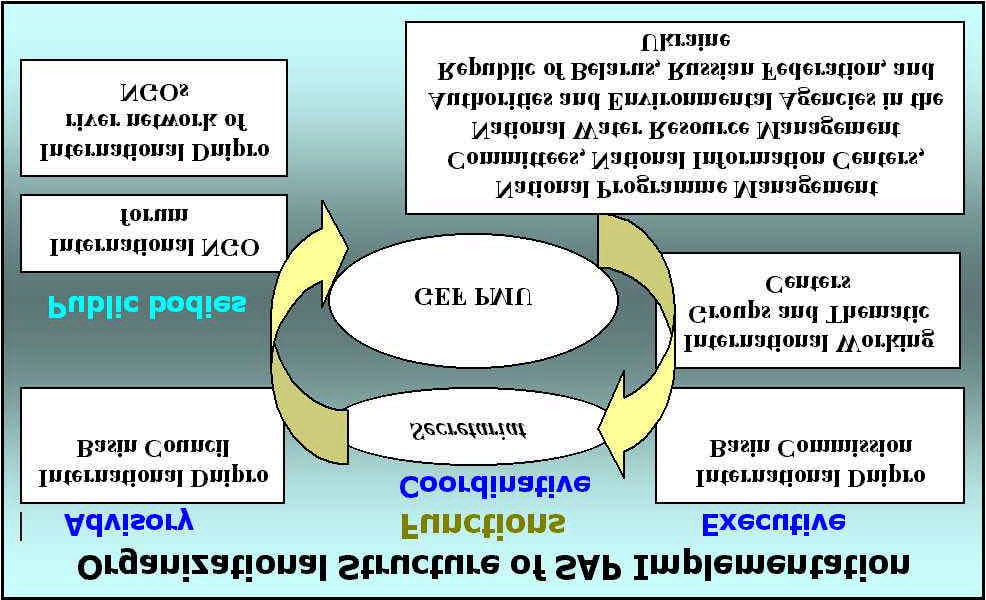
Agreement on cooperation in the field of use and
Annex 1
protection of the Dnipro basin
It is imperative that the existing legal and institutional arrangements should be strengthened in
order to:
· implement the SAP in line with the sustainable development concepts adopted by the
riparian countries of the Dnipro Basin;
· ensure the sustainable and environmentally sound use and protection of the Basin's water
resources in the interests of current and future generations and national economies;
· ensure the conservation of ecosystems; and
· minimise/prevent adverse transboundary impacts.
In order to strengthen and coordinate regional cooperation, the riparian countries and
international partners should:
· be guided by this SAP and governed by the national environmental laws and
global/regional UN Conventions, ratified by the Republic of Belarus, Russian Federation
and Ukraine, relating to transboundary pollution, both air and water, and the conservation
of biological diversity;
· cooperate closely in order to develop, sign and ratify the Convention on Cooperation in
the Field of Sustainable Management and Protection of the Dnipro River Basin (the
`Dnipro Convention' hereinafter).
Institutional Framework of the SAP Implementation
4.3 Public Participation
The SAP provides for a sufficient level of consultation and dissemination of information, and
encourages the active involvement of the public in the decision-making process through, inter
alia, the participation of representatives of citizen groups in the International Dnipro Basin
Council and support of the International Dnipro River NGO Network.
Strategic Action Programme for the Dnipro Basin
and Mechanisms for its Implementation
31
Agreement on cooperation in the field of use and
Annex 1
protection of the Dnipro basin
The public and non-governmental organizations will be an important part of the process of
environmental rehabilitation of the Dnipro Basin at the international, national, and local levels.
1. International level focuses on coordination of actions across the whole Dnipro Basin, and is
represented by the International NGO Forum, supported by the International Dnipro River
NGO Network.
2. National level covers the process of enhancing the legislative framework and strengthening
the institutional capacity for wider stakeholder involvement in the monitoring and public
control of the SAP/NAP implementation.
3. Local level, where the active involvement of the public will be a prerequisite to the
successful implementation of practical environmental actions.
The active involvement of the public in the implementation of the SAP on Environmental
Rehabilitation of the Dnipro Basin will be encouraged through (Table 3.2.1):
· The enhancement of national legal systems in order to support public initiatives and
ensure the active and effective participation of non-governmental organizations in the
implementation of the Dnipro Basin Rehabilitation Programme;
· The acknowledgement and consideration of the interests of the public, as a matter of
priority, in the process of formulation and implementation of local environmental action
plans;
· Support for the International Dnipro River NGO Network and active involvement of its
representatives in the management decision-making process;
· The monitoring of the SAP implementation by the public;
· Dissemination of information on the state of the Dnipro Basin and participation of the
NGOs in this process;
· The integration of environmental considerations into educational programmes adopted in
the riparian countries, and active involvement of the NGOs in the promotion of the
integrated basin management approach.
5
Financing the SAP
5.1 Investment Needs and Estimate of Costs Associated with the
SAP Implementation
The total investment cost of financing the implementation of actions required to achieve the
LTEQOs identified in the Dnipro Basin SAP is estimated at 1,676.6 million US dollars. This
amount can be broken down by LTEQO as follows: 8% for actions on ensuring the sustainable
use of nature resources and environment protection, 75.5% for actions on ensuring the
environment quality that is safe for human health, and 16.5% for actions on ensuring the
conservation and protection of biological and landscape diversity.
Required investment
Long-Term Objectives
Million USD
% of the total sum
LTEQO 1
133.4
8
LTEQO 2
1267
75.5
LTEQO 3
276.2
16.5
Total
1,676.6
Strategic Action Programme for the Dnipro Basin
and Mechanisms for its Implementation
32
Agreement on cooperation in the field of use and
Annex 1
protection of the Dnipro basin
In the light of the national priorities and the scale of the actions identified in the SAP, the total
investment can be broken down by country as follows:
Country
Total investment
% of the total sum
Republic of Belarus
392.9 million USD
23.4
Russian Federation
304.8 million USD
18.2
Ukraine
978.9 million USD
58.4
Total for the Basin
1,676.6 million USD
These outline estimates are indicative only, attempting to reflect the costs that need to be
financed by the riparian countries in order to ensure the implementation of basinwide and
national actions identified in the SAP. These values are based on the cost data provided in the
National Action Plans of the Republic of Belarus, Russian Federation, and Ukraine, and take full
account of cost estimates made from the perspective of the long-term objectives of this SAP.
Summaries of the financial needs, broken down by SAP component and priority, are shown in
Tables 3.2.1, 3.2.2 and 3.2.3.
5.2 Existing Financing Arrangements
5.2.1 National Sources of Finance
National legislation for the Republic of Belarus, Russian Federation, and Ukraine specifies a
range of potential budgetary and non-budgetary sources which can be used to finance
environmental investments. The budgetary sources include government contributions from the
state (federal), Oblast (RF Constituent) and local budget, and reserves accumulated by the
specialized Environment Protection Funds. The non-budgetary sources include the internal
reserves accumulated by enterprises, private sector finance, and donations made by citizens.
The capacity for mobilising funding from national sources for major projects similar in scale to
the SAP largely depends on the current state of the national economies and their strategic
priorities. Total environmental expenditures constitute about 1% of GDP in the Republic of
Belarus and Russian Federation, and about 1.95% of GDP in Ukraine. The 2000 GDP values for
the three riparian countries are shown below in billions of US dollars:
Country
GDP
Republic of Belarus
22.0
Russian Federation
341.6
Ukraine
32.6
About 80% of the annual environmental expenditure is used to maintain the existing level of
environmental protection/management. The remaining 20% is invested in fixed assets, including
the construction/upgrade of new and existing environmental facilities, and the implementation of
restoration/rehabilitation measures.
In all three countries of the Dnipro Basin, the environmental expenditure pattern is dominated by
water protection expenditures, while funding allocated for land protection/restoration actions is
kept at a minimum. This is illustrated by the Table below (2000 data).
Country
Water protection, % Land restoration, %
Republic of Belarus
53
15
Strategic Action Programme for the Dnipro Basin
and Mechanisms for its Implementation
33
Agreement on cooperation in the field of use and
Annex 1
protection of the Dnipro basin
Russian Federation
37
16
Ukraine
66
3
The major sources of investment and their respective contributions are shown in the Table below
(%).
Republic of
Russian
Source of investment
Ukraine
Belarus
Federation
State (federal) budget
21
4
1.3
Regional (Oblast) and local budgets
43
18
0.3
Internal reserves held by industries
10
74
97.9
Environmental funds
26
4
(*)
(*) Environmental funds are the component of respective budgets
5.2.2 International Sources of Finance
The international cooperation policy of the riparian countries of the Dnipro Basin, particularly with
regard to environmental protection, focuses on the following key components:
· Cooperation with the international agencies, including the United Nations Environment
Programme (UNEP), United Nations Economic Commission for Europe (UNECE), United
Nations Development Programme (UNDP), United Nations Industrial Development
Organisation (UNIDO), International Atomic Energy Agency (IAEA), Global
Environmental Facility (GEF), World Bank, European Bank for Reconstruction and
Development (EBRD), EU TACIS Programme, Interstate Environmental Council (IEC), and
other bodies established to support the implementation of international
environmental conventions and relevant protocols.
· Bilateral cooperation between the riparian countries of the Dnipro Basin.
Key areas for international cooperation on the management of water resources and
rehabilitation of the Dnipro Basin include:
· Strengthening the cooperation and coordination between the riparian countries of the Dnipro
Basin (Republic of Belarus, Russian Federation, and Ukraine);
· Mobilising technical and financial assistance from bilateral and multilateral funding sources;
· Attracting external investments to finance the cost of national, regional and local
environmental programmes.
Many developed countries provide valuable support for implementing environmental
improvements in the Dnipro Basin. These include, without limitation, UK, Germany, Denmark,
Canada, Netherlands, USA, Finland, Sweden, Switzerland, and Japan.
Total estimated contribution of international agencies to the implementation of environmental
actions in the riparian countries of the Dnipro Basin over the last three years is summarised in the
Table below:
Country
Contribution, million USD
Republic of Belarus
12,000,000
Russian Federation
11,000,000
Ukraine
65,000,000
Total for the Basin
88,000,000
Strategic Action Programme for the Dnipro Basin
and Mechanisms for its Implementation
34
Agreement on cooperation in the field of use and
Annex 1
protection of the Dnipro basin
5.3 Strengthening the Financing Arrangements
Strengthening the financing arrangements is only possible in the broader context of national
environmental policy. This should be based on economic incentives that encourage the active
involvement of nature users in the implementation of environmental actions, including the
actions identified in this SAP. At the same time, it is important to maintain a balanced mix of
administrative and economic instruments for managing the nature uses.
New institutional arrangements have started to take shape in the process of transition to the
market economy. They have been driven by a major change in the relationships between the state
and private sector. As a result of large-scale privatisation, the management and operation of
essential municipal services have been progressively taken over by the private sector in the
course of large-scale privatisation. As a result, the role of direct command-and-control tools is
also being reduced in response to policies that encourage political decentralisation and
institutional reform. However, environmental values and considerations are still low in the
agenda of businesses and industries. This problem is complicated by severe budget constraints,
and the shortage of funds for financing the cost of required environmental actions is seen as a
principal barrier to improvement.
The strengthening of Public-Private Partnership arrangements designed to encourage the active
involvement of governance bodies, business community and civil society is seen as a potential
option for improving the existing situation.
Emphasis should be placed on the reform of the environmental tax system. This should be based
on the `polluter pays' principle, translated into appropriate economic incentives for a reduction
in the environmental impact of human activities. As part of this reform, the system of pollution
fees should also be revised to ensure a greater level of cost recovery, simplicity and
transparency. It is also important to enhance the system of fees charged for nature resource uses,
in order to ensure the financial sustainability of environmental programmes and systems for
nature resource use and management.
Financial sustainability of the SAP can be ensured through the introduction of new specific
economic instruments designed to encourage environmental investments.
5.4 Financing the Incremental Costs
Additional funding required to strengthen the financial sustainability and ensure the prompt and
adequate provision of funding for priority environmental actions identified in the SAP/NAPs,
may be secured by the Dnipro basin countries in the form of external investments, loans, grants,
and other technical assistance arrangements.
Over the long term, the financing capacity of the riparian countries of the Dnipro Basin is based
on the forecasts of the main indicators of socio-economic development. In addition, it is
determined by the national target of the Russian Federation to double its GDP over the next 10
years. Thus, the Republic of Belarus will be able to cover 80-85%, the Russian Federation 100%
and Ukraine 80% of their investment needs associated with the SAP implementation from their
respective national sources. The estimate for the Russian Federation does not exclude the
importance of external investments (including donor funding) for the SAP/NAP implementation,
provided that the terms and conditions of such investments are attractive (the external sources
could provide up to 10-20% of the total required amount of investment). Incremental costs for
Republic of Belarus and Ukraine could be provided in accordance with the principles of equity
Strategic Action Programme for the Dnipro Basin
and Mechanisms for its Implementation
35
















Agreement on cooperation in the field of use and
Annex 1
protection of the Dnipro basin
sharing with external and internal investors participating in attractive bilateral terms and
conditions too. Thus, the required amount of incremental costs could be as follows:
Incremental costs
Country
Million USD
% to the total amount
Republic of Belarus
58.9 - 78.6
15 - 20
Russian Federation
30.5 - 61
10 20 %
Ukraine
195.8
20
Total for the Basin
285.2 335.4
6
Arrangements for Monitoring the Implementation of
the SAP
Provision of adequate arrangements for monitoring and assessment is a key to ensuring the
successful implementation of the SAP. The international and national structures responsible for
managing the nature uses and environment protection actions will play a major role in the SAP
monitoring (see Section 4).
Periodic assessment (TDA)
State of the
Scope and significance of issues;
Environment Report
Identification of priority environmental issues
based on the
transboundary
and their impact on the socio-economic
monitoring data
situation in the region;
Review of institutions, laws, policies and
economic instruments.
Success indicators to measure
LTEQOs
the progress towards LTEQOs
(set for 10-15 years)
(system indicators)
Efficiency and performance
indicators
Adjustment of causal chains
(if necessary)
Short-term
operational objectives
(set for 5 years)
Regular monitoring
(project performance indicators)
Regulations and
State of environment and
compliance
trends
Strategic Action Programme for the Dnipro Basin
and Mechanisms for its Implementation
36
Agreement on cooperation in the field of use and
Annex 1
protection of the Dnipro basin
These bodies have been established through the Ministry of Natural Resources and Environment
Protection of the Republic of Belarus, Ministry of Natural Resources of the Russian Federation,
and Ministry of Environment Protection of Ukraine, in close cooperation with other ministries
and agencies, interested operating agencies and non-governmental organisations from various
areas of the Dnipro Basin (Annex 4).
These governmental bodies are responsible for the formulation and implementation of national
environmental policies, and coordination of national environmental monitoring efforts. They will
undertake monitoring and control of the SAP/NAP implementation on the basis of relevant
performance indicators (see table below).
Strategic Action Programme for the Dnipro Basin
and Mechanisms for its Implementation
37
Agreement on cooperation in the field of use and
Annex 1
protection of the Dnipro basin
List of Performance Indicators to be Used for the Monitoring of the SAP Implementation
Organisation Responsible for
No
Indicator
Monitoring
RB
RF
Ukraine
1
2
3
4
5
Additional Indicators (see Section 3.2 I for Main Indicators)
The enhanced legal framework and increased level of responsibility of local self-governance authorities for 1-3,7,116
1,2,3
1,2,3,4
the ecological state of water protective zones and riparian strips
The provision of legally defined mechanism for control of invasions of alien species
1-4
1,3
1,3,4
The integration of `polluter pays' principle into the legislative framework, to ensure that the cost of
1-3,6,9
1,2,3
1,3,10,12
mitigating/preventing damages to the environment is covered by users who benefit from activities affecting
the state of natural environment
The number of drafted and adopted laws/regulations relating to the harmonisation of environmental
1-3
1,3
1,3
legislation with that of the EU
Successful examples of introduction/application of `green' technologies and best practices in the industrial
2,3,9,11
3,4,5,6
3,5,6
and agricultural sectors, demonstrating the economic benefits of environmental improvements
Investments (in million USD) in the upgrade, expansion, and/or modernisation of wastewater treatment 3,5,8,9,11
1,2,3
1,3,11,12
facilities
State funds (in million USD), allocated and released for the performance environmental monitoring and 2,3,3.1,5,
1,2,3,7,8
1,2,3,12
regulatory inspection functions
11
Availability of effective pollution controls at the industry and catchment level
2,3,3.1,7,8
3,7,8
3,10,12
Availability of effective tools for monitoring of invasions and introductions of alien species
3,4
3,8
3,4
Number of the state environmental reviews conducted with the participation of the public
2,3,11
1,3
1,3,12
The enhancement of methodological framework for regulating the impacts on the environment
2,3,5,6,7
1,3
1,3
The development and introduction of economic mechanisms that encourage transition towards the BAT-
2,3,5
1,3
1,2,3
dicators to Measure Progress towards LTEQO 1 based approach to setting wastewater discharge limits
Availability of regional and local programmes of action on the protection of water resources
2,3,6,7
1,3,4,5,8
1,3
The enhancement of radiological monitoring of environment
1,2,3,5,9
3,7
3,7,8,12
The development of a legally defined performance security mechanism for dangerous sites/facilities in 1,2,3,5,5.1
1,3,5,6
1,3,8
Success In order to insure against the risk of potential accidents
6 Ordinal number of the Organization indicated in the Annex 4 to the document "Strategic Action Programme for the Dnipro Basin and the Mechanisms for its Implementation"
Strategic Action Programme for the Dnipro Basin
and Mechanisms for its Implementation
38
Agreement on cooperation in the field of use and
Annex 1
protection of the Dnipro basin
The establishment of safety control service for hydro engineering facilities
2,3,5.1
3,5
12
The provision of incentives and mechanisms that encourage separate collection of solid municipal waste
2,3,11
3
1,3
The provision of insurance arrangements for environmental risks
2,3
1,3
1,3
1
2
3
4
5
The introduction of realistic and achievable target indicators, based on the existing environmental standards
2,3
1,3
1,3,4,12
and water quality categories; and provision of monitoring mechanisms
Building the capacity for environmental education and awareness raising of the public
2,3,11
3
1,3,4
Additional Indicators (see Section 3.2 II for Main Indicators)
Road network density
10
3,6
9
Dredging works
3
3,6
3,12
Sand and gravel extraction
3
3
3,10,12
Mineral resource extraction (quarries etc.)
3
3
3,10
Additional flow due to wastewater discharges from industries
3
3,7
3,12
Groundwater abstraction
3
3,7
3,10,12
Changes in vegetation cover
3,6,9,10
3,4
3,13,14
Changes in water level
3,3.1
3
3,12
Changes in channel processes
3,3.1
3
3,12
Flow diversion for irrigation
3,9,11
3,4
3,6,12
Flow diversion for industrial and municipal needs
3,8,11
3
3,5,12
Level of water reuse and recycling
3
3
3,12
Nutrient load
3,3.1
3,7
3,12
Organic load
3,3.1
3,7,8
3,12
Chemical pollution load on the basin area
3,3.1,5
3,7
3,12
Presence of phosphates, nitrogen compounds, and pesticides in soil at the elevated concentrations
3,3.1
3,7
3,6,12
Presence of storage ponds for liquid waste generated by chemical industries
3,3.1,5
3,7
3,5,6
Presence of industries specialized in extraction and processing of radioactive materials
3,5
3,5
3,5,8
Presence of storage sites for expired pesticides
3,9,5
3,4,8
3,6
Availability and adequacy of wastewater treatment capacity at the sources of pollution
3
3
3,5,12
Volume of contaminated wastewater discharges from animal-breeding farms and diffuse pollution sources
3,9
3,7
3,6,7,11
Volume of insufficiently treated and untreated wastewater discharges from municipal utilities, food
3,5,9
3
3,12
processing industries, hospitals etc.
Success Indicators to Measure Progress towards LTEQO 2 Volume of wastewater discharges
3,3.1
3
3,12
Strategic Action Programme for the Dnipro Basin
and Mechanisms for its Implementation
39
Agreement on cooperation in the field of use and
Annex 1
protection of the Dnipro basin
1
2
3
4
5
Pollution load carried with storm water and surface runoff from urban areas and agricultural land,
3,3.1,5
3,7
3,6,12
accidental spills and releases of wastewater, etc.
Industrial and municipal solid waste generation, including hazardous waste (total and by sector)
3,5,11
3,7
1,3,5,6,7,
11
Flow diversion
2,3
1,3,7
1,3,12
Area of shallow-water sections in the Dnipro reservoirs
-
-
3,12
Area of drained and irrigated land
2,3,6,9
1,3,4
6,12
Area of reclaimed land
2,3,6,10
3,4
12
Livestock
9
4
6
Industrial waste landfills
5,8
3,7
3,5
Suspended solid load from point and diffuse pollution sources
3,3.1
3,7
3,12
Application of chemical fertilisers and pesticides
3,9
3,4,7
3,6,12
Invasion of alien species, number of alien species, density and biomass of alien species, relative density and
3,4,7
3,8
3,4
biomass of alien species, % of density/biomass of a respective community; rate of expansion of alien
species per unit area over a given decade; documented evidence of impact on the environment
Chemical pollution load carried with wastewater discharges
3,5,11
3,7
3,12
Flow regulation rate
3
3
3,12
o Measure Progress towards LTEQO 2 Level of treatment provided to contaminated effluents (total and by sector)
3,3.1
3
3,12
Level of development of centralized water supply and wastewater collection service in the human
3,5
1,3
3,5,11
settlements (residential housing sector)
Transboundary transport of nutrients
3,3.1
3,7
3,12
Transboundary transport of suspended solids
3,3.1
3,7
3,12
Transboundary pollution load
3,3.1
3,7
3,12
Transboundary transport of radionuclides
3,3.1,5
3,7
3,8,12
Population relying on groundwater sources
3,8,10,11
3,4
3,4,10
Success Indicators t Number of illegal dumps
3,11
3,8
3
Area of eroded land
3,10
3,4
6
Strategic Action Programme for the Dnipro Basin
and Mechanisms for its Implementation
40
Agreement on cooperation in the field of use and
Annex 1
protection of the Dnipro basin
1
2
3
4
5
Additional Indicators (see Section 3.2 III for Main Indicators)
Reduction in nutrient concentrations in water
3.1
7
3,12
3
Visible algal blooms (Chlorophyll-like pigment concentration units (mg/m3) over time (given year/decade)
3,3.1
7
3,12
LTEQO and location (lat/long,) polygon; satellite imaging data)
Decrease in number of fish kills (fish kills recorded in the Basin)
3,4,7
3,7,8
3,6
Decrease in number of land subsidence craters
3.1
3
3,10
Long-term changes in the monthly average flow discharges (mean monthly discharge m3 per second; total
3,3.1
3,7
3,12
volume discharged per month (m3 per month/ hydrological year)
-
3 Conservation of hydrographic network in the Basin
3,10
3,7
3,12
Conservation of natural stream flow hydrograph
3,10
3,7
3,12
Changes in maximum and minimum monthly average stream flows at various water availability
3,3.1
3,7
3,12
Decrease in the rate of floodplain modification due to cultivation and grazing, estimated loss of floodplain
3,10,11
3,4
3,6
????? area (%)
Increase in vegetation cover
3,6,10
3,7
3,13,14
Transparency changes (Secci disk data)
3.1
7
3,12
?
???
? Stable groundwater quality in the locations of solid waste disposal sites
3.1
4,7,8
3,10
? Reduction in concentrations of suspended solids in water
3.1
7
3
?
? Pathogens in water (e.g. E-coli and faecal streptococci) present at or below mandatory limits
7
8
4
?? Decrease in concentrations of solid waste degradation products and dust particles in the air samples
7
8
4
? Decrease in number and duration of periods of intensive algal blooms with documented environmental/
3,4,11
3,7,8
3,4
?? human effects (frequency (number/year); intensity (biomass/abundance); duration (days); extension (m2);
? causative species (species)
Decrease in area of flooded land and extent of flooding/underflooding events
3,10,11
3,7
3,12
Presence of radionuclide pollution spots in the catchment area
3,5
3,7,8
3,8,12
?????
? Reduction in radionuclide concentrations in water, bottom sediments and biota
3,5,7
3,7,8
3,8
Absence of increases in radiation level
3,5,5.1
3,5,7
3,8,12
Reduction in concentrations of aromatic hydrocarbons in water, sediment and biota due to anthropogenic
3,5,7
3,7,8
3,4
activities
Reduction in concentrations of halogenated PTS in water, sediments and biota due to human activity
3,5,7
3,7,8
3,4
Strategic Action Programme for the Dnipro Basin
and Mechanisms for its Implementation
41
Agreement on cooperation in the field of use and
Annex 1
protection of the Dnipro basin
1
2
3
4
5
Absence of oil products in water due to human activities
3,3.1,11
3,7
,3,4
Metals in water, bottom sediments and biota present at or below mandatory limits
3,3.1,7
3,7,8
3,4
No reduction in base flow
3,3.1
3,7
3,12
Improved state of landscapes and natural systems, and increased area of protected territories
3,4
3,7
3,10
Reduced number of accidents, affected areas, accidental spills
3,5
3,7
3,12
LTEQO 3
No reports of fish that do not reach WHO public health standards
7,9
3,7,8
4
Number/proportion of taxa in IUCN threat categories (number of taxa in IUCN threat categories; proportion
4
3
3,10
of taxa in IUCN threat categories; change in taxa number in IUCN threat categories per given decade)
Strategic Action Programme for the Dnipro Basin
and Mechanisms for its Implementation
42
Agreement on cooperation in the field of use and
Annex 1
protection of the Dnipro basin
The Agreement provides the legal framework for international coordination of the SAP
implementation process, and enables the development of an appropriate trilateral
legislative/regulatory system, including regional organisational arrangements for monitoring and
control.
Monitoring and assessment of the implementation of the SAP for the Dnipro Basin is based on a
system of key indicators, consistent with a suite of indicators adopted by the European
Environment Agency for Eastern European, Caucasian, and Central Asian countries.
The sustainability of the implementation of the SAP is significantly linked with the application
of other mechanisms and outputs produced within the framework of the UNDP-GEF Dnipro
Basin Environment Programme, which include, inter alia:
· Transboundary Monitoring Programme,
· Regional Strategy for the Conservation of Biological and Landscape Diversity.
· International System for Exchange of Environmental Information and the supporting
Environmental Data Base;
· Report on the State of Environment in the Dnipro Basin;
· Mechanisms designed to ensure the involvement of the public in the monitoring of the
SAP implementation.
The Transboundary Monitoring Programme has been developed to address the information
needs of the interstate basin management system set up in the Dnipro Basin. This includes action
planning and assessment needs and the provision of information support to the national agencies
responsible for the implementation of the SAP and NAPs.
Key users of information produced by the Transboundary Monitoring Programme include:
· The international basin management system;
· National governmental bodies with responsibilities in the field of water resource
protection and management;
· Relevant ministries and agencies (and their regional bodies), involved in the SAP/NAP
implementation;
· Research institutions that are responsible for the scientific component of the SAP/NAP
process (and the Tranboundary Monitoring Programme itself), non-governmental
organisations, citizen groups, and water users.
The overall transboundary monitoring strategy adopted for the Dnipro Basin requires that the
Transboundary Monitoring Programme should be aligned along the following two axes:
· The assessment of the effectiveness of the SAP/NAPs using information generated with
the help of tools employed in monitoring and assessment of water quality in the
transboundary sections of the Basin;
· The monitoring of transboundary pollution loads for a range of priority pollutants that
contribute significantly to transboundary impacts in the Basin.
The Regional Strategy for the Conservation of Biological and Landscape Diversity pursues the
following objectives:
· Consolidation of the national efforts of the Republic of Belarus, Russian Federation, and
Ukraine in the field of conservation and restoration of biological and landscape diversity
in the Dnipro River Basin;
Strategic Action Programme for the Dnipro Basin
and Mechanisms for its Implementation
43
Agreement on cooperation in the field of use and
Annex 1
protection of the Dnipro basin
· Identification of root causes and consequences of reduced biodiversity; and setting the
long-term environmental quality targets with regard to biodiversity;
· Development of strategic actions designed to achieve these targets within the specified
timescale.
· Ensuring that the international commitments, ensuing from the international conventions
on conservation of biological and landscape diversity, signed and/or ratified and/or
acceded by the Republic of Belarus, Russian Federation, and Ukraine, are met by these
countries.
An International System for the Exchange of Environmental Information and the supporting
Environmental Data Base have been established to:
· facilitate the mutual exchange of information between the parties (on the basis of the
Protocol for the International Exchange of Information between the Riparian Countries of
the Dnipro Basin);
· support coordinated decision-making on issues relating to the SAP/NAP implementation;
· communicate the results of the SAP/NAP implementation to the wider public.
The Report on the State of Environment in the Dnipro Basin provides the detailed picture of
the ecological status of the Dnipro Basin prior to the SAP/NAP implementation, and as such will
be used as a baseline for evaluation of progress and success of the SAP/NAP.
The involvement of the public in monitoring and control of the SAP implementation is ensured
through the provision and strengthening of the arrangements designed to support independent
environmental monitoring activities undertaken by the local self-governance bodies and
environmental NGOs.
Arrangements for reporting and monitoring the SAP implementation
The riparian countries of the Dnipro Basin will produce the SAP/NAP progress report on an
annual basis. National reports on the State of the Environment in the Dnipro Basin, to be
presented every five years, will be prepared and produced by the Regional Thematic Centres.
Based on these reports, and in accordance with the concept and structure approved by the three
countries, the Regional Report will be prepared, to cover the following issues:
· trends in the state of environment, defined on the basis of the suite of indicators (see
Section 3 and table above);
· the existing legislative and regulatory framework, and the status of compliance;
This Report will provide a basis for regular review of the TDA, revision of the LTEQOs, and
subsequent adjustment of corrective actions identified in the SAP.
The riparian countries of the Dnipro Basin shall exchange information on the following issues:
· trends in the quality of the environment in the Dnipro Basin, emerging from the analysis
of the transboundary monitoring data (in accordance with the approved data exchange
protocol);
· changes in the legal, regulatory, and institutional arrangements, relating to the SAP
implementation.
Strategic Action Programme for the Dnipro Basin
and Mechanisms for its Implementation
44
Agreement on cooperation in the field of use and
Annex 1
protection of the Dnipro basin
The parties shall review and discuss the progress of the SAP implementation, and relevant
adjustments will made where necessary. If and when the need arises, the riparian countries of
the Dnipro Basin will initiate the preparation of new versions of the TDA and SAP/NAPs.
Dissemination of the SAP document
The final version of the SAP document will be published in the three national languages of the
Dnipro Basin (i.e. Belorussian, Russian, and Ukrainian) and in English. It will be widely
distributed in the three countries of the Dnipro Basin for detailed review and to enable the active
involvement of the public in the SAP implementation process. The English version of the SAP
document will be circulated amongst all of the international agencies involved in the Dnipro
Environment Programme. In addition, it will be distributed to international organisations that are
interested in the projects and actions identified in the SAP and NAPs.
The electronic version of the SAP document will be made available in Russian and English on
the UNDP-GEF Dnipro Basin Environment Programme web page: http://www.dnipro-gef.net/
Strategic Action Programme for the Dnipro Basin
and Mechanisms for its Implementation
45
Agreement on cooperation in the field of use and
Annex 1
protection of the Dnipro basin
Annexes:
Annex 1. The GEF approaches to the Dnipro Basin SAP preparation
Annex 2. The Dnipro Basin Passport
Annex 3. The Priority Investments Portfolio.
Annex 4. Institutional framework of the SAP implementation.
Strategic Action Programme for the Dnipro Basin
and Mechanisms for its Implementation
46