


E R M E
H
S
Hotsp
s
o
a
t
e
E
S
c
n
os
ea
ystemResearchontheMarginsofEurop
Deep-sea
biodiversity and ecosystems
A scoping report
on their socio-economy, management and governance
Regional
Seas



E R M E
H
S
Hotsp
s
o
a
t
e
E
S
c
n
os
ea
ystemResearchontheMarginsofEurop
Deep-sea
biodiversity and ecosystems
A scoping report
on their socio-economy, management and governance
Regional
Seas

UNEP World Conservation Monitoring Centre
ACKNOWLEDGEMENTS
219 Huntingdon Road,
The authors are grateful to Salvatore Arico, Claire Armstrong, Antje
Cambridge CB3 0DL,
Boetius, Miquel Canals, Lionel Carter, Teresa Cunha, Roberto
United Kingdom
Danovaro, Anthony Grehan, Ahmed Khalil, Thomas Koetz, Nicolas
Tel: +44 (0) 1223 277314
Kosoy, Gilles Lericolais, Alex Roger, James Spurgeon, Rob Tinch
Fax: +44 (0) 1223 277136
and Phil Weaver for their insightful comments on earlier versions
Email: info@unep-wcmc.org
of this report. Thanks also for the additional comments provided
Website: www.unep-wcmc.org
by UNEP Reginal Seas Programme Focal Points, and to all
individuals and institutions who gave permission to use their
©UNEP-WCMC/UNEP December 2007
pictures. Special thanks to Vikki Gunn and Angela Benn for their
input and support and to Stefan Hain from UNEP for his significant
ISBN: 978-92-807-2892-7
input, dedication and immense enthusiasm. Any error or
inconsistency, as well as the views presented in this report, remain
Prepared for
the sole responsibility of the authors.
UNEP World Conservation Monitoring Centre
(UNEP-WCMC) in collaboration with
HERMES (Hotspot Ecosystems Research on the Margins of
the HERMES integrated project
European Seas) is an interdisciplinary research programme
involving 50 leading research organisations and business partners
AUTHORS
across Europe. Its aim is to understand better the biodiversity,
Sybille van den Hove, Vincent Moreau
structure, function and dynamics of ecosystems along Europe's
Median SCP
deep-ocean margin, in order that appropriate and sustainable
Passeig Pintor Romero, 8
management strategies can be developed based on scientific
08197 Valldoreix (Barcelona)
knowledge. HERMES is supported by the European Commission's
Spain
Framework Six Programme, contract no. GOCE-CT-2005-511234.
Email: s.vandenhove@terra.es
For more information, please visit www.eu-hermes.net.
CITATION
UNEP (2007) Deep-Sea Biodiversity and Ecosystems:
A scoping report on their socio-economy, management
and governance.
A Banson production
URL
Design and layout Banson
UNEP-WCMC Biodiversity Series No 28
Printed in the UK by The Lavenham Press
(www.unep-wcmc.org/resources/publications/
UNEP_WCMC_bio_series)
UNEP Regional Seas Reports and Studies N° 184
UNEP promotes
(www.unep.org/regionalseas/Publications/Reports/Series
environmentally sound practices,
_Reports/Reports_and_Studies)
globally and in its own activities.
DISCLAIMER
This report is printed on 100% recycled
The contents of this report do not necessarily reflect the views or policies
paper, using vegetable-based inks and other
of UNEP or contributory organizations. The designations employed and
the presentations do not imply the expressions of any opinion whatsoever
eco-friendly practices.
on the part of UNEP or contributory organizations concerning the legal
Our distribution policy aims to reduce
status of any country, territory, city or area and its authority, or
concerning the delimitation of its frontiers or boundaries.
UNEP's carbon footprint.
For all correspondence relating to this report please contact:
info@unep-wcmc.org
Foreword
Foreword
"For too long, the world acted as if the oceans were somehow a realm apart as areas owned by none, free for all, with little
need for care or management... If at one time what happened on and beneath the seas was `out of sight, out of mind', that can
no longer be the case."
Kofi Annan, UN Secretary General, Mauritius, 2005
Billionsofpeopleliveat,orincloseproximityto,the depleted and regulated, commercial operations such as
world's coastlines. Many depend on the narrow strip
fishing, mining, and oil and gas exploration are increasingly
of shallow waters for their food, income and
taking place in deeper waters.
livelihoods, and it is here that most efforts to conserve and
In the light of these alarming findings and trends, various
protect marine ecosystems are concentrated, including the
international fora, including the UN General Assembly, are
sustainable management and use of the resources they
starting to consider the need for measures to safeguard
provide. We tend to forget that coastal waters less than 200
vulnerable deep-sea ecosystems, especially in areas beyond
metres deep represent only 5 per cent of the world's oceans,
national jurisdiction, and to ensure their sustainable use.
and that their health and productivity, indeed all life on Earth,
Amongst others, three key questions need to be answered:
is closely linked to the remaining 95 per cent of the oceans.
· What are key deep-sea ecosystems, and what is their
role and value?
THE DEEP SEA
· Are existing governance and management systems
Remote, hidden and inaccessible, we rely on deep-sea
appropriate to take effective action?
scientists using cutting-edge technology to discover the
· What are the areas for which we need further data and
secrets of this last frontier on Earth. Although only a tiny
information?
amount (0.0001 per cent) of the deep seafloor has so far been
subject to biological investigation, the results are remarkable:
In order to begin seeking answers, and to establish a direct
the bottom of the deep sea is not flat it has canyons,
link between the deep-sea science community and policy
trenches and (sea)mounts that dwarf their terrestrial
and decision makers, UNEP became a partner in the inter-
counterparts. The deep sea is not a uniform environment with
disciplinary, deep-sea research project HERMES in October
stable conditions and very little environmental change, but
2006. This report is the product of this fruitful partnership and
can be highly dynamic through space and time. The deep sea
demonstrates that the findings and discoveries from the deep
is not an inhospitable, lifeless desert but teems with an
waters of the European continental shelf can easily be
amazing array of organisms of all sizes and types. Indeed, it
transferred and are applicable to similar deep-sea areas
is believed to have the highest biodiversity on Earth.
around the world. It also highlights the benefits, and short-
One of the remaining misconceptions about this
comings, of looking from a socio-economic perspective
environment that the deep oceans are too remote and too
at deep-sea ecosystems and the goods and services
vast to be affected by human activities is also rapidly being
they provide.
dispelled. Destroyed or damaged deep-water habitats and
The intention of this report is to raise awareness of the
ecosystems, depleted fish stocks, and the emerging/predicted
deep-sea and the impacts and pressures this unique
effects of climate change and rising greenhouse gas
environment faces from human activities. We are confident
concentrations on the temperature, currents and chemistry of
that this report provides substantial input to the ongoing
the oceans are proof to the contrary. Further pressures and
discussions about vulnerable deep- and high-sea ecosystems
impacts on the deep sea are looming: with traditional natural
and biodiversity, so that action will be taken to preserve the
resources on land and in coastal waters becoming ever more
oldest and largest biome on Earth before it is too late.
Ibrahim Thiaw
Jon Hutton
Phil Weaver
Director of the Division of
Director
HERMES Coordinator
Environmental Policy Implementation
UNEP World Conservation
National Oceanography Centre
UNEP
Monitoring Centre
UK
Contents
FOREWORD.................................................................................................................................................................................3
CONTENTS..................................................................................................................................................................................5
LIST OF ACRONYMS ...................................................................................................................................................................8
INTRODUCTION ..........................................................................................................................................................................9
1 HABITATS, ECOSYSTEMS AND BIODIVERSITY OF THE DEEP SEA......................................................................................11
Continental slopes ................................................................................................................................................................14
Abyssal plains........................................................................................................................................................................15
Seamounts.............................................................................................................................................................................16
Cold-water corals .................................................................................................................................................................16
Deep-sea sponge fields........................................................................................................................................................17
Hydrothermal vents ..............................................................................................................................................................18
Cold seeps and gas hydrates...............................................................................................................................................19
2 ECOSYSTEM FUNCTIONS, GOODS, SERVICES AND THEIR VALUATION .............................................................................20
Valuation of ecosystems and the goods and services they provide..................................................................................20
Different types of values.....................................................................................................................................................20
Valuation methods ..............................................................................................................................................................23
Shortcomings of monetary environmental valuation.........................................................................................................23
Deep-sea goods and services and their valuation.............................................................................................................25
Deep-sea goods and services............................................................................................................................................25
Valuation of deep-sea goods and services .......................................................................................................................27
Research needs.....................................................................................................................................................................29
3 HUMAN ACTIVITIES AND IMPACTS ON THE DEEP SEA.......................................................................................................31
Direct impacts on deep-sea biodiversity and ecosystems ................................................................................................31
Deep-sea fishing .................................................................................................................................................................33
Offshore oil and gas operations.........................................................................................................................................37
Deep-sea gas hydrates.......................................................................................................................................................40
Deep-sea mining.................................................................................................................................................................42
Waste disposal and pollution .............................................................................................................................................44
Cable laying .........................................................................................................................................................................47
Pipeline laying .....................................................................................................................................................................48
Surveys and marine scientific research............................................................................................................................48
Bioprospecting ....................................................................................................................................................................50
Ocean fertilization ...............................................................................................................................................................51
Indirect impacts on deep-sea biodiversity and ecosystems .............................................................................................52
Research needs.....................................................................................................................................................................53
4 GOVERNANCE AND MANAGEMENT ISSUES ........................................................................................................................54
Key elements for environmental governance and management .....................................................................................55
Implementing an ecosystem approach.............................................................................................................................55
Addressing uncertainties, ignorance and irreversibility ..................................................................................................55
Multi-level governance .......................................................................................................................................................56
Governance mechanisms and institutional variety..........................................................................................................57
5
Deep-sea biodiversity and ecosystems
Information and knowledge ...............................................................................................................................................60
Equity as a cornerstone of environmental governance ...................................................................................................60
Key issues for deep-sea governance ..................................................................................................................................61
Deep-sea governance.........................................................................................................................................................61
Implementing an ecosystem approach in the deep sea .................................................................................................63
Governance mechanisms in the deep sea .......................................................................................................................64
Area-based management, marine protected areas and spatial planning ....................................................................65
Information and knowledge challenges............................................................................................................................67
Equity aspects .....................................................................................................................................................................67
Ways forward .......................................................................................................................................................................67
Research needs ...................................................................................................................................................................68
5 CONCLUSIONS.......................................................................................................................................................................69
Research needs on socio-economic, governance and management issues ..................................................................69
Research priorities .............................................................................................................................................................69
Integrating natural and social science research .............................................................................................................70
Training and capacity-building...........................................................................................................................................70
Improving the science-policy interfaces for the conservation and sustainable use
of deep-sea ecosystems and biodiversity ...........................................................................................................................71
GLOSSARY ..........................................................................................................................................................................................72
REFERENCES.....................................................................................................................................................................................75
6
FIGURES
Figure 1.1: The main oceanic divisions ...............................................................................................................................11
Figure 1.2: Marine biodiversity patterns in relation to water depth .................................................................................14
Figure 1.3: Species richness in relation to depth in the Atlantic and the Mediterranean..............................................14
Figure 1.4: Schematic showing cold seeps and other focused fluid flow systems/features discussed in the text .....19
Figure 2.1: Ecosystem services ...........................................................................................................................................20
Figure 2.2: Classification under Total Economic Value .....................................................................................................22
Figure 2.3: Examples of deep-sea goods and services .....................................................................................................26
Figure 3.1: Mean depth of global fisheries landings by latitude, from 1950 to 2000......................................................33
Figure 3.2: Oil and gas production scenario per type and region.....................................................................................38
Figure 3.3: Deep-water oil and gas production..................................................................................................................40
Figure 3.4: Methods of CO2 storage in the oceans.............................................................................................................46
Figure 4.1: Three key governance mechanisms ................................................................................................................58
Figure 4.2: Marine zones under the UNCLOS ...................................................................................................................61
TABLES
Table 1.1: Main geomorphologic features of the deep sea ...............................................................................................12
Table 2.1: Classification of environmental values ..............................................................................................................21
Table 2.2: Knowledge of the contribution of some deep-sea habitats and ecosystems to goods and services ..........27
Table 2.3: Total Economic Value components and deep sea examples ...........................................................................28
Table 3.1: List of the main human activities directly threatening or impacting the deep sea .......................................32
Table 3.2: Most developed human activities in the deep sea and main habitats/ecosystems affected ........................33
Table 3.3: Summary of the principal types of mineral resources in the oceans.............................................................43
Table 3.4: Estimated anthropogenic impacts on key habitats and ecosystems of the deep sea...................................52
Table 4.1: Different forms of incertitude and possible methodological responses.........................................................56
Table 4.2: Some major governance mechanisms and tools .............................................................................................57
Table 4.3: The relationship between the Responses and the Actors. ..............................................................................59
BOXES
Box 1.1: Biodiversity of the deep sea...................................................................................................................................13
Box 2.1: Valuation methods..................................................................................................................................................22
Box 2.2: Some key issues relating to monetary valuation of the environment ...............................................................24
Box 3.1: Deep-sea fishing gear............................................................................................................................................36
Box 3.2: Main potential sources of non-fuel minerals in the deep sea ...........................................................................41
Box 3.3: IPCC on geo-engineering ......................................................................................................................................51
Box 4.1: Risk, uncertainty, ambiguity and ignorance.........................................................................................................55
Box 4.2: The Precautionary Principle and Precautionary Appraisal.................................................................................57
Box 4.3: Adaptive Management ...........................................................................................................................................58
Box 4.4: Information and knowledge needs for environmental governance ...................................................................60
Box 4.5: Some key governance principles for sustainability .............................................................................................60
7
Deep-sea biodiversity and ecosystems
LIST OF ACRONYMS
ABNJ
Areas Beyond National Jurisdiction
BRD
Bycatch Reduction Device
EEZ
Exclusive Economic Zone
FAO
United Nations Food and Agriculture Organization
GHG
Greenhouse gases
HDI
Human Development Index
IEA
International Energy Agency
IMO
International Maritime Organization
ISA
International Seabed Authority
ITQ
Individual Transferable Quotas
IUU
Illegal, Unreported and Unregulated fishing
IWC
International Whaling Commission
MA
Millennium Ecosystem Assessment
MPA
Marine Protected Area
MSR
Marine Scientific Research
NGL
Natural Gas Liquids
NGO
Non-Governmental Organization
OSPAR
Convention for the Protection of the Marine Environment of the Northeast Atlantic, 1992
PAH
Polycyclic Aromatic Hydrocarbon
PCB
Polychlorinated Biphenyl
RFMO
Regional Fisheries Management Organization
ROV
Remotely Operated Vehicles
SIDS
Small Island Developing States
TAC
Total Allowable Catch
TBT
Tributyltin
TEV
Total Economic Value
UN
United Nations
UNCLOS United Nations Convention on the Law of the Sea, 1982
UNFSA
United Nations Fish Stocks Agreement, 1995
8
Introduction
Theobjectiveofthisreportistoprovideanoverviewof atthegloballevel,suchastheUNGeneralAssembly(UNGA)
the key socio-economic, management and governance
and the UN Convention on the Law of the Sea (UNCLOS), the
issues relating to the conservation and sustainable use
UN Fish Stocks Agreement, the Convention on Biological
of deep-sea ecosystems and biodiversity. The report high-
Diversity (CBD), and under regional multilateral agree-
lights our current understanding of these issues and ident-
ments and conventions, for example. We are also in a time
ifies topics and areas that need further investigation to close
of rapid change in the way we think about marine resource
gaps in knowledge. It also explores the needs and means for
management both in shallow waters and offshore. We
interfacing research with policy with a view to contributing to
are moving away from sector-based management to
the political processes regarding deep-sea and high-seas
more holistic integrated ecosystem-based management
governance, which are currently ongoing in various inter-
approaches. Sustainable deep-sea governance presents
national fora within and outside the UN system. In addition,
additional specific challenges linked to the criss-cross of
this report provides guidance on the future direction and
legal and natural, vertical and horizontal, boundaries
focus of research on environmental, socio-economic and
applying to the deep-sea and deep-seabed areas. Deep-sea
governance aspects in relation to the deep sea.
waters and seabed can be within or beyond areas of national
The deep sea, as defined and used here, includes the
jurisdiction of coastal states, which further complicates
waters and seabed areas below a depth of 200 metres. This
policy design and implementation, and challenges the
corresponds to 64 per cent of the surface of the Earth and
establishment of effective links with shallow-water
90 per cent of our planet's ocean area. The average ocean
governance regimes.
depth is 3 730 metres and 60 per cent of the ocean floor lies
Despite existing political commitments, deep-sea
deeper than 2 000 metres. The volume of the oceans, incl-
resources are increasingly exploited. On the one hand, the
uding the seabed and water column, creates the largest
depletion of some shallow-water resources (in particular
living space on Earth, roughly 300 times greater than that of
fish stocks and fossil fuels) has drawn more commercial
the terrestrial environment (Gage, 1996).
interest in deep-water ones and, on the other hand, the
For millennia, the oceans have been used for shipping
advances in technology over the last decades have made the
and fishing. More recently, they became convenient sinks for
exploitation of the deep waters and deep seabeds feasible
waste. This usage was guided by the perception that the
and more economically attractive. The same technological
seas are vast, bottomless reservoirs that could not be
advances have also revolutionized deep-sea research. Until
affected by human activity. Today, we know that the seas are
recently, research on deep-sea ecosystems and biodiversity
not limitless, and that we are approaching (or in some cases,
was restricted by the complexity of the systems, their
may even have overstepped) the capacity of the marine env-
inaccessibility and the associated technological and
ironment to cope with anthropogenic pressures. In the light
methodological challenges. Our knowledge started to
of this knowledge, over the last 1015 years the international
expand with the rise of sophisticated sampling technologies,
community has adopted increasingly ambitious goals and
remotely operated vehicles, acoustic mapping techniques,
targets to safeguard the marine environment and its
ocean observatories and remote sensing (Koslow, 2007). We
resources. During the 2002 World Summit on Sustainable
now know that the deep sea harbours rich, complex and
Development held in Johannesburg, world leaders agreed
vulnerable ecosystems and biodiversity. As we discover the
inter alia on: the achievement of substantial reductions in
natural wonders of the last frontier on Earth, we also realize
land-based sources of pollution by 2006; the introduction of
that the deep biosphere is no longer too remote to remain
an ecosystems approach to marine resource assessment
unaffected by the human footprint. The enduring miscon-
and management by 2010; the designation of a network of
ception of the oceans as bottomless reservoirs of resources
marine protected areas by 2012; and the maintenance or
and sinks for wastes is rapidly eroding in the face of
restoration of fish stocks to sustainable yield levels by 2015
scientific evidence of the finiteness and fragility of the deep
(UN, 2002: Chapter IV).
oceans. We have proof that several deep-sea habitats and
In this context, issues related to deep-sea governance
ecosystems are impacted, threatened, and/or in decline
are increasingly appearing on the political agenda at diff-
because of human activity. But the knowledge gaps are still
erent levels. There is presently a heavy international policy
huge. It is estimated that the amount of properly mapped
focus on deep-sea ecosystems and resources in various fora
seafloor in the public domain is around 2 or 3 per cent
9
Deep-sea biodiversity and ecosystems
(Handwerk, 2005). This figure could reach 10 per cent if
open file seismic data from the hydrocarbon industry that
classified military information is taken into account. Only
provides information on the structure of the seabed in
0.0001 per cent (10-6) of the deep seafloor has been
certain areas). But socio-economic research in support of
scientifically investigated. Although we know that species
the sustainable use and conservation of deep-sea resources
diversity in the deep sea is high, obtaining precise data and
is lagging behind (Grehan et al., 2007). Collapsing fisheries,
information is problematic: current estimates range
degraded and destroyed habitats and ecosystems, changes
between 500 000 and 100 million species (Koslow, 2007). As
in ocean chemistry and qualities, are all indications of direct
of today, the bulk of these species remains undescribed,
and indirect human interactions with the deep-sea
especially for smaller organisms and prokaryotes (Danovaro
environment, which affect the role of the oceans, their buffer
et al., 2007).
functions and their future uses. There is a clear need to
Meanwhile, anthropogenic impacts on vulnerable
identify the societal and economic implications of these
ecosystems and habitats are rising. Direct impacts of human
activities and impacts, and for documenting the key socio-
activities relate to existing or future exploitation of deep-sea
economic and governance issues related to the conser-
resources (for example, fisheries, hydrocarbon extraction,
vation, management and sustainable use of the deep seas.
mining, bioprospecting), to seabed uses (for example,
This report constitutes a first step in that direction. It is
pipelines, cable laying, carbon sequestration) and to
structured along four chapters. Chapter 1 offers a short
pollution (for example, contamination from land-based
introduction to habitats, ecosystems and biodiversity of the
sources/activities, waste disposal, dumping, noise, impacts
deep sea. Chapter 2 explores ecosystem functions, goods
of shipping and maritime accidents). Indirect effects and
and services, and issues pertaining to their valuation. It then
impacts relate to climate change, ocean acidification and
turns more specifically to deep-sea goods and services and
ozone depletion.
their valuation. Chapter 3 describes the main human
The recent advances in research have also shown that
activities and impacts on deep-sea biodiversity and
deep-sea processes and ecosystems cannot be addressed in
ecosystems. Following the same structure as Chapter 2,
isolation. They are not only important for the marine web of
Chapter 4 identifies key elements for environmental man-
life; they also fundamentally contribute to global biogeo-
agement and governance and then turns more specifically to
chemical patterns that support all life on Earth (Cochonat et
deep-sea governance issues. Based on the gaps identified in
al., 2007). They also provide more direct goods and services
previous chapters, the Conclusions summarize strategic
that are of growing economic significance. Most of today's
research needs on socio-economic, governance and man-
understanding of the deep oceans comes from the natural
agement issues and suggests priority actions to improve
sciences, supplemented by data from industry (such as,
science-policy interfaces.
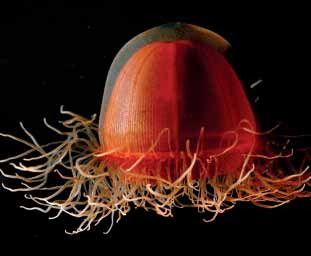
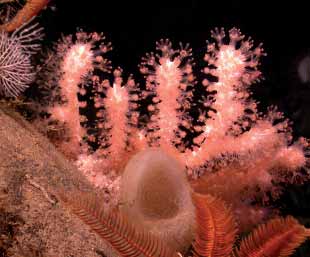
Coral, sponge, and feather star at 3 006 meters depth on the
A jelly fish of the genus Crossota, collected from the deep
Davidson Seamount, located 120 kilometres to the
Arctic Canada Basin with an ROV.
southwest of Monterey, California (US).
2006
Raskoff/NOAA
NOAA/MBARI
Kevin
10
1. Habitats, ecosystems and
biodiversity of the deep sea
Deepwatersor"deepseas"aredefinedinthisreport bottom in areas of at least 200metres depth; and the
as waters and sea-floor areas below 200 metres,
seafloor itself (Figure 1.1).
where sunlight penetration is too low to support
The structure and topography of the deep-seafloor is as
photosynthetic production.
complex and varied as that of the continents or even more
From a biological perspective, the deeper waters below
so. Many submarine mountains and canyons/trenches dwarf
the sunlit epipelagic zone comprise: the mesopelagic or the
their terrestrial counterparts. Numerous larger and smaller
"twilight" zone (200 to about 1 000 metres), where sunlight
geomorphologic features (Table 1.1) strongly influence the
gradually dims depending, for example, on water turbidity,
distribution of deep-sea organisms. Many of these features
seasons, regions; the bathypelagic zone from approximately
rise above, or cut into, the seafloor, thereby creating a
1 000 metres down to about 2 000 metres; the abyssal
complex, three-dimensional topography that offers a
pelagic zone (down to 6 000 metres); the hadalpelagic
multitude of ecological conditions, habitats and niches for a
zone, which delineates the deepest trenches; the bentho-
wide variety of unique marine ecosystems.
pelagic zone, which includes waters directly above the
Biodiversity in the deep seas depends among other
Figure 1.1: The main oceanic divisions Source: http://en.wikipedia.org/wiki/Ocean
High
Pelagic
water
Neritic
Oceanic
Epipelagic
Photic
Low
200 m
water
Mesopelagic
Sublittoral or ice shelf
Littoral
10ºC
700 to 1,000 m
Bent
Bathypelagic
hal
4ºC
2,000 to 4,000 m
Aphotic
Benth
Abyssalpelagic
ic
Abyssal
6,000 m
Hada
Hadalpelagic
l
10,000 m
11
Deep-sea biodiversity and ecosystems
Table 1.1: Main geomorphologic features of the deep sea
Continental shelf
Seaward continuation of continents underwater, typically extending from the coast to depths of up to 150
to 200 metres. Ends at the continental shelf break at an average depth of 130 metres.
Continental slope
Beyond the shelf break, often disrupted by submarine landslides. Steeper slopes frequently cut by
canyons.
Continental rise
The gently sloped transitional area between the continental slope and the abyssal plain.
Continental margin
Submerged prolongation of the land mass of a coastal state, consisting of the seabed and subsoil of
the shelf, the slope and the rise.
Abyssal plains
Flat areas of seabed extending beyond the base of the continental rise.
Mid-ocean ridges
Underwater mountain range of tectonic origin commonly formed when two major plates spread
apart. They often host hydrothermal vents.
Back-arc basins
Submarine basins associated with island arcs and subduction zones, formed where tectonic plates
collide.
Dysoxic (anoxic)
Ocean basins in which parts (or all) of the water mass, often near the bottom, is depleted in basins
oxygen (for example the Black Sea below 160200 metres depth).
Submarine canyons
Valleys carved into the continental margin where they incise the continental shelf and slope, often off
river estuaries. Act as conduits for transport of sediment from the continent to the deep-ocean floor.
Their formation has been related both to subaerial erosion during sea level lowstands and to
submarine erosion.
Submarine channels
Wide, deep channels that may continue from canyons and extend hundreds to thousands of
kilometres across the ocean floor.
Deep sea trenches
Narrow, deep and steep depressions formed by subduction of one tectonic plate beneath
and hadal zones
another and reaching depths of 11 kilometres; the deepest parts of the oceans.
Seamounts
Submarine elevations of at least 1 000 metres above the surrounding seafloor, generally conical with
a circular, elliptical or more elongate base and a limited extent across the summit. Typically volcanic
in origin, seamounts can form chains and sometimes seamounts show vent activity.
Carbonate mounds
Seabed features resulting from the growth of carbonate-producing organisms and (current
controlled) sedimentation
Hydrothermal vents
Fissures in the seafloor commonly found near volcanically active places which release geothermally
super-heated and mineral-rich water.
Cold seeps
An area of the ocean floor where hydrogen sulphide, methane and other hydrocarbon-rich fluids (with a
temperature similar to the surrounding seawater) escape into seawater.
Mud volcanoes
Dome-shaped formations on the seafloor of up to 10 kilometres in diameter and 700 metres in
height, created mostly by the release of fluids charged with mud derived from the subseabed. A type
of cold seep.
12
Habitats, ecosystems and biodiversity
are horizontally and vertically interconnected with shallow
Box 1.1: Biodiversity of the deep sea
areas, for instance by ocean currents, which carry large
amounts of surface water continuously (for example, the
Mesopelagic: Biodiversity includes horizontally and
Meridional Overturning Circulation in the North Atlantic) or
vertically actively swimming species (nekton)
sporadically (by dense shelf water cascading, for example)
distributed over large geographic areas and
into the deep sea, and vice versa (upwelling of nutrient-rich
plankton (typically small metazoans, jelly fish and
deep waters to the surface, for example).
eukaryotic, as well as prokaryotic single cell
The mesopelagic zone is home to a large number of
organisms) living at depths ranging from 200 to
planktonic micro-organisms as well as a wide variety of
1 000 metres.
macro-organisms, which are widely distributed over large
geographic areas and undergo regular horizontal and
Bathypelagic: Biodiversity and biomass inhabiting
vertical migrations in search of food. In the bathypelagic
the water column comprised from 1 000 to 4 000
zone, the number of species and their biomass appear to
metres depth. Knowledge of biodiversity in the
decrease rapidly with depth. Very little is known about
bathy- and abyssal pelagic zones is limited. Typical
the organisms living in the deeper bathypelagic waters,
life forms include gelatinous animals, crustaceans
and even some of the large animals on Earth such as the
and a variety of fish.
giant squid are barely documented.
The study of the deep-seabed life (benthos) has revealed
Benthic: Species on the seabed (epibenthic) and in
that the fauna is as varied and highly diverse as and that
sediments (endobenthic) are abundant, although
their diversity is linked to the complexity of the seafloor it
not evenly distributed. Complex, 3-dimensional
is occupying. Some stretches of seafloor, especially on the
habitats such as seamounts have often a high
abyssal plains, seem to be sparsely populated by inter-
species richness and a high degree of endemism.
spersed macrobenthos and meiofauna (which account for
Emphasis on the levels of benthic biodiversity,
more than 90 per cent of total faunal abundance), whereas
especially in sediments, cannot be overrated
other areas can teem with life. Marine benthic biodiversity is
since estimates show close to 98 per cent of
highest from around 1 000 to 2 000 metres water depth.
known marine species live in this environment.
Biodiversity along the continental margins is, per equal
Microbial life can extend kilometres into the sea-
number of individuals, in terms of abundance, higher than
floor (deep biosphere).
that of continental shelves. In addition, continental slopes,
ridges and seamounts are expected to host most of the
undiscovered biodiversity of the globe (Figure 1.2).
parameters on depth (see Box 1.1). In this report we mainly
Recent results from the HERMES project suggest that in
(although not exclusively) focus on deep seabed and benthic
biodiversity and ecosystems. Although, in recent years,
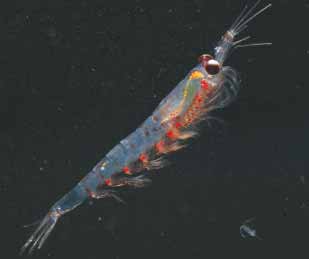
Planktonic animals like this krill form a vital link in the marine
knowledge about biodiversity in the deep-sea water column
food chain.
has started to increase (Nouvian, 2007; Koslow, 2007) there
are still a number of mysteries and myths surrounding
deep-sea life. The deep sea was regarded as a vast, desert-
NOAA
like expanse void of life, until the first research expeditions in
the mid 19th century proved otherwise (Koslow, 2007). Deep-
sea organisms were believed to live in very stable conditions
with very little environmental change, relying completely on
food sinking down from surface waters. However, we now
know that certain biophysical conditions and parameters
that govern deep-water and deep-seabed systems are highly
dynamic both in spatial and temporal scales, and that there
are communities that thrive on minerals and chemicals,
rather than energy from the sun and organic matter.
Today, the deep sea is still commonly seen (and
addressed, for example, in policy processes) as distinct from
shallow coastal marine environments. Research in recent
years indicates that the deeper waters and the life therein
13
Deep-sea biodiversity and ecosystems
100
non-colonial marine invertebrate known, whereas a close
relative, Riftia pachyptila, living around hydrothermal vents,
80
number
reaches maturity and 1.5 metres length in less than two
60
years which makes these worms the fastest-growing
(200)
species
40
ES
marine invertebrate known (Druffel et al., 1995).
ed
The majority of deep-sea organisms rely on the input of
20
food and nutrients produced in the epipelagic zone; that is,
Expect
00
1
2
3
4
5
they depend indirectly on energy from the sun. Where food
Depth ('000 m)
availability is increased or more stable, such as around
Figure 1.2: Marine biodiversity patterns in relation to
seamounts and other seafloor features, organisms and
water depth. Highest biodiversity values occur from about
species can aggregate in large numbers, forming biodiversity
1 000 to 2 000 metre depths. Source Weaver et al., 2004,
hotspot communities such as those associated with cold-
compiled from various literature sources
water coral reefs. Hydrothermal vents and cold seeps are
types of ecosystems that are chemotrophic; that is they
some areas biodiversity can increase with depth down to the
benefit from non-photosynthetic sources of energy, such as
abyssal plains (Figure 1.3).
gas, hydrocarbons and reduced fluids as well as minerals
Despite the heterogeneity and variety of deep-sea life,
transported from the deep subsurface to the seafloor at a
there are a number of traits that the majority of deep-sea
wide range of temperatures from 2°C of up to 400°C.
organisms share. Most are adapted to life in environments
Another frequent characteristic of deep-sea fauna is the
with relatively low and/or sporadic levels of available energy
high level of endemism (for example, Brandt et al., 2007).
and food (Koslow et al., 2000; Gage, 1996). Most deep-sea
Due in part to the unique conditions of deep-sea habitats,
organisms grow slowly and reach sexual maturity very late.
and the distances or physical and chemical obstacles that
Reproduction is often characterized by low fecundancy (that
often separate them, in some areas 90 per cent of species
is, number of offspring produced) and recruitment. Some
are endemic (UN, 2005).
deep-sea organisms can reach astonishing ages: orange
Out of the variety of deep-sea environments, this report
roughy, a commercially exploited fish species, can live up to
focuses on the deep-seabed features and ecosystems
200 years or more, and gold corals (Gerardia spp.) found for
described below, which are (or have the potential to be)
example, on seamounts may have been alive for up to 1 800
important from a socio-economic point of view, and for
years, making them the oldest known animals on Earth
which some information is available, although big gaps of
(Bergquist et al., 2000). However, slow growth is not necess-
knowledge still exist in most cases.
arily consistent even within the same group: the vestimenti-
feran tube worm Lamellibrachia living near cold seeps
CONTINENTAL SLOPES
requires between 170 and 250 years to grow to a length of
Continental slopes and rises, commonly covering water
two metres which makes these worms the longest-lived
depths of about 2003 000 metres, constitute 13 per cent of
the Earth's area. They consist of mostly terrigenous
a
140
sediments angled between 1 and 10 degrees, and are often
in
heavily structured by submarine canyons and sediment
120
specimen
slides. These large-scale features, together with ocean
100
species
currents, create a varied seafloor topography with a wide
of
200
of 80
range of substrates for organisms to settle in or on,
e 60
including large areas of soft sediments, boulders and
number
sampl 40
exposed rock faces. The geomorphologic diversity of
ed
continental slopes, combined with favourable ocean-
20
Expect
r
andom
ographic and nutrient conditions (for example, through
00
1
2
3
4
5
upwelling or cascading-down of nutrient-rich waters from
Depth ('000 m)
deeper or shallower areas, respectively), create an array of
Atlantic
Mediterranean
conditions suitable for a great abundance and variety of
marine
life.
Several
marine
biodiversity
"hotspot
Figure 1.3: Species richness in relation to depth in the
ecosystems" can be found on continental slopes such as
Atlantic and the Mediterranean.
cold-water coral reefs or ecosystems associated with slope
Source: preliminary unpublished data from the HERMES
features (for example, canyons, seamounts, carbonate
project (R. Danovaro, pers. com.)
mounds or cold seeps).
14
Habitats, ecosystems and biodiversity
NOCS
Gunn,
Vikki
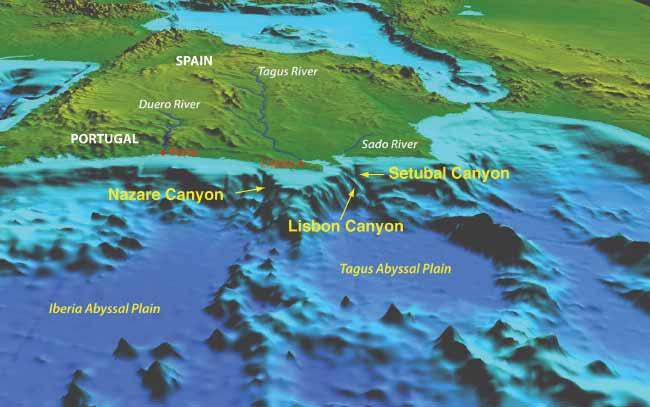
Three-dimensional map of the seafloor off the Atlantic coast of the Iberian Peninsula, showing various submarine canyons cut
into the continental shelf.
ABYSSAL PLAINS
on the abyssal plains, which support a distinct community of
Abyssal plains, commonly occurring in water depths of about
organisms. Cadavers of large marine mammals (for
3 0006 000 metres, constitute approximately 40 per cent of
example, whale falls) or fish sinking to the bottom of the
the ocean floor and 51 per cent of the Earth's area. They are
abyss attract a succession of specialized organisms that feed
generally flat or very gently sloping areas formed by new
on these carcasses over months to years. Polymetallic
oceanic crust spreading from mid-oceanic ridges at a rate of
20 to 100 millimetres per year. The new volcanic seafloor
near these ridges is very rough, but soon becomes covered in
Hawaiii
most places by layers of fine-grained sediments,
of
predominantly clay, silt and the remains of planktonic
organisms, at a rate of appromimately two to three
centimetres per thousand years. The main characteristics of
University
abyssal plain ecosystems are (1) low biomass, (2) high
Smith,
species diversity, (3) large habitat extension and (4) wide-
scale, sometimes complex topographic and hydrodynamic
Craig
features. Species consist mostly of small invertebrate
organisms living in or burrowing through the seabed (Gage,
1996), as well as an undiscovered plethora of micro-
organisms. Given the relative homogeneity of abyssal plains,
small organisms (larvae, juveniles and adults) can drift over
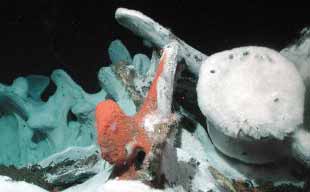
For over four years, the bones of this 35-tonne gray whale
long distances. The percentage of endemic species found on
have rested on the seabed at 1 670 metres depth in the Santa
abyssal plains may therefore not be as high as elsewhere in
Cruz Basin (Eastern Pacific) and are now covered with thick
the deep sea. In certain areas, special conditions are found
mats of chemosynthetic bacteria.
15
Deep-sea biodiversity and ecosystems
and are, increasingly targeted by commercial fisheries.
Bottom trawling causes severe impacts on benthic
Azores
seamount communities, and without sustainable manage-
the
of
ment can deplete fish stocks within a few years ("boom and
bust" fisheries). The flanks of some seamounts, especially in
the equatorial Pacific, contain cobalt-rich ferromanganese
University
crusts, which are attracting deep-water mining interest.
Thus, the commercial fisheries close to seamounts are
unlikely to remain the only source of direct human impact on
IMAR/DoP,
seamounts (ISA, 2004). Moreover, as a consequence of the
diversity and uniqueness of species on seamounts, research
and bioprospecting programmes may increase, and likewise
their associated impacts (Arico and Salpin, 2005).
Bashmachnikow,
COLD-WATER CORALS
Igor
Cold-water corals thrive in the deeper waters of all oceans.
Unlike their tropical shallow-water cousins, cold-water
corals do not possess symbiotic algae and live instead by
feeding on zooplankton and suspended particulate organic
matter. Cold-water corals belong to a number of groups
including soft corals (for example, sea fans) and stony
corals, and are most commonly found on continental
shelves, slopes, seamounts and carbonate mounds in
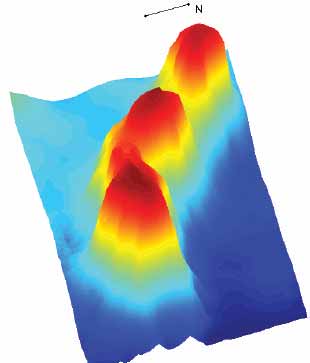
3D map of the Sedlo Seamounts, north of the Azores,
depths of 200 to 1 000 metres at temperatures of 413ºC
Atlantic. Base depth ca. 2 500 metres, minimum summit
(Freiwald et al., 2004). Most cold-water corals grow slowly
depth 750 metres.
(Lophelia pertusa, 4-25 millimetres per year). Some stony
coral species can form large, complex three-dimensional
manganese nodules, found on some abyssal plains, support
structures on continental shelves, slopes and seamounts.
distinct ecosystems (Wellsbury et al., 1997).
The best-known examples are the cold-water coral reefs in
the Northeast Atlantic, which are part of a Lophelia belt
SEAMOUNTS
stretching on the eastern Atlantic shelf from northern
Seamounts are underwater mountains of generally tectonic
Norway to South Africa. The largest individual reef dis-
and/or volcanic origin, often (but not exclusively) found on
covered so far (Røst reef off the coast of Norway) measures
the edges of tectonic plates and mid-ocean ridges.
40 kilometres in length and 23 kilometres in width.
Seamounts are prominent and ubiquitous geological
Growing at a rate of 1.3 millimetres a year (Fosså et al.,
features. Based on satellite data, the location of 14 287 large
2002), this reef took about 8 000 years to form. In the deeper
seamounts with summit heights of more than 1 000 metres
waters of the North Pacific, dense and colourful "gardens"
above the surrounding area has been predicted. This is likely
of soft corals cover large areas, for example, around the
to be an underestimate: there may be up to 100 000 large
Aleutian Islands. What these cold-water coral reefs or
seamounts worldwide. Seamounts often have a complex
gardens have in common with their tropical counterpart is
topography of terraces, pinnacles, ridges, crevices and
their ecological role. Cold-water coral ecosystems are
craters, and they are subject to, and interact with, the water
among the richest biodiversity hotspots in the deep sea,
currents surrounding them. This leads to a variety of living
providing shelter and food for hundreds of associated
conditions and substrates providing suitable habitat for rich
species, including commercial fish and shellfish. This
and diverse communities. Although only a few large
makes cold-water corals, like seamounts, a prime target
seamounts have been subject to detailed biological studies
for trawling. There is some evidence that some com-
(Clark et al., 2006), it appears that seamounts can act as
mercially targeted fish are more abundant close to cold-
biodiversity hotspots, attracting top pelagic predators and
water coral reefs; more detailed studies that demonstrate
migratory species, such as whales, sharks, tuna or rays, as
their role and potential as nursery grounds have yet to be
well as hosting an often-unique bottom fauna with a large
carried out (Freiwald et al., 2004; Clark et al., 2006). Cold-
number of endemic species (Richer de Forges et al., 2000).
water coral reefs formed by stony corals are also
The deep-water fish stocks around seamounts have been,
threatened by the indirect impacts of anthropogenic CO2
16
Habitats, ecosystems and biodiversity
emissions. With increasing CO2 emissions in the atmos-
phere, large amounts of CO2 are absorbed by the oceans,
which results in a decrease in pH ("ocean acidification") and
reduced number of carbonate (CO32-) ions available in
seawater (see Chapter 3). Scientists predict that, due to this
T.Lundalv/TMBL
phenomenon, by 2100 around 70 per cent of all cold-water
corals will live in waters undersaturated in carbonate,
especially in the higher latitudes (Guinotte et al., 2006). The
decline in carbonate saturation will not only severely affect
cold-water corals it will also impede and inhibit a wide
array of marine organisms and communities (such as
shellfish, starfish and sea urchins) with carbonate
skeletons and shells.
DEEP-SEA SPONGE FIELDS
Sponges are primitive, sessile, filter feeding animals with
no true tissue, that is, they have no internal organs,
muscles and nervous system. Most of the approximately 5
000 sponge species live in the marine environment attached
to firm substrate (rocks etc.), but some are able to grow on
soft sediment by means of a root-like base. As filter
feeders, sponges prefer clear, nutrient-rich waters.
Continued, high sediment loads tend to block the pores of
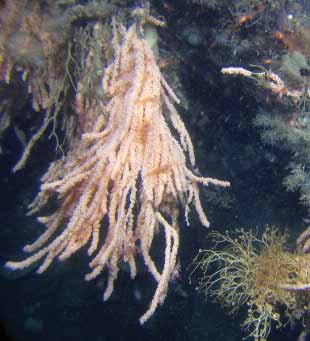
Above: A colony of the gorgonian coral Primnoa
sponges, lessening their ability to feed and survive. Under
resedaeformis at 310m depth in the Skagerrak, off the coast
suitable environmental conditions, mass occurrences of
of Sweden.
large sponges ("sponge fields") have been observed on
continental shelves and slopes, for example, around the
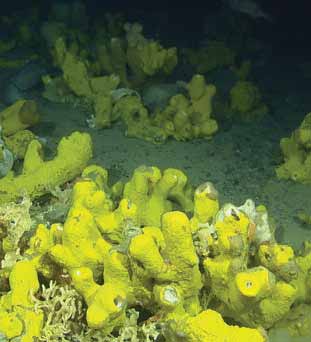
Below: Sponge field dominated by Aplysilla sulphurea
Faroe Islands, East Greenland, around Iceland, in the
covering Stryphnus ponderosus. Still image from HD video
Skagerrak off Norway, off the coast of British Columbia, in
filmed at 271 metres depth in the North East Atlantic off the
the Barents Sea and in the Antarctic ocean. Some of these
coast of the Finnmark area, northern Norway.
fields originated about 8 5009 000 years ago. Most deep-
water sponges are slow-growing (Fosså and Tendal,
undated), and individuals may be more than 100 years old,
weighing up to 80 kg (Gjerde, 2006a). Similar to cold-water
Norway
coral reefs, the presence of large sponges adds a three-
dimensional structure to the seafloor, thus increasing
Research,
habitat complexity and attracting an invertebrate and fish
fauna at least twice as rich as that on surrounding gravel or
Marine
soft bottom substrates. Sponge fields around the Faroe
of
Islands are associated with about 250 species of
invertebrates (UN, 2006b), for which the sponges provide
Institute
shelter and nursery grounds. Most of the approximately 65
sponge
species
known
from
sponge
fields
are
characterized by their large size, slow growth rates and
Mortensen,
weak cementation, which makes them very fragile and
P.B.
vulnerable to the direct physical impact from bottom
trawling and to emothering by the sediment blooms this
and
gear causes. Sponges are also a very important marine
Fosså
source of chemicalls and substances with potential
J.H.
pharmaceutical and biotechnological purposes/value. Most
of the more than 12 000 marine compounds isolated so far
stem from these animals.
17
Deep-sea biodiversity and ecosystems
Ifremer
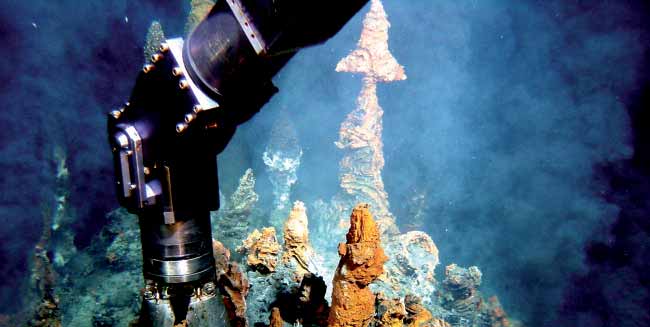
Sampling of hydrothermal vent chimneys in the North East Pacific at 260 metre depth using ROV Victor.
HYDROTHERMAL VENTS
depths of 850 to 2 800 metres and deeper, with one of the
Hydrothermal vents were discovered in 1977 and are
largest fields at 1 700 metres below sea level off the
commonly found in volcanically active areas of the seafloor
Azores in the Atlantic (Santos et al., 2003). On contact with
(for example, mid-ocean ridges, tectonic plate margins,
the surrounding cold deep-ocean seawater, the minerals
above magma hotspots in the Earth's crust), where
in the superheated (up to 400ºC) plumes precipitate and
geothermally heated gases and water plumes rich in
form the characteristic chimneys (which can grow up to 30
minerals and chemical energy are released from the
centimetres a day and reach heights of up to 60 metres)
seafloor. Vents have been documented in many oceans at
and polymetallic (copper, iron, zinc, silver) sulphide
deposits. Hydrothermal vents host a unique fauna of
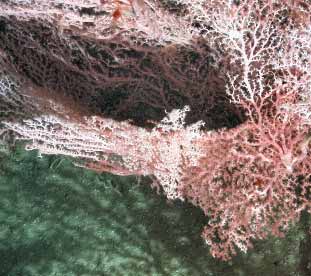
Gorgonian corals at the Carlos Ribeiro mud volcano in the
microbes, invertebrates (for example, mussels and crabs)
Gulf of Cadiz, south of the Iberian Peninsula.
and fish. The local food chains are based on bacteria
converting the sulphur-rich emissions into energy, that is,
are independent from the sun as an original source for
energy. The chemosynthesis of minerals, and the extreme
cruise
physical and chemical conditions under which hydro-
thermal vent ecosystems thrive, may provide further clues
on the evolution of life on Earth. Although hydrothermal
NOCS/JC10
vent communities are not very diverse in comparison with
those in nearby sediments (Tunnicliffe et al., 2003), the
biomass around such vents can be 500-1 000 times that of
the surrounding deep sea, rivalling values of some of the
most productive marine ecosystems. Over 500 vent
species have so far been identified (ChEss, 2007).
Community composition varies among sites with success-
ional stages observed. Different ages of hydrothermal
flows can be distinguished by the associated fauna
(Tunnicliffe et al., 2003).
The activity of individual vents might vary over time. The
temporary reduction or stop of the water flow, for example,
18
Habitats, ecosystems and biodiversity
due to its diversion to a new outlet, will also affect the supply
ecosystems on the basis of microbial chemosynthesis,
of hydrogen sulphide on which the organisms depend. If the
which makes them prime potential targets for biopros-
flow stops altogether, all non-mobile animals living in the
pecting (Arico and Salpin, 2005). Cold seep communities are
surrounding of the particular chimney will starve and
characterized by a high biomass and a unique and often
eventually die. The mineral deposits around hydrothermal
endemic species composition. Biological communities
vents are of potential interest for commercial mining
include large invertebrates living in symbiosis with chemo-
operations, and the "extromophile" fauna of hydrothermal
trophic bacteria using methane and/or hydrogen sulphide as
vent ecosystems might become a source of organic
their energy source. The fauna living around cold seeps often
compounds (for example, proteins with a wide range of heat
display a spatial variability, depending on the distance to the
resistance) for industrial and medical applications (ISA,
seep. Communities of microbes oxidizing methane thrive
2004). Even when the original vent community becomes
around these cold seeps, despite the extreme conditions of
extinct, vent chimneys may continue to provide a basis for
pressure and toxicity (Boetius et al., 2000; Niemann et al.,
life as hard-substrate for a new community of corals and
2006). Research recently showed the relevance of such
other species to grow.
microbes and their genetic makeup in controlling green-
house gases (GHG) such as methane, which is a much more
COLD SEEPS AND GAS HYDRATES
potent GHG than CO2 (Krueger et al., 2003).
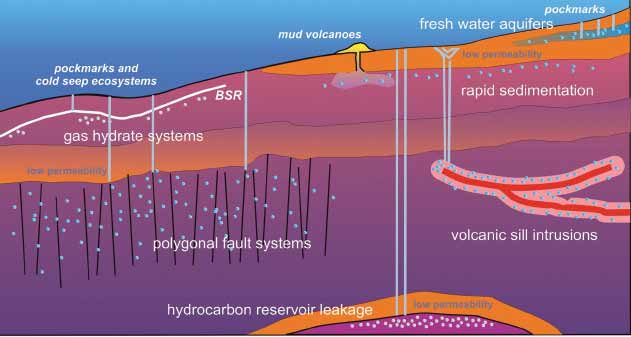
Cold seeps are areas on the ocean floor where water,
Cold seeps are often associated with gas hydrates
minerals, hydrogen sulphide, methane, other hydrocarbon-
(Figure 1.4), naturally occurring solids (ice) composed of
rich fluids, gases and muds are leaking or expelled through
frozen water molecules surrounding a gas molecule, mainly
sediments and cracks by gravitational forces and/or
methane. The methane trapped in gas hydrates represents
overpressures in often gas-rich subsurface zones (Figure
a huge energy reservoir. It is estimated that gas hydrates
1.4). In contrast to hydrothermal vents, these emissions are
contain 500-3 000 gigatonnes of methane carbon (WBGU,
not geothermally heated and therefore much cooler, often
2006), over half of the organic carbon on Earth (excluding
close to surrounding seawater temperature. Cold seeps can
dispersed organic carbon), and twice as much as all fossil
form a variety of large to small-scale features on the sea-
fuels (coal, oil and natural gas) combined (Kenvolden, 1998).
floor, including mud volcanoes, pockmarks, gas chimneys,
However, the utilization of gas hydrates as energy sources
brine pools and hydrocarbon seeps. As in the case of hydro-
poses great technological challenges and bears severe risks
thermal vents, cold seeps sustain exceptionally rich
and geohazards (see Chapter 3).
Figure 1.4: Schematic showing cold seeps and other focused fluid flow systems/features discussed in the text. (BSR:
bottom-simulating reflector) (Source: Berndt, 2005)
19
Deep-sea biodiversity and ecosystems
2. Ecosystem functions, goods,
services and their valuation
Ecosystem functions are processes, products or biogeochemicalconditions.Humansocietiesandeconomic
outcomes arising from biogeochemical activities
systems fundamentally depend on the stability of
taking place within an ecosystem. One may
ecosystems and their functions (Srivastava and Vellend,
distinguish between three classes of ecosystem functions:
2005). The provision of ecosystem goods and services is
stocks of energy and materials (for example, biomass,
likely to be reduced with biodiversity loss (for example, Worm
genes), fluxes of energy or material processing (for
et al., 2006).
example, productivity, decomposition), and the stability of
The notion of ecosystem goods and services has been
rates or stocks over time (for example, resilience,
put forward as a means to demonstrate the importance of
predictability) (Pacala and Kinzig, 2002).
biodiversity for society and human well-being, and to trigger
Ecosystem goods and services are the benefits human
political action to address the issue of biodiversity change
populations derive, directly or indirectly, from ecosystem
and loss. The provision of ecosystem goods and services,
functions (Costanza et al., 1997). This definition includes
however, is a sufficient but by no means necessary
both tangible and intangible services and was adopted by
argument for biodiversity and ecosystem conservation.
the Millennium Ecosystem Assessment (MA), which
Other arguments, based on precaution or ethics in
identifies four major categories of services (supporting,
particular, are equally legitimate. Hence, the goods and
provisioning, regulating and cultural) (Figure 2.1). The
services approach adds value to conservation strategies that
concepts of ecosystem functions and services are related.
argue for conservation on moral or ethical grounds.
Ecosystem functions can be characterized outside any
human context. Some (but not all) of these functions also
VALUATION OF ECOSYSTEMS AND THE GOODS AND
provide ecosystem goods and services that sustain and
SERVICES THEY PROVIDE
fulfil human life.
The human enterprise depends on ecosystem goods and
Maintained biodiversity is often essential to the stability
services in an infinite number of ways, often divided into
of ecosystems. The loss of species can temporarily or
direct and indirect contributions. Directly, with the
permanently move an ecosystem into a different state of
provision of goods as essential as food or habitat, and
indirectly with multiple services that maintain appropriate
Figure 2.1: Ecosystem services Source: MA (2005a)
biochemical and physical conditions on Earth. Providing
value evidence for ecosystem goods and services is
important for at least two reasons. First, to measure the
Provisioning services
human dependence upon ecosystems (Daily, 1997) and
· Food
· Freshwater
second, to better account for the contribution of
· Wood and fibre
ecosystems to human life and well-being so that more
· Fuel
efficient, effective and/or equitable decisions can be made
· ...
(DEFRA, 2006). Hence, a key question for the conservation
and management of biodiversity and ecosystems is how to
Supporting services
Regulating services
value ecosystems themselves and the goods and services
· Nutrient recycling
· Climate regulation
· Soil formation
· Food regulation
they provide, in particular those goods and services that
· Primary production
· Disease regulation
are not (and cannot be) traded in markets.
· ...
· Water purification
· ...
Different types of values
Valuation of ecosystem goods and services is restrictive in
Cultural services
the sense that it caters to humans only. However, as shown
· Aesthetic
· Spiritual
in Table 2.1, anthropocentric values are only two of four
· Educational
categories of environmental values. The other two categ-
· Recreational
ories cannot be completely accounted for, as by definition it
· ...
is hard or impossible for humans to comprehend non-
20
Ecosystem functions, goods and services and their valuation
anthropocentric values. Focusing on the total economic
value only (the top left corner of Table 2.1), in particular
through monetary valuation, is often the preferred answer to
the question of how to account for ecosystem goods and
NOAA/MBARI
services in policy and decision making (see, for example,
Costanza et al., 1997; Costanza, 1999; Beaumont and Tinch,
2003). There are, however, strong arguments for the use of
non-monetary types of valuation in decision-making
processes (see section on shortcomings of monetary
environmental valuation below).
Several typologies of values exist. Environmental econo-
mists often divide Total Economic Value (TEV) into various
types of (in principle) quantifiable values before adding them
up. A major division is between use and non-use values. Use
values are further divided into direct and indirect use as well
as option-use values, while non-use value includes bequest
and existence values (Beaumont and Tinch, 2003). Figure 2.2
summarizes this classification of value.
The components of TEV can be defined as follows:
Use values relate to the actual or potential, consumptive or
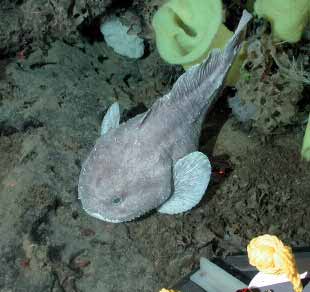
Deep-sea blob sculpin (Psychrolutes phrictus); yellow
non-consumptive, use of resources:
Picasso sponge (Acanthascus (Staurocalyptus) sp.); and
Direct-use values come from the exploitation of a
white ruffle sponge (Farrea sp.) at 1 317 meters depth on
resource for both products and services. Sometimes
the Davidson Seamount off the coast of California.
market prices and proxies can be used to estimate
such values.
biodiversity. Some species may prove valuable in the
Indirect-use values are benefits that humans derive
future, either as the direct source of goods (for example,
from ecosystem services without directly intervening.
the substances they secrete or their genes for
They correspond to goods and services mostly taken
pharmaceutical or industrial applications) or as a key
for granted and stem from complex biogeochemical
component of ecosystem stability.
processes, which are often not sufficiently understood to
Non-use values essentially refer to the benefits people
be properly valued.
attach to certain environmental elements independently of
Option-use values consist of values attached to possible
their actual or future use:
future uses of natural resources. Future uses are
Bequest value is associated with people's satisfaction
unknown, a reason to want to keep one's options open.
that (elements of) the natural environment will be
As such, option-use values are intrinsically linked with
passed on to future generations.
Table 2.1: Classification of environmental values
Source: Adapted from DEFRA, 2006
Anthropocentric
Non-anthropocentric
Instrumental
Total Economic Value (TEV): use
The values to other animals, species, ecosystems,
and non-use (including value
etc. (independent of humans). For instance, each
related to others' potential or
species sustains other species (through different
actual use)/ utilitarian.
types of interactions) and contributes to the evolution
and creation of new species (co-evolution).
Intrinsic
"Stewardship" value (unrelated
Value an entity possesses independently of any
to any human use)/ non-
valuer.
utilitarian.
21
Deep-sea biodiversity and ecosystems
Total Economic Value
(TEV)
Use values
Non-use values
Direct use
Indirect use
Option
Bequest
Existence
value
value
value
value
value
Figure 2.2: Classification under Total Economic Value (Beaumont and Tinch, 2003)
Existence value is associated with people's satisfaction
such as the deep seas, which may never be witnessed
to know that certain environmental elements exist,
without proxy.
regardless of uses made. This includes many cultural,
aesthetic and spiritual aspects of humanity as well as,
Although TEV represents only a fraction of the overall value
for instance, people's awe at the wonders of nature,
of the natural environment, it is a useful notion to signal
Box 2.1: Valuation methods
Source: DEFRA 2006
Monetary valuation methods are based on economic theory and aim to quantify all or parts of the Total Economic Value (TEV).
These methods assume that individuals have preferences for or against environmental change, and that these preferences are
affected by a number of socio-economic and environmental factors and the different motivations captured in the TEV
components. It is also assumed that individuals can make trade-offs, both between different environmental changes and
between environmental changes and monetary amounts, and do so in order to maximize their welfare (or happiness, well-being
or utility). Several methods can be used to estimate individual preferences in order to monetarize individual values. They are
based on individuals' willingness to pay (WTP) for an improvement (or to avoid a degradation) or willingness to accept (WTA)
compensation to forgo an improvement (or to tolerate a degradation). Methods include: market price proxies; production
function; hedonic property pricing; travel cost method; random utility model; contingent valuation and choice modelling1.
Non-monetary valuation methods, often called deliberative and participatory methods, also examine the values underlying
decisions, but do this by asking people to explain or discuss why they behave in a particular way, or hold a particular view. Often,
these methods focus on what people think society should do not on their personal actions, motivations or values. In this sense,
they can be (but are not necessarily) very different from economic methods, which focus on the individual level and apply external
value judgments about how individual values should be aggregated to reach a social welfare assessment. Deliberative and
participatory methods also focus on the processes of decision making and management, for example in terms of procedures,
without necessarily changing the outcomes of management decisions. This represents a move away from the "substantive"
framework of standard economic analysis, which focuses on the outcomes of decisions, towards a more procedural rationality,
which focuses as much (or more) on the ways in which society reaches decisions. Methods include: survey approaches; focus
groups; citizens' juries; health-based approaches; Q Methodology; Delphi surveys and systematic reviews2.
1 See DEFRA 2006 and Spurgeon 2006 for descriptions of methods. 2 See DEFRA 2006 for descriptions of methods.
22
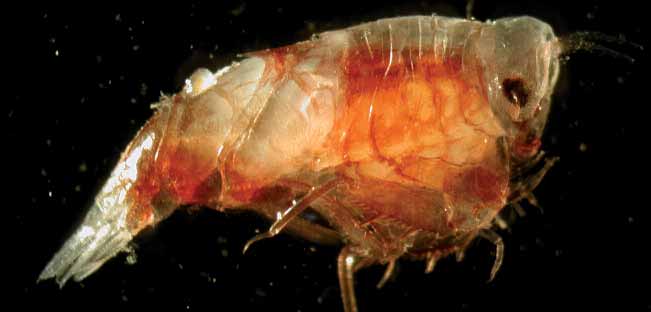
Ecosystem functions, goods and services and their valuation
2007
6000/Medeco
Ifremer/Victor
An amphipod (Crustacea) found in deep Mediterranean waters.
the need to broaden the horizon of analysis when attempting
It is important to note that monetary valuation is not a
to capture the value of ecosystem goods and service.
necessary ingredient of decision making, even though it
Computing total or subtotal dollar figures may not be
can be of great use when applicable, available and of good
feasible, or necessarily desirable. Nevertheless, certain
quality. Obviously, many decision makers do act without
values can be estimated in monetary and non-monetary
having a quantitative (monetary) valuation at their
terms, for which a number of methods exist.
disposal, as is often the case for public health issues and
the value of human life, for instance.
Valuation methods
There are two broad categories of valuation methods:
SHORTCOMINGS OF MONETARY ENVIRONMENTAL
monetary methods and non-monetary ones (Box 2.1). While
VALUATION
the former attempt at setting a price tag in a single
Monetary valuation of ecosystems and their goods and
numéraire (for example, dollars) on ecosystem goods and
services provides a way to evaluate projects on the basis of
services, the latter recognize the inherent incommen-
economic and environmental performance with a single
surability of different aspects of the value of nature and
numerical unit (for example, dollars). In other words, when
rather explore how actors value the objects under
an activity impedes on the provision of ecosystem goods and
consideration (See DEFRA, 2006 for a recent inventory
services, their value could count as a loss to be traded off
of methods).
against the socio-economic benefits of the activity.
Whatever the valuation method(s) used, it is important
As attractive as the idea may be of being able to assign
to stress that valuation evidence is to support rather than
monetary value to all services and goods provided by nature
to make decisions. Decision making is ultimately a
for it would in principle allow decision makers to
political process. As stressed in the MA (MA, 2003, p.34):
"unambiguously" optimize their decisions through cost-
"the [quantified] ecosystem values in this sense are
benefit analysis there is no one single best solution for the
only one of the bases on which decisions on ecosystem
assignation of monetary values to ecosystem services; in
management are and should be made. Many other
many cases, it is not desirable or simply impossible to do so,
factors, including notions of intrinsic value and other
for reasons we shall briefly address here.
objectives that society might have (such as equity
The monetary valuation approach has a number of
among different groups or generations), will also feed
caveats. Shortcomings arise in relation to both the very idea
into the decision framework. Even when decisions are
of monetary valuation of biodiversity, ecosystems and their
made on other bases, however, estimates of changes in
goods and services, and the valuation methods per se. Some
utilitarian value provide invaluable information".
of the key questions and limitations of monetary valuation
23
Deep-sea biodiversity and ecosystems
Box 2.2: Some key issues relating to monetary valuation of the environment
Monetary valuation is more appropriate for valuation of small changes in quality or quantity of well-defined
goods or services at a small scale, than to value complex arrays of interlinked ecosystem goods and services on a broad
scale.
Valuation methods such as willingness to pay (WTP) for goods and services, do not determine absolute values. Instead,
they establish marginal values; that is the value of having or not having one extra unit of good or service relative to the
total current state.
Nature is composed of highly diverse, complex and interconnected ecosystems. The resultant complexity of many
ecosystem goods and services renders it difficult to place boundaries around them to define property rights or to define
marginal change for the purpose of monetary valuation (O'Neill and Spash, 2000).
Valuation methods imply a necessary simplification of the role of ecosystems, which often leads to undervaluation.
Monetary methods often do not take into account all environmental benefits of an ecosystem, particularly as some
goods and services are unknown and/or unrecognized as such.
Ecosystem goods and services for human beings and their value, if quantifiable, will only reflect human preferences,
which in turn depend on understanding, individual income and/or culture.
There are significant gaps in knowledge and understanding of the links between environmental service provision and
uses. As a consequence, a change in environmental service availability might not necessarily be reflected by changes
in price; that is, unlike most markets, a monetary system for valuing the environment might not reflect scarcity issues.
The assumptions behind monetary valuation methods (Box 2.2) imply that what is valued can be compared, exchanged
and compensated for. This is often meaningless for ecosystem goods and services.
In ecological terms, some ecosystems goods and services can only be given an infinite value, as they are non-
substitutable by other forms of capital, goods or services and they are indispensable to support human life on
the planet. Some environmental features may also be valued for their "uniqueness" in social, cultural or geographical
sense and hence be considered as non-substitutable (Holland et al., 1996).
Many ecosystem goods and services are public goods, in the sense that they benefit people collectively and
are indivisible among individuals. Thus, to value them through methods relying on individual expressions of
preferences, such as in contingent valuation methods, for example) may not be appropriate (Wilson and Howarth, 2002).
People have ethical values that inform their preferences; they have preferences over consequences as well as
processes (ethical) and their valuation is always a combination of both (Le Menestrel, 2002). Individuals may have
concerns about legitimate procedures and the fairness of the distribution of burdens and benefits beyond mere
concerns about maximizing welfare (O'Neill and Spash, 2000).
The values that inform environmental valuation are plural and incommensurable such that the use of one single unit of
measurement (monetary or non-monetary) in view of a cost-benefit analysis cannot capture all the distinct dimensions
of environmental choice (O'Neill and Spash, 2000).
Monetary valuation techniques imply that people have knowledge and/or experience of the ecosystem good or service
to value. If they do not, this knowledge can be provided to them in the valuation exercise, but the way it is done will
influence their valuation. Moreover, there always remains some extent of unknown about the system to evaluate. For
these reasons, combinations of discursive and monetary techniques may be more appropriate.
Valuing the flow of economic benefits from ecosystem goods and services raises the issue of discounting. In economic
cost-benefit analysis, future costs and benefits are converted to current values through a social discount rate. The
higher the discount rate, the lower the value of future benefits and costs compared to present ones. Thus,
unsustainable resource uses may mean greater profits for now. In the normative context of sustainability, values
become atemporal; that is, a tonne of fish today is worth the same as a tonne of fish in 10, 20, or 30 years' time.
Discounting the benefits from a flow of non-renewable resources or the depletion of exhaustible stocks must therefore
be questioned, and in some cases, rejected (for example Daly, 1996).
The outcomes of monetary valuations also vary widely according to what is included in the analysis (e.g. which
externalities, with what time horizon and discount rate). Hence the importance of making the context and the underlying
assumptions explicit in order to avoid ad hoc or plain misuse of single "dollar-values".
24
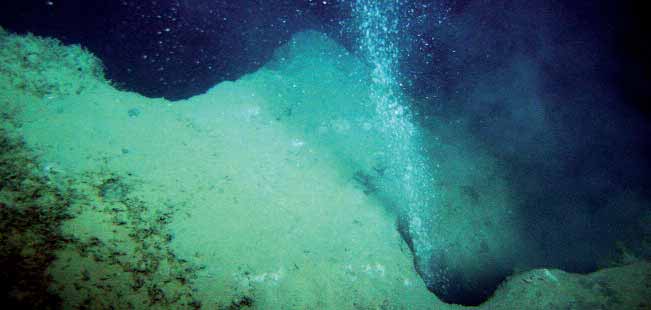
Ecosystem functions, goods and services and their valuation
AWI/Ifremer
Mineral-rich fluid flows and methane gas bubbles seeping from the seabed supports chemosynthetic ecosystems at the Haakon
Mosby Mud Volcano on the Norwegian Margin (1 250 metre depth).
are listed in Box 2.2. They suggest subtler and more modest
particular, the "qualitative insight obtained along the way
policy roles for monetary valuation and cost-benefit analysis
can sometimes be as valuable as the quantitative estimates
in environment decision making (Holland et al., 1996).
themselves" (Holland et al., 1996). In other cases, including
Some defend monetary valuation on the pragmatic
most deep-sea ecosystem goods and services, where
grounds that it is better to have an inappropriate (often
knowledge is limited, impacts are irreversible, potential
lower bound) value for ecosystem goods and services than
thresholds exist, and complexity and interconnectedness of
to have no value estimate at all. The argument being that if
different systems is high, and where knowledge about both
no value is put forward, there is a risk that these
the nature of potential outcomes and the probabilities of
ecosystems and the goods and services they provide will not
them is problematic (Table 4.1, p56), other non-monetary
be taken into account in economic decision-making
analytical methods must be explored and developed. Some
processes, either because "no value" will be considered to
already exist such as Multicriteria Analysis (MCA),
equal zero, or because it is not easy to deal with an infinite
indicator-based methods, discourse-based methods or
value in an economic framework. But this pragmatic
methods building on decision-support tools such as, for
defence could well be counter-productive to its own
instance,
life-cycle
analysis
(LCA)
or
integrated
purpose of "taking the environment into account", because
environmental and social impact assessments and
continuing reliance upon inappropriate methods could
support decision making in various areas. These methods
impede the development of alternative methods of
also aim to take into account the normative and ethical
environmental value articulation capable of taking living
dimensions stressed in Box 2.2 and, in a sense, try to re-
systems into account (Farrell, 2007).
establish the role of intuition, common sense and ethics in
While the shortcomings of monetary valuation,
environmental valuation.
discounting and cost-benefit analysis are well known, in
practice, there is still a strong pull to focus on these
DEEP-SEA GOODS AND SERVICES AND THEIR VALUATION
methods. In the appropriate context (including choice of
Deep-sea goods and services
discount rates and time frames), monetary valuation
Following the MA's conceptual framework (Figure 2.1), a
methods may bring important elements to the decision-
general and non-exhaustive classification of goods and
making process in those cases where ecosystem goods and
services for the deep seas, is presented in Figure 2.3.
services and the underlying ecosystem functions and
Because the focus of this study is on the deep sea as a
processes are well understood and mostly small changes in
whole, including the ecosystems it contains and the human
quantity or quality of these services are considered. In
interactions with them, we have included abiotic goods or
25
Deep-sea biodiversity and ecosystems
species recruit in the deep and then move upwards to where
Provisioning services
they are fished. Such findings substantiate indirect benefits
include
· Finfish, shellfish and
of deep-sea ecosystems functions to human beings, but our
marine mammals
knowledge is as yet insufficient to draw well-defined
· Oil, gas and minerals
pictures of their overall value. Most goods and services listed
· Genetic resources
in Figure 2.3 are self-explanatory, but some may need a
and chemical
compoundsfor
brief description.
industrial and
Chemosynthetic primary production: There is increasing
pharmaceutical uses
evidence that chemosynthetic processes in the deep sea are
· Waste disposal sites
more widespread, which means that the contribution of
· ...
chemosynthesis to the overall primary production of the
Supporting services
include
Regulating services
oceans may be higher than the original estimates of 0.03 per
· Chemosynthetic
include
cent (from hydrothermal vent communities).
primary production
· Water circulation and
Nutrient cycling: Deep-sea organisms (from invertebrates
· Nutrient cycling
exchange
to prokaryotes) are responsible for almost the entire
· Carbon sequestration
· Gas and climate
and storage
regulation
regeneration of nutrients in the oceans. Without these
· Resilience
· Carbon sequestration
processes, the primary production in the photic zone of the
· Habitat
and storage
oceans, the basis for most life on Earth, would collapse.
· ...
· Waste absorption and
Genetic resources and chemical compounds: Microbial and
detoxification
· Biological control of
prokaryote gene richness within the oceans is expected to be
pests
orders of magnitude higher than in the rest of the biosphere.
· ...
Recent findings (Yooseph et al., 2007) reported the discovery
of thousands of new genes and proteins (and therefore
Cultural services
potentially new functions) in a few litres of water. The deep
include
· Education
seas, comprising more than 90 per cent of the biosphere,
· Scientific
represent by far the largest reservoir of microbes and
· Aesthetic
potential new discoveries, including ones of major biotechn-
·Spiritual
ological interest.
· ...
Gas and climate regulation services provided by the deep
sea include the maintenance of the chemical composition of
Figure 2.3: Examples of deep-sea goods and services
the atmosphere and the oceans, for example via the
"biological pump", which transports carbon absorbed during
services derived from the deep sea (such as minerals or
photosynthesis into the deep seas (Schubert et al., 2006).
waste dumps) and goods that are not immediately derived
Methanotrophic microbes in the ocean floor and waters
from ecosystems today, although they have depended on
control almost all of the oceanic methane emission
biotic elements for their formation (such as oil and gas).
(Reeburgh, 2007). Moreover, if scenarios of deep-sea carbon
Ecosystems of the deep seas are, as shown in the first
sequestration and storage became a reality, the deep sea
chapter, diverse in every sense of the word. The deep oceans
would be of direct service (see pp46 and 51).
and seas are far from the uniform and desert-like plains
Waste absorption and detoxification are important
reported by pioneer expeditions. The oceans are home to 32
regulating services as marine organisms store, bury and
of the 33 phyla of plants and animals on Earth, 15 of which
transform many waste materials through assimilation and
are endemic (Beaumont et al., 2006). Thus, the oceans are
chemical transformation, either directly or indirectly. Oceans
not just greater in volume than the terrestrial environment,
have a unique (though not infinite) ability to clean up sewage,
but also in biodiversity. Without deep-sea life, all life on Earth
waste material and pollutants. In particular, bioturbation
would cease because of the fundamental role of deep sea in
the biogenic mixing of sediments on the seafloor by
global biogeochemical cycles (Cochonat et al., 2007).
burrowing organisms (Solan et al., 2004) and accumulation
In contrast to terrestrial ecosystems, most of the deep-
regulate the processes of decomposition and/or sequest-
sea ecosystems goods and services have an indirect benefit
ration (for example, by burial) of organic wastes.
to human beings. Recent findings support the hypothesis
Biological controls of pests: There is evidence that several
that a large fraction of coastal biodiversity and biomass
pathogenic organisms (including pathogenic bacteria) are
production is linked to, and supported by, deep-sea
increasingly spread over the globe (including through ballast
ecosystems. Moreover, many commercially exploited marine
waters). Most of these are able to produce cysts and remain
26
Ecosystem functions, goods and services and their valuation
Table 2.2: Knowledge of the contribution of some deep-sea habitats and ecosystems to goods and services
Organic matter
GOODS and SERVICES
input/chemo-
synthetic
Food,
Micro
Educational,
HABITATS
primary
Nutrient
Resil-
minerals,
organ
Climate
Bio-
scientific,
ECOSYSTEMS
production
cycling
ience
Habitat
oil, gas
isms
regulation
remediation
spiritual
Continental
shelves
Continental
slopes
Abyssal plains
Submarine
canyons
Deep-sea
trenches
Seamounts
Carbonate
mounds
Hydrothermal
vents
Cold seeps
Mud volcanoes
Cold-water
corals
Deep-sea
sponge fields
Whale falls
Key: State of knowledge good knowledge some knowledge little knowledge no knowledge
stored within the sediment. Benthic organisms, including
by surface organisms, the great ocean conveyor belt,
those found in deeper waters, contribute to the control of
currents, as well as salinity and the capacity of micro-
these potential pests by removing them (by ingestion) or
organisms to absorb greenhouse gases.
averting their outbreak (by competing for available
resources). In this sense, a high biodiversity represents a
Valuation of deep-sea goods and services
buffer for environmental changes and ecological shifts and
In view of the problems surrounding monetary valuation of
this reduces the probability that these invasive forms will
ecosystem goods and services outlined above, the deep
develop (Danovaro, personal communication).
sea appears to be possibly the worst case for deriving
Table 2.2 lists some of the deep-sea habitats and
monetary values. There are several reasons for this,
ecosystems and the goods and services they provide. It gives
including:
an estimation of the level of knowledge about these eco-
the limited knowledge of deep-sea ecosystems and the
systems and habitats and their importance for the different
even lesser knowledge of the goods and services they
goods and services. The major difficulty with a medium as
provide; in particular the challenge of linking the results
vast and unknown as the deep oceans is tracing the contrib-
of deep-sea research to the services that people do
utions of specific ecosystems. While ecosystem processes
experience (for example, climate regulation);
support the hypothesis that deep-ocean ecosystems
the complexity of the processes going on in the deep sea,
contribute to nutrient cycling, climate regulation services
as well as the broad time- and space-scales over which
cannot be attributed to one ecosystem in particular. Instead,
they operate;
climate-regulation services are the work of photosynthesis
the nature of deep-sea ecosystems, especially those
27
Deep-sea biodiversity and ecosystems
Table 2.3: Total Economic Value components and deep-sea examples
(Source: adapted from Beaumont and Tinch, 2003)
Total Economic Value
Use values
Non-use values
Direct-use value
Indirect-use value
Option-use value
Bequest value
Existence value
Examples
Fish, shellfish, oil,
Nutrient cycling, gas
Potential drugs,
Preserving the deep-
Knowing that deep-
gas and minerals
and climate
chemicals, and
sea environment for
sea environments
provision,
regulation, carbon
biopolymers for future
future generations
exist
waste dumps, military
sequestration,
industrial,
submarines routes
abatement of wastes
pharmaceutical and
biotechnological
applications
with significant option-use values for which it is by
economy. For instance, establishing estimates of the value of
definition difficult to derive a monetary value;
services provided by burrowing organisms on the seafloor
that people have practically no first-hand experience of
with, say, their replacement costs, would be difficult and
deep-sea ecosystems, so valuation methods based on
most likely pointless as replacement costs only make sense
preferences are likely to be biased or irrelevant.
when replacement is a viable option.
Deep-sea examples of the components of the Total
Our limited knowledge of the deep sea also affects our
Economic Value (TEV) presented in the section above is
capacity to put values on its ecosystems and the goods and
given in Table 2.3.
services they provide. Deep-sea trawling may provide food
Certain components of TEV of the deep seas such as
and employment, but at what environmental costs, and for
oil and gas extracted or fish harvested are relatively
how long? Were we to have a precise idea of the multiple
straightforward to value through market prices, even
roles of deep-sea ecosystems and to evaluate them, we
though this does not solve the problems associated
might find that deep-sea trawling is highly uneconomical.
with incommensurability, discounting, irreversibility, lack
likewise, before we can value say the supporting services
of knowledge, uncertainty or externalities presented on
(chemosynthetic primary production) and provisioning
pages 2325. In particular, the majority of deep-water
services (mineral and biochemical resources) of hydro-
biotic resources have slow growth rates such that their
thermal vents or cold seeps, we need a better understanding
exploitation is much like that of abiotic resources; that
of what their role is. Similarly, it is difficult to assess the
is, they should be considered as non-renewable (Roberts,
value of deep-sea bioturbation services without further
C.M., 2002). We are in a situation where the use of
investigations being carried out. From shallow-water stu-
positive discount rates is problematic. Hence methods
dies, it can be hypothesized that beyond a certain level of
must be developed to ensure that the valuation process
biodiversity loss, the rate and depth of bioturbation
includes sustainable exploitation over the long term as a
decreases significantly. This would impact the structure
framing assumption.
of other marine communities, potentially triggering extinc-
Another issue with valuation relates to the fact that
tions and consequent losses in goods and services.
habitats and ecosystems of the deep ocean and seas are
Bioremediation of wastes is linked in many ways to bio-
unevenly distributed across the globe. The total number and
turbation, but the deep sea cannot assimilate all wastes.
distribution of seamounts, for example, is still unknown.
Can the costs of disposal on land be used as a proxy for the
Thus, it is difficult, if not impossible, to derive a meaningful
value of corresponding deep-sea services? This is another
pertinent overall value for seamounts and the goods and
example of methodological questions relating to value
services they provide globally.
articulation, which requires further research.
Most of the other goods and services rendered by deep-
Moreover, as deep-sea biodiversity and ecosystem
sea ecosystems and biodiversity are outside the market
functions are still largely unknown, any quantitative estimate
28
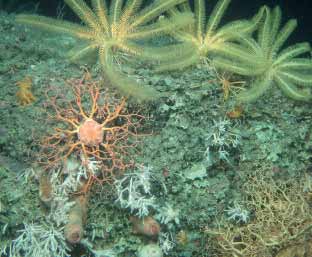
Ecosystem functions, goods and services and their valuation
of option-use value of related goods and services would be
highly speculative. Few individuals have "direct" experiences
of the deep sea, which in such cases is mediated through
manoeuvring a remote-controlled vehicle, a winch on a
AWI/Ifremer
trawler or a crane on a rig. The rest of the population has
only indirect, if any, experience of the deep sea, mediated by
the mass media, scientific dissemination, or through the
consumption of a deep-sea fish. Valuation methods that rely
on surveys for preferences towards the deep sea clearly
suffer from a lack of knowledge on the part of both scientists
and the public. Thus, a choice of valuation method for deep-
sea ecosystem goods and services is not obvious. The way
forward is to improve our knowledge of the deep sea and to
use knowledge of how deep-sea ecosystem processes link
to goods and services as an input to valuation and decision
support. This applies to economic and non-economic
methods, which equally need to build on the best possible
understanding of the roles the deep sea plays in providing
Fauna living on carbonate crust crust in the Storegga slope
ecosystem goods and services.
area offshore mid-Norway.
Another aspect is that, given the nature of the deep sea
(similar to other large and wild compartments of the
One study has attempted to use socio-economic criteria
biosphere such as tropical forests, for example), it is likely
for ranking large marine ecosystems and regional seas,
that with increasing knowledge and awareness, the non-use
which extend to the deep sea (UNEP/RSP, 2006). A
values become more and more important to the public.
combination of economic rent, calculated as the product of
Notwithstanding the issues attached to monetary
quantities of goods and services and market values, and
valuation, some numbers have been put forward for some
Human Development Index (HDI) gives a measure of the
deep-sea ecosystem goods and services. The benefits from
intensity of human activities. In turn, this might represent
the ocean only restricted to food production, have been
the level of exploitation and degradation of large marine
valued at almost half a trillion dollars (1994 US$) per year
ecosystems. Exploitation of the deep sea would, however,
(Costanza et al. 1997). In 2005, deep-sea oil and gas wells
fall under another category since access requires large
produced the equivalent of 3.4 millions barrels per day
capital expenditures available only to rich countries and big
(DWL, 2005). With the price of a barrel averaging US$ 54.5
corporations. The resulting classification, however, might
(BP, 2005) over the year, that amounts to US$ 67.7 billion in
help prioritize international conservation efforts and direct
2005, and deep and ultra deep production is expected to
management resources where needed.
double in the next two years (DWL, 2005). With an estimated
Another issue linked to deep-sea valuation lies in the
production value of a US$ 0.25 billion per year, diamond
problem of ownership of values as property rights are
mining off the coast of Namibia is one of the biggest
loosely, or not at all, defined in the high seas (see Chapter 4
offshore-mining development successes to date (Rona,
for more details).
2003). Elsewhere, deep-sea mineral resources are still in
the exploration phase. The costs of technological
RESEARCH NEEDS
alternatives to natural ecosystem processes can sometimes
Today, we still do not have the knowledge basis to be able
be used as a proxy for the value of ecosystem goods and
to list all the goods and services and other benefits
services. For instance, Costanza et al. (1997) valued nutrient
provided by the deep sea and its ecosystems, nor to provide
cycling from the oceans at US$ 3.9 trillion per year, and gas
estimates of their values in support of decision making. In
regulation at approximately US$ 1.3 trillion per year. Yet, it is
the next chapter, some human activities and their impacts
important to note that, given the remoteness and
on the deep sea will be described. By doing so, we also
underexploration of the deep sea, some of its contributions
further illustrate some of the benefits provided by the
may be completely unknown and out of the human realm.
deep-sea environment.
Values beyond human experience simply cannot be
The above discussion highlights the question of the
estimated, such that any figure will always understate the
(im)possibility of providing pertinent TEVs (in monetary
total value of ecosystem goods and services (Beaumont and
terms) for deep-sea ecosystem goods and services and the
Tinch, 2003).
importance of developing research on alternative methods
29
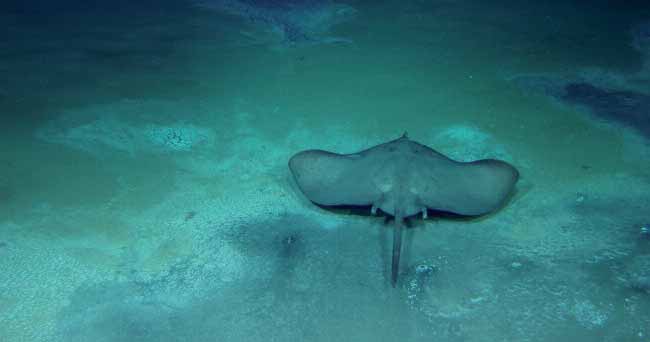
Deep-sea biodiversity and ecosystems
6000/Medeco2007
Ifremer/Victor
A skate ray near the Napoli mud volcano in the deep Mediterranean.
for taking the value of ecosystem goods and services into
As expressed by the `no knowledge' cells in Table 2.2,
account in decision-making processes. Obviously, this is a
relations between deep-sea ecosystems and the provision of
challenge for most ecosystems, but because of its
goods and services need more systematic research. While
characteristics, the deep sea provides a potentially highly
evidence exists of the substantial contribution of deep-sea
fertile area for developing and testing alternative methods
ecosystems and biodiversity to human livelihood and well-
of value articulation and their potential to support decision
being, more research should allow better estimates of the
making for governance and sustainable management.
costs imposed to society and the environment associated
To value ecosystems and their goods and service, one
with the unsustainable use of deep-sea resources.
requires knowledge about ecosystems, their structure,
More research is also needed on both monetary and
function, global and regional importance, rarity, sensitivity
non-monetary valuation techniques and on how to use
(resistance and resilience), ecological significance, spatial
available valuation evidence in decision-making processes
and temporal distribution of impacts, and status of health,
for the deep sea. It is also essential to develop decision-
decline or recovery. Hence, the importance of developing
support tools for combining different types of value
simultaneously and cooperatively our knowledge of
evidence with a view to present as much information as
ecosystems, their goods and services and the corresponding
possible. This involves, in particular, the exploration of
values to human well-being. This further highlights the need
interfaces and combinations of monetary and non-
for interdisciplinary natural and social science research. The
monetary methods while keeping in mind the inevitability
latter should consist in an integrated socio-economic
of imperfect assessment with the methods currently
research effort to improve understanding of the social,
and likely to be in the medium term at our disposal
cultural, economic and political aspects of the deep sea,
(Tinch, 2007).
including the relevant actors and institutions (for example,
Spurgeon, 2006).
30
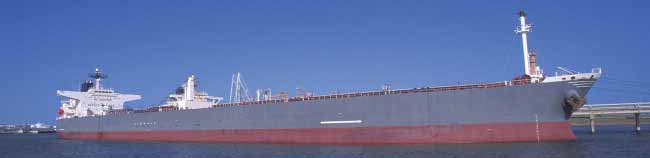
Human activities and impacts on the deep sea
3 Human activities and impacts
on the deep sea
Any human interaction with an ecosystem has impactsofindustrialactivitiesonmarineecosystemsand
potentially destabilizing effects and may result in
biodiversity, while industry data and exploration tools (ROVs,
losses of biodiversity and ecosystem integrity or
for example) can be valuable for the deep-sea scientific
resilience, and consequent losses in goods and services.
community or as tools for educational and public outreach
Such impacts of human activities have to be contrasted
purposes. The latter is illustrated, for instance, by the
with the benefits obtained from the exploitation of
SERPENT collaborative project (Scientific and Environ-
goods and services. In general, the issue as to when a
mental
ROV
Partnership
using
Existing
iNdustrial
positive benefit becomes a negative impact is difficult to
Technology). It brings together key players in the oil and gas
grasp and requires more holistic, ecosystemic and long-
industry and the deep-sea scientific community to make
term thinking.
cutting-edge ROV technology and data more accessible to
An increasing number of human activities target
the world's science community, share knowledge and
resources found in the deeper marine waters and seabed.
progress deep-sea research. (www. serpentproject.com).
Deep-sea organisms and ecosystems are particularly vul-
Industrial exploitation may, however, permanently alter
nerable given their often slow growth and low productivity.
deep-sea habitats, and thereby impede scientific efforts to
Fisheries are a case in point as overexploitation on an
conduct inventories, baseline and long-term studies. Thus,
industrial scale has already severely decimated some deep-
understanding of biodiversity or community structure,
sea fish stocks, maybe even beyond the point of recovery.
especially in the vast deep sea areas that have not yet
Bottom trawling, in particular, destroys large portions of the
been studied, may be foregone by rapid direct and indirect
deep seafloor at a time (Gianni, 2004).
human impacts on habitats and ecosystems. In the
Technological advances in the last decades have opened
following sections we describe some of those impacts and
access to the deep seas to industrial and scientific ventures
the activities that are causing them.
(Gianni, 2004); these two spheres of activity are not com-
pletely independent of one another. Marine research, both
DIRECT IMPACTS ON DEEP-SEA BIODIVERSITY AND
applied and for purely scientific purposes, is crucial to our
ECOSYSTEMS
understanding of the deep-sea environment and its role in
Several human activities can cause acute or potential direct
the global biogeophysical cycles. It is also of key importance
impacts on deep-sea ecosystems. Table 3.1 summarizes
for our understanding of climate change. Results of sci-
those that potentially affect deep-sea ecosystems directly,
entific research may be used by industry to prospect for new
according to the nature of the interactions (extraction,
biological or mineral resources and to develop exploitation
pollution, noise, infrastructure, for example), the deep-sea
strategies, for example, it can lead to the development of
areas or habitats targeted by the activity, the frequency,
new fisheries and/or help to regulate existing fisheries.
geographic area/extent of threat or impact, the current
Research can also help to better assess and limit the
stage of development and the foreseeable development in
the coming decades (increasing, decreasing or stable level
Oil tanker.
of activity).
Photobank
2005/Marine
Wolcott
Henry
31
Deep-sea biodiversity and ecosystems
Table 3.1: List of the main human activities directly threatening or impacting the deep sea
Activity
Nature of
Deep-sea
Frequency
Area and extent of
Stage of
Foreseeable
interaction
area/habitat
threat/impact
development
development
Deep-sea
Resource
Continental
Repeated
Regional, large
Widespread
fishing
extraction/
margins
pollution
seamounts,
currently down
to 1 500 m
depth
Hydrocarbon
Resource
Continental
Continuous
Local to regional
Limited
exploration
extraction/
margins
small to medium
and extraction
infrastructure
pollution/noise
Pipeline
Infrastructure/
Continental
Sporadic
Local/regional
Limited
laying
pollution
margins
(Installation)
small
Continuous
(operation)
Deep-sea
Resource
Continental
Continuous
Local/regional
Anticipated
mining
extraction/
margins, abyssal
small
(pilot projects)/
pollution
plains, hydro-
tests
thermal vents,
(carried out)
cold seeps,
seamounts
Waste
Pollution
All
Variable
Local/regional
Limited
disposal and
medium
(waste disposal)
litter
Widespread
(litter, illegal
dumping)
Marine
Noise/
All
Repeated
Local,
Widespread
scientific
infrastructure/
small
research and
resource
(research)
surveys
extraction
medium
(surveys)
Bioprospecting
Resource
Biodiversity
Sporadic
Local,
Limited
extraction
hotspots (for
Small (except
example, cold-
if organisms
water coral
are harvested
reefs, cold seeps,
hydrothermal
vents)
Submarine
Infrastructure
All
Sporadic
Local
Widespread
cable laying
(installation,
small
repair)
Gas hydrates
Resource
Continental
Continuous
Local/regional
Anticipated
exploration
extraction/
margins down
medium
(pilot projects/
and extraction
infrastructure/
to 2 000 metres
tests
pollution
depth
carried out)
Surveillance
Noise/
All
Repeated or
Global
Widespread
(e.g. military
pollution
continuous
medium
activities.
high-intensity
sonar)
Carbon
Pollution/
All
Sporadic
Local
Anticipated
sequestration
changes in
small (except if
(pilot projects/
and storage
environmental
accidental releases:
tests carried
conditions
large)
out)
Shipping
Pollution/
All
Continuous
Global
Widespread
noise
Large
Pollution from
Pollution
All
Continuous
Global
Widespread
land-based
large
activities
32

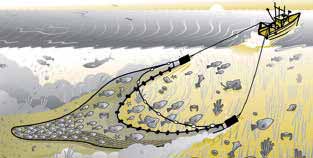
Human activities and impacts on the deep sea
Depth (m)
40
0
100
20
200
0
Latitude
500
-20
1,000
-40
2,000+
1950
1960
1970
1980
1990
2000
Year
Figure 3.1: Mean depth of global fisheries landings by
Schematic cartoon showing the principle of
latitude, from 1950 to 2000 Source: Pauly et al., 2005
bottom trawling.
The exploration and prospecting stages of most deep-
sea activities involve hydrographical, geological and/or
geophysical profiling via acoustic or optical methods. Thus,
Table 3.2: Most developed human activities in the
at this stage of the activities, their associated threats or
deep sea and main habitats/ecosystems affected
impacts are similar, even if the subsequent operations
have very different impacts. Some operations interact with
Activity
Main direct impacts on:
the deep-sea environment in similar ways, causing
Deep-sea fishing
Continental shelves and slopes
comparable impacts, albeit often at very different temporal
Seamount ecosystems
and spatial scales. The burial of submarine cables/
Cold-water coral ecosystems
pipelines (commonly done on the continental shelves of
Deep-sea sponge fields
1 500 m to prevent accidental damage to the cable) and
Hydrocarbon
Seamount ecosystems
bottom trawling can, in principle, have the same kind of
extraction
Cold-water coral ecosystems
impact on the seafloor by disturbing habitats and
Deep-sea sponge fields
ecosystems. The extent of impacts, however, is quite
Deep-sea mining
Continental shelves and
different due to the nature of the activity and the size of the
abyssal plains
areas involved. Trawling for instance is a repetitive
Seamount ecosystems
operation, whereas the placement of submarine cables is
Cold-water coral ecosystems
generally a one-off activity (barring repairs). Trawling
Deep-sea sponge fields
affects thousands to tens of thousands of square
Hydrothermal vents
kilometres per tow (Gianni, 2004), whereas the area taken
Waste disposal
All marine habitats and
up by all submarine cables ever deployed is several orders
and pollution
ecosystems
of magnitude smaller. Some activities also involve risks of
Cables
All marine habitats and
accidental impacts (for example, pollution from a burst or
ecosystems
leaking submarine pipeline).
Pipelines
All marine habitats and
Some of the human activities listed in Table 3.1 are still
ecosystems, especially on
in the early testing or planning stages. Table 3.2 lists the
continental shelves and
most developed human activities in the deep sea and the
slopes
main habitats/ecosystems that are threatened and/or
Surveys/
All marine habitats and
affected by them. In the following subsections, we address in
Marine Scientific
ecosystems
more detail those activities that are most important from a
Research
socio-economic and environmental perspective and/or
Bioprospecting
Seamount ecosystems
which currently represent the greatest actual or potential
Continental shelves and
impact on the deep seas.
abyssal plains
Cold-water coral ecosystems
Deep-sea fishing
Deep-sea sponge fields
Context
Hydrothermal vents
Deep-sea fisheries became commercially feasible and
Cold seeps and mud volcanoes
attractive for two main reasons: (i) the depletion and
33
Deep-sea biodiversity and ecosystems
increasing control/regulation of the traditional fish stocks in
Iceland, New Zealand and Latvia. In general, deep-water
shallower, coastal areas under national jurisdiction and (ii)
bottom trawling requires large and powerful ocean-going
technological developments that provided the tools and gear
vessels,
often
owned/operated
by
big
commercial
necessary to fish effectively in deeper waters. Figure 3.1
enterprises. Without government incentives and subsidies
shows the trend towards deeper catches, especially in the
(for example, for building new vessels or on fuel tax), deep-
southern and northern oceans. It is estimated that 40 per
water and high seas bottom trawling would in most cases
cent of all marine trawling grounds are now deeper than the
not be economically attractive. Over the 1990s, government
continental shelf (Roberts, C.M., 2002). Deep-sea fisheries
subsidies (estimated at US$ 1520 billion per year)
are dominated by bottom trawling, which provided some 80
accounted for nearly 20 per cent of revenues of all fishing
per cent of the deep-sea catch in 2001 (Gianni, 2004). The
industry worldwide (Milazzo, 1998). A more recent figure
main target species are prawn, orange roughy, redfish,
estimates the sum of fuel and non-fuel subsidies to be
oreos, alfonsinos and grenadiers (Pauly et al., 2003).
between US$ 3034 billion per year for the period from 1995
Patagonian toothfish is a target of longliners in the Southern
to 2005 (Sumaila and Pauly, 2006). The global amount of
Ocean, while bottom gillnets fisheries target monkfish and
subsidies paid to bottom trawl fleets operating in the high
deep-water sharks. Compared to coastal fisheries, a high
seas is estimated to be at least US$ 152 million per year,
percentage of deep-water fishing is carried out illegally,
that is 25 per cent of the total landed value of the fleet. If, as
unreported and unregulated (IUU).
suggested by economic data for bottom trawlers, the profit
The characteristics and life traits of most deep-sea
achieved by this vessel group is normally not more than 10
organisms and ecosystems (see Chapter 1) such as slow
per cent of landed value, the implication is that, without
growth, late maturity, slow reproduction, exceptional
subsidies, the bulk of the world's bottom trawl fleet fishing
longevity and low productivity apply also to deep-sea fish
in the high seas would operate at a loss. This could be a
species. Orange roughy, for example, live up to 200 years or
factor in reducing the current threat to deep-sea and high
more, and only start to reproduce at around 20 years old
seas fish stocks (Sumaila et al. 2006).
(Gjerde, 2006a; Koslow et al., 2000). This has considerable
Although deep-sea fish stocks have been exploited only
implications for the approach to be taken in the
since the late 1960s, several species have already declined
conservation, protection and sustainable management/use
so much that they can be categorized as "endangered",
of deep-sea fish stocks.
some of them practically unknown to marine and biological
sciences (Devine et al., 2006). Armourhead and alfonsino
Nature
fisheries along the Hawaiian and Emperor Seamount chains
Heavy-duty bottom trawls are the dominant deep sea fishing
and the northern mid-Atlantic ridge respectively, have not
gear used to catch fish and shrimps living on or near the
shown much sign of recovery since their collapse in the mid
seafloor. To avoid losing or damaging gear, fishers
1970s after a decade of intensive fishing (Gianni, 2004).
sometimes drag chains and heavy equipment to level the
Without sustainable management, many deep-water and
seafloor before they trawl with their nets. The trawls are
high seas fisheries follow a "boom and bust" cycle of rapid
towed for short periods of time, at speeds averaging 4 knots,
development and decline, such as the recent fisheries in the
usually by one or two large vessels with engines of several
Southwest Indian Ocean, which collapsed after only four
thousand horsepower. Bottom trawling for commercially
years in the late 1990s (Clark et al., 2006).
valuable deep-sea species now takes place at depths from
approximately 250 to 1 500 metres, depending on the
Impact
targeted species (Clark et al., 2006).
The impact of deep-water demersal trawling has been
compared to that of forest clear-cutting or resource mining,
Scope
given rapid depletion and unlikely recovery of resources
Bottom trawling in the high seas constitutes a small fraction
(Beaumont and Tinch, 2003; Roberts, C.M., 2002). Some
of the world's fisheries in both quantitative and monetary
areas of the southern North Sea may be trawled more than
terms (Gianni, 2004), but the ecological impacts of this
10 times a year (Beaumont and Tinch, 2003), while deeper
activity are disproportionately large. The Northwest Atlantic
and more sensitive waters may only be trawled once a year
(Grand Banks and Flemish Cap) accounts for approximately
to allow for minimal recovery. Any type of gear dragged on
two thirds of the high seas bottom trawl catch, of which
the seafloor has considerable impact, classified into eight
European trawlers (the majority Spanish vessels) take
categories: scraping, penetration, pressure, sediment
approximately two thirds (Gianni, 2004). Other countries with
suspension, habitat destruction, burying, pollution by ripped
significant deep-sea trawling activity are: Russia, Portugal,
nets and mortality in the benthos (Linnane et al., 2000).
Norway, Estonia, Denmark/Faroe Islands, Japan, Lithuania,
Trawls level the seabed, reducing habitat complexity
34
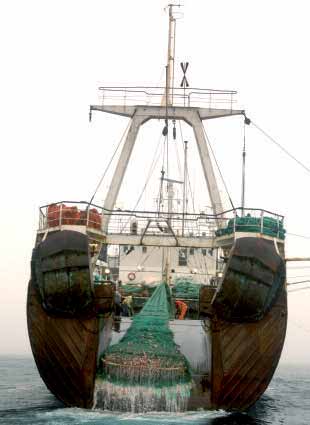
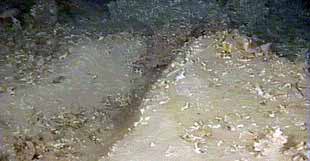
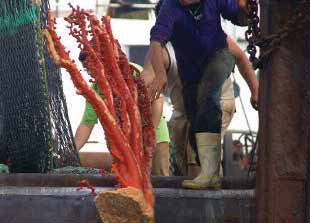
Human activities and impacts on the deep sea
Hunter
Lee
Fosså/IMR
Helge
Jan
Greenpeace/Virginia
Pullman/Greenpeace
Malcolm
Top: Trawl scars across a destroyed coral reef, offshore
Norway.
Bottom trawling for deep sea red fish (Sebastes marinus) at
Bottom: A giant piece of 500-year-old gorgonian coral being
depths of 650 metres in the North Atlantic Ocean.
hoisted out of a trawl net.
and leaving ground for opportunistic species such as
amounts of coral bycatch (both reef-forming and solitary
scavengers. The removal of ecosystem-building species
species). Thirty to fifty per cent of cold-water corals in
such as corals might lead to a temporal or permanent
Norwegian waters are severely damaged or dead, and their
change in fauna composition. In general, the impact
extremely slow growth threatens recovery (Fosså et al.,
depends on four factors: the type of gear (weight and size),
2002). In 1999, Norway was the first country to protect
the towing speed and length of the line, the nature of the
and conserve cold-water coral reefs within its Exclusive
seabed substrate (sand, sediments, rocks) and tidal
Economic Zone (EEZ) under the Norwegian Nature
conditions or currents (Linnane et al., 2000). Depending on
Conservation Act (Armstrong and van den Hove, 2007). The
local conditions, sediments suspended by the trawl may
state of cold-water corals on the Darwin mounds in the
impact neighbouring ecosystems over considerable
North East Atlantic prompted authorities to adopt protective
distances. Water column species are also affected by the
measures (Commission Regulation (EC) No.1475/2003) (De
cloud of suspended particles churned up by the bottom gear.
Santo and Jones, 2007). In October 2007, the European
While most deep-sea ecosystems are threatened by
Commission proposed a ban on fishing with active or passive
demersal trawling, the risk is particularly acute for
gears in four areas (Belgica Mound, Hovland Mound and
seamounts and cold-water coral reef communities. The
Northwest and Southwest Porcupine) off the Atlantic coast
benthic biomass from unfished seamounts has been
of Ireland hosting extensive cold-water coral reefs (Belgica
measured at 106 per cent more than that of fished ones
Mound, Hovland Mound and Northwest and Southwest
(Koslow et al., 2001). Suspension feeders such as cold-water
Porcupine). Together, these areas cover a total of around
corals and deep-sea sponge fields are particularly at risk
2 500 square kilometers. In the first year of the orange
from physical impact and smothering by sediments.
roughy fishery on the south Tasman rise, an estimated 10
Evidence of impact on cold-water corals from bottom
tonnes of coral was caught per tow, or approximately 10 000
trawling includes images of devastated reefs and large
tonnes of coral for 4 000 tonnes of fish (Gianni, 2004).
35
Deep-sea biodiversity and ecosystems
Box 3.1: Deep-sea fishing gear
Source: UN, 2006a
There are essentially four types of gear used in deep-sea fisheries. These are listed below in decreasing order of
importance and in increasing order of so -called ghost fishing potential.
Trawls are by far the most common. They consist of large nets with openings of up to 55 metres length and 12
metres width, large enough for a double-decker bus. Two otter boards on the side of the net opening, weighing up to
six tonnes each, act like ploughs on the seafloor and keep the net apart. The head line or upper lip of the net opening
is fitted with buoys, and the foot rope or lower lip is weighted with rollers, cables, chains, bobbins and "rock hopper
gear", depending on the roughness of the seafloor. The mesh size of the net is determined by the targeted species.
Bycatch of non-target or unwanted organisms can be very high. Bottom trawls are being dragged, and are in constant
contact, with the seafloor. Apart from the direct physical impact, they create large sediment plumes which can
smoother nearby communities.
Long lines are thin lines/cables with several thousands of baited hooks attached. The lines are lowered to the
seafloor with weights, most often near or in deep-sea biodiversity hotspots. While long lines are a static fishing gear,
bycatch of seabirds (hooked when the lines are being deployed), marine turtles and mammals is a significant
problem. Bycatch Reduction Devices (BRDs) do exist, but are not yet applied by all long liners.
Gillnets are similar to drift nets except that they are anchored on the seafloor. The bottom of the net is weighted
and buoys or floats are attached to the top. Up to 3 metres in height, these nets can stretch for 1 000 metres. They
are widely used in all oceans.
Traps are mostly used on seamounts to catch crustaceans, sometimes around cold-water corals.
Bycatch from trawlers is a significant problem in both
research vessel RSS James Cook. It is estimated that such
shallow and deep waters. Mortality among undesirable
abandoned fishing gear represents 30 per cent of sea-based
species or immature specimens of target species tends to
marine litter (UN, 2006a). Deep-sea environments are more
increase with depth and as fisheries progress. In the
exposed to ghost fishing than shallow waters, where nets
southern North Sea for instance, for every kilogram of
are quickly overgrown by algae or ripped by storms and
market fish, an average of 45 kilograms of invertebrates
currents. However, the recovery of lost long lines and
and 2 kilograms of fish are thrown out by beam trawlers
gillnets that snagged cold-water coral reefs or sponge fields
(Linnane et al., 2000). Trawls can be equipped with bycatch-
can also have a large environmental impact (ICES, 2005).
reduction devices (BRDs), however, these can only reduce
the magnitude of the problem.
Future
Demersal long-line fishing has a considerable impact on
Given the state of fisheries and the serious decline in fish
seabirds such as albatross, which take the bait and drown
stocks worldwide, the pressure to develop new fisheries
during the deployment (Dunn, 2007), and also has some of
and/or target new stocks and species is stronger than ever,
the highest bycatch and discard rates (Maguire et al., 2006).
with exploration mainly taking place in deeper waters both
Octocorals and other invertebrates are routinely entangled
within and beyond national jurisdiction. Large seamounts in
or caught by deep long-line fisheries (Alex Rogers, pers.
the southern Indian Ocean, the southern portions of the Mid-
comm.), but no scientific studies of this impact have been
Atlantic Ridge in the South Atlantic and in some regions of
carried out to date.
the southern-central Pacific Ocean could become targets for
The physical impact of other fishing gear is moderate
the future commercial exploration and exploitation of alfon-
and mostly limited to the damage caused by weights or
sino and orange roughy, threatening the as yet undiscovered
anchors (UN, 2006a). Fishing gear lost or dumped at sea
ecosystems and communities that might live on these sea-
continues to attract and ensnare fish for several years so-
mounts (Clark et al., 2006). Rapid (and unsustainable)
called ghost fishing (Hareide et al., 2005). Remains of fishing
development of deep-sea fisheries is bound to go on with
gear are commonly observed on cold-water coral reefs in
greater impact on biodiversity and ecosystems and con-
the northeast Atlantic (Jan-Helge Fosså, pers. comm.). They
tinued decline of global catch (Pauly et al., 2003).
were also recently documented in submarine canyons off
Nevertheless, deep-sea fisheries, and bottom trawling in
the coasts of Portugal in depths of more than 1 000 metres
particular, rely heavily on cheap and abundant fossil fuels,
during a HERMES cruise (JC10, June 2007) with the
which means they would be the first to be hit by peak oil and
36
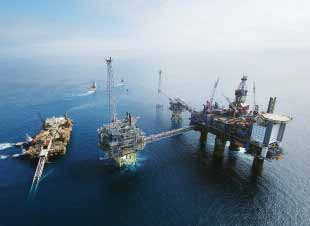
Human activities and impacts on the deep sea
high oil prices (Pauly et al., 2003). Captains of large trawlers
have already refused to go to sea knowing the ex-vessel
Hydro
value of the catch would not cover fuel costs, despite
subsidies (Clavreul, 2006). Pauly et al. (2003) suggest that
Norsk
areas of the high seas could become "quasi-marine
reserves" as deep-sea fisheries become cost-prohibitive for
large trawlers. Restrictions on trawling gear, such as the
diameters of bobbins and rollers or the use of chains for
levelling the seabed, could also prevent fishing in some
vulnerable and coarse areas (UN, 2006a).
The long-term effects of bottom trawling are
increasingly visible and habitat destruction will potentially
lead to the collapse of more fisheries. Assessing the impact
of these fisheries on biodiversity and ecosystems at all
trophic levels is an urgent task for the scientific community.
Further economic studies of the deep-sea fishing sector
The Ormen Lange gas field off Norway.
including assessment of externalities and of market
distortions due to subsidies are needed to support sus-
areas, such as for instance the Gulf of Mexico, favourable tax
tainable use and management of the deep-sea resources.
regulations (in this case from the US government) provide an
Such studies must be linked to the issue of sustainable use
additional incentive to oil companies to be more active.
of shallow-water fisheries, which have a greater potential for
resilience than deep-sea ones.
Nature
Systematic seismic surveys by oil and gas companies,
Offshore oil and gas operations
combined with "ground-truthing" data from drilling
Context
programmes (for example, Deep Sea Drilling Project, Ocean
Most submarine oil and gas reserves occur on the
Drilling Program, Integrated Ocean Drilling Program and
continental shelfs and slopes (sometimes at considerable
other private endeavours) have yielded considerable inform-
depth), where continental crust is present. These oil and gas
ation on continental margins and the nature of the ocean's
resources were formed by the degradation of organic matter
subsoil. These results are obviously valuable to both science
that accumulated over millennia in sedimentary basins on
and industry exploration and production in the deep sea
the bottom of the ocean. Buried by sediments in an
(Katz, 2003).
anaerobic environment, the organic matter was subjected to
The development of deep and ultra-deep water fields
gradual decay through bacterial and chemical action while
has continuously provided new technological challenges. At
sediments continued to accumulate above. The resulting
present, semi-submersible, submersible and tender plat-
conditions of pressure and temperature led to the breaking
forms account for roughly 20 per cent of all oil and gas rigs
down of complex biological molecules into simpler
worldwide. It is now possible to lower up to a thousand
hydrocarbon chains. The resulting oil and gas migrated
tonnes economically to depths of 3 000 metres (for further
upwards through the rock layers in which they were
information see www.rigzone.com) and to install sub-sea
enclosed until they reached an impermeable surface, which
production systems with processing hubs and tie-backs
concentrated them into an exploitable accumulation.
linking more wells to an equal number of surface platforms.
The depletion of shallow-water offshore hydrocarbon
Deep and ultra-deep fields are often developed with fewer,
reserves (DWL, 2005), rising oil prices, and the development
high-productivity and horizontal or highly deviated wells
of new drilling and sub-sea technologies, has made the
drilled into poorly consolidated reservoirs, which require
exploration and exploitation of oil and gas reserves in deep
large volumes of injected and produced water (Bruhn, 2005).
(5001 500 metres) and ultra deep (deeper than 1 500
Chevron broke a number of records in 2003, drilling in
metres) waters increasingly interesting and commercially
3 051 metres of water at its Toledo prospect in the Gulf of
viable. The "golden triangle" of the continental slopes off
Mexico. Transocean drilled a well to 10 411 metres in 2005 at
western Africa, the Campos Basin in Brazil and the US Gulf
the Chevron/Unocal's Knotty Head discovery. In 2006, on the
of Mexico, concentrates at present most of the investment.
Walker Ridge, a well sustained a flow of 6 000 barrels of
Sixty per cent of the golden triangle's output now comes
crude per day during tests and is believed to be one of the
from deep-water wells. This ratio reaches 65 per cent for the
largest fields in the Gulf of Mexico. Despite these results, a
Gulf of Mexico (French et al., 2006). In some deep-water
peak in deep-water drilling activities was observed in 2001
37
Deep-sea biodiversity and ecosystems
35
NGL
30
Polar
Deepwater
Heavy etc.
25
Middle East
y
ear
Other
per
Russia
20
els
Europe
barr
US-48
Billion 15
10
5
01930
1940
1950
1960
1970
1980
1990
2000
2010
2020
2030
2040
2050
Figure 3.2: Oil and gas production scenario per type and region Source: Campbell, 2004
and fewer exploratory and development wells have been
extraction could eventually trigger seafloor and subseafloor
drilled in all but one year between 2001 and 2006 (French et
destabilization has resulted in extensive geohazard studies
al., 2006; Robertson et al., 2006). Expenditures continue to
of the area (for example, Bryn et al., 2007). Impacts of
rise however, as activities such as drilling and floating
hurricanes are another important component to take
platforms become increasingly expensive and form the main
into account in business risk assessments prior to deep-
component of deep-water development (Robertson et al.,
sea operations.
2006). A recent development is the coming on stream of the
Total-operated Dalia project offshore Angola. It operates at
Scope
1 200 to 1 500 metres depth, with 71 subsea wells and 160
Deep-water oil and gas accounted for 10 and 7 per cent
kilometres of pipelines and umbilicals to transfer the oil to
respectively of global offshore oil and gas production in 2004
the Floating Production Storage and Offloading vessel.
(DWL, 2005), which amounts to roughly 3 and 1 per cent of
Various
potential
geohazards
may
affect
the
world oil and gas extraction, respectively. Determining the
development of deep-water oil and gas fields. These include
amount of deep-water hydrocarbon resources and reserves
large prehistoric submarine landslides and gas/liquid
is an intricate process, involving data on:
seepage features like pockmarks and gas chimneys, active
1. Estimates of hydrocarbon resources by geoscientists;
faulting and earthquakes, mud volcanoes, diapirs, gas
2. Discoveries by scientists and oil and gas corporations;
hydrates and very soft and brittle ooze-type sediments. In
3. Estimates
of
recoverable
reserves
from
well
addition to these natural features and processes, human
development;
activities related to drilling of exploration and production
4. Proven hydrocarbon reserves once fields go into
wells, anchoring and pipeline installation might trigger
production.
large-scale instabilities of the seabed (NGI, 2007). Hence,
The results are subject to both inaccuracies and
geohazard analysis is an important component of the
uncertainties due to several factors, including limited
studies required before going ahead with the development
geological knowledge of the oceans, the difficulties in
of hydrocarbon fields in the deep seas. An example is the
sampling as well as the use of different statistical methods,
Ormen Lange gas field off Norway, on the upper section of
and technological change for recoverable reserves. For
the giant Storegga slide. The fact that hydrocarbon
instance, of the 99 gigatonnes of oil equivalent estimated to
38
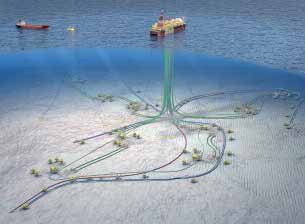
Human activities and impacts on the deep sea
be in deep waters, the known oil and gas reserves account
for a mere 2.9 to 3.4 per cent (ISA, 2000). If the estimated
Total
amounts of hydrocarbon resources in the deep water are
proven and recoverable reserves, then the growth potential
of deep-water oil and gas is significant.
The oil and gas production scenario per type and region
(see Figure 3.2) shows that even though deep-water oil and
gas extraction will remain limited compared to overall global
production, relative to other sources, the projected increase
in deep-water production comes only second to the
projected production of natural gas liquids (NGL).
Impact
The environmental threats and impacts resulting from such
activities in deeper waters can be estimated based on
experiences and analyses of shallow-water oil and gas
The Dalia Project: oil extraction in the deep waters offshore
operations. Direct physical impacts are relatively low. Other
Angola.
potential impacts consist essentially in chemical pollution
(for example, from operational releases of chemicals and
hard substrate in an area where naturally ocurring hard
drilling muds and/or accidental, sudden spills) that may
substrate is sparse (Roberts, J.M., 2002).
occur during the drilling process. Drill cutting piles that
The presence, or formation, of reefs around installations
surround oil and gas wells are often contaminated with
where trawling is prohibited, may indicate that the
hydrocarbons and drilling fluids. Leaking of, and chronic
environmental impacts of deep-water oil and gas operations
exposure to, these contaminants can have serious effects
are less damaging in the short run compared to bottom
on nearby ecosystems, especially sessile organisms. The
trawling. Nevertheless, more detailed studies of the (short-
volume of contaminated drill cuttings from oil and gas
and long-term) physical and chemical effects of drilling
platforms in the United Kingdom and Norwegian sectors of
waste discharges on ecosystems are needed to have a more
the North Sea is approximately 2 million cubic metres (Grant
precise assessment of environmental impacts (Patin, 1999).
and Briggs, 2002). While this is mostly in shallow waters, it
Another potential impact of oil and gas activities in the
illustrates what deep-sea environments may face. Given the
deep sea is the spread of invasive species as slow-moving
relative lack of current and tidal motion in the deep sea, the
and frequently moored vessels, such as drilling platforms
dispersion and degradation of contaminants and pollutants
serve as large artificial reefs and therefore pose a risk of
such as polycyclic aromatic hydrocarbons (PAHs), may be
alien species transmission when (and if) they are brought to
slower than at shallower depths where no significant levels
shore for maintenance (Galil, 2006).
of contamination from a rig may be detected among fish
(King et al., 2005). In some places this is debatable, however,
Future
as processes such as dense shelf water cascading could be
Figure 3.3 shows the forecasted production of deep-water
extremely efficient in carrying pollutants to the deep sea
hydrocarbons to 2009. Between 2005 and 2009, deep-water
(Canals et al., 2006).
oil and gas operations are expected to rise from 17 per cent
The deeper waters in the northern North Sea,
to 24 per cent of global offshore expenditures. As new
the Norwegian shelf, off northwest Scotland and in the
development projects come online, the share of deep-water
Atlantic "golden triangle" are all regions where deep-
oil output is likely to increase by 2015 to 25 per cent of all
water oil and gas exploration and extraction might take
offshore extraction (Robertson et al., 2006). The contribution
place close to vulnerable deep-sea ecosystems, such as
of deep-water oil and gas is expected to account for most
deep-sea sponge fields or cold-water corals. The effects
future offshore growth. Not all deep-sea provinces are
are potentially acute on the latter in particular (Freiwald et
suitable for holding hydrocarbon reservoirs because of their
al., 2004), albeit varying between coral species. But
geological nature and evolution. There are still many
implications regarding environmental sensitivity of cold-
uncertainties and most deep continental basins and
water corals, such as Lophelia pertusa, near offshore oil
margins, including the polar ones, are still poorly explored.
and gas drilling platforms are unclear as the amount of
Deep-water
hydrocarbons
are
considered
an
exposure to drill discharges is often unknown. Moreover,
unconventional source of hydrocarbons. Exploiting oil and
corals may use platforms for settlement as they provide a
gas in harsh environments such as the deep sea at high
39
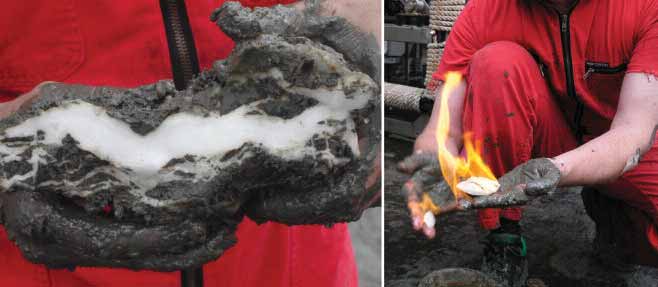
Deep-sea biodiversity and ecosystems
www.marum.de
Margins
Ocean
Centre
Research
MARUM
Gas hydrate is found in subsurface sediments where physical and chemical conditions permit. When brought to the surface, the hydrate
dissociates, releasing the (flammable) methane gas.
pressures and low temperatures relies on technological
oil lead to significantly increased oil prices, the story could
breakthroughs and sustained oil prices. It is accordingly
be completely different.
more vulnerable and accident-prone than operations in
To ensure minimum impacts of deep-sea hydrocarbon
shallow waters and on land. Furthermore, under current
exploration and production, the industry needs to better
cost/benefit (that is, energy return to energy investment)
understand, assess, predict, monitor and consequently
ratios, deep-water oil remains a marginal source of energy,
manage the potential short, medium and long-term impacts
however, should the combination of world demand and peak
that its activities may have on the surrounding environment.
To that purpose, more knowledge on deep-sea ecosystems
Figure 3.3: Deep-water oil and gas production
and their environments is needed, as well as improved
Source: DWL, 2005
strategic environmental assessments, environmental
impact assessments, indicators and monitoring.
8
Ultimately, even if the cumulative adverse effects of
hydrocarbon extraction continue to pressure deep-sea bio-
7
diversity, the indirect impacts from the combustion of fossil
fuel in particular, climate change and ocean acidification
day)
Gas (oil equivalent)
remain a far more daunting threat.
per 6
Oil
els
Deep-sea gas hydrates
barr 5
Context
The increasing worldwide demand for energy (and the
(million 4
shortcomings associated with satisfying this demand with
fossil fuels, nuclear power or renewable energies) has
oduction
pr 3
triggered over the last decade a search for other
er
unconventional energy resources. Gas hydrates, naturally
occurring solids (ice) composed of frozen water molecules
2
Deepwat
surrounding a gas (mostly methane) molecule, are known to
represent an immense energy reservoir. It is estimated that
1
gas hydrates contain between 500 and 3 000 gigatonnes of
methane carbon (WBGU, 2006), over half of the organic
0
carbon on Earth (excluding dispersed organic carbon), and
1994
1996
1998
2000
2002
2004
2006
2008 09
40
Human activities and impacts on the deep sea
twice as much as all fossils fuels (coal, oil and natural gas)
addition, destabilized gas hydrates may also affect the
combined (Kenvolden, 1998).
climate and increase atmospheric concentrations of
greenhouse gases through the release of large amounts of
Nature
methane, more than 20 times as potent a greenhouse gas
Gas hydrates are metastable; that is, their existence is
as CO2.
controlled by the prevailing pressure, temperature, water
chemistry, gas composition and gas concentration
Scope
(Lüdmann et al., 2004). Suitable conditions for gas hydrate
Research into submarine gas hydrates has so far
formation are found in polar areas and in sediment layers on
concentrated on the identification of the distribution and
the outer continental margins in 500 to 2 000 metres water
extent of gas hydrate reservoirs. Apart from some
depth. Changes in these conditions, due to a rise in water
experimental pilot projects to recover small amounts of
temperatures near the deep-sea bottom, for example, can
gas hydrates, the challenges and risks involved have so far
cause the gas hydrates to dissociate into gas (methane) and
prevented operations on a commercial scale. Whether the
water (liquid or frozen). The volume of methane captured in
exploitation of gas hydrates could become reality in the
gas hydrates is large, with 1 m3 of gas hydrate equalling
near future is still disputed among experts. Firstly,
164 m3 of methane at standard temperature and pressure.
technologies would have to be developed to cope with the
The utilization of gas hydrates as energy sources poses
physical conditions (pressure and temperature, for
great technological challenges and bears severe risks and
example) under which gas hydrates would have to be
geohazards. The destabilization of gas hydrates can cause
extracted. Secondly, gas hydrates commonly occur in
large parts of the seafloor on the continental margins to
numerous but small forms of ice interspersed within
become instable and slump or slide into deeper areas,
sediments; that is, they do not form "clean" and easily
triggering earthquakes and tsunamis. An example is the
minable concentrations or horizons. This means that large
Storegga Slides off the Norwegian coast, which count
amounts of sediments would have to be extracted with
among the largest submarine sediment slides in history
considerable environmental impacts, including the
(the latest incident occurred around 6100 BC). Here, a 290-
removal of large quantities of fauna and wide-ranging
kilometre stretch of coastal shelf suddenly collapsed,
increase in turbidity and sediment suspension.
displacing some 3 500 cubic kilometres of material. This
caused a large tsunami, which affected all coastal states
Future
and islands in the North Atlantic. In Scotland, the effects of
It is still uncertain if and when it will be feasible and econ-
this tsunami can be traced up to 80 kilometres inland. In
omically viable to exploit gas hydrates as an energy resource
Box 3.2: Main potential sources of non-fuel minerals in the deep sea Source: adapted from ISA, 2004)
Polymetallic manganese nodules are rock concretions containing metals such as cobalt, copper, iron, lead,
manganese, nickel and zinc. They lie partially buried on the surface of sediments that cover the abyssal plains (typical
water depth 5 000 metres) and mostly range in size from that of a golf-ball to a tennis ball. It generally takes millions
of years to form a manganese nodule. The metals concentrated in these nodules come from two sources. The primary
source is considered to be metals that are dissolved from rocks on land as part of the weathering process and
transported to the ocean by rivers. The secondary source is metal-rich solutions that discharge as warm and hot
springs at ocean ridges. The upper portion of the nodules accumulates metals that are precipitated from seawater,
while the lower portion of the nodules accumulates metals from pore-water in the underlying sediments.
Massive polymetallic sulphides containing copper, lead, zinc, silver, gold and other trace metals are forming in the
deep ocean around submarine volcanic arcs, where hydrothermal vents exhale sulphide-rich mineralizing fluids into
the ocean. Their mineralization process requires tens of thousands of years.
Cobalt-rich ferromanganese crusts are precipitations of metals such as iron, manganese, cobalt, nickel, platinum
and others that are dissolved in seawater. The metals are derived from a combination of sources comprising
dissolution from continental rocks and transport into the ocean by rivers, and discharge of metal-rich hot springs in
the deep ocean. Instead of accumulating as nodules on the sediment surface of abyssal plains in the deep ocean,
cobalt-rich-ferromanganese crusts accumulate as extensive layers directly on volcanic rock that forms submerged
volcanic seamounts and volcanic mountain ranges.
41
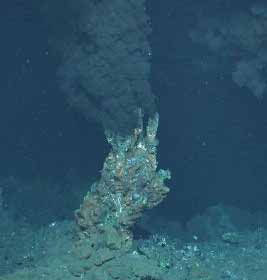
Deep-sea biodiversity and ecosystems
Nature
Commercial interest in deep-sea mining concentrates at
Margins
present on polymetallic sulphides around hydrothermal
vents (for example, around Papua New Guinea) and
Ocean
www.marum.de
manganese nodules. The latter are mainly found in the
Clarion-Clipperton fracture zone of the Pacific, the so-called
Centre
"manganese nodule belt".
Research
Scope
Mining activities in the deep sea are still largely prospective.
MARUM
Since 1987, the International Seabed Authority (ISA) has
signed eight exploration contracts, which allow contractors
to prospect and explore for nodules in specified areas
beyond national jurisdiction. Exploration contracts require
contractors to report their activities to ISA on an annual
Hydrothermal vents, such as this black smoker at the Logachev
basis, and contractors are bound to prevent, reduce and
hydrothermal vent site on the Mid-Atlantic Ridge, and their
control pollution and other hazards to the marine
underlying mineralization system are the source of rich
environment arising from their activities. Seven of these
polymetallic sulphide deposits at and just below the seafloor.
contracts are for areas in the J31manganese nodule belt,
including the most recent with the German Federal Institute
on a commercial scale. If it were an option, consequent GHG
for Geosciences and Natural Resources. At stake for this 15-
emissions would only exacerbate the problem of climate
year claim are 50 million tonnes of copper, nickel and cobalt
change. The occurrence and distribution of gas hydrates is
in depths of at 4 000 to 5 000 metres.
also of special interest to other industrial developments
Prospecting for massive polymetallic sulphide deposits
taking place in the deep sea, such as oil and gas operations.
containing deposits of gold, silver, copper and zinc from
In relevant areas, gas hydrates could become one of the
hydrothermal vents and seamount areas respectively,
major risks for these activities, as their disturbance can
currently takes place in the Exclusive Economic Zones
dramatically modify the character and engineering response
(EEZs) of Papua New Guinea and New Zealand by two
of the seabed and subsoil and may lead to large and
companies. Nautilus Minerals is operating at 1 600 metres
explosive gas releases.
water depth, whereas Neptune Mineral's concession
ranges from 120 down to 1 800 metres (for further
Deep-sea mining
information see www. neptuneminerals.com and www.
Context
nautilusminerals.com). Industry has recently invested
Both continental margins and ocean basins contain
several million dollars in marine mining. The chief executive
potentially valuable non-fuel mineral resources. Some of
of Nautilus Minerals compares the costs of underwater
these minerals have a terrigenous origin; that is, they come
mines to those of the Pascua Lama gold mine project in
from land erosion and were transported to the sea mainly by
Chile, stressing that mining sulphides in 1 600 metres of
rivers and glaciers. Margins and ocean ridges, however, are
water may represent lower capital costs than drilling for
host to other sources and processes (for example, volcanic)
gold under a glacier 4 500 metres above sea level (see
that form different types of mineral deposits (see ISA, 2004
media article "Nautilus Minerals looking to ocean floor" on
for a detailed description). The main potentially exploitable
www.nautilusminerals. com).
sources of deep-sea minerals lie in polymetallic manganese
Independently of environmental considerations, several
nodules, polymetallic sulphides, and cobalt-rich ferro-
economic factors affect the feasibility of deep-sea mining.
manganese crusts (see Box 3.2).
They include the price of metals, the availability and costs of
The potential for deep-sea mining operations is
different technology options, as well as the energy costs. As
significant. Submarine cobalt-rich ferromanganese crusts
regards technology, depth is not the only constraint. The
of 0.6 to 1 per cent grades would be enough to provide up to
more complex the geometry of the deposit and the structure
20 per cent of global cobalt demand, but cost-effective
of the seafloor, the more sophisticated (and therefore
mining methods still need to be developed (Rona, 2003).
potentially less reliable) the collecting devices need to be.
Similarly, the high recovery cost of manganese nodules on
The different deposits can be classified from relatively easy
abyssal plains and hydrothermal vent polymetallic sulphides
(nodules) to moderately difficult (Cobalt-crusts) and more
has prevented any significant development so far.
difficult (sulphides) to mine (Lenoble, 2004).
42
Human activities and impacts on the deep sea
Table 3.3: Summary of the princial types of mineral resources in the oceans
Source: Cochonat et al., 2007
Type
Location
Commodity
Depth
Mining status
Economic
interest
Salt
Coastal
Salt
Shore
Operational
Moderate
Sand and gravels
Beach,
Aggregates
Shallow
Operational
High
shallow water
Marine placers
Beach
Tin, gold,
Shallow
Operational
Moderate
shallow water
chromium
zirconium
Rare Earth
Elements,
titanium
Diamonds
Coastal
Diamonds
<250m
Operational
High
Phosphates
Shallow water
Phosphate
Shallow to
Non-operational
Low
and seamounts
medium
depths
Nodules
Deep ocean
Copper, cobalt,
4 500m -
Potential
Moderate
nickel
5 500m
resources
Manganese crusts
Intraplate
Copper, cobalt,
1 000m -
Potential
Moderate
seamounts
platinum
2 500m
resources
Deep-sea
Volcanic
Copper, zinc,
1 000m -
Potential
High
sulphides
ridges
silver, gold,
4 000m
resources
cobalt, lead
Impact
diversity (Smith, 1999). Recolonization rates on abyssal
The potential environmental impact of deep-sea mining still
plains are expected to be extremely low. Moreover, the
needs to be further investigated, including the recovery of
occurrence of endemic species would seriously limit
deep-sea ecosystems after mining has taken place. Earlier
the options for conservation in one area to compensate for
impact studies by German and US scientists, and bio-
biodiversity loss in another. The impact from resuspension of
diversity studies by French scientists (Tilot, 2006) have
sediments would also be considerable. For instance, one
shown a unique fauna associated with nodule fields, which
calculation estimates that to be economically feasible, it
would be endangered in case of large-scale mining (Thiel,
would be necessary to mine on the order of 0.5 square
2001). However, experiments would have to be carried out
kilometres per day, which would resuspend about 7 400
over large spatial and temporal scales, something the
tonnes of sediment per day. Surface deposit feeders in a
mining companies may not wait for. Very little is known about
radius of over one kilometre would find themselves buried
the community structure of deep-sea organisms and, by the
under millimetres to centimetres of sediments (Smith, 1999).
same token, their resilience to large disturbances.
An estimate of how thick a layer of sediment might entomb
Given the presence of macrofauna primarily in the top
burrowing organisms would help to quantify potential losses
sediment layers of the deep-sea bed, scooping up poly-
of biodiversity. The actual removal of sediments, that is,
metallic nodules and subsoil operations would wipe out bio-
habitat to the majority of organisms on abyssal plains, would
43
Deep-sea biodiversity and ecosystems
sacrifice the fauna. Needless to say, resuspension and
the submerged volcanic mountain range associated with
removal would occur repeatedly during operations.
divergent plate boundaries in the international seabed area
Similarly, mining massive sulphides is likely to affect the
of the oceans (ISA, 2004). Underwater mining potentially
unique fauna around hydrothermal vents, either by direct
offers the same prospects pioneer miners had when land-
killing of organisms by mining machinery or by altering the
based industries first started.
fluid flows on which these organisms depend. Individuals
surviving these disturbances would be subject to a radical
Waste disposal and pollution
change in habitat conditions. Because of the high degree of
Context
uniqueness and high endemism of vent communities,
Despite their vastness and depth, the deep seas are no
impacts of mining on biodiversity are likely to be significant
longer a pristine environment. Eventually, many pollutants
as species might not be able to recolonize easily once mining
end up in the sea from either point or diffuse sources.
operations cease. The vents of some seafloor polymetallic
Pollution, wastes and litter are running off from land, are
sulphide deposits can become naturally inactive and stop
intentionally dumped at sea (including toxic chemicals, oil,
providing habitat for the specialized chemosynthetic vent
disused weapons and radioactive materials), are lost (such
fauna. Once this occurs, these inactive areas can be
as oil, fishing gear), or are discarded (such as plastic bags,
colonized by neighbouring deep-sea organisms. Before
damaged fishing nets), with no consideration for the
concluding that mining in such inactive areas would pose
resulting environmental effects. The threats to biodiversity
little threat to biodiversity, more extensive sampling is
from waste disposal and pollution include ghost fishing,
required to establish the nature of their fauna, as mining
death from ingestion of plastics and chemical compounds,
would eliminate habitats (Juniper, 2004).
and extinction from changes in biochemical conditions that
Ecosystems
and
biodiversity
in
areas
rich
in
might disrupt entire food chains. In addition, it is most likely
ferromanganese crusts would be seriously affected by
that the oceans will also become a critical target and
mining activities. Especially around seamounts, these
component of attempts to mitigate climate change.
operations would affect vulnerable communities and
However, the "dilution is the solution to pollution" maxim,
associated species some of which with commercial value
the utmost misconception of environmental engineering,
in a similar way to trawling. Before mining for crusts on
proves to be as wrong in the oceans and seas as in the
seamounts becomes the underwater equivalent of mountain
atmosphere or on land. In addition, ocean currents such as
top removal, thorough environmental impact assessments
the Gulf Stream have no concept of political and legal
must be conducted (Koslow, 2004).
borders, which makes pollution across these boundaries
Nevertheless, some argue that deep-sea mining is less
difficult to manage.
damaging than terrestrial excavation. Picking up nodules
and sulphides from the seafloor appears less intrusive than,
Nature and scope
say, open pit mines (Scott, 2006). In the end, impact largely
Some 80 per cent of the pollution load in the oceans
depends on the scale at which deep-sea mining operations
originates from diffuse land-based activities. This includes
would take place. Further research would be necessary to
municipal, industrial and agricultural wastes and run-off, as
assess the scale factor relative to the size and vulnerability
well as atmospheric deposition (see www.gpa.unep.org for
of deep-sea ecosystems and biodiversity hotspots.
further information). Untreated sewage, sewage sludge,
fertilizer, pesticide residues, persistent chemicals and heavy
Future
metals all reach the marine environment through natural
Today, most operational ocean mining takes place in shallow
and man-made channels. Rivers, estuaries and their
water, however, recent advances in industrial capability have
prolongation in the form of submarine canyons carved in
increased the potential economic interest in deep-sea ores
continental slopes carry large amounts of sediments to the
(see Table 3.3). With the technology developed for submarine
deep sea (Canals et al., 2006). Also, around 80 to 90 per cent
oil and gas production facilities and the rising prices of
of the material in weight deliberately dumped at sea results
minerals, deep-ocean mining might become feasible and
from dredging, currently amounting to hundreds of millions
commercially attractive in the near future. Due to their
of tonnes per year. Disposal of dredged material in deep
generally higher metal contents, lesser water depths, and
seas represents about 20 to 22 per cent of the total dredged,
proximity to land within the 200-nautical mile zone, the
while the rest ends up in shallow waters and on land (see
polymetallic massive sulphide deposits at convergent plate
www.oceanatlas.org for further information). Approximately
boundaries associated with the coastal states of the volcanic
one tenth of all dredged sediments are contaminated with
island chains, especially in the Western Pacific, are likely to
anything from anti-fouling paints and heavy metals to
be developed sooner than more remote and deeper sites on
sewage and land runoff. It is therefore a matter of time
44
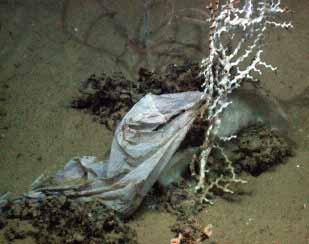
Human activities and impacts on the deep sea
before toxic chemicals from land-based sources are
transported to the deep sea.
The nuclear and military industries are sources of some
of the most dangerous wastes intentionally dumped at sea.
www.marum.de
Because of the difficulty to access data from both civil and
military sources, the quantities of radioactive wastes dumped
in ocean trenches off the British Isles by the United Kingdom
Margins
and other European nations, or of submarines reactors
Ocean
dumped by the Soviet Union, can barely be estimated.
Nuclear (re)processing plants continue to discharge low
Centre
levels of radioactive waters into the sea. However,
atmospheric nuclear tests are responsible for more than
2 000 times the levels of radioactivity observed in the oceans,
Research
compared to solid wastes (IMO, 1997). The oceans are not
safe, secure garbage cans either: nuclear wastes in shallow
MARUM
waters off Somalia were recently washed ashore by the 2004
Tsunami, causing serious health and environmental
Plastic rubbish caught on Madrepora coral colonies in the
problems (see www.unep.org/tsunami_rpt.asp for further
central Mediterranean.
information).
The oil and gas industry is also a source of pollutants.
As mentioned above, some 30 per cent of marine debris
Radioactive radon and lead isotopes are released in the seas
is fishing gear, either lost or dumped. In addition, a rough
while pumping oil and gas out of continental crusts (Dutton
estimate of lost merchant freight at sea is 1.3 million tonnes
et al., 2002). Decommissioning of oil and gas rigs, as the
per year. Over seven million tonnes of British merchant
1995 Brent Spar case showed, will become a critical issue
vessels were sunk during the First World War and more than
and strategies need to be put in place to manage the end of
21 million tonnes of allied merchant cargo during the Second
life of such equipments, especially in the deep sea. Even if
(Angel and Rice, 1996). Numerous types of non-degradable
pipelines and platforms can be towed to shore, chances are
plastics litter the ocean floor, and even buoyant plastics
that some equipment will be left in place on the seafloor and
might eventually sink due to their long persistence. Recent
the potential contaminants contained in such structures will
deep-sea dives to the Eastern Mediterranean observed a
become a key issue. The toppling of disused offshore
piece of plastic litter every 10100 m2 (HERMES expeditions
installations is equivalent to dumping according to the
RV METEOR M70). The proportion of plastics in marine litter
OSPAR Convention and therefore illegal in the North Sea,
varies between 60 and 80 per cent (Derraik, 2002).
unlike in the Gulf of Mexico. The bulk of the oil and gas
Another type of pollution impacting on the deep sea is
industry's wastes, however, will come from another indirect
acoustic pollution. Maritime transportation around the globe
source: the deep sea is bound to be at the end of the
is increasing and so is the number of boats and vessels at
economy's largest waste stream, CO2 emissions.
sea. The acoustic impact of the low frequency sounds
Pollution from ships tends to be less controlled away
produced by vessels is not confined to coastal waters, but
from the coasts. Further out at sea, tanks are often cleaned,
penetrates into the deep portions of the oceans. It is not yet
and oil and chemical residues deliberately discharged
clear what impact this type of pollution can have on
overboard. Such operations represent the largest sources of
cetaceans (such as sperm whales, for example) that spend a
pollution from ships (UN, 2007). Moreover, the regulation of
large part of their life in the deep sea and use sound to
effluents from ships remains difficult to enforce, especially if
communicate, navigate, feed and sense their environment
discharges take place in remote offshore areas or
(Galil, 2006). Ships can also kill mammals by accident when
international waters. Spurred by a boom in tourism at sea,
they surface to breathe. Most lethal or severe injuries are
cruise ships are increasingly threatening vulnerable areas
caused by ships 80 metres or longer travelling at 14 knots or
with their wastes. Seabed litter studies in the Mediterranean
faster. Ship strikes can significantly affect small populations
found that the most common litter were paint chips (44 per
of whales (Laist et al., 2001).
cent) and plastics (36 per cent), with probably most of this
seabed debris being ship-based. Moreover, vessel-genera-
Impact
ted refuse remains a major source of marine litter, even
Bioaccumulation of toxic chemicals increasingly affects
after the entry into force of regulations that prohibit disposal
deep-sea biodiversity. Some deep-sea fish are seriously
of all litter except food (Galil, 2006).
contaminated
by
heavy
metal
and
polychlorinated
45
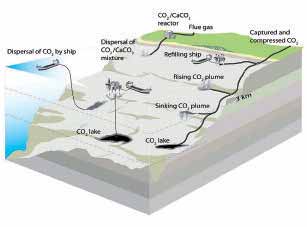
Deep-sea biodiversity and ecosystems
On the seafloor, plastics form a barrier to gas and
nutrient exchange and benthic organisms. Plastics also
pose a great threat to marine mammals, turtles and
seabirds via ingestion, suffocation, entanglement and
ensuing death. As victims die, persistent plastics are freed
again to be picked up by subsequent victims.
Oceans naturally absorb some two gigatonnes of carbon
per year (Brewer et al., 1999). Moreover, as a carbon
reservoir, the oceans have unparalleled capacity in the
biosphere, 44 teratonnes (44x1012 tonnes) compared to 750
gigatonnes (750x109 tonnes) for the atmosphere (Johnston
and Santillo, 2003). Storage of CO2 emissions in the oceans
is now technically feasible, with various techniques being
Source: IPCC, 2005
proposed and considered (see Figure 3.4). Economically,
some claim that the ocean storage of CO2 would increase
the cost of electricity generation by 50 per cent on average,
Figure 3.4: Methods of CO2 storage in the oceans
but estimates vary widely, depending on the choice of
capture technology, the type of (power) plant, transportation
biphenyl (PCB) concentrations that led to consumer
and place of injection (IEA, 2002; IPCC, 2005). The solubility
warnings about fish consumption. Even fish reared in
of CO2 increases with pressure and decreases with
aquaculture farms might be contaminated by fishmeal
temperature, such that beyond 2 600 metres water depth,
made of deep-sea fish (Storelli et al., 2004). Canyons on
sinking plumes of pure CO2 can be formed (Brewer et al.,
continental slopes seem to carry contaminants from coastal
2000). Injection of liquefied gases at such depths is
to deep waters where they accumulate. As well as the
technically difficult and, in general, injection technology
risks they present to humans consuming deep-sea fish or
plays an important role in overall storage efficiency.
fish fed with deep-sea fishmeal, PCBs are known to behave
Geological formations under the seabed might provide a
like enzymes and hormones and to disrupt biological
safer place for the storage of CO2. The potential impacts of
functions, especially reproduction in many organisms (for
sub-seabed storage are disturbance on the seafloor due to
example, Koppe and Keys, 2001).
well drilling and operations and accidental leaks or sudden
Among the most toxic materials introduced into the sea
release of CO2 from the geological reservoir.
are tributyltin compounds (TBT) (Galil, 2006). These
The increased concentrations of CO2 in the areas of inj-
substances were (and in some places still are) commonly
ection will change the pH of seawater (acidification) with
used as antifouling agents in ship paints as they effectively
adverse consequences for biodiversity such as changes in
and economically prevent the accumulation of fouling
oxygen supply, and metabolic rates of primary producers.
communities on vessels and man-made structures at sea
Pools of liquefied CO2 in the water column or on the seafloor
(Santillo et al., 2001). TBT and its degradation products
would create chemical barriers for pelagic and benthic org-
impact notably on the immune system of marine mammals
anisms, disrupting vertical migrations and food provisions.
and on the reproductive system of molluscs. TBT
Moreover, CO2 from industrial sources is likely to be impure
compounds may reach great depth and have been found in
and contaminated with, for example, sulphur and nitrogen
deep-sea
crustaceans,
cephalopods,
echinoderms,
oxides as well as heavy metals. In addition, the disposal of
gastropods and fishes (Takahashi et al., 1997; Borghi and
CO2 in the deep oceans would not permanently remove it
Porte, 2002). The substances bioaccumulate and move up
from the global carbon cycle. Taking into account global
the food chain to end up in high concentrations in top
ocean circulation and water exchange patterns, CO2 stored
predators such as dolphins, tuna and sharks (Galil, 2006). As
in the deep sea would, on average, come into contact with
legislations develop and restrictions are put in place on the
the atmosphere again in around 1 000 years. The only long-
use of TBTs, alternative antifouling compounds are used
term sequestration of CO2 could be achieved by injection into
more widely, but there is still very little available data on the
geological formations underneath the seabed, where the
toxicity and environmental impacts of the herbicides and
CO2 could be stored for millions of years, provided no leak-
pesticides they contain (ibid.).
ages or sudden releases occur. The disposal of CO2 in the
The risks and impacts associated with exotic species
deep sea and/or in geological formations under the seabed
transported in ballast water are largely unknown for the
can postpone the consequences of climate change, however,
deep seas (Gjerde, 2006a).
they may also result in slowing down the emergence of
46
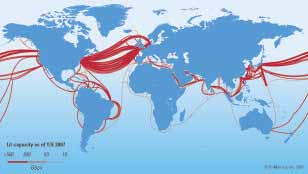
Human activities and impacts on the deep sea
better alternatives to fossil fuels (Schubert et al., 2006).
Future
Research
Past disposal of wastes in the deep sea is certainly no
argument for future environmentally harmful ocean dis-
posals, but hazardous chemicals and radioactive elements
continue to make their way to the ocean depths. As for
TeleGeography
carbon storage, before large quantities of CO2 are injected in
the deep sea or beneath the deep sea floor, many factors
must be studied in greater detail. While the oceans naturally
absorb large quantities of CO2, the same is not true for other
more potent greenhouse gases. Although parties to the
London Convention approved storage of CO2 in geological
The vast majority of international telephone and internet traffic
formations under the ocean floor and seabed, the economic
travels through underwater cables. This map shows the
and environmental soundness of such a scheme over the
submarine cables in use in 2007 and gives an indication of where
long term must still be demonstrated. In any case, even if
traffic is heaviest.
technically and economically feasible, these methods would
See http://www.telegeography.com/products/map_cable for a wall poster
only apply to point sources of CO2 emissions, not the large
of Submarine Cable Map
quantities of diffuse CO2 emissions released, for instance, by
the transportation sector.
accidental damage, cables are regularly buried 13 metres
below the seabed for protection on the continental shelf
Cable laying
and slope in water depths of up to 1 400 metres, a depth,
Context
which, until a few years ago was the limit of deep-
Ever since Professor Samuel Morse thought of the
sea trawling (Shapiro et al., 1997). Another risk for cables
transatlantic cable idea, cables have been laid on the ocean
comes from earthquakes and submarine landslides. One
floor. The placement of submarine cables is historically the
of the Internet's most recent and largest breakdowns was
first human activity to directly affect and take place in the
caused by a powerful earthquake and resultant submarine
deep sea, with the first transatlantic cable laid in 1858
landslide which damaged undersea cables in the Luzon
between Great Britain and Newfoundland. It is estimated
Strait between Taiwan and the Philippines.
that 100 000 kilometres of cables are being laid on the
Burial of cables in the sediment is by a plough-like
seafloor each year (Vierros et al., 2006). As an important part
device, which slices a narrow furrow into which the cable is
of modern infrastructure, submarine cables literally wire
inserted before the furrow is closed/covered again. Remotely
and connect the world. Nowadays, fibre-optic cables carry
operated vehicles may also be used to jet a narrow trench in
hundreds of gigabytes of information per second, with the
the seabed into which the cable is inserted. This technique is
transatlantic routes concentrating a large part of total traffic
most commonly used for cable reburial after repairs.
(see www.atlantic-cable.com). Ninety five per cent of the
Depending on sediment composition and currents, jetting
voice and data traffic between continents is being carried by
can create large plumes of sediment. In contrast to the shelf
submarine cables, which remain a cheaper and quicker
and upper slope, the unarmoured deep-water cables are
option than via satellites.
laid on the seabed surface guided there by computer-based
systems that control the ship's position, speed, location
Nature, scope and impact
relative to the seabed and the cable-laying machinery.
Telecommunications cables are designed to meet various
seabed conditions. In shallow water zones of high current
Future
and wave action or rough seabed, cables are armoured
Optic fibres were a revolution in the submarine cable
with steel wire and can reach a maximum diameter of 50
industry, but the real boom came in the mid to late 1990s.
millimetres. In contrast, deep-sea cables are typically
The surge in Internet use, especially from Europe and North
unarmoured and have a diameter of 1721 millimetres.
America, accelerated growth until eventually the e-business
The main threat to submarine cables is bottom trawling,
bubble burst in 2001. Cable overcapacity meant new cable-
which accounts for approximatively 70 per cent of faults
laying activities levelled off. Two recent trends include
caused by external aggression. Cables often give way when
investment shifts into the cable upgrade market, and a
snagged by trawl doors or rollers and tension may disturb
geographical shift in new laying operations from the North
the seabed at length along the cable. In order to avoid
Atlantic to the Indian and Pacific oceans (Ruddy, 2006). The
47
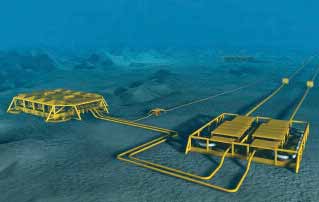
Deep-sea biodiversity and ecosystems
Construction, maintenance and repair have an impact on the
Hydro
seafloor. The submarine cables, over time the greatest risks
come from bottom trawling, earthquakes, landslides, and
Norsk
rust, which may cause leaks. Depending on the nature of the
product, temperature and pressure, an oil or gas leak could
have serious impact on benthic biodiversity, and upper
trophic levels.
Future
To date, few pipelines have been laid in the deep sea and
most of them serve as tie-backs between oil and gas wells
and the surface where tankers take over transportation.
Several major projects are underway. For instance, a
consortium led by Norsk Hydro is currently building the
Artist's view of the Ormen Lange field subsea installations
world's longest sub-sea gas pipeline, stretching for 1 200
off Norway. The templates will be at depths of around 800
kilometres from the Ormen Lange gas field in Norway to
1 100 metres.
England at depths of 800 to 1 100 metres (see www.hydro.
com/ormenlange/en). Another example is the Medgaz
former trend presumes a considerable reduction of impact,
natural gas pipeline between Algeria and Spain and whose
eliminating route surveys and new furrows. Technological
construction started in 2007. With a length of 210 kilometres
progress also shortens the lifespan of cables. However, and
and a diameter of 60 centimetres, its maximum depth will be
with a roughly 150-year history, many cables lie abandoned
2 160 metres (see www.medgaz.com). Other ambitious pro-
on the seafloor, except in shelf and upper slope
jects are being discussed across the globe (for example, in
environments where older cables are often recovered to
the Caspian and Baltic seas).
clear routes for new cables. The question of recovery and
The development of sub-sea oil and gas production
corresponding impact must be asked.
systems tying back wells to a central hub and up to a surface
With the increase in deep-sea research, more cabled
platform means many kilometres of pipelines have been
observatory projects will be built in the near future, which
and will still be added. Over the next five years, some
means placing cables in areas sometimes more sensitive
13 000 kilometres of pipeline might be needed by the oil and
than for communication purposes. However, this should be
gas industry to complete planned deep-water projects
balanced against the benefits of such projects in terms of
(Robertson et al., 2006).
better understanding and monitoring the deep sea and
managing anthropogenic activities (Cochonat et al., 2007).
Surveys and marine scientific research
Moreover, these observatories are subject to the same
Context
environmental assessment requirements as commercial
Surveying and mapping the deep ocean is a prerequisite to
systems so that impacts are assessed and regulated.
many civilian and military activities. Surveys are essential
tools for, inter alia, submarine cable and pipeline routes,
Pipeline laying
deep-sea oil, gas and mineral developments, installation of
Context
any other equipment in the deep sea, as well as production
Legally, the placement of cables and pipelines is often
of navigational charts. Surveys are also used in marine
treated similarly, and both activities belong to the list of
scientific research (MSR). In terms of impact and growth
freedoms established in the UNCLOS (see Chapter 4, p62).
potential, MSR and non-research surveying jobs share
However, the difference in size between pipelines and cables
similar characteristics, although not always on the same
is noteworthy: deep-ocean cables are typically of 2050
spatial and temporal scale.
millimetres, while submarine oil or gas pipes reach 900
millimetres diameter. In addition, the laying, operations and
Nature
maintenance of pipelines have different characteristics from
The main methods used to survey the deep sea are sonars
that of submarine cables.
of varying frequency, seismic air guns, drilling and sampling.
The first two used by scientists, industry and the military
Nature, scope and impact
allow both mapping of seabed topography and profiling of
Pipelines require more construction work than submarine
geological formations under the seabed. Arrays of air guns
cables. They may be laid on the seabed rather than buried.
producing intense pulses are coupled with large computing
48
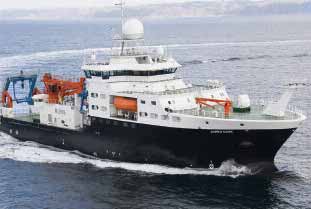
Human activities and impacts on the deep sea
capacity to process the echoes. The sounds of seismic air
Scientific surveys and deep-sea scientific research have
guns penetrate the ocean crust and can profile the subsoil
both positive and negative impacts. On the positive side, they
down to 10 kilometres below the seafloor (Weilgart, 2004).
are essential for increasing our knowledge of the deep-sea
Scientists also use sediment cores and small-scale dredges
environment and ecosystems, to understanding the value of
and trawls for benthic sampling.
deep-sea ecosystems goods and services and of other
The high costs of deep-sea MSR encourage public-
abiotic resources, and to underpin appropriate governance,
private partnerships. In particular, scientists may benefit
management and exploitation schemes. On the other side,
from industry's surveys just as industry may benefit from
marine scientific research may cause local physical impacts
scientific surveys. In some cases, scientific institutions may
due to equipment, cables and their operations. But scientific
also benefit from data acquired by military organizations,
research programmes normally strive to cause the least
and researchers are embedded within military organizations
amount of disruption in order to make accurate observ-
like hydrographical institutes.
ations, as well as for conservation and deontological
reasons. There is obviously a big difference between the
Scope and impact
scale of potential impacts of scientific research compared to
Different types of surveys have different impacts. Industrial
that of industry or military activities. For instance, the impact
(for example, for hydrocarbon exploration) and military
of scientific trawls is minuscule compared to that of fishing
surveys are often much more intense and cause more
trawlers. As a further step in limiting the impact of MSR,
damage than scientific surveys. Research activities involve a
codes of conduct for MSR are currently being discussed
low-level and small-scale use of sound. Oil industry activ-
internationally, for example, in the framework of the
ities involve much higher levels, but the areas covered are
OSPAR Convention, to ensure that scientific research and
relatively small and mitigation measures are often in place.
monitoring is carried out with minimum impacts.
Military activities involve high-level uses of sound over broad
areas, but it is extremely difficult to access relevant data.
Future
There are still many open questions and controversies
In the future, sonar exercises and seismic surveys are likely
around the effects of multibeam and seismic sources on
to continue on a broad scale. This is driven by both the lack
marine fauna, in particular, mammals. Seismic surveys
of knowledge and the differences between civilian and
usually cover large areas, with high-intensity and high-
military interests. Hence surveys of the deep sea will
frequency pulses sent from slow-moving vessels over long
continue at various levels, if only for natural resource
time periods. The sound signals become amplified with
extraction. Sharing data across the scientific and industrial
depth. The resulting impact from intensity and repetit-
sectors would bring synergies and contribute to diminishing
iveness could especially affect deep-sea organisms.
impacts. Studying the effects of acoustic devices on deep-
Compared to military sonar, commercial and scientific
sea organisms might help geosciences corporations to
seismic surveys operate in a broader range of frequencies
explore alternative technologies and processes.
(10 Hz 3 kHz) depending on the depth under investigation.
The development of long-term deep-sea cabled obs-
However, despite possible mitigation measures for
ervatories such as the Monterey Accelerated Research
example, visual detection of animals, time/area planning of
System (see www.mbari.org/mars) and other deep-sea obs-
surveys to avoid marine mammals (Weir et al., 2006)
seismic surveys have been linked to mass stranding of cet-
The UK research ship RRS James Cook.
aceans (see Engle et al., 2004, for example). Accumulating
evidence suggests that acoustic factors may provoke
behavioural changes particularly among deep-diving
NOCS
species, which are sent rapidly to the surface, and become
victims of decompression sickness (Jepson et al., 2003). The
damage to organic tissues is lethal, but other effects may
eventually be lethal as well. Air guns and sonar may inter-
fere with cetaceans' own sonar, disorienting them on their
migration course, hunt for food or hazard detection. Military
mid-frequency tactical sonar has been linked to the
increasing number of whale strandings and the increased
military use of low frequency sonar during the past decade
has been shown to affect animals hundreds of kilometres
away (Jepson et al., 2003; Reynolds and Jasny, 2006).
49
Deep-sea biodiversity and ecosystems
Nature and scope
Because of the high biodiversity and richness of deep-sea
faunas and the extreme conditions of pressure and
temperature in which deep sea species thrive, deep-sea
Danovaro/DiSMar
ecosystems and their genetic resources offer great
opportunities in terms of bioprospecting for industrial and
medical
applications.
Developments
in
molecular
Roberto
technology and bioinformatics are facilitating the gathering
of information on the diversity of existing bacteria and their
potential (UN, 2007). Meanwhile, new technologies enable
access to remote and new deep-sea areas. The frontier
between scientific investigation and bioprospecting is
sometimes unclear since genetic resources are often
collected and analysed as part of scientific research
projects, in the context of partnerships between public
research institutes and biotechnology companies (UN, 2007).
Bacterial colonies (orange dots) growing on a nutritional
Successful industrial and medical screening of deep-sea
substrate (green background). These bacteria are isolated
organisms in search of biological anti-fouling compounds,
from the deep sea and used in biotechnology for the
anti-freeze, anti-coagulant, food conservatives, anti-oxidant,
production of new bioactive molecules .
as well as drugs and genes of all sorts and functions might
return great profits. Most of the larger international
ervatory programmes such as the European Seafloor
pharmaceutical and chemical corporations are involved in
Observatory Network (ESONET, see www.oceanlab.abdn.ac.
developing products from marine biodiversity, although not
uk/research/esonet.php) in Europe will also have both
always from the deep sea. Companies have been running
positive and negative impacts on deep-sea ecosystems and
clinical trials with anti-tumour drugs containing active
biodiversity. The proposed ESONET for instance would com-
ingredients from deep-sea sponges, for instance (Fenical W.
prise 5 000 kilometres of fibre-optic sub-sea cables linking
et al., 1999). The Diversa Corporation holds a number of
observatories to the land via seafloor junction box terminals.
patents from isolating compounds of deep-sea origin with
potential industrial uses, which are often subsequently
Bioprospecting
licensed to larger corporations. Deep-sea substances have
Context
also been introduced into sunscreen lotions for higher UV
Bioprospecting is generally defined as the search for
and heat protection (Arico and Salpin, 2005). Cytotoxins from
substances or genetic materials for commercial or
deep-water sponges found on the Chatham Rise 400
industrial purposes (Arico and Salpin, 2005). Marine genetic
kilometers off the New Zealand coast are under
resources include a broad range of macro- and micro-
investigation. Other examples of work in progress include
organisms. The latter, which include bacteria, archae, fungi,
cold-adapted enzymes from deep-sea microbial extremo-
yeasts, and viruses, are the world's most genetically diverse
philes in the Southern Ocean and deep-sea extreme
organisms (UN, 2007).
environments such as hydrothermal vents; and genes for
Present legislation does not distinguish between marine
"anti-freeze" proteins from fishes found in the Southern
scientific research and bioprospecting. With current
Ocean (FAO, 2003).
technological means, samples of deep-sea species can be
taken practically anywhere. Both UNCLOS and CBD
Impacts
established the sovereign rights of nations over biodiversity
Because of the difficulty and high costs of access to deep-
within their jurisdictions, but in the Area of the High Seas
sea ecosystems, it is unlikely that harvesting will be applied
there is a regulatory vacuum for bioprospecting, as the
to deep-sea species. The industry will rather aim at retrieval
International Seabed Authority addresses and manages only
of a small number of specimens for screening and testing,
abiotic resources (see Chapter 4, p63).
with subsequent culture of organisms and/or synthesis of
The CBD stresses the societal benefits of biodiversity
compounds of interest. If this is the case, the physical impact
and therefore the need to ensure its conservation and
of deep-sea bioprospecting is likely to remain limited.
sustainable use as well as equitable sharing of benefits,
however, whether and how these principles are also
Future
applicable to the high seas is still debated.
Bioprospecting activities are likely to increase in the future
50
Human activities and impacts on the deep sea
oceans. Frequently, these solutions are presented by
commercial operators as the panacea to combat global
climate change, but unfortunately, many lack proper
scientific assessment of their environmental impacts and
Danovaro/DiSMar
effectiveness (see Box 3.3). One of the technological fixes
which has been put forward to tackle the increasing
and
concentration of CO2 in the atmosphere is the fertilization of
ocean areas with iron. In some areas of the World's oceans,
primary production is low, despite sufficient levels of nutri-
Tangherlini
ents ("High Nutrient/Low Chlorophyll areas"), indicating that
certain factors and conditions are limiting the growth of
phytoplankton, such as the availability of iron. The idea of
ocean fertilization is to artificially enrich such areas with iron
in order to trigger phytoplankton blooms (Martin et al.,
1994). According to the theory, the increased phytoplankton
mass would absorb large quantities of CO2, which, following
the plankton bloom would sink to the deep ocean, where the
carbon would remain for many decades (Myers, 2006).
Since 1993, 11 major iron enrichment experiments were
conducted around the world. There are, however, several
Deep-sea sediments host huge amount of DNA and genes that
unknowns regarding the process of iron fertilization, its
can be released by dead cells or remain in the living biomass.
effectiveness in trapping carbon and its ecological
This enormous amount of genes and their functions are the
consequences. These include: effects of iron fertilization
main resource explored by bioprospecting. The drawing shows
through the food web; influences on species composition of
a cell releasing the DNA and some bacteria that swim around it
the phytoplankton community and productivity of the
searching for nutritional sources.
ecosystem; genetic, behavioural or ecological responses of
phytoplankton communities; impacts on the nitrogen cycle;
as marine scientific deep-sea research shifts from
fate of the excess organic matter; actual amount of carbon
geophysical aspects to a more biological focus (Arico and
transported to the deep sea; effects on deep-sea
Salpin, 2005). To lower the costs, the number of public-
ecosystems; risk of formation of extended anoxic zones due
private partnerships between science and industry will also
to increased decomposition of organic matter in deep-ocean
increase. The establishment of regulations, especially as
waters; uncertainties about end-product of decomposition
regards bioprospecting in deep-water areas beyond national
(methane or carbon dioxide) and potential increase in ocean
jurisdiction will therefore become a critical issue. Options
acidification (IPCC, 2007; Myers, 2006; Torda, 2007). Hence,
range from voluntary measures such as a code of conduct
before such large-scale technological and/or geo-
for bioprospecting to legal frameworks that guarantee
engineering solutions are put into practice, long-term,
access but also conservation and benefit sharing.
interdisciplinary, holistic in-situ studies are needed to
Recent international discussions on bioprospecting
and marine genetic resources, such as those held under
the auspices of CBD and at the eighth (2007) meeting of the
Box 3.3: IPCC on geo-engineering
United Nations Informal Consultative Process on Oceans
Source: IPCC, 2007, pp.7879
and the Law of the Sea (UNICPOLOS), identified a need for
comprehensive information about the scope of present,
Geo-engineering solutions to the enhanced
and potential for future, bioprospecting activities in the
greenhouse effect have been proposed. Options to
deep sea, including market studies and maps of key actors
remove CO2 directly from the air, for example, by
in the field.
iron fertilization of the oceans, or to block sunlight,
remain largely speculative and may have a risk of
Ocean fertilization
unknown side effects. Detailed cost estimates for
The challenges associated with global environmental
these options have not been published and they
change have triggered a vast array of ideas and responses,
are without a clear institutional framework for
including technological and geo-engineering proposals for
implementation.
artificially "enhancing" natural processes on land and in the
51
Deep-sea biodiversity and ecosystems
Table 3.4: Estimated anthropogenic impacts on key habitats and ecosystems of the deep sea
Key deep-sea habitats and ecosystems
Continental
Deep-sea
Hydro-
Cold seeps
Human
shelves and
Abyssal
Cold-water
sponge
thermal
and mud
activities
slopes
plains
Seamounts
coral reefs
fields
vents
volcanoes
Deep-sea
fishing
Hydrocarbon
extraction
Deep-sea
mining
Waste disposal
and pollution
Cable laying
Pipeline laying
Research and
bioprospecting
Impact:
high
medium
low
unknown
answer those questions. There is also a need to ensure that
anthropogenic greenhouse gas emissions, while ozone
proper regulations are in place before any such operations
depletion results from anthropogenic emissions of freons
are being carried out on in the high seas.
and halons. The impacts of climate change on the deep sea
are still hard to predict, but changes in water chemistry and
INDIRECT IMPACTS ON DEEP-SEA BIODIVERSITY AND
temperature alone may threaten a number of vulnerable
ECOSYSTEMS
ecosystems (such as cold-water coral reefs) and lead to
In addition to direct impact, human activities result in global
great shifts in biodiversity, especially (and starting) in
environmental changes that also affect the oceans. Climate
sensitive zones such as the polar areas. Many marine
change and ocean acidification are consequences of
organisms, in particular those inhabiting the deep waters,
tend to live within narrow temperature ranges and sudden
Close up-of a Lophelia pertusa cold water coral. Collected in
changes may not provide enough time for them to adapt
the Cap de Creus Canyon ( northwestern Mediterranean) at
(Schubert et al., 2006). We still know very little about
250 metres depth.
potential impacts of climate changes on deep-sea currents,
on salinity and on water densities and movements of
subsurface currents and the consequent impacts on
ecosystems. Although surface waters are prone to quicker
changes than the deep sea, the formation of cold water in
the North Atlantic, which is driving the global ocean current
conveyor belt, already sends signals of anthropogenic
interference deep under the surface. A drop in primary
production as a result of climate change would also diminish
nutrients sinking to the seafloor, an essential source of food
for deep-sea organisms. Conversely, a decrease in bio-
Andrea Gori & Cova Orejas/ICM.CSIC
diversity could have implications for climate change; lower
productivity of surface waters implies lower carbon dioxide
absorption, a positive feedback loop on indirect impacts.
52
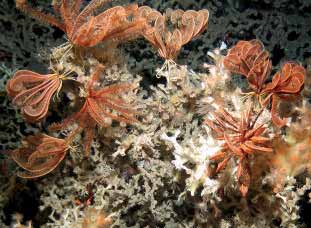
Human activities and impacts on the deep sea
Carbon dioxide emissions dramatically alter ocean
chemistry. As more atmospheric carbon is absorbed and
dissolved in the slightly alkaline seawater, carbonic acid is
produced, which progressively acidifies the ocean (Royal
Society, 2005). Carbonic acid separates in hydrogen and
carbonate ions, which in turn lowers concentrations of
calcium carbonate. Most marine organisms are adapted to
narrow pH ranges and would face dire consequences from
the slightest changes in pH (Knutzen, 1981). The pH of the
oceans has been lowered by 0.1 units (which equates to a 30
UK Department of Trade and Industry
per cent increase in the concentration of hydrogen ions)
since the beginning of the industrial age (Orr et al., 2005).
Coupled with the decrease in pH is a reduction of calcium
carbonate concentrations, which poses severe risks to all
organisms with calcareous skeletons and shells, ranging
from major plankton groups at the bottom of the food chain
These beautiful feather stars were found living amongst live and
to corals, mollusks, shellfish and echinoderms. The
dead coral on the Hatton Bank in the Northeast Atlantic. Bryozoans
calcification rates of some of these organisms could drop by
and anemones, squat lobsters and sponges are just some of the
60 per cent during this century (Kleypas et al., 2006).
fauna that lives in amongst the coral.
Research shows that the impacts of ocean acidification
will be particularly acute in the deep seas and polar regions
research is needed to qualify and quantify total impact.
(Orr et al., 2005), although in certain areas, the slow
In light of the the high uncertainties and the lack of
dissolution of carbonate sediments on the seabed might
knowledge about the deep-sea environment, the importance
partly reduce, or slow the effects of acidification (Schubert
of prior environmental impact assessments to any type of
et al., 2006).
human activity that might affect the deep sea must be
It is as yet unknown whether acidification of the oceans
emphasized. Furthermore, there is a need for monitoring
will lead to massive extinctions and changes in marine
once activities commence. This requires the adaptation of
ecosystems and foodchains, but with the ocean chemistry
existing methodologies, or the development and testing
currently changing at least 100 times more rapidly than it
of new techniques of, suitable for the deep-sea conditions
has changed during the last 650 000 years, it is unlikely that
and environment.
marine organisms and systems affected by these changes
ICES defines "sensitive habitats" as those habitats that
will be able to adapt. Assessment of the potential impact of
are easily adversely affected by a human activity, and/or
ocean acidification on biodiversity hotspots may partly
those where an affected area is expected to recover only over
respond to this lack of knowledge.
a very long period, or not at all (ICES, 2005). In order to
The emissions of ozone-depleting gases, mainly
identify and define sensitive deep-sea habitats with a view to
chlorofluorocarbons and bromofluorocarbons, weaken the
developing effective governance of human activities that may
protective ozone layer in the atmosphere and leave some
affect these habitats, we need to gain a better understanding
regions of the world under intense radiation from the sun.
of the scope of these activities and have scenarios for their
According to NASA, the ozone "hole" over the south polar
future development.
region was the biggest ever recorded in September 2006,
Key research needs on human activities in the deep sea
almost twice the size of Antarctica. That too could have
include mapping of activities, impacts, stakeholders, and
considerable impact on primary production, especially in the
potential conflicts between activities as well as the develop -
southern ocean, with knock-on effects for other ocean areas
ment of plausible scenarios of future trends in economic
and deeper waters.
activities. Studies are also needed on how various direct and
indirect impacts may interact and combine. This, together
RESEARCH NEEDS
with studies of effects of these impacts on the provision of
Table 3.4 summarizes the direct and indirect impacts of the
ecosystem goods and services from deep-sea ecosystems,
main human activities upon key deep-sea habitats and
including their socio-economic valuation (see Chapter 2),
ecosystems. It should be noted that these impacts can occur
would allow a better assessment of threats and to prior -
synergistically with potentially cumulative effects, with
itize areas for policy action, depending on ecosystem
indirect impacts (such as those induced by climate change)
vulnerability and fragility, the extent of activities, and their
causing extra stress on the systems. However, much more
associated impacts.
53
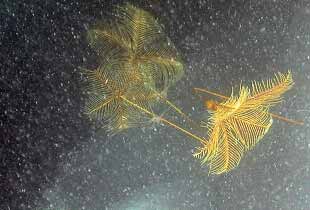
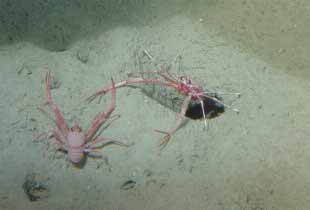
Deep-sea biodiversity and ecosystems
4 Governance and management
issues
Designingandimplementingeffectivegovernanceand institutionsthatareembeddedingovernanceinstitutions.
management strategies is critical to address the
Other authors see governance as providing the vision and
challenges posed by the increasing impacts of
direction for sustainability, while management is the
human activities on deep-sea biodiversity and ecosystems
operationalization of this vision (Boyle et al., 2001, quoted
and to ensure conservation and sustainable use of deep-sea
in Folke et al., 2005).
living and non-living resources. Governance is:
Today, we are confronted with an ever-rising env-
the sum of the many ways individuals and institutions,
ironmental crisis that spans across spatial and temporal
public and private, manage their common affairs. It is a
scales to encompass local, regional and global, short- and
continuing process through which conflicting or diverse
long-term, reversible and irreversible destabilization of
interests may be accommodated and cooperative action
ecosystems and as a consequence affects the indispensable
may be taken. It includes formal institutions and regimes
life-support functions they provide. Both natural and human
empowered to enforce compliance, as well as informal
systems are complex non-equilibrium and self-organizing
arrangements that people and institutions either have
systems that are in co-evolution (Kay et al., 1999). Traditional
agreed to or perceive to be in their interest.
forms of environmental governance, based on sectoral app-
(Commission on Global Governance, 1995)
roaches to problems, have shown their limits to address
such complex systems and a shift towards ecosystem-based
It may sometimes be difficult to articulate the distinction
adaptive management and governance is taking place (for
between governance and management. In this study, we
example, Dietz et al., 2003; Folke et al., 2005). The Handbook
follow the distinction proposed by Olsen et al. (2006: 5)
on Governance and Socioeconomics of Large Marine
whereby governance "probes the fundamental goals and
Ecosystems (Olsen et al., 2006), which is aimed primarily
the institutional processes and structures that are the
at practitioners ("innovators in governance" as the authors
basis
for
planning
and
decision
making,"
while
call them), offers practical insights on how governance and
"management, in contrast, is the process by which human
socio-economic science can support the ecosystem appr-
and material resources are harnessed to achieve a known
oach to marine resource management.
goal within a known institutional structure." This is a useful
Before turning to the specific challenges of deep-
if
imperfect
division
as
the
distinction
between
sea governance, we briefly review some important and
"governance" and "management" is not clear-cut in many
necessary elements for integrated environmental gov-
real-life situations, for management does create its own
ernance and management.
Crinoids (sea lilies) living at 2 500 metres water depth in the
Two squat lobsters (galatheid crustaceans) on the Var
Whittard Canyon, North East Atlantic.
Canyon seafloor, North West Mediterranean.
cruise
6000/Medeco
NOCS/JC10
Ifremer/Victor
54
Governance and management issues
Box 4.1: Risk, uncertainty, ambiguity and ignorance Sources: Stirling, 2007; Stirling and Gee, 2002; Harremoës et al., 2001
Risk is a function of two variables: likelihood of an impact and magnitude. It is a condition under which the possible
outcomes are known in advance and their relative likelihood can be adequately expressed as probabilities. When
knowledge about either likelihood or outcomes are problematic, there are three possible states of incomplete
knowledge: uncertainty, ambiguity and ignorance.
·
Under the condition of uncertainty, possible outcomes can be characterized, but the adequate empirical or
theoretical basis for assigning probabilities to outcomes does not exist. This may be because of the novelty of
the activities concerned, or because of complexity or variability in their contexts.
·
Under the condition of ambiguity, it is not the probabilities but the outcomes themselves that are problematic.
This might be the case for events that are certain or have occurred already (probablility = 1). Ambiguity stems
in particular from the multidimensionality, complexity and scope of environmental issues and from the different
ways of framing them.
·
The condition of ignorance is when neither probabilities nor outcomes can be fully characterized. It differs from
uncertainty, which focuses on agreed, known parameters such as carcinogenicity or flood damage. It also
differs from ambiguity in that the parameters are not only contestable but also at least in part unknown.
Ignorance refers to the prospect of unknown unknowns. It is an acknowledgement of the possibility of surprise.
For each of these conditions, different types of methodological responses can be called upon, as shown in Table 4.1.
KEY ELEMENTS FOR ENVIRONMENTAL GOVERNANCE
Hence, this approach stresses the importance of integrating
AND MANAGEMENT
socio-economic dimensions in the governance and manage-
Implementing an ecosystem approach
ment of ecosystems. Unlike sector-specific management
Governing and managing complex environmental systems,
regimes, the ecosystem approach is integrative and recog-
(which, by definition, include the socio-economic and
nizes the need to tackle the expanding human footprint on
cultural human systems that are at the root of many
biodiversity and ecosystems in a comprehensive manner. It
pressures bearing on ecosystems) requires a "paradigm
also recognizes that while conservation areas are a vital tool,
shift" (Olsen et al., 2006) towards a systemic approach.
a more holistic approach that includes ecosystem health as
This is evidenced today by efforts at all levels to move
a common goal in all sectoral activities is essential. At the
towards ecosystem approaches to environmental gov-
same time, the ecosystem approach acknowledges (and
ernance and management.
strives to address) from the outset the existence of value
The ecosystem approach strives to account for the
conflicts between different social groups and between
interconnectedness of ecosystem processes and socio-
different users.
economic processes. Following the 2002 World Summit on
Sustainable Development, many multilateral environmental
Addressing uncertainties, ignorance and irreversibility
agreements and governance institutions now include
A precautionary approach
provisions for the ecosystem approach. However, there are
Ecological systems are complex, non-equilibrium and self-
still many discussions about what such approach entails and
organizing systems characterized by properties of emer-
how it should be implemented in practice. According to the
gence, non-linear internal causality and indeterminacy.
CBD, the ecosystem approach is:
Hence, complete knowledge and understanding of eco-
a strategy for the integrated management of land, water
systems and full prediction of their evolution will never
and living resources that promotes conservation and
be achieved (van den Hove, 2007). Models and paradigms
sustainable use in an equitable way. [...] It is based on the
underpinning environmental governance and management
application of appropriate scientific methodologies foc-
must embrace risk, uncertainty, ambiguity and ignorance
used on levels of biological organization, which encom-
(see Box 4.1) and lead to appropriate methodological
pass the essential processes, functions and interactions
responses.
among organisms and their environment. It recognizes
This condition, combined with the potential irreversibility
that humans, with their cultural diversity, are an integral
of environmental change and the magnitude of actual and
component of ecosystems.
potential threats and impacts calls for precaution, as artic-
(CBD website: http://www.biodiv.org/programmes/cross-
ulated in the precautionary principle and precautionary app-
cutting/ecosystem/description.asp [accessed April 2007])
raisal (see Box 4.2), to be a central element of environmental
55
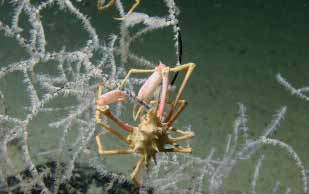
Deep-sea biodiversity and ecosystems
Table 4.1: Different forms of incertitude and possible methodological responses
Source: Adapted from Stirling, 2007 and Stirling and Gee, 2002
Knowledge about outcomes
Knowledge about likelihood
Outcomes well defined
Outcomes poorly defined
Some basis for probabilities
Risk
Ambiguity
Risk assessment
Participatory deliberation
Multi-attribute utility theory
Stakeholder negotiation
Decision analysis
Q-method, repertory grid
Cost-benefit analysis
Scenario workshops
Monte Carlo modelling
Multi-criteria mapping
Bayesian techniques
Interactive modelling
Statistical errors,
levels of proof
No basis for probabilities
Uncertainty
Ignorance
Uncertainty heuristics
Targeted research and horizon scanning
Sensitivity analysis
Transdisciplinary and institutional learning
Scenario analysis
Open-ended surveillance and monitoring
Interval analysis
Evidentiary presumptions, ubiquity, mobility, persistence
Onus of persuasion
Bio-accumulation
Decision heuristics
Adaptive management: flexibility, diversity, resilience
governance and management. Precaution implies that
management of ecosystems to address the broader social
measures may need to be taken even when some cause-and-
contexts that enable ecosystem-based management (Dietz
effect relationships are not fully established scientifically.
et al. 2003; Folke et al., 2005).
Adaptive governance and management
Multi-level governance
Characteristics of environmental issues also imply that both
The anthropogenic causes of the current environmental
governance systems and management schemes must be
crisis are of an inherently global dimension and at the same
adaptive to deal with the complexity and dynamics hence
time deeply rooted in local contexts. Focusing on a single
the constant change of ecosystems and of human systems,
scale is not sufficient, as many local interactions are caused
to respond to uncertainties and to allow for continuous
by trends and interactions at higher levels, which they in turn
learning, feedbacks and adjustments to new situations and
influence. The most important contemporary environmental
knowledge (see Box 4.3). The concept of adaptive
challenges require governance at levels from the global all
governance is used to enlarge the focus from adaptive
the way down to the local (Dietz et al., 2003). Hence,
institutional governance and management arrangements
Small spider crab among black corals (antipatharians).
must be complex, redundant, and nested in many layers.
"Simple strategies for governing the world's resources that
rely exclusively on imposed markets or one-level,
2007
centralized command and control and that eliminate
apparent redundancies in the name of efficiency have been
tried and have failed" (Dietz et al., 2003). The challenge is to
6000/Medeco
design, implement and constantly revise multilevel
governance systems, crossing local and global dimensions
of both the issue at hand and the institutions addressing it,
and building on a complex multilayered network of actors,
Ifremer/Victor
institutions and interactions. This is further complicated by
the fact that the linked cross-scale social-ecological
systems at hand are dynamic. These systems change over
time, which creates fundamental problems for establishing
56
Governance and management issues
Box 4.2: The Precautionary Principle and Precautionary Appraisal
Sources: adapted from O'Riordan and Cameron, 1994; Stirling, 2007 and Harremoës et al., 2001
The Precautionary Principle states that:
"Where there are threats of serious or irreversible damage, lack of full scientific certainty shall not be used
as a reason for postponing cost-effective measures to prevent environmental degradation."
Principle 15 of the Rio Declaration on Environment and Development (UN 1992)
The precautionary principle includes elements such as:
Preventive anticipation;
Research and monitoring for the early detection of hazards;
Duty of care;
Need to allow natural processes to function in such a manner as to maintain the essential support for all life
on Earth;
Burden of proof of no harm on those who induce potential damage or propose technological change;
Action to reduce risks before full "proof" of harm is available if impacts could be serious or irreversible;
Proportionality principle, where the costs of actions to prevent hazards are shown not to be unduly costly;
Going beyond short-term benefits and accounting for long-term benefits of precautionary action;
Cooperative approaches between stakeholders to solving common problems;
Polluter-pays principle and historical responsibility.
The Precautionary Appraisal of risk implies a new vision and manner of approaching risk, whereby:
the scope of appraisal is broadened to include more scientific disciplines, more types of information
and knowledge;
transdisciplinary learning takes place;
more humility is shown in the practice and the use of science;
research is active and interactive;
alternative options are explored;
the appraisal is based on deliberate arguments where different publics and stakeholders are engaged.
and adopting a division of responsibility between centralized
which the processes of governance are expressed: markets,
and decentralized agents (Folke et al., 2005).
governments and the institutions and arrangements of civil
society. These three mechanisms of governance interact
Governance mechanisms and institutional variety
with one another through complex and dynamic inter-
As shown in Figure 4.1 there are three key mechanisms by
relationships, and individually and collectively affect how
Table 4.2: Some major governance mechanisms and tools Source: adapted from Olsen et al., 2006 and Dietz et al., 2003
Government
Market Place
Institutions and organizations
Laws and regulations
Profit seeking (production of
of civil society
Taxation, subsidies, incentives
and/or trade in goods,
Socialization processes
and spending policies
services, permits)
Constituency roles and "issue
Property rights, permits, quotas
Ecosystem service valuation
framing"
Area-based management
Eco-labelling and green
Co-management
measures
products
Information, education and
Sanctions, compliance
Voluntary schemes
outreach
arrangements
Lobbying
Campaigning, lobbying
Information, education and
Community self-governance
outreach
57
Deep-sea biodiversity and ecosystems
humans use and otherwise interact with ecosystems. These
mechanisms can alter patterns of behaviour through tools
Markets
Civil society
such as those identified in Table 4.2 and induce changes in
Government
social organizations and attitudes, which in turn have an
impact on the effectiveness of governance and management
schemes. Socio-economic and governance analyses can be
Economic
Legal/political
Social
applied to understand and explain how these mechanisms
pressures
pressures
pressures
function, and how they interact with one another (see
illustration in Olsen et al. (2006), Part III).
Human uses of ecosystems
The Millennium Ecosystem Assessment (MA) proposes
a typology to classify the wide range of responses
societies have devised to regulate their use of ecosystem
Figure 4.1: Three key governance mechanisms
services and the human activities that affect ecosystems.
Source: Adapted from Olsen et al., 2006
Box 4.3: Adaptive Management
"Adaptive Management is a systematic approach for improving environmental management and building knowledge
by learning from management outcomes. Contrary to common belief, adaptive management is much more than
simply "adapting as you go". It involves exploring alternative ways to meet management objectives, predicting the
outcomes of each alternative based on the current state of knowledge, implementing one or more of these
alternatives, monitoring to learn which alternative best meets the management objectives (and testing predictions),
and then using these results to update knowledge and adjust management actions.
Adaptive management differs from traditional management approaches in that it allows management activities
to proceed despite uncertainty regarding how best to achieve desired outcomes, and despite inevitable changes and
surprises. In fact, it specifically targets such uncertainty: it compels ecosystem managers to be open and explicit
regarding what is not known about how best to achieve conservation and management objectives, and provides a
science-based learning process characterized by using outcomes for evaluation and adjustment ("closing the loop")
[...]." Murray and Marmorek (2003, 2004)
Define the problem: management objectives. Indicators of
success, options for action, assumptions, key uncertainties,
alternative hypotheses
Revise uncertanties
Design actions to test
and hypotheses and
hypotheses; predict
repeat; share what has
outcomes based on
been learned
current knowledge
Adaptive
management
Evaluate the results:
cycle
which actions
Implement the actions
weremost effective,
as designed
and which hypotheses
to accept/reject?
Monitor implementation (any deviations from the design?)
and effectiveness (were objectives achieved?)
Source: Murray and Marmorek (2003, 2004)
58
Governance and management issues
Table 4.3: The Relationship between the Responses and the Actors Source: adapted from MA (2005b)
RESPONSE
ACTORS
Government
Private
Local
NGOs
Scientists
sector
communities
Legal
Treaties
5/5
International soft law
2/5
International customary law
3/5
International agreement legislation
outside the environment sector
5/5
Domestic environmental regulations
5/5
Domestic administrative law
3/5
Domestic constitutional law
4/5
Domestic legislation
outside the environmental sector
4/5
Economic
Command and control interventions
5/5
Incentive-based
5/5
5/5
2/3
2/4
Voluntarism-based
3/5
4/5
4/5
4/4
Financial/monetary measures
5/5
5/4
3/3
3/3
International trade polices
4/5
Social and behavioural
Population policies
5/4
3/4
4/3
3/4
Public education and awareness
5/3
4/5
4/5
4/5
Policy-maker education and awareness
4/3
3/3
4/3
5/4
5/4
Empowering youth
3/5
4/5
4/5
4/5
Empowering communities
3/5
4/3
5/5
5/5
Empowering women
3/5
4/3
5/5
5/5
Civil society protest and disobedience
1/5
1/5
Lobbying
5/5
4/3
5/4
4/4
Technological
Incentives for innovation R&D
5/4
5/5
5/4
5/4
Cognitive
Legitimization of traditional knowledge
5/2
5/5
5/5
Knowledge acquisition and acceptances
5/3
4/3
3/2
4/4
The first number in a pair is the availability of the response to the actor. The second number shows the effectiveness the actor has
in using the response. Blank cells mean the response is not applicable to the actor. Elements in red have been added by the
authors.
These responses are human actions to address specific
directly, and those that modify direct or indirect drivers that
issues, needs, opportunities or problems in ecosystem
shape ecosystem status and processes. The typology is
governance and management. They encompass policies,
organized according to the dominant mechanism through
strategies,
measures
and
interventions
that
are
which specific responses are intended to change human
established to change ecosystem status and processes
behaviour or ecosystems characteristics. It distinguishes
59
Deep-sea biodiversity and ecosystems
enthusiasm in many national and international policy and
Box 4.4: Information and knowledge needs
economic circles for the creation of markets and market-
for environmental governance
based instruments (for example, biodiversity offsets,
auctioning, tradable permits) for biodiversity conservation
·
Ecosystem function, structure
and the sustainable use of ecosystem services, these
·
Status and trends of ecosystems
should not be seen as the panacea. Rather they should be
·
Natural drivers and evolution of ecosystems
considered as one subset of tools and approaches in a
·
Geographical occurrence and abundance
wider mix, applicable to some (but not all) ecosystem
·
Direct human interactions with ecosystems
services
and
situations.
When
designed
and
(anthropogenic pressures)
implemented, market based instruments necessitate
·
Indirect human influence on ecosystems
solid framing by the other two types of governance
(anthropogenic drivers)
mechanisms (government and civil society institutions) to
·
Existing institutional framework and its
ensure that externalities are properly internalized, that
potential for evolution
equity aspects are accounted for, and that they do not end
·
Actors and power distribution
up displacing the problems (as many examples have
·
Uncertainties and scientific disagreements
shown, for example, in the fisheries sector) or being
·
Individual and social values and value conflicts
plainly counterproductive (Duraiappah, 2007).
·
Effects of decisions on valued outcomes
Information and knowledge
To ensure effective environmental governance, a whole
legal, economic, social and behavioural, technological and
array of information and knowledge will need to be called
cognitive responses (MA, 2005b). Responses are not
upon (see Box 4.4). Governance requires factual
equally available to and/or used by all actors (Table 4.3).
information about the ecosystems being governed, in
Governance is more likely to be effective if it employs
particular about their function, structure, state and natural
a mixture of mechanisms and responses that constitute
evolution.
It
requires
knowledge
of
geographical
different strategies to change incentives, increase
occurrence and abundance of ecosystems as well as
information, monitor use of resources and impacts, and
information
on
how
human
actions
affect
these
induce compliance (Dietz et al., 2003; National Research
ecosystems (drivers and pressures). It needs information
Council, 2002). Hence, notwithstanding the current
about uncertainties and values as well as information
about scientific and value disagreements and about the
effect of decisions on various valued outcomes (Dietz et al.,
Box 4.5: Some key governance principles for
2003: 1908). It also requires knowledge about the existing
sustainability
institutional framework and its potential for evolution. In
other words, knowledge is needed on the natural and the
·
Decision making: democracy; subsidiarity;
social, economic, legal and political processes (including
participation;
transparency;
international
on the interactions between them), and on actors and
cooperation;
holistic
approaches;
policy
power distribution. This knowledge is necessary to devise
coordination and integration; internalization of
governance schemes and management strategies, to
environmental and social costs.
monitor implementation and effectiveness of policies and
·
Precaution: decision making under uncert-
measures, to support enforcement, and to underpin an
ainty, indeterminacy, irreversibility; adaptive
adaptive and dynamic approach to governance and
approaches.
management based on self-evaluation and learning.
·
Responsibility: polluter pays; responsibility for
generating knowledge; burden of proof;
Equity as a cornerstone of environmental governance
common but differentiated responsibilities;
Underlying the development and evolution of environmental
liability; accountability.
governance are a number of principles that are frequently
·
Management: prevention; rectification of
called upon as a normative basis for governance and
pollution at source; adaptability; (eco)systemic
management (see Box 4.5).
approaches; partnerships.
Effectiveness
of
environmental
governance
and
·
Distribution: intra-generational and inter-
institutions can be gauged against multiple evaluation
generational equity; capacity-building.
criteria. These typically include economic efficiency,
ecological integrity, sustainability and equity, but also other
60
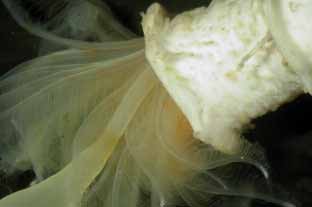
Governance and management issues
Contiguous zone
Territorial sea
Exclusive economic zone
High seas
Baseline < 12nM < 24 nM
<200 nM
The Area
Continental shelf
The Area starts at 200 nautical miles (nm) from the baseline when the legal continental
shelf (as defined in UNCLOS, Article 76) does not extend beyond that limit.
Source:
Adapted from IUCN, 2007
Figure 4.2: Marine zones under the UN Convention on the Law of the Sea, 1982 (UNCLOS).
criteria that link more or less directly to the underlying
UNCLOS add to the complexity of the situation.
principles listed in Box 4.5.
Of particular importance to deep-sea governance are
Equity is a central criterion of sustainability. In
Exclusive Economic Zones (EEZ) out to 200 nautical miles
particular, elements such as equitable sharing of burdens
(nm) seaward; the High Seas water column beyond the EEZ
and benefits, capacity-building in developing countries and
(or territorial sea where no EEZ has been declared); the
the rights of future generations need to be taken into
"legal continental shelf" which extends to 200 nm, or to the
account in designing and assessing governance institutions
outer edge of the continental margin when this lies beyond
and management schemes. Nevertheless, although con-
200 nm; and the Area the seabed and oceanfloor as well
cerns of equity and sustainability of the resource may be
as subsoil beyond the legal continental shelf. In the EEZ,
more important to those directly affected by policy
states have sovereign rights for exploration, exploitation,
proposals, economic efficiency frequently dominates the
conservation and management of all natural resources and
policy debate (National Research Council, 2002), which often
results in placing lower priority on equity aspects. As Dietz
Serpulid worm.
et al. (2002: 26) emphasize: "no institutional arrangement is
likely to perform well on all evaluative criteria at all times.
Thus, in practice, some trade-off among performance
criteria is usually involved". The key point here is to ensure
Bruneaux
that those trade-offs are explicit and open to debate.
KEY ISSUES FOR DEEP-SEA GOVERNANCE
Deep-sea governance
As noted previously, the deep seas are defined as the waters
and seafloor beyond the reach of sunlight, most commonly
below 200 metres depth. Legal boundaries in the oceans and
seas, however, are vertical limits, extraneous to habitats and
Ifremer/MEDECO2007/Matthieu
ecosystems. Figure 4.2 illustrates this difference and how
human-defined limits as set out in international law by
61
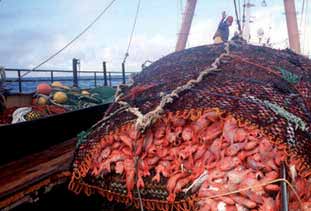
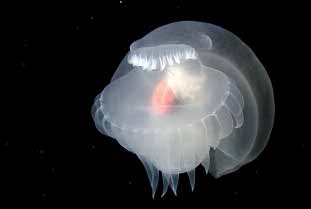
Deep-sea biodiversity and ecosystems
Greenpeace
NOAA/MBARI
Orange Roughy catch landed by a deep-sea trawler.
Mystery mollusk (Order Nudibranchia) in 1498 meters depth
above the Davidson Seamount, located 120 kilometers to the
over other economic activities, while on the legal continental
southwest of Monterey, California (US).
shelf, states have sovereign rights for exploration and
exploitation of non-living (for example, mineral) resources
agree on binding measures that cover marine areas
and sedentary seabed organisms. The High Seas and Area
beyond national jurisdiction.
(that is, the waters, seabed and subseafloor beyond national
The right of coastal states to enforce these agreements
jurisdiction) are explained in greater detail below. All states
depends on where the violation takes place, and sometimes
and all areas are subject to the duty to protect and preserve
on its potential impact on coastal state interests. Coastal
the marine environment (UNCLOS, Art. 192).
states may enforce these agreements as well as associated
UNCLOS provides the main framework agreement
national regulations over vessels within their ports and over
which governs rights, duties and activities throughout the
their citizens, corporations and nationally registered vessels
oceans. In addition to UNCLOS, there are a number of
wherever they are located (flagstate responsibilities). With
other global and regional agreements that supplement
respect to the conservation of living resources, states may
UNCLOS regarding specific activities or regions (see Gjerde
enforce their laws over vessels within their territorial seas
(2006a) for a more extensive review of the evolving
and EEZs (UNCLOS, Art. 73, 213222), whereas the right to
international and policy regime for the deep sea). At the
enforce pollution control laws in the territorial sea and EEZ
global level, key instruments include: the 1995 UN Fish
depends on the severity of the pollution and its impact on
Stocks Agreement (UNFSA) and the Convention on
coastal interests (UNCLOS, Art. 220). Enforcement on the
Biological Diversity (CBD). At the regional level, the UNEP
high seas may only take place under certain very limited
Regional Seas Programme (see http://www.unep.org/
conditions (for example, stateless vessels). But states can
regionalseas) and other regional marine environmental
also agree to mutual boarding and inspection procedures to
programmes include multilateral agreements that
enforce fisheries and other regulations on the high seas (for
generally apply to deep seas out to the limits of national
example, UNFSA, Art. 2122). To date, only a few regions
jurisdiction. Four agreements, however, include areas
have enacted such mutual high seas enforcement schemes
beyond national jurisdiction: the OSPAR Convention for the
for high seas fisheries.
Protection of the Marine Environment of the northeast
For areas beyond national jurisdiction, UNCLOS defines
Atlantic, the Barcelona Convention for the Protection of the
a series of rights and duties. Unlike the high seas, the deep
Marine Environment and the Coastal Region of the
seabed Area and its non-living resources have been
Mediterranean, the Noumea Convention for the Protection
designated by UNCLOS as the "common heritage of
of the Natural Resources and Environment of the South
mankind", which means they are free from national claims
Pacific Region (SPREP), and the Antarctic Treaty and
and subject to a different governance regime. High seas
related agreements. In certain regions of the world's
rights include freedom to fish, navigate, lay submarine
oceans these regional environmental agreements are
cables and pipelines, conduct marine scientific research,
complemented by Regional Fisheries Management
conduct peaceful military activities and authorize vessels to
Organizations (RFMOs), established for the development of
fly national flags. Duties include conserving living marine
conservation and management measures for fisheries.
resources,
protecting
and
preserving
the
marine
Currently, twelve of these RFMOs have full responsibility to
environment, cooperating, controlling vessels and citizens
62
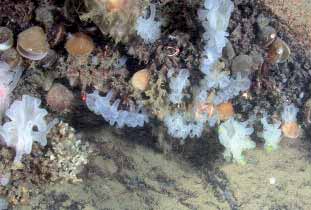
Governance and management issues
and not interfering with the rights and interests of others.
The laws that do exist beyond the EEZ are often very basic
cruise
and as noted above, difficult to enforce. Nations have been
very good at taking advantage of their rights, but many have
not yet fully implemented their duties to protect, conserve
NOCS/JC10
and cooperate. The high seas freedoms create a challenge
as they assume all states and all people will behave
responsibly. There are rich resources and some actors
adopt opportunistic strategies, depleting resources in one
place and then moving on to another (Berkes et al. 2006).
Until recently, law makers have not paid much attention to
what goes on in the high seas beyond pelagic fishing
activities (Gjerde, 2006b).
Mineral resources within the Area are regulated by the
International Seabed Authority (ISA) established under
Deep-sea ecosystem in the Setubal canyon in the North East
UNCLOS. These include solid, liquid and gaseous mineral
Atlantic, 1 444 metre depth.
deposits. Abiotic seabed exploitation is subject to the rules
of benefit sharing as well as protection of the marine
need significant follow-up to ensure that such protection is
environment. ISA oversees mining-related activities,
effectively implemented wherever deep-sea fishing on the
develops environmental rules, and promotes marine
high seas occurs.
scientific
research.
Rules
to
protect
the
marine
Implementing an ecosystem approach in the deep sea
environment are to be in place before any mining can begin
The fragmentation of management regimes, per species,
(Gjerde, 2006b).
issues, or region is a major obstacle for the implem-
Living resources in the Area and in the High Seas are
entation of an ecosystem approach for the deep sea. In the
either unregulated or, as in the case of fisheries, managed
case of fisheries, the present governance structure has
by species or on a regional basis by Regional Fisheries
been unable to prevent overfishing and collapses of deep-
Management Organisations (RFMOs). The UN Fish Stocks
sea fish stocks in both areas of national jurisdiction and in
Agreement supplements and implements the provisions of
the high seas. Even if the sectoral approach to deep-sea
UNCLOS with respect to the conservation and governance
governance and management still dominates, a shift (at
duties of states for highly migratory and straddling fish
least in texts) towards the ecosystem approach is
stocks, but does not cover deep-sea fish stocks in the high
noticeable in different fora. This is illustrated for instance
seas. Thus, deep-sea bottom fishing and its related habitat
by the 2006 UNGA resolution on sustainable fisheries,
impacts are not addressed by a specific treaty at present. It
which repeatedly calls for the implementation of the
should be noted, however, that the United Nations General
precautionary approach and an ecosystem approach to
Assembly in 2006 called for targeted and time specific action
fisheries management, even though it maintains the
by states and RFMOs to bring high seas bottom fisheries
sectoral approach (UNGA Res. 61/105, 2006). As far as
and their impacts under control (UNGA resolution 61/105,
fisheries are concerned, implementation of the ecosystem
paras. 8091).
approach appears as a necessary condition to the
Overall, the deep-sea governance context forms
maintenance of fisheries in the long term (Garcia et al.,
what Gjerde (2006a: 37) calls a "web of obligations for
2003). The non-binding FAO code for responsible fisheries
states regarding biodiversity". However, Gjerde stresses
in tandem with the UN Fish Stocks Agreement provide a
that "there are inadequacies, both with respect to
good basis for an ecosystem approach (FAO, 1995), but are
the implementation of existing legal requirements
in need of more effective implementation.
("implementation gap"), as well as in the coverage of the
The
paradigm
shift
towards
ecosystem-based
existing conventions and organizations ("governance gap")
governance and management is necessary to achieve
(ibid.). For example, as of May 2007, China, the world's
conservation and sustainable-use objectives in the deep sea.
largest fishing nation, had not yet ratified the UN Fish
The ecosystem approach recognizes that some challenges
Stocks Agreement. And until recently, following a vast
related to conservation and sustainable use of ecosystems
global effort by NGOs and scientists, deep-sea vents and
cannot be solved with protected areas (see below). This
coral reefs were more strictly protected from potential
obviously applies to marine protected areas (MPAs), which
mining activities than from deep-sea fishing impacts. The
constitute a necessary (but in itself not sufficient) tool to
UNGA resolution 61/105 fills that gap somewhat, but will
ensure sustainable management of the deep sea. This does
63
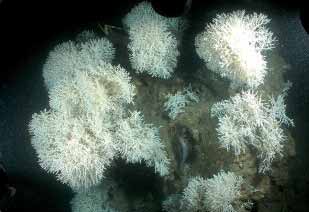
Deep-sea biodiversity and ecosystems
map also presents potential conflicts between stakeholders
themselves as well as conflicts between human activities
and ecosystem health.
IFM-GEOMAR
Governance mechanisms in the deep sea
Deep-sea ecosystems provide a unique and challenging
case for applying the main governance mechanisms set out
JAGO-Team,
in Figure 4.1 and Table 4.2. Currently, the governance of
commercial activities such as fishing, oil and gas exploration
and production, takes place through sector-based
regulations in areas under national jurisdiction. Legal and
political pressures by governments are barely in place
and/or not working when it comes to the deep seas. A
number of countries have adopted some legislative
A highly diverse ecosystem around cold water coral Madrepora
measures for the deeper waters of their EEZs (including for
oculata in the Cap de Creus canyon (Western Mediterranean) at
example, the USA, Canada, Australia, New Zealand, Norway,
200 metres depth, photographed through front window of
Iceland and various EU member states). Also some small
manned submersible JAGO, HERMES IV_CORAL8 cruise on
island developing states (SIDS) are starting to take action on
board RV García del Cid.
deeper waters. For instance, several island states in the
South Pacific are very aware of their deeper waters, and
in no way reduce the importance of MPAs, as their relevance
were among the first to call for an international ban on
as tools in the framework of an ecosystem approach is
bottom trawling. Nevertheless, most developing countries
increasingly recognized.
and SIDS have not yet the capacity to manage activities in
When considering the implementation of holistic and
their deeper waters, hence leaving their governance mostly
integrated approaches for the deep sea, specific additional
to markets.
problems arise. In areas under national jurisdiction,
In areas beyond national jurisdiction (high seas and the
difficulties arise because of the lack of awareness and/or
Area) there are only a few sectoral or activity-based
interest that many countries show towards their deeper EEZ
regulations. The principles of High Seas Freedoms
waters. Many states, especially developing countries and
embedded in UNCLOS can leave the door wide open for
small developing island states, do not have the necessary
markets to move in and act without effective control. Many
capacities, technical means and financial resources, and
commercial activities primarily take place in relatively
therefore have a tendency to focus more on their coastal
unregulated markets. Resources from the high seas are
waters. As for the high seas, there is not yet an international
currently common pool resources, which may lead
body or organization formally designated to be in charge of
unsustainable exploitation (the so-called "tragedy of the
such programmes. One way to overcome this and to allow
commons" (Hardin, 1968)).
for the paradigm shift to take place would be the
Meanwhile, social pressures from civil society (including
development of an UNCLOS Implementation Agreement on
international environmental NGOs and the research
the High Seas (as proposed by the European Community and
community) to regulate human impacts on deep-sea
some other countries during recent UN General Assembly
ecosystems are starting to build as more information
consultations). Such an agreement could provide a
emerges about these ecosystems, their importance, and
framework for a holistic, integrated and coherent ocean
their vulnerability. However, taking into account the current
governance and management approach for the areas
lack of knowledge and awareness of the general public
beyond national jurisdiction.
about the deep sea, as well as the remotness of the deep-
In practice, a first necessary step in the ecosystem
sea environment, these social pressures may never be as
approach consists of mapping out stakeholders and their
great as they are for other environments and ecosystems, to
interests (Vierros et al., 2006). An inventory of human
which people can more closely relate (for example,
activities in the deep sea as those described in Section 3
terrestrial systems, coastal marine systems such as coral
allow for identification of the immediate circle of actors and
reefs). In any case, these pressures will depend on the
stakeholders. This circle then needs to be enlarged, for
quality of dissemination, education and outreach efforts by
example, to include those who value the deep sea for
the scientific and NGO communities.
cultural purposes, who stand for the voiceless species and
The process of regulating the oceans and seas follows
ecosystems, and for future generations. A comprehensive
the general pattern of regulating the commons: manage-
64
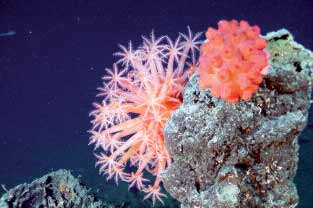
Governance and management issues
ment measures are proposed first to fix burning problems
and the governance framework only comes next. When fish
NOAA
stocks started to collapse for instance, management was
called upon to control both the stocks and the flow of
economic benefits from fisheries resources. Unfortunately,
to date, most instruments have failed to improve either the
socio-economic conditions of fishing communities or the
conservation of fish stocks (Ben-Yami, 2004).
As seen in Chapter 3, overcapitalization is a chronic
problem in fisheries. Fishery subsidies are immense and
distributed across several categories. Both capital and vari-
able costs are sometimes subsidized with special subsidies
to access foreign EEZs. Subsidies can lead to overcapacity,
overfishing and encourage IUU fishing. Decommissioning
subsidies or buybacks can also have perverse effects, since
Deep-sea octocorals at the top of an inactive sulfide chimney, off
retiring old vessels does not necessarily reduce the capacity
the coast of western North America.
of the fishing fleet as fishermen include future rounds of
buybacks in their investment strategies (Clark et al., 2005).
should therefore expect that many conventional practices
Larger and more powerful fleets do not necessarily yield
carried out in shallow waters are not, or only with
more fish any more, but powerful vessels are able to fish the
limitations, applicable to the deep sea as they can be
high and deep seas, should traditional shallow-water fishing
incompatible with either the natural or the human context.
ground become depleted or too regulated. Market- and
This is something that has not yet been sufficiently
regulatory-based instruments such as licenses, Total
recognized by many policy makers.
Allowable Catch (TAC), Individual Transferable Quotas (ITQ),
have been put in place to limit the collapse of stocks and
Area-based management, marine protected areas and
hopefully help their recovery. Nevertheless, such manage-
spatial planning
ment tools often fail to ensure sustainable use, in particular
The need for precautionary, integrated and multi-level gov-
due to information and enforcement problems (Dietz et al.,
ernance of marine ecosystems was acknowledged 15 years
2003). No simple solutions exist to the problems of con-
ago in the Agenda 21 adopted at the 1992 Rio UN Conference
servation and overcapacity, even though they have been
on Environment and Development. The text stresses that the
central issues in fisheries management for some time. The
protection and sustainable development of the marine and
key seems to lie in an ecosystem approach to fisheries and
coastal environment and its resources requires new app-
more holistic forms of management.
roaches for management and development of these areas,
The governance of the deep sea and management of
at national, subregional, regional and global levels, app-
goods and services human beings derive from deep-sea
roaches that are integrated in content and are precautionary
ecosystems need to take two very important characteristics
and anticipatory in ambit (Agenda 21, §17.1). The Plan of
into account. First, the deep sea is the largest ecosystem on
Implementation of the World Summit on Sustainable Devel-
Earth, making monitoring and enforcement very difficult.
opment (Johannesburg 2002) invites nations to:
Second, stocks of biotic deep-sea resources can in general
Develop and facilitate the use of diverse approaches and
be considered as non-renewable (Roberts C.M., 2002). The
tools, including the ecosystem approach, the elimination
majority of biotic resouces deep under the surface have slow
of destructive fishing practices, the establishment of
growth rates such that their exploitation is often more akin
marine protected areas consistent with international law
to mining mineral resources and impacts may not be revers-
and
based
on
scientific
information,
including
ible in our lifespans, if ever. Hence timely and effective enf-
representative networks by 2012 and time/area closures
orcement is difficult but also of vital importance. As a result
for the protection of nursery grounds and periods, proper
of these two factors, the deep-sea governance system will
coastal land use and watershed planning and the
need to develop processes that encourage actors to comply
integration of marine and coastal areas management
willingly as well as processes that enable real-time monit-
into key sectors.
oring, tracking and surveillance to enable effective policing.
(WSSD Plan of Implementation, Art. 32(c))
These two characteristics also mean that for governance
and management purposes the deep sea is completely
Important to the integrated governance of the deep sea is
different from other habitats and ecosystems on Earth. One
the development of comprehensive systems of spatial
65
Deep-sea biodiversity and ecosystems
planning. These must be developed in cooperation with
spawning closures and seasonal closures are particularly
stakeholders and linked to management tools such as
useful in data-poor situations such as encountered in the
extensive spatial data and geographic information systems,
deep seas. These tools could contribute to management
environmental impact assessments and marine protected
using a precautionary approach and, if appropriately
areas. Marine spatial planning and zoning is already taking
implemented, provide some level of protection for
place in a number of countries that have developed
biodiversity, habitats and fish stocks.
overarching marine policies (for example, Australia, Canada)
(FAO 2007: 18)
whereby areas are protected first and activities are built up,
taking the protection framework into account.
Nevertheless, the establishment and management of MPAs
Management of the oceans and deep seas takes many
(or networks of them) in the deep sea raise a series of
different forms. Area-based management measures are an
specific problems. Some of these problems relate to all
important subset of these. They include geographical and
deep-sea areas, whether under national jurisdiction or in the
temporal closures to fishing and/or other activities, tech-
High Seas, others are specific to the latter. Issues concerning
nical measures such as fishing gear restrictions in a given
all deep-sea areas stem primarily from the lack of
area, multipurpose protected areas or networks of protected
knowledge of the deep-sea environment. It is difficult to
areas. Area-based management measures are widely
ensure that MPA designation is ecologically sound in the
viewed as key tools to improve integrated conservation and
sense that the widest possible range of ecosystems and
sustainable use of marine biological diversity (Gjerde, 2007),
habitats would be under sufficient protection. There is a risk
and to bring current sectoral authorities and tools together.
that arguments for protection are biased towards those
This requires "compatibility of governance in marine areas
ecosystems and habitats already known to science. This
within and outside national jurisdiction, a cooperative rather
suggests a need to develop alternative ways to accommodate
than competitive agenda and states acting uniformly in
the precautionary principle in MPA selection when the very
different international fora" (UN, 2006b).
nature of the ecosystems is barely known and where
According to the World Conservation Union (IUCN)
protection is needed before the damage is too severe or
definition, a protected area is "an area of land and/or sea
irreversible. The lack of knowledge also renders the
especially dedicated to the protection and maintenance of
development of ecosystem-based management more
biological diversity, and of natural and associated cultural
challenging. Moreover, as stressed by Gjerde, "many marine
resources, and managed through legal or other effective
experts suggest that MPAs need to be vastly scaled up in
means." Protected areas can have different management
number and size to protect deep-sea biodiversity at
objectives, including: protection for scientific research, for
ecosystem, species and genetic levels" (2007:2). This implies
wildlife protection, for ecosystem protection, for recreation,
a need for improved cooperation between all actors:
for conservation of specific natural features, for conserv-
governments, regional fisheries and marine environmental
ation through management intervention, for landscape/
bodies, intergovernmental and non-governmental organiz-
seascape protection and recreation, and for the sustainable
ations, the research community, the deep-sea fishing
use of natural ecosystems (IUCN, 1994). A Marine Protected
industry and other industries operating in the deep sea (ibid.).
Area (MPA) is "any area of the intertidal or subtidal terrain,
In the case of the High Seas, additional challenges relate to
together with its overlying water and associated flora, fauna,
their global commons nature and to the need to frame
historical and cultural features, which has been reserved by
actions in the context of international law (Gjerde and
law or other effective means to protect part or all of the
Kelleher, 2005, 2007; Foster et al., 2005). Hence issues arise
enclosed environment" (Kelleher, 1999).
of how to legislate MPA development in the high seas, how to
MPAs will tend to address one or more of the objectives
enforce MPAs and how to finance their establishment,
listed above by protecting species and habitats from direct
administration, monitoring and enforcement (Morling, 2005).
human impacts, but this need not necessarily imply that all
Just as protected areas on land, MPAs are more effective
human activities have to be prohibited in these areas. A
if integrated in a network protecting vulnerable areas of
significant strength of MPAs is their potential to go beyond
biological and ecological significance as well as areas
traditional sectoral management practices by allowing a
representative of the full range of regional biological
more holistic take on management needs and promoting
diversity, even when their full ecological or societal
improved coordination between and cooperation with
significance has not yet been assessed. Biodiversity and
existing sectoral regimes (Laffoley, 2005).
ecosystems require a certain level of connectivity, which
As noted in the report of the FAO Expert Consultation on
could be translated into a combination of spacing, number
Deep-sea Fisheries in the High Seas:
and coverage of MPAs. The diversity and endemism of
Spatial and temporal management tools such as MPAs,
species found over the deep sea mean the scale and scope
66
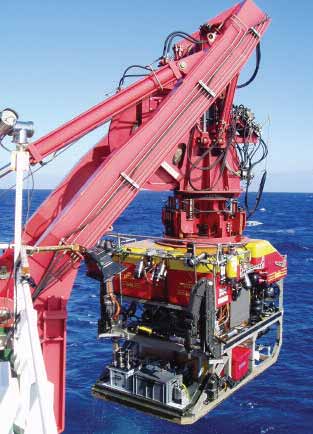
Governance and management issues
Nevertheless, action is needed urgently as there is evid-
ence that many human activities are already significantly
NOCS
affecting the deep sea. Innovative governance systems and
management tools therefore need to be developed in para-
llel with the increasing scientific and socio-economic know-
ledge and in anticipation of emerging future deep-sea
activities and uses. Scientific knowledge needs to be
produced in an interdisciplinary way, bringing together sci-
entists from various relevant disciplines of natural sciences
(biology, microbiology, geochemistry, oceanography, geo-
logy, geophysics) as well as the social sciences (economics,
sociology, law, political sciences). Such transdisciplinary
research has been initiated, for instance in the integrated,
interdisciplinary research project HERMES (Hotspot Eco-
system Research on the Margins of European Seas).
Equity aspects
As stressed above, equity is a central element of
sustainability and governance systems need to encompass
principles of fairness and distribution (Box 4.5). Most
countries, especially developing countries and small island
developing states, are not yet fully aware of deep-sea issues
and their relevance to them. There is often a lack of capacity
and resources to address deep-sea governance challenges
and implement commitments. Access to technology is
limited and only the richer countries and big corporations
have the means to study, exploit and manage deep-sea
environments. Hence, the need for practical support and
Equipment such as remotely operated vehicles (ROVs) are
collaboration to transfer expertise and provide suitable
essential tools in the advancement of our knowledge of the
technology and methodologies to the countries that need
deep ocean environment.
them and to establish and implement conservation and
management measures adapted to their local, national and
of protected areas may need to be much larger than in
regional circumstances.
nearshore waters (Laffoley, 2005).
Equity aspects are also strongly present in the issue of
Deep-sea MPAs could be enforced through measures
bioprospecting
for
marine
genetic
resources.
The
already at hand for the control of fisheries, for example,
Convention on Biological Diversity (CBD) encompasses the
strict reporting requirements, catch documentation
objective of fair and equitable sharing of the benefits from
schemes, vessel monitoring systems, satellite monitoring,
the use of genetic resources within areas under national
and observer coverage. Such enforcement measures may
jurisdiction, however, the governance situation for genetic
need to be made more broadly applicable to other users
resources of the High Seas is less clear. Some countries
when the agreed MPA provisions regulate other uses beyond
would like to give deep seabed genetic resources in the Area
fishing (Gjerde, 2007). To reduce enforcement costs, it is
the status of common heritage of mankind similar to
helpful to have the support and participation of all
mineral resources, hence providing for sharing of benefits,
stakeholders (Alban et al. 2006).
while others would prefer to have a regime of free access to
all, which, in practice may come down to access to those
Information and knowledge challenges
who have the technological capacity and financial resources.
We are still at the outset in understanding deep-sea
Another related issue is that of patentability of genes or
environments ecosystems. Their remoteness renders
compounds derived from marine species, which is far from
research on, and monitoring of, ecosystems and biodiversity
being resolved (for example, Gambini, 2006). It remains to be
both technically challenging and expensive. Moreover, our
seen how the concept of equity, as embedded in UNCLOS
knowledge of threats induced by human activities is limited
and the CBD, will be translated to the full range of uses of
and so is our understanding of possible political responses.
the deep sea beyond national jurisdiction.
67
Deep-sea biodiversity and ecosystems
Ways forward
While these and other proposals are still under
To address these key issues in deep-sea governance a series
consideration, significant efforts are required to improve and
of priority policy steps need to be considered. These include:
implement deep-seas governance and management to
·
immediate protection of most vulnerable areas based on
ensure long-term sustainable use and conservation through
the precautionary principle;
better use of currently available mechanisms.
·
shifting the burden of proof to those carrying out the
activity so that they show that they do not harm
RESEARCH NEEDS
ecosystems;
The above discussion highlights the importance of
·
minimizing impacts of human activities and developing
increasing our understanding of governance and manage-
environmental impact assessments;
ment issues for the deep sea. In particular, we need
·
improving implementation of existing regulations and
interdisciplinary institutional and governance analyses that
instruments;
explore the linkages between different institutions and the
·
analysing
gaps
in
deep-sea
governance
and
multi-level governance challenges. This should include
management;
critical appraisal of existing and potential governance
·
upgrading existing international and regional bodies and
institutions and management tools and how they are linked,
improving coordination and collaboration between
as well as legal studies of existing and potential regimes.
institutions;
Studies should also focus on mechanisms to increase instit-
·
investing in research to improve knowledge and
utional capacity to respond to three important factors: (i) the
understanding;
high levels of uncertainty given the gaps in knowledge of
·
developing environment-friendly technologies;
deep-sea systems; (ii) the high vulnerability and long
·
sharing benefits between stakeholders and with
recovery times for many deep-sea ecosystems and (iii)
developing countries and SIDS;
increasing rates of change that are predicted as a
·
raising awareness and willingness to act amongst the
consequence of global climate change (for example,
public, stakeholders and policy makers.
changing temperatures, ocean current regimes, acidification).
Research is also needed on ways to implement the
In this respect, a series of suggestions have been put
ecosystem
approach
and
on
holistic,
integrated,
forward in various international policy fora, among which a
intersectoral and adaptive management in practice
call for a Global Programme of Action (GPA) for the Oceans.
including empirical testing of options and benchmarking
Such an intergovernmental programme would have an
for best practices. This must comprise mapping of
environmental focus and address issues across all sectors
stakeholders and proactive research on how to manage
in collaboration with all stakeholders. The objective would
new and emerging issues or activities (for example, those
be to move from a fragmented to an integrated and
that are not yet covered by existing governance
coordinated approach in the conservation, sustainable
arrangements). This implies foresight research into
management and use of deep waters and the High Seas. It
technology, business and market developments.
would operate at national, regional and global levels and
Practical environmental impact assessment method-
support those in need of help.
ologies for the deep sea need to be developed as well as
Another proposal was made by the European Union (EU)
operational socio-economic and ecological indicators,
and tabled at the first meeting of the UN "Ad Hoc Open-
which can be used for ecosystem management. This
ended Informal Working Group to study issues relating to the
should be linked to research into spatial planning and
conservation and sustainable use of marine biological
geographic information systems including socio-economic
diversity beyond areas of national jurisdiction", in February
data for management support. Economic studies of
2006. The EU proposes that an Implementing Agreement
subsidies and other economic incentives/disincentives
consistent with UNCLOS should be developed to provide for
as well as of different market-based instruments are
the conservation and management of marine biological
also needed.
diversity in areas beyond national jurisdiction (ABNJ),
Finally, research is needed on public attitudes and
including the establishment and regulation of MPAs, where
awareness, their evolution and their relation to the
there is a scientific case for establishing such areas (EU,
conservation and sustainable use of deep-sea ecosystems
2006). Such a mechanism could augment the provisions of
and resources.
UNCLOS in relation to regulation of ABNJ and to coordinate
an ecosystem-based approach for sustainable use of
resources (Hart, 2007).
68
Conclusions
5. Conclusions
This scoping study has explored the key socio- · economic effects of subsidies and other economic
economic, governance and management issues
incentives/disincentives and market-based instruments;
relating to the conservation and sustainable use of
·
development of comprehensive decision-support tools,
deep-sea biodiversity and ecosystems. After a succinct
including in particular multicriteria approaches and
overview of habitats and ecosystems of the deep, the goods
participatory integrated assessments, which allow for
and services they provide were presented and issues
the combination of different types of values;
pertaining to their valuation were discussed. Human
·
spatial planning and geographic information systems
activities and impacts on deep-sea ecosystems were then
including socio-economic data for management support;
described. Finally, key governance and management issues
·
development of plausible scenarios of future trends in
have been addressed. Based on this overview, two particular
economic activities, including foresight research into
objectives of the study were to highlight: (i) issues and areas
technology, business and market developments;
that need further investigation to close gaps in knowledge
·
indirect drivers of ecosystem changes such as demo-
and understanding and (ii) the needs and means for
graphic, economic, socio-political and cultural factors,
interfacing this research with policy processes related to
which have the potential to act as better leverage points
deep-sea ecosystems and biodiversity. These are discussed
for policy;
below and constitute a draft road map to serve as a basis for
·
public attitudes and awareness, their evolution and their
consideration and future action.
relation to the conservation and sustainable use of deep-
sea ecosystems and resources;
RESEARCH NEEDS ON SOCIO-ECONOMIC, GOVERNANCE
AND MANAGEMENT ISSUES
Impact assessment
Research priorities
·
mapping of human activities in the deep-sea, including
Knowing and understanding the deep sea better will
threats, direct impacts, stakeholders, and potential
certainly improve our ability to comprehend in a qualitative
conflicts between activities;
and quantitative sense both human impacts on deep-sea
·
mapping of indirect impacts of human activities on deep-
biodiversity and ecosystems, and deep-sea contributions to
sea biodiversity and ecosystems;
human well-being. This will allow us to better account for
·
studies on how various direct and indirect impacts may
the deep-sea environment in decision-making processes.
act in synergy and consequent combined/cumulative
Research gaps and needs on the natural environment
effects;
and ecosystems of the deep sea are numerous. We also lack
·
long-term monitoring of deep-sea environments and
understanding of the role played by the deep sea in a
human activities impacting on them, in support of
complex and dynamic Earth system (Cochonat et al., 2007).
research, policy and adaptive management;
In addition, as this report has shown, vast research gaps
·
life-cycle analysis and footprint of processes of
exist on the socio-economic, governance and management
exploitation of deep-sea resources compared to exploit-
aspects of the deep sea. The following important research
ation of similar resources in terrestrial or shallow-water
topics have been identified:
environments;
Socio-economy
·
environmental impact assessment methodologies for
·
relationships between biodiversity, ecosystem structure
the deep sea;
and functioning and the provision of goods and services;
·
monetary and non-monetary valuation techniques and
Management and governance
whether and how these can be applied to goods and
·
methods for prioritization of threats and impacts, and
services provided by the deep sea and its ecosystems,
consequently of areas for policy action;
including the question of the pertinence of using
·
interdisciplinary institutional and governance analyses
(monetary) economic valuation for the deep sea;
that explore the linkages between different institutions
·
costs imposed to society or environment as a conse-
and the multi-level governance challenges;
quence of unsustainable uses of deep-sea resources;
·
critical appraisal of existing and potential governance
69
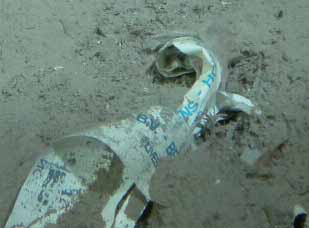
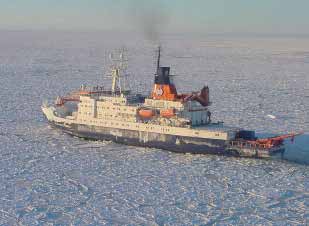
Deep-sea biodiversity and ecosystems
2007
Marine
Research
and
6000/Medeco
Polar
for
Institute
Ifremer/Victor
Wegener
Alfred
Human impact in the deep sea: plastic rubbish at the
German research vessel `Polarstern' on a deep-water
bottom of the Var Canyon, Western Mediterranean,
expedition in the Arctic Ocean.
2 200 m water depth.
relate to the natural phenomena in question, they improve
institutions
and
management
tools;
including
knowledge and contribute to finding potential solutions. For
institutional capacity to respond to high uncertainty, high
instance, social sciences can contribute to the identification
and long-term vulnerability, irreversibility, and high
and understanding of the direct and indirect anthropogenic
rates of global environmental change;
drivers of deep-sea biodiversity change, and help assess the
·
ways of implementing the precautionary principle and
societal impacts of response strategies. Social scientists
other governance principles;
can also contribute to prediction exercises that are operating
·
governance and management systems for new and
at the science-policy interface, through integrated models,
emerging issues or activities;
scenarios or narratives. Moreover, social scientists are
·
ways of implementing the ecosystem approach and hol-
sometimes particularly well placed to build bridges between
istic, integrated, intersectoral, anticipative and adaptive
different scientific disciplines or between the different actors
management in practice, and empirical testing of
(scientists, policy makers, other stakeholders). Hence, they
options, including benchmarking for best practices;
can also reinforce the science-policy interfaces by contrib-
·
development and assessment of various policies and
uting to their design, evaluation or even implementation
measures towards sustainable use of deep-sea
by acting as translators, mediators or facilitators (van den
resources;
Hove, 2007).
·
management of networks of MPAs within and outside
Socio-economic and governance research for the deep
EEZs;
sea can only develop in synergy with natural-science
·
development of operational socio-economic and eco-
research on deep-sea ecosystems and their functions,
logical indicators that can be used for the management
hence the importance of interdisciplinary endeavours.
of deep-sea ecosystems.
Deep-sea scientists have only recently started to work jointly
in interdisciplinary teams, bringing together biologists,
Integrating natural and social science research
microbiologists, geochemists, geologists, oceanographers
Social sciences (for example, economics, law, sociology,
and geophysicists. The next step is to integrate social
political sciences) have important roles to play in the study
sciences in these partnerships, in order to develop an inte-
of biodiversity loss and change, since the main causes of the
grated science in support of deep-sea governance. This
global biodiversity crisis are anthropogenic. Social sciences
process has started in the integrated, multidisciplinary
have a long and pluralistic tradition of studying human
research project HERMES (Hotspot Ecosystem Research on
aspects of the world: behaviours, activities, societies and
the Margins of European Seas).
their values and institutions (political, economic, cultural
or social).
Training and capacity-building
The roles of social sciences in interdisciplinary
Specific social science expertise on socio-economic and
biodiversity research programmes are manifold. By
governance aspects of the deep sea is still very sparse and
providing explanations for social phenomena and how they
often non-existent. Consequently, there is a need for
70
Conclusions
transferring social science knowledge and expertise from
governance issues and policy makers' awareness of
other environmental topics to the deep-sea research area
developments in science; for instance, through exchange
with a view to train and motivate a new generation of social
of staff between policy and research institutions and
scientists to work on these questions. Moreover, training in
through joint workshops and training sessions;
communication and mediation could be proposed as part of
·
accelerating the uptake of scientific advice in policy
training of young (natural and social) scientists to reinforce
decisions (for example, for fisheries management);
these skills for those who are interested in linking science
·
developing strategic dialogues and partnerships
and society.
between scientists and other stakeholders (policy
On the governance side, training for managers, policy
makers, industry, resource managers, NGOs) to foster
makers and other stakeholders in various aspects of deep-
adaptive management, generate debate and learning
sea science and governance is also needed, both in devel-
across the science-policy interface, and allow for
oped and in developing countries. Fostering good human,
collaborative strategies to emerge;
institutional and technical capacity in scientific and policy
·
establishing
more
open
consultations
with
all
institutions could be achieved via such efforts as exchanges
stakeholders (including scientists) in the course of policy
of experience and bilateral or multilateral cooperation.
development;
·
collaborative and participatory identification of gaps in
IMPROVING THE SCIENCE-POLICY INTERFACES FOR THE
knowledge in relation to the deep-sea and avenues to fill
CONSERVATION AND SUSTAINABLE USE OF DEEP-SEA
these gaps;
ECOSYSTEMS AND BIODIVERSITY
·
developing synergies among deep-sea research
In recent years, deep-sea governance issues have become
programmes, projects and networks to consolidate the
more and more prominent on the policy agendas at
system of scientific expertise in support of policy;
international and national levels. Many stakeholders and
·
developing less sectoral and more integrated holistic
policy makers are increasingly involved in those issues. They
ocean governance approaches;
urgently need integrated, interdisciplinary natural and
·
mandatory dynamic environmental impact assessments
social-science knowledge to prioritize and guide action in
incorporating scientific research and observation for the
support of policy development and implementation
exploitation of new areas;
strategies. To ensure the effective use of deep-sea science in
·
encouraging research institutions to bring about the
deep-sea governance and management, as well as the
participation of scientists in science-policy interfaces
policy relevance of deep-sea research, effective science-
and outreach activities by acknowledging and valuing
policy interfaces must be developed. For instance, a well-
these activities in career development and research
functioning science-policy interface is required to decide
funding criteria.
whether, when, and how to go forward with exploitation of
deep-sea resources and whether, when, and how
As a final note, it must be stressed that communication of
exploitation should be restricted or prohibited for
research results to the public is of paramount importance
conservation purposes.
for the deep sea. The remoteness of the deep sea makes it
To improve the deep-sea science-policy interfaces,
practically inaccessible to human experience, except for a
priority actions include:
handful of scientists and even for them, the deep-sea
·
translating relevant research results to make them
experience is highly mediated by technology. This creates a
available to policy makers and other users;
strong responsibility for scientists to contribute to outreach
·
removing barriers and improving processes and tools for
and dissemination efforts. To do so, scientists need support
presenting, sharing and exchanging data between
in terms of infrastructure, funding and human resources. As
different user groups;
of today, it is still very hard to obtain funding for outreach and
·
developing real-time dialogue with, and input to, the
education activities, even though these necessitate skilled
policy processes; in particular through: (i) participation
and qualified individuals and are extremely time-consuming.
of scientists from the deep-sea research community in
The development of accessible, interoperable databases
international, regional and national policy meetings; (ii)
helping to store and retrieve ecological and socio-economic
provision of scientific advice to States, Regional
knowledge including inter alia metadata, environmental
Fisheries Management Organisations, international
parameters, species description, human activities, images
organizations, etc; (iii) close cooperation with NGOs to
and video footage is also needed. Such support is
support the provision of science into policy processes;
indispensable if scientists are to contribute to raising
·
increasing
scientists'
awareness
of
policy
and
awareness of, and willingness to act for, the deep sea.
71
Deep-sea biodiversity and ecosystems
Glossary
See also Table 1.1 on page 12 for short definitions of major
Exclusive
Sea zone over which coastal states have
deep-sea features.
Economic Zone:
special rights over the exploration and
use of marine resources. EEZs usually
Area (The):
The seabed and ocean floor and subsoil
extend to 200 nautical miles seaward or
thereof, beyond the limits of national
to the edge of the continental shelf,
jurisdiction (UNCLOS, 1982 Art. 1.1)
whichever is farthest.
Benthos:
All organisms living on, in, or close to
Emergence:
The arising of novel and coherent
the seafloor.
structures, patterns and properties
Biodiversity:
The variability among living organisms
during the process of self-organization
from all sources including, inter alia,
in complex systems (Goldstein, 1999).
terrestrial, marine and other aquatic
Endemism:
A endemic species that is endemic
ecosystems and the ecological
is unique to a defined place, region
complexes of which they are part;
or biota and not naturally found
this includes diversity within species,
anywhere else.
between species and of ecosystems.
Environmental
Procedure that ensures that the
(Convention on Biological Diversity, Art. 2)
Assessment:
environmental implications of decisions
Biome:
A major ecological community type (as
are taken into account before the
for example, tropical rain forest,
decisions are made. In principle,
grassland, desert).
environmental assessment can be
Civil society:
The arena of uncoerced collective action
undertaken for individual projects such
around shared interests, purposes and
as a dam, motorway, airport or factory
values. In theory, its institutional forms
("Environmental Impact Assessment")
are distinct from those of the state,
or for plans, programmes and policies
family and market, though in practice,
("Strategic Environmental
the boundaries between state, civil
Assessment"). (ec.europa.eu/
society, family and market are often
environment/eia/ home.htm)
complex, blurred and negotiated. Civil
Externalities:
In economics, externalities are defined
society includes organizations such as
as costs or benefits incurred by parties
charities, non-governmental
outside of a transaction. When
organizations, community groups,
considering the environment, and public
professional associations, trade unions,
goods in general, most externalities
social movements, business
tend to be costs, and economists dub
associations, coalitions and advocacy
them market failures, until a market
groups (www.lse.ac.uk/collections/
exists for them. Greenhouse gas
CCS/Default.htm).
emissions are an example. Ecological
Continental
The layer of granitic, sedimentary and
economists argue that market failures
crust:
metamorphic rocks that forms the
are cost-shifting "successes", for
continents and the continental margins.
example when social and environmental
It is less dense than oceanic crust,
costs go unpaid or are passed on to
though it is considerably thicker (35
society at large.
to 40 kilometres). About 40 per cent
Gas regulation:
The balance and maintenance of the
of the Earth's surface is underlain by
gaseous composition of the atmosphere
continental crust.
and oceans. One of the most important
Cyst:
A small capsule-like sac that encloses
processes is the exchange of carbon
certain organisms in their dormant or
dioxide at the surface by photosynthesis.
larval stage.
Marine organisms facilitate the slow
72
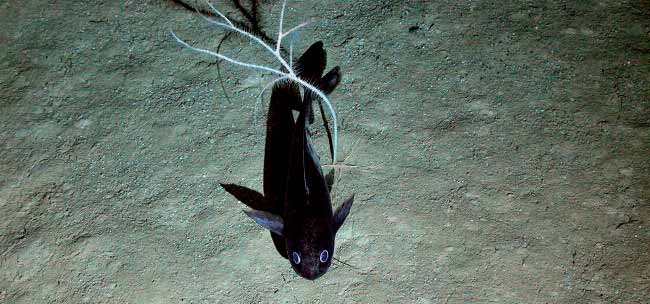
Glossary
cruise
NOCS/JC10
Morid fish at the Carlos Ribeiro mud volcano in the Gulf of Cadiz, East Atlantic Ocean.
migration of carbon dioxide to great
participants in these practices and
depths and long-term storage. Changes
guide the interactions among occupants
in biodiversity would therefore modify
of these roles (Young, 1994). In other
the ability of the oceans to act as a
words, institutions are ways of
carbon sink.
organizing human activities (Dietz et
Ghost fishing:
Ghost fishing is the term used for lost
al., 2003).
or abandoned fishing gear (for example
IUU:
Illegal, unreported and unregulated
longlines, gill nets, entangling nets,
fishing that: takes place where vessels
trammel nets, traps and pots
operate in violation of the laws of a
constructed from modern, non-
fishery (illegal); has been unreported
biodegrable synthetic fibres) that
or misreported to the relevant national
continues to catch fish and other
authority or regional organization
organisms. Catch rates drop off to
(unreported); is in contravention of
around 20 per cent after three months
applicable laws and regulations; is
(inter alia due to gear degradation), and
conducted by vessels without
appear to stabilize at around 5-6 per
nationality or flying the flag of a
cent after 27 months. This catching
country that is not party to the
efficiency is believed to continue over
regional organization governing the
several years. Ghost fishing is
particular fishing area or species, or
environmentally deleterious and the fish
is conducted in areas or for fish stocks
caught is wasted. The issue of ghost
where there are no conservation
fishing was first brought to the attention
and management measures in
of world at the 16th Session of the FAO
place (unregulated) (High Seas
Committee on Fisheries in April 1985
Task Force, 2006).
(FAO, 1991).
Lithosphere:
The solid outermost shell of the
High Seas:
The water column beyond the EEZ (or
planet; includes the crust and the
beyond territorial sea where no EEZ has
uppermost mantle.
been declared).
Macrobenthos:
Bottom-dwelling organisms greater
Institutions:
Sets of rules of the game, or codes of
than 500 microns (0.5 millimetre)
conduct that serve to define social
in size.
practices, assign roles to the
Meiofauna:
Fauna between 100500 microns length
73
Deep-sea biodiversity and ecosystems
living in the spaces between sediment
losses arising from death or
grains.
emigration.
Nodule:
A nodule is an irregular and rounded
Resilience:
Ecosystem resilience is the capacity of
aggregate of base metals, approximately
an ecosystem to tolerate disturbance
the size of a tennis ball. Manganese
without collapsing into a qualitatively
nodules typically contain other metals
different state that is controlled by a
such as iron, copper, cobalt and zinc.
different set of processes (Holling,
They are found primarily in the abyssal
1973)
plains of the Clarion Clipperton Fracture
Science-policy
Science-policy interfaces are social
Zone in the central Pacific Ocean.
interfaces:
processes that encompass relations
Oceanic crust:
The part of Earth's lithosphere that
between scientists and other actors in
surfaces in the ocean basins. It is
the policy process and that allow for
thinner, generally less than 10
exchanges, co-evolution and joint
kilometres thick, but more dense than
construction of knowledge with the aim
the continental crust. Most of the
of enriching decision making at different
present-day oceanic crust is less than
scales (van den Hove, 2007).
200 million years old, because it is
Sessile:
Animals permanently attached to a
continuously being created at oceanic
substrate so unable to move to another
ridges and desolved/melted by being
location.
pushed back under less dense
Stakeholder:
Although definitions vary from areas
continental crust in subduction zones.
under considerations, stakeholders are
Phyla:
Plural of phylum, taxonomic
most likely to be individuals, groups or
category/rank at the level below
organizations who are in one way or
kingdom and above class. Represents
another interested, involved or affected
the largest generally accepted
(positively or negatively) by a particular
groupings of animals and other living
project or action toward resource use
things with certain evolutionary traits
(Pomeroy and Rivera-Guieb, 2006).
Primary
The production of organic compounds
Terrigenous:
Being or relating to oceanic sediment
production:
from atmospheric or aquatic sources
derived directly from the erosion rocks
(for example carbon dioxide), principally
on land.
through the process of photosynthesis
Unconventional
Unconventional sources of oil
and (to a lesser extent) chemosynthesis.
oil:
commonly include fields located in
All life on Earth relies directly or
harsh environmental conditions or fields
indirectly on primary production.
where oil itself is difficult to recover. In
Prokaryotes:
Cellular organisms without a cell
both cases, unconventional sources
nucleus or other membrane-bound
present a low-energy return on energy
organelles. Comprising the kingdoms
invested. Such fields become exploited
Archaea and Eubacteria.
when oil prices make investment
Recruitment :
Additions to a population through birth
economically attractive. Tar sands, oil
or immigration. Net recruitment is the
under ice shelves and deep-water oil
difference between these additions and
are some examples.
74
References
References
Alban, F., Appere, G., Boncoeur, J. 2006. Economic
Boyle, M., Kay, J., Pond, B. 2001. Monitoring in support of
Analysis of Marine Protected Areas. A Literature
policy: an adaptive ecosystem approach. In: Munn,
Review. EMPAFISH Project, Booklet 3.
T. (ed.) Encyclopedia of Global Environmental
Angel, M.V. and Rice, T.L. 1996. The Ecology of the Deep
Change 4: 11637. Wiley, New York.
Ocean and Its Relevance to Global Waste
BP (British Petroleum), 2005. Statistical Review of World
Management. Journal of Applied Ecology 33 (5):
Energy. Available at http://www.bp.com
915926.
Brandt, A., Gooday, A.J., Brandão, S.N., Brix, S.,
Arico, S. and Salpin, C. 2005. Bioprospecting of Genetic
Brökeland, W., Cedhagen, T., Choudhury, M.,
Resources in the Deep Seabed: Scientific, Legal
Cornelius, N., Danis, B., De Mesel, I., Diaz, R.J.,
and Policy Aspects. UNU-IAS Report.
Gillan, D.C., Ebbe, B., Howe, J.A., Janussen, D.,
Armstrong, C. and van den Hove, S. 2007. The formation of
Kaiser, S., Linse, K., Malyutina, M., Pawlowski,
policy for protection of cold-water coral off the
J., Raupach, M., Vanreusel, A. 2007. First insights
coast of Norway, Marine Policy, online
into the biodiversity and biogeography of the
prepublication.
Southern Ocean deep sea. Nature 447: 307311.
Beaumont, N.J., and Tinch, R. 2003. Goods and services
Brewer, P.G., Friederich, G., Peltzer, E.T., Orr, F.M. 1999.
related to the marine benthic environment,
Direct experiments on the ocean disposal of fossil
CSERGE Working Paper ECM 0314.
fuel CO2. Science 284: 943945.
Beaumont, N., Townsend, M., Mangi, S., Austen, M.C.
Brewer, P.G., Peltzer, E.T., Friederich, G., Aya, I., Yamane,
2006. Marine Biodiversity: An Economic Valuation.
K. 2000. Experiments on the ocean sequestration
Plymouth Marine Laboratory, Plymouth, UK.
of fossil fuel CO2: pH measurement and hydrate
Ben-Yami, M. 2004. Fisheries management: Hijacked by
formation. Marine Chemistry 72: 8393
neoliberal economics, post-autistic economics
Bruhn, C.H.L. 2005. How Much Oil and Gas from
review 27, http://www.paecon.net/PAEReview/
Deepwater? The Brazilian Experience.
issue27/BenYami27.htm
Presentation at the IVth International Workshop
Berkes, F., Hughes, T.P., Steneck, R.S., Wilson, J.A.,
on Oil and Gas Depletion, 1920 May 2005, Lisbon,
Bellwood, R., Crona, B., Folke, C., Gunderson, L.
Portugal.
H., Leslie, H. M., Norberg, J., Nyström, M.,
Bryn, P., Andersen, E., Lien, R. 2007. The Ormen Lange
Olsson, P., Österblom, H., Scheffer,M., Worm, B.
Geohazard Experience: Best Practice for
2006. Globalization, Roving Bandits, and Marine
Geohazard Evaluations of Passive Continental
Resources. Science 311 (5767): 15571558.
Margins. Paper presented at the Offshore
Bergquist, D.C., Williams, F.M., Fisher, C.R. 2000.
Technology Conference, Houston, Texas, 30 April
Longevity record for deep-sea invertebrate.
3 May 2007.
Nature 403, 499500.
Campbell, C.J. 2004. The Coming Oil Crisis. Independent
Berndt, C. 2005. Focused fluid flow in passive continental
Publishers Group. Figure also available from
margins. Philosophical Transactions of the Royal
http://www.oilcrisis.com/campbell/
Society A 363, 28552871.
Canals, M., Puig, P. Durrieu de Madron, X. Heussner, S.
Boetius, A., Ravenschlag, K., Schubert, C.J., Rickert, D.,
Palanques, A. Fabres, J. 2006. Flushing
Widdel, F., Gieseke, A. Amann, R. Jürgensen,
submarine canyons. Nature 444: 354357
B.B., Witte, U., Pfannkuche, O. 2000. A marine
ChEss (Biogeography of Chemosynthetic Deep-water
microbial consortium apparently mediating
Ecosystems) http://www.noc.soton.ac.uk/chess/
anaerobic oxidation of methane. Nature 407,
database/database.html, Accessed on 20.9.2007.
623626.
Clark, C.W., Munro, G.R. Sumaila, U.R. 2005. Subsidies,
Borghi, V., Porte, C. 2002. Organotin pollution in deep-sea
buybacks, and sustainable fisheries. Journal of
fish from the northwestern Mediterranean.
Environmental Economics and Management 50:
Environmental Science and Technology 36:
4758.
42244228.
75
Deep-sea biodiversity and ecosystems
Clark, M.R., Tittensor, D., Rogers, A.D., Brewin, P.,
De Santo E. and Jones P.J.S. 2007. Offshore marine
Schlacher, T., Rowden, A., Stocks, K., Consalvey,
conservation policies in the North East Atlantic:
M. 2006. Seamounts, Deep-Sea Corals and
Emerging tensions and opportunities. Marine
Fisheries: Vulnerability of Deep-Sea Corals to
Policy 31: 336347.
Fishing on Seamounts Beyond Areas of National
Devine, J.A., Baker K.D., Haedrich, R.L. 2006. Deep-sea
Jurisdiction. UNEP-WCMC, Cambridge, UK.
fishes qualify as endangered. Nature 439: 5.
Clavreul, L. 2006. Le pétrole cher bouleverse l'économie
Dietz, T., Ostrom, E., Dolsak, N., Stern, P.C. 2002. The
de la pêche. Le Monde, 18 July 2006.
Drama of the Commons. In: Ostrom, E., Dietz, T.,
Cochonat, P., Dürr, S., Gunn, V., Herzig, P., Mevel, C.,
Dolsak, N. Stern, P.C., Stovich, S., Weber, E.U.
Mienert, J., Schneider, R., Weaver, P., Winkler,
(eds.) The Drama of the Commons. Committee on
A. 2007. The Deep-Sea Frontier: Science
the Human Dimensions of Global Change,
challenges for a sustainable future. Office for
National Research Council, National Academy
Official Publications of the European
Press, Washington, DC.
Communities, Luxembourg, 53pp.
Dietz, T., Ostrom, E., Stern, P.C. 2003. The Struggle to
Commission on Global Governance. 1995. Our Global
Govern the Commons. Science 302: 19071912.
Neighbourhood: The Report of the Commission on
Druffel, E.R.M., Griffin, S., Witter, A., Nelson, E., Southon,
Global Governance, Oxford University Press,
J., Kashgarian, M., Vogel, J. 1995. Gerardia:
Oxford, UK.
Bristlecone pine of the deep-sea? Geochimica et
Costanza, R., 1999. The ecological, economic, and social
Cosmochimica Acta 59 (23): 50315036.
importance of the oceans. Ecological Economics
Dunn, E. 2007. Fisheries Impacts on Seabirds: bycatch,
31: 199213.
prey depletion and discards. In: J. Krause, H. von
Costanza, R., d'Arge, R., de Groot, R., Farber, S., Grasso,
Nordheim and S. Bräger (Eds.) Proceedings of the
M., Hannon, B., Limburg, K., Naeem, S., O'Neill,
Symposium on "Marine Nature Conservation in
R.V., Paruelo, J., Raskin, R.G., Sutton, P. and van
Europe 2006", Stralsund, 8-12 May 2006.
den Belt, M. 1997. The value of the world's
Duraiappah, A. 2007. Markets for Ecosystem Services:
ecosystem services and natural capital. Nature
A Potential Tool for Multilateral Environmental
387: 253260.
Agreements. International Institute for
Daily, G.C. (ed.) 1997. Nature's Services: Societal
Sustainable Development (IISD).
Dependence on Natural Ecosystems. Island
Dutton, L.M.C., Gerchikov, M.Y., Nielsen, S.P., Simmonds,
Press, Washington, DC.
J.R., Sazykina, T.G., Hunter, G., van Weers, A.,
Daly, H.E., 1996. Beyond Growth: The Economics of
Lepicard, S., Bexon, A.P., Buckley, M., Hou, X.,
Sustainable Development. Beacon Press, Boston,
Hagel, P., Jones, A.L., Harvey, M.P., Sihra, K.,
MA.
Keith-Roach M., Kryshev, I.I. 2002. MARINA II:
Danovaro, R., Weaver, P., Ballu, V., Billett, D.,
Update of the MARINA Project on the radiological
Christiansen, B., Freiwald, A., Le Bris, N.,
exposure of the European Community from
Pfannkuche, O., Ramirez-Llodra, E., Santos, R.,
radioactivity in North European marine waters.
Tselepides, A., Tyler, P. 2007. Evolution of deep-
Report for DG Environment of the European
sea ecosystems: functioning, diversity and
Commission. Downloadable at: http://ec.europa.
conservation. In: Cochonat, P., Dürr, S., Gunn, V.,
eu/energy/nuclear/radioprotection/doc/studies/
Herzig, P., Mevel, C., Mienert, J., Schneider, R.,
rp132/2003-06-05_marina_executive_summary_
Weaver, P., Winkler, A. (eds.) The Deep-Sea
en.pdf.
Frontier: Science Challenges for a Sustainable
DWL (Douglas Westwood Ltd) 2005. Marine industries
Future. Office for Official Publications of the
global market analysis. Marine Foresight Series 1.
European Communities, Luxembourg.
Marine Institute, Ireland
DEFRA (Department for Environment, Food and Rural
EC (European Commission) 2003. Commission Regulation
Affairs), 2006. Valuing our Natural Environment.
No. 1475/2003 on the protection of deep-water
Report No. 0103.
coral reefs from the effects of trawling in an area
Derraik, J.G.B. 2002. The pollution of the marine
north west of Scotland. L 211/14. OJ L 211,
environment by plastic debris: a review. Marine
21.8.2003, pp. 1415.
Pollution Bulletin 44: 842852.
76
References
Engle, M.H., Marcondes, M.C.C., Martins, C.C.A., Luna,
Fosså, J.H., Mortensen, P.B., Furevik, D.M., 2002. The
F.O., Lima, R.P., Campos, A. 2004. Are seismic
deep-water coral Lophelia pertusa in Norwegian
surveys responsible for cetacean strandings? An
waters: distribution and fishery impacts.
unusual mortality of adult humpback whales in
Hydrobiologia 471: 112.
Abrolhos Bank, Northeastern coast of Brazil.
Fosså , J.H., Tendal, O. (undated). Discovering deep-water
Paper SC/56/E28 presented to the Scientific
sponges. ICES article. http://www.ices.dk/marine
Committee of the International Whaling
world/sponge.asp
Commission.
Foster E., Flood, T., Graham, A., Exel, M. 2005. Improved
EU (European Union), 2006. Marine Biodiversity in Areas
oceans governance to conserve high seas
beyond National Jurisdiction. Statement on behalf
biodiversity. IUCN, Gland, Switzerland. Parks 15
of the European Union to the Ad Hoc Open-ended
(3): 1923.
Informal Working Group to study issues relating to
Freiwald, A., Fosså, J.H., Grehan, A., Koslow, T., Roberts,
the conservation and sustainable use of marine
J.M., 2004. Cold-water Coral Reefs. UNEP-
biological diversity beyond areas of national
WCMC, Cambridge, UK.
jurisdiction. 60th Session of UNGA, New York, 13
French, L.S., Richardson, G.E., Kazanis, E.G.,
February 2006.
Montgomery, T.M., Bohannon, C.M., Gravois, M.P.
FAO (Food and Agriculture Organization of the United
2006. Deepwater Gulf of Mexico 2006: America's
Nations), 1991. Report of the Expert Consultation
Expanding Frontier. OCS Report, MMS 2006-022.
on the Marking of Fishing Gear, Victoria, British
Gage, J.D. 1996. Why are there so many species in deep-
Columbia, Canada. 1419 July 1991.
sea sediments? Journal of Experimental Marine
FAO (Food and Agriculture Organization of the United
Biology and Ecology 200: 257286.
Nations), 1995. Code of conduct for responsible
Galil, B., 2006. Shipwrecked Shipping impacts on the
fisheries. FAO, Rome.
biota of the Mediterranean Sea. In: Davenport J.
FAO (Food and Agriculture Organization of the United
and Davenport, J.L. (eds.) The Ecology of
Nations), 2003. Report on Deep Sea 2003, an
Transportation: Managing Mobility for the
International Conference on Governance and
Environment. Springer: Dordrecht.
Management of Deep-Sea Fisheries. Queenstown,
Gambini, E. 2006. Patents at the interfaces among science,
New Zealand 15 December 2003. Appendix VI,
society and the law. In: Guimaraes Pereira, A.,
Report on the workshop on bioprospecting in the
Guedes Vaz, S., Tognetti, S. (eds.) Interfaces
high seas. FAO Fisheries Report 772. FAO, Rome.
between Science and Society. Greenleaf, Sheffield,
FAO (Food and Agriculture Organization of the United
UK.
Nations), 2007. Report and documentation of the
Garcia, S.M., Zerbi, A., Aliaume, C., Do Chi, T. Lasserre, G.
Expert Consultation on Deep-sea Fisheries in the
2003. The ecosystem approach to fisheries.
High Seas. Bangkok, Thailand, 2123 November
Issues, terminology, principles, institutional
2006. FAO Fisheries Report No. 829. Rome, Italy.
foundations, implementation and outlook. FAO
Farrell, K. 2007. Living with living systems: The co-
Fisheries Technical Paper 443. FAO, Rome.
evolution of values and valuation. International
Gianni, M., 2004. High Seas Bottom Trawl Fisheries and
Journal of Sustainable Development and World
their Impacts on the Biodiversity of Vulnerable
Ecology 14: 113.
Deep-Sea Ecosystems: Options for International
Fenical, W., Baden, D., Burg, M., De Ville de Goyet, C.,
Action. IUCN, Gland, Switzerland.
Grimes, D. J., Katz, M., Marcus, N., Pomponi, S.,
Gjerde, K.M. 2006a. Critical Ocean Issues: Ecosystems and
Rhines, P., Tester, P., Vena, J. 1999. Marine-
Biodiversity in Deep Waters and High Seas.
derived pharmaceuticals and related bioactive
UNEP/World Conservation Union (IUCN),
agents. In: From Monsoons to Microbes:
Switzerland. Available at: http://www.iucn.org/
Understanding the Ocean's Role in Human Health.
dbtw-wpd/edocs/2006-007.pdf
Committee on the Ocean's Role in Human Health,
Gjerde, K. 2006b. International Deep-Sea Governance: Key
National Research Council, National Academy
legal aspects. Presentation to the first meeting of
Press, Washington DC, pp. 7382.
the HERMES Science-Policy Panel, Brussels, 29
Folke, K., Thomas Hahn, T., Olsson, P., Norberg, J. 2005.
September 2006.
Adaptive Governance of Social-Ecological
Systems. Annual Review of Environment and
Resources 30: 44173
77
Deep-sea biodiversity and ecosystems
Gjerde, K. 2007. High Seas MPAs and deep-sea fishing.
Harremoës, P., Gee, D., MacGarvin, M., Stirling, A., Keys,
Document prepared for the Expert Consultation
J., Wynne, B., Guedes Vaz, S. 2001. Late lessons
on Deep-sea Fisheries in the High Seas, Bangkok,
from early warnings: the precautionary principle
Thailand, 2123 November 2006.
18962000. European Environment Agency
Gjerde, K. and Kelleher, G. 2005. High Seas marine
Environmental issue report No.22, Office for
protected areas on the horizon: legal framework
Official Publications of the European
and recent progress. Parks 15 (3): 1119. IUCN,
Communities, Luxembourg
Gland, Switzerland.
Hart, S. 2007. Possible options for an Implementing
Goldstein, J. 1999. Emergence as a Construct: History and
Agreement for protection of marine biodiversity in
Issues. Emergence 1 (1): 4972.
areas beyond national jurisdiction. Paper prepared
Grant, A., Briggs, A.D., 2002. Toxicity of sediments from
for the European Expert Workshop on Countdown
around a North Sea oil platform: are metals or
2010 for Marine Ecosystems, IUCN, Berlin, 2628
hydrocarbons responsible for ecological impacts?
April 2007.
Marine Environmental Research 53: 95116.
High Seas Task Force, 2006. Closing the Net: Stopping
Grehan, A., Armstrong, C., Bergstad, O., Edwards, A.,
Illegal Fishing on the High Seas. Governments of
Fouquet, Y., Herrera, J., Person, R., Pickrill, D.,
Australia, Canada, Chile, Namibia, New Zealand
Skinner, A., Thomsen, L., van den Hove, S. 2007.
and the United Kingdom, WWF, IUCN and the
Sustainable use of deep-sea resources. In:
Earth Institute at Columbia University.
Cochonat, P., Dürr, S., Gunn, V., Herzig, P., Mevel,
Holland, A., O'Connor, M., O'Neill, J. 1996. Costing
C., Mienert, J., Schneider, R., Weaver, P., Winkler,
Environmental Damage: A Critical Survey of
A. (eds.) The Deep-Sea Frontier: Science
Current Theory and Practice and
challenges for a sustainable future. Office for
Recommendations for Policy Implementation.
Official Publications of the European
European Parliament STOA, Luxembourg.
Communities, Luxembourg.
Holling, C.S. 1973. Resilience and stability of ecological
Guinotte, J., Orr, J., Cairns, S., Freiwald, A., Morgan, L.,
systems. Annual Review of Ecology and
George, R. 2006. Will human-induced changes in
Systematics 4: 123
seawater chemistry alter the distribution of deep-
ICES (International Council for the Exploration of the Sea),
sea scleractinian corals? Frontiers in Ecology and
2005. Report of the Working Group on Deep-water
the Environment 4 (3): 141146.
Ecology (WGDWE), 811 March 2005, ICES
Hafner, G. 2006. Issues relating to the conservation and
Headquarters, Copenhagen. ICES CM
sustainable use of marine biological diversity
2005/ACE:02.
beyond areas of national jurisdiction. Statement
IEA (International Energy Agency), 2002. Ocean storage of
on behalf of the European Union to the Ad Hoc
carbon dioxide; Greenhouse Gas R&D
Open-ended Informal Working Group, UN, New
Programme.
York. 13 February 2006.
IMO (International Maritime Organization), 1997. Focus on
Handwerk, B. 2005. Seafloor Still About 90 Percent
IMO, July 1997, http://www.imo.org
Unknown, Experts Say. National Geographic
IPCC (Intergovernmental Panel on Climate Change), 2005.
News, February 17, 2005.
IPCC Special Report on Carbon Dioxide Capture
Hardin, G. 1968. The Tragedy of the Commons. Science 162
and Storage. Prepared by Working Group III of the
(3859) 12431248.
Intergovernmental Panel on Climate Change
Hareide, N.R., Garnes, G. Rihan, D. Mulligan, M. Tyndall,
(Metz, B., Davidson, O., de Coninck, H.C., Loos, M.,
P. Clark, M. Connolly, P. Misund, R. McMullen, P.
Meyer, L.A., eds.). Cambridge University Press,
Furevik, D., Humborstad, O.B., Høydal, K.,
Cambridge, UK and New York, NY, USA.
Blasdale, T. 2005. A Preliminary Investigation on
IPCC (Intergovernmental Panel on Climate Change), 2007.
Shelf Edge and Deepwater Fixed Net Fisheries to
Climate Change 2007: Mitigation. Contribution of
the West and North of Great Britain, Ireland,
Working Group III to the Fourth Assessment
around Rockall and Hatton Bank. High Seas
Report of the Intergovernmental Panel on Climate
Deep-water Fisheries and their Contribution to
Change. Cambridge University Press, Cambridge,
Sustainable Development, The World
UK and New York, NY, USA.
Conservation Union, UNICPOLOS, Sixth session
New York, 610 June 2005
78
References
ISA (International Seabed Authority), 2000. Minerals other
Kenvolden, K.A. 1998. A primer on the geological
than Polymetallic Nodules of the International
occurrence of gas hydrate. In: Henriet, J.P. and
Seabed Area. Proceedings of the International
Mienert, J. (eds.) Gas Hydrates: Relevance to
Seabed Authority's Workshop, Kingston, Jamaica,
World Margin Stability and Climate Change.
June 26-30, 2000 (ISA/04/01) (ISBN 976-610-647-
Geological Society, London. Special Publications,
9)
p.137
ISA (International Seabed Authority), 2004. Marine Mineral
King, S.C., Johnson, J.E., Haasch, M.L., Ryan, D.A.J.,
Resources, Scientific Advances and Economic
Ahokas, J.T., Burns, K.A. 2005. Summary results
Perspectives. A Joint Publication by the United
from a pilot study conducted around an oil
Nations Division for Ocean Affairs and the Law of
production platform on the Northwest Shelf of
the Sea, Office of Legal Affairs, and the
Australia. Marine Pollution Bulletin 50 (11):
International Seabed Authority.
11631172
IUCN (The Word Conservation Union), 1994. Guidelines for
Kleypas, J.A., Feely, R.A., Fabry, V.J., Langdon, C., Sabine,
Protected Area Management Categories. IUCN,
C.L. and Robbins, L.L. 2006. Impacts of Ocean
WCMC.
Acidification on Coral Reefs and Other Marine
IUCN (The Word Conservation Union), 2007. Introduction
Calcifiers: A Guide for Future Research. Report of
from the sea. Briefing Document. CITES CoP14. .
a workshop 1820 April 2005, sponsored by NSF,
Available at: http://www.iucn.org
NOAA, and the US Geological Survey. St.
/themes/ssc/our_work/
Petersburg, Florida, US.
wildlife_trade/citescop14/index_cites_2007.htm.
Knutzen, J. 1981. Effect of decreased pH on marine
Accessed September 2007
organisms. Marine Pollution Bulletin 12: 2529
Jepson, P.D., Arbelo, M., Deaville, R., Patterson, I.A.P.,
Koppe, J. and Keys, J. 2001. PCBs and the precautionary
Castro, P., Baker, J.R., Degollada, E., Ross, H.M.,
principle. In: Harremoës, P. et al. (eds.) Late
Herráez, P., Pocknell, A.M., Rodríguez, F., Howie,
lessons from early warnings: the precautionary
F.E. 2003. Gas-bubble lesions in stranded
principle 18962000. European Environment
cetaceans. Nature 425: 575576
Agency Environmental issue report No.22, Office
Johnston, P. and Santillo, D. 2003. Carbon Capture and
for Official Publications of the European
Sequestration: Potential Environmental Impacts.
Communities, Luxembourg
Proceedings of IPCC Workshop on Carbon Dioxide
Koslow, J.A. 2004. The biological environment of cobalt-
Capture and Storage, Regina, Canada. 1821
rich ferromanganese crust deposits, the potential
November 2002. Energy Research Centre of the
impact of exploration and mining in this
Netherlands (ECN): 95110
environment, and data required to establish
Juniper, K. 2004. Impact of the development of seafloor
environmental baselines. International Seabed
massive sulphides on the vent ecosystem. In:
Authority, Kingston, Jamaica
Minerals other than Polymetallic Nodules of the
Koslow, T. 2007. The Silent Deep: The Discovery, Ecology,
International Seabed Area; Proceedings of the
and Conservation of the Deep Sea. UNSW Press,
International Seabed Authority's Workshop,
Sydney, Australia
Kingston, Jamaica, June 2630 2000. (ISA/04/01)
Koslow, J.A., Boehlert, G.W., Gordon, J.D.M., Haedrich,
Katz, B.J. 2003. Hydrocarbon shows and source rocks in
R.L., Lorance, P. and Parin, N. 2000. Continental
scientific ocean drilling. International Journal of
slope and deep-sea fisheries: implications for a
Coal Geology 54 (12): 139154
fragile ecosystem. ICES Journal of Marine Science
Kay, J., Regierb, H., Boylec, M., Francis, G. 1999. An
57: 548557.
ecosystem approach for sustainability: addressing
Koslow, J.A., Gowlett-Holmes, K., Lowry, J.K., O'Hara, T.
the challenge of complexity. Futures 31: 721742
Poore, G.C.B., Williams, A. 2001. Seamount
Kelleher, G. (ed.) 1999. Guidelines for Marine Protected
benthic macrofauna off southern Tasmania:
Areas, IUCN, Gland, Switzerland and Cambridge,
community structure and impacts of trawling.
UK. http://www.iucn.org/themes/marine/pdf/
Marine Ecology Progress Series 213: 111125.
mpaguid.pdf.
79
Deep-sea biodiversity and ecosystems
Krueger, M., Meyerdierks, A., Gloeckner, F.O., Amann, R.,
Martin, J.H., Coale, K.H., Johnson, K.S., Fitzwater, S.E.,
Widdel, F., Kube, M., Reinhardt, R., Kahnt, J.,
Gordon, R.M., Tanner, S.J., Hunter, C.N., Elrod,
Boecher, R., Thauer, R.K., Shima, S. 2003. A
V.A., Nowicki, J.L., Coley, T.L., Barber, R.T.,
conspicuous nickel protein in microbial mats that
Lindley, S., Watson, A.J., van Scoy, K., Law, C.S.,
oxidize methane anaerobically. Nature 426:
Liddicoat, M.I., Ling, R., Stanton, T., Stockel, J.,
878881
Collins, C., Anderson, A. Bidigare, R., Ondrusek,
Laffoley, D. 2005. Protecting Earth's last frontier: why we
M., Latasa, M., Millero, F.J., Lee, K., Yao, W.,
need a global system of High Seas marine
Zhang, J.Z., Friederich, G., Sakamoto, C., Chavez,
protected area networks. IUCN, Gland,
F., Buck, K., Kolber, Z., Greene, R., Falkowski, P.,
Switzerland. Parks 15 (3): 510
Chisholm, S.W., Hoge, F., Swift, R., Yungel, J.,
Laist, D., Knowlton, A., Mead, J.,Collet, A., Podesa, M.
Turner, S., Nightingale, P., Hatton, A., Liss, P.,
2001. Collisions between ships and whales.
Tindale, N.W. 1994. Testing the iron hypothesis in
Marine Mammal Science 17 (1): 3575
ecosystems of the equatorial Pacific Ocean.
Le Menestrel, M. 2002. Economic rationality and ethical
Nature 371: 123129
behaviour: ethical business between venality and
Milazzo, M., 1998. Subsidies in world fisheries: a re-
sacrifice. Business Ethics: A European Review 11
examination. World Bank Technical Paper. No.
(2): 157166
406. Fisheries series, The World Bank,
Lenoble, J.P. 2004. A comparison of the possible economic
Washington, DC.
returns from mining deep seabed polymetallic
Morling, P. 2005. The economic rationale for marine
nodules, seafloor massive sulphides and cobalt-
protected areas in the High Seas. IUCN, Gland,
rich crusts. In: Minerals other than Polymetallic
Switzerland. Parks 15 (3): 2431
Nodules of the International Seabed Area;
Murray, C. and Marmorek, D. 2003. Adaptive
Proceedings of the International Seabed
management: a science-based approach to
Authority's Workshop, Kingston, Jamaica, June
managing ecosystems in the face of uncertainty.
2630 2000 (ISA/04/01)
Proceedings of the Fifth International Conference
Linnane, A., Ball, B., Munday, B., van Marlen, B.,
on Science and Management of Protected Areas:
Bergman, M. and Fonteyne, R. 2000. A review of
Making Ecosystem Based Management Work,
potential techniques to reduce the environmental
Victoria, BC.
impact of demersal trawls. Irish Fisheries
Murray, C. and Marmorek, D. 2004. Adaptive
Investigations (New Series) No.7. The Marine
Management: A spoonful of rigour helps the
Institute, Dublin
uncertainty go down. In: Proceedings of the 16th
Lüdmann, T., Wong H.K., Konerding, P., Zillmer, M.,
Annual Society for Ecological Restoration
Petersen, J., Flüh, E. 2004. Heat flow and
Conference, Victoria, BC, August 2426, 2004.
quantity of methane deduced from a gas hydrate
Myers, A. 2006. Pumping Iron. Blue Planet Magazine
field in the vicinity of the Dnieper Canyon,
Autumn 2006: 1217
northwestern Black Sea. Geo-Marine Letters 24:
National Research Council 2002. The Drama of the
182193.
Commons. Committee on the Human Dimensions
MA (Millennium Ecosystem Assessment) 2003.
of Global Change. Ostrom, E., Dietz, T., Dolsak, N.,
Ecosystems and Human Well-being, A
Stern, P.C., Stovich, S., Weber, E.U. (eds.) National
Framework for Assessment. Island Press,
Academy Press, Washington, DC
Washington, DC
NGI (Norwegian Geotechnical Institute) 2007.
MA (Millennium Ecosystem Assessment) 2005a.
http://www.ngi.no/. Accessed September 2007
Ecosystems and Human Well-being: Synthesis.
Niemann, H., Loesekann, T. de Beer, D. Elvert, M.
Island Press, Washington, DC
Nadalig, T. Knittel, K., Amann, R., Sauter, E.J.,
MA (Millennium Ecosystem Assessment) 2005b.
Schlueter, M., Klages, M., Foucher, J.P., Boetius,
Ecosystems and Human Well-being: Policy
A. 2006. Novel microbial communities of the
Responses. Island Press, Washington, DC
Haakon Mosby mud volcano and their role as a
Maguire, J.J., Sissenwine, M., Csirke, J., Grainger, R.,
methane sink. Nature 443: 854858
Garcia, S., 2006. The state of world highly
Nouvian, C. 2007. The Deep: The Extraordinary Creatures
migratory, straddling and other high seas fishery
of the Abyss. University of Chicago Press, Chicago
resources and associated species. FAO Fisheries
Technical Paper No. 495. FAO, Rome
80
References
Olsen, S., Sutinen, J., Juda, L., Hennessey, T., Grigalunas,
Richer de Forges, B., Koslow J.A., Poore G.C.B. 2000.
T. 2006. A Handbook on Governance and
Diversity and endemism of the benthic seamount
Socioeconomics of Large Marine Ecosystems.
fauna in the Southwest Pacific. Nature 405:
Coastal Resource Centre, University of Rhode
944947
Island, US
Roberts, C.M. 2002. Deep impact: the rising toll of fishing
O'Neill, J. and Spash, C. 2000. Conceptions of Value in
in the deep sea. Trends in Ecology and Evolution
Environmental Decision-Making. Policy Research
17 (5): 242245
Brief 4, Cambridge Research for the Environment
Roberts, J.M. 2002. The occurrence of the coral Lophelia
Orr, J.C., Fabry, V.J., Aumont, O., Bopp, L., Doney, S.C.,
pertusa and other conspicuous epifauna around
Feely, R.A., Gnanadesikan, A., Gruber, N., Ishida,
an oil platform in the North Sea. Journal of the
A., Joos, F., Key, R.M., Lindsay, K., Maier-
Society for Underwater Technology 25: 8391
Reimer, E., Matear, R., Monfray, P., Mouchet, A.,
Robertson, S., MacFarlan, G. Smith, M. 2006. Deepwater
Najjar, R.G., Plattner, G.K., Rodgers, K.B.,
sector's growth will remain steady through 2010.
Sabine, C.L., Sarmiento, J.L., Schlitzer, R.,
World Oil 227 (4)
Slater, R.D., Totterdell, I.J., Weirig, M.F.,
Rona, P.A. 2003. Resources of the sea floor. Science 299:
Yamanaka, Y., Yool, A. 2005. Anthropogenic
673674
ocean acidification over the twenty-first century
Royal Society, 2005. Ocean acidification due to increasing
and its impact on calcifying organisms. Nature
atmospheric carbon dioxide. Policy Document
437: 681686.
12/05. The Royal Society, London, UK
O'Riordan, T. and Cameron, J. (eds) 1994. Interpreting the
Ruddy, M. 2006. An Overview of International Submarine
Precautionary Principle. Cameron and May,
Cable Markets. Terabit Consulting Inc., Executive
London.
Telecom Briefings Presentation, Boston
Pacala S. and Kinzig A.P. 2002. Introduction to theory and
University, 12 December 2006
the common ecosystem model. In: Kinzig, A.P.,
Santillo, D., Johnston, P., Langston, W.J. 2001. Tributyltin
Pacala, S.W., Tilman, D. (eds) Functional
(TBT) antifoulants: a tale of ships, snails and
Consequences of Biodiversity: Empirical Progress
imposex. In: Harremoës, P. et al. (eds.) Late
and Theoretical Extensions. Princeton University
lessons from early warnings: the precautionary
Press, Princeton, US. pp 16974. Cited in
principle 18962000. European Environment
Srivastava and Vellend, 2005.
Agency Environmental issue report No.22, Office
Patin, S. 1999. Environmental Impact of the Offshore Oil
for Official Publications of the European
and Gas Industry. Eco Monitor Publishing, East
Communities, Luxembourg
Northport, New York.
Santos, R.S., Colaço, A. and Christiansen, S. (eds) 2003.
Pauly, D., Alder, J., Bennett, E., Christensen, V.,
Management of Deep-sea Hydrothermal Vent
Tyedmers, P., Watson, R. 2003. The Future for
Fields MPA in the Azores Triple Junction.
Fisheries. Science 302: 13591361.
Proceedings of the Workshop, Arquipélago Life
Pauly, D., Watson, R., Alder, J. 2005. Global trends in
and Marine Science Supplement 4
world fisheries: impacts on marine ecosystems
Schnier, K.E. 2005. Biological "hotspots" and their effect
and food security. Philosophical Transactions of
on optimal bioeconomic marine reserve
the Royal Society B, 360: 512.
formation. Ecological Economics 52: 453468
Pomeroy, R. and Rivera-Guieb, R. 2006. Fishery Co-
Schubert, R., Schellnhuber, H-J., Buchmann, N., Epiney,
management: A Practical Handbook. International
A., Grießhammer, R., Kulessa, M., Messner, D.,
Development Research Centre, Ottawa, Canada.
Rahmstorf, S., Schmid, J. 2006. The Future
Reeburgh, W. 2007 Oceanic Methane Biochemistry.
Oceans Warming Up, Rising High, Turning Sour.
Chemical Reviews 107 (2): 486513
Special Report of the German Advisory Council on
Reynolds, J.R. and Jasny, M. 2006. Ocean Noise Pollution:
Global Change, Berlin
the rise of an environmental problem and
Scott, S. 2006. The dawn of deep ocean mining,
emerging international response. In: Krause, J.
EurekAlert!, 19 February 2006.
von Nordheim, H., Bräger, S. (eds.) Proceedings of
http://www.eurekalert.org/pub_releases/2006-
the Symposium on Marine Nature Conservation in
02/nsae-tdo021706.php#. Accessed 22 September
Europe 2006, Stralsund, 812 May 2006
2007.
81
Deep-sea biodiversity and ecosystems
Shapiro, S., Murray, J., Gleason, R., Barnes, S., Eales, B.,
Takahashi, S., Tanabe, S., Kubodera, T. 1997. Butyltin
Woodward, P. 1997. Threats to Submarine Cables.
Residues in Deep-Sea Organisms Collected from
Paper presented at the SubOptic 1997
Suruga Bay, Japan. Environmental Science and
Conference. Available at: http://www.scig.net/
Technology 31: 31033109
Shepherd, G. 2004. The Ecosystem Approach: Five Steps to
Thiel, H. (ed.) 2001. Environmental Impact Studies for the
Implementation. IUCN, Gland, Switzerland and
Mining of Polymetallic Nodules from the Deep
Cambridge, UK
Sea. Deep Sea Research II: Topical studies in
Smith, C.R. 1999. The biological environment in the nodule
oceanography 48 (1718)
provinces of the deep sea. In: Deep-seabed
Tilot, V. 2006. Biodiversity and distribution of the
Polymetallic Nodule Exploration: Development of
megafauna. Vol.1 The polymetallic nodule
Environmental Guidelines. Proceedings of the
ecosystem of the Eastern Equatorial Pacific
International Seabed Authority's Workshop, Sanya,
Ocean. Paris, UNESCO/IOC, 2006 (IOC Technical
Hainan Island, People's Republic of China, 15
Series 69), p.148.
June 1998, pp. 4168
Tinch, R. 2007. In Defense of Pluralism. In: J Young,
Solan, M., Cardinale, B.J., Downing, A.L., Engelhardt,
Neßhöver, C., Henle, K., Jax, K., Lawson, G.,
K.A.M., Ruesink, J.L. and Srivastava, D.S., 2004.
Weber, J., Watt, A.D. (eds.) European research for
Extinction and ecosystem function in the marine
a sustainable Europe: Research contributing to
benthos. Science 306: 11771180
the implementation of the EU Biodiversity
Spurgeon, J. 2006. Time for a third-generation economic-
Strategy. Report of an e-conference, pp.167168.
based approach to coral management. In: Côté, I.
Torda, G. 2007. Iron fertilization of oceans as a means to
and Reynolds, J. (eds.) Coral Reef Conservation.
sequester carbon dioxide. Contribution to the
Cambridge University Press, Cambridge, UK
EPBRS e-Conference Life on the Blue Planet:
Srivastava, D.S. and Vellend, M. 2005. Biodiversity-
Biodiversity research and the new European
ecosystem function research: Is it relevant to
Marine Policies. 119 October 2007
conservation? Annual Review of Ecology Evolution
Tunnicliffe, V., Juniper, S.K., Sibuet, M. 2003. Reducing
Systematics 36: 267290
environments of the deep-sea floor. Ecosystems
Stirling, A. 2007. Risk Assessment in science: towards a
of the World 28
more constructive policy debate. EMBO Reports 8
UN (United Nations), 2002. Johannesburg Plan of
(4): 309315
Implementation. World Summit on Sustainable
Stirling, A. and Gee, D. 2002. Science, Precaution and
Development. Available at:
Practice. Public Health Reports 117: 521533
http://www.un.org/esa/sustdev/documents/
Storelli, M.M., Storelli, A., D'Addabbo, R., Barone G. and
docs_key_conferences.htm. Accessed September
Marcotrigiano, G.O. 2004. Polychlorinated
2007.
biphenyl residues in deep-sea fish from
UN (United Nations), 2005. Oceans and the law of the sea,
Mediterranean Sea. Environment International
Report of the Secretary General, General
30(3): 343349
Assembly, Sixtieth session A/60/63/Add. 1
Sumaila, U. and Pauly D. (eds.) 2006. Catching more Bait:
UN (United Nations), 2006a. Impacts of fishing on
A bottom-up Re-estimation of Global Fisheries
vulnerable marine ecosystems: actions taken by
Subsidies. University of British Columbia,
States and regional fisheries management
Vancouver. Fisheries Centre Research Reports 14
organizations and arrangements to give effect to
(6)
paragraphs 66 to 69 of General Assembly
Sumaila, U., Khan, A., The, L., Watson, R., Tyedmers, P.
resolution 59/25 on sustainable fisheries,
and Pauly, D. 2006. Subsidies to High Seas
regarding the impacts of fishing on vulnerable
Bottom Trawl Fleets. In: Sumaila, U. and Pauly D.
marine ecosystems, Report of the Secretary
(eds.) Catching more Bait: A bottom-up Re-
General, General Assembly, Sixty first session
estimation of Global Fisheries Subsidies.
A/61/154.
University of British Columbia, Vancouver.
UN (United Nations), 2006b. Report of the United Nations
Fisheries Centre Research Reports 14 (6), pp. 49-
Ad hoc Open-ended Informal Working Group to
53.
study issues relating to the conservation and
sustainable use of marine biological diversity
beyond areas of national jurisdiction A/61/65.
82
References
UN (United Nations), 2007. Oceans and the law of the sea,
Weir, C.R., Dolman, S.J., Simmonds, M.P. 2006. Marine
Report of the Secretary General, General
mammal mitigation during seismic surveys and
Assembly, Sixty-second session A/62/UNCLOS
recommendations for worldwide standard
(United Nations Convention on the Law of the
mitigation guidance. Paper SC/58/E12 presented
Sea), 1982.
to the Scientific Committee of the International
http://www.un.org/Depts/los/index.htm.
Whaling Commission
UNEP (United Nations Environment Programme)/RSP
WBGU 2007. The Future Oceans Warming Up, Rising
(Regional Seas Programme), 2006. Accounting for
High, Turning Sour. Special Report of the German
Economic Activities in Large Marine Ecosystems
Advisory Council on Global Change (WBGU).
and Regional Seas. UNEP Regional Seas Reports
110pp.
and Studies No. 181, UNEP/RSP and NOAA LME
Wilson, M. and Howarth, R. 2002. Discourse-based
Partnership.
valuation of ecosystem services: establishing fair
UNGA (United Nations General Assembly), 2006. UN
outcomes through group deliberation. Ecological
General Assembly resolution A/61/L.38, section X.
Economics 41: 431443.
van den Hove, S. 2007. A Rationale for Science-Policy
Worm, B., Barbier, E.B., Beaumont, N., Duffy, J.E., Folke,
Interfaces. Futures 39: 7
C., Halpern, B.S., Jackson, J.B.C., Lotze, H.K.,
Vierros, M., Douvere F., Arico, S. 2006. Implementing the
Micheli, F., Palumbi, S.R., Sala, E., Selkoe, K.A.,
Ecosystem Approach in Open Ocean and Deep
Stachowicz, J.J., Watson, R. 2006. Impacts of
Sea Environments: An Analysis of Stakeholders,
Biodiversity Loss on Ocean Ecosystem Services.
their Interests and Existing Approaches. UNU-IAS
Nature 314: 787790
Report
Young, O. 1994. International Governance. Protecting the
Weaver, P.P.E., Billett, D.S.M., Boetius, A., Danovaro, R.,
Environment in a Stateless Society, Cornell
Freiwald, A., Sibuet, M. 2004. Hotspot Ecosystem
University Press, Ithaca, NY
Research on Europe's Deep Ocean Margins.
Yooseph, S., Rusch, G., Halpern, D. B., Williamson, S. J.
Oceanography 17(4)
Remington, K., Eisen, J.A., Heidelberg, K.B.,
Weilgart, L. 2004. Seismic testing and the impacts of high
Manning, G., Li, W., Jaroszewski, L., Cieplak, P.,
intensity sound on whales. Lecture tour with David
Miller, C.S., Li, H., Mashiyama,S.T., Joachimiak,
Suzuki, David Suzuki Foundation
M.C., van Belle, C., Chandonia, J-M., Soergel,
Wellsbury, P., Goodman, K., Barth, T., Cragg, B.A.,
D.A., Zhai, Y., Natarajan, K., Lee, S., Raphael,
Barnes, S.P., Parkes, R.J. 1997. Deep marine
B.J., Bafna, V., Friedman, R., Brenner, S.E.,
biosphere fuelled by increasing organic matter
Godzik, A., Eisenberg, D., Dixon, J.E., Taylor,
availability during burial and heating. Nature 388:
S.S., Strausberg, R.L., Frazier, M., Venter, J.C.
573576
2007. The Sorcerer II Global Ocean Sampling
Expedition: Expanding the Universe of Protein
Families. PLoS Biology 5 (3).
83
Deep-sea biodiversity and ecosystems
Cover images: (left to right) Ifremer; Department of Trade and Industry (UK); PhotoNewZealand/TopFoto; S. McGowan,
Australian Maritime College, 2006/Marine Photobank; Wolfgang Schmidt/Das Fotoarchiv/Still Pictures.
Back cover:
J.H. Fosså and P.B. Mortensen, IMR.
84

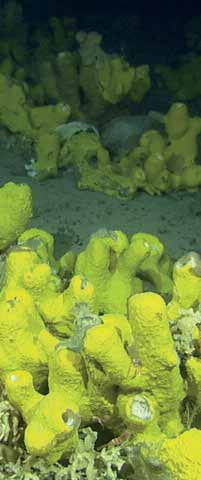
Deep-sea biodiversity and ecosystems
The deep sea is the oldest and largest biome on Earth, yet we have little knowledge
of the ecosystems and processes in these dark, hidden depths. Only in the last two
decades have new technologies enabled scientists to start exploring this last frontier
and their discoveries are fascinating but alarming: the deep sea is teeming with
life but is already showing clear signs of anthropogenic impacts despite its
remoteness. Many vulnerable deep-sea habitats and communities are being
destroyed by fishing and are under threat from increasing exploitation of their
mineral and living resources.
Since 2003, the protection, conservation and sustainable use of habitats,
ecosystems and biodiversity in the deep sea and high seas have been on the agenda
of international meetings. However, our knowledge is insufficient, and the existing
governance and management systems are inadequate, to develop, implement and
enforce concerted, effective action.
Deep-sea biodiversity and ecosystems responds to key questions, including:
where do we find vulnerable deep sea and high sea ecosystems, what are the goods
and services they provide, and how are they affected or threatened by existing or
emerging human activities and climate change.
Deep-sea biodiversity and ecosystems scopes new ways and perspectives
for answering these questions by applying modern methods and concepts used in
the context of the Millennium Ecosystem Assessment. With input from leading
experts, the report highlights gaps in socio-economic and governance knowledge,
analyses shortcomings in assessment methodologies and valuation concepts, and
identifies research needs. This results in strong arguments for urgent action to
protect and conserve the deep waters, seabed, and high seas, and for the
governance and sustainable management of human activities impacting on them.
The deep sea is of crucial importance for life on Earth - we have to stop irreversible
damages before it is too late.
UNEP Regional Seas Report and Studies No 184
www.unep.org
United Nations Environment Programme
UNEP-WCMC Biodiversity Series No 28
P.O. Box 30552, Nairobi 00100, Kenya
Tel: +254 (0) 20 7621234
Fax: +254 (0) 20 7623927
Email: uneppub@unep.org
Website: www.unep.org
UNEP World Conservation
Monitoring Centre
219 Huntingdon Road, Cambridge
ISBN: 978-92-807-2892-7
CB3 0DL, United Kingdom
Tel: +44 (0) 1223 277314
February 2008 DEP/1021/CA
Fax: +44 (0) 1223 277136
Email: info@unep-wcmc.org
Website: www.unep-wcmc.org