

United Nations
Intergovernmental
Educational, Scientific and
Oceanographic
Cultural Organization
Commission
Seamounts, deep-sea corals
and fisheries
Census of Marine Life on Seamounts (CenSeam)
Data Analysis Working Group
Regional
Seas

Seamounts, deep-sea corals
and fisheries
Vulnerability of deep-sea corals to fishing on
seamounts beyond areas of national jurisdiction
Regional
Seas

UNEP World Conservation Monitoring Centre
ACKNOWLEDGEMENTS
219 Huntingdon Road,
The authors would like to thank Matt Gianni Advisor, Deep Sea
Cambridge CB3 0DL,
Conservation Coalition and Dr Stefan Hain, Head, UNEP Coral
United Kingdom
Reef Unit for promoting the undertaking of this work and for many
Tel: +44 (0) 1223 277314
constructive comments and suggestions. Adrian Kitchingman of
Fax: +44 (0) 1223 277136
the Sea Around Us Project, Fisheries Centre, University of British
Email: info@unep-wcmc.org
Columbia, kindly provided seamount location data, and Ian May at
Website: www.unep-wcmc.org
UNEP-WCMC re-drew most of the original maps and graphics.
Derek Tittensor would like to thank Prof. Ransom A Myers and Dr
Jana McPherson, Department of Biological Sciences, Dalhousie
©UNEP-WCMC/UNEP 2006
University and Dr Andrew Dickson, Scripps Institute of
Oceanography for discussions, comments, and advice on
ISBN: 978-92-807-2778-4
modelling of coral distributions and ocean chemistry; Dr Alex
Rogers would like to thank Prof. Georgina Mace, Director of the
Institute of Zoology and Ralph Armond, Director-General of
A Banson production
the Zoological Society of London for provision of facilities for
Design and layout J-P Shirreffs
undertaking work for this report. Dr Amy Baco-Taylor (Woods
Printed in the UK by Cambridge Printers
Hole Oceanographic Institution) provided very useful comments
Photos
on a draft of the manuscript. Three reviewers provided comments
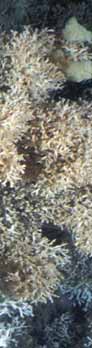
Front cover: Left, Cold-water coral (Lophelia pertusa), André Freiwald,
on the final manuscript. Dr Christian Wild, GeoBiocenter LMU
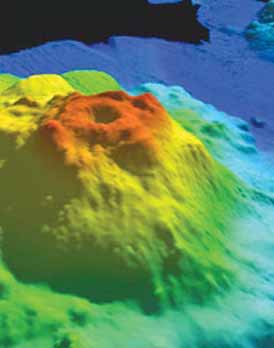
IPAL-Erlangen; Centre, Multibeam image of Ely seamount (Alaska) with
Muenchen reviewed and guided the report on behalf of UNESCO-
the caldera clearly visible at the apex. Jason Chaytor, NOOA Ocean
IOC. The authors gratefully acknowledge the support of the
Explorer (http://oceanexplorer.noaa.gov/ explorations/04alaska); Right,
Census of Marine Life programmes FMAP (Future of Marine
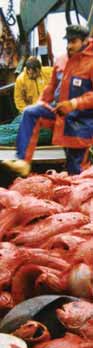
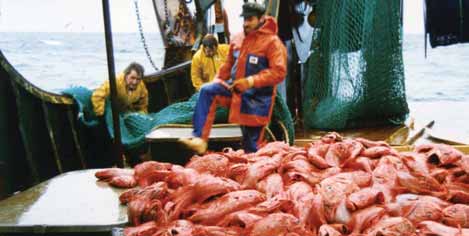
Orange roughy haul. Image courtesy of M Clark (NIWA). Back: Multibeam
Animal Populations) and CenSeam (a global census of marine life
image Brothers NW, NIWA.
on seamounts). The Netherlands' Department of Nature, Ministry
We acknowledge the photographs (pp 16, 21, 25, 26, 29, 31, 47) from
of Agriculture, Nature and Food Quality are gratefully
the UK Department of Trade and Industry's offshore energy Strategic
acknowledged for funding the original workshop and NIWA for
Environmental Assessment (SEA) programme care of Dr Bhavani
hosting the meeting. Hans Nieuwenhuis is additionally
Narayanaswamy, Scottish Association for Marine Science and Mr Colin
acknowledged for help in bringing this report to fruition. The
Jacobs, National Oceanography Centre, Southampton.
UNEP Regional Seas Programme and the International
Oceanographic Commission of UNESCO kindly provided funding
DISCLAIMER
for the publication of this report.
The contents of this report are the views of the authors alone. They are not
an agreed statement from the wider science community, the organizations
the authors belong to, or the CoML.
Citation: Clark MR, Tittensor D, Rogers AD, Brewin P, Schlacher T,
The contents of this report do not necessarily reflect the views or
Rowden A, Stocks K, Consalvey M (2006). Seamounts, deep-sea
policies of the United Nations Environment Programme, the UNEP World
corals and fisheries: vulnerability of deep-sea corals to fishing
Conservation Monitoring Centre, or the supporting organizations. The
on seamounts beyond areas of national jurisdiction. UNEP-
designations employed and the presentations do not imply the expressions
WCMC, Cambridge, UK.
of any opinion whatsoever on the part of these organizations concerning
the legal status of any country, territory, city or area or its authority, or
URL: www.unep-wcmc.org/resources/publications/
UNEP_
concerning the delimitation of its frontiers or boundaries. Moreover, the
WCMC_bio_series/
views expressed do not necessarily represent the decision or the stated
and
policy of UNEP or contributory organizations, nor does citing of trade
www.unep.org/regionalseas/Publications/Reports/
names or commercial processes constitute endorsement.
Series_Reports/Reports_and_Studies
2
Seamounts, deep-sea corals and fisheries
The work was initiated with data compilation and analysis in 2005
AUTHORS
supported by CenSeam, followed by a workshop funded by the
Malcolm R Clark*
Department of Nature, Ministry of Agriculture, Nature and Food
National Institute of Water and Atmospheric Research
Quality, Netherlands, which was held at the National Institute of
PO Box 14-901, Kilbirnie, Wellington, New Zealand
Water and Atmospheric Research (NIWA) in Wellington, New
Zealand, from 8 to 10 February 2006.
Derek Tittensor*
Department of Biological Sciences
CENSUS OF MARINE LIFE AND CENSEAM
Life Sciences Centre
The Census of Marine Life (CoML) is an international science
1355 Oxford Street
research programme with the goal of assessing and explaining
Dalhousie University
the diversity, distribution and abundance of marine life past,
Halifax, Nova Scotia, B3H 4J1, Canada
present and future. It involves researchers in more than 70
countries working on a range of poorly understood habitats. In
Alex D Rogers*
2005 a CoML field project was established to research and sample
Institute of Zoology
seamounts (Stocks et al. 2004; censeam.niwa.co.nz). This project,
Zoological Society of London
termed CenSeam (a Global Census of Marine Life on Seamounts),
Regent's Park, London NW1 4RY, United Kingdom
provides a framework to integrate, guide and expand seamount
research efforts on a global scale. It has established a `seamount
Paul Brewin
researcher network of almost 200 people around the world, and is
San Diego Supercomputer Center
collating existing seamount information and expanding a data-
University of California San Diego
base of seamount biodiversity. Its Steering Committee comprises
9500 Gilman Drive, La Jolla, CA 92093-0505, USA
people who are at the forefront of seamount research, and can
therefore contribute a wealth of knowledge and experience to
Thomas Schlacher
issues of seamount biodiversity, fisheries and conservation.
Faculty of Science, Health and Education
One of the key themes of CenSeam is to assess the impacts of
University of the Sunshine Coast
fisheries on seamounts, and to this end, it has established a Data
Maroochydore DC Qld 4558, Queensland, Australia
Analysis Working Group (DAWG) that includes people with a wide
range of expertise on seamount datasets and analysis and
Ashley Rowden
modelling techniques.
National Institute of Water and Atmospheric Research
PO Box 14-901, Kilbirnie, Wellington, New Zealand
Karen Stocks
San Diego Supercomputer Center
University of California San Diego
9500 Gilman Drive, La Jolla, CA 92093-0505, USA
Mireille Consalvey
National Institute of Water and Atmospheric Research
PO Box 14-901, Kilbirnie, Wellington, New Zealand
*These authors made an equal contribution to this report and
are therefore joint first authors.
3


Supporting organizations
Regional
Seas
UNEP's Regional Seas Programme aims to address the
Department of Nature, Ministry of Agriculture, Nature and Food
accelerating degradation of the world's oceans and coastal areas
Quality, Netherlands.
through the sustainable management and use of the marine and
coastal environment, by engaging neighbouring countries in
comprehensive and specific actions to protect their shared marine
environment.
The Census of Marine Life (CoML) is a global network of
researchers in more than 70 nations engaged in a ten-year
initiative to assess and explain the diversity, distribution and
abundance of marine life in the oceans past, present and future.
The UNEP World Conservation Monitoring Centre (UNEP-WCMC)
is the biodiversity assessment and policy implementation arm of
the United Nations Environmental Programme (UNEP), the
world's foremost intergovernmental environment organization.
UNEP-WCMC aims to help decision makers recognize the value of
The National Institute of Water and Atmospheric Research
biodiversity to people everywhere, and to apply this knowledge to
(NIWA) is a research organization based in New Zealand, and is an
all that they do. The Centre's challenge is to transform complex
independent provider of environmental research and consultancy
data into policy-relevant information, to build tools and systems
services.
for analysis and integration, and to support the needs of nations
and the international community as they engage in programmes
of action.
The Intergovernmental Oceanographic Commission (IOC) of the
United Nations Educational, Scientific and Cultural Organization
(UNESCO) provides Member States of the United Nations with an
essential mechanism for global cooperation in the study of the
ocean. The IOC assists governments to address their individual
and collective ocean and coastal problems through the sharing of
knowledge, information and technology and through the
coordination of national programmes.
4

Foreword
Foreword
`How inappropriate to call this planet Earth, when it is quite clearly Ocean'
attributed to Arthur C Clarke
Alook at a map of the world shows how true this and described. However, the same observations also
statement is. Approximately two-thirds of our planet
provided alarming evidence that seamount habitats are
is covered by the oceans. The volume of living space
increasingly threatened by human activities, especially from
provided by the seas is 168 times larger than that of
the rapid increase of deep-sea fishing.
terrestrial habitats and harbours more than 90 per cent of
The United Nations General Assembly has repeatedly
the planet's living biomass.
called upon States and international organizations to
The way most world maps depict the oceans is
urgently take action to address destructive practices, such
deceiving: while the land is shown in great detail with
as bottom trawling, and their adverse impacts on the
colours ranging from greens, yellows and browns, the sea
marine biodiversity and vulnerable ecosystems, especially
is nearly always indicated in subtle shades of pale blue.
cold-water corals on seamounts.
This belies the true structure of the seafloor, which is
This report, compiled by an international group of
as complex and varied as that of the continents or even
leading experts working under the Census of Marine Life
more so. Some of the largest geological features on Earth
programme, responds to these calls. It provides a
are found on the bottom of the oceans. The mid-ocean
fascinating insight into what we know about seamounts,
ridge system spans around 64 000 km, four times longer
deep-sea corals and fisheries, and uses the latest facts
than the Andes, the Rocky Mountains and the Himalayas
and figures to predict the existence and vulnerability of
combined. The largest ocean trench dwarfs the Grand
seamount communities in areas for which we have no or
Canyon, and is deep enough for Mount Everest to fit in with
only insufficient information.
room to spare.
The deep waters and high seas are the Earth's final
Only in the last decades, advanced technology has
frontiers for exploration. Conservation, management and
revealed that there are also countless smaller features
sustainable use of the resources they provide are among the
seamounts arising in every shape and form from the sea
most critical and pressing ocean issues today.
floor of the deep sea, often in marine areas beyond national
Seamounts and their associated ecosystems are
jurisdiction. Observations with submersibles and remote
important and precious for life in the oceans, and for
controlled cameras have documented that seamounts
humankind. We hope that this report provides inspiration to
provide habitat for a large variety of marine animals and
take concerted action to prevent their further degradation,
unique ecosystems, many of which are still to be discovered
before it is too late.
Veerle Vandeweerd, Head,
Jon Hutton, Director,
Patricio Bernal, Executive Secretary,
United Nations Environment
UNEP World Conservation
Intergovernmental Oceanographic
Programme (UNEP) Regional
Monitoring Centre
Commission (IOC) of the United
Seas Programme,
Nations Educational, Scientific and
Coordinator, GPA
Cultural Organization (UNESCO)
5
Seamounts, deep-sea corals and fisheries
Executive summary
The oceans cover 361 million square kilometres, almost on seamounts and identifies the seamounts on which
three-quarters (71 per cent) of the surface of the Earth.
they are most likely to occur globally;
The overwhelming majority (95 per cent) of the ocean
3. compares the predicted distribution of stony corals on
area is deeper than 130 m, and nearly two-thirds (64 per
seamounts with that of deep-water fishing on
cent) are located in areas beyond national jurisdiction.
seamounts worldwide;
Recent advances in science and technology have provided an
4. qualitatively assesses the vulnerability of communities
unprecedented insight into the deep sea, the largest realm
living on seamounts to putative impacts by deep-water
on Earth and the final frontier for exploration. Satellite and
fishing activities;
shipborne remote sensors have charted the sea floor,
5. highlights critical information gaps in the development
revealing a complexity of morphological features such as
of risk assessments to seamount biota globally.
trenches, ridges and seamounts which rival those on land.
Submersibles and remotely operated vehicles have
SEAMOUNT CHARACTERISTICS AND DISTRIBUTION
documented rich and diverse ecosystems and communities,
A seamount is an elevation of the seabed with a summit of
which has changed how we view life in the oceans.
limited extent that does not reach the surface. Seamounts
The same advances in technology have also documented
are prominent and ubiquitous geological features, which
the increasing footprint of human activities in the remote
occur most commonly in chains or clusters, often along
and little-known waters and sea floor of the deep and high
the mid-ocean ridges, or arise as isolated features from the
seas. A large number of video observations have not only
sea floor. Generally volcanic in origin, seamounts are often
documented the rich biodiversity of deep-sea ecosystems
conical in shape when young, becoming less regular with
such as cold-water coral reefs, but also gathered evidence
geological time as a result of erosion. Seamounts often have
that many of these biological communities had been
a complex topography of terraces, canyons, pinnacles,
impacted or destroyed by human activities, especially by
crevices and craters telltale signs of the geological
fishing such as bottom trawling. In light of the concerns
processes which formed them and of the scouring over time
raised by the scientific community, the UN General
by the currents which flow around and over them.
Assembly has discussed vulnerable marine ecosystems and
As seamounts protrude into the water column, they are
biodiversity in areas beyond national jurisdiction at its
subject to, and interact with, the water currents surrounding
sessions over the last four years (2003-2006), and called,
them. Seamounts can modify major currents, increasing the
inter alia, `for urgent consideration of ways to integrate and
velocity of water masses that pass around them. This often
improve, on a scientific basis, the management of risks to
leads to complex vortices and current patterns that can
the marine biodiversity of seamounts, cold-water coral reefs
erode the seamount sediments and expose hard substrata.
and certain other underwater features'.
The effects of seamounts on the surrounding water masses
This report, produced by the Data Analysis Working
can include the formation of `Taylor' caps or columns,
Group of the global census of marine life on seamounts
whereby a rotating body of water is retained over the summit
(CenSeam), is a contribution to the international response to
of a seamount.
this call. It reveals, for the first time, the global scale of the
In the present study the global position of only large
likely vulnerability of habitat-forming stony (scleractinian)
seamounts (>1 000 m elevation) were taken into account due
corals, and by proxy a diverse assemblage of other species,
to methodological constraints. Based on an analysis of
to the impacts of trawling on seamounts in areas beyond
updated satellite data, the location of 14 287 large sea-
national jurisdiction. In order to support, focus and guide the
mounts has been predicted. This is likely an underestimate.
ongoing international discussions, and the emerging
Extrapolations from other satellite measurements estimate
activities for the conservation and sustainable management
that there may be up to 100 000 large seamounts worldwide.
of cold-water coral ecosystems on seamounts, the report:
Numbers of predicted seamounts peak between 30ºN
1. compiles and/or summarizes data and information on
and 30ºS, with a rapid decline above 50ºN and below 60ºS.
the global distribution of seamounts, deep-sea corals on
The majority of large seamounts (8 955) occur in the
seamounts and deep-water seamount fisheries;
Pacific Ocean area (63 per cent), with 2 704 (19 per cent) in
2. predicts the global occurrence of environmental
the Atlantic Ocean and 1 658 (12 per cent) in the Indian
conditions suitable for stony corals from existing records
Ocean. A small proportion of seamounts are distributed
6
Executive Summary
between the Southern Ocean (898; 6 per cent), the
animals that contains the corals, hydroids, jellyfishes and
Mediterranean/Black Seas (59) and Arctic Ocean (13) (both
sea anemones). A recent study recorded more than 1 300
less than 1 per cent).
species associated with the stony coral Lophelia pertusa on
An analysis of the occurrence of these seamounts inside
the European continental slope or shelf. Thus some cold-
and outside of Exclusive Economic Zones (EEZs) indicates
water corals may be regarded as `ecosystem engineers'
that just over half (52 per cent) of the world's large
because they create, modify and maintain habitat for other
seamounts are located beyond areas of national jurisdiction.
organisms, similar to trees in a forest.
The majority of these seamounts (10 223; 72 per cent) have
Cold-water corals can form a significant component
summits shallower than 3 000 m water depth.
of the species diversity on seamounts and play a key
ecological role in their biological communities. The assess-
DEEP-SEA CORALS AND BIODIVERSITY
ment of the potential impacts of bottom trawling on corals is
Compared to the surrounding deep-sea environment,
therefore a useful proxy for gauging the effects of these
seamounts may form biological hotspots with a distinct,
activities on seamount benthic biodiversity as a whole. A
abundant and diverse fauna, and sometimes contain many
comprehensive assessment of biodiversity is currently
species new to science. The distribution of organisms on
impossible because of the lack of data for many faunal
seamounts is strongly influenced by the interaction between
groups living on seamounts.
the seamount topography and currents. The occurrence of
hard substrata means that, in contrast to the mostly soft
DISTRIBUTION OF CORALS ON SEAMOUNTS
sediments of the surrounding deep sea, seamount
One of the data sources utilized for this report was a
communities are often dominated by sessile, permanently
database of 3 235 records of known occurrences of five
attached organisms that feed on particles of food
major coral groups found on seamounts, including some
suspended in the water. Corals are a prominent component
shallower features <1 000 m elevation. Existing records
of the suspension-feeding fauna on many seamounts,
show that the stony corals (scleractinians) were the most
accompanied by barnacles, bryozoans, polychaete worms,
diverse and commonly observed coral group on seamounts
molluscs, sponges, sea squirts and crinoids (which include
(249 species, 1 715 records) followed by Octocorallia (161
sea lilies and feather stars).
species, 959 records), Stylasterida (68 species, 374 records),
Most deep-sea corals belong to the Hexacorallia,
Antipatharia (34 species, 159 records) and Zoanthidea (14
including stony corals (scleractinians) and black corals
species, 28 records). These records included all species of
(antipatharians), or the Octocorallia, which include soft
corals, including those that were reef-forming, contributed
corals such as gorgonians.
to reef formation, or occur as isolated colonies.
Three-dimensional structures rising above the sea
The most evident finding in analysing the coral database
floor in the form of reefs created by some species of
is that sampling of seamounts has not taken place evenly
stony coral, as well as coral `beds' formed by black corals
across the world's oceans, and that there are significant
and octocorals, are common features on seamounts and
geographic gaps in the distribution of studied seamounts.
continental shelves, slopes, banks and ridges. Coral
For some regions, such as the Indian Ocean, very few
frameworks add habitat complexity to seamounts and other
seamount samples are available. In total, less than 300
deep-water environments. They offer refugia for a great
seamounts have been sampled for corals, representing
variety of invertebrates and fish (including commercially
only 2.1 per cent of the identified number of seamounts in
important species) within, or in association with, the living
the oceans globally (or 0.03 per cent when assuming there
and dead coral framework. Cold-water corals are frequently
are 100 000 large seamounts). Only a relatively small
concentrated in areas of the strongest currents near ridges
number of coral species have wide geographic distributions,
and pinnacles, providing hard substrata for colonization
and very few have near cosmopolitan distributions. Many of
by other encrusting organisms and allowing them better
the widely distributed species are the primary reef, habitat
access to food brought by prevailing currents. Although the
or framework-building stony corals such as Lophelia
co-existence between coral and non-coral species is in most
pertusa, Madrepora oculata and Solenosmilia variabilis.
cases still unknown, recent research is showing that some
In most parts of the world, stony corals were the most
coral/non-coral relationships may show different levels
diverse group, followed by the octocorals. However, in the
of dependency. A review of direct dependencies on cold-
northeastern Pacific, octocorals are markedly more diverse
water corals globally, including those on seamounts, has
than stony corals. Most stony corals and stylasterid species
shown that of the 983 coral-associated species studied, 114
occur in the upper 1 000-1 500 m depth range.
were characterized as mutually dependent, of which 36
Antipatharians also occurred in the upper 1 000 m, although
were exclusively dependent on cnidarians (group of
a higher proportion of species occurs in deeper waters than
7
Seamounts, deep-sea corals and fisheries
the two previous groups. Octocorals were distributed to
total alkalinity; total dissolved inorganic carbon;
greater depths, with most species in the upper 2 000 m. Very
aragonite saturation state).
little sampling has occurred below 2 000 m.
There are a number of reasons for the differences in the
The model predictions were as follows: in near-surface
depth and regional distribution of the coral groups, including
waters (0-250 m), habitat predicted to be suitable for stony
species-related preferences of the nature of substrates
corals lies in the southern North Atlantic, the South
available for attachment, quantity, quality and abundance
Atlantic, much of the Pacific, and the southern Indian
of food at different depths, the depth of the aragonite
Ocean. The Southern Ocean and the northern North
saturation horizon, temperature and the availability of
Atlantic are, however, unsuitable. Below 250 m depth, the
essential elements and nutrients.
suitability patterns for coral habitat change substantially.
In depths of 250-750 m, a narrow band occurs around
PREDICTING GLOBAL DISTRIBUTION OF STONY CORALS
30ºN ± 10º, and a broader band of suitable habitat occurs
ON SEAMOUNTS
around 40ºS ± 20º. In depths of 750-1 250 m, the North
The dataset for corals on seamounts revealed significant
Pacific and northern Indian Ocean are unsuitable for stony
areas of weakness in our knowledge of coral diversity and
corals. The circum-global band of suitable habitat at
distribution on seamounts, especially the lack of sampling
around 40ºS narrows with increasing depth (to ± 10º).
on seamounts at equatorial latitudes. Thus, to make a
Suitable habitat areas also occur in the North Atlantic and
reasonable assessment of the vulnerability of seamount
tropical western Atlantic. These areas remain suitable
corals to bottom trawling (and, by proxy, determine
for stony corals with increasing depth (1 250-1 750 m;
the potential impacts of this activity on non-coral
1 750-2 250 m; 2 250 m-2 500 m), whereas the band
assemblages), it was necessary to fill the sampling gaps by
at 40ºS breaks up into smaller suitable habitat areas
predicting the global occurrence of suitable coral habitat
around the southeast coast of South America and the tip
by modelling coral distribution.
of South Africa.
An environmental niche factor analysis (ENFA) was used
The global extent of habitat suitability for seamount
to model the global distribution of deep-sea stony corals on
stony corals was predicted to be at its maximum between
seamounts and to predict habitat suitability for unsampled
around 250 m and 750 m. The majority of the suitable
regions. Other groups of coral, such as octocorals, for
habitat for stony corals on seamounts occurs in areas
example, can also form important habitats such as coral
beyond national jurisdiction. However, suitable habitats are
beds. These corals may have very different distributions
also predicted in deeper waters under national jurisdiction,
to stony corals, which would also be useful to appreciate in
especially in the EEZs of countries:
the context of determining the vulnerability of seamount
1. between 20ºS and 60ºS off Southern Africa, South
communities to bottom trawling. The available data for
America and in the Australia/New Zealand region;
octocorals are, unfortunately, currently too limited to enable
2. off Northwest Africa; and
appropriate modelling.
3. around 30ºN in the Caribbean.
ENFA compares the observed distribution of a species to
the background distribution of a variety of environmental
Combining the predicted habitat suitability with the
factors. In this way, the model assesses the environmental
summit depth of predicted seamounts indicates that the
niche of a taxonomic group i.e. how narrow or wide this
majority of seamounts that may provide suitable habitat
niche is identifies the relative difference between the niche
for stony corals on their summits are located in the
and the mean background environment, and reveals those
Atlantic Ocean. The rest are mostly clustered in a band
environmental factors that are important in determining the
between 15ºS and 50ºS. A few seamounts elsewhere, such
distribution of the studied group.
as in the South Pacific, with summits in the depth range
The model used and combined:
between 0 m and 250 m, are highly suitable. In the Atlantic,
(i). the location data of 14 287 predicted large seamounts;
a large proportion of suitable seamount summit habitat is
(ii). the location records of stony corals (Scleractinia) on
beyond national jurisdiction, whereas in the Pacific, most of
seamounts; and
this seamount habitat lies within EEZs. In the southern
(iii). physical, biological and chemical oceanographic data
Indian Ocean, suitable habitat appears both within and
from a variety of sources for 12 environmental
outside of EEZs. When analysing habitat suitability on the
parameters (temperature; salinity; depth of coral
basis of summit depth, it should be noted that suitable
occurrence; surface chlorophyll; dissolved oxygen; per
habitat for stony corals might also occur on the slopes of
cent oxygen saturation; overlying water productivity;
seamounts, i.e. at depths greater than the summit.
export primary productivity; regional current velocity;
The analysis found the following environmental factors
8
Executive Summary
were important for determining suitable habitat for stony
and target species for smaller-scale line fisheries (e.g. black
corals: high levels of aragonite saturation, dissolved oxygen,
scabbardfish Aphanopus carbo).
per cent oxygen saturation, and low values of total dissolved
The distribution of four of the most important seamount
inorganic carbon. Neither surface chlorophyll nor regional
fish species (for either their abundance or commercial
current velocity appears to be important for the global
value) is as follows:
distribution of stony corals on seamounts. Nevertheless,
1. ORANGE ROUGHY is widely distributed throughout the
these factors may be important for the distribution of corals
Northern and Southern Atlantic Oceans, the mid-
at smaller spatial scales, such as on an individual seamount.
southern Indian Ocean and the South Pacific. It does
The strong dependency of coral distribution on the
not extend into the North Pacific. It is frequently
availability of aragonite (a form of calcium carbonate) is
associated with seamounts for spawning or feeding,
noteworthy. Stony corals use aragonite to form their hard
although it is also widespread over the general
skeletons. A reduction in the availability of aragonite, for
continental slope.
example through anthropogenically induced acidification of
2. ALFONSINO has a global distribution, being found in all
the oceans due to rising CO2 levels, will limit the amount
the major oceans. It is a shallower species than orange
of suitable habitat for stony corals.
roughy, occurring mainly at depths of 400-600 m. It is
associated with seamount and bank habitat.
SEAMOUNT FISH AND FISHERIES
3. ROUNDNOSE GRENADIER is restricted to the North
Seamounts support a large and diverse fish fauna. Recent
Atlantic, where it occurs on both sides, as well as on the
reviews indicate that up to 798 species are found on and
Mid-Atlantic Ridge, where aggregations occur over
around seamounts. Most of these fish species are not
peaks of the ridge.
exclusive to seamounts, and occur widely on continental
4. PATAGONIAN TOOTHFISH has a very wide depth range
shelf and slope habitats. Seamounts can be an important
and is sometimes associated with seamounts, but it is
habitat for commercially valuable species, which may form
also found on general slope and large bank features.
dense aggregations for spawning or feeding targeted by
large-scale fisheries.
The distribution of historical seamount fisheries includes
For the purpose of this report, the distribution and depth
heavy fishing on seamounts in the North Pacific Ocean
ranges of commercial fish species were compiled from a
around Hawaii for armourhead and alfonsino; in the South
number of Internet and literature sources, including
Pacific for alfonsino, orange roughy and oreos; in the
seamount fisheries catch data of Soviet, Russian and
southern Indian Ocean for orange roughy and alfonsino; in
Ukrainian operations since the 1960s; published data on
the North Atlantic for roundnose grenadier, alfonsino,
Japanese, New Zealand, Australian, European Union (EU)
orange roughy, redfish and cardinalfish; and in the South
and Southern African fisheries; Food and Agriculture
Atlantic for alfonsino and orange roughy. Antarctic waters
Organization of the United Nations (FAO) catch statistics;
have been fished for toothfish, icefish and notothenioid cods.
and unpublished sources. Although known to be incomplete,
The total historical catch from seamounts has been
this is the most comprehensive compilation attempted to
estimated at over 2 million tonnes. Many seamount fish
date for seamount fisheries, and is believed to give a
stocks have been overexploited, and without proper and
reasonable indication of the general distribution of
sustainable management, they have followed a `boom
seamount catch over the last four decades.
and bust' cycle. After very high initial catches per unit
Deep-water trawl fisheries occur in areas beyond
effort, the stocks were depleted rapidly over short time
national jurisdiction for around 20 major species. These
scales (<5 years) and are now closed to fishing or no longer
include alfonsino (Beryx splendens), black cardinalfish
support commercial fisheries. The life history character-
(Epigonus telescopus), orange roughy (Hoplostethus
istics of many deep-water fish species (e.g. slow growth
atlanticus),
armourhead and southern boarfish
rate, late age of sexual maturity) make the recovery and
(Pseudopentaceros spp.), redfishes (Sebastes spp.),
recolonization of previously fished seamounts slow.
macrourid rattails (primarily roundnose grenadier
Over the last decade, exploratory fishing for deep-
Coryphaenoides rupestris), oreos (including smooth oreo
water species in many areas beyond national jurisdiction
Pseudocyttus maculatus, black oreo Allocyttus niger) and
has focussed on alfonsino and orange roughy. The depth
Patagonian toothfish (Dissostichus eleginoides), and in
distribution of the two main target fisheries for alfonsino
some areas Antarctic toothfish (Dissostichus mawsoni),
and orange roughy differ. The former is primarily fished
which has a restricted southern distribution. Many of these
between 250 and 750 m, and includes associated
fisheries use bottom-trawl gear. Other fisheries occur over
commercial species like black cardinalfish and southern
seamounts, such as those for pelagic species (mainly tunas)
boarfish. The orange roughy fisheries on seamounts,
9
Seamounts, deep-sea corals and fisheries
between 750 and 1 250 m depth (deeper fishing can occur
or recolonization. Trawling's impact on sea floor biota differs
on the continental slope), include black and smooth oreos
depending on the gear type used. The most severe damage
as bycatch. Seamount summit depth data was used to
has been reported from the use of bottom trawls in the
indicate where such suitable fisheries habitat might occur
orange roughy fisheries on seamounts. Information is
in areas beyond national jurisdiction. Combined with
currently lacking about the potential impact of trawling
information on the geographical distribution of the
practices for alfonsino, where mid-water trawls are often
commercial species, various areas where fishing could
used on seamounts. These may have only a small impact if
occur were broadly identified. Many of these areas are in
they are deployed well above the sea floor. However, in many
the southern Indian Ocean, South Atlantic and North
cases the gear is most effective when fished very close to, or
Atlantic. The South Pacific Ocean also has a number of
even lightly touching, the bottom. Thus, it is likely that the
ridge structures with seamounts that could host stocks of
effects of the alfonsino fisheries on the benthic fauna would
alfonsino and orange roughy. Many of these areas have
be similar to that of the orange roughy fisheries.
already been fished and some are known to have been
The comparison between the distributions of
explored, but commercial fisheries have not developed.
commercially exploited fish, fishing effort and coral habitat
on seamounts highlighted a broad band of the southern
ASSESSING THE VULNERABILITY OF STONY CORALS
Atlantic, Pacific and Indian Oceans between about 30°S and
ON SEAMOUNTS
50°S, where there are numerous seamounts at fishable
In order to assess the likely vulnerability of corals and the
depths, and high habitat suitability for corals at depths
biodiversity of benthic animals on seamounts to the impact
between 250 m and 750 m (the preferred alfonsino
of fishing, the report examines the overlap and interaction
fisheries depth range), and again but somewhat narrower
between:
between 750 m and 1 250 m depth (the preferred orange
1. the predicted global distribution of suitable habitat for
roughy fisheries depth range).
stony corals;
This spatial concordance suggests there could be
2. the location of predicted large seamounts with summits
further commercial exploration for alfonsino and orange
in depth ranges of alfonsino and orange roughy
roughy fisheries on large seamounts in the central-
fisheries; and
eastern southern Indian Ocean, the southern portions
3. the distribution of the fishing activity on seamounts for
of the Mid-Atlantic Ridge in the South Atlantic, and
these two species, and combines this with information
some regions of the southern-central Pacific Ocean.
on the known effects of trawling.
Importantly, since these areas also contain habitat suitable
for stony coral, impacts on deep-water corals and
Many long-lived epibenthic animals such as corals have an
seamount ecosystems in general are likely to arise in such
important structural role within sea floor communities,
a scenario. However, it is uncertain whether fisheries
providing essential habitat for a large number of species.
exploration will result in economic fisheries.
Consequently, the loss of such animals lowers survivorship
and recolonization of the associated fauna, and has spawned
A WAY FORWARD
analogies with forest clear-felling on land. A considerable
This report has identified sizeable geographical areas with
body of evidence on the ecological impacts of trawling is
large seamounts, which are suitable for stony corals and
available for shallow waters, but scientific information on the
are vulnerable to the impacts of expanding deep-sea fishing
effects of fishing on deep-sea seamount ecosystems is
activities. To establish and implement adequate and effective
much more limited to studies from seas off northern
management plans and protection measures for these
Europe, Australia and New Zealand. These studies
areas beyond national jurisdiction will present major
suggested that trawling had largely removed the habitats
challenges for international cooperation. In addition, the
and ecosystems formed by the corals, and thereby
report has identified that there are large gaps in the current
negatively affected the diversity, abundance, biomass and
knowledge of the distribution of seamounts and the
composition of the overall benthic invertebrate community.
biodiversity they harbour.
The intensity of trawling on seamounts can be very high.
In light of these findings, the report recommends a
From several hundred to several thousand trawls have been
number of activities to be carried out collaboratively by all
carried out on small seamount features in the orange
stakeholders under the following headings:
roughy fisheries around Australia and New Zealand. Such
intense fishing means that the same area of the sea floor
How can the impacts of fishing on seamounts be managed
may be trawled repeatedly, causing long-term damage to
in areas beyond national jurisdiction?
the coral communities by preventing any significant recovery
Management initiatives for seamount fisheries within
10
Executive Summary
national EEZs have increased in recent years. Several
them to report detailed catch and effort data, but many
countries have closed seamounts to fisheries, established
do not. Therefore it is difficult at times to know where
habitat exclusion areas and stipulated method restrictions,
certain landings have been taken.
depth limits, individual seamount catch quotas and bycatch
2. Ensuring compliance with measures, especially in
quotas.
areas that are far offshore and where vessels are
In comparison, fisheries beyond areas of national
difficult to detect. Compliance monitoring is also acute
jurisdiction have often been entirely unregulated. There
in southern hemisphere high seas areas, where there
are 12 Regional Fisheries Management Organizations
are no quotas for offshore fisheries.
(RFMOs) with responsibility to agree on binding measures
3. Facilitating RFMOs, where necessary, to undertake
that cover areas beyond national jurisdiction, including
ecosystem-based management of fisheries on the high
some of the geographical areas identified in this report that
seas.
might see further expansion of exploratory fishing
4. Establishing, where appropriate, dialogue to ensure
for alfonsino and orange roughy on seamounts. An
free exchange of information between RFMOs,
RFMO covers parts of the eastern South Atlantic where
governments, conservation bodies, the fishing industry
exploratory fishing has occurred in recent decades, and
and scientists working on benthic ecosystems.
where further trawling could occur. However, the western
side of the South Atlantic is not similarly covered by an
The experiences gained by countries in the protection of
international management organization. There have been
seamount environments in their EEZs and in the
recent efforts to improve cooperative management of
management of their national deep-water fisheries can
fisheries in the Indian Ocean, although there are no areas
provide useful case examples for the approach to be taken
covered by an RFMO. In addition, efforts are underway in
under RFMOs. Other regional bodies, such as Regional Sea
the South Pacific, for example to establish a new regional
Conventions and Action Plans, might be able to provide
fisheries convention and body, which would fill a large gap
lessons learned from regional cooperation to conserve,
in global fisheries management. However, it should be
protect and use coastal marine ecosystems and resources
noted that only the five RFMOs for the Southern Ocean,
sustainably, including the implementation of an ecosystem
Northwest Atlantic, Northeast Atlantic, Southeast Atlantic
approach in oceans management and the establishment of
and the Mediterranean currently have the legal competence
networks of marine protected areas (MPAs). Regional Sea
to manage most or all fisheries resources within their areas
Conventions and Action Plans also provide a framework for
of application, including the management of deep-sea
raising awareness of coral habitats in deep water areas
stocks beyond national jurisdiction. The other RFMOs have
under national jurisdiction, and coordinating and supporting
competence only with respect to particular target species
the efforts of individual countries to conserve and manage
like tuna or salmon.
these ecosystems and resources sustainably.
In the light of the recent international dialogues
In calling for urgent action to address the impact of
concerning the conservation and sustainable management
destructive fishing practices on vulnerable marine
and use of biodiversity in areas beyond national jurisdiction
ecosystems, Paragraph 66 of UN General Assembly
held within and outside the United Nations system, various
Resolution 59/25 places a strong emphasis on the need to
fisheries bodies are more actively updating their mandates
consider the question of bottom-trawl fishing on seamounts
and including benthic protection measures as part of their
and other vulnerable marine ecosystems on a scientific and
fisheries management portfolios. It appears that a growing
precautionary basis, consistent with international law. The
legislation and policy framework, including an expanding
UN Fish Stocks Agreement (FSA) Articles 5 and 6 `General
RFMO network, particularly in the southern hemisphere,
principles' and the `Application of the precautionary
could enable the adequate protection and management of
approach' also establish clear obligations for fisheries
the risks to vulnerable seamount ecosystems and
conservation and the protection of marine biodiversity and
resources identified in this report. In order to be
the marine environment from destructive fishing practices.
successful, a number of challenges will have to be
The Articles also establish that the use of science is
overcome, including:
essential to meeting these objectives and obligations. At the
1. Establishing adequate data reporting requirements for
same time, the FSA recognizes that scientific understanding
commercial fishing fleets. Some unregulated and
may not be complete or comprehensive, and in such
unreported fishing activities take place, even in areas
circumstances, caution must be exercised. The absence
where there are well-defined fishery codes of practice
of adequate scientific information shall not be used as a
and allowable catch limits (e.g. Patagonian toothfish
reason for postponing or failing to take conservation and
fishery). Some countries require vessels registered to
management measures.
11
Seamounts, deep-sea corals and fisheries
A precautionary approach, consistent with the general
taxonomists; increased accessibility of full (non-aggregated)
principles for fisheries conservation contained in the FSA,
datasets from seamount expeditions through searchable
as well as the UN FAO Code of Conduct for Responsible
databases; and the further development of integrated,
Fisheries and the principles and obligations for biodiversity
Internet-based information systems such as Seamounts
conservation in the Convention on Biological Diversity
Online and the Ocean Biogeographic Information System.
(CBD), would require the exercise of considerable caution
It should be noted that the activities under the two
in relation to permitting or regulating bottom-trawl fishing
headings above are closely interrelated and linked.
on the high seas on seamounts. This is because of the
Increased research and collaboration between scientists
widespread distribution of stony corals and associated
and fishing companies will not only improve the amount and
assemblages on seamounts in many high seas regions, and
quality of data, it will also expand the scientific foundation for
the likelihood that seamounts at fishable depths may also
reviewing existing measures (e.g. those which were taken on
contain other species vulnerable to deep-sea bottom
a precautionary basis in the light of information gaps), and
trawling even in the absence of stony corals. In this regard,
for developing new, focussed management strategies to
a prudent approach to the management of bottom-trawl
mitigate against negative human impacts on seamounts and
fisheries on seamounts on the high seas would be to
their associated ecosystems and biodiversity. Requirements
ascertain whether vulnerable species and ecosystems are
in this context include:
associated with a particular area of seamounts of potential
1. obtaining better seamount location information;
interest for fishing, and only then permitting well-regulated
addressing geographic data gaps (including the
fishing activity provided that no vulnerable ecosystems
sampling of other deep-sea habitats);
would be adversely impacted.
2. assessing the spatial scale of variability on and between
seamounts; increasing the amount and scope of genetic
Further and improved seamount research
studies;
The conclusions of this report apply only to the association
3. undertaking better studies to assess trawling impacts;
of stony corals with large seamounts. In order to consider
assessing recovery from trawling impacts; undertaking
other taxonomic groups on a wider range of seamounts,
a range of studies to improve functional understanding
further sampling and research is required.
of seamount ecosystems; and
Spatial coverage of sampling of seamounts is poor and
4. implementing the means to obtain better fisheries
data gaps currently impede a comprehensive assessment of
information.
biodiversity and species distributions. Only 80 of the 300
biologically surveyed seamounts have had at least a
Without a concerted effort by a number of organizations,
moderate level of sampling. Existing surveys have tended to
institutions, consortia and individuals to attend to the
concentrate on a few geographic areas, thus the existing
previously identified gaps in data and understanding, the
data on seamount biota are highly patchy on a global scale,
ability of any body to effectively and responsibly manage and
and the biological communities of tropical seamounts
mitigate the impact of fishing on seamount ecosystems will
remain poorly documented for large parts of the oceans.
be severely constrained. Considering what this report has
Most biological surveys on seamounts have been relatively
revealed about the vulnerability of seamount biota
shallow and thus the great majority of deeper seamounts
particularly deep-sea corals to fishing, now is the time for
remain largely unexplored. Very few individual seamounts
this collaborative effort to begin in earnest.
have been comprehensively surveyed to determine the
variability of faunal assemblages within a single seamount.
In addition to the previous spatial gaps in sampling
coverage, there are a number of technical issues that make
direct comparisons of seamount data sometimes
problematic. These issues relate to the availability of non-
aggregated data, differences in collection methods and
taxonomic resolution.
In order to expand the type of analyses conducted for this
report to other faunal groups common on seamounts, and to
work at the level of individual species, certain steps should
be taken. These include the adoption of a minimum set of
standardized seamount sampling protocols; more funding
for existing taxonomic experts and training of new
12
Contents
Acknowledgements...............................................................................................................................................................2
Supporting organizations...............................................................................................................................................................4
Foreword ...............................................................................................................................................................................5
Executive summary...............................................................................................................................................................6
1. INTRODUCTION ..........................................................................................................................................................15
Study objectives.....................................................................................................................................................................17
2. SEAMOUNT CHARACTERISTICS AND DISTRIBUTION................................................................................................18
Small and large seamounts.................................................................................................................................................18
How many large seamounts are there?..............................................................................................................................18
Where are the large seamounts located?...........................................................................................................................19
The origin and physical environment of seamounts......................................................................................................... 21
What environmental conditions influence life on seamounts?........................................................................................ 21
3. DEEP-SEA CORALS AND SEAMOUNT BIODIVERSITY ................................................................................................23
The diversity of life on seamounts...................................................................................................................................... 23
The relationship between corals and other life................................................................................................................. 25
Attempting to determine the global seamount fauna ...................................................................................................... 27
Global distribution of sampling on seamounts ................................................................................................................. 27
A preliminary assessment of global seamount faunal diversity...................................................................................... 30
How to alternatively assess seamount faunal diversity.................................................................................................... 30
4. DISTRIBUTION OF CORALS ON SEAMOUNTS ............................................................................................................31
The need to assess the distribution of corals ................................................................................................................... 31
The task of compiling useful data ...................................................................................................................................... 31
Global distribution of records for seamount corals.......................................................................................................... 32
Patterns of coral diversity ................................................................................................................................................... 33
The relative occurrence and depth distribution of the main coral groups ..................................................................... 35
Getting a better understanding of coral distribution on seamounts............................................................................... 35
5. PREDICTING GLOBAL DISTRIBUTION OF STONY CORALS ON SEAMOUNTS.............................................................37
Known coral distribution ..................................................................................................................................................... 37
Using habitat suitability modelling to predict stony coral distribution............................................................................ 38
Stony coral distribution and environmental data .............................................................................................................. 38
Predicted habitat suitability for stony corals ..................................................................................................................... 39
What environmental factors are important in determining stony coral distribution? ................................................... 40
6. SEAMOUNT FISH AND FISHERIES ............................................................................................................................ 46
Fish biodiversity.................................................................................................................................................................... 46
Deep-water fisheries data................................................................................................................................................... 46
Global distribution of deep-water fishes............................................................................................................................ 47
Global distribution of major seamount trawl fisheries .................................................................................................... 49
Areas of exploratory fishing in areas beyond national jurisdiction.................................................................................. 50
7. ASSESSING THE VULNERABILITY OF STONY CORALS ON SEAMOUNTS ..................................................................55
Rationale............................................................................................................................................................................... 55
13
Seamounts, deep-sea corals and fisheries
Overlap between stony corals and fisheries...................................................................................................................... 56
Vulnerability of corals on seamounts to bottom trawling ................................................................................................ 58
Where are the main areas of risk and concern?............................................................................................................... 60
8. A WAY FORWARD .......................................................................................................................................................61
How can the impact of fishing on seamounts be managed in areas beyond national jurisdiction?............................ 61
Further and improved seamount research........................................................................................................................ 63
Acronyms .............................................................................................................................................................................. 66
Glossary ................................................................................................................................................................................ 67
References............................................................................................................................................................................ 69
Selection of institutions and researchers working on seamount and cold-water coral ecology ................................. 76
Selection of coral and seamount resources...................................................................................................................... 78
APPENDICES
Appendix I: Physical data .................................................................................................................................................... 79
Appendix II: The habitat suitability model.......................................................................................................................... 80
14
Introduction
1. Introduction
A)
M. Clark (NIW
Seamounts are prominent and ubiquitous features can provide important habitat for a great variety of
found on the sea floor of all ocean basins, both within
associated invertebrates and fish, which use the coral as
and outside marine areas under national jurisdiction.
food, attachment sites and/or for protection and shelter.
With food availability on and above seamounts often higher
Deep-water corals can support a rich fauna of closely
than that of the surrounding waters and ocean floors,
associated animals with, for example, greater than 1 300
seamounts may function as biological hotspots, which
species reported living on Lophelia pertusa reefs in the
attract a rich fauna. Pelagic predators such as sharks, tuna,
northeastern Atlantic alone (Roberts et al., 2006). Many fish
billfish, turtles, seabirds and marine mammals can
species, including several of commercial significance, show
aggregate in the vicinity of seamounts (Worm et al., 2003).
spatial associations with deep-water corals (e.g. Stone,
Deep-sea fish species such as orange roughy (Pankhurst,
2006), and fish catches have been found to be higher in, and
1988; Clark, 1999; Lack et al., 2003) and eels (Tsukamoto,
around, deep-water coral reefs (Husebø et al., 2002).
2006) form spawning aggregations around seamounts.
The fragility of cold-water corals makes them highly
The bottom fauna on seamounts can also be highly
vulnerable to fishing impacts, particularly from bottom
diverse and abundant, and they sometimes contain many
trawling (Koslow et al., 2001; Fosså et al., 2002; Hall-Spencer
species new to science (Parin et al., 1997; Richer de Forges
et al., 2002), but also from gill nets and long-lining gear
et al., 2000; Koslow et al., 2001). Suspension-feeding
(Freiwald et al., 2004; ICES, 2005, 2006). Ground-fishing gear
organisms, such as deep-sea corals, are frequently prolific
can completely devastate coral colonies (Fosså et al., 2002),
on seamounts, mainly because the topographic relief
and such direct human impacts can be extensive. For
creates fast-flowing currents and rocky substrata, providing
example, coral bycatch in the first year of the orange roughy
suspension feeders with a good food supply and attachment
fishery on the South Tasman Rise was estimated at 1 750
sites (Rogers, 1994). Corals are recognized as an important
tonnes, but this fell rapidly to 100 tonnes by the third year of
functional group of seamount ecosystems, as they can
the fishery as attached organisms on the seabed were
form extensive, complex and fragile three-dimensional
progressively removed by repeated trawling (Anderson and
structures. These may take the form of deep-water reefs
Clark, 2003). Because corals provide critical habitat for many
built by stony corals (scleractinians) (Rogers, 1999; Freiwald
other seamount species, destruction of corals has `knock-
et al., 2004; Roberts et al., 2006), or coral gardens or beds
on' effects, resulting in markedly lower species diversity and
formed by black corals and octocorals (e.g. Stone, 2006). All
biomass of bottom-living fauna (Clark et al., 1999; Koslow et
15
Seamounts, deep-sea corals and fisheries
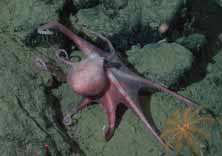
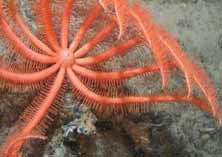
Benthoctopus sp. and crinoid, Davidson Seamount,
Brisingid sea star, Hatton Bank.
2 422 m. (NOAA/MBARI)
(DTI SEA Programme, c/o Bhavani Narayanaswamy)
al., 2001; Smith, 2001; Clark and O'Driscoll, 2003).
2004). Most of this is taken from shelf and slope areas of the
Importantly, recovery of cold-water coral ecosystems from
Northwest Atlantic, but outside this region fishing effort
fishing impacts is likely to be extremely slow or even
tends to focus on deep-water species from seamounts. Over
impossible, because corals are long lived and grow extremely
77 fish species have been commercially harvested from
slowly (in the order of a few millimetres per year). Individual
seamounts (Rogers, 1994), including major fisheries for
octocorals can reach ages of several hundred (Andrews et al.,
orange roughy (Hoplostethus atlanticus), pelagic armour-
2002; Risk et al., 2002; Sherwood et al., 2006) or even more
head (Pseudopentaceros spp.) and alfonsino (Beryx
than a thousand years old (Druffel et al., 1995), and larger
splendens). Most of these fisheries have not been managed
reef complexes, formed by stony corals, may be more 8 000
in a sustainable manner, with many examples of `boom and
years old (Freiwald et al., 2004; Roberts et al., 2006). Corals
bust' fisheries, which rapidly developed and then declined
also have specific habitat requirements and may be sensitive
sharply within a decade (Koslow et al., 2000; Clark, 2001;
to alteration of the character of the seabed by fishing gear,
Lack et al, 2003). In most cases there is insufficient infor-
or to increased sedimentation resulting from trawling
mation on the target fish species, let alone the seamount
(Commonwealth of Australia, 2002; ICES, 2006). Such effects
ecosystem, to provide an adequate basis for good manage-
may prevent recovery of cold-water coral reefs or octocoral
ment (Lack et al., 2003). Furthermore, the life-history
gardens permanently (Rogers, 1999; ICES, 2006).
characteristics of many exploited deep-sea fish are unlike
There has been a dramatic expansion of fishing over the
those of shallow-water species, rendering some fisheries
last 50 years (Royal Commission on Environmental
management practices inappropriate (Lack et al., 2003).
Pollution, 2004) and the exploitation of deep-sea species of
In the light of the evidence found in numerous in situ
fish in the last 25 years (Lack et al., 2003). The expansion of
observations, the scientific community raised concern about
deep-sea fisheries has been driven by the depletion of
the damage that trawling can have on the bottom-dwelling
shallow fisheries based on the continental shelf, the
(benthic) communities in deep-waters and on seamounts
establishment of the 200 nautical mile economic exclusion
(MCBI, 2003 et seq.). Taking into account that most of the
zones by states under the UN Convention on Law of the Sea
potential areas affected by the expanding deep-sea fishing
(UNCLOS), overcapacity of fishing fleets, technological
activities are in areas beyond national jurisdiction, the United
advances in fishing including developments in navigation,
Nations General Assembly (UNGA) addressed the issue in its
acoustics and capture gear and in the power of vessels and
58th (2004), 59th (2005) and 60th sessions (2006), both in its
the availability of subsidies for building new fishing vessels
discussions on `Oceans and the Law of the Sea' and
equipped for deep-sea fishing (Lack et al., 2003; Royal
`Sustainable Fisheries'. Seamounts and cold-water corals/
Commission on Environmental Pollution, 2004). It is
reefs were specifically mentioned in the following
estimated that 40 per cent of the world's trawling grounds
resolutions:
are now located in waters deeper than the continental shelf
UN resolutions on oceans and the law of the sea (UN
(Roberts, 2002). The catch of commercial fish species
General Assembly, 2003, 2004a, 2005a, 2006)
beyond areas of national jurisdiction by bottom trawling has
Reaffirms the need for States and competent
been estimated at about 200 000 tonnes annually (Gianni,
international organizations to urgently consider ways
16
Introduction
to integrate and improve, based on the best available
paragraph 52 of Resolution 58/240). Following the
scientific information and in accordance with the
examination of this report in 2004, the UNGA decided to
Convention [UN Convention on Oceans and the Law of
establish an Ad Hoc Open-ended Informal Working Group to
the Sea, 1982] and related agreements and
study issues relating to the conservation and sustainable
instruments, the management of risks to the marine
use of marine biological diversity beyond areas of national
biodiversity of seamounts, cold-water corals,
jurisdiction (cf. Paragraph 73 in Resolution 59/24). The
hydrothermal vents and certain other underwater
outcome of their first meeting (New York, 13-17 February
features; (Resolution 60/30, Paragraph 73, following
2006) will be presented to the 61st session of the UNGA.
similar text in the previous resolutions 59/24, 58-240
Furthermore, the UNGA requested in 2005 the Secretary
and 57-141)
General, in cooperation with the FAO, to include in his next
Calls upon States and international organizations to
report concerning fisheries a section on the actions taken by
urgently take action to address, in accordance with
States and regional fisheries management organizations
international law, destructive practices that have
and arrangements to give effect to Paragraphs 66 to 69 of
adverse impacts on marine biodiversity and
Resolution 59/25, in order to facilitate discussion of the
ecosystems, including seamounts, hydrothermal
matters covered in those paragraphs. The UNGA also
vents and cold-water corals; (Resolutions 60/30,
agreed to review, within two years, progress on action taken
Paragraph 77 and 59/24)
in response to the requests made in these paragraphs, with
UN resolutions on sustainable fisheries (UN General
a view to further recommendations, where necessary, in
Assembly, 2004b, 2005b)
areas where arrangements are inadequate.
Requests the Secretary-General, in close cooperation
From the above, it is apparent that the UNGA
with the Food and Agriculture Organization of the
discussions on:
United Nations (FAO), and in consultation with States,
(i). conservation and sustainable management of
regional and subregional fisheries management
vulnerable marine biodiversity and ecosystems
organizations and arrangements and other relevant
(including seamount communities) in areas beyond
organizations, in his next report concerning fisheries
national jurisdiction, and
to include a section outlining current risks to the
(ii). the role of regional fisheries management organizations
marine biodiversity of vulnerable marine ecosystems
or arrangements in regulating bottom fisheries and the
including, but not limited to, seamounts, coral reefs,
impacts of fishing on vulnerable marine ecosystems
including cold-water reefs and certain other sensitive
are set to continue.
underwater features related to fishing activities, as
well as detailing any conservation and management
It is hoped that the scientific findings presented in this report
measures in place at the global, regional, subregional
by members of the Census of Marine Life programme
or national levels addressing these issues; (Resolution
CenSeam will help and guide policy and decision makers to
58/14, Paragraph 46).
make progress on these issues.
Calls upon States, either by themselves or through
regional fisheries management organizations or
STUDY OBJECTIVES
arrangements, where these are competent to do so, to
The study presented here aimed to:
take action urgently, and consider on a case-by-case
1. compile and/or summarize data for the distribution of
basis and on a scientific basis, including the
large seamounts, deep-sea corals on seamounts and
application of the precautionary approach, the interim
deep-water seamount fisheries;
prohibition of destructive fishing practices, including
2. predict the global occurrence of environmental
bottom trawling that has adverse impacts on
conditions suitable for stony corals from existing records
vulnerable marine ecosystems, including seamounts,
on seamounts and identify the seamounts on which they
hydrothermal vents and cold-water corals located
are most likely to occur globally;
beyond national jurisdiction, until such time as
3. compare the predicted distribution of stony corals on
appropriate conservation and management measures
seamounts with that of deep-water fishing on
have been adopted in accordance with international
seamounts worldwide;
law; (Resolution 59/25, Paragraph 66)
4. qualitatively assess the vulnerability of communities
living on seamounts to putative impacts by deep-water
In 2003, the UNGA requested the Secretary General to
fishing activities; and
prepare a report on vulnerable marine ecosystems and
5. highlight critical information gaps in the development of
biodiversity in areas beyond national jurisdiction (cf.
risk assessments to seamount biota globally.
17
Seamounts, deep-sea corals and fisheries
2. Seamount characteristics
and distribution
SMALL AND LARGE SEAMOUNTS
Seamounts are masses of rock and give rise to anomalies
Seamounts are submarine elevations with a limited in the usual straight-down force of gravity. These minute
extent across the summit and have a variety of
variations in the Earth's gravitational pull cause seawater to
shapes, but are generally conical with a circular,
be attracted to seamounts. This means that the sea surface
elliptical or more elongate base (Rogers, 1994). The slopes
is pitched up over a seamount with a shape that reflects
of seamounts can be extremely steep, with some showing
the underlying topographic feature (Wessel, 1997 and 2001).
gradients of up to 60º (e.g. Sagalevitch et al., 1992), although,
Satellite sensors can detect the anomalies in the Earth's
in general, slopes are less steep (generally less than 20º in
gravitational field (e.g. Seasat gravity sensor) or the small
the New Zealand region; Rowden et al., 2005). Younger
differences in sea-surface height (e.g. Geosat/ERS1 alti-
seamounts tend to be more conical and regular in shape,
meter) (Stone et al., 2004). Efforts to estimate the number
whereas older seamounts that have been subject to
of seamounts worldwide using satellite altimetry and
scouring and erosion by currents are less regular.
gravitational gradient data have indicated that there are
Geophysical definitions distinguish between (i) hills, with
between 5 000 and 16 000 features with an elevation greater
summits lower than 500 m; (ii) knolls, with summits
than 1 000 m (reviewed in Stone et al., 2004). However, the
between 500 m and 1 000 m; and (iii) seamounts, with
available satellite datasets are limited in terms of resolution
summits over 1 000 m. However, the size component of
because of defence policy, and there are limitations in the
seamount definitions has become more flexible with the
methods employed by researchers. This has led to analyses
growing appreciation of the abundance of elevated sea floor
that suggest (after extrapolation) that globally there may be
features of similar morphology but with smaller vertical
as many as 100 000 seamounts with an elevation of more
extent (greater than 50 m; Smith and Cann, 1990); the
than 1 000 m (Wessel, 2001). The most recent (non-extra-
observation that such features may represent similar habitat
polative) estimate of the global number of large seamounts is
and faunistic characteristics as their larger counterparts
14 287 (Kitchingman and Lai, 2004). This number originated
(e.g. Epp and Smoot, 1989; Rogers, 1994; Rowden et al.,
from the Sea Around Us Project (SAUP), which used depth
2005); and because small features are targeted by
difference algorithms applied to a digital global elevation
commercial fisheries (greater than 100 m, Brodie and Clark,
2004). Differences in the methodologies available to
Fig. 2.1 Distribution of predicted large seamounts
determine the number and distribution of seamounts have
by latitude.
led to a distinction between `small' and `large' seamounts.
Source: Kitchingman and Lai (2004)
Generally, large seamounts are those with a vertical height
2000
of greater than 1 000 m (e.g. Wessel, 2001) or 1 500 m (ICES,
2006). For global and regional studies of seamounts and
aspects of the present report, methodological and practical
constraints mean that examinations have been restricted to
1500
large seamounts only (e.g. ICES, 2006).
HOW MANY LARGE SEAMOUNTS ARE THERE?
The deep oceans are the largest ecosystem on Earth. This
1000
vast area of seabed has been only partially mapped; therefore
it is not possible to give a figure for the number of (both small
and large) seamounts globally. Attempts at estimating the
500
Number of seamounts
numbers of seamounts globally have been made by
extrapolation of the known numbers of seamounts in a
geographic region (e.g. Smith and Jordan, 1988 for the Pacific
Ocean). Recently, satellite sensors have been used
0
-90
-70
-50
-30
-10
10
30
50
70
90
to estimate the position and size of large seamounts.
Latitude (degrees)
18
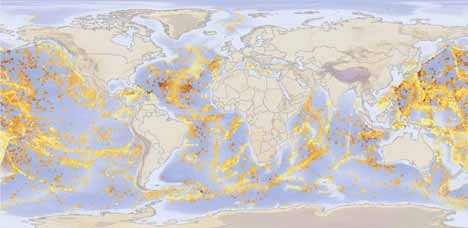
Seamount characteristics and distribution
Fig. 2.2 Global distribution and summit depths of
lapping seamounts (14 287) found by using both these
predicted large seamounts.
methodologies were used as the SAUP seamount dataset.
Source: Kitchingman and Lai (2004)
Characteristics of the second method could mean that
some `real' seamounts that occur on ridges could be
Key
eliminated from the dataset, as well as possibly including
Summit depth (m)
Summit depth (m)
some features such as semi-circular banks.
0-500
4 000-4 500
The SAUP data not only provide information on the
500-1 000
4 500-5 000
location and elevation of predicted seamounts but also,
1 000-1 500
5 000-5 500
usefully, on the depth of the seamount summit.
1 500-2 000
5 500-6 000
2 000-2 500
6 000-6 500
WHERE ARE THE LARGE SEAMOUNTS LOCATED?
2 500-3 000
6 500-7 000
The distribution by latitude of the large seamounts
3 000-3 500
7 000-7 500
estimated from an analysis of global digital elevation data
3 500-4 000
generated by SAUP (Kitchingman and Lai, 2004) is shown in
Figure 2.1. The location of some seamounts will be in error
map and a more generalized definition to detect seamounts
because the combining of the results from the two methods
that fit into ecological and management contexts.
used by Kitchinman and Lai (2004) will reduce the location of
Kitchingman and Lai (2004) used the National Oceanic
seamounts with a double peak to a single location at a mid-
and Atmospheric Administration's (NOAA) ETOPO2 dataset
point between the two, maintaining the shallower depth
as the source for all analyses to estimate the global
value of the pair. The error in real-world location is enhanced
number and location of large seamounts. The dataset was
by a misregistration of the underlying ETOPO2 bathymetry
supplied at a 2-minute cell resolution (13.7 km2 at the
dataset. However, ground truthing performed on a dataset of
equator), which allowed for a generalized global analysis,
known seamounts produced from a combination of data
but certainly missed many seamounts. Thus the estimated
from the US Department of Defense Gazetteer of Undersea
number is an underestimate of the global number of large
Features (1989) and SeamountsOnline revealed that
seamounts. Two methods were used to identify possible
approximately 60 per cent of the known seamounts were
seamounts. The first method involves isolating peaks that
within 30 arc minutes of predicted seamounts.
have significant rise from the ocean floor. The second
Numbers of identified seamounts peak between 30ºS
method isolates peaks with a circular or elliptical base
and 30ºN, with a rapid decline above 50ºN and below 60ºS.
in an effort to eliminate peaks found along ridges. The
Available surface (ocean) area by latitude probably drives
two methods produced different numbers of predicted
this pattern. Figure 2.2 shows the global distribution and
seamounts (30 314 and 15 962, respectively). The over-
summit depths of the large seamounts identified by
19
Seamounts, deep-sea corals and fisheries
Fig. 2.3 Summit depths of predicted large seamounts and
Kitchingman and Lai (2004), many of which are located along
current depth range of bottom trawling on seamounts.
plate boundaries. Table 2.1 shows the distribution of large
Source: Kitchingman and Lai (2004)
seamounts in the United Nation's Food and Agriculture
Organization (FAO) major fishing areas, and identifies the
0
number of large seamounts that fall outside the EEZs of
Depth range of bottom trawling
countries, i.e. are in areas beyond national jurisdiction
1
on seamounts
250m-1500m
(Kitchingham et al., in press). Although FAO areas do not
exactly fit oceanic boundaries, their use allows broad and
2
es)
more specific comparison with other studies and allows an
3
appreciation of seamounts in a global and regional fishery
management context. The majority of large seamounts
4
occur in the Pacific Ocean area (63 per cent), with 19 per
cent and 12 per cent of seamounts occurring in the Atlantic
5
and Indian Ocean areas, respectively. A small overall
proportion of seamounts are distributed between the
Summit depth ('000 metr 6
Southern Ocean (6 per cent), Mediterranean/Black Seas and
Arctic Ocean (both less than 1 per cent) areas. The
7
occurrence of large seamounts inside and outside EEZs
0
500
1000
1500
2000
2500
shows that just over half (52 per cent) of the world's large
Number of seamounts
Table 2.1: Number of predicted large seamounts in major FAO fishing areas and in areas beyond national
jurisdiction
Ocean Areas
FAO area
Number of predicted
Number of predicted large
large seamounts
seamounts in areas beyond
national jurisdiction
Pacific
All
8 955
3 540
Eastern Central
77
2 735
967
Northeast
67
265
176
Northwest
61
1 350
630
Southeast
87
939
700
Southwest
81
996
643
Western Central
71
2 670
424
Atlantic
All
2 704
1 959
Eastern Central
34
536
433
Northeast
27
325
211
Northwest
21
83
77
Southeast
47
639
512
Southwest
41
452
301
Western Central
31
669
425
Indian
All
1 658
1 082
Eastern
57
588
426
Western
51
1 070
656
Mediterranean and Black Seas
37
59
59
Southern Ocean
All
898
713
Atlantic, Antarctic
48
498
371
Indian Ocean, Antarctic
58
212
154
Pacific, Antarctic
88
188
188
Arctic
18
13
13
Totals
-
14 287
7 366
Source: Kitchingham et al. (in press)
20
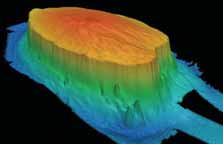
Seamount characteristics and distribution
seamounts are located in marine areas beyond national
WHAT ENVIRONMENTAL CONDITIONS INFLUENCE LIFE
jurisdiction. Figure 2.3 shows that there are many large
ON SEAMOUNTS?
seamounts with summits at less than 500 m depth, and
The geographical location, depth and elevation of the
another peak between 1 500 m and 3 000 m. Thus, most
seamount determine the interactions of the seamount with
large seamounts have summits shallower than 3 000 m
the water masses and currents that impinge on it. Water
water depth. The current depth range of bottom trawling
masses have different environmental characteristics such
for commercially valuable fish (250-1 500 m) encompasses
as flow velocity, temperature, salinity, nutrient availability
about 18 per cent of the summits of large seamounts.
and pH. The environmental characteristics of the waters that
overly seamounts can influence the spatial and temporal
THE ORIGIN AND PHYSICAL ENVIRONMENT OF
patterns of supply of organic material to a seamount benthic
SEAMOUNTS
(seabed) community in terms of phytoplankton, zooplankton
Seamounts are generally volcanic in origin and may be
and organic detritus (dead organisms, faecal pellets, and
associated with the continental margin or located on the
so on). Pelagic communities and supply of larvae will also
abyssal plains, either as isolated features, clusters or
largely reflect the dominant oceanographic influences on a
chains. Most commonly, however, seamounts occur along
seamount.
the mid-ocean ridges. These are areas where new oceanic
Within the immediate vicinity of a seamount, complex
crust is formed by lava welling up from magma chambers
current-topography interactions can take place at all scales.
below the sea floor, generating enormous ranges of
At the largest scale, seamount chains can divert major
seamounts. As the oceanic crust is formed and moves away
currents (e.g. the Emperor Seamount chain deflects the
from the mid-ocean ridge, the associated seamounts move
Kuroshio and subarctic currents; Roden et al., 1982; Roden
with it, becoming older and subsiding, causing decreased
and Taft, 1985; Vastano et al., 1985). At smaller scales, the
elevation. Seamounts are also associated with areas where
interactions of seamounts with the surrounding currents are
oceanic plates meet and one plate is subducted under the
complex and difficult to measure, although in some cases
other. The enormous pressures associated with this
such responses can be modelled. For example, models
process melt the subducted plate, resulting in an arc of
predict the formation of a rotating body of water retained
volcanic activity giving rise to islands and seamounts lying
over the summit of a seamount (known as a `Taylor' column).
adjacent to an oceanic trench. Examples include the
Observations have demonstrated the existence of such
Scotia Arc in the Southern Ocean and the islands of
columns above many seamounts (Meincke, 1971; Vastano
Tonga and associated seamounts in the southwestern
and Warren, 1976; Cheney et al., 1980; Genin et al., 1989;
Pacific. Seamounts are also generated by ocean hotspots,
Roden, 1991; Dower et al., 1992), although the stratification
areas where plumes of magma well up from the Earth's
of water layers above a seamount often reduces the column
mantle and form volcanoes on the sea floor. In geological
to a cap. Seamounts may also interact with tides, amplifying
time scales, as oceanic plate passes over the hotspot, a
them and accelerating currents to greater than 40 cm s-1
chain of seamounts and islands is formed. Examples
(Chapman, 1989; Genin et al., 1989; Noble and Mullineaux,
include the Hawaiian Islands and Emperor Seamount
1989). The seamounts themselves may also generate
Chain in the North Pacific, and the Louisville Seamount
internal tides (Noble et al., 1988) and generate or interact
Chain in the southwestern Pacific. Seamounts on or close
to the continental margin can have different origins, arising
Side scan sonar image of Anton Dohrn Seamount,
from rifting margin volcanoes or rifted continental blocks.
Northeast Atlantic. (DTI SEA Programme, c/o Colin Jacobs)
As a result of the volcanic origin of seamounts they may
be associated with high temperature (e.g. Marianas
Seamounts or Brothers Seamount, Kermadec Ridge) or
low temperature (e.g. Loihi Seamount, Hawaiian Ridge)
hydrothermal venting, though the majority of seamounts
are no longer geologically active and are not venting. The
bases of seamounts associated with continental margins
tend to be shallower and have an overall elevation lower
than those located away from continents (e.g. Rowden et al.,
2005). In some cases, for example the Rosemary Bank in
the northeastern Atlantic, such features may be termed
banks, as definitions of the two types of features can overlap
(ICES, 2006).
21
Seamounts, deep-sea corals and fisheries
with internal waves (e.g. Bell, 1975; Wunsch and Webb,
seamount and resuspend organic material. Many
1979; Eriksen, 1982a, 1982b, 1985, 1991; Kaneko et al., 1986;
seamounts also have distinct `moats' around the base where
Brink, 1989; Genin et al., 1989). Such phenomena can lead to
currents scour out sediments lying around the seamount
the generation of periodic, small-scale, fast, short-duration
(e.g. Anton Dohrn Seamount, northeastern Atlantic). Some
bottom currents.
seamounts, known as guyots, are flat-topped and often
The depth of the seamount summit below the ocean
covered in sediment as a result of wave-erosion when they
surface is one of the most important physical factors in
were exposed as islands. However, seamounts are notable
determining the abundance and diversity of benthic
for the occurrence of hard substrata and complex small-
communities on seamounts and has been used to classify
scale topography, which show a marked contrast to the
them (e.g. ICES, 2006). Seamounts with a depth of less than
surrounding deep seabed which tends to comprise fine
250 m reach into the euphotic zone, where enough light
sediments (hard substrata can occur elsewhere on banks
penetrates to allow photosynthesis, and therefore
and the slopes of continental shelves). The occurrence of
communities that include algae can develop. Seamounts
terraces, canyons, pinnacles, crevices, craters, rocks and
with a summit depth down to 1 000 m are likely to interact
cobbles can exert a strong influence on the distribution of
with layers of zooplankton that undergo a daily vertical
animals and plants on seamounts (reviewed in Rogers,
migration in the water column (Wilson and Boehlert, 2004).
1994). Topographic relief controls local current flow regimes,
These migrating plankton form a relatively thin layer of
and filter-feeding organisms such as corals are frequently
organisms detectable by echo sounders (deep scattering
concentrated in areas of strongest currents near ridges and
layer, or DSL). Several observations indicate that the
pinnacles (Genin et al., 1986).
topography of seamounts can trap descending layers of
The following chapter will examine in greater detail the
zooplankton, which provide a source of food for seamount-
biological communities that seamounts can support, and
associated species (Rogers, 1994; Seki and Somerton, 1994;
ask how well their diversity can be assessed on a global
Haury et al., 2000). Whether or not this takes place depends
scale.
on the depth of the seamount summit in relation to the
vertical depth range over which the plankton migrate. It
also depends on the intensity of horizontal currents that
advect the DSL over the seamount at night. Studies of the
fish populations of the Great Meteor Seamount have shown
that they prey on the DSL and are concentrated around
the margins of the summit to maximize chances of
encountering zooplankton (Fock et al., 2002). Such
mechanisms may also be important in the nutrition of
abundant benthic communities on seamounts. For example,
over the Nasca and Sala Y Gómez Seamounts in the
southeastern Pacific, the lower depth of distribution of the
lobster Projasus bahamondei, a dominant megabenthic
predator, coincided with the deepest depth of migration
of the DSL (Parin et al., 1997). Other mechanisms of
concentration of food may also operate around seamounts
associated with eddies or up- or down-welling currents and
the relative movement behaviour of zooplankton (Genin,
2004). It is important to note that currently there is little
understanding of the ecological links between the pelagic
ecosystem, especially of larger predators such as fish, and
communities of benthic organisms living on seamounts.
Thus it is unknown how the removal of large quantities of
fish biomass, by fisheries, from the vicinity of seamounts
would affect the benthic community (Commonwealth of
Australia, 2002; Lack et al., 2003).
The distribution of sediments and benthic communities
on seamounts is a function of the current velocity near the
seabed. Such currents may displace material off the
22
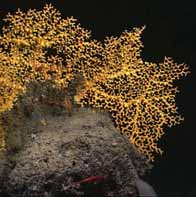
Deep-sea corals and seamount biodiversity
3. Deep-sea corals and
seamount biodiversity
THE DIVERSITY OF LIFE ON SEAMOUNTS
The occurrence of hard substrata on seamounts means AA
that, seamount communities can be dominated by
sessile organisms that are permanently attached to
the seabed not possible on the soft sediments of most of
the surrounding deep-sea floor. On seamounts with very
eam/IFE/URI/NO
shallow summits that penetrate the euphotic zone, such as
eT
the Vema Seamount in the southeastern Atlantic Ocean or
the Gorringe Bank in the northeastern Atlantic Ocean, plant
life can occur with kelp and encrusting calcareous algae
ones Scienc
dominating hard substrates (Simpson and Heydorn, 1965;
Oceana 2006). The deepest records of living marine
epping St
plants are of encrusting coralline algae from seamounts in
the Caribbean living at 268 m depth (Littler et al., 1985). In
the tropics, reef-forming corals such as Acropora spp.,
Pocillopora spp., Porites spp. and Montastrea spp. can
Deep Atlantic St
occur on shallow seamounts which are often drowned atolls,
such as the Raita Bank on the Hawaiian Ridge. Other animal
groups that occur commonly on hard substrata on shallow
seamounts include sponges, hydroids, azooxanthellate
Box 1: What is a coral?
corals, molluscs, echinoderms and ascidians (sea squirts)
Corals are found within the phylum Cnidaria
(Simpson and Heydorn, 1965; Oceana, 2006).
(coming from the Greek word cnidos, which means
On seamounts with deeper summits, the dominant
stinging nettle). Four main classes of Cnidaria are
megafauna (i.e., generally those animals that can be easily
known: the Anthozoa (which contains the true
seen in photographs or video) are the attached, sessile
corals, anemones and sea pens); Hydrozoa (the
organisms that feed on particles of food suspended in the
most diverse class, comprising hydroids, siphono-
water. The predominant suspension feeders are from the
phores and many medusae); Cubozoa (the box
phylum Cnidaria and include sea anemones, sea pens,
jellies); and Scyphozoa (true jellyfish).
hydroids, stony corals, gorgonian corals and black corals
Corals can exist as individuals or in colonies, and
(reviewed in Rogers, 1994; see also Koslow and Gowlett-
stony corals may secrete external skeletons made
Holmes, 1998; Koslow et al., 2001; Rowden et al., 2002).
of aragonite, a form of calcium carbonate. Corals
Other common suspension feeders include barnacles,
can be found in the photic zone of the ocean, where
bryozoans, polychaete worms, molluscs, sponges, ascid-
sunlight penetrates (with symbiotic photosynthetic
ians, basket stars, brittle stars and crinoids. There is also an
zooxanthellae, a type of alga), as well as in the deep
associated mobile benthic fauna that includes echinoderms
sea the so-called `cold-water corals'.
(starfish, sea urchins and sea cucumbers) and crustaceans
Cold-water coral ecosystems are populated by
such as crabs and lobsters, some of which have commercial
members from two classes of the Cnidaria. The
value (reviewed in Rogers, 1994).
main corals that will be discussed in this report
Deep-sea or cold-water corals (Box 1) are a group of
are: scleractinians (stony corals), octocorals (which
organisms that have drawn a great deal of public attention
include the gorgonians), antipatharians (black
recently. Whilst their existence has been known since the
corals) and zooanthideans (anemone-like hexa-
18th century, it was only with the advent of modern
corals), which are all found within the Anthozoa,
technologies which allowed fisheries, oil exploration and
and the stylasterids (hydrocorals), which are found
scientific observations to penetrate into deeper areas that
within the Hydrozoa.
the scale and abundance of cold-water coral ecosystems
23
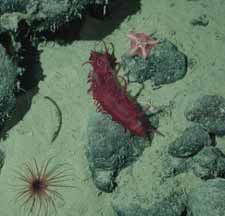
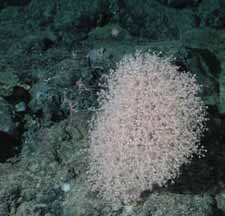
Seamounts, deep-sea corals and fisheries
Chrysogorgia sp., Davidson Seamount.
Holothurian, cerianthid anemone and Hymenaster
(NOAA/MBARI)
koehleri, Davidson Seamount, 2 854 m. (NOAA/MBARI)
were revealed. Deep-sea coral reefs are common features of
may burrow into sediments, or live amongst the sediment's
continental shelves, slopes, banks, ridges and seamounts
particles or on its surface. The animals found in the
(Rogers, 1999; Friewald et al., 2004; Roberts et al., 2006).
sediment, known as the infauna, are classed according to
Today, as knowledge of their biology and ecology expands, it
size. The macrofauna (animals typically 500-250 m in size)
is becoming clear that deep-sea corals are particularly
are dominated by polychaetes in the few studies on
vulnerable to physical disturbance such as bottom trawling
seamount infauna. These include many families common in
(Koslow et al., 2001; Clark and O'Driscoll, 2003; Freiwald et
other deep-sea habitats such as Paraonidae, Cirratulidae,
al., 2004; Rogers, 2004). Furthermore, because deep-sea
Sabellidae, Syllidae and Ampharetidae (Levin and Thomas,
corals have slow growth rates and poor post-disturbance
1989). Other common groups include crustaceans,
recovery potential (Roberts et al., 2006), major research
molluscs, ribbon worms, peanut worms and oligochaetes.
efforts on their conservation are emerging globally (e.g.
The smaller animals that live amongst the sand grains,
Weaver et al., 2004). However, in addition to the direct
known as the meiofauna (250-48 m in size) include
effects of disturbance on deep-sea corals, it is becoming
nematode worms, tiny crustaceans and some more unusual
increasingly evident that they are an integral component of
groups of marine invertebrates such as loriciferans and
the overall species assemblage, and that the disturbance of
kinorhynchs. Observations indicate that there can be an
deep-sea coral will have an equally destructive impact on
inverse relationship between diversity of the infaunal
the wider biological community.
community and current strength. This is because vigorous
Whilst hard substrata are more common on seamounts
currents lead to more coarse sediments, with a lower
than elsewhere in the deep sea, sediments are common
content of bacteria and organic food particles and higher
towards the base of seamounts or on terraces or summits
incidence of abrasion resulting from turbation (Levin and
of flat-topped seamounts (so-called guyots). These
Thomas, 1989). The summit of Great Meteor, in the
sediments originate from different sources, and their
Northeast Atlantic, is covered in coarse, calcareous
distribution and particle size depend on the local current
sediments that are home to a highly unusual community of
regime and biological activity. Sites characterized by low
tiny meiofaunal animals. These include new species of
exposure to currents exhibit fine, poorly sorted sediments,
Loricifera (Gad, 2004a) epsilonematid nematode worms
whilst those that are exposed to stronger currents tend to be
(Gad 2004b) and harpacticoid copepods (George and
coarser and may also be associated with bedforms such as
Schminke, 2002). The species, genera and families are not
ripples or sand waves (Levin and Thomas, 1989). There are
typical for deep-sea sediments and are more characteristic
only a few studies on the biology of seamount sediments, but
of littoral or shallow subtidal sediments. Larger animals
it is known that they host a wide diversity of organisms that
living on the surface of sediments include sea pens,
24
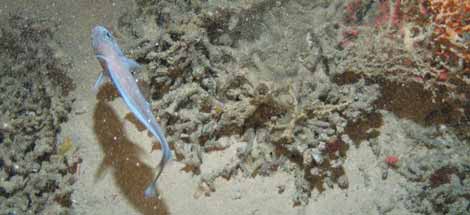
Deep-sea corals and seamount biodiversity
sponges, stalked-barnacles, gorgonians, cerianthid sea
Forges et al., 2000). The reasons for this highly diverse
anemones, crinoids, brittle stars, sea urchins and sea
association are not fully understood. However, the added
cucumbers. Xenophyophores, giant single-celled organisms
habitat complexity to the environment is thought to offer
that agglutinate different types of particles (e.g.
refugia for numerous invertebrates and fish within the living
foraminiferan shells, sand, volcanic glass) to create
and dead coral reef framework, coral rubble and sediments,
elaborate dwellings of a variety of shapes, are particularly
while at the same time providing hard substrates for
common on seamount sediments (Rogers, 1994). Many of
colonization by other sessile or encrusting organisms such
these organisms are suspension feeders and tend to favour
anemones, bryozoans and other corals (Freiwald et al.,
areas exposed to strong currents.
2002). In this sense, some cold-water corals may be
regarded as `ecosystem engineers' that is, they create,
THE RELATIONSHIP BETWEEN CORALS AND OTHER LIFE
modify and maintain habitat for other organisms (Jones et
The most spectacular benthic communities on seamounts
al., 1994). Many fish species, including several of com-
are those associated with biological habitats or bioherms,
mercial significance, show spatial co-occurrence with deep-
such as cold-water coral reefs (Koslow et al., 2001). It has
water corals (Auster et al., 2005; Stone, 2006), and fish
been suggested that cold-water coral reefs are `the most
catches have been found to be higher in and around deep-
three-dimensionally complex habitats in the deep ocean'
water coral reefs (Husebø et al., 2002).
(Roberts et al., 2006). As a result, there may be an associated,
The reefs formed by some stony corals (scleractinians)
complex community of organisms that is dynamically linked
are not the only three-dimensional structures built by
to either the habitat structure provided by coral, or the living
corals. Large branching and treelike corals such as
coral (Koslow et al., 2001; Freiwald et al., 2002). As such,
antipatharians (black corals) and octocorals (including the
cold-water coral reefs can play a similar ecological role to
gorgonians) can also provide an extension of the benthic
that of shallow-water coral reef systems (Rogers, 1999).
habitat through forming so-called coral beds or gardens
The diversity of animals associated with cold-water coral
(Stone, 2006). The branches of these corals are raised off the
reefs is extremely high and comparable to, or higher than,
seabed into the overlying water (emergent epifauna),
their tropical shallow-water counterparts (Rogers, 1999;
providing rigid platforms for other sedentary and sessile
Buhl-Mortensen and Mortensen, 2005). For example,
species, thereby allowing them better access to food brought
greater than 1 300 species have been reported to date as
by prevailing currents (Stone, 2006). Such non-reef forming
being closely associated with cold-water coral reefs in the
corals, along with other organisms such as sponges,
northeastern Atlantic Ocean (Roberts et al., 2006). A varying
therefore have an important role in providing habitat for
proportion of associated species may be new to science,
other species. In the Aleutian Islands, 97 per cent of juvenile
depending on geographic area investigated (e.g. Richer de
rockfish and 96 per cent of juvenile golden king crabs have
Lepidion sp., swimming amongst coral framework, Hatton Bank. (DTI SEA Programme, c/o Bhavani Narayanaswamy)
25
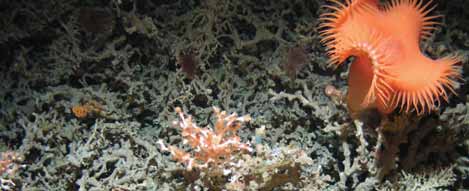
Seamounts, deep-sea corals and fisheries
been observed as associated with emergent epifauna such
114 were characterized as mutually dependent, of
as octocorals and sponges (Stone, 2006). Such observations
which 36 were exclusively dependent to cnidarians (Buhl-
do not necessarily indicate dependence by fish on emergent
Mortensen and Mortensen, 2004). Such commensal
epifauna. Recent studies in the Hawaiian archipelago on
relationships may come in a variety of forms: some
associations between black corals (Antipathes spp.) and fish
animals are obligate inhabitants on or within the
in shallow water have indicated that many fish may routinely
coral skeleton, such as the polychaete Gorgoniapolynoe
pass through the branches of coral colonies, treating it as
caeciliae
on the gorgonian Candidella
imbricata
general habitat. A few species regularly used the coral for
(Eckelbarger et al., 2005); the amphipod Pleusymtes
protection from perceived threats, and only one species of
comitari associated with the gorgonian Acanthogorgia sp.
fish was restricted to the branches of coral trees (Boland
(Myers and Hall-Spencer, 2004); and the polychaete
and Parrish, 2005). The fish communities of deeper slopes in
Eunice norvegicus associations with the scleractinians
Hawaii also use octocorals and zoanthids as shelter
Lophelia pertusa and Madrepora oculata (Rogers, 1999;
interchangeably with non-biotic habitat (Parrish and Baco, in
Mortensen, 2001; Roberts, 2005). E. norvegicus lives in
press). In some cases observations suggest that fish and
tubes that become calcified by Lophelia pertusa or
corals occur together because they may have similar habitat
Madrepora oculata as they grow, conferring protection to
requirements on seamounts and banks (Mundy and Parrish,
the worm which also acts as a kleptoparasite on the corals
2004; Parrish and Baco, in press). In a similar way, despite
(Mortensen, 2001; Roberts, 2005). The worm tubes aggre-
concentrations of orange roughy on the Tasmanian
gate coral colonies, strengthening the coral framework,
Seamounts, juveniles or young fish of this species have not
and the worms defend the coral vigorously from predators.
been found associated with the corals; and though the
Numerous species of ophiuroid brittle stars are obligate
adults occur in the same physical environment as the
inhabitants of tree-forming corals such as the anti-
epibenthic fauna, no interaction has been observed between
patharia (Stewart, 1998 and references therein; Buhl-
them (Smith, 2001). The association of fish and corals may
Mortensen and Mortensen, 2004), which in exchange
attract large predators. For example, the endangered
`clean' corals of the build-up of detrital material that could
Hawaiian monk seal (Monachus schauinslandi) forages
clog their polyps. Such coral associates may be regarded
preferentially for fish amongst beds of deep-sea octocorals
as important structural species in that they may be
and antipatharians (Parrish et al., 2002).
important for the viability of the key structural species in
In addition to the general coexistence of coral and non-
reef and coral garden habitats (ICES, 2006). Other types of
coral species, some animals have formed strong
relationship also exist, for example epitoniid gastropods
relationships with their coral hosts. A recent review of
are specifically adapted to feed on coral polyps (B
direct dependencies on cold-water corals globally has
Marshall, personal communication, Museum of New
shown that of the 983 coral associated species studied,
Zealand Te Papa Tongarewa, Wellington, New Zealand).
Lophelia pertusa framework with rich associated invertebrate fauna, Hatton Bank.
(DTI SEA Programme, c/o Bhavani Narayanaswamy)
26
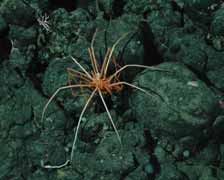
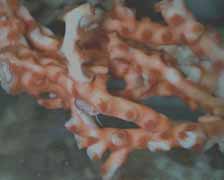
Deep-sea corals and seamount biodiversity
Pycnogonids found on slope and base of Davidson
Fragment of live stony coral Lophelia pertusa with
Seamount (1 570 m); also note the chiton.
polychaete worm Eunice norvegicus.
(NOAA/MBARI)
(Paul Tyler, School of Ocean & Earth Science, University of Southampton)
ATTEMPTING TO DETERMINE GLOBAL SEAMOUNT
were targeted (e.g. whilst hard substrates have generally
FAUNAL DIVERSITY
been sampled, some studies have targeted soft substrates),
It is important to understand the relationships between coral
and that the majority of seamounts have been under-
colonies and the fauna that is likely to be dependent on them
sampled, so that the number of species should be
for food and habitat. In this sense, better understanding of
considered an underestimate. Among the 47 seamounts,
the entire deep-sea coral community on seamounts will lead
322 coral species and 1 158 non-coral species are recorded
to a more comprehensive view of the potential impact on
from 5 541 observations. However, it must be noted that co-
them from human activities such as bottom trawling.
occurrence of corals and other benthic species does not
In order to examine the global benthic invertebrate
necessarily indicate an association. That is, coral and non-
community composition on seamounts where corals have
coral species examined here were not necessarily collected
also been found, a freely available online resource of
simultaneously, nor were they necessarily collected from the
seamount related biological data, SeamountsOnline (Stocks,
same area of the seamount. In addition, some scleractinian
2006) was used. SeamountsOnline is currently the largest
coral species that form frameworks may have an
database of its kind, spanning a wide taxonomic and
exceptional influence on non-coral species diversity, as the
geographic range of published accounts of animal and plant
reefs they form have a high associated biodiversity (e.g.
species occurrences on seamounts, as well as unpublished
Rogers, 1999; Freiwald et al., 2004; Roberts et al., 2006).
data provided voluntarily by seamount researchers. Data
Therefore, the main assumption for this analysis is that coral
from SeamountsOnline used here are the most up to date at
and non-coral species collected on the same seamount are
the time of the analysis (last accessed July 13, 2006).
possibly associated, in the sense that any impact on the
Our analysis was constrained to those seamounts for
seamount would potentially affect both coral and non-coral
which coral has been sampled. For this, we consider in total
communities.
the members of the Antipatharia, Octocorallia, Scleractinia,
Stylasterida and Zoanthidea to be the coral community with
GLOBAL DISTRIBUTION OF SAMPLING ON SEAMOUNTS
potential for providing substrate or unique habitat. At the
The geographic distribution of 47 seamounts examined
time of this analysis, the database held approximately 15 841
here, and the number of observations from which data were
observations of 3 701 species from 287 seamounts around
generated, is shown in Table 3.1. The map (Figure 3.1)
the globe. We use the term `observation' to mean a record of
shows that generally the North Atlantic and Southwest
the occurrence of a species on a seamount.
Pacific are the two main centres, with the highest numbers
Both corals and other members of the benthic
of observations of both corals and non-coral seamount
community have been sampled on 47 seamounts (including
species. Most seamounts examined fall within national
seamounts <1 000 m). However, it should be noted that
EEZs, although exceptions include seamounts in the eastern
there can be a sampling bias towards the communities that
Atlantic (Josephine, Great Meteor, Plato, Hyeres, Cruiser
27
Seamounts, deep-sea corals and fisheries
Table 3.1: Ocean area and FAO area of seamounts used for the biodiversity analysis, together with the predicted
number of large seamounts per FAO area (* indicates seamounts < 1 000 m elevation).
Seamount Name
Ocean Area
FAO Area
Estimated total no. of large
(Number refers to Figure 3.1)
seamounts per FAO area
1. Galicia Bank
2. Joao de Castro Bank
3. Josephine Seamount
Atlantic, Northeast
27
325
4. Le Danois Bank*
5. Lousy Bank
6. Ormonde Seamount
7. Atlantis Seamount
8. Cruiser Tablemount
9. Great Meteor Tablemount
Atlantic, Eastern Central
34
536
10. Hyeres Seamount
11. Plato Seamount
12. Seine Seamount
13. Andy's Seamount*
14. Dory Hill*
15. Hill 38*
Indian, Eastern
57
588
16. Macca's Seamount*
17. Main Pedra Seamount*
18. Sister I Seamount*
19. Kinmei and Koko Seamounts
Pacific, Northwest
61
1 350
20. Dickens Seamount
21. Giacomini Seamount
Pacific, Northeast
67
265
22. Pratt Seamount
23. Welker Seamount
24. Antigonia*
25. Argo Seamount
26. Jumeau East Seamount
27. Jumeau West Seamount*
Pacific, Western Central
71
2 670
28. Kaimon Maru Seamount
29. Nova Bank
30. Titov Seamount*
31. Bank 8
32. Bonanza Seamount*
33. Brooks Banks
34. Cross Seamount
35. Fieberling Tablemount
36. Horizon Tablemount
37. Ladd Seamount
Pacific, Eastern Central
77
2 735
38. Loihi Seamount
39. Middle Bank
40. Raita Bank
41. Salmon Bank
42. Twin Banks
43. Volcano 6
44. Britannia Guyot
45. Gascoyne Tablemount
Pacific, Southwest
81
996
46. Gifford Tablemount
47. Taupo Seamount
28
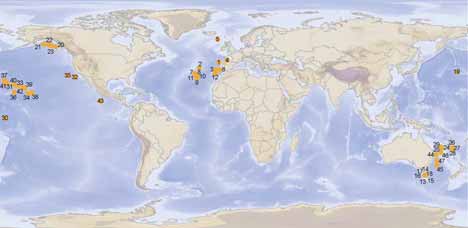
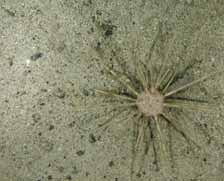
Deep-sea corals and seamount biodiversity
Figure 3.1: Locations of seamounts from where coral and non-coral species data were compiled for the biodiversity
analysis. The numbers refer to the seamounts listed in Table 3.1.
and Atlantis Seamounts), the eastern Pacific (Fieberling and
Northeast Pacific seamounts have been generally poorly
Volcano 6 Seamounts), the western Pacific (Kinmei and Koko
studied. This may reflect an historical and present day
Seamount) and the South Pacific (Gifford Seamount).
scientific interest restricted to seamount fisheries of these
Seamounts where comparative data exist are restricted to
regions. In the Central Pacific, however, the Cross and
eight FAO areas (Table 3.1). Within FAO areas, the number of
Horizon Seamounts have been well studied, and show
seamounts sampled is limited to only a small fraction of the
similar community components to those described above at
total estimated number of large seamounts.
a similar taxonomic level.
Some of the seamounts were subject to recent and/or
Finally, common to most seamount species inventories
continued studies, which produced useful species
are numerous observations of mobile epifauna such as
inventories. In the North Atlantic Ocean, the Atlantis,
decapods, gastropods, nudibranchs, pycnogonids and
Cruiser, Great Meteor, Hyeres and Josephine seamounts
have been particularly well studied (Figure 3.1). Numerous
Sea urchin on sediments on Rockall Bank.
species of sessile (e.g. brachiopods, bryozoans, fan worms,
(DTI SEA Programme, c/o Bhavani Narayanaswamy)
sponges, barnacles, tunicates) and mobile (e.g. crinoid
feather stars) suspension feeders have been observed.
However, the occurrence of species that typically live within
soft sediments (e.g. Echinocardium heart urchins,
cuspidarid bivalves and numerous polychaete families)
suggests that soft sediment habitats also exist on these
seamounts.
Seamounts in the Southwest Pacific have received much
recent attention, and represent the most comprehensively
studied region in terms of their benthic communities. The
Antigonia, Jumeau East, Jumeau West, Kaimon Maru and
Nova seamounts have useful species inventories, where, in
addition to those components found in North Atlantic
seamounts, species of ascidians, hydroids and anemones
were commonly sampled.
The coral communities of the Central Pacific and
29
Seamounts, deep-sea corals and fisheries
Table 3.2: Summary of sampling effort on seamounts
Number of
Number of
Mean number of coral
Mean number of
Observations
seamounts
species recorded per seamount
non-coral species
recorded per seamount
<10
7
2
3
11-25
5
5
10
26-50
12
11
9
51-100
11
8
32
101-200
3
26
64
201-500
6
17
119
5011 000
3
21
172
Source: SeamountsOnline
echinoderms. These groups are typically categorized as
areas represented by studied seamounts, and the limited
detritivores or predators, suggesting higher levels of trophic
number of seamounts studied in areas beyond national
complexity within seamount communities.
jurisdiction in general. Examination of coral communities is
limited primarily to a few seamounts in the North Atlantic
A PRELIMINARY ASSESSMENT OF GLOBAL SEAMOUNT
and Southwest Pacific Oceans, representing only a fraction
FAUNAL DIVERSITY
of the total number of seamounts where biological
A summary of the sampling effort on large seamounts is
collections have been made worldwide. Furthermore,
given in Table 3.2, expressed in terms of the total number
taxonomic gaps in species inventories are likely where
observations per seamount, mean number of coral species
sampling or research aims have targeted specific
and mean number of non-coral species observed per
components of the community, such as in the central,
seamount. The majority of seamounts have had a total of 26-
western and eastern North Pacific. Nonetheless, the
100 reported observations, with means of up to 11 species of
examination of SeamountsOnline data has been useful for
coral and 32 non-coral species observed on each seamount.
identifying these taxonomic and geographic gaps in the
The numbers of non-coral species observed increased as
global picture of seamount biodiversity.
total number of observations increased, with the highest
It has been widely suggested that negative impacts on
mean number of non-coral species observed being 172 per
seamount coral assemblages are likely to have significant
seamount. The mean number of coral species observed
impacts on a wider benthic community (e.g. Fosså et al.,
varied from two species per seamount to 26 species per
2002; Koslow et al., 2001; Lack et al., 2003), and may have
seamount. Although these data could be interpreted as
possible cascading effects on the benthic and pelagic
suggesting a link between numbers of coral species and
community as a whole, although these are poorly
numbers of non-coral species in the community overall, the
understood (Commonwealth of Australia, 2002; Lack
data are highly dependent on the numbers of observations
et al., 2003). Currently there is insufficient global data to
made. This reflects the inadequate sampling of the fauna on
assess directly the potential vulnerability of seamount
all of the seamounts studied. As a result of the limited
communities. Assessing the potential impacts of
sampling on seamounts where both corals and non-coral
disturbance by bottom trawling on the seamount coral
species have been observed, any conclusion on the
community using available cold-water coral data as a proxy
relationship between coral and non-coral diversity or further
for the whole seamount benthic community is a prudent
analysis and interpretation of these data would be
alternative. The first step in this approach is taken in the
inappropriate at this time.
following chapter of this report.
HOW TO ALTERNATIVELY ASSESS SEAMOUNT FAUNAL
DIVERSITY
The comparative global analysis of the few well-sampled
seamount assemblages indicates that a complex community
of invertebrates may exist on those seamounts that harbour
corals. However, the most evident finding is that there are
significant geographic gaps in the distribution of studied
seamounts. This is highlighted by the limited number of FAO
30
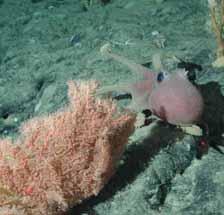
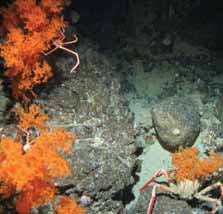
Distribution of corals on seamounts
4. Distribution of corals
on seamounts
Graneledone boreopacifica and Trissopathes sp.,
Antipatharian coral, Munidopsis sp. and Paramola sp.,
Davidson Seamount, 1 973 m depth. (NOAA/MBARI)
Hatton Bank. (DTI SEA Programme, c/o Bhavani Narayanaswamy)
THE NEED TO ASSESS THE DISTRIBUTION OF CORALS
THE TASK OF COMPILING USEFUL DATA
Analyses of the diversity of seamount communities have
A database was generated for records of all known
generally aimed at assessing the overall diversity of
occurrences of corals on seamounts, including some
seamount communities and levels of potential endemism
shallower features of <1 000 m elevation and some banks
(e.g. Richer de Forges et al., 2000). However, such studies
associated with the continental margin (n = 3 235; Rogers
have revealed little about how species within specific groups
et al., in press). The coral database consisted of records of
are distributed on seamounts at regional and global scales.
the presence of a coral species at a locality and could not
Such information is critical in understanding what
be used to infer species absence. This included records of
environmental factors influence species diversity on
Scleractinia (stony corals); Octocorallia (including
seamounts. It is also important in predicting the impacts of
gorgonians); Antipatharia (black corals); Stylasterida
human activities on seamount communities in the absence
(stylasterids/hydrocorals) and Zoanthidea (zoanthids).
of detailed data. Data on the occurrence of species on
These records included all species of corals including
seamounts is sparse and scattered over a variety of sources.
those that are reef-forming, contribute to reef formation,
For some groups of animals, most notably those comprising
or occur as isolated colonies. Corals were chosen as they
large, conspicuous organisms, there are a substantial
are the most commonly recorded group of benthic animals
number of observations. Fortunately, data for corals was
recorded from seamounts (Stocks, 2004) and are also often
sufficient for a detailed analysis of the distribution of corals
associated with a diversity of other species (Rogers, 1999;
on seamounts that had several principle aims:
Freiwald et al., 2004; Buhl-Mortensen and Mortensen,
(i). to identify global hotspots in seamount coral diversity;
2005; Roberts et al., 2006). As such, corals may be
(ii). to compare the distribution of different coral groups;
representative of the biological diversity of the hard-
and
substrata benthic communities on seamounts in general
(iii).to understand the limitations of available data for
(see arguments in previous chapter).
corals in terms of geographic coverage (Rogers et al.,
These records were extracted from the primary scientific
in press).
literature, from museum databases, from online data
31
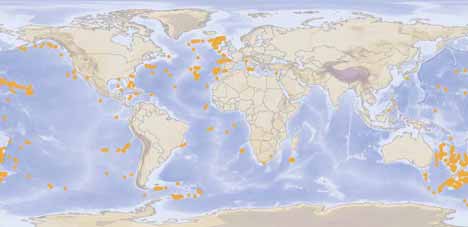
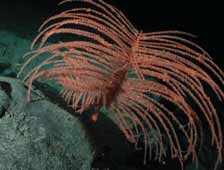
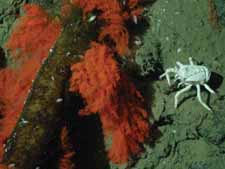
Seamounts, deep-sea corals and fisheries
Fig. 4.1 Global distribution of seamounts with records of
depth range from which the specimen was collected;
corals (Scleractinia, Octocorallia, Antipatharia, Stylast-
whether the specimen was alive, dead or if this information
erida and Zoanthidea). Source: Rogers et al. (in press)
was unknown; the origin of the record; and any other
pertinent notes.
sources (Seamounts Online; Biogeoinformatics of Hexa-
corals), from reports and from the records held by scientists.
GLOBAL DISTRIBUTION OF RECORDS FOR SEAMOUNT
Records were included in the database if corals were
CORALS
identified to species level or occasionally to genus if this
Analyses of the corals on the seamount database
represented a single unidentified species within the genus
demonstrated that sampling of seamounts has not taken
on a seamount. Information recorded for each record, if
place across the world's oceans evenly (Rogers et al., in
available, included the species name; ocean region;
press). Examination of a map of all coral (Scleractinia,
seamount; location, which was the exact latitude and
Octocorallia, Antipatharia, Stylasterida and Zoanthidea)
longitude of the specimen collection if available or that of
records shows that for some regions very few seamount
the seamount given in IOC-IHO GEBCO database; depth or
samples have been taken, including the entire Indian Ocean
Bathypathes sp., Davidson Seamount, 2 467 m.
Munidopsis sp., orange hydroid and amphipods on drifting
(NOAA/MBARI)
kelp, Davidson Seamount, 1 400 m (NOAA/MBARI)
32
Distribution of corals on seamounts
Table 4.1: Numbers of records, species, genera and families recorded for all coral groups from seamounts
Total
Number
Number
Number
Group
of records
of species
of genera
of families
Scleractinia
1 713
249
85
20
Octocorallia
957
161
68
21
Stylasterida
372
68
18
2
Antipatharia
157
34
22
6
Zoanthidea
28
14
6
3
Source: Rogers et al. (in press)
and other regions, such as the South Atlantic, central
reefs (e.g. Lophelia pertusa, Solenosmilia variabilis and
southern Pacific and much of the Southern Ocean (Figure
Madrepora oculata). It is not known to what extent the
4.1). It is also apparent that some areas have been well
limited sampling of seamounts influenced this result, and
sampled, such as around New Zealand, Hawaii, off western
certainly some coral species have a wider geographic
North America and in the Northeast and Northwest Atlantic.
distribution than is apparent from the occurrences recorded
In total, fewer than 300 seamounts have been sampled for
on seamounts (Rogers et al., in press).
corals, representing 2.1 per cent of the identified number of
A global analysis of the species richness of corals on
large seamounts in the oceans globally (or 0.03 per cent
seamounts on a 10º by 10º latitudinal and longitudinal grid
when assuming there are 100 000 seamounts with elevation
was also carried out (Rogers et al., in press). This analysis
greater than 1 000 m).
showed that several geographic areas appeared to be
hotspots of coral diversity. However, an analysis of the
PATTERNS OF CORAL DIVERSITY
relationship between the numbers of coral samples for each
One of the most notable results of analyses of the database
grid box indicated that species richness was strongly
was the finding that most coral species found on seamounts
dependent on sampling effort (Rogers et al., in press).
are restricted to a single ocean and most of these to a single
Species richness of corals was also analysed by latitude
region within an ocean (Rogers et al., in press). Only a
(Rogers et al., in press) because there has been a suggestion
relatively small number of species have wide geographic
that biological diversity in the oceans peaks at mid-latitudes
distributions, and very few have near-cosmopolitan
(Worm et al., 2003). This suggestion seemed to be confirmed
distributions. Often the taxonomy and systematic status of
by the coral diversity on seamounts, which also peaked at
such globally distributed species is not entirely resolved, and
mid-latitudes. However, this proved to be an artefact, caused
it is possible that some of these species represent clusters
by an equatorial gap in the sampling of seamount fauna
of morphologically similar sibling or cryptic species (see Le
(Rogers et al., in press).
Goff-Vitry et al., 2004). Many of the widely distributed species
Despite the limitations of the coral on seamounts
are the primary framework building corals of cold-water
dataset, some broad patterns in distribution were detected.
Table 4.2: Numbers of species of the two main coral groups that occur on seamounts in different ocean regions
Coral group
Ocean Region
Scleractinia
Octocorallia
Northeast Atlantic
48
27
Northwest Atlantic
9
7
Southeast Atlantic
10
1
Southwest Atlantic
5
1
Northeast Pacific
15
54
Northwest Pacific
3
3
Southeast Pacific
3
-
Southwest Pacific
108
20
Southern Ocean
8
4
Source: Rogers et al. (in press)
33
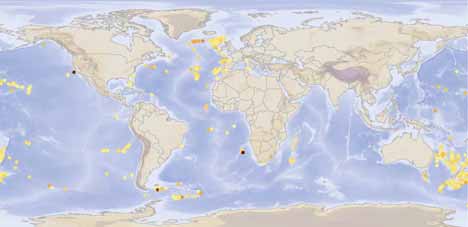
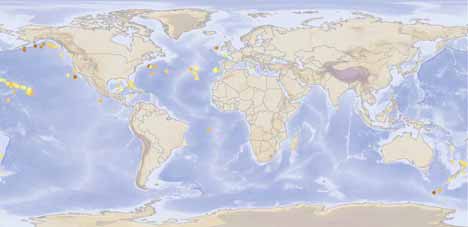
Seamounts, deep-sea corals and fisheries
Figure 4.2: Known locations of scleractinian corals on seamounts. Source: Rogers et al. (in press)
Key
(above and below)
Scleractinian corals are the most diverse and commonly
observed group, with 249 species having been recorded. This
Summit depth (m)
Summit depth (m)
is followed by the octocorals, the stylasterids, the
0-500
2 500-3 000
antipatharians and the zoanthids in order of diversity and
500-1 000
3 000-3 500
number of records (Table 4.1). Fewer than 1 500 species of
1 000-1 500
3 500-4 000
scleractinian corals have been described, and seamounts
1 500-2 000
4 000-4 500
therefore potentially host a substantial fraction of the
2 000-2 500
4 500-5 000
global scleractinian fauna, and a very large fraction of
Fig. 4.3: Known locations of octocorals on seamounts. Source: Rogers et al. (in press)
34
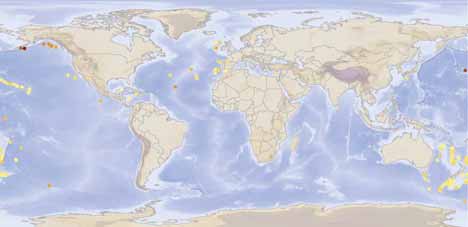
Distribution of corals on seamounts
Figure 4.4: Known locations of antipatharian corals on seamounts. Source: Rogers et al. (in press)
Key
the northeastern Pacific are very isolated, and differences in
dispersal capacity between the two coral groups may also
Summit depth (m)
Summit depth (m)
influence their distribution. The feeding ecology of
0-500
2 500-3 000
scleractinians and octocorals is also different, and this may
500-1 000
3 000-3 500
also result in contrasting environmental preferences of the
1 000-1 500
3 500-4 000
two coral groups.
1 500-2 000
4 000-4 500
2 000-2 500
4 500-5 000
THE RELATIVE OCCURRENCE AND DEPTH DISTRIBUTION
OF THE MAIN CORAL GROUPS
azooxanthellate coral species living in deeper waters
Analysis of the depth distribution of the four main different
(Rogers et al., in press).
coral groups, the Scleractinia, Octocorallia, Stylasterida,
Comparison of the relative diversity of the coral groups
Antipatharia and Zoanthidea, found that the different coral
in different regions of the oceans revealed significant
groups occurred at different depths (Figures 4.2-4.4). Most
differences (Table 4.2). In most parts of the world,
scleractinian and stylasterid species occur in the upper 1 000-
Scleractinia were the most diverse group, followed by the
1 500 m (Rogers et al., in press). Octocorals can be found in
Octocorallia. However, in the northeastern Pacific, this trend
greater depths, with most species occurring in the upper
was reversed. Here, octocorals are markedly more diverse
2 000 m. Antipatharians also occurred in the upper 1 000 m,
than scleractinians (Rogers et al., in press). The north-
although a higher proportion of species occurs deeper than
eastern Pacific is characterized by a shallow aragonite
scleractinians or stylasterids. A variance analysis, using a
saturation horizon, which may explain the lower relative
Generalised Linear Model (GLM), of the whole dataset
diversity of stony corals in this region (Guinotte et al., 2006).
showed that the depth distributions were different between
Scleractinia need to accumulate large quantities of
the four coral groups. Analysis in pairs showed the depth
aragonite to build the coral skeleton. Undersaturation of
distributions of scleractinian and stylasterids to be similar
aragonite makes this process more difficult and may result
and different from both octocorals and antipatharians
in the dissolution of dead coral skeletons, potentially
(Rogers et al., in press). Sampling effort to date limits our
preventing the occurrence of cold-water coral reefs. Given
understanding of coral distribution below 2 500 m.
the present evidence of acidification of the oceans, this has
significant implications for the global distribution of cold-
GETTING A BETTER UNDERSTANDING OF CORAL
water corals and coral reefs (Orr et al., 2005; Royal Society,
DISTRIBUTION ON SEAMOUNTS
2005; see Chapter 5). It is also notable that the seamounts of
The relative occurrence and distribution of corals on
35
Seamounts, deep-sea corals and fisheries
seamounts demonstrate that the depth of the seamount
summit will have a significant influence on the composition
of the coral communities present. This is likely to apply also
to other groups of sessile organisms (Rogers et al., in press).
The greatest diversity of corals observed on seamounts
occurs in the upper 1 000 m of the oceans, and the depth
ranges with the highest coral diversity overlap with those
where most deep-sea fishing currently takes place (250-
1 500 m; Koslow et al., 2000; ICES, 2005).
Given that depth is one of the major factors influencing
physical classification of seamounts (Rowden et al., 2005;
ICES, 2006), this will be a significant factor in predicting the
diversity of coral communities on unsampled seamounts.
However, it should be noted that even for mean depths, the
results for the GLM indicated that taxonomic groups of coral
have only a relatively small influence on depth distribution (it
explains about 10 to 13 per cent of the variation), and that
many other factors such as the physical environment of a
seamount will also determine species composition and
distribution (Rowden et al., 2005).
Overall, the analyses revealed new patterns in the
regional and vertical distribution of coral species. The
reasons for differences in the depth and regional
distribution of the different coral groups are most likely
related to the nature of substrates available for
attachment; the quantity, quality and abundance of food at
different depths (see Chapters 2 and 3); but also to the
aragonite saturation horizon, temperature and the
amounts of different essential elements and nutrients
(Bonilla and Piñón, 2002). The dataset also revealed
significant areas of weakness in our knowledge of
seamount coral diversity, especially in the lack of sampling
of seamounts in equatorial latitudes. Thus, in order to
make a reasonable assessment of the vulnerability of
corals and, by proxy, non-coral communities on seamounts
to bottom trawling, it is currently necessary to use models
to predict the global occurrence of suitable coral habitat.
36
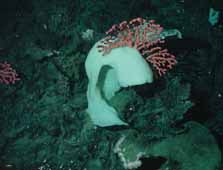
Stony corals on seamounts
5. Predicting global distribution
of stony corals on seamounts
seamounts. Some scleractinian corals form complex
structures and frameworks such as reefs that provide
habitat for other deep-sea species (Rogers, 1999; Freiwald
et al., 2004). Better knowledge of the distribution of such
species supplies a useful proxy for the biodiversity of benthic
communities of seamounts (see Chapter 3).
Other groups of coral, such as octocorals, for example,
can also form important habitats such as coral gardens (e.g.
Stone, 2006; see Chapter 3). These corals may have very
different distributions from that of stony corals, which would
also be useful to appreciate in the context of determining the
vulnerability of seamounts communities to bottom trawling.
Unfortunately, the available data for octocorals are currently
too limited to enable appropriate modelling.
Paragorgia arborea, Davidson Seamount, 1 779 m.
(NOAA/MBARI)
Box 2: What is a model?
A model, in this context, is a simplified, abstracted
KNOWN CORAL DISTRIBUTION
representation of a real-world system. Models
The previous chapter demonstrates that our knowledge of
are typically constructed using mathematical
the distribution of corals on seamounts is limited. Most
equations or statistical functions that are
records come from heavily sampled regions such as the
programmed into a computer. For example,
Northeast Atlantic and around New Zealand, a pattern that
existing data (such as known seamount coral
is unlikely to represent the true distribution of these corals.
distributions) are fed into the model, and the
There are very few data from seamounts in some regions,
output (such as predicted habitat suitability maps
such as the south-central Pacific and the Indian Ocean, and
for seamount corals) is used to aid in the
the vast majority of large seamounts have not been sampled
understanding of patterns and processes and to
at all. In order to improve our knowledge of where and why
make predictions. Models are often compared and
deep-sea corals are found on seamounts, further sampling
tested against one another. There is a trade-off
and research has to be conducted, but this is time-
between simplicity and complexity. A simple model
consuming and expensive. A short-term alternative,
that captures the essential features of the system
although not replacing the need for further sampling, is to
in question is often preferable to a more complex
use a modelling approach.
model where more assumptions have to be made
A common problem in biology is attempting to predict
because there is normally not enough known
in which areas an organism is likely to be found, given
about parts of the ecosystem.
a limited set of observations of its distribution.
It is important to remember that a model can
Understanding the factors, such as climate and food
never be perfect or `right'. It is a simplified
availability, that drive its distribution (Gaston, 2003) can
representation of reality. A good outcome would
help. Models (Box 2) can be used to predict the distribution
be for the model to capture large-scale features
of a species from observed occurrences and absences
of the system in question. It is also important
of individuals and their relationship to measurable
to calibrate a model against known data and
environmental parameters (Guisan and Zimmermann,
knowledge, and to statistically assess its accuracy.
2000; Guisan and Thuiller, 2005).
Only when the uncertainty in a model can be
In this chapter we construct a habitat suitability model to
quantified is it of significant use.
gain insight into the global distribution of deep-sea corals on
37
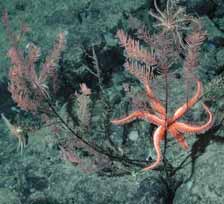
Seamounts, deep-sea corals and fisheries
Table 5.1: Environmental parameters used to predict habitat suitability [GLODAP = Global Ocean Data Analysis
Project; SODA = Simple Ocean Data Assimilation 1.4.2; VGPM = Vertically Generalized Productivity Model; WOA =
World Ocean Atlas 2001]
Parameter
Units
Source
Reference
Temperature
ºC
WOA
Conkright et al., 2002
Salinity
Pss
WOA
Conkright et al., 2002
Depth
m
WOA
Conkright et al., 2002
Surface chlorophyll
g l-1
WOA
Conkright et al., 2002
Dissolved oxygen
ml l-1
WOA
Conkright et al., 2002
Per cent oxygen saturation
%
WOA
Conkright et al., 2002
Overlying water productivity
mg C m-2 yr-1
VGPM
Behrenfeld and Falkowski, 1997
Export primary productivity
g C m-2 yr-1
VGPM
Behrenfeld and Falkowski, 1997
Regional current velocity
cm s-1
SODA
Carton et al., 2000
Total alkalinity
mol kg-1
GLODAP
Key et al., 2004
Total dissolved inorganic carbon
mol kg-1
GLODAP
Key et al., 2004
Aragonite saturation state
mol kg-1
Derived from
Key et al., 2004;
GLODAP data
Orr et al., 2005;
Zeebe and Wolf-Gladrow, 2001
USING HABITAT SUITABILITY MODELLING TO PREDICT
The modelling technique used in this analysis is
STONY CORAL DISTRIBUTION
`environmental niche factor analysis' (ENFA), developed
Statistical techniques for the modelling of habitat
by Hirzel et al. (2002). ENFA compares the observed
suitability have been used since the 1970s, and since then
distribution of a species, or group of species, to the
have branched into a variety of different approaches
background distribution of environmental factors
(Guisan and Thuiller, 2005). There is no single model that
(temperature and salinity, for example). In this way, it
is `best' in all situations; typically a model is selected
assesses how different the environmental niche a tax-
because it is thought to be the most appropriate for the
onomic group occupies is relative to the mean background
type of data, or several competing models are tested
environment (its `marginality'), and how narrow this niche
against one another.
is (its `specialization'). The model also reveals factors that
can be important in determining the distribution of the
Crinoid (Florometra serratissima) and brisingid seastar
studied organisms. ENFA can then use this information to
on black coral, Davidson Seamount 1 950 m. (NOAA/MBARI)
predict habitat suitability for unsampled regions.
ENFA is ideal when there is reliable presence data, but
no reliable absence data (Hirzel et al., 2001; Brotons et al.,
2004), as is the case for coral data from seamounts. We
know where scleractinians have been found, but even for
those seamounts that have been sampled, we cannot infer
true absence, since coral species may be living on an
unsampled region of the same seamount or coral material
has not been identified and sorted from samples. ENFA has
been previously used in the marine environment to model
coral distributions on the Canadian Atlantic continental shelf
(Leverette and Metaxas, 2005). Further details of the model
are given in Appendix II.
STONY CORAL DISTRIBUTION AND ENVIRONMENTAL
DATA
The location of records of scleractinian corals on
seamounts came from the database generated for the
analysis of coral distribution (see Chapter 4). These data
38
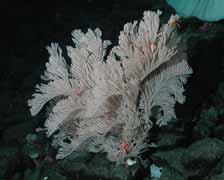
Stony corals on seamounts
were then combined with physical, biological and chemical
northern Indian Ocean become particularly unsuitable. The
oceanographic data from a variety of sources, as outlined
circum-global band of suitable habitat at around 40ºS
in Table 5.1 (full details in Appendix I). Data on large
narrows with depth (to ± 10º), breaking up into smaller
seamount locations were obtained from the data used for
suitable habitat areas around the southeast coast of South
Chapter 2 (Kitchingman and Lai, 2004). The coral data and
America and the tip of South Africa. Suitable habitat
the seamount locations do not completely match, since
remains in parts of the Atlantic to 2 500 m depth (especially
some of the coral records come from small seamounts.
the North and tropical West Atlantic, most consistently in
Thus we cannot model habitat suitability for stony corals on
FAO areas 31 and 34, with FAO areas 21 and 27 becoming
seamounts directly. Instead, we use the coral data to model
more prominent with depth). The global extent of habitat
habitat suitability in various regions and depth zones of the
suitability for stony corals on seamounts was predicted to
global oceans, initially ignoring the locations of large
be at its maximum between 250 m and 750 m (Figure 5.2).
seamounts. The habitat suitability maps can then be used
The majority of the suitable habitat for stony corals occurs
in two ways: (i) to examine the habitat suitability for as yet
in areas beyond national jurisdiction. However, suitable
unknown seamounts and other sea floor features within a
habitats are also predicted in deeper waters under national
particular region of the marine environment; and (ii) fitted
jurisdiction, especially in the EEZs of countries (i) between
to the summits of known/predicted seamounts. Habitat
20ºS and 60ºS off South Africa, South America and the
suitability for scleractinians on seamounts may be very
Australian/New Zealand region, (ii) off northwest Africa,
different depending upon whether the corals are sited on
and (iii) around 30ºN in the Caribbean.
the seamount summit or slope, as these are at different
The results of combining the predicted habitat
depths and potentially in different oceanographic regimes.
suitability with the summit depth and location of large
Caution should therefore be used when interpreting habitat
seamounts are shown in Figure 5.7. The majority of the
suitability fitted to seamount summits.
large seamounts that could provide suitable habitat on
The ENFA model assumes that the data span the
their summits are located in the Atlantic Ocean (all Atlantic
environmental range of actual scleractinian occurrence, i.e.
FAO areas 21, 27, 31, 34, 41 and 47). The rest are mostly
that Scleractinia do not reside outside the environmental
clustered in a band between 20ºS and 60ºS. A few
extremes that have been sampled; otherwise, the model will
seamounts elsewhere, such as in the South Pacific, have
not predict areas of suitable habitat beyond these extremes.
summits in the high suitability depth range between 0m
This appears to be a reasonable assumption in this instance.
and 250 m. In the Atlantic, a large proportion of suitable
Nonetheless, we limited the model to 2 500 m in depth, as
seamount summit habitat is beyond national jurisdiction,
below 2 500 m data are more limited by sampling, and there
whereas in the Pacific it is mostly within EEZs. In the
is a marked change in the species composition of the
southern Indian Ocean, suitable habitat appears both
scleractinians (Rogers et al., in press).
within and outside of EEZs. When analysing the habitat
suitability on the basis of summit depth, it should be
PREDICTED HABITAT SUITABILITY FOR STONY CORALS
The predicted habitat suitability for scleractinians found on
Primnoid coral with shrimp, Davidson Seamount,
seamounts is shown in Figures 5.1 to 5.6 in 250-500 m bands
1 570 m depth. (NOAA/MBARI)
from 0 m to 2 500 m depth. The following assessment of
these maps refers to the main FAO fishing areas (FAO, 2005)
and to the areas beyond national jurisdiction given in the
Reference Maps 1 and 2 on the back cover.
In near-surface waters, suitable seamount habitat
lies in the southern North Atlantic (mostly FAO area 31),
the South Atlantic (FAO area 41), much of the Pacific
(especially FAO areas 77, 81 and 87), and the southern
Indian Ocean (FAO areas 51 and 57). The Southern Ocean
and northern North Atlantic are, however, unsuitable.
Habitat suitability patterns change substantially below this
depth. In depths from 250 m to 750 m, a narrow band
around 30ºN ± 10º and a broader band of suitable habitat
occur around 40ºS ± 20º (areas 81 and 87 in the South
Pacific, 41 and 47 in the South Atlantic, and 51 and 57 in
the Indian Ocean). Below 750 m, the North Pacific and
39
Seamounts, deep-sea corals and fisheries
Table 5.2: Variance explained by the first eight ecological factors in the ENFA model. Factor one explains the
marginality, the remainder the specialization. The cumulative explained specialization of the first eight factors
is 88.6 per cent.
Factor
1 (Marginality)
2
3
4
5
6
7
8
Explained 0.12
0.19
0.17
0.12
0.10
0.08
0.06
0.05
specialization
Alkalinity
-0.30
0.04
0.22
0.07
0.13
0.23
0.23
0.35
Aragonite 0.34
0.07
0.06
0.83
0.12
0.00
0.14
0.12
saturation state
Surface chlorophyll
0.25
0.02
0.13
0.05
0.01
0.00
0.03
0.30
Depth
-0.21
0.15
0.32
0.18
0.05
0.16
0.07
0.07
Dissolved O2
0.22
0.66
0.11
0.08
0.41
0.48
0.68
0.35
Per cent O2
0.27
0.61
0.22
0.41
0.74
0.70
0.46
0.40
saturation
Primary productivity 0.46
0.00
0.00
0.06
0.01
0.04
0.08
0.49
Export productivity
0.31
0.02
0.00
0.01
0.01
0.00
0.04
0.09
Salinity
0.24
0.05
0.03
0.13
0.04
0.03
0.16=
0.00
Total CO2/DIC
-0.29
0.29
0.57
0.12
0.51
0.48
0.04
0.49
Temperature
0.35
0.29
0.49
0.11
0.01
0.09
0.46
0.40
Regional current
-0.03
0.03
0.01
0.07
0.03
0.03
0.03
0.01
velocity
remembered that suitable habitat for stony corals might
values of total dissolved inorganic carbon also correspond
also occur on the slopes of seamounts, i.e. at depths
with suitable habitat. Interestingly, neither surface
greater than the summit.
chlorophyll nor regional current velocities apparently are
important in determining global scleractinian distributions
WHAT ENVIRONMENTAL FACTORS ARE IMPORTANT IN
on seamounts, although these may have an effect at a
DETERMINING STONY CORAL DISTRIBUTION?
smaller spatial scale, such as an individual seamount. That
Table 5.2 shows the importance of each environmental
is at a scale not captured by the size of the grid used within
parameter in constraining the distribution of scleractinians
the model.
on seamounts. The first column (Factor 1) is the marginality
Temporal variability in the environmental factors is not
of the group, and the remaining factors its specialization
captured by the model, and daily, seasonal and annual
(see Appendix II). The predicted value of the marginality is
changes may all play a role in driving stony coral
0.918, which indicates that optimal habitat for scleractinians
distributions. It is also worth noting that other important
is quite different from the background mean values. This is
factors may not have been included in the model. For
true for almost all environmental variables except regional
example, biological factors, such as competitive exclusion,
current velocity.
are typically not captured by habitat suitability models. Those
The remaining factors (2-8) show the parameters that
factors that are included in the model may not actually be
are important in driving the observed distribution. The
responsible for driving the distribution of Scleractinia, but
specialization value is 1.369, indicating that stony corals
simply correlated with unknown factors. This could mean
are highly specialized and occupy a relatively narrow
that even if a region is predicted as being highly suitable for
environmental niche.
scleractinians, it does not mean that these corals will
The environmental parameters that are most important
actually be found there.
in determining suitable habitat for seamount stony corals
The result that dissolved oxygen availability is a major
are dissolved oxygen and per cent oxygen saturation, total
factor affecting habitat suitability for stony corals, and thus
dissolved inorganic carbon and the aragonite saturation
influences their distribution, is significant in a global
state. The comparison of Figures 5.8 with Figures 5.2 and 5.3
oceanographic context. It means that oxygen minimum
shows that high levels of aragonite saturation and dissolved
zones (Helly and Levin, 2004), which can be extensive in
oxygen correspond with suitable habitat for scleractinians.
some parts of the worlds oceans, would not be very suitable
Similarly, high values of per cent oxygen saturation and low
habitat for these corals.
40
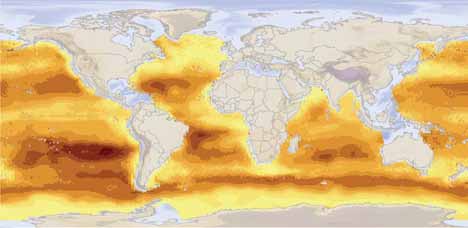
Stony corals on seamounts
Figure 5.1: Predicted habitat suitability for seamount stony corals from 0-250 m depth.
Key
Habitat suitability
Habitat suitability
High percentage values
%
%
indicate more suitable
0-10
50-60
habitat.
10-20
60-70
20-30
70-80
30-40
80-90
40-50
90-100
Aragonite is a form of calcium carbonate that
saturation, so low levels provide suitable stony coral
scleractinians use to form their hard skeletons. It has been
habitat.
speculated that stony corals will have their distribution
The model output must be examined in an appropriate
limited by the level of aragonite saturation (Orr et al., 2005;
context, and the habitat suitability maps in this chapter can
Guinotte et al., 2006). In the oceans, carbon dioxide and
be considered as testable hypotheses. If additional sampling
carbonate ions react with each other to form bicarbonate
were to be carried out and found scleractinians on
(Royal Society, 2005). Increased amounts of aqueous CO2
seamounts outside their current environmental envelope,
(e.g. from anthropogenic sources) cause a decrease in the
then this would change the model predictions. The model
availability of carbonate ions, which corals and other
may perform better in some regions than in others.
organisms use to build calcareous skeletons (Royal
Furthermore the distribution of deep-sea stony corals in
Society, 2005). Simultaneously, this decreases the pH of
non-seamount regions may be different from that on
the ocean (makes it more acidic). Thus not only are there
seamounts.
fewer resources available with which to produce coral
Previous chapters have built a picture of where
skeletons, but they are also dissolved more quickly by
seamounts are located, what lives on them in particular
the higher acidity (Orr et al., 2005). Thus, we would expect
corals and where corals may be found beyond areas that
high levels of aragonite saturation to be suitable habitat,
have been sampled. The next step in the sequence is to look
and this is indeed the case. Total dissolved inorganic
at what fish species occur on seamounts, and where
carbon, however, is inversely correlated with aragonite
fisheries for them have, or may, occur.
41
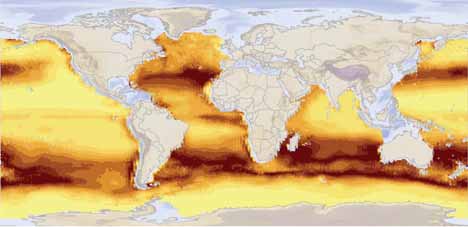
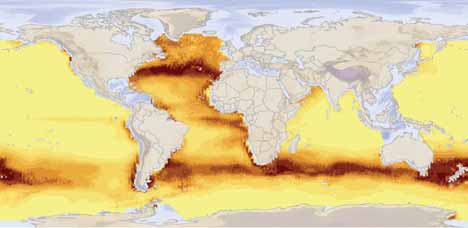
Seamounts, deep-sea corals and fisheries
Figure 5.2: Predicted habitat suitability for seamount stony corals from 250-750 m depth.
Key (above and below)
Habitat suitability
Habitat suitability
High percentage values
%
%
indicate more suitable
0-10
50-60
habitat.
10-20
60-70
20-30
70-80
30-40
80-90
40-50
90-100
Figure 5.3: Predicted habitat suitability for seamount stony corals from 750-1 250 m depth.
42
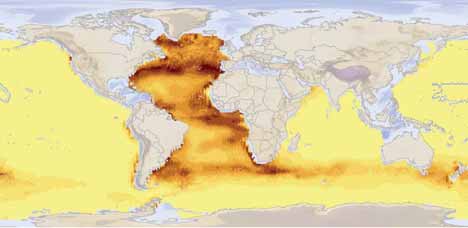
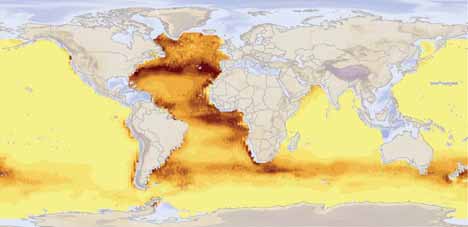
Stony corals on seamounts
Figure 5.4: Predicted habitat suitability for seamount stony corals from 1 250-1 750 m depth.
Key (above and below)
Habitat suitability
Habitat suitability
High percentage values
%
%
indicate more suitable
0-10
50-60
habitat.
10-20
60-70
20-30
70-80
30-40
80-90
40-50
90-100
Figure 5.5: Predicted habitat suitability for seamount stony corals from 1 750-2 250 m depth.
43
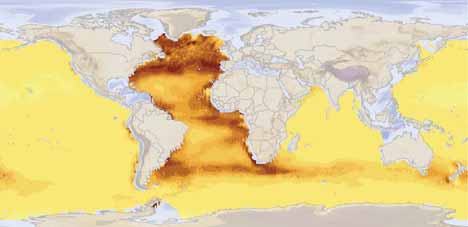
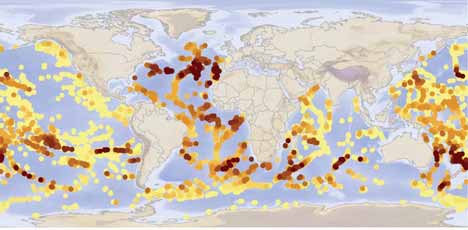
Seamounts, deep-sea corals and fisheries
Figure 5.6: Predicted habitat suitability for seamount stony corals from 2 250-2 500 m depth.
Key (above and below)
Habitat suitability
Habitat suitability
High percentage values
%
%
indicate more suitable
0-10
50-60
habitat.
10-20
60-70
20-30
70-80
30-40
80-90
40-50
90-100
Figure 5.7: Predicted habitat suitability for stony corals on the summits of predicted large seamounts.
44
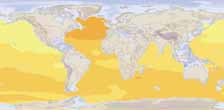
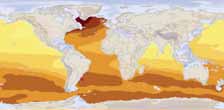
Stony corals on seamounts
Figure 5.8: Aragonite saturation state (left panels) and dissolved oxygen (right panels). Top panels are at a depth of
500 m, lower panels at 1 000 m.
Key (left upper and lower)
Key (right upper and lower)
Aragonite (mol kg-1)
Dissolved oxygen (ml l-1)
-50-25
50-75
0-0.5
3.5-4.0
-25-0
75-100
0.5-1.0
4.0-4.5
0-25
100-125
1.0-1.5
4.5-5.0
25-50
125-150
1.5-2.0
5.0-5.5
2.0-2.5
5.5-6.0
2.5-3.0
6.0-6,5
3.0-3.5
6.5-7.0
45
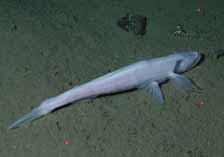
Seamounts, deep-sea corals and fisheries
6. Seamount fish and fisheries
FISH BIODIVERSITY
cially valuable species that may form dense aggregations
Seamounts support a large number and wide diversity of fish
for spawning or feeding (Clark, 2001; Roberts, 2002; ICES,
species. Wilson and Kaufman (1987) were the first to review
2005), and on which a number of large-scale fisheries have
seamount biota worldwide and reported about 450 fishes
developed. Because many fisheries on seamounts target
collected from more than 60 seamounts. Rogers (1994)
aggregations, catches can be relatively clean (i.e. they are
provided a list of 77 commercial species fished on
composed of one or a few species). However, in other
seamounts. Since then, more detailed studies of certain
cases, the by-catch of seamount fisheries include a variety
seamounts and seamount chains have provided more
of other species that are often discarded (Roberts, 2002).
comprehensive species lists. Froese and Sampang (2004)
Levels of by-catch can be such that non-target species
compiled a list of 535 fish species, which was augmented
of seamount can become depleted. For example, records
by Morato and Pauly (2004) to a total of 798 species. Most
over 10 years of the orange roughy fishery on the Chatham
of these fish species are not exclusive to seamounts and
Rise showed that 13 out of 17 by-catch species recorded
occur widely on the continental shelf and slope habitat
lower biomass in 1994 compared to 1984 (Clark et al., 2000).
(Morato and Clark, in press). Fish communities around
Depletion of sharks and rays either by targeted fishing
and on seamounts are therefore complex, being composed
or as by-catch from deep-sea fisheries is a major cause
of pelagic species living in the surface water layers,
for concern (Lack et al., 2003; Royal Commission on
mesopelagic species such as myctophids occurring in
Environmental Pollution, 2005; see also UN General
deeper water, and species living close to or on the seabed
Assembly, 2004b, Paragraphs 47 and 48).
of the seamount itself (sometimes termed the seamount
community; Commonwealth of Australia, 2002). It is known
DEEP-WATER FISHERIES DATA
that different elements of these communities may share
Information on distribution and depth ranges of commercial
common prey species, although the trophic relationships
fish species were obtained from global databases available
between different groups of fish around seamounts are
on the Internet, namely FishBase (www.fishbase.org) and
not well understood at present (e.g. Parin and Prut'ko, 1985;
Ocean Biogeographic Information System (OBIS; www.
Commonwealth of Australia, 2002).
iobis.org). Both sources have a number of distributional
Seamounts can be an important habitat for commer-
maps available, based on point locality information. Fish
Base also offers facilities to map a projected distribution;
Bathysaurus mollis, Davidson Seamount, 2 375 m depth;
however, location data for areas outside of national
ambush predator. (NOAA/MBARI)
jurisdiction are often missing, and the maps overestimate
the potential distribution for some species. Both types of
distributional data were examined, and a subjective
assessment was applied based on expertise and experience
of one of the contributors to this report (M Clark) to define
the likely distribution of the fish species in areas outside of
national jurisdiction.
The only international source of global fisheries catch
data is that compiled by the FAO. While FAO statistics do not
make a distinction between EEZs and areas beyond national
jurisdiction, and reporting areas are very large, data
available from the FAO provides a useful input for assessing
the deep-water catch by species in areas outside of national
jurisdiction in various parts of the world where seamounts
are important fishing grounds. Clark et al. (in press) have
46
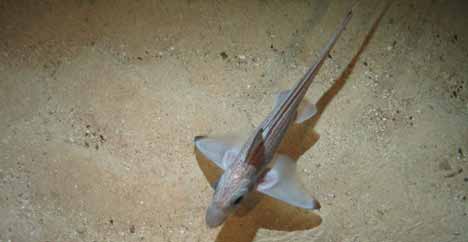
Seamount fish and fisheries
Chimaerid, probably Chimaera monstrosa, Hatton Bank, Northeast Atlantic. By-catch of this group of fish species is a
major concern related to deep-sea fisheries. (DTi SEA Programme, c/o Bhavani Narayanaswamy)
used FAO data, together with fisheries statistics and data
GLOBAL DISTRIBUTION OF DEEP-WATER FISHES
of Soviet, Russian and Ukrainian scientific research and
Current deep-water trawl fisheries occur in areas beyond
exploratory cruises, and published reports for some
national jurisdiction for a number of species. These include
seamount fisheries conducted by Japan, New Zealand,
alfonsino (Beryx splendens); black cardinalfish (Epigonus
Australia, Spain, other EU countries and Namibia. Personal
telescopus); orange roughy (Hoplostethus atlanticus);
contacts and data extracted by Clark et al. (in press) were
boarfish (Pseudopentaceros richardsoni); macrourid rattails
used in some cases to provide `guesstimates' of likely
(primarily roundnose grenadier Coryphaenoides rupestris);
species composition and catch for some seamount regions.
oreos (several species of the family Oreosomatidae,
The report by Gianni (2004) on high seas (areas outside of
including smooth oreo (Pseudocyttus maculatus), black
national jurisdiction) fishing in general was examined for
oreo (Allocyttus niger), warty oreo (Allocyttus verrucosus)
some areas where much of the high seas catch was thought
and spiky oreo (Neocyttus rhomboidalis). Many of these
to be from seamounts.
fisheries use bottom-trawl gear. Other fisheries occur over
The catch figures given in this chapter are known to be
seamounts, such as those for pelagic species (mainly tunas)
incomplete. Some countries' data were not available, there
and target species for smaller-scale line fisheries (e.g. black
is known to have been misreporting or non-reporting of
scabbardfish Aphanopus carbo) (FAO 2004).
catches from areas outside of national jurisdiction in
The depth distribution of these fish species is given in
the past (e.g. Lack et al., 2003). In addition, many catch
Table 6.1. Many species cover a very wide depth range, which
statistics (e.g. FAO records; catches from ICES sub-areas)
can vary with the life history stage of the species (e.g.
are on a scale that does not allow the approximate location
juveniles are often found in shallower depths than adults).
to be determined, let alone assign the catch to a particular
Typically, the depth range in which fishing takes place is
seamount. The effect of this variable quality is that some
smaller than the actual range of the species, as fishers
fishing may have occurred outside areas of national
target depths where the adult fish often aggregate for
jurisdiction, or that effort and catch levels in some areas
spawning or feeding. The depth distribution of most species
could be much higher. However, the compilation is the
differs in various parts of the world, as water masses vary.
most comprehensive attempted to date for seamount
For example, orange roughy typically occurs on seamounts
fisheries, and is believed to give a reasonable indication of
at depths of 800-1 000 m in the Southwest Pacific and
the general distribution of seamount catch over the last
southern Indian Ocean, 500-800 m in the South Atlantic, and
four decades.
at greater than 1 000 m in the North Atlantic.
47
Seamounts, deep-sea corals and fisheries
Table 6.1: Depth distribution of commercial fish species on seamounts
Species
Code
Scientific name
Main depth
Total depth
(common name)
range (m) *
range (m) *
Alfonsino
BYX
Beryx splendens
300-600
25-1 300
Cardinalfish
EPT
Epigonus telescopus
500-800
75-1 200
Rubyfish
RBY
Plagiogenion rubiginosum
250-450
50-600
Blue ling
LIN
Molva dypterygia
250-500
150-1 000
Black scabbardfish
SCB
Aphanopus carbo
600-800
200-1 700
Sablefish
SAB
Anoplopoma fimbria
500-1 000
300-2 700
Pink maomao
MAO
Caprodon spp.
300-450
To 500
Southern boarfish
LBO
Pseudopentaceros richardsoni
600-900
To 1 000
Pelagic armourhead
ARM
Pseudopentaceros wheeleri
250-600
To 800
Orange roughy
ORH
Hoplostethus atlanticus
600-1 200
180-1 800
Oreos
OEO (BOE, SSO)
Pseudocyttus maculatus,
600-1 200
400-1 500
Allocyttus niger
Bluenose
BNS
Hyperoglyphe antarctica
300-700
40-1 500
Redfish
RED
Sebastes spp. (S. marinus,
400-800
100-1 000
S. mentella, S. proriger)
Roundnose grenadier
RNG
Coryphaenoides rupestris
800-1 000
180-2 200
Toothfish
PTO
Dissostichus spp.
500-1 500
50-3 850
Notothenid cods
NOT
Notothenia spp.
200-600
100-900
* Main depth range refers to the commercial fishing depths; total depth range refers to the full known depth range of adult
fish (from FishBase).
The geographical distribution of the main commercial
A number of southern hemisphere species are found in the
fish species in the world's oceans is summarized in Table
North Atlantic, but do not extend into the North Pacific (e.g.
6.2. Many have a widespread occurrence, especially through
orange roughy, oreos). Some species are more localized to
the Atlantic Ocean, Indian Ocean and South Pacific Ocean.
the North Atlantic (e.g. roundnose grenadier, blue ling, and
Table 6.2: Geographical distribution of commercial fish species (+ indicates occurrence in that ocean)
Species North
South
North
South
Indian
Southern
(common name)
Atlantic
Atlantic
Pacific
Pacific
Ocean
Ocean
Alfonsino
+
+
+
+
+
Cardinalfish
+
+
+
+
Rubyfish
+
+
+
Blue ling
+
Black scabbardfish
+
+
+
Sablefish
+
Pink maomao
+
+
Southern boarfish
+
+
+
+
Pelagic armourhead
+
+
+
+
Orange roughy
+
+
+
+
Oreos
+
+
+
+
Bluenose
+
+
+
Redfish
+
+
Roundnose grenadier
+
Toothfish
+
+
+
+
Notothenid cods
+
+
+
+
48
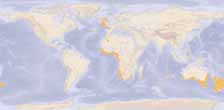
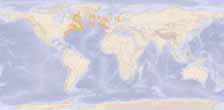

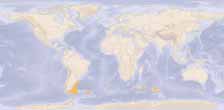
Seamount fish and fisheries
Figure 6.1: Distribution of (clockwise from top left) orange roughy, roundnose grenadier, Patagonian toothfish and
alfonsino. Source: OBIS and FishBase databases
redfishes Sebastes mentella and S. marinus), and sablefish
continental slope. Alfonsino has a global distribution, being
(Anoplopoma fimbria) occur only in the North Pacific.
found in all the major oceans. It is a shallower species
Hence, depending on the target fish species, certain
than orange roughy, occurring mainly at depths of 400 m to
geographic areas, including parts of areas beyond national
600 m. It is associated with seamount and bank habitat.
jurisdiction, are more likely to be searched by fishing
Roundnose grenadier is restricted to the North Atlantic
vessels than others.
(FAO areas 21, 27). It occurs on both sides of the North
Distributions of four of the most important (for either
Atlantic, as well as on the Mid-Atlantic Ridge, where aggre-
their abundance or commercial value) seamount fish
gations occur over peaks of the ridge. Patagonian toothfish
species are shown in Figures 6.1 and 6.2. The first shows
(Dissostichus eleginoides) and in some areas Antarctic
recorded location data taken from OBIS (which is linked to
toothfish (Dissostichus mawsoni) have a restricted
FishBase), whereas the second shows the distributions
southern distribution (FAO areas 48, 58, 88). Having a very
modelled and generated with the Aquamap function within
wide depth range, the species is sometimes associated with
FishBase. Location data for areas outside of national
seamounts, but also general slope and large bank features
jurisdiction are poor, because research vessels work mainly
(Rogers et al., 2006).
in national waters. The modelled distribution of some of
the species is uncertain. The overall distribution and relative
GLOBAL DISTRIBUTION OF MAJOR SEAMOUNT TRAWL
densities predicted are based on limited distributional and
FISHERIES
environmental data. In some cases they are known to be too
The intensive search for fisheries resources on seamounts
extensive. However, they do serve as an approximate guide
around the world's oceans was initiated by the former Soviet
to the likely distribution when viewed together with the
Union, and soon after by Japan, in the late 1960s and 1970s
actual location data. Orange roughy is widely distributed
(Rogers, 1994). Seamounts with concentrations of fish and
throughout the North and South Atlantic Oceans (FAO
invertebrates were found initially in the Pacific Ocean but
areas 27, 47), the mid-southern Indian Ocean (FAO areas
later in other parts of the Atlantic and Indian Oceans, and
51, 57) and the South Pacific (FAO areas 81, 87). The species
offshore seamounts became established as important
does not extend into the North Pacific, and is unlikely to
habitat for global fisheries (Figure 6.3). In subsequent
occur in the northern parts of the Indian Ocean (although
decades other countries such as Korea, and later China,
the modelling does suggest the latter; cf. Figure 6.2). It
Cuba, Australia and New Zealand, and countries in the
is frequently associated with seamounts for spawning or
European Union and southern Africa, also developed
feeding, although it is also widespread over the general
fisheries on seamounts. Table 6.3 shows that in total, the
49
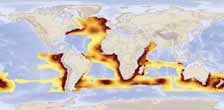
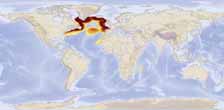
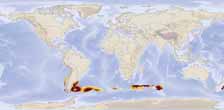
Seamounts, deep-sea corals and fisheries
Figure 6.2: Predicted distribution of (clockwise from top left) orange roughy, roundnose grenadier, Patagonian toothfish
and alfonsino. High probability of occurrence values indicate more suitable habitat.
Key
(all above)
seamounts in the mid-Atlantic and off the coast of North
Habitat suitability
Habitat suitability
Africa. In the Southern Ocean, fisheries for toothfish,
0-0.1
0.5-0.6
notothenioids and icefish can occur on seamounts as well
0.1-0.2
0.6-0.7
as slope and bank areas. Most of these seamounts are
0.2-0.3
0.7-0.8
fished with bottom trawl, but several are also subject to
0.3-0.4
0.8-0.9
mid-water trawl and long-line fisheries. In most cases it
0.4-0.5
0.9-1.0
has not been possible to distinguish between bottom trawl
and mid-water trawl.
international catch of demersal fishes on seamounts by
Many of these fisheries are historical. Most of these
distant-water fishing/trawling fleets is estimated to be about
fisheries have not been sustainably managed, with many
2 million tonnes of fish since the 1960s (derived from data in
examples of `boom and bust' fisheries, which developed and
Clark et al., in press).
declined rapidly, sometimes within a few years or a decade
The largest seamount trawl fisheries have occurred in
(e.g. Uchida and Tagami, 1984; Koslow et al., 2000; Clark,
the Pacific Ocean. In the 1960s to 1980s large-scale
2001; Lack et al., 2003). A prime example of this, in areas
fisheries for pelagic armourhead and alfonsino occurred on
beyond national jurisdiction, is the recent fishery in the
the Hawaiian and Emperor seamount chains in the North
Southwest Indian Ocean, which collapsed after only four
Pacific (FAO area 77) (Figure 6.3). In total about 800 000
years in the late 1990s (FAO, 2002; Lack et al., 2003).
tonnes of pelagic armourhead were taken, and about 80 000
Recovery of shallow-water fish stocks that have been
tonnes of alfonsino. In the southwestern Pacific (FAO areas
collapsed or severely depleted have rarely taken place after
81, eastern part of 57), fisheries for orange roughy, oreos
15 years (Royal Commission on Environmental Pollution,
and alfonsino have been large, and continue to be locally
2004). The life history characteristics of many deep-water
important. Orange roughy has also been the target of
fish species are more conservative than shallow water
fisheries on seamounts on the Reykjanes Mid-Atlantic
species (e.g. slow growth rate, low rates of natural mortality
Ridge in the North Atlantic, off the west coast of southern
in adult fish, late age of sexual maturity, sporadic repro-
Africa, and in the southwestern Indian Ocean. Roundnose
duction, high longevity; Rogers, 1994; Koslow et al., 2000;
grenadier was an important fishery for the Soviet Union
Lack et al., 2003). This makes the rebuilding and recolon-
in the North Atlantic (FAO area 27), where catches have
ization of previously fished seamounts extremely slow, and
been over 200 000 tonnes. Smaller fisheries for alfonsino,
many have shown no signs of recovery to date (Tracey and
mackerel and cardinalfish have occurred on various
Horn, 1999; Cailliet et al., 2001; Lack et al., 2003).
50
Seamount fish and fisheries
Table 6.3: Total estimated historic catch of main commercial fish species from seamounts, major fishing periods,
and main gear types used in the seamount fisheries
Species
Total historical catch (t) Main fishery years
Gear type
Alfonsino
166 950
1978-present
Bottom and mid-water trawl, some
long-line
Cardinalfish
52 100
1978-present
Bottom (and mid-water trawl)
Rubyfish
1 500
1995-present
Bottom and mid-water trawl
Blue ling
10 000
1979-1980
Bottom trawl
Black scabbard fish
75 000
1973-2002
Bottom and mid-water trawl
Sablefish
1 400
1995-present
(Bottom trawl), line
Pink maomao
2 000
1972-1976
Bottom and mid-water trawl
Southern boarfish
9 600
1982-present
Bottom trawl
Pelagic armourhead
800 000
1968-1982
Bottom and mid-water trawl
Orange roughy
419 100
1978-present
Bottom trawl
Oreos
145 150
1970-present
Bottom trawl
Bluenose
2 500
1990-present
Bottom and mid-water trawl
Redfish
54 450
1996-present
Bottom and mid-water trawl
Roundnose grenadier
217 000
1974-present
Bottom and mid-water trawl
Toothfish
12 250
1990-present
Bottom trawl, long-line
Notothenid cods
36 250
1974-1991
Bottom trawl
Mackerel species
148 200
1970-1995
(Bottom) and mid-water trawl
Total
2 153 470
Source: Clark et al. (in press)
AREAS OF EXPLORATORY FISHING IN AREAS BEYOND
Alfonsino fisheries:
approximately 250-750 m.
NATIONAL JURISDICTION
Commercially valuable by-catch species include black
Offshore seamount fisheries in international waters
cardinalfish, southern boarfish, bluenose.
generally require large freezer trawlers. Such fleets need to
Orange roughy fisheries: approximately 750-1 250 m.
target aggregations of high-value species in order to operate
Commercially valuable by-catch species include various
economically. For this reason we have presented distribution
oreos (black, smooth and sometimes spiky).
maps of orange roughy, toothfish and alfonsino, which are
all relatively valuable species. Roundnose grenadier is of
This depth difference, although not clear-cut, can help when
lesser value, but can occur in large quantities, and the North
trying to evaluate seamounts that could be of commercial
Atlantic region, where this species is most commonly found,
interest. Seamounts with a summit shallower than the
is readily accessible to trawlers compared with the southern
species distribution may still have that species present down
hemisphere oceans.
its slopes, i.e. at greater depth than the summit. Hence
Over the last decade, exploratory fishing for deep-water
seamounts with summits shallower than 750 m can have
species in many areas beyond national jurisdiction has
orange roughy at 750 m and deeper down their flanks.
focused on alfonsino and orange roughy on seamounts.
However, although caution needs to be exercised, summit
Toothfish have also been targeted, although this species
depth is a useful parameter to examine against the dis-
occurs in areas under the management of the Commission
tribution of seamounts in areas beyond national jurisdiction.
for the Conservation of Antarctic Marine Living Resources
The distribution of large ones with summit depths in the two
(CCAMLR), and illegal, unreported and unregulated (IUU)
depth ranges are shown in Figures 6.4 and 6.5.
fishing in waters of the Southern Ocean is the focus of major
At alfonsino depths (250-750 m), there are seamount
international preventative measures. Hence, we do not cover
chains in the central and eastern Pacific that are beyond
this species here. The two fisheries for alfonsino and orange
areas of national jurisdiction, near the Challenger Fracture
roughy are, to an extent, discrete in that they operate at
Zone and along the Sala y Gomez Ridge respectively (FAO
different depths on seamounts.
area 87). Further areas with fishable seamounts are at the
51
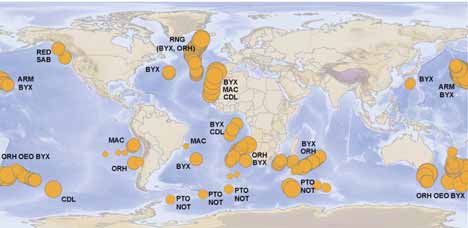
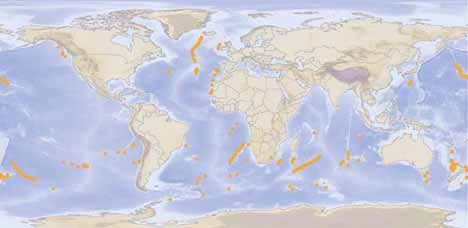

Seamounts, deep-sea corals and fisheries
Figure 6.3: Distribution (top panel) and relative size (bottom panel) of major historical seamount fisheries. Circle size
in the bottom panel is proportional to the total catch for that one-degree grid square, maximum is 85 000 tonnes.
See Table 6.1 for codes to the fish species.
Key
1-10
11-100
101-1 000
1 001-10 000
10 001-50 000
50 001-100 000
52
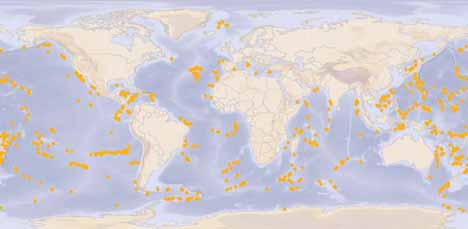
Seamount fish and fisheries
Figure 6.4: Location of predicted large seamounts with summit depths between 250 m and 750 m, the main depth
range for alfonsino fisheries.
southwestern end of the Walvis Ridge and in the Gulf of
searched in the late 1980s to 1990s and early 2000s. Where
Guinea (FAO area 47) in the South Atlantic; in the Indian
large-scale fisheries have not developed, it may be a sign
Ocean along the Southwest Indian Ocean Ridge (FAO area
that commercial concentrations of target species are not
51) and near the Ninety East Ridge (FAO area 57); along the
there. Alternatively, rough patches of sea floor are common
Emperor Seamount chain (FAO area 77) in the North Pacific;
on seamounts, and bottom trawling may have been
and south of the Azores in the North Atlantic (FAO areas 27,
unsuccessful due to gear damage or the bottom being too
34). Most of these areas are thought to have been explored,
rough to even attempt trawling. Modern deep-water trawls
or commercially exploited, already.
have large bobbin or rock-hopper ground gear, and together
At orange roughy depths (750-1 200 m), there are
with advances in navigational and electronic fishing aids
seamounts in the South Pacific Ocean, along the Louisville
since the 1980s, these have made trawling on rough
Ridge (FAO area 81), and further east near the Challenger
seamounts much more feasible than 20 years ago (Roberts,
Fracture Zone and Sala y Gomez Ridge (FAO area 87). The
2002; Lack et al., 2003). Small seamounts and trawlable
Walvis Ridge, Atlantic-Indian Ridge, and southern end of the
paths can routinely be located and fished. Nevertheless,
Mid-Atlantic Ridge (all FAO area 47) also have seamounts at
appropriate depths. In the Indian Ocean, areas of the South-
Spectrunculus grandis, Davidson Seamount, 2 677 m
west Indian Ridge, Ninety East Ridge, and Broken Ridge
depth, 60 cm long. (NOAA/MBARI)
(FAO areas 51, 57) are also at orange roughy depths, but
towards the northern limit of the species distribution. In the
North Atlantic, there are features along the Mid-Atlantic
Ridge from about 30°N northwards. Seamounts further
south into the northern South Atlantic are getting outside
the geographical distribution of orange roughy.
It is difficult to determine which areas outside national
jurisdiction have been extensively explored. The data sources
used by Clark et al. (in press) are known to be incomplete,
and FAO catch reporting is on a spatial scale that does
not allow individual seamounts, clusters or chains to be
identified. Clark et al. (in press) have determined that some
of the areas of potential seamount fisheries have been
53
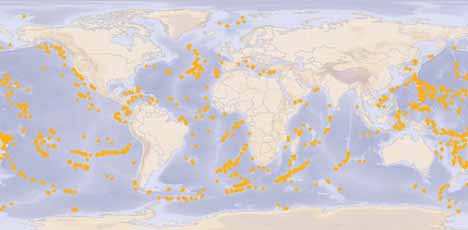
Seamounts, deep-sea corals and fisheries
Fig 6.5: Location of predicted large seamounts with summit depths between 750 m and 1 200 m, the main depth
range for orange roughy fisheries.
there are still some limitations on fishers' ability to bottom
trawl on seamounts. When clusters of seamounts occur,
fish may not be distributed evenly between them, or may
only be evident at certain times of the day or year, and so
intensive trawling may be required to locate commercial
quantities. Operating costs of large offshore vessels are
relatively high, and if there are no signs of fish, the vessel
may move on rather than continue to explore a small area.
Therefore, even where fishing has occurred, there may be
potential for small stocks of deep-water species to exist, and
to support future exploratory fishing operations.
The depth and geographical distribution of the alfonsino
and orange roughy trawl fisheries overlap with the predicted
distribution of large seamounts and deep-sea coral
distribution. The next chapter will discuss the results of the
previous chapters, and bring various sources of information
together to evaluate the vulnerability of seamount benthic
communities to deep-water fishing activities.
54
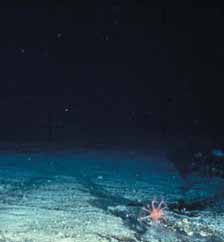
The vulnerability of stony corals on seamounts
7. Assessing the vulnerability of
stony corals on seamounts
RATIONALE
Corals are a prominent component of the seamount fauna,
which can be highly diverse and abundant, and may be
associated with many species new to science. Deep-sea
corals can form complex biological structures on the seabed
and thus provide crucial habitat for a diversity of associated
invertebrates and fish. Up to 100 000 large seamounts may
exist in the world's oceans, but the fauna of only a small
fraction has been documented.
Commercial fishing has targeted numerous fish species
on seamounts, and there is mounting concern over the
damage that deep-sea trawling can cause to the benthic
communities that live on them. The biology and life
histories of deep-sea corals make them highly vulnerable
to bottom trawling. Their destruction can potentially have
knock-on effects for seamount ecosystems.
Many seamounts are located in areas beyond national
jurisdiction, and are increasingly targeted by commercial
fishing activities taking place on the high seas. In the light of
concern about the impacts and ecological ramifications of
fishing on seamount habitats and the biological commun-
ities in these areas, countries and some stakeholders called
A trawled seamount off Tasmania. (T Koslow, CSIRO Marine
on intergovernmental bodies to discuss and develop appro-
and Atmospheric Research)
priate multilateral action on a regional and/or global scale.
The United Nations General Assembly (UNGA) has
living resources (Kimball, 2005). These obligations apply
repeatedly addressed the issue (UN General Assembly,
both within and beyond waters of national jurisdiction. The
2003, 2004a, 2004b, 2005a, 2005b, 2006). In the resolutions
enforcement of international legal regimes on vessels is the
on `oceans and the law of the sea' and `sustainable fisheries',
responsibility of flag states. Obligations under UNCLOS are
the UNGA has called upon States and international
also implemented through regional agreements and, in the
organizations to urgently take action to address destructive
case of fisheries, through Regional Fisheries Management
practices that have adverse impacts on marine biodiversity
Organizations (RFMOs). UNCLOS (Kimball, 2005), regional
and vulnerable ecosystems, and to consider the interim
agreements (e.g. OSPAR; see Johnston, 2004) and RFMOs
prohibition of such destructive fishing practices. Common to
have all emphasized the requirement to base conservation
all of these calls was (i) the need to take action on a scientific
measures on the best scientific information available. This
basis, and (ii) the specific mentioning of seamounts and
may be justified because of the risk of displacing harmful
cold-water corals as examples of vulnerable marine
activities, such as deep-sea trawling, to as yet unexplored
biodiversity and ecosystems.
but potentially more sensitive habitats if decisions are made
Protection of marine biodiversity in coastal areas within
without sufficient scientific information (ICES, 2006).
EEZs and particularly on the high seas has been weak (e.g.
However, lack of scientific data should not be used as an
Royal Commission on Environmental Pollution, 2004), and
excuse for inactivity and should also be balanced by the app-
only 0.5 per cent of the world's marine environment is
lication of the precautionary principal through ecosystem-
currently protected (Kimball, 2005). However, there are
based management practices (Vierros et al., 2006; WWF,
general obligations in the 1982 United Nations Convention
2006).
on the Law of the Sea (UNCLOS) to protect and preserve the
The ecological importance of corals on seamounts has
marine environment and to conserve and manage high seas
been clearly demonstrated through a growing body of
55
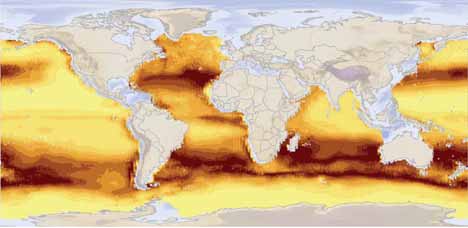
Seamounts, deep-sea corals and fisheries
Figure 7.1: Main areas under risk from alfonsino
Key (above)
seamount fisheries (250-750 m depth horizon).
Above: Predicted habitat suitability for stony corals in
Habitat suitability
Habitat suitability
250-750 m depth. High percentage values indicate
%
%
more suitable habitat.
0-10
50-60
Upper, opposite page: Predicted seamount summit
10-20
60-70
depths 250-750 m depth.
20-30
70-80
Lower, opposite page: Seamounts with known
30-40
80-90
historical alfonsino group catches.
40-50
90-100
scientific evidence. Scientific investigations have also
are likely to occur. Combining this information with the
identified that these organisms and their associated bio-
known geographical occurrence of commercially valuable
logical communities are highly vulnerable to fishing. To
seamount fish species identifies which seamounts are in
evaluate the vulnerability of seamounts to putative impacts
urgent need of measures to protect biodiversity. A note of
by trawling, the distribution of coral habitat needs to be
caution here is that other types of corals, particularly
compared with that of seamount fisheries worldwide.
octocorals, and other organisms, such as sponges, form
However, corals have only been sampled from a small
diverse biological communities and have markedly different
fraction of seamounts worldwide, whilst because of the
distributions from that of stony corals. Thus, whilst large
rapid expansion of deep-sea fisheries, a global perspective
areas of the North Pacific may be relatively unsuitable for
on seamount conservation is required. Scientific surveys of
stony corals, the area is suitable for octocorals, which form
seamount communities are extremely expensive and time-
coral gardens with a high diversity of associated species.
consuming and are unlikely in the short to medium term
Octocoral gardens are as vulnerable to fishing activities as
(tens of years) to identify the majority of seamount habitats
cold-water coral reefs formed by stony corals.
that require protection from harmful activities. In the
present report, a new approach to identifying the occurrence
OVERLAP BETWEEN STONY CORALS AND FISHERIES
of marine habitats that are sensitive to particular activities
A key finding from the qualitative comparisons of the
in this case fishing, primarily by deep-sea bottom trawling
predicted global distribution of stony coral habitat on
has been adopted by scientists within the CenSeam
seamounts with the distribution of seamount fisheries is the
programme. This approach was to use modelling based on
considerable spatial overlap between the likely distribution
existing observations of the occurrence of stony corals to
of stony corals and past, current and potential future
predict where seamounts with favourable environmental
seamount fisheries.
conditions for the development of diverse coral communities
The predicted distribution of seamount habitat suitable
56
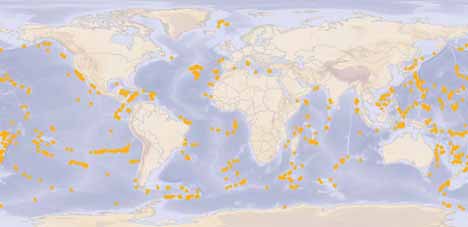
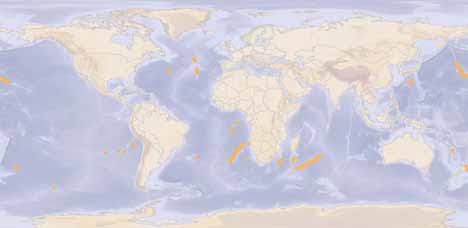
The vulnerability of stony corals on seamounts
for stony corals (scleractinians) is extensive on a global
Ocean. In the Atlantic, a large proportion of suitable sea-
scale. The majority of this suitable habitat is located in areas
mount coral habitat lies beyond areas of national juris-
beyond national jurisdiction, mainly at depths between
diction, whereas in the Pacific it lies mostly within national
250 m and 750 m. High levels of oxygen saturation and
EEZs. In the southern Indian Ocean, suitable coral habitat on
aragonite (a form of calcium carbonate used by corals to
seamounts appears both within and outside of areas of
form hard skeletons) are among the most important
national jurisdiction.
environmental factors in determining habitat suitability for
Examinations of seamount fisheries information
stony corals.
revealed that the main deep-sea fish species of commercial
Predicted habitat suitability indicates that seamounts
value have a widespread distribution, and for at least parts of
provide coral habitat mainly in a band across all oceans
their life history can be found associated with seamounts.
between 20ºS and 60ºS, and in other areas of the Atlantic
The two fish species of highest commercial value that are
57
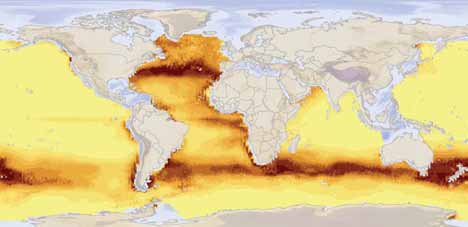
Seamounts, deep-sea corals and fisheries
targeted on seamounts in areas beyond national jurisdiction
providing essential habitat for a large number of species
are alfonsino and orange roughy. Fisheries for these two
(Rogers, 1999; Freiwald et al., 2004; Roberts et al., 2006).
species are, to an extent, discrete in that they operate at
Consequently, the loss of such key structural species lowers
different depths: the alfonsino fishery operates primarily
survivorship and recolonization of the associated fauna, and
between 250 m and 750 m, whilst the fishery for orange
has spawned analogies with forest clear-felling on land
roughy occurs largely at water depths of 750-1 200 m.
(e.g. Watling, 2005). Such comparisons stem principally
Throughout the world's oceans, there are numerous
from destructive fishing practices that are mostly in the form
large seamounts that a) have summits within the depth
of bottom-contact trawling. A considerable body of evidence
range of the fish and fisheries; b) are located outside of
on the ecological impacts of trawling is available for
areas of national jurisdiction; and c) lie within the known or
shallow waters (e.g. Watling and Norse, 1998; Hall, 1999;
predicted distribution of alfonsino and orange roughy. Most
Kaiser and de Groot, 2000), but scientific information on the
of the areas where these seamounts occur are thought to
effects of fishing on deep-sea seamount ecosystems is
have already been explored or commercially exploited, but,
much more limited.
especially at orange roughy depths, there are seamounts in
The scientific literature of the effects of fishing on
some areas that appear to be within the distributional and
seamount habitat is summarized by Clark and Koslow (in
depth range of the species that may not yet have been the
press). Their key findings include:
subject of extensive fishing.
1. The impacts of trawling on seamounts have been
studied most intensively within the EEZs of Australia
VULNERABILITY OF CORALS ON SEAMOUNTS TO
and New Zealand (e.g. Koslow et al., 2001; Clark and
BOTTOM TRAWLING
O'Driscoll, 2003).
Many long-lived epibenthic animals such as corals have an
2. On seamounts off Tasmania (Australia), the fished
important structural role within sea floor communities,
seamounts had typically fewer species (reduced by about
Figure 7.2: Main areas under risk from orange roughy
Key (below)
seamount fisheries (750-1 250 m depth horizon).
Below: Predicted habitat suitability for stony corals in
Habitat suitability
Habitat suitability
750-1 250 m depth. High percentage values indicate
%
%
more suitable habitat.
0-10
50-60
Upper, opposite page: Predicted seamount summit
10-20
60-70
depths between 750-1 250 m depth.
20-30
70-80
Lower, opposite page: Seamounts with known historical
30-40
80-90
orange roughy group catches.
40-50
90-100
58
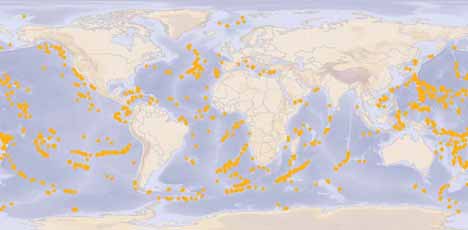
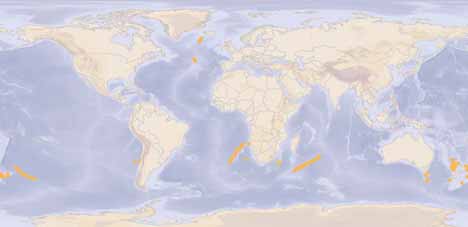
The vulnerability of stony corals on seamounts
half) and had lower biomass of benthic invertebrates (by
The intensity of trawling on seamounts can be very high. For
about seven times) (Koslow and Gowlett-Holmes, 1998;
example, Soviet fishing effort for pelagic armourhead on
Koslow et al., 2001).
relatively few seamounts in the Southern Emperor and
3. On New Zealand seamounts, the composition of larger
Northern Hawaiian Ridge system was around 18 000 trawler
benthic invertebrates was different on `fished'
days during the period from 1969 to 1975 (Borets, 1975).
seamounts, which had a smaller amount of coral habitat
Koslow et al. (2001) and Clark and O'Driscoll (2003) have
formed by live Solenosmilia variabilis and Madrepora
reported that between several hundred and several
oculata than on `unfished' seamounts. In addition, trawl
thousand trawls have been carried out on small seamount
marks were observed over six times more frequently on
features in the orange roughy fisheries around Australia and
seabed images from `fished' seamounts (Clark and
New Zealand.
O'Driscoll, 2003, Rowden et al., 2004).
Similarly, O'Driscoll and Clark (2005) documented that
59
Seamounts, deep-sea corals and fisheries
the total length of bottom tows per square kilometre of
potential, but if stocks are small and localized, they may not
seamount area off New Zealand averages 130 km of trawled
currently be economic.
sea floor. Such intense fishing means that the same area of
Thus, this study has for the first time revealed the global
the sea floor can be repeatedly trawled, causing long-term
scale of the likely vulnerability of stony (scleractinian) corals
damage to the coral communities and preventing any
on seamounts including habitat-forming species, and by
recovery or recolonization.
proxy a diverse assemblage of other species to the impacts
The impact of trawling on sea floor biota can differ
of trawling on seamounts in areas beyond national
depending on the gear type used. Information about the
jurisdiction. This report provides some of the best scientific
potential impact of trawling practices for alfonsino, where
evidence to date to support the need for management
mid-water trawls are often used on seamounts, is currently
practices on the high seas to protect seamounts vulnerable
lacking. Mid-water trawls may have only a small impact if
to the adverse effects of deep-water fishing.
they are deployed well above the sea floor. However, in many
cases the gear is most effective when fished very close to, or
even lightly touching, the bottom. Thus, it is likely that the
effects of the alfonsino fisheries on the benthic fauna would
be similar to that of the orange roughy fisheries.
WHERE ARE THE MAIN AREAS OF RISK AND CONCERN?
The spatial extent of the likely vulnerability of seamount
biodiversity on seamounts in areas beyond national
jurisdiction can be gauged by combining the three sets of
information (Figures 7.1 and 7.2) produced in this study:
1. the predicted global distribution of suitable habitat for
stony (scleractinian) corals;
2. the location of predicted large seamounts with summits
in depth ranges of the fishery for alfonsino (250 m-
750 m) and orange roughy (750 m-1 250 m); and
3. the distribution of the fishing activity on seamounts for
these two species.
The spatial overlaps highlight a broad band of the southern
Atlantic, Pacific and Indian Oceans between about 30°S and
50°S where there are numerous seamounts at fishable
depths, and high habitat suitability for corals at depths
between 250 m and 750 m, and again (but somewhat
narrower) between 750 m and 1 250 m depth. There are also
some areas of overlap in the North Atlantic Ocean.
This spatial concordance of fishable seamounts within
the depth band of orange roughy suggests there could be
further commercial exploration for orange roughy fisheries
on seamounts in the central-eastern southern Indian Ocean
(as evidenced by the Southwest Indian Ocean fisheries rush
between 1998 and 2003), the southern portions of the Mid-
Atlantic Ridge in the South Atlantic, and some regions of the
southern-central Pacific Ocean. Importantly, since these
areas also contain habitat suitable for stony coral, impacts
on deep-water corals and seamount ecosystems in
general are likely to arise in such a scenario. It is uncertain
whether fisheries exploration will expand further. Often, fish
aggregations are very localized, and given the large number
of seamounts and smaller features in the oceans, they may
be difficult to locate. Hence, there may be further fisheries
60
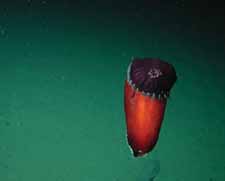
A way forward
8. A Way Forward
HOW CAN THE IMPACT OF FISHING ON SEAMOUNTS BE
MANAGED IN AREAS BEYOND NATIONAL JURISDICTION?
The Report of the Secretary-General on Oceans and the Law
of the Sea (2003), Paragraph 183, states:
`...fisheries governance has focused its attention on
reducing fishing efforts, improving compliance with and
enforcement of conservation and management
measures established by regional fisheries bodies.... The
international community has yet to devote sufficient
attention to the protection of vulnerable marine
ecosystems from the adverse impacts of fishing and non-
fishing activities, an important step towards fisheries
conservation within an ecosystem-based management of
capture fisheries.'
Examples of vulnerable marine ecosystems in this
document include seamounts (Report of the Secretary-
Benthodytes sp. (sea cucumber), Davidson Seamount,
General, 2003, Paragraph 180). In 2005 the Secretary-
2 789 m. (NOAA/MBARI)
General published a further report detailing deep-sea
ecosystems, threats to the marine environment and the
Gianni, 2004; Gjerde, 2006). There are 12 Regional Fisheries
legal framework associated with protecting the marine
Management Organizations (RFMOs) with responsibility to
environment both within and beyond waters of national
agree on binding measures that cover areas beyond national
jurisdiction (Report of the Secretary General, 2005).
jurisdiction (Kimball, 2005), including some of the
This report has reviewed scientific evidence that where
geographical areas identified in this report that might see
seamounts, deep-sea corals and fisheries come together,
further expansion of exploratory fishing for alfonsino and
there is a need for management. It has also demonstrated
orange roughy on seamounts. However, it should be noted
that deep-sea corals, and by proxy benthic communities, on
that only the five RFMOs for the Southern Ocean (CCAMLR),
as yet unexplored/unfished seamounts in areas beyond
Northwest Atlantic (NAFO), Northeast Atlantic (NEAFC),
national jurisdiction are at risk from the potential expansion
Southeast Atlantic (SEAFO) and the Mediterranean (GFCMI)
of alfonsino and orange roughy fisheries. Consequently, it is
currently have the legal competence to manage most or all
sensible for appropriate management strategies to be in
fisheries resources within their areas of application,
place prior to these fisheries being established, so as to
including the management of deep-sea stocks beyond
prevent the adverse effects of fishing on these seamount
national jurisdiction (Kimball, 2005). The other RFMOs have
ecosystems.
competence only with respect to particular target species
Management initiatives for seamount fisheries within
like tuna or salmon (Kimball, 2005). SEAFO covers parts of
national EEZs have increased in recent years. Several
the eastern South Atlantic where exploratory fishing has
countries, such as New Zealand and Australia, have closed
occurred in recent decades, and where further trawling
seamounts to fisheries, established habitat exclusion areas
could occur. However, the western side of the South Atlantic
and stipulated method restrictions, depth limits, individual
is not similarly covered by an international management
seamount catch quotas and by-catch quotas (e.g., Smith,
organization. There have been recent efforts to improve
2001; Commonwealth of Australia, 2002; Gianni, 2004;
cooperative management of fisheries in the Indian Ocean,
Gjerde, 2006; Brodie and Clark, 2004; Melo and Menezes,
although there are no areas covered by an RMFO. In addition,
2003).
efforts are underway, for example in the South Pacific, to
In comparison, fisheries beyond areas of national
establish a new regional fisheries convention and body that
jurisdiction have often been entirely unregulated (FAO, 2004;
would fill a large gap in global fisheries management.
61
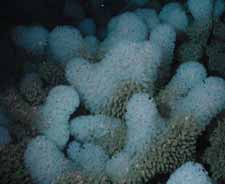
Seamounts, deep-sea corals and fisheries
in this report. In order to be successful, a number of
challenges will have to be overcome, including:
1. Establishing adequate data reporting requirements for
commercial fishing fleets. Some unregulated and
unreported fishing activities take place, even in areas
where there are well-defined fishery codes of practice
and allowable catch limits (e.g. Patagonian toothfish
fishery). Some countries require vessels registered to
them to report detailed catch and effort data, but many
do not. Therefore it is difficult at times to know where
certain landings have been taken.
2. Ensuring compliance with measures, especially in areas
that are far offshore and where vessels are difficult to
detect. Compliance monitoring is also an acute problem
in southern hemisphere high seas areas, where there
Farrea sp., a sponge that blankets large areas at or near
are no quotas for offshore fisheries.
crests on Davidson Seamount (1 400 m); associated with
crabs, basket stars, seastars and brittle stars.
3. Facilitating RFMOs, where necessary, to undertake
(NOAA/MBARI)
ecosystem-based management of fisheries on the high
seas.
In light of the recent international dialogues
concerning the conservation and sustainable manage-
4. Establishing, where appropriate, dialogue to ensure free
ment and use of biodiversity in areas beyond national
exchange of information between RFMOs, governments,
jurisdiction held within and outside the United Nations
conservation bodies, the fishing industry and scientists
system (Report of the Secretary-General, 2003 and 2005;
working on benthic ecosystems.
CBD, 2004; Kimball, 2005), various fisheries bodies (e.g.
NEAFC, NAFO, SEAFO) are more actively updating their
The experiences gained by countries in the protection of
mandates and including benthic protection measures as
seamount environments in their EEZs and in the
part of their fisheries management portfolio. Very recent
management of their national deep-water fisheries can
initiatives include the formation of a Southwest Indian
provide useful case examples for the approach to be taken
Ocean Fisheries Commission. There have also been recent
under RFMOs. Other regional bodies, such as Regional Sea
proposals by industry to designate large voluntary Benthic
Conventions and Action Plans, might be able to provide
Protection Areas (BPAs). These are areas that are closed
lessons learned from regional cooperation to conserve,
to bottom trawling primarily to protect the benthic fauna
protect and use coastal marine ecosystems and resources
but also to preserve areas of outstanding scientific interest
sustainably, including the implementation of an ecosystem
and potentially to act as a refuge for commercial fish
approach in oceans management and the establishment of
species. In general, they have been proposed to give a wide
marine protected areas (MPAs) (Johnston and Santillo,
representative coverage of geological structures,
2004). Regional Sea Conventions and Action Plans also
sediment overlays, bottom types and benthic habitat
provide a framework for raising awareness of coral habitats
types. The New Zealand deep-water fishing industry
in deep water areas under national jurisdiction, and
has proposed BPAs mainly inside the New Zealand
coordinating and supporting the efforts of individual
EEZ but some of which also encompass areas outside
countries to conserve and manage these ecosystems and
of the national EEZ. The Southern Indian Ocean
resources sustainably (e.g. ICES, 2005, 2006).
Deepwater Fisheries Operators Association (SIODFOA)
In calling for urgent action to address the impact of
has also proposed a number of BPAs in the southern
destructive fishing practices on vulnerable marine
Indian Ocean.
ecosystems, Paragraph 66 of UN General Assembly
It appears that a growing legislation and policy
Resolution 59/25 (UN General Assembly, 2005b) places a
framework, including an expanding RFMO network,
strong emphasis on the need to consider the question of
particularly in the southern hemisphere, could enable the
bottom-trawl fishing on seamounts and other vulnerable
adequate protection of and management of the risks to
marine ecosystems on a scientific and precautionary basis,
vulnerable seamount ecosystems and resources identified
consistent with international law. In this regard, it is
62
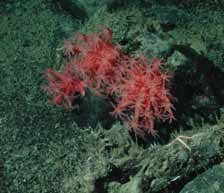
A way forward
important to recognize the role of science and the extent that
associated with a particular area of seamounts of potential
scientific information, or lack thereof, is a prerequisite for
interest for fishing, and only then permitting well-regulated
management action.
fishing activity provided that no vulnerable ecosystems
The UN Fish Stocks Agreement (FSA) Articles 5 and 6
would be adversely impacted.
`General principles' and the `Application of the precautionary
approach' (Kimball, 2005) also establish clear obligations
FURTHER AND IMPROVED SEAMOUNT RESEARCH
for fisheries conservation and the protection of marine
The conclusions of this report apply only to the association
biodiversity and the marine environment from destructive
of stony corals with large seamounts. In order to consider
fishing practices. The Articles also establish that the use
other taxonomic groups on a wider range of seamounts,
of science is essential to meeting these objectives and
further sampling and research is required.
obligations.
Development, implementation and review of effective
Article 5(k) calls on States to promote and conduct
management measures rely on sound scientific data and
scientific research in support of fishery conservation and
assessments. As already acknowledged in Principle 15 of
management, and Article 6.3(a) requires States to improve
the Rio Declaration on Environment and Development
decision making by obtaining and sharing the best scientific
(Agenda 21), gaps in information and knowledge often cause
information available and implementing improved tech-
a lack of full scientific certainty, and a precautionary
niques for dealing with risk and uncertainty. Article 5(d) calls
approach has to be applied to protect the environment from
on States to assess the impacts of fishing on target stocks
threats of serious or irreversible damage and to prevent
and species belonging to the same ecosystem, or those
environmental degradation. UN General Resolutions 59/24
associated with or dependent upon the target stocks. And
(Paragraph 81) and 60/30 (Paragraph 85) (UN General
Article 6.3(d) calls for the development of data collection and
Assembly, 2005a, 2006) call for scientific research to:
research programmes to assess the impact of fishing on
`...improve understanding and knowledge of the deep
non-target and associated or dependent species and their
sea, including, in particular, the extent and vulnerability
environment, and for adopting plans necessary to ensure the
of deep-sea biodiversity and ecosystems...'
conservation of such species and to protect habitats of
special concern (Kimball, 2005).
The preparation of this report has identified a number of
At the same time, the FSA recognizes that scientific
shortcomings and gaps in the data and in our knowledge
understanding may not be complete or comprehensive, and
of seamounts, deep-sea corals and fisheries. These gaps
in such circumstances, caution must be exercised. Articles
need to be addressed and closed in order to answer
6.2 and 6.3(c) require taking into account uncertainties
questions from policy makers, managers and scientists
relating to the impact of fishing activities on non-target
answers that at present cannot be provided at the required
and associated or dependent species that States be `more
level of certainty.
cautious' when information is uncertain, unreliable or
inadequate. The absence of adequate scientific information
Anthomastus sp. (mushroom soft coral), Davidson
shall not be used as a reason for postponing or failing to take
Seamount, 1 580 m. (NOAA/MBARI)
conservation and management measures.
A precautionary approach, consistent with the general
principles for fisheries conservation contained in the FSA, as
well as the UN FAO Code of Conduct for Responsible
Fisheries and the principles and obligations for biodiversity
conservation in the Convention on Biological Diversity
(Kimball, 2005), would require the exercise of considerable
caution in relation to permitting or regulating bottom-trawl
fishing on the high seas on seamounts. This is because of
the widespread distribution of stony corals and associated
assemblages on seamounts in many high seas regions, and
the likelihood that seamounts at fishable depths may also
contain other species vulnerable to deep-sea bottom
trawling even in the absence of stony corals. In this regard,
a prudent approach to the management of bottom-trawl
fisheries on seamounts on the high seas would be to first
ascertain whether vulnerable species and ecosystems are
63
Seamounts, deep-sea corals and fisheries
These include:
a range of spatial scales for example, on a seamount,
1. Obtain better seamount location information: The two
and within and between seamounts on different clusters
most recent seamount position datasets, based on
and chains. Very few individual seamounts have been
satellite altimetry measures, both contain location
comprehensively surveyed to determine the variability of
information for about 15 000 predicted large seamounts.
faunal assemblages within a single seamount, where,
This number is thought to be an underestimate, with
for example, small-scale differences may occur between
extrapolative techniques predicting the global seamount
hard and soft substrates. It is important to understand
number to be 100 000. Fisheries often operate on much
the spatial scales at which variation in fauna community
smaller seamounts, but such seamounts cannot be
composition occurs, in order to develop management
identified by large-scale remote sensing methods.
strategies that ensure the effective protection of this
However, it will be possible, with more extensive satellite
level of biodiversity and associated ecosystem function.
measurements of the Earth's ocean surface with
improved altimetry technology (to reduce loss of signal
5. Availability of data: For many seamount studies, only
by wave `noise') and closer spacing of satellite tracks, to
summary data are publicly available. Analysis of species
greatly improve location data for large seamounts.
distribution patterns and studies on assemblage
composition across different seamounts and regions
2. Address geographic data gaps: Fewer than 300
does, however, require access to species catch data for
seamounts have been biologically surveyed worldwide,
individual stations and/or samples (i.e. non-aggregated
which represents a very small (less than 2 per cent)
data). In addition, many seamount studies are contained
fraction of existing seamounts in the world's oceans.
in the `grey literature' and not always readily accessible.
Only 80 of these seamounts have had at least a
Increased accessibility of full (non-aggregated) datasets
moderate level of sampling, and far fewer have received
from seamount expeditions (after an appropriate time
sampling sufficient to characterize the biological
to publish) through searchable, integrated databases
communities present. Thus, the fauna on the vast
like SeamountsOnline and the Ocean Biogeography
majority of seamounts remains unknown. Past surveys
Information System (OBIS) is required.
have tended to concentrate on a few geographic areas
(e.g. North Atlantic, Southwest Pacific), while few data
6. Collection methods: While different gear types are
exist for seamounts in other regions such as the Indian
required to sample different types of faunal assembl-
Ocean and the Southern Ocean. Although seamounts
ages (e.g. otter trawls for fish, benthic sleds and dredges
are particularly common in the tropics, existing data
for macro-invertebrates), past studies have also used
come mostly from temperate regions at higher latitudes,
different gear types for the same faunal group. Since
and therefore the biological communities of tropical
different collecting gears have different performances,
seamounts remain poorly documented for large parts of
often compounded by differences in deployment
the oceans. Most biological surveys on seamounts have
techniques and operations, direct comparisons of data
been relatively shallow (e.g. mostly less than 1 500 m),
may be confounded to some (unknown) degree. A
and thus the great majority of deeper seamounts
minimum set of standardized seamount sampling
remains largely unexplored. Field programmes are
protocols should be adopted as widely as possible by
required to address these deficiencies.
seamount sampling programmes.
3. Inclusion of other deep-sea habitats: To assess to what
7. Taxonomic resolution: Different taxonomists (scientists
degree seamounts present `unique' ecosystems,
who classify living things) or different groups of
comparative data are required from other deep-sea
taxonomists often work on collections from different
environments such as the abyssal plains surrounding
seamount studies. In fact, much of past and current
seamounts, and direct comparisons with slope
seamount research relies fundamentally on the
environments particularly island slopes and
availability of specialized taxonomic expertise, a critical
continental margins. Thus, field programmes should
resource that continues to decline globally. Datasets
target both seamounts and such comparative
may need careful taxonomic intercalibration before
environments whenever possible.
regional and global analysis can be undertaken with
confidence. Similarly, for some faunal groups, few
4. Assessment of the spatial scale of variability: The
taxonomic specialists are available, often limiting the
distribution of deep-sea corals and other benthic
scope of analysis. More funding for existing taxonomic
invertebrate fauna on seamounts is likely to be patchy at
experts and training of new taxonomists particularly
64
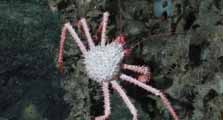
A way forward
for faunal groups that are currently poorly analysed
globally is required. This provision should also enable
the research community to analyse specimens collected
across multiple seamounts in multiple programmes.
8. Increase genetic studies: One of the critical questions
for seamount conservation is whether they support
isolated populations and, if so, on what scale that
isolation occurs. Genetic studies can inform, for
example, whether a single seamount is an appropriate
scale for protection, or whether multiple seamounts in a
chain have connected populations and should be
Neolithodes, Davidson Seamount, 1 319 m. (NOAA/MBARI)
protected.
may be altered by human activities. Therefore, future
9. Assessment of trawling impacts: Better studies on the
research should include aspects of community and
impacts of trawling are needed. Studies to date on
ecosystem processes such as:
seamounts and in the deep sea have been limited. More
food-web architecture on and above seamounts;
and improved studies would improve our understanding
linkages of the bottom fauna with water-column
of the extent to which the large fauna associated with
and geological processes;
corals and other structure-forming organisms are
mechanisms and rates of recruitment (addition of
impacted. Studies should also investigate the nature of
organisms through reproduction or immigration)
impact from different gear types, so that fishing gear can
to seamount communities (e.g. larval dispersion,
be optimized to reduce damage to the benthic fauna,
retention, oceanographic drivers of recruitment
while still catching fish effectively.
variability, etc.);
processes promoting increased primary and
10. Recovery from trawling impacts: Bottom fishing
secondary production on seamount and coupling
undoubtedly has severe impacts on seamount biota,
to sea floor communities;
particularly corals. The physical destruction caused by
trophic (food-chain) links between seamount-
bottom-contact fishing gear is clearly visible on the
associated fish and prey populations; and
seabed, and the removal of corals has significant
the relative role of corals and other structure-
consequences for the biodiversity and biomass of the
forming fauna in promoting biodiversity and
associated fauna. It is, however, not known how long
providing essential habitat for fish.
these communities take to recover from fishing impacts
and what the trajectory of any such recovery may be.
12. Fisheries information: At present, data collection from
Based on the slow growth and longevity of deep-
fishing vessels operating in areas beyond national
sea corals, recovery of corals is predicted to be
jurisdiction is largely ad hoc, and FAO records also appear
extremely slow, but is essentially unknown for field
incomplete for many offshore fisheries. It is important for
situations. However, such information on the time and
effective management of such fisheries to obtain accurate
nature of recovery (if any) is essential for ecosystem-
information on what is being caught, how much, and where.
based fisheries management on seamounts, and for
With seamount fisheries, this requires location data on a
evaluating the efficiency of MPAs on seamounts. Thus it
small-scale (individual tow data, recorded to at least a 1
is essential that the time frames and nature of recovery
minute of a degree accuracy), so that fishing on individual
be documented.
seamounts can be identified.
Without a concerted effort by a number of organizations,
11. Functional understanding: Our understanding of
institutions, consortia and individuals to attend to the
seamount biota has improved over the last few decades,
identified gaps in data and understanding, the ability of any
but many of these advances have been made in
body to effectively and responsibly manage and mitigate the
documenting structural properties of seamount
impact of fishing on seamount ecosystems will be severely
communities (e.g. species composition, distribution,
constrained. Considering what this report has revealed
growth rates, etc.). By contrast, much less is known
about the vulnerability of seamount biota particularly
about the processes operating in seamount ecosystems
deep-sea corals to fishing, now is the time for this
and how functional aspects of seamount assemblages
collaborative effort to begin in earnest.
65
Seamounts, deep-sea corals and fisheries
Acronyms
CCAMLR Commission for the Conservation of Antarctic Marine Living Resources
CoML
Census of Marine Life
DAWG
Data Analysis Working Group
DSL
Deep Scattering Layer
EEZ
Exclusive Economic Zone
ENFA
Environmental Niche Factor Analysis
GLODAP
Global Ocean Data Analysis Project
ETOPO2
Used to describe a 2-minute global bathymetry grid generated from a combination of sources
including satellite altimetry observation and shipboard echo-sounding measurements
ERS1
European Remote-Sensing Satellite-1
FAO
Food and Agriculture Organization of the United Nations
GEBCO
General Bathymetric Chart of the Oceans
GFCM
General Fisheries Commission for the Mediterranean
GLM
Generalised Linear Model
GLODAP Global Ocean Data Analysis Project
ICES International Council for the Exploration of the Sea
IHO
International Hydrographic Organization
IOC
International Oceanographic Commission
NAFO Northwest Atlantic Fisheries Organization
NEAFC Northeast Atlantic Fisheries Commission
OBIS
Ocean Biogeographic Information System
RFMO Regional Fisheries Management Organizations
SAUP
Sea Around Us Project
SEAFO Southeast Atlantic Fisheries Organization
SODA
Simple Ocean Data Assimilation
SWIOFC
Southwest Indian Ocean Fisheries Commission
NOAA
National Oceanic and Atmospheric Administration (USA)
UN
United Nations
UNEP
United Nations Environment Programme
UNGA
United Nations General Assembly
VGPM
Vertically Generalized Production Model
WOA
World Ocean Atlas
WOCE World Ocean Circulation Experiment
66
Glossary
Glossary
Algae: a group of plants (i.e. capable of photosynthesis)
temperature and pressure.
that occur in aquatic habitats, or in moist
Diversity: (1) The number of taxa in a group or place
environments on land.
(species richness) (2) a parameter used to
Anthozoa: A class of animals within the Cnidaria that
describe richness and evenness within a
contains the corals and anemones.
collection of species.
Antipatharia: An order within the Anthozoa (sub-class
Echinoderms: A phylum of marine animals found at all
Hexacorallia), the so-called black corals.
depths (from the Greek for spiny skin)
Aragonite: A form of calcium carbonate used by
Exclusive economic zone (EEZ): 1) A zone under national
scleractinian corals to build their skeletons.
jurisdiction (up to 200-nautical miles wide)
Ascidians: a class of animals (Ascidiacea), the sea squirts.
declared in line with the provisions of the 1982
Azooxanthellate: without Zooxanthellae.
United Nations Convention of the Law of the Sea,
Beam trawl: A trawl in which the horizontal opening is
within which the coastal State has the right to
maintained by a wood or metal beam.
explore and exploit, and the responsibility to
Benthic: Related to the sea floor, includes fauna and flora
conserve and manage, the living and non-living
that live on or in the seabed.
resources; 2) The area adjacent to a coastal state
Biodiversity: (1) The number and variety of organisms
which encompasses all waters between: (a) the
found within a specified geographic region; (2)
seaward boundary of that state, (b) a line on
The variability among living organisms including
which each point is 200 nautical miles (370.40
within and between species and within and
km) from the baseline from which the territorial
between ecosystems.
sea of the coastal state is measured (except when
Biota: The plant and animal life of a region.
other international boundaries need to be
Bottom trawling: Method of trawling where the net
accommodated), and (c) the maritime boundaries
remains in contact with the sea floor can
agreed between that state and the neighbouring
comprise multiple nets i.e. twin-rigged trawls.
states.
Chlorophylls: A group of green pigments found in
Endemic: A taxa that is restricted in its distribution, only
photosynthetic organisms including phyto-
found in a specific area/region.
plankton that absorb energy from sunlight.
Environmental Niche Factor Analysis (ENFA): A habitat
Cnidaria: Phylum of more-or-less radially symmetrical
suitability modelling technique.
invertebrate animals that lack a true body
Epipelagic: The part of the oceanic zone into which
cavity, possess tentacles studded with nema-
enough sunlight enters for photosynthesis to take
tocysts (stinging structures), and include the
place. See also euphotic/photic.
hydroids, jellyfishes, sea anemones and corals.
Epibenthic: Living on the bottom or sea floor
Synonomous with the Coelenterates.
Euphotic: The part of the oceanic zone into which enough
Coelenterates: See Cnidaria.
sunlight enters for photosynthesis to take place.
Corals: A group of benthic anthozoans that can exist as
See also epipelagic/photic.
individuals or in colonies and may secrete
Fauna: Animals, especially those of a particular region,
calcium carbonate external skeletons. Corals can
considered as a group.
be found in the photic zone (with symbiotic
GLM: Generalised Linear Model. A statistical linear model
zooxanthellae) as well as in the deep sea, the so
that can relate one dependent factor to one or
called cold-water corals.
more independent factors.
Crinoid: Marine animals that make up the class Crinoidea
Gorgonacea: An order within the Anthozoa characterized
(phylum Echinodermata). Also known as `sea
by having a flexible, often branching skeleton of
lilies' or `feather-stars'.
horny material.
Deep scattering layer: A relatively thin layer of organisms,
Guyot: Flat topped seamount which is often covered in
composed of migrating plankton forms, which
sediments from when they were exposed islands.
can be detected by echo sounders.
Habitat: The area or environment where an organism or
Detritivores: Scavengers that feed on dead plants and
ecological community normally lives or occurs.
animals or their waste.
Hexacorals: A subclass of the Anthozoans. Includes the
Dissolved inorganic carbon (DIC): All inorganic carbon
Antipatharia and Scleractinia.
dissolved in a volume of water at a given
High seas: denotes (in municipal and international law) all
67
Seamounts, deep-sea corals and fisheries
of that continuous body of salt water in the world
There is no unified consensus of what does or
that is navigable in its character and that lies
does not constitute a seamount. Some definitions
outside of the territorial waters and maritime
are based on elevation e.g. must be greater than
belts of the various countries (also called open
1 000 m whilst others will class a seamount as
seas).
a topographic feature that rises more than 50 m
Hydrozoa (hydroids): A class within the phylum Cnidaria.
above the sea floor.
Marginality: An ENFA term indicating how different the
Scleractinia: An order within the Anthozoa (sub-class
optimal habitat for a taxonomic group is from the
Hexacorallia), the so called stony corals.
mean environment.
Specialization: An ENFA term indicating how stringent are
Mid-water trawling: Method of trawling where the net is
the environmental requirements of a taxonomic
towed through mid-water i.e. above, and not in
group (how narrow a niche it occupies).
contact with the sea floor.
Sponge: A phylum (Porifera) of sessile (attached) forms
Modelling: Representing a system through mathematical
that are spongy or stony to the touch. No obvious
or statistical equations.
animal features and often mistaken for a plant.
Niche: The role an organism fills in an ecosystem.
Stylasteridae: A family of corals within the class
Octocorals: A sub-class of corals within the Anthozoa
hydrozoa.
which are characterized by having eight tentacles
Taxonomy: The science of classifying living things e.g.
on each polyp.
Phylum, Class, Order, Family, Genus, Species.
Otter trawl: A trawl in which the horizontal opening is
Taylor column: Models predict that the steady flow of a
maintained by a pair of trawl doors (or otter
uniform water column past a seamount results in
boards).
a stationary vortex over the seamount, a so-
Pelagic: Of relating to or living in the open sea, away from
called a Taylor column. However, stratification of
the sea bottom.
water layers above a seamount may reduce the
Photic: A zone in the water column that is penetrated by
column to a cap a Taylor cap.
sufficient sunlight for primary productivity/
Trawl: Trawls are nets consisting of a cone-shaped body
production.
closed by a bag or cod end and extended at the
Photosynthesis: The process by which carbohydrates are
opening by wings. They are actively pulled
synthesized from carbon dioxide and water using
through the water and kept open in the vertical
light as an energy source. Most forms of
plane by various methods e.g. floats, and on the
photosynthesis release oxygen as a byproduct.
horizontal plane e.g. by trawl doors. They can be
Plankton: Minute pelagic organisms that float or drift in
towed by 1 or 2 boats and according to type, are
great numbers in fresh or salt water, especially
used on the bottom (demersal) or mid-water
at or near the surface, and serve as food for fish
(pelagic).
and other larger organisms.
Trophic: Of, or involving, the feeding habits or food
Polyp: A single individual of a colony or a solitary attached
relationship of different organisms in a food
cnidarian.
chain.
Primary productivity/production: The rate of carbon
Zooxanthellae: Algae that live symbiotically within the
fixation by phytoplankton (marine photosynthetic
cells of other organisms e.g. corals in the photic
organisms).
zone.
Seamount: An elevation of the seabed with a summit of
Zooanthid: An order of anemone like hexacorals which
limited extent that does not reach the surface.
have a colonial lifestyle.
They can have a variety of shapes but are
Zooplankton: General term for the animal component of
generally conical with a circular, elliptical or
the plankton. in aquatic habitats, or in moist
elongate base, and do not breach the surface.
environments on land.
68
References
References
Anderson OF, Clark MR (2003) Analysis of bycatch in the
we know? Proceedings of the World Congress on
fishery for orange roughy Hoplostethus
Aquatic Protected Areas (eds JP Beumer, A
atlanticus, on the South Tasman Rise. Marine
Grant, DC Smith), Australian Society for Fish
and Freshwater Research, 54 (3), pp. 635-652.
Biology, pp. 664-673, Cairns 2002, Australia.
Anderson OF, Clark MR (2003) Analysis of bycatch in the
Brotons L, Thuiller W, Araujo MB, Hirzel AH (2004).
fishery for orange roughy Hoplostethus
Presence-absence versus presence-only
atlanticus, on the South Tasman Rise. Marine
modelling methods for predicting bird habitat
and Freshwater Research, 54 (3), pp. 635-652.
suitability. Ecography, 27, pp. 437-448.
Andrews AH, Cordes EE, Mahoney MM, Munk K, Coale
Buhl-Mortensen L, Mortensen PB (2004). Symbiosis in
KH, Cailliet GM, Heifetz J (2002). Age, growth
Deep-Water Corals. Symbiosis, 37, pp. 33-61.
and radiometric age validation of a deep-sea,
Buhl-Mortensen L, Mortensen PB (2005). Distribution
habitat-forming gorgonian (Primnoa resedae-
and diversity of species associated with deep-
formis) from the Gulf of Alaska. Hydrobiologia,
sea gorgonian corals off Atlantic Canada. In:
471, pp. 101-110.
Cold-water Corals and Ecosystems (eds A
Auster PJ, Moore J, Heinonen KB, Watling L (2005). A
Freiwald, JM Roberts), Springer Publishing
habitat classification scheme for seamount
House, pp. 849 879, Heidelberg, Germany.
landscapes: assessing the functional role of
Cailliet GM, Andrews AH, Burton E.J, Watters DL, Kline
deep-water corals as fish habitat. In: Freiwald A,
DE, Ferry-Graham LA (2001). Age determination
Roberts JM (eds) Cold-Water Corals and Eco-
and validation studies of marine fishes: do deep-
systems. Springer-Verlag, Berlin, Heidelberg,
dwellers live longer? Experimental Gerontology,
pp. 761-769.
36, pp. 739-764.
Behrenfeld MJ, Falkowski P (1997). Photosynthetic rates
Carton JA, Chepurin G, Cao X, Giese B (2000). A simple
derived from satellite-based chlorophyll
ocean data assimilation analysis of the global
concentrations. Limnology and oceanography,
upper ocean 1950-1995. Part 1: Methodology.
24, pp. 1-20.
Journal of Physical Oceanography, 30, pp. 294-
Bell TH (1975). Topographically generated internal waves
309.
in the open ocean. Journal of Geophysical
CBD (2004). Convention on Biological Diversity. Decisions
Research, 80, pp. 320-327.
adopted by the conference of the parties to the
Boland RC, Parrish FA (2005). A description of fish
Convention on Biological Diversity at its seventh
assemblages in the black coral beds of Lahaina,
meeting. Decision VII/5 Marine and coastal
Maui, Hawai'i. Pacific Science, 59, pp. 411-420.
biological diversity. Paragraphs 57-62, pp. 140-
Bonilla HR, Piñón GC (2002). Influence of temperature
141. Conservation and sustainable use of
and nutrients on species richness ofdeep water
biological diversity in marine areas beyond the
corals from the western coast of the Americas.
limits of national jurisdiction. Available at:
Hydrobiologia, 471, pp. 3541.
www.biodiv.org/decisions/default.aspx?m=COP.0
Borets LA (1975). Some results of studies on the biology
7&id=7742&lg=0
of the pelagic armourhead (Pentaceros
Chapman DC (1989). Enhanced subinertial diurnal tides
richardsoni Smith). Investigations of the biology
over isolated topographic features. Deep-Sea
of fishes and fishery oceanography, TINRO,
Research, 36, pp. 815-824.
Vladivostok, pp. 82-90 (in Russian).
Cheney RE, Richardson PL, Nagasaka K (1980). Tracking
Boyce MS, Vernier PR, Nielsen SE, Schmiegelow FKA
a Kuroship cold ring with a free-drifting surface
(2002). Evaluating resource selection functions.
bouy. Deep-Sea Research, 27, pp. 641-654.
Ecological Modelling, 157, pp. 281-300.
Clark MR (1999).
Fisheries for orange roughy
Brink KH (1989). The effect of stratification on seamount-
(Hoplostethus atlanticus) on seamounts in New
trapped waves. Deep-Sea Research, 36, pp. 825-
Zealand. Oceanologica Acta, 22, pp. 593-602.
844.
Clark MR (2001). Are deepwater fisheries sustainable?
Brodie S, Clark MR (2004). The New Zealand seamount
the example of orange roughy (Hoplostethus
management strategy steps towards con-
atlanticus) in New Zealand. Fisheries Research,
serving offshore marine habitat. In: Aquatic
51, pp. 123-135.
Protected Areas: what works best and how do
Clark MR, Anderson OF, Francis RICC, Tracey DM (2000).
69
Seamounts, deep-sea corals and fisheries
The effects of commercial exploitation on orange
reflection off sloping bottoms. Journal of
roughy (Hoplostethus atlanticus) from the
Geophysical Research, 87, pp. 525-538.
continental slope of the Chatham Rise, New
Eriksen CC (1982b). An upper ocean moored current and
Zealand, from 1979 to 1997. Fisheries Research,
density profiler applied to winter conditions near
45, pp. 217-238.
Bermuda. Journal of Geophysical Research, 87,
Clark MR, Koslow JA (in press). Impacts of fishing on
pp. 7879-7902.
seamounts. In: Seamounts: Ecology Fisheries
Eriksen CC (1985). Implications of ocean bottom reflection
and Conservation (eds TJ Pitcher, PJB Hart, T
for internal wave spectra and mixing. Journal of
Morato, R Santos, M Clark), Blackwell Fisheries
Physical Oceanography, 15, pp. 1145-1156.
and Aquatic Resources Series, Blackwell
Eriksen CC (1991). Observations of amplified flows
Scientific.
atop a large seamount. Journal of Geophysical
Clark MR, O'Driscoll R (2003). Deepwater fisheries and
Research, 96, pp. 15,227-15,236.
aspects of their impact on seamount habitat in
FAO (2002). Report of the second Ad-Hoc meeting on
New Zealand. Journal of Northwest Atlantic
management of deepwater fisheries resources
Fishery Science, 31, pp. 441 458.
of the Southern Indian Ocean. FAO Fish Report,
Clark MR, O'Shea S, Tracey D, Glasby B (1999) New
No. 677, 106 pp.
Zealand region seamounts. Aspects of their
FAO (2004). The State of World Fisheries and Aquaculture.
biology, ecology and fisheries. Report prepared
Food and Agricultural Organization of the United
for the Department of Conservation, Wellington,
Nations, Rome, Italy. 153 pp.
New Zealand, August 1999. 107 pp.
FAO (2005). Review of the state of world marine fishery
Clark, MR, Vinnichenko VI, Gordon JDM, Kukharev NN,
resources. FAO Fisheries Technical Paper, 457,
Kakora, AF (in press). Large scale distant water
235 pp.
trawl fisheries on seamounts. Chapter 17. In:
Fock H, Uiblein F, Köster F, Westernhagen H (2002).
Seamounts: Ecology Fisheries and Conservation,
Biodiversity and species-environment relation-
(eds TJ. Pitcher, PJB Hart, T Morato, R Santos,
ships of the demersal fish assemblage at the
M Clark), Blackwell Fisheries and Aquatic
Great Meteor Seamount (subtropical NE
resources Series, Blackwell Scientific.
Atlantic), sampled by different trawls. Marine
Commonwealth of Australia (2002) Tasmanian
Biology, 141, pp. 185-199.
Seamounts Marine Reserve Masnagement Plan.
Fosså J, Mortensen P, Furevik D (2002). The deep-water
Environment Australia, Canberra, Australia.
coral Lophelia pertusa in Norwegian waters:
ISBN 0642 547 742. 54 pp.
distribution and fishery impacts. Hydrobiologia,
Conkright ME, Locarnini RA, Garcia HE, O'Brien TD, Boyer
471, pp. 1-12.
TP, Stephens C (2002). World Ocean Atlas 2001:
Freiwald A, Hühnerbach V, Lindberg B, Wilson JB,
Objective analyses, data statistics, and figures.
Campbell J (2002). The Sula Reef Complex,
CD-ROM documentation. Rep. IR-17. National
Norwegian shelf. Facies, 47, pp. 179 200.
Oceanography Data Centre, 17, Silver Spring, Md.
Freiwald A, Fosså JH, Grehan A, Koslow JA, Roberts JM
Dower J, Freeland H, Juniper K (1992). A strong biological
(2004). Cold-water coral reefs: out of sight-no
response to oceanic flow past Cobb seamount.
longer out of mind. UNEP-WCMC.Cambridge,
Deep-Sea Research, 39, pp. 1139-1145.
UK. 84 pp.
Druffel ERM, Griffin S, Witter A, Nelson E, Southon J,
Froese R, Sampang A (2004). Taxonomy and biology of
Kashgarian M, Vogel J (1995)
Gerardia:
seamount fishes. In: Seamounts: Biodiversity
bristlecone pine of the deep-sea? Geochimica et
and Fisheries (eds T Morato, D Pauly). Fisheries
Cosmochimica Acta, 59, pp. 5031-5036.
Centre Research Report, 12, pp. 25-31.
Eckelbarger KJ, Watling L, Fournier H (2005).
Gad G (2004a). The Loricifera fauna of the plateau of the
Reproductive biology of the deep-sea polychaete
Great Meteor Seamount. Archive of Fishery and
Gorgoniapolynoe
caeciliae
(Polynoidae), a
Marine Research, 51 (1-3), pp. 9-29.
commensal species associated with octocorals.
Gad G (2004b). Diversity and assumed origin of the
Journal of the Marine Biological Association of
Epsilonematidae (Nematoda) of the plateau of
the United Kingdom, 85, pp. 1425 1433.
the Great Meteor Seamount. Archive of Fishery
Epp D, Smoot NC (1989). Distribution of seamounts in the
and Marine Research, 51 (1-3), pp. 30-42.
North Atlantic. Nature, 337, pp. 254-257.
Gad G, Schminke HK (2004). How important are
Eriksen CC (1982a). Observations of internal wave
seamounts for the dispersal of interstitial
70
References
meiofauna? Archive of Fishery and Marine
Helly JJ, Levin LA (2004). Global distribution of naturally
Research, 51 (1-3), pp. 43-54.
occurring marine hypoxia on continental
Gaston KJ (2003). The structure and dynamics of
margins. Deep-Sea Research I, 51, pp. 1159-
geographic ranges. Oxford University Press,
1168.
Oxford, UK. pp. 276.
Hirzel AH, Arlettaz R (2003). Modeling habitat suitability
George KH, Schminke HK (2002).
Harpacticoida
for complex species distributions by
(Crustacea, Copepoda) of the Great Meteor
environmental-distance geometric mean.
Seamount, with first conclusions as to the origin
Environmental Management, 32, pp. 614-623.
of the plateau fauna. Marine Biology, 144, pp.
Hirzel AH, Hausser J, Chessel D, Perrin N (2002).
887-895.
Ecological-niche factor analysis: how to compute
Genin A (2004). Bio-physical coupling in the formation of
habitat-suitability maps without absence data?
zooplankton and fish aggregations over abrupt
Ecology, 83, pp. 2027-2036.
topographies. Journal of Marine Systems, 50, pp.
Hirzel AH, Helfer V, Metral F (2001). Assessing habitat-
3-20.
suitability models with a virtual species.
Genin A, Dayton PK, Lonsdale PF, Spiess FN (1986).
Ecological Modelling, 145, pp. 111-121.
Corals on seamount peaks provide evidence of
Husebø A, Nøttestad L, Fosså JH, Furevik D, Jørgensen S
current acceleration over deep-sea topography.
(2002). Distribution and abundance of fish in
Nature, 322, pp. 59-61.
deep-sea coral habitats. Hydrobiologia, 471, pp.
Genin A, Noble M, Lonsdale PF (1989). Tidal currents and
91-99.
anticyclonic motions on two North Pacific
ICES (2005). Report of the Working Group on Deep-water
seamounts. Deep-Sea Research, 36, pp. 1803-
Ecology (WGDEC), 8-11 March, 2005, ICES
1815.
Headquarters, Copenhagen. ICES CM
Gianni M (2004). High Seas bottom trawl fisheries and
2005/ACE:02. 76pp.
their impacts on the biodiversity of vulnerable
ICES (2006). Report of the Working Group on Deep-water
deep-sea ecosystems: options for international
Ecology (WGDEC), 4-7 December 2005, Miami,
action. IUCN, Gland, Switzerland. 83 pp.
USA. ICES CM 2006/ACE:04. 79pp.
Gjerde KM (2006). Ecosystems and biodiversity in deep
Johnston PA, Santillo D (2004). Conservation of seamount
waters and high seas. UNEP Regional Seas
ecosystems: application of a Marine Protected
Report and Studies, No. 178. 58 pp.
Areas concept. Archive of Fishery and Marine
Guinotte JM, Orr J, Cairns S, Freiwald A, Morgan L,
Research, 51, pp. 305-319.
George R (2006). Will human-induced changes
Jones CG, Lawton JH, Shachek M (1994). Organisms as
in seawater chemistry alter the distribution of
ecosystem engineers. Oikos, 69, pp. 373-386.
deep-sea scleractinian corals? Frontiers in
Kaiser MJ, de Groot SJ (eds) (2000). Effects of fishing on
ecology and the environment, 1, pp. 141-146.
non-target species and habitats. Blackwell
Guisan A, Zimmermann NE (2000). Predictive habitat
Scientific, Oxford, U.K. 399 pp.
distribution models in ecology. Ecological
Kaneko A, Honji H, Kawatate K, Mizuna S, Masuda A,
Modeling, 135, pp. 147-186.
Miita T (1986). A note on internal wavetrains and
Guisan A, Thuiller W (2005). Predicting species
the associated undulation of the sea surface
distribution: offering more than simple habitat
observed upstream of seamounts. Journal of the
models. Ecology Letters, 8, pp. 993-1009.
Oceanographic Society, Japan, 42, pp. 75-82.
Hall SJ (1999). The effects of fishing on marine
Key RM, Kozyr A, Sabine CL, Lee K, Wanninkhof R,
ecosystems and communities. Blackwell
Bullister J, Feely RA, Millero F, Mordy C, Peng
Scientific, Oxford, U.K. 274 pp.
T-H (2004). A global ocean carbon climatology:
Hall-Spencer J, Allain V, Fosså JH (2002). Trawling
results from Global Data Analysis Project
damage to Northeast Atlantic ancient coral
(GLODAP). Global Biogeochemical Cycles, 18,
reefs. Proceedings of the Royal Society of
doi:10.1029/2004GB002247.
London, Series B: Biological Sciences, 269, pp.
Kimball LA (2005). The International Legal Regime of the
507-511.
High Seas and the Seabed Beyond the Limits of
Haury L, Fey C, Newland C, Genin A (2000). Zooplankton
National Jurisdiction and Options for the
distribution around four eastern North Pacific
Establishment of Marine Protected Areas
seamounts. Progress in Oceanography, 45, pp. 69-
(MPAs) in Areas Beyond the Limits of National
105.
Jurisdiction. Secretariat of the Convention on
71
Seamounts, deep-sea corals and fisheries
Biological Diversity, Montreal, Canada, CBD
MCBI (2003 et seq.) Scientists Statement on Protecting
Technical Series No. 19. 64pp.
the World's Deep-Sea Coral and Sponge
Kitchingman A, Lai S (2004). Inferences on potential
Ecosystems. Marine Conservation Biology
seamount locations from mid-resolution
Institute and Oceana. Available at www.mcbi.org/
bathymetric data. In: Seamounts: Biodiversity
what/what_pdfs/dsc_signatures.pdf. 37pp (1 452
and Fisheries (eds T Morato, D Pauly) UBC
signatures).
Fisheries Centre, 78, pp. 261, Vancouver, B.C.
Meincke J (1971). Observation of an anticyclonic vortex
Kitchingman A, Lai S, Morato T, Pauly D (in press).
trapped above a seamount. Journal of Geo-
Seamount abundance and locations. In:
physical Research, 76, pp. 7432-7440.
Seamounts: Ecology Fisheries and Conservation
Melo O, Menezes G (2002). Exploratory fishing of the
(eds TJ Pitcher, PJB Hart, T Morato, R Santos,
orange roughy (Hoplostethus atlanticus) in some
M Clark), Blackwell Fisheries and Aquatic
seamounts of the Azores archipelago. ICES C.M.
Resources Series, Blackwell Scientific.
2002/M, 26, p 11.
Koslow JA, Boehlert GW, Gordon JD, Haedrich RL, Lorance
Morato T, Clark MR (in press). Seamount fishes: ecology
P, Parin N (2000). Continental slope and deep-sea
and life histories. In: Seamounts: Ecology
fisheries: implications for a fragile ecosystem.
Fisheries and Conservation (eds TJ Pitcher, PJB
ICES Journal of Marine Science, 57, pp. 548-557.
Hart, T Morato, R Santos, M Clark), Blackwell
Koslow JA, Gowlett-Holmes K (1998). The seamount
Fisheries and Aquatic resources Series,
fauna off southern Tasmania: benthic com-
Blackwell Scientific.
munities, their conservation and impacts of
Morato T, Pauly D (eds) (2004). Seamounts: Biodiversity
trawling: Final Report to Environment Australia
and Fisheries. Vancouver: Fisheries Centre
and the Fisheries Research and Development
Research Report 12.
Corporation. Rep. FRDC Project 95/058, CSIRO,
Mortensen PB (2001). Aquarium observations on the
Hobart, Tasmania, Australia, pp. 104.
deep-water coral Lophelia pertusa (L., 1758)
Koslow JA, Gowlett-Holmes K, Lowry JK, O'Hara T, Poore
(Scleractinia) and selected associated
GCB, Williams A (2001). Seamount benthic
invertebrates. Ophelia, 54, pp. 83-104.
macrofauna off southern Tasmania: community
Mundy BC, Parrish FA (2004). New records of the fish
structure and impacts of trawling. Marine
genus Grammatonotus (Teleostei: Perciformes:
Ecology Progress Series, 213, pp. 111-125.
Percoidei: Callanthiidae) from the Central Pacific,
Lack M, Short K, Willock A (2003). Managing risk and
including a spectacular species in the north-
uncertainty in deep-sea fisheries: lessons from
western Hawaiian Islands. Pacific Science, 58,
Orange Roughy. TRAFFIC Oceania and WWF
pp. 403-417.
Endangered Seas Programme, 73pp.
Myers AA, Hall-Spencer J (2004). A new species of
Le Goff-Vitry MC, Pybus OG, Rogers AD (2004). Genetic
amphipod crustacean, Pleusymtes comitari sp.
structure of the deep sea coral Lophelia pertusa
nov., associated with gorgonians on deep-water
in the northeast Atlantic revealed by micro-
coral reefs off Ireland. Journal of the Marine
satellites and internal transcribed spacer
Biological Association of the United Kingdom,
techniques. Molecular Ecology, 13, pp. 537 549.
84, pp. 1029-1032.
Leverette TL, Metaxas A (2005). Predicting habitat for two
Noble M, Cacchione DA, Schwab WC (1988). Observations
species of deep-water coral on the Canadian
of strong mid-Pacific internal tides above
Atlantic continental shelf and slope. In: Cold-
Horizon guyot. Journal of Physical Oceano-
water corals and ecosystems (eds A Freiwald,
graphy, 18, pp. 1300-1306.
JM Roberts) Springer Publishing House,
Noble M, Mullineaux LS (1989). Internal tidal currents
Heidelberg, Germany.
over the summit of Cross seamount. Deep-Sea
Levin LA, Thomas CL (1989).
The influence of
Research, 36, pp. 1791-1802.
hydrodynamic regime on infaunal assemblages
Oceana (2006) The seamounts of the Gorringe Bank.
inhabiting carbonate sediments on central
Available at www.oceana.org. 71pp.
Pacific seamounts. Deep-Sea Research, 36 (12),
O'Driscoll RL, Clark MR (2005). Quantifying the relative
pp. 1897-1915.
intensity of fishing on New Zealand seamounts.
Littler MM, Littler DS, Blair SM, Norris JN (1985).
New Zealand Journal of Marine and Freshwater
Deepest known plant life discovered on an
Research, 39, pp. 839-850.
uncharted seamount. Science, 227, pp. 57-59.
Orr JC, Fabry VJ, Aumont O, Bopp L, Doney SC, Feely RA,
72
References
Gnanadesikan A, Gruber N, Ishida A, Joos F,
Roberts CM (2002). Deep impact: The rising toll of fishing
Key RM, Lindsay K, Maier-Reimer E, Matear R,
in the deep sea. Trends in Ecology and Evolution,
Monfray P, Mouchet A, Najjar RG, Plattner GK,
17 (5), pp. 242-245
Rodgers KB, Sabine CL, Sarmiento JL, Schlitzer
Roberts JM (2005). Reef-aggregating behaviour by
R, Slater RD, Totterdell IJ, Weirig MF,
symbiotic eunicid polychaetes from cold-water
Yamanaka Y, Yool A (2005). Anthropogenic ocean
corals: Do worms assemble reefs? Journal of the
acidification over the twenty-first century and its
Marine Biological Association of the U.K., 85, pp.
impact on calcifying organisms. Nature, 437, pp.
813-819.
681-686.
Roberts JM, Harvey SM, Lamont, PA, Gage JD, Humphery
Pankhurst NW (1988). Spawning dynamics of orange
JD (2000). Seabed photography, environmental
roughy, Hoplostethus atlanticus, in mid-slope
assessment and evidence for deep-water
waters of New Zealand. Environmental biology of
trawling on the continental margin west of the
fishes, 21, pp. 101-116.
Hebrides. Hydrobiologia, 441, pp. 173-183.
Parin NV, Mironov AN, Nesis KN (1997). Biology of the
Roberts J, Wheeler AJ, Freiwald A (2006). Reefs of the
Nazca and Sala y Gomez submarine ridges, an
Deep: The Biology and Geology of Cold-Water
outpost of the Indo-West Pacific fauna in the
Coral Ecosystems. Science, 312, pp. 543-547.
eastern pacific ocean: compostion and
Roden GI (1991). Mesoscale flow and thermohaline
distribution of the fauna, its communities and
structure around Fieberling seamount. Journal
history. Advances in Marine Biology, 32, pp. 145-
of Geophysical Research, 96, pp. 16,653-16,672.
242.
Roden GI, Taft BA (1985). Effect of the Emperor
Parin NV, Prut'ko VG (1985).
The thalassial
Seamounts on the mesoscale thermohaline
mesobenthopelagic icthyocoene above the
structure during the summer of 1982. Journal of
equator seamount in the western tropical Indian
Geophysical Research, 90, pp. 839-855.
Ocean. Oceanology, 25 (6), 781-783.
Roden GI, Taft BA, Ebbesmeyer CC (1982). Oceanographic
Parrish FA, Abernathy K, Marshall GJ, Buhleier BM
aspects of the Emperor Seamounts region.
(2002).
Hawaiian monk seals (Monachus
Journal of Geophysical Research, 87, pp. 9537-
schauninslandi) foraging in deep-water coral
9552.
beds. Marine Mammal Science, 18 (1), 244-258.
Rogers AD (1994). The biology of seamounts. Advances in
Parrish FA, Baco AR Chapter 8: State of the U.S. Deep Coral
Marine Biology, 30, pp. 305350.
Ecosystems in the Hawaiian Archipelago and the
Rogers AD (1999). The biology of Lophelia pertusa
United States Pacific Islands Region. NOAA
(Linnaeus 1758) and other deep-water reef-
Technical Memorandum NMFS-OPR-29, In press.
forming corals and impacts from human
Report of the Secretary General (2003) United Nations
activities. International Review of Hydrobiology,
General Assembly. Oceans and the Law of the Sea.
84, pp. 315 406
Report of the Secretary-General 58/65 Available at:
Rogers AD (2004). The biology, ecology and vulnerability
daccessdds.un.org/doc/UNDOC/GEN/N03/266/68/
of seamount communities. IUCN, Gland,
PDF/N0326668.pdf?OpenElement 80pp.
Switzerland. Available at: www.iucn.org/themes/
Report of the Secretary General (2005) United Nations
marine/pubs/pubs.htm 12 pp.
General Assembly. Oceans and the Law of the
Rogers AD, Baco A, Griffiths H, Hall-Spencer JM (in
Sea. Report of the Secretary-General 60/63
press). Corals on seamounts. In: Seamounts:
Addendum 1 Available at: daccessdds.un.org/
Ecology Fisheries and Conservation (eds TJ
doc/UNDOC/GEN/N05/425/11/PDF/N0542511.pd
Pitcher, PJB Hart, T Morato, R Santos, M Clark),
f?OpenElement 87pp.
Blackwell Fisheries and Aquatic Resources
Richer de Forges B, Koslow JA, Poore GCB (2000).
Series, Blackwell Scientific.
Diversity and endemism of the benthic seamount
Rogers AD, Morley S, Fitzcharles E, Jarvis K, Belchier M
fauna in the southwest Pacific. Nature, 405, pp.
(2006). Genetic structure of Patagonian toothfish
944-947.
(Dissostichus eleginoides) populations on the
Risk MJ, Heikoop JM, Snow MG, Beukens R (2002)
Patagonian Shelf and Atlantic and western Indian
Lifespans and growth patterns of two deep-sea
Ocean Sectors of the Southern Ocean. Marine
corals: Primnoa resedaeformis and Desmo-
Biology, 149 (4), pp. 915-924.
phyllum cristagalli. Hydrobiologia, 471, pp. 125-
Rowden AA, Clark MR, O'Shea S (2004). The influence of
131.
deepwater coral habitat and fishing on benthic
73
Seamounts, deep-sea corals and fisheries
faunal assemblages of seamounts on the
Feeding and cleaning behaviour in Astrobrachion
Chatham Rise, New Zealand. ICES CM2004/
constrictum (Farquhar) (Echinodermata: Ophiu-
AA:09.
roidea), a euryalid brittle-star living in association
Rowden AA, Clark MR, O'Shea S, McKnight D (2002).
with the black coral, Antipathes fiordensis
Benthic biodiversity of seamounts on the
(Grange, 1990). Journal of Experimental Marine
northwest Chatham Rise. New Zealand Marine
Biology and Ecology, 221, pp. 173-189.
Biodiversity Biosecurity, Report No. 2. 21 pp.
Stocks KI (2004). Seamount invertebrates: composition
Rowden AA, Clark MR, Wright IC (2005). Physical
and vulnerability to fishing. In: Seamounts:
characterisation and a biologically focused
Biodiversity and Fisheries (eds T Morato, D
classification of `seamounts' in the New Zealand
Pauly), UBC Fisheries Centre, 78, pp. 17-24,
region. New Zealand Journal of Marine and
Vancouver, B.C.
Freshwater Research, 39, pp. 1039-1059.
Stocks KI (2006). SeamountsOnline: an online information
Royal Commission on Environmental Pollution (2004).
system for seamount biology. World Wide Web
Turning the Tide Addressing the Impact of
electronic publication. seamounts.sdsc.edu.
Fisheries on the Marine Environment. Royal
Last accessed 13 July 2006.
Commission on Environmental Pollution,
Stocks KI, Boehlert GW, Dower JF (2004). Towards an
Westminster, London, U.K. ISBN 0 10 1639228.
international field programme on seamounts
480pp.
within the Census of Marine Life. Archive of
Royal Society (2005) Ocean acidification due to increasing
Fishery and Marine Research, 51, pp. 320-327.
atmospheric carbon dioxide. The Royal Society,
Stone GS, Madin, LP, Stocks, K, Hovermale, G, Hoagland,
London, U.K. Policy Document 12/05, available at
P, Schumacher, M, Etnoyer, P,Sotka, C, Tausig,
www.royalsoc.ac.uk ISBN 0 85403 617 2. 60pp.
H. (2004). Seamount biodiversity, exploitation
Sagalevitch AM, Torohov PV, Matweenkov VV, Galkin SV,
and conservation. In: Defying Ocean's End (eds
Moskalev LI (1992). Hydrothermal activity on
LK Glover, SA Earle), pp. 45-70, Island Press,
the underwater volcano Peepa (Bering Sea).
Washington.
Izvestiya RAN. Seroes Biology , 9, pp. 104-114. (In
Stone RP (2006). Coral habitat in the Aleutian Islands of
Russian).
Alaska: depth distribution, fine-scale species
Seki MP, Somerton DA (1994). Feeding ecology and daily
associations, and fisheries interactions. Coral
ration of the pelagic armourhead Pseudo-
reefs, 25, pp. 229-238.
pentaceros wheeleri at Southeast Hancock
Tracey DM, Horn PL (1999). Background and review of
Seamount. Environmental Biology of Fishes, 39,
ageing of orange roughy (Hoplostethus atlant-
pp. 73-84.
icus) from New Zealand and elsewhere. New
Sherwood OA, Scott DB, Risk MJ (2006) Late Holocene
Zealand Journal of Marine and Freshwater
radiocarbon and aspartic acid racemization
Research, 33, pp. 6786.
dating of deep-sea octocorals. Geochimica et
Tsukamoto K (2006). Oceanic biology: Spawning of eels
Cosmochimica Acta, 70, pp. 2806-2814.
near a seamount. Nature, 439, p. 929.
Simpson ESW, Heydorn AEF (1965). Vema Seamount.
Uchida RN, Tagami DT (1984). Groundfish fisheries and
Nature, 207, pp. 249-251.
research in the vicinity of seamounts in the
Smith DK, Cann, JR (1990). Hundreds of small volcanoes
North Pacific Ocean. Marine Fisheries Review,
on the median valley floor of the Mid-Atlantic
46, pp. 1-17.
ridge at 24-30° N. Nature, 348, pp. 152-155.
UN General Assembly (2003) Resolution adopted by the
Smith DK, Jordan TH (1988). Seamount Statistics in the
General Assembly. 57/141. Oceans and the law of
Pacific Ocean. Journal of Geophysical Research,
the sea. Available at: daccessdds.un.org/doc/
93, pp. 2899-2918.
UNDOC/GEN/N02/547/54/PDF/N0254754.pdf?O
Smith PJ (2001) Managing biodiversity: Invertertebrate
penElement 13pp.
bycatch in seamount fisheries in the New
UN General Assembly (2004a) Resolution adopted by the
Zealand Exclusive Economic Zone. World
General Assembly. 58/240. Oceans and the law of
Fisheries Trust, IRRC/CRDI & UNEP. 30pp.
the sea. Available at: daccessdds.un.org/doc/
Sokal RR, Rohlf FJ (1995). Biometry: the principles and
UNDOC/GEN/N03/508/92/PDF/N0350892.pdf?O
practice of statistics in biological research. WH
penElement 15pp.
Freeman, New York.
UN General Assembly (2004b) Resolution adopted by the
Stewart B (1998). Can a snake star earn its keep?
General Assembly 58/14. Sustainable fisheries,
74
References
including through the 1995 Agreement for the
Watling L (2005). The global destruction of bottom habitats
Implementation of the Provisions of the United
by mobile fishing gear. In: Marine conservation
Nations Convention on the Law of the Sea of 10
biology: the science of maintaining the sea's
December 1982 relating to the Conservation and
biodiversity (eds EA Norse, LB Crowder), Island
Management of Straddling Fish Stocks and
Press, Washington. pp. 198-210.
Highly Migratory Fish Stocks, and related
Watling L, Norse EA (1998). Disturbance of the seabed by
instruments. Available at: daccessdds.un.org/
mobile fishing gear: a comparison to forest
doc/UNDOC/GEN/N03/453/75/PDF/N0345375.pd
clearcutting. Conservation biology, 12, pp.
f?OpenElement 12pp.
11801197.
UN General Assembly (2005a) Resolution adopted by the
Weaver PPE, Billett DSM, Boetius A, Danovaro R,
General Assembly. 59/24. Oceans and the law of
Freiwald A, Sibuet M (2004). Hotspot ecosystem
the sea. Available at: daccessdds.un.org/doc/
research on Europe's deep-ocean margins.
UNDOC/GEN/N04/477/64/PDF/N0447764.pdf?O
Oceanography 17 (4), pp. 132-143.
penElement 18pp.
Wessel P (1997). Sizes and ages of seamounts using
UN General Assembly (2005b) Resolution adopted by the
remote sensing: Implications for intraplate
General Assembly 59/25. Sustainable fisheries,
volcanism. Science, 277, pp. 802805.
including through the 1995 Agreement for the
Wessel P (2001). Global distribution of seamounts inferred
Implementation of the Provisions of the United
from gridded Geosat/ERS-1 altimetry. Journal of
Nations Convention on the Law of the Sea of 10
Geophysical Research. B. Solid Earth, 106, pp.
December 1982 relating to the Conservation and
19,431-19,441.
Management of Straddling Fish Stocks and
Wilson CD, Boehlert GW (2004). Interaction of ocean
Highly Migratory Fish Stocks, and related
currents and resident micronekton at a
instruments. Available at: daccessdds.un.org
seamount in the central North Pacific. Journal of
/doc/UNDOC/GEN/N04/477/70/PDF/N0447770.p
Marine Systems, 50, pp. 39-60.
df?OpenElement 16pp.
Wilson RR, Kaufman RS (1987). Seamount biota and
UN General Assembly (2006) Resolution adopted by the
biogeography. In: (eds BH Keating, P Fryer, R
General Assembly. 60/30. Oceans and the law
Batiza, G Boehlert) Seamounts, Islands and
of the sea. Available at: daccessdds.un.org/doc/
Atolls, Geophysical Monograph, 43, pp. 355-377.
UNDOC/GEN/N05/489/34/PDF/N0548934.pdf?O
Worm B, Lotze HK, Myers RA (2003). Predator diversity
penElement 19pp.
hotspots in the blue ocean. Proceedings of the
US Department of Defense (1989). Gazetteer of undersea
National Academy of Sciences, USA, 100, pp.
features. CD-ROM, US Department of Defense,
9884-9888.
Defense Mapping Agency, USA
Wunsch C, Webb S (1979). The climatology of deep ocean
Vastano AC, Hagen DE, McNally GJ (1985). Lagrangian
internal waves. Journal of Physical Ocean-
observations of the surface circulation at the
ography, 9, pp. 225-243.
Emperor seamount chain. Journal of Geo-
WWF (2006) Policy proposals and operational guidance
physical Research, 90, pp. 3325-3331.
for ecosystem-based management of marine
Vastano AC, Warren BA (1976). Perturbations of the Gulf
capture fisheries. WWF International, Gland,
Stream by Atlantis II seamount. Deep-Sea
Switzerland, 80pp. Available at: www.panda.org.
Research, 23, pp. 681-694.
Zeebe RE, Wolf-Gladrow DA (2001). CO2 in seawater:
Vierros M, Douvere F, Arico S (2006) Implementing the
equilibrium, kinetics, isotopes. Elsevier Oceano-
Ecosystem Approach in Open Ocean and Deep-
graphy Series, 65, pp. 346, New York.
Sea Environments. United Nations University-
Institute of Advanced Studies Report. UNU-IAS,
Yokohama, Japan, 40pp.
75
Seamounts, deep-sea corals and fisheries
Selection of institutions and researchers working on seamount and cold-water coral ecology
Country/Institution
Contact
Country/Institution
Contact
AUSTRALIA
University of Erlangen
André Freiwald
Commonwealth Scientific and Industrial
Tony Koslow
andre.freiwald@pal.uni-erlangen.de
Research Organization (CSIRO)
Tony.Koslow@csiro.au
Universität Hamburg
Bernd Christiansen
Marine and Atmospheric Research
Alan Williams
bchristiansen@uni-hamburg.de
alan.williams@csiro.au
INDIA
University of the Sunshine Coast
Thomas Schlacher
National Institute of Oceanography
Baban Ingole
tschlach@usc.edu.au
baban@darya.nio.org
IRELAND
University of Tasmania
Karen Miller
National University of Ireland,
Anthony J Grehan
karen.miller@utas.edu.au
Galway
anthony.grehan@nuigalway.ie
Martin White
CANADA
Martin.White@nuigalway.ie
Dalhousie University
Derek Tittensor
derekt@mathstat.dal.ca
University College Cork
Andrew Wheeler
a.wheeler@ucc.ie
University of British Columbia
Adrian Kitchingman
a.kitchingman@fisheries.ubc.ca
JAPAN
Telmo Morato
Extremobiosphere Research Center
Shinji Tsuchida
t.morato@fisheries.ubc.ca
Daniel Pauly
Japan Agency for Marine-Earth Science
d.pauly@fisheries.ubc.ca
and Technology (JAMSTEC)
tsuchidas@jamstec.go.jp
Tony Pitcher
t.pitcher@fisheries.ubc.ca
NETHERLANDS
Royal Netherlands Institute
Gerard CA Duineveld
University of Victoria
John Dower
for Sea Research (NIOZ)
duin@nioz.nl
dower@uvic.ca
Verena Tunnicliffe
Fisheries, Oceans, Marine Biodiversity
Matt Gianni
verenat@uvic.ca
matthewgianni@netscape.net
GERMANY
NEW CALEDONIA
Alfred Wegener Institute for
Heino O Fock
Institut de Recherche pour
Bertrand de Forges
Polar and Marine Research
hfock@awi-bremerhaven.de
le Développement (IRD)
bertrand.richer-de-
forges@noumea.ird.nc
Coral Reef Ecology (CORE)
Christian Wild
Working Group,
c.wild@lrz.uni-muenchen.de
NEW ZEALAND
GeoBio-Centre,
National Institute of Water and
Malcolm Clark
Ludwig Maximilians University Munich
Atmospheric Research (NIWA)
m.clark@niwa.co.nz
Mireille Consalvey
Mainz Academy of Sciences /
Dieter Piepenburg
m.consalvey@niwa.co.nz
The Institute for Polar
dpiepenburg@ipoe.uni-kiel.de
Ashley Rowden
Ecology, University of Kiel
a.rowden@niwa.co.nz
Dianne Tracey
Max Planck Institute for
Antje Boetius
d.tracey@niwa.co.nz
Marine Microbiology, Bremen
aboetius@mpi-bremen.de
University of Otago
Keith Probert
keith.probert@stonebow.otago.ac.nz
76
Institutions and researchers
Country/Institution
Contact
Country/Institution
Contact
NORWAY
UNITED STATES OF AMERICA
Institute of Marine Research (IMR)
Lene Buhl-Mortensen
Natural History Museum of
Peter Etnoyer
Lene.Mortensen@ifm.uib.no
Los Angeles, County
peter@aquanautix.com
Jan Helga Fosså
in California
jhf@imr.no
Pål Mortensen
National Undersea
Peter Auster
Paal.mortensen@imr.no
Research Center
peter.auster@uconn.edu
(NURP)
PORTUGAL
University of the Azores
Gui Menezes
National Oceanic &
Bob Embley
gui@notes.horta.uac.pt
Atmospheric Administration
embley@pmel.noaa.gov
Ricardo Santos
(NOAA)
ricardo@notes.horta.uac.pt
University of California
Paul Brewin
RUSSIA
San Diego
pebrewin@sdsc.edu
P.P. Shirshov Institute
Andrey Gebruk
Lisa Levin
of Oceanography
agebruk@ocean.ru
llevin@ucsd.edu
Tina Molotsodova
tina@sio.rssi.ru
Karen Stocks
kstocks@sdsc.edu
UNITED KINGDOM
Joint Nature Conservation
Charlotte Johnston
Florida Atlantic University
Jon Moore
Committee (JNCC)
charlotte.johnston@jncc.gov.uk
jmoore@fau.edu
Mark Tasker
mark.tasker@jncc.gov.uk
Smithsonian Institution
Stephen Cairns
Cairnss@si.edu
Scottish Association for Marine
Bhavani Narayanaswamy
University of Hawaii
Science (SAMS)
Bhavani.Narayanaswamy@sams.ac.uk
Paul Wessel
J Murray Roberts
pwessel@hawaii.edu
Murray.Roberts@sams.ac.uk
University of Maine
Les Watling
United Nations Environment Programme
Stefan Hain
watling@maine.edu
World Conservation
Stefan.Hain@unep-wcmc.org
Monitoring Centre
University of Kansas
Daphne G Fautin
(UNEP-WCMC)
fautin@ku.edu
University of Plymouth
Jason Hall-Spencer
Woods Hole Oceanographic
Amy Baco-Taylor
jason.hall-spencer@plymouth.ac.uk
Institution (WHOI)
abaco@whoi.edu
Kerry Howell
Tim Shank
kerry.howell@ plymouth.ac.uk
tshank@whoi.edu
Zoological Society of London, Institute
Alex Rogers
of Zoology
Alex.Rogers@ioz.ac.uk
77
Seamounts, deep-sea corals and fisheries
Selection of coral and seamount resources
censeam.niwa.co.nz
with 50 partners under the EC Framework Six Programme.
CenSeam (a global census of marine life on seamounts) is a
HERMES work packages include, inter alia, cold-water coral
Census of Marine Life Field Programme aiming to provide the
reefs and carbonate mounds.
framework needed to prioritize, integrate, expand and facilitate
seamount research efforts.
www.kgs.ku.edu/Hexacoral/
Biogeoinformatics of Hexacorals is intended to: (1) provide a
www.coml.org
public information resource of data, interpretation and methods
The Census of Marine Life (CoML) is a network of researchers
related to the taxonomy, biogeography and habitat
in more than 70 nations engaged in a 10-year initiative to assess
characteristics or environmental correlates of the Hexacorallia
and explain the diversity, distribution, and abundance of marine
and allied taxa (2) connect and integrate the activities of the
life in the oceans past, present and future.
individual and institutional partners (3) keep a wide range of
project information updated and available to all interested
www.fao.org/DOCREP/003/X2465E/x2465e0h.htm
parties and (4) provide a directory and communication links to
FAO FISHERIES TECHNICAL PAPER 382 `Guidelines for the
participants and related projects.
Routine Collection of Capture Fishery Data'
www.lophelia.org/index.htm
www.fishbase.org/search.php
Lophelia.org is dedicated to the cold-water coral Lophelia
FishBase is a relational database with information to cater to
pertusa and is an information resource on the cold-water coral
different professionals such as research scientists, fisheries
ecosystems of the deep ocean.
managers, zoologists and many more. FishBase on the web
contains practically all fish species known to science. (eds R
www.mar-eco.no
Froese, D Pauly; version 16 February 2004).
MAR-ECO (patterns and processes of the ecosystems of the
northern mid-Atlantic) is Census of Marine Life Field
bure.unep-wcmc.org/marine/coldcoral
Programme. MAR-ECO is an international exploratory study of
Global cold-water coral database and GIS, an interactive
the animals inhabiting the northern mid-Atlantic. Scientists
mapping tool developed by UNEP which provides easy access to
from 16 nations around the northern Atlantic Ocean are
a wealth of information on cold-water coral ecosystems,
participating in research of the waters around the mid-Atlantic
drawing on the data and collective expertise of scientists,
Ridge from Iceland to the Azores
national agencies and regional organizations from around the
world.
oceanexplorer.noaa.gov/
NOAA Ocean Explorer is an educational Internet offering for all
cdiac.ornl.gov/oceans/glodap/Glodap_home.htm
who wish to learn about, discover, and virtually explore the
The GLobal Ocean Data Analysis Project (GLODAP) is a
ocean realm. It provides public access to current information on
cooperative effort to coordinate global synthesis projects funded
a series of NOAA scientific and educational explorations and
through the National Oceanic and Atmospheric Administration
activities in the marine environment with links to numerous
(NOAA), the U.S. Department of Energy (DOE), and the National
cold-water coral expeditions.
Science Foundation (NSF) as part of the Joint Global Ocean Flux
Study Synthesis and Modeling Project (JGOFS-SMP).
www1.uni-hamburg.de/OASIS
OASIS (Oceanic seamounts: an integrated study) is a European
www.ngdc.noaa.gov/mgg/gebco
Commission supported project aiming to describe the
General Bathymetric Chart of the Oceans (GEBCO) aims to
functioning characteristics of seamount ecosystems.
provide the most authoritative, publicly-available bathymetry
datasets for the world's oceans. GEBCO operates under the
marine.rutgers.edu/opp
auspices of the International Hydrographic Organization (IHO)
IMCS Ocean Primary Productivity Team's (OPPT) home page
and the United Nations' (UNESCO) Intergovernmental
aims to provide: (1) Access to datasets of primary productivity
Oceanographic Commission (IOC).
measurements based on 14C uptake and stimulated
fluorescence techniques, with the hope that these data will be
www.eu-hermes.net
used for productivity model development and testing; (2)
Hotspot Ecosystems Research on the Margins of European
Computer source code, input data fields and ocean productivity
Seas (HERMES), a multidisciplinary deep-sea research project
estimates for the Vertically Generalized Production Model
78
Resources
Appendix I
(VGPM) developed by the OPPT, and; (3) Information on activities
Physical data
of the NASA-sponsored Ocean Primary Productivity Working
All physical data were compiled onto a one-degree resolution
Group (OPPWG), which has been conducting round-robin
global grid, centred on the midpoint of each degree cell.
algorithm testing exercises since 1994 to compare, in an
Physical data were gridded at 0, 500, 1 000, 1 500, 2 000 and
investigator-independent manner, the performance of various
2 500 m depth. These resolutions were chosen to fit with data
productivity models with the intent of establishing a NASA
availability (WOA and GLODAP data are available at this grid
resident `consensus' algorithm for the routine generation of
resolution). Physical data and primary productivity model output
ocean productivity maps.
were all long-term annual means. Composite annual data were
derived from cruises and sampling covering a variety of time
www.seaaroundus.org
periods; where possible, data were selected from the 1990s.
The Sea Around Us Project (SAUP) is devoted to studying the
impact of fisheries on the world's marine ecosystems. To
World Ocean Atlas 2001 data (Conkright et al., 2002) were
achieve this, project staff have used a Geographic Information
composite annual objectively analysed means. GLODAP gridded
System (GIS) to map global fisheries catches from 1950 to the
data (Key et al., 2004) were mostly derived from 1990s WOCE
present, under explicit consideration of coral reefs, seamounts,
(World Ocean Circulation Experiment) cruises. VGPM model
estuaries and other critical habitats of fish, marine
outputs (Behrenfeld and Falkowski, 1997) were depth-
invertebrates, marine mammals and other components of
integrated surface values corrected for cloudiness, derived from
marine biodiversity. The data presented, which are all freely
data collected between 1977 and 1982. SODA modelled current
available, are meant to support studies of global fisheries
velocities (Carton et al., 2000) were the grand mean of the
trends and the development of sustainable, ecosystem-based
annual means for the period 1990-1999, using the 1.4.2 version
fisheries policies.
of the model; the velocity layer nearest to each depth grid layer
was used. The aragonite saturation state was calculated using
seamounts.sdsc.edu
GLODAP data and following the [CO32-]A method of Orr et al.
SeamountsOnline is a freely-available online resource of
(2005), with constants as described in Orr et al. (2005) and
seamount related data. It is a NSF-funded project designed to
equations following Zeebe and Wolf-Gladrow (2001). Positive
gather information on species found in seamount habitats, and
[CO32-]A indicates supersaturation; negative undersaturation.
to provide a freely-available online resource for accessing and
Depth is included as a parameter not because it is important
downloading these data. It is designed to facilitate research into
per se, but because it may correlate with unmeasured factors
seamount ecology, and to act as a resource for managers.
such as pressure.
earthref.org
The Seamount Catalog (search under databases for the
Seamount Catalog) is a digital archive for bathymetric
seamount maps that can be viewed and downloaded in various
formats. This catalog also contains morphological data and
sample information. Related grid and multibeam data files, as
well as user-contributed files, can be downloaded as well.
www.nodc.noaa.gov/OC5/WOA01/pr_woa01.html
The World Ocean Atlas 2001 (WOA01) contains ASCII data of
statistics and objectively analysed fields for one-degree and
five-degree squares generated from World Ocean Database
2001 observed and standard level flagged data. The ocean
variables included in the atlas are: in situ temperature, salinity,
dissolved oxygen, apparent oxygen utilization, per cent oxygen
saturation, dissolved inorganic nutrients (phosphate, nitrate
and silicate), chlorophyll at standard depth levels, and plankton
biomass sampled from 0-200m.
79
Seamounts, deep-sea corals and fisheries
Appendix II
The habitat suitability model
Table A1: Cross-validation results; Spearman's rank coefficient
ENFA is a predictive habitat suitability modelling technique
Replicate
Rs
designed to work with presence-only data (Hirzel et al., 2002).
1
0.8
We bin scleractinian seamount data records to the one-degree
2
0.8
global grid and assign them to the closest depth layer. We used
3
1
only coral records above 2 500 m depth. Physical data were
4
1
normalized using the Box-Cox transformation (Sokal and Rohlf,
5
1
1995). A mismatch occurs between some coral locations and
6
0.8
predicted seamount locations in that some corals are found on
7
1
seamounts that are not detected by the bathymetric analysis
8
0.8
(Kitchingman and Lai, 2004). To resolve this, we model habitat
9
0.8
suitability for the whole ocean, but restrict coral presences to
10
0.8
seamounts.
Mean
0.88
We used the geometric mean algorithm in ENFA (Hirzel and
S. D.
0.10
Arlettaz, 2003). ENFA outputs species marginality (absolute
difference between the global mean and the species mean in
Key assumptions of ENFA are that data are multinormal, that
the multidimensional environmental space) and specialization
species occurrence data span the complete environmental
(ratio of variance between the global distribution and species
range, and that the species is at equilibrium. Hirzel et al. (2002)
distribution). All environmental variables are converted into
suggest that ENFA is robust to deviations from normality, and
uncorrelated factors in a manner similar to principal com-
the method has also been shown to be robust to quality and
ponent analysis.
quantity of data (Hirzel et al., 2001). Spatial autocorrelation was
Habitat suitability maps were constructed following Hirzel et
not directly accounted for but is unlikely to be a major issue with
al. (2002) using the isopleth method. Eight factors were used
this data (Leverette and Metaxas, 2005).
to construct habitat suitability maps, following a broken stick
distribution (Hirzel et al., 2002).
Assessing model performance presents a different challenge
for presence-only models than for presence-absence models
(Boyce et al., 2002). In this case, validation for habitat suitability
maps was carried out using a cross-validation technique (Boyce
et al., 2002). Data were partitioned into four bins followed by
a 10-fold cross validation. For each validation subset, area-
adjusted frequency was compared with that of a randomly
distributed species using Spearman's rank correlation to
assess the monotonicity of the curve (Table A1). This coefficient
varies between -1 and 1; a value near 1 indicates area-adjusted
frequency model predictions monotonically increasing with
increasing habitat suitability and deviating from a random
curve, suggesting good model performance.
80
REFERENCE MAPS
Map 2. FAO Major marine fishing areas
Area
Name
Area
Name
18
Arctic Sea
57
Indian Ocean, Eastern
21
Atlantic, Northwest
58
Indian Ocean, Antarctic and Southern
27
Atlantic, Northeast
61
Pacific, Northwest
31
Atlantic, Western Central
67
Pacific, Northeast
34
Atlantic, Eastern Central
71
Pacific, Western Central
37
Mediterranean and Black Sea
77
Pacific, Eastern Central
41
Atlantic, Southwest
81
Pacific, Southwest
47
Atlantic, Southeast
87
Pacific, Southeast
48
Atlantic, Antarctic
88
Pacific, Antarctic
51
Indian Ocean, Western
Map 3. Regional sea conventions and action plans
1
Convention on the Protection of the Marine Environment of the Baltic Sea Area (HELCOM)c
2
Bucharest Convention and Black Sea Environment Programmeb
3
Cartagena Convention for the Wider Caribbean Region, Caribbean Environment Programme (CEP) and Action Plana
4
East Asian Seas Action Plan (COBSEA)a
5
Nairobi Convention and East African Action Plana
6
Barcelona Convention and Mediterranean Action Plan (MAP)a
7
Antigua Convention and North-East Pacific Action Planb
8
North West Pacific Action Plan (NOWPAP) a
9
Jeddah Convention and Red Sea and Gulf of Aden Action Plan (PERSGA)b
10
Kuwait Convention and ROPME Sea Area Action Planb
11
Noumea (or SPREP) Convention and Pacific Action Planb
12
South Asian Seas Action Plan (SAS) and South Asian Seas Cooperative Environment Programme (SACEP)b
13
Lima Convention and South-East Pacific Action Plan (CPPS)b
14
Abidjan Convention and West and Central Africa Action Plana
15
Regional Programme of Action for the Protection of the Arctic Marine Environment from Land-based Activities (PAME)H,c
16
Convention on the Conservation of Antarctic Marine Living Resources (CCAMLR)H,c
17
Framework Convention for the Protection of the Marine Environment of the Caspian Sea (Teheran Convention) and Caspian
Sea Strategic Action Programmec
18
OSPAR Convention for the Protection of the Marine Environment of the North-East Atlantic (OSPAR)H,c
H: with a high sea mandate / competence. In general, UNEP administered Conventions and Action Plans apply only
to the national waters of member states, incl. EEZs, where appropriate.
a: UNEP administered
b: Non-UNEP administered
c: Independent Programme
Map 4. Regional marine fisheries bodies that can directly establish management measures
The map shows only the areas of competence of those Regional Marine Fisheries Bodies that can directly establish management
measures. In addition to those listed and displayed, the International Whaling Commission (IWC) is a global bodies without a defined
area of competence.
1
Convention on the Conservation of Antarctic Marine Living Resources (CCAMLR)b
2
Convention on the Conservation and Management of the Pollock Resources in the Central Bering Sea (CCBSP)
3
Commission for the Conservation of Southern Bluefin Tuna (CCSBT)
4
General Fisheries Commission for the Mediterranean (GFCM)a,b
5
Inter-American Tropical Tuna Commission (IATTC)
6
International Commission for the Conservation of Atlantic Tunas (ICCAT)
7
Indian Ocean Tuna Commission (IOTC)a
8
International Pacific Halibut Commission (IPHC)
9
Northwest Atlantic Fisheries Organization (NAFO)b
10
North Atlantic Salmon Conservation Organization (NASCO)
11
North East Atlantic Fisheries Commission (NEAFC)b
12
North Pacific Anadromous Fish Commission (NPFAC)
13
Pacific Salmon Commission (PSC)
14
South East Atlantic Fisheries Organization (SEAFO)b
15
South Indian Ocean Fisheries Agreement (SIOFA)c
16
South Pacific Regional Fisheries Management Organisation (SPRFMO)c
17
Western and Central Pacific Fisheries Commission (WCPFC)
a: FAO administered
b: legal competence to manage most or all fisheries within their areas of application, including management of deep sea stocks
beyond national jurisdiction
c: under negotiation
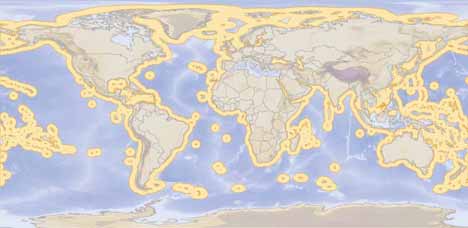
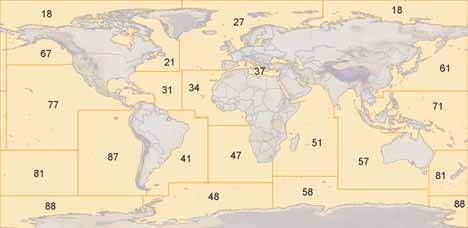
REFERENCE MAPS
Map 1. Exclusive economic zones
Prepared using the Global Maritime Boundaries Database (February 2006 edition, © General Dynamics Advanced Information Systems, 1998-2006).
EEZs and fishing zones in the Mediterranean not displayed.
Map 2. FAO Major marine fishing areas
Source and further information: http://www.fao.org/figis/servlet/static?dom=root&xml=geography/fao_fishing_area.xml
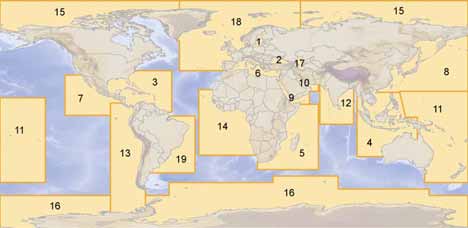
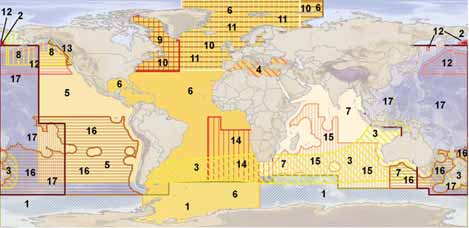
REFERENCE MAPS
Map 3. Regional sea conventions and action plans
Source and further information: http://www.unep.org/regionalseas/
MAP 4. Regional marine fisheries bodies that can directly establish management measures
Source and further information: FAO, 1999-2006, Regional Fishery Bodies - Map of competence area, http://www.fao.org/fi/body/rfb/index.htm
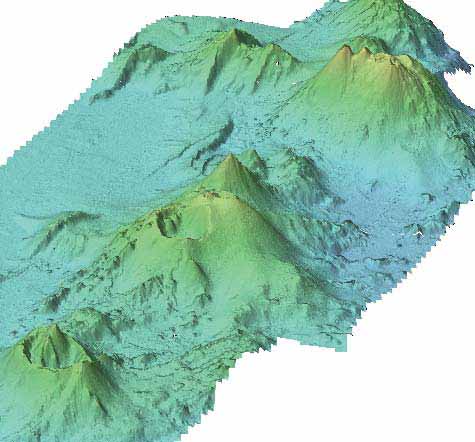

Seamounts, deep-sea corals
and fisheries
An ubiquitous ocean floor feature, a key marine ecosystem and an important
human activity: together these have created one of the most critical ocean issues.
Seamounts, deep-sea corals and fisheries reveals the global scale of the
vulnerability of habitat-forming stony corals on seamounts and that of
associated marine biodiversity and assemblages to the impacts of trawling,
especially in areas beyond national jurisdiction. It provides some of the best
scientific evidence to date to support the call for concerted and urgent action on
the high seas to protect seamount communities and their associated resources
from the adverse effects of deep-water fishing.
Seamounts, deep-sea corals and fisheries describes the results of data
analyses that were used to understand the global distribution of deep-sea corals
on seamounts, to model the distribution of suitable habitat for stony corals, and
to appreciate the extent of trawl fisheries on seamounts in areas beyond national
jurisdiction. These results were combined, along with knowledge of the effects of
trawling on corals and other seamount species, to identify the main areas at risk
from the impact of current and future trawling on the high seas. In particular,
seamount ecosystems in the Indian, North and South Atlantic, and South Pacific
Oceans are threatened by the expansion of alfonsino (250-750 metres) and orange
roughy (750-1 200 metres) fisheries.
Seamounts, deep-sea corals and fisheries aims to raise the awareness
of managers, decision makers and stakeholders about the distribution of deep-
sea corals on seamounts and their vulnerability to trawling. It provides facts and
information to support and guide the international processes within and outside
the United Nations system to find solutions for the conservation, protection and
sustainable management of seamount ecosystems before it is too late.
UNEP Regional Seas Report and Studies No 183
www.unep.org
United Nations Environment Programme
UNEP-WCMC Biodiversity Series No 25
P.O. Box 30552, Nairobi, Kenya
Tel: +254 (0) 20 7621234
Fax: +254 (0) 20 7623927
Email: uneppub@unep.org
Website: www.unep.org
UNEP World Conservation
Monitoring Centre
219 Huntingdon Road, Cambridge
ISBN 978-92-807-2778-4
A
CB3 0DL, United Kingdom
Tel: +44 (0) 1223 277314
Fax: +44 (0) 1223 277136
v
ember 2006
Email: info@unep-wcmc.org
No
DEP/0896/C
Website: www.unep-wcmc.org