XVI SOUTH WEST ATLANTIC
XVI 52 North Brazil Shelf LME
XVI 53 East Brazil Shelf LME
XVI 54 South Brazil Shelf LME
XVI 55 Patagonian Shelf LME
700
XVI South West Atlantic
XVI South West Atlantic
701
XVI-52 North Brazil Shelf LME
S. Heileman
The North Brazil Shelf LME extends along northeastern South America from the
boundary with the Caribbean Sea to the Parnaíba River estuary in Brazil (Ekau &
Knoppers 2003). It has a surface area of about 1.1 million km2, of which 1.69% is
protected, and contains 0.01% of the world's coral reefs and 0.06% of the world's sea
mounts (Sea Around Us 2007). The hydrodynamics of this region is dominated by the
North Brazilian Current, which is an extension of the South Equatorial Current and its
prolongation, the Guyana Current. Shelf topography and external sources of material,
particularly the Amazon River with its average discharge of 180,000 m3s-1 (Nittrouer &
DeMaster 1987), exert a significant influence on the LME. This is complemented by
discharge from other rivers such as Tocantins, Maroni, Corantyne, and Essequibo. A
wide continental shelf, macrotides and upwellings along the shelf edge are some other
features of this LME. Book chapters and reports pertaining to the LME include Bakun
(1993), Ekau & Knoppers (2003), UNEP (2004a, 2004b).
I. Productivity
The North Brazil Shelf LME is considered a Class I, highly productive ecosystem
(>300 gCm-2yr-1), with the Amazon River and its extensive plume being the main source
of nutrients. Primary production is limited by low light penetration in turbid waters
influenced by the Amazon, while it is nutrient-limited in the clearer offshore waters (Smith
& DeMaster 1996). Primary productivity on the continental shelf has been found to be
greatest in the transition zone between these two types of waters, occasionally exceeding
8 gCm-2day-1 (Smith & DeMaster 1996). In addition to high production, the food webs in
this LME are moderately diverse. Brazil's coral fauna is notable for having low species
diversity, yet a high degree of endemism.
Oceanic Fronts (Belkin et al. 2008)(Figure XVI-52.1): Major fronts within this LME are
associated with outflow from the Amazon River and, to a lesser extent, that of the
Orinoco River. The Amazon plume initially turns northwestward and flows along the
Brazil coast as the North Brazil Current. Off the Guiana coast, between 5°N and 7°N, the
North Brazil Current retroflects and flows eastward. This retroflection develops
seasonally and produces anticyclonic rings of warm, low-salinity water that propagate
northwestward toward Barbados, the Lesser Antilles Islands and eventually the
Caribbean Sea. The second major source of fresh water is the Orinoco River plume.
Most thermal fronts are associated with salinity fronts related to freshwater lenses and
plumes originated at the Amazon and Orinoco estuaries. Such fronts are relatively
shallow, sometimes just a few meters deep. Nonetheless, these fronts are important to
many species whose ecology is related to the upper mixed layer. Fresh lenses
generated by the Amazon and Orinoco outflows persist for months, largely owing to the
sharp density contrasts across TS-fronts that form their boundaries (in case of fresh,
warm tropical lenses, the temperature and salinity contributions to the density differential
reinforce each other).
North Brazil Shelf LME SST (Belkin 2008)(Figure XVI-52.2):
Linear SST trend since 1957: 0.22°C.
Linear SST trend since 1982: 0.60°C.






702
52. North Brazil
Figure XVI-52.1. Fronts of the North Brazil Shelf LME. Acronyms: NBCF, North Brazil Current Front.
SSF, Shelf Slope Front (most probable location. Yellow line, LME boundary. After Belkin et al. (2008).
The North Brazil Shelf's thermal history over the last 50 years started with a long-term
cooling that culminated in the all-time minimum of 27.3°C in 1976, followed by warming
until present. Using the year of 1976 as a true breakpoint, a linear trend would yield a
0.9°C increase over 30 years, which would place the North Brazil Shelf among moderate-
to-fast warming LMEs. The North Brazil Shelf thermal history is decorrelated from the
adjacent South Brazil Shelf. This can be explained by decoupling of their oceanic
circulations. Indeed, the North Brazil Shelf is strongly affected by the North Equatorial
Current and Amazon Outflow, whereas the South Brazil Shelf is affected by sporadic
inflows of Subantarctic waters from the south and also by offshore oceanic inflows from
the east.
Figure XVI-51.2. North Brazil Shelf LME annual mean SST (left) and SST anomalies (right), 1957-2006,
based on Hadley climatology. After Belkin (2008).
XVI South West Atlantic
703
North Brazil Shelf LME Chlorophyll and Primary Productivity: The North Brazil Shelf
LME is a Class I, highly productive ecosystem (>300 gCm-2yr-1)(Figure XVI-51.3).
Figure XVI-51.3. North Brazil Shelf LME trends in chlorophyll a (left) and primary productivity (right),
1998-2006, from satellite ocean colour imagery. Values are colour coded to the right hand ordinate.
Figure courtesy of J. O'Reilly and K. Hyde. Sources discussed p. 15 this volume.
II. Fish and Fisheries
The multispecies and multigear fisheries of the North Brazil Shelf LME are targeted by
both national and foreign fleets (FAO 2005 and see below). Major exploited groups
include a variety of groundfish such as weakfish (Cynoscion sp.), whitemouth croaker or
corvina (Micropogonias furnieri) and sea catfish (Arius sp.). The shrimp resources, such
as southern brown shrimp (Penaeus subtilis), pink spotted shrimp (P. brasiliensis),
southern pink shrimp (P. notialis), southern white shrimp (P. schmitti) as well as the
smaller seabob (Xiphopenaeus kroyeri) support one of the most important shrimp
fisheries in the world. Tuna is also exploited, and although its catch weight is relatively
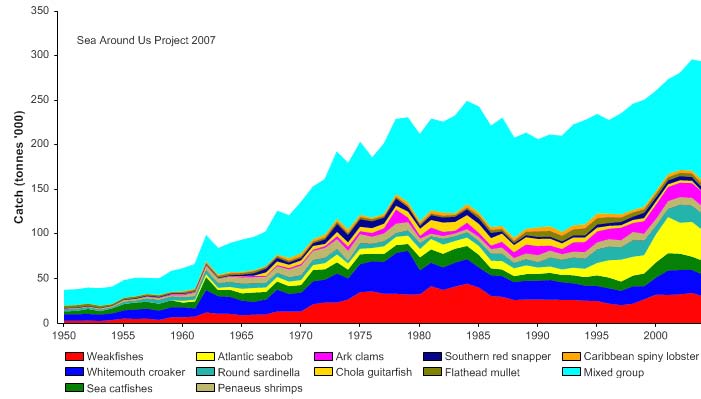
small, its value is significant. Total reported landings in this LME underwent a steady
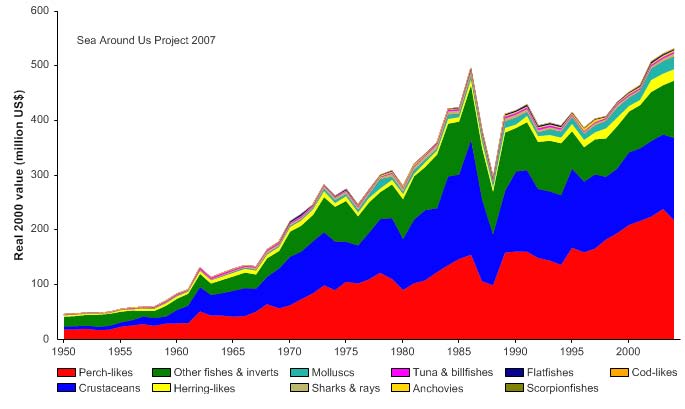
increase from 1950 to just over 290,000 tonnes in 2004 (Figure XVI-52.4) and the value
of the reported landings reached US$532 million (in 2000 US dollars) in 2004 (Figure
XVI-52.5).
Figure XVI-52.4. Total reported landings in the North Brazil Shelf LME by species (Sea Around Us 2007).
704
52. North Brazil
Figure XVI-52.5. Value of reported landings in the North Brazil Shelf LME by commercial groups (Sea
Around Us 2007).
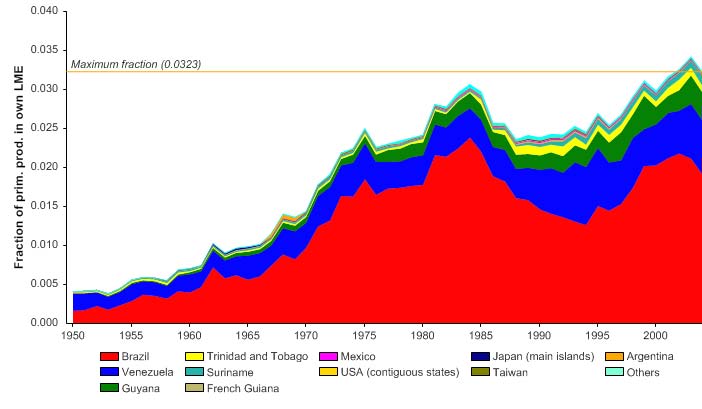
The primary production required (PPR; Pauly & Christensen 1995) to sustain the reported
landings in this LME is low, currently at 3% of the observed primary production (Figure
XVI-52.6). Brazil has the largest share of the ecological footprint in this LME, followed by
Venezuela and Guyana.
Figure XVI-52.6. Primary production required to support reported landings (i.e., ecological footprint) as
fraction of the observed primary production in the North Brazil shelf LME (Sea Around Us 2007). The
`Maximum fraction' denotes the mean of the 5 highest values.
From the mid 1980s, the mean trophic level of the reported landings (i.e., the MTI; Pauly
& Watson 2005) has undergone a steady decline (Figure XVI-52.7, top), a trend
indicative of a `fishing down' of the food webs (Pauly et al. 1998) in the LME, while the
flatness of the FiB over the same period (Figure XVI-52.7, bottom) implies that the
increase in the reported landings have not compensated for the decline in the mean
XVI South West Atlantic
705
trophic level. A detailed study of ecosystems in the region by Freire (2005) has found
similar trends using local catch data.
Figure XVI-52.7. Mean trophic level (i.e., Marine Trophic Index) (top) and Fishing-in-Balance Index
(bottom) in the North Brazil Shelf LME (Sea Around Us 2007).
The Stock-Catch Status Plots indicate that over 60% of commercially exploited stocks in
the LME are either overexploited or have collapsed (Figure XVI-52.8, top). However,
70% of the reported landings come from fully exploited stocks (Figure XVI-52.8, bottom).
1950
1960
1970
1980
1990
2000
0%
100
10%
90
20%
)
80
%
(
s
30%
u
70
at
st
40%
y
60
b
ks
50%
c
50
o
f
st
60%
o
40
er
b
70%
m
30
Nu
80%
20
90%
10
100%0
1950
1960
1970
1980
1990
2000
(n = 4573)
developing
fully exploited
over-exploited
collapsed
1950
1960
1970
1980
1990
2000
0%
100
10%
90
20%
80
)
%
30%
(
70
s
u
at
40%
60
k st
c
50%
o
50
st
y
60%
b
h
40
t
c
a
70%
C
30
80%
20
90%
10
100%0
1950
1960
1970
1980
1990
2000
(n = 4573)
developing
fully exploited
over-exploited
collapsed
Figure XVI-52.8. Stock-Catch Status Plots for the North Brazil Shelf LME, showing the proportion of
developing (green), fully exploited (yellow), overexploited (orange) and collapsed (purple) fisheries by
number of stocks (top) and by catch biomass (bottom) from 1950 to 2004. Note that (n), the number of
`stocks', i.e., individual landings time series, only include taxonomic entities at species, genus or family
level, i.e., higher and pooled groups have been excluded (see Pauly et al, this vol. for definitions).
706
52. North Brazil
Detailed analysis of the fisheries in this LME confirms this diagnosis of severe
overexploitation. There is evidence that some of the fisheries may be fully exploited or
overexploited in relation to MSY, particularly some of the groundfish stocks. Where
assessments have been undertaken, there are clear signs of overexploitation of the
southern red snapper (Lutjanus purpureus) resource (UNEP unpubl), with declining catch
rates and a decrease in the size of this species (Charuau et al. 2001, Charuau & Medley
2001). Recent trends in catch per unit effort and other analyses indicate that the corvina
is now overexploited in some areas, with the low stock levels of this species being
commensurate with exploitation levels beyond the MSY level (Alió et al. 2000, Alió 2001).
Similarly, lane snappers (L. synagris), bangamary (Macrodon ancylodon) and sharks are
also showing signs of overexploitation (Alio 2001, Ehrhardt & Shepard 2001a).
Moreover, a decrease in the average size of some groundfish species has raised
sustainability issues (Booth et al. 2001, Chin-A-Lin & IJspol 2001). The increasing
capture of small individuals is potentially compromising recruitment to the spawning stock
(Souza 2001). For instance, in Brazil, immature southern red snappers comprise over
60% of the catch of this species (Charuau et al. 2001). Trawl and Chinese seines
harvest bangamary at ages far below the age at maturity (Ehrhardt & Shepherd 2001a).
In general, all the shrimp species in the region are subjected to increasing trends in
fishing mortality (Ehrhardt 2001) and the fishery is generally overcapitalised (Chin-A-Lin
& M. IJspol 2001). Stocks of brown and pink spotted shrimp may be close to being fully
exploited (Charuau & Medley 2001, Ehrhardt 2001, Ehrhardt & Shepherd 2001b,
Negreiros Aragão et al. 2001), with the latter being overexploited in some areas (Ehrhardt
& Shepherd 2001b). There has been a general downward trend in the abundance of
brown and pink shrimps, particularly during the late 1980s and throughout the 1990s.
The trends in fishing mortality were not high enough to have created the very
conspicuous decline in abundance, which implies that environmental factors (seasonal
river run-off and rainfall) may be more significant than fishing in determining recruitment
in these species.
Excessive bycatch and discards and destructive fishing practices are severe, and are of
concern throughout the LME. The shrimp bycatch issue is well known in the region,
where the bycatch/shrimp ratios are typically between 5 and 15:1 (Villegas & Dragovich
1984, Marcano et al. 1995). Many commercial species, predominantly young individuals,
comprise the bycatch, most of which is discarded dead at sea. Several species have
practically disappeared from the bycatch, indicating a dramatic shrinking of their
populations, notably in the case of sharks (Charlier 2001). The operation of trawlers in
shallow areas also causes extensive physical damage to benthic habitats and their
communities (Charlier 2001). The use of explosives and poisons on the reefs (bleach for
capturing octopus) and mangroves (toxic chemicals to capture crabs), capture of
immature individuals through diving as well as the use of nets to catch lobsters, which
drag sediments, animals and calcareous algae from the sea floor, have also been
reported in this region (UNEP 2004a).
III. Pollution and Ecosystem Health
Pollution: Overall, pollution was found to be moderate, but severe in localised hotspots
near urban areas. Most of the pollution is concentrated in densely populated and
industrialised coastal basins, and not widespread across the region. Water quality in the
coastal areas is threatened by human activities that give rise to contamination from
sewage and other organic material, agrochemicals, industrial effluents, solid wastes and
suspended solids (EPA/GEF/UNDP 1999).
Effluents from industries are released, sometimes untreated, into the water bodies.
Contamination by mercury as well as by chemical agricultural wastes is the main source
XVI South West Atlantic
707
of chemical pollution in the Amazon Basin (UNEP 2004b). Gold is exploited in all the
countries of the region and mercury from gold mining operations is dispersed into the air.
It is assumed that the largest part ends up in rivers, transforms into methyl-mercury and
other chemical compounds and concentrates along the food chain. Mercury
contamination could, on the longer-term, become a hazard for the coastal marine
ecosystem and for human health, if suitable measures to limit its use are not
implemented. There is also the potential risk of pollution from oil extraction, both in the
coastal plain and the sea.
Agricultural development is concentrated along the coast and includes intensive
cultivation of sugarcane, bananas and other crops. This involves the application of large
quantities of fertilisers and pesticides, which eventually end up in the coastal
environment. Sugarcane plantations along the coast are also suspected to contribute
persistent organic contaminants, which are widely used in pest control, to the coastal
habitats (UNEP 2004b).
As a result of the coastal hydrodynamics in this LME, the potential for transboundary
pollution impacts is significant. River outflow is deflected towards the northwest and
influences the coastal environment in an area situated west of each estuary. It has been
estimated that 40-50% of the annual Amazon run-off transits along the Guyana coast
(Nittrouer & DeMaster 1987). In fact, Amazon waters can be detected as far away as the
island of Barbados (Borstad 1982). As a result, most of the coastal area of the Brazil-
Guianas region has been described as an `attenuated delta of the Amazon' (Rine &
Ginsburg 1985). This implies that contaminants in river effluents, particularly those of the
Amazon, could be transported across national boundaries and EEZs.
Habitat and community modification: Human activities have led to severe habitat
modification in this LME. Mangroves, which dominate a major part of the shoreline, have
been seriously depleted in some areas, for example, in Guyana, where mangrove
swamps have been drained and replaced by a complex coastal protection system (EPA
2005. Likewise, on the Brazilian coast, the original mangrove area has been significantly
reduced by cutting for charcoal production and timber, evaporation ponds for salt and
drained and filled for agricultural, industrial or residential uses and development of tourist
facilities (Marques et al. 2004). In Brazil, erosion also threatens coastal habitats and
some coastal lagoons have been cut off from the sea.
In the past, the coral reefs were mined for construction material. Currently, they are
exposed to increased sedimentation due to poor land use practices and coastal erosion,
chemical pollution from domestic sewage and agricultural pesticides, overfishing, tourism
and development of oil and gas terminals (Maida & Ferreira 1997). Additionally, there
has been some coral bleaching associated with climate variation (Charlier 2001).
Trawlers often operate without restriction in the shallower areas of the shelf, over
ecologically sensitive areas inhabited by early life stages of shrimp. The environmental
impact of such activities is likely to be high, considering the intensity of shrimp trawling
operations in these areas (Ehrhardt & Shepherd 2001b). Evidence from other regions
suggests that precautionary measures should be undertaken in environmentally sensitive
areas of the continental shelf (Ehrhardt & Shepherd 2001b). Trawlers also catch
significant quantities of finfish as bycatch, of which dumping at sea is still a widespread
practice in the region (FAO 2005). This is especially damaging to the stocks when the
bycatch includes a significant portion of juvenile fish. In Suriname, small-scale fishers
have reported the incidence of `dead waters', in shallow areas, following fishing activity
by trawlers (Charlier 2001). These dead waters were scattered with dead fish in larger
amounts than could have been discarded by the trawlers. Vast areas were devoid of live
708
52. North Brazil
fish, as they had apparently died or moved out of the area. Such mortality could be the
result of local oxygen depletion, caused by the re-suspension of anoxic sediment
combined with the presence of organic matter dumped from the vessels.
Growth of the local human population and pressures associated with urban and industrial
development will continue to threaten the health of the LME. The problems are, however,
potentially reversible, considering that there is a greater public and governmental
awareness about environmental issues and several measures at national and regional
levels are being taken to address some of these problem.
IV. Socioeconomic Conditions
Brazil (states of Amapá, Pará, Maranhão), French Guiana, Guyana, Suriname and the
southeastern part of Venezuela border this LME. A high percentage of the total
population consists of indigenous communities. Human uses of the coastal zone include
subsistence agriculture, fisheries, exploitation of clay and sand and limited ecotourism.
Marine fisheries constitute an important economic sector in the region, providing foreign
exchange earnings, employment and animal protein. A significant portion of the region's
population depends upon fishing for its survival and is unable to substitute other sources
of animal protein for fish protein (UNEP 2004b). In Guyana, the fishery sector is of
critical importance to the economy and to social well-being. The economic contribution of
Guyana's fisheries has grown dramatically in recent years, contributing about 6% to GDP
and employing about 10,000 persons (FAO 2005). Furthermore, fish protein is the major
source of animal protein in Guyana, with per capita consumption of about 60 kg in 1996,
more than four times the world average (FAO 2005). In general, unsustainable
overexploitation of living resources as well as environmental degradation may result in
threats to the food security of fishers and loss of employment, as well as loss of foreign
exchange to the countries of this LME. Because of shrinking resources and degradation
of habitats, a number of development projects have been implemented to support local
communities.
V. Governance
Fisheries management issues in the countries bordering the North Brazil Shelf LME are
complicated because of the variety of gears used, and the multi-species and multinational
nature of the groundfish fisheries. This situation is further complicated by the paucity of
data pertaining to the biology and productivity of the region's fish stocks and catch and
fishing effort. As a consequence, confidence in stocks assessments is low (Booth et al.
2001). The countries have ongoing programmes for environmental and natural resource
management and coastal zone management and most have established several national
marine parks and protected areas.
The countries are parties to several international environmental agreements, for example
CBD, UNFCCC, UNCLOS, MARPOL and Ramsar Convention on Wetlands. Brazil,
Guyana, Peru, Suriname and Venezuela, along with Bolivia, Colombia, Ecuador and
Peru have developed a project for support by GEF: `Integrated Management of Aquatic
Resources in the Amazon' For the Brazilian Amazon River Basin. The project, approved
for Work Program Entry in June 2005, recognises the close linkages between integrated
water resource management and the protection of marine habitats. The general
objective of this project is to strengthen the institutional framework for planning and
executing, in a coordinated and coherent manner, activities for the protection and
sustainable management of the land and water resources of the Amazon River Basin,
based upon the protection and integrated management of transboundary water resources
and adaptation to climatic change.
XVI South West Atlantic
709
The first phase of the project will involve strategic planning and institutional
strengthening, including the development of a TDA of the Basin and preparation of a
Framework SAP. Brazil has applied for the GEF biodiversity project `Strengthening the
Effective Conservation and Sustainable use of Mangrove Ecosystems in Brazil through
its National System of Conservation Units'. The aim of the project is to develop
conservation and sustainable management of mangrove ecosystems in Brazil to
conserve globally significant biodiversity and key environmental services and functions
important for national development and the well-being of traditional and marginalised
coastal communities.
References
Alió, J.J. (2001). Venezuela, Shrimp and Groundfish Fisheries. FAO Fisheries Report 651:115-119.
Alió, J.J., Marcano, L., Soomai, S., Phillips, T., Altuve, D., Alvarez, R., Die, D., and Cochrane, K.
(2000). Analysis of industrial trawl and artisanal fisheries of whitemouth croaker (Micropogonias
furnieri) of Venezuela and Trinidad and Tobago in the Gulf of Paria and Orinoco River Delta.
FAO Fisheries Report 628:138-148.
Bakun, A. 1993. The California Current, Benguela Current, and Southwestern Atlantic shelf
ecosystems A Comparative Approach to Identifying Factors Regulating Biomass Yields, p
199-221 in: Sherman, K., Alexander, L.M. and Gold, B.D. (eds), Large Marine Ecosystems
Stress Mitigation, and Sustainability AAAS, Washington D.C., U.S.
Belkin, I.M. (2008) Rapid warming of Large Marine Ecosystems, Progress in Oceanography, in
press.
Belkin, I.M., Cornillon, P.C., and Sherman, K. (2008). Fronts in Large Marine Ecosystems of the
world's oceans. Progress in Oceanography, in press.
Booth, A., Charuau, A., Cochrane, K., Die, D., Hackett, A., Lárez, A., Maison, D., Marcano, L.A.,
Phillips, T., Soomai, S., Souza, R., Wiggins, S. and IJspol, M. (2001). Regional assessment of
the Brazil-Guianas groundfish fisheries. FAO Fisheries Report 651:22-36.
Borstad, G.A. (1982). The influence of the meandering Guiana Current and Amazon River
discharge on surface salinity near Barbados. Journal of Marine Research 40:421-434.
Charlier, P. (2001). Review of environmental considerations in management of the Brazil-Guianas
shrimp and groundfish fisheries. FAO Fisheries Report 651:37-57.
Charuau, A. and Medley, P. (2001). French Guiana, snapper fishery. FAO Fisheries Report 651:77-
80.
Charuau, A., Cochrane, K., Die, D., Lárez, A., Marcano, L.A., Phillips, T., Soomai, S., Souza, R.,
Wiggins, S. and IJspol, M. (2001). Regional Assessment of red snapper, Lutjanus purpureus.
FAO Fisheries Report 651:15-21.
Chin-A-Lin, T. and IJspol, M. (2001). Suriname, groundfish and shrimp fisheries. FAO Fisheries
Report 651:94-104.
Ehrhardt, N. M. and Shepherd, D. (2001a). Guyana, groundfish fisheries. FAO Fisheries Report
651:85-89.
Ehrhardt, N.M. (2001). Comparative regional stock assessment analysis of the shrimp resources
from northern Brazil to Venezuela. FAO Fisheries Report 651:1-14.
Ehrhardt, N.M. and Shepherd, D. (2001b). Guyana, shrimp fisheries. FAO Fisheries Report 651:81-
84.
Ekau, W. and Knoppers, B. A. (2003). A review and redefinition of the Large Marine Ecosystems
of Brazil, p 355-372 in: Sherman, K. and Hempel, G. (eds), Large Marine Ecosystems of the
World: Trends in Exploitation, Protection and Research. Elsevier Science. Amsterdam, The
Netherlands.
EPA (2005). Issues and Importance of Guyana's Coastal Zone. Environmental Protection Agency
Guyana. http://www.epaguyana.org/iczm/articles.htm
EPA/GEF/UNDP (1999). Guyana National Biodiversity Action Plan. www.epaguyana.org/
downloads/National-Biodiversity-Action-Plan.pdf
FAO (2005). Fishery Country Profile. The Federative Republic of Brazil. www.fao.org/fi/fcp
/en/BRA/profile.htm
Freire, K. (2005). Fishing impacts on marine ecosystems off Brazil, with emphasis on the north-
eastern region. PhD thesis, University of British Columbia, 254 p.
710
52. North Brazil
Freire, K.M.F. and Pauly, D. (2005). Richness of common names of Brazilian marine fishes and its
effect on catch statistics. Journal of Ethnobiology. 25 (2): 279-296.
Maida, M. and Ferreira, B.P. (1997).Coral reefs of Brazil: An overview, p 263-274 in: Proceedings
of the 8th International Coral Reef Symposium, Vol. 1.
Marcano, L., Alió, J.J., Altuve, D.E. and Celaya, J. (1995). Venezuelan shrimp fisheries in the
Atlantic margin of Guyana. National report of Venezuela. FAO Fisheries Report 526 (Suppl.):1-
29.
Marques, M., da Costa, M.F., de O. Mayorga, M.I. and Pinheiro, P.R.C. (2004). Water
environments: Anthropogenic pressures and ecosystem changes in the Atlantic drainage basins
of Brazil. Ambio (33)1-2:68-77.
Negreiros Aragão, J.A., de Araújo Silva, K.C., Ehrhardt, N.M., Seijo, J.C. and Die, D. (2001). Brazil,
Northern Pink Shrimp Fishery. Regional Reviews and National Management Reports Fourth
Workshop on the Assessment and Management of Shrimp and Groundfish Fisheries on the
Brazil-Guianas Shelf. FAO Fisheries Report 651.
Nittrouer, C.A. and DeMaster, D.J. (1987). Sedimentary Processes on the Amazon Continental
Shelf. Pergamon Press, New York, U.S.
Pauly, D. and Christensen, V. (1995). Primary production required to sustain global fisheries.
Nature 374: 255-257.
Pauly, D. and Watson, R. (2005). Background and interpretation of the `Marine Trophic Index' as a
measure of biodiversity. Philosophical Transactions of the Royal Society: Biological Sciences
360: 415-423.
Pauly, D., Christensen, V., Dalsgaard, J., Froese R. and Torres, F.C. Jr. (1998). Fishing down
marine food webs. Science 279: 860-863.
Rine, J.M. and Ginsburg, R.N. (1985). Depositional facies of the mudshorefave in Suriname, South
America: A mud analogue to sandy, shallow-marine deposits. Journal of Sedimentary Petrology
55(5):633-652.
Sea Around Us (2007). A Global Database on Marine Fisheries and Ecosystems. Fisheries Centre,
University British Columbia, Vancouver, Canada. www.seaaroundus.org/lme/
SummaryInfo.aspx?LME=17
Smith, W.O. and DeMaster, D.J. (1996). Phytoplankton biomass and productivity in the Amazon
River plume: Correlation with seasonal river discharge. Continental Shelf Research 16(3):291-
319.
Souza, R. (2001). Brazil, northern red snapper fishery. FAO Fisheries Report 651:3-70.
UNEP (2004a). Marques, M., Knoppers, B., Lanna, A.E., Abdallah, P.R. and Polette, M. Brazil
Current, GIWA Regional Assessment 39. University of Kalmar, Kalmar, Sweden.
www.giwa.net/publications/r39.phtml
UNEP (2004b). Barthem, R. B., Charvet-Almeida, P., Montag, L. F. A. and Lanna, A.E. Amazon
Basin, GIWA Regional Assessment 40b. University of Kalmar, Kalmar, Sweden.
www.giwa.net/publications/r40b.phtml
Villegas, L. and Dragovich, A. (1984). The Guianas-Brazil shrimp fishery, its problems and
management aspects, p 60-70 in: Gulland, J.A. and Rothschild, B.J. (eds), Penaeid Shrimps -
Their Biology and Management. Fishing News Books, Farnham, U.K.
XVI South West Atlantic
711
XVI-53 East Brazil Shelf LME
S. Heileman
The East Brazil Shelf LME encompasses that part of the Brazilian coast from the
Parnaíba Estuary in the North to Cape São Tomé in the South (Ekau & Knoppers 2003).
It covers a surface area of about 1.1 million km2, of which 0.86% is protected, and
contains 0.33% of the world's coral reefs and 0.58% of the world's sea mounts (Sea
Around Us 2007). The South Equatorial Current, which splits into the North Brazil
Current and the southward-flowing Brazil Current, dominates the LME. Coastal upwelling
of nutrient-rich South Atlantic Central Waters characterises the area south of Abrolhos
Bank in spring and summer (Summerhayes et al. 1976). About 35 rivers, the largest of
which are the Jequitinhonha, Mucuri, Doce and Paraíba do Sul rivers, drain into the
coastal areas. Estuaries include São Francisco and Paraíba. Apart from the Abrolhos
Bank, this LME has a narrow continental shelf. A tropical climate characterises this LME.
LME book chapters and articles pertaining to the South Brazil Shelf LME include Bakun
(1993), Ekau & Knoppers (2003), UNEP (2004).
I. Productivity
The East Brazil Shelf LME is a typical oligotrophic system, poor in nutrients and
phytoplankton biomass, except in areas of upwelling where primary production is
enhanced (Gaeta et al. 1999). The oligotrophic character of the eastern shelf system and
its diverse food web structure is in clear contrast to the Southeast-South shelf system
(Ekau & Knoppers 1999). The LME can be considered a Class II, moderate productivity
ecosystem (150-300 gCm-2yr-1). Highest biomass and densities of pico-, nano-, micro-
and macro-plankton typify the southern coast and the Abrolhos Bank (Susini-Ribeiro
1999). The macro-zooplankton is dominated by calanoid and cyclopoid copepods.
Mesopelagic species dominate the ichthyofauna community in waters more than 200 m
deep. On the Abrolhos Bank, demersal ichtyoplankton species, largely herbivorous fish,
dominate the system possibly relying on the primary production of benthic algae. The
Abrolhos Bank and the Vitória-Trindade Ridge form a topographical barrier to the Brazil
Current, inducing fundamental changes and spatial variability in physical, chemical and
biological features over the shelf and along the shelf edge (Castro & Miranda 1998, Ekau
& Knoppers 1999).
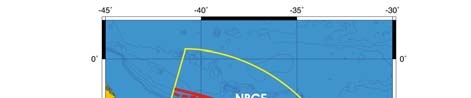
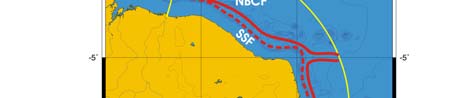
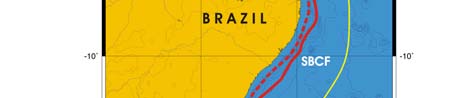
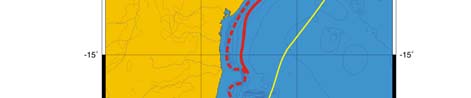
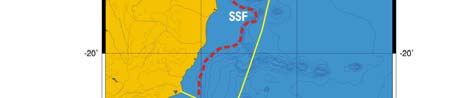
Oceanic Fronts (Belkin et al. 2008)(Figure XVI-53.1): This LME includes the bifurcation
of the westward South Equatorial Current near Cabo de São Roque (5.5°S; Belkin et al.
2008) that gives rise to two currents and associated fronts: the northward North Brazil
Current Front (NBCF) and the southward South Brazil Current Front (SBCF). Within this
LME the SBCF is most noticeable in salinity; it becomes distinct as a temperature front
from the South Brazil Bight southward (see South Brazil Shelf LME). The NBCF is year-
round, best defined in austral winter; it extends along the coast into the North Brazil Shelf
LME. The Southern Bahia Front (15°S-19°S) and the Cabo Frio Front (20°S-24°S) are
caused by wind-induced upwelling and are best developed during austral summer and
fall, from January through June.
East Brazil Shelf LME SST (Belkin 2008)(Figure XVI-53.2):
Linear SST trend since 1957: 0.57°C.
Linear SST trend since 1982: 0.30°C.
712
53. East Brazil Shelf LME
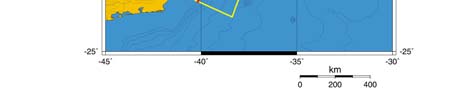
Figure XVI-53.1. Fronts of the East Brazil Shelf LME. Acronyms: NBCF, North Brazil Current Front;
SBCF, south Brazil current Front; SSF, Shelf Slope Front (most probable location). Yellow line, LME
boundary. After Belkin et al. (2008).
Like the adjacent South Brazil Shelf, the East Brazil Shelf experienced a long-term
warming at a slow-to-moderate rate. The most significant event since 1957 was a 1°C
warming in 1981-84, similar to and concurrent with the South Brazil Shelf warming. Both
LMEs are linked by shelf-slope along-frontal currents that transport SST anomalies from
one LME to another; therefore the observed synchronism can be explained by advection,
although large-scale atmospheric forcing spanning both LMEs also could have played a
role.
Figure XVI-53.2. East Brazil Shelf LME annual mean SST (left) and SST anomalies (right) , 1957-2006,
based on Hadley climatology. After Belkin (2008).
XVI South West Atlantic
713
East Brazil Shelf Chlorophyll and Primary Productivity: This LME is a Class II,
moderate productivity ecosystem (150-300 gCm-2yr-1)(Figure XVI-53.3).
Figure XVI-53.3. East Brazil Shelf trends in chlorophyll a (left) and primary productivity (right), 1998-
2006, from satellite ocean colour imagery. Values colour coded to the right hand ordinate. Figure
courtesy of J. O'Reilly and K. Hyde. Sources discussed p. 15 this volume.
II. Fish and Fisheries
The fisheries are mainly artisanal although commercial fisheries for lobster, shrimp and
southern red snapper are significant in the states of Ceará, Rio Grande do Norte and
Espírito Santo (Ekau & Knoppers 1999). Tuna (mainly bigeye) are fished in offshore
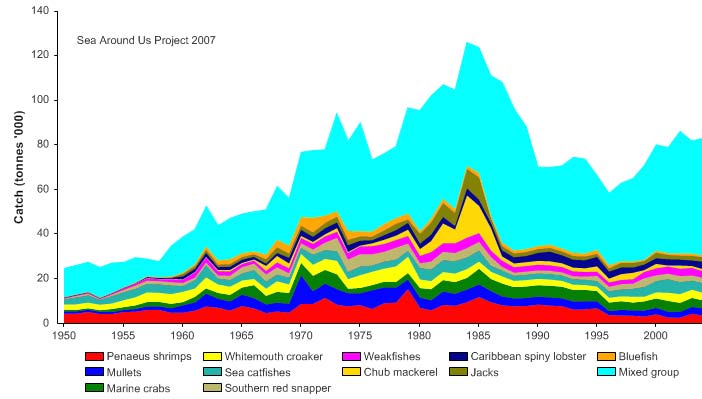
areas and landed mainly in Rio Grande do Norte and Paraíba. Total reported landings in
the LME increased to 300,000 tonnes in 1973 with Brazilian sardinella (Sardinella
brasiliensis) accounting for two-third of the landings, but have decline over the past three
decades, recording 130,000 tonnes in 2004 (Figure XVI-53.4). However, a large quantity
of fish bycatch from shrimp trawlers is not included in the underlying statistics and, there
are reasons to believe that a substantial fraction of the landings from small artisanal
fisheries (predominantly fishes) may not be included in the statistics as well (Freire 2003).
The high likelihood of misreporting in the underlying statistics makes `ecosystemic'
diagnosis of catch trends difficult if not impossible (see below).
Figure XVI-53.4. Total reported landings in the East Brazil Shelf LME by species (Sea Around Us 2007).
714
53. East Brazil Shelf LME
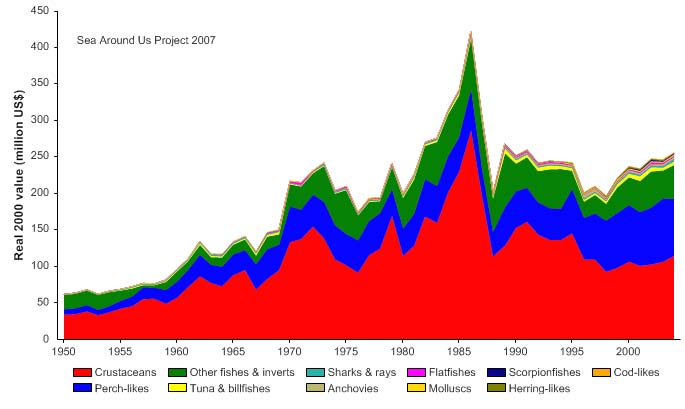
The value of the reported landings peaked at US$400 million (in 2000 US dollars) in
1986, with landings of crustaceans accounting for the largest share (Figure XVI-53.5).
Figure XVI-53.5. Value of reported landings in the East Brazil Shelf LME by commercial groups (Sea
Around Us 2007).
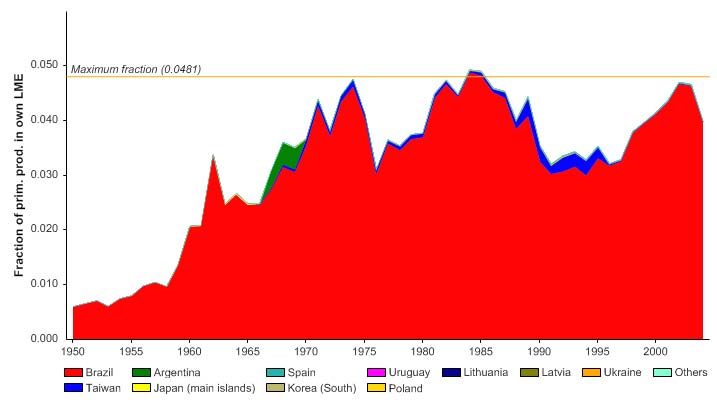
The primary production required (PPR; Pauly & Christensen 1995) to sustain the reported
landings for the LME approached 5% of the observed primary production in the early
1970s, and has fluctuated between 3 to 5% in recent years (Figure XVI-53.6). This is
probably an underestimate due to the large under-reporting of catch in the region (see
above). Brazil account for almost all of the ecological footprint in this LME, which has
little foreign fishing (Figure XVI-53.6).
Figure XVI-53.6. Primary production required to support reported landings (i.e., ecological footprint) as
fraction of the observed primary production in the East Brazil Shelf Sea LME (Sea Around Us 2007). The
`Maximum fraction' denotes the mean of the 5 highest values.
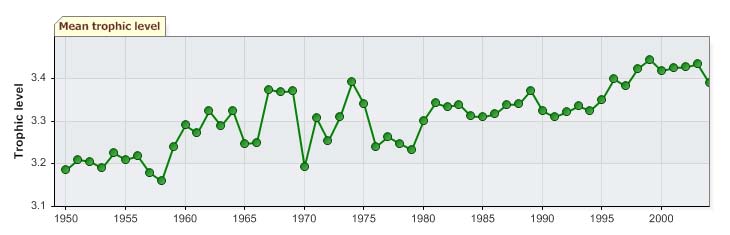
The mean trophic level of the reported landings (i.e., the MTI, Pauly & Watson 2005) has
increased steadily (with variation) from around 3.2 in the early years to 3.4 in recent
years (Figure XVI-53.7, top).. As for the FiB index, the expansion of the fisheries in the
XVI South West Atlantic
715
1950s and 1960s is represented by an increase in the FiB index, though it has since
been on a generally flat trend (Figure XVI-53.7, bottom).
Figure XVI-53.7. Mean trophic level (i.e., Marine Trophic Index) (top) and Fishing-in-Balance Index
(bottom) in the East Brazil Shelf LME (Sea Around Us 2007).
The Stock-Catch Status Plots indicate that over 70% of commercially exploited stocks in
the LME are either overexploited or have collapsed (Figure XVI-53.8, top). With regard to
the contribution to the reported landings biomass, approximately 60% of the landings are
supplied by overexploited and collapsed stocks (Figure XVI-53.8, bottom). However,
given the quality of the underlying catch statistics (see text), this diagnosis is tentative.
1950
1960
1970
1980
1990
2000
0%
100
10%
90
20%
)
80
(
%
s
30%
u
70
t
at
s
40%
y
60
b
ks
50%
c
o
50
f
st
60%
o
40
er
b
70%
m
30
u
N
80%
20
90%
10
100%0
1950
1960
1970
1980
1990
2000
(n = 3296)
developing
fully exploited
over-exploited
collapsed
1950
1960
1970
1980
1990
2000
0%
100
10%
90
20%
80
)
%
30%
(
70
s
t
u
a
40%
60
ck st
50%
o
50
st
y
60%
b
h
40
t
c
a
70%
C
30
80%
20
90%
10
100%0
1950
1960
1970
1980
1990
2000
(n = 3296)
developing
fully exploited
over-exploited
collapsed
Figure XVI-53.8. Stock-Catch Status Plots for the East Brazil Shelf LME, showing the proportion of
developing (green), fully exploited (yellow), overexploited (orange) and collapsed (purple) fisheries by
number of stocks (top) and by catch biomass (bottom) from 1950 to 2004. Note that (n), the number of
`stocks', i.e., individual landings time series, only include taxonomic entities at species, genus or family
level, i.e., higher and pooled groups have been excluded (see Pauly et al., this volume, for definitions).
716
53. East Brazil Shelf LME
Overexploitation is considered to be severe in this LME, with both artisanal and
commercial fishing contributing to the significant decrease of the region's fish stocks.
Several valuable species (e.g., shrimp, lobster, tuna, crabs and mussels) are fully
exploited or exploited above MSY (FAO 1997, UNEP 2004. As a result, declining fish
catches are evident in several areas (e.g., Paiva 1997, Hilsdorf & Petrére 2002) and
overfishing has drastically reduced the stocks of some commercially important fish or
eliminated them from the catches. In fact, marine and estuarine fisheries for red snapper,
prawns and mangrove crabs have declined as a result of overfishing.
Excessive bycatch and discards range from slight to severe (UNEP 2004. Non-selective
fishing methods are used extensively and up to 30% of fisheries catches in the northeast
areas consists of accidental captures and/or discards. In the oceanic fisheries, bycatch
comprises 80% of the catch (on the Sergipe and Alagoas coast this can reach 90%) with
discards amounting to 60% of the catch. Small-meshed nets used in commercial shrimp
trawling capture a number of non-target species, such as finfish, lobster, crab and turtle.
This bycatch, which is normally returned dead to the sea, can reach up to 8 kg for each
kilogram of shrimp captured. Destructive fishing practices are moderate to severe
(UNEP 2004). Trawling has also destroyed many habitats. The use of bombs and
poison is seen in most estuaries in the state of Sergipe while the use of explosives is
common along the entire Bahia coast.
Measures aimed at recovery and sustainability of the principal species may help to
address overexploitation in the LME (FAO 2005). However, improved fisheries statistics
are necessary for the development of fisheries management plans. Fisheries statistics
continue to be a difficult issue in Brazil, due to several factors including the lack of
institutional stability among the regulatory agencies in charge of the fisheries sector
(Freire 2003), the multitude of common names used for reporting landings (Freire &
Pauly 2005), the large geographical extension of the coast, the uneasy coexistence of
artisanal and commercial fisheries and the large number of species and landing sites
related to the artisanal fisheries (Paiva 1997).
III. Pollution and Ecosystem Health
Pollution: Pollution is a growing concern, especially around densely populated and
industrialised coastal areas where hotspots have been identified. In general, pollution
was found to be moderate in this LME, but severe in localised hotspots (UNEP 2004,
UNEP unpubl). The main sources of marine pollution are linked to land-based activities,
especially unplanned coastal development and tourism and recreation centres, as well as
ocean transport and industrial activities (e.g., Suape industrial port complex in the State
of Pernambuco) and agriculture. As a result of the disposal of untreated sewage in
coastal areas, microbial contamination is evident in the estuaries and coastal waters near
major cities. In fact, beaches located downstream of densely populated urban centres are
likely to be contaminated by faecal coliform bacteria in concentrations above the
threshold limit (FEMAR 1998). Estuaries, bays and lagoons encircled by large urban
areas show varying degrees of eutrophication from sewage and other organic pollution,
increased sediment loads and limited water circulation (FEMAR 1998, Kjerfve et al.
2001). Low oxygen levels (<3 mgl-1) occur in estuaries and coastal lagoons and
significantly affect coastal embayments (Lacerda et al. 2002). As a result, fish kills due to
low concentration of dissolved oxygen associated with the proliferation of harmful algal
blooms are not uncommon in some areas (Sierra de Ledo & Soriano-Serra 1999).
Chemical pol ution arises mainly from industry and agricultural plantations. Mercury
concentrations reach about 2-5 times baseline levels in some hotspots (Seeliger & Costa
1998). Deforestation, coastal plantations and mining have facilitated soil erosion, which
XVI South West Atlantic
717
has resulted in increasing suspended solids in estuaries and other coastal areas
(Knoppers et al. 1999a, 1999b).
Oil exploitation and shipping in the coastal zone, although on a lesser scale than offshore
oil and gas activities, represent one of the greatest pressures on the coastal environment
of this LME (IBAMA 2002). Several small-, medium- and large-scale spills of oil, grease
and a number of hazardous substances have been detected in coastal and marine
waters (UNEP 2004). Oil spills are becoming more frequent along the northeast coast of
Brazil. The refuelling of boats and the washing of ship tanks is normally carried out a few
kilometres from the coastline, resulting in the occurrence of tar and sometimes weathered
oil slicks in coastal habitats such as sandy beaches and coral reefs.
Habitat and community modification: Human activities in the coastal zone have
resulted in moderate to severe habitat modification in this LME, with the East Atlantic
Basins and NE Brazil Shelf being the most affected (UNEP 2004, UNEP unpubl).
Destruction of mangrove forests for charcoal production, timber, urban and tourist
developments, salt production, agriculture and shrimp farms is widespread throughout
the region. It is estimated that the area of mangrove swamp on the entire Brazilian coast
has been reduced by up to 30% of its original area, with the probability of further
reduction (UNEP unpubl). Only in the state of Piauí can significant areas of non-
impacted mangrove forest be found. The conversion of the mangrove to shrimp farms
has drastically changed the natural and ecological balance of the region's estuaries. The
highest rate of mangrove deforestation and conversion to aquaculture occurs on the
coast of Rio Grande do Norte, which has lost about 2,000 ha of its original area. The
states of Paraíba and Pernambuco are no exception, with almost all of its estuaries
having shrimp farms of various sizes. This industry is expanding in Piauí, where the total
loss of mangrove has already reached 600 ha.
The coral reefs of Brazil are mostly spread over a distance of 2,000 km between 0o50'
and 19° S latitude from the state of Maranhão in the North Brazil Shelf LME to southern
Bahia. They are the southernmost reefs in the Atlantic Ocean and are characterised by
relatively low species diversity and the endemism of the hard coral species, with six
endemic species (Castro 1994). The largest and richest reefs of Brazil occur on the
Abrolhos Bank in the southern part of the state of Bahia. In the past, the coral reefs of
the North Brazil Shelf LME were mined for construction material, but at present they
come under a growing number of threats. These include increased sedimentation due to
unsustainable land use as well as coastal erosion, pollution from domestic sewage and
pesticides from sugar cane plantations, overfishing and use of explosives for fishing,
tourism, as well as port and oil/gas terminals development (Amado-Filho et al. 1997,
Maida & Ferreira 1997, Leão 1999).
In the state of Bahia, an acceleration of generally unplanned urbanisation and
indiscriminate use of septic tanks in urban centres have resulted in contamination of
groundwater (Marques et al. 2004). As a consequence, nutrient enrichment through
groundwater seepage has resulted in eutrophication of adjacent coastal areas (Costa et
al. 2000). This has affected the trophic structure of the reefs in these areas, with
increasing turf and macroalgae growth, reduction of available light to coral colonies and
competition for space preventing the settlement of new coral larvae. Coral bleaching
resulting from high sea surface temperature has also affected the reefs in this LME (Leão
1999). There was extensive coral bleaching in 1998 in North Bahia and the Abrolhos
region, with levels of 80% reported in important species such us Agaricia agaricites,
Mussismilia hispida and Porites astreoides (Garzón-Ferreira et al. 2002). However, all
corals recovered after six months. The reefs of the Abrolhos Archipelago have been
impacted by coastal zone development, tourism, overexploitation of natural resources
and pollution from urbanisation as well as industrial activities, including the exploitation of
718
53. East Brazil Shelf LME
fossil fuel in deep waters (Amado Filho et al. 1997, Coutinho et al. 1993, Leão 1996,
1999).
Changes in sediment transport dynamics due to land-based activities are considered one
of the most serious environmental issues in this region (IBAMA 2002). The lower São
Francisco River and its estuary have suffered significant morphological changes as a
consequence of the construction of dams. Significant reduction of sediment/nutrient
transport has caused sediment deficit in coastal areas, erosion and modification of
ecological niches (Marques 2002). Some marine turtles, such as the green, loggerhead,
hawksbill, Pacific ridley and leatherback, marine mammals such as the humpack whale,
as well as the marine manatee have suffered significant reductions in their populations
and are in danger of extinction (Fundação CEPRO 1996).
IV. Socioeconomic Conditions
The East Brazil Shelf LME is bordered by the Brazilian states of Piauí, Ceará, Rio
Grande do Norte, Paraíba, Pernambuco, Alagoas, Sergipe, Bahia and Espírito Santo. It
shows an extremely high social, cultural and economic diversity (UNEP 2004). The
estimated population is about 53 million inhabitants, with a large percentage living in
urban areas (IBGE 2000). In most states, the increasing concentration of the population
and economic activities in coastal cities is notable. For example, the state of
Pernambuco has the highest coastal population density in the country (over 800 persons
km-2). This is ten times greater than the population density of the rest of the state and
twice above the national average (Costa & Souza 2002). A large number of the
inhabitants of this region are among the poorest in the country, with a wide social and
economic gap separating the few rich and the mass of poor people (UNEP 2004).
The main economic activities are linked to agriculture, livestock farming,
fisheries/aquaculture and tourism. The LME's fisheries represent an important source of
food and income for coastal communities, although they make a small contribution to the
country's GDP. Shrimp farming is also an important economic activity, with farms in the
northeastern part representing 75% of the national total. Tourism is one of the most
important drivers of coastal development in Brazil, and is expected to expand further
during the coming years.
Artisanal fisheries are an important subsistence activity not accounted for in the formal
economy of Brazil. Fishing represents a labour-intensive activity, responsible for about
800 000 direct jobs. Approximately four million people depend on this sector. The
decline in marine fisheries in the region has been accompanied by reduced economic
returns over the years. Severe impacts are seen on the fisheries sector economy,
affecting the population that is directly dependent on the sector. Several fishing
associations have been closed and the labour force diverted into other sectors, such as
tourism. As a consequence of the declining stocks and interruption of industrial fishing
activities, unemployment in the seafood processing sector has increased.
The socioeconomic impacts of pollution and habitat modification and loss in the East
Brazil Shelf LME include loss of revenue and employment opportunities from tourism and
fisheries, loss of property value, increased cost of surveillance, restoration of degraded
areas as well as penalties against companies responsible for accidents (UNEP 2004).
More frequent are the health impacts related to water-borne diseases such as
microbiological and parasitic diseases (Governo do Estado de São Paulo 2002).
Increasing gastrointestinal symptoms related to exposure to polluted beaches were
described by Ciência e Tecnologia a Serviço do Meio Ambiente (CETESB) (Governo do
Estado de São Paulo 2002). Among the social and other community impacts are the loss
of recreational and aesthetic value of many coastal areas. Pollution and habitat
XVI South West Atlantic
719
modification are also thought to cause reduction of fish stocks, leading to loss of
sustainable livelihoods in hundreds of fishing communities along the coast of this LME.
Habitat and community modification have also resulted in increased costs for coastal
areas maintenance due to higher vulnerability to erosion and lower coastline stability.
This concern has also created generational inequity and loss of scientific and cultural
heritage through the disappearance of aquatic species (UNEP 2004).
V. Governance
The Brazilian Government became involved in coastal preservation and management
during the 1970s when habitat degradation increased due to industrialisation and urban
growth (Lamardo et al. 2000). Coastal management is supported by the Federal
Constitution in Brazil, which defined the coastal zone as national property (UNEP 2004).
In 1988, the government implemented the National Coastal Management Plan. In 1995
the National Programme of Coastal Management (Programa Nacional de Gerenciamento
Costeiro, GERCO) proposed decentralisation, with the objective of stimulating initiatives
by the states and municipalities, according to the local conditions and demands. The
main objective of GERCO is to realign public national policies, which affect the coastal
zone, in order to integrate the activities of the states and municipalities and incorporate
measures for sustainable development (UNEP 2004). In parallel with the Ecological-
Economic Diagnosis, the Ministry of the Environment has coordinated the implementation
of the National Programme for Coastal Management involving all 17 coastal states and
their municipalities. The programme's main objective is the assessment and diagnosis of
the coastal zone uses and conflicts for better planning and management of its living and
non-living resources.
Some of the requirements for sustainable development in Brazil include the alleviation of
poverty, innovative development strategies, technological improvements as well as sound
conservation policies. The greatest constraints are the lack of harmonised legal
instruments and financial mechanisms, as well as discrepancies in the capabilities of
national and regional experts and managers. The Centre of Fisheries Research and
Development of Northeast (CEPENE) is a regional department of the Brazilian Institute of
Environment and Natural Renewable Resources and is responsible for the northeastern
and eastern coast from Rio Parnaíba to north of Abrolhos Bank. CEPENE has played an
important role in supporting research and technological development and promoting
technical and social assistance to the local labour force.
The East Brazil Shelf LME, along with the South Brazil Shelf LME and the Patagonian
Shelf LME, forms the Upper South-West Atlantic Regional Sea Area. In 1980 UNEP's
Governing Council launched a programme for the marine and coastal environment of
Argentina, Brazil and Uruguay. In 1998, in cooperation with the UNEP/GPA Coordination
Office and the UNEP Regional Office for Latin America and the Caribbean (ROLAC), a
Regional Programme of Action (POA) on Land-based Activities and a regional
assessment for the Upper South-West Atlantic were prepared and endorsed by
representatives of the three governments. The first steps in implementing the
programme, which covers the coast from Cape São Tomé in Brazil to the Valdés
Peninsula in Argentina, are under development. Under this regional POA, the Brazilian
National Programme of Action for the Protection of the Marine Environment from Land-
based Activities in the Brazilian Section of the Upper South-West Atlantic has been
developed. This national POA covers the area from São Tomé Cape to Chuí, in Rio
Grande do Sul state.
720
53. East Brazil Shelf LME
References
Amado-Filho, G.M. Andrade, L.R., Reis, R.P., Bastos, W. and Pfeiffer, W.C. (1997). Heavy metal
concentration in seaweed species from the Abrolhos Reef Region, Brazil, p 183-186 in:
Proccedings of the VIII International Coral Reef Symposium, Panama, 2. Panama.
Bakun, A. 1993. The California Current, Benguela Current, and Southwestern Atlantic shelf
ecosystems A Comparative Approach to Identifying Factors Regulating Biomass Yields, p
199-221 in: Sherman, K., Alexander, L.M. and Gold, B.D. (eds), Large Marine Ecosystems
Stress Mitigation, and Sustainability AAAS, Washington D.C., U.S.
Belkin, I.M. (2008) Rapid warming of Large Marine Ecosystems, Progress in Oceanography, in
press.
Belkin, I.M., Cornillon, P.C., and Sherman, K. (2008). Fronts in Large Marine Ecosystems of the
world's oceans. Progress in Oceanography, in press.
Castro, B.M. and Miranda, L.B. (1998). Physical Oceanography of the Western Atlantic Continental
Shelf Located Between 4° N and 34° S, in: Robinson, A.R. and Brink, K.H. (eds), The
Sea 11:209-252.
Castro, C.B. 1994. Corals of Southern Bahia, p 161-176 in: Hetzel, B. and Castro, C.B. (eds),
Corals of Southern Bahia. Nova Fronteira, Rio de Janeiro, Brazil.
Costa, M.F. & Souza, S.T. (2002). A zona costeira Pernambucana e o caso especial da Praia da
Boa Viagem: Usos e conflitos, in: Construção do Saber Urbano Ambiental: A Caminho da
Trasdisciplinaridade. Editora Humanidades, Londrina, Brazil.
Costa, O.S.Jr., Leão, M.A.N., Nimmo, M. and Atrill, M.J. (2000). Nutrification impacts on coral reefs
from northern Bahia, Brazil. Hydrobiologia 440:307-315.
Coutinho, R, Villaça, R.C., Magalhães, C.A., Apolinário, M and Muricy, G. (1993). Influência
antrópica nos ecosistemas coralinos da Região de Abrolhos, Bahia, Brasil. Acta Biológica
Lepoldensia 15(1):133-144.
Ekau, W. and Knoppers, B. A. (2003). A review and redefinition of the Large Marine Ecosystems of
Brazil, p 355-372 in: Sherman, K. and Hempel, G. (eds), Large Marine Ecosystems of the
World: Trends in Exploitation, Protection and Research. Elsevier Science. Amsterdam, The
Netherlands.
Ekau, W. and Knoppers, B.A. (1999). An introduction to the pelagic subregion of the east and
northeast Brazilian Shelf. Archive of Fishery and Marine Research 47(2/3):113-132.
FAO (1997). Review of the State of World Fishery Resources: Marine Fisheries. Southwest
Atlantic. FAO Fisheries Circular 920 FIRM/C920.
FAO (2005). Fishery Country Profile The Federative Republic of Brazil. http://www.fao.org/fi/fcp/
en/BRA/profile.htm
FEMAR (1998). Uma Avaliação da Qualidade das Águas Costeiras do Estado do Rio de Janeiro.
Projeto Planágua SEMA/GTZ. Fundação de Estudos do Mar. Rio de Janeiro, Brazil.
Freire, K. (2003). A database of landings on Brazilian marine fisheries, 1980-2000, p. 181-189. in:
Zeller D., Booth, S., Mohammed, E. and Pauly, D. (eds.). (2003). From Mexico to Brazil:
Central Atlantic fisheries catch trends and ecosystem models. Fisheries Centre Research
Reports 11(6).
Freire, K.M.F. and Pauly, D. (2005). Richness of common names of Brazilian marine fishes and its
effect on catch statistics. Journal of Ethnobiology. 25 (2): 279-296.
Fundação CEPRO (1996). Fundação Centro de Pesquisas Econômicas e Sociais do Piauí.
Macrozoneamento Costeiro do Estado do Piauí: Relatório Geoambiental e Sócio-econômico.
Teresina, Brazil.
Gaeta, A.S., Lorenzetti, J.Á., Miranda, L.B., Susini-Ribeiro, S.M.M., Pompeu, M. and De Araujo,
C.E.S. (1999). The Victoria eddy and its relation to the phytoplankton biomass and primary
productivity during the Austral Fall of 1995. Archive of Fishery and Marine Research
47(2/3):253-270.
Garzón-Ferreira, J., Cortés, J., Croquer, A., Guzmán, H., Leao, Z. and Rodríguez-Ramírez, A.
(2002). Status of coral reefs in southern tropical America in 2000-2002: Brazil, Colombia,
Costa Rica, Panama and Venezuela, p 343-360 in Wilkinson, C. (ed), Status of Coral Reefs of
the World: 2002. Australian Institute of Marine Science, Townsville, Australia.
Governo do Estado de São Paulo (2002). Water Resources Management, in: Agenda 21 in São
Paulo: 1992-2002. Ciência e Tecnologia a Serviço do Meio Ambiente. Governo do Estado de
São Paulo, Brazil.
XVI South West Atlantic
721
Hilsdorf, A.W.S. and Petrére, M. (2002). Concervação de peixes na bacia do rio Paraíba do Sul.
Ciência Hoje 30(180):62-65.
http://www.seaaroundus.org/lme/SummaryInfo.aspx?LME=16
IBAMA (2002). Geo-Brasil 2002: Perspectivas do Meio Ambiente no Brasil. Instituto Brasileiro de
Meio Ambiente, Brasília, Brazil.
IBGE (2000). Brazil in Figures. Instituto Brasileiro de Geografia e Estatística. Rio de Janeiro, Brazil.
Kjerfve, B., Seeliger, U. and Lacerda, L.D. (2001). A summary of natural and human-induced
variables in coastal marine ecosub-regions of Latin America, p 341-353 in: Seeliger, U. and
Kjerfve, B. (eds), Coastal Marine EcoSub-regions of Latin America. Springer Verlag, Berlin,
Germany.
Knoppers, B., Ekau, W. and Figueiredo, A.G. (1999a). The coast and shelf of east and northeast
Brazil and material transport. Geo-Marine Letters 19:171-178.
Knoppers, B., Meyerhöfer, M., Marone, E., Dutz, J., Lopes, R., Leipe, T. and Camargo, R. (1999b).
Compartments of the pelagic system and material exchange at the Abrolhos Bank coral reefs,
Brazil. Archive of Fishery and Marine Research 47(2/3):285-306.
Lacerda, L.D., Kremer, H.H., Kjerfve, B., Salomons, W., Crossland, J.I.M. and Crossland, C.J.
(2002). South American Basins: LOICZ Global Change Assessment and Synthesis of River
Catchment-Coastal Sea Interaction and Human Dimension. Land-Ocean Interactions in the
Coastal Zone. LOICZ Reports and Studies 21. Amsterdam, The Netherlands.
Lamardo, E.Z., Bícego, M.C., Castro-Filho, B.M., Miranda, L.B. and Prósperi, V.A. (2000). Southern
Brazil, p 731-747 in: Sheppard, C.R.C. (ed), Seas at the Millennium: An Environmental
Evaluation I. Pergamon Press, Amsterdam, The Netherlands.
Leão, Z.M.A.N. (1996). The coral reefs of Bahia: Morphology, destruction and the major
environmental impacts. Anais Academia Brasileira de Ciências 68(3): 439-452.
Leão, Z.M.A.N. (1999). Abrolhos The South Atlantic largest coral reef complex, in:
Schobbenhaus, C., Campos, D.A., Queiroz, E.T., Winge, M. and Berbert-Born, M. (eds), Sítios
Geológicos e Paleontológicos do Brasil. http://www.unb.br/ig/sigep/sitio090/sitio090.htm
Maida, M. and Ferreira, B.P. (1997). Coral reefs of Brazil: An overview. Proceedings of the 8th
International Coral Reef Symposium 1:263-274.
Marques, M. (2002). Analise da Cadeia Causal da Degradação dos Recursos Hidricos: Proposta
de Modelo Conceitual do Projeto GIWA UNEP/GEF. 2o Simposio de Recursos Hidricos do
Centro Oeste. Campo Grande, Brazil.
Marques, M., da Costa, M.F., de O. Mayorga, M.I. and Pinheiro, P.R.C. (2004). Water
environments: Anthropogenic pressures and ecosystem changes in the Atlantic Drainage
Basins of Brazil. Ambio (33)1-2:68-77.
Paiva, M.P. (1997). Recursos Pesqueiros Estuarinos e Marinhos do Brasil. Universidade Federal
do Ceará-UFC. Fortaleza, Brazil.
Pauly, D. and Christensen, V. (1995). Primary production required to sustain global fisheries.
Nature 374: 255-257.
Pauly, D. and Watson, R. (2005). Background and interpretation of the `Marine Trophic Index' as a
measure of biodiversity. Philosophical Transactions of the Royal Society: Biological Sciences
360: 415-423.
Sea Around Us (2007). A Global Database on Marine Fisheries and Ecosystems. Fisheries Centre,
University British Columbia, Vancouver, Canada.
Seeliger, U. and Costa, C.S.B. (1998). Impactos Naturais e Humanos, p 205-218 in: Seeliger, U,
Odebrecht, C, Castello, J. P. (eds), Os Ecosistemas Costeiro e Marinho do Extremo sul do
Brasil. Ecoscientia, Rio Grande, Brasil.
Sierra de Ledo, B. and Soriano-Serra, E., eds. (1999). O Ecosistema da Lagoa da Conceição.
Fundo Especial de Proteção ao Meio Ambiente. Governo do Estado de Santa Catarina.
IOESC/FEPEMA 4.
Summerhayes, C.P., De Melo, U. and Barretto, H.T. (1976). The influence of upwelling on
suspended matter and shelf sediments off southeastern Brazil. Journal of Sedimentary
Petrology 46(4):819-828.
Susini-Ribeiro, S.M.M. (1999). Biomass distribution of pico, nano and micro-phytoplankton on the
continental shelf of Abrolhos, East Brazil. Archive of Fishery and Marine Research
47(2/3):271-284.
UNEP (2004). Marques, M., Knoppers, B., Lanna, A.E., Abdallah, P.R. and Polette, M. Brazil
Current, GIWA Regional Assessment 39. University of Kalmar, Kalmar, Sweden.
http://www.giwa.net/publications/r39.phtml
722
53. East Brazil Shelf LME
XVI Southwest Atlantic
723
VI-54 South Brazil Shelf LME
S. Heileman and M. Gasalla
According to the re-definition of the Brazilian LMEs (Ekau & Knoppers 2003), the South
Brazil Shelf LME extends from 22°-34°S along the South American southeast coast and
is bordered by the Brazilian states of Rio de Janeiro, São Paulo, Paraná, Santa Catarina
and Rio Grande do Sul. This LME has a surface area of about 565,500 km2, of which
1.47% is protected (Sea Around Us 2007), with a wide continental shelf that reaches
220 km in some areas. Another feature is its mixed climate and composite structure of
environmental conditions that imprints a warm-temperate characteristic (Semenov &
Berman, 1977). According to Gasalla (2007), the South Brazil LME would extend over 3
sub-areas: (a) the Southern shelf (28-34°S), influenced by estuarine outflows; (b) the
Southeastern Bight (23-28°S), also termed the South Brazil Bight, characterized by
seasonal upwellings and cool intrusions; and (c) a slope and oceanic system at its
eastern fringe, with the occurrence of meso-scale eddies. The Brazilian continental shelf
lies within the path of the South Equatorial Current, which gives rise to the North Brazil
Current and the southward flowing Brazil Current (Ekau & Knoppers 2003). The latter
influences the South Brazil Shelf LME which is also under regional effects of the Malvinas
current and the La Plata River plume edging northwards along the coast (Piola et al.
2008). Thus, the Brazil-Malvinas confluence system in the southwestern corner of the
subtropical gyre also shapes this LME characteristics. Major rivers and estuaries include
Patos-Mirim and Cananeia-Paranaguá Lagoon systems, Ribeira de Iguape and Paraiba
do Sul rivers, and the Santos/São Vicente estuarine complex. Book chapters, articles and
reports pertaining to the South Brazil Shelf LME include Bakun (1993), Vasconcellos &
Gasalla (2001), Ekau & Knoppers (2003),UNEP (2004) and MMA (2006).
I. Productivity
The South Brazil Shelf LME is subjected to relatively intense shelf edge and wind-driven
coastal upwelling of the South Atlantic Central Water (SACW), pumped by alongshore
winds and by cyclonic vortexes originated from the Brazil Current, particularly in summer
and at Cape Santa Marta (28° S) (Bakun 1993; Vasconcellos & Gasalla 2001). It is the
most productive coast of the Brazil Current region and considered a Class II ecosystem
with moderately high productivity (150-300 gCm-2yr-1). Productivity is higher in summer
when upwelling of the SACW is frequent, and decreases towards the north (Metzler et al.
1997; Ekau & Knoppers 2003). In addition to coastal, shelf-edge and offshore upwelling,
production is also sustained by various terrigenous sources such as the Patos-Mirim
Lagoon system and La Plata River plume (Seeliger et al. 1997; Piola et al. 2008). This
LME sustains higher production and fisheries than the East Brazil LME to the north (Ekau
& Knoppers 2003).
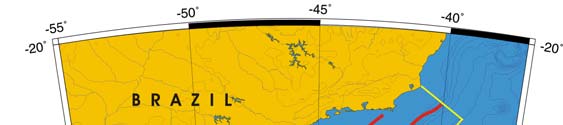
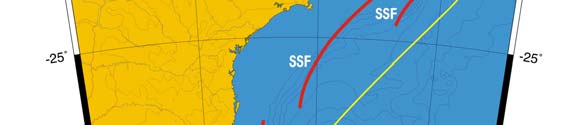
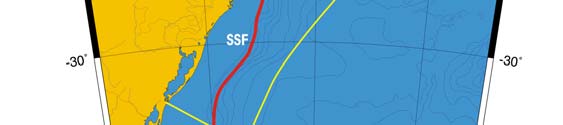
Oceanic fronts (Belkin et al. 2008) (Figure XVI-54.1): The Brazil Current Front forms the
offshore boundary of this LME. This current transports equatorial waters from off Cabo
de São Roque (5° 30'S) down to 25°S, where the thermal contrast with colder shelf
waters is enhanced in winter-spring by an equatorward flow of cold, fresh Argentinean
shelf water reaching as far north as 23°S (Campos et al. 1995, 1999, Ciotti et al. 1995,
Lima & Castello 1995, Lima et al. 1996). Shelf-slope fronts in the South Brazil Bight and
off Rio Grande do Sul are year-round, but best defined from April through September
(Castro 1998; Belkin et al. 2008). The Subtropical Shelf Front off southern Brazil has
724
54. South Brazil Shelf LME
been recently described by Piola et al. (2000), Belkin et al. (2008) and Campos et al.
(2008).
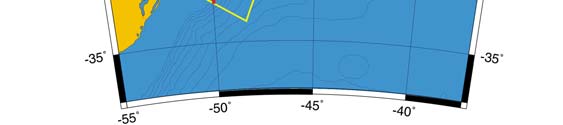
Figure XVI-54.1. Fronts of the South Brazil Shelf LME. Acronyms: SSF, Shelf Slope Front (most
probable location). Yellow line, LME boundary. After Belkin et al. (2008).
South Brazil Shelf LME SST (Belkin 2008) (Figure XVI-54.2):
Linear SST trend since 1957: 1.12°C.
Linear SST trend since 1982: 0.53°C.
The South Brazil Shelf remained relatively cold or cooled down until the relatively
abrupt warming by 1°C between 1981 and 1984 that commenced the modern epoch of
steady warming. The post-1982 warming of 0.53°C over 25 years is moderate compared
to other LMEs. The warming event of 1981-1984 was concurrent with a similar warming
in the East Brazil Shelf LME. In both LMEs, the maximum warming rate was observed
between 1982 and 1983. This synchronism can be explained either by large-scale
forcing spanning both LMEs or by ocean currents that connect these LMEs and transport
SST anomalies along shelf and shelf-slope fronts (Belkin et al. 2008).
Figure XVI-54.2. South Brazil Shelf LME annual mean SST (left) and SST anomalies (right), 1957-2006,
based on Hadley climatology. After Belkin (2008).
XVI Southwest Atlantic
725
South Brazil Shelf Chlorophyll and Primary Productivity
This LME is a Class II ecosystem with moderately high productivity (150-300 gCm-2yr-1)
(Figure XVI-54.3).
Figure XVI-54.3. South Brazil Shelf trends in chlorophyll a (left) and primary productivity (right), 1998-
2006, from satellite ocean colour imagery; courtesy of J. O'Reilly and K. Hyde.
II. Fish and Fisheries
The South Brazil Shelf contributes about half of Brazil's commercial fisheries yield. In
2002, artisanal fisheries accounted for about 22 % of the total commercial catch in this
LME (IBAMA 2002). Sardines represent the most important group in shelf catches (FAO
2003), while the important demersal species are the whitemouth croaker (Micropogonias
furnieri), the argentine croaker (Umbrina canosai) and other sciaenids, the skipjack tuna
Katsuwonus pelamis, and penaied shrimps (Paiva 1997; Valentini & Pezzuto, 2006).
There is increasing expansion and importance of the oceanic fisheries in Brazil,
particularly for tuna (FAO 2005a). In 2002, 23,128 tonnes of skipjack and 3,116 tonnes of
yellowfin tuna were landed (IBAMA 2002). Deep fisheries initiated in the late 1990s
including serranids, Aristaid shrimps, crabs and monkfish have shown unsustainable
(MMA 2006).
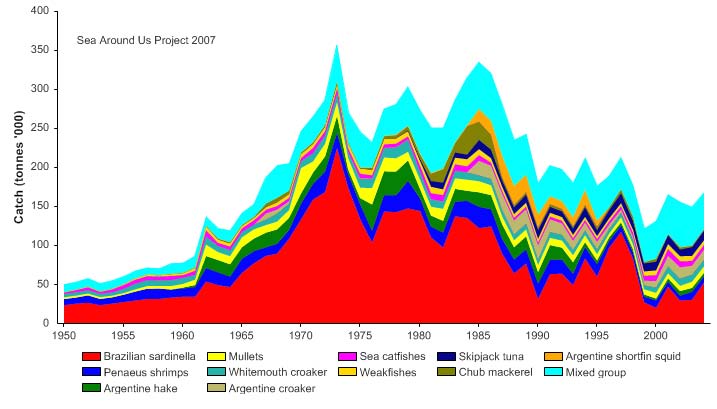
Total reported landings showed an increase up to the early 1970s, when landings peaked
at 356,000 tonnes, but have since declined to 160,000 tonnes in 2004 (Figure XVI-54.2).
Historically, catches have been dominated by the Brazilian sardinella (Sardinella
brasiliensis). Overexploitation as well as oceanographic anomalies are believed to have
accounted for the fluctuations of the sardine and anchovy fisheries in this LME (Bakun &
Parrish 1991, Paiva 1997, Matsuura 1998). Some recent changes in fishing strategies
and their ecosystem effect has been investigated by Gasalla & Rossi-Wongtschowski
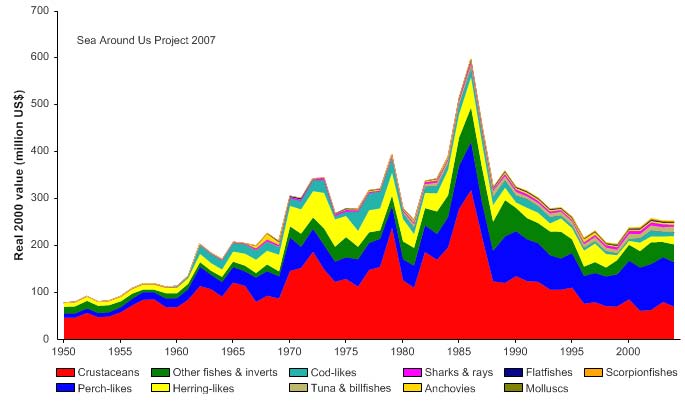
(2004).The value of the reported landings reached nearly US$600 million (in 2000 US
dollars) in 1986, with crustaceans accounting for a significant fraction (Figure XVI-54.3).
726
54. South Brazil Shelf LME
Figure XVI-54.4. Total reported landings in the South Brazil Shelf LME by species (Sea Around Us 2007).
Note: Argentine shortfin squid and Whitemouth croaker trends are being reviewed.
Figure XVI-54.5. Value of reported landings in the South Brazil Shelf LME by commercial groups (Sea
Around Us 2007).
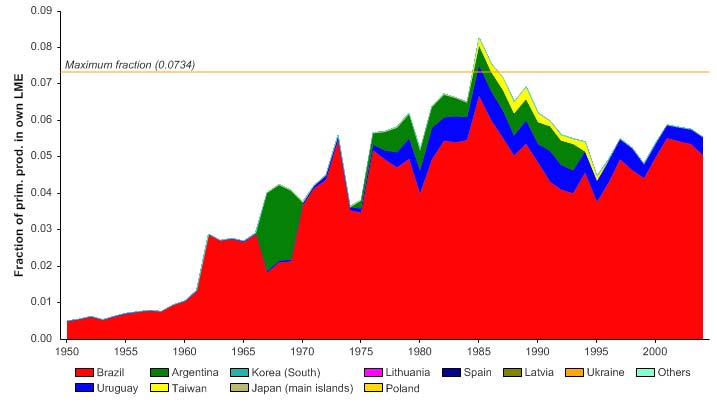
The primary production required (PPR; Pauly & Christensen 1995) to sustain the reported
landings in this LME reached 8% of the observed primary production in the mid 1980s,
and has fluctuated between 4 to 6% in recent years (Figure XVI-54.6). However,
Vasconcellos and Gasalla (2001) estimated that fisheries utilize 27 and 53% of total
primary production in the southern most shelf and in South Brazil Bight regions,
respectively. Brazil seems to account for almost all of the ecological footprint on this
LME, with very small fisheries by foreign fleets.
XVI Southwest Atlantic
727
Figure XVI-54.6. Primary production required to support reported landings (i.e., ecological footprint) as
fraction of the observed primary production in the South Brazil Shelf LME (Sea Around Us 2007). The
`Maximum fraction' denotes the mean of the 5 highest values.
Both the mean tropic level of the reported landings (i.e., the MTI, Pauly & Watson 2005;
Figure XVI-54.7 top) as well as the FiB index (Figure XVI-54.7 bottom) show an increase
from the late 1950s, somehow consistent with what was previously found by
Vasconcellos and Gasalla (2001). This pattern is indicative of the geographical expansion
of the fisheries, the collapse of the sardine fishery and an increase of offshore fishing for
higher trophic levels in the LME (Vasconcellos and Gasalla, 2001).
Figure XVI-54.7. Mean trophic level (i.e., Marine Trophic Index) (top) and Fishing-in-Balance Index
(bottom) in the South Brazil Shelf LME (Sea Around Us 2007).
The Stock-Catch Status Plots indicate that about 80% of commercially exploited stocks in
the LME are either overexploited or have collapsed (Figure XVI-54.8 top) with only 20%
of the reported landings biomass supplied by fully exploited stocks (Figure XVI-54.8,
bottom).
728
54. South Brazil Shelf LME
1950
1960
1970
1980
1990
2000
0%
100
10%
90
20%
)
80
%
(
s
30%
u
70
at
st
40%
y
60
b
ks
50%
c
o
50
f
st
60%
40
r
o
e
b
70%
m
30
u
N
80%
20
90%
10
100%0
1950
1960
1970
1980
1990
2000
(n = 3556)
developing
fully exploited
over-exploited
collapsed
1950
1960
1970
1980
1990
2000
0%
100
10%
90
20%
80
)
30%
(
%
70
s
u
at
40%
60
ck st
50%
o
50
st
y
60%
b
h
40
c
70%
Cat
30
80%
20
90%
10
100%0
1950
1960
1970
1980
1990
2000
(n = 3556)
developing
fully exploited
over-exploited
collapsed
Figure XVI-54.6. Stock-Catch Status Plots for the South Brazil Shelf LME, showing the proportion of
developing (green), fully exploited (yellow), overexploited (orange) and collapsed (purple) fisheries by
number of stocks (top) and by catch biomass (bottom) from 1950 to 2004. Note that (n), the number of
`stocks', i.e., individual landings time series, only include taxonomic entities at species, genus or family
level, i.e., higher and pooled groups have been excluded (see Pauly et al, this vol. for definitions).
Overexploitation of fisheries, excessive bycatch and discards and destructive fishing
practices were found to be severe, particularly for the inshore fisheries (UNEP 2004). In
some coastal areas, the stocks have been particularly overfished. For example, fish
stocks in Sepetiba Bay have declined by 20% during the last decade (Lacerda et al.
2002). In the mangrove areas of Babitonga Bay, crab, shrimp and mollusc have also
been overexploited (UNEP 2004). Recently, national evaluations showed that this LME
is the Brazil's most impacted by overfishing, with 55% of fishery resources been
overexploited and 29%, totally exploited (MMA, 2006). On the other hand, the oceanic
fisheries for migratory species such as tuna are not yet very significant in Brazil's EEZ
and could have some potential for further development (FAO 2005b). Bycatch and
discards are currently one of the main problems being faced in the coastal areas.
Trawlers fish illegally in shallow waters and apart from the capture of juvenile and adult
fish during spawning periods, they discard enormous quantities of small and low-value
fish (UNEP 2004). Also pelagic gillnets and driftnets are still allowed to operate in this
LME, and finning have been contributing to the depletion of sharks stocks (MMA, 2006).
Measures aimed at recovery and sustainability of the principal species may help to
address overexploitation (FAO 2005b). However, improved fisheries statistics and stock
assessments are still needed (Gasalla and Tomás, 1998), as well as fishery management
programs, as in the other two Brazilian LMEs,.
III. Pollution and Ecosystem Health
Pollution: The pollution issues of great importance are usually associated with the
process of coastal urbanisation observed in Latin America (Hinrichsen 1998), as well as
industries, tourism and recreation centres, agriculture and shipping (UNEP 2004). Air
and water pollution stem mainly from the presence of Brazil's two largest metropolitan
XVI Southwest Atlantic
729
areas that are situated in or close to the coastal area: São Paulo, the world's 7th largest
city with a population of 10.9 million in 2007 (IBGE 2007) with a concentration of
petrochemical and fertiliser industries, and Rio de Janeiro, with 6 million inhabitants.
Megacities either affect the coastal waters or estuaries directly or contribute to coastal
change through their location in catchments which carry the urban waste load. Overall,
pollution was found to be severe in localised areas (UNEP 2004).
Sewage pollution is of concern downstream of densely populated metropolitan areas,
with microbiological pollution and eutrophication being severe in some coastal hotspots.
Several bays, estuaries and lagoons downstream of urban centres show different
degrees of eutrophication due to the discharge of untreated domestic sewage and
industrial effluents (Rorig et al. 1998, Knoppers et al. 1999, Braga et al. 2000). As a
result, anoxia seriously affects some coastal embayments (Lacerda et al. 2002). Fish
kills due to low concentration of dissolved oxygen associated with the proliferation of
algae or algal toxins are not uncommon in some areas such as Conceição Lagoon
(Sierra de Ledo & Soriano-Serra 1999) and Patos Lagoon estuary. Dredging and
deforestation have resulted in increased soil erosion and siltation of coastal zones.
Pollution by suspended solids is severe in many areas (Torres 2000).
Guanabara Bay represents one of the most severely polluted and eutrophic bays of Brazil
(UNEP 2004). This and Sepetiba Bay are highly polluted as a result of discharge of
domestic effluents, the petrochemical industry, trace elements, changes in sediment
loading generated by river basin activities and port operation. There is no marine life in
many parts of Guanabara Bay. Fishing has decreased by 90% during the last 20 years
and several beaches are not recommended for swimming. The construction of Sepetiba
Port and dredging of the shipping channel have caused re-suspension of heavy metals
accumulated in the sediments. Cadmium, zinc, lead and chromium have been found in
suspended material, sediments and in mussels, oyster and macroalgae of both Sepetiba
and Guanabara Bays.
Coastal areas receive effluents with concentrations above threshold limits of heavy
metals, such as zinc, mercury, chromium, copper and lead. High concentrations of heavy
metals have been found in the water column, sediments and fish and shellfish tissues
(Lamardo et al. 2000, UNEP 2000). Agricultural run-off is a significant cause of pollution
in some areas such as the Patos Lagoon (Lacerda et al. 2002). Organochlorine
compounds in tissue of molluscs were detected in Guanabara, Santos and Paranaguá
Bays and Patos Lagoon. Association between water pollution and water-borne diseases
such as microbiological and parasitic infections, poluted beaches, and microbiological
infection were found, such as in the Paraiba do Sul river municipalities (UNEP 2004).
The country's main sea terminal, accounting for around 55% of all oil transported in
Brazil, is situated on the São Paulo coast. A large number of accidents, including leaks
and accidental oil spills, have been recorded during routine operations (Poffo et al. 1996)
contributing to chronic pollution in nearby areas. Large spills have also occurred, with
serious impacts on the region's coastal habitats (IBAMA 2002). From January 1980 to
February 1990, 71 accidents involving spills of oil and its derivatives along the São Paulo
coast occurred, causing serious damage to estuarine communities (CETESB 2001). Sea
outfall monitoring showed also nutrient enrichment and increase of organic matter
content in sediments of the São Paulo coast (CETESB 2003).
Recent global research on hypoxia in coastal zones showed the occurrence of dead
zones in 4 regions of the South Brazil Shelf LME, as being the Patos Lagoon, Guanabara
Bay, Rodrigo de Freitas and Conceição lagoons (Diaz & Rosenberg 2008). This suggests
that this LME is the most impacted of Brazil.
730
54. South Brazil Shelf LME
Habitat and community modification: Urbanisation, petroleum exploitation, port
operations, agriculture, tourism, fishing and aquaculture exert significant pressures on the
coastal habitats, which has led to severe habitat degradation throughout this LME (UNEP
2004). Estuaries and bays have been particularly degraded. For example, drainage for
rice culture, catching of shrimp and mullets, hunting as well as land speculation in beach
areas have had negative impacts in the Patos Lagoon (Diegues 1999). Between 1956
and 1996, 10% of the marshland in this estuary was lost (Seeliger & Costa 1997,
Seeliger et al. 1997). The filling of intertidal and shallow water flats in the lower Patos
Lagoon estuary for port construction and residential and industrial development has
destroyed or reduced seagrass beds (Seeliger et al. 1997). Estuaries and bays located
around the cities in the states of Rio Grande do Sul, Santa Catarina have been impacted
by river discharge of organic pollutants and increasing oxygen demand.
In Ilha Grande Bay in Rio de Janeiro, only 50% of the original mangrove remains (UNEP
2004). One of the largest natural fish breeding grounds, Sepetiba Bay, has been under
severe impacts due to silting, pollution and mangrove destruction. Intensive soil
excavation and transport for construction of the Rio-São Paulo highway, as well as
increasing urbanisation have caused intense erosion and a significant increase in
suspended solids in coastal waters and subsequent smothering of benthic species. The
construction of decks, walls and land reclamation has destroyed rocky foreshores and
modified beaches in this LME.
In Guanabara Bay, the mangrove system has been reduced by landfilling with solid
waste, illegal exploitation of mangrove wood and occupation by low-income population.
Changes in the sediment transport dynamics due to land-based activities on the coast
are considered one of the most serious environmental issues in this region (IBAMA
2002). For example, the sediment transport and sedimentation rates in Sepetiba Bay
have changed dramatically because of civil engineering works during the 1950s and
water transfer from the Paraíba do Sul River for the purpose of supplying the Rio de
Janeiro Metropolitan area (UNEP 2004). Coastal erosion is expected to become worse
due to sea level rise, which may also eliminate mangrove habitats at an approximate rate
of 1% per year (IPCC 2001).
The health of the South Brazil Shelf LME may come under greater threat in the future as
a result of pollution and habitat and community modification becoming severe in the
absence of any strong responses to address these concerns (UNEP 2004). These
responses should include new and creative strategies to promote integrated
environmental management and increasing investment in education and recovering.
IV. Socioeconomic Conditions
The population of the states bordering this LME is about 82 million, 20% of whom live in
the coastal areas and are responsible for for more than 75% of the Brazilian GDP (IBGE
2007). In addition, the population of the megacity of São Paulo, about 80 km from the
coast, is about 11 million people and Rio de Janeiro, the second, is about 6 million
(IBGE, 2007). In most states, the increasing concentration of the population and
economic activities in coastal cities is evident. Major LME's marine harbours movement
an annual activity of about 214 million tons of goods (UNEP 2004). The region shows an
extremely high social, cultural and economic diversity. Artisanal and commercial fishing,
agriculture, tourism and shipping are important activities. The aquaculture sector (mainly
for shrimp, oysters, mussels and clams) is developing rapidly, particularly the state of
Santa Catarina with an annual production of more than 20,000 tonnes (Poli et al. 2000).
This state is the largest mussel producer in Latin America, producing about
12,000 tonnes in 2000 (FAO 2005a).
XVI Southwest Atlantic
731
Fisheries are of great social, cultural and economic importance and sustain a large
number of traditional fishers who have lived for generations off fishing. Small-scale and
artisanal fisheries are declining as a result of overexploitation in coastal areas and
competition from large fishing fleets, but there are around 110,000 artisanal fishers
registered (IBAMA 2003). Traditional fishing communities have almost disappeared in
some coastal areas due to real state speculation, coastal degradation and urban-
industrial expansion, and workers have moved to other activities (IBAMA 2007).
Commercial fishing and the fish processing industry are important economic activities for
export. Falling sardine production has led to the closure of many salting and canning
companies and loss of employment. Social and community impacts in the region include
reduced capacity of local populations in meeting basic human needs when fish stocks are
reduced. The socioeconomic impacts of overexploitation are overall moderate in the
LME (UNEP 2004) but they seem to be still underevaluated.
The economic impacts of pollution are severe in the LME (UNEP 2004). Coastal areas
have already experienced economic losses, mostly in tourism and moderate to severe
economic impacts in the fisheries sector because of pollution and habitat degradation.
Impacts also include loss of property value, costs of remediation of polluted areas as well
as penalties against companies responsible for accidents (e.g., major spills events).
Health impacts due to water pollution include the incidence of water-borne
microbiological and parasitic diseases. Increasing gastrointestinal symptoms related to
exposure to polluted beaches have been reported (Governo do Estado de São Paulo
2002). Economic impacts of habitat and community modification are similar to those of
pollution and also include increased costs for coastal area maintenance due to higher
vulnerability to erosion and reduced coastline stability.
V. Governance
Brazil is party to several environmental conventions and agreements and has specific
dated agreements with Uruguay relating to fisheries, the use of natural resources and
environmental issues. Brazil, Uruguay, Argentina and Paraguay form the Common
Market MERCOSUR. The Brazilian Government became involved in coastal preservation
and management during the 1970s when degradation of ecosystems increased due to
industrialisation and urban growth (Lamardo et al. 2000). Coastal management is
supported by the Federal Constitution in Brazil (1998), which defines the coastal zone as
national property. Brazil has expended great efforts to assess the state of the living and
non-living resources within its EEZ. The greatest constraints include inadequate
harmonised legal instruments and financial mechanisms and limited human resources.
This country also has an ongoing coastal zone management programme, as well as a
significant number of institutions such as universities, research institutes and foundations
dedicated to fisheries research. The Centro de Pesquisa e Gestão de Recursos
Pesqueiros do Litoral Sudeste e Sul (CEPSUL) is a regional department of the Instituto
Brasileiro do Meio Ambiente (IBAMA) that is responsible for fisheries management of
overexploited species in the area from Cape Frio to the Uruguayan border. Important
protected areas include the Ecological Station of Taim and the National Park of Lagoa do
Peixe-PARNA, as well as several APAs (Area de Proteção Ambiental) along the coast.
Also, the so-called new "extractive reserves" have been created by fishers associations
for fisheries conservation. By the other hand, since 2003, the Secretaria Especial de
Aquicultura e Pesca (SEAP) with a Ministry status, have been responsible for the
management of underexploited fishery resources, aquaculture and fishing development,
including incentives and subsidies. There is a clear disconnection between agencies for
fisheries, ICZM and conservation issues. See the North and East Brazil Shelf LMEs for
additional information on governance.
732
54. South Brazil Shelf LME
The South Brazil Shelf LME, along with the East Brazil Shelf LME and the Patagonian
Shelf LME, forms the Upper South-West Atlantic Regional Sea Area. See the East Brazil
Shelf LME for information on the POA on Land-based Activities and on the Brazilian
National Programme of Action for the Protection of the Marine Environment from Land-
based Activities in the Brazilian Section of the Upper South-West Atlantic.
References
Bakun, A. 1993. The California Current, Benguela Current, and Southwestern Atlantic shelf
ecosystems A Comparative Approach to Identifying Factors Regulating Biomass Yields, p
199-221 in: Sherman, K., Alexander, L.M. and Gold, B.D. (eds), Large Marine Ecosystems
Stress Mitigation, and Sustainability AAAS, Washington D.C., U.S.
Bakun, A. and Parrish, R.H. (1991). Comparative studies of coastal pelagic fish reproductive
habitats: The anchovy (Engraulis anchoita) of the southwestern Atlantic. ICES Journal of
Marine Science 48:343-361.
Belkin, I.M. (2008) Rapid warming of Large Marine Ecosystems, Progress in Oceanography, in
press.
Belkin, I.M., Cornillon, P.C., and Sherman, K. (2008). Fronts in Large Marine Ecosystems of the
world's oceans. Progress in Oceanography, in press.
Braga, E.S., Bonetti, C.V.D.H., Burone, L. and Bonetti Filho, J. (2000). Eutrophication and bacterial
pollution caused by industrial and domestic wastes at the Baixada Santista Estuary. Marine
Pollution Bulletin 40(2):165-173.
Campos, E. J. D., Gonçalves, J.E. and Ikeda, Y. (1995). Water mass characteristics and
geostrophic circulation in the Southern Brazil Bight: Summer of 1991. Journal Geophysical
Research 100(C9): 18,537-18,550.
Campos, E.J.D., Lentini, C. A. D., Miller, J. L. and Piola, A. R. (1999). Interannual variability of the
sea surface temperature in the South Brazil Bight. Geophysical Res. Lett. 26 (14): 2061-2064.
Campos, E.J.D., Piola, A.R., Matano, R.P., and Miller, J.L. (2008). PLATA: A synoptic
characterization of the southwest Atlantic shelf under influence of the Plata River and Patos
Lagoon outflows. Continental Shelf Research, 28(13): 1551-1555.
Castro, B.M. (1998). Physical oceanography of the western Atlantic continental shelf located
between 4N and 34S coastal segment. In: Robison, A. and Brink, K. eds. The Sea. New York
John Wiley & Sons, Inc., vol 11: 209-251..
CETESB (2001). Relatório da Qualidade das Águas Internas do Estado de São Paulo. Companhia
Estadual de Engenharia e Saneamento Básico. São Paulo, Brazil.
CETESB (2003). Companhia Estadual de Engenharia e Saneamento Básico. Lamparelli, C. and
Ortiz, J. P.(eds). Submarine outfalls: design, compliance and environmental monitoring. São
Paulo, Brazil, 204p.
Ciotti, Á. M., C. Odebrecht, G. Fillmann, and O. O. Möller, Jr. (1995) Freshwater outflow and
Subtropical Convergence influence on phytoplankton biomass on the southern Brazilian
continental shelf. Continental Shelf Research 15(14): 1737-1756.
Diaz, R.J. and Rosenberg, R. (2008). Spreading dead zones and consequences for marine
ecosystems. Science, 321: 926-929.
Diegues, A.C. (1999). Human populations and coastal wetlands: Conservation and management in
Brazil. Ocean and Coastal Management 42:187-210.
Ekau, W. and Knoppers, B. (2003). A review and redefinition of the Large Marine Ecosystems of
Brazil, p 355-372 in: Sherman, K. and Hempel, G. (eds), Large Marine Ecosystems of the World
Trends in Exploitation, Protection and Research. Elsevier Science. Amsterdam, The
Netherlands.
FAO (2003). Trends in Oceanic Captures and Clustering of Large Marine Ecosystems Two
Studies Based on the FAO Capture Database. FAO Fisheries Technical Paper 435.
FAO (2005a). Fishery Country Profile. The Federative Republic of Brazil. www.fao.org
/fi/fcp/en/BRA/profile.htm
FAO (2005b). Information on Fisheries Management in the Federative Republic of Brazil.
www.fao.org/fi/fcp/en/BRA/body.htm
Freire, K.M.F. and Pauly, D. (2005). Richness of common names of Brazilian marine fishes and its
effect on catch statistics. Journal of Ethnobiology. 25 (2): 279-296.
XVI Southwest Atlantic
733
Gasalla. M.A. and Rossi-Wongtschowski, C.L.D.B. (2004). Contribution to ecosystem analysis to
investigating the effects of changes in fishing strategies in the South Brazil Bight coastal
ecosystem. Ecological Modelling, 172: 283-306.
Gasalla, M. A. and Tomás, A.R.G (1998). Evaluation of the status of fisheries data collection and
stock assessment problems in São Paulo, southeastern Brazil. In: Funk, F et al (eds). Fishery
stock assessment models, Alaska Sea Grant College Program AK-SG-98-01, University of
Alaska Fairbanks, pp. 41-60.
Gasalla, M.A. (2007). Ecosystem-based fisheries modelling in the South Brazil Shelf: a review
based on the LME perspective. 2nd Global Conference on Large Marine Ecosystems, Qingdao,
China, September 2007.
Governo do Estado de São Paulo (2002). Water Resources Management, in: Agenda 21 in São
Paulo: 1992-2002. Governo do Estado de São Paulo, Brazil.
Hinrichsen, D. (1998). Coastal Waters of the World: Trends, Threats and Strategies. Island Press,
Washington D.C., U.S.
IBAMA (2002). Geo-Brasil 2002: Perspectivas do Meio Ambiente no Brasil. Instituto Brasileiro de
Meio Ambiente. Brasília, Brazil.
IBAMA (2007). Instituto Brasileiro do Meio Ambiente e dos Recursos Naturais Renováveis. Lobo,
A. (org) Nas redes da pesca artesanal. Brasilia, Brazil.
IBGE (2000). Brazil in Figures. Instituto Brasileiro de Geografia e Estatística IBGE. Rio de Janeiro,
Brazil.
IBGE (2007). Instituto Brasileiro de Geografia e estadística, http://www.ibge.gov.br
IPCC (2001). Latin America, in: McCarthy, J.J., Canziani, O.F., Leary, N.A., Dokken, D.J. and
White, K.S. (eds), Climate Change 2001: Impacts, Adaptation and Vulnerability. Inter-
governmental Climate Change Panel IPCC. UNEP/WMO. Cambridge University Press, U.K.
Knoppers, B., Carmouze, J.P. and Moreira-Turcq, P.F. (1999). Nutrient dynamics, metabolism and
eutrophication of lagoons along the East Fluminense Coast, State of Rio de Janeiro, Brazil, p
123-154 in: Knoppers, B., Bidone, E.D. and Abrao, J.J. (eds), Environmental Geochemistry of
Coastal Lagoon Sub-regions, Rio de Janeiro, Brazil. UFF/FINEP. Série Geoquímica Ambiental
6.
Lacerda, L.D., Kremer, H.H., Kjerfve, B., Salomons, W., Crossland, J.I.M. and Crossland, C.J.
(2002). South American Basins: LOICZ Global Change Assessment and Synthesis of River
Catchment-Coastal Sea Interaction and Human Dimension. LOICZ Reports and Studies 21.
Land-Ocean Interactions in the Coastal Zone. Amsterdam, The Netherlands.
Lamardo, E. Z., Bícego, M.C., Castro-Filho, B.M., Miranda, L.B. and Prósperi, V.A. (2000).
Southern Brazil, p 731-747 in: Sheppard, C.R.C. (ed), Seas at the Millennium: An
Environmental Evaluation I. Regional Chapters: Europe, the Americas and West Africa.
Pergamon Press Amsterdam, The Netherlands.
Lima, I. D. and Castello, J.P. (1995). Distribution and abundance of South-west Atlantic anchovy
spawners (Engraulis anchoita) in relation to oceanographic processes in the southern Brazilian
shelf. Fisheries Oceanography 4(1): 1-16.
Lima, I. D., Garcia, C.A.E. and Möller, O.O. (1996). Ocean surface processes on the southern
Brazilian shelf: characterization and seasonal variability. Continental Shelf Research 16(10):
1307-1317.
Matsuura, Y. (1998). Brazilian Sardine (Sardinella brasiliensis) spawning in the southeast brazilian
bight over the period 1976-1993. Revista Brasileira de Oceanografia. 46(1):33-43.
Metzler, P.M. Gilbert, P.M., Gaeta, S.A. and Ludlam, J.M.(1997). New and regenerated production
in the South Atlantic off Brazil. Deep-sea research I, 44(3): 363-384.
MMA, 2006. Ministério do Meio Ambiente (Brazilian Environment Ministry) Programa REVIZEE:
avaliação do potencial sustentável de recursos vivos da zona econômica exclusiva. Relatório
executivo, 280p.
Paiva, M.P. (1997). Recursos Pesqueiros Estuarinos e Marinhos do Brasil. Universidade Federal
do Ceará-UFC. Fortaleza, Brazil.
Pauly, D. and Christensen, V. (1995). Primary production required to sustain global fisheries.
Nature 374: 255-257.
Pauly, D. and Watson, R. (2005). Background and interpretation of the `Marine Trophic Index' as a
measure of biodiversity. Philosophical Transactions of the Royal Society: Biological Sciences
360: 415-423.
Pauly, D., Christensen, V., Dalsgaard, J., Froese R. and Torres, F.C. Jr. (1998). Fishing Down
Marine Food Webs. Science 279: 860-863.
Piola, A. R., Campos, E.J.D., Miller, O.O., Jr., Charo, J. and Martinez, C. (2000). Subtropical shelf
front off eastern South America. Journal Geophysical Research 105(C3): 65656578.
734
54. South Brazil Shelf LME
Piola, A.R., Möller Jr., O.O., Guerrero, R.A. and Campos E.J.D. (2008). Variability of the
subtropical shelf front off eastern South America: Winter 2003 and summer 2004. Continental
Shelf Research, 28(13): 1639-1648.
Poffo, I.R.F., Nakasaki, A. Eysink, G.G.J., Heitzman, S.R., Cantão, R.F., Midaglia, C.L.V., Caetano,
N.A., Sepra, R.R., Aventuarto, H. and Pompéia, S.L. (1996). Dinâmica dos Vazamentos de
Óleo no Canal de São Sebastião. São Paulo. Ciência e Tecnologia a Serviço do Meio
Ambiente elatório.Técnico CETESB, Vol. 1 and 2.
Poli, C.R., Grumann, A. and Borghetti, J.R. (2000). Situação Atual da Aquicultura na Região Sul,
p 323-354 in: Valenti, W.C., Poli, C.R., Pereira, J.A. and Borghetti, J.R. (eds). Aquicultura no
Brasil Bases Para um Desenvolvimento Sustentável. CNPq/ MCT-Ministério da Ciência e
Tecnologia, Brasília, Brazil.
Rorig, L.R., Yunes, J.S., Kuroshima, K.N., Schetinni, C.A.F., Pezzuto, P.R. and Proença, L.A.O.
(1998). Studies on the Ecology and Toxicity of Thrichodesmium spp. Blooms in Southern
Brazilian Coastal Water, in: Reguera, B., Blanco, J., Fernándes, M.L. and Wyatt, T. (ed).
Harmful Algae. Xunta de Galicia and Intergovernmental Oceanographic Commission of
UNESCO. Paris, France.
Sea Around Us (2007). A Global Database on Marine Fisheries and Ecosystems. Fisheries Centre,
University British Columbia, Vancouver, Canada. www.seaaroundus.org/lme/
SummaryInfo.aspx?LME=15
Seeliger, U. and Costa, C.S.B. (1997). Human and Natural Impacts, p 197-203 in: Seeliger, U.,
Odebrecht, C. and Castello, J.P. (eds). Subtropical Convergence Environments: The Coast and
Sea in the Southwesten Atlantic. Springer-Verlag, Berlin, Germany.
Seeliger, U., Costa, C.S.B. and Abreu, P.C. (1997). Primary Production Cycles, p 65-70 in:
Seeliger, U., Odbrecht, C. and Castello, J.P. (eds). Subtropical Convergence Environments:
The Coast and Sea in the Southwestern Atlantic. Springer-Verlag, Berlin, Germany.
Semenov, V.N. and Berman, I.S. (1977). Biogeografic aspects of the distribution and dynamics of
the water masses off South American coast. Oceanology 17(6): 710-718.
Sierra de Ledo, B. and Soriano-Serra, E. (eds) (1999). O Ecossistema da Lagoa da Conceição.
Fundo Especial de Proteção ao Meio Ambiente, Governo do Estado de Santa Catarina. Editora
Imprensa Oficial do Estado de Santa Catarina, FEPEMA N 4.
Torres, R.J. (2000). Uma Análise Preliminar dos Processos de Dragagem do Porto de Rio Grande,
RS. Tese de Mestrado em Engenharia Oceânica, Fundação Universidade Rio Grande FURG.
Rio Grande, Brazil.
UNEP (2000). Overview on Land-based Sources and Activities Affecting the Marine, Coastal and
Associated Freshwater Environment in the Upper Southwest Atlantic Ocean. Regional Seas
Report and Studies170. UNEP/GPA Coordination Office.
UNEP (2004). Marques, M., Knoppers, B., Lanna, A.E., Abdallah, P.R. and Polette, M. Brazil
Current, GIWA Regional Assessment 39. University of Kalmar, Kalmar, Sweden.
www.giwa.net/publications/r39.phtml
UNESCAP (2001). Economic and Social Survey of Asia and the Pacific 2001. United Nations
Economic and Social Commission for Asia and the Pacific. United Nations Publications.
Valentini, H. and Pezzuto, P.R. (2006). Análise das principais pescarias comerciais da região
Sudeste-Sul do Brasil com base na produção controlada do período 1986-2004. Série
Documentos REVIZEE-SCORE Sul, 56p.
Vasconcellos, M. and Gasalla, M.A. (2001). Fisheries catches and the carrying capacity of marine
ecosystems in southern Brazil. Fisheries Research, 50: 279-295.,
XVI South West Atlantic
735
XVI-55 Patagonian Shelf LME
S. Heileman
The Patagonian Shelf LME extends along the southern Atlantic coast of South America
from the Río de la Plata (La Plata River) to southern Patagonia and Tierra del Fuego,
covering an area of about 1.2 million km2, of which 0.18% is protected (Sea Around Us
2007). The continental shelf is one of the widest in the world, and encompasses the
Falkland Islands/Malvinas some 760 km east of the mainland. Two major wind-driven
currents influence the LME: the cold, northward flowing Falkland/Malvinas Current and
the warm, southward flowing Brazil Current (Bakun 1993). The Falkland/Malvinas
Current provides the LME with a distinctive ecological boundary to the east. This LME is
also influenced by low salinity coastal waters (principally outflow of the Río de la Plata)
and upwelling of cold Antarctic waters caused by the prevailing westerly winds. Major
estuaries include the Rio de la Plata, Rio Colorado, Rio Negro and Chubut. LME
chapters and reports pertaining to this LME include Bakun (1993), Bisbal (1995) and
UNEP (2004).
I. Productivity
The Patagonian Shelf LME is one of the world's most productive and complex marine
systems, and is considered a Class I, highly productive ecosystem (>300 gCm-2yr-1).
Extensive mixing of the Falkland/Malvinas Current and the Brazil Current in the La Plata
region results in a highly productive confluence zone. This mixing has biological, physical,
and meteorological consequences that impact the entire LME. The outflow from the Río
de la Plata, the second largest drainage basin (3.2 million km2) in South America, also
contributes to the high biological productivity on the continental shelf and slope. The
waters of the sub-tropical Brazil Current show lower productivity. Phytoplankton species
are dominated by dinoflagellates, coccolithophorids, and cyanophyceans, with few
diatoms. The zooplankton community shows a high abundance of calanoid copepods,
chaetognaths, salps and hydromedusa.
Biological diversity is rich, with species from warm, temperate and cold waters. Some
endemic species such as the migratory Plata dolphin (Pontoporia blainvillei) are also
found in this region. The coastal area has favourable reproductive habitats for small,
pelagic-spawning clupeoids (Bakun & Parrish 1991). Some species (e.g., tuna and
marine mammals) are migratory and are of outstanding global ecological, economic, and
social importance. The LME supports significant seabird and marine mammal
populations as well as fish and invertebrates (Bakun 1993, DRIyA 2001), and is
particularly rich in fisheries resources.
Oceanic Fronts (Belkin et al. 2008) (Figure XVI-55.1): Three year-round fronts are
distinguished over the Patagonian Shelf: Valdes Front (VF) at 42°S, San Jorge Front
(SJF) at 46°S, and Bahia Grande Front (BGF) at 51°S. The origin of VF and SJF might
be related to intense tidal mixing (Glorioso 1987, Glorioso and Flather 1995, 1997). Two
seasonal fronts are the Bahia Blanca Front (39°S) and Magellan Front (MF), the latter
consisting in fall (April-June) of two branches, the Patagonian-Magellan Front and Tierra
del Fuego Front. The origin of MF and its branches is related to the influx of cold, fresh
Pacific water via the Strait of Magellan. The offshore boundary of this LME coincides
with the Falkland (Malvinas) Front/current that extends along the Patagonian shelf break
and upper continental slope of the Argentinean Sea.
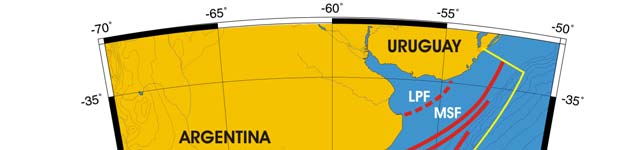
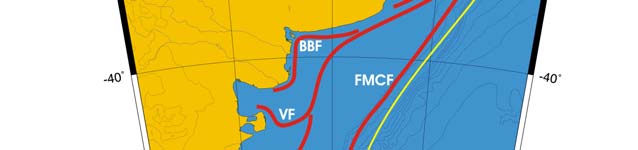
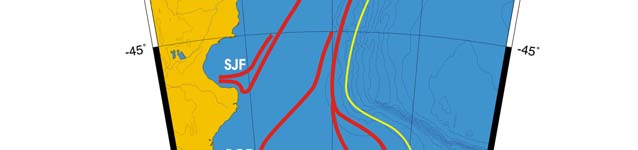
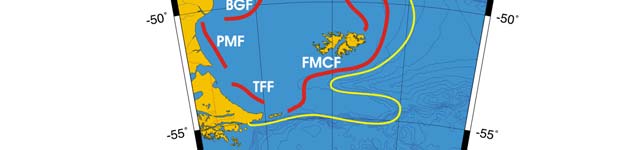
736
55. Patagonian Shelf LME
Figure XVI-55.1. Fronts of the Patagonian Shelf LME. BBF, Bahia Blanca Front; BGF, Bahia Grande
Front; FMCF, Falkland/Malvinas Current Front; LPF, La Plata Front; MSF, Mid-Shelf Front; PMF,
Patagonian-Magellan Front; SJF, San Jorge Front; TFF, Tierra del Fuego Front; VF, Valdes Front. After
Belkin et al. (2008).
Patagonian Shelf LME SST (Belkin, 2008) (Figure XVI-55.2):
Linear SST trend since 1957: 0.15°C.
Linear SST trend since 1982: 0.08°C.
The Patagonian Shelf experienced a very gradual, steady warming over the last 50
years. The most dramatic event occurred in 1961-62, when SST rose from the all-time
minimum of 10.3°C to the all-time maximum of >11.3°C. The most likely cause of the
observed stability of the Patagonian Shelf is the constant influx of sub-Antarctic waters
with the Falkland/Malvinas Current (see the Falkland/Malvinas Current Front, FMCF,
associated with the namesake current. These waters in turn are stabilized by the
Antarctic Circumpolar Current. Another possible cause of the Patagonian Shelf thermal
stability is an extremely rich and well-defined frontal pattern; this pattern persists, albeit
constantly evolving, year-round. Many fronts are tidal mixing fronts separating vertically
mixed areas from vertically stratified areas. Naturally, SST in tidally mixed areas is more
stable than elsewhere.
XVI South West Atlantic
737
Figure XVI-55.2. Patagonian Shelf LME annual mean SST (left) and SST anomaly (right), 1957-2006,
based on Hadley climatology. After Belkin (2008).
Patagonian Shelf LME Chlorophyll and Primary Productivity
This LME is a Class I, highly productive ecosystem (>300 gCm-2yr-1) (Figure XVI-55.3).
Figure XVI-55.3. Patagonian Shelf LME trends in chlorophyll a (left) and primary productivity (right),
1998-2006, from satellite ocean colour imagery. Values are colour coded to the right hand ordinate.
Figure courtesy of J. O'Reilly and K. Hyde. Sources discussed p. 15 this volume
II. Fish and Fisheries
Fisheries in the Patagonian Shelf LME have undergone accelerated growth in the last
decades involving mostly Argentine hake (Merluccius hubbsi), Argentine shortfin squid
(Illex argentinus), southern blue whiting (Micromesistius australis), Patagonian grenadier
(Macruronus magellanicus), and prawns (Pleoticus muelleri). Total reported landings
have increased over the past three decades, recording 1.5 million tonnes in 1997 with
Argentine hake and shortfin squid accounting for the majority share (Figure XVI-55.4).
The landings have since declined to 970,000 tonnes in 2004 (Figure XVI-55.2). The
value of the reported landings has been over US$1 billion (in 2000 real US dollars) since
the mid-1980s with a peak of US$1.6 billion recorded in 1987 (Figure XVI-55.5).
However, the value has been declining in recent years.
The Secretariat of Agriculture, Livestock, Fisheries, and Food (SAGP&A) reports
landings of hake by the Argentinian fleet for the 2008 January through 4 September 2008
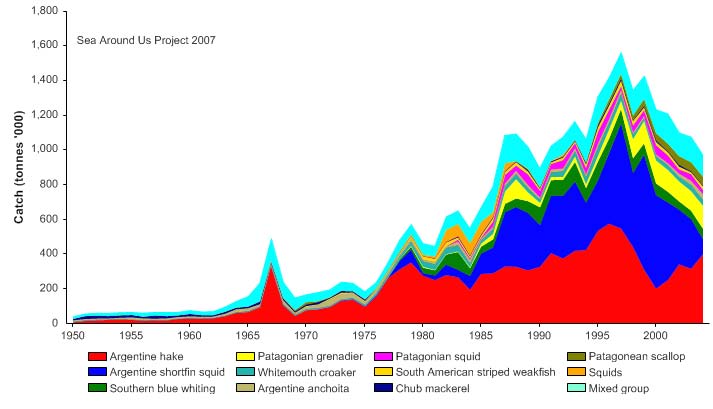
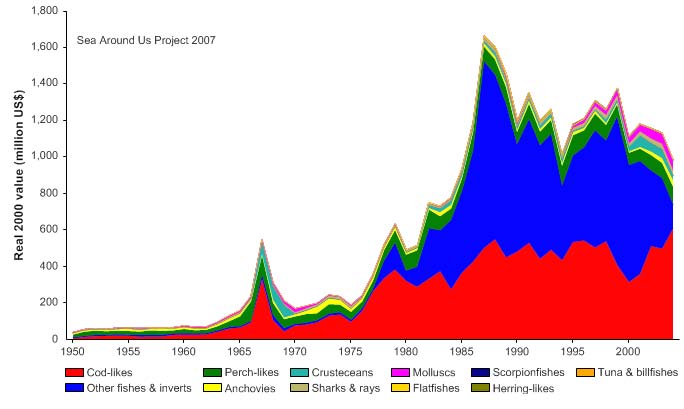
738
55. Patagonian Shelf LME
at 180,051.1 tonnes of common hake landed in Argentine ports, down 6% from the same
period the previous year. (SAGP&A). The Joint Technical Commission for the Argentine-
Uruguay Maritime Front (CTMFM) has banned Merlussius hubbsi fishing in the Common
Fishing Area from 6 October through 31 December, 2008, to protect juvenile hake
concentrations and "encourage rational exploitation of the resource"
(www.fis.com/fis/worldnews, Tuesday, 7 October 2008).
Figure XVI-55.4. Total reported landings in the Patagonian Shelf LME by species (Sea Around Us 2007).
Figure XVI-55.5. Value of reported landings in the Patagonian Shelf LME by commercial groups (Sea
Around Us 2007).
The primary production required (PPR; Pauly & Christensen 1995) to sustain the reported
landings in this LME reached 25% of the observed primary production in the mid-1990s,
but has declined to 20% in recent years (Figure XVI-55.6). Argentina accounts for the
largest share of the ecological footprint in this LME (Figure XVI-55.6).
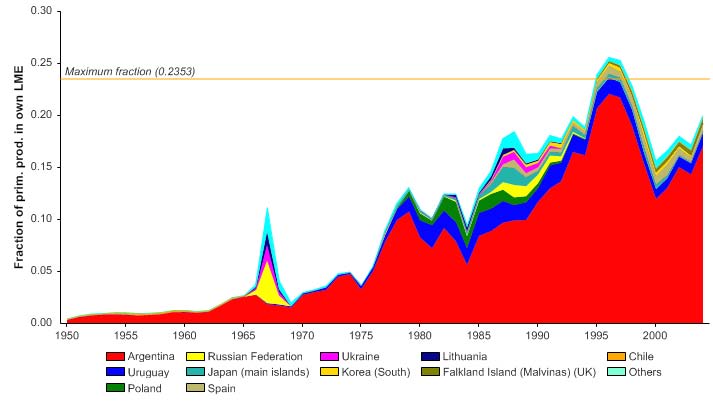
XVI South West Atlantic
739
Figure XVI-55.6. Primary production required to support reported landings (i.e., ecological footprint) as
fraction of the observed primary production in the Patagonian Shelf LME (Sea Around Us 2007). The
`Maximum fraction' denotes the mean of the 5 highest values.
The mean trophic level of the reported landings (i.e., the MTI; Pauly & Watson 2005)
shows a decline since the late 1970s (Figure XVI-55.7, top), an indication of a `fishing
down' of the food web in the LME (Pauly et al. 1998). Over the same period, the FiB
index have remained flat (Figure XVI-55.7, bottom), implying that the increasing reported
landings in Figure XVI-55.4 were due not only to ecological compensation, but also to a
geographic expansion of the fishery. These compensatory mechanisms worked until the
mid-1990s, at which points the number of overexploited and collapsed stocks increased
(see Figures XVI-55.8, top and XVI-55.8, bottom).
Figure XVI-55.7. Mean trophic level (i.e., Marine Trophic Index) (top) and Fishing-in-Balance Index
(bottom) in the Patagonian Shelf LME (Sea Around Us 2007).
740
55. Patagonian Shelf LME
The Stock-Catch Status Plots shows that over 70% of commercially exploited stocks in
the LME are either overexploited or have collapsed (Figure XVI-55.8, top), with 70% of
the reported landings supplied by overexploited stocks (Figure XVI-55.8, top). However,
the transition from fully exploited to overexploited stocks in the early 2000s was rather
abrupt.
1950
1960
1970
1980
1990
2000
0%
100
10%
90
20%
)
80
%
(
s
30%
u
70
at
st
40%
y
60
ks b
50%
c
o
50
f
st
60%
o
40
er
70%
mb
30
u
N
80%
20
90%
10
100%0
1950
1960
1970
1980
1990
2000
(n = 2938)
developing
fully exploited
over-exploited
collapsed
1950
1960
1970
1980
1990
2000
0%
100
10%
90
20%
80
)
%
30%
(
70
s
u
at
40%
60
k st
c
50%
o
50
st
y
60%
b
h
40
t
c
a
70%
C
30
80%
20
90%
10
100%0
1950
1960
1970
1980
1990
2000
(n = 2938)
developing
fully exploited
over-exploited
collapsed
Figure XVI-55.8. Stock-Catch Status Plots for the Patagonian Shelf LME, showing the proportion of
developing (green), fully exploited (yellow), overexploited (orange) and collapsed (purple) fisheries by
number of stocks (top) and by catch biomass (bottom) from 1950 to 2004. Note that (n), the number of
`stocks', i.e., individual landings time series, only include taxonomic entities at species, genus or family
level, i.e., higher and pooled groups have been excluded (see Pauly et al, this vol. for definitions).
Despite the low exploitation levels of some species (e.g., Atlantic anchovy and southern
blue whiting), intensive exploitation of other species by Argentina and Uruguay has
resulted in moderate to severe overexploitation in the LME (UNEP 2004). This is
particularly serious in the Buenos Aires coastal system and Common Argentine-
Uruguayan Fishing Zone. Overexploitation of hake in the Mar del Plata area became
evident in 1997, with increased fishing effort (Bertolotti et al. 2001) and catching of large
quantities of juvenile and spawning fish (DRIyA 2001). Between 1988 and 1999, the
proportion of hake in the total landings fell from 62 to 31% (DRIyA 2001). Subsequently,
catch limits and other controls were implemented to allow recovery of the stocks. In
2000, the hake reproductive stock south of 41ºS was the lowest since 1986 (Pérez 2001).
Total biomass of the northern and southern hake stocks decreased, reproductive
biomass was lower than the biologically acceptable level, and the fishery was sustained
by a few year classes (Aubone 2000, Pérez 2000). This led to the collapse of the hake
stocks, which may have caused important changes in productivity and community
structure as shown by a decrease in trophic levels of the catch and an increase in
anchoita stocks between 1993 and 1996 (DRIyA 2001).
XVI South West Atlantic
741
A number of other fish and invertebrate species are also overfished. The squid fishery
was established in the 1980s, with catches by both Argentina and Uruguay off the Río de
la Plata. In 1987, there were indications that squid stocks were being maximally
exploited and probably overfished (Csirke 1987). However, this fishery has been highly
variable in subsequent years and this has probably been driven by environmental
variability. Most species of bony fish targeted in the multi-species coastal fishery show a
decreasing trend in biomass. The estimated population of the southern blue whiting
(Micromesistius australis) was found to be about 77% lower than previous levels, and its
exploitation rate relatively high (Wöhler et al. 2001). Biomass of mackerel (Scomber
japonicus), corvina (Micropogonias furnieri) and shore ray species have decreased since
1996. The cod (Genypterus blacodes) stock is near its maximum sustainable limit of
exploitation (Cordo 2001, Perrota & Garciarena 2001).
The use of non-selective fishing gear results in the capture of large quantities of bycatch
and discards (DRIyA 2001). Bycatch rates of the freezer and factory fleet vary between
9.9-24.3%, and 2.3-7.2% respectively (Cañete et al. 1999). The high seas fleet discards
about 25%-30% of its catch, while the coastal fleet discards about 25% (Caille &
González 1998). From 1990-1996, between 20 and 75 thousand tonnes per year of
young hake (under two years old) that represented between 80 and 300 thousand tonnes
of adult fish were caught as bycatch. The cod fishery has been declining since 1999
because of high levels of bycatch of this species in the hake fishery (Cordo 2001). Trawl
fishing also affects mammals such as sea lions and dolphins, as well as penguins,
albatross, petrels, and seagulls. Incidental capture of macrobenthic organisms is also a
common occurrence in the San Jorge Gulf and Chubut coastal areas (Roux 2000).
Some species historically discarded in Argentina, such as Myliobatis spp., are possibly
`keystone species' (Power et al. 1996).
III. Pollution and Ecosystem Health
Pollution: The coastal areas of the Patagonian Shelf LME face accelerating development
pressures. Although pollution is generally slight, its occurrence in several localised areas
is cause for concern (UNEP 2004). The effects of pollutants from land-based sources are
exacerbated in large river basins such as the La Plata, which contains important urban
centres as well as agricultural and industrial activities. The Rio De La Plata and coastal
areas are sinks for substantial urban, agricultural and industrial wastes. Pollution of the
water and sediments of the Rio De La Plata and its maritime front from land-based and
aquatic activities is a key transboundary issue. Some pollution problems arise from the
coastal cities of Buenos Aires and Montevideo, which are densely populated and have a
high concentration of economic and industrial activities.
Raw sewage is commonly discharged into coastal areas mainly in the vicinity of cities
due to the general lack of sewage treatment facilities. This has led to serious microbial
pollution in some localised areas. Pathogens, which in some cases have exceeded
international recommended levels for recreational water, have been detected in coastal
areas (Fundación Patagonia Natural 1999). Toxic red tides are becoming more frequent
and of longer duration in the outer La Plata River and maritime front.
The Patagonian coastal zone experiences slight to moderate toxic chemical pollution.
For example, lead, zinc and copper concentrations in sediments were registered in San
Antonio Bay and in San Matías Gulf. Cadmium was also found in these two localities,
affecting local flora and fauna, and threatening migratory birds. High cadmium
concentrations were detected in kidney and liver of Commerson's dolphin and dusky
dolphin, and in kidneys of kelp gulls. Persistent organic pollutant (such as pp'-DDE) was
detected in penguins and kelp gulls. Significant halogenated residues have been found
742
55. Patagonian Shelf LME
in dead new-born cubs of sea lions, suggesting maternal transmission (Fundación
Patagonia Natural 1999).
A sharp increase in turbidity has been observed in localised marine areas due to mining
and alteration of the natural vegetation cover of extensive sedimentary areas in Southern
Patagonia. About 30% of the Patagonia region is experiencing desertification, basically
caused by overgrazing by sheep and cattle (SAyDS 2003). This has increased water
runoff and soil losses and in many cases, has resulted in an increase in suspended
solids, which cause moderate pollution in coastal areas. Pollution from solid wastes is
concentrated mainly in urban areas near the coast where disposal of solid wastes in open
dump sites is common.
The LME is subject to heavy shipping and oil tanker traffic. Chronic oil pollution is a
problem in the vicinity of ports and oil terminals that have become pollution `hot spots'.
Ecologically sensitive areas are potentially at risk when winds and marine currents
transport these persistent pollutants beyond the port facilities. Beaches are often
affected by the presence of tarballs and marine birds are frequently covered with oil.
Occasional major oil spil s occur in the Patagonian Shelf LME, with significant impact at
local levels. Petrogenic hydrocarbons in sediments show the highest concentrations in
oil shipping locations where oil and ballasts washing are discharged.
Habitat and community modification: The Patagonian Shelf LME coastal areas have
been under pressure from population and industrial growth over the last 15 years, with
attendant habitat degradation, fragmentation and loss (Gray 1997). Although this occurs
in localised areas, some impacts, for example on migratory species, may be
transboundary. Overall, habitat and community modification is moderate, but is expected
to worsen in the future (UNEP 2004). Physical alteration and destruction of habitats in
the coastal areas occur mainly through mining, dredging, port activities, urban and
coastal development, tourism, and destructive fishing methods (DRIyA 2001). Urban and
industrial pollution also contribute to this problem. The operation of harbours and oil
shipping facilities in some areas along the shore results in localised pollution `hot spots'
that harm coastal habitats and associated communities.
Sediments from the continuous dredging of the La Plata River alter marine benthic
communities and re-suspend sediments and pollutants. Human-induced erosion is
another cause of habitat modification. Most beaches of Buenos Aires have suffered
significant erosion and consequent altered coastline. For instance, in Mar Chiquita
beach, the rate of the beach retreat reaches 5 m/year in some localities (Bonamy et al.
2002). Coastal erosion has also degraded sand dunes, salt marshes and coastal
lagoons. In spite of the severe erosion problems that affect the coastline, sand extraction
for construction purposes continues.
There is evidence of fragmentation of sandy foreshores, the littoral belt system, and
coastal fringes, mainly in the province of Buenos Aires. The La Plata estuary is a highly
impacted system because of land use practices in the drainage basin. Modification of the
structure of coastal communities and mortality of fauna, mainly on the Buenos Aires
coast, has been attributed to habitat degradation. Biodiversity is seriously endangered
(Fundación Patagonia Natural 1999); this situation is aggravated by the accidental
introduction of exotic species, such as brown alga (Undaria pinnatifida), Asian clam
(Corbicula fluminea) and dog's teeth (Balanus glandula), in some areas. The brown alga,
introduced in ballast water, has quickly spread in the Nuevo Gulf area (Casas & Piriz
1996). The persistence of brown alga in this LME is thought to be a consequence of
sewage, oil spills and wastes discharged from ships (Fundación Patagonia Natural 1999).
Other species such as brown trout, rainbow trout (O. mykiss), pacific oyster (Crassostrea
XVI South West Atlantic
743
gigas), Chilean oyster (Tiostrea chilensis), Chinook salmon (Onchorhynchus
tshawystcha) and beavers were intentionally introduced.
In the long-term, a slight improvement is expected due to governmental action, the
influence of environmental NGOs, enhanced community awareness and commitment and
increased self-regulation of industry. However, improvements in pollution control will
require major investments by the private and public sectors.
IV. Socioeconomic Conditions
This LME includes the entire coastlines of Argentina and Uruguay. The combined
population of the coastal cities of Montevideo and Buenos Aires is close to 16 million
inhabitants. Both countries have a high urbanisation rate, with the urban population
significantly exceeding the rural population. Fisheries contribute less than 1% to the
GDP of these countries. Other marine-related economic activities include tourism and
offshore oil exploration. The overall socioeconomic impact of unsustainable exploitation
of fisheries in the Patagonian Shelf LME is moderate, and could become worse in the
future if regulations are not implemented and enforced (UNEP 2004). In particular,
overfishing of hake has resulted in severe social problems, loss of employment, and the
closure of fishing enterprises. Since 1997, employment has decreased by about 22%,
while more recently it decreased by about 13% in the Patagonian region (Bertolotti et al.
2001). Between 1999 and 2000, employment by the high seas fleet decreased by about
9%. Likewise, in the same period, employment by the freezer and factory fleets
decreased by up to 14% (Bertolotti et al. 2001). Argentine fish exports decreased in
2002, mainly due to international and national market conditions, but also to reduced
hake landings, which led to the closure of many fish plants (Bertolotti et al. 2001). Of the
38 established plants only 26 were operative in 2001. Since 1998 there has been an
ongoing trend towards poorer working conditions and lower incomes. The likelihood of
conflicts among different sectors also increases as a result of overfishing.
Toxic algal blooms have a negative economic impact on the private sector engaged in
fisheries exploitation and seafood production, when harvests and sales are prohibited
due to toxic algal blooms. Algal blooms and oil spills demand major economic
investment in contingency measures. Toxic algal blooms together with shellfish toxicity
have serious consequences for public health, and have caused some deaths in the
Patagonian Shelf LME region. Habitat and community modification have significant
economic and social impacts on coastal populations, particularly those related to fisheries
exploitation. Generally, the impacts on local communities are quite harsh. Economic
losses and elevated costs associated with this issue affect both the State and private
sectors comprised mainly of small enterprises, cooperatives, and individuals, who are
most vulnerable. Damage to urban infrastructure and disruption of coastal activities by
coastal erosion has strongly affected tourism revenues and promoted conflicts among
different users (tourism, aquaculture, and fishing). Many affected municipalities are now
executing projects to address problems created by coastal degradation.
V. Governance
Argentina and Uruguay have national and local environmental authorities and have
developed national policies and programmes aimed at the protection and management of
the natural environment. The two countries are in the process of strengthening the
regulatory capacity of their national environmental authorities with support from the Inter-
American Development Bank. The environmental action plans of Argentina and Uruguay
have set as goals the conservation and rehabilitation of the coastal habitats of the Rio de
la Plata and Atlantic Ocean and strengthening the management of common resources
and boundary areas.
744
55. Patagonian Shelf LME
An area held in common by both Argentina and Uruguay is the Rio de la Plata and its
maritime front. The Treaty of the Río de la Plata and its Maritime Front, signed in 1973
by both countries, established the legal framework for the bi-national management of this
area. This framework includes two bi-national governmental Commissions responsible
for the preservation, conservation and rational use of living resources and the prevention
and elimination of pollution. The Argentine-Uruguayan Technical Commission for the Rio
de la Plata Maritime Front has jointly managed the shared hake stock since 1975.
The Patagonian Shelf LME, along with the East and South Brazil Shelf LMEs, forms the
Upper South-West Atlantic Regional Sea Area. In 1998, in cooperation with the
UNEP/GPA Coordination Office and the UNEP Regional Office for Latin America and the
Caribbean, a Regional Programme of Action on Land-based Activities and a regional
assessment for the Upper South-West Atlantic were prepared and endorsed by
representatives of the three governments. The first steps in implementing the
programme, which covers the coast from Cape São Tomé in Brazil to the Valdés
Peninsula in Argentina, are under development. The Argentine Federal Fisheries Council
(CFP) has requested that the National Fisheries Research and Development Institute
(INIDEP) implement a mechanism that provides updated scientific information on the
status of the resource [www.cfp.gov.ar/funciones_ing.htm].
Argentina and Uruguay have embarked on a joint project supported by GEF and
implemented by UNDP: `Environmental protection of the Rio de la Plata and its Maritime
Front: Pollution Prevention and Control and Habitat Restoration'. The project will
contribute to the mitigation of current and emergent transboundary threats to the water
body by assisting Argentina and Uruguay to prepare a Strategic Action Plan (SAP) as a
framework for addressing the most imminent transboundary issues. Preparation of the
SAP would be preceded by finalisation of a TDA, building on assessments already
completed by prioritising issues, filling data gaps, and performing an in-depth systems
analysis of cause/effect variables, including socioeconomic and ecological factors.
References
Aubone, A. (2000). El colapso de la merluza (Merluccius hubbsi) y su recuperación biológica.
INIDEP Technical Report 17. INIDEP, Mar del Plata, Argentina.
Bakun, A. (1993). The California Current, Benguela Current, and Southwestern Atlantic Shelf
Ecosystems: A comparative approach to identifying factors regulating biomass yields, p 199-
221 in: Sherman, K., Alexander L.M. and Gold, B.D. (eds), Large Marine Ecosystems: Stress,
Mitigation and Sustainability. AAAS, Washington D.C, U.S.
Bakun, A. and Parrish, R.H. (1991). Comparative studies of coastal pelagic fish reproductive
habitats: The anchovy (Engraulis anchoita) of the southwestern Atlantic. ICES Journal of
Marine Science 48:343-361.
Belkin, I.M. (2008) Rapid warming of Large Marine Ecosystems, Progress in Oceanography, in
press.
Belkin, I.M., Cornillon, P.C., and Sherman, K. (2008). Fronts in Large Marine Ecosystems of the
world's oceans. Progress in Oceanography, in press.
Bertolotti, M., Pagani, A. and Errazti, E. (2001). Actividad Pesquera. Incidencia Relativa de la
Provincia de Buenos Aires. INIDEP Technical Report 70-2001. INIDEP, Mar del Plata,
Argentina.
Bisbal, G. (1995). The southeast South American shelf large marine ecosystem: Evolution and
components. Marine Policy 19: 2138.
Bonamy, J., Daniele, C. Fernández, A., and Trueba, J. (2002). Informe de Consultoría,
Fundamentos Económicos. SOGREAH, Buenos Aires-Montevideo-Grenoble.
Caille, G. and González, R. (1998). La pesca costera en Patagonia: Principales resultados del
Programa de Biólogos Observadores a Bordo (1993-1996), p 1-29 in: Informes Técnicos del
XVI South West Atlantic
745
Plan de Manejo Integrado de la Zona Costera Patagónica, 38. Fundación Patagonia Natural,
Puerto Madryn, Argentina.
Cañete, G., Blanco, G. Marchetti, C., Brachetta, H. and Buono, P. (1999). Análisis de la Captura
Incidental en la Pesquería de la Merluza Común en el Año 1998. INIDEP, Mar del Plata,
Argentina.
Casas, G. and Piriz, M. (1996). Surveys on Undaria pinnatifida in Golfo Nuevo, Argentina.
Hydrobiology, 326/327: 213-215.
Cordo, H. (2001). Evaluación del Estado Actual del Recurso Abadejo y Recomendaciones sobre su
Explotación a Partir del Año 2002. INIDEP Technical Report 98. INIDEP, Mar del Plata,
Argentina.
Csirke, J. (1987). The Patagonian Fishery Resources and the Offshore Fisheries in the South-West
Atlantic. FAO Fisheries Technical Paper 286.
DRIyA (2001). La Biodiversidad Marina en la Plataforma Patagónica. Preliminary Document,
Dirección Nacional de Recursos Ictícolas y Acuícolas.
Fundación Patagonia Natural (1999). Análisis Técnico de los Problemas de la Contaminación en la
Zona Costera del Patagónica. Proyecto de la Contaminación Costera y Gestión de la
Biodiversidad Marina.
Glorioso, P. (1987). Temperature distribution related to shelf-sea fronts on the Patagonian shelf.
Cont. Shelf Res., 7:27-34.
Glorioso P.D. and Flather R.A. (1995). A barotropic model of the currents off SE South America.
Journal of Geophysical Research 100: 13,427-13,440.
Glorioso P.D. and Flather R.A. (1997). The Patagonian Shelf tides. Progress in Oceanography 40:
263-283.
Gray, J. (1997). Marine biodversity: Patterns, threats and conservation needs. Biodiversity and
Conservation 6(1):153-175.
Pauly, D. and Christensen, V. (1995). Primary production required to sustain global fisheries.
Nature 374: 255-257.
Pauly, D. and Watson, R. (2005). Background and interpretation of the `Marine Trophic Index' as a
measure of biodiversity. Philosophical Transactions of the Royal Society: Biological Sciences
360: 415-423.
Pauly, D., Christensen, V., Dalsgaard, J., Froese R. and Torres, F.C. Jr. (1998). Fishing Down
Marine Food Webs. Science 279: 860-863.
Pérez, M. (2000). Resumen del Estado del Efectivo y de Explotación (Año 2000) de la Merluza
(Merluccius hubbsi) al sur de 41° S. INIDEP Technical Report 21. INIDEP, Mar del Plata,
Argentina.
Pérez, M. (2001). Resumen sobre la Evaluación y Sugerencias de Manejo para el Efectivo de
Merluza sur de 41°S. Año 2001. INIDEP Technical Report 19. INIDEP, Mar del Plata,
Argentina.
Perrota, R. and Garciarena, D. (2001). Indices de Abundancia de dos Especies Pelágicas: Caballa
(Scomber japonicus) y Savorin (Seriolella porosa) Derivados de la Operación de la Flota
Comercial de Arrastre. Período 1989-2000. INIDEP Technical Report 41. INIDEP, Mar del
Plata, Argentina.
Power M., Tilman, D., Estes, J., Menge, B., Bond, W., Mills, L., Daily, G., Castilla, J., Lubchenco, J.
and Payne, R. (1996). Challenges in the quest for keystones. BioScience 48 (8):609-620.
Roux, A. (2000). Evaluación del estado de los fondos de pesca de langostino (Pleoticus muelleri) a
través del análisis de la fauna bentónica acompañante en el Golfo de San Jorge y Litoral de
Chubut, Argentina. Frente Marítimo 18 (A):143-149.
SAyDS (2003). Programa de Acción Nacional de Lucha contra la Desertificación.
www.medioambiente.gov.ar/suelo/programas/pan/default.htm
Sea Around Us (2007). A Global Database on Marine Fisheries and Ecosystems. Fisheries Centre,
University British Columbia, Vancouver, Canada. www.seaaroundus.org/lme/Summary
Info.aspx?LME=14
UNEP (2004). Mugetti, A., Brieva, C., Giangiobbe, S., Gallicchio, E., Pacheco, F., Pagani, A.,
Calcagno, A., González, S., Natale, O., Faure, M., Rafaelli, S., Magnani, C., Moyano, M.C.,
Seoane, R. and Enriquez, I. Patagonian Shelf, GIWA Regional Assessment 38. University of
Kalmar, Kalmar, Sweden. http://www.giwa.net/publications/r38.phtml
Wöhler, O., Hansen, J., Cordo, H. and Cassia, M. (2001). Evaluación de la Abundancia y
Recomendación de la Captura Biológicamente Aceprable de Polaca (Micromesistius australis)
para el Año 2001. INIDEP Technical Report 16. INIDEP, Mar del Plata, Argentina.
746
55. Patagonian Shelf LME