Land-based Nutrient Loading to LMEs: A Global
Watershed Perspective on Magnitudes and Sources
Sybil P. Seitzinger and Rosalynn Y. Lee
Abstract
Land-based nutrient (nitrogen and phosphorus) inputs to coastal systems around the
world have markedly increased due primarily to the production of food and energy to
support the growing population of over 6 billion people. The resulting nutrient enrichment
has contributed to coastal eutrophication, degradation of water quality and coastal
habitats, and increases in hypoxic waters, among other effects. There is a critical need
to understand the quantitative links between anthropogenic activities in watersheds,
nutrient inputs to coastal systems, and coastal ecosystem effects. As a first step in the
process to gain a global perspective on the problem, a spatially explicit global watershed
model (NEWS) was used to relate human activities and natural processes in watersheds
to nutrient inputs to LMEs, with a focus on nitrogen.
Many LMEs are currently hotspots of nitrogen loading in both developed and developing
countries. A clear understanding of the relative contribution of different nutrient sources
within an LME is needed to support development of effective policies. In 73% of LMEs,
anthropogenic sources account for over half of the dissolved inorganic nitrogen (DIN)
exported by rivers to the coast. In most of these, agricultural activities (fertilizer use and
wastes from livestock) are the dominant source of DIN loading, although atmospheric
deposition and, in a few LMEs, sewage can also be important.
Over the next 50 years, human population, agricultural production, and energy production
are predicted to increase especially rapidly in many developing regions of the world.
Regions of particular note are in southern and eastern Asia, western Africa, and Latin
America. Unless substantial technological innovations and management changes are
implemented, this will lead to further increases in nutrient inputs to LME coastal waters
with associated water quality and ecosystem degradation. An approach is needed such
as that being developed in GEF-sponsored LMEs programs where all stakeholders
including scientists, policy makers and private sector leaders work together to develop
a better understanding of the issues and to identify and implement workable solutions.
Introduction of the Problem
Human activities related to food and energy production have greatly increased the
amount of nutrient pollution entering the coastal environment from land-based sources
(Howarth et al. 1996; Seitzinger and Kroeze 1998; Galloway et al. 2004; Green et al.
2004). Small amounts of nutrient enrichment can have beneficial impacts to some
coastal waters and marine ecosystems by increasing primary production which can have
potentially positive impacts on higher trophic levels. However, a high degree of nitrogen
and phosphorus enrichment, causing eutrophication of coastal and even inland waters,
tends towards detrimental effects including degradation of fisheries habitats. The
negative effects of eutrophication begin with nutrient uptake by primary producers that
can result in blooms of phytoplankton, macroalgae, and nuisance/toxic algae. When
phytoplankton blooms die and sink, decomposition of the biomass consumes and may
deplete dissolved oxygen in the bottom water resulting in hypoxic or "dead zones." There
are many other effects of nutrient over-enrichment including increased water turbidity,
82
Land-based sources of nutrients in LMEs
loss of habitat (e.g., seagrasses), decreases in coastal biodiversity and distribution of
species, increase in frequency and severity of harmful and nuisance algal blooms, and
coral reef degradation, among others (National Research Council 2000; Diaz et al. 2001;
Rabalais 2002).
Nutrient over-enrichment and associated coastal ecosystem effects are occurring in
many areas throughout the world and a number of recent assessments have begun to
document their regional and global distribution. The European Outlook reported that in
2000, more than 55% of ecosystems were endangered by eutrophication. This includes
the notable hypoxic/anoxic zones in the Baltic Sea, Black Sea and Adriatic Sea, among
many others. In the USA, a recent assessment of over 140 coastal systems by the
National Oceanic and Atmospheric Administration found that in 2004 50% of the
assessed estuaries had a high chlorophyll a (phytoplankton) rating and 65% of the
assessed estuaries were moderately to highly eutrophic (Bricker et al. 2007). In a recent
literature review by the World Resources Institute (Selman et al. 2008), 375 eutrophic
and hypoxic coastal systems were identified around the world, including many areas in
developing countries.
The need to address nutrient over-enrichment as a priority threat to coastal waters and
Large Marine Ecosystems (LMEs) has been recognized at national and global levels.
The Global Plan of Action for the Protection of the Marine Environment from Land-based
Activities (GPA), which was adopted by 108 Governments and the European
Commission in 1995, recognized the need for global, regional and national action to
address nutrients impacting the coastal and marine environment. Continued widespread
government support to address nutrients has been noted in both the Montreal and Beijing
Declarations. In 2002, the World Summit on Sustainable Development convened in
Johannesburg identified substantial reductions in land-based sources of pollution by 2006
as one of their 4 marine targets. Over 60 countries have developed national policies or
national action plans to address coastal nutrient-enrichment within the context of
sustainable development of coastal areas and their associated watersheds.
Over the next 50 years, human population, agricultural production, and energy production
are predicted to increase especially rapidly in many developing regions of the world
(Hassan et al. 2005). Unless substantial technological innovations and management
changes are implemented, this will lead to further increases in nutrient (nitrogen and
phosphorus) inputs to the coastal zone with associated water quality and ecosystem
degradation. In order to optimize use of land for food and energy production while at the
same time minimizing degradation of coastal habitats, there is a critical need to
understand the quantitative links between land-based activities in watersheds, nutrient
inputs to coastal systems, and coastal ecosystem effects.
In this chapter we primarily address the links between land-based activities in watersheds
and nutrient inputs to coastal systems around the world. Here we use a global watershed
model (NEWS) to examine the patterns of nutrient loading and source attribution at global
and regional scales and then apply the model at the scale of large marine ecosystems
(LMEs) (Sherman & Duda 1999). Within all LMEs, 80% of the world's marine capture
fisheries occur (Sherman 2008) which emphasizes the importance of cross political-
boundary management of these international marine ecosystem units, as in the Global
International Waters Assessment (GIWA; UNEP 2006). Various aspects including
ecosystem productivity, fish and fisheries, pollution and ecosystem health,
socioeconomic conditions, and governance, have been examined for many individual
LMEs, but limited assessments across all LMEs have been made with a primarily
fisheries emphasis (e.g., Sea Around Us Project 2007). In individual LMEs, few
estimates of nutrient loading have been made, and only in the Baltic Sea LME has source
Seitzinger and Lee
83
apportionment been investigated (HELCOM 2004, 2002). At the end of the chapter we
return to coastal ecosystem effects.
A Watershed Perspective
Rivers are a central link in the chain of nutrient transfer from watersheds to
coastal.systems. Nutrient inputs to watersheds include natural (biological N2-fixation,
weathering of rock releasing phosphate) as well as many anthropogenic sources. At the
global scale, anthropogenic nitrogen inputs to watersheds are now greater than natural
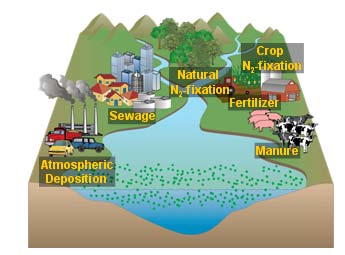
inputs (Galloway et al. 2004). Anthropogenic nutrient inputs are primarily related to food
and energy production to support the over 6 billion people on Earth with major sources
including fertilizer, livestock production, sewage, and atmospheric nitrate deposition
resulting from NOx emissions from fossil fuel combustion.
Figure 1. Watershed schematic of nitrogen inputs and transport to coastal systems. Symbols for
diagram courtesy of the Integration and Application Network (ian.umces.edu/symbols), University of
Maryland Center for Environmental Science.
Uneven spatial distribution of human population, agriculture, and energy production leads
to spatial differences in the anthropogenic alterations of nutrient inputs to coastal
ecosystems (Howarth et al. 1996; Seitzinger and Kroeze 1998; Green et al. 2004;
Seitzinger et al. 2005). While many site-specific studies have documented river transport
of nutrients (nitrogen (N), phosphorus (P), carbon (C) and silica (Si)) to coastal systems,
there are many more rivers for which there are no measurements; sustained monitoring
of temporal changes in exports is rarer still. A mechanism is needed to develop a
comprehensive and quantitative global view of nutrient sources, controlling factors and
nutrient loading to coastal systems around the world under current conditions, as well as
to be able to look at past conditions and plausible future scenarios.
A Global Watershed Nutrient Export Model (NEWS)
In order to provide regional and global perspectives on changing nutrient transport to
coastal systems throughout the world, an international workgroup (Global NEWS
Nutrient Export from WaterSheds; http://www.marine.rutgers.edu/globalnews) has
developed a spatially explicit global watershed model that relates human activities and
natural processes in watersheds to nutrient inputs to coastal systems throughout the
world (Beusen et al. 2005; Dumont et al. 2005; Harrison et al. 2005a and b; Seitzinger et
al. 2005). Global NEWS is an interdisciplinary workgroup of UNESCO's
Intergovernmental Oceanographic Commission (IOC) focused on understanding the
relationship between human activity and coastal nutrient enrichment.
84
Land-based sources of nutrients in LMEs
In addition to current predictions, the NEWS model is also being used to hindcast and
forecast changes in nutrient, carbon and water inputs to coastal systems under a range
of scenarios. In this chapter we briefly describe the NEWS model and then present
results for mid-1990's conditions at both global scales and as specifically applied to LME
regions.
NEWS Model Basics. The NEWS model is a multi-element, multi-form, spatially explicit
global model of nutrient (N, P, and C) export from watersheds by rivers (Table 1). The
model output is the annual export at the mouth of the river (essentially zero salinity).
The NEWS model was calibrated and validated with measured export near the river
mouth from rivers representing a broad range of basins sizes, climates, and land-uses.
Over 5000 watersheds are included in the model with the river network and water
discharge defined by STN-30 (Fekete et al. 2000; Vörösmarty et al. 2000a and b). The
input databases are at the scale of 0.5o latitude by 0.5o longitude.
Table 1. Nutrient forms modeled in Global NEWS. DIC and DSi sub-models (in italics) are currently in
development.
Dissolved
Particulate
Inorganic Organic
N DIN DON PN
P
DIP
DOP
PP
C
DIC
DOC
POC
Si
DSi
Whereas previous efforts have generally been limited to a single element or form, the
Global NEWS model is unique in that it can be used to predict magnitudes and sources
of multiple bio-active elements (C, N, and P) and forms (dissolved/particulate,
organic/inorganic). It is important to know coastal nutrient loading of multiple elements
because different elements and elemental ratios can have different ecosystem effects.
The various forms of the nutrients (dissolved inorganic and organic and particulate forms)
also have different bioreactivities. For example, the dissolved inorganic nitrogen (DIN)
pool is generally considered to be bio-available, while only a portion of river transported
dissolved organic nitrogen (DON) is readily available for uptake by micro-organisms,
including bacteria and some phytoplankton (Bronk, 2002; Seitzinger et al., 2002a).
However, DON can be an important N source and it is implicated in the formation of
some coastal harmful algal blooms (Paerl, 1988; Berg et al., 1997 and 2003; Granéli et
al., 1999; Glibert et al., 2005a and b). Particulate and dissolved species can also have
very different impacts on receiving ecosystems.
The NEWS model predicts riverine nutrient export (by form) as a function of point and
non-point nutrient sources in the watershed, hydrological and physical factors, and
removal within the river system (Figure 2) (Beusen et al. 2005; Dumont et al. 2005;
Harrison et al. 2005a and b; Seitzinger et al. 2005). A further feature of the model is that
it can be used to estimate the relative contribution of each watershed source to export at
the river mouth. The NEWS model builds on an earlier model of dissolved inorganic N
(DIN) export (Seitzinger and Kroeze 1998).
Seitzinger and Lee
85
Figure 2. Schematic of some of the major inputs and controlling factors in the Global NEWS watershed river
export model.
There is considerable detail in the input databases and model parameterizations that
reflect food and energy production and climate (Figure 2). For example, crop type is
important in determining fertilizer use, the amount of manure produced is a function of
animal type (e.g., cows, camels, chickens, goats, etc.), nutrient loading from sewage
depends not only on the number of people in a watershed but also on their connectivity to
a sewage system and level of sewage treatment, atmospheric nitrate deposition is related
to fossil fuel combustion. A number of hydrological and physical factors are important in
transferring nutrients from soils to the river, with water runoff being important for all
elements and forms. Once in the river, N and P can be removed by biological and
physical processes during river transport within the river channels, in reservoirs, and
through water removal for irrigation (consumptive water use).
NEWS Model Output: The NEWS model has provided the first spatially distributed
global view of N, P and C export by world rivers to coastal systems. At the global scale
rivers currently deliver about 65 Tg N and 11 Tg P per year according to NEWS model
predictions (Tg = tera gram = 1012 g) (Figure 3). For nitrogen, DIN and particulate N (PN)
each account for approximately 40% of the total N input, with DON comprising about
20%. This contrasts with P, where particulate P (PP) accounts for almost 90% of total P
inputs. However, while DIP and dissolved organic P (DOP) each contribute only about
10% of total P, both of these forms are very bioreactive and thus may have a
disproportionate impact relative to PP on coastal systems.
Figure 3. Global N and P river export to coastal systems by nutrient form based on the NEWS model (Dumont
et al. 2005; Harrison et al. 2005a).
86
Land-based sources of nutrients in LMEs
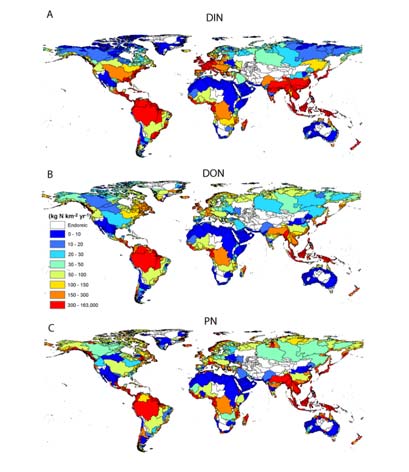
There is large spatial variation around the world in river nutrient export, including different
patterns for the different nutrient forms (DIN, DON and PN) (Figure 4). Using N yield (kg
N per km2 watershed per year that is exported to the river mouth), DIN yield shows
considerable variation at regional and continental scales, as well as among adjacent
watersheds. As might be expected based on past measurements of river nutrient export,
the NEWS model predicts relatively high watershed yields in the eastern USA, the
Mississippi basin, and much of western Europe. Of particular note, however, are also the
high DIN yields from developing regions including much of southern and eastern Asia,
Central America and small coastal watersheds in western Africa.
The large spatial variation in N yield reflects the variable magnitudes of the different
nutrient sources and controlling factors among watersheds. This underscores the
importance of the need for a clear understanding of the nutrient sources and controls
within LMEs at many scales in order to develop effective policies and implementation
strategies to control coastal nutrient loading.
Figure 4. NEWS-model-predicted A) DIN, B) DON, and C) PN yield (kg N km-2 yr-1) to coastal systems
from basins globally. Model output replotted from Harrison et al., 2005b, Dumont et al 2005, and
Beusen et al. 2005.
Seitzinger and Lee
87
N and P differ markedly in the relative contribution of different nutrient sources to river
nutrient export (Seitzinger et al. 2005). At the global scale, natural sources account for
about 40% of DIN and DIP river export (biological N2-fixation and rock weathering,
respectively) (Figure 5). Anthropogenic sources for DIN export are dominated by
agriculture (fertilizer and manure) in contrast to DIP where sewage accounts for ~60% of
river export. This difference in major sources, illustrates the need for different strategies
to reduce nitrogen or phosphorus loading to coastal systems.
Of course there is considerable variation in the relative contribution of nutrient sources at
continental, regional and watersheds scales, and this must be known and taken into
consideration when developing nutrient reduction strategies. At the continental scale, for
example, in South America livestock production (manure) is by far the largest
anthropogenic N source contributing to river DIN loading to coastal systems (Figure 6).
This contrasts with Asia where fertilizer use is about twice as great as livestock
production in contributing to river DIN loading.
Figure 5. Contribution of different sources to DIN and DIP river export globally.
Figure 6. Contribution of N sources in watersheds to model predicted DIN river export to the coastal
zone of each continent. (Figure from Dumont et al. 2005)
88
Land-based sources of nutrients in LMEs
NEWS Model Application to LMEs
Land-based pollution of coastal waters in LMEs can have sources in multiple countries
often located upstream at a considerable distance from the coastal zone. The release of
nutrients into rivers can cross national borders and create environmental, social and
economic impacts along the way - until reaching the coastal zone, which may be in a
different country. Thus an LME transboundary approach is essential for identifying
watershed nutrient sources and coastal nutrient loading to support policy development
and implementation in LMEs that will reduce current and future coastal eutrophication.
Few estimates of nutrient loading have been made in individual LMEs, and only in the
Baltic Sea LME has source apportionment been investigated (HELCOM 2004, 2002). As
a first step in bridging the gap between land-based activities and LME waters, we
examined the relative magnitudes and distribution of DIN loading from watersheds to
LMEs globally. We focused on N because it is often the most limiting nutrient in coastal
waters and thus important in controlling coastal eutrophication. DIN is often the most
abundant and bioavilable form of nitrogen, and therefore contributes significantly to
coastal eutrophication.
Watershed DIN export to rivers predicted by the NEWS model described above was
compiled for each of the 64 LMEs (2002 delineation; Duda & Sherman 2002) except for
the Antarctic (LME 61) where database information was limited. Total DIN load to each
LME was aggregated from all watersheds with coastlines along that LME for point
sources and only those watersheds with discharge to that LME for diffuse sources. This
work was part of the GEF Medium-Sized Project: Promoting Ecosystem-based
Approaches to Fisheries Conservation and LMEs (Component 3: Seitzinger and Lee
2007).
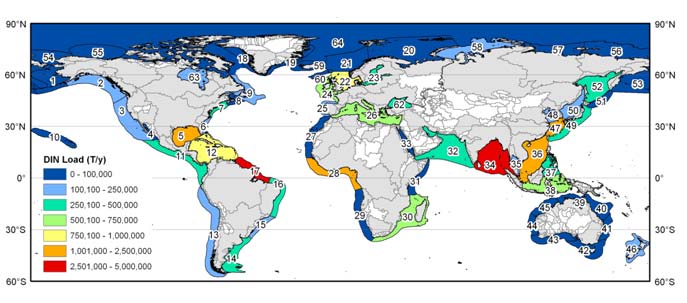
Figure 7. DIN inputs to LMEs from land-based sources predicted by the NEWS DIN model. Watersheds
discharging to LMEs are grey; watersheds with zero coastal discharge are white. Units: Tons N/y. See
Table 2 for LME identification. (Figure from Lee and Seitzinger submitted).
Seitzinger and Lee
89
Table 2. LMEs identified by name and number (see Fig. 7 and 8)
LME
LME
LME name
LME name
#
#
1
East Bering Sea
33
Red Sea
2
Gulf of Alaska
34
Bay of Bengal
3
California Current
35
Gulf of Thailand
4
Gulf of California
36
South China Sea
5
Gulf of Mexico
37
Sulu-Celebes Sea
6 Southeast
U.S.
Continental Shelf
38
Indonesian Sea
7
Northeast U.S. Continental Shelf
39
North Australian Shelf
Northeast Australian Shelf-Great Barrier
8 Scotian
Shelf
40 Reef
9
Newfoundland-Labrador Shelf
41
East-Central Australian Shelf
10
Insular Pacific-Hawaiian
42
Southeast Australian Shelf
11
Pacific Central-American Coastal
43
Southwest Australian Shelf
12
Caribbean Sea
44
West-Central Australian Shelf
13
Humboldt Current
45
Northwest Australian Shelf
14
Patagonian Shelf
46
New Zealand Shelf
15
South Brazil Shelf
47
East China Sea
16
East Brazil Shelf
48
Yellow Sea
17
North Brazil Shelf
49
Kuroshio Current
18
West Greenland Shelf
50
Sea of Japan
19
East Greenland Shelf
51
Oyashio Current
20
Barents Sea
52
Okhotsk Sea
21
Norwegian Sea
53
West Bering Sea
22
North Sea
54
Chukchi Sea
23
Baltic Sea
55
Beaufort Sea
24
Celtic-Biscay Shelf
56
East Siberian Sea
25
Iberian Coastal
57
Laptev Sea
26
Mediterranean Sea
58
Kara Sea
27
Canary Current
59
Iceland Shelf
28
Guinea Current
60
Faroe Plateau
29
Benguela Current
61
Antarctic (not included in this analysis)
30
Agulhas Current
62
Black Sea
31
Somali Coastal Current
63
Hudson Bay
32
Arabian Sea
64
Arctic Ocean
DIN export from watersheds to LMEs varies globally across a large range of magnitudes
(Figure 7). The smallest loads are exported to many polar and Australian LMEs, while
the largest loads are exported to northern tropical and subtropical LMEs. Of particular
90
Land-based sources of nutrients in LMEs
note are the large loads exported to the Gulf of Mexico, South China Sea, East China
Sea, and North Sea LMEs in which high anthropogenic activity occurs in their
watersheds. The Carribean Sea, Mediterranean Sea and Indonesian Sea LMEs, among
others, also receive substantial DIN loads.
The NEWS model also predicts substantial DIN export from the North Brazil Shelf LME
which has relatively low anthropogenic activity in its watersheds. Further investigation is
underway to evaluate the NEWS model for these large and relatively pristine tropical river
basins. The high DIN load may reflect a number of factors including the large role that
high water runoff from tropical rivers plays in the export of DIN, high biological N2-fixation,
low denitrification, and model uncertainty.
Identification of Land-based Nutrient Sources to LMEs. DIN loading to each LME
was attributed to diffuse and point sources including natural biological N2-fixation,
agricultural biological N2-fixation, fertilizer, manure, atmospheric deposition and sewage.
Dominant sources of DIN to LMEs were also identified which may be useful for the
management of land-based nutrient loading to LMEs.
Figure 8. Histogram of anthropogenic contribution to total DIN load to LMEs. LME numbers are shown
in each bar. See Table 2 for LME identification.
Land-based sources of DIN include natural sources (biological N2-fixation in natural
landscapes) and anthropogenic activities. In watersheds draining to LMEs,
anthropogenic activities contribute to over half of the total DIN load in 73% of LMEs
(Figure 8). These anthropogenic DIN dominant LMEs are distributed across most
continents, except sub-Saharan Africa and most polar regions. Some of the highest
proportions (> 90%) of anthropogenic DIN loads are to European LMEs, such as the
North Sea and Mediterranean LMEs, and East Asian LMEs, such as the Yellow Sea and
East China Sea LMEs.
Agriculture is a major source of the anthropogenic DIN export to LMEs (Lee and
Seitzinger submitted). In 91% of the LMEs with agriculture occurring in their related
watersheds, over half their anthropogenic export is due to agricultural sources such as
agricultural biological fixation, manure, and fertilizer. Attribution of agricultural DIN export
Seitzinger and Lee
91
to these three sources reveals the predominance of fertilizer and manure over agricultural
biological fixation. For example, LMEs with the largest agricultural loads have less than
20% of the total DIN load due to biological fixation and over 50% due to either fertilizer
(e.g., in many northern temperate and Southeast Asian LMEs such as the Bay of Bengal,
East China Sea and South China Sea LMEs), to manure (e.g., in most Central and South
American LMEs such as the Caribbean and North Brazil Shelf LMEs) or to a combination
of both (e.g., in the North Sea and Celtic-Biscay Shelf LMEs) due to local agricultural
practices. There is no agricultural export to most polar LMEs.
Atmospheric deposition is important in regions where there are few other land-based
inputs (e.g., in polar regions such as the West and East Greenland Shelf LMEs), where
fossil fuel combustion from development is extreme (e.g., in the North- and Southeast
U.S. Continental Shelf LMEs), or where extensive landscape burning occurs (e.g., in the
Guinea Current LME which is fed by savannah fires in Western Central African
watersheds; Barbosa et al. 1999). Sewage is an important source of DIN to only a few
LMEs (as a primary source to the Kuroshio Current, Red Sea, West-Central Australian
Shelf, and Faroe Plateau LMEs), while agricultural fixation plays an even lesser role as a
primary source to only the Southwest Australian Shelf LME and a secondary source to
the Benguela Current, North Australian Shelf, and West-Central Australian Shelf LMEs.
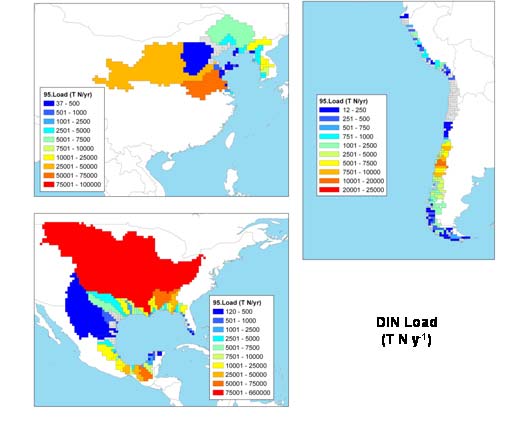
Figure 9. DIN export predicted by the NEWS DIN model from watersheds within the Yellow Sea,
Humboldt Current and Gulf of Mexico LMEs. Units: Tons N/yr.
The variability in watershed DIN export and source attribution within individual LMEs
exhibits comparably large differences as with across LMEs. Examples from different
world regions including Asia, South America and the US-Latin America are presented
below. Among the Yellow Sea, Humboldt Current and Gulf of Mexico LMEs, the DIN load
92
Land-based sources of nutrients in LMEs
from individual watersheds ranges over several orders of magnitude across both small
and large watersheds (Figure 9). For example, similarly sized watersheds in both the
Yellow Sea and Humboldt Current LMEs exhibit both the largest and smallest
magnitudes of watershed DIN export. In contrast, the Mississippi watershed is the
largest watershed contributing to the Gulf of Mexico LME and also exports the largest
load of DIN to the Gulf of Mexico.
Figure 10. Source attribution of DIN export predicted by the NEWS DIN model to the Yellow Sea,
Humboldt Current and Gulf of Mexico LMEs. Units: Tons N/yr.
The relative importance of different watershed sources of DIN to LME loading also varies,
e.g., among the Yellow Sea, Humboldt Current and Gulf of Mexico LMEs (Figure 10).
Agricultural sources dominate the DIN export in all of these LMEs, but fertilizer
contributes the most to export to the Yellow Sea and Gulf of Mexico LMEs while manure
is relatively more important than fertilizer to the Humboldt Current LME. In the Yellow
Sea LME, sewage is also a significant source (19%) to DIN export, while less so to the
Humboldt Current and Gulf of Mexico LMEs. Nitrogen fixation occurring in natural
landscapes is a significant source (28%) to the DIN export to only the Humboldt Current
LME. Atmospheric deposition is a lesser source of DIN export to all three example
LMEs, but contributes the relatively largest percentage (11%) to the Gulf of Mexico LME.
The identification of dominant sources of DIN and their relative contribution at the
individual LME level is essential for developing effective nutrient management strategies
on an ecosystem level.
Implications of Future Conditions in LME Watersheds
At the global scale, river nitrogen export to coastal systems is estimated to have
approximately doubled between 1860 and 1990, due to anthropogenic activities on land
(Galloway et al., 2004). Over the next 50 years the human population is predicted to
increase markedly in certain world regions, notably Southern and Eastern Asia, South
America, and Africa (United Nations, 1996). Growing food to feed the expanding world
population will require increased use of nitrogen and phosphorus fertilizers (Alcamo et al.,
1994; Bouwman et al., 1995; Bouwman, 1997). Increased industrialization, with the
associated combustion of fossil fuels and NOx production, is predicted to increase
atmospheric deposition of N (Dentener et al., 2006; IPCC, 2001). Thus, unless
substantial technological innovations and management changes are implemented,
increasing food production and industrialization will undoubtedly lead to increased export
of N to coastal ecosystems (Galloway et al. 2004), with resultant water quality
degradation.
Based on a business-as-usual (BAU) scenario, inorganic N export to coastal systems is
predicted to increase 3-fold by the year 2050 (relative to 1990) from Africa and South
Seitzinger and Lee
93
America (Figure 11) (Kroeze and Seitzinger, 1998; Seitzinger et al., 2002b). Substantial
increases are predicted for Europe (primarily eastern Europe) and North America.
Alarmingly large absolute increases are predicted for eastern and southern Asia; almost
half of the total global increased N export is predicted for those regions alone.
Figure 11. Predicted DIN export to coastal systems in 1990 and 2050 under a business-as-usual (BAU)
scenario. Modified from Kroeze and Seitzinger (1998).
The above scenario for 2050 was based on projections made from early 1990 trajectories
and using a relatively simple DIN model (Seitzinger and Kroeze 1998). The NEWS
model has more parameters and more detail behind the inputs (e.g., fertilizer use by crop
type, level of sewage treatment, etc.) (Figure 2) thus facilitating more advanced scenario
development and analyses. For example, it is now possible to explore the effects of a
range of development strategies, effects of climate change, production of biofuels,
increase in dams for hydropower, and consumptive water use (irrigation) on coastal
nutrient loading. Using the NEWS model, we are currently analyzing a range of
alternative scenarios for the years 2030 and 2050 based on the Millennium Ecosystem
Assessment (www.millenniumassessment.org) to provide insights into how changes in
technological, social, economic, policy and ecological considerations could alter future
nutrient export to coastal systems around the world (Seitzinger et al. in prep.).
Coastal Ecosystem Effects
As noted at the beginning of this chapter, nutrient over-enrichment can lead to a wide
range of coastal ecosystem effects. The most direct response of coastal ecosystems to
increased nutrient loading is an increase in biomass (e.g., chlorophyll a) of primary
producers or primary production rates (Nixon 1995). How might land-based DIN loading
be affecting primary production in LMEs? As a preliminary examination, we compared
land-based DIN loads predicted by the NEWS model to LME primary production
(modeled SeaWiFS data; Sea Around Us Project 2007) (Figure 12). This analysis
suggests that land-based DIN export supports a significant portion of primary production
at the level of an entire LME. In areas with upwelling, nutrient-rich bottom waters support
high rates of photosynthetic production. This is reflected in the generally higher primary
productivity than predicted by the regression solely with land-based DIN inputs in LMEs
characterized by upwelling (the Guinea Current, Arabian Sea, Pacific Central-American,
Humboldt Current, California Current, Gulf of Alaska, Benguela Current, Canary Current,
Northwest Australian, and Southwest Australian LMEs).
94
Land-based sources of nutrients in LMEs
Figure 12. Phytoplankton production vs. DIN load to the 63 LMEs. Orange points are LMEs in upwelling
regions. Phytoplankton production rates are from the Sea Around Us Project; DIN loads are from the
NEWS model (Dumont et al. 2005). Figure from Lee and Seitzinger submitted.
The above analysis compares land-based N loading to average primary production for
waters in the entire LME. In the near shore areas of LMEs, land-based N loading likely
supports a much higher proportion of primary production than suggested by the overall
relationship in Figure 12 and should be investigated. The additional effects of high
nutrient loading to estuaries and near shore waters in LMEs on hypoxia, biodiversity,
toxic and nuisance algal blooms, habitat quality, and fisheries yields also warrants further
analysis.
Future Needs
We are beginning to make significant advances in understanding the relationship
between human activities in watersheds and coastal nutrient loading at a range of scales
(e.g., watershed, LME, and global) as illustrated by the application of the NEWS model.
However, this is only a start. For example, to date the LME, regional, and global
analyses have relied on input databases at the scale of 0.5 o latitude x 0.5o longitude.
The use of higher spatial resolution input databases based on local knowledge from
specific LME regions could significantly improve the model predictions. Similarly,
additional data for model validation is need. Development of scenarios based on local
projections of population, agricultural production, biofuels, dam construction, and climate
change, among others could provide information of use to policy makers.
Development of nutrient reduction policies and effective mitigation strategies also
requires widely applicable, quantitative relationships between nutrient loading and coastal
ecosystem effects. While there is considerable information on nutrient sources and
coastal impacts, this information is often much dispersed and has not yet been compiled
into a consistent database so that nutrient sources in specific LMEs can be linked to
impacts in their associated coastal system. This is a critical next step in order for a
toolbox to be developed so that effective policy measures can be formulated and
measures taken, and for the outcomes of those policies and measures to be evaluated.
Many technical and political options are available to reduce fertilizer use, decrease
nutrient runoff from livestock waste, decrease NOx emissions from fossil fuel burning,
Seitzinger and Lee
95
and enhance sewage treatment. The fact that many of these tools have not yet been
implemented on a significant scale suggests that additional technological options and
new policy approaches are needed. In addition, policy approaches to address non-point
source pollution are often nonexistent or very limited. To ensure that the science used to
develop these technologies and polices is sound and complete, existing data on nutrient
sources, mobilisation, distribution, and effects need to be assessed. An approach is
needed such as that being developed in GEF-sponsored LME programs and as
promoted by the International Nitrogen Initiative (INI: INitrogen.org) where all
stakeholders including scientists, policy makers and private sector leaders work
together to develop a better understanding of the issues and to identify and implement
workable solutions.
Literature Cited
Alcamo, J., Kreileman, J.J.G., Krol, M.S., and Zuidema, G. (1994). Modeling the global society-
climate system: Part 1: Model description and testing. Water Air Soil Pol. 76, 1-35.
Barbosa, P.M., Stroppiana, D., Gregoire, J.-M., and Pereira, J.M.C. (1999). An assessment of
vegetation fire in Africa (1981-1991): Burned areas, burned biomass, and atmospheric
emissions. Global Biogeochemical Cycles 13:933-950.
Berg, G. M., Glibert, P.M., Lomas, M.W., and Burford, M.A. (1997) Organic nitrogen uptake and
growth by the chrysophyte Aureococcus anophagefferens during a brown tide event. Marine
Biology 129, 377-87.
Berg, G.M., Balode, M., Purina, I., Bekere, S., Bechemin, C., and Maestrini, S.Y. (2003). Plankton
community composition in relation to availability and uptake ofoxidized and reduced nitrogen.
Aquatic Microb. Ecol. 30, 263-74.
Beusen, A., Dekkers A.D., Bouwman, A.F., Ludwig, W., and Harrison, J.A.. (2005). Estimation of
global river transport of sediments and associated particulate C, N and P. Global
Biogeochemical Cycles 19(4):GB4S06.
Bouwman, A.F. (1997). Long-term scenarios of livestock-cropland use interactions in developing
countries. Land Wat. Bull. 5. Food and Agriculture Organization of the United Nations, Rome,
Italy.
Bouwman, A.F., Vanderhoek, K.W., and Olivier, J.G.J. (1995). Uncertainties in the global sources
distribution of nitrous oxide. Journal of Geophys Res-Atmos. 100, 2785, 2800.
Bricker, S., Longstaff, B., Dennison, W., Jones, A., Boicourt, K., Wicks, C., and Woerner, J. (2007).
Effects of nutrient enrichment In the nation's estuaries: A decade of change. NOAA Coastal
Ocean Program Decision Analysis Series No. 26. National Centers for Coastal Ocean Science,
Silver Springs, MD. Pp. 328.
Bronk, D.A. (2002). Dynamics of DON, Chapter 5, pp. 153-247, In: D.A. Hansell, and C.A. Carlson
(eds.) Biogeochemistry of marine dissolved organic matter. Academic Press, San Diego,
California.
Diaz., R.J. (2001). Overview of hypoxia around the world. J. Environ.Qual. 30: 275-281.
Dentener, F., Drevet, J,. Lamarque, J.F., Bey, I., Eickhout B., Fiore, A.M., Hauglustaine, D.,
Horowitz, L.W., Krol, M., Kulshrestha, U.C., Lawrence, M., Galy-Lacaux, C., Rast, S., Shindell,
D., Stevenson, D., Van Noije, T., Atherton, C., Bell, N., Bergman, D., Butler, T., Cofala, J.,
Collins, B., Doherty, R., Ellingsen, K., Galloway, J., Gauss, M., Montanaro, V., Müller, J.F.,
Pitari, G., Rodriguez, J., Sanderson, M., Solmon, F., Strahan, S., Schultz, M., Sudo, K., Szopa,
S. and Wild, O. (2006). Nitrogen and sulfur deposition on regional and global scales: A
multimodel evaluation, Global Biogeochem. Cycles, 20, GB4003, doi:10.1029/2005GB002672.
Duda, A.M., and Sherman, K. (2002). A new imperative for improving management of large marine
ecosystems. Ocean and Coastal Management 45:797-833.
Dumont, E., Harrison, J.A., Kroeze, C., Bakker, E.J., and Seitzinger, S.P. (2005). Global distribution
and sources of dissolved inorganic nitrogen export to the coastal zone: results from a spatially
explicit, global model. Global Biogeochemical Cycles 19:19(4): GB4S02.
Fekete, B.M., Vorosmarty, C.J., and Grabs, W. (2000). Global, composite runoff fields based on
observed river discharge and simulated water balances, Report 22. World Meteorological
Organization-Global Runoff Data Center, Koblenz, Germany.
96
Land-based sources of nutrients in LMEs
Galloway, J.N., Dentener, F.J., Capone, D.G., Boyer, E.W., Howarth, R.W., Seitzinger, S.P.,
Asner, G.P., Cleveland, C., Green, P., Holland, E., Karl, D.M., Michaels, A.F., Porter, J.H.,
Townsend, A., and Vorosmarty, C. (2004). Nitrogen cycles: past, present and future.
Biogeochemistry 70:153-226.
Glibert, P.M., Seitzinger, S., Heil, C.A., Burkholder, J.M., Parrow, M.W., Codispoti, L.A., and Kelly,
V. (2005a). The role of eutrophication in the global proliferation of harmful algal blooms.
Oceanography, 18: 199-209.
Glibert, P.M., Harrison, J., Heil, C. and Seitzinger, S. (2005b). Escalating worldwide use of urea -- a
global change contributing to coastal eutrophication. Biogeochemistry. DOI 10.1007/s10533-
3070-0.
Global International Waters Assessment (GIWA; UNEP 2006). Challenges to International Waters;
Regional Assessments in a Global Perspective. United Nations Environment Programme.
February 2006. ISBN 91-89584-47-3.
Granéli, E., Carlsson, P., and Legrand, C. (1999). The role of C, N, and P in dissolved and
particulate organic matter as a nutrient source for phytoplankton growth, including toxic
species. Aquat. Ecol. 33, 17-27.
Green, P.A., Vörösmarty, C.J., Meybeck, M., Galloway, J.N., Peterson, B.J., and Boyer, E.W.
(2004). Pre-industrial and contemporary fluxes of nitrogen trough rivers: a global assessment
based on topology, Biogeochemistry 68, 71-105
Harrison, J., Seitzinger, S.P., Caraco, N., Bouwman, A.F., Beusen, A., and Vörösmarty, C. (2005).
Dissolved inorganic phosphorous export to the coastal zone: results from a new, spatially
explicit, global model (NEWS-SRP). Global Biogeochemical Cycles 19(4): GB4S03.
Harrison, J.H., Caraco, N.F., and Seitzinger, S.P. (2005). Global patterns and sources of dissolved
organic matter export to the coastal zone: results from a spatially explicit, global model. Global
Biogeochemical Cycles 19(4): GBS406.
Hassan, R., Scholes, R., and Ash, N. (eds). (2005). ECOSYSTEMS AND HUMAN WELL-BEING:
CURRENT STATE AND TRENDS Vol. 1 Findings of the Condition and Trends Working Group.
Millennium Ecosystem Assessment. Island Press, Washington, DC.
HELCOM; Helsinki Commission. (2002). Environment of the Baltic Sea Area 1994-1998. Baltic Sea
Environmental Proceedings, No. 82B. Helsinki Commission, Helsinki, Finland.
HELCOM; Helsinki Commission. (2004). The Fourth Baltic Sea Pollution Load Compilation (PLC-
4) Baltic Sea Environment Proceedings No. 93. Helsinki Commission, Helsinki, Finland.
Howarth, R.W., Billen, G., Swaney, D., Townsend, A., Jaworski, N., Lajtha, K., Downing, J.A.,
Elmgren, R., Caraco, N., Jordan, T., Berendse, F., Freney, J., Kudeyarov, V., Murdoch, P.,
and Zhao-Liang, Z. (1996). Regional nitrogen budgets and riverine N & P fluxes for the
drainages to the North Atlantic Ocean: Natural and human influences. Biogeochemistry 35, 75-
139.
IPCC, Climate Change 2001: Synthesis Report. A Contribution of Working Groups, I, II, and III to
the Third Assessment Report of the Intergovernmental Panel on Climate Change, Cambridge,
United Kingdom and New York, NY, USA, Cambridge University Press, pp. 398, 2001.
Kroeze, C., and Seitzinger, S.P. (1998). Nitrogen inputs to rivers, estuaries and continental
shelves and related nitrous oxide emissions in 1990 and 2050: A global model. Nutrient
Cycling in Agroecosystems 52: 195-212.
Lee, R.Y., and Seitzinger, S.P. In prep. Land-based dissolved inorganic nitrogen export to Large
Marine Ecosystems.
National Research Council. (2000). Clean waters: Understanding and reducing the effects of
nutrient pollution. National Academy of Science Press, Washington, D.C.
Nixon, S.W. (1995). Coastal marine eutrophication: A definition, social causes, and future
concerns. Ophelia 41:199-210.
Paerl, H.W. (1988). Nuisance phytoplankton blooms in coastal, estuarine, and inland waters.
Limnol. Oceanogr. 33, 823-847.
Rabalais, N.N. (2002). Nitrogen in aquatic ecosystems. Ambio 31, 102-112.
Sea Around Us. (2007). A global database on marine fisheries and ecosystems. World Wide Web
site www.seaaroundus.org. Fisheries Centre, University British Columbia, Vancouver, British
Columbia, Canada. [Accessed 15 May 2007].
Seitzinger, S.P. and Lee. R.Y. (2007). Eutrophication: Filling Gaps in nitrogen loding forecasts for
LIMEs. Component Three in GEF MSP Promoting Ecosystem-based Approaches to Fisheries
Conservation and LMEs. Final report to Global Environmental Facility.
Seitzinger and Lee
97
Seitzinger, S.P., Harrison, J.A., Dumont, E., Beusen, A.H.W., and Bouwman, A.F. (2005). Sources
and delivery of carbon, nitrogen and phosphorous to the coastal zone: An overview of global
nutrient export from watersheds (NEWS) models and their application. Global Biogeochemical
Cycles 19(4):GB4S01.
Seitzinger, S.P., Sanders, R.W., and Styles, R.V. (2002a). Bioavailability of DON from natural and
anthropogenic sources to estuarine plankton. Limnology and Oceanography 47(2):353-366.
Seitzinger, S.P., Kroeze, C., Bouwman, A.F., Caraco, N., Dentener, F., and Styles, R.V. (2002b).
Global patterns of dissolved inorganic and particulate nitrogen inputs to coastal systems:
Recent conditions and future projections. Estuaries 25(4b):640-655.
Seitzinger, S.P., and Kroeze, C. (1998). Global distribution of nitrous oxide production and N
inputs in freshwater and coastal marine ecosystems. Global Biogeochemical Cycles 12(1): 93-
113.
Selman, M., Greenhalgh, S., Diaz, R., and Zachary S. (2008). Eutrophication and hypoxia in
coastal areas: a global assessment of the state of knowledge. Washington, DC: World
Resources Institute.
Sherman, K., and Duda, A.M. (1999). An ecosystem approach to global assessment and
management of coastal waters. Marine Ecology Progress Series. 190:271-287.
Sherman, K. (2008). The UNEP Large Marine Ecosystem Report: A perspective on changing
conditions in LMEs of the World's Regional Seas. UNEP Regional Seas Report and Studies No.
182. United Nations Environment Programme, Nairobi.
United Nations (1996). Country population statistics and projections 1950-2050, Report, Food and
Agricultural Organization of the United Nations, Rome, Italy, 1996.
UNEP/MAP/MED POL. (2003). Riverine transport of water, sediments and pollutants to the
Mediterranean Sea. MAP Technical Reports Series. Athens: United Nations Environment
Programme-Mediterranean Action Plan. 141, 1-111.
Vörösmarty, C.J., Fekete, B.M., Meybeck, M., and Lammers, R. (2000a). Geomorphometric
attributes of the global system of rivers at 30-minute spatial resolution. Journal of Hydrology
237:17-39.
Vörösmarty, C.J., Fekete, B.M., Meybeck, M., and Lammers, R. (2000b). A simulated topological
network representing the global system of rivers at 30-minute spatial resolution (STN-30).
Global Biogeochemical Cycles 14:599-621.
98
Land-based sources of nutrients in LMEs