Contributions to Global
and Regional Agreements
Review of GEF International Waters Program
Andrea Merla
Monitoring and Evaluation Working Paper 8
March 2002
i
Acknowledgements
This Working Paper was originally prepared within the context of the International Waters Program Study
during 2001, and subsequently updated in early 2002. The author wishes to thank the Program Study Team
members, and in particular Alfred M. Duda, Michael Bewers, and Juha I. Uitto, for sharing their experience and
critically reviewing the text.
Published 2002
Global Environment Facility
This paper may be reproduced in whole or in part and in any form for educational or nonprofit uses,
without special permission, provided acknowledgment of the source is made. The Global Environment
Facility secretariat would appreciate receiving a copy of any publication that uses this paper as a source.
Copies may be sent to GEF secretariat, 1818 H Street NW, Washington, DC 20433.
No use of this paper may be made for resale or other commercial purpose without prior written consent
of the Global Environment Facility secretariat. The designations of geographic entities in this document,
and the presentation of materials, do not imply the expression of any opinion whatsoever on the part of
the GEF concerning the legal status of any country, territory, or area, or its authorities, or concerning the
delimitation of its frontiers or boundaries. The views expressed in this paper are not necessarily those of
the GEF or its associated agencies.
ISBN 1-884122-81-7
ISSN 1020-0894
ii
iii
Foreword
The GEF Council, at its meetings in December 1999 and May 2000, requested a review of GEF operations prior
to the next replenishment, which began in 2001.1 This review, the Second Study of GEF's Overall Performance
(OPS2) was carried out by a fully independent team and completed at the end of 2001. The OPS2 is the third
major GEF-wide review to take place since the Facility was created.2 Among the broad topics the OPS2 team
assessed were:
· Program results and initial impacts
· GEF overall strategies and programmatic impacts
· Achievement of the objectives of GEF's operational policies and programs
· Review of modalities of GEF support
· Follow-up of OPS1
To facilitate the work of the OPS2 team, GEF's monitoring and evaluation team, in cooperation with the imple-
menting agencies, decided to undertake program studies in the biodiversity, climate change, and international
waters focal areas. The role of these program studies was to provide portfolio information and inputs for the
OPS2 team's consideration.
The present report was prepared by Andrea Merla, program manager in the GEF Secretariat land and water
resources team, as a background document to the International Waters Program Study. The report of that study
has been published3 and is available on the GEF website or from the GEF monitoring and evaluation team.
Jarle Harstad
Senior Monitoring and Evaluation Coordinator
GEF Corporate Monitoring and Evaluation Team
1818 H Street, NW
Washington, DC 20433, USA
Telephone: (202) 458-2548
Fax: (202) 522-3240
E-mail: geflessons@gefweb.org
Web: http://www.gefweb.org
http://www.gefweb.org/ResultsandImpact/Monitoring_Evaluation/monitoring_evaluation.html
1 Joint Summary of the Chairs, GEF Council Meeting, December 8-9, 1999, and GEF/C.15/11.
2 The first two studies, respectively, were Global Environment Facility: Independent Evaluation of the Pilot Phase, UNDP, UNEP,
and World Bank (1994) and Porter, G., R. Clémençon, W. Ofosu-Amaah, and M. Philips, Study of GEF's Overall Performance,
Global Environment Facility (1998).
3 Bewers, J.M. and J.I. Uitto, International Waters Program Study, Evaluation Report #1-01. Global Environment Facility
(2001).
ii
iii
v
Contents
Introduction.......................................................................................................................................................... 1
Regional Review.................................................................................................................................................. 3
Southeastern South America .................................................................................................................. 3
Caribbean Sea......................................................................................................................................... 4
Atlantic African Coast and Watersheds.................................................................................................. 5
Mediterranean Sea.................................................................................................................................. 5
Eastern and Southern Africa Southwest Asia...................................................................................... 6
Eastern Europe Central Asia ............................................................................................................... 7
Arctic...................................................................................................................................................... 8
East Asian Seas ...................................................................................................................................... 8
Other Areas and Global Projects............................................................................................................ 9
Conclusions........................................................................................................................................................ 11
Annex 1: Conventions and Agreements International Waters ........................................................................ 13
Annex 2: GEF International Waters Projects..................................................................................................... 14
v
Introduction
Existing legal agreements related to the protection of and collective action. These are translated, through
international water bodies establish a continuum-- specialized agreements at national and regional levels,
from general norms of conduct for all nations and pri- into more specific goals and commitments. Recog-
vate actors, to specific commitments to achieve broad nizing the need to respond to site-specific circum-
goals and targets, and agreements on more detailed stances and the particular mix of problems in a given
sector-by-sector rules, standards, and recommended water body, specific geographic instruments enable
practices.
policymakers to determine priorities and comprehen-
sively address them. Thus, for land-based sources of
Fundamental global norms for the conservation of marine pollution, including the riverborne transport of
marine resources and preservation and protection of substances to the sea, the UNCLOS framework calls
the marine environment are established in the UN on governments to elaborate more detailed rules and
Convention on the Law of the Sea (UNCLOS), which guidelines and to harmonize policies at the regional
entered into force in 1994. Detailed rules and stan- level to account for regional differences. Numerous
dards exist at the global level to control pollution from regional seas conventions4 have specific protocols on
ships, including at-sea waste disposal, and to protect land-based pollution.
whales, a target species that migrates worldwide.
Other global approaches include non-binding codes The world community took one step closer to acknowl-
of conduct, e.g., for managing fisheries responsibly. edging that nations must address water-body issues in
Otherwise, the legal frameworks on marine pollution a site-specific manner, regionally and nationally, by
and fisheries are mostly regional, in keeping with the concluding the Global Program of Action for the Pro-
scale of coastal marine and marginal sea systems.
tection of the Marine Environment from Land-Based
Activities (GPA) in late 1995. Its comprehensive and
A similar situation prevails in fresh water. There are logical approach to national and transboundary waters
hundreds of international agreements focused on issues should help nations adopt new institutional ar-
particular transboundary systems. On May 21, 1997, rangements linking freshwater basin management
the global Convention on Non-Navigational Uses of with downstream marine and coastal impacts, such
International Watercourses was opened for signature. as the revised 1996 protocol on land-based sources
It establishes a framework and provides benchmark and activities for the Mediterranean Sea. This linkage
norms for nations to negotiate specific agreements is reinforced by the 1997 International Watercourses
resolving transboundary freshwater environmental Convention.
problems.
Another example of the relationship between global
Global norms, through general principles and objec- frameworks and specialized agreements may be found
tives, establish goals and mechanisms for all national in the fisheries sector. A call for selective fishing gear
4 The Abidjan, Barcelona, Bucharest, Cartagena, Jeddah, Kuwait, Lima, Nairobi, and Noumea Conventions (UNEP Regional
Seas Program)
1
and practices and a precautionary approach to fish- system-based and adaptive management approaches.
eries management at the global level was set out in
the 1995 UN Agreement on Straddling Fish Stocks Non-binding soft law complements binding legal ar-
and Highly Migratory Fish Stocks. Implementing rangements, helping countries overcome barriers to
UNCLOS leverages application and elaboration in action. Examples range from Agenda 21 (chapters 17
particular regional fisheries agreements. As specific and 18) and the GPA to the Barbados Action Program
improvements are developed and applied at national for Small Island States. The great value of non-bind-
and regional levels, they may be adopted elsewhere ing documents is that they work around the edges of
and provide the basis for agreement on more detailed binding commitments to expand, guide, and influence
global rules.
action.
Existing international agreements go only part of Completing this common global understanding are
the way toward achieving comprehensive problem important links to other global conventions such as
diagnosis and specialized solutions. Agreements on the UN Framework Convention on Climate Change
freshwater systems rarely integrate water quality with (FCCC), the Convention on Biological Diversity
predominant water allocation concerns, nor do they (CBD), the UN Convention to Combat Desertifica-
embody the idea of allocating water for environmental tion (CCD), and the Convention on Persistent Organic
services, such as groundwater recharge or freshwater Pollutants (POPs). In fact, these initiatives provide a
flow to maintain downstream ecosystems. Although new opportunity for cooperating nations to link many
the 1997 International Watercourses Convention now different programs and instruments into compre-
remedies this situation in principle, it has not been hensive regional approaches to address international
applied at the level of specific transboundary agree- waters issues. Joint multicountry initiatives tackling
ments. For the most part, regional marine agreements transboundary freshwater, coastal, and marine issues
have not linked consideration of pollution with habitat are essential for achieving the goal of a collective re-
modification and international fisheries, nor with eco- sponse to these important conventions.
3
Regional Review
This chapter will review GEF actions that have
contributed to the development and implementation Eight GEF international waters projects have been
of water-related global and regional environmental developed in this region, each addressing different
agreements. The review will be regionally based to ecosystems, water bodies, and transboundary threats.
emphasize linkages between global frameworks and While all of these various projects respond to specific
regional responses, and between general principles country requests and facilitate the solution of a whole
and the specificities of the transboundary issues of array of transboundary problems, the clustering of
each region. Abbreviated references will be made these projects is beginning to show a coherent pat-
to conventions and agreements. GEF projects will tern. Clear synergies are emerging, together with an
be identified in general through their geographical opportunity to develop a coordinated solution to the
focus.
problems threatening the whole region's transbound-
ary environmental resources. Furthermore, these
Southeastern South America
international waters projects are supporting and fa-
cilitating, in each country and the region, a collective
The continental shelf of southeastern South America response to the requirements of all relevant global
is one of the largest and most productive globally. Its environmental treaties and programs of action.
width increases progressively from a minimum at the
mouth of the São Francisco River in Northeastern Four projects, Integrated Management of Land-Based
Brazil to the huge expanses of the Patagonian shelf of Activities in the São Francisco Basin, Environmental
Argentina. Its ecosystems and living marine resources Protection of the Rio de La Plata and Its Maritime
are threatened by both over-exploitation and ship- and Front, Uruguay Coast5 (under preparation), and
land-based sources of pollution, including sediments. Argentina Patagonia Shelf6, address the problem of
A major area of degradation is the Rio de La Plata land-based sources of pollution along the region's
estuary, where two river basins, the Paraná and the coast, linking freshwater basin management with
Uruguay, drain into the shallow coastal sea. As the downstream marine and coastal impacts. Thus, this
source of an increasingly large load of contaminated activity aligns well with the requirements of the
sediments and chemical pollutants, the Paraná basin, Global Program of Action. The same projects contain
one of the world's largest, and endowed with unique components dedicated to establishing a common ap-
wetland ecosystems (the Pantanal), contributes heav- proach to the solution of problems related to naviga-
ily to degrading estuarine and marine ecosystems. tion (i.e., MARPOL7), fisheries (Straddling Stocks),
The discharge of untreated municipal and industrial and the protection of coastal biological diversity (the
wastewater from greater Buenos Aires into the Rio de Convention on Biological Diversity-Jakarta Man-
La Plata is the single main source of pollution in the date). Three projects (Strategic Action Program for
region.
the Binational Basin of the Bermejo River, the Strate-
5 Uruguay Marine Management Project
6 Argentina Coastal Contamination Prevention and Sustainable Fisheries Management
7 International Convention for the Prevention of Pollution from Ships, 1973, as modified by the Protocol of 1978 (MARPOL
73/78)
3
gic Action Program Implementation for the Bermejo
River Basin, and the Integrated Watershed Manage-
Since the GEF Pilot Phase (1991-1994), the Caribbean
ment Program for the Pantanal and Upper Paraguay region has been a focus of GEF international waters
River Basin) focus on sub-basins of the Paraná and projects. Seven projects are now in the portfolio; some
deal primarily with the problems of accelerated ero- completed, others in preparation or implementation.
sion, land degradation, and wetland protection (UN Two early projects were dedicated exclusively to the
Convention to Combat Desertification, Ramsar Con- problems of pollution from ship wastes and oil spills,
vention, Convention of International Watercourses, thus representing responses to UNCLOS, MARPOL,
and Convention on Biological Diversity). Finally, a and the Cartagena Convention. Following the estab-
project aimed at the protection of the international lishment of the GEF Operational Strategy in 1995,
freshwater resources of the Guaraní Aquifer8 (among five additional projects are underway, all adopting a
Brazil, Uruguay, Argentina, and Paraguay) has been more holistic ecosystem approach. Upon the request
recently approved. Its conceptual basis responds to of most Caribbean SIDS, a major project10 is being
the principles contained in the Bellagio draft treaty9, prepared to address, in an integrated fashion, coastal
and activities will be included to promote a multi- management, nearshore fisheries, and freshwater re-
country joint management body as a way to ensure sources protection. Through this project, countries will
protection.
respond to the criteria laid down in the Barbados Pro-
gram of Action, the GPA, and the regional Cartagena
In the absence of regional environmental agreements, Convention. The Caribbean Bays project11 (addressing
these projects tend to enhance the role of multicountry the discharge to the wider Caribbean of the Havana
river commissions and waterbody-related treaties to harbor) will demonstrate the effectiveness of nutrient
incorporate transboundary and biodiversity consid- reduction technologies, in line with the requirements
erations. The Bermejo River projects have brought of the GPA and Cartagena Convention (and its Land-
environmental issues into the binational commission Based Sources Protocol). The other three projects are
between Argentina and Bolivia. The Rio de La Plata addressing the Central American Caribbean coast and
project supports the two commissions between Uru- watersheds. The Formulation of a Strategic Action
guay and Argentina created under the Treaty of the Program for the Integrated Management of Water Re-
Rio de La Plata and its Maritime Front and assists sources and the Sustainable Development of the San
them sorting out overlapping responsibilities. These Juan River Basin and its Coastal Zone project pro-
efforts may bring about more comprehensive frame- motes both binational management (between Nicara-
works for collaboration.
gua and Costa Rica) and protection of the biodiversity
of the coastal environment (Convention on Interna-
Caribbean Sea
tional Watercourses, GPA, Convention on Biological
Diversity) through integrated basin management. The
The main factors affecting Caribbean ecosystems, project entitled Reduction of Pesticide Runoff to the
and the regional environment as a whole, are intense Caribbean addresses issues in conformity with the
maritime transport, especially of oil; nutrient and POPs Treaty, the GPA, and the Cartagena Conven-
other chemical introductions from the surrounding tion in a number of Central American countries and
land masses; and aggressive coastal development. Colombia. The Environmental Protection of the Gulf
The vulnerability of many small island developing of Honduras and Maritime Transport Control project
states (SIDS) to transboundary threats, unsustainable involves activities to protect ecosystems from navi-
resource use, and climate change is seriously hinder- gational hazards (MARPOL), overfishing (Straddling
ing their development potential.
Stocks), and land-based sources of pollution (the GPA
and Cartagena Convention).
8 Environmental Protection and Sustainable Integrated Management of the Guaraní Aquifer
9 An agreement concerning the use of transboundary groundwaters
10 Integrated Catchment Area and Coastal Zone Management in Small Island Developing States in the Caribbean
11 Demonstrations of Innovative Approaches to the Rehabilitation of Heavily Contaminated Bays in the Wider Caribbean
5
Atlantic African Coast and Watersheds
Basin), and are intended to ease conflicts and facili-
tate integrated land and water management to protect
The Atlantic coast of Africa is characterized by a freshwater ecosystems and biodiversity. An integral
narrow shelf prone to the influence of oceanic cur- part of these projects is supporting the existing basin
rents that produce some of the richest oceanic and organizations and commitments to global treaties
coastal fisheries. The coast contains the estuaries of (CCD, Convention on International Watercourses,
several major rivers (including the Senegal, Volta, Ni- Ramsar Convention, and CBD) and regional freshwa-
ger, Congo, and Orange Rivers) draining vast inland ter conventions (Fort Lamy and Niger).
areas. Human activity, particularly overfishing and
the release of contaminants, are affecting the other- Mediterranean Sea
wise pristine coastal and marine environments, while
freshwater scarcity is a dominant concern in the vast There is a marked difference between the northern and
expanses of the arid and semi-arid regions of the Sahel southern shores of the Mediterranean. The former are
and Southern Africa. Conflicts among water uses, dam highly populated, industrialized, and characterized by
construction, and over-abstraction are exacerbating relatively high rainfall, intense agriculture, and nu-
international relations and threatening valuable flood merous rivers discharging contaminants. In contrast,
plain, wetland, and coastal ecosystems.
the less densely developed southern coast features
arid and semi-arid climates and the absence of ma-
In response to requests from many African countries, jor rivers14. Nutrient over-enrichment, habitat loss,
the GEF portfolio has grown to encompass the region overfishing, and ship wastes affect this semi-enclosed
almost in its entirety. Projects based on the Large marginal sea. Although the major sources of these
Marine Ecosystem concept are underway, or being agents of environmental degradation can be traced
prepared. They cover the entire Atlantic coast and essentially to European Union countries, intense de-
its marine ecosystems: the Canary Current (Canary velopment in segments of the southern and eastern
Current Large Marine Ecosystem), the Gulf of Guinea coastal areas, isolated centers of industrialization, and
Current (Development of a Strategic Action Program major shipping traffic represent significant threats to
for the Guinea Current Large Marine Ecosystem12), habitats and living resources.
and the Benguela Current (Implementation of the
Strategic Action Program Towards the Achievement The GEF has undertaken two major efforts in the
of the Integrated Management of the Benguela Cur-
Mediterranean. One addresses the risks of oil spills
rent Large Marine Ecosystem13). The major focus of along the high-density traffic lanes of the south-
these projects is the protection of fisheries (Straddling western Mediterranean, by strengthening the response
Stocks), with other components addressing land- capabilities and harbor facilities of Morocco, Algeria,
based sources of transboundary pollution (GPA) and and Tunisia15 (MARPOL, Barcelona Convention).
habitat protection (CBD). All contribute to strength- The second16 is an ambitious attempt that involves all
ening national commitments to the implementation of the littoral countries, including those of the EU, in an
the Abidjan Convention.
effort to implement a jointly agreed program of pri-
ority actions to address land-based sources of marine
Freshwater projects are concentrated in arid and pollution (GPA, Barcelona Convention). This project
semi-arid West Africa (Senegal River Basin Water will also facilitate agreement on a second program
and Environmental Management Program, Integrated of action dedicated to protecting the living resources
Management of the Volta River Basin, Reversing Land and habitats of the region (CBD-Jakarta Mandate,
and Water Degradation Trends in the Niger River Ba-
Ramsar, Barcelona Convention). The project has
sin, and Integrated Management of the Lake Chad been very successful in fostering effective collabo-
12 Follow up to a now-completed project on the Gulf of Guinea
13 In addition, the Benguela project addresses the effects of fluctuating climatic regimes on oceanic fisheries as part of the
sustainable management of the large marine ecosystem.
14 The contribution of the Nile is presently negligible due to the Aswan High Dam.
15 Oil Pollution Management Project for the Southwest Mediterranean Sea
16 Determination of Priority Actions for the Further Elaboration and Implementation of the Strategic Action Program for the
Mediterranean Sea
5
ration among southern and northern littoral states, Aldabra Atoll) from navigational hazards is the object
and represents the first comprehensive and concrete of the Western Indian Ocean Islands Oil Spill Con-
application of the principles and commitments of the tingency Planning project (MARPOL, CBD, Nairobi
Barcelona Convention.
Convention), while the Southern Indian Ocean Fish-
eries project, now under preparation, will strengthen
Eastern and Southern Africa - Southwest Asia
the capacity of countries to sustainably manage their
fisheries resources (Straddling Stocks).
This region is varied in climatic and geomorpho-
logic conditions. It contains some of the world's A second group of projects that deals with freshwater
most valuable freshwater and marine biodiversity resources is focused on the Nile basin and Great
and ecosystems. The previously pristine conditions of African Rift lakes17. The Nile Transboundary Envi-
the water bodies (lakes, rivers, wetlands and coastal ronmental Action project supports the Nile Vision
oceans) are seriously threatened by the ever-increasing process and addresses issues related to the Convention
degradation of adjoining lands. Increasing amounts of on International Watercourses, the CBD, and CCD. It
sediments and nutrients are being discharged by riv- is complemented by a medium-sized project aimed
ers into lakes (Victoria, Malawi, and Tanganyika) and at assessing renewable groundwater resources in the
coastal ecosystems (in Tanzania, Kenya, and Mozam- Eastern Desert of Egypt, as possible alternatives to the
bique), endangering living resources and habitats. The scarce Nile surface flows18, and by the Lake Manzala
introduction of alien species and aggressive growth Engineered Wetlands project, which will mitigate
of aquatic weeds are also widespread agents of deg- nutrient pollution in the Nile delta (GPA). The Lake
radation of the natural environment. In arid Southern Victoria Environmental Management project is on-
Africa, excessive water abstraction from rivers and going, while follow-up projects are being prepared
aquifers for irrigation and domestic uses pose con- for Lake Malawi19 and Lake Tanganyika (given the re-
cerns for the health of some unique freshwater eco- cent completion of GEF Pilot Phase projects for both
systems such as the Okavango Delta.
lakes). All these efforts address major transboundary
problems, such as overfishing, sediment and nutrient
A number of international waters projects are being loads, pollution hotspots, and aquatic weeds with the
implemented or prepared in the region, most of them overall goal of protecting habitats and biodiversity
focused on transboundary freshwater ecosystems. within a sustainable development framework (CBD,
Four projects, however, deal with marine issues. The CCD, Convention on International Watercourses).
Implementation of the Strategic Action Program for The Pilot Phase project Pollution Control and Other
the Red Sea and Gulf of Aden project, being imple-
Measures to Protect Biodiversity in Lake Tanganyika
mented by the regional body PERGSA (Red Sea and was successful in facilitating the drafting of a lake
Gulf of Aden Environment Program), established convention. The second-phase project under prepa-
by the Cairo Declaration, is aimed at implementing ration20 will lead to its finalization.
agreed measures for environmental protection of the
still largely unspoiled water ecosystems and living In Southern Africa, GEF is working with SADC21
resources of the region (Jeddah Convention, CBD, and various countries of the region to prepare two
GPA). As a complement to this regional preventive demonstration projects dealing with the prevention
effort, the Gulf of Aqaba Environmental Action Plan and eradication of aquatic weeds (Ramsar, CBD)22,
project addresses the only major pollution hot spot of with groundwater protection for drought management
the Red Sea (GPA, CBD-Jakarta Mandate). The pro- in the Limpopo basin23 (Bellagio draft treaty, CBD,
tection of globally valuable marine biodiversity (e.g., CCD), and integrated watershed and coastal manage-
17 The Water Quality and Environmental Improvement in the Jordan Rift Valley project (CWI, Ramsar) is the only one dealing
with Southwest Asia freshwater issues.
18 Developing Renewable Ground Water Resources in Arid Lands: a Pilot Case - the Eastern Desert of Egypt
19 Lake Malawi/Niassa/Nyasa Ecosystem Management project
20 Lake Tanganyika Strategic Action Program and the Convention
21 Southern Africa Development Community
22 Regional Project to Control Infestation and Translocation of Aquatic Weeds in the SADC Countries
23 Opportunities for Using Groundwater in Drought Prone Areas of the SADC Region
7
ment in the Maputo basin24 (CBD, CCD, and GPA). A cluding the Danube and the Dnieper River basins (14
major effort is also underway to ease water use con- full projects and one medium-sized project), the Bal-
flicts in the Okavango basin and protect the Okavango tic Sea (three projects), the Caspian Sea (one project),
Delta wetlands25. Compliance with the Convention on and the Aral Sea basin (one project). The main objec-
International Watercourses, the Ramsar Convention, tive of GEF action in the Black Sea basin is reducing
and the SADC Protocol on Shared Watercourses will nutrient discharges, which have been identified as the
be strengthened through this project. Finally, a project region's main transboundary environmental problem.
to harmonize and strengthen transboundary water This is being attempted by establishing regional
legislation throughout the SADC region has recently cooperation frameworks (several regional projects28
entered the pipeline26 (CWI, SADC Protocol).
encompassing the entire Danube, Black Sea, and
Dnieper basins have enhanced compliance with the
Eastern Europe - Central Asia
Danube Convention and facilitated agreement on a
new Black Sea Convention), adopting new legisla-
In this region, major world rivers, draining vast areas tion and policies, and demonstrating new practices in
with humid to semi-arid climatic conditions and sev- the agricultural and industrial sectors29. This response
eral mountain ranges (the Alps, Carpathians, Urals, represents the largest coordinated multiproject effort
Caucasus, and Hindu Kush) flow into enclosed and to implement the provisions of the GPA. The projects
semi-enclosed seas (the Black, Caspian, Aral and also address issues relevant to the Ramsar and bio-
Baltic Seas). High densities of industrialization and diversity conventions. Nutrients and the protection
population, intensive use of fertilizers and pesticides of living resources and habitats are the focus of the
in agriculture and unsustainable water abstraction Baltic Sea Environment (Helsinki Convention), the
from rivers coupled with unregulated discharges of Poland Rural Environment, the Development and
untreated wastes have contaminated the waters of the Implementation of the Lake Peipsi/Chudskoe Basin
region that are now suffering severe environmental Management Plan, and the Lake Ohrid Management
degradation.27 Excessive nutrient discharges from projects (GPA, CBD, Ramsar, Straddling Stocks).
agriculture and other point sources, together with The Addressing Transboundary Environmental Issues
problems related to maritime navigation (ballast and in the Caspian Environment Program has similar ob-
bilge water discharges, oil spills, and alien species jectives (GPA, MARPOL, Straddling Stocks, Ramsar,
introduction) and the adverse effects of highly toxic CBD), and is facilitating the establishment of a legal
chemicals, have been identified as the major trans- multicountry agreement to protect this highly vul-
boundary environmental threats to the waters of this nerable water body. The text of a Convention for the
region.
Protection of the Caspian Sea is presently being nego-
tiated. The Water and Environmental Management in
The GEF international waters portfolio in this region the Aral Sea Basin project is an attempt to restore min-
is concentrated on these highly degraded "enclosed" imum ecosystem quality in the deltas and wetlands of
seas and their drainage areas: the Black Sea basin, in- the Amu Darya and Syr Darya rivers (Ramsar).
24 Joint Integrated Management of the Maputo Basin
25 Environmental Protection and Sustainable Management of the Okavango River Basin
26 Integrating Transboundary Concerns into National Water Resources Management Legislation in the SADC Region
27 The demise of the Aral Sea is possibly the world's most dramatic case of environmental degradation.
28 Eight regional projects: Danube River Basin Environmental Management; Developing the Danube River Basin Pollution
Reduction Program; Strengthening Implementation of Nutrient Reduction Measures and Transboundary Cooperation in the Danube
River Basin; Preparation of a Strategic Action Program for the Dnieper River Basin and Development of SAP Implementation
Mechanisms; Black Sea Environmental Management; Developing the Implementation of the Black Sea Strategic Action Plan;
Regional: Nutrient Reduction Program - Regional Project for the Black Sea; Building Environmental Citizenship to Support
Transboundary Pollution Reduction in the Danube (MSP)
29 Demonstrations include the Moldova Agricultural Pollution Control project; Hungary Nutrient Reduction project; Romania
Agricultural Pollution Control project; Reduction of Nutrient Discharges and Methane Emissions in Rostov-on Don; Turkey
Agricultural Pollution Control project; and Georgia Agricultural Research, Extension, and Training (ARET) project.
7
Arctic
versity globally32. Several major rivers, draining vast
inland areas, discharge into the semi-enclosed seas of
The plants and animals of the Arctic have adapted to the huge continental shelf in China and Vietnam. Fish-
its harsh climate, which is characterized by extreme eries of global significance represent irreplaceable
variations in light and temperature and extensive resources for the littoral countries. Degradation is
snow and ice cover, creating rich but highly vul- affecting the freshwater and marine environment of
nerable ecosystems. In comparison with most other the entire region. Aquatic ecosystems and marine
areas of the world, the Arctic remains a clean environ- living resources are seriously threatened by extreme
ment. Nevertheless, growing concerns exist because population pressure in coastal areas, habitat destruc-
of climate change and the already detectable impacts tion, hazards associated with maritime transport, and
of contaminants introduced from sources located both locally severe nutrient, sewage, and industrial con-
outside and inside the Arctic region. It has been dem- tamination in the Bohai Sea, the Gulf of Thailand,
onstrated that persistent organic pollutants migrate to and Manila Bay. The lack of regional agreements
the north through water, air, and migratory species and for the protection of the marine environment, largely
are found at hazardous levels in human and animal tis- due to territorial disputes, is a further impediment to
sues in the Arctic, very far from their origins. Hotspots coordinated preventive and remedial action. Unsus-
of contamination with PCBs, heavy metals, hydrocar- tainable exploitation and pollution of surface and
bons, and radionuclides are also present in the Arctic, ground waters in China, which also affect the coastal
especially within the Russian Arctic.
and transboundary marine environments such as the
Yellow Sea, have drastically altered natural regimes
There are two GEF international waters projects in and pose serious threats to livelihoods and social and
the Arctic addressing pollution originating within and economic development. The Mekong River, shared by
outside the region. The two projects deal respectively many countries and a source of life for downstream
with the Russian coastal and shelf environment and populations and wetland ecosystems, is also at risk
with the indigenous peoples of the Russian North. because of conflicting uses and complex multicountry
Both attempt to enhance Russia's role within the management issues.
context of existing coordination and collaboration
mechanisms established among the Arctic countries The GEF response to problems in the regional marine
(the Arctic Council and its component programs). The ecosystems started in the Pilot Phase and developed
project, Support to the National Program of Action since then into several major initiatives, some on-
for the Protection of the Arctic Marine Environment, going and some in preparation. The clustering of these
addresses the major pollution hotspots along Russia's projects, and the growing interest of the countries in
coast to support rehabilitation measures and invest- exploring collaborative frameworks for the Yellow
ments (GPA, POPs Treaty, LRTAP30). The second Sea, the South China Sea, and the Sulu-Celebes Sea,
project31 will assess the impacts of persistent toxic appears to provide opportunities for a more program-
substances, including POPs, on the indigenous peo- matic approach, like those demonstrated by GEF's ef-
ples of the Russian North and their traditional foods forts in the Plata basin-Patagonia Shelf area in South
(POPs Treaty, CBD).
America and the Black Sea-Danube Basin in Europe.
East Asian Seas
Five international waters projects are dealing with
the marine environment. A major Pilot Phase initia-
This area ranges from the northwest Pacific to the In- tive33 facilitated the building of ship waste disposal
donesian seas in the south. It includes the South China facilities in Dalian harbor in China (in the Bohai Sea),
Sea, one of the major centers of marine biological di- representing a response to MARPOL. The two phases
30 Convention on Long-Range Transboundary Air Pollution of the UN ECE
31 Persistent Toxic Substances, Food Security, and Indigenous Peoples of the Russian North
32 The Indo-west Pacific marine biogeographic province has been recognized as the global center of marine shallow-water
tropical biodiversity.
33 China Ship-Waste Disposal Project
9
of the East Asian Seas project34 embrace the whole Program by focusing on the protection of aquatic bio-
region and focus on issues of pollution and contami- diversity (CBD)38.
nation by applying the tool of integrated coastal zone
management, using demonstrations and public-pri- Other Areas and Global Projects
vate partnerships (GPA, CBD-Jakarta Mandate, var-
ious IMO conventions). The Reversing Degradation This review of GEF's contributions to the imple-
Trends in the South China Sea project is adopting an mentation of water-related global and regional envi-
ecosystem approach to address a broader range of is- ronmental agreements would be incomplete without
sues, including biodiversity, habitat protection, and reference to some additional projects that--either
fisheries. It is advancing multicountry cooperation because of their global or continental nature or their
in support of a number of international agreements focus on geographically isolated areas--have not
(GPA, CBD-Jakarta Mandate, Ramsar, Straddling been covered in the previous sections.
Stocks). The Reducing Environmental Stress in the
Yellow Sea Large Marine Ecosystem project is build- Among them is an effort to prevent the frequently dev-
ing a framework for cooperation among the littoral astating environmental effects of the introduction of
countries to tackle pollution and fisheries degradation alien species through ballast water discharges (MAR-
(Straddling Stocks, CBD, GPA). A project to address POL)39. The project will test various ballast water
the critical issue of navigational environmental haz- management schemes in six major harbors (in China,
ards (spills, ballast water discharges, and alien species India, Brazil, South Africa, Ukraine, and Iran) and
transfer) through the introduction of electronic pre- will assist the International Maritime Organization in
cision navigation techniques (the "Marine Electronic preparing a new legal treaty, or protocol, on ballast
Highway") is under preparation35. These innovative water discharges.
navigation tools will be tested on a pilot basis in the
dense traffic area of the Malacca Straits with a view to The Small Island States of the South Pacific, threat-
subsequent expansion along the region's high-traffic ened by climate change, overfishing, dwindling
lanes (MARPOL).
freshwater supplies, and coastal development, are the
focus of another regional project40. This initiative will
Three projects deal with freshwater issues. One36 will strengthen regional cooperation on management of
help the Mekong River Commission to incorporate transboundary fisheries and will introduce integrated
environmental considerations into its water utiliza- land and water management concepts and habitat
tion framework in an attempt to secure the protection protection through numerous demonstrations. The
of downstream wetlands (Tonle Sap) and deltaic eco- project will be implemented under the umbrella of the
systems (Convention on International Watercourses, Noumea Convention, and will strengthen support for
Ramsar). A second project will address management the Barbados Program of Action and compliance with
of the over-exploited water resources of the Hai ba- the CBD-Jakarta Mandate, the FCCC, and the Strad-
sin, draining to the Yellow Sea37 (GPA). The third dling Stocks agreement. Another project41 now under
will complement the Tumen River Area Development preparation will improve the management of the
34 The first, started during the Pilot Phase (Prevention and Management of Marine Pollution in the East Asian Seas), is now
completed. It has been fol owed by a second phase concentrated on private-public partnerships, now under implementation (Building
Partnerships for the Environmental Management of the East Asian Seas - PEMSEA).
35 Development of a Regional Marine Electronic Highway in the East Asia Seas, with a first phase in the Straits of Malacca and
Singapore
36 Mekong River Water Utilization Project
37 Hai River Basin Water Resources Management
38 Preparation of a TDA/SAP for the Tumen River Area, Its Coastal Regions, and Related Northeast Environs
39 Removal of Barriers to the Effective Implementation of Ballast Water Control and Management Measures in Developing
Countries
40 Implementation of the Strategic Action Program for the Pacific Small Island Developing States
41 Integrated Management of the Humboldt Current Large Marine Ecosystem (HCLME)
9
Humboldt Current fisheries in Latin America (Strad- of the new POPs Convention. Two deal with test-
dling Stocks, CBD). The Development and Protection ing alternatives to DDT for disease vector control
of the Coastal and Marine Environment in Sub-Sa-
in Central America and Africa. Another deals with
haran Africa project will strengthen the compliance of demonstrating the effectiveness of non-combustion
many coastal African countries with the Abidjan and technologies for the elimination of POP stockpiles,
Nairobi Conventions and the GPA.
with emphasis on PCBs. Two projects involve as-
sessments of the impact of persistent toxic substances
Several projects, ongoing or under preparation, spe- on a regional basis, and management requirements of
cifically address issues related to the implementation countries in respect to persistent toxic substances.
11
Conclusions
The strengthening of compliance with global and but also external effects of national activities and the
regional environmental treaties and adoption of the effects of other countries' activities on the national
recommendations of action programs and other soft jurisdiction concerned (i.e., transboundary causes and
laws are not the primary purpose of GEF international effects). The GEF approach of fostering regional ar-
waters projects. Nevertheless, through the adoption rangements in which countries can consider both indi-
of an ecosystem approach, or water-body and basin vidual and collective causes and effects provides even
framework, such projects contribute greatly to the im- greater benefits to international agreements.
plementation of the provisions of a variety of interna-
tional environmental agreements. Indeed, one of the The foregoing regional review of international waters
strengths of GEF interventions is that they deal with projects has highlighted how, in each region, the var-
water bodies in a holistic manner, thereby ensuring ious global and regional agreements enter into play
that the preventive and remedial actions taken are con- and interact through the clustering of projects within
sistent with a collective response to relevant agree- river basins, geomorphologic regions, and large
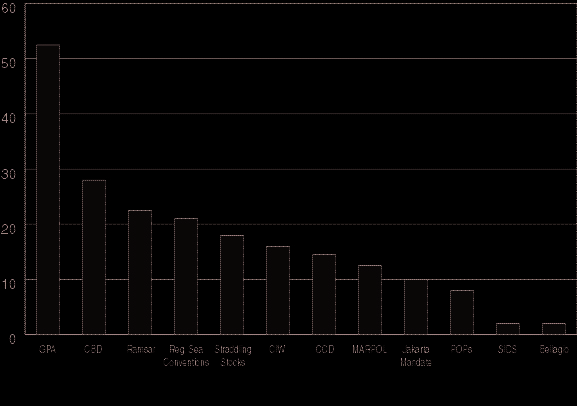
ments--whether bilateral, multilateral, regional, or marine ecosystems. Figure 1 shows the numbers of
truly global. Furthermore, they allow countries to ad- international waters projects that correlate to specific
dress issues in a way that deals not only with national international agreements, including global conven-
concerns and the internal effects of national activities, tions.
Figure 1
Numbers of GEF International Waters Projects Correlating with Specific International Agreements
11
Thus, through GEF actions to reduce nutrient pollution tection agreements have gone largely unnoticed. Sev-
in the Black Sea basin, the provisions and objectives eral global conventions and their secretariats have not
of the GPA as translated into regional commitments by taken full advantage of the opportunities arising from
the Danube and Bucharest conventions, are strength- GEF projects to advance sectoral goals and foster their
ened by compliance with the Ramsar Convention and translation into national legislation and policies. The
vice versa, while beneficial consequences are also holistic approach that underlies the GEF strategy and
accrued in respect to biodiversity preservation. Many the majority of its projects is tangibly demonstrating
projects in different regions address the fragile eco- how the effectiveness of international environmental
systems of coastal environments where marine and law can be enhanced through collective arrangements
freshwater systems interact, hydrodynamic processes and responses. However, a satisfactory level of syn-
are more intense, and the impact of human activities ergy has yet to be achieved with existing international
is being increasingly manifest. All these projects en- convention mechanisms, such as their consultative
hance synergies between the Jakarta Mandate and the meetings of contracting parties and secretariats, that
GPA, and in some instances MARPOL, as is the case would further strengthen the catalytic role of the GEF,
with projects in the Yellow Sea, along the Patagonian the replication of successful demonstrations, and
coast and shelf, and in the Southern Mediterranean. global awareness of, and compliance with, interna-
Where freshwater scarcity represents the major trans- tional agreements43.
boundary threat to ecosystems, the interplay of the
Ramsar, international watercourses, and desertifica- The role of regional conventions and international
tion conventions has provided a basis for the design river and lake basin organizations may be of critical
of a number of GEF projects, such as the Okavango importance for the success and sustainability of GEF
and the Niger basin projects.
initiatives. The present review has documented GEF
support for strengthening several basin organizations
The GEF, through its international waters focal area, and the regional seas conventions (UNEP) to address
can thus be seen as a major, or possibly the major, transboundary issues. The GEF has also been instru-
facilitator of the implementation, and increased adop- mental in advancing new multicountry agreements
tion42, of international water laws, action plans, and for the management of shared water bodies, such
regional environmental protection agreements. By as Lake Tanganyika and the Caspian Sea. Most of
far the main topic of the relevant agreements is pol- these institutions are both politically44 and financially
lution from land-based sources (GPA), followed by weak, however, and are frequently limited to advisory
loss of biodiversity (CBD), fisheries over-exploitation functions. Efforts should be made in GEF projects
(Straddling Stocks), loss of wetlands (Ramsar), and to institute mechanisms aimed at strengthening the
hazards associated with shipping (MARPOL).
financial self-sustainability of these organizations
and enhance their wider recognition, acceptance, and
This function of the GEF and the considerable service implementation.45
provided to international aquatic environmental pro-
42 Some of the agreements referred to in this review have not yet entered into force (e.g., the Convention on International
Watercourses).
43 Ways to encourage information exchanges among GEF IW projects, national and international executing agencies, NGOs,
and regional/global agreements could be identified based on the framework of the IW:LEARN project (Strengthening Capacity
for Global Knowledge-Sharing in International Waters).
44 The prevalence of environmental or water ministries and the lack of interministerial commit ees at national levels are additional
elements undermining the effectiveness of these organizations.
45 An example of innovative approaches is the Marine Electronic Highway, a private-public venture being tested for the first
time in the international waters projects of the GEF. This information infrastructure would greatly enhance navigational safety and
promote compliance with, and enforcement of, national and international marine law. A small fraction of the revenues generated
would be allocated to a regional environment fund.
13
Annex 1: Conventions and Agreements--
International Waters
Convention on Wetlands of International Importance UN Convention to Combat Desertification (CCD)
Especially as Waterfowl Habitat - Ramsar (1971)
(1992)
International Convention for the Prevention of Pol- Convention on Biological Diversity (CBD) (1994)
lution from Ships, 1973, as modified by the Protocol
of 1978 (MARPOL 73/78)
Barbados Program of Action for the Sustainable De-
velopment of Small Island States (1994)
UNEP Regional Seas Program: the Barcelona (1976),
Kuwait (1978), Abidjan (1981), Lima (1981), Jeddah UN Agreement on Straddling Fish Stocks and Highly
(1982), Cartagena (1983), Nairobi (1985), Noumea Migratory Fish Stocks (1995)
(1986), Bucharest (1992), and Guatemala (2002)
Conventions, and their partner agreements (Helsinki Global Program of Action (GPA) for the Protection of
1974, OSPAR 1992)
the Marine Environment from Land-Based Activities
(1995)
Convention on Long Range Transboundary Air Pol-
lution of the UN Economic Commission for Europe Jakarta Mandate on Marine and Coastal Biodiversity
(1979)
(1995)
UN Convention on the Law of the Sea (UNCLOS) UN Convention on Non-Navigational Uses of Inter-
(1982)
national Watercourses (1997)
Bellagio Draft Agreement Concerning the Use of Stockholm Convention on Persistent Organic Pol-
Transboundary Groundwaters (1987)
lutants (POPs) (2001)
UN Framework Convention on Climate Change
(FCCC) (1991)
13
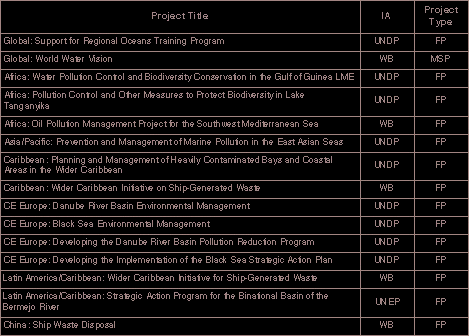
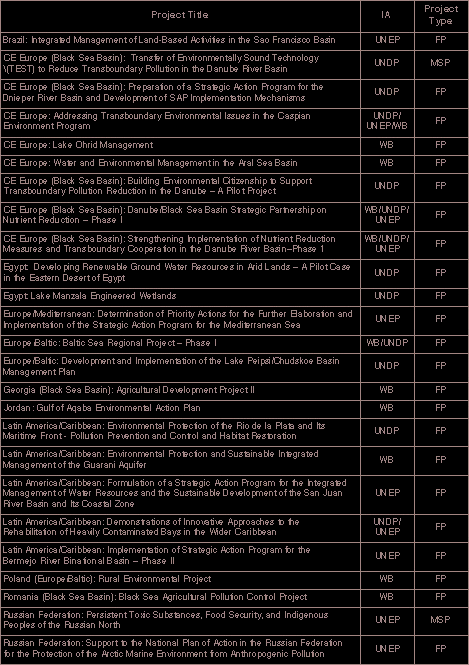
Annex 2: GEF International Waters Projects
Completed
15
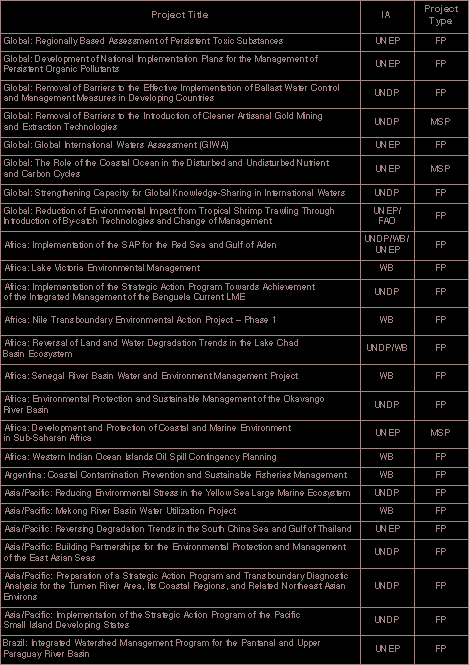
Ongoing
15
17
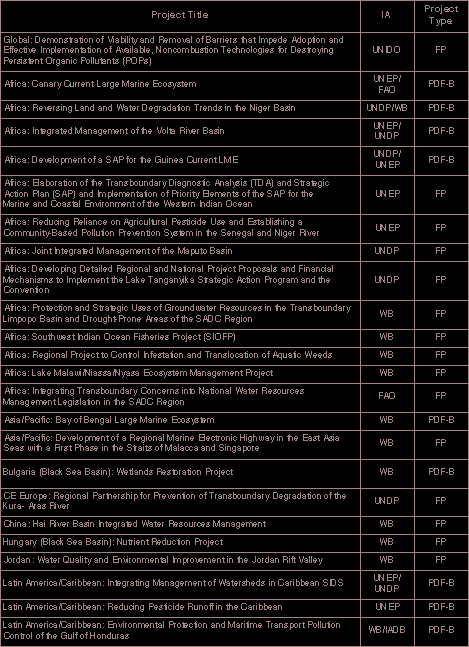
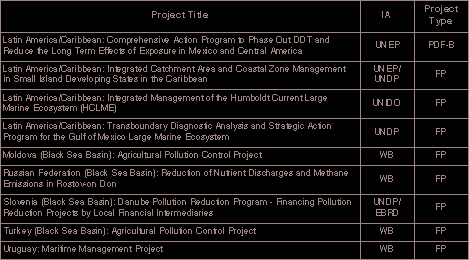
Pipeline
17