OPS3: PROGRESSING TOWARD
ENVIRONMENTAL RESULTS
THIRD OVERALL PERFORMANCE STUDY OF THE GEF
June 2005
© 2005 Office of Monitoring and Evaluation of the Global Environment Facility
1818 H Street, NW
Washington, DC 20433
Internet : www.thegef.org
E-mail : gefteam@thegef.org
All rights reserved.
The findings, interpretations, and conclusions expressed herein are those of the author(s) and do not necessarily
reflect the views of the GEF Council or the governments they represent.
The GEF Office of Monitoring and Evaluation does not guarantee the accuracy of the data included in this work.
The boundaries, colors, denominations, and other information shown on any map in this work do not imply any
judgment on the part of the GEF concerning the legal status of any territory or the endorsement or acceptance of such
boundaries.
Rights and Permissions
The material in this work is copyrighted. Copying and/or transmitting portions or all of this work without
permission may be a violation of applicable law. The GEF encourages dissemination of its work and will normally grant
permission promptly.
Global Environment Facility
Director of the Office of Monitoring and Evaluation: Robert D. van den Berg
Task Manager, Office of Monitoring and Evaluation: Claudio R. Volonte
OPS3 Team: ICF Consulting and partners
1725 I Street, NW, Suite 1000
Washington, DC 20006
www.icfconsulting.com
A FREE PUBLICATION
OPS3: PROGRESSING TOWARD ENVIRONMENTAL RESULTS
TABLE OF CONTENTS
Foreword ............................................................................................................................................................................... vii
Preface..................................................................................................................................................................................... x
Third Overall Performance Study Teams ............................................................................................................................... xii
Acronyms and Abbreviations................................................................................................................................................ xiii
Section I: Introduction and Approach
1. Introduction ................................................................................................................................................................. 1
1.1 Purpose and Scope............................................................................................................................................. 1
1.2 GEF Instrument and Mandate......................................................................................................................... 1
1.2.1 Establishment of the GEF.................................................................................................................... 1
1.2.2 GEF Program Activities........................................................................................................................ 3
1.2.3 GEF Entities--Roles and Responsibilities......................................................................................... 4
1.3 Historical Context for OPS3 ............................................................................................................................ 5
1.4 Organization of the Report............................................................................................................................... 6
2. OPS3
Approach........................................................................................................................................................... 6
2.1 Developing Thematic Areas of Assessment .................................................................................................. 6
2.2 Evaluation Challenges and Strategies.............................................................................................................. 6
2.2.1 Results of GEF Activities...................................................................................................................... 6
2.2.2 Sustainability of Results at the Country Level and the GEF as a Catalytic Institution ............... 8
2.2.3 GEF Policies, Institutional Structure, and Partnerships, and GEF
Implementation Processes..................................................................................................................... 9
2.3 Elements of the OPS3 Approach .................................................................................................................. 10
2.3.1 Research Agenda................................................................................................................................... 10
2.3.2 Desk Study............................................................................................................................................. 10
2.3.3 Field Study: Participatory Stakeholder Consultations..................................................................... 10
2.3.4 Development of Evidence to Support Findings.............................................................................. 10
2.3.5 Organization of Findings..................................................................................................................... 11
Notes, Section I................................................................................................................................................................. 12
Section II: Focal Area Analysis
3. Focal Area Portfolio Analysis.................................................................................................................................. 13
3.1 Biodiversity (TORs 1A, 1B, and 1E)............................................................................................................. 14
3.1.1 Scientific and Historical Context: Biodiversity ................................................................................ 14
3.1.2 Biodiversity Portfolio Analysis ........................................................................................................... 16
3.1.3 Contributions of the GEF to Biodiversity Conservation............................................................... 19
3.1.4 Challenges and Strategic Tradeoffs.................................................................................................... 26
3.1.5 Recommendations ................................................................................................................................ 28
3.2 Climate Change (TORs 1A, 1B, and 1E)...................................................................................................... 29
3.2.1 Scientific and Historical Context: Climate Change ......................................................................... 29
3.2.2 Climate Change Portfolio Analysis .................................................................................................... 30
3.2.3 Results of the GEF in Climate Change............................................................................................. 33
3.2.4 Challenges and Strategic Tradeoffs.................................................................................................... 36
3.2.5 Recommendations ................................................................................................................................ 41
iii
OPS3: PROGRESSING TOWARD ENVIRONMENTAL RESULTS
3.3 International Waters (TORs 1A, 1B, and 1E) ............................................................................................. 42
3.3.1 Scientific and Historical Context: International Waters ................................................................. 42
3.3.2 International Waters Portfolio Analysis............................................................................................ 43
3.3.3 Contribution of the GEF to the Health of International Waters ................................................. 45
3.3.4 Challenges and Strategic Tradeoffs.................................................................................................... 51
3.3.5 Recommendations ................................................................................................................................ 53
3.4 Update to the 2000 "Study of Impacts of GEF Activities on Phase-Out of Ozone
Depleting Substances" (TORs 1A, 1B, and 1E).......................................................................................... 54
3.4.1 Scientific and Historical Context: Ozone Depletion ...................................................................... 54
3.4.2 Ozone Portfolio Analysis .................................................................................................................... 54
3.4.3 Contributions of the GEF to ODS Phaseout.................................................................................. 55
3.4.4 Update to 2000 Study of Impacts--Results..................................................................................... 57
3.4.5 Challenges and Strategic Tradeoffs.................................................................................................... 60
3.4.6 Recommendations ................................................................................................................................ 61
3.5 Land Degradation (TORs 1C and 1E).......................................................................................................... 61
3.5.1 Scientific and Historical Context: Land Degradation ..................................................................... 62
3.5.2 Land Degradation Portfolio Analysis ................................................................................................ 62
3.5.3 Current Evidence on Meeting Global Priorities.............................................................................. 63
3.5.4 Challenges and Strategic Tradeoffs.................................................................................................... 65
3.5.5 Recommendations ................................................................................................................................ 66
3.6 POPs (TORs 1C and 1E)................................................................................................................................ 67
3.6.1 Scientific and Historical Context: POPs ........................................................................................... 67
3.6.2 POPs Portfolio Analysis...................................................................................................................... 68
3.6.3 Current Evidence on Meeting Global Priorities.............................................................................. 68
3.6.4 Challenges and Strategic Tradeoffs.................................................................................................... 71
3.6.5 Recommendations ................................................................................................................................ 72
3.7 Responsiveness of the GEF to Conventions (TOR 4C) ........................................................................... 72
3.7.1 Biodiversity (CBD) ............................................................................................................................... 73
3.7.2 Climate Change (UNFCCC) ............................................................................................................... 77
3.7.3 Ozone Depletion (Montreal Protocol).............................................................................................. 80
Notes, Section II ............................................................................................................................................................... 81
Section III: Sustainability and the Catalytic Effects of the GEF
4. Achieving and Sustaining Global Environmental Benefits ................................................................................ 84
4.1 Achieving Global Environmental Benefits .................................................................................................. 84
4.2 Sustaining Global Environmental Benefits.................................................................................................. 85
4.3 Achieving versus Sustaining Global Environmental Benefits: Where to Draw the Line? ................... 85
4.4 Factors for Achieving and Sustaining Global Environmental Benefits
(TORs 1D, 2A, 2B, and 2C) ........................................................................................................................... 86
4.4.1 Historical Context................................................................................................................................. 86
4.4.2 Factors for Achieving and Sustaining Results.................................................................................. 87
4.4.3 Extent of Sustainability........................................................................................................................ 98
4.5 Challenges and Strategic Tradeoffs ............................................................................................................. 101
4.5.1 Ensuring the Will ................................................................................................................................ 101
4.5.2 Ensuring the Way ............................................................................................................................... 101
4.6 Recommendations.......................................................................................................................................... 102
iv
OPS3: PROGRESSING TOWARD ENVIRONMENTAL RESULTS
5. Cross-Cutting Factors Contributing to Global Environmental Benefits ....................................................... 103
5.1 The GEF as a Catalyst (TORs 3A and 3B)................................................................................................ 104
5.1.1 Historical Context............................................................................................................................... 105
5.1.2 Current Evidence................................................................................................................................ 107
5.1.3 Challenges and Strategic Tradeoffs.................................................................................................. 119
5.1.4 Recommendations .............................................................................................................................. 120
5.2 National Priorities of Recipient Countries (TOR 4E).............................................................................. 122
5.2.1 Historical Context............................................................................................................................... 122
5.2.2 Responsiveness to National Priorities ............................................................................................. 123
5.2.3 Challenges and Strategic Tradeoffs.................................................................................................. 124
5.2.4 Recommendations .............................................................................................................................. 125
5.3 Varying Capacities of SIDS, LDCs, and CEITs (TOR 4F)..................................................................... 126
5.3.1 Historical Context............................................................................................................................... 127
5.3.2 Responsiveness to Varying Capacities............................................................................................. 127
5.3.3 Challenges and Strategic Tradeoffs.................................................................................................. 130
5.3.4 Recommendations .............................................................................................................................. 131
Notes, Section III ........................................................................................................................................................... 132
Section IV: Effects of the GEF's Institutional Structure and Procedures on Results
The Institutional Form of the GEF............................................................................................................................. 134
Is the GEF's Institutional Form an Appropriate One for Meeting Its Mandate and Operations?................... 135
Measuring Institutional Effectiveness ......................................................................................................................... 136
The Evolutionary Nature of the GEF......................................................................................................................... 138
Structure of Section IV .................................................................................................................................................. 138
6. Effects of the GEF's Institutional Structure ...................................................................................................... 138
6.1 How Effectively Is the GEF Meeting Its Challenges? (TOR 4D) ......................................................... 138
6.1.1 Communication and Alignment of Goals....................................................................................... 139
6.1.2 Coordinating Partners on Multiple Levels and Managing Increasingly Complex
Interdependence.................................................................................................................................. 140
6.1.3 Maintaining an Inclusive Approach................................................................................................. 142
6.1.4 Structured Informality (Balance between Control and Empowerment).................................... 143
6.1.5 Overcoming Capacity Shortages ...................................................................................................... 144
6.1.6 Managing in a Permanently Evolving World .................................................................................145
6.1.7 Maintaining Effective Relations with External Stakeholders ...................................................... 146
6.1.8 Challenges and Strategic Tradeoffs.................................................................................................. 147
6.1.9 Recommendations .............................................................................................................................. 147
6.2 A Discussion of the GEF Entities: Evolving Roles and Responsibilities (TORs 4A and 4G) ......... 148
6.2.1 GEF Secretariat................................................................................................................................... 149
6.2.2 Implementing Agencies ..................................................................................................................... 152
6.2.3 Executing Agencies ............................................................................................................................ 156
6.2.4 Scientific and Technical Advisory Panel ......................................................................................... 158
6.2.5 Trustee.................................................................................................................................................. 159
6.2.6 Monitoring and Evaluation ............................................................................................................... 161
6.2.7 Nongovernmental Organizations..................................................................................................... 165
6.2.8 Participant Countries.......................................................................................................................... 166
6.3 Challenges and Strategic Tradeoffs ............................................................................................................. 166
6.4 Recommendations.......................................................................................................................................... 167
v
OPS3: PROGRESSING TOWARD ENVIRONMENTAL RESULTS
7. GEF
Procedures...................................................................................................................................................... 170
7.1 GEF Project Cycle (TOR 5A)...................................................................................................................... 170
7.1.1 Historical Context............................................................................................................................... 170
7.1.2 Current Evidence................................................................................................................................ 171
7.1.3 Challenges and Strategic Tradeoffs.................................................................................................. 174
7.1.4 Recommendations .............................................................................................................................. 175
7.2 Lessons Learned and the Use of Knowledge Gained (TOR 5B) ........................................................... 176
7.2.1 Lessons Learned and Knowledge Management ............................................................................ 176
7.2.2 Management and Information Systems (MIS) ............................................................................... 180
7.2.3 Recommendations .............................................................................................................................. 182
Notes, Section IV............................................................................................................................................................ 183
Section V: Main Findings and Recommendations
8. Main
Findings .......................................................................................................................................................... 185
8.1 Focal Area Results.......................................................................................................................................... 185
8.2 Strategic Programming for Results--Focal Area Level ........................................................................... 186
8.2.1 Improving Coherence of Strategic Guidance................................................................................. 186
8.2.2 Tracking Indicators............................................................................................................................. 187
8.3 Strategic Programming for Results--Country Level................................................................................ 187
8.4 Responsiveness to Conventions................................................................................................................... 189
8.5 Information Management within the GEF Network............................................................................... 190
8.6 Network Responsibilities and Administration........................................................................................... 191
8.6.1 Network Administrative Office........................................................................................................ 191
8.6.2 Competition versus Collaboration ................................................................................................... 191
8.6.3 Scientific and Technical Advisory Panel ......................................................................................... 192
8.6.4 Monitoring and Evaluation ............................................................................................................... 192
8.6.5 Private Sector....................................................................................................................................... 193
8.7 Small Grants Programme.............................................................................................................................. 193
9. Major
Recommendations ....................................................................................................................................... 194
9.1 Programming for Results--Focal Area Level............................................................................................ 195
9.2 Programming for Results--Country Level ................................................................................................ 196
9.3 Responsiveness to Conventions................................................................................................................... 197
9.4 Information Management within the GEF Network............................................................................... 197
9.5 Network Responsibilities and Administration........................................................................................... 197
9.6 Small Grants Programme.............................................................................................................................. 198
Notes, Section V ............................................................................................................................................................. 199
Annex A: Clarification of OPS3 Terms of Reference.............................................................................................. 200
Annex B: High-Level Advisory Panel......................................................................................................................... 203
Annex C: List of Interviews and Country Trips ....................................................................................................... 205
Annex D: Comparison to Similar Institutions (TOR 4B)........................................................................................ 222
Annex E: Progress on Recommendations from the Third Replenishment (TOR 5C) ...................................... 226
Annex F: Bibliography .................................................................................................................................................. 237
vi
OPS3: PROGRESSING TOWARD ENVIRONMENTAL RESULTS
FOREWORD
The Global Environment Facility is replenished by donors every four years. Ideally, any replenishment should
be based on the achievements so far and the problems that need to be addressed in the coming years. The
fourth replenishment, which will be negotiated and agreed in the second half of 2005, will be informed on the
achievements of the GEF through the present "Overall Performance Study," which is the third of its kind. It
provides an overview of the results in dealing with global environmental problems and it also looks at how
the GEF functions as a network and partnership of institutions and organizations. Given the fact that the
GEF is the main financial mechanism for several global environmental conventions, the report amounts to a
review on what governments are doing to improve the global environment. It also provides an indication of
the status of some of the most important global environmental issues.
Any impression that the GEF on its own would be able to solve global environmental problems needs to be
qualified immediately. The world community currently spends approximately US $ 0.5 billion a year on
solving these issues through the GEF. The problems are immense. Any solution would need the strong
involvement of many other actors. The amount of Green House Gases emissions continues to increase.
Extinction of animal and plant species continues. Pollution and waste treatment pose enormous challenges.
Access to safe water is not ensured and even endangered for many people. Land degradation is a huge
problem in many countries across the world. The only global environmental problem that is almost solved is
that of the elimination of ozone depleting substances. For all of these problems, the GEF contribution needs
to be seen in its proper perspective as a catalyst or innovator rather than as the direct purveyor of
international public goods.
My personal assessment of this study is that it provides a solid basis for discussion and decisions on the
fourth replenishment of the GEF. The questions of the Terms of Reference of the study have been
addressed. It provides an authoritative overview of the current state of knowledge in the GEF about its
results. Furthermore, it gives a challenging picture of the GEF as a network of organizations and institutions.
The report is consistent with the methodology presented in Inception and Interim Reports. The study draws
on data gathering and analysis based on literature review, evaluative evidence in the GEF (mainly from
studies of the GEF Office of Monitoring and Evaluation) and extensive stakeholder consultations and
country visits.
The current state of knowledge about results in the GEF is well presented, as well as shortcomings
concerning these results. Furthermore, the strategic choices are identified that the GEF is facing in reaching
(and maintaining) these results. The difficulties of sustaining results is highlighted and the catalytic role of the
GEF receives due attention. Last but not least the study contains many recommendations and suggestions for
increasing the results orientation of the GEF in the fourth replenishment period.
It should be noted that OPS3 did not do an independent empirical assessment of the environmental results
that were achieved by the GEF. This was not possible given the time limitations of the study. To explain why
this is the case, let me turn back to the origin of OPS3. The GEF Council attached great importance to the
independence of the OPS3 team from GEF management, and devoted extra time and energy to ensure that
this would be the case. In the first half of 2004, when preparations for the Third Overall Performance Study
started, the monitoring and evaluation unit of the GEF Secretariat was not yet fully independent. As a result,
Council decided to take the final drafting of the terms of reference for the study in its own hands. This took
longer than initially expected, which meant that the tendering process for the study started relatively late in
June 2004. The study started in September 2004, which meant that the actual time available was reduced
significantly, since it still had to be finalized in April 2005 in order to feed into the replenishment process.
This meant that given the scope and range of the questions in the terms of reference, no empirical data
gathering on environmental results was possible.
vii
OPS3: PROGRESSING TOWARD ENVIRONMENTAL RESULTS
The tendering process was handled by the Operations Evaluation Department of the World Bank in July and
August of 2004 in a timely and professional manner. The tender was won by ICF Consulting and its
international partners. In August and early September 2004 contract negotiations took place. Furthermore, in
early September I started in my position as Director of Monitoring and Evaluation. My arrival meant that the
monitoring and evaluation unit of the GEF Secretariat changed into the independent GEF Office of
Monitoring and Evaluation. As required by the Terms of Reference of OPS3, as Director of Monitoring and
Evaluation I provided oversight of the process, ensuring that the terms of reference were being followed.
Furthermore, a High Level Advisory Panel was established as part of the technical backstopping, reporting
directly to me and providing written comments on all deliverables.
The GEF Council in its session in November 2004 requested me to work with the study team to ensure
consistency and high quality in the field analyses to be undertaken by the team. To this end, further
discussions were held with the study team on the composition of field teams and the preparation of field
visits. I participated fully in one field visit and regional meeting to witness the team in operation. This led to a
satisfactory conclusion on the preparedness and openness of the team concerned.
The primary way in which the time limitations were addressed by the study team was through fielding a large
team of mostly senior experts. This approach is sound in itself, but led to some unanticipated difficulties
when it turned out that no proper sequencing of efforts could take place. Ideally, the desk review of
evaluative evidence would have finished before the field visits and interactions with stakeholders took place.
A more systematic agenda for checking the reality behind literature and evaluative findings in field visits could
have been developed if there had been sufficient time. In reality, the desk review and the field visits and
consultations had to run in parallel. It seems to me that these difficulties raised concerns on first the quality of
the field work and second on the (lack of) emergence of findings in early stages of the analysis. These
concerns were raised by several Council members in November 2004 (on the quality of field visits) and in
February 2005 (on the lack of emerging findings on results of the GEF) and by the High Level Advisory
Panel at several occasions.
The field visits were logistically difficult to arrange for. Often dates and agendas had to be changed,
sometimes at the last moment. In November, the study team promised to involve itself at an adequate level
(senior and mid-level participation) and that counterparts from developing countries would participate. This
was realized for most, but not all, of the workshops and field visits. The workload was increased when some
workshops were added on the request of the Council (notably Cuba and Fiji), as well as an informal exchange
with Council members in Paris in February 2005. The regional workshops were generally well attended.
Although these constraints and added milestones and meetings limited the time available even further the
process has been managed by the team in a truly exemplary manner. Many evaluation managers would have
buckled under the pressure and have asked for a delayed delivery of the final product. The study team, under
the leadership of Mark Wagner, has not done this and has excelled in keeping the whole process within the
time limits set for it. Given the scale and the scope, this is to be applauded.
During the study, the team did take the advice of the High Level Panel on board in various ways.
Furthermore, the interactions of the team with the GEF Council and with GEF Council members have
helped to focus the study on the issues that are important for the replenishment process.
In many respects the Third Overall Performance Study was a global effort and therefore there are many
people from around the globe that should be acknowledged in making it possible. The ICF Consulting OPS3
team, led by Mark Wagner, and the GEF Office of Monitoring and Evaluation OPS3 support team, led by
Claudio Volonte, should be recognized first of all. Both of these teams ensured that the final report was
technically sound and prepared with high professional standards. The entire GEF Office of Monitoring and
Evaluation was involved in the exercise and provided essential inputs through the preparation of studies of
the three main GEF focal areas which constituted the basis for OPS3's assessments on results. The High
viii
OPS3: PROGRESSING TOWARD ENVIRONMENTAL RESULTS
Level Advisory Panel, chaired by Nancy McPherson, provided critical comments that pushed the study team
to improve the quality of the analysis and final report.
Council members also should be acknowledged for their active participation from the preparation and
approval of the Terms of Reference to extensive comments on several of the products produced by the study
team. Staff of the GEF Secretariat, GEF Implementing Agencies and global convention Secretariats as well
as many of the STAP members provided many valuable hours of their time throughout the process. I would
also like to acknowledge the very active and open contribution made by GEF Focal Points and
representatives of the many NGOs from around the globe that participated in the extensive consultation
process conducted by the study team, probably the most extensive one so far in the history of the GEF.
Finally, but not least, I would like to thank the national and local governments as well as the GEF project
teams that opened their doors to share their experiences during the visits conducted by the OPS3 teams.
Although it is impossible to accurately portrait the extensive tapestry of GEF activities in a report like this
one the projects that were visited helped the study team to recognize the richness and uniqueness of GEF
experience.
Rob D. van den Berg
Director of Monitoring and Evaluation
ix
OPS3: PROGRESSING TOWARD ENVIRONMENTAL RESULTS
PREFACE
The team for the Third Overall Performance Study of the GEF (OPS3), which took place between
September 2004 and June 2005, was charged with evaluating the 1) results of GEF activities, 2) sustainability
of results at the country level, 3) GEF as a catalytic institution, 4) GEF policies, institutional structure and
partnerships, and 5) GEF implementation processes. From the onset, our team viewed the evaluation as an
opportunity to evaluate the progress of GEF activities, and also to set the stage for future evaluations.
This perspective was essential to avoid the development of a static evaluation (a "snap shot") for a dynamic
and evolving institution such as the GEF. As such, OPS3 attempted to place all analyses, findings, and
recommendations in the context of the future. In particular, we asked the question, "What information will
OPS4 and future evaluations need to conduct analysis, and how will having this information ensure the
success of the GEF?"
One of the key challenges for OPS3 was collecting and assessing results. While results are critical to project
success and aggregated results are essential to the evaluation process, this information is not always available
in the GEF system. This difficulty is attributable to a range of factors, but most importantly to limited
baseline data, inconsistency on what will be measured and how, a vast array of projects with differing goals,
and nascent centralized data collection systems. All of these issues are overlaid by very high expectations for
achieving global environmental benefits.
While there clearly has been progress in the GEF system and while all stakeholders are more informed, and
processes are better off, than they were 4 years ago, when OPS2 took place, further attention is needed in
certain core areas. In particular, if the GEF is to be robust, there must be continued dialogue on baseline
setting and, specifically, how to define baselines in the face of a moving target, for example, as additional
species are catalogued or abandoned stockpiles of POPs are uncovered.
Additionally, measuring results relative to these often shifting baselines can be difficult, and while
improvements are being made in data collection, verification, and analysis, it is critical that simple procedures
for gauging results be agreed upon. Simple measures of results will be more practical for tracking progress
than the use of complex, resource intensive measurement schemes. To house this ever growing universe of
data, transparent, centralized data systems, accessible to all parties will be necessary to enable future
evaluations.
Collaboration is critical to success. Improving outcomes and results will depend on furthering the emerging
acknowledgement of the GEF as a network collaboration between the parts of various institutions that
focus on the GEF. By realizing the advantages of this network arrangement, the effectiveness of the GEF can
be improved, but it will take compromise and a willingness to work towards the utility of all to sacrifice self
interest for the overall good of the system.
During the field study portion of our evaluation, the OPS3 team spoke to more than 600 GEF stakeholders
from country governments, Implementing and Executing Agencies, NGOs, GEF project managers, and
representatives from the private sector and civil society, in addition to representatives of the GEF Council,
the GEF Secretariat, and the Scientific and Technical Advisory Panel. The leadership of the Office of
Monitoring and Evaluation, especially the newly appointed director Robert van den Berg and his staff,
notably Claudio Volonte, was integral to the success of this study and made our work more targeted than
would have otherwise been possible. Their help in establishing a High Level Advisory Panel and in
orchestrating panel interactions also was instrumental. Further, the contributions of the High Level Advisory
Panel itself improved the quality of the evaluation.
x
OPS3: PROGRESSING TOWARD ENVIRONMENTAL RESULTS
Across all of the groups with whom we interacted, there was a great commitment to the GEF and its
mandate, a great enthusiasm for the work being undertaken, and eagerness to demonstrate success. We hope
that the recommendations put forward by OPS3 will be helpful in moving the GEF's agenda forward in
achieving global environmental benefits in a sustainable way.
Finally, I would like to personally acknowledge my colleagues at ICF Consulting and our regional partners for
their creativity, thoughtfulness, and dedication to this evaluation.
Mark C. Wagner
OPS3 Team Leader
and Senior Vice President
ICF Consulting
xi
OPS3: PROGRESSING TOWARD ENVIRONMENTAL RESULTS
THIRD OVERALL PERFORMANCE STUDY TEAMS
Core OPS3 Team
ICF Consulting
Partners
Mark Wagner, Team Leader
ICF-EKO (Russian Federation)
Christopher Durney
Olga Varlamova
Will Gibson
Abyd Karmali
Walter Palmer
Polly Quick
OPS3 Support Team
ICF Consulting
Partners
Paula Aczel
Africon (South Africa)
Joana Chiavari
Joseph Asamoah
Chiara D'Amore
Thomas van Viegen
Craig Ebert
Centre for Environmental Education (India)
David Hathaway
R. Gopichandran
Alan Knight
ICF-EKO (Russian Federation)
Johanna Kollar
Svetlana Golubeva
Daniel Lieberman
Mexican Institute of Water Technology (Mexico)
Pamela Mathis
Alberto Guitron
Jeremy Scharfenberg
Marian Martin Van Pelt
Jessica Warren
GEF Monitoring and Evaluation Office OPS3 Team
Robert van den Berg, Director
Claudio Volonte, Senior Monitoring and Evaluation Specialist
Aaron Zazueta, Senior Monitoring and Evaluation Specialist
Siv Tokle, Senior Monitoring and evaluation Specialist
Juan Jose Portillo, Project Officer
Joshua Brann, Junior Professional Associate
OPS3 High Level Advisory Panel
Professor Zhaoying Chen, Director, China's National Centre for Science and Technology Evaluation
Dr. Lawrence Haddad, Director, Institute of Development Studies, University of Sussex, United
Kingdom
Dr. Alcira Kreimer, independent consultant
Dr. Uma Lele, Sr. Adviser, Operations Evaluation Department, World Bank
Ms. Nancy MacPherson, Senior Adviser, Performance Assessment, IUCN The World Conservation
Union
xii
OPS3: PROGRESSING TOWARD ENVIRONMENTAL RESULTS
ACRONYMS AND ABBREVIATIONS
ABS
Access and benefit sharing
FUNBIO
Brazilian Biodiversity Fund
ACTUAR
Asociación Costarricense de
GEF
Global Environment Facility
Turismo Rural Comunitario
GEF-1
Restructured GEF, fiscal 1995/98
ADB Asian
Development
Bank
GEF-2 Restructured
GEF,
fiscal
AfDB
African Development Bank
1999/2002
ARPA Amazon
Region
Protected Areas
GEF-3
Restructured GEF, fiscal 2004/06
Program
GEF-4
Restructured GEF, fiscal 2007/10
ASP
African Stockpile Program
GEFM&E
GEF Monitoring and Evaluation
BPS
Biodiversity Program Study
Unit
CAS
Country Assistance Strategy
GEFSEC GEF
Secretariat
CBD
Convention on Biological
GHG Greenhouse
gas
Diversity
GTZ
German Agency for Technical
CCPS
Climate Change Program Study
Cooperation (Deutsche
CCS
Carbon capture and sequestration
Gesellschaft für Technische
Zusammenarbeit)
CDM
Clean Development Mechanism
GWP Global-warming
potential
CDW
Country Dialogue Workshop
HCFC Hydrochlorofluorocarbon
CEITs
Countries with economies in
transition
HFC Hydrofluorocarbon
CEO
Corporate Executive Officer
HLP
OPS3 High-Level Advisory Panel
CFC Chlorofluorocarbon
IA Implementing
agency
CO
IADB Inter-American
Development
2 Carbon
dioxide
Bank
COP
Conference of the Parties
ICR
Implementation completion report
CPAP
Country Programme Action Plan
[UNDP]
IFAD
International Fund for Agricultural
Development
DDT Dichloro-diphenyl-trichloroethane
[a POP]
IGO Intergovernmental
organization
EA Executing
agency
IPCC
Intergovernmental Panel on
Climate Change
EBRD
European Bank for
Reconstruction and Development
IPO Indigenous
peoples'
organization
EU European
Union
IUCN
World Conservation Union
(formerly International Union for
FAO
Food and Agriculture
the Conservation of Nature)
Organization of the United
Nations
IW:LEARN The International Waters Learning
Exchange and Resource Network
FCCC
Framework Convention on
Climate Change
IWPS International
Waters
Program
Study
FSP Full-size
project
IWTF
GEF International Waters Task
FSU
Former Soviet Union
Force
xiii
OPS3: PROGRESSING TOWARD ENVIRONMENTAL RESULTS
KM Knowledge
management
OECD
Organisation for Economic Co-
LDCs
Least developed countries
operation and Development
LME Large
marine
ecosystem
OFP Operational
focal
point
M&E
Monitoring and evaluation
OME
GEF Office of Monitoring and
Evaluation (after 2004)
MAR Management
action
record
OP Operational
Program
MBC Meso-American
Biological
Corridor
OP1
Arid and Semi-Arid Zone
Ecosystems
METT Management
Effectiveness
Tracking Tool
OP2
Coastal, Marine, and Freshwater
Ecosystems
MIS Management
and
information
systems
OP3 Forest
Ecosystems
MLF
Multilateral Fund of the Montreal
OP4 Mountain
Ecosystems
Protocol
OP5
Removal of Barriers to Energy
MMTCO
Efficiency and Energy
2Eq Million metric tons of carbon
dioxide equivalent
Conservation
MOP
Meeting of the Parties to the
OP6
Promoting the Adoption of
Montreal Protocol
Renewable Energy by Removing
Barriers and Reducing
MOU
Memorandum of understanding
Implementation Costs
MSP Medium-size
project
OP7
Reducing the Long-Term Costs of
MT Metric
tons
Low Greenhouse Gas Emitting
Energy Technologies
NAI Non-Annex
I
OP8 Waterbody-Based
Operational
NAP
National Action Program (to
Program
combat desertification)
OP9
Integrated Land and Water
NAPA
National Adaptation Programme
Multiple Focal Area Operational
of Action
Program
NBF
National Biosafety Framework
OP10 Contaminant-Based
Operational
NBSAPs
National Biodiversity Strategies
Program
and Action Plans
OP11 Promoting
Environmentally
NCSA
National Capacity Self-Assessment
Sustainable Transport
NDI
National Dialogue Initiative
OP12 Integrated
Ecosystem
Management
NEPAD
New Partnership for Africa's
Development
OP13
Conservation and Sustainable Use
of Biological Diversity Important
NGO
Nongovernmental organization
to Agriculture
NIPs
National Implementation Plans
OP14
Persistent Organic Pollutants
(under POPs)
OP15
Sustainable Land Management
ODP Ozone-depleting
potential
OPS
Overall Performance Studies
ODS Ozone-depleting
substance
PCBs
polychlorinated biphenyls (a POP)
OED Operations
Evaluation
Department [World Bank]
PDF
Project preparation and
development facility
xiv
OPS3: PROGRESSING TOWARD ENVIRONMENTAL RESULTS
PEMSEA
Partnership in Environmental
UNEP
United Nations Environment
Management for the Seas of East
Programme
Asia
UNFCCC
United Nations Framework
PIR
Project Implementation Review
Convention on Climate Change
PMIS
GEF Project Tracking and
UNIDO
United Nations Industrial
Management Information System
Development Organization
POP Persistent
organic
pollutant
WCMC
World Conservation Monitoring
POV
Point of view
Centre
PPR
Project Performance Report
WCST
Wildlife Conservation Society of
Tanzania
PROBIO
Brazilian National Biodiversity
Project
WSSD
World Summit for Sustainable
Development
PTMS
Project Tracking and Mapping
System
PV Photovoltaic
QAG
Quality Assurance Group
QEA
Quality at Entry Assessment
QSA
Quality Supervision Assessment
RAF
Resource allocation framework
SAP
Strategic Action Program
SCCF
Special Climate Change Fund
SGP Small
Grants
Programme
SIDS
Small island developing states
SLM
Sustainable land management
STAP
Scientific and Technical Advisory
Panel
STRMs
Short-term response measures
TDA Transboundary
Diagnostic
Analysis
TE Terminal
evaluation
TEAP
Technology and Economic
Assessment Panel
TER
Terminal evaluation review
TOR
Term of reference
UN United
Nations
UNAIDs
Joint United Nations Programme
on HIV/AIDS
UNCCD
United Nations Convention to
Combat Desertification
UNDP
United Nations Development
Programme
xv
OPS3: PROGRESSING TOWARD ENVIRONMENTAL RESULTS
SECTION I: INTRODUCTION AND APPROACH
1. Introduction
1.1 Purpose and Scope
The purpose of the Third Overall Performance Study (OPS3), commissioned by the Global Environment
Facility (GEF) Council, is "to assess the extent to which GEF has achieved, or is on its way towards
achieving its main objectives, as laid down in the GEF Instrument and subsequent decisions by the GEF
Council and the Assembly, including key documents such as the Operational Strategy and the Policy
Recommendations agreed as part of the Third Replenishment of the GEF Trust Fund." (GEF/C.23/4)
OPS3 follows two previous studies that were similar in nature to that of OPS3; however, as the GEF and its
portfolios have matured, so the purpose of an overall performance study has evolved. OPS3 is part of a
larger, longitudinal study that will build on the concepts and recommendations of the previous studies and
look forward to improvements in GEF operations to set the stage for OPS4. The OPS3 team also recognizes
that this study is taking place at a critical time and will provide input that is relevant to the Fourth
Replenishment of the GEF Trust Fund, which will be taking place shortly after the publication of the OPS3
study. A primary goal of OPS3 is to provide relevant, timely, and actionable recommendations for each of the
Terms of Reference (TOR) areas to support the replenishment process and associated programming.
The scope of OPS3 is defined by the "Terms of Reference for the Third Overall Performance Study of the
GEF" (GEF/C.23/4. 2004) approved by the GEF Council on May 21, 2004, and it covers five main themes:
· Results of GEF activities
· Sustainability of results at the country level
· GEF as a catalytic institution
· GEF policies, institutional structure, and partnerships
· GEF implementation processes.
1.2 GEF Instrument and Mandate
As the only existing multiconvention financing mechanism, the GEF serves as such for the Convention on
Biological Diversity (CBD), United Nations Framework Convention on Climate Change (UNFCCC),
Stockholm Convention on Persistent Organic Pollutants (POPs), and the United Nations Convention to
Combat Desertification (UNCCD). The GEF also supports the Montreal Protocol and activities related to
international waters. Drawing on the financial contributions of developed-country GEF participants, the
GEF provides new and additional funding for the incremental costs of projects in six focal areas:
Biodiversity, Climate Change, POPs, Land Degradation, International Waters, and Ozone Layer Depletion.
1.2.1 Establishment of the GEF
In 1991, the GEF was established in the International Bank for Reconstruction and Development (the World
Bank) as a pilot facility to assist in the protection of the global environment by providing new and additional
funding in the areas of climate change, biodiversity, ozone layer depletion, and international waters.
Participants in this phase agreed to a collaborative management arrangement among the three Implementing
1
OPS3: PROGRESSING TOWARD ENVIRONMENTAL RESULTS
Agencies (IAs)--the United Nations Development Programme (UNDP), the United Nations Environment
Programme (UNEP), and the World Bank--with the understanding that the three-year program would be
exploratory.
In 1994, after several years of negotiation, the GEF was restructured under the guidance of the "Instrument
for Establishment of the Restructured Global Environment Facility" (GEF 1994a) (hereafter referred to as
the Instrument) and became a permanent mechanism to promote international cooperation and fund projects
to achieve global environmental benefits. The network design of the GEF emerged from these restructuring
negotiations, during which it was determined that a new, stand-alone institution would not be created.
The Instrument was accepted by representatives of 73 countries and formally adopted by the three IAs. The
GEF was mandated to "...operate, on the basis of collaboration and partnership among the IAs, as a
mechanism for international cooperation for the purpose of providing new and additional grant and
concessional funding to meet the agreed incremental costs of measures to achieve agreed global
environmental benefits" (GEF 1994a) in the stated focal areas.
In 1996, the GEF put forth its Operational Strategy, based on the objectives of the UNFCCC and CBD, the
Instrument, and Council decisions. The Operational Strategy was developed through GEF Secretariat
(GEFSEC) consultations with the IAs, the GEF Scientific and Technical Advisory Panel (STAP),
Conferences of the Parties (COPs) for the two conventions, and regional stakeholders. The GEF Council
approved the strategy at its October 1995 meeting. Exhibit 1 presents the 10 operational principles to which
the GEF pledged to adhere in carrying out its mission.
The third operational principle of the GEF states that the GEF will provide funding to meet the agreed
incremental costs of activities to achieve global environmental benefits. As outlined in the 1996 Council
document "Incremental Costs" (GEF/C.7/Inf.5), to calculate incremental costs, "[t]he cost of GEF eligible
activity should be compared to that of the activity it replaces or makes redundant. The difference between the
two costs--the expenditure on the GEF supported activity and the cost saving on the replaced or redundant
activity--is the incremental cost. It is a measure of the future economic burden on the country that would
result from its choosing the GEF supported activity in preference to one that would have been sufficient in
the national interest."
Exhibit 1. Operational Principles of the GEF
1) For purposes of the financial mechanisms for the implementation of the Convention on Biological Diversity
and the United Nations Framework Convention on Climate Change, the GEF will function under the guidance
of, and be accountable to, the Conference of the Parties (COPs). For purposes of financing activities in the focal
area of ozone layer depletion, GEF operational policies will be consistent with those of the Montreal Protocol
on Substances that Deplete the Ozone Layer and its amendments.
2) The GEF will provide new, and additional, grant and concessional funding to meet the agreed incremental costs
of measures to achieve agreed global environmental benefits.
3) The GEF will ensure the cost-effectiveness of its activities to maximize global environmental benefits.
4) The GEF will fund projects that are country-driven and based on national priorities designed to support
sustainable development, as identified within the context of national programs.
5) The GEF will maintain sufficient flexibility to respond to changing circumstances, including evolving guidance
of the Conference of the Parties and experience gained from monitoring and evaluation activities.
6) GEF projects will provide for full disclosure of all nonconfidential information.
7) GEF projects will provide for consultation with, and participation as appropriate of, the beneficiaries and
affected groups of people.
8) GEF projects will conform to the eligibility requirements set forth in paragraph 9 of the GEF Instrument.
9) In seeking to maximize global environmental benefits, the GEF will emphasize its catalytic role and leverage
additional financing from other sources.
10) The GEF will ensure that its programs and projects are monitored and evaluated on a regular basis.
2
OPS3: PROGRESSING TOWARD ENVIRONMENTAL RESULTS
To provide the needed funding to meet these incremental costs, contributing participants pledge resources
every four years. The First Replenishment of the GEF was undertaken in 1994, and subsequent
replenishments were carried out in 1998 and 2002. The Fourth Replenishment of the GEF is scheduled for
2006, and input from OPS3 will contribute to the negotiations of this replenishment.
1.2.2 GEF Program Activities
As described, the GEF operates in six focal areas that align with the objectives of their respective
conventions. In addition to the Biodiversity, Climate Change, Ozone Layer Depletion, and International
Waters focal areas, in 2002, the Second GEF Assembly established two new focal areas: Land Degradation
(primarily desertification and deforestation) and POPs, and the Instrument was amended accordingly.
Projects proposed for funding under the GEF must be consistent with the Instrument and the GEF
Operational Strategy. In particular, in funding activities, the GEF aims to emphasize its catalytic role and to
leverage additional financing from other sources. IAs also aim to avoid transfer of negative environmental
impacts between focal areas and to take advantage of synergies between focal areas.
Once funding eligibility is confirmed, projects are generally classified in one of three inter-related ways:
enabling activities, short-term response measures (STRMs), or Operational Programs (OPs). Additionally,
since 1997, limited amounts of GEF funding have also been occasionally granted for goal-oriented research
that supports the GEF operational strategy.1
· Enabling activities "are a means of fulfilling essential communication requirements to a Convention, provide
a basic and essential level of information to enable policy and strategic decisions to be made, or assist
planning that identifies priority activities within a country" (GEF Operational Strategy 1996).
· Short-term response measures are activities that are considered sufficiently important for funding, even though
they may not be strictly related to an OP or enabling activity. STRMs are expected to provide short-term
benefits at a relatively low cost.
· OPs represent "a conceptual and planning framework for the design, implementation, and coordination of
a set of projects to achieve a global environmental objective in a particular focal area" (GEF Operational
Strategy 1996).
Initially, OPs were developed for the Biodiversity and Climate Change focal areas conforming to the program
priorities approved by the COPs to those conventions, and for the International Waters focal area based on
the priorities determined by the Council. It was decided that the Ozone Layer Depletion focal area would not
have an OP, but that activities in that focal area would be focused on STRMs and enabling activities. OPs
have since been developed for the Land Degradation and POPs focal areas.
In addition to enabling activities, STRMs, and projects approved under the OPs, projects may also be
submitted under the Small Grants Programme (SGP). Established in 1992 to grant funding for community-
based initiatives, the SGP currently provides up to US$50,000 per project in the Climate Change, Biodiversity,
International Waters, Land Degradation, and POPs focal areas. The SGP incorporates a separate, streamlined
project cycle that is conducted at the national level.
To further direct GEF resources in a way that catalyzes action to maximize global environmental benefits, a
strategic planning framework was introduced in GEF's fiscal 2004/06 Business Plan. As part of this
framework, Strategic Priorities were identified in each of the six focal areas. These Strategic Priorities are
"consistent with the OPs, guidance from the Conventions, and country priorities...and...reflect the major
themes or approaches under which resources are programmed within each of the focal areas"
(GEF/C.24/9/Rev.1).
3
OPS3: PROGRESSING TOWARD ENVIRONMENTAL RESULTS
1.2.3 GEF Entities--Roles and Responsibilities
Based on the Instrument, the following GEF entities were charged with these mandates:
· Assembly, consisting of representatives of all participants, meets once every three years to "(a) review the
general policies of the Facility; (b) review and evaluate the operation of the Facility on the basis of reports
submitted by the Council; (c) keep under review the membership of the Facility; and (d) consider, for
approval by consensus, amendments to the present Instrument on the basis of recommendations by the
Council."
· Council, made up of 32 members that represent regional constituency groupings, is responsible for
developing, adopting, and evaluating the operational policies and OPs for GEF-financed activities in
accordance with the Instrument and guidance from the Assembly. The Council acts in accordance with
program priorities and eligibility criteria as decided by the COPs for the conventions. Among other
responsibilities, the Council also reviews and approves work programs and provides guidance to the
GEFSEC, IAs, the Office of Monitoring and Evaluation, the Trustee, STAP, and other bodies. The
Council meets twice each year.
· GEFSEC, headed by the Corporate Executive Officer (CEO)Chairperson of the GEF, supports and
reports to the Assembly and Council. To assist the Council, the GEFSEC (a) implements the decisions of
the Assembly and the Council and, in consultation with the IAs, ensures the implementation of the
operational policies adopted by the Council; (b) coordinates the development and oversees the
implementation of the activities in the work program; and (c) coordinates with the secretariats of the
conventions for which the GEF is a financial mechanism and other bodies.
· IAs, which include the UNDP, UNEP, and World Bank, develop and implement GEF activities within
each of their respective technical competences.
· STAP serves a scientific and technical advisory role for the GEF. For example, members of the STAP
expert roster review and advise on individual projects.
· Trustee of the Fund is the World Bank, which is responsible for the financial management of the Fund,
including investment of assets, disbursement of funds to IAs and Executing Agencies (EAs), and
monitoring and reporting on the investment and use of the Fund's resources.
In addition to these entities that received specific mandates in the Instrument, the following entities are
important partners in the GEF network and have had evolving roles and responsibilities over the lifetime of
the GEF:
· Monitoring and evaluation (M&E): In October 1996, the GEF Council approved a budget and work program
for an M&E function. The Third Replenishment of the GEF Trust Fund recommended in 2002 that the
M&E unit (GEFM&E) become an independent entity. The TOR for an independent M&E function were
approved by the Council in July 2003, and the unit was granted full independence and renamed the Office
of Monitoring and Evaluation (OME) in 2004.
· EAs: In the Instrument, IAs were allowed to cooperate with EAs to prepare and implement GEF
activities. In 1999, the GEF Council approved a policy to expand the number of international
organizations that can directly access funding from the GEF Trust Fund through the GEFSEC to prepare
and implement GEF-financed activities. This policy of expanded opportunities for EAs was eventually
extended to the Asian Development Bank (ADB), African Development Bank (AfDB), European Bank
for Reconstruction and Development (EBRD), Inter-American Development Bank (IADB), Food and
Agriculture Organization of the United Nations (FAO), United Nations Industrial Development
Organization (UNIDO), and International Fund for Agricultural Development (IFAD).
4
OPS3: PROGRESSING TOWARD ENVIRONMENTAL RESULTS
· Nongovernmental organizations (NGOs): In the Instrument, IAs were permitted to cooperate with NGOs to
promote the purposes of the GEF and to prepare and implement GEF activities. NGOs may also
participate in the semi-annual GEF-NGO consultations and the NGO network, the representative of
which can make interventions at GEF Council meetings. Additionally, NGOs can prepare and execute
medium-size projects as well as projects under the SGP.
1.3 Historical Context for OPS3
The GEF Monitoring and Evaluation Unit (GEFM&E) has coordinated two previous OPSs to evaluate the
global impacts and policies that result from the GEF programs. OPSs are conducted by external experts every
four years and generate a number of recommendations for the GEF. These recommendations are taken into
consideration by the GEF Assembly and used for financial negotiations and decision making.
In 1997, the first OPS (OPS1 [GEF/A.1/4]) was conducted at the request of the GEF Council. The report
focused on the GEF's provision of resources as well as country and institutional issues. However, so few
GEF projects had been completed at the time that OPS1 could not evaluate program results. By the time
OPS2 was conducted in 2001, a subset of projects had been completed and their success documented,
allowing reviewers to focus on whether the GEF objectives were being met. Despite the different focuses,
OPS1 and OPS2 posed many common questions and came to similar conclusions in many areas. Common
themes and issues raised by both reports include:
· Need for additional financial leveraging, including stronger involvement of private sector funds and
entities
· Concerns about the functionality of focal point system
· Concerns about IA coordination
· Prioritization of convention guidance and GEF implementation of convention guidance
· Concerns about outreach to stakeholders and GEF visibility
· Effectiveness of institutional organization and management strategies
· Role of the STAP.
In addition to the OPS, every four years, coinciding with the GEF replenishment cycle, the GEFM&E
conducts a round of evaluations and studies on all GEF programs. These reviews are fundamental elements
of the GEFM&E's work program and are major inputs to the OPS, the GEF replenishment process, and the
GEF Assembly. In preparation for the OPS3, the fourth2 major GEF-wide review, the following program
studies (and other key non-program-area studies) were conducted in 2004:
· GEF Biodiversity Program Study (BPS2004)
· International Waters Program Study (IWPS2004)
· Climate Change Program Study (CCPS2004)
· Progress Report on Implementation of the GEF Operational Program on Sustainable Land Management
(GEF/C.23/Inf.13.Rev.2)
· Local Benefits Study (GEFM&E 2004a.2004h.)
These studies are an essential contribution to OPS3. Their key findings and recommendations are drawn on
to complement OPS3 findings in this report.
5
OPS3: PROGRESSING TOWARD ENVIRONMENTAL RESULTS
1.4 Organization of the Report
The remainder of this report is organized around the OPS3 TORs:
· Chapter 2 discusses the approach and methodology employed by OPS3.
· Chapter 3 addresses findings and recommendations related to results of GEF activities.
· Chapter 4 gives findings and recommendations related to the sustainability of GEF results.
· Chapter 5 discusses the success of the GEF as a catalytic institution.
· Chapter 6 presents the effects of the GEF network structure on results.
· Chapter 7 addresses the effects of GEF procedures on results.
· Chapter 8 presents the main findings of OPS3.
· Chapter 9 puts forth the major recommendations of OPS3.
2. OPS3
Approach
2.1 Developing Thematic Areas of Assessment
Based on its review of the five main areas of assessment outlined in the study TOR, OPS3 grouped the
subject matter of the TOR into three broad points of view (POVs) for purposes of data collection and
analysis. This allowed for a more focused and thematic approach to research and assessment of GEF
performance. These POVs, presented in exhibit 2, are the:
· Focal area point of view, which includes each of the six GEF focal areas
· Cross-cutting point of view, which includes issues concerning, among other things, sustainability,
contributions to global benefits, replicability, incremental cost, country-drivenness, the GEF's role as a
catalytic institution, and similar issues that can be observed across the GEF's operations
· Institutional point of view, which includes the effectiveness of the GEF's structure, roles, and
responsibilities and the core processes the GEF uses for conducting its work
Exhibit 2 describes this general POV framework and indicates which specific TOR areas were considered
within each POV grouping. A detailed list of the indexed TOR topics is included in annex A.
2.2 Evaluation Challenges and Strategies
In addressing the various areas of the OPS3 TOR, there were several distinct challenges and requirements
that contributed to the OPS3 approach. These are outlined below.
2.2.1 Results of GEF Activities
Given the increasing maturity level of certain GEF portfolios, and in the context of recent dialogue on the
results of the GEF, there was a clear focus on assessing results as part of OPS3 (TOR 1). In addition, this is
an area where OPS1 and OPS2 were not able to provide any comprehensive assessment, and where
expectations for OPS3 were high.
6
OPS3: PROGRESSING TOWARD ENVIRONMENTAL RESULTS
Exhibit 2. Organization of TOR Questions by POV
The OPS3 Role in Results Assessment
During initial consultations with the OME, discussions were held on how OPS3 would address the results
assessment issue, given the objectives of the study, other major recent analyses that had contributed to the
study (for example, Program Studies), and various other constraints, such as the general unavailability of
impact-level results data and the study timeframe. Three consensus points emerged from these discussions:
· OPS3 should focus on assessing overall results of the GEF at the level of the focal areas, based on
available data synthesized in reports such as the recent Program Studies, data gathered through a series of
country visits to assess results observed at the country level, and other available summary data.
· The recently completed Program Studies for Biodiversity, Climate Change, and International Waters
would serve as one of the primary existing sources of detailed data concerning specific results and related
issues at the project and focal area level. Consideration of the Program Studies as part of the OPS3
assessment was supported by the Council in the November 2004 summary meeting documentation.
(GEF. "Joint Summary of the Chairs, GEF Council Meeting." November 2004.)
· The research conducted by the OPS3 team during the desk and field study components would look to
provide an overview of GEF activities, and would not try to corroborate data at the project level. Instead,
the OPS3 team would use information collected in the field to corroborate findings from the Program
Studies, OPS1 and OPS2, and the rest of the desk study.
Key Challenges to Results Measurement
After conducting an initial desk review, it was clear that the TOR 1 would be problematic. In particular, there
would be problems relating to reporting at the level of long-term quantifiable results or impacts (global
environmental benefits). This difficulty had been reported by OPS2 (GEFM&E 2002d) and was similarly
raised in the 2004 Program Studies, which also indicated that more recent projects have made progress in
including baselines and indicators. However, the results of these newer projects will not be seen for several
years. These observations by OPS3, in addition to the scientific literature, pointed to problems such as:
· Most projects do not generate information at the level of long-term quantifiable impacts and, more
important, many projects still do not have clear and agreed baselines, indicators of impacts, or
methodologies to calculate them.
7
OPS3: PROGRESSING TOWARD ENVIRONMENTAL RESULTS
· Although environmental change may take decades to be perceived or measured, GEF projects on average
span a four- to five-year period.
· The GEF does not systematically conduct postcompletion studies to look at long-term results.
· The GEF, as an institution, does not have an overall results measurement framework or methodology to
aggregate from project-level impacts to program-level or GEF-wide impacts. There is no existing unified
framework in place for systematically defining, measuring, and aggregating results of GEF activities,
particularly in terms of global environmental benefits for each of the GEF focal areas.
OPS3 observed that although mechanisms appeared to be in place to guide development of goals and results
during project design, implementation, and reporting (for example, project log-frames), and individual
projects have been assessed against their implementation performance as part of various annual, mid-term,
and completion reports, there remains a large gap in the effectiveness of such project-level mechanisms in
capturing results at the impact level. Apart from this constraint, there were not mechanisms in place to
support the roll-up of impacts should they be identified. In summary, the OPS3 team was presented with a
situation where basic questions concerning what to measure, how to measure, and how to scale up results to
the program level were not resolvable, and results did not exist in a form conducive to clear aggregation.
Taken as a whole, these observations at the outset of OPS3 indicated that results measurement within the
GEF, in particular at the impact level and in terms of global environmental benefits, remained a key challenge
for the GEF and would pose a challenge for the OPS3 team.
Given the limitations to conducting quantitative analyses, this report provides qualitative evidence, where
possible, to point to successes and challenges. It should be recognized, however, that the examples given in
this report are intended only to be illustrative and are not necessarily representative of the entire GEF
portfolio.
Recognizing Nonquantifiable Results
A subtheme to the challenges surrounding the development of a more practical results measurement
framework is how to treat nonquantifiable results of GEF activities. The OPS3 team was asked to assess both
quantitative and qualitative results. The team recognized that there is currently no agreed methodology
available in many focal areas to support the quantification and aggregation of qualitative or "soft" outcomes,
although there have been recent advances made in some areas (for example, Biodiversity) that may assist the
GEF in aggregating such outcomes in the future.
The Program Studies, in addition to other studies in progress (for example, the Local Benefits Study), point
out certain outcomes that are either inherently resistant to quantification or pose serious difficulties to
quantification. Participatory stakeholder consultations under OPS3 identified many project-level outcomes
that project participants recognized as nonquantifiable yet significant, and that cannot be easily aggregated.
2.2.2 Sustainability of Results at the Country Level and the GEF as a Catalytic
Institution
The key challenge in assessing issues related to sustainability and catalytic effects of the GEF, as required
under TORs 2 and 3, was gaining input from key GEF stakeholders at all levels. The OPS3 desk study
process provided limited input. Project-level reporting data do not lend themselves to this assessment because
it is not sufficiently dynamic in presentation to articulate GEF project performance relating to cross-cutting
factors such as sustainability and catalytic effects of GEF activities. Limited data exist for assessing certain
aspects of the questions in these TOR areas (for example, intended levels of cofinancing for evaluating
financial leveraging of GEF activities), and the 2004 Program Studies were quite useful in providing both
specific and synthesized input, but other new data were required from many different perspectives. Given
8
OPS3: PROGRESSING TOWARD ENVIRONMENTAL RESULTS
that the GEF's network structure involves the participation of many key stakeholders, assessing GEF
performance on any particular topic generally required a process of triangulation to collect observations from
several relevant participants.
Accordingly, the key methodological element of the OPS3 assessment of these issues was the extensive series
of stakeholder consultations undertaken over the course of the study. These consultations allowed the OPS3
team to probe the experience and observations of each set of stakeholders to arrive at a fuller picture of the
key questions underlying TORs 2 and 3, such as the key elements contributing to sustainability of GEF
activities, how effective leveraging occurs on the ground, how the GEF is catalytic, and conversely how the
GEF's processes or procedures may limit the GEF's effectiveness in achieving sustainability of its efforts, or
in maximizing its capacity to catalyze efforts on the ground. The consultative process assisted the OPS3 team
in opening dynamic and iterative lines of inquiry to support its analysis.
2.2.3 GEF Policies, Institutional Structure, and Partnerships, and GEF
Implementation Processes
The questions posed in TORs 4 and 5 required OPS3 to evaluate the GEF's institutional effectiveness in a
number of different areas. In some cases, OPS3 identified definitional challenges to these questions that
could pose a barrier to providing a clear and consistent assessment. Certain terminologies used in the
TORs--for example, the use of institutional performance terms such as "satisfactory" and "responsive"--
required the development and articulation of a baseline against which to conduct a clear assessment.
Recognizing that assessments of institutional structures, processes, and effectiveness often require (and are
very conducive to) the use of an overarching analysis framework, OPS3 developed a specific institutional
framework to guide its assessment of TORs 4 and 5. This framework included a specific investigative
framework to support the research process and an interpretive framework for assessing the results of the
research, conducting analysis, and developing findings and recommendations.
For its investigative framework, the OPS3 team developed a Framework for Institutional Expectations
Analysis, which provided a set of underlying expectations for performance that the team would expect to find
based on the Instrument, previous guidance and assessments, and the particular organizational traits and
operating context of the GEF institution. For each area of TORs 4 and 5, the institutional analysis compares
these ideal expectations to actual performance of the GEF entities and the overall institution.
The interpretive framework developed by the OPS3 team drew conclusions about the form of the GEF
institution (a network institution) and draws on a body of emerging literature related to network effectiveness
to identify key challenges of a network institution and link those to similar challenges observed with the GEF
institution. This interpretive framework assisted the OPS3 team in assessing the results of its research in the
context of the GEF institution's particular form and challenges. At the level of findings and
recommendations, the interpretive framework assisted OPS3 in communicating how effective the GEF is as a
mechanism for supporting, encouraging, planning, managing, funding, monitoring, and evaluating
environmental action on a global basis. A more detailed discussion of this interpretive framework is included
in section IV of this report, "Effects of the GEF's Institutional Structure and Procedures on Results."
It should be noted that the scope of TOR 4B (comparison review of international institutions similar to the
GEF) was narrowed from its original form, per clarification with the OME during the initial OPS3 work-
planning stage. Specifically, it was determined that a key element of the comparison would be the availability
of appropriate information on other institutions because of the scope of the overall OPS3 and the limited
time and resources available. At the time of finalizing this report, a sufficient body of data useful for clear
comparison was still lacking or would have required a more extensive independent study with full access to
performance data from other institutions. The limited results of this comparison are provided in annex D.
9
OPS3: PROGRESSING TOWARD ENVIRONMENTAL RESULTS
2.3 Elements of the OPS3 Approach
An overall methodology for conducting OPS3 was developed during the inception phase of the study, and a
detailed methodology document is available.3 This report does not present that methodology in full.
However, this section provides a brief overview of the principal components of the methodology, including
discussion of the OPS3 research agenda, the desk study, the field study, and evidence and findings
development.
2.3.1 Research Agenda
Research agendas for each TOR were developed to guide both initial fact finding during the desk study and
the stakeholder consultations during the field study component. The research agendas comprised sets of
issues, concerns, and specific questions arising from the OPS3 inception planning process.
2.3.2 Desk Study
The OPS3 team carried out a desk study and a field study as its two primary research activities. The desk
study included a review of key existing documents developed to coincide with OPS3 (for example, Program
Studies and draft version of the Local Benefits Study) in addition to specific project and M&E documents
that pertained to specific TOR topics, and to countries and projects to be assessed during the field study
component. Key initial information and evidence from the desk study process was assessed by the OPS3
team and incorporated into a master database of initial evidence to support the implementation of the field
study component.
2.3.3 Field Study: Participatory Stakeholder Consultations
As outlined in the overall OPS3 methodology, and as requested in the OPS3 TOR, the OPS3 team conducted
extensive participatory stakeholder consultations as a major element of its research. Efforts were made to
consult all key stakeholders within the GEF family, to bring the full range of perspectives to bear on all key
areas of the TOR. As noted, these consultations focused on the research agendas developed to guide OPS3
research activities.
Consultations were conducted with both individuals and groups and included consultations involving more
than 600 GEF stakeholders. In collaboration with the OME, the OPS3 team conducted 11 regional
stakeholder workshops, where IAs, operational and political focal points, NGOs, government representatives,
and others were brought together for consultations on regional and local efforts. Individual consultations
occurred on an ongoing basis, during visits to 17 countries and as needed to reach many of the key GEF
institutional partners (for example, the GEFSEC, IAs, EAs, OME, STAP, NGO network, Trustee,
convention representatives, and private sector representatives). Exhibit 3 summarizes the number and types
of stakeholders consulted during the field study component.
2.3.4 Development of Evidence to Support Findings
To develop key findings, evidence was reviewed from the desk and field study components. Evidence from
key existing studies (such as the 2004 Program Studies) was considered a significant baseline set of
information; however, the OPS3 team sought to corroborate such evidence through its field study
component (participatory stakeholder consultations). Assessing the significance and validity of the evidence
collected by the OPS3 field study required a separate vetting process. The OPS3 team determined significance
and validity by assessing each piece of evidence against specific criteria. Evidence was considered valid and
significant if it met two of four criteria:
10
OPS3: PROGRESSING TOWARD ENVIRONMENTAL RESULTS
1. Evidence corroborated the desk study.
2. Evidence was supported within a stakeholder group.
3. Evidence was supported across multiple stakeholder groups.
4. Evidence was supported across multiple field visits.
2.3.5 Organization of Findings
To develop key findings, it was necessary for the OPS3 team to first sort initial findings into summative and
formative findings:
· Summative findings based on evidence concerning observable results were developed and assessed to
identify larger patterns and trends in performance, most specifically to determine if results were being
produced and the kinds of results produced.
· Formative findings were developed to assess the process of how the GEF achieves its results. These
findings centered on how results are achieved under the GEF and whether results were being achieved
effectively and efficiently by the GEF institution.
Both sets of findings were drawn on as necessary to develop final key findings and recommendations for each
of the areas of the TOR.
Exhibit 3. Participatory Stakeholder Consultation Summary Data
Interviewee classification
Number of interviews
Focal points
71
NGO representatives
143
Project managers
60
GEF Council members
10
GEF Trustee members
4
M&E staff
7
Government officials
113
Academic representatives
8
IA staff:
140
UNDP staff
51
UNEP staff
37
World Bank staff
40
EA staff
12
Convention staff
19
GEFSEC 24
Private sector representatives 15
Others 2
Total interviewees
616
11
OPS3: PROGRESSING TOWARD ENVIRONMENTAL RESULTS
Notes, Section I
1. At its May 1997 meeting, the GEF Council approved the principles in the Council document
GEF/C.9/5, Principles for GEF Financing of Targeted Research, prepared by the STAP, as the basis for
considering GEF funding of goal-oriented research that supports the GEF Operational Strategy.
2. The first GEF-wide review was conducted in 1992, which led to the restructuring of the GEF in 1994.
3. The detailed methodology document is available at http://www.gefweb.org/MonitoringandEvaluation/
MEPublications/MEPOPS/mepops.html.
12
OPS3: PROGRESSING TOWARD ENVIRONMENTAL RESULTS
SECTION II: FOCAL AREA ANALYSIS
This section discusses results and strategic issues in the six GEF focal areas--Biodiversity, Climate Change,
International Waters, Ozone Layer Depletion, Land Degradation, and POPs--and addresses TOR questions
1A, 1B, 1C, 1E, and 4C.
3. Focal Area Portfolio Analysis
In general, the GEF has achieved significant results, particularly at the outcome level, in the focal areas of
Biodiversity, Climate Change, International Waters, and Ozone Layer Depletion. From 1991 through March
2005, the GEF approved a total of US$5.25 billion for full-size projects (FSPs) and medium-size projects
(MSPs), as well as enabling activities, to more than 160 countries to achieve global environmental benefits
across the six focal areas (Biodiversity, Climate Change, International Waters, Land Degradation, Ozone
Layer Depletion, and POPs), as shown in exhibit 4. Of this total, approximately US$1.7 billion (35 percent)
has funded multicountry projects.1
The Biodiversity and Climate Change focal areas together account for the overwhelming majority of the GEF's
project portfolio in terms of funding, representing 70 percent of the overall GEF funds committed from 1991
through March 2005. Although funding for all focal areas has increased over time, the share of total GEF funds
attributed to the various focal areas has remained relatively constant across the GEF periods.
The geographic distribution of GEF funds overall, and in each GEF period, is shown in exhibit 5. Overall,
since 1991, Africa and Asia have together received about half of global GEF project financing.
While the value of the GEF's portfolio has grown significantly over time, the shares of total funding received
by particular regions have remained relatively constant from 1991 through the current (GEF-3) period.
Exhibit 6 illustrates that projects' sizes, however, are not necessarily consistent across regions. For instance,
Africa has received US$1,181.8 million, or 23 percent of the global total funds, and 513 projects, or 31
percent, of the number of projects worldwide have been completed or approved in Africa.
Excluding regional and global projects (which
Exhibit 4. Total GEF Funding, 1991March 2005
accounted for US$106.4 million and US$712.6
U.S. dollars
million, respectively), the GEF has funded
Focal area
(millions)
Percent
1,531 projects in 151 countries and regions
since 1991, totaling US$4,431.6 million. As
Biodiversity
$
1,906.3
36%
shown in exhibit 7, particular countries have
Climate Change
$ 1,747.4
33%
received significant shares of global funding
International Waters
$ 768.3
15%
and projects. Indeed, of those 151 countries,
Multifocal areas
$ 457.9
9%
the top 20 recipients (13 percent of countries)
represent 59 percent of total funding.
Ozone Layer Depletion
$ 177.2
3%
POPs
$
121.3
2%
OPS3 found that there was not enough
Land Degradation
$
72.2
1%
information collected within the GEF system
at the results level to evaluate whether the
Total
$5,250.5
100%
geographic allocation is appropriate in terms
Source: GEF Project Management Information System, March
of results generation or even whether the
2005.
allocation is appropriate at the focal area level.
13
OPS3: PROGRESSING TOWARD ENVIRONMENTAL RESULTS
Exhibit 5. GEF Funding by Region, Million U.S. Dollars, 1991March 2005
$2,000
$2,000
Latin America and the Caribbean
Africa
$1,500
$1,500
$1,000
$1,000
$508.7
$389.3
$427.7
$500
$500
$158.4
$171.6
$208.9
$159.8
$205.0
Latin
Regional
$0
America
2%
$0
23.0%
14.5%
27.3%
13.8%
Africa
and the
23.2%
17.3%
20.9%
28.2%
23%
Pilot
GEF-1
GEF-2
GEF-3
Caribbean
Pilot
GEF-1
GEF-2
GEF-3
phase
20%
phase
Europe
Europe and Central Asia
$2,000
Asia
$2,000
and
Central
Asia $1,500
$1,500
Asia
Global
25%
16%
$1,000
$1,000
14%
$500
$500
$245.7
$260.7
$246.3
$235.1
$369.8
$462.3
$309.7
T otal GEF funding
$70.4
$0
$5.25 billion
$0
10.2%
20.8%
14.0%
16.3%
34.1%
31.3%
24.8%
20.4%
Pilot
GEF-1
GEF-2
GEF-3
Pilot
GEF-1
GEF-2
GEF-3
phase
phase
Notes: Percentages in the individual region graphs represent the percent of GEF funding allocated to each region during
each phase of the GEF. Please note that these percentages do not sum to 100 percent because funding for regional and
global projects is not included in the totals for each region. GEF funding is lower in GEF-3 because the period is only
two-thirds complete at the time of this analysis.
Source: GEF Project Management Information System, accessed March 2005.
3.1
Biodiversity (TORs 1A, 1B, and 1E)
3.1.1 Scientific and Historical Context: Biodiversity
Scientific Context
"Human population growth, unsustainable consumption habits, increasing production of waste and
pollutants, urban development, international conflict and continuing inequities in the distribution of wealth
and resources" (UNEP 2002) are the primary causes of biodiversity loss. Reports of species extinction
indicate that "the current rate of extinction is many times higher than the `background' rate that has persisted
over long periods of geological time (one bird or mammal species lost only every 500 to 1,000 years" (UNEP
Exhibit 6. GEF Funding and Number of Projects by Region, 1991March 2005
$1,600
395
s)
513
n $1,200
352
il
li
o
(
m
271
$800
102
l
l
a
r
s
o
.
d $400
.
S
U
16
$0
Asia
Africa
Latin America
Europe and
Global
Regional
and the Caribbean
Central Asia
Source: GEF Project Management Information System, accessed March 2005.
14
OPS3: PROGRESSING TOWARD ENVIRONMENTAL RESULTS
2002). A declining number of species and conversion of natural ecosystems may alter and reduce crucial
environmental services. Reduced species diversity limits the ability of natural ecosystems to withstand change,
both from natural causes and human activities.
Land use change and conversion poses the most significant threat to biodiversity, especially in tropical
regions. Forests, some of the most species-rich ecosystems, have faced the greatest threats due to
deforestation, as have coral reefs, wetlands, and other water ecosystems. Other sources of biodiversity loss
include climate change, pollution, overharvesting of natural resources, and the introduction of exotic species.
The CBD, which entered into force in 1993, aims to conserve biodiversity, promote sustainable use of
biodiversity components, and share the benefits of genetic biodiversity fairly and equitably.
Historical Context
OPS2 found it premature to estimate the precise impact the Biodiversity Program has had on the status of
global biodiversity, but the study concluded that the GEF had "laid the foundation for a concerted, science-
based effort to stem biodiversity loss." OPS2 also noted significant achievements in building national,
regional, and global partnerships; creating an information base; and developing tools, methodologies, and
human and institutional capacities to address the exploitation of biodiversity. In particular, OPS2 found
significant advances in demonstrating community-based conservation within protected areas and, to a lesser
Exhibit 7. GEF Funding and Number of Projects by Country, Excluding Global and Regional
Projects, 1991March 2005
$600
44
$500
)
s $400
n
io
ill
m $300
(
r
s
24
ll
a
o $200
21 20 22
.
d
23
.
S
U
17
$100
15 18 10 25 15 20 14 15 12 19 12 15 13
$0
a
ia
ia
i
a
a
i
n
z
i
l
ion
o
f
r
u
i
a
xico
a
ina
b
at
land
c
c
o
nam
f
r
i
c
a
Ch
e
I
ndia
Br
ep.
o
r
o
Pe
lgar
unis
m
M
P
ganda
i
et
c
uador
u
h
A
T
l
o
eder
ilippines
U
r
gent
r
i Lank
h
V
B
I
ndones
Mo
A
E
Co
S
P
r
ab R
out
S
s
s
i
an F
u
y
p
t
,
A
g
R
E
Source: GEF Project Management Information System, accessed March 2005.
15
OPS3: PROGRESSING TOWARD ENVIRONMENTAL RESULTS
extent, in production landscapes. OPS2 pointed out, however, that no guidance had been received from the
CBD on what would be the optimal distribution of projects in a balanced portfolio.
OPS2 concluded that the consideration of livelihood alternatives in biodiversity projects is crucial for long-
term biodiversity conservation at local levels and should be emphasized in all GEF projects. Additionally,
OPS2 stated that the GEF could continue to improve the efficiency with which the Biodiversity Program
delivers global benefits through increasing its emphasis on incorporating lessons learned in the field into the
design and implementation of new projects, together with improving M&E.
3.1.2 Biodiversity Portfolio Analysis
Geographic Distribution
The GEF's biodiversity portfolio funding totaled US$1.9 billion from 1991 through March 2005. Exhibit 8
shows the geographic distribution of total GEF biodiversity financing (of FSPs, MSPs, and enabling activities)
from 1991 through March 2005, and in GEF-1, GEF-2, and GEF-3. GEF's biodiversity portfolio has grown
significantly over time, from a total of US$448 million during GEF-1 to a total of US$702 million during GEF-
2, and it has reached almost US$440 million as of March 2005, though GEF-3 is only two-thirds complete.
Excluding multicountry projects (which accounted for US$408 million), the GEF has funded 617 biodiversity
projects in 149 countries since 1991, totaling almost US$1.5 billion. The top 20 recipients of those 149
countries (13 percent of countries) represent 53 percent of global biodiversity funding.
The GEF's BPS2004 notes the correlation between countries with the largest allocation of GEF biodiversity
funds and those proclaimed "megadiverse." Of the 15 countries known as "Like-Minded Megadiversity
Countries" (those indicated by green bars in exhibit 9), which are estimated to hold 70 percent of the world's
Exhibit 8. Geographic Allocation of Biodiversity GEF Funding, Million U.S. Dollars, 1991
March 2005
$800
$800
Latin America and the Caribbean
Africa
$600
$600
$400
$400
$279.5
Latin
Regional
$144.1
$164.3
$153.4
$200
$111.7
America and
$200
$95.0
$88.3
$65.8
5%
the
$0
Caribbean
$0
35.2%
21.2%
39.8%
15.0%
15%
Africa
27.8%
32.2%
23.4%
34.9%
Pilot
GEF-1
GEF-2
GEF-3
34%
Pilot
GEF-1
GEF-2
GEF-3
phase
Europe and
phase
Central Asia
$800
16%
$800
Europe and Central Asia
Asia
Global
$600
Asia
$600
6%
24%
$400
$400
Total biodiversity funding
$200
$200
$129.7
$146.2
$1.91 billion
$81.3
$104.7
$21.8
$54.8
$41.1
$68.5
$0
$0
6.9%
12.2%
5.9%
15.6%
25.6%
29.0%
20.8%
23.8%
Pilot
GEF-1
GEF-2
GEF-3
Pilot
GEF-1
GEF-2
GEF-3
phase
phase
Notes: Percentages in the individual region graphs represent the percent of GEF funding allocated to each region during
each phase of the GEF. Please note that these percentages do not sum to 100 percent because funding for regional and
global projects is not included in the totals for each region. GEF funding is lower in GEF-3 because the period is only
two-thirds complete at the time of this analysis.
Source: GEF Project Management Information System, accessed March 2005.
16
OPS3: PROGRESSING TOWARD ENVIRONMENTAL RESULTS
Exhibit 9. Biodiversity Funding and Number of Projects by Country, Excluding Regional and
Global, 1991March 2005
$90
Top 20
8
$80
10
12
$70
#21
#41
$60
11
i
l
l
i
ons)
#42
$50
11 15 10
#54
10 11
l
a
r
s
(
m
$40
11 7 7
.
dol $30
7
4 5 11 4
.
S
4 5 6
U
5
$20
5
4
7
$10
$0
r
.
z
i
l
a
r
u
ia
i
a
n
h
ia
.
B
a
a
i
n
ion
b
c
a
s
o
f
r
i
c
a
d
s
c
a
inea
nam
a
liv
ysia
R
Br
at
ador
Ch
Pe
In
Ri
u
k
i
s
t
a
hana
o
l
a
eny
Mexico
lades
K
donesia
c
u
lom
h A
G
i
et
G
g
eder
ilippines
o
s
t
a
V
r
i Lanka
B
I
n
h
E
C
ut
w
Pa
n
S
Ma
P
o
adaga
e
a
r
k
ina F
n F
S
Co
M
B
u
a N
B
enezuela,
s
s
ia
V
u
apu
R
P
Source: GEF Project Management Information System, accessed March 2005.
biodiversity, 11 are among the top 20 recipients of GEF biodiversity funds. The remaining 4 countries in this
group place 21st, 41st, 42nd, and 54th and are also shown in the figure. Though prioritizing these countries
has not been a stated policy of the GEF Biodiversity Program, these countries have received a large
percentage of GEF resources for biodiversity conservation.
Operational Programs
Exhibit 10 shows the allocation of biodiversity funds by OP across the GEF phases. Five OPs support the
Biodiversity focal area: Arid and Semi-Arid Zone Ecosystems (OP1); Coastal, Marine, and Freshwater
Ecosystems (including wetlands) (OP2); Forest Ecosystems (OP3); Mountain Ecosystems (OP4); and
Conservation and Sustainable Use of Biological Diversity Important to Agriculture (OP13). As shown, OP3
and OP2 have accounted for almost 60 percent of all GEF biodiversity funding over the period 1991March
2005.
Exhibit 11 presents GEF-3 funding in each Biodiversity Program Strategic Priority to date (March 2005).
Four Strategic Priorities were approved in GEF-3 under the Biodiversity focal area: Catalyzing Sustainability
of Protected Areas (BD-1), Mainstreaming Biodiversity in Production Landscapes and Sectors (BD-2),
Capacity Building for Implementation of the Cartagena Protocol on Biosafety (BD-3), and Generation and
Dissemination of Best Practices for Addressing Current and Emerging Biodiversity Issues (BD-4). As shown,
projects have been approved in Strategic Priorities 1 and 2, equaling about 70 percent of the total resource
envelopes allocated in the GEF fiscal 2005/07 Business Plan.
17
OPS3: PROGRESSING TOWARD ENVIRONMENTAL RESULTS
Exhibit 10. Allocation of GEF Funding by Biodiversity OP, Million U.S. Dollars, 1991March 2005
$800
OP 1
$800
OP 3
$600
$600
$400
$400
$231.7
$257.4
$169.6
$200
$112.9
$200
$91.7
$82.9
$25.7
$41.8
$0
$0
8.1%
9.3%
24.2%
25.7%
28.9%
51.8%
36.7%
18.9%
Pilot
GEF-1
GEF-2
GEF-3
Pilot
GEF-1
GEF-2
GEF-3
phase
phase
$800
OP 13
$800
OP 4
Enabling STRMs
OP 1
activities
8%
$600
$600
18%
6%
$400
OP 13
$400
OP 4
2%
$200
$200
8%
$18.7
$29.9
$76.3
$27.9
$7.2
$38.4
$0
$0
OP 2
0.0%
0.0%
1.0%
8.7%
5.9%
6.7%
10.9%
6.4%
OP 3
22%
Pilot
GEF-1
GEF-2
GEF-3
Pilot
GEF-1
GEF-2
GEF-3
35%
phase
phase
T otal biodiversity funding
$800
OP 2
$800
Enabling activities
$1.91 billion
$600
$600
$400
$400
$135.3
$148.3
$200
$200
$58.9
$71.6
$14.0
$25.9
$53.5
$29.2
$0
$0
18.6%
16.0%
19.3%
33.7%
4.4%
5.8%
7.6%
6.6%
Pilot
GEF-1
GEF-2
GEF-3
Pilot
GEF-1
GEF-2
GEF-3
phase
phase
Notes: Percentages in the individual OP graphs represent the percent of GEF funding allocated to each OP during each
phase of the GEF. GEF funding is lower in GEF-3 because the period is only two-thirds complete at the time of this
analysis.
Source: GEF Project Management Information System, accessed March 2005.
Exhibit 11. GEF-3 Biodiversity Funding by Strategic Priority, Million U.S. Dollars, 2002March 2005
100%
90%
pes
07
80%
e
l
o
05/
20
70%
$186.4
env
$275.6
ce
60%
i
s
cal
F f
50%
E
G
40%
t
a
l
r
esour
n
o
i
30%
t
e
d
$23.3
$17.5
of
20%
cat
l
o
10%
cent
al
Per
0%
BD-1
BD-2
BD-3
BD-4
Strategic Priorities
Source: GEF Project Management Information System, accessed March 2005.
18
OPS3: PROGRESSING TOWARD ENVIRONMENTAL RESULTS
3.1.3 Contributions of the GEF to Biodiversity Conservation
Current evidence from the "GEF Biodiversity Program Study 2004 " (BPS2004 [GEF/ME/C.24/Inf.1]) and
the OPS3 desk study and stakeholder consultations found that the GEF Biodiversity Program has provided
significant outcomes at the project level, but has not been able to aggregate impacts at the global level.
Impacts of the GEF Biodiversity Program
The overarching mission of the CBD is to support activities to halt or reduce global biodiversity loss
attributable to human actions. Given the characteristics of biodiversity components, changes to their status
may take a decade or more to produce measurable impacts. Because of the type of program interventions that
have been undertaken to date (projects averaging 3.5 to 5.5 years), rather broad guidance from the CBD, and
the absence of an articulated long-term strategy, OPS3 finds (in corroboration with BPS2004) that it is not
possible to determine the GEF's cumulative impact on the global biodiversity conservation at this time
(please see section 3.1.4, which discusses the difficulties associated with measuring impacts in biodiversity).
That said, some projects have measured and reported impacts, such as the Ecomarkets project in Costa Rica,
a project visited by the OPS3 team (see text box).
In general, as pointed out in BPS2001, OPS2, and BPS2004, the GEF Biodiversity Program still suffers from
a lack of tools to measure program-level impacts, as opposed to outcomes. Impacts in the Biodiversity
Program would be at the level, for instance, of species saved or populations bolstered, a measure that remains
in development and difficult to apply. To this end, BPS2004 recommended that "links between project-level
indicators of outcomes and impacts and their relationships to indicators of the program goal (that is, changes
in the status of global biodiversity) must be more clearly established and dedicated work on this topic should
be undertaken." Based on its own experience in attempting to identify progress in impacts, OPS3 strongly
endorses this recommendation.
Thus, OPS3 believes that the GEF, as likely the world's largest government-funded mechanism for
biodiversity conservation in developing countries, has had a notable impact on slowing or reducing the loss of
biodiversity, although the number of threatened species continues to increase.2 Indeed, as addressed in detail
in the section below, the GEF has been widely credited with helping to achieve the global goal of protecting
10 percent of the world's land.
To date, the GEF has provided US$1.9 billion in project support in the Biodiversity focal area. Because there
is no evidence to support success in achieving long-term impacts of the program, however, the discussion
provided here, like previous discussions in BPS2001, OPS2, and BPS2004, will address GEF biodiversity
results at the level of outcomes. The
issue of measuring impacts is discussed
Ecomarkets in Costa Rica
in more length in section 3.1.4.
In 1999, the World Bank, in collaboration with Fondo Nacional de
Financiamiento Forestal de Costa Rico, received GEF approval for the
US$8.3 million Ecomarkets project in Costa Rica. This project has
Outcomes of the GEF Biodiversity
had unique and significant success in terms of establishing a financial
Program
instrument to support conservation easements. The forestry laws in
Costa Rica recognize that the forest provides services (protection of
This section discusses the outcomes
water resources, protection of biodiversity, mitigation of the impact
related to the three objectives of the
of pollutant emissions, and aesthetic value) to the citizens of Costa
Rica for which they should pay. The Ministry of Environment and
CBD3 and also touches on various other
Energy decided that an average of US$40 paid for each conserved
outcomes, which are explored in depth
hectare of forest would cover all four of these services. The citizens
in BPS20044 and supported by specific
of Costa Rica pay for these services through a fee linked to their
findings from the OPS3 field visits and
water use. GEF funds for the Ecomarkets project go to areas of
particular importance to the Meso-American Biological Corridor. In
desk study:
these areas, GEF funds pay for US$10 of the US$40.
19
OPS3: PROGRESSING TOWARD ENVIRONMENTAL RESULTS
· Conservation of biological diversity in protected areas
· Sustainable use of biological resources
· Access and sharing of benefits arising from the use of genetic resources
Other outcomes, including creating enabling environments, mainstreaming biodiversity, invasive alien species,
taxonomy, and agrobiodiversity
Biodiversity Conservation in Protected Areas
Although the GEF was given no direct guidance on protected areas from the CBD until COP7 (February
2004), protected areas have featured prominently in the GEF portfolio. Between fiscal 1991 and fiscal 2003,
approximately 75 percent of the projects in the GEF biodiversity portfolio have supported activities related
to protected areas. GEF inputs have played an important role in the notable increase in protected area
coverage over the past decade. As reported in BPS2004 and also found by OPS3, the GEF has been credited
by many with helping to achieve the global goal of 10 percent of the world's land area under protection.
Indeed, by the end of fiscal 2004, the GEF had supported investments in 1,426 protected areas, covering
nearly 269 million hectares, which constitutes almost 17 percent of the total terrestrial land area protected
globally (World Conservation Union [formerly International Union for the Conservation of Nature; IUCN]
2003a ).
In addition to its important contribution to this global goal, the GEF Biodiversity Program has successfully
met, and in fact far exceeded, the mid-term performance targets set in the "Third Replenishment Agreement"
(GEF/R.3/38). At the November 2004 GEF Council meeting, the GEFSEC estimated the projects approved
in fiscal 2003 and fiscal 2004 would put 46,080,334 additional hectares of land under improved management
for conservation or protection, representing an achievement of 271 percent of the target. For productive
landscapes, including land around protected areas that are under productive use but support habitats and
ecosystems, it was estimated that fiscal 2003 and fiscal 2004 project approvals would place under
conservation 38,968,527 hectares, or 557 percent of the target (GEF/C.24/3).
Scaling Up to the Portfolio Level in Brazil
In 1991, the GEF approved the US$10.275 million Brazilian National Biodiversity Project (PROBIO), managed by
the World Bank. The Brazilian Ministry of the Environment is using PROBIO to gather economic and social data to
help the ministry influence other government sector plans. This project was developed in tandem with the Brazilian
Biodiversity Fund project (FUNBIO). OPS3 meetings with project stakeholders from PROBIO and FUNBIO
found that these projects have been perceived as very successful and transparent. Two of the greatest successes
attributed to these projects are the development of a forum to discuss conservation in the context of development
and the creation of an institutional structure in the Brazilian government for biodiversity. The project stakeholders
considered this process to be long and challenging, but the significant attention paid to awareness raising and
outreach was instrumental in the success to date.
Several new projects have been based on PROBIO. One of the most prominent of these is the Amazon Region
Protected Areas Program (ARPA), approved in 2000. This project supports the expansion and consolidation of
strictly protected areas in the Amazonian region, and it has been credited with using a landscape-level approach for
developing protected areas. In Brazil, ARPA is one example of a general scaling up from earlier disparate biodiversity
projects. This trend can be further observed through current efforts to conserve biodiversity on the scale of biomes.
For example, the Brazilian government chose to focus their SGP entirely on one biome, cerrado, which is the
equivalent of savanna. All SGP grants go to projects that promote biodiversity conservation in this biome, which
extends over a large expanse of central and northern Brazil. There is also currently an FSP in the GEF pipeline called
the Brazilian Cerrado Umbrella Program, which aims to provide a framework for formulating and implementing, at
the state and federal levels, a coherent, consolidated, integrated program and the financing of investments for the
conservation and sustainable use of the cerrado biome. Brazil is making positive strides toward scaling up to the
portfolio level by aggregating protected area projects. This is significant because it allows for a cohesive approach
and will be conducive to aggregation and evaluation at the portfolio level in the future.
20
OPS3: PROGRESSING TOWARD ENVIRONMENTAL RESULTS
Among completed projects, BPS2004 reported that many existing parks and new protected areas have
received support from the GEF, and important expansions of protected area networks were identified in
Comoros, Brazil, China, Madagascar, and the Philippines. BPS2004 also found examples of scaling up to
larger landscape levels, including corridors and transboundary conservation areas, demonstrated in projects
such as the Belize Northern Corridors. During field visits, the OPS3 team also identified examples of scaling
up that corroborate these findings by BPS2004, including the World Bank projects in Brazil (ARPA) and the
Meso-American Corridor.
BPS2004 also found that the GEF Biodiversity Program had resulted in strengthened legal and policy
frameworks. Indeed, several projects examined by BPS2004 reported having supported the drafting and
proposal of new legislation, including amendments to existing protected area laws, support to new protected
area laws, and new management plan regulations. Again, OPS3 found many instances of strengthened legal
and policy initiatives, including PROBIO, which created an institutional structure in the Brazilian government
for biodiversity.
Stakeholders in several regions also reported that GEF biodiversity projects in their countries had resulted in
legal and policy strengthening. For instance, the Russian Biodiversity Conservation Project was seen by
stakeholders as crucial in providing the support needed to maintain and amplify the system of protected areas
that had been in place before the fall of the Soviet Union. One focus of the project was the Lake Baikal area,
which includes parts of three regions (states). That portion of the project led to the drafting of federal and
state legislation that protected the area and to the formalization of inter-region relations and relations
between the regions and the federal government with regard to managing economic development in an
ecologically sensitive way.
BPS2004 also found that about 10 percent of the projects they reviewed had reported support for setting up
innovative financing mechanisms to support the recurrent cost of protected areas, including visitor fee
systems, tax systems, and trust funds, or support for conducting valuation studies to find new and diverse
products. OPS3 found several examples of innovative financing options for protected areas during its field
visits that support this finding by BPS2004, including in the Ecomarkets project in Costa Rica, which
established a financial instrument to support conservation easements.
In addition, BPS2004 reported that many projects supported successful management and planning initiatives,
including the establishment of new management structures and planning units, drafting of management plans,
and establishment of collaborative management agreements. For instance, the ongoing Cape Peninsula
project in South Africa, managed by the World Bank, which the OPS3 team also visited, is expected to set
international standards for best practices in management, planning, and implementation. However, few
projects reviewed by BPS2004 reported success in implementing draft management plans as a result of several
factors, including overly complex plans, nonprioritized actions within the plans, a lack of capacity or
resources for implementation, and strained relations with communities.
Other outcomes identified by BPS2004 in the field of biodiversity conservation in protected areas include the
reinforcement of park staffing (although BPS2004 cautioned that the use of external funds to pay for the
recurrent cost of staffing often poses major sustainability problems) and local benefits for neighboring
communities (as discussed in more depth in the OME's draft Local Benefits Study).
To determine whether these aggregated outcomes across the GEF biodiversity portfolio have delivered
greater protected area management, BPS2004 attempted to employ the Management Effectiveness Tracking
Tool (METT), which was designed by the World Bank and the World Wildlife Fund. Because BPS20004 was
not able to use the METT effectively, it recommended that clearer definition of both the diagnostic and
analytical capabilities of the METT was necessary to enable it to better fulfill its function for the GEF
Biodiversity Program.
21
OPS3: PROGRESSING TOWARD ENVIRONMENTAL RESULTS
With respect to conservation impacts as a result of better management of protected areas, BPS2004 found
discouraging results. More than half of the completed protected area projects reviewed by BPS2004 reported
few or no positive biodiversity impacts, and other projects reported possibly negative impacts. For example,
in the Kerinci Sablat Integrated Conservation and Development project in Indonesia, the greatest loss of
forest cover during the project occurred in the two districts that received the largest proportion of Village
Conservation Grants; in the Tana River National Primate Reserve Conservation Project in Kenya, the habitat
critical for the survival of the primates inside and outside the reserve declined by at least 5 percent during the
project period, and its quality also decreased. BPS2004 suggested that this may be a result of shortcomings in
monitoring at the project level rather than the true impact of GEF-supported biodiversity projects, but it
firmly concluded that the linkage between outcomes and impacts in the GEF Biodiversity Program have yet
to be established. BPS2004 recommended that "despite GEF's very significant financial and technical
contribution towards expanding the world's PAs and protected area networks and enhancing their
management, the GEF has yet to conduct a study that looks at the aggregate contribution of local, project, or
site-level outcomes and impacts in protected areas to the GEF's overall contribution to higher level, global
biodiversity impacts." Noting that the OPS3 team also found it impossible to aggregate to the level of
impacts, OPS3 strongly endorses this recommendation and discusses the issue of measuring results in more
detail in section 3.1.4.
Sustainable Use of Biodiversity Resources
Sustainable use of biological resources is one of the three objectives of the CBD, and it is essential to achieve
the broader goals of sustainable development. Regarding sustainable use, the "GEF Operational Strategy"
(GEF 1996) explains that it "is not possible to conserve all species in a region by using conservation areas
alone. Biodiversity conservation and sustainable use must also be achieved outside the designated
conservation areas, including protected areas, and must be integrated into the management of the natural and
modified surrounding areas." Approximately one-third of the projects reviewed in BPS2004 could be
considered to have the sustainable use of a particular biodiversity component as their primary objective.
One outcome of biodiversity projects is the generation of alternative or additional income for local
populations. In support of the BPS2004 finding that these project activities can produce alternative income,
the OPS3 team found examples of activities that were generating alternative income during its field visits. For
instance, a project in Burkina Faso has provided alternative means of income for community members
through ranching operations. However, although many GEF-supported activities may be linked to creating
alternative incomes for local communities, BPS2004 found that several projects reported activities that were
not producing enough income for the population, and thus demand for the targeted resource in fact
increased. As demonstrated in a case study for the draft Local Benefits Study, income-generating activities are
likely to fail if proper attention is not paid to
Optimizing Biological Diversity in Burkina Faso
market planning, financing, and other aspects of
As the OPS3 team found during its meeting with project
income generation (see chapter 5 for a more
managers in Burkina Faso, the wildlife ranching project has
achieved many successes. Integration of local communities
thorough discussion of the link between global
has been quite successful; all employees of the park are
and local benefits).
reported by park management to live in areas adjacent to the
park. The ranch itself has provided alternative means of
Biodiversity projects have also resulted in the
subsistence for many community members; this has had the
preparation and implementation of natural
positive effect of reducing traditional unsustainable burning
and cropping practices that would likely otherwise continue
resource management plans. BPS2004 found
to occur. Through wildlife inventories that have been taken
that projects that have developed such
regularly since the project's implementation, it is evident that
management plans with GEF support have
the positive impacts on biodiversity resulting from the
succeeded in involving a broad range of
project are substantial. Several wildlife species have returned
from low population levels in recent years; this success and
stakeholders at many levels, from government
the management practices instituted contribute to the park's
institutions to local communities. Similarly, the
ability to charge game hunters who visit the ranch for sport,
OPS3 team encountered a number of projects
resulting in significant cash flow.
that have assisted in or been responsible for
22
OPS3: PROGRESSING TOWARD ENVIRONMENTAL RESULTS
drafting a management plan for a particular resource or area. For instance, as BPS2004 pointed out, a project
within the Jozani Chwaka Bay National Park in Tanzania designated use and nonuse zones through
stakeholder consultation and the development of community management plans; the OPS3 team also visited
this project and confirmed these outcomes.
Given that COP7 invited the GEF to assist in the implementation of the Addis Ababa Principles, which
underpin the practice of sustainable use,5 BPS2004 recommended that this would provide an opportunity to
make a linkage between the operationalization of these principles and the Malawi Principles, which underlie
the ecosystem approach.6 To improve the chance of success, BPS2004 recommended that the
operationalization of these principles should encourage partnerships between GEF and other actors,
particularly the private sector, at all levels--from small-scale producers to intensified industrial production
systems. OPS3 endorses this recommendation as an important means to increasing the outcomes in the field
of sustainable use.
Access and Benefit Sharing of Genetic Resources between Countries
As BPS2004 noted, the GEF has funded a number of enabling activities for countries to assess their needs
and capacities in support of access and benefit sharing (ABS), and some GEF projects have addressed ABS
issues within project design. The Second CBD Review (UNEP/CBD/COP/6/INF/4) noted that the GEF
had indicated a commitment to supporting specific "benefit sharing initiatives," such as policy, regulatory,
and institutional frameworks for mechanisms that will facilitate access to genetic resources and benefit
sharing.
Reviews conducted for BPS2004, however, found that few projects reported on this topic, achievements or
otherwise. Indeed, this objective has received the least attention of the three CBD objectives among GEF-
funded activities. During its field study, the OPS3 team also found that the GEF has not adequately
addressed this objective. To that end, in February 2004, the COP7, requested the GEF "to provide financial
resources for country-driven projects based on national priorities that assist with the implementation of the
Action Plan in support of the implementation of the Bonn Guidelines on Access to Genetic Resources and
Fair and Equitable Sharing of Benefits Arising Out of their Utilization," and "to support capacity-building
regarding the transfer of technologies which enables providers to fully appreciate and actively participate in
benefit-sharing arrangements at the stage of granting access permits." ("Report of the Seventh Meeting of the
Conference of the Parties to the Convention on Biological Diversity." UNEP/CBD/COP/7/21/PART2.
April 13, 2004.)
BPS2004 found that part of the reason that more significant outcomes have not been achieved in this area is
the current lack of clarity on ABS in the context of the CBD. To this end, BPS2004 concluded that once the
COP negotiates and puts in place an ABS regime, the GEF Biodiversity Program will be better situated to
appropriately direct its resources; BPS2004 further recommended that clarity is needed among all parties
involved in communications involving ABS.
Other Outcomes of the GEF Biodiversity Program
Enabling Environment
BPS2004 found that the majority of GEF-financed projects included components that seek to improve the
enabling environment for conservation and sustainable use of biodiversity. The enabling environment
includes contextual factors that are recognized as playing major roles in progress toward biodiversity loss,
including those identified by the 2003 GEFM&E study, "Measuring Results of the GEF Biodiversity
Program"--policy, information, capacity, and finance. Improving the enabling environment has also been
undertaken at the international level in some GEF projects, as BPS2004 pointed out, through such activities
as international policy, development, information exchange, and research.
23
OPS3: PROGRESSING TOWARD ENVIRONMENTAL RESULTS
One way that GEF biodiversity projects create an enabling environment is through creating and
implementing national priorities or legislative action. BPS2004 found GEF projects to have documented a
wide range of achievements in influencing policy and legislation; indeed, more than 50 percent of the projects
reviewed in the study reported achievements in this area, including helping countries develop stronger
protected area systems, securing the legal status of a particular protected area, and working on legislation
related to land use and natural resource management. Approximately 15 percent of projects examined by
BPS2004 reported achievements in the area of implementing or enforcing national policy or legislation, such
as the enforcement of protected area laws. Despite these positive outcomes, BPS2004 also reported some
legislative setbacks in the form of unexpected delays in legislative process and unclear or inappropriate
government policies that remain in place.
A second tool for forming an enabling environment is generating public awareness and improving
environmental education. Acknowledging that little information about the achievement of measurable
outcomes is available in this area, BPS2004 found that about two-thirds of the projects reviewed by the study
reported improved public awareness and environmental education, including conducting environmental
education programs at local, subnational, and national levels. The OPS3 team also found evidence of
increased public awareness during its field visits; for instance, increased awareness of biodiversity was an
outcome of the Sabana-Camaguey Ecosystem project in Cuba. In addition to the local and national levels,
there has been some speculation regarding whether the GEF has raised the overall level of global awareness
of biodiversity conservation. BPS2004 reported that some practitioners conjectured that this is the case, but
other observers opined that the international profile of biodiversity conservation has waned recently.
Partnerships are also an important outcome of biodiversity projects that broaden the catalytic effect of the
GEF. More than 50 percent of projects reviewed by BPS2004 reported achievements in creating partnerships,
including those among local and national governments, local and national NGOs, academia, the private
sector, donors, other general stakeholders, and other projects and international initiatives. OPS3 found that
such partnerships can also work to mainstream biodiversity at the local and national levels, as well as improve
coordination within countries. For instance, in addition to keeping the federal biological reserves intact, the
previously discussed Russian Biodiversity Conservation Project was able to add significant regional and local
reserves by developing strong regional partnerships for the planning of reserves.
Outcomes are also achieved in knowledge generation, including at the level of environmental science and
practice and knowledge sharing. Approximately half of the projects examined by BPS2004 reported
achievements in both areas. The OPS3 team found evidence of knowledge generation during its field visits, in
particular in the Sabana-Camaguey Ecosystem project in Cuba. About 40 percent of projects assessed by
BPS2004 also reported achievements in tool and technology development, including working with geographic
information systems technology, working on or with electronic databases, and developing maps or
conducting mapping activities. OPS3 field findings indicated that many of these tools are being developed,
but they are not shared among projects and are not reused, and their value is limited. This issue of
incorporating lessons learned in project design and implementation is discussed at length in section 7.2.
Mainstreaming Biodiversity
Article 6b of the CBD includes as an objective to "integrate, as far as possible and as appropriate, the
conservation and sustainable use of biological diversity into relevant sectoral or cross-sectoral plans,
programmes and policies." (Article 6b of "Convention on Biological Diversity." 15 June 1992. Available at:
http://www.biodiv.org/convention/articles.asp?lg=0&a=cbd-06) The GEF integrated this objective into its
own Strategic Priorities, approved by the Council in May 2003; indeed, the Strategic Priority "mainstreaming
biodiversity in production landscapes and sectors" was provisionally allocated US$252 million over
fiscal200306, which constitutes more than 30 percent of the total allocation to the GEF Biodiversity
Program. A Strategic Objective on mainstreaming is also proposed for GEF-4. To track progress against the
outcome-level targets set for this Strategic Priority, the GEFSEC and OME have been engaged in developing
a tracking tool for projects in the production sector.
24
OPS3: PROGRESSING TOWARD ENVIRONMENTAL RESULTS
BPS2004 found that mainstreaming at the local, subnational, and national levels was accomplished in several
ways, including through linking government agencies with local-level actors and providing technical assistance
to governments during their planning and management activities. According to BPS2004, when
mainstreaming is accomplished, it can result in bringing government agencies together, creating synergies, and
empowering local communities to conserve and protect biological resources. During field visits, the OPS3
team found instances of countries working hard to mainstream biodiversity. For example, OPS3 found that,
through catalysis, the GEF has had a profound impact on biodiversity conservation and environmental
management in South Africa, which is now actively mainstreaming biodiversity. The GEF established the
bioregional approach in South Africa, and as a result this approach has been incorporated into the country's
official conservation policy. Furthermore, the GEF supported the establishment of the South Africa
Biodiversity Network, which has significantly affected institutional capacity to mainstream biodiversity in the
10 countries in which it operates.
That said, however, the GEF Biodiversity Program has not been entirely successful in mainstreaming
biodiversity. At the national level, BPS2004 identified the most common obstacle as a lack of true
commitment by the government to incorporating biodiversity considerations. OPS3 also found challenges in
mainstreaming; stakeholders reported to the OPS3 team that the national reports to the CBD are somewhat
isolated in some countries and thus are neither mainstreamed nor influential. Part of this difficulty in
mainstreaming may be a result of inadequate time frames; BPS2004 generally concluded that mainstreaming
takes significant time, usually far longer than the typical length of a GEF project.
To reduce operational complications in implementing the mainstreaming Strategic Priority, the BPS2004
recommended that "guidelines and clear definitions should be developed to clarify exactly what type of
activities, processes, and interventions are covered under the mainstreaming concept in the GEF context."
OPS3 found stakeholders that were discussing mainstreaming in many different ways and contexts and agrees
with this recommendation.
General mainstreaming of the GEF is discussed in section 5.1.
Other Priority Areas
BPS2004 also identified the following outcomes in the CBD priority areas of invasive alien species,
taxonomy, and agrobiodiversity:
· Invasive alien species: Only 6 percent of projects reviewed in BPS2004 had specific objectives directly related
to the control of invasive alien species, although BPS2004 indicated that this percentage was likely an
underestimate of the amount of invasive
Increased Public Awareness and Knowledge
alien species work now in the portfolio.
Generation from the Sabana-Camaguey Ecosystem
Several good examples of projects that
Project
target alien species are the global
In 1998, the UNDP received GEF approval for the US$3.889
million Priority Actions to Consolidate Biodiversity Protection in
Building Capacity and Raising
the Sabana-Camaguey Ecosystem project in Cuba. In meetings
Awareness in Invasive Alien Species
with stakeholders of the project during its field visit to Cuba, the
Prevention and Management project,
OPS3 team found that the scientific benefits achieved from the
the Biodiversity Restoration project in
first phase of the project were of particular importance to Cuba.
Project proponents reported that the best local scientists have
Mauritius, and the Management of
been working on this project in both phase 1 and phase 2, and
Avian Ecosystems project in the
the resulting local capacity and understanding have had a
Seychelles.
significant impact on tourism planning by the government. The
stakeholders cited the importance of having the necessary
· Taxonomy: Ten percent of projects
knowledge to substantiate their documentation that went to the
reviewed in BPS2004 had objectives
government decision makers on these issues. Indeed, one of the
key successes of this project has been the education, training, and
directly related to taxonomy. BPS2004
increased awareness of many decision makers, project managers,
noted, however, that the projects
developers, and local people.
reviewed did not include enabling
25
OPS3: PROGRESSING TOWARD ENVIRONMENTAL RESULTS
activities, which could support taxonomic research or capacity building through National Biodiversity
Strategies and Action Plans (NBSAPs) and National Capacity Needs Assessments. A number of taxonomy
projects in the cohort involved the inventory and assessment of agrobiodiversity resources, and others
focused on the maintenance of a biodiversity collection and the creation of databases, networks, and other
information sharing strategies. For example, according to the World Bank's 2004 PIR, the Costa Rican
Biodiversity Resources Development project has achieved substantial collaboration by foreign
taxonomists and has identified more than 250,000 specimens meeting all international taxonomic
standards. (World Bank. 2004. "Project Status Report: Costa Rica. GEF CR Biodiversity (Project
ID:P039876 -- Loan/Credit No.:28324.)
· Agrobiodiversity: GEF's OP13 specifically supports the conservation and sustainable use of biodiversity
important to agriculture. Thirteen percent of projects assessed in BPS2004 could be considered as
addressing issues related to agrobiodiversity, for example, involving agricultural landscapes, farmers, and
traditional agricultural practices. BPS2004 also found that although a few projects potentially dealt with
pasturelands, no projects specifically targeted livestock and pastoralists. OPS3 finds that as of March 2005,
11 projects have been approved in OP13 for US$45.6 million. For example, OPS3 found that the regional
MSP Community-Based Management of On-Farm Plant Genetic Resources in Arid and Semi-Arid Areas
of Sub-Saharan Africa has achieved innovative results in indigenous crop conservation, increased the
knowledge and understanding among farmers that indigenous crops are valuable, helped to determine
what types of policies are required at all levels to conserve indigenous crops, and brought about
replication beyond the scope of the project.
· SGP: As BPS2004 noted, the "Third Independent Evaluation of the GEF Small Grants Programme"
(Wells, Hosain, Ogunseye, and Tresierra 2003). found that the most significant impact of the SGP will not
be its direct effect on biodiversity conservation, but instead the indirect impact of capacity building, policy
reform, increased awareness, and the empowerment of local communities to take conservation action.
Wells and others (2003) found that "the overall long-term global benefits from SGP activities will be
considerable, and are likely to exceed the global benefits generated by most larger projects with financial
resources comparable to or even exceeding the entire SGP budget." Stakeholders consistently repeated to
the OPS3 team that benefits from the SGP greatly outweighed the costs, and thus OPS3 agrees with
BPS2004's recommendation that additional resources be allocated to the SGP. For a more in-depth
discussion of the SGP, please see section 8.7.
3.1.4 Challenges and Strategic Tradeoffs
This section discusses the six strategic issues identified by BPS2004, OPS3, or both: (1) strategic direction and
programming, (2) strategic resource allocation, (3) measuring results, (4) expectations management, and (5)
tradeoffs.
Strategic Direction and Programming
Based on the Strategic Priorities, the strategic emphasis of the GEF-3 biodiversity portfolio has been directed
toward conserving and sustainably using biodiversity within protected areas and mainstreaming biodiversity in
production landscapes and sectors. OPS3 concurs with the statement made by the Management Response to
BPS2004 that these two strategic priorities "reflect current thinking in the conservation community of the
imperative to both secure the global protected area estate while integrating biodiversity considerations into
those sectors that provide an opportunity for biodiversity conservation and sustainable use to develop and
persist within more far-reaching socio-economic processes." (GEF/ME/C.24/7.)
OPS3 finds that the development of the Strategic Priorities for GEF-3 has brought increased strategic
direction to the GEF Biodiversity Program during GEF-3. Moreover, in part as a result of recommendations
proposed by BPS2004, the strategic objectives identified in the GEF-4 Programming Document
26
OPS3: PROGRESSING TOWARD ENVIRONMENTAL RESULTS
(GEF/R.4/7) constitute an improvement of the Strategic Priorities and impact and coverage indicators and
targets, as well as the tools to measure them, which should improve management of the portfolio. These
advances will provide future program evaluators with better tools to measure results.
Nevertheless, OPS3 agrees with BPS2004 that the Biodiversity Program still needs to refine, clarify, and
strengthen the overall strategy and vision of the program, above and beyond the four Strategic Priorities. This
is also related to the expectations management discussed below. Furthermore, OPS3 finds that the
development of Strategic Priorities has served as additive guidance and has resulted in a broadening, rather
than refining, of the overall strategic focus. Consequently, there is confusion among stakeholders about the
role of Operational Programs and Strategic Priorities. In addition, projects that address a wide range of
biodiversity outcomes can be funded through the GEF as a result of the broadening of strategic focus.
Strategic Resource Allocation
As likely the world's largest government-funded mechanism for biodiversity conservation for developing
countries, the GEF is a significant source of funding for the achievement of the objectives of the CBD.
BPS2004 noted that "as more traditional bilateral donors move away from funding biodiversity conservation
and the global economy continues to grow, increasing negative impacts on biodiversity, the demand for GEF
funding will no doubt increase as well." OPS3 concurs with the BPS2004 conclusion that as a result of these
pressures, the GEF's Biodiversity Program "must become far more strategic and deliberate in using its
significant, albeit limited, funds."
In the event that a resource allocation framework (RAF) is approved by the Council, it will likely have
significant ramifications on the GEF Biodiversity Program. Decisions on the allocation of resources to
specific countries will need to be cognizant of important nuances of the development of biodiversity
priorities. For example, as BPS2004 points out, "conserving the giant panda in China...is not the point
[because] conserving endemic and rare species alone will not stem the rates of biodiversity loss." Instead, "all
countries actively contributing to the objectives of the CBD are assisting in the conservation of biodiversity,
regardless of whether they are home to species and ecosystems that have been identified as being of `global
importance'."
Though prioritizing countries self-proclaimed as "megadiverse" has not been a stated policy of the GEF
Biodiversity Program, these countries have received a large percentage of GEF resources for biodiversity
conservation. Thus far, there has been a strong correlation between "megadiverse" countries and the largest
allocations of GEF biodiversity funds. Of the 15 countries known as "Like-Minded Megadiversity Countries"
(those shown in green bars and bold type in exhibit 9), estimated to hold 70 percent of the world's
biodiversity, an OPS3 review of the biodiversity portfolio showed 11 to be among the top 20 recipients of
GEF biodiversity funds.
GEF funding also has a particular value in countries that are not priorities for bilateral funding from
developed countries. Numerous representatives from countries that are not considered to be biodiversity
"hotspots" reported to OPS3 that the GEF funding they received was largely responsible for enabling their
country to focus on the conservation of biodiversity resources. Examples include least developed countries
(LDCs) in Africa such as Comoros, Djibouti, and Sudan, as well as the former Soviet Union and Eastern
European countries.
All of these fine distinctions will need to be considered when determining strategies to allocate resources
among countries.
27
OPS3: PROGRESSING TOWARD ENVIRONMENTAL RESULTS
Measuring Results
As pointed out by BPS2004, in the last five years, GEF Council meetings and both BPS2001 and OPS2
highlighted and called for work on the delivery and reporting of impacts. The new Strategic Priorities
developed for GEF-3 and "Measuring Results of the GEF Biodiversity Program" (GEFM&E 2003b) have
led to progress at the project and program outcome level. The biodiversity Strategic Priorities identify a
tactical emphasis for the biodiversity portfolio and provide tools to measure its impact.
BPS2004 found that "though more work is needed on the socio-economic side, the new generation of
recently approved projects demonstrates progress in ensuring that important data are captured at the project
level" and recommended that "the establishment of baselines should be considered mandatory...particularly
to ensure that both biodiversity and socioeconomic impact indicators are developed, measured, and analyzed
at all levels, from outputs to outcomes to impacts." However, BPS2004 found that at a higher level, "there
are still no clear guidelines, standardized procedures, or measurable program-level targets or indicators to
assess the impacts of the GEF portfolio on biodiversity status." Indeed, efforts by OPS3 to identify the
global impact of the GEF on biodiversity loss were not fruitful. At the outcome level, the application of
portfolio-level tracking tools developed to monitor and measure progress within each Strategic Priority for
GEF-3 better enables the aggregation of indicators from the project level to the portfolio level.
Expectations Management
BPS2004 found that since the inception of the GEF, there has not been a clear articulation of the
"expectations of the GEF or the level at which the GEF's performance--overall and at the three focal
areas--would be assessed." Like BPS2004, OPS3 found the expectations of the GEF Council, the Parties,
and other stakeholders regarding the potential accomplishments of the GEF Biodiversity Program to be
unclear. BPS2004 concluded that the GEF is, and can only be, one of many contributors to the achievement
of global environmental benefits, in biodiversity as well as the other focal areas. This reality seems to have
been understated in the GEF vision. BPS2004 found that "for these reasons, the GEF's, and by association,
its Biodiversity Program's ability to demonstrate achievements may have been undermined by the tacit belief
that the GEF would `do it all'."
Tradeoffs in Project Outcomes
An implicit expectation of the GEF that is directly related to its operating environment is that biodiversity
(and other focal area) projects should result in win-win situations; OPS3 found this to be the expectation in
stakeholder consultations at all levels. However, biodiversity protection and restoration compete with other
factors that public and private sector organizations consider when planning and implementing development
activities, including market pressures and local poverty. As a result, as noted in the OP12 Program Study7,
there are tradeoffs to biodiversity conservation that impede the GEF's capacity to achieve win-win situations.
That said, some projects have successfully managed these tradeoffs to achieve win-win situations; for
instance, the OPS3 field study found that the Costa Rican Ecomarkets project has achieved great success in
this area (see related text box), and the OP12 Program Study highlighted a Colombia, Costa Rica, and
Nicaragua project that carefully calibrated payments for increases in environmental services given to ranchers
who improved land use.
3.1.5 Recommendations
In addition to the priority recommendations and recommendations on the outcomes of the GEF Biodiversity
Program from BPS2004 that OPS3 has endorsed in the sections above, OPS3 also proposes that:
· The geographical distribution of resources in the Biodiversity focal area should be considered in ongoing discussions about the
implications of a potential RAF.
28
OPS3: PROGRESSING TOWARD ENVIRONMENTAL RESULTS
In the Biodiversity focal area, there is a need to strike a balance between even distribution of resources from
the geographic or regional standpoint, as well as from the perspective of the likelihood of generating the
greatest global environmental benefits. Although geographic homogeneity is not essential, targeting a few
hotspots would not be in keeping with the GEF's objective for inclusiveness and balance. Of course,
generating global environmental benefits is essential and must be linked to the project selection and
prioritization process. National priorities and the implications that aspects of these priorities (for example,
poverty alleviation, alternative livelihoods) place on the generation of benefits must also be considered. In
light of these issues, OPS3 recommends that these tradeoffs be considered in ongoing discussions about the
implications of a potential RAF (please also see recommendation regarding strategic planning under a RAF
scenario in section 5.2.4).
3.2 Climate Change (TORs 1A, 1B, and 1E)
3.2.1 Scientific and Historical Context: Climate Change
Scientific Context
Evidence presented by the Intergovernmental Panel on Climate Change (IPCC) in 2001 indicates that "most
of the warming observed over the last 50 years is attributable to human activities." The evidence also links a
0.6 (±0.2) °C rise in temperature to a 1020 centimeter rise in sea level over the past 100 years. Carbon
dioxide (CO2) is the major contributor to the greenhouse effect, although increasing concentrations of
methane, nitrous oxide, halocarbons, and halons are also factors.
Although industrialized countries have historically accounted for the majority of greenhouse gas (GHG)
emissions, emissions from developing countries are expected to rise continuously. Developing countries in
Africa are predicted to be among the most vulnerable to the effects of climate change, which will vary
regionally, and have already altered various physical and biological systems. Growing seasons in regions at
middle to high latitudes have lengthened, and latitudinal and altitudinal shifts of plant and animal ranges have
occurred. Glaciers, atolls, polar and alpine ecosystems, prairie wetlands, and native grasslands are recognized
as the natural systems most at risk. Other significant impacts of climate change include increasing incidents of
coral reef bleaching. Forest distribution and composition are likely to change, which may in turn negatively
influence climate change. Climate change may more directly affect humans through changes in freshwater
availability and increased spread of vector-borne diseases.
The UNFCCC, adopted in 1992, requested that industrialized countries limit GHG emissions to 1990 levels
by 2000. The most recent measure, the Kyoto Protocol of the UNFCCC, which was adopted in 1997 and
entered into force in early 2005, sets definite reduction targets for most industrialized countries. A special
feature of the Kyoto Protocol is mechanisms that permit industrialized countries to invest in measures that
restrict GHG emissions in developing countries in exchange for emission credits at home.
Current science suggests that responding to global warming trends will require both mitigation to slow the
speed of change through limiting GHG emissions reductions and adaptation to limit adverse impacts by
countries becoming more resistant to climate change. At present, slightly less than half of all GHG emissions
come from developing countries, but they are anticipated to overtake countries belonging to the Organisation
for Economic Co-operation and Development (OECD) well before 2025 (see exhibit 12 ).
Historical Context
OPS2 found that "project impacts from the Climate Change focal area are slow in emerging, because only a
small part of the portfolio (28 projects) has been completed so far." Nonetheless, although OPS2 did not
quantify the impact of projects in terms of GHG emissions avoided, that study did point out some indirect
29
OPS3: PROGRESSING TOWARD ENVIRONMENTAL RESULTS
Exhibit 12. Projected GHG Emissions, Metric Tons
57%
15,000
3,000
118%
13,500
2,700
39%
q
u
i
v
.
12,000
2,400
Projected emissions, 2025
2000 emissions
10,500
2,100
a
r
b
o
n
e
84%
9,000
1,800
f
c
o
35%
7,500
1,500
19%
42%
6,000
1,200
70%
80%
n
s
o
f
t
o
ns
4,500
68%
900
i
llio
26%
3,000
600
M
124%
1,500
300
0
0
World
Developed
Developing
U.S.
China
EU
FSU
India Africa Brazil Japan Mexico
Notes: EU European Union; FSU Former Soviet Union.
Source: World Resources Institute (2004).
effects of GEF projects in four areas: technology development and demonstration, market-oriented
approaches, capacity-building and institutional development impacts, and policy development. OPS2
recommended that generally the GEF would benefit from a more focused program in the Climate Change
focal area and "concentrating its efforts where there is a strong continuing commitment to innovation and
thus likely to have the greatest impact."
OPS2 noted that two important elements of this program were the creation of enabling environments for
market transformation and market transformation itself, as well as other market-oriented interventions.
Additionally, OPS2 noted that the "existing GEF system is slow to recognize success, and thus slow to
replicate and integrate positive lessons in planning for future projects." Last, OPS2 recommended that the
GEF seek higher leverage opportunities in order to make a significant impact on GHG emissions on a global
scale.
3.2.2 Climate Change Portfolio Analysis
Geographic Distribution
The GEF's climate change portfolio funding totals almost US$1.75 billion over the period from 1991 through
March 2005. Exhibit 13 shows the geographic distribution of total GEF climate change financing during this
period. GEF's climate change portfolio has grown significantly over time, from a global total of US$443.7
million during GEF-1 (covering fiscal 1995 through fiscal 1998) to US$638.5 million during GEF-2 (covering
fiscal 1999 through fiscal 2002). With this overall growth (about 44 percent from GEF-1 to GEF-2), the
geographic distribution of funding has changed somewhat over time. Asia, for example, constituted a majority
(54 percent) of the climate change portfolio during GEF-1 but fel to 37 percent during GEF-2. The project
funding supporting climate change activities in Asia remained constant (having received US$237 million in both
periods) over these periods, while the Africa, Latin America and the Caribbean, and Eastern and Central Europe
regions all received increased funds. GEF-3 is shown to date in exhibit 13 but continues through 2006.
As shown in exhibit 14, excluding multicountry projects (which accounted for US$316 million), the GEF has
funded 460 climate change projects in 143 countries since 1991, totaling over US$1.4 billion. The top 20
recipients of those 143 countries (13 percent of countries) represent 63 percent of global climate change
funding (including regional and global projects), and the top 10 alone represent 52 percent. Indeed, China and
30
OPS3: PROGRESSING TOWARD ENVIRONMENTAL RESULTS
India together (with 36 completed or ongoing projects) have received US$445 million since 1991, more than
one-quarter of climate change funding worldwide.
Exhibit 13. Climate Change Funding by Region, Million U.S. Dollars, 1991March 2005
$700
Latin America and the Caribbean
$700
Africa
$600
$600
$500
$500
$400
$400
$300
Latin
$300
America
$200
$135.8
$78.7
and the
Regional Africa
$200
$120.4
$100
$113.0
$27.9
$60.8
Caribbean
1%
17%
$100
$31.2
$0
$24.0
17%
12.1%
13.7%
21.3%
18.3% Europe and
$0
Pilot
GEF-1
GEF-2
GEF-3
Central
13.5%
5.4%
18.9%
26.2%
phase
Asia
Pilot phase
GEF-1
GEF-2
GEF-3
13%
$700
Europe and Central Asia
Asia
Asia
$700
Global
$600
40%
$600
12%
$500
$500
$400
$400
T otal climate change funding
$300
$300
$237.1
$237.7
$1.75 billion
$200
$200
$103.2
$113.0
$103.8
$100
$28.5
$38.5
$62.5
$100
$0
$0
12.3%
8.7%
16.2%
14.5%
48.8%
53.4%
37.2%
24.1%
Pilot
GEF-1
GEF-2
GEF-3
Pilot
GEF-1
GEF-2
GEF-3
phase
phase
Notes: Percentages in the individual region graphs represent the percent of GEF funding allocated to each region during
each phase of the GEF. Please note that these percentages do not sum to 100 percent because funding for regional and
global projects is not included in the totals for each region. GEF funding is lower in GEF-3 because the period is only
two-thirds complete at the time of this analysis.
Source: GEF Project Management Information System, accessed March 2005.
Exhibit 14. Climate Change Funding and Number of Projects by Country, Excluding Multicountry
Projects, 1991March 2005
$350
23
$300
)
s
n $250
il
liio
$200
(m
rs $150
13
lla
9
o $100
.
d
10
.
S
5
8
U
4
5
$50
4
6
6
7
5
4
6
5
4
5
4
4
$0
a
ia
a
a
i
a
i
n
co
of
z
i
l
b
a
ia
xi
c
c
o
a
ina
n
i
s
i
a
land
s
s
i
a
ys
Ch
I
ndia
pines
ep.
o
land
r
o
Br
nes
Cu
r
oat
la
Me
ganda
i
e
t
nam
huani
i
lip
R
P
U
Tu
hai
Ru
C
r
i Lank
r
gent
h
Mo
V
I
ndo
T
Lit
S
Ma
A
P
r
a
b
t
,
A
y
p
g
Count
Coun ri
tre
i s
e em
s e i
mtiti
ttn
i g >
ng 1
> 0
1 0
0 M
0 M
M TC
MT O
C 2
O E
2 q.*
Eq.*
E
Count
Coun ri
tre
i s
e em
s e it
mi titn
i g <
ng 100
<10 M
0 M
M T
M C
T O
C 2
O Eq.
2Eq *
* Million metric tons carbon dioxide equivalent (MMTCO2Eq.)
Source: GEF Project Management Information System, accessed March 2005.
31
OPS3: PROGRESSING TOWARD ENVIRONMENTAL RESULTS
Operational Programs
OPs are intended to provide a basic framework for the preparation and design of the GEF projects for
specific themes in each focal area. Four OPs support the Climate Change focal area: Removal of Barriers to
Energy Efficiency and Energy Conservation (OP5), Promoting the Adoption of Renewable Energy by
Removing Barriers and Reducing Implementation Costs (OP6), Reducing the Long-Term Costs of Low
Greenhouse Gas Emitting Energy Technologies (OP7), and Promoting Environmentally Sustainable
Transport (OP11). Enabling activities and STRMs, respectively, account for 11 percent and 7 percent of total
climate change funding since 1991. Exhibit 15 shows the allocation of climate change funds by OP during
each GEF phase. Since 1991, OP6 projects have received the largest share of funding to date, US$653.4
million (37 percent), while OP11 projects have received only US$64 million (4 percent) of the total of the
US$1,747 million that has supported the Climate Change focal area.
Exhibit 16 presents GEF-3 funding in each Climate Change Program Strategic Priority to date (March 2005).
Seven Strategic Priorities were approved in GEF-3 under the Climate Change focal area: Transformation of
Markets for High Volume Products and Processes (CC-1), Increased Access to Local Sources of Financing
for Renewable Energy and Energy Efficiency (CC-2), Power Sector Policy Frameworks Supportive of
Renewable Energy and Energy Efficiency (CC-3), Productive Uses of Renewable Energy (CC-4), Global
Market Aggregation and National Innovation of Emerging Technologies (CC-5), Modal Shifts in Urban
Transport and Clean Vehicle/Fuel Technologies (CC-6), Short-Term Measures (CC-7), and Adaptation (CC-
SPA). As shown, funding has been somewhat inconsistent across the Strategic Priorities; projects have been
approved in Strategic Priority 5 equaling almost 90 percent of the total resource envelope allocated in the
GEF fiscal 2005/07 Business Plan. By contrast, only about 20 percent of the total resources allocated to
Strategic Priorities 4 and 6 have been approved in projects.
Exhibit 15. Breakout of Climate Change Funding by OP, Enabling Activities, and STRMs, Million
U.S. Dollars, 1991March 2005
$800
OP 11
$800
OP 7
$600
$600
$400
$400
$200
$200
$46.4
$17.6
$10.1
$53.5
$98.5
$65.5
$0
$0
0.0%
0.0%
7.3%
4.1%
4.4%
12.1%
15.4%
15.2%
Pilot
GEF-1
GEF-2
GEF-3
OP 11
Pilot
GEF-1
GEF-2
GEF-3
STRMs
phase
4%
phase
7%
Enabling
$800
OP 5
activities
$800
Enabling activities
11%
OP 5
$600
28%
$600
$400
$400
$193.3
OP 7
$128.6
$127.0
$200
$200
$39.1
13%
$20.2
$46.3
$45.3
$74.2
$0
$0
16.9%
29.0%
30.3%
29.5%
8.7%
10.4%
7.1%
17.2%
Pilot
GEF-1
GEF-2
GEF-3
OP 6
Pilot
GEF-1
GEF-2
GEF-3
phase
37%
phase
$800
OP 6
T otal climate change funding
$800
STRMs
$1.75 billion
$600
$600
$400
$400
$185.3
$234.5
$142.2
$200
$91.5
$200
$70.8
$30.0
$20.4
$3.7
$0
$0
39.5%
41.8%
36.7%
33.0%
30.6%
6.8%
3.2%
0.9%
Pilot
GEF-1
GEF-2
GEF-3
Pilot
GEF-1
GEF-2
GEF-3
phase
phase
Notes: Percentages in the individual OP graphs represent the percent of GEF funding allocated to each OP during each
phase of the GEF. GEF funding is lower in GEF-3 because the period is only two-thirds complete at the time of this
analysis.
Source: GEF Project Management Information System, accessed March 2005.
32
OPS3: PROGRESSING TOWARD ENVIRONMENTAL RESULTS
Exhibit 16. GEF-3 Climate Change Funding by Strategic Priority, Million U.S. Dollars, 2002March
2005
100%
es
$90.9
p
o
07
80%
2005/
$105.6
60%
r
ce envel
i
scal
$57.5
f
sou
$66.2
e
l
r
GEF
40%
t
a
i
n
f
t
o
ed
$4.0
t
o
cat
20%
$36.6
en
l
o
$17.6
c
al
$5.0
Per
0%
CC-1
CC-2
CC-3
CC-4
CC-5
CC-6
CC-7
CC-SPA
Strategic Priorities
Source: GEF Project Management Information System, accessed March 2005.
3.2.3 Results of the GEF in Climate Change
Direct and indirect reductions in GHG emissions attributed to the GEF from closed, and expected to result
from active, climate change projects (1991 through April 2004) total about 1.9 billion metric tons (MT), as
reported by the "GEF Climate Change Program Study 2004 " (CCPS2004 [GEF/ME/C.24/Inf.2]). Project
approvals in fiscal 2003/04 are expected to result in direct emission reductions of approximately 181 million
MT and indirect reductions of about 409 million MT, which represent roughly 2 percent and almost 5 percent
of the 9 billion MT for global emissions in 2000, respectively (World Resources Institute 2004).
Thus, although OPS3 finds the GEF's impact satisfactory given its limited resources, the GEF's role is
relatively minor in slowing climate change. It can, however, play an important catalytic role in influencing,
developing, and transforming the markets for energy and mobility in developing countries so that over the
long term, their economies are less carbon intensive than they would have otherwise been. In addition, the
GEF's role in climate change can help to ensure that developing countries have in place appropriate national
adaptation strategies and that the portfolio of projects being undertaken to address global environmental
benefits from other focal areas (for example, Biodiversity or International Waters) takes into account the
anticipated medium- and longer-term impacts of climate change. For example, a marine ecosystem project
should factor in the potential effects of climate change because a rise in the sea level could affect the project
results.
To discuss results, OPS3 followed roughly the same evaluation framework as CCPS2004 with respect to the
division between outcomes and impacts. The primary outcome of the portfolio is, through barrier removal,
market development and transformation, which leads to the long-term impact of reduction or avoidance of
GHG emissions. The results of the climate change portfolio across two dimensions are discussed below in
"Impacts: GHG Emissions Reduced or Avoided" and "Outcomes: Market Development and
Transformation."
33
OPS3: PROGRESSING TOWARD ENVIRONMENTAL RESULTS
Impacts: GHG Emissions Reduced or Avoided
The GEF climate change portfolio achieves its impacts in several ways. The GEF supports some STRMs,
which largely aim to reduce GHG emissions in the short term, although this kind of GEF support remains
limited. However, the GEF's main potential impact is its contribution to catalyzing the sustainable
transformation of markets and programs such that GHG emissions are reduced or avoided in the long term.
These longer-term impacts are inherently more difficult to measure, particularly given the time scales over
which the impacts are likely to be realized. As the management response to CCPS2004 highlights, while the
GEF's role is primarily catalytic and long term and should not be one "of identifying the cheapest carbon
reductions measured in narrowly defined terms," ( GEF/ME/C.24/7) measuring the GHG reductions
brought about by the GEF remains a useful tool for examining project and program effectiveness.
Indeed, perhaps the most measurable impact of the GEF Climate Change Program is in GHG emissions
reduced or avoided, although CCPS2004 marks the first time that these impacts have been aggregated.
Projects' impacts on GHG reduction are measured in MT of CO2 equivalents and consist of both direct and
indirect reduced or avoided emissions. Direct reduction is defined as tangible CO2 reductions directly
attributable to specific project activities and the lifetime of technology promoted by the project; indirect
reduction is the estimated replication effect catalyzed by the GEF intervention.
Although OPS3 concludes that the overall GHG reduction impact of the GEF climate change portfolio has
been marginal compared to the overall climate problem, the GEF has effectively met its own performance
targets for emission reductions. At the November 2004 GEF Council meeting, the GEFSEC estimated that
the projects approved in fiscal 2003 and fiscal 2004 will have or should result in direct GHG emission
reductions of 181 million MT of CO2 equivalent (about 4 percent of about 4.5 billion MT of CO2 equivalent
for developing country emissions in 2000) and indirect reductions ranging from 409 million to 1.86 billion
MT of CO2 equivalent over their investment lifetimes (GEF/C.24/3).8 Thus, based upon even the lower end
of the GHG reduction estimates, the GEFSEC considered, and OPS3 agrees, that the mid-term performance
target of reduction of at least 200 million MT of CO2 equivalent as set by the Third Replenishment has been
met.
In terms of the GEF climate change portfolio in the aggregate (as of April 2004), CCPS2004 analyzed actual
GHG emissions for 43 closed climate change projects9 and concluded that the direct impact of closed
projects was 97 million MT of CO2 equivalent reductions and the total impact, including indirect impacts
from replication, was 224 million MT of CO2 equivalent reduced.
When compared to the set of closed projects, the 124 active FSPs and MSPs have improved GHG estimates
and underlying assumptions in project design. CCPS2004 reported that, of the active projects, 104 had
quantifiable intended CO2 GHG effects. The aggregate estimated direct impact of these projects amounts to
435 million MT of CO2 equivalent reduced and roughly 1.7 billion MT of CO2 equivalent reduced, when the
estimated indirect impact of replication is included.
The intended GHG impacts vary widely across the Climate Change Program's clusters, investment levels,
country typology, and individual projects. Almost two-thirds of all CO2 reductions from closed projects
come from three disparate projects. Similarly, among active projects, almost 40 percent of CO2 reductions
are contributed by the World Bank's China Efficient Industrial Boilers project. CCPS2004 reported that
almost 75 percent of reductions were from 12 projects, 8 of which were in China. Of the estimated GHG
impacts from projects approved in fiscal 2003 and fiscal 2004, more than 100 million MT of the 180 million
direct MT of CO2 equivalent reduced are jointly attributable to two projects in China: the China End-Use
Energy Efficiency Project (EUEEP) phase 1 project of the UNDP and the Heat Reform and Building Energy
Efficiency Project of the World Bank. Such an outcome is not too surprising, given the different scales and
categories of project types that inherently have differing abilities to deliver GHG emission reduction. In any
given portfolio of projects, there are likely to be a small number of those that can yield significant GHG
34
OPS3: PROGRESSING TOWARD ENVIRONMENTAL RESULTS
emission reductions. This may have implications for the innovativeness of project design, which is discussed
in more detail in section 7.1. Strategic resource allocation is discussed in section 3.2.4.
CCPS2004 found that the performance of the GEF portfolio overall in reducing GHG emissions was
satisfactory, and OPS3 concurs. The GEF has met its mid-term performance targets as set by the Third
Replenishment agreement and led to considerable GHG emission reductions at relatively low incremental
costs. Indeed, the cost effectiveness of GHG emission reductions by the GEF seems to have improved over
time. For closed projects (as of April 2004), CCPS2004 calculated that avoided emissions ranged from
US$2.00 per MT (direct reductions) to US$0.87 per MT (direct and indirect), based only on GEF allocations.
For active projects (as of April 2004), costs ranged from US$1.39 per MT (direct) to US$0.35 per MT (direct
and indirect), again based only on GEF allocations.
Outcomes: Market Development and Transformation
Market transformation is a long-term challenge and a dynamic process, and according to CCPS2004 and the
OPS3 findings, it is becoming evident in the GEF Climate Change Program. CCPS2004 found that the
greatest progress has been made within the energy efficiency portfolio, where it observed achievements in
specific countries and sectors, such as financial markets in Hungary, energy-efficient appliances and products
in Mexico and Poland, and industrial boiler conversion in China. The OPS3 team also uncovered
achievements during its field study that substantiate this general finding. For example, an electrical energy
efficiency project in Thailand is credited with catalyzing significant energy efficiency activity in the region.
Indeed, for many evolving markets, the GEF is seen as a driving force to help move changes forward.
The experience of the renewable energy cluster is more varied, because the GEF is often trying to develop
markets from a much lower baseline. Renewable energy remains, in general, more expensive and less
accessible than traditional fossil fuelbased energy sources, despite sustained efforts at volume increases and
market aggregation. CCPS2004 reported that the GEF has been able to contribute to emerging market
changes in specific energy sectors and countries, pointing to such examples as the mini-hydro energy project
in Sri Lanka and the wind market in India.
During field visits, the OPS3 team also observed
Energy Efficiency in Russia
good examples of market transformation in the
In 2002, the GEF approved the US$1 million OP5
renewable energy cluster that corroborate the findings
climate change project, Cost Effective Energy
of CCPS2004. For instance, a wind power project in
Efficiency Measures in the Russian Educational
Sector. The overall objective of the project is to
Russia enabled an environment that is more
contribute to the abatement of GHG emissions by
conducive to private sector financing of both wind
improving the energy efficiency of Russian
farms and power plants. In India, a project to develop
educational facilities. The project sought to address
small hydro resources reportedly led to the re-
the problem of low attention to energy efficiency
measures and inadequate project development
inclusion of small hydro as one of the priority areas
capacity, which result in inefficient use of energy and
for renewable energy investment in India.
subsequent environmental, economic, and social
problems. This project focused on achieved results
As CCPS2004 concluded, the GEF has had less
through awareness raising, training and capacity
building, demonstration programs, and development
success in contributing directly to policies that
of schemes and tools, including models for sustainable
promote energy efficiency or renewable energy
administrative and financial solutions. The OPS3 team
technologies. Limited success has also been achieved
met with managers of this project during the field visit
in advancing new technologies. Under OP7, only a
to Russia and found that as an outcome of specific
small number of projects have been approved, but the
measures that had been taken at the participating
educational institutions, notable savings in energy use
March 2003 STAP review of OP7 found that, "It is
were being recorded. Furthermore, this project seems
questionable, with the current structure of the
to have had a significant catalytic effect in primary and
portfolio, whether the `pipeline' of projects is
secondary education institutions across Russia in
sufficient to achieve OP7's objective" (STAP 2003b).
terms of the growing number of energy efficiency
education programs.
Projects in this OP have proven difficult to design
35
OPS3: PROGRESSING TOWARD ENVIRONMENTAL RESULTS
and implement, in large part because key questions must be answered regarding tradeoffs between innovation
with higher risk versus mainstreaming with lower risk. Refer to section 5.1.3 for further discussion of
innovation versus risk avoidance.
In general, CCPS2004 found that projects were more successful in transforming markets when they:
· Have a clear concept of which market they wish to transform, and which market barriers have to be
overcome, and have a well-defined and narrow target group
· Build on a basic level of existing market development
· Have sustained programmatic support, either from the GEF or other partners
3.2.4 Challenges and Strategic Tradeoffs
This section discusses six strategic issues identified by CCPS2004 and OPS3: (1) strategic direction and
programming, (2) strategic resource allocation, (3) measuring results, (4) lesson learning and replication, (5)
adaptation, and (6) carbon financing and its relationship with the GEF.
Strategic Direction and Programming
OPS2 concluded that the GEF would benefit from a more focused program in the Climate Change focal
area, but this does not appear to have been fully achieved in GEF-3. CCPS2004 found that "the linkages
between GEF's overall mission or goals, its strategic priorities, OPs, project clusters, and performance
measurement indicators are no longer conceptually clear, nor are they entirely consistent." Specifically,
CCPS2004 noted that the "discourse within GEF on strategies to achieve market transformation is either
narrowly constructed or consists of poorly grouped and often unconnected sets of market barriers or project
activities." The study further concluded that GEF Strategic Priorities "obscure potential linkages or overlaps
between proposed strategies." Project-level indicators were also identified as a considerable challenge that
significantly complicates the process of aggregating and reporting on intended results at the GEF portfolio
level. Moreover, CCPS2004 noted that although emerging strategic issues are often discussed within the GEF
family, these discussions often do not result in support of an official GEF position on the issues, such as
carbon financing.
In response, CCPS2004 recommended that "the GEFSEC should take the lead in improving overall strategic
coherence by clarifying the overarching goal of market transformation outcomes that contribute to GHG
emissions reduction or avoidance, and the manner in which existing Operational Programs and associated
strategies contribute to this overall goal." This recommendation was accepted in the management response,
where it was noted that clarifying and reformulating the GEF's programming framework and priorities would
increase both transparency and effectiveness.
This lack of clarity and consistency regarding the linkages between GEF strategic directions (for example,
OPs, Strategic Priorities) was reiterated to the OPS3 team during field visits at several stakeholder levels,
including the IAs. Given that the IAs should be providing guidance to country participants on how to
interpret and incorporate GEF strategic direction, OPS3 finds this supporting evidence disquieting, though
understandable. Indeed, not only did the OPS3 team hear this message echoed by field visit participants, but
as a team that has intensively studied the GEF for the past seven months and has had unrestricted access to
all levels of the GEF family, has also experienced difficulty parsing out the strategy of the GEF in climate
change.
36
OPS3: PROGRESSING TOWARD ENVIRONMENTAL RESULTS
Strategic Resource Allocation
CCPS2004 found that the current project development system does not favor strategic choice, a condition
that has resulted in a relatively dispersed portfolio and cases of missed opportunities in terms of potential
impact. In particular, three trends were observed by the study:
1) The GEF has generally responded to country needs in climate change, and higher levels of funding have
typically been assigned to the countries with the highest overall potential for GHG mitigation. CCPS2004
noted some inconsistencies, however, in allocations to countries with low to medium levels of GHG
emissions.
2) The "current demand-driven and project-led approval system has led to cases of inconsistent focus within
countries where the GEF is not always addressing major climate change needs." CCPS2004 also
commented that national communications have generally not been helpful in guiding GEF programming.
3) The strategic shifts in the focus of the GEF are not adequately or obviously reflected in the GEF project
portfolio, which instead reveals an irregular evolution of project clusters within the OPs.
To address these issues, CCPS2004 recommended that the GEF "improve strategic choice and resource
allocation within its Climate Change Program, in order to ensure that the bulk of the portfolio is directed
toward mitigation efforts in countries with relatively higher levels of GHG emissions and market
transformation potential. For countries with significant GEF portfolios, integrated GEF country strategies
need to be developed; smaller portfolios require, at least, explicit priorities." The management response found
that the study did not explicitly note the problem associated with inconsistent allocations to low and medium
emitters, and noted that the flexibility to respond to opportunities when they arise has served the GEF well in
the past. However, the GEF management stated that they would "take careful note of this recommendation
and the associated caveats, and to encourage the development of a cost-effective, country-driven portfolio
consistent with its constantly evolving programming framework." (GEF/ME/C.24/7)
On the first point of directing funding toward countries with higher levels of GHG emissions, OPS3 notes
that approximately 20 countries eligible for GEF funding, and which do not have quantified emission
limitation objectives under the Kyoto Protocol, emit more than 100 million MT of CO2 equivalents (Marland,
G., T.A. Boden, and R. J. Andres. 2003. Global, Regional, and National Fossil Fuel CO2 Emissions. In
Trends: A Compendium of Data on Global Change. Carbon Dioxide Information Analysis Center, Oak
Ridge National Laboratory, U.S. Department of Energy, Oak Ridge, Tenn., U.S.A.; IEA 2003 CO2 Emissions
from Fuel Combustion (edition 2003): Emissions of CO2, CH4, N2O, HFC, PFC and SF6. International
Energy Agency in Paris, France; (3) UNFCCC Greenhouse Gas Inventory Database. http://ghg.unfccc.int/
Data downloaded January 8, 2003.). As a starting point, these would seem to be the highest-priority countries
for future mitigation projects, given the cost-effective nature of the GEF's interventions and its ability to help
countries adjust to a lower emission-intensity pathway. For example, the overall cost effectiveness of emission
reductions associated with projects approved in fiscal 2003 and fiscal 2004 is US$0.51 per MT (including
GEF funding, not cofinancing), but the cost effectiveness of projects approved in China in the same years is
US$0.11 per MT, again based only on GEF allocation. This would seem to suggest that the GEF can achieve
the most cost-effective emission reductions in high-emitting countries, although again it is important to note
that actual cofinancing is not considered in the analysis.
CCPS2004 found that, in general, higher levels of GEF funding have been allocated to countries with the
highest potential for GHG mitigation, but that there were inconsistencies in the relationship between GHG
emissions levels and GEF funding in other countries, particularly in middle emitters. OPS3 also finds this to
be true, as shown in exhibit 14, but finds that although the GEF should pay careful attention to ensure that
its portfolio is focused on achieving maximum impact, the GEF should maintain the flexibility to assess
individual countries' enabling environments and determine whether to fund activities. Prioritization of the
high emitters should continue by considering the relative availability of national funding and the specific
opportunities for the GEF to add value by focusing on specific market transformation projects in the energy
37
OPS3: PROGRESSING TOWARD ENVIRONMENTAL RESULTS
and transportation sectors. Given the GEF's mandate for global and regional balance, one consideration
could be to include smaller-emitting countries in more global and regional projects. Smaller emitters could
also receive priority for adaptation projects under the adaptation Strategic Priority.
On the second point regarding inconsistent focus within countries, OPS3 concurs with CCPS2004 that to
develop a more coherent GEF strategy for those countries that are likely to receive significant levels of
funding, the GEF should consider developing country strategies to identify sectoral and project priorities.
OPS3 also notes that most developing countries (Non-Annex I [NAI] countries) are just embarking on the
development of their second National Communications. The first National Communications have tended to
focus on helping countries meet their reporting obligations under the UNFCCC, in particular with regard to
national inventories of GHG emissions. Generally speaking, they have not resulted in projects that can be
taken forward through the GEF. They have, however, contributed to institutional capacity building. As
evidence, participants in several OPS3 regional workshops commented that the first round of National
Communications seems to have been received positively by country stakeholders, and some countries noted
that institutions were developed as a result of these communications.
In addition, at several regional workshops, country focal points commented that the second National
Communication represents a significant opportunity for countries to develop a national strategy that includes
consideration of mitigation and adaptation elements. The IAs have responded positively to the second round
of National Communications, which are being approached slightly differently. OPS3 interviews with IAs
suggested that a higher level of country ownership and better stakeholder communication would result from
this revised approach. IAs also commented that National Communications need to be better linked to
national policy.
Measuring Results
OPS3 agrees with CCPS2004 and subsequent management response that the most important role for the
GEF in the Climate Change focal area is to "maximize its comparative advantage of catalytic, innovative, and
incremental support in ways that change markets to more climate-friendly behaviors," and OPS3 supports the
development of better methods to measure market development results proposed in GEF-4 programming.
Although this is paramount, the measurement of reductions of GHG emissions brought about by the GEF
Climate Change Program remains an important indicator of project and program effectiveness.
CCPS2004 found that "although the data quality has improved in recent years, the portfolio still suffers from
lack of targets; unrealistic estimates, especially for replication; unavailable data; and inconsistencies in
estimates among and within clusters." In response, the study recommended that "the GEFSEC should
provide explicit guidance regarding the realistic calculation of GHG avoidance or reduction in project design
and implementation and the manner in which impacts should be monitored and reported." Another
consideration for the GEFSEC in developing such guidance should be ensuring consistency with emission
reduction methodologies developed under the auspices of the Clean Development Mechanism (CDM).
In fact, OPS3 finds that CCPS2004 has already prompted a useful dialogue among the GEFSEC, IAs, and
OME. Discussions are ongoing about how to move to a more harmonized approach to the Climate Change
focal area that will generate measurable quantifiable results, where possible, and clearer measures of impacts
where it is more difficult to quantify. Additionally, as the management response to CCPS2004 reports, the
GEFSEC has worked with the IAs, EAs, and OME to further develop an approach to estimating GHG
emissions avoided through GEF projects. This methodology was the basis for the evaluation of mid-term
targets for the Third Replenishment (GEF/C.24/3) and also for much of the estimation of GHG emissions
reduced as part of the program study. The GEFSEC reported that the methodology should be published as a
guide for project proponents by the end of fiscal 2005.
38
OPS3: PROGRESSING TOWARD ENVIRONMENTAL RESULTS
Lesson Learning and Replication
Identifying, storing, disseminating, and incorporating lessons learned into GEF project operations has been
an ongoing challenge for the Climate Change Program. OPS2 found that "the existing GEF system is slow to
recognize success, and thus slow to replicate and integrate positive lessons in planning for future projects."
More recently, CCPS2004 concluded "learning within the GEF family has been neither systematic nor
system-wide, nor has it had strong outreach to outside expertise. This has diminished both efficiency and
effectiveness of the GEF Climate Change Program." Although the CCPS2004 found examples of good
knowledge-sharing initiatives within IAs and at the headquarters level within the Climate Change Task Force,
it suggested that better learning was needed among projects within the same clusters and within and between
countries.
In the management response to CCPS2004, the Climate Change Task Force expressed its hope to "work with
all concerned parties to design a system of knowledge management that is concrete, strategic and suited to
GEF's primary role as an institution committed to learning by doing and catalyzing innovative activities in
pursuit of global environmental benefits." In fact, OPS3 found that discussions of a pilot knowledge
management initiative in the Climate Change Program have been ongoing among the GEF entities.
Like CCPS2004, OPS3 finds that the GEF's approach to learning and replication is not effective, given the
size of the portfolio and the valuable insights generated at the project level. Furthermore, as cited by the
UNFCCC Secretariat, the frequent change of countries' convention representatives for climate change
impedes capacity building. The GEF's climate change portfolio has generated significant lessons in its efforts
to transform markets for energy efficiency and renewable energy technologies that could be useful lessons for
other stakeholders involved in the same activities. For a detailed discussion of knowledge management in the
GEF, please see section 7.2.
Adaptation
Adaptation was part of the original goal of the Climate Change Program as expressed in the "GEF
Operational Strategy" (GEF 1996),10 adaptation issues have moved steadily to the fore of the climate change
policy discussions since COP7 in October 2001. Many developing countries now cite adaptation as a higher
priority than mitigation. The global insurance industry expects that the magnitude and frequency of extreme
weather events to increase (Swiss Reinsurance Company 2004), and developing countries will be hardest hit,
highlighting the need for adaptation measures. Based on the essential need for mitigation to stem climate
change, and the need for adaptation in many nations, it is critical that a comprehensive strategy that looks at
both adaptation and mitigation be adopted in the GEF climate change portfolio.
In response to recent UNFCCC COP guidance, the GEF has developed a pilot funding window for
adaptation to climate change effects, which as CCPS2004 pointed out, will "present new strategic challenges
and choices for GEF in both countries with and without GEF mitigation projects."
Stakeholders in several OPS3 regional workshops, particularly in the Pacific region, suggest that the GEF
must fund activities in the area of adaptation to climate change because it is in the guidance from the
UNFCCC and, because they are smaller emitters, the mitigation of GHG emissions is not a high national
priority. Stakeholders in these regions, as well as IAs, also noted, however, that adaptation will be a
complicated new program area because adaptation issues are typically local; thus, the calculation of global
environmental benefits and incremental costs will be difficult.
Currently, three adaptation-related funds are managed by the GEF, in addition to the trust fund that includes
adaptation in GEF-3 Strategic Priority 7. The GEF is working with its partners to ensure that GEF projects
place greater emphasis on issues of adaptation. To start, the GEF is establishing pilot or demonstration
projects to show how adaptation planning and assessment can be practically translated into projects that will
39
OPS3: PROGRESSING TOWARD ENVIRONMENTAL RESULTS
provide real benefits and may be integrated into national policy and sustainable development planning. In
November 2003, the GEF allotted US$50 million during the 200507 period to support adaptation projects.
Up to 10 percent of the GEF adaptation resources will be allocated to the SGP (GEF 2004a).
Carbon Financing and Its Relationship with the GEF
Carbon financing is a mechanism for market transformation, but the GEF's role in this particular type of
market transformation must be considered. CCPS2004 reported that the possibilities of greater coordination
between the GEF and carbon finance had been discussed within the GEF family. CCPS2004 found that it
would be "useful to clarify GEF involvement in carbon finance programs... Assuming carbon finance grows
consistent with modest forecasts, the greater the opportunities for GEF to address barrier removal activities
(and less on actual finance) as part of a continuum, and the need for the GEF to address the largest markets
and lowest hanging fruit should accordingly decline. Whereas the GEF does not have an obvious role in
facilitating emissions trade, it needs to seize the leveraging opportunity of funding that carbon trade
represents." The management response to CCPS2004 noted that "carbon finance and other flexible
mechanisms have dramatically reduced the demand for Short Term Response Measures," which the
management found to be a positive trend because it leaves the GEF relatively free to focus on its longer-term
catalytic mission.
The OPS3 team believes that carbon finance will play an increasing role in improving the financial returns of
many projects of the type that are in the GEF portfolio, particularly as many regions (for example, the EU,
Japan, and Canada) begin to impose carbon constraints on their industries, providing companies with an
incentive to locate low-cost emission reduction opportunities. With the entry into force of the Kyoto
Protocol on February 16, 2005, some projects that have in the past relied on the GEF may be able to tap
carbon financing, which may offer more competitive terms and which is more easily able to leverage private
sector engagement. A survey of its members by the International Emissions Trading Association released at
COP10 in Buenos Aires highlighted that there are currently some 800 CDM11 projects in the pipeline.
As highlighted in the regional workshops and confirmed by the IAs, the GEF portfolio is beginning to see
competition for funding arising from the CDM in market segments such as wind and landfill gas, which are
especially attractive for carbon financing because these renewable energy technologies are almost cost
competitive with fossil fuels in power generation. Indeed, participants in several regional workshops cited the
emergence of the CDM as a competitor to the GEF. Specific examples cited included funding delays
associated with a wind power project in Morocco that have resulted in the project being more likely to move
forward with carbon finance coming from an OECD government donor than through the GEF. Similarly,
participants in the steel rerolling project in India designed to improve the energy efficiency of the process are
aware that although the GEF can play a critical role in overcoming a market barrier, carbon finance will be an
option for the roll out of energy efficiency to other mills.
This is not, however, likely to be the case for the greater portion of the GEF climate change portfolio,
particularly as it relates to off-grid rural energy projects and longer-term technologies. At present, the CDM
pipeline does not feature many energy efficiency projects because of the difficulty of proving additionality
but, based on several new methodologies being submitted to the CDM Executive Board, this may change as
improvements in energy efficiency are shown to earn carbon credits. For now, however, transforming the
markets for energy efficiency will likely continue to be an area of focus for the GEF.
Just as the GEF is experiencing competition in some market segments, the CDM and carbon finance are
currently active in areas where the GEF is not. For example, COP9 in Milan defined the rules for CDM-
eligible carbon sequestration projects. To date, the GEF has not considered projects in these areas.
Geological sequestration through carbon capture and sequestration (CCS) has been identified by the
International Energy Agency's GHG research and development program, among others, as a key medium-
term technology for sequestering carbon. At present, the marginal abatement costs of reducing GHG
40
OPS3: PROGRESSING TOWARD ENVIRONMENTAL RESULTS
emissions through CCS are roughly US$50 per MT of CO2. Several publicly and privately funded efforts are
currently ongoing to ensure that the costs are reduced to half that amount by 2020. As the technology
evolves, it may be appropriate for the GEF to undertake pilot CCS projects, given the significant scope for
demonstrating this technology in developing countries with large geological sequestration potential. This is a
key area for the STAP to monitor.
An outstanding issue is whether the GEF should attempt to engage the private sector by building greater
capacity for carbon markets to succeed in developing countries, particularly in those countries that have not
attracted investments in CDM projects that reduce GHG emissions. OPS3's conclusion is that the GEF may
not need to intervene. The climate change capacity-building programs of the UNEP and UNDP appear to
have recognized this market gap and are putting in place a variety of capacity-enhancing measures in CDM-
eligible countries. Additionally, there are production sector sources of high global-warming potential (GWP)
gas emissions that are eligible for credit under the CDM. Some such sources are associated with mechanisms
under the CDM that can lead to disincentives for a phaseout under the Montreal Protocol. This is discussed
further in section 3.4.4.
3.2.5 Recommendations
OPS3 endorses the CCPS2004 recommendations on strategic coherence, strategic direction, and lesson
learning. OPS3 makes the following additional recommendations, keeping in mind the need for strategic
resource allocation based on the competing strategic objectives, including innovation versus cost effectiveness
and adaptation versus mitigation:
· Exploit fully the unique opportunity provided by the second round of the NAI National Communications to develop shared
agreements about priority policies, programs, and projects.
As CCPS2004 notes, the GEF has supported or is supporting the development of the majority of NAI first
National Communications. Development of the second round of NAI National Communications provides an
opportunity for the GEF to address its stated goal that mitigation and adaptation priorities must be country
driven to contribute to UNFCCC objectives and provide greater coherence in funding climate change
projects. Specifically, the GEF should use the opportunity to develop sectoral strategies for those countries
with existing or anticipated large and diverse portfolios of projects. For countries with portfolios below a
certain threshold (which would need to be established), the GEF should explore the development of sectoral
strategies at the regional level.
· Develop lessons learned based on activities undertaken as part of the pilot adaptation Strategic Priority to inform future
activities.
The GEF should identify and synthesize lessons learned from activities implemented under the GEF-3
adaptation Strategic Priority to inform future activities and to feed into any potential revisions of the GEF
adaptation strategy. In the further future, through the experiences in its adaptation pilot activities, the GEF
will need to develop plans for more strategic response to adaptation following the pilot program, given the
cost paradigms each funding source requires. Through its programs on international waters and biodiversity,
the GEF is well positioned to carry out the UNFCCC's mandate to help coastal communities--in particular,
small island developing states (SIDS)--resist the adverse effects of sea-level rise at the level of natural
systems.
· Evolve the climate change portfolio in light of the maturation of the global carbon market by considering the exclusion or
limitation of specific technologies that are already attracting significant carbon finance in specific countries.
41
OPS3: PROGRESSING TOWARD ENVIRONMENTAL RESULTS
In general, it will be important for the GEFSEC and the IAs to clarify those areas where carbon finance is
competitive to inform the GEF's decisions regarding intervening in specific technologies and countries that
are already attracting carbon finance. As CCPS2004 pointed out, technologies and clusters that are attractive
for CDM in some countries are not in others. One possibility is to ensure ongoing monitoring via the
UNFCCC Secretariat of the types of methodologies being submitted to the CDM Executive Board, the
number of projects being approved for each approved methodology, and the volumes and geographic
distribution of certified emission reduction that are issued. The World Bank's annual report on the state of
the carbon market might serve in this regard. The information gathered could be used to identify specific
areas where the GEF would be duplicating the role of the private sector if it intervened. Such areas would
need to be technology and country specific.
3.3 International Waters (TORs 1A, 1B, and 1E)
3.3.1 Scientific
and
Historical
Context: International Waters
Scientific Context
Both freshwater systems and oceans are under attack as a result of human activities. A majority of wetlands
have been drained or otherwise altered, which has affected biodiversity and restricted functioning of these
natural systems. Most of the world's largest rivers have been disrupted by dams, canals, and other
infrastructure. This infrastructure has caused flooding and changes to river ecosystems, affecting biodiversity.
Invasive species are prevalent in a majority of freshwater systems, further altering endemic biodiversity. More
than half of the world's major rivers have been degraded by pollution, including untreated sewage, industrial
runoff, illegal dumping, and agricultural chemicals from farms. Limited resources in shared river basins have
been a source of conflict between countries, especially as demands for freshwater rise. Not only do growing
populations demand increasing amounts of freshwater from rivers, groundwater resources have also been
contaminated, lowering their potability, and overused, leading to saltwater intrusion and further diminution of
fresh drinking-water sources. In addition, the availability of freshwater in certain regions is expected to be
affected by climate change. The use of untreated, contaminated water continues to be a major environmental
threat to human health in developing countries (UNEP 2005).
Coastal and marine areas have also been affected by human activities, primarily through increasing releases of
untreated sewage. Nitrogen pollution from agricultural and other runoff causes phytoplankton blooms and
eutrophication. In addition, reported global catch of living marine resources was slightly higher in 2002 than
the average for the period since 1990, indicating continued human pressure on marine ecosystems (UNEP
2005).
Measures taken in the international waters area have been very diverse. The UN Convention on the Law of
the Non-Navigational Uses of International Watercourses (1997) has helped reduce competition over shared
freshwater resources. Awareness of problems related to freshwater resources has increased as a result of the
World Water Forums and the International Drinking Water Supply and Sanitation Decade (the 1980s). Other
conventions and agreements handle marine environmental protection, loss of wetlands (Ramsar Convention),
the prevention of pollution from ships, land-based activities (Global Program of Action for the Protection of
the Marine Environment from Land-Based Activities), and the protection of fish stocks (UN Agreement on
Straddling Fish Stocks and Highly Migratory Fish Stocks). The Global International Waters Assessment,
funded by GEF since 1998, has focused on solutions and actions to various water problems.
Historical Context
OPS2 found that that GEF projects had made significant contributions to the global health of international
waters, and project performance in the international waters portfolio was viewed as generally successful.
42
OPS3: PROGRESSING TOWARD ENVIRONMENTAL RESULTS
Activities under GEF projects were identified to have facilitated agreement on new conventions,
endorsement of regional agreements, adoption of legislation, and acceptance of best practices.
In analyzing impacts from the perspective of performance indicators--process, stress reduction, and
environmental status indicators--OPS2 found that most of the impacts thus far had been related to
processes. OPS2 found some impacts that had been identified at the level of stress reduction.
OPS2 suggested that an
examination of the role and definition of OP8 and OP9 seems timely given GEF's expanded
mandate in addressing integrated ecosystem management (OP12) and conservation and
sustainable use of biodiversity important to agriculture (OP13). Also, the introduction of a new
focal area for land degradation will require a thorough assessment of strategic operational issues
related to international waters in the operational programs. Furthermore, the classes of priority
contaminants to be targeted in international waters projects should be reconsidered in light of
ongoing discussions to create an operational program on POPs. Consequently, OP10
[contaminant-based operational program] should be revisited to change the emphasis from ship-
derived impacts on international waters to effects of land-based activities.
OPS2 also recommended that "the science-based Trans-boundary Diagnostic Analysis (TDA) continue[s] to
be the basis for facilitating country agreements on Strategic Action Programs (SAPs) which can mobilize
multi-donor support for remedying or preventing environmental threats to international waters."
The Third GEF Replenishment Agreement set the following mid-term target for the GEF International
Waters Program: "Projects will be approved to establish management frameworks (focused on environmental
priorities) in riparian countries in no fewer than 2 new transboundary waterbodies."
3.3.2 International Waters Portfolio Analysis
The GEF's international waters portfolio funding totals US$768.3 million over the period from 1991 through
March 2005. Exhibit 17 shows the geographic distribution of total GEF international waters financing during
Exhibit 17. GEF International Waters Funding by Region, Million U.S. Dollars, 1991March 2005
$350
Latin America and the Caribbean
$350
Africa
$300
$300
$250
$250
$200
$200
$150
$150
$100
$67.8
$100
Regional
$61.0
$70.1
$40.4
$36.8
$50
$18.8
$20.3
Latin America
6%
Africa
$50
$11.9
and the
$0
27%
$0
Caribbean
15.6%
10.0%
22.2%
9.1%
33.5%
30.8%
20.0%
31.4%
15%
Pilot phase
GEF-1
GEF-2
GEF-3
Pilot phase
GEF-1
GEF-2
GEF-3
Europe and
$350
Europe and Central Asia
Central Asia
$350
Asia
24%
Asia
$300
$300
Global
20%
$250
8%
$250
$200
$200
Total international waters funding
$150
$768 million
$150
$100
$100
$71.1
$68.0
$69.3
$40.8
$36.8
$50
$50
$17.8
$30.1
$3.0
$0
$0
14.8%
25.2%
22.3%
31.1%
33.9%
2.5%
23.3%
16.5%
Pilot phase
GEF-1
GEF-2
GEF-3
Pilot phase
GEF-1
GEF-2
GEF-3
Notes: Percentages in the individual region graphs represent the percent of GEF funding allocated to each region during
each phase of the GEF. Please note that these percentages do not sum to 100 percent because funding for regional and
global projects is not included in the totals for each region. GEF funding is lower in GEF-3 because the period is only
two-thirds complete at the time of this analysis.
Source: GEF Project Management Information System, accessed March 2005.
43
OPS3: PROGRESSING TOWARD ENVIRONMENTAL RESULTS
that period. This portfolio has grown significantly over time, from a global total of US$119.4 million during
GEF-1 (fiscal 1995 through fiscal 1998) to US$305.4 million during GEF-2 (fiscal 1999 through fiscal 2002).
With this overall growth (about 56 percent from GEF-1 to GEF-2), the geographic distribution of funding
has changed somewhat over time. Asia, for example, grew from a small fraction (3 percent) of the
international waters portfolio during GEF-1 to 23 percent during GEF-2. The project funding supporting
International Waters activities in Asia grew from only US$3 million to more than US$70 million over this
period, while other regions grew by much smaller amounts. GEF-3 shares to date are shown in exhibit 17,
but the phase continues through 2006.
The large majority of funding in the GEF International Waters Program has gone to multicountry projects--
US$622.3 million to date, more than 80 percent of all funding in the focal area. The GEF has funded 21
International Waters projects in 14 individual countries since 1991, totaling more than US$145.9 million. The
top three recipients (China, Romania, and Brazil) represent 57 percent of international waters funding to
individual countries.
Exhibit 18 shows the allocation of international waters funds by OP during each GEF Phase. Three OPs
support the International Waters focal area: Waterbody-Based Operational Program (OP8), Integrated Land
and Water Multiple Focal Area (OP9), and Contaminant-Based Operational Program (OP10). Since 1991,
OP8 projects have received the largest share of funding to date, US$319.7 million (42 percent), while OP10
projects have received only US$194.8 million (25 percent) of the total US$768.3 million that has supported
the International Waters focal area. The quantity and share of OP10 funding has increased over time,
however, from only 6 percent during GEF-1 to 25 percent during the current period.
Exhibit 18. GEF International Waters Funding by Operational Program, Million U.S. Dollars, 1991
March 2005
$350
OP 10
$300
OP 10
$250
OP 9
25%
33%
$200
$150
$100
$70.5
OP 8
$60.8
$56.7
42%
$50
$6.8
Total international waters funding
$0
$768 million
58.6%
5.7%
19.9%
25.4%
Pilot phase
GEF-1
GEF-2
GEF-3
$350
OP 8
$350
OP 9
$300
$300
$250
$250
$200
$141.5
$200
$150
$150
$100
$76.8
$72.4
$103.2
$89.5
$29.1
$100
$50
$40.3
$0
$50
$20.8
24.1%
60.6%
46.3%
34.4%
$0
Pilot
GEF-1
GEF-2
GEF-3
17.3%
33.7%
33.8%
40.1%
phase
Pilot phase
GEF-1
GEF-2
GEF-3
Notes: Percentages in the individual OP graphs represent the percent of GEF funding allocated to each OP during each
phase of the GEF. GEF funding is lower in GEF-3 because the period is only two-thirds complete at the time of this
analysis.
Source: GEF Project Management Information System, accessed March 2005.
44
OPS3: PROGRESSING TOWARD ENVIRONMENTAL RESULTS
Exhibit 19. GEF-3 International Waters Funding by Strategic Priority, Million U.S. Dollars, 2002
April 2005
100%
90%
pes
l
o
07
80%
$50.7
e
v
05/
n
70%
$142.0
e
l
20
ce
60%
f
i
sca
50%
sour
e
$72.4
40%
l
r
GEF
t
a
n
o
30%
t
d i
t
e
20%
of
ca
l
o
10%
r
cent
al
0%
Pe
IW -1
IW -2
IW -3
Strategic Priorities
Source: GEF Project Management Information System, accessed March 2005.
Exhibit 19 presents GEF-3 funding in each International Waters Program Strategic Priority to date (March
2005). Three Strategic Priorities were approved in GEF-3 under the International Waters focal area: Catalyze
Financial Resources for implementation of agreed actions (IW-1), Expand global coverage with capacity
building foundational work (IW-2), and Undertake Innovative Demonstrations for reducing contaminants
and addressing water scarcity (IW-3).
As shown, funding has been somewhat inconsistent across the Strategic Priorities; projects have been
approved in Strategic Priority 3 equaling almost 90 percent of the total resource envelope allocated in the
GEF fiscal 2005/07 Business Plan. By contrast, only about 50 percent of the total resources allocated to
Strategic Priority 2 have been approved in projects.
3.3.3 Contribution of the GEF to the Health of International Waters
The GEF's mission in the International Waters focal area is to provide global environmental benefits by
supporting activities that safeguard transboundary water resources by protecting them against pollution,
physical habitat degradation, introduction of non-native species, and excessive exploitation of resources. The
GEF Council established guidance for the International Waters focal area in the GEF Operational Strategy.
Three OPs were developed to implement the Operational Strategy.
OPS3 used the recently completed "International Waters Program Study" (IWPS2004 [GEFM&E 2002e]) as
the primary input on the results achieved through International Waters projects. Based on findings obtained
from the OPS3 desk study and stakeholder consultations, OPS3 does not refute any of the results reported in
IWPS2004. Indeed, OPS3 agrees that the International Waters focal area is a well-managed portfolio of
interventions that extends to almost every GEF-eligible large catchment and large marine ecosystem, and it is
increasingly successful at leveraging collateral funding, including investments. The international waters
portfolio is a work in progress--that is, it has set out to plan what needs to be done to systematically improve
45
OPS3: PROGRESSING TOWARD ENVIRONMENTAL RESULTS
transboundary water environments and has focused much of its initial support on creating the proper
enabling environments to implement those plans. The impacts and outcomes of these efforts are highlighted
below.
In general, the International Waters focal area should continue building a foundation for international
cooperation on joint waterbodies. This focal area provides a unique mechanism for improving transboundary
environmental problems in continental and coastal waters and the global marine commons. Its stepwise
approach (of understanding the key transboundary concerns; building capacity to work jointly; identifying
policy, legal, and institutional reforms and investments needed to reverse degradation trends; making joint
commitments to implementation; and actually implementing on-the-ground measures with agreed
incremental costs) could be a useful role model for other focal areas to use in pursuit of improved resource
use and sustainable development.
As the GEFSEC noted in a November 2004 document (GEF/C.24/3), the GEF International Waters
Program was more than successful in achieving the mid-term target set by the Third GEF Replenishment; in
fiscal 2003 and fiscal 2004, projects were approved in six new transboundary waterbodies with the aim of
facilitating the establishment of a variety of management frameworks. These approvals represent a significant
expansion of the geographic coverage of foundational projects in the portfolio.
Impacts of the GEF International Waters Program
Environmental and Socioeconomic Status
The International Waters focal area is making progress in determining environmental status indicators and
setting goals for improved water quality. However, IWPS2004 reported difficulty in convincing some
recipient countries to sustain monitoring systems in order to measure the longer-term impacts of international
waters projects on environmental status. For example, although IWPS2004 found that more attention had
been paid to environmental status monitoring in projects in Lake Victoria, South America, and the South
China Sea, it also found that, despite 10 years of activity and substantial action on the ground, a coherent
monitoring system had largely not been established in the projects occurring in the Black SeaDanube region
(except in Romania and, to a limited extent, Ukraine). However, OPS3 found evidence that selected, long
time-series monitoring to identify system improvements is in fact ongoing on the Black Sea coast, and a long
time-series monitoring system is also in place in the Danube countries. Monitoring could, of course, be more
rigorous in these projects, but the GEF's primary concern is to catalyze action on the ground in the area of
international waters.
To date, there are only a few projects in the international waters portfolio that have entered an SAP
implementation phase, such as the Black SeaDanube Strategic Partnership. These projects are making
valuable contributions to stress reduction that are expected to eventually result in environmental status
impacts, but it is too early in the lifetime of these projects to report on impacts in terms of environmental
improvement.
Stress Reduction
IWPS2004 reported being reasonably satisfied that monitoring of stress reduction impacts was happening in
most projects, although the diverse reporting formats and dense documentation made it difficult for
IWPS2004 to determine whether systematic monitoring systems had been established.
Stress reduction that will help prevent future degradation of vital systems is occurring in some waterbodies,
such as the Black SeaDanube and Lake Victoria. In other waterbodies, the results of GEF support are still
being quantified and are likely to be greater than can be measured at this time.
46
OPS3: PROGRESSING TOWARD ENVIRONMENTAL RESULTS
Outcomes of the GEF International Waters Program
In general, the GEF International Waters Program has achieved significant outcomes. There are numerous
examples of International Waters focal area outcomes that in time will result in stress reduction impacts.
There is no global convention for which the GEF International Waters focal area is the financial mechanism,
but the International Waters Program has itself spawned a global and several regional conventions. This focal
area has been an effective agent for policy, legal, and institutional reforms, and for valuable, but
unquantifiable, results such as regional integration, political stability, and promotion of peace and security.
Further, one of the strengths of GEF interventions is that they provide a forum for countries to address
external effects that their activities have on other countries sharing the same waterbody. Countries often resist
coming to the table, but the GEF International Waters Program can often be credited with overcoming this
resistance.
Outcomes in the International Waters Program have been achieved in six primary areas:
· Successful foundational, demonstration, or SAP implementation projects
· Institutional strengthening, partnerships, and stakeholder participation
· Establishing international agreements
· Increasing regional and global security
· Creating links to sustainable development
· Identifying and incorporating lessons learned
Each of these is discussed in more detail below.
GloBallast: Cornerstone of a New Global Regime
The global transport of invasive alien species by ships'
Successful Foundational, Demonstration, or
ballast water constitutes one of the greatest threats to
SAP Implementation Projects
marine biodiversity. Economic losses associated with
invasive alien species can be significant and can lead to the
IWPS2004 paid special attention to overall
permanent collapse of traditional sectors and livelihoods.
GloBallast is a highly successful GEF project that has
performance of projects classified as
catalyzed the issue of transport of invasive alien species
"foundational," "demonstration," or "SAP
into a global priority, decisively contributing to an
implementation." As a result of research and
emerging international legal regime. As expressed by the
consultations, OPS3 agrees that: foundational
Chairman of the International Maritime Organization
Working Group that drafted the International Convention
projects generally show improvements upon each
for the Control and Management of Ships' Ballast Water
iteration of the TDA or SAP process;
and Sediments, "GloBallast made us believe that it was
demonstration activities have been successful in
possible."
generating local participation and "home-grown"
GloBallast developed versatile state-of-the-art
solutions to problems. The success of the
methodologies and tools to enable six pilot countries to
GloBallast demonstration project (see text box) to
establish ballast water management frameworks and
catalyze an international agreement is a
expertise. These have proven to be of interest to both
developing and developed countries, creating a worldwide
noteworthy achievement; SAP implementation
network of engaged stakeholders. It also provided a
projects, such as the Black Sea Strategic
platform for advancing technological responses to the
Partnership, are demonstrating catalytic impacts
problem and contributed to the development of the
through leverage of investments. IWPS2004
standards and guidelines needed to manage ballast water.
GloBallast has engineered one of the few instances of
found, however, that an increased effort will be
South-North knowledge and technology transfer. Through
needed to maintain coherence among the
its execution and linkages to the convention process, it has
components of the Black Sea Strategic
become a vehicle for changing national, and potentially
Partnership, including enhanced mechanisms to
regional and global, practices that should translate into far-
reaching global benefits.
coordinate the approaches of the IAs at an
operational level. The completed Red Sea project
47
OPS3: PROGRESSING TOWARD ENVIRONMENTAL RESULTS
is another example where all three IAs contributed to the overall success by sharing their comparative
advantages. This was a success despite a tendency for projects, such as these in the Red Sea, to fragment into
self-standing components because the level of management fees that can be individually charged by the IAs is
low when collaboration occurs.
Projects in the International Waters Program have also produced scientific results and catalytic effects.
IWPS2004 found that projects that produce scientific results have usually had catalytic effects. Projects such
as the Global International Waters Assessment project have advanced the use of large marine ecosystems
(LMEs) classification. The United States is planning to promote, within UNEP's Regional Seas Programme
and within international fisheries bodies, the use of the LME concept as a tool for enabling ecosystem-based
management to provide a collaborative approach to management of resources within ecologically bounded
transnational areas.
Establishment of International Agreements
The GEF does not serve as the financial mechanism for a global convention on international waters, but its
operational policies have supported the negotiation, establishment, and implementation of several globally
relevant treaties, conventions, protocols, agreements, and multicountry commissions related to international
waters. Such new regional and global treaties and protocols to existing treaties demonstrate country-driven
support for sustainability of GEF catalytic action and underscore the relevance of the achievements in the
focal area; indeed, 50 countries have signed the 9 regional treaties and dozens have signed the global
convention. Additionally, "Contributions to Global and Regional Agreements: Review of GEF International
Waters Program" (GEFM&E 2002a) concluded that the GEF International Waters Program "can thus be
seen as a major, or possibly, the major, facilitator of the implementation, and increased adoption, of
international water laws, Action Plans, and regional environmental protection agreements," the role of which
"may be of critical importance for the success and sustainability of GEF initiatives."
Improvements in Regional and Global Security
There have also been important benefits to regional and global security from some interventions.
Interventions such as those in the Dnipro, Caspian Sea, Lake Victoria, Lake Tanganyika, Lake Peipsi, and the
Mekong River have promoted a productive dialogue between countries that has avoided conflicts over
resource use. This additional outcome has in turn generated greater ownership by the countries involved and
has attracted additional donors that are particularly concerned with resource use security issues. The
International Waters focal area is likely unique in its capability to achieve such outcomes and leverage. It is
therefore making an important contribution to the United Nations' Millennium Development Goals and the
Johannesburg Declaration of the World Summit on Sustainable Development (WSSD). During its visit to the
Partnership in Environmental Management for the Seas of East Asia (PEMSEA) office in Manila, the OPS3
team found that, in terms of regional security, encouraging the Democratic People's Republic of Korea to
participate fully in PEMSEA is a noteworthy diplomatic achievement for which the GEF can take credit.
Partnerships, Stakeholder Participation, and Management and Institutional Strengthening
The GEF has created many successful partnerships with local and national governments; local, national, and
international NGOs; academia; private sector entities; donors; and other projects and international initiatives.
The GEF has been able to bring different stakeholders together, creating linkages among communities,
NGOs, and governments; encouraging cooperation; and improving understanding and dialogue between local
and national levels.
As an example of a strategic partnership that the GEF has spawned, the International Waters focal area has
successfully piloted in the DanubeBlack Sea Basin a Strategic Partnership Investment Fund for catalyzing
action to reduce transboundary pollution. Similar partnerships are taking shape elsewhere, suggesting that this
48
OPS3: PROGRESSING TOWARD ENVIRONMENTAL RESULTS
is becoming a priority funding mechanism for implementation of stress reduction measures. There are
challenges associated with partnership, however. IWPS2004 found that the constituent projects under the
DanubeBlack Sea Strategic Partnership had proceeded in their initial phases, some quite successfully, but
little cohesion has been achieved, in part because this issue has been given insufficient attention in the initial
project design. Based on field visits, OPS3 found that the lack of cohesion in these projects, as well as others,
is due in part to a lack of IA supervision and inadequate project management during project implementation.
Sufficient technical knowledge, effective political dialogue, and adequate supervision are needed on the part
of IA staff, in addition to adequate support from IA headquarters when needed, to foster strong country
support and optimal project results. Since IWPS2004, and following the mid-term evaluations of both the
Danube and Black Sea regional projects in late 2004 and early 2005, as well as the DanubeBlack Sea Basin
stocktaking meeting in late 2004, IAs have begun to take steps to address these issues, and they are making
progress in an area where the GEF has invested heavily. In particular, the IAs and relevant countries adopted
mid-course corrections at the DanubeBlack Sea Basin stocktaking meeting, and they now have an imperative
for action (see text box). However, it must be noted that the historical political conflicts between countries
bordering the Black Sea render the achievement of cooperative support to improve the Black Sea far more
challenging than in the Danube River region. In light of this, GEF's expectations for success cannot be the
same for both waterbodies.
Institutional strengthening at the national and regional levels, resulting partly or totally from GEF projects,
has proven useful in situations requiring an immediate response. The TDA-SAP process has provided a
mechanism for the GEF to contribute substantially to the in-country strengthening of institutions and
promote strategic alliances among institutions in different countries, thus promoting the development of
effective monitoring systems and improved management capacities. The TDA-SAP tool is a good mechanism
for harmonizing the International Waters focal area's scientific approach with a policy approach, and a
positive by-product is capacity building.
To that end, IWPS2004 found that the TDA can be an effective tool if it "sets appropriate boundaries,
identifies all relevant stakeholders, conducts studies by joint fact finding (without excluding any relevant
regional expertise), includes an appropriate balance of disciplines, identifies the socioeconomic causes of the
transboundary problems identified, evaluates the institutional capacity, and makes all the information available
to the stakeholders in a concise and nonjargonistic manner." However, not all of the TDAs examined by
IWPS2004 considered all these elements, resulting in difficulties in strategic planning and effective
operationalization of the projects; IWPS2004 recommended that stakeholder analysis and institutional
Black Sea/Danube Strategic Partnership
In the Black Sea/Danube Strategic Partnership, there has been a concerted attempt to integrate the comparative
advantages of all IAs and counterpart donors to prevent the return of devastating eutrophication to the Black Sea
during the economic recovery of countries in its basin. The partnership has generated more than US$110 million
grant funds and leveraged at least three times as much in investment. Its first phase has resulted in a number of very
successful large demonstration projects.
The International Commission for the Protection of the Danube River represents a role model platform not only for
sustainable river basin management, but also for transboundary cooperation among 13 countries. Despite the
region's ecological and socioeconomic heterogeneity along the Danube River, the commission has proven successful
in a variety of activities, including the finalization of a comprehensive Danube Basin Analysis (as a first step for the
Water Framework Directive implementation) and setting up a basin-wide Action Programme for Sustainable Flood
Prevention.
During the DanubeBlack Sea Basin stocktaking meeting held in Bucharest in November 2004, information was
shared with the OPS3 team that highlighted initial evidence of stress reduction and ecosystem recovery. The benthic
hypoxia observed over broad sections of the western Black Sea in the 1970s and 1980s has been virtually nonexistent
in recent years, and benthic species diversity has roughly doubled from 1980s levels. This demonstrates that the
Black Sea/Danube Strategic Partnership Investment Fund--the first of several similar partnerships for SAP
implementation--is a promising approach for addressing transboundary water problems. It also demonstrates the
extent to which international cooperation has been, and is being, fostered through these GEF-funded projects; some
of the countries bordering the Danube River have overcome political animosities and historical conflicts in order to
work collaboratively to improve water quality.
49
OPS3: PROGRESSING TOWARD ENVIRONMENTAL RESULTS
mapping be an essential part of all TDAs. With respect to the SAPs, IWPS2004 found that well-designed,
country-driven SAPs "provide a benchmark to encourage and assess progress toward commonly defined
goals and milestones." However, according to IWPS2004, many SAPs have lacked certain elements that allow
them to achieve this success, including detailed Operational Strategies and effective country-level monitoring
programs.
The IAs recently completed a three-year process of developing a more harmonized approach to TDA-SAP by
developing a TDA-SAP training course, which builds on best practices and lessons learned. This effort is a
positive step in improving the ways TDAs and SAPs are conducted. However, additional improvements are
needed in the area of project management and supervision.
Links to Sustainable Development
Another important outcome of the GEF International Waters Program is laying the groundwork for
sustainable development in relation to international waters. Additional GEF International Waters Program
outcomes include providing effective support to integrating protected areas into several ecosystem
management projects, building capacity for hundreds of public officials worldwide, and providing
opportunities for NGOs to assume a greater role in resource management. As IWPS2004 suggests, much of
what International Waters supports is the vital but unglamorous, and difficult to quantify, groundwork for
sustainable development: developing strategies and innovative solutions, improving awareness, promoting
stakeholder dialogue, helping to build new institutions, testing new approaches through demonstration
projects, and creating opportunities for investment. The International Waters Program, in following its
Operational Strategy to assist countries to jointly undertake a series of processes with progressive
commitments to action, instill a philosophy of adaptive management, and simplify complex situations into
manageable components for action (GEFM&E 2002b), is engaged in a pursuit that is difficult to objectively
assess. GEF International Waters activities are also making an important contribution to Agenda 21
objectives by bringing together countries that share waterbodies to discuss common strategies for sustainable
use and development.
The GEF International Waters Program has also linked multilateral action to achieve global benefits to local
benefits and sustainability. Resolution of problems such as huge overgrowths of water hyacinths in Lake
Victoria could not have been resolved unilaterally--it was truly a transboundary problem with serious
implications for sustainable use of the aquatic resources. It also had important local dimensions for poverty
alleviation and a reduction in health risk. Also, Pacific SIDS economies rely heavily on the tuna fisheries.
After adopting a GEF joint SAP in 1997, 13 Pacific SIDS began implementation, and a landmark
international treaty for sustaining tuna fisheries in the Pacific, the Convention on the Conservation and
Management of Highly Migratory Fish Stocks of the Western and Central Pacific Ocean, was negotiated over
several years and adopted in 2004. This agreement and the recent GEF commitment to support its initial
implementation is having a positive effect on sustainability of the fishery. In general, institutional
sustainability is critical in the International Waters focal area, as explained further in section 4.4.2. To ensure
institutional sustainability, local conditions, political realities, and the capacities of local institutions must be
given due consideration in the planning, development, and implementation of international waters projects.
Lessons Learned
The OPS3 consultations have found that the exchange of lessons learned is significantly improving. OPS3
found that the processes demonstrated in International Waters focal area projects and structured learning
undertaken within the portfolio through its International Waters Learning Exchange and Resource Network
(IW:LEARN) initiative with all three IAs are excellent models for others to emulate in striving to implement
WSSD targets to achieve the Millennium Development Goals. IW:LEARN is in its second phase and has the
potential to become increasingly effective at producing focused results and yielding useful products such as
the TDA-SAP course, which was an output of Train-Sea-Coast, the second component of the first phase of
50
OPS3: PROGRESSING TOWARD ENVIRONMENTAL RESULTS
Global Knowledge Sharing in International Waters. For a more detailed discussion of lessons learned and
knowledge management in the GEF, please see section 7.2.
The GEF IAs and countries have also responded well to fill gaps in coverage of transboundary concerns
addressed by projects in the portfolio that have been identified in Program Status Reviews. Two key program
gaps have been identified for a number of years: (a) addressing water scarcity and competing uses of water
resources, including those resulting from climatic fluctuations, and (b) stabilizing and reversing fisheries
depletion in LMEs through ecosystem-based approaches. In response, there are a number of concepts in the
approved pipeline as well as several more mature concepts ready to enter the pipeline consistent with the
OPs. As underscored by the STAP, implicit in addressing water scarcity and competing water uses in basins is
the integrated consideration of surface water and groundwater. This linkage is being stressed.
3.3.4 Challenges and Strategic Tradeoffs
This section discusses three strategic issues identified by IWPS2004 and OPS3: clarification of programs,
processes, and practices; M&E and measurement of results; and coordination in the International Waters
Program.
Clarification of Programs, Processes, and Practices
IWPS2000 recommended that "much more could be done to clarify the role of the various Operational
Programs.... For instance, OP8 and OP9 should be clarified to make them mutually coherent and consistent
with the new OP12." Along the same lines, IWPS2000 recommended that "the definitions in OP10 should be
revised to reduce the emphasis on ship-derived impacts on international waters and increase the emphasis on
land-based activities and their effects, including those mediated by atmospheric transport pathways.
Concurrently, the classes of priority contaminants should be reconsidered and revised to reduce the emphasis
on metals, hydrocarbons, and those persistent organic pollutants of primary relevance to the new POPs
Convention." In reviewing progress on these recommendations, IWPS2004 found little evidence of progress
to clarify the definition of these OPs, although IWPS2004 did note that the range of projects implemented
under OP10 has expanded.
To address these conceptual discrepancies, IWPS2004 recommended "the production and use of an
accessible GEF International Waters Focal Area manual to clarify the concepts, tools and processes that are
giving rise to recurrent difficulties for project design and implementation." IWPS2004 envisaged this manual
to include clearer descriptions of the OPs and the relationship of the International Waters Program with
other focal areas; concepts, including global and local benefits, incremental costs, and leverage; tools such as
adaptive management, TDA, SAP, and demonstration projects; and processes, including project cycle details
and M&E systems. Written in plain English and translated into all UN languages, IWPS2004 believes that this
document should be used during the training of all GEF project staff. OPS3 endorses this recommendation,
noting that such a document could be useful in the other focal areas, as well.
GEF management also responded positively to this recommendation, noting that the GEFM&E's
"Monitoring and Evaluation Indicators for GEF International Waters Projects" (GEFM&E Working Paper
10 [2002b]) could serve as a starting point for producing such a manual for GEF-4 that incorporates
experience gained during GEF-3. The GEF management response also noted that a training course on the
TDA-SAP process and the focal area has been under development for two years, and its final design was
completed in October 2004; now the course will be used to train new project staff, governments, and
technical experts to address deficiencies in the understanding of the TDA-SAP approach.
51
OPS3: PROGRESSING TOWARD ENVIRONMENTAL RESULTS
M&E and Measurement of Results
IWPS2000 recommended that "a streamlined oversight and tracking methodology should be prepared and
implemented." IWPS2004 identified some areas of progress, including attempts at indicators and improved
project identification, but current deficiencies in the M&E system were identified and attributed largely to the
fact that the M&E components have not been well integrated into a system. To address these shortcomings,
IWPS2004 recommended that the GEF "develop a comprehensive M&E system for International Waters
projects that ensures an integrated system for information gathering and assessment throughout the lifespan
of a project." This system, according to IWPS2004, would incorporate monitoring of both project
achievements and progress. In endorsing this recommendation, OPS3 also finds that this system should also
provide standard formats for reporting on stress reduction and environmental and socioeconomic indicators.
GEF management noted that the project level indicators included in GEFM&E Working Paper 10 could be
used as indicators of progress in International Waters projects.
Coordination in the International Waters Program
IWPS2004 identified shortcomings with respect to coordination in the International Waters Program,
specifically at the regional level and in terms of the role of an important coordination mechanism in the
International Waters Program--the GEF International Waters Task Force (IWTF).
IWPS2004 recommended "the incorporation of a regional level coordination mechanism for International
Waters projects. The objective of the new mechanism would be to increase the synergies between
International Waters projects within defined natural boundaries and their focus on global benefits, to enable
communication and coordination with relevant projects in other focal areas, to enhance feedback between
projects and the International Waters Task Force, and to facilitate implementation of the M&E strategy at the
regional level."
The GEF management response pointed out actions that are already being taken to improve regional
coordination, including a cluster of five new international waters projects in the Sahel and one cluster in East
Africa. These have all been prepared with additional resources dedicated to coordination. The management
stated that "GEF is committed to continue to program such coordination resources in current and future
projects." Additionally, the GEF management noted that regional coordination has also been included as a
feature in Strategic Partnerships, and a DanubeBlack Sea Basin stocktaking meeting in November 2004
provided an opportunity to assess why this feature has not worked as well as originally intended and to
facilitate integrating lessons learned into future project designs.
IWPS2004 also recommended that the IWTF be redefined in such a way that it should enhance its role in the
definition of technical guidelines and policies, and ensure the optimum use of comparative advantages of the
IAs within each intervention, and examine the selection of EAs in accordance with agreed criteria. As an
additional part of this redefinition, IWPS2004 suggested that an independent study of the management costs
of GEF international waters projects, as well as a needs assessment for the efficient technical backstopping
and supervision of international waters projects, be conducted. The GEF management response, while
supporting the recommendation, suggested that additional corporate resources could be required to
implement the recommendation.
Although OPS3 supports these recommendations to improve coordination within the International Waters
Program (please see section 6.1.2 for a detailed discussion of coordination within the GEF), it also finds that
IA supervision and coordination must be strengthened in the field. Focal point and NGO stakeholders
interviewed during OPS3 consultations reported a perceived correlation between the competency of IA
project managers and the success of GEF projects. Because international waters projects are inherently
complex and politically charged, it is imperative that managers with the proper technical and diplomatic skills
take the responsibility to supervise these projects, and that they receive adequate support in regional offices
52
OPS3: PROGRESSING TOWARD ENVIRONMENTAL RESULTS
and headquarters, as needed (see section 4.4.2 for a discussion of the importance of project management to
the achievement and sustainability of GEF projects). Strengthened IA supervision and management would
likely improve coordination in and results from international waters projects.
3.3.5 Recommendations
In addition to the recommendations from IWPS2004 endorsed by OPS3 above, OPS3 recommends the
following:
· The GEF International Waters Program should move from enabling activities to scaling up of full operations to address
agreed priorities for globally critical transboundary water systems.
The objectives established for the International Waters OPs in 1996 were quite modest because strategies to
facilitate multicountry cooperation for addressing transboundary concerns of different types of freshwater
and marine systems in different settings were not well developed, capacity building processes take time to
build trust and confidence among nations, and only modest resources were available for the focal area. OPS1
(GEF/A.1/4), OPS2 (GEFM&E 2002d), and M&E activities documented considerable success with
foundational and capacity building processes, but suggested that determining achievement of OP objectives
would require additional years of project implementation.
The GEF International Waters Program has achieved significant success at the foundational and capacity-
building levels. This has tended to be a cost-effective approach to overcoming barriers to joint action,
building ownership among various ministries in each participating nation, and setting science-based priorities
for policy, legal, and institutional reforms and investments. Once the science-based frameworks for joint
action have been agreed upon, GEF assistance is intended to move from a foundational and capacity-building
phase to implementation of agreed incremental costs of the reforms and investments that will lead to
measurable impacts. The initial multicountry projects are equivalent to enabling activities in other focal areas
in that they are designed to develop country-driven priorities for policy, legal, and institutional reforms and
investments needed to address key transboundary concerns identified by nations.
To date, the International Waters focal area has primarily been a mechanism for catalyzing action by
undertaking analyses of transboundary concerns, building capacity to work jointly, identifying needed reforms
and investments in action programs, and leveraging funds to implement the programs. The new challenge for
the GEF International Waters Program, which the International Waters Strategic Priorities have identified, is
to push beyond the shorter-term goals of OPs 8 and 9 (the Waterbody-Based and Integrated Land and Water
Multiple Focal Area Operational Programs) to longer-term financial mobilization and realization of
demonstration projects necessary under OP10 (the Contaminant-Based Operational Program).
OPS3 recommends that the International Waters focal area should shift from a testing and demonstration
mode (enabling activities) to scaling-up of full operations in support of agreed incremental costs of reforms,
investments, and management programs needed to address agreed priorities for globally critical
transboundary freshwater and marine systems. To this end, specific methodologies for project development
and implementation, as well as indicators for project success, will need to be developed. Focus should be
given to ensure adequate project management and supervision during implementation.
53
OPS3: PROGRESSING TOWARD ENVIRONMENTAL RESULTS
3.4 Update to the 2000 "Study of Impacts of GEF Activities on
Phase-Out of Ozone Depleting Substances" (TORs 1A, 1B,
and 1E)
The Ozone Layer Depletion (Ozone) focal area's main objective is the phaseout of the production and
consumption of ozone-depleting substances. In 2000, the "Study of Impacts of GEF Activities on Phase-Out
of Ozone Depleting Substances" (hereafter referred to as the 2000 Ozone Study [GEFM&E 2000b]) reported
on program progress through 1999 (reported consumption data were through 1997). The TOR for OPS3, in
addition to posing questions about quantitative and qualitative benefits of GEF activities in the Ozone focal
area, specifically asked for an update of the 2000 Ozone Study. Therefore, the findings for the Ozone focal
area are presented here first as overall program results and then as an update to those outcome categories
reported in the 2000 Ozone Study.
3.4.1 Scientific and Historical Context: Ozone Depletion
Scientific Context
As early as the 1970s, anthropogenic emissions of chlorofluorocarbons (CFCs) and other ozone-depleting
substances (ODSs) were identified as a threat to the Earth's protective ozone layer. These concerns were
linked to the seasonal Antarctic ozone hole in the early 1980s. Based on targeted research and high-level
discussions in the international scientific community, the link between ozone depletion, ultraviolet-B
radiation reaching the Earth's surface, and the associated risks to human health ( skin cancers, cataracts, and
immune suppression) was clearly made. These adverse health effects--as well as other impacts, including
deleterious effects on agriculture, aquaculture, ecosystems, and materials--led the international community to
negotiate the Vienna Convention for the Protection of the Ozone Layer in 1985, and subsequently the
Montreal Protocol on Substances that Deplete the Ozone Layer in 1987, to gradually phase out production
and consumption of ODSs.
Historical Context
The 1995 GEF Operational Strategy states that "although the GEF is not linked formally to the Montreal
Protocol, the GEF Operational Strategy in Ozone Depletion is an operational response to the Montreal
Protocol, its amendments, and adjustments." The GEF focuses on providing support to developing countries
that are not eligible for financial assistance under article 5 of the Montreal Protocol; in particular, countries
with economies in transition (CEITs) that are not eligible for funding under the Multilateral Fund (MLF) of
the Montreal Protocol. The restructured GEF has assisted 18 CEITs in meeting their obligations under
annexes A and B of the Montreal Protocol (addressing CFCs and halons). As a result of the implementation
of the Montreal Protocol (both GEF and MLF projects), total consumption of ODSs has dropped by more
than 90 percent compared to what would have occurred under a business-as-usual scenario.
3.4.2 Ozone Portfolio Analysis
The GEF's ozone depletion portfolio funding totals US$177.2 million over the period from 1991 through
March 2005. As shown in exhibit 20, this portfolio has been reduced significantly over time, from a global
total of US$122.3 million during GEF-1 (fiscal 1995 through fiscal 1998) to US$43.4 million during GEF-2
(fiscal 1999 through fiscal 2002), reflecting the success of phaseout efforts in the earlier years. In GEF-3,
funding has totaled only US$7.3 million thus far, although the phase continues through 2006.
54
OPS3: PROGRESSING TOWARD ENVIRONMENTAL RESULTS
Exhibit 20. GEF Ozone Funding in GEF-1, GEF-2, and GEF-3, 1991March 2005
$140
$122.3
$120
)
s
n
$100
o
i
lli
$80
(
m
r
s
$60
$43.4
lla
o
$40
.
d
.
S
$20
$7.3
U
$0
GEF - 1
GEF - 2
GEF - 3
Source: GEF Project Management Information System, accessed March 2005.
3.4.3 Contributions of the GEF to ODS Phaseout
According to official data reports under Article 7 of the Montreal Protocol collected by the Ozone
Secretariat, consumption of Annex A and B substances12 in the countries eligible for GEF funding (that is,
CEITs) decreased from about 296,000 ODP MT13 in the late 1980s to less than 350 ODP MT by 2003, a
reduction of more than 99.8 percent. Since publication of the 2000 Ozone Study, consumption has dropped
from 14,600 ODP MT to 350 ODP MT. This consumption reduction is depicted in exhibit 21.
Exhibit 21. ODS Consumption in Article 5 Countries and CEITs, 19912003
350,000
300,000
MT)
P 250,000
D
O
n ( 200,000
i
o
pt 150,000
um
Article 5
100,000
ons
c
S
50,000
D
O
CEITs
0
1991
1993
1995
1997
1999
2001
2003
Source: UNEP. 1991-2004. "Information provided by the Parties in accordance with Article 7 of the Montreal Protocol
on Substances that Deplete the Ozone Layer."
55
OPS3: PROGRESSING TOWARD ENVIRONMENTAL RESULTS
The 2000 Ozone Study anticipated that, excepting Kazakhstan and Tajikistan, all CEITs would be in
compliance by 2003. Currently, of the 14 countries that have reported data for 2003, only one CEIT is in
potential noncompliance with Annex A and B phaseout requirements. Because some CEITs historically have
been in noncompliance with these Annex A and B phaseout requirements, a number of benchmarks were set
by the Meeting of the Parties to the Montreal Protocol (MOP) to bring noncompliant CEITs into
compliance. For example, in Decision XIII/20, the 13th MOP required Tajikistan to reduce CFC
consumption to 4.69 ODP MT for 2003 and to completely phase out CFC consumption by January 1, 2004.
Production also has been reduced accordingly, and Russia (the former largest producer of ODSs in the
region) reported zero production of Annex A and B substances in 2002.
As shown in exhibit 22, the CEITs have nearly completed the full phaseout of Annex A and B substances,
and the GEF has essentially achieved its main objective in the Ozone focal area--to eliminate the
Exhibit 22. Information on CEITs Receiving GEF Support (ODP MT)
Annex A & B
Annex E
consumption
consumption
Status of
Country
ratificationa
Baseline
2003
Baseline
2003
Annex A & B compliance notes
Azerbaijan MA
3,759.7
10.2
2.8
0 Potential
noncompliance.
Belarus LA
2,811.8
0
0
0
In
compliance.
Bulgaria BA
3,290.0
0
51.8
4.2
In
compliance.
Czech
BA 8,654.7
94.6c
6.5
0
By-product waste stocked for
Republic
feedstock, export, or destruction.
Estonia BA
311.9
0
0
0
In
compliance.
Hungary BA
8,254.2
0d 31.8 9.5
In
compliance.
Kazakhstan LA
2,349.5
0.4 15.6 6.4
Residual
consumption of CFCs is
within commitment in plan of
action; residual consumption of
methyl bromide is above
commitment in plan of action.e
Latviab BA
6,183.0
0
15.3
0
Data
for 2003 not yet reported.
Lithuania BA
5,595.3
0
32.9
6.0
In
compliance.
Poland MA
9,880.5
115.0
120.0
36.0
Residual consumption is in
essential use exemptions and
laboratory and analytical uses.
Russian
LA 233,072.0
0f
0
0
Data for 2003 not yet reported.
Federationb
Slovakia BA
1,873.6
6.0
6
0
Residual consumption is
laboratory and analytical uses.
Slovenia BA
2,838.3
0.8
0
0
Residual consumption is
laboratory and analytical uses.
Tajikistan
LA
211
4.7
0.9
0
Within commitments in plan of
action.
Turkmenistanb
LA
178.7
0.5
0
0
Data for 2003 not yet reported.
Ukraine CA
4,993.2
77.8
0
0
Residual consumption is
essential use exemptions.
Uzbekistanb CA 1,888.1
0 4.4
0
Data
for 2003 not yet reported.
Total
296,145.5 343.3 288.0
62.1
a. Presents amendment most recently ratified. MP Montreal Protocol; LA London Amendment; CA Copenhagen
Amendment; MA Montreal Amendment; BA Beijing Amendment.
b. These countries had not provided data for 2003 as of the 16th Meeting of the Parties in November 2004.
c. The Czech Republic also reported -4.4 ODP MT for consumption of CFCs in 2003.
d. Hungary also reported -1.3 ODP MT for consumption of CFCs in 2003.
e. Because Kazakhstan has not yet ratified the Copenhagen Amendment, it is not bound by the control measures
applicable to Annex E/I.
f. The Russian Federation also reported -6.4 ODP MT for consumption of carbon tetrachloride in 2002.
Source: Information provided by the Parties in accordance with Article 7 of the Montreal Protocol on Substances that
Deplete the Ozone Layer
56
OPS3: PROGRESSING TOWARD ENVIRONMENTAL RESULTS
consumption (production, exports, and imports) and emissions of ODSs. All countries with the exception of
Kazakhstan have met the 70 percent reduction target for methyl bromide for 2003, but additional efforts will
be needed to completely phase out the consumption of methyl bromide. This is especially true in light of
continuing use of methyl bromide by developed countries past the 2005 phaseout date. To aid in these
efforts, the GEF Council named methyl bromide reduction as one of its Strategic Priorities in its fiscal
2005/07 Business Plan.
CEITs must also address the phaseout of hydrochlorofluorocarbons (HCFCs) (Annex C controlled
substances), following the schedules that apply to industrialized countries under the Montreal Protocol,
summarized in exhibit 23. Almost all CEITs are well positioned to meet this phaseout schedule. Of the 17
CEITs, in 2003, 13 countries reported that their current HCFC consumption is less than 25 percent of their
baseline consumption levels (that is, more than a 75 percent reduction in consumption).
3.4.4 Update to 2000 Study of Impacts--Results
The following topics are parallel to those reported in the 2000 Ozone Study, and the information presented
updates the progress achieved in the phaseout of ODSs, as stipulated in the OPS3 TOR.
Project Approval
Since 1999, the GEF has approved projects for ODS phaseout in four additional CEITs (Armenia, Estonia,
Kazakhstan, and Tajikistan), bringing the total number of countries receiving support from the GEF for
ozone activities to 18.14 Excluding Armenia, 8 of these 17 GEF projects have been implemented jointly by
the UNDP and UNEP, and 9 have been implemented by the World Bank alone. An additional 22 subprojects
have been implemented since 1999.
Exhibit 23. Montreal Protocol Controls for Non-Article 5(1) Parties
Phaseout target
Consumption
Production
Base level
1989 HCFC consumption + 2.8% of
1989 HCFC production + 2.8% of
1989 CFC consumption.
1989 CFC production.
Freeze 1996.
January
1,
2004, at the level of the
average of its base levels of
production and consumption.
Allowance for production to meet the
basic domestic needs of article 5
parties: 15% of base-level production.
35% reduction
January 1, 2004.
65% reduction
January 1, 2010.
90% reduction
January 1, 2015.
99.5% reduction
January 1, 2020, and thereafter,
consumption restricted to the
servicing of refrigeration and air-
conditioning equipment existing at
that date.
100% reduction
January 1, 2030.
Source: UNEP. "Summary Control Measures." Available at http://www.unep.org/ozone/Treaties_and_Ratification/
2Biii_1summary_controls_measures.asp.
57
OPS3: PROGRESSING TOWARD ENVIRONMENTAL RESULTS
Financing for ODS Phaseout
According to the GEF project database, the total cost of phaseout projects (including regional projects) has
grown from US$335.9 million at the end of fiscal 1999 to approximately US$359.1 million as of March 2005.
Of that approximately US$23 million increase, US$15.4 million has come from GEF grants, and the
remaining US$7.8 million has come from cofinancing. As a result, the GEF's total contributions (from 1991
through March 2005) have increased to about US$177.2 million from US$161.8 million in 1999. The
percentage of the total cost of the projects covered by the GEF has increased slightly over the past five years,
from 48.2 percent in 1999 to 49.3 percent as of March 2005.
Amount of ODS Phaseout
As shown in exhibit 24, total appraised direct ODS phaseout15 has amounted to approximately 19,000 ODP
MT, an increase of almost 700 ODP MT since 1999. This increase can be mostly attributed to the
considerable progress of Estonia, Tajikistan, and Kazakhstan in implementing their Country Programs for
ODS phaseout. Assistance from GEF projects has accounted for approximately 2060 percent of the total
ODS consumption phased out in the Country Program base years.16 Remaining consumption is phased out
either through market forces, legislative measures, or the implementation of economic instruments by
agreement.
Approval of Country Programs
The Country Programs for Estonia, Kazakhstan, and Tajikistan were approved by their governments in May,
December, and September of 1999, respectively. The grant agreements for Estonia and Tajikistan's
corresponding GEF projects were subsequently signed in August and September of 2000. Kazakhstan's GEF
project was approved in February 2000, but implementation was delayed while awaiting ratification of the
London Amendment (which Kazakhstan undertook in July 2001).
Completion of GEF Projects
By 1999, four countries had completed their GEF projects (the Czech Republic, Hungary, Slovakia, and
Slovenia). Since then, Belarus, Bulgaria, and Poland have also completed their GEF projects. In these seven
countries, complete or nearly complete (in the Czech Republic) compliance with the Montreal Protocol has
been accomplished.
Although their GEF projects have not been closed, Estonia, Latvia, Lithuania, Russia, Uzbekistan, and
Ukraine reported zero illegal consumption of Annex A and B substances as of 2003 or earlier.17 Although
Kazakhstan and Tajikistan reported residual consumption, their levels of consumption were within the
reduction benchmarks approved by the MOP. Even though Azerbaijan was identified by the 16th MOP as
potentially noncompliant, the UNDP reported in its 2002 "Project Implementation Review" (PIR) that
Azerbaijan had completed all of its GEF subprojects. The 16th MOP noted that Azerbaijan would complete
CFC phaseout by January 1, 2005, and urged Azerbaijan to confirm its introduction of a ban on the import of
CFCs, to support full phaseout.
Import and Export Licensing Systems
By 1999, all CEITs except Kazakhstan and Tajikistan had already established or were planning to establish (in
Azerbaijan, Estonia, Turkmenistan, and Uzbekistan) import and export licensing systems in the near future.
At that time, Latvia had designed their systems to cover only imports, which did not meet the requirements
of the 1997 Montreal Adjustment to the Montreal Protocol. Even though not all countries have yet ratified
this amendment, all CEITs have now set up import and export licensing systems with the exception of
Turkmenistan, whose system has been designed and is in the process of being approved by senior
58
OPS3: PROGRESSING TOWARD ENVIRONMENTAL RESULTS
government officials. Many CEITs have also adopted various policy measures and economic instruments
such as import quotas, import bans, use bans, and import taxes, duties, or fees to ensure compliance. To
ensure sustainability, it is critical that these systems be supported to prevent the resurgence of illegal trade
activities. In addition to import and export requirements, outreach activities, such as customs training and
enforcement, should be supported.
Exhibit 24. Summary and Status of GEF Projects in CEITs, ODP MT and Million U.S. Dollars
Import/
export
Appraised
licensing
Base year
ODS
Total
Contribution Percent
Number of
system
Country
consumptiona
phaseout
cost
by GEF
of total
subprojects established
IA(s)
UNDP,
Azerbaijan 960.6
(1996) 307.4 $9.0 $6.9 75.5
6
UNEP
World
Belarus 1,005.8
(1994)
619.7 $14.7
$7.4 50.3
8
Bank
World
Bulgaria 1,360.0
(1992) 334.4
$13.5 $10.5 77.8
15
Bank
Czech
World
2,466.1 (1991)
390.0
$4.1
$2.3
55.4
5
Republic
Bank
UNDP,
Estonia 58.87
(1998) 50.4 $1.0 $0.9 95.3
3
UNEP
World
Hungary 1,854.1
(1993)
1,156.4 $8.4 $6.9 82.2
14
Bank
UNDP,
Kazakhstan 1,305
(1998) 617.4 $6.4 $5.6 88.1
5
UNEP
UNDP,
Latvia 711.3
(1995)
223.6 $2.1 $1.5 69.0
6
UNEP
UNDP,
Lithuania 371.5
(1995) 387.0 $8.2 $4.6 56.4
7
UNEP
World
Poland 4,147.8
(1994)
1,054.0 $20.2
$6.2 30.8
9
Bank
Russian
48,662.6
World
11,842.0 $177.6
$75.9
42.7
23
Federation
(1992)
Bank
World
Slovakia 832.2
(1991) 283.0 $6.0 $3.5 58.8
2
Bank
World
Slovenia 1,205.9
(1992) 338.2 $9.7 $6.2 63.8
7
Bank
UNDP,
Tajikistan 60.1
(1998) 24.1 $1.2 $1.0 83.5
4
UNEP
UNDP,
Turkmenistan 29.6
(1996)
14.1 $0.5
$0.5
95.8
3
( )b
UNEP
World
Ukraine 2,460.5
(1994)
1,299.8 $55.5 $23.3 42.0
12
Bank
UNDP,
Uzbekistan 272.2
(1996) 142.0 $3.6 $3.4 95.7
4
UNEP
Total 67,764.2
19,083.5 $341.8 $166.7
48.8
133
a. The base year is given by each country in its respective Country Program.
b. The UNEP reported in its 2003 Ozone Project Implementation Review (PIR) that Turkmenistan's licensing system
had been developed, but was still in the process of being approved by senior ministers in sectors involved in ODS
control.
Sources: GEFM&E (2000b); 2002 PIRs for Estonia, Kazakhstan, and Tajikistan, and GEF project database.
59
OPS3: PROGRESSING TOWARD ENVIRONMENTAL RESULTS
3.4.5 Challenges and Strategic Tradeoffs
There are few remaining issues in the Ozone focal area to be addressed in large part because of (a) the clear
relationship between funded activities and ODS phaseout, (b) the maturity of the focal area, and (c) the
strength of the agreements made among Parties to the Montreal Protocol. The GEF has played a key role in
extending the success of ODS phaseout to the CEITs.
This section addresses those remaining issues that may affect the success of GEF interventions in the Ozone
focal area, as well as issues that may have implications in terms of translating the success in the Ozone focal
area to other focal areas. The issues identified by OPS3 are (a) the priority that should be placed on the
phaseout of HCFCs, (b) deployment of capacity in the Ozone focal area to other chemicals management
agendas, (c) lessons learned for the development of data-tracking and analysis systems, and (d) identification
of a clear results chain.
HCFC Phaseout
The MLF stipulates that countries that elected to switch to interim replacement HCFCs in various end-use
sectors did so at their own risk because these chemicals had their own phaseout schedules under the Montreal
Protocol, and funding would not be provided for a second round of replacements. However, further dialogue
on this issue could possibly lead to changes in existing funding eligibility requirements, which would
significantly affect the future extent of GEF involvement in the Ozone focal area.
Additionally, many of the obvious replacements for HCFCs in the refrigeration and air conditioning, foam
blowing, and other end-use sectors are the potent global-warming gases called hydrofluorocarbons (HFCs).
HFCs have GWP that can be many thousand times higher than CO2, and emissions from these sources are
the fastest growing source of CO2-equivalent emissions globally. If HCFC phaseout strategies are developed,
it is critical that strategies be established to ensure that the most climate-friendly options are implemented in
place of HCFCs.
Conversely, it is important that the HFC phaseout being pursued under the UNFCCC does not undermine
the HCFC phaseout being pursued under the Montreal Protocol. Currently, there is concern that the CDM
Methodology AM001--which sets out the baseline and monitoring methodologies for CDM projects for the
incineration of HFC-23 waste streams from existing HCFC-22 production facilities located in NAI--will lead
to increased consumption of HCFCs and, ultimately, higher eligible incremental costs to be paid by the GEF
and MLF in the HCFC production phaseout. This is because AM001 will provide HCFC producers with
financial benefits, which could allow them to lower the costs of HCFC-22 and spur an increase in
consumption. Efforts are needed to ensure that mechanisms established under these environmental
conventions do not lead to counter incentives.
Capacity Sharing
OPS2 noted that the success of the GEF approach in the Ozone focal area could be linked to its reliance on a
comprehensive country strategy that, in addition to phaseout, resulted in institutional strengthening activities
that enhanced country commitments. However, based on discussions with IAs, OPS3 notes that because
incremental operating costs are not covered in GEF funding, capacity in CEITs may be short lived. This may
have implications for the sustainability or the sharing of capacity, or both, across chemicals management
treaties (please see section 3.6).
Data Systems
This analysis of the results of the Ozone focal area in terms of reduced consumption of ODSs was enabled
by the databases maintained by the Ozone Secretariat. Part of the reason that the database maintained by the
60
OPS3: PROGRESSING TOWARD ENVIRONMENTAL RESULTS
Ozone Secretariat is so effective in reporting on results is that baselines were set by which to measure
progress. Further, the analysis of appraised ODS phaseout was accomplished by examining individual project
documents; the GEF maintains no central database of data on ODS phaseout.
Clear Results Chain
The success in identifying results in this focal area is also due in part to the strong and relatively
straightforward connections between project inputs and resulting outputs, outcomes, and impacts. For
example, investment projects brought under the GEF aim to phase out ODS in the short term, which leads
directly to a long-term global environmental impact of repairing the ozone layer, which in turn leads to
human health and environmental improvements. The cohesiveness of the results chain in the Ozone focal
area is partially a result of the direct connection between ODS emissions and ozone depletion, but also a
result of the extensive research to establish the links between the reduction of ODS emissions and health and
environmental impacts that has been undertaken in the science community, as well as agreements entered
into by the Parties to the Montreal Protocol that lay out how results will be measured and who will be
responsible for ensuring that results are sustained. Lessons regarding the establishment of an integrated
results chain, as well as setting of baselines, can be learned particularly for the POPs focal area or other
chemicals management agreements (please see section 3.6).
3.4.6 Recommendations
· The GEFSEC should coordinate with convention secretariats and other bodies regarding HCFC phaseout issues.
The GEFSEC should continue coordinating with the MLF Secretariat regarding funding eligibility for HCFC
users who have already received funding to convert from CFCs to HCFCs, to the extent that existing
eligibility requirements may change. Similarly, if HCFC phaseout projects are developed in the future,
dialogue between the GEFSEC and the MLF Secretariat will be needed to establish strategies to ensure that
the most climate-friendly options are implemented. In addition, the GEFSEC and MLF Secretariat should
coordinate closely with the CDM management bodies to ensure that the CDM (in support of the UNFCCC)
does not undermine efforts pursued under the Montreal Protocol through finalization of AM0001.
· The GEFSEC should coordinate with the MLF Secretariat on project funding eligibility issues and phaseout opportunities.
· IAs should prevent backsliding by ensuring that adequate customs training and border enforcement activities are conducted to
thwart illegal trade of ODSs.
3.5 Land Degradation (TORs 1C and 1E)
This section discusses whether projects developed under the Land Degradation focal area reflect global
priorities. Because the UN Convention to Combat Desertification (UNCCD) has been agreed upon by the
international community, the priorities outlined in the convention document are recognized as global
priorities. The overarching objective of the convention is to "combat desertification and mitigate the effects
of drought in countries experiencing serious drought and/or desertification, particularly in Africa...with a
view to contributing to the achievement of sustainable development in affected areas." The convention states
that "achieving this objective will involve long-term integrated strategies that focus simultaneously, in affected
areas, on improved productivity of land, and the rehabilitation, conservation and sustainable management of
land and water resources, leading to improved living conditions, in particular at the community level."
61
OPS3: PROGRESSING TOWARD ENVIRONMENTAL RESULTS
3.5.1 Scientific
and
Historical Context: Land Degradation
Starting with the UN Conference on Desertification in 1977, land degradation has become internationally
recognized as a threat to the global commons. As described in the "Scope and Coherence of the Land
Degradation Activities in the GEF" (GEF/C.24/6/Rev.2), land degradation "is associated with
desertification, deforestation, loss of biodiversity, its affect on climate, sedimentation and pollution of
international waters." As appropriate, given the magnitude of the impact of land degradation, international
responses to address this issue have been incorporated in a variety of conventions and international
agreements. These include the CBD, and UNFCCC, as well as several international waters agreements and
the UN Forum on Forests.
Land degradation is defined by the UNCCD as the reduction or loss of the biological or economic
productivity of drylands, and desertification is further defined as "land degradation in arid, semiarid and dry
subhumid areas resulting from various factors, including climatic variations and human activities."
Desertification occurs on all continents except Antarctica and affects the livelihoods of millions of people,
including a large proportion of the poor in the drylands, which occur in more than 110 countries. According
to the "Millennium Ecosystem Assessment, Ecosystems and Human Well-Being: Desertification Synthesis"
report (World Resources Institute 2005), drylands occupy 41 percent of Earth's land area and are home to
more than 2 billion people--a third of the human population in the year 2000.
The "Millennium Ecosystem Assessment" determined with medium certainty18 that 1020 percent of the
world's drylands are already degraded. This report stated that "if unchecked, desertification and degradation
of ecosystems services in drylands will threaten future improvements in human well-being and possibly
reverse gains in some regions." Therefore, the report identifies desertification as among the greatest
environmental challenges today and a major impediment to meeting basic human needs in drylands. As a
response to this ongoing challenge, the UNCCD entered into force in 1996, and to date, 191 countries
acknowledge it as a legally binding framework to tackle land degradationrelated issues.
The GEF has been supporting its recipient countries in addressing land degradation issues since its
establishment in 1991. However, until 2002, the GEF's support focused on addressing land degradation
issues as they related to the original focal areas--Biodiversity, Climate Change, International Waters, and
Ozone. In October 2002, the GEF Assembly approved Land Degradation as a new focal area, meaning that a
project may tackle land degradation as its primary objective. In September 2003, the UNCCD designated the
GEF as an official financial mechanism. This designation makes sustainable land management a primary
focus of GEF assistance to achieve global environmental benefits within the context of sustainable
development.
The Land Degradation focal area is operationalized through OP15, Sustainable Land Management (SLM). In
the OP15 document, the definition of land degradation developed by the STAP Expert Group Workshop on
Land Degradation is used: "...any form of deterioration of the natural potential of land that affects ecosystem
integrity either in terms of reducing its sustainable ecological productivity or in terms of its native biological
richness and maintenance of resilience." The operational program specifically notes that GEF support under
OP15 "will be consistent with the work program priorities of the UNCCD as well as the program priorities
on sustainable land management of the UNCBD and the UNFCCC."
3.5.2 Land Degradation Portfolio Analysis
Land Degradation's OP15 was approved by the GEF Council in May 2003, and funding for the OP on SLM
was provided "with the assumption that the program will take time to develop and mature"
(GEF/C.24/6/Rev.2). However, according to that document, "Scope and Coherence of the Land
Degradation Activities in the GEF," the response to the new OP far exceeded expectations, and the funds
made available in GEF-3 have not been able to meet the demand for developing activities in OP15.
62
OPS3: PROGRESSING TOWARD ENVIRONMENTAL RESULTS
An allocation of US$250 million was made for
Exhibit 25. Regional Distribution of GEF
the Land Degradation focal area under GEF-3.
Funding in Land Degradation
As of March 2005, the GEF portfolio of
approved land degradation projects totaled
Africa
US$72.2 million.19 Of this amount, about
US$20.5 million (28 percent) has been approved
28%
for projects in Africa, US$13.3 million (18
percent) has been approved for two projects in
Brazil, and US$38.5 million (54 percent) has
been approved for global projects (as shown in
Global
exhibit 25). Of the US$38.5 million allocated for
54%
global projects, however, the majority (about
US$29 million) was approved for a project
supporting LDCs and SIDS to develop a
targeted portfolio approach for capacity
Brazil
development and mainstreaming of sustainable
18%
land management. Therefore, because the
majority of LDCs are in Africa, a good portion
Source: GEF Project Management Information System,
of the funding for global projects is destined for
accessed March 2005.
African countries.
As had been the case prior to the establishment of the Land Degradation focal area, land degradation in
GEF-3 was undertaken in part in conjunction with other GEF focal areas. A study was undertaken to
determine the magnitude of resources devoted to land degradation activities within other focal areas, which
resulted in the report, "Status of Land Degradation as a Cross-Cutting Issue under GEF-3"
(GEF/C.24/Inf.6). This report reviewed a total of 158 GEF-3 projects with a total GEF allocation of
US$643.9 million. The specific allocation of activities related to land degradation in these 158 projects was
estimated at US$155 million. Furthermore, the 2001 "GEF Land Degradation Linkage Study"
(GEF/C.17/Inf.7. "GEF Land Degradation Linkage Study." April 2001), which reviewed 103 land
degradation linkage projects in a desk study, found that "while projects containing a strong land degradation
(LD) component have been allocated about US$278 million by the GEF, the portion that comprises the land
degradation component is estimated at US$50 million of the GEF portfolio."
3.5.3 Current Evidence on Meeting Global Priorities
Meeting Global Priorities through GEF Strategic Documentation
The global priorities outlined by the UNCCD are addressed by the GEF in OP15, the Land Degradation
Business Plan, the "Scope and Coherence of the Land Degradation Activities in the GEF"
(GEF/C.24/6/Rev.2) report, and project documents.
A comparison of the convention priorities and those established in GEF documentation is outlined in exhibit
26. OPS3 concludes that the GEF has generally addressed the global priorities established in the UNCCD.
All of the global priorities mentioned in the convention are addressed in GEF documents. In some ways,
however, priority actions under the Land Degradation focal area have a more global or integrated perspective
than the priorities set forth by the UNCCD, for instance:
· The UNCCD has a priority for combating desertification in Africa, whereas the GEF Land Degradation
focal area strives for geographic balance.
63
OPS3: PROGRESSING TOWARD ENVIRONMENTAL RESULTS
Exhibit 26. Comparison between UNCCD Priorities
· The UNCCD focuses on combating
and Land Degradation Business Plan and OP15
desertification, but GEF projects tackle
Priorities
all causes of land degradation
Land Degradation
(unsustainable agricultural practices,
Convention
Business Plan
overgrazing, deforestation and forest
priorities
OP15 priorities
priorities
degradation, and so on.), including that
Combat desertification and SLM
which occurs in humid areas.
Indigenous involvement
This broader focus is appropriate, given
OP15's commitment to land degradation as
Creation of enabling environments
a whole (not just desertification) and its
consideration of the goals of the UNCBD,
Capacity building
UNFCCC, and UN Forum on Forests. The
Strategic Priorities for GEF-3 were
Mainstreaming into national priorities
appropriately established to allow for the
"quick development of a portfolio of
projects that address urgent concerns of
Stakeholder involvement
countries to: (a) strengthen their enabling
environment for effective SLM, and (b)
Technology development and coordinated information collection
build capacity to fulfill their obligations
under the UNCCD" (GEF/C.25/Inf.7).
Geographic priority to Africa
Meeting Global Priorities through
not covered under the scope of OP15 or the Business Plan.;
Project Approvals
priority addressed by documents;
priority emphasized by
documents.
The "Progress Report on Implementation of
the GEF Operational Program on Sustainable Land Management" (GEF/C.23/Inf.13.Rev.2 "GEF and
Small Island Developing States") summarizes the initial GEF actions under OP15 to implement programs to
promote sustainable land management. Thus far, actions have focused on capacity building, the creation of
enabling environments, and integration to enable countries to fulfill their obligations under the UNCCD.
These first steps include:
· An MSP (Global Support to Facilitate the Early Development and Implementation of Land Degradation
Programs and Project under the GEF Operational Program 15) has been created to introduce OP15 and
possible GEF enabling activities to countries and develop guidelines for preparation of activities in SLM
for wide distribution to countries and collaborating partners.
· A GEF umbrella project was developed to help LDCs and SIDS fulfill their obligations under the
UNCCD and build their capacity for the implementation of sustainable land management activities.
· Three country pilot partnerships in Central Asia, Cuba, and Namibia, have begun the process of
implementation. These partnerships allow for integrated land and water management at the national level
by providing a longer time frame than the typical three- to five-year project cycle, providing a predictable
and sizeable commitment of resources, and allowing individual countries to design programs suitable to
their unique needs, capacities, and levels of development.
A May 2005 assessment, "Scope and Coherence of the Land Degradation Activities in the GEF"
(GEF/C.24/6/Rev.2), determined that "after only 23 months of implementation, the GEF land degradation
portfolio is robust and well balanced regionally and thematically...[and that] all GEF3 resources have been
allocated to high quality project proposals representing a broad range of innovative approaches to SLM."
OPS3 and the "Scope and Coherence" report find that the land degradation portfolio coherently meets the
objectives of the OP and the Strategic Priorities established for the focal area. Land degradation continues to
64
OPS3: PROGRESSING TOWARD ENVIRONMENTAL RESULTS
be addressed in the other focal areas of the GEF, and there is a steep increase in the number of projects that
address land degradation as a cross-cutting issue.
Meeting Global Priorities through Achieving Project Objectives
Although to date no land degradation projects have been completed and therefore there are few, if any,
results from land degradation projects to review, throughout stakeholder consultations, the OPS3 team found
that land degradation (either desertification or deforestation) is a significant national priority in recipient
countries and that the efforts made toward alleviating land degradation thus far through projects in other
focal areas have been in line with global priorities as defined by the UNCCD, as well as the UNFCCC and the
CBD.20
Furthermore, the guidelines for GEF-eligible activities in SLM, which were completed in May 2004 in
conjunction with the land degradation Strategic Priorities21 developed concurrently with the inception of
OP15, can be expected to ensure that the land degradation projects in the GEF portfolio and pipeline will be
closely linked to the global priorities for land degradation.
As identified in the "Scope and Coherence" report, lessons learned so far from land degradation project
implementation confirm that: "(a) prevention and control are more cost effective than rehabilitation
measures; (b) effective strategies for the prevention and control of land degradation will require an
appropriate mix of local management and macro policy approaches; (c) enabling environment and capacity
building for SLM are fundamental to achieving positive results; and (d) integrated approaches that are based
on stakeholder participation as well as building on national established planning frameworks are likely to
assure sustainability of SLM activities."
3.5.4 Challenges and Strategic Tradeoffs
To stay in accord with global priorities, the GEF Land Degradation Program must continue to strike a
balance among land degradation strategic priorities, "traditional" project approach modalities, and piloting of
innovative, cross-cutting sector and programmatic approaches and land use systems (agriculture, rangeland
and livestock, and forestry). OPS3 concurs with findings of the "Scope and Coherence" report that the
following challenges for the Land Degradation focal area will need to be addressed in GEF-4:
· Defining criteria and programming and project performance indicators as well as a science-based priority-
setting process that will ensure the selection and M&E of viable initiatives with desired impact
· Fostering systematic learning through a well-tailored knowledge management program
· Finding a mutually beneficial balance of tradeoffs between global environmental benefits and sustainable
livelihoods while not diverting from the GEF core mandate to protect the global environment
· Balancing the steadily growing demand for GEF support under this new focal area against limited
available resources
OPS3 also notes that the lack of baseline land degradation data against which to measure the results of GEF
land degradation projects in terms of actual environmental improvement over time is a challenge that needs
to be overcome in this focal area (as well as most other focal areas). The GEF is well aware of these
challenges, and it is making strides in addressing them in the planning and development of strategic objectives
for GEF-4.
65
OPS3: PROGRESSING TOWARD ENVIRONMENTAL RESULTS
3.5.5 Recommendations
OPS3 recommends the following:
· As the GEF moves forward in its programming for GEF-4, there should be a clear evolution toward identifying synergies
among the focal areas and programming in the broader context of integrated natural resource management.
With integration, the GEF will better link its incremental role as steward of the global environment with the
growing international call for sustainable development (GEF/C.24/6/Rev.2).
· A system for prioritization of GEF funding under OP15 should be established.
A robust pipeline of GEF land degradation projects is under development. To optimize the global benefits, a
prioritization system for funding in the Land Degradation focal area should be developed. Furthermore,
clearer definitions of activities beyond capacity building, particularly those related to the Strategic Priority
"implementation of innovative and indigenous sustainable land management practices," should be developed
to distinguish GEF activities from national activities, and global benefits from local benefits. Optimally, the
allocation to the Land Degradation focal area will be increased in future negotiations, such that the resources
for this important and highly synergistic focal area are less constrained.
· The GEFSEC should develop a set of output and outcome indicators, with a focus on the global and incremental benefits at
the project, national, and global levels.
These indicators should be developed to help prioritize funding of the scarce resources. Conversely, once
more definition is given to the GEF priorities within the Land Degradation focal area, and the priorities begin
to influence the projects in implementation, there will be greater clarity as to the sphere of influence of OP15
projects, and it will become easier to assess the results attributable to these GEF funds.
Moving Forward in Africa
In 2001, African heads of state adopted the New Partnership for Africa's Development (NEPAD), which sets forth
a vision and strategic framework for the integrated socioeconomic development and environmental protection of the
continent. NEPAD calls for the development and adoption of a coherent action plan to address environmental
concerns, known as the Action Plan of the Environmental Initiative of NEPAD, which has been prepared under the
auspices of a UNEP-GEF MSP. This proposed action plan adopts a long-term approach focused on enlarging
Africa's economic prospects through sustainable environmental management. The plan considers economic growth,
income distribution, poverty eradication, social equity, and better governance as an integral part of Africa's
sustainable development agenda (UNEP 2003b).
The GEF has also been addressing environmental concerns in Africa through its involvement with the NEPAD
Action Plan on Combating Desertification, which is one the seven components of the Action Plan of the
Environmental Initiative. This action plan is focused on four thematic areas: (1) support to the implementation of
the UNCCD; (2) SLM; (3) networking, capacity building, and institutional strengthening; and (4) policy and
governance issues. As part of this work, the GEF has supported Africa's UNEP-FAO-UNCCD initiative, Land
Degradation Assessment in Drylands, as well as the UNDP project, Coping with Drought and Climate Change by
using Climate Information for Reducing Land Degradation and Conserving Biodiversity. The GEF has also
supported the implementation of National Action Plan Objectives in Dryland Ecosystems (through the Biodiversity
focal area) and the Africa Land and Water Management Initiative (UNEP 2003a).
During OPS3 country visits and regional NGO and focal point workshops held in Burkina Faso, Kenya, Mauritius,
South Africa, and Tanzania, the issue of land degradation was a particularly common theme raised by stakeholders.
Although land degradation, desertification, and poverty have compounded to create great challenges for African
countries, stakeholders in the region have said that progress is being made vis-à-vis the implementation of the
UNCCD, in large part because of GEF activities.
66
OPS3: PROGRESSING TOWARD ENVIRONMENTAL RESULTS
3.6 POPs (TORs 1C and 1E)
This section discusses whether projects developed under the POPs focal area reflect global priorities. Because
the Stockholm Convention on Persistent Organic Pollutants has been agreed upon by the international
community, the priorities outlined in the convention document are recognized as global priorities. The
convention addresses several priorities for action to eliminate POPs in an effort to protect human health and
the environment.
That said, it should be noted that at the time of this writing, the GEF has not received any official guidance
from the convention because the first COP did not take place until May 2005. However, there has been
ongoing dialogue leading to diplomatic resolutions (including deliberations at the Seventh Meeting of the
Intergovernmental Negotiating Committee on POPs) that endorse GEF priorities and, for example, support
the GEF's continuing emphasis on National Implementation Plans (NIPs).
3.6.1 Scientific and Historical Context: POPs
By definition, all POPs are organo-chlorine compounds with extensive longevity in the environment. As
noted by Eckley, N. 2001. "Traveling Toxics: The Science, Policy, and Management of Persistent Organic
Pollutants." Environment 43:7, 23-36, and cited by Adeola (2004), POPs are characterized by their persistence
in the environment, with a tendency to bioaccumulate in the food chain, and their capacity for long-range,
transboundary dispersion, posing a threat to human health and the environment globally. The 12 most
dangerous POPs, all of which are addressed by the Stockholm Convention, are aldarin, chlordane, dichloro-
diphenyl-trichlorethane (DDT), dieldrin, endrin, heptachlor, hexachloro-benzene, mirex, toxaphane,
polychlorinated biphenyls (PCBs), dioxins, and furans.
After more than half a century of extensive production, use, and release, POPs are now ubiquitous in air, soil,
and water throughout the world. The major sources of air pollution that contribute to the accumulation of
POPs include the manufacture and use of certain pesticides, the production and use of certain toxic
chemicals, and the unintentional formulation of certain by-products of incineration, combustion, metal
production, and the burning of leaded fuels in vehicular transport (Ballschmitter, K., R. Hackenberg, W.M.
Jarman and R. Looser. 2002. Manmade Chemicals Found in Remote Areas of the World: The Experimental
Definition of POPs. Environmental Science and Pollution Research 9: 4, 274-288). There are hardly any
biomes and species on Earth left untouched by these chemicals. A wealth of scientific evidence suggests that
all living organisms presently carry chemicals in their bodies. For instance, POPs have been found in marine
mammals at levels concentrated enough to classify their bodies as hazardous waste (Adeola 2004). As
reported by Adeola in "Boon or Bane? The Environmental and Health Impacts of Persistent Organic
Pollutants (POPs)," scientists have reported evidence of POPs contamination in our food, human blood, and
breast milk. Some of the highest concentrations of these chemicals are found in otherwise pristine
environments near the Arctic Circle and in apex predators including humans, killer whales, polar bears, and
eagles. These chemicals pose reproductive and developmental hazards to affected species, as well as cancer
and immune suppression risks (UNEP 2005).
Although POPs have been or are being used in almost every country in the world, there is a paucity of
reliable data regarding the use and disposal of POPs, which has made it "impossible to accurately determine
the quantities still in use, where they are used, the specific crops to which the pesticidal substances are being
applied, and the direction and initiatives underway to eliminate these substances throughout the world."
[Ritter, L., K.R. Solomon, J. Forget, M. Stemeroff and C.O'Leary. 1995. An Assessment Report on:
DDT-Aldrin-Dieldrin-Endrin-Chlordane-Heptachlor-Hexachlorobenzene-Mirex-Toxaphene-Polychlorinated
Biphenyls-Dioxins and Furans. Prepared for the International Programme on Chemical Safety (IPCS) within
the framework of the Inter-Organization Programme for the Sound Management of Chemicals (IOMC)]
Where data do exist, they are plagued with a variety of limitations making it difficult to develop
67
OPS3: PROGRESSING TOWARD ENVIRONMENTAL RESULTS
comprehensive and accurate use profiles. At the request of the POPs Intergovernmental Negotiating
Committee, UNEP Chemicals has launched a POPs Global Monitoring Programme. The program is
intended to form a basis for the evaluation of the effectiveness of the Stockholm Convention. What is known
is that POPs continue to pose a threat to human health and the environment, and both the international
scientific and governance communities have acknowledged this area as one of great concern.
The realization that global efforts were required to address the threats that POPs pose to people and the
environment led to the adoption of the Stockholm Convention on Persistent Organic Pollutants in May 2001
and its entry into force on May 17, 2004. The Stockholm Convention designated the GEF as the principle
entity entrusted with the operations of the financial mechanism of the convention in the meantime. The
convention's objective is to protect human health and the environment from POPs through the elimination
or restriction of production and use of all intentionally produced POPs (industrial chemicals and pesticides),
the continuous minimization of unintentionally produced POPs (dioxins and furans), and the cleanup of
wastes and contaminated products (GEF/C.25/Inf.7). Although most of these substances have been banned
and are being phased out in OECD countries, developing countries, in particular LDCs, have limited local
capacity to adhere to these objectives (GEF/C.25/Inf.7).
Although the GEF began funding projects related to POPs in transboundary waters as part of the
International Waters focal area as early as 1998, it was not until October 2002, after its designation as the
Stockholm Convention financial mechanism, that the GEF established a POPs focal area. Under the POPs
focal area, the GEF aims to help countries develop and implement activities related to POPs. The GEF's
overall strategy is to reduce or eliminate releases of POPs to the environment through capacity building,
targeted research, and implementation of projects on the ground. Based on dialogue with the Stockholm
Convention, the GEF has adopted the NIP approach as the basis for determining POPs funding priorities.
3.6.2 POPs Portfolio Analysis
The GEF's POPs portfolio funding has totaled US$121.3 million since POPs became a focal area in 2002.
GEF3 allocations to date are shown in exhibit 27; the phase, however, continues through 2006.
Excluding multicountry projects (which accounted
Exhibit 27. Total GEF Funding in POPs by
for US$35.2 million), the GEF has funded 111
Region, 1991March 2005
POPs projects in 108 countries since 1991, totaling
Latin America
more than US$86.1 million. The top three recipients
and the
(China, the Slovak Republic, and the Philippines)
Caribbean
are also the only countries to have received multiple
7%
projects, and they represent 46 percent of POPs
Europe and
funding to individual countries.
Central Asia
Africa
17%
36%
3.6.3 Current Evidence on Meeting
Global Priorities
Global
8%
The GEF has made good progress toward
designing an intervention approach that addresses
global priorities. Evidence for this comes from both
Asia
the desk and field studies performed for OPS3.
32%
This evidence is seen at the level of GEF strategy
and through information regarding the project
Total POPs funding = $121.3 Million
design, approval, and implementation processes.
Source: GEF Project Management Information System,
accessed March 2005.
68
OPS3: PROGRESSING TOWARD ENVIRONMENTAL RESULTS
The framework for NIPs is a five-step process:
Exhibit 28. Comparison of Stockholm Convention
(1) determination of coordinating mechanisms
Priorities and POPs Business Plan and OP14
and organization of the process, (2)
Priorities
establishment of a POPs inventory and an
OP14 and POPs
assessment of national infrastructure and
Convention priorities
Business Plan priorities
capacity, (3) setting of priorities and
Protect human health and the environment
determination of objectives, (4) formulation of
an NIP and specific Action Plans, and (5)
Impose production limits
endorsement of the NIP by stakeholders.
Develop reduction strategies
Meeting Global Priorities through GEF
Strategy
Monitor releases
The global priorities outlined by the
Stockholm Convention are addressed by the
Develop and implement Action Plans and
implementation plans
GEF in their draft OP for Persistent Organic
Pollutants (OP14), the POPs Business Plan
Identify new POPs
(2003), and project documents.22 A
representation of the level of focus for
convention priorities compared to those
Raise awareness
established in GEF documentation is
presented in exhibit 28.
Achieve multifocal area benefits
Based on a review of priorities and the
not covered under scope of the convention, OP14, or
associated GEF strategies, OPS3 concludes
Business Plan; priority addressed by documents;
priority emphasized by documents.
that the GEF has addressed the global
priorities established in the Stockholm Convention. All of the global priorities mentioned in the convention
are addressed in the GEF strategy, with the exception of the potential need to identify and regulate the
production of new chemicals with POPs characteristics. This priority has been investigated to some degree
through the UNEP's GEF-funded "Regionally Based Assessment of Persistent Toxic Substances: Global
Report" (2003c), but next steps and guidance to the GEF may need to be further articulated.
GEF priorities and strategies address the global priorities established in the Stockholm Convention, but some
differences between the convention and the way that GEF programs are intended to implement the phaseout
of POPs are noted. Specifically, compared to the Stockholm Convention, GEF strategic documents:
· Place a greater emphasis on the institutional steps, such as capacity building and institutional
strengthening, that must be taken before a reduction in POPs can be successfully enforced.
· Stress the need for innovative and cost-effective technologies for the disposal of POPs.
· Emphasize the integration of POPs management practices that will benefit other focal areas, such as
integrated pest management and noncombustion destruction technologies. Such a synergistic priority is
not introduced by the convention and is, in essence, a refinement of global priorities.
This last issue--consideration of synergies across focal areas and other international conventions--is an
important one for the GEF, because it can result in cost efficiencies and allow for additional global
environmental benefits to be realized. For example, improvements of incineration practices undertaken for a
GEF climate change project can reduce POPs emissions, or the elimination of PCB releases in a POPs
project can have benefits for biodiversity by improving species' reproductive health.
69
OPS3: PROGRESSING TOWARD ENVIRONMENTAL RESULTS
POPs Elimination in Africa
Meeting Global Priorities through Project
Through the POPS focal area, the GEF is, in part, seeking
Approvals
to destroy obsolete stockpiles of POPs. Stockpiles are
especially problematic in Africa, with 47,000 obsolete
The initial focus of the GEF has been to assist
pesticide stockpiles identified (STAP 2003b). The GEF has
developing countries to prepare their NIPs in
supported the development the African Stockpile Program
(ASP), and in 2002, the GEF approved US$25 million for
response to the Stockholm Convention. As of
phase 1 of the program. According to the ASP, across
January 2005, 119 proposals for enabling
Africa, at least 50,000 tons of obsolete pesticides have
activities for the development of NIPs had been
accumulated. The ASP is addressing this situation by seeking
approved. Five MSPs and 5 FSPs have also been
to clear all obsolete pesticide stocks from Africa and put in
place measures to help prevent their recurrence. The ASP is
approved; however, of these 10 projects, 4 are
designed as a 12- to 15-year program, consisting of four
directed at supporting the NIP process. To date,
overlapping phases, each of which will last 4 to 5 years.
these GEF projects have focused on certain
Stakeholders consulted through the OPS3 field visits
aspects of the global priorities addressed under
described this design as being reflective of the breadth of
the problem on the continent and the range of activities
the Stockholm Convention, including:
necessary in each country to achieve cleanup, disposal, and
prevention of future accumulation. In addition to advancing
· Assessing the enforcement capacity and
the GEF's work on POPs, the ASP is benefiting the GEF
adequacy of laws to meet the convention
Biodiversity, International Waters, and Land Degradation
focal areas.
· Preparing an inventory for the sources and
emissions of POPs
· Identifying technologies for the elimination of POPs
· Exchanging information between countries and stakeholders and providing POPs education in regional
and national workshops
· Formulation of NIP
Given that the large majority of projects approved thus far have been for NIPs, and hence are at the initial
level of strategy development and implementation, OPS3 finds the focus on selected priorities under the
Stockholm Convention appropriate. It is anticipated that other priorities identified under the Stockholm
Convention will be addressed in future POPs projects as the strategy matures.
Meeting Global Priorities through Achieving Project Objectives
Because no terminal evaluations have been completed for projects under the POPs focal area, it is difficult to
determine whether global priorities have been met through achieving project objectives. OPS3 stakeholder
consultations have indicated, however, that OP14 does address global priorities under the Stockholm
Convention, and that the NIPs process has helped develop capacity.
Examples of successful NIPs were shared with the OPS3 team. In particular, in the Czech Republic, project
proponents have been able to bilaterally share the technical capacity they developed under their NIP with
neighboring countries to assist them in developing their own POPs inventory. Additionally, proposals for
follow-on activities identified under the NIP process have been prepared. For example, the Moldova has
developed a project with the World Bank that is currently in the pipeline as a project preparation and
development facility-B (PDF-B) based on activities developed in the NIP.
However, NGOs and country focal points in the OPS3 regional workshops expressed concern about the
quality and consistency of the NIPs in all countries, noting that the quality of technical assistance among IAs
and EAs varies widely in this area. This indicates that the comparative advantages of IAs and EAs are not
being applied well in this focal area. Also, demonstration projects have begun under OP14 (the draft OP on
POPs) without clear instruction from the convention on how to calculate incremental costs. As a result,
difficulties have been encountered in terms of identifying and calculating incrementality for these projects;
some country governments have argued that, because the removal of POPs invariably leads to global
70
OPS3: PROGRESSING TOWARD ENVIRONMENTAL RESULTS
environmental benefits, project costs should be covered almost completely by the GEF. Some guidance
within OP14 addresses incrementality as applying to certain types of activities, including "...additional cost to
alter or replace chemical products, technologies, and/or management practices related to pest and vector
management, industrial chemicals, or unwanted by-products, to achieve global environment benefits"
(GEF/C.22/Inf.4). Further guidance suggests that, "To a large extent, the increment of GEF funding for
POPs reduction and elimination activities will be based operationally on cost sharing."
3.6.4 Challenges and Strategic Tradeoffs
Challenges that the GEF will face in the near term relate to responsiveness to the convention, baseline
development and measurement of progress (that is, results), and developing synergies across focal areas.
Responsiveness
Through OP14 and the POPs Business Plan, the GEF has positioned itself to address global priorities of the
Stockholm Convention and is in fact responding to those priorities through its POPs strategy. It is essential,
however, that the GEF continue to monitor responsiveness and, in particular, to react to guidance from the
first COP, which was held in May 2005 in Punta del Este, Uruguay. Based on such guidance, the GEF should
work with the Stockholm Convention Secretariat to finalize OP14. Moreover, because the NIPs have been
developed in parallel with convention guidelines on best available technologies and best environmental
practices guidelines, it is important that this guidance feed into the implementation of the NIPs and the
finalization of OP14.
Determining Baselines and a Clear Results Chain
Although GEF activities in the POPs focal area are just beginning, one thematic issue may underpin future
progress: inadequate indicators for global environmental benefits. Specifically, baseline POPs concentrations
in environmental media and human tissue generally are not available to measure results in terms of actual
environmental improvement over time. Quantitative factors such as the number of POPs inventories
developed, policy frameworks established, or the amount of POPs stockpiles contained or eliminated can be
measured, but these may not be good indicators of reductions in environmental POPs loading in human
populations or in environmental media. Unless more light can be shed on the connection between project
inputs and resulting outputs, outcomes, and impacts through development of such baseline data, it may be
difficult to raise the public and political profile of POPs issues globally. OPS3 identified one step that has
already been taken in this regard--a STAP workshop on bio-indicators, which raised awareness on cost-
effective strategies for monitoring POPs concentrations.
Synergies
GEF projects have already emphasized the integration of POPs management practices with other focal areas;
however, much opportunity still exists for incorporating cross-focal area synergies into project design and
implementation. For example, energy efficiency projects under the climate change portfolio may have
synergies and opportunities for cost sharing with POPs projects relating to dioxin and furan reduction.
Similarly, institutional synergies exist between the Stockholm Convention and other conventions dealing with
the movement and management of chemicals and chemical wastes, particularly the Rotterdam and Basel
Conventions. In particular, as more POPs projects are developed and implemented, there is a potential
opportunity to maximize existing infrastructure and expertise developed under other global and regional
chemicals conventions, as well as that developed in the broader context of integrated chemicals management
at the country level.
71
OPS3: PROGRESSING TOWARD ENVIRONMENTAL RESULTS
3.6.5 Recommendations
OPS3 recommends the following:
· To ensure that the GEF remains responsive to the Stockholm Convention, regular dialogue between the GEFSEC and the
convention COP should be maintained.
This dialogue should achieve the following three objectives. First, monitor the observed differences between
the convention and the way that GEF programs intend to implement the phaseout of POPs. In particular, the
GEFSEC should initiate a dialogue with the convention on how or whether additional chemicals with POPs
characteristics should be addressed, as called for under the convention. Second, ensure that the GEFSEC
works with the convention to identify which Stockholm Convention priorities are to be addressed in future
GEF projects. OPS3 finds it appropriate that projects approved to date have not addressed all Stockholm
Convention priorities because the majority of projects approved thus far have been for NIPs. However,
continued dialogue between the COP and the GEFSEC can ensure that unaddressed priorities are
incorporated in future projects, as appropriate. Finally, address clarification issues, such as providing guidance
on how to calculate incremental costs associated with POPs activities.
· The GEF should aim to incorporate emerging science on indicators of reductions in environmental POPs loading in human
populations and environmental media into its projects.
Baseline POPs concentration in the environment and in human populations is potentially a key element in the
unequivocal measurement of global environmental benefits. Through involvement of the scientific
community in discussions about how to cost-effectively develop this information, the GEFSEC and IAs can
help to move this dialogue forward. To foster knowledge sharing, the STAP and IAs should stay up to date
on the emerging science related to indicators of reductions in environmental POPs loading in human
populations and environmental media. Incorporating this science into its projects would eventually allow the
GEF to more clearly demonstrate the outcomes and impacts of POPs projects. The role of the STAP in
moving this dialogue forward and leveraging input from the broader scientific community in a timely fashion
should be investigated in consultation with the Stockholm Convention Secretariat and its relevant scientific
bodies.
· The GEFSEC and IAs should pursue synergies within and across the POPs focal area, where possible.
The IAs should continue to explore whether reducing duplicative or competing initiatives for chemicals
management in the development of policy frameworks, training, and information gathering across
conventions is possible. In addition, to avoid wasting capacity and expertise developed under other
conventions, the GEFSEC and IAs should seek dialogue with the conventions on how to leverage
infrastructure and capacity in chemicals management from within other global chemicals management
protocols, particularly the Rotterdam and Basel Conventions, as well as through regional initiatives. Similarly,
to promote crossfocal area synergies between POPs and other focal areas, IAs should pursue opportunities
to incorporate POPs projects under OP12 (Integrated Ecosystem Management).
3.7 Responsiveness of the GEF to Conventions (TOR 4C)
The OPs of each GEF focal area are aligned with the international convention to which it serves as a financial
mechanism. Typically, the COP to each convention has nominated the GEF as the institutional structure to
operate the financial mechanism under the convention. (The one exception is the International Waters focal
area.) The GEF, in operating the financial mechanism under the convention, agrees to finance activities that
conform to the guidance provided to it by the COP.
72
OPS3: PROGRESSING TOWARD ENVIRONMENTAL RESULTS
In all focal areas, other than International Waters, when a COP reaches a new decision concerning the GEF,
the members of the respective GEF Interagency Task Force develop proposals to the GEF Council on how
to interpret and implement the new guidance. At each GEF Council meeting, the GEFSEC presents a
document entitled "Relations with Conventions" (GEF/C.8/9), in which new COP (and other convention)
guidance, interpretation, and overall implementation strategies are presented for discussion and
recommendation. Once the GEF Council agrees on the final interpretation of the COP guidance, the
GEFSEC, in partnership with the IAs, develops ways to operationalize the guidance. The IAs and EAs then
work with countries to implement the GEF Councilapproved guidance in accordance with GEF principles
and procedures. This standard process for responding to convention objectives has proved to be generally
effective across the focal areas.
This review of the responsiveness of each of the GEF focal areas to the objectives of the convention it serves
utilized the reviews of the effectiveness of the GEF produced by the conventions, the documents produced
by the GEFSEC as a part of the response process, and input from stakeholder consultations. Responsiveness
of the GEF to conventions is discussed here for the Biodiversity, Climate Change, and Ozone focal areas;
responsiveness is addressed in sections 3.4.5 and 3.6 for the Land Degradation and POPs focal areas,
respectively.
3.7.1 Biodiversity
(CBD)
The GEF's objectives in biological diversity derive from the broad objectives of the CBD: "the conservation
of biological diversity, the sustainable use of its components and the fair and equitable sharing of benefits
arising out of the utilization of genetic resources, including by appropriate access to genetic resources...."
(CBD article 1). To respond to these objectives, the GEF has developed an Operational Strategy in
biodiversity, as well as OPs and, more recently, Strategic Priorities. The alignment of these programs and
priorities is addressed below.
In general, OPS3 finds, as did OPS2, the "Second Review of the Financial Mechanism for the CBD"
(hereafter Second CBD Review of the GEF [UNEP/CBD/COP/6/INF/4]), and BPS2004, that the GEF
has been generally responsive to COP guidance. As of March 2005, the GEF has provided funding for 300
enabling activities in the Biodiversity focal area, with a total allocation of US$122.6 million. In particular, as
BPS2004 points out, the GEF has been particularly responsive to guidance on forest ecosystems and capacity
building in biosafety.
The GEF faces challenges, however, in addressing COP guidance. BPS2004 found that the GEF remains fully
responsive in the areas of "implementing effective incentive measures, implementing national plans and strategies,
developing indicators, developing and applying baselines to monitor changes in the status of biodiversity over time,
and establishing mechanisms for promoting the sustainability of project outcomes." OPS3 also finds that the GEF
has not adequately addressed the convention priority on access and benefit sharing.
With respect to the more general challenges that the GEF must address, as OPS2 pointed out, initial guidance
provided to the GEF was "so broad and general that it was difficult to respond to it in operational terms."
BPS2004 found, however, that subsequent guidance has become more focused and detailed; in particular,
"More recent guidance from the COP addresses objectives to be pursued and provides details on the activities
to be undertaken." As a result, BPS2004 found, and OPS3 concurs, that the GEF response to COP guidance
has become more targeted. That said, the general lack of prioritization of guidance from the COP remains a
challenge, according to BPS2004. BPS2004 also identified two additional challenges: "forging a participatory
approach among relevant parties to enable an agreement on the clarification and prioritization of COP
guidance" and "the apparent expectation that all COP guidance will be supported by the GEF, at the same level
and in perpetuity." To address these challenges, BPS2004 concluded that "there is a need for more concerted
efforts to improve the dissemination of information on how the GEF responds to guidance. The GEF-
sponsored Country Dialogue Workshops (CDWs) could provide a good venue to clarify GEF processes and
73
OPS3: PROGRESSING TOWARD ENVIRONMENTAL RESULTS
strengthen the outreach process." OPS3 supports this recommendation, noting that the revised National
Dialogue Initiative (NDI), which replaces the CDWs, also provides for follow-up, which may present an
opportunity for the GEF entities to assess whether guidance has been incorporated at the country level.
The responsiveness of the GEF to specific areas of COP guidance is addressed in the next section.
Current Evidence
Several areas of guidance were issued to the GEF at COP-7 in February 2004; for several areas of guidance,
OPS3 defers to, and concurs with, the findings of BPS2004. These include access to and transfer of
technology, education and public awareness, the Global Taxonomy Initiative, invasive alien species, marine
and coastal biological diversity, national planning and implementation, and the Millennium Development
Goals. Discussion of GEF's responsiveness to several other areas of guidance has been presented in section
3.1.3 and will not be repeated here. These include COP-7 guidance on access and benefit sharing as they
relate to genetic resources; identification, M&E, and indicators; sustainable use; and protected areas. For two
of the guidance areas that were highlighted during the OPS3 field study--national reporting and biosafety
issues--OPS3 addresses the GEF's responsiveness to guidance issued by the COPs, and particularly COP-7,
in more detail below.
In exhibit 29, OPS3 presents some updates to BPS2004 and also defers to the findings of BPS2004 on the
responsiveness of the GEF to guidance from COP-1 through COP-6. No prioritization was provided from
the CBD among these decisions.
Also, the recommendations made by the Second CBD Review of the GEF were in line with those made by
the Third Replenishment and OPS2; for OPS3's analysis of progress made on these recommendations, please
see annex E. In general, OPS3 concludes that these recommendations have been addressed and incorporated
by the GEF, although to varying degrees.
In terms of a general response to COP-7, the GEFSEC, in the document "Institutional Relations"
(GEF/C.23/6), submitted to GEF Council in November 2004, argued that most of the guidance could be
incorporated through the GEF's various operational tools (including "full and medium-sized projects,
enabling activities, the Small Grant Programme, the strategic approach of capacity building, including national
capacity self assessments, and country relations activities"). The secretariat also noted that the GEF and its
IAs would "continue to support country driven activities to address these issues and will fine-tune and further
emphasize project activities so as to encompass the guidance."
National Reporting
OPS2 concluded that the GEF has followed "guidance from the biodiversity convention to implement
support for enabling activities that assist countries in developing their biodiversity country studies, national
reports, and National Biodiversity Strategies and Action Plans (NBSAPs)." OPS2 found, however, that "there
should be support for countries to mainstream the national reports/action plans to the conventions."
COP-6 decided that the GEF "shall provide financial resources...[i]n a timely manner, to eligible Parties for
the preparation of national reports."
COP-7 requested that the GEF "explore ways to expedite and simplify its procedures for allocating funds to
eligible countries to prepare their national report to fulfill their reporting obligations under the Convention."
At the November 2004 GEF Council meeting, the GEFSEC noted that the format for the third national
report is different from that of the second report. In the third report, countries are requested to provide
factual data based on indicators and other substantive information, instead of the process-focused approach
used by the second report. Also, countries are requested to provide targeted data to assess the progress
74
OPS3: PROGRESSING TOWARD ENVIRONMENTAL RESULTS
Exhibit 29. BPS2004 and OPS3 Findings on the Responsiveness of the GEF to the CBD (COP-1
COP-6)
COP topic of guidance
Responsiveness
Comments
Access to and transfer of
BPS2004 found that the Action Plan addresses this
technology
guidance through the development of a strategy to
better engage the private sector.
Agricultural biological diversity
BPS2004 found that the new OP on agrobiodiversity
was in response to this guidance. OPS3 finds that as of
March 2005, 11 projects have been approved in OP13
for US$45.6 million.
Article 8(j) and related provisions
BPS2004 found that the SGP has funded more than 100
projects with indigenous peoples.
Clearinghouse mechanism and
BPS2004 found that although the GEF approved a
scientific and technical
project for a regional clearinghouse in 2004, there is no
cooperation
indication whether the mechanism is becoming more
effective and sustainable.
Dry and subhumid lands'
BPS2004 found that funding in this OP increased by
biological diversity
more than four times from the pilot phase to the end of
GEF-1. OPS3 finds that by March 2005, the GEF had
approved a total of US$591.2 million in this area.
Ecosystem approach
BPS2004 found that a new OP on integrated ecosystem
management was approved. OPS3 finds that by March
2005, the GEF had approved 39 projects for a total
value of US$136.9 million.
Education and public awareness
BPS2004 found that almost all GEF projects have
education and public awareness as essential
components.
Endemic species
BPS2004 did not identify any action or strategy in this
area.
Forest biological diversity
OPS3 finds that as of March 2005, 143 projects have
been approved in the forest OP for US$668.9 million.
Global strategy for plant
conservation
BPS2004 did not identify any action or strategy in this
area.
Global Taxonomy Initiative
BPS2004 identified a number of projects that have
supported this objective.
Incentive measures
BPS2004 found that several projects with incentive
measure components were approved after COP-6, but
that it is not clear whether these measures will be more
effective or easier to implement than before the second
CBD review.
Inland water ecosystems
BPS2004 found that as of 2002, 40% of projects in OP2
and almost 50% in OP12 addressed this area.
Invasive alien species
The second CBD review found that by 1999, the GEF
had allocated US$34.5 million to seven projects for this
area.
Marine and coastal biological
BPS2004 found that an approach providing guidance to
diversity
IAs to stimulate projects on coral conservation and
management and biodiversity were developed.
Mountain ecosystems
OPS3 finds that as of March 2005, 33 projects have
been approved in the mountain OP for US$152.9
million.
National planning and
BPS2004 found that only five projects to support
implementation
NBSAPs were approved between COP-6 and COP-7,
and there have been substantial delays in the
preparation of these reports.
Targeted research and related
BPS2004 found that several GEF projects have
activities
incorporated research components.
Millennium Development Goals
BPS2004 did not identify any action or strategy in this
area.
indicates that the GEF has not been adequately responsive; indicates that the GEF has been adequately responsive.
75
OPS3: PROGRESSING TOWARD ENVIRONMENTAL RESULTS
toward achievement of the CBD 2010 target. Countries are also requested to elaborate on how they are
implementing specific articles and related COP decisions, the outcomes and impacts of actions taken, and
what contributions the action taken is making toward the achievement of the goals of the Strategic Plan of
the convention. Three countries so far have requested GEF support to assist in the preparation of their third
national reports (GEF/C.24/7).
Although the GEF has been responsive to the CBD by assisting countries in preparing their national reports,
as OPS2 also noted, stakeholders have reported to the OPS3 team that the reports to the CBD are somewhat
isolated in some countries and thus are neither mainstreamed nor influential. In this way, the GEF has not
been entirely responsive to article 6B of the convention, which has as an objective to "integrate, as far as
possible and as appropriate, the conservation and sustainable use of biological diversity into relevant sectoral
or cross-sectoral plans, programmes and policies." That said, some countries are working hard to mainstream
biodiversity. Mainstreaming of biodiversity is discussed at more length in section 3.1.3.
Biosafety Issues
At COP-6, the GEF was requested to provide financial resources "for national capacity-building in biosafety,
in particular for enabling effective participation in the Biosafety Clearing-House and in the implementation of
the Action Plan for Building Capacities for the Effective Implementation of the Cartagena Protocol on
Biosafety proposed by the Intergovernmental Committee on Cartagena Protocol at its second meeting, and
for other needs identified in the recommendations of the Intergovernmental Committee at its second meeting
for assisting developing countries to prepare for the entry into force of the Protocol."
In response to this guidance, in November 2003, the UNEP proposed an additional project aimed at building
capacity for the effective participation of parties in the Biosafety Clearing-House as an add-on project to the
current UNEP-GEF National Biosafety Framework (NBF) project; the project proposed to assist 50
countries that had ratified or acceded to the Cartagena Protocol by the time of the first COP serving as the
meeting of the parties to the protocol (COP-MOP) and were not already beneficiaries of similar assistance
through a GEF project to participate in the Biosafety Clearing-House. However, the GEF Council did not
approve this project. At the same meeting, the council approved a further request for additional funds for 20
countries to prepare their NBFs.
Additionally, in May 2003, the GEF Council approved capacity building for implementation of the Cartagena
Protocol as a Strategic Priority of the GEF Biodiversity Program. In November 2003, the fiscal 2005/07
Business Plan substantially increased resources for this Strategic Priority. US$5 million was spent in fiscal
2003, and the GEF Council provisionally approved US$75 million for the Strategic Priority over fiscal
2004/06. US$35 million was also provisionally approved for fiscal 2007.
At COP-7, eligibility criteria for funding by the GEF were determined, and the COP called for support from
the GEF on capacity-building activities and an extension of its existing support for demonstration projects on
the implementation of NBFs.
At its November 2004 meeting, two more projects were proposed by the UNEP, though neither was
approved by the GEF Council (because no additional projects will be approved until an evaluation of the
NBF is completed). One aimed to help 89 additional countries build and strengthen their national capacity to
access and use the Biosafety Clearing-House, and the other proposed to assist the last 10 eligible countries to
prepare their NBFs in preparation for the entry into force of the Cartagena Protocol, which would bring the
total number of countries financed to 130.
Additionally, the GEFSEC reported at the November 2004 meeting that: "[l]essons learned during the
demonstration phase and the National Biosafety Framework development project will be incorporated into
project development. The Secretariat is planning to undertake an assessment of the effectiveness and
76
OPS3: PROGRESSING TOWARD ENVIRONMENTAL RESULTS
efficiency of various approaches that have previously been adopted to provide additional support to backstop
the delivery of enabling activities in biosafety and other areas of GEF's work, such as climate change and land
degradation, including umbrella projects and technical support programs. Once this assessment is complete, a
proposal will be made, if deemed necessary, to the Council on the most efficient and effective means to
provide any necessary additional capacity building support to countries to ensure the successful
implementation of national biosafety frameworks" (GEF/C.24/7). Although this is a commendable plan of
action, stakeholders commented to the OPS3 team that because so many NBFs were funded in a short time
(120 projects in four years), there has been inadequate time for identifying and incorporating lessons learned,
which may compromise the quality of the NBFs.
In general, however, OPS3 finds that the GEF has been particularly responsive to the guidance of the COP
in terms of providing significant funding for capacity building for the Cartagena Protocol, and it aims to be
responsive with respect to incorporating lessons learned from the NBF project into future projects.
3.7.2 Climate Change (UNFCCC)
The ultimate objective of the UNFCCC is to stabilize GHG concentrations at levels preventing dangerous
climate change, while allowing ecosystems to adapt, ensuring food security and allowing sustainable economic
development (UNFCCC article 2). As described in the introduction to this report, there are four OPs within
the Climate Change focal area that represent programmatic responses to the COP.
At the first COP, the parties decided to adopt a mixed set of priorities for the GEF Climate Change focal
area, including support for long-term projects, STRMs, and enabling activities (Decision 12/CP.1, based on
GEF FCCC/CP/1995/7/Add.1 1995b). Subsequently, the largest share of GEF resources has been assigned
to long-term mitigation projects. A share of funds has also been committed to the STRMs. These include
projects that "maximize short-term cost-effectiveness, by...sequestering or abating the emissions of carbon
dioxide that have the lowest unit incremental costs" (FCCC/CP/95/4). Another limited portion of funds is
for GEF-supported enabling activities and forms a key part of UNFCCC adherence by the parties that are
required to report on GHG emissions and climate change activities in the form of national communications.
Therefore GEF's funding of projects is in direct response to the priorities outlined by the COP.
In general, OPS3 finds, as did OPS2, the 2002 COP-8 review of the GEF, and the CCPS2004, that the GEF
has effectively performed its role as financial mechanism of the UNFCCC and has been responsive to its
mandate as defined by the convention and guidance and priorities as given by the COPs. As the CCPS2004
points out, "the COP has been closely involved in major strategic decisions regarding the GEF, including the
choice of OPs and the recent call for adaptation pilots and capacity building support." Indeed, stakeholders
from both the UNFCCC and the GEFSEC noted to the OPS3 team that communication and coordination
between the two entities have improved over the past few years. In particular, more interaction was observed;
for instance, now joint retreats are held by the two bodies.
This section will specifically discuss the responsiveness of the GEF to UNFCCC since OPS2 in three priority
areas:
· National Communications
· Implementation of special trust funds
· Other COP priorities, such as adaptation
National Communications
As CCPS2004 reported, the GEF has supported 3 of 40 national communications for Annex I countries and
105 of 115 national communications from NAI countries (23 have yet to submit their first National
77
OPS3: PROGRESSING TOWARD ENVIRONMENTAL RESULTS
Communication, and the 10 remaining countries were mainly small island states or newly industrializing
countries). UNFCCC representatives reported to OPS3 that three countries have also submitted their second
National Communications, and about 65 countries have reported that they have started the process of
preparation of the second National Communication. Thus, the GEF has adequately responded to the COP
requirement that the GEF support National Communications.
Several weaknesses, however, have been identified with respect to the first round of National
Communications. The 2000 "GEF Review of Climate Change Enabling Activities" (GEFM&E 2000c) found
that preparation of the operational guidelines for the first National Communications did not involve
consultations with the countries and recommended that the GEF establish a better consultative process for
formulation of the procedures for subsequent communications. In response, the GEFSEC, in consultation
with the IAs and the UNFCCC Secretariat, held a consultation of experts in September 2003 to discuss the
proposed procedures (GEF/C.23/6). To facilitate the preparation of the second round of National
Communications, the GEF Council authorized the expedited financing of projects for the preparation of
National Communications using the COP-8 guidelines, on the basis of operational procedures to be prepared
by the GEFSEC in consultation with the IAs and the UNFCCC Secretariat in May 2003. Please see section
3.2 for OPS3's assessment of the National Communications and recommendations for the second round.
Implementation of Special Funds
Decisions 7/CP.7 and 10/CP.7 from COP-7 FCCC/CP/2001/13/Add.1. "Report of the Conference of the
Parties on its Seventh Session Held at Marrakesh from 29 October to 10 November 2001." January 2002.,
established an Adaptation Fund under the protocol and two funds under the convention, the LDC Fund and
the Special Climate Change Fund (SCCF). All three funds are to be administered by the GEF, where the
special funds remain distinct from the existing GEF Trust Fund used for climate change activities.
Responsiveness of the GEF as it relates to the LDC Fund and Special Climate Change Fund are addressed in
this section, whereas the issue of adaptation is discussed in the "Adaptation" section below.
LDC Fund
Decision 27/CP.7 (FCCC/CP/2001/13/Add.4. "Report of the Conference of the Parties on its Seventh
Session Held at Marrakesh from 29 October to 10 November 2001." January 2002) of COP-7 requested that
the LDC Fund "as a first step, [provide] funding to meet the agreed full cost of preparing the National
Adaptation Programme of Action (NAPA), given that the preparation of NAPAs will help to build capacity
for the preparation of national communications under Article 12, paragraph 1 of the Convention." The GEF
responded quickly to this guidance in mobilizing the LDC Fund, and, as of March 2005, projects for the
preparation of NAPAs had been approved in 43 of the 48 LDC parties to the UNFCCC, as well as two global
support projects, for a funding total of US$9.4 million. (Of the five countries that are currently not receiving
financing for the preparation of NAPAs, the UNDP is working with one country and the UNEP with four
countries to prepare their project proposals [GEF/C.24/Inf.8/Rev.1]). The GEFSEC also reported at the
November 2004 GEF Council meeting that most approved projects anticipated completion of the NAPA
within 12 to 18 months, and that the first NAPAs were expected to be completed in the first three months of
2005. Most countries, however, expect to finalize their NAPAs in the second half of 2005.
At COP-9, the COP requested the GEF to "support the implementation of national adaptation programmes
of action as soon as possible after their completion" and to take into account the following elements when
developing operational guidelines for funding the implementation of NAPAs:
· Ensuring a country-driven approach, in line with national priorities, which ensures cost-effectiveness and
complementarity with other funding sources;
· Equitable access by least developed country Parties to funding for the implementation of national
adaptation programs of action;
78
OPS3: PROGRESSING TOWARD ENVIRONMENTAL RESULTS
· Criteria for supporting activities on an agreed full-cost basis, taking account of the level of funds available;
· Guidelines for expedited support;
· Urgency and immediacy of adapting to the adverse effects of climate change; and
· Prioritization of activities. (FCCC/CP/2003/6/Add.1. "Report of the Conference of the Parties on its
Ninth Session, Held in Milan 1 to 12 December 2003." April 2004.)
To address these elements, the GEFSEC prepared a proposal on the process to be followed in funding the
implementation of NAPAs for the November 2004 Council meeting, "Elements to be Taken into
Consideration in Implementing NAPAs under the LDC Fund" (GEF/C.24/Inf.7).
Special Climate Change Fund
At COP-9 in 2003, the parties agreed upon guidance for the operation of the SCCF in Decision 5/CP.9--
specifically, that adaptation activities to address the adverse impacts of climate change are to have top priority
for funding and that technology transfer and its associated capacity-building activities are also to be an
essential area for funding. The decision invited the GEF to make the necessary arrangements to mobilize
resources to make the fund operational without delay.
In response to this guidance, the GEFSEC, in consultation with the IAs and UNFCCC Secretariat, prepared
a programming paper (GEF/C.24/12: Programming to Implement the Guidance for the Special Climate
Change Fund Adopted by the Conference of the Parties to the United Nations Framework Convention on
Climate Change at its Ninth Session) describing how the SCCF will fund activities in the program areas of
adaptation and technology transfer. This document was also reviewed by potential donors at two meetings
during 2004. The GEF Council endorsed this document at the November 2004 meeting.
Adaptation
The original guidance given to the GEF, at COP-1 in Berlin, provided for a staged approach to adaptation
(Decision 11/CP.1, FCCC/CP/1995/7/Add.1 1995a). In this decision, the GEF was directed to consider
criteria for supporting planning and studies of climate change impacts as a first stage. The second stage would
explore measures to prepare for adaptation. The third and most advanced stage was concerned with measures
to facilitate adaptation. The GEF has implemented this staged approach for NAI National Communications
activities. CCPS2004 noted that assessment and planning activities have been funded by the GEF, mostly
through National Communications, though the challenge to define concrete implementation activities
remains. Significant progress has been made, notably in prioritizing adaptation activities through a
participatory process of the NAPA by LDCs.
At COP-7, the parties agreed that there was a need for additional funding beyond contributions that are
allocated to the Climate Change focal area of the GEF and to multilateral and bilateral funding for the
implementation of the convention. The GEF was also requested by COP-7 to provide support for
establishing pilot or demonstration projects to show how adaptation planning and assessment can be
practically translated into projects that will provide real benefits and may be integrated into national policy
and sustainable development planning. COP-7 established an Adaptation Fund under the protocol, and the
SCCF includes adaptation as one of its needs.
Adaptation was prioritized in subsequent COPs. The parties acknowledged at COP-8 that increasing
importance of adaptation measures was an objective of the convention. In May 2003, the GEFSEC proposed
a strategy to support adaptation based on three components: (1) support for adaptation activities within
National Communications, (2) support for projects that link adaptation strategies with other measures that
achieve GEF-supported global benefits, and (3) greater consideration to impacts of climate change as a long-
79
OPS3: PROGRESSING TOWARD ENVIRONMENTAL RESULTS
term risk for the sustainability of GEF projects. A Strategic Priority piloting an operational approach to
adaptation was approved by the GEF Council in November 2003, along with an associated US$50 million in
funding. At COP-9, guidance was issued that adaptation activities to address the adverse impacts of climate
change shall have top priority for funding. In all, there are four different sources of funding for adaptation
managed by the GEF, each subject to different criteria:
1) GEF Trust Fund--funding will be based on incremental cost guidance.
2) LDC Fund--funding is based on a sliding scale.
3) SCCF--funding is based on a sliding scale.
4) Adaptation Fund--there are currently no clear criteria for how this fund will be operationalized.
The GEF still has much to sort out, however, in terms of its funding of adaptation activities--for instance,
how it will mainstream adaptation into the other focal areas of the GEF portfolio. The GEF's adaptation
activities are addressed further in section 3.2, where OPS3 suggests that the GEF will need to develop plans
for more strategic response to adaptation after the pilot program.
3.7.3 Ozone Depletion (Montreal Protocol)
The Montreal Protocol on Substances that Deplete the Ozone Layer was established to take appropriate
measures to protect human health and the environment against effects of human activities that are likely to
modify the ozone layer. The main objective of the protocol is stated in the sixth paragraph of its preamble:
the parties to this protocol are "[d]etermined to protect the ozone layer by taking precautionary measures to
control equitably total global emissions of substances that deplete it, with the ultimate objective of their
elimination on the basis of developments in scientific knowledge, taking into account technical and economic
considerations and bearing in mind the developmental needs of developing countries."
As discussed in section 3.4, almost all CEITs for which the GEF has provided assistance are now in
compliance with the protocol. As such, the GEF has essentially achieved the main objective of the Montreal
Protocol--to eliminate the consumption (production, exports, and imports) and emissions of ODSs.
Regarding strategic responsiveness, OPS2 found that the GEF was both responsive and supportive of the
Montreal Protocol. Since OPS2, only one specific request has been made of the GEF by the MOP. In
Decision XV/49, the 15th MOP requested "the Council of the Global Environment Facility to consider, on
an exceptional basis, project proposals from South Africa on phasing out controlled substances in Annex E
for funding as per the conditions and eligibility criteria applicable to all countries eligible for such assistance
under the Facility." (UNEP/OzL.Pro.15/9. "Report of the Fifteenth Meeting of the Parties to the Montreal
Protocol on Substances that Deplete the Ozone Layer." November 2003.)
The GEFSEC requested more information from the Ozone Secretariat, which it then shared with the GEF
Council at its May 2004 meeting. In response, the Council agreed to provide project preparation financing to
South Africa to develop a project proposal for phasing out methyl bromide. Thus, considering that the GEF
Council agreed to provide funding for South Africa, as requested by the MOP, the GEF can be regarded as
having been responsive to the objectives and guidance of the Montreal Protocol.
80
OPS3: PROGRESSING TOWARD ENVIRONMENTAL RESULTS
Notes, Section II
1. Multicountry projects include more than one country, whereas regional projects include more than one
region and global projects include more than two regions.
2. Although the total number of species is unknown, and the data on threatened species are incomplete,
these data can serve as a proxy for "the extent to which biodiversity is at risk from human activities and
pressures on the environment" (UNEP 2005).
3. The three objectives of the CBD are the conservation of biological diversity, the sustainable use of its
components, and the fair and equitable sharing of benefits arising from the use of genetic resources.
4. Findings cited from BPS2004 are based on the project cohort selected by the study, which included 141
projects.
5. For more information, see CBD Secretariat (2004).
6. For more information on the twelve Malawi Principles or characteristics of the ecosystem approach to
biodiversity management, see FAO (2003).
7. GEF/ME/C.25/5. 2005. "Review of the GEF Operational Program 12: Integrated Ecosystem
Management." May 2005
8. This estimate of 409 million MT of CO2 equivalent GHG reduction was arrived at using a conservative
bottom-up approach. If a less conservative top-down approach is used, the projects are estimated to
have indirect GHG emission reductions of up to 1.86 billion MT of CO2 equivalent.
9. Of these 43 closed projects, only 27 projects had CO2 avoidance estimates.
10. The Operational Strategy states, "The overall strategic thrust of GEF-financed climate change activities
is to support sustainable measures that minimize climate change damage by reducing the risk, or the
adverse effects, of climate change. The GEF will finance agreed and eligible enabling, mitigation, and
adaptation activities in eligible recipient countries [emphasis added]."
11. The CDM allows investment by Annex I parties in projects in developing countries under article 12. The
CDM also includes a second objective of assisting developing countries in achieving sustainable
development, because the Kyoto Protocol was also structured to assist in generating funding to address
adaptation needs. Parties to the protocol have agreed, in article 12.8, "to ensure that a share of the
proceeds from certified [CDM] project activities is used to...assist developing country Parties that are
particularly vulnerable to the adverse effects of climate change to meet the costs of adaptation."
12. Annex A and B substances include CFCs, halons, carbon tetrachloride, and methyl chloroform.
13. ODP MT refers to ozone-depleting potential weighted metric tons.
14. Armenia was reclassified as an Article 5 country after the approval of its GEF project and thus is not
included in Exhibit 21.
15. Appraised ODS phaseout is the amount of ODS phaseout that each country's respective GEF project is
expected to phase out.
16. This estimate is approximate because the basis for assessing appraised phaseout may vary among
subprojects.
17. In some CEITs, residual consumption exists under essential use exemptions or in laboratory or
analytical uses.
18. Despite the importance of desertification, only three exploratory assessments of the worldwide extent of
land degradation are available. However, there are substantive limitations and problems with each of the
81
OPS3: PROGRESSING TOWARD ENVIRONMENTAL RESULTS
underlying datasets for these assessments, and the need for a better assessment is underscored by the
"Millennium Ecosystem Assessment."
19. The land degradation portfolio is growing rapidly, with more projects having been approved since
March. The bulk of the projects in the portfolio, however, are still in the pipeline.
20. A 2004 document, "Status of Land Degradation as a Cross-Cutting Issue under GEF-3"
(GEF/C.24/Inf.6) identified 158 projects in the GEF-3 portfolio in the Biodiversity, International
Waters, Climate Change, and POPs focal areas--as well as the multifocal area program, Integrated
Ecosystem Management--that have linkages to land degradation.
21. The Strategic Priorities are capacity building and implementation of innovative and indigenous SLM
practices.
22. It should be noted, however, that the Stockholm Convention entered into force after the Strategic
Business Plan and OP14 were drafted; as such, the priorities addressed in these GEF documents were
derived directly from the convention text and not from specific guidance regarding the financial
mechanism.
82
OPS3: PROGRESSING TOWARD ENVIRONMENTAL RESULTS
SECTION III: SUSTAINABILITY AND THE CATALYTIC
EFFECTS OF THE GEF
This section investigates the extent to which global environmental benefits that have been achieved through
GEF activities have been sustained over time. In addition, the section evaluates the degree to which the GEF
activities have had a catalytic impact, that is, created action and response that is greater than what can be
accomplished by GEF resources alone. Examples include leveraging additional resources, replicating project
successes, mainstreaming environmental priorities into the national development agendas of the host
countries, and fostering international cooperation on environmental issues.
This section also considers the key factors that have contributed to the achievement and sustainability of
global environmental benefits and effective catalytic action. Lessons learned from successes in sustainability
and catalytic effects--especially those lessons dealing with elements of project design and implementation--
should be transferable to other GEF projects in order to increase the overall amount of global environmental
benefit created by GEF action.
The exploration of sustainability and catalytic action takes place at a level beyond the focus on specific
projects that dominates the first part of this review. In fact, by definition, sustainability concerns the period
beyond the end of the project as usually conceived. The conditions that contribute to sustainability are not
necessarily tied to the specifics of project implementation, but are often found in circumstances beyond the
edge of the specific project--in the social awareness, economic conditions, and political intent of the locality,
country, or region in which the project is taking place. Similarly, success in producing catalytic action--for
instance, in replicating the project in other areas or in mainstreaming environmental concerns--also takes
place at a level outside the confines of the project.
The analysis in this section, therefore, cuts across and goes beyond the project-level analysis found in section
II. Project-level success is an important precondition, of course, to sustainability and catalytic action.
However, these cross-cutting issues require analysis at a broader, country level, including the role and impact
of the GEF within the wider context of society and its environmental fabric.
Furthermore, the interactions between these issues are complex, interdependent, and mutually reinforcing.
For example, catalysis contributes to sustainability, as when additional resources are leveraged to allow
activities to continue once GEF funding comes to an end or when environmental benefits are extended to
larger areas through replication, increasing the chances not only for sustaining but also amplifying those
benefits over time. Similarly, the attention received by sustainable project success--the role of the project in
the local economy, visits by dignitaries to the project, advertisement of project accomplishments, and so on--
create environmental benefits beyond the scale of the project itself.
Therefore, the analysis in this section, while using specific projects as examples, looks beyond those projects
both temporally and conceptually, to the environmental conditions in the wider society that contribute to the
sustained and amplified generation of global environmental benefits.
The remainder of this chapter is structured as follows: Chapter 4 discusses the factors for achieving and
sustaining global environmental benefits, as well as the extent to which sustainability has been achieved
through GEF projects. Chapter 5 discusses the extent and factors of catalytic impacts. Each section provides
historical context, current evidence, strategic tensions, and recommendations.
83
OPS3: PROGRESSING TOWARD ENVIRONMENTAL RESULTS
4. Achieving and Sustaining Global Environmental
Benefits
4.1
Achieving Global Environmental Benefits
"Global environmental benefits" are defined in a 1996 GEF policy paper as those benefits obtained
"whenever a global environmental objective is met," which includes the achievement of any of the
conventions' environmental objectives (GEF/C.7/Inf.5). The policy paper further explains that a "global
environmental benefit" is distinct from the achievement of development or local environmental benefits. In
particular, the GEF defines global environmental benefits for the six focal areas as follows:
· Biodiversity: Stemming the loss of global biodiversity through the expansion and strengthening of protected
areas in areas of high species richness and global significance (with a particular focus on four critical
ecosystem types: arid and semi-arid; coastal, marine, and freshwater; forest; and mountain); and the
conservation and sustainable use of components of biodiversity within broader landscapes by means of
mainstreaming biodiversity concerns into land and water management (GEF 1996; World Bank 2002).
· Climate Change: Minimizing climate change damage through mitigation measures that reduce GHG
emissions by means of the adoption of low- and zero-GHG-emitting technologies (for example, in the
energy and transportation sectors) or that protect or enhance the removal of atmospheric GHG by sinks,
thus reducing the risk of climate change, and adaptation activities that minimize the adverse effects of
climate change (GEF 1996; World Bank 2002).
· International Waters: Safeguarding transboundary water resources through protection against pollution from
land-based sources; physical habitat degradation from poor management practices, such as land
conversion and dredging; introduction of non-native species; and excessive exploitation of living and
nonliving resources (GEF 1996; World Bank 2002).
· Ozone Layer Depletion: Protecting human health and the environment against adverse effects resulting, or
likely to result, from ozone layer depletion and the increase in ultraviolet-B radiation reaching the ground
through the phase out of the production and consumption of ODSs (GEF 1996; World Bank 2002).
· POPs: Protecting against the toxicological effects resulting from the bioaccumulation of POPs through the
phase out and elimination of the production and use of POPs by means of the switch to new sustainable
alternative chemicals, technologies, and practices and the safe and effective management and disposal of
existing POPs (GEF/C.22/Inf.4).
· Land Degradation: Preserving or restoring land ecosystem integrity and productivity through addressing the
causes of land degradation (with a particular focus on desertification and deforestation), where these
causes include unsustainable agricultural practices, overgrazing, and the unsustainable harvesting and use
of timber and nontimber forest resources (GEF 2003. "Operational Program on Sustainable Land
Management (OP15)" December 2003).
The achievement of global environmental benefits can be measured at the outcome level (short- or medium-
term effects) or the impact level (long-term effects). In projects that are highly technical in nature, have a
well-understood results chain (for example, in the Ozone focal area), or both, the achievement of global
environmental benefits can typically be realized in the short term and will continue unless specific action is
taken to reverse the progress made. For example, CFC production sector phaseout projects target the shut
down of CFC-producing facilities, thereby eliminating ODS supply and subsequent emissions and resulting in
quantifiable global environmental benefits. Unless the technology switch is reversed, baseline ODS emissions
will continue to be avoided.
84
OPS3: PROGRESSING TOWARD ENVIRONMENTAL RESULTS
However, in more complex GEF projects, which represent the majority of the portfolio--such as many of
those in the Biodiversity, Climate Change, International Waters, and Land Degradation focal areas--
environmental improvements can often be perceived and measured only over long time frames (on the order
of decades). As such, achieving global environmental benefits necessarily requires that the outcomes be
sustained over the long term. For example, a biodiversity project may establish a protected area as an
outcome, but the sustainability of that protected area is needed for the project to result in reduced
biodiversity loss. Likewise, in the Climate Change focal area, market transformations must be sustained over a
period of years for GHG emissions to be reduced.
Whether global environmental benefits can transpire from a project in the short, medium, or long term, they
will be achieved only if the right set of conditions is in place on that particular time scale. "Sustainability" is
the continued balance of those conditions to allow the continuation of those benefits, as discussed below.
4.2 Sustaining Global Environmental Benefits
The concept of sustainability was popularized in 1987 with the release of Our Common Future: The World
Commission on Environment and Development (also known as the Brundtland Report). The report stated,
"Sustainable development meets the needs of the present without compromising the ability of future
generations to meet their own needs." At the 1992 UN Conference on Environment and Sustainable
Development in Rio de Janeiro, world leaders endorsed this concept by adopting the Rio Declaration, a
statement of 27 principles to underpin sustainable development, including a precautionary approach to
environmental, social, and economic issues. The principles were affirmed in Agenda 21, a comprehensive
plan of action to assist countries in implementing sustainable development. In 2002, the WSSD--prepared
and sponsored in part by the GEF--was held in Johannesburg to advance practical and sustained steps in the
fight against poverty and a deteriorating natural environment.
Today, many definitions of sustainability and sustainable development exist, because the very concept of
sustainability is difficult to define. As stated by Mog (2004), the specific meaning and practical applications of
sustainability are (a) highly dynamic, as a result of constantly seeking balance amidst shifting background
conditions; (b) largely indefinite, as a result of being based on necessarily abstract, context-specific, and very
long-term goals; and (c) highly contested, as a result of the many human values, perceptions, and competing
political interests evoked by the concept. At the core, however, all definitions of sustainability recognize the
interconnectedness of environmental, social, and economic considerations and the need to achieve an
appropriate balance among these three pillars.
In the context of the GEF, OPS3 defines sustainability to be the continuation of global environmental
benefits (which may not themselves be apparent in the short or medium term) after project completion and,
in particular, the persistence of conditions--sociopolitical, economic, and environmental--brought about by
the project. The focus on conditions is important in underscoring the need to constantly monitor and adapt to
changes in environmental health, resource constraints, policies, technologies, markets, and other dynamic
forces that affect the continued achievement of global environmental benefits. That said, it is important for
the GEF to look beyond outcomes and impacts when assessing sustainability and explicitly consider the
context in which project benefits and activities will be able (or not be able) to endure.
4.3 Achieving versus Sustaining Global Environmental Benefits:
Where to Draw the Line?
Given that (1) the achievement of global environmental benefits often can be realized only if activities and
conditions endure over the long term and that (2) sustainability inherently requires that global environmental
benefits be achieved before they can endure, the concepts of achieving and sustaining global environmental
benefits are closely related, if not one and the same. Further evidence of this interwoven relationship has also
85
OPS3: PROGRESSING TOWARD ENVIRONMENTAL RESULTS
become apparent through an exercise conducted by the OPS3 team. Specifically, the team developed a matrix
of factors, based on a review of the GEF literature, for both the achievement and sustainability of global
environmental benefits; the resulting matrices were virtually identical, as explained further in section 4.4.2.
Therefore, the OPS3 team treats the discussion of factors for the achievement and sustainability of global
environmental benefits jointly in this section.
4.4 Factors for Achieving and Sustaining Global Environmental
Benefits (TORs 1D, 2A, 2B, and 2C)
4.4.1 Historical
Context
The achievement of agreed global environmental benefits is at the core of the GEF's mission statement
(GEF 1996). Thus, GEF operations and modalities are designed with this goal in mind. For example, past
and present criteria for project design and project approval address factors believed to be key to the
achievement of global environmental benefits--project concepts must identify root causes of problems,
describe national commitments, and provide a preliminary risk assessment and an associated mitigation
approach.
The GEF's operational definition of sustainability is called out in its 1996 Operational Strategy, which
specifies that to ensure the sustainability of global environmental benefits, GEF activities must be designed to
support
· National policies that provide adequate incentives for development paths that are sound, from a global
environmental perspective, and contribute to the effective implementation of GEF operations
· Institutional arrangements that support global environmental protection
· Capacity building, human resource development, and skills required to achieve global environmental
objectives
· Communications and outreach that promote better public understanding of the global environment,
mobilize people and communities to protect the global environment, and build support for the GEF's
objectives, strategy, and programs
· Public participation and consultation with major groups (see paragraph 5 of the GEF Instrument; see also
Agenda 21, section III, "Strengthening the Role of Major Groups in Report of the United Nations
Conference on Environment and Development, Rio de Janeiro, 3-14 June 1992. Annex II: AGENDA 21.
A/CONF.151/26 (Vol. I-III), 12 August 1992. Available at http://sedac.ciesin.org/entri/texts/a21/a21-
contents.html), local communities, and other stakeholders at appropriate stages of project development
and implementation. (GEF 1996)
· In addition, one of the GEF's operational principles is to fund projects that are "country-driven and based
on national priorities designed to support sustainable development, as identified within the context of
national programs." (GEF. 1996. "GEF Operational Strategy.") In this context, the GEF operational
programs need to relate to the economic and social development aspirations of developing countries and
particularly their national and local environmental priorities. To this end, each of the focal areas provides
scope for exploring objectives related to sustainable development benefits at both national and local levels
(GEFM&E 2002d).
Since the OPS2 evaluation was conducted, various GEF entities have taken steps that directly or indirectly
target enhanced sustainability. Select examples include:
86
OPS3: PROGRESSING TOWARD ENVIRONMENTAL RESULTS
· At the May 2002 GEF Council meeting, Strategic Priorities were introduced in the fiscal 2003/05 Business
Plan. In the Biodiversity focal area, through Strategic Priority 1 (Sustainability of Protected Area Systems),
the GEF is providing support to build sustainable systems of protected areas that go beyond support to
individual and often "systemically isolated" protected areas, but in which enabling environments, capacity,
and sustainable financing are targeted in more focused and systemic ways. Similarly, within Strategic
Priority 2 (Mainstreaming Biodiversity in Production Landscapes and Sectors), the GEF seeks to catalyze
mainstreaming through support for systemic and institutional capacity building while improving awareness
and education among government agencies and other stakeholders (GEF/ME/C.24/7, "GEF
Management Responses to the M&E Focal Area Program Studies." October 2004).
· To promote proactive and adaptive management, the UNDP and GEF developed a Projects Risk
Management System that reinforces current mechanisms and adds new ones to ensure achievement of
results and impacts. This system aims to provide a "systematic approach to prioritizing projects for
supervision and by effectively addressing any issues that significantly impair or might impair the project's
progress towards its objectives." Moreover, it aims to enable the regional coordinators to enter into
dialogue with the Country Office Program Officers concerning adaptive management of projects at risk
(UNDP 2005a).
· The OME is preparing a study on the nature and role of local benefits in GEF projects, which will analyze
stakeholder involvement according to the GEF policy. Once this study is complete, the OME is expecting
to begin the process of developing stakeholder indicators with the IAs.
· The International Waters Task Force, through IW:LEARN, is developing guidelines for the realization of
TDAs and SAPs and the incorporation of stakeholders in international waters projects.
· The OME, in coordination with the IAs and the GEFSEC, is to carry out a study to identify steps that
might be taken to address issues related to project design complexity and overambitious project objectives
(GEF/ME/C.24/2).
· GEF entities are currently exploring measures to enhance engagement with the private sector.
· Initiatives are being undertaken by various GEF entities to strengthen country focal points and conduct
mainstreaming at the country level to promote country ownership and drivenness, as described in detail in
sections 5.2.2 and 6.1.
4.4.2 Factors for Achieving and Sustaining Results
Based on recent GEF reports,1 the OPS3 team developed matrices of factors for the achievement and
sustainability of global environmental benefits. In developing the matrices separately, the team found that the
sets of factors were virtually identical, and that they could not be assessed in isolation from one another,
given the interwoven nature of achieving and sustaining global environmental benefits. It should be noted,
however, that this analysis of factors is subject to uncertainty at several levels. First, factors mentioned in each
study are based on the authors' assessments and judgment of available, disparate information (for example,
project documents, interviews, and so on)--not on precise, ex post information about actual outcomes and
impacts. Second, in compiling factors for sustainability into the matrix, the OPS3 team was forced to use its
judgment regarding what constitutes such a factor. In addition, the OSP3 team used its judgment in
determining how the factors should be categorized in the matrix. To the extent possible, similar ideas were
grouped together, to keep the matrix manageable and meaningful.
Exhibit 30 presents the factors cited in each report as influencing the achievement and sustainability of global
environmental benefits, as indicated by the Xs in each column. As shown, the resulting list of consolidated
factors includes political will (commitment, ownership); adequate financing; appropriate policy and legal
framework (including economic development plans, land tenure and rights); capable institutions and people
87
OPS3: PROGRESSING TOWARD ENVIRONMENTAL RESULTS
Exhibit 30. Matrix of Factors for Achieving and Sustaining Global Environmental Benefits
ans
)
e)
h)
pl
nc
i
c
a
c
i
e
s
sues
cal
e
,
t.
n
s
i
.
l
o
a
l
sc
g
i
p
onom
ci
a
t
i
o
h
c
l
.
outr
m
i
ght
o
r
s
(
i
ncl
nc
v
e
e
l
.
e
l
l
e
vi
n
e
i
tigation
nd r
w
nc
apti
a
opl
ng (i
l
and s
s
d
r
ty a
t, o
k (i
e,
r
a
n
or
n
l
.
a
e
n
t
u
t
i
o
nc
t
i
on & m
ew
r
s
tandi
pove
i
tm
and pe
a
t
i
o
l
.
na
ac
m
a
m
i
p
nt (i
e
r
i
ng,
tifica
m
a
nd tenur
ons
t
i
c
nc
s
t
i
ve
m
n
o
l
fr
,
l
e
r
a
t
i
ons
p
ga
t
uti
e (i
t
or
d
hi
l, c
r
r
ec
t sha
ide
s
l
e
v
es
par
a
ls
sti
and unde
nc
o
o
y
fi
s
n
ps
fac
g
der
i
e
i
z
ons
c
a
nage
ale
r
i
s
k
onsi
ner
l
wil
i
c
te
i
ng
ess
t
h
use
centi
e
i
t
y
)
r
s
hi
t m
sc
al
r
c
a
y
and
tic g
n
e
hol
wi
t
r
a
e
c
l
bene
n
l
ow
litica
a
r
e
n
e
hor
E
r
s
i
ght)
nanc
l
i
c
paci
r
t
ne
onom
m
alis
&
it s
ope,
ter
nde
e
Source
o
o
a
pabl
t
a
k
a
w
ound sc
c
x
r
oj
c
x
oot c
P
Fi
P
and i
C
ca
S
P
A
S
E
Ti
Re
M
E
P
ove
S
Loca
E
G
Loca
R
O
PS2 (2002)
x
x
x
x
x
x
x
x
x
x
x
x
x
x
x
x
BPS2004
x
x
x
x
x
x
x
x
x
x
x
x
x
x
unclear
x
x
IWPS2004
x
x
x
x
x
x
x
x
x
x
x
x
x
x
x
CCPS2004
x
x
x
x
x
x
x
x
x
2002 PPR
x
x
x
x
x
x
x
x
x
x
x
2003 PPR
x
x
x
x
x
x
x
x
x
x
x
GEF/C.18/Inf.4
x
x
x
x
x
x
x
x
x
x
x
x
OP12 Study (2005)
x
x
x
x
x
x
x
x
x
x
D
raft L
ocal Ben
efits Study
x
x
x
x
x
x
x
x
x
x
x
x
x
x
x
x
x
Note: The OSP3 team used its judgment in determining what constitutes a "factor" for the achievement and/or
sustainability of global environmental benefits, based on the information provided in each source, as well as how the
factors should be categorized in the matrix.
(local capacity); adequate stakeholder participation; partnerships; awareness and understanding; sound
scientific and technological basis; careful consideration of economic factors; adequate time horizons; realistic
goals; M&E with corrective actions; exit strategy; strong project management; appropriate scope and scale;
local benefit sharing (including poverty alleviation); external risk identification and mitigation; gender
considerations; local ownership; and identification of root causes. The matrix reveals that political will and
financing were mentioned as factors in every report reviewed.
Although all of the above factors have been singled out as important in achieving and sustaining global
environmental benefits at some level, many are interrelated or inputs (or outputs) of another factor. No single
factor, or set of factors, can guarantee sustainable benefits from all projects and programs across focal areas
or projects goals, types, and conditions. Moreover, because sustainability is a dynamic state, so too are the
factors that influence its achievement at any point in time; thus, the range of factors, or at least the level of
importance attributed to each, are subject to fluctuation.
At the most fundamental level, two generic factors are key to all GEF projects and programs across the board:
· The will--political will (at the national government level) and local will (at the local government and
community level).
· The way--viable means and tools to sustain environmental benefits. This includes resource factors, design
factors, and management factors. Once the will is established, the way must be provided.
The Will
The most basic requirement to ensure sustainability for any project or program--the sine qua non--is political
will at all the national level, without which global environmental benefits cannot be achieved or sustained. The
fact that all GEF studies in the matrix have flagged political will as a key factor underscores its critical
importance across all focal areas and project types.
88
OPS3: PROGRESSING TOWARD ENVIRONMENTAL RESULTS
Political will is the commitment of national government decision makers to protect the environment, which is
needed for the long-term success of environmental initiatives. Political will is evidenced in the actions and
decisions of political leaders that demonstrate country ownership (commitment) and country drivenness
(when environmental initiatives are country inspired). It can be manifested in a variety of ways, such as
through national laws and policies, including economic development plans and policies that align with GEF
project goals and set appropriate incentives and disincentives. Having the environment on national agendas, a
high level of awareness and understanding of environmental issues, and pride in national environmental resources
are other manifestations, as are strong environmental ministries, the existence of interministerial councils, and
strong GEF country focal points.
Political will at the national government level is needed to ensure that national policies do not undermine
GEF project goals and that financial and institutional commitments will be made after project completion.
For example, government biodiversity policies and enforcement practices must provide a minimum level of
protection for protected areas. Likewise, government support to sustain joint institutional arrangements in the
International Waters focal area is critical, as are power sector reforms and regulatory frameworks for more
widespread and sustainable applications of renewable energy and energy efficiency (CCPS2004). Indeed,
BPS2004 noted that the sustainability of project achievements has been "virtually non-existent" in
circumstances where government commitment or ownership was weak. Likewise, the World Bank's 2003
Biodiversity focal area report noted that national policies and decisions at the country level (or outside the
country) have often posed greater threats to conservation of protected areas than did poverty or lack of
alternative livelihoods, with decisions regarding the allocation of logging concessions, new transport
infrastructure, and the like undermining efforts to achieve and sustain global environmental benefits
(GEF/C.23/Inf.5)
Political will is also needed to ensure that national policies and legislation regarding land tenure and other
rights issues do not undermine the achievement or sustainability of environmental benefits. GEF experience
has shown that the inability to address land tenure issues can contribute to project failure (for example,
biodiversity projects in Laos and Indonesia) (GEFM&E 2004a, 2004b). This is especially relevant in projects
that potentially affect indigenous peoples' rights to resources and land, such as protected areas projects in the
Biodiversity focal area. Simply stated, land tenure and rights issues are critical to providing the basis for
indigenous community conservation of biodiversity and, therefore, must be addressed in national policy and
legislations (GEFM&E 2004e).
However, it must be recognized that governments are not monolithic, nor are they static. Strong political will
may exist at the level of the environment ministry, but that ministry may be weak and not necessarily
representative of the broader political will among the government sectors that hold the power to set national
priorities and enact policies. Moreover, political will may be strong with a political regime today, but that may
disappear once a new regime comes to power. As such, shifts in political will can undermine the continuation
of global environmental benefits already achieved by changing the external conditions under which the fragile
state of sustainability was built by GEF actors.
The GEF recognizes the importance of political will and, therefore, has mandated that GEF projects fit into
national priorities and be country driven. In countries where government decision makers lack political will,
environmental mainstreaming and capacity building at the national level are needed (for example, the
provision of technical assistance to governments during planning and management exercises to ensure
consideration of environmental issues) and is commonly provided by the GEF. However, OPS3 found that
political will is sometimes compromised in GEF projects, as discussed in detail in section 5.2.
Local will, including that of local government, NGOs, the private sector, and communities, is also critical to
the achievement and sustainability of global environmental benefits from all projects and programs, especially
those that are community based or require behavior changes to achieve the desired environmental impacts (as
is common in the Biodiversity and Land Degradation focal areas). Local will, as manifested through local
89
OPS3: PROGRESSING TOWARD ENVIRONMENTAL RESULTS
ownership, is also critical to the success of some climate change projects, especially those that involve the
management of fuelwood resources (GEFM&E 2004c, 2004f). To garner local will, outreach and awareness
raising, stakeholder participation, and the generation of local benefits (including income-generating activities)
are key.
Outreach and awareness raising are the basic method of providing information to stakeholders and garnering their
support. CCPS2004 found that sustainability of market transformation would be enhanced if GEF programs
were backed with well-designed public awareness campaigns, among a variety of other factors. Similarly, TDA
activities in the International Waters focal area, which are cited in IWPS2004 as being most likely to
"maintain stakeholder confidence while endeavoring to ensure longer-term sustainability of local and global
benefits," aim to make all information available to the stakeholders in a "concise and non-jargonistic
manner." According to BPS2004, the public information and education components of some projects (for
example, the Barrier Reef project in Belize) have been cited as "one of the most important techniques for
bringing about long-term environmental awareness and action." Awareness raising and outreach can also be
the first step of engagement toward more meaningful stakeholder participation.
Stakeholder participation is needed at all project stages (design, implementation, M&E), particularly in projects
that rely on behavior changes to achieve environmental goals. Stakeholder participation can range from
information sharing and consultations (low-level participation) to collaborative management partnerships
(mid-level participation) to self-management (high-level participation) (Soussan, John, Alexandra Clemett and
Oskar Wallgren. "The Nature and Role of Local Benefits in GEF Program Areas: A Review of International
Experiences Concerning the Nature and Role of Local Benefits in the Biodiversity, Climate Change and
International Waters Areas." August 18, 2003. Study Document Number Eight. Funded by the GEF).
Higher-level stakeholder participation is most commonly cited as a factor for sustainability in the Biodiversity
and Land Degradation focal areas, as well as small-scale or community-based projects. In such projects, active
(not passive) participation is commonly needed to build local ownership and local leadership. A "champion"
can "carry the torch" once GEF involvement comes to an end. Such "champions," who infuse enthusiasm
and commitment into the work and sustain desirable project outcomes, were found by the OPS3 team in a
number of projects, including the regional Lake Tanganyika international waters project (FSP) and the
Organic Farming project (SGP) in Costa Rica. Likewise, the 2002 MSP Evaluation (GEF/C.18/Inf.4) found
that "the local and participatory emphasis of most MSPs has helped create more favorable conditions for the
achievement of long-term environmental goals."
To change local behaviors, extensive groundwork on community social organization and culture is often
needed as a basic foundation, which can take considerable time. According to BPS2004, the availability of
timely and reliable information is also important to hold project actors accountable and promote trust
building and transparency, especially in cases where groups are asked to give up traditional resource use.
OPS3 NGO consultations underscored the importance of timely and transparent information flows, because
lengthy project approval time frames were blamed for compromising project results by causing local
stakeholders to lose trust, interest, or both in projects after a number of years have gone by.
Although stakeholder participation may be most critical in the types of projects described above, it offers the
opportunity to increase the potential for achieving, sustaining, and catalyzing global environmental benefits in
nearly all types of projects (with the exception of those that require in-depth technical or legal expertise,
where the contribution of local people may be limited). IWPS2004 noted the failure to give due consideration
to proper stakeholder identification, consultation, and eventual participation as factors that would "severely"
compromise "project outcomes and the search for sustainable solutions." Moreover, the draft Local Benefits
Study cautions that projects in the Climate Change focal area could be "underestimating the social factors that
pattern the reception of new technologies within target communities" (GEFM&E 2003g ). Likewise, Brunner
(2004) states that devolution of power to smaller communities is the most "constructive response" for all but
the most technical problems, where multiple goal values are typically at stake, different interests have to be
90
OPS3: PROGRESSING TOWARD ENVIRONMENTAL RESULTS
The GEF and Indigenous Groups
Because many traditional territories of indigenous peoples worldwide have been designated as protected areas, and
much of their ancestral lands contain biodiversity and biological corridors of global importance, GEF policies,
projects, and programs have major implications for indigenous peoples. In recognition of this, the GEF agreed to
designate 2 of the 10 seats reserved for NGO observers for indigenous peoples' organizations (IPOs) in 2000,
following COP-5 of the CBD. Since that time, IPOs regularly attend both the GEF Council meetings and the
preceding NGO consultation meetings. Although indigenous participants have had mixed reviews of these GEF
Council meetings, they have reported that they appreciate the inclusiveness of the process and feel that they have
some level of influence on the thinking and priorities of the GEF Council (Griffiths 2005).
As described in "Indigenous Peoples and the Global Environmental Facility," prepared by the Forest Peoples
Programme in January 2005 (Griffiths 2005), the GEF is making some strides toward improving its consideration of
indigenous communities. For example, the GEF launched a review of local benefits in GEF projects in 2002, in
response to IPO (and others') requests, and is to work on developing social and participation indicators. In addition,
the GEF is starting to support community conservation areas in Latin America, and several MSPs are beginning to
be prepared and implemented by indigenous peoples. Also, indigenous communities and organizations generally
praise the GEF-UNDP SGP, especially ongoing efforts to improve indigenous peoples' access to GEF grants.
However, the 2005 report of the Forest Peoples Programme and the Local Benefits focal area desk studies (2003e
2003h) uncovered some critical areas of improvement for the GEF with regard to how the needs and wants of
indigenous peoples are addressed, particularly in the Biodiversity focal area. The major findings of one or both of
these reports include:
· Indigenous consultation and participation are often lacking.
· Legal rights and cultural issues are not addressed in project design and social assessments.
· GEF policy regarding indigenous peoples is lacking (for example, on land tenure and resettlement).
· An exclusionary model of conservation is still applied to some GEF policies and projects.
· Livelihood benefits received at community level are minimal.
· Local communities are inappropriately treated as homogenous groups.
· Use of existing local and community institutions is inconsistent or inadequate.
Issues related to the GEF and indigenous peoples were acknowledged in May 2004 during the GEF-NGO
consultation, as the GEF CEO and Chairman noted the need for the GEF to align IA polices on indigenous peoples
with the reality on the ground. Concerted efforts on this front are still needed, and, as the GEF intends to expand
grant aid to large-scale conservation and sustainable use projects in the wider landscape, it will become increasingly
critical that the GEF adequately address the needs, rights, and concerns of indigenous peoples.
integrated if possible or traded off if necessary. Indeed, Mog (2004) states that "...to create a sustainable
process of learning and of innovation, local people and institutions must be treated not as mere collaborators,
but as lead actors in the formal and informal research, trials and experimentation that can help orient them
toward identifying and solving the problems they face."
Adopting an inclusive approach to vulnerable groups--including indigenous groups, women, and children--
is particularly important during the stakeholder participation process. Addressing the needs of these
vulnerable groups is a fundamental aspect of sustainable development. Case studies prepared for the Local
Benefits Study highlighted that gender issues are particularly relevant to projects that involve the use of
terrestrial or marine resources--for which the key users are often women (GEFM&E 2004d)--and that land
tenure/rights issues are critical for indigenous community conservation of biodiversity (GEFM&E 2004e).
For these types of projects, women and indigenous groups should be involved in design and implementation
in meaningful ways. Currently, however, the majority of project documents provide little detail on the
involvement of these stakeholders or on why they are involved or how; for example, "local communities,"
"women," and "indigenous communities" were found to be commonly mentioned in project documents, but
rarely disaggregated (GEFM&E 2003f). A greater focus on considerations of gender and the needs, rights,
and local knowledge of indigenous peoples appears to be needed within the GEF, as highlighted further in
the text boxes in this section.
91
OPS3: PROGRESSING TOWARD ENVIRONMENTAL RESULTS
Gender Consideration in the GEF
Addressing gender roles in the context of GEF projects is particularly relevant at the local level, in rural areas, where
women are generally responsible for agriculture and other activities directly related to the management and use of
terrestrial and marine resources. However, GEF operational policies are silent on gender, although it is arguably
implicit in the guidelines on marginalized groups and participation. Still, the literature on gender mainstreaming is
emphatic that unless gender is explicitly addressed in policies and planning, gender inequalities will persist (Lowe and
Khan 2001). Fortunately, each of the IAs has explicit policies on gender, all of which include the goal of
mainstreaming the consideration of gender throughout all policies, programs, and projects. For example, the World
Bank's gender strategy requires periodic gender assessments in a country and designing of country-specific strategies
based on cultural and social differences (Khundker 2004).
Involving women meaningfully in GEF projects such that they are empowered to participate requires special effort on
the part of implementing and executing agencies. The OPS3 team found some evidence that agencies are rising to
the occasion in this area. For example, one SGP project in Brazil is being run by a women's group (Mulheres das Aguas
or Women of the Water), which is supporting savanna biodiversity conservation through a variety of activities that
strategically utilize gender roles to influence community behaviors (for example, teaching women how to make jellies
and other goods from local plants, to gain an appreciation for and economic incentive to conserve). Another
example is the Ecomarkets project in Costa Rica (FSP), which provides a specified amount of its revenue to women
heads of households.
However, most often, IA representatives and other project proponents interviewed during OPS3 field visits had very
little to say on the topic of gender consideration, suggesting that such consideration is not typically prominent in
GEF projects. This supports the findings of the Local Benefits desk review of the Biodiversity focal area, which
found that project documents generally do not disaggregate "local communities" by gender (nor along other lines,
such as ethnicity, age, and so on). Similarly, an earlier study (Lowe and Khan 2001) conducted as part of the OPS2
evaluation also found that gender participation is rarely mentioned in project documents and that, when it is
mentioned, it is done largely because of the explicit need to address the issue rather than as a result of an in-depth
analysis. It is evident that great opportunity exists to learn from GEF projects that have successfully incorporated
gender issues into project design and implementation, to promote greater replication of such approaches throughout
the GEF portfolio.
According to several GEF reports (BPS2004, OPS2, OP12), GEF projects have made good progress in
involving all types of potential stakeholders. Recent assessment data from the World Bank are very positive;
of 54 World BankGEF projects subject to the Quality Assurance Group's (QAG) Quality at Entry
Assessments (QEAs) and Quality Supervision Assessments (QSAs) between fiscal 1999 and fiscal 2004, 89
percent of projects overall were rated satisfactory or above in their treatment of social development aspects,
which is slightly higher than the Bank-wide average of 87 percent. Of the 26 projects reviewed for the third to
sixth QEAs (QEA3 to QEA6), 88 percent received a rating of satisfactory or better on design quality, or the
attention paid by the task team to integrating social, poverty, and gender issues into the project. For another
28 projects implemented during fiscal 2000 to fiscal 2004, 89 percent were rated satisfactory or better in
QSAs of identified social, poverty, and gender issues.
However, BPS2004 found that despite progress made, active stakeholder participation has been more
common during project implementation than during project preparation. Additionally, the desk review
conducted by the OME for the Local Benefits Study found that social assessment and stakeholder analysis in
project design and implementation are not clearly articulated, with no systematic collection of baseline data
on participation (both quantitative and qualitative) against which progress can be monitored and assessed
against agreed indicators (GEFM&E 2003f). OPS3 suspects that the divergence in findings between those of
the OME and the QAG points largely to the inconsistency with which stakeholder participation is measured
and rated. A review of select project documents by the OPS3 team supports the findings of the OME.
Overall, more transparency and accountability and systematic reporting systems are needed across IAs and
EAs with regard to participation.
Also, the need for multilevel and multisectoral partnerships has been strongly linked to achieved and sustained
environmental benefits (GEFM&E 2000a). This factor resonated powerfully with NGO stakeholders
interviewed during the OPS3 field study, who felt that partnerships among government, NGOs, community-
based organizations, and the private sector are critical for achieving and sustaining environmental benefits on
92
OPS3: PROGRESSING TOWARD ENVIRONMENTAL RESULTS
the ground. Involvement of such partners
introduces expertise and skills to projects and can
Fostering Sustainable Conservation through
result in commitment, investment, and synergies
NGOs in Tanzania
In Tanzania, the GEF has had a significant impact on
that are vital to producing positive impacts.
capacity building and increasing awareness of
Evidence of successful partnerships gathered by the
environmental issues. As part of the 199296
OPS3 team supports this, including the Integrated
Institutional Support Program in Biodiversity project,
Management of Land-Based Activities in the São
the GEF supported local NGOs in organizing a
workshop, Putting Biodiversity on the National Agenda.
Francisco Basin, Brazil; the Conservation and
This event was attended by the president, various
Sustainable Use of Biodiversity in the Llanos
ministers, and representatives of NGOs and
Ecoregion project, executed by Fundación para la
universities, and it had a major impact on increasing
Defensa de la Naturaleza (FUDENA) in Venezuela;
awareness that has not only endured, but grown, over
the years. The event allowed NGOs to gain credibility
and the 199296 Institutional Support Program in
with the government and raise needed funds to expand
Biodiversity project in Tanzania.
their conservation work into new areas. Indeed, the
workshop has been credited with launching the NGO
However, NGOs consulted by the OPS3 team
movement in Tanzania.
noted that more is written or said about stakeholder
Since the mid-1990s, the Wildlife Conservation Society
participation in GEF projects than actually takes
of Tanzania (WCST), an NGO, has played a large role
place. The OPS3 team found that much
in various GEF projects in the country. Their first GEF
project, the GEF cross-border biodiversity project,
"consultation" takes place, but less active
provided them with valuable experience and allowed
participation is seen. In the Pacific SIDS, NGO
them to play a critical role in conserving wildlife in the
participation did not occur on a meaningful level,
country. For example, the WCST is responsible for
and NGOs were not kept abreast of project
developing quotas on live bird trade and interacts with
the Ministries of Education, Forestry, and Fisheries to
development. Moreover, during regional NGO
develop marine parks, among other things. According
workshops held in Fiji, many participants
to the WCST representative interviewed by the OPS3
commented that they did not realize, or realized
team, their growth has largely been a result of GEF
belatedly, that projects in which they had been
projects, which gave them the needed experience,
exposure, and funds to kick-start biodiversity
involved (in some way) were GEF funded, nor were
conservation in Tanzania.
they clear about what their roles were in those
projects.
Local benefits2 are interpreted as elements of project outcomes that directly or indirectly have positive impacts
on people and ecosystems within or adjacent to GEF project areas; they provide tangible gains in the
livelihoods of communities and the integrity of ecosystems (GEFM&E 2003e). Simply stated, local benefits
promote local will by providing local stakeholders with incentives to undertake desired behavioral changes
that lead to environmental benefits. By targeting social and economic development and poverty reduction
goals, local benefits can foster sustainability by balancing the social and economic pillars with the
environmental dimension. They are particularly important for indigenous groups, women, the poor, and
minority groups who depend more directly on natural resources and have the lowest capacity to respond to
and cope with the degradation of ecosystems.
Although the generation of local benefits is most commonly considered in projects in the Biodiversity focal
area and in smaller-scale or community-based projects, they can be built into projects in any focal area to
maximize benefits and promote sustainable development. Local benefits that directly reduce poverty (for
example, improvements in physical and economic capital) seem to hold the highest value among local
stakeholders (Van Dam, Castro Arze, and Zazueta 2004). Indeed, the incorporation of poverty considerations
into project design and implementation is critical to targeting local-global linkages effectively (GEFM&E
2004e). The OPS3 team found that this is particularly true for LDCs and SIDS, where stakeholders
interviewed emphasized that poverty alleviation goals are the most pressing priorities; as was said, "You can't
fix the environment until you fix poverty." The outcomes of the WSSD and the Millennium Declaration
reinforce what is an emerging trend to require that environmental projects and programs justify themselves in
poverty reduction and development terms, thereby reinforcing the importance of local benefits (GEFM&E
2003e).
93
OPS3: PROGRESSING TOWARD ENVIRONMENTAL RESULTS
However, the generation of local benefits is not a panacea. BPS2004 noted that there is not a significant
amount of evidence demonstrating that benefits accrued by individuals and communities resulted in changes
of behavior that favored biodiversity conservation. In particular, the report found that, for several
biodiversity projects targeting local benefits, activities did not produce enough cash income for local
populations and resulted in continued demand for the targeted resource--and, in some cases, even increased
demand for it.
This is because the social goals of local benefit generation cannot in themselves produce global
environmental benefits, but must be balanced with the other pillars of sustainability. Accordingly, the
BPS2004 example points to inadequate consideration of the economic pillar, especially to the need for
adequate market research and understanding and careful monitoring to provide and ensure that communities
are given economically viable alternatives that will compel them to behave as desired (for example, refrain
from specific resource use).
Likewise, the environmental pillar must also be carefully considered. The draft Local Benefits Study suggests
that many GEF projects focus heavily on achieving either environmental or development objectives without
reaching a healthy balance between the two. When development-focused projects do not target
environmental objectives, global environmental benefits are not achieved or sustained; when environment-
focused projects do not target development objectives, opportunities for promoting sustainable development
are lost, and global environmental benefits are likely not sustainable.
According to the draft Local Benefits Study, inadequate focus is given to the generation of local benefits. For
example, few GEF projects establish social baselines against which to measure change in stated local
livelihood benefit goals, and plans are not typically in place to monitor and evaluate such changes. This is not
surprising, given that the establishment of a social baseline is not included in the GEF-funded incremental
cost. The study also found that, during project implementation, the systems of reporting to the GEF do not
provide sufficient information on local livelihood benefits and impacts--again, this is not surprising, given
that they are not designed to systematically provide this type of information. Further, the study found that no
quantitative or qualitative information on the generation of local benefits is systematically provided in PIRs,
Mid-Term Evaluations, or terminal evaluation (TE) reports (GEFM&E 2003f). Enhanced accountability and
common reporting systems are needed across IAs and EAs with regard to local livelihoods and benefit
generation--as found by OPS2 and the Local Benefits desk review. Moreover, improved tracking of
livelihood benefits, such as health benefits, could increase political will and local buy-in and foster increased
replication, by improving the understanding of those benefits.
The Way
Conceptually, the way to achieve and sustain global environmental benefits, according to the OPS3 team,
consists broadly of three components. These components include resource factors, design factors, and
management factors.
Resource Factors
Resource factors are those assets that must endure once GEF involvement comes to an end. The first such
asset is finances--a factor that was highlighted in all GEF studies as being key. Adequate financial support is
needed during project implementation to provide needed project inputs, but unless projects are self-financing,
additional sources of funding must also be secured to sustain outputs and outcomes once GEF involvement
ceases. Financial self-sufficiency or even profitability may be the ultimate goal for many projects, but
achieving this state within the lifetime of a GEF project--if at all--is often not possible (BPS2004;
GEFM&E 2002d). For example, in the International Waters focal area, sufficient government funding is
needed to maintain the institutions at the level necessary to implement actions agreed on in the SAP and
other relevant agreements; in the Biodiversity focal area, long-term funding is needed to manage protected
94
OPS3: PROGRESSING TOWARD ENVIRONMENTAL RESULTS
areas and to support alternative livelihood behaviors; and in the Climate Change focal area, sustainable
financing schemes contribute to the achievement of market transformations for energy savings or clean
technology applications. Diversity in funding is ideal, so as not to become dependent on a single source
(GEFM&E 2000a).3 Involvement of the private sector has been identified as an important way to promote
financial sustainability of projects.
The other resource factors for sustainability are institutions and people, which refer to the capacity that must
be available while the project is ongoing and then must endure once GEF involvement ceases. Institutions are
particularly important in the Biodiversity and International Waters focal areas to champion the cause and
undertake ongoing responsibilities. In particular, sustaining biodiversity conservation in the long term requires
institutions with a "cohesive presence and identity to be able to operate and achieve their mandate," to whose
establishment the GEF has contributed (BPS2004). According to BPS2004, a sustainable institution should
have an appropriate organizational structure to enable accountability, effective communication, and chain-of-
command processes within the institution. Similarly, in the International Waters focal area, interministry and
intercountry bodies are needed to implement agreed actions (for example, those in the SAP). OPS2 noted
that broadened and intensifying partnerships with the science and technology communities can help build
capacity.
IWPS2004 observed that sustainable institutional mechanisms are rarely created in less than a 10-year total
time frame. Moreover, OPS3 field visits identified a number of projects facing challenges due to weak or
changing institutional structures. For example, in Russia, challenges to continuity were caused by
governmental reorganizations over the past decade, where responsibilities and associated staff and budget
might have been lodged in an agency that was subsequently eliminated or changed in function. Russia
overcame this challenge by putting in place redundancies for roles and responsibilities, such that
responsibilities were devolved to lower government levels. Building in these types of staff redundancies may
be necessary in some countries, particularly in unstable federal institutional arrangements, but there are
associated cost implications.
Human resources, including technical and leadership capacity, are needed across all major focal areas to carry
out responsibilities at the local level, institutional level, or both. Capacity at the local level is particularly
important for small-scale or community-based projects (for example, SGP, MSP).
Country focal points interviewed during the OPS3 field visits commonly cited the need for human capacity,
and they noted two main obstacles to sustainability in this area. First, the use of international experts or
consultants in GEF projects has often undermined capacity development and technology transfer to local
people (as well as national institutions and organizations). Moreover, the use of international consultants can
weaken the likelihood of sustainability by creating animosity or a sense of disempowerment in communities,
thereby undermining local will. Second, high staff turnover is a problem in many countries, especially in
LDCs, SIDS, and CEITs, where new skills may lead to better opportunities. Often, staff turnover can result
in the loss of capacity, particularly if capacity is narrowly held. Thus, technical capacity must reside in more
than one person.
Design Factors
Creating a project or program that will achieve and sustain global environmental benefits begins with making
sure that the appropriate factors are considered at the outset, in design. A fundamental factor in project
design is getting the premise (in terms of achieving and sustaining environmental benefits) of the project right
by using sound scientific bases. For most projects, strong scientific and technical bases are needed for ensuring
that global environmental benefits are both achieved and sustained. IWPS2004 and OPS3 found that TDA
and SAP activities are most likely to lead to success and longer-term sustainability of benefits. As previously
mentioned, the OP12 study found several troubling cases of projects that were based on flawed science in
95
OPS3: PROGRESSING TOWARD ENVIRONMENTAL RESULTS
design, although these findings were based only on the 38 projects in OP12 (Integrated Ecosystem
Management).
Adequate social science input is also critical for the design of most GEF projects, particularly those that target
the poor or have significant community or natural resource management components. Social assessments,
which develop an understanding of sociocultural local contexts and establish who and what the project
targets are, should be conducted during project preparation and used to inform project design. For example,
in the Biodiversity focal area, social assessments are needed to properly identify targeted livelihood
interventions, and they are often needed in the International Waters focal area to identify who the
communities are, what their needs are, and what local institutional structures exist that can be germane for
implementation. Similarly, social assessments are needed to generate and sustain maximum global
environmental benefits of rural energy projects in the Climate Change focal area. For example, case studies of
rural photovoltaic (PV) projects in Uganda and Zimbabwe, conducted as part of the draft Local Benefits
Study, revealed that the lack of social analyses during design and implementation resulted (in part) in failure to
target delivery modes and strategies to improve affordability and accessibility of solar PV technologies for
low-income groups, including women--thereby limiting the potential for achieving large-scale development
and environmental objectives (GEFM&E 2004g; GEFM&E 2004h). Social assessments can also be used to
ensure that local benefits are generated equitably and that there is a good understanding and conscious
selection of who the "winners" and "losers" will be. To date, it appears that the GEF reporting systems allow
for project approval based on only minimal social analysis (GEFM&E 2003f).
For projects that target market-based solutions, a sound economic basis is also key. In particular, climate change
projects that seek to transform markets must reflect solid understanding of the market and business
infrastructure and use the appropriate technology. Likewise, economic awareness and understanding is
needed in biodiversity projects that must provide alternative livelihoods, as briefly discussed above. Indeed,
BPS2004 noted that, in cases where the intended use of a particular biodiversity component is commercial in
nature, "a business planning approach should be considered, including a market analysis for demand and a
biological analysis for supply." The OPS3 team observed that, where the goals of the project have been
aligned with or have developed viable commercial opportunities, drivers for sustainability have been created.
Project designers must also correctly identify and seek to address the social and political root causes of
environmental problems if they are to properly design solutions to achieve and sustain global environmental
benefits. For example, the root causes of biodiversity loss often compel the need for local benefit sharing and
modifications to national economic policies.
In addition, project designers must set realistic goals for achieving sustainability within the limited time frame of
GEF projects. The 2003 PPR found that "[o]bjectives may be unrealistic in terms of the capacities of local
partners, assumptions about initial conditions or the resources, and time required to achieve the desired
results--or in all of these." (GEF/C.23/Inf.5) IAs have also reported that GEF projects tend to include too
many separate activities, resulting in lack of clarity of what the project objective actually is (GEF/C.23/3).
For many GEF projects, it is simply not possible to reach sustainable results within the short time frames in
which they are implemented (typically two to four years). For example, the 2002 PPR (GEFM&E 2002c)
found that, for biodiversity projects, the chances of attaining sustainability within the typical three- to four-
year lifetime of GEF projects are poor, especially in the case of projects in LDCs. Longer time frames, on the
order of 10 years, are often needed to achieve sustainable results. At the big-picture level, this may call for the
development of more phased and programmatic approaches to GEF activities. At the project level, this calls
for the need to plan for an exit strategy at the outset of projects, so that benefits continue once the GEF pulls
out. Exit strategies should not just plan for an exit, per se, but should plan for the next phase--the evolution
of the project post-GEF financing. BPS2004 found that project designs rarely include dedicated exit strategies
from the start, which very likely resulted in lessened potential for sustainability.
96
OPS3: PROGRESSING TOWARD ENVIRONMENTAL RESULTS
Realistic project design should also carefully consider tradeoff, because "win-win" situations, though
desirable, are not always possible (GEF/ME/C.25/5). In addition to the need to consider the project
"winners" and "losers," tradeoffs must also be considered in terms of development and poverty alleviation
goals and global environmental goals. In such cases, difficult and perhaps unpopular decisions will need to be
made, which balance the perceived importance of specific environmental goods and services versus the
possible need to sacrifice some gains in poverty alleviation. Based on the OP12 report, it appears that this
issue of tradeoffs is not being adequately addressed--at least not in the OP12 portfolio, which was reviewed
(GEF/ME/C.25/5).
Successful projects also require that project design consider the most appropriate scope and scale for achieving
sustainable global environmental benefits. A project of any size or scale can produce (and has produced)
sustainable results, but to do so, design must strive to achieve the right balance among the ambition of a
project, its budget, and its likelihood for sustainability. Often, the very nature of certain projects may dictate
scale. For example, addressing environmental issues in the International Waters focal area may not be feasible
through a smaller-sized project vehicle. IWPS2004 highlighted the need for a coordinated, systemwide
approach to achieve global environmental benefits, noting that piecemeal approaches do not work. A recent
OME report found that the scale of projects and their technical complexity and implementation schedules
should be consistent with the capacities of local EAs (GEF/C.23/3). The MSP Evaluation (2002) found that
MSPs that are part of a larger process appear to have greater potential for sustainability.
Some evidence suggests that smaller-size projects may hold more promise in achieving sustainability,4 perhaps
because of their more targeted focus and limited objectives, or because of the more transparent, participatory,
and country-driven approach to planning that characterizes SGP projects (BPS2004). Indeed, the SGP
evaluation (Wells and others 2003) found that "the overall long-term global benefits from SGP activities will
be considerable, and are likely to exceed the global benefits generated by most larger projects with financial
resources comparable to or even exceeding the entire SGP budget." Stakeholders at all levels and across
multiple countries interviewed as part of the OPS3 field study voiced very strong support for the SGP, citing
very high likelihood of sustainability because they are more manageable--especially for LDCs and SIDS with
very limited capacities--and more in line with their capacity to absorb funds. These findings make sense in
light of Brunner (2004), who found that "[f]or all but the most technical problems...the most constructive
response to ameliorating pressing problems is often to devolve power to smaller communities, where it is
easier to integrate the competing demands of interest groups and institutions."
However, although the nature of smaller projects may be more conducive to sustainability, at least at some
level, their potential impact on the global environment may be less significant. Further investigation into how
the achievement and sustainability of environmental benefits varies by project size is needed to more
conclusively state which, if any, project size is most successful.
To the extent possible, design should also attempt to build in resilience to exogenous effects, such as
international economic shocks or changes in the political and security environments. BPS2004 emphasized
the importance of clearly articulating potential external risks (for example, war and political instability,
economic uncertainties, corruption, HIV/AIDS and other pandemic diseases, impacts of weather and climate
change, and so on) and developing mitigation strategies for dealing with them from the outset of a project.
The 2002 PPR noted the importance of this as well, citing the failure to achieve sustainability in one climate
change project in Poland as a result of a lack of consideration for future fuel and energy prices and
environmental taxes or fees.
To move the project to a sustainable basis, sustainability indicators should be identified to allow M&E
against those indicators at early and middle stages of implementation. This can allow the gauging of
ecological, sociopolitical, and economic variables to inform future project decisions, such that projects can be
kept on track to achieve sustainability. (This issue also links to the need for adaptive project management,
discussed below, so that constructive feedback can be used to improve project implementation.)
97
OPS3: PROGRESSING TOWARD ENVIRONMENTAL RESULTS
It should be noted that a variety of other considerations must be addressed in project design to foster local
ownership (for example, social assessments, stakeholder input, and so on), which is key for community-based
projects. These factors have been discussed in the context of garnering local will.
Management Factors
Adequate management skills, including project management, were explicitly flagged in the GEF documents
reviewed (see exhibit 30) as being important for achieving and sustaining global environmental benefits of
projects in all major focal areas. As previously stated, the OPS3 team found that the success of many projects
often depended on the competence of project managers on the ground. Adaptive management5 is needed in all
project types to allow managers to modify project plans for sustainability as project conditions and external
factors change over time. Adaptive management systems are needed to identify emerging risks and address
them properly. In addition, an appropriate level of oversight is also needed on the ground. Some country focal
points interviewed during OPS3 field visits noted a particular need for monitoring and verification of
reported progress in countries where government corruption is evident.
4.4.3 Extent
of
Sustainability
Since OPS2, a number of other GEF studies have also provided information on actual or likely sustainability
of GEF projects, including The Challenge of Sustainability (GEF. 2002. "The Challenge of Sustainability: An
Action Agenda for the Global Environment." Available at http://thegef.org/Outreach/outreach-
Publications/MainBook.pdf), BPS2004, PPRs (2002 and 2003), and the draft Local Benefits Study. For
example, the UNDP project in Uzbekistan that is establishing the Nuratau-Kyzylkum Biosphere Reserve is
highlighted as a success in BPS2004, as is the UNEP project Reversing Environmental Degradation Trends in
the South China Sea and Gulf of Thailand, which is noted in the 2003 PPR.
In addition, the OPS3 field study has also uncovered further evidence of sustainability. For example, the
Ecomarkets project in Costa Rica, which was noted as holding promise for sustainability in the 2000
GEFM&E Thematic Review(GEFM&E 2000a), was found to be producing sustainable results (see section
3.1 for more details). Benefits of other projects were also deemed likely to be sustained, including the
Integrated Management of Land-Based Activities in the São Francisco Basin project in Brazil; and the
Management and Conservation of Wetland Biodiversity in the Esteros del Ibera project in Argentina.
However, although it is clear that sustainability of benefits follows some GEF projects, there is reason to
believe that the level of actual or likely sustainability achieved through GEF projects may be somewhat
limited:
· BPS2004 found that, based on an in-depth review of 34 completed projects, important outcomes were not
likely to be sustained in about two-thirds of the projects, including 13 of 21 World Bank projects, 6 of 10
UNDP projects, and 3 of 3 UNEP projects.
· The 2004 "Report of the Monitoring and Evaluation Unit" (GEF/C.23/3) noted that the GEF has
supported TDAs and SAPs on reduction of stress in water bodies in the International Waters focal area,
but it is uncertain whether investments are taking place after the planning exercise. The report also noted
that the 2003 PPR found that financial and institutional sustainability are a major problem at the time the
GEF projects are closed in the Biodiversity focal area.
· The 2003 PPR noted that only five of nine ongoing World Bank climate change projects assessed were
given encouraging prognoses for sustainability.
· The 2002 PPR found that "even though some aspects of projects might have a high likelihood of
sustainability, GEF projects are not doing enough to ensure the sustainability of overall project outcomes
and impacts."
98
OPS3: PROGRESSING TOWARD ENVIRONMENTAL RESULTS
· The MSP Evaluation (2002) found that most MSPs supported and catalyzed important initial steps toward
addressing environmental problems, but that subsequent steps would be required to generate long-lasting
and significant benefits (GEFM&E 2002f).
But aside from project examples and qualitative observations, all of these studies--including OPS3--have
been hampered by data limitations in assessing the extent of sustainability. As already discussed, achieved
sustainability of benefits and activities can be assessed only in the long term (1015 years), which renders
assessment of GEF projects difficult, given that only a small sample of projects have been completed to date.
More important, a systematic account of the extent of sustainability is not possible, given the lack of systems
in place to adequately measure actual or likely sustainability. Indeed, there is still no common system in place
to quantifiably or qualitatively measure the extent of actual or likely sustainability in terms of the overall GEF
portfolio.
Currently, several modalities are in place to promote and monitor sustainability in GEF projects. In particular,
sustainability must be explicitly addressed in project proposals and terminal evaluation reviews (TERs),
although the treatment of sustainability is often focused on financial sustainability. In annual PIRs, the
treatment of sustainability can vary by project: Some directly discuss prospects, threats, or requirements (or all
three) for sustainability, and others may indirectly address it through the provision of information on general
project risks, partnership strategies, M&E, stakeholder participation, and so forth.6 In addition, projects are
encouraged to include long-term monitoring plans that are sustainable after project completion.
But without a system in place to measure the extent of likely sustainability, or any systematic ex post
monitoring to measure actual sustainability, a comprehensive assessment of sustainability achieved by the
GEF portfolio is impossible.
On a positive note, the OME is to begin ex post project evaluations in 2006. Moreover, the World Bank
Operations Evaluation Department (OED) already conducts select ex post project impact evaluations,
including of GEF projects. According to the OED, the likelihood of sustainability of GEF projects
implemented by the World Bank averaged 72 percent from fiscal 2001 to fiscal 2003, and the implementation
completion reports (ICRs) ratings were even more optimistic (GEFM&E 2003c). Moreover, these studies
have found that newer GEF projects show improvements over older ones in terms of incorporating the
necessary ingredients for sustainability. More recently, the World Bank's GEF coordination team has begun a
series of impact assessments of projects completed, on average, five years ago. Studies are nearing completion
of four climate change projects and about to begin for five biodiversity projects. Based on the assessment of
the climate change projects, four were found to be producing sustainable results: the Poland Efficient
Lighting project, the Mexico High Efficiency Lighting project, the Thailand Promotion of Energy Efficiency
project, and the Jamaica Demand Side Management project.
Some IAs also conduct other types of evaluations that touch on sustainability in some shape or form. In
particular, the World Bank and UNDP conduct thematic and sectoral studies and country evaluations, and
the UNDP also conducts outcome evaluations (GEFM&E 2003c).
Additionally, the OME's draft 2004 Annual Performance Report (GEF/ME/C.25/1) also addresses
sustainability. This report summarizes the ratings on anticipated achievement of objectives and sustainability
provided by IAs in the 25 TEs prepared in fiscal 2004. Based on this summary, the majority of projects (58
percent) were rated as being likely, good, or satisfactory for achieving sustainability, as presented in exhibit 31.
However, the sustainability ratings provided by IAs were not consistent across or within agencies, and there
are wide variations in the types and numbers of ratings (for example, some used the scale from "highly likely"
to "highly unlikely," and others used the scale from "highly satisfactory" to "unsatisfactory")
(GEF/ME/C.25/1).7 Moreover, as shown in exhibit 31, ratings were not provided for 8 percent of
completed projects in fiscal 2004.
99
OPS3: PROGRESSING TOWARD ENVIRONMENTAL RESULTS
Exhibit 31. Summary of IA Sustainability Ratings in Fiscal 2004 TERs
Unlikely,
Highly likely,
fair,
very good,
marginally
Likely, good,
highly
Projects
satisfactory
satisfactory
satisfactory
Excellent
No rating
Percent of total
12
58
18
4
8
Number 3
14.5a 4.5a 1 2
Number by IA
· 1 UNDP
· 2.5 UNDPa
· 0.5 UNDPa
· 1 UNEP
· 1 UNDP
· 1 UNEP
· 5 UNEP
· 2 UNEP
· 1 World
· 1 World
· 6 WB
· 2 World
Bank
Bank
· 1 UNDP
Bank
World Bank
a. One UNDP project was rated as "highly satisfactory/satisfactory," which is represented in this table as a half point in
both "highly satisfactory" and "satisfactory" rating categories.
Notes: Ratings in this table attempt to unify disparate ratings systems used by IAs. Ratings grouped together in this table
may not necessarily reflect the same level of achievement of sustainability.
In the absence of a more systematic measurement and cataloging of likely or actual sustainability, a more
accurate portrayal of the extent to which sustainability is being achieved in the GEF portfolio is not possible.
This would require the development of clear definitions and indicators for sustainability by focal area and
adequate information management architecture and systems. Indicators would need to look beyond project
outcomes by accounting for the conditions in which projects are operating (for example, use of adaptive
management to modify project plans in response to changes in national economic policies and other external
conditions, strengthening of institutions to respond to such changes once GEF-funding ceases, and so on).
Fortunately, a number of efforts are under way that hold promise in contributing to the measurement of
achieving and sustaining global environmental benefits. For example:
· In June 2003, the GEFM&E developed "GEF Guidelines for IAs to Conduct Terminal Evaluations"
(GEFM&E 2003a), which includes general principles for assessing project achievements with regard to
sustainability. The GEFM&E proposed that evaluators address at least three aspects of sustainability: (1)
financial resources, (2) stakeholder ownership, and (3) institutional framework and governance. The
guidelines encouraged evaluators to include long-term monitoring plans that are sustainable after project
completion (GEF 2005).
· The International Waters Task Force has produced consensus-based indicator frameworks at both project
and program levels. The framework identifies process indicators, stress reduction indicators, and
environmental status indicators (GEFM&E 2002b). Work on using this framework for aggregating the
indicators at the program level (OP8 and OP9) is almost completed, and the program indicators
framework being finalized also contains indicators for projects under OP10 (UNDP 2005a).
· The Land Degradation Task Force has prepared a paper and a series of steps to develop a set of indicators
for activities related to the Land Degradation focal area (GEF 2004c).
· The development of indicators for GEF-funded impacts on pressures and behaviors affecting biodiversity
is ongoing. The interagency Biodiversity Task Force is continuing its work on indicators for each
biodiversity Strategic Priority (UNDP 2005a).
· The UNDP and GEF are leading the preparation of capacity development indicators, with the goal of
creating a framework and model indicators for tracking capacity development results and impacts in all 22
Strategic Priorities identified in the Business Plan (UNDP 2005a).
100
OPS3: PROGRESSING TOWARD ENVIRONMENTAL RESULTS
4.5 Challenges and Strategic Tradeoffs
Several strategic tensions are associated with the will and the way for achieving and sustaining benefits, as well
as with the GEF's management information systems (MIS) for tracking successes in these areas.
4.5.1 Ensuring
the
Will
Priorities may vary at the national and global levels. OPS3 found that global environmental priorities, as
advanced by the GEF, may not necessarily be consistent with country priorities (for example, of poverty
alleviation); too often, country focal points approve GEF projects that are not in line with country priorities,
but are good funding opportunities to accomplish important activities. In such cases, political will and,
therefore, sustainability is undermined. (See section 5.2 for more details.)
To achieve sustainable benefits, it is critical that the GEF focus on those countries where political will exists
above those where it does not exist. In those countries where political will is not sufficient, efforts should be
spent on building political will, not on actual projects. The RAF's consideration of a "trigger" that
incorporates an assessment of "macro policy/ governance" in the country performance indicator is a step in
this direction (GEF/C.25/88).
At the local level, despite the GEF's guidelines on marginalized groups and stakeholder participation, greater
attention is needed to address the concerns and rights of indigenous peoples and more strongly consider
gender issues in project design and implementation (particularly in rural, community-based projects).
4.5.2 Ensuring
the
Way
Strategic tensions are associated with resource, design, and management factors. In particular:
· Resource factors. To build sustainable local capacity, short-term expedience may need to be forfeited. Local
stakeholders repeatedly emphasized to the OPS3 team the need for in-country consultants to be used in
GEF projects, where available, to build and sustain the necessary technical capacity. Often this
opportunity to build capacity is forgone in favor of international consultants who can get the job done
faster, within short project timeframes (Delta Networks and Pacific Environment Consultants 2004).
· Design factors. A balance must be reached or tradeoffs must be made to achieve sustainable environmental
and development (poverty reduction) goals within GEF projects and programs. "Win-win" gains in both
development and global environmental goods are rarely possible, and project designs must recognize this.
Moreover, all project designs should specifically target the key factors for achieving and sustaining
benefits; by planning for sustainability from the start, the sustainability of outputs and outcomes can be
improved.
· Management factors. Adaptive management is needed to adapt to changing circumstances and new
information, but it can be difficult to work into log-frames. Adherence to log-frames helps ensure IA and
EA accountability. The need for enhanced flexibility in project management has been acknowledged and
attempted to be addressed, but based on field input, more work is needed in this area. (See also section
6.1.6.)
Improving Information Management
A final strategic tension concerns the GEF's information management systems in relation to the achievement
and sustainability of benefits. Many efforts are taken to monitor and report on project results, but assessing
sustainability requires an explicit, dedicated focus of a slightly different kind. More than outputs and
outcomes, it is the conditions that are needed to foster sustainability that must be monitored, reported, and
tracked, because it is the fragile balancing of those conditions--which are ever-changing--on which the
101
OPS3: PROGRESSING TOWARD ENVIRONMENTAL RESULTS
persistence of environmental benefits depends. Such information would provide indexes of the likelihood of
sustainability for ongoing projects.
To accurately determine the extent of benefit sustainability across the entire GEF portfolio, systematic ex
post monitoring of some kind is needed. Whether the GEF chooses to develop the necessary tools and
indicators and devote the necessary resources to such endeavors will depend on the priority to which the
GEF attributes sustainability.
4.6 Recommendations
To better assess the extent of actual or likely sustainability, OPS3 recommends the following:
· The GEFSEC and IAs should sharpen focus on sustainability at the project level by developing indicators and standard
reporting procedures.
The multidimensional and dynamic nature of sustainability must be accounted for in GEF projects through
project documentation at all stages. Project design, implementation, and evaluation should explicitly consider
sustainability and report on the conditions relevant to all of its dimensions: political and local will, resource
factors, design factors, and management factors. Thus, for example, project design documents should
systematically address sustainability at all dimensions and include an exit strategy that is appropriate. Similarly,
PIRs should systematically report not only on the level of financing received to date, but on levels of
financing secured for the future, or on any efforts undertaken to secure next-phase financing; stakeholder
participation should be reported in terms of how attitudes and behaviors have changed, not simply the
number of workshops or meetings held. Such changes will keep the focus of project actors on the long-term
goals of the project and allow them to adaptively change course as needed. Likewise, evaluators should be
required, not just encouraged, to address aspects of sustainability. Biodiversity projects that require alternative
livelihoods should attempt to report not just on what alternatives have been provided, but on whether those
alternative livelihoods are equal to or better than people's livelihoods prior to the project. This type of
information would enable the GEF to develop a better sense of likely sustainability at project end. This will
require the development of sustainability indicators, as well as standard reporting templates for tracking such
indicators, which should be pursued by the GEFSEC in coordination with the IAs and Focal Area Task
Forces. Recent and ongoing GEF work to establish indicators can help in this area.
· The GEF Council and OME should sharpen focus on sustainability at a higher level.
If the GEF is serious about achieving sustainability, then more resources must be devoted to achieving it.
OPS3 recommends that the GEF Council consider establishing a "sustainability team" within the OME to
evaluate and promote sustainability of GEF benefits on a permanent basis. Such a team could explore
sustainability indicators for use in project documents, so that ongoing projects stay on track to achieve
sustainability and completed projects can be assessed based on likelihood of sustainability. In addition, the
sustainability team within the OME should evaluate the longer-term impacts of GEF projects by conducting
systematic ex post monitoring of random samples of projects that have been completed for several years (for
example, 5 or 10 years), as is currently done by the QAG for World Bank projects and is in fact expected to
be done by the OME in 2006. The sustainability team should also be responsible for the tracking and
compiling of information on likely and actual sustainability achieved by the GEF portfolio at various levels of
aggregation.
Based on what is known about key factors for sustainability, the following action items should also be
considered to better promote the sustainability of global environmental benefits:
102
OPS3: PROGRESSING TOWARD ENVIRONMENTAL RESULTS
· IAs should continue to enhance political will through country ownership.
To promote greater country ownership and drivenness, more work is needed to equip countries with
necessary tools and capacity. To this end, IAs should place continued emphasis on activities designed
to mainstream environmental considerations at the national level and strengthen focal points. Further support
is also needed to help country governments develop clear strategies and priorities for GEF funding that are
transparent to other IAs, NGOs, and other sources of project concepts. (See section 5.2.4 for more
information.)
· IAs should capitalize on and build local capacity.
IAs should require the use of local experts, with training if necessary, and ensure that capacity is not narrowly
held to promote sustainable institutional and technical capacity. Where sufficient local capacity is not
available, ensure that outside expertise is channeled to local entities.
· The GEFSEC should facilitate greater financial sustainability.
Greater financial sustainability can be promoted for activities initiated under GEF projects by assisting IAs,
countries, NGOs, and other partners in procuring cofinancing for projects and other funding for postproject
activities, as well as replication or scaling up. For example, the GEFSEC could maintain a clearinghouse of
information on donors and their associated interests. The GEF should also continue its initiatives to develop
a strategy for private sector engagement.
· The GEFSEC should draft policy and strengthen practices regarding vulnerable groups.
To foster sustainability, it is critical that the GEF more strongly consider the needs, rights, and concerns of
indigenous groups, especially in protected area projects, where problems have been most noted. Updating the
GEF to be in harmony with existing international standards and best practice on indigenous peoples and
conservation (CBD decisions and work programs, IUCN guidelines, Durban Action Plan, and Durban
Recommendations is the appropriate next step). Additionally, opportunities to better incorporate gender
considerations into project design and implementation should be maximized by increasing knowledge sharing
of project approaches that have been successful in this area, which the GEFSEC can facilitate (see section
7.2.3 for more specific recommendations on knowledge management).
5. Cross-Cutting Factors Contributing to Global
Environmental Benefits
The term "catalyst" is taken from the field of chemistry, where a catalyst is a material that enhances the rate
of reaction between chemical reagents to yield a higher quantity of the desired end product--catalysts are
added in small quantities compared to other inputs in the reaction. In a similar way, the GEF attempts to
create catalytic effects by using its limited funds to produce faster or more global environmental benefits (or
both) than it could produce on its own. As is stated in its strategic considerations, the GEF finances actions
that "catalyze complementary actions or have a multiplier effect." The GEF can create catalytic impacts by
increasing resources, fostering conditions, and encouraging processes that lead to the faster or greater
achievement of global environmental benefits.
This chapter explores the extent to which the GEF has achieved catalytic impacts and the factors that lead to
effective catalysis. Specifically, sections 5.1.1 and 5.1.2 provide a discussion on the extent of catalytic effects.
Section 5.1.2 also describes the factors that influence each mechanism of catalysis singled out in the TOR.
103


OPS3: PROGRESSING TOWARD ENVIRONMENTAL RESULTS
Section 5.1.3 presents the strategic tensions related to enhancing the catalytic impacts of the GEF, and
section 5.1.4 presents OPS3 recommendations.
5.1
The GEF as a Catalyst (TORs 3A and 3B)
TOR 3A specifies four mechanisms for catalytic action and asks to what extent the GEF has been successful
in fulfilling them: (1) leveraging additional resources from the public and private sector; (2) catalyzing results
by innovation, demonstration, and replication; (3) fostering international cooperation on environmental
issues; and (4) mainstreaming of environmental issues into partner institutions. These four GEF mechanisms
represent categories of resources, types of conditions, and selected processes that can lead to catalytic
reactions and improved effectiveness (that is, faster or more global environmental benefits than could be
realized through GEF alone). In particular, leveraging is a way for the GEF to augment resources;
international cooperation and mainstreaming are ways for the GEF to foster favorable conditions; and
innovation, demonstration, and replication are ways for the GEF to create processes--all of which, if
successful, can produce the desired catalytic effects, as shown in exhibit 32.
Before presenting the historical context and current evidence, a brief introduction on each of these four areas
that can potentially lead to catalytic effects is provided.
Leveraging refers to the amplification of resources or, more specifically, to the GEF's ability to attract
cofinancing from public and private sectors, as well as other resources that are beyond those committed to
the project itself. The terms "cofinancing" and "leveraged resources" are defined in "GEF Operational
Policies, Templates and Guidelines: Annex C--Co-financing Policy for GEF Projects" (GEF 2004d).
Accordingly, cofinancing is "the project resources that are committed by the GEF agency itself or by other
non-GEF sources and which are essential for meeting the GEF project objectives," and leveraged resources
are "additional resources--beyond those committed to the project itself--that are mobilized later as a direct
result of the project, e.g., for further replication or through programmatic influence." One aspect of
cofinancing and leveraging that has received increasing attention in the GEF in recent years is the extent of
private sector involvement. According to a recent report of the OME (GEF/C.23/3), two GEF Council
papers developed in the late 1990s laid down some essential objectives and principles related to private sector
involvement, outlining that the GEF would provide incentives to private sector entrepreneurs to invest in
ventures designed to create global environmental benefits, and support activities to help make policy and
regulatory frameworks conducive to more environmentally sound private sector investments. These
documents, however, did not specify several critical issues, such as the objectives of engaging the private
sector, the use of appropriate modalities of support, or the GEF policy on risk sharing. These issues remain
to be resolved.
Exhibit 32. GEF Mechanisms for Producing Catalytic Effects
Resources
e.g., co-financing,
leveraged resources
CATALYTIC EFFECTS
Conditions
Catalytic reaction
e.g., mainstreaming at all
faster and/or more global
levels, international
GEF projects
environmental benefits
for each GEF contribution
Processes
e.g., demonstration,
innovation, replication
104
OPS3: PROGRESSING TOWARD ENVIRONMENTAL RESULTS
Innovation, demonstration, and replication are processes that can foster catalytic impacts. Specifically, successful
environmental innovations proven through demonstration, be they technologies or approaches, can serve as a
mechanism for catalysis by reducing the private risk for others and thereby paving the way for increased
adoption--or replication. According to the OME (OME 2005. "Global Environment Facility Guidelines for
IAs to conduct Terminal Evaluations." March 2005 ), replication is defined as "lessons and experiences
coming out of the project that are replicated or scaled up in the design and implementation of other
projects." Replication can have two aspects: (1) replication proper, when lessons and experiences are
replicated in different geographic areas, or (2) scaling up, when lessons and experiences are replicated within
the same geographic area but funded by other sources. Examples of replication include knowledge transfer,
including the dissemination of lessons through project result documents, training workshops, information
exchange, national and regional forums, and so forth; expansion of demonstration projects; capacity building
and training of individuals and institutions to expand projects' achievements in the country or other regions;
and the use of project-trained individuals, institutions, or companies to replicate projects' outcomes in other
regions (GEF 2005).
International cooperation is a condition that can produce catalytic impacts by leading to continued action once
GEF funding has come to an end. Indeed, the GEF's strategic considerations state that the GEF is to
"examine the role it might play in facilitating and promoting international cooperation, thereby leveraging
GEF financing to address global environmental objectives in a multi-country and multi-actor context."
Mainstreaming is another condition that can produce catalytic impacts through the integration of
environmental considerations into operations--be they IAs, EAs, or national governments. In this section,
OPS3 primarily focuses on mainstreaming at the national level, which broadly refers to the mainstreaming of
environmental issues into economic sectors and development strategies, programs, and policies. More
specifically, mainstreaming can mean different things across focal areas, as implied by the areas recommended
by the OME for assessing mainstreaming (GEF 2005). In particular, mainstreaming in the Biodiversity focal
area entails the improvement of enabling environments through adopting effective policies, building
institutional capacity, increasing public awareness, appropriately involving stakeholders, promoting
conservation and sustainable use research, providing incentives for conservation, and the like; mainstreaming
in the Climate Change focal area entails the transformation of markets through enabling policy environments,
disseminating information, and promoting awareness; and mainstreaming in the International Waters focal
area entails assisting countries in developing policy, legal, and institutional frameworks to address
transboundary stresses. Successful mainstreaming leads to catalytic effects as the environment is considered in
decisions that affect a country's broader economic and sociopolitical landscape, thus producing additional
environmental benefits in the near and long terms. Successful mainstreaming requires political will, as
discussed in detail in section 4.4.2.
The remainder of this section presents the historical context and current evidence related to the extent of
catalytic impacts achieved by the GEF.
5.1.1 Historical
Context
Within the GEF's 1996 Operational Strategy, Operational Principle 9 most directly addresses the desired
catalytic role of GEF--it states: "In seeking global environmental benefits, the GEF will emphasize its
catalytic role and leverage funding from other sources." Other approaches to a catalyst role are mentioned in
the strategy, including a strategic consideration to "facilitate effective responses by other entities to address
global environmental issues." To address these strategic considerations, the GEF planned to encourage
involvement of both government and private sector agencies to achieve global environmental benefits and
leverage additional financing through the private sector, the promotion of international cooperation, the
encouragement of cofinancing from organizations and foundations, and the support of innovative financing
approaches that will meet recurring project costs. Although very finance-centered in this 1996 expression, the
105
OPS3: PROGRESSING TOWARD ENVIRONMENTAL RESULTS
catalytic factors of leveraging, mainstreaming, and fostering international cooperation were all recognized
early.
A number of GEF studies have documented the historical success realized and challenges faced by the GEF
in achieving catalytic impacts, including OPS1 and OPS2. The highlights of these reports are presented
below, by catalytic component:
Leveraging
OPS2 found that that most private sector involvement in the GEF had been in transitional economies, many
opportunities remained unexploited, and many barriers prevented a wider engagement of the private sector.
To remedy this, OPS2 recommended that clear guidelines be developed on new modalities for private sector
involvement. In May 2002, the GEF Council requested the GEFSEC to prepare a private sector strategy, and
a review of private sector engagement was initiated at the end of 2002 by the GEFM&E.
In terms of cofinancing, OPS2 found that "opportunities to leverage GEF funds in ways that could mobilize
large amounts of additional private capital resources, especially for high-risk, but potentially commercially
viable projects in the climate change portfolio were not adequately pursued" (GEFM&E 2002d). To improve
cofinancing levels, OPS2 suggested that each IA and EA explicitly describe in project documents how it will
be accountable for bringing a significant level of total cofinancing into each new project. Moreover, OPS2
found that the database for reporting on cofinancing was weak, in part because there was no clearly
articulated or well-accepted definition of the term "cofinancing" and in part because cofinancing
commitments are not monitored systematically. Overall, OPS2 described cofinancing levels as "surprisingly
modest, particularly since only a few projects account for most of the total cofinancing generated under the
completed projects."
In terms of the private sector, involvement in the GEF has historically been most common in one of three
forms: (1) as a supplier, advisor, or both to GEF-funded projects; (2) in cofinancing arrangements and as a
recipient of grant and nongrant GEF financing; and (3) as the intended beneficiary of barrier removal for
private sector activities in environmental markets in developing countries, such as renewable energy
(GEF/C.22/Inf.10).
Innovation, Demonstration, and Replication
OPS1 suggested a study be conducted on the replicability of GEF projects (GEF/A.1/4). OPS2 was cautious
in its assessment of replication, noting that "[i]t is difficult to ascertain the extent of replication since it is not
being systematically monitored in the GEF." Yet, OPS2 found some encouraging evidence from completed
and ongoing projects. For example, in the Biodiversity focal area, a number of GEF projects attracted the
positive attention of governments, conservationists, and local populations, which led to some replication of
project activities elsewhere.
International Cooperation
OPS2 noted the important role of TDAs and SAPs in facilitating international agreements to protect
international waters, that is, promoting international cooperation.
Mainstreaming
OPS1 focused on mainstreaming at the IA level, noting various areas for improvement for each IA. Four
years later, OPS2 found that all three IAs had "made reasonable efforts to mainstream global environmental
issues into their operational programs," and noted that the two development assistance agencies, the UNDP
and the World Bank, had made significant progress in "helping countries assess national and local
106
OPS3: PROGRESSING TOWARD ENVIRONMENTAL RESULTS
environmental issues and establish national and local priorities in national development strategies, programs,
and projects."
At the country level, OPS2 found that many ministries showed awareness of global environmental issues at
the national level. In addition, OPS2 found that GEF projects resulted in increased awareness and knowledge
at the local or regional level or both--which can help foster mainstreaming at the national level (as discussed
in more detail further on). Indeed, OPS2 found that biodiversity projects created increased conservation
awareness and understanding among various stakeholders, including local communities, NGOs, decision
makers, and political leadership; that land degradation projects resulted in increased awareness at the
community level; and that, through the process of conducting TDAs and developing SAPs, international
waters projects have been "instrumental" in advancing local and regional knowledge related to various water
systems.
Earlier studies have also found evidence of successful mainstreaming from GEF projects. In particular, the
"Interim Assessment of Biodiversity Enabling Activities, Evaluation Report #2-99" (GEFM&E 1999b)
found that some biodiversity enabling activities had successfully promoted the establishment of new
institutional arrangements and raised the profile of biodiversity within government.
5.1.2 Current
Evidence
Since OPS2, a number of actions have been taken to sharpen the GEF focus on catalysis. For example, many
of the Strategic Priorities established for focal areas specifically target mechanisms for catalytic effects, such
as:
· BD-2, Mainstreaming Biodiversity in Production Landscapes and Sectors
· CC-2, Increased Access to Local Sources of Financing for Renewable Energy and Energy Efficiency
· CC-5, Global Market Aggregation and National Innovation for Emerging Technologies
· IW-1, Catalyzing Financial Resources for Implementation of Agreed Actions
· IW-2, Expand Global Coverage with Capacity Building Foundational Work (to facilitate initial
multicountry collaboration)
· IW-3, Undertake Innovative Demonstrations for Reducing Contaminants and Addressing Water Scarcity
· POP-3, Demonstration of Innovative and Cost-Effective Technologies
· SLM-2, Implementation of Innovative and Indigenous Sustainable Land Management Practices
In addition, several Strategic Priorities target capacity building (for example, BD-3, POP-1, CB-1, CB-2), the
dissemination of best practices (for example, BD-4), market transformation (for example, CC-1), and policy
and regulatory reforms (for example, CC-3, POP-2)--all of which are aspects of mechanisms for catalytic
effects and are discussed below.
Leveraging: Extent
The GEF maintains a robust dataset on planned cofinancing, based on which trends can be analyzed.
Exhibits 33 and 34 present data on planned8 cofinancing, as of March 2005. All data presented here exclude
cofinancing levels for projects implemented jointly by IAs.
107
OPS3: PROGRESSING TOWARD ENVIRONMENTAL RESULTS
Exhibit 33. Planned Cofinancing Ratios over Time, by Implementing Agencya
6
World Bank
5
t
i
o 4
a
g r 3
i
n
c
n
UNDP
2
f
i
na
UNEP
o 1
C
0
GEF-1
GEF-2
GEF-3
GEF pe riod
a. Excludes projects implemented jointly by IAs.
Source: GEF Project Management Information System, accessed March 2005.
As shown in exhibit 35 the World Bank is responsible for attracting the lion's share of cofinancing,
representing more than 60 percent of the planned cofinancing raised in GEF-3 and approximately 80 percent
since the GEF's inception. This is expected, given the World Bank's comparative advantage relative to the
UN agencies in macroeconomic and private sector strategies.9 Moreover, the UNEP and, to a lesser extent,
the UNDP do not have the ability to provide their own cofinancing (a reflection of tight UN budgets) and
also have fewer opportunities than the World Bank to secure bilateral contributions, as a result of limited
human resources and financial leverage.
Exhibit 34. Planned Cofinancing Ratio in GEF 3, by Project Typea
6
3
World Bank
F- 5
E
UNDP
G
UNEP
n 4
t
i
o i
a 3
g r
i
n 2
nc
a 1
f
i
n
o
C 0
EA
MSP
FSP
Proje ct type
a. Excludes projects implemented jointly by IAs.
Source: GEF Project Management Information System, accessed March 2005.
108
OPS3: PROGRESSING TOWARD ENVIRONMENTAL RESULTS
Exhibit 35. Planned Cofinancing Dollars and Percentages, by IAa
GEF-1
GEF-2
GEF-3
Total
US$
US$
US$
US$
IA
(millions)
Percent
(millions)
Percent
(millions)
Percent
(millions)
Percent
World
Bank
$1,452
81%
$8,182
87% $2,254
63% $11,890
80%
UNDP
$ 310
17%
$1,058
11% $1,149
32% $ 2,518
17%
UNEP
$ 28
2%
$ 173
2% $ 180
5% $ 381
3%
Total
$ 1,790
$
9,413
$
3,583
$14,788
a. Excludes projects implemented jointly by IAs.
Source: GEF Project Management Information System, accessed March 2005.
As presented in exhibit 33, however, planned cofinancing ratios have been increasing among all IAs over
time, with the exception of the UNEP (which is flat between GEF-2 and GEF-3) in recent years. Growing
cofinancing ratios suggest that the GEF's catalytic effects are increasing over time. In addition, this overall
trend supports the GEFM&E finding that competence on business finance matters has increased in the
UNDP and UNEP (GEF/C.23/3).
Exhibit 34 demonstrates that IAs leverage nearly equal ratios of cofinancing for enabling activities, and the
greatest disparity in terms of IA cofinancing ratios is in the FSPs. The World Bank's lead in raising
cofinancing for FSPs can be explained by the fact that the Bank specializes in financing large projects.
Although data on planned cofinancing are readily available, it is difficult to determine with certainty what the
actual extent of leveraging is, given that current GEF information management systems do not systematically
track actual cofinancing amounts or leveraged resources. Numerous studies have noted the need for better
tracking of leveraged resources and more systematic reporting on indicators of investments, so that the GEF
can monitor its performance in these areas.10 Indeed, not only does the GEF lack a system to compile and
track these data across its portfolio, but also the information is not readily available on a project-by-project
basis. Currently, individual IA TEs are very weak in terms of presenting actual project costs and
cofinancing--especially those prepared by the UNDP and UNEP; according to the OME, only one of six (17
percent) UNDP reports and two of nine (22 percent) UNEP reports prepared in fiscal 2004 included a
satisfactory presentation of the actual project costs and cofinancing.11 Conversely, 8 of 11 (73 percent) World
Bank ICRs prepared in fiscal 2004 reported satisfactorily on actual project costs and cofinancing used
(GEF/ME/C.25/1).
OPS3 also reviewed the TEs from fiscal 2004 and found that reporting on leveraging was not only
inconsistent in terms of the quality, quantity, and presentation of data, but that there is usually no clear
distinction made between what constitutes "cofinancing" versus "other leveraged resources." It is apparent
that additional guidance is needed for the preparation of TEs.
Of course, how planned cofinancing levels compare with actual levels is of great importance. The 2002 PPR
stated that, among specially managed projects review projects, actual cofinancing exceeded the estimates at
project approval. Conversely, according to the UNEP's PIRs, as summarized in the 2003 PPR, actual levels of
cofinancing and leverage for the five projects that were subject to mid-term review or terminal review during
fiscal 2003 represented roughly 89 percent of proposed cofinancing levels (GEF/ME/C.24/2). Of course,
the small size of this sample limits the extent to which any findings can be extrapolated to the rest of the
GEF portfolio.
In terms of nonfinancial leveraging, however, GEF partners have brought a wealth of value to GEF projects in
the form of technical expertise, management capacity, equipment and technology, and other in-kind
contributions. GEF partners have included NGOs, government agencies, regional and national institutions,
109
OPS3: PROGRESSING TOWARD ENVIRONMENTAL RESULTS
IAs and EAs, and private sector entities. Partnerships can lead to continuing activity by partners once GEF
support ends (that is, financial sustainability), as has often been the case with government partners. Indeed,
OPS3 found evidence of GEF projects that led to government commitment and resources (staff and budget)
to continue activities and support replication in multiple localities.12 Similarly, OPS3 found evidence of new
partners being brought on board in large phased programs, such as the multifocal area GEF-China
partnership on land degradation in dryland ecosystems, developed by the ADB with the Chinese government.
This US$1.5 billion project, of which the GEF will contribute US$150 million, will receive financial support
from multilateral and bilateral partners after the initial project phase (focused on technical and institutional
capacity building and development of appropriate legal frameworks).13 This and other in-kind contributions
and partnerships with the scientific, academic, industrial, and NGO communities have demonstrated that the
GEF possesses great catalytic power to create momentum for others to build on.
Partnerships involving the private sector have not been as numerous or catalytic as desirable. According to
the 2004 GEFM&E report, as of June 30, 2002, only 60 (10 percent) of the 621 regular and medium-size
GEF projects under implementation involved cooperation with the private sector beyond procurement of
goods and services (GEF/C.23/3). Moreover, the private sector's role in cofinancing has also been weak,
with approximately 87 percent of the total cofunding committed to these projects (US$2.138 million) having
been proposed to come from donor organizations, recipient governments, and other public sector sources. In
fact, private sector cofinancing--which totaled US$391 million--was proposed for only about 20 projects (3
percent of projects) (GEF/C.23/3). In an earlier informational report prepared by the GEFM&E
(GEF/C.22/Inf.10), it was reported that the majority of GEF private sector activities had been in the Climate
Change focal area, with a smaller number in Biodiversity, and even fewer in International Waters. Such
activities included projects in renewable energy, energy efficiency, ecotourism, commodity-based agroforestry,
and payment for environmental services (GEF/C.22/Inf.10).
One example of an effective strategy for the GEF in catalyzing participation by the private sector is the
UNEP-supported geothermal energy development project in Kenya. In this project, the GEF helped
introduce new technologies and practices so that the electricity-generating company could drastically lower its
prospecting and development costs for geothermal energy, thereby lowering the overall costs of developing
this new source of renewable energy. This capacity-building project has resulted in substantially lowering the
technical and financial risk associated with developing new sources of electricity generation, which could be a
key element in obtaining further private investment in renewable energy development in Kenya. This project
is an example of the GEF's ability to target fairly limited resources in an area where there is specific technical,
financial, or other risk that is preventing independent market-driven action, and where the GEF role could be
limited, cost effective, and catalytic. Further, by demonstrating the value of this approach and lowering the
financial risk for other players in the market, this project is an example of how successful innovation and
demonstration can lead to replication. Indeed, this approach could be highly replicable across the Rift Valley
region, where similar untapped sources of geothermal energy are present.
Overall, a 2004 GEFM&E report found that it is not possible to draw a firm conclusion about the degree to
which GEF projects have been successful in leveraging private sector financial risk taking, given that the term
"leveraged funding" has not been well defined in the context of private sector investments and that reporting
on leveraging has not been systematic (GEF/C.23/3). In particular, although cofunding is mostly decided at
the stage of GEF allocation, contributions by the private sector (including investments related to the GEF
project objectives by financial intermediaries, equity investments, and so on) are sometimes decided at later
stages and are considered to be "leveraged funding" (GEF/C.23/3). As discussed before, the OPS3 review of
the 25 projects for which TEs were prepared in fiscal 2004 demonstrated the wide variation in financial
reporting and the difficulty in discerning what constitutes actual "cofinancing" versus other "leveraged
resources."
In recent years, GEF entities have explored the development of a more targeted approach to engage the
private sector. For example, in April 2004, the OME released an information paper, "Review of GEF
110
OPS3: PROGRESSING TOWARD ENVIRONMENTAL RESULTS
Engagement with the Private Sector" (GEF/C.23/Inf.4). In response to this report, GEF management
requested the GEFSEC to better articulate a private sector strategy, in collaboration with the IAs and EAs
and in consultation with private sector stakeholders. Discussion is ongoing on this issue, but a clear, focused
GEF strategy for engaging the private sector is not yet in sight--and until such a strategy is defined,
opportunities will be lost.
Leveraging: Factors
The high cofinancing levels raised by the World Bank have been made possible because, as a bank, it can
both provide and attract large sums of financing. However, it should be emphasized that larger amounts of
financing do not necessarily in themselves lead to positive catalytic effects in the environment. Indeed,
evidence suggests that GEF financing in World Bank projects is often used to augment other funds already
committed to projects, which would go forward with or without GEF contributions. In such projects, GEF
funds typically account for a small proportion of the overall budget and may translate into a less influential
role for the GEF (and its mission for sustainable global environmental benefits). Conversely, when the GEF
"leads" by providing a more significant share of project budgets, it can demand more.
One aspect of leveraging in which the GEF has been weak is involvement of the private sector. A number of
recent GEF studies suggest that several factors must be addressed to enhance private sector engagement--
the most notable of which is appropriate operational modalities, which need to be more expedient, flexible,
and innovative to better meet the needs of the private sector. According to a November 2003 report
submitted to the GEF Council, GEF decision-making processes and management culture need to be less
complex, less difficult, and less lengthy, to better match private sector practices. The report found that
experimentation with innovative modalities, with increased flexibility and less reliance on precedence and
procedure, is needed to allow the GEF to better identify and exploit new possibilities. Modifying the GEF's
operational modalities in these ways will require shifts in the GEF's perceptions of and commitment to the
private sector, such that they can be viewed as a key partner (GEF/C.22/Inf.10). For example, GEF's
commitment may require additional staff expertise in the financial area to address loan and risk guarantee
modalities, which have been seldom used (GEF/C.23/Inf.4).
The OPS3 team concurs with the above findings. Indeed, the OPS3 team learned of a number of lost
opportunities for private sector partnerships due to the need to secure cofinancing commitments prior to
project approvals (rather than once projects are under way) and the long time lags between project submittal
and approval, which are incompatible with business decision time frames. Country focal points, NGOs, IA
representatives, and project staff in a number of countries noted the need for more flexibility in cofinancing
requirements and accounting to address these issues. Additional analysis is needed to better understand how
the timing of cofinancing commitments affects actual cofinancing received. In particular, if cofinancing is
committed once the project is under way instead of prior to approval, it is worth studying whether actual
cofinancing is closer to the amount committed, actual cofinancing tends to represent a higher proportion of
overall project funding, or both. Based on what the OPS3 team heard in the field, it is speculated that greater
amounts of cofinancing that are closer to planned amounts may be delivered if commitments are made once
projects are under way (when funders can consider a real project) versus prior to project approval (when
funders must consider projects in the abstract). Moreover, the OPS3 team was told by country focal points
that lengthy project approval time frames (on the order of several years) may cause potential funders to lose
trust or interest in projects, given the lack of transparency and predictability associated with the approval
process or shifts in political will as national budget priorities or political regimes change.
In addition, awareness and understanding of the GEF is another factor that influences private sector
engagement. OPS3 field visits revealed that visibility of the GEF among the private sector is extremely low.
Moreover, those private entities that do know about the GEF have had difficulties learning the "GEF
language" and understanding what procedures must be followed to operate within the GEF mechanism.
111
OPS3: PROGRESSING TOWARD ENVIRONMENTAL RESULTS
There is a need for greater emphasis on communication and outreach efforts vis-à-vis the private sector and
for a simplified, streamlined approach to facilitate private sector involvement.
OPS3 found that more appropriate operational modalities are needed not just for the private sector, but for
the public sector as well, if cofinancing and leveraged resources are to be maximized. In particular, the OPS3
team heard from country focal points in the regional workshops that the time lag between project design and
approval is often longer than government budget cycles, which can make donors less willing or able to
commit to GEF projects. Similarly, OPS3 heard from NGOs in the regional workshops that the long project
cycles are in conflict with their shorter planning and budgeting cycles.
OPS3 field studies also uncovered a number of other issues and barriers regarding cofinancing. In particular,
meeting cofinancing requirements can be difficult, especially for LDCs and SIDS, where resources are not
available to commit to GEF projects, as discussed further in section 5.3. Moreover, cofinancing can lead to
project implementation delay or political conflict, as evidenced by one biodiversity project in Argentina. In
this project, political tensions (and hence, project delay) resulted because GEF cofinancing was secured in the
form of a large land purchase (for conservation) by a foreign private investor.
Finally, another factor for leveraging resources is the ability to identify and secure potential funders or
partners for in-kind support. The more partnerships the GEF can foster with civil society, NGOs, the private
sector, academia, governments, and so forth, the more resources will be devoted to the cause, and the greater
the potential for catalytic effects. Stakeholders expressed the need for assistance in this area, noting that the
GEF's international reach and contact network goes far beyond those of individual countries or project and
program proponents. The GEF could help catalyze further leveraging by playing a greater role in matching
funders or partners with projects, as appropriate.
Currently, the GEF database is not robust enough to explore the extent to which different types of leveraging
(for example, in-kind resources, additional grants or gifts, loans, and so on) have produced catalytic effects
and how different factors influence different types of leveraging in different ways. Such analyses, if data
become available, would be worthwhile.
Innovation, Demonstration, and Replication: Extent
Development and demonstration of innovative technologies and methodologies that lead to replication is a
critical component of catalysis in the GEF. Although replication is not equally applicable to all projects in the
GEF portfolio, many GEF projects have replication as one of their objectives or activities. For example,
replicability is highly relevant in the climate change sector, such as for energy-efficient product market
transformations. Indeed, for such projects, the replication of outcomes is often the goal, which signals that
market barriers have been removed. Likewise, as recognized in the GEF Business Plan for fiscal 2004/06,
replication in the Biodiversity focal area can be critical to move conservation beyond protected areas and into
production landscapes and sectors.
The OPS3 team found evidence of innovation, demonstration, and replication in a number of exciting
projects, including an SGP rural tourism project in Costa Rica, where as many as 24 community-based
ecotourism projects were stimulated with the help of GEF funds. The project's success may lead to yet
further replication because the approach may be adopted in neighboring countries (see textbox). Likewise, the
GEF-UNDP Biomass Power Generation project in Brazil helped support analytical work and technology
development of biomass-gasifier and gas turbine power plant technology with sugarcane-derived biomass as
fuel, to reduce the use of fossil fuels and associated emissions of carbon dioxide. The project did not lead to
the commercialization of the technology because of cost-effectiveness issues, but it did compel some mill
managers to begin using sugarcane waste for energy. Moreover, the project contributed significantly to
capacity development at the Copersucar Technology Center in Brazil and across a wide range of stakeholders,
including government agencies, private industry, universities, and NGOs (GEFM&E 2004i).
112
OPS3: PROGRESSING TOWARD ENVIRONMENTAL RESULTS
Catalytic Effects through Innovation, Demonstration, and Replication in Costa Rica
The SGP project to develop the Costa Rica Asociación Costarricense de Turismo Rural Comunitario (ACTUAR) has
produced notable catalytic effects. Established in 2001 to promote rural community tourism initiatives, by the time
of the OPS3 field visit to Costa Rica in January 2005, the project had helped ACTUAR to:
· Create a network of more than 24 rural community tourism initiatives and position them as a national rural
community tourism association
· Become a founding member of the Rural Tourism Alliance and help politically position the organization
· Develop new, alternative tourism activities and destinations
· Develop a promotion plan
· Create commercial alliances with national and international agencies
· Train affiliates in best environmental practices
These activities have led to increased environmental awareness among local communities, entities within the country,
and international travelers. Moreover, local livelihoods now rely on environmental preservation for success, ensuring
that current and future pressures on the surrounding natural resources will be minimized.
Before ACTUAR, there was no market for rural- or community-based tourism in Costa Rica. ACTUAR's promotion
of this new form of tourism has added a distinct and important element to the industry, and it is being increasingly
promoted by travel agencies in developed countries. The innovation, demonstration, and replication (scaling up) of
this approach in 24 communities illustrate the GEF's ability to stimulate catalytic effects. Moreover, the catalytic
impacts of this project may prove to be yet greater as neighboring countries have expressed interest in developing
rural, community-based, and ecotourism industries in their own countries, in hopes of replicating Costa Rica's
economic success.
However, although OPS3 and previous GEF studies have documented successful examples of replication
throughout the GEF portfolio, a thorough assessment of the extent to which replication is (or is not)
occurring is not possible, given the lack of comprehensive data on this topic. Currently, OME guidelines
suggest that TEs for biodiversity and climate change projects report on the project's "contribution to
replication or scaling up of innovative practices or mechanisms that support the project objectives." For
international waters projects that involve demonstrations, OME guidance also suggests that TEs report on
evidence of successful or likely replication and assess whether demonstration selection was conducive to
future replication (GEFM&E 2005). But project documents do not systematically report on replication, and
the GEF database does not systematically track any data on replication across the portfolio.
Based on a review of the 25 TEs prepared in fiscal 2004 by the OPS3 team, 8 (32 percent) reports included
actual ratings for replication, and an additional 11 (44 percent) included qualitative descriptions regarding
actual or potential replication. The remaining 6 (24 percent) did not provide any qualitative or quantitative
information on replication. Fortunately, all but one of the eight reports that rated replication scored "good"
or better (with one scoring "very good," and four scoring "excellent"). These findings are summarized in
exhibit 36.
Inconsistent reporting is just one barrier to measuring the extent to which the GEF has stimulated
replication, and other barriers exist. First, like the concept of sustainability, replication is difficult to
operationally define and track, in part because it is often observed after project completion. Moreover, no
indicators or metrics are available by which to systematically assess replication in most focal areas and project
types within focal areas.
Some progress has been made in this area. The Biodiversity Task Force has developed a tracking tool for the
GEF Biodiversity focal area Strategic Priority 2 (Mainstreaming Biodiversity in Production Landscapes and
Sectors). This tool is essentially a standard template or reporting form in which project managers must
evaluate progress in achieving impact targets, one of which includes targets on replication through the use of
"positive incentive measures and instruments" (for example, trust funds, payments for environmental
services, certification). Specifically, the reporting form requests information on "the number of replications
reported and verified through projects that apply incentive measures and instruments...within and beyond
113
OPS3: PROGRESSING TOWARD ENVIRONMENTAL RESULTS
Exhibit 36. Replication Ratings for 25 Projects with TEs in Fiscal 2004
Replication
Project name
IA
rating
Bhutan, Integrated Management of Jigme Dorji National Park
UNDP
Fair
Bulgaria, Energy Efficiency Strategy to Mitigate GHG Emissions Energy Efficiency
Zone in the City of Gabrovo
UNDP
NR
Georgia, Conservation of Arid and Semi-Arid Ecosystems in the Caucasus
UNDP
NR
Regional, Implementation of the SAP for the Red Sea and Gulf of Aden
UNDP
NR
Uruguay, Consolidation of the Bañados del Este Biosphere Reserve
UNDP
NR
Madagascar, The Environment Program Phase II Project (Environment Program
UNDP
Support Project)
World
Bank NR
China, Lop Nur Nature Sanctuary Biodiversity Conservation Project
UNEP Excellent
Global, Development of Best Practices and Dissemination of Lessons Learned for
UNEP Excellent
Dealing with the Global Problem of Alien Invasive Species that Threaten
Biological Diversity
Global, Promoting Best Practices for Conservation and Sustainable Use of
UNEP Very
good
Biodiversity of Global Significance in Arid and Semi-Arid Zones
Global, Regionally Based Assessment of Persistent Toxic Substances UNEP
Good/satisfactory
Global, Support to the Implementation of the Stockholm Convention on POPs
UNEP
Excellent/highly
satisfactory
Kenya, Lake Baringo Community-Based Integrated Land and Water Management
UNEP Good
Project
Regional, An Indicator Model for Dryland Ecosystems in Latin America
UNEP
Excellent
Regional, Development and Protection of the Coastal and Marine Environment in
UNEP NR
Sub-Saharan Africa
Regional, Initiating Early Phaseout of Methyl Bromide in Countries with Economies
UNEP ND
in Transition through Awareness Raising, Policy Development, and
Demonstration and Training Activities
Cameroon, Biodiversity Conservation and Management
World
ND
Bank
China, Sichuan Gas Transmission and Distribution Rehabilitation
World
ND
Bank
Indonesia, Solar Home Systems
World
ND
Bank
Mexico, Protected Areas Program
World
NR
Bank
Mozambique, Transfrontier Conservation Areas Pilot and Institutional
World
NR
Strengthening Project
Bank
Philippines, Conservation of Priority Protected Areas
World
ND
Bank
Regional, Organisation of Eastern Caribbean States Ship-Generated Waste
World
ND
Management
Bank
Regional, Water and Environmental Management Project in the Aral Sea Basin
World
NR
Bank
Republic of Croatia, Kopacki Rit Wetland Management Project
World
NR
Bank
Russia, Biodiversity Conservation Project
World
NR
Bank
ND no data provided, including rating or qualitative information; NR no rating available, only qualitative information
was provided.
114
OPS3: PROGRESSING TOWARD ENVIRONMENTAL RESULTS
project boundaries." The reporting form is now required for all biodiversity projects in Strategic Priority 2
that are approved under GEF-3, and it must be completed three times during a project's life: at work
program inclusion, project mid-term, and project completion. Information from each project will be
aggregated for portfolio-level analysis, and progress toward meeting targets and performance indicators will
be published annually. The tracking tool will be used through June 2006, at which time feedback will be
sought from the users of the tool to refine it for application during GEF-4 (GEF 2004b). This
standardization and systematic collection of data is a positive step for the GEF.
Innovation, Demonstration, and Replication: Factors
For innovation to foster catalytic effects, several factors are required. First, the innovation must demonstrate a
relative advantage over the baseline technologies or approaches otherwise used. If the innovation is proven
successful and economically viable through demonstration, then others are likely to adopt it because their
private risk is reduced. To have a successful innovation replicated, then, depends on the extent of knowledge
and information sharing to get the word out about how the innovation works and where (and in what
conditions) it can be applied.14 In the case of technologies, such as renewable energy projects, replication or
scaling-up often depends on the degree of access, as dictated by affordability. All of these factors are important
if innovations are to be adopted quickly and widely to generate catalytic global environmental benefits.
As recognized by the GEFSEC, IAs, and the OME, there is no single project design blueprint that can be
applied within or across focal areas to ensure that replication occurs, given the incredible diversity of cultural,
social, economic, and biological systems within which GEF projects are implemented, as well as the variation
in project types within each focal area (GEF/ME/C.24/2). However, one somewhat "generic" factor that
can influence replication across all focal areas is knowledge sharing, or the dissemination of information
about proven innovations or successful demonstrations that can be replicated elsewhere, in other appropriate
locales. Effective communication and active promotion of such successes is important for magnifying GEF
successes throughout the world.
Currently, a number of vehicles are in place to foster knowledge sharing as a mechanism for the replication of
successful innovations and demonstrations through GEF projects. For example, Strategic Priority 4 in the
Biodiversity focal area (Dissemination of Best Practices) directly targets this, as have a number of GEF
newsletter issues15 and annual PPRs.16 Likewise, OP12 (Integrated Ecosystem Management) provides scope
for "documentation and dissemination of experience to facilitate replication," as well as "thematic reviews to
document and disseminate broader lessons learned and good practices to encourage replication"
(GEF/ME/C.25/5). At the IA level, a number of systems have been implemented to share information (for
example, the UNDP-GEF portal, UNEP.net, and so on), and various workshops and seminars have been
held at the intra-agency or focal area level. OPS3 found some evidence of ad hoc interagency efforts made to
share lessons learned in some countries (for example, Brazil). What is missing, however, is a cohesive,
systematic sharing of information and active promotion of successes across all GEF entities with equal access
and a view toward compatibility and alignment of systems.
Another "generic" factor that can influence potential replication of successful innovations and
demonstrations, as noted in the 2003 PPR, is the inclusion of replication strategies in project design, where
relevant. To date, the development of replication strategies has often been overlooked during project design
and implementation (GEF/ME/C.24/2; GEF/C.23/3). Currently, project review criteria include only general
principles that may increase the likelihood of replication--such as cost effectiveness or integration of project
interventions into wider processes outside the project boundary--without requiring specific blueprints to
ensure that replication occurs. Moreover, OPS3 and other recent GEF studies have found that even the
concept of replication is not entirely clear (GEF/ME/C.24/2; GEF/C.23/3).
In recognition of the technical nature of developing replication guidelines, the OME and the GEFSEC have
agreed that the most effective way to further define the project review criteria of replication would be to
115
OPS3: PROGRESSING TOWARD ENVIRONMENTAL RESULTS
engage the Focal Area Task Forces to refine and adapt criteria to each focal area and, as necessary, to project
types within each focal area (GEF/ME/C.24/2).
The distinction made by the OME and the GEFSEC that criteria for replication are specific to focal area and
project types underscores that factors that influence replicability are also distinct by focal area and project
type. Of course, replication is also often specific to geography, with cultural and ecological differences
requiring different approaches and solutions. A better understanding of the factors that lead to replicability by
focal area and project type should be made possible pending the development of project review criteria by
focal area Task Forces, as is currently underway (GEF/ME/C.24/2).
In addition, the relationship between replicability and project size--if in fact one exists--may be worth
further study. The OPS3 team heard anecdotal evidence from several groups of stakeholders, including IA
country office representatives, and other project proponents, that SGP projects are more replicable than
larger projects because their lower cost makes them easier to adopt in other places. However, without a
robust set of data on replication, no firm conclusions can be drawn.
International Cooperation: Extent
International waters projects often aim to foster international cooperation via agreements or the creation or
strengthening of international commissions. The GEF can "be seen as a major, or possibly the major,
facilitator of the implementation, and increased adoption, of international water laws, action plans, and
regional environmental protection agreements" (GEFM&E 2002a). Indeed, "Contributions to Global and
Regional Agreements: Review of GEF International Waters Program" documented GEF support for
strengthening several basin organizations and the regional seas conventions to address transboundary issues,
noting that the GEF has been "instrumental in advancing new multicountry agreements for the management
of shared water bodies" (GEFM&E 2002a). This GEFM&E report, as well as IWPS2004, provides multiple
examples of how the GEF has indeed fostered international cooperation in this focal area.
However, in spite of some successes, the review also indicated that some multicountry agreements in the
environmental arena are weak, and the GEF should work to strengthen them (GEFM&E 2002a). Further, the
study found that the related institutions are often limited to advisory functions as a result of political and
financial weakness and a lack of interministerial committees at national levels. In particular, the GEF has been
able to achieve success in fostering international cooperation in the international waters area, but expectations
should be tempered based on local political conditions and international relations.
Of course, not only international waters projects target international cooperation. A number of other
multicountry (that is, regional or global) GEF projects target this goal as a means to achieving global
environmental benefits. One such project, explored through OPS3 field visits, is the regional biodiversity
project Establishment of a Programme for the Consolidation of the Meso-American Biological Corridor
(MBC). This US$10.9 million project approved by the GEF Council in 1997 involves Belize, Costa Rica, El
Salvador, Guatemala, Honduras, Mexico, Nicaragua, and Panama, and it aims to enhance the conservation of
biodiversity in Central America and southern Mexico. The MBC, which was established by the presidents of
the seven Central American nations as a crucial environmental region, is a priority of the Central American
Alliance for Sustainable Development and consists of a network of protected areas and their buffer zones
linked by biological corridors of a variety of uses and degrees of protection. This project aims to provide
technical assistance to allow the governments and societies of Meso-American countries to jointly establish
the MBC as a system that integrates conservation and sustainable uses of biodiversity within the framework
of economic development priorities over the medium to long term.
Finally, the OPS3 workshops in themselves demonstrated another important function of the GEF in
catalyzing international cooperation. Specifically, the workshops provided participants with an opportunity to
exchange ideas and experiences, which helped raise awareness about international project opportunities and,
116
OPS3: PROGRESSING TOWARD ENVIRONMENTAL RESULTS
more broadly, build support for international cooperation on environmental issues. For example, the Pacific
SIDS regional workshop held in Fiji created a platform for enhanced organization, collaboration, networking,
and learning about the GEF within the region. Workshop participants expressed the importance of this type
of exchange in building momentum and cooperation among countries, and they noted that this is an area in
which the GEF could play a role.
International Cooperation: Factors
OPS3 found evidence to suggest that, in the International Waters focal area, the TDA-SAP process continues
to facilitate long-term involvement of multiple countries at national and subnational government levels by
allowing each country to set individual goals and develop individual programs against a shared understanding
of transboundary problems and their causes.17 In addition to TDAs and SAPs, other factors that influence
sustained international cooperation that can lead to catalytic action in the International Waters focal area are
strong multicountry institutions. However, "Contributions to Global and Regional Agreements: Review of
GEF International Waters Program" cautioned that most of the GEF-supported multicountry institutions are
politically and financially weak. Thus, as emphasized by GEFM&E, efforts to strengthen the financial self-
sustainability of such organizations and "enhance their wider recognition, acceptance, and implementation"
are important if international cooperation is to lead to catalytic effects (GEFM&E 2002a).
Based on evidence in the field, OPS3 found that for international cooperation to result in catalytic effects,
increased coordination within and among countries is needed. For example, the OPS3 team learned that
intercountry coordination on the MBC project has been limited because project directors have tended to
focus on their individual country's parts of the project, which have been parceled out, instead of
communicating and working closely together. In this case, a unique opportunity to foster a high level of
collaboration and knowledge sharing, and potentially augment catalytic effects, is being lost. Moreover, in-
country coordination on the MBC project has also been inadequate in some countries, with the status of
project progress in some areas completely unknown to project proponents both in and out of country. The
MBC project's success requires the development of a shared vision of its goals and functions. This vision
must recognize the divergent needs of the participating countries and their constituent regions and identify
the common interest all regional actors share in achieving ecological and socioeconomic sustainability. The
ability to build trust and confidence among various stakeholders of the MBC will, in the end, determine its
fate. Because the extent of this project's achievement of global environmental benefits will depend on the
whole, and not the sum of its parts, it is critical that information flow and exchange occur more freely both
within and among countries.
Another important factor for success highlighted by the MBC project is that global and regional projects must
careful y consider and address local and global realities and needs in project design. In particular, because the
MBC project is top-down in approach, as is common for projects of this size and scope, some country-specific
realities have been overlooked in project planning. The result has been that countries with lower capacities have
had difficulty adhering to project expectations, and overall progress of the project has been slowed. IWPS2004
also pointed to the need for regional project approaches to be tailored to each site based on the geographic scale
of pressures on the system, the local governance structure, and available human capacity.
Mainstreaming: Extent
Since OPS2, recent program studies have credited some climate change and biodiversity enabling activities--
such as the preparation of inventories and plans required by conventions--with increasing national
government awareness and understanding of environmental issues, a key element in mainstreaming
(BPS2004, CCPS2004). In addition, various efforts have been undertaken to more directly target
mainstreaming, such as the GEF NDI, which has been established in part to achieve greater mainstreaming
of GEF activities into national planning frameworks and coordination and synergies among the GEF focal
areas at the national level (UNDP 2005b). Building on the lessons learned from the GEF CDW Programme,
117
OPS3: PROGRESSING TOWARD ENVIRONMENTAL RESULTS
the NDI is being implemented by the UNDP over a four-year period, based on strategic guidance provided
by the GEFSEC. The shift from the CDW to the NDI represents a changing focus of the GEF, from an
emphasis on how to gain access to the GEF to bringing together diverse stakeholders within and outside
government, including the private sector, to discuss broad national agendas and the place of environmental
considerations within them.
At the IA level, OPS3 concurs with the OPS2 finding that the IAs have made reasonable efforts to
mainstream global environmental issues into their operational programs. It should be noted, however, that
the level of mainstreaming, or GEF influence on IAs and projects, tends to vary based on the significance of
the GEF's financial contributions to the particular agency, project, or both. In other words, the greater the
financial role played by the GEF, the greater its influence over the agency and vice versa. That said, the GEF
must ensure that those partners whose mission is to provide financing (that is, international and regional
development banks)--and who, therefore, tend to provide large sums of financing to each project relative to
the GEF--must be particularly cautious that the GEF mission to achieve and sustain global environmental
benefits is the guiding force behind all of their GEF projects.
Although the overall extent of mainstreaming achieved by the GEF is not possible to discern, given a lack of
data on this subject, some progress is being made. In October 2004, a STAP interim report on mainstreaming
biodiversity in production landscapes and sectors developed potential indicators for mainstreaming (STAP
2004). Since then, the BD-2 tracking tool has been established, which requires evaluators to provide
information about the extent of mainstreaming at both the country and IA levels in a systematic way (GEF
2004b). For example, it asks whether biodiversity considerations are mentioned in sector policy and
legislation, and if so, whether regulations, enforcement, or monitoring (or all three) are in place to support the
legislation. It also asks whether the private sector has undertaken voluntary measures to incorporate
biodiversity considerations in production and other questions related to mainstreaming biodiversity
considerations into the economy. Through this tool, assessment of progress made on mainstreaming
biodiversity will be possible at various levels of aggregation.
Mainstreaming: Factors
In October 2004, the STAP released an interim report on mainstreaming biodiversity in production
landscapes and sectors. The report lists 10 conditions for mainstreaming in this focal area and describes a
lengthy list of activities that can foster mainstreaming goals. In particular, the report describes three broad
categories of activities for mainstreaming: (1) strengthen capacity at the systemic level, through strengthening
policy, incorporating environmental management considerations into spatial and sector planning, and
awareness and advocacy; (2) establish markets for environmental goods and services, including supply chain
initiatives (for example, certification); and (3) improve production practices, such as through the promotion
of best practices (STAP 2004).
Although the nuances of mainstreaming in the Biodiversity versus Climate Change or International Waters
focal areas have yet to be fleshed out, at a fundamental level, the three sets of activities are critical factors for
successful mainstreaming. Stated more broadly, capacity, markets, and production practices must be
appropriately targeted to effectively mainstream environmental concerns in all focal areas.
The OPS3 team found that the most basic building block of mainstreaming is political will, as discussed in
detail in section 4.4.2. Once political will exists, the resolve to integrate environmental considerations into
broader decision making at the national level will follow. Strong leadership and dialogue at all levels is another
dominant factor observed by the OPS3 team in terms of influencing mainstreaming. In particular, the active
involvement of line ministries with decision-making mandates is needed for successful mainstreaming. As
discussed in more detail in sections 6.1 and 6.2, field interviews revealed that entities with environmental
responsibilities often do not have adequate strength within national governments to influence national
decisions and policies, and the more powerful ministries are not aware of or interested in pursuing
118
OPS3: PROGRESSING TOWARD ENVIRONMENTAL RESULTS
environmental objectives. In such cases, mainstreaming can best be promoted through GEF capacity-building
activities embedded in strong ministries that can effectively address intersectoral issues.
Additional Considerations
In addition to the four standard mechanisms for creating catalytic effects singled out in the TOR (leveraging
additional resources; innovation, demonstration, and replication; fostering international cooperation; and
mainstreaming), the OPS3 team has observed that there are other mechanisms that can contribute to catalysis
as well. In particular, the mechanisms of knowledge sharing, partnerships, and institutional and individual
capacity building--although discussed in this chapter as components of or factors for some of the four
standard mechanisms--may be worth further consideration in their own right.18 OPS3 considers knowledge
sharing and partnerships as resources that the GEF can use to create catalytic effects, and institutional and
individual capacity building as a condition that GEF can foster to create catalytic effects. Perhaps these
mechanisms can be explored in more depth by OPS4.
5.1.3 Challenges and Strategic Tradeoffs
There are several issues and strategic tradeoffs regarding the GEF's role in enabling catalytic effects to create
more and faster global environmental benefits, as discussed below.
Financial versus Nonfinancial Mechanisms for Catalytic Effects
Currently, all GEF projects require that some level of cofinancing be provided, but the inclusion of other,
nonfinancial modes for catalysis is optional and varies by project. The focus on cofinancing to produce
catalytic effects has led to a number of issues, including project delay, and has effectively served as a barrier to
project entry, especially for LDCs and SIDS, where resources are particularly scarce. All things considered,
dialogue may be warranted to determine whether this across-the-board focus on financial modes for
achieving catalytic impacts is appropriate or if other modes for catalysis should be given equal weight in the
project criteria equation, or at least greater weight than is currently attributed.
The GEF as "Leverager" or "Leveragee"
Evidence from the OPS3 team reveals that GEF funds are in some instances being used to augment other
funds already committed to large projects. Such projects would go forward with or without GEF
contributions and may be less driven by the GEF mission (for sustainable global environmental benefits) as a
result. It could be argued that such use of GEF funds is catalytic, in that it increases total resources, which
can in turn lead to increased or faster achievement of global environmental benefits, but it could also be
argued that the GEF's limited funds could produce greater catalytic effects if they were used for projects that
would not be implemented without the GEF, may be more driven by the GEF mission, or both.
Means versus Mandate for the Private Sector
Currently, the GEF does not have an effective strategy to engage the private sector, despite its mandate to do
so. The development of a GEF strategy that effectively engages the private sector has been under
consideration for several years now, but it will ultimately require difficult decisions about the extent to which
the GEF is prepared to reach out to industry and reconcile the differences in doing business--which include
disparate drivers (profit versus environment) and different, sometimes incompatible, modes of operation.
Innovation versus Risk Avoidance
Innovation is a mechanism for catalytic effects that is actively promoted by the GEF's OPs (for example,
OP7) and Strategic Priorities (for example, CC-5, IW-3, POP-3, SLM-2), and it inherently involves risk. At
119
OPS3: PROGRESSING TOWARD ENVIRONMENTAL RESULTS
the same time, however, project criteria and cofinancers aim to ensure project results and minimize risk. This
tension between proven successful strategies and those that may be more innovative yet more open to risk
creates choices for the GEF in terms of its priorities. One specific area where this is a major concern is in
leveraging private sector involvement in GEF activities, where risk may be high but potential success may be
substantial. Consultations with both GEFSEC and OME staff indicated that this issue of emphasis across all
GEF programs is a high-level strategic issue that has yet to be resolved. Ultimately, if innovation is a priority
for the GEF as a mechanism for catalytic effect, proper incentives and guidelines are needed to promote the
pursuit of higher-risk opportunities. This tension is well illustrated by OP7 (Reducing the Long-Term Costs
of Low GHG Emitting Energy Technologies), which has supported only a small number of projects and
realized very limited achievements to date (STAP 2003a).
Information Management and Knowledge Sharing
Currently, GEF information systems do not adequately track indicators for catalytic effects. Although data on
cofinancing and other leveraged resources may be the easiest to quantify and monitor, IA reporting on actual
leveraging is unsystematic and ambiguous. For other mechanisms of catalysis (for example, mainstreaming,
replication), indicators are still lacking across most focal areas and Strategic Priorities. Moreover, systematic,
GEF-wide knowledge sharing to impart information on successful innovations and demonstration and
actively promote their replication into appropriate sectors or geographic areas is also lacking. The
development of indicators and reporting and data tracking systems, as well as the operationalization of a
knowledge-sharing information system to foster replication, will require additional time and resources, but
OPS3 considers this to be a critical aspect of the GEF's role in contributing to catalytic effects. (See section
7.2.2 for more information.)
5.1.4 Recommendations
· The GEFSEC, in collaboration with IAs and EAs, should systematically track proxies for catalytic effects.
Current evidence on the extent to which catalytic effects have been realized is paltry because proxies for
measuring such effects are not well defined, measured, or tracked. To better measure the GEF's success in
this area, operational definitions and indicators are needed for the mechanisms of catalytic effects (for
example, cofinancing, leveraged resources, replication, mainstreaming). In addition, an information
management system is needed to collect and track these data so that progress at the portfolio level can be
assessed. The development and monitoring of indicators for catalytic effects will allow for more systematic
data collection, which will in turn allow for the reconstruction of baselines and facilitate impact evaluations,
including those at the program level.
· The GEFSEC, in collaboration with IAs and EAs, should promote catalytic effects through systematizing innovation,
demonstration, and replication.
An organized mechanism for sharing information and systematically promoting the replication of successful
innovations, demonstrations, and approaches must be implemented to maximize the catalytic potential of
GEF resources. OPS3 recommends that the GEFSEC, in collaboration with the IAs and EAs, organize
annual workshops for each of the three major focal areas to share information on successful innovations,
demonstrations, and approaches that have been demonstrated in the field and strategize about how and
where to promote their replication. To facilitate such meetings, IAs and EAs should submit "nominations"
for their top successes for each focal area, for review and selection by the GEFSEC. The workshops should
include presentations and discussion of the top successes and attended by senior staff, who could then
disseminate key information throughout their respective organizations, including regional or country offices,
where they exist; to the extent possible, staff in field offices should then promote replication of innovations,
demonstrations, and approaches, as relevant, through in-country networks. Methods to facilitate, ensure, and
120
OPS3: PROGRESSING TOWARD ENVIRONMENTAL RESULTS
incentivize dissemination of information by field staff through appropriate in-country channels should also be
explored.
· The GEFSEC, in collaboration with IAs and EAs, should launch a private sector special initiative.
The GEF should launch a private sector special initiative to look for good models of cooperation with the
private sector and pilot projects under a special initiative. As part of this special initiative, the GEF should
continue working to develop an appropriate strategy and mechanism for private sector engagement, as
recommended in the October 2004 "GEF Management Response to the Private Sector Review"
(GEF/ME/C.24/6) and prioritized in the GEF-4 programming. Specifically, OPS3 recommends that the
GEFSEC, in coordination with the IAs and EAs, work directly with members of the private sector to identify
appropriate means and modalities to more effectively involve the private sector. Private sector representatives
should be identified and selected based on their previous involvement with the GEF, so that a blueprint that is
sensitive to the needs and realities of industry can be formulated during a series of work sessions scheduled
throughout the year. The GEF should aim to design a proposal for private sector engagement that includes a
strategy for private sector outreach and communication, as well as risk-sharing arrangements. In addition, the
work sessions should address any type of additional staff expertise, resources, or both that may be required
within the GEFSEC to actively engage the private sector moving forward, such as the development of a new
staff position to identify, market, and facilitate new opportunities for private sector leveraging and partnerships.
· The GEFSEC should broaden its focus on nonfinancial mechanisms for catalysis.
The GEF should consider substituting cofinancing requirements with other requirements related to
nonfinancial mechanisms for catalysis described in this chapter. The reduced burden on cofinancing
requirements would be especially beneficial to LDCs and SIDS. This would also remove project approval
barriers currently faced by the UNDP and especially the UNEP, while freeing their resources to pursue other
catalytic activities wherein they possess greater strengths. To this end, the GEFSEC should explore the extent
to which different types of leveraging have produced catalytic effects and how project requirements may best
be modified to substitute cofinancing levels with other forms of catalytic mechanisms. To ensure that reduced
cofinancing requirements do not lead to a significant decrease in the GEF's ability to fund projects,
innovative funding mechanisms should also be explored, such as concessional loans, guarantees (contingent
grants), and equity participation.
· The GEF Council should clarify acceptable use of GEF funds to maximize leveraging.
To ensure that cofinancing is targeted for GEF projects and not vice versa, the use of GEF funding as "add-
on" to projects with large budgets should not be pursued. To this end, the GEF Council should develop
explicit policy regarding the proper use of GEF funds as they relate to the leveraging of financing and other
resources, as well as ensure that all IAs and partners are clear on such policies. It should be the responsibility
of each agency to ensure that GEF policies are adhered to within their own organization.
· The GEFSEC should conduct further analysis into catalytic mechanisms.
Pending the availability of more robust data on actual cofinancing amounts, the GEFSEC should conduct
thematic reviews to assess how actual cofinancing amounts received are affected by the timing with which
commitments are secured--that is, whether greater cofinancing contributions are delivered when
commitments are made once projects are under way, instead of prior to their approval. In addition, the extent
to which different types of leveraging have produced catalytic effects should also be explored, as should the
relationship between project size (for example, SGP versus MSP versus FSP) and replication and
sustainability. All of these analyses could have important implications for the development of future project
plans.
121
OPS3: PROGRESSING TOWARD ENVIRONMENTAL RESULTS
5.2 National Priorities of Recipient Countries (TOR 4E)
5.2.1 Historical
Context
The GEF mandate incorporates the role of national priorities through its fourth Operational Principle , which
states, "The GEF will fund projects that are country-driven and based on national priorities designed to
support sustainable development, as identified within the context of national programs" (GEF/C.21/Inf.11).
To this end, the recipient government is responsible for identifying national priorities, using a
multistakeholder process; ensuring consistency of its national priorities with conventions through
coordination with national focal points for the conventions; and through sign off by the GEF country focal
point, ensuring that GEF projects conform to national priorities and country strategies (GEF/C.21/Inf.5).
In addition, national priorities are explicitly considered in the proposal process for FSPs and MSPs. For FSP
proposals, a project's fit with national priorities is examined twice when being considered for pipeline entry
(by the GEFSEC) and for Work Program inclusion. MSP proposals are also reviewed for consistency with
national priorities at two separate stages of the review cycle: (1) at Project Concept Review (conducted by the
IA) and (2) at the Project Brief ReviewCEO Approval. During these reviews, the national priorities typically
considered are those defined in national reports and communications to conventions, national or sector
development plans, and recommendations of appropriate regional intergovernmental meetings or agreements
(GEF/C.22/Inf.9).
Review of GEF documentation through OPS2 has shown that most projects tend to be consistent with
national priorities, to the extent that national priorities are well defined. For example, the 2002 MSP
Evaluation found that, of the projects reviewed, documentation of consistency with country priorities had
been carried out to ensure that the proposed activities were "more or less" in agreement with the priorities
documented in national environmental planning documents. However, the study also found that "while this
process worked well in some countries, it was less convincing in those cases where such environmental
planning documents included lengthy, unprioritized lists of potential projects expressed in very general terms"
(GEF/C.18/Inf.4).
OPS2 found that, although much country ownership was apparent, many GEF projects "did not seem
country-driven in terms of involvement of the designated national operational focal points." Moreover, OPS2
recognized a lack of country-drivenness, noting that projects were "often initiated largely through IAs'
efforts, along with their main contact points in the country" (GEFM&E 2002d).
But, while the commitment and capacity of national operational focal points (OFPs) have a strong influence
on the actual extent to which national priorities are addressed through GEF projects, projects were often
found to be initiated mainly by the IAs, without participation of OFPs. Moreover, for regional and global
projects, many OFPs felt pressure from IAs to endorse a project before they were even aware of the national
benefits that would be gained from the project. OPS2 also found that, in the Climate Change focal area,
projects were often more focused on countries' obligations under the UNFCCC and less on national needs
and priorities. Furthermore, the 2002 MSP Evaluation found that many countries' environmental planning
documents often included a number of potential projects without prioritization, rendering it difficult to tie
GEF projects to specific national priorities.
A number of recommendations have been made to strengthen the GEF at the country level, to ensure that
projects are in fact country driven and based on national priorities. In particular, OPS2 recommended that the
GEF continue efforts to support capacity development of OFPs, the national GEF coordinating structures,
and the CDWs. OPS2 also recommended that the GEFSEC provide OFPs better information services on the
status of projects in the pipeline and under implementation. Reiterating this concern, the Beijing Assembly
and the Participants in the Third Replenishment recommended that the GEF consult with countries on
122
OPS3: PROGRESSING TOWARD ENVIRONMENTAL RESULTS
available operational tools and programming options developed for accessing GEF assistance to best address
their needs and enhance performance and effectiveness.
5.2.2 Responsiveness
to
National
Priorities
A number of recent initiatives were undertaken to strengthen focal points. For example, since OPS2, the
Focal Point Support Program (established in 1999) has undergone significant review.19 Overall, the findings
showed that the program contributed to improved communication, as well as increased awareness and better
coordination with program stakeholders, but further improvements were needed. In particular, there is a
need, especially among less developed countries, to strengthen GEF coordination at the country level; raise
awareness of GEF priorities, policies and programs; and enhance the capacity of countries to develop and
implement GEF projects (GEF/C.23/Inf.12). The GEF Council has continued to approve annual funding
for the program, but it has not yet approved any major changes to it.
In addition, the GEFSEC is developing good practices to share with other focal points on successful in-
country coordination. Also, the GEFSEC Country Relations Team is developing a comprehensive tool kit to
introduce focal points to the GEF. To further strengthen national focal points in LDCs and SIDS, the GEF
has provided support for the National Capacity Self-Assessments (NCSAs) and approved country programs
to provide financing at the country level to address critical capacity bottlenecks. Other initiatives to support
LDCs and SIDS at the national level are discussed in section 5.3.
The GEF NDI has also been established, which builds on lessons learned from the GEF CDWs. The NDI
aims to strengthen country ownership and involvement in GEF cofinanced activities through a
multistakeholder dialogue process, which brings together key stakeholders from a wide variety of national and
local interests in sustainable development. The NDI aims to promote in-depth understanding of the GEF's
strategic directions, policies, and procedures; strengthen country coordination and ownership in GEF
operations and share lessons learned from project implementation; and achieve greater mainstreaming of
GEF activities into national planning frameworks and coordination and synergies among the GEF focal areas
and convention issues at the national level (UNDP 2005b). The NDI is being implemented by the UNDP
based on strategic guidance provided by the GEFSEC, and it is being organized over a four-year period. In
addition, the UNDP's Country Programme Action Plan (CPAP) and the World Bank's Country Assistance
Strategy (CAS)20 have also played a positive role in helping to create a cohesive framework by which to
strategically plan and pursue GEF (and other) environmental projects.
These and other efforts at the country level appear to have paid off for a number of countries. The OPS3
field study found that, for many countries, GEF projects are responding to national priorities. In some
countries (for example, Kenya, Kazakhstan), the GEF has prompted the setting of national environmental
priorities that fall within GEF focal areas. In other countries (for example, India), the IAs are very responsive
to the OFPs. Also, many stakeholders noted how effectively the SGP was responding to country priorities at
the local level. Overall, the GEF portfolio was found to best reflect country priorities in countries that were
able to move toward greater strategic partnership among IAs and among government ministries executing
projects.
However, recent GEF reports and OPS3 field studies have identified a need for improvement in this area. In
particular, BPS2004 stated that a project has "little hope of making it through to eventual GEF
funding...without a champion within one of the IAs to shepherd a project through the maze," suggesting
that IAs, not country priorities per se, are the main drivers behind the ultimate project submission process.
IWPS2004 suggested that attention of the GEFSEC and IAs can at times lead toward project progression
when the project might have otherwise been challenged by the GEF Council, such as in cases where
multicountry projects lack full financial contributions.
123
OPS3: PROGRESSING TOWARD ENVIRONMENTAL RESULTS
In the majority of field visits, country focal points and other government representatives interviewed
criticized IAs for not having been responsive to their country priorities, and they asserted that IAs are often
the main drivers of GEF projects, not their country priorities.21 In several countries, focal points stated that
IAs had modified project proposals so extensively after country approval that the projects no longer reflected
national priorities. The perceptions of stakeholders were that such modifications were made based on IA
priorities,22 the need to render the project more "GEFable" (that is, to better fit GEF OPs and strategic
priorities), or both. In fact, some focal points interviewed during the South American regional workshops
noted that their countries wanted to pursue projects in the Land Degradation focal area, but they were told by
IAs to focus their efforts elsewhere because the GEF was prioritizing funds in the Land Degradation focal
area for countries in Africa. As a result of these dynamics, there are GEF projects in the pipeline that are not
based on national priorities but rather on opportunistic access to available funding. Such behavior is not a
function of corruption or breach of trust; it is simply the result of countries doing what is in their best interest
to maximize available opportunities.
The notion that the IAs drive the process was voiced most strongly by focal points in SIDS and LDCs. This
is not surprising, for several reasons: (a) national environmental priorities are not well defined for many SIDS
and LDCs; (b) SIDS and LDC governments do not have the capacity to develop their own project proposals;
and (c) SIDS and LDC priorities tend to focus on immediate development needs (for example, poverty
alleviation, clean drinking water, and so on) rather than global environmental objectives. Indeed, stakeholders
who were consulted frequently highlighted the need to link environmental problems to local development
needs (including the elimination of poverty). There is some space within the GEF to address such needs (for
instance, OP13 on agricultural biodiversity, OP15 on SLM), but the perception among stakeholders in SIDS
and LDCs is that the GEF does not always respond to country priorities to eliminate poverty, even if it is a
fundamental need for countries to address before tackling environmental problems. This suggests a need for
countries (and not just LDCs and SIDS) to develop clear environmental priorities, as well as strategic
priorities for GEF funding. The NDI, NCSAs, the UNDP's CPAP, and the World Bank's CAS are all
examples of the existing structures that can be utilized by the GEF in developing cohesive country strategies.
The weak link between country priorities and GEF projects also occurs at the country level. As noted by
OPS2, focal point endorsement of project proposals "is not by itself a good indicator of country ownership,"
because the focal point system often does not work as it is intended. Weak or ineffective focal points can put
a wrench in the system. In fact, several NGO stakeholders in the field stated that their country focal points
had caused their projects significant delay. Similarly, stakeholders informed the OPS3 team of other instances
where the focal point system wasn't working well, such as in countries with high government corruption or
where the focal point is lodged within an environmental department with little clout or ability to contribute to
national priority setting. Moreover, focal points can reject or approve project proposals based on personal or
political motivations, not country priorities. Finally, the focal point system can be especially problematic in
countries without a central government, where mainstreaming and coordination of environmental activities at
the country level is very difficult.
5.2.3 Challenges and Strategic Tradeoffs
National versus Global Priorities
The GEF's mandate to foster global environmental benefits may contradict its mandate to fund projects that
are country driven and based on national priorities. Although countries may set environmental priorities that
benefit the global environment, this is not necessarily the case; countries act in their sovereign interest, not in
the interest of the global environment per se. Moreover, linking the environment with poverty alleviation
poses particular challenges for the GEF because such a linkage could undermine its niche role that
distinguishes it from mainstream development agencies. See section 4.4.2 for further discussion of the
linkages between poverty and the environment.
124
OPS3: PROGRESSING TOWARD ENVIRONMENTAL RESULTS
Local and Regional versus Country Priorities
Country priorities should reflect priorities at the state and local levels, but in many countries this is not the
case. In such countries, the GEF can provide support (for instance, through the NDI) by facilitating dialogue
between government and nongovernment actors at the national, state, and local levels.
Mandating versus Ensuring Country Ownership
The development and selection processes for GEF projects are not transparent, and as such, focal point
approval does not necessarily translate into country ownership. Ensuring country ownership, however, is
critical to project success, and it is a mainstay of ensuring alignment with national priorities. Although there is
no way for project criteria to guarantee that GEF projects are country driven or truly have country ownership
in the current system, this is in fact essential.
5.2.4 Recommendations
· The GEF Council, in collaboration with Focal Area Task Forces, should continue efforts to link poverty alleviation with
environmental ef orts.
To place the environment on the national agendas of developing countries, particularly LDCs and SIDS, the
GEF must take seriously the link between poverty and environment by operationalizing modalities to address
poverty alleviation within its focal areas. Several such modes already exist (for example, OP13 and OP15), but
field studies reveal that more is needed. OPS3 recommends that the GEF increase funding levels and the
number of projects that can benefit from such modalities. The GEF should also consider if and how other
focal areas and OPs can be modified to incorporate poverty alleviation components, as well as how project
design can be more sensitive to poverty issues, if possible without sacrificing its niche role that distinguishes it
from mainstream development agencies.
· The GEFSEC, in collaboration with IAs and EAs, should promote strategic GEF planning at the national level.
In countries with robust GEF portfolios, the GEF should move toward a stronger country program focus
that recognizes the need for and emphasizes local capacity, partnership in the GEF process, and planning and
development of clear country strategies and priorities for GEF funding. Country programs should be
developed as an outgrowth of and in concert with activities such as the NCSA and the NDI, and they should
be planned by a multistakeholder team coordinated by the GEFSEC and including IAs and EAs, national
focal points, and other local stakeholders. In this role, GEF partner agencies should ensure that bottom-up
requests in programming exercises are reconciled with global strategic objectives of the GEF. In addition,
country portfolio planning teams should fit within existing structures and should pay attention to include
local decision makers at the right levels in order to give the programs adequate weight and credibility in-
country. The development of country programs could fit nicely into an RAF structure--if approved--
because the RAF will likely require the GEF to allocate resources among countries in a systematic manner.
Developing and managing national strategic portfolios would be a logical means of maximizing results in each
country. However, given that the GEF will not be able to fund all country priorities and will, therefore, need
to prioritize projects at the country portfolio level, a process and set of criteria for choosing among projects
(for example, based on innovativeness, replicability, cost effectiveness) should be established by the GEFSEC
and clearly articulated to country focal points and other relevant stakeholders at all levels. In countries with
small GEF portfolios (for instance, LDCs and SIDS), an alternative strategy should be considered.
125
OPS3: PROGRESSING TOWARD ENVIRONMENTAL RESULTS
5.3 Varying Capacities of SIDS, LDCs, and CEITs (TOR 4F)
SIDS, LDCs, and CEITs face unique challenges that make them economically, ecologically, and geopolitically
vulnerable. These vulnerabilities, combined with low capacities and other obstacles faced by these countries,
require consideration of how the GEF conducts business with these partners--in terms of the modes of
outreach and communication used, the types of projects implemented, and the project implementation
strategies applied. In this context, this section discusses how the GEF has addressed the unique capacity
challenges faced by SIDS, LDCs, and CEITs and what more, if anything, needs to be done.
LDC is a designation of the United Nations and is based on the following three criteria:
· A low-income criterion (based on gross domestic product per capita)
· A human resource weakness criterion (based on nutrition, health, education, and literacy)
· An economic vulnerability criterion (based on the stability of agricultural production and the export of
goods and services, the economic importance of nontraditional activities, merchandise export
concentration, an economic smallness handicap, and the percentage of population displaced by natural
disasters)
SIDS is a designation of the UN Department of Economic and Social Affairs and includes 41 low-lying
coastal countries with similar attributes, including:
· Sustainable development challenges
· Small populations
· Lack of resources
· Remoteness
· Susceptibility to natural disasters
· Excessive dependence on international trade
· Vulnerability to global developments
· Lack of economies of scale
· High transportation and communication costs
· Costly public administration and infrastructure
Efforts to recognize the vulnerabilities of SIDS and support their sustainable development received
encouragement in January 2005, with the unanimous adoption of the Mauritius Strategy for the Further
Implementation of the Programme of Action for the Sustainable Development of Small Island Developing
States. In light of the recent Indian Ocean earthquake and tsunami and the hurricane, cyclone, and typhoon
season in the Caribbean and Pacific, the Mauritius Strategy emphasizes that SIDS "are located among the
most vulnerable regions in the world in relation to the intensity and frequency of natural and environmental
disasters and their increasing impact, and face disproportionately high economic, social and environmental
consequence" (United Nations 2005).
CEITs are countries that have been designated by the UNFCCC as those countries that are transitioning to a
market economy. These countries, which have been listed in Annex I to the UNFCCC, are Belarus, Bulgaria,
Croatia, the Czech Republic, Estonia, Hungary, Latvia, Lithuania, Poland, Romania, the Russian Republic, the
Slovak Republic, Slovenia, and Ukraine.
126
OPS3: PROGRESSING TOWARD ENVIRONMENTAL RESULTS
5.3.1 Historical
Context
The GEF has long recognized the unique challenges faced by certain countries, particularly LDCs and SIDS,
and has made special efforts to respond to their needs. To improve in this area, the Second GEF Assembly
presented numerous recommendations regarding LDCs and SIDS in 2003:
· The GEF should assist in the implementation of the results of the WSSD through its work, consistent
with its mandate and taking into account the situation of LDCs and SIDS. In particular, the GEF should
take into account the importance placed by the summit on regional and subregional initiatives, public
participation, stakeholder involvement, and partnerships.
· MSPs should play an important role in GEF action for capacity building, particularly in LDCs and SIDS.
· The GEF should continue to enhance its partnership with civil society, including NGOs, local
communities, and indigenous peoples' organizations, at the country level. In this regard, the GEF should
seek to expand the SGP to more countries, in particular to LDCs and SIDS.
In 2005, the GEF Council approved the introduction of a pilot program for the financing of smaller MSPs up
to US$250,000, and Council members expressed support for expanding the SGP. In addition, the Council
approved an increase in SGP funding to US$47 million for the first year of the SGP's Third Operational
Phase (GEF 2005). Although these decisions were not directed specifically at LDCs or SIDS, they may
inevitably benefit these countries.
In addition, a new SLM portfolio of projects for LDCs and SIDS is available to help LDCs and SIDS that
have not yet completed their National Action Programs to Combat Desertification (NAPs) to help them
develop individual, institutional, and systematic capacity for SLM. The portfolio approach is meant to provide
eligible countries with a cost-effective way of delivering a large number of relatively small projects in a timely
manner through expedited MSPs (GEF/C.23/Inf.13/Rev.2).
In a similar vein, the GEF established an LDC Fund as a first
step to provide funding to meet the full cost of preparing
Exhibit 37. Percent of Total GEF
NAPAs, help build capacity for the preparation of National
Funding for Single-Country Projects
Communications under article 12, paragraph 1 of the
UNFCCC. As of September 2004, projects for the
Total value of single-country projects:
preparation of NAPAs in 43 countries have been approved,
US$3,518 (millions)
totaling US$9,415, 219 (including two global support
LDC
projects) (GEF/C.24/Inf.7).
CEIT
13%
SIDS
14%
4%
5.3.2 Responsiveness
to
Varying
LDC/SIDS
1%
Capacities
According to data available in the GEF project database on
single-country projects as of March 2005 (including projects
that are approved, CEO endorsed, completed, and completed
or closed), CEITs have received 14 percent of GEF funding
allocations; LDCs have received 13 percent; SIDS, 4 percent;
and countries that are classified as both LDCs and SIDS, 1
percent. Exhibit 37 presents these data. It should be
Other
68%
emphasized that regional and global GEF projects are not
included in this analysis, although they may represent a
Source: GEF Project Management Information
significant portion of funding in LDCs, SIDS, and CEITs.
System, accessed March 2005.
127
OPS3: PROGRESSING TOWARD ENVIRONMENTAL RESULTS
Exhibit 38. Average Projects per Country and Funding per Country for Single-Country Projects
LDCs, SIDS
SIDS
LDCs
CEITs
Other
Total number of countries in
classification
7 31 36 14 68
Total number of projects
41
173
308
145
719
Total GEF funds (million US$)
$28.07 $131.64
$460.56 $497.31 $2,400.94
Average number of projects per country
5.9
5.6 8.6 10.4 10.6
Average funds per country (million US$) $4.01 $4.25 $12.79 $35.52 $35.31
Source: GEF Project Management Information System, accessed March 2005.
Exhibit 38 puts the numbers above in their appropriate context, based on the number of countries grouped
in each country classification. As shown, SIDS account for the smallest average share of GEF funding by
country, followed by LDCs; CEITs and all other countries have similar average shares of funding by country,
which on average is more than double that of LDCs. This appears to be reasonable, given the small average
size and population of SIDS and the lower institutional capacities of SIDS and LDCs to absorb project funds.
SIDS also have the lowest average number of GEF projects by country, followed by LDCs.
Within the country categories themselves, GEF efforts in LDCs are weighted heavily toward Africa, and
efforts in SIDS are weighted heavily toward Latin America and the Caribbean, as shown in exhibit 39.
Exhibit 40 compares the distribution of enabling activities versus MSPs and FSPs for the GEF portfolio of
single-country projects for LDC, SIDS, CEITs, and other countries. The figure clearly shows the emphasis on
enabling activities in SIDS, particularly in those SIDS that are also LDCs, where enabling activities constitute
85 percent of all GEF projects. Conversely, enabling activities represent a much smaller share of the GEF
project portfolio in CEITs (only 35 percent) and all other countries (45 percent). In CEITs, FSPs represent
the majority of projects.
Based on OPS3 field studies, a number of positive findings can be made regarding how the GEF has
considered the varying capacities of LDCs, SIDS, and CEITS:
· The GEF has played a critical role in strengthening environmental institutions and developing capacity in
LDCs and SIDS. This funding has, in part, helped to refocus some countries on environmental
management.
· The flexibility of the SGP has allowed for innovative thinking and design of activities to meet country
needs and capacities in SIDS and LDCs.
Exhibit 39. Total GEF Funding, Million U.S. Dollars, and Number of Projects by Geographic
Region in LDCs and SIDS
LDCs
LDCs, SIDS
SIDS
GEF
Number of
GEF
Number of
GEF
Number of
Geographic region
financing
projects
financing
projects
financing
projects
Africa
$356.37
241
$21.49 28 $12.72 21
Asia $104.19
67
$11.14
32 $35.34 39
Latin America and
Caribbean
-- --
$1.28
5
$77.72
89
Total $460.56
308
$33.92
65
$125.79
149
-- Not applicable. All LDCs in Latin America and Caribbean are SIDS.
Note: Shaded cells denote largest funding/number of projects in each country classification.
Source: GEF Project Management Information System, Accessed March 2005.
128
OPS3: PROGRESSING TOWARD ENVIRONMENTAL RESULTS
Exhibit 40. Percent of Single-Country Projects by Type (based on number of projects)
100%
12%
11%
90%
2%
25%
9%
36%
80%
47%
8%
70%
t
s
j
ec
60%
r
o
18%
FSP
f
p
50%
t
o
MSP
85%
18%
40%
80%
r
cen
Enabling activities
e
68%
P
30%
45%
20%
35%
10%
0%
LDCs, SIDS
SIDS
LDCs
CEITs
Other
Source: GEF Project Management Information System, accessed March 2005.
· The rollout of NAPAs has been quite successful and efficient in LDCs. Moreover, the establishment of
NAPAs and the LDC Fund has demonstrated that the GEF is responsive to the needs of LDCs.
· The fight against desertification is a priority for LDCs; the introduction of OP15 (on SLM) has helped
integrate the country priorities of LDCs into the GEF.
· The OPS3 workshop held in Fiji has, in and of itself, created a platform for enhanced organization,
collaboration, networking, and learning about the GEF within Pacific SIDS.
· SIDS are optimistic about the impacts the SGP will bring. Many SIDS are only now gaining access to the
SGP, and they feel strongly that wider access will lead to cost-effective strategies for addressing the focal
areas. One innovative step was recently taken to extend the SGP through the establishment of a
subregional SGP modality in the Federated States of Micronesia, the Marshall Islands, and Palau. The
subregional modality23 allows the three countries to sidestep barriers to GEF funding associated with the
administration of grant making beyond the 25:75 ratio required for grants disbursed or absorbed. This
subregional approach will also allow the three countries to reduce overhead and share capacity.
In addition, the OPS3 field study identified a number of weaknesses in how GEF has approached LDCs,
SIDS, and CEITs, given their limited capacities:
· The majority of GEF projects in SIDS have been enabling activities (more than 80 percent of single-
country projects), but most of these activities have not fostered tangible environmental results. This is
because enabling activities in Pacific SIDS (which represent 88 percent of all projects) have focused
primarily on fulfilling international reporting requirements and developing action plans, without much
follow-on implementation of those plans. Also, by their nature, enabling activities have tended to focus
resources largely on governments and not on other stakeholders, which has kept the GEF visibility low in
those countries and contributed to the belief that the GEF is not very active in the region.
· Institutional capacity in LDCs and SIDS--and to a lesser extent, in less developed CEITs--remains
largely inadequate to pursue GEF opportunities and fulfill GEF obligations. In particular, focal points and
129
OPS3: PROGRESSING TOWARD ENVIRONMENTAL RESULTS
country governments are not well informed about the GEF (how it works, how to gain access to it), and
they do not have the capacity to develop GEF proposals. This is due in large part to the GEF's outreach
strategy, which relies heavily on the Internet and the English language to disseminate information, even
though the Internet is not always accessible or affordable and English is not well understood in many of
these countries. Moreover, even if information about the GEF were made more available, focal points do
not have the capacity to widely disseminate it to other stakeholders, given the difficulties and expenses of
travel and communication within countries (especially in LDCs and Pacific SIDS). Partly because of the
Internet problems, there is a preference to rely on printed materials to augment communication of GEF
activities. Furthermore, staff turnover often leads to the loss of institutional capacity, particularly in SIDS
with very small populations (Delta Networks and Pacific Environment Consultants 2004).
· LDCs, SIDS, and less developed CEITs do not have adequate capacity to meet the cofinancing
requirements of larger GEF projects (Delta Networks and Pacific Environment Consultants 2004).
Specifically, they do not have the in-country resources or the knowledge about other international donors
and how to gain access to external funding options. Stakeholders made clear during OPS3 field visits that
additional GEF support in this area would be helpful.
· Project modalities that provide smaller levels of funding and require less reporting and administrative
burdens (for example, the SGP) are well suited to the lower capacities of LDCs and SIDS (Delta
Networks and Pacific Environment Consultants 2004). Reporting and other administrative requirements
tend to consume too much of the available resources; rigid project schedules also add to project
inefficiencies because specific project circumstances are often not taken into account.
· The capacities of CEITs vary widely, with the less developed Eastern countries tending to have lower
capacities. Stakeholders in CEITs working toward EU accession expressed confusion and uncertainty
about how they will be treated by the GEF (that is, when they will be graduated, what will happen with
ongoing projects or those in the pipeline, and so on). The GEF Instrument specifies country eligibility
criteria for GEF funding, which are equally applicable to EU accession countries,24 OPS3 found that focal
points in the region are not always aware of this or the implications for their participation in projects.
Additionally, ramifications for projects in the pipeline or in the approval process are a source of concern
for CEITs that are unclear or unaware of GEF policies in this regard.
5.3.3 Challenges and Strategic Tradeoffs
The OPS3 field and desk studies revealed that the GEF communication and outreach strategy is not adequate
for reaching out to focal points, NGOs, and other stakeholders in LDCs and SIDS (Delta Networks and
Pacific Environment Consultants 2004). The studies also reveal that the GEF's outreach strategy for CEITs is
inadequate, as demonstrated by stakeholders' uncertainty regarding existing GEF policies that are of great
concern to them. How the GEF chooses to pursue (or not to pursue) an outreach strategy in these countries
calls into question the very nature of the GEF: Does the GEF identify itself as an international advocacy
institution, like the Joint United Nations Programme on HIV/AIDS (UNAIDS), in which case it should
expand its outreach as widely as possible--such as through strategic alliances with other agencies, national
governments, regional and country environmental networks, and other NGOs? Or does the GEF identify
itself more as a financial assistance institution, like the International Monetary Fund, in which case outreach is
not quite within its mandate? Based on GEF/C.12/8 (1998), it would appear that a more extensive outreach
strategy is appropriate for the GEF, but determining to what extent will require further dialogue.
The same questions regarding GEF's identity are relevant to the issue of cofinancing, a concern that LDCs
and SIDS have cited during OPS3 as a major barrier in terms of accessing GEF funds. Is the GEF's primary
concern the improvement of the global environment, or does the rule of incremental cost weigh more
heavily? Is the GEF willing to forgo the incremental costs rubric in some cases, if that is what is needed to
improve the environment and mainstream environment issues in certain locations? How the GEF answers
130
OPS3: PROGRESSING TOWARD ENVIRONMENTAL RESULTS
these questions will in part determine the extent to which cofinancing requirements will limit access of LDCs
and SIDS to GEF funds.
5.3.4 Recommendations
· The GEF Council should continue promoting smaller-scale projects (for example, the SGP) that fit the capacities of LDCs
and SIDS, as well as provide additional funds for key activities in these countries.
The introduction of the pilot program for the financing of smaller MSPs (up to US$250,000) is a positive step
in this direction, but such modalities need to be extended to LDCs and SIDS. Also, additional financial
assistance should be provided to Pacific SIDS to implement activities developed or designed through
enabling activities, as well as to all LDCs and SIDS to build government capacity and mainstream
environmental issues. To support the latter recommendation, efforts should be made to strengthen and
expand the NDI in these countries. Additionally, the role of intergovernmental organizations (IGOs) can be
augmented and strengthened to provide technical backstopping, proposal development support, and training
to help foster country-driven approaches.
· The GEFSEC and IAs should improve outreach to LDCs, SIDS, and CEITs.
Outreach and communication efforts must be augmented to facilitate accomplishment of the GEF's agenda
with respect to the generation of global environmental benefits, keeping in mind the needs of LDCs and
SIDS. Options to do so may include dissemination of more information about the GEF to LDCs and SIDS
in multiple languages and through nonelectronic media; a user-friendly "Guide to the GEF" available in print,
video, CD ROM. or all three formats would be helpful. In addition, better access to GEF information can be
promoted through a series of regional workshops or through the designation of regional GEF focal points,
which could be housed in IGOs that have experience with the GEF and environmental issues in their
respective regions. Similarly, the GEF's outreach to CEITs must clearly communicate its policy for handling
EU accession countries that will graduate from GEF funding recipient status. Consultation with the
GEFSEC on a subregional level was suggested by CEITs during the OPS3 regional workshop.
· The GEFSEC should assist LDCs, SIDS, and less developed CEITs in identifying external funding opportunities to
better access GEF funding, reduce their cofinancing requirements, or both.
For example, a clearinghouse of donors and donor interests could be developed. Alternatively, the GEF
could consider reducing cofinancing requirements or allowing more in-kind contributions from those
countries, as discussed in section 4.6.
131
OPS3: PROGRESSING TOWARD ENVIRONMENTAL RESULTS
Notes, Section III
1. Studies included in the matrix include OPS2 (2002), the MSP Evaluation (GEFM&E 2002f), the draft
Local Benefits Study. the OP12 report (2005) GEF/ME/C.25/5. 2005. "Review of the GEF
Operational Program 12: Integrated Ecosystem Management." May 2005, and all 2004 focal area
program studies for Biodiversity, Climate Change, and International Waters (GEF/ME/C.24/Inf.1.
2004; GEF/ME/C.24/Inf.2. 2004; GEF/ME/C.24/Inf.3. 2004).
2. According to the draft Local Benefits Study, local benefits can be categorized as (1) improved access to
natural capital; (2) increased livelihood opportunities, income, and financial capital; (3) improved social
capital, equity, and institutional capacities in local communities; (4) improvements to physical capital; (5)
improvements to human capital; (6) reduced vulnerability to disasters, ecosystems degradation, and other
factors; (7) improved health and food security; and (8) improved sustainability of resource management.
3. The more conservation projects draw on a diversified base of many sources of funding (for example,
governments, user and service fees, private donations, and the international community), the more likely
they are to be sustainable.
4. BPS2004 found that, of the projects assessed that reported achievements regarding the overall likelihood
of sustainability, MSPs outnumber FSPs by approximately two to one, and FSPs outnumber MSPs
approximately two to one for projects that reported shortcomings on sustainability.
5. Adaptive management is defined as "accommodating changes in project design and implementation to
changes in context (implementation environment), if any, with the overall objective of meeting project
goals and objectives" in GEF/C.24/Inf.5. See section 6.1.6 for further discussion of adaptive
management within the GEF.
6. In project proposals, sustainability is also addressed through information required on risks and elements
that are key to sustainability--which include the national programming context, root causes, stakeholder
participation, dissemination, scientific and technical reviews, and so forth.
7. In line with international best practice, and for the sake of clarity and standardization, the May 2003
"GEF Guidelines for IAs to Conduct Terminal Evaluations" (GEFM&E 2003a) suggests that IAs use a
six-scale rating system in TERs for the achievement of sustainability ("highly satisfactory" [HS],
"satisfactory" [S], "moderately satisfactory" [MS], "moderately unsatisfactory" [MS], "unsatisfactory"
[U], and "highly unsatisfactory" [HU]).
8. Data on planned levels of cofinancing are presented here because data on actual levels are not
maintained by the GEF.
9. Additionally, the World Bank often credits as cofinancing the funding for large development projects
with which GEF funds are commingled, as discussed further in section 5.3.
10. See, for example, the 2002 PPR (GEFM&E. 2003c. "Project Performance Report) and "Annual
Performance Report 2004: Draft I, Global Environment Facility Office of Monitoring & Evaluation,
April 22, 2005." (GEF/ME/C.25/1. 2005. "2004 Annual Performance Review." April 2005).
11. According to the GEFM&E, effective financial plans include identification of potential sources of
cofinancing and leveraged and associated financing; strong financial controls, including reporting and
planning; and due diligence in the management of funds and financial audits (GEFM&E 2005).
132
OPS3: PROGRESSING TOWARD ENVIRONMENTAL RESULTS
12. Evidence was found in field interviews regarding Russian Federation biodiversity, climate change, and
international waters projects and Brazil biodiversity projects.
13. Interview with OP12 Review authors, April 6, 2005
14. It should be noted that even project designs that are replicable in other places must be grounded in
national and local contexts, as found in the in the draft Local Benefits nonfield case study of the Mali
Household Energy Project ( GEFM&E 2004c), which closely replicated a project in Niger.
15. The GEF newsletter, GEF Lessons Notes, summarizes the highlights, conclusions, and lessons learned
from evaluations, thematic reviews, the annual PIRs, and other studies conducted by the GEF--which
can include dissemination of information with an eye toward replication.
16. PPRs contain information on lessons learned and brief summaries of project successes, including
evidence of replication.
17. Evidence was found during field interviews in Russian Federation; consistent with OPS1 and OPS2.
18. OPS3 considers sustainability to be a complex mechanism for catalytic effect, and it is treated in detail in
chapter 4.
19. This includes the May 2003 analysis of the support provided to national focal points and GEF Council
members (GEF/C.21/Inf.12), the March 2004 evaluation of the GEF Council Member and Focal Point
Support Program (GEF/C.23/Inf.12), and the May 2004 "Elements for Strengthening National Focal
Points and Enhancing Constituency Coordination in GEF Recipient Countries" (GEF/C.23/12).
20. The CAS establishes a program of support linked to the country's own development strategy and to the
World Bank Group's own comparative advantage in the context of other donor activities.
21. This view also supported by the report by Delta Networks and Pacific Environment Consultants,
"Views and Lessons: Effectiveness of the Global Environment Facility in the Pacific" (2004).
22. Many focal point and NGO stakeholders noted that IAs have conflicting motivations about serving the
needs of countries because they must develop projects that are approvable and expand their own levels
of business.
23. The structure of the subregional modality consists broadly of a Subregional Steering Committee (SRSC)
and a regional coordinator, with review and approval of projects performed by a voluntary Country
Focal Group with facilitation by a Country Focal Person (supported with an honorarium).
24. Section I-9-b of the Instrument states, "A country shall be an eligible recipient of GEF grants if it is
eligible to borrow from the World Bank (IBRD and/or IDA) or if it is an eligible recipient of UNDP
technical assistance through its country Indicative Planning Figure (IPF)" (GEF 1994a).
133
OPS3: PROGRESSING TOWARD ENVIRONMENTAL RESULTS
SECTION IV: EFFECTS OF THE GEF'S INSTITUTIONAL
STRUCTURE AND PROCEDURES ON RESULTS
The Institutional Form of the GEF
To discuss the effectiveness of the GEF, it is necessary to understand the GEF's1 institutional form. The GEF,
based on its composition, structure, and division of roles and responsibilities, is a network organization.2,3 A
network is different from a stand-alone hierarchical organization and requires a different set of evaluative criteria
than a hierarchical organization does (Provan and Milward 1995, 2001; Rank and Wald 2000).
The stand-alone hierarchy is the traditional form of organization. In the hierarchy, instruction and authority
issue from a first party to a second party, but not the other way around. Information can flow from the
second party to the first, but it is generally only in the form of advisement and reporting. The entities that
make up the larger organization are usually subunits of it, and each subunit is arranged to correspond to the
specific subtask of the larger, more complex task the organization is undertaking.
Conversely, a network is an emerging form of organization in which independent, or at least semi-
autonomous, entities work together to achieve a common result. Instruction and authority are not fixed in
any part of the organization or in any direction, but flow back and forth between the parties involved. Parties
in the network often have an organizational existence independent from the network, including their own
inherent authority and command relationships (they may in fact be hierarchies themselves internally). The
entities participate in the network through their own consent to the network coordinator and to the roles and
responsibilities of the other entities.
The designers of the GEF purposely decided, during restructuring, to avoid the creation of a new,
hierarchical organization. Instead, the Instrument establishes the GEF as a network of collaborative partners
who, working together, support the conventions by using the incremental cost principle to enhance
environmental projects within recipient countries to achieve global environmental benefits (GEFM&E.
1999a. "Restructuring the Global Environment Facility: Working Paper 13." September 1999; Streck 2000).
One of the entities in the GEF network, the GEFSEC, was established to coordinate network relationships
by setting policy, establishing goals, coordinating activities, negotiating parameters of participation,
monitoring compliance, and holding the parties accountable. Diplomacy, consensus building, motivation,
setting incentives, information sharing, and so on are the means by which this network entity, which Provan
and Milward (1995, 2001) call the "network administrative office,"4 coordinates network activity.
Although the GEFSEC was established to coordinate GEF activities, responsibility for accomplishing GEF
goals is distributed throughout the multiple entities. The flow of authority and instruction is complex. For
instance, the conventions provide guidance to the GEF on convention priorities. These priorities are
integrated by the GEFSEC with the help of the other entities into OPs and Strategic Priorities, which are
approved by the GEF Council and provide direction for the development of projects around the world. The
IAs and EAs work with countries and the GEFSEC to develop project proposals and implement projects
that meet GEF requirements, working within the project cycle, the OPs, and the Strategic Priorities
articulated by the GEFSEC. Countries are the recipient of funds and also "drive" the projects--"country
drivenness" is one of the GEF's key operating principles--directing the IAs concerning those projects that
are most important to their national programs. Furthermore, the countries are parties to the conventions and
are members of the GEF Assembly and Council (at least by representation). Thus, the countries contribute
guidance to the GEFSEC through several channels. Exhibit 41 demonstrates some of these pathways
through the GEF network.
134
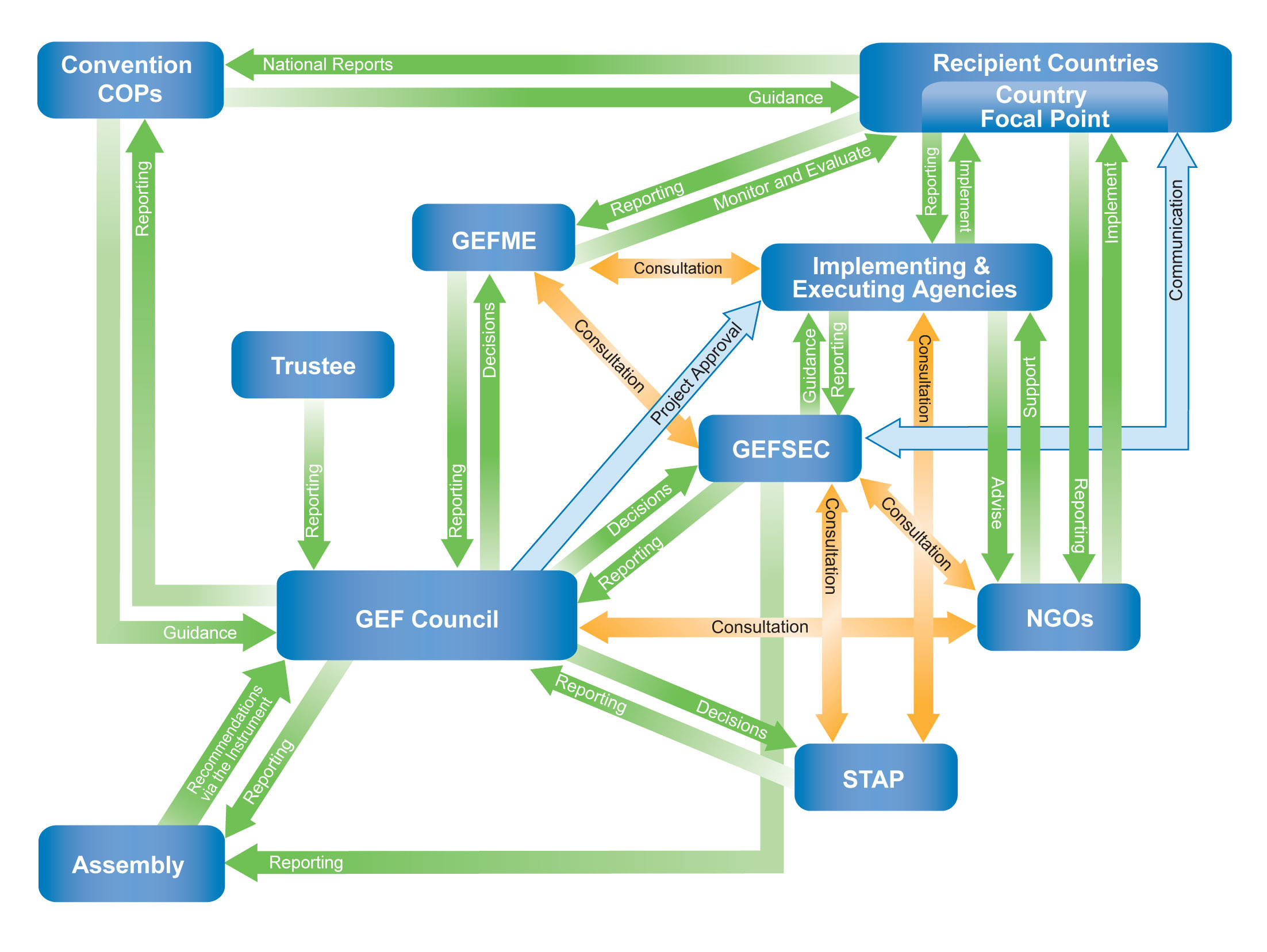
OPS3: PROGRESSING TOWARD ENVIRONMENTAL RESULTS
Exhibit 41. Governance and Reporting Structure of the GEF
Is the GEF's Institutional Form an Appropriate One
for Meeting Its Mandate and Operations?
Networks are appropriate when:
· The challenges undertaken are complex and "cannot be handled by dividing them up into simple pieces in
near isolation from each other" (for instance, networks appear to be especially appropriate in the area of
global policy and international cooperation, where the forces behind their emergence seem exceptionally
strong) (Reinicke and Deng 2000).
· Multiple entities exist who have some claim on the mission (for example, conventions, countries, IAs,
NGOs).
· Network entities are independent, with their own internal mission, governance, and structure, and
participate in the network by choice.
· The challenges facing the network are geographically diverse, and the entities are geographically dispersed.
135
OPS3: PROGRESSING TOWARD ENVIRONMENTAL RESULTS
· Required skills and competencies are widely distributed among entities, and there is a desire to use these
skills as much as possible without replicating them (that is, the roles and responsibilities of the GEF
entities).
· Various levels of interactions--from global strategy to very specific local implementations--are required
for the mission to be accomplished.
· The need for flexibility and responsiveness demands a local presence where decisions can be made in real
time.
All these conditions for appropriateness pertain to the GEF network of partners. Therefore, its institutional
form is appropriate for meeting its mandate and operations. How effectively the GEF performs as a network
institution is the concern of this chapter.
Measuring Institutional Effectiveness
Measures of network effectiveness are just beginning to emerge in the literature (Provan and Milward 1995,
2001; Rank and Wald 2000). The most important way to measure effectiveness of any institution is to look at
results. If an institution is producing results that contribute to the achievement of mission goals, then the
institution is having an effect. Other sections in this report discuss results produced by the GEF network at
the focal area level (section II) and at the level of the community and country (section III).
However, the network itself can also be analyzed (O'Toole 1997). This section discusses how effective the
GEF is as a mechanism for supporting, encouraging, planning, funding, monitoring, and evaluating
environmental action on a global basis. Effectiveness at the network level is discussed in terms of the GEF's
overall ability to negotiate successfully the challenges associated with network management. Such challenges,
and associated indicators of an effective network, are outlined in exhibit 42.
Exhibit 42. Network Challenges and Indicators of an Effective Network
TOR #/
Challenges of a
OPS3
network
Indicator of an effective network
section
Communication
· Specific goals create focus for the network partners.
4D,
and alignment of
· Health and goals of the partners are acknowledged concerns of the Network
6.1.1
goals
Administrative Office.
· Conflicting bottom-line expectations are acknowledged and actively
managed.
· Commitment (and alignment) of the partners, as well as the parts of partners,
to network goals is a concern.
· An appropriate range of services is provided to communities.
Coordinating
· A Network Administrative Office exists.
4D, 4A
partners on
· Resources are used efficiently; minimal redundant efforts exist.
6.1.2
multiple levels and
· Coordination mechanisms facilitate cooperation between levels.
managing
· The effects of rule changes on the network are monitored ("butterfly effect"--
increasingly
sensitive dependence on initial conditions).
complex
interdependence
Maintaining an
· The network seeks requisite variety (diversity) in developing and expanding
4D,
inclusive approach
network membership.
6.1.3
· Membership is growing.a
· The balance between growth and network administrative capacity is
managed.
(continued)
136
OPS3: PROGRESSING TOWARD ENVIRONMENTAL RESULTS
TOR #/
Challenges of a
OPS3
network
Indicator of an effective network
section
Maintaining
· Policies, procedures, and guidance exist to manage network decision making 4D, 5A,
structured
and core activities.
6.1.4, 7.1
informality (balance · Use of minimum critical specification (everything you need, but only what you
between control
need) in defining processes and policies is a core Network Administrative
and empowerment)
Office practice.
in managing
· Special competencies of network members are incorporated into basic
network activities
network practices where possible.
· Decisions are made at the appropriate level.
· Adaptive management provides a means of balancing upfront specification
with on-the-ground reality.
· Ongoing documentation of project decisions makes adaptive management
understandable at higher levels.
Overcoming
· Sufficient financial, physical, and human resources exist.
4D,
capacity shortages
· People trained in network skills (negotiation, collaboration, leadership, and so 6.1.5
on) are available.
· Absorptive capacity exists in all network partners to carry their share of the
responsibility.
· Training programs exist for new network members to bring them up to speed.
Managing in a
· The network maintains openness to the future instead of rigidly adhering to
4D,
permanently
the past.
6.1.6
evolving world
· The network has the capacity to scan the external environment to anticipate
changes that might affect network capabilities.
· The network provides stability over time while maintaining flexibility to
respond to emerging needs that are created by changes in local conditions.
Maintaining
· Network outreach processes span the boundary between the network and
4D,
effective relations
the external community in which it exists.
6.1.7
with external
· The network establishes its external legitimacy through public demonstration
stakeholders
and dissemination of its results.
Managing evolving
· Focused integration of partners is an ongoing concern.
4D, 4A,
roles, relationships
· Roles and responsibilities distinguish the expected contributions of partners.
6.2.1
(trust, competition,
· Redundancy of functional knowledge (understanding how the network works) 6.2.5
and collaboration),
exists alongside clarity of roles and responsibilities.
and responsibilities · Mix of strong and weak ties (various strengths of relationships among
among network
partners) exists.
partners
· Incentive structures support expected behaviors and trust among partners.
· Stable patterns of relationships create trust and make individual entity
behavior more predictable.
· Collaboration occurs at multiple levels
Developing clarity
· An overall framework for network effectiveness evaluation--including
4G,
in measures and
monitoring at the level of the network itself--is in place and is evolving along
6.2.6
outcomes
with the network itself.
· A good model exists on how benefits are created.
· Overall cost of network maintenance is measured in relation to the value of
benefits gained.
· Quality assurance is built into network systems.
· Clear expectations for network (external) outcomes and impacts, and internal
partner accountability and the approaches for measuring these exist, are
clear and are understood and used.
Information and
· Learning the right lessons and using the learning is an important feature of
5B,
communication
the network.
7.2
transparency,
· Mechanisms exist for capturing, storing, and delivering new knowledge to
knowledge sharing
decision makers who need it.
· Timely and transparent communication exists among entities.
· Critical information is captured, managed, and shared among stakeholders in
transparent ways.
a. In most cases, growth indicates vitality of the network. Network carrying capacity is an issue, however, because it
basically establishes an upper limit to the network's size.
137
OPS3: PROGRESSING TOWARD ENVIRONMENTAL RESULTS
The Evolutionary Nature of the GEF
The list of network challenges helps explain one of the most obvious findings of OPS3--that many of the
same challenges cited in OPS1 and OPS2 are still on the minds of stakeholders who provided input to OPS3.
Does the recurrence of these challenges mean that the GEF has been ineffective in addressing them in the
years since OPS1?
The table of challenges in exhibit 42 suggests a different approach to framing this issue. OPS3 considers these
challenges to be constant and continuous challenges in network management. In a network organization as
complex as the GEF, all parts and partners will never be perfectly aligned. Furthermore, the GEF exists in
the turbulence of the modern world. The continuously changing world causes the GEF to be in a constant
state of adaptation and evolution in response to it. At the same time, network stability (defined as
noninterference by structural superiors, such as the Assembly and Council in the GEF) has been found to be
central to network performance; thus, changes should be incremental to maintain stability (Milward and
Provan 2003).
Therefore, an assessment of GEF effectiveness should focus first on the degree to which the GEF is
achieving global environmental benefits, and it is also worthwhile to consider the degree to which the GEF
network is over time increasing its resilience and robustness as an institution that can consistently deliver those
results. The question is really not whether the GEF has completely solved the challenge of the project life
cycle or knowledge management (KM) in a distributed environment. Rather, the question is whether the GEF
is better able to manage the network challenges so that, in sum, it is more effective and more able to deliver
on its goals and objectives at the end of GEF-3 than it was at the end of GEF-2. In this regard, OPS3 has
particularly sought evidence that the GEF is either moving in the direction of greater "fitness" with its
environment or whether, to the contrary, the complexities of the network are beginning to overwhelm the
GEF's ability to accomplish its goals.
Structure of Section IV
In response to TOR 4A, 4D, and 4G, "Effects of the GEF's Institutional Structure and Procedures on
Results" discusses the effects of the GEF's institutional structure on the achievement of its mission and
mandate. "GEF Procedures" discusses the effects of GEF procedures on the achievement of its mission and
mandate.
6. Effects of the GEF's Institutional Structure
Using the network challenges described above, this section considers whether the GEF is stronger and more
effective as a network as it approaches the end of GEF-3 than it was at the end of GEF-2. This institutional
perspective must be read in conjunction with sections II and III on results produced at the focal area and
cross-cutting levels. Institutional fitness will not be of any value unless it translates into better results in the
environment.
6.1
How Effectively Is the GEF Meeting Its Challenges? (TOR
4D)
This section discusses how the GEF is meeting the following challenges from the table of network challenges
(see exhibit 42), including communication and alignment of goals (section 6.1.1), coordinating partners on
multiple levels and managing increasingly complex interdependence (section 6.1.2), maintaining an inclusive
approach (section 6.1.3), structured informality (balance between control and empowerment) (section 6.1.4),
138
OPS3: PROGRESSING TOWARD ENVIRONMENTAL RESULTS
overcoming capacity shortages (section 6.1.5), managing in a permanently evolving world (section 6.1.6), and
maintaining effective relations with external stakeholders (section 6.1.7).
6.1.1 Communication and Alignment of Goals
Historical Context
Strategic coherence has been cited as a concern in GEF evaluations from OPS1 up to the present. This is not
surprising, because many GEF entities have their own organizational goals--with potentially conflicting
principles, objectives, and bottom lines--that they must support in addition to fulfilling their commitment to
support the GEF goals. In response, the GEFSEC has worked continuously to provide the guidance needed
to help align the entities to the GEF mission and goals. These efforts have resulted in a great deal of
instruction about various aspects of the mission, such as the definition of global benefits and the
determination of incremental costs (GEF/C.6/Rev.2, GEF/C.13/7, GEF/C.14/5). Both of these aspects of
the GEF mission have ambiguities that the GEF has been trying to specify since the restructuring.
Similarly, the GEF has provided guidance on strategy and goals to network members. OPs were developed to
help guide work plan development, and 13 of the current 15 OPs were approved by the GEF Council by
2000. However, both OPS1 and OPS2 identified the goals and alignment issue as only partly solved.
Specifically, OPS1 noted that greater clarity and improved guidance are needed to determine what is covered
by "global environmental benefits," particularly in the Biodiversity and International Waters focal areas.
OPS2 also found that confusion still existed at the country level and among other stakeholders over
definitions of "global environmental benefits" and "incremental costs."
Current Evidence
In a response to stakeholders' need for additional guidance, in 2003, the GEFSEC introduced a Strategic
Business Planning framework that defined Strategic Priorities for each focal area and projected levels of
financing associated with each priority. The Business Plan presented at the November 2004 GEF Council
meeting proposed that the Strategic Priorities be used as a review screen, in addition to the project review
criteria, and not be associated with strict resource envelopes in the business plan.5 However, OPS3 concludes
that there is still much to be done in this area.
BPS2004 called the concept of incremental costs, as well as its application in the Biodiversity focal area,
"highly problematic" and recommended the creation of a handbook with simplified guidelines on project
budgeting and incremental cost calculations. Similarly, IWPS2004 concluded that the GEF Operational
Strategy and OPs do not provide sufficient guidance regarding the concept of incremental costs, in part
because much of the language is in "GEF-speak" that is difficult for practitioners to understand and
implement. OPS3 stakeholder consultations confirmed these findings. Many stakeholders, particularly country
focal points and NGOs, expressed the opinion that the incremental cost component has become so arcane
that only specialized consultants, who are brought in specifically to develop the project design documents,
can get it right. Several country-based IA managers with whom the OPS3 team spoke offered specific
examples in which they had used this consultant strategy and even offered to share a list of trusted consultant
names. However, country focal point and NGO stakeholders, although agreeing that the consultants had
helped get the project design approved, also commented that these consultants sometimes miss some of the
subtleties of country capacity and local requirements.
Another problem is that the strategic guidance is additive. The Strategic Priorities, for instance, now
constitute an additional review test. Thus, during project preparation, project proponents must now identify
both a Strategic Priority as well as an OP under which to classify their project. In fact, rather than creating
alignment, the proliferation of guidance appears to have defined a broad enough area for strategic activity that
GEF entities may find whatever direction they seek in it. Additionally, as discussed in section II, although
139
OPS3: PROGRESSING TOWARD ENVIRONMENTAL RESULTS
there is better clarity as to the strategy of the GEF in each Strategic Priority, it is not entirely apparent how
the Strategic Priorities in each focal area aggregate to an overall focal area program strategy. The Strategic
Priorities proposed for the Climate Change focal area for GEF-4, however, represent a positive step toward
clarifying the relationship between OPs and Strategic Priorities because each Strategic Priority is explicitly
linked to a certain OP.
The OPS3 team was also told by several country focal points that the alignment of national priorities and
GEF priorities is sometimes problematic. How national priorities are linked to the projects submitted by
many countries is unclear and may be based on opportunistic access to available funds (instead of being
tightly tied to national priorities). A frequent suggestion from participants at every level in OPS3 was that a
more programmatic approach to funds disbursement would improve strategic alignment. The implementation
of an RAF, about which discussions are continuing within the GEF, may provide countries with a predictable
allocation that can then be used to develop some national strategic programming. A further discussion of this
issue is provided in section 5.2.
6.1.2 Coordinating Partners on Multiple Levels and Managing Increasingly
Complex Interdependence
Historical Context
For the GEFSEC, coordinating multiple entities across multiple levels is a particularly difficult and persistent
challenge, especially as the network becomes more widespread and the tasks to be accomplished by the
entities become more complex. The GEF network exists across many different dimensions, as shown in
exhibit 41. It is not surprising then, that both OPS1 and OPS2 identified coordinating partners on multiple
levels as a constant challenge for the GEF.
In particular, OPS1 noted the lack of coordinating mechanisms for interactions with other ministries, country
representatives to the conventions, and NGOs in some countries. OPS2 recommended that the GEF
continue efforts to support capacity development of operational focal points, the national GEF coordinating
structures, and the CDWs. OPS2 also suggested that the GEFSEC help empower operational focal points by
providing better information services on the status of projects in the pipeline and under implementation. The
Participants in the Third Replenishment and the Beijing Assembly took up this challenge and recommended
further strengthening at the country level.
Current Evidence
The Network Administrative Office as a Key Function of the GEFSEC
Coordination costs are high in a network. A rough calculation by OPS3 revealed that while the number of
GEF partners increased from about 11 to 21 during GEF-3,6--about a onefold increase--the number of
potential communication channels among those entities increased from approximately 55 to 210--or about a
fourfold increase.7 During the same time (200004), the corporate budget has increased by approximately 40
percent (see exhibit 43). However, as a percentage of the annual GEF program, the corporate budget has
ranged between 3 percent and 5 percent from 2000 to 2004). It is encouraging that the corporate budget has
increased proportionately to the increase in GEF programming, but OPS3 finds that the GEFSEC is still
underresourced to perform its expected functions, especially because the increase in the complexity of the
GEF network is not a linear function. The more projects there are and the more stakeholders are involved,
the more relationships there are to manage and coordinate.
The GEFSEC has worked consistently to coordinate its partners and manage this increasingly complex
network. Recognizing the need for a better coordination function, the GEFSEC CEO recently established
140
OPS3: PROGRESSING TOWARD ENVIRONMENTAL RESULTS
Exhibit 43. Corporate Budget Allocation, Fiscal Year 2000-04
$25
$20
)
$
S
U
2000
$15
n
2001
illio
m
2002
$10
t
(
2003
2004
$5
udge
B
$0
+
E
P
P
e
&
E
ank
at
SEC
M
UND
UN
F
F
E
o
r
l
d B
o
r
p
or
budget
C
G
GE
W
Source: GEF Project Management Information System, accessed March 2005.
a group in the GEFSEC to manage corporate and operational issues of the GEF. At its May 2002 meeting,
the GEF Council reviewed a document, "Clarifying the Roles and Responsibilities of the GEF Entities"
(GEF/C.19/8), which presented the main roles and responsibilities of each of the GEF entities. The Council
also stressed the need for country ownership of GEF activities and the important role of the national focal
points in ensuring such ownership. Coordination mechanisms both among the GEF entities and between the
GEF entities and country partners have been strengthened since the last replenishment (see below).
However, without adequate resources, the GEFSEC will not be able to continue functioning effectively as the
Network Administrative Office of the GEF.
Coordination Mechanisms among the GEF Entities
To facilitate coordination among the GEFSEC and the IAs, the GEFSEC holds Interagency Task Forces for
each focal area, which include members from the IAs and the GEFSEC who meet regularly to discuss issues
related to the focal areas, and Executive Coordinator meetings, held biweekly and attended by the Executive
Coordinators of the IAs and representatives from the GEFSEC.
Participants felt that these meetings provide a basis for coordination but that the meetings could be improved
by ensuring that meeting agendas treat issues at a strategic level and with enough time for any decisions made
by meeting participants to actually affect operations. Action has also been taken to remedy a lack of
coordination between the Interagency Task Forces and Executive Coordinator meetings. The Executive
Coordinators must now approve the determinations of the Interagency Task Forces before action can be
taken.
Interagency retreats have been organized between the GEFSEC and the IAs to discuss the strategic direction
of the GEF, although stakeholders have reported to the OPS3 team that they are not as useful as they could
be. Open discussions about how to improve the effectiveness of the retreats should be undertaken.
141
OPS3: PROGRESSING TOWARD ENVIRONMENTAL RESULTS
Although the GEFSEC is working toward better coordination with the IAs, it is less clear how the GEFSEC
is coordinating efforts with the EAs. There is an apparent need, expressed repeatedly by the EA
representatives who consulted with the OPS3 team, for better involvement of the EAs in the strategic
discussions of the GEF if the EAs are going to be able to participate effectively in GEF activities. This
additional administration by the GEFSEC, however, would represent an additional cost to the GEF.
Coordination Mechanisms between the GEF Entities and Country Partners
Country partners are a critical element of the GEF network. Since the last replenishment, coordination
mechanisms between the GEF entities and country stakeholders have been strengthened considerably. Since
OPS2, the GEF Council Member and Focal Point Support Program (established in 1999) has undergone
significant review.8 The review found that the program contributes to improved communication, increased
awareness, and better coordination with program stakeholders, but improvements are still needed. According
to the 2004 evaluation (GEF/C.23/Inf.12), there is a need, particularly among less developed countries, to
strengthen GEF coordination at the country level by raising awareness of GEF priorities, policies, and
programs; strengthening stakeholder involvement in global environmental programs; and enhancing the
capacity of those countries to develop and implement GEF projects. Likewise, a report prepared in May 2004
(GEF/C.23/12) proposed that the program be extended for a four-year period, with certain changes and
specifications. Sections 5.2 and 5.3 discuss these issues in more depth.
In response to an independent evaluation of the GEF CDWs in 2002 (Le Group-conseil Baastel Ltée. 2002.
"Independent Evaluation of the GEF Country Dialogue Workshops Programme: Evaluation Report."
October 11, 2002. Available at: http://www.undp.org/gef/workshop/documents/indpdenteval.pdf.), the
GEF Council approved the GEF NDI to further promote understanding of the GEF, strengthen country
coordination and ownership, share lessons learned, and achieve greater mainstreaming of GEF activities at
the national level. In fiscal 2004, the CDWs completed a final group of workshops and the NDI conducted
workshops in eight countries. Currently, the GEFSEC is developing a study to compile practical examples of
how countries have developed and employed GEF national coordination mechanisms. Information resources
for focal points are available on the GEF Web site and the GEFSEC Country Relations Team is developing a
comprehensive tool kit to introduce newly assigned focal points to the GEF.
Other activities in fiscal 2004 included orientation seminars for new GEF Council members and alternates;
constituency groupings to inform Council Members about meetings and logistics; regular meetings between
the GEFSEC, UNDP, and World Bank to discuss ways to strengthen the focal point support program;
information disseminated to focal points on availability and use of focal point support funds; employment of
an additional staff at the GEFSEC to assist the Country Relations Team in providing information to national
focal points and constituencies; distribution of the GEF newsletter, Talking Points, to all identified country
stakeholders; and other focal point support activities.
6.1.3 Maintaining an Inclusive Approach
Historical Context
Maintaining the balance between a growing number of partners and the need for some oversight and
discipline in the partnership is a continual challenge.
Throughout its existence, the GEF has made inclusiveness a priority, as stated in its Operational Principles9
and policies on stakeholder involvement, and has been urged to further expand its inclusiveness (for instance,
the Beijing Assembly recommended that the GEF continue to enhance its partnership with civil society)
where possible. The diversity that results from this inclusiveness is critical to the health of the network, which
must reflect the diversity of the community that it serves.10 In particular, the network must be willing to
consider additional partners as it becomes clear that the diversity offered by the new partners will contribute
142
OPS3: PROGRESSING TOWARD ENVIRONMENTAL RESULTS
important benefits to the network. The inclusiveness of the GEF, however, has also placed a burden on the
capacity of the network to function and coordinate--a fact that both OPS1 and OPS2 have acknowledged.11
Current Evidence
Since the last replenishment, the diversity of GEF partners has increased. In particular, the GEF has sought
to embrace additional partners, including granting EAs operating under expanded opportunities direct access
to GEF resources; approving two new focal areas, thereby bringing on new convention partners; creating a
new independent OME; doubling the number of countries entering the SGP every year; and exploring efforts
to engage the private sector. During the OPS3 consultations, stakeholders commented that the inclusiveness
of the GEF, operationalized during the stakeholder consultation process during project preparation, has
played a major role in the success and sustainability of GEF projects.
This diversity strengthens the GEF network, but it threatens to overload the capacity of the system to
coordinate. For example, currently, EAs are not involved in the weekly Executive Coordinator meetings, and
participants in those meetings recognized that including the EAs would make the meeting more difficult to
schedule and manage. Simple things like finding a common time to meet, discussing issues openly, and
coming to decisions become more challenging with extra partners. A balance must be sought between
inclusiveness and the ability of the system to coordinate additional partners and stakeholders.
6.1.4 Structured Informality (Balance between Control and Empowerment)
A key mechanism for balancing control and empowerment in the current GEF network structure is the
project life cycle. The project life cycle is discussed in depth in chapter 7.
Historical Context
Balancing empowerment and control of its partners has been at the heart of the GEF approach since its
inception. All partners want to have some say in the GEF's decisions about direction, strategy, access to
funds, and so on. IAs have always participated in these decision-making processes through Interagency
Task Forces and Executive Coordinators' meetings. The countries participate in decisions at both the
Council level and the project level because projects must be approved by the OFP as an indication that
projects are country driven. Likewise, NGOs have been granted increasingly direct access to the GEF
through the SGP and the MSP modality, and some EAs have been granted expanded opportunities and
direct access to GEF resources.
Current Evidence
Although the GEF has worked to empower the partners, because the GEF guidance has been additive, as
discussed in Section 6.1.1, Communication and Alignment of Goals, it has been difficult for the GEF to
practice minimal critical specifications (for example, providing the least amount of guidance necessary).
Moreover, empowerment to a certain degree has been by default in the GEF. Indeed, without a specific
policy group in the GEFSEC (that is, a "policy shop"), means of empowerment have been somewhat ad
hoc.
An important element of effective empowerment is that partners must have the capacity for empowerment.
For example, if OFPs are going to sign off on projects as an indication of country drivenness, they need to
have the capacity--time, willingness, education, political awareness, and so on-- to make that determination.
Capacity has been lacking in many partners of the GEF, which, in combination with the empowerment of
those partners, threatens the stability of the network. Currently, the GEF has insufficient mechanisms to
compensate for deficiencies when parts of the network are not performing.
143
OPS3: PROGRESSING TOWARD ENVIRONMENTAL RESULTS
6.1.5 Overcoming Capacity Shortages
Historical Context
The question of capacity in the GEF has three general components: (1) People--does the GEF have the skill
sets and number of staff that it needs throughout the network? (2) Funding--does the GEF provide the right
level of resources to support its project activities? (3) Infrastructure--does the GEF have absorptive capacity
in terms of technical and institutional infrastructure to accomplish its goals?
Overcoming capacity shortages has been a persistent challenge for the GEF. The GEFSEC can write policies
and approve projects, but it is harder to ensure that its empowered partners have sufficient capacity to take
on the responsibilities associated with these projects. For instance, OPS1 noted that some focal points
required funding to adequately perform their coordination roles, and OPS2 recommended a number of
actions to enable OFPs to be more effective advocates for GEF issues in their country. Both OPS1 and
OPS2 also made recommendations about realignment of resources within the GEF to address some of the
capacity issues.
Current Evidence
Although the GEF has worked consistently since OPS2 to overcome its capacity shortages at the country
level, stakeholders at all levels in a range of countries still identify the lack of basic infrastructure capacity,
including communication technology, as a major challenge. Language barriers can also affect the absorptive
capacity of countries; although OPS1 and OPS2 noted that documentation should be provided in all UN
languages, this has yet to happen in the GEF.
As noted before, the capacity of focal points is still uneven, with some not being fully informed about GEF
activities in their countries with GEF activities in their countries or not well integrated into other ministries.
The loss of institutional memory resulting from high turnover of GEF Council members and focal points
also threatens the stability of countries' capacity. Stakeholders reported to the OPS3 team that it can take up
to a couple of years for focal points and Council members to get up to speed on the GEF, but approximately
25 percent of focal points and 40 percent of Council members (including alternates) changed in 2004. The
GEFSEC reports to have ramped up efforts to work with support staff below the level of the focal point to
retain institutional memory when the focal point changes, however, increases in the turnover rate in the first
two months of 2005--there were 31 changes in focal points and Council members--may overwhelm the
capacity of the GEFSEC and IAs to educate new focal points and Council members about the GEF. On a
positive note, the OPS3 team was told by several stakeholders that changes in focal points and Council
members may have a beneficial externality for the GEF in that, as country government officials rotate out of
the focal point and Council member positions, they bring with them a knowledge of the GEF that they can
spread throughout other parts of the government.
As the GEF has recognized, capacities vary significantly among countries, and this must be considered in all
aspects of project work. Country capacity in part depends on the depth of the pool of qualified people on
which the GEF can draw; for example, in some SIDS, there may only be a few people with any
environmental management experience, which presents a significant challenge. Recognizing that a network is
only as strong as its partners, the GEFSEC should aim to make the recipient countries more partners than
recipients, and in doing so, should work to improve their capacity. However, although the GEFSEC can, and
should, suggest that countries form internal coordination mechanisms to improve their capacity (for example,
interministerial councils), the GEFSEC cannot be held culpable for the failure of some countries to take
action to improve their own capacity.
At the corporate level, the GEF has benefited to date from a core of people who have been working and
maturing in the partnership network for so long that they understand how it functions and are able to
144
OPS3: PROGRESSING TOWARD ENVIRONMENTAL RESULTS
communicate more effectively. Moreover, there has been some exchange of personnel among IAs, EAs, and
the GEFSEC, which also may increase the ability of GEF staff to overcome inherent capacity shortages by
retaining people in the network that are already familiar with the GEF and other GEF entities. At the same
time, this in-network turnover may contribute to the insularity that the GEF has been charged with by
stakeholders from time to time. The newly appointed Corporate Executive Officer and Director of OME
also bring fresh perspectives that will likely continue to open the GEF to new ideas. CEO and the Director of
the OME already has helped this and will likely continue to open the GEF to new ideas.
The OPS3 team received strong endorsements that IAs and EAs working at the local level in countries is an
important component of project success. However, numerous stakeholders testified to the varying capacity of
the officers in these positions, many of whom were either junior professionals, who lacked the capacity to
address the issues of countries effectively, or not specialized in a particular focal area and so lacked the
capacity to give effective technical advice to countries. As more responsibilities are currently being delegated
to in-country offices, the IAs must monitor the capacities of each office and strengthen them when necessary.
One of the basic problems of a network is that staff are generally trained to work in hierarchies, not in
networks, and, thus, generally lack the appropriate management skills. Frequent changes in staff among
network partners, lack of direct training in network management skills, little project management training--all
limit the capacity of a network to manage itself effectively. OPS3 finds that the capacity of the GEFSEC is
still insufficient for it to effectively function as the Network Administrative Office of the GEF partnership
network (see section 6.2.1). As such, the GEF may want to undertake a program to ensure that its staff are
trained in and understand strategic and institutional issues and are not too narrowly focused on technical focal
area issues. Further, the GEF should seek specific skills in future hires that are necessary for managing in a
network--negotiation, consultation, collaboration, KM, managing virtual teams, and so on.
6.1.6 Managing in a Permanently Evolving World
Historical Context
The GEF exists in a dynamic world replete with political, economic, social, regulatory, scientific, and
environmental variability that causes turbulence to which the GEF must continually adapt. For instance, new
guidance from a convention, new scientific findings about environmental management, or changes in the
politics within a block of countries may directly affect GEF operations. The GEF has committed itself to
maintaining "sufficient flexibility to respond to changing circumstances," as one of its 10 Operational
Principles affirms. Further, the GEF has been defined as an "incrementally evolving" institution (Sjöberg
1999), expected to learn from and adapt to new conditions. As stated by the GEF CEO, the GEF seeks to be
seen as "highly adaptable and uniquely positioned to take on additional responsibilities to help close the
recurring gaps in the evolving environmental regime" (GEF/C.17/9). Indeed, the GEF has been hailed as
being an "innovative, flexible entity that can respond to new challenges and responsibilities" and specifically
for having an open decision-making process that involves a range of stakeholders (Boisson de Chazournes
GEFM&E. 2003d. "The Global Environment Facility as a Pioneering Institution: Lessons Learned and
Looking Ahead." Working Paper 19. November 2003.).
Current Evidence
At the enterprise level, the GEF has shown itself to be a continually self-reflective and evolving institution, as
evidenced by its regular undertaking of program studies, overall performance studies, and other self-
evaluations. In many instances, especially with major program studies, recommendations are turned into
management actions.
At the project level, however, recent studies have highlighted the difficulties associated with project
inflexibility. BPS2004 found that projects have shown some rigidity in the face of changing circumstances,
145
OPS3: PROGRESSING TOWARD ENVIRONMENTAL RESULTS
and that greater flexibility and room for innovation are needed to allow projects to achieve optimal results.
Similarly, IWPS2004 cautioned that rigid structures and excessive bureaucracy will lead to failure. The lack of
flexibility in GEF projects was also noted by some stakeholders during OPS3 field visits. For instance, a
number of stakeholders commented that projects are not very flexible in their ability to change funding
groups (for example, to shift money from consultants to equipment). Several reviews from the GEFM&E,
including the annual PPRs, have also stressed the need to clarify policies and procedures to encourage
adaptive management of projects (GEF/C.24/Inf.5).
On a positive note, the GEF encourages flexibility in designing and implementing projects through adaptive
management techniques, which have provided some flexibility to implementers on the ground. Adaptive
management is defined as "accommodating changes in project design and implementation to changes in
context (implementation environment), if any, with the overall objective of meeting project goals and
objectives" in GEF/C.24/Inf.5. BPS2004 commented that "[t]he World Bank's risk management strategies
(already in practice) and those of UNEP and UNDP that are under development provide important examples
[for GEF projects] of the practice of adaptive management in action at the project level." CCPS2004 noted
that "many [energy efficiency] projects are now successfully incorporating financing components, partial
guarantees and loans, depending on the specific context and set of market barriers and adaptive
management." In addition, the International Waters focal area's Operational Strategy aims to instill a
philosophy of adaptive management (GEFM&E 2002b), and the IWPS2004 observed a move toward
projects that "articulate the adaptive management process." IWPS2004 cautioned, however, that long time
gaps during implementation can lead to difficulties in applying an adaptive management approach, and that
good monitoring is key to effective implementation of adaptive management.
As a complex network, the GEF faces another challenge related to external and internal changes. It is well
known that within complex systems even fairly small changes can ripple through the network and create
significantly larger effects. For instance, a change to the fee structure can influence the behavior of the IAs
and create corresponding ripples to move throughout the network. The institution of the RAF, for instance,
may have significant downstream effects on the network that will have to be monitored closely. The need for
the GEFSEC and OME to monitor the network in terms of its systemwide effects is discussed below.
6.1.7 Maintaining Effective Relations with External Stakeholders
Historical Context
To support and increase its ability to leverage additional funding from sources, the GEF must maintain its
visibility in the international community through effective outreach. OPS1 recommended that the Council
fund the development of a GEF outreach and clear communications strategy that targets the GEF's multiple
constituencies. The fiscal 2000 corporate budget made a provision to fund an outreach and communications
strategy as a special initiative, which included activities such as a best practices workshop for focal points,
GEF displays and project-based workshops at meetings of the COPs and subsidiary bodies, an audiovisual
program broadcasting mainly to recipient countries, and video reproduction and translation. Other elements
for greater outreach were also proposed. By fiscal 2002, the corporate budget reported that the GEFSEC had
increased the number of its news releases produced and distributed and placed several articles on the GEF's
operations in newspapers and other serial publications.
In May 2001, the Council approved funding for a focused outreach effort about the GEF to be undertaken at
the WSSD. Relations with external stakeholders have also been sought through other special initiatives, such
as the UNEP's Strategic Partnership with the GEF.12 In the same vein, the STAP's original mandate, set in
1994, called for the STAP to function as a conduit between the GEF and the scientific community at large.
While acknowledging that information and communication services were a relatively recent undertaking in the
GEF, OPS2 observed that the GEF still suffers from poor visibility and IAs often do not give credit to the
146
OPS3: PROGRESSING TOWARD ENVIRONMENTAL RESULTS
GEF. OPS2 noted the need for the GEF's objectives and approach to global environmental issues to be
better understood in government and civil society and suggested enhancing its visibility by launching flagship
publications on the global environment based on its operational experiences and project results.
Current Evidence
In the fiscal 2005/07 business plan, the GEFSEC proposed the development of a communications strategy
to bring coherence to the activities currently undertaken by the GEFSEC and the IAs. In the fiscal 2005
corporate budget, the plan was explained to cover "media relations, partnerships with federations of
environmental journalists, publications production and distribution, website maintenance, and outreach
support for the Secretariat and IAs' participation in major environmental conferences and conventions."
(GEF/C.23/9. 2004. "GEF Corporate Budget FY05." April 2004.)
OPS3 finds that, despite the progress described above in proposing a communications strategy,13 there is
currently still not an aggressive enough outreach campaign to broadcast GEF accomplishments either to
external or to internal stakeholders, especially those stakeholders like the NGOs who may be many network
nodes away from the source of the communication from the GEFSEC. There is also still some confusion
internally with respect to who takes credit for what accomplishments, as OPS2 pointed out. OPS3 field visits
revealed that some NGOs working on GEF projects (for example, in Pacific SIDS) were not even aware that
the GEF was a source of the project's funding.
6.1.8 Challenges and Strategic Tradeoffs
Goal Definition and Structural Stability versus Adaptive Flexibility
The logical framework is structured to guarantee that GEF projects clearly define their goals and support the
GEF operational principles. Getting a project approved is often a long process precisely because of the hard
work done during this phase. The results of this effort, according to the testimony of many stakeholders
throughout the network, are well-thought-out projects that are stable and strong. However, many
stakeholders, some of whom were the same as those praising strong design, acknowledged that project
circumstances change rapidly and lead to significant changes in the project plan during implementation. One
repeated suggestion heard by the OPS3 team was that the logical framework should be simplified, with goals
and objectives--including cofinancing--defined completely only during implementation.
Inclusiveness versus Cost Effectiveness and Network Capacity
The GEF Operational Principles require that "the GEF will ensure the cost-effectiveness of its activities" and
at the same time "provide for consultation with, and participation as appropriate of, the beneficiaries and
affected groups of people." (GEF. 1996. GEF Operational Strategy.) The degree of inclusiveness required for
GEF projects can easily lead to extra time and cost in the preparation and execution of projects.
6.1.9 Recommendations
To address the issues discussed above, OPS3 proposes the following recommendations:
· The GEF should simplify and streamline strategic direction.
Goal alignment is still difficult in GEF-3 and further complicated by the inclusion of additional partners and
the fact that partners in the GEF are only parts of partners. The GEF must simplify and streamline direction,
especially with respect to the OPs and Strategic Priorities, so that it can be absorbed by partners in an
effective way.
147
OPS3: PROGRESSING TOWARD ENVIRONMENTAL RESULTS
One step toward simplifying and harmonizing strategic direction in the GEF would be to set up a specific
team dedicated to developing policy. Additionally, employing a country or regional portfolio approach could
assist in goal alignment in recipient countries. For example, through GEF support to focal points, the NDI,
and the Interagency Task Forces, country partners, IAs, and the GEFSEC could work together to align their
objectives and build more strategic country portfolios.
· Recipient countries need to be regarded and treated as partners in the GEF network, as well as recipients.
This new and strengthened relationship could be accomplished through a number of activities. The GEF
must increase capacity at the recipient country level through an improved focal point and Council member
support program. To that end, the current Council Member and Focal Point Support Program should
become a formal program and should be strengthened in a number of ways, including those set out in the
GEFSEC document "Elements for Strengthening National Focal Points and Enhancing Constituency
Coordination in GEF Recipient Countries" (GEF/C.23/12). Additionally, better follow-up could be
conducted after NDI workshops.
6.2 A Discussion of the GEF Entities: Evolving Roles and
Responsibilities (TORs 4A and 4G)
"In network organizations, ...coordination is predominantly achieved by stable patterns of exchange
relationships, which, once established, create trust and make individual action more predictable" (Rank and
Wald 2000). However, growth of the network is important to maintain its vitality (Goldsmith and Eggers
2004). In particular, managing growth, while maintaining the trust of the partners, is a constant challenge in
the GEF. This section discusses the institutional roles and functions of the GEFSEC, IAs, EAs, Trustee,
STAP, NGOs, and participant countries.
"One of the interesting aspects of public and nonprofit networks is that various stakeholders hold them
responsible for multiple and conflicting bottom lines--efficiency, effectiveness, accountability,
responsiveness, and equity. A network may very well do quite well on some of these measures, only to be
judged as failing on others" (Milward and Provan 2003).
In light of this insight, OPS3 finds that the GEF entities are performing in a satisfactory way, when
"satisfactory" is defined to be "progressively more effective management of potentially conflicting bottom-
line results." The challenge of managing potentially conflicting bottom-line results is particularly evident in
the case of the GEF efforts to produce results in both a "responsive" and "cost-effective" manner. Because
multiple stakeholders and entities will likely define success criteria differently and give them different weights
in terms of importance, it is often impossible to come to a single metric that all can agree on. Therefore,
"responsiveness" and "cost effectiveness" will be defined differently by different GEF entities.
For instance, "responsiveness" to the recipient countries may mean that GEF projects support the national
program. However, the IAs must be "responsive" to the strategic guidance of the GEFSEC. These two
definitions of responsiveness may be (although in theory should not be) in some misalignment. Similarly,
responsiveness to some of the GEF's own Operating Principles means that projects should include all parties
with an interest in the projects. This requirement for inclusiveness means taking additional time to design the
project, which of course creates tension in those who criticize the GEF's responsiveness because of the
amount of time it takes to move a project from conception to implementation. Inclusiveness, which involves
time and resources to build participation, may be seen by other stakeholders as interfering with the cost
effectiveness of projects.
In essence, the question of effectiveness and responsiveness raises the question of how the GEF manages the
tradeoffs between these bottom-line results. This has been part of the fabric of the GEF at least since the
148
OPS3: PROGRESSING TOWARD ENVIRONMENTAL RESULTS
restructuring talks in 1994, when competing global philosophies were fused into the one network. The dual
conditions for Council decisions are a clear indicator that these tradeoffs occur each day in the GEF.
Satisfactory performance may be thought of as the effective resolution of the tradeoffs between
responsiveness and cost effectiveness.
There are areas of strength and areas for improvement in the overall performance, but in general OPS3 finds
that the GEF is doing an increasingly strong job of understanding and managing these tradeoffs. The next
five sections present the findings and recommendations of OPS1, OPS2, the Third Replenishment, and the
Beijing Assembly, in addition to other specific evaluations, that are relevant to each of GEF entities--the
GEFSEC, the IAs, the EAs, the STAP, the Trustee, the NGOs, and the countries.
The remainder of section 6.2 discusses:
· Evolving roles and responsibilities and managing collaboration and competition (providing an in-depth
discussion of the major GEF entities) (section 6.2.16.2.5)
· Developing clarity measures and outcomes (particularly focusing on the M&E function) (section 6.2.6)
6.2.1 GEF
Secretariat
Historical Context
The role of the GEFSEC has evolved and intensified over the history of the GEF. Originally formed as an
administrative office reporting to the World Bank, the GEFSEC now reports to the GEF Council and
interacts and coordinates with partners at all levels of the network. Indeed, the Instrument notes that
"responsibility for facilitating and coordinating GEF-financed activities will be vested in the Secretariat."
The "GEF-Commissioned Independent Evaluation of the Pilot Phase" (GEFM&E 1993) found that the
collaborative arrangements between the three IAs "that were supposed to result in interagency synergy and
provide leadership for the GEF as a whole [had] proved to be ineffective." The evaluation concluded that the
overview and management function ought to be strengthened by developing the Office of the Administrator
into a Secretariat "that is organizationally, administratively, and functionally independent from the IAs and
organizations." As such, the Instrument outlined roles and responsibilities for a functionally independent
GEFSEC.
Based on the original tasks set out for the Secretariat in the Instrument, as well as on agreements between the
Secretariat and the IAs, a paper first introduced in December 2001, and finalized in May 2003
(GEF/C.21/Inf.5), further clarified the roles and responsibilities of the GEFSEC as shown in exhibit 44.
OPS2 highlighted the growing role of the GEFSEC, noting that, with the expansion and realignment of the
GEFSEC's functions, the GEFSEC was "severely understaffed to carry out both its present and proposed
new functions." OPS2 praised the ability of the GEFSEC to provide leadership for the GEF on what OPS2
described as a "relatively modest budget," but noted that the "senior management capacity has been stretched
and would now benefit from some external advice on the effectiveness of management systems." To assist
the GEFSEC in effectively performing its functions, OPS2 recommended that the professional resources and
management capacities of the GEFSEC be strengthened by:
· Establishing a separate unit (the Country Support Team) that would provide the national operational focal
points, in collaboration with the IAs and the EAs, with effective, prompt policy and procedural guidance
· Strengthening its capacity to develop and communicate operational modalities that can effectively engage
the private sector
149
OPS3: PROGRESSING TOWARD ENVIRONMENTAL RESULTS
Exhibit 44. Roles and Responsibilities of the GEF Secretariat
· Ensure implementation of Council and Assembly decisions
· Coordinate with convention secretariats and represent the GEF at meetings of convention bodies
(COPs and subsidiary)
· Promote dialogue with stakeholders (including NGOs) participating in conventions
· Operationalize convention guidance
· Plan, agree, and coordinate the GEF program of support for national focal points and constituency
coordination
· Coordinate the program of national, subregional, and regional dialogue workshops, including chairing of
an interagency steering committee for these workshops
· Prepare the Business Plan including strategic priorities; develop OPs, operational criteria, and GEF
pipeline
· Review project concepts for eligibility, according to project review criteria, and strategic fit, according to
the Strategic Priorities of the Business Plan, and manage pipeline entry and exit
· Manage relations with IAs, and with EAs under expanded opportunities
· Prepare criteria, standards, and priorities for programmatic approaches for Council consideration
· Ascertain that each proposed programmatic approach is consistent with the approved criteria,
standards, and priorities; provide guidance on the resources that can be committed; agree on the roles
of participating GEF agencies; and make "go or no go" recommendation
· Review progress and consistency of programmatic approach with the agreed criteria, standards, and
priorities as it develops through the project cycle
· Promote GEF awareness and visibility; undertake outreach for countries, convention meetings, NGOs,
and the private sector
· Manage GEF-wide relationships with NGOs, the private sector, bilateral development cooperation
agencies, and others
· Requesting a special human resources planning exercise of the proposed and expanding functions of the
GEFSEC to give the GEF Council more precise recommendations regarding staffing needs
· Contracting an external management review of current management systems and future management
needs in the GEFSEC
Current Evidence
Responsiveness
The GEFSEC has typically responded to requests and guidance from the GEF Council in a timely manner.
The GEFSEC is currently undertaking activities to improve parts of the project life cycle, including meeting
with IAs and EAs to discuss proposed new procedures for more closely managing the pipeline (see chapter 7
for a more detailed discussion of pipeline management).
To further improve institutional coordination and operational responsiveness, the GEFSEC created the
Operations Coordination Team in FY04 (GEF/C.23/9). This team has organized a series of meetings with
the IAs to address and resolve outstanding operational issues.
When the needs have been identified, the GEFSEC has added staff to help increase responsiveness. In fiscal
2002, the GEFSEC added staff in the POPs focal area and to support private sector investments and
mainstreamed the GEFSEC's database administrator to support the Project Tracking and Management
Information System (please see chapter 7 for a detailed discussion of the PMIS). In fiscal 2003, the GEFSEC
planned to add a land management specialist. In fiscal 2004, the GEFSEC planned to fill positions that had
been vacated in fiscal 2003; however, at the end of fiscal 2004, the GEFSEC budget was underspent by about
US$1 million because some budgeted positions were not filled, including one for a staff member responsible
150
OPS3: PROGRESSING TOWARD ENVIRONMENTAL RESULTS
for KM. The GEFSEC did, however, bring on a second staff member to its Country Relations Team, in
response to the OPS2 recommendation. For fiscal 2005, the GEFSEC anticipates filling all the vacant
positions.
The Cost Effectiveness of the GEFSEC as the Network Administrative Office
Complex networks such as the GEF require a Network Administrative Office. Through consensus,
diplomacy, setting incentives, and sharing information, the Network Administrative Office administers,
guides, and coordinates network activities by setting policy, establishing goals, coordinating activities,
negotiating parameters of participation, monitoring compliance, and holding the parties accountable.
The GEFSEC provides the Network Administrative Office function for the GEF partnership network:
coordinating Interagency Task Forces and Executive Coordinator meetings, maintaining the PMIS,
coordinating the Member and Focal Point Support Program and NDI, undertaking dialogue with the
convention COPs, and performing general communication and outreach activities with the NGO network, in
addition to the day-to-day activities of managing the project pipeline, approval, and oversight responsibilities.
As the Network Administrative Office function matures, the GEFSEC may provide coordination services
that will help minimize the marginalization of certain GEF partners. For example, partners such as the
recipient countries, NGOs, and private sector are currently marginalized to varying degrees in the GEF, and a
central coordination function can ensure that they are adequately represented. Exhibit 45 presents graphically
the current status of coordination with the major GEF partners. In the graphic, the thickness and darkness of
the lines indicates the relative strength of the relationships between network components. The strengthening
of these lines of communication could be catalyzed by the strengthening of the GEFSEC as the GEF
Network Administrative Office.
Because transaction costs associated with coordination are inherently higher in a network, they must be
managed carefully. Therefore, one way to consider the cost effectiveness of the GEFSEC is to compare the
ratio of the GEFSEC's corporate budget to the GEF programming budget over time (a relatively constant 3
5 percent, as mentioned in section 6.1.2) with the increased number of communication channels for which
the GEFSEC is responsible for coordinating.
Exhibit 45. Coordination with Major GEF Partners
COPs
P
GEF cl
GE
u
F cl s
u te
t r
e
IA-EA
Coun
Cou try
y
clu
cl ster
clu
cl ster
te
ter
NGOs
Private
Os
Privat
sect
se o
ct r
151
OPS3: PROGRESSING TOWARD ENVIRONMENTAL RESULTS
Between GEF-1 and GEF-3 (200304), after fees were unbundled from the GEFSEC's corporate budget, the
budget has remained consistent at approximately 1.5 percent of the annual program budget through GEF-2
and GEF-3. During the same period, however, the complexity of coordinating the annual program budget
increased significantly. For instance, during the GEF-2 period, more than 600 projects were approved. Then,
in the first two years of GEF-3 alone, more than 450 additional projects, or approximately 75 percent of total
GEF-2 approvals, were approved, while only a limited number of GEF-2 projects came to completion.
Because the GEFSEC plays a role in project development, approval, and M&E, this proliferation of
represents a significant burden on the GEFSEC. Furthermore, during the same period, as mentioned
previously, the number of the GEFSEC's partners increased from about 11 to 21 during GEF-2 and
GEF-3,14 about a 100 percent increase. With these additions, the number of potential communication
channels increased from approximately 55 to 210, or about a 400 percent increase. It is clear that not all
potential channels are actively used for communication and coordination, but the number represents a
significantly large number of channels to be managed and a subsequent increase in coordination costs.
Yet, during the same period, overall coordination did grow stronger. The continual strengthening of the
country focal point program and the attention focused on the GEF-NGO network are examples of increased
coordination over the time period.
Therefore, OPS3 concludes that the GEFSEC has maintained, and even improved in certain areas, its
coordination and management of increasingly complex GEF network activities and stakeholders, while
receiving a consistent, relatively flat, percentage of the overall GEF programming budget. Thus, OPS3
concludes that the GEFSEC has increased its overall cost effectiveness during that period.
However, complexity will continue to increase within the GEF network, and it is not apparent that the same
proportion of the corporate budget will continue to suffice in the future. Significant areas for improvement in
GEF management and coordination clearly exist, and some of these weaknesses may be tied to lack of
adequate resources to do the work. If the GEFSEC is to strengthen its role as Network Administrative
Office, these resource issues will have to be taken into account.
6.2.2 Implementing
Agencies
Historical Context
During the restructuring of the GEF, the roles, responsibilities, and comparative advantages of the IAs were
agreed upon in a document entitled "Principles of Cooperation among the IAs" (GEF 1994b), which was
annexed to the Instrument. In this agreement, the IAs sought to institutionalize a feeling of partnership
among themselves, pledging to "[w]ithin an overall cooperative framework, ...strive for innovative
approaches to strengthening their collaboration and effectiveness, in particular at the country level, and an
efficient division of labor that maximizes the synergy among them and recognizes their terms of reference
and comparative advantages." This agreement also provided the parameters for those comparative
advantages, noting that the UNDP would be the lead agency for capacity building and technical assistance,
the UNEP would have primary responsibility for scientific and technical analysis and environmental
management, and the World Bank would be the principal agency for investment projects.
OPS1 found that the original definition of roles and responsibilities of the IAs had been blurred, and some of
the most important comparative advantages of the IAs "may depend on both the country and the type of
institutional process and policy issues involved in a project." OPS1 thus concluded that the blurring of
distinctions among IAs was "not necessarily harmful to the mission of GEF...and...could result in greater
responsiveness to country demands and greater efficiency in project preparation if more than one agency is
capable of implementing the same type of project."
152
OPS3: PROGRESSING TOWARD ENVIRONMENTAL RESULTS
OPS2 observed that "[t]he roles of the three IAs have been crucial in the GEF's operational
achievements...and ...each has provided technical expertise and operational experience based on their
comparative advantages. Their continued strong involvement in GEF operations will be important for the
future of GEF, as it also expands to include new executing agencies." OPS2 also noted the "existence of a
larger number of GEF-committed staff within the IAs." OPS2 commented, however, that "no single IA can
on its own absorb all of the present and planned GEF functions. Neither can the GEFSEC manage these
functions on its own. Each entity is a critical partner for ensuring that the GEF evolves effectively to meet
expanded operational challenges."
In the spirit of that partnership, the IAs and the GEFSEC agreed on the roles and responsibilities of the IAs
shown in exhibit 46, which were featured in a paper first introduced to the GEF Council in December 2001
and finalized in May 2003 (GEF/C.21/Inf.5).
Current Evidence
Responsiveness
The issue of competing bottom lines was made starkly clear to the OPS3 team in consultations with the IAs.
Although the GEF was originally established on the basis of a partnership among the UNDP, UNEP, and
World Bank based on their comparative advantages, all IAs reported to OPS3 that, over time, the partnership
has evolved from one based on comparative advantages to one based in part on competition. The
introduction of competition as an element of IA decision making seems to be of two distinct types.
The first sense of competition the OPS3 team observed was introduced to some extent by the GEF Council
in response to concerns about the level of fees when fees were at their peak. IAs report receiving mixed
signals from the Council with regard to whether the IAs should continue to collaborate with the other GEF
entities and to produce "spillover" benefits in the form of participation on task forces, encouraging
inclusiveness, and so on, or whether they should compete with each other for work on the basis of cost. Part
of the source of this conflict was a rationale circulated in support of the inclusion of the EAs--that the EAs'
addition would increase competition among the IAs and EAs and thereby drive down costs.
Exhibit 46. Roles and Responsibilities of the IAs
· Implement GEF operations at country level
· Deliver support for specific national focal points
· Provide support for specific constituency
· Undertake country dialogue on mainstreaming GEF operations within overall country programming and
on sector policies
· Program at country or multicountry level
· Prepare project concepts
· Develop, prepare, and supervise the implementation of projects
· Manage relations with EAs
· Mobilize project cofinancing
· Work with countries to identify opportunities for programmatic approaches
· Prepare detailed design of an agreed programmatic approach and undertake sector dialogue
· Develop individual project proposals within the framework of the agreed programmatic approach
· Undertake mid-term reviews, project completion reports, and project M&E, including projects under
programmatic approaches
· Disseminate project-level information, including lessons learned
153
OPS3: PROGRESSING TOWARD ENVIRONMENTAL RESULTS
All IAs emphasized that they would prefer to work in a collaborative environment, but they all expressed a
willingness to enter a phase of strict competition among the agencies if that was the Council's specific
directive. In this competition-first scenario, they would continue to participate in some enterprise activities,
financed by the corporate budget allocation that they receive in their role as IAs. However, they would begin
to compete for project fees, cut away all aspects of project management not directly related to the execution
of those projects, and focus on attaining as large a project portfolio as possible within the operational
principles of the GEF.
The second sense of competition the OPS3 team observed comes from the ongoing overlapping of IA roles
over time, which is causing friction within the system. For example, the UNDP was tasked to do technical
assistance projects and the World Bank to do investment projects, and IAs have done both types of projects.
Similarly, the UNEP has typically done global and regional projects but is proposing a national project. The
EAs have been granted direct access solely for specific competencies, and the additional competition that
they bring to the project arena will likely only complicate the current tension between competition and
collaboration. Furthermore, an RAF could restrict and constrain the amount of money per country,
potentially creating more frictions. The GEF Council should be clear as to whether it would like the IAs to
restrict themselves to their original comparative advantages or whether it would prefer that the IAs compete
for all projects on an equal basis.
Exhibit 47 shows the number of projects in the GEF portfolio by IA (projects implemented jointly are not
included in totals). Although the UNDP has had the largest number of projects approved (857), the World
Bank has received the most GEF funding (US$2,912.9 million). The UNDP has received the second largest
total share of funding (US$1,801.3 million), and the World Bank has implemented the second largest share of
total projects (392). The UNEP has had both the smallest number of projects approved (299 projects) and
has also received the least amount of GEF funding (US$417.6 million). In exhibit 47, the total number of
projects are shown by FSPs, MSPs, and enabling activities. The type of projects provide only a very gross
approximation of comparative advantage, and the breakout of IA allocations by FSP, MSP, and EA is
unsurprising. As expected, for instance, the World Bank has implemented the most FSPs and very few
enabling activities.
Exhibit 47. Total Number of Approved Projects per IA, 1991March 2005
FSPs
42
MSPs
254
247
61
Enabling activities
100
38
103
196
507
World Bank
UNDP
UNEP
154
OPS3: PROGRESSING TOWARD ENVIRONMENTAL RESULTS
The relative rarity of joint projects in the GEF portfolio is illustrated by the fact that there have been fewer
than 20 joint projects in each of GEF-1, GEF-2, and GEF-3 (to date), according to the GEF's PMIS
(accessed March 2005). IAs, when asked about this fact, responded that joint projects were not common
because of the basic structure of the project, rather than the unwillingness of IAs to work together.
One final point about the responsiveness of the IAs is necessary. According to GEF stakeholders, particularly
country focal points and government representatives and NGOs, there is a great variability at the country
level in the quality and effectiveness of stakeholder experiences with the IAs. In general, IAs have been found
to be committed and thoughtful, especially at the headquarters level, but countries report inconsistent IA
capacity when interfacing with the focal points and overseeing projects. Although the UNDP has been
responsive by providing staff at the regional and country levels, OPS3 found that the UNDP country offices
had varying capacities to provide real support to recipient countries. There has also been varying levels of
mobilizing of cofinancing among the agencies.
Cost Effectiveness
It is difficult to evaluate project level budget performance because project accounting is not very transparent
among key stakeholders, including IAs, EAs, and key program implementation partners on the ground.
Moreover, given the lack of standard indicators for measuring global environmental benefits, it is nearly
impossible to calculate the cost effectiveness of IAs and EAs at the project level on a dollar per benefit ratio.
As a result, OPS3 evaluates only the cost effectiveness of the IAs' corporate budget.
The IAs' corporate budget (not including project fees) as a percentage of overall GEF programming has
decreased slightly from 1.7 percent in GEF-2 to 1.4 percent in GEF-3.15 In real terms, the corporate budget
remained relatively flat over the past five years. Corporate monies are allocated for the IAs to participate in
network administration tasks. Given the increase in communication channels and overall responsibilities, this
suggests that the IAs have been more cost effective in GEF-3 than they were in GEF-2. However, as with the
case of the GEFSEC, areas for improvement still exist.
When project fees are taken into account, the IAs' annual income more closely reflects the annual program
budget, as is to be expected, because fees are allocated in some proportion to project activities. Exhibit 48
shows the effect of adding multiyear projects to the GEF portfolio over time. (Note: The chart takes into
account an increasing frequency of project completion, although an estimate is used in lieu of precise
Exhibit 48. Active Projects (Annual and Cumulative)
1,400
1,200
1,000
800
600
400
164
196
244
217
122
200
0
2000
2001
2002
2003
2004
Cumulative
Annual
Source: GEF Project Management Information System, accessed March 2005.
155
OPS3: PROGRESSING TOWARD ENVIRONMENTAL RESULTS
information on completed projects.) Exhibit 49 shows that fees are proportional to the projects (using the
same estimate of project completion for fee completion). Therefore, there should be enough money for the
IAs to manage projects through their life cycles.
What these charts do not show, of course, is the amount of interaction among the agencies and among
projects. These types of learning experiences can be expected to increase as the portfolio increases. This is a
critical aspect of the knowledge-sharing challenge within the GEF network and one that is usually considered
"in addition to" normal project management and M&E. As the amount of this type of learning increases, a
relatively flat corporate budget may not accommodate the task requirements.
6.2.3 Executing
Agencies
Historical Context
The concept of increasing the number of organizations that could implement projects has been under
discussion since the founding of the GEF. The Instrument allowed the IAs to "make arrangements for GEF
project preparation and execution by multilateral development banks, specialized agencies and programs of
the United Nations, other international organizations, bilateral development agencies, national institutions,
non-governmental organizations, private sector entities and academic institutions, taking into account their
comparative advantages in efficient and cost-effective project execution."
OPS1 concluded that "increasing the number of IAs could result both in an increase in the number of project
proposals submitted to the GEF and a broadening of their range...and...that increased competition among
IAs would help reduce the transaction costs of permitting additional organizations to be IAs" (GEF/A.1/4).
The First GEF Assembly in New Delhi in 1998 reinforced OPS1, stating that "GEF should...expand
opportunities for execution of activities to those entities referred to in Paragraph 28 of the Instrument, in
particular Regional Development Banks and non-governmental organizations (NGOs)."(GEF. 1998. "The
New Delhi Statement of the First GEF Assembly." April 1998). Building on the momentum of this
statement, the GEF Council analyzed criteria and options for expanding opportunities and adopted a new
policy in May 1999 for expanded opportunities for EAs.
Exhibit 49. IA Fees (Cumulative and Annual), Million U.S. Dollars
$400
$350
$300
$250
$200
$150
$100
$36.4
$37.9
$48.0
$55.3
$36.1
$50
$0
2000
2001
2002
2003
2004
Cumulative
Annual
Source: GEF Project Management Information System, accessed March 2005.
156
OPS3: PROGRESSING TOWARD ENVIRONMENTAL RESULTS
At its meeting in May 2001, the Council approved criteria for selecting new EAs (GEF/C.17/13), including
the three main criteria: strategic match, capacity, and complementarity. At this same meeting, the Council
granted IFAD expanded opportunities in land degradation and provided direct access to GEF resources to
UNIDO and the FAO for undertaking enabling activities on POPs.
The following year, OPS2 recommended that the comparative strengths of the EAs for GEF activities "be
carefully examined with respect to areas where the agencies demonstrate fully satisfactory, GEF-relevant,
operational capacity to help countries produce effective implementation results. However, once the GEF has
ascertained this specific operational capacity, the new executing agencies should be enabled to access the
GEF work program and become directly accountable to the GEF Council" (GEFM&E 2002d). The
Participants in the Third Replenishment reinforced this recommendation, stating that the ADB and Inter-
American Development Bank should benefit from direct access to GEF project funding, and that the
experience of the other EAs under expanded opportunities be reviewed annually to determine whether they
should also receive direct access.
Current Evidence
Responsiveness
In response to recommendations from OPS2, the Third Replenishment, and the Beijing Assembly, in
November 2003, a review of the performance of the EAs recommended that, to reduce the complexities of
the IA-EA arrangement and alleviate some of the constraints impeding more active participation from
current EAs, all EAs should be granted direct access to GEF project planning and implementation funds
without involving the IAs beyond the initial due diligence reviews (GEF/C.22/12).
At its November 2003 meeting, the GEF Council approved direct access for EAs within their agreed
comparative advantage and also agreed that on a case-by-case basis, the CEO may approve PDF-A grants for
the development of eligible concepts by an EA. In the "Trustee Report" presented at the November 2004
Council meeting (GEF/C.24/Inf.3), the Trustee reported that the ADB, IADB, and UNIDO had finalized
their arrangements for direct access to GEF resources. Commitments, disbursements, or both have been
made by the Trustee to the ADB and IADB for projects and fees under those arrangements.
One of the facts pointed out repeatedly to the OPS3 team by both IAs and EAs was that the EAs came into
the GEF near the end of GEF-3, when available funding was quite scarce. When the lack of funding
opportunities is combined with the rather recent decisions regarding direct access, OPS3 concludes that the
conditions for EA responsiveness have been somewhat constrained during GEF-3 and it would be premature
to conclusively determine whether the EAs have been responsive to the needs and requests of the partners.
The EAs have begun to be integrated into GEF coordination activities--for example, the OME's
consultative process and the GEFSEC's discussions on streamlining the project pipeline--but their project
work has been too minimal to evaluate. The OPS3 team has heard reports that the GEF has yet to be
mainstreamed into the EAs because of the steep learning curve involved and the associated costs. At this
early stage, however, this is to be expected. As GEF-4 proceeds and the EAs begin to be gain greater access,
the GEF should carefully monitor the progress of mainstreaming.
Cost Effectiveness
In terms of cost effectiveness, the EAs do not receive a corporate budget that OPS3 could compare to the
overall GEF programming budget. Furthermore, there are not enough projects as yet (and not enough clarity
at the project level) to compare the GEF entities on the cost effectiveness of their projects. See exhibit 50 for
a list of projects conducted by EAs under expanded opportunities.
157
OPS3: PROGRESSING TOWARD ENVIRONMENTAL RESULTS
Exhibit 50. Total Number, Value (Million U.S. Dollars), and Cofinancing (Million U.S. Dollars) of
EA Projects from GEF 2 and GEF 3
Total
number
Total
of
Enabling
GEF
Total
Cofinancing:
EA
projects
FSP
MSP
activities
amount
cofinancing
EF ratio
ADB 7 4
3 0
$38.5
$177.5 4.6
IADB 2 2 0 0
$8.2 $20.3 2.5
IFAD 1 1 0 0
$6.2 $9.2 1.5
UNIDO 38
0
0 38
$21.7 $6.7 0.3
Total 48
7 3 38
$74.7 $213.8
2.9
Source: GEF Project Management Information System, accessed March 2005.
6.2.4 Scientific and Technical Advisory Panel
Historical Context
The effectiveness of the STAP in providing scientific and technical advice to the GEF has been a topic of
discussion since the STAP was founded in 1991. During discussions leading up to the reconstitution of the
STAP in 1994, its function was envisioned as primarily to advise the GEF on strategic issues while playing a
role in ensuring independent review and technical quality of projects.
In 1998, and again in 2002, the previous OPS evaluations found that a number of problems existed in the
STAP's ability to fulfill its role, particularly in regard to project reviews, where the reviews, although generally
reported to be of good quality, were often performed late in the project design cycle, very quickly, and by a
small fraction of the expert roster, which included a majority of experts from developed countries. Both OPS
evaluations made recommendations for organizational structure modifications to the STAP to increase its
effectiveness.
Recognizing the important role of the STAP as a scientific advisory body to the GEF Council, the
Participants in the Third Replenishment of the GEF Trust Fund recommended that its ability to fulfill its
strategic advice functions be strengthened. The Participants identified needs to "(1) clarify and focus STAP's
role in project development and review; (2) better define its role in the M&E activities of the GEF; and (3)
strengthen the involvement of regional and national level scientific expertise in project development and
design" (GEF/R.3/38. 2000. "Third Replenishment Agreement." October 2000).
Current Evidence
Responsiveness
In response to the recommendations from OPS2 and the Third Replenishment, the GEF Council, at its
meeting held in May 2002, endorsed the recommendation to stagger the terms of appointment of members to
the panel by approving the composition of STAP-III. Further, the third meeting of STAP-III, held in
October 2003, discussed and agreed on a note prepared by the UNEP on the role of STAP (GEF/C.23/10).
A new roster of STAP experts, which includes 224 experts, of whom 40 percent are from developing
countries, was established in November 2003. New operational rules for the roster have also been finalized.
In October 2004, the STAP had extensive discussions with the GEFSEC and the IAs about work that the
panel might undertake over the next two years. The STAP decided that it would emphasize its role as a
provider of strategic advice while continuing to advise on narrower, more technical issues
(GEF/C.24/Inf.15).
158
OPS3: PROGRESSING TOWARD ENVIRONMENTAL RESULTS
However, despite the strong efforts of the two most recent STAP chairs in trying to refine and focus the work
of the STAP and coordinate more closely with GEF entities, OPS3 found a general perception among
stakeholders that the STAP is still not nearly as responsive as it needs to be to provide consistent value to the
GEF. For instance, stakeholders report that STAP reports are not always relevant to the GEF and, even when
relevant, are not provided to GEF entities in a timely enough manner to be useful. The use of the STAP roster
is still not perceived as objective because project managers at the IAs are able to choose the roster expert that
reviews their project. Moreover, the STAP has not sufficiently reached out to the scientific and research
community, as its mandate clearly prescribes. OPS3 found a perception among stakeholders involved with the
STAP that STAP members frequently do not have sufficient time to dedicate to their STAP work.
The STAP itself appears to be keenly aware of this perception of its marginalized role, and STAP members
commented to the OPS3 team that their mandate still needs to be clarified and redefined.
Cost Effectiveness
The STAP budget as a percentage of the overall GEF programming budget has remained relatively constant
over the life of the GEF at 0.3 percent, although rising slightly in real dollars over the past five years (see
exhibit 51). During this time, the STAP's responsibility to coordinate with more partners and more projects
has increased. However, it is unclear to many stakeholders what outcomes are being produced for that
budget. This leads OPS3 to conclude that the STAP needs to be significantly refocused in terms of its
mission and structure in order to produce outcomes that are responsive and cost effective.
6.2.5 Trustee
Historical Context
The World Bank's role as Trustee of the GEF Trust Fund was established in 1991. As Trustee, the World
Bank is responsible for the financial management of the fund, including investment of assets, disbursement of
funds to IAs and EAs, and monitoring and reporting on the investment and use of the fund's resources.
While the "GEF-Commissioned Independent Evaluation of the Pilot Phase" (GEFM&E 1993) found the
GEF Trust Fund arrangement with the World Bank to be "satisfactory and well-administered," the role of
the Trustee was not addressed in OPS1 or OPS2.
Exhibit 51. Corporate Allocation for the STAP, in Millions of U.S. Dollars,
200004
$2.00
0.31%
0.27%
$1.80
r
s
)
0.38%
0.30%
0.30%
$1.60
lla
$1.40
.
do
.
S $1.20
n U $1.00
$0.80
illio
m $0.60
e
t
(
$0.40
g
d
u $0.20
B $0.00
2000
2001
2002
2003
2004
Note: Percentages indicate corporate allocation for the STAP as a percentage of
overall GEF programming budget.
Source: GEF Project Management Information System, accessed March 2005.
159
OPS3: PROGRESSING TOWARD ENVIRONMENTAL RESULTS
Current Evidence
Responsiveness
Stakeholders report that the Trustee has become a closer partner with the other GEF entities during GEF-3,
including its recent efforts to enhance the financial management process. The Trustee held its first annual
financial consultation meeting with the IAs and EAs in October 2003. This meeting provided an opportunity
to familiarize the agencies with the financial processes and procedures for commitments, disbursements, and
financial reporting that is required by the Trustee. At the request of the GEF Council in its November 2003
Council Meeting, the Trustee completed drafting and negotiating 10 Financial Procedures Agreements with
the IAs and EAs during fiscal 2004.
However, the Trustee seems to play a back-office role within the network. Few of the other GEF entities
mentioned the Trustee as a significant force in the activities of the GEF.
OPS3 concludes that the Trustee can play a more integral role in GEF-4. For instance, during consultations
with representatives of the Trustee, the OPS3 team discovered that there are difficulties of systems
integration with the GEF entities, which makes disbursement and tracking cumbersome processes. OPS3
strongly recommends that the GEF develop an effective MIS during GEF-4. The Trustee, as one of the key
stakeholders in the flow of funds through the GEF network, must play a major role in the analysis and
development of this important system.
Cost Effectiveness
The Trustee's corporate budget as a percentage of the overall GEF programming budget has decreased in
each of the GEF periods, while the real amounts have increased only slightly over the past five years (see
exhibit 52). However, the actual amount of funds to be disbursed, as well as the number of partners to
disburse to, have increased. OPS3 concludes that the World Bank, in its role as Trustee, has been a cost-
effective partner in the GEF network. Still, there is a question about whether the Trustee can, and should,
play a larger role with the GEFSEC in improving financial reporting throughout the network.
Exhibit 52. Corporate Allocation for the Trustee, in Millions of
U.S. Dollars, 200004
$1.00
0.15%
0.13%
$0.90
0.17%
0.20%
0.16%
) $0.80
r
s
lla $0.70
o
.
d $0.60
.
S
U
n $0.50
o
illi $0.40
m
t
( $0.30
udge $0.20
B
$0.10
$0.00
2000
2001
2002
2003
2004
Note: Percentages indicate corporate allocation for the Trustee as a percentage of
overall GEF programming budget.
Source: GEF Project Management Information System, accessed March 2005.
160
OPS3: PROGRESSING TOWARD ENVIRONMENTAL RESULTS
6.2.6 Monitoring and Evaluation
M&E is a critical function in the GEF as a partnership network to ensure that the partners in the network are
evolving in a coordinated and complementary manner. M&E is a network responsibility of which the OME is
the steward. As such, the OME requires effective M&E from all the partners of the network. Exhibit 53
presents the characteristics that OPS3 sees as indicators of effectiveness for M&E in the GEF.
Historical Context
In April 1996, the GEF Council approved previous recommendations about the establishment of an M&E
unit (GEFM&E), thereby formally establishing an M&E function at the GEF. This roughly corresponded
with OPS1, and no conclusion could be reached in that report concerning the performance of the GEFM&E.
However, OPS2 did assess the effectiveness of M&E within the GEF, including the role and function of the
GEFM&E, and found that a better understanding of evaluation responsibilities needed to be develop
between the GEFSEC and IAs, and that the GEFM&E should strengthen their assessments of results and
impacts by focusing on program evaluation--predominantly assessing the effectiveness of GEF investments.
Based on these findings, OPS2 recommended that the functions of the GEFM&E should be strengthened
and expanded "so that it can play a supporting partnership role in mid-term reviews and project evaluations,
particularly by providing advice on TORs for mid-term reviews and final project evaluations, contributing to
the review of each of these reports, reviewing and compiling the results reported from project evaluations,
and arranging adequate feedback to all GEF partners" (GEFM&E 2002d).
The Participants in the Third Replenishment of the GEF Trust Fund reinforced the conclusions of OPS2,
recommending that, among other things, "the GEF M&E Unit, the Secretariat, and IAs and EAs develop a
common interagency approach on indicators to be used for more systematic monitoring of activities and
document best practices of stakeholder participation," and that "the GEF M&E unit should be made
independent, reporting directly to the Council." The Beijing Assembly further reiterated the
recommendations of the replenishment related to indicators, the independence of the GEFM&E, and
procedures to disseminate lessons learned.
Current Evidence
Since OPS2, the GEFM&E has been in the process of redefining both its process and structure in the GEF
network. First and foremost, in response to the recommendations of the Third Replenishment and Beijing
Assembly, TORs for an independent M&E unit reporting directly to the GEF Council were approved by the
Exhibit 53. Indicators of Effectiveness
· Are GEF results monitored and evaluated on multiple levels?
· Is there a commonly accepted conceptual model for how benefits are created by the GEF?
· Are there clear expectations for network (external) outcomes and impacts and how they are measured?
· Are internal expectations and measures for accountability clear?
· Are there clear records of GEF results? Are they the right measures?
· Are evaluation outputs formulated in actionable ways and used by the organization?
· Is quality assurance is built into systems?
· Do people throughout the network understand the M&E function? Do people understand their responsibility?
· Is the percentage of resources spent on M&E realistic?
· Does the M&E approach demonstrate an understanding of the unique aspects of M&E in a network?
Note: These indicators have been derived from discussions with OME and other stakeholders, as well as a review of
literature on the challenges of M&E in a network situation. The indicators provide a foundation for the analysis that
follows, although each one is not explicitly addressed.
161
OPS3: PROGRESSING TOWARD ENVIRONMENTAL RESULTS
Council in July 2003, and a new director of the OME was appointed, bringing international experience and a
fresh perspective to the unit. To reflect its independence, in 2004, the GEFM&E was renamed the Office of
Monitoring and Evaluation. The new independent structure of the OME has implications for the processes
of M&E in the GEF, which are now being discussed among the GEF entities through the consultative
process.
Undertaking the Consultative Process and Separation of M&E Functions
Recognizing that OME responsibilities can be fulfilled only with the collaboration of the GEFSEC, IAs, and
EAs, the OME proposed, in "Elements for a New GEF Monitoring and Evaluation Policy"
(GEF/ME/C.24/1), to begin a collaborative effort with the evaluation units, offices, and departments of the
GEF partners. The purpose of the consultative process is to identify best practices in environmental
evaluations and in monitoring the specific issues of concern to the GEF. The OME held the first consultative
workshop in January 2005 with the IAs, EAs, and GEFSEC, which the OPS3 team attended. Follow-up
meetings were held in Europe for EAs that were not able to attend in January, as well as additional
consultations with the STAP, NGOs, and other stakeholders.
This consultative process is evidence of growing harmonization of goals and processes across the GEF.
OPS3 encourages the continuation of this process, especially given the broad stakeholder involvement
approach that the OME has chosen. In particular, OPS3 supports the idea of engineering quality into the
M&E system through the validation of IA M&E systems. Indeed, the consultative process can be seen as a
positive step toward developing an M&E community of practice throughout the network. Communities of
practice are groups of people connected by technology and a common mission, and they offer a powerful,
minimum-cost way to build trust and understanding throughout a network, thereby improving the overall
quality of services (Goldsmith and Eggers 2004). Trust among partners is critical to success in a networked
organization, especially in the context of M&E. The more trust among partners in a network, the less
redundant evaluation is required (for instance, one entity evaluates something and presents a result, which is
then evaluated by another entity for accuracy). Indeed, the consultative process seems to be building trust and
understanding among M&E participants across the partnership network; stakeholders commented receptively
to the OPS3 team on the consultative process and the positive impacts they believed it would generate. In
particular, almost all stakeholders agreed that the M&E functions should be separated, and that the process
would help to ensure that separation was done effectively.
In "Elements for a New GEF Monitoring and Evaluation Policy," the OME proposed to start a process of
consultation with GEF partners to develop proposals for a new division of labor in M&E activities. Because
the current monitoring system in the GEF concentrates on implementation issues rather than progress
toward achieving results, the OME considers the monitoring function to be a management instrument to
keep activities on track. To better use the monitoring capacities and resources across the GEF system, the
OME proposed the following roles:
· IAs and EAs would retain responsibility for project monitoring (reporting to the GEFSEC) and project
evaluation (submitting TEs and mid-term reviews to the OME).
· The GEFSEC would assume responsibility for portfolio monitoring.
· The OME would play an oversight and validation role of M&E systems put in place by the GEFSEC, IAs,
and EAs to ensure that GEF concerns and policies are properly incorporated. The OME would also be
responsible for verifying the attainment of replenishment targets. Additionally, the OME would undertake
overall performance, cross-cutting, and program studies and report directly to the GEF Council in an
annual GEF performance report on issues related to the quality of M&E systems, results, and follow-up.
OPS3 encourages dividing the M&E functions among the IAs, EAs, GEFSEC, and OME, especially because
it would allow the OME more time and resources to focus on other important evaluation activities, such as
162
OPS3: PROGRESSING TOWARD ENVIRONMENTAL RESULTS
monitoring at the level of the network (discussed below). The OME should continue to provide oversight
and guidance to IAs and other partners on monitoring activities within the GEF.
Moreover, to date, monitoring in the GEF has focused much more closely on results at the project level and
not at the project portfolio level (for example, aggregate trends in the GEF portfolio). Assigning this
portfolio function to the GEFSEC will ensure that someone has responsibility for this important task and the
impacts of strategic decisions on the portfolio are tracked and fed back into subsequent strategic decisions.
That said, if monitoring at the project level is transferred completely to the IAs and EAs, the GEFSEC and
OME must define clearly not just what the best practices are for monitoring (as discussed above), but also
what specific data they expect to see from the IAs and EAs. Further, the information that is reported by the
IAs and EAs must be compatible with the MIS that is being developed (see section 7.2 for a more detailed
discussion of the MIS). Collecting those data in a central place is critical for information transparency.
While there is still much work to be done to ensure that the monitoring systems of the IAs and EAs--some
of which are very sophisticated in their own right--can take into account the specific concerns of the GEF,
the OME is making progress toward this goal. As an input to the first consultative meeting on M&E across
the GEF, the paper "Overview of Monitoring and Evaluation Approaches in the GEF Family" (Baastel 2005)
was prepared by an independent consultant. This paper reviews the current monitoring systems in each of the
IAs and EAs and concludes that while "all IAs and EAs reviewed have a form of monitoring and evaluation
unit/department responsible for the monitoring system design and for the provision of monitoring support
and overall guidance on monitoring activities," there is a definite need to harmonize and standardize IA and
EA M&E systems and build the GEF network's capacity to perform consistent, results-based monitoring.
Refocusing M&E by the OME
M&E in the GEF has to date grouped its evaluations by focal area, but not by country, a reflection in part of
the lack of a programmatic approach in the GEF. "OME's Four Year Work Plan" (GEF/ME/C.24/5),
presented to the GEF Council in November 2004, did, however, identify country portfolios as an area that
has not been evaluated in the past four years, and that it would like to focus on. OPS3 would encourage the
OME to begin to evaluate country portfolios to the extent possible because projects in countries have
ostensibly not been developed to generate a portfolio per se. In the event that an RAF is approved by the
Council, regardless of the specifics of the framework, it is highly likely that some evaluation of countries'
performance will be required, and it would benefit the OME to get a head start on working out the details
and addressing the inherent challenges in performing such evaluations.
Moreover, to date, the GEF's focus on has been on results produced by projects and the accumulation of
those results to constitute the overall results of a focal area portfolio. (The OME has conducted several
thematic reviews--the Local Benefits study is a good example--that look at network-wide issues, but these
studies are less frequent, and many issues, such as sustainability and catalytic action, are left to the program
studies and the OPS evaluations.) The GEF should be more concerned, however, with the sustainable impact
of a portfolio over time than the individual projects that make up a portfolio. Indeed, the focus on the results
of individual projects significantly complicates the task of reporting overall results of the GEF because
project results cannot easily be aggregated for an overall portfolio impact. Instead, the GEF has a "patchwork
quilt" of positive project results that cannot be simply assimilated. Results should be assessed over time,
especially at the country level.
To that end, "OME's Four Year Work Plan" proposed to explore whether it is possible to include impact
assessments concerns in pilot projects and OME evaluation tools. Recognizing the difficulty of reporting on
postproject completion and long-term impacts, OPS3 supports this exploration. In further support of this
initiative, the GEF Council must acknowledge that, despite its requests, evaluation of outcomes and impacts
is effectively not provided for within the current GEFM&E system and, perhaps more important, will likely
not be provided for until the GEF Council decides to provide resources to support such activities.
163
OPS3: PROGRESSING TOWARD ENVIRONMENTAL RESULTS
Further, monitoring and measuring results in a complex system is very difficult. Thus, to enable more
effective measurement of results, the GEF Council should provide clearer definitions in terms of the
expected outcomes, the expected contributions of the partners, and the expected costs. However, clearer
expectations are not the panacea to better measurement; in a network as complex as the GEF, and with the
added complexity of the fact that the GEF's contribution covers only the costs of global benefits, it is
inherently very difficult to measure and attribute results.
M&E at the Level of the Network
In "OME's Four Year Work Plan" (GEF/ME/C.24/5) and in its budget, the OME proposed to refocus its
evaluations into three main areas: (1) focal areas, including OPs and Strategic Priorities; (2) cross-cutting and
thematic issues, including local benefits, indigenous people and capacity building, the guiding principles, and
country portfolios; and (3) institutional and procedural issues, such as regional and global projects, cost
effectiveness, the project cycle, the fee system, M&E, and KM. Although OPS3 assumes that the third main
area is at the level of the network, OPS3 would further encourage the OME, as it redefines its policy, to think
of that area as an evaluation of the network itself, rather than just institutional and procedural issues.
As a partnership network, the GEF reacts in complex, inter-reliant ways to changes in its own rules, as
pointed out in section 6.1. For instance, instituting an RAF will have significant ripple effects on the GEF as
a network, all the dimensions of which cannot be anticipated before implementation. Other changes in the
rules of the GEF, such as in the IA fee system or in separating M&E functions, will also have unknown,
systemwide impacts. These impacts should be monitored to ensure that such modifications of rules or
procedures are not having unexpected negative effects on the functioning of the network. The OME and the
GEFSEC should work together to define this range of effects and decide who should be responsible for
monitoring those effects on a real-time basis. In doing so, the OME and the GEFSEC should be sure to
evaluate the effectiveness of the partnership network according to network characteristics.
In this same vein, the OME should further investigate the special implications of evaluation in a network
organization, as well as emerging approaches to context-sensitive M&E, which instruct that an M&E system
"must be sensitive to differences and changes in context to accommodate uncertainties and ambiguities
arising from the human factors central to [the program]" (Brunner 2004).
M&E at the Level of the Frontier of Environmental Science and Practice
In addition to the three levels of evaluation described in the sections above, the OME should also consider
monitoring and evaluating benefits at the level of advancing the knowledge frontiers of environmental science
and practice, which, as pointed out section 7.2, though not the overall goal of the GEF, is a positive
externality of GEF activities and takes root in some of the GEF Strategic Priorities and in research
components of certain projects. Indeed, as other evaluations such as OPS2 and the program studies have
indicated, GEF projects have made valuable contributions to the science of environmental management and
practice, which should be tracked and reported on. Perhaps the OME could collaborate with the STAP and
the IAs and EAs in this level of M&E.
Absorbing Evaluation Findings and Recommendations
Stakeholders at all levels communicated to the OPS3 team during field visits that some of the publications
produced by the GEFM&E have been somewhat inaccessible to them, in large part because they have found
the evaluations too dense to be easily digested and integrated into their day-to-day operations. Even at the IA
level, some stakeholders reiterated the concern that GEFM&E evaluations were too dense and descriptive to
facilitate easy uptake of recommendations. Fundamentally, these comments point to a distinction between
informing knowledge and productive knowledge.
164
OPS3: PROGRESSING TOWARD ENVIRONMENTAL RESULTS
At the highest level, "Elements for a New GEF Monitoring and Evaluation Policy" (GEF/ME/C.24/1),
presented to the GEF Council in November 2004, outlined an approach for follow-up on M&E reports
through a system of management responses prepared by the GEFSEC and a management action record
(MAR), maintained by the OME. OPS3 finds the management responses to be a very positive step toward
promoting accountability for the implementation of decisions by the Council, it is only one level within the
complex network of the GEF. To respond to the concerns of GEF stakeholders at all levels, the OME must
work to ensure that its recommendations approved by the Council are able to be absorbed at the IA, EA, and
country levels. This effort will be very closely connected to KM activities that OPS3 is recommending be
undertaken in the GEF (please see section 7.2 for a more detailed discussion).
6.2.7 Nongovernmental
Organizations
NGOs accredited to the GEF have been organizing themselves through the GEF-NGO network since 1995.
Currently, the network is structured around 15 regional focal points, including 1 for indigenous peoples in the
developing world, 2 regional focal points from donor constituencies, and a central focal point. In May 2003,
the roles and responsibilities of GEF partners, including NGOs, were set out in the document "Clarifying the
Roles and Responsibilities of the GEF Entities: (GEF/C.19/8). The NGO network was specifically tasked to
disseminate GEF policy and project information to multiple stakeholders and promote ongoing dialogue. The
NGOs and the GEF
In addition to NGO involvement at the GEF project level, NGOs also play a role at the GEF policy level. Ten seats
are reserved in the GEF Council for NGO observers (two of which are reserved for IPOs), and more than 430
NGOs are accredited to the GEF-NGO network--a voluntary network coordinated by regional focal points who
help select attendance at GEF Council meetings and disseminate the outcomes of GEF Council meetings to NGO
networks in their regions. Before each GEF Council meeting, the GEF convenes a one-day NGO consultation
meeting. In recent years, the GEF has provided travel and subsistence funds to enable the increased participation of
NGOs from developing countries. Additionally, NGOs have participated in various working groups and other
activities initiated by the GEFSEC (for instance, for the design of MSPs, enhancing M&E activities) and lobbying for
donor contributions.
However, there are several limitations and issues related to the involvement of NGOs in the GEF, as expressed by
NGO stakeholders during OPS3 field visits and interviews. The major obstacles and issues include:
· NGOs have difficulty understanding the GEF and IA requirements, and they lack access to information (for
example, related to proposal requirements, reasons for project rejections, IA procurement and administrative
requirements, and so on).
· There is a lack of IA responsiveness to NGO inquiries, input, or both.
· Delays in project approval (from country focal points, the GEF Council, or both) and fund disbursement pose
great challenges to NGOs.
· Project development and reporting requirements are cumbersome and time consuming; this serves as a barrier,
especially for smaller NGOs.
· NGO participation in many countries is superficial, controlled by IAs or country governments.
· Cofinancing requirements limit participation of NGOs because of the lack of capacity to organize counterpart
funds.
· NGOs should play a greater role in GEF M&E procedures.
· Lack of resources is a constraint to NGO participation in the network.
· Coordination within the network is difficult because important issues vary by geographic region.
· The NDI often does not include NGOs or other local stakeholders.
Some of these findings--for instance, those related to limited access to information and involvement in GEF
activities--were identified in the 1999 report, Improving GEF Country Level Coordination: Experiences, Views, and
Recommendations from the NGO Community. However, despite these obstacles, some of which may be persistent, NGOs
told the OPS3 team that they are appreciative of the inclusive processes of the GEF, which they perceive to help
foster broader and deeper NGO participation in international environmental protection efforts. Most NGOs believe
that they have some influence on the thinking and priorities of the GEF Council, and that they have been
strengthened by their involvement in GEF projects. NGOs were also hopeful that the "NGO Guide to the GEF,"
due out in the summer of 2005, will help answer common questions about the GEF in simple, understandable
language.
165
OPS3: PROGRESSING TOWARD ENVIRONMENTAL RESULTS
large number of NGOs participating in the GEF, as well as varying levels of capacity with respect to modes
of communication, has posed a significant challenge for the NGO network. OPS2 concluded that the NGO
focal point system, with a few exceptions, was "ineffective in information dissemination."
Current Evidence
Roles and responsibilities must be clear, or competition will overcome collaboration among partners. As the
proverb goes, "good fences make good neighbors." In addition to efforts to clarify the roles and
responsibilities of the NGO network and the recipient countries, the GEF partners themselves have made
efforts to more clearly define their own functions since OPS2. For instance, in May 2003, the GEF-NGO
network adopted "Guidelines for the Coordination Committee of the GEF-NGO Network" (GEF 2003a) to
clarify its functioning, structure, and the responsibilities of the focal points. The guidelines also established
election procedures to enhance transparency and representation of more than 600 NGOs accredited to the
GEF. Additionally, the OPS3 team found that, in attempting to coordinate NGO participation during field
visits, information on NGO partners was not current. The recent appointment of dedicated staff to support
NGO network interaction will improve NGO coordination within the GEF.
6.2.8 Participant
Countries
The roles and responsibilities of participant countries are to (a) identify national priorities, (b) ensure that
GEF projects conform to national priorities and country strategies, (c) ensure consistency with national
priorities for conventions through coordination, and (d) collaborate with the OME on reviews of in-country
activities. More specifically, the political focal point is expected to serve as the country contact for Council
matters and constituency coordination, and the OFP serves as the country contact for national policy and
project coordination.
According to OPS1, the GEF focal point system was not adequately institutionalized in some countries, with
some focal points not clear on their roles or unable to fully carry them out because of internal weaknesses.
OPS2 noted the growing need to ensure that the OFPs are working effectively, given their increasing
importance as more actors are entering the GEF (for example, EAs).
6.3 Challenges and Strategic Tradeoffs
OPS3 found that roles and responsibilities were not always clear for IAs and EAs, especially with regard to
collaboration and competition. On the one hand, IAs are aware of their stated comparative advantage, and
OPS3's review of the project portfolio across all focal areas found that the majority of projects in the pipeline
are well aligned with these comparative advantages. However, the OPS3 review also found that there were a
number of projects for which it was not possible to discern from looking at the characteristics of the project
why a particular IA was the implementer of record. The OPS3 team also heard testimony, from the IAs
themselves and other stakeholders, that competition for projects and resources was forcing IAs to look ever
wider for projects and investigate new lines of business to support their sustained growth, even when those
projects crossed over into the comparative advantage of one of the other IAs. This tendency to blur the
boundaries of the IAs' roles is further exacerbated by the addition of the EAs that must find their way within
the GEF project context. EAs have an uncertain mandate and a large learning curve to climb in order to
function competitively in the GEF "market." In fact, only four of the seven EAs with expanded
opportunities have signed a memorandum of understanding (MOU) with the GEF that officially sanctions
their ability to implement projects solely. The EAs are the lead on only 38 of the more than 1,500 projects
implemented by the GEF, which further underscores the nascent aspect of their involvement and speaks to
the competitive playing field and dwindling funds under GEF-3.
166
OPS3: PROGRESSING TOWARD ENVIRONMENTAL RESULTS
At the same time that competition is, in some cases, straining the trust among corporate entities,
collaboration among project proponents, including IAs and EAs, is being fostered by the GEF as a means to
improved functioning (and cost effectiveness) and is specified in the Instrument. In discussions with the
GEFSEC and the IAs, it was clearly stated to the OPS3 team that unlimited competition will be at odds with
collaboration. For example, implementing projects jointly and the associated fee sharing imply collaboration,
but competition implies developing and implementing wholly owned projects with a single manager claiming
the entire fee. Left to their own devices, the IAs will not likely be able to solve the equation between
competition and collaboration on projects effectively.
6.4 Recommendations
· The GEF should formalize the role of the GEFSEC as the Network Administrative Office.
The GEF Council should acknowledge the critical contribution of coordination within the GEF to the
success of GEF efforts. This role includes managing the challenges associated with a network--providing
strategic alignment, coordinating and motivating network partners, managing tradeoffs between competing
bottom-line results, managing capacity shortages, and so on. The GEF Council should adjust resources where
necessary to allow the GEFSEC to coordinate network activities in a more comprehensive and strategic way.
OPS3 recognizes, as OPS2 and the 2004 program studies have also, that the GEFSEC is currently
understaffed and underbudgeted to take on this comprehensive coordination function. Unless the
coordination function within the network is taken seriously, the network will produce degraded results.
Therefore, the GEF must be willing to commit resources to support a Network Administrative Office in
performing the coordination activities essential in a network, as outlined above. The GEF network as a whole
may actually be more cost effective if the Network Administrative Office were organized and staffed at a level
appropriate to the coordination challenge, rather than administering the network using the current somewhat
ad hoc approach.
To that end, the GEFSEC, as Network Administrative Office, should consider formalizing the organizational
functions discussed below.
Communication, coordination, and outreach cover communication with all the GEF partners in relation to capacity
and coordination, including:
Country partner capacity encompasses all the functions currently associated with the Country
Relations Team at the GEFSEC, including coordinating the Council member and focal point support
program and the NDI. These activities should be expanded, however, to make countries capable of
being true partners in the GEF, rather than simply recipients. To that end, a function may be to assist
countries in understanding and implementing an RAF or other important policy decisions that affect
country partners.
Communication and outreach has two distinct functions--communication with existing partners and
with the external community:
Coordination and outreach with other partners, including NGOs and the private sector--
recognizing that NGOs and the private sector should be full partners in the GEF network (as
illustrated in exhibit 45). This function would have responsibility for administering the GEF-
NGO network and, as the GEF starts to engage the private sector more, for reaching out to
and coordinating with private sector partners.
External entity outreach--as OPS3 discussed under section 6.1, a more aggressive outreach
campaign to broadcast GEF accomplishments to external stakeholders is needed in the GEF.
Indeed, greater visibility of the GEF may enhance the catalytic impact of the GEF through
167
OPS3: PROGRESSING TOWARD ENVIRONMENTAL RESULTS
increasing the external community's awareness of the global environmental benefits that the
GEF generates and thus their willingness to donate cofinancing. To that end, in collaboration
with the IAs and EAs, this function is responsible for communicating the GEF results to
external entities.
Management, information, and policy encompass:
Policy and planning--developing policy documents for the Council to review at their biannual
meetings, including planning documents such as the annual Business Plans and Corporate Budgets, as
well as implementation of policy approved by the Council, for instance, an RAF or any new IA fee
system.
Information management--performing both KM and MIS functions (as discussed in chapter 7) with
the bottom-line goal of information transparency in the network and to provide information support
for monitoring at the portfolio level.
Project cycle management is responsible, in close coordination with the focal area teams, for
managing the project lifecycle, including the pipeline.
Focal area teams--the existing focal area teams would report directly to the deputy CEO and Management,
Information, and Policy CEO as appropriate, but would also coordinate with the Communication
Coordination and Outreach and Management, Information, and Policy Teams as needed. Focal area staff
would still participate in Interagency Task Forces. However, the question has been raised that with the
implementation of a country-focused RAF and a growing interest in an interdisciplinary approach, whether
regional teams managing a regional portfolio may be more effective that the current focal area teams.
· Roles and responsibilities for all partners must be clear, and outreach and collaboration must be encouraged.
In particular, the GEFSEC needs to work with the IAs and EAs to clarify roles and responsibilities and work
through the competition or collaboration challenge--an issue that has the potential to seriously affect the
quality of GEF results during GEF-4 if it is not managed effectively and proactively. Because there are
already disincentives to collaborate, including competition for resources and projects, and there is still poor
transparency and less-than-perfect trust in the system, it is essential that the GEFSEC take more of a
leadership role in enunciating the positioning of collaboration and competition in the system. OPS3
recommends that an ongoing dialogue among the GEFSEC, IAs, and EAs be undertaken to voice issues on
the advantages and disadvantages of, and ways to optimize, the competition versus collaboration nexus. This
dialogue could, for example, be in the form of a regularly scheduled workshop or contact group that
convenes before Council meetings (TORs 4A and 4D).
· The role of the STAP should be revisited, and structural and organization changes should be undertaken, to allow the
STAP to provide their reviews in a timely fashion.
The STAP is currently a marginalized partner in the GEF. Several efforts would assist the STAP in becoming
a more involved and valued member of the GEF network:
The STAP should be the liaison with the external scientific community, providing the GEF with the
latest on science and practice trends, and working with the OME on some reviews.
To make the roster review process more objective and independent, the STAP, instead of the project
managers, should be responsible for choosing experts from the roster for project review.
The STAP should undergo structural and organizational changes to enable it to provide relevant
reviews in a timely manner. One possibility could be a streamlined STAP of seven panel members
(that is, one panel member to cover each of the focal areas, including the cochair and a STAP chair
who serves as a political liaison with the other GEF entities) that commit a greater portion of their
168
OPS3: PROGRESSING TOWARD ENVIRONMENTAL RESULTS
time (for instance, half instead of quarter time) to serving the STAP. Requiring a greater time
commitment from a fewer number of panel members could improve the overall commitment level of
panelists to their STAP work. STAP activities would be coordinated through these seven panel
members, who would draw on their networks with the greater scientific community, as well as on
more junior scientists and consultants who have the time to undertake such activities.
· The OME should formalize the consultative process.
OPS3 recommends that the consultative process be formalized and institutionalized to create a community of
practice of M&E in the GEF, as discussed above, especially if this new division of roles and responsibilities in
M&E as proposed by the OME is approved by the GEF Council. For instance, the GEF entities could meet
once or twice per year to check on the effectiveness of the current process and share knowledge gained
through experience.
· Together, the OME, GEFSEC, and IAs and EAs should ensure that M&E is covered at all levels.
Through the consultative process, the OME, GEFSEC, and IAs and EAs should come to an agreement on
how to most effectively separate project and portfolio monitoring from evaluation. Monitoring at the
portfolio level is an essential task to inform strategic decision making by the GEF Council, and it should be
assigned to the GEFSEC, as is currently under discussion. Monitoring at the project level should remain with
the IAs and EAs, and the OME should work to engineer quality into the M&E system through validation of
IA and EA M&E systems. To that end, the OME and GEFSEC should establish clear, results-based
expectations for IA reporting and ensure that IAs have the capacity to perform that monitoring and
reporting.
In addition to current focuses on focal area, cross-cutting, and institutional evaluations, as set out in "OME's
Four Year Work Plan" (GEF/ME/C.24/5), OPS3 strongly encourages the OME to begin to evaluate
country portfolios, especially in light of ongoing discussions regarding an RAF in the GEF.
Further, although OPS3 regards as a very positive step forward that monitoring at the portfolio level is being
specifically called out and assigned to the GEFSEC, monitoring and evaluation by the OME must happen
explicitly at the level of the network. The OME should begin to monitor the health and the effectiveness of
the GEF partnership network itself, paying particular attention to the ripple effects of changes in GEF
procedures and rules, such as the employment of an RAF. Perhaps the GEF could adapt the set of criteria for
network effectiveness that OPS3 has presented in its discussion of TOR 4D in section 6.2. OME should also
begin to monitor and evaluate benefits at the level of the frontier of environmental science and practice, for
example, the intellectual contribution that GEF projects are making to the environmental management body
of knowledge.
· The OME should endeavor to better ensure that its evaluations are easily digestible, actionable, and relevant to stakeholders.
Keeping in mind that evaluation results will be at multiple levels, the OME must carefully consider who its
target audience is for each evaluation--the GEF Council, GEFSEC, IAs headquarters staff, IA in-country
staff, project managers, NGOs, focal points, or other stakeholders--and tailor the evaluation output to the
needs and absorptive capacity of those stakeholder groups. In this way, evaluation products will be better
absorbed at all levels of the GEF, especially among stakeholders further out in the network, such as in-
country stakeholders. As noted, this effort will be closely intertwined with the KM activities that OPS3 is
recommending that the GEF undertake (please see section 7.2 for more information.)
169
OPS3: PROGRESSING TOWARD ENVIRONMENTAL RESULTS
7. GEF
Procedures
This chapter discusses the effects of GEF procedures on the achievement of its mission and mandate. In
doing so:
· Section 7.1 discusses the project cycle in response to TOR 5A,, the principal coordinating mechanisms in
the GEF network.
· Section 7.2 discusses information and communication transparency and knowledge sharing in response to
TOR 5B.
· Annex E addresses progress on GEF Council recommendations since the last replenishment talks in
response to TOR 5C.
7.1
GEF Project Cycle (TOR 5A)
Since its introduction in 1995, the GEF project cycle has been a focus of evaluation in the GEF, a guide to
project designers and implementers, and a source of both achievement and frustration for many GEF
stakeholders. This analysis addresses the project cycle at its two main stages, design and implementation, in
addition to discussing pipeline management and different project modalities.
7.1.1 Historical
Context
The GEF has a history of working to improve all stages of the project cycle. In approving the project cycle in
May 1995, the GEF Council "stressed the need to apply project review procedures flexibly, recognizing the
differences that may exist among specific projects, focal areas, and regions. The Council agreed to keep the
Project Cycle under review, particularly in light of the information and analysis that will be generated through
monitoring and evaluation activities." (GEF/C.4. 1995.). It was understood that the cycle should be upgraded
by the GEFSEC as necessary to reflect any additional policies approved by the Council.
Since then, the Council has approved a number of other policies and procedures that have upgraded the
project cycle. Among many modifications, significant changes to the project cycle have included
(GEF/C.16/Inf.7 "GEF Project Cycle." October 2000.):
· The approval of expedited approval and disbursement procedures for PDF grants, enabling activities, and
MSPs, and the increase of CEO approval authority up to US$1 million for MSPs
· The integration and refinement of M&E activities throughout the project cycle
· Phasing in the logical framework approach for project preparation and review
· The selective delegation to the GEFSEC of the project endorsement review
· Strengthened country involvement in estimating incremental costs
· The advance publication of the GEF pipeline to facilitate reviews in member countries
· The approval of expedited disbursement procedures for PDF grants
Both OPS1 and OPS2 recognized the efforts of the GEF entities to streamline the project cycle, and they
specifically noted that the UNDP and the World Bank had both implemented significant reforms of their
internal project cycles. However, despite these efforts by the GEF entities to streamline the project cycle,
OPS1 concluded that the GEF project cycle was "protracted and complex" and that reforms to date had not
adequately addressed the problem. Similarly, OPS2 found that "although some streamlining of the project
170
OPS3: PROGRESSING TOWARD ENVIRONMENTAL RESULTS
cycle has occurred, there is still a need to further improve GEF review and processing procedures"
(GEFM&E 2002d). OPS2 recommended that a tracking system be implemented so that projects could be
more easily and transparently followed, particularly by operational focal points. Participants in the Third
Replenishment recommended that the Council should "formulate stricter criteria for project and program
quality, including criteria on co-financing, on the basis of monitoring and evaluation experience and lessons
learned by the GEF."
7.1.2 Current
Evidence
The GEF continues to review the cycle for its effectiveness and efficiency and to update its guidance
concerning the project cycle. The latest update of the cycle appears in the GEF project cycle update
(GEF/C.22/Inf.9) presented to the GEF Council at its meeting in November 2003. The OME is currently
completing a study on the project cycle and the sources and factors affecting time lapse at all stages of the
cycle. In its four-year work program for 2006 to 2009, the OME has proposed a joint evaluation of the GEF
activities and modalities that will include review of the current project cycle, possibly addressing the extent to
which underlying objectives, such as quality, timeliness, and accountability, are being met in its various
phases; the division of labor among the various stakeholders involved in the GEF activities; and
opportunities for greater integration between GEF approaches and the modalities and cycles of the agencies
(GEF/ME/C.25/3 2005. "Four Year Work Program and Budget of the Office of Monitoring and Evaluation
FY06-09 and Results in FY05." May 2005).
During the OPS3 consultations, four aspects of the project cycle were of particular interest and are discussed
below:
· Pipeline
· Design phase
· Implementation phase
· Project modalities
Pipeline
All concepts for GEF projects have to be reviewed and entered into the GEF pipeline before further
preparation and Council review for work program inclusion. Once a project is officially in the pipeline, the
amount of funding that a project requests is subtracted from the pool of available resources for
programming. Consequently, agencies have been eager to get projects in the pipeline in order to reserve
future funding. As a result, significant time lags can occur between a project entering the pipeline and being
submitted for work program inclusion. Indeed, the OPS3 team heard reports of projects staying in the
pipeline for up to eight or nine years. Currently, because of time lags between pipeline entry and inclusion in
work programs, many projects entering the pipeline in GEF-3 will not be included in work programs until
GEF-4. In fact, the fiscal 2005/06 Business Plan (GEF/C.24/9/Rev.1) indicated that almost US$300 million
worth of concepts would fall into this category, not including those that might slip to GEF-4 as a result of
difficulties in preparation or resource constraints.
To keep GEF partners abreast of developments in the pipeline, the GEFSEC publishes a weekly bulletin
providing pipeline and work program schedules that is distributed to all IAs and EAs. This document also
provides information on the program managers responsible for projects assigned to particular Strategic
Priorities under each focal area, as well as the status of the processing of concepts and projects received by
the Secretariat. Although these efforts are helpful, the GEFSEC has recognized that tighter management of
the pipeline is needed.
171
OPS3: PROGRESSING TOWARD ENVIRONMENTAL RESULTS
In response to this concern, the GEFSEC is currently initiating a process to manage the pipeline more
closely, including possibly requiring projects to indicate which work program they will be included in or
having a maximum number of years that a project can remain in the pipeline. A proposed time horizon
(perhaps three years as the standard) would be imposed for all projects in the pipeline. After that time, project
concepts that have not moved on would be eliminated from the pipeline unless a strong argument based on
the difficulty or complexity of the project start-up activities is provided. OPS3 fully supports these efforts by
the GEFSEC, especially in the face of additional agencies (for example, EAs) vying to reserve funding during
GEF-4. OPS3 urges, however, that whatever pipeline management strategy the GEFSEC decides to
implement, the strategy should be transparent to all partners. This requires that the information systems
supporting pipeline management are accessible and user friendly.
Design Phase
The design phase typically draws the most fire from stakeholders who feel that the phase takes too long, is
impenetrable in terms of where projects are in the process, and requires too much specialized expertise to
write a design document that meets all the GEF requirements. However, the design phase does have some
positive aspects, including:
· Stakeholders are extensively consulted during the project design phase; the GEF acknowledges that there
is value in these consultations, and funds are provided for it through the PDF. Stakeholders at all levels
indicated to the OPS3 team that they are appreciative that the GEF provides such funding, and, with
some exceptions, the additional time it takes to perform the consultations has a positive impact on project
implementation and results and is necessary.
· Comments from the GEFSEC are helpful at concept level. However, some stakeholders feel that the
Secretariat should focus on strategic, rather than technical, details at the work program inclusion level, and
that once the project concept is approved, the GEF Council should delegate all other approvals to other
GEF entities. This issue was also identified in OPS1 and OPS2.
· There is a clear appreciation among GEF partners of flaws or incompatibilities in the project cycle design
phase, and efforts are being undertaken to conduct further study to create action steps that will improve
the design of future projects.
On the negative side, OPS3 stakeholders identified the following concerns:
· Many stakeholders find that the average time for FSP approval is longer than necessary. There is an
emerging understanding of the costs of excessive time lapse; examples cited by stakeholders include loss
of constituencies (built, then lost), disempowerment of sponsoring agencies in-country, loss of
cofinancing opportunities, and loss of private sector engagement opportunities.
· Complexity and lack of transparency of the project process is a major concern. Much of the negative
feeling of the stakeholders seems to stem from the fact that once a project is submitted, there is no way to
know where it is, what is happening to it, or when they will hear anything about its status. This is
especially true of its country proponents.
· An unintended consequence of the GEF's attempts to improve the design of projects by providing more
guidance on project development is the additive nature of that guidance. Project proponents must address,
for instance, key GEF principles, OPs, Strategic Priorities, guidance such as cofinancing levels and
processes, incremental costs, and future sustainability. This proliferation of guidance appears to be the
source of some confusion among those involved in developing projects, at both the IA and country levels.
· The amount of complicated items to be addressed in project design leads to a situation in which many
project proposals are developed by external consultants or specialists that understand the increasingly
complex criteria involved with GEF proposal writing. However, these consultants may not be as familiar
172
OPS3: PROGRESSING TOWARD ENVIRONMENTAL RESULTS
with the subtleties of the country context. Moreover, the use of external consultants in the design phase
causes a disconnect between design and implementation because the consultants are not involved in later
project stages.
· By encouraging the use of adaptive management techniques, the GEF has acknowledged that the
conditions under which a project is implemented change and that management must adapt. Policies and
procedures such as the logical framework, incremental cost calculations, and cofinancing requirements do
not reflect the variable and adaptive stage of implementation.
Implementation Phase
When projects begin implementation, the project managers recognize a universal truth: no matter how good
the plan, the reality of the world will require that it be frequently reconsidered and adjusted. Therefore, the
GEF encourages managers to use flexibility in implementing projects through the use of adaptive
management techniques, the advantages of which the 2004 program studies cited as providing flexibility to
implementers on the ground. BPS2004 commented that "[t]he World Bank's risk management strategies
(already in practice) and those of UNEP and UNDP that are under development provide important examples
of the practice of adaptive management in action at the project level" (GEF/ME/C.24/Inf.1). CCPS2004
noted that "many [energy efficiency] projects are now successfully incorporating financing components,
partial guarantees and loans, depending on the specific context and set of market barriers and adaptive
management" (GEF/ME/C.24/Inf.2). In fact, "Monitoring and Evaluation Indicators for GEF International
Waters Projects" (GEFM&E 2002b) stated that the International Waters focal area's operational strategy
"aims at assisting countries to jointly undertake a series of processes with progressive commitments to action
and instilling a philosophy of adaptive management." IWPS2004 observed a "move toward projects that
combine strategic planning with demonstration projects to maintain stakeholder interest and articulate the
adaptive management process" (GEF/ME/C.24/Inf.3).
On the negative side, adaptive management needs to be based on a good monitoring system that provides
information upon which the manager can make informed decisions. Despite many requests, the OPS3 team
could not find consistent evidence that such clear information exists. Therefore, it is unclear just how
adaptive management is being used. Without the necessary information, project managers are often making
adaptive decisions in the dark.
Furthermore, even with an information-enabled adaptive approach, mid-course corrections can still be
difficult. IWPS2004 cautioned that long time gaps during implementation can lead to difficulties in applying
an adaptive management approach. There is also a sense among IAs that the concept of adaptive
management is not backed up in practice (that is, processes and rules at the GEF do not fully support the
goal of allowing adaptive management to happen). For instance, a number of stakeholders mentioned that on
their project, reprogramming of funds--say, from consultants to equipment--was difficult if not impossible
to accomplish.
As IWPS2004 pointed out, good monitoring is key to effective implementation of adaptive management.
Therefore, monitoring at the project level should be strengthened to serve as an input for mid-course
correction. To date, stakeholders report that monitoring to help manage projects more effectively is done
unevenly among IAs. There is a consensus that monitoring of projects needs to be more firmly placed at the
IA and operational levels. Also, the necessary processes need to be in place in each IA to ensure that accurate
and timely information regarding a project's progress in meeting key goals (for example, on time, within
budget, and on target to achieve objectives) can be made. These concepts need to be built into the
management system--monitoring as a management practice (as opposed to an administrative requirement or
something that the OME does). Please see section 6.2 for more information on monitoring and proposed
roles and responsibilities.
173
OPS3: PROGRESSING TOWARD ENVIRONMENTAL RESULTS
Modalities
The GEF, as a continuously improving organization, has responded to the varying needs of its stakeholders
by creating different project modalities to support the GEF's objectives. The GEF has approved expedited
procedures for approval and disbursement for these modalities (for example, MSPs and the SGP) and is
currently considering instituting another modality--mid-size projects between US$100,000 and US$500,000.
Several standard beliefs about the modalities, shared at virtually every level of GEF stakeholders, emerged
from the OPS3 team's discussions.
The SGP is well received by recipient countries and has the potential to increase the visibility of the GEF in the
countries. The SGP remains one of the most appreciated programs, and many NGOs and other country
representatives, especially in LDCs and SIDS, that are not currently recipients of the SGP expressed to the
OPS3 team that they wanted to be (see section 5.3). The GEF has met its recent targets for increasing the
number of countries that participate in the SGP. And, as explained in section 5.1.2, SGP projects may be the
most easily replicable types of projects. However, as explained in section 4.4.2, stakeholders also point out that
the scale of small grants projects is such that the global environmental benefits that accrue may be very smal .
This is the opposite of FSP, which are designed to maximize the environmental benefits that result. On the
downside, however, is the length of time it takes for FSPs to be designed and approved. FSPs consume GEF
funds at higher rates, obviously, leaving less for the other modalities, and not all recipient countries can
support an FSP in terms of need or country capacity.
Mid-size projects were designed to ameliorate some of the criticisms of FSPs by cutting back a bit on project
scope (project size up to US$1 million) and streamlining the approval process. However, the 2004 "GEF
Annual Performance Report" (GEF/ME/C.25/1) states that "[t]he record for medium-sized projects is also
well beyond what was originally expected for this type of project" and several GEF MSP stakeholders
interviewed by the OPS3 team felt that MSPs were being subjected to almost the same degree of scrutiny as
FSPs (GEF/ME/C.25/1).
Nevertheless, these modalities are a key element of the GEF's ability to respond to the diverse needs of its
stakeholders, and the GEF has demonstrated a commitment to evaluating these modalities constantly for
effectiveness and improvements. To this end, the OME has included a study on the modalities in its work
plan for fiscal 2008 (GEF/ME/C.25/3).
7.1.3 Challenges and Strategic Tradeoffs
Risk Aversion versus Innovation
The tensions between the GEF's simultaneous commitment to both innovative approaches to environmental
management (that is, higher risk) and achieving results in a cost-effective and successful way (that is, lower
risk) is discussed in section 5.1.3. Consultations with both GEFSEC and OME staff indicated that this issue
of emphasis across all GEF programs is a high-level strategic issue that has yet to be resolved.
Approval Culture versus Results Culture
OPS2 noted that the GEF should be heading more in the direction of a results-oriented culture than an
approval culture. As pointed out in Sections II and III, a results culture is not fully in evidence at this time.
Moves have been made to shift focus to results and better assess baselines and indicators for results, but
OPS3 notes that the emphasis among key stakeholders, such as IAs and their recipient country counterparts,
is on the approval element of the project cycle. Considerable time and resources are spent during the design
and approval phase of the cycle, and it appears that available funding in various OPs is as much a driver of
174
OPS3: PROGRESSING TOWARD ENVIRONMENTAL RESULTS
project development as are country priorities or results. In addition, the generally additive nature of guidance
over time has led to a substantial focus by IAs on following approval procedures.
Adaptive Management and Maintenance of the Accountability Chain
There is a dynamic tension between detailed project design in the logical framework and the need for project
managers to have flexibility during project implementation to adjust project elements (staff, resources, goals,
and so on) as required to meet changing circumstances. The GEF encourages managers to use flexibility in
implementing projects through the use of adaptive management techniques. However, often there is only a
limited record of any changes in a revised project plan, if indeed the revised plan exists at all. This leads to
difficulties in tracking the achievement of project results, if an MIS existed that permitted such analysis.
Furthermore, an adaptive management approach must not become a substitute for effective and in-depth
project design.
7.1.4 Recommendations
To address the issues identified above, OPS3 recommends the following:
· OME should ensure that the monitoring tools of the IAs and EAs allow them to effectively manage projects in an adaptive
way. Also, the GEF's project guidance for the design phase should be rethought in the spirit of adaptive management.
Adaptive management takes into account the realities of the complexities that arise during implementation
from context, culture, and other changing environmental conditions. The GEF has encouraged these
techniques during the implementation phase, but stakeholders reported to the OPS3 team that they still
experience a lack of flexibility in shifting resources between funding groups (for instance, from consultants to
equipment). However, effective use of adaptive management requires close monitoring of the conditions for
and the effects of adaptive decisions on project structures, budgets, and timing. Therefore, the GEF must
ensure that the monitoring tools of the IAs and EAs can effectively fulfill this function.
Additionally, the GEF's project guidance for the design phase needs to be rethought in the spirit of adaptive
management. OPS3 recommends that the GEFSEC develop better guidelines, in consultation with the IAs,
to back up the concept of adaptive management--there should be genuine flexibility and a recognition of the
need to avoid delays in mid-course corrections. For example, the following aspects of project design could
potentially be affected:
Logical framework--recognizing that the specifics of project implementation will likely change from the
design phase to implementation phase, it may not be useful for the logical framework (or log-frame)
to be overly detailed. Instead, perhaps the log-frame could focus on techniques for adapting to
changing conditions in the projects or in risk management activities.
Cofinancing--many stakeholders reported that the requirement that projects have upfront commitment
from cofinancers to be approved poses great difficulties to successfully attaining cofinancing.
Government and private sector cofinancers are often reluctant to commit to cofinancing a project
that has not yet been approved and will not be implemented for several years in the future. To that
end, building more flexibility into cofinancing procedures could actually improve overall levels of
cofinancing. The GEF should investigate what proportion of funding is actually leveraged during
implementation; if projects are largely successful in leveraging resources, the GEF should consider
relaxing front-end cofinancing requirements.
Incremental costs--as OPS3 discussed in section 6.1, there is a widespread lack of clarity regarding how
to determine levels of incremental costs. Although the GEFSEC and IAs were requested by OPS1
and OPS2 to clarify the concept and provide a framework example of how to calculate these costs,
this has not been done. To date, stakeholders report that the computation of incremental costs is
175
OPS3: PROGRESSING TOWARD ENVIRONMENTAL RESULTS
done inconsistently. Streamlined guidance on incremental costs, as well as a standard algorithm for
calculation, should be issued, and the GEF should consider what the impact of relaxing this
requirement would be.
7.2 Lessons Learned and the Use of Knowledge Gained (TOR 5B)
Modern networks are absolutely dependent on information infrastructure. The goal of the network is to
ensure that information is transparent--clear, easily accessible, on time, and accurate--for all partners, within
the constraints of reasonable information security.
One of the 10 GEF Operational Principles requires that the GEF be transparent in all its dealings with its
stakeholders and entities. The GEF abides by this policy in the area of information management--that is,
whatever information that is collected is made publicly available on the GEF Web site, including Council
documentation, M&E reports, and GEF operational policies and procedures. However, part of information
transparency is identifying, collecting, and disseminating the right types of information to meet the needs of
the network. In that regard, the GEF is significantly less successful. To that end, this section will address
more broadly the issue of information transparency in two parts--lesson learning and KM, as well as MIS.
Lessons learned and feedback are addressed at three levels in the GEF partnership network, including the
project level, which is the focus of the TOR question addressed in this section. Lessons can also be learned,
however, at the level of systems and processes, such as the project cycle itself, and at the level of pushing
forward the knowledge frontier of environmental practice.
7.2.1 Lessons Learned and Knowledge Management
Historical Context
The integration of lessons learned and feedback into project design and implementation is an issue that the
GEF has grappled with since its inception. As mentioned in section 6.2, the 1993 "GEF-Commissioned
Independent Evaluation of the Pilot Phase" (GEFM&E 1993) found that the GEF had "not been successful
in establishing a mechanism for systematically learning from experience as a GEF-wide operation" and "no
GEF-wide system had been set up to systematically gather and disseminate this information."
Despite the recognition of a lack of a systematic mechanism to identify, capture, and disseminate lessons
learned so early in the life of the GEF, however, OPS1 and OPS2 both identified the lessons learned issue as
only partly addressed. OPS1 noted a tendency to limit information to a relatively narrow circle of government
stakeholders, and not consult widely, and found that the recommendation of the pilot phase evaluation to
establish a permanent mechanism for identifying and applying lessons learned had been only partially
implemented. Four years later, OPS2 still found little evidence that GEF entities fully considered and used
lessons learned documents or other publications that include lessons learned. OPS2 recommended that a
strengthened information dissemination system and institutional partnerships with the IAs and operational
focal points be established. Specifically, OPS2 suggested that the GEF strengthen, facilitate, and accelerate
the process of sharing of lessons learned, especially among IAs. It was felt that specific efforts needed to be
made to encourage more systematic use of the results and outputs of GEF-funded projects for the
improvement of national environmental plans and strategies. To increase the scope of operational lessons
learned, OPS2 also noted that more effective methods of sharing field experiences among in-country project
officers and field staff were necessary.
The Participants in the Third Replenishment of the GEF Trust Fund concurred with OPS2 and made the
following recommendations:
176
OPS3: PROGRESSING TOWARD ENVIRONMENTAL RESULTS
· The GEFSEC and IAs and EAs should establish a procedure to disseminate lessons learned and best
practices emanating from the M&E activities.
· A formal feedback loop should be established between evaluation findings and management activities to
ensure more systematic use of the results and outputs of GEF projects for the improvement of planning
and subsequent activities.
· Because each of the IAs and EAs has its own system for drawing lessons from operational experiences,
the GEFM&E should facilitate more intensive interagency sharing of experiences relevant to the GEF.
The Beijing Assembly reaffirmed the recommendations of OPS2 and the replenishment, stating that the GEF
should establish procedures to disseminate lessons learned and best practices to ensure more systematic use
of the results and outputs of GEF projects for the improvement of planning and subsequent activities.
Current Evidence
Certain efforts are currently being undertaken in the GEF partnership that attempt to capture lessons learned at
the project, processes and systems, and environmental practice levels. At the project level, lessons learned are
identified through semi-formal mechanisms, including annual PIRs and PPRs, TEs, as well as TERs performed
by the OME. Additionally, as BPS2004 (GEF/ME/C.24/Inf.1) pointed out, "opportunities for institutional
lesson learning and direct incorporation within the GEFSEC and the IAs" also exist in the Interagency Task
Forces. OPS3 finds that the Executive Coordinators' meeting is a mechanism for exchanging lessons learned.
IW:LEARN has been a successful, albeit unique, mechanism in the International Waters focal area to undertake
and encourage lessons learned (see text box). The UNDP also has a system that allows project proponents to
post questions and receive answers from various participants across the globe.
In addition to these somewhat formal mechanisms, lessons learned at the project level are also identified in a
sporadic and ad hoc manner. BPS2004 found that "ad hoc lesson learning takes place actively, at all times, at
many levels of interaction (for example, within projects, among projects, between the GEFSEC and their IAs,
and vice versa) and from the GEF to its larger constituency in the public sector, civil society, and the private
sector." Through field visits, the OPS3 team found that in-county stakeholder groups that seek to capture
lessons learned are also formed on an ad hoc
basis--for example, in China, related to
IW:LEARN
renewable energy projects.
In 1999, IW:LEARN was launched to improve "global
management of transboundary water systems by increasing
capacity to replicate best practices and lessons learned in
Further, the IAs have generated some
each of the GEF International Waters Operational
knowledge publications. For instance, the fiscal
Programs" (IWPS2004). Several different aspects of
2005 Corporate Budget reports that the
IW:LEARN were launched to achieve this goal, including
"UNDP is developing a series of `Advisory' and
formal distance learning courses, the development of a Web-
based information system including all GEF international
`Good Practice' notes for GEF corporate based
waters projects and the provision of new knowledge
on its `on-the-ground' experience in projects"
products and tools, a number of e-forums, and training to
(GEF/C.23/9). The UNDP publication on
generate new networks and help projects achieve higher
solar PV projects in Africa is widely regarded as
standards in information exchange. IW:LEARN is widely
regarded as very successful by stakeholders at all levels, and
a good knowledge product (UNDP 2004).
IWPS2004 reported that a large number of international
CCPS2004 also noted the generation of several
waters project managers had found the IW:LEARN Web site
learning products by the World Bank, including
an important instrument for locating information on
an "incisive analysis of its [energy efficiency]
international waters projects.
portfolio." GEF projects also sometimes aim to
The IW:LEARN project also funded the first two biennial
gather lessons learned, such as the UNEP
GEF International Waters Conferences in Budapest in
October 2000 and in Dalian in September 2002, which
projects Development of Best Practices and
brought together most of the international waters project
Dissemination of Lessons Learned for Dealing
coordinators with task managers, key specialists, GEF focal
with the Global Problem of Alien Species that
point representatives, and relevant staff from IAs and EAs.
177
OPS3: PROGRESSING TOWARD ENVIRONMENTAL RESULTS
Threaten Biological Diversity and Development and Implementation of Mechanisms to Disseminate Lessons
Learned and Best Practices in Integrated Transboundary Water Resources Management in Latin America and
the Caribbean.
There is also evidence that the GEF has incorporated these lessons learned into project design and
implementation in an ad hoc manner. BPS2004 noted that the GEF had or is incorporating findings and
recommendations on issues such as "stakeholder participation [and] the improvement of linkages with other
sectors of the economy." IWPS2004 reported that the TDA-SAP process, properly managed and monitored,
"enables the successes and inevitable mistakes made in project design and implementation to feed back into
the process as lessons learned." As further support for lesson learning being mainstreamed into GEF
processes, the approaches used under enabling activities for POPs rely heavily on the experience gained in the
Biodiversity and Climate Change focal areas.
At the processes and systems level, the GEF has shown itself to be effective in generating and incorporating
lessons learned. The ongoing review and amendments of the project life cycle, such as streamlining MSP
procedures, is one indication that lessons are being learned. Lessons learned are generated in fairly high
volume--in addition to its annual PPR and TEs, the GEFM&E has completed more than five major
evaluations since OPS2, including three program studies. In terms of incorporating lessons learned, Action
Plans are developed to respond to the recommendations of the OPS evaluations, replenishments, and
Assembly, and other evaluations, and progress on implementing the recommendations is periodically
assessed. Moreover, the document "Elements for a New GEF Monitoring and Evaluation Policy"
(GEF/ME/C.24/1), approved by the GEF Council at the November 2004 meeting, called for the
development of management responses for all reports presented to the Council by the OME, including all
GEF focal area program evaluations, and cross-cutting and thematic reviews. The Council is then expected to
review the evaluation report and the management response and give guidance to the GEF on a plan of action
with specific time frames. These decisions are to be recorded in the MAR, which will be kept by the OME.
The GEFSEC is requested to report annually to the Council on the follow-up of the Council decisions
included in the MAR.
There are also indicators that lessons have been learned at this broader level--for instance, the direction that
the OME is taking with respect to harmonizing and standardizing M&E across the GEF network (see section
6.2), the formation of an Operation Coordination Team in the GEFSEC (see section 6.2), and the re-
formation of the CDWs into the NDI (see section 6.1) are all signs that members of the GEF network
identify lessons and integrate them into future activity at the processes and systems level.
The third level of generating and incorporating lessons learned is the level of advancing the knowledge
frontiers of environmental practice, which, although not the overall goal of the GEF, is a positive externality
of GEF activities and takes root in some of the GEF Strategic Priorities. The Strategic Priorities were in part
developed to "identify gaps in the GEF portfolio and niches for innovation that need to be explored [emphasis
added]" (GEF/C.21/9. 2003. "GEF Business Plan FY04-06." April 2003.) For instance, accordingly, one of
the Strategic Priorities in the Land Degradation focal area is "Implementation of Innovative and/or
Indigenous on-the-Ground Investments." Thus, clearly the GEF expects itself to make a contribution to
global environmental practice through innovative approaches. See section 7.1.3 for a further discussion of the
tension between innovation and cost effectiveness. At this level, some GEF projects have incorporated
research components to find effective approaches to environmental problems that provide valuable
information for making good environmental management decisions. For instance, the GEF project on large
marine ecosystems has been regarded as developing important research data for integrated ecosystem
approaches.
Although there are some informal subparts of a system for learning lessons as identified above, OPS3 was
not able to identify any systematic, comprehensive, GEF-wide approach to ensuring that lessons learned are
captured and disseminated properly throughout the network. Moreover, there seems to be broad consensus at
178
OPS3: PROGRESSING TOWARD ENVIRONMENTAL RESULTS
every level of the GEF partnership that lessons learned are not being identified, collected, and used in any
cross-network, integrated way.
Recent evaluations have also highlighted the inadequacy of current processes for capturing lessons learned.
BPS2004, for instance, concluded that "the majority of projects do not or have not included distinct
components for the dissemination of lessons learned (both from achievements and shortcomings) or best
practices developed during the life of the project at any level of implementation--local, national, regional, or
global." To that end, it was recommended that an "overall strategy and action plan for Knowledge
Management in the GEF Biodiversity Program, including collecting, compiling, and analyzing information
acquired at the project level for program-level consolidation and distribution to GEF partners and the global
conservation and development community, [be established]" (GEF/ME/C.24/Inf.1). CCPS2004 noted that
the Climate Change Program had "benefited from some very good knowledge sharing initiatives...within IAs,
and at headquarters level within the Climate Change Task Force.... However, learning within the GEF family
has been neither systematic nor system-wide, nor has it had strong outreach to outside expertise. This has
diminished both efficiency and effectiveness of the GEF Climate Change Program" (GEF/ME/C.24/Inf.2).
In particular, three challenges for better learning and knowledge sharing were identified in CCPS2004: (1)
There is a need for better horizontal exchange, especially at the implementation stage, between projects
within the same clusters, as well as within and between countries; (2) the centralized nature and long and
indirect vertical communication chain of the GEF system creates communication problems for active
learning; and (3) a risk for GEF issues "falling between the cracks" exists depending on the extent to which
GEF climate change concerns are mainstreamed in the IAs. CCPS2004 recommended that "[t]he GEF
Secretariat, together with the IAs and assisted by GEFM&E and STAP, should develop a strategic and
pragmatic approach to capturing and sharing information and knowledge within the climate change area, both
among projects and between headquarters and the field and supported by electronic knowledge systems."
As the Pilot Phase Evaluation, OPS1, OPS2, Third Replenishment, Beijing Assembly, and BPS2004 and
CCPS2004 have all pointed out, the lack of a formal mechanism for lesson learning at each level in the GEF
partnership has serious ramifications for the GEF, especially at the project level. Given that there has not
been an adequate systematic process for capturing lessons learned over time, there is a real risk that
substantial lessons learned, and capacity and institutional knowledge among individuals, will be lost if it is not
captured and recorded. Stakeholders indicated to the OPS3 team the strong feeling that the sharing of lessons
learned could reduce duplicative activities and contribute to the overall quality of projects. BPS2004 noted
that "[g]iven the weakness of the process for integrating lessons learned from more than a decade of
experiences in project preparation and implementation, the Biodiversity Program runs the risk of
perpetuating the status quo and precludes the GEF from being able to truly focus its resources in ways that
might have the highest chance of significant impact." CCPS2004 also commented that without "systematic
learning, the GEF innovation and replication will be less effective."
That said, since OPS2, there has been positive movement toward developing a KM system for the GEF to
identify, capture, and disseminate lessons learned. Acknowledging that little progress had been made to
develop KM systems on a GEF-wide basis, in its interim work plan for fiscal 2003/06 (GEF/C.21/13. 2003.
"Monitoring and Evaluation Work Plan for FY03-08." April 2003), the GEFM&E proposed to develop a
KM strategy based on primary user needs and priorities and the latest technologies and approaches and to
pilot this strategy in the Climate Change focal area. The GEFM&E also agreed to make a greater effort, in
collaboration with the GEFSEC and IAs and EAs, to close the feedback loop by providing evaluation
findings and recommendations in a timely and readily accessible form to the relevant decision makers.
In the "GEF Business Plan for FY05-07" (GEF/C.22/6), the GEFSEC, in collaboration with the IAs and
EAs, the STAP, and the independent GEFM&E, proposed to begin developing a KM framework in the
GEF, building on existing frameworks in the partner agencies. Drawing upon what the IAs, GEFSEC, and
OME are already doing, the aim would be to develop the framework and initial set of products for KM
within the GEF, taking into account the Council and GEF operational mandates, and pilot the framework in
179
OPS3: PROGRESSING TOWARD ENVIRONMENTAL RESULTS
two focal areas (Climate Change and Biodiversity). The concept of KM was defined in the Business Plan as
the process of creating and internalizing what is learned and turning it into behavioral or organizational
change and improved performance.
In May 2004, the Council acknowledged KM as a corporate GEF task to be led by the GEFSEC with the
support of the IAs by approving the "GEF Corporate Budget FY05" (GEF/C.23/9), which included
US$0.49 million for KM in the GEFSEC's budget. This specialist position, however, has not yet been filled.
This is in part a result of the fact that there seems to be a general acknowledgment by most GEF partners
that KM is needed, but questions remain about where this function should be housed and how it will be
operationalized. In this context, the GEFM&E proposed to concentrate initially on developing better
procedures, tools, and methods to disseminate lessons and knowledge gained from evaluations. Other key
initial areas to be explored further were also identified, including knowledge user needs, effective channels
and mechanisms for dissemination, two-way communication, and networking.
Regarding its mandate in its TOR to "develop a knowledge management strategy based on user needs and
priorities and the latest technologies and approaches, subject to budget resource availability," the OME
pointed out in its 2004 "Elements for a New GEF Monitoring and Evaluation Policy" (GEF/ME/C.24/1)
that it is on the supply side of knowledge, and any KM strategy from the supply side will fail if there is no
structure or strategy on the demand side. Thus, the OME proposed to seek full interaction with the relevant
other actors in KM to further explore how its products should be made available inside and outside the GEF
family. OPS3 also acknowledges this issue of KM and demand. This places additional pressure on the OME
to not only supply the relevant knowledge, but also to shape the demand of the partners. The GEF must
highlight the importance of sharing knowledge and lessons learned among GEF partners to improve project
design, implementation, and general operations.
In brief, despite the current inadequacy of KM in the GEF, there appears to be positive discussion in the
GEF on the topic of how to enhance KM within the GEF, as well as some agreement that pragmatic
approaches that leverage existing GEF entity resources may be the most effective route for improvement of
KM.
7.2.2 Management and Information Systems (MIS)
Historical Context
The establishment of the PMIS was first discussed in the "FY01-FY03 Corporate Business Plan"
(GEF/C.14/9) in November 1999. It was felt that the GEF's "unique structure and the diverse, open, and
transparent partnerships" required new management techniques, including modern information technologies.
The GEF IA Executive Coordinators, at their March 2000 meeting, further agreed that the "GEF and its
partners should expeditiously develop an electronic information and portfolio system whereby all
stakeholders can view the status of a proposal or a project from the proposed concept to implementation"
(GEF/C.15/5. "Corporate Budget FY01." April 2000.)
At its May 2000 meeting, the GEF Council approved US$250,000 for a special initiative to design, develop,
and implement an integrated GEF PMIS. In the fiscal 2001 Corporate Budget, the PMIS was described as
"critical to the success of GEF's mission, including its efforts to develop and strengthen partnerships and
collaboration with multiple organizations and to making readily available the essential information and data
on its operational experiences and its project portfolio to its member countries, clients and external partners"
(GEF/C.15/5. "Corporate Budget FY01." April 2000.) To enable and facilitate the access, dissemination, and
exchange of data, information, documents, and reports to and by all involved and interested parties, the
GEFSEC, in collaboration with the IAs, proposed to create a robust and user-friendly integrated PMIS. The
system was intended to build on and draw from the existing information systems and databases maintained by
the GEF units. Before the PMIS, the GEFSEC relied on a number of stand-alone databases that were
180
OPS3: PROGRESSING TOWARD ENVIRONMENTAL RESULTS
independently created and maintained by GEFSEC teams in various formats (MSWord®, MSExcel®,
MSAccess®). The PMIS was proposed to provide the GEFSEC with a single, comprehensive, centralized
database system.
Using MSAccess® as the database software, the PMIS was intended to provide a mechanism for efficient
data input and transfers, a standard format for data update and exchange with IAs, and preparing regular
standard reports by the GEFSEC for both internal and external purposes. In a progress report presented at
the May 2001 Council meeting, the GEFSEC reported that the PMIS was already realizing the following
benefits:
· Providing complete, accurate, updated, and reliable data pertaining to all GEF projects from pipeline entry
until completion and evaluation;
· Maintaining all GEF project data in one efficient centrally maintained, readily accessible, and consolidated
database;
· Facilitating user-friendly data analysis and customized report preparation, including the preparation of the
half-yearly ORGP; and
· Making available to the public, through the PTMS (Project Tracking and Mapping System), six-monthly
updated GEF project-related information (GEF/C.17/Inf.12).
The PMIS was successfully tested in March 2001 and operationally deployed in mid-April 2001. Data from
the separately maintained databases in the GEFSEC were consolidated into a centrally maintained
MSAccess® database. A direct link was also established between the PMIS and the PTMS, which is
maintained on the GEF Web site.
However, OPS2 noted limitations in terms of available data and specifically commented that "the database
for reporting on co-financing in the GEF is surprisingly weak." OPS2 also found that "more and better
focused information services need to be provided by GEF to empower the operational focal point system in
each country to execute their tasks more effectively ... [including providing] them with improved access to
available GEF project information from the global databases" (GEFM&E 2002d).
Current Evidence
At present in the GEF, no MIS captures information systematically and makes that information available to
GEF partners regularly. General information management at the GEF has been lacking since its inception
and makes accurate monitoring of GEF activities at the portfolio level very difficult. To that end,
stakeholders at all levels of the GEF partnership commented that the PMIS maintained by the GEFSEC is
inadequate to meet the management and monitoring needs of the GEF. Indeed, many high-level GEF staff
felt that the PMIS could not even be considered an MIS in its current form. Moreover, the data contained in
the PMIS are also not considered entirely reliable by GEFSEC and M&E staff, and the OPS3 team was
frequently cautioned regarding the limitations of the data. For example, the project database only includes
information on the amount of approved project funding and the amount of cofinancing agreed upon at
project approval. Although the amount of cofinancing actually received by conclusion of the project has
recently been added as a category in the TEs, this value is not monitored systematically or recorded in a
central place to allow for portfolio-wide analysis. Given that one of the GEF's Operational Principles is to
"emphasize its catalytic role and leverage additional financing from other sources," OPS3 finds it
unacceptable that the GEF does not methodically monitor the level of cofinancing and leveraged resources it
actually catalyzes.
There is lack of information transparency throughout the network. For instance, despite the recommendation
of OPS2, very little information is available to recipient country stakeholders regarding where their projects
181
OPS3: PROGRESSING TOWARD ENVIRONMENTAL RESULTS
are in the project cycle. Indeed, CCPS2004 commented that the shift from an approval culture to a results
and quality orientation, recommended by OPS2, would "remain elusive as long as it is so difficult for any
stakeholder to gain a full overview of what is going on in the portfolio at any given time. The portfolio
information, project data, and documentation management are, in part, incomplete, dated, or restricted, and
hamper dynamic portfolio management and effective monitoring" (GEF/ME/C.24/Inf.2). Moreover,
CCPS2004 found that "the GEF database is not an analytical tool accessible to parties outside the GEFSEC,
updating is irregular, it has limitations in data on results, and data inconsistencies between GEF and IA
databases are frequent. This function is seriously under-resourced in the GEFSEC."
Like the KM function, the absence of a well-managed and comprehensive MIS in the GEF has critical
implications for the GEF network. As OPS2 pointed out, and as many stakeholders have since commented
to the OPS3 team, the lack of transparency threatens the GEF's partnership with recipient countries by not
empowering them to stay actively involved by tracking their projects through the project cycle. A lack of
system integration at the level of the Trustee creates extra work and ample room for error because requests
for disbursement are currently faxed from IAs to the Trustee, rather than communicated electronically
between the information software programs of the different entities. The current inability of the GEF to
monitor its portfolio at a macro level inhibits strategic vision. Indeed, the OPS3 team has struggled to provide
an analysis of results in the focal areas and of the GEF portfolio as a consequence of the inadequate MIS in
the GEF. As expressed in the recommendation below, the establishment of a comprehensive, reliable, and
harmonized MIS is crucial to enabling OPS4 to confidently report on the results of the GEF and the GEF's
progress in meeting its Operational Principles, such as leveraging resources.
7.2.3 Recommendations
· The GEFSEC should develop an overall information management function for the GEF that encompasses both KM and
MIS functions; this information management function should build upon existing systems in the GEF entities and be based
on a comprehensive information management strategy to be developed by the GEFSEC.
To address the current inadequacy of both the KM and MIS functions in the GEF, OPS3 recommends that
the GEF establish a formal function for information management in the GEFSEC (please see the
recommendation in TOR 4A and section 6.4 on formalizing the GEFSEC's function as a network
administrative office). This function would be responsible for KM and MIS with the bottom-line goal of
transparency of information at all levels of the GEF partnership network. The GEF should give this function
appropriate time and resources, make it pragmatic by building on existing KM and MIS systems in the GEF
entities (for example, UNEP.net, the UNDP GEF portal, the World Bank KM system), and, in pushing
forward KM and lessons learned, make sure that adequate time is given to both the capture and, even more
important, the dissemination and delivery of that information to its appropriate targets.
As a first step in the improvement process, the GEFSEC should mount a focused effort with the IAs to
update data that already exist in the current systems so that the latest and most accurate data are available.
The KM and MIS systems should build upon and meld the existing, but currently incompatible, information
systems of the GEF entities into a useful GEF-wide resource. At the same time, the GEFSEC should begin
the development of an information management strategy16 that will guide the long-term improvement and
overall quality of the KM and MIS systems and their supporting business processes. The strategy should
broadly address all aspects of information management and KM and contain at least the following points:
Trends and challenges affecting the GEF in the areas of information management and knowledge
sharing, including the issue of the capacity challenges of communicating to a global membership
Assessment of the strengths and weaknesses of the current information management implementation,
including systems currently implemented at the IAs and EAs that might provide functionality in
revised GEF MIS and knowledge-sharing systems
182
OPS3: PROGRESSING TOWARD ENVIRONMENTAL RESULTS
Plans for significantly improving the GEF MIS and knowledge-sharing systems
Technical description and principles for a GEF-wide technical architecture that would support the
goals and objectives of the MIS and knowledge-sharing systems17
Any organizational processes, staff structure, and GEF culture changes needed to effectively
implement MIS and KM; including quality assurance and content management procedures to ensure
that information is accurate, applicable, and current
Performance measures and milestones to assess the progress of the information management function
The execution of the information management strategy should lead to the implementation of:
An institution-wide MIS that makes available information on the status of projects at every stage from
pipeline entry to completion--this MIS should be accessible by all project proponents, including
operational focal points, so that they are able to track their (and other) projects through the various
stages of the project cycle, thereby improving country ownership. This project-level information
would also be aggregated and analyzed to aid the process of collecting and measuring results,
determining cost effectiveness, and comparing and evaluating project results. The data in the MIS
should also reflect actual situations in the GEF rather than expected outcomes (for example,
cofinancing at the conclusion of projects in addition to at approval).
A knowledge-sharing infrastructure designed to support the capture and dissemination of lessons
learned and the exchange of information and knowledge at all levels and for specific communities of
practice and interest within the GEF network.
Notes, Section IV
1. In this section, the specific GEF entities are referred to by GEFSEC (GEF Secretariat), OME (Office
of Monitoring and Evaluation), and so on. When the term GEF is used alone, it means the larger
organization that is discussed as the "GEF network."
2. O'Toole's (1997) definition of networks-- "structures of interdependence involving multiple
hierarchical arrangement"--is used here. Additionally, Rank and Wald (2000) define a network as
consisting "of a well-defined, persistent, and structured set of semi-autonomous corporate actors
engaged in numerous mutual exchange relationships in order to jointly reach the common network
objectives."
3. OPS3 acknowledges, along with O'Toole, that the notion of a network "includes a very wide range of
structures in between [formal hierarchies and perfect markets]" (1997). These forms may include
coalitions, alliances, partnerships, and so on. Unfortunately, it does not appear from the literature that a
well-accepted topology of these subtypes exists. Therefore, OPS3 treats the GEF as a network in the
general sense outlined by O'Toole. Indeed, it is at this general level that most of the literature and
research seems to be addressed.
4. Although the Network Administrative Office has responsibility for the administration and coordination
of the whole network, as the GEFSEC does, the other entities in the network may have administrative
responsibilities for specific parts of the network and the networks activity. For instance, the IAs must
provide any administration connected to the management and delivery of the projects that they
undertake.
5. Focal areas may choose to allocate indicative envelopes to Strategic Priorities over a replenishment
period as an operational approach to programming.
183
OPS3: PROGRESSING TOWARD ENVIRONMENTAL RESULTS
6. Partners in GEF-2 included the GEF Assembly, Council, and Secretariat, three IAs, the Trustee; the
STAP, UNFCCC, and CBD; and the Montreal Protocol. Additional partners in GEF-3 included an
independent OME, seven EAs, UNCCD, and the Stockholm Convention. Coordination with the
countries, NGOs, and the private sector was not figured into this analysis but clearly would increase the
coordination challenge by an order of magnitude.
7. The number of communication channels in a network is calculated as (N2 - N)/2, where N is the
number of network partners. Not all channels are active, of course, but each does represent a potential
information flow that can be used for coordination among the entities.
8. This includes the May 2003 analysis of the support provided to national focal points and Council
members (GEF/C.21/Inf.12), the March 2004 evaluation of the GEF Council Member and Focal Point
Support Program (GEF/C.23/Inf.12), and the May 2004 "Elements for Strengthening National Focal
Points and Enhancing Constituency Coordination in GEF Recipient Countries" (GEF/C.23/12).
9. The Operational Principle stated, "GEF projects will provide for consultation with, and participation as
appropriate of, the beneficiaries and affected groups of people."
10. Morgan (1986) identifies this characteristic as "requisite variety," a term he borrows from the field of
cybernetics.
11. OPS1 noted that a greater number of IAs could result in a greater number of project proposals and
some short-term sacrifice of commitment to operational principles and reduced incentives for existing
IAs to work on GEF projects. Similarly, OPS2 cautioned that the capacity of the GEF would be tested
by the increased number of focal areas, an increasing demand for its resources, and the expanded
opportunities extended to EAs.
12. For example, in fiscal 2000, the UNEP launched the Global Environmental Outreach component to
mobilize the scientific and technical communities on GEF issues through electronic forums and
workshops for certain programmatic issues.
13. The strategy was begun but had to be put on hold after the loss of the staff member assigned to the task.
14. Partners in GEF-2 included the GEF Assembly, Council, and Secretariat, three IAs, the Trustee; the
STAP, UNFCCC, and CBD; and the Montreal Protocol. Additional partners in GEF-3 included an
independent OME, seven EAs, UNCCD, and the Stockholm Convention.
15. The GEF-2 period only includes years 2000 through 2002 because the IA fee system changed in 1999,
and starting in 2000, IAs received a separate corporate budget.
16 The GEFSEC is currently undertaking a requirements analysis for MIS. The OPS3 team believes this
study is necessary but not sufficient to build a full-dimensioned information management function. The
information management plan described here will provide a more comprehensive framework for
information management within which the MIS requirements analysis will fit. The OPS3 team sees no
problem with developing these activities separately, as long as the MIS requirements analysis is
developed with the awareness that this larger context is necessary and is under consideration.
17. The technical architecture will have to be developed based on World Bank support, and it will take into
account connectivity with architecture that already exists within the partners.
184
OPS3: PROGRESSING TOWARD ENVIRONMENTAL RESULTS
SECTION V: MAIN FINDINGS AND RECOMMENDATIONS
8. Main
Findings
OPS3 has identified findings in five main areas: (1) results in each of the focal areas, (2) strategic
programming for results at the focal area level, (3) strategic programming for results at the country level,
(4) responsiveness to conventions, (4) information management and knowledge sharing, (5) network
responsibilities and coordination, and (6) the Small Grants Programme.
8.1
Focal Area Results
The GEF has achieved significant results, particularly at the outcome level, in the focal areas of Biodiversity,
Climate Change, International Waters, and Ozone Depletion, and is well placed to deliver important results in
the newer focal areas of Land Degradation and Persistent Organic Pollutants (POPs).
The OPS3 team believes that the GEF Biodiversity Program, as probably the world's largest government-
funded mechanism for biodiversity conservation in developing countries, has had a notable impact on
slowing or reducing the loss of biodiversity. Unfortunately, global trends in biodiversity loss continue to be
downward. The GEF has produced significant outcomes in biodiversity conservation through protected
areas. Indeed, the GEF has been credited by many with helping to achieve the global goal of 10 percent of
the world's land area under protection. By the end of fiscal 2004, the GEF had supported protected area
investments that constitute almost 17 percent of the total land area protected globally (International Union
for the Conservation of Nature [IUCN] 2003). The GEF has also contributed to improving the enabling
environments in which biodiversity conservation and sustainable use occur. The GEF has far exceeded the
mid-term targets set in the Third Replenishment Agreement for the Biodiversity focal area (GEF/R.3/38.
2000). However, outcomes related to access and benefit sharing arising from the use of genetic resources, the
third objective of the Convention on Biological Diversity, have been less robust (though less guidance has
been issued to the GEF on this issue).
In the Climate Change focal area, although the GEF's role is relatively minor in slowing worldwide climate
change, the GEF portfolio has satisfactorily performed (given its limited resources), exceeding its interim
greenhouse gas emission reduction targets set by the Third Replenishment Agreement in an increasingly cost-
effective manner. Additionally, the GEF has played an important catalytic role in developing and
transforming the markets for energy and mobility in developing countries, particularly through its energy
efficiency portfolio. Market transformation results in the renewable energy cluster have been more varied,
although some good results have been identified.
The GEF's International Waters Program has achieved some stress reduction impacts, particularly in the
Black SeaDanube and Lake Victoria. Because only a few IW projects have entered a Strategic Action
Programme implementation phase, however, it is too early to report on impacts in terms of environmental
improvement. In general, the outcomes of the IW Program have been robust and are expected to result in
stress reduction and environmental improvement impacts over time. The IW Program has exceeded its mid-
term performance target set by the Third Replenishment Agreement. The program has supported the
negotiation and implementation of a number of global and regional conventions; has been an effective agent
for policy, legal, and institutional reforms; and has served as an example of the benefits of systematic
identification and incorporation of lessons learned through the International Waters Learning Exchange and
Resource Network. Better cooperation at the regional level, more coherence in strategic partnerships, and
stronger on-the-ground management and supervision are needed, however, to improve results.
185
OPS3: PROGRESSING TOWARD ENVIRONMENTAL RESULTS
In the Ozone Depletion focal area, the GEF has essentially achieved its main objective--to eliminate the
consumption (that is, production, exports, and imports) and emissions of ozone-depleting substances in
countries with economies in transition, with more than 99 percent of the agreed phaseout having been
accomplished. Moving forward, the GEF Secretariat should coordinate with the Multilateral Fund of the
Montreal Protocol Secretariat regarding the status of hydrochlorofluorocarbon and methyl bromide
phaseouts.
In the Land Degradation and POPs focal areas, the OPS3 team finds that there are signs of health; in
particular, these focal area programs seem poised to learn from the experiences of the other, more mature
focal areas, although it is premature to assess the likelihood of results generation. In the POPs focal area,
there has been significant progress in implementing convention guidance through the funding of national
implementation plans in more than 100 countries, and it is likely that the relatively straightforward approach
to chemicals management will allow for a clear results chain, particularly if the proper steps are taken up front
to identify human health and environmental baselines.
8.2 Strategic Programming for Results--Focal Area Level
OPS2 recommended that the GEF shift from an approvals focus to a results-and-quality orientation. In
general, the OPS3 team has observed good steps in this direction, and significant results have been achieved,
but much remains to be done to focus on and manage results. In particular, clarifying and improving the
coherence of strategic direction in each of the focal areas is an important step toward more effective
programming for results at the focal area level, as well as toward developing and tracking meaningful
indicators for results.
8.2.1 Improving Coherence of Strategic Guidance
Strategic guidance in the GEF has been mixed--abundant in some areas but notably absent from others. For
example, in 2003, additional strategic direction was issued in the form of Strategic Priorities for each focal
area as part of a general Strategic Business Planning Framework. Although these Strategic Priorities have been
helpful for some focal areas, they constitute additive strategic guidance and an additional review screen during
project approval. Indeed, the Strategic Priorities have resulted in a broadening, rather than a refining, of the
overall strategic focus of the focal area programs. In addition to direction issued by the GEF, guidance from
some conventions, in particular the CBD, has proliferated without any prioritization. Thus, to some extent,
rather than better aligning the goals of the GEF, this proliferation of guidance appears to have defined a
sufficiently vast area that GEF entities may find whatever direction they seek in it. In other areas, such as for
calculating incremental costs, guidance has not been sufficient (for instance, in the POPs focal area), and
stakeholders find the issued guidance difficult to understand and implement. As a result, in many cases, only
specialized consultants brought in specifically to develop the project design documents are able to perform
the arcane calculations. This simultaneous proliferation and lack of guidance has, in part, resulted in focal area
programs that do not have strategic focus and coherence. This lack of strategic focus and coherence in the
more established focal areas, including Biodiversity, Climate Change, and International Waters, is discussed in
more detail below.
Biodiversity
The development of the GEF-3 (FY200406) Strategic Priorities (and those proposed for GEF-4 [FY2007
10]) has brought increased strategic direction to the GEF Biodiversity Program, and the development of
impact and coverage indicators and targets, as well as the tools to measure them, should improve
management of the portfolio. Nevertheless, the OPS3 team agrees with the Biodiversity Program Study 2004
that the Biodiversity Program still needs to refine, clarify, and strengthen the overall strategy and vision of the
program. Furthermore, OPS3 finds that the development of Strategic Priorities has led to additive guidance
186
OPS3: PROGRESSING TOWARD ENVIRONMENTAL RESULTS
and has broadened, not streamlined, the overall strategic focus of the GEF Biodiversity Program.
Consequently, not only is the interplay between Operational Programs (OPs) and Strategic Priorities not
sufficiently clear at the operational- to country-level participants, but projects that address a wide range of
biodiversity outcomes can be funded through the GEF, making aggregation of results difficult.
Climate Change
The OPS2 recommendation for the Climate Change Program--that the GEF would benefit from a more
focused program in climate change--does not appear to have been fully achieved during GEF-3. The Climate
Change Program Study 2004 found that "the linkages between GEF's overall mission or goals, its strategic
priorities, OPs, project clusters, and performance measurement indicators are no longer conceptually clear,
nor are they entirely consistent." OPS3 also found a lack of clarity regarding the links between GEF strategic
directions reported at several stakeholder levels, including Implementing Agencies. However, recent progress
on the part of the GEFSEC in response to issues raised in the CCPS2004 has shown that dialogue is leading
to action. Additionally, the strategic objectives proposed for GEF-4 have been reformulated using the model
for market development presented by the CCPS2004, and they have been fit into the established OP
framework, providing more clarity. OPS3 finds, however, that the Climate Change Program would benefit
from a clarification of its role with respect to carbon finance initiatives, and by providing more distinct
guidance on the role of adaptation in its portfolio.
International Waters
The strategic programming challenges for the IW focal area differs from those faced by Biodiversity and
Climate Change. The GEF International Waters Program has achieved significant success at the foundational
or capacity-building level. To date, the IW focal area has primarily been a mechanism for catalyzing action by
gathering information, conducting analyses of transboundary concerns, building capacity to work jointly,
identifying needed reforms and investments in action programs, and leveraging funds to implement the
programs. The new challenge for the GEF International Waters Program, which the IW Strategic Priorities
have identified, is to push beyond the shorter-term goals of OPs 8 and 9 (water bodybased and integrated
land and water multiple focal area OPs, respectively), to longer-term financial mobilization and realization of
demonstration projects necessary under OP10 (contaminant-based OP).
8.2.2 Tracking
Indicators
Finally, an important part of clarifying the strategic direction in the focal areas is developing meaningful and
user-friendly indicators for results at the output, outcome, and impact levels that can be aggregated to report
on the results of the focal area programs overall. Critical questions concerning what to measure, how to
measure, and how to scale up project results to the program level are still not resolved. The recent
development of targets and indicators in the focal area strategic objectives for GEF-4, as well as the tools to
measure them, will likely improve the management of the focal area portfolios, but the existing indicators do
not allow for easy aggregation of benefits at the program level, particularly in Biodiversity. This reality
presents a serious challenge to the evaluator intent on amassing the results of the GEF. The Ozone Depletion
focal area--a model for results in the GEF system--stands as a success primarily because of the systems for
agreeing on and measuring results that were established under the Montreal Protocol and recorded by the
Ozone Secretariat. Developing appropriate monitoring and evaluation tools in all focal areas is an urgent and
important task.
8.3 Strategic Programming for Results--Country Level
In addition to strategic coherence within focal area programs, which can be thought of as the vertical
portfolio strategy, the GEF also needs strategic coherence at the national, or horizontal, level. These two
187
OPS3: PROGRESSING TOWARD ENVIRONMENTAL RESULTS
dimensions of strategic direction interact with each other and form a natural feedback loop, such that, ideally,
national priorities are developed with an eye to GEF strategy in each focal area, and GEF strategies are
developed taking into consideration the activities recipient countries really need and want.
In fact, GEF projects are often developed in a more ad hoc and sometimes opportunistic manner, rather than
systematically to contribute to an overall country strategy. Consequently, because coherent portfolios are not
always developed for countries, results may not always be maximized or achieved in the most cost-effective
manner. For example, as the CCPS2004 pointed out, although projects can be in line with national priorities,
the current system for project development and approval has led to inconsistent focus within some countries,
such as India and Mexico, where the GEF is not addressing the major climate change needs of the country.
The OPS3 team also heard reports from GEFSEC and GEF Office of Monitoring and Evaluation (OME)
representatives, country focal points, and nongovernmental organizations (NGOs) of somewhat duplicative
projects in some countries--an issue that could be resolved through managed country portfolios. By contrast,
success has generally been achieved in China, where the World Bank and the United Nations Development
Programme (UNDP) collaborated early to develop the overall climate change portfolio. The CCPS2004 set
forth, and OPS3 agrees, that countries with significant GEF portfolios would benefit from a simple, but
integrated, country program, and that countries with smaller portfolios may not need a full-blown program
but would benefit from explicitly articulated priorities. In addition to promoting country ownership and
country drivenness, country programs could also optimize GEF resources by enabling better synergies and
multiple benefits through programming of a strategic portfolio for each country, rather than approving
projects in a more piecemeal manner.
In short, OPS3 finds that the type of programmatic approach needed is one that (1) targets crossfocal area
synergies, (2) prioritizes country projects, (3) explicitly considers global environmental benefits, and (4)
sharpens the focus on sustainability and catalytic effects.
Looking for synergies across focal areas, such as benefits and capacity sharing, is essential for maximizing
results and leads to increased cost effectiveness--and it can be facilitated within existing structures through a
country program approach. Recognizing this, the GEF-4 Programming Document proposed that "the GEF
move towards more integrated approaches to the national resource management challenges that span the
global environmental agreements. Pursuing integration across focal areas, at the various levels--basin,
landscape, ecosystem, country, and region--will allow the GEF to fulfill its role as catalyst and facilitator of
global environmental sustainability" (GEF/R.4/7 2005).
Stakeholders at all levels consulted during OPS3 suggested that a more country-oriented programmatic
approach to funds disbursement would improve strategic alignment. Activities such as the National Capacity
Self-Assessment and the National Consultative Dialogue Initiative help countries identify and develop
national environmental priorities, but these priorities, GEF priorities, and the projects actually developed for
countries are not always aligned. How national priorities are linked to the projects submitted by many
countries is sometimes unclear and may be partially based on opportunistic access to available funds (instead
of national priorities). Indeed, in the event that a Resource Allocation Framework (RAF)1 is approved, the
GEF will likely have to allocate resources among countries in a systematic manner. In this context,
developing and managing national strategic portfolios for results would maximize results with the resources
allocated to each country. Under any RAF approach, however, it will be necessary not only to program at the
country level, but also to prioritize projects for the country at the portfolio level. A process for choosing
among projects based on certain characteristics (for example, innovativeness, replicability, cost
effectiveness)--which may vary significantly depending on the country, focal area, or project size--has, to
date, not been explicitly included in the RAF. In particular, although the proposed RAF indicators look at
governance and environmental performance at the country level, there is no discrimination between projects.
Clearly, however, there are factors that affect performance and attractiveness at the project level. For
example, protected area projects in the Biodiversity focal area are common and can be developed based on a
history of approvals for similar projects. In fact, it may be easier to move such a project through the pipeline
188
OPS3: PROGRESSING TOWARD ENVIRONMENTAL RESULTS
than to create a more innovative, but potentially riskier, project that may in the long run generate greater
benefits. These trade-offs should be considered and reflected in criteria for choosing among projects.
Although the IAs have their own systems for programming activities in countries (for example, the World
Bank has its Country Assistance Program, and UNDP has its Country Programme Action Plan and also
identifies regional priorities in business plans), these programs do not necessarily explicitly consider global
benefits in the manner that the GEF does. OPS3 finds that recipient countries would benefit from joint,
coordinated GEF country programs that bring many actors (and the outcomes of other initiatives) to the
table in a collaborative, egalitarian exercise.
Finally, recipient countries would also benefit from a sharper focus on sustainability and catalytic effects
among GEF entities. The multidimensional and dynamic nature of sustainability is not systematically
addressed in GEF projects, as is apparent in project documentation prepared during the design,
implementation, and evaluation phases. Likewise, the mechanisms for sharing information and systematically
promoting the replication of successful innovations, demonstrations, and approaches are conducted on a
relatively ad hoc basis within the GEF network. Moreover, no systematic reporting on indicators for catalytic
effects is in place across all GEF focal areas, although a tracking tool for measuring mainstreaming in the
Biodiversity focal area has recently been established. A tighter framework for conceptualizing, measuring, and
tracking the sustainability and catalytic effects of GEF projects would allow the GEF to better understand the
extent of its success and areas of weakness at the portfolio and country levels. This in turn could help
prioritize resource allocations within an RAF (if approved), as well as within countries themselves.
8.4 Responsiveness to Conventions
In general, OPS3 finds that the GEF has been responsive to guidance from the CBD, the United Nations
Framework Convention on Climate Change, the Montreal Protocol, the United Nations Convention to
Combat Desertification, and the Stockholm Convention.
· Biodiversity and CBD. In the Biodiversity focal area, OPS3 finds, as did OPS2, the Second CBD Review of
the GEF, and BPS2004, that the GEF has been generally responsive to Conference of the Parties (COP)
guidance. The GEF has funded activities in almost all of the areas of guidance provided by the COP. In
particular, as BPS2004 points out, the GEF has been particularly responsive to guidance on forest
ecosystems and capacity building in biosafety. The GEF faces some challenges, however, in addressing
COP guidance. In particular, OPS3 finds that the GEF has not adequately addressed the convention
priority on Access and Benefit Sharing (ABS), although this is partly due to the current lack of clarity on
ABS in the context of the CBD.
· Climate Change and UNFCCC. OPS3 also finds, as did OPS2, the 2002 COP8 review of the GEF, and
CCPS2004, that the GEF has effectively performed its role as financial mechanism of the UNFCCC and
has been responsive to its mandate as defined by the Convention and guidance and priorities as given by
the COP. GEF funding of projects has been in direct response to the priorities outlined by the COP.
Moreover, communication and coordination between the UNFCCC and the GEFSEC has improved over
the past few years. The GEF has been particularly responsive in quickly mobilizing and implementing
special trust funds, as requested by the COP. The GEF has been responsive in supporting countries' first
rounds of national communications, and the second round provides an opportunity to identify country
priorities. With respect to the adaptation priority of the Convention, the GEF has begun to respond by
approving an adaptation Strategic Priority for GEF-3 and proposing one for GEF-4, although the GEF
still has much to sort out in terms of its funding of adaptation activities.
· Ozone Depletion and the Montreal Protocol. In the Ozone Depletion focal area, the GEF has essentially
achieved its role in the main objective of the Montreal Protocol--to eliminate the consumption and
189
OPS3: PROGRESSING TOWARD ENVIRONMENTAL RESULTS
emissions of ODS--and has been responsive to strategic guidance from the Meeting of the Parties to the
Montreal Protocol (MOP).
· Land Degradation and UNCCD. The GEF has generally addressed the UNCCD global priorities with two
exceptions: (1) The UNCCD set a priority for combating desertification in Africa, whereas the GEF Land
Degradation focal area strives for geographic balance; (2) the UNCCD focuses on combating
desertification, whereas GEF projects tackle all causes of land degradation, including those that occur in
humid areas.
· POPs and the Stockholm Convention. In POPs, all global priorities mentioned in the Stockholm Convention
are addressed in the GEF strategy, with the exception of the potential need to identify and regulate the
production of new chemicals with POPs characteristics. There are also differences in the emphases placed
on priorities in the Convention versus those articulated in Persistent Organic Pollutants (OP14) and the
POPs Business Plan: the GEF places greater emphasis on capacity building and institutional
strengthening, the need for innovative and cost-effective technologies for the disposal of POPs, and the
aim of promoting synergies by integrating POPs management practices with other focal areas.
Mechanisms for communication between the GEFSEC and the Convention Secretariats exist, and dialogue
takes place regularly, but it is not always easy to engage on certain issues. For instance, although guidance
from the COPs is not always sufficiently prioritized, the Convention Secretariats are hesitant to interpret
guidance issued from the Convention COPs. Through consultations with GEFSEC representatives, the
OPS3 team has also learned that there is some awkwardness regarding what has been construed as "guidance
back to the conventions." There are often circumstances, however, wherein the GEF entities, through
implementation experience, have relevant perspectives on what is working, what could be improved or
clarified, and what might benefit from a fresh approach. Indeed, more frank and timely exchange of ideas
between the GEFSEC and the conventions could be helpful in furthering the agenda and success of the
conventions within the context of the GEF.
8.5 Information Management within the GEF Network
GEF systems for information management, which encompass knowledge management (KM), management
information systems (MIS), and infrastructure are inadequate. Although OPS3 identified some components
of a system for learning lessons, such as IW:LEARN and UNDP knowledge management services, OPS3 was
not able to identify any systematic, comprehensive, GEF-wide approach to ensuring that lessons learned are
captured and disseminated properly throughout the network. This conclusion was supported by a broad
consensus at every level of the GEF partnership. Recent focal area program studies also highlighted the
inadequacy of current processes for capturing lessons learned. Given that there has not been an adequate
systematic process for capturing lessons learned over time, there is a real risk that substantial lessons learned,
capacity, and institutional knowledge among individuals will be lost if they are not captured and recorded.
Although positive discussion on how to enhance KM in the GEF is under way, more remains to be done.
MIS in the GEF have also been lacking since its inception. Each of the GEF entities maintains its own
database, but currently no comprehensive and integrated MIS captures information systematically and makes
that information regularly available to GEF partners, which makes accurate monitoring of GEF activities at
the portfolio level very difficult. The Project Tracking and Management Information System (PMIS)
maintained by the GEFSEC is inadequate to meet the management and monitoring needs of the GEF. The
lack of transparency threatens the GEF's partnership with recipient countries by not empowering them to
stay actively involved in tracking their projects through the project cycle. The current inability of the GEF to
monitor its portfolio at a macro level inhibits strategic vision, though the GEFSEC is slated to undertake
monitoring at the portfolio level. The lack of MIS also greatly inhibits the ability of the evaluator to report on
results in the focal area programs and in other areas, such as actual cofinancing. The GEF's ability to
demonstrate success in the Ozone Depletion focal area, where the GEF can rely on the Ozone Secretariat's
190
OPS3: PROGRESSING TOWARD ENVIRONMENTAL RESULTS
systems for tallying results, underscores the need for more robust data systems. A comprehensive, reliable,
and harmonized MIS could allow OPS4 to confidently report on the results of the GEF and the GEF's
progress in meeting its operational principles.
8.6 Network Responsibilities and Administration
OPS3 finds that the GEF, based on its composition, structure, and division of roles and responsibilities, is a
network organization, which is different from a stand-alone hierarchical organization.2 A network is an
emerging form of organization in which independent or at least semi-autonomous entities work together to
achieve a common result. OPS3 finds that this network structure is the appropriate institutional form to
enable the GEF to meet its mandate and operations. Indeed, the literature strongly supports the assertion that
organizations that undertake complex and geographically dispersed challenges, are composed of multiple
independent entities that have some claim on the mission, and require flexibility and responsiveness most
effectively operate as a network.
8.6.1 Network
Administrative
Office
The literature supports OPS3's contention that complex networks such as the GEF require a Network
Administrative Office to administer, guide, and coordinate network activities. The GEFSEC has worked
consistently to manage the increasingly complex GEF network and to serve the Network Administrative
Office function for the GEF. The activities undertaken include implementing GEF Council and Assembly
decisions; preparing criteria, standards, priorities, and business plans; and coordinating various activities and
partners, including Inter-Agency Task Forces, Executive Coordinator meetings, maintaining the PMIS,
coordinating the Council member and focal point support programs and National Dialogue Initiatives
(NDIs), undertaking dialogue with the Convention Secretariats, and performing general communication and
outreach activities. These tasks are in addition to the day-to-day activities of managing the project pipeline,
engaging in the approval process, and performing oversight responsibilities. The GEFSEC already has
undertaken some organizational changes during GEF-3 to facilitate this administration, including establishing
a group to manage corporate and operational issues of the GEF.
However, without adequate resources, the GEFSEC will not be able to continue functioning effectively as the
Network Administrative Office of the GEF. Given that the Secretariat's corporate budget has remained
steady as an overall percentage of the programming budget since the restructured GEF FY199598 (GEF-1),
the apparent ability of the GEF coordination mechanism to absorb an increase in coordination and
communications channels resulting from the addition of two focal areas and seven Executing Agencies (EAs)
with expanded opportunities could suggest either a maturing economy of scale or a positive efficiency
outcome. Although the GEFSEC has absorbed these expansions to some degree, its effectiveness and ability
to implement a comprehensive, GEF-wide coordination strategy, rather than individual coordination efforts,
will be compromised as the GEF continues to expand. Without additional support in the form of staff and
resources, it is unclear whether the growing responsibilities of the Network Administrative Office can be
accommodated. With additional resources, and as the Network Administrative Office function matures,
however, the GEFSEC will be better able to provide key central coordination services that will help to fully
integrate GEF partners, such as NGOs, EAs, the Scientific and Technical Advisory Panel (STAP), and the
private sector.
8.6.2 Competition
versus
Collaboration
OPS3 found that roles and responsibilities were not always clear for IAs and EAs, especially with regard to
collaboration and competition. IAs are aware of their stated comparative advantage, but there were a number
of projects for which it was not possible for OPS3 to discern from the characteristics of the project why a
particular IA was the implementer of record. The OPS3 team also heard testimony from the IAs themselves
191
OPS3: PROGRESSING TOWARD ENVIRONMENTAL RESULTS
and other stakeholders that competition for projects and resources was forcing IAs to look ever wider for
projects and investigate new lines of business to support their sustained growth, even when those projects
crossed over into the comparative advantage of one of the other IAs. This tendency to blur the boundaries of
the IAs' roles is further exacerbated by the addition of the EAs that must find their way within the GEF
project context. EAs have an uncertain mandate and a large learning curve to climb in order to function
competitively in the GEF "market." In fact, only four of the seven EAs with expanded opportunities have
signed a memorandum of understanding (MOU) with the GEF that officially sanctions their ability to
implement projects solely. EAs are the lead on only 38 of the more than 1,500 projects implemented by the
GEF, which further underscores the nascent aspect of their involvement and speaks to the competitive
playing field and dwindling funds under GEF-3.
While competition is, in some cases, straining the trust among corporate entities, collaboration among project
proponents, including IAs and EAs, is being fostered by the GEF as a means to improved functioning (and
cost effectiveness) and is specified in the "Instrument for the Establishment of the Restructured Global
Environment Facility" (GEF 1994). In discussions with the GEFSEC and the IAs, it was clearly stated to the
OPS3 team that unlimited competition will be at odds with collaboration. For example, joint project
implementation and the associated fee sharing imply collaboration, but competition implies developing and
implementing wholly owned projects with a single manager claiming the entire fee. On their own, the IAs will
not likely be able to solve effectively the equation between competition and collaboration on projects. In the
POPs focal area, for example, it was envisioned that the comparative advantages of the IAs and EAs would
be brought to bear jointly in NIP development, with the United Nations Industrial Development
Organization supporting activities with an industrial component and the Food and Agriculture Organization
of the United Nations having responsibility for agricultural aspects. The current competitive climate has
resulted in projects being developed with a sole agency as the implementer. Additionally, under a full
competition scenario, IAs may be less willing to fulfill their GEF corporate responsibilities.
8.6.3 Scientific and Technical Advisory Panel
Despite the recent efforts of the STAP to refine and focus its work, and coordinate more closely with GEF
entities, stakeholders generally believe that the panel is still not nearly as responsive as it needs to be and is
not able to provide consistent value to the GEF. For instance, stakeholders at the GEFSEC, the IAs, and
within the STAP itself asserted that STAP reports are not always relevant to the GEF and are not always
provided to GEF entities in a timely enough way to be useful. The current process for requesting STAP
reports is circuitous, and the reports, when completed, may no longer be relevant. Also, although the STAP
roster is seen as a success in building scientific capacity within the GEF system, the selective use of the STAP
roster is still not perceived as objective by project proponents, GEFSEC staff, and STAP members. In
particular, because project managers at the IAs are able to choose the roster expert who reviews their project,
there is the appearance of a conflict of interest.
Moreover, despite the efforts of STAP leadership to do so, the STAP has not been able to sufficiently reach
out to the scientific and research community for selected technical input as its mandate clearly prescribes, nor
has it used the linkages with other scientists, a hallmark of the academic community, to leverage its own
resources. This leads to a conundrum because STAP members frequently do not have sufficient time to
dedicate to their STAP work, but more networking with the larger academic community could potentially
alleviate this problem by leveraging additional experts. Finally, OPS3 finds that positive progress is being
made: a STAP retreat in Quito, Ecuador, is planned to discuss these issues with GEF partners, including the
IAs, OME, and the GEFSEC.
8.6.4 Monitoring and Evaluation
Some partners within the GEF system are in fact parts of partners. This can result in overlapping and
competing procedures. For example, evaluations performed as part of the requirements for an institution's
192
OPS3: PROGRESSING TOWARD ENVIRONMENTAL RESULTS
own evaluation procedures may overlap with (but not fully supplant) GEF requirements for evaluation.
Additionally, because IA evaluation systems historically have not been validated by OME, there was some
inefficiency related to evaluating evaluations. OPS3 finds that one of the most notable signs of recent success
has been the new leadership of, and strategic actions undertaken by, the independent OME. The consultative
process sponsored by OME is evidence of growing harmonization of goals and processes across the GEF,
but there are remaining tensions and obstacles to overcome. OPS3 encourages the continuation of this
process, especially given the broad stakeholder involvement approach that OME has chosen. In particular,
OPS3 supports the idea of engineering quality into the M&E system through the validation of IA M&E
systems. Indeed, the consultative process can be seen as a positive step toward developing an M&E
"community of practice" throughout the network.
Through the consultative process, OME, the GEFSEC, and IAs and EAs are also coming to agreements on
how to cover M&E at many levels; to date, however, monitoring at the network level has not been addressed.
As a partnership network, the GEF reacts in complex, inter-reliant ways to changes in its own rules, such as
the adoption of an RAF, changes in the IA fee system, or separation of M&E functions. These systemwide
impacts must be monitored by OME to ensure that such modifications of rules or procedures are not having
unexpected negative effects on the functioning of the network.
8.6.5 Private
Sector
In recent years, GEF entities have explored the development of a more targeted approach to engage the
private sector, including the preparation of a May 2004 OME report "Review of GEF's Engagement with the
Private Sector" (GEF/C.23/Inf.4 2004). In response, GEF management requested the GEFSEC to better
articulate a private sector strategy, in collaboration with the IAs and EAs, and in consultation with private
sector stakeholders. Discussion is ongoing, but a clear, focused GEF strategy for engaging the private sector
is still lacking. The development of such a GEF strategy ultimately may require difficult decisions about the
extent to which the GEF is prepared to reach out to industry and reconcile the differences in doing
business--which include disparate drivers (profit versus environment) and different, sometimes incompatible,
modes of operation and time frames for action. In part as a result of this absence of coherent strategy, the
GEF has missed opportunities for potentially increasing catalytic effects through GEF projects involving the
private sector. OPS3 supports the GEF-4 Programming Document in its assessment that strengthened
engagement with the private sector should be a major element of the GEF-4 management agenda.
8.7 Small Grants Programme
The "Third Independent Evaluation of the GEF Small Grants Programme" (Wells, Hosain, Ogunseye, and
Tresierra, 2003) noted that "in many countries SGP has become the permanent public face or even de facto
ambassador of the GEF." OPS3 also found that the SGP is well received by recipient countries and increases
the visibility of the GEF. Indeed, the SGP remains one of the most appreciated programs of the GEF, and
many representatives of countries, especially NGOs, that are not currently recipients of the SGP expressed to
the OPS3 team that they wanted to be. Many recipient country stakeholders, including government
representatives, NGOs, and project proponents, as well as in-country IA representatives, noted how
effectively the SGP was responding to country priorities at the local level. The evaluation noted that "one of
the most striking findings... is the high degree of fit between the services and benefits provided by the SGP
and the current priorities and needs in an extraordinary variety of country contexts in which the program
operates." OPS3 found that the flexibility of the SGP has allowed for innovative thinking and design of
activities to meet country needs and capacities in small island developing states (SIDS) and least developed
countries (LDCs). Although many SIDS are only now gaining access to the SGP, they are optimistic about
the impacts it will bring and feel strongly that wider access will lead to cost-effective strategies for addressing
focal area needs.
193
OPS3: PROGRESSING TOWARD ENVIRONMENTAL RESULTS
The 2003 SGP evaluation also found that "the overall long-term global benefits from SGP activities will be
considerable, and are likely to exceed the global benefits generated by most larger projects with financial
resources comparable to or even exceeding the entire SGP budget." Although the OPS3 team has not itself
aggregated the benefits associated with SGP activities, it finds this conclusion meritorious.
Additionally, OPS3 concurs with BPS2004, which found evidence suggesting that smaller-sized projects may
hold more promise in achieving sustainability,3 perhaps because of their more targeted focus and limited
objectives, or because of the more transparent, participatory, and country-driven approach to planning that
characterizes SGP projects. Stakeholders at all levels and across multiple countries interviewed as part of the
OPS3 field study voiced very strong support for the SGP, citing very high likelihood of sustainability due to
their being more manageable and accessible--especially for LDCs and SIDS with very limited capacities--
and more in line with their capacity to absorb funds. The 2003 SGP evaluation also concluded that the SGP's
participatory approach to project development and implementation is very favorable to project sustainability.
The OPS3 team also heard anecdotal evidence from several groups of stakeholders, including IA country
office representatives and other project proponents, that SGP projects are more replicable than larger
projects because their lower cost makes them easier to adopt in other places. The 2003 SGP evaluation found
that many SGP projects leveraged their impact through scaling up, replication, and influencing government
policies during GEF-2 (FY19992002). Without a robust set of data on replication, however, no conclusions
can be drawn on this issue by OPS3.
9. Major
Recommendations
The major recommendations suggested by OPS3 are based on the main findings discussed in the previous
section. The recommendations provided here are those that the OPS3 team viewed as most significant; within
the main report, there are additional recommendations that have been identified and elaborated upon. Some
of these have been aggregated into major recommendations, if, for example, they cut across focal areas or
across Terms of Reference (TOR) areas. Others are minor or procedural in nature, and are not "major"
recommendations. Please refer to the main report for a discussion of all recommendations, organized by
TOR. The major recommendations are summarized in exhibit 54.
As presented in exhibit 54, and throughout the text that follows, a conceptual point is necessary to consider
when interpreting and/or implementing these recommendations. That is, there are strategic as well as
operational recommendations, and although the operational aspect of the recommendation is how the way
forward may be put into practice, it is critical that these be considered in light of the more strategic aspects of
the recommendation. For example, it is not sufficient to put in place a detailed system for managing
information on the results of projects unless there is a strategic-level decision on what should be classified as
results, what measures are appropriate, what levels of expectations are appropriate, what the priorities are,
and so on.
GEF guidance has been incremental and additive and, generally, no direction has been provided on
approaches for streamlining outdated guidance. The GEF Council will need to collaborate with the GEFSEC
and IAs to determine how streamlining should be accomplished (for example, through elimination of
guidance, harmonization of reports, and so on).
194
OPS3: PROGRESSING TOWARD ENVIRONMENTAL RESULTS
Exhibit 54. Summary of Major Recommendations
Topic
Recommendation(s)
Programming for results Focal Area Level
· Clarify strategic direction
· Define impacts
Programming for results Country Level
· Cultivate a stronger country program focus
· Incorporate RAF concepts into ranking projects at
the country level
· Track sustainability and catalytic effects
Responsiveness to conventions
· Strengthen two-way communication between the
GEFSEC and Convention Secretariats
Information management within the GEF network
· Establish a formal information management function
Network responsibilities and administration
· Strengthen the role of the GEFSEC as the Network
Administrative Office
· Clarify roles and responsibilities for all GEF partners,
especially IAs and EAs
· Clarify and strengthen the role of the STAP
· Foster M&E at all levels
· Launch a private sector initiative
SGP
· Allocate additional resources to the SGP
9.1
Programming for Results--Focal Area Level
· Clarify strategic direction. The strategic direction and coherence of each focal area program should be clarified
and improved. In particular, some reformulation of the GEF's programming framework and priorities
should be undertaken to increase transparency and effectiveness of the programs. In the Biodiversity,
Climate Change, and International Waters focal areas, the definitions of the OPs and the manner in which
they contribute to achieving impacts should be clarified, and the relationship between OPs and Strategic
Priorities should be clarified. In the Biodiversity Program, the "Christmas tree effect" can be counteracted
by better describing the strategic vision and direction for the Program. In the Climate Change focal area,
clarification of the way in which the long-term goal of market transformation outcomes contributes to
GHG emissions reduction or avoidance would increase transparency of the Program. Also, while the
strategic direction of the climate change portfolio has shifted over time (for example, moving away from
solar photovoltaics [PV] projects), this direction should be better articulated to provide more program
cohesiveness. In addition to clarifying the OPs, the IW Program should move from enabling activities to
scaling-up of full operations to address agreed priorities for global critical transboundary water systems. In
the relatively new focal areas of Land Degradation and POPs, moving beyond enabling activities to
implementation should be undertaken. The Inter-Agency Task Forces should take up the matter of
improving strategic direction and coherence at the program level. (TOR 1A, 1C)
· Define impacts. Given the difficulties experienced by OPS3 in measuring program impacts, it is apparent
that more pragmatic project impact definitions are needed. In order to measure the results of the GEF,
and to evaluate whether the GEF is optimally programming to achieve results, indicators should continue
to be developed and refined in all focal areas to allow aggregation of results at the country and program
levels--for instance, across the Strategic Priorities. To cost-effectively deal with this daunting issue, the
GEF must rely on the efforts of others in the area of indicator development, when possible. Collaborative
efforts and coordination of activities are the strengths that the GEF can leverage to ensure progress in this
area. Finally, to facilitate the aggregation of results, GEF partners should be more proactive about
ensuring that project proponents understand how to report on results and should be stricter about the
quality of project-level M&E. (TOR 1A, 1B, 1C)
195
OPS3: PROGRESSING TOWARD ENVIRONMENTAL RESULTS
9.2 Programming for Results--Country Level
· Cultivate a stronger country program focus. In countries with robust GEF portfolios, the GEF should move
toward a stronger country program focus on local capacity, on partnership in the GEF process, as well as
on planning and development of clear country strategies and priorities for GEF funding. Country
programs should be developed within existing structures, as an outgrowth of and in concert with activities
such as National Capacity Self-Assessments (NCSAs) and National Dialogue Initiatives (NDIs), and
should be planned by a multistakeholder team coordinated by the GEFSEC and including IAs and EAs,
national focal points, and other local stakeholders. In this role, GEF partner agencies should ensure that
bottom-up requests in programming exercises are reconciled with the GEF's global strategic objectives.
Additionally, country portfolio planning teams should pay attention to include local decision makers at the
right levels in order to give the programs adequate weight and credibility in-country. Special consideration
must be paid to indigenous populations, allowing them to play a lead role in programs design and
implementation. Also, adequate attention should be paid to focal area interlinkages to optimize benefits
both at the country and regional levels. In countries with smaller GEF portfolios (such as LDCs and
SIDS), an alternative strategy should be considered. Finally, to better understand the GEF portfolio
performance at the country level, OME evaluation of selected country portfolios is recommended. The
outcomes of such evaluations would not only indicate performance at the country level, but also could
serve as valuable input to future programming at the country level. (TOR 1D, 2A, 2B, 2C, 4E)
· Incorporate RAF concepts in ranking projects at the country level. With regard to the proposed RAF, the GEF
should continue to develop hierarchies of priorities and incorporate important concepts into any eventual
RAF scoring system. For example, geographic balance and the relationship between global and local
benefits (such as poverty alleviation) are important factors that can lead to success. Project success factors
and a weighting for innovation, as examples, should be included in a scheme to rank projects within a
country program (or for picking among projects for countries with similar RAF ratings). This notion,
which is not currently incorporated into current conceptions of the RAF, emphasizes the need for
measuring benefits at the country portfolio level. (TOR 1E, 4E, 5A)
· Track sustainability and catalytic effects. Operational definitions and indicators are needed for sustainability and
the mechanisms of catalytic effects (for example, cofinancing, leveraged resources, replication, and
mainstreaming) to sharpen the focus on these goals. In particular, project design, implementation, and
evaluation should explicitly consider sustainability and catalytic effects, and more systematically report on
these issues in project documents to allow for the tracking of the GEF's success. For example, in the
project implementation reviews (PIRs), assessments of all relevant factors of sustainability (that is, political
and local will, finances, design, and management) should be explicitly included within the context of
sustainability. While PIRs currently report on the level of financing received to date, they do not report on
the levels of financing secured for the future, or on efforts undertaken to secure next-phase financing,
which is important from a sustainability standpoint. A focus on sustainability would require that
stakeholder participation be reported on in terms of how attitudes and behaviors have changed, and not
simply on the number of workshops or meetings held. The OPS3 Team recommends that the GEF
establish a dedicated team to explore indicators for sustainability and catalysis for use in project
documents; conduct systematic ex post monitoring of random samples of GEF projects; and track and
compile information on likely and actual sustainability and catalytic effects that can be aggregated at the
portfolio level. Additionally, information generated from these processes must be shared within the GEF
network to catalyze additional global environmental benefits. (See also the recommendation on
"Information Management within the GEF Network."). (TOR 2A, 2B)
196
OPS3: PROGRESSING TOWARD ENVIRONMENTAL RESULTS
9.3 Responsiveness to Conventions
· Strengthen two-way communication between GEFSEC and Convention Secretariats. Robust, collaborative, and
regular two-way communications between the GEFSEC and the Convention Secretariats should be
further fostered to enable dialogue on priority setting, streamlining of strategies, and institutional capacity
sharing. In particular, dialogue should also be pursued between the GEFSEC and Secretariats of the
UNCCD and Stockholm Convention to monitor the observed differences between the Convention and
the way that GEF programs intend to implement the focal areas. This dialogue should also serve to clarify
outstanding issues such as guidance on how to calculate incremental costs associated with POPs activities.
These interactions should be formally structured to ensure a transparent and effective process. (TOR 4C)
9.4 Information Management within the GEF Network
· Establish a formal information management function. To address the current inadequacy of both the KM and
MIS functions in the GEF, OPS3 recommends that the GEF establish a formal function for information
management in the GEFSEC (please see the recommendation on formalizing the GEFSEC's function as
a network administrative office in the section on "GEF Procedures"). This function would be responsible
for KM and MIS with the bottom-line goal of transparency at all levels of the GEF partnership network.
The GEF should give this function appropriate time and resources, making it pragmatic by building on
existing KM and MIS systems in the GEF entities (such as UNEP.net, UNDP's GEF portal, and the
World Bank knowledge management system). In addition, in pushing forward KM and lessons learned,
the GEF should make sure that adequate time is given to both the capture and, even more important, the
dissemination and delivery of that information to its appropriate targets. As a first step in the
improvement process, the GEFSEC should mount a focused effort with the IAs to update data that
already exist in the current systems so that the latest and most accurate data are available. At the same
time, the GEFSEC should begin the development of an information management strategy that will guide
the long-term improvement and overall quality of the KM and MIS systems, and their supporting business
processes. (TOR 5B)
9.5 Network Responsibilities and Administration
· Strengthen the role of the GEFSEC as the network administrative office. The GEFSEC, as the network
administrative office, should administer and coordinate network activities in a more comprehensive and
strategic way. The GEF Council should adjust resources allotted to the Secretariat, as necessary,
recognizing that this function is critical to effectiveness and bears a cost. To that end, the GEFSEC, as the
network administrative office, should consider formalizing the following organizational functions:
Communication, coordination, and outreach--covering communication with all the GEF partners in relation
to capacity and coordination, including country partner capacity; communication and outreach;
coordination and outreach with other partners, including NGOs and the private sector; and external
entity outreach.
Management, information, and policy--encompassing the following functions: implementation of Council
and Assembly decisions, policy and planning, work plan programming, information management
strategies and systems, knowledge management and communities of practice coordination, and project
cycle management. (TOR 4A, 4D)
· Clarify roles and responsibilities for all GEF partners, especially IAs and EAs. Roles and responsibilities for all
partners must be clear, and outreach and collaboration must be encouraged. In particular, the GEFSEC
needs to work with the IAs and EAs to clarify roles and responsibilities and work through the challenge of
competition and collaboration--an issue that has the potential to seriously affect the quality of GEF
197
OPS3: PROGRESSING TOWARD ENVIRONMENTAL RESULTS
results during GEF-4 if it is not managed effectively and proactively. Because there are already
disincentives to collaborate, including competition for resources and projects, and there is still poor
transparency and less than full trust in the system, it is essential that the GEFSEC take more of a
leadership role in enunciating the positioning of collaboration and competition in the system. OPS3
recommends that an ongoing dialogue between the GEFSEC, IAs, and EAs be undertaken to voice issues
on the advantages and disadvantages of, and ways to optimize, the competition versus collaboration
nexus. This dialogue could, for example, be in the form of a regularly scheduled workshop or contact
group that convenes prior to GEF Council meetings. (TOR 4A, 4D)
· Clarify and strengthen the role of the STAP. The role of the STAP must be better articulated and the
relationship with the outside scientific community strengthened and realigned. Positioning and
accessibility must be conducive to early and effective involvement. STAP should also coordinate more
closely with the scientific bodies of the conventions (for example, the Intergovernmental Panel on Climate
Change [IPCC] and the POPs Review Committee), being careful not to overlap, duplicate, or supersede
the mandates of those bodies. In addition, STAP should feed lessons learned, best practices, and science-
based advice into the knowledge management system. To implement these recommendations and enable
the STAP to provide relevant reviews in a timely manner, structural changes may be in order. One
possibility is that the STAP could be streamlined to include only one member per focal area, plus a chair,
and that all members could give a higher percentage of their time (for instance, 50 percent or greater) to
increase commitment and availability. STAP activities could be coordinated through these seven panel
members, who would draw on their networks with the greater scientific community, as well as on more
junior scientists and consultants who have the time to undertake such activities. (TOR 4A)
· Foster M&E at all levels. OME should further foster collaboration by institutionalizing the consultative
process to create a community of practice of M&E in the GEF, coordinating with IAs and EAs on the
science of evaluation, building trust to foster harmonization and streamlining, and allocating responsibility
at the appropriate level. OME should also begin to monitor the health and the effectiveness of the GEF
partnership network itself, paying particular attention to the ripple effects of changes in GEF procedures
and rules, such as the employment of an RAF. (TOR 4G)
· Launch a private sector initiative. The GEF should launch a private sector special initiative to look for good
models of cooperation with the private sector and to pilot projects. Specifically, OPS3 recommends that
the GEFSEC, in coordination with the IAs and EAs, work directly with members of the private sector to
identify appropriate means and modalities to more effectively involve the private sector. Private sector
representatives should be identified and selected based on their previous involvement with the GEF, so
that a blueprint that is sensitive to the needs and realities of industry can be formulated during a series of
work sessions scheduled throughout the year. The GEF should aim to design a proposal for private sector
engagement that includes a strategy for private sector outreach and communication, as well as risk-sharing
arrangements. In addition, the work sessions should address additional staff expertise or resources that
may be required within the GEFSEC to actively engage the private sector moving forward, such as the
potential development of a new staff position to identify, market, and facilitate new opportunities for
private sector leveraging and partnerships. (TOR 3A)
9.6 Small Grants Programme
· Allocate additional resources to the SGP. Building on the findings of the Third Independent Evaluation of the
SGP, OPS3 recommends that additional resources be allocated to the SGP and that the Land Degradation
and POPs focal areas, and that the adaptation Strategic Priority under the Climate Change Portfolio be
integrated into the program. Because the need for the SGP has been particularly noted in LDCs and SIDS,
where the need for adaptation funding is also particularly strong, the inclusion of the adaptation Strategic
Priority is especially appropriate. (TOR 1A, 1C, 4F, 5A)
198
OPS3: PROGRESSING TOWARD ENVIRONMENTAL RESULTS
Notes, Section V
1. Although the exact nature of the RAF is yet to be determined, such a system will necessitate the
development of processes at all levels, including structures for decision making, M&E, outreach, and
administration. It is with this in mind that OPS3 makes recommendations about the RAF. The need for
such systems to support the RAF does not depend on the exact nature of the RAF, and OPS3 makes
recommendations regarding the RAF at this abstract level.
2. This report uses O'Toole's (1997, 45) definition of networks as "structures of interdependence involving
multiple hierarchical arrangement." Forms of network may include coalitions, alliances, partnerships, and
so on. Rank and Wald (2000, 3) define a network as "a well-defined, persistent, and structured set of
semi-autonomous corporate actors engaged in numerous mutual exchange relationships in order to jointly
reach the common network objectives."
3. BPS2004 found that, of the projects assessed that reported achievements regarding the overall likelihood
of sustainability, medium-size projects (MSPs) outnumber full-size projects (FSPs) by approximately two
to one, and FSPs outnumber MSPs approximately two to one for projects that reported shortcomings on
sustainability.
199
OPS3: PROGRESSING TOWARD ENVIRONMENTAL RESULTS
Annex A: Clarification of OPS3 Terms of Reference
OPS3 has interpreted many of the TOR questions for clarification purposes. These interpreted TOR
questions will serve as OPS3's working definition of the TOR. The original TORs and the interpreted
language are provided below.
TOR Question 1: Operational and Program Results
TOR question 1A: What have been the quantitative and qualitative impacts and results of GEF activities at
the local, regional, and global levels in the areas of biodiversity, climate change, international waters, and
ozone depletion?
· OPS3 interprets the words "impacts and results" as "results" for results to be consistent with the
definition of results provided in the original TOR. This change has been made because results are defined
as "outputs, outcomes, and impacts" in the original TOR. 1
TOR question 1B: If impacts and other results are not quantifiable, what are the reasons?
· OPS3 interprets the words "impacts and results" as "results" for results to be consistent with the
definition of results in the original TOR (see discussion for TOR question 1A above).
TOR question 1C: Do projects developed under the new focal areas of land degradation and persistent
organic pollutants reflect global priorities?
· No interpretation required.
TOR question 1D: What are the key factors that have contributed to the achievement of global
environmental benefits?
· No interpretation required.
TOR question 1E: Historically, how have GEF resources been allocated geographically, and is this allocation
consistent with strategic priorities?
· No interpretation required.
TOR Question 2: Sustainability of Results
TOR question 2A: To what extent have desired global environmental benefits continued following
completion of GEF projects?
· No interpretation required.
TOR question 2B: What are the key factors that determine the sustainability of GEF projects?
· OPS3 interprets this question to be asking about the sustainability of global environmental benefits, rather
than sustainability of GEF projects.
1 "Results are defined as the outputs, outcomes and impacts achieved by the implementation of projects and programs.
These should include the assessment of both positive and negative outputs, outcomes and impacts that are both
intended and unintended." (Transcribed from footnote 2 of OPS3 TORs.)
200
OPS3: PROGRESSING TOWARD ENVIRONMENTAL RESULTS
TOR question 2C: To what extent do country ownership, stakeholder involvement in project development
and execution, and the generation of local benefits improve the sustainability of activities supported through
the GEF?
· OPS3 interprets this question to be focused on sustainability of results, rather than on sustainability of
activities.
TOR Question 3: Effects of GEF Operations on Other Institutions
and Related Issues
TOR question 3A: How successful has the GEF been in fulfilling its catalytic role by leveraging additional
resources; catalyzing results by innovation, demonstration, and replication; fostering international cooperation
on environmental issues; mainstreaming environmental issues into partner institutions; and involving the
private sector in both projects and cofinancing?
· OPS3 interprets this question to be focused on four distinct areas, including (1) leveraging additional
resources from public and private sectors; (2) catalyzing results by innovation, demonstration, and
replication; (3) fostering international cooperation on environmental issues; and (4) mainstreaming
environmental issues into partner institutions. Based on additional discussion of scope in the TORs, the
first and the last portions of this question were combined into item (1).
TOR question 3B: What are the key areas that lead to catalytic impacts, and what issues need to be addressed
to improve catalytic impacts?
· OPS3 interprets this question to be asking about key factors, rather than key areas.
TOR Question 4: Effects of the GEF's Institutional Structure and
Procedures on Results
TOR question 4A: Are the GEF entities--the IAs and EAs, the GEFSEC, the STAP, and the Trustee--
performing their respective functions in a satisfactory, cost-effective, and responsive manner?
· No interpretation required.
TOR question 4B: Are there conclusions that can be drawn with respect to cost effectiveness and
responsiveness of the GEF projects in comparison to similar international institutions?
· No interpretation required.
TOR question 4C. Are the GEF's policies and programs adequately responding to the objectives of the
conventions to which it serves as a financial mechanism?
· No interpretation required.
TOR question 4D: Are the GEF's composition, structure, and division of roles and responsibilities effective
in meeting its mandate and operations?
· No interpretation required.
TOR question 4E: Are the GEFSEC and its partner agencies effectively responding to national priorities?
· OPS3 interprets this question to focus on the national priorities of recipient countries.
201
OPS3: PROGRESSING TOWARD ENVIRONMENTAL RESULTS
TOR question 4F: Is the GEF taking into account the varying capacities of countries including, for example,
SIDS, LDCs, and emerging economies?
· OPS3 interprets "emerging economies" to mean CEITs.
TOR question 4G: How effective has the M&E unit been, and how effective has the M&E process been?
· No interpretation required.
TOR Question 5: Effects of GEF Implementation Processes
TOR question 5A: What are the factors that influence performance at all stages of the GEF project cycle?
· No interpretation required.
TOR question 5B: Have lessons learned and feedback been adequately integrated into project design and
implementation?
· No interpretation required.
TOR question 5C: What progress has been made on the implementation of key policy recommendations
from the GEF Council?
· No interpretation required.
202
OPS3: PROGRESSING TOWARD ENVIRONMENTAL RESULTS
Annex B: High-Level Advisory Panel
For the purpose of providing advice, comments, and suggestions on OPS3, an external and independent
High-Level Advisory Panel has been established. The HLP will base its advice on its own knowledge and
expertise as well as on the TORs for OPS3 as agreed upon by the GEF Council in its meeting of May 2004.
Furthermore, given the independent status of OPS3, the panel's advice may be accepted or rejected (in whole
or in part) by OPS3.
Panel members will not represent positions of their own institutions and will excuse themselves if any conflict
of interest appears. Comments and suggestions of the panel will be provided to the OME and OPS3 as a
panel and not from each individual member, although a panel member may take a minority viewpoint if he or
she deems that necessary. The OME will provide the HLP's comments to the Council in a summary, with
summaries of all stakeholder comments.
HLP TORs and Work Program
The HLP will receive an honorarium for their work and will be reimbursed for travel expenses as necessary.
The panel is organized and paid for by a TOR separate from that of OPS3. During the first teleconference,
the panel agreed on its TOR and work program as well as on the way the panel will function.
TOR
The HLP is required to fulfill the following tasks:
· Become familiar with GEF major documents and the OPS3 TORs
· Provide comments and suggestions to the OPS3 team and OME on the:
Draft inception report
Interim report
Final draft report
Methodological papers or other products of the review that the OPS3 team would like to submit to the
advisory panel
HLP Work Program (20042005)
October 8, 2004
Public announcement of the HLP
October 13 or 14, 2004 Teleconference: introduction to the GEF, OPS3, HLP TORs, and work program
October 15, 2004
Inception report due to the GEF Council
October 22, 2004
Teleconference: discussion of inception report
October 29, 2004
Comments on inception report to OPS3 and the GEFM&E
November 10, 2004
Inception report due to the GEF Council
December 17, 2004
Teleconference to receive an update and progress by OPS3 and the GEFM&E and
discuss how the plan will provide comments on the interim report and first draft
January 20, 2005
Draft interim report to the HLP
203
OPS3: PROGRESSING TOWARD ENVIRONMENTAL RESULTS
January 2021, 2005
Meeting in Washington, DC: comments on interim report (comments due to OPS3
and the GEFM&E by January 28)
January 31, 2005
Interim report due to the GEF Council
April 15, 2005
First draft report to the HLP
April 1920, 2005
Meeting in Washington, DC: comments on draft report
April 30, 2005
Final draft report due to the GEF Council
May 20, 2005
Final OPS3 draft report due to the GEF Council
204
OPS3: PROGRESSING TOWARD ENVIRONMENTAL RESULTS
Annex C: List of Interviews and Country Trips
Exhibit 55. Contacts Interviewed by the OPS3 Team
Name
Organization
NGOs
Arcanjo Daniel da S. Fonseca Fundação Pró-Natureza (Brazil)
Adolpho Luiz B. Kesselring
Fundação Pró-Natureza (Brazil)
Mara Cristina Moscoso
Fundação Pró-Natureza (Brazil)
Carlota Sanchez Aizcorbe
Fundación Pro-Tigre y Cuenca del Plata (Argentina)
Adrian Rosenberg
Fundación Ecologica Universal (Argentina)
Elena Palacios
Fundación Ecologica Universal (Argentina)
Liliana Hisas
Fundación Ecologica Universal (Argentina)
Nagayuki Kurita
Mizuho Information and Research Institute (Japan)
Arq. Elida Barreiro
Fundación Jorge E. Roulet (Argentina)
Brigitte Garcia
Organización Internacional Proinversión y Conservación del Medioambiente
(Paraguay)
Deborah S. Bigio Edery
Fundación para la Defensa de la Naturaleza (Venezuela)
Eduardo Ditt
Instituto de Pesquisas Ecológicas (Brazil)
Galo Medina
Ecociencia (Ecuador)
Gaston Urquiza
International Institute for Economic Development--Latin America (Argentina)
German Rocha
Fundación Instituto Biodiversidad (Colombia)
Jorge Ugaz
Pronaturaleza (Peru)
Juan Luis Mérega
Fundación del Sur (Argentina)
Maria Leichner
Fundación Ecos (Uruguay)
Milagros Olivera
Fundación Vida Silvestre (Argentina)
Teresa Moncarz
Asociación Civil Los Algarrobos (Agentina)
Victoria Maldonado San Jose
Comité Prodefensa de la Flora y Fauna Chilena (Chile)
Abdou Ouedraogo
Association Nationale d'Action Rurale (Burkina Faso)
Florent S. Ouedraogo
Association des Volontaires pour le Développement--Bureau de Liaison des
Organizations Non-Gouvernementales et Associations (Burkina Faso)
Guillaume Badoit
Association Communité Burkinabé d'Action, Groups Energy Renewable and
Environment (Burkina Faso)
Idrissa Zeba
Fondation Naturama (Senegal)
Jean-Marie Gyengani
Secrétariat Permanent des Organizations Non-Gouvernementales (Burkina Faso)
Libasse Ba
Enda-Energie (Senegal)
Tony Hill
Tree Aid (international representative)
Yacouba Ouedraogo
Tree Aid (Burkina Faso representative)
Alexandra Saenz
Fondo Nacional de Financiamiento Forestal (Costa Rica)
Donald Reyes
Mesa Indígena (Costa Rica)
Esmerelda Arce
Asociación Centroamericana para la Económica, la Salud y el Ambiente (Costa
Rica)
Esther Camac
Asociación Ixacavaa (Costa Rica)
Ingrid Anabella Arias Salas
Foundation for Eco-Development and Conservation (Guatemala)
Jesus Cisneros
IUCN Central America
Jorge Mario Rodriguez
Fundo Nacional de Financiamiento Forestal de Costa Rica (Costa Rica)
Jose Antonio Chaves
Movimiento de Agricultura Orgánica Costarricense (Costa Rica)
Villalobos
(continued)
205
OPS3: PROGRESSING TOWARD ENVIRONMENTAL RESULTS
Name
Organization
Jose Maria Blanco R.
Biomass Users Network of Central America (Costa Rica)
Luis Marin
Asociación Preservacionista de Flora y Fauna Silvestre (Costa Rica)
Macario Pino
Fundecooperación (Costa Rica)
Maribel Sinfonte
IUCN (Costa Rica)
Oliver Komar
Programa de Ciencias para la Conservación (El Salvador)
Oscar Sanchez Chaves
Fondo Nacional de Financiamento Forestal (Costa Rica)
Roberto Pedraza
Sierra Gorda (Mexico)
Ronald Arias
Fundecooperación (Costa Rica)
Ronny Cascante
Biomass Users Network (Costa Rica)
Silvia Chavez
Centro de Derecho Ambiental y de los Recursos Naturales (Costa Rica)
Williams Marroquin
Fundación Hondureña de Ambiente y Desarrollo (Honduras)
Zsuzsanna Pato
Independant NGO representative (Hungary)
Angel Grana Gonzalez
The Antonio Núñez Jiménez Foundation for Nature and Humanity (Cuba)
Esten Fabiola
The Antonio Núñez Jiménez Foundation for Nature and Humanity (Cuba)
Liliana Nunez Velis
The Antonio Núñez Jiménez Foundation for Nature and Humanity (Cuba)
Maria del Carmen
The Antonio Núñez Jiménez Foundation for Nature and Humanity (Cuba)
Oretes Rodriguez
The Antonio Núñez Jiménez Foundation for Nature and Humanity (Cuba)
Roberto Perez Rivero
The Antonio Núñez Jiménez Foundation for Nature and Humanity (Cuba)
Marton Kelemen
Milvus Group (Czech Republic)
Milena Bokova
BlueLink (Bulgaria)
Mojmir Vlasin
Czech Union for Nature Conservation and the Veronica Ecological Institute
(Czech Republic)
Todd Shneck
Regional Environmental Center for Eastern Europe
Andras Krolopp
Regional NGO coordinator (Hungary)
Akram Issa Darwish
Syrian Society for Conservation of Wildlife (Syria)
Emad Adly
Arab Network for Environment and Development
Faouzi Senhaji
Groupe d'Études et de Recherches sur les Énergies Renouvelables et
l'Environnement (Arab Republic of Egypt)
Imad Atrash
Palestine Wildlife Society (Egypt, Arab Republic of)
Khadija Catherine Razavi
Centre for Sustainable Development (Iran)
Annie Homasi
Tuvalu Association of NGOs (Tuvalu)
Bakanebo Tamaroa
Kiribati Association of NGOs (Kiribati)
Cema Bolabola
Pacific Island Association of NGOs (Fiji)
Coral Pasisi
South Pacific Regional Environmental Programme (Samoa)
Dennis Alessio
Waan Aelon in Majel (Marshall Islands)
Doroteo Nagata
Palau Community Action Agency (Palau)
Henry Vira
Vanuatu Association of NGOs (Vanuatu)
Pori Williams
Cook Islands Association of NGOs (Cook Islands)
Tina Takashy
Federated States of Micronesia Alliance of NGOs (Federated States of
Micronesia)
Muiaki Makani
Niue Association of NGOs (Niue)
Neil Netaf
Pacific Concerns Resource Centre (Fiji)
Nelson Tamakin
Nauru Island Association of NGOs (Nauru)
Paulo Vanualailai
World Wildlife Fund (Fiji)
Peceli Rokotuivuna
Pacific Island Association of NGOs (Fiji)
Rex Horoi
Foundation of the Peoples of the South Pacific International (Fiji)
206
OPS3: PROGRESSING TOWARD ENVIRONMENTAL RESULTS
Name
Organization
William Atu
The Nature Conservancy (Solomon Islands)
Lima Rosalind
World Wildlife Fund (India)
P. K. Gupta
National Cleaner Production Centre (India)
Prakash Rao
World Wildlife Fund (India)
Bakhyt Yessekina
Institute of Economics, Division of Environmental Strategy Development, Network
of Experts of Sustainable Development of Central Asia (Kazakhstan)
Abdulrahman S. Issa
IUCN (Tanzania)
M. Charles Moturi
Industrial Research and Development Institute (Kenya)
Eldad Tukahirwa
IUCN, East Africa regional representative (Kenya)
George Jambiya
World Wildlife Fund (Tanzania)
Hazell Shokellu Thompson
BirdLife International--Birdlife Africa Partnership Secretariat (Kenya)
John Salehe
World Wildlife Fund, Eastern Africa Regional Programme Office (Kenya)
Joseph M. Maitima
International Livestock Research Institute (Kenya)
Julia Ndung'u-Skilton
International Plant Genetic Resources Institute (Kenya)
Julius A. Arinaitwe
BirdLife International-- Birdlife Africa Partnership Secretariat (Kenya)
Lota Melamari
Wildlife Conservation Society (Tanzania)
Magnus Ngoile
National Environment Management Council (Tanzania)
Melita Samoilys
IUCN (Kenya)
Mine Pabari
IUCN, East Africa regional coordinator (Kenya)
Mohammed Y. Said
International Livestock Research Institute (Kenya)
Neil Burgess
World Wildlife Federation (Washington, DC)
Nike Doggart
Forest Conservation Group (Tanzania)
Thabit S. Masoud
CARE International (Tanzania)
Andre Volentras
South Pacific Regional Environmental Programme (Samoa)
Cristelle Pratt
South Pacific Applied Geoscience Commission (Fiji)
Asterio Takesy
South Pacific Regional Environment Programme (Mauritius)
Edgardo E. Tongson
World Wildlife Fund (Philippines)
Francis B. Lucas
Asian NGO Coalition (Philippines)
Lourdes G. Ferrer
Foreign Assisted and Special Projects Office (Philippines)
Luz Teresa P. Baskinas
World Wildlife Fund (Philippines)
Teresita T. Blastique
Department of Environment and Natural Resources (Philippines)
Emma Gileva
Black Sea NGO Network (Romania)
Johannes Wolf
Danube Environmental Forum
Magda Toth Nagy
The Regional Environmental Center for Central and Eastern Europe
Marta Szigeti Bonifert
The Regional Environmental Center for Central and Eastern Europe
Ruth Greenspan Bell
Resources for the Future
L. I. Abryutina
Russian Association of Indigenous People of the North (Russian Federation)
S. E. Tikhonov
Centre of International Projects (Russian Federation)
T. P. Butylina
Centreof International Projects (Russian Federation)
V. A. Rezepov
Centre of International Projects (Russian Federation)
Yu. Darman
World Wildlife Federation (Russian Federation)
Yu. Klimova
Centre of International Projects (Russian Federation)
David Chitedze
Greenline Movement (Malawi)
Dieter Holm
Sustainable Energy Society of Southern Africa
Ebenizario Chonguica
World Conservationi Union (South Africa)
(continued)
207
OPS3: PROGRESSING TOWARD ENVIRONMENTAL RESULTS
Name
Organization
Fred Kafeero
Environmental Alert (Uganda)
Keith Siame
Wildlife Conservation Society (Zambia)
Sarah Frazee
Conservation International, Critical Ecosystem Partnership Fund (South Africa)
Tzila Katzel
IUCN (South Africa)
Adhi Prasetyo
Raca Institute (Indonesia)
Aimé J. Nianogo
IUCN (Thailand)
Fadi F. Sharaiha
The Royal Marine Conservation Society of Jordan (Jordan)
Faizal Parish
Global Environment Centre (Malaysia)
Holly Dublin
IUCN Eastern Africa Regional Office (Kenya)
Phan Thi Nguyet Minh
Association of Botanical Protection of Vietnam (Vietnam)
John Fanshawe
BirdLife International (Thailand)
Junai Chimeg
World Wildlife Fund (Mongolia)
Menbayar Badarch
Nature and Environment Consortium (Mongolia)
Myrissa Lepiten-Tabao
Foundation for the Philippine Environment (Philippines)
Roy J. Cabonegro
Philippines Youth for Sustainable Development Assembly (Philippines)
Sanu Babu Silwal
Society of Environmental Journalists (Nepal)
Andrew Deutz
IUCN
Geoffrey Howard
IUCN
Nancy McPherson
IUCN
Julie Bourns
Conservation International
Linda Krueger
Wildlife Conservation Society
Randall Curtis
The Nature Conservancy
Project Managers
Daniela America Suarez de
PROBIO (Brazil)
Oliveira
Humberto Cardoso
GEF Pantanal Alto Paraguai Project (Brazil)
Goncalves
Jose Luiz de Souza
GEF São Francisco Project (Brazil)
Paulo Lopes Varella Neto
Agencia Nacional de Aguas (Brazil)
Wang Shumao
Project Management Office of World BankGEF China Energy Conservation
Project (China)
Bill Wallace
GEFWorld Bank Renewable Energy Development Project (China)
He Ping
GEF-UNDP project manager (China)
Jim Finnucane
GEFWorld Bank Renewable Energy Development Project (China)
Sherry Li
GEF-China Partnership on Land Degradation in Dryland Ecosystems (China)
Wang Xiwu
GEF- UNDP China Township and Village Enterprises Energy Conservation
Program (China)
Zhang Weidong
GEF-China Partnership on Land Degradation in Dryland Ecosystems (China)
Zheng Ge
GEF-UNDP Energy Conservation and Greenhouse Gas Emissions Reduction in
Chinese Township and Village Enterprises (China)
Alfredo Curbelo
Center for Management of Priority Projects (Cuba)
Daniela Mercedes Arellano
Ministry of Science, Technology, and Environment (Cuba)
Enrique H. Hernandez
Planificador Regional, Centro Nacional de Áreas Protegidas (Cuba)
Hernandez
Joaquin Guiterrez
Gestión Ambiental, Centro de Información, Gestión y Educación Ambiental
(Cuba)
Maria Abo
Ministry of Science, Technology, and Environment (Cuba)
208
OPS3: PROGRESSING TOWARD ENVIRONMENTAL RESULTS
Name
Organization
Maria Nery Urquiza
Gestión Ambiental, Centro de Información, Gestión y Educación Ambiental
(Cuba)
Odalys C. Goicochea
Ministry of Science, Technology, and Environment (Cuba)
Paulino Lopez
Energy Development Programme, Ministerio del Azúcar (Cuba)
Reinaldo Estrada
Centro Nacional Áreas Protegidas (Cuba)
Diaa El-Quosy
Lake Manzala Engineered Wetland Project (Egypt)
Ithar Khalil
Nile Basin Initiative (Egypt)
Mohamed A. El-Demerdash
GEF-UNDP Conservation of Medicinal Plants Project (Egypt)
G. Mishra
GEF-UNDP Removal of Barriers to Energy Efficiency Improvement in the Steel
Rerolling Mill Sector (India)
Gireesh Madan
GEF-UNDP Assisted Government of India Programme (India)
Serik Akhmetov
Strategic Action Plan on the Caspian Sea (Kazakhstan)
Tolgat Kerteshev
GEF-UNDP Integrated Conservation of Priority Globally Significant Migratory Bird
Wetland Habitat (Kazakhstan)
Valeriy V. Krylov
Forest Protection and Reforestation (Kazakhstan)
Vera Inyutina
GEF-UNEP Biosafety Project (Kazakhstan)
Fee Chon Chong-Low
GEF-UNEP project manager (Switzerland)
Chua Thia-Eng
GEF-UNDPInternational Maritime Organization Partnerships in Environmental
Management for the Seas of East Asia (Philippines)
Stephen Adrian Ross
GEF-UNDPInternational Maritime Organization Partnerships in Environmental
Management for the Seas of East Asia (Philippines)
Ivan Zavadsky
GEF-UNDP Danube Regional Project (Romania)
Kari A. Eik
GEF-UNDP Danube Regional Project (Romania)
Lubomyr Markevych
GEF-UNDP Dnipro Basin Environment Programme (Romania)
Yegor Volovik
GEF-UNDP Black Sea Ecosystem Recovery Project (Romania)
A. D. Anisimov
Developing the Legal and Regulatory Framework for Wind Power in Russia
(Russian Federation)
A. P. Shilina
Development of a Wetland Site and Flyway Network for Conservation of the
Siberian Crane and Other Migratory Waterbirds in Asia (Russian Federation)
B. Reutov
Capacity Building to Reduce Key Barriers to Energy Efficiency in Russian
Residential Buildings and Heat Supply (Russian Federation)
E. Sulman
Cost-Effective Energy Efficiency Measures in the Russian Educational Sector
(Russian Federation)
E. I. Antonidze
Rehabilitation of the Black Sea Ecosystem (Russian Federation)
N. Alexeyeva
Development and Implementation of the Lake PeipsiChudskoe Basin
Management Plan (Russian Federation)
N. N. Mikheyev
Interventions of the Dnipro Basin Strategic Action Programme (Russian
Federation)
P. V. Sulyandziga
Managing Project Group (Russian Federation)
V. Kryukov
Integrated Management of the Amur-Heilong River Basin (Russian Federation)
V. A. Vlasenko
Development of a Wetland Site and Flyway Network for Conservation of the
Siberian Crane and Other Migratory Waterbirds in Asia (Russian Federation)
Yu. Kirillov
Developing the Legal and Regulatory Framework for Wind Power in Russia
(Russian Federation)
D. C. Pacy
Department of Minerals and Energy, Wind Energy Project (South Africa)
Bob Scholes
Council for Scientific and Industrial Research, Assessment of Impacts and
Adaptation to Climate Change (South Africa)
Bruce Hewitson
Assessment of Impacts and Adaptation to Climate Change (South Africa)
Dale Howarth
Addo Elephant Park (South Africa)
(continued)
209
OPS3: PROGRESSING TOWARD ENVIRONMENTAL RESULTS
Name
Organization
Etienne Fourie
Agulhas National Park (South Africa)
Howard Langley
South African National Parks
Lynn Jackson
Global Invasive Species Programme and GloBallast (South Africa)
Mandy Barnett
Cape Strategy and Action Plan Programme (South Africa)
Michael Knight
South African National Parks
Tertius Carnius
Agulhas National Park (South Africa)
Trevor Sandwith
Cape Strategy and Action Plan Programme (South Africa)
Restoration of Highly Degraded and Threatened Native Forests in Mauritius
Ananda Rajoo
(Mauritius)
Restoration of Highly Degraded and Threatened Native Forests in Mauritius
Hon. Rajesh A. Bhagnon
(Mauritius)
Private sector
Suleiman Hassuani
Copersucar Technology Center (Brazil)
Andrew Laurie
Chief Technical Advisors (China)
Stuart Jeffcott
Chief Technical Advisors (China)
Abel Centella
Meteorology Institute (Cuba)
Ivan Holoubek
Regional expert for Croatia, Egypt, Hungary, and Slovak Republic; technical
expert for Czech POPs National Implementation Plan
Peter Hilliges
Kreditanstalt für Wiederaufbau (KfW)
Deepak Rathi
Rathi Steels, Ltd. (India)
Nayanika Singh
Consultant for Ministry of Environment and Forests (India)
Silas M. Simiyu
KenGen (Kenya Electricity Generating Company Ltd.)
Adriana Cociasu
Consultant for National Institute for Marine Research and Development
(Romania)
Joachim Bendow
International consultant for Black Sea Ecosystem Recovery Project and Danube
Regional Project (Croatia , Germany)
Laurence Mee
International consultant (Romania)
Tanay Uyar
Black Sea Ecosystem Recovery Project consultant, the Marmara University
(Turkey)
David Hancock
German Agency for Technical Cooperation (Deutsche Gesellschaft für
Technische Zusammenarbeit [GTZ]) Solar Cooker Field Test (South Africa)
Marlis Kees
GTZ Programme for Biomass Energy Conservation (Southern Africa)
GEF Council
Anton Hilber
Switzerland
Phillippe Roche
Switzerland
Jurg Schneider
Switzerland
Ellen Hagerman
Canada
Helen Walsh
United States
John Matuszak
United States
Jorge Chamero
Cuba
Josceline Wheatley
United Kingdom
Jozef Buys
Belgium
Michal Pastvinsky
Czech Republic
GEF Trustee
Deborah Schermerhorn
Jing Chen
Kyung Hee Kim
Pamela Crivelli
210
OPS3: PROGRESSING TOWARD ENVIRONMENTAL RESULTS
Name
Organization
GEF Secretariat
Xia Yingzhe
GEF Office (China)
Wen Gang
GEF Office (China)
Boni Biagini
Program manager, Climate and Chemicals, NGO coordinator
Gonzalo Castro
Team leader, Biodiversity
Al Duda
Senior adviser , International Waters
Alaa Sarhan
Senior operational officer, Country Relations, Corporate Team
Andrea Kutter
Environmental specialist, Land and Water Resources
Andrea Merla
Consultant, Land and Water Resources
Christine Woerlen
Program manager, Climate and Chemicals
Dick Hosier
Team leader, Climate and Chemicals
Funke Oyewole
Senior operations officer, Country Relations
Kiran Pandey
Senior environmental economist, Operational Coordination Team
Len Good
CEO and chairman
Lily Uy Hale
Senior operations officer, Project Cycle
Mark Zimsky
Senior biodiversity specialist
Moctar Toure
Team leader, Land and Water Resources
Patricia Bliss-Guest
Corporate secretary, team leader
Ramesh Ramankutty
Strategic planner, team leader, Operational Coordination Team
Walter Lusigi
Senior adviser, Biodiversity, Land and Water Resources
Laurent Granier
Program manager, POPs
STAP
Christopher Whaley
Secretary
Habiba Gitay
Vice-chair
Julia Carabias
Previous chair
Yolanda Kukubazi
Current chair
GEF M&E unit
Aaron Zazueta
Senior M&E specialist, International Waters
Rob van den Berg
Director
Claudio Volonte
Senior M&E specialist, Biodiversity
Jarle Harstad
Senior M&E specialist
Juan Portillo
M&E specialist
Josh Brann
Junior professional associate
Siv Tokle
Senior M&E specialist, Climate Change
Lee Risby
M&E specialist
David Todd
Senior M&E specialist
Convention
Oksana Tarasova
Black Sea Commission Permanent Secretariat
Plamen Dzhadzhev
Black Sea Commission Permanent Secretariat
Arthur Nogueira
CBD Secretariat
David Cooper
CBD Secretariat
Sandra Mein
CBD Secretariat
Yibin Xiang
CBD Secretariat
Hama Arba Dallo
UNCCD Secretariat
Zeljko Ostojic
International Commission for the Protection of the Danube River (Croatia)
Jasmine Bachman
International Commission for the Protection of the Danube River (Austria)
(continued)
211
OPS3: PROGRESSING TOWARD ENVIRONMENTAL RESULTS
Name
Organization
Phillip Weller
International Commission for the Protection of the Danube River (Austria)
Andrew Reed
Multilateral Fund
Maria Nolan
Multilateral Fund
Marco Gonzalez
Ozone Secretariat
Nikola Marjanovic
International Commission for the Protection of the Danube River (Serbia and
Montenegro)
Janos Pasztor.
UNFCCC
Joke Waller-Hunter
UNFCCC
Luis Gomez Echeverri
UNFCCC
Martha Perdomo
UNFCCC
Youssef Nassef
UNFCCC
John Whitelaw
Stockholm Convention on Persistent Organic Pollutants
Government officials
Diego Malpede
Ministry of Foreign Affairs, International Trade and Worship (Argentina)
Adolfo Rosellini
Ministry of Foreign Affairs, International Trade and Worship (Argentina)
Ana Cafiero
Ministry of Foreign Affairs, International Trade and Worship (Argentina)
Epeli Nasome
Director of Environment (Fiji)
Valentin Bartra
Government of Peru
Braulio Ferreira de Souza
Ministry of Environment, Secretariat of Biodiversity and Forests (Brazil)
Dias
Cadmo Soares Gomes
Ministério do Planejamento, Orçamento e Gestão (Brazil)
Carlos Eduardo Lampert
Ministério do Planejamento, Orçamento e Gestão (Brazil)
Costa
Cinthya Prudencio
Embassy of Bolivia in Argentina (Bolivia)
Francisca Mendes de
Ministry of Environment (Brazil)
Menezes
Francisco C. Barreto
Ministério do Meio Ambiente e dos Recursos Naturais Renováveis (Brazil)
Campello
Francisco Cleodato Porta
Ministério da Clencia e Tecnologia (Brazil)
Coelho
Marco Antonio Laboissiere
Ministério da Ciencia e Tecnologia (Brazil)
Ambrosio
Nicoletta Viale Tavares
Agencia Brasileira de Cooperação (Brazil)
Cai Li
Industrial Guidance Division, Bureau of Township Enterprises, Ministry of
Agriculture (China)
Chen Yue
Department of International Cooperation, State Oceanic Administration (China)
Dai Yande
Energy Research Institute, National Development and Reform Commission
(China)
Guo Yinfeng
Project Management, Division IV, Foreign Economic Cooperation Office, State
Environmental Protection Administration (China)
Jiang Yishan
State Forestry Administration (China)
Li Qian
Ministry of Finance (China)
Liu Dewang
China Giant Panda Conservation Office, State Forestry Administration (China)
Samuel Ossa
Embassy of Chile in Argentina (Chile)
Shen Longhai
Energy Management Companies Committee of China Energy Conservation
Association
Song Lei
State Forestry Administration (China)
Song Xiaozhi
State Environmental Protection Administration (China)
Sun Xuefeng
State Environmental Protection Administration (China)
212
OPS3: PROGRESSING TOWARD ENVIRONMENTAL RESULTS
Name
Organization
Wang Bing
Ministry of Finance (China)
Xie Fei
Ministry of Finance (China)
Xu Zhiqiang
Energy Efficiency Division, Department of Environment and Resources
Conservation (China)
Yang Ya Feng
Division of International Organizations, State Oceanic Administration (China)
Zhang Jianzhi
Biodiversity and Biosafety Office, State Environmental Protection Administration
(China)
Zhang Qiufeng
State Environmental Protection Administration (China)
Patricia Marin Gonzalez
International Cooperation Office of the Ministry of Environment and Energy (Costa
Rica)
Claudio Alonso Herrera
Centro de Investigaciones de Ecosistemas Costeros (Cuba)
Edmund Jackson
Ministry of Health and the Environment (St. Vincent)
Fabian Pina Amargos
Centro de Investigaciones de Ecosistemas Costeros (Cuba)
Felipe Matos Pupo
Centro de Investigaciones de Ecosistemas Costeros (Cuba)
Gisela Alonso Dominguez
Ministerio de Ciencia, Tecnología y Medio Ambiente, Agencia de Medio Ambiente
(Cuba)
Gricel Acosta Acosta
Ministerio de Ciencia, Tecnología y Medio Ambiente (Cuba)
Leonie Barnaby
Centro de Investigaciones de Ecosistemas Costeros (Cuba)
Luis Batista Tamayo
Centro de Investigaciones de Ecosistemas Costeros (Cuba)
Pedro Enrique Cardoso
Centro de Investigaciones de Ecosistemas Costeros (Cuba)
Gomez
Pedro Morales Carballo
International Economic Organizations Department, Ministry for Foreign
Investment and Economic Collaboration (Cuba)
Ramiro Leon Torras
Dirección de Organismos Económicos Internacionales (Cuba)
Raul Gomez Fernandez
Centro de Investigaciones de Ecosistemas Costeros (Cuba)
Roberto Chirino Perez
Ministerio de Ciencia, Tecnología y Medio Ambiente (Cuba)
Roberto Gonzalez de Zayas
Centro de Investigaciones de Ecosistemas Costeros (Cuba)
Ruleta Camacho
Environment Division, Ministry of Public Works, Environment, and Transport
(Antigua and Barbuda)
Vicente Osmel Rodriguez
Centro de Investigaciones de Ecosistemas Costeros (Cuba)
Klara Quasitanova
Czech Republic delegate
Prof. Dali Najeh
Ministry of Environment and Sustainable Development (Tunisia)
Gamal Allozy
Ministry of Water and Environment (Republic of Yemen)
George Tawfik Kondos
Egyptian Environmental Affairs Agency (Egypt, Arab Republic of)
Mohamed A. Borhan
Egyptian Environmental Affairs Agency, Costal Zone Management Unit (Egypt,
Arab Republic of)
Mohamed A. El-Shahawy
Egyptian Environmental Affairs Agency, Climate Change Unit (Egypt, Arab
Republic of)
Mohamed Sayed Khalil
Egyptian Environmental Affairs Agency (Egypt, Arab Republic of)
Prof. Moustafa M. Fouda
Egyptian Environmental Affairs Agency, Nature Conservation Sector (Egypt, Arab
Republic of)
Moustafa S. El Hakeem
Consultant for Egyptian Environmental Affairs Agency (Egypt, Arab Republic of)
Yasmine S. Fouad
Egyptian Environmental Affairs Agency, International Convention Department
(Egypt, Arab Republic of)
Chandra Bhushan
Centre for Science and Environment (India)
J. P. Singh
Ministry of Steel (India)
S. K. Joshi
Ministry of Environment and Forests (India)
Saurabh Garg
Ministry of Finance, Department of Economic Affairs (India)
Sharad Gaur
Centre for Environment Education (India)
(continued)
213
OPS3: PROGRESSING TOWARD ENVIRONMENTAL RESULTS
Name
Organization
Aitkul Samakova
Minister of Environmental Protection (Kazakhstan)
Alexander Bragin
Department of International Cooperation and Environmental Standards
(Kazakhstan)
Askar Akhmetov
Department of Multilateral Cooperation, Ministry of Foreign Affairs (Kazakhstan)
Kairat Ustemirov
Regulation and Control over Forestry and Especially Protected Natural Areas,
Ministry of Agriculture (Kazakhstan)
Khairbek Musabayev
Animal Life Management, Ministry of Agriculture (Kazakhstan)
Muradov Turakul
State Committee for Environmental Protection and Forestry (Tajikistan)
Nailya Kulmanova
Ministry of Environment Protection (Kazakhstan)
Rasul Urazgulov
Department of Agroindustrial Complex and Environment Protection (Kazakhstan)
Saule Sugralina
Department of External Affairs, Ministry of Energy and Mineral Resources
(Kazakhstan)
Serik Zhambbekov
Environmental Protection Issues, Ministry of Economy and Budget Planning
(Kazakhstan)
Bakari S. Asseid
Department of Commercial Crops, Fruits and Forestry (Zanzibar)
David Howlett
Representative of the Tanzania
Prof. Ratemo W. Michieka
National Environment Management Authority (Kenya)
Ruzika N. Muheto
National Environment Management Council (Tanzania)
Joy Goco
Department of Environment and Natural Resources (Philippines)
Sheila Marie M. Encabo
National Economic and Development Authority (Philippines)
Gheorghe Constantin
Ministry of Water and Environmental Protection (Romania)
Nikolai Kouyumdzhiev
Ministry of Environment and Waters (Bulgaria)
Tulay Kirimhan
Ministry of Environment and Forestry (Turkey)
Yaroslav Movchan
Ministry of the Environment and Natural Resources (Ukraine)
Zaal Lomtadze
Ministry of Environment and National Resources (Georgia)
A. Amirkhanov
Department of Environmental Policy, Ministry of Natural Resources (Russian
Federation)
A. Biryukov
Department of International Cooperation (Russian Federation)
A. Shevchuk
Federal Agency of Water Resources (Russian Federation)
A. Sirin
Ministry of Natural Resources (Russian Federation)
A. Tishkov
Ministry of Natural Resources (Russian Federation)
I. Kostin
Ministry of Natural Resources (Russian Federation)
I. Temnov
Federal Agency of Water Resources (Russian Federation)
N. Bantsekin
Department of International Cooperation, Ministry of Natural Resources (Russian
Federation)
N. Chistyakova
Department of International Cooperation, Ministry of Natural Resources (Russian
Federation)
N.B. Tret'yakova
Department of International Cooperation, Ministry of Natural Resources (Russian
Federation)
O. Krever
Department of Environmental Policy, Ministry of Natural Resources (Russian
Federation)
S. Tveretinov
Federal Environmental, Industrial and Nuclear Supervision Service (Russian
Federation)
V. Belyaev
Federal Service of Environmental Management Control (Russian Federation)
V. Orlov
Department of Environmental Policy, Ministry of Natural Resources (Russian
Federation)
V. Tselikov
Ministry of Natural Resources (Russian Federation)
Yu. Karmadonov
Representative of the Kamchatka region (Russian Federation)
Andre Otto
Department of Minerals and Energy (South Africa)
214
OPS3: PROGRESSING TOWARD ENVIRONMENTAL RESULTS
Name
Organization
Daniel D. Nkondola
Vice President's Office (Tanzania)
Duncan M. Musama
Ministry of Tourism, Environment and Natural Resources (Zambia)
Jameson D. Vilakati
Ministry of Tourism, Environment and Communications (Swaziland)
Joe Mosima
South Africa Department of Environmental Affairs and Tourism (South Africa)
Joyce Onyango
National Environment Management Authority (Kenya)
Kevin Nassiep
Department of Minerals and Energy (South Africa)
Larry Hutchings
Department of Environmental Affairs and Tourism (South Africa)
Lebohang Margaret Ntsingi
Environment Minister (Lesotho)
Lesley Staegemann
Environmental Variability Activity Centre (South Africa)
Madeleine Costanza
National Department of Transportation (South Africa)
Manny Singh
Central Energy Fund, Department of Minerals and Energy (South Africa)
P. Nhleko
Department of Environmental Affairs and Tourism (South Africa)
Rod Crompton
Department of Minerals and Energy (South Africa)
Stanley M. Damane
National Environment Secretary (Lesotho)
Philippe Roch
Representative of Switzerland
Ralph Osterwoldt
Canadian International Development Agency
IAs and EAs
Bruce Carrad
ADB (China)
Carlos Abreu Castro
UNDP (Environment and Energy unit) (Brazil)
Christina Montenegro
UNEP (Brazil)
Dai Cunfeng
World Bank, GEF Project Management Office (China)
Donald Sawyer
UNDP-GEF SGP (Brazil)
Deng Yongzheng
UNDP (China)
Li Rusong
UNDP (China)
Liu Jin
World Bank (Forestry Projects) (China)
Malcolm Douglas
ADB (China)
Maria Suokko
UNDP (China)
Miao Hongjun
UNDP (China)
Michael Toman
IADB (Washington, DC)
Helen Coles de Negret
UNDP-GEF (Mexico)
Qun Du
ADB (China)
Wang Guiling
UNDP-GEF Project Management Office (China)
Wang Wei
World Bank, Project Management Office of the World BankGEF (China)
Xuemin Shao
UNEP (China)
Zhang Wenjuan
UNEP (China)
Zhao Jianping
World Bank, Energy Sector (China)
Zhiming Niu
ADB (China)
Stephen Gold
UNDP, NDI, Headquarters
Alida Spadafora
UNDP (Costa Rica)
Derrick Akintade
Department of International Development (United Kingdom)
Eduardo Mata
UNDP, SGP coordinator (Costa Rica)
Gunars Platais
World BankUnidad Regional de Asistencia Técnica (Costa Rica)
Jan-Jilles van der Hoeven
UNDP (Costa Rica)
Kasper Koefoed-Hansen
UNDP (Costa Rica)
Mario Castejon
Food and Agricultural Organization of the United Nations (FAO)
Miguel R. Gomez
Unidad Regional de Asistencia Técnica (Costa Rica)
(continued)
215
OPS3: PROGRESSING TOWARD ENVIRONMENTAL RESULTS
Name
Organization
Olga Corrales
UNDP (Costa Rica)
Antonio Perera
UNDP (Cuba)
Bruno Moro
UNDP (Cuba)
Florentino Chacon Puig
UNIDO (Cuba)
Francisco Robert Arias Milla
FAO (Cuba)
Ivette Suarez Cabrera
FAO (Cuba)
Ulrika Richardson-Golinski
UNDP (Cuba)
Steve Gorman
World Bank (Czech Republic)
Chandra Govindarajalu
World Bank (Headquarters)
Dahlia Lotayef
World Bank (Headquarters)
Delphin Ganapin
UNDP, SGP
Ellen Tynan
World Bank (Headquarters)
Erik Pedersen
World Bank (Headquarters)
Ian Noble
World Bank (Headquarters)
Maryam Niamir-Fuller
UNDP, Land Degradation
Mary-Ellen Foley
World Bank (Headquarters)
Sam Wedderburn
World Bank (Headquarters)
Ted Kennedy
World Bank (Headquarters)
Terence Hay-Edie
UNDP, Biodiversity, SGP
Todd Johnson
World Bank (Headquarters)
Christophe Crepin
World Bank, Africa
Claudia Sobrevila
World Bank, Biodiversity
Emilia Battaglini
World Bank (Europe and Central Asia)
Enos Esikuri
World Bank, Land Degradation
Jocelyne Albert
World Bank, Latin America and the Caribbean
Kanta Kumari
World Bank, Middle East and North Africa
Karen Luz
World Bank, Biodiversity
Kathy Mackinnon
World Bank, Biodiversity
Malcolm Jansen
World Bank, South Asia
Marea Hatziolos
World Bank, International Waters
Robin Broadfield
World Bank, East Asia and Pacific
Rohit Khanna
World Bank, Operations
Steve Gorman
World BankGEF
Tracy Hart
World Bank, International Waters
Abdul Q. Fitrat
World Bank (Egypt, Arab Republic of)
Antonio Vigilante
UNDP (Egypt, Arab Republic of)
Ayat Soliman
World Bank (Egypt, Arab Republic of)
Mohamed Bayoumi
UNDP-GEF (Egypt, Arab Republic of)
Asenaca Ravuvu
UNDP (Fiji)
Hans de Graaff
UNDP (Fiji)
Rose Diegues
UNDP (Fiji)
Anil Arora
UNDP (India)
Bilal Rahill
World Bank (India)
K. Usha Rao
UNDP (India)
Neera Burra
UNDP (India)
Prabhjot Sodhi
UNDP-GEF SGP, Centre for Environment Education (India)
216
OPS3: PROGRESSING TOWARD ENVIRONMENTAL RESULTS
Name
Organization
Ravi Chellam
UNDP (India)
Sunil Kumar Arora
UNDP (India)
Bulat Utkelov
World Bank (Kazakhstan)
Bakary Kante
UNEP (Kenya)
Benoit Bihamiriza
UNDP-GEF Lake Tanganyika Project (Tanzania)
Charles Gbedemah
UNEP (Kenya)
Christopher Briggs
UNEP (Kenya)
David Piper
UNEP (Kenya)
Estherine Lisinge Fotabong
UNEP (Kenya)
Gertrude Lyatuu
UNEP (Kenya)
Gilbert M. Bankobeza
UNEP (Kenya)
Ivar A. Baste
UNEP (Kenya)
Katrin Lervik
UNEP (Kenya)
Max Zieren
UNEP (Kenya)
Michael Graber
UNEP (Kenya)
Nehemiah K. Murusuri
UNEP (Kenya)
Richard Spencer
World Bank (Kenya)
Ruth Batten
UNEP (Kenya)
Vladimir Mamaev
UNEP, International Waters (Kenya)
Abdul-Majeid Haddad
UNEP, National Capacity Needs Self-Assessment (Kenya)
Ahmed Djoghlaf
UNEP (Kenya)
Anna Tengberg
UNEP, Land Degradation (Kenya)
Anna-Karen Regenass
UNEP, M&E (Kenya)
Bahar Zorofi
UNEP, POPs (Kenya)
Carmen Tavera
UNEP-GEF coordination (Kenya)
Christine Wellington
UNEPDivision of Technology, Industry, and Economics (Kenya)
David Duthie
UNEP, Biodiversity (Kenya)
Isabelle Vanderbeck
UNEP, International Waters, Latin America and the Caribbean (Kenya)
Jan Karel Sorgedrager
UNEP, Synergies Project (Kenya)
Koffi Dantsey
UNEP-GEF coordination (Kenya)
Liza Leclerc
UNEP, Climate Change (Kenya)
Mohammed Sessay
UNEP, Land Degradation (Kenya)
Neil Pratt
UNEP, Data Management (Kenya)
Peerke De Bakker
UNEP, Energy Efficiency, Renewable Energy (Kenya)
Sean Khan
UNEP, Division of Environmental Information Assessment and Early Warning
(Kenya)
Segbedzi Norgbey
UNEP, M&E (Kenya)
Sheila Aggarwal-Khan
UNEP-GEF coordination (Kenya)
Takehiro Nakamura
UNEP, POPs (Kenya)
John Hough
UNDP-GEF (Headquarters)
Juha Uitto
UNDP, M&E (Headquarters)
Miguel Perez Torralba
UNDP, M&E (Headquarters)
Yannick Glemarec
UNDP-GEF (Headquarters)
Andrew Hudson
UNDP (Headquarters)
Bo Lim
UNDP (Headquarters)
Frank Pinto
UNDP (Headquarters)
Jacques van Engel
UNDP (Headquarters)
(continued)
217
OPS3: PROGRESSING TOWARD ENVIRONMENTAL RESULTS
Name
Organization
Laurence Reno
UNDP (Headquarters)
Marcel Alers
UNDP (Headquarters)
Nick Remple
UNDP, Biodiversity and International Waters (Headquarters)
Ove Bjerregaard
UNDP (Headquarters)
Stephen Gitonga
UNDP (Headquarters)
Suely Carvalho
UNDP (Headquarters)
Takashi Otsuka
UNEP, International Waters, Asia and the Pacific (Headquarters)
Tehmina Akhtar
UNDP, Biodiversity (Headquarters)
Yamil Bonduki
UNDP (Headquarters)
Angelita B. Cunanan
UNDP-GEF SGP (Philippines)
Daniele Ponzi
ADB, Environment and Social Safeguards Division (Philippines)
Nessim J. Ahmad
ADB, Environmental and Social Safeguards Division (Philippines)
John Carstensen
UNEP, Regional Office for Europe
A. Kushlin
World Bank, Europe and Central Asia Region
E. Armand
UNDP (Russian Federation)
S. Milenin
World Bank (Russian Federation)
V. Tsirkunov
World Bank (Russian Federation)
Aziz Bouzaher
World Bank (South Africa)
Chris Warner
World Bank, senior environmental specialist (South Africa)
Eddy Rusell
UNDP (South Africa)
Martin Krause
UNDP-GEF, Climate Change (South Africa)
Nik Sekhran
UNDP-GEF, Biodiversity and International Waters (South Africa)
Alison Drayton
UNDP, SGP administration (Thailand)
Misa Andriamihaja
UNDP, Energy and Environment (Thailand)
Focal points (and their representatives)
Adriana Villavicencio
GEF coordinator (Bolivia)
Andrea Albán
Environmental Affairs Office, GEF Council Member, political focal point
(Colombia)
David Solano Cornejo
GEF coordinator, National Environmental Council (Peru)
Isis Smidt Lara Resende
Operational focal point, Planning Ministry (Brazil)
Juan Carlos Garabuso
Operational focal point, Ministry of Foreign Affairs, International Trade and
Worship (Argentina)
Julio Prado
GEF political focal point, Ministry of Foreign Affairs (Ecuador)
Luis Molinas
Operational focal point, Secretaria de Medio Ambiente (Paraguay)
Tabare Bocalandro
GEF Council Alternate, political focal point, Ministry of Foreign Affairs (Uruguay)
Ximena George-Nascimento
GEF operational focal point, Comisión Nacional del Medio Ambiente (Chile)
Lara
Alimata Kone-Bakayoko (Côte
d'Ivoire)
Chabi Theophile Worou (Benin)
Jean-Baptiste Kambou (Burkina
Faso)
Justin Goungounga
(Burkina Faso)
Magomna Oualbadet
(Chad)
Saley Hassane
(Niger)
Vincent Kasulu Seya
(Congo, Democratic Republic of)
Makonga
Cesar Rafael Chavez Ortiz
Operational focal point (Mexico)
Ricardo Ulate Chacon
(Costa Rica)
218
OPS3: PROGRESSING TOWARD ENVIRONMENTAL RESULTS
Name
Organization
Gricel Acosta Acosta
(Cuba)
Jorge L. Fernandez Chamero
(Cuba)
Lionel Parisien, Ing.
(Haiti)
Lloyd Pascal
(Dominica)
Andres Kratovits
(Estonia)
Dimitrinka Marinova
(Bulgaria)
Emil Ferjancic
(Slovenia)
Georgi Arqumanyan
(Armenia)
Izamettin Eker
(Turkey)
Katarina Novaka
(Slovakia)
Imad Hassoun Homsi
National focal point (Syria)
Tarek Eid El-Ruby
National focal point of POPs (Egypt, Arab Republic of)
Cama Tuiloma
Political and operational focal point, Ministry of Local Government, Housing,
Squatter Settlement and Environment (Fiji)
Cynthia Ehmes
Environment and Sustainable Development Unit (Federated States of Micronesia)
Deborah Barker
Office of Environmental Planning and Policy Coordination (Marshall Islands)
Enate Evi
Deputy Director, Environment (Tuvalu)
Steve-Daniel Likaveke
GEF operational focal point, Department of Forestry, Environment and
Conservation (Solomon Islands)
Tagaloa Cooper
Department of Environment (Niue)
Tania Temata
National Environment Service (Cook Islands)
Teitirua Bwaate
Ministry of Environment, Lands and Agriculture Development (Kiribati)
Toni Tipama'a
Principal environment officer (Samoa)
Tonu Kuman
Focal Point Office, Department of Environment and Conservation (Papua New
Guinea)
Tyrone Deiye
Operational focal point, Department of Island Development and Industry (Nauru)
Kanat Januzakov
(Kyrgyzstan)
Sergey Myagkov
(Uzbekistan)
Babani Maraga
(Papua New Guinea)
Maria Galambos
Technical focal point (Hungary)
I. Osokina
Former operational focal point (Russian Federation)
Evans Njewa
(Malawi)
Jato S. Sillah
(Gambia)
Margaret Sangarwe
Operational and political focal point (Zimbabwe)
Zaheer Fakir
Political focal point (South Africa)
Asdaporn Krairapanond
Operational focal point (Thailand)
Chalermpol Wangsomcholk
(Thailand)
Eng Kimsan
(Cambodia)
Laksmi Dhewanthi
(Indonesia)
Manop Mekprayoonthong
Political focal point (Thailand)
Oyundar Navaan-Yunden
(Mongolia)
Socorro A. Mallare
(Philippines)
Truong Manh Tien
(Vietnam)
Xayaveth Vixay
(Lao People's Democratic Republic)
(continued)
219
OPS3: PROGRESSING TOWARD ENVIRONMENTAL RESULTS
Name
Organization
Academia
Justo Pastor Nunez
Universidad del Norte Nicaragua
Zsuzanna Pato
Central European University (Czech Republic)
Moustafa S. El Hakeem
Professor of Afforestration, consultant for the Egyptian Environmental Affairs
Agency
Kim M. Howell
University of Dar es Salaam, Department of Zoology and Marine Biology
(Tanzania)
A. G. Sorokin
Research Institute Priroda (Russia)
Prof. Brian Huntley
South African National Biodiversity Institute
Desalwyn Wana
Addis Ababa University (Ethiopia)
Lunga Mdlungu
University of Johannesburg, South Africa
220
OPS3: PROGRESSING TOWARD ENVIRONMENTAL RESULTS
Exhibit 56. OPS3 Field Visit Schedule
Trip
Country
Dates
no.
Purpose
Kenya
UNEP meeting, global projects overview
1
October 2529
Tanzania Country
visit
Romania
Black SeaDanube Stocktaking Meeting
November 1013
2
Thailand
IUCN conference, East Asia and the Pacific Regional
Workshop
November 1725
Philippines Country visit, ADB visit
3
Czech Republic
MOP, country visit, Eastern Europe Regional Workshop November 2226
4
Argentina
COP 10
December 617
5
China
Country visit
December 310
6
Costa Rica
Country visit, Central America Workshop
January 1016
7 Mauritius
SIDS
meeting
January
1014
8
Cuba
Country visit, Caribbean Regional Workshop
January 2328
9 Germany
UNFCCC
consultation
January
27
10
Russia
Country visit
January 30February 5
11
Burkina Faso
Country visit, Francophone Africa Regional Workshop
January 31February 4
12
Egypt
Country Visit , Middle East Regional Workshop
January 30February 3
13
South Africa
Country visit, Anglophone Africa Regional Workshop
February 1423
14
India
Country visit, South Asia Regional Workshop
February 1623
15
Kenya
UNEP meeting and interviews
February 2024
Brazil Country
visit
16
February 20March 2
Argentina
South America Regional Workshop
17
Kazakhstan
Country visit, Former Soviet Union Regional Workshop
February 28March 3
18
Fiji
South Pacific Regional Workshop
March 1418
221
OPS3: PROGRESSING TOWARD ENVIRONMENTAL RESULTS
Annex D: Comparison to Similar Institutions
(TOR 4B)
Background and Historical Context
The cost effectiveness and responsiveness of GEF projects in comparison to other institutions has been a
recurring topic of interest within the GEF. Previously, limited efforts have been undertaken to develop
conclusions about this topic, and key challenges in conducting such analysis have included identifying an
appropriate basis for conducting a comparative analysis among institutions with unique characteristics. The
OPS3 team understands that previous efforts within the GEF to conduct such assessments have been
problematic, in particular because of the general lack of both relevant project- and institution-level cost-
effectiveness data. Additionally, the similar institutions that best met the selection criteria have different
technical focus areas from those of the GEF, which reduces the OPS3 team's ability to directly compare
project implementation costs.
OPS3 observes that these constraints to comparison have not changed significantly, and adequate
comparison of the GEF to similar institutions would require data to allow such a comparison review to
address several key questions, as outlined in exhibit 57.
At the time of writing, a sufficient body of data useful for clear comparison based on these questions is still
lacking, or would require a more extensive independent study with full access to performance data from other
institutions. During discussions with the GEF OME at the outset of OPS3, it was agreed that in light of
operational constraints, the OPS3 team would conduct a limited desk study to determine the availability of
existing appropriate information on selected institutions that can be identified and reviewed expeditiously
within the time frame and resources of the study. It was also agreed that this information should be found in
similar performance evaluation documents conducted within the last five years.
Based on these and five other factors (the goals, structure, operations, and size of the institutions, as well as
the maturity of the institutions' portfolios), the OPS3 team developed a preliminary list of 17 comparable
institutions that were candidates for comparison with the GEF. Of these 17 organizations, 6 met the key
criteria of having undergone a significant evaluation since January 2000, and 3 institutions had conducted
evaluations that were sufficiently comprehensive in scope to include at least limited information required by
the TOR concerning cost effectiveness and responsiveness. The three institutions identified are:
Exhibit 57. Questions for Institutional Comparison
Cost effectiveness
The GEF's use of cost-effectiveness thresholds compared with the selected institutions
GEF project life-cycle times and costs compared with the selected institutions
Project development costs
Project management costs and fees
Responsiveness
Project development pipeline time
Project implementation time
Timeliness of the GEF in implementing management guidance into operational projects
and programs compared with the selected institutions
Responsiveness of GEF projects to the objectives and priorities of key stakeholders (for
example, convention COPs, recipient countries) compared with the selected institutions
222
OPS3: PROGRESSING TOWARD ENVIRONMENTAL RESULTS
· Global Fund to Fight AIDs
· IUCN
· UNAIDs
Limited data were also available from a recent review of the MLF, which compared very specific cost-
effective metrics related to MLF and GEF implementation of similar ozone-related projects.
Current Evidence
Cost Effectiveness
The OPS3 team found several existing metrics for measuring cost effectiveness among the three institutions.
Different approaches to institutional management costs were also identified. In terms of direct comparison to
cost effectiveness, and the handling of IA operating budgets, the MLF offered several points of useful
comparison:
· In a direct comparison of costs of ozone-related project implementation, the cost effectiveness of MLF-
implemented projects compared with GEF-implemented ozone projects was very similar. There was a 3.5
percent variation in the cost of ODS phaseout, per kilogram, between the two institutions. GEF costs
were marginally higher at US$11.07 per ODP kilogram (19912000), compared to MLF costs of US$10.69
per ODP kilogram (19912003).
· Three IAs under the MLF (the World Bank, UNDP, and UNIDO) are currently provided with fixed core
funding of US$1.5 million, subject to annual review.
· In addition to core funding, project-level implementation and administrative fees are set at fixed rates
equal to 7.5 percent for projects with a cost at or above US$250,000, as well as institutional strengthening
projects and project preparation, and a 9.0 percent rate for projects with a cost below US$250,000,
including country program preparation. These rates are comparable to current rates used within the GEF
system, and they are also comparable to at least one fixed fee level currently under discussion within the
GEF.
In terms of assessing overall corporate budgets among the institutions studied, comparison becomes more
difficult because of the structure of each institution, differing technical mandates, differing institutional
operating environments, and questions relating to the transparency of the information included in existing
evaluations. Findings include:
· The GEF corporate budget, which includes all headquarters fees, administrative fees, and the fees
provided to implementation agencies, has remained substantially unchanged despite the addition of seven
new EAs and an increase in overall fund expenses of approximately 28.5 percent from 2000 through 2004.
The GEF corporate budget as a percentage of all costs was 11.63 percent in 2000 and 13.5 percent in
2004. These data could indicate growing economies of scale and increased efficiency, though further study
would be needed to draw more specific conclusions. Section 6.2 of this report includes additional detail
concerning the GEF's overall cost effectiveness and evaluation of the corporate budget as a percentage of
overall costs.
· Based on its 2003 progress assessment, the IUCN (2003b) reports annual expenditures of the Director
General and Corporate Strategies and Services to be 13 percent, with remaining funds being reported in
Global Thematic Programmes and Commissions (22 percent) and Regional Programmes (65 percent).
These figures would appear to indicate that the GEF's corporate expenditures are comparable to those of
IUCN. However, based on the IUCN's reporting, it is not immediately clear whether additional corporate
223
OPS3: PROGRESSING TOWARD ENVIRONMENTAL RESULTS
costs are embedded within the Thematic and Regional Programmes. If that were the case, the GEF's
overall corporate cost effectiveness would appear to be equal to or more cost-effective than the IUCN's.
Further data would be required to provide a more accurate assessment.
· The Global Fund to Fight AIDs reports spending 97 percent of funds on grants, with 1 percent of funds
going to local financial agents and 2 percent to the Fund Secretariat. However, the data presented do not
make clear whether these data include implementation costs of associated implementing partners such as
the World Bank and the UNDP. There are also dissimilarities in the modalities of GEF and Global Fund
operations that may skew this comparison.
Responsiveness
There are several findings that provide limited insights into the overall responsiveness of the GEF compared
with other similar institutions:
· The OPS3 field study elicited many concerns regarding the inefficiency and overall time frame of the
project cycle. Tightening the project cycle may both increase responsiveness to key stakeholders and
improve the cost effectiveness of the GEF overall. Additional discussion of this issue in relation to the
GEF is found under TOR 5A.
· IAs involved in both the MLF and GEF indicated that the GEF is, in general, a far more complicated
instrument. There was an observed consensus that the GEF could borrow strategies from the MLF for
simplifying the process of project development.
· There was a mixed reaction to the GEF's overall responsiveness among the various stakeholders
consulting during the OPS3 field study. Although some stakeholders explicitly preferred using the GEF
over other mechanisms or programs working in the same sector, other stakeholders conveyed that the
GEF was not their preferred option, given the constraints on accessing the GEF, when a choice was
possible (principally, time and ease of use issues). There was an observed consensus that when it is
deployed in a timely manner, GEF funding has been very responsive in serving as "seed" funding or a
"deal clincher" for mobilizing other partners around key issues. The GEF's grant-funding modality, in
particular, has been cited as an attractive element that allows the GEF to be responsive in a unique
manner.
· The OPS3 field study elicited mixed results concerning the level of GEF responsiveness to country
priorities. There is a process in place for national priorities at the GEF to be considered during the project
development process, and recent initiatives to stimulate country dialogue have been seen as positive steps,
but three observations can be made by the OPS3 team. First, the GEF does not currently operate around
the concept of country-based portfolios, so no operational framework exists to have national priorities
lead the GEF process in-country. Second, there is wide variability in country capacity at the level of focal
points, such that some countries have succeeded in matching their GEF portfolios to national priorities.
Third, the current system for developing country-based projects places IAs in substantial control of the
fate of projects, and there are suggestions that IAs may not be as responsible to national priorities,
particularly if there is no IA "champion" backing a particular project. There are no data available in
existing performance studies of the institutions compared to confirm whether those institutions are more
or less responsive to this concern.
· In terms of being responsive in demonstrating results, other similar institutions studied appear to have
developed specific strategies to present progress toward key metrics in their performance reporting. For
example, the Global Fund provides clear progress toward a range of key metrics such as people treated,
people reached for counseling, people trained in treatment strategies, equipment distributed, and so forth.
The IUCN implements its program through Key Results Areas, which allow them to clearly point to
achievements. The IUCN also points specifically to results that would be considered unquantifiable, but
224
OPS3: PROGRESSING TOWARD ENVIRONMENTAL RESULTS
that they consider key enabling or supporting achievements toward their goals. UNAIDs uses log-frames
that explicitly link objectives and key indicators in the reporting performance evaluation process. As
discussed in other sections of OPS3, the development and systematic use of performance metrics within
the GEF, and creating linkages between those metrics and global environmental benefits, is a critical
current shortcoming of the GEF.
· OPS3 noted that that in the performance review of the Global Fund, it was reported that for 20 percent
of grants, performance indicated that "no substantial progress was made against indicator targets." The
OPS3 team considered this to be useful information, because irrespective of the failures it points out, the
information allows the Global Fund to more accurately report on specific results. This reporting strategy
suggests a high level of transparency in the reporting process.
Recommendations
Cost Effectiveness
Cost effectiveness of GEF projects appears to be on par with similar institutions studied, where limited data
were available. The overall corporate budget as a percentage of GEF costs also appears to be on par with
those institutions, where limited data supported limited comparison. Therefore, no specific recommendations
concerning cost effectiveness have been identified.
Responsiveness
Project cycle issues and overall complexity are clear obstacles to responsiveness among GEF stakeholders
consulted during the OPS3 field study. Several stakeholders indicated that they avoid using the GEF as a
mechanism when other options exist. To improve its responsiveness, the GEF needs to further streamline
the project cycle so that it offers key stakeholders easier access, a clearer understanding of process, and a
shorter time frame. In general, evidence from stakeholder consultations suggests that the GEF must continue
to make itself easier to understand and use. These ideas are treated in more depth under TOR5A.
Despite the emphasis on results since the last replenishment, the GEF still does not have a process for
managing its work and reporting on progress that allows for easy identification of results. There are remaining
questions concerning how to identify the most appropriate indicators or metrics for results, and additional
issues relating to how such results can be quantified. Further questions remain concerning which results are
unquantifiable and how to identify and report on those results. In general the GEF needs to develop more
effective mechanisms that are embedded in the overall management process of its programs from the concept
to completion stage and allow for more effective identification, quantification, and communication of results.
Developing such mechanisms would result in a tremendous improvement in the GEF's responsiveness to the
GEF Council, donors, and other key stakeholders who continue to express demands for better information
on results of GEF-funded activities.
Responsiveness to national priorities is a central issue in GEF performance. Refer to the discussion on
national priorities in Section 5.2 for specific findings and recommendations (TOR 4E).
225
OPS3: PROGRESSING TOWARD ENVIRONMENTAL RESULTS
Annex E: Progress on Recommendations from the
Third Replenishment (TOR 5C)
In May 2000, the GEF Council requested the World Bank, as Trustee of the GEF Trust Fund, to initiate the
Third Replenishment of the Trust Fund (GEF-3). The replenishment negotiations, in October 2000 in
Washington, DC, began the GEF-3 replenishment process and finalized agreements on two issues. The first
issue was to maximize the focus and effectiveness of GEF operations. The second was to address
outstanding debts to previous GEF replenishments. It was agreed that the GEF-3 replenishment would
include a second Overall Performance Study of the GEF, as well as policy recommendations for GEF-3.
OPS3 seeks to assess the progress of the Third Replenishment recommendations.
At its meeting in May 2003, the GEF Council reviewed the "Action Plan to Respond to the
Recommendations of the Second GEF Assembly, the Policy Recommendations of the Third Replenishment,
the Second Overall Performance Study and the World Summit on Sustainable Development"
(GEF/C.21/Inf.4). Council Members subsequently provided comments on the Action Plan to the GEFSEC
in June 2003. The revised matrix from the Action Plan (GEF/C.22/7) will provide an input toward
evaluating the progress on the Third Replenishment recommendations, and the assessment is OPS3's own.
Exhibit 58 presents the status of progress on implementing these recommendations.
226
OPS3: PROGRESSING TOWARD ENVIRONMENTAL RESULTS
il
il
to o-
unc e
y
ing
nd
n
u
untr
year-t
d Co
he Counc
(continued)
y
positiv
ng co
o
int an e ver rmance a vel. T GEFSEC's eni
am on a
y
l
e
ther than conti
R 4D for more
O
o
cal P
g perfo
ncin
e strength ever, ra
t
w
nd the F ort Program ar nha t the countra
hanc o g for the progr ase see T
n
men
pp
d
in
a
rd e
on, h
ess
w
is. Ple
osal to e inati ove fun ar bas
Both the NDI a Member Su steps to effectiveness must find time to discuss the prop coord appr ye information.
OPS3 ass
·
r
ng
ich
nal
n
cil
F
i
t
h
e
into ry.
s
n
t
a
s h
h
ird
o
u
E
n
t w e to
d
the
ent
n
w w
eate
e
he
unt
l
s
m
s
ed
n
eme
port
ntinu
a
x
ten
a
tio
03,
g more
y
th
b
amed
w
d
nd
o
lv
o
me
posa
SEC's
d
in
und
g for natio
4
ng Recipie ng that,
a
r
d
a mor
a
ch co
x
pa
ped
in
g, the
ld co w
n
cil
y
inv
i
th s
ops in a gr
GEFSEC and
anci
mmen
mber 20 n e
from the GEF
tions of the T
posi hou
ed at the
r
ust F ntr uild
c
ing for an
h 200
w
s to
u
y 2003, the C
ded that the G
t
s for Strengtheni
ar
i
t
h
in e
EC's pro
co
s, inclu
e
d evelo
T
a
n
ed
n
n
GEF
w
he GEF
o
ve
rksh
en
S
uss
o
nda
it
y
b
4 meetin
y
e
re
on of the CDW
i
th the
o
c
a
l
Point Sup
of the program. T
d Enh on i
es
nts, but it did e
n
w
earn as d
in Ma
g, the Cou
g.
w w
ed co pac
g
ed fin
x
tend
il in N
p
e
n
d in Marc
y
200
i
nati
year. T
e Third Replenish
e for
a
tion
xt four that can be mainstre
r
ess o
NDI
be e
/C.23/12), pro
g
t evaluati ounc
l
abl ntries. essons l
e
rshi
e recomme
nue the F uthoriz valu plete
m
oord
, the program s ne m ng activiti 4 meetin ss the GEF
other lso not disc 4 meetin
en
d that there be a
n
t
of the GEF
p and ca
l
meetin
a
l Points an
a
0
on l
a
rtn
hi
y C
es
ldi
s a
nd a
ogr
i
scu
a
f
pro
ase for the CDW
o
ca
end
nde
g
strength
200
e
rs
ent e n com
ang
w
s from th
e
s avai
n
enc
e
o
e
p
d
ph
g
up
ishme nin
nd
it
y
-
bui
ber 20
c
n
ted to C
e
r of cou
s, the GEF
n
se to th
w
/C.23/Inf.12) recomm
ign. At the Ma
nal F
e
over the
am for an
din
en
ed to conti
uatio
ort progr
SEC submitted "Eleme
n
tries" (GEF
ble to d use of time constrai
osal
en
epe
v
id
An ind prese recomme secon resourc numb
Buil CDW UNDP, in p other IAs, to serve as one of the tools i respo Repl concer and o focal points.
At the Counci agre Program a ind eval (GEF supp redes GEF Natio Constitu Cou minor ch evolv focused pr capac At its May una beca progr prop Novem
endation
E
·
·
·
d
l
s
ecomm
a
l
p
s an
o
n
on R
,
through
a
te too ance
h
o
assistance
n
h
ds,
opri
o
rks
GEF
y
nee
w efforts, consult of operati lities that have g
and e s at the country
Progress
Third
ue ng ge
nes
untr
og
oda
eds
d
that the GEF ial
y
ne
g
rammi
from the
nal d
n
the ran
g the most appr
t
ry level
d
for accessin
nd effective
n
commen gio y pro
usin
g
specific co
n
try o gramming m pe
e countr
i
n
d re
to
w
ndations
elo
nce a
hment
e cou
ants re
d pro
y
an
is
mme n
n dev
at th
i
t
h
the cou
i
t
h
a vie
c
o ple
In address Particip countr the IAs' countr w tools an bee w to address th performa level.
Exhibit 58. Summary of
Re Re
GEF
·
227
OPS3: PROGRESSING TOWARD ENVIRONMENTAL RESULTS
y
Cs,
e
l
ac
e GEF
ons to tr
for a
ities of LD
n
l
le acti
R 4F
o
O
w
.
dab apac T
l
o cating scarc se of the olitica has taken p F
o
en
au
on
en s
d p
y
ing c
n
t.
e an iscussi
t
ent of an RA
t
e the var s. Please see
ess has be
rge part bec
ood d m
a
s
y
stem for all
men
d assessme
ogr
o
p
has taken comm
ile
ng a
y
of the issu ns, g
ess
e
vel
gh pr
e
s, in la xit
ishi
e
he GEF
T to accommod SIDS, and CEIT more deta
Althou establ resourc compl ramificatio on the d
OPS3 ass
·
·
-
r
of
F
n
d S bat al,
f
i
r a
,
gs.
E
rces
d
il l
ort
vant
s
on of
bers
M.
der
n of d
u
n
h
e
er p
n
e i
du
n
are
le
ucti er
atio
.
T
n
tal
divi
e
so
d cha
y
the
u
st
a
tio
eas
nd SID
it
y
for the
ng a
op a G
d
prove
u
lts at the
and
e
chnica
n
cil Mem
h an
d
the re
op in ity for SL
a
tions u
u
s meetin
w
ed b
e
onme
n ap
performance-
g
Aug
w
for the first yea
und as a first
mmen
e
vie
d
from Counc
d
the introd ng of small
ing the SGP. In
F
unic
d Cou
d
an incr
ts for LDCs an
e
vel
ed the vario
03 meeti
u
rin
on of GEF
vie
r
formance re
e
et the full cost of
e
l Phase.
p LDCs a
il
d capac m
/
C.21/8, "Issues amming R nd Res
x
perts to prep GEF il r
p
i
ng an RAF ort, "Performance-
a
t to devel l envir e
co
e
nd
on
lli
ec
d their NAPs com
e bee
l
o
na
LDC
o
m
for the prepar
e a y 20
l e
ed d
re
0, an
prov
em d atic capac
at its
e
rts identifi
oba
n
prov
9.
i
scuss
o
rk
evel p
e to hel
g
to me
ects
ork for
x
p
n
gl
il ap
0,00
il ap
d an
nal C
es hav
SEC to establis
w
ns receiv
w
y
-l
peratio
bl
h
1 of the UNFCCC. As o
y
stem
r
k for Progr
a
r
d
deve
/C.22/11), at the Novemb
r
ess o
s, to help bu
o
w
he Council re
g
2003a).
ounc
port for expa
aila
to help th d s
fundin A
g
rap
415, 21
cil has d f an RAF
at the Ma GEF of technica
n
s for Counc
that
d
its final rep ork for Allocati
the Secretari
p ounc
rtfolio of proj
yet complete
n
e
04, proj ountri
i
scussed GEF
Performanc
o F
i
natio other e
p
w
a
sed o
am for the financi
g
to US$47 mi hird O
3 to
e
av ot
ed
up
nd
ente
ng. T
d countr
f
pro
establishe
n of Natio
Coun ent o
r
amew
e
vel,"
ed su
a
tion,
e
r 20
o
cati
a
t, the CEO constituted a T
ested
i
ll b
nal, a
g NAP
2
, para
n
nom
r
ame
e
o
SLM po
g US$ 9,
y
L
g gro
qu ystem b es an
c
w
o
t progr
urces" (GEF
ition, the C
w
arin aratio
l
opm
n
tr ested "the
ents of a frame d all oval" (GE
p pres
3 meeti
en
rkin
he GEF
he GEF
he Council d
o
o
rking Grou
i
de s
v
id
In 2005, the C a pil MSPs up to US$25 express add SGP fundin the SGP's T
A ne SIDS that have n desertific institutio
T step to provid prep prep article 1 Septemb NAPAs in 43 c totalin
T deve T Note: A F for Enhanc Cou requ w elem base appr
Based o members a Secretari W October 200 grou Based F Reso 200 and re w prioriti
E
·
·
·
·
·
i
z
e
the ir
a
ct
ng
i
de.
s
ion
in
al ling
SEC
u
lts.
i
th
1,
w
l
w
e
at uld be
on
n
y
nab e
y the ith
rk
g focal
deci
d be isio
SEC and
eds of arl w
o
o
r
l
d
i
th th
uar locati
nt ng res
w
on g the imp
w
n
sho
es of
nmenta
oul
d
and
ebr
pl
a
l ne
n
w
w
il dec
y
F
ans to ration e field of e g to achiev
peci
n
viro
ion sh
SEC to
and am ximizin
actices
s request the ultatio evie
s
ultatio s b ose an a
ounc princi results.
Third
n
nd that the GEF
em, particul
y
s
t
em for allocati
il r
er
n
d
g
, consiste
al e ng soun
ant
op
i
t
h
in
3. A draft paper th
d
that the GEF ncil me
u
il
di ncy.
ob
nd pr
ed at maximizi
w ard ma
e core
omoti
ld pr ementat
it
y
b
u
il
din
ish a s
w
o
pr ies a
e, in cons
y
200
il Memb
y after a C
b
il
it
y
,
a
from the
efficie
y
b
t
among th
w
commen the Cou activities in th apac nd
o
recomme
S cit
quest the GEF establ
e ces on gl
polic
on, Particip
e
r for Counc n Ma a basis of con ounc
i
c
h impl iatel ed on th ounta
attention to the s
ons aim
h d
resources
ur
a
p
nate nd c
nning
ecti
w
ndati
ents and ntal
ed as
ndations
i
th a vi
3
, bas y, acc
hment
building
ants re
ordi
ants als
nd SID
pla
ants re ncil to
w
ed to C he paper shou
0
0
is
onme
SEC to prepar ncil, a p
ed imme
mme n
c
i
ty
ds for capa
gic
3. T
y
2
te
c
o ple pa Particip IAs propose to and co activities a effectiveness a Particip and IAs give LDCs a nee recomme
Particip the Cou scarce GEF areas, of these reso improvem envir
In this conn GEF Cou at its meeting i can be us circulat 200 system, for initiat Ma selectivit
Re Re
Ca
·
·
Stra
·
·
228
OPS3: PROGRESSING TOWARD ENVIRONMENTAL RESULTS
(continued)
t
men
ess
OPS3 ass
y
F
E ion
ed
d
4.
on
o
rk.
27
s
l
ude
l
g.
er
s
w
r
in
a w
d
a
,
u
n
n
lus
i
e
g.
ng G
g
ree in 's e a
ber
d that
urce
n
the
unci
i
l
l
incl
/C.24/8) ,
a
tio
il
g.
pare
r
ance
s
e
furth eetin
d
ons to
n
cil
w w
nt, "GEF
n
cil rev
ls for nted i
er Co
4 meeti
i
ll b
w
r
to the Counci
mmen
of allocati
3/7), and a
the seminar,
meetin
ariat pre
r
k." August 200 r on Reso
earli
r
k" (GEF
uncil m
y of opti
ng to a conc 3b).
ork for Allocati
d to prepar
prese
o
cume
ris on March 2,
w
v
ene a sem the Cou
on of the GEF
on Septem
e 04 that the vie
er 200
n
et
o
n
Paris, F ). No consens
n
ts requeste
o
a hich o
co
w
4
a
w
to present to the Ma
em
/C.2
03
e mode
ld i
e
re
,
w
re
stud yst
200
g, the Cou
ent for ecisi
Resource Allocation
w
er 20
05 C
n
a
t
r
ame
ld co ance
a
r and
to comi
queste
er 20
n
Paris
r
ame Semina
8
, 200
a
rticip
r
ame
ld in P
u
rther, the Counc
g a
w
n
t a pap
y
20
a
s re
Secretariat. 2004. "GEF
ork, he
reflecting
w
s he
r
ess o
w
e
a
g
Secretari
current s a vie 004 (GEF 4 meetin
t d docum
o
vemb
h
ich the Secr
e GEF
y of the thre tion that
Novemb
e semin
t submitted a d
w s the RAF e Jul
i
ti
es. F
Based F
EC shou 04 to adv
ount the d
s held i
e
r 27-2
RAF
at the Novemb
l
meetin
0
m
i
th
e-
S
w
ate
a
o
c
a
tion F
a
t prese in
o
c
a
tion F
w
w
r
a
n
an oca
w
on
on
f
pro
unci n the
y
20
e
r 20
e
s
Resources" (GEF
abor
4, for
ork." (GEF
e
all he seminar p
ed at th
e
o
e
mber 2
n
to acc
w
ed for th
ed o
gs.
c
ested the
urce All
n
ted at th
urce All
4 Co
n
cil at its N
a
tion F
er. T
ns for an
5, to discus
en
he Secretaria
r
ame
he Secretaria
v
id
to those prior requ 200 strengthe resourc in Nov
At the Ma "Performanc for GEF that the GEF Septemb T more el taking i Cou
A seminar 28, 200 discussion paper, "GEF F Reso Prepar Alloc from Septemb emerg resourc pap the Secretari for its revie optio prese meetin
T Reso for discussi
A consultati 200 discuss
E
·
·
·
·
e
s
e
n
y
r
n
lts
d
abl s.
r
e
u sion
y
i
ness
n
i
n
ma
a
ic
w
a
tio
l
y
b
es and
e
nd typ ent y
er
b
le
e
ss pla
n
ork fo
all
lloc
g
for
ial
w
n
a
ioriti
u
l
d
be a
i
ze res
nu
e
ls a
a
ng a n nin
y
,
and
n
that
nmenta
u
sin
w
ges that
from the GEF
a frame
ance. Such
t
its meeting in
n
viro
focal areas a
n
t of the GEF icators of strategic
v
ed an
ental pr
ed lev on transpar ts of countr
maxim
n es most appl of GEF project at all memb
SEC and IAs a esenti s plan
l
an sho ar pla
d fulfill the mis
tive financ
es reaso
d sistenc
s
, conventio
Third
l
e
a
e
d
ed
n
il a
ye
h
e strategic bus
n
lish
nes
d
on
eme
ppro
gs, chan
onm
d an ba
should take into
e
rform
ure th d as to ho
ndic
o
ritie earn
n
tatio
ounc
w
ate in pr
iness p
he strategic b
e
e glo eas. T
T nd a
de for vari es bas
y
pri
from the
d estab l envir
d ens
bor
e an i rk, base
d
a
pleme
o
e
oul oba sed on p
oul e informe
end, the GEF
a
ch to busi y the C
gic bus
es for action to the groun chiev
w
r the involv
mes. w ch revi g other thin
e
ssons l
a
e
s, and practic m
o
lla
a
sed, three-
ovid
g
rammatic co
d provi
i
ti
es, that provid
lici
e made.
ul
pro on b
ioriti
to a
y
fo
o
n
ts of those eleme
.
lit
ndations
n
to gl
strate nce-b
u
ld pr
um term, linked to in
e
revie
hment
stem sh
w
stem sh es can b
03
w
pacts on
d outco
n
cil. Su
e, and l
e
from countr
is
it
y
,
po
ng frame
n
t, amon
a
tio
ons ar
ested to c
derati 20
des pr
am prior ictabi
ance, pro
ld b
mme n
efits in its focal ar n sho nni
danc
c
o ple he sy
h
is sy
o
achieve this
he ne
T alloc to countries b system of support to countri assessme capac to successful i T countri decisi
T requ strategic ap consi May
T performa inclu and im of the GEF ben pla pla progr pred the medi relev expecte shou the Cou accou emerg gui M&E activities.
Re Re
·
·
·
229
OPS3: PROGRESSING TOWARD ENVIRONMENTAL RESULTS
'
s
o
r
for
A
ve
ve S2,
le f y
n
i
ng
a
SEC.
R 5
n
ha
on.
h
n of
n in the
i
ties
n full O
g
the
datio
e see the
g direct ortun of the GEF
ertake ements
w
se see T
Pleas
nal stren und
bust since OP
r
antin d opp
e not bee a
e Action Pla
on of the
o
mmen
e
n
t.
eam in the GEF
y
g
e
s to be a strugg
e
ro
ld be
d 4A for more
and pth revie
n
u
nal arrang
n T
x
p de
ed in th
ou
e creati
a
tors hav ested. Ple
y
th natio
ed this rec hment b er e
t
R 4D for more informati
equ
taken to date. O
more institutio
er and mor d b ordi Rs 4D an
g an in-
y
c
l
e conti
d assessme
h d and sh
e
O
enis
i
t
h
the EAs thus far.
men
ile
der
w
oul GEF institutio
has fulfill
e
ess
,
and indic ed as r
n un on of T
l
y
aid ns Co
e
rtakin
gh muc ly c
e strong
l
op
ial
e see T
h
ird Repl
n
d ienc
he project c
he activities describ
he GEF
T the GEF deve a more deta
T not bee discussi
Althou certain GEF, the becom espec Operatio Pleas information.
T the T access to EAs und and u exper
OPS3 ass
·
·
·
·
e
a
of
p
s
t.
d
nd the
d
s
ov
o
cator
l
d
l
o
t
nd
e
h
n
di
a
tion of
g
u
ed
o
on a
h
ic 03
op
i
n ntal
w es an
d
a n th ures
e
s an w
a
tio
g
n
tal cos
aniz
e
ed
d
nd in
w
nd impr nd
osals for
i
nati
ons for
ork iari
ies to pi
es.
y
20
a
utin
onme
w
w
ng a
SEC created eam in fiscal
partners, main rol
in Ma
mmen
icies a ments and dr g prop
(1) devel nicati he determ
n
creme
(3) assist the
l
coord
T
s to address a al issu
il revie
nd proc
i
n
anci
u
l
envir rk for reachin
d
a
n
GEFSEC, in
co
i
ll:
o
g Agenc
on
g
pol
w
w
b
a w
of benefic
n
tries."
o
n
ounc
g
the
re
utin ou
als to strengthe
n
d to revie yin
a
t
/C.21/Inf.4) states, "In
l
s on t
es on i
ent
c
ituti
i
nati
sses, a
he team has org
eratio
yin the GEF entities,
ue
w
T ith the IA
pos
-
up, the
ect amend
.
x
ec
y, the GEF
w
w
w
gs, such a frame
g
op
r
ess o
g
e, clarif proj s, and revie Ps. ents on cofin elo
i
th the IAs and Exec Secretari ce and comm
sts and glo
volvem st sharing; an and E n a fe
ove inst cienc s Coord
ngs din
001, the C ng pro e, proce follo ith the other GEF er clarif ities of
5).
y
cl
m
n
d
in its final form
on
n
t
r
y
officia
i
t
h
countri
h i
bil
n
w
w er thin
/C.23/9).
er 2 enti
n
w
f
pro
has contin
ent b
u
i
dan
a
l effi atio
a pap nsi ente
ect c
llati ng MS
n
tal co
n the in ate co nting oac
e
o
l
tatio ies, the
e outstan
l
tatio
c
dures for
ent cou
ll structur
anci
l
opm
efits; (2) draft a frame ement
opri
ation Oper 4 (GEF
er pres
ared
en
s pres
he GEF
he Action Plan (GEF
o
further impr
w
a
v
id
T the proj proce or cance enh
Also see com deve
T consu Agenc simpler g recipi increme ben agre Among oth ascertai appr Impleme this appr
T oper ne 200 series of meeti resolv
In Decemb pap overa the GEF. As a consu prep the respo w (GEF/C.21/Inf.
E
·
·
·
·
·
f
rs
ork
ued
p
n
t,
he
u
l
d
g
r
a
m
e
d
al w
l
g
s
e
a
to
lts and
ob
e
s
y
ative ll as o
ershi
iliti
and IAs
hip, eme
d pro g, on the earn
essin
e
ndic
n
cil
e
their
ments
ges, the
ested to
e
rs olv
nd
ing to
w
es on the
n
of the
y
in rol ntab
n
ement in t
e
n
w
a
tors sho
ncin
nge
ort a contin
institutiona
countries, to ance i
oject an
e
ssons l
ance a
on of a frame
rra
F
ies as is requ
their partn clarit
m f a project at the
blic inv ndic roject resu .
continu
costs and gl
n
volv
E
j
ect-proc
chall e compar
il d pla
Third
i
t
h
id
u
l
t
s, to ensure that
w
n
try o
nd l
u
ld
ee
n
t countri
nati
e costs.
a
l a
to supp
are effectivel
nd
ng ar accou
n
tal
n
ts' i
e pro
nce
d
that the GEF ue
i
t
y
, pu
pacts
d
that the Cou
a
for cofina
ovi
ler gu
ion
ed
d
that in seek
pon th
og
g cou bil
pie
nd res
ng. Such i
ence a
i
ssemi
e
n
y a
ld u
he Counc
from the
d
in
e
ri
s
t
itut
ectives a
y
impr
ental im
n
commen ir dial ess the perfor cted success o nclu staina anci ssessment of p
er criteria for pr
x
p
op simp for recipie
i
ng d he reci
ded that the G
streamlin
obj
p
.
T rove the agr
s
b
a m
commen
mating thes
ualit on the GEF
c
ation of cle
sts
n
d
q
commen
ifi ilities.
ddr
o
n
d
i
ng criteri
o
n of increme
of i
d
s
p
p
o
n
e
e
l, i y, su
a
tio
ing t
and
ershi
n
sib
ndations
y a
SEC and IAs sho
e
s of each of its entit
hment
ants re
ilit
n
vir
ning
p
o
y
lev
ants re
tal c
natio
ants re
and a
h spec
is
ue, in the usl d to expe
ab
ddress
y
,
i
n
clu
asis on eman
dures.
d essed
ess these continue to bui ntag
w SEC and IAs to enha nteracti
mme n
bal e
lit
efits, inclu
the GEF.
ngthe
w
c
o ple ject cycl
he GEF
Particip contin rigoro relate countr replic M&E, and cofin also a glo
Particip formulate strict qua basis of M&E e by
cremen
T efforts to devel communic determi ben for increas process of esti
It is recommen structure be strength emph ne addr proce
Particip addr GEF adva their partn revie GEF and i throug and res
Re Re
Pro
·
·
In
·
Stre
·
·
230
OPS3: PROGRESSING TOWARD ENVIRONMENTAL RESULTS
(continued)
t
men
ess
OPS3 ass
c
e
o
re
ce
ect
l
s
en
that
l
ove e
n
d to
u
t
ested
lig
i
r
ppr ibl
of a
B,
ing m
eed
y in
D
resources.
a
tio
i
tho
y
a
equ
d
n
cil
ent an
w ue di
in the o agr
pacit
er.
e A r
i
th
he Counci
n
f.
3),
ei
w
T
Cou
itial d
,
the Counci
ent of elig
s.
.24/I
at th th
mmen
f
the performan
nt EAs, all EAs ss to GEF proj
cil also r cope of GEF
to further
o t, to reduce thea
nts imped
funds
g
nd als CEO ma mp
n
the basis nal ca ed
C
co
w
n
a
ized
e
etin
l
o
r
2004 ed th
re
on,
the s ncy o
nal ccess to GEF
n
d
the in
ded th
n
tatio
is the
w
he Coun
stitutio
g
e
ess ne
n of EAs into GEF
e
p
o
rt
fi
yon
T
vembe
of in
e
e r
i
rect a
r
ess o
pleme
w
No
O had r d
g
003, a revi
the IA-EA arrangem
tion from curre ted direct acce
r
2002 me t access for EAs
a
se bas
EA.
busin the Secretariat tegratio cost-effective mann
e
of the constrai
m
/C.22/12).
of operati
each a ie
r
ust
fo
a
t to revie
ID
e
d
er 2
i
pa
pe y-c
ee Report" (GEF/
ts
b
y
an
n
a
f
pro
nd i
direc
UN
e
gran
a
t
the
h
e T
xities of
g the IAs be
e the in
rust
e
o
e
ng a
s (GEF
p
ts b
quest
ted
emen
c
i
ate som
ld b
in w
oved ed sco
-
A grants for the deve
ations for
on to GEF
n
g, t , and
anc ations i
B
en
nni
t
he "T
eti
v
id
In Novemb of the EAs recommen compl allev active partic shou pla involv revie
At its Novembe appr agre on a case- PDF conce the Secretari oper systematic rev relati also re enh oper
In presen me IAD arrang
E
·
·
·
ee
03,
r
d
ugh e
s
0 er
nd of ded nce
n
t
e
agr
y
en
nde
d th
y 2
ethe
y a
g
h
ent
y.
n
cil
their
d
und w
ishm din
x
pa
ed that
e
ct access,
e in
pacit
d
il for GEF
gem
l
en
g
in Ma nate der
de
projects thro
i
t
h
dir
nder e
nin
o
mmen
n
strated
satisfactoril
the polic
vantag F
mmend in
nefit from such
of the performa xpan w
Third
d
u
d consi be ing l their ca
n
h
ird Rep
beg
n
ci
io er e
on of
d
that the Cou
u
ld hav
i
n
the mana
nate
ing GE
EAs desig
e demo
nat nd
ative ad
nefit from direct acces
l
y
,
es an
ge
g those
ual
d
in
from the
activities (the ADB an be
ng the T ective of rec
w SEC to the Counc
x
ami
commen
o
mpar manag
c
ies sho
d
o
. It is also reco ann of other ortuniti n
o
the Cou dvanta
h e rating u nclu
modificati
e obj
d n
ng w
p
u
t duri
es that hav
g
e
nd c
i
e nce
ept
g an
ie
es, i
on or
ndations
o of GEF
i
th th
hment
ants re
in
a
l a
h the GEF
ed op
ative a
ed o w
is
it
y
a
l
op
n
strated t
uati
n
cil rev xper nd
project activities. It is further recomm
mme n
ortuniti
ect fundi
ition
ortuniti
od
c
o ple Particip that current EAs desig opp capac deve a portfoli IADB) shoul throug proj Cou the e expa add direct access based on demo compar GEF that an in-d of the EAs ope opp be carri peri contin
Re Re
·
231
OPS3: PROGRESSING TOWARD ENVIRONMENTAL RESULTS
of
and sus
ent
5/07
ed ner, g ver
aliz
ncin
fiscal 200 he assessm cing re d hoc man
a
n
g
cofina e see the
een t
i
n
d
in the
n
an a
gard
Rs 5B and 3A for more
t
O
r
esente has not b actual cofin racked i ains re urces. Pleas T
men
ess
d reso
on rem
ons of
e
ss Plan
ears to be t
age
he situation p
T Busin OPS3; instead, app confusi lever discussi information.
OPS3 ass
·
g
t
e
s, ill d
y --
g;
e
ls;
l
in
i
n
d
in
s
ber
3
w
s
g
in
2
/
6
)
IAs
e tha
n
i
n
w
n
th 02.
0
0
at e an ject
d
to and
i
n
it
i
o
ns
GEF
3
y
in quac
w
.2
n
d
d
g lev
ess
anc
ueste
h
e
the
ing in th rted
a
tio
y
2
3.
l issue nc
e IAs and
i
n
a
n
c
i
n
g
d
been
d
d the
w
po
d the
ing th ienc
nd ncin
nities, to
to
progr
cof
ect
e
rm a
out pro
g,
y
200
g
, ade
ng an
il req
t
h
e def
vie
re ual
.
i
th th
(GEF/C
oj
nd ated ts ha
d-t
nanc
ts and revie
w
pr
act
mmen
mmented o /C.20/6, 20
the IAs and EA
ent criteria for
pportu rt to the Counci
PIR
02.) at its Octo queste ith the IAs and EAs,
g
in-ki
queste
exper ugh tion. ncin
s presente
n
cin
e in cofin
a e Ma d severa consiste a y of commitment ith the follo
nitori
n g cofina
ounc
en
n
v
erall
h
e
n
re
t
a
l
so
al
co
w
po
20
i
th
na
w
gi
a
p
p
r
o
v
a
l of t
i
n
g
a
a
c
h
ect mi
n
w
w
n
ta
lit
nsist
ienc
in
ng o
king
ss Plan
e
d
u
r
es,
nc ssemin iremen w
oj
re
d co (GEF er
e
r for the Ma
g thro
n
tifie
l
tatio
oc
r e men ac
n
a
ch
a
p lso re on e on cofi of GEF
annu
.20/6/Rev.1. 200
ndi
y.
ne
di
cu
d
an
l
tatio
l
eme
003), ncil at th
er, the C
and re ns on o
si ouncil
requ teria
e ing"
ncin
/C
pro ng co
exper
n
creas
y
lic
o
f
i
na
a
s tr
w
n
cil a
ysis
er ide
ng; (2) mo
es.
Bu e C and pr
been
t
cri ored fo
w
g
h
the
r
ess o
he Council re
EF
cing ici
h
e
do
g
vie nanc
vised p
a
tabas nal
t
eria on cofi
e
vels, stabi
s
ons, mana
i
ng commitm
e
r expa
Cou
o
fina nd imp
G
e Cou pap rent practice-- toring of cofin
an ap
anci GEF
ang
polic ess pla
i
nc
o
nit . T unit
g l
a
t, in consu nd
05/07
o
l
i
c
y
had
e
a
l
i
z
e
d
, at pr
ng. T
he
y
th his
in
finan
se
g les
g the pap
ng the po
y
p
e
s of c
ts
d m
, throu
f
pro
ng." Septemb
a
t, in consu e a re
h a d
ent a
nd cri ng" ( ng." April 2 b
g
cur
nfirm e ch
in
h
at, s
s
expl
ba
ng of c
osed
g the
l
20
ent the busin enti
e
n
t t
an ta
e
o
ent "Cofi anci
g. T
y a anci anci
g. T nin ng, moni
op
ng cofin
l
y
in
d
a
tion
c
a better a
sca ed t
er
2 meeti
SEC, in consultati
l
opm
ents: (1) adopti
w
oved
uatin
i
r
emen
e
c
ts
en
i
n
a
n
c
i
ng p
i
n
a
n
c
i
ng r
he Council re
h
e
fi port
diff
d
EAs; co
oj
mple
v
id
T docum "Cofin 200 Secretari to prepar meetin GEF to establis allo monitori deve
A polic "Cofin "Cofin appr meetin concer reporti of cofinanc and pr elem reporti eval (3) app commitments, and i and (4) co substantiv
In approv the Secretari EAs acting u implem the GEF implem
T re cof of requ an include pr GEF da the GEF M&E cof co
E
·
·
·
·
he
g
.
nd g
T r to
be e f
n
o e
in
d
l
i
c
y
u
ld
y
th
x
i
b
il
i
t
y
to
ng o
j
ect o are
l
i
ng th
ants g po
es, the IAs
fundin
g
ram
establish
nci
ate
2
.
ed at the time
ncin
y
de fle
a
tor sho
ation b 00
rk pro
gener ge GEF a ke o
s
tent criteria a
cil. Recal
,
in consultati
w
ll
as cofinanc
j
ect situations. g in a pro and comp icipat ndic
n
cofina
cofina
Third
n
t countri
a
e
in d
be
un
onsi w
ed
pie
ng
that the GEF
u
l
d
provi
anc itore g ant
1, the Particip
nors to
u
ld
d this i
deri
i
th c
w
ncin
y
200
g in October 2
from the
y
quest reci
urces to lever vels sho n consi
o
lic ements as
n
t specific pro zed cofin
oval, an ed to the Co
l
d
be mon
est for a note o
at a propos y the Secretariat d EAs, for consider
d other do o e
recommend
u
ir
o
u
ppr
on i
ng p
port
ng l
nt of cofina
nd th ed b
ndations
il a
hment
ing
ants re
a
l res
n.
nci ng req
y re 's requ
par
is
io
nt of reali
nc
anci derati
am shou
larl ncil projects in Ma
n
cil at its meetin
mme n
ition
i
t
h
the IAs an
c
o ple
Particip and EAs, an add Cofin consi inclus
a cofina reporti targets. Such targets sho take into acc amou progr the amou of Counc regu Cou GEF recomme be pre w Cou
Re Re
Cofina
·
·
Participants
232
OPS3: PROGRESSING TOWARD ENVIRONMENTAL RESULTS
for
of
.
A
ne to
y
o
o
t be R 3
n
.
y
is
O
i
ll n
to better
(continued)
l
y
partl
w
,
and
y
in the GEF
the future role
en on r strateg
GEF n
n
formatio
mains to be d
n
t, but it
made to try
a
s be
n n the de o ork re
opme
i
thi
w
on h
w
t
devel
has bee AP T been ma much
R 4A for more i
AP an effective entit O
men
d
. A private secto
i
thin GEF-3. Please see T ation.
nder w
a
ve
g
ress
ess
ente y u
ate the S
AP, but
osals h
e see T
h
is recommendati
T implem currentl completed more inform
Some pro integr prop the ST make the ST Pleas
OPS3 ass
·
·
y
,
n
w
g
e
l at
te
d
e
AP ive
a
s
s
M&E
n
ted
e e
ng
l
e
e
d in
AP
e
ld i
on of
AP). ithin ere ere w
n
gin
n
ci
02,
w w w
e
s of
AP
ese
ders.
AP-III.
n
a no
l (ST
iliti
a
tio
Sector"
AP
h
ich th
e Privat
y 20
AP
ntific an
d
g at the
w
AP-III, h
onstituti of the ane
ents
r
iennial
n
sib /C.23/Inf.11.
d
in
ested th
onse to th
ed o
ements
i
th th
y
P
,
the Counci
t
e sector strateg
Role
mmen
t on the "Revie
)
, for ted the privat
w
r
stakehol
l
d
in Ma
agre role of the ST
e
spo
AP) of the Global 04.) for ST to all ST
eting, the GEF
EC also pr Private Sector" les for Enga 4
n
clu
d to the Cou
n to stagger th
a
l Rec
e
ls for Protecti
g
d requ
of the ST
rang
iva
o
n
e e of the Execut
sor
co
ent
ate the ST
d r
20
the Private S
nd
ure (GEF of the Scie
etin nt Resp
an
g.
e
v
e
l segm
e
re
l (ST
l repor
consul ions, i
a pr
g of the ST
"Not
g the
on ar
ed
n
i
th
g
the
gem
etin
ndati
ositio
le an
n
cil me
w
n
t.
ed a
4.
AP roster of experts
bmitted
ncin
ane
04.
he GEF gin
e
ss Mod
geme
n of the IAs and EAs an
i
nati
AP adopted a T
y." April
T
4. "Princip
ST
w
y
P
r
ess o
ana
AP high-l
g
4
Cou
t
or." April 200 the IAs
ronme
r
2004 me
005 me
its meeting he
e
chnical Advi
and su
0
Enga
ral occas
'
s Enga
to be submitte
ntment of members to the ST
e UNEP on th
d ST
y the ro
sor
d
their fina
M
oratio ith private secto
EP on the Parti
T o better integr coord ST
of Procedur
n
Busin
l
ab
3, discuss
w
ed
n
w y is er 2
e recomme
g the comp
y
th
h
ile Enha nd
n
March 20
f
pro
y
20
d, a ne d, an
ente
a
t and
l Envi
b
pon,
les for
d
the " of GEF
ovin
,
ne
epar
e
o
Engagement
e
l
tatio
004). T
ishe ishe
AP, Rules of Proc
nment Facilit
c
/C.23/Inf.4).
/C.23/11. 200
w w
/C.23/Inf.10. 200
orsed th
ared
ed u
4. "Rules
en
o
rkshop o
AP III W
re pr
i
t
h
the col
he strateg
he Council, at
y
appr urther, the third meetin
o
rk Program.
o
further clarif
e
chnical Advi
e
v
id
At the Ma unit pres of GEF (GEF "Princip (GEF the Private Sec Secretari sector on seve W the Globa
At its Novembe revie Revie Sector" (GEF/ME/C.24/6) Secretariat to articulate w consu T its Decemb
T end terms of appoi b F October 200 prep (GEF Director of UN ST Scientific a April 2 the GEF agre establ establ W
T the ST 200 T Enviro w members i
E
·
·
·
·
or,
,
F
E
s to
e or
the
p
a
ate
d
nd
l
on
SEC, in
ne th
nstraint
i
t
h
priv
ona
nd
w
derati
s
a
EAs, develo the private sect
end that the G sult ived co
i
th private sect
w
i
th the other IAs
Third
n
ated to defi w
AP constituted
age
AP.
us practices a
e
rce
n
n
w
d
that the GEF
io comm y, co y p
abor
d
that the UNEP an
.
Clear operati
atio
n
t the vie
as the results of OPS2,
e
el
l
tatio
bor
ll
e
e
of ST
from the
n
cil for its consi
w
commen ith the IAs and better eng
pants re
e GEF
w
ount prev
e strateg
u
ld b colla
commen
ons of the ST
r
n y to
h
o
n
to accou
-
2 as
n
the rol
ng th
i
th th
ndati
ndations
w
a
t, in consu
hment
ecto
ants re atio
n
to acc
ng i
g
ants re
is
ines s
bor
pari
n
t to the Cou
strateg
ies. Partici
osals o
mme n
w
rkin del
ng GEF
o
c
o ple
Particip colla ne taking i polic in pre sector actors to identif w gui scope of GEF activities.
Particip Secretari and taki recomme duri prese prop
Re Re
Private s
·
STAP
·
233
OPS3: PROGRESSING TOWARD ENVIRONMENTAL RESULTS
.
our
e
F
has d
d
GEF
n
w ll as ew ing a d
e
te an
n in the ith the dent OME.
le
"OME's
e
n
le efforts to al resources, but
w
w
g en
for more
dab lob
compl rocess. Pleas
OME, has taken
B
this
n
in
nts for a Ne licy," as ess, the OME
f
M&E in the GEF
o
en
the ne
ear
y
the
gin
dress
&E has bee
of eme
all
on Po
M
e
proc ard strength
ere n ate the p
w
h
on, be R for an indep ation
w
t
pacts from GEF
O
o
rs to assess g m no
1B, 4G, and 5
i
on to ad on.
e
finiti T epar n" and "El Evaluati nsultativ
effectiveness R 4G for a more detaiO
men
i
cat
n
d
n
tal i
has made comm nd
,
and specific
ndati
ess
a
te act
eat strides to
a
ctors complic Rs 1A,
o
rk Pla ng a h the co ng the
l
op i onme
O
y
f
opri
oval of the
e see T
he GEF
he GEF
h
rough the pr
T deve envir this process is man see T information.
T appr recomme
Since OPS2, the GEF process of red appr T Year W Monitori throug made gr improvi Pleas discussion.
OPS3 ass
·
·
·
e
s
e
.
rs
s
l d
ld u
g
e
r,
a
s
to
ne
s
ut e o
w
e
p
in
anc
ng th
e
d
am
ona
n
d
ent.
d ca
e
w
asure
n
t lo
aper
d
tools
e both
y
stem
nati
a
rro
n
a
tio
ating
e
an
i
cators,
elate
d
ects nor
e
i
n
di
/ME/C.24/5)
x
tensiv
d
that it
th
004"
should b
ces deve d coll
verag
ance me mming p s of the third me focal are ul in tracki
t
the macro- ssessment of proj ve the strategic F sociate g refinem o improv
i
ng of progr dicator s
tors for nd inter d strengthe
a
a
in
v
ement an
Ps, land ystems and
n
mmen
e
rtake over th
er of strategic
e
(GEF
d vise on n
n
Performanc
ogress o
:
a
ll 2
our
e a
hie
g an
o
se
dicator-r
e
n
nst the perform
.
So
go
l
and
n
os
ge a
co
n
d decide
nd as
nue t
o
n
SEC and IAs abo
ovi
y
F
ai
e
portfolios. It is
p
riat
e
ve
ated a
re
AP had e
ng o
i
ng pr
atin
u
ccessf
e achi
i
ng i
ength
n
ght u AP
g
to ad (GEF/C.24/Inf.15).
w
e useful
ire on
w
n
t. Indica
ed b o
y
s
ppro
ich the GE
ated ec
h
i
l
l
conti
o
rk Plan" o
ped for PO
l mi
uin
w
s. Program in
ate chan
he ST
t and the IAs have spe
to measure co
t
these perform
r
ed for purp of the GEF tivel
l
y a rovid
requ t
o
rtfolio l
ng attenti
nd str m elo tegr opme m be upd
r
ess o
a
u
l
t
ing from GEF
n
c
entive to ac
measur
g
4, the ST
T ole as a pr
issues
e
v
e
r, in others, the ind
i
t
h
the GEF ane
n
t "Reporti Achiev
i
cators is noted:
d from the progr
w ing
edi
w
e
g
i
e
s, gener
e
r p
a
r
d
s
w
e
ent a yste
e
vel
ars.
b
l
e
time and res
d
tha
n
rela
he indicators a
on, in
ed to
il
e contin
on to report ag
h
ment
w
es.
e
s the foll
i
t
y
, cli
f
pro
h
g ind
olo
es and
e
rive s prep
e
e
e
ith
our Year W
ons
ye
w
in
dera
n
ize
a
opm
it
y
d
a
tor s
adati
e
o
o
w enis
d to be dev
c
w asize its r e,
/C.24/3), the foll lop
re d
il
e seem
d
ivers
he Secretaria
e
h
he Secretaria
dentifi
a
t
e
rs ne
en
rk that the p
o xt t
consi method informati measur impact of the respectiv recog w that repl have b targets. Ho w level, n outcomes res serve as an i results to striving. T of assessment T the means to impact at the p themselv
indic nee degr capac bio w
a
rgets to be
T
Devel
v
id
In October 200 discussi w ne emph advic more technical
In the docum T (GEF deve
"OME's F also i activities as n
E
·
·
·
M&E
a
e
d
unit,
d s
ed
d
to ed
n of
and
the
ent,
d
op
n
d
e
d ur
ev
e
g
t
hen
nes ject
ign
atio
ishm
g
a
tors to
here
e
M&E
l
s an
h
o
mes
at
dic
e
r
d
u
si
o
a
T
l
en
x
pecte d meas
e
des
ants
i
th the nts note that
old
entific
w
stren
ng suc
pact.
al status
h
pacts achi
for the
g
d EAs devel h on in s for more
ing e
illi uld b
rs, plans for
m
.
cretariat, in EAs, should
e outcomes a ed
e activities an
ed an
m
nd id ed to improv
m and outc
a
rticip
g strategies to
a
ch rep
ded so th
t
icipa
Third
u
a
ti
c and pro
l
ud
a
in
ro
oac lin
n
cil
d EAs shoul
nitor
hiev
n
tal i
i
cato
y
ste ators
provi nd th
d
that the GEF
ide
rd fulf
o
u
a
i
on,
ng. P
e th
ppr
ximize i
d the Se
i
cators to measur
c
w
ded. Par
y a
ent s
submit annu
ng of such
e that strategic g d in the strategic b
e ind
onme
ndic
from the
od be
s to
rman
commen
genc ctical gu nitori practices of stakeh
l
ishe
dicators, inc can be mo ress to Indicators sho
urces. All projects must include itorabl supervis
ing the C
unit an ith the IAs and
instreami A mainstream
quest that for e utcomes for the forthcomin peri r understa
a
t, and the IAs an
d
to programm
y
and ma
w
al envir
n
d er factors design
ncrete ind
eir
e
cted to be ac
e
rfo
als.
n
n
tera
n.
nke
ob
x
p
ndations
p
SEC and IAs an
nce in
ng a
e
a transpar ng of these i
M&E
hment
g
ants re
d
as pra
ent best
ate to ensur
atio
ants re
h
ment
e
s to be provi
es estab
nd mon
l
y
inform
es bette
is
patio
ish co
rin
bor
y
at entr ld b
bor
ess in ma ested the I
n
cil.
mme n
n
are li
lit
ual
ections of o enis
c
o ple
he GEF
he GEF
Particip the Secretari common i be use systematic mo docum partici
T colla prioriti pla performa outcomes that to assess prog strategic go assess gl from GEF reso clear a monitori risks and oth qua shou monitori ann
T colla establ progr requ reports on th Cou
Particip proj repl countri impacts e resourc
Re Re
Measu
·
·
·
·
234
OPS3: PROGRESSING TOWARD ENVIRONMENTAL RESULTS
(continued)
t
men
ess
OPS3 ass
A
-
nt F
d
F
f
E
to
and
ce
tor
s
s.
t a
r in
s
s
ia
e E
ed y the
ate
l in
M n
t
art its,
s
t
n
l
ul
n
an
ove
GE
n
d
bo
w
u
e
isio nse
i
t
h
the
Direc
w
n
ci
n un
w
a
tio
o
rk during
h
ment
appr w
y
stem o
d
g
w
/ME/C.24/5)
y
the y the O
ng a
partners to
05
y
stems in
il dec
ed to star
i
c
y
," to s
ns in IA and E
on of la
s ating criter .
oved for G
enis
oach for
uatio
es to calcul
e
re
partners to
y
20
itted in adv
w
ed b
ent respo
mmen
, the Counci fy the attainm
ed to the meetin
(GEF
4. In 2004, the he Office of M&E
l
i
c
y
"
ugh a s ared b
ounc
eval
onmental e specific iss
ing r
port is sched If requested b
t
M&E unit
ents for a Ne
ncies
appr
more attentio logi
m .
n ncil
nts for a Ne
m
Monitori
GEF divisi
uar
co
dback
ent
y
d
to the Cou n appr
ep ntain
e
w
a
ti
on Pol
n
ntinue this
d to repl
ess
de ou 3, and a ne
a
g
i
th
e
m
the
re
i
l
l
veri
ubmitt
n
200
on Po
l
u
i
ng th he OME held the fir
n
w
d sub
0
0
ed a
GEF
i
th
n
ishm
Council
o
rk Plan"
pen
-
up to C
w
n
w
.
T p in Ja
a
s s
i
ll co
w
d to pa
d
an
de
y
2
n
ses pr
w
of GEF concer
-
3 in 2006.
s and fee orts, includ cross age
w
nted i s renamed t
ent "Eleme
ces in envir
r
ess o
g w p
he second re
y
to the C
a
g
e
hment targets
4
GEF
ents relate
in Jul poi w
m Evaluati
4
, outlin
follo
r a Ne
osed, in "El
e GEF
0 T GEF
a nee nt of methodo
pare hment proc an in
p
/1), presente 0
s
and man
s
ultatio sals for a ne
g
and Eva
partments of the GEF
d monitor
o
rksho
o
li
c
y
," the OME propos
o
e
amin
e
ctl
n
d
w
ng re
n
is
ed
n
is
n
cil
n
M&E reports thro nt respo
g
on
f
pro
at the OME
p
me
decisions.
a
s a
ative effort w
al revi
actices a
our Year W
l
o
s pre
a
ns an
Rs for
w
ng a
prop
e
o
ber 20
w
ng dir
ber 20
y
best practi
l
tative
c
O
-
up o geme
a
tion P
ded th
/C.24/3).
dentifi
/ME/C.24
abor
he first report
achievem
T
e Cou
w
SEC and an MAR mai
l
op
Monitorin
uatio
en
Mainstre intern monitori and pr
T
he
y
th
he OME docu
he OME prop
coll
v
id
At the last GEF reple deci of the reple 3. Novem (GEF for the end of Council, the Office GEF-4.
"OME's F also i the deve GEF Assembly
OPS3 of the reple
T reporti b of M&E GEF M&E unit (OME).
T Monitori (GEF Novem follo mana GEF for reportin on M&E report
In "Elements fo Evalu process of con deve M&E activities.
T GEF a offices, and d identif eval that concern th consu
E
·
·
·
·
·
·
·
d
r
ed e
nd
to
n
ts
ng
he
h
e
-
3,
c
ts. a
ed ns o
ni
an
w
p
a
e
blis
ed n thei
ng th
i
t
y
be
a
ch
d essons
ns of
-
specific
d
n
form
dent,
e GEF
ents.
ed in
ndati
y
th
ng from
u
tputs of
h more
ppro
en ith its
n
cil o
w
y
th
atio
d
an hment. T
d
duri
h
prior
y
, Partici
dep
ned b
ent of plan
d
b uncil for a
minate l anati
nd
o
s
e
s of
ure more
end
n
c
il,
ght of M&E
m
pare lenis also be i ieve
provid
a
se call
u
l
d
be esta
e
d
as through
process.
ship a
actions be
e
in
ds for GEF
Third
E of GEF proje
ifi g
o
u
ose e Co
ersi
d EAs shoul
d EAs are call o the Cou
oul
ent
nd that the roles
n
cre
i
n
e
termi op
u
l
d
establis
s the case for GEF ld be
i
t
h
recomme
d
i
ngs a
d of M&E units of the
w artner
w
y
th
p
sho
results and o
l
y
t
s
h
ment docum
e
r
e
pre
a ou
d
that a hig
e to disse
ng M&
nd i
e
mad
ed.
w
a
cts ach
w
ent, such
n
ishm
ual
eni
ni
n
cil ov
from the
ng a p
unit, for purp uld b y to the C rk plan d
inted b of five years.
s
t practices em
c
tivities to ens of the
e
vant recomm
unit sho
expecte
o head pr
m
blish
c
edur
ann
repl
u
m standar
o e
ack loo ation fin
nt activities.
process sh nd imp nishm
ation sh reple
commen
o
recomme
t, and IAs and EAs be revie
ilities a
a together lopi
po
i
m
ib ity. More spec at the follo
e
ctl w
alu
d
n
t a use
que
i
es
u
tcomes
l
e
e
s
for M&E among the GEF M&E
M&E n, sho
nd its
l
e ter
e
esta
SEC and IAs an
nd b
SEC and IAs an
M&E
d
for the current rep
iliti
n
cil
nd th n:
b
bse
ndations
ent OPS as nform
n
strengthe
ng dir
a
ish a pr
en ev geme
n
se to rel
u
s min
hment
h
ment
nd
ants re
ants als
uatio
get an ncil a
w
ld b
ned a
e
projects for the improv
n to report
is
dere
ous rep
n
ce of the
n
sib
e
mentar
w
ed o
e Cou d at deve
he GEF
he GEF
he GEF
he GEF
mme n
ected o
enis
epe
ertake
T eval reporti bud Cou CEO and ap rene
A process for Cou shou
T establ lear the M&E activities.
A formal feedb bet mana systematic GEF and su
T upo respo OPS2 and the
T rigoro aspects of projects relating to GEF policies and strateg IAs and EAs.
c
o ple
y
th
proj consi repl of the results a previ ind and this i adva
Particip plac Particip respo unit, Secretari b aime M&E respons compl recomme und
Re Re
·
235
OPS3: PROGRESSING TOWARD ENVIRONMENTAL RESULTS
t
men
ess
OPS3 ass
i
t
h
s
n
ed in
n
s w
a
tio
n
n
ers.
d
attend in ltatio ld
mmen
h the OPS3 team p is plao
l
consu
co
h
ic
n
a
re
w
not able to
n
o
rksh
w
ditio
e
re
SEC, p -u w
r
ess o
w
g
o
ll as ad
e
w
f
pro
d. A foll
e
o
y
,
as AP, NGOs, and other stakeho
c
ar
en
v
id
IAs, EAs, and GEF attende Rome for EAs that Janu the ST
E
n
n
w
g
nal
u
ld
y
to
a
arin
e
tha
atio d
all
are
for the
y sh .
n sho ng
ded
Rs
genc
v
isions for tcomes of
have mor
nitori
o
rt annu
provi
n
cil at its O
a
o
r
ojects that do
entatio
n
ts of the IAs and activities. , Participants
d ou g p nd
Cou
Third
ns from oper
l
em
de pr
e
u
l
d
rep
u
l
d
be ume
unt
M&E unit shoul e inter
M&E unit prep
e
sso
ant to the GEF
x
istin ons a
y
th 2 on the T
n
clu
o
rk.
-
financed
n b 00
from the
i
ng l
u
ld i impacts an
provisi n their imp meet such mo
unit sho
unit sho oject doc GEF
h of the IAs and EAs has its o w
e
i
n
tensiv
es relev
ve into acco at the GEF eratio
es, the GEF
u
ch
d
M&E
M&E
e eac
enc
ects sho ng the
ds.
n
cil on its w
nd th
ndations
ienc
ars left i
ent M&E unit.
hment
ects, and those e
ye
Cou
g in October 2 nd
is
o
he GEF
he GEF
mme n
Becaus system for dra exper facilitate mor of experi
All proj monitori proj not have s tw be retrofitted to standar
T the
T access to all pr EAs related to
epe
c
o ple
a
king the abo
T recomme note for consi meetin ind
Re Re
·
236
OPS3: PROGRESSING TOWARD ENVIRONMENTAL RESULTS
Annex F: Bibliography
GEF Council Documents
GEF. 2002. "The Challenge of Sustainability: An Action Agenda for the Global Environment." Available at
http://thegef.org/Outreach/outreach-Publications/MainBook.pdf.
------. 2003a. "Joint Summary of the Chairs, GEF Council Meeting." Washington, D.C. May.
------. 2003b. "Joint Summary of the Chairs, GEF Council Meeting." Washington, D.C. November.
GEF/C.4. 1995. "Joint Summary." Washington, D.C. May.
GEF/C.6/Rev.2. 1995. "Incremental Costs and Financing Modalities." Washington, D.C. May.
GEF/C.7/12. 1996. "GEF Strategy for Engaging the Private Sector." Washington, D.C. March.
GEF/C.8/9. 1996. "Relations with Conventions." Washington, D.C. August.
GEF/C.9/5. 1997. "Principles for GEF Financing of Targeted Research." Washington, D.C. April.
GEF/C.12/8. 1998. "Country Ownership of GEF Projects: Elements for Strengthening Country-Level
Coordination and Ownership, and Greater Outreach and Communication." Washington, D.C.
September.
GEF/C.13/7. 1999. "Notes on Incremental Costs." Washington, D.C. May.
GEF/C.13/10. 1999. "GEF Corporate Budget FY00." Washington, D.C. May.
GEF/C.14/5. 1999. "Report on Incremental Costs." Washington, D.C. November.
GEF/C.14/9. 1999. "FY01-FY03 Corporate Business Plan." Washington, D.C. November.
GEF/C.16/Inf.7. 2000. "GEF Project Cycle." Washington, D.C. October.
GEF/C.17/9. 2001. "CEO Note on Activities Related to the World Summit on Sustainable Development."
Washington, D.C. April.
GEF/C.17/11. 2001. "FY02 Corporate Budget." Washington, D.C. May.
GEF/C.17/13. 2001. "Criteria for the Expansion of Opportunities for Executing Agencies." Washington,
D.C. April.
GEF/C.19/8. 2002. "Clarifying the Roles and Responsibilities of the GEF Entities." Washington, D.C. April.
GEF/C.21/9. 2003. "GEF Business Plan FY04-06, May 2003." Washington, D.C. May.
GEF/C.21/13. 2003. "Monitoring and Evaluation Work Plan for FY03-06." Washington, D.C. April.
237
OPS3: PROGRESSING TOWARD ENVIRONMENTAL RESULTS
GEF/C.21/Inf.11. 2003a. "Strategic Business Planning: Direction and Targets--Annex 5: Persistent Organic
Pollutants." Washington, D.C. April.
------. 2003b. "Strategic Business Planning: Direction and Targets--Annex 6: Sustainable Land
Management." Washington, D.C. April.
GEF/C.22/6. 2003. "GEF Business Plan for FY05-07." Washington, D.C. October.
GEF/C.22/7. 2003. "Action Plan to Respond to Recommendations for Improving GEF's Performance."
Washington, D.C. October.
GEF/C.22/12. 2003. "Review of Experience with Executing Agencies under Expanded Opportunities."
Washington, D.C. October.
GEF/C.23/3. 2004. "Report of the Monitoring and Evaluation Unit." Washington, D.C. April.
GEF/C.23/4. 2004. "Terms of Reference for the Third Overall Performance Study of the GEF."
Washington, D.C. May.
GEF/C.23/6. 2004. "Institutional Relations." Washington, D.C. April.
GEF/C.23/9. 2004. "GEF Corporate Budget FY05." Washington, D.C. April.
GEF/C.23/10. 2004. "Status Report on the Least Developed Countries Trust Fund for Climate Change."
Washington, D.C. April.
GEF/C.23/12. 2004. "Elements for Strengthening National Focal Points and Enhancing Constituency
Coordination in GEF Recipient Countries." Washington, D.C. May.
GEF/C.23/Inf.4. 2004. "Review of GEF's Engagement with the Private Sector." Prepared by the
GEFM&E. Washington, D.C. April.
GEF/C.24/3. 2004. "Reporting on Performance Targets to be Achieved by Fall 2004." Washington, D.C.
November.
GEF/C.24/6/Rev.2. 2005. "Scope and Coherence of the Land Degradation Activities in the GEF."
Washington, D.C. May.
GEF/C.24/7. 2004. "Institutional Relations." Washington, D.C. October.
GEF/C.24/9/Rev.1. 2004. "GEF Business Plan FY05-06." Washington, D.C. October.
GEF/C.24/13. 2004. "Proposals for Enhancing GEF Medium-Sized Projects." Washington, D.C. October.
GEF/C.25/88. 2005. "GEF Resource Allocation Framework." Washington, D.C. May.
GEF/ME/C.24/2. 2004. "Action Plan to Respond to the Recommendations of the 2003 Project
Performance Report." Washington, D.C. October.
GEF/ME/C.25/3. 2005. "Four Year Work Program and Budget of the Office of Monitoring and
Evaluation FY06-09 and Results in FY05." Washington, D.C. May.
238
OPS3: PROGRESSING TOWARD ENVIRONMENTAL RESULTS
Replenishment Documents
GEF/R.3/38. 2000. "Third Replenishment Agreement." Washington, D.C. October.
GEF/R.4/7. 2005. "GEF-4 Programming Document." Washington, D.C. June.
GEF Documents
GEF. 1994a. "Instrument for Establishment of the Restructured Global Environment Facility" and
subsequent updates; most recently updated at the Second GEF Assembly, Beijing, China, October 2002.
------. 1994b. "Principles of Cooperation among the IAs." Washington, D.C.
------. 1996. "GEF Operational Strategy." Washington, D.C.
------. 1998. "The New Delhi Statement of the First GEF Assembly." Washington, D.C. April.
------. 2003a. "Guidelines for the Coordination Committee of the GEF-NGO Network." Washington,
D.C. May.
------. 2003b. "Operational Program on Sustainable Land Management (OP15)." Washington, D.C.
December.
------. 2004a. "GEF and Small Island Developing States." Washington, D.C. April.
------. 2004b. "Tracking Tool for GEF Biodiversity Focal Area Strategic Priority Two: Mainstreaming
Biodiversity in Production Landscapes and Sectors." Washington, D.C.
------. 2004c. "Impact Indicators for the Land Degradation Focal Area: A Suggested Process for Their
Development." The GEF Land Degradation Task Force. Washington, D.C. September.
------. 2004d. "GEF Operational Policies, Templates and Guidelines: Annex C--Co-financing Policy for
GEF Projects." Washington, D.C.
------. 2005. GEF Talking Points 5 (1). Washington, D.C.
GEF/C.6/Inf.7. 1995. "Terms of Reference of the STAP: Mandate, Composition and Role." Washington,
D.C. October.
GEF/C.7/Inf.5. 1996. "Incremental Costs." Washington, D.C. February.
GEF/C.13/Inf.5. 1999. "Engaging the Private Sector in GEF Activities." Washington, D.C. April..
GEF/C.16/Inf.8. 2000. "Progress Report on the Implementation of the Action Plan to Enhance GEF
Support for Land Degradation." Washington, D.C. December.
GEF/C.17/Inf.12. 2001. "Progress Report on the Project Management Information System." Washington,
D.C. April.
GEF/C.18/Inf.4. 2002. "2002 MSP Evaluation." Washington, D.C. May.
239
OPS3: PROGRESSING TOWARD ENVIRONMENTAL RESULTS
GEF/C.19/8. 2002. "Clarifying the Roles and Responsibilities of the GEF Entities." Washington, D.C. April.
GEF/C.21/Inf.4. 2003a. "Action Plan to Respond to the Recommendations of the Second GEF Assembly,
the Policy Recommendations of the Third Replenishment, the Second Overall Performance Study, and
the World Summit on Sustainable Development." Washington, D.C. April.
GEF/C.21/Inf.4. 2003b. "Performance Study of the GEF and the World Summit on Sustainable
Development." Washington, D.C. April.
GEF/C.21/Inf.5. 2003. "Clarifying the Roles and Responsibilities of the GEF Entities." Washington, D.C.
May.
GEF/C.22/Inf.10. 2003. "Enhancing GEF'S Engagement with the Private Sector." Washington, D.C.
November.
GEF/C.21/Inf.11. 2003. "Strategic Business Planning Direction and Targets." Washington, D.C. April.
GEF/C.21/Inf.12. 2003. "Analysis of the Support Provided to National Focal Points and Council Members."
Washington, D.C. May.
GEF/C.22/11. 2003. "Performance-Based Framework for Allocation of GEF Resources." Washington, D.C.
October.
GEF/C.22/Inf.4. 2003. "Operational Program on Persistent Organic Pollutants (OP14)." Washington, D.C.
October.
GEF/C.22/Inf.9. 2003. "GEF Project Cycle: An Update, Annex H Criteria for Review of GEF Full-Sized
Projects and Annex J Criteria for Review of GEF Medium-Sized Projects." Washington, D.C.
November.
GEF/C.23/Inf.5. 2004. "2003 GEF Project Performance Report." Washington, D.C. April.
GEF/C.23/Inf.12. 2004. "Evaluation of the GEF Council Member and Focal Point Support Program."
Washington, D.C. March.
GEF/C.23/Inf.13/Rev.2. 2004. "Progress Report on Implementation of the GEF Operational Program on
Sustainable Land Management." Washington, D.C. May.
GEF/C.24/Inf.3. 2004. "Trustee Report." Washington, D.C. October.
GEF/C.24/Inf.5. 2004. "GEF Project Cycle Update: Clarification of Policies and Procedures for Project
Amendments and Drop/Cancellations." Washington, D.C. October.
GEF/C.24/Inf.6. 2004. "Status of Land Degradation as a Cross-Cutting Issue under GEF-3." Washington,
D.C. October.
GEF/C.24/Inf.7. 2004. "Elements to Be Taken into Account in Funding the Implementation of NAPAs
under the LDC Fund." Washington, D.C. October.
GEF/C.24/Inf.8/Rev.1. 2004. "Status Report on the Least Developed Countries Fund for Climate Change."
Washington, D.C. November.
240
OPS3: PROGRESSING TOWARD ENVIRONMENTAL RESULTS
GEF/C.24/Inf.15. 2004. "Scientific and Technical Advisory Panel (STAP) of the Global Environmental
Facility: Work Programme FY05-06." Washington, D.C. November.
GEF/C.25/Inf.7. 2005. "Programming Document for GEF-4." Washington, D.C. May.
STAP Documents
STAP. 2003a. "STAP Brainstorming Session on Reducing the Long-Term Costs of Low Greenhouse Gas
Emitting Energy Technologies: Operational Programme 7." Washington, D.C.
------. 2003b. "Technical Workshop on Emerging Innovation Technologies for the Destruction and
Decontamination of Obsolete POPs: Background Note." Washington, D.C.
------. 2004. "Mainstreaming Biodiversity in Production Landscapes and Sectors (Interim) Report." Cape
Town, South Africa. October.
GEF OME Documents
GEF/A.1/4. 1997. "The First Overall Performance Study of the GEF (OPS1)."
GEFM&E. 1993. "GEF-Commissioned Independent Evaluation of the Pilot Phase." Washington, D.C. June.
------. 1999a. "Restructuring the Global Environment Facility." Working Paper 13. Washington, D.C.
September.
----. 1999b. "Interim Assessment of Biodiversity Enabling Activities, Evaluation Report #2-99."
Washington, D.C. December.
------. 2000a. "Achieving Sustainability of Biodiversity Conservation: Report of a GEF Thematic Review."
Washington, D.C. June.
------. 2000b. "Study of Impacts of GEF Activities on Phase-Out of Ozone Depleting Substances."
Washington, D.C.
------. 2000c. "GEF Review of Climate Change Enabling Activities." Washington, D.C. September.
------. 2001. "GEF Biodiversity Program Study." Washington, D.C.
------. 2002a. "Contributions to Global and Regional Agreements: Review of GEF International Waters
Program." M&E Working Paper 8. Washington, D.C. March.
------. 2002b. "Monitoring and Evaluation Indicators for GEF International Waters Projects." M&E
Working Paper 10. Washington, D.C. November.
------. 2002c. "Project Performance Report." Washington, D.C.
------. 2002d. "The Second Overall Performance Study of the GEF (OPS2)." Washington, D.C. January.
------. 2002e. "International Waters Program Study (IWPS)." Washington, D.C.
241
OPS3: PROGRESSING TOWARD ENVIRONMENTAL RESULTS
------. 2002f. "Medium Sized Project Evaluation." Washington, D.C.
------. 2003a. "GEF Guidelines for IAs to Conduct Terminal Evaluations." Washington, D.C. June.
------. 2003b. "Measuring Results of the GEF Biodiversity Program." Washington, D.C.
------. 2003c. "Project Performance Report." Washington, D.C. April.
------. 2003d. "The Global Environment Facility as a Pioneering Institution: Lessons Learned and Looking
Ahead." Working Paper 19. Washington, D.C. November.
------. 2003e. "The Nature and Role of Local Benefits in GEF Program Areas: A Review of International
Experiences Concerning the Nature and Role of Local Benefits in the Biodiversity, Climate Change and
International Waters Areas. Study Document Number Eight." Washington, D.C. August.
------. 2003f. "The Nature and Role of Local Benefits in GEF Program Areas: Desk Review of GEF
Projects. International Waters. Study Document Number Four." Washington, D.C. June.
------. 2003g. "The Nature and Role of Local Benefits in GEF Program Areas: Desk Review of GEF
Projects. Climate Change. Study Document Number Five." Washington, D.C. June.
------. 2003h. "The Nature and Role of Local Benefits in GEF Program Areas: Non-Field Case Study of
Guyana (IWOKRAMA Rain Forest Program)." Draft. Washington, D.C. August.
------. 2004a. "The Nature and Role of Local Benefits in GEF Program Areas: Non-Field Case Study of
Indonesia (Kerinci Seblat Integrated Conservation and Development Project)." Draft. Washington, D.C.
March.
------. 2004b. "The Nature and Role of Local Benefits in GEF Program Areas: Non-Field Case Study of
Lau (Forest Management and Conservation Project)." Draft. Washington, D.C. March.
------. 2004c. "The Nature and Role of Local Benefits in GEF Program Areas: Non-Field Case Study of
Mali (Household Energy Project)." Draft. Washington, D.C. July.
------. 2004d. "The Nature and Role of Local Benefits in GEF Program Areas: Non-Field Case Study of
Micronesia (Pohnpei Community Conservation and Sustainable Development Project)." Draft.
Washington, D.C. September.
------. 2004e. "The Nature and Role of Local Benefits in GEF Program Areas: Non-Field Case Study of
the Philippines (Conservation of Priority Protected Areas Project)." Draft. October.
------. 2004f. "The Nature and Role of Local Benefits in GEF Program Areas: Non-Field Case Study of
Sudan (Community-Based Rangeland Rehabilitation for Carbon Sequestration and Biodiversity)." Draft.
Washington, D.C. April.
------. 2004g. "The Nature and Role of Local Benefits in GEF Program Areas: Non-Field Case Study of
Uganda (Photovoltaic Pilot Project for Rural Electrification." Draft. Washington, D.C. April.
------. 2004h. "The Nature and Role of Local Benefits in GEF Program Areas: Non-Field Case Study of
Zimbabwe (Photovoltaic Project for Household and Community Use)." Draft. Washington, D.C. April.
242
OPS3: PROGRESSING TOWARD ENVIRONMENTAL RESULTS
------. 2004i. Final Evaluation Report for UNDP/GEF Project BRA/96/G31, "Biomass Power
Generation: Sugar Cane Bagasse & Trash." Prepared by Eric D. Larson of the Princeton Environmental
Institute: Princeton, New Jersey.
------. 2005. "Global Environment Facility Guidelines for IAs to Conduct Terminal Evaluations."
Washington, D.C. March.
GEF/C.23/Inf.4. 2004. "Review of GEF's Engagement with the Private Sector." Washington, D.C. April.
GEF/ME/C.24/1. 2004. "Elements for a New GEF Monitoring and Evaluation Policy." December.
GEF/ME/C.24/2. 2004. "Action Plan to Respond to the Recommendations of the 2003 Project
Performance Report." October.
GEF/ME/C.24/5. 2004. "OME's Four Year Work Plan." Washington, D.C. November.
GEF/ME/C.24/6. 2004. "Management Response to the Review of GEF's Engagement with the Private
Sector." Washington, D.C. November.
GEF/ME/C.24/Inf.1. 2004. "GEF Biodiversity Program Study 2004 (BPS2004)." Washington, D.C.
September.
GEF/ME/C.24/Inf.2. 2004. "GEF Climate Change Program Study 2004 (CCPS2004)." Washington, D.C.
September .
GEF/ME/C.24/Inf.3. 2004. "GEF Program Study on International Waters 2004 (IWPS2004)." Washington,
D.C. October.
GEF/ME/C.25/1. 2005. "2004 Annual Performance Review." Washington, D.C. April.
GEF/ME/C.25/5. 2005. "Review of the GEF Operational Program 12: Integrated Ecosystem
Management." Washington, D.C. May.
OME. 2005. "Global Environment Facility Guidelines for IAs to conduct Terminal Evaluations."
Convention Documents
CBD Secretariat. 2004. Addis Ababa Principles and Guidelines for the Sustainable Use of Biodiversity.
Montreal: Secretariat of the Convention on Biological Diversity.
http://www.cites.org/eng/res/13/addis-gdl-en.pdf.
FCCC/CP/1995/7/Add.1. 1995a. "Report of the Conference of the Parties on Its First Session, Held at
Berlin from 28 March to 7 April 1995. Addendum. Part Two: Action Taken by the Conference of the
Parties at Its First Session." Decision 11/CP.1. "Initial Guidance on Policies, Programme Priorities and
Eligibility Criteria to the Operating Entity or Entities of the Financial Mechanism." Berlin, Germany.
------. 1995b. "Report of the Conference of the Parties on Its First Session, Held at Berlin from 28 March
to 7 April 1995. Addendum. Part Two: Action taken by the Conference of the Parties at Its First
Session." Decision 12/CP.1. "Report of the Global Environment Facility to the Conference of the
Parties on the Development of an Operational Strategy and on Initial Activities in the Field of Climate
Change." Berlin, Germany.
243
OPS3: PROGRESSING TOWARD ENVIRONMENTAL RESULTS
FCCC/CP/2002/13/Add.1. "Report of the Conference of the Parties on its Seventh Session Held at
Marrakesh from 29 October to 10 November 2001."
International Law Commission. 1997. "UN Convention on the Law of the Non-Navigational Uses of
International Watercourses."
UNEP/CBD/COP/6/INF/4. 2002. "Second Review of the Financial Mechanism for the CBD." Nairobi,
Kenya.
UNEP/CBD/COP/7/21. 2004. "Report of the Seventh Meeting of the Conference of the Parties to the
Convention on Biological Diversity."
UNEP/OzL.Pro.13/10. 2001. "Report of the Thirteenth Meeting of the Parties to the Montreal Protocol on
Substances that Deplete the Ozone Layer." October.
UNEP/OzL.Pro/15. 2003. "Report of the Fifteenth Meeting of the Parties to the Montreal Protocol on
Substances that Deplete the Ozone Layer." November.
UNEP/OzL.Pro/16/17. 2004. "Report of the Sixteenth Meeting of the Parties to the Montreal Protocol on
Substances that Deplete the Ozone Layer." December.
IA Documents
IFAD. 2002. "Tackling Land Degradation and Desertification." GEF-IFAD Partnership. July.
UNDP. 2002a. "Project Implementation Report: Estonia Country Program."
------.2002b. "Project Implementation Report: Kazakhstan Country Programme."
------.2002c. "Project Implementation Report: Tajikistan Country Programme."
------. 2002d. "Project Implementation Review." September 2002, New York.
------. 2004. "Solar Photovoltaics in Africa: Experiences with Financing and Delivery Models. Lessons for
the Future." UNDP/GEF Monitoring and Evaluation Report Series Issue 2. May.
------. 2005a. "Measuring and Demonstrating Impact: UNDP/GEF Resource Kit (No. 2). Work in
Progress." March.
------. 2005b. "National Dialogue Initiative." http://cfapp2.undp.org/gef_dialogue/about/index.htm.
UNEP. 2002. "Change and Challenge: A State of the Environment Briefing for the Global Environmental
Facility."
------. 2003a. "Development of an Action Plan for the Environment Initiative of NEPAD: Combating
Land Degradation, Drought and Desertification/Cross-Border Collaboration.", Nairobi, Kenya.
------. 2003b. "New Partnership for Africa's Development (NEPAD): Action Plan for the Environment
Initiative." Nairobi, Kenya.
244
OPS3: PROGRESSING TOWARD ENVIRONMENTAL RESULTS
------. 2003c. "Regionally Based Assessment of Persistent Toxic Substances: Global Report." Geneva,
Switzerland.
------. 2004. "UNEP-GEF: Project Implementation Review FY04: Ozone Focal Area Report."
------. 2005. "Global Environment Outlook 2004/5: An Overview of Our Changing Environment."
http://www.unep.org/geo/yearbook/.
World Bank. 2002. "Sustainable Development & the Global Environment: The Experience of the World
Bank Group Global Environmental Facility Program." October.
Other Documents
Adeola, Francis. 2004. "Boon or Bane? The Environmental and Health Impacts of Persistent Organic
Pollutants (POPs)." Human Ecology Review 11 (1): 27-35.
Agranoff, Robert. 2003. "Leveraging Networks: A Guide for Public Managers Working across
Organizations": IBM Endowment for the Business of Government, Washington, D.C.
Baastel. 2005. "Overview of Monitoring and Evaluation Approaches in the GEF Family." Paper presented at
the Monitoring and Evaluation Brainstorming Workshop, Washington, D.C., January 19.
Brunner, Ronald D. 2004. "Context-Sensitive Monitoring and Evaluation for the World Bank." Policy Sciences
37: 10336.
Bruntland, G., ed.. 1987. Our Common Future: The World Commission on Environment and Development. Oxford:
Oxford University Press.
Delta Networks and Pacific Environment Consultants. 2004. "Views and Lessons: Effectiveness of the
Global Environment Facility in the Pacific."
Eckley, N. 2001. "Traveling Toxics: The Science, Policy, and Management of Persistent Organic Pollutants."
Environment 43:7, 23-36
FAO. 2003. "The Ecosystem Approach to Fisheries: Issues, Terminology, Principles, Institutional
Foundations, Implementation and Outlook. Annex I: Malawi Principles for the Ecosystem Approach."
FAO Fisheries Technical Paper 443. Rome, Italy.
Goldsmith, Stephen, and William D. Eggers. 2004. Governing by Network: The New Shape of the Public Sector.
Washington, D.C.: Brookings Institution Press.
Griffiths, Thomas. 2005. "Indigenous Peoples and the Global Environmental Facility." The Forest Peoples
Programme. Available at http://www.forestpeoples.org.
IPCC. 2001. "Climate Change 2001: Impacts, Adaptation and Vulnerability." Contributions of Working Group II
to the Third Assessment Report. Cambridge: Cambridge University Press.
IUCN. 2003a. "2003 United Nations List of Protected Areas." IUCN and UNEP World Conservation
Monitoring Centre, Cambridge, U.K.
245
OPS3: PROGRESSING TOWARD ENVIRONMENTAL RESULTS
------. 2003b. IUCN. 2004. An Assessment of Progress 2003. The IUCN Programme. IUCN, Gland,
Switzerland and Cambridge, U.K.
Khundker, N. 2004. A Gentle Touch? Gender and the World Bank A Critical Assessment. A paper
prepared for the event Reforming the World Bank: Will Gender Mainstreaming Strategy Make a
Difference?
Le Group-conseil Baastel Ltée. 2002. "Independent Evaluation of the GEF Country Dialogue Workshops
Programme: Evaluation Report." October 11, 2002. Available at: http://www.undp.org/gef/workshop
/documents/indpdenteval.pdf.
Lowe, C.M., and Z. Khan. 2001. Gender Links: Second Study of the Global Environment Fund's
Performance Participation and Stakeholder Inclusion in GEF Projects in South Africa and Regional
Projects.
Mandell, Myrna P. 2003. "Partnerships, Networks, and Collaborations: Do the Differences Matter?"
California State University, Northridge
www.getinvolved.qld.gov.au/share_your_knowledge/training/documents/ppt/MyrnaMandell.ppt.
Miles, Raymond E., and Charles C. Snow. 1996. "Causes of Failure in Network Organizations." California
Management Review 34 (4): 5372.
Milward, H. Brinton, and Keith G. Provan. 2003. "Managing Networks Effectively." Paper presented at the
National Public Management Research Conference, Georgetown University, Washington, D.C, October
10.
Mog, Justin M. 2004. "Struggling with Sustainability--a Comparative Framework for Evaluating Sustainable
Development Programs." World Development 32 (12): 2139-60.
Morgan, Gareth. 1986. Images of Organization. Beverly Hills, CA: Sage Publications.
O'Toole, Laurence J., Jr. 1997. "Treating Networks Seriously: Practical and Research-Based Agendas in
Public Administration." Public Administration Review 57 (1): 4552.
Provan, Keith, and Brinton Milward. 1995. "A Preliminary Theory of Interorganizational Network
Effectiveness: A Comparative Study of Four Community Mental Health Systems." Administrative Science
Quarterly 40 (1): 133.
------. 2001. "Do Networks Really Work? A Framework for Evaluating Public-Sector Organizational
Networks." Public Administration Review 61 (4): 41423.
Rank, Olaf, and Andreas Wald. 2000. "A Methodological Framework for the Analysis of Network
Organizations." Paper presented at the 26th European International Business Academy Conference,
Maastricht, the Netherlands, December 11.
Reinicke, Wolfgang H., and Francis Deng. 2000. "Critical Choices: The United Nations, Networks, and the
Future of Global Governance." International Development Research Centre, Ottawa, Canada.
Ritter, L., K.R. Solomon, J. Forget, M. Stemeroff and C.O'Leary. 1995. An Assessment Report on:
DDT-Aldrin-Dieldrin-Endrin-Chlordane-Heptachlor-Hexachlorobenzene-Mirex-Toxaphene-
Polychlorinated Biphenyls-Dioxins and Furans. Prepared for the International Programme on Chemical
246
OPS3: PROGRESSING TOWARD ENVIRONMENTAL RESULTS
Safety (IPCS) within the framework of the Inter-Organization Programme for the Sound Management of
Chemicals (IOMC)
Roelefs, Marcoen. 2004. "Criteria for the Evaluation of Public Action Taking Place within Networks." The
Hague: Algemene Rekenamer, September 30October 2.
Snow, C. C., R. E. Miles, and H. J. Coleman. 1992. "Managing 21st Century Network Organizations."
Organizational Dynamics 20 (3): 520.
Streck, Charlotte. 2000. "The Network Structure of the Global Environment Facility." Case Study for the UN
Vision Project on Global Public Policy Networks. International Development Research Centre, available
at www.globalpublicpolicy.net.
Swiss Reinsurance Company. 2004. "Tackling Climate Change." Zurich.
Thompson, Grahame F. 2003. Between Hierarchies and Markets: The Logic and Limits of Network Forms of
Organization. New York: Oxford University Press.
United Nations. 2000. "United Nations Millennium Declaration." New York.
------. 2005. "Mauritius Strategy for the Further Implementation of the Programme of Action for the
Sustainable Development of Small Island Developing States."
www.sidsnet.org/docshare/other/20050222171050_Mauritius_Strategy_latest_version.pdf.
Van Alstyne, Marshall. 1997. "The State of Network Organizations: A Survey in Three Frameworks." Journal
of Organizational Computing 7: 3.
Van Dam, Chris, Miguel Castro Arze, and Aaron Zazueta. 2004. "Local Benefits and Missed Opportunities in
the SAP-Bermejo (Argentina-Bolivia): Midterm Considerations and Lessons Learned."
Wells, Michael G. and Mehreen Hosain, Bolaji Ogunseye, and Julio C. Tresierra. 2003. "Third Independent
Evaluation of the GEF Small Grants Programme." GEF Small Grants Program, New York.
World Resources Institute. 2004. "Climate Data: Insights and Observations." Presentation by Jonathan
Pershing at a COP 10 side event, Buenos Aires, December 13.
------. 2005. "Millennium Ecosystem Assessment, Ecosystems and Human Well-Being: Desertification
Synthesis." Washington, D.C.
World Summit on Sustainable Development. 2002. "Johannesburg Declaration of the World Summit on
Sustainable Development (WSSD)." A/CONF.199/L.6/Rev.2. Johannesburg, South Africa.
247