THE FIRST DECADE OF THE GEF
Second Overall Performance Study
January 25, 2002
SECOND OVERALL PERFORMANCE
STUDY TEAM
Core International Team
Leif Christoffersen, team leader
Ogunlade Davidson
Maria Concepcion Donoso
John Fargher
Allen Hammond
Emma Hooper
Thomas Mathew
Jameson Seyani
National Consultants
Argentina
Lilian Laborde,
Patricia Feliu
Brazil
Andres Mendes
China
Ma Keping,
Wu Yusong
Jamaica
David Smith
Jordan
Ma'an Al-Huneidi
Nepal
Santosh Rayamajhi
Romania
Arinda Cadariu,
Despina Pascal
Samoa
Elitise Suluvale
Senegal
Ngone Sow-Cisse
South Africa
Joseph Asamoah
Colleen Lowe Morna
Uganda
Telly Eugene Muramira
The views expressed in this study are those of the core international team members and do not necessarily represent the views of the national
consultants or the GEF
[ ii ]
TABLE OF CONTENTS
Foreword ....................................................................................................................................................... v
Preface ........................................................................................................................................................ vii
Executive Summary ..................................................................................................................................... ix
Acronyms ..................................................................................................................................................... 1
I.
Introduction ........................................................................................................................................... 2
A.
Methodology ................................................................................................................................. 2
B.
Conventions and the GEF Mandate ................................................................................................ 3
C.
The Development Context ............................................................................................................. 6
D.
Overview Comments ..................................................................................................................... 7
II.
The Global Context .................................................................................................................................. 8
A.
Environmental Trends ..................................................................................................................... 8
B.
Economic and Social Trends ......................................................................................................... 11
III. Program Impacts, Results, and Policy Issues .............................................................................................. 12
A.
Ozone: Impacts and Results ......................................................................................................... 13
B.
Ozone: Program and Policy Issues ............................................................................................... 14
C.
Climate Change: Impacts and Results .......................................................................................... 15
D.
Climate Change: Program and Policy Issues ................................................................................ 21
E.
Biodiversity: Impacts and Results ................................................................................................. 24
F.
Biodiversity: Policy and Program Issues ....................................................................................... 32
G.
International Waters: Impacts and Results .................................................................................... 34
H. International Waters: Policy and Program Issues .......................................................................... 37
I.
Land Degradation: Impacts and Results ....................................................................................... 38
J.
Land Degradation: Policy and Program Issues ............................................................................. 40
K.
New Focal Areas ........................................................................................................................... 42
L.
Overall Results ............................................................................................................................. 44
IV. GEF Relations with the Conventions ........................................................................................................ 46
V.
The GEF at Country Level ........................................................................................................................ 50
VI. Program and Policy Issues and Findings .................................................................................................... 58
A.
Global Benefits and Incremental Costs ......................................................................................... 58
B.
Mainstreaming, Co-financing and Replication of Project Results ................................................ 60
C.
Engaging the Private Sector .......................................................................................................... 69
[ iii ]
D.
Public Involvement and Participation .......................................................................................... 70
E.
Role of NGOs and Local Communities ........................................................................................ 78
F.
Project Modalities ........................................................................................................................ 80
G.
Generation and Use of Scientific Knowledge ............................................................................... 83
H. Information and Communication ................................................................................................ 83
I.
Sharing Lessons Learned .............................................................................................................. 84
J.
Long-Term Programmatic Approach ............................................................................................ 85
VII. Institutional and Management Issues ....................................................................................................... 86
VIII. Main Conclusions and Key Recommendations ......................................................................................... 102
ANNEXES
Annex 1
Terms of Reference for OPS2 .......................................................................................... 114
Annex 2
Study Team Resumés ....................................................................................................... 119
Annex 3
OPS2 Methodology ......................................................................................................... 121
Annex 4
High Level Advisory Panel ............................................................................................... 131
Annex 5
Ten Operational Principles for Development and Implementation
of GEF's Work Program ................................................................................................... 132
Annex 6
OPS1 Recommendations ................................................................................................. 134
Annex 7
Mainstreaming in the Implementing Agencies ............................................................... 143
[ iv ]
FOREWORD
The first Study of GEF's Overall Performance was initi-
were also made available. The evaluation and GEF coor-
ated in 1997. It was submitted to the GEF Assembly in
dination departments of the implementing agencies have
New Delhi in 1998. The GEF Council, at its May 2000
prepared 41 project evaluation and completion reports,
meeting, requested another overall performance review
which were also presented to the team.
of the GEF. The plan for the study was approved by the
Council in September of 2000. The study was to be un-
In the initial phase of the work, the OPS2 team con-
dertaken in time to provide inputs to the third replen-
sulted with the GEF Secretariat, the implementing agen-
ishment and the Second Assembly of the GEF.
cies, STAP, the executing agencies under the expanded
opportunities policy, and the Secretariats of UNFCCC,
The Second Overall Performance Study (OPS2) is de-
CBD, and CCD. The OPS2 team selected 11 countries for
signed to assess the extent to which GEF has achieved,
specific visits, involving meetings with government of-
or is on its way to achieving, its main objectives as speci-
ficials, project stakeholders, and NGO representatives. The
fied during the restructuring in 1994, and the policies
countries selected were Argentina, Brazil, China, Jamaica,
adopted by the GEF Council in subsequent years. (See
Jordan, Nepal, Romania, Samoa, Senegal, South Africa,
the Terms of Reference in Annex 1.)
and Uganda. Jamaica, Romania, and Senegal also pro-
vided venues for regional consultations with GEF opera-
In consultation with the GEF CEO and Chairman, I re-
tional focal points and GEF-accredited NGOs, together
cruited the core team, composed of Leif Christoffersen
with Kenya, Mexico, and Thailand. The team also visited
(team leader), Ogunlade Davidson, Maria Concepcion
individual projects in Bulgaria, Hungary, Kenya, Leba-
Donoso, John Fargher, Allen Hammond, Emma Hooper,
non, and Tanzania. Fifteen national consultants/experts
Thomas Mathew, and Jameson Seyani. The team is pre-
were recruited to assist the team during country visits.
sented in Annex 2. The team members were selected on
Upon the consent of the GEF Council, the Team Leader
the basis of their general and specific competencies in
of OPS2 and I appointed a High-Level Advisory Panel for
global environmental issues, policy formulation, project
the study. The panel consists of Jose Goldemberg (Bra-
management, and evaluation. They come from various
zil), Hisham Khatib (Jordan), Akiko Domoto (Japan),
regions of the world and have been found to be inde-
Corinne Lepage (France), and Zhang Kunmin (China)
pendent of the GEF; that is, they are not associated with
(see Annex 4). Panel members made individual advi-
any of the GEF entities and possess respected expertise
sory comments on the Inception Report in March 2001.
enabling them to assess GEF based on their independent
Subsequently, the Panel met in June 2001 to give its ad-
professional judgments.
vice on tentative OPS2 findings during the country vis-
its. Thereafter, some panel members also commented
The team presented its Inception Report on February
upon early draft reports.
10, 2001. The report laid out the operational details of
the study. The report was submitted to the GEF Council
The First Draft of the report was sent to the GEF Secre-
and posted on GEF's website. The study uses a variety of
tariat, the implementing agencies, STAP, and the High-
information sources. As inputs to OPS2, the GEF moni-
Level Advisory Panel on August 21, 2001. Extensive com-
toring and evaluation team had prepared four broad pro-
ments were received and were reviewed by the OPS2
gram studies on results and impacts in GEF focal areas
team.
and a linkage study on land degradation. Another 10
program evaluations and project implementation reviews
[ v ]
An Interim Report was prepared for discussion at the
I want to express my full gratitude to all those who con-
GEF Replenishment Meeting held in Edinburgh, Scot-
tributed to the study, especially the OPS2 team mem-
land, from October 11-12, 2001. The GEF Council mem-
bers, who have struggled continually against tough travel
bers who were not participating in the Replenishment
schedules, unusual external events that caused delays,
Meeting were notified that the Interim Report was ac-
and very tight deadlines. Special thanks are also due to
cessible on the GEF website.
the GEF Secretariat, the staff of the implementing agen-
cies at headquarters and country offices, the convention
The Final Draft of the OPS2 report was submitted for
secretariats, the High-Level Advisory Panel, the GEF fo-
discussion at the December 2001 GEF Replenishment
cal points, the GEF-NGO network, and a large number
and Council meetings. Comments were invited, by De-
of other people in the countries that were visited. Al-
cember 20, 2001, from these meetings' participants, but
though staff members, government officials, other con-
also from all other participants in GEF programs and
sultants, and informants provided the building blocks
projects.
for the study, the views expressed in the report are en-
tirely those of the OPS2 team. These views do not neces-
The Final OPS2 report was completed on January 25,
sarily coincide with the those of the GEF, nor those of
2002, and will be made available to the February 2002
various other informants.
replenishment meeting and the May 2002 GEF Council
meeting. The report is being translated into Arabic, Chi-
Jarle Harstad
nese, French, Russian, and Spanish and will be published
Senior Monitoring and Evaluation Coordinator
well ahead of the Second GEF Assembly in Beijing in
October 2002.
[ vi ]
PREFACE
This evaluation, over the course of 2001, was faced with
ferent professional backgrounds, the team was still able
a formidable challenge. It was charged with the task of
to work well together and ultimately arrived at unani-
assessing results and impacts of GEF-funded activities
mous agreement on each of our key findings, conclu-
over the decade since the GEF was established and how
sions, and recommendations.
GEF policies, strategies, and institutional arrangements
have influenced project outcomes. The two earlier evalu-
Our visits to countries made clear the wide support and
ations of GEF could not evaluate results, since too few
appreciation that exists for GEF-supported projects. Gov-
GEF projects had then been completed. By 2001, how-
ernment officials were very open and helpful. Our coun-
ever, a large enough number of completed projects had
try work was ably supported by local consultants in each
produced evaluation reports that set out to document,
country that we visited. Discussions with a variety of
among other things, the extent to which completed and
NGOs in countries and during regional consultations
advanced ongoing projects are achieving their objectives.
revealed the openness and transparency with which the
GEF operates--a unique characteristic among multilat-
The GEF represents a unique partnership among some
eral institutions.
key agencies in the United Nations and Bretton Woods
system--UNDP, UNEP, and the World Bank Group. To-
We were impressed by the high level of motivation, pro-
gether with two other entities, the GEF Secretariat and
fessionalism, and candor that we encountered and by
the GEF Scientific and Technical Advisory Panel, this in-
the support that we received from the Scientific and Tech-
teragency partnership was created to provide support to
nical Advisory Panel and from staff at the GEF Secretariat
developing countries participating in the global envi-
at Washington and staff at the headquarters and coun-
ronmental conventions for undertaking activities that
try/regional offices of the UNEP, UNDP, and the World
would provide global environmental benefits.
Bank. In particular, Jarle Harstad, Ramesh Ramankutty,
Elizabeth George, and other members of the GEF moni-
Our evaluation task, therefore, involved obtaining a com-
toring and evaluation unit deserve to be highly com-
prehensive understanding of how the operational rela-
mended for their effective professional and administra-
tionships function within this rather unusual and com-
tive support. Elizabeth Mook's editing skills enhanced
plex interagency organizational arrangement.
the clarity of the report. The results of this external and
independent evaluation were significantly influenced and
Equally important was the task of verifying results on
made possible through the positive spirit, remarkable
the ground. The effectiveness of the GEF must ultimately
openness, and wide range of helpful responses from
be demonstrated in results that convince governments
which the team benefited.
and the people in countries eligible for GEF funding that
it is worthwhile to participate in international environ-
mental agreements.
Leif E. Christoffersen
Team Leader
Many positive factors helped to make this challenging
Second Study of GEF's Overall Performance
evaluation task a positive experience. First and foremost,
and Senior Fellow
I was fortunate to be associated with seven other team
The Center for Environment and Development - Noragric
members of high professional competence and wide
The Agricultural University of Norway
international experience. While coming from very dif-
[ vii ]
EXECUTIVE SUMMARY
The Second Study of GEF's Overall Performance (OPS2)
Despite the above qualifications, this evaluation con-
focused on answering four questions:
cludes that GEF-supported projects have been able to
produce significant results that address important glo-
1.
What impacts or results related to the global envi-
bal environmental problems. Under the GEF ozone
ronment have been achieved through activities sup-
program, which supported implementation of the
ported by the GEF?
Montreal Protocol in economies under transition in East-
ern Europe and Central Asia, significant reductions of
2.
What bearing do GEF relations with conventions and
ozone depleting substances (ODS) have been achieved.
countries have on these results?
Under its climate change programs, GEF has been very
effective in promoting energy efficiency and has achieved
3.
How have GEF policies or programs influenced these
some success in promoting grid-connected renewable
results?
energy. In the biodiversity focal area, GEF support has
steadily improved the management standards for pro-
4.
How have GEF institutional arrangements and rela-
tected areas through participatory approaches. GEF-sup-
tionships reflected on its performance?
ported activities in the international waters focal area
Given the unique organizational arrangements that con-
Recommendation
stitute the GEF, the last question generated a more di-
rected query: "As a partnership, has the GEF produced
The GEF should review and rationalize the
results which each partner agency could not have pro-
number and objectives of operational pro-
duced on its own?"
grams in light of the lessons learned to en-
GEF Results and Impacts
sure consistency and a unified focus on de-
livering global environmental benefits. Fur-
The evaluation's starting point was an assessment of
thermore, to ensure quality outcomes that
whether the projects supported by the GEF have pro-
focus on global environmental benefits,
duced significant results. With a still-young portfolio,
OPS2 recommends that GEF make a special
only 95 GEF projects had completed implementation as
effort to use scientific analysis as a constant
of June 30, 2000. Of these, only 41 had finalized evalu-
foundation for the planning and implemen-
ations or project completion reports available for use by
tation of new projects in all focal areas. The
the OPS2 team. These 41 projects represent about 12
science-based Transboundary Diagnostic
percent of the full-sized projects approved by GEF since
Analysis (TDA) should continue to be the
its inception. Further, the completed projects were largely
basis for facilitating regional agreements on
approved during GEF's Pilot Phase, when the emphasis
actions to address threats to international
was on experimentation and testing new ideas. These
waters and for developing strategic action
projects did not benefit from the guidance of the Op-
programs (SAPs). OPS2 further recommends
erational Strategy and Operational Programs, both of
the extension of a similar approach to land
which were developed and approved by the GEF Coun-
degradation, as it is now becoming a new
cil in 1996.
focal area.
The First Decade of the GEF [ ix ]
have contributed significantly to the implementation of
The GEF has also been responsive to requests from the con-
existing global and regional agreements that address pro-
ventions to support countries in meeting their reporting
tection and restoration of freshwater and marine eco-
requirements. There have been problems determining and
systems. Results achieved in the area of land degrada-
spelling out how GEF should respond to the conventions'
tion have been more modest because related activities
rather broad guidance and, similarly, the conventions have
are undertaken primarily to achieve objectives in the areas
been challenged to determine how responses best fit into
of climate change, biodiversity conservation, and inter-
the larger sustainable development context. However, con-
national waters. Nevertheless, the evaluation found that
siderable encouraging progress has been made in this re-
many projects did in fact address the causes of land deg-
gard in recent years. Close consultations with the conven-
radation and built community capacity for sustainable
tions are needed to ensure that current priorities are clearly
management of land resources.
understood and to clarify the extent to which convention
guidance received in previous years is reflected in the cur-
Whether the above results have had an impact on the
rent set of priorities. Some caution also is advised in taking
global environment is difficult to determine. Given GEF's
on any new rounds of enabling activities from the same
relatively short existence and the limited amount of funds
convention before the current enabling activities' potential
made available, it is unrealistic to expect its results to be
effectiveness has been assessed.
able to halt or reverse the current deteriorating global
environmental trends. What is clear is that the GEF has pro-
At the country level, closer coordination between GEF
duced a wide array of important project results--results
focal points and those of the conventions is needed. Also,
that can be considered important process indicators towards
countries need to report on GEF-funded activities, be-
achieving future positive environmental impacts.
yond enabling activities, to the appropriate conventions.
There should be support for countries to mainstream
GEF Relations with Conventions and Countries
the national reports/action plans to the conventions.
The GEF has been responsive to the global environ-
mental conventions, particularly those for which it has
The evaluation found that in-country understanding of
been nominated as the financial mechanism--the United
the GEF is very weak; there is poor visibility of the GEF,
Nations Framework Convention on Climate Change
even on projects fully funded by it. It is essential that
(UNFCCC) and the Convention on Biological Diversity
GEF improve its operations at the country level and
(CBD). The Operational Strategy and operational pro-
enhance its visibility through better information
grams reflect these conventions' objectives and priorities.
products and communication. While the country dia-
Recommendations
The GEF should adopt a cautious approach to funding any new rounds of enabling activities to
the same convention. All such activities must be assessed for their effectiveness in responding
to the convention guidance and to country needs. It is important to assess the use of national
reports, national communications, and national action programs within the strategic frameworks
for a country's national sustainable development program and GEF's programming and project
preparation activities. In this context, OPS2 also recommends that the GEF Council explore the
feasibility of each country reporting directly to the appropriate convention on the effectiveness
and results of GEF's country-relevant support for both enabling activities and projects.
In its dialogue with each convention that it supports, the GEF should regularly seek to update and
clarify existing priorities and commitments in light of each new round of guidance it receives.
[ x ] Executive Summary
all the focal areas. However, the evaluation finds that
Recommendation
stakeholder participation should be addressed more
systematically. GEF projects would benefit from address-
The GEF should continue ongoing efforts to
ing socioeconomic and livelihood issues more thor-
support capacity development of opera-
oughly. The application of participatory processes needs
tional focal points, the national GEF coordi-
to be accompanied by the development of appropriate
nating structures, and the country dialogue
monitoring indicators so that both participation and
workshops. Furthermore, OPS2 recommends
sustainability issues can be addressed more effectively.
that the GEF Secretariat help empower op-
Both the GEF Pilot Phase Review and the First Overall
erational focal points by providing better
Performance Study (OPS1) emphasized the importance
information services on the status of projects
of greater clarity and improved operational guidance on
in the pipeline and under implementation.
how to determine "global environmental benefits" and
To that end, the GEF Council should allocate
"incremental costs," specifically for the biodiversity and
special funding, administered by the GEF
international waters focal areas. The evaluation finds that,
Secretariat, to support the organization of
while the GEF Secretariat and implementing agencies
regular in-country GEF portfolio review
have made progress in deriving a practical approach to
workshops, carried out by the national op-
determine global benefits and incremental costs at the
erational focal points with participation by
technical level, there is confusion at the country level
the related convention focal points, imple-
and among other stakeholders over these definitions.
menting agencies, and executing agencies.
High priority should be given to providing greater
clarity to country and project stakeholders on global
benefits and incremental costs. Operational guidance
logue workshops have improved understanding of the
materials need to be prepared that clearly communicate
GEF, there is still a broad, unmet information gap re-
how global benefits should be defined at project design
garding the GEF at the country level. While a good deal
and how they are to be measured at completion; with
of country ownership of GEF projects seemed apparent,
regard to incremental costs, it is imperative that similar
many GEF projects did not seem country-driven in terms
guidance provide consistent application of the concept
of involvement of the designated GEF operational focal
by country officials and other project stakeholders.
point. The implementing agencies and their main con-
tact points in the country often took the initiative for
The evaluation finds that despite several steps taken to
project development. A better in-country mechanism,
streamline the GEF project cycle, there is still room for
centered on the operational focal points, is needed for
improvement in the GEF's review and processing pro-
coordinating GEF activities. It is also important for the
cedures and management of the project review pro-
GEF to take steps to increase the capacity of national
cess. There seems to be scope for reductions in the time
operational focal points, particularly in small and me-
dium-sized countries. On the information front, while
the GEF website is valuable, the GEF cannot rely on mem-
Recommendation
ber countries satisfying their main information needs
from this one source. Print, CD-ROM, and visual media
An interagency task force should be orga-
products are also essential.
nized by the GEF Secretariat for the purpose
of developing an effective and systematic
GEF Policies and Programs
way to document information on stake-
GEF projects are, by and large, prepared in a participa-
holder consultations and participation, in-
tory manner. The OPS2 team found evidence of good
cluding the involvement of indigenous com-
participatory processes, benefit sharing, and positive so-
munities, in GEF-funded projects.
cioeconomic impacts from a number of GEF activities in
The First Decade of the GEF [ xi ]
novative activities. These funding options are not only
Recommendation
suited to NGO activities, but also to smaller countries,
including small island states. With growing demand for
To improve the understanding of agreed in-
GEF funding, it may be important to allocate funding
cremental costs and global benefits by coun-
to small and medium-sized projects as first steps in
tries, IA staff, and new EAs, OPS2 recom-
GEF programming towards subsequent larger projects.
mends that the 1996 Council paper on incre-
mental costs (GEFF/C.7/Inf.5) be used as a
The evaluation finds that despite encouraging evidence
starting point for an interagency task force.
of GEF efforts to engage the private sector, many oppor-
This group would seek to link global envi-
tunities remain unexploited and many barriers to a wider
ronmental benefits and incremental costs in
engagement of the private sector in GEF projects still
a negotiating framework that partner coun-
remain. This evaluation concludes that there are strong
tries and the GEF would use to reach agree-
rationales for engaging the private sector on a sub-
ment on incremental costs. This should be
stantially increased scale. Council endorsement of ex-
tested in a few countries, and revised based
panded engagement of the private sector and explicit
on the experience gained, before it is widely
acceptance of risks would help to remove uncertainties
communicated as a practical guideline for
within the GEF.
operational focal points, IAs, and GEF Secre-
tariat staff.
GEF Institutional Arrangement and Relationships
The overall results achieved by the GEF show the influ-
required for processing GEF projects, particularly me-
ence of a broader collaborative effort by several part-
dium-sized projects.
ners. The operational experiences and technical compe-
tence of the three implementing agencies and substan-
The GEF's operational strategy includes the principle:
"Seeking to maximize global environmental benefits, the
GEF will emphasize its catalytic role and leverage addi-
Recommendation
tional financing from other sources." This catalytic role,
to be achieved through mainstreaming, co-financing,
In response to the concerns raised when the
and replication of GEF activities, needs more focus.
GEF was established regarding cost effi-
The evaluation finds that the three implementing agen-
ciency, accountability for services provided,
cies have made reasonable attempts to mainstream glo-
and monitoring of overhead costs, OPS2 rec-
bal environmental issues in their operational programs.
ommends two measures: (i) establishing a
The performance on co-financing has been quite mod-
standard set of tasks to be performed by the
est. Among the completed projects reviewed during the
IAs with fee resources and (ii) adopting a
evaluation, a few projects account for the major share of
simple output-based fee payment system for
co-financing generated. Co-financing commitments and
IAs using two or three payments that are
efforts need to be systematically assessed and monitored
phased through the life of a project and
at all stages of the project cycle. Even if mainstreaming and
linked to specific project milestones.
co-financing should make only modest progress, there is
still a potential for results to be replicated. Since completed
projects are few, it is difficult to assess replication effects.
tial government commitments have contributed signifi-
cantly to the achievement of these results. The active pres-
Within the GEF portfolio, small and medium-sized
ence of the GEF Secretariat within GEF has greatly sup-
projects seem to have a good success rate and under many
ported the maintenance of a firm and disciplined focus
circumstances may be the best way to start new and in-
on GEF's global goals by emphasizing the application of
[ xii ] Executive Summary
Recommendation
Each IA and new executing agency should be held responsible for generating significant addi-
tional resources to leverage GEF resources. A clear definition of co-financing and a set of strict
co-financing criteria should be developed for different GEF project categories and country cir-
cumstances. The emphasis should be on the total amount of additional co-financing considered
to constitute a significant and effective cost-sharing arrangement for each project, rather than
on the quantity of co-financing forthcoming from an agency's operating programs and govern-
ment contributions. Co-financing levels should be monitored and assessed annually through the
interagency PIR process, as well as evaluated in the final project reports. The monitoring of rep-
lication of successful project activities should be established as a separate exercise in GEF.
its operational strategy and policies. Furthermore, while
formation dissemination and institution linkages with
each of the three implementing agencies has made dif-
implementing agencies and operational focal points to
ferent kinds of strategically important contributions to
support adaptive management at a project level, portfo-
GEF, none of the IAs seem to have the full environmental
lio management at the program level, and a process of
capacity, broad international credibility and acceptance,
continuous improvement at the institutional level.
and operational capacity necessary to carry out GEF func-
tions entirely on its own. The OPS2 team considers the
Finally, it is appropriate and timely to consider strength-
GEF to be a particularly encouraging example of con-
ening the institutional character of the GEF substantially.
structive interagency cooperation. However, while the
There are many factors driving this recommendation--
GEF system has performed well overall, there is room
the new focal areas and operational programs, the ex-
for some further clarification of the institutional roles
panding relations with new conventions and protocols,
and responsibilities of GEF's partners, while continu-
the inclusion of new institutional partners, the need to
ing to enhance the active partnership approach in all
strengthen country-level coordination and partnerships
phases of GEF's operational activities.
with the GEF, and the increasing demand for GEF funds.
The GEF Council should take immediate steps to explore
First, there is a clear need to strengthen the role and
how the institutional character of the GEF can be best
staffing capacity of the Secretariat. A Country Support
strengthened.
Team needs to be established, followed by a careful as-
sessment of the work programming and budgetary im-
plications for the Secretariat of the findings and recom-
Recommendation
mendations in this evaluation. Second, the three imple-
menting agencies will need medium-term assurance of
The GEF should manage delivery of global
funding levels in order to maintain institutional com-
environmental benefits by initiating a insti-
mitments and staff capacity. Third, the new GEF execut-
tution-wide shift from an approval culture
ing agencies under the policy of expanded opportuni-
to one that emphasizes quality and results.
ties will need to be carefully brought into the GEF for
This should be achieved through a partner-
roles in specific focal areas where they have established
ship approach that expands the use of inter-
credible technical and operational expertise. Fourth, the
agency task forces to address program and
role of STAP in the project cycle needs to be improved.
policy issues and adopts broader teamwork
Careful scrutiny of how STAP's roster of experts is being
practices to support project implementation
used and managed is recommended. Fifth, the GEF moni-
and evaluation.
toring and evaluation team needs to strengthen its in-
The First Decade of the GEF [ xiii ]
Recommendations
The GEF Council should commit to strengthening the professional resources and management
capacities of the GEF Secretariat in the following key areas:
·
Establishing a separate unit (Country Support Team) that possesses adequate regional knowl-
edge, language capacity, and the competence to provide the national operational focal points,
in close collaboration with the IAs and the EAs, with effective, prompt policy and proce-
dural guidance
·
Strengthening its capacity to develop and communicate operational modalities that can
effectively engage the private sector, including the recruitment of relevant private sector
expertise and arrangement of secondments from the IAs/IFC or the external private sector
·
Requesting a special human resources planning exercise, including work programming and
budget implications, of the proposed and expanding functions of the GEF Secretariat to give
the GEF Council more precise recommendations regarding staffing needs
·
Contracting an external management review of current management systems and future
management needs in the GEF Secretariat.
With due respect for the IAs' overall responsibility for project implementation and evaluation,
the GEF Council should strengthen and expand the monitoring and evaluation functions of the
GEF monitoring and evaluation unit so that it can play a supporting partnership role in mid-term
reviews and project evaluations, particularly by providing advice on TORs for mid-term reviews
and final project evaluations, contributing to the review of each of these reports, reviewing and
compiling the results reported from project evaluations, and arranging adequate feedback to all
GEF partners.
To strengthen the GEF system for providing science and technology inputs, OPS2 recommends
appointing STAP members for staggered terms, exploring with STAP members mechanisms for
improving the use of in-country scientific and technical expertise within the GEF, and seeking
STAP recommendations for appropriate changes to improve the project review system and en-
hance the utility of the roster of experts.
To support GEF's evolution to a quality- and results-oriented institutional culture and to ensure
that new demands on the GEF are effectively addressed, OPS2 recommends that the institu-
tional structure of the GEF be strengthened and that, towards this end, the GEF Council consider
a review of options to strengthen GEF's institutional structure, including providing it with a sepa-
rate legal status.
[ xiv ] Executive Summary
ACRONYMS
BCP
biodiversity conservation project
CBD
Convention on Biological Diversity
CBM
coal-bed methane
CEITs
countries with economies in transition
COPs
Conferences of the Parties
EA
executing agency
ESCOs
energy-service companies
ESD
economic and sustainable development
GAS
Goal Attainment Scaling
GEF
Global Environment Facility
GEFOPs
Global Environment Facility operational programs
GHG
greenhouse gas
IA
implementing agency
ICDP
Integrated Conservation and Development Planning
IFC
International Finance Corporation
MSP
medium-sized project
NAP
national action plans
NBSAP
national biodiversity strategies and action plans
NCS
national conservation strategies
NEAP
National Environmental Action Plan
NFP
national focal points
NRM
China Nature Reserves Management Project
ODA
official development assistance
ODS
ozone-depleting substance
OP
operational program
OPS1
First Overall Performance Study
OPS2
Second Overall Performance Study
PDF
Project Development and Preparation Facility
PIR
Project Implementation Review
POPs
persistent organic pollutants
SABONET
Southern Africa Botanical Network
SAP
strategic action plan
SGP
Small Grants Program
SME
small and medium-sized enterprises
STAP
Scientific and Technical Advisory Panel (of GEF)
TDA
Transboundary Diagnostic Analysis
TOR
terms of reference
UNCCD
United Nations Convention to Combat Desertification
UNDP
United Nations Development Programme
UNEP
United Nations Environment Programme
UNFCCC
United Nations Framework Convention on Climate Change
UNOPS
United Nations Office for Project Services
The First Decade of the GEF [ 1 ]
1 INTRODUCTION
The central theme of the Second Overall Performance
Study of the GEF (OPS2) is the assessment of impacts
and results seen in the context of the four GEF focal ar-
eas of ozone, climate change, biodiversity, and interna-
tional waters, as well as in land degradation as it relates
to these areas. Other cross-cutting areas included in the
assessment relate to stakeholder involvement and social
issues.
The OPS2 analyzes how GEF policies, institutional struc-
tures, and cooperative arrangements have facilitated or
impeded results achieved so far. Three main topics guided
the analysis: Effects of GEF Policies and Programs on
Results; Strengthening Country Capacity to Deliver Glo-
bal Environmental Benefits; and Strengthening the GEF
to Support Global Environmental Benefits.
Recent Project Performance Reports (PPRs) have empha-
sized the importance of moving the GEF system from an
"approvals culture" to a "results-oriented implementa-
tion culture." In the OPS2 terms of reference (TOR), "re-
sults" are defined as project/program impacts, outcomes,
or outputs. Impacts are defined as the (positive or nega-
tive) changes that the project/program has brought
about. Outcomes are the longer term changes resulting
from an intervention, and outputs are the immediate
results achieved at project completion. Operational and
program results are defined in the context of the GEF's
Operational Strategy and operational programs (OPs).
A. Methodology
The evaluation methodology adopted by the OPS2 team
was based on reviews of existing documentation of pro-
gram and project results, consultations with implement-
ing agency (IA) managers and staff, and country visits,
including visits to field project sites and meetings with
government officials, project stakeholders, and NGO rep-
resentatives. Among the main sources of information for
OPS2 assessments were four comprehensive program
studies prepared by the GEF's monitoring and evalua-
tion team, in cooperation with the IAs, on biodiversity,
Regional consultations with national GEF operational
climate change, international waters, and land degrada-
focal points and GEF-accredited NGOs were conducted
tion. An external evaluation of the ozone program was
in conjunction with the visits to Jamaica, Kenya, Mexico,
another key source.
Romania, Senegal, and Thailand. Several additional coun-
tries were covered as part of evaluations conducted by
Other sources of information included the findings and
the GEF monitoring and evaluation team over the last
conclusions of the First Overall Performance Study of
few years to provide preparatory materials for OPS2 (see
the GEF (OPS1), evaluation reports of 41 completed
Annex 3, Table 1). The OPS2 team was represented at the
projects, implementation reports from ongoing projects,
May 2001 meeting of the GEF Council and its associated
and annual Project Implementation Reviews produced
NGO consultation, at the October GEF Replenishment
by the three IAs and the GEF Secretariat. The OPS2 team
meeting in Edinburgh, and at the GEF Council meeting
was provided with a list of 95 completed full-size projects
in December 2001.
as of June 30, 2000. This group of regular projects rep-
resents about 28 percent (of a total of 341) full-size
The findings and conclusions presented in this report
project approvals during the period 1991-2000. Among
constitute the independent view of the OPS2 team.
these completed projects, there were 61 projects that had
finalized project evaluations; 41 of these reports were
B. Conventions and the GEF Mandate
made available to the OPS2 team when it began its work.
The 1985 Vienna Convention for the Protection of the
Hence the OPS2 project cohort consisting of completed
Ozone Layer, including the 1997 Montreal Protocol on
projects with project evaluations constituted about
Substances That Delete the Ozone Layer, was not initially
12 percent of total project approvals by the GEF as of
supported by donor funding. Therefore, its London
June 30, 2000.
amendments of 1990, which created a specific financial
mechanism, were considered a major breakthrough in
The OPS2 team also used the Goal Attainment Scaling
global environmental governance. This financial mecha-
(GAS) method to determine stakeholder perceptions of
nism, the Multilateral Fund, received substantial finan-
participation, project ownership, and GEF processes (An-
cial support from governments in developed countries.
nex 3 describes the methodology in more detail.)
The United Nations Framework Convention on Climate
An important starting point was to attempt verification
Change (UNFCCC) and the Convention on Biological
of reported operational results. Consultations were held
Diversity (CBD), both of which were negotiated in par-
with management and staff at the headquarters and in
allel with preparations for the United Nations Confer-
several field offices of the IAs, with STAP, with the con-
ence on Environment and Development (UNCED) in Rio
vention secretariats and some of the international ex-
de Janeiro in 1992, acknowledged the need for interna-
ecuting agencies (EAs), and with NGOs and national
tional financial mechanisms to deal with global envi-
operational focal points for the GEF at six subregional
ronmental issues.
meetings.
During negotiations for the Earth Summit (UNCED) and
The OPS2 team conducted country visits to 11 coun-
the climate change and biodiversity conventions, vari-
tries, which involved interviews and meetings with key
ous arguments were made in support of dedicated fi-
stakeholders and field visits to some 23 GEF projects.
nancial mechanisms for each new agreement. Through
The Team alone made the final selection of the 11 coun-
these mechanisms, countries in the North would con-
tries to be visited: Argentina, Brazil, China, Jamaica, Jor-
tribute to help countries in the South implement the
dan, Nepal, Romania, Samoa, Senegal, South Africa, and
intent of each convention. The novelty of a financial
Uganda. Additional field visits were made to GEF projects
mechanism for the Montreal Protocol became an appeal-
in Bulgaria, Hungary, Kenya, Lebanon, and Tanzania.
ing concept to replicate in new conventions.
The First Decade of the GEF [ 3 ]
The idea of establishing many different financial mecha-
basis of recommendations by the Council. The first
nisms under different conventions drew considerable
Assembly of the GEF was held in New Delhi, India,
skepticism and even opposition from donor countries,
in April 1998. The second Assembly will be held in
partly because of the concern that too much institutional
Beijing, China, in October 2002.
fragmentation would result.
·
Council, consisting of 32 Members,1 meets twice an-
Instead another proposal emerged--for a possible joint
nually with the overall objective of developing,
funding mechanism for many conventions.
adopting, and evaluating the operational policies and
programs for GEF-financed activities, in conformity
The GEF, created in 1991, provided a potential means to
with the Instrument and fully taking into account
support the CBD and the UNFCCC and to assist in fi-
reviews carried out by the Assembly. The Council
nancing efforts to address the underlying causes of glo-
has the main responsibility for reviewing and ap-
bal environmental degradation. In fact, the GEF was the
proving the work program.
only new source of international financing that emerged
from all the parallel negotiations during the late 1980s
·
GEF Secretariat, headed by the CEO/Chairperson of
and early 1990s. The GEF was established, after prolonged
the Facility, (i) implements the decisions of the As-
negotiations, as an interim instrument for this purpose.
sembly and the Council in coordination with the
implementing agencies, (ii) coordinates the formu-
When the two conventions were finalized in 1992, the
lation and oversees the implementation of the work
GEF was accepted by both as a financial mechanism, ini-
program, and (iii) coordinates program activities
tially on an interim basis. The GEF was established in the
with the Secretariats of other relevant international
World Bank as a pilot program, by resolution of the Ex-
bodies, particularly those of the GEF-relevant Con-
ecutive Directors of the World Bank and by related inter-
ventions.
agency arrangements between the UNDP, the UNEP, and
the World Bank. A central premise in the international
·
Implementing Agencies, the UNDP, UNEP, and World Bank,
agreement to establish the GEF was that it would not
prepare and implement GEF-financed activities
become a new international institution, but rather would
within their respective areas of competence.
rely on the capacities of existing international organiza-
tions. The GEF would largely rely for project develop-
·
Scientific and Technical Advisory Panel (STAP) acts as an ad-
ment and implementation on three IAs of proven tech-
visory body to the GEF.
nical competence in the multilateral system--the UNDP,
UNEP and the World Bank.
In May 1999, the GEF Council expanded the number of
international agencies that can directly prepare and imple-
In 1994, the GEF was restructured under the aegis of the
ment GEF-financed activities under the policy of ex-
Instrument for Establishment of the Restructured Global Environment
panded opportunities for executing agencies. These agen-
Facility. GEF became a mechanism to forge international
cies are the Asian Development Bank (ADB), the African
cooperation and to fund projects addressing global en-
Development Bank (AfDB), the European Bank for Re-
vironmental issues, with the following entities:
construction and Development (EBRD), and the Inter-
American Development Bank (IADB). Following subse-
·
Assembly, consisting of representatives of all Partici-
quent Council decisions, the United Nations Food and
pants, (i) reviews the general policies and evaluates
Agricultural Organization (FAO), the United Nations
the operation of the GEF on the basis of reports sub-
Industrial Development Organization (UNIDO), and In-
mitted by the Council, (ii) considers the member-
ternational Fund for Agricultural Development (IFAD)
ship of the GEF, and (iii) considers, for approval by
have joined the GEF group of executing agencies eligible
consensus, amendments to the Instrument on the
for expanded opportunities.
[ 4 ] Introduction

The GEF has become a novel multilateral creation that
The GEF has designated a specific "focal area" program
embodies partnerships at different levels and dimensions,
which links up with objectives of a convention. Initially,
facilitated by the GEF Council and Secretariat, and builds
climate change and biodiversity were designated as fo-
on the comparative strengths of different entities. The
cal areas. A third focal area on ozone depletion involved
most significant level of partnerships is among the GEF
support to the economies in transition in Eastern Eu-
Secretariat, STAP, and the three implementing agencies--
rope and Central Asia for mitigating ozone layer deple-
UNDP, UNEP, and the World Bank--given their signifi-
tion (for countries not covered under the Montreal
cant roles in the evolution of the GEF and in preparing
Protocol's financial mechanism). A fourth focal area cov-
and implementing GEF-financed activities. In addition,
ered international waters, which has no global conven-
the World Bank acts as the Trustee to the GEF Trust
tion, but relates to a number of international, regional,
Fund and provides administrative support to the GEF
and subregional conventions and agreements. Alleviat-
Secretariat.
ing land degradation was approved as a cross-cutting is-
sue. The GEF Council agreed in 2001 to set up new focal
The mission of the GEF sets forth that:
areas for land degradation and for the new persistent
organic pollutants (POPS) convention.
"The GEF is a mechanism for international co-
operation for the purpose of providing new, and
The GEF was established with funding largely from the
additional, grant and concessional funding to
Organization for Economic Cooperation and Develop-
meet the agreed incremental costs of measures
ment (OECD) countries to serve as a common facility
to achieve agreed global environmental benefits
for various convention-related financial mechanisms,
in the area of biological diversity, climate
both present and future. Its operational principles ex-
change, international waters and ozone deple-
plain that, in its role as financial mechanism for the
tion. Land degradation issues, primarily deser-
implementation of the UNFCCC and CBD, the GEF will
tification and deforestation, as they relate to the
function under the guidance of, and be accountable to,
four focal areas will also be addressed. In car-
those conventions' Conferences of Parties (COPs).
rying out its mission, the GEF will adhere to
key operational principles based
on the two conventions, the GEF
Instrument, and Council deci-
sions."
The main rationale of the GEF is
therefore to fund the incremental
costs of achieving global environ-
mental benefits. This principle was
intended to be applied in a context
that supports sustainable develop-
ment goals. The IAs were expected
to address these larger sustainable
development dimensions by relating
GEF-funded activities, through na-
tional-level strategies and programs,
to a development and environment
policy framework.
The First Decade of the GEF [ 5 ]





Thus the GEF, the only multiconvention financing facil-
The conventions that GEF serves state that GEF funding
ity in existence, is now the major source of funding spe-
for the global environment must be associated with na-
cifically supporting international environmental agree-
tional sustainable development priorities. This can be il-
ments.
lustrated by the following diagram:
Acting as a catalyst to mobilize resources from other
Matrix for Global Benefits and Sustainable Development
sources has been a key GEF objective since it was founded.
Co-financing arrangements with other donors were
Development
Environment
sought as a way to supplement GEF funding for activi-
ties focusing on global environmental benefits. It was
Global
understood that GEF would not have the means itself to
fund all objectives sought under the conventions. Fur-
National
thermore, co-financing would also be needed for asso-
ciated development activities linked to GEF projects.
Local
The GEF Secretariat was given the responsibility for
monitoring progress and outcomes from GEF-funded
projects. The results would be reported to the GEF Council
As articulated by the conventions, there are considerable
and, through it, to all GEF member countries.
opportunities for GEF activities focusing mainly on glo-
bal issues to have significant national and local impacts.
Results would also be brought to the attention of the
Furthermore, GEF activities can also serve to mobilize
conventions through GEF CEO's regular reporting to the
co-financing for the purpose of broadening impact.
COPs of each of the conventions. In addition, the IAs
often present general reports on their institutional pro-
Each of the focal areas provides scope for exploring ob-
grams separately to the COPs. Such reports usually in-
jectives related to sustainable development benefits at
clude information about their GEF-executed activities.
both national and local levels. For instance, reducing
Countries were not required to report directly to the
greenhouse gas emissions also yields significant energy
conventions about GEF activities and their results. Fur-
savings and cleaner air, which benefits public health.
ther discussion on this point is included in Chapter 4.
Protecting biodiversity of global importance may also
benefit a country's tourism industry and generate em-
C. The Development Context
ployment and other income-sharing benefits to local
The 13 operational programs of GEF are guided by its
communities. Safeguarding the health of international
Operational Strategy of 1996, with its 10 operational
waters can also increase yields from fisheries and im-
principles (Annex 5). One of the operational principles
prove local health.
states that the GEF "will fund projects that are country-
driven and based on national priorities designed to sup-
Sustainable development objectives are pursued through
port sustainable development, as identified within the
the regular programs of international development agen-
context of national programs."
cies, such as the UNDP and the World Bank, and hence
provide opportunities for global environment issues to
GEF focuses on achieving global environmental benefits.
be included in country and sector programming frame-
Since the main focus of the conventions served by the
works. This opens up two distinct opportunities: for GEF
GEF is the global environment, the GEF operational pro-
objectives to be funded under the regular programs of
grams need to relate to the economic and social devel-
each agency, and for each IA to seek co-financing for
opment aspirations of developing countries, and particu-
activities associated with GEF-funded projects.
larly, their national and local environmental priorities.
[ 6 ] Introduction
D. Overview Comments
policy issues and findings discussed in Chapter 6 also
An important reference point for the OPS2, as empha-
include a review of public involvement and stakeholder
sized in its TOR, is whether GEF-funded projects have
participation in GEF activities and other cross-cutting
been able to produce significant results. Even though the
issues. The final two chapters deal with institutional and
GEF portfolio is still young, both the growing number
management issues and present the overall conclusions
of completed projects and many ongoing projects re-
and recommendations.
port measurable achievements. The OPS2 team started
its work with some critical questions in this regard, in-
During its work, the OPS2 team continually reviewed
cluding whether results so far achieved would be sig-
the set of recommendations presented 4 years ago by
nificant enough to enable OPS2 to recommend the con-
OPS1, as well as GEF's ongoing response to the recom-
tinuation of the GEF. A substantial part of the OPS2 team's
mendations and its reports to Council on progress. The
initial work with the various GEF entities as well as its
complete list of OPS1 recommendations, with a brief
country and project visits were focused on results and
summary prepared by the GEF monitoring and evalua-
impacts of GEF-funded activities. This is discussed in
tion team for OPS2 based on various reports on the topic
Chapter 3. GEF relations with the conventions and with
to the GEF Council, is presented in Annex 6. The OPS2
member countries are reviewed in Chapters 4 and 5, re-
has considered most of the issues raised by OPS1. In sev-
spectively.
eral areas, considerable efforts have been made to imple-
ment that first set of recommendations, and there has
The GEF has pursued two parallel goals--to mainstream
been some encouraging progress. Yet, as subsequent chap-
global environmental objectives in the regular programs
ters of this report demonstrate, some of the key findings
of each IA and to generate co-financing from the IAs
and recommendations of OPS1 concern issues that OPS2
and others sources for funding GEF activities. These is-
found to be continuing weaknesses in the GEF.
sues are analyzed in Chapter 6. The broader program and
The First Decade of the GEF [ 7 ]
2 THE GLOBAL CONTEXT
The 1990s have been a period of significant global
change. Environmentally, the decade has been character-
ized by increasingly unambiguous signals of global en-
vironmental degradation. High population growth and
accelerating urbanization, along with increasingly un-
sustainable levels of consumption of natural resources,
have led to severe pollution of air and water supplies.
Economically, it has been a period of global integration
and new income opportunities, but also persistent pov-
erty and growing economic disparity. The rapid rise of
the Internet opened new modes of communication and
widened access to information, but also drew attention
to the "digital divide" between information haves and
have-nots.
Institutionally, the decade witnessed the end of the Cold
War and the emergence of a number of new interna-
tional institutions and agreements, including Agenda 21,
the global environmental conventions, and the GEF, the
facility designed to support those conventions. An as-
sessment of the GEF and its impact must therefore take
into account the rapidly changing context in which it
has operated during this decade.
A. Environmental Trends2
At the beginning of the decade, there was growing con-
cern that rapid changes in the composition of the atmo-
sphere could lead to changes in the Earth's protective
ozone layer and the Earth's climate. By the end of the
decade, the first concern was allayed when dramatic
progress was achieved in phasing out emissions of ozone
depleting substances.3
Concern about the health of the climate, however, had
given way to growing certainty, supported by a broad-
based, international, scientific consensus: The warming
climate, shifting precipitation patterns, melting glaciers,
and rising sea levels were all attributable at least in part
to emissions of greenhouse gases from human activi-
Consumption of Ozone-Depleting Substances
emissions in western industrial nations (primarily in the
in Eastern Europe and Central Asia
United States), and a more rapid rise in emissions from
200,000
developing countries.
180,000
160,000
Aside from emissions, there is evidence that many econo-
140,000
mies are becoming less carbon intensive. The global ra-
120,000
ons
100,000
tio of carbon emissions to economic output declined
ODP T
80,000
steadily during the 1990s, with the most dramatic im-
60,000
provements in China, which reduced its carbon inten-
40,000
sity by more than any other major country.5
20,000
0
Degradation of ecosystems accelerated in the 1990s,
1986
1989
1990
1991
1992
1993
1994
1995
1996
1997
Years
undermining their ability to provide food, fiber, flood
control, nutrient recycling, and a host of other ecosys-
AI
AII
BI-III
tem services, including conservation of biodiversity.
ties. The 1990s was the warmest decade on Earth since
Carbon Intensity Indicator:
meteorological records have been kept.
Selected Countries
700
Driven by the growing use of fossil fuels, emissions of
greenhouse gases have risen rapidly in past decades.
600
However, in the 1990s, global emissions of carbon di-
500
oxide, the most important greenhouse gas, rose more
ons 400
slowly than previously, peaking in 1997 at about 6.4 bil-
Million T 300
lion tons of carbon. Emissions have since declined
200
slightly,4 but emissions levels are still above what has
100
been found sustainable by the Intergovernmental Panel
on Climate Change (IPCC).
0
1980
1982
1984
1986
1988
1990
1992
1994
1996
Years
These global trends masked a dramatic reduction in
China
USA
India
EU
emissions due to the economic contractions in Russia
and the eastern European countries, a substantial rise in
Forests, for example, cover nearly 25 percent of the
World Carbon Emissions from Fossil Fuel
world's land surface and help maintain water supplies
Burning (1970 1998)
and prevent erosion. They provide habitat for two-thirds
7,000
of known terrestrial species. But forested land is being
6,000
converted to other uses, especially in tropical forest coun-
tries, at rates of about 130,000 square kilometers per
5,000
year. Wood harvesting is occurring at rates above the re-
ons
4,000
placement rate in Canada, Russia, Australia, and in most
Million T
3,000
developing countries.
2,000
1,000
Nearly 30 percent of the world's major watersheds have
0
lost more than three-fourths of their tree cover, lower-
1970
1973
1976
1979
1982
1985
1988
1991
1994
1997
ing the dependability and quality of water supplies and
Y
The First Decade of the GEF [ 9 ]
increasing the likelihood of floods. Forests are increas-
1998, some 349 major dams were under construction
ingly fragmented, as roads open up access to clearing
in river systems around the world, many on rivers that
for settlement, firewood gathering, and invasion by non-
cross international boundaries.
native species and break up habitats into parcels that can
be too small to support viable animal or bird popula-
Food production, by and large, kept pace with popula-
tions. Toward the end of the decade, land conversion,
tion growth, as irrigation expanded and yields contin-
logging, and other human activities had put 39 percent
ued to improve. But agro-ecosystems face future prob-
of the remaining intact forest ecosystems at significant
lems from declining nutrient balances, soil erosion, and
risk of degradation.6 Forests are also a major storehouse
overuse of ground water resources. The area planted with
of carbon, and clearing and forest degradation added
transgenic crops expanded rapidly at the end of the de-
nearly 20 percent to global emissions of carbon diox-
cade, from 1.7 million hectares in 1996 to 40 million
ide, increasing the likelihood of climate change.
hectares in 1999.
Marine and freshwater ecosystems also faced growing
A record number of plants and animal types were threat-
pressures. In Southeast Asia and the Caribbean, tourism,
ened with extinction during the 1990s, including 1,096
destructive fishing, land-based pollution, and other
species of mammals (24 percent of known species),
stresses put nearly 70 percent of the coral reef ecosys-
1,107 species of birds (11 percent), and 25,971 species
tems at significant risk of degradation.7 Worldwide, harm-
of plants (10 percent).
ful algal blooms in coastal areas increased rapidly. Some
700 incidents of algal toxins affecting public health, fish-
Threatened Species (1990 1999)
eries, or birds were recorded in the 1990s, up from 200
30
in the 1970s.8 The number of hypoxic zones, devoid of
all life, increased in coastal waters near intensively farmed
20
T
otal
watersheds or major industrial centers. Disease incidence
among marine mammals and coral reefs has risen dra-
ercent of
P
matically.
10
Nearly 1 billion people depend on fish as their primary
0
Mammals
Birds
Plants
source of protein, but the outlook for world fisheries
worsened during the 1990s. Some 75 percent of the
world's marine fisheries were judged to be at risk, up
Stresses on the environment come from many human
from 69 percent at the end of the 1980s.9 World fishing
activities, but ultimately stem from the needs of a grow-
fleets gained the capacity to capture 40 percent more
ing population and the even more rapid growth in con-
fish than the major ocean fisheries are projected to sus-
sumption of natural resources. World population grew
tain. Trawling, an especially destructive fishing method
by about 700 million people (13 percent) in the 1990s,
that drags weighted nets across the sea floor, expanded
even though average fertility declined substantially in
to cover an estimated 15 million square kilometers.10
developing countries--from 3.4 births per woman in
1990 to 2.9 in 1999. Urban areas expanded, growing
Freshwater ecosystems faced pressures from growing
by more than 50 million inhabitants per year. House-
withdrawals of water, primarily for irrigation, and from
hold consumption expenditures rose 40 percent in the
other major human interventions. Water use grew at twice
1990s, with high-income countries accounting for a
the rate of human population, and by the mid-1990s,
fairly consistent 80 percent of the worldwide total. Not
40 percent of the world's population lived in conditions
all consumption adds directly to environmental stresses,
of water stress or water scarcity. Fragmentation of fresh-
but use of natural resources has continued to grow. World-
water ecosystems continued to increase rapidly: as of
wide energy use, for example, rose 17 percent between
[ 10 ] The Global Context
1987 and 1997; electricity use grew 32 percent. The
An estimated 1.5 billion people (38 percent of those
number of passenger cars reached 500 million world-
living in rural areas) still lack access to clean water. Pov-
wide, a 25 percent increase from the beginning of the
erty remains widespread, with more than a billion people
decade.
living on less than $1 per day and more than 2.7 billion
living on less than $2 per day. In addition to material
B. Economic and Social Trends
deprivation, the poor also face heightened vulnerability,
With the end of the Cold War and the gradual transition
social exclusion, and exposure to environmental risk.
of centrally planned economies to market-oriented ap-
Among the many serious diseases facing all countries,
proaches, the global expansion and integration of mar-
the AIDS epidemic has spread to infect one of every 100
kets accelerated in the 1990s. Foreign direct investment
adults worldwide. With 66 percent of the world's HIV-
increased more than four-fold, from US$200 billion in
positive population living in sub-Saharan Africa, the
1990 to $884 billion in 1999. Developing countries re-
region's countries have suffered devastating human and
ceived part of these inflows (for low and middle income
economic costs.
countries, the numbers are $24 billion in 1990, and
about $185 billion in 1999), but most of this was con-
Despite these growing needs, official development as-
centrated on a small number of countries. The large ma-
sistance (ODA) declined from 0.3 percent of world GDP
jority of developing countries gained little or no ben-
in 1990 to 0.2 percent in 1999--a total of just $48.5
efits from direct foreign investments. Over the same pe-
billion. The decade also saw a significant shift of the avail-
riod, worldwide capital flows more than doubled, reach-
able ODA from developing country recipients to econo-
ing 18.3 percent of world GDP in 1999. Trade in goods
mies in transition.
and services expanded from 39 to 52 percent of world
GDP over the decade. The economic importance of glo-
Globalization has created new economic opportunities
bal financial markets, and of large multinational corpo-
for developing countries, while simultaneously increas-
rations, continued to increase. Partly as a result of this
ing the vulnerability of many poor communities. Easily
globalization of economic activity, output expanded, with
devastated by forces beyond their control, like natural
developing economies growing at 3.2 percent over the
disasters, such communities are also vulnerable to dis-
decade and high-income countries at 2.3 percent.
ruptions caused by volatile capital flows and increased
government policy interest in more intensive exploita-
Assisting global integration was the growing power of
tion of natural resources. Poor communities often face
information and communication technologies and the
reduced access to water, forests, or prime coastal areas,
rapid growth of the Internet. During the 1990s, the "digi-
even when their economic livelihoods are heavily de-
tal revolution" promoted the widespread availability of
pendent on such natural resources.
information and established new forms of communica-
tion and commerce. By the end of the decade, virtually
In the context of a rapidly changing world and steadily
every country was connected to the Internet, although
worsening global environment conditions, the role of
access and costs remain highly uneven among countries.
the GEF is critical. At the same time, given its relatively
recent origins and comparatively modest resources, it is
The benefits of growing prosperity--or the means to
not realistic to expect that the GEF can, by itself, turn
achieve it--were not shared very equitably, however. By
around global environmental trends. It is in that context
the end of the decade, the developed world accounted
that the OPS2 team has considered its assessment.
for one-fifth of the world's population but three-fourths
of world economic output. The gap between average in-
come in an industrial country and that in a developing
country rose from $16,873 in 1990 to $18,375 in 1997.
The First Decade of the GEF [ 11 ]
3 PROGRAM IMPACTS, RESULTS,
AND POLICY ISSUES
The OPS2 team was specifically asked to assess program
impacts and other results in light of the GEF portfolio's
growing maturity. For this task, the Team has mainly re-
lied on the following sources of information:
·
Four program studies conducted for OPS2 by the
monitoring and evaluation team at the GEF Secre-
tariat, with staff from the three IAs and supported
by external consultants, and a fifth document, an
external evaluation of the ozone program, were the
starting points for the assessment.
·
Evaluation reports from completed projects and re-
ports and documentation from IAs regarding on-
going projects were used to assess and supplement
the findings of the program studies.
·
Country and project visits and regional consultations
carried out by the OPS2 team were also used to assess
and supplement the findings of the program studies.
·
Interviews conducted with the IAs, STAP, and con-
vention secretariats (CBD, UNFCCC, and CCD) also
informed the assessment.
The OPS2 team notes a number of limitations in avail-
able data and information. First, due to the lack of baseline
data, the program studies had difficulty reporting mea-
surable results related to the GEF's impact on the global
environment, whether from completed or ongoing
projects. Second, only a relatively small number of
projects (95) have been completed. Among these, 41
evaluation reports were available for the OPS2. Hence,
the OPS2 analysis of the completed projects represents
about 12 percent of the total portfolio. A third limita-
tion is the difficulty of measuring impacts from older
projects (those approved during the Pilot Phase) due to
a lack of impact-related data gathered. Furthermore, a
clear operational definition of global environmental ben-
efits is still not well developed in the GEF. Without such
definitional clarity, it is difficult to obtain precise mea-
The GEF ozone program has had an unambiguous im-
surements of the impact of GEF activities on the global
pact in assisting and catalyzing the phase-out of ODS in
environment.
the CEITs. As of 1999, six countries were in compliance
with their obligations under the Montreal Protocol; six
In reporting the impact of GEF projects, the OPS2 team
additional countries are expected to be in compliance
has focused primarily on the role of the GEF. In fact, GEF
by or before 2003. As of 1999, ODS consumption in the
projects involve strategic partnerships between IAs, gov-
14 countries with extensive project implementation ex-
ernments, national institutions, NGOs, communities, and
perience had declined by more than 90 percent, from
private sector entities. The projects are financed partly
about 190,000 tons to less than 15,000 tons annually.11
by the GEF and co-financed by governments and other
The largest absolute decline occurred in Russia, which
supporting agencies or firms in the public and private
had accounted for over two-thirds of the ODS production
sectors. In discussing the impacts of GEF projects, this
and consumption among CEITs receiving GEF support.
report may not explicitly attribute credit to each of the
partner agencies (especially governments). However, the
The GEF program used an approach that targeted whole
intent is that credit for the achievements be shared among
sectors and developed comprehensive country strategies.
all stakeholders involved.
In comparison with similar phase-out efforts in devel-
oping countries supported by the Multilateral Fund,
A. Ozone: Impacts and Results
which initially targeted micro-projects, the available evi-
Over the past decade, the GEF has committed $138 mil-
dence is compelling that the GEF efforts have been suc-
lion to assist the phase-out of ozone depleting substances
cessful. Total reductions in ODS consumption exceeded
(ODS) in countries with economies in transition (CEIT).
175,000 tons, and all recipient countries have recorded
These countries were not able to draw on the Multilat-
significant reductions. The GEF program has also been
eral Fund for the Implementation of the Montreal Pro-
relatively efficient, in large part because of its sector and
tocol, which is reserved for assisting developing coun-
country strategy: based on direct, audited reductions, the
tries. The GEF investment, together with co-financing
average cost has been $7.5 per kilogram of reductions.
expected to total $67 million, has supported 121 sub-
projects in 17 countries.
Box 3.1 Phasing Out Ozone-Depleting Gases in Bulgaria
This World Bank-implemented GEF project met its objective--Bulgaria is now in compliance with its Montreal
Protocol obligations--and ultimately exceeded its reduction target of 334 ODP tons of ozone depleting substances.
It did so by engaging the government; targeting key sectors of the economy, including extensive capacity develop-
ment; and conducting innovative public awareness efforts. Consumption went from 1,360 ODP tons/year in 1992 to
an essentially complete phase-out of Annex A and B substances in 1998, with much of the impact already underway
during the project's planning phase.
The project involved 11 subprojects targeting technical conversions in enterprises operating in three specific eco-
nomic sectors. It gained the full support of the Ministry of Environment, which created and trained a three-person
task force. The project also trained 1,500 technicians and customs officials and helped provide border-crossing
points with ODS detection equipment to enforce a 1996 ban on imports and control smuggling. An NGO-imple-
mented public awareness campaign focused on teenagers, using posters, stickers, painting contests, and rock con-
certs that generated nationwide television and radio coverage. Following the end of the GEF project, the Ministry
of Environment is continuing ODS reduction efforts with other donor support.
The First Decade of the GEF [ 13 ]
According to the external evaluation report on the ozone
·
Countries formally adopted national programs, and
program, audited reductions directly attributable to the
GEF grants were structured to enhance the national
GEF investments amount to 27 percent of the total re-
commitment.
ductions achieved by 1999.12 Economic slowdowns and
the process of economic transition, as well as country
·
Country-wide programs were integrated with sector-
preparation for accession to the European Union, con-
specific strategies.
tribute substantially to the bulk of the reductions. How-
ever, the external evaluation study credits the GEF pro-
·
Phase-out efforts were supplemented by capacity-
gram with catalyzing larger reductions through funding
building efforts that targeted economic, political,
institution strengthening activities that enhanced recipi-
and legal barriers and strengthened key institutions,
ent country commitments. These activities included de-
such as customs services. Policy development also
veloping legislative frameworks, improving the exchange
played an important role.
of information, and conducting public awareness cam-
paigns. An OPS2 field visit to Bulgaria was able to verify
Some of these approaches, such as sector strategies, are
the findings of the external evaluation report in that coun-
being adopted by the Multilateral Fund that supports the
try (see Box 3.1), and the OPS2 team agrees generally
Montreal Protocol in developing countries. Because of
with the report's overall findings.
the similarity of ODS problems to those of persistent
organic pollutants (POPs), these lessons and strategies
Overall, the Team finds that (i) the GEF has been respon-
also may have applicability in new areas of the GEF's work.
sive and supportive of the Montreal Protocol, (ii) the
impact of the GEF has been significant in helping to
A broader lesson concerns the GEF policy framework
achieve meaningful reductions in ODS, and (iii) the GEF
within which the ODS reduction program took place. The
has helped materially in assisting CEIT countries to meet
OPS2 team found evidence that, while effective, the pro-
their obligations under the Montreal Protocol.
gram could have been more efficient if it had been al-
lowed to use economic instruments across the entire port-
B. Ozone: Program and Policy Issues
folio of projects, not just for small and medium enter-
The GEF-funded ODS reduction efforts did encounter a
prises. In particular, use of GEF funds to provide incen-
number of problems. Implementation was delayed in
tives for governmental action or to underwrite investment
some cases by economic instability within recipient
risk might have accelerated government commitments and
countries or by the time required for countries to ratify
encouraged more rapid action by individual decisionmakers.
the London Amendment of the Montreal Protocol. The
This finding, too, may have relevance to other areas of the
program also encountered problems updating most
GEF's work, perhaps especially in the climate portfolio
countries' refrigerator servicing sectors because of a lack
and in engaging the private sector more fully in all focal
of substitutes usable in existing equipment. Efforts so
areas. Even so, the relatively wide discretion, within an
far have focused primarily on Annex A and B substances,
agreed country program, that each government was given
but CEITs also have commitments to limit the consump-
to determine how to use GEF funds for ODS reduction
tion of HCFCs and methyl bromide. Further efforts will
seems to have played an important role in catalyzing na-
be needed achieve these commitments.
tional commitment, and highlights the strategic value of
GEF policies that more directly empower governments.
Despite such problems, the GEF's ODS-related activities
have been generally successful in achieving the GEF objec-
With all projects under implementation and substantially
tive of enabling compliance with the Montreal Protocol.
complete achievement of its objectives, GEF's ODS re-
Among the lessons learned from this effort are the im-
duction efforts for Annex A and B substances are them-
portance of national commitments to the phase-out goal
selves winding down, while support to phase out me-
and the value of integrated approaches.13 For example:
thyl bromide and HCFCs continues.
[ 14 ] Program Impacts, Results, and Policy Issues
C. Climate Change: Impacts and Results
bed methane resources in China. By developing a vari-
Since the inception of the GEF, 270 climate change
ety of methods for tapping methane from coal beds, the
projects have been approved in 120 countries for a sum
project (Development of Coal-Bed Methane Resources) led to the
of about $1 billion, with an expected $5 billion in co-
commercialization of this technology in China. In addi-
financing.
tion to widespread replication in China, the technology
is now taught in university curricula and has been widely
Among the 43 climate projects that have been completed
spread through international conferences, affecting prac-
or have been in operation for at least 2 years by June 30,
tices in other countries (see Box 3.2).
2000, 19 were in Asia, 12 in Eastern Europe, eight in
Africa, and four in Latin America.
Another instance of successful technology development
has been the adaptation of gasifier/gas turbine systems
The GEF's climate portfolio has demonstrated a wide
to burn biomass fuels, along with associated techniques
range of approaches to promote energy efficiency and
for collecting and handling such fuels, in Brazil. The tech-
renewable energy. Early efforts focused on technology
nology has the potential to increase power generation
development and demonstration, while more recent
by a factor of five or more compared to conventional
projects have targeted market development, demonstra-
biomass power plants. Two projects, one focused on wood
tion of sustainable business models, financing mecha-
chips (Biomass Integrated Gasification/Gas Turbine project) and
nisms, or demand-side incentives.
the other on sugar cane bagasse and sugarcane wastes
(Biomass Power Generation: Sugar Cane Bagasse and Trash project),
The OPS2 team finds that project impacts from the cli-
have brought the technology to the threshold of com-
mate change focal area are slow in emerging, because
mercial demonstration in Brazil (see Box 3.3), with cur-
only a small part of the portfolio (28 projects) has been
rent replication in a United Kingdom plant.
completed so far. Nonetheless, the Team finds that there
have been important results in a number of specific ar-
Demonstration of new, grid-connected, renewable tech-
eas described below. It also finds that there have also
nologies has occurred in a number of countries, with
been important indirect influences and impacts from GEF
the largest direct and indirect impact in India (close to
projects in the climate change focal
area. These include GEF-stimulated
awareness and understanding of cli-
mate change issues observed in
many countries visited by the OPS2
team; greater knowledge of specific
technologies by policy-makers, fi-
nancial institutions, energy sector
companies, investors, and NGOs as
a result of GEF commitments; and
investment decisions or policy ac-
tions triggered by increased aware-
ness and confidence.
Technology Development and
Demonstration
One successful example of technol-
ogy development and demonstration
has been the development of coal-
The First Decade of the GEF [ 15 ]
Box 3.2 Technology Development and Commercialization in China
This project, implemented by UNDP with some $10 million in GEF funding, aimed to help protect the local and
global environment by demonstrating appropriate techniques and technologies to reduce methane emissions from
coal mines and by sensitizing national and local-level policymakers. The project clearly demonstrates how GEF
funding has assisted the development and dissemination of innovation, leading to the development of a viable
commercial concern with the ability to compete at the international level. It has also put in place a policy frame-
work to guide the development and use of coal-bed methane (CBM) in China.
Prior to the project, methane was perceived as a nuisance, with only a small amount used for domestic and limited
industrial purposes. Technologies for CBM recovery, exploration, and production were also lacking, as was the
policy framework for methane recovery. The project approach used was to tap methane from the coal bed rather
than emitting it into the atmosphere and increasing GHG emissions. Two methods were used: the vertical gob well
and the horizontal gob well.
Benefits resulting from this initiative, which achieved all its main stated objectives, included:
·
A substantial increase in the rate of recovery of methane from the coal bed from 40 to 70 percent
·
An increase in the number of households using methane for cooking through the production of an additional
25 cu.m/year each for 22,000 households, and through four 5-ton boilers with the eventual capacity to satisfy
165,000 households
·
Increased revenues from sales of gas (Y25 million/year in Tiefa and Y12 million/year in Songzao)
·
The designation of CBM as a national priority in China's development plans and its citation in environment and
energy policy speeches
·
The inclusion of CBM recovery in the curricula of technical colleges and universities
·
Formation of the China United Coal-Bed Methane Corporation with the authority to direct national CBM
programs
·
Substantial improvement in air quality and safety in mining areas and towns, and the virtual elimination of gas
explosions from mines
·
Demonstration and mastery of improved technologies for resource assessments, methane exploration, and
methane use, and the development of new techniques that have been disseminated to other countries via
training and workshops
·
The development of sufficient capacity to drive the process on a commercial basis: The Tiefa mining company
has now been able to attract funds from APEC and is interested in identifying further support to expand its
operations to the provincial capital, Shenyang.
1000 MW). Other examples of renewable technologies
portfolio. Some 18,000 systems have been installed, but
include biogas power from sewage treatment plants or
this achievement is small relative to the 600,000 sys-
landfills in India and Jordan, wind power in India, and
tems expected to be installed when the implementation
bagasse-based power in Mauritius. In Mauritius, the GEF
of 23 GEF-funded solar PV projects is complete. Fur-
Sugar Bio-Energy Project stimulated significant private sector
thermore, several promising business and consumer
involvement in the power sector.
credit models for solar PV are showing initial success,
with good prospects for replication on a larger scale.
Off-grid solar photovoltaic systems for rural electrifica-
Progress has been made in terms of increased awareness
tion comprise the largest part of the GEF climate change
and enhanced technical standards in several countries.
[ 16 ] Program Impacts, Results, and Policy Issues
Box 3.3 Setting the Stage for Biomass Power in Brazil
Two separate UNDP-implemented projects have helped to prepare the way for commercialization of an efficient new
biomass power technology in Brazil, with the potential for global impact. The technology involves gasification of biom-
ass--woodchips from plantations of rapidly growing trees in one project, sugar cane bagasse and field wastes in the
other--and combustion of the resulting gases in a high-efficiency gas turbine to generate electric power. The projects
were undertaken at a time when interest in biomass power and concern over climate issues were not high in Brazil. GEF
grants were thus essential to engage major private sector entities--a major regional utility, CHESF, and the sugar cane
industry, through its Copersucar cooperative--in developing an unproven technology.
The two projects produced a number of results. They resolved virtually all technology and system integration issues,
including developing and testing equipment to harvest, dry, and feed the biomass fuels. The sugar cane project showed
that field wastes can be successfully gasified, roughly doubling the available fuel supply and making possible year-round
power generation. Both projects completed the engineering design of a commercial demonstration plant.
Moreover, both projects helped change attitudes of key stakeholders about the potential of biomass power and in-
creased Brazil's capacity to commercialize this technology. Hydropower-based utility companies like CHESF came to see
growing trees as a form of energy storage, much like water behind a dam. The sugar cane industry, which already generated
much of its own power using conventional (steam) technology, became aware that the gasifer-turbine technology could
increase the efficiency of biomass power generation from 5 percent to 27 percent. The Copersucar technology center
gained an international reputation as a leader in biomass power. The projects also contributed to heightened awareness
of the energy potential and climate-related benefits of biomass power among university scientists and government offi-
cials at the state and federal level.
But neither project had proceeded to commercial demonstration in Brazil. Indeed, long delays in taking this step for the
woodchip project, for which a World Bank loan had been approved, had led to negative internal reviews, even though a
commercial demonstration plant based on the same technology and strongly influenced by the Brazilian work is now
underway in the United Kingdom. Then, in early 2001, Brazil experienced an energy crisis brought on by several years of
low rainfall and a drop in hydropower production, necessitating extreme conservation measures and setting off a scramble
to find additional sources of power.
The sugar cane industry awoke to discover a lucrative new commercial opportunity on its doorstep, with utilities bidding
ever-higher prices for the modest amounts of power it generates. One mill is already producing 15 MW of power for sale,
and 5 additional mills are installing equipment to produce similar quantities, using conventional technology. Suddenly,
being in the power business was more than a sideline, and the major efficiency gains available from gasifier-turbine
technology seemed commercially significant. Săo Paulo State energy officials, aware of the strategic importance of the
state's bagasse resources, are committed to pushing ahead rapidly with commercial demonstration. CHESF, its hydro-
power reservoirs depleted, decided to go ahead with the woodchip commercial demonstration plant and asked the Bank
to execute the loan. CHESF reports that it has been approached by other private sector entities, including Japanese
companies, about participating in commercializing the technology.
Although the market opening created by Brazil's energy crisis may have tipped conditions in favor of commercial biomass
power, the GEF projects clearly created the potential for commercialization and put Brazil in a position to be the world
leader in this technology. Moreover, if commercialization occurs, as now seems likely, it could well have global climate
significance. The worldwide, 1-billion ton, sugar cane industry alone, if it turned its bagasse and field waste to power,
could displace nearly 250 million tons of oil (or its equivalent in other fossil fuels) annually.
The First Decade of the GEF [ 17 ]
Box 3.4 Transforming the Market for Efficient Lighting in Poland
The Poland Efficient Lighting Project (PELP), implemented by the International Finance Corporation (IFC), aimed at
replacing incandescent light bulbs with energy-efficient compact fluorescent lamps (CFLs) to reduce energy con-
sumption and consequently reduce carbon dioxide emissions. Prior to this project, Philips had introduced CFLs into
the Polish market, but sales were negligible. Pricing was a major barrier, with CFLs then priced at around $15 com-
pared to $0.4 for incandescent bulbs.
The project used direct subsidy programs, expanded distribution channels, product promotion, and public educa-
tion to increase the dissemination of CFLs. Local manufacturers had to compete for subsidies based on their pro-
jected energy savings.
After one year, penetration of CFLs in households increased from 11.5 percent to 33.2 percent, and has now reached
50 percent, far higher than in most OECD countries. The CFL price declined in real terms by 34 percent between
1995 and 98 and has remained stable since then. Generally, consumer satisfaction and awareness is very high.
Since the completion of the project, in 1998, a cooperative program was initiated to build on its success, further
leveraging the marketing investment. Sales have increased, and new manufacturers have entered the Polish market.
The project thus illustrates the value of market stimulation, transforming a low-demand, high-price market by using
manufacturer subsidies and a mass media campaign.
Some modest impact on rural electrification planning
on a much larger scale, and a number of Asian countries
and policies has been achieved in a few countries. De-
are replicating a China efficient lighting project even
velopment of micro-financing schemes for rural house-
before implementation has begun.
holds is a common feature in these projects, and these
schemes have helped to boost the market in rural areas.
A novel financing approach--using GEF funds to pro-
vide loan guarantees to commercial banks that financed
Market-Oriented Approaches
energy service companies (ESCOs)--proved very suc-
GEF-supported projects succeeded in developing or pro-
cessful in stimulating the lending market for energy ef-
moting markets for efficient energy lighting, refrigera-
ficiency in Hungary (see Box 3.5). The IFC has since
tors, electric motors, and other products and systems in
committed its own funds to expand the project. GEF ef-
a number of countries. Efficient lighting has been the
forts reported in the Climate Change Program Study have
main success. A project in Poland, for example, targeted
also helped establish viable ESCOs in Tunisia and China
subsidies to manufacturers of efficient lights and im-
and attract commercial bank financing for energy effi-
proved penetration from 10 percent of households to
ciency projects in Egypt. Because the China project also
33 percent after 1 year (see Box 3.4). In Mexico, two
helped to resolve policy and legal issues surrounding
financing schemes for efficient lights--one in which
ESCOs, replication in the form of a growing ESCO in-
customers were allowed to pay for the lights through
dustry seems likely in that country.
electricity bills and another in which the users pay
through their salaries--greatly increased the market.
Providing business and supporting services is an approach
More than 5 million efficient lights have been installed
that has proved effective in a few GEF projects. In Thai-
as a result of GEF projects, with sustained reductions in
land, a demand-side management project (Promotion of
market prices to the benefit of consumers. Mexico
Electricity Energy Efficiency) used public awareness cam-
launched a follow-on project to replicate the GEF project
paigns, appliance energy labels, and other educational
[ 18 ] Program Impacts, Results, and Policy Issues
approaches to increase energy efficiency. In Bulgaria, a
district heating schemes--triggered energy efficiency
GEF project (Energy Efficiency Strategy to Mitigate GHG Emis-
investments in many towns.
sions) created a network of mayors of municipalities and
helped the network to conduct energy audits and un-
Capacity-Building and Institutional Development Impacts
derstand potential energy savings. That knowledge, and
GEF support within its enabling activities program to
the further recognition of human health impacts--in
over 120 countries to prepare national communications
Bulgaria, many school rooms go unheated because mu-
to the FCCC has often had a significant impact on na-
nicipalities cannot afford to pay for heat from antiquated
tional capacity and awareness of climate change issues.
Box 3.5 Catalyzing Energy Efficiency Markets in Hungary
Hungary's overall energy intensity is three times the OECD average, so there are substantial energy efficiencies to be
realized. Yet a legacy of subsidized energy prices and little attention to energy efficiency means that such improve-
ments represent a significant challenge. Energy efficiency investments have been modest.
An IFC project is having a significant impact in Hungary and, in doing so, is illustrating the potential of new financial
instruments to advance the GEF's mandate and substantially leverage its limited funds. The project provides an
incentive for commercial banks to make loans for energy efficiency investments, a new area of business for virtually
all Hungarian banks. The incentive takes the form of a loan guarantee covering up to 50 percent of the loan, thus
lowering the bank's perceived risk. The loans are made at commercial rates to energy service companies (ESCOs) or
to a portfolio of end users in both the public and private sector.
In one example visited, a private ESCO--Kipcalor--won a bid to design, build, and operate a new heating and
cooling system for the Semmelweis Medical University teaching hospital in Budapest on the basis of a GEF-guaran-
teed loan. The new computer-controlled energy system for the 27-building hospital complex generates much of
the hospital's power needs while cutting energy used for heating and cooling by 40-45 percent. The energy savings
pay for the project, and Kipcalor expects its investment to show positive cash flow within a few years. Replicability
is demonstrated by the fact that, based on the Semmelweis experience, Kipcalor and the commercial bank are
jointly bidding on a larger hospital energy project without a GEF loan guarantee.
The project is targeting hospitals, schools, railway stations, municipal district heating systems, institutional and
industrial lighting, and apartment complexes (the primary housing stock in Budapest). The importance of using
commercial banks as financial intermediaries is evident in the way the Hungarian energy efficiency market works:
When projects are put up for bid, an ECSO does its analysis, then seeks a loan to enable it to enter a bid. Loan
decisions are typically made within a day to meet the constraints of the short bidding period.
IFC officials estimate that the project will actually expend less than 5 percent of the GEF funds committed to loan
guarantees; when the loans are repaid, these funds can be reused. If these estimates are correct, the loan guarantee
approach is providing commercial co-financing approaching 20 times the GEF investment. Moreover, the IFC plans
to expand the loan guarantee fund fourfold using its own money, effectively quadrupling the leveraging of GEF
funds. The IFC chief of mission, Borbala Czako, believes that the GEF funds play a critical role, because some is
applied to education and the engagement of each new sector in energy efficiency. She also believes that the risk
guarantee approach using intermediary institutions could be effectively extended to catalyze change in environ-
mental areas well beyond energy efficiency.
The First Decade of the GEF [ 19 ]
Box 3.6 Vulnerability and Adaptation to Climate Change--Caribbean Planning for Adaptation to
Climate Change (CPACC)
Potential impacts identified in climate change forecasts by the scientific community are among the highest priori-
ties for small island and low-lying coastal states' development agendas. Twelve Caribbean countries, members of
CARICOM (the Caribbean Community), are presently participating in a GEF-supported project that is undertaking
the planning process to cope with adverse impacts of climate change, particularly sea level rise, in coastal and
marine areas. This process will focus on vulnerability assessments, adaptation planning, and capacity building. It
follows a regional approach and is being executed cooperatively by all 12 participating countries, the University of
the West Indies' Center for Environment and Development, and several regional institutions, such as the Organiza-
tion of American States. The result is that although CPACC is a regional project (i.e., considers the limited technical
capacities and resources of many of the countries), its elements represent national priorities.
Since the project's inception, CPACC has received excellent support from all member governments and from the
regional political system. The project has, among other things:
·
Established a large monitoring network of gauges of meteorological and sea level measures, including a re-
gional archiving center
·
Integrated information from the Caribbean into global monitoring efforts (GCOS and GLOSS) as well as other
regional efforts (Central America)
·
Strengthened regional and national capacity, such as increased participation of Caribbean countries in the
UNFCCC process, on climate change issues
·
Directly benefited country development agendas by identifying the socioeconomic, environmental, and geo-
graphic areas particularly vulnerable to the adverse effects to climate change
·
Established the Caribbean Climate Change Center as a regional center of excellence
·
Prepared national and regional policy options and instruments to help initiate implementation of long-term
programs of adaptation to climate change impacts in vulnerable coastal areas.
These projects engaged and helped train engineers, sci-
in a few countries; Senegal, for example, now makes use
entists, and other government officials and university
of local consultants to prepare GEF projects.
academics, enabling them to better appreciate and cope
with the challenges of climate change issues. In Brazil,
GEF projects evaluated by the OPS2 team and as part of
for example, the OPS2 team was informed that some
the Climate Change Program Study show that a variety
500 professionals from more than 100 different institu-
of institutions have been created or strengthened. One
tions participated in that country's emissions inventory
example is the strengthening of a Thailand utility by cre-
alone. In addition, the Team observed that newly trained
ating a demand-side management office, which led to
professionals have formed informal networks among
bulk procurement of efficient lights and major price re-
different regions and countries that meet and commu-
ductions throughout the country. Another is the creation
nicate regularly through conferences and workshops. The
of coal-bed methane enterprises in China with the abil-
increase in participation by professionals from develop-
ity to search for business deals and funding from di-
ing countries in the international climate debate is an
verse sources. The development of independent power
indirect impact of capacities gained through participa-
producers in Mauritius, Sri Lanka, and India, and the
tion in enabling activities. Also, as a result of GEF projects,
formation of the Jordan Biogas Company, a public/pri-
the capacity to prepare project proposals has developed
[ 20 ] Program Impacts, Results, and Policy Issues
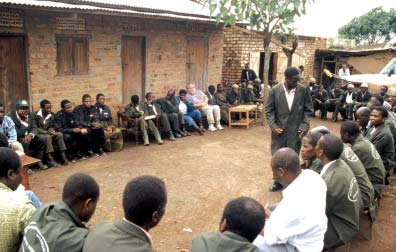
vate partnership between municipalities, a utility, and a
Methane Emissions and Utilization of Municipal Waste for Energy in
private company, also illustrate this impact.
Amman) was negotiating a power-purchase agreement
with the national utility. Overall, however, the OPS2 find-
Vulnerability and adaptation to climate change impacts
ings parallel those of the program study: The GEF poten-
are emerging as important areas of GEF funding. The
tial for influencing policy is much higher than what has
Caribbean Planning for Adaptation to Climate Change (CPACC)
so far been achieved.
project is among the first examples of this type of project
(see Box 3.6).
D. Climate Change: Program and Policy Issues
The OPS2 team identified a number of significant issues
Policy Development
pertinent to ongoing and future work in this focal area.
Several GEF-supported projects have directly and indi-
rectly resulted in policy changes in some countries. These
Sharing Experience
policy changes mainly involve setting up national codes
The Team considers it important that the sharing of les-
and standards and developing specialized regulations. The
sons gained from GEF projects be strengthened and ac-
solar photovoltaic project in Zimbabwe led to the devel-
celerated, so that GEF resources can be used more effec-
opment of national codes for installing solar PV systems.
tively. The transfer of lessons across projects has been
Similarly, a Mexican lighting project led to the develop-
slow and effective efforts relatively recent. The Team also
ment of national quality standards for high-efficiency
considers it important that specific efforts be made to
lights. In Thailand, a utility collaborated with the Thai
encourage more systematic use of the results and out-
Consumer Protection Agency in getting mandatory la-
puts of GEF-funded projects for the improvement of
beling on refrigerators. In China, national standards for
national plans and strategies in climate change. Though
refrigerators resulted from an energy efficiency project
the climate change portfolio has few completed projects
in that country. In Senegal, an energy efficiency project
so far, project lessons are beginning to emerge. They have
(Sustainable and Participatory Energy Management) led to the de-
the potential to form a body of knowledge that can be
velopment of building codes.
applied to ongoing projects and used in designing new
projects. The second phase of the Energy Conservation and
As a result of GEF-funded projects,
some countries have also developed
power-purchase agreements for pri-
vate power supply systems. This is
important because it enables a pri-
vate power supplier to sell its power
to the national utility at acceptable
terms. One instance reported in the
program study is a biomass power
project in Mauritius, resulting in a
power-purchase agreement between
the sugar industry and the national
utility. Similar agreements provided
an institutional and regulatory
framework for independent power
producers in Sri Lanka. In Jordan, the
OPS2 team was informed that the
biogas power project (Reduction of
The First Decade of the GEF [ 21 ]
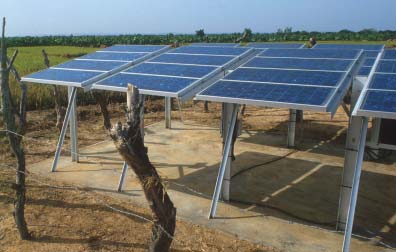
GHG Emissions Reduction in Township and Village Enterprise Indus-
vided major subsidies to a private hotel for efficient light-
tries in China project was largely built on the experience
ing and retrofit measures, with no evidence available to
gained in the first phase of the project, especially the
an OPS2 team that the gains from this project will be
development of technical skills and educational materi-
replicated after project completion.
als. The Thailand demand-side management project pro-
vided some lessons for a similar project in Vietnam.
Perhaps one of the most important factors inhibiting
replication, given the important role of the private sec-
Replication of Project Results
tor in energy production and in the production of en-
With only about 28 completed projects in the climate
ergy-consuming products, is the lack of an enabling en-
change portfolio, it is difficult to assess further replica-
vironment for business in some client countries and the
tion and sustainability of project results. Replication of
frequently low involvement of the private sector in GEF
project results is quite limited so far, as discussed above,
projects. OPS2 findings demonstrate that a clear under-
and has not been systematically addressed in project de-
standing of the scope for technology development and
sign. A number of factors can inhibit project replication.
demonstration, an emphasis at the project design stage
For example, the energy efficiency project in Jamaica
on market transformation, the demonstration of viable
(Demand-Side Management Demonstration) developed a demand-
business models, and other approaches that effectively
side management (DSM) unit in a public utility, but the
engage the private sector could help improve replica-
utility is being taken over by foreign investors whose
tion.
interest in continuing DSM-related project activities was
uncertain at the time of the OPS2 visit. Subsidy schemes
Strengthening Project Risk Assessment and Management
can be difficult to replicate, as illustrated by the doubt-
Significant project risks confront both project design and
ful viability of the consumer fund created by the Zimba-
implementation. It is therefore important to consider
bwean PV project (Photovoltaics for Household and Community
carefully the implications of these risks at an early stage.
Use), the PV project in Uganda (Photovoltaic Pilot Project for
Project risk assessment and management needs to be
Rural Electrification), and the energy efficiency project in
strengthened so that projects can adjust to changes in
Senegal (Sustainable Participatory Energy Management) that pro-
the market, technology, policy, macroeconomic condi-
tions, co-financing, and government
commitments.
While the Jamaica project mentioned
previously was found to be relatively
successful during most of project
implementation, it suddenly en-
countered a new risk caused by
change in ownership of the public
utility. The Uganda photovoltaic
project ran into problems caused in
part by user non-payment. Such eco-
nomic and financial factors can have
a decisive effect on market responses
and institutional viability beyond the
life of the project. Implementing and
executing agencies thus need the ca-
pacity to make sophisticated risk as-
sessments and manage a wide range
[ 22 ] Program Impacts, Results, and Policy Issues
of potential risks if they are to successfully manage mar-
framework to ensure the competitiveness of grid-con-
ket-oriented projects. This is of special concern in the
nected renewable energy projects. Improperly structured
context of expanded opportunities for executing agen-
power purchase agreements also caused problems in a
cies. Carefully choosing executing agencies with the nec-
mini-hydro project in Sri Lanka. Off-grid solar PV projects
essary range of market awareness and financial skills is
in Zimbabwe and Ghana achieved limited success for a
an important starting point. Additionally, broader use of
variety of reasons, including insufficient attention to the
economic instruments in project design could help pro-
sustainability of the financing scheme in Zimbabwe and
vide the necessary flexibility and risk management tools.
to the policy and institutional framework in Ghana. Both
projects illustrate the lesson that off-grid power projects
Long-Term Programmatic Approaches
must be integrated into a broader and well-conceived
Long-term programmatic approaches, in which all the
rural development strategy.
GEF projects in a country are coordinated and matched
with a long-term national strategy, require sufficient GEF
Overall Conclusions
"credibility" and IA experience in a country. The OPS2
Looking across the GEF climate change portfolio, OPS2
team found that the Chinese experience, strongly sup-
finds that the GEF has been most effective in promoting
ported by the World Bank and UNDP, in developing a
energy efficiency, and still has a large opportunity for
programmatic approach towards GEF funding for cli-
further efforts in this area. The GEF has had more mod-
mate change activities has significantly enhanced such
est success in promoting grid-connected renewable en-
activities in that country.
ergy. Since this is a sector in which large commercial
entities are active, the GEF should select additional
Enabling Activities
projects very carefully and should concentrate on creat-
While these activities have been very useful, the com-
ing enabling environments and reducing risk. The GEF
plexity and novelty of many climate change interven-
has had the least success with off-grid, rural, renewable
tions caused some difficulties. The projects were more
energy projects. Rural areas pose very difficult develop-
focused on the UNFCCC obligations and less on a criti-
ment challenges and face immense poverty problems.
cal assessment of national needs and priorities. They also
Hence the OPS2 team suggests that the GEF target the
tended to raise unrealistic expectations, particularly in
productive uses of energy in rural economies and en-
regard to capacity-building aspirations. Too often, cli-
courage more innovative approaches in this field. Over-
mate change concerns have not been integrated into
all, the Team believes that the GEF would benefit from
national development policies and the project pipeline
adopting a more focused program in the climate change
development, but such integration is time-consuming
focal area and concentrating its efforts where there is a
and demands skills and expertise beyond what has been
strong continuing commitment to innovation and thus
provided in enabling activities projects. The OPS2 team
likely to have the greatest impact.
finds that benefits from enabling activities projects are
useful and provide opportunities for a good first-stage
An important element of a more focused climate change
involvement by the GEF in the complex subject matter
program is the creation of enabling environments for
of climate change.
market transformation. The OPS2 team believes that it is
important to recognize and make better use of the dif-
Lessons Learned
fering capacities and special strengths of the different
Much can be learned from projects that do not succeed.
IAs and EAs in such activities. A second critical element
For example, the Inner Mongolian part of a wind power
is market transformation and other market-oriented in-
project suffered a major setback when a neighboring
terventions. In this area, the World Bank and the IFC have
utility proved unwilling to sign a power purchase agree-
unique skills. Procedural issues that have contributed to
ment, illustrating the need to incorporate explicit pric-
under-utilization of the IFC, such as the long time de-
ing policies and marketing agreements into the project
lays in the GEF approval process and some hesitation to
The First Decade of the GEF [ 23 ]
use intermediary financial entities, need to be resolved.
Finally, the Team believes that the GEF needs to seek higher
The expansion of the GEF to include the regional devel-
leverage opportunities. The 5:1 or 6:1 ratio of co-financ-
opment banks would become valuable in this respect.
ing claimed for the bulk of the climate change portfolio
is not sufficient, given the size of GEF resources, to make
Ideally, all the differing skills of the IAs could be brought
a significant impact on emissions of greenhouse gases
together in a coordinated and complementary fashion
on a global scale. Leveraging additional (largely private
to catalyze significant change at the country level. Some
sector) resources at much higher multiples, even 50 or
dramatic changes in Hungary provide an example of how
100 to one--either directly, or indirectly by influencing
effective such coordination can be. In recent years, three
private capital flows--would make a significant differ-
projects have together influenced Hungary's approach
ence. Higher rates of leverage may entail higher risks or
to climate change issues. A UNEP global project prepared
at least new forms of risk and new modalities of engage-
climate scenarios that significantly improved
ment, including risk guarantees and equity participa-
decisionmakers' understanding of climate issues and
tion. The OPS2 team believes that the GEF should accept
enhanced related legislative processes; an IFC project has
these risks as the price of fulfilling its mandate to foster
catalyzed commercial bank lending for energy efficiency
experimentation and as the best hope of creating global
projects; and a UNDP capacity-building project is help-
environmental benefits on climate.
ing municipalities and other public-sector entities to
increase their energy efficiency. These projects have been
E. Biodiversity: Impacts and Results
closely coordinated at the country level and have conse-
The GEF is the single largest source of funding for glo-
quently reinforced each other, multiplying their impacts
bal biodiversity conservation. Under the guidance of the
on public and private sectors. Unfortunately, such coor-
CBD, and in partnership with governments, institutions,
dination is rare. While recognizing that circumstances
NGOs, and communities, it has invested approximately
will vary from one country to another, the OPS2 team
$1.2 billion over the past 9 years to meet the incremen-
commends the Hungary example to the GEF as a model
tal costs for the conservation and sustainable use of bio-
for country-level coordination.
logical diversity in 123 developing countries and econo-
mies in transition. It expects to leverage over $2 billion
The OPS2 team finds that the existing GEF system is slow
in co-financing.
to recognize success, and thus slow to replicate and in-
tegrate positive lessons in planning for future projects.
The biodiversity focal area activities include 395 full and
OPS1 highlighted the IFC-implemented innovative risk-
medium-sized projects and enabling activities, as of June
reduction project in Hungary, as has OPS2, but wide-
30, 2000. These projects (other than the enabling activi-
spread replication in other countries has been slow. An
ties) have been categorized under a number of opera-
innovative project to increase awareness and capacity for
tional programs that reflect different ecosystem types:
energy efficiency changes in Bulgarian municipalities is
apparently successful--as judged by the changes already
·
Arid and semi-arid ecosystems (OP1)
being made by municipal leaders contacted during an
·
Coastal, marine, and freshwater ecosystems (OP2)
OPS2 visit--but its apparent success is unknown to the
·
Forest ecosystems (OP3)
GEF Secretariat. These circumstances and others like them
·
Mountain ecosystems (OP4)
discovered during the OPS2 argue for additional capac-
·
Integrated ecosystem management (OP12)
ity within the Secretariat and for the inclusion of Secre-
·
Conservation and Sustainable Use of Biological Di-
tariat staff in selective mid-term project reviews to en-
versity Important to Agriculture (OP13)
able the GEF Secretariat to play a more strategic role in
portfolio management, as discussed in Chapter 7.
According to the 2000 Program Status Review, the geo-
graphic distribution of projects shows Africa with 132
projects for a total budget of $299.81 million, Latin
[ 24 ] Program Impacts, Results, and Policy Issues

America and the Caribbean with 101 projects for a bud-
Ecoregions, the Ramsar Convention on Wetlands of In-
get of $403.07 million, and Asia and the Pacific with 81
ternational Importance, UNESCO's Man and the Bio-
projects for a total of $284.10 million.
sphere Program, as well as globally important species
listed under various conventions and named on the IUCN
The GEF biodiversity program draws its mandate from
lists of threatened and endangered species. In FY2000,
the CBD and seeks to reflect the guidance from the COP/
the distribution of projects between ecosystems/habi-
CBD through its program objectives, its priorities, and
tats was arid and semi-arid ecosystems (27 projects);
its functional modalities. The enabling activities have
coastal, marine, and freshwater (59 projects); forest eco-
supported governments to meet their obligations to the
systems (81 projects); and mountain ecosystems (14
CBD. The GEF biodiversity projects have sought to target
projects). The GEF is developing the capacity to have
globally important ecosystems, species, and genetic re-
impacts on a broadly representative base of globally im-
sources, while also deriving complementary sustainable
portant ecosystems. The OPS2 team notes that there is
development benefits.
no guidance from the biodiversity convention on what
an optimal distribution of projects should be for a bal-
The OPS2 team finds that the GEF biodiversity program
anced portfolio. Moreover, the distribution of projects
has made significant advances in demonstrating com-
among these globally important sites does not necessar-
munity-based conservation within protected areas and,
ily reflect the true extent of "coverage" of these sites
to a lesser extent, in production landscapes. While it is
relative to the conservation of biodiversity that is actu-
still premature to estimate the precise impact that the
ally being achieved.
program has had on the status of global biodiversity, GEF's
program has resulted in building institutional and indi-
Conservation of Protected Areas
vidual capacity in biodiversity conservation, developing
The GEF has steadily improved the standards of manage-
new conservation approaches, forging effective partner-
ment of protected areas through participatory ap-
ships, strengthening legal frameworks, influencing policy,
proaches. As part of the Biodiversity Program Study, a
and creating awareness on the importance of conserv-
special assessment of 49 projects that are protecting
ing biodiversity within the context of sustainable na-
biodiversity in 320 protected areas covering a total of
tional development. In reviewing the results
and impacts from the biodiversity focal area,
the OPS2 team noted the findings and conclu-
sions of the Biodiversity Program Study
(2001). The Team independently verified some
of the outputs and results through its in-coun-
try consultations and project site visits to 15
countries, and it specifically notes the follow-
ing key positive impacts from the biodiversity
portfolio.
Global Coverage
The Biodiversity Program Study examined the
global coverage of projects in the biodiversity
portfolio and reported that the GEF had,
through its choice of projects, covered many
of the globally important sites such as those
listed under the World Heritage Program,
WWF's Global 200 Earth's Distinctive
The First Decade of the GEF [ 25 ]
60 million hectares found that more than 50 percent
project network covers 625,000 hectares and protects
have fully or mostly met their objectives. More than 50
rich biodiversity including the habitat of the giant panda.
percent have also achieved some benefit sharing and put
Under the Nepal Biodiversity Conservation project, GEF helped
in place measures for ensuring sustainability. While at
to establish the Makalu Barun National Park covering
least half of the projects had reasonable stakeholder par-
2330 square kilometers in northeast Nepal. A strongly
ticipation, only a fifth could claim to have achieved "own-
participatory planning and management approach was
ership" by stakeholders. In its country visits, the OPS2
used (see Box 3.7).
team observed a number of successful protected area
projects involving conservation of biodiversity of global
Conservation in Production Landscapes
significance. The Uganda Bwindi Impenetrable National Park
GEF projects are increasingly moving beyond the nar-
and Mgahinga Gorilla National Park Conservation project, for in-
row scope of protected area conservation to strategies
stance, covers 766 square kilometers and protects the
that conserve biodiversity within the broader produc-
highest diversity of primates in Africa (13 species), in
tion landscape. Of a selection of 20 projects that con-
addition to other endemic species of plants, animals, and
serve biodiversity in production landscapes, the
birds. The South Africa Cape Peninsula Biodiversity Conservation
Biodiversity Program Study found that about half were
project protects one of the world's six plant kingdoms
assessed to have achieved most of their objectives while
(Cape Floral Kingdom), and associated terrestrial and
the remainder had partly achieved them. OPS2 country
marine biodiversity. The China Nature Reserves Management
visits identified some positive examples of biodiversity
Box 3.7 Community-Based Conservation in Nepal
The Makalu Barun National Park and Conservation Area (MBNPCA) in northeast Nepal is a successful example of commu-
nity-based conservation management financed by the GEF. Covering 2,330 square kilometers, the park is recognized as a
global "hotspot" of Eastern Himalayan biodiversity. At present, communities manage over 10,000 hectares of forest area
in the park and buffer zone.
At project completion in July 1999, a new model for participatory national park management had been developed. Project
sustainability has been ensured with ongoing government financial and technical support, continued use of community
facilitation and joint management techniques, and active community management of forests and grazing areas.
Other project achievements include local trails and bridges that encourage tourism--a key incentive for the ongoing
participation of local communities. Alternative fuel sources such as kerosene are now used, reducing dependency on fuel
wood. Local management organizations have been established, such as those for lodge owners and porters and commit-
tees to manage threatened, biodiversity-rich habitats. Conservation education materials in Nepali have been used in non-
formal education classes and by trained local teachers.
Several lessons learned from this GEF Pilot Phase project were conveyed to the OPS2 team by the project staff:
·
Sustainability is not possible unless host governments commit their own staff resources before the start of the
project.
·
To monitor impacts effectively, projects need to allocate sufficient funds for baseline data collection right at the
beginning.
·
High-level project steering committees have difficulty providing technical inputs because the people involved have
many other commitments.
·
In the interests of cost-effective project management, it is important to develop more streamlined service
delivery procedures than are normally used by IAs.
[ 26 ] Program Impacts, Results, and Policy Issues
conservation outside protected areas and within the larger
Lake Victoria project in East Africa is promoting aquac-
productive landscape. For instance, the small grants pro-
ulture in threatened fish species, which relieves pressure
gram in Brazil provides important instances of conser-
on the wild populations of these species in Lake Victoria,
vation of agricultural and forest biodiversity (see Box
satellite lakes, and associated rivers.
3.8). Science-based tools and techniques have been tested
in tackling special problems affecting ecosystem produc-
Benefit Sharing
tivity. For instance, a number of GEF projects have in-
The program study found that, of the projects exam-
cluded mitigation measures against the threat of inva-
ined, more than half demonstrated efforts toward achiev-
sive alien species that adversely affect indigenous
ing benefit sharing. The OPS2 team visited a number of
biodiversity and economic activities. The East Africa Lake
projects where benefits accruing at local and commu-
Victoria Environmental Management Project14 has brought under
nity levels provide good incentives for conservation and
control the water hyacinth that was threatening Lake
sustainable use by the very people who live with, own,
Victoria's fisheries, navigation, power generation, and
and depend on biodiversity. Examples of projects that
water quality. The use of water hyacinth weevils has re-
demonstrate local benefit sharing include the GEF-sup-
duced the weed population by 70 percent--resulting in
ported Mgahinga Bwindi Trust that has helped commu-
increased populations of many fish species, better access
nities through alternative livelihood schemes and a vari-
to fishing areas, and improved navigation and power
ety of social benefits, including schools and health clin-
generation.
ics (see Box 3.9). GEF projects have also enhanced
ecotourism in protected areas, resulting in sustainable
Sustainable Use of Biodiversity
development benefits. For instance, the Jordan Conserva-
The GEF has developed a number of effective projects
tion of Dana and Azraq Protected Areas project has increased the
both within protected areas and production landscapes
annual number of visitors from about 4,000 in 1993 to
that demonstrate the sustainable use of biodiversity (the
35,000 in 1999. Ecotourism development earnings have
second major objective of the Convention on Biological
increased from $6,760 in 1994 to $18,000 in 1997 (cov-
Diversity). While most of these are currently under small-
ering about 70 percent of the reserve's operating costs),
scale implementation, they provide models for upscaling
and to an estimated $330,000 in 2000. In total, the
and/or wider application. These include both consump-
project counts an estimated 3,430 direct and indirect
tive uses of biodiversity (Kibale Forest Wild Coffee Project,
beneficiaries. Since the project entered its second phase,
Uganda) as well as non-consumptive uses such as
there has been a one-third increase in funds going di-
ecotourism (South Pacific Biodiversity Conservation Program). The
rectly to the local community. The higher ecotourism
Box 3.8 Conserving Biodiversity in Production Landscapes in Brazil
One example of the projects targeted at production landscapes is the small grants program focused on Brazil's
"cerrado," the second largest biome in the country covering 2 million square miles in 14 states. This extensive area
harbors a rich ecosystem that is being rapidly degraded. Other sources of conservation funding have apparently
neglected to support biodiversity conservation in the cerrado. In the first five years of the program, 39 projects
were funded with a total of $900,000. Projects included extraction and commercial processing of medicinal plants,
flowers, and native fruits; conservation of soil and headwaters of a river; actions to control the use of fire in the
ecosystem; promotion of solar energy; income generation from ecotourism; and generation of sustainable liveli-
hoods from beekeeping and other rural technologies. These projects have combined the conservation of the glo-
bally significant cerrado ecosystem with enhancement of the quality of life of affected communities. Further, the
OPS2 team was informed that the program has influenced public policies at the local and state levels, and some of
the projects are being promoted as successful, replicable models.
The First Decade of the GEF [ 27 ]
income and environmental concerns influenced the Min-
Improving the Enabling Environment
istry of Mining and Mineral Resources to halt copper
An important indicator of the larger impact of GEF
mining in the Dana Reserve. However, in the view of the
projects is the influence that they exert on new policies,
OPS2 team, the GEF portfolio could considerably extend
regulations, and laws promoting a favorable enabling
its work on benefit sharing as defined by the CBD. For
environment for biodiversity conservation. The OPS2
instance, there have been few projects that demonstrate
team observed many instances of policy changes, new
revenue sharing, of royalties, fees, etc., from the exploi-
policy formulation, new legislation, and new regulations
tation of indigenous knowledge of biological resources.
that followed from GEF-supported initiatives. These
An assessment also is needed of the sustainability of the
changes have occurred at the local, national, and inter-
benefit-sharing initiatives that have been established over
national levels. For instance, the Jordan Dana and Azraq
the years.
project and the Country Study on Biological Diversity,
Box 3.9 Mgahinga Bwindi Impenetrable Forest Conservation Trust (MBIFCT)
The MBIFCT is a GEF-funded biodiversity trust fund that supports biodiversity conservation in the 331 square kilo-
meters of the Bwindi Impenetrable National Park and 48 square kilometers of Mgahinga Gorilla National Park.
The Trust capital has been invested to provide a flow of recurrent funds that support park management and help
local communities develop alternative economic activities to replace those that traditionally rely on harvesting
forest resources. In this way, the Trust has helped halt habitat degradation and protect the threatened biodiversity
of two of Africa's richest protected areas--home to at least 120 species, including 10 primates and endemic species
of the Afro-montane and Afro-alpine ecosystems.
Census data collected by the Uganda Wildlife Authority shows that the populations of threatened big game and
the mountain gorillas are increasing slowly. Through Trust support, both applied ecological and conservation re-
search have provided new and important data for the management, monitoring, and evaluation of the parks'
biodiversity.
Local people living around the national parks have developed alternative livelihoods with support from the Trust,
including tree nurseries, beekeeping, water catchment protection, water harvesting from roofs, and aquaculture. In
addition, the Trust has contributed to construction of 18 schools and 11 clinics. The community argued rationally
that schools were necessary to provide education for their children so that they can get jobs in Kampala and
elsewhere and become less dependent on the national parks for their livelihoods than their parents. Similarly, they
argued that the clinics would treat ailments that were previously treated with herbal medicines harvested from the
parklands, which people are now restricted from entering to harvest the medicinal plants. Today, the schools and
clinics serve about 75 percent of the 300,000 people in the project area.
The positive response of the Trust to the livelihood needs of the local people of Mgahinga and Bwindi National
Parks have contributed to changing local attitudes about conservation of the national parks and their biodiversity.
People have developed a sense of ownership, and local communities have become proud of "their" gorillas. They
now report poachers to park authorities, which was not the case before. The success of this Trust has led to
replication of biodiversity trust funds elsewhere, such as Malawi (i.e., the Mulanje Mountain Conservation Trust).
The Trust has attracted donor, NGO, and private funding to advance the conservation, sustainable use, and benefit
sharing of the biological resources of Mgahinga and Bwindi National Parks.
[ 28 ] Program Impacts, Results, and Policy Issues

together with the GEF climate change initiatives posi-
gency funding from both internal and external sources. GEF
tively influenced the decision to create a new Ministry
was also able to mobilize scientific expertise and interna-
of Environment. The South Africa Cape Peninsula Biodiversity
tional cooperation to assist countries in their responses to
Conservation project led to the designation of the Cape Pen-
emergencies and in building human and institutional ca-
insula National Park as a World Heritage Site.
pacities. In Mauritania, following the massive deaths of the
threatened monk seals in 1997, the GEF emergency fund-
Capacity Building
ing (for the Rescue Plan for the Cap Blanc Colony of the Mediterranean
The GEF includes capacity building measures as an inte-
Monk Seal project) through UNEP led to international action
gral part of all GEF-financed biodiversity projects. The
that saved the species, established husbandry and release
OPS2 findings highlight capacity development elements
facilities, developed the monk seal monitoring program,
as among the most successful components of GEF's
and produced the Mauritania Monk Seal Strategy. However,
biodiversity projects. Under the Nepal Biodiversity Conser-
the evaluation of the emergency response to the Indone-
vation project, the King Mahendra Trust for Nature Con-
sian forest fires in 1998 points out that the GEF-supported
servation, a prominent Nepali NGO, has developed ef-
action could not provide timely or well-targeted responses
fective training facilities near the Royal Chitwan National
for controlling the fires. And, in 1995, the GEF's attempts
Park that is used to train Park officials, Department of
to respond to an emergency that arose from the refugee-
National Parks and Wildlife Conservation staff, local com-
driven biodiversity crisis in the Democratic Republic of
munity leaders, research students, and park visitors. The
Congo could not be successfully sustained. Despite some
Inventory, Evaluation, and Monitoring of Botanical Diversity in South-
shortfalls, these innovative emergency response measures
ern Africa: A Regional Capacity and Institution Building Network
have the potential to respond to global environmental di-
(SABONET) project has trained technical and professional
sasters. GEF should be encouraged to explore setting up a
botanists in plant taxonomy to meet the floral diversity
separate "funding window" for emergency response mea-
management needs of the10 participating countries (see
Box 3.10, page 30).
Scientific Research Inputs
Several GEF projects have incorporated research compo-
nents to find solutions to problems of biodiversity con-
servation and sustainable use, which have generated valu-
able information for making sound conservation man-
agement decisions. The Lake Victoria project has gener-
ated important research data for the conservation and
sustainable use of Lake Victoria's fish and other biologi-
cal resources. Within the People, Land Management, and Envi-
ronmental Change (PLEC) project, the Amazon cluster's re-
search and extension strategy effectively demonstrates
the alliance of traditional ecological knowledge with
modern scientific knowledge and management systems
to achieve sustainability of biodiversity conservation
within a production landscape (see Box 3.11, page 31).
Short-term Emergency Response Measures
In a few instances, the GEF has responded to emergen-
cies where natural and man-made disasters have threat-
ened the global environment. The GEF has mobilized emer-
The First Decade of the GEF [ 29 ]
sures under the biodiversity focal area, with clear guide-
cluding government, local residents and communities,
lines to ensure urgent approvals, disbursement of funds,
academics, NGOs, and the private sector. For example,
and rapid action.
the East Africa cross-border biodiversity project features
active community participation and ownership in forest
Stakeholder Participation
management plans, led by voluntary and inclusive Envi-
The OPS2 team observed that many projects involved
ronmental Planning Committees that are empowered to
the participation of a broad range of stakeholders dur-
be agents of change in each community. With this local
ing the planning and execution phases of projects, in-
assistance, the project is successfully integrating
Box 3.10 Capacity-Building Through Networking
The SABONET project aims to build capacity and a formal network for the inventory, evaluation, and monitoring of
botanical diversity of 10 Southern African countries--Angola, Botswana, Lesotho, Malawi, Mozambique, Namibia,
Swaziland, South Africa, Zambia, and Zimbabwe. By developing critical skills in taxonomy and improving institu-
tional capacity, the project has helped the participating botanical institutions meet important human resource
needs. A total of 17 short courses have trained 192 technicians and professional botanists in various herbarium and
botanic garden-related skills (e.g., field collection techniques, herbarium management, identification and classifica-
tion, biology and taxonomy of special plant groups (ferns and grasses), database management, preparation of Red
Data Lists, etc.). These courses have so far been held in seven participating countries, using botanical experts from
the subregion. At undergraduate and postgraduate levels, SABONET has supported the training of 29 staff from
participating institutions in plant taxonomy/biodiversity and horticulture architecture (14 MScs and 13 BSc Hons in
plant taxonomy, one BTech in horticulture architecture, and one BTech in Nature Conservation). In addition, SABONET
has strengthened the botanical infrastructure of the respective national herbaria and botanic gardens through the
provision of vehicles and field equipment for enhancing botanical work; computer hardware and software and
internet connections to facilitate networking; specimen freezers; basic laboratory equipment; and some essential
literature. The improvement of herbaria is being complemented with similar development of botanic gardens for
the ex-situ conservation of threatened plant species. SABONET has already completed a botanic gardens needs
assessment, and a botanic gardens network will strengthen the work of Southern Africa's botanic gardens. SABONET
supported the development of human and institutional capacity to document, evaluate, and monitor plant diver-
sity conservation and sustainable use through ethno-botanical research, i.e., identify uses of medicinal plants and
threats to them; develop Red Data Lists, etc. The developed capacity is used also to create plant databases in the 10
participating national herbaria, and approximately 160,000 specimens in the region's herbaria have been computer-
ized as a direct intervention of SABONET. Some of the plant information has been used to publish valuable books
on the taxonomy and diversity of Southern Africa's plants.
SABONET has also strengthened regional cooperation and networking. Joint plant exploration expeditions within
the project area, i.e., to Nyika Plateau (Malawi), have been undertaken, during which young botanists are mentored
in field botanical skills. Such botanical expeditions have attracted Northern botanists, thus furthering North-South
cooperation. The SABONET activities are disseminated widely within and outside the region through newsletters
and other botanical literature. In fact, SABONET has become a virtual campus where over 100 active botanists are
engaged in implementing SABONET's goals. The project has attracted co-funding from USAID and participating
governments. The success of the SABONET model is now being replicated in East Africa (BOZONET) and the Carib-
bean (CARIBNET), It has also been catalytic to the formation of the Italian-funded SECOSUD project that focuses
on GIS databases in herbaria.
[ 30 ] Program Impacts, Results, and Policy Issues
biodiversity conservation, management of land degra-
TV. The implementing NGO, Fundacion Patagonia Natu-
dation, and poverty alleviation. In Samoa, traditional
rale, hosted a TV spot for 2 years with financial contri-
decisionmaking structures at the community and local
butions from local retailers who paid for TV and radio
levels have enabled the effective participation of key stake-
air time. In East Africa, in the Lake Victoria environmen-
holders in the South Pacific Biodiversity Conservation project
tal management area, the project awareness by local
and Samoa Marine Biodiversity Protection and Management project.
people is so high, even young students know the func-
tion of the dudus (water hyacinth weevils). In the East
GEF biodiversity projects have created increased conser-
Africa cross-border biodiversity project, key awareness
vation awareness and understanding among various
messages communicated to the Minziro forest commu-
stakeholders including local communities, NGOs,
nity have led to sustained action. The project connects
decisionmakers and the political leadership. The OPS2
three villages with more than 1,800 households and
team noted a number of projects that disseminated in-
8,400 people who are promoting reforestation (10 trees
formation through outreach efforts, including interpre-
per household target) to address "supply side" issues.
tation centers, newsletters, signage, and mass media
The establishment of nurseries (planted trees and grow-
(cross-border biodiversity and Kibale Forest projects).
ing saplings evident), reduction in burning (grass is a
The Argentina Patagonian Coastal Zone Management Plan project
valuable mulch), and construction of improved wood
carried out successful public awareness campaigns that
stoves to reduce unsustainable energy demand are rap-
included short video clips and documentaries on national
idly expanding.
Box 3.11 Learning From the Practices of Small Farmers in the Amazon
The People, Land Management, and Environmental Change (PLEC) project is a multicountry program of studies on
small farmers' practices in the area of biodiversity conservation and livelihoods. The Amazon "cluster" researchers
work with farmers at five sites on the Amazon floodplain ranging from Maçapa on the Amazon estuary to Iquitos in
the upper Amazon of Peru. While the agricultural potential of the Amazon floodplain, or varzea, is widely recog-
nized, the risks of floodplain farming have led policymakers and agricultural research institutions to ignore it. How-
ever, traditional farmers have developed sophisticated management systems that address many of the challenges
of farming the floodplain and take advantage of its productive potential. PLEC researchers are working with these
farmers to harness their knowledge in developing agricultural systems that conserve biodiversity while also im-
proving agricultural performance.
The Amazon cluster's research and extension strategy is based on the concept of expert farmers, the especially
gifted local farmers who have developed repertoires of crop varieties, techniques, and management systems that
enable them to overcome local problems and achieve exceptional yields while conserving local biodiversity. Clus-
ter researchers work with these farmers to develop on-farm demonstration projects through which other farmers
can learn the techniques involved in these management systems. Through this process of farmers teaching farmers,
experts share with others the techniques and management philosophies that they have developed.
The project has achieved a number of important successes. A system for controlling the spread of Moko disease by
growing bananas in secondary growth has caused the resurgence of banana production in a region where it had
been abandoned. Another system involving management of secondary vegetation for palm heart and fruit and
timber is one of the few successful smallholder timber management systems documented in the Amazon. Informa-
tion about these systems is now being disseminated throughout the region.
The First Decade of the GEF [ 31 ]
F. Biodiversity: Policy and Program Issues
·
Funding patterns that are incompatible with the
While the GEF biodiversity program has achieved a num-
absorptive capacity of the target project areas and
ber of impressive results in the conservation and sus-
implementation structures
tainable use of biological diversity and in benefit shar-
ing, as documented above, the OPS2 team identified
·
Rigid project management structures that do not
opportunities for the GEF to become more strategic,
allow for flexibility in project implementation
better targeted, more participatory, and more cost effec-
tive, thereby improving its impact on the status of glo-
·
Unrealistic and overly ambitious objectives, includ-
bally significant biodiversity.
ing lack of time and lack of money to fully achieve
the intended changes
Measuring Impact on Status of Biodiversity
For a large proportion of GEF biodiversity projects, it is
·
Weak linkages with other sectors of the economy that
difficult, if not impossible, to determine their impact on
influence project success (cross-sectoral impacts)
the status of the biodiversity they were intended to con-
serve. This is partly because a majority of the projects
·
Failure to address the root causes of biodiversity loss.
had not gathered baseline status information against
which progress could be measured. In many cases, sci-
The executing agencies and IAs could address these is-
entifically valid indicators of impact had not been for-
sues through sustained attention to effective project de-
mulated and therefore could not be monitored. Further-
sign and supervision. OPS2 country visits revealed in-
more, measurement of biodiversity impact will usually
stances where IAs lacked the capacity to track project
require a long time period. The record of accomplish-
progress and take timely action when necessary. In some
ment is therefore apparent mainly through various out-
cases, "shuttle management" from headquarters resulted
put and process indicators. This is not to discount the
in inadequate in-country capacity for tracking project
value of process indicators but to reiterate that such
progress, remaining engaged with governments and in-
monitoring and evaluation is incomplete and limited.
country project teams, providing technical support, and
This situation is now being rectified by GEF Secretariat
addressing early warning signals. The OPS2 team received
initiatives and by biodiversity assessment projects sup-
indications from senior IA representatives that the fees
ported by the GEF such as the Millennium Ecosystem Assess-
being paid to IAs were inadequate to cover the costs of
ment project. A review of a group of newer forestry projects
closer project supervision. In view of the rapidly expand-
reveals that almost all of them have carried out, or pro-
ing biodiversity portfolio and the increasingly complex
pose to carry out, biological and socio-economic baseline
strategic approaches being adopted by the GEF, steps
studies.
should be taken to ensure that IAs and executing agen-
cies receive adequate resources to fully support project
Lessons Learned
design and supervision capacity.
While GEF biodiversity projects have often achieved en-
couraging results, the majority of GEF biodiversity
Root Causes of Biodiversity Loss
projects have not been as successful as they might have
The GEF Operational Strategy states that GEF projects
been in fulfilling their stated overall objectives. There
should address the underlying root causes of global en-
are several reasons for this, including:
vironmental deterioration, such as inappropriate eco-
nomic and social policies, inadequate legal frameworks,
·
Basic implementation capacity not being in place
institutional weaknesses, and information barriers. A
prior to projects being launched
considerable amount of discussion within GEF on this
subject has centered on what among the root causes is
·
Inadequate stakeholder participation and ownership
within the capacity and mandate of the GEF to address.
in project design and implementation
The OPS2 team met stakeholders at the country level who
[ 32 ] Program Impacts, Results, and Policy Issues
emphasized that root causes of biodiversity loss are best
tries), and at significant cost to GEF, are playing any role
addressed when GEF's conservation objectives are
in country processes for identifying priority projects for
grounded more strongly in the sustainable development
GEF support and integrating global biodiversity conser-
context. Here the operational experiences of UNDP and
vation priorities into national plans, policies, and legal
the World Bank are of key importance, and so are their
frameworks. Further, OPS2 country visits revealed that
country dialogues on sustainable development. One im-
the capacity built within countries in the course of pre-
plication of this guideline is that GEF must give stronger
paring NBSAPs tends to be dissipated in the absence of
emphasis to initiatives that promote sustainable use and
timely follow-up. The GEF Secretariat and the implement-
benefit sharing of biodiversity products and services. As
ing agencies need to take responsibility in catalyzing
pointed out earlier, most of the current initiatives in this
action to ensure that NBSAPs effectively serve as docu-
regard remain at a small scale, with limited impact and
ments for integrated biodiversity conservation and sus-
uncertain long-term sustainability.
tainable development planning.
Programmatic Approach
Overall Conclusions
GEF proposes to move beyond the current projects-based
The GEF biodiversity portfolio has grown from 56
emphasis to a more strategic approach that systemati-
projects and about $334 million in FY94 to 395 projects
cally targets countries' enabling environments to posi-
and over $1.18 billion by FY 2000. The 2000 Program
tion them to address biodiversity conservation program-
Status Review demonstrates that of the total expected
matically and mainstream it in the wider development
co-financing of about $2.01 billion committed, more
context. OPS2 supports this approach but recognizes that
that 50 percent comes from counterpart contributions
it implies a much broader interface with national gov-
by governments, 25 percent from bilateral and multilat-
ernments. The capacity of governments and other in-
eral agencies, and 15 percent from the implementing
country stakeholders to engage with the GEF at this broad,
agencies own funds, with a remaining 8 percent from
cross-sectoral level will need to be enhanced if the pro-
NGOs and the private sector. These estimates of co-fi-
cess is to remain country-driven. As part of a learning
nancing committed are credible both in terms of the
phase, GEF has begun testing a strategic programmatic
total amount and the spread among the various stake-
approach to biodiversity conservation
in a few countries.
Enabling Activities
The GEF has followed Convention
guidance in implementing support
for enabling activities that assist
countries to develop their commu-
nications to the Convention, includ-
ing the national biodiversity strate-
gies and action plans (NBSAPs). As
of June 30, 2000, the GEF had sup-
ported 185 enabling activities and
clearinghouse mechanisms in the
biodiversity focal area with a total
allocation of $46.62 million. How-
ever, it is not clear whether the
NBSAPs, often developed with wide
participatory effort (within coun-
The First Decade of the GEF [ 33 ]
holders, although no rigorous review has been conducted
plying more strategic programmatic approaches at na-
of the amount of the committed co-financing actually
tional, regional, and global levels will not succeed with-
realized. The one clear conclusion that is discussed else-
out the full support of the COP/CBD at one level and the
where in this report, and reiterated here, is that the po-
individual country governments at another. The COP/
tential for drawing on private sector support for
CBD could, through its consultative processes, empha-
biodiversity conservation initiatives remains largely
size to its member countries the imperative for much
untapped.
stronger national political commitment for biodiversity
conservation. With technical support from the GEF (the
There is little doubt that global environmental trends
GEF Secretariat and implementing agencies), countries
related to the conservation and sustainable use of
could strengthen their focus on improving the enabling
biodiversity continue in a downward trajectory. The GEF,
environment for biodiversity conservation. Equally, the
acting under the mandate and guidance of the CBD, has
COP/CBD could, in formulating its guidance to GEF, fully
not yet been able to reverse this trend. But more precise
consider the strategic approaches to biodiversity con-
assessments about the impacts of efforts and initiatives
servation currently being planned that move beyond the
(GEF-supported, multilateral/bilateral aid agency-sup-
narrow focus on grant-based project funding.
ported, and country efforts) over the last decade will be
clear only after the results and outputs of ongoing sci-
G. International Waters: Impact and Results
entific assessments (such as the Millennium Ecosystem Assess-
The GEF portfolio in the international waters focal area
ment) start to emerge and a total picture can be pieced
comprises an investment of $329 million over the last 9
together. However, the OPS2 team concludes that the GEF
years. The OPS2 findings are that GEF projects have made,
has laid the foundation for a concerted, science-based
and continue to make, significant contributions to the
effort to stem biodiversity loss. Marked advances have
global health of international waters. Its projects prima-
been made in building national, regional, and global
rily support the implementation of existing global and
partnerships; creating the information base; and devel-
regional agreements that address the protection and res-
oping the tools, methodologies, and human and institu-
toration of freshwater and marine ecosystems. The OPS2
tional capacities to address the unsustainable exploita-
team views project performance in the GEF international
tion of biodiversity. The consideration of livelihood al-
waters portfolio as generally successful. While the GEF
ternatives in biodiversity projects is crucial for long-term
does not serve as financial mechanism for a global con-
biodiversity conservation at local levels and should be
vention on international waters, its operational policies
emphasized in all GEF projects.
support many different conventions, protocols, and
agreements related to international waters, including
OPS2 believes that the GEF can continue to improve the
multicountry commissions (see Table 3.1).
efficiency with which its biodiversity projects deliver
global conservation benefits. The key is increasing its
Furthermore, actions under GEF projects have facilitated
emphasis on incorporating lessons learned in the field
agreement on new conventions (e.g., the new Black Sea
into the design and implementation of new projects,
Convention and the Convention for the Protection of the
together with improved monitoring and evaluation pro-
Caspian Sea), endorsement of regional agreements (e.g.,
cesses. However, for the GEF to build on project-level
the Central-West Pacific Tuna Agreement), adoption of
technical achievements and undertake a concerted drive
legislation (e.g., as in the Integrated Watershed Management Pro-
to address the broader root causes of biodiversity loss, it
gram for the Pantanal and Upper Paraguay River Basin project), and
will require substantial support from the Convention on
acceptance of best practices. In the absence of regional
Biological Diversity, the implementing agencies, and its
agreements or water-body-related treaties, these projects
member countries. For instance, GEF's effort to secure
tends to strengthen the role of multicountry commis-
broader gains in global environmental benefits by ap-
sions, such as with the Binational Commission (Bolivia
[ 34 ] Program Impacts, Results, and Policy Issues
Table 3.1 Completed Water Projects and their Contribution to Global and Regional Environmental Agreements
Region
IA
Project
OP
Regional/Global Agreement
EAP
World Bank
China Ship Waste Disposal
9
MARPOL
Global
World Bank
Water for Nature (MSP)
MNA
World Bank
Gulf of Aqaba Environmental Action
8
GPA, CBD - Jakarta Mandate
ECA
UNDP
Danube River Basin Environmental Management
8
GPA, Danube Conv, CBD, Ramsar
AFR
UNDP
Industrial Water Pollution in the Gulf of Guinea Large Marine Ecosystem
9
Str.Stocks, CBD, GPA, Abidjan
AFR
UNDP
Pollution Control and Other Measures to Protect Biodiversity in Lake Tanganyika
9
CBD,CCD,CWI
Regional
UNDP
Regional Oceans Training Program
ECA
UNDP
Black Sea Environmental Management
8
GPA, Black Sea Conv. Ramsar, CBD
ECA
UNDP
Developing the Danube River Basin Pollution Reduction Program
8
GPA, Danube Conv, CBD, Ramsar
ECA
UNDP
Developing the Implementation of the Black Sea Strategic Action Plan
8
GPA, Black Sea Conv. Ramsar, CBD
LAC
UNDP
Planning and Management of Heavily Contaminated Bays and Coastal Areas
10
GPA
LAC
UNEP
Argentina-Bolivia: Strategic Action Program for the Binational
Basin of the Bermejo River
9
CCD, CWI, CBD
ECA
World Bank
Oil Pollution Management for the Southwest Mediteranean Sea
MARPOL
LAC
World Bank
Wider Caribbean Initiative for Ship-Generated Waste
9
MARPOL
MNA
UNDP
Protection of Marine Ecosystems of the Red Sea Coast
8
CBD, Jeddah Conv.
and Argentina) of the Bermejo River produced by the
grated planning in multinational water bodies. The TDA-
Strategic Action Program for the Binational Basin of the Bermejo River
SAP process has provided a mechanism for the GEF to
project.
contribute substantially to the in-country strengthening
of institutions and to promote strategic alliances among
In analyzing impacts from the perspective of performance
institutions in different countries, thus promoting the
indicators--process, stress reduction, and environmen-
development of effective monitoring systems and im-
tal status indicators--most of the impacts so far are re-
proved management capacities.
lated to processes. Some impacts have been identified at
the level of stress reduction (Building Partnerships for the En-
GEF interventions have also provoked positive institu-
vironmental Protection and Management of the East Asian Seas
tional reforms as early as the preparation stage. GEF
project.) As a result of follow-up of the GEF project, in
projects have contributed to the formulation of new
the city of Xiamen, China, actions have been taken to
policies, laws, and regulations related to the international
stabilize water pollution levels in the port (see Box 3.12,
waters Institutional strengthening at the national and
page 36). More modest improvements can be detected
regional level resulting partly or totally from GEF projects
among the environmental status indicators for ecosys-
has proven extremely useful in situations requiring an
tem quality of the Danube and Black Sea water systems.
immediate response, for example, counteracting disasters
of natural or anthropogenic origin like the cyanide spill
Examining the results of the international waters port-
in the Danube River in 2000 (see Box 3.13, page 37).
folio, one particular operational approach demonstrates
considerable merits: A science-based Transboundary Di-
GEF projects have helped increase knowledge and develop
agnostic Analysis (TDA) is conducted at the preparatory
databases at the national and regional level. The TDA-SAP
stage, before a strategic action program (SAP) is elabo-
process has been instrumental in advancing local and re-
rated. It has similarities to the process embedded in en-
gional knowledge related to various water systems.
abling activities in support of UNFCCC or CBD. Further-
more, the GEF is one of very few financial mechanisms
GEF projects have successfully provided replicable ex-
available to support comprehensive analysis and inte-
amples, such as in the Regional Program for the Prevention and
The First Decade of the GEF [ 35 ]
Management of Marine Pollution in the East Asian Seas project. Expe-
Uganda) Lake Victoria project, where protection of the
riences emanating from this project have been reproduced
lake and its basin influences the livelihoods of some 25
in other coastal cities in China, as well as in various coun-
million people. In Jordan, ecotourism development re-
tries of the region. The OPS2 team also found that compo-
lated to the Azraq project has increased annual visitors
nents of both the Bermejo River project and the Danube
to the wetlands, with 75,000 visitors recorded in 2000.
River project were being replicated in other locations.
The local population has benefited from direct employ-
ment opportunities, the re-establish-ment of traditional
International waters projects have been instrumental in
craftmaking (such as producing handicrafts from reeds),
generating economic benefits in various regions. The in-
and from an increase in tourism-related income. Else-
separable nature of economic and environmental values
where, in Patagonia, Argentina, a GEF-supported initia-
is demonstrated in the East Africa (Kenya, Tanzania, and
tive within the Patagonian Coastal Zone Management
Box 3.12 Ship Waste Disposal and Integrated Coastal-zone Management (ICM) in Xiamen
Xiamen, one of the major sea ports in China, has substantial shipping, commerce, communication, and tourism
industries and has attracted considerable foreign investments. Rapid economic growth (more than 20 percent an-
nually since 1994) has been accompanied by similar population growth, largely through labor migration from other
parts of China. Concerns about avoiding environmental degradation were noted in the early 1990s. More recently,
Xiamen has been designated a "model environmental city" by the government.
Xiamen was among six sites included under the 1992 GEF-World Bank China Ship Waste Disposal project carried
out through the International Maritime Organization. The main objectives were to reduce marine pollution in
China and adjacent international waters through treatment facilities, a waste tracking system, an environmental
monitoring system, and development of an oil spill response capacity. At its completion in 1997, the project was
considered successful in meeting most of these objectives. The project has had lasting results. The Port Authority
of Xiamen took responsibility for continuing many project activities, including ship waste tracking and environ-
mental monitoring.
Xiamen was also included under the 1997 GEF-UNDP-IMO Regional Program for the Prevention and Management of
Marine Pollution in the East Asian Seas. The program's primary objective was to test the usefulness of ICM as a
management tool for addressing complex coastal management problems. The main training focus for the three
main demonstration sites (Hailing, Fenhenggang, and Qinglan) was provided by the Third Institute of Oceanography
in Xiamen. Operational linkages were established to the IMO Regional Program.
The city authorities in Xiamen have been motivated to enact strict local marine regulations for sea area use, estab-
lish enforcement capacity, set up a scientific support mechanism, and fund broad-based public awareness cam-
paigns. The Marine Management Coordination Committee, chaired by the Deputy Mayor, brings together urban
development and environment agencies, including those responsible for construction, transport, fisheries, land
management, tourism, and environmental protection. ICM has become a significant management tool for urban
economic regulations, water pollution, and ecological conservation. The ICM includes specific measures to protect
the habitats of the rare Chinese white dolphin, the local egret, and the sea-bed lancelet. The ICM experiences are
being shared with urban and environmental authorities in other countries in the region, as well as with the new
GEF-UNEP project, Reversing Degradation Trends in the South China Sea and the Gulf of Thailand.
[ 36 ] Program Impacts, Results, and Policy Issues
Program for Biodiversity Conservation has resulted in
The TDA-SAP process is a valuable part of project prepa-
sustainable ecotourism development in protected areas.
ration to build capacity, receive scientific and technical
inputs, and encourage participation by the political au-
H. International Waters: Program and Policy Issues
thorities involved and other important institutional ac-
As described above, the OPS2 team finds that the GEF
tors and stakeholders. In addition, it is recognized as an
portfolio of projects in the international waters focal area
essential process for securing multicountry political
has been generally successful, although the degree of
agreement to focus on transboundary environmental
achievement attained by individual operational programs
priorities. As stated by the OPS1 team, "The centerpiece
varies. However, an examination of the role and defini-
of the GEF strategy on International Waters is the con-
tion of OP8 and OP9 seems timely given GEF's expanded
cept of `strategic joint fact finding' in the form of a
mandate in addressing integrated ecosystem management
transboundary diagnostic analysis (TDA), which is then
(OP12) and conservation and sustainable use of
used to set national priorities for actions to address threats
biodiversity important to agriculture (OP13). Also, the
to international waters in the form of a strategic action
introduction of a new focal area for land degradation
program (SAP)."15 The OPS2 team underscores this state-
will require a thorough assessment of strategic opera-
ment and recommends that the science-based TDA con-
tional issues related to international waters in the opera-
tinue to be the basis for facilitating country agreements
tional programs. Furthermore, the classes of priority
on SAPs which can mobilize multidonor support for rem-
contaminants to be targeted in international waters
edying or preventing environmental threats to interna-
projects should be reconsidered in light of ongoing dis-
tional waters.
cussions to create an operational program on persistent
organic pollutants (POPs). Consequently, OP10 should
In cases where the TDA-SAP process was not been ad-
be revisited to change the emphasis from ship-derived
equately completed, problems have been experienced.
impacts on international waters to effects of land-
In the Aral Sea project, for example, the SAP remains in
based activities.
draft form and a shared vision and political commit-
Box 3.13 Danube River Basin Pollution Reduction Program
The project Developing the Danube River Basin Pollution Reduction Program represents the GEF's contribution to
the second phase of the Environmental Program for the Danube River Basin (EPDRB), created in 1992. The project
was a continuation of two previous GEF projects that assisted the EPDRB. All three projects helped the EPDRB to
prepare Strategic Action Plans (SAP) and develop and improve the Danube Water Quality Model (DWQM). These
initiatives also focused on creating public awareness, developing a knowledge base, promoting information ex-
change, and building understanding of transboundary water pollution and Black Sea marine ecosystem degrada-
tion. The project's overall long-term objective was to stimulate sustainable institutional and financial arrangements
for effective environmental management of the Danube River Basin, including the establishment of the Interna-
tional Alarm Center for the Danube River.
During the OPS2 country visit to Romania, the team members noted that the Disaster Response Plan and Interna-
tional Alarm Center for the Danube River were successfully used to manage the 2000 cyanide spill in Danube River.
This toxic spill was largely caused by a mining company with substantial foreign investments. The International
Alarm Center for the Danube River was a key element in implementing the Disaster Response Plan. The Hungarian
Operational Focal Point for GEF indicated to OPS2 team members that without this system in place, the disaster
would have been catastrophic, and the response much slower. Also, the communication and coordination between
agencies and countries would have been weak without the relations built through the GEF project.
The First Decade of the GEF [ 37 ]
ment to action among participants never materialized.
port services. In view of the great expectations from this
As the surrounding countries' priorities shifted , they
project and the implementation delays it is experienc-
lost interest in the original project objectives, and
ing, the upcoming mid-term review should be seized as
multicountry arrangements related to water and envi-
an opportunity to restructure the project to improve its
ronment began to lose political support. The project's
performance.
implementation suffered accordingly.
I. Land Degradation: Impact and Results
Within the international waters portfolio, important glo-
Land degradation has been a cross-cutting issue for the
bal benefits may be gained by adopting approaches that
GEF, not a separate focal area; components that address
focus on larger, interconnected environmental entities,
land degradation have been included in other focal area
as GEF advocates in its "wider" basin-approach inter-
projects. Since 1991, the GEF has allocated about $278
ventions. The emerging integrated basin-wide approach
million to more than 100 projects with strong linkages
seeks to establish linkages among all GEF projects that
to land degradation.
operate in the same hydrological system (defined as
freshwater catchments draining into a single recipient
The recent GEF Land Degradation Linkage Study (March
body of water). Use of this programmatic approach helps
2000) does not make any clear distinction between land
to ensure and expand linkages among different focal ar-
degradation as an important development constraint and
eas of the GEF portfolio for a specific region.
land degradation as a global environment issue. It rec-
ommends that the "GEF explore ways in which land
The OPS2 team also finds that the complex nature of
degradation issues of global significance can be dealt with
international waters projects requires the GEF Secretariat
more directly and successfully." The OPS2 team notes
to thoroughly assess a proposed executing agency's suit-
that the GEF does not yet have an operational definition
ability to guarantee good project management during
of the global environmental benefits of alleviating land
implementation and promote project sustainability af-
degradation.
ter GEF project completion. Where capable regional or-
ganizations exist, the GEF should delegate the execution
The OPS2 findings show some quantitative evidence of
of elements of a specific project or the entire project. To
areas where land degradation has been prevented or re-
further secure project success, high-risk initiatives, or
duced. These positive operational results in land degra-
projects with high-risk components, should generally
dation, based on field visits and consultation with land
undergo a mid-term evaluation.
managers and other local project stakeholders, empha-
size the importance of inclusive stakeholder participa-
GEF should also re-activate the interagency advisory task
tion, not only in project design and implementation, but
force to ensure coordination and effective development
in project evaluation.
of the international waters focal area. The GEF Secretariat
also should focus on expanding private sector and fi-
While few projects have significantly alleviated land deg-
nancing institutions' involvement in international wa-
radation, the OPS2 team found that many GEF projects
ters projects, so that successful approaches can be repli-
did in fact address the causes of land degradation and
cated more effectively.
build community capacity for sustainable management
of land resources as part of activities to achieve outcomes
A final issue concerns the Global International Waters Assess-
primarily related to biodiversity, climate change, and
ment (GIWA) project. The key strategic importance of
international waters.
GIWA was its potential, in the absence of a global water
convention, to provide an overall global framework to
In GEF projects, prevention and reduction of land deg-
guide priorities for GEF-funded investments and sup-
radation was most commonly achieved by:
[ 38 ] Program Impacts, Results, and Policy Issues
·
Arresting the loss of woody vegetation, deforesta-
between Kenya and Tanzania. Project impacts include co-
tion, and unsustainable fuel wood use (for example,
management of the natural watershed by local Maasai
the Senegal Sustainable and Participatory Energy Management
communities covering 11,783 hectares in Namanga For-
project)
est Reserve in Kenya and 2,015 hectares in Longido For-
est Reserve in Tanzania. Following forest ecosystems sur-
·
Managing over-harvesting of flora and fauna (for ex-
veys, land management plans were prepared and are now
ample, the East Africa cross-border biodiversity project)
used sustainably by the neighboring communities.
·
Reversing habitat conversion from cropping and
Integrated conservation and development planning
pasture expansion and urban development (for ex-
(ICDP) is the focus of initial community participation--
ample, the Romania Danube Delta Biodiversity project).
successfully establishing direct and obvious links between
priority community needs (water, fuel, income) and
With the benefit of field visits and consultations with
biodiversity management (forests, springs, fire manage-
stakeholders in more than 10 international waters
ment). The men and women who serve on community
projects, the Team also found that:
environment committees in Kenya (Namanga, Maili Tisa,
and Ormani Kavero) and Tanzania (Longido) are elected
·
International waters projects have effectively linked
during community meetings (baraza). In addition to im-
components addressing land degradation into both
proved resource security, the major achievement in com-
TDA-SAP and project implementation activities (for
munities to date is their increased awareness of forest
example, the East Africa Lake Victoria Environmental Man-
values and better understanding of causes of, and op-
agement Program project). The TDA-SAP tools appear to
portunities to reverse, degradation.
be especially effective for developing enabling policy
environments to combat land degradation.
OPS2 country visits confirmed that arid and semi-arid
environments provided the best synergy between land
·
Some land degradation management activities have
degradation and biodiversity--as noted in the examples
led to global benefits linked with the Global Pro-
from Senegal, Tanzania, and Kenya.
gram of Action for the Protec-
tion of the Marine Environment
from Land-Based Activities
(GPA) (for example, the Eastern
Europe Danube River Basin Pollu-
tion Reduction Program).
During country visits, OPS2 team
members found synergy between
preventing and reducing land deg-
radation and preserving biodiversity
in arid and semi-arid environments
(OP1). For example, the cross-bor-
der biodiversity project in East Af-
rica has successfully addressed
biodiversity conservation and the
prevention and reduction of land
degradation in semi-arid landscapes
The First Decade of the GEF [ 39 ]
However, the OPS2 team found that land degradation ac-
J. Land Degradation: Program and Policy Issues
tivities in GEF projects lacked innovative approaches to both
In December 2001, the GEF Council agreed to consider
policy and technological components--with most projects
at its next meeting proposed amendments to its Instru-
visited by OPS2 team members relying on old technolo-
ment to designate land degradation as a GEF focal area.
gies and approaches. For example, the People, Land Management,
Such a designation would enhance GEF support for the
and Environmental Change (PLEC) project activities around Mount
successful implementation of the CCD. This development
Meru in Tanzania promoted technology that is at least 20
raises several issues for the GEF, which currently addresses
years old, had limited relevance to the objectives of PLEC or
land degradation through other focal areas.
the operational programs of the GEF, and was not address-
ing the causes of land degradation in the region.
Given their development within GEF's four existing fo-
cal areas, projects with land degradation components
OPS2 country visits confirmed that land degradation is-
tend to focus more on biophysical symptoms than on
sues tend to be addressed more directly in projects that
improving land management and developing sustainable
have both a people/land management focus and active
use options for natural resources management. Under a
participation by local communities. This is consistent with
new land degradation focal area, policy and institutional
the emphasis by the United Nations Convention to Com-
issues affecting people and their interactions with eco-
bat Desertification (CCD) on civil society's important role
logical systems such as land tenure, land use planning,
in implementing activities to prevent and reduce land
and access to support services could be better integrated
degradation. For example, OPS2 visits verified that the
into project design.
Senegal energy management project addresses forest
biodiversity and land degradation--the priority needs
The OPS2 findings verify that creating an enabling envi-
identified by local communities during project design.
ronment is central to achieving sustainable land manage-
Co-financed with the World Bank, the GEF is financing
ment outcomes, because policy failures are often a root
supply-side work that gives local villages secure prop-
cause of land degradation and livelihood insecurity. In such
erty rights to community forests and supports sustain-
circumstances, further investment in natural resource man-
able agricultural systems to conserve classified forests
agement is unwise in the absence of supportive policy and
and buffer the globally significant Niokolo-Koba Bio-
institutional frameworks at local and national levels.
sphere Reserve. After 2 years of participatory planning,
1.3 million hectares of forest inventories have been com-
Using lessons learned from existing focal areas, GEF
pleted and forest management plans are prepared for
should identify the most promising investments in sev-
300,000 hectares of forest. In addition, local communi-
eral key areas: activities to combat land degradation and
ties have signed community forest management agree-
the preparation of guidelines that identify global envi-
ments (see Box 3.14.)
ronmental benefits and the implementation of a strate-
gic GEF response to the challenges of land degradation.
At Diallamakan Village, inside the classified forest that
The scale of GEF's investment in alleviating land degra-
buffers the Niokolo-Koba Biosphere Reserve bee hives
dation is small--$278 million16 from GEF during the
and market gardens have been established. Says the Presi-
past decade compared with the $562 million worth of
dent of the Diallamakan Village Committee, "the forest
OECD-reported official development assistance (ODA)
is a very important source of non-wood forest products
in 1998 alone.17 Although the ODA investment in sec-
for us, and the bee hives have given us an additional
tors targeting land degradation dwarfs the GEF invest-
reason to protect the forest from fires and livestock. The
ment, it only represented 1.8 percent of total bilateral
project has been so successful during the first year in our
ODA in 1998. There is clearly an opportunity for the
village that neighboring villages now want to join in!"
GEF to add value by targeting complementary activities
seeking global environmental benefits, alongside ODA in-
vestments in the developmental aspects of land degrada-
[ 40 ] Program Impacts, Results, and Policy Issues
seek-Box 3.14 Conserving Biodiversity And Combating Land Degradation In Senegal
ing
glo-
bal The Sustainable and Participatory Energy Management project got underway in Senegal during 1998. The $20 mil-
en- lion project aims to address household energy supply and demand as well as capacity building in village, regional,
vi- and national institutions. However, the project seeks to achieve this by addressing forest biodiversity and land
ron- degradation--the priority needs identified by local communities.
men-
t a l Project activities focus on sustainable management of the forests around Tambacounda and Kolda--which repre-
ben- sent 25 percent of the remaining forest ecosystems in southern Senegal. These forests are traditional sources of
efits, charcoal for Dakar, some 700 kilometers away. Harvesting during the past 15 years was unsustainable and did not
along- benefit local communities.
side
ODA The GEF is financing supply-side work that gives local villages secure property rights to community forests and
in- supports sustainable agricultural systems that conserve classified forests and buffer the globally significant Niokolo-
vest- Koba Biosphere Reserve.
ments
i n After two years of participatory planning, 1.3 million hectares of forest inventories have been completed, and forest
the management plans encompassing 300,000 hectares of forest have been prepared. In addition, community forest manage-
de- ment agreements are signed with local communities in Thiewal, Netteboulou, Gardi, and Missirah. Nineteen villages
vel- manage the 15,500-hectare Netteboulou Community Forest, and 41 villages manage the 62,000-hectare Missirah-Kothiary
op- Community Forest. In the project's third year, villagers started implementing the management plans with support from
men- project staff living in villages and based regionally at Tambacounda and Kolda. They also are participating in income-
t a l generating activities to reduce pressure on forest resources and reverse land degradation.
as-
pects Dead wood from the Netteboulou Community Forest is being carefully harvested and converted to charcoal using
o f improved Casamance kilns--providing double the carbonization yield. Says the president of the Sourouyel village
land committee, "Our new property rights and ability to control charcoal licensing in our forest give us the incentive to
deg- adopt the more efficient charcoal system." The village committee applies 15 percent of income generated from the
ra- charcoal to forest management activities, including reforestation with local species, maintaining fire breaks, and
da- conducting early controlled burning to reduce the impact of wild fires. In 2000, 54 tons of charcoal were produced
tion. from dead wood in Netteboulou Community Forest. At the same time, more than 140 kilometers of fire breaks were
GEF established.
also
may The president of the Sourouyel Women's Committee emphasized the role of women in project activities. "We
make especially welcome the improved sorghum, cow pea, and peanut varieties that reduce the area needed for cultiva-
a
tion and reduce the time between sowing and harvest," she said. "All we need now is better water supply systems
valu- and grain mills to give us extra time for gardening and planting more trees."
able
con- Project coordinator Youssou Lo stressed the importance of income-generating activities to address the causes of biodiversity
tri- decline. "We have helped villagers establish small vegetable gardens, beekeeping activities, and improved crop produc-
bu- tion systems to eliminate the need for clearing new fields and unsustainable forest cutting," he said. "In addition, villages
tion managing community forest areas have received support for livestock production--with the emphasis on intensification
b y to increase productivity with less animals and so reduce impact on forest ecosystems."
sup-
The First Decade of the GEF [ 41 ]
tion. GEF also may make a valuable contribution by sup-
their measurements. These tools should be used to pre-
porting measures that enable more understanding and de-
pare and present an investment portfolio that outlines
livery of global environmental benefits in activities to
how combating land degradation produces global envi-
combat land degradation.
ronmental benefits and sustainable development achieve-
ments, which may help attract a broad range of national
The GEF Secretariat should prepare clear guidance on
and international sources of funding.
global environmental benefits and incremental costs as-
sociated with activities to combat land degradation. Such
The GEF should co-finance capacity building, education,
guidance will help the identification and preparation of
and public awareness measures that specifically address
new projects and attract co-financing for such activities.
the global environmental benefits of activities to com-
It should also review references to land degradation in
bat land degradation identified in the national action
existing operational programs to prevent confusion over
programs developed under the CCD.
where and how the GEF invests in activities that combat
land degradation.
There is strong country demand for activities to combat
land degradation. Given concerns expressed elsewhere
The effectiveness of the TDA-SAP tools for developing
in this report about excess demand, replenishment of
such enabling policy in the international waters focal
the GEF should explicitly include new and additional
area warrants the testing of similar fact-finding and di-
funding for activities to combat land degradation that
agnostic analytical tools in the new land degradation focal
deliver global environmental benefits.
area. It is imperative that GEF obtain a solid scientific
understanding of the multicountry dimensions of land
K. New Focal Areas
degradation, their relationship to global benefits, and
The GEF focal areas and programs have expanded in the
last few years. In the biodiversity focal area, the GEF is
now financing the implementation of one of the CBD
protocols: the Cartagena Protocol on Biosafety, adopted
by the resumed first extraordinary session of the Con-
ference of the Parties to the Convention of Biological
Diversity in Montreal, Canada, on January 29, 2000. The
objective of the Protocol is "to contribute to ensuring
an adequate level of protection in the field of the safe
transfer, handling, and use of living modified organ-
isms resulting from modern biotechnology that may have
adverse effects on the conservation and sustainable use
of biological diversity, taking into account risks to hu-
man health, and specifically focusing on transboundary
movements." As the financial mechanism of the CBD, the
GEF is also called upon to serve as the financial mechanism
of the Protocol. The mandate envisaged is consistent with
the GEF's general approach of assisting action that is ben-
eficial to the global environment, since national action on
biosafety can yield global benefits in terms of conservation
and sustainable use of biological resources.
In addition to expanding the biodiversity focal area into
the issue of biosafety, the GEF is now promoting the
[ 42 ] Program Impacts, Results, and Policy Issues
concept of agro-biodiversity through the implementa-
by international organizations and programs, in which
tion of OP13. In essence, this program protects the wild
they seem to unable to focus on clear operational priori-
relatives of crops by protecting their habitats through
ties in project design and ultimately support projects that
community-based incentives that support improved live-
set out to serve many objectives indiscriminately and
lihood opportunities.
ineffectually.
Furthermore, the GEF has now expanded to include
The climate change focal area recently gained a fourth
OP12, Integrated Ecosystem Management. It represents
operational program (OP11) to promote the long-term
a shift from a single-sector approach to natural resource
shift towards low emissions and sustainable transport
management to a more integrated and cross-sectoral
systems. Specifically, this program will reduce GHG emis-
approach to achieve both sustainable development goals
sions from ground transportation sources in recipient
and global environment benefits. This shift to an inte-
countries. The objective will be achieved by facilitating
grated approach is considered advantageous because it
recipient countries' commitment to adopt sustainable,
holds the promise of addressing interrelated issues in
low-GHG transport measures, while disengaging from
more than one GEF focal areas. As noted below, the ap-
unsustainable measures common in many parts of the
proach may encounter substantial implementation prob-
world. There are six full projects and two MSPs in this
lems. On the positive side, the operational program pro-
operational program.
vides a framework for countries to address ecological or
conservation issues within the context of sustainable
The GEF Council, at its 16th session in November 2000,
development. Since its introduction about a year ago,
encouraged the implementing and executing agencies
five full projects have been approved under OP12. Two
and the GEF Secretariat to act promptly to implement
of the projects are in Africa, two in Latin America and
the Stockholm Convention (POPs Convention). Article
the Caribbean, and one in Asia. GEF's contribution of
14 of the convention designates the GEF, on an interim
nearly $17 million is expected to leverage $38.5 million
basis and until the Conference of the Parties decides oth-
in co-financing.
erwise, as the "principal entity entrusted with the op-
erations of the financial mechanism." The GEF Council
However, GEF should exercise some caution in getting
decided that "should the GEF be the financial mecha-
involved in multiconvention projects under broadly de-
nism for the legal agreement, it would be willing to ini-
fined operational programs. Projects may face implemen-
tiate early action with regard to the proposed enabling
tation problems unless their objectives are clearly aligned
activities with existing resources" mainly by supporting
with their appropriate convention-related objectives.
two types of activities:
Tackling too many such objectives addressing several
conventions may overwhelm project management and
·
Developing and strengthening capacity aimed at
implementation. A more integrated and holistic approach
enabling recipient countries to fulfill their obliga-
to project formulation has considerable conceptual ap-
tions under the POPs Convention. These country-
peal for understandable reasons. Yet it may only be pos-
specific enabling activities will be eligible for full fund-
sible if there is an intensive participatory approach at
ing of agreed costs.
both local and national levels and if the various stake-
holders involved understand, agree on, and fully sup-
·
Supporting on-the-ground interventions to imple-
port all of the project objectives. In reality, this is diffi-
ment specific phase-out and remediation measures
cult to achieve. A review of the long history of imple-
at national and/or regional levels, including targeted
mentation experience from various types of integrated
capacity building and investments. This second cat-
and multipurpose projects clearly illustrates the very high
egory of GEF interventions will be eligible for GEF
"mortality rates" among these projects. GEF would be
incremental costs funding.
well advised to avoid falling into the trap encountered
The First Decade of the GEF [ 43 ]
At its December 2001 meeting, the GEF Council re-
observed, particularly at the national and local levels, to
quested the preparation of amendments to the GEF In-
enable progress. Resources associated with international
strument concerning the designation of a new focal area
environmental agreements can motivate and galvanize
relating to persistent organic pollutants.
political and popular support for taking action to allevi-
ate deteriorating environmental conditions. This is par-
The OPS2 team comes to the following conclusions re-
ticularly true if such action is associated with activities
garding these new focal areas and associated operational
that meet the urgent development aspirations of both
programs:
governments and people in GEF-eligible countries.
·
As the only multiconvention financial facility, it is
We find that the GEF has reported accurately and cred-
appropriate for GEF to create new focal areas related
ibly on the results from completed and ongoing projects.
to specific conventions. Consultations should be made
During our project visits and country and subregional
with each convention to ensure that the new opera-
consultations, the viewpoints of country officials and
tional programs are not so broadly defined as to over-
other stakeholders were not materially different from the
burden GEF's limited resources. New activities need
positive project achievements that emerged in GEF's
to be clearly prioritized, and conventions should be
project reporting system. These reports seem credible and
asked to identify current convention-related activi-
professional.
ties that no longer have the same priority, and can
therefore be discontinued or reduced.
In our view, the GEF has already produced a broad range
of results that are beginning to demonstrate significant
·
New environmental conventions should be wel-
positive impacts and that have laid the foundation for even
comed into the GEF, provided that the GEF Council
more substantial results in the future. Broader impacts
is able to secure commitments for the additional
should also be expected through the replication, with other
resources needed for implement such expansion.
sources of funding, of successful GEF project outcomes.
L. Overall Results
The OPS2 team finds these positive achievements very
As cautioned in the introduction, halting or reversing
encouraging and commendable. They lead us to conclude
the conditions responsible for the severe deterioration
that many of these achievements reflect significant in-
in global environmental conditions will involve far more
teragency partnerships within the GEF. In our view, these
resources than the GEF has. It will also take more time.
results would most likely not have been achieved in the
Thus, while resources alone are inadequate, they can serve
absence of this unique international financial mechanism.
as catalytic stimuli for both public and private sector
These results are significant enough to warrant continu-
actors to enter this arena. It is equally important that
ing strong support for GEF by its member countries.
political and institutional commitments are made and
[ 44 ] Program Impacts, Results, and Policy Issues
Recommendation
The GEF should review and rationalize the number and objectives of operational programs in
light of the lessons learned in order to ensure consistency and a unified focus on delivering
global environmental benefits. Furthermore, to ensure quality outcomes that focus on global
environmental benefits, OPS2 recommends that GEF make a special effort to use scientific
analysis as a constant foundation for the planning and implementation of new projects in all
focal areas. The science-based Transboundary Diagnostic Analysis (TDA) should continue to
be the basis for facilitating regional agreements on actions to address threats to international
waters and for developing strategic action programs (SAPs). OPS2 further recommends the
extension of a similar approach to land degradation, as it is now becoming a new focal area.
The First Decade of the GEF [ 45 ]

4 GEF RELATIONS WITH
THE CONVENTIONS
The GEF was created to provide support to global envi-
ronmental conventions and to assist in financing efforts
to address the underlying causes of global environmen-
tal degradation. In fact, the GEF was the only new source
of international financing that emerged from all the par-
allel negotiations during the late 1980s and early 1990s
leading up to the 1992 Earth Summit in Rio de Janeiro.
The GEF is the only multiconvention financing facility
in existence, and it is the major source of funding spe-
cifically supporting international environmental agree-
ments.
GEF's operational principles state that, as the financial
mechanism for the implementation of the two global
conventions on climate change and biodiversity, the GEF
will function under the guidance of, and be accountable
to, the Convention COPs.
Has the guidance received from the conventions been
effective? Has GEF been able to incorporate this guid-
ance into its operational programs? The OPS2 team tried
to explore these and other related questions.
Overall, the OPS2 team finds that the GEF has been re-
sponsive to the UNFCCC and the CBD. The Operational
Strategy and operational programs, by and large, reflect
Convention objectives and priorities. The OPS2 team
identified some confusion among the IAs and partner
countries in defining global environmental benefits and
the role of GEF in financing activities that primarily ad-
dress country development needs rather than global en-
vironmental issues. A perceived shortfall in the
biodiversity focal area, where the GEF portfolio is con-
sidered relatively weak in supporting activities leading
to sustainable use and benefit sharing, may reflect the
fact that the Convention itself has not yet provided clear
and precise guidance on these matters to the GEF.
The GEF response to convention directives for support-
The OPS2 team found that considerable progress has been
ing countries in meeting their reporting requirements
made in improving communications between the con-
has been satisfactory and pragmatic. The GEF has funded
vention secretariats and the GEF Secretariat and also with
a worldwide program of enabling activities to support
the IAs. During the OPS2 country visits, the GEF was
the reporting requirements of both the UNFCCC and
commended by all parties concerned for its responsive-
the CBD. Lessons learned from the design and imple-
ness, through its enabling activities, in meeting some of
mentation of these enabling activities are reflected in
the funding needs of member countries for developing
the current GEF initiative to support countries to under-
their national capacities to fulfill their membership ob-
take assessments on capacity development to meet their
ligations to the conventions. The nature of country re-
obligations and contributions to the conventions.
porting has been subject to much debate in the conven-
tions. Two sharply different views were noted in the evalu-
The GEF has had some difficulties in translating broad
ation report for the climate change enabling activities.
convention guidance into practical operational activities.
On one side, it was argued that capacity building was
Since discussions and decisions in the COPs often in-
needed only to the extent required to prepare the initial
clude--and derive from--very complex political pro-
national communications, while the countervailing view-
cesses, clarity in the decisions of the COPs to the con-
point was that capacity building should be established
ventions is essential. The consistency of guidance from
to help countries move beyond the initial communica-
the conventions must be such that it can be translated
tions and gear up for developing policies and strategies
into meaningful action in support of the conventions'
required to deal with climate change.
objectives.
The OPS2 team found that GEF has funded 320 enabling
For example, the GEF has followed guidance from the
activities for a total of $104.5 million with a further
biodiversity convention to implement support for en-
$10.5 million of co-financing. This is a very significant
abling activities that assist countries in developing their
amount and careful reflection is needed. There are good
biodiversity country studies, national reports, and na-
reasons for continuing such funding. However, at the
tional biodiversity strategies and action plans (NBSAPs).
same time, some caution should be exercised with re-
As of June 30, 2000, the GEF had supported 185 en-
gard to new rounds of funding requests for the same
abling activities and clearinghouse mechanisms (CHMs)
convention--in order to ensure that priority country needs
in the biodiversity focal area with a total allocation of
are met and convention guidance is reflected effectively.
$46.62 million. However, the evaluation of these enabling
activities pointed out that COP guidance was so broad
GEF's operational principles state very clearly that GEF
and general that it was difficult to respond to it in opera-
projects must be based on national priorities designed
tional terms. Countries themselves often experienced dif-
to support sustainable development in the context of
ficulties in understanding the broad guidance given by
national programs. Hence, the OPS2 team points to the
the conventions. Efforts have been made to establish better
importance of GEF assistance to countries in
guidelines and criteria.
mainstreaming the national reports to the conventions,
such as national biodiversity SAPs and other enabling
In response to guidance given by the COP for enabling
activities, within their national plans and sustainable
activities in the climate change focal area, guidelines and
development policies. In this regard, the active participa-
criteria were produced in 1996 by the GEF Secretariat in
tion by the implementing agencies can be very valuable.
close collaboration with the Convention Secretariat and
the IAs. However, the evaluation report notes that there
The current system for reporting on results from GEF-
was no consultation with any of the countries involved
funded activities in each recipient member country is
in developing the operational criteria.
calls for reporting directly to the GEF Council and indi-
rectly to the conventions by the GEF CEO and the IAs.
The First Decade of the GEF [ 47 ]
Under the conventions, the individual countries are not
into account the COPs' guidance on programs and pri-
required to report on GEF-funded activities in their na-
orities.
tional reporting and communications to the COPs.
In that case, the recipient countries' assessment of the
These relationships are conveyed in the following simple
relevance of project outcomes would not only be ex-
diagram:
pressed through the regular country dialogues with each
implementing agency handling GEF projects and through
the GEF monitoring and evaluation system. It also would
be expressed directly by member countries in their coun-
try statements and reporting to each of the conventions,
as conveyed in the diagram on page 49.
GEF
Global Environment
Council/Secretariat
Conventions
There seem to be wide differences in opinion about
whether national reporting to the conventions should
systematically include results achieved from all GEF
projects.
Besides reporting to the GEF Council, the Chair/CEO of
GEF reports on a regular basis directly to the conven-
tions. Representatives from implementing agencies also
attend these meetings regularly. However, for many do-
Member Countries
nor countries, it would be far more compelling and con-
vincing to hear representatives from recipient countries
speak up on whether funding by the GEF resulted in
Discussions at COPs are often of a highly political na-
significant results that are consistent with the conven-
ture, including debates on broad issues related to changes
tions' objectives and relevant to national sustainable de-
needed in North-South relationships.
velopment policies and programs.
At the same time, GEF donor countries have sought to
During several OPS2 country visits, it was pointed out
learn, for GEF replenishment purposes, whether recipi-
that country statements made to GEF by the GEF coun-
ent countries endorse GEF-funded activities as targeted
try focal points were not always consistent with state-
and useful to their participation in the related conven-
ments made by the same country's delegates to the COPs.
tions. While not a convention requirement, there is ample
In a few cases, the reason given for this lack of consis-
scope for member countries to include such reporting
tency was that the country considered COPs as largely
to the conventions on a voluntary basis. As the GEF port-
covering discussions and international negotiations of a
folio matures and as project outcomes are becoming
political nature, while GEF addresses substantive techni-
apparent from a growing number of completed projects,
cal, developmental, and financial matters. The Team's
there will be increasing opportunities to provide such
overall impression was that most countries consider it
reports in the years ahead.
appropriate to reflect GEF achievements in their state-
ments to the COPs as well as in the national reporting by
The OPS2 team tried to explore whether member coun-
their convention focal points. This would lead one to
tries are beginning to acknowledge these outcomes di-
expect member governments to give more attention to
rectly to the convention--that is, to reflect the actual in-
this matter, contributing to stronger partnerships be-
country results arising from project approvals that take
tween countries and the GEF.
[ 48 ] GEF Relations with the Conventions
Global Environment
Conventions
GEF
Results in Countries
Council/Secretariat
Projects in Countries
GEF Implementing
Agencies
Possible Cycle of Convention
Recommendations
The GEF should adopt a cautious approach to funding any new rounds of enabling activities to
the same convention. All such activities must be assessed for their effectiveness in responding to
the convention guidance and to country needs. It is important to assess the use of national re-
ports, national communications, and national action programs within the strategic frameworks
for a country's national sustainable development program and for GEF's programming and project
preparation activities. In this context, OPS2 also recommends that the GEF Council explore the
feasibility of each country reporting directly to the appropriate convention on the effectiveness
and results of GEF's country-relevant support for both enabling activities and projects.
In its dialogue with each convention that it supports, the GEF should regularly seek to update
and clarify existing priorities and commitments in light of each new round of guidance it
receives.
The First Decade of the GEF [ 49 ]

5 THE GEF AT COUNTRY LEVEL
A key GEF operational principle is that its projects must
be country-driven and based on national priorities de-
signed to support sustainable development, as identified
in the context of national programs. OPS1 made a dis-
tinction between a project being "country driven" and a
project having "country ownership." It concluded that
these two concepts were related but not synonymous. A
project may not be country-driven in origin but strong
country ownership can evolve if project stakeholders
support its objectives and implementation and find it
valuable and consistent with country priorities and needs.
Country ownership of GEF projects is considered to be in-
strumental in the integration of the global environmental
agenda with country development policies. The many posi-
tive results noted earlier among completed and ongoing
GEF projects would not have been possible without con-
siderable country ownership in the development and imple-
mentation of these GEF-funded activities and the percep-
tion that projects were consistent with country priorities.
As more GEF activities become country-driven, there will
be more opportunities for governments to integrate these
activities into the larger context of their own national
development and environment priorities. As noted in
Chapter 2, the funding of global environmental activi-
ties leads to the creation of national and local environ-
mental and developmental benefits. The OPS2 team finds
that GEF-funded global environmental activities need to
be operationalized in a broader sustainable development
context, particularly to ensure national and local sup-
port for their continuation beyond the project timeframe
and further replication of project results.
GEF Focal Points
Countries have designated two types of GEF country fo-
cal points--political and operational. Political focal points
are responsible for GEF governance issues and policies,
while the operational focal points are responsible for in-
country program coordination. All member countries
have political focal points, whereas only countries eli-
The OPS2 team found that countries especially valued
gible for GEF funding are expected to designate opera-
the immediate and significant impact of GEF funding
tional focal points.
for enabling activities on raising the quality of reporting
to the conventions. By demonstrating that efforts to
It is obviously important for the GEF to make sure that
achieve global environmental improvements can also have
its operational policies and procedures are clearly un-
direct local and national benefits, enabling activities have
derstood by national policymakers and project planners.
generated government commitment and created a clear
To ensure that projects achieve positive global environ-
understanding about the GEF among non-institutional
mental results and impacts and at the same time strongly
stakeholders such as NGOs and community-based orga-
support country development policies, GEF needs to help
nizations. Within the international waters portfolio, the
operational focal points become effective.
TDA carried out as a basis for developing a SAP is being
regarded as a mechanism to enable countries to address
Each of the IAs has important operational contact points
common, multicountry environmental problems. This
with partner governments. These contact points are very
process was considered very valuable for building ca-
important to ensure that GEF project activities are set
pacity (scientific, technical, and institutional) and en-
within a framework of national sustainable development
hancing stakeholders' participation at various levels.
policies and programs. However, GEF also needs a cen-
Hence, technical assistance included in GEF projects has
tral focal point in each country that can ensure that GEF
facilitated in-country capacity building for dealing with
projects are properly coordinated, fall within the priori-
global environmental issues.
ties and policies of the government, are considered in
the context of a country's membership in international
Several countries covered by multicountry constituen-
environmental conventions and in other related agree-
cies of Council members, expressed concerns about co-
ments, and receive the support needed to achieve results
ordination problems. Many operational focal points felt
that have positive global environmental impacts.
that communication channels with the Council Mem-
ber representing their country were weak. It was not
In countries visited by the OPS2 team, strong apprecia-
clear whether this was due to little direct contact be-
tion was expressed for the role of
GEF projects in bringing interna-
tional environmental issues to the
attention of national policymakers.
In addition, GEF-financed activities
have supported institutional and
human development and strength-
ened in-country involvement with
international environmental conven-
tions. In particular, GEF's financing
of enabling activities has helped
build local capacity to enable meet-
ing country obligations under the
global environmental conventions. A
main emphasis has been to assist
countries in preparing their national
reports and communications to the
conventions and in developing asso-
ciated action plans.
The First Decade of the GEF [ 51 ]
tween the Member and the operational focal points in
Their key role in the GEF system is exemplified by the
their constituency. Problems also seemed to occur when
dedicated list of operational focal points in a separate
communications made through political focal points
annex in the GEF Annual Report and on the GEF website.
failed to reach operational focal points. The links between
The current list of operational focal points in GEF's 2000
the political and operational focal points within many
Annual Report, however, has some important missing
countries appeared to be weak. At one OPS2 regional
entries and is not accurate. The quality of this reporting
meeting, an operational focal point expressed no knowl-
needs to be significantly improved. The GEF Secretariat
edge about the political focal point in his own country.
should maintain an up-to-date roster of all operational
In certain instances, both political and operational focal
focal points, which should be reconfirmed at least annually
points expressed dissatisfaction with their relations and
prior to the publication of the GEF Annual Report.
communications with the GEF Council Member repre-
senting their constituency.
Four years ago, the OPS1 stated that focal point endorse-
ment of project proposals is not by itself a good indica-
The importance of the role of the operational focal points
tor of country ownership, since the focal point system
has become increasingly evident in recent years with
did not work well in most countries. OPS2 finds that
larger GEF portfolios and new trends towards a long-
there has been little improvement in this regard, with
term programming approach of GEF activities. Such pro-
the exception of some of the larger countries.
gramming must be placed within the overall context of
national sustainable development policies and programs.
Critical Issues Facing the Operational Focal Point System
It also means that the operational focal points must have
During OPS2 country visits, complaints were frequently
close links with the IA and EA contact points in the coun-
made about the weak status and ineffectiveness of the
try, as well as have direct access to the GEF Secretariat.
operational focal point system. Many of the stakeholders
considered the focal point system to be a major obstacle
to GEF effectiveness.
Operational focal points often felt that they had only a
limited real responsibility, mainly for signing the project
endorsement letter. However, most of them were only
able to devote a small part of their professional time to
GEF activities, since they also carried many other non-
GEF-related government responsibilities. Many opera-
tional focal points were disappointed by the lack of sup-
port received from the GEF Secretariat. In particular, they
felt handicapped by a lack of information-related sup-
port both from the GEF Secretariat and from the IAs.
Improving the effectiveness of the operational focal
points is not only important for program and project
coordination but also for efforts to improve project pro-
cessing. The MSP evaluation showed that clearance by
the country operational focal point is often among
the significant factors causing delays in GEF project
processing.
[ 52 ] The GEF at Country Level
Similar to the conclusions of OPS1, during its country
Rather than focusing mainly on project endorsements,
visits, the OPS2 team found that country officials often
the operational focal points should become better in-
were concerned about the generally weak national coor-
formed and more involved in the other stages of the GEF
dination during GEF processing of global and regional
project cycle, including project implementation. An im-
projects. Some operational focal points felt that the IAs
portant improvement would be to provide them with
pressured them to endorse projects, often at short no-
improved access to available GEF project information
tice. Furthermore, several operational focal points ex-
from the global databases.
pressed a lack of understanding as to the potential na-
tional benefits to be derived from regional and global
Every 6 months, the GEF Secretariat issues a global Op-
projects. Hence there continues to be significant prob-
erational Report on GEF Projects, based on regular semi-
lems in this regard.
annual status reports provided by each IA (and, in the
future, by each EA also). The elements of this report that
The OPS2 team met with many country officials and
relate to GEF country, regional, or global projects of di-
other stakeholders who expressed strongly held views
rect interest to a given country can also be made avail-
to the effect that the GEF should have a separate institu-
able, for very marginal or no extra cost, to that country.
tional structure, thereby giving it a stronger international
This should strengthen the GEF system by dovetailing
profile. While there was appreciation for the GEF's many
the current effort to provide "upwards" status reporting
positive benefits, including credible and operationally
to IA headquarters and the GEF Secretariat with new
experienced IAs, the views expressed pointed to the stra-
parallel reporting to the country through its operational
tegic importance of a distinct role for GEF, in which it
focal point.
may ascertain that Convention guidance will in fact lead
to program and project development that brings about
Such information should enable operational focal points
the targeted global environmental benefits.
to become better informed about GEF activities affect-
ing their countries. It also should make it more feasible
Improving the Operational Focal Point System
to aggregate country-level information into a national
Many of the operational focal points that the OPS2 team
status report on all GEF activities in that country. Each
met noted the need for enhanced clarity on their GEF-
operational focal point should be encouraged to dissemi-
related functions. Some requested specific support and
nate such semi-annual status reports on country-relevant
guidance on how to carry out their assignments. Others
national, regional, and global GEF projects, and to make
suggested training to improve technical capacity for car-
these reports available in the language(s) appropriate for
rying out GEF program coordination at the national and
effective in-country communication on GEF activities.
local levels. Periodic subregional workshops were also
The GEF Secretariat and the IAs/EAs should provide di-
suggested, whereby operational focal points would be
rect technical support services for such reporting.
able to meet with counterparts from neighboring coun-
tries to exchange experiences on GEF issues.
Empowered by such a country-focused and comprehen-
sive GEF information base, the operational focal points
There are difficulties with the assumption that officials
would be well positioned to contribute to portfolio re-
and other stakeholders in member countries can ad-
views at the country level. They also would have access
equately meet their GEF information needs by accessing
to improved information flows from the IAs and EAs on
the GEF website. It is both costly and difficult to down-
project development, implementation, and evaluation of
load documents in many developing countries. The GEF
national, regional, and global projects, including infor-
Secretariat needs to be far more proactive in informa-
mation flows facilitated by the in-country representa-
tion dissemination generally and in providing better
tives (resident offices) of the implementing and execut-
country-focused information, in particular, in support
ing agencies.
of the operational focal points.
The First Decade of the GEF [ 53 ]
Besides tapping public and private sector stakeholders
The May 2001 Council paper (Review of GEF Support to
in ongoing projects, such portfolio review workshops
National Focal Points and Council Members Represent-
should also help bring together GEF project managers/
ing Recipient Country Constituencies; GEF/C.17.Inf.10)
field staff at regular intervals to review the breadth and
reports that a total of 110 countries have requested, and
complexities of the GEF portfolio in each country and
subsequently had approved, assistance to national focal
draw implementation lessons useful for improving the
points (99 through the UNDP and 11 through the World
project approval process. The reviews should involve the
Bank). It was also reported that most of these have been
country and regional offices of the IAs and EAs, as well
approved at the maximum level of $8,000 annually. The
as the related convention focal points for the country.
program will have commitment authority until the end
of 2002. Disbursements were about $763,000 in May
As more actors are entering the GEF, for example, the
2001, which seem to be on schedule.
new executing agencies, it will become even more im-
portant to ensure that the operational focal points are
During its country visits, the OPS2 team found that the
working effectively. In this regard, the present system of
officials concerned were grateful for this assistance pro-
nominating GEF country contact points within each
gram, but also dissatisfied with what they perceived as
implementing agency should also be extended to the
its cumbersome procedures. The Team found that:
new executing agencies.
·
The focal point part of this program should be fo-
The GEF country dialogue workshops were particularly
cused very clearly on the operational focal points.
appreciated in all countries visited by OPS2. The work-
shops have typically involved a broad range of stakehold-
·
Procedures should allow for 3-year support pro-
ers, including representatives from the GEF Secretariat,
grams.
the IAs, government officials, academics, the media, and
NGOs, as well as other segments of civil society. Private
·
The IA chosen by the country should make sure that
sector participation has also been encouraged, though
simplified procedures are available for accessing
this has been limited. Apart from contributing to raising
these in-kind services.
awareness about the GEF, the workshops have provided
specific information to stakeholders on GEF functions,
·
The perception of procedural problems in the imple-
operational programs, and procedures. There seems to
mentation of the constituency part of this support
be broad consensus that the GEF should consider holding
program should be addressed.
repeat workshops at regular intervals in each country.
The OPS2 team found that the enabling activities, coun-
In 1999, the GEF Council approved a program to sup-
try dialogue workshops, and the assistance program for
port country focal points and enable constituency meet-
the country operational focal points had many positive
ings. The main objective is to provide in-kind services to
features, allowing for significant country reporting to
facilitate the administrative functions of the country
the conventions, better understanding of GEF policies
operational focal points. The estimated budget support
and procedures, and some support to the generally weak
for a 3-year assistance program, planned for about 100
operational focal point system. The latter two programs
countries, came to a total of $639,000 per year. As origi-
should each be subject to an evaluation when they are
nally planned, there would a range between $2,000 and
completed at the end of 2002. Despite these country
$8,000 for annual services to each country focal point
support activities, the OPS2 findings highlight the need
(after initial start-up assistance for internet connections
for additional support measures to enable improved func-
of $500) and up to a maximum of $2,000 for constitu-
tioning by the country operational focal points, which
ency coordination services. Each country can choose
are still weak links in the GEF operations.
which local IA field office would administer these funds.
[ 54 ] The GEF at Country Level

The cautious approach adopted so far by the GEF is un-
should include participation by all GEF entities active in
derstandable. National coordination functions are clearly
that country and the GEF Secretariat, but their travel costs
a country responsibility. Several recipient countries,
and per diems would not be covered under this special
mostly the larger ones, have already established effective
funding allocation.
GEF units around the position of the operational focal
point. However, in most countries visited by the OPS2
In general, funding should be limited to contributions
team, the funding and staffing needs of a GEF opera-
towards in-country travel, accommodation, and com-
tional focal point system required closer attention. While
munication costs. The financial administration and ac-
it seems appropriate for the GEF to refrain from financ-
countability for this special service to in-country GEF
ing staffing costs related to national GEF coordination
portfolio reviews, should, in the view of the OPS2 team,
functions, there are compelling reasons for empower-
rest with the GEF Secretariat.
ing them with more targeted information services re-
lated to all phases of the GEF project cycle. More pro-
Furthermore, regarding national coordination functions,
active involvement in portfolio reviews by the opera-
some recipient countries, mainly among the larger ones,
tional focal points systems in each country would greatly
have already established effective GEF coordination sup-
strengthen the annual GEF Project Implementation Re-
port units around the position of the operational focal
views. It would also help to reduce the present confu-
point. However, in most other countries visited by the
sion in many countries on the status of project propos-
OPS2 team, the GEF operational focal point system
als and on the actual outcomes of GEF funded projects.
seemed to function with very little support.
With a modest and carefully targeted amount of ear-
OPS2 country visits reinforced the understanding that
marked funding set aside, in-country portfolio reviews
successful preparation of projects is only possible if co-
could be conducted at regular intervals, as appropriate,
ordination between government and non-governmen-
to provide strategically important contributions to GEF
tal stakeholders is good. Inclusive participation should
operations and improve operational understanding in
include stakeholders at the regional and local levels, as
each country. Such funding should be additional to the
well as the private sector. The GEF operational focal point
continuation of the country dialogue
workshops, which address different
audiences and serve broader infor-
mation and awareness functions.
Funding for project portfolio reviews
in each country should not be based
on formalized country allocations.
Rather, it should be determined on
a case-by-case basis depending on
actual needs and specific circum-
stances in each country, after con-
sultations between the operational
focal point and the GEF Secretariat,
and in collaboration with the coun-
try-assigned staff of the implement-
ing and executing agencies. Coun-
try portfolio workshops of this kind
The First Decade of the GEF [ 55 ]
Box 5.1 Strengthening the Operational Focal Point system
Participants from the 12 countries participating in the March 2000 Workshop on Good Practices in Country-Level
Coordination identified key elements for effective country coordination of GEF activities:
·
National GEF focal point coordination mechanism
·
Institutional continuity for the GEF focal points
·
Coordination function of the GEF operational focal point
·
Effective dissemination of information to and from the GEF operational focal point
·
High-level commitment
·
Coordination at many levels
·
Linkages to NGOs
·
Grassroots support
·
GEF projects driven by country stakeholders
·
Mainstreaming/streamlining of GEF projects
·
Subregional coordination and regional projects
·
Activity to address GEF complexity and links with conventions.
Lessons learned from the March workshop include:
·
Coordination on GEF matters is more effective when it is part of an overall national strategy for handling
sustainable development issues at the government level.
·
GEF project identification and preparation is effective when cooperation and coordination is standardized,
transparent, and inclusive.
·
Effective country coordination for GEF evolves from strong country driven-ness - including a national com-
mitment to a coordinated approach to GEF investment.
·
Awareness raising and information sharing is an integral part of the coordination activities conducted by
governments and their partners in GEF projects.
Given the demands GEF activities can impose, national coordination structures are more effective than operational focal
points alone, especially when they draw on expertise from civil society as well as government institutions.
__________________________
Source: Good Practices: Country Coordination & GEF, January 2001, GEF.
can and should be able to act as the main facilitator for
nificant progress in demonstrating this type of country
such coordination.
ownership in their selection of projects for GEF country
endorsement and for further project development. Each
A recent GEF workshop on best practices in country co-
of these countries have established interministerial GEF
ordination suggested that the implementation of GEF-
coordination committees that include the ministries of
related activities could be substantially improved and
environment and finance, as well as other ministries,
expedited if GEF national coordination structures were
agencies, and other institutions.
established in the countries (see Box 5.1). Increasing
the capacity and effectiveness of the operational focal
An important facet of GEF effectiveness that the country
points would substantially enhance the efficiency of GEF
coordination workshop noted was the extent to which
interventions. In recent years, some of the larger coun-
the operational focal point in each country was able to
tries such as China, Brazil, and Mexico have shown sig-
coordinate GEF program planning and reporting with
[ 56 ] The GEF at Country Level
the country's focal points for the different international
agers and field staff from national, regional, and glo-
conventions. Because the GEF's main rationale is its rela-
bal GEF projects. Such portfolio reviews would en-
tionship to the global environmental conventions, it
able operational focal points to obtain a good un-
stands to reason that reports of the results of its program
derstanding of their influence and impact on coun-
funding should ultimately be channeled back to the con-
try priorities, strategies, and national programs.
ventions through member countries' reporting on results.
The GEF Secretariat needs to establish staffing capacity
Consequently, it is necessary to develop an effective ca-
in the form of a Country Support Team (see Chapter 7)
pacity at the national level for the GEF operational focal
to be able to interact more promptly and efficiently in
points to exchange information (especially program re-
providing consistent guidance, information, and opera-
sults) with the national focal points for the individual
tional advice to the operational focal points.
conventions the GEF serves. This would ensure that the
national reporting to the conventions is complete in all
respects and, most importantly, would highlight posi-
Recommendation
tive outcomes from GEF investments and, where appro-
priate, acknowledge failures and weaknesses. Indeed, the
conventions that GEF serves should broaden the report-
The GEF should continue ongoing efforts to
ing requirements from member countries to specifically
support capacity development of opera-
incorporate such complete reporting.
tional focal points, the national GEF coordi-
nating structures, and the country dialogue
Three main conclusions flow from our findings in this area:
workshops. Furthermore, OPS2 recommends
that the GEF Secretariat help empower op-
·
More and better focused information services need
erational focal points by providing better in-
to be provided by GEF to empower the operational
formation services on the status of projects
focal point system in each country to execute their
in the pipeline and under implementation.
tasks more effectively.
To that end, the GEF Council should allocate
special funding, administered by the GEF Sec-
·
A modest amount of additional and carefully tar-
retariat, to support the organization of regu-
geted financial resources are needed to enable them
lar in-country GEF portfolio review work-
to carry out in-country portfolio reviews with the
shops, carried out by the national opera-
IAs and EAs, with the relevant convention focal
tional focal points with participation by the
points for the country, with public and private sec-
related convention focal points, IAs, and EAs.
tor agencies involved in the implementation of on-
going GEF projects, and also with local project man-
The First Decade of the GEF [ 57 ]

6 PROGRAM AND POLICY ISSUES
AND FINDINGS
This chapter deals with some important cross-cutting
issues beyond individual focal areas that have implica-
tions for GEF policies and programs.
A. Global Benefits and Incremental Costs
The basic provisions of the Instrument for the Establish-
ment of the Restructured GEF requires that the GEF shall
operate as an interim financial mechanism for provid-
ing new and additional grant and concessional funding
to meet the agreed incremental costs of measures to
achieve global environmental benefits in four focal areas.
The OPS2 team found that both IA staff and other GEF
stakeholders at the country level seemed unfamiliar with,
and sometimes uncomfortable about their lack of un-
derstanding of, the economic concepts and the GEF Op-
erational Strategy relating to the incremental costs of
delivering global environmental benefits.
Both the GEF Pilot Phase Review and OPS1 emphasized
the importance of greater clarity and operational guid-
ance on how to determine what is covered by the term
"global environmental benefits," particularly for the
biodiversity and international waters focal areas. Early
on the GEF Secretariat was given funding for a global
project, the Program for Measuring Incremental Costs
for the Environment (PRINCE) that was supposed to sort
out the concept of incremental costs linked to global
environmental benefits. Various workshops and studies
have been undertaken, although OPS2 was informed that
funding for this exercise has not been exhausted and the
exercise has not been completed.
Progress has been made in deriving a practical approach
to determining incremental costs at the technical level
between the GEF Secretariat and the GEF units in the IAs.
Convincing views were expressed among these parties
that the use of the agreed incremental cost principle has
generated positive impacts, including strengthening
country design of projects for the GEF, helping to focus
GEF investment on global environmental benefits, and
of this concept by country officials and other project
fostering greater leverage to secure co-financing for GEF
stakeholders.
projects.
·
The principle that incremental costs for achieving
However, the OPS2 team also found that there is confu-
global environmental benefits are agreed between
sion at the country level and among other stakeholders
country partners and the GEF is enshrined in both
over definitions of global environmental benefits and
the Instrument and the conventions (CBD, UNFCCC,
incremental costs. There is some lack of clarity on these
and CCD). Thus, the starting point should be devel-
related topics even among IA field office staff.
opment of a mechanism for reaching agreement
between country partners and the GEF. The most
Country officials and project stakeholders who met with
appropriate approach would be a transparent negotia-
the OPS2 team during its visits did not question the prin-
tion framework capable of being consistently applied.
ciple of GEF financing the agreed incremental costs as-
sociated with meeting obligations of the conventions.
·
Progress on these points will facilitate a host of other
However, they raised questions about how it was ap-
improvements in GEF operational policies, country
plied in practice, while making decisions about GEF fund-
participation, and country-drivenness, reducing pro-
ing. They were unclear about how GEF has incorporated
cessing complexities and boosting opportunities for
into its operations the GEF priority for funding global as
co-financing and GEF partnerships.
compared with national environmental benefits. While
some lack of clarity on these issues may have enabled
If a negotiation framework such as that proposed in the
operational flexibility and more freedom for case-by-
February 1996 information paper is used to establish a
case interpretation, a state of affairs more appropriate in
cost-sharing arrangement, the GEF share of the project
GEF's early trial-and-error days, it should not acceptable
investment will be based on an agreed understanding of
today. Better operational guidance, improved communi-
global environmental benefits and a related estimate of
cations, and greater consistency in the application of the
the incremental costs. If the negotiation process is effec-
incremental costs concept are needed.
tive, the cost-sharing arrangement would be arrived at
through pragmatic approximation rather than detailed
The OPS2 team concludes that:
calculation. The GEF has the opportunity to support de-
velopment of a practical tool that helps identify global
·
The GEF Secretariat needs to give high priority to
environmental benefits and assists negotiations of cost-
developing operational guidance materials that
sharing arrangements between the GEF, IAs and EAs,
clearly communicate how global benefits are de-
country partners, and other funding sources. This could
fined at project design and also how they will be
be done by an interagency task force convened by the
measured at project completion.
GEF Secretariat involving a small group of resource
economists and focal area practitioners representing the
·
To derive an understandable operational definition
GEF Secretariat, STAP, the IAs, and recipient countries.
for incremental costs, it is not necessary to under-
take more research or conduct highly technical as-
The resulting practical tool could be tested in five to 10
sessments of the complexities that this term may
countries over a 2-year period before being reviewed
involve.
and revised by the same task force. The revised practical
tool should then be widely promoted and applied to GEF
·
Based on available material, such as the information
activities.
paper sent to the Council in 1996, it is now im-
perative to provide written guidance that enables
Such a practical tool should be used at various points in
improved understanding and consistent application
the project cycle:
The First Decade of the GEF [ 59 ]
·
Project identification. In the project brief, the IA task
tal benefits, the GEF will emphasize its catalytic role and
manager should present the basic principles behind
leverage additional financing from other sources." This
the concept of incremental costs after consultation
section will look at activities to realize global environ-
with technical counterparts in the country.
mental benefits in the regular operational programs of
the implementing agencies (so-called "mainstreaming"),
·
Project preparation. When a project document is
the degree to which the implementing agencies have
presented for inclusion in a GEF work program, its
succeeded in getting co-financing from other sources,
incremental costs framework should be used as the
and other efforts to replicate results from GEF projects.
foundation for technical negotiations between the
government and the IA task manager.
Mainstreaming Global Environmental Objectives
The GEF Instrument makes it very clear that each imple-
·
Final approval. The agreed incremental cost and the
menting agency will strive to promote measures to
basis for the agreement, along with other project
achieve global environmental benefits within the con-
details, would be reviewed by the GEF CEO prior to
text of their regular work programs (GEF Instrument,
final approval in the IA.
Annex D, paragraph 7). One of the priority recommen-
dations of OPS1 was that the IAs adopt measurable goals
for mainstreaming GEF's global objectives into their
Recommendation
regular operations. All three implementing agencies have
made efforts to mainstream global environmental issues.
To improve the understanding of agreed in-
Annex 7 provides more details on these efforts, through
cremental costs and global benefits by coun-
excerpts from IA documentation.
tries, IA staff, and new EAs, OPS2 recom-
mends that the 1996 Council paper on incre-
The recent environment strategy of the World Bank (Mak-
mental costs (GEF/C.7/Inf.5) be used as a
ing Sustainable Commitments: An Environment Strat-
starting point for an interagency task force.
egy for the World Bank, (GEF/C.17/Inf.15, May 2001)
This group would seek to link global environ-
is centered around three interrelated objectives--im-
mental benefits and incremental costs in a
proving people's quality of life, improving the prospects
negotiating framework that partner coun-
for and quality of growth, and protecting the quality of
tries and the GEF would use to reach agree-
the regional and global environmental commons. The
ment on incremental costs. This should be
goal of the strategy is to promote environmental im-
tested in a few countries, and revised based
provements as a fundamental element of development
on the experience gained, before it is widely
and poverty reduction strategies and action. Among the
communicated as a practical guideline for
various efforts to integrate environmental considerations
operational focal points, IAs, and GEF Secre-
into all Bank activities are the moves to mainstream glo-
tariat staff.
bal environmental objectives in the country dialogues
and the country assistance strategies (CAS). The Bank
recognizes it role in helping client countries address the
objectives of the international environmental conven-
B. Mainstreaming, Co-financing and Replication of
tions and their associated protocols. Recognizing poten-
project results
tial synergies and complementarities, the strategy plans
From the outset, it was considered important that the
to seek interventions which simultaneously bring about
GEF become an effective facility for generating funding
global as well as national and local benefits to develop-
from other sources in order to meet global environmental
ing countries. The strategy document notes that the in-
objectives. Its Operational Strategy includes the follow-
tegration of GEF-funded projects into Bank lending op-
ing principle: "Seeking to maximize global environmen-
erations has improved substantially over the last 10 years,
[ 60 ] Program and Policy Issues and Findings
with free-standing GEF projects having dropped from
mance criteria for promoting global environmental con-
80 percent at the beginning of the GEF Pilot Phase to
vention objectives for funding allocations to national
less than one-third in 2000. Furthermore, it is claimed
programs; (iii) undertaking a 10-country pilot scheme
that there has been much improvement in integrating
in which there will be complementary programming to
GEF objectives with those of associated Bank Group-
identify projects with UNDP-managed resources as le-
funded projects, in particular in the biodiversity portfo-
veraged for co-financing for planned GEF-supported in-
lio. The Bank notes that the integration of global objec-
terventions; (iv) including global environmental objec-
tives in the CAS frameworks has been pursued with clear
tives in half of UNDP national program documents by
encouragement, but with less immediate results. It will
2004; (v) systematically feeding the results of completed
take time and, as noted by the World Bank, "a readiness
biodiversity strategy and action plans, strategic action
and capacity on the client side to address global envi-
plans, and national communications into UNDP coun-
ronmental concerns and their links to national develop-
try programs; and (vi) establishing a project tracking
ment objectives and priorities."
system that identifies projects contributing to global en-
vironmental convention objectives.
The UNDP prepared an action plan in 1999 (Integrating
GEF-Related Global Environmental Objectives into UNDP
UNEP states in its action plan (Action Plan on UNEP-
Managed Programmes and Operations: An Action Plan.
GEF Complementarity. UNEP/GC.20/44, 1999) that it
GEF/C.13/4, March 1999) to promote measures that
is fully committed to realizing its mandate in the GEF,
can achieve global environmental benefits by
which is based on its demonstrated comparative advan-
mainstreaming global environmental concerns into the
tage and calls for strengthening programmatic linkages
design, implementation, monitoring, and evaluation of
with the UNEP program of work. Indicators proposed
UNDP policies, programs, and operations. The action plan
for defining "additionality" include the application of
notes that the mission of the UNDP focuses on efforts to
GEF funds for scaling up and replicating UNEP activities
achieve human development based on country-driven
and adding complementary components to achieve glo-
activities, primarily with a domestic benefit. The GEF,
bal environmental benefits; responding directly and spe-
on the other hand, focuses on country-driven activities
cifically to GEF operational programs; and relating to
with primarily global benefits. Fur-
thermore, it observes that these are
not mutually exclusive interventions,
but that they create both challenges
and opportunities for main-
streaming. The challenge to
mainstreaming is two-fold. First to
find a strategic nexus between na-
tional development priorities where
trade-offs can be pragmatically ad-
dressed and, second, to capitalize on
potential win-win opportunities that
can be equally supported by UNDP,
GEF, and the countries. The UNDP
action plan focuses on specific out-
puts, which include (i) reflecting
global environmental objectives in
UNDP national program documents;
(ii) proposing additional perfor-
The First Decade of the GEF [ 61 ]
issues on which the conferences of the parties to the
vironmental benefits and strengthening links between
CBD and UNFCCC have provided guidance to the GEF.
activities that address sustainable development issues and
The action plan notes that integrating GEF activities
global environmental benefits.
within UNEP means GEF objectives should be an inte-
gral part of UNEP's internal decisionmaking on institu-
Chapter 3, which presented results from the program
tional priorities and programs, thus ensuring that such
studies prepared by the GEF monitoring and evaluation
integration takes place at the highest levels in UNEP. The
team, discussed the issue of planned co-financing under
plan aims to provide enhanced information and train-
the different GEF focal areas. The cohort of projects un-
ing for UNEP staff along with demonstrating associated
der examination in the program studies comprised those
financing or co-financing, while recognizing that UNEP,
that have completed implementation and others that are
unlike the World Bank and UNDP, is not a funding agency.
well into the implementation phase.
The plan has been operational since 1999.
Co-financing can be measured at two levels: (i) the ratio
On the basis of information provided by the IAs and
of non-GEF resources to GEF resources, termed the total
from examination of project documents and country
co-financing ratio and (ii) the ratio of implementing
assistance strategies, the OPS2 team concludes that the
agency co-financing to GEF resources, termed the IA co-
three IAs have made reasonable efforts to mainstream
financing ratio. The former is an indicator of the total
global environmental issues in their operational programs.
co-financing leverage, while the latter is one of the indica-
Development assistance agencies such as the UNDP and
tors of the extent of mainstreaming in the implementing
the World Bank have made significant progress in help-
agencies, as it reflects the commitment of IA resources.
ing countries assess national and local environmental is-
sues and establish national and local priorities in national
The three IAs have widely different opportunities for
development strategies, programs, and projects.
generating co-financing for GEF projects. UNEP deals
primarily with environmental activities and has little
The presence of the GEF has had the effect of broaden-
involvement with development finance. UNEP has been
ing these country processes by bringing global environ-
focusing on securing reasonable co-financing contribu-
ment issues to the attention of national policymakers
tions from each government. The GEF Council has ac-
and by informing public opinion. As noted above, both
cepted that a proper understanding of the
the UNDP and World Bank have made the commitment
complementarity and additionality issues between UNEP-
to mainstream GEF-related global environmental issues
funded activities and GEF activities was essential to ad-
in their country dialogues. This is an important aware-
dress effectively the expectations of funding leverage.
ness-raising and educational process that may have sub-
UNDP, however, has considerable experience and exper-
stantial long-term effects. As yet, however, it is unclear
tise in development finance. Co-financing from both
the extent to which one can expect countries to be will-
UNEP and UNDP take the form of grants. The World Bank
ing to include co-funding for GEF projects in discussions
Group is quite different. Its co-funding of GEF projects
about funding allocations within their country program-
is not in the form of grants but Bank loans or IDA credits
ming frameworks with these agencies. The best possibili-
(soft loans) instead. It also has considerable experience
ties will exist where there are strong win-win scenarios in
mobilizing other sources of funding, including grants
which GEF-funded projects produce clear global environ-
and soft loans.
ment benefits in tandem with substantial nationally priori-
tized development and environment benefits.
The degree to which IA co-financing is directed towards
global benefits or supporting associated sustainable de-
Co-financing
velopment activities can also vary. UNDP and the World
Co-financing of GEF projects is critical because it brings
Bank may be able to co-finance both global environmen-
additional resources to the goal of obtaining global en-
tal activities and sustainable development, while UNEP
[ 62 ] Program and Policy Issues and Findings
can be expected to focus on environmental activities.
tion of the term "co-financing" among the IAs and the
During its country visits, the OPS2 team encountered
GEF Secretariat. Here, the GEF Secretariat must take a
some queries about and objections to possible pressures
lead. In particular, there is confusion about the relation-
being put on countries to agree to Bank loans associated
ship between co-financing as it is applied to funding
with GEF projects. The main thrust of these arguments
sources included under the project budget and "associ-
was that countries should not be asked to increase their
ated funding," which is inconsistently accounted for in
external indebtedness for the sake of financing global
this context. Furthermore, in some cases, co-financing
benefits. On the other hand, the World Bank makes ma-
data included amounts that related to the subsequent
jor contributions to funding sustainable development in
replication of project results. As will be discussed in the
its client countries. Co-financing for GEF projects in this
next section, replication is a very important matter for
context is associated with development activities that
the GEF and needs to be monitored, but separately from
support efforts to achieve global environmental benefits.
actual co-financing.
The World Bank also considerable capacity to mobilize
co-financing or parallel financing in the form of loans
Any further and more in-depth analysis of GEF co-fi-
on soft terms (IDA) and grants, from sources other than
nancing will face the immediate need to sort out the
the Bank or IDA, e.g., the environmental investment pro-
inconsistent co-financing data currently reported by the
grams for Madagascar in the mid-1990s.
various GEF entities.
The database for reporting on co-financing in the GEF is
Based on available data, the OPS2 team examined co-
surprisingly weak. The analysis below encountered seri-
financing for (i) projects that completed implementa-
ous problems in the interpretation of data in the ab-
tion as of June 30, 2000, and (ii) planned co-financing
sence of a clearly articulated and well-accepted defini-
during fiscal years 1991-2000.
Table 6.1 Planned vs. Actual GEF and Non-GEF Resources for Completed Projects as of June 30, 2002
UNDP
UNEP
World Bank
Total
Number of projects
46
12
37
95
Planned GEF funding (US $ millions)
192.97
31.38
252.68
477.03
Actual GEF funding (US $ millions)
190.47
31.08
238.89
460.44
Planned IA funding (US $ millions)
0
1.07
344.6
345.67
Actual IA funding (US $ millions)
1.5
1.08
198.68
201.26
Planned Other co-financing (US $ millions)
113.99
8.19
1409.09
1531.27
Actual Other co-financing (US $ millions)
125.19
7.72
1266.46
1399.37
Planned Total Project (US $ millions)
306.96
40.64
2006.37
2353.97
Actual Total Project (US $ millions)
317.16
40.11
1694.34
2051.61
Planned Total co-financing Ratio
0.59
0.30
6.94
3.93
Actual Total co-financing Ratio
0.67
0.29
6.09
3.46
Planned IA co-financing ratio
0
0.03
1.36
0.72
Actual IA co-financing ratio
0.01
0.03
0.83
0.44
The First Decade of the GEF [ 63 ]
Table 6.2 Planned vs Actual GEF and Non-GEF Resources Across Focal Areas for Completed Projects as of June 30, 2002
Climate
International
Biodiversity
Change
Waters
Multiple
Ozone
Total
Number of Projects
44
28
15
2
6
95
Planned GEF funding (US $ millions)
178.26
152.4
105.05
5.02
36.3
477.03
Actual GEF funding (US $ millions)
172.37
148.3
105.19
0.69
33.89
460.44
Planned IA funding (US $ millions)
4.82
325.3
15.55
0
0
345.67
Actual IA funding (US $ millions)
1.93
183.8
15.53
0
0
201.26
Planned Other co-financing (US $ millions)
52.83
1326.57
118.51
12.24
21.11
1531.26
Actual Other co-financing (US $ millions)
63.75
1264
50.34
0.81
20.47
1399.37
Planned Total Project (US $ millions)
235.92
1804.27
239.11
17.26
57.41
2353.97
Actual Total Project (US $ millions)
228.92
1596.1
171.39
1.5
54.36
2051.61
Planned Total co-financing Ratio
0.32
10.84
1.28
2.44
0.58
3.93
Actual Total co-financing Ratio
0.33
9.76
0.63
1.17
0.60
3.46
Planned IA co-financing ratio
0.03
2.13
0.15
0
0
0.72
Actual IA co-financing ratio
0.01
1.24
0.15
0
0
0.44
Completed Projects
implemented through the World Bank, account for nearly
The OPS2 team first examined co-financing among the
all the IA resources actually committed.
95 projects that completed implementation as of June
30, 2000, comparing the planned co-financing against
In this cohort of projects, there have been significant
actual amounts that were realized. This cohort of projects
shortfalls in IA co-financing. Parts of the projects involv-
consists largely of projects approved during the GEF Pi-
ing Bank loans were not fully disbursed because projects
lot Phase when the project review and approval process
components were cancelled by the borrower for various
were not guided by an operational strategy or operational
reasons; in addition, a project was closed due to unsatis-
programs. The summary results in Tables 6.1 and 6.2 are
factory performance.
based on data provided by the implementing agencies.
Planned Co-financing During FY 1991-2000
The implementing agencies had, through this cohort of
The OPS2 team also looked at co-financing as it has been
projects, planned initially to leverage GEF resources by a
planned over the last 10 years of the GEF--from fiscal
factor of nearly four in the total co-financing ratio; com-
years 1991 to 2000. Table 6.3 is a time-series of co-fi-
mitments of their own resources were planned to total
nancing ratios among the IAs based on preliminary fi-
72 percent of GEF resources (the IA co-financing ratio).
nancing data in documents submitted for GEF approval.
Ultimately, the total leverage achieved was three and a
Corresponding data on actual co-financing was not avail-
half time GEF's commitments, while IA commitments
able to OPS2.
of their resources equaled 44 percent of GEF resources.
On the average, across the GEF, the IAs had planned to
As would be expected, among the three implementing
leverage GEF resources by a factor of 3 over the last 10
agencies the World Bank has provided the largest amounts
years, while the commitment of their own resources was
of its own resources and other co-financing in associa-
planned to be about two-thirds of GEF resources.
tion with GEF projects. Analysis also shows that co-fi-
nancing with resources of the implementing agencies is
As expected, the data clearly shows that the World Bank
contained in a few projects--of the 95 projects, three
planned to provide the largest leverage in co-financing
(the China Ship Waste Disposal, Mauritius Sugar Bio-Energy Tech-
by either of the measures. Though the proposed co-fi-
nology, and Philippines Leyte/Luzon Geothermal projects), all
nancing ratios for the World Bank fluctuate through the
[ 64 ] Program and Policy Issues and Findings
Table 6.3 Planned Co-Financing Ratios in GEF-Approved Projects, Fiscal Years 1991 2001
UNDP
UNEP
World Bank
Multiple IAs
Total GEF
Fiscal
Total IA Total IA Total
IA Total
IA
Total IA
Year
Cofinancing
Cofinancing
Cofinancing
Cofinancing
Cofinancing
Cofinancing
Cofinancing
Cofinancing
Cofinancing
Cofinancing
Ratio
Ratio
Ratio
Ratio
Ratio
Ratio
Ratio
Ratio
Ratio
Ratio
1991
0.77
0
n/a
n/a
7.66
1.36
n/a
n/a
5.74
0.98
1992
0.49
0.00
0.26
0.00
4.93
1.75
n/a
n/a
2.95
0.97
1993
0.35
0.00
0.05
0.00
4.83
2.10
n/a
n/a
2.87
1.18
1994
0.42
0.00
0.25
0.00
n/a
n/a
n/a
n/a
0.35
0.00
1995
0.52
0.00
1.04
0.00
1.01
0.32
n/a
n/a
0.93
0.26
1996
0.48
0.02
0.06
0.00
3.86
0.30
n/a
n/a
3.10
0.24
1997
1.17
0.04
0.53
0.03
3.31
0.77
6.28
1.13
2.77
0.55
1998
1.39
0.18
0.43
0.00
6.29
1.49
0.93
0.04
3.89
0.85
1999
1.06
0.06
2.02
0.64
3.03
0.69
1.22
0.11
2.14
0.42
2000
1.20
0.05
1.17
0.09
4.95
1.56
0.23
0.02
3.27
0.90
Avg.
0.93
0.04
0.80
0.13
4.43
1.07
1.99
0.27
3.09
0.68
Cumulative FY91-FY00
(US$ millions)
UNDP
UNEP
World Bank
Multiple IAs
TOTAL GEF
GEF Resources
910.93
100.10
1769.38
142.74
2923.14
IA Cofinancing
40.98
12.67
1884.96
38.99
1977.60
Other Cofinancing
808.41
67.79
5946.12
244.61
7066.94
Total Project
1760.32
180.56
9600.46
426.34
11967.68
Biodiversity
Climate Change
International Waters
Multiple Focus Areas
Ozone
Total
Fiscal
Total IA Total IA Total
IA Total
IA
Total IA Total
IA
Year
Cofinancing
Cofinancing
Cofinancing
Cofinancing
Cofinancing
Cofinancing
Cofinancing Cofinancing
Cofinancing
Cofinancing
Cofinancing Cofinancing
Ratio
Ratio
Ratio
Ratio
Ratio
Ratio
Ratio
Ratio
Ratio
Ratio
Ratio
Ratio
1991
0.39
n/a
22.74
4.03
1.81
0.39
n/a
n/a
n/a
n/a
5.74
0.98
1992
0.90
0.54
5.80
1.78
0.54
n/a
0.27
n/a
n/a
n/a
2.95
0.97
1993
0.63
n/a
4.81
2.30
1.98
0.51
n/a
n/a
0.80
n/a
2.87
1.18
1994
0.25
n/a
n/a
N/a
0.42
n/a
n/a
n/a
n/a
n/a
0.35
0.00
1995
1.16
0.42
0.56
0.17
n/a
n/a
3.53
n/a
0.41
n/a
0.93
0.26
1996
1.42
0.03
4.62
0.22
1.45
0.93
0.00
n/a
0.91
n/a
3.10
0.24
1997
2.61
0.72
3.10
0.44
3.68
0.69
2.18
n/a
1.41
n/a
2.77
0.55
1998
2.15
0.31
7.30
1.80
1.18
0.23
1.17
n/a
0.43
0.003
3.89
0.85
1999
1.90
0.55
3.26
0.56
1.43
0.25
1.02
n/a
2.18
n/a
2.14
0.42
2000
1.64
0.30
5.98
1.81
0.85
0.04
1.58
0.72
0.10
0.005
3.27
0.90
Avg.
1.59
0.39
5.86
1.28
1.41
0.31
1.10
0.17
1.06
0.000
3.09
0.68
Cumulative FY91-FY00
Climate
International
Multiple
(US$ millions)
Biodiversity
Change
Waters
Focal Areas
Ozone
Total
GEF Resources
1169.76
1081.11
378.58
126.95
166.74
2923.14
IA Cofinancing
454.08
1384.75
117.70
21.00
0.07
1977.60
Other Cofinancing
1405.00
4950.40
415.97
118.5
177.07
7066.94
Total Project
3028.84
7416.26
912.25
266.45
343.88
11967.68
Source: All tables are prepared from the project database at GEF Secretariat. Fiscal years correspond to the year of GEF Council approval.
Project cost and co-financing data are based on project proposals submitted for Council approval for entry into the work program.
Total co-financing ratio: Non-GEF project share/GEF contribution
IA co-financing ratio: IA project share/GEF contribution
The First Decade of the GEF [ 65 ]
Distribution of Planned IA Co-financing Ratio,
years, there is an upward trend. In terms of cumulative
FY 19912000
amounts over the last decade, the World Bank Group
350
was to provide nearly 95 percent of the total planned
304
300
IA co-financing, and more than 80 percent of co-fi-
250
nancing from other sources for GEF projects.
v
ed Projects
200
Appro
150
Discussion and data on actual versus planned amounts
100
of co-financing are absent from all GEF publications,
Number of
52
50
28
including its annual reports. This is particularly notice-
17
9
9
11
0
able when GEF's 2000 Annual Report presents planned
>2
2<1
1<.75
.75<.5
.5<.25
.25<0
zero
co-financing data representing a considerably higher
IA Co-financing Ratio
> = Greater than
< = Less than
level of co-financing than what is reported by the IAs
in their own publications (e.g., the World Bank's recent
Note: There are an additional 320 enabling activities with zero IA
environment strategy). The difference seems to be caused
financing as these are eligible for "full-cost" financing.
by a numbers of factors involved in tracking co-financ-
ing and other data at the GEF Secretariat vis-á-vis the
Among the focal areas, on the measures of both "other"
IAs. For example, the GEF Secretariat data refers to fiscal
and "IA funding," planned co-financing leverage is the
years and financing amounts that are associated with
highest in the climate change focal area, followed by
approval of projects by the GEF Council for work pro-
biodiversity and international waters.
gram inclusion, while the data at the IAs refers to fiscal
years and the final amounts that are approved at the IAs.
The OPS2 team considers GEF's overall performance on
In addition, there are discrepancies in the way that the
co-financing surprisingly modest, particularly since only
GEF Secretariat and IAs account for the total project cost.
a few projects account for most of the total co-financing
There also is confusion in some IAs between co-financ-
generated under the completed projects.
ing and replication effects. It is imperative that the Sec-
retariat and the IAs/EAs synchronize their databases to
As noted earlier, there was an expectation that IA
ensure consistency in analysis and reporting.
mainstreaming of GEF activities would mean that the
IAs would mobilize additional resources that would
While UNDP and UNEP planned to bring very little of
supplement (or provide additionality to) GEF grants. This
their own resources to GEF projects, it is worth noting
could take different forms, such as committing IA co-
that clear efforts have been made in recent years by these
financing, generating co-financing from other sources,
two agencies to boost the level of planned other co-fi-
and ensuring reasonable government/private sector con-
nancing to GEF projects.
tributions, whenever appropriate, to GEF projects.
The planned IA co-finance leveraging is concentrated
The earlier expectations regarding GEF mainstreaming
among a small number of projects. Of the 750 projects
in the IAs, in which they would leverage significant IA
financed during the FY1991-2000 period, 624 projects
co-financing for GEF projects, have some clear limita-
have no IA co-financing; More than half of these (320
tions. At a time when UN agencies generally face severe
projects) are enabling activities eligible for "full cost fi-
budget constraints, and when the external debt prob-
nancing" provided under expedited procedures for re-
lems for many developing countries constrain their ability
porting to the conventions on climate change and
and willingness to assume the debt burden inherent in
biodiversity. Another 81 projects have IA co-financing
funding from the World Bank and regional development
ratios of less than 1, of which 52 projects have a ratio of
banks, it no longer seems realistic to assume that IA co-
less than 0.25; only 45 projects have an IA co-financing
financing can become the main leverage for the GEF.
ratio greater than or equal to 1 (see Figure 6. 3).
Development agencies such as UNDP and the World Bank
[ 66 ] Program and Policy Issues and Findings
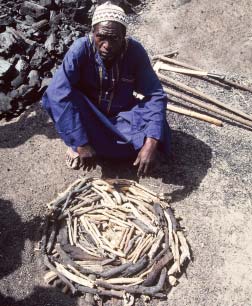
can, of course, provide associated development support.
It is also important for the GEF to keep track of associ-
However, significant leveraging of funding for global
ated projects (i.e., similar projects financed by govern-
objectives will have to come largely from other official
ments, other donors, or the private sector) to track the
and private sources of funding.
replication effects of GEF activities, which also indicate
successful co-financing. In the case of several completed
The OPS2 team concludes that while the IAs should con-
projects, such as in Hungary and Mauritius, follow-up
tinue to make strong efforts to provide co-financing to
activities that were significantly influenced by the GEF
GEF projects from their own operational budgets, the
project produced results that contributed to replication--
conclusion of overriding importance for the GEF is that
and the achievement of a wider impact of the GEF
total co-financing levels for the GEF portfolio must be
projects. However, as discussed below, it seems reason-
improved. Each IA, and each new EA, should make it
able to conclude that such monitoring should be con-
clear in the project documents how it will be account-
ducted as a separate and parallel exercise to that of co-
able for bringing a significant level of total co-financing
financing.
into each new project. The IAs should have some flex-
ibility, though, in how they put together the various ele-
Replication
ments of the overall financing package for each GEF project.
In addition to the mainstreaming and co-financing is-
sues, one of the very important factors in assessing GEF's
As the GEF is now entering a new phase in its develop-
performance is its impact through the replication of GEF-
ment, with an excess of demand for funds relative to
funded projects under other financial and operational
funds available, it will be important to consider stricter
modalities. It is difficult to ascertain the extent of such
criteria for co-financing as part of project approvals. Co-
replication since it is not being systematically monitored
financing criteria need to be established for projects based
in the GEF. However, there is some encouraging evidence
on the focal area, the development status of the country,
the size of the GEF portfolio in the country, the capacity
of the country to attract other sources of financing, the
implementing/executing agency, etc. Co-financing com-
mitments and achievements will need to be systemati-
cally assessed and monitored, for instance, in all project
completion, termination, and project reports, as well as
in the annual interagency Project Implementation Re-
view (PIR) process.
In this regard it would seem important to distinguish
between GEF co-financing that extends global environ-
mental benefits beyond those triggered by the GEF grants
themselves and GEF co-financing that provides associ-
ated development support. The difference between these
can vary substantially. On one of end of the scale is co-
financing which in its entirety is influenced by and in-
corporates GEF objectives. On the other end is a large
sector operation, such as for the energy sector, where
the GEF component is a strategically important compo-
nent on its own but does not affect or influence the main
results sought under the other components of the sector
operation.
The First Decade of the GEF [ 67 ]
from several completed and ongoing projects. It should
sustainable funding for GEF biodiversity projects in de-
also be remembered that because completed projects are
veloping countries, where budget allocations for con-
still few, it will take time before one can begin to moni-
servation is very low. In the Jordan Conservation of the Dana
tor and assess replication effects.
and Azraq Protected Areas project, the integrated approach to
the management system developed for the reserve has
The impact of the climate change portfolio projects will
been applied to all five other protected areas in the coun-
ultimately depend on the extent of replication. Since only
try. The positive lessons from the Southern Africa
28 projects have been completed so far, the direct im-
SABONET project for capacity development in taxonomy
pact on global environmental objectives is limited. Some
has been replicated in East Africa where the BOZONET
replication has been documented. For example, the De-
project has been developed; similar initiatives are being
centralized Wind Electric Power for Social and Economic Development
replicated by international NGOs and organizations, such
project in Mauritania and the Promotion of Electricity Energy
as the Nature Conservancy, WWF, IUCN, the Secretariat
Efficiency project in Thailand are resulting in replication
of the Pacific Commission, and the World Bank (Samoa
within these countries. The Poland Efficient Lighting Project
MPA). Replication has also been witnessed at the local
(PELP) has triggered a sustained decline in market prices
level, for example, in the East Africa Lake Victoria envi-
of compact fluorescent lamps (CFLs), to the benefit of
ronmental management and cross-border biodiversity
consumers, and increases in the market share of CFLs.
projects, and in-situ biodiversity conservation in Leba-
The Development of Coalbed Methane Resources in China project
non (Strengthening of National Capacity and Grassroots In-Situ Con-
has not only led to replication in China via a newly es-
servation for Sustainable Biodiversity Protection). In Samoa, where
tablished intermediary institution and widespread dis-
the Marine Biodiversity Protection and Management project has
semination of information about the technology inter-
raised extensive community support, some villages are
nationally, but the project's sustainability seems assured
copying the project, and establishing their own marine
as it led to the development of an apparently viable com-
protected areas (MPAs) and developing their own regu-
mercial company. Legal frameworks and legislation es-
lations--yielding a good example of replication of GEF
tablished as a result of GEF projects foster the future of
activities at the local level.
project operation well beyond the life of GEF funding,
as illustrated by the building code developed through
The OPS2 team believes that replication of successful
the energy efficiency project in Senegal that will posi-
approaches should be facilitated by programmatic ap-
tively affect that country's building industries, if ad-
proaches and knowledge sharing between projects and
equately enforced. Such examples are relatively rare in
other stakeholders. Pilot project demonstration activi-
the GEF climate change portfolio, however, and the port-
ties implemented to demonstrate community-based in-
folio is still too young to accurately assess the extent of
volvement in reducing environmental degradation have
replication. Factors that might enhance replication in the
been successful in harnessing the support of projects'
climate change portfolio are discussed further below.
main stakeholders (e.g., in the Bermejo River basin) and
have potential for extensive replication.
The contribution of a number of GEF biodiversity projects
to global environmental benefits has attracted the posi-
The GEF needs to monitor systematically the replication
tive attention of governments, conservationists, and lo-
of successful GEF activities. While awaiting evidence that
cal populations, which has led to some replication of
mainstreaming, co-financing, and the replication of suc-
GEF project activities elsewhere using both GEF and/or
cessful project results have made substantial progress,
donor funding. Financing mechanisms such as the trust
the focus on the private sector becomes even more stra-
funds initiated in the Uganda Bwindi Impenetrable National
tegically important for the future of the GEF.
Park and Mgahinga Gorilla National Park project has produced
[ 68 ] Program and Policy Issues and Findings
However, the OPS2 team finds that many opportunities
Recommendation
remain unexploited and that many barriers exist that
prevent a wider engagement of the private sector in GEF
Each IA and new Executing Agency should be
projects. At the same time, the Team believes there are
held responsible for generating significant
powerful rationales for seeking such engagement on a
additional resources to leverage GEF re-
substantially increased scale.
sources. A clear definition of co-financing
and a set of strict co-financing criteria should
As indicated earlier, excess demand is likely to become
be developed for different GEF project cat-
an overwhelming fact of life for the GEF. Yet the Team
egories and country circumstances. The em-
finds that opportunities to leverage GEF funds in ways
phasis should be on the total amount of ad-
that could mobilize large amounts of additional private
ditional co-financing considered to consti-
capital resources, especially for high-risk but potentially
tute a significant and effective cost-sharing
commercially viable projects in the climate portfolio,
arrangement for each project, rather than on
remain inadequately pursued. The mismatch between
the quantity of co-financing forthcoming
the long GEF project approval cycle and the often short
from an agency's operating programs and
time scale for private sector investment decisions is a
government contributions. Co-financing lev-
significant barrier. Yet GEF Secretariat has not pursued a
els should be monitored and assessed annu-
rapid response facility that the IFC proposed nor has it
ally through the interagency PIR process, as
encouraged IAs and EAs with requisite financial skills to
well as evaluated in the final project reports.
create or scale up other approaches using financial in-
The monitoring of replication of successful
termediaries.
project activities should be established as a
separate exercise in GEF.
In the biodiversity portfolio, conservation efforts in pro-
duction landscapes are a growing priority, reflecting the
predominance of this land use. In this context, engag-
C. Engaging the Private Sector
ing economic actors--from small farmers to commer-
The OPS2 team finds encouraging evidence of GEF ef-
cial firms--will play a critical role, for which economic
forts to engage the private sector more extensively in its
instruments and market transformation approaches are
activities on behalf of the global environment. For ex-
powerful tools. Yet GEF efforts to use these approaches
ample, OPS2 findings reveal that building private sector
within the biodiversity portfolio have so far been very
capacity in specific sectors played an important role in
limited, representing a largely untapped opportunity.
achieving objectives and significant global environmen-
Promising efforts to engage private sector interests in
tal benefits throughout ozone focal area projects. The
GEF projects in ecotourism and agro-forestry sectors
Team also notes with approval the efforts of the GEF Sec-
should be encouraged; the OPS2 team believes there are
retariat to build direct partnerships with private sector
also important opportunities to involve progressive pri-
entities; the efforts of UNDP to involve major compa-
vate sector entities in GEF biodiversity conservation efforts
nies in biodiversity conservation as co-funders, sources
in mining and commercial forestry. The OPS2 team also
of advice and technical support, and as partners in the
believes that private sector involvement will be equally
country-level policy dialogues conducted as part of the
critical in new GEF areas such as POPs and biosafety.
U.N. Secretary General's global compact; and the exten-
sive efforts of the Bank and the IFC to catalyze private
There are legitimate concerns about broad private sector
sector participation and investment within the climate
participation in GEF projects, including concerns about
portfolio, especially in the development and transfor-
subsidies or competition for scarce resources with gov-
mation of energy markets.
ernment or NGO projects. Yet direct subsidies should be
relatively rare. Such GEF support should be provided on
The First Decade of the GEF [ 69 ]
a short-term basis and clearly targeted towards helping
Lingering concerns about the appropriate extent of pri-
the private sector deal with the "incremental risks" as-
vate sector involvement in the GEF may themselves be a
sociated with the potential investments that secure glo-
significant barrier. Council endorsement of expanded en-
bal environmental benefits. It must also be offered with
gagement of the private sector and explicit acceptance
a realistic understanding that such private sector engage-
of the risks involved would help to remove uncertainties
ment can soon become sustainable on its own.
within the GEF.
The OPS2 team believes that other modalities are more
Clear guidelines from the GEFSEC on new modalities
effective, given that the need is to lower financial, tech-
would help, as would substantially increased GEFSEC staff
nology, or policy risks faced by economic actors. A 1999
expertise in relevant areas. (This will be discussed fur-
paper submitted to the GEF Council proposed a focus on
ther in Chapter 7.) In the current efforts to formulate a
removing barriers, using non-grant modalities such as
GEF private sector strategy it will be important to con-
contingent financing and guarantees, bankable feasibil-
sider what constitutes an adequate staff capacity in the GEF
ity studies, and direct long-term partnerships, including
Secretariat for effectively engaging the private sector.
equity investments. Experiments now underway with
many of these modalities suggest their value. The Team
also believes that private sector involvement and invest-
Recommendation
ment will enlarge the total pool of resources for GEF
projects and advance national development strategies. This
The GEF must place greater emphasis on
highlights the need for public-private partnerships,
sustainability and the potential for replica-
which the GEF must proactively pursue when develop-
tion in project design and implementation.
ing its work programs.
In particular, OPS2 recommends that the GEF
should engage the private sector more ef-
Private sector engagement also carries real financial and
fectively in all phases of the project cycle,
operational risks, since private sector entities are exposed
including securing adequate GEF Secretariat
to market fluctuations that can rapidly alter their invest-
expertise in this field. It should seek to cre-
ment and operational strategies. Nonetheless, the OPS2
ate an enabling environment in which more
team believes that the GEF should accept these risks
specific, market-oriented strategies and ex-
because they are outweighed by the potential global
panded GEF operational modalities enable
environmental benefits.
timely interaction with the private sector,
thereby forming the basis for long-term
Private sector capital flows to developing countries are
sustainability of GEF activities.
substantial (if unevenly spread), and even local private
sector investments play an increasingly major role in
shaping land use and energy supply and demand. The
D. Public Involvement and Participation
OPS2 team believes that it is important for the GEF to
Public involvement and effective stakeholder participa-
expand its efforts to influence these investments in ways
tion have been important features of the GEF since it
that create global environmental benefits. Moreover, most
was restructured. The 1996 Public Involvement Policy
of the private sector involvement by the GEF has so far
was a major policy development for the GEF. The
been in transitional economies. As a result, the poorer
operationalization of this policy has had three main out-
countries, which need the most help, are often left out.
comes:
Thus it is essential for the GEF to provide financing that
is consistent with the level of barriers needing to be re-
·
Processes for inclusive stakeholder participation in
moved in poorer countries.
project operations
[ 70 ] Program and Policy Issues and Findings

·
Transparency through disclosure of operational in-
involvement at different stages of the GEF project cycle,
formation, including project documents, evaluation
and to document best practices of stakeholder participa-
reports, and program lessons learned
tion, by focal area.
·
Enhanced consultation, including specific opportu-
When the GEF Council approved the Public Involvement
nities for civil society to communicate issues and
Policy in 1996, it "requested the Secretariat to prepare
influence the agenda of Council meetings.
operational guidelines as expeditiously as possible."18 The
1999 PIR identified the need for full community involve-
Stakeholder participation is discussed below. In the mul-
ment at all stages of project design, implementation,
tilateral system, the GEF has been providing leadership
monitoring, and evaluation, together with an assessment
in establishing open access practices for making opera-
of the broader political, social, and economic environ-
tional information available to the public. Its pioneering
ment.19 All three IAs report with equal emphasis that
role in this respect includes making all Council docu-
this issue is crucial to project success. The OPS2 team
ments freely available on its internet website. The OPS2
endorses this view.
team compliments the GEF for setting up an informa-
tion system that gives the public access to all project
The OPS2 team's examination of participation in the sec-
evaluations reports. It is possible that this novel approach
ond operational phase of the GEF finds that while many
among multilateral institutions has influenced other in-
projects are indeed addressing participation, particularly
ternational institutions to follow suit or to consider it
in areas where people and environment intersect most
seriously. The GEF has also taken commendable steps to
strongly (biodiversity and land degradation) and, in
invite some NGO representatives, selected by their peers,
many instances, doing so meaningfully, there has as yet
to Council meetings and to encourage that senior staff
been no systematic collection of baseline data (both
from the GEF entities participate in NGO consultations,
quantitative and qualitative) on participation against
which are being regularly conducted immediately prior
which progress can be monitored through assessment
to each Council meeting.
against agreed indicators. It is by no means evident ei-
ther that stakeholder analysis routinely informs the par-
The OPS1 concluded that the first
phase of GEF projects witnessed the
beginnings of the inclusion of local
stakeholders in key project activities,
noting the significant accomplish-
ment of the issuance of GEF guide-
lines on stakeholder participation,
and that trust funds, in particular,
provided innovative opportunities
for different stakeholders to work
together at both policy and opera-
tional levels. However, the OPS1 team
also found that careful monitoring
and evaluation of implementation
was still required. OPS1 therefore
recommended that the GEF Secre-
tariat should work with its IAs to de-
velop quantitative and qualitative
indicators of successful stakeholder
The First Decade of the GEF [ 71 ]
ticipation approach, and thus to identifying appropri-
The GEF has made significant progress in obtaining wider
ate, inclusive approaches to project implementation.
acceptance for disclosure of information among the IAs.
Many GEF projects bring out encouraging evidence of
The OPS2 country visits found evidence of good partici-
stakeholder consultations. However, it is still difficult to
patory processes, benefit-sharing, and positive socioeco-
assess stakeholder participation systematically. GEF
nomic impacts from GEF projects in all the focal areas.
projects would benefit from addressing socioeconomic
Box 6.1 Effective Participation Delivers Results
The Reducing Biodiversity Loss at Selected Cross Border Sites in East Africa project commenced in 1998 and oper-
ates in Kenya, Tanzania, and Uganda. The project is a successful example of transboundary natural resource manage-
ment. Project activities include sustainable management of forest and grazing resources that cross the Tanzania-
Uganda border at Minziro-Sango Bay. This swamp forest, with adjacent wetlands in the Kagera River floodplain,
covers a total ecosystem area of 849 km2 including forest, swamp, and grassland.
Local communities in Bukoba District in Tanzania and Rakai District in Uganda were actively involved in project
design and implementation. Local communities are organized into management groups with responsibility for pro-
tection of the forest and associated resources. District and village environment committees (DEC & VEC) in Tanza-
nia and local environment committees (LEC) in Uganda have legal recognition and authority to manage the forest.
The Bukoba DEC closed the Minziro forest to logging as a result of awareness raised by the project and the alternative
income-generating activities promoted by it. Key messages include reducing seasonal burning (grass is now seen as a
valuable mulch for crops and thatching material); planting trees (the "10 indigenous trees per household" target to address
supply side is well on track with nurseries, and planted trees and growing saplings are everywhere); and using improved
stoves that burn 65 percent less fuel than traditional stoves (more than 3,000 built so far).
The work of the Environment Committees has resulted in reduced illegal logging in the forest - "we don't hear pit
saws any more," one old man told OPS2 team members. Environment Committees are now empowered to be
agents of change in each community - "we have become community mobilizers to protect our forest and improve
our lives," says the leader of Kassamya community. Land degradation is being arrested through the focus on forest
conservation, fire management, tree planting, and extension of sustainable agriculture techniques.
Effective information dissemination during consultation for preparation and active participation in implementa-
tion allows communities to see links and tradeoffs between forest use and habitat protection, deforestation, and
declining water resources. This enabled harmonized community planning, resource documentation, and analysis,
which will lead to effective forest management plans. These activities demonstrate a strong sense of ownership
and a "one team" culture between community, government staff, and project coordinators. There is a visible differ-
ence between unmanaged and managed forests in the project area. Local team members have learned to use forest
management planning tools such as Conflict Mapping Matrices and Threat Reduction Assessment (TRA).
One of the reasons the project has succeeded is the active engagement of political leaders at the regional (East
African Community), national (Political Focal Point/GEF Council Member) and district council scales. The strong
sense of ownership developed in district governments augurs well for the sustainability of the project. Project
success has led to project experience and key staff being invited to participate in the East African Community (EAC)
Environment Committee, which generated changes in forest law and regulations.
[ 72 ] Program and Policy Issues and Findings
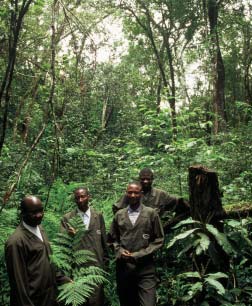
and livelihoods issues more systematically and in greater
Such conclusions, particularly the recognition of the
depth, including in the application of participatory pro-
importance of participatory processes in building suc-
cesses and through the development of appropriate moni-
cessful projects, are welcome. However, it is clear that
toring indicators, so that both participation and
more remains to be done, particularly in terms of sys-
sustainability issues may be addressed more effectively.
tematically assessing the experience on participation,
including:
Three of the four program studies noted that participa-
tion constituted a key element of successful projects. The
·
Applying GEF guidelines on participation across the
Land Degradation Program Study concluded that people-
portfolio, and the extent to which different forms
focused projects tended to be strong projects. The Inter-
of participation are used, as appropriate, for differ-
national Waters Program Study found a number of inno-
ent target groups
vative mechanisms for stakeholder participation among
several international waters projects that facilitated the
·
Determining whether inclusive, ongoing participa-
creation of local and regional bodies, the participation
tory processes are followed in GEF-supported
of the private sector, and, in many cases, led to measur-
projects
able improvements in environmental indicators.
·
Generating more information on the quality of par-
ticipation, from which lessons can be learned for
The Biodiversity Program Study stresses the importance
sustainability and replicability.
of involving stakeholders at all stages of the project, and
specifically considers such involvement a pre-condition
GEF projects have used a variety of tools to create jobs,
for achieving many of the project activities. Implemen-
enhance incomes, and use resources sustainably. These
tation experience from the 78 projects examined within
include direct investment, subsidy, credit, conservation
this study show that comprehensive stakeholder involve-
ment took place in 30 percent of the projects and partial
involvement in 20 percent. About 25 percent of the
projects included plans for such involvement, but had
no reported evidence that they had in fact been carried
out. The remaining quarter of the projects had either
poor or no participation. Overall, the OPS2 team agrees
with the Program Study's conclusion that inadequate
stakeholder participation in project design and imple-
mentation has inhibited the success of biodiversity
projects in meeting their objectives.
Beneficiary participation is not emphasized in the Climate
Change Program Study, except for those projects catering
to rural energy needs. However, the GEF Project Implemen-
tation Review for 2000 identifies two major social impacts
of GEF climate change strategies: (i) "adding to the social
reservoirs of both expert and community awareness and
knowledge" and (ii) "the demonstration of creative project
approaches including impacts on an improved quality of
life by bringing together mixes of government, busi-
ness, community and other stakeholders."
The First Decade of the GEF [ 73 ]
trusts, and alternative livelihood activities, often in in-
ronment issues, leading to successful project impacts and
novative mixes. Matching up the short-term needs of
the mobilization of community and other resources.
local people for generating work, income, and economic
Similar comments were made in many other countries
progress with the long-term management of natural re-
visited, including Jordan, Lebanon, Nepal, Samoa, and
sources to capture local and global benefits is explicitly
Uganda, where government officials reported that the
recognized in a number of projects in all four focal areas.
GEF had raised the profile of global and national envi-
ronmental issues in their countries. A number of politi-
The trend towards the creation of new economic oppor-
cians met by the OPS2 team during their country visits
tunities at the local level through implementation of
showed full awareness of GEF projects and the associ-
environmental policies is an important component in
ated global environment issues in their countries and/
advancing the GEF's global environmental mandate, as
or regions.
people become stakeholders in the true sense of the word,
and as their livelihoods become more entwined with
In terms of outreach activities, the OPS2 team noted
environmental sustainability than with environmental
during its country visits that most GEF projects in Africa
degradation. Evidence exists to show that the GEF can
have disseminated information on project activities and
play a catalytic role toward achieving socioeconomic
ways to manage global environment issues through edu-
benefits in a mutually reinforcing manner. Examples of
cation outreach programs, interpretation centers, signage,
projects in the three main focal areas that achieve this
and newsletters. However, such activities were not rou-
have been previously referred to in Chapter 3.
tinely documented. A special case was found under the
South Africa Cape Peninsula Biodiversity Conservation project (see
The outcomes of many GEF-financed projects show in-
Box 6.2).
creased awareness and understanding on the part of lo-
cal people, decisionmakers, and politicians about the
Measuring Stakeholder Perceptions of Participation
importance of global environment issues. This can lead
The OPS2 team used Goal Attainment Scaling (GAS) tech-
to active participation of key stakeholders in activities to
niques to quantify stakeholder perceptions relating to
address these issues and deliver global environmental
participation in GEF projects.
benefits.
GAS matrices were completed by 161 participants in
The OPS2 team noted during their country visits that
OPS2 country visits--stakeholders in national and re-
many line ministries showed awareness of global envi-
gional GEF projects who identified themselves as gov-
ronment issues. In Brazil, for example, a range of stake-
ernment institutions, executing agencies, NGOs, project
holders informed the OPS2 team that the GEF support
participants, or project beneficiaries. These data are from
had played a substantial, and in many instances critical,
non-systematic samples of participants in OPS2 country
role in generating increased awareness of global envi-
visits and are therefore not definitive. However, they do
Box 6.2 Documented, Proactive Public Consultation
In the South Africa Cape Peninsula National Park project, whose Corporate Plan (June 1998) stated that "...we are
committed to maintaining a culture of transparency through relevant information sharing and good communica-
tions with internal and external stakeholders," local and provincial government, business, organized labor, academic
representatives, CBOs, and civic associations held regular, recorded meetings bimonthly and developed proactive
outreach programs to communicate a common vision, policy, and 5-year strategic plan for the Park. Activities in-
cluded media liaison, establishment of a database of 1,200 organizations and 800 individuals, capacity-building
tours and workshops, joint discussion fora, and documentation of all public processes on video.
[ 74 ] Program and Policy Issues and Findings
Summary Perceptions of Participation
Summary Perceptions of Participation
by Stakeholder Institutions
by Stakeholder Institutions
40
30
35
25
30
20
25
ution
ib
20
15
Frequency
% Distr
15
10
10
5
5
0
0
Worse
As expected
Better
Worse
As expected
Better
than expected
than expected
than expected
than expected
Perceived GEF Performance
Perceived GEF Performance
NGO
Executing Agency
Project Participant
provide an indication of stakeholder perceptions to in-
impact on stakeholder participation. However, the dif-
crease the rigor of findings from country visits. Detailed
ferent perception of some NGO stakeholders suggests
data and analysis, including a summary of responses from
the need for new or additional management responses
stakeholders in national and regional GEF projects to GAS
from the GEF and its IA partners.
matrices relating to stakeholder participation, are pre-
sented in Annex 3.
Broadening the Base of Public Consultation
The importance of broad-based participation and own-
The GAS data presented in Charts 6.1 and 6.2 suggest
ership through the involvement of all relevant stakehold-
that participation in GEF projects is being implemented
ers is stressed in the PIR 2000.20 GEF activities (e.g., in
largely as stakeholders expect. Executing agencies and
Jordan, Panama, and Senegal) have positively influenced
participants in national and regional projects perceived
a broadening in the base of public consultation (see Box
that a range of government and civil society stakehold-
6.3). However, there remains a need to include the pri-
ers participate in the GEF project preparation and also
vate sector as well as NGOs, and to recognize that the
are actively involved in the GEF project implementation.
private sector consists of a range of entities, from large
These perceptions suggest that national and regional GEF
corporations to small rural enterprises, that will require
projects meet stakeholder expectations for participation.
different modalities of engagement. The same approaches
cannot be successfully used for all stakeholders. Differ-
The GAS data highlighted some important differences
ent projects call for different levels of stakeholder par-
in perception about participation. Despite the GEF's ef-
ticipation. This has implications for the introduction of
forts to engage the NGO community, many NGO par-
a more systematized public involvement approach and
ticipants in OPS2 country visits perceived a limited par-
for its documentation and measurement.
ticipation of selected stakeholders in some GEF project
activities. The GAS data presented in Annex 3 demon-
In Brazil, information technology has been successfully
strates the different perceptions of stakeholder partici-
used in the climate change focal area to create a network
pation by NGOs, executing agencies, and project par-
involving more than 100 institutions (see Box 6.4). The
ticipants. Significantly, country executing agencies and
availability of information in local languages is a key tool
project participants responding to the OPS2 GAS survey
to facilitate participation, transparency, and timely in-
had similar perceptions of participation in GEF projects.
formation dissemination. However, a remaining chal-
This reinforces the general perception gained during
lenge in GEF activities, exemplified in Romania, is the
OPS2 country visits that GEF projects have had a positive
need to improve communications between local and
The First Decade of the GEF [ 75 ]
Box 6.3 Delegation of Decisionmaking to NGOs
The GEF has helped to develop an NGO culture in some countries in which NGOs are not usually highly accepted
or encouraged by "officialdom." For example, decisionmaking related to the Small Grants Program (SGP) in Senegal
has been delegated to an NGO coalition (CONGA), and efforts were made to set up co-management of parks and
to provide decentralization of forest licensing. All stakeholders recognized the need for, and importance of, partici-
patory approaches.
national level stakeholders, as well as to involve a broader
ticipation, with governments being held responsible for
range of stakeholders in both project preparation and
both documenting and reporting back on the process.
implementation.
Where participation is integral to projects, there is fre-
The inclusion of professional social development exper-
quently a lack of statistics on intended beneficiaries,
tise in project implementation teams can lead to sub-
which are not usually gender-disaggregated. Clearer lines
stantial results in terms of meaningful community par-
of accountability, and common reporting systems across
ticipation: For example, the OPS2 team noted the posi-
all IAs/EAs for ensuring that broad-based, inclusive par-
tive impact of the appointment of a social scientist in
ticipation is a feature of GEF projects, are required. Stake-
the East Africa cross-border biodiversity project, where
holders must be clearly defined, and the term must be
the number of participating communities almost doubled
understood to include more than institutional stakehold-
over a period of 3 years. On the other hand, where local
ers alone.
participation in the development of an initial project
concept and design is absent or weak, ownership also
Where projects are working with institutions whose
tends to be weak, and projects can miss opportunities
experience in stakeholder participation is limited, a set
identified by community participants, such as in the
of common "good practice" guidelines, showing how
Uganda Mgahinga and Bwindi national parks project.
to carry out stakeholder analysis and design and imple-
Active participation by communities in implementation
ment gender-aware, inclusive participatory processes
is important, but in order to sustain project activities,
would be helpful. Such guidelines should outline the
adaptive management and flexibility are also required. A
tools, methodologies, best practices, and lessons learned
mechanism for transferring such lessons from GEF
from GEF and other relevant projects, as well as where
project field experiences to stakeholders implementing
to obtain further support.
or preparing GEF projects would contribute to enhanced
sustainability and project relevance.
The GEF Secretariat should strengthen its existing in-
house capacity to strategically address social issues and
Inclusive, Ongoing Participation. Stakeholder partici-
to ensure that projects prepared by countries and IAs
pation and gender-inclusive processes have not been in-
and EAs effectively address issues of inclusive participa-
tegral to GEF projects relative to budget lines reflecting
tion, gender, and poverty alleviation, to deliver sustain-
the processes, and thus allowing measures to be taken to
able global environmental benefits (see Chapter 7).
address non-institutional and community stakeholder
involvement, as well as that of government and NGOs.
Vulnerable Groups. Issues concerning vulnerable
During OPS2 country visits, NGO regional consultations
groups,21 including indigenous communities, are the
in Meso-America suggested that the GEF make funding
subject of the particular operational policies of each IA,
available specifically for participation, to encourage gov-
and are supplemented by the public involvement policy
ernments to be more open in this regard, and to link
of the GEF. Specific guidelines for addressing indigenous
financial criteria to genuine, ongoing stakeholder par-
peoples and involuntary resettlement issues in GEF
[ 76 ] Program and Policy Issues and Findings
projects are dealt with differently by each IA, but the
ticipation of indigenous and local communities." As of
main thrust is the same--to provide developmental safe-
FY2000, GEF has provided direct funding of nearly $203
guards for vulnerable groups of people. These guidelines
million to 25 projects in which indigenous communi-
have been the subject of extensive debate and in-depth
ties are actively involved in the design and implementa-
examination in recent years, but remain an issue that is
tion of biodiversity conservation and sustainable use ac-
both sensitive and difficult to address, even in the case
tivities. With co-financing, the total amount expected to
of quite explicit operational policies such as those of the
be mobilized is about $600 million, which is aimed at
World Bank Group.22
supporting over 100 different ethnic and tribal popula-
tions around the developing world. However, there is
The core of the GEF's overall mandate is to deliver glo-
little systematically documented information across
bal environmental benefits. Addressing the needs of the
projects on the quality of involvement with indigenous
poor and the vulnerable through GEF-supported initia-
communities, though clearly some projects have ad-
tives is one of the means towards achieving this end.
dressed this issue substantively.
Poverty-environment linkages are particularly strong in
the focal areas of biodiversity and land degradation.
In Darien, Panama, for example, the main objective of
the UNDP Biodiversity Conservation in the Darien Region project
Certain direct opportunities for poverty-targeted inter-
was the protection and conservation of the rich
ventions present themselves within the context of GEF's
biodiversity of the remaining forests of Darien, through
mandate. For example, climate change projects in Mexico
the development of local capacities and implementation
and Bolivia, where government-designed "twinning"
of sustainable practices for the use of natural resources.
projects (under which institutional development part-
To meet its key objective, the project tried to integrate
nerships are developed between a national institution
elements of participatory sustainable development with
and a supporting institution in another country) have
efforts to strengthen management capacity of the pro-
invested in renewable energy by focusing on the poorest
tected area. The population of the province comes from
villages. Equally, the sustainable use approach to con-
three different ethnic groups (indigenous, Afro-colonial,
serving biodiversity responds to environmental manage-
and immigrants from the central provinces), which have
ment goals through integrated conservation and devel-
different cultural backgrounds and production means.
opment and through community-based natural resource
The human settlements in the province are occupied
management. These approaches become particularly
mainly in agricultural activities and to a lesser degree,
important in the global commons and transboundary
cattle raising and some trade services; they are affected
resources, where the issues of property and access be-
by significant poverty. Indigenous populations in par-
come more challenging. In the focal area of waters, the
ticular suffer from the highest levels of extreme poverty.
open access fishery poses serious problems affecting poor
When the project's new execution phase began in 1999,
coastal populations, which are among the poorest groups
the technical team faced high levels of mistrust by nu-
worldwide. In the area of climate change, poor rural
merous local communities, as a result of the prevailing
households in a number of instances are assisted with
perception that commitments went unfulfilled in the
credit in order to make renewable energy more affordable.
previous cycle. Nonetheless, they were able to regain the
confidence and interest of local inhabitants and reestab-
Indigenous Communities. GEF's project experience
lish credibility. Actions taken included implementing a
working with indigenous communities is concentrated
successful microcredit program in three communities
in the biodiversity focal area. In accordance with Article
that strengthened community capacities and promoted
8(j) and related provisions of the Convention on Bio-
the participation of women--providing an example of
logical Diversity (CBD), the GEF's operational programs
how (i) concentration on consolidation of internal or-
on biodiversity conservation and sustainable use con-
ganizational processes, accompanied by small financial
tain activities that emphasize "the full and effective par-
stimuli, (ii) a series of well-designed activities through
The First Decade of the GEF [ 77 ]
a participatory process linked to the revolving credit fund,
The OPS2 team concludes that there is a need for the
and (iii) a training and follow-up program can have an
GEF to produce systematic, documented information
important positive impact on attitudes.
across projects on its involvement with indigenous com-
munities.
The scale of medium-sized projects particularly assists
civil society engagement, including that of indigenous
communities. Community stakeholders are seen as key
Recommendation
partners in MSP implementation. Their substantial con-
tributions are in terms of time, indigenous knowledge,
An interagency task force should be orga-
and local resources devoted to a project. Projects consid-
nized by the GEF Secretariat for the purpose
ered successful are those where local stakeholders have
of developing an effective and systematic
taken ownership of existing initiatives and future tasks.
way to document information on stake-
However, in MSPs as well, meaningful participation of
holder consultations and participation, in-
indigenous communities is not easily achieved due to
cluding the involvement of indigenous com-
suspicion of outside support, arising both from past lega-
munities, in GEF-funded projects.
cies of violence and the use of indigenous knowledge
without permission. In particular, encroachment over
ancestral lands has been so prevalent that achieving par-
E. Role of NGOs and Local Communities
ticipation necessitates building capacity related to secur-
The GEF's overall engagement with civil society partners
ing claims to the land and its resources. For all these
(community-based organizations (CBOs), non govern-
reasons, the partnership between MSP executing agen-
ment organizations (NGOs), scientific institutions, and
cies (mostly NGOs) and indigenous peoples should al-
the private sector) has been framed under the Public
ways proceed from a highly participatory process to build
Involvement Policy, which requires the GEF to promote
trust. This has implications for the sustainability of MSPs,
information dissemination, consultation, and stakeholder
since the empowerment of highly vulnerable groups re-
participation. The importance of the role of NGOs and
quires a long lead time. A 3-year time horizon for projects
CBOs in GEF programs has also been articulated in a
can be considered unrealistic where indigenous groups
number of other GEF policy documents: For example,
are key partners, unless prior investments in building
the New Delhi Statement of the First GEF Assembly noted,
trust and ensuring meaningful modalities for participa-
"The GEF should increase consultations with NGOs and
tion have been carried out. Many GEF projects seek ac-
local communities concerning GEF activities; GEF should
tively to address this issue.
develop and implement an action plan to strengthen
country-level coordination and promote genuine coun-
A systematic sharing of information on project experi-
try ownership of GEF-financed activities, including the
ences would allow the GEF to benefit from, and share
active involvement of local and regional experts and com-
more widely, lessons learned from its fairly substantive--
munity groups in project design and implementation."
if uneven--engagements in this area. Both MSPs and the
In giving effect to this guidance, the GEF catalyzed the
Small Grants Program have proved to be particularly re-
establishment of the GEF-NGO Network that serves as a
sponsive modalities for interaction with community-level
consultative body as well as a channel of information to
stakeholders. Opportunities to capitalize on the sustain-
national civil society groups on GEF policies and programs.
able development benefits clearly achievable through
these project modalities should be optimized, including
NGOs have played a valuable role in the functioning of
making better use of indigenous knowledge and related
the GEF, ranging from policy analysis and project plan-
revenue sharing.
ning at the international level to project implementation
and monitoring at the local level. Over 700 NGOs are
[ 78 ] Program and Policy Issues and Findings
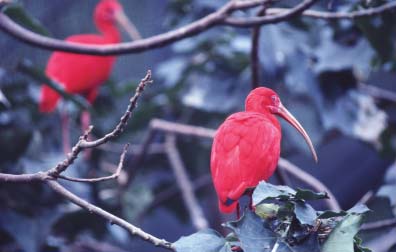
participating actively--that is, receiving funding from
tion dissemination. While the country dialogue work-
GEF projects--in GEF activities as co-executing agents
shops being organized by the GEF do address these in-
or service contractors. Of these, more than three-fourths
formation gaps to some extent, their effectiveness re-
are based in developing countries. International NGOs
mains limited as long as they are one-off events that do
(INGOs) have been particularly effective when they have
not address the need for a system of ongoing internal
functioned in strong partnership with national and local
communications between stakeholders and with the GEF.
NGOs and CBOs. INGOs have brought technical strengths
to bear on projects, have assisted in securing co-financ-
The need for capacity development among national and
ing, have supported capacity building for national NGOs,
local NGOs was expressed frequently to the OPS2 team.
and been responsible for the establishment of medium-
Lack of capacity--and resources--place national NGOs
sized projects that provide a window of opportunity for
at a major disadvantage in preparing GEF project pro-
NGOs to take the lead in implementing GEF programs.
posals. The extent of the empowerment and involvement
of local NGOs and CBOs in GEF projects tends to reflect
While the OPS2 country visits found some notable ex-
the culture of civil society involvement in the country's
amples of NGO achievements in furthering GEF goals,
nation-building efforts in general. For example, the OPS2
considerable additional opportunities remain for using
team found vigorous NGO networks involved in GEF
NGO and CBO strengths more fully in GEF activities,
programs in countries such as Brazil and Nepal on the
including in mobilization of civil society support.
one hand and a hesitant, nascent NGO presence in GEF
programs in China on the other.
In most of the countries visited, the relationship between
the GEF national focal points (NFPs) and NGOs was tenu-
OPS 2 country visits have highlighted the important role
ous and unproductive. In some countries, NFPs had very
that NGOs and CBOs have played in the GEF program
little knowledge of the role that NGOs were expected to
with particular reference to the Small Grants Program
play in GEF programs. NGOs reported that NFPs often
and the medium-sized projects. The work of international
considered the official project endorsement required
NGOs and developing country NGOs in global environ-
from governments to mean that GEF initiatives were es-
mental policy analysis and advocacy has been impres-
sentially government-owned and
that, in consequence, NGOs had no
intrinsic right to participate in them.
In one country, government endorse-
ment for GEF projects was perceived
as being used as a method for the
exclusion of "unwelcome" NGOs.
During some country visits, the
OPS2 team received complaints that
NGOs were not kept adequately in-
formed about GEF policies and pro-
cedures or GEF-related country pri-
orities, and did not receive informa-
tion on current and pipeline GEF
projects. The NGO focal points sys-
tem established by the GEF-NGO
Network appears, with a few excep-
tions, to be ineffective in informa-
The First Decade of the GEF [ 79 ]
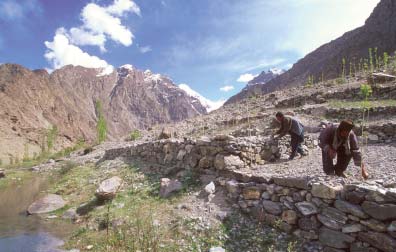
sive, particularly that related to the work of the conven-
people and communities are actively involved. Small, stra-
tions. The OPS2 team feels that the degree of involve-
tegically targeted projects can contribute to solving glo-
ment of NGOs and CBOs in the planning, implementa-
bal environmental problems while enhancing the liveli-
tion, and monitoring of GEF projects is a key determi-
hood security of local people.
nant of the effectiveness and sustainability in many of
these projects. The GEF could further stress the impor-
The OPS2 team received very positive reports about the
tance of NGO and CBO participation in GEF operations
GEF/SGP in the countries they visited. National institu-
during country dialogue exercises.
tional arrangements for management of the program
under the overall supervision of the UNDP are generally
During its country visits, the OPS2 team was informed
functioning effectively. National project portfolios in-
that the range of INGO in-country partners is often lim-
clude innovative and impressive projects characterized
ited. The need for capacity development among both
by strong stakeholder participation, and consistent with
national and local NGOs was expressed frequently to the
GEF operational programs. GEF/SGP has received strong
OPS2 team. Lack of required capacity--and resources--
support from relevant governmental agencies, academic
places national NGOs at a particular disadvantage in pre-
institutions, NGOs, local governments, and community
paring GEF project proposals. OPS2 identified few GEF-
groups. National ownership of the GEF/SGP is reflected
supported, in-country programs that provide technical
by the commitment to the program from in-country
support to NGOs.
professionals represented on the national steering com-
mittees and the generally high quality of the national
F. Project Modalities
coordinators recruited under the program.
Small Grants Program
The main constraint faced by SGP relates to meeting non-
The GEF Small Grants Program (SGP) is currently being
grant management costs. The extremely stringent bud-
implemented by the UNDP in 61 countries. The GEF/
getary rules on management overheads allows little flex-
SGP is based on the rationale that global environmental
ibility for the national coordinator to carry out adequate
problems can be addressed more sustainably when local
information services and provide research support for
improving the program's focus and
targeting and initiating proactive
partnership building and cross-
learning. This is particularly true of
countries where co-financing for the
SGP has not yet been successful.
While it is reasonable to expect that
the overall impact on the global en-
vironment from the SGP will be
small in the early stages, until the
larger connections with the national
environmental and sustainable devel-
opment programs are fully devel-
oped, there is evidence that many of
these projects deliver more favorable
cost-benefit ratios than larger GEF
projects. An important factor is the
perceived relevance of the GEF/SGP
[ 80 ] Program and Policy Issues and Findings
for developing countries in the way in which it links
impact on the global environment within the three focal
global, national, and local-level issues through a trans-
areas. However, there are clear indicators of impressive
parent, strongly participatory, and country-driven ap-
progress in terms of capacity development, innovation
proach to project planning, design, and implementation.
and use of new methodologies, awareness raising, and
prospects for sustainability. MSPs have leveraged signifi-
To the extent that the GEF/SGP projects have generated
cant co-financing, created conditions for replication, and
wide stakeholder participation, built local capacity in
have increased the profile of global environmental pri-
project management, successfully raised significant co-
orities and obligations within national government policy
financing (in a number of cases from UNDP's develop-
and planning processes. MSP projects have been particu-
ment funds), and routinely involved income-generating
larly successful in creating synergy with sustainable de-
activities, their chances of sustainability are good. How-
velopment activities at the national level, including bring-
ever, it is important to ensure that the income-generat-
ing about livelihood and income opportunities for key
ing components of SGP projects are based on good fea-
stakeholders.
sibility studies and incorporate business-oriented man-
agement approaches.
The MSP evaluation acknowledges that though measure-
ment is difficult it is very likely that the overall value/
The OPS2 team concurs with the conclusion of the Second
impact of GEF dollars invested in MSPs compares favor-
Independent Evaluation of the GEF/SGP (1998) that the
ably with investments in many larger projects of either
program occupies a unique and valuable niche within the
GEF or other donors, especially in the biodiversity focal
GEF and that it would be appropriate for the GEF Small
area. OPS2 country visits have confirmed that MSPs have
Grants Program to be expanded so that it is accessible in all
been impressive in attracting participation from a di-
countries that meet the criteria for its implementation.
verse range of stakeholders including government agen-
cies, NGOs, community groups, research institutions,
Medium-Sized Projects (MSPs) Within the GEF Portfolio
international organizations, and the private sector.
Under the program approved by the GEF Council in April
1996, GEF's medium-sized projects (MSPs) were in-
However, there have been widespread complaints from
tended as a set of smaller and more rapidly
country partners in regard to the length of processing
"implementable" projects in comparison to GEF's full-
times for MSP proposals, suggesting that original expec-
sized projects (FSPs). The maximum funding ceiling for
tations in respect to expedited processing have not been
each project was originally $750,000 but was later re-
met. The 2001 Medium-Sized Projects Evaluation pro-
vised to $1 million. MSPs were to have simplified ap-
vided an analysis of the factors responsible for the ex-
proval procedures ("expedited procedures") that would
tended and often erratic processing times and longer
encourage greater participation from non-official insti-
project cycles. These include:
tutions and civil society groups, particularly NGOs.
·
Variations in the capacities of the UNDP and the World
As of June 30, 2001, GEF had approved 121 MSPs with
Bank country offices to initiate and facilitate MSPs
a total outlay of $90 million in GEF resources with $125
million in co-financing. MSPs were subjected to a desk
·
Delays in obtaining MSP endorsements from national
review by the GEF monitoring and evaluation unit in
operational focal points for NGO-executed projects
1998 and a full evaluation in 2001 to provide an input
to the work of the OPS2.
·
The involvement of new and inexperienced coun-
try partners that require more extensive IA inputs
The MSP evaluation concluded that it was still too early
to enable them to navigate through GEF program
in the implementation of the majority of MSPs (six out
priorities and operational procedures (including the
of 121 projects completed) to ascertain their precise
incremental cost calculation)
The First Decade of the GEF [ 81 ]
·
Unclear and sometimes conflicting technical reviews
financial sustainability to projects and programs. Such a
from different sources in the IAs and the GEFSEC
mechanism has the advantage over traditional project
that have added considerably to processing time
funding in that it can provide a very long timeline for its
operations, thereby giving more long-term assurance,
·
Adjustments in legal, procurement, and disburse-
continuity, and predictability to funding for activities that
ment procedures of IAs to fit smaller projects in re-
require a longer development period than can be ac-
mote locations.
commodated under the conventional project timeframe.
The OPS2 team endorses the recommendation of the
Trust funds involve legally set-aside assets (such as GEF
2001 Medium-Sized Projects Evaluation that "major
grants) whose use is restricted to the specific purposes
bottlenecks and delays in MSP processing need to be
set out in the legal trust agreement. They can be finan-
tracked more closely so that GEFSEC and/or IA manage-
cially structured in three different ways: endowments, whose
ment can intervene and address problems as they arise...
funds are invested to earn income (with only that earned
A transparent tracking system should be established to
income available for agreed purposes); sinking funds, which
enable project proponents and other interested parties
are designed to be dispersed over a fixed, usually long-
to easily follow the status and progress of MSPs under
term period; and revolving funds, which provide for the re-
preparation through the various stages of GEF review
ceipt of new resources on a regular basis, such as ear-
and approval."
marked local taxes. A trust fund can combine one or all
of these features.
MSPs clearly form an important segment of the GEF
project portfolio between the highly regarded GEF Small
As of the end of 1998, the GEF had funded seven trust
Grants Program that supports small, community-based
funds within its biodiversity focal area. Most initiatives
initiatives and the full-sized projects that address larger
with conservation trust funds over the last decade have
national and regional level initiatives. MSPs are not only
resulted from lead roles taken by non-governmental in-
suited to major NGO-led initiatives, but also small coun-
stitutions. A recent GEF evaluation (Experience with Con-
tries, including small island states, that have found MSPs
servation Trust Funds, 1999, GEF) noted the main ac-
very appropriate for meeting many of their financing
complishments of trust funds have included:
needs for making contributions to the global environ-
ment conventions.
·
Providing a basic "resource security" for operating
protected areas
The OPS2 team concludes that it is important that the
GEF Council allocate adequate resources to this GEF
·
Generating and managing financial resources over
mechanism. MSPs should be able to serve as spearheads
a long time period
for new, innovative, and participatory initiatives that
could later be considered for larger scale and more wide-
·
Encouraging the participation of civil society in-
spread replication. This is particularly important in the
stitutions
immediate future when the competing demands for GEF
resources far exceed supply.
·
Increasing scientific research applied to conserva-
tion issues
Trust Fund mechanisms
During its meetings with the IAs and with various coun-
·
Improving public awareness of conservation issues.
try stakeholders, the OPS2 team encountered expressions
of appreciation and praise for the GEF's role in promot-
While there was some uncertainty regarding the long-
ing and establishing long-term trust funds under GEF
term conservation impact of trust funds, they provide
projects. Trust funds are innovative means of ensuring
more continuity than other project financing modali-
[ 82 ] Program and Policy Issues and Findings
ties. The above evaluation points out that in order to suc-
progress in engaging the scientific community at the
ceed, trust funds require adequate governance structures
national and regional levels remains limited.
and legal systems, staff, and technical support to allow
them to proactively influence their environment; moni-
The main activities in which GEF has successfully in-
tor their results and learn from experience; maintain cred-
volved national scientific communities is in preparing
ible and transparent procedures; and support participa-
reports to the conventions, particularly national inven-
tory approaches.
tories and national strategies and action plans. UNEP has
focused special attention on mobilizing scientific sup-
The OPS2 team understood that the GEF had encoun-
port for global and regional monitoring and assessment
tered difficulties in getting other sources of funding com-
exercises. On the other hand, the involvement of national
mitted to provide co-financing for trust funds. The GEF
science and technology communities in developing
cannot be expected to be sole supporter of such local
countries in a sustained way in the design and imple-
funding mechanisms. This should not stop the GEF from
mentation of country-driven GEF projects is limited and
trying further. In searching for innovative financial mo-
non-systematic. While STAP does provide a conduit for
dalities, the GEF should be encouraged to continue pro-
interfacing with the wider science and technology net-
motion of such longer term operational approaches. Trust
works, this is considered an inadequate mechanism be-
funds should not just be confined to the biodiversity
cause of a lack of supporting mechanisms at the regional
focal area, since they can play a strategically important
and national levels.
role for institution building more generally.
By broadening and intensifying this partnership with
The GEF should proceed, on the basis of a strictly de-
the science and technology communities, GEF would not
fined matching principle, to finance trust funds in which
merely be making in-country project planning and
it becomes one of several financial backers, rather than
implementation cost-effective and sustainable, it would
their sole promoter. The OPS2 team would encourage
build capacity that enabled developing countries to meet
the GEF to explore further the most effective ways to
their obligations under the conventions. Expertise could
support trust funds in GEF operations in collaboration
be built in-country for developing and applying scien-
with other sources of funding.
tific indicators to measure project impacts in each of the
GEF focal areas. Policy guidance should be given to the
G. Generation and Use of Scientific Knowledge
implementing agencies regarding how national science
The Scientific and Technical Advisory Panel (STAP) con-
and technology communities could be encouraged to
stitutes the central mechanism for providing the GEF with
participate as key stakeholders in the project planning
advice on science and technology issues. GEF recognizes
and implementation process.
the importance of mobilizing the wider scientific and
technological community to help incorporate scientific
The OPS2 team finds that country ownership of projects
inputs in GEF operations at the national and local levels,
and global environmental issues is significantly enhanced
including the development of methods for assessing the
when government engages the national scientific and
efficacy of ongoing GEF operations. Indeed, STAP orga-
technical community, as has been often the result in GEF
nized an international workshop in January 1999 on the
enabling activities.
theme "Integrating Science and Technology into GEF
Work," which focused attention on how to establish a
H. Information and Communication
dialogue with the global and regional science and tech-
Information and communication services (outreach)
nology networks and what were the most appropriate
represent a relatively recent undertaking in the GEF. In
mechanisms for involving the science and technology
the last 2 years, with Council support, the GEF has initi-
community at the national level in the different phases
ated a multipronged approach to its outreach and
of the GEF project cycle. Despite the efforts of STAP,
communications responsibilities that include country
The First Decade of the GEF [ 83 ]
dialogue workshops, project or issue-based workshops
holders) being able to easily access the Internet.
organized in parallel with major convention meetings,
preparation and dissemination of experience related to
For GEF, it is important that its main objectives and ap-
best practices and lessons learned, NGO-targeted infor-
proach to global environmental issues be better under-
mation dissemination, use of national and international
stood in government (particularly through the opera-
media, and the development and enhancement of the
tional focal points), and civil society (particularly among
GEF website.
NGOs and the private sector).
Yet during its country visits, the OPS2 team found that
The GEF needs to become more adept at spreading its
there was still little clarity or knowledge, even among
messages in easily understandable information products,
key stakeholders, about GEF and its goals, structure, and
well beyond its present reliance on website services. Its
program implementation modalities. Many of the results
visibility would be enhanced by launching flagship pub-
brought about by GEF funding were mostly known by
lications on the global environment on the basis of GEF's
their association with the implementing agencies. There
operational experiences and project results. As a demon-
was clearly a problem with the attribution of credit to
stration of its commitment to shift the focus from project
GEF for achievements under the program. The use of the
approvals to achieving high-quality results, the GEF
GEF logo on GEF publications from the field and assets
should consider including a section in the GEF Annual
created out of GEF funding did not follow any system-
Reports on the outcomes achieved under completed
atic guidelines, resulting in greater prominence being
projects that have been evaluated during the year.
given to the IA partners involved. The GEF website is
valuable and comprehensive, but GEF cannot rely on
I. Sharing lessons learned
member countries (and various GEF in-country stake-
The OPS2 team considers it important that cross-learn-
ing be strengthened and accelerated, so that GEF resources
can be used more effectively. The Team also believes
strongly that specific efforts should be made to encour-
age more systematic use of the results and outputs of
GEF-funded projects for the improvement of national
environmental plans and strategies. Each of the imple-
menting agencies has their own systems for drawing les-
sons from operational experiences. The key point for the
GEF is to encourage and facilitate more intensive inter-
agency sharing of experiences relevant to the GEF.
The annual Project Implementation Reviews provide a
useful forum for interagency sharing of experiences. But
the GEF also needs to find more effective ways to share
field experiences among in-country project officers and
field staff, and thereby broaden the basis for drawing
operational lessons. Furthermore, country-based mana-
gerial or technical staff with GEF implementation expe-
rience could be considered for consulting assignments
under project mid-term reviews and final project evalu-
ations for similar type projects in other countries. This
could enhance the dissemination of GEF project lessons.
[ 84 ] Program and Policy Issues and Findings
A notable result for the international waters area is that
vidual country dialogues, they can open important chan-
it is the only GEF focal area with an easily accessible and
nels for long-term programmatic approaches. Some of
established mechanism, through IW:LEARN,23 to carry
the IAs have also been testing joint country exercises of
out and promote the exchange of information, technolo-
this kind. The GEF-World Bank and UNDP collaboration
gies, good practices, innovative instruments and poli-
on the China Climate Change Program has significantly
cies, and lessons learned in general. In addition, in Oc-
enhanced GEF activities. All three IAs have experience
tober 2000, the First GEF International Waters Confer-
with joint programming under several international
ence took place in Bucharest. Conference attendees in-
waters projects, as in the Black Sea and Danube partner-
cluded present representatives from the IAs and the GEF
ships. The OPS2 team notes that both Mexico and South
Secretariat and GEF project participants. It provided a
Africa are developing medium-term strategies for GEF
forum for exchanging experiences between GEF projects
funding in collaboration with local stakeholders.
and for promoting collaboration to incorporate lessons,
avoid duplication, and ensure efficiency.
Besides IA experience and capacity, a key precondition
of such approaches is the credibility of the GEF, built up
The OPS2 team considers it important that cross-learning
over a period of time through a set of GEF-funded
processes be strengthened and accelerated particularly
projects perceived to be part of a country's overall devel-
on the interagency basis, within each project category.
opment strategy. A second precondition is local capabil-
ity in effective program management and links with other
J. Long-Term Programmatic Approach
sources of finance, including a clear commitment of
The GEF is considering introducing the programmatic
domestic financial resources. A third precondition is the
approach into its set of different modalities. The basic
commitment and willingness of agencies to work across
outline of such an approach was articulated through an
sectoral ministries and boundaries to integrate and main-
information paper presented at the May 2001 Council
stream global environmental issues into national plan-
meeting, where the modality was described as provid-
ning and development processes. A basic foundation for
ing "a longer term financial support through a country-
all this should be a high level of national political and
based program, which would go beyond the scope of an
financial commitment to the environment, and in par-
individual project to support an integrated set of projects,
ticular, to the proposed program.
funded through a phased, multiyear commitment."24 The
GEF expects to pilot the approach in a few countries
The OPS2 team supports the GEF strategy of piloting the
during the next 2-3 years. Such a joint approach will
programmatic approach in a few countries by building
become even more important when new executing agen-
on IA experiences and focusing on those where there is
cies and new focal areas are being added into the GEF's
a significant portfolio and/or pipeline of GEF-funded
expanding mandate.
activities. One important point is that a programmatic
approach should not be pursued on a piecemeal basis by
The experience and capacities of the IAs is obviously
each IA, nor by the GEF Secretariat alone, but should
important. Particular agencies, such as UNDP and the
involve all key GEF partners in a joint exercise with the
World Bank, are crucial partners in this regard. With ef-
national operational focal point and other key stakehold-
fective mainstreaming of GEF objectives into their indi-
ers in the country, all coordinated by the GEF Secretariat.
The First Decade of the GEF [ 85 ]
7 INSTITUTIONAL AND
MANAGEMENT ISSUES
The central theme of OPS2 is the assessment of the re-
sults and impacts achieved in completed and ongoing
GEF projects. While the OPS2 team was not requested to
evaluate the institutional and legal issues affecting the
future of GEF, it was asked to consider how GEF institu-
tional structures and relationships have facilitated or
impeded the attainment of results. During its work with
the GEF Secretariat, the implementing agencies, STAP, the
new executing agencies, country officials, NGOs, and
other stakeholders, the OPS2 team has tried to assess the
impacts of GEF's institutional structure, and the division
of roles and responsibilities between GEF entities, on
project implementation, content and quality of the GEF
portfolio, and the recent streamlining of the GEF project
cycle (see GEF Council document GEF/C.16/5). In this
context, the Team also considered how expanding the
GEF, to include new executing agencies, is affecting its
programming efforts and coordination between GEF
entities.
The GEF is a novel multilateral organizational arrange-
ment that embodies institutional partnerships at differ-
ent levels and dimensions, facilitated by the GEF Coun-
cil and Secretariat, and builds on the comparative
strengths of the different partner entities. The first level
of partnership is among the Council, GEF Secretariat,
and the three implementing agencies--UNDP, UNEP, and
the World Bank--given their significant roles in the evo-
lution of the GEF and in operational program develop-
ment, preparation and implementation of GEF-financed
activities, and monitoring and evaluation. The World Bank
acts as the Trustee to the GEF Trust Fund and provides
administrative support to the GEF Secretariat.
During earlier phases of the GEF, considerable problems
of coordination between the GEF Secretariat and the three
implementing agencies were reported. Given the fledg-
ling character of this new financial facility and its inno-
vative nature, such problems were inevitable. The con-
cepts of global environmental benefits and incremental
costs were new and had not yet been tested operationally.
ing three implementing agencies. The strategic and co-
As a source of funding, the GEF emerged at a time when
ordination roles of the Secretariat will therefore continue
OECD country contributions to UNDP and UNEP core
to grow in importance over the next few years.
funding were declining and when the World Bank faced
limitations to further growth in its lending. A new grant
Institutional Relations with the Conventions
facility of this magnitude inevitably attracted much interest
As noted in Chapter 2, in GEF's role as the financial
within the implementing agencies. It is not surprising
mechanism of the conventions, it responds to guidance
that considerable competition for GEF resources arose.
received from the conventions by developing appropri-
ate operational programs and criteria for funding. The
In this situation, the Secretariat and the IAs attempted to
GEF Secretariat plays the lead role in executing this func-
ensure that this competition was constructive and that
tion in cooperation with the implementing agencies and
the resulting outcome supported both the interests of
STAP. The GEF CEO, on behalf of the GEF Council, re-
country partners and the objectives of the GEF Opera-
ports regularly to the relevant Conference of the Parties.
tional Strategy and operational programs. In recent years,
relations have become more cooperative and harmoni-
The GEF Secretariat works closely with the appropriate
ous between these four primary entities of the GEF. All
Convention Secretariat on technical matters relating to
of them reported to the OPS2 team that progress had
the interpretation of convention guidance. As the OPS2
been made in this respect.
team has noted, GEF's response to convention guidance
has been pragmatic and generally satisfactory. The cur-
However, several factors are going to test the capacity of
rent sharing of responsibilities among the GEF entities
the GEF in the coming years. An increasing number of
is appropriate and sound, and should continue. The co-
convention-related tasks fall within the GEF's mandate.
ordinating role of the GEF Secretariat becomes even more
The GEF has been requested to handle new responsibili-
important as the GEF becomes the financial mechanism
ties by the UNFCCC and the Stockholm Convention on
for more conventions. The OPS2 team would like to
POPs. The GEF Council is considering introducing land
emphasize that clear communication and consistency in
degradation as a focal area. The portfolio under imple-
COP guidance regarding GEF priorities would enhance
mentation is growing very rapidly. There are currently
the timeliness and quality of GEF responses.
more than 200 projects, not including enabling activi-
ties, under active implementation. The GEF has there-
The Team finds that, as the only multiconvention finan-
fore become a multiconvention financing mechanism,
cial facility, it is appropriate for GEF to be open to con-
with growing responsibilities under each of them. The
sidering the inclusion of new convention-related focal
current trajectory of the GEF suggests that in the near
areas. However, in such cases, it should take up consul-
future the demand for its resources will increase signifi-
tations with each Convention to make sure that it does
cantly. Its resources are far short of immediate demand.
not overburden GEF's limited resources, particularly with
A growing number of countries have an increasing un-
respect to new protocols and areas of support. If new
derstanding of the GEF and knowledge of the possibili-
activities need to be introduced and prioritized, and if
ties of marrying global environmental benefits with sus-
no new resources are being made available, then the con-
tainable development objectives.
ventions should be encouraged to identify current con-
vention-related activities that no longer have the same
As GEF's mandate has been expanding, the nature of the
priority and can therefore be discontinued or reduced
global economy has changed. The roles of the private
in scope. This must be part of a two-way dialogue that is
sector and civil society in managing the global commons
reflected in GEF's regular reporting to the COPs.
have become more pronounced. Most recently, it has been
agreed that GEF operating arrangements will be expanded
A rapidly expanding number of convention-related meet-
to include seven executing agencies as well as the exist-
ings and consultations requiring the presence of GEF
The First Decade of the GEF [ 87 ]
Secretariat staff is taking up a major part of its annual
portfolio-related workshops, in parallel with the ongo-
work program and budget. Representatives of the GEF
ing country dialogue workshops, which focus on fos-
Secretariat are expected to participate in a growing num-
tering broader awareness of GEF policies and procedures.
ber of substantive meetings related to the conventions.
The travel costs of staff in the GEF Secretariat for partici-
The GEF operational focal point should be able to func-
pation in convention-related meetings increased about
tion as the main facilitator for such coordination of the
50 percent in FY01 as compared with the FY00. Such
GEF program in country. How this task is to be orga-
costs absorbed 37 percent of total travel expenses for the
nized and established should be the country's own re-
GEF Secretariat in FY00 and accounts for 49 percent in FY01.
sponsibility, but the GEF can provide support to help
increase the effectiveness of operational focal points and
Still, as noted in Chapter 4, from an institutional per-
strengthen their communication with the country's con-
spective, it is important for the GEF to address the chal-
vention focal points, with the goal of enhancing sub-
lenge of connecting GEF operational focal points effec-
stantially the efficiency of GEF interventions. The OPS2
tively with the convention focal points at the country
team has concluded that the GEF Secretariat must lead
level so that reporting on GEF projects and their results
this coordination effort, together with other GEF enti-
are included in the national reporting to the conven-
ties, to the extent that they are engaged in GEF opera-
tions. Because the GEF's main institutional mandate is to
tional activities in that country. Such a role would in-
serve as financial mechanisms for the conventions, it is
volve the GEF Secretariat in a new lead function and re-
obviously important for those who provide funding to
quire the establishment of a new and separate unit (Coun-
the GEF to expect that the conventions' ultimate clients,
try Support Team) in the GEF Secretariat to support the
the country recipients of such support, will articulate
operational focal points. These positions should be filled
their views and judgment on GEF's effectiveness, not just
by staff possessing adequate regional knowledge and lan-
to the GEF Council and other GEF entities, but also to
guage skills and the capacity to provide effective, prompt
the convention bodies that provide guidance to the GEF.
operational processing; procedural guidance; and infor-
The level of GEF replenishments will very likely be in-
mation support services.
fluenced by the reporting of the recipient countries at
convention-related meetings.
Currently, the GEF Secretariat has neither the staff capac-
ity nor the budgetary resources to establish effective sup-
The OPS2 team finds it important that the GEF Secre-
port services for the operational focal points. The OPS2
tariat continues to take a lead role in carrying out the
team concludes that the lack of such support is a major
various functions relating to the conventions. This insti-
weakness in the present GEF system. Hence, the Team
tutional task is likely to increase substantially in the years
would encourage the GEF Council to give this matter
ahead, and it is important that the GEF Secretariat has
immediate attention.
adequate staff and budget resources to carry out these
tasks effectively and efficiently.
Technical and Operational Capacities in the IAs and EAs
The roles of the three IAs have been crucial in the GEF's
Relations with Countries
operational achievements. They have made extensive tech-
The conclusions from Chapter 5 also have significant
nical contributions to the various focal areas and cross-
institutional implications. The GEF needs to focus on
cutting themes. Each has provided technical expertise
strengthening the operational focal points in each coun-
and operational experience based on their comparative
try. This will entail proactive efforts by the GEF Secre-
advantages. Their continued strong involvement in GEF
tariat as well as the IAs to provide regular, up-to-date
operations will be important for the future of GEF, as it
information on the project pipeline and the status of the
also expands to include new executing agencies. How-
GEF portfolio in each country. It will also involve mak-
ever, in the view of the Team, no single IA can on its own
ing available specific funding to facilitate in-country
absorb all of the present and planned GEF functions.
[ 88 ] Institutional and Management Issues
Neither can the GEF Secretariat manage these functions
implementation results. However, once the GEF has as-
on its own. Each entity is a critical partner for ensuring
certained this specific operational capacity, the new ex-
that the GEF evolves effectively to meet expanded opera-
ecuting agencies should be enabled to access the GEF
tional challenges.
work program and become directly accountable to the
GEF Council.
One of the encouraging findings of OPS2 was the exist-
ence of a larger number of GEF-committed staff within
Capacity to Engage the Private Sector
the IAs. They are deeply motivated by GEF objectives and
As noted in Chapter 6, the OPS2 team has concluded
often work exceptionally hard to overcome processing
that it is important for the GEF to become more actively
problems and project design complexities. IA represen-
involved in engaging the private sector. One of the op-
tatives frequently stressed to the OPS2 team that such
erational principles of the GEF emphasizes its catalytic
staff contributions could be maintained and developed
role and leveraging of additional financing from other
further only with a reasonably predictable sense in the
sources. The private sector can obviously make a sub-
medium-term future of the funding levels of GEF activi-
stantial contribution in this respect. In particular, it will
ties, around which IAs could plan. The Team considers
often have a key role in the replication of GEF project
such an approach feasible and believes GEF can derive a
results. GEF's capacity to engage the private sector thus
common "indicative planning" framework, which can
becomes a critical issue. OPS2 would encourage the GEF
reasonably predict resource availability over the medium-
Secretariat, in partnership with the implementing and
term future.
executing agencies, to take a lead role in creating an in-
teragency task force which can help to develop more
The OPS2 team considers it feasible to arrive at such
specific, market-oriented strategies to attract private sec-
rolling, medium-term agreements, say, on a 3-year ba-
tor partnerships and to tailor GEF operational modali-
sis, which would be linked to indicators for strategic
ties to enable timely interaction with the private sector
relevance, programmatic consistency, expected outcomes,
in developing policies and strategies to engage the pri-
and annually adjusted for changes emerging from ex-
vate sector effectively.
pressed country priorities. This should be accommodated
within the GEF Corporate Business Plan.
The GEF Secretariat has made slow progress in recruit-
ing senior staff with private sector expertise. The CEO
The new executing agencies will occupy a distinctive
has been participating in dialogues with various private
level of partnership to prepare and implement GEF-fi-
sector representatives and corporate leaders, but there is
nanced activities. They will add a welcome dimension to
scope for strengthening the institutional relationships
GEF's capabilities in fulfilling country needs, but also
between the GEF and the private sector in general, be-
will stimulate increased competition for GEF funding
yond the linkages available through the IFC. Lessons can
and more complex country and interagency coordina-
be drawn from examples of GEF activities that already
tion. Besides the overall institutional "due diligence"
involve private sector actors. The OPS2 team considers it
examination, which has been or is being conducted for
important for the GEF Secretariat to add strong profes-
each EA, it is also very important that an additional (sec-
sional capacity with broad private sector experience, in-
ond step) institutional examination be conducted for
cluding experience from developing countries. In addi-
each EA to determine its technical and operational ca-
tion this can be achieved by attracting seconded staff
pacity to serve GEF effectively within each GEF focal area.
from the private sector on a temporary and rotational
A gradual and selective approach would seem appropri-
basis. Furthermore, expertise may be drawn from within
ate. Their comparative strengths for GEF-related tasks
the IAs, particularly the IFC and the new EAs, particu-
should be carefully examined with respect to areas where
larly the regional development banks. The very recent
the agencies demonstrate fully satisfactory, GEF-relevant,
recruitment in the GEF Secretariat of a professional with
operational capacity to help countries produce effective
private sector expertise is an encouraging step. Under
The First Decade of the GEF [ 89 ]

current efforts to formulate a GEF private sector strategy,
Strategic Advice
it will be important to examine further the scope of pri-
By general agreement, the STAP's most important role is
vate sector capacity needed within the GEF to achieve its
providing scientific and technical guidance in the devel-
global environmental goals.
opment of OPS and other operational modalities. The
OPS2 team finds that providing strategic advice is an
The Role of the STAP
absolutely critical role for the STAP and that structural
The Scientific and Technical Advisory Panel (STAP) has
changes discussed below are needed to strengthen its
an essential role to play in grounding GEF programs and
ability to fulfill this function.
projects in the best available scientific information. How-
ever, OPS2 discussions with STAP members, with the
Selective Reviews
STAP Secretariat, with the GEF Secretariat, and with the
The OPS2 team generally believes that STAP should be
IAs suggest that the present system of providing scien-
used quite selectively to perform this role, but the STAP
tific advice to the GEF could be significantly improved.
does offer a useful perspective not limited to natural sci-
ence or engineering questions.
There is general agreement that the STAP performs three
basic roles:
Project Reviews
Use of the STAP roster of experts to perform project re-
·
Providing strategic advice to the GEF on a wide range
views, as the system now functions, raises questions
of issues, including the formulation of new OPs
about the utility and appropriateness of the reviews. While
the reviews are generally reported to be of good quality,
·
Providing selective reviews of specific projects during
as appraised by the STAP and the IAs, the review system
implementation and after completion, when requested
nonetheless needs to be strengthened. Reviews occur
relatively late in the project design cycle (typically just
·
Developing and maintaining a roster of experts that
prior to submission for Council approval), are often done
agencies can call on for assistance with project re-
very quickly, and draw on a small fraction of the roster.
views during the project design stage.
It is striking that 77 percent of the experts in the roster
have never been used for reviews.
Most reviews are performed by ex-
perts from developed countries, al-
though the percentage of reviews
from developing country experts has
risen significantly in recent years to
about 28 percent.
Moreover, despite an elaborate qual-
ity control process on reviews, the
process has virtually never resulted
in experts being removed from the
roster. Indeed, there is no systematic
pruning of the roster, raising ques-
tions about its quality and relevance
to the evolving GEF program. The
OPS2 team is concerned that project
reviews, as currently performed,
function as an obligatory but some-
[ 90 ] Institutional and Management Issues
times meaningless check-off and do not make the best
use of the expertise represented by the STAP roster, even
Recommendation
though reviews are clearly sometimes useful to the IAs.
Repeated use of the same reviewers and the fact that 25
To strengthen the GEF system for providing
percent of the reviews are evaluated as less-than-good
science and technology inputs, OPS2 recom-
reviews indicate that the system needs improvement. The
mends appointing STAP members for stag-
STAP itself shared with OPS2 team its view that the STAP
gered terms, exploring with STAP members
project review step comes too late in the project design
mechanisms for improving the use of in-
cycle to be optimal and that brief reviews were some-
country scientific and technical expertise
times superficial.
within the GEF, and seeking STAP recommen-
dations for appropriate changes to improve
As a result, the OPS2 team finds that the STAP review
the project review system and to enhance
component in the project cycle should be substantially
the utility of the roster of experts.
changed. The STAP roster needs major pruning and up-
grading. The Team also finds that experts from the roster
could contribute more if their role was more participa-
The GEF Processes for Project Approval and Start-up
tory and consultative than judgmental and if they could
Since its inception, numerous complaints have been
provide a science and technology perspective at an early,
raised about the lengthy and time-consuming processes
conceptual stage of project design with continuing feed-
for preparing and implementing GEF projects. During
back through the project cycle to the extent needed. The
the OPS2 country visits and NGO consultations, con-
OPS2 team notes with approval the suggestion from STAP
cerns were continually raised about lengthy GEF proce-
of involving two members of the roster, at least one from
dures for appraising and approving project proposals. IA
a developing country, in each project review, to ensure a
staff in country offices, government officials, and other
breadth of perspective. The OPS2 team would encourage
project stakeholders perceived the project review pro-
STAP project reviews to be evaluated regularly as part of
cess to be excessively layered with multiple reviews at IA
overall reports on each completed GEF project to assess
headquarters and in the GEF Secretariat.
the reviews' value.
These concerns have both institutional and managerial
STAP Structural Issues
implications. The concerns raised had to do with the same
OPS2 found instances where coordination between the
authority--in the GEF Secretariat and at IA headquar-
STAP Secretariat and the rest of the GEF has been prob-
ters--producing multiple sets of comments without ef-
lematic. OPS2 welcomes the UNEP decision to move the
fective coordination of their internal consistency, and
STAP Secretariat to UNEP's Regional Office in Washing-
with different views often expressed when new staff were
ton, D.C in 2002, in order to improve coordination be-
assigned to a specific project or new sets of comments
tween the STAP Secretariat and the GEF Secretariat.
coming subsequently from the same supervising or ad-
visory source indicating new viewpoints and new for-
A more important structural issue arises from the cur-
mats for presenting project proposals and final reports.
rent practice of appointing the STAP membership all at
Such problems can be addressed through improved man-
the same time and for the same term. The OPS2 team
agement practices and more clarity about the institu-
finds that this has led to loss of institutional memory
tional roles within the GEF.
and a lengthy learning curve for each new STAP. Conse-
quently, OPS2 findings have generated the suggestion
However, the OPS2 team noted that many of projects
that STAP members should be appointed for staggered
with lengthy design and preparation were also consid-
terms. The Team believes that this structural change would
ered better projects because time had been taken to plan
tend to improve communication and management issues.
them very carefully. By their very nature, GEF projects
The First Decade of the GEF [ 91 ]
are seldom straightforward or "simple." Quite the con-
should be encouraged to undertake a more in-depth re-
trary, they are often fairly complex and require consid-
view of processing time in each annual Project Perfor-
erable time to explore various technical options and ex-
mance Review. The OPS2 team finds that this is an issue
perimental designs, as well as considerable stakeholder
which must be addressed more thoroughly in the GEF.
consultations, in many cases. Therefore GEF regular
There is scope for achieving improvements. There is also
projects cannot necessarily be expected to fit comfort-
a need for current approval timeframes to be better ex-
ably into "fast track" processing procedures, in which
plained at the country level.
they may lose quality-enhancing preparatory steps. Im-
provements sought to enable shorter timeframes for
Processing times for approving medium-sized projects
project processing therefore must be balanced between
(MSPs) present opportunities for more immediate im-
procedures necessary to ensure project quality and those
provements. These projects were expected to require
that are poorly coordinated and potentially duplicate and
much shorter processing times than regular GEF projects,
overlap existing institutional functions.
but this has not materialized. Elapsed time from project
identification to submission of the briefs to the GEF Sec-
These matters have been a source of ongoing concern
retariat is, on average, 342 days for UNEP and 566 days
since the beginning of GEF. Project processing times are
for UNDP. The OPS2 team noted the following assess-
frequently addressed during various interagency consul-
ment from the recent evaluation of MSPs:
tations. The annual GEF Project Performance Reports have
analyzed data on the average time taken from GEF ap-
"While there have been improvements in pro-
proval to start of project implementation. For the larger
cessing over time, MSPs have clearly not been
investment-type projects undertaken by the World Bank,
expedited. Reality has fallen far short of the ex-
there was some reduction in the time needed to process
pectations that MSPs would be a relatively fast-
projects in 1998 and 1999 but, in 2000, it increased to
moving and flexible funding opportunity.
about the same level as in 1997--an average of about
GEFSEC expected that it would take about 6
700 days. This recent increase was explained by a large
months between the time a project concept was
standard deviation caused in part by a few exceptionally
approved and project implementation could
difficult projects. Some reduction in time was achieved
begin. In practice, the average has been over 2
by UNDP and UNEP--to a level of 362 days and 339
years, with several projects taking 3 or 4 years.
days, respectively, in 2000.
Even this figure does not include the substan-
tial time often required to prepare a project
The OPS2 team found it difficult to draw firm conclu-
concept to the satisfaction of both GEFSEC and
sions from this data since they do not easily lend them-
the IAs, which has varied from a few months
selves to interagency comparisons. Given the complex
to over 2 years."
nature of regular (full-sized) GEF projects and the need
for careful preparations and consultations, it is not obvi-
The OPS2 team concludes that more efforts should be
ous that substantial improvements can be achieved in
devoted to reviewing the processing procedures and pro-
reducing the processing time. It is well understood that
cess management in the GEF. There seems to be scope to
project designs containing very demanding objectives,
improve the time needed for processing regular GEF
such as global benefits, cannot be expected to move
projects; that is even more true for processing MSPs. The
speedily through the review system without running
latter should receive high priority for immediate cor-
some risk of reducing project quality.
rective action.
However, there seems to be room for some improve-
Information and Communication
ment in the management system and project review pro-
The GEF Secretariat focuses on corporate-level aware-
cedures in both the GEF Secretariat and the IAs. The GEF
ness raising, and it uses as its fora the convention-re-
[ 92 ] Institutional and Management Issues

lated and other international meetings, speeches by the
ferent entities of the GEF about how information about
CEO, and publications documenting GEF results and
global environmental issues and the GEF will be dissemi-
impacts. The implementing agencies focus on outreach
nated during project development and implementation.
and information at the project level. However, the OPS2
To demonstrate its commitment to shifting the empha-
visits have revealed that the implementing agencies have
sis from project approvals to high-quality results, it would
little incentive to give credit to the GEF for operational
seem appropriate for GEF annual reports to include a
achievements--there is a widespread tendency for the
section on project outcomes emerging from the evalua-
implementing agencies to omit giving credit to the GEF
tions of completed projects conducted during the year.
and rather emphasize their own role in the projects. As a
The GEF Instrument includes text requesting that such
result, the GEF suffers from poor visibility, even on
reporting should be included in GEF Annual Reports.
projects that it fully funds.
Partnerships to Manage for Quality and Funding Scarcity
Country stakeholders do not find it easy to understand
Given the excess demand for GEF resources and the new
the GEF's goals, objectives, and operational modalities,
operational programs and responsibilities being entrusted
particularly its essential emphasis on global environmen-
to the GEF, there is a need for a new management para-
tal benefits and incremental cost financing. Good infor-
digm for managing and allocating scarce GEF resources
mation products from the GEF would help to alleviate
to deliver the greatest possible global environmental
the prevailing misconceptions and misunderstandings
benefit. This requires an active partnership between all
about GEF's mandate and processes. Furthermore, GEF
GEF entities throughout the project cycle--recognizing
information products must be produced and made avail-
the comparative advantages of each in particular areas.
able in all UN languages. The current overwhelming re-
Such collaboration throughout the project cycle will
liance by the GEF on English language products may be
enable continuous improvement: well-informed pro-
for cost-saving reasons, but it is quite unsatisfactory in
the larger context of its global program.
The GEF website is valuable and effective, but the GEF
cannot rely on member countries to satisfy their main
information needs from this one source. Print, CD-ROM,
and visual media products are also essential. While eas-
ily accessible in more developed countries, Internet ac-
cess is not only much more difficult in many developing
countries, but also involves considerable costs, which
may not be easily met at the country level, especially by
NGOs. While the digital divide among rich and poor
nations is being gradually bridged, there remain con-
siderable obstacles, including the need to change and
adapt GEF communication policies to compensate for
the absence of easy and low-cost use of the Internet in
developing countries. Public sector agencies, educational
institutions, and local community organizations are par-
ticularly vulnerable in this respect.
The Secretariat should lead this work, in cooperation with
the implementing agencies and new executing agencies.
There should be a clear understanding between the dif-
The First Decade of the GEF [ 93 ]
gramming, preparation, and implementation that bal-
interrelationships--and in its management and staffing
ances global environmental benefits and the sustainable
functions.
development needs of countries and monitoring and
evaluation that shares program and project information.
The implementing agencies should continue to be mainly
responsible for project implementation, but also must
The 1999 Project Performance Report recommended a
be open to, and appreciate, the strategic and practical
transition from an approvals focus to a results-based cul-
value of active GEF Secretariat participation in monitor-
ture. The OPS2 team endorses that move, and recom-
ing the main strategic and programmatic goals during
mends a subsequent transition for GEF: from a results
GEF project implementation. More field-level experience
focus to a quality-based culture. This would be an effec-
will also have a positive impact on the professional ca-
tive way to manage excess demand for GEF resources
pacities of the GEF Secretariat staff in interpreting pro-
and ensure that the GEF delivers global environmental
gramming criteria and providing strategic guidance on
benefits. To successfully develop a results- and quality-
project concepts.
culture that delivers global environmental benefits, the
GEF Council needs to address:
There must also be opportunities for close coordination
during project evaluations because the difficult task of
·
The results-based relationship between the GEF Sec-
gaining knowledge and sharing experience about how
retariat and IAs
to best achieve positive results for the global environ-
ment could be more successfully carried out through a
·
The fee system for project implementation
collaborative approach.
·
Monitoring and evaluation functions
At the same time, there is scope for the Secretariat to
reduce its involvement in detailed project reviews prior
·
GEF Secretariat roles and responsibilities
to work program entry and final project approval. As part
of the creative partnership approach that the OPS2 con-
·
A strengthened institutional status for the GEF.
siders important for GEF project development and imple-
mentation, responsibility for some of this upfront re-
Results-Based Relationship Between the GEF Secretariat
view work may be shifted over to the IAs, with the un-
and IAs
derstanding that the Secretariat can then reprogram ca-
The GEF is a unique experiment in interagency collabo-
pacity that is freed up to become more involved in sup-
ration among important agencies in the UN system and
porting partnership tasks during project implementa-
the Bretton Woods system. This multilateral system in
tion and evaluation.
general is not well known for successful attempts at such
interagency collaboration in operational matters. The
It is encouraging to note that this idea has been discussed
OPS2 team considers the GEF to be an encouraging ex-
informally within the GEF and seems broadly acceptable
ample of constructive interagency cooperation. While
to the current GEF entities. At a GEF senior management
many problems have been encountered and there has
retreat held in June 2000, the Secretariat and the imple-
been considerable frustration at times, the GEF none-
menting agencies agreed on a set of actions to expedite
theless has demonstrated important results, which often
project processing and shift the focus towards imple-
can be attributed to effective collaboration between agen-
mentation. Under this principle, the Secretariat review
cies with different institutional purposes and processes.
during project preparation would focus on strategic
matters relevant to the GEF and not on technical mat-
While the GEF system has performed well overall, the
ters; the implementing agencies would be responsible
OPS2 team has identified room for some further spe-
for ensuring that projects meet GEF review criteria. In
cific improvements in its organizational structure and
exchange, the Secretariat would have a strategic role in
[ 94 ] Institutional and Management Issues
reviews of project implementation beyond the annual
ing of the fee system for GEF projects. Many of these
PIR exercise. Many of the elements of a plan to expedite
concerns related to accountability and transparency. The
project processing were approved by the Council at its
OPS2 team also noted that IA offices in some locations
meeting in November 2000.
seemed to regard GEF fees as a useful additional source
of non-earmarked funding. There are several examples
of project delays caused by bickering between UNDP, UNEP,
Recommendation
or the World Bank over fees and "rights" to projects.
The GEF should manage delivery of global
The OPS2 team finds that the current fee system should
environmental benefits by initiating a insti-
address at least three key management functions--keep-
tution-wide shift from an approval culture
ing institutional costs under careful control, allocating
to one that emphasizes quality and results.
resources in an open and transparent manner, and as-
This should be achieved through a partner-
suring, through associated service agreements, that all
ship approach that expands the use of inter-
parties concerned clearly understand what services will
agency task forces to address program and
be provided to GEF project clients and what results can
policy issues and adopts broader teamwork
be expected.
practices to support project implementation
and evaluation.
The Team has identified a number of opportunities to
strengthen the fee system to ensure that GEF projects
are effectively and efficiently implemented:
Fee System for Project Implementation
The GEF Secretariat has a specific responsibility to the
·
Accountability could be ensured by adopting out-
Council for ensuring that GEF resources are used to
put-based fee payments that are phased through the
achieve results in an appropriate and cost-effective manner.
life of the project and linked to specific project mile-
The Council in turn oversees GEF institutional costs, and
stones or outputs under an implementation service
is responsible for keeping them under close scrutiny.
agreement.
The GEF Council adopted the fee-based system in May
·
Transparency could be enhanced by making fees paid
1999--an innovative mechanism that compensates the
to IAs for project implementation a clear and inte-
IAs for costs incurred during project preparation and
gral component of project budgets, and thus ac-
implementation. In the 2 fiscal years since July 1999,
counted for and evaluated like other project com-
GEF has approved 282 projects for total GEF grants of
ponents. There is an opportunity to benchmark the
$991 million. These projects carried IA fees totaling $82
efficiency and effectiveness of IA performance by
million, equivalent to 8.3 percent of total grants approved
consulting with project participants, executing agen-
in that period. A benchmarking study presented to Coun-
cies, and project beneficiaries. Although fees have
cil in May 2000 found that GEF's project cost manage-
so far been largely the business of the IAs and the
ment practices were adequately and effectively methodi-
GEF Secretariat, a more transparent approach would
cal, rigorous, and demanding and, furthermore, that
increase the sense of partnership and create an ap-
GEF's flat-fee structure is neither unreasonable nor inap-
preciation for the roles and responsibilities of all
propriate. An independent evaluation of the fee system
stakeholders in GEF projects.
is scheduled to take place in 2002.
·
Competition might be addressed by encouraging the
IAs and government focal points consulted during OPS2
implementing agencies and the executing agencies
country visits and regional consultations consistently
to create cost-effective project approaches that are
raised concerns about a widespread lack of understand-
consistent with national priorities. Where the IAs,
The First Decade of the GEF [ 95 ]
EAs, and client governments choose to subcontract
addition, an output-based approach to fee payments
some project implementation services, there are
could be used with fee payments phased over the life of
expanded opportunities to enhance positive com-
the project using two or three payments linked to spe-
petition by involving the private sector and NGOs, as
cific project milestones and outputs linked to the stan-
well as other project executing institutions.
dard set of tasks performed by IAs or EAs.
Because IAs only earn fees for implementing projects
Monitoring and Evaluation
approved by the GEF Council, their engagements during
Effective monitoring and evaluation is central to a qual-
the identification and preparation stages of the project
ity culture because of its contribution to continuous
cycle carry a degree of risk. The Project Preparation and
improvement. The GEF monitoring and evaluation unit
Development Facility (PDF) modality recognizes this to
should strengthen its information dissemination and
some extent, but some IAs and other GEF stakeholders
institutional linkages with IAs and operational focal
expressed concerns to the OPS2 team that the upfront
points to enhance its support of three tasks: adaptive
perception of risks discourages innovative project de-
management at a project scale, portfolio management at
sign and execution that focuses on delivering global en-
a program scale, and a continuous improvement process
vironmental benefits. The existing modalities could ad-
at an institutional scale.
dress this concern by explicitly encouraging innovation
and offering special fees in association with PDF grants
The GEF Secretariat and implementing agencies have
to IAs for innovative project design that addresses prior-
monitoring and evaluation roles that reflect their respec-
ity operational-program objectives and delivers global
tive portfolio management and project implementation
environmental benefits. Fees should be transparently
responsibilities. The objectives and core activities of the
identified with reference to each project, be subject to
GEF monitoring and evaluation unit are spelled out in
audit, and be evaluated, to allow comparisons with other
the framework and work program for the GEF monitor-
project-related costs.
ing, evaluation, and dissemination activities.25 Its func-
tions are to guide decisionmaking on improvements in
The effectiveness of IA performance in GEF project imple-
program management, including adjustments and
mentation could be further strengthened by the GEF Sec-
amendments to policies, strategies, procedures, and
retariat, IAs, and EAs negotiating a standard set of tasks
projects; to account for resource use relative to objec-
to be performed by IAs and EAs with fee resources. In
tives; to document and disseminate lessons learned; and
to assess results and impacts.
Recommendation
The respective roles and responsibilities for monitoring
and evaluation among the GEF Secretariat and imple-
In response to the concerns raised when the
menting agencies need to be revisited. There is an op-
GEF was established regarding cost effi-
portunity to develop a better understanding between the
ciency, accountability for services provided,
GEF Secretariat and IAs for a partnership approach to
and monitoring of overhead costs, OPS2 rec-
program and project evaluation responsibilities. The GEF
ommends two measures: (i) establishing a
monitoring and evaluation team at the Secretariat oper-
standard set of tasks to be performed by the
ates principally at the program scale but uses selected
IAs with fee resources and (ii) adopting a
project-scale evaluations as case studies to inform pro-
simple output-based fee payment system for
gram evaluations. The GEF has published several pro-
IAs using two or three payments that are
gram evaluations--most notably in climate change.
phased through the life of a project and
Projects are routinely monitored and evaluated by imple-
linked to specific project milestones.
menting agencies, at mid-term and project completion.
[ 96 ] Institutional and Management Issues
Currently, there are no regular procedures or processes
There is an opportunity to effectively use the existing
that enable partnerships between the GEF Secretariat and
networks of IAs, executing agencies, and operational fo-
IAs for mid-term reviews and project evaluations. Good
cal points to disseminate this information where it is
teamwork should be encouraged among the GEF part-
relevant to other projects and countries. Such an approach
ners to ensure that these activities follow well-focused
would strengthen the linkage between the GEF monitor-
design and planning steps and that their outcomes bring
ing and evaluation unit and other actors in the project
out the key GEF objectives pursued under each project.
cycle--especially operational focal points, IAs, and ex-
The monitoring and evaluation team at the GEF Secre-
ecuting agencies--helping ensure that lessons learned
tariat should maintain full responsibility for program
are reflected in the design and management of new GEF
evaluation, but should also have a strategic and partici-
investments.
patory role in mid-term project reviews and the evalua-
tion of completed projects, without undermining the
The GEF monitoring and evaluation team has initiated
overall IA responsibility for project implementation.
innovative and thorough activities to assess results and
impacts. It needs to strengthen this work by focusing on
Annual Project Implementation Reviews are an impor-
program evaluation--predominantly assessing the effec-
tant tool to account for resource use relative to objec-
tiveness of GEF investments. A portfolio approach (as-
tives. The GEF monitoring and evaluation team will con-
sessing allocation and performance of investments by
tinue to prepare these but could consider involving more
sector, focal area, or thematic categories) could be added
actively the country operational focal points to provide
to the existing techniques to better reflect modern in-
participatory inputs to the IAs' annual reporting to the
vestment practices and generate guidance on allocating
GEF Secretariat. Such an approach would strengthen the
scarce GEF resources to the best possible use.
linkage between project reviews and project implemen-
tation and would support adaptive management for con-
Care should be taken to ensure that the monitoring and
tinuous improvement.
evaluation work is well balanced between conducting
intensive in-depth studies and undertaking assessments
GEF has successfully documented the results and lessons
that monitor more immediate program achievements and
learned from monitoring and evalu-
ation of its investments. However,
while some interesting progress has
been made, e.g., as a result of the
Poland Efficient Lighting project, there is
not yet much systematic evidence
that the GEF Secretariat or IAs, let
alone country partners, fully reflect
and act on lessons learned docu-
ments or other publications stem-
ming from the program evaluation
and selected project indicators. There
is obviously a time-lag effect before
this becomes apparent but there
seems to be a need to link more ef-
fectively the evaluation findings with
management activities.
The First Decade of the GEF [ 97 ]
global environmental objectives that are the main focus
Recommendation
of GEF's mandate.
With due respect for the IAs' overall responsi-
Furthermore, the OPS2 team considers it important that
bility for project implementation and evalua-
evaluation work include staff from the focal area and
tion, the GEF Council should strengthen and
thematic teams in addition to the staff from the moni-
expand the monitoring and evaluation func-
toring and evaluation unit itself. It is self-evident that
tions of the GEF M&E unit so that it can play a
staff capacity to provide advice and guidance during the
supporting partnership role in mid-term re-
early phases of project cycle (project concept and work
views and project evaluations, particularly by
program entry approval) will be substantially strength-
providing advice on TORs for mid-term reviews
ened by their participation in such exercises. The evalu-
and final project evaluations, contributing to
ations offer opportunities to learn, at the end of the
the review of each of these reports, reviewing
project, about the realities of field-level conditions and
and compiling the results reported from project
the development context as well as gain a good opera-
evaluations, and arranging adequate feedback
tional understanding of the extent to which the global
to all GEF partners.
benefits have been achieved.
Some concerns were expressed to the OPS2 team about
provide short-term responses to key indicators for achiev-
the capacity of the GEF to define sufficiently and pro-
ing GEF results. One such task is to enable and ensure
mote global environmental benefits. Since its inception,
annual reporting on project outcomes in the GEF An-
the GEF Secretariat has been small and well focused. With
nual Report, a task which is identified in the 1994 GEF
the expansion and realignment of its present functions,
Instrument, but which has so far not been carried out.
as discussed above, it is obvious that the GEF Secretariat
This task goes beyond the current annual Project Imple-
is presently severely understaffed to carry out both its
mentation Reviews in that it would enable a careful and
present and proposed new functions. The OPS2 team
balanced presentation of project outcomes as presented
concludes that a careful work program and budgeting
in project termination and completion reports and final
assessment should look at the GEF Secretariat's expanded
project evaluations.
role and growing functions, so that a more precise rec-
ommendation on staffing requirements can be made to
Roles and Responsibilities of the GEF Secretariat
the Council. Furthermore, the skill mix and composi-
An important thrust of this report is to promote an ac-
tion of the GEF Secretariat staff should be assessed. An
tive partnership approach in all phases of GEF's opera-
assessment should be conducted of appropriate training
tional activities. This has direct implications for the ca-
programs and how they can be complemented with op-
pacity of the GEF Secretariat, which must have the com-
portunities for gaining practical field experience. Staff
petence and capability to make constructive contribu-
rotation between the GEF Secretariat and the implement-
tions to the implementing or executing agencies during
ing agencies should also be considered.
the implementation and evaluation phases of the GEF
project cycle. Such operational participation can occur
Efforts to strengthen capacities in the GEF Secretariat must
in different ways; the GEF Secretariat could provide guid-
clarify roles and responsibilities and address improved
ance on key GEF objectives (e.g., ensuring global envi-
coordination, recruitment, and staff training, as well as
ronmental benefits) by contributing to the formulation
the need for new positions. Opportunities are now
of tasks set under TORs and by participating selectively
emerging for recruiting staff with actual operational
in field missions for mid-term project reviews. It must
experience from GEF projects and other GEF-related ac-
provide the overall assurance as to whether the actual
tivities, a situation which did not exist when GEF came
project outcomes effectively and explicitly address the
into being. The OPS2 team notes that management train-
[ 98 ] Institutional and Management Issues
ing is already provided to all of its team leaders.
plan in this regard. Instead a two-step approach is sug-
gested. First, immediate action seems warranted on es-
For the GEF Secretariat, an important question would be
tablishing a Country Support Team in the GEF Secretariat.
whether staff time saved as a result of processing im-
Second, this should be followed by a careful reassess-
provements (such as reducing the involvement of the
ment of the work programming and budgetary implica-
GEF Secretariat in detailed project reviews prior to project
tions arising from the findings and recommendations in
approval) yields staff capacity that can then be used for
this report.
GEF Secretariat involvement during project implemen-
tation. Some savings of this kind can be realized but the
The GEF has been fortunate to benefit from very able
OPS2 team does not consider it realistic to assume that
and adept leadership since its beginning. With a rela-
the likely staff time saved would allow much opportu-
tively modest budget allocated to the Secretariat, it has
nity for the Secretariat staff to participate in recom-
been possible to build up a core of very motivated and
mended partnership tasks during project implementa-
able staff and spearhead many important catalytic func-
tion. Staffing levels in the GEF Secretariat will have to be
tions that have contributed to GEF's cumulative achieve-
increased for it to fulfill a useful implementation func-
ments. In this process with continual new and expand-
tion and serve its expanded role in regard to both exist-
ing tasks, the senior management capacity has been
ing and new conventions and new focal areas, as well as
stretched and would now benefit from some external
strengthen country programming and coordination.
advice on the effectiveness of management systems related
to recruitment, staff development, work programming, and
This leads to an overall conclusion that there is an im-
coordination among the various units in the Secretariat and
mediate need for more staff positions in the GEF Secre-
on the most efficient way to delegate responsibility among
tariat. The OPS2 team is not able to present a detailed
senior managers, including team leaders.
Recommendation
The GEF Council should commit to strengthening the professional resources and management
capacities of the GEF Secretariat in the following key areas:
·
Establishing a separate unit (Country Support Team) that possesses adequate regional knowl-
edge, language capacity, and the competence to provide the national operational focal points,
in close collaboration with the IAs and the EAs, with effective, prompt policy and procedural
guidance
·
Strengthening its capacity to develop and communicate operational modalities that can ef-
fectively engage the private sector, including the recruitment of relevant private sector ex-
pertise and arrangement of secondments from the IAs/IFC or the external private sector
·
Requesting a special human resources planning exercise, including work programming and
budget implications, of the proposed and expanding functions of the GEF Secretariat to give
the GEF Council more precise recommendations regarding staffing needs
·
Contracting an external management review of current management systems and future
management needs in the GEF Secretariat.
The First Decade of the GEF [ 99 ]

The OPS2 team was informed about an internal man-
implementing agencies and other international institu-
agement review conducted by external management con-
tions. However, it also requires the GEF Secretariat to
sultants in 1997 and would recommend that a new man-
play an increasingly active role in ensuring that the various
agement review be carried out by an external manage-
partnerships produce the most efficient and cost-effective
ment consulting group to update findings from the 1997
results to meet GEF's global environmental objectives.
exercise and also assess current management systems and
future management needs in light of the emerging ex-
It is our view, based on the GEF Secretariat's experience
panded role and responsibilities of the GEF Secretariat.
and results so far, that the GEF would increase its effec-
tiveness and visibility and carry out its challenging stra-
Strengthening the Institutional Status of the GEF
tegic tasks more successfully if the institutional status of
The GEF was established as a pilot program by a resolu-
the GEF was better recognized. Giving it some form of
tion of the executive directors of the World Bank and
legal recognition or autonomy without undermining the
with related interagency arrangements between the
key partnerships formed with the implementing agen-
UNDP, UNEP, and the World Bank. Since the GEF was
cies warrants consideration. It seems particularly timely
restructured in 1994 and a functionally independent GEF
to do so now in light of the growing demands for GEF
Secretariat was established, the World Bank has contin-
funds because of a rapidly increasing project pipeline.
ued to be the Trustee of the GEF Trust Fund. Thus, in
legal terms, and in the eyes of many observers, GEF re-
The need to strengthen the GEF institutionally is driven
mains very closely linked to the World Bank.
by many factors mentioned earlier--including the ex-
panding operational programs, the growing workload
The OPS2 team considered this issue from the perspec-
in dealing with new conventions and protocols, the in-
tive of GEF's mission and its long-term functional effi-
clusion of new institutional partners, such as the seven
ciency. Serving global environment objectives and re-
executing agencies, and the need to help GEF eligible
sponding to the guidance of the international environ-
member countries achieve effective country coordination
ment conventions is a long-term task, which will con-
tinue to require substantive contributions from the
The activities funded by the GEF are beginning to pro-
vide results and influence factors that
facilitate global environmental man-
agement. GEF has supported the con-
ventions effectively and has sought
to respond to requirements from
member countries. These tasks are
likely to expand substantially in the
next few years requiring, we believe,
a strong institutional presence by the
GEF in the global community.
Mainstreaming of global environ-
mental issues in the IAs is showing
results and will be pursued further.
However, this will not reduce the
need for the GEF to have a stronger
institutional structure. GEF is respon-
sible for the complex task of trans-
lating and transforming convention
guidance into projects that will yield
[ 100 ] Institutional and Management Issues
viable results and impacts in recipient countries. Based
on the performance of GEF so far, and its new and ex-
Recommendation
panding functions in the future, it is very timely to con-
sider a significant strengthening of the institutional struc-
To support GEF's evolution to a quality- and
ture of the GEF.
results-oriented institutional culture and to
ensure that new demands on the GEF are ef-
As the GEF moves into its next phase, the shifts sug-
fectively addressed, OPS2 recommends that
gested above are crucial to ensure that the benefits
the institutional structure of the GEF be
achieved so far are sustained and enhanced and that the
strengthened and that, towards this end, the
GEF progresses to the next level in its maturation. The
GEF Council consider a review of options to
existing partnerships that have formed the bulwark of
strengthen GEF's institutional structure, includ-
the GEF's success need to continue, and be strengthened,
ing providing it with a separate legal status.
with some clarification of roles and adjustments to ac-
commodate new partners. The OPS2 team concludes that
this evolution of growing institutional responsibilities
should be centered on a stronger role for the GEF Secre-
tariat within the GEF.
The First Decade of the GEF [ 101 ]

8 MAIN CONCLUSIONS AND
KEY RECOMMENDATIONS
Introduction
Throughout this report, a number of findings, conclu-
sions, and recommendations have been presented. This
chapter summarizes the main conclusions of OPS2 and
lists the 14 key recommendations set forth in earlier
chapters.
At the outset of this evaluation task, the OPS2 team was
asked to assess the performance of GEF, particularly
whether its projects have produced results that are sig-
nificant in a global context. The GEF portfolio is still
young, with 95 completed projects, 41 of which had
evaluation reports available for use by the OPS2 team.
The latter represents about 12 percent of approved GEF
projects since its inception. The completed projects are
largely those set in motion during the Pilot Phase, be-
fore the subsequently approved GEF Operational Strat-
egy and the operational programs. The Pilot Phase in-
volved experimentation with new ideas and project con-
cepts.
The OPS2 team was also asked to note results achieved
under ongoing projects. In this case, the emphasis was
on projects with at least 2 years of implementation ex-
perience. In the absence of evaluated project results for
the majority of GEF projects, the Team relied heavily on
the four program studies on climate change, biodiversity,
international waters, and land degradation, prepared by
the GEF monitoring and evaluation unit with interagency
participation.
Main Conclusions
The OPS2 team has 10 main conclusions:
1.
The GEF has produced significant project results
that address important global environmental is-
sues, despite some limitations acknowledged in
this report.
Under its ozone program, the GEF has been responsive
GEF-supported activities under the international waters
to and supportive of the Montreal Protocol and has had
focal area have contributed significantly to the imple-
significant impact in helping to achieve meaningful re-
mentation of existing global and regional agreements
ductions in ozone depleting substances (ODS). As of
that address protection and restoration of freshwater and
1999, ODS consumption in 14 countries receiving GEF
marine ecosystems. The OPS2 team confirms that the
support had declined by more than 90 percent--from
science-based Transboundary Diagnostic Analysis (TDA)
about 190,000 tons to less than 15,000 tons annually.
should continue to be the basis for facilitating country
agreements on strategic action programs (SAPs) to rem-
In its climate change focal area, the OPS2 team finds that
edy or prevent environmental threats to international
the GEF has been most effective in promoting energy
waters.
efficiency and has achieved some success in promoting
grid-connected renewable energy. The GEF has had the
Since land degradation has so far been designated only
least success with off-grid, rural, renewable energy
as a cross-cutting program area, the results are more
projects. Given the vast, unmet needs for energy in most
modest. While few projects have significantly alleviated
rural areas, the OPS2 team suggests that the GEF pursue
land degradation, the OPS2 team found that many
more innovative approaches to support productive uses
projects did in fact address the causes of land degrada-
of energy in rural areas. Overall, the Team believes that
tion and built community capacity for sustainable man-
the GEF would benefit from adopting a more focused
agement of land resources. Tools similar to the TDA/SAP
program in the climate change focal area, in which an
approach in the international waters area should also be
important element would be the creation of enabling
applied to land degradation projects, to ensure a solid
environments for market transformation. Also, it is nec-
scientific basis for determining the international, as dis-
essary for GEF to seek higher leverage opportunities; co-
tinct from national, environmental benefits.
financing at a ratio of 5:1 or 6:1--the level claimed by
the bulk of the climate change portfolio--is not suffi-
The OPS2 team also examined the reporting by GEF en-
cient, given the modest size of the GEF resources in rela-
tities on results achieved under completed and several
tion to the magnitude of global climate change prob-
ongoing projects. It appeared generally consistent with
lems. Leveraging additional (largely private sector) re-
the viewpoints held by government officials and other
sources at much higher multiples, even 50:1 or 100:1--
stakeholders in the countries visited by the OPS2 team.
directly, or indirectly by influencing private sector capi-
There was general satisfaction among the key officials in
tal flows--would make a significant difference.
these countries that the results reported by the GEF imple-
menting agencies and the GEF Secretariat are objective
In the biodiversity focal area, the GEF has steadily im-
and credible.
proved the standards of management of protected areas
through participatory approaches. However, a greater
Overall, it is too early to expect the GEF to have had any
proportion of biodiversity resides outside protected ar-
substantial impact in halting or reducing current down-
eas and is facing more serious threats. The GEF should
ward global environmental trends, except for the clearly
continue to broaden its funding to conserve biodiversity
positive aggregate impact of its ozone program in Eastern
in production landscapes and on public lands. In addi-
Europe and Central Asia. The projects supported by the GEF
tion, GEF projects should give greater priority to the other
are implemented under very difficult conditions, often in-
two objectives of the Convention on Biological Diver-
volving issues that countries do not consider the highest
sity: sustainable use and benefit sharing. All projects
priorities and that are unlikely to yield measurable results
should include consideration of livelihood alternatives,
in the short term. GEF has had a relatively short existence;
which is crucial for long-term conservation. Further test-
with the relatively modest amount of funding available, it
ing of emergency response measures should be encour-
is not realistic to expect that substantial global impacts could
aged in this focal area.
be demonstrated by the GEF so far.
The First Decade of the GEF [ 103 ]
Despite these limitations, it is the view of the OPS2 team
any new rounds of enabling activities from the same
that the GEF has already been able to produce a wide
conventions. Past funding for enabling activities need to
array of important project results that are important pro-
be carefully assessed for their effectiveness in meeting
cess indicators toward the achievement of future posi-
country needs and responding to convention guidance.
tive environmental impacts. We find that GEF is moving
in the right direction and therefore deserves continuing
Because GEF is focused on serving international envi-
support for its operational programs and activities.
ronmental conventions, closer coordination is needed at
the country level between GEF focal points and conven-
With regard to the two new focal areas--on persistent
tion focal points. There is increasing recognition for GEF
organic pollutants and land degradation--the OPS2 team
enabling activities in the conventions, but there has so
concludes that it is important for the GEF to take up
far been little attention to results achieved though other
consultations with each convention that expectations
GEF-funded activities. By recognizing actual results
correspond realistically to GEF's limited resources. The
achieved in GEF projects, the statements made by recipient
GEF also needs to review and rationalize the objectives
countries to the conventions may become more impor-
and number of its operational programs in light of the
tant to GEF's ability to attract ongoing funding support.
lessons learned. Such moves will promote consistency
and clarify the focus on delivering global environmen-
The OPS2 team points to the value of GEF's assistance to
tal benefits.
countries in mainstreaming, within their national plans
and sustainable development policies, the national ac-
2.
The GEF has been serving the global environmental
tion plans such as national biodiversity strategies and
conventions well.
action plans and associated enabling activities.
GEF is the major source of funding specifically support-
In terms of GEF's documented results, it is the view of
ing international environmental agreements. The GEF has
the OPS2 team that the GEF has performed well as a
been responsive to the global environmental conventions,
multiconvention financial mechanism and has become
particularly the UNFCCC and the CBD. The Operational
an effective and credible facility for funding activities
Strategy and operational programs reflect well the ob-
that have significant global environmental benefits.
jectives and priorities of these conventions. GEF's re-
sponse to convention directives for supporting countries
3.
Since the understanding of the GEF is very weak
in meeting their reporting requirements has been satis-
within recipient countries, substantial improve-
factory and pragmatic.
ments are urgently needed in how the GEF oper-
ates at the country level.
Determining and spelling out how GEF should respond
to the conventions' rather broad guidance has been prob-
The country dialogue workshops initiated 2 years ago
lematic; the conventions have been similarly challenged
have contributed significantly to expanding understand-
to identify the actions most appropriate to the larger
ing of the GEF, but this is not enough. There is a broader
sustainable development context. However, both GEF and
unfilled information gap about GEF at the country level.
the conventions have made considerable encouraging
This must be addressed more systematically.
progress in recent years. The OPS2 team noted that close
consultations with the conventions are needed to ensure
Several countries covered by multicountry constituen-
that current priorities are correctly interpreted and that
cies of Council members expressed concerns about co-
convention guidance received previously is reflected in
ordination problems. Many operational focal points felt
the current set of priorities. Since it was established, the
that communication channels with the Council Mem-
GEF has funded 320 enabling activities totaling $104.5
ber representing their country were weak. It was not
million. Some caution would be prudent in taking on
clear whether this was primarily due to little direct con-
[ 104 ] Focusing on the Global Environment
tact between the Member and the operational focal points
priate for effective in-country communication on GEF
in his or her constituency.
activities. The GEF Secretariat should provide technical
support for such reporting. A modest amount of addi-
A good deal of country ownership seemed apparent, but
tional and carefully targeted financial resources are
many GEF projects did not seem country-driven in terms
needed to enable operational focal points to carry out
of involvement of the designated national operational
in-country portfolio reviews with various stakeholders,
focal points. Projects were often initiated largely through
including the IAs and convention focal points and, par-
IAs efforts, along with their main contact points in the
ticularly, the local and national staff involved in the imple-
country. This would be expected when GEF was new and
mentation of GEF projects.
its operational objectives, strategy, and policies were not
well known. Now, however, better in-country mecha-
Finally, the list of operational focal points in the GEF
nisms are needed for coordinating GEF activities. GEF
Annual Report needs to be updated at least annually and
funding must be aligned with national sustainable de-
reconfirmed prior to the publication of the report.
velopment policies and programs as well as the country's
commitments to international environmental conven-
4.
Stakeholder participation must be addressed more
tions and related agreements.
systematically.
Furthermore, the effectiveness of GEF coordination at
It is well recognized that GEF-funded activities must be
the country level greatly depends on the capacity of the
placed in a sustainable development context. GEF's op-
operational focal points. The role they play depends on
erational principles state that it will fund projects that
support from effective consultation bodies or structures
are country-driven and based on national priorities de-
for cross-ministerial coordination and inclusive partici-
signed to support sustainable development, as identified
pation by stakeholders outside the government. We com-
in the context of national programs. In this sense, the
mend GEF for taking steps to improve intercountry un-
operational experience and country dialogues carried out
derstanding of the best practices derived from country
by UNDP and the World Bank over many years are of
initiatives. It is also important for GEF to take more force-
strategic importance to the GEF.
ful and effective steps to help in-
crease the capacity of national op-
erational focal points, particularly in
small and medium-sized countries.
The present system in which each
implementing agency designates a
staff to serve as contact point for
country coordination for GEF activi-
ties in that country, should be ex-
tended to the new executing agen-
cies. More customized information
services need to be provided to each
operational focal point who would
then be empowered to disseminate
to stakeholders overall status reports
on national, regional, and global GEF
projects. Such information should be
provided in the language(s) appro-
The First Decade of the GEF [ 105 ]
Stakeholders in many countries emphasized to the OPS2
holders over definitions of global environmental ben-
team that root causes of biodiversity loss are best ad-
efits and incremental costs.
dressed when GEF's conservation objectives are directly
linked to sustainable development policies and programs.
The OPS2 findings highlight the importance of opera-
Hence the GEF must give stronger emphasis to initia-
tional guidance materials that clearly communicate how
tives that promote sustainable use and benefit sharing of
global benefits are defined at the project design stage
biodiversity products and services. More broadly, the
and how they will be accounted for and measured at the
OPS2 team found evidence of good participatory pro-
time of project completion. To improve understanding
cesses, benefit sharing, and positive socioeconomic im-
of incremental costs in relation to defined global ben-
pacts from a number of GEF projects in all the focal ar-
efits and to enable consistent application of these con-
eas. Many GEF projects show encouraging evidence of
cepts by country officials and other project stakehold-
stakeholder consultations.
ers, it is now imperative that GEF provide clear and ef-
fective written guidance. GEF should give a high prior-
However, it is still difficult to assess stakeholder partici-
ity to developing and distributing such materials.
pation systematically. GEF projects would benefit from
addressing socioeconomic and livelihood issues more
Progress in this area will facilitate a host of other im-
thoroughly and systematically. The application of par-
provements in GEF, such as enhancing operational poli-
ticipatory processes and development of appropriate
cies, country participation, and country drivenness; re-
monitoring indicators will enable GEF to address both
ducing project processing complexities; and boosting
participation and sustainability issues more effectively.
opportunities for co-financing and GEF partnerships.
Attention to gender issues and vulnerable groups, in-
cluding indigenous communities, is especially impor-
6.
Improvements are needed in processing GEF
tant in this area.
projects and in improving GEF visibility through
better information products and communication.
The GEF Secretariat should strengthen its in-house capacity
to provide strategic guidance on social issues like inclu-
The OPS2 team concludes that more efforts should be
sive participation, gender opportunities, and poverty al-
devoted to reviewing the processing procedures and the
leviation, and ensure that projects designed and formu-
management of the project review processes in the GEF.
lated for GEF consideration can deliver global environ-
There are opportunities to reduce the time needed for
mental benefits that are sustainable over the longer term.
processing regular GEF projects; a conclusion even more
applicable to MSP processing. The latter should be a high
5.
Greater clarity needs to be provided to country
priority for immediate corrective action.
and project stakeholders on global benefits and
incremental costs.
Furthermore, the OPS2 team found that the GEF suffers
from poor visibility, even on projects it finances fully.
Both the GEF Pilot Phase Review and OPS1 emphasized
The GEF website is valuable and effective, but the GEF
the importance of greater clarity and improved opera-
cannot rely on member countries satisfying their main
tional guidance for determining what is covered by the
information needs from this one source. Print, CD-ROM,
term "global environmental benefits," particularly for
and visual media products are also essential. GEF visibil-
the biodiversity and international waters focal areas. The
ity would be enhanced by launching flagship publica-
OPS2 team found that GEF has made progress in deriv-
tions on the global environment that highlight GEF op-
ing a practical approach for determining incremental
erational experiences and project results.
costs at the technical level between the GEF Secretariat
and GEF units in the IAs. However, the Team also found
Country stakeholders do not find it easy to understand
confusion at the country level and among other stake-
the GEF's goals, objectives, and operational modalities,
[ 106 ] Focusing on the Global Environment
particularly with respect to its primary emphasis on glo-
termination, and evaluation reports, as well as in the
bal environmental benefits and incremental cost financ-
annual interagency PIR process. As the GEF enters a new
ing. Good information products from the GEF would help
phase of its development facing a rapidly growing project
to alleviate the prevailing misconceptions and misun-
pipeline accompanied by demands that exceed available
derstandings about the GEF mandate and processes.
funding, it will need to define and apply strict criteria
for co-financing as part of project approvals.
A major thrust of OPS2 conclusions is that GEF should
demonstrate a shift in operational emphasis from an "ap-
Even with more success in mainstreaming and attract-
proval culture" to a culture of "quality and results." A
ing co-financing, the potential to replicate GEF-funded
highly visible sign of such a shift would be presentation
projects under other financial and operational modali-
in GEF's annual reports, as set forth in the GEF Instru-
ties is strategically important. Since completed projects
ment, of the project outcomes that have emerged from
are still few, it may take time before replication effects
the completed project evaluations available each year.
can be monitored and assessed. However, it would be
difficult to ascertain such replication because GEF does
7.
The catalytic role of the GEF needs better focus--
not systematically monitor such impacts. This should be
through mainstreaming, co-financing, and rep-
done. To that end, the OPS2 team considers it important
lication of GEF-funded activities.
that cross-learning processes be strengthened and accel-
erated, particularly on an interagency basis, within each
The OPS2 team notes that from the outset it was consid-
project category.
ered important that GEF become an effective facility for
generating funding from other sources to help meet glo-
Regarding trust funds, the OPS2 team concluded that
bal environmental objectives. Its Operational Strategy
they provide more continuity than other project financ-
includes this principle: "Seeking to maximize global
ing modalities and thus encourages the GEF to explore
environmental benefits, the GEF will emphasize its cata-
further the most effective ways to finance trust funds in
lytic role and leverage additional financing from other
GEF operations in tandem with other sources of funding.
sources."
8.
Small grants and medium-sized projects have pro-
The OPS2 team found that the three IAs have made rea-
duced good results and can be effective first steps
sonable efforts to mainstream global environmental issues
in GEF programming aimed at subsequent larger
in their operational programs. Development assistance
projects.
agencies such as UNDP and the World Bank have made
progress in helping countries raise the profile of global
Small and medium-sized projects seem to have a good
environmental concerns in country dialogues on national
success rate and, under many circumstances, may be the
development strategies, programs, and projects. There is
best way to initiate new and innovative GEF activities.
still a long way to go.
These types of funding are not only well suited to NGO
activities but also to smaller countries, including small
The OPS2 team considers the GEF's performance on co-
island states, which may well find medium-sized projects
financing decidedly modest. Among the completed
ideally suited for most of the needs related to their aspira-
projects, only a few account for most of the co-financ-
tions to contribute to global environmental conventions.
ing that has been generated. A clear definition of the
term "co-financing" is much needed and should address
The OPS2 team concludes that, in light of recent posi-
the many substantial inconsistencies in the co-financing
tive evaluations of SGP and MSP performance and grow-
databases maintained by various GEF entities. Co-financ-
ing demand for GEF funding, it will be important to
ing commitments and efforts need to be systematically
allocate increased resources to both these funding cat-
assessed and monitored, such as in project completion,
egories.
The First Decade of the GEF [ 107 ]
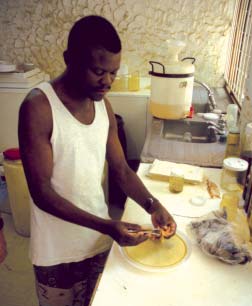
MSPs are well-positioned to help test the opportunities
creased scale. Council endorsement of expanded partici-
for what can be achieved through GEF funding, before
pation of the private sector and explicit acceptance of
new approaches are deemed suitable for scaling up into
the risks involved would help remove uncertainties
a full-sized projects. This is also becoming an important
within the GEF. Clear guidelines from the GEF Secre-
point from a programming perspective because of the
tariat on new modalities should have high priority, as
rapidly increasing demand for GEF funding.
should the acquisition of substantially increased and glo-
bal environment-related private sector expertise for the
9.
The GEF needs to engage the private sector more
GEF Secretariat.
extensively.
10. The institutional roles and responsibilities of GEF
The OPS2 team finds encouraging evidence of GEF ef-
partners need clarification and some modification.
forts to engage the private sector in GEF's activities on
behalf of the global environment. However, the Team
The GEF is a unique experiment in interagency collabo-
finds that many opportunities remain unexploited and
ration among important agencies in the UN system and
many barriers still constrain GEF in engaging the private
the Bretton Woods system. Multilateral development
sector more widely in its projects. There is clear evidence
agencies are not well known for successful interagency
of this in the ozone and climate change focal areas, but
collaboration in operational matters. The OPS2 team con-
considerable untapped potential also exists for private
siders the GEF to be a particularly encouraging example
sector engagement in biodiversity. This effort also should
of constructive interagency cooperation.
be extended to international waters and land degrada-
tion. The OPS2 team believes there are powerful ration-
While the GEF system has performed well overall, the
ales for seeking such engagement on a substantially in-
Team has identified room for some further specific im-
provements in its organizational structure and manage-
ment and staffing functions.
As GEF moves from an approval culture to a results- and
quality-oriented culture, it will be of utmost importance
to reduce the rather rigid programming divide between
the GEF Secretariat and the IAs. A better partnership is
needed. A main thrust in the OPS2 findings and conclu-
sions is the necessity to encourage an active partnership
approach in all phases of GEF's operational activities,
without diluting the prime responsibilities of each part-
ner at specific project cycle intervals.
Institutionally, GEF must address some key issues of im-
mediate concern. There is a clear need for strengthening
the Secretariat's role and staffing capacity. Efforts to
strengthen Secretariat capacity must focus on clarifying
roles and responsibilities; improving coordination, re-
cruitment, and staff training; and assessing the need for
new positions. First, immediate action should be taken
to establish a Country Support Team in the Secretariat.
This should be followed by a careful assessment of the
work programming and budgetary implications arising
[ 108 ] Focusing on the Global Environment
from the OPS2 findings and recommendations.
sibility of the IAs. The GEF monitoring and evaluation
team should have a strategic role, in partnership with
The three IAs will continue to have very important re-
the IAs and the EAs, during project implementation. Also,
sponsibilities in GEF. They have developed valuable pro-
it needs to strengthen its information dissemination and
fessional and technical expertise, accompanied by high
institutional linkages with IAs and operational focal
commitment to GEF objectives. Each of them has devel-
points to support and enable adaptive project and pro-
oped considerable operational experience and, as a team,
gram management, and continuously improving port-
they have the international credibility needed to carry
folio management across the entire GEF system.
out GEF-related tasks and understand the sustainable
development context within which GEF activities must
Hence, the OPS2 concludes that the GEF Council should
occur. The IAs--and their relationship with GEF--would
take immediate steps to explore how GEF's institutional
benefit, however, from some medium-term assurances
status might be best strengthened. It seems both timely
of funding levels needed to maintain institutional com-
and appropriate to consider strengthening the institu-
mitment and staff capacity, while at the same time being
tional character of the GEF substantially. Providing it with
sufficiently flexible so that they continuously reflect
a legal status should be among the options Council should
country priorities.
examine in this regard. The need to strengthen the GEF
institutionally is driven by many factors mentioned ear-
The new GEF executing agencies under the policy of
lier--the increasing operational programs; the expand-
expanded opportunities will add capacities, but they need
ing relations with new conventions and protocols; the
to be carefully integrated into GEF for involvement in
inclusion of new institutional partners, such as the seven
specific focal areas, where they have established credible
executing agencies, to help GEF-eligible member coun-
technical and operational expertise.
tries achieve effective country coordination and address
country priorities within national sustainable develop-
Responses to the global environmental issues covered
ment programs and policies; and the increasing scarcity
by the conventions need the solid foundation of scien-
of GEF funds.
tific and technical advice from recognized sources. STAP
serves a key role in meeting this need. We have noted
Key Recommendations
significant improvements in the way STAP interacts with
other parts of GEF. Its roster of experts needs to be more
The GEF Partnership
carefully scrutinized regarding the way it is used and
how it is managed. There is also a need for regular evalu-
Recommendation 1 (Chapter 7)
ation of STAP reviews, as part of the evaluation of com-
The GEF should manage delivery of global
pleted projects. It would be advantageous for STAP to
environmental benefits by initiating a institution-wide
assess ways of improving the use of scientific and tech-
shift from an approval culture to one that emphasizes
nical expertise in GEF project approval and implementa-
quality and results. This should be achieved through a
tion processes.
partnership approach that expands the use of
interagency task forces to address program and policy
Effective monitoring and evaluation is central to a qual-
issues and adopts broader teamwork practices to
ity-oriented culture because of its contribution to con-
support project implementation and evaluation.
tinuous improvement. The GEF monitoring and evalua-
tion team has over the last several years conducted a large
Recommendation 2 (Chapter 7)
number of relevant program reviews and evaluations of
In response to the concerns raised when the GEF was
the GEF focal areas and themes cutting across focal areas.
established regarding cost efficiency, accountability for
These provided useful inputs for OPS2. Project-level
services provided, and monitoring of overhead costs,
monitoring and evaluation has remained the sole respon-
OPS2 recommends two measures: (i) establishing a
The First Decade of the GEF [ 109 ]
standard set of tasks to be performed by the IAs with
GEF Operational Issues
fee resources and (ii) adopting a simple output-based
fee payment system for IAs using two or three payments
Recommendation 5 (Chapter 4)
that are phased through the life of a project and linked
The GEF should adopt a cautious approach to funding
to specific project milestones.
any new rounds of enabling activities to the same
convention. All such activities must be assessed for their
Recommendation 3 (Chapter 6)
effectiveness in responding to the convention guidance
Each IA and new executing agency should be held
and to country needs. It is important to assess the use
responsible for generating significant additional
of national reports, national communications, and
resources to leverage GEF resources. A clear definition
national action programs within the strategic
of co-financing and a set of strict co-financing criteria
frameworks for a country's national sustainable
should be developed for different GEF project
development program and for GEF's programming and
categories and country circumstances. The emphasis
project preparation activities. In this context, OPS2 also
should be on the total amount of additional co-
recommends that the GEF Council explore the feasibility
financing considered to constitute a significant and
of each country reporting directly to the appropriate
effective cost-sharing arrangement for each project,
convention on the effectiveness and results of GEF's
rather than on the quantity of co-financing forthcoming
country-relevant support for both enabling activities
from an agency's operating programs and government
and projects.
contributions. Co-financing levels should be monitored
and assessed annually through the interagency PIR
Recommendation 6 (Chapter 4)
process, as well as evaluated in the final project reports.
In its dialogue with each convention that it supports,
The monitoring of replication of successful project
the GEF should regularly seek to update and clarify
activities should be established as a separate exercise
existing priorities and commitments in light of each new
in GEF.
round of guidance it receives.
Strengthening Country Capacity
Recommendation 7 (Chapter 6)
To improve the understanding of agreed incremental
Recommendation 4 (Chapter 5)
costs and global benefits by countries, IA staff, and new
The GEF should continue ongoing efforts to support
EAs, OPS2 recommends that the 1996 Council paper on
capacity development of operational focal points, the
incremental costs (GEF/C.7/Inf.5) be used as a starting
national GEF coordinating structures, and the country
point for an interagency task force. This group would
dialogue workshops. Furthermore, OPS2 recommends
seek to link global environmental benefits and
that the GEF Secretariat help empower operational focal
incremental costs in a negotiating framework that
points by providing better information services on the
partner countries and the GEF would use to reach
status of projects in the pipeline and under
agreement on incremental costs. This should be tested
implementation. To that end, the GEF Council should
in a few countries, and revised based on the experience
allocate special funding, administered by the GEF
gained, before it is widely communicated as a practical
Secretariat, to support the organization of regular in-
guideline for operational focal points, IAs, and GEF
country GEF portfolio review workshops, carried out
Secretariat staff.
by the national operational focal points with
participation by the related convention focal points,
Recommendation 8 (Chapter 3)
IAs, and EAs.
The GEF should review and rationalize the number and
objectives of operational programs in light of the
lessons learned in order to ensure consistency and a
unified focus on delivering global environmental
[ 110 ] Focusing on the Global Environment
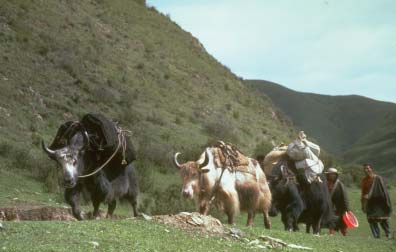
benefits. Furthermore, to ensure quality outcomes that
capacities of the GEF Secretariat in the following key
focus on global environmental benefits, OPS2
areas:
recommends that GEF make a special effort to use
scientific analysis as a constant foundation for the
·
Establishing a separate unit (Country Support Team)
planning and implementation of new projects in all focal
that possesses adequate regional knowledge,
areas. The science-based Transboundary Diagnostic
language capacity, and the competence to provide
Analysis (TDA) should continue to be the basis for
the national operational focal points, in close
facilitating regional agreements on actions to address
collaboration with the implementing agencies and
threats to international waters and for developing
the executing agencies, with effective, prompt
strategic action programs (SAPs). OPS2 further
policy and procedural guidance
recommends the extension of a similar approach to land
degradation, as it is now becoming a new focal area.
·
Strengthening its capacity to develop and
communicate operational modalities that can
Recommendation 9 (Chapter 6)
effectively engage the private sector, including the
An interagency task force should be organized by the
recruitment of relevant private sector expertise and
GEF Secretariat for the purpose of developing an
arrangement of secondments from the
effective and systematic way to document information
implementing agencies/IFC or the external private
on stakeholder consultations and participation,
sector
including the involvement of indigenous communities,
in GEF-funded projects.
·
Requesting a special human resources planning
exercise, including work programming and budget
Recommendation 10 (Chapter 6)
implications, of the proposed and expanding
The GEF must place greater emphasis on sustainability
functions of the GEF Secretariat to give the GEF
and the potential for replication in project design and
Council more precise recommendations regarding
implementation. In particular, OPS2 recommends that
staffing needs
the GEF should engage the private sector more
effectively in all phases of the
project cycle, including securing
adequate GEF Secretariat expertise
in this field. It should seek to create
an enabling environment in which
more specific, market-oriented
strategies and expanded GEF
operational modalities enable
timely interaction with the private
sector, thereby forming the basis for
long-term sustainability of GEF
activities.
Capacity of the GEF Secretariat
Recommendation 11 (Chapter 7)
The GEF Council should commit to
strengthening the professional
resources and management
The First Decade of the GEF [ 111 ]
·
Contracting an external management review of
members for staggered terms, exploring with STAP
current management systems and future
members mechanisms for improving the use of in-
management needs in the GEF Secretariat.
country scientific and technical expertise within the
GEF, and seeking STAP recommendations for appropriate
Recommendation 12 (Chapter 7)
changes to improve the project review system and to
With due respect for the implementing agencies' overall
enhance the utility of the roster of experts.
responsibility for project implementation and
evaluation, the GEF Council should strengthen and
Recommendation 14 (Chapter 7)
expand the monitoring and evaluation functions of the
To support GEF's evolution to a quality- and results-
GEF monitoring and evaluation unit so that it can play a
oriented institutional culture and to ensure that new
supporting partnership role in mid-term reviews and
demands on the GEF are effectively addressed, OPS2
project evaluations, particularly by providing advice on
recommends that the institutional structure of the GEF
TORs for mid-term reviews and final project evaluations,
be strengthened and that, towards this end, the GEF
contributing to the review of each of these reports,
Council consider a review of options to strengthen GEF's
reviewing and compiling the results reported from
institutional structure, including providing it with a
project evaluations, and arranging adequate feedback
separate legal status.
to all GEF partners.
Strengthening GEF's Institutional Capacity and Structure
Recommendation 13 (Chapter 7)
To strengthen the GEF system for providing science and
technology inputs, OPS2 recommends appointing STAP
[ 112 ] Focusing on the Global Environment
ANNEXES
1.
Terms of Reference
2.
Study Team Resumés
3.
OPS2 Methodology
4.
High-Level Advisory Panel
5.
Ten Operational Principles for GEF Work
Program & Operational Programs of the GEF
6.
OPS1 Recommendations
7.
Mainstreaming in the Implementing Agencies
The First Decade of the GEF [ 113 ]
Annex 1 TERMS OF REFERENCE FOR SECOND
STUDY OF GEF'S OVERALL PERFORMANCE
Background
a financial mechanism for the Montreal Protocol, GEF op-
The Global Environment Facility (GEF) is a financial
erational policies concerning ozone layer depletion are con-
mechanism that promotes international cooperation and
sistent with those of the Montreal Protocol and its amend-
fosters actions to protect the global environment. It pro-
ments. For the international waters focal area, GEF opera-
vides grants and concessional funds to complement tra-
tional policies take into account numerous relevant inter-
ditional development assistance by covering the addi-
national treaties and conventions.
tional costs (also known as "agreed incremental costs")
incurred when a national, regional, or global develop-
The Study of GEF's Overall Performance (OPS 1), com-
ment project also targets global environmental objec-
pleted in 1998, was the first to review the performance
tives. The GEF has defined four focal areas for its pro-
of the GEF in its restructured operational phase. OPS 1
grams: biological diversity, climate change, international
did not focus on assessing results at the project or the
waters and ozone layer depletion. Efforts to stem land
program level, due to the fact that relatively few projects
degradation as they relate to the above four focal areas
had been completed, and such an assessment would have
are also eligible for GEF funding.
been premature. It focused instead on a wide range of
topics including: (i) adequacy of the financing and le-
The GEF Pilot Phase started in 1991. The Restructured
veraging of additional investment toward global envi-
Global Environment Facility was made operational in
ronmental benefits; (ii) operations at the country-level;
1994 with a pledged core fund of US$2 billion. At the
(iii) institutional roles and relations; (iv) project cycle
replenishment in 1998 an additional US$2.75 billion
procedures; and (v) issues related to programming. OPS
was pledged. Project allocations have increased steadily
1 contributed to the deliberations at the replenishment,
over the years, and amounted to an estimated US$3.3
and provided a basis for some of the discussions at the
billion as of June 30, 2000. Cumulative disbursements
first GEF Assembly held in New Delhi in April 1998.
as of December 31, 1999, was US$0.938 billion. (Up-
date to 6/30/00 will be made).
Objectives and Scope of the Second Study of GEF's
Overall Performance
The GEF is governed by a Council, consisting of 32 Mem-
The Second Study of GEF's Overall Performance (OPS 2)
bers from developing and developed countries, as well
will assess the extent to which the GEF has achieved, or
as countries in transition. GEF's Implementing Agencies
is on its way to achieving, its main objectives as speci-
(IAs) are UNDP, UNEP, and the World Bank. The World
fied during the restructuring in 1994 and policies
Bank also serves as the trustee of the GEF Trust Fund. The
adopted by the GEF Council since then, including the
Scientific and Technical Advisory Panel (STAP) is an ad-
public involvement policy. OPS 2 will also assess imple-
visory body that provides scientific and technical advice.
mentation of GEF's Operational Strategy and its Opera-
tional Programs. OPS 2 will contribute to the third re-
The GEF serves as the financial mechanism for the Conven-
plenishment and the second Assembly of the GEF, ex-
tion on Biological Diversity (CBD) and the UN Framework
pected to occur in 2001-2002. The study will be imple-
Convention on Climate Change (UNFCCC). In this capac-
mented by an independent team.
ity the GEF receives guidance from the Conference of the
Parties to the conventions and is accountable to them. The
The central theme of OPS 2 is the assessment of impacts
GEF also supports the objectives of the UN Convention to
and results.1 In the years since OPS 1 was undertaken,
Combat Desertification (UNCCD). Although the GEF is not
the GEF portfolio has matured sufficiently for OPS 2 to
[ 114 ] Annex 1: Terms of Reference
focus on initial impacts--30 projects have completed
(d) "Country Ownership" and Sustainability of Results. What has
implementation, while at least another 135 full projects
been achieved in terms of "country ownership,"
have been under implementation for more than a year.
institutional development and sustainability of
In addition, a large number of "enabling activities" and
projects? Are GEF operations well coordinated with
"small grants" have been completed or well advanced.
governmental and non-governmental partners?
During recent years the GEF has carried out a number of
As a preparatory phase to the OPS 2, the M&E team is
evaluations and reviews.2 Annual Project Implementation
coordinating program studies in climate change,
Reviews have been made during the last 5 years. In addi-
biodiversity and international waters, including related
tion, the evaluation departments and the Global Envi-
land degradation components. The studies will be un-
ronment/GEF departments of the Implementing Agen-
dertaken by independent consultants and staff members
cies have completed project reviews and evaluations of
from the GEF Secretariat, Implementing Agencies and
more than thirty projects. Other reports have been pre-
STAP. The studies will help create databases, gather rel-
pared by executing agencies and NGOs. The documents
evant data and analyze experiences and lessons. The stud-
will be provided as inputs to OPS 2.
ies will focus on operational and program results, and
will be conducted in accordance with the framework
OPS 2 will primarily focus on impacts and other results
presented to Council at its May 2000 meeting.
seen in the context of the four focal areas and the cross-
cutting area of land degradation. The study will further
Areas for Assessment
analyze how GEF policies, institutional structures and
On "Operational and Program Results," the OPS 2 team
cooperative arrangements have facilitated or impeded
will review the findings and conclusions of relevant ex-
good quality projects or results. There are four main topics
isting program and project studies (see paragraph 8 and
for the study, namely:
10) and carry out complementary evaluation tasks in
order to reach an independent conclusion on GEF re-
(a) Operational and Program Results. What have been the cu-
sults and initial impacts. For this task the team will also
mulative operational and program results in the four
be aided by GEF's work on program indicators and evalu-
focal areas of climate change, biodiversity, interna-
ation approaches. (Attachments 1-3). The team will fur-
tional waters, and ozone depletion; as well as in land
ther consider these results in the global context and dis-
degradation efforts related to the focal areas? What
cuss GEF's overall accomplishments in supporting actions
has been GEF's role in attempting to halt or miti-
to halt and/or mitigate the degradation of the global
gate negative global environmental trends?
environment within its four focal areas. Moreover, the
OPS 2 team will, on the basis of its own data collection
(b) Effects of GEF Policies on Results. Are GEF policies and pro-
and analyses, cover the three remaining topics in para-
grams responsive to the objectives of the UNFCCC
graph 9. In total, the team will:
and the CBD and the guidance of their Parties? Do
the policies effectively guide GEF approaches, ac-
Operational and Program Results
tions, and modalities of support?
(a) Assess impacts and other results in the climate
change focal area in terms of market advancement
(c) Effects of GEF's Institutional Structure and Procedures on Results.
of renewable energy and energy efficiency efforts at
Do GEF's institutional structure and procedures fa-
country and international levels (See Attachment 1);
cilitate timely implementation and high quality re-
sults? Is the GEF effectively monitoring and evaluat-
(b) Assess results in protection and sustainable use of
ing its results, feeding lessons learned back into
biodiversity resources (See Attachment 2);
operations and disseminating the lessons widely?
The First Decade of the GEF [ 115 ]
(c) Assess results on diagnostic analyses, action pro-
policy development, including integration of reviews
grams and preventive actions in the context of in-
and advice by GEF's Scientific and Technical Advi-
ternational waters (See Attachment 3);
sory Panel (STAP).
(d) Assess impacts and other results on the phase-out
(e) Assess GEF guidelines and practice for determining
of ozone depleting substances (Ref. GEF/C.14/
global vs. local benefits and the determination of
Inf.6).
incremental cost in the four focal areas.
(e) Assess results of efforts to stem land degradation, in
(f) Evaluate GEF's partnerships with non-government
the context of support in the focal areas of climate
organizations and academic institutions. Evaluate
change, biodiversity and international waters.
GEF cooperation with the private sector, particularly
in view of the private sector's role and contribution
(f) Assess results in GEF multi-focal areas.
to shaping and finding solutions to global environ-
mental problems.
(g) On the basis of (a) - (f) discuss GEF's overall role in
initiating and supporting actions to halt and/or
Effects of GEF's Institutional Structure and
mitigate the degradation of the global environment
Procedures on Results
within its areas of responsibility.
(a) Discuss how GEF's institutional structure, and divi-
sion of roles and responsibilities between the GEF
Effects of GEF Policies on Results
entities have impacted the rate of implementation,
(a) Evaluate whether the GEF policies and programs are
content and the quality of the GEF portfolio. Dis-
adequately responding to the objectives of the CBD
cuss cooperation and coordination arrangements
and the UNFCCC and the guidance of their parties.
among GEF Implementing Agencies, particularly at
Assess GEF's role in its support to the objectives of
the country level. Assess the progress and timeliness
UNCCD.
of implementation of GEF operations.
(b) Assess how well GEF policies and programs guide
(b) Consider the growing GEF cooperation under ex-
actions to address global environmental issues. Con-
panded opportunities for executing agencies and
sider if there are policy gaps. Discuss the adequacy
how this is affecting GEF's programming efforts as
of scope and content of the current portfolio, in-
well as coordination between GEF entities.
cluding integration of actions between the various
focal areas.
(c) Discuss whether GEF's project cycle, its recent
streamlining, as well as other procedures have fa-
(c) Assess whether GEF is playing a strategic, comple-
cilitated implementation and good quality results.
mentary and catalytic role vis-ŕ-vis its Implement-
ing Agencies and other organizations, particularly
(d) Assess the adequacy of GEF monitoring and evalua-
in terms of facilitating and encouraging additional
tion work and efforts for feeding lessons back into
financing to global environmental endeavors.
operations and to the public at large. Review the
progress of follow up of OPS 1.
(d) Discuss GEF's role in identifying innovative and ad-
equate policies, approaches and technologies in its
"Country Ownership" and Sustainability of Results
focal areas, as well as its role in the demonstration
(a) Assess how well GEF operations are integrated with
and replication of viable approaches. Discuss GEF's
national environmental and development priorities
achievements in coordinating and integrating re-
and actions. Examine whether the cooperation and
search, scientific and technical assessments with
coordination arrangements between the GEF Secre-
[ 116 ] Annex 1: Terms of Reference
tariat, the Implementing Agencies and the recipient
The team will function in an inclusive and open man-
countries have facilitated "country ownership" of
ner. To ascertain transparency and good communication
projects. Assess the effectiveness of the country co-
with all cooperating partners, the team will be involved
ordination of GEF efforts and the GEF Focal Point
in three to four consultations in conjunction with Council
system.
Meetings and appropriate international or regional en-
vironmental meetings. Partner organizations and the
(b) Assess the effectiveness of GEF's outreach and in-
public at large will be informed via the internet about
formation activities, including the Country Dialogue
the implementation of the study and will be given op-
Workshops.
portunities to provide relevant inputs to the OPS 2 team.
The following reports will be placed on the GEF website:
(c) Assess results in capacity development.3
inception report, draft report and final report.
(d) With reference to GEF's public involvement policies,
Study Team
examine the participation of national or commu-
The study team will consist of a core team of 5-7 inter-
nity interest groups, NGOs and the private sector.
national consultants and 16- 20 local consultants. The
team will be composed of men and women from differ-
(e) With particular reference to global and regional (in-
ent geographic regions of the world.
cluding transboundary) projects, assess the adequacy
of coordination mechanisms with participating
The team leader will have an excellent knowledge of glo-
countries, regions and groups.
bal environmental and sustainable development issues.
He or she will also be knowledgeable in policy formula-
(f) Assess whether GEF-funded efforts have become or
tion, project management and evaluation. He or she will
are likely to become sustainable and replicated upon
lead the main work of managing the study and be re-
termination of GEF funding.4
sponsible for drafting the final report, in cooperation
with the other team members.
Conclusions and Recommendations
Present conclusions of findings and recommendations
The core team members will also have a good under-
to the GEF.
standing of global environmental and sustainable devel-
opment issues, policy formulation, project management
OPS 2 Execution
and evaluation. Furthermore, the team will have exper-
The Second Study of GEF's Overall Performance (OPS 2)
tise in assessing the role of public and private institu-
will be undertaken from November 2000 to January
tions.
2002 by a fully independent team. The team will be ap-
pointed by the Senior Monitoring and Evaluation Coor-
National or regional team members will be recruited to
dinator in accordance with the terms of reference crite-
take part in assessments of GEF efforts in countries. They
ria approved by the GEF Council and in consultation with
will have competencies in the same areas as the interna-
the GEF CEO/Chairman.
tional team members, and a good working knowledge
of national environmental issues.
The OPS 2 team will consult with all GEF entities as well
as GEF's collaborating partners: a wide group of cooper-
Mode of work
ating countries, the convention secretariats, executing
The team members will familiarize themselves with all
agencies, non-governmental organizations (NGOs), aca-
relevant documents and available monitoring and evalu-
demic and private sector institutions.
ation material. They will review the findings and con-
clusions of GEF program and other relevant studies and
The First Decade of the GEF [ 117 ]
evaluations, and carry out complementary and indepen-
(c) Well performing and innovative projects as well as
dent evaluation tasks.
less-well-performing ones,
The team will prepare an Inception Report including a
(d) Length of GEF involvement,
plan for the implementation of the study. This report will
also contain an overview of data sources.
(e) Various institutional models for responding to GEF
initiatives, and
The team will meet with all GEF entities and relevant
GEF partners at international, regional and national, and
(f) Consideration of geographical and other variations
as required, local levels. The team will review selected
between countries.
projects through desk reviews and field visits.
On the basis of specific agreements in each case, the
Study team members will visit 10-12 countries. The coun-
Country Focal Points assisted by the field missions of
tries will be selected on the basis of the following criteria:
the Implementing Agencies (World Bank, UNDP and
UNEP) will assist in the preparation and implementa-
(a) Number of GEF projects and size of funds allocated,
tion of the country assessments.
(b) Broad representation of projects in the various focal
The team will prepare the OPS 2 report, which will con-
areas,
sist of 60-80 pages plus appendices.
Proposed Timetable
y
t
i
v
i
t
c
A
t
a
D e
· p
A p o
r
a
v l f
o
r
e
T
s
m
f
o
r
e
f
e
R
e
e
c
n
d
n
a
B
e
g
d
u
t y
b
o
C
i
c
n
u
l
t
c
O
r
e
b
o
0
0
0
2
· I
f
i
t
n
e
d
c
i
n
o
i
t
a
f
o
m
a
e
t
m
e
m
s
r
e
b
r
e
b
m
e
t
p
e
S
r
e
b
m
e
v
o
N
2 0
0 0
· R c
e
m
t
i
u
r
t
n
e
f
o
,
m
a
e
t
r
a
t
s
t f
o
r
o
w k
r
e
b
m
e
v
o
N
0
0
0
2
· T m
a
e
i
t
e
e
m
s
g
n
d
n
a
i
s
s
u
c
s
i
d
s
n
o
w h
t
i
C
E
S
F
E
G
, Im l
p e e
m
i
t
n
g
n
y
r
a
u
n
a
J
0
0
2
n
a
J
1
r
a
u y
2
0
0
2
A
s
e
i
c
n
e
g
,
A
T
S
P
· o
C
y
r
t
n
u
v s
i
s
t
i ,
d
n
a
m
t
e
e
n
i
s
g
h
t
i
w
r
e
h
t
o
F
E
G
a
t
s k
r
e
d
l
o
h
e
,
s
F
a
u
r
b
e
l
i
r
p
A
y
r
2
1
0
0
a
n
r
e
t
n
i
l
a
n
o
i
t
d
n
a
l
a
n
o
i
g
e
r
c
a
t
l
u
s
n
o
s
n
o
i
t
·
m
i
r
e
t
n
I
p
e
r
t
r
o
o
t
F
E
G
l
i
c
n
u
o
C
o
T
e
b
r
e
t
e
d
d
e
n
i
m
· D f
a
r t
p
e
r
t
r
o
r
e
b
o
t
c
O
1
0
0
2
· F
l
a
n
i
t
r
o
p
e
r
J
r
a
u
n
a
y 2
2
0
0
[ 118 ] Annex 1: Terms of Reference
Annex 2 STUDY TEAM RESUMÉS
Leif Christoffersen
Asia Program). He has served in the Government of In-
Leif E. Christoffersen is Senior Fellow at the International
dia as Senior Environmental Specialist, overseeing envi-
Center for Environment & Development (Noragric) of
ronmental appraisals of development projects. In 1980,
the Agricultural University of Norway, and is Chairman
as head of a research team supporting a High-Level Com-
of the GRID-Arendal foundation in Norway, supporting
mittee established by the Prime Minister of India, he
UNEP's environmental information and assessment ac-
was responsible for coordinating the Government of
tivities. He also serves as Chairman of IUCN's Sustain-
India's plan for establishing a full-fledged Ministry of
able Use Specialist Group in the Species Survival Com-
Environment and Forests.
mission. From 1964 to 1992, he served with the World
Bank, where he held various management positions re-
Ogunlade Davidson
lated to agriculture, rural development, and the envi-
Ogunlade Davidson, an expert in the field of energy sys-
ronment. Between 1987 and 1992, Mr. Christoffersen
tems and climate change, is the Executive Director of
headed the Environment Division for the Africa Region.
the Energy and Development Research Group (EDRC),
University of Cape Town, South Africa, and is the Co-
James Seyani
Chair of Working Group 111 (Mitigation) of the Inter-
James H. Seyani is a Malawian Systematic Botanist and
governmental Panel on Climate Change (IPCC). He has
Conservation Biologist, and works for the Common-
initiated and managed many internationally funded
wealth Secretariat in London as Chief Programme Of-
projects, and has acted as a consultant to UNESCO,
ficer (Biodiversity). His experience includes development
UNIDO, ILO, UNECA, UNDP, UNEP, and the World Bank,
of national biodiversity strategies and action plans, con-
as well as various regional institutions.
servation and sustainable use of biodiversity in protected
areas and public land, access policies, co-management,
Mr. Davidson is a member of various international en-
taxonomy, biosafety, bioprospecting, benefit-sharing,
ergy and engineering institutions, and has been a Visit-
indigenous knowledge, and impact assessments. Mr.
ing Professor/Senior Scientist at the University of Cali-
Seyani has extensive knowledge of the Convention on
fornia (Berkeley), Princeton University, and the Univer-
Biological Diversity (CBD) and became first Chair of its
sity of Gothenburg, among others. He has published
Subsidiary Body on Scientific, Technical, and Technologi-
widely in energy and climate change.
cal Advice (SBSTTA).
Allen Hammond
Thomas Mathew
Allen Hammond is Senior Scientist and Chief Informa-
Thomas Mathew is President of the South Asian Conser-
tion Officer, World Resources Institute, Washington, D.C.
vation Foundation (SACF), a non-profit organization with
He has an institute-wide leadership role in the use of
its headquarters in Washington, D.C. SACF supports field
analytical methods and information tools for policy re-
conservation programs in South Asia with a primary fo-
search, helps lead WRI's digital industry initiative, pro-
cus on building government-NGO partnerships to con-
vides oversight of WRI's electronic information and com-
serve wild habitats.
munications infrastructure, and does research and writ-
ing on long-term sustainability issues. He was formerly
Mr. Mathew worked for 17 years with the World Wild-
Director of the Program in Resource and Environment
life Fund first in India (Secretary General) and then in
Information, Director of the Strategic Indicator Research
the United States (Director of Conservation within the
Initiative on environmental indicators, and Editor-in-
The First Decade of the GEF [119 ]
Chief of the World Resources report series.
agencies, as well as the private sector. He is a Natural
Resource Scientist with 21 years experience in resource
Mr. Hammond has also been the advisor on indicators
economics, natural resource impact assessment, and in-
to the UN Commission on Sustainable Development, the
vestment analysis for integrated resource management.
UN Environmental Programme for its Global Environ-
His areas of expertise specifically include program evalu-
mental Outlook, and the UN Development Programme's
ation, participatory management to address land degra-
Human Development Report.
dation, watersheds, and river basins and forest resources.
Maria Concepcion Donoso
Mr. Fargher's recent experience includes participatory
Maria Concepcion Donoso, a hydraulics and ocean en-
project and program evaluations in Armenia, Australia,
gineer, is currently Director of the Water Center for the
China, Indonesia, South Africa, and Turkey.
Humid Tropics of Latin America and the Caribbean
(CATHALAC), with headquarters in Panama City. She is
Emma Hooper
an expert in water resources management, specifically
Emma Hooper is an independent consultant in social
focused on air-sea-land interaction processes and climate
development, with over 20 years experience in a wide
change impact on the natural environment and society.
range of cross-sectoral, social, and institutional issues.
She works regularly with both multilateral and bilateral
Since 1987, Ms. Donoso has directed var ious
agencies, as well as the private sector and NGOs. She has
consultancies, and been advisor for the Government of
worked in South and East Asia, the Middle East and North
Panama, UNESCO, and a large number of regional insti-
Africa, Africa, Latin America, and Europe.
tutions. She has been a member for various working
groups and committees at the regional and international
Her professional skills include social policy and strategy
level, including the IOCARIBE Group of Experts on Ocean
formulation; social impact assessment and stakeholder
Process and Climate.
analysis including poverty, equity, and gender concerns;
participatory and partnership approaches to environmen-
John Fargher
tal infrastructure delivery; social aspects of rural devel-
John Fargher is an independent consultant who has
opment; and institutional development issues.
worked for a large number of bilateral and multilateral
[ 120 ] Annex 2: Study Team Resumés
Annex 3 OPS2 METHODOLOGY
Overall Approach
The program studies were undertaken by
The starting point for the OPS2 team's approach was to
multidisciplinary teams comprising staff from the GEF
verify reported progress in the achievement of tangible
Secretariat, the three GEF implementing agencies, and
results and impacts in the field. Our main sources of
the GEF Scientific and Technical Advisory Panel (STAP),
information were four focal area Program Studies and
with additional support from consultants contracted to
an external evaluation report of GEF's ozone program.
undertake detailed studies in different parts of the port-
We also examined evaluation reports from completed
folio as well as to consolidate all the information col-
projects, as well as reports and documentation from the
lected and background documents prepared.
implementing agencies regarding ongoing projects. A
series of consultation meetings with the implementing
The Program Studies are available from GEF as published
agencies and the GEF Secretariat were also very helpful
reports and are also available at: www.gefweb.org/
to our work.
R e s u l t s a n d I m p a c t / M o n i t o r i n g _ E v a l u a t i o n /
Evaluationstudies/.
Another important phase was the period of various coun-
try visits during which stakeholders were consulted in
Further Verification
the field and discussions held with country focal points,
Verification of operational results was carried out
relevant government ministries, project implementing
through:
agencies, NGOs, private sector partners, and others.
·
A review of the GEF Operational Strategy, Opera-
The framework for this assessment is contained in the
tional Programs, and other GEF policy documents
policy documents of the GEF, and in particular, the state-
ments of its operational programs. The outputs from this
·
Four team workshops and follow-up briefing meet-
verification of project and country-level impacts and
ings with the Secretariat
achievements were fed into a macro-level strategic evalu-
ation, which assessed, in each focal area, the cumulative
·
Dialogue with GEF's NGO and operational/politi-
effect of the GEF portfolio: (i) on institutions, (ii) on
cal focal points
process, and (iii) in relation to cross-cutting issues in-
cluding transparency, country-level ownership, capacity
·
Review of existing institutional structures and pro-
development, private sector involvement, innovation and
cedures
replication, and public involvement through inclusive
stakeholder participation.
·
Consultations in conjunction with Council meet-
ings and appropriate regional or international en-
Focal Area Program Studies
vironment meetings
To facilitate the work of the OPS2 team, GEF's Monitoring
and Evaluation team, in cooperation with the GEF imple-
·
In-country interviews and meetings with key stake-
menting agencies, decided to undertake program studies
holders, including government staff, GEF opera-
in the biodiversity, climate change, and international wa-
tional focal points; NGO representatives; NGO re-
ters focal areas as well as for land degradation. The role of
gional focal points; private sector representatives,
these program studies was to provide portfolio informa-
the Small Grants Program national focal points
tion and inputs for the OPS2 team's considerations.
The First Decade of the GEF [ 121 ]
·
Field visits to selected in-country projects and meet-
tunities for assessing the impact, if any, of GEF activities.
ings, interviews, and focus group discussions with
A table of these suggestions was prepared, and compared
GEF project implementation teams and community-
with suggestions from each agency. This was supple-
level project stakeholders.
mented by the Team's own assessments from reviews of
project documentation, team members' in-country
In addition, the Team used Goal Attainment Scaling to
knowledge, and considerations of the need for coverage
elicit stakeholders' perceptions of participation, owner-
of all regions, with representation of large and small
ship, and processes from participants in OPS2 country
countries.
visits wherever it was feasible and appropriate. Data was
collected from 161 participants; details are presented later
The final selection for country and project visits was ar-
in this Annex.
rived at independently by the Team after reviewing
project-related documents and soliciting suggestions
Country Visits and Regional Consultations
from all three implementing agencies and the GEF Sec-
Supplementary information from implementing agen-
retariat. Before completing a final shortlist, the Team care-
cies and key stakeholders was collected during the pe-
fully checked its identification of such visits against the
riod from March to May 2001, in a series of country
criteria set forth in its Terms of Reference, that is, num-
visits and visits to selected GEF project sites to verify
ber of GEF projects and size of funds allocated, broad
reported project results and impacts. In addition, input
representation of projects in the various focal areas, well
from key partners was sought through six regional meet-
performing and innovative projects as well as less-well-
ings held in Eastern Europe (Romania), Africa (Senegal
performing ones, length of GEF involvement, various
and Nairobi), the Caribbean and Central America (Ja-
institutional models for responding to GEF initiatives,
maica and Mexico), and Asia and the Pacific (Bangkok)
and consideration of geographical and other variations
during March-May 2001.
between countries.
Process for Country Selection
This process resulted in a shortlist of 15 countries. The
The Terms of Reference required the Team to visit 10-12
shortlist was discussed with the GEF Secretariat, follow-
countries. Following extensive consultations with the
ing which the Team alone made a final selection of 11
implementing agencies and the GEF Secretariat, the Team
countries: Argentina, Brazil, China, Jamaica, Jordan,
proposed a travel program that involved two to four team
Nepal, Romania, Samoa, Senegal, South Africa, and
members for each visit, covering 11 countries. The pro-
Uganda. Regional consultations were conducted in con-
cess for country selection is set out below.
junction with the visits to Romania, Senegal, and Jamaica;
three further regional consultations were also conducted
Suggestions were sought from the GEF Secretariat and
in Bangkok, Thailand; Nairobi, Kenya; and Mexico City.
the implementing agencies about what they considered
to be the most important countries to visit in terms of
Preparation for Country Visits and Use of Local
being able to see verifiable project impacts on the ground,
Consultants
innovative projects, and successful and unsuccessful
During the planned country and project visits, the Team
projects from which lessons could be learned. The Team
made an effort to explore (i) the degree of country own-
also examined the coverage of the program studies in
ership in GEF activities, (ii) the relevant linkages between
order to avoid duplication of effort.
national and local recognition of project results and im-
pact on the country's participation in the Conventions,
The Team then examined the project portfolios of coun-
(iii) the effectiveness of stakeholder involvement (with
tries with significant GEF projects that were either (a)
specific reference to the GEF policy on public involve-
completed, (b) had substantial on-the-ground imple-
ment) and in-country operational effectiveness of GEF,
mentation experience, or (c) offered significant oppor-
and (iv) the extent to which there was clear understanding
[ 122 ] Annex 3: OPS2 Methodology
of GEF operational modalities, programs, and policies.
Six additional executing agency and selected project-re-
lated visits were made in addition to the country visits:
Local consultants in each of the countries selected for
visits by the OPS2 team were asked to undertake the fol-
Istanbul
March 26-30
lowing tasks:
met with Black Sea Secretariat
·
Preparing and participating in country visits, in-
Hungary
April 9-13
cluding facilitating and scheduling meetings with
visited Energy Efficiency Co-Financing
the government and other key stakeholders, accom-
Program
panying the study team during country visits, and
facilitating focus group discussions and related fol-
Bulgaria
April 9-13
low-up activities
visited Energy Efficiency Strategy Project
·
Carrying out preparatory studies, including col-
Lebanon
April 9-13
lecting background information on engagement
visited Strengthening of Biodiversity
with the private sector and activities in selected GEF
National Capacity Project
focal areas, preparing an overview of press coverage
of GEF-financed projects, and conducting a review
UNEP, Nairobi April 30-May 4
of project-level participation
Kenya and
May 7-11
·
Preparing an overview paper, including modali-
Tanzania
visited Lake Victoria Environmental Man-
ties for institutional interaction between GEF Op-
agement Project; Pollution Control and
erational Focal Points and key stakeholders, and how
other Measures to Protect Biodiversity in
these relate to the Conventions.
Lake Tanganyika Project; and Reducing
Biodiversity Loss at Cross-Border Sites in
Country Visits
East Africa Project
Country visits and related travel were scheduled for the
OPS2 team during the period of March to May 2001:
High-Level Advisory Panel
In consultation with the GEF CEO, the Team Leader and
Argentina
March 12-16
the Senior Monitoring and Evaluation Coordinator agreed
Brazil
March 19-23
to appoint a High-Level Advisory Panel to provide guid-
South Africa
March 26-30
ance and advice to the OPS2 Team. This panel comprised
Romania
April 4-13 (plus Regional Consultation)
five distinguished experts from Brazil, China, France,
Jordan
April 9-13
Japan, and Jordan. Panel members had broad experience
Senegal
April 16-20 (plus Regional Consultation)
in global environmental negotiations, environmental
Jamaica
April 23-27 (plus Regional Consultation)
conventions, and the policymaking context of GEF focal
Nepal
May 7-11
areas and cross-cutting issues.
Uganda
May 7-11
China
May 14-18
The Panel advised the OPS2 team on the implementa-
Bangkok
May 21-22 (Regional Consultation only)
tion of the evaluation study and provided guidance to
Samoa
May 21-25
the Team, once it had begun to bring together its first
round of findings, on the formulation of its conclusions
and recommendations.
The First Decade of the GEF [ 123 ]
Organization of the Study - Team Responsibilities
·
Third, in early August 2001 to formulate the main
The eight team members had specific responsibilities for
findings and recommendations arising from the
focal areas and cross-cutting issues. They also participated
study
actively in a joint collaborative and consultative process
to synthesize the main findings of the evaluation and to
·
Fourth, in mid-October 2001 to respond to com-
formulate its broader conclusions and recommendations.
ments from implementing agencies and GEF Secre-
The Team was supported administratively by staff in the
tariat concerning matters of fact and detail.
GEF Monitoring and Evaluation Unit and used its offices
as the main hub for communication and contacts.
Organization of the Study - Work Program
The starting point for the Team's work program was veri-
Two team members focused particularly on climate
fying reported results and impacts of GEF activities. Coun-
change issues, with one focusing also on ozone deple-
try and project visits were used to ascertain the extent to
tion issues. Two other team members focused on
which reported project results and impacts could be veri-
biodiversity issues. An additional two members focused
fied at country and project levels. Issues such as the de-
on international waters, with one also covering land
gree of country ownership, the extent of recognition of
degradation issues. Cross-cutting issues were given spe-
results and impacts, and the effectiveness of stakeholder
cial attention by the social development expert and by
involvement were examined and tested through coun-
the OPS2 Team Leader.
try visits and selected project visits.
The entire team met as a group four times:
On completion of its travel program, the Team synthe-
sized its main findings from the country and project visits
·
First, during the team inception workshop in Janu-
and the regional consultations, reviewing and beginning
ary 2001 at the GEF Secretariat
to assess these in light of the broader programmatic,
policy, and institutional issues to be addressed.
·
Second, in early-June 2001 after completion of the
country and project visits and documentation re-
The work program was organized in the following
views
phases:
[ 124 ] Annex 3: OPS2 Methodology
(i)
Inception
First team workshop
January 2001
Discussions with partners
Completion of Inception Report
February 9
Visit to UNEP-HQ
February 23-27
(ii)
Documentation Review
February-March
(iii)
Consultation at the CBD SBSTTA6 meeting, Montreal
March 13, 2001
(iv)
Country visits, including regional consultations and
project field visits
end of March-May
(v)
Assessment of findings from document reviews
And country visits
May-June
Consultation at Council meeting
May 10
Consultation with GEF partners
May-June
Second team workshop
June 18-29
(vi)
Formulation of main findings
July
First draft (internal to team)
July 29
Third team workshop
July 30-August 5
(vii)
Report writing
August
Second draft to GEF management and IAs
August 20
Comments on proposed country references in final report
(viii)
Review of second draft
August 21-September 7
(ix)
Preparation of interim report for submission to third GEF
Replenishment Meeting
September 10 - 26
(x)
Presentation to GEF Replenishment Meeting, Edinburgh
October 11-12
(xi)
Fourth team Workshop
October 16-18
(xii)
Final Draft Report for submission to December 2001
Council Meeting
November 11, 2001
(xiii)
Final Report
January 25, 2002
(xiv)
Translation/Publication
January - March 2002
The First Decade of the GEF [ 125 ]
Table 1 Countries Covered by Evaluation Work of the GEF Monitoring and Evaluation Team (FY98 FY02)
Interim
Review of
Experience
Assessment of
Climate
Climate
International
Medium-
with
Biodiversity
Change
Multicountry
Biodiversity
Change
Waters
sized
Conservation
Enabling
Enabling
Project
Solar PV
Program
Program
Program
Projects
#
Country
OPSI
Trust Funds
Activities
Activities
Arrangements
Review
Study
Study
Study
Review
OPS2
1
Argentina
2
Armenia
3
Azerbaijan
4
Bangladesh
5
Belize
6
Bolivia
7
Brazil
8
Bulgaria
9
Cambodia
10
Cameroon
11
Central
African Republic
12
China
13
Costa Rica
14
Côte d'Ivoire
15
Cuba
16
Ecuador
17
Egypt
18
Egypt
19
Eritrea
20
Gabon
21
Ghana
22
Guatemala
23
Guinea
24
Honduras
25
Hungary
26
India
27
Indonesia
28
Jamaica
29
Jordan
30
Kenya
31
Lebanon
32
Losotho
33
Malawi
34
Malaysia
35
Mali
36
Mauritius
37
Mexico
38
Namibia
39
Nepal
40
Pakistan
41
Peru
42
Phillippines
43
Poland
[ 126 ] Annex 3: OPS2 Methodology
Table 1 (Continued)
Interim
Review of
Experience
Assessment of
Climate
Climate
International
Medium-
with
Biodiversity
Change
Multicountry
Biodiversity
Change
Waters
sized
Conservation
Enabling
Enabling
Project
Solar PV
Program
Program
Program
Projects
#
Country
OPSI
Trust Funds
Activities
Activities
Arrangements
Review
Study
Study
Study
Review
OPS2
44
Regional:
Arab States
45
Regional:
Baltic States
46
Regional:
Caribbean Isles
47
Regional:
Danube Basin
48
Regional:
Mediterranean
49
Regional: South
Pacific Islands
50
Romania
51
Russia
52
Samoa
53
Senegal
54
Slovak Republic
55
Slovenia
56
South Africa
57
Sri Lanka
58
Tanzania
59
Thailand
60
Tunisia
61
Uganda
62
Ukraine
63
Uzbekistan
64
Vietnam
65
Yemen
66
Zambia
67
Zimbabwe
The First Decade of the GEF [ 127 ]
Goal Attainment Scaling (GAS) Data
puts such as stakeholder participation, institutional pro-
The OPS2 team used Goal attainment scaling to elicit
cesses, and country ownership.
stakeholder perceptions of participation, ownership, and
processes from participants in OPS2 country visits, wher-
GAS uses a matrix framework that compares the "level
ever it was feasible and appropriate. Data was collected
of outcome" (for example, how successful GEF was)
from 161 participants using the matrices presented here.
against the "goals" that are being sought. The terms
The resulting data is summarized below by country and
"goal" and "outcome" are used to focus on investment
stakeholder institution.
frameworks. Ideally, the investment being evaluated will
have been developed with a logical framework that clearly
Goal attainment scaling (GAS) is a method of data col-
sets out the relationship between inputs, outputs, out-
lection used to support an evaluation. It is not an evalu-
comes, and goals of specific or program investments.
ation in itself, but the data measured with GAS, and
changes in GAS scores over time, can be evaluated. The
There must be a statement of what the expected out-
method is easy to use and was selected by the OPS2 team
comes are for each goal before work begins - making it
because it gave an opportunity for participants in OPS2
similar to creating benchmarks based on the current level
country visits to make a tangible contribution to the
of understanding and the expected returns from an in-
evaluation of GEF's overall performance.
vestment.
Goal attainment scaling is commonly used in participa-
The real strength of goal attainment scaling is that it
tory evaluation of intangible project outcomes, such as
makes the best guesses of what is expected conscious, rather
in the environmental and health sectors. It is founded
than implicit. This is partly because project stakeholders
on neuro- linguistic programming (NLP), which deals
provide their conscious perceptions and partly because
with the idea that you need to be more aware of where you want to
implicit expectations today will change over time even
go before you can get there. Because of this, it is ideally suited
though one may not be aware of it. It also helps institu-
to evaluation of qualitative investment inputs and out-
tions consider what is really expected for this investment or this
part of a program in terms of achievement.
[ 128 ] Annex 3: OPS2 Methodology
GAS Data for OPS2 -- Country Summary
GAS Data for OPS2 -- Institutional Summary
Ownership
Frequency of GAS Score
Ownership
Frequency of GAS Score
1
2
3
4
5
n
1
2
3
4
5
n
East Africa
2
5
4
29
14
54
Government
0
3
4
10
3
20
Eastern Europe
1
0
0
2
0
3
NGO
8
3
5
0
4
20
Jamaica
0
1
2
0
0
3
Executing Agency
5
8
4
42
17
76
Latin America
4
0
2
20
7
33
Project Participant
1
1
3
12
6
23
Romania
3
3
3
2
1
12
Project Beneficiary
2
1
0
2
1
6
Samoa
0
3
0
1
0
4
Other
0
0
0
0
0
0
Senegal
6
4
5
12
9
36
Total Frequency
16
16
16
66
31
145
Total Frequency
16
16
16
66
31
145
Participation
Frequency of GAS Score
Worse than
As
Better than
Participation
Frequency of GAS Score
expected
expected
expected
n
1
2
3
4
5
n
Government
0
1
2
6
4
13
East Africa
0
3
14
23
14
54
NGO
0
18
7
8
2
35
Eastern Europe
0
1
2
0
0
3
Executing Agency
0
5
18
28
18
69
Jamaica
0
2
2
0
0
4
Project Participant
1
3
12
16
5
37
Latin America
1
6
6
27
7
47
Project Beneficiary
1
2
1
2
1
7
Romania
0
6
3
4
0
13
Other
0
0
0
0
0
0
Samoa
0
0
9
2
0
11
Total Frequency
2
29
40
60
30
161
Senegal
1
11
4
4
9
29
Total Frequency
2
29
40
60
30
161
Processes
Frequency of GAS Score
1
2
3
4
5
n
Processes
Frequency of GAS Score
Government
2
3
2
3
4
14
1
2
3
4
5
n
NGO
12
7
2
1
0
22
East Africa
0
0
0
0
0
0
Executing Agency
0
8
3
0
2
13
Eastern Europe
0
0
0
0
0
0
Project Participant
2
0
1
0
1
4
Jamaica
1
3
0
0
0
4
Project Beneficiary
0
0
0
0
0
0
Latin America
1
0
1
0
1
3
Other
0
0
0
0
0
0
Romania
0
3
4
3
2
12
Total Frequency
16
18
8
4
7
53
Samoa
0
4
0
0
0
4
Senegal
14
8
3
1
4
30
Total Frequency
16
18
8
4
7
53
The First Decade of the GEF [ 129 ]
GAS Data for OPS2 -- Trend Summary: Countries
Ownership
% distribution of GAS Score
1
2
3
4
5
n
East Africa
3.7%
9.3%
7.4%
53.7%
25.9%
1
Eastern Europe
33.3%
0.0%
0.0%
66.7%
0.0%
1
Jamaica
0.0%
33.3%
66.7%
0.0%
0.0%
1
Latin America
12.1%
0.0%
6.1%
60.6%
21.2%
1
Romania
25.0%
25.0%
25.0%
16.7%
8.3%
1
Samoa
0.0%
75.0%
0.0%
25.0%
0.0%
1
Senegal
16.7%
11.1%
13.9%
33.3%
25.0%
1
% distribution
of total
11.0%
11.0%
11.0%
45.5%
21.4%
100.0%
Participation
% distribution of GAS Score
1
2
3
4
5
n
East Africa
0.0%
5.6%
25.9%
42.6%
25.9%
1
Eastern Europe
0.0%
33.3%
66.7%
0.0%
0.0%
1
Jamaica
0.0%
50.0%
50.0%
0.0%
0.0%
1
Latin America
2.1%
12.8%
12.8%
57.4%
14.9%
1
Romania
0.0%
46.2%
23.1%
30.8%
0.0%
1
Samoa
0.0%
0.0%
81.8%
18.2%
0.0%
1
Senegal
3.4%
37.9%
13.8%
13.8%
31.0%
1
% distribution
of total
1.2%
18.0%
24.8%
37.3%
18.6%
100.0%
Processes
% distribution of GAS Score
1
2
3
4
5
n
East Africa
0.0%
0.0%
0.0%
0.0%
0.0%
0
Eastern Europe
0.0%
0.0%
0.0%
0.0%
0.0%
0
Jamaica
25.0%
75.0%
0.0%
0.0%
0.0%
1
Latin America
33.3%
0.0%
33.3%
0.0%
33.3%
1
Romania
0.0%
25.0%
33.3%
25.0%
16.7%
1
Samoa
0.0% 100.0%
0.0%
0.0%
0.0%
1
Senegal
46.7%
26.7%
10.0%
3.3%
13.3%
1
Total Frequency
30.2%
34.0%
15.1%
7.5%
13.2%
100.0%
Worse than
As
Better than
expected
expected
expected
Ownership
11.0%
11.0%
11.0%
45.5%
21.4%
100.0%
Participation
1.2%
18.0%
24.8%
37.3%
18.6%
100.0%
Processes
30.2%
34.0%
15.1%
7.5%
13.2%
100.0%
[ 130 ] Annex 3: OPS2 Methodology
Annex 4 HIGH-LEVEL ADVISORY PANEL
Hisham Khatib
Akiko Domoto
World Energy Council
Akamon Abitashion No. 805
PO Box 925387
5-29-13 Hongo, Bunkyo-ku
Amman, Jordan
Tokyo 113-0033, Japan
Fax: 962 6 5698556
Fax: 81 3 35068085
Phone: 962 6 5621532
E-mail: khatib@nets.com.jo
Corinne Lepage
40, rue de Monceau
Zhang Kunmin
F-75008 Paris, France
China Council for International Cooperation
Fax: 33 1 56 59 29 39
on Environment and Development
Phone: 33 1 56 59 29 59
No. 115, Xizhimennei Nanxiaojie
E-mail: paris@huglo-lepage.com
Beijing, 100035 China
Fax: 86 10 66126793/66151762
E-mail: Zhangkunmin@hotmail.com
Jose Goldemberg
Universidade de Sao Paulo
Av. Prof Almeida Prado 925
Sao Paolo, 05508-900 Brazil
Fax: 55 11 3818 5056
Phone: 55 11 3818 5053
E-mail: Goldemb@iee.usp.br
The First Decade of the GEF [ 131 ]
Annex 5 TEN OPERATIONAL PRINCIPLES FOR
DEVELOPMENT AND IMPLEMENTATION
OF GEF'S WORK PROGRAM
1.
For purposes of the financial mechanisms for the implementation of the Convention on Biological Diversity and
the United Nations Framework Convention on Climate Change, the GEF will function under the guidance of, and
be accountable to, the Conference of the Parties (COPs).[3] For purposes of financing activities in the focal area of
ozone layer depletion, GEF operational policies will be consistent with those of the Montreal Protocol on Sub-
stances that Deplete the Ozone Layer and its amendments.
2.
The GEF will provide new, and additional, grant and concessional funding to meet the agreed incremental costs of
measures to achieve agreed global environmental benefits.
3.
The GEF will ensure the cost-effectiveness of its activities to maximize global environmental benefits.
4.
The GEF will fund projects that are country-driven and based on national priorities designed to support sustain-
able development, as identified within the context of national programs.
5.
The GEF will maintain sufficient flexibility to respond to changing circumstances, including evolving guidance of
the Conference of the Parties and experience gained from monitoring and evaluation activities.
6.
GEF projects will provide for full disclosure of all non-confidential information.
7.
GEF projects will provide for consultation with, and participation as appropriate of, the beneficiaries and affected
groups of people.
8.
GEF projects will conform to the eligibility requirements set forth in paragraph 9 of the GEF Instrument.
9.
In seeking to maximize global environmental benefits, the GEF will emphasize its catalytic role and leverage addi-
tional financing from other sources.
10.
The GEF will ensure that its programs and projects are monitored and evaluated on a regular basis.
[ 132 ] Annex 5: Ten Operational Principles
Operational Programs of the GEF
There are 13 operational programs (OPs) through which the GEF provides grants. Twelve of these reflect GEF's
primary focal areas: five in the biodiversity focal area, four in climate change, and three in international waters. OP
12, Integrated Ecosystem Management, encompasses cross-sectoral projects that address ecosystem management in
a way that optimizes ecosystem services--ecological, social, and economic. These services encompass biodiversity,
carbon sequestration, land and water conservation, food production, sustainable livelihoods, and the production of
marketable goods and services. Projects to combat ozone depletion are not grouped among multiple operational
programs.
Biodiversity
OP #1
Arid and Semi-Arid Zone Ecosystems
OP #2
Coastal, Marine, and Freshwater Ecosystems
OP #3
Forest Ecosystems
OP #4
Mountain Ecosystems
OP #13
Conservation and Sustainable Use of Biological Diversity Important to Agriculture
Climate Change
OP #5
Removal of Barriers to Energy Efficiency and Energy Conservation
OP #6
Promoting the Adoption of Renewable Energy by Removing Barriers
and Reducing Implementation Costs
OP #7
Reducing the Long-Term Costs of Low-Greenhouse-Gas-Emitting
Energy Technologies
OP # 11
Promoting Environmentally Sustainable Transport
International Waters
OP #8
Waterbody-Based Operational Program
OP #9
Integrated Land and Water Multiple Focal Area Operational Program
OP #10
Contaminant-Based Operational Program Multifocal Area
Multifocal Area
OP #12
Integrated Ecosystem Management
The First Decade of the GEF [ 133 ]
Annex 6 OPS1 RECOMMENDATIONS
Priority Recommendation 1:
In the period April 2000 to March 2001, 17 GEF Coun-
The Focal Point System
try Dialogue Workshops were conducted: South Africa
In order to enable Operational Focal Points to be more effective advo-
(April 4-7, 2000), Vietnam (April 25-29, 2000),
cates for GEF issues in their country, the GEF Secretariat and Imple-
Uzbekistan (June 5-8, 2000), Egypt (June 26-28, 2000),
menting Agencies should broaden the existing Project Development Work-
Nigeria (July 18-21, 2000), Algeria (July 24-26, 2000),
shop format by involving the Operational Focal Points as much as pos-
Caribbean sub-regional5 (August 8-11, 2000), Philip-
sible in planning and execution and by focusing more on the coordina-
pines (August 22-25, 2000), Malawi (October 3-6,
tion and information dissemination functions of the Operational Focal
2000), Tanzania (November 6-9, 2000), Sri Lanka (No-
Points.
vember 7-10, 2000), Caribbean sub-regional6 (Decem-
ber 5-8, 2000), Cuba (December 12-15, 2000),
The GEF should provide resources for translation of basic GEF docu-
Azerbaijan (January 30-February 2, 2001), Tunisia (Feb-
ments into the local languages of those countries requiring such trans-
ruary 20-23, 2001), Bolivia (March 6-9, 2001) and
lated documents.
Cambodia (March 13-16, 2001). A total of 27 countries
participated in 15 national and two sub-regional CDWs
Progress
during the period. On average, a Workshop is being con-
In direct response to priority recommendation 1, a
ducted every three weeks since the workshops were first
project to finance 50 Country Dialogue Workshops
initiated.
(CDWs) was approved by the Council in May 1999. The
workshops are designed to promote country ownership,
Participants for all workshops represented a wide range
facilitate national coordination and enhance awareness-
of stakeholders, including government representatives,
building by means of direct dialogue with countries on
non-governmental organizations, academic institutions,
the GEF and national priorities through targeted, par-
scientific communities, donor organizations, the private
ticipatory workshops. The main objective of the work-
sector, and the media, as well as resource persons from
shops is to facilitate group dialogue amongst and be-
the GEF Secretariat and its three Implementing Agen-
tween the workshop participants and the GEF and its
cies. The average number of national participants per
Implementing Agencies, the Convention Secretariats, and
CDW was approximately 90, with more than 1,500 par-
STAP. The workshops effectively allow the GEF to:
ticipants attending the 17 CDWs to date.
·
inform a broad national audience about the GEF,
The results of workshop evaluations are encouraging and
including its governance and mission, strategy, poli-
indicate that the multi-stakeholder participants felt the
cies, and procedures;
CDWs met or exceeded the workshop objectives as out-
lined above. The workshops are providing a unique plat-
·
facilitate national stakeholders' inputs to and informa-
form for countries to engage in a comprehensive dia-
tion sharing on the country's priorities, including na-
logue with the GEF and its implementing agencies to
tional coordination efforts, to ensure that national pri-
clarify GEF's role as a partner and ensure that national
orities are fully reflected in GEF assistance; and
priorities are fully reflected in GEF assistance.
·
provide practical information on how to access GEF
As of March 2001, 95 countries have offered to host
resources and how to propose, prepare, and imple-
workshops. These offers are evaluated by the GEF CDW
ment GEF co-financed activities.
steering committee using criteria that include: conven-
[ 134 ] Annex 6: OPS1 Recommendations
tion ratification; no previous GEF awareness workshops;
posals to enhance GEF outreach and communications
cost effectiveness; lack of strong GEF portfolio/pipeline;
with regard to the World Summit on Sustainable Devel-
significance of concerns in one or more focal areas; sub-
opment (GEF/C.17.9) and the Second GEF Assembly
mission of biological diversity national reports or cli-
(GEF/C.17.10).
mate change national communications; and regional
balance.
Priority Recommendation 3:
Mainstreaming by the Implementing Agencies
At its May 1999 meeting, the Council approved a series
of proposed activities and associated financial resources
The World Bank
to strengthen country level coordination, as proposed in
The World Bank should adopt public, measurable goals for the integra-
document GEF/C.13/13, Constituencies and Assistance for Council
tion of global environmental objectives into its regular operations, in-
Level Coordination. The GEF Secretariat reported on steps that
cluding goals related to: 1) staff incentives, 2) funding level and/or
had been undertaken to provided the approved support
number of GEF associated projects, 3) funding level and/or number of
to focal points through the Implementing Agencies' field
projects for the global environment in its regular lending portfolio, and
offices in May 2000 (GEF/C.15/Inf.8).
4) integration into its sector work and the Country Assistance Strategy
(CAS) process. It should report regularly to GEF and to the public on its
The proceedings of the workshop on Good Practice in
progress in achieving these objectives.
Country Level Coordination, which took place on March
14 -15, 2000, have been published and will be made
The World Bank should begin a transition from its role in financing
available to all national focal points as well as to national
conventional power loans to a new role in financing sustainable energy
focal points of the Convention on Biological Diversity
technologies.
and the UN Framework Convention on Climate Change.
The World Bank should allocate increased financial resources to the
Priority Recommendation 2:
Global Overlays Program in order to ensure adequate staffing for a
Communications and Outreach
substantially higher level of integration of global environment into sec-
The GEF Council should authorize and adequately fund the develop-
tor work and the CAS process.
ment of a GEF outreach and communications strategy that targets GEF's
multiple constituencies, including the Focal Points and relevant govern-
The IFC
ment agencies, NGOs and civil society, the media and the private sector.
The IFC should maintain a database of its projects with global environ-
The strategy should rely on simple, user-friendly materials about the
mental benefits, so that its mainstreaming of global environment can be
GEF and its operations, and should include provision of basic GEF docu-
assessed in the future.
ments in local languages. This strategy should be coordinated with the
broadening of the Project Development Workshops.
UNDP
UNDP should establish a system of tracking projects and components
Progress
that are relevant to the GEF focal areas and set public, measurable tar-
The Corporate Budget for FY00 made provision to fund
gets related to: 1) funding levels and/or number of core-funded projects
the outreach and communications strategy. Continued
for biodiversity conservation, alternative energy and international wa-
support for the strategy is envisioned in the Corporate
ters, 2) funding level and/or number of GEF-associated projects, and
Business Plan FY01-03 (GEF/C.14/9) and was budgeted
3) the Country Cooperation Frameworks (CCFs). It should report regu-
for in the GEF Corporate Budget FY01 (GEF/C.15/5) and
larly to GEF and to the public on its progress in achieving those targets.
proposed GEF Corporate Budget FY02 (GEF/C.17/11). A
It should also consider making linkages between potential GEF projects
brief report on FY01 outreach and communications ac-
and potential core budget project an explicit objective of the process of
tivities is included in document GEF/C.17.11. The May
preparing the Country Cooperation Frameworks.
2001 Council also had before it for consideration pro-
The First Decade of the GEF [ 135 ]
UNEP
Progress
UNEP should devise a system of staff incentives, involving at least a
At the May 1999 meeting, the Council approved the ap-
revision of staff evaluation criteria, to give adequate consideration to
proach proposed in document GEF/C.13/3, Expanded Op-
GEF work.
portunities for Executing Agencies, for participation of Regional
Development Banks in preparing and executing GEF
The GEF Secretariat and UNEP should devote more staff time and re-
projects. FAO and UNIDO have also been identified by
sources to upstream consultation not only in Washington but also in
the Council as agencies to benefit from this approach. At
Nairobi to ensure that all relevant UNEP program staff have adequate
the May 2000 Council Meeting the GEF submitted a
guidance in formulating GEF proposals.
"Progress Report on Expanded Opportunities for Execut-
ing Agencies (GEF/C.15/4). A proposal for Criteria for the
Progress
Expansion of Opportunities for Executing Agencies was before the
The Corporate Business Plan presented to the Council
Council (GEF/C.17/13) for consideration at the May
meeting in December 1999 (GEF/C.14/9) identified in-
2001 meeting, together with a proposal to include IFAD
dicators that would be used regularly to assess the depth
as an agency benefiting from this approach.
of the Implementing Agencies' commitment to GEF.
Priority recommendation 5: Incremental Costs
At the December 1999 meeting there was a presentation
A working group representing the GEF Secretariat and the Implement-
of the "World Bank Group Progress Report on the Prepa-
ing Agencies should, in consultation with the convention secretariats,
ration of an Environment Strategy (GEF/C.14/3).
develop simpler, more straightforward guidance and communication for
recipient country officials on the calculation of incremental costs and a
At the May 1999 Council Meeting UNDP submitted the
strategy for increasing their involvement in the process of estimating
paper "Integrating GEF-Related Global Environment
those costs.
Objectives into UNDP Managed Programs and Opera-
tions. An Action Plan (GEF/C.14/4).
Progress
At the December 1999 meeting the GEF submitted a re-
At the May 2000 Council Meeting UNEP submitted an
port on the Incremental Cost (GEF/C.14/5). In addition,
"Interim Report of the UNEP Executive Director on the
as part of its continuing effort on this issue, the GEF
Implementation of the UNEP/GEF Strategic Partnership
Secretariat, in collaboration with the working group on
Activities", GEF/C. 15Inf. 5, and the "Implementation
incremental costs (which includes the Implementing
of the Action Plan on the Complementarity between the
Agencies and Convention Secretariats) has recently com-
Activities undertaken by UNEP and the GEF and its
missioned a new consultant to undertake work to ex-
Programme of Work". (GEF/C. 15/Inf. 15).
plore creative options in the application of the principle
of incremental costs. The incremental cost is also an is-
The May 2001 Council documentation included a new
sue in the Second Study of GEF's Overall Performance
World Bank Environment Strategy (GEF/G.17/Inf.15) which
(OPS2).
outlines the efforts towards mainstreaming global envi-
ronment in the World Bank operations.
Priority Recommendation 6: Private Sector
The GEF Secretariat and Implementing Agencies should engage business
Priority Recommendation 4:
and banking associations and mobilize financing from individual pri-
Implementing Agency Monopoly
vate financial sector companies, such as banks, insurance companies and
The GEF Council should undertake a study of the advantages and disad-
pension funds. To interest the financial sector in GEF projects, the GEF
vantages of various approaches to permitting additional organizations to
should use the "incremental risk" of a potential private sector GEF project
propose GEF projects directly to the Secretariat and assume direct re-
as a way of determining the size of the GEF grant.
sponsibility for GEF projects.
[ 136 ] Annex 6: OPS1 Recommendations
GEF should identify and apply techniques for reducing the risk of the
Other Recommendations from the Study of GEF's
private investors of participating in GEF projects, such as using GEF
Overall Performance
funds to provide loan guarantees.
Recommendation 8
Progress
The GEF Council should address the need for a clear definition of "new
Significant progress has been made in including many
and additional" financing for the GEF, including the indicators that
new projects with private sector involvement in the GEF
should be used in measuring additionality.
work program. The role of the private sector is typically
that of provider of technology, goods and services,
Donor countries should consider separating budget lines for global envi-
awarded through competitive bidding processes where
ronmental measures in developing countries and for contributions to
the private sector responds to requests for proposals or co-
GEF from budget lines for development cooperation.
finances specific components of projects or activities.
Progress
In the May 2001 work program a good example was the
In document GEF/C.12/7 presented at the October 1998
Croatia: Energy Efficiency project, which will address two
Council meeting, the Council was invited to discuss this
specific barriers to energy efficiency in the country -
issue and make recommendations for possible follow up,
lack of development and project financing, and lack of
at the individual donor country level and/or at the in-
capacity and know-how - by creating a utility-based ESCO
ternational level, including the UN General Assembly,
supported by an innovative blend of funding mecha-
ECOSOC and/or the OECD/DAC. No recommendations
nisms: an IBRD Learning and Innovation Loan, a GEF
emerged from the Council discussion. No further action
Contingent Grant, a GEF Partial Credit Risk Guarantee and
on this recommendation is currently planned.
GEF Grant for Technical Assistance (see GEF/C.17/7).
Recommendation 9
Recently approved projects with significant private sec-
GEF should regularly review and compare its own portfolio and project
tor participation include the China: Windpower Development
pipeline with those of other institutions to ensure that it is either pro-
project in which a GEF-financed contingent loan is used
viding significant additional resources or demonstrating a comparative
to address key barriers to commercial wind investments
advantage over other institutions involved in funding the same activities.
in China, namely increased transaction costs for initial
In this regard, particular attention should be paid to GEF support for
investments in certain regions and perceived technol-
solar photovoltaics, energy-efficient lighting, and biodiversity trust funds.
ogy performance risks.
GEF should work with the OECD and other appropriate international
Priority Recommendation 7: GEF Council Review
institutions to ensure that reliable, comparable data on financing mea-
The GEF Council should seriously consider delegating the second review
sures to protect the global environment, including data on different types
of project proposals to the GEF Secretariat.
of projects, is compiled and made available to the public.
Progress
Progress
At the October 1998 Council meeting, document GEF/
With respect to recommendation 9 (a), an evaluation of
C.12/9, Streamlining the Project Cycle, was discussed by the
biodiversity trust funds has been completed and it in-
Council. In order to further expedite the project cycle,
cluded a review of the comparative roles of GEF and other
the Council agreed that in approving work programs,
donors in supporting these mechanisms.8 A review of
with the exception of certain agreed projects, it would
experience with solar photovoltaics projects, including
authorize the CEO to endorse final project documents
activities supported by key multilateral and bilateral agen-
without awaiting a four-week review by Council Mem-
cies, has also been completed last year.9 On September
bers.7 This recommendation is closed.
25-28, 2000, approximately 100 people from 17 devel-
oping countries, 11 developed countries and key multi-
The First Decade of the GEF [ 137 ]
lateral organizations met in Marrakech, Morocco, to dis-
Progress
cuss current and future government programs, private
A main recommendation of the 1998 PIR was that GEF
initiatives and opportunities to promote photovoltaic
should adopt a broader definition of leveraging for its
electricity generation in developing countries. Through
programs and projects that reflects financial resources -
a combination of plenary sessions and small working
both during design and implementation - and actions
groups, the participants, whose expertise covered all as-
catalyzed by GEF activities. Upon a fuller consideration
pects of the photovoltaic market, discussed and debated
of this question, the Secretariat concluded that "lever-
the critical issues related to the growth and success of
age" should be retained as a term to denote additional
photovoltaic markets in developing countries. The work-
financial resources. However, GEF will focus more at-
shop concluded that GEF could promote and pilot viable
tentively on its catalytic role, through "demonstration
business models; help with risk sharing; promote ratio-
effects" and "replication."
nal rural electrification policies; influence governments
to be more supportive of photovoltaics; and support of
With respect to recommendation 10 (b), an evaluation
photovoltaic market segments which will assist in de-
of replicability of GEF projects is included in the
velopment of infrastructure.
Secretariat's indicative monitoring and evaluation work
program for FY00-02. This aspect is covered as part of
With respect to recommendation 9 (b), GEF has taken
the Program Studies that assess the performance of GEF
the lead in developing and implementing an informa-
focal area programs (see GEF/C.17/Inf.4-6).
tion-sharing and data-exchange initiative among inter-
national institutions involved in global environment in-
Recommendation 11
vestments. In March 2001, representatives from 15 fund-
The GEF Council should adopt a policy, paralleling that for stakeholder
ing and development organizations/agencies, and the
participation, aimed at promoting the greater use of local and regional
Climate Change and Biodiversity Conventions partici-
consultants in projects; encouraging an appropriate mix of local and
pated in an information-sharing workshop organized by
foreign experts in GEF projects; and securing greater recipient govern-
GEF, in collaboration with UNEP, to discuss strategies
ment participation in the screening, short-listing and selection of project
and mechanisms for improving general access to infor-
consultants
mation on environment investment and project activi-
ties funded and implemented by different donor orga-
Progress
nizations. The participating organizations encouraged GEF
Through the strategic partnership with UNEP to mobi-
to take the lead in developing and expanding this initia-
lize the scientific and technical community, GEF will be
tive to encompass as many funding and development
able to stimulate greater involvement of local and re-
organizations/agencies as possible .
gional experts in projects. Also through the expanded
partnerships, it is expected that national and regional
Recommendation 10
competence will be increasingly used in GEF. The UN-
The GEF should adopt a rigorous definition of "leveraging" that includes
wide Administrative Instruction (ST/AI/1999/7) con-
only funding that is additional to existing funding patterns and that is
cerning consultants and individual contractors of Au-
expected to create global environmental benefits. It should apply this
gust 1999 places specific emphasis on the selection of
definition in the Quarterly Operational Report and other relevant GEF
consultants from the widest possible geographical base.
documents. Implementing Agencies should apply this more rigorous defi-
Both UNDP and UNEP are covered by these policy guide-
nition in their own databases and reports on cofinancing of GEF projects.
lines. UNEP reports that during 1999-2000 about 45%
of consultants hired for GEF projects managed by UNEP
When there is sufficient experience with implementation of GEF projects,
headquarters were from developing countries. Since al-
the GEF's Senior Monitoring and Evaluation Coordinator should com-
most all consultants hired for nationally executed UNEP/
mission a study of the replicability of projects in the GEF portfolio.
GEF projects are local, this figure would be much higher
if these projects were taken into account.
[ 138 ] Annex 6: OPS1 Recommendations
The World Bank's policies and procedures for selecting,
The Program Studies undertaken in FY01 also cover stake-
contracting and monitoring consultants are defined by
holder participation (see GEF/C.17/Inf.4-7).
the Bank's "Guidelines: Selection and Employment of Consultants by
World Bank Borrowers". The Bank's clients use consultants to
Recommendation 13
help in a broad range of activities to complement the
The GEF project submission format's description of project risks should
client's capabilities in these areas. According to the Bank's
call for identification of any specific policies or sectoral economic ac-
Guidelines, the client is responsible for preparing and
tivities that could negatively affect project success, as well as the steps
implementing projects, and therefore for selecting con-
that need to be taken to reduce the risks to project success from those
sultants, and awarding and subsequently administering
policies and activities.
the contract. The World Bank encourages the develop-
ment and use of national consultants in its developing
The GEF should adopt a policy requiring that Implementing Agencies
member countries. In general, the World Bank uses local
obtain clear, formal commitments from recipient country governments
consultants in project development and implementation
regarding policies and sectoral activities identified as increasing the risk
where possible, because they are more cost-effective and
of project failure before proceeding with project implementation.
have better knowledge of the country situation, and be-
cause preparation grants and projects are usually coun-
Progress
try-executed.
As indicated in document GEF/C.12/7, no additional steps
are necessary to carry out this recommendation. Imple-
Recommendation 12
menting Agencies have been asked to make explicit ref-
The GEF Secretariat should work with Implementing Agencies to de-
erence in project briefs to such policies, activities, and
velop quantitative and qualitative indicators of successful stakeholder
steps. The 2000 Project Implementation Review (GEF/C.17/8)
involvement at different stages of the GEF project cycle, and to document
paid particular attention to how external and internal
best practices of stakeholder participation by focal area.
risks related to political, economic or institutional is-
sues that can have an impact on a project's success have
Progress
been identified and monitored in ongoing GEF projects.
The GEF good practice paper Designing Public Involvement Ac-
This recommendation is closed.
tivities in GEF-Financed Projects provides practical guidance
for strengthening stakeholder participation throughout
Recommendation 14
the project cycle. The paper focuses on ensuring consis-
The GEF Secretariat and Implementing Agencies should require that
tent documentation across the implementing agencies
project proposals contain a more thorough assessment of options for
describing completed or planned stakeholder consulta-
achieving financial sustainability.
tions as well as built-in mechanisms for long-term in-
volvement in project decision making and operations.
The GEF Secretariat and Implementing Agencies should encourage the
The paper also makes sure that financing these activities
broader use of biodiversity trust funds to help ensure the funding of
is reflected in the project's budget. Indicators of effec-
biodiversity projects in perpetuity. The Implementing Agencies should
tive stakeholder participation are being developed and
continue to seek a high rate of leveraging of other sources of trust fund
tested in a few projects. Additionally, through the coor-
capital.
dination of the GEF's M&E unit, program study reviews,
special studies, and lessons notes contain examples of
The Implementing Agencies should provide for longer project implemen-
how stakeholder groups are actively involved in the
tation periods--for example, five to seven years instead of three to five
project's design and implementation. With regard to
years--in cases in which project sponsors can show that extra time will
participation of vulnerable populations in projects, the
be necessary to implement the project and demonstrate its viability for
GEF produced a booklet in September 2000 (What Kind of
future funders.
World) containing good practices in dealing with gen-
der, age, and culture (indigenous communities) issues.
The First Decade of the GEF [ 139 ]
Progress
Recommendation 15
With respect to recommendation 14 (a), financial
The GEF should play a more proactive role in its relations with the
sustainability is a key feature examined in the review of
conventions and should, in consultation with Implementing Agencies,
project proposals. The GEF Secretariat identifies, during
prepare more detailed requests for guidance on those issues on which
work program preparation, examples of good project
guidance would be most helpful.
design that seek to ensure financial sustainability. Col-
lective experience in this area will be shared with Imple-
The GEF Secretariat, the Implementing Agencies, and the convention
menting Agencies so that future project designs can in-
secretariats should undertake a comprehensive review of enabling activi-
corporate identified good practice. In addition, a the-
ties before the end of 1998 to determine how successful the projects
matic review on achieving sustainability of biodiversity
have been, analyze the reasons for those that have failed, and consider
conservation carried out by the corporate monitoring
policy and programmatic responses to the problem.
and evaluation team has been completed.10
Progress
Regarding recommendation 14 (b), the evaluation of
GEF continues to collaborate and interact on GEF's op-
experience with conservation trust funds provided rec-
erational policies and operations, both between and dur-
ommendations to guide further GEF support of these
ing the Conferences of the Parties of both conventions,
funds11.
as well as their regional and subsidiary body meetings.
The GEF Secretariat has regular meetings with the Con-
With respect to recommendation 14 (c), a key conclu-
vention Secretariats to discuss matters of mutual inter-
sion of both the 1998 and 1999 PIRs was the need for
est. The Convention Secretariats routinely participate in
longer term and more flexible approaches to addressing
reviewing GEF project proposals and in the GEF Opera-
global environmental problems than is accommodated
tions Committee meetings.
in current project instruments. In many cases, this calls
for a phased approach that sets out firm benchmarks for
The UNDP-GEF Secretariat Strategic Partnership on Ca-
moving from one phase to the next, and provides assur-
pacity Development Initiative established mechanisms
ance of support over ten years or longer if these bench-
whereby the Climate Change and Biodiversity Conven-
marks are met.
tion COPs and subsidiary bodies were regularly con-
sulted. The CDI has now been completed and a final re-
Project proposals currently being received generally have
port was presented to the Council in the document Ele-
longer implementation periods than the 3-5 years typi-
ments of Strategic Collaboration and a Framework for GEF Action for
cal of projects previously undertaken. In addition, the
Capacity Building for the Global Environment (GEF/C.17/6).
World Bank is now actively employing its "Adaptable
Program Loan" instrument - which provides funding on
The GEF corporate monitoring and evaluation team has
a long-term basis (10-15 years) - in its GEF portfolio.
completed a study of Biodiversity Enabling Activities
UNDP is also actively exploring similar approaches.
(presented to the Council in its 14th meeting in docu-
ment GEF/C.14/11). Its Review of Climate Change En-
GEF is in the process of developing programmatic ap-
abling Activities was completed and presented to the
proaches with the aim of securing larger and sustained
Council in 2000 (GEF/C.16/10). The studies were carried
impact on the global environment through integrating
out in consultation with the Convention Secretariats.
and mainstreaming global environmental objectives into
a country's national strategies and plans through part-
Recommendation 16
nership with the country.
The Council should provide a new, more sharply focused mandate for
the STAP in light of the change in the GEF's needs and the experience of
STAP during GEF
[ 140 ] Annex 6: OPS1 Recommendations
Progress
Progress
The work program of the recently reconstituted STAP
Information on successful projects in sustainable use was
has been sharply focused on priorities emerging in the
compiled and distributed to a wide range of readers
context of GEF's Corporate Business Plan. As noted in
through a variety of communications vehicles, includ-
document GEF/C.12/7, an amendment of the STAP's
ing monitoring and evaluation documents such as the
mandate is not regarded as necessary. This recommen-
Project Performance Report. Early Impacts, Promising
dation is closed.
Futures, the 1998 GEF special edition Annual Report,
offered short descriptions of a number biodiversity
Recommendation 17
projects providing insights into sustainable use as well
In order to encourage continued adherence by the World Bank to its
as conservation. This publication was widely distributed
streamlined project cycle, the GEF Secretariat should allow the Imple-
in three languages. A follow-on effort to identify lead-
menting Agencies to submit a range of estimates when a project is first
ing project examples for the United Nations Commis-
submitted, on the understanding that a firm estimate will be submitted
sion on Sustainable Development resulted in brief "suc-
for final approval.
cess story" descriptions of seven GEF projects covering
all four focal areas. The 2000 Project Implementation
Progress
Review (GEF/C.17/8) also identified projects where
As noted in document GEF/C.12/7, current guidelines
biodiversity conservation and sustainable use had been
and practice are regarded as adequate. This recommen-
successfully linked with improvements in the well-be-
dation is closed.
ing of stakeholders.
Recommendation 18
Other Recommendations from the Policy
The GEF Council should authorize the GEF Secretariat and Imple-
Recommendations for the Second Replenishment
menting Agencies, in consultation with the Secretariat of the CBD, to
Period
undertake a formal exercise to identify the ecosystems and ecosystem
In policy recommendation number 2, the Secretariat was called upon
types within each Operational Program in biodiversity that should be
"...to further develop the GEF resource allocation strategy to maximize
the highest priorities for GEF in terms of a set of agreed criteria, in-
global impacts and effectiveness of operations, and to make the develop-
cluding those specified in the Operational Strategy.
ment of broad 'performance indicators' a high priority."
Progress
Policy recommendation number 4 called for "...the further strength-
As noted in document GEF/C.12/7, responsibility for
ening of the Secretariat monitoring and evaluation function by provid-
determining program priorities in the biodiversity focal
ing additional capacity for independent evaluation and for the urgent
area rests with the Conference of the Parties of the Con-
development of performance indicators...."
vention on Biological Diversity. A formal exercise to iden-
tify priority ecosystems is not consistent with GEF's coun-
Progress
try-driven approach. The Biodiversity Program Study
In cooperation between the GEF Secretariat, its Imple-
(GEF/C.17/Inf.4) assesses the GEF portfolio by its cover-
menting Agencies and STAP program indicators were
age of ecosystem types. This recommendation is closed.
developed for the GEF climate change and biodiversity
programs last year. The indicators have been tested dur-
Recommendation 19
ing the implementation of the program studies (GEF/
The GEF Secretariat should compile information on successful projects
C.16/Inf. 4-5). The indicators in climate change have
in sustainable use from NGOs and other bilateral and multilateral agencies
proved to be very useful, while those for biodiversity
worldwide, and disseminate them to Implementing Agencies and recipi-
were found less satisfactory. It is proposed in the moni-
ent country Focal Points.
toring and evaluation work program for FY 2002 that
the program indicators for biodiversity will be revised.
It is further proposed that indicators for International
The First Decade of the GEF [ 141 ]
Waters and land degradation as it relates to GEF pro-
grams, will be developed.
An additional staff member joined the GEF's corporate
monitoring and evaluation team in May 1999. Over the
past few years there has been an increase in the partici-
pation in the corporate M&E activities by the Implement-
ing Agencies and STAP.
[ 142 ] Annex 6: OPS1 Recommendations
Annex 7 MAINSTREAMING IN THE
IMPLEMENTING AGENCIES
The World Bank
Protecting the quality of the regional and global commons. The search
(Source: Making Sustainable Commitments: An Environ-
for solutions needs to go beyond individual countries.
ment Strategy for the World Bank. GEF/C.17/Inf. 15, May
The deteriorating quality of the regional and global com-
2001)
mons threatens many developing countries. They face
potential conflicts over shared resources, such as scarce
The Environment Strategy sets a direction for the World
water supplies, and are expected to suffer most of the
Bank's actions on environmental issues. It is based on an
worst effects of climate change. A poverty-focused envi-
understanding that addressing environmental problems
ronmental agenda will require interventions to protect
and sustainably managing natural resources is fundamen-
the global environmental commons that are carefully
tal to the Bank's core objective of poverty alleviation...The
targeted to benefit developing countries and local com-
rationale for this Environment Strategy is threefold:
munities. The Bank has taken a leadership role in ad-
dressing global issues. When it is appropriate, we will
·
Learning and applying lessons. The Strategy builds on the
seek to engage the GEF and other special financing mecha-
lessons learned in the past decade both from our
nisms to compensate countries for the incremental costs
own efforts and from those of others. It seeks to
they incur to protect the global commons. (Page xiv)
more effectively internalize these lessons, and ac-
celerate progress toward integrating environment
Mainstreaming the Global Environment in the Country
and development.
Dialogue
Continued progress in incorporating global environmen-
·
Adapting to a changing world. A number of trends - glo-
tal objectives at the project level depends on how well
balization, the increased role of the private sector
the environment and its global dimension are
and of civil society, rapid technological advances -
mainstreamed in the country dialogue. Progress on this
have been reshaping the world. The Bank has also
front has been mixed. The analysis of CASs completed in
been changing. It has reaffirmed its commitment to
fiscal 1999 showed that a limited number addressed lo-
poverty reduction, adopted a bottom-up, client-fo-
cal environmental issues of global concern and that GEF
cused approach to development, and is moving to-
activities, although mostly identified, were only in part
ward new lending approaches. Our work on the
linked strategically to the CAS objectives. With a few
environment must also adapt to these changing con-
notable exceptions, CASs did not acknowledge a role for
ditions.
the Bank in helping countries address their responsibili-
ties under global environmental conventions.
·
Deepening our commitment. To date, environmental issues
have too often been the concern of a small, special-
Although operational policies and sectoral strategies are
ized group. This is clearly insufficient. To make a
largely responsive to global environmental objectives,
substantial and lasting difference, we must ensure
the analytical tools and skills for measuring global ex-
that environmental concerns are fully internalized -
ternalities and understanding their links to national sus-
"mainstreamed" - into all the Bank's activities. (Page xii)
tainable development and poverty are not sufficiently
available. Improved country sector work focused on the
The Strategy sets three interrelated objectives: improv-
global environment and linkages with local priorities is
ing people's quality of life; improving the prospects for
needed to inform the country dialogue. (Pages 28-29)
and quality of growth; and protecting the global commons.
The First Decade of the GEF [ 143 ]
The Changing Bank Context
global commons, principally through interventions that
The renewed efforts to fight poverty, the need to respond
simultaneously bring local benefits to developing coun-
to a rapidly changing global context, and emerging les-
tries. Our experience has shown that interventions with
sons on development aid effectiveness call for a rein-
global environmental objectives can only be effective if
forced effort to focus on the needs and aspirations of
such programs take into account the development needs,
client countries by supporting broad-based growth, bot-
local priorities, and constraints of countries and com-
tom-up initiatives, openness, and partnerships with stake-
munities. Going beyond the complementarity between
holders affected by development decisions. These prin-
national and global benefits will require compensation
ciples are expressed in the Comprehensive Development
from the global community and its financing mecha-
Framework (CDF).
nisms, GEF and MFMP. (Pages 38-39)
It (CDF) offers an opportunity to approach environmental
UNDP
challenges holistically, by catalyzing local initiatives, tak-
(Source: Integrating GEF-Related Global Environmental
ing a long-term perspective on development, and focus-
Objectives into UNDP Managed Programmes and Op-
ing on coordinated strategies among development part-
erations: An Action Plan. GEF/C.13/4. March 1999)
ners. (Page 30)
The GEF Assembly meeting in April 1998 requested the
Protecting the Quality of the Regional and Global
Implementing Agencies to "promote measures to achieve
Commons
global environmental benefits within the context of their
The degradation of regional and global environmental
regular programs and consistent with the global envi-
resources can constrain economic development. It often
ronmental conventions while respecting the authority
disproportionally affects developing countries and poor
of the governing bodies of the Implementing Agencies."
people.
This paper responds to the Assembly statement and the
request of the GEF Executive Council at its October 1998
...the Bank has accepted the mandate to help client coun-
meeting, for UNDP to prepare a strategic Action Plan
tries address the objectives of the international environ-
integrating global environmental activities into its regu-
mental conventions and their associated protocols, in-
lar operations. "Mainstreaming" in this context refers to
cluding the conventions on climate change, ozone, and
efforts to ensure that GEF-related global environmental
biodiversity. It provides this assistance in its role as imple-
concerns are an integral part of the design, implementa-
menting agency for the financing mechanisms of these
tion, monitoring and evaluation of UNDP policies, pro-
conventions, including the Global Environment Facility
grams and operations.
and the Multilateral Fund for the Montreal Protocol. In
moving the Environment Strategy into implementation,
UNDP's mission is to help countries in their efforts to
we remain fully committed to these obligations. Simi-
achieve sustainable human development by assisting
larly, through our continued work under the Prototype
them to build their capacity to design and carry out de-
Carbon Fund and other ongoing programs, we will be
velopment programmes in poverty eradication, employ-
able to help client countries prepare for their effective
ment creation and sustainable livelihoods, the empow-
participation in the Climate Change Convention, and in
erment of women and the protection and regeneration
proposed carbon markets through instruments such as
of the environment, giving first priority to poverty eradi-
the Kyoto Protocol's Clean Development Mechanism and
cation. UNDP's focus is on country-driven activities pri-
Joint Implementation Initiative.
marily with domestic benefit. The focus of the GEF, on
the other hand, is on country-driven activities primarily
Recognizing the potential synergy between local, re-
with global benefit. These are not mutually exclusive
gional, and global environmental management, we will
interventions, but they do create both challenges and
seek ways to improve the quality of the regional and
opportunities for mainstreaming.
[ 144 ] Annex 7: Mainstreaming in the Implementing Agencies
UNDP's Executive Board at its January 1998 meeting,
Mainstreaming has often been narrowly defined as
agreed that sustainable energy, forest management, wa-
Implementing Agency co-financing for GEF projects. UNDP
ter resources, and food security/sustainable agriculture--
places high priority on co-financing and has committed
which correspond closely to the GEF-related global en-
itself to leverage USD 1.5 of UNDP managed resources for
vironmental objectives--should be key areas of focus
every GEF 1 USD allocated by the end of FY 2002. While
for UNDP's programming in the future. In addition at
this is one indicator of mainstreaming, it is not the only
its first regular session in January 1999, UNDP's Execu-
gauge, and indeed does not capture the full potential for
tive Board reiterated its strong support for efforts to in-
mainstreaming throughout UNDP operations. UNDP pro-
tegrate environmental management into UNDP activi-
poses a more comprehensive definition of mainstreaming
ties. As part of these ongoing efforts UNDP is commit-
including the extent to which both indirect and direct UNDP
ted to a cross-cutting agency-wide initiative to integrate
services are mobilized to secure given global environ-
environmental management objectives throughout its
mental objectives. ...offering a broader framework for
programs. Specifically in response to the Executive Board's
advancing mainstreaming objectives where there is iden-
request, UNDP is currently establishing an environmen-
tifiable synergy between the objectives of global envi-
tal action plan with clear objectives, responsibilities and
ronment conventions (as reflected in the GEF Operational
monitoring support. The objective of these corporate-
Strategy and Programme mandates), UNDP's corporate
wide efforts are first and foremost to strengthen the
Sustainable Human Development (SHD) mission, and
agency's ability to respond proactively to client coun-
national development priorities.
tries' sustainable human development needs. GEF-related
global environmental issues are a subset of the full range
UNDP can contribute towards the protection of global
of global environmental issues defined by other global
environmental benefits not only through programmatic
environment conventions such as the Convention to
arrangements, but also in a number of other ways. First,
Combat Desertification. Actions to mainstream global
the agency can supply a range of indirect services, inter
environmental objectives thus comprise part of a broader
alia aimed at building capacity for sound governance,
program of interventions to create new environment-
establishing systems for effective and accountable man-
related products within UNDP's portfolio of develop-
agement of sustainable development, and nurturing sus-
ment services.
tainable development processes, all of which may have
positive externalities for the global environment if care-
As a decentralized agency, decision making over many
fully designed and targeted. In particular such services
policy and operational issues with a bearing on
create an enabling environment for the successful deliv-
mainstreaming within UNDP occurs at the program
ery of global environmental programs. Second, UNDP
country level. ... UNDP must be cognizant of and re-
can also provide a range of services at the individual
sponsive to the perceived and real tradeoffs between
program/project level. These include securing co-financ-
environment and development. This is particularly the
ing for the GEF Alternative, leveraging new policies and
case with global environmental management programs,
country commitments, brokering public-private partner-
which produce benefits that are often non excludable in
ships, driving application of best practice principles,
supply, diffuse and long-term and which may not be a
building multi-stakeholder consensus, monitoring pro-
priority of program countries' development agenda. The
gram delivery and ensuring sound financial management
challenge to mainstreaming is twofold: 1] to find a stra-
of GEF investments.
tegic nexus between national development priorities and
global environmental management objectives where
This action plan promotes mainstreaming within the
tradeoffs can be pragmatically addressed; and 2] to capi-
broader range of UNDP's services with the objective of
talize on potential win-win opportunities that can be
enhancing cost effectiveness in operations, and building
mutually supported by UNDP, the GEF, and program
the foundations for long-term programmatic sustainability,
countries.
and includes the following strategic commitments:
The First Decade of the GEF [ 145 ]
a.
across the UNDP/GEF portfolio, UNDP will lever-
and emerging opportunities to create synergy and link-
age USD 1.5 UNDP managed resources for every
ages between objectives stated in the global environmen-
GEF 1 USD allocated, by the end of FY 2002;
tal conventions and the priorities of national develop-
ment. This section lists concrete activities, timeframes,
b.
a proposal will be submitted to the Executive Board,
and benchmarks for their implementation. The activities
to include additional performance criteria for pro-
listed here comprise only a subset of a broader action
moting global environmental convention objectives,
plan being prepared in collaboration with SIDA.
for the allocation of 40% of UNDP's resources (TRAC
Mainstreaming global environmental issues will ulti-
2 resources) to national programs;
mately require more than selected corporate actions and
initiatives. Fundamental changes are required in the way
c.
in the seventh programming cycle a 10 country pi-
UNDP does business. Capacities must be enhanced, in-
lot scheme will undertake complementary program-
cluding relevant skills and knowledge, for strategic man-
ming to clearly identify, in national program docu-
agement and the creation of an enabling policy and in-
ments, projects with UNDP managed resources as
stitutional environment complete with effective networks
leveraged co-financing for planned GEF supported
and linkages. Since refocusing and remodeling a highly
interventions;
decentralized organization such as UNDP requires a long-
term perspective, the activities described should be seen
d.
by the end of year 2004 50% of UNDP's national
as part of a rolling program of at least 5 years. UNDP
program documents for the eighth programming
will regularly review progress made with the action plan,
cycle will include global environmental objectives;
and identify and revise areas that need strengthening.
e.
UNDP will systematically feed the results of com-
The action plan includes and builds on further UNDP/
pleted Biodiversity Strategy and Action Plans, Stra-
GEF efforts to raise awareness of the complementarity
tegic Action Plans and National Communications
between global environmental and development issues;
into its country programs starting in the year 2000;
to provide training to UNDP staff regarding access to
and
the GEF; and to assist GEF streamline and simplify its
project cycle and eligibility criteria for better integra-
f.
by the end of year 2001 UNDP's project tracking
tion with UNDP's operations.
system will be able to identify projects contribut-
The action plan is expected to have the following out-
ing to the global environmental convention objec-
puts:
tives along with amounts and sources of financing
and co-financing.
a.
global environmental objectives are reflected in
UNDP national program documents;
Mainstreaming in the context of this plan of action fo-
cuses on the future, i.e. its objective is to outline a prac-
b.
USD 1.5 UNDP managed resources leveraged for
tical plan of action of what UNDP will do, with measur-
every GEF 1 USD allocated;
able objectives and timelines. However, ...mainstreaming
global environmental objectives is not new to UNDP and
c.
UNDP Executive Board considers a proposal for in-
a large number of activities aimed at mainstreaming have
cluding the performance of national programs in
already been undertaken. (Pages 1-3)
promoting global environmental objectives as a cri-
terion for the allocation of performance related TRAC
Action Plan to Mainstream Global Environmental Issues
resources;
within UNDP's Regular Programs
UNDP's development services offer a range of existing
d.
UNDP's role in advocating global environmental
convention objectives is strengthened;
[ 146 ] Annex 7: Mainstreaming in the Implementing Agencies
e.
greater access to global environmental expertise is
The following indicators are proposed for defining
facilitated;
additionality in the context of UNEP:
f.
heightened awareness among UNDP staff of the links
a.
In agreement with GEF, the additional GEF funds
between global environmental and development
could be applied for scaling up and replicating UNEP
objectives; and
activities, demonstrating and applying methodolo-
gies and tools developed by UNEP, or adding
g.
the capability to track the impact of UNDP's activi-
complementary components to UNEP activities to
ties in promoting global conventions is improved.
achieve additional global environmental benefits;
(Pages 7-8)
b.
UNEP's GEF activities will be additional in the sense
UNEP
that they will respond directly and specifically to
(Source: Action Plan on UNEP-GEF Complementarity.
the operational programs of GEF, and fill possible
UNEP/GC.20/44, 1999)
operational gaps in understanding and methodolo-
gies identified by the STAP, the GEF secretariat and
Introduction
the other implementing agencies;
UNEP is committed to realizing fully its mandate in GEF,
as contained in the Instrument, and to continue strength-
c.
Issues on which the conferences of the parties to
ening its partnerships with the GEF secretariat and the
the CBD and UNFCCC have provided guidance to
other implementing agencies, based on its demonstrated
GEF as the financial mechanism for incremental-cost
comparative advantage. The objectives of this action plan
financing will be considered additional to the UNEP
are to ensure the effectiveness of UNEP as a GEF imple-
program of work under the Environment Fund.
menting agency, as well as to strengthen programmatic
linkages with the revised UNEP program of work...It
Synergy in the context of UNEP's GEF activities means
also responds to the United Nations General Assembly
that GEF activities should build upon the UNEP programs,
resolution 53/187 of 15 December 1998, by which the
and they should collectively add value to the global en-
Assembly welcomed the collaboration between UNEP
vironment and to efforts to assist GEF-recipient coun-
and GEF on freshwater resources, as the global interna-
tries. This in turn means that UNEP will seek to imple-
tional water assessment, and activities aimed at combat-
ment GEF activities in areas where the UNEP regular
ing land degradation as they relate to the focal areas of
programs, and/or those of its project partners, are ac-
the Facility. (Page 4; paragraph 2.)
tive in the sector and region...The achievement of such
synergy could be measured by the extent to which:
Complementarity Between the Activities Undertaken by
UNEP under GEF and its Program of Work
a.
UNEP's regular programs serve as an effective path-
There are three elements to achieving complementarity
way for the dissemination of information on results,
between UNEP's role in GEF and its regular program of
best practices, lessons, and experiences gained
work: additionality, synergy and integration.
through GEF operational activities, and vice versa,
in order to stimulate replication as called for in the
...The action plan proposes that UNEP's GEF activities
GEF operational programs...
will be additional to the outputs of the program of work.
However, these activities will be consistent with the
b.
Institutions with whom UNEP has long-standing and
mandate and overall program objectives established by
extensive cooperation are encouraged to contribute
the UNEP Governing Council.
to GEF activities...
The First Decade of the GEF [ 147 ]
c.
GEF provides the opportunity for achieving synergy
b.
Relating national regional environmental priorities
between UNEP's regular programs and activities
to the global environmental objectives of the GEF;
implemented by the other GEF implementing
agencies...
c.
Promoting regional and multi-country cooperation
to achieve global environmental benefits;
Integrating GEF activities within UNEP means that the
objectives of the GEF should be an integral part of inter-
d.
Catalyzing responses to environmental emergencies
nal decision-making on UNEP's institutional priorities
in the GEF focal areas through short term measures,
and programs. The indicators for assessing the effective-
in accordance with the Operational Strategy; and
ness of integration are as follows:
e.
Supporting STAP, as the interface between the GEF
a.
Internal management and coordination mechanisms
and the scientific and technical community at the
have been established in such a way that decision-
global, regional and national levels.
making concerning the GEF takes place at the high-
est levels in UNEP. GEF issues will be regular agenda
UNEP's GEF activities to achieve these objectives can be
items in meetings of UNEP's governing bodies and
categorized in two distinct, but interrelated, groupings of
senior management. UNEP's programming and bud-
strategic and project activities. (Page 21; paragraphs 15.-16.)
geting processes will reflect UNEP's strategic objec-
tives for the additional GEF resources;
Measures to Achieve Complementarity
The specific measures to achieve complementarity will
b.
UNEP regular staff will need to have enhanced in-
require a combination of initiatives with partners as well
formation, tools, management guidance and incen-
as internal actions.
tives to undertake additional GEF activities...
To achieve complementarity between its GEF activities
c.
Demonstration of associated financing or co-financ-
and its core program, UNEP will strengthen its collabo-
ing of UNEP/GEF activities from the Environment
ration with the GEF secretariat, the other implementing
Fund or other sources, where appropriate. However,
agencies, STAP and other traditional partners. (Page 29;
as noted by OPS1, there is need to recognize that
paragraphs 23.-24.)
UNEP, unlike the World Bank and UNDP, is not a
funding agency, but a catalyst for action on the glo-
Timeframe for Implementation
bal environment.
The implementation of this action plan will be phased
in order for it to be carefully synchronized with the de-
(Pages 15-18; paragraphs 9.-14.)
velopment of UNEP staff resources and technical capac-
ity, growth scenarios in the GEF corporate business plan,
UNEP's Strategic Objectives in GEF
and elaboration of needs and institutional modalities with
Based on UNEP's program of work, its role as defined in
GEF. Taking these factors into account, the implementa-
the GEF Instr ument, and the need to ensure
tion of the action plan may be divided into three, some-
complementarity between the two, UNEP has proposed
what overlapping, stages:
the following five strategic objectives for its GEF work
program:
a.
Phase I (through 1999): During this period, imple-
mentation measures for the action plan will be fi-
a.
Contributing to the ability of GEF and countries to
nalized...
make informed strategic and operational decisions
on scientific and technical issues in the GEF focal
b.
Phase II (late 1999): UNEP will begin initial imple-
areas;
mentation of measures identified in the action plan,
[ 148 ] Annex 7: Mainstreaming in the Implementing Agencies
in consultation with its GEF partners, including the
of the action plan is closely linked to the Executive
GEF secretariat, the other implementing agencies and
Director's reform efforts, particularly with respect to
STAP;
strengthening UNEP's core capacities, focusing and pri-
oritizing UNEP's activities, and mobilizing adequate re-
c.
Phase III (early 2000): With the initiation of the
sources for the program of work.
UNEP program of work for the biennium 2000-
2001, and finalization of implementation details
It is expected that the implementation of the action plan
with the GEF, the action plan should be fully opera-
will lead to a qualitative and quantitative enhancement
tional.
of UNEP's GEF work program over the period 2000-
2001. Accordingly, the UNEP/GEF administrative bud-
The proposed action plan is a working document, which
get should be commensurate with UNEP's new enhanced
will be reviewed periodically by UNEP's management
level of activities as an implementing agency of GEF. (Pages
and revised as experience is gained. The implementation
40-41; paragraphs 44.-46.)
The First Decade of the GEF [ 149 ]
END NOTES
Main Text
11 For Annex A and B substances, the measurement unit
1
Sixteen members from developing countries, 14
used is metric tons weighted according to the ozone
members from developed countries, and two
depleting potential of the respective substance.
members from countries of central and eastern
Europe and the former Soviet Union.
12 Study of Impact of GEF Activities on Phase-Out of Ozone
Depleting Substances (GEF Evaluation Report #1-00).
2 Unless otherwise cited, data comes from the World
Bank, United Nations Development Programme,
13 As discussed in Study of Impact of GEF Activities on Phase-
United Nations Environment Programme, and the
Out of Ozone Depleting Substances.
World Resources Institute database (World
14
Resources 2000-2001) prepared in cooperation
The East Africa Lake Victoria Environmental Management
with these three international agencies.
Project comes under the international waters focal
area, but includes important biodiversity activities.
3
Data from GEF.
15 Study of GEF's Overall Performance I. (Washington, DC:
4
Vital Signs 2001. Worldwatch Institute (New York:
Global Environmental Facility, 1997): 84.
W.W. Norton & Company, 2001): 53.
16 GEF Land Degradation Linkages Study. Working Paper 6.
5
What Might A Developing Country Climate Commitment Look
Leonard Berry and Jennifer Olson (Washington, DC:
Like? Kevin Baumert, Ruchi Bhandari, and Nancy
Global Environment Facility, 2001).
Kete (Washington DC: World Resources Institute,
17
May 1999): 3.
Aid Targeting the Rio Conventions: First Results of the Pilot Study.
(Paris: DAC Secretariat, OECD, 2000).
6
The Last Frontier Forests: Ecosystems and Economies on the Edge.
18
Dirk Bryant, Daniel Nielsen, and Laura Tangley
Joint Summary of the Chairs, April 2-4 GEF Council
(Washington, DC: World Resources Institute, 1997): 1.
Meeting, Agenda Item 7, p. 8.
19
7
Reefs at Risk: A Map-Based Indicator of Threats to the World's
Cited in the PIR 2000 para. 48.
Coral Reefs. Dirk Bryant, Lauretta Burke, John
20 PIR 2000, p. 31, para 90.
McManus, and Mark Spalding (Washington, DC:
World Resources Institute, 1998):
21 Vulnerable groups cover indigenous communities,
women, youth, and displaced populations. These
8
Health Ecological and Economic Dimensions of Global Change
broadly correspond to the international social issues
(HEED), 1998. Marine Ecological Disturbance
(identified at the 2000 UN Social Summit in
Database.
Geneva, 2000) (in the case of environmental
9
State of Fisheries and Aquaculture 2000. (Rome: UN Food
refugees). Because of the issue of global public
and Agriculture Organization, 2000).
goods, populations affected by infectious diseases
(especially HIV/AIDs) are defined as "vulnerable."
10 Watling and Norse, 1998. Conservation Biology 12 (6):
22
1180-1197.
A case in point is that of Jamaica, where the
proposed Cockpit Country Biodiversity project was
[ 150 ]
eventually abandoned by the World Bank due to the
4
Sustainability may depend on e.g. political, legal,
sensitivity and difficulties surrounding an
institutional, technological, social, cultural,
indigenous community issue.
economic and financial factors. Financial
sustainability can for instance be promoted through
23 IW:LEARN is a project under the implementation of
trust funds, user fees or other long term
UNDP (Strengthening Capacity for Global Knowledge Sharing in
commitments by the community, government and
International Waters).
the private sector.
24 Council Paper GEF/C.17/Inf.11, The GEF
5
All member states of the Organization of Eastern
Programmatic Approach: Current Understandings,
Caribbean States as well as Barbados participated in
April 2001 GEF Council Meeting.
this sub-regional workshop hosted by Dominica.
25 GEF/C.8/4/Rev. 1
6
Bahamas, Guyana, Jamaica, Suriname, and Trinidad
and Tobago participated in this sub-regional
Annexes
workshop hosted by Trinidad and Tobago.
1
Result is defined as a project/program impact,
outcome or output. Impact is defined as the
7
Joint Summary of the Chairs, GEF Council meeting,
(positive or negative) changes that the project/
October 14-16, 1998. Paragraph 13.
program has brought about. Operational and
program results are defined in the context of GEF's
8
Global Environment Facility, Experience with Conservation
Operational Strategy and Operational Programs.
Trust Funds, Evaluation Report #1-99, January 1999.
2
These include a Study on Trust Funds in Biodiversity
9
Eric Martinot, Ramesh Ramankutty and Frank
Conservation (GEF/C.12/Inf. 6), the Interim Assessment of
Rittner. The GEF Solar PV Portfolio: Emerging Experience and
Biodiversity Enabling Activities (GEF/C14/11), and Impact
Lessons. Monitoring and Evaluation Working Paper 2.
of GEF Activities on Phase-out of Ozone Depleting Substances
August 2000.
(GEF/C.14/Inf.6). An ongoing review of Climate
10
Change Enabling Activities will be submitted to the
Scott Smith and Alejandra Martin. Achieving
GEF Council for review at its November 2000
Sustainability of Biodiversity Conservation: Report of a GEF
meeting.
Thematic Review. Monitoring and Evaluation Working
Paper 1. July 2000.
3
Capacity development results may relate to the
individual, organizational or systemic level. (See GEF
11 Experience with Conservation Trust Funds. Evaluation Report
M&E Working Paper No. 5, 2000.)
#1-99.
The First Decade of the GEF [ 151 ]
CREDITS
Task manager, Second Overall Performance Study:
Ramesh Ramankutty
Editorial and publication manager:
Caroline Taylor
Editorial advisors:
Shirley Geer and Juha Uitto
Designer:
Studio Spark, Washington, D.C.
Printer:
Whitmore Print and Imaging, Annapolis, Maryland
Photo Credits:
Cover: © Still Pictures, Gilles Nicolet; p. 2: Daniel Miller; p. 5: John Fargher;
p. 8: © PhotoDisc; p.12: The World Bank, Curt Carnemark;
p. 15: © PhotoDisc; p. 21: John Fargher; p. 22: The World Bank, Curt
Carnemark; p. 25: International Potato Center/CGIAR; p. 30: PhotoDisc;
p. 33: The World Bank, Curt Carnemark; p. 39: The World Bank, Curt
Carnemark; p. 42: Juha Uitto; p. 46: The World Bank, Curt Carnemark;
p. 50: The World Bank, Curt Carnemark; p. 51: The World Bank, Curt
Carnemark; p. 52: Juha Uitto; p. 55: The World Bank, Jan Pakulski;
p. 58: © PhotoDisc; p. 61: John Fargher; p. 67: John Fargher;
p. 71: © PhotoDisc; p. 73: John Fargher; p. 79: © PhotoDisc;
p. 80: The World Bank, Curt Carnemark; p. 84: Juha Uitto; p. 86: The World
Bank, Sarine Rajagukguk; p. 90: Juha Uitto; p. 93: © PhotoDisc; p. 97: John
Farger; p. 100: © PhotoDisc; p. 102: © PhotoDisc; p. 105: Juha Uitto;
p. 108: Juha Uitto; p. 111: Daniel Miller.
[ 152 ]