


G l o b a l E n v i r o n m e n t F a c i l i t y
GEF/ME/C.28/5
May 12, 2006
GEF Council
June 6-9, 2006
Agenda Item 6
GEF COUNTRY PORTFOLIO EVALUATION -
COSTA RICA (1992 - 2005)
(Prepared by the GEF Evaluation Office)
Recommended Council Decision
The Council, having reviewed the document GEF/ME/C.28/5, GEF Country Portfolio
Evaluation Costa Rica (1992 2005), takes note of the findings and
recommendations. The Council requests the GEF Evaluation Office to report through
the Management Action Record on the follow-up to the following decisions:
(a) The GEF Evaluation Office should continue conducting GEF Country Portfolio
Evaluations in other countries, selected with transparent criteria.
(b) The GEF Evaluation Office should conduct an evaluation of GEF regional
projects in Central America, as a cohort. A budget for such an evaluation will be
presented to Council at its next session.
(c) The GEF Secretariat needs to improve the information mechanisms in the GEF,
most notably the GEF website, to make essential operational information
available at the national level.
(d) The GEF Evaluation Office is invited to continue its interaction with the
government of Costa Rica on the evaluation report and to report back to Council
on Costa Rica's experience implementing the RAF and their attempt at defining
the country's potential national contribution to global environmental benefits
and how it has used it in the prioritization of projects for future GEF funding, as
part of the review of the RAF in 2 years time.
Council reiterates its decision of June 2005 that "the transparency of the GEF project
approval process should be increased" and requests the GEF secretariat to reinforce its
efforts to improve this transparency.
ii
Table of Contents
Executive Summary .................................................................................................................. 1
CHAPTER 1. MAIN CONCLUSIONS AND RECOMMENDATIONS.............................................. 4
Background ............................................................................................................................. 4
Conclusions ............................................................................................................................. 4
Recommendations ................................................................................................................... 8
Observation............................................................................................................................. 9
CHAPTER 2. DESCRIPTION OF THE EVALUATION ............................................................... 10
Background ........................................................................................................................... 10
Objectives of the Evaluation................................................................................................. 10
Key Questions for the Evaluation......................................................................................... 11
Focus and Limitations of the Pilot Phase.............................................................................. 11
Methodology ......................................................................................................................... 12
CHAPTER 3. CONTEXT OF THE EVALUATION ..................................................................... 13
General Description .............................................................................................................. 13
Brief Description of Environmental Resources in Key GEF Support Areas ........................ 13
The Environmental Legal Framework of Costa Rica ........................................................... 18
The Environmental Political Framework of Costa Rica ....................................................... 21
Global Environment Facility................................................................................................. 22
CHAPTER 4. ACTIVITIES FUNDED BY THE GEF IN COSTA RICA ........................................ 25
Introduction........................................................................................................................... 25
Activities Considered in the Evaluation ............................................................................... 26
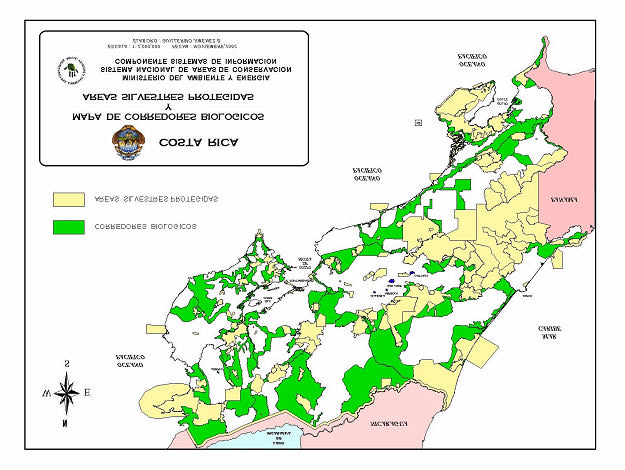
Areas Addressed in Projects and Enabling Activities........................................................... 30
Activities Over Time............................................................................................................. 33
Evolution of the GEF Funding to Costa Rica ....................................................................... 35
CHAPTER 5. RESULTS OF GEF SUPPORT TO COSTA RICA................................................. 39
Global Environmental Impacts ............................................................................................. 39
Catalytic and Replication Effects.......................................................................................... 39
Institutional Sustainability and Capacity Building ............................................................... 40
Details of Project Results ...................................................................................................... 40
CHAPTER 6. RELEVANCE OF GEF SUPPORT TO COSTA RICA ........................................... 43
Relevance of GEf Support to the Country's Sustainable Development
Agenda and Environmental Priorities .............................................................................. 43
Relevance of GEF Support to Country's Development Needs and Challenges ................... 45
Relevance of GEF Support to National Action Plans Within GEF Focal Areas .................. 46
Relevance of GEF Support to Global Environmental Indicators.......................................... 47
Relevance of GEF Portfolio to Other Global and National Organizations........................... 49
iii
CHAPTER 7. EFFICIENCY OF GEF SUPPORTED ACTIVITIES IN COSTA RICA .................... 51
How much time, effort and money does it take to develop and implement a project, by type
of GEF support modality?................................................................................................. 51
Roles and Responsibilities Among Different Stakeholders in Project Implementation....... 56
The GEF Focal Point Mechanism in Costa Rica .................................................................. 58
Lessons Learned Between GEF Projects .............................................................................. 59
Synergies Between GEF Stakeholders and Projects ............................................................. 59
ANNEXES (available in a separate document)
Annex 1. Terms of Reference
Annex 2. List of documents reviewed
Annex 3. List of participants to consultation workshops
Annex 4. List of people interviewed
Annex 5. Complete list of activities funded by GEF in Costa Rica
Annex 6. Brief description of activities funded by GEF not included in the evaluation
Annex 7. Results of projects included in the evaluation
Annex 8. Relevance of projects objectives and results to National Development Plans
iv
Executive Summary
1.
Costa Rica and the GEF have worked successfully together as partners in the effort
against the decline in global environmental conditions since the beginning of the GEF. Costa
Rica has been the recipient of GEF financial support since 1992 through a variety of projects and
activities in collaboration with the GEF's Implementing and Executing Agencies. The activities
supported by the GEF have assisted Costa Rica in the development of its environmental and
national development strategies. Costa Rica's rich natural endowments, well developed
environmental sector and national human resources capacity have helped the many achie vements
attained in the country with GEF support.
2.
The present evaluation is the first of its kind produced by the GEF Evaluation Office.
This type of evaluation was requested by the GEF Council with two main objectives (1) to
provide Council with additional information on the results of the GEF supported activities and
how they are implemented, and (2) to evaluate how GEF supported activities fit into the national
strategies and priorities as well as within the global environmental issues mandated to the GEF.
Costa Rica was selected for the first evaluation as a pilot with the additional objective of learning
and assessing if this new evaluation modality can actually be implemented in other countries in
the future.
3.
The evaluation focused on a portfolio of 12 full and medium size projects, some
completed and others still under implementation, approved between 1992 and 2005 for a total of
$32 million. In addition, the evaluation includes the Small Grants Programme, established in
Costa Rica since 1993 with an accumulated investment of $5 million in 354 small projects. The
GEF support to Costa Rica has been concentrated in the biodiversity focal area (almost 70% of
the GEF investment) but there are examples of projects in all the other GEF focal areas.
4.
The Costa Rica Country Portfolio Evaluation produced very good results and proved that
this kind of evaluation is indeed valid and feasible. The evaluation is relevant to the GEF
system, in particular to establish a historic assessment of how the GEF has been implemented in
the country. Based on this experience the evaluation produced recommendations to improve GEF
functioning in its new phase, under the implementation of the RAF.
5.
The evaluation reached the following conclusions:
Relevance of the portfolio
(1) GEF support to Costa Rica has been relevant to the progress of the country's
environmental agenda.
(2) The GEF's support could be more relevant in terms of the country's contribution to
global benefits.
Results of the portfolio
(3) GEF support of Costa Rica has produced global benefits and has been in accordance
with the GEF's mandate.
1
Portfolio's efficiency
(4) The duration of project preparation and approval varied greatly from very short to
very long. No common problem areas, constituting bottlenecks for all projects, were
found in this evaluation.
(5) The mechanisms available for tracking project preparation and negotiation processes
are generally very limited and the parties involved in these processes at the national
level do not have direct access to them. This limitation is particularly severe in the
pre-pipeline and post-GEF Council approval stages.
(6) GEF operational information (project procedures and requirements, decisions of
Council, etc.) is not easily available and is presented in a confusing way.
(7) Costa Rica is beginning to prepare for the challenges of the GEF's new Resource
Allocation Framework (RAF), though with some delay, particularly with regards to
institutional coordination and project prioritization.
Country Portfolio Evaluations
(8) GEF portfolio evaluations at the country level are valid and feasible despite the fact
that there is no national GEF program or strategy.
6.
The evaluation provides two set of recommendations:
(a) to the Council:
(1) Continue with GEF portfolio evaluations in other countries
(2) Evaluate Regional Projects for Central America
(3) Reinforce the effort to improve transparency in the GEF project cycle
(4) The information mechanisms in the GEF, most notably the GEF website, need to be
improved to make essential operationa l information available at the national level
(b) to the government of Costa Rica:
(1) Explicitly define the potential national contribution to global environmental benefits
and use this definition in prioritizing the country's proposals to the GEF in the future.
(2) Speed up processes for meeting the challenges inherent to the introduction of the
RAF.
7.
In addition, the evaluation also recommends that the on-going joint evaluation of GEF
activities and modalities conducts further investigation for developing proper support or
mitigation actions for GEF project proponents particularly during the pre-pipeline part of the
project cycle when most of the investments of counterpart organizations take place.
8.
The document begins with a presentation of main conclusions and recommendations
coming from the evaluation. The following chapters present the information collected and the
analysis conducted and how they support the conclusions and recommendations.
2
9.
The evaluation was conducted by a team of consultants under the leadership of Claudio
Volonte (Sr. Evaluation Officer, GEF Evaluation Office) and Alejandro Imbach (consultant). A
draft document was presented in Costa Rica on April 20, 2006 to national stakeholders, including
national government, Implementing and Executing Agencies, NGOs and other civil society
partners. Feedback was very positive. Comments received are included in this final version. The
Office remains fully responsible for the contents of this report.
3
CHAPTER 1. MAIN CONCLUSIONS AND RECOMMENDATIONS
Background
10.
Costa Rica has been the recipient of GEF financial support since 1992 through a variety
of projects and activities in collaboration with the GEF's Implementing and Executing Agencies.
From the end of 2005 until April 2006 the GEF Evaluation Office undertook an evaluation of the
GEF support to Costa Rica. This is the first time that the Office has performed such an
evaluation. The GEF Council asked the Office to begin conducting evaluations of activities
supported by the GEF at the country level with the goal of providing pertinent information to the
Council on how those activities relate to the country's sustainable development agenda, national
environmental strategies and priorities and the GEF's mandate. Costa Rica was selected as a
pilot case for testing the methodology and, based on that experience, for drawing up terms of
reference for similar future evaluations.
11.
The focus of the evaluation is a portfolio of 12 projects funded by the GEF during the
period from 1992 to the present with an investment of almost $32 million. Eight of those
projects were completed and four are under execution. This portfolio was not developed based
on a predetermined program or strategy, but consists of various projects with different aims and
objectives, developed and implemented over a 14-year period.
12.
All the focal areas are represented in this group, as are all GEF Implementing Agencies
(World Bank, UNDP and UNEP) and the IADB. In addition to those projects, the evaluation
included the Small Grants Programme, which has been under implementation in Costa Rica since
1993 and has funded 354 projects worth $5 million.
Conclusions
Relevance of the portfolio
13.
On the relevance of GEF support for the country's sustainable development agenda and
its environmental priorities, as well as its relevance to the GEF's mandate and programs, the
following conclusions were reached.
Conclusion 1. GEF support to Costa Rica has been relevant to the progress of the country's
environmental agenda.
14.
The analysis of the GEF portfolio shows that it was in line with National Development
Plans and national environmental strategies. Also, an analysis of the origins and results of
completed projects shows that Costa Rica has full ownership of the GEF's portfolio in the
country and has managed it in accordance with the national agenda. Projects that were completed
several years ago demonstrated catalytic and replication effects.
15.
Over the years the GEF support has become increasingly important relative to
development grants, given the relative constancy of the former compared to the drastic reduction
of the latter in the last few years.
4
Conclusion 2. The GEF's support could be more relevant in terms of the country's
contribution to global benefits.
16.
Although the preceding conclusion points out the relevance of GEF support of Costa
Rica's agenda and indicates that this agenda is clearly in line with the GEF's global agenda,
Costa Rica has not clearly defined its potential contribution to global benefits, even though it has
the capabilities and information needed to do so, as is evidenced by the work done in preparing
the GEF Programmatic Framework (2000) on biodiversity. Doing so would allow even better
alignment of the GEF's mandate, the country's priorities and projects.
17.
Given the fact that the activities supported by the GEF in Costa Rica were carried out
without a programmatic focus (the GEF does not require this in any of its programs), GEF
support puts special emphasis on the area of biodiversity (almost 70% of total funds) and little on
other major areas such as land degradation, and marine and coastal areas. This might be due to
the fact that other donors supported the country in those areas1, which was not studied further in
this evaluation.
Results of the portfolio
Conclusion 3. GEF support of Costa Rica has produced global benefits and has been in
accordance with the GEF's mandate.
18.
The analysis shows that there are many success stories related to:
· Impacts at the global environmental level, particularly in biodiversity conservation
through protected area management programs and payment for environmental services
and the abetment of CO2 emissions through wind energy projects.
· Replication and catalytic effect in terms of wind energy, payment for environmental
services, persistent organic pollutants national plan.
· Improvement in institutional sustainability for the Institute for Biodiversity (INBIO), the
national fund for forestry financing (FONAFIFO through Full Size Projects and other
local organizations through the Small Grants Programme and capacity building on areas
such as protected area management, taxonomy, payment for environmental services and
wind energy.
The portfolio's efficiency
19.
Efficiency questions focus on determining the time, energy and financial resources
needed to develop and implement GEF projects; the roles, coordination, lessons and synergies
among the various players and GEF projects; and the various challenges that are critical to the
entire GEF operation (communications, information on projects, GEF focal point and level of
preparation for the RAF).
1 As put forward during the workshop on the draft evaluation report in San José, Costa Rica, April 20, 2006.
5
Conclusion 4. The duration of project preparation and approval varied greatly from very
short to very long. No common problem areas emerged constituting bottlenecks for all
projects.
20.
As with other evaluations performed by the Office, the main problem when attempting to
conduct an analysis of this kind is the lack of systematized information on the progress of
projects during the project cycle.
21.
Analysis of existing information compiled for the evaluation shows considerable
variability in the duration of the phases for the same funding modality. It was noted that, on
average, preparation (from entry into the pipeline until start of execution) for Full Size Projects
took much longer than for Medium Size Projects (33 mo nths and 10 months respectively), while
this time was only about 4 months for Enabling Activities. There is no readily available
information on time spent on preparing projects before they enter the pipeline.
22.
Variability in the duration of the various phases of the project cycle seems to be
explained by factors particular to each project, such as prolonged negotiations between executors
and IAs/EAs, technical discussions among the various players involved, conflicts with public
finance regulatory entities in Costa Rica, staff rotation in IAs/EAs and changes in GEF priorities.
Conclusion 5. The mechanisms available for tracking project preparation and negotiation
processes are generally very limited and the parties involved in these processes at the
national level do not have direct access to them. This limitation is particularly severe in the
pre-pipeline and post-GEF Council approval stages.
23.
During interviews and visits, it was noted that there is no access to mechanisms for
tracking the progress of project proposals by parties acting at the national level (in both
implementing agencies and national organizations), which leads to apprehension and frustration.
Several cases were found where many months went by without project proponents at the national
level receiving any information on progress in reviewing their proposals. It was also noted that
there are mechanisms for doing this at the level of the central headquarters of the implementing
agencies, but the public does not have access to them.
Conclusion 6. GEF operational information (project procedures and requirements,
decisions of Council, etc.) is not easily available and is presented in such a way that
sometimes it leads to confusion.
24.
One area in which there is confusion and unawareness at the level of all national parties
(including some of the IAs/EAs local representatives) is the lack of knowledge and information
on the GEF in general, its operation, and the differing operating procedures of the Implementing
and Executing Agencies and the GEF for submitting projects and navigating them successfully
throughout the project cycle. Performance in these areas was deemed to be poor, deficient or
non-existent by most of the national executors interviewed and is confirmed by the experience of
the evaluation team. The GEF webpage is not visited regularly since it is perceived as being
confusing and not user-friendly. In general, it is hard to access operational information that is
relevant to national players. Council decisions are not indexed by subject on the webpage. This
was pointed out as a serious deficiency. Also, various people interviewed mentioned the lack of
direct communications between the GEF Secretariat and interested national parties.
6
Conclusion 7. Costa Rica is beginning the preparation process for dealing with the
challenges of the GEF's new Resource Allocation Framework (RAF), though with some
delay, particularly in relatively weak areas such as institutional coordination and project
prioritization.
25.
There are no GEF-related participatory mechanisms in operation at the national level for
analyzing the country's priorities based on requirements arising from the implementation of the
RAF, which is scheduled to begin operation in July 2006. Progress in this area can be shown
within the national capabilities self-assessment project funded by the GEF, which is beginning to
look into operational and strategic RAF issues and expects to address this subject. Pertinent
lessons can also be drawn from the process set up by the Small Grants Programme to give
priority to participatory mechanisms to efficiently allocate the GEF resources.
26.
At the same time, there is still no country program that sets specific priorities for
processes supported by the GEF. Existing instruments (Biodiversity Strategy, National
Environmental Agenda and others) are still very generic and require adaptation to become
operational for this particular source of funding.
Country portfolio evaluations
27.
A parallel goal for the GEF portfolio evaluation in Costa Rica was to evaluate the
feasibility of this new kind of evaluation at the GEF.
Conclusion 8. GEF portfolio evaluations at the country level are valid and feasible despite
the fact that there is no national GEF program or strategy.
28.
The pilot evaluation conducted in Costa Rica made it possible to satisfactorily answer
key questions regarding the relevance and efficiency of the portfolio. In addition, it was possible
to identify results and achievements of projects terminated several years ago, although it should
be pointed out tha t the results of the projects cannot be aggregated at the national level, but only
at the focal area level. The choice of Costa Rica as a pilot case was satisfactory, particularly as
an experiment in evaluating countries with small and medium GEF portfolios.
29.
A significant added value of this kind of evaluation is the ability to assess project results
several years after they are completed, creating a perspective that it is not possible to achieve
with the end-of-project evaluations that are normally done when particular projects are
completed.
30.
A fuller picture would emerge if the contributions of regional and global projects would
be included. However, unless the coordination offices of such projects are based in the country in
question, inclusion of these projects would substantially raise the costs of this kind of evaluation.
Furthermore, inclusion would increase the complexity of the evaluation by introducing contexts
different from the national ones, for example regional environmental problems and agreements.
7
Recommendations
(a) Recommendations to the GEF Council
(1) Continue with GEF portfolio evaluations in other countries.
31.
Continuing with these evaluations will allow a greater body of evidence on GEF support
at the country level to be built up. Moreover, such evaluations will add evidence and possibly
confirm the findings and conclusions of other evaluations with different focuses such as program
evaluations or global results evaluations, as well as provide inputs and questions to explore in
future exercises.
(2) Evaluate Regional Projects for Central America.
32.
This country evaluation demonstrated that this methodology is not an efficient way of
analyzing regional projects. In the case of Central America, regional projects on the whole have
constituted a large part of the GEF support to the region. Any comprehensive evaluation of these
projects should consider their performance, costs and relevance at the national and regional
levels, given the various regional environmental agreements and treaties in place in Central
America.
(3) Reinforce the effort to improve transparency in the GEF on project proposals in
the approval process.
33.
The GEF Council should reiterate its decision on the 2004 Annual Performance Report
that "the transparency of the GEF project approval process should be increased". The Costa Rica
portfolio evaluation highlights the difficulties at the national level to follow the project approval
process and reinforces the need for action on this issue, which was also emphasized in OPS3.
(4) The information mechanisms in the GEF, most notably the GEF website, need to
be improved to make essential operational information available to the national
level.
34.
On the national level it is difficult to ascertain whether the information provided on the
GEF's operations is up-to-date and in line with the decisions of the GEF Council. This could be
addressed by improving the accessibility of the website.
(b) Recommendations to the Government of Costa Rica
(1) Explicitly define the potential national contribution to global environmental
benefits and use this definition in prioritizing its proposals to the GEF in the
future.
35.
Costa Rica has an opportunity and the ability to increase its national contribution to
achieve global benefits. To do that, it must develop a strategic focus based on its environmental
potential and its national environmental and development strategies. The strategic spirit that
powered the preparation of the Programmatic Framework for Biodiversity (2000) could be
improved and extended to the entire range of actions supported by the GEF.
8
(2) Speed up processes for meeting the challenges inherent in the introduction of the
RAF.
36.
Implementation of the RAF will provide specific funding to countries for the biodiversity
and climate change focal areas. This will require developing new institutional processes for
prioritizing the use of those limited resources, mainly as regards climate change, where Costa
Rica will be sharing in group funding. Although Costa Rica has already begun this process, with
the implementation of the RAF in July 2006, it is recommended that this process be sped up to
avoid missing opportunities in areas such as climate change that will be open to competition.
Observation
37.
The GEF Evaluation Office is conducting an evaluation in conjunction with the
Evaluation Units of Implementing and Executing Agencies on GEF activities and modalities and
their respective cycles. The subject of efficiency, which is dealt with in Chapter 7, is an input for
this evaluation, especially as regards certain suggestions proposed to mitigate the negative
effects of long project preparation times.
9
CHAPTER 2. DESCRIPTION OF THE EVALUATION
Background
38.
The GEF Council asked the GEF Evaluation Office to conduct an evaluation of the GEF
portfolio at the country level. Such evaluations will provide the Council with additional
information on how the GEF functions at the country level and on the results of the activities it
supports, allowing it to better understand how these activities respond both to the country's
sustainable development, national strategies and priorities and the GEF mandate. Interestingly,
no evaluations of this kind using a country as the evaluation unit have ever been conducted
within the GEF system. Since the recently approved "Resource Allocation Framework" (RAF)
will be implemented in the next phase of the GEF (GEF 4, 2006-2010), it is expected that
evaluations of GEF support at the national level will provide useful feedback on work at that
level.
39.
The Council approved this new evaluation modality, as a pilot plan, for evaluating its
viability and developing a methodology for future country evaluations based on this experiment
as part of the EO's 2006 work program. The evaluation of the Costa Rica pilot case was
conducted in accordance with the Terms of Reference prepared by the Office and discussed with
Implementing Agencies, the GEF Secretariat and the Government of Costa Rica (see the Terms
of Reference attached as Annex 1).
40.
The Office selected Costa Rica for this first pilot evaluation for a number of reasons
including that the GEF portfolio in Costa Rica entails a wide variety of national, regional and
global projects, enabling activities and small grants implemented by all the implementing and
executing agencies. Also important is the fact that Costa Rica has a very good knowledge base
on the country's development and the environmental sector.
Objectives of the Evaluation
41.
The GEF support to Costa Rica pilot evaluation has three objectives:
1) Independently evalua te the relevance and efficiency of GEF support in the country
from various points of view: sustainable national development and the environmental
work framework; the GEF's mandate; achievement of global environmental benefits;
and the GEF's policies and procedures;
2) Explore methodologies that might be used to measure the results and effectiveness of
the GEF's portfolio at the aggregated and country levels; and
3) Provide feedback and knowledge to be shared with (1) the GEF Council in its
decision-making process on distributing resources and developing policies and
strategies (2) Costa Rica regarding its participation in the GEF.
10
Key Questions for the Evaluation
42.
The key questions explored during the evaluation of GEF support to Costa Rica were:
1) Is GEF support relevant to: (a) the national sustainable development agenda and
environmental priorities? (b) national development needs and challenges (e.g.
direction and appropriation by the country of the various kinds of GEF activities?;
(c) action plans for the GEF's national focal areas (e.g. enabling activities)?; and
(d) the GEF's mandate and focal area programs and strategies, and particularly what
is the relationship between the results of GEF support and impacts (proposed and
actual) and the global environmental indicators of each focal area?
2) Is GEF support efficient? (a) how much time, effort and money is involved in
developing and implementing GEF projects (e.g. based on the various kinds of GEF
support); (b) are the roles and responsibilities of the various players involved with the
GEF during the project design and implementation phases clear? (c) are execution
agreements, partnerships and synergies created within the GEF and between it and
other project donors and the national projects funded? and (d) how efficient are the
various kinds of GEF activities (e.g. comparison of full and medium-size projects)?
3) What methodologies are available for measuring GEF results (products, results and
impacts) and the effectiveness of its support: (a) at the project, focal area and work
framework levels and to explore various indicators for measuring these factors (e.g.
aggregation to measure progress in achieving global environmental benefits); and
(b) how can we determine what achievements are attributable to the GEF?
Focus and Limitations of the Pilot Phase
43.
The evaluation included all the activities supported by the GEF at the national level (full
and medium-size projects, enabling activities and Small Grants Programme) at various stages of
implementation (completed, on-going and in the pipeline) and implemented by all implementing
and executing agencies in all the local areas. This set of projects is defined as the GEF portfolio
in the country.
44.
In this evaluation exercise, environmental sector activities supported by other funding
sources, whether national, binational or multinational, were not included since the base
information for performing an analysis of this kind has not been compiled or systematized. At
the evaluation results presentation and validation meeting (April 20, 2006), the participants
pointed out the importance of those supplementary funding sources. As far as possible, mention
is made of them in the results analysis sections of this document and it is recommended that this
subject be considered in future evaluations of this kind.
45.
The way in which the GEF has operated at the country level causes various difficulties
for evaluations of this kind. For example, the GEF does not have national strategic programs.
Thus, there is no GEF national framework against which to evaluate results or effectiveness. On
the other hand, the GEF rarely supports work in isolation, but does in association with different
institutions. This makes it hard to attribute results. On the positive side, an evaluation with the
objectives described above might lead to important findings and increased understanding that
11
will allow the GEF to be more effective at the country level and within the RAF's operational
context.
46.
The evaluation of the GEF portfolio in this pilot project is not intended to be an
evaluation of the performance of the GEF, the implementing agencies or the country, taking into
account their effectiveness and the results achieved. The focus of this evaluation was on the
effectiveness and relevance of the overall GEF support.
47.
Also, given financial and time constraints and those described above, these evaluations
cannot be considered exhaustive, but limited, based mainly on existing literature (for example,
independent evaluations of projects and countries and reports from various studies and
evaluations carried out by the Office) and consultations with the major stakeholders involved.
48.
This evaluation of GEF support to Costa Rica was carried out by staff at the GEF's EO
and by local and international consultants who made up the evaluation team.
Methodology
49.
The methodology used included a combination of quantitative and qualitative methods:
· An in-depth review and analysis of over 10 documents containing information of the
development of Costa Rica's environmental, political and legal sectors, over 20 on
the GEF and the implementation of the assistance programs of GEF implementing
and executing agencies in Costa Rica and almost 100 documents with information on
progress in implementation and evaluative information on the results of projects
supported by the GEF (see the list in Annex 2).
· Two consultation workshops with key members in the implementation of the GEF in
Costa Rica, including the government, NGOs and other civil society stakeholders
(Annex 3 lists participants at various workshops). The first workshop discussed the
evaluation's the terms of reference, including the methodology. The second one
presented the first draft of the report and received feedback from all major
stakeholders.
· Extensive coverage of interviews with over 30 individuals and 20 global, national and
local institutions associated with the GEF and analysis of their contents (Annex 4 lists
the people interviewed).
· Field visits to 5 projects.
12
CHAPTER 3. CONTEXT OF THE EVALUATION
50.
In the preceding chapter, it was explained that one of the fundamental objectives of this
evaluation is to analyze the relevance of GEF support, both for Costa Rica and for the GEF itself.
Thus, it will be useful to present a brief summary of the context of the evaluatio n related to the
environmental sector in Costa Rica and the mandate and operations of the GEF, while pointing
out that there are a number of detailed documents that treat this subject in depth. Those
documents are listed in Annex 2.
General Description
51.
Costa Rica is a small country (land area: 51,100 km2; marine area: 589.000 km2) located
in the Central American tropics to the north of the Equator. It is a country of medium population
density (80 inhab/km2) with a total population of 4,200,000 inhabitants (2002), of whom
approximately half live in urban areas (48% en 2000).
52.
Costa Rica is a High Human Development country, in position 45 on the pertinent list
(UNDP, 2004), because of its high rating for various key indicators such as:
· Child mortality (9.5 per 1000, 2005)
· Life expectancy at birth (2000-2005): 79.7 years (women) and 75.0 years (men)
· Literacy (general adult population) 95.8% (UNESCO)
· Per capita GDP: (US$) 4,271 and per capita Purchasing Power Parity: (US$) 8,840
· Equality. Gini Index for income distribution by quintiles. 46.4. This index is high, being
the fourth highest among high human development countries, surpassed only by Mexico,
Chile and Argentina.
· Gender. The Gender-related Development Index lists Costa Rica in position 44, which is
consistent with its general position in the HDI (45), while on the Gender Empowerment
Measure (GEM), it is in position 19 on the list.
53.
In 2005, the Environmental Sustainability Index presented at the World Economic Forum
placed Costa Rica in position 18 among 146 nations. That index analyzes the performance and
the ability of countries to protect the environment in coming decades, considering investment in
natural resources, past and present pollution levels, environment management efforts and
society's ability to improve its management in that area (Programa Estado de la Nacion, 2005)
Brief Description of Environmental Resources in Key GEF Support Areas
a) Biodiversity and its conservation
54.
Based on the Costa Rican Institute of Biodiversity (INBIO) documentation and website
Costa Rica is among the 20 most biologically diverse countries in the world, having over
500,000 living species, of which 300,000 are insects (4% of the planet's land species).
Furthermore, approximately 11% of plant species are endemic, as are 14% of freshwater fish,
16% of reptiles and 20% of amphibians. To protect some of this extensive endowment, Costa
Rica has developed a world-class model of Protected Areas System. The development of this
13
system began in the mid-20th century and currently covers over 25% of the country. The table
below summarizes the System's status in 2001.
Table 1: Protected land area management categories in Costa Rica (SINAC 2001)
Management categories
Number
Area (ha)
% of the
country's Area
National parks
26
621,267
12.23
Biological reserves
8
21,663
0.42
Buffer zones
32
166,604
3.06
Forest reserves
11
227,545
4.47
Wildlife refuges
65
182,473
3.53
Wetlands
15
62,195
1.53
Other categories
12
23,264
0.34
Total
169
1,305,011
25.58
Figure 1. Map of biological corridors and protected areas in Costa Rica (SINAC-MINAE, 2002)
55.
In addition to the numbers mentioned above, there are over 55,000 hectares in 10 Private
Reserves (2001) and over 320,000 hectares in 21 Indigenous Territories. The latter are not
protected areas but, in general, they contain critical biodiversity and are important part in the
conservation system.
14
56.
This Protected Areas System is supplemented by a network of biological corridors being
developed that is intended to ensure the System's effectiveness and viability, playing an
important role in the migration and dispersion of plant and animal species, thus reducing the
vulnerability of protected areas to global and local threats. This biological corridor strategy has
become more relevant nationally and regionally because of the Mesoamerican Biological
Corridor project funded by the GEF through the World Bank and the impetus given by the
CCAD (Central American Commission for Environment and Development) to the concept as
such (Programa Estado de la Nacion, 2005). Moreover, both the Ecomarkets project (funded by
the World Bank and the GEF) and the GEF Small Grants Programme have designated biological
corridors as high-priority intervention areas.
57.
In recent years, this concept has been extended to the marine sector through a new
initiative aimed at establishing the Eastern Tropical Pacific Marine Conservation Corridor
through Costa Rica, Ecuador and Panama. In 2004, the MINAE set up the "Interdisciplinary
Exclusive Economic Zone Marine Coastal Committee" to determine the feasibility of dedicating
up to 25% of the exclusive economic zone to the conservation, restoration, management and
sustainable use of existing species and ecosystems (Decree 31832-MINAE, Program Estado de
la Nacion, 2005). This decree puts Costa Rica on the road to protecting an area in the ocean
equal to that on land.
b) Contribution to climate change and vulnerability
58.
According to the World Resources Institute (2000), Costa Rica has quantifiable emissions
in just three sectors: liquid fuels, cement production and land use change. In all three sectors, its
global and regional contribution is marginal. However, its emissions are increasing, with
domestic transportation being the sector with the greatest impact (66% of emissions).
Table 2: CO2 emissions in 2000 (World Resources Institute, 2000)
CO2 EMISSIONS, YEAR 2000 (thousands of metric tons)
LIQUID FUELS
CEMENT
LAND USE
PRODUCTION
CHANGE
World
10,636,592
824,400
7,618,621
Mesoamerica and the Caribbean
445,575
23,137
303,227
Costa Rica (country)
4,851
573
9,876
Costa Rica (% of Mesoamerica and the
1.1
2.5
3.3
Caribbean)
Costa Rica (% of world)
0.0
0.1
0.1
Costa Rica 1990
2,609
309
14,076
Costa Rica 2000
4,851
573
9,876
Change (%)
85.9
85.4
-29.8
SOURCE: Carbon Dioxide Information Analysis Center; World Resources Institute
15
SECTORIAL EMISSIONS (%) - (2001)
Electricity
2.1
Industry
1.0
Construction
15.9
Domestic transportation
66.0
Residential
2.9
Other commercial, public and agricultural
11.3
uses
99.2
SOURCE: International Energy Agency
59.
As regards to energy, Costa Rica's consumption is derived from three main sources:
petroleum derivatives, electricity and biomass (MINAE, First National Communication to the
Framework Convention on Climate Change, 2000). Energy demand has increased over the past
decade. This increase has been covered mainly by importing hydrocarbons and, to a lesser
extent, by producing energy domestically (Program Estado de la Nacion, 2005). In 2004, 70% of
commercial energy consumption came from imported hydrocarbons, 20% from electricity and
the remaining 10% from biomass resources. Energy consumption by the residential sector
(including family and personal vehicles) is dominated by electricity (42%). (2004 CENCE
report, ICE 2005).
60.
In 2004, 97% of the country was electrified. The population without access to the
electricity network is located in very remote areas where it is not feasible to extend the network.
In those cases, the government has been undertaking a rural electrification program with isolated
sources of renewable energy, in cooperation with international agencies and financial support
from the GEF.
61.
This energy overview gives a clear picture of Costa Rica's carbon emissions profile,
which is concentrated in liquid fuels and land use change, and shows the domestic transportation
sector as the main emitter (Table 2).
62.
On the other hand, Costa Rica is vulnerable to climate change impacts in various ways.
In its first communication to the UN Framework Convention on Climate Change, Costa Rica
presented a study on the vulnerability of various sectors to possible climate change impacts:
(1) according to simulations, runoff patterns in most basins could be altered; (2) changes in sea
levels would negatively impact the present coastline and extend areas subject to flooding;
(3) temperature changes could affect planting dates and cultivation areas; and (4) climate
changes might also reduce tropical and mountain zone areas and increase foothill floor life areas.
c) International waters
63.
The country has 589,000 km2 of oceans, 210 km of coastline on the Caribbean and 1,106
km on the Pacific. The broad continental shelf along the Pacific coast is one of the main factors
contributing to its fishing wealth. The Gulf of Nicoya is the most degraded marine area, both
because of overexploitation of its resources and because of pollution, particularly that resulting
16
from waste carried by the Río Grande de Tárcoles. Various migratory marine species have
routes that pass through the country's oceans (5 species of turtles, whales, lobster and others).
64.
The development of Marine Protected Areas is beneficial but limited compared to the
country's coastal and marine extension, as is indicated in the table below:
Table 3: Marine wildlife protected areas in Costa Rica (INBIO, 1997)
Management class
Area (ha)
National park
368,120
Biological reserve
2,700
National wildlife refuge
12,436
Total
383,256
65.
The Cocos Island marine ecosystems are noteworthy for their coral reefs and their
abundant highly endemic fish communities (approx. 17% of the 300 species), as well as for their
importance as a distribution center for many species of the Indo-Pacific region.
66.
In addition to marine environments, the country shares two transborder basins with
neighbouring countries: to the north with Nicaragua (San Juan River) and to the south with
Panamá (Sixaola-Yorquin Rivers). The San Juan River begins in Lake Nicaragua and flows into
the Caribbean Sea. At its head, the river runs through Nicaraguan territory and then forms the
international border. The river basin (i.e. excluding the Lake Nicaragua basin) covers 38,500
km2, of which 64% belongs to Nicaragua and 36% to Costa Rica. The river has various large
sub-basins in both countries and borders very important protected areas such as the Indio-Maíz
Reserve in Nicaragua and the Barra del Colorado Wildlife Reserve in Costa Rica. The Sixaola
River begins in the Talamanca mountain range, which divides the waters between the Pacific
Ocean and the Caribbean Sea, and empties into the Caribbean. In its lower course, it forms
Panama's northern border with Costa Rica. It is 146 km long and its basin covers 5,094 km².
Biodiversity and natural resources are safeguarded by six protected areas (155,848 has.), two
national biological corridors and six indigenous territories (112,789 has.) legally established by
the governments of Costa Rica and Panama.
d) Persistent organic pollutants
67.
Costa Rica has signed the main international conventions on chemical pollutants: Basel,
Rotterdam and Stockholm. Consistent with them, Costa Rica has prohibited, through decrees,
the production, importation, transportation, registration, trade in and use of raw materials and
manufactured products that contain polychlorinated or polybrominated biphenyls, heptachlor,
pentachlorophenol, aldrin, clordane, DDT, dieldrin, endrin, mirex or toxaphene. As will be seen
in later chapters, the country is currently in the process of inventorying toxic substances,
developing an action plan for them and creating the organizations needed to work effectively in
that area.
17
e) Land degradation
68.
Costa Rica has also signed and ratified the UN Convention to Combat Desertification and
set up an official advisory committee on the matter in 1998: the Land Degradation Advisory
Commission (CADETI). Work in this area has progressed as far as approval of the Soils General
Law and the creation of the National Action Program to Combat Land Degradation, while the
various requirements of the pertinent Convention have been fulfilled. The land degradation
situation in the country is summarized in Table 4.
Table 4: Current use of land in Costa Rica (National Land Degradation in Costa Rica Action
Programme, 2004)
Use class (Land)
Area (hectares)
Area (percent)
Well used (W)
2,714,977
54.9
Used in accordance with its use capacity, but requires special
521,598
10.5
conservation measures (Wt)
Underutilized (U)
732,217
14.8
Over-utilized (O)
475,204
9.6
Severely over-utilized (Ot)
504,584
10.2
TOTAL
4,948,580
100.0
The Environmental Legal Framework in Costa Rica
69.
Environmental legislation, including biodiversity and natural resources, is well developed
and up-to-date in Costa Rica. The national legal system consists of approximately 20,000 in-
force instruments, of which approximately 10% (2,000) deal with environmental matters in
general. Although the number of instruments mentioned above may seem high, the Attorney
General's Office, as the official attorney of the State, operates and periodically updates the
National System of In-Force Legislation, resolving any contradictions or overlapping in the
legislation being produced.
70.
The country's laws are based on the Roman/Germanic tradition and the hierarchy of legal
rules in Costa Rica is in line with that tradition. That hierarchy is set out in the Political
Constitution and the General Public Administration Law, as follows:
18
LEGAL FRAMEWORK
· GOVERNING FRAMEWORK
· OPERATIONAL FRAMEWORK
o Political Constitution of the Republic
o Executive Branch decrees
o International Treaties, Conventions and
o Regulations
Protocols
o Directives
o Laws
o Standards
§ Organic
§ Specific
a) Constitution of the Republic of Costa Rica and the environment
71.
In 1994, an amendment to Article 50 of Costa Rica's Political Constitution to read as
follows was approved2:
"The State shall attempt to ensure the greatest welfare of all inhabitants of the country,
organizing and stimulating the most appropriate production and distribution of wealth. All
persons have a right to a healthy and ecologically balanced environment and thus may denounce
any acts that infringe upon that right and demand that any damage caused be repaired. The
State shall guarantee, defend and preserve that right. The law shall determine the pertinent
responsibilities and sanctions."
72.
This amendment is very pertinent since by incorporating the right of "ecological balanced
environment" in the Constitution, no administrative rule or act may oppose it and it is protected
against all infraction.
b) Relevant International Treaties, Conventions and Protocols
73.
Costa Rica has signed and ratified most international treaties and conventions, including
the seven major international instruments monitored by the UNDP, as well as those related to
biodiversity and natural resources. The main ones are:
2 This is not an official translation of the original Constitution article; it was translated just to illustrate the
importance of the environmental sector in the country.
19
Table 5: Main international environment-related treaties, conventions and protocols
in Costa Rica over the last 30 years
Year
Milestone
1975
·
Ratification of CITES, the Convention on International Trade in Endangered Species of
Wild Fauna and Flora (Law 5605).
·
Ratification of the Montreal Protocol (Law 7223).
·
Ratification of the Vienna Convention (Law 7228).
1991
·
Ratification of the RAMSAR Convention on Wetlands of International Importance (Law
7224).
·
Ratification of its joining the CBD (Law 7416).
·
Ratification of its joining the UNFCCC (Law 7414).
·
Ratification of the Convention for the Conservation of Biodiversity and the Protection of
1994
Priority Protected Wildlife Areas in Central America (Law 7433).
·
Ratification of its acceptance of the Basel Concordat on the Control of Transborder
Movements of Dangerous Waste (Law 7438) and then ratification of the pertinent
Regional Agreement in 1995 (Law 7520).
1995
·
Ratification of the Regional Convention (Central American) on Climate Change (Law
7513).
·
Ratification of the UNCCD.
·
Ratification of the Kyoto protocol.
1997
·
Signature of the Stockholm Convention on Persistent Organic Pollutants (not yet
ratified).
·
Signature of the Cartagena Biosecurity Protocol (not yet ratified).
c) Relevant Laws
74.
In 1995, the Environmental Organic Law (Law 7554) was passed. Under its various
sections, this law establishes guidelines in numerous sectors and resources (protected areas;
marine, coastal, wetland, biodiversity, forest, air, water, soil, and energy resources) and on
numerous matters (administration and public participation; environmental education and
research; environmental impacts; protection and improvement of environment in human
settlements; land use planning; funding; sanctions, Environmental Controller, pollution, and
environmentally-friendly production)
75.
In the following years, various laws dealt with many of those issues in greater detail.
Some that might be mentioned are:
· 1996. Forest Law (7575). Established the Forest Fund and the FONAFIFO
· 1998. Soil Use, Management and Conservation Law (7779)
· 1998. Biodiversity Law (7788). Created the CONAGEBIO and the SINAC
20
76.
As regards deficiencies and weaknesses, the Water Law should be mentioned which it is
still being actively discussed in the Assembly, but has not yet been approved. Likewise, the legal
planning of coastal and marine areas still has weaknesses.
d) Operational framework
77.
The operational part that supplements and applies the legal framework is broad and
covers all existing legislation. Even more, certain important areas such as that related to
agrochemicals are almost totally regulated by various decrees.
78.
Finally, but very importantly, the existence and recognition in Costa Rica of
administrative careers should be pointed out. That means that technical level and middle
management personnel in state institutions remain in their positions when administrations change
and are not replaced automatically when a government is formed by a different political party.
Only officials of a "political" nature (senior managers and high officials) are replaced when
administrations change. That means that good institutional memory is maintained in most state
institutions because employees' jobs are secure.
Environmental Political Framework in Costa Rica
79.
The legal framework described in the preceding chapter is the legal structure that governs
national life despite political dynamics and the regular changes in government that have occurred
in the country since 1948. However, the various administrations (or governments) by different
political parties have left their mark on the national process through instruments such as plans
and strategies.
80.
Some of the instruments mentioned were created in response to obligations contracted
under international conventions such as the National Biodiversity Strategy. Notable among those
relevant to this evaluation include:
· ECODES National Conservation and Development Strategy (1989)
· National Conservation and Sustainable Use of Biodiversity Strategy (1999)
· 2001-2020 National Forest Development Plan (NFDP)
· NFDP action plan (2001)
· National Environmental Strategy 2005-2020
81.
The meshing of the political agendas of the various administrations with the current legal
framework is achieved through the National Development Plan (NDP), developed by the
different government institutions and coordinated by MIDEPLAN. This is a medium-term plan,
the duration of which coincides with the 4-year term of each administration, prepared at the
beginning of each democratically elected administration's mandate. Recently, the NDP has been
harmonized with state budget allocation mechanisms and with follow-up and account rendering
processes through the National Evaluation System (SINE). Public participation and national
discussions on environmental issues are a fundamental aspect of the formation of the
environmental political framework in Costa Rica, contributing to a high level of awareness and
involvement by civil society in decision-making. This social capital is particularly notable in the
environmental sector.
21
82.
Work with international organizations such as multilateral banks, the GEF and others has
also been subject to some extent to political dynamics, since it is with high-ranking officials from
the various administrations that they negotiate regarding a variety of issues. As was already
stated, all this activity takes place within the prevailing legal framework, but with political and
ideological nuances introduced by the rotation of different political parties in the government.
Global Environmental Facility
83.
The GEF is an international cooperation financial mechanism whose goal is to provide
new and additional funding, in the form of grants and concessionary funding, to cover the
additional agreed cost of measures necessary to achieve the agreed global environmental benefits
in the areas of:
· Biological diversity, in coordination with the Convention on Biological Diversity
· Climate change, in coordination with the UN Framework Convention on Climate Change
· International waters
· Depletion of the ozone layer, in coordination with the Montreal Protocol
· Persistent Organic Pollutants, in coordination with the Persistent Organic Pollutants
Convention
· Land degradation, in coordination with the UN Convention to Combat Desertification
· Multifocal Area for initiatives that combine two or more of the above thematic areas.
84.
The GEF is governed by an Assembly of almost 150 member countries that meet every
four years and a 32-member Council (representing all the member countries), which meets semi-
annually. A Secretariat located in Washington (USA) is responsible for the institution's
operational matters.3
85.
GEF activities are implemented through three implementing agencies: the World Bank,
the UNDP and the UNEP. Since 2004, seven executing agencies have been approved (regional
banks: Inter-American, African, European and Asiatic), the FAO, the IFAD and the UNIDO) to
execute GEF activities, although the great majority of projects are still being implemented
through the three implementing agencies.
GEF support modalities can be summarized as follows:
· Full-size projects (funding over $ 1 million)
· Medium-sized projects (total funding under $ 1 million)
· Small grants, with funding under $ 50,000, directed to NGOs and local organizations.
Small GEF grants are structured into a global program (Small Grants Programme)
administered by the UNDP and support initiatives included in any of the GEF's four focal
areas
· Enabling activities, intended to help countries meet their obligations under the various
conventions which the GEF services
3 More information may be found on the GEF's web page at http://www.thegef.org.
22
· Project development funds (PDFs), which are organized into three classes based on the
amount of support (PDF A up to $ 50,000, PDF B up to $ 500.000 and PDF C up to $1
million).
86.
Activities funded by the GEF are governed by Operational Programs and Priority
Strategies in each of the focal areas. Global conventions provide the GEF with guidelines on
projects that should be funded, the GEF Council approves those guidelines and the Secretariat
makes them operational.
87.
At the national level, the GEF operates through a Focal Point mechanism, which is
structured differently in each national context. The GEF recommends that two Focal Points be
established (one political and the other operational) and the establishment of transparent
mechanisms with strong participation. As for the structure of the Focal Point function, there are
several different models ranging from single-person models (as is the case in Costa Rica, which
has one person designated by the government as both the political and operation Focal Point) to
schemes based on multi-institutional committees (Colombia), mulit-sector committees (Bolivia),
specific offices within the formal state structure (China) and others. The GEF provides
guidelines defining the functions and responsibilities of the Focal Point mechanism. There are
also basic support programmes for those functions.
88.
The GEF trust fund is made up of contrib utions from donor countries plus interest on
them generated over time. This fund is administered by the World Bank. Once the trust fund is
replenished (every 4 years), funding is allocated through grants as countries develop projects and
the Council approves them.
89.
Officially, the GEF began with a 2-year pilot phase from 1992 to 1994. This was
followed by 3 regular 4-year phases: GEF I (1994-1998), GEF II (1998-2002) and GEF III
(2002-2006). In mid-2006, GEF IV will be initiated and will continue until 2010. During those
phases, grants were allocated by means of a funding windows process where a global amount
was allocated to each of the seven thematic areas listed above (and not by country). GEF
member countries submitted their requests to the various windows through the different
Implementing Agencies, which take appropriate action before the GEF.
90.
GEF III donors recommended the establishment of a system for allocating resources by
country, specifically for biodiversity and climate change, to be implemented in GEFIV. The
GEF Council approved this new framework in August 2005 and it will be implemented
beginning in July 2006 for the duration of GEF IV (until June 2010) under the name RAF
(Resource Allocation Framework).4 Unlike the mechanism used previously, the RAF sets
funding allocations for each country in each of the two areas mentioned. Depending on the
importance of the country in each of area, these allocations might be made individually (country
allocation) or for countries within a group of countries (group allocation). For example, in the
case of Costa Rica, the country will receive an individual allocation for Biodiversity but a group
allocation for Climate Change, reflecting its great importance in the first case and its limited
relevance to emissions abatement.
4 More information about the RAF is provided in the GEF website: www.thegef.org
23
91.
Since this evaluation focuses on projects approved before July 2006, the subject of the
RAF is considered to be outside its terms of reference despite the fact that it is considered as the
framework of relevance for any recommendatio ns and suggestions that might be made.
24
CHAPTER 4. ACTIVITIES FUNDED BY THE GEF IN COSTA RICA
Introduction
92.
The GEF has supported a wide and diverse range of activities and projects in Costa Rica
in collaboration with national and multinational partners5. The GEF portfolio of projects is
formed by a series of individual initiatives that were approved and implemented in relative
isolation since neither the GEF nor Costa Rica have developed a strategic plan or program to
guide GEF support. It is thus not possible to speak of a country program or other instruments
that involve a pre-existing higher-level design.
93.
It should be pointed out that in 2000 a group of national experts prepared a strategic
document to guide biodiversity-related activities to be funded by the GEF, following
recommendations on the matter contained in GEF Council Resolution C14-11 of December
1999. That document (Programmatic Framework for Biodiversity GEF, 2000) was developed
to the level of project profiles, but was never used in practice.6
94.
In short, GEF support to Costa Rica can only be described as a portfolio or group of
projects that have been approved over the years in different areas. In this and following chapters,
it will be discussed whether this was a weakness in GEF support or if, in reality, projects in
Costa Rica in some way succeeded in filling gaps in the national environmental strategy.
95.
For analysis purposes, the portfolio may be broken down into six basic groups:
a) All Projects (full and medium-size) completed or being implemented within the country.
b) Project Development Facilities (PDF A, PDF B and others) that constitute the country's
"pipeline".
c) Enabling Activities.
d) The Small Grants Programme.
e) Regional Projects (shared by Costa Rica and other Latin American and Caribbean
countries).
f) Global Projects (shared by Costa Rica and countries on other continents).
96.
A complete list of the activities funded by the GEF in Costa Rica may be found in
Annex 5.
5 As was indicated above, there are other sources of support and funding for the environmental sector in Costa Rica.
However, the analysis presented in this chapter is limited to the GEF portfolio supported by the GEF and the co-
funding.
6 In the late 1990s and early 2000s, a number of countries, including Costa Rica, developed guide strategies and
programs for GEF intervention at the national level. None of those initiatives were formalized or approved by the
GEF Council or the GEF Secretariat.
25
Activities Considered in the Evaluation
97.
In this pilot evaluation, not all activities supported by the GEF were included because of
time and financial limitations only those that met the following criteria:
a. Activities carried out exclusively in Costa Rica i.e. all regional and global activities
were excluded
b. Activities completed and under implementation, excluding current project development
facilities i.e. PDF A and PDF B and pipeline activities.
98.
Those criteria were used to define a group of homogeneous and feasible activities to be
analyzed with available resources (money and time). A very brief description of activities that
were not considered is given in Annex 6. Based on those criteria, the group of activities
considered in this evaluation are presented in the following table:
Table 6: List of activities supported by the GEF in Costa Rica included in the evaluation
GEF
ID/Focal
Name/Implementing Agency
Type
Area
Completed Projects
60/CC
Tejona Wind Power (World Bank/IADB)
FSP
103/BIO
Biodiversity Resources Development (World Bank)
FSP
364/BIO
Conservation of Biodiversity and Sustainable Development in the Osa and La Amistad
FSP
Conservation Areas (UNDP)
671/BIO
Ecomarkets (World Bank)7
FSP
672/BIO
Conservation of Biodiversity in the Talamanca-Caribbean Biological Corridor (UNDP)
MSP
979/BIO
Conservation of Biodiversity in Agroforestry with Cacao (World Bank)
MSP
Projects Under Implementation
1132/CC
National Off-grid Electrification Based on Renewable Sources of Energy Programme
FSP
Phase 1 (UNDP)
1713/BIO
Improvement in Management and Conservation Practices for the Cocos Island
MSP
Conservation Area (UNDP)
Completed Enabling Activities
213/BIO
National Biodiversity Strategy and Action Plan (Report to the CBD) (UNDP)
EA
1659/CC
Inventory of Greenhouse Gases (Second National Communication to the UNFCCC
EA
Climate Change-) (UNDP)
Enabling Activities in Execution
2207/MFA
National Global Environmental Management Capacity Self-Assessment (UNDP)
EA
2426/POPs
National Convention on Persistent Organic Pollutants Implementation Plan (UNEP)
EA
Small Grants Program
Small Grants Programme (UNDP)
SGP
99.
As presented in the previous table, most of the focal areas and all GEF's implementing
agencies are present in the selected projects.8. On the next page, Figure 3 showing types of
7 This project will be completed as June 30, 2006
26
activities, implementing agencies and the GEF focal area to which projects belong is presented to
illustrate how the group of activities selected in relation to those variables is visualized. In this
figure, each block of color (shades of gray) represents one of the activities implemented or under
implementation with GEF funds in Costa Rica. The height of each block is proportional to the
budget assigned to it. The color of each block indicates the GEF focal area to which each activity
belongs. In addition, each block has the unique GEF identification number, the name of the
project and its budget. The dark text indicates completed projects and in the light text represents
projects in execution.
Figure 3: Activities supported by the GEF in Costa Rica, by IA/EA
100. As can be seen in the above graphic, the main implementing agencies are the World Bank
(which has executed 53.2% of GEF funds) and the UNDP (which has executed 45.5% of GEF
funds). The World Bank has participated in fewer activities than the UNDP, but with larger
budgets in all of them. The above graphic shows that the WB:
· has participated in 4 activities
§ 3 Full-size Projects (2 in Biodiversity and 1 in Climate Change)
§ 1 Medium-sized Project in Biodiversity
· has executed a total budget of $19.67 million
· the average budget is $4.92 million per activity
· currently has no activities in execution
101. In the case of the UNDP, its participation has been more varied, including all the funding
modalities available through the GEF. The above graphic shows that UNDP:
8 The IADB was recently added to the list of executing agencies but its national projects are still
in the development phase.
27
· has participated in 7 activities
§ 2 Full-size Projects (1 in Biodiversity and 1 in Climate Change)
§ 2 Medium-size Projects, both in Biodiversity
§ 3 Enabling Activities (1 in Biodiversity,1 in Climate Change and 1 Multifocal)
· has executed the Small Grants Programme for 13 years
· has executed a total budget of $11.75 million (not including the SGP)
· the average budget is $1.68 million per activity
· the SGP has distributed approximately U$ 5.08 million in 354 projects (an average of
$14,350)
· currently has 3 activities in execution, plus the SGP.
102. The UNEP has participated only marginally in the execution of GEF funds at the national
level only $450,000, equal to 1.2% of all GEF funds executed in Costa Rica. As is usual in
most countries, the UNEP's portfolio includes regional and global projects but, as was
mentioned earlier, activities of that type were not included in this analysis.
103. The GEF Executing Agencies do not appear in the graphic since they do not currently
have any activities in execution or completed.9
104. On the next page, another graphic similar to the preceding one is presented, but using
other criteria that make it possible to look at GEF activities in Costa Rica by focal area and
extract useful information. As in the preceding figure, in this one each color block (gray
shadings) represents one of the activities executed or in execution in Costa Rica with GEF funds.
The height of each block is proportional to the budget assigned to each activity. In this graphic,
the color of each block indicates the Implementing Agency associated with each activity. Each
block also has a brief text giving the GEF identification number, the name of the activity and its
budget. For completed projects, the text appears in dark black. For projects in execution, it
appears in light black.
105. This graphic clearly shows the particular emphasis placed in the Biodiversity focal area
(68.6% of funds) on activities supported by the GEF in Costa Rica. In second place is the SGP,
which has executed approximately 13.2% of GEF funds. In third place are activities related to
the Climate Change focal area (12.5% of funds). Finally comes the Persistent Organic Pollutants
focal area (1.2% of funds) and the Multifocal area (0.5%).
106. The preceding graphic shows that for the Biodiversity focal area:
· 7 activities have been executed
o 3 by the World Bank and 4 by the UNDP
o 3 Full-size Projects, 3 Medium-size Projects and 1 Enabling Activity
o 6 activities have been completed and 1 is still in execution
· A total of $ 26.4 million has been executed for an average of $3.8 million per activity
107. In the case of the Climate Change focal area, we observe that:
9 The IADB executed the Tejona Project but through the World Bank since at that time the IADB was not one of the
seven Executed Agencies under Expanded Opportunities.
28
· 3 activities have been implemented
o 1 by the World Bank and 2 by the UNDP
o 2 Full-size Projects and 1 Enabling Activity
o 2 activities have been completed and 1 is still in execution
· A total of U$ 4.8 million has been executed for an average of $1.6 million per activity
· The total budget for this focal area is 5.5 times less than the total budget for the
biodiversity focal area
108. For the remaining focal areas (POPs and Multifocal), it should be mentioned that they
each have one activity in execution Enabling Activities in both cases one implemented by
UNDP (Multifocal area) and the other one by UNEP (POPs).
109. The remaining GEF focal areas (International Waters and Land Degradation) do not
appear in the graphic since there are currently no activities in execution or completed in them at
the national level.
Figure 4: Activities supported by the GEF in Costa Rica, by GEF focal area
29
Areas Addressed in Projects and Enabling Activities
110. The areas addressed in the projects and enabling activities supported by the GEF in Costa
Rica are summarized in Table 7. A more detailed description of each of the projects objectives
and their results are found in Annex 7. Tables 8 and 9 also provide basic information about
regional and global projects for information purposes only, these projects were not considered in
this pilot evaluation.
Table 7: Main themes addressed by activities supported by the GEF in Costa Rica through
national projects
Focal area
Full-size Projects
Medium-size Projects
Enabling Activities
SGP
· Strengthening of Osa
and La Amistad
· Strengthening of the
Conservation Areas
Cocos Island
Conservation Area
· National Biodiversity
· Biodiversity
Biodiversity
Strategy and Action
inventories
· Biological corridors
Plan
· Payment for
· Agrobiodiversity
environmental
(Cacao)
services
· Solar power
production
Projects in
· Inventory of
Climate Change
various thems
· Electrification with
greenhouse gases
related to all
alternative energy
focal areas
sources
· National Plan for the
Persistent
implementation of the
Organic
Convention on
Pollutants
Persistent Organic
Pollutants
· Self-assessement of
national capacity for
Multifocal
the management of
the global
environment
Table 8: Main thems addressed by regional projects in which Costa Rica participates
Area focal
Full-sized Projects
Medium-sized Projects
· Establishment of a Program for Consolidating the
· Eco-business fund
Mesoamerican Biological Corridor
· Integrated management of ecosystems in
indegenous communities (*)
· Conservation of biodiversity and socioeconomic
Biodiversity
values of mangrove ecosystems in tropical
America
· Conservation of biodiversity in private lands in
Latin America
· Conservation and sustainable use of native
neotropical crops and the wild relatives of
cultivated species
30
Area focal
Full-sized Projects
Medium-sized Projects
· Central American markets for biodiversity
· Biosafety in biodiversity centers: building of
technical capacity for the safe development of
transgenic crops
1. Acceleration of renewable energy investments
3. Creation and enhancement of
Climate Change
through the CABEI in Central America
capacity for the sustainable
2. Energy efficiency in El Salvador, Nicaragua, Costa
development of renewable
Rica and Panama (*)
energy in Central America
4. Formulation of a strategic action programme for the
integrated management of water resources and the
sustainable development of the basin of the San
International waters
Juan River and its coastal areas (*)
5. Reduction of pesticide runoff into the Caribbean
6. Regional action programme and demonstration of
sustainable alternatives to DDT for controlling the
malaria vector in Mexico and Central America
· Global Environmental Citizenship (GEC)
· Participatory focus in
· Integrated forest/pasture focus in ecosystem
environmental management: a
contribution to the Inter-
Multifocal
management (*)
· Sustainable environmental management for the
American Strategy for
basin of the Sixaola River
Participation (ISP)
(*) Regional projects whose Coordination Offices are located in Costa Rica
Table 9: Main thems addressed by global projects in which Costa Rica participates
Focal area
Full-size projects
Medium-size projects
Enabling activities
Implementation of the Global
Training in biodiversity
Strategy for the Conservation of
data management and
Biodiversity
Plant Species:
information network
Development of a market
National Case Studies on
Climate change
strategy transformation for
greenhouse gas sources
on-grid solar power
and sinks
technologies
Reduction of the environmental
International
impact of fishing lobster with
waters
dragnets by introducing catch
technologies and changing
management practices.
participatory approaches for
managing the environment
Multifocal
Small Grants Programme (SGP)
111. Costa Rica was part of the first group of countries that participated in the SGP, starting in
1993. The Program in Costa Rica has steadily increased its budgets and number of projects
funded over the years. Currently, approximately 40 projects per year are being executed in all the
GEFs's focal areas. UNDP implements this GEF corporate program.
31
112. UNDP, in its own assessment, has concluded that the SGP program in Costa Rica has
been very successful and has provided additional funds in the last two years to execute projects
($ 900,000 in 2004 and $ 850,000 in 2005, compared to a planned per-country maximum of
$ 750,000 per year). Since the SGP began, it has invested the equivalent of a full-size project
($ 5.08 million) and has funded 354 projects.
Table 10: Grants given out by the SGP by GEF focal area
GEF focal area
Number of grants
Estimated value of
Percent
grants
Biodiversity
269
$ 3.860
76.0%
Multifocal
57
$ 0.818
16.1%
Climate change
13
$ 0.187
3.7%
Land degradation
11
$ 0.158
3.1%
Persistent organic pollutants
3
$ 0.043
0.8%
International waters
1
$ 0.014
0.3%
Total
354
$ 5.08
100.0%
113. The distribution of funds through the SGP show tendencies similar to that in the general
support the GEF provides to Costa Rica: strong emphasis on the biodiversity focal area, followed
in a distant second place by the multifocal area and, with smaller allocations, the climate change
and land degradation areas. The remaining two focal areas (POPs and International Waters) have
received limited allocations (less tha n 1%).
114. At the national level, the SGP is managed by a Committee which includes representatives
from UNDP, MINAE and NGOs, indigenous and farmers groups.. Among its functions, this
Committee selects projects to be funded and sets strategic priorities for each phase of the
program. For example, the SGP has established that projects have a maximum total ceiling of
$50,000 but, in the specific case of Costa Rica, the Committee set an annual ceiling of $25,000.
In this way, it has been possible to support a la rger number of projects over more years and,
according to the Committee, this approach provided more opportunities for capacity building and
the financial sustainability of the beneficiary organizations.
115. In recent years, the SGP in Costa Rica has gone through a process of reflection and
adjustment that has led to focusing its work exclusively on five priority area:
1. Biological Corridors (in conjunction with the Mesoamerican Biological Corridor
Regional Project and other national corridors)
2. Rural Community Tourism
3. Support to volunteer environmental work (volunteers, brigades and COVIRENAS)
4. Sustainable production, basically organic agriculture
5. Indigenous territories.
32
116. In addition to the priority areas mentioned, to be eligible, proposed projects must meet
the following conditions:
· Be located in the Buffer Zone of a Protected Area, in a Biological Corridor or in a
indigenous Territory
· Be clearly within one of the five priority issues
· Be clearly related to one of the GEF's focal areas.
117. The financial future of the SGP in Costa Rica during the next phase of the GEF (GEF IV)
has caused some concern since, at the global level, the SGP continues to add countries in the
Programme, but its funding is not increasing proportionally. One of the alternatives proposed for
the next phase of the GEF is that the country use part of the funds assigned from the Biodiversity
and/or Climate Change RAF to maintain the level of operations of the SGP. At the time of the
evaluation, government authorities seemed to be sympathetic to this alternative, although no
formal decisions have been taken in the matter.
118. Two things that became apparent during the interviews explain the reasons for the
favourable opinion of SGP:
a. the Program has the most synergies with other projects funded by the GEF in Costa Rica
(e.g. with the Mesoamerican Biological Corridor Regional Project-, Ecomarkets, etc.)
b. The great majority of those interviewed during the evaluation assigned high value and
impact to the actions of the SGP in Costa Rica.
Activities Over Time
119. Figure 5 gives an overview of the GEF portfolio in Costa Rica and the changes
experienced over the past 13 years. It includes milestones in changes in the national legal
framework, which appear under the graphic ordered by year. On the vertical axis, the budget
assigned to each activity is graphed. The various funding modalities are represented with colors:
Full-size Projects (dark red), Medium-size Projects (blue), Enabling Activities (green) and the
Small Grants Programme (yellow). The activities supported by the GEF appear as horizontal
lines whose start point is the effective date or beginning of implementation and whose end point
is the actual closing date (for completed projects) or the projected closing date (for projects in
execution). The legend accompanying each project appears in black for completed projects and
in red for projects in execution. On the horizontal axis, the timeline is graphed. It is subdivided
into GEF stages (gray and white lines on the background of the graph), which coincide almost
exactly with the terms of the country's various political administrations.
33
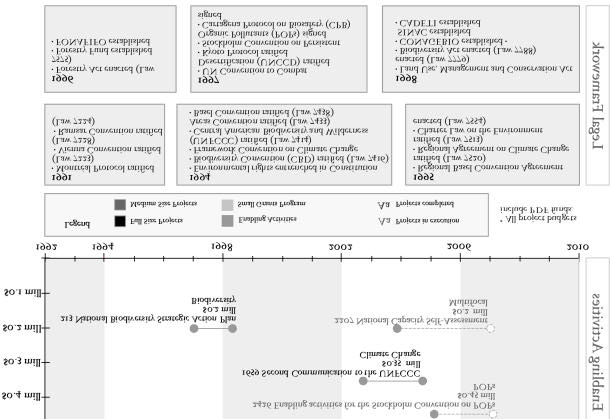
Figure 5: Timeline for activities supported by the GEF in Costa Rica
34
120. Some interesting observations based on an analysis of this timeline are:
· In each phase of the GEF, Costa Rica has executed at least one full-sized project with a
budget exceeding $ 7 million.
· In the early phases of the GEF, GEF supported primarily biodiversity conservation, but
beginning in GEF III, the portfolio began to diversify (climate change, biodiversity use,
payment for environmental services, etc.)
· Resources provided through the SGP show a marked and steady increase in each
subsequent phase of the GEF.
· The greatest legal activity in environmental matters in Costa Rica took place between
1994 and 1998 (during the first phase of the GEF).
Evolution of the GEF Funding to Costa Rica
121. The following table shows the evolution of GEF funding to Costa Rica for various
modalities, during the GEF different phases.
Table 11: Details of GEF funds provided to Costa Rica by phase, focal area and implementing
agency as of December 2005
$ GEF
Pilot
GEF I
GEF II
GEF III
Pipeline
Total
phase
National
$11.30
$7.48
$9.83
$3.15
$23.54
$55.30
($13.15)10
($13.54)5
Regional
---
$14.87
$22.53
$29.48
$29.14
$96.02
Global
$8.70
---
$5.53
$1.00
$3.35
$18.58
Biodiversity
$8.00
$7.48
$9.83
---
$20.06
$45.37
($10.06)5
Climate change
$3.30
---
---
$1.50
$2.50
$7.30
Land degradation
---
---
---
---
$0.98
$0.98
Multifocal
---
---
---
$0.20
---
$0.20
Persistent Organic Pollutants
---
---
---
$0.45
---
$0.45
Small Grants Programme
$0.09
$0.71
$1.27
$3.01
---
$5.08
National
World Bank
$3.30
$7.28
$9.08
---
$10.00
$29.66
($0)5
UNDP
$8.00
$0.20
$0.75
$2.70
$13.51
$25.16
UNEP
---
---
---
$0.45
---
$0.45
Cofunding
$28.00
$13.08
$54.71
$3.26
$124.95
$224.01
($73.26)5
($54.92)5
Note: The GEF Council approval date was used rather than the effectiveness date when placing a project within a GEF phase.
122. Considering this information, it can be seen that GEF support to Costa Rica has remained
relatively constant since the GEF began. The importance of the Regional Programs in which
Costa Rica participates can also be seen, although the proportion of those amounts used in the
country has not been calculated.
10 It must be pointed out that in the first quarter of 2006, the "Generalization of Payment for Environmental
Services" project, a $10 million project in the area of biodiversity, was endorsed by the GEF CEO and therefore
included in GEFIII but after this evaluation completed its analysis .
35
Co-funding of GEF projects
123. The co-funding data shown in Table 12 comes from project documents prepared for
Council approval before projects actually start. It is possible that in many cases the real co-
funding for those projects may have been higher or lower once project begins implementation.
However, that information is not available and therefore could not be used for the analysis.
Taking this limitation into account, the average co-funding/GEF contribution ratio for each of
their phases could be estimated:
Table 12: Cofunding/GEF contribution ratio for each phase
GEF phase
Cofunding: GEF contribution
Pilot phase
2.48
GEF I
1.75
GEF II
5.57
GEF III
5.31
Average
3.78
124. The average cofunding/GEF contribution ratios for phases II and III are very similar and
significantly higher than those for the first phase. The average figure for all phases (1:3.78) is
quite close to the global average estimated in the GEF's Annual Performance Report (1:4).
Changes in international cooperation assistance to Costa Rica
125. Figure 6 shows changes in international cooperation assistance to Costa Rica (Human
Development Report, UNDP, 2005) over the period of GEF operations, as well as changes in
GEF financial support over that same period. Neither regional nor global projects are taken into
account. The "Generalization of Payment for Environmental Services in Costa Rica" project is
included in this set of GEF financial support data.
126. International assistance to Costa Rica has declined dramatically in recent years. A
significant drop is noted in the decade between 1992 and 2002. However, GEF financial support
was increased during that period, reaching a relatively stable level in recent years (from $4.13
million to $4.78 million annually between 1999 and 2006). It is important to point out that the
data available for international assistance to Costa Rica presented here is aggregated data for all
assistance received by the country in various areas, of which the environmental agenda is only
one. However, GEF financial support is specifically related and limited to environmental issues.
127. Given the scenario described, it can be stated that the relevance of GEF financial support
in Costa Rica is increasing and that the role this support plays in implementing the national
environmental agenda is becoming more and more strategic.
36
Figure 6: Changes in international assistance to development in Costa Rica and in GEF support
$125.00
R2 = 0.9314
$100.00
$75.00
$50.00
$25.00
$-
1992
1994
1995
1996
1997
1998
1999
2000
2001
2002
2003
2004
2005
2006
Apoyo financiero del GEF
Asistencia internacional para el desarrollo
Evolution of GEF support to Costa Rica compared to other Central American countries
128. The following graph shows the evolution in GEF support to various Central American
countries (including Costa Rica) over its different phases. This information does not include
Small Grants Programme figures for any of the countries studied.
129. Costa Rica is the Central American country that has received the most support from the
GEF (22.9% of funds provided to Central America) and that, as already stated, this support has
been relatively constant throughout the last 13 years. Nicaragua (16.1% of funds) is in second
place, followed with very similar amounts by Panama (14.4%), Honduras (14.2%) and
Guatemala (14%), and finally El Salvador (9.3%) and Belize (9.2%). The support to the other
Central American countries has been irregular or almost completely absent within some of the
GEF phases (particularly GEF I and II).
37
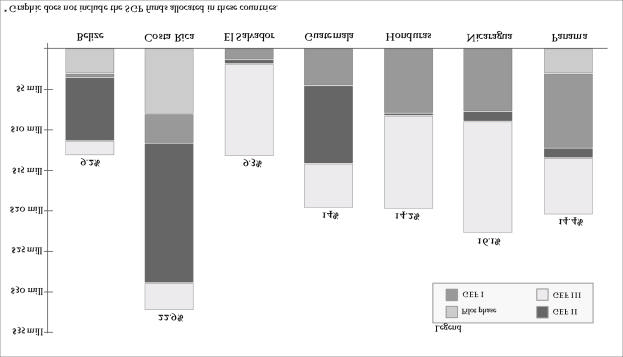
Figure 7: Changes in GEF support to Central America Countries
38
CHAPTER 5. RESULTS OF GEF SUPPORT TO COSTA RICA
130. The issues addressed by the various projects are discussed in the previous chapter. To
determine relevance to the country, this chapter will briefly review results (outcomes and
impacts). To assess whether the projects have helped advance the policy debate in the country,
their origins will also be reviewed. Results were measured per the following parameters:
1. Global Environmental Impacts
2. Catalytic and Replication Effect
3. Institutional Sustainability and Capacity-Building
Information on results was compiled from interviews and documents subsequent to project completion.
Final project evaluations focused mostly on attainment of outcomes and provided limited information in
this regard, suggesting that they may not be an efficient tool for identifying and evaluating project results.
Global Environmental Impacts
131. GEF support has achieved impacts on several biodiversity areas. In the critical ecoregion
of Osa and La Amistad Protected Areas, one of the last stands of Pacific Coast rainforest is being
conserved. INBIO has significantly expanded its body of knowledge concerning species in
ecoregions throughout the country. The Ecomarkets Project has significantly increased the areas
under Environmental Services Payments and helped reclaim the forest cover; presently the
program covers 5 percent of the country's land surface, not including Protected Areas. The
community-based Rural Tourism program supported by the Small Grants Programme has helped
reforest in excess of 1,000 hectares along biological corridors and conserve over 15,000 hectares
of privately-held forests.
132. In the area of climate change, the 20 MW Tejona Wind Energy Project has had an impact
that cannot be measured solely in terms of carbon dioxide emissions avoided. New wind energy
facilities owned by other utilities have tripled the installed capacity and are now supplying up to
6 percent of the country's energy needs. The SGP has helped more than 400 households switch
to biogas.
Catalytic and Replication Effect
133. GEF supported activities have been replicated by other donor and government programs.
INBIO's taxonomy and bioprospecting work, for example, has been adapted for use abroad. The
lessons learned on infrastructure development for Osa and Amistad Protected Areas have helped
set standards for Costa Rica's entire system of protected areas. As noted, Tejona's original 20
MW capacity has been tripled as other utilities, including Compañía Nacional de Fuerza y Luz,
COOPESANTOS, Empresa de Servicios Públicos de Heredia, and COOPEGUANACASTE,
bring wind energy facilities of their own on stream.
134. The Small Grants Programme has had an important effect on community-based rural
tourism, a mainstay of Costa Rica's tourist industry, in turn the country's largest income earner.
Several SGP projects have joined forces with rural stakeholders to set up a local tourism
39
infrastructure, build their capacity, and organize local groups into associations with a view to
promoting rural tourism and finding solutions to common issues.
135. While designed to comply with the requirements of the Stockholm Convention, enabling
activities in respect of persistent organic pollutants have also served as catalysts for application
of the Basel and Rotterdam Conventions, thus helping merge key components of hazardous
chemical management policy into a single process.
Institutional Sustainability and Capacity-Building
136. Key outcomes of the INBIO program supported by GEF and the governments of the
Netherlands and Norway include INBIO's new standing as an internationally-recognized
biodiversity research organization as well as its financial stability. The share of INBIO needs
financed from own sources rose from 20 percent in 1998 to 70 percent in 2006, effectively
keeping the INBIO budget at project execution levels.
137. The Small Grants Programme has strengthened institutional sustainability and capacity-
building in a significant number of local and national organizations concerned with organic
farming, community-based rural tourism, and other environmentally-related issues.
138. GEF support has also contributed to the institutional development of community-based
NGOs such as the Biomass Users Netwo rk-Central America (BUN-CA). BUN-CA first worked
with GEF as an SGP recipient, then progressed to medium-size projects, and is now executing a
full-size energy efficiency regional project in the focal area of climate change.
139. GEF and World Bank support have greatly enhanced national technical capacities,
especially FONAFIFO's strengths in the area of Environmental Services Payments.
Details of Project Results
140. A summary of completed full-size GEF projects and relevant SGP projects is shown
below.
Table 13: Summary of Origins and Outcomes of GEF Supported Activities in Costa Rica
60 Tejona Wind Energy Project
ORIGINS
Following a dramatic increase in world oil prices that hit Costa Rica hard, in the mid-`70s the Costa Rican Electricity
Institute (ICE) set out to consider various renewable energy options. These included wind energy generation in Lago
Arenal, an area of the northern Central Volcanic Mountain Range noted for strong, constant winds. ICE's first step was
to set up wind gauging stations in several parts of the country. These soon confirmed the region's enormous wind
power generation potential, estimated to surpass that of California's well-known wind farms.
By 1989 ICE was ready to seek assistance for a pilot site in Tejona. Based on the encouraging results of a pre-
feasibility study conducted in 1990 with USAID funding, the ICE secured World Bank and IADB support for a GEF
project to complement the main IADB investment in a pilot wind energy plant at Tejona. Due to a number of reasons,
IADB funding was later replaced by a Clean Development Mechanism Joint Implementation grant from the
Netherlands.
40
RESULTS
The Tejona pilot project paved the way for wind energy generation in Costa Rica. It provided a valuable opportunity to
conduct trials, train local technicians, and determine cost and revenue streams with some precision. It also addressed
critical issues such as how to connect with a national power grid fed from a variety of hydroelectric, thermoelectric,
geothermal and other sources.
The impact of the 20 MW Tejona Wind Energy Project cannot be measured solely in terms of carbon dioxide
emissions avoided. Following on Tejona's footsteps, utilities such as the Compañía Nacional de Fuerza y Luz,
COOPESANTOS, Empresa de Servicios Públicos de Heredia and COOPEGUANACASTE have commissioned wind
energy facilities that have tripled the country's installed capacity. Nowadays 6 percent of Costa Rica's energy needs
are supplied by wind power. The expected ceiling is 15 percent.
103 Biodiversity Resource Development
ORIGINS
Costa Rica began establishing Protected Areas in the second half of the last century. In 1986, Protected Areas were
transferred to the jurisdiction of the new Ministry of Natural Resources, Energy and Mines (MIRENEM), thus giving
new mom entum to biodiversity issues in Costa Rica. The not-for-profit National Biodiversity Institute (INBIO) was
created in 1989 with a mandate to assemble a national biodiversity inventory, manage collections of flora and fauna,
and provide effective public access to biodiversity-related information.
INBIO proceeded to take an inventory of biodiversity in protected areas under sole or joint MIRENEM administration.
This undertaking led to the GEF proposal, which dovetailed with Netherlands and Norway support and eventually
resulted in the Joint Biodiversity Resource Programme.
RESULTS
In addition to the project objectives attained, key outcomes are both INBIO's current standing as an internationally-
recognized biodiversity research institution and its new financial stability. The share of INBIO needs financed from
own sources rose from 20 percent in 1998 to 70 percent in 2006, effectively keeping its budget at project execution
levels.
The project was also instrumental in helping INBIO greatly increase its body of knowledge concerning the Seasonal,
Pacific Coast, and Talamanca rainforests, the first two currently listed as being in critical or endangered condition.
364 Biodiversity Conservation and Sustainable Development in the Amistad and Osa
Conservation Areas
ORIGINS
The project's origins are akin to those of the previous project, i.e., the protected areas established in the `70s and
`80s and their subsequent transfer to MIRENEM jurisdiction. Funding was needed to protect these areas against
deforestation, mining, hunting, and other threats arising from the prevailing unawareness of their true value. The
debt-for-nature swap mechanism provided a successful start. MIRENEM then organized conservation areas into
clusters, the forerunners of today's National System of Conservation Areas. MIRENEM and then MINAE set out to
enlist support for these clusters. They succeeded in involving Canada in Arenal, USAID in the Central Volcanic
Mountain Range, and the European Union in Tortuguero. They also requested and received GEF support for Osa
and La Amistad Protected areas.
RESULTS
While project outcomes have been local in nature, the area involved is a key section of a critical ecoregion (see
Chapter 5) and as such it is of high global importance. Project outcomes include a consolidated MINAE/SINAC
presence in the region and effective conservation of area resources facing a severe threat from deforestation and
gold mining. These outcomes have translated into renewed interest from conservation groups and a proliferation of
conservation efforts in the area.
41
671 Ecomarkets
ORIGINS
In the `70s and `80s, as protected areas were being established, vast tracts of Costa Rican forest were being cleared
for cattle ranching and, to a lesser extent, farming purposes. In 1979 a Forestry Law sought to address these issues
by providing incentives for reforestation. In 1996 a new Forestry Law (Law 7575) built upon this scheme. Formally
recognizing that forests provided four types of environmental services --i.e., carbon sequestration, hydrological
services, biodiversity conservation and scenic beauty-- it established a mechanism to compensate forest owners for
the provision of these services. In subsequent years, payments were funded by a 3.5 percent tax on gasoline, the
sale of certified tradable offsets, and other methods. The initial success of this mechanism led to a request for a
World Bank loan and a GEF project grant. The GEF-financed Ecomarkets Project was launched in 2001.
RESULTS
Together, the GEF grant and World Bank loan helped to both significantly enlarge forest areas earning Environmental
Services Payments as well as achieve sustained replenishment of the forest cover, as a result of both payments and
a concurrent fall in cattle ranching and farming profits.
The vast land surface involved in the program (over 250,000 hectares or 5 percent of the country's entire land
surface, not including protected areas), turned Costa Rica into a conservation world leader and attracted much
interest from countries looking to implement similar mechanisms. As domestic demand remains higher than the
system can accommodate, new options, including a water use tax and several innovative scenic beauty schemes,
continue to be explored. Adoption of these initiatives and a GEF project associated with a new World Bank loan are
expected to provide greater system stability and significantly increase awareness of environmental costs throughout
Costa Rica.
42
CHAPTER 6. RELEVANCE OF GEF SUPPORT TO COSTA RICA
141. This Chapter reviews the relevance of GEF support to:
1. The country's sustainable development agenda and environmental priorities
2. The country's development needs and challenges
3. National action plans within the GEF focal areas
4. Global environmental indicators, and
5. Relevance of the GEF portfolio to other global and national organizations
Relevance of GEF Support to the Country's Sustainable Development Agenda and
Environmental Priorities
· Is GEF support within the country's sustainable development agenda and environmental priorities?
· Does GEF support have country ownership and is it country driven?
· What is the level of GEF funding compared to other ODAs in the environment sector?
Relevance to the Country Agenda and Priorities
142. Relevance of GEF support to the country's development agenda was evaluated on the
basis of the appropriateness of the project development process and project results relative to
National Development Plans. This Chapter offers a summary of this evaluation; for complete
details see Annex 8.
143. The results generally indicate that, as evidenced in Chapter 5, GEF support to Costa Rica
has had a significant biodiversity focus (69% of all support). This is aligned with Costa Rica's
development agenda (as stated in National Development Plans since 1994), where environmental
issues have consistently ranked among the four or five topmost priorities. Biodiversity has
always ranked in the first sublevel. In the 2002-2006 NDP, biodiversity stands next to climate,
energy, institutional development, environmental education, environmental rights, and economic
valuation issues.
A review of biodiversity activities shows that GEF support has closely tracked country progress in this
area. The GEF has provided support for important components of the National System of Protected
Areas, for improving knowledge of biodiversity, and for innovative conservation funding mechanisms such
as Payments for Environmental Services.
144. GEF support in other areas has been less relevant. On climate change, the current NDP
focuses on vulnerability and power generation from renewable resources. The GEF has
supported the latter but not the former. While it could be argued that vulnerability only became
an explicit part of the GEF agenda in 2004, it could also be argued that the GEF has supported
this topic as part of projects in other areas of the world.
43
145. The reason the current NDP makes no specific mention of CO2 emissions maybe because
the NDP predates the completion of the greenhouse gases inventory (Second Communication to
the UNFCCC, supported by GEF).
146. Available data for Costa Rica indicates that the leading source of CO2 emissions is
internal transportation. Should future GEF support focus on this issue and on vulnerability to
climate change, it would require a substantial shift from the current focus on wind power
generation and electrification, in a context where Costa Rica's power sources remain decidedly
green (i.e., hydroelectric).
147. With respect to international waters, a Regional Project with Nicaragua involving the San
Juan River is nearing completion while an additional Regional Project with Panama concerning
the Sixaola River is under preparation. In other words, the GEF is supporting activities in both of
the country's most important international river basins.
148. While not in the current NDP, marine areas were a priority in the first two NDPs (1994 to
2002). However, it would appear that marine areas have not been selected for GEF funding.
MINAE has begun talks with Ecuador and Panama to establish marine corridors along the
Pacific coast.
149. In other focal areas, the GEF is supporting enabling activities (POPs) or are a the
planning stages (land degradation). The National Implementation Plan for POPs, supported by
an enabling activity is having a significant impact on sector standing within government
structures.
150. GEF support through the SGP has been highly relevant to consolidation of the national
sustainable development agenda, especially as regards to local organizations and synergies with
full- and medium-size GEF supported projects. Support for community-based rural tourism, for
example, has helped this activity rise to fourth place within the country's tourist industry. The
GEF has also supported the National Organic Farming Awareness Strategy, the drafting of
related proposed legislation, and the creation of a network of organic farming stakeholders.
Country Base and Ownership
Chapter 5 reviewed the origins and results of full-size projects supported by the GEF in Costa Rica. This
assessment clearly shows that these projects have originated within the country and are fully locally-
owned, as they implement national priorities that align with GEF priorities.
151. In all cases, GEF projects have provided an opportunity to implement or build on
preexisting initiatives originating in-country as national ideas and experiences evolve. While IAs
have helped improve certain operational aspects and assisted in making adjustments whenever
necessary, leadership has remained in local hands. Much of the credit goes to a modern, adequate
legal framework, a stable civil service, and efficient coordination of political and legal issues.
44
GEF and Other ODA Support
152. GEF support through the nineties was overshadowed by ODA from the Netherlands,
Sweden, Norway, and the United States, among others. More recently, the end of armed conflict
in the region and of the Cold War in general, as well as a renewed focus on poverty (e.g., the
Millennium Development Goals approved at the 2002 Johannesburg Summit) have made GEF
support more important (see Chapter 4).
153. GEF supported projects have also been instrumental in helping secure bilateral and
multilateral funding, as demonstrated by World Bank and IADB loans linked to GEF projects in
the same areas.
154. In Costa Rica, the shift in ODA flows has created new opportunities for involvement in
environmental issues by INGOs such TNC, CI, WWF, and IUCN. However, while their
contribution (not estimated for this report) is growing, it has yet to fill the ODA decline.
Relevance of GEF Support to Country's Development Needs and Challenges
· Does GEF support help development needs (i.e., technology transfer, income generation, capacity
building) and reduce challenges (i.e., gaps in capacity building)?
· Are the different GEF modalities and project components and instruments (i.e., FP, MSP, EAs, small
grants, etc.) in accordance with the country's needs and challenges?
Development Needs
155. All GEF Projects have capacity-building and technology transfer (when necessary)
components built in. The desk review and interview process did not detect implementation issues
in this regard.
156. Some criticism was expressed about the role of outside consultants in local communities.
It was felt that while using consultants can help expedite compliance with requirements, this
method fails to build local capacities, as consultants essentially collect data, then provide a
finished product.
Modalities of Support
157. Consistency of GEF modalities of support with country needs is best evidenced by the
extent of use. In Costa Rica, all existing GEF modalities except PDF C have been used, often
more than once. This reflects well on the capacity of the country's institutions and organizations,
on the stability of its civil service and on its commitment to exploring and using available
options to build on and advance the country's environmental agenda.
158. The availability of project development funding (PDF A & B) is highly valued as it
makes it possible to devote the time and resources necessary to achieving a thorough
understanding of the issues and modalities of intervention.
45
159. The improvement in project quality over the various GEF stages is noteworthy. Newer
projects are more precise, better defined, more realistic, and easier to evaluate. Obviously, better
projects require a more significant investment of time and money, which further highlights the
relevance of funding.
160. The role played by the Small Grants Programme should be noted. The SGP provides
local NGOs and community groups with transparent access to GEF support, based on processes
and requirements specifically targeted at them. Local activities can thus become part of larger,
more comprehensive undertakings working to obtain global environmental benefits.
Relevance of GEF Support to National Action Plans Within GEF Focal Areas
· Is GEF support linked to the National Biodiversity Strategic Action Plan; National
Communications to UNFCCC; National POPs; National Capacity Self-Assessment?
National Biodiversity Strategic Action Plan
161. The National Biodiversity Strategic Action Plan was completed in 1998. All subsequent
GEF-supported biodiversity projects (Biodiversity Resources, Ecomarkets, Talamanca-Caribe
Biodiversity Conservation, Biodiversity Conservation in Cacao Agro-forestry and Cocos Island,
as well as projects currently underway) are priorities in the Action Plan. The GEF Programmatic
Framework for Biodiversity (2000) is also based on these priorities. However, not all priorities in
this framework have received GEF support.
Communications to the UNFCCC
162. This process led to the development of the Costa Rica Greenhouse Gas Emission
Inventory and to identification of the steps to Implement the Convention. It concluded in 2005.
National Implementation Plan for the Stockholm Convention on POPs
163. This process began in 2005 and has not concluded. As a result, no projects have yet been
developed for GEF consideration. However, the Plan development process has been instrumental
as a framework for interlinking actions under the Stockholm, Basel, and Rotterdam conventions.
Plans to institutionalize this framework include setting up a MINAE Technical Office and
convening an intersectoral, interagency commission to address this issue, which remains a clear
concern to many in both the public and private sectors.
National Capacity Self-Assessment for Global Environmental Management
164. This very recent process remains underway and has not yet produced GEF proposals. A
key expected product is a proposal to restructure the mechanism in which the GEF focal point is
located in Costa Rica.
46
Relevance of GEF Support to Global Environmental Indicators
· Are project outcomes and impacts related to the RAF Global Benefit Index (for biodiversity and
climate change) and to other global indicators for POPs, land degradation, and international waters?
165. A constraint faced by this report is the lack of prioritization and indicators of
environmental issues in the GEF, as noted in focal area studies conducted by the Office in 2001
and 2004.
166. To work around this limitation, the evaluation used the implicit RAF criteria for
biodiversity and climate change as potential environmental priorities. As these criteria were
adopted after completion of the projects under review, projects were not designed within these
criteria.
167. In spite of these restrictions, it was decided to conduct this review as a means to
exploring the relevance of the portfolio to the GEF. Since all projects are indeed relevant to a
GEF area--a basic condition for approval--this review attempts to go beyond the merely
obvious.
Biodiversity
168. The RAF Global Benefit Index for Biodiversity (GBIB) considers the following aspects:
· Terrestrial ecoregions, based on the WWF map of 867 ecoregions across the globe.
· For each ecoregion, an index is compiled based on four key aspects:
o Represented species
o Threatened species
o Represented ecoregions
o Threatened ecoregions
· Marine ecoregions (unsubdivided), with an index based on represented species.
169. Given the limitations faced by the evaluation process, this review will be restricted to
ecoregions.
170. Costa Rica has eight terrestrial ecoregions. Each has a corresponding threat level.
47
Figure 8: Ecoregions of Costa Rica (WWF)
NT 0116 Cocos Island Rainforest.
Stable / Intact
NT 0119 Costa Rica seasonal Rainforest.
Critical / Endangered
NT 0129 Atlantic Coast Rainforest.
Vulnerable
NT 0130 Pacific Coast Rainforest.
Critical / Endangered
NT 0167 Talamanca Rainforest.
Stable / Intact
NT 0209 Central American Dry Forest.
Critical / Endangered
NT 1403 Bahamian Mangroves.
Vulnerable
NT 1407 Bocas del Toro San Blas Mangroves.
Vulnerable
171. An examination of represented ecoregions and of some threatened ecoregions relative to
GEF-supported activities prior to establishment of the above criteria shows as follows:
Table 14: GEF-Supported Activities and Key Ecoregions of Costa Rica
Ecoregion
Threat Level
GEF Action
NT 0209 Central American Dry
Critical / Endangered
103 Biodiversity Resources
Forest
NT 0119 Costa Rica Seasonal
Rainforest
Critical / Endangered
NT 0130 Pacific Coast Rainforest
Critical / Endangered
364 Amistad-Osa Biodiversity Conservation
672 Talamanca-Caribe Biodiversity Conservation
NT 0129 Atlantic Coast Rainforest
Vulnerable
979 Biodiversity in Cacao Agro-forestry
NT 1403 Bahamian Mangroves
Vulnerable
NT 1407 Bocas del Toro San
Vulnerable
Blas Mangroves
NT 0116 Cocos Island Rainforest
Stable / Intact
1713 Cocos Island
NT 0167 Talamanca Rainforest
Stable / Intact
48
172. Three additional projects were countrywide in scope:
213 National Biodiversity Strategic Action Plan
671 Ecomarkets
Small Grants Programme
173. Table 14 shows that GEF action on biodiversity has focused on (all) represented
ecoregions with a reasonable emphasis on those facing threats, even if projects were developed
and approved with no specific consideration given to this factor.
174. This cursory review shows that the GEF agenda in Costa Rica has focused on stable or
intact ecoregions (i.e., the Cocos Island Rainforest) over critical or endangered ecoregions (i.e.,
the Seasonal Rainforest). Further consideration of these issues may help both Costa Rica and the
GEF improve the GEF contribution to global environmental benefits.
Climate Change
175. Aspects considered in the RAF Global Benefit Index for Climate Change (GBICC):
· Greenhouse gas emissions in 2000 from fossil fuels, cement production, and other
sources. Emissions from changes in land use are not considered.
· Carbon intensity adjustment factor. Carbon intensity is the amount of carbon equivalent
emitted per unit of economic activity (kg carbon/US$1 GDP) while the adjustment factor
is the ratio of carbon intensity in 1990 to carbon intensity in 2000. The adjustment factor
is multiplied by the level of the above emissions. This seeks to reward countries that have
reduced carbon intensity levels through energy efficiency or increased use of renewable
energy sources.
176. The Costa Rica projects reviewed both focus on electricity generation using renewable
sources (wind and solar) and thus help cut back on carbon emissions and carbon intensity. As
such, both are clearly aligned with RAF climate change priorities.
Relevance of the GEF Portfolio to Other Global and National Organizations
· Do GEF activities, country commitments and project counterparts support GEF mandate and focal
areas programs and strategies?
177. GEF supported projects in Costa Rica were not developed or executed in isolation. Most
are part of larger undertakings. Some supplemented a larger effort, while others were
complemented and given continuity by smaller projects. The information on Table 15 supports
this assertion.
49
Table 15: GEF Supported Projects Relative to Other National and International Support
GEF
Project Name
Status
Other National and International Support
Code
60
Tejona Wind
Completed Co-financed by a $4.5-million (NLG 9,569,916,00) Joint
Power Project
Full-Size
Implementation Pilot Program grant from NV EDON Groep of the
Project
Netherlands.
New facilities brought on stream by Compañía Nacional de Fuerza y
Luz, COOPESANTOS, Empresa de Servicios Públicos de Heredia
and COOPEGUANACASTE have increased the installed capacity
threefold.
Wind power currently supplies 6 percent of Costa Rica's energy
needs. The expected ceiling is 15 percent.
103
Biodiversity
Completed Part of the Joint Biodiversity Resources Programme co-financed by
Resources
Full-Size
the Netherlands and Norway (tripling GEF support).
Development
Project
INBIO, the executing agency, is now practically self-sustaining and
has become an internationally-recognized leader in its field.
364
Biodiversity
Completed This project had no co-financing. Activities in the Conservation Areas
Conservation and
Full-Size
have continued to this day by SINAC.
Sustainable
Project
FONAFIFO has several Environmental Services Payments projects in
Development in
this area (where GEF supported projects also operate).
the Osa-Amistad
Conservation agencies such as TNC have significant programs in the
Conservation
Osa area.
Areas
671
Ecomarkets
Completed Co-financed by Costa Rica with a World Bank loan which helped
Full-Size
increase investment in the project sixfold. Activities are currently
Project
financed by a 3.5 percent levy on gasoline, the sale of carbon bonds,
and other revenues.
672
Biodiversity
Completed Project activities were given continuity by SINAC and by the
Conservation in
Medium-
Talamanca-Caribe Biological Corridor Association, which executes
the Talamanca-
Size
projects funded by various sources.
Caribe Biological
Project
The French GEF and TNC are also active in the area.
Corridor
979
Biodiversity
Completed Project activities continue under a CATIE program with JICA (Japan)
Conservation in
Medium-
support. An IADB/GEF Regional Project on natural resource
Cacao Agro-
Size
management by indigenous communities (GEF 1092) is also being
forestry
Project
executed in the area.
1132
National Off-grid
Ongoing
Ongoing project with matching funds from ICE/MINAE. Given the
Electrification
Full-Size
nature of the project (power generation for isolated areas) and its key
Programme
Project
participants (ICE is a power generator and distributor) ICE itself is
Based on
expected to provide continuity.
Renewable
Energy Sources
Phase 1
1713
Improving
Ongoing
Ongoing project with co-financing from several sources increasing
Cons ervation
Medium-
GEF support threefold. Key contributors are SINAC (using public
Management in
Size
funds earmarked for the Cocos Island Conservation Area) and the
the Cocos Island
Project
French GEF.
Conservation
Area
178. With respect to catalytic and replication effects, special mention should be made of the
global standing achieved by the Payments for Environmental Services scheme funded in part by
GEF, which has effectively turned Costa Rica into a world leader in this field. Representatives of
numerous public, private and civil society groups from around the globe continue to visit Costa
Rica to learn more about the system. Many a lesson learned in this process is being adapted or
replicated by similar initiatives currently under implementation abroad.
50
CHAPTER 7. EFFICIENCY OF GEF SUPPORTED ACTIVITIES IN COSTA RICA
179. This Chapter reviews the efficiency of GEF supported activities in Costa Rica as per the
following indicators:
· How much time, effort and money does it take to develop and implement a project, by
type of GEF support modality?
· Roles and responsibilities among different stakeholders in project implementation
· The GEF Focal Point mechanism in Costa Rica
· Lessons learned between GEF projects
· Synergies between GEF stakeholders and projects
180. Consistent with the findings of other GEF Evaluation Office reviews, the FOREMOST
issue facing this type of analysis was the absence of baseline project information, particularly
project cycle details. This type of information has yet to be properly compiled and systematized.
181. In most cases, dating the different project cycle phases required a perusal of original
project documents (ProDoc, Endorsement Letters, GEF Secretariat e-mails, GEF CEO
correspondence, final evaluations, PIRs, etc.). This cannot be considered official GEF
information. In addition, IA and Secretariat data are often inconsistent with each other, making
for a significant information gap. Not surprisingly, most local executors interviewed regarded
these as critical issues.
How much time, effort and money does it take to develop and implement a project, by type
of GEF support modality?
· Project processing timing (according to project cycle steps)
· GEF Project cycle steps in Costa Rica
· Actual project completion dates
The GEF Project Cycle
182. To most local executors interviewed, the GEF project approval process and the project
cycle in general remain confusing. While IA/EA staff have a better understanding of its
workings, the process is not fully self-evident even to some of them. One of the criticisms most
often heard is the long-drawn-out nature of the project cycle. This is perceived as a complex
process where there is limited knowledge about the expected or actual timing of each phase or
the factors that prolong their duration.
183. Figure 9 below shows all phases of the GEF project cycle, from preparation of proposals
through to implementation and completion:
51
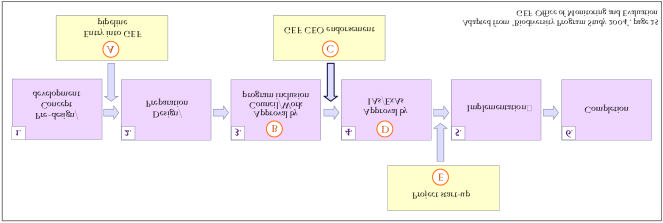
Figure 9: GEF Project Cycle
Stages of the GEF Project Cycle in Costa Rica
184. Table 16 below was prepared on the basis of the flow shown in Figure 9 and the baseline
information obtained from project documents. This table estimates the duration in days of some
phases in the projects reviewed.
Table 16: Duration of Project Cycle Phases in GEF Supported Activities in Costa Rica
Full-Size Projects
--
--
1132 National Off-grid Electrification
328
721
7
N/A
728
1056
Programme
364 Biodiversity Conservation in Osa
N/A
N/A
548
N/A
and La Amistad
103 Biodiversity Resources
N/A
360
7
133
500
N/A
Development
671 Ecomarkets
N/A
169
19
315
503
N/A
60 Tejona Wind Power Project
N/A
436
1088
N/A
Average
328
417
11
295
673
1056
Medium-Size Projects
1713 Cocos Island Conservation
N/A
N/A
N/A
345
672 Talamanca-Caribe Biological
266
N/A
N/A
175
441
Corridor
979 Biodiversity in Cacao Agro-forestry
106
N/A
13
6
20
126
Average
186
N/A
13
6
98
304
Enabling Activities
National Biodiversity Strategic
213 Action Plan (Report to the CBD
36
1
132
133
169
COP)
1659 Second Communication to the
179
3
UNFCCC
National Capacity Self-Assessment
2207 for Global Environmental
18
1
Management
2426 National Implementation Plan,
10
1
58
59
69
Stockholm POP Convention
Average
61
1.5
95
96
119
52
185. The lack of information (see gray cells) is evident. As project cycle and approval
procedures have varied through the life of the GEF and are different for each IA, many phases do
not apply to all projects (Not Applicable, N/A), especially the early ones. (For example, the
pipeline or CEO endorsement mechanisms have not been in formal existence since the inception
of the GEF; in the case of the UNDP, for example, Steps D & E are the same).
186. As presented in the table above, phase duration is highly variable. For any given modality
of GEF support --Medium-Size Projects, for example-- the coefficient of variation on the
interval from Point A to Point E is 55 percent. For Enabling Activities, the coefficient of
variation on the interval from Point A to Point B is 131 percent. In some cases, this coefficient
for the entire data set is as high as 164 percent. Given the limited number of projects reviewed
and the unique nature of the planning, preparation and development processes, no clear trends
about the duration of the vario us phases of the GEF project cycle can be said to have emerged
from these data. Nevertheless, there are certain observations that could be made. Predictably,
the table above shows that the preparation stage (i.e., from entry into pipeline to start-up) is
clearly longer (by about three years) for Full-Size Projects than for Medium-Size Projects, which
are in turn longer than Enabling Activities. This is clearly evident when charting the average
interval (in years) from Points A to E of the GEF project cycle for each modality of GEF
support:
Figure 10: Average Project Cycle Intervals
1200.0
2.89 years
1000.0
800.0
600.0
400.0
0.83 years
Average project duration (in days)
200.0
0.33 years
0.0
Project cycle interval from point A to E
Full Size Projects
Medium Size Projects
Enabling Activities
187. In conclusion, the length of the development and negotiation stage varies widely among
the projects reviewed, and the data collected show no evidence of particularly protracted phases
or process bottlenecks. A comprehensive Joint Evaluation currently being conducted by the
Office may answer lingering questions and concerns in this respect.
53
188. It should be noted that the project cycle and intervals herein refer exclusively to the GEF
process. The duration of the pre-pipeline phase was not reviewed because no adequate baseline
information was available. In addition, many projects reviewed in this evaluation were prepared
during the initial GEF phases, when PDF were not available and project cycles were not
necessarily alike.
Rather than system-wide delays or bottlenecks, the variability of project cycle phases seems to stem from
the peculiarities of each case, including protracted discussions between executors and IAs/EAs; technical
debates among stakeholders; conflicts with fiscal public regulators in Costa Rica, etc.
189. To address the issue of prolonged GEF project cycles, several of the persons interviewed
proposed various options:
o For NGOs: Have reserve funds and be ready for a lengthy project preparation and
negotiation process. Carefully weigh these factors before making a decision to turn to the
GEF for funding.
o For Governmental organizations: Take all reasonable steps to ensure that changes in
the public service do not impact project negotiations.
o For GEF Secretariat: Recognize that a lengthy project process leads to proposals
designed for one phase (e.g., GEF II) being submitted under another (e.g., GEF III). As a
result, proposals may be evaluated under GEF priorities that differ from those extant at
project preparation. At present, such proposals are sent back to be reformulated and
rewritten to conform to the new GEF priorities, adding several extra months, and even
years, to the preparation process.
o For GEF Secretariat, IAs and EAs: High staff turnover and the absence of standards
and procedures lead to most project proposals being reviewed by two or sometimes three
IA, EA and GEF Secretariat staff. This causes two types of problems:
§ Different staff use different criteria;
§ Staff positions go unfilled for long periods, sometimes months, while proposals go
unattended.
Access to Procedural Information
190. Many interviewees expressed concern at the absence of information on two specific
areas:
o Requirements, norms, and mechanisms of the GEF project cycle.
o Progress of proposal reviews along the GEF project cycle.
Information about the GEF project cycle in general, and its workings and proposal tracking procedures in
particular, were rated poor, deficient or nonexistent by most local executors interviewed. Evaluator
experience bears out this perception.
54
191. In addition, project executors do not use the GEF Web site regularly. They perceive it as
a confusing and user-unfriendly site that makes access to pertinent operating data a difficult
proposition.
192. As to efficiency, several respondents identified poor information as a more critical issue
than process duration. Most agreed that not knowing what stage a proposal is in, which
requirements or priorities are set by the GEF and which by IAs/EAs, etc., is a leading source of
frustration.
From the standpoint of informants, the absence of a clear, publicly accessible proposal tracking
mechanism is a critical shortcoming.
Actual Project Completion Dates
193. Project executors have fewer issues with the implementation stage (block 5 in the GEF
project in Figure 9) than with the planning and approval stages. In their view, once
implementation norms and mechanisms are understood, following them is a straightforward
matter. From the point of view of the public at large, however, information about project
implementation remains confusing and hard to obtain.
194. Predictably, the projects and activities reviewed showed that the average length of the
implementation stage varies for each modality of GEF support.
Table 17: Average Length of Implementation Stage per Modality of GEF Support
Modality of GEF Support
Average Length
Full-Size Projects
50 months (4 years, 2 months)
Medium-Size Projects
40 months (3 years, 4 months)
Enabling Activities
20 months (1 year, 8 months)
195. Table 18 presents an analysis of the variation of completion dates from original or
proposed a project start up to actual. Enabling Activities were not assessed due to insufficient
information.
55
Table 18: Target and Actual Completion Dates for GEF Supported Activities in Costa Rica
Target
Actual
Full-Size Projects
Completio
Completion
Difference
n Date
Date
National Off-grid Electrification
This 24-month project effectively began
1132
12 Oct 2006
Ongoing
Programme
in March 2006. Expected difference: at
least 15 months.
364 Biodiversity Conservation in
1 Jun 1996
1 Jul 1998
25 months
Osa and La Amistad
103 Biodiversity Resources
30 Jun 2005
31 Dec 2005
6 months
Development
671 Ecomarkets
30 Jun 2006
Near
Expected to complete on schedule.
completion
60 Tejona Wind Power Project
24 Nov
1 Jul 2002
32 months
1999
Target
Actual
Medium-Size Projects
Completio
Completion
Difference
n Date
Date
1713 Cocos Island Conservation
31 Mar 2008
Ongoing
Completion date moved to 31 March
2009. Difference: at least 12 months.
672 Talamanca-Caribe Biological
6 Mar 2003
31 May 2003
2.8 months
Corridor
979 Biodiversity in Cacao Agro-
21 Feb 04
28 Feb 2004
7 days
forestry
Roles and Responsibilities Among Different Stakeholders in Project Implementation
· Who implements projects?
· Clarity in roles and responsibility of stakeholders
· Coordination among projects
Who implements projects?
196. Table 19 presents GEF supported activities executed by governmental organizations.
Table 19: GEF Supported Activities in Costa Rica Executed by Governmental Organizations
Description
IA/EA
Executor
Phase
Budget
60
Tejona Wind Power Project
WB
ICE
GEF I
$3.30
671
Ecomarkets
WB
FONAFIFO
GEF II
$8.30
1132
National Off-grid Electrification Programme
UNDP
ICE
GEF III
$1.15
364
Biodiversity Conservation in Osa and La Amistad
UNDP
SINAC
Pilot Phase
$8.00
1713
Cocos Island Conservation
UNDP
SINAC
GEF III
$1.10
1659
Second Communication to the UNFCCC
UNDP
IMN
GEF III
$0.35
2207
National Capacity Self-Assessment for Global
UNDP
MINAE
GEF III
$0.20
Environmental Management
2426
National Implementation Plan, Stockholm POP
UNEP
Ministry of Health
GEF III
$0.45
Convention
Total
$ 22.85
56
197. Table 20 summarizes GEF supported activities executed by non-governmental
organizations.
Table 20: GEF Supported Activities in Costa Rica Executed by Non-Governmental Organizations
Description
IA/EA
Executor
Phase
Budget
103
Biodiversity Resources Development
WB
INBIO
GEF II
$7.30
672
Talamanca-Caribe Biological Corridor
UNDP
ACBTC
GEF II
$0.75
979
Biodiversity in Cacao Agro-forestry
WB
CATIE
GEF II
$0.76
213
National Biodiversity Strategic Action Plan
UNDP
INBIO
GEF I
$0.20
(Report to the CBD COP)
SGP
Small Grants Programme
UNDP
Various
Ongoing
$5.08
Total
$ 14.09
198. The leading IAs active in Costa Rica (UNDP & World Bank) have implemented GEF
supported activities in partnership with both governmental and non-governmental organizations.
Both types of organizations have implemented at least one project per modality of GEF support.
199. As to resource allocation, 61.8 percent of GEF funds earmarked for Costa Rica have been
allocated to eight governmental organizations. Activities implemented by NGOs (a total of four,
plus the SGP) account for 38.2 percent. Worth noting is the distributive effect of the Small
Grants Programme, whose $5.08 million in funding (13.8 percent of the total) are specifically
targeted at civil society groups, mostly NGOs.
200. All NGO activities started implementation during GEF Phase I or II (i.e., none during the
Pilot Phase of Phase III). The Costa Rican government's growing interest in GEF funds is a
cause for concern in the NGO community, which fears that access to the Enabling Activities,
Medium-Size Project or Full-Size Project modalities of GEF support may become increasingly
difficult as a result. In their view, the RAF will restrict NGO involvement to the Small Grants
Programme. They feel that it will be practically impossible for national or regional NGOs to
obtain access to national GEF support allocated through the RAF.
Clarity of Roles and Responsibility of stakeholders
201. As noted, national executors do not consider the implementation stage to be problematic
or contentious. The protracted, detailed and often highly participatory process of project
preparation helps stakeholders become well acquainted with each other and with project
objectives and activities. As a result, implementation and coordination often proceed trouble-
free.
Coordination Among Projects
202. IAs and EAs all have their own particular way of implementing GEF Projects in Costa
Rica. Table 21 summarizes their respective strategies:
57
Table 21: IA/EA Implementation Strategies for GEF Supported Activities
IA/EA
Implementation Strategy
Implements directly in coordination with local partners, mostly government agencies
UNDP
such as SINAC or MINAE or sometimes NGOs, as the case may be.
Implements indirectly through arm's-length government agencies such as
World Bank
FONAFIFO or NGOs such as INBIO.
Implements indirectly through regional bodies such as the OAE or government
UNEP
agencies such as MINAE.
Implements indirectly through a consortium formed by a private firm retained to this
IADB
effect and a local counterpart (often an NGO or government agency).
203. The data gathered and the interviews conducted do not support the conclusion that one
implementation strategy is more effective or efficient than another. All have advantages and
disadvantages, and project executors had no special difficulties with any in particular.
The GEF Focal Point Mechanism in Costa Rica
204. In Costa Rica, the Focal Point function was initially performed by
FUNDECOOPERACIÓN, a not-for-profit civic foundation administering project funds under a
Bilateral Sustainable Development Agreement with the Netherlands. During that period, the
GEF Focal Point was advised by a committee of governmental and non-governmental
organizations.
205. In 1999 the Minister for the Environment transferred both the Political and Operational
Focal Point functions to the MINAE Director for International Cooperation. As noted in Chapter
3, while the GEF sets some basic guidelines for the Focal Point function, it refrains from
mandating specific structures or mechanisms and leaves the final decision to each country. As a
result, and depending on the country, the Focal Point mechanism may be a small committee, a
large commission, a specific office, or --as in Costa Rica-- a single individual. While Costa
Rica's current Focal Point structure is thus within GEF guidelines, many respondents regarded it
as weak and not transparent for a country with a strong tradition of public participation. These
remarks were not aimed at the individual in charge and referred only to the mechanism and
method chosen by MINAE to discharge this function.
206. In the past the GEF Council approved a support program for focal points that included
$8,000 annual stipend toward the cost of coordination meetings, consultation workshops,
translation, and other expenses. Costa Rica has not used these funds in recent years due to the
high administrative and reporting costs involved in obtaining these funds through the UNDP.
207. In November 2005 the GEF Council approved a more substantial program of Focal Point
support which will include, in addition to the above, the following assistance:
58
· Focal Point training activities
· Additional funds for travel to meetings with Council Members at least twice a year
· A new information support framework, including an Internet-based system of support
· Subregional consultation meetings with Focal Points from various countries
208. This Program is to be administered by UNEP/GEF. As this is a very recent initiative,
people interviewed did not know about it.
209. Another type of GEF support to Focal Points includes informational e-mail and the
Talking Points newsletter, published about three times a year since 2001, on average. While the
quality of information provided through these channels has improved significantly in the last
year, the Focal Point and the public in general remain without clear access to general GEF
information or specific project details. The online GEF database is incomplete, information on
many projects has critical gaps, and some documentation is filed in the wrong place.
While the Focal Point in Costa Rica has discharged its basic function as defined by the GEF, it has done
so with distinct weaknesses in the areas of public consultation and information flow. There is significant
concern across the board about future operations after the RAF effectively places. Most respondents
would like a participatory, transparent mechanism to review issues and projects based on strategic
priorities, thus removing the risk associated with the current first-come, first-served practices.
Lessons Learned Between GEF Projects
210. In line with related findings in previous Evaluation Office reports (e.g., OPS3), Costa
Rica also exhibits serious weaknesses with regard to the systematization and management of
information on GEF supported activities.
211. While some new projects have been able to benefit from the lessons learned by past or
current projects, this has owed more to project staff initiative than to mechanisms and processes
explicitly set up to this effect.
212. It would also appear that projects make rather limited efforts to share results. This task is
not a formal component of project documents and, with the exception of the 103 Biodiversity
Resources Development project and the Small Grants Programme, it is allocated no specific
budget. In most projects, culling and sharing lessons learned seems to be the isolated work of
inspired individuals rather than the norm. Only the Small Grants Programme has a number of
evaluations and publications in this regard.
Synergies Between GEF Stakeholders and Projects
213. Most IAs/EAs have a basic understanding and acknowledgement of each other's on-
going and future projects. While communication among IA/EA officials exists, it is mostly
informal in nature and owes more to chance meetings at certain events than to explicit, formal,
established processes or mechanisms.
59
214. Technical support between GEF projects implemented by different agencies is practically
non-existent. A remarkable exception is the Small Grants Programme, which systematically
encourages coordination and collaboration between GEF supported projects at both the national
and regional levels.
215. Government bodies involved in GEF projects often work alone. Their mostly informal
meetings and exchanges owe little to synergies promoted or encouraged by GEF projects and
much more to outside factors, such as institutional policy or government initiatives.
216. With respect to synergies, SINAC has made an effort to encourage meetings and
exchanges among staff members coordinating projects supported by non-government funds.
Results, however, remain unclear.
217. Strong synergies between GEF supported activities and activities supported by other
donors do materialize when both sets of activities are coordinated or implemented by the same
body (e.g., SINAC or MINAE). These links are more tenuous when the only common factor is
geographical area or field of intervention.
60