Lake Issyk-Kul
Experience and Lessons Learned Brief
Rasul Baetov*, Cholpon-Ata, Kyrgyz Republic, koabu@yahoo.com
* Corresponding author
Lake Issyk-Kul (also referred to simply as Issyk-Kul), located
the high-mountain syrts (the Kyrgyz word syrt in this context
in the Kyrgyz Republic (commonly referred to as Kyrgyzstan),
can be translated as "outside" or "external", meaning that
is the world's second-largest high-altitude lake and a major
these far-off pasturelands lie beyond the territory immediately
biological and economic resource of the country. Among surrounding Issyk-Kul) and the desertland and steppes of the
lakes lying 1,200 meters or more above sea level, Issyk-Kul
Central Tien-Shan, a land of perennial freezes, high peaks and
is second only to Lake Titicaca in overall area. Slightly salty,
extensive glaciation zones, whose waters also feed the Aral and
the lake never freezes, which contributes to its importance as
Tarim basins. Within the Issyk-Kul basin itself are 834 glaciers
a stopover for migratory birds. Over the past few decades, the
of various sizes ranging from less than 0.1 km2 to 11 km2. These
level of the lake has dropped some 2.5 m as the result of water
glaciers cover 650.4 km2, or about 3% of the overall basin area.
diversions. In the face of several serious threats to the lake,
The Issyk-Kul oblast contains 3,297 glaciers, the overall area of
the Government of the Kyrgyz Republic has created the Issyk-
which is 4,304 km2; this constitutes roughly 40% of the total
Kul Biosphere Reserve, run by a Directorate General.
number of glaciers, and half of the total glaciated area in the
Kyrgyz Republic. Glaciers play many roles in the ecology of the
1.
Physical Geography of the Issyk-Kul Basin
basin, but their primary value lies in their function as collectors
of clean freshwater and sources of fl ow into local rivers.
The Lake Issyk-Kul basin is one of the Kyrgyz Republic's most
important natural areas, occupying 22,080 km2, or about half
Issyk-Kul is a tectonic lake, approximately 25 million years old,
of the area of Issyk-Kul oblast (province), which covers 43,144
formed by faults, folds and warps in the earth's surface. As a
km2. The oblast of Issyk-Kul lies between latitudes 41°08' and
great part of this surface sank and was fl ooded, surrounding
42°59' N and longitudes 75°38' and 80°18' E.
areas rose 3,000 to 3,500 m above what is now lake level to
form the Teskei Alatau and Kungei Alatau ranges to the north
The Lake Issyk-Kul basin (Figure 1) lies within the geographic
and south. On the east, the basin is bounded by the isolated
area known as the Northern Tien-Shan, "the heaven's peaks of Alabel and Chaarzhoon (2,722 m); to the west by
mountains", and encompasses the unique topography of the
Karakuu and Kyzylompol. The ring of mountains surrounding
basin of Lake Issyk-Kul, a closed lake framed by the Kungei-
the lake is broken on the west by a narrow gorge, the Buum,
Alatau mountain chain to the north and the Teskei-Alatau through which fl ows the River Chu. The Chu fl ows within a
mountain chain to the south. The watershed also includes mere four km of the lake and is linked to it by the Kutemalda
Figure 1. The Lake Issyk-Kul Basin.
channel, through which the river in high-water season will, as they do now. As a result, nature has begun to punish
sometimes drains into Issyk-Kul.
them more often. Destruction of bedrock, erosion of soil,
earthquakes, fl oods--these are only a few of the disasters
Lake Issyk-Kul is 180 km long and 60 km wide at its widest
before which humans stand helpless. The consequences
point. Its average depth is 280 m, its maximum depth is 668
of environmental damage have long ago crossed national
m, and its overall area is 6,236 km2. Approximately 38% of
borders; climate change has clearly shown that whatever
the lake is less than 100 m deep; this is the area most densely
happens in one of Earth's hemispheres directly affects the
inhabited by organic life. The overall water volume of the lake
other one.
is 1,738 km3, and its overall circumference is 688 km. Water
level varies according to season. In spring and summer the
Intensive exploitation of the Issyk-Kul region has without
water level rises by 21-22 cm due to abundant infl ow from
doubt had a great infl uence on the unique natural qualities of
snowpack and glacier melt. In the autumn and winter, the this lake. Irreversible processes with long-term consequences
water level falls accordingly.
have been set in motion. There is already concrete information
on the extinction of several species, and on the destruction of
Given the relatively small coves and mild indentations along
landscape, including unique thickets of buckthorn, barberry,
its shoreline, the singular climate of the basin, the great depth
and ephedra. The state of lake waters continues to worsen;
and the unique hydrology of the lake itself, Issyk-Kul is an
this represents a threat to the lake both as a recreation area
oligotrophic lake. It produces phytoplankton at a rate of less
and as home to a variety of natural systems. There are a
than 488 mg/m3, zooplankton at a rate of 910 mg/m3, and
host of problems around use of natural resources, and any
zoobentos at a rate of 10 g/m2.
solutions to these problems must take into account the unique
environmental concerns of the lake basin itself, as well as the
Issyk-Kul is a closed lake; hence its waters are somewhat unique character of human life around the lake.
saline. The salinity, however, is not high--a mere 5.968 g/L,
fi ve-and-a-half times lower than that of the ocean. Its mineral
In the agricultural sector, for example, one of the most crucial
content is chloride/sulfate/sodium/magnesium-based. current issues is erosion of cropland. This problem has arisen
The low overall mineral content testifi es to the fact that, in
as a consequence of hillside plowing, improper watering and
geological terms, Issyk-Kul has only relatively recently become
rotation of crops, poorly planned irrigation networks, and poor
a closed lake.
layout of fi elds in general. Unfortunately, there has also been
overuse of timber and brushland resources, as well as the
The waters of Issyk-Kul are rich in oxygen, as a result of deterioration of plant cover and soils in natural pastures near
aeration and movement of lake waters. These waters are villages--all due to overgrazing and generally poor grazing
clear and transparent due to the paucity of organic life and
and herding practices.
to the overall salinity, which has in turn contributed to the
coagulation of tinted organisms. The transparency of Lake 2.1 Mining
Issyk-Kul waters approaches that of seawater or ocean water,
and in the open part of the lake Secchi disk readings are up to
The introduction of manufacturing has caused a number of
30-35 m. Transparency and bright sunlight combine to create a
problems in the region including: disruption of soils, terrain,
range of shades in the lake, from sky blue to darkest indigo.
and water tables by widespread mining operations; pollution
from untreated agricultural runoff; pollution from illegal
The high-mountain pastures to the south of Teskei Alatau dumping or storing of toxic chemicals currently in use at the
and the slopes of the mountain ranges that descend into Kumtor gold mine. One of the worst regional environmental
foothills around Lake Issyk-Kul make up the lake's drainage
disasters in recent history occurred on 20 May 1998, when a
basin. Within the basin, 118 rivers and streams fl ow toward
truck hauling toxic chemicals crashed just upstream from the
the lake, but only 49 of them actually drain into it. The river
mouth of the Barkuum River, which empties into Lake Issyk-
system refl ects the distribution of rainfall in the basin. In the
Kul. As a result, 1,762 kg of sodium cyanide, a chemical used in
west, where precipitation is light, the river system is poorly
the processing of gold ore at Kumtor, were dumped into basin
developed, and the relative water volume is light. In the east,
waters.
where precipitation is heavier, the hydro-network is denser
and the rivers are fuller. The greatest volume of fl ow comes
Despite the devastating accident, the Kumtor Operating
through rivers on the basin's eastern side. The volume of rivers
Company provides an example of good environmental
on the western side of the basin is signifi cantly smaller.
management in Issyk-Kul oblast. The company has banned
grazing and hunting on outlying lands under its use; this has
2.
Threats to the Sustainable Use of the Lake
led to regrowth of plant cover in syrts and an increase in wildlife
populations. Measures undertaken to improve wastewater
Issyk-Kul is the joy, the pain and the hope of the Kyrgyz people.
treatment have helped maintain the natural chemical balance
In centuries past, people lived in harmony with the lake, of the waters in the Kumtor and Taragai Rivers, and preserve
husbanding its resources, passing their love for the lake from
biological communities.
generation to generation. They did not try to subject it to their
194 Lake
Issyk-Kul
2.2 Wastewater
Treatment
2.6 Reform-policy
Priorities
Lack of both adequate infrastructure and fi nancial means Priorities for sustainable development of biodiversity include
to support public utilities (let alone any resort or tourism the creation of nurseries and hatcheries for rare and endemic
industry) has made it impossible to improve wastewater species, and the protection of natural breeding, spawning and
treatment plants. This in turn has led to further pollution and
feeding grounds. This is especially important for the biota of
unwise use of lake waters.
the lake; since the biota lives in a closed-lake environment,
it is more vulnerable to human pressure than are the dryland
2.3
Hunting and Biodiversity
plant and animal communities that surround it. Thus, it is
crucial that measures be taken and laws be passed to regulate
Poaching and unregulated hunting and trapping have reduced
commercial, industrial, agricultural and recreational use of
wildlife numbers, with particular impact on disappearing both the shore zone and the lake waters, the watchword being
populations such as the lynx, the vulture, and any number of
"let us not squander renewable natural resources, let us use of
indigenous fi sh in the lake.
non-renewable natural resources rationally."
Biological diversity in the Lake Issyk-Kul basin can be Substantial attention must be paid to environmental
preserved and sustained only if the entire region is developed
management, to environmental protection, to prevention of
in an environmentally sound way. First and foremost stands
emergencies, and to control of emergencies when they cannot
the question of preservation of rare and endemic species, be prevented. This will aid in preserving Lake Issyk-Kul, the
among them the lynx (Felis unsia), the Tien-Shan mountain
natural system that lies at the heart of the basin.
sheep (Ovis common), the Siberian deer (Servus elaphus),
various hawks such as saker falcon (Falco cherrug) and F.
2.7 Glacial
Retreat
Schizothoraz, fi shes (Leuciscus, Dyptichus, Erebia), insects
(Netocia, Calosoma), bumblebees (Bombus) and honeybees
The fi rst and most important task in the Issyk-Kul Biosphere
(Xylocora).
Reserve is the collection of data and the creation of a data
base on the current state of plant and animal communities,
2.4
Recreation and Spas
individual species, populations and numbers, to identify areas
where biodiversity is most concentrated.
Lake Issyk-Kul represents an enormous natural and cultural
heritage. It has a long history as a recreation site and a spa. Its
Kungei Alatau and Teskei Alatau, the mountain ranges that
waters are strikingly clean and clear, and are said to possess
frame Lake Issyk-Kul, peak at 4,711 and 5,216 m respectively.
healing powers. Thus the lake and the surrounding basin They have been one of the factors in the development of the
attract a tremendous number of vacationers, especially in the
glaciers that provide a regular supplemental fl ow of water into
summertime. Yet poor infrastructure and lack of services at
the lake during the summer months.
popular vacation sites put the lake under tremendous stress.
This stress falls primarily on the northern shore and the slopes
Glaciation research conducted in 1995 has shown that in the
of Kungei Alatau, where forests and sub-alpine meadows are
last fi fteen years, seven of the 22 glaciers included in the study
home to rare and protected species.
have retreated by 90 m or more; six others have retreated by
60 to 69 m, and the remaining nine have retreated by 25 to
2.5 Conservation
59 m. The rate of retreat has varied considerably from year to
year, determined largely by fl uctuations in temperature and
At times, the strategy and tactics of environmental and precipitation. For example, a typical Issyk-Kul cirque glacier
biodiversity protection run counter to the interests of the local
(a glacier that resides in basins or amphitheaters near ridge
population. The basin is a densely settled region, home to a
crests--most cirque glaciers have a characteristic circular
large industrial complex, to farms, fi sheries, and recreational
shape, with their width as wide or wider than their length)
areas--all of which combine to make environmental protection
retreats upward by roughly 2.5 and 1.3 m per year. Yet while the
a diffi cult process. The situation has become even more front edges of glaciers in the area have uniformly crept back to
complicated in light of the socioeconomic crisis of recent years,
higher and higher elevations, a more objective indicator of their
because any efforts to preserve unique species and to maintain
current condition is data on their mass balance, calculated over
biodiversity are linked to social and economic development
many years' time. Particularly indicative are data gained from
that must be environmentally oriented. Once again, this is long-term observation of Karbatkak, a typical cirque glacier,
because preservation of rare species and biological diversity
which originates at the sources of the Chonkyzylsuu River and
overall must be linked with an environmentally oriented socio-
fl ows down the northern slope of the central Teskei Alatau.
economic policy. As it continues to develop, the local hunting
Between 1957 and 1997, ice loss exceeded snowmass gain by
and trapping economy must guarantee a balance between 17.96 m. In other words, during the last 41 years, the upper
overall numbers of game animals and preservation of their
surface of the glacier has dropped by 18 m. If we consider that
ecological niche.
at the beginning of the study, the central portion of the ice
sheet was 49 m thick, we must acknowledge that such thinning
Experience and Lessons Learned Brief
195
represents an even greater threat to the existence of the 2.8 Agriculture
glacier than does any reduction in its overall length.
The plant world of the Issyk-Kul oblast is rich and diverse;
There are a number of reasons for the degradation of equally diverse are its uses. This plant world deserves
glaciation in Issyk-Kul, but the increase in surface pollution
universal protection, in that it is benefi cial to human health,
and climate change are the two most signifi cant ones. Both
improves the local climate, curbs erosion, and regulates river
contribute to more intense melting and therefore degrade the
fl ow.
mass balance of the glacier. The average yearly temperature in
the glaciation zone has risen by 0.2°C; summers are warmer
One of the most basic functions of plant cover is agricultural,
by 0.6°C, evidenced not only by higher melting rates, but also
which serves as a natural source of feed, such as from grazing
by a longer ablation period. This continued warming trend will
lands and hayfi elds. Pasturelands are that part of the plant
accelerate glacial collapse and, most important of all, lead to
world that provide the food base for animal husbandry in
a change in the water volume of those rivers the glaciers help
the Kyrgyz Republic. The quality and quantity of livestock
to feed. According to current calculations, by 2005 the overall
production depends on the state of these grazing lands.
glaciation area on the northern slopes of the Teskei Alatau will
Any problems with pastureland (their overall state, species
have shrunk by 32%. On the south-facing slopes of the Kungei
makeup, productivity, capacity, etc.) affect many other areas
Alatau range it will have shrunk by 76.6% (Dikikh 2000).
as well: beekeeping, hunting and trapping, not to speak of
national parks, preserves and game reserves, since the food
Analysis of many years of hydro-meteorological data indicates
base for wildlife grazing in the foothills of these mountain
that over the coming fi ve to ten years, glaciers on the southern
ranges depends fi rst and foremost on the state of the plant
slopes of the Kungei Alatau will be able to sustain the current
communities on which they feed.
water volume in rivers in spite of shrinking glaciers and
increasing surface evaporation. After that, however, the fl ow
Within a biosphere reserve such as Issyk-Kul, any use of natural
will begin to diminish markedly. On the other hand, water resources that might lead to destruction of ecological balance
volume of the rivers on the south shore of the lake, whose
(i.e. noncompliance with rules of pasture stress/capacity,
sources are in well-developed areas of glaciation, will not only
overgrazing, trampling, etc.) is utterly unacceptable.
remain stable but will continue to increase until 2020 or 2030.
This conclusion was reached by calculating fl ow formed under
Overall natural pastureland area in Issyk-Kul oblast totals 1.4
the following conditions: reduction in the size of the glaciated
million ha: of these, 0.4 million ha are spring and autumn
area, more intensive melting, and increase in the area of pasturing grounds; 0.6 million ha are summer pastures; and
ablation due to a higher snow line.
0.4 million ha are winter pastures.
The yearly volume of surface runoff is calculated to be 3.72
At present, 12% of the total pastureland in the Issyk-Kul oblast
km3. An important part of this comes from the glacial waters
is degraded in some way: invaded by inedible grasses or other
that compensate for losses in the water budget of Lake Issyk-
inedible plant cover, eroded, trampled, etc. Moreover, 25%
Kul, where water level continues to drop. In the last forty years
of the total area is overrun by various types of thistles and
weather posts stationed around the lake have noted an overall
thornbushes, primarily caragana; this too is a consequence of
189 cm drop in lake level. Without glacial runoff, this fi gure
neglect and improper use.
would have been much greater (Dikikh 2000).
Over centuries, grazing practices have evolved around the
Such a drop will only increase human stresses on the lake.
mountainous terrain and the corresponding differences in start
Indirect evidence for degradation in water quality already of vegetation at various elevations. In early spring, livestock
exists. For example, comparisons with data obtained by V.P.
is pastured close to settled areas, in the foothills and low
Matveev show that the color of the water has changed over
lying mountain valleys; then, as grass cover appears at higher
time. Hydrobiologists from the Issyk-Kul biological station elevations, herds are driven upland to the central highland
have noted an increase in numbers of phytoplankton and belt, and eventually into the high sub-alpine and alpine
microorganisms. The decline in lake level brings with it a meadows. In the fall, livestock is moved back down through
reduction in the volume of biogenic elements entering the the central highland zones, the foothills and the fl ats.
lake from littoral silts, and thus an increase of the biological
productivity of the lake.
Currently, with the disappearance of collective farms and
state farms and the emergence of a great number of small
With the drop in water level also comes a certain increase in
private farms, grazing practices have changed. Virtually all
salinity. V.P. Matveev's data show that in 1932 the salinity of
livestock owned by small proprietors is now grazed year
Issyk-Kul measured 5.82 g/L. By 1984 salinity had increased
round near villages, on what were once exclusively spring
to 5.9 g/L. Over this period, the water level dropped by 2.5 m
and fall pastures. Farmers have neither the transportation nor
and overall volume by 16 km3. Thus, further drop in the level of
the fi nancial means to drive their animals upland to outlying
Issyk-Kul could lead to change in the entire ecosystem.
pastures. Such disproportionate use of grazing lands leads to
further degradation of lands near villages. This environmental
196 Lake
Issyk-Kul
dilemma is typical for the entire length of Issyk-Kul's densely
2.9 Water
Diversion
populated shoreline.
Given the long and consistent decline in lake level, the
In consideration of the increasingly negative human impact
question of supplementing lake waters has been posed more
on the environment, and in the effort to conserve natural than once. Since there are no natural prospects for improving
resources, on 1 March 1999 the Kyrgyz Republic enacted the water balance of the lake, it is inevitable that the question
the latest in a series of environmental laws, including one will be posed again. There is no other choice but to do so.
entitled "On monitoring of agricultural lands in the Kyrgyz
Republic". This particular act is directed at timely identifi cation
An early project proposed by M.N. Bolshakov and B G. Shpak
of environmental change in commercially used lands, and (1960) involved diverting some part of the waters of the upper
also at assessment, prevention and elimination of negative
Karkyr River into the lake, and later M.N. Bolshakov reaffi rmed
processes.
that this proposal might make it possible to ameliorate
the water-balance crisis (1969). Engineering organizations
Monitoring of agricultural lands is a key component in the in Kazakhstan were highly critical of this project, however,
monitoring of the natural environment overall; this includes
because the Karkyr River lies within the Lake Balkhash Basin,
monitoring of soils and natural pastures. In order to identify
another area in dire need of water resources. On the other
precisely which pastures are deteriorating and therefore in hand, scientists assert that diverting some part of the waters
need of improvement, and in order to make recommendations
of the Karkyr would not present a signifi cant threat to Lake
on rational use and protection of grazing lands, it is crucial
Balkhash.
that grass cover be kept under constant observation. Given
recent laws on land reform, which require that rent be paid
Other projects for easing the water-balance crisis in Lake
for land use, it is particularly important to have credible Issyk-Kul have also been proposed. The fi rst of these involves
information about the current state of grazing lands, about
diversion of run-off that now drains into the Arabelsuu River
their productivity, and about any changes in the grass cover
from high mountain syrts above. Aside from the immediate
brought about by human infl uence.
expediency of such diversion, the proposal also allows for the
creation of a reservoir in the Arabelsuu syrts. Such a reservoir
In order to resolve problems of land use throughout the might serve to change the microclimate of these high pastures
Issyk-Kul Biosphere Reserve, then we must be systematic in
and also to preserve already-existing glaciers in the area which
the monitoring of both cultivated and natural pastures. Since
contain centuries' worth of water resources in solid form.
1997, under the aegis of a project entitled "Developing sheep
husbandry in the Kyrgyz Republic", geobotanists from the The problem of improving the lake's water regime, given its
Kyrgyzgiprozem Institute have been conducting research in unfavorable natural tendencies, is one of the most important
high-elevation zones. Their goal is to assess the current status
issues arising from competing economic uses of the lake and
of these high pastures, and then to design a set of measures
its basin. Its importance is due to the connection between the
aimed at preservation, defense, improvement, and rational natural tendency for the lake level to decline with the resulting
use. Monitoring of pastures, recommendations based on this
decline in water quality caused by a rise in the general mineral
monitoring, and rental of these pasturelands to individuals content. Again, this is not the only problem, but it is one
will make it possible to educate livestock farmers in wise that requires careful and in-depth analysis of how to use the
use of pastureland, in part by the application of rewards and
natural resources of the lake in a way that is most benefi cial
sanctions.
to the local economy in the long term. Herein lays a crucial and
very complicated human issue.
Of particular importance is the issue of livestock grazing in
mixed forest and woodland. The fate of Kyrgyz forests depends
In years past--let alone in decades past--very few people
on how pasturelands within forested areas are used. Given
were concerned with studying resource use around the lake or
the enormous role of mixed woodland and grassland pasture
with planning for the lake basin economy in the long term. This
in the Kyrgyz rural economy, it is crucial that special systems
attitude was rooted in false assumptions about the "endless
are developed for their rational use. These should be based
possibilities" of Issyk-Kul and its basin. No one considered
on optimal grazing loads and timelines for various types of
the possibility that many of these resources might soon be
pastures depending on the productivity and capacity of each.
exhausted.
In order to prevent negative impacts, it is also very important
Supplementary feeding of Lake Issyk-Kul over and above
to identify those areas of pastureland that should be taken
its natural water resources was necessary to maintain
out of use altogether: steep slopes, avalanche prone areas,
development of irrigation in the basin with inevitably
and lands presenting some threat to villages. Without such
diminishing reserves of natural waters, and also to maintain,
monitoring of pasturelands, an environmentally-oriented farm
at the very least, the current water balance and water level of
economy that both uses and conserves the natural riches of
the lake.
the Issyk-Kul basin is impossible.
Experience and Lessons Learned Brief
197
2.10 Introduction of Fish
were introduced into Issyk-Kul. There were also proposals to
replace the Issyk-Kul chebachok with the ryapushka, a more
Within the basin proper, Lake Issyk-Kul occupies a particular
nutritious food fi sh. However, in light of the decision to save
and unique place: it is home to a diverse group of endemic
the chebachok and in light of new data on its consumption
species that are also highly valued commercial fi sh. It is also
of zooplankton, further efforts were limited to importation
home to introduced species from the Ponto-Caspian-Aral of whitefi sh. As of the late 1970s, the Baikal omul was still
group and from the Indian and boreal groups. At the same time
observed in the lake, while at present there is no evidence of
the lake hosts a number of high-mountain Asian fi sh species,
pelyad at all. The whitefi sh, however, has established itself as
eight of which are endemic.
a major component of fi sh life in the lake.
In the past, the largest component of the fi sh population in
These colonization efforts have led to a number of substantial
the lake was the Issyk-Kul chebachok (Leuciscus bergi). At changes in the composition of lake fauna. The number of
that time the chebachok was considered a common fi sh of no
native species has diminished, and some, including the naked
particular value, and the chebachok population was thought to
osman (Dyptichus dybowskii), are on the verge of disappearing
be "inexhaustible". In light of this, there have been attempts to
entirely.
qualitatively transform the Issyk-Kul fi sh stocks.
At present, the following fi sh species are now present in
The fi rst attempts at acclimatization of non-native species Issyk-Kul: Sevan trout (Salmo ischchan gegarkuni), rainbow
were launched in 1930. On recommendation of Academician
trout (S. gairdneri), whitefi sh (Coregonus lavaretus), omul (C.
L.S. Berg, the Sevan trout (Salmo ischchan gegarkuni) was
autumnalis migratorius), bream (Abramis brama orientalis),
released into Lake Issyk-Kul. Then, in January 1936, 800,000
tench (Tinca tinca), giebel carp (Carassius auratus gibelio),
Sevan trout eggs were incubated and hatched in the Aksai
striped gudgeon (Alburnoides taeniatus), Amur chebachok
River, after which the fry were released into the mouth of the
(Pseduorasbora parva), pikeperch (Stizostedion lucioperca),
river Ton. Comparison of data on growth rates for both fry and
and sleeper (Hypseleotris cinctus).
adult fi sh, plus comparisons by A. Konurbaev and A. Zhadin of
the scientifi c literature describing the composition and density
There have also been anecdotal reports of catfi sh caught in the
of animal life in the rivers draining into Lake Issyk-Kul and Lake
lake, and of a school of grass carp was sighted in the Tyupsky
Sevan have shown that habitat in Issyk-Kul was comparable to
Bay 20 years ago.
that in Lake Sevan. This leads us to acknowledge that Issyk-Kul
was an appropriate setting for acclimatization of the Sevan
Before any attempts at colonization of non-native species,
trout. But despite attempts over more than seventy years to
the following fi sh were present in the lake: Issyk-Kul chebak
introduce this trout into Lake Issyk-Kul, and despite thirty (Leuciscus schmidti), Issyk-Kul chebachok (L. bergi), naked
years of cultivation, the Sevan trout has yet to reproduce in
osman (Dyptichus dybowskii), Issyk-Kul marinka (Schizothorax
suffi cient numbers to become self-sustaining. According to pseudaksaiensis isskkuli), wild carp (Cyprinus carpio), Issyk-
researchers Konurbaev and Zhadin, the reasons for this failure
Kul gudgeon (Gobio gobio latus), Issyk-Kul minnow (Phoxinus
include: fewer opportunities for natural reproduction of the
isskkulensis), Issyk-Kul loach or "usan" (Nemacheilus strauchi
species; withdrawal of water for irrigation, which has led to
ulacholicus), and gray loach (N. dorsalis).
the drying and silting-up of spawning grounds; death of the
fry themselves as they are poured out with the river water to
Despite the unfavorable effects of human impact, Issyk-Kul
irrigate fi elds; ineffi cient fi sh-farming operations; poaching dace is at present the most abundant fi sh species in the lake.
and theft, plus a multitude of other factors.
Savvaitova and Petr (1999) provide further information on
fi sheries of Lake Issyk-Kul.
In the early 1950s, other non-native species uncharacteristic
of the fi sh population of the lake began to be introduced. 2.11 Biodiversity
Between 1956 and 1958 the lake was stocked with bream
(Abramis brama orientalis) and pikeperch (Stizostedion
There are even more terrestrial species than fi sh species
lucioperca), both of which migrated to the eastern part of endemic to the basin. Thirty-nine of these are on the
the lake, where they found the most hospitable habitat. Also
endangered list.
introduced were khramul and carp; with them apparently came
other species as well, including tench (Tinca tinca) and crucian
Lake Issyk-Kul never freezes over, and it thus plays a special
carp (Carassius carassius).
role in the preservation of biodiversity. The lake is a haven
for waterfowl and shore birds during the fall and winter.
In the early 1970s, efforts to reconstruct fi sh stocks in Issyk-
Anywhere from 50,000 to 80,000 birds belonging to 30 to
Kul took a new direction. The plan was to turn the lake into
35 species winter over on the lake. The lake is important for
a reservoir for trout and whitefi sh, and to gradually reduce
many other bird species as well, who use it as a stopover
the numbers of chebachok to a bare minimum. To this end,
and feeding ground during seasonal migration. This is why,
the Sevan whitefi sh (Coregonus lavaretus), the pelyad (C.
in 1975, Lake Issyk-Kul was included in the list of "Wetlands
peled), and the Baikal omul (C. autumnalis migratorius)
of International Importance" (Ramsar Convention). However,
198 Lake
Issyk-Kul
with the collapse of the Soviet Union, the Soviet-era law under constant threat from mudfl ows, avalanches and fl ood
sanctioning participation became null and void; this in turn led
waters, as well as people combing them for saleable waste
to the adoption of a new law by the newly independent Kyrgyz
and scrap metal (BBC News 2004). It is worth mentioning that
Republic, making the Kyrgyz Republic an offi cial signatory of
Lake Issyk-Kul is characterized by increased natural uranium
the Ramsar Convention, and thus Lake Issyk-Kul a nominee for
content. Within the project "Assessment and prognosis of
designation as a Ramsar site. That designation became offi cial
environmental changes in Lake Issyk-Kul" (Program of the
in March 2003.
European Commission "Copernicus-2", 2001-2003) the water
assays were sampled from different depths near the banks
In August 2002, a regional seminar on preservation of high-
of the lake and from low-debit sources draining the dumping
altitude lakes, glaciers and other bodies of water was held
grounds of the uranium-carbon deposit. The results obtained
in Urumchi, People's Republic of China. Twenty high-altitude
demonstrated that the ecological status of the Lake Issyk-Kul
lakes and glaciers were listed as potential Ramsar sites of is not damaged at present and wastewaters from the uranium-
either biological or cultural signifi cance. Unfortunately, at carbon mine do not make a decisive contribution into the
present, there is no real data about the status of many of these
natural radioactive background (Palesski et al. 2003) but the
sites, even as the growth of tourism in the region has brought
threat persists.
more and more visitors to them every year.
3.
The Issyk-Kul Biosphere Reserve
2.12 Radioactive
Contamination
One of the most important steps taken in government
Radioactive contamination of the lake has potential to be environmental policy in general and in the preservation of Lake
a signifi cant problem. Uranium-carbon deposits may be Issyk-Kul in particular is the creation of a specially protected
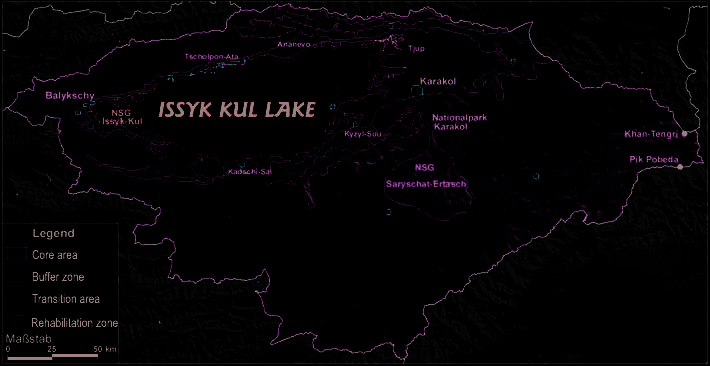
contaminating the lake and the President of the Kyrgyz area, the Issyk-Kul Biosphere Reserve (Figure 2).
Republic, Askar Akayev, highlighted the need to speed up
the reclamation of the Kadzhi-Say dump on the southern In response to UNESCO's call to preserve the unique natural
shore of Lake Issyk-Kul (BBC News 2004). Previously, Kyrgyz
environment of the northeastern part of the Tien-Shan, which
newspapers reported a warning from the Emergencies and includes Lake Issyk-Kul, and in order to give aid to nations with
Civil Defence Ministry that if no action was taken, heavy rains
transitional economies, the Federal Republic of Germany has
could wash radioactive particles into the Issyk-Kul basin, but
provided technical aid to the Kyrgyz Republic in the latter's
the problem remains unsolved. A project to reduce this threat
efforts to create of a bio-reserve within Issyk-Kul oblast. A draft
has reportedly attracted foreign funding. Russia is said to have
plan on the creation of a biosphere reserve was completed
given US$160,000, and a further US$400,000 has been made
in September 1998, and in May 1999, a new law entitled "On
available by the USA. Now Russian Atomic Energy Minister
Biosphere Reserves in the Kyrgyz Republic" was adopted.
Aleksandr Rumyantsev has presented an US$8.8 million project
This was followed by a government directive entitled "On
to reclaim areas around former uranium mines. The structures
Ratifi cation of the Statute on the Issyk-Kul Biosphere Reserve"
built to contain the waste are in great need of renovation and
(1 January 2000). This last document regulates the activity of
Figure 2. The Issyk-Kul Biosphere Reserve (Source: http://www.unesco.org/mab/br/focus/2002Oct/Issyk.htm).
Experience and Lessons Learned Brief
199
the General Directorate of the Issyk-Kul Biosphere Reserve,
One of the Directorate's major objectives is protection of rare
which is charged with implementation of the idea and intent
plant and animal species and other valuable natural complexes
of biosphere reserves in general. In September 2001, by from the random and uncontrolled use that has followed the
decision of the coordinating committee of the UNESCO Man
fall of the Soviet Union. Other tasks include monitoring of the
and Biosphere Programme (MAB), the Issyk-Kul Biosphere environment, conducting scientifi c research, promoting long-
Reserve became No. 411 on the list of World Wide Network of
term use of natural resources consistent with environmental
biosphere reserves.
demands, working diligently to raise environmental awareness
and create a sense of stewardship of nature by explanation
The goal of creating such a reserve is twofold: conservation of
and example--goals impossible to achieve simply by banning
natural areas, and support for long-term economic and social
or limiting use of resources. To that end, it has been crucial to
development that will help restore natural resources.
delineate separate zones with separate preservation and use
plans.
Table 1. Zoning Criteria for the Issyk-Kul Biosphere Reserve.
Sites
Description
Content
Core Zone
Glaciers
Primary source of water retreat/shrinkage
Stringent protections for entire
Monitoring of changes in ecosystems, scientifi c
natural complex
research, other activities that do not disturb
natural processes
High mountain areas (niveal zone)
Snow leopard habitat (3,000-4,000 m asl)
Mountain goat habitat (largest concentration
here)
Lakes
Habitat for rare waterfowl, fi sh
Primary source of water resources
Forests and brushlands (outlying)
Limited supply
Wildlife habitat
Existing reserves, preserves and
Charged with environmental protection
national parks
Legal guarantees in place
Buffer Zone
Natural and historic sites
Scientifi c research sites
Usually surrounds or borders
core zone
Development of ecotourism
Traditional uses with extensive forms of economic
activity, including regulated use of agricultural
land, controller tourism, various forms of
scientifi c research
High-mountain summer pasture
Infrequent
Winter wildlife habitat
Forests and brushlands (near settled
Use crucial to local economy
areas)
Natural sites near settled areas
Environmental education sites
Scientifi c research
Ecotourism
Transitional Zone
Agricultural lands, including summer
Primary source of agricultural products for local
Environmentally-oriented
and economic winter pastures
consumption
activity
Settled areas (towns, villages)
Population centers
Economic centers
Certain sections along shores of
Fisheries/fi sh farms
major lakes
Development of ecotourism
Restoration Zone
Abandoned mines
Damaged ecosystems
Areas have suffered
environmental damage and
require restoration
Other damaged sites
Subject to improvement
200 Lake
Issyk-Kul
The primary goal must be the protection of natural complexes
Within Issyk-Kul oblast, there are eight specially protected
from poachers, whose numbers may grow as economic natural areas, as listed in Table 3. There are two national
instability in the country persists. Also important is regulation
preserves (gosudarstvennye zapovedniki), fi ve game reserves
of industries that currently pollute. In this connection, yet (zakazniki) and one national park. These areas were created
another task of the biosphere reserve must be to defend to protect and study the genetics of wildlife and plant life
natural complexes from future harm by industries that threaten
in the region, to study and protect ecological systems and
the environment.
landscapes both typical and unique to the region, to develop a
scientifi c foundation for environmental protection efforts, and
The most important individual components in the environment
to ensure that natural processes within the region continue
of the reserve were assessed for their natural and unhindered. They are institutions whose purposes include
socioeconomic signifi cance and also for their sustainability both conservation and research.
in the face of various types of stress, including anthropogenic
stress. Results of this assessment served as the basis for 3.1
Problems Facing the Issyk-Kul Biosphere Reserve
division of the biosphere reserve into a number of zones,
as summarized in Table 1. In accordance with UNESCO The Issyk-Kul National Preserve (Issykkulskii gosudarstvennyi
requirements, four zones were delineated: a core zone; a zapovednik) constitutes a mere 0.05% of the overall territory
buffer zone; a transitional zone; and fi nally a restoration zone.
of the region. The preserve lies in close proximity to towns
Goals for protection and development differ from zone to zone,
and villages, livestock operations, and other heavily used
as do standards for use. However, environmental problems in
sites, which makes it diffi cult for the preserve to carry out the
all four zones are closely intertwined with economic activity,
tasks laid upon it. Lack of fi nancial support in general and poor
and, correspondingly, recommendations on improvement of working conditions in particular make it hard for the preserve
the given areas are intertwined with prospects for economic
to function in any normal way.
development.
Many resolutions aimed at protecting the lake and improving
In order to conduct large-scale, long-term planning, plus a the work of the preserve have been passed, but in general
number of experiments including small-scale environmental
these have been poorly implemented, or not implemented
projects in a number of regions in the reserve, three at all. As the situation now stands, increasing tourism in the
experimental sites were chosen as typical of the region's region will inevitably lead to confl ict between tour agencies
natural and socio-economic makeup. The goal was threefold:
and the preserve. To prevent this, the boundaries of the
to develop "green" industry and tourism; to educate the local
preserve must be clearly delineated, and accommodations
populace; and to then apply lessons learned to other areas.
for tourists and tour agencies must be made in other, non-
All these small projects were experiments of the biosphere
protected areas around the lake.
reserve and the model sites were intended to serve as
examples/models for implementation throughout the reserve.
The Sarychat-Ertash National Preserve lies high in the
mountains, at altitudes of 3,000 m asl and more, and is
Government agencies charged with oversight of environmental
relatively far from population centers. Thus it is better
issues in Issyk-Kul oblast are given in Table 2.
protected against human impact. Farmers bringing herds to
Table 2. Government Agencies Overseeing Environmental Issues in Issyk-Kul Oblast.
Agency
Purpose/Function
Subordinate to
General Directorate of Issyk-Kul
Charges fees for entry to biosphere
National Forestry Service, Kyrgyz
Biosphere
reserve; fees go toward environmental
Republic
activities
Conducts scientifi c research,
environmental education
Oversees ranger service
Oversees preserves and game reserves
Government Supervisory Service
Supervision of wildlife, plant life of
National Forestry Service
oblast
Issyk-Kul Hunting Authority
Supervises hunting
National Forestry Service
Monitors and controls wolf population
Karakol National Park
Supervises/regulates timber use
National Forestry Service
Issyk-Kul Environmental Protection
Supervises water/land/air use in the
Ministry of the Environment and
Authority
biosphere reserve
Emergency Management
In accordance with a law enacted by the
Issyk-Kul Oblast Kenesh, levies fees for
commercial use of airways or waterways
within the Issyk-Kul biosphere reserve
Experience and Lessons Learned Brief
201
summer pasture and very occasional tourists (hikers, trekkers)
suffer signifi cantly if climbers and hikers pour into the Tien-
are the only visitors to the area. Neither group presents a Shan, in large part because the rare and endangered species
serious hindrance to environmental efforts.
which inhabit the area require a wide range. Until recently,
there was no better place for them than the heights of the
However, there is one substantial threat to the preserve, and
Central Tien-Shan, Kungei and Teskei Alatau, and the Interior
that is Kumtor, a gold-mining operation located roughly 20 km
Tien-Shan. If tourist pressure forces these animals to migrate
from the preserve's western border.
to other areas, then other components of local ecosystems will
also be set in motion.
At present, agencies charged with environmental protection
are poorly organized, and their work is for the most part limited
The northern shore of Lake Issyk-Kul is particularly problematic
to inspection. Virtually no scientifi c research is being done.
in that it has become increasingly popular as an unregulated
camping site where local residents sell services to visitors. The
3.2 Tourism
temporary canteens and food stands they set up do not meet
health and sanitation standards. The lack of water treatment
Each and every tourist organization in the Kyrgyz Republic facilities in populated areas also poses a threat to the lake.
includes Lake Issyk-Kul and the Issyk-Kul basin in its itinerary.
But at present, tourist pressure on these sites has not yet
One possible solution is for the Issyk-Kul Biosphere Reserve to
reached the level of former days, when the Kyrgyz Republic
set up its own tourist routes; these might be developed jointly
was still part of the Soviet Union.
with tour agencies and climbing organizations. Developing
ecotourism seems to be one advantageous way to foster both
Nonetheless, the increasing number of tourists and the environmental protection and commercial tourism. This would
promotion of mass tourism will undoubtedly affect the overall
help support environmental efforts and also provide jobs for
ecosystem of the region. Not only well-known sites such as
the local population.
Khan Tengri and Pobeda Peak, but other peaks as well, may
Table 3. Specially Protected Areas within the Issyk-Kul Biosphere Reserve.
Area
Name
Year founded
Purpose
Flora and fauna
(hectares)
Whooper swan, mute swan,
Protection of winter habitat,
Issyk-Kul National
fl amingo, white heron, gray
18,998
1948
nesting grounds, stopover for
Preserve
heron, white-tailed duck,
waterfowl and shore birds
Eurasian spoonbill
Arkhar, Marco Polo sheep, snow
leopard, Pallas's cat, golden
Sarychat-Ertash
Protection of ecosystems, rare
135,400
1995
eagle, mountain turkey, saker
National Preserve
and endangered species
falcon, Lammergeier (bearded
vulture)
Pine, fi r, larch, birch, roe deer,
ibex snow leopard, bear,
Preservation of ecosystems
Karakol National Park
38,256
1997
Siberian deer, lynx, golden
unique to Karakol Gorge
eagle, kumai, saker falcon,
Lammergeier
Roe deer, Siberian deer, wild
boar, ibex, Marco Polo sheep,
Protection of roe deer, Siberian
Tyup Game Reserve
19,085
1978
Pallas's cat, marten, bear, lynx,
deer, wild boar
black grouse, mountain turkey,
Lammergeier
Preservation of alpine
Snow leopard, bear, lynx,
Zheti-Oguz Game
31,300
1958
ecosystems, wild game, rare
Siberian deer, roe deer, ibex,
Reserve
species
wild boar, marten, ermine
Chonzhargylchak
Preservation of ecosystems, wild Bear, ibex, wild boar, roe deer,
13,092
1980
Game Reserve
game, rare species
Marco Polo sheep
Preservation and increase
Wild boar, roe deer, Siberian
of Siberian and roe deer
Kensuu Game Reserve
6,878
1989
deer, ibex, golden eagle, black
population, wild boar
vulture, grouse
population, lynx population
Bear, marten, lynx, Siberian
Preservation of game animals
deer, wild boar, roe deer,
Aksuu Game Reserve
32,014
1958
and of alpine forest ecosystems
black vulture, black grouse,
sparrowhawk
202 Lake
Issyk-Kul
4. Conclusion
and supplemental information on an earlier draft by Robert
Jellison and others at the International Society for Salt Lake
The Kyrgyz people are nomadic by tradition, and thus are well
Research.
aware of the need to protect and husband natural resources--
their life has always been closely connected to the land. Yet
6.
References and Further Reading
over the last century, resources have not been used wisely and
signifi cant damage has been done. The current situation is in
Asykulov, T. 2002. The socio-economics and natural
large part due to the fact that decisions on social and economic
environment of eastern Kyrgyzstan and development issues of
issues were made without any consideration of environmental
Biosphere reserve Isykkul. Graysvald.
risks or eventual impact, and without any public participation.
BBC News. 02 Feb 2004.
At present there is serious cause for alarm. Human impact on
all biological communities is increasingly heavy, primarily as a
Dikikh, A.O. 2000. "Glaciations in the Issyk-Kul basin: Its role
result of socioeconomic problems. This impact takes a variety
as a fl ow source." In Nature and People of Kyrgyzstan. Special
of forms, including poaching, widespread illegal cutting of edition, Bishkek.
brush and timber, illegal harvesting of medicinal plants, and
capture and sale of rare and endangered species.
Jeenbaeva, R.I. 2000. "The Issyk-Kul Biosphere Reserve:
Outcomes and hopes." In Nature and People of Kyrgyzstan.
Much of this is due to a low level of environmental education,
Special edition, Bishkek.
to ignorance of the laws and regulations governing use of
natural resources, and to lack of information in general. Until
Konurbaev, A.O. and A.B. Jadin. 1997. "Changes in fi sh life in
now, there has been no access to information at all, nor Lake Issyk-Kul: The Impact of Human Activity." Echo Nauki 4:
has there been an opportunity for the public to take part in
111-114.
decision-making on environmental issues.
Konurbaev, A.O. 1998. "Transgressions and regressions of
The General Directorate of the Issyk-Kul Biosphere Reserve is
Isykkul Lake." News of National Academy of Science of Kyrgyz
charged, among other things, with environmental education,
Republic 2(3).
and is currently taking a number of steps to educate the
local populace on the state of the local environment, on Osmonov, A.O. 2000. "Surface waters of Issyk-Kul Oblast." In
the importance of wise use of natural resources, and on Nature and People of Kyrgyzstan. Special edition, Bishkek.
the objectives of the Biosphere Reserve. It is conducting
workshops, publishing materials and recommendations on Palesski S.V., I.V. Nikolaeva, A.I. Saprykin and V.M. Gavshin.
environmentally-oriented local and farm economy. It publishes
2003. "Assessment of contamination of the Issyk-Kul valley
and distributes "Ak-Kuu", a free quarterly newsletter with natural waters with uranium mine wastes." Journal De
a circulation of 4,000. The directorate receives support for Physique IV. 107: 1013-1015
this from a German agency, the Deutsche Gesellschaft fur
Technische Zusammenarbeit (GTZ).
Savvaitova K.F. and T. Petr. 1999. "Fish and fi sheries in Lake
Issyk-Kul (Tien Shan), River Chu and Pamir lakes." In T. Petr
In 2001, an Offi ce of Environmental Information Management
(ed.). Fish and fi sheries at higher altitudes: Asia. FAO Fisheries
(EIM) was created within the Directorate. This new offi ce's
Technical Paper. No. 385. FAO: Rome.
primary goal is to gather, systematize, analyze and publish
environmental data. If the EIM works properly, both the Shnitnikov, A.V. 1979. Lake Issyk-Kul: Nature, conservation and
local population and guests in the area (users) can fi nd the
perspectives of lake use. Academy of Science of Kirghiz SSR,
information they need quickly and easily, and thus make the
Kirghiz Society of Geography: Ilim, Bishkek.
right decision.
Sotnikova, S.A. 2000. "Monitoring of vegetation use in the
So the fi rst steps toward environmental education have been
Isykkul area." In Nature and People of Kyrgyzstan. Special
taken successfully. These should not stop at simply informing
edition, Bishkek.
and educating. The public must be engaged in conservation
and preservation of the natural and cultural riches of the Issyk-
Toktosunov, K.U. 2000. "Biosphere territory and prospects for
Kul basin.
development of the Issyk-Kul Oblast." In Nature and People of
Kyrgyzstan. Special edition, Bishkek.
5. Acknowledgements
Toropova, V.I. and L.A. Kustareva. 2000. "Conservation and
The author gratefully acknowledges the original translation wildlife sustainable development in the Biosphere Reserve
of this paper from Russian to English by Jane Ann Miller, the
Isykkul." In Nature and People of Kyrgyzstan. Special edition,
editorial support of David Read Barker of LakeNet and Richard
Bishkek.
Kujawa of Saint Michael's College, and insightful comments
Experience and Lessons Learned Brief
203
Disclaimer
The fi ndings, interpretations and conclusions expressed in
this report are the views of the author and do not necessarily
represent the views of The World Bank and its Board of
Directors, or the countries they represent, nor do they
necessarily represent the view of the organization, agency
or government to which the author is associated. Also, the
colors, boundaries, denominations, and classifi cations in this
report do not imply, on the part of The World Bank and its
Board of Directors, or the countries they represent, and the
organization, agency or government to which the author is
associated, any judgment on the legal or other status of any
territory, or any endorsement or acceptance of any boundary.
204 Lake
Issyk-Kul