|
1
|
|
|
2
|
- Experiences
- 1- Capacity Building effort :
- Economic Valuation of Environment (EVE) workshop held in Ashgabat in
November 2005; collaborative effort with the World Bank ; three from
each country including environment and economic agencies
- Lessons learnt : novelty of the concept;
strong resistance to the idea; need to focus on case studies;
need to get participants to apply
their learning
|
|
3
|
|
|
4
|
|
|
5
|
|
|
6
|
- WLF Plan
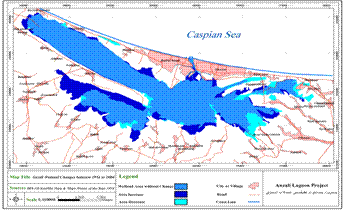
- Objective : to cost a number of options to deal with the Caspian rising
level versus cost of doing nothing !
|
|
7
|
- WLF Plan
- Concept : use of direct costs
- Cost of no-action being defined on basis of ‘perceived’ inundated land
and facilities plus references to number of people made homeless
- Cost of various options mostly defined as ‘physical costs ‘ associated
with structures plus un-costed ‘political’ consequences.
- Lessons learnt : worst case
scenarios do not always
work; lack of data forces huge
guessestaimtes; practically
impossible to go for intrinsic values; figures always help to convince
politicians
|
|
8
|
- Cost of Invasion
- Objective : estimate cost of no- action to deal with invading ML
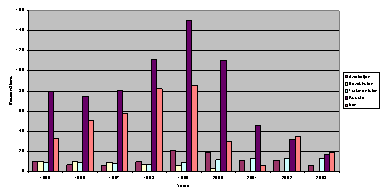
- Kilka Catch rate in the Caspian
|
|
9
|
- Concept : Sum of direct and indirect costs including :
- Cost of decline in catch from maximum sustainable yield
- Lost wages of fishermen and kilka processing plants workers
- Govt subsidies in lieu of fisheries halt
- Annualized cost of fleet deprecations and stopped plants.
- Lessons learnt : “causality’ is
an assumption that will need be theoretically backed; hugely difficult
to look at consequential damages
|
|
10
|
- Conclusions
- Economic valuation of environment
needs to be taken seriously.
- Capacity needs to be built
- Try to be simple
- Try to monetize but lo highlight
the elements that can not be monetized.
|
|
11
|
|

 Notes
Notes