

INTERNATIONAL WATERS
EXPERIENCE NOTES
http://www.iwlearn.net/experience
2006-007
Lessons-learned Reporting on Project
Management Structure: WIO-Lab
Abstract: The WIO-LaB project workplan is based upon the Nairobi Convention workplan. The synergy
between the project and the policy/programme level, provides an important advantage. Despite these
important advantages, it should be noted that the capacity of the focal points (technical, financial and
human resources) for coordination of the different project activities, which cover a wide range of issues,
may in cases be limited. A second challenge concerns the large diversity in the respective institutional,
cultural and socio-economic settings of the respective countries. Apart from official structures, the WIO-
LaB PMU has furthermore established/supported a number of more informal structures for stakeholder
consultation and involvement. Although the adopted structure builds upon the existing structure of the
Nairobi Convention, the approach would generally be replicable in other situations.
Peter Scheren
Peter.Scheren@unep.org
Addressing Land Based Activities in the Western Indian Ocean
1
Lessons Learned Reporting on Project Management
Structure: Wio-LAB
Experience of the GEF sponsored
Addressing Land Based Activities in the Western Indian Ocean"
(UNEP/GEF WIO-LaB Project)
PROJECT DESCRIPTION
The project involves eight countries in the
WIO region (Kenya, Tanzania,
The Project entitled "Addressing Land-
Mozambique, South Africa, Comoros,
based activities in the Western Indian
Madagascar, Mauritius and Seychelles).
Ocean" (shortly referred to as "WIO-LaB")
Its total budget is 11,413,465 USD, of
addresses some of the major
which 4,511,140 USD from GEF,
environmental problems and issues
3,395,650 USD in cash co-financing from
related to the degradation of the marine
the Norwegian Government, and
and coastal environment due to land-
3,131,675 USD and 375,000 USD in in-
based activities in the Western Indian
kind and cash co-financing from the
Ocean (WIO) region. The project is
participating governments and UNEP
designed to serve as a demonstration
respectively. The project is executed
project for the Global Programme of Action
jointly by the Nairobi Convention
for the Protection of the Marine
Secretariat and the United Nations Office
Environment from Land-based Activities
for Project Services (UNOPS). The total
(GPA/LBA).
duration of the WIO-LaB project is 4 years
(2005-2008).
The project has three main objectives: 1)
Improve the knowledge base, and
ISSUES AND CHALLENGES
establish regional guidelines for the
reduction of stress to the marine and
The project is implemented under the
coastal ecosystem by improving water and
umbrella of the Nairobi Convention, in that
sediment quality; 2) Strengthen the
it executes part of the Convention's
regional legal basis for preventing land-
Programme of Work as agreed by its
based sources of pollution; and 3) Develop
Conference of Parties. As such, the
regional capacity and strengthen
project is strongly embedded in the
institutions for sustainable, less polluting
political and institutional framework of the
development. The project activities include
Convention, and key stakeholders are
among others, a regional monitoring
those related closely to the Convention.
programme for water, sediment and biota
Among others, the national focal points of
quality, the implementation of
the Nairobi Convention are at the same
demonstration projects and the
time the focal points for the WIO-LaB
development of regional guidelines for the
project.
management of municipal wastewater and
physical alteration and destruction of
Furthermore, the WIO-LaB project
habitats, the development of regional
workplan is based upon the Nairobi
guidelines for environmental quality
Convention workplan. The synergy
objectives and standards and
between the project and the
Environmental Impact Assessment, and a
policy/programme level, provides an
regional Protocol on Land-based Activities
important advantage. Apart from the
to the Nairobi Convention, and various
benefits of an existing structural setup, the
training, educational and stakeholder
fact that this workplan was adopted by the
involvement activities. The final product of
COP of the Convention, which is at
the project will be a Transboundary
Ministerial-level, and therewith expect
Diagnostic Analysis (TDA) and Strategic
reporting back on the basis of this agreed
Action Plan (SAP), as well as related
workplan, and also the fact that countries
National Programmes of Action (NPA) for
contribute to sustain the Convention
abating the impacts of land-based sources
(financially and in-kind), ensures a certain
activities.
level of commitment from the countries.
This is probably an important advantage
2
as opposed to projects which operate
government institutions mandated for
more in a kind of vacuum.
Environmental Policy Making and
Implementation, represented by
Despite these important advantages, it
National Focal Points (NFPs). Since
should be noted that the capacity of the
the WIO-LaB project operates under
focal points (technical, financial and
the umbrella of the Nairobi
human resources) for coordination of the
Convention, the NFPIs ad NFPs are
different project activities, which cover a
those of the Nairobi Convention.
wide range of issues, may in cases be
Under the general guidance of the
limited. Also, the focal points operating at
NFPs, most countries have meanwhile
a more political level, the need existed for
(this is, 1 year in project
a clear separation of technical-level
implementation) set up National Inter-
interventions from political-level decision
Ministerial Committees, which function
making. The challenge in this is thus to
as the national mechanisms for project
ensure that relevant technical
coordination and decision making.
actors/institutions are adequately involved
in the design and implementation of the
2. At the technical level, task/issue-
various project interventions, whilst at the
specific management structures
same time assuring adequate involvement
consisting of regional and national
of the focal points, without causing
level Task Forces and Working
conflicting situations and ensuring that
Groups1 have been established. Such
decisions are taken at the appropriate
mechanisms have been set up for the
level.
main project components, which are (i)
water, sediment and biota quality, (ii)
A second challenge concerns the large
municipal wastewater management,
diversity in the respective institutional,
(iii) physical alteration and destruction
cultural and socio-economic settings of the
of habitats, (iv) environmental impact
respective countries, ranging from the
assessment and (v) legal and
relatively `rich' small-island states of
technical review. At the national level
Seychelles (80,000 inhabitants) and
the work of the Task Forces is
Mauritius, the much poorer island states of
overseen by the NFPs. At the regional
Comoros and Madagascar, to the large
level such guidance is provided by the
continental states of Kenya, Tanzania,
PMU, in cases assisted by a dedicated
Mozambique and in particular the
Regional Expert.
economic giant (within the African context)
South Africa. This diversity, in itself, is an
The overall structure constitutes a virtual
enormous challenge, since varying
matrix structure, whereby on one axis
resources and capacity do not enable, nor
policy-level management is assured by the
desire a fully uniform approach.
structure of NFPIs, and on the other axis
technical-level guidance is provided by the
THE EXPERIENCE
structure of Task Forces and Working
Groups. The project structure is
DESCRIPTION OF THE ORIGINAL
schematically presented below.
DESIGN
Description of project management
structure
The WIO-LaB PMU is established within
1 Task Forces, in this context, are defined as
the offices of the Nairobi Convention
groups of nominated experts dedicated to a
Secretariat and closely cooperates with
specific group of project activities and outputs.
the latter, at both the policy and technical
It is anticipated that these Task Forces will fulfill
level. The day-to-day WIO-LaB project
a longer-term advisory role within the context of
management structure consists of two
the Nairobi Convention. A Working Group,
within the context of the WIO-LaB project,
main components:
distinguish from this definition in that it will fulfill
only a temporary function. It is anticipated,
1. At the policy level, a project
however, that the existing Working Group on
coordination structure consisting of
Water and Sediment Quality will fulfill only a
National Focal Point Institutions
temporary function, to be taken over by the
(NFPIs), which are the appropriate
Forum of Academic and Research Institutions
(FARI), which is later described.
3
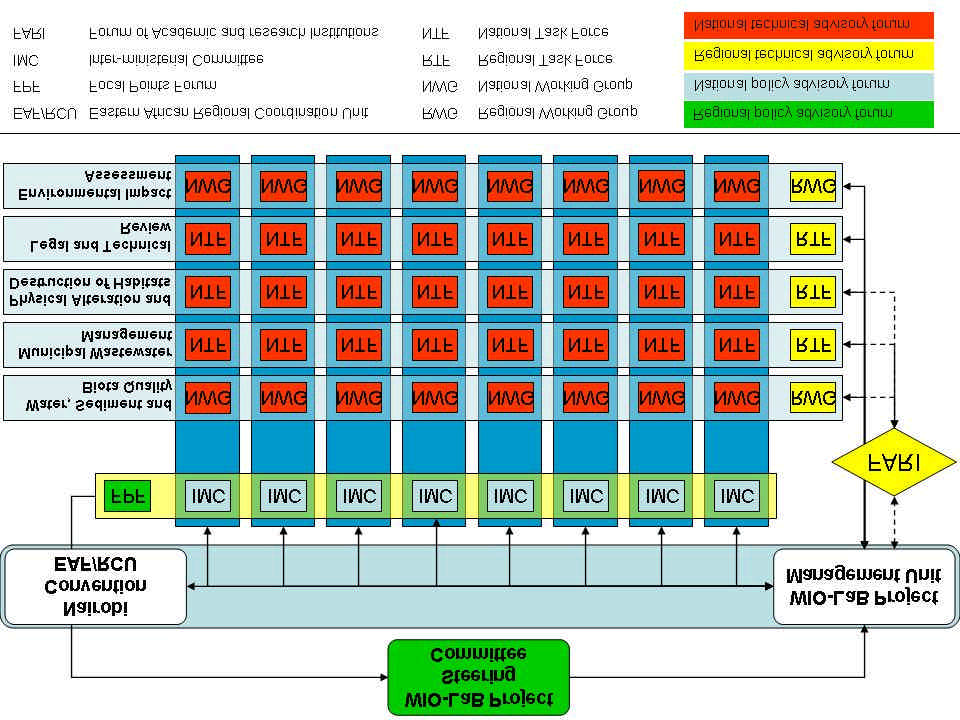
At the governance level, the NFPs are united in
quality assurance and as a sounding board /
the form of a Focal Points Forum, which
clearinghouse for technical outputs from the
provides guidance through the Nairobi
project and other regional activities.
Convention Regional Coordination Unit. Overall
· The Informal WIO International Waters (IW)
governance is, however, assured by a Project
Forum (not displayed in the above diagram),
Steering Committee which consist of the NFPs,
which is a regional event during which key
the executing and implementing agencies
players within the WIO IW arena, including
(Nairobi Convention Secretariat, UNOPS,
organizations such as WIOMSA, WWF,
UNEP/DGEF and UNEP/GPA), key regional
IUCN, the IOC, as well as projects, discuss
NGOs (WIOMSA, IUCN and WWF), sister IW
issues of coordination and synergy between
projects (the UNDP/GEF ASCLME project and
projects and activities. The first of these
the WB/GEF SWIOFP project) and national
forums has taken place in September 2005,
NGOs and the private sector as appropriate.
as a side-event to the WIOMSA bi-annual
WIO Marine Sciences Symposium and
Apart from these official structures, the WIO-LaB
brought together more than 100 participants
PMU has furthermore established/supported a
from organizations and projects in the
number of more informal structures for
region.
stakeholder consultation and involvement. Most
importantly, these are:
Following the Informal WIO IW Forum and more
detailed discussions with other project
· The Forum of Academic and Research
managers, it has furthermore been decided to
Institutions (FARI) in the Western Indian
set up a more formal Coordination Committee
Ocean (WIO) region. This independent
for larger GEF (and non-GEF) projects in the
Forum is constituted of the Heads of
WIO region, which are most importantly the
Institutions of academic and research
UNDP/GEF Agulhas and Somali Current LMEs
institutions in the region and functions as a
(ASCLMEs) project, the World Bank/GEF South-
mechanism for coordination of research
Western Indian Ocean Fisheries Project
activities, but also as a mechanism for
(SWIOFP), which are both expected to take off
4
in 2006, and the ongoing African Coelacanths
· The fact that the NFP network is embedded
Ecosystems Project (ACEP). The modalities for
in an existing regional coordination and
this Committee have already been agreed
policy-making structure (the Nairobi
between the respective project managers of
Convention), facilitates political-level
these projects. Other projects may join this
decision-making at the regional-level.
structure as well.
Decisions can thus be taken up to the level
of the COP of the Nairobi Convention, at
Rationale for approach taken
Ministerial level.
· The structure of regional and national Task
The rational for the approach is based upon two
Forces and Working Groups provides a
main elements:
good mechanism for the implementation of
specific activities, such as for example the
· The existing management structure of the
identification, selection and implementation
UNEP/Nairobi Convention Secretariat,
of demonstration projects, and the review of
consisting of a network of NFPIs and NFPs.
existing and development of new policies
This structure provided a solid basis for the
and strategies for addressing the impacts of
overall regional management structure of
land-based activities. The Task Forces are
the project. The embedding of the project in
generally very active and effective.
the Nairobi Convention structure represents
· The integrated regional-national
a win-win situation, whereby the Convention
management structure of both the NFP
is strengthened through the visibility of
network and the Task Forces has a number
concrete project activities, and on the other
of important spin-offs, such as the exchange
hand the project benefits from an existing
of experiences and points of view between
structure for regional coordination and a
countries, and improvement of `ownership'
strong means of decision-making and
of the project by the region.
achieving government commitment at the
· The adopted structure provides an excellent
regional level.
vehicle for assuring broad stakeholder
· The decision to operate on the basis of a
involvement. The various national and
structure of national and regional Task
regional Steering Committees, Task Forces
Forces and Working Groups is mostly based
and Working Groups represent most of the
upon the success of similar approaches in
key project stakeholders, and ensure their
other IW projects, such as the South China
active involvement in the project.
Seas Project. Despite some of the
drawbacks of such structure, such as the
Nevertheless, there are also a few weaknesses
relatively high cost and administrative
to be marked:
burden, the benefits of achieving ownership
and a means of efficient exchange of
· The efficiency and effectiveness of
experiences and points of view, seem to
implementation at the national level very
generally outweigh such considerations.
much depends on the capacity of the
individual NFPI, and more specifically the
RESULTS AND LEARNING
NFP. The capacity and strength of these
NFPs is, however, in many cases
The adopted project management structure has
inadequate which in cases leads to delays in
thus far proven to be very advantageous. On the
the implementation of activities. Also, the
positive site, the adopted structure offers all
NFPs are government employees, and not
appropriate handles for project implementation
paid in any way by the project, which in most
and decision making. The following advantages
cases has proven to limit the level of priority
may therefore be formulated:
given to the project, and which also limits
the PMU in controlling/directing the NFPs in
· The NFP network provides direct access to
the execution of their tasks. The relative
policy makers at the national level, whilst the
weakness of some of the NFPs is probably
technical Task Forces ensure adequate
the most restricting factor in terms of the
involvement of technical-level actors. The
efficiency and effectiveness of project
system clearly separates political and
implementation.
technical decision-making processes.
· The appropriateness of the structure also
depends on the specific conditions of the
5
country. For example, having 5 different
For example, the mandate given to the Inter-
Task Forces, and an Inter-Ministerial
Ministerial Committees in Mauritius and
Committee at the level of Seychelles
Seychelles is much larger, and covers at the
(80,000 inhabitants) and even slightly
same time functions of some of the more
smaller islands such as Mauritius, may not
technical Task Forces.
be feasible, nor desirable. In such cases,
· Ensuring efficiency of the Task Force
some of the Committees and Task Forces
meetings, by continuously weighing the
may better be merged.
benefits of the regional meetings (i.e. not
· The structure of NFPs assuring coordination
meeting only because of meeting itself, but
and decision-making at the national level
only with very specific outputs in mind).
also provides some concern in that such
Meetings are therefore not on regular
individuals are strongly influenced by the
intervals but on a pre-defined and agreed
existing social and institutional structure in
workplan for each Task Force)
which they operate. Decisions, such as for
example with regard to the nomination of
REPLICATION
participants in Task Forces, and the pre-
selection of demonstration projects at the
Although the adopted structure builds upon the
national level, may therefore be biased.
existing structure of the Nairobi Convention, the
· The structure of technical Task Forces and
approach would generally be replicable in other
Working Groups, however effective, weighs
situations. This is demonstrated by the fact that
quite heavily on the project organization and
other IW projects have successfully adopted
budget. The organization of the many
similar approaches. It should be noted, however,
regional `events' (meetings, workshops, etc.)
that the regional legal framework of the
takes up an important part of the time of the
Convention provides additional leverage to this
PMU as well as consumes considerable
structure, in particular the network of NFPs, and
budget. In a region where modern
it would in all cases therefore be advisable to
communication means are still relatively
use such existing structure where available.
underdeveloped (or better unused), cultural
aspects inhibit quick and efficient responses,
REFERENCES
and simply acts such as ticket distribution is
hampered by all kinds of logistical
WIO-LaB Website: www.wiolab.org
restrictions (not to mention the UN
administrative demands and inefficiencies),
Contact details: Dr.ir. Peter Scheren, WIO-LaB
the average meeting preparation poses a
Project Manager,
heavy burden on the small WIO-LaB PMU.
Tel: +254.20.7621270/1206/1250
Also, meetings are quite expensive (40-
E-mail:
wiolab@unep.org /
50,000 USD each for a 2-3 meeting with 20
peter.scheren@unep.org
participants).
KEYWORDS
The project is currently implementing measures
to (partly) counteract some of the above-
S Project management
mentioned draw-backs. The strategy to do so
S National focal points
consists mainly of:
S Socioeconomic disparity
S Inter-project coordination
· The provision of financial and technical
support to the NFPIs to implement their
coordinative tasks. Country-specific
The Global Environment Facility (GEF)
approaches are taken in this respect, in view
International Waters Experience Notes series
of the considerable differences between the
helps the transboundary water management
various national institutional setups and
(TWM) community share its practical
capacity.
experiences to promote better TWM.
· Capacity building activities, such as a
Experiences include successful practices,
Training Course on Effective Leadership for
approaches, strategies, lessons, methodologies,
the NFPs.
etc., that emerge in the context of TWM.
· Ensuring adequate flexibility in establishing
coordination structures at the national level.
6
To obtain current IW Experience Notes or to
contribute your own, please visit
http://www.iwlearn.net/experience or email
info@iwlearn.net.
7