


INTERNATIONAL WATERS
EXPERIENCE NOTES
http://www.iwlearn.net/experience
2008-016
Nature's Answers to the Sanitation
Challenge: The Application of
Constructed Wetland Technology for
Wastewater Management
Abstract: The coastal zone of the Western Indian Ocean region is the site of most major cities, harbours,
industries and other socio-economic infrastructure, which increasingly affect the environment. One of the
technologies being promoted by UNEP-GPA WIO-LaB project is that of constructed wetland treatment
systems. This note describes several completed demonstration projects. The projects have led to a
number of important lessons learnt, covering: cost-efficiency, learning from experience, stakeholder buy-
in and ownership and technology. The note also addresses replication issues, including selecting the right
technology for the right conditions, ensuring adequate stakeholder buy-in and building upon experience.
These demonstration projects are not the first examples of such systems in the WIO region, however they
have made an important contribution to extending the knowledge and understanding of this promising
technology to other countries in the region. Furthermore, with the establishment of a regional center for
wetland technology at the University of Dar es Salaam, the projects are expected to have very important
spin-off, in providing countries in the region with an effective and cost-efficient alternative to existing
wastewater treatment technology.
Peter Scheren
Peter.Scheren@unep.org
Addressing Land Based Activities in the Western Indian Ocean
1
Nature's Answers to the Sanitation Challenge: The Application of
Constructed Wetland Technology for Wastewater Management
Experience of the GEF sponsored
Addressing Land Based Activities in the Western Indian Ocean"
(UNEP/GEF WIO-LaB Project)
(GFL/QGL-2328- 2731- 4792 GF/XG-6030-04-11)
PROJECT DESCRIPTION
these demonstration projects is the challenge of
addressing the need for proper sanitation and
The Project entitled "Addressing land-based
wastewater management in the increasingly
activities in the Western Indian Ocean" (shortly
populated but socio-economically still poorly
referred to as "WIO-LaB") addresses some of
developed coastal urban centers of the region.
the major environmental problems and issues
related to the degradation of the marine and
ISSUES AND CHALLENGES
coastal environment due to land-based activities
in the Western Indian Ocean (WIO) region. The
The issue
project involves eight countries in the WIO
region (Kenya, Tanzania, Mozambique, South
The marine and coastal environment in the
Africa, Comoros, Madagascar, Mauritius and
Western Indian Ocean (WIO) is of high
Seychelles) and is executed jointly by the
ecological and economic value. Its natural
UNEP/Nairobi Convention Secretariat and the
bounties, including beaches, mangroves, coral
United Nations Office for Project Services
reefs, plant and animal life are the basis for the
(UNOPS). The total duration of the WIO-LaB
growing tourism sector, attracting visitors from
project is 4 years (2005-2008). Its total budget of
over the world. Its marine waters, and in
11,413,465 USD is contributed by the GEF, the
particular its continental shelves, coastal
Norwegian Government, UNEP and participating
margins, lagoons and estuaries are important
countries.
fishing grounds. The total economic value of the
goods and services provided by the natural
The WIO-LaB project is designed to serve as a
environment in the region is considerable, with
demonstration project for the Global Programme
estimates ranging between 4.6 and 26.1 billion
of Action for the Protection of the Marine
US$ annually.
Environment from Land-based Activities
(GPA/LBA). The project has three main
However, the coastal zone of the WIO region is
objectives: 1) Improve the knowledge base, and
also the site of most major cities, harbours,
establish regional guidelines for the reduction of
industries and other socio-economic
stress to the marine and coastal ecosystem by
infrastructure, which increasingly affect the
improving water and sediment quality; 2)
environment. Pollution from domestic, industrial
Strengthen the regional legal basis for
and agricultural sources causes the degradation
preventing land-based sources of pollution; and
of water and sediment quality, resulting in loss of
3) Develop regional capacity and strengthen
biological diversity, human health problems and
institutions for sustainable, less polluting
a reduction in fish stocks. Countries in the region
development.
currently lack both the capacity and regulatory
framework to adequately manage these
A key part of the WIO-LaB Project is to provide
environmental threats.
assistance to participating countries to
implement demonstration projects at a number
The challenge
of hotspots and sensitive areas in the WIO
region. These projects are intended to
One of the challenges being addressed by the
demonstrate innovative, appropriate and cost-
WIO-LaB Project is the need for appropriate
effective technical and managerial approaches
(low-cost) approaches for sanitation and
for addressing the impacts of land-based
wastewater management. The majority of WIO
sources and activities. One of the focal areas of
countries are classified as `poor' by World Bank
2
criteria. At the same time these countries are
mangrove wetland area, therewith expected to
also experiencing rapid population growth and
blend in very well wit the natural environment.
urbanisation in coastal areas. The consequent
Construction itself will in part be based on labour
inadequacy of appropriate wastewater
provided by the local community, which has also
management infrastructure leads to severe
attributed 60,000 US$ in cash co-financing from
consequences for the health and living
its community development funds; a clear sign
conditions of the population as well as the
of local ownership and engagement. Once
general quality of the environment.
operational, the project is expected to make an
important contribution to the health and
The experience
livelihood of the local communities, as well as to
UNEP, through the Global Programme of Action
the integrity of the marine ecosystem.
for the Protection of the Marine Environment
from Land-based Activities (GPA), is an active
A second constructed wetland project is
promoter of the application of appropriate low-
currently being implemented at Shimo La Tewa
cost technologies for wastewater management
Prison in Mombasa, Kenya. The project, which
in developing countries. One of the
is being implemented in cooperation with the
technologies being promoted by UNEP is that of
Coast Development Authority (CDA), the
constructed wetland treatment systems. UNEP,
National Environment Management Authority
through its International Environmental
(NEMA) and the Prison Service (KPS) of Kenya,
Technology Center (IETC) has been actively
consists of a sewerage system and central
promoting the constructed wetland technology,
septic tank coupled with a subsurface flow
among others through the development of
constructed wetland system. Wastewater and
various tools, including guidelines, manuals and
sludge generated will be used for aquaculture
models for wastewater management
(fish ponds) and for agricultural purposes. The
(http://www.unep.or.jp/ietc/ws/publications.asp).
system will be commissioned by November
2008, from there on serving the 2,500 inmates
Practical applications of the technology are
and 1,500 staff population of the prison. In
furthermore being demonstrated in Eastern
addition, a smaller but more innovative scheme
Africa, within the framework of the Nairobi
will be implemented in the adjacent `boy's
Convention and in particular through the UNEP-
prison', employing more advanced reuse
GEF Project `Addressing Land-based Activities
schemes such as biogas production, ecosan
in the Western Indian Ocean (WIO-LaB)'; Using
toilets and rainwater harvesting. Once in place,
experts at the Center for Wetland Technology of
the wastewater treatment system will
the University of Dar es Salaam in Tanzania, the
substantially reduce the pollution of Mtwapa
WIO-LaB project is in the process of
Creek, which supports a diversity of habitats
implementing several constructed wetland
such as mangrove forests, coral reefs and
treatment schemes in Eastern Africa.
seagrass beds and is of large socio-economic
importance for the surrounding population.
The first of these demonstration projects is
implemented in the Town of Chake-Chake in
A third constructed wetland project is currently
Pemba Island, Tanzania. The project, which is
being designed for the purpose of serving high-
scheduled to be fully commissioned by June
density low-cost coastal housing schemes in the
2009, will serve a population of 4,000 people
Seychelles. The scale of this demonstration
(650 households), or approximately half of the
project is much smaller (in the order of 150
population of Chake-Chake. The project
persons), but very appropriate to the situation in
employs a system for collection of wastewater
Seychelles where numerous of similar housing
from households, restaurants, mosques, public
complexes are requiring similar interventions.
and others commercial institutions in Pemba
through an innovative modular sewerage
RESULTS AND LEARNING
system, using piping material donated by the
European Council for Vinyl Manufacturers as
Although still in a stage of implementation, the
part of a private sector participation scheme.
demonstration projects have already led to a
The sewage thus collected will be lead into a
number of important lessons learnt:
coupled anaerobic lagoon subsurface flow
constructed wetland treatment system, which
Cost-efficiency: The projects, in particular the
will be located on the outskirts of a natural
mediums-size facilities in Tanzania and Kenya
3
are examples of cost-effective methods of
Stakeholder buy-in and ownership: A crucial
wastewater management. The treatment
aspect of many projects is the buy-in/ownership
systems as demonstrated cost approximately 5
of local stakeholders. In the case of the three
US$ per person in investment (excluding the
WIO-LaB demonstration projects on constructed
related sewerage infrastructure), as opposed to
wetland treatment systems, the need for local
mechanized systems such as activated sludge
ownership is even more important, since it not
which may require 10 times or more this value.
only affects sustainability and chances of
In addition, maintenance and operation are
success, but also opportunities for replication. In
relatively simple and cheap. Finally, the use of
all three projects, therefore, effort has been
constructed wetland treatment systems provides
made to involve all relevant stakeholders
opportunities for re-use in agriculture,
throughout the process of identification, design,
aquaculture and forestry, thus having the
feasibility study and implementation. The effects
potential of allowing for cost recovery.
of these efforts are clearly paying back:
Learning from experience: The technology of
The Chake-Chake wastewater project in
constructed wetland systems has by been
Pemba, Tanzania, addresses a very
recognized as proven technology, in particular in
important problem of the local community,
more tropical climates. Fortunately, one of the
which is faced by frequent blockages and
global knowledge centers in the region, the
resulting overflow of its open drainage
University of Dar es Salaam in Tanzania, is
system, which causes severe health risks as
located in the WIO region. Through a 12-year
well as nuisance to the surrounding
collaborative project between the University of
population. The project is therefore very
Dar es Salaam, the Royal Danish School of
much local-born and the local population
Pharmacy (currently known as The
actually contributes both in terms of labour
Pharmaceutical University of Denmark) and the
force as well as through a cash co-financing
University of Copenhagen, the "Waste
contribution of 60,000 US$ made from the
Stabilisation Pond & Constructed Wetlands
communities own social funds.
Research Project", the University of Dar es
The Shimo La Tewa addresses a pressing
Salaam has been building up an extensive
need of the Kenyan Prison Services (KPS),
record in this field of expertise, both at research
which is frantically seeking appropriate
level and as consulting engineers for practical
solutions for its wastewater management
cases. Several of such schemes are already
problems in prisons all over the country;
functional, including in Iringa (Ruaha Secondary
KPS is currently in court on such cases,
School and Kleruu Teachers College),
being sued by the National Environmental
Shinyanga, Malya and Bariadi prisons, Moshi
Management Authority (NEMA) of Kenya.
Municipality, Kibaha and Dar es Salaam
Thanks among others to such local
(household wetlands). Frame 1 provides an
pressure, the project has been adopted as a
example of one of such existing projects.
demonstration project within the context of
the National Prison Reform Programme, and
The three demonstration projects build strongly
budgetary allocations to implement similar
upon these experiences, engaging engineers
schemes in other prisons in Kenya have
from the University in the design and supervision
been made. In addition, the Coast
of the works. Building upon such existing `local'
Development Authority is making plans to
experience provides an enormous advantage,
implement similar schemes in both new and
among others in terms of (i) potential for
old coastal development projects.
replication, (ii) adaptability to the local
In Seychelles, finally, the project addresses
circumstances and culture and (iii) cost-
a problem that is prominently affecting the
efficiency (i.e. avoiding the high costs often
population: due to unfavourable geological
related to international experts and consulting
structure and groundwater flows, the
engineers). The experience of the University of
existing system of septic tank and drain
Dar es Salaam has meanwhile been
fields is frequently malfunctioning, resulting
internationally recognized, among others as co-
in nuisance and health risk to the population.
authors of the joint UNEP-DANIDA
commissioned Design Manual on Waste
Technology: There are various types of
Stabilization Ponds and Constructed Wetlands.
constructed wetland systems. The main
distinction is, however, made between Free
4
Water Surface (FWS) and Sub-Surface Flow
Case Study: Kleruu Teacher's College
(SSF) systems. In FWS systems, the flow of
Wetland Project
water is above the ground, and plants are rooted
The wetland is located at Iringa town and is
in the sediment layer at the base of water
serving a Teacher's Training College in
column. In SSF systems, water flows though a
Tanzania. Before the introduction of the
porous media such as gravels or aggregates, in
Constructed Wetland system the college was
which the plants are rooted. A further distinction
treating its wastewater through a combination of
in types of SSF systems is made into Horizontal
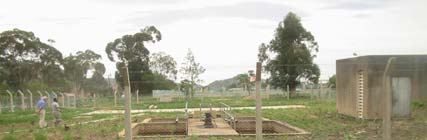
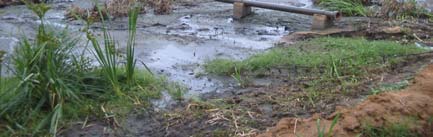
a mechanical aeration system (Fig. 1) and a
flow SSF (HSSF) and Vertical flow SSF (VSSF).
pond. However, operation of the mechanical
From research and applications in Tanzania, a
system failed because of high costs of electricity
few important lessons learnt have become
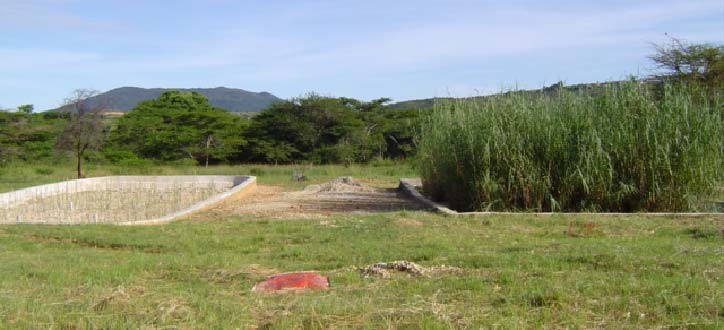
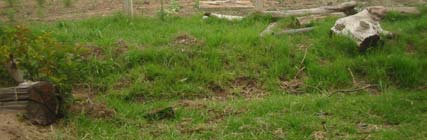
and lack of regular maintenance. Fig. 2 shows
apparent:
the situation that resulted; the pond was
malfunctioning, ignored, lacked de-slugging and
(1) Tropical wetlands are considerably more
released untreated effluent to the downstream
effective than non-tropical systems.
communities.
BOD5 removal rates achieved in
Tanzania are almost a factor 10 higher
than standard literature values.
Consequently, wetland size may be
reduced without loss of efficiency.
(2) In tropical areas SSF constructed
wetlands is the type of choice, in
particular because it eliminates the
problem of mosquito breeding and
hence risk of mosquito-born diseases
such as malaria.
(3) In SSF systems, the most expensive
component of the constructed wetland is
the substrate. The aggregates used
Fig. 1: Malfunctioning Mechanical Aeration System
contribute about 60-70% of the total
investment cost.
(4) While constructing a wetland, care has
to be taken that the contractor does not
allow soil or other fine materials to be
introduced with the aggregates, in order
to avoid clogging of the system and
reduction of performance. Noted should
be here that people often have difficulty
understanding that plants can grow on
stones without any soil; most people
would therefore allow some fines
thinking that they are crucial for the
Fig. 2: Condition of the Pond before the intervention
growth of the wetland plants.
(5) Mass transfer in wetlands plays a very
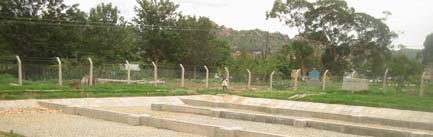
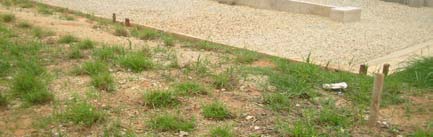
A HSSF Constructed Wetland was installed to
significant role. Several design
replace the pond. A baffled system was
components may be introduced to
introduced, as seen in Fig. 3. The need to
enhance such transfer; to do so,
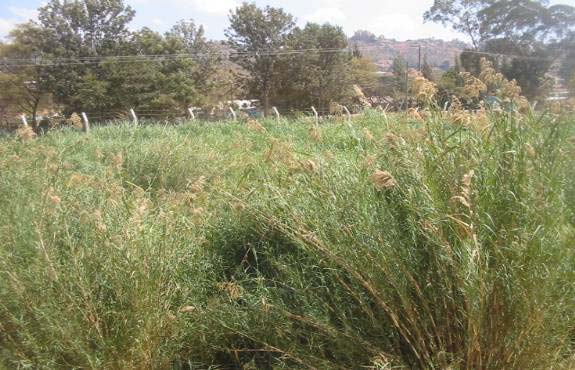
operate the mechanical system ceased and the
wetlands must be narrow or baffled in
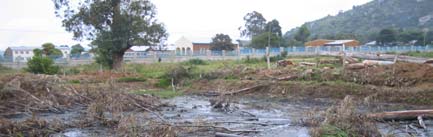
condition of the wetland after full growth of the
order to increase the interstitial velocity
plants is as show in Fig. 4.
and thus improve the performance.
(6) Inlet and outlet works need careful
design considerations. Care must be
taken to ensure that the inlet distributes
the inflow uniformly.
5
selection of the sub-surface flow alternative
for the WIO-LaB wetland systems was the
risk of health impacts related to mosquito
breeding as may occur in free surface
systems. However, since free surface flow
systems are relatively easier to construct, as
well as often cheaper, it may well be that
under different circumstances such systems
are the preferred alternative.
b. Ensuring adequate stakeholder buy-in:
As for many development projects, a crucial
aspect of constructed wetland projects is the
Fig. 3: Constructed wetland replaced the pond
buy-in/ownership by local stakeholders.
Although the systems are relatively easy to
operate, the risk of failures due to
inadequate operation and maintenance are
real. In many cases, such impacts are due
to upstream factors, such as inappropriate
use of sewers and drainage channels
leading to sediment and even solid waste
clogging the system. The users of the
systems, mostly the general population,
need to be aware of such risk and take
precautionary measures to protect `their'
system. Regulatory measures may be
Fig. 4: Constructed wetland after full growth
applied, but control is difficult without the
necessary level of self-regulation by the
The performance of the installed constructed
users; Assuring adequate ownership/buy-in
wetland is very promising, with a BOD removal
by local stakeholders is therefore the issue.
rate of 90%, 76% in nitrate and 69% in heavy
c. Building upon experience: The technology
metals (cupper and chromium). The effluents
of constructed wetlands has been quite
therewith easily meet internationally accepted
rapidly evolving in recent times. Yet, there
standards for effluents from wastewater.
are still many uncertainties related to the
optimal design and constructions. Using
REPLICATION
existing knowledge centers avoids making
mistakes already made, so should be highly
The key factors in implementing constructed
recommended.
wetland projects of nature implemented by WIO-
LaB naturally follow from the key lessons learnt
It should be noted that the WIO-LaB project is
as presented above:
actively promoting the replication of its
demonstration projects. As for all WIO-LaB
a. Selecting the right technology for the
demonstration projects, the three constructed
right conditions: In the case of the WIO-
wetland projects therefore involve wide
LaB demonstration project the most
stakeholder participation (especially of the local
appropriate treatment system appeared to
community and institutions) in planning, decision
be the horizontal sub-surface flow
making and implementation. The projects
constructed wetland system. It should be
furthermore incorporate replication strategies
noted, however, that whereas constructed
that will ensure that the lessons learnt will be
wetland systems may have great potential
widely disseminated through various expert
under the right conditions, they do not
networks and learning alliances established
provide the ideal solution for all situations;
within the framework of the Nairobi Convention.
for example, where space is the issue,
Several initiatives are currently already
conventional mechanical treatment may be
underway the projects, including:
preferable. Also, natural systems such as
constructed wetlands, work best in warm
Design and implementation of constructed
climate. Furthermore, a key factor in the
wetland systems in other prisons in Kenya is
6
being considered as part of the Prisons
WIO-LaB Website: www.wiolab.org
Reform Programme.
The design of a constructed wetland system,
Contact details:
based upon the WIO-LaB demonstration
project in Pemba, Tanzania, is currently
WIO-LaB Project Management Unit
being undertaken for the City of Toliare in
Dr. Peter Scheren
Madagascar. This replication project is being
WIO-LaB Project Manager
supported by the Norwegian Government,
C/o UNEP/ROA Rm. A-130
with technical support being provided by
P. O. Box 30552
Stavanger University.
Nairobi, Kenya
Several other initiatives for replication are
Tel: +254 20 7621270/1206/1250
also being considered in Tanzania and
Mobile: +254 722509186
Kenya.
Fax: +254 20 7623203
E-mail: wiolab@unep.org /
Finally, in order to ensure long-term
peter.scheren@unep.org
sustainability of the regional center of excellence
on constructed wetland technology at the
University of Dar es Salaam
University of Dar es Salaam in Tanzania, the
Dr. Karoli Njau
WIO-LaB Project and Nairobi Convention
WSP & Constructed Wetlands Research Project
Secretariat are supporting a new initiative by the
P.O. Box 35131
University that is targeting the transfer of
Dar es Salaam, Tanzania
wetland technology for decentralized wastewater
Tel: +25522 2410368
treatment through various dissemination
Mobile: +255 754 296 993
activities as well as through the establishment of
Fax: +255 22 2410114
a business unit. The latter project has
Email: knjau@udsm.ac.tz
meanwhile attracted considerable financial
support from the Swedish BIO EARN innovation
KEYWORDS
fund.
Eastern
Africa
SIGNIFICANCE
Wastewater
treatment
Constructed
wetland
The WIO-LaB demonstration projects on
Sub-surface
flow
constructed wetland technology are not the first
Low-cost
technology
examples of such systems in the WIO region.
However, so far such experiences have been
The Global Environment Facility (GEF)
confined to Tanzania only, where several
International Waters Experience Notes series
systems are already operational and extensive
helps the transboundary water management
experience is available at the University of Dar
(TWM) community share its practical
es Salaam. The WIO-LaB demonstration
experiences to promote better TWM.
projects have therefore made an important
Experiences include successful practices,
contribution to extending the knowledge and
approaches, strategies, lessons, methodologies,
understanding of this promising technology to
etc., that emerge in the context of TWM.
other countries in the region, the fruits of which
are already visible: several initiatives for
To obtain current IW Experience Notes or to
replication are currently already ongoing.
contribute your own, please visit
http://www.iwlearn.net/experience or email
Furthermore, with the establishment of a
info@iwlearn.net.
regional center for wetland technology at the
University of Dar es Salaam, the projects are
expected to have very important spin-off, in
providing countries in the region with an
effective and cost-efficient alternative to existing
wastewater treatment technology.
REFERENCES
7