|
1
|
- FORMULATING THE SAP
- Development of a Long-term Vision
- Preparing and assessing the Acceptability of the Options
- Setting Targets
- Drafting the Action Programmes
|
|
2
|
|
|
3
|
|
|
4
|
- GENERAL
- Identify the key elements in the SAP process and understand the
importance of alternatives.
- Explain the key features of the adaptive management approach and the
concept of the ‘long-term vision’ for each priority problem.
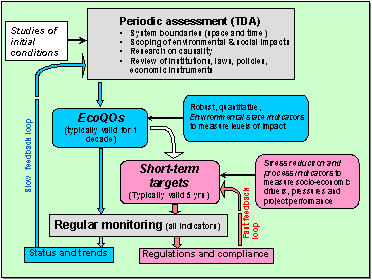
- Identify the roles played by Eco/WR QOs and short-term targets in this
process.
|
|
5
|
- SAP PROCESS
- Describe the key factors that should be considered when developing the
long-term vision.
- Identify long-term Eco/WR QOs
for specific problems.
- Explain the process of brainstorming ways to reach the Eco/WR QOs .
- Describe the process of assessing the feasibility of options and the
key factors that should be considered.
- Explain the need to identify as part of this process:
- the associated costs and benefits;
- links to existing or projected policies/actions;
- barriers to implementation.
|
|
6
|
- COMPLETION OF THE SAP
- Explain the need for setting short-term targets and priority actions.
- Explain the importance of monitoring and evaluation in the life cycle
of a GEF project or programme, and describe the differences between
process, stress reduction and environmental status indicators.
- Explain the key steps in drafting National Action Programmes (NAPs) and
the Strategic Action Programme (SAP)
|
|
7
|
|
|
8
|
- Negotiated policy document
- Endorsed at the highest level of all relevant sectors
- Establishes clear priorities and commitments for action to resolve the
priority problems identified in the TDA
- Undertaken prior to the development of technical assistance,
capacity-building, or investment projects
|
|
9
|
|
|
10
|
- SAP process are generally presented in linear fashion. however:
- A number of steps will be carried out in parallel.
- Proposals frequently involve reforms that require ad-hoc groups to
conduct detailed studies; the process should not be delayed to wait for
slower study groups to ‘catch up’.
- SAP steps may need to be by-passed.
|
|
11
|
- Flexible system which is designed to cope with uncertainty and
complexity in natural environmental and social systems,
- Often referred to as experimental management or "learning by
doing".
|
|
12
|
- An adaptive management process has two vital components
|
|
13
|
|
|
14
|
- Operates over extended timescales.
- Should be adequate time for impacts, resulting from the management
actions, to occur and be assessed.
- Appropriate mechanisms -Indicators/monitoring- built in to enable this
assessment.
- Should consider both social and ecosystem effects.
|
|
15
|
- Eco/WR QOs are statements of the
‘vision’ of how the stakeholders would like to see the state of the
system in the future.
- They provide the long-term goal for adaptive management.
- Eco/WR QOs must be linked to the
state of ecosystems but should fully acknowledge the place of humans
within that ecosystem.
|
|
16
|
- Should be clearly understandable to a wide range of stakeholders.
- Developed with stakeholder Involvement, consultation, participation
- Reflect the acceptable environmental status which would signify a
solution for each of the priority transboundary problems identified in
the TDA – not process changes or institutional changes.
|
|
17
|
- Short-term management targets can be thought of as stepping stones on
the way to an Eco/WR QO
- They define the pragmatic steps towards achieving agreed Eco/WR QOs .
- The timescale of an EcoQO may be decades, while a short-term management
target could be monitored and reported on perhaps annually.
|
|
18
|
|
|
19
|
|
|
20
|
|
|
21
|
|
|
22
|
|
|
23
|
- At the first meeting of the SAP phase a ‘vision statement’ and candidate
long-term Eco/WR QOs should be
devised
- Usually the same group of people that developed the TDA
- It links how the region is now with what it is hoped it will be in the
future.
- Gives structure to the Eco/WR QOs
and direction to the SAP.
|
|
24
|
- "A clear representation
of the characteristics desired for the future environment."
- A long term vision is a
political objective, and as such it will have to be reach at an
inter-governmental level, so that all countries are committed to
achieving those goals
- So….. compromises may have to
be made
|
|
25
|
- It should be understandable to the general
public as well as a scientific audience
- It should inspire those living in and around the catchment to believe
that they can improve the condition of the water environment
- It should encourage the relevant parties to strive to reach this goal
- It must challenge those involved and really make a difference.
- It must not be impossible - this would be disheartening and defeating.
|
|
26
|
- Examples of vision statements for the Nile and Rhine River Basins are
shown on Page 17 of the Participant Manual
|
|
27
|
- Not based solely on the natural qualities for the area but includes human
activities
- Point to important principles on which actions will be based.
- Should not be restricted or limited by current issues or problems in the
local environment – to past damage and future threats.
- Wide-ranging, both in geographic and time scales.
- Must be agreed by all parties.
|
|
28
|
- The TTT should examine the ‘vision’ and each priority transboundary
problem detailed in the TDA and ask the question:
- This statement of status will represent a long-term Eco/WR QO
|
|
29
|
- Examples of Long-Term Eco/WR QOs
for the Caspian Sea, and the Danube, Dnipro and Bermejo River
Basins are shown on Pages 18 and 19 of the Participant Manual
|
|
30
|
|
|
31
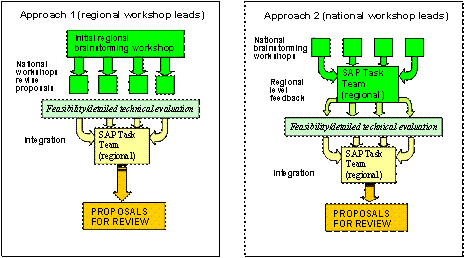
|
- Organization of Meetings and Workshops
- Engage the National Inter-Ministry Committees (IMCs) in the process as
early as possible
- The IMCs should organize national meetings that mirror the initial
brainstorming
- Include a suitable range of stakeholders and technical specialists
|
|
32
|
|
|
33
|
- Irrespective of which of these approaches is taken:
- Early national feedback is critically important in order to ensure the
acceptance of the options by the stakeholders
- Though approach 2 appears more complex, it may involve more people in
the initial stages and then reduce the need to move large numbers of
specialists
- The procedure for conducting the initial brainstorming is the same,
whether at a regional or national level
|
|
34
|
|
|
35
|
- Objective: To work with stakeholder representatives and specialists to
propose a number of practical options that make significant progress
toward the Eco/WR QOs
- Purpose: to ensure full stakeholder participation in SAP planning
- Timescale: The meeting finalises the work of the TTT and sets the agenda
for the SAP development
- Actors: members of the TTT, the Steering Committee and additional
specialists or stakeholder representatives selected by the Project
Manager
|
|
36
|
- Tasks:
- The meeting discusses the Eco/WR QOs
and agrees on final drafts
- Examines each Eco/WR QO and identifies possible options for achieving
them
- Organization: small groups developing a matrix of options for the part
of the causal chain they address, including:
- timeframes for implementation
- responsible parties and relative costs (where possible)
- Assign indicative priorities to the solutions proposed
- Note: The matrix will be the basis for further technical evaluation and
should be as ‘inclusive’ as possible – it does not represent a
commitment.
|
|
37
|
|
|
38
|
|
|
39
|
- Refer to Page 31 of the Participant Manual for more details
|
|
40
|
|
|
41
|
- Purpose: The high priority proposals emerging from the brainstorming are
followed by a more rigorous national and regional level analysis and
evaluation for:
- their technical feasibility
- their costs and environmental benefits
- their political and social acceptability
- Who is responsible?: Each of
these analyses should be carried out nationally by the NAP formulation
teams and national members of the SAP formulation team
- Perspective: The whole process should be steered regionally
|
|
42
|
- Purpose: To determine which options are technologically possible, and
whether it is practical in terms of current technology, economics,
social needs, etc.
|
|
43
|
- Approach: For each Long-term Eco/WR QO
|
|
44
|
- Purpose: to create a basis for sound decisions about the allocation of
financial resources
- Approaches:
- Cost effectiveness of the options
- evaluation of all costs and benefits in a common measure, monetary
units. Cost-Benefit Analysis (CBA)
|
|
45
|
- Pre-conditions that paved the way for this political phase:
- The TDA stakeholder consultations and governance analysis
- A participatory approach that legitimised the process with relevant
stakeholders
- The initial brainstorming session, which engages the National
Inter-Ministry Committees as well as key stakeholders
|
|
46
|
|
|
47
|
- Key question:
- Which mix of options, including key reforms and investments, would
governments (and the private sector where appropriate) commit themselves
to in the short/medium term (5/15 years)?
|
|
48
|
|
|
49
|
- To respond to this question, a set of 1 to 10 year targets and priority
actions should be set up. Three
basic technical recommendations are required:
- Development of short-term targets and priority actions
- Agreement on the national/regional institutional framework
- Development of measurable M & E indicators for each target
|
|
50
|
- Short term targets are goals towards which measurable progress should be
observed over a period of, say, one, five or ten years. They:
- are stepping stones on the way to an Eco/WR QO
- define the pragmatic steps towards achieving agreed Eco/WR QOs
- should be monitored and reported on annually
- target either environmental (e.g. species abundance), or societal
- factors (human sewage being
treated)
- should be unambiguous and easy to communicate to the public
|
|
51
|
- Ultimately, the decision on which of the available options will be
pursued is a political one
- Sound advice will inevitably be tempered by political pragmatism
- Whatever the outcome it will require clear short-term targets, priority
actions and robust M & E indicators
|
|
52
|
- Examples of Short-Term Targets for the Caspian Sea, and the Dnipro and
Bermejo River Basins are shown on Pages 39 and 40 of the Participant
Manual
|
|
53
|
- Objective: to formulate proposals on how (the already examined)
institutional weaknesses should be corrected, through increasing the
capacity of existing institutions or creating new ones
- Parallel discussions must go on:
- the formulation of national policy
- the need for legal and institutional reforms
- investment priority
- Who does it?: NAP teams, and agreed by the National Inter-ministry
Committees
|
|
54
|
|
|
55
|
- Objective:
- The SAP team should prepare a set of process, stress reduction and
environmental status indicators based on the results of the TDA but
adapted according to the needs of the long-term Eco/WR QOs and shorter term targets and priority
actions)
- In addition:
- Project monitoring and evaluation indicators for any subsequent GEF
interventions should also be developed
- Attention:
- There should be clear linkages between the indicators and the
institutional capacity for monitoring them
|
|
56
|
- Process indicators demonstrate actual on-the-ground institutional and
political progress in the step-by-step journey to the resolution of
these complex problems
- In the initial stages of multi-country projects:
- the only types of appropriate indicators may be regional process
indicators (e.g. establishing country inter-ministerial committees)
- Further into implementation:
- more importance can be placed on single country process indicators (e.g. enacting of legal reforms)
|
|
57
|
|
|
58
|
- Stress reduction indicators focus on concrete actions that reduce
environmental stress
- They indicate the rate of success of specific on-the-ground actions
implemented by collaborating countries
- Often a combination of stress reduction indicators in several nations
may be needed to produce detectable changes in transboundary waters
|
|
59
|
|
|
60
|
- Focus on actual improvements of ecosystem quality that usually extend
beyond the lifetime of the project
- Measure actual success in restoring or protecting the targeted waterbody
- Social indicators may also be appropriate to measure whether communities
and stakeholders benefit from the changes in environmental conditions
brought about by the project.
|
|
61
|
|
|
62
|
|
|
63
|
|
|
64
|
- Each country involved in the TDA/SAP may need to develop a National
Action Programme (NAP)
- National actions must respond to the uniquely specific circumstances and
priorities of each country
- Each country must select the approach that best suits:
- geographic characteristics
- political, institutional and regulatory frameworks
- best available science and technology, and
- current assessments, inventories and data
- No two NAPs will have quite the same appearance, scope or focus
|
|
65
|
|
|
66
|
|
|
67
|
- The SAP should be prepared on the basis of the reforms and investments
outlined in the draft NAPs and the components agreed in the preceding
negotiation process
|
|
68
|
- The work of integration of the various materials of the SAP into a
single document should be conducted under the supervision of the Project
Manager and key members of the PMU and the SAP TTT
|
|
69
|
- The SAP should embody:
- a statement of the priority problems
- principles adopted for solving them
- joint planning and dispute settlement mechanisms
- institutional arrangements
- public participation
- long term Eco/WR QOs and
short-term targets and priority actions
- common measures to be taken
- monitoring and review arrangements and reporting.
|
|
70
|
- Full details of agreed measures at the national and regional levels
(including national policy/legal/institutional reforms and investments)
and their implementation mechanisms
- Process, stress reduction and environmental and living resource status
indicators
- Stakeholders and their involvement in the implementation and review
process
- Lists of contact points for the responsible authority for implementation
in each country
|
|
71
|
- There is no single approach or model used for the SAP document
structure. It should adhere to
the following criteria:
- Executive Summary - should be jargon-free. No more than 2 pages long
- Main Text - should be lucid and concise
- Language (English or English translation)
|
|
72
|
|
|
73
|
- The SAP (and the associated NAPs) must be formally endorsed by relevant
government authorities. This is
to ensure that:
- The SAP (and the associated NAPs) are incorporated into planning and
budgetary processes at all levels
- The SAP is brought into the mainstream of policy, legal and budget
provisions, enforcement mechanisms, and technical and scientific
frameworks
- Official adoption of the SAP give the process the legitimacy and
support needed to bring on board a wide range of stakeholders, both
from the public and private spheres
|
|
74
|
- Purpose: allow bilateral and multilateral organizations to review the
proposals and to engage in joint planning for future projects
- Suggested preparation for a meeting:
- Inform relevant donors of planned meeting at least six months in
advance.
- Distribute preliminary NAPS at least two months prior to the meeting.
- Distribute nationally endorsed SAP as soon as it is available
|

 Notes
Notes