The GEF IW TDA/SAP Process
Notes1 on a proposed best practice approach
Executive Summary This
document is designed to provide a road map for best practice in
formulating a Transboundary Diagnostic Analysis and a Strategic
Action Programme (TDA/SAP) as part of a GEF international waters
project. It is prepared on the basis of discussions between
specialists from UNDP, UNEP and the GEF Secretariat, together with
practitioners who have completed the process in freshwater and
marine systems. It reflects experience obtained in conducting
TDA/SAPs between 1996 and the present. It is not however intended as
a prescriptive formula, merely a guide that should be adapted to the
cultural realities of each region. In preparing this guide, various
other inter-institutional processes have been taken into account
that have been supported by the GEF: the Global International Waters
Assessment (UNEP-GEF), the IW:Learn programme (UNDP-GEF) and the
Train Sea Coast programme (UNOALOS). The approach taken closely
follows the paradigm of adaptive management and incorporates the
recently defined GEF IW M & E indicators.
1. Introduction to the TDA/SAP process
The formulation of a Transboundary Diagnostic Analysis (TDA) followed by a Strategic Action Programme (SAP) is recommended for most projects proposed for financing in Operational Programmes 8 and 9 of the GEF International Waters Focal Area.
The advice on TDA and SAP approaches given by the relevant GEF documents is rather limited. The design of new information gathering mechanisms and the experience of a number of GEF projects to date in the design of TDA’s provides an opportunity to develop more formal guidelines to assist with the preparation of TDAs and to ensure inter-regional comparability.
The GEF recently commissioned a comprehensive programme study for its Operation Programmes 8 and 9. The Final Report of the International Waters Program Study is available on the IW:LEARN Web site at: http://www.iwlearn.net/ftp/iwps.pdf..
The Programme Study found that the current emphasis on undertaking a science-based TDA prior to the design of a SAP is appropriate for projects in Operational Programs 8 and 9. Such scientific and technical assessments are needed to:
identify, quantify, and set priorities for the environmental concerns that are transboundary in nature, and
to identify their immediate, intermediate and fundamental causes. The identification of causes specifies practices, sources, locations and human activity sectors from which environmental degradation arises or is threatened.
A TDA thus provides the factual basis for the formulation of a SAP embodying specific actions (policy, legal, institutional reforms or investments) that can be adopted nationally, usually within a harmonized multinational context, to at least address the top priority transboundary concern(s) and over the longer term restore or protect a specific body of water or transboundary ecosystem.
The Programme Study found that there are a variety of ways in which a TDA is conducted. Some are more resource-intensive than others, but these usually offer advantages in providing greater insight and specificity, thereby providing an improved information base for the formulation of SAPs. The TDA permits the logical development of a strategic action program that is based on a reasoned, holistic and multisectoral consideration of the problems associated with the state of and threats to transboundary water systems. Furthermore, it is a valuable vehicle for multilateral exchanges of perspectives and stakeholder consultation as a precursor to the eventual formulation of a SAP.
2. Underlying principles
The following are some of the key underlying principles incorporated into the TDA/SAP approach:
Full
stakeholder participation.
All parties involved in or
affected by an environmental problem and/or its solution can be
termed ‘stakeholders’. In order to be objective in
analysis and effective in solutions, the TDA/SAP process must
reflect a shared vision that enables stakeholder to be independently
identified, fully involved in the TDA and fully consulted throughout
the SAP process. Whilst understanding that some solutions may not be
acceptable to all parties, it is imperative that those that are
eventually adopted should reflect a rigorous social assessment and
be subjected to open stakeholder consultation.
Joint
fact-finding.
The TDA should be conducted with the best
available independent expertise, sourced locally where possible. The
specialists should be selected by stakeholder representatives, many
of which are typically included in national inter-ministerial
committees (see below), and consult with them during the process.
This is important to ensure regional ownership of the process and
its products.
Transparency.
The
TDA is a document that will be in the public domain. During the
fact-finding process, stakeholders should agree to freely share the
necessary information and information products, taking care that
full recognition is given to information sources.
The ecosystem
approach.
A useful working definition of the ecosystem
approach has been developed by the Convention on Biological
Diversity (CBD, 1998): The ecosystem approach is based on the
application of appropriate scientific methodologies focused on
levels of biological organization which encompass the essential
processes and interactions amongst organisms and their environment.
The ecosystem approach recognizes that humans are an integral
component of ecosystems.
The ecosystem approach has the
following key features:
Management objectives as societal choice
Management decentralised and multi-sectoral
Appropriate temporal and spatial scale
Conservation of ecosystem function and resilience
Appropriate balance between conservation and use
Management within system limits
The outward vision (respect interconnectedness) and long-term vision (change is inevitable)
Broad use of knowledge, scientific and traditional
Incorporation of economic considerations (costs and benefits, removal of externalities, etc.)
The GEF IW Programme has the potential of delivering the ecosystem
approach as it defines systems within natural boundaries (catchments
or LMEs) rather than political ones.
Adaptive
management.
Adaptive management, sometimes described as
‘learning by doing’, is a process by which agreed
long-term environmental goals are achieved in a series of pragmatic
action-based steps. Within each step agreed achievement indicators
are monitored and there is a joint planning exercise to review
progress and to plan the next step. For the purposes of many GEF IW
projects, the adaptive management process consists of: (1)
establishing long-term Ecosystemic Quality Objectives (EcoQOs) for
identified key problems, (2) agreeing upon the most practical and
achievable short-term (project length) measures for making
substantive progress towards resolving the problems, (3) setting
time-limited operational objectives as project targets, (4) agreeing
upon the appropriate process, stress reduction and environmental and
living resource status indicators to monitor progress and setting
new operational objectives, (5) consulting with stakeholders on the
proposals, (6) ensuring that the appropriate institutional measures
are in place to oversee implementation of the agreed joint actions,
and finally (7) conducting a review to document progress toward the
long-term EcoQOs in the light of any new scientific information and
to agree on a new set of measures, operational objectives, etc. The
details of the process and its components will be elaborated further
in section 3 of the current notes. The document describing
stakeholder commitment to the process for a particular transboundary
system is the Strategic Action Programme. A key requirement of this
approach is a monitoring and assessment programme to determine the
effectiveness of the approach and guide it as it moves forward (see
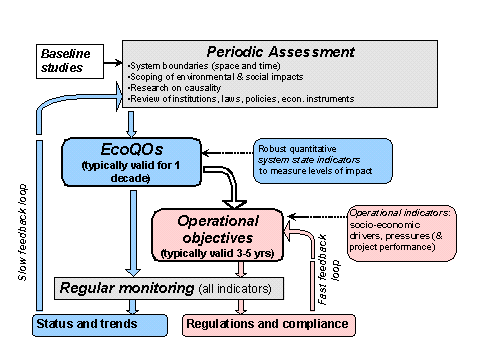
Fig. 1 for details).
Action that
takes into account social and economic root causes of the
problem.
The analysis of causal chains between key
transboundary problems and their social and economic causes is a
critically important element of the TDA process. It is important to
appreciate that the geographical scale may change between the
environmental and social impacts of a problem, the problem itself
and the causes of the problem. Actions taken nearer to the root
causes are more likely to have a lasting impact on the problem. The
causal chain analysis is an important reference point when designing
the practical actions that will be included in the SAP.
Accountability.
Parties
committing themselves to implementing the SAP must be fully
accountable for their actions. The stakeholder group/ sector/
government agency(ies) responsible for implementing the actions
proposed within the TDA must be clearly and unambiguously
identified.
Inter-sectoral
policy building.
Current systems of government are highly
sectoral in nature. In order to develop a pragmatic programme of
action, direct participation should be achieved by the key sectors
involved in the problems. This involvement will normally consist of
national Interministerial committees, including appropriate
government sectors as well as other relevant stakeholder
representatives.
Stepwise
consensus building
Effective management requires a
consensus to be built at every step. It is important not to advance
to the subsequent step until a clear consensus emerges. By including
clear stakeholder representation at all stages of the process,
consensus-building is more likely to occur, ensuring a greater
probability of long-term sustainability of the process and its
outcomes.
Subsidiarity
Practical
solutions to transboundary issues require action at regional,
national and sub-national (or local) levels. The more closely
defined are the national and sub-national actions, the greater the
likelihood of reaching the EcoQOs. The SAP should clearly address
the balance between regional and national actions, attributing the
most appropriate implementation mechanism to each level of action.
Incremental
costs.
The SAP should distinguish those actions involving
agreed incremental costs from those of purely national interest
(baseline actions).
Donor
partnerships.
The SAP process is designed to build
partnerships between development partners (donors) in order to
address the identified problems and, where necessary, to assist
governments to cover the costs of baseline actions. An effective
donor partnership will act as an incentive for commitment to the SAP
and avoid duplication of efforts by the donor community.
Government
commitment.
Approval or adoption of the SAP
as a binding agreement between governments should be an important
management objective of the process. If the process has been
conducted in a stepwise manner, this final step should not be
difficult to achieve (though it may well require administrative
time). An SAP that does not involve a high level of formal
commitment is unlikely to be taken seriously as a roadmap for policy
development and implementation.
Figure 1: Diagram illustrating the approach towards monitoring and assessment within the paradigm of adaptive management. There are two feed-back loops in the process. The first step consists of the selection of Ecosystemic (or Ecological) Quality Objectives based upon the results of the Transboundary Diagnostic Analysis. Operational objectives, negotiated and set within the timescale of a project implementation cycle, are pragmatic steps towards achieving the EcoQOs. Both the EcoQOs and the operational objectives require quantitative indicators and these are incorporated within a regular monitoring programme. The results of the monitoring programme are used for (1) implementing regulations and checking compliance with the operational objectives, and (2) measuring the status and trends of key system state indicators (environmental and socio-economic) in order to assess progress towards the EcoQOs and ultimately the relevance of the EcoQOs themselves.
3. Key steps in the TDA/SAP process
Figure 2 describes a TDA/SAP process as a series of steps divided into three components: (1) development of a project idea, (2) joint fact-finding, and (3) preparing the SAP. These will be described in the current section. Please note that the linear arrangement of most of the tasks has been adopted for the purpose of simplicity in presentation. In practice, some of the tasks can be performed in parallel, especially during the information gathering process for the TDA.
3.1 Development of the project idea
Project process initiated – Facilitator identified
The initial preliminary request for a project is submitted to one of the GEF Implementing Agencies through the GEF Focal Points following the usual procedure. If the GEF-IA task manager is satisfied with the legitimacy of the request, he/she may solicit start-up funding (PDF-A). At this point, it is advisable to appoint a neutral facilitator with full knowledge of the TDA/SAP process. The facilitator may be a member of the IA staff, an external consultant or and expert from another organisation. She/he should not be from any of the interested regional parties in the project however. It is important that the facilitator should have appropriate language skills and cultural sensitivity.
Identify/consult with stakeholder groups
A stakeholder consultation is a formal process designed to identify the main stakeholder groups (and their representatives) and to solicit their opinions on the main transboundary issues in the region. The consultation is conducted on the basis of formal structured face-to-face interviews using open questions. The interview has three principal parts (1) questions regarding the nature and severity of the transboundary issues, (2) questions regarding who are the other stakeholders, and (3) questions about who are the main persons empowered to resolve the identified problems (a ‘power analysis’). The facilitator visits the countries requesting project support and conducts the interviews (based upon an initial list supplied by the GEF focal points or the organism initiating the proposal2). If the results of the interviews suggest the omission of a major stakeholder, he/she may request access to them for the purpose of an additional interview.
Having completed the interview process, the facilitator formulates a report to the IA that contains observations regarding stakeholder representation on the project technical task team.
Form technical task team (TTT)
The IA task manager visits the GEF focal points to discuss the outcome of the stakeholder consultation and to agree upon the composition of a technical task team. Note that the TTT is a broadly representative technical body that will undertake the joint fact-finding work of the TDA. It is important that stakeholder groups feel part of this process. If the technical work is ‘captured’ by a single sector, the first step in the consensus building process will be lost. Note also that broad representation at this stage does not mean selection of the best academic scientific experts. There will be an opportunity to fully involve the science community at a subsequent stage. The initial TTT should be relatively small (a convenient maximum size would be 12 but number will vary between geographical regions). Project that have taken this approach include the Mekong River and the Dnieper.
Design project concept
The TTT meets with the facilitator to design a project concept for undertaking the TDA/SAP process. This implies a good understanding of the overall TDA/SAP process. Train Sea Coast, together with IWLearn is developing a training package to ensure that the general process is understandable. All facilitators will have already attended a colloquium on the TDA/SAP and project delivery.
Figure
2. Schematic diagram of the overall process.
Major decision boxes are coloured orange. Funding points are
tentative
The product of the initial meeting will be a concept paper (for the TDA/SAP part of the process). The concept paper is used as the technical core for a funding submission to the GEF (usually PDF-B3). The IA will take responsibility for submitting the proposal to the GEF Secretariat following established procedures. The concept paper will clearly identify appropriate implementation focal points in each of the countries involved.
Conduct stakeholder analysis/public involvement plan
As a prerequisite for formal project approval, a stakeholder analysis is conducted. This is conceptually different from the initial consultation by the facilitator as it seeks to verify the interest of groups and individuals in the problems and processes identified in the project concept. The analysis would also include information on affected populations as part of the identification process. The analysis is made on the basis of structured questionnaires distributed to a number of organisations and individuals. The questionnaires are distributed to as many stakeholder (government and civil society) and public interest groups as possible and the results are analysed statistically. The work can easily be conducted by an independent (e.g. academic) research group in the region. The public participation plan should be prepared as an annex to the project document. It can be formulated in a meeting of civil society representatives. The representatives meet with key members of the TTT and the facilitator to learn about the TDA/SAP process, examine the project concept and stakeholder analysis and agree on the best means of involving the general public. This dialogue represents another foundation stone in the stepwise consensus building process.
Project approved by Council
As soon as the preparatory4 project has been approved by the GEF Council and the appropriate operational document approved by the IA, the IA Task Manager5 will inform the project focal points and GEF focal points. He/she will initiate the process of hiring a local project manager (or Chief Technical Advisor, CTA).
Form Steering Committee – Form Interministerial Committees
The new project requires appropriate management structures. At the regional level, authority for project implementation will be with a Project Steering Committee that will consist of the project focal point representatives (often senior government officials and technical advisors), eligible donors (as observers) and IA/Executant representatives plus other stakeholder and civil society representatives as appropriate. Day to day implementation of the project would normally be by the CTA and his/her staff of technical specialists. The project focal point representatives are expected to organise National Interministerial Committees (NICs) to ensure that there is adequate feed-back on the project from each country and interests from different sectors are involved. These should incorporate representatives of all significant government ministries plus representation from other key stakeholders and civil society organisations.
The final task of the facilitator will be to explain the TDA/SAP process to the Steering Committee and the National Interministerial Committees. In the case of a project with a CTA already trained through the TSC/IWLearn colloquia, this work can be the responsibility of the CTA alone.
Steering Committee appoints additional experts to Technical Task Team
This is the final stage in the first component. The Technical Task Team will remain as the core body of expertise for the TDA process, thus ensuring spinal continuity and a clear link with the stakeholders themselves. However, they will be augmented with the necessary scientific and technical expertise to complete the TDA itself. The additional expertise will be recommended by the TTT itself and appointed by the Steering Committee. The TTT thus becomes a technical advisory body of the Steering Committee, hopefully without losing its continuity or broad representativity6.
3.2 Joint fact-finding
Joint fact-finding is the essence of the TDA process. ‘Joint’ implies a coordinated action between key stakeholders to agree on the facts that are relevant to understanding and managing major transboundary problems in the region. The information gathered should be strictly relevant to the design of joint actions within the paradigm of adaptive management. The work of conducting a TDA will be coordinated by project CTA with the assistance of the augmented TTT. Additional experts may be co-opted as necessary.
Identify & locate transboundary issues (Scaling – Scoping – Screening)
The first stage in the TDA process is to agree on the transboundary issues. The initial stakeholder consultation will have already highlighted the main issues but it is important for the TTT to revisit them, agree on whether or not the list is complete, examine their transboundary relevance, determine preliminary priorities and examine the geographical and temporal scope of the identified problems. The analysis does not need to be a complex one. The experts should brainstorm a list of issues with particular regard to their transboundary status and then conduct a simple ‘delphi’ exercise to assign priorities (high-medium-low) from an environmental and social/economic standpoint7. The geographical extent of the problems associated with each issue can then be stated and described on a map.
The initial meeting of the TTT for TDA process also serves as an agenda setting exercise. The necessary expertise for the subsequent stages of the process can be discussed as well as the availability of information. Agreement on a preliminary contents page for a TDA is a useful means of ensuring that the entire process has been thoroughly discussed.
Gather and interpret information on environ. and socio-economic consequences of each issue
Detailed information should be gathered on the consequences of each of the medium and high priority issues in the region. Joint government and local groups may help gather information and identify key transboundary issues and consequences through collaborative processes. The scheme used is (a) to describe the issue itself (using available survey data showing changes over time, etc.); (b) to examine the impact of the issue from an environmental perspective (e.g. high concentrations of chemical pollutants may be an issue but what is the evidence of impact on the natural environment?); and (c) to examine social and economic impacts of the issue (e.g. How many people have their health impaired by chemical pollution? What is the economic cost of the damage to health and the natural environment?). It is useful to agree on a set of status indicators for data presentation (some of these will be important monitoring tools in the SAP). The final reports will be quite brief (typically some 5 pages per issue) but should contain objective and quantitative8 information. The work will normally be conducted by selected individual specialists but a summary text by the TTT should explain the overall significance of the issues in the region. A good example of reporting for this stage of the process is the South China Sea TDA.
Complete causal chain analysis
This is one of the most useful aspects of the TDA for the development of future corrective actions. The causal chain relates the issues with their immediate physical causes and their social and economic underlying causes. It is useful at this point to distinguish between issues and immediate causes, since a failure to understand this hierarchy often causes confusion. ‘Pollution hot spots’, for example is a term that often confuses causes and issues. The issue in question is chemical or biological pollution. What is commonly described as a ‘hot spot’ is the cause (e.g. a polluting factory or sewage discharge). The consequence to the environment may be the death of aquatic species.
Completion of a causal chain analysis for each of the priority issues requires a mixture of expertise; scientific for the immediate causes and social and economic for the underlying causes. Immediate causes are usually technical in nature and should be quantified, prioritised and geographically located. Indicators used for quantifying the immediate causes will have subsequent application as stress reduction indicators.
One approach to the examination of underlying causes already tested in the Sub-Saharan MSP and the Dnieper Basin TDA, is to examine the separate role of various economic sectors and then integrate the results in a single framework. This ‘sectoral analysis’ approach should help to translate the findings into potential actions by the Interministerial committees. Beyond the sectoral causes however, are deeper root causes of the problems, often related to fundamental issues of macroeconomy, demography, consumption patterns, environmental values and access to information and democratic processes. Most of these are beyond the scope of GEF intervention but it is useful to document them. The reason for this is that some proposed solutions may be unworkable if the root causes of the issue in question are overwhelming. The completed causal chain analysis should help to locate potential areas of intervention for the GEF.
Methodology for conducting causal chain analyses has been developed for the Global International Waters Assessment and is currently being tested. Examples of causal chains are available for the Sub-Saharan MSP, Bermejo and Dnieper GEF projects.
Complete an analysis of institutions, laws, policies and projected investments
In order to understand the situation in the region with regard to existing9 mechanisms that may contribute to resolving the identified problems, an analysis of institutions, laws and policies is conducted by regional experts selected by the TTT. This is a cross sectoral study but should be closely linked to the causal chains themselves. The analysis should examine problems of implementation and compliance as well as an overview of the legal and policy mechanisms themselves as a basis for recommended policy/legal/institutional reforms. A methodology for conducting this analysis is already available and has recently been tested in the Dnieper Basin TDA.
It is also important to understand the spectrum of relevant projects, programmes and investments that have been approved or are in the pipeline for the forthcoming decade. Investment project cycles are generally very long and it is important to understand the current development portfolios as an integral part of the TDA.
Integrate draft TDA
The work of integration of the various components of the TDA into a single document is conducted under the supervision of the CTA (the CTA may appoint specialists to help with this work). The TDA should have a jargon-free executive summary and the main text should be lucid and concise. There should be easy to understand sketch maps showing impacted areas and the location of immediate causes (such as hot spots, river diversions, urban developments, etc.) and should be reviewed in draft by the NICs. Complex technical reports may be published separately or as annexes. The TDA should include a full list of contributing specialists and annexes containing lists of identified stakeholders and a glossary of all terms employed.
Hold stakeholders meeting to review TDA
The review mechanism for the draft TDA should involve at least one meeting of the key stakeholders and may include review by a wider audience according to the public involvement plan. For the purposes of the stakeholder meeting(s), the draft executive summary should be made available in relevant languages. The graphical representation of the impacts and immediate causes should also prove very useful at this stage.
TDA approved/adopted by Steering Committee
The TDA is an objective, factual assessment, it establishes priorities on the importance of various transboundary issues from a geographic perspective and is not a negotiated document; it makes no recommendations for action.. It should be formally adopted by the Project Steering Committee following requisite technical and stakeholder reviews in order to have official standing. This gives a seal of authority on the document as a significant project output – and an input into the more political process of the SAP.
3.3. Preparing the SAP
The third component takes the process into the political arena where objectivity may be attenuated (but not usurped) by political pragmatism. A good TDA will make it easier to develop logical, sustainable and politically acceptable solutions. This is why so much emphasis has been given to the groundwork. The next steps are described in detail:
TTT proposes ‘vision statement’ of long-term EcoQOs
The meeting examines the ‘vision’ for each priority issue. What would be an acceptable environmental status10 signifying a solution for each issue? This statement of status represents the long-term Ecosystemic Quality Objective. The long term EcoQOs should be tangible, measurable and easily communicated to the public. Statements such as ‘a 50% reduction in nitrate loads’ are not acceptable as long-term EcoQOs as they measure stress reduction but not the eventual state of the environment. What if 50% is not enough – or too much? Statements such as to restore a viable population of migratory salmon to the river Thames are clearly understandable (incidentally, this is one of the world’s best known EcoQOs).
Example of good practice: the Danube/Black Sea ad hoc Working Group that set common EcoQOs for the entire 17 country system.
Brainstorming meeting discusses long term EcoQOs and identifies options for achieving them
The brainstorming activity is an opportunity to ensure full stakeholder participation in SAP planning and should be prepared very carefully. The meeting finalises the work of the TTT and sets the agenda for the SAP development. The actors for the meeting will include the members of the TTT, the Steering Committee and additional specialists or stakeholder representatives selected by the CTA. Since this is a brainstorming meeting, it is not necessary to seek formal approval from the SC for invitees. All invitees should have been given copies of the TDA well in advance of the meeting as well as the proposed long-term EcoQOs. The meeting discusses the EcoQOs and agrees on final drafts. It then examines each EcoQO and identifies possible options for achieving them. The process involves working in small groups developing a matrix of options, which part of the causal chain they address, timeframes for implementing them, responsible parties and relative costs (where possible). It should also assign indicative priorities to the solutions proposed. This matrix will be the basis for further technical evaluation and should be as ‘inclusive’ as possible – it does not represent a commitment.
Example of good practice: The Benguela Current TDA/SAP brainstorming meeting.
Appoint regional and national SAP formulation teams
Each country should appoint a National SAP Formulation Team. These have the advantage of ensuring that all actions are firmly anchored on realistic national policy actions and promote ownership at the national level. The national teams should be appointed by the National Inter-ministerial Committee. They should include a mixture of specialists in technical, legal, financial and public policy issues (the composition will depend on the nature of the potential solutions emerging from the brainstorming). The teams should include adequate stakeholder representation. The teams will eventually generate draft National SAPs. Example of good practice: Caspian Sea National SAP
The CTA uses the opportunity of the presence of the Steering Committee Members at the brainstorming in order to confirm the appointment of a Regional SAP formulation team in order to lead the process through its final technical stages. This will include representatives of the National SAP Teams in order to ensure adequate synergy to address regional priorities. It must be stressed however, that this is a technical team and will not make political decisions. The CTA will recommend the appointment of external consultants where this is felt to be necessary.
Conduct feasibility study of options
The National SAP teams examine the options proposed by the brainstorming meeting. They revisit the prioritisation and select those higher priority solutions that require further study. The studies will probably require additional technical information and the teams should schedule two meetings, enabling technical work to be conducted intersessionally. For each option the team should evaluate costs, listing of benefits, social soundness and links to current policies. Social acceptance studies should include public consultation through the mechanism agreed in component 1 of the process. The regional SAP team should then conduct preliminary environmental accountancy to evaluate whether or not the proposed options will make significant progress towards the long-term EcoQOs (see ‘set operational objectives’ below). If the proposed measures do not signify significant progress towards the longer term objectives, the options considered should be revisited at the national level and strengthened.
Decision (SC, NICs) on intent to implement selected feasible options (Policy, legal institutional reforms, investments)
At this stage, there needs to be a firm political decision. Which mix of options, including key reforms and investments, would governments (and the private sector where appropriate) commit themselves to in the short/medium term (5/10 years)? This requires careful consultation in the Steering Committee and, most importantly, in the national Interministerial committees. The outcome is ultimately reflected in the draft National SAPs.
Set operational objectives/measureable targets
The technical and political consultation process should enable the regional SAP team to determine how far the political process can be taken towards the long-term EcoQOs/measureable targets in the short/medium term. By careful accountancy of the environmental and social benefits, a set of five or ten year operational objectives can be set. What measurable progress should be observable at the end of a decade? Operational objectives can be reflected in process, stress reduction or environmental status indicators (including living resources). They should be unambiguous and easy to communicate to the wider public.
Agree on national/regional institutional framework
The TDA will have examined institutional strengths and weaknesses. Proposals on how the weaknesses identified should be corrected should be formulated in terms of capacity building requirements. There may be a need to create a revised or new regional coordinating framework such as a river basin or LME commission. Such institutional arrangements should be discussed in parallel with the formulation of national policy, legal and institutional reforms and priority investments (to be formulated by the National SAP teams and agreed by the National Inter-ministerial Committees) and final agreement reached following the decision on the operational objectives.
Example of new institutional arrangement proposed in a SAP: Benguela Commission. Example of strengthened arrangement: Black Sea Commission.
Monitoring/evaluation indicators
The SAP team should prepare a set of process, stress reduction and environmental status indicators (including living resources) - (initially based on the results of the TDA but adapted according to the needs of the long-term EcoQOs and shorter term operational objectives/targets), as well as project monitoring and evaluation indicators for any subsequent GEF interventions. The GEF IW M & E guide (GEF M & E Working Paper # 10) contains detailed information on the development of suitable indicators. There should be clear linkages between the indicators and the institutional capacity for monitoring them.
Produce draft SAP
The SAP team should prepare a draft SAP on the basis of the reforms and investments outlined in the draft National SAPs and the components agreed in the preceding negotiation process. The SAP should be a concise jargon-free document with clear targets, quantifiable time-limited milestones and unambiguous assignment of responsibilities. It embodies a statement of the priority problems, principles adopted for solving them, joint planning and dispute settlement mechanisms, institutional arrangements, public participation, long term EcoQOs and operational objectives, common measures to be taken, monitoring and review arrangements and reporting. It should include a series of annexes giving (1) full details of agreed measures at the national and regional levels (including national policy/legal/institutional reforms and investments) and their implementation mechanisms, process, (2) stress reduction and environmental and living resource status indicators, (3) stakeholders and their involvement in the implementation and review process, and (4) lists of contact points for the responsible authority for implementation in each country.
Example of good practice: Benguela SAP.
National endorsement
Broad –based consultations with affected populations and stakeholders should be held.
The regional draft SAP and appropriate national SAP should be endorsed in each participant country. This should be conducted under the auspices of the National Interministerial Committee (NIC) but should also include wide consultation with stakeholders and civil society. The public involvement plan agreed at the start of the project should identify the pertinent mechanism for public consultation in each instance. The NIC should seek approval of the SAP at the highest possible level.
In the event of a major reservation on the SAP (unlikely if full consultations are maintained throughout its development), the Steering Committee should decide whether or not to amend the draft and submit it for additional consultations/endorsement.
Develop GEF Interventions and conduct Partnership Conference
Though the TDA/SAP is a self standing policy process leading to tangible benefits, for the GEF its ultimate purpose is to identify future interventions. These should be initially planned on the basis of the draft SAP in parallel with the endorsement process. The planning process itself should be encouraging to the various parties engaged in the endorsement process. One of the most efficient mechanisms for initiating the process is to call a partnership conference, enabling bilateral and multilateral organizations to review the specific proposals requiring development assistance (including TA, loans and possible equity transfers) and to engage in joint planning for actions to address priority transboundary issues in potential future projects.
From the GEF’s perspective, the SAP process should have identified clear requirements for incremental cost funding. These can be translated into proposals in the form of one or more project briefs following the established procedures.
Example of good practice: Black Sea Basin Stocktaking Meeting, Istanbul 2000.
Ministerial conference – adopt SAP
A high level event such as a Ministerial Conference provides an opportunity for formalising national commitment to the regional SAP, giving suitable press coverage and celebrating the conclusion of the policy process. It can also serve as a launch pad for a new GEF initiative.
4 Actors engaged in the TDA/SAP process
Here is a summary of the actors mentioned in the TDA/SAP process (in order of appearance):
GEF Implementing Agency (GEF-IA) – currently World Bank, UNDP, UNEP, plus UNIDO for some specific purposes
GEF Executing Agency – a wider number of international organisations working in close collaboration with the IAs (e.g. UN Office for Project Services)
GEF-IA Task Manager (the official in the IA responsible for GEF International Waters project) or appointed for the specific purposes of the proposed project
Facilitator – a trained and experienced expert capable of providing technical assistance to the IA for the initial stages of the project including the stakeholder consultation; he/she should be entirely neutral within the process, culturally sensitive and with proven negotiation skills.
Stakeholders – anybody with an involvement in the problem or its potential solutions (not to be confused with NGO or civil society).
Stakeholder representative – a person with the authority to act as spokesperson for a group of stakeholders.
GEF Focal points – these are persons appointed by GEF member states to act as their empowered representative to the GEF Council; some countries also have GEF technical focal points that act as advisors to their political counterparts.
Technical Task Team – a body formed to provide technical advice on the initial project formulation and subsequently to undertake the technical process of TDA formulation and proposals for long-term EcoQOs; the body is broadly representative of stakeholders but entirely technical in nature.
Public – any member of the general public in the participating countries.
Civil society – a vague but rather useful term referring to those persons or organisations not directly involved in government (includes business organisations, NGOs, religious organisations as well as the public in general).
Civil society representatives – often assumed to be representatives of public interest groups such as NGOs but may also include business organisations, etc.
Project focal points – a person or persons (often senior government officials) empowered to act as national representatives for project implementation.
Project Steering Committee – a body consisting of project focal point representatives (and technical advisors where appropriate), donor and IA/Executant representatives plus other stakeholder and civil society representatives as appropriate.
Development Partners (Donors) – organisations contributing or potentially contributing to project funding or funding of project outputs; the Steering Committee normally agrees who is eligible to attend its own meetings as observers (normally donors making a significant cost-sharing contribution).
National Inter-ministerial Committees – these are coordinated by the National Focal Points and incorporate empowered representatives of all significant government sectors plus representation from other key stakeholders and civil society organisations.
Chief Technical Advisor (CTA), sometimes known as the Project Manager – person responsible to the Executing Agency for project implementation at the local level.
Project Staff – person or persons engaged by the Executing Agency to work with the CTA under his/her supervision (usually includes technical specialists).
Regional SAP Formulation Team (also referred to as the SAP Team) – team of technical specialists appointed by the CTA with the agreement of the Steering Committee in order to undertake the technical studies for the SAP; it should include specialists in technical, legal, financial and public policy issues (the composition will depend on the nature of the potential solutions emerging from the brainstorming).
National SAP Team – team of technical experts at the national level appointed by the National Inter-ministerial Committee and reflecting a similar mix of specialists as the regional team.
External consultants – extra-regional consultants hired by the Executing Organisation for specific technical purposes.
Ministers – refers to the government Ministers most relevant to project implementation or implementation of project recommendations.
1 These notes were prepared by Prof. Laurence Mee following discussions at the GEF TDA/SAP Course Design and Development Session (DACUM) held at the Division for Ocean Affairs and the Law of the Sea, Office of Legal Affairs, United Nations from 15 to 19 July 2002. They have been amended on the basis of the discussions held in the Second GEF International Waters Conference in Dalian, People’s Republic of China, 26-29 September, 2002 and further comments from the GEF Implementing Agencies, members of STAP and the GEF Secretariat. They are designed for guidance but do not constitute official policy documents of the GEF.
2 Many initial approaches do not contain a balance of stakeholders that would enable a comprehensive solution to the problems identified. It is important to rectify this situation from the outset as any significant omission of stakeholders will create misunderstandings and resentments that may result in an SAP of little implementation value.
3 The model presented here is for a small (2-6 country region). Depending upon the geographical scale of the proposed project, the PDF-A funds may be insufficient to bring the process to this stage. For a large region, the IA may take a different funding strategy, requesting PDF-B funding after the stakeholder consultation. The essence of the process however will remain the same.
4 In the case of PDF-B funding
5 In some cases, the project will be executed by another organization or agency. In this case the Task Manager will transfer responsibilities to the executants. The reference to ‘Task Manager’ is included for simplicity since ultimate authority will always rest with the IA at this stage.
6 It is important for the stakeholders to feel included throughout the process. Many processes have failed at a later implementation stage because stakeholders (e.g. industries being regulated) have felt excluded from the fact finding or proposal development process. The alternative approach, the ‘blue ribbon’ committee of government appointed scientific experts, may develop an analysis that other stakeholders dissociate themselves from at a later stage.
7 Methodology for conducting such an exercise has been developed for the Global International Waters Assessment (GIWA). It is felt however, that the process can be simplified even further for the purposes of a TDA (see for example, the methodology applied in the Humboldt Current TDA).
8 A web-based list of typical indicators will shortly be made available from IWLearn.
9 It should be obvious that the current mechanisms or their implementation are insufficient (otherwise the problem would not exist). However, these mechanisms and the reasons for their failure must be documented in order to develop appropriate interventions.
10 Note that the final outcome of GEF interventions should be reflected in improvement of the state of the natural environment (or its protection from degradation). The EcoQOs should therefore reflect the long-term tangible outcomes in terms of state change and not process or institutional changes. These will be reflected in the management objectives (see subsequent paragraphs).