Pollution Control and Other Measures to
Protect Biodiversity in Lake Tanganyika
Lake Tanganyika
The Transboundary Diagnostic Analysis
Pollution Control and Other Measures to Protect Biodiversity in Lake Tanganyika
The Transboundary Diagnostic Analysis
CONTENTS
Abbreviations
iv
National Institution Abbreviations
v
Glossary of Terms
vii
1
Introduction
1
1.1 Lake Tanganyika
1
1.2 Concern for the Lake's Future
1
1.3 The Project
3
1.3.1 The Special Studies
4
1.3.2 The Strategic Action Programme
4
1.3.3 The Transboundary Diagnostic Analysis
5
1.3.4 The Convention
5
1.4 Biodiversity and Sustainable Development
6
1.5 The Development of the Lake Tanganyika SAP and TDA
6
1.5.1 The Process of Consultation
7
2
The Analysis
10
2.1 Analytical Problem Matrix
10
2.1.1 Level 1 Main Threats
11
2.1.2 Level 2 Specific Problems
12
2.1.3 Level 3 Proposed Interventions
12
2.2 Prioritisation of Interventions
13
2.2.1 Prioritisation Criteria
13
2.2.2 Prioritisation of Actions
15
3
Conclusions of the TDA - Priority Interventions
17
3.1 Priority Concerns
18
3.2 Reduction of Fishing Pressure
19
3.2.1 Excessive Fishing Effort in the Littoral Zone
21
3.2.2 Excessive Fishing Effort in the Pelagic Zone
22
3.2.3 Excessive or Uncontrolled Extraction of Ornamental Fish
23
3.2.4 Medium Priority Fishing Problems
24
3.2.5 Low Priority Fishing Problems
25
3.3 Pollution Control
25
3.3.1 Urban and Industrial Pollution
26
3.3.2 Harbour Pollution
28
3.3.3 Pollution from Future Mining Activities or Oil Exploitation
28
3.3.4 Risks of Major Marine Accidents
29
i
Pollution Control and Other Measures to Protect Biodiversity in Lake Tanganyika
The Transboundary Diagnostic Analysis
3.3.5 Medium Priority Pollution Problems
29
3.3.6 Low Priority Pollution Problems
30
3.4 Control of Sedimentation
30
3.4.1 Erosion from Inappropriate Farming Practices
31
3.4.2 Deforestation
33
3.4.3 Medium Priority Sedimentation Problems
34
3.4.4 Low Priority Sedimentation Problems
34
3.5 Habitat Conservation
34
3.5.1 Threats to Resources of National Parks
36
3.5.2 Degradation of Sensitive Habitats
37
4
The Transboundary Diagnostic Analysis Matrix
39
4.1 Level 1 Main Threats to Biodiversity
39
4.2 Level 2 Action Areas and Specific Problems
40
4.2.1 Reduce Impact of Fishing
Excessive fishing pressure in the littoral zone
40
4.2.2 Reduce Impact of Fishing
Excessive Fishing in the Pelagic Zone
41
4.2.3 Reduce Impact of Fishing Excessive or uncontrolled extraction
of ornamental fish
43
4.2.4 Level 2 Pollution Control Urban and Industrial pollution
44
4.2.5 Level 2 Pollution Control Pollution in harbours
48
4.2.6 Level 2 Pollution Control
Pollution from future mining and oil exploitation activities
49
4.2.7 Level 2 Pollution Control
Pollution from major marine accidents
50
4.2.8 Level 2 Control Sedimentation
Erosion from agricultural practices
51
4.2.9 Level 2 Control Sedimentation Deforestation
53
4.2.10 Level 2 Habitat Conservation
Threats to Resources in National Parks
55
4.2.11 Level 2 Habitat Conservation
Degradation of sensitive habitats
55
4.3 Level 3 Specific Problems and Proposed Interventions
57
4.3.1 Level 3 Reduce Impact of Fishing
Excessive fishing pressure in the littoral zone
57
4.3.2 Level 3 Reduce Impact of Fishing
Excessive fishing pressure in the pelagic zone
58
4.3.3 Level 3 Reduce Impact of Fishing
Excessive or uncontrolled extraction of ornamental fish
60
4.3.4 Level 3 Pollution Control Urban and Industrial Pollution
61
4.3.5 Level 3 Pollution Control Pollution in harbours
66
4.3.6 Level 3 Pollution Control
Pollution from future mining and oil exploitation activities
67
ii
Pollution Control and Other Measures to Protect Biodiversity in Lake Tanganyika
The Transboundary Diagnostic Analysis
4.3.7 Level 3 Pollution Control
Pollution from major marine accidents
68
4.3.8 Level 3 Control Sedimentation
Erosion from agricultural practices
69
4.3.9 Level 3 Control Sedimentation Deforestation
71
4.3.10 Level 3 Habitat Conservation
Threats to Resources in National Parks
73
4.3.11 Level 3 Habitat Conservation
Degradation of sensitive habitats
74
Tables
Table 1 Technical Composition of the SAP Planning Group
9
Table 2 Analytical Problem Matrix Level 1
12
Table 3 Prioritisation of Problems - Reduction of Fishing Pressure
18
Table 4 Prioritisation of Problems - Control of Pollution
18
Table 5 Prioritisation of Problems - Control of Sedimentation
19
Table 6 Prioritisation of Problems - Habitat Conservation
19
Table 7 Key Fishing Gear Characteristics
20
Maps
Map 1 Lake Tanganyika -
National Boundaries, Main Towns and River Systems
2
Map 2 Main Fish Trade Routes
20
Map 3 Main Urban Settlements and Population Density
26
Map 4 Erosion Hazard and Sediment Source Areas
31
Map 5 National Parks and Sites of High Conservation Interest
35
Figures
Figure 1 Seven Steps in the Development of the SAP
7
Figure 2 The Analytical Matrix
11
iii
Pollution Control and Other Measures to Protect Biodiversity in Lake Tanganyika
The Transboundary Diagnostic Analysis
Abbreviations
CIFA Committee for Inland Fisheries of Africa
CITES Convention on International Trade in Endangered Species of Wild Fauna and
Flora
EIA Environmental Impact Assessment
FAO Food and Agricultural Organisation of the UN
FU Fishing Unit
GEF Global Environmental Facility
GIS Geographical Information System - a data base system for managing spatial
information, linking maps to physical and socio-economic data
IAs Implementing agencies of the GEF: UNDP, UNEP and the World Bank
ILMC Interim Lake Management Committee - of the ILTMB
ILMS Interim Lake Management Secretariat - of the ILTMB
ILTMB Interim Lake Tanganyika Management Body proposed in this SAP
LTBP Lake Tanganyika Biodiversity Project full title "Pollution Control and Other
Measures to Protect Biodiversity in Lake Tanganyika"
LTFFMP Lake Tanganyika Framework Fisheries Management Plan developed by
LTR
LTFMP Lake Tanganyika Fisheries Monitoring Programme part of the Lake
Tanganyika Framework Fisheries Management Plan developed by LTR
LTR Lake Tanganyika Research Project full title "Research for the Management of
the Fisheries on Lake Tanganyika"
NWG National Working Groups of the LTBP
SADCC the Southern African Development Coordination Committee now SADC
the Southern African Development Community
SAP Strategic Action Programme
STAP Scientific and Technical Advisory Panel of the GEF
TAC Technical Advisory Committee of the LTBP
TDA Transboundary Diagnostic Analysis a planning framework used in GEF
international waters programmes
UNDP United Nations Development Programme
UNEP United Nations Environment Programme
iv
Pollution Control and Other Measures to Protect Biodiversity in Lake Tanganyika
The Transboundary Diagnostic Analysis
National Institution Abbreviations
Burundi
BBN Bureau Burundais de Normalisation
BRB Banque de la République du Burundi
CCI Chambre du Commerce et de l'Industrie du Burundi
DG ATE Direction Générale de l'Aménagement du Territoire et de l'Environnement
ETP Ecole des Travaux Publics de Gitega
IGEBU Institut Géographique du Burundi
INECN Institut National pour l'Environnement et la Conservation de la Nature
MAE Ministère de l'Agriculture et de l'Elevage
MCIT Ministère du Commerce, de l'Industrie et du Tourisme
MDC Ministère du Développement Communal
MEM Ministère de l'Energie et des Mines
MINATE Ministère de l'Aménagement du Territoire et de l'Environnement
MSP Ministère de la Santé Publique
MTPE Ministère des Travaux Publics et de l'Equipement
ODEB Organisation pour la Défense de l'Environnement au Burundi
ONAPHA Office National Pharmaceutique
Regideso Régie de Distribution de l'Electricité et des Eaux
SETEMU Services Techniques Municipaux
UB Université du Burundi
Congo
AT Admimistration Territoriale
CADIC Centre d'Actions et de Développement et d'Initiatives Communautaires
CIC Conseil Interministériel de Consultation
CRH Centre de Recherches en Hydrologie
CRGM Centre de Recherches Géologiques et Minières
CRSN Centre de Recherche en Sciences Naturelles
ICCN Instititut Congolais pour la Conservation de la Nature
INERA Institut National d'Etudes et de Recherches Agronomiques
ISDR Institut Supérieur de Développement Rural
ISP Institut Supérieur Pédagogique
MINAGRI Ministère de l'Agriculture
NOPTA Nouvelles Orientations de la Pêche au Lac Tanganyika
SENADEP Service National de Développement de la Pêche
SNV Service National de Vulgarisation
v
Pollution Control and Other Measures to Protect Biodiversity in Lake Tanganyika
The Transboundary Diagnostic Analysis
Tanzania
JGI the Jane Goodall Institute
NEMC National Environmental Management Council
NLUPC National Land Use Planning Commission
PMO Prime Ministers Office
TACARE Tanganyika Catchment Reforestation
TAFIRI Tanzania Fisheries Research Institute
TANAPA Tanzania National Parks
TANESCO Tanzania Electrical Supply Company
TRC Tanzania Railways Corporation
UWWS & S Urban Water Supply and Sewerage
WCST Wildlife Conservation Society of Tanzania
Zambia
DOF Department of Fisheries
D-WASHE District Water Supply and Sanitation Education
ECZ Environmental Council of Zambia
MAFF Ministry of Agriculture, Food and Fisheries
ZAWA Zambia Wildlife Authority
ZRA Zambia Revenue Authority
vi
Pollution Control and Other Measures to Protect Biodiversity in Lake Tanganyika
The Transboundary Diagnostic Analysis
Glossary of Terms
Agenda 21 United Nations Conference on Environment and Development (Earth
Summit) agreement on action to be taken to protect the environment. It proposes
integrating environmental protection and economic development.
Baseline Costs the reference point for calculating incremental costs. The GEF funds
the difference between the cost of a project undertaken with global environmental
objectives in mind and the costs of the same project without global environmental
concerns. The baseline is the latter project that yields only national benefits.
Benthic the environment where organisms are attached to, or rest on, the substrate.
Biodiversity defined in the Convention on Biological Diversity: "Biological
diversity" means the variability among living organisms from all sources including
terrestrial, marine and other aquatic ecosystems and the ecological complexes of
which they are part; this includes diversity within species, between species and of
ecosystems.
Co-funding or co-financing Since the GEF funds the incremental costs of projects,
with few exceptions (e.g. for enabling activities) GEF projects require additional
funding from other sources to cover the national benefits costs. This additional
funding component is referred to as co-funding. The incremental cost can be co-
financed as well.
Convention on Biological Diversity was opened for signature at the United Nations
Conference on Environment and Development (UNCED) in Rio de Janeiro in June
1992. The principal objectives of the Convention on Biological Diversity are the
conservation and sustainable use of biological diversity, and the fair and equitable
sharing of benefits arising from its utilisation The Convention recognises that the key
to maintaining biological diversity depends upon using it in a sustainable manner.
Convention The Convention for the Sustainable Management of Lake Tanganyika a
draft document prepared by LTBP.
Dublin Principles The Dublin Statement on Water and Sustainable Development,
prepared at the International Conference on Water and the Environment (ICWE) in
Dublin, Ireland, January 1992, calling for fundamental new approaches to the
assessment, development and management of freshwater resources.
Eutrophication a process in which increasing nutrient load in rivers or lakes triggers
algal blooms which in turn result in de-oxygenation and a change in species.
Gazetted (e.g. Gazetted Forest Reserve) a legally established protected area, with
boundaries published in the Government Gazette or some other formal record of
government procedures.
Global environmental benefits that accrue to the global community, as distinct from
solely national benefits that accrue to the people of the country, in which a project is
located.
vii
Pollution Control and Other Measures to Protect Biodiversity in Lake Tanganyika
The Transboundary Diagnostic Analysis
Hot spot a local land area, stretch of surface water or specific aquifer which is subject
to excessive pollution or other human induced pressure and which requires a specific
action to prevent or reduce degradation.
Incremental cost the additional cost that the GEF funds between the cost of an
alternative project that a country would have implemented in the absence of global
environmental concerns and a project undertaken with global objectives in mind.
International waters One of the four focal areas that the GEF focuses on. Defined as
the seas, shared river and lake basins and shared estuaries and wetlands and shared
groundwater aquifers. The distinguishing feature is that more than one nation has
access to or makes use of them.
Investment project A project where a significant part of the funding is used for the
acquisition of capital equipment or the creation of infrastructural benefits.
Leveraging refers to the ability to secure, or "leverage" additional funds for GEF
project implementation. GEF projects generally require such co-financing from host
governments, the Implementing Agencies (UNDP, UNEP and the World Bank),
multilateral development banks, bilateral agencies and/or other funding sources.
Littoral the near-shore environment (down to about 40m depth in Lake Tanganyika).
Pelagic the open water environment.
Point source, Non-point source a localised discharge of pollutants, (e.g. from an
industrial plants; non-point source indicates diffuse pollution (e.g. agricultural run-
off).
Protected area a geographical area or territory with legally defined boundaries,
established to afford protection to certain natural characteristics of particular value or
interest, in the case of Lake Tanganyika this is generally only used to refer to the
formal network of National Parks or Natural Reserves.
Public involvement a basic operational principle for GEF project development and
implementation is that the public be involved at all stages. Public involvement
consists of information dissemination, consultation, and stakeholder participation. The
GEF policy on public involvement is outlined in Public Involvement in GEF-Financed
Projects, 1996.
Ramsar the Ramsar Convention aims to protect wetlands sites of international
importance.
Stakeholder the term applied to those potentially affected by a project, including
recipient country governments, implementing agencies, project executing agencies,
groups contracted to conduct project activities at various stages of the project , and
other groups in the civil society which may have an interest in the project.s
viii
Pollution Control and Other Measures to Protect Biodiversity in Lake Tanganyika
The Transboundary Diagnostic Analysis
1 Introduction
1.1 Lake
Tanganyika
Lake Tanganyika was formed about 12 million years in ago, and as a result of this
time-scale is ecologically very different from modern lakes formed by glaciers within
the last 12,000 years. During this long period of isolation, the early colonisers of Lake
Tanganyika have undergone some spectacular evolutionary productions.
Lake Tanganyika is the richest freshwater ecosystem in the world, with more than
1,500 species of plants and animals, of which at least 500 are found only in the
Tanganyika basin.
Among these, the most notable are the cichlid fish species, crabs, sponges and snails.
Formal scientific interest in the lake dates back to the first sighting by Richard Burton
and John Speke in 1858. Speke gathered shells from the beach at Ujiji, and sent these
back to the British Museum, where they caught the attention of the scientific
community. Unlike most freshwater shells, the Tanganyikan shells, with their heavy
armour and sculpture, were nearly indistinguishable from the shells of marine species,
leading to the hypothesis that, at one time, the lake had been connected to the sea.
However, it is now generally accepted that the main reason for this resemblance is the
continual evolutionary development of species in response to an environment that
equates to an inland sea, and has remained relatively stable over a vast period of time.
The lake is valuable not only for the presence of unique, endemic species, but also as a
microcosm in which to study the processes of evolution. The value of the lake to
Global Biodiversity is beyond measure.
But the lake is not just of interest to the global environmental community; the lake is a
source of fish to local communities; it is their highway and their drinking water.
There are about one million people around the lake who depend on the fishing
resources. Fish is also transported to distant urban centres where it is part of the
preferred diet.
The future use of the lake by local communities relies on sound management of the
environment of the lake and the catchment, sustaining the ecological balance and
hence the resources on which local communities depend.
1.2 Concern for the Lake's Future
Although the subject of much research, the views of the scientists were brought to the
wider community at the First International Conference on the Conservation and
Biodiversity of Lake Tanganyika held in Bujumbura in 1991.
At this meeting scientists from the four riparian states of Burundi, D.R. Congo,
Tanzania and Zambia and their international colleagues expressed concern at the
increasing threats to the lake's unique and, economically important resources.
1
Pollution Control and Other Measures to Protect Biodiversity in Lake Tanganyika
The Transboundary Diagnostic Analysis
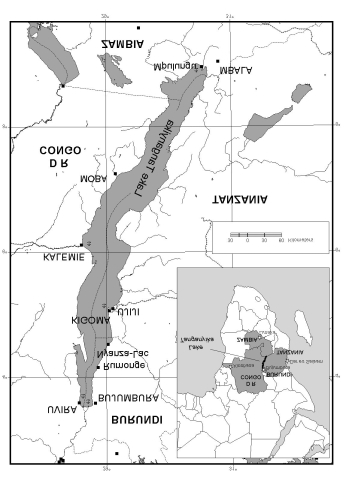
Map 1 Lake Tanganyika - National Boundaries, Main Towns and River Systems
The lake is vulnerable to pollution because of its natural characteristics, and there are
presently few efforts to conserve its biodiversity. The meeting concluded that the main
threats to the lake environment and biota were pollution from excess loads of
sediment and nutrients caused by erosion in the watershed, industrial and urban
pollution including boat discharges and intensive fishing with inappropriate methods.
These problems and their effects are increasing, and others such as oil exploration and
transportation on the lake, present potential future threats to the lake's ecosystem.
It was recommended therefore that prompt attention be given to the assessment and
control of pollution and protection of biodiversity. In doing so, the livelihoods of the
2
Pollution Control and Other Measures to Protect Biodiversity in Lake Tanganyika
The Transboundary Diagnostic Analysis
lakeside communities should be safeguarded, thus securing their future access to those
resources on which they depend.
The waters of Lake Tanganyika are shared by the four countries; clearly any actions
taken by one country can have impacts on these shared international resources. Any
approach to improving the understanding and subsequent management of the lake
must have an international and regional perspective.
Subsequently, steps were taken to attract the interest of international, funding agencies
in order to secure funding for a regional project to address the problems identified1.
1.3 The
Project
Funding was secured through the UNDP/ Global Environmental Facility (GEF) which
at the 1992 Rio environmental summit meeting, was endorsed as a mechanism for
financing activities which generate global environmental benefits. Originally
conceived as primarily a biodiversity project, the project relates to GEF interests in
both biodiversity and international waters, giving greater emphasis to management
objectives for sustainable development.
The project became effective in 1995 following the signing of the Project Document
by the four riparian countries, the funding agency UNDP/GEF and the executing
agency United Nations Office for Project Services (UNOPS).
The ultimate objective of the project as stated in the Project Document is:
"...to demonstrate an effective regional approach to control pollution and to prevent
the loss of the exceptional diversity of Lake Tanganyika's international waters. For
this purpose, the development objective which has to be met is the creation of the
capacity in the four participating countries to manage the lake on a regional basis as a
sound and sustainable environment."
More specifically, the project aimed to:
"...establish a regional long term management programme for pollution control,
conservation and maintenance of biodiversity in Lake Tanganyika."
To achieve these objectives the project included a number of research programmes
aimed at addressing specific information gaps that were constraining improved
management of the lake and catchment the Special Studies.
1 However, this was not the first regional proposal related to the lake resources. The LTR project
(Research for the Management of the Fisheries on Lake Tanganyika) which was focussed on the pelagic
fisheries, was already under development. This followed recommendations adopted at the 1st Session of
the Committee for Inland Fisheries of Africa (CIFA), Sub-Committee for Lake Tanganyika, convened
in 1988. The project became operational in 1992.
While initially concentrating on establishing a lake-wide fisheries research programme, the project was
also required to facilitate the development of a regional mechanism to coordinate the management and
exploitation of the pelagic fishery resources of the whole lake. The project has prepared a proposal that
is presently under review, "Regional Framework Planning for Lake Tanganyika Fisheries
Management", which includes proposals for policy, planning and management, fisheries statistics,
fisheries regulation and legislation, improved fishing practices and post harvest improvements.
3
Pollution Control and Other Measures to Protect Biodiversity in Lake Tanganyika
The Transboundary Diagnostic Analysis
The results of the special studies will feed into the Strategic Action Programme
(SAP), of which this document is a component.
1.3.1 The Special Studies
Divided into five focal areas, these studies will collectively provide a
multidisciplinary understanding of the complex scientific, technical and socio-
economic issues related to conservation and sustainable use of the lake.
The Special Studies include: Biodiversity, developing appropriate field methods for
assessment of impacts on biodiversity; Fishing Practices, identifying the impact of
fishing on biodiversity and propose potential remedial actions; Pollution, identifying
sources, evaluating consequences and finding preventative measures; Sedimentation,
monitoring the movement and impact of soil entering the Lake; and Socio-economics,
providing the human context within which the conclusions of the technical studies can
be discussed, developed and implemented.
The legal and institutional component is primarily concerned with the development of
an international agreement to support the ongoing development of the regional SAP.
Underpinning all these activities are training and environmental education
components, which aim to raise the capacity of regional institutions and communities
to carry this work beyond the life of the project.
In association with these special studies, are studies on agricultural practices, merits of
sites for underwater national parks, the relevance of the legal systems of land
ownership, lake conservation and developmental needs considering all the problems
associated with the huge distances and poor communications involved.
1.3.2 The Strategic Action Programme
Since the project document was prepared, the planning ideas incorporated in the first
immediate objective have been encapsulated in the concept of a Strategic Action
Programme SAP. In 1996 the GEF published their Operational Strategy which
describes the purpose of the SAP as follows:
"The SAP should establish clear priorities that are endorsed at the highest
levels of government and widely disseminated. Priority transboundary
concerns should be identified, as well as sectoral interventions (policy
changes, program development, regulatory reform, capacity-building
investments, and so on) needed to resolve the transboundary problems as well
as regional and national institutional mechanisms for implementing elements
of the SAP2."
Fundamental to this is the recognition that management plans have to be revised in
response to changing circumstances there can be no final plan. The SAP therefore
establishes an agreed planning and management process, and prioritises an initial
programme of interventions based on present knowledge.
2 Operational Strategy of the GEF; GEF 1996
4
Pollution Control and Other Measures to Protect Biodiversity in Lake Tanganyika
The Transboundary Diagnostic Analysis
The responsibility for formulating the SAP and implementing the steps leading to the
development of the document are very clear:
"Formulation of SAPs is the responsibilities of the collaborating governments
and national/regional stakeholders....It is through SAP formulation that
baseline and additional priority actions are identified."
The role of the project is to facilitate the process, not to carry it out on behalf of
collaborating governments.
The capacity to implement the programmes embodied in the SAP, and hence to make
use of additional funding sources to support the programmes, is demonstrated by their
capacity to develop the SAP.
1.3.3 The Transboundary Diagnostic Analysis
Following on from this, and as a response to the clear need for local and regional
consultation the GEF recommends that participating countries adopt a process that
includes a formal assessment of problems and priorities, described as a Transboundary
Diagnostic Analysis TDA.
"The centrepiece of the GEF strategy... is the concept of "strategic joint fact
finding" as a means of arriving at a consensus on what actions are needed to
address threats... collaborating states establish technical teams that work to
establish a common baseline of facts and analysis of the problem in the form
of a transboundary diagnostic analysis (TDA), which is then used to set
(national) priorities for actions to address threats to international waters in
the form of the SAP.3"
1.3.4 The
Convention
The project document also included the objective of "...a regional legal framework for
cooperative management of the lake environment". As a result of preliminary
consultation it was agreed that this legal framework would be formulated as a
Convention, in line with recognised legal international principles4.
The overall aim of developing the Convention is to establish a legal and institutional
framework to support the strategic action programme (SAP), specifically an
agreement between the four countries, for the management of Lake Tanganyika. The
Convention, based on international law, formalises national obligations, and allows
international arbitration in case of dispute.
As the SAP provides flexible management guidance it will change as management
priorities change however the Convention is unlikely to be regularly amended.
3 Study of GEF's Overall Performance; GEF 1998
4 Recommendations of the Legal and Institutional Workshop concerning the contents of the Draft
Agreement - February 1998.
5
Pollution Control and Other Measures to Protect Biodiversity in Lake Tanganyika
The Transboundary Diagnostic Analysis
1.4 Biodiversity and Sustainable Development
Although in the project document the problems of managing the lake resources are
phrased in terms of threats to biodiversity, in line with the lessons learned from other
projects, the SAP addresses biodiversity conservation through promoting sustainable
development5.
The conservation of natural resources within and around the lake will have a positive
effect on the sustainability of the fisheries, and the control of pollutants will have a
positive impact on human health. Although the SAP will continue to support the
appropriate development of protected areas (used in the sense of national parks and
reserves), the main conservation approach is controlled management rather than
exclusion6.
Essentially the SAP is looking for win-win situations, where biodiversity
considerations are taken into account in developing strategies for sustainable
development.
1.5 The Development of the Lake Tanganyika SAP and TDA
The main threats to Lake Tanganyika's biodiversity were identified by the riparian
representatives at the Project Inception Workshop in January 1996. The country
representatives also ranked the perceived threats in order of national importance and
the summation of these scores provided the initial prioritisation of threats for the
region.
Building on this matrix, the project prepared a consultation document for the
Preliminary Strategic Action Programme. The document was circulated and discussed
at a regional meeting in December 1997.
At the January 1998 Project Regional Steering Committee (RSC) the four countries
jointly committed themselves to formulating a regional Strategic Action Programme
for Lake Tanganyika. The Steering Committee defined a process of consultation
which would be led at the national level by the National Working Groups (NWG), and
at the regional level by the Technical Advisory Committee (TAC).
The process was based on a two-stage development, leading to a final project SAP.
The first stage was the preparation of a preliminary TDA and a draft SAP.
The implementation of the preliminary TDA introduced the SAP Planning group to
the analytical approach that would be followed and brought together national concerns
into a regional framework. The preliminary TDA also guided the special studies
towards answering specific priority management concerns through their research and
monitoring programmes.
5 Biodiversity Conservation Projects in Africa: Lessona Learned from the First Generation World
Bank Environment Department Dissemination Notes Number 62 July 1998.
6 "...free standing biodiversity operations - enclaves of conservation separated from the development
mainstream are unlikely to be financially sustainable" World Bank Environment Department
Dissemination Notes July 1998.
6
Pollution Control and Other Measures to Protect Biodiversity in Lake Tanganyika
The Transboundary Diagnostic Analysis
In a similar way, the preliminary TDA also fed into the development of the
Convention that was prepared in parallel with the SAP, ensuring that the Convention
would have the scope to support the management concerns of the SAP.
The final project iteration of the TDA was undertaken following the completion of the
special studies programmes and the preparation of reports directed at the specific
information requirements of the TDA.
Figure 1 Seven Steps in the Development of the SAP
Special Studies
National Consultation Workshops
Legal Convention
Preliminary TDA Workshop
SCM Endorses Preliminary TDA
Draft Convention
Draft SAP Workshop
Final Conclusions
SCM Endorses Draft SAP
Final TDA/SAP Workshop
SCM / Ministers Endorse Final SAP
However, the SAP process does not stop with the production of the first plan. The
SAP incorporates the formation of a Lake Management Body, responsible for
supervising regional interventions that stem from the SAP, and promoting national
interventions within the framework of the regional programme. The Lake
Management Body will be responsible for developing future iterations of the SAP in
response to improved information and changing threats and opportunities.
1.5.1 The Process of Consultation
National Consultation
Following the initial consultation process that led to and evolved from the inception
workshop, and the regional agreement on a process to develop the SAP, each country
then proceeded with their internal consultation process.
This was initiated with a planning meeting, at which the National Working Groups
identified the need to expand the national consultation process to as wide a range of
stakeholders as possible, including the private sector and NGOs.
7
Pollution Control and Other Measures to Protect Biodiversity in Lake Tanganyika
The Transboundary Diagnostic Analysis
Following this two workshops were held in each country: the National Sectoral
Problem Review and the National Environmental Priorities and Strategies Review7.
Participants were identified and background papers prepared in advance, to ensure a
common national understanding of the problems facing the management of the lake.
These national workshops served two main purposes:
· The national consultation ensured that national representatives in the regional
TDA and SAP process were in a position to reflect the concerns of their national
constituents, following their national review of the priority biodiversity and
management concerns and priorities for intervention.
· The four countries developed a common analytical framework, allowing their
conclusions to be brought together into a regional framework. The national
analytical framework effectively defined the framework for the TDA.
Regional Consultation
The TAC took on the role of supervising the development of the draft SAP, adapting
their composition for this exercise to reflect the new terms of reference.
Each country was represented in the SAP Planning Group by a team led by the
National Coordinator with four additional experts identified by the national working
groups on the advice of the workshop participants. The team members were selected
to provide a range of skills and knowledge of the lake and the lake management
problems.
This expanded SAP Planning Group met in Lusaka in November 1998, and with the
support of the project research team leaders, drew up the preliminary matrix that
provided guidance as to areas of concern that should be addressed by the special
studies.
The preliminary TDA was endorsed by the project Steering Committee in May 1999.
The next meeting of the SAP Planning Group was held in January 2000 in Arusha.
The output of this second meeting was the draft SAP "The First Strategic Action
Programme for the Sustainable Management of Lake Tanganyika".
This first draft focused on the structure of the document, and proposed an interim
Lake Management Body that would function until the introduction of the permanent
regional body proposed in the Convention.
The second TDA workshop was held in Arusha in March 2000. The meeting was
supported by the special studies facilitators who presented the conclusion of their
research programmes of relevance to the management needs of the lake. It was at this
workshop that the final matrix was drawn up indicating the priority actions for
inclusion in the SAP.
7 In the case of DR Congo, following the outbreak of fighting in August 1998, the two workshops were
combined into a single meeting held in Arusha Tanzania, allowing representatives from both Kinshasa
and the Lake area to participate.
8
Pollution Control and Other Measures to Protect Biodiversity in Lake Tanganyika
The Transboundary Diagnostic Analysis
This document records the conclusions of the TDA analysis and describes the process
that was used to develop the TDA framework. Further supporting documents are listed
at the end of the report.
Table 1 Technical Composition of the SAP Planning Group
BURUNDI
DR CONGO
TANZANIA
ZAMBIA
National
National
National
National coordinator
coordinator.
coordinator.
coordinator
pollution / institutions
Socioeconomics
Hybrobiology
Fisheries
Fisheries
and demography.
Biodiversity and Environmentalist.
Pollution
Socioeconomics
fisheries
Institutional
Fisheries expert.
Environment
Sediment
framework
Catchment basin / Institutional
Sediment)
Environment
sediment/ forestry framework
and land use.
9
Pollution Control and Other Measures to Protect Biodiversity in Lake Tanganyika
The Transboundary Diagnostic Analysis
2 The
Analysis
The purpose of the Preliminary TDA is to define immediate management objectives
within the overall management goal of conserving the biodiversity of Lake
Tanganyika, addressing global concerns and ensuring the sustainable use of these and
other resources for local communities into the foreseeable future.
The Transboundary Analysis brought together technical teams from the participating
countries to establish a common understanding of the threats and specific problems
that the riparian countries are facing in managing the lake resource. With this
information the teams together established priorities for possible interventions to
address specific management problems.
This initial prioritisation, reflecting the management concerns of the four countries,
sets the agenda for the remaining activities for the special studies being carried out by
the project with local partner institutions. The TDA identifies some of the
uncertainties, and effectively poses the question as to whether the identified problem
is having a major impact on biodiversity and hence requires immediate attention, or
may be a major problem in the future and hence requires monitoring. The special
studies should also comment on the value of additional benefits to sustainable
development that can be expected to accrue from counteracting the biodiversity
problem.
The Preliminary TDA also acts as a guide to the development of the draft Convention,
through indicating the expected scope of national and regional actions that will need
to be covered in the legal framework.
The conclusions of the analysis are the basis for the recommendations for priority
programmes of interventions that will be addressed in the draft Strategic Action
Programme. However, the SAP will take into account additional aspects relating to
economic and political needs and national responsibilities to regional and international
agreements.
From Threat to Management Intervention
The analysis starts off by reviewing the major threats, defining the specific problems
or sub-problems that together make up the threat and finally proposes a sequence of
management interventions to counteract each specific problem.
The value of this approach is that what appears to be an excessively ambitious and
daunting management objective such as the Control of Pollution, can be broken into a
series of manageable objectives addressing specific problems, many of which can be
done with available resources and initiated by local institutions.
2.1 Analytical Problem Matrix
The Preliminary TDA brings together the four national review exercises and then adds
the regional and transboundary perspective. The four countries adopted a formal
10
Pollution Control and Other Measures to Protect Biodiversity in Lake Tanganyika
The Transboundary Diagnostic Analysis
analytical matrix analysis that would form the basis of their workshops, and
subsequently the regional TDA8.
The matrix has three levels of analysis.
Figure 2 The Analytical Matrix
M ain Threats to
Transboundary
M ain Institutional
G eneral A ction
B iodiversity a nd
Im plications
C auses
A reas
S ustainab le U se
G eneral A ction A re a
P rogramm e of
S pecific P roblem s
S takehold ers
U ncertainties
A ctions
P rogramm e of
A vailability of
Tim e Fram e
K ey A gency
A ctions
R esources
2.1.1 Level 1 Main Threats
The first matrix starts by reiterating the underlying objective of the project; the
starting point is the list of the Main Threats to Biodiversity and Sustainable Use9.
The main threats are as follows:
· Unsustainable Fisheries;
· Increasing Pollution;
· Excessive Sedimentation; and
· Habitat Destruction
The second column, Transboundary Implications, highlights the rational for a
regional programme, addressing global biodiversity and international waters issues.
This column is effectively a justification for the need for international donor support
for global biodiversity conservation, as well as the need for regional cooperation in
addressing these threats.
The third column, Main Institutional Problems, describes the institutional constraints
that are faced by the management institutions in addressing those threats. At this level
the matrix is describing generic institutional problems that are common to many
institutional management structures throughout the region.
8 The adopted matrix framework is based closely on the analysis used in the "Black Sea Transboundary
Diagnostic Analysis", a key in the GEF programmes concerned with the development of international
waters SAPs.
9 These threats are effectively still the same as those identified during the inception workshop, and built
into the project design;
11
Pollution Control and Other Measures to Protect Biodiversity in Lake Tanganyika
The Transboundary Diagnostic Analysis
The final column, General Action Areas addresses the identified threats and provides
a focus for linked programmes.
Table 2 Analytical Problem Matrix Level 1
Main Threat to
Cross-Cutting
Cross-Cutting
General Action
Biodiversity and
Transboundary
Institutional
Areas
Sustainable Use
Implications
Problems
Unsustainable
Lack of Resources
Reduce Impact of
Fisheries
Global Loss of
Poor Enforcement of
Fishing
Increasing
Biodiversity
Existing Regulations
Control Pollution
Pollution
Loss of Shared
Lack of Appropriate
Control
Excessive
Fisheries Resource
Regulations for Lake
Sedimentation
Sedimentation
Decline in Water
Tanganyika
Habitat
Habitat
Quality
Lack of Institutional
Conservation
Destruction
Coordination
2.1.2 Level 2 Specific Problems
The Level 2 Matrix has four parts, one for each of the identified General Action
Areas: Reduce Impact of Fishing; Control Pollution; Control Sedimentation and
Habitat Conservation.
The starting point for the matrix is the column Specific Problem; a listing of all the
problems that together form the threat, which the general action area is addressing.
The second column lists the Stakeholders that that will need to be involved in
resolving management issues for each Specific Problem identified within each
General Action Areas.
Uncertainties highlights those areas where further information is required to improve
management or where the extent and nature of the problem is unknown. Effectively an
uncertainty indicates a need for further research, often in advance of undertaking
further actions.
The last column lists a set of Programme of Actions which address the Specific
Problem, breaking down the interventions into steps. These proposed actions can
include proposals for further research and/or monitoring activities and capacity
building.
2.1.3 Level 3 Proposed Interventions
The third level takes each specific problem and in the first column lists each
Programme of Action. The second column, Timing indicates whether an activity is
"On going", whether it could start "Now" assuming resources were made available,
or whether a Proposed Action has to be preceded by a "Previous" action.
12
Pollution Control and Other Measures to Protect Biodiversity in Lake Tanganyika
The Transboundary Diagnostic Analysis
Key Agency identifies the agency that would lead a particular Proposed Action, which
would always be one of the Stakeholders from Level 2. Clearly this will not be the
only agency involved, but it would be the one with the primary responsibility for
coordination and the one that would be responsible for drawing together a detailed
programme of activities for funding.
Finally the Availability of Human / Material Resources is an indication of whether
the Key Agency and it's partner agencies could tackle the Proposed Activity with
existing human and/or material resources. However this does not mean that these
resources are already being directed to the action, merely that, given a priority by the
agency, they could be made available now.
Lack of human resources includes lack of personnel and/or lack of training to be able
to carry out the proposed activity. Lack of material resources includes both lack of
physical equipment, ranging from laboratories to vehicles, and lack of funds to cover
subsistence or other field expenses.
Clearly where a "No" exists, the implementation of the action will require additional
institutional capacity building, either through reallocation of resources among the
agencies, or through external donor support. In addition, if the rate of progress that
can be achieved using only existing resources is considered unsatisfactory, then there
is still a case for capacity building.
2.2 Prioritisation of Interventions
Throughout the region, government and private resources are stretched by existing
demands for development. The resources that can be directed towards biodiversity
conservation and sustainable development at the Lake, will always be limited by
conflicting demands for national poverty alleviation, employment creation and food
security. As a result it is necessary to establishing priorities to direct limited resources
(financial, material or human), to address critical problems.
The concept can be presented quite simply: if you only have resources to address one
problem, then based on some formal logical appraisal, the first priority is given to
addressing that one rather than any others.
A problem is of second priority if, having resources to address a second problem, one
would also decide to address that one.
Establishing priorities in this way will help the four countries to allocate their own
resources. In the same way, donors are assured of the rational use of their financial
support, and hence encouraged to contribute to the programme.
2.2.1 Prioritisation
Criteria
The analysis used in the TDA exercise to establish priorities is based on three criteria.
The first two are related directly to the objective of the lake biodiversity conservation.
The third one is related to indirect benefits that can be associated with these actions.
13
Pollution Control and Other Measures to Protect Biodiversity in Lake Tanganyika
The Transboundary Diagnostic Analysis
The three criteria are:
1. The severity of the problem threatening biodiversity;
2. The feasibility of the solution;
3. Additional benefits in terms of sustainable development.
Identified problems and actions within each General Action Area were prioritised
separately. There are therefore effectively four sets of priorities, dealing with fisheries,
pollution, sediment control and habitat conservation.
Severity of Problem
The first stage is to assess what benefits could be expected from addressing a
particular problem, in terms of strengthening the conservation status of Lake
Tanganyika biodiversity. This judgement is based as far as possible on a scientific
diagnosis of the impact of the problem on the lake biodiversity.
However, many uncertainties inevitably remain and it is then necessary to bring in
the concept of the Precautionary Principle10. This can be summarised as follows:
If an existing problem is considered to be a significant threat to the
biodiversity of the lake, then steps should be taken to minimise this threat,
even if it can not be conclusively shown on the basis of scientific evidence,
that damage will be unacceptable.
The assessment of the severity of a problem will result from the combination of a
scientific diagnosis (where the information is available) and from more subjective and
intuitive assessments, based on an empirical knowledge of the lake, where national
consultation plays a crucial role.
Feasibility of the Solution
The second consideration in setting priorities is the feasibility of the solution; there is
little point in addressing management or research concerns to problems that have no
real management solutions11.
The assessment of the feasibility of the solution comes after the identification of
actions needed to address the problem. In general, it comes from the acquired field
experience of environment management in the region, particularly from the
experience of different sectoral participants represented in the NWGs (fisheries,
erosion control, harbour management, towns...).
10 "Noting also that where there is a threat of significant reduction or loss of biological diversity, lack of
full scientific certainty should not be used as a reason for postponing measures to avoid or minimize
such a threat" Convention on Biological Diversity, 5 June 1992.
11 Threats that are not susceptible to local management solutions such as global warming or volcanic
movements, although with potential impacts on biodiversity, are therefore excluded from the analysis.
14
Pollution Control and Other Measures to Protect Biodiversity in Lake Tanganyika
The Transboundary Diagnostic Analysis
Additional Benefits
Although the primary objective of the project is defined as biodiversity conservation,
this in itself is accepted as an integral component of sustainable development, within
the framework of the Rio 1992 resolutions.
The conservation of lake biodiversity has benefits at both global and local levels,
however the costs of biodiversity conservation, in terms of constraints on natural
resource exploitation, are met by local communities. Identified actions should
therefore strengthen sustainable development as a specific objective.
Here again, at the level of this assessment, additional stakeholders represented in
NWGs have a central role to play. This is particularly important to ensure that
proposed actions fit within the different national policies and strategies aimed at
promoting sustainable development.
2.2.2 Prioritisation of Actions
The assessment of problems according to these three criteria resulted in three levels of
classification:
High (A), Medium (B) or Low (C) Priority
To reach this classification, within each of the four general action areas, participants
reviewed all identified problem areas against the three criteria described above:
severity of problem; feasibility of solution and additional benefits. The participants
then decided to give a score of 1, 2 or 3 to each of these criteria, with a high score
allocated to addressing serious biodiversity problem, a high score to readily
implemented management interventions, and a high score to high additional benefits
to sustainable development.
The final prioritisation into High, Medium and Low priorities is based on a simple
addition of the three scores, giving a maximum score of nine. High Priority (A) was
given to those that scored eight or nine, Medium Priority (B) six or seven, while Low
Priority (C) was given to those that scored five or less.
Although there are many possible criticisms of this method of criteria aggregation, it
has at least the advantage of being a simple way of obtaining a consensus. The
approach was not, however, rigid, as participants were able to react where they felt the
conclusions were unsatisfactory. In the event, only minor readjustments were required,
demonstrating the acceptability of the method.
Specific Priorities within the High Priority Groups
The result of the first level of prioritisation was to identify high, medium and low
priorities within each of the four general action areas. The final stage of the
prioritisation was to review the specific priority of each of those problems in the High
(A) priority group.
The analysis was largely based on the appraisals carried out at the national level, again
discussed before being given a regional priority. In most cases the specific problems
15
Pollution Control and Other Measures to Protect Biodiversity in Lake Tanganyika
The Transboundary Diagnostic Analysis
being addressed were not equally applicable throughout the four countries, and
therefore not equally nationally significant, but identified as regionally significant.
As a result there will not be identical national interventions counteracting specific
problem, or indeed actions by all four countries.
16
Pollution Control and Other Measures to Protect Biodiversity in Lake Tanganyika
The Transboundary Diagnostic Analysis
3 Conclusions of the TDA - Priority Interventions
While the problems are analysed as if they were sectoral issues, the interconnection
between different sectors is recognised in the cross-sectoral proposed actions.
Fishing, along with farming, are the two main livelihood option for lakeside
communities. The only major area of industrialisation is Bujumbura.
Fishing provides an important source of protein and cash for households in the region.
It also provides a major export, Lake Tanganyika's sardines are highly valued and are
transported to areas distant from the lake, such as the copper belt in Zambia and to the
diamond areas in DR Congo. Annual commercial catch in `recent years' has varied
from 165,000 - 200,000 t, which translate into annual earnings of tens of millions of
US dollars. Widening the perspective to include additional artisanal gears and the
subsistence fishery it is clear that fishing makes a major contribution to the nutritional
and financial well being of local and national economies.
The links between fishing and farming activities are important: many fishermen's
households are also dependent on agriculture (a role largely taken by women).
Demand for terrestrial resources (flat land for sun-drying and fuel wood for smoking)
to support fishing also links the terrestrial and aquatic environment of the lake. The
relative importance of fishing and farming to individual households changes
according to factors such as the cycle of the moon, the season, short and long term
returns from fishing or farming.
In many case agriculture in the coastal zone is constrained by the narrow flat shoreline
and moves onto the steeper hillsides above the villages. The loss of forest cover and
the limited use of soil conservation strategies results in a loss of soil and decrease in
soil fertility. It is these steep coastal areas that provide the localised rocky habitats that
support many of the species of major significance to biodiversity. Erosion from
existing and newly opened farm land, while restricted to areas adjacent to coastal
villages, threatens to swamp these rocky habitats with increased sediment load.
Further away from the lake, the impact of farming practices in the medium sized
basins has resulted in increased sediment load in the rivers flowing into the lake. The
expanding deltas and coastal currents can result in the impact of the increased
sediment load being felt up to ten kilometres away from the river mouth.
Poor farming practices and associated deforestation and land clearance threatens the
long term viability of farming through loss of soils and soil fertility and threatens the
lake biodiversity and fishing resources through increased sediment load.
The potential interaction between pollution and fisheries is also clear. Urban domestic
waste and industrial pollution are of particular concern as the discharge is
concentrated into a few areas and can build up to levels that can affect human health
directly as well as through the fish and mollusc food chain.
While the focus of attention on biodiversity has been on the value of the littoral zone,
the ecological and economic links between the pelagic fisheries, the littoral fisheries
and coastal agriculture are clear. The concern is that if any one component of the
system collapses, additional and unsustainable pressure will be put on the remaining
17
Pollution Control and Other Measures to Protect Biodiversity in Lake Tanganyika
The Transboundary Diagnostic Analysis
resources. If over-fishing damages the pelagic fisheries, then communities will be
forced to transfer activities to the littoral fisheries and extend agriculture into ever
more marginal areas, with the associated risks of increased land degradation and
erosion, increasing the sediment load, in turn threatening biodiversity.
3.1 Priority
Concerns
The following tables summarises the conclusions of the workshop, listing the specific
problems, the score on each of the three criteria (severity, feasibility, additional
benefits), and the final classification in three priority categories A, B, C.
Table 3 Prioritisation of Problems - Reduction of Fishing Pressure
Specific Problem
S
F
B
T
C
Excessive fishing effort in the littoral zone
3
2
3
8
A
Excessive fishing effort in the pelagic zone
3
2
3
7
A
Excessive or uncontrolled extraction of ornamental fish
3
2
3
8
A
Use of beach seines
3
1
3
7
B
Use of inappropriate mesh sizes
3
1
3
7
B
Lack of economic alternatives for fishermen
3
1
3
7
B
Insecurity and piracy
2
1
3
6
B
Fishing in sensitive areas
3
1
3
7
B
Destructive methods (others than seines or mesh)
1
1
3
5
C
High demand for fish
2
1
1
4
C
Insufficient data in the southern part of lake in Congo
1
1
2
4
C
S: severity, F: feasibility, B: additional benefits, T: total, C: classification
Table 4 Prioritisation of Problems - Control of Pollution
Specific Problem
S
F
B
T
C
Urban and Industrial pollution
3
2
3
8
A
Harbour pollution
3
2
3
8
A
Pollution from future mining activities or oil exploitation
3
2
3
8
A
Risks of major marine accidents
3
2
3
8
A
Ri sk
of wat er hyacin th expansion
2
2
3
7
B
Chron ic pollutio n fro m boats
2
2
2
6
B
Introduction of exotic fish species
2
2
2
6
B
Pollutio n fro m farmin g
in t
he catchment
2
2
2
6
B
U se
of pesticid es
to contr ol vecto rs
of hum
an diseases
1
3
1
5
C
Pollution by present mining activities
1
1
2
4
C
Atmospher ic fallo ut fro m bu sh fires
1
1
2
4
C
S: severity, F: feasibility, B: additional benefits, T: total, C: classification
18
Pollution Control and Other Measures to Protect Biodiversity in Lake Tanganyika
The Transboundary Diagnostic Analysis
Table 5 Prioritisation of Problems - Control of Sedimentation
Specific Problem
S
F
B
T
C
Erosio n fro m inappropria te farmin g practices
3
2
3
8
A
Deforestation
3
2
3
8
A
Human settlements badly designed or uncontrolled
3
1
3
7
B
Sand extraction and other activities in river banks
2+ 2
2
6+ B
Overgrazin g
in plains
2
2
2
6
B
B
ad installatio n
or manageme nt
of min es an d quarries
2
2
2
6
B
Unsatisfacto ry designin g
or constructio n
of roads
2
2
2
6
B
Erosio n fro m uncontroll
ed bu sh fires
2
2
2
6
C
Potenti al min es an d quarries
2
1
2
5
C
S: severity, F: feasibility, B: additional benefits, T: total, C: classification
Table 6 Prioritisation of Problems - Habitat Conservation
Specific Problem
S
F
B
T
C
Threats to Resources in National Parks
3
1+ 3
8+ A
Degradation of Key Habitats
3
3
2+ 7+ A
S: severity, F: feasibility, B: additional benefits, T: total, C: classification
3.2 Reduction of Fishing Pressure
There are two distinct but overlapping fisheries in the lake, the near-shore fisheries
and the offshore fisheries the littoral zone and the pelagic zone. The overlap is both
ecological and economic, and both fisheries are linked to shore communities and
interrelate with their other economic activities.
Within any lake shore community, there are likely to be groups who concentrate their
fishing activities in the offshore zone, at the same time as other groups focus on the
littoral zone for both subsistence and commercial activities. Meanwhile, other family
members and the fisherman themselves are usually also engaged in farming. The
balance between these activities depends on the season, the fluctuation in fish stocks,
labour availability and changes in markets.
19
Pollution Control and Other Measures to Protect Biodiversity in Lake Tanganyika
The Transboundary Diagnostic Analysis
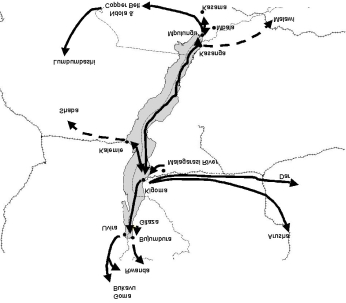
Map 2 Main Fish Trade Routes
The focus of the Lake Tanganyika Biodiversity Project (fishing practices and
biodiversity special studies) has been predominantly on the littoral zone, the fishing
grounds with the greatest biodiversity. The FAO/FINNIDA supported lake
Tanganyika Research (LTR) Project, has been focused on the pelagic zone and the
commercial fisheries. These two aspects must be related if an overall sustainable
fisheries management programme is to be developed. If the pelagic fisheries collapse,
then this will place additional pressure on the littoral fisheries.
Over 50 different fishing gears were recorded during surveys of the lake fisheries. Of
these, twelve12 are considered to be of key significance, and there is some overlap
between the pelagic gear and the littoral gear. The problem is not one of fishing gear,
but one of fishing pressure.
Table 7 Key Fishing Gear Characteristics
Gear
Key Characteristics
Industrial purse seine
Used in the industrial fishery offshore Zambian DoF figures
indicate that this fishery takes 4-5,000 tons/year, roughly 3%
of the estimated 167,000 tons/year of the whole lake fishery
12 Industrial purse seine; beach seine; light assisted beach seine; ring net; bottom set gill net; encircling
gill net; lift nets; simple lines; jigged lines; bottom set long lines; pole and line; and, non return traps.
20
Pollution Control and Other Measures to Protect Biodiversity in Lake Tanganyika
The Transboundary Diagnostic Analysis
Light assisted beach
Targets sardines, attracted to kerosene pressure lights at
seine
night. Each beach seine can employ as many as 20 people,
including light boat crews and net pullers.
Beach seine
Catches & targets littoral fishes. Usually has a larger mesh in
the wings than in the bunt or bag.
Ring net
"Chiromila" seine as used in Zambia in Nsumbu region.
Used offshore at night with lights.
Bottom set gill net
Set net, various mesh sizes and depths. Ubiquitous. Cheap.
All countries have some mesh size restrictions.
Encircling gill net
M'timbo or splashing water or tam tam (not a ring net). Like
a gill net but deeper and used in a circle with draw lines
from a boat with a frightening device.
Lift nets
One, two or three boat. Each boat employs a crew of 6 and
LTR estimated a minimum of 3,200 boats. A large
percentage of the total lake catch is hauled by this gear.
Jigged lines
Mainly for Lates stappersii, 50 or more un-baited hooks.
Used during the day in deep waters. High economic
importance, found all round the lake.
Simple lines
Includes vertical hand lines. Used everywhere round the
lake. Baited hooks, targeting fish on or near the bottom
Pole and line
Important in terms of contribution to protein in the
household diet. This practice is carried out by children in
every village round the lake, targeting juvenile littoral
species.
Non-return traps
Used in swamps and reed beds. Very common in Rusizi.
Made from bamboo, wooden slats and wire mesh.
Bottom set long lines
Lines with 40400 baited hooks, which are laid along the
bottom from a boat. Used everywhere where there is a snag
free bottom.
3.2.1 Excessive Fishing Effort in the Littoral Zone
High Severity of Problem: a major increase in the number of fishermen has been
observed throughout large parts of the lake shore. Many people are now exploiting the
coastal waters, which are richest in biodiversity. The higher the population density,
the greater the problem.
Medium Feasibility of Solutions: the problem is not easy to solve, traditional
approaches to enforcement have had little success, often constrained by very limited
resources. However, there are possibilities to take a broader approach involving
positive promotion of community solutions and promotion of alternatives.
High Additional Benefits: with few alternative livelihood options available for the
majority of the riparian communities, the maintenance of sustainable fisheries is, at
present, essential for the livelihoods of coastal populations.
21
Pollution Control and Other Measures to Protect Biodiversity in Lake Tanganyika
The Transboundary Diagnostic Analysis
The littoral fisheries are complex. They are multi-species, multi-gear, and involve
both artisanal and subsistence fishermen whose pattern of effort is primarily dictated
by the moon but with the rains also affecting fishing activity. Both artisanal (i.e. sell
catch) and subsistence (i.e. eat catch and sell any occasional surplus) fishermen
operate in the littoral zone.
Of the twelve significant practices the majority are deployed in the inshore area. These
are light assisted and day beach seines, gill nets (bottom set and encircling), traps, and
lines (simple, bottom set, pole).
Many of the inshore fishing grounds (0-50m depth) adjacent to areas of high
population settlement are already under heavy pressure from a range of gears, and
there are indications of reduced catch and changing catch composition and in some
areas collapse.
Previous management interventions to try to control these fisheries have depended on
state legislation limiting fishing effort through licensing or banning a particular gear.
This approach has not been successful, partly as a result of lack of enforcement
capacity13 and partly as a result of the tendency by fishermen to switch gear without
reducing effort.
An alternative approach, increasingly adopted in the management of fisheries world-
wide is to look toward partnership arrangements amongst groups of people with a
stake in the fishery (e.g. fisher communities, NGO's and governments). This is often
called co-management, a broad term used to describe a range of partnerships from
those which are primarily community-led through to those in which governments
retain more responsibility in managing a fishery.
This approach does require a major change in perspective towards increasing
participation of local stakeholders and a changing role for the institutions formally
charged with fisheries management (usually focussing exclusively on enforcement).
One starting point might be the riparian communities in Zambia which have
established village conservation and development committees, who have been
working on training and environmental education component of the LTBP to improve
their capacity to plan and manage projects.
3.2.2 Excessive Fishing Effort in the Pelagic Zone
High Severity of Problem: although the pelagic zone is less rich in biodiversity than
the littoral zone, any collapse in the pelagic fisheries will have a dramatic knock-on
effect on the littoral zone, both through increased fishing pressure and indirectly
through intensified farming practices.
Medium Feasibility of Solutions: the improved management of the pelagic fisheries
is essential for the economic well-being of the region. The LTR programme is in the
13 The ban on beach seines is in Tanzania only (in Zambia they are banned everywhere except Lake
Tanganyika, and they are not banned in Burundi and DRC). Tam Tam (encircling net with frightening
device) is banned everywhere, but only in Zambia is it enforced (through local chiefs).
22
Pollution Control and Other Measures to Protect Biodiversity in Lake Tanganyika
The Transboundary Diagnostic Analysis
process of drawing up management plans through a process of negotiation, which has
included coastal communities.
High Additional Benefits: with few alternative livelihood options available for the
majority of the riparian communities, the maintenance of the pelagic fisheries is
essential for the livelihoods of coastal populations, and for national economies.
As noted earlier, the study of fishing in the pelagic zone fell under the remit of the
Lake Tanganyika Research project (LTR) that has initiated the development of a
fisheries management plan covering the pelagic commercial species. The area of
overlap between LTR's remit and LTBP's focus on biodiversity is however important
for the SAP to consider.
In essence, the pelagic fishery supports large numbers of fishermen throughout the
lake. The most `visible' practices are the purse seine fleet, the light assisted beach
seines and the lift net fleet which fall within LTR's plan. However, the pelagic species
fishery is also an important livelihood option for many smaller scale artisanal
fishermen who paddle some distance from the shore and use jigged lines to target
Luciolates stappersi.
The effect of a failed pelagic fishery would be increasing pressure on the coastal zone
through greater reliance on inshore fish resources and/or land for agriculture. This has
serious implications for the sustainable management of the lake's ecosystem the
remit of the SAP.
Focussing the SAP's attention on the pelagic stocks and the livelihoods they support
also recognises that, to many riparian communities, these species are the most
valuable part of Lake Tanganyika's biodiversity. Sustainable use of the lates and
clupeid stocks is a key contribution to the maintenance of the `higher profile' part of
the lake's biodiversity the species of the littoral zone. Therefore, both local and
regional aims can be achieved through implementing a sustainable management plan
for the pelagic fishery.
It is important to note that fishing pressure is not the only factor influencing the status
of the commercial stocks. Environmental changes such as temperature are thought to
contribute to the relative abundance of clupeids and perch species. These
environmental changes and their effect on the fish stocks are not fully understood.
Thus management of the fishery has to be undertaken within some uncertainty and be
guided by the precautionary principle.
The SAP should assess the status of the Fisheries Management Plan developed under
LTR, reviewing it in light of the broader biodiversity objectives of the SAP. It is
important for the sustainable management of the lake as a whole that any plan to
manage the fisheries is brought into the SAP process. This ensures major resource
plans will be considered alongside other regional priorities and provides a mechanism
to proactively promote adoption of sustainable fisheries management in the lake.
3.2.3 Excessive or Uncontrolled Extraction of Ornamental Fish
High Severity of Problem: the problem is believed to be serious for biodiversity
because the targeted species are endemic, rare, localised and hence vulnerable.
23
Pollution Control and Other Measures to Protect Biodiversity in Lake Tanganyika
The Transboundary Diagnostic Analysis
Medium Feasibility of Solutions: the problem is not very easy to solve, but exporters
are specialised, few in number, identifiable; the problem can also be addressed
through the end market.
High Additional Benefits: a reasonable management of this exportable resource
could provide sustainable economic benefits.
These proposals are considered to have a high priority, as although they clearly affect
a much smaller segment of the population in the region, they focus on vulnerable
species, and there are already reports from traders of the disappearance of species
from specific sites. The potential for improved management is quite high, and
licensing for export could pay for the enforcement of legislation. Meanwhile the
export of these species continues to draw attention to the lake biodiversity value, and
can help direct donor attention to the lake management problems.
There is the potential for promoting community involvement in the industry and hence
promoting livelihood alternatives. Environmental education and possibly the
management of a few aquaria have been proposed as means of raising awareness.
3.2.4 Medium Priority Fishing Problems
There are five problems that have been given a medium priority rating. The impact on
biodiversity is generally high and if they could be effectively managed the potential
socials and economic benefits would also be high, but the potential management
interventions are limited.
The specific issue of the use of beach seines and inappropriate mesh size highlights
the concern of fisheries departments with the control of catch through targeting the
use of gear. However, while the use of these gears clearly is a major contributory
aspect to the problem of over-fishing in the littoral zone, it is not the key problem,
which is too many people fishing and with little alternative options in terms of
acceptable livelihoods.
This leads into the problem described generally as lack of economic alternatives for
fishermen. Much of the lakeshore is remote with few options in terms of agricultural
production or fisheries, while in the more densely populated areas there may be more
options available related to urban markets, the number of people capable of taking up
these options is limited. However, unless the issues of livelihoods and poverty are
addressed, through the promotion of a broad range of socio-economic interventions,
there can be no long term solution to the underlying problem of over dependence on a
fisheries resource.
While insecurity and piracy clearly affect many fishing communities, the impact on
biodiversity is localised. Fishing pressure is generally moved from one part of the
pelagic zone to another, albeit one closer to the shore. In some cases where problems
are really serious it can result in a switch from the pelagic zone to the littoral zone and
increase damaging pressure on biodiversity. The social and economic pressures are
also high, with fishermen loosing their craft and in some case their lives. However,
given the continuing political disturbances in the region, there is little that can be done
in the immediate future, apart from an overall political settlement.
24
Pollution Control and Other Measures to Protect Biodiversity in Lake Tanganyika
The Transboundary Diagnostic Analysis
The final issue fishing in sensitive areas is dealt with later in this chapter, under
the topic Habitat Conservation. This issue impacts on both the littoral and pelagic
fisheries, and has been largely overlooked in the LTR programme, however it does
include the protection of critical spawning and nursery grounds.
3.2.5 Low Priority Fishing Problems
These are generally problems which are considered to have low impact on biodiversity
or thought to be very limited in extent (destructive fishing methods such as dynamite
and poison and lack of data in the southern part of the lake...) and are at the same
time hard to solve (clandestine methods, insecurity, commercial demand). The high
market demand, which results in the high fishing pressure (addressed as a specific
problem above), is considered as a more important problem, but is particularly
difficult to solve without harmful effects on the socio-economics of the area (decline
of purchasing power) or environmental area (increasing grazing pressure).
3.3 Pollution
Control
The potential impact of pollution on the lake is a major concern, and was given due
weight in the full title of the LTBP Pollution control and other measures to protect
biodiversity in Lake Tanganyika.
Pollution is the result of human activities within the catchment, and is predominantly
linked to settlements, ranging from villages to towns to capital cities. These
settlements are scattered throughout the catchment and are centres for a variety of
potentially polluting industries and activities. Possible sources of damaging pollution
include: domestic waste; farming with fertilisers and pesticides; ports, harbors and
marine traffic; industrial factories and small-scale registered and unregistered
industries; petroleum products depots and power stations; commercial fishing
industries and slaughterhouses; mines and quarries.
25
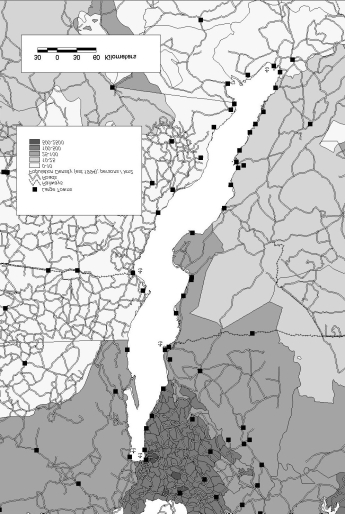
Pollution Control and Other Measures to Protect Biodiversity in Lake Tanganyika
The Transboundary Diagnostic Analysis
Map 3 Main Urban Settlements and Population Density
3.3.1 Urban and Industrial Pollution
High Severity of Problem: the problem is considered as serious in all urban centres
around the lake. The major urban centre of Bujumbura has a growing industrialised
base, and there are both registered and informal industries associated with all
settlements round the lake. The fact that the lake is effectively a closed system means
26
Pollution Control and Other Measures to Protect Biodiversity in Lake Tanganyika
The Transboundary Diagnostic Analysis
that the emission of non biodegradable pollutants will result in an accumulation
process which could threaten the lake.
Medium Feasibility of Solutions: the problem is technically easy to solve and
localised, but requires the commitment of local government and the communities
involved, as well as financing. However, interventions will also receive political
support as a result of their social and health benefits.
High Additional Benefits: controlling the problem would allow for the preservation
of water quality for domestic and industrial use, while also protecting the fishing
industry. Particular benefits will go to the public health sector, while the
recommended recycling of industrial waste provides also opportunity for economic
savings.
Urban and industrial pollution is closely linked. Urban centres attract industries and
form major market and transport hubs, which in turn attract more settlement. Urban
population growth in all the riparian countries greatly exceeds rural population
growth.
The largest city on the lake is Bujumbura with an urban and peri-urban population of
around 600,000. With the other coastal towns in Burundi, and with Uvira in DR
Congo, with a population of around 300,000, the northern part of the lake is the major
concentration of urban settlement on the lakeshore. In Tanzania Kigoma, with a
population of 135,000, is the major settlement and port facility, and to the south of the
lake, Mpulungu in Zambia with a population of 70,000 is also a major port.
Bujumbura has two major industries that discharge significant quantities of waste
water that passes untreated into the lake, brewing and textiles. There are in addition
many other potentially polluting industries. These include the production of batteries,
paints, soap, pharmaceuticals, slaughterhouse, oil depots and garages. In Uvira, the
main concerns are petroleum products, cotton processing and sugar production.
In addition increasing volume of domestic waste and effluents linked to growing
urban settlements is an issue in all countries round the lake. Even where the
settlements were originally planned to incorporate sewage and solid waste
management, their growth has outstripped the planned capacity of waste disposal
systems.
In Kigoma bay, where water circulation is restricted, there are already signs of
eutrophication. The water intake for the town is located very close to the discharge
points for untreated sewage from a number of institutions and the waste entering the
lake from the TANESCO power station.
While the problem is technically easy to solve and fairly localised, it requires the
commitment of local government and the communities involved, as well as major
financial investments. The benefits to public health are immediate and direct, with
improved water quality benefiting many direct users. The long-term benefits to
fisheries and biodiversity relate to a reduction in excess nutrient load, and the
reduction in harmful leachates from poorly sited or managed solid waste disposal.
27
Pollution Control and Other Measures to Protect Biodiversity in Lake Tanganyika
The Transboundary Diagnostic Analysis
3.3.2 Harbour
Pollution
High Severity of Problem: harbours are identified as an important source of
pollution, sometimes deliberate as waste is dumped into the lake (Mpulungu);
pollution is however estimated to be less than that of factories and towns; precautions
have already been taken (Bujumbura) or are envisaged (Mpulungu).
Medium Feasibility of Solutions: actions are identified and will be facilitated by the
concentration of those sources of pollution; some immediate actions are easy to
undertake, although total eradication of the problem will be difficult as boat and
harbour operators will not be willing to bear all additional costs.
High Additional Benefits: controlling the problem would allow for the preservation
of water quality for its use (domestic or industrial) and for fishing.
Harbours are a significant source of pollution, both through accidental contamination
from spillage during transfer of cargo, through waste dumped from boats, and in some
cases, waste dumped from shoreline factories.
Harbour management systems are designed to avoid accidental pollution, but the
majority of harbour facilities are designed for low volumes of marine traffic and
become over-stretched by high traffic volumes. While dumping waste from boats may
be acceptable at low levels, with increasing traffic pollution problems will occur.
The impact of political instability in the region has been to reduce the level of some
marine traffic such as the transport of oil and agrochemicals, while increasing others
such as bulk food transport. With increasing stability the volume of potentially
hazardous goods and the potential for spillage in harbours will increase.
The benefits of addressing harbour pollution are again immediate, with direct public
health impacts as well as more general benefits to fisheries and biodiversity.
3.3.3 Pollution from Future Mining Activities or Oil Exploitation
High Severity of Problem: very serious damage could result from those activities if
no measure is taken (pollution from the mercury used by some gold washers14,
pollution from other heavy metal contained in ores, eutrophication from phosphates,
pollution from hydrocarbons).
Medium Feasibility of Solutions: this potential problem is not easy to address, but
preventive measures are identified (particularly by EIAs).
High Additional Benefits: controlling the problem would allow for the preservation
of water quality for its direct use (domestic or industrial) and for fishing; controlling
the usage of mercury by gold washers is a crucial issue in terms of public health.
At present there is relatively little mineral exploitation in the catchment. However, the
mineral potential of the basin has not been fully explored, and there are indications
that there may be economically viable oil fields as well as gold and other minerals.
14 While mercury is now used for both small scale and industrial gold extraction, there are techniques
that do not rely on these processes, these could be reviewed and promoted where relevant.
28
Pollution Control and Other Measures to Protect Biodiversity in Lake Tanganyika
The Transboundary Diagnostic Analysis
"Smallholder" gold mining is carried out in the upper catchment of the Malagarasi in
Tanzania, and involves the use of mercury in processing, and there are companies that
have looked into commercial operations in the same area.
There is also already a signed agreement for the exploitation of a nickel resource in
the Burundi part of the Malagarasi basin. The processing factory will constitute a
potential source of pollution for the lake.
The level of control on industrial mineral exploitation varies from country to country,
although all have some legislation that could be used to support sound industrial
development and to a lesser degree smallholder mining operations. In practice there is
little control of smallholder systems and little experience of environmentally sound
management of major industrial operations.
These limitations are recognised but if appropriate actions are taken now, there is the
potential to implement preventive measures and avoid future problems associated with
any significant expansion of mining or oil exploitation.
3.3.4 Risks of Major Marine Accidents
High Severity of Problem: the problem is considered as serious because of the
potential danger of an accident causing oil slicks or spillage of dangerous products
(pesticides or others). As the lake has numerous endemic species some limited to very
confined habitats, there is a big risk that accidental pollution may cause irreversible
extinction, even if the quality of water can restore itself. Although no major accident
have yet occurred, the risk is ever present and increases with trade and development.
Medium Feasibility of Solutions: the risk cannot be eliminated, but progress is
possible towards reducing of risks and planning better intervention in case of disaster.
High Additional Benefits: controlling the problem would allow for the preservation
of water quality for its direct use (domestic or industrial) and for fishing; in addition,
prevention of accidents favours directly transport activities and, indirectly, dependent
economic sectors.
So far there have been no major environmentally damaging marine accidents recorded
on the lake. However there are hazardous cargoes transported regularly across the lake
with little control of storage or handling. The volume of traffic is variable and at
present depressed as a result of the continued political disturbances. However, oil
continues to be one of the main potentially hazardous cargoes and is transported in
towed barges.
As the riparian countries continue to develop their industrial potential, the volume of
traffic will increase as will the range of cargoes. Again there is existing legislation in
all countries that deals both with design of vessels and cargo handling, but this needs
to be reviewed in the light of increasing traffic and range of hazardous cargoes.
3.3.5 Medium Priority Pollution Problems
These are problems believed to be less important than the previous ones: two non-
point sources of pollution (Chronic pollution from boats, Farming pollution in the
29
Pollution Control and Other Measures to Protect Biodiversity in Lake Tanganyika
The Transboundary Diagnostic Analysis
catchment) and two problems of introduction of biological pollution (risk of
expansion of water hyacinth, introduction of exotic fish).
Pollution from boats remains limited and is going to be addressed in Burundi, but
effective actions can however be envisaged at regional level. Farming pollution is
modest and partially resorbed (pesticides in Rusizi). However it could be increased by
changes in agricultural policy and import policy (agricultural development policies),
but at the same time technical options exist allowing them to be controlled (options
for integrated and organic agriculture).
Damage from biological pollution could turn out to be important, requires monitoring,
but does not seem to constitute a direct threat. Problems are believed to be slight or
easily controlled depending on whether the concerned species are already in the lake
or not. Their impact will largely depend on additional changes in the lake ecology, the
risk of expansion of water hyacinth is related to eutrophication trends and thus mainly
to town pollution, considered above.
3.3.6 Low Priority Pollution Problems
These are minor problems (relatively harmless) with regard to the lake biodiversity
and also largely uncontrollable (fallout of bush fires from very wide spaces; pollution
from scattered and informal mining activities).
3.4 Control of Sedimentation
The impact of sedimentation on lake biodiversity has two components, the first relates
to the physical changes to habitats through the deposition of a sediment blanket over
other substrata, the second impact relates to the nutrient load associated with
sediments.
It is clear that there have been major changes in sediment movement from the
catchment to the lake over the last 50 years or so, with an increase in dissolved and
suspended sediment load changing conditions in the littoral zone. However, so far the
indications are that the major impacts are from siltation rather than nutrient load.
These changes in sediment load are directly related to changing land use patterns
within the catchment. The expansion of agricultural land is both the cause of and
follows deforestation. These two aspects can be considered separately as they often
fall under different institutional mandates, but are generally linked.
The reduction of sediment load will only occur as a result of improved land
management practices, however this is promoting a win-win situation as the reduction
in sediment load will be reflected by the maintenance of soil structure and soil fertility
in the agricultural and forestry production systems.
While both deforestation and inappropriate farming practices are significant local
problems in the coastal zone, erosion in the hinterland is most critical in the medium
size catchments where wetlands and deltas are unable to absorb or mitigate major
increases in sediment load. The impact of sediment is not limited to the river outflow
or the delta. Littoral sites within 10 km of the point of discharge of a catchment of the
medium size range (50-4000 km²) are threatened by any changes in erosion rates
30
Pollution Control and Other Measures to Protect Biodiversity in Lake Tanganyika
The Transboundary Diagnostic Analysis
within that catchment. Larger catchments (>4000 km²) are unlikely to be as affected
due to their history of input of suspended matter and the adaptation within adjacent
habitats to this situation.
Map 4 Erosion Hazard and Sediment Source Areas
3.4.1 Erosion from Inappropriate Farming Practices
High Severity of Problem: the problem is believed to be serious because the
cumulative impact of poor agricultural practices forms the major erosion source,
including those which release sediments into the fragile lake ecosystems.
Medium Feasibility of Solutions: although the problems are understood and there
are well-known technical solutions, there is little evidence of a major uptake of
improved farming methods. However as the focus of activities is concentrated in key
areas affecting the lake zone, efforts can be concentrated on solving local problems
and adapting local solutions with communities.
High Additional Benefits: social and economic benefits from sustainable agricultural
development, reduced loss of fertility and associated reduced need for fertilisers.
The goal of sustainable farming is a major objective in all of the riparian countries.
Interventions in support of this goal include the promotion of physical conservation
31
Pollution Control and Other Measures to Protect Biodiversity in Lake Tanganyika
The Transboundary Diagnostic Analysis
structures and improved methods of maintaining soil fertility, in addition there is the
potential for promoting alternative crops or adding value to production and hence
intensifying the value of production, limiting the need for farming expansion.
Around much of the lakeshore flat land suitable for farming is limited, often to no
more than a strip a few hundred metres wide at the base of the steep slopes of the rift
valley escarpment. The principal crop is cassava, which is grown for subsistence,
although a surplus may be sold. The primary cash crop, particularly in the north, is oil
palm, although there is also some rice grown in river valleys. Other crops include
maize, beans, and bananas. Where there is flat fertile land (e.g., in the Ruzizi
floodplain, or at the mouth of the Lufubu) agriculture is much more diverse.
However, many lakeshore villages do not meet their non-fish food requirements, and
depend on trade with inland villages. Subsistence farming is typically the mark of the
poorest households. Most households depend on a diverse range of activities and
income sources.15.
Where fishing has declined the importance of agriculture has increased. This, coupled
with population growth, has resulted in land shortages in the immediate lakeshore
area, with farmers clearing steep slopes to farm. In some areas fields are unusable
after only two or three harvests, and new, even steeper slopes are cleared. In villages
bordering National Parks, the land issue generates tension between villagers and park
authorities. In many areas agriculture is still founded on extensive shifting cultivation.
As populations grow and agriculture expands the natural miombo woodland is
cleared, which results in increased erosion.
Farming is primarily undertaken by women, although patterns vary, and is more
important to poorer families. A lack of hill farming traditions and a perception that
farming is still not as important as fishing, particularly to the wealthier or more
influential members of many communities has meant that there have been few efforts
to improve it. Poor access to markets also limits people's attempts to increase or
diversify production.
Nevertheless, in some areas the arrival of new practices and technologies such as the
use of animal manure or ox-drawn ploughs has had some impact. Tree planting
programmes are also a common response, providing additional benefits including
sustainable wood supply (mainly for firewood and building materials), shade, fruit
production and the use of leguminous tree species that can act as an alternative to
fertilisers (which would ultimately add to the nutrient burden of the lake).
Tree planting programs could focus on shade and fruit trees in areas around houses
with native trees planted on the more severe slopes16.
15 Diversification occurs for many reasons including reducing risks/improving security, income
instability due to seasonality, and the insufficiency of any one activity to support life of generate
sufficient income, e.g., for school fees.
16 The cycle of deforestation, land clearance and agricultural expansion followed by population growth
often continues to the point of total loss of natural tree cover, at which point farmers will start on-farm
planting. This cycle can be improved through the timely promotion of appropriate targeted .tree
planting
32
Pollution Control and Other Measures to Protect Biodiversity in Lake Tanganyika
The Transboundary Diagnostic Analysis
In Kigoma Region the TACARE Project has promoted better hillside practices,
agroforestry, and vegetable growing.
3.4.2 Deforestation
High Severity of Problem: deforestation, including diffuse deforestation, largely
associated with agricultural expansion, is a primary cause of accelerated erosion. The
problem is considered to be particularly serious in forest reserves gazetted as
"protection forests", on the basis of their catchment protection value.
Medium Feasibility of Solutions: the problem is hard to solve, but multiple
responses are known, and are locally implemented. A favourable social climate exists
in at least in one part of the region and despite the scale of the problem, it is possible
to focus efforts on the most critical areas.
High Additional Benefits: a control of deforestation and actions in favour of
agroforestry would lead to obvious benefits in terms of production of wood and other
products, land conservation, water control and conservation of forest biodiversity
(including regional endemic species).
As a result of clearing woodland for agriculture and demands for fuelwood for
domestic use, smoking fish, processing palm oil and producing traditional beer, there
are fuelwood shortages in many lakeshore villages.
Trade in fuelwood and charcoal occurs both within lakeshore villages and between
lakeshore and inland villages, and in some cases is a cross-lake trade carried from
Tanzania to Zambia and then through Zambia down to the copper belt and urban
centres.
In the wider catchment area in Tanzania there is further pressure on woodland
resources for curing tobacco, as well as for charcoal production around urban areas,
and timber extraction where suitable species exist.
The immediate response by many forestry authorities is to try to enforce control in
gazetted areas, however the management of gazetted forests has broken down as a
result of decreasing central government support and often in the face of political
pressure to release land for settlement. The response adopted in parts of Tanzania is to
pass the ownership of forests to communities, along with rights and responsibilities.
While clearly there remains a need for managed forest areas, particularly those
gazetted to protect critical catchments, the emphasis has to be on reducing pressure
through the provision of alternatives and managed access, rather than exclusion.
Many of these interventions will be related and/or complimentary to farming and
alternative livelihood interventions and should be geared towards improving the diets
and/or income levels of the farming households involved. Farmers are more likely to
invest in an activity because it will improve their own livelihoods than because it will
reduce erosion for the benefit of fish productivity or the conservation of aquatic
biodiversity.
33
Pollution Control and Other Measures to Protect Biodiversity in Lake Tanganyika
The Transboundary Diagnostic Analysis
3.4.3 Medium Priority Sedimentation Problems
These include: badly designed or uncontrolled human settlements, sand extraction and
other activities in river banks, overgrazing in plains, bad establishment or
management of mines and quarries, unsatisfactory road design or construction.
While not a general lake shore problem, these problems can lead to localised, but in
some cases serious sediment discharge into sensitive habitats. Overgrazing in plains is
perhaps an exception with sediments carried towards deltas (ecosystems which are not
threatened by sedimentation), however when this has impacts on reed beds then this
can effect fish spawning and nursery grounds (Rusizi, Malagarazi). The Rusizi has the
additional specific problem of pressure on the National Park from cattle grazing.
Bush fires are also a known cause of erosion, however, unless followed by land
clearance, they cause only temporary loss of vegetation cover. Attempts at control can
have negative effects - a policy against burning can result in later burns and hence
more harmful fires.
Despite their lower priority, some of these actions can be tackled locally, with local
resources and activities addressing these problems could turn out to be more effective
in the short term, than the wider actions to control agricultural and forestry problems
classified as a higher priority.
3.4.4 Low Priority Sedimentation Problems
These are problems considered to be less harmful and difficult to control.
It is assumed that "potential mines and quarries" will have an impact limited by EIA
guided preventive measures, but that this impact will not be able to be totally
removed.
3.5 Habitat
Conservation
While previous sections have dealt with threats to biodiversity and livelihoods and
focused on the positive benefits to sustainable development from counteracting those
threats, habitat conservation is a pro-active response to the need to protect
biodiversity, and through this support sustainable development.
Management responses to protection range from the creation of national parks and
reserves to more traditional community approaches of seasonal access restrictions to
resource areas17.
17 While there are few examples of traditional community protected fisheries areas, there are many
examples of traditional protection or reserve of grazing resources. This is particularly true in wetland
areas, where grazing in seasonally flooded grasslands is reserved for the late dry season and livestock
access is restricted.
34
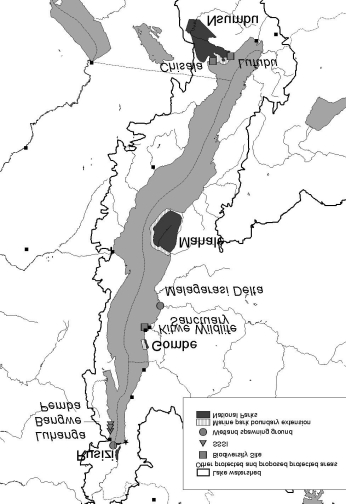
Pollution Control and Other Measures to Protect Biodiversity in Lake Tanganyika
The Transboundary Diagnostic Analysis
Map 5 National Parks and Sites of High Conservation Interest
Although not yet generally applied to fisheries or wetlands, community ownership
approaches are now being promoted for forestry management, and in parts of
Tanzania government forests are being handed back to local communities to ensure
their survival as protected areas.
35
Pollution Control and Other Measures to Protect Biodiversity in Lake Tanganyika
The Transboundary Diagnostic Analysis
The highest biodiversity, in terms of number of species, is situated in the sub-littoral
zone (down to 40 m)18. Much of this biodiversity is found all around the lake, but
there are limited number of taxa with spatially restricted distributions.
This littoral zone is most threatened by coastal development, particularly loss of
terrestrial vegetation leading to increased siltation. At present, over much of the
lakeshore, this effect is relatively localised around fishing villages and major towns. It
is more widespread around the north basin and along the Tanzanian coast
There are four National Parks around the lake, Nsumbu in Zambia, Mahale and
Gombe Stream in Tanzania and Rusizi in Burundi. These formal "protected areas"
have provided a focus for conservation activities around the lake, and although 73%
of known fish species have been found in waters in and around these park areas, they
can not protect all species or indeed protect all key habitats for the spawning and
nursery grounds of the non-threatened economic species. There is therefore a need for
a broader approach to protection ranging from parks to seasonally closed and
restricted areas, where land and water based activities are limited to acceptable
practices defined and agreed with the lake shore communities.
3.5.1 Threats to Resources of National Parks
High Severity of Problem: increasing land pressure adjacent to national parks and
the lack of alternative livelihood options is resulting in resource conflicts between
parks and neighbouring communities. The problem is compounded by a decline in the
resources available to parks from central government as part of policies promoting
decentralised management.
High Feasibility of Solution: however, parks management is already adapting to
changes in social and economic pressures and negotiating access rights and
compensatory mechanisms with local communities, and continue to be able to draw
on non-governmental and international support.
High Additional Benefits: the objective of the proposed intervention is to reduce
threats to parks resources by promoting benefits to communities. These benefits can
range from agreed limited and/or seasonal access rights to adjacent communties, to
compensatory investment in community development, such as health care or schools.
Simply maintaining or extending existing terrestrial parks can protect a representative
sample of the majority of littoral habitats in the lake. Associating an aquatic zone with
an existing terrestrial park is the most effective strategy as it minimises resources
required for park management, reduces disruption to lake shore communities, and
serves to ensure that the aquatic habitats are protected from developments in the
adjacent coastal zone.
The waters adjacent to three of the existing terrestrial national parks (Mahale, Gombe,
Nsumbu) include relatively unimpacted sandy, rocky and mixed sand/rock/ habitats.
18 Sub-littoral is normally used to mean below low tide, however in the case of Lake Tanganyika this is
considered to be down to 40m, where sufficient light reaches the benthic environment to allow primary
production to occur.
36
Pollution Control and Other Measures to Protect Biodiversity in Lake Tanganyika
The Transboundary Diagnostic Analysis
The species assemblages associated with these habitats are representative, in terms of
overall diversity and ecosystem structure, of communities in similar habitats
elsewhere in the lake.
More specialised habitats, such as shell-beds, emergent macrophyte stands and
stromatolite reefs are also represented in the areas adjacent to Lake-shore national
parks. Shell beds are found in both Mahale (southern part) and Nsumbu (north-
western part). Stromatolite reefs are also found in the northern part of Mahale NP. The
species associated with these habitats, including unique assemblages of shell-dwelling
cichlids therefore benefit from a measure of protection from land-based threats, and in
the case of Nsumbu and Mahale, from aquatic protection.
Rusizi National Park provides an area adjacent to a major river delta, that includes
emergent macrophyte stands, muddy substrates and the turbid, nutrient-rich waters
associated with river-mouths. The major threats to its current diversity originate in the
wider Rusizi basin, and are unlikely to be mitigated by protecting a small area of the
delta, however the reed-bed areas provide important nursery grounds for fish of
commercial importance, as well as trapping some sediment. Extending protection into
the lake, to manage fishing and reed-cutting activities is therefore desirable.
3.5.2 Degradation of Sensitive Habitats
High Severity of Problem: by definition "key" habitats are critical for the protection
of specific and often spatially limited ecological communities, and for the protection
of the spawning and nursery grounds of economically valuable species.
Low to Medium Feasibility of Solution: these areas have not been "protected" under
existing formal or informal agreements, and suffer from the same management
constraints as other littoral areas. The degree of protection envisaged will generally be
higher than required for the wider littoral zone.
High Additional Benefits: while some of these key habitats are selected for their
biodiversity value, many of the wetland areas are spawning and nursery grounds
supporting the littoral and pelagic fisheries. The protection of these areas is essential
for the maintenance of sustainable fisheries.
Given that these areas do not have the formal protection status of national parks,
management proposals will have to take direct account of community interests and
will rely on a process of negotiation to reach agreements on limited access and
possible mitigatory or compensatory mechanisms. Again co-management mechanisms
should be explored.
Historical surveys indicate that the Congolese territory hosts very high aquatic
biodiversity. Three sites have been identified as key habitats meriting some protection
status, Pemba, Luhanga and Bangwe 19. These locations are all high in species richness
and are some of the few largely unimpacted sites within close proximity of Uvira, and
as such provide a valuable research/study area for the Centre Dr Recherché En
19 Pemba (3°.611S, 029°.150E), Luhanga (3°.522S, 029°.149 E) and Bangwe (3°.576S, 029° .149E).
37
Pollution Control and Other Measures to Protect Biodiversity in Lake Tanganyika
The Transboundary Diagnostic Analysis
Hydrobiologie. Currently, the major threat to their biodiversity is from sedimentation
due to deforestation of the slopes above them.
Additional key protected habitats could include a number of rocky sites in the area of
Gitaza in Burundi, the waters next to the Kitwe Wildlife Sanctuary and south of
Kigoma in Tanzania.
From the perspective of fisheries protection, it is essential that some protection status
be given to the coastal wetlands, the nursery and spawning grounds for economically
important fish species. Key areas the Rusizi, the Malagarasi delta, the Lukuga
effluent, or the Lufubu/Chisala river mouths.
A possible mechanism for managing these areas for sustainable use is provided by the
Ramsar Convention, and indeed the Malagarasi has already been declared as a wetland
of international importance. While focusing attention within the country, the real
impact of this is to attract other donors that could provide co-financing in support of
the wider activities envisaged in the TDA and the SAP.
38
4 The Transboundary Diagnostic Analysis Matrix
4.1 Level 1 Main Threats to Biodiversity
P
o
Main Threat to Biodiversity and
CrossCutting Transboundary
CrossCutting Institutional
General Action Areas
l
l
u
t
i
Sustainable Use
Implications
Problems
on Cont
Lack of Resources
rol
and Ot
Unsustainable Fisheries
Poor Enforcement of Existing
Reduce Impact of Fishing
Global Loss of Biodiversity
Increasing Pollution
Regulations
Control Pollution
The Trans
Loss of Shared Fisheries Resource
Excessive Sedimentation
Lack of Appropriate Regulations for
Control Sedimentation
her M
Decline in Water Quality
Habitat Destruction
Lake Tanganyika
Habitat Conservation
eas
Lack of Institutional Coordination
boundary Di
ures
t
o
39
P
agnos
r
ot
ec
t
B
t
i
c
i
A
odi
nal
vers
ys
i
i
t
s
y i
n
Lak
e Tanganyi
k
a
4.2 Level 2 Action Areas and Specific Problems
4.2.1 Reduce Impact of Fishing Excessive fishing pressure in the littoral zone
P
o
Specific Problem
Stakeholders
Uncertainties
Proposed Actions
l
l
u
t
Burundi Excessive fishing pressure
Fisheries administration (including
Potential of resource
Ascertain potential, fishing standards
i
on Cont
MAE Fisheries Dept and Territorial
and acceptable licensing quotas
Admin.); Fishermen; Owners of fishing
Support other income generating
rol
units; MINATE (INECN); NGOs;
activities or those that supply animal
and Ot
Local associations and communities;
proteins
The Trans
UB
Strengthen capacities for Fisheries
her M
Dep. to control and supervise
Raise awareness and train (fishermen,
eas
boundary Di
boat owners, administration)
ures
Update and issue draft law and by
t
laws, as well as ordinances
o
40
P
Translation in Kirundi and extension
agnos
r
ot
ec
Congo Excessive fishing pressure in
Min Env; Fishermen and associations
Maximal exploitable production
Strengthen regulations : introduce
t
B
the northern part of the lake
of fishermen; Local authorities; CRH;
licence system (according to type of
t
i
c
i
A
odi
Fish sellers; NGOs and local
FU) with recording of existing
nal
vers
communities; MINAGRI
fishermen; regional harmonisation
ys
i
Strengthen control
i
t
s
y i
n
Improvement of statistics
Lak
Assessment of potential (maximal
e Tanganyi
exploitable production) both in
Northern and Southern zones
Feasibility study of tax raising system
k
aiming to regulate fishing effort
a
(feeding at the same time a lake
management fund)
Identify reasons for catches increase in
the South
(continued)
Identify actions to develop fish
farming
Raise awareness information
Research aiming at establishing how
better fish conservation could decrease
pressure on stock and favour transfer
P
of demand towards bigger fish
o
l
l
u
Tanzania Lack of quota on fishing
Fisheries; Communities; Local
Optimal quota; available stock;
Review LTR conclusions
t
i
on Cont
licences
Authorities; TAFIRI
Impact on biodiversity
Assess relevance to fish biodiversity
issues
rol
Assess trend in expansion of licensing
and Ot
Review licensing procedures
The Trans
Zambia Excessive coastal fishing
Artisanal Fishermen; Subsistence
Optimal level of extraction
Promotion of alternative livelihoods
her M
Fishermen; Dep. Fisheries; Local
Impact of fishing gear on fisheries and
Raise awareness
Leaders; Community Based
biodiversity
Strengthen Dep. of Fisheries
eas
boundary Di
Organisations
Negotiate comanagement with
ures
identified communities in specific
t
fishing zones
o
41
P
Assess impact of fishing gear
agnos
r
ot
ec
t
B
t
4.2.2 Reduce Impact of Fishing Excessive Fishing in the Pelagic Zone
i
c
i
A
odi
nal
vers
Specific Problem
Stakeholders
Uncertainties
Proposed Actions
ys
Burundi Excessive offshore fishing
Min. of Env; Fishermen; Local
Acceptable catch
Establish standards and quotas for
i
i
t
s
y i
Authorities; Fish traders; Net
acceptable fishing practices
n
Lak
manufacturers; CRH; NGOs; Local
Put in place a sufficient capacity to
e Tanganyi
Communities
control lake fisheries
Review national and regional
components of the Framework
Fisheries Management Plan within the
k
a
context of the SAP
Incorporate additional activities into
national programmes within the
framework of the SAP
Congo Uncontrolled offshore
Min. of Env; Fishermen; Local
Optimal mesh size and net type
Research into best mesh sizes and
fisheries
Authorities; Fish traders; Net
Impact on biodiversity
fishing methods
manufacturers; CRH; NGOs; Local
Studies on secondary species
P
Communities
Legislation distinguishing between
o
l
l
u
three levels of activity, banning
t
i
on Cont
excessively fine nets, limited permits
for appropriate net types and banning
destructive fishing practices
rol
and Ot
Support to control capacity
The Trans
Education and awareness raising
Review national and regional
her M
components of the Framework
eas
Fisheries Management Plan within the
boundary Di
ures
context of the SAP
Incorporate additional activities into
t
o
42
P
national programmes within the
agnos
r
ot
framework of the SAP
ec
Tanzania Inadequate Control of
Fisheries Division; TAFIRI; Ministry
Scale of problem
Build district statistics capacity
t
B
t
i
c
i
Offshore Fisheries
of Regional Administration and Local
Establish the existing fishing pressure
A
odi
nal
Govt.; Fisheries investors;
(vessels, gear, fishermen...),
vers
ys
Communities; NGOs
differentiate between industrial and
i
i
t
s
y i
artisanal
n
Lak
Establish optimal fishing pressure
Set up appropriate monitoring, control
e Tanganyi
and surveillance
Implement education and awareness
programmes for fishing communities
k
a
Enforce regulations
Review national and regional
components of the Framework
(continued)
Fisheries Management Plan within the
context of the SAP
Incorporate additional activities into
national programmes within the
framework of the SAP
Zambia Excessive Industrial and
Commercial Fisheries; Artisanal
Optimal fishing levels
Raise national and Local Political
P
o
Artisanal Fishing
Fishermen; Local Authority; Dep. of
Market Distribution
Awareness
l
l
u
Fisheries; Community Based
Negotiate interim acceptable fleet and
t
i
on Cont
Organisations; Local Leaders;
means of reducing fleet
Licensing Committee
Establish optimal fleet composition
rol
Review licensing procedures
and Ot
Strengthen local capacity to monitor
The Trans
and enforce regulations
her M
Review national and regional
components of the Framework
eas
boundary Di
Fisheries Management Plan within
ures
the context of the SAP
t
o
43
Incorporate additional activities
P
agnos
r
ot
into national programmes within
ec
the framework of the SAP
t
B
t
i
c
i
A
odi
nal
vers
4.2.3 Reduce Impact of Fishing Excessive or uncontrolled extraction of ornamental fish
ys
i
i
t
s
y i
Specific Problem
Stakeholders
Uncertainties
Proposed Actions
n
Lak
Burundi Excessive or uncontrolled
MINATE (INECN); MAE (Fisheries
Scale of problem and impact
Prepare list of threatened species and
extraction of ornamental fish
dep.); Exporters; Sellers; Customs;
proposal of inclusion in CITES lists
e Tanganyi
BRB; NGOs; Local associations and
Regulations, control, monitoring
communities
Encourage fish farming of those
species
k
a
Raise awareness
Set up protected areas (demarcation,
eco tourism development,
management plans)
Congo Excessive or uncontrolled
Local authorities; CRH; Customs;
Vulnerability of all the species
Improvement and strengthening of
extraction of ornamental fish
Exporters; Min Environ; ICCN
potential per species and per site
licence delivery (authorised species,
quantities, extraction sites)
Strengthen extraction and exporting
control
Establish natural reserves : Luhanga,
Pemba, Kalamba, Kiriza(Ubwari) and
P
o
Bangwe
l
l
u
Additional prospecting in order to
t
i
on Cont
expand the network of protected areas
Inscription of lake Cichlides on CITES
rol
list, except fish identified as capable to
and Ot
support extraction
The Trans
Tanzania Excessive or uncontrolled
Licensed Traders; Fisheries; TAFIRI;
Endangered species
Identify threatened species
her M
extraction of ornamental fish
Foreign Affairs; Home Affairs;
Extent of threat
Regional agreement on exportable
Customs
species by country of origin
eas
boundary Di
Monitor numbers and species exported
ures
Raise senior level awareness of
t
problems
o
44
P
Establish species quotas
agnos
r
ot
Review number of licensees
ec
t
B
Examine possibility of inclusion in
t
i
c
i
A
odi
CITES list
nal
vers
Zambia Excessive or uncontrolled
Commercial Fishers; Local
Scale / Impact of Extraction
Ascertain Scale and Impact
ys
i
extraction of ornamental fish
Authorities; Fisheries Dept; Parks;
Raise Public Awareness Establish
i
t
s
y i
n
Museums; Communities and Local
Aquarium
Lak
Leaders; Revenue Authority
Define Levels of Extraction
e Tanganyi
Review License / Export Fees
Establish Local Regulations
Evaluate Potential for Captive
k
Breeding
a
Review Inclusion of Species in CITES
4.2.4 Level 2 Pollution Control Urban and Industrial pollution
Specific Problem
Stakeholders
Uncertainties
Proposed Actions
Burundi Pollution from urban waste
MINATE (DG ATE ; INECN); Mayor
Nature and quantity of effluents
Expansion of treatment capacities
Particularly from Bujumbura and
(SETEMU); MCIT; CCIB; Regideso;
Impact of pollutants on biodiversity
Set up controlled site disposal and
Rumonga
MTPE; MSP; BBN; NGOs; Local
collect waste
associations and communities
Raise awareness and train
Regulations for marketing of
dangerous products for environment
P
o
Develop standards for enforcement of
l
l
u
t
legislation relating to waste
i
on Cont
Implement land use plans in the
framework of planning schemes
rol
Strengthen capacities for INECN to
and Ot
monitor and control
The Trans
Support development of secondary
her M
urban centres
Surveying pollution and impact levels,
eas
boundary Di
monitor and follow up
ures
Burundi Industrial Pollution from
MINATE (DG ATE ; INECN); Mairie
Scale of pollution, pollutant discharges
Pretreatment of industrial sewage and
t
Bujumbura town (with particular
(SETEMU); MCIT; Industrial
and impact on biodiversity
put to work the water treatment plant
o
45
P
concern to the paint industries,
Enterprises the paint industries,
Acceptable standards
Expansion of the treatment capacities
agnos
r
ot
tanneries, soap industry, food
tanneries, soap industry, food
Set up controlled site disposal and
ec
t
B
industries, textiles and chemicals)
industries, textiles and chemicals;
collect waste
t
i
c
i
A
odi
CCIB; Regideso; MTPE; MSP; BBN;
Treatment, recycling and development
nal
vers
NGOs; Local associations and
of waste
ys
i
communities
Improve industrial procedures
i
t
s
y i
n
Raise awareness and train
Lak
Regulations for facilities likely to
e Tanganyi
pollute (Prior EIA technical
specifications)
Regulations for marketing of
dangerous products for environment
k
a
(continued)
Develop standards for enforcement of
legislation relating to waste
Implement land use plans in the
framework of planning schemes
Strengthen capacities for INECN to
monitor and control
Surveying pollution and impact levels,
monitor and follow up.
EIA prior to Industrial Development
Congo Pollution by domestic
Ministry of Environment; Local
Nature and quantity of pollutants and
Identification of pollutants, evaluation
P
o
effluents and waste
Authorities; Population; NGOs and
impacts n the Lake biodiversity
of impact.
l
l
u
Local communities; Urban services;
Sanitation (construction of latrines,
t
i
on Cont
INERA; Ministry of Energy
installation of controlled disposal sites
and waste collecting, setting up waste
rol
and sewage network connected to a
and Ot
treatment plant) : Uvira, Mboko,
The Trans
Kalemie, Moba, Baraka
her M
Health education
Research focused on recycling
eas
boundary Di
through agricultural and energy
ures
Develop appropriate legislation and
t
support enforcement capacity
o
46
P
Congo Industrial Pollution Kiliba
Kiliba sugar factory; CRH; CRSN;
Impact of pesticides and lime on the
Recycling of by-products (bagasse,
agnos
r
ot
Sugar Factory
INERA; ISDR; NGOs and Local
lake biodiversity.
treacle, lime)
ec
t
Communities; Min. of Energy;
Alternatives
Assessment of the impact of herbicides
B
t
i
c
i
A
odi
Ministry of Environment
on the Lake waters and the
nal
vers
biodiversity.
ys
Research for more appropriate
i
i
t
s
y i
fertilising modalities
n
Lak
Update legislation
e Tanganyi
Control
Congo Pollution from Kabimba
Ciment-lac; CRH; CRSN; INERA;
Impact of ashes; dusts and smokes on
Assessment of the impact and
cement factory
ISDR; NGOs and local Communities;
lake biodiversity
identification of the measures to be
(continued)
taken (continued)
k
a
Ministry of Environment
Feasibility study of agricultural
recovering of ashes
Implement recommendations
Update legislation
Control
Tanzania Discharge of untreated
Local Council; Regional Authority;
Impact on biodiversity
Review existing town development
domestic waste, Kigoma Town
Min of Water; Min of Health; Min of
Quantity and type of effluents
plans
Lands
Incorporate proposals for sewage,
waste water and water supply;
Propose developments & promote
awareness to counteract existing
P
o
situation of open drains etc.
l
l
u
Monitor effluents
t
i
on Cont
Tanzania Discharge of untreated
Police; Prisons; TRC; Local Council;
Impact on biodiversity
Enforce regulations;
waste from institutions (Police,
Min of Water; Min of Health; Min of
Quantity and type of effluents
Identify reasons for noncompliance
rol
Prisons, Railway Station, Docks)
Transport; Regional Authorities
Promote Senior level awareness
and Ot
Kigoma Town
Identify and propose practical
The Trans
treatment works and disposal sites
her M
Implement proposals and regulations
Monitor effluents
eas
boundary Di
Tanzania Inappropriately sited solid
Local Council; Regional Authority;
Impact on biodiversity
Identify appropriate sites;
ures
waste dumps Kigoma Town
Min of Water; Min of Health; Min of
Leaching and surface runoff
Review present collection and disposal
t
Lands; Communities
procedures
o
47
P
Check existing and introduce
agnos
r
ot
appropriate local regulations;
ec
t
B
Develop appropriate landfills
t
i
c
i
A
odi
Monitor quantity and quality of
nal
vers
leachates
ys
i
Tanzania Industrial Pollution
TANESCO; Local Council; Min of
Extent of Pollution
Implement appropriate management
i
t
s
y i
n
Kigoma TANESCO Power Station
Water; Min of Energy; NEMC
practices and structures
Lak
Implement both short and long term
e Tanganyi
remedial measures
Review TANESCO plans for
rehabilitation, including funding
k
Zambia Discharge of untreated
Local Authority; Water Affairs;
Scale of problem and impact on
Assess scale of problem and impact on
a
domestic effluent, Mpulungu and
Fisheries Dept; Local Communities;
biodiversity
biodiversity (note available data)
Shoreline Settlements
District Health Management Team;
Review design of existing sewerage
DWASHE; ECZ
systems, assess potential for
alternatives
Link with existing DWASHE
programme
Implement alternatives
Monitor effluent disposal
Raise awareness of issues
Zambia Uncontrolled Waste
Transporters; Fishing Companies;
Scale of problem and impact on
Assess scale of problem and impact on
P
o
Dumping in and around Mpulungu
Local Authority; Water Affairs;
biodiversity
biodiversity
l
l
u
t
Zambia Revenue Authority; Fisheries
Raise awareness of issues
i
on Cont
Dept; Local Communities; District
Monitor disposal
Health Management Team; ECZ
Enforce regulations
rol
Zambia Transboundary movement
Communities; Min of Energy & Water
Types of pollutants, distribution and
Identify sites for monitoring
and Ot
of industrial pollution
Depart.; Dept. of Fisheries; Local
buildup
Establish a functioning monitoring
The Trans
Authorities; Min of Environment;
programme
her M
NISIR; ECZ; Maritime
Training in monitoring lake pollution
eas
boundary Di
4.2.5 Level 2 Pollution Control Pollution in harbours
ures
Specific Problem
Stakeholders
Uncertainties
Proposed Actions
t
o
48
P
Burundi Pollution in harbours
MTPET (Lake transport), Ship owners,
Scale of threats
Promulgation of Lake Traffic Act, and
agnos
r
ot
EPB, INECN MINATE (INECN),
extension
ec
t
MCIT, Lake Guard
Control enforcement of Act, and
B
t
i
c
i
A
odi
continue technical checking of ships
nal
vers
Monitor and evaluate scale of the
ys
problem of lake pollution
i
i
t
s
y i
Harmonise regulations and supervising
n
Lak
activities and control with the other
e Tanganyi
riparian states
Establish a shipyard for maintenance
and repairing of ships
Congo Harbour Pollution (Kalemie,
Ministry of Environment; Transport
Nature and quality of pollutants and
Raise awareness
k
a
Kabimba, Kalundu, Moba)
and Communication; CRH; Ship
impact on the Lake biodiversity
Update regulations (eco tax combined
owners
system dissuading from legal pollution
and penalising illicit pollution)
Strengthen control
Installation of controlled disposal sites
on dry land
Identification of pollutants and
assessment of their impact on the lake
biodiversity
Tanzania Pollution in harbours
TRC; Ship Owners / Operators; Local
No information on specific handling
Identify specific causes of leaks and
(particular concern over storage and
Council; Oil Companies; Shipping
problems
spillage
P
o
handling of oil)
Department; NEMC; Min of Transport
Impact on biodiversity
Check and review regulations and
l
l
u
t
recommended procedures
i
on Cont
Review reasons for nonenforcement
of regulations
rol
Implement short term and long term
and Ot
remedial actions
The Trans
Zambia Pollution in harbours
Mpulungu Population; Water Affairs;
Impact on Biodiversity of Different
Carry Out Risk Assessment
her M
(particular concern over storage and
Maritime Department; Harbours
Cargoes and Scenarios
Review Potential Impact on
handling of oil and other cargoes)
Authority; Barge Owners; Fisheries
Biodiversity
eas
boundary Di
Dept; Local Authorities; Police;
Mitigate impacts and put in place
ures
Defence; ECZ; Disaster Management
emergency response capacity
t
Unit
o
49
P
agnos
r
ot
ec
4.2.6 Level 2 Pollution Control Pollution from future mining and oil exploitation activities
t
B
t
i
c
i
Specific Problem
Stakeholders
Uncertainties
Proposed Actions
A
odi
nal
vers
Burundi Pollution from future
MEM (DMC); MINATE; mining
Scale of pollution and effects on lake
EIA prior to start mining
ys
mining and oil exploitation activities
companies; oil companies
Review Oil and Mines Act in order to
i
i
t
s
y i
take into account environmental
n
Lak
impacts
e Tanganyi
(continued)
Negotiate agreements with other
riparian countries
k
a
Support the existing chemical and
biological laboratories
Congo Pollution from future mining
Min Environment; CRH; CRGM; Min.
Probability and site of works
Studies of impact on the environment
and oil exploitation activities
of Oil; Ministry of Energy
Environment follow up of activities
Tanzania Discharge of toxic
"Smallholder miners"; Min of Energy
Scale of problem
Quantify scale and processes used
substances from mine workings
and Mines; Min of Water; Regional /
different mining areas
Local Authorities; NLUPC; NEMC;
Promote appropriate technology
Min of Health
Enforce existing regulations
Review status of EIA legislation
4.2.7 Level 2 Pollution Control Pollution from major marine accidents
P
o
l
l
u
Specific Problem
Stakeholders
Uncertainties
Proposed Actions
t
i
on Cont
Burundi Pollution from major
MTPET (Lake transport), Ship owners,
Scale of threats
Promulgation of Lake Traffic Act, and
marine accidents
EPB; MINATE (INECN), MCIT, Lake
extension
rol
Guard; MAE (Fisheries)
Control enforcement of Act, and
and Ot
continue technical checking of ships
The Trans
Monitor and evaluate scale of the
her M
problem of lake pollution
Harmonise regulations and supervising
eas
boundary Di
activities in riparian states
ures
Congo Pollution from major marine
Min. of Environment; Transport and
Nature and quantities of pollutants and
Raise awareness (ship operators and
Communication service; CRH; Ship
impact on lake biodiversity
other stakeholders)
t
accident
o
50
P
owners; CRSN; External Commerce;
Review regulations (navigation rules;
agnos
r
ot
Congolese Office for Control
pollution and security standards,
ec
t
transport of hazardous cargo)
B
t
i
c
i
Strengthen control
A
odi
nal
vers
Technical control of ships (with anti
ys
pollution and security standards)
i
i
t
s
y i
Pollution monitoring
n
Lak
e Tanganyi
(continued)
Evaluate impact (scale of problem,
frequency of discharge, risks,
harmfulness of pollutants)
k
a
Tanzania Pollution from major
Ship Owners / Barge Operators;
Level of Risk
Risk analysis
marine accident
Regional Authorities; Shipping
Develop contingency plan
Department; NEMC; Min of
Transport; Min of Water; NEMC;
Insurance Companies; TAFIRI
Zambia Pollution from major marine
Large Transporters; Passengers;
Impact on Biodiversity of Different
Carry out risk assessment
accident
Maritime Department; Harbours
Cargoes and Scenarios
Review potential impacts on
Authority; Insurance Companies;
biodiversity
Fisheries Dept; Local Authorities;
Put in place emergency response
ZRA; Police; Defence; Disaster
capacity
Management Unit; Parks; ECZ
Review a need for a regional response
P
o
and emergencies disaster management
l
l
u
unit
t
i
on Cont
4.2.8 Level 2 Control Sedimentation Erosion from agricultural practices
rol
and Ot
Specific Problem
Stakeholders
Uncertainties
Proposed Actions
The Trans
Burundi Erosion from agricultural
MAE, MINATE, Territ. Admin.,
Impact on biodiversity, scale of
Evaluate impact of problem, study the
her M
practices
Farmers, Research Institutes, MTPE,
sedimentation, relation between
extent of sedimentation in the lake and
NGOs, Local associations and
erosion and fragile areas receiving
identify high risk erosion areas
eas
boundary Di
communities
sediments at lake level
Plan catchment (agroforestry, anti
ures
erosive practices), raise awareness and
promote participative approach
t
o
51
P
Research development and extension
agnos
r
ot
of suitable techniques
ec
t
Planning focused on sediment deposits
B
t
i
c
i
in the valleys, traps for sediments
A
odi
nal
vers
Define special standards and prioritise
ys
interventions to identified areas
i
i
t
s
y i
Congo Inappropriate farming
Minagri (SNV); Ministry Environ;
Sensitive zones
Education and awareness
n
Lak
practices and extensive agriculture
(continued)
(continued)
e Tanganyi
INERA; NGOs and local communities;
Identification of sensitive erosion
CRH; Local authorities; AT
zones
Regulation of soil use in these zones
Implementing demonstrations (anti
k
a
erosive techniques, agrozootechnical,
agroforestry integration)
Extension and support to enforcement
capacity
Tanzania Erosion from agricultural
Min of Agriculture; Communities;
Identify with communities sensitive
practices (particular concern on steep
NLUPC; Local Authorities;
areas
slopes and cultivating down the slope)
JGI/TACARE
Demarcate hazardous areas and
reforest
Raise awareness of critical issues
Promote soil conservation measures
Check/review local byelaws
P
o
Assist villages in preparing land use
l
l
u
plans
t
i
on Cont
Zambia Erosion from agricultural
Farming Communities; Forestry
Scale of Problem and Trend; Cultural
Assess Scale, Impact and Risks
practices (particular concern slash and
Department; Ministry of Agriculture;
and Economic Viability of Alternative
Evaluate impact on the lake
rol
burn and stream bank cultivation)
Water Affairs; Local Chiefs;
Farming Practices
Review Alternative Practices including
and Ot
Chongololo Club; Local Authorities;
Irrigation
The Trans
Churches
Review Relevance of Existing
her M
Regulations
Promote Appropriate Farming
eas
boundary Di
Practices
ures
Identify Critical Erosion Sites and
t
Remedial Measures
o
52
P
Monitor enforcement of regulations
agnos
r
ot
Monitor current practices
ec
t
B
t
i
c
i
A
odi
nal
vers
ys
i
i
t
s
y i
n
Lak
e Tanganyi
k
a
4.2.9 Level 2 Control Sedimentation Deforestation
Specific Problem
Stakeholders
Uncertainties
Proposed Actions
Burundi Deforestation
MINATE, MAE; NGOs, Local
Scale and distribution of clearings
Inventory of forests and evaluate
P
associations and communities
State of resource
damage
o
l
l
u
Strengthen legal basis for Protected
t
i
on Cont
Areas
Expansion of network of Protected
Areas to cover all natural forests
rol
and Ot
Demarcate PAs and national forests
The Trans
boundaries
Rehabilitation of destroyed parts of
her M
PAs and Forests
eas
Environmental education
boundary Di
ures
Prepare participative management
plans for woods and PAs and identify
t
o
53
alternative resources
P
agnos
r
ot
Promote agroforestry and private
ec
woods
t
B
t
i
c
Compensate people expelled from PAs
i
A
odi
nal
Reinforce the capacity to supervise and
vers
ys
control PAs and forests and INECN
i
i
t
s
y i
capacities
n
Lak
Congo Deforestation
Ministry of Environment ; ICCN;
Scale and distribution of clearing;
Education and awareness (including
Local authorities; NGOs (CADIC) and
State of resource
authorities)
e Tanganyi
local communities; Population;
Promotion of private woods and agro
Ministry of Energy; MINAGRI
forestry (extension, demonstration)
Protection and restoring of public
k
a
forests along rivers
Identification of forestry areas to be
protected
Establish protected forest areas
(continued)
Update legislation
Strengthen environmental services
capacities
Creation of micro hydropower plants
in order to supply substitution energy
inciting to protect the catchment
P
Action towards improved stoves,
o
l
l
u
improved process for smoking of fish
t
i
on Cont
and alternative energy (biogas, solar
etc.)
rol
Tanzania Deforestation
Local / Regional Authorities;
Current scale and rate of deforestation
Identify critical encroachment and
and Ot
Communities; Forestry Department;
critical threatened zones
The Trans
NLUPC; Min of Lands: TACARE;
Create political awareness of problems
her M
Min of Local Gov't.
Negotiate with communities to gazette
sensitive areas
eas
boundary Di
Negotiate means of resettlement from
ures
sensitive areas
t
Promote community forest
o
54
P
management and access rights
agnos
r
ot
Enforce byelaws
ec
t
Scale of Impact on Sediment Load
Assess Impact on Sediment Load
B
Zambia Deforestation
Local Communities; Forestry
t
i
c
i
A
odi
Department; Parks; Water Affairs;
Negotiate Solution to Current
nal
vers
Local Chiefs; Chongololo Clubs;
Encroachment
ys
Politicians
Rehabilitate sensitive areas
i
i
t
s
y i
Enable Enforcement of Current
n
Lak
Regulations
e Tanganyi
Raise Awareness of Issues, particularly
at the Political Level
Promote afforestation
Raise local awareness
k
a
Promote sustainable forest
management, agroforestry and promote
alternative energy
4.2.10 Level 2 Habitat Conservation Threats to Resources in National Parks
Specific Problem
Stakeholders
Uncertainties
Proposed Actions
Burundi Encroachment in the Rusizi
MAE (incl. Fishing dep.); MINATE
Compensation for expulsion from
Natural Reserve
(INECN); Territ. Adm.; Farmers;
sensitive zones
P
NGOs; Local associations and
Extend the reserve into the littoral;
o
l
l
u
communities
zone to 1000 metres offshore of the
t
i
on Cont
774-metre contour.
Plant hedges to demarcate the reserve
in the delta
rol
and Ot
Congo Lack of protection of the
ICCN; CRH; CRSN; NGOs, Local
Establish a "protected area" in the
The Trans
Congolese side of the Ruzizi delta
Communities
Ruzizi delta, adjacent to the Burundi
Natural Reserve
her M
Tanzania Exploitation of Fisheries
TANAPA; Fisheries Department;
Compliance of local communities
Raise awareness of parks issues
eas
boundary Di
within the Parks
Local Communities
Involve local communities
ures
Zambia Community Pressure on
ZAWA; Lodge Operators; Local
Support from Local Communities
Involvement of Communities in Parks
Nsumbu National Park
Communities; Fisheries
Management
t
o
55
P
Training in Aquatic Parks
agnos
r
ot
Management
ec
Define aquatic and aquatic mark parks
t
B
t
i
c
i
boundary
A
odi
nal
vers
ys
i
4.2.11 Level 2 Habitat Conservation Degradation of sensitive habitats
i
t
s
y i
n
Lak
Specific Problem
Stakeholders
Uncertainties
Proposed Actions
Burundi Degradation of sensitive
MAE (incl. Fishing dep.); MINATE
Extent of lake shore activities and
Mapping supra littoral area and
e Tanganyi
coastal areas
(INECN); Territ. Adm.; Farmers;
impact on biodiversity
cultivated area
NGOs; Local associations and
Raise awareness
communities
Participative management and non
k
a
destructive recovering of natural
resources
Declare sensitive areas as protected
areas (Murembwe, Nyengwe, Rwaba)
(continued)
Control lake shore vegetation
exploitation
Protect the rocky coastline through tree
planting between Gitara and Flugara
Congo Risk of degradation of
ICCN; CRH; CRSN; NGOs, Local
Establish a protected area Lukuga
coastal zone; lack of protection of
Communities
Establish a protected area Ruzizi
P
o
specific key zones (Rusizi, Lukuga,
Establish protection for sites of special
l
l
u
Luhanga, Pemba, Kalamba, Kiriza,
scientific interest Luhanga, Pemba,
t
i
on Cont
Kazimia)
Kalamba, Kiriza, Kazimia
Participative preparation of a
rol
management plans
and Ot
Hydrologic monitoring (rate of flow
The Trans
from lake)
her M
Tanzania Degradation of wetland
Communities; Fisheries; TAFIRI;
Impact on Biodiversity
Negotiate access with communities
areas in particular the Malagarasi
Local Government; Tourism
Optimal size of protected areas
Gazette areas
eas
boundary Di
Community Compliance
Raise Awareness
ures
Ban destructive fishing practices
t
Evaluate stock
o
56
P
Conduct hydrological and limnological
agnos
r
ot
monitoring
ec
t
B
Zambia Damage to Sensitive
Min. of Agriculture; Min. of Env.; Min
Extent of degradation and impact on
Evaluate destructive fishing practices
t
i
c
i
A
odi
Habitats Lufuba and Chituba Bay and
of Tourism; Local Authorities; Local
biodiversity
Ban specific destructive practices
nal
vers
Chisala River Mouth
Communities; Traditional Leaders
(poison, explosives...)
ys
i
Negotiate designation of Chituba and
i
t
s
y i
Lufuba bays and Chisala river mouth
n
Lak
as conservation areas
e Tanganyi
Negotiate with communities acceptable
management practices
Develop procedures for capital
empowerment of communities to
k
a
alleviate impact of zone designation
(continued)
Negotiate designation of Lufuba mouth
as Ramsar site
Monitor stock levels
4.3 Level 3 Specific Problems and Proposed Interventions
P
o
l
4.3.1 Level 3 Reduce Impact of Fishing Excessive fishing pressure in the littoral zone
l
u
t
i
on Cont
Proposed Actions
Timing
Key Agency
Human
Material
Resources
Resources
rol
Burundi Excessive fishing pressure
and Ot
The Trans
Ascertain potential, fishing standards and acceptable licensing quotas
On Going
MAE
No
No
her M
Support other income generating activities or those that supply animal proteins
On Going
MDC
No
No
Strengthen capacities for Fisheries Dep. to control and supervise
Now
MAE
No
No
eas
boundary Di
Raise awareness and training (fishermen, boat owners, Administration)
Now
MAE
No
No
ures
Update and issue draft law and bylaws, as well as ordinances
Now
MAE
No
No
Translation in Kirundi and extension
After
MAE
Yes
Yes
t
o
57
P
previous
agnos
r
ot
ec
Congo Excessive fishing pressure in the northern part of the lake
t
B
t
i
c
i
A
odi
Strengthen regulations : introduce licence system (according to type of FU) with recording of
Now
Min of Env
Yes
No
nal
vers
existing fishermen; regional harmonisation
ys
i
i
t
Strengthen control
Now
Min of Env
No
No
s
y i
n
Improvement of statistics
Now
CRH
Yes
No
Lak
Assessment of potential (maximal exploitable production) both in Northern and Southern zones
Now
CRH
Yes
No
e Tanganyi
Feasibility study of tax raising system aiming to regulate fishing effort (feeding Now
CRH
Yes
No
at the same time a lake management fund)
k
Identify reasons for catches increase in the South
Now
CRH
Yes
No
a
Identify actions to develop fish farming
Now
MINAGRI
Yes
No
Raise awareness information
Suspended
Min of Env
Yes
Yes
Research aiming at establishing how better fish conservation could decrease Now
CRH
Yes
No
pressure on stock and favour transfer of demand towards bigger fish
Tanzania Lack of quota on fishing licences
P
Review LTR conclusions
Now
TAFIRI
Yes
Yes
o
l
l
u
Assess relevance to fish biodiversity issues
After
TAFIRI
Yes
Yes
t
i
on Cont
previous
Assess trend in expansion of licensing
After
Fisheries
Yes
Yes
previous
Dept
rol
and Ot
Review licensing procedures
Now
Fisheries
Yes
Yes
The Trans
Dept
her M
Zambia Excessive coastal fishing
eas
boundary Di
ures
Promotion of alternative livelihoods
Now
Community
Yes
No
t
Dev.
o
58
P
Raise awareness
On Going
DOF
Yes
Yes
agnos
r
ot
Strengthen Dep. of Fisheries
Now
DOF
Yes
No
ec
t
Negotiate comanagement with identified communities in specific fishing zones
On Going
DOF
Yes
No
B
t
i
c
i
A
odi
Assess impact of fishing gear
Now
DOF
Yes
No
nal
vers
ys
i
i
t
s
y i
n
Lak
4.3.2 Level 3 Reduce Impact of Fishing Excessive fishing pressure in the pelagic zone
e Tanganyi
Proposed Actions
Timing
Key Agency
Human
Material
Resources
Resources
Burundi Excessive offshore fishing
k
a
Establish standards and quotas for acceptable fishing practices
Now
MAE
Yes
No
Put in place a sufficient capacity to control lake fisheries
Now
MAE
Yes
No
Review national and regional components of the Framework Fisheries Management Plan within
Now
MAE
Yes
Yes
the context of the SAP
Incorporate additional activities into national programmes within the framework of the SAP
Now
MAE
Yes
Yes
Congo Uncontrolled offshore fisheries
Research into best mesh sizes and fishing methods
On Going
CHR
Yes
No
Studies on secondary species
Now
CRH
Yes
No
Legislation distinguishing between three levels of activity, banning excessively fine nets, limited
After
Min of Env
Yes
Yes
permits for appropriate net types and banning destructive fishing practices
previous
P
o
l
Support to control capacity
Now
Min of Env
Yes
No
l
u
t
i
on Cont
Education and awareness raising
Now
Min of Env
Yes
No
Review national and regional components of the Framework Fisheries Management Plan within
Now
Min of Env
Yes
Yes
the context of the SAP
rol
Incorporate additional activities into national programmes within the framework of the SAP
Now
Min of Env
Yes
Yes
and Ot
The Trans
her M
Tanzania Inadequate control of offshore fisheries
eas
Build district statistics capacity
Now
Fisheries
No
No
boundary Di
ures
Establish the existing fishing pressure (vessels, gear, fishermen...), differentiate between
Now
Fisheries
Yes
No
industrial and artisanal
t
o
59
P
Establish optimal fishing pressure
Now
Fisheries
Yes
No
agnos
r
ot
Set up appropriate monitoring, control and surveillance
Now
Fisheries
Yes
No
ec
Enforce regulations
Now
Fisheries
Yes
No
t
B
t
i
c
i
Implement education and awareness programmes for fishing communities
Now
Fisheries
Yes
No
A
odi
nal
Review national and regional components of the Framework Fisheries Management Plan within
Now
Fisheries
Yes
Yes
vers
ys
the context of the SAP
i
i
t
s
y i
Incorporate additional activities into national programmes within the framework of the SAP
Now
Fisheries
Yes
Yes
n
Lak
e Tanganyi
Zambia Excessive industrial and artisanal fishing
Raise national and local political awareness
On Going
Fisheries
Yes
Yes
Negotiate interim acceptable fleet and means of reducing fleet
Now
Fisheries
Yes
Yes
k
Establish optimal fleet composition
Now
Fisheries
Yes
No
a
Review licensing procedures
Now
Fisheries
Yes
Yes
Strengthen local capacity to monitor and enforce regulations
Review national and regional components of the Framework Fisheries Management Plan within
Now
Fisheries
Yes
Yes
the context of the SAP
Incorporate additional activities into national programmes within the framework of the SAP
Now
Fisheries
Yes
Yes
After
Fisheries
Yes
No
previous
P
4.3.3 Level 3 Reduce Impact of Fishing Excessive or uncontrolled extraction of ornamental fish
o
l
l
u
t
Proposed Actions
Timing
Key Agency
Human
Material
i
on Cont
Resources
Resources
Burundi Excessive or uncontrolled extraction of ornamental fish
rol
and Ot
Prepare list of threatened species and proposal of inclusion in CITES lists
Now
MINATE
Yes
Yes
The Trans
Regulations, control, monitoring
Now
MINATE
Yes
No
her M
Encourage fish farming of those species
Now
MAE
Yes
No
Raise awareness
Now
MINATE
Yes
No
eas
boundary Di
Set up protected areas (demarcation, eco tourism development, management plans)
Now
MINATE
Yes
No
ures
t
o
60
P
Congo Excessive or uncontrolled extraction of ornamental fish
agnos
r
ot
ec
Improvement and strengthening of licence delivery (authorised species, quantities, extraction
Now
Min of Env
Yes
Yes
t
B
t
i
sites)
c
i
A
odi
Strengthen extraction and exporting control
Now
Min of Env
No
No
nal
vers
Establish natural reserves : Luhanga, Pemba, Kalamba, Kiriza(Ubwari)
Now
ICCN
Yes
No
ys
i
i
t
s
y i
Additional prospecting in order to expand the network of protected areas
Now
CRH
Yes
No
n
Lak
Inscription of lake Cichlides on CITES list, except fish identified as capable to support
Now
Min of Env
Yes
Yes
extraction
e Tanganyi
Tanzania Excessive or uncontrolled extraction of ornamental fish
k
a
Identify threatened species
Now
TAFIRI
No
No
Regional agreement on exportable species by country of origin
Now
Fisheries Dep
Yes
Yes
Monitor numbers and species exported
Now
Fisheries
Yes
Yes
Dep/Customs
Raise senior level awareness of problem
Now
Local Govt. /
Yes
No
Fisheries Dep
Establish species quotas
Now
TAFIRI
Yes
Yes
Review number of licensees
Now
Fisheries Dep
Yes
Yes
Examine possibility of inclusion in CITES list
After
Fisheries Dep
Yes
Yes
previous
P
o
l
l
u
Zambia Excessive or uncontrolled extraction of ornamental fish
t
i
on Cont
Ascertain Scale and Impact
On Going
Fisheries
Yes
Yes
Raise Public Awareness Establish Aquarium
Now
Fisheries
Yes
Yes
rol
Define Levels of Extraction
Now
Fisheries
Yes
Yes
and Ot
Review License / Export Fees
Now
Fisheries
Yes
Yes
The Trans
Establish Local Regulations
After
Fisheries
Yes
Yes
her M
previous
Evaluate Potential for Captive Breeding
Now
Fisheries
No
No
eas
boundary Di
Review Inclusion of Species in CITES
After
Parks
Yes
Yes
ures
previous
t
o
61
P
agnos
r
ot
ec
t
B
4.3.4 Level 3 Pollution Control Urban and Industrial Pollution
t
i
c
i
A
odi
Proposed Actions
Timing
Key Agency
Human
Material
nal
vers
Resources
Resources
ys
i
i
t
s
y i
Burundi Pollution from urban waste; particularly from Bujumbura and Rumonga
n
Lak
Expansion of treatment capacities
Now
Mairie /
No
No
e Tanganyi
SETEMU
Set up controlled site disposal and collect waste
Now
SETEMU
No
No
Raise awareness and train
Now
MCIT
No
No
k
a
Regulations for marketing of dangerous products for environment
Now
MINATE
Yes
Yes
(DG ATE)
Develop standards for enforcement of legislation relating to waste
Now
MINATE
No
No
(DG ATE)
Implement land use plans in the framework of planning schemes
Now
MTPE
No
No
Strengthen capacities for INECN to monitor and control
Now
MINATE
No
No
(INECN)
Support development of secondary urban centres
Now
MTPE
No
No
Surveying pollution and impact levels, monitor and follow up
Now
MINATE
No
No
(INECN)
P
o
l
l
u
Burundi Industrial Pollution from Bujumbura town and other urban areas (especially in Rumonge)
t
i
on Cont
Pretreatment of industrial sewage and put to work the water treatment plant
Now
Mairie /
No
No
SETEMU
rol
Expansion of the treatment capacities
After
Mairie /
No
No
and Ot
previous
SETEMU
The Trans
Set up controlled site disposal and collect waste
Now
Mairie /
No
No
her M
SETEMU
Treatment, recycling and development of waste
Now
Mairie /
No
No
eas
boundary Di
SETEMU
ures
Improve industrial procedures
Now
MCIT
No
No
t
Raise awareness and train
Now
MINATE
No
No
o
62
P
(INECN)
agnos
r
ot
ec
Regulations for facilities likely to pollute (prior EIA technical specifications)
Now
MINATE
No
No
t
B
(DG ATE)
t
i
c
i
A
odi
Regulations for marketing of dangerous products for environment
Now
MINATE
Yes
Yes
nal
vers
(DG ATE)
ys
i
i
t
Develop standards for enforcement of legislation relating to waste
Now
MINATE
No
No
s
y i
n
(DG ATE)
Lak
Implement land use plans in the framework of planning schemes (including regulations for
Now
MTPE
No
No
e Tanganyi
burial sites)
Strengthen capacities for INECN to monitor and control
Now
MINATE
No
No
(INECN)
k
Surveying pollution and impact levels, monitor and follow-up
After
MINATE
No
No
a
previous
(INECN)
EIA prior to industrial development
Now
MINATE
No
No
(INECN)
Congo Pollution by domestic effluents and waste
Identification of pollutants, evaluation of impact.
Now
CRH
Yes
No
Sanitation (construction of latrines, installation of controlled disposal sites and waste collecting,
Now
Min of Env
No
No
setting up waste and sewage network connected to a treatment plant) : Uvira, Mboko, Kalemie,
Moba, Baraka
Health education
Now
Health
Yes
No
P
Services
o
l
l
u
Research focused on recycling through agricultural and energy
Now
INERA
Yes
No
t
i
on Cont
Develop appropriate legislation and support enforcement capacity
After
Min of Env
Yes
No
previous
rol
and Ot
The Trans
Congo Industrial Pollution Kiliba Sugar Factory
her M
Recycling of by-products (bagasse, treacle, lime)
Now
Min of Env
No
No
Assessment of the impact of herbicides on the Lake waters and the biodiversity.
Now
CRH
Yes
No
eas
boundary Di
Research for more appropriate fertilising modalities
Now
INERA
Yes
No
ures
Update legislation
On Going
Min of Env
Yea
Yes
t
Control
Now
Min of Env
No
No
o
63
P
agnos
r
ot
ec
t
Congo Industrial Pollution Kabimba cement factory
B
t
i
c
i
A
odi
Assessment of the impact and identification of the measures to be taken
Now
CRH
Yes
No
nal
vers
ys
Feasibility study of agricultural recovering of ashes
Now
INERA
Yes
No
i
i
t
s
y i
Implement recommendations
After
Min of Env
Yes
Yes
n
Lak
previous
Update legislation
On Going
Min of Env
Yes
No
e Tanganyi
Control
Now
Min of Env
Yes
No
k
a
Tanzania Discharge of untreated domestic waste, Kigoma Town
Review existing town development plans
Now
Min of Lands
Yes
Yes
Incorporate proposals for sewage, waste water and water supply;
After
Min of Lands
Yes
Yes
previous
Propose developments & promote awareness to counteract existing situation of open drains etc
After
Min of Lands
Yes
Yes
P
o
l
previous
l
u
t
i
on Cont
.Monitor effluents
Now
Min of Water
Yes
No
rol
Tanzania Discharge of untreated waste from institutions (Police, Prisons, Railway Station, Docks) Kigoma Town
and Ot
The Trans
Check and review regulations;
On Going
Min of Water
Yes
Yes
her M
Identify reasons for noncompliance
Now
UWS&S dept
Yes
Yes
Promote Senior level awareness
After
Local
Yes
No
eas
boundary Di
previous
authorities
ures
Identify and propose practical treatment works and disposal sites
After
Min of Water
Yes
No
previous
t
o
64
P
Implement proposals
After
Min of Water
Yes
No
agnos
r
ot
previous
ec
Monitor effluents
Now
Min of Water
Yes
No
t
B
t
i
c
i
A
odi
nal
vers
ys
Tanzania Inappropriately sited solid waste dumps Kigoma Town
i
i
t
s
y i
Identify appropriate sites;
Now
Town Council
Yes
Yes
n
Lak
Review present collection and disposal procedures
Now
Town Council
Yes
Yes
e Tanganyi
Check existing and introduce appropriate local regulations;
After
Town Council
Yes
Yes
previous
Develop appropriate landfills
After
Town Council
Yes
No
previous
k
a
Monitor quantity and quality of leachates
Now
Min of Water
Yes
No
Tanzania Industrial Pollution Kigoma TANESCO Power Station
Identify appropriate management practices and structures
Now
Energy
Yes
No
Department
Identify immediate remedial measures
Now
Energy
Yes
No
Department
P
o
l
Review government plans for rehabilitation, including funding proposals
Now
Energy
Yes
Yes
l
u
t
i
on Cont
Department
Identify & implement appropriate long term solutions
After
Energy
Yes
No
previous
Department
rol
and Ot
The Trans
Zambia Discharge of untreated domestic waste, Mpulungu and Shoreline Settlements
her M
Assess Scale of Problem and Impact on Biodiversity (note Available Data)
Now
ECZ
Yes
Yes
eas
boundary Di
Review Design of Existing Systems, Potential for Alternatives
After
Local Council
Yes
No
ures
previous
Link with existing DWASHE Programme
Now
Local Council
Yes
Yes
t
o
65
P
Raise Awareness of Issues
On Going
ECZ
Yes
No
agnos
r
ot
ec
Zambia Uncontrolled Waste Dumping in and around Mpulungu
t
B
t
i
c
i
A
odi
Assess Scale of Problem and Impact on Biodiversity
Now
ECZ
Yes
Yes
nal
vers
Raise awareness of Issues
Now
Local
Yes
No
ys
i
i
t
Councils
s
y i
n
Monitor effluent disposal
Now
ECZ
Yes
No
Lak
Enforce regulations
Now
Local
Yes
Yes
e Tanganyi
Councils
Zambia Transboundary Movement of Industrial Pollution
k
a
Identify sites for monitoring
Now
ECZ
No
No
Establish a functioning monitoring programme
Now
ECZ
No
No
Training in monitoring lake pollution
Now
ECZ
No
No
4.3.5 Level 3 Pollution Control Pollution in harbours
Proposed Actions
Timing
Key Agency
Human
Material
Resources
Resources
Burundi Pollution in harbours
P
o
l
Promulgation of Lake Traffic Act, and extension
Now
MTPET
Yes
Yes
l
u
t
i
on Cont
Control enforcement of Act, and continue technical checking of ships
After
MTPET
Yes
No
previous
Monitor and evaluate scale of the problem of lake pollution
Now
MINATE
No
No
rol
(INECN)
and Ot
Harmonise regulations and supervising activities in riparian states
Now
MTPET
No
No
The Trans
Establish a shipyard for maintenance and repairing of ships
Now
MTPET
No
No
her M
eas
boundary Di
Congo Harbour Pollution (Kalemie, Kabimba, Kalundu, Moba)
ures
Raise awareness
Now
Min of Env
Yes
No
t
o
66
P
Update regulations (eco tax combined system dissuading from legal pollution and penalising
On Going
Min of Env
Yes
Yes
agnos
r
ot
illicit pollution)
ec
Strengthen control
Now
Min of Env
No
No
t
B
t
i
c
i
Installation of controlled disposal sites on dry land
Now
Min of Env
No
No
A
odi
nal
Identification of pollutants and assessment of their impact on the lake biodiversity
Now
CRH
Yes
No
vers
ys
i
i
t
s
y i
n
Lak
Tanzania Pollution in harbours (particular concern over storage and handling of oil)
e Tanganyi
Identify specific causes of leaks and spillages
Now
Min of Water
Yes
No
Check and review regulations and recommended procedures
Now
Min of Water
Yes
Yes
Review reasons for nonenforcement of regulations
After
Min of Water
Yes
Yes
previous
k
a
Implement short term and long term remedial actions
After
Min of Water
Yes
No
previous
Zambia Pollution in harbours (particular concern over storage and handling of oil and other cargoes)
Carry Out Risk Assessment
Now
Maritime
Yes
Yes
Review Potential Impact on Biodiversity
After
Fisheries
Yes
Yes
previous
Mitigate impacts and put in place emergency response capacity
After
Harbours
Yes
No
P
o
l
previous
Authorities
l
u
t
i
on Cont
rol
4.3.6 Level 3 Pollution Control Pollution from future mining and oil exploitation activities
and Ot
The Trans
Proposed Actions
Timing
Key Agency
Human
Material
Resources
Resources
her M
Burundi Pollution from future mining and oil exploitation activities
eas
boundary Di
ures
EIA prior to start mining
Now
MINATE
No
Yes
(INECN)
t
o
67
P
Review Oil and Mines Act in order to take into account environmental impacts
Now
MEM
Yes
Yes
agnos
r
ot
Negotiate agreements with other riparian countries
Now
MEM
Yes
No
ec
Support the existing chemical and biological laboratories
Now
MINATE
Yes
No
t
B
t
i
c
i
(INECN)
A
odi
nal
vers
ys
i
i
t
s
y i
Congo Pollution from future mining and oil exploitation activities
n
Lak
Studies of impact on the environment
Now
CRH/Min of
Yes
No
e Tanganyi
Env
Environment follow up of activities
After
Min of Env
Yes
No
previous
k
a
Tanzania Discharge of toxic substances from mine workings
Quantify scale and processes used different mining areas
Now
Energy and
Yes
No
Minerals
Promote appropriate technology
Now
Energy and
Yes
Yes
Minerals
Enforce existing regulations
After
Energy and
Yes
No
Previous
Minerals
Review the status of EIA legislation
Now
Energy and
Yes
Yes
Minerals
P
o
l
l
u
t
i
on Cont
4.3.7 Level 3 Pollution Control Pollution from major marine accidents
rol
Proposed Actions
Timing
Key Agency
Human
Material
and Ot
Resources
Resources
The Trans
Burundi Pollution from major marine accidents
her M
Promulgation of Lake Traffic Act, and extension
Now
MTPET
Yes
Yes
eas
boundary Di
Control enforcement of Act, and continue technical checking of ships
After
MTPET
Yes
No
ures
previous
t
Monitor and evaluate scale of the problem of lake pollution
Now
MINATE
No
No
o
68
P
(INECN)
agnos
r
ot
ec
Harmonise regulations and supervising activities in riparian states
Now
MTPET
No
No
t
B
t
i
c
i
A
odi
nal
vers
Congo Pollution from major marine accidents
ys
i
i
t
s
y i
Raise awareness (ship operators and other stakeholders)
Now
Min of Env /
Yes
No
n
Lak
Transp &
Comm
e Tanganyi
Review regulations (navigation rules; pollution and security standards, transport of hazardous
On Going
Min of Env
Yes
Yes
cargo)
Strengthen control
Now
Min of Env
No
No
k
a
Technical control of ships (with antipollution and security standards)
Now
Transp &
Yes
No
Comm
Pollution monitoring
Now
CRSN
Yes
No
Evaluate impact (scale of problem, frequency of discharge, risks, harmfulness of pollutants)
Now
CRH
Yes
No
Tanzania Pollution from major marine accidents
Risk analysis
Now
NEMC
Yes
No
Develop contingency plans
Ongoing
NEMC
Yes
Yes
P
o
Zambia Pollution from major marine accidents
l
l
u
t
i
on Cont
Carry Out Risk Assessment
Now
Maritime
Yes
No
Review Potential Impacts on Biodiversity
On Going
Fisheries
Yes
Yes
rol
Put in place emergency response capacity
After
Maritime
Yes
No
and Ot
previous
The Trans
Review need for a regional response and emergencies disaster management unit
Now
ECZ
Yes
No
her M
eas
boundary Di
ures
4.3.8 Level 3 Control Sedimentation Erosion from agricultural practices
t
Proposed Actions
Timing
Key Agency
Human
Material
o
69
P
Resources
Resources
agnos
r
ot
ec
Burundi Erosion from agricultural practices
t
B
t
i
c
i
A
odi
Evaluate impact of problem, study the extent of sedimentation in the lake and identify high risk
Now
MINATE
Yes
No
nal
vers
erosion areas
(IGEBU)
ys
i
Plan catchment (agroforestry, antierosive practices), raise awareness and promote
On Going
MINATE
No
No
i
t
s
y i
participative approach
(DG ATE)
n
Lak
Research development and extension of suitable techniques
On Going
MAE
Yes
No
e Tanganyi
Planning focused on sediment deposits in the valleys, traps for sediments
Now
MINATE
No
No
(DG ATE)
Define special standards and prioritise interventions to identified areas
After
MINATE
Yes
No
previous
(DG ATE)
k
a
Congo Inadequate farming practices and extensive agriculture
Education and awareness
Now
MINAGRI/S
Yes
No
NV
Identification of sensitive erosion zones
Now
INERA
Yes
No
Regulation of soil use in these zones
After
Min of Env
Yes
Yes
P
o
l
previous
l
u
t
i
on Cont
Implementing demonstrations (anti erosive techniques, agrozootechnical, agroforestry
After
INERA
Yes
Yes
integration)
previous
Extension and support to enforcement capacity
After
MINAGRI/S
Yes
Yes
rol
previous
NV
and Ot
The Trans
her M
Tanzania Erosion from agricultural practices (particular concern on steep slopes and cultivating down the slope)
eas
boundary Di
Identify with communities, sensitive areas, demarcate hazardous areas
Now
NLUPC
Yes
No
ures
Raise awareness of critical issues
Now
Min of
Yes
No
Agriculture
t
o
70
P
Promote soil conservation measures
Now
Min of
Yes
No
agnos
r
ot
Agriculture
ec
Check/review local byelaws
Now
Local
Yes
Yes
t
B
t
i
c
i
Authority
A
odi
nal
Assist villages in preparing land use plans
After
NLUPC
Yes
No
vers
ys
previous
i
i
t
s
y i
n
Lak
Zambia Erosion from agricultural practices (particular concern slash and burn and stream bank cultivation)
e Tanganyi
Assess Scale, Impact and Risks
On Going
Water
Yes
Yes
Evaluate impact on the lake
Now
Water Affairs
Yes
No
Review Alternative Practices including Irrigation
Now
MAFF
Yes
Yes
k
a
Research
Review Relevance of Existing Regulations
After
Water Affairs
Yes
Yes
previous
Promote Appropriate Farming Practices
After
Field Services
No
No
previous
Identify Critical Erosion Sites and Remedial Measures
After
Water Affairs
Yes
Yes
previous
Monitor enforcement of regulations
After
Water Affairs
No
No
previous
Monitor current practices
After
Water Affairs
No
No
previous
P
o
l
l
u
t
i
on Cont
4.3.9 Level 3 Control Sedimentation Deforestation
rol
Proposed Actions
Timing
Key Agency
Human
Material
and Ot
Resources
Resources
The Trans
Burundi Deforestation
her M
Inventory of forests and evaluate damage
Now
MINATE
No
No
eas
boundary Di
(DG ATE)
ures
Strengthen legal basis for Protected Areas, Update Forestry and Land Act, harmonise with
On Going
MINATE
Yes
No
t
Environment Act
(INECN)
o
71
P
Expansion of network of Protected Areas to cover all natural forests
On Going
MINATE
No
No
agnos
r
ot
ec
(INECN)
t
B
Demarcate PAs and national forests boundaries
After
MINATE
No
No
t
i
c
i
A
odi
previous
(INECN)
nal
vers
Rehabilitation of destroyed parts of PAs and Forests
Now
MINATE
No
No
ys
i
i
t
(INECN)
s
y i
n
Environmental education (at all levels)
On Going
MINATE
No
No
Lak
(INECN)
e Tanganyi
Prepare participative management plans for woods and PAs and identify alternative resources
Now
MINATE
No
No
Promote agroforestry and private woods
On Going
MINATE
No
No
(DG ATE)
k
Compensate people expelled from PAs
After
MINATE
No
No
a
previous
Reinforce supervision of PAs and forests and INECN capacities
On Going
MINATE
No
No
Congo Deforestation
Education and awareness (including authorities)
Now
Min of Env
Yes
No
Promotion of private woods and agro forestry (extension, demonstration)
Now
Min of Env
Yes
No
Protection and restoring of public forests along rivers
Now
ICCN
Yes
No
Identification of forestry areas to be protected
After
ICCN
Yes
No
P
o
l
previous
l
u
t
i
on Cont
Establish protected forest areas
On Going
Min of Env
Yes
Yes
Update legislation
Now
Min of Env
Yes
Yes
Strengthen environmental services capacities
Now
Min of Env
Yes
No
rol
Creation of micro hydropower plants in order to supply substitution energy to protect the
Now
Min of
Yes
No
and Ot
catchment
Energy
The Trans
Action towards improved stoves, improved process for smoking of fish and alternative energy
Now
Min of Env
Yes
No
her M
(biogas, solar etc..)
eas
boundary Di
ures
Tanzania Deforestation
t
o
72
P
Identify critical encroachment and critical threatened zones
Now
Forestry
Yes
No
agnos
r
ot
Department
ec
Create political awareness of problems
Now
Local
Yes
Yes
t
B
t
i
c
i
Government
A
odi
nal
Negotiate with communities to gazette sensitive areas
After
Local
Yes
No
vers
ys
previous
Authority
i
i
t
s
y i
Negotiate means of resettlement from sensitive areas
After
Local
Yes
No
n
Lak
previous
Authority
Promote community forest management and access rights
After
Forestry
Yes
No
e Tanganyi
previous
Department
Enforce byelaws
After
Local
Yes
No
previous
Authority
k
a
Zambia Deforestation (particular concern for protected areas, national parks and forest reserves)
Assess Impact on Sediment Load
On Going
Water
Yes
Yes
Negotiate Solution to Current Encroachment
Now
Forestry,
Yes
No
Parks
Rehabilitate sensitive areas
After
Forestry,
Yes
No
P
o
l
previous
Parks
l
u
t
i
on Cont
Enable Enforcement of Current Regulations
Now
Forestry,
Yes
No
Parks
Raise Awareness of Issues, particularly at the Political Level
Now
ECZ
Yes
Yes
rol
Promote afforestation
Now
MENR
Yea
No
and Ot
Raise local awareness
Now
MENR
Yea
No
The Trans
Promote alternative energy
Now
MENR
Yea
No
her M
eas
boundary Di
ures
4.3.10 Level 3 Habitat Conservation Threats to Resources in National Parks
t
o
73
P
Proposed Actions
Timing
Key Agency
Human
Material
agnos
r
ot
Resources
Resources
ec
t
B
Burundi Encroachment in the Rusizi Natural Reserve
t
i
c
i
A
odi
nal
vers
Compensation for expulsion from sensitive zones
Now
MINATE
Yes
No
ys
(INECN)
i
i
t
s
y i
Extend the reserve into the littoral; zone to 1000 metres offshore of the 774-metre contour.
Now
MINATE
Yes
No
n
Lak
(INECN)
e Tanganyi
Plant hedges to demarcate the reserve in the delta
After
MINATE
Yes
No
previous
(INECN)
k
a
Congo Lack of Protection of the Congolese side of the Ruzizi delta
Establish a "protected area" in the Ruzizi delta, adjacent to the Burundi Natural Reserve
Now
ICCN
Yes
No
Tanzania Exploitation of Parks Fisheries
Raise awareness of parks issues
Now
TANAPA
Yes
No
Involve local communities
Now
TANAPA
Yes
No
P
o
Zambia Community Pressure on Nsumbu National Park
l
l
u
t
i
on Cont
Involvement of Communities in Parks Management
Now
ZAWA
Yes
No
Training in Aquatic Parks Management
Now
ZAWA
No
No
rol
Define and mark aquatic parks boundary
Now
ZAWA
Yes
No
and Ot
The Trans
her M
4.3.11 Level 3 Habitat Conservation Degradation of sensitive habitats
eas
boundary Di
Proposed Actions
Timing
Key Agency
Human
Material
ures
Resources
Resources
t
o
74
P
agnos
r
ot
Burundi Degradation of sensitive coastal areas
ec
t
B
t
Mapping supra littoral area and cultivated area
Now
MINATE
Yes
No
i
c
i
A
odi
(INECN)
nal
vers
Raise awareness
Now
MINATE
Yes
No
ys
i
i
t
(INECN)
s
y i
n
Participative management and non destructive recovering of natural resources
Now
MINATE
Yes
No
Lak
(INECN)
e Tanganyi
Declare sensitive areas as protected areas (Murembwe, Nyengwe, Rwaba)
Now
MINATE
Yes
No
(INECN)
Control lake shore vegetation exploitation
Now
MINATE
Yes
No
k
(INECN)
a
Protect the rocky coastline through tree planting between Gitara and Flugara
MINATE
Yes
No
(INECN)
Congo Risk of degradation of coastal zone; lack of protection of specific key zones (Rusizi, Lukuga, Luhanga, Pemba, Kalamba, Kiriza, Kazimia)
Establish a protected area Lukuga
Now
ICCN
Yes
No
Establish a protected area Ruzizi
Now
ICCN
Yes
No
Establish protection for sites of special scientific interest Luhanga, Pemba, Kalamba, Kiriza,
Now
ICCN
Yes
No
Kazimia
P
o
l
l
Participative preparation of a management plans
Now
ICCN
Yes
No
u
t
i
on Cont
Hydrologic monitoring (rate of flow from lake)
Now
CRH
Yes
No
rol
and Ot
Tanzania Degradation of wetland areas in particular the Malagarasi
The Trans
her M
Negotiate access with communities
Now
Min of Agric
Yes
No
Gazette areas
After
Min of Agric
Yes
No
eas
boundary Di
previous
ures
Raise Awareness
Now
Fisheries
Yes
No
t
Ban destructive fishing practices
Now
Fisheries
Yes
No
o
75
P
Evaluate stock
Now
TAFIRI
Yes
No
agnos
r
ot
Conduct hydrological and limnological monitoring
Now
TAFIRI
Yes
No
ec
t
B
t
i
c
i
A
odi
nal
vers
Zambia Damage to Sensitive Habitats Lufuba and Chituba Bay and Chisala River Mouth
ys
i
i
t
s
Evaluate destructive fishing practices
On Going
Fisheries
Yes
Yes
y i
n
Ban specific destructive practices (poison, explosives...)
Now
Fisheries
Yes
Yes
Lak
Negotiate designation of Chituba and Lufuba bays and Chisala river mouth as conservation
Now
Fisheries
Yes
No
e Tanganyi
areas
Negotiate with communities acceptable management practices
Now
Community
Yes
Yes
Dev
k
Develop procedures for capital empowerment of communities to alleviate impact of zone
Now
Community
Yes
No
a
designation
Dev
Negotiate designation of Lufuba mouth as Ramsar site
Now
ECZ
No
Yes
Monitor stock levels
On Going
Fisheries
Yes
No
Pollution Control and Other Measures to Protect Biodiversity in Lake Tanganyika
The Transboundary Diagnostic Analysis
Annex 1 Regional and National Workshop Participants
Participants at the Final SAP Workshop
BURUNDI
Monsieur. Jerome
Directeur General- INECN/ Coordinateur National
Karimumuryango
Monsieur Boniface
Conseiller au MINATE
Nyakageni
Monsieur Gabriel
Coordonnateur du Volet Pollution
Hakizimana
Dr. Gaspard Ntakimazi
Professeur, Universite du Burundi
DR Congo
Monsieur Mady Amule
Directeur Ministere de l'Environnement / Coordinateur
National
Dr. Nshombo Mudherwa
Directeur General CRH UVIRA
Dr. Mulimbwa Nsibula
Directeur Scientifique CRH UVIRA
Prof. Takoy Lomema
Professeur, Universite de Kinshasa
Tanzania
Mr. W.V. Haule
Assistant Director, Fisheries Division
Dr. Hudson Nkotagu
Lecturer / Geologist University of Dar es Salaam
Mr. Faustin Masanja
Hydrologist, Water Resources Department
Zambia
Mr. George M Chitalu
Assistant National Co-ordinator, Environmental Council of
Zambia
Mr. Shadreck Nsongela
Senior Environment Impact Assessment Officer,
Environmental Council of Zambia
Ms. Georgina Zulu
Senior Planning Officer Ministry of Environment and
Natural Resources
Mr. Leonard Mwape
Senior Fisheries Officer Mpulungu
PCU
Dr. Andrew Menz
Project Co-ordinator
Dr. Kelly West
Scientific Liaison Officer
Sap Coordinators
Mr. Nicholas Hodgson
Anglophone
Mr. Jean Paul Ledant
Francophone
Pollution Control and Other Measures to Protect Biodiversity in Lake Tanganyika
The Transboundary Diagnostic Analysis
Participants at the Final TDA Workshop
BURUNDI
Monsieur Boniface
Directeur INECN / Coordinateur National
Nyakageni
Monsieur Roger Kanyaru
Directeur, Departement d'Eaux, Peche et Pisciculture
Monsieur Antoine Kiyuku
Directeur des Affairs Juridique a.i
Dr. Gaspard Ntakimazi
Professeur, Universite du Burundi
DR Congo
Monsieur Mady Amule
Directeur Ministere de l'Environnement / Coordinateur
National
Dr. Nshombo Mudherwa
Directeur General CRH UVIRA
Dr. Mulimbwa Nsibula
Directeur Scientifique CRH UVIRA
Prof. Takoy Lomema
Professeur, Universite de Kinshasa
Tanzania
Mr. Rawson Yonazi
Assistant Director Division of Environment / National
Coordinator
Ms. Catherine Msigwa
Fisheries Officer Fisheries Division
Dr. Hudson Nkotagu
Lecturer / Geologist University of Dar es
Salaam
Mr. Jerome Dukuduku
Hydrologist Water Resources Dept.
Zambia
Mr. George M Chitalu
Assistant National Co-ordinator, Environmental Council of
Zambia
Mr. Shadreck Nsongela
Senior Environment Impact Assessment Officer,
Environmental Council of Zambia
Ms. Georgina Zulu
Senior Planning Officer Ministry of Environment and
Natural Resources
Mr. Leonard Mwape
Senior Fisheries Officer Mpulungu
PCU
Dr. Andrew Menz
Project Co-ordinator
Dr. Kelly West
Scientific Liaison Officer
PCU SS FACILITATORS
Mr. Richard Paley
Biodiversity
Mr. Olivier Drieu
Sediment
Ms. Karen Zwick
Socio Economics
Mr. Robert Lindley
Fishing Practices
Sap Coordinators
Mr. Nicholas Hodgson
Anglophone
Mr. Jean Paul Ledant
Francophone
Pollution Control and Other Measures to Protect Biodiversity in Lake Tanganyika
The Transboundary Diagnostic Analysis
Participants at the First SAP Workshop
BURUNDI
Mr. Boniface Nyakageni
Director- Institut pour l'Environnement et Conservation de
la Nature/ Nat. Coordinator
Mr. Roger Kanyaru
Director- Department of Fisheries and Fish Farming
Mr. Benoit Bihamiriza
Director- Legal Affairs and Settlement of Disputes.
Dr. Gaspard Ntakimazi
Lecturer- University of Burundi.
DR Congo
Mr. Mady Amule
Director- Ministry of Environment/ Nat. Coord.
Prof. Palata Kabudi
Lecturer- University of Kinshasa
Prof. Takoy Lomema
Lecturer- University of Kinshasa
Dr. Nshombo Mudherwa
Director- Centre de Recherche Hydrobiologique-UVIRA
Tanzania
Mr. Rawson Yonazi
Assistant Director-Division of Environment, Vice
President's Office/ Nat. Coordinator
Mr. W.V. Haule
Assistant Director- Fisheries Division
Dr. Hudson Nkotagu
Senior Lecturer- University of Dar es Salaam
Mr. Faustin Masanja
Hydrologist- Ministry of Water
Zambia
Mr. George.M. Chitalu
Assistant National Coordinator- Environmental Council of
Zambia.
Mr. Shadreck Nsongela
Senior Inspector, Environmental Impact Assessment,
Environmental Council of Zambia
Ms. Georgina Zulu
Senior Planning Officer, Ministry of Environment and
Natural Resources
Mr. Leonard Mwape
Senior Fisheries Officer- Fisheries Department.
PCU
Dr. Andrew Menz
Project Co-ordinator
Dr. Kelly West
Scientific Liaison Officer
NRI
Mr. Nicholas Hodgson
SAP Facilitator- Anglophone
Mr. Jean-Paul Ledant
SAP Facilitator- Francophone
Pollution Control and Other Measures to Protect Biodiversity in Lake Tanganyika
The Transboundary Diagnostic Analysis
Participants at the First TDA Workshop
Burundi
Jean Berchmans Manirakiza
National Coordinator & Directeur Général INECN
Salvator Ruzima
Directeur Général de Développement Communal
Gaspard Ntakimazi
Professeur à l'Université du Burundi
Didace Nimpagaritse
Professeur à l'Université du Burundi.
François Nkurunziza
Professuer à l'Université du Burundi.
Congo
Mady Amule
National Co-ordinator, Min. de l'Environnement et
Conservation de la Nature.
Nshombo Mudherwa
Director General, CRH - Uvira
Takoy Lomema
Professeur, Universite de Kinshasa
Palata Kabudi
Professeur-Expert, Universite de Kinshasa
Baluku Bajope
Scientific Director, Research Center for Natural Sciences of
Lwiro, Bukavu
Tanzania
R.P Yonazi
National Coordinator, LTBP
Dr Francis Chale
LTBP Research Consultant Pollution Special Studies
W.Y. Haule
Senior Fisheries Officer, Ministry of Natural Resources and
Tourism
Ms. Hidaya M.M Faraji
Senior Research Officer, Central Water Laboratory,
Ministry of Water
Dr. H.H. Nkotagu
Senior Lecturer, Hydro-geology, University of Dar-Es-
Salaam
Zambia
James Phiri
National Coordinator, Director, Environmental Council of
Zambia
Leonard Mwape
Fisheries Department, Mpulungu
Henry Sichingabula
University of Zambia
G Chilukusha
Min for Environment and Natural Resources
G M Chitalu
Environmental Council of Zambia
Shadreck Nsongela
Environmental Council of Zambia
PCU
Andrew Menz
Project Coordinator
Kelly West
Scientific Liaison Officer
Resource persons
John Dorr
Fishing Practices, SS
Nick Hodgson
SAP Workshop Facilitator
Jean-Paul Ledant
SAP Workshop Facilitator
Graeme Patterson
Sediment and Pollution SS
Eddie Allison
Biodiversity SS
Observers
Gerard Cougny
GEF, Project Evaluation Mission
Niels Henrik Ipsen
GEF, Project Evaluation Mission
Pollution Control and Other Measures to Protect Biodiversity in Lake Tanganyika
The Transboundary Diagnostic Analysis
Participants at the National Consultation Workshops Burundi
Manirakiza, Jean-
PBLT (CN), INECN (DG)
Berchmans
Kinezero, Mathias
MINATE (chef de cabinet)
Kanayaru, Roger
Dép. Pêches, Pisciculture, Eau (direct.)
Songore, Tharcisse
Géologie et Mines
Bakevya, Pierre
Planification urbaine (directeur)
Ndizeye, Pascal
Dép. Transport Lacustre (directeur)
Ruzima, Salvator
Développement Communal (DG)
Barandemaje, Denis
Ressources hydrauliques (directeur)
Ntakimazi, Gaspard
Université du Burundi (professeur)
Nimpagaritse, Didace
Université du Burundi (professeur)
Nkurunziza, François
Université du Burundi (professeur)
Nzabimana, Stanislas
Université du Burundi (professeur)
Kinomvyi, Antoine
ODEB
Nakizimana, Gabriel
INECN (expert)
Bukuru, Jean-Marie
Dép. Génie Rural (directeur)
Niragira, Gaspard
MINATE (conseiller)
Kabwa, Agapit
MINATE (conseiller)
Gakima, Cécile
INECN (directeur)
Ntiranyibagira, Elysée
INECN (directeur technique)
Nindorera, Damien
INECN (conseiller)
Nzigidahera, Benoit
INECN (conseiller)
Ntungumburanye, Gérard
IGEBU
Bandandaza, Ignace
ETP Gitega
West, Kelly
PBLT (chargée de liaison scientifique)
Célestin
SETEMU (chargé de programme)
Marcelin
PNUD
Hanek, George
PLT, FINIDA
Ignace
ONAPHA (directeur technique)
Drieu, Olivier
NRI, PBLT (facilitateur sédimentation)
Ledant, Jean-Paul
NRI, PBLT (facilitateur PAS)
Pollution Control and Other Measures to Protect Biodiversity in Lake Tanganyika
The Transboundary Diagnostic Analysis
Participants at the National Consultation Workshops Congo
M Mady Amule,
Coordinateur National
ME Bashige
ICCN
MM Baluku
CRSN-Bukavu
Prof. Bitijula
ISDR
Elongo Buedi
ONG CADIC
MM Gayo
Min. Environnement
Golama
ISP-Gombé
Gombo Eunda Matunga
Dir. Service National de Reboisement
Mino-Kahozi Kalibu
Dir. SENADEP
Mwenyi Kaningingi
Dir. Du Project Pêche/Lac Kivu
Kitungano
CRH-Uvira
Mandgi
SENADEP
Me Mbombo
CIC
Kumbu di Mbemba
Dir. Aux Affaires Etrangères
MM Mulimbwa
CRH-Uvira
Mudherwa Nshombo
CRH-Uvira
Prof. Bungisabo
Univ. Kinshasa
Prof. Golama
ISP/Gombe
Prof Kalambayi
Univ. Kinshasa
Prof. M Nagahusedi
Univ. Kinshasa
Prof. Palata
Univ. Kinshasa
MM. Swedi
CADIC
Prof. Takoy
Univ. Kinshasa
J.P. Ledant
Facilitateur NRI
Pollution Control and Other Measures to Protect Biodiversity in Lake Tanganyika
The Transboundary Diagnostic Analysis
Participants at the National Consultation Workshops Tanzania
Mrs. V. Macha
Attorney General Chamber
Ms S Capper
AWF
Mr A Lugome
CARITAS Tanzania
Bishop Dr G Mpango
Diocese of Western Tanganyika
Mr. M. M. Shirima
District Council
Mr. G. Makinda
Mr. C. Swai
Division of Environment
Mr. R Yonazi
Mr. S. Kisinto
Mr. S. Nkondokaya
Mrs. E. Makwaia
Ms. A . Madete
Mr Kayega
Mr. W. V. Haule
Fisheries Division
Mrs. V. Lyimo
Ms. B. N. Marwa
Mrs J Uronu
Mr F Mukome
Forestry Division
Dr. Lukonge
JET
Dr. Andrew Menz
LTBP
Dr. F. M. Chale
Mr. JP Ledant
Mr. N. Hodgson
Mr. J. Dukuduku
Maji-Ubungo
Mr C Rumisha
Marine parks and Reserves Unit
Mr D Mhalu
Ministry of Agriculture
Mr m Ndimbo
Sgt. T. Mwaijande
Ministry of Communication and Transport
Mr. JB Tindyembwa
Ministry of Energy and Minerals
Mr M S Gilbert
Mr L Rwebembera
Mrs I Aboud
Ministry of Justice and Constitutional Affairs
Mr. Kihurnwa
Ministry of Lands and Human Settlements
Mr J Dukuduku
Ministry of Water
Mr C Kangero
Natural Resources
Mr G Makinda
Mr. P. Chisara
NEMC
Mr. W. N. Sarunday
Mr L Nzali
Mr F Stolla
Mrs. C. Makundi
NLUPC
Mr. S. Mayeye
Mr. AJ Mkama
Mr. J. Shilungushela
Mr. Kirit Vaitha
Ornamental Fish Trade
Mr. T. Killenga
Planning Commission
Mrs. A. E. Mayawalla
Mr. Z. Kittina
PMO
Pollution Control and Other Measures to Protect Biodiversity in Lake Tanganyika
The Transboundary Diagnostic Analysis
Dr. Mohamed Bahari
Regional Office
Mr. H.N. Kachechele
Mr. D. B. R. Chitamwebwa
TAFIRI
Mr. E. Lenganasa
TANAPA
Mr. M. T. Looboki
Mr. H. M. Mohamed
Mr. M Mbijima
Mr H Mollel
Mr W Daniel
Mr Z Mshanga
TANESCO
Mrs h Mremi
Tanzania Railways Corporation
Mr.G. Strunden
The Jane Goodall Institute
Dr. C.Mung'ong'o
University of Dar es Salaam
Dr. H. Nkotagu
Prof Misana
Mr p Nnyiti
WCST
Pollution Control and Other Measures to Protect Biodiversity in Lake Tanganyika
The Transboundary Diagnostic Analysis
Participants at the National Consultation Workshops Zambia
E Bwalya
Mpulungu District Council
J Mwilwa
J Phiri
Environmental Council of Zambia
S Nsongela
C Kabumbu
A Muvwende
P Banda
M Phiri
O Kalumiana
Department of Energy
R Sinyinza
Department of Fisheries
L Mwape
K Mazingaliwa
A Mphande
Food and Drugs Control Laboratory
B Lukama
Department of Forestry
M Musaba
G Chikwama
Mpulungu Harbour Authority
A Menz
LTBP
N Hodgson
JP Ledant
P Chipungu
M Pearce
R Chiti
Ministry of Agriculture, Food and Fisheries
L Mawele
A Kabeleka
Department of Maritime Services
G Chilukusha
Ministry of Environment and Natural Resources
S Chisamga
Central Board of Health
F Nyirenda
Ministry of Health
G Mudenda
Motomoto Museum
S Siachoono
M Nsomi
National Institute of Scientific and Industrial Research
G Zulu
Department of National Parks and Wildlife Service
C Phiri
K Siame
Provincial Planning Unit, Northern Province
C Kabumbu
University of Zambia
W Malambo
K Mungule
H Sichingabula
O Lungu
P Kimena
Water Affairs
C Akashambatwa
Wildlife and Environmental Conservation Society
G Muwowo
WWF ZEP
Document Outline