 | ||||
As discussed in Chapter 1, advice on TDA and SAP approaches presented in relevant GEF documents has been rather limited. The rapid development of information technology and the experience of a number of GEF projects involved in the design of TDA/SAPs has provided the GEF with an opportunity to develop more formal guidelines to assist with their preparation and to ensure inter-regional comparability. A recently commissioned comprehensive programme study for GEF indicated that such scientific and technical assessments are needed to:
(1) Identify, quantify, and set priorities for the environmental concerns that are transboundary in nature; and
(2) Identify their immediate, intermediate and fundamental causes. The identification of causes specifies practices, sources, locations and human activity sectors from which environmental degradation arises or is threatened.
A methodology for conducting exercises such as those described above has been developed for the Global International Waters Assessment (GIWA) by the University of Plymouth, UK[1]. The Global International Waters Assessment is a UNEP funded project (GF/FP/1100-99-01) which aims to produce a comprehensive and integrated strategic assessment, encompassing the ecological status and causes of environmental issues in transboundary freshwater basins and their associated coastal and ocean systems. This integrated assessment will be used by GEF and its partners to identify priorities for remedial and mitigatory actions in international waters. It is being undertaken from the perspective of: water quality and quantity; associated biodiversity and habitats; their use by society; the societal causes of the regionally identified issues; and scenarios of future conditions based on projections of demographic, economic and social changes associated with the process of human development. The GIWA methodology:
· Is holistic in nature and primarily regional in execution;
· Assesses transboundary issues within natural boundaries defined by catchments and their associated coastal and ocean systems;
· Examines the issues from the perspectives of the integrity of biological diversity and habitats as well as their use by human society;
· Examines the causes of the issues within human society; and
· Seeks to evaluate the likely future perspectives for IW issues based upon various human development scenarios.
The Dnipro Basin TDA is based on a modified version of this methodology and uses information already gathered and drafted in the nine chapters produced by the TDA authors/expert groups drawn from the Thematic Centres (Figure 1.1). It examines:
· the current state of the environment;
· the impacts and immediate causes of each environmental issue on the natural environment and human society;
· the sectoral pressures and socio-economic root causes for its degradation.
It focuses on transboundary issues without ignoring national concerns and priorities and identifies information gaps, policy distortions and institutional deficiencies. The analysis is cross-sectoral and examines national economic development plans, civil society (including private sector) awareness and participation, the regulatory and institutional framework and sectoral economic policies.
In order to facilitate the transition from the nine existing TDA chapters to the approach outlined above, the process was carried out in 3 stages. These were:
1. Identification of the major transboundary issues in the Dnipro Basin.
2. Development of an indicator based approach for the state of the environment report and environmental and socio-economic impact assessments of the Dnipro river Basin TDA in accordance with the GIWA methodology.
3. Development of causal chains for the priority transboundary issues in the Dnipro Basin based on the GIWA methodology.
The first stage in the TDA process was to agree on the transboundary issues. Initial consultations had already highlighted the main issues but it was important to revisit them, agree on whether or not the list was complete, examine their transboundary relevance, determine preliminary priorities and examine the geographical and temporal scope of the identified issues.
During the preparatory phase of GIWA, a classification was developed of the 5 major concerns related to the degradation of international waters and their associated living systems, together with a list of 22 key issues underlying these perceptions. In order to determine the geographical scale of the system to be examined and to assess the importance of each of the 22 GIWA issues within the system in terms of their environmental and socio-economic impacts, a scaling and scoping methodology was developed.
This methodology was considered too complex and prescriptive for the TDA approach. However, a simplified prioritisation exercise based on the scoping component of the GIWA methodology was carried out in order to determine the severity of the environmental and socio-economic impacts of the 22 GIWA issues and also to determine the relevance and transboundary nature of each issue. Each transboundary issue was scored on a scale of 0 (no impact) to 3 (severe impact) for both environmental and socio-economic impacts.
It is important that detailed information is gathered on the consequences of each of the transboundary issues in the Dnipro Basin. The approach should (a) describe the issue itself (using available survey data showing changes over time, etc.); (b) examine the impact of the issue from an environmental perspective (e.g. high concentrations of chemical pollutants may be an issue but what is the evidence of impact on the natural environment?); and (c) examine social and economic impacts of the issue (e.g. How many people have their health impaired by chemical pollution? What is the economic cost of the damage to health and the natural environment?).
It was therefore necessary to develop a set of status/impact indicators that would reflect this approach. The development of pressure indicators was also required for the immediate cause/causal chain analysis. Some of the indicators developed would also be used as important monitoring tools in the SAP. The starting point for the development of indicators relevant for the Dnipro river Basin was the GIWA environmental impact methodology.
The GIWA methodology includes a suite of indicators, the information of which was thought to be accessible throughout all the 66 GIWA sub-regions. The GIWA methodology defines each of these indicators, gives units of measure, sources of information, errors associated with their measurement and use and reporting forms. Inevitably, many of the indicators developed for GIWA are specific to a particular feature of a biogeographical region and are not applicable to others (e.g. coral reefs, mangroves, boreal wetlands).
The GIWA methodology was found to be very generic and not designed as a tool for TDA development. Therefore the focus was concentrated on screening the GIWA indicators using the following criteria:
· Is the indicator relevant to the Dnipro Basin?
· Is the information required for this indicator in the existing chapters?
· If not, is the information/data readily available?
Further, all indicators were scored in the following manner:
+ Relevant to the Dnipro Basin
+ + Relevant to the Dnipro Basin/information available
+ - Relevant to the Dnipro Basin/information not available
- Not relevant to the Dnipro Basin.
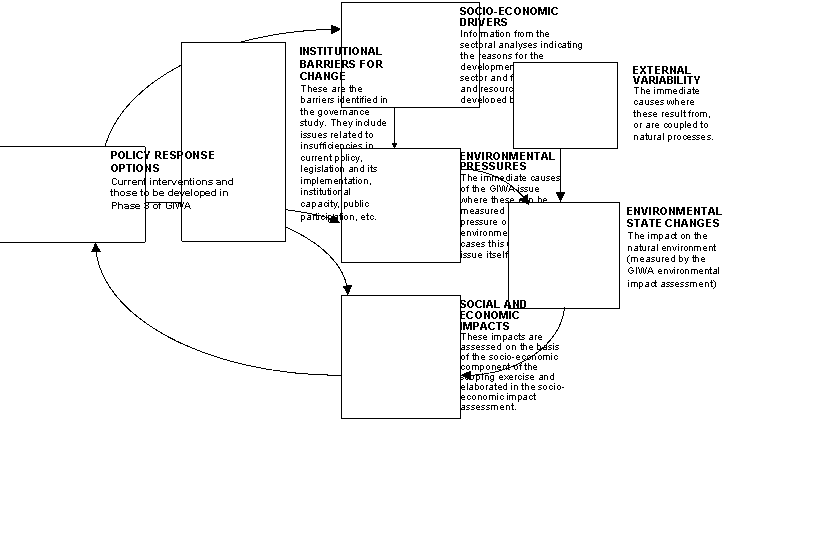
The indicators selected from this process were then categorised as pressure, state, impact or response indicators according to the Driver/Pressure/State/Impact/Response (DPSIR) approach (Figure 2.1). The status indicators are used in the TDA to describe the Dnipro Basin and the priority transboundary issues in the Basin (Chapters 3 and 4). Impact indicators are used to quantify the impacts of each transboundary issue in the Basin (Chapter 4). The pressure indicators are used to substantiate each causal chain developed for the priority transboundary issues (Chapter 4). The full list of indicators is shown in Annex 1.
This is one of the most useful aspects of the TDA for the development of future corrective actions. The causal chain relates the issues with their immediate physical causes and their social and economic underlying causes. The approach used in this TDA is to examine the separate role of various economic sectors and then integrate the results in a single framework. This ‘sectoral analysis’ approach helps to translate the findings into potential actions. Beyond the sectoral causes however, are deeper root causes of the problems, often related to fundamental issues of macroeconomy, demography, consumption patterns, environmental values and access to information and democratic processes. Most of these are beyond the scope of GEF intervention but it is useful to document them. The reason for this is that some proposed solutions may be unworkable if the root causes of the issue in question are overwhelming. The completed causal chain analysis should help to locate potential areas of intervention for the GEF.
The GIWA causal chain methodology examines the causes of individual GIWA issues within the GIWA sub regional context. The methodology itself is based upon a number of templates that help the causal chain team through the process in a stepwise manner. Having selected the priority issue to be addressed by the chain, the team of experts examines the immediate causes of the issue. The team then assesses from which sector of the human economy the immediate causes have arisen through a sectoral analysis approach using seven generic sectors: agriculture, industry, urban development, energy production, transport, fishing and recreation (including tourism). For each of the sectors, report sheets have been developed that facilitate the identification of the most significant resource uses or practices that contribute to the particular immediate cause and GIWA issue.
| ||||
| ||||
The methodology then explores the social and economic reasons for the key resource uses and practices. This tertiary stage in the chain also includes a simple analysis of existing measures taken to limit the cause. It explores factors related to governance, legislation and stakeholder involvement and provides important information for examining future options for intervention. It is also the first step in a more comprehensive governance analysis to be completed in parallel with the causal chain.
The final step in the methodology is a simple analysis of underlying or root causes. Existing and/or emerging transboundary environmental issues can be attributed to a range of socio-economic and legal root causes. The Socio-economic root causes themselves represent social and economic issues whereas the Legal root causes are associated with policy, legal and governance issues. Economic, political, legal and governance issues constitute a suite that in itself is a cause of social issues and underlying sectoral causes, (resource uses and practices).
As with the GIWA impact analysis, the causal chain analysis is very generic and prescriptive in its nature and was developed as a tool to enable some degree of intercomparison between GIWA sub regions. It was not designed as a tool for TDA development. The third stage in the development of the TDA methodology concentrated on the modification of the GIWA approach and the production of draft causal chains for the priority transboundary issues. The complete causal chain methodology will be presented in a Dnipro Basin TDA Methodology Report.
An illustration of the layout of a generic TDA causal chain outlining the root, underlying sectoral and immediate causes of transboundary issues is presented in Figure 2.2.
Part 1: Immediate cause analysis
The immediate causes listed for each environmental issue in the GIWA methodology were considered to be too generic for the Dnipro Basin TDA. However, pressure indicators are in essence indicators of immediate causes and consequently, the list of pressure indicators developed in stage 2 were rephrased as immediate causes and reviewed by the TDA expert team. The complete set of immediate cause report sheets will be presented in the full Dnipro Basin TDA methodology report. There was general agreement between the experts that the GIWA approach to assigning significance of the contribution of each sector to the immediate cause using percentages was not appropriate. Therefore an alternative method using a simple scoring exercise on the scale 0-3 was applied where 0 indicated no significant contribution and 3 indicated a very significant contribution.
Part 2: Underlying sectoral analysis
The general headings within the resource use and practice and social and economic cause components of the sectoral analysis were acceptable, if simplistic. However, it was considered that determining the significance of cause to the issue and the determination of perceived trends in the prescriptive manner required by GIWA would not result in the level of detail required for TDA causal chains. The sectoral analysis was used as a means of focusing the expert team allowing them to rephrase or alter the resource uses and practices and social and economic causes when constructing the causal chains, so that they fully reflected the situation in the Dnipro Basin.
Part 3: Root cause analysis
The root cause section was also considered to be too generic for the TDA. Therefore a draft list of underlying causes was developed. The underlying causes were divided into social and economic causes together with a list of over-arcing policy and legislative barriers.
Part 4: Governance
No changes were made to this section.
    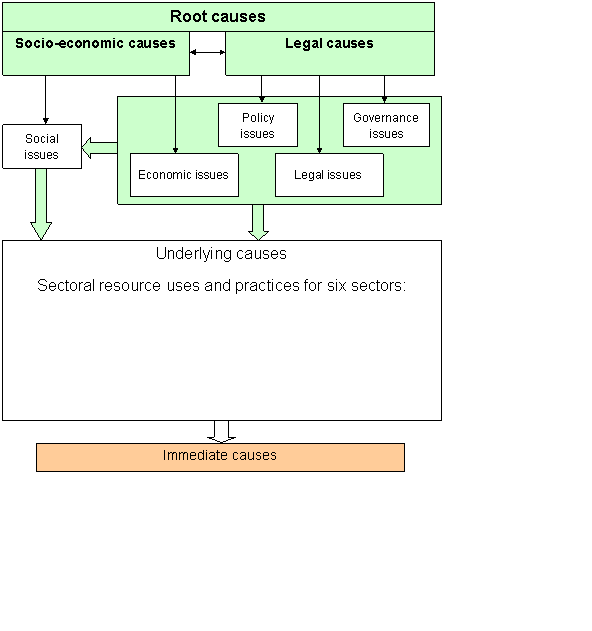 |
Figure 2.2 Outline of the approach employed for the causal chain analysis
[1] Global International Waters Assessment, Mee, L.D., Bloxham, M.J., Glegg, G.A., Hart, V., Beaumont, N. C. and Payne, S., University of Plymouth, 2001.