1 INTRODUCTION
The Dnipro River is the third largest in Europe (after the Volga and the Danube) and the second-largest river emptying into the Black Sea. It drains an area of 511,000 square kilometres and has a total length of 2,200 km. The Dnipro River is a transboundary system, with 20% of the river basin within the territory of the Russian Federation, 23% in Belarus, and the largest portion, 57%, in Ukraine.
The Dnipro is a great river, owing not only to its hydrology, but also to its role and significance in the formation and development of the three Slavic nations. Indeed, the past history, present environmental and economic conditions, and future destiny of Belarus, Russia, and Ukraine are deeply entwined with the Dnipro.
The Dnipro Basin has been described as a “classic example of unsustainable development”, due to the past legacy of trying to convert a traditionally agricultural region into a major industrial one within a span of a few decades. The situation has been complicated by the extreme social and economic difficulties faced by all three riparian countries in their transition to market economies.
Despite ongoing social and economic difficulties, all arms of government in the three Dnipro countries are making significant efforts to improve the environmental situation. In February 1997, the Verkhovna Rada (Parliament) of Ukraine approved the “National Programme for Dnipro Basin Rehabilitation and Improvement of Drinking Water Quality” – the first national environmental programme in Ukraine based on the basin approach. Similar regional environmental programmes are also being implemented in the Russian Federation and the Republic of Belarus.
Under conditions of limited state financing, international co-operation will play a significant role in the rehabilitation of the Dnipro River. Awareness of the fact that the environmental problems of the Dnipro Basin cannot be solved by one country alone has promoted the development of the “Programme for the Dnipro Basin Rehabilitation” among the three riparian nations. This has been carried out under the framework of the UNDP-GEF Project “Preparation of a Strategic Action Programme for the Dnipro Basin and Development of Mechanisms for its Implementation”.
In June 1996, the Ministers of Environment from the three riparian countries signed a statement in Helsinki expressing their intention to provide resources and participate equally in the development of a programme for the rehabilitation of the Dnipro Basin. This was a clear statement of commitment by the governments of the region, and shows their intention to work closely together towards clearly defined common goals.
As a result of this process, the first Transboundary Diagnostic Analysis (TDA) was completed and submitted in 1997. A key recommendation of the first TDA was the need for a more comprehensive study that examined social and economic issues and the need for a more inter-sectoral approach towards managing the Dnipro Basin.
Consequently, the preparation of the 2002 TDA has involved the identification of major environmental issues existing in the Dnipro Basin and its transboundary sections, together with an analysis assessing the significance of these issues in the context of the Basin as a whole and its riparian countries using the best available verified scientific information. It also defines the immediate, sectoral and root causes of environmental deterioration in the Basin and identifies the most urgent transboundary issues and priority areas that require further co-operation between the GEF and the riparian countries participating in the project. The 2002 TDA is an objective assessment and not a negotiated document.
The TDA working group, involving leading specialists from the Republic of Belarus, the Russian Federation, and Ukraine, was established to carry out tasks defined within the UNDP-GEF Programme. The Project Management Unit and Regional TDA Co-ordinator have managed and co-ordinated the activities of the working group. International experts including Laurence Mee and Martin Bloxham (UK) and Jan Barica (Canada) have assisted the working group in preparing the TDA in line with international requirements and current methodological approaches such as the Global International Waters Assessment (GIWA).
The development of the 2002 TDA has proceeded in several stages. This has included the preparation of nine chapters by the TDA authors/expert groups set up in the Regional Thematic Centres (RTC’s) using available official data (Table 1.1).
Although advice on the development of the TDA and SAP approach has been limited in the past, the GEF is currently developing more formal guidelines to assist with the preparation of TDAs and to ensure inter-regional comparability. With this in mind, the UNDP/Global Environment Facility Dnipro Basin Environment Programme determined that a modified version of the GIWA methodology developed by the University of Plymouth should be used for the purposes of the Dnipro basin TDA. This TDA uses the information already gathered and drafted in the nine chapters produced by the TDA authors/speciality teams drawn from the Thematic Centres and is graphically illustrated in Figure 1.1.
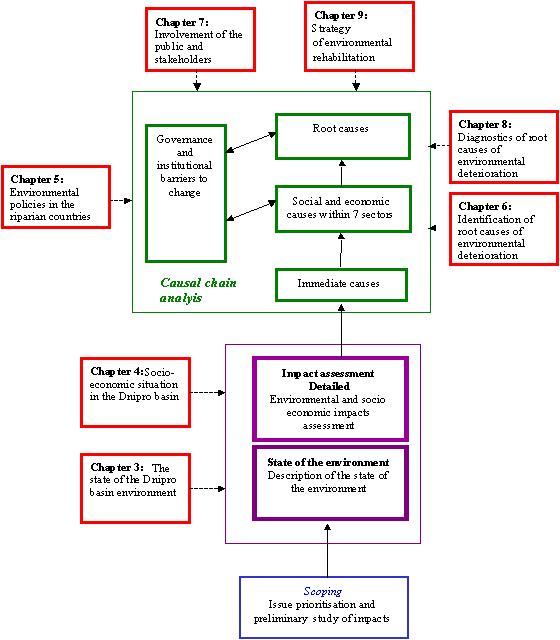
Figure 1.1 Layout of the 2002 TDA showing links with the chapters produced by the TDA authors/expert groups set up in the RTC’s
Table 1.1 TDA chapters produced by the country experts
|
2. The TDA Methodology 2.1 The GIWA methodology for preparation of the TDA and Strategic Action Plan (SAP) - Brief description of the GIWA methodology; - Approaches to identification of immediate and root causes of deteriorated environmental situation in the Basin. |
6. Cause-effect analysis of existing transboundary and national environmental issues in the Dnipro Basin (using the GIWA methodology) 6.1 Analysis of efficiency of natural resource uses; unsustainable management of natural resources - Water budget for the Dnipro Basin. Water resource availability by country - Mitigation of adverse effects of water-related issues 6.2 Pollution monitoring. Review of its efficiency 6.3 Identification of hot spots and analysis of their potential transboundary impact 6.4 Environmental effects of the Chernobyl nuclear accident 6.5 Transboundary pollution flows (flow diagrams, schemes etc.) 6.6 Impact of anthropogenic pollution and human activities on biodiversity of the Dnipro Basin 6.7 Social and environmental effects of anthropogenic pollution: deteriorated human health and degraded natural ecosystems in the Basin - Identification of ecologically sensitive areas (ecosystems) within the Basin |
|
|
3. Environmental Situation in the Dnipro Basin 3.1 Global trends in the environmental situation in the Basin (on the basis of the UNEP data) 3.2 Characterisation of environmental situation in the Dnipro Basin on the basis of data provided by the Regional Thematic Centres (RTC) 3.3 Assessment of the state of environment in the Basin using techniques adopted in the riparian countries and the GIWA methodology 3.4 Review of the 2000-2001 field survey results. Assessment of impact of transboundary pollution flows on the Basin environment (local and global effect). 3.5 Projection of future trends in the environmental situation in the Dnipro Basin and potential transboundary pollution loads (using historic data over the period of 1985-1991 and 1991-2001) 3.6 Identification and scaling of issues caused by deteriorated environmental situation and impeding nature uses in the Basin |
||
|
7. Attitude of the public and other stakeholders of the Dnipro Basin 7.1 Environment protection and nature resource management priorities in the Basin 7.2 Root causes of deteriorated environmental situation in the Basin 7.3 Remedial actions to be taken to improve the situation in the Basin |
||
|
4. Review of the socio-economic situation in the Dnipro Basin 4.1 Socio-demographic and natural resource potential of the region 4.2 Analysis of the state of production assets in the Dnipro Basin. 4.3 Social development and living standards in the Dnipro Basin - Sanitary situation and water-borne diseases 4.4 Projected development scenarios and distribution of production capacities in the Dnipro Basin - Projected trends in the natural resource uses in the Basin. 4.5 Issues of socio-economic development in the context of regional policies of riparian countries 4.6 Legal, regulatory and environmental economic mechanisms of environmental policy development in the Basin countries 4.7 Overall social, legal and institutional context and its implications for the environmental policies |
||
|
8. Diagnostic study of the root causes of deteriorated environmental situation in the Basin Synthesis of Chapters 4-7 |
||
|
9. Strategy for the environmental rehabilitation of the Dnipro Basin 9.1 The TDA as an integral part of the SAP 9.2 Environmental rehabilitation strategy: key development areas 9.3 Priority setting: - Political solutions, - Cost-benefit analysis, - Socio-economic analysis, - Public/stakeholder involvement, - Business development opportunities 9.4 Classification and prioritisation of issues on the basis of identified priorities; search for potential options to address them (cost-benefit analysis). 9.5 Scenario development and strategy selection 9.6 Enhancement of monitoring and control of implementation of the preferred strategy 9.7 Identification of potential funding sources: - national budgets; and - evaluation of incremental costs. |
||
|
5. Review of the national environmental policies. Similarity and differences of legislative and regulatory framework of nature use management 5.1 Analysis of options for environmental policy (and legislative/regulatory framework) development in the Republic of Belarus, the Russian Federation and Ukraine 5.2 Similarity and differences in the identified environmental policy priorities of the riparian countries. Comparative review of existing national standards and regulations (maximum admissible limits) 5.3 Public awareness raising and involvement in the decision-making process |