CASPIAN ENVIRONMENT PROGRAMME
INSTITUTIONAL ARRANGEMENTS
(INTERIM)
(Extraordinary Steering Committee Meeting: March 12, 2003)
TABLE OF CONTENTS
I. Programme Structure 3
Regional Governance 5
National Governance 6
Regional Advisory Groups 6
Funding Arrangement and Responsibilities 7
II. Communications modalities 9
III. Inclusion of new projects under CEP Umbrella 10
IV. International Partner Coordination 11
Annex 1 Terms of Reference 12
1.1 Steering Committee 12
1.2 Programme Coordination Unit 13
1.3 National Focal Points 14
1.4 National Coordination Structures 15
1.5 Regional Advisory Groups 16
1.6 Programme Coordinator 17
Annex 2 Rules of Procedure for Steering Committee 18
Annex 3 Draft Application for Decision on formal status of
new projects under CEP umbrella 22
1. The Caspian Environment Programme (CEP) has participation on regional, national, and international levels. The CEP organization has as its basis several overarching documents, including:
The Concept Paper (approved May 1998 in Ramsar)
The Project Brief (approved May 1998 in Ramsar)
2. The CEP is a programme for and from the five Caspian Littoral States, Azerbaijan, Iran, Kazakhstan, Russia and Turkmenistan aiming to halt the deterioration of environmental conditions of the Caspian Sea and to promote sustainable development in the area. This intergovernmental process is currently being supported by CEP’s International Partners, Global Environmental Facility (GEF), UNDP, World Bank, UNEP and European Union, other international organizations and the private sector, in particular the oil and gas sector. In the first four years, CEP has developed and adopted a Strategic Action Programme (SAP) for the protection and rehabilitation of the Caspian environment in four priority regional environmental concern areas and assisted the littoral states to develop National Caspian Action Plans (NCAPs).
3. Within the context of the CEP and the implementation framework provided by its various programmes and projects the main responsibilities of the five Caspian littoral states will include the following:
to contribute to the overall strategic policy and management direction to the CEP through their representation in the Steering Committee;
to provide technical and management advice to the CEP through their representation on the Advisory Groups;
to provide national policy guidance for the CEP through their National Coordination Structures (NCS) and Inter-sectoral Coordination Groups (ICG);
to ensure that policy guidance from the Steering Committee is reflected in national CEP-related policies and programme activities, as appropriate; and
to contribute and commit, financially and in kind, to implementation of the National Caspian Action Plans and the Strategic Action Programme.
4. During its first four years (July 1998 to October 2002) the CEP has established and prepared the following:
A management structure, including a Programme Coordination Unit (PCU) and ten Caspian Regional Thematic Centres
Transboundary Diagnostic Analysis (TDA)
National Caspian Action Plans (NCAPs)
Strategic Action Programme (SAP)
Biodiversity Strategy and Action Plan (BSAP)
Priority Investment Portfolio Project (PIPP)
Draft text of the Framework Convention for the Protection of the Marine Environment of the Caspian Sea
Regional Cooperation Plan for Oil Spill Preparedness
CEP will concentrate efforts in the longer term on the implementation of the adopted NCAPs and SAP and further support to the Framework Convention Process. Implementation of the SAP will be supported by the CEP with the assistance of the International Partners at both the national and regional levels. During SAP implementation it is anticipated that other international agencies will apply (see section III) to have their projects included under the CEP umbrella and in so doing become full international partners.
5. The CEP Institutional Arrangements will need to be modified in the future, in particular upon final determination of the legal status of the Caspian Sea and subsequent ratification of regional agreements between the five littoral states.
6. The overall programme structure is shown as Figure 1. The overall governance is provided by the Steering Committee. The National Focal Point and the National Coordination Structure (NCS) provide coordination at the national level. Overall CEP implementation is under the guidance of the Programme Coordination Unit, led by the Programme Coordinator.
7. Each of these elements is discussed below and Terms of Reference (ToR) are provided in Annex 1.
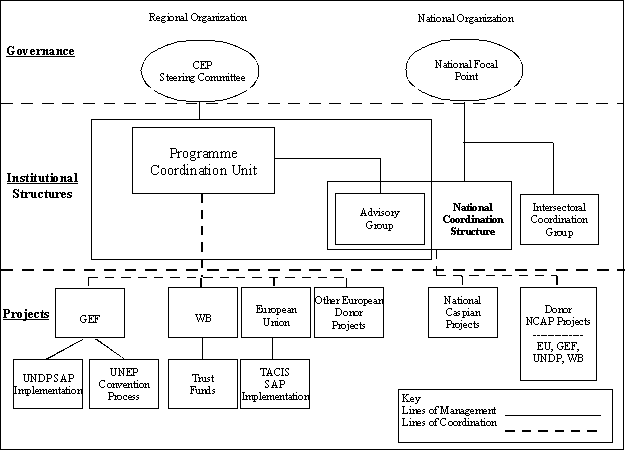
FIGURE 1
Structure of the Caspian Environment Programme
Regional Governance
Steering Committee:
8. The Steering Committee (Committee) comprises one senior representative from each Caspian littoral state and one representative from the present four International Partners, UNDP, UNEP, World Bank, and European Union. Project Managers of projects operating under the CEP umbrella may attend meetings as observers, subject to the discretion of the Steering Committee Chairman. Other interested parties may be invited as observers at the Steering Committee's discretion.
9. The Steering Committee is the principal policy-making body of the CEP. The Committee will provide direction to the Programme Coordination Unit (PCU) on issues pertaining to the regional governance of the CEP, and, when appropriate, to the National Coordination Structures on issues pertaining to the national governance.
10. The Steering Committee’s approved Rules of Procedure (Baku in June 1999) are included in Annex 2.
11. Funding of Ordinary Steering Committee meetings will be shared between the countries and International Partners. The country chairing the Steering Committee will be expected to host and bear the costs of the Steering Committee meeting in its year of office whilst the other countries and International Partners shall bear the costs of attendance at the meeting by their representatives. Attendance of observers will be at their own cost.
12. The ToR for the Steering Committee are provided in Annex 1.1.
Programme Coordination Unit:
13. In accordance with the recommendations of the CEP Institutional Arrangements meeting in Tehran July 2002, the PCU has been transferred from its first location Baku, Azerbaijan, to Tehran, Islamic Republic of Iran, at the end of December 2002, reconfirming the decision made in Ramsar in 1998. The PCU will remain in Tehran until December 2006, in accordance with the decision taken at the 2002 Tehran institutional arrangement meeting. The decision whether the PCU location is to be permanent after December 2006 or will rotate around the littoral states, moving every four years, is deferred until December 2003, one year after re-location to Tehran.
14. The PCU will carry out the day-to-day coordination of the regional components of the CEP and implementation of the SAP, and will act as the Secretariat for the Steering Committee. The initial PCU structure will consist of a Programme Coordinator, an Assistant and the necessary support staff. The Programme Coordinator and Assistant will be selected from applicants proposed by the littoral states.
15. The Programme Coordinator and Assistant will be selected by the Steering Committee by simple majority. Nominations for the two posts will be accepted from any littoral state. The salary and living expenses of the selected Programme Coordinator and Assistant shall be borne by the nominating littoral state.
16. Project Managers of umbrella projects will be subject to coordination of the Programme Coordinator, and, where project staff is located within the PCU, the Programme Coordinator’s management authority with regard to office administration matters.
17. Each individual Project Manager of an umbrella project will be responsible to the Steering Committee members, as per project application (see section III) and the stated project beneficiary, for his/her project activities.
18. The Host Country will provide appropriate furnished accommodation, for the PCU and the necessary support staff.
19. The ToR for the PCU are provided in Annex 1.2.
20. The ToR for the Programme Coordinator are provided in Annex 1.6.
National Governance
The National Focal Points:
21. The National Focal Point is the main contact in each Country for the CEP. The NFP is either a Minister or the Minister's authorized representative and will sit on all meetings of the Steering Committee. The NFPs will hold an existing national governmental post.
22. The NFP directs and manages the activities of the National Coordination Structure and assures full inter-sectoral participation in CEP nationally, including ministries, academia, NGOs, private sector and other pertinent stakeholders. It is recommended to establish a national Inter-sectoral Coordination Group (ICG), chaired by the NFP, to ensure full partnership and involvement of the other pertinent national stakeholders.
23. Terms of Reference for the NFP are provided in Annex 1.3.
National Coordination Structures:
24. The National Coordination Structure (NCS) in each country is responsible for coordination of NCAP implementation, national SAP implementation and provision of national input into the regional programme.
25. The NCS is a permanent body directed and managed by the National Focal Point, which will maintain close contact with the PCU and be aware of all PCU activities.
26. The ToR for the NCS are provided as Annex 1.4.
The Regional Advisory Groups
27. The five Regional Advisory Groups (RAG), established to replace the Caspian Regional Thematic Centres that were operational during the first four years of CEP are as follows:
- Advisory Group on Biodiversity and Invasive Species
- Advisory Group on Fisheries
- Advisory Group on Emergency Response
- Advisory Group on Pollution
- Advisory Group on Sustainable Coastal Development
Each littoral state will chair and host one of the Advisory Groups.
28. The Regional Advisory Groups purpose is to assist CEP PCU in concert with the PCU to coordinate its activities in the priority regional environmental concern areas. The Regional Advisory Groups will oversee implementation of the SAP in their specific concern area and, where required, develop specific implementation plans. Through the Regional Advisory Groups the littoral states will contribute to the overall regional coordination of the CEP.
29. The Regional Advisory Groups will operate on the basis of working parties, involving the participation of all littoral states, PCU representation, and, when necessary, outside experts. Each littoral state, through the NFP, will appoint a technical expert from the appropriate authority to sit on each Regional Advisory Group and act as the country focal point, reporting to the NCS and NFP.
30. The Regional Advisory Groups will meet at least twice a year. The host littoral state will bear the costs of convening the Advisory Groups meetings. The other littoral states and PCU shall pay the costs of their representatives’ attendance at the meeting.
31. The National Coordinating Structure of the host country shall act as the Secretariat to the Regional Advisory Group and shall prepare meeting minutes and an annual report on the activities of the Group to be submitted to the host country’s National Focal Point and the PCU. The Steering Committee will be informed regarding the activities of the Regional Advisory Groups through the PCU. The PCU will assist in assuring relevant communication and data exchanges across the Regional Advisory Groups.
32. Terms of Reference for the Regional Advisory Groups are provided in Annex 1.5.
34. Within these regulations and conditions, the Steering Committee will have the ability to pass comment on project work plans through an annual review. Subsequently, it will be the responsibility of the Project Managers of umbrella projects (in coordination with the CEP Programme Coordinator and in consultation with the NFPs through the National Coordination Structures) to revise the work plans where appropriate.
35. The littoral states contribution to CEP shall include:
Mobilize sufficient resources to implement all national activities and support all regional actions, specified in CEP National Action Plans and Strategic Action Programme in accordance with programme dates.
Provide all umbrella projects with appropriate work space.
Provide the NCS and its staff with the necessary financial support to execute its Terms of Reference; this includes adequate office space, utilities, meeting expenses and administrative support.
Provide access to all data and information required for implementation of the CEP, in accordance with the rules and procedures of the littoral state.
Each country shall, as the incumbent Chair of the Steering Committee, host and support the Steering Committee meeting and Regional Advisory Groups meetings, providing venue, logistical support and translation.
Provide support for their representatives to attend the Steering Committee meetings and the meetings of the Regional Advisory Groups.
II. COMMUNICATIONS MODALITIES
The Programme Coordinator, as Secretary to the CEP, will help maintain clear channels of communication. The Secretary will be responsible for:
preparation of materials for Steering Committee meetings;
assisting the Chairman of the Steering Committee in providing inter-sessional updates;
assuring that all parties have the latest versions of the SAP and NCAP reports and CEP implementation progress report and other pertinent documents;
distribution of all major reports from the umbrella project to all parties, for review and comment;
Communication exchange between the RAGs and distribution of RAG minutes and reports to the members of the Steering Committee;
All correspondence between the NFPs and PCU, should be copied to all Steering Committee Members and the NCSs.
III. INCLUSION OF NEW PROJECTS UNDER CEP UMBRELLA
PROCEDURES FOR DETERMINING THE STATUS OF ASSOCIATED PROJECTS
WITHIN THE CASPIAN ENVIRONMENT PROGRAMME
Preamble: The Caspian Environment Programme (CEP) is a body of the five Caspian Littoral States, which formally came into being at the 1998 Ramsar Steering Committee Meeting. In its inception, the CEP was assisted by umbrella project implemented by the four CEP International Partners, European Union, UNDP, UNEP and the World Bank.
It is desirable to attract other international partners to place their projects under the CEP umbrella. The advantages to the CEP include bringing more resources to address the goals of the CEP; minimization of overlap and duplication of project activities; broader Programme participation; involvement of CEP at the project design phase, thereby ensuring better targeting of resources.
Advantages to the new projects of being under the CEP umbrella include resources of the CEP will be made available to the umbrella project; the PCU may be able to help guide the project, and provide resources to assist; formal acceptance under the CEP umbrella will ease the process of obtaining official government approval of the project; duplication and overlap can be minimized; certain governmental activities (licenses, permits, etc.) may be obtained more easily.
In this context, two types of projects will likely be conducted, namely those under the CEP umbrella; those outside the CEP umbrella, but still encouraged to coordinate/communicate with the CEP through the PCU.
This second category may exist for several reasons, i.e. short duration of the Project; limited congruence with the goals and objectives of the CEP.
Full Status: Full status will be approved to those projects whose goals coincide strongly with those of the CEP, and which would benefit close collaboration and cooperation with the CEP. The project would be expected to interact closely with the PCU in matters of coordination, communication, and conduct of the work. Such projects may even have Staff located within the PCU. Their Work Plans should be subject to review by the Steering Committee.
Associated Status: Associated status may be given to projects whose goals only partially coincide with those of the CEP. The benefit to CEP of association is the maintenance of close communication and awareness of the goals and products of the project. The benefit to the project is that it enables the project to benefit from the coordination capacity and products of the CEP, such as contact lists, reports and meeting notes and attend and participate in relevant technical meetings.
Procedure for applying for Status under the CEP: The Form, included in Annex 3 should be filled out by any Project applying for Umbrella or Associated status under the Caspian Environment Programme to be submitted to the PCU, and distributed to the Steering Committee and Regional Advisory Groups for comment. The final decision on acceptance will be made Steering Committee following advice by the PCU. Communication with the applicants will be through the Chairman of the Steering Committee.
IV. INTERNATIONAL PARTNER COORDINATION
The International Partners in supporting the Caspian Environment Programme acknowledge the guidelines provided in the Concept Paper, as approved at Ramsar in 1998, whilst complying with the specific project development and intervention goals set down by their implementing bodies. As a result of this commitment, the International Partners, will seek to develop their projects in close collaboration and, if possible, in parallel with each other, in order to ensure that both overall CEP and specific project goals are met with minimum overlap and maximum targeting.
In this regard, the International Partners agree to:
With the assistance of the Programme Coordinator, develop an integrated implementation plan and programme, to be shared with the Steering Committee.
Hold the following schedule of meetings:
- Task managers, once a year, chaired by Programme Coordinator, with meeting notes sent to Steering Committee;
Project managers, three times a year, chaired by Programme Coordinator, meeting notes sent to Steering Committee;
Submit all public reports in draft form to the Programme Coordinator for review and comment before finalization; this does not include reports intended for internal distribution within the International Partner organizations.
Submit all final public reports to all International Partners and Steering Committee in electronic and paper form for review and comment.
Annex 1.1 Terms of Reference
Caspian Environment Programme
Background: The CEP Steering Committee will direct the activities of the CEP. The CEP Steering Committee will also act as the Steering Committee for the GEF/UNDP and the EU/TACIS projects and any other projects that are incorporated under the CEP umbrella (at which time additional donors to the CEP may designate a Steering Committee member from their agency, upon agreement of Steering Committee). The CEP Steering Committee will make decisions based on the consensus principle.
Membership: Initial Steering Committee membership will include a representative from each of the five littoral countries as well as one each from UNDP, EU/TACIS, UNEP, and The World Bank.
Tasks:
Provide management direction to the Programme;
Assist in identifying and allocating Programme support for activities consistent with
Programme objectives;
Annually review and assess the progress of the Programme and its projects;
Annually review and approve the work plan and comment on the budgets of the Programme and its projects, and provide overall direction on the work plan implementation;
Provide guidance to the PCU in coordinating and managing the Programme and its projects,
and review and provide guidance on Regional Advisory Groups recommendations;
Create mechanisms for interaction with the Private Sector, including a Trust Fund;
Coordinate activities of International Partners projects, ensuring maximum targeting of the NCAPs and SAP;
With the assistance of National Coordinating Structures, review the implementation of the NCAPs and SAP.
Caspian Environment Programme
Background: The PCU will provide a coordination and management structure for implementation of the Caspian Environment Program in accordance with the rules and procedures and directions provided by the Steering Committee.
Tasks:
Assist in networking between National Focal Points and National Coordination Structures in all five coastal countries (Azerbaijan, Iran, Kazakhstan, Russian Federation, Turkmenistan) and act as a Secretariat to the CEP Steering Committee;
Coordinate the activities of the International Partner projects ensuring maximum targeting of the NCAPs and SAP;
Cooperate and liaise with RAGs;
With the assistance of the National Coordinating Structures, prepare the reports on implementation of the NCAPs and SAP on a regular basis for the Steering Committee;
Assistance in capacity building within and among littoral countries;
Prepare progress reports (administrative and financial) concerning programme activities;
Maintain the CEP web-site and Caspian information system;
Disseminate information on policy, economic, environmental, scientific and technical issues related to the programme;
Coordinate international, multi-lateral and bi-lateral environmental activities in the Caspian, where appropriate; and
Assist in resource mobilization for the NCAPs and SAP.
Annex 1.3 Terms of Reference
Caspian Environment Programme
National Focal Point
Background: National Focal Point is the main contact point for the Caspian Environment Programme in the littoral state. The NFP is a member of the Steering Committee, and represents his/her country’s interests in the governance of the CEP. The National Focal Point is tasked with coordinating national activities on the Caspian within CEP, as well as coordinating and being responsible for his/her country’s participation in the CEP. The National Focal Point oversees the office and functions of National Coordination Structure. The NFP must hold an existing national governmental post.
Tasks:
Member of the Steering Committee representing his/her country;
Performs Intersectoral Coordination with his/her country, including ministries, private sector, NGOs, and other stakeholders;
Directs and manages the National Coordination Structure;
Nominates Advisory Group staff;
Nominates Chairperson of RAG hosted by his/her country;
Assures participation of national representatives at the Steering Committee meeting and Regional Advisory Group meetings.
Annex 1.4 Terms Of Reference
Caspian Environment Programme
National Coordination Structure
Tasks:
Promote and coordinate NCAP implementation;
Assist in resource mobilization for the NCAP;
Report annually on NCAP implementation and national SAP implementation against programme timelines and submit report to the Steering Committee and PCU;
Review and comment on CEP documents prepared by PCU, Advisory Groups and National Focal Points;
Act as the secretariat to the nationally hosted RAG and monitor and report on its activities to the PCU;
Assist in coordination of all national inputs into umbrella projects;
Assist with practical arrangements for international and regional cooperation (e.g. meeting arrangements, logistics, visa applications, etc.);
Assist in identifying national institutions and experts to undertake different thematic tasks with the umbrella projects and coordinate the different themes at the national level.
Caspian Environment Programme
Background: The Advisory Groups’ purpose is to provide the PCU with the best possible advice and information on topics key to the implementation of the SAP. They will operate on the basis of working parties involving participation of all littoral states and the PCU, together with outside experts when considered necessary. The involvement of NGOs is encouraged. The Advisory Groups will meet at least twice a year and the country NCSs (see Annex 1.4) will act as the Secretariats.
Tasks:
With the assistance of the PCU and the International Partner support projects, develop where necessary specific implementation plans to operationalise the relevant section of the SAP;
Work closely with the PCU to ensure regional coordination within the area of competency;
When and where appropriate, make recommendations to the Steering Committee, on guidance and strategy within area of competency;
Assist in further development and revision of the TDA and SAP;
Make recommendations for training within area of competency;
Liaison closely with National Coordination Structures and PCU;
Cooperate with other Regional Advisory Groups.
Annex 1.6 Terms of Reference
Caspian Environment Programme
Programme Coordinator
General Job Description: The Programme Coordinator shall be responsible in general for the overall coordination of all aspects of the Caspian Environmental Programme (CEP) and implementation of the SAP in particular. He/she shall liaise directly with the National Focal Points and the representatives of International Partners and other donors in order to coordinate the annual implementation plan for the programme (SAP, and NCAPs).
The implementation plan will provide day-to-day guidance on implementation of the programme and on the integration of the various donors funded initiatives. He/she shall be responsible for all CEP substantive managerial and financial reports. He/she will provide overall administrative supervision of the Programme Coordination Unit, as well as guiding and supervising all external policy relations. He/she will be active in promoting the CEP and mobilizing funds from other donors and the private sector to assist with SAP implementation.
Tasks:
Prepare an annual implementation plan for CEP on the basis of the SAP, NCAPs and support projects, in close consultation and coordination with the National Focal Points, International Partners and relevant donors. The plan will provide day-to-day implementation guidance on the programme and assist with integration of donor funded initiatives;
Cooperate closely with NCS and RAGs;
Coordinate and monitor the implementation of the SAP and, with the assistance of NFPs, RAGs and the NCSs- NCAPs;
Ensure consistency between the various programme elements and related support project activities;
Oversee preparation of the regional technical documents, such as protocols to the Framework Convention, relating to environmental governance of the Caspian; and
Foster and establish links with other related Caspian programmes and, where appropriate, with other Regional Seas programmes.
CASPIAN ENVIRONMENT PROGRAMME
STEERING COMMITTEE
RULES OF PROCEDURE
(ADOPTED AT 1999 BAKU STEERING COMMITTEE MEETING)
For the purposes of these Rules:
a) “Steering Committee” means the Steering Committee of the Caspian Environment
Programme;
b) “Programme Coordination Unit” means the Programme Coordination Unit of the
Caspian Environment Programme;
c) “Chairperson” means the Chairperson nominated in accordance with Rule 6;
d) “Meeting” means any meeting of the Steering Committee;
e) “Caspian littoral States” means Azerbaijan, Islamic Republic of Iran, Kazakhstan,
Russian Federation and Turkmenistan.
Rule 2. Composition
1. The Steering Committee shall be composed of representatives of the Caspian littoral states and of the United Nations Development Programme, United Nations Environment Programme, The World Bank, and European Union TACIS.
2. The Steering Committee may decide that other organizations become Members of the Steering Committee.
Rule 3. Meetings
1. The Steering Committee holds an ordinary meeting at least once a year, upon convocation by the Chairperson. At each ordinary meeting, the Steering Committee shall decide upon dates and venues of the next ordinary meeting.
2. An extraordinary meeting may be convened at any time at the request by any Member of the Steering Committee submitted to the Secretariat, subject to concurrence of the majority of the Steering Committee. The requests for an extraordinary meeting shall be circulated by the Secretariat to all Members with a deadline for reply. The requesting member shall be informed by the Secretariat about the replies it receives.
3. The ordinary meetings shall be held in each Caspian littoral State in turn in alphabetic order of the Caspian Littoral States in the English language. The venue for extraordinary meeting should be defined by the Chairman of Steering Committee in consultations with Secretariat.
4. The meetings shall be held in private unless the Steering Committee decides otherwise.
Rule 4. Agenda
1. The Secretariat shall in consultation with the Chairperson prepare the provisional agenda for each meeting.
2. The provisional agenda for each ordinary meeting shall include:
a) items the inclusion of which was decided at a previous meeting;
b) items proposed by any member;
c) items proposed by the Chairperson.
3. The provisional agenda for an extraordinary meeting shall consist only of those items proposed for consideration in the request for the holding of the extraordinary meeting.
4. The provisional agenda together with supporting documents shall be circulated in all working languages by the Secretariat to the members at least four weeks before the opening of the meeting.
Rule 5. Representation
The Caspian littoral states shall be normally represented at ministerial level or by senior officials designated by their respective governments.
Rule 6. Chairmanship
1. The chairmanship of the Steering Committee shall be given to each Caspian littoral State, in turn, in alphabetical order, of the Caspian littoral States, in the English language.
2. The Caspian littoral State chairing the Steering Committee shall nominate the Chairperson and a Vice-Chairperson. If the Chairperson finds it necessary to be absent during any meeting or any part thereof and/or is unable to perform his/her functions, the Vice-Chairperson shall take his/her place.
3. The Chairperson shall serve for a period of one year.
4. In addition to exercising the powers and duties conferred upon him/her elsewhere in these rules the powers and duties of the Chairperson shall be:
a) to convene the ordinary and extraordinary meetings;
b) to declare the opening and closing of each meeting;
c) to preside at all meetings;
d) to ensure observance of these Rules and to decide all questions of order raised at
the meetings;
e) to make such decisions and to give such directions to the Secretariat as will ensure,
especially in the interval between the meetings, that the business of the Steering Committee is carried out efficiently and in accordance with its decisions;
f) to hold responsibility for public awareness, particularly through mass media, in consultations with Secretariat and in accordance with Steering Committee policy.
Rule 7. Secretariat
1. The Programme Coordination Unit shall serve as the Secretariat of the Steering Committee.
2. In addition to exercising the powers and duties conferred upon it elsewhere by the Rules, the Secretariat shall:
a) issue the invitations to the meetings;
b) prepare the provisional agenda for the meetings in accordance with Rule 4;
c) make all necessary arrangements, including secretarial assistance, for the meetings of
the Steering Committee and its subsidiary bodies;
d) prepare reports of the meetings; and
e) perform such other functions and tasks entrusted to it by the Steering Committee.
Rule 8. Conduct of business
1. A majority of the members shall constitute quorum.
2. Proposals shall normally be introduced in writing and submitted to the Secretariat, which shall circulate them to the members.
3. The decisions of any meeting shall be taken by consensus.
4. Between meetings, any proposal for a decision falling within the competence of the Steering Committee shall be circulated in writing by the Secretariat to all members with a specified deadline for reply.
5. A written decision shall be taken by consensus subject that all members reply.
Rule 9. Subsidiary bodies
1. The Steering Committee may establish any subsidiary body if it deems it necessary.
2. The Rules of Procedure of any such Subsidiary body shall be, mutatis mutandis, those of the Steering Committee.
Rule 10. Languages
The working languages of the Steering Committee shall be English and Russian.
Rule 11. Participation of Observers
1. The Steering Committee may invite observers to participate in its meetings.
2. The observers may participate, without the right to participate in decision-making, in the deliberations of the Steering Committee and its subsidiary bodies, if any, upon the invitation of the Chairperson, as the case may be, on question within their competence or scope of activities.
3. Observers may, upon invitation of the Chairperson, submit written statements that shall be circulated by the Secretariat to the members of the Steering Committee or of the subsidiary body concerned.
Rule 12. Amendments and Suspension
Any of these rules may be amended or suspended by the Steering Committee in accordance with Rule 8.
FORMAL STATUS OF NEW PROJECT
UNDER THE UMBRELLA OF THE
CASPIAN ENVIRONMENT PROGRAM
STATUS DESIRED: UMBRELLA STATUS_________
ASSOCIATE STATUS_________
DATE OF APPLICATION: _______________________
APPLICANT: __________________________________
CONTACT INFORMATION FOR APPLICANT (ADDRESS, PHONE, FAX, EMAIL, ETC.): ____________________________________________________________________
______________________________________________________________________________________________________________________________________________________
FULL PROJECT TITLE: _____________________________________________________
SOURCE OF FUNDS: _______________________________________________________
LEVEL OF FUNDING: ______________________________________________________
PROJECT DESCRIPTION: ATTACH ONE-PAGE DESCRIPTION
PROJECT START DATE: __________________________
PROJECT DURATION: __________________________
MODALITY OF INTERACTION WITH THE CEP:
STEERING COMMITTEE: _____________________________________________
PROGRAMME COORDINATION UNIT: _________________________________
REGIONAL ADVISORY GROUPS: ______________________________________
___________________________________________________________________________
___________________________________________________________________________
REGIONAL EXPERTS_________________________________________________
______________________________________________________________________________________________________________________________________________________PAGE 1 OF 2
REQUIREMENTS FOR ASSISTANCE FROM THE CEP (PCU, PERMITS, LICENSES, CUSTOMS, ETC.): __________________________________________________________
___________________________________________________________________________
___________________________________________________________________________
___________________________________________________________________________
___________________________________________________________________________
Please send this Application to the Programme Coordination Unit:
Programme Coordinator
Email: caspian@caspian.in-baku.com