strategic action program for the
binational basin of the bermejo river
Binational Commission for the Development of the Upper
strategic action program for the binational basin of the bermejo river
Bermejo River and Grande de Tarija River Basins
www.cbbermejo.org.ar
Global Environment Facility
www.gefweb.org
United Nations Environment Program
www.unep.org
Organization of the American States
www.oas.org
Binational Commission for the Development of the Upper
Bermejo and Grande de Tarija River Basins
www.cbbermejo.org.ar
Global Environment Facility
www.gefweb.org
United Nations Environment Programme
www.unep.org
Organization of American States
www.oas.org
STRATEGIC ACTION PROGRAM
for the BINATIONAL BASIN of the BERMEJO RIVER
#
INDEX
PART I FRAMEWORK, DIAGNOSIS AND JUSTIFICATION OF THE PROJECT
1.
INTRODUCTION
1.1.
The project for preparation of the SAP
1.2.
Geographic location and political division
1.3.
Institutional framework for the preparatory stage of the SAP project
1.3.1.
The Binational Commission
1.3.2.
Governmental agencies
1.3.3.
Nongovernmental organizations
1.4.
Activities and work conducted during preparation of the SAP
2.
TRANSBOUNDARY DIAGNOSIS, IDENTIFICATION OF PRIORITY AREAS FOR STRATEGIC ACTION
2.1.
Social-geographic vision of the basin
2.2.
The principal transboundary problems
2.3.
Principal basic causes
2.4.
Forecasting scenarios with and without the SAP
PART II THE STRATEGIC ACTION PROGRAM
3.
OBJECTIVES OF THE SAP
3.1.
General objective of the SAP
3.2.
Specific objectives
4.
POLICY FRAMEWORK
5.
THE STRATEGIC ACTION FRAMEWORK AND PRIORITY ACTIONS OF THE PROGRAM
5.1.
The strategic action framework
5.1.1.
Institutional development and strengthening for integrated planning and management of the basin
5.1.2.
Environmental prevention, protection and rehabilitation
5.1.3.
Sustainable development of natural resources
5.1.4.
Public awareness and participation
5.2.
Strategic actions
5.3.
Criteria adopted for prioritizing projects
5.4.
Priority actions included in the SAP
5.4.1.
Projects contained in the SAP
5.4.2.
Core group of priority activities
PART IIIIMPLEMENTATION PLAN
6.
INSTITUTIONAL AND ORGANIZATIONAL COMMITMENT
6.1.
Preliminary considerations on institutional issues
6.2.
The institutional stakeholders
6.3.
The organizational framework of the SAP
6.3.1.
Backgound
6.3.2.
Organizational framework
7.
PUBLIC PARTICIPATION
8.
FINANCING
9.
RISKS AND SUSTAINABILITY
10.
MONITORING, EVALUATION AND DISSEMINATION
FIGURE INDEX
Figure 1
Localization of the Bermejo River Basin
Figure 2
Bermejo River Basin. Political and Administrative division
Figure 3
Bermejo River Basin. Drainage network.
Figure 4
4.
Priority Actions. Location and Scope
TABLE INDEX
Table 1.1
Bermejo River Basin Government Institutional Framework for the preparatory stage of the
Project
Table 1.2
Government agencies responsible for managing water and other natural resources in the
Bermejo river basin (Annex I)
Table 1.3
Nongovernmental organizations undertaking activities in the Bermejo river basin (Annex I)
Table 2.1
Principal problems. Transboundary manifestations and quantification of the Problem
Table 2.2
Priority environmental problems, effects and symptoms, causes and strategic actions
Table 5.1
Strategic Actions
Table 5.2
Summary of the Strategic Framework and Priority Actions of the SAP
Table 5.3
Principal Strategic Areas and Activities. Total Investment Budget in US$000
Table 5.4
Multiple Purpose Project for the Upper Rio Bermejo Basin
Table 5.5
Strategic areas, specific activities and projects that make up the block of immediate actions
Table 6.1
Official institutions of Argentina and Bolivia to be involved in sap strategic actions (Annex V).
Table 6.2
Nongovernmental organizations that could carry out SAP actions (Annex V).
Table 6.3
Principal organizations of industries and water resource users in the Bermejo river basin that
could participate in executing the SAP (Annex V)
Table 7.1
Indicators of public participation during formulation of the SAP (Annex V)
ANNEX INDEX
ANNEX I
Government agencies responsible for managing water and other natural resources in the
Bermejo river basin
Nongovernmental organizations undertaking activities in the Bermejo river basin
Summarized list of institutions that have participated either directly or indirectly in the formula-
tion of the SAP
ANNEX II
List of documents drawn up during formulation of the SAP
Policy framework for executing SAP actions
ANNEX III
Plans and programs being executed: Investments in the Bermejo river basin
ANNEX IV
Priority actions, location and scope
ANNEX V
Official institutions of Argentina and Bolivia to be involved in SAP strategic actions
Nongovernmental organizations that could carry out SAP actions
Principal organizations of industries and water resource users in the Bermejo river basin that could
participate in executing the SAP
Indicators of public participation during formulation of the SAP
ANNEX VI
Multi purpose development project: Las Pavas, Arrazayal y Cambari
PART
I.
FRAMEWORK,
DIAGNOSIS
AND
the department of Tarija, and in northern Argentina,
JUSTIFICATION OF THE PROJECT
where it embraces portions of the provinces of Chaco,
Formosa, Jujuy and Salta. Figure 1 shows location of
1.
INTRODUCTION
the basin within the South American continent, and
figure 2 outlines its political and administrative
1.1
The project for preparation of the SAP
divisions.
The project for a «Strategic Action Program for Binational
1.3.Institutional framework for the preparatory
Basin of the Rio Bermejo»1 is the result of technical and
stage of the SAP project
financial assistance provided in October 1996 by the
Council of the Global Environmental Facility (GEF) to
The binational nature of the basin and the federal
the governments of Argentina and Bolivia. This grant of
structure of government organization in Argentina
US$2,990,000 was supplemented with additional
give the Rio Bermejo basin an inter-jurisdictional
financing from the United Nations Environment
character that makes for a highly complex institutional
Program (UNEP) of US$150,000 and from the
setting for the project. The following levels of
Organization of American States (OAS) of US$75,000.
government are involved:
The governments of Bolivia and Argentina together
provided counterpart funding amounting to a total of
·Binational:
US$2,510,000. Preparation of the SAP was a joint
-Comisión
Binacional
para
el
Desarrollo
effort by the governments of Argentina and Bolivia,
Sustentabledela AltaCuenca del Río Bermejo y Grande
working through the Binational Commission for
de Tarija (the "Binational Commission")
Development of the Upper Basin of the Rio Bermejo
and the Rio Grande de Tarija. The work was carried out
·Regional:
in both countries, beginning in August 1997 and
-Argentina: Comisión Regional del Río Bermejo2
concluding in December 1999. The executing agency
-Bolivia: Comisión Nacional de los Ríos Pilcomayo y
has been the OAS, which is responsible for
Bermejo
administering the funds provided to the project by the
GEF through UNEP.
·Provincial level:
-Argentina Governments of the Provinces of Chaco,
The principal objective of the project was to prepare a
Formosa, Jujuy and Salta
Strategic Action Program (SAP) as an instrument for
working with the responsible local institutions towards
·Departmental and Municipal level:
the sustainable development of the binational and
-Bolivia Prefecture and Municipalities of the Depart-
inter-jurisdictional basin of the Rio Bermejo, by
ment of Tarija 3.
incorporating environmental concerns into
development policies, plans and programs for This
Table 1.1 summarizes the main governmental areas
paper describes the priority actions identified by the
with responsibility for managing water and other natu-
two countries as necessary to deal wih the principal
ral resources.
environmental problems and their transboundary
manifestations, and reflects the results of a
1.3.1.
The Binational Commission
participatory process of consultation.
It also
establishes the institutional framework and
The Binational Commission for Development of the
commitments for carrying out these actions, and
Upper Basin of the Rio Bermejo and the Rio Grande
assesses the financing needs for the projects and
was created through a treaty, signed on June 9,
items selected for development. It therefore paves
1 9 9 5 , f o r t h e p u r p o s e o f c o o p e r a t i n g i n
the way to proceeding with the next phase, the
programming economic and social development and
implementation of the program.
managing the natural environment of the region in
a manner that would be sustainable overtime. The
This Strategic Action Program for the Binational Basin
Commission has the legal status of an international
of the Rio Bermejo will be systematically reviewed and
entity, it enjoys autonomy in its technical,
updated during the course of its implementation, in
administrative and financial management, and it
light of new knowledge and the ongoing evaluation of
has the legal capacity to acquire rights and contract
its performance through monitoring of sustainable
obligations, in the area of the upper basin of the Rio
development indicators and the efforts of the inter-
Bermejo and the Rio Grande de Tarija as far as their
jurisdictional institutional mechanisms that are part
confluence at Juntas de San Antonio. The Binational
of the program.
Commission is financed by the governments of Ar-
gentina and Bolivia and acts in representation of
1.2. Geographic location and political division
the two governments, which have given it sufficient
authority to perform all actions necessary in carrying
The Rio Bermejo Basin is located in southern Bolivia, in
out its duties.
1 Formal name of the Project, according to the documentation establishing it.
9
2 Regional body consisting of the Federal Government, the provinces of Chaco, Formosa, Jujuy and Salta, which border on the basin, and the provinces of
Santa Fe and Santiago del Estero.
3 Municipalities of Cercado, Mendez 1ª Sección, Avilés 1ª Sección, Arce 1ª and 2ª Sección, Gran Chaco 2ª Sección and O´Connor.
Table Nº 1.1 Bermejo River Basin Government Institutional Framework for the preparatory stage of the
Project
AGENCY
FUNCTION/SCOPE
ACTION PLAN / JURISDICTION
Binational Commission
Coordination and pursuit of cooperative
Binational. Its responsibilities are
projects between the two countries for
limited to projects expressly agreed
developing water resources of the
by the two countries
upper basin of the Rio Bermejo and
the Rio Grande
Comisión Regional del Río
Promote the integrated development and
Argentina Provinces
of Chaco,
Bermejo
management of water resources of the Rio
Formosa, Jujuy and Salta, Santiago
Bermejo, coordinating cooperation between
del Estero and Santa Fé
the federal and provincial levels in the
greater Rio Bermejo region
Comisión Nacional de los Ríos
Formulate national policies and strategies
Bolivia. Basins of the Pilcomayo and
Pilcomayo y Bermejo.
for exploiting the waters of the Pilcomayo
Bermejo Rivers
and Bermejo rivers. Coordinate and
participate as the national representative in
multilateral studies and projects
Secretariat of Natural Resources
Nationwide competence for natural
National Argentina
and Sustainable Development4
resources, in areas designated by the
national Constitution
Ministry of Sustainable
Nationwide competence for natural
National - Bolivia
Development
resources policy
Ministries of Foreign Affairs
Competence(Bolivia)/Involvement
Bolivia
(Argentina) in external policy issues
Argentina
relating to shared water and natural
resources. Involvement in bilateral and
multilateral environmental agreements
Provincial Agencies
Primary policy responsibility for managing
Provinces of Chaco, Salta, Formosa,
water and other natural resources
Jujuy
Prefecture of the Department of
Competence in environmental issues under
Department of Tarija Bolivia
Tarija.
the Administrative Decentralization Law of
Bolivia. Undertakes projects and studies
related to natural resources and their
sustainable exploitation
Powers delegated by the municipal
Department of Tarija, Bolivia
Municipalities in the basin
division of the national territory. Water
supply, environmental sanitation and
micro-irrigation
Municipalities
Limited roles in natural resource and
Region of the Basin. Argentina
environmental management
National Technical Agencies
Specialized in the operation of
Bolivia
hydrometeorological and water quality
Argentina
networks, and technical support for water
resources, agricultural technology and other
areas. (SENAMHI, INTA , INA)
10
4 With the recent installation of a new constitutional government in Argentina, on 10/12/99, this agency has been modified and its powers and functions
reassigned within the new ministerial structure.
1.3.2.
Governmental agencies
transport in the upper and lower basin in Argentina;
diagnosis of the legal and institutional framework for
Table 1.2, in Annex I, presents a summary of the
environmental issues in the basin. The principal result
governmental agencies involved in managing the
of the Transboundary Diagnostic Analysis was to
waters and other natural resources of the basin. In
identify the environmental problems affecting the
Argentina, management of these resources falls under
basin, their transboundary manifestations and the
the jurisdiction and competence of the provincial
direct and basic causes underlying them.
governments, reflecting the fact that natural resources
are the preserve of the provinces (art. 124 of the
(ii) Cartographic work. Availability of digital cartography
national Constitution), while in Bolivia the national
at a scale of 1:250,000 for the entire basin, in a GIS
government is responsible.
environment, relating to geology, susceptibility to the
production and transport of sediments in the upper
The large number of governmental organizations
basin through surface erosion and mass-movement
involved in managing the area's natural resources
processes.
means that management of water resources is
fragmented sectorally and dissociated from other
(iii) The Public Participation Program. This was
natural resources. There is no proper horizontal or
developed on several fronts: there was broad
vertical articulation and the flow of information
participation by institutions, specialists and
essential for proper coordination is inadequate. There
organizations from the region in developing the
is much overlapping and conflict and frequent gaps
project's activities; regional workshops were held on
among functions, responsibility areas, programs and
the project along its development; consultation and
activities. This has been indicated as one of the basic
communication mechanisms were promoted and
causes of problems detected during the diagnosis, and
organized with civil society organizations and experts
institutional coordination constitutes one of the
in the region, facilitating their articulation with the
priority objectives of the SAP.
use of email; a Web page was set up with regularly
updated information about the project. It is to be noted
1.3.3.
Nongovernmental organizations
that in Argentina a Governmental Working Group for
Formulation of the SAP (GTGPEA)5 was established
In addition to the government agencies noted above,
as the principal mechanism for participation and
there are a large number of nongovernmental
consultation with provincial governments.
organizations (NGOs), for the most part nonprofit
groups, with an interest in various aspects of water
(iv) Pilot demonstrations. An important phase of the
resource management in the Rio Bermejo basin. Table
preparatory process was a series of pilot
1.3 in Annex I lists the principal NGOs that have specific
demonstrations relating to erosion control and
areas of interest in the basin's development, like
sediment transport in the Tarija valley, sustainable
natural resources conservation, community
management practices in mountainous and piedmont
development assistance or environmental protection.
areas of the Yungas, forage management and weed
The presence of these organizations is a factor that
control in the Humid Chaco, removal of barriers to
augurs well for the activities proposed under the SAP:
sustainable development in the Dry Chaco and Humid
they represent potential execution and cooperation
Chaco and environmental education in Formosa.
partners in their areas of interest, and they have
qualified human resources with a vast range of
(v) Survey of projects and programs. An inventory of
specialties and geographic coverage within the basin.
plans, programs, projects and initiatives for economic,
social and natural resource development at the
1.4.Activities and work conducted during
regional level was compiled showing the level of
preparation of the SAP
execution.
Preparation of the SAP involved a set of 18 working
(vi) Formulation of the Strategic Action Program. The
elements, arranged under 6 broad thematic areas. The
studies and work referred to above were taken as the
contents of the various studies and the results
basis for identifying the strategic areas and elements
achieved are presented in Annex II. They may be
of action that form the framework and content of this
summarized as follows:
Strategic Action Program.
(i) Transboundary regional diagnosis, with local and
2.
TRANSBOUNDARY
DIAGNOSIS,
regional sectoral studies relating to the generation
2.
TRANSBOUNDARY
IDENTIFICATION OF PRIORITY AREAS FOR
and transport of sediments, water quality,
IDENTIFICATION OF PRIORITY AREAS
STRATEGIC ACTION
environmental zoning, integral management of water
STRATEGIC
resources, the legal and institutional framework, and
This section summarizes the results of the
transboundary population migrations, water quality
transboundary diagnostic analysis and the various
assessment; mathematical modeling of sediment
11
5 Made up of representatives of government agencies for water and natural resources and the environment in the provinces of Chaco, Formosa, Jujuy
and Salta, the Argentine Delegation to the Binational Commission for the Upper Rio Bermejo Basin and the Regional Commission for the Rio Bermejo.
items of work performed during the preparatory stage,
are among the lowest anywhere in the two countries.
indicated in the preceding section.
A large proportion of the population, estimated at 1.2
million, is below the poverty line. Among this group,
2.1.
Social-geographic vision of the basin
the indigenous population is most disadvantaged,
followed by rural workers and small-scale agricultural
The basin of the Rio Bermejo, shared by Argentina and
producers who migrate each season in search of
Bolivia, is an important area of the Rio de la Plata
employment.
region. It embraces some 123,200 km2, of which
about 11,900 km2, or 10 percent, belongs to the
Despite its potential and its strategic location within
Bolivian portion and the rest to the upper and lower
the southern regional market, the basin overall is much
basin in Argentina. Figure 3 shows the principal
less developed than other areas of the two countries.
drainage system. The River itself has a length of about
This reflects in part a long history of extractive
1300 kilometers and passes through the entire extent
exploitation of forests and natural pasture lands: the
of the huge Chaco plain, serving as a link between two
unsustainable use of these resources has diminished
important geographic features of southern South
biological diversity and has severely limited the
America: the Andes Ranges and the Paraguay-Parana
natural regeneration of native species.
river system. In this way, it provides a corridor
In short, the Rio Bermejo basin has, on one hand, an
connecting the biotic elements of the Andean
enormous supply of natural resources and an
mountains and the Chaco Plain.
There is an
advantageous geographic position, as well as urban
exceptional diversity of habitats all along the course
centers with a relatively high level of development. On
of the river, as well as great potential for human
the other hand, it suffers from a high degree of social
development and the sustainable exploitation of its
and environmental vulnerability, typified by the loss of
resources. Erosion and sedimentation are serious
natural resources, the soil and the native forest,
problems, and studies have shown that the Rio
severely limited supplies of surface and underground
Bermejo produces about 90 percent of the sediment
water, and deteriorating living conditions for its
that flows into the Rio de la Plata through the
population, due to the weakness of markets and the
Paraguay-Parana river system.
isolation of wide areas and groups. These problems
have a transboundary impact.
This extensive basin contains urban centers and areas
of widely differing degrees of social, agricultural,
2.2.
The principal transboundary problems
commercial and industrial development, many of which
produce goods of national significance. The
In the course of preparing and compiling6 the
department of Tarija, for example, produces wine and
Transboundary Diagnostic Analysis for the basin, six
beverages, fruits and vegetables, and sugarcane; areas
major environmental problems were identified,
of the Chaco and Formosa produce cotton; fruits and
covering the major environmental concerns in the
vegetables are grown around the city of Oran in Salta,
basin, particularly those of transboundary
and sugarcane in the vicinity of Salta and Jujuy.
significance, as a summarized in table 2.1.
Extensive livestock operations, including cattle, sheep
and goats, are widespread in a great part of the basin.
2.3.
Principal basic causes
Crops such as soybean are gaining growing importance
in the piedmont zone of the upper basin in Argentina,
On the basis of information gathered directly during
and their spread has a major impact on soil and forest
preparation of the diagnosis, it was concluded that
management; rice growing, for which there is good
the principal problems identified Table 2.1 at basin
potential in the area of the lower basin, places a high
level, are related to a set of political, institutional and
seasonal demand on the water supply and requires
economic factors that contribute to their aggravation
sound water and soil management that will have to be
and that constitute a growing threat to the stability,
closely monitored.
conservation and sound management of natural
resources, protection of the environment and the
Natural resource degradation (severe soil erosion and
generation of sustainable development projects in the
desertification) can be found to varying degrees in
basin. A number of human-induced7 Basic Causes
much of the basin, and in large parts of many areas
(Specific to the problem or Common to all problems)
soil productivity is low. This is one of the significant
as lying at the origin of the chain of causal
factors leading to low levels of income, temporary
relationships that determine these problems were
migration by workers and small producers, which in
identified. This list reflects a view that emerged during
turn results in the general neglect of rural
preparation of the transboundary diagnostic analysis
establishments and in unsustainable farming
and consultation procedures that were carried out.
practices.
Table 2.2 presents in simplified form the causal
The population suffers from low levels of income, and
relationship inherent to the bio-geophysical and social
indicators of education, health and sanitary conditions
situation of the basin and shows how this relationship
12
6 This relates to the integration of the ideas and visions collected in the various regions of the basin at the basin level.
7 This does not imply disregarding the conditioning role of the natural environment on the manner in which anthropogenic causes ultimately make themselves felt in the major
problems identified. But it is unsustainable forms of human intervention in nature that are their determining causes.
results in the problems identified and gives them a
transport corridors, transboundary gas, oil and multi-
transboundary impact.
In the Transboundary
purpose pipeline networks, works for regulating water
Environmental Diagnosis these specific and common
flows and generating hydroelectricity, large-scale
basic causes are described in greater detail.
agricultural development, the resurgence of mining
using state-of-the-art technology, are all examples of
major works resulting from this process.
2.4.Forecasting scenarios with and without
the SAP
It may be expected that these investment projects will
have major impacts on natural resources and their
The existence of demands, conflicts and requests for
conservation and management, as well as on the
action and the information compiled into the
functional structure of population.
Two possible
documentation produced during formulation of the
scenarios may be forecasted under these conditions:
SAP point out to a high degree the social and
environmental vulnerability of the Rio Bermejo basin,
a) The State maintains the current situation without
demonstrated by the weakness of its markets, its
change, or intervenes only modestly through the
isolation and marginality, in the context of plentiful
regulatory framework governing natural resource
natural resources and of a society that is in general
use. In this case, the consequences and impacts
characterized by poverty and by economic and social
listed in Table 2.2 would be agravated, with
behavioral factors that are degrading the human and
consequently growing damage to the environment
natural habitat.
and the population.
To cope with this situation, a series of major projects
b) The second, more favorable, scenario would result
are being planned in response both to regional
from successful implementation of the measures
demands, particularly in the MERCOSUR area in which
called for in this SAP, the general and specific
the basin is located, and to global demands, as part of
objectives of which are to promote sustainable
the process of economic restructuring that has been
development by addressing the basic causes of
underway during the last decade. The most dynamic
environmental problems and establishing a
and well-functioning sectors are transport and energy,
management framework that will ensure the
and to a lesser extent agro-industry. Inter-ocean
sustainability of development initiatives.
Table 2.1 PRINCIPAL PROBLEMS. TRANSBOUNDARY MANIFESTATIONS AND QUANTIFICATION OF
THE PROBLEM
ENVIRON.
EFFECTS AND
TRANSBOUNDARY
QUANTIFICATION OF
PROBLEMS
SYMPTOMS
MANIFESTATIONS
THE PROBLEM
I.
-
High
sediment Increased
sediment
About 22 percent of the basin's to-
Soil
content in surface tranport, impacting on
tal surface area is critically affected
degradation.
waters.
fluviomorphological dynamics
by erosion.
Intense
- Silting up of reservoirs. and on the utilization of the
erosion and
- Increased rate of basin's water resources, the
Erosion processes (surface erosion
desertification
salinization.
formation process of the
and mass movement) that contribute
processes
-
Reduced
natural Parana Delta and navigation
sediments to the Rio Bermejo arise
productive capacity of channels in the Rio de la Plata.
mainly in active areas of the upper
soils.
basin where human influence is
- Loss of organic matter. Increased transboundary mi-
currently slight. Measurements
- Reduced farming and gration within and beyond the
show that the upper Rio Bermejo and
livestock productivity.
basin, because of reduced
Rio Grande account for 24 percent,
- Loss of productive productivity of the land and
the Iruya-Pescado system 49
areas.
advancing desertification
percent, and the San Francisco 20
- Increase in areas which affects incomes, par-
percent of the total sediment carried
affected
by ticularly among small-scale
by the Rio Bermejo to the lower basin.
desertification.
producers
In the lower basin, surface erosion
- Lower water retention
is mainly related to human activity.
capacity.
Its contribution to sedimentation in
- Increased erosion
the Rio Bermejo is insignificant.
Areas showing signs of desertification
represent approximately 18 percent of
the total basin.
13
Table 2.1 Continued
ENVIRON.
EFFECTS AND
TRANSBOUNDARY
QUANTIFICATION OF
PROBLEMS
SYMPTOMS
MANIFESTATIONS
THE PROBLEM
II.
- General shortage of Temporary or permanent
The
high
variability
of
the
Water
water
during
dry transboundary migration
hydrological regime (85 percent of
scarcity and
periods,
both
for within and beyond the basin,
the flow occurs in a few months),
availability
human consumption reflecting limitations on the
sediment concentrations exceeding
restrictions
and for farming and pursuit of domestic and
10 kg/m3 and fluviomorphological
livestock use.
productive activities, affecting
dynamics severely constrain intakes
- Reduced area under incomes and living conditions
design and development of water
irrigation.
and fostering transience.
resources in water-deficient regions.
-
Low
levels
of Potential conflicts over water
Seasonal hydrological variability: Oct.
production
and use, because of variations and
Dec. 14-15% of annual flow, January
productivity.
limitations in the usable flow
March April 63-75% . Low flows April-
- Seasonal employment
September
for farm labor.
Water deficit during the dry season
- High percentage of
is severe or very severe for
population without
approximately 31 percent of the
access to drinking
basin's total area.
water.
In the ecoregions of the semi-arid
- Health problems.
Chaco and Bolivian portion of the
-Conflicts
over
Yungas a high percentage of the ru-
uncontrolled water use
ral and urban population has no
in the dry season.
access to drinking water.
- Limitations on water
Sediments carried by the rivers of the
use in the rainy season.
upper basin: approximately 1200
tons/km2 year in the Rio Grande,
1700 tons/km2 year in the upper Rio
Bermejo, 12,500 tons/km2 year in
the Iruya River and 700 tons/km2
year in the San Francisco.
III.
- High levels of organic,
Growing transport of organic,
Soil salinization: because of poor
Degradation bacterial, chemical and
microbiological and other
management, approximately 7
of water
probably agro-chemical
polluting agents of health
percent of the basin's surface
quality
pollution in certain
concern, from urban, indus-
suffers from critical salinity levels,
reaches of the basin's
trial or even agricultural
primarily in the floodplain of the
rivers.
origin, with growing impact on
Dorado, del Valle rivers, the Quir-
- High sediment content
water use, human health and
quincho marshes, areas around
in watercourses of the
aquatic ecosystems.
Rivadavia and headwaters of the
basin.
Massive transportation of
Guaycuru.
- Increased salinity.
sediments affecting water
Water quality: at 41 sites sampled in
- Destruction of habitat
use in the basin and beyond,
the department of Tarija, 28 showed
for aquatic flora and
in the Parana-Rio de la Plata
some degree of pollution. In Argen-
fauna.
systems
tina, of 14 sites sampled, 2 sites in
- Fish mortality.
the province of Salta on the Berme-
- Presence of infectious
jo and San Francisco and 4 sites in
diseases
from
Jujuy were unfit for human
consumption
of
consumption because of total and
contaminated water and
fecal coliform counts.
foods.
- Limitations on water
use
14
Table 2.1 Continued
ENVIRON.
EFFECTS AND
TRANSBOUNDARY
QUANTIFICATION OF
PROBLEMS
SYMPTOMS
MANIFESTATIONS
THE PROBLEM
II
- Changed dynamics of Impact on distribution and a) Endangered Species. More than 11
Destruction
wildlife populations and transboundary dynamics of species of flora, more than 18 species
of habitats,
their
area
of wildlife populations, with of fauna. Together, 14 percent of the
loss of
distribution
and significant changes to the basin shows signs of biodiversity loss.
biodiversity
development.
natural heritage and balance
b) Deforestation: apparent in lands
and
- Reduced populations of the basin's ecosystems, suitable for agriculture, in nearly all the
deterioration
of wildlife (flora and particularly land and water ecoregions. The large ecological units
of biotic
fauna).
biological corridors.
showing critical signs of deforestation
resources
- Reduced biological
account for roughly 14 percent of the
properties of soils,
total basin. The forested surface
restricting their use for
converted to agriculture represents 7
farming and livestock.
percent of the basin.
- Loss of natural scenic
c) Overgrazing occurs on more than 60
beauty.
percent of pasture lands in the Eastern
Increase in invasive
Cordillera of Bolivia.
Large units
woody vegetation.
showing significant to very serious
- Increase in domestic
overuse of vegetation cover, including
clearings.
overgrazing, cover approximately 61
- Impoverished structure
percent of the basin.
and composition of
d) Woody invasive shrubs, (primarily
species and functions
vinal), especially in the center of
of forests and pasture
Formosa.
lands.
e) Degradation through overuse,
- Fish mortality.
situation is critical in all ecoregions, but
- Loss of wetlands.
to a lesser extent in the Humid Chaco.
f) Protected natural areas: acceptable
protection levels found in only 2 of 21
protected sites.
g) Domestic bare-lands are frequent.
Large units with severe bare-lands
occurrence cumulatively amount 9
percent of the total basin. The areas
most affected are the Rio Bermejo
divagation region, la Almona and the
vicinity of Sauzalito.
V. Conflicts
- Loss of human life and Loss of urban and rural Lower basin: Two large units affected
arising from
population displaced by habitability, infrastructure by Rio Bermejo overflows, in the vicinity
flooding and
flooding, in both urban and equipment leads to of the junction with the Bermejito; in
other natural
and rural areas.
migration and loss of the floodplain of the Paraguay River and
hazard
- Losses in productive production and productivity in of the Dorado and Del Valle rivers, and
events
activities from flooding, the region, affecting living in the low land region of the Eastern
drought, frost and hail. conditions.
Chaco and Formosa. These critical
-
Losses
from Possible inter-provincial conditions, at the large unit level, occur
deterioration
of conflicts
in approximately 8 percent of the total
infrastructure and rural
basin.
and urban facilities.
Critical urban points: city of Tarija, city
- Chronic indebtedness
of Bermejo in the piedmont region
of producers
and parts of the Quebrada de
Humahuaca on the San Francisco
River, and in the lower basin, where
they become isolated. Extremely high
flows in 1984 in the province of Chaco
resulted in the flooding of about
390,000 hectares.
15
Table 2.1 Continued
ENVIRON.
EFFECTS AND
TRANSBOUNDARY
QUANTIFICATION OF
PROBLEMS
SYMPTOMS
MANIFESTATIONS
THE PROBLEM
VI.
- Low indices of human The valley exports population Health conditions. A 48 percent of the
Diminished
development.
as a result of low living basin's population in Argentina and 37
quality of life
- High percentages with standards.
percent in Bolivia has no medical
and
Unmet Basic Needs Domestic and international coverage. The infant mortality rate is
endangered
(UBN).
migration in search of better 24-34/000 and 44-74/000 respectively.
cultural
- Presence of endemic living conditions, from the Migratory movements. 42 percent of
resources.
diseases and increased Bolivian sector of the basin the rural population in the Bolivian
numbers of people at into northern Argentina, Bue- basin has moved at least once, and of
health risk.
nos Aires and other places, these half went to Argentina. While
- Presence of poverty and from the Argentine sec- Argentine provinces in the basin receive
and extreme poverty tor towards major population migrants from neighboring countries,
among broad sectors of centers.
they are as a whole exporters of
the population.
Changes in practices and population to the major cities.
- Low capacity for self- customs of the expelling and The Argentine sector of the basin has
management.
receiving populations, with 37% of the population with UBN, being
- Decline in traditional frequent under-utilization of 31.8 % in rural areas. In the Bolivian
cultural values and human potential in the latter sector, the population with UBN is 64.1
education
case.
%, and in rural areas this proportion
rises to 90.2 %
Population with UBN in the Basin
amount to 41,7%.
UBN percentages in the Argentine
basin, by province, are: Chaco 53 %,
Formosa 37 percent, Jujuy 34 percent
and Salta 35 %.
The provincial illiteracy rate in the
Argentine basin exceeds 6 percent
in all cases.
The percentage of substandard
dwellings in Argentina exceeds 48
percent.
16
Table Nº 2.2: Priority Environmental Problems, Effects and Symptoms, Causes8 and Strategic
Actions
ENVIRON.
EFFECTS AND
DIRECT
BASIC
STRATEGIC
PROBLEMS
SYMPTOMS
CAUSES
CAUSES
ACTIONS (+)
I.
- High sediment content in Adverse
natural Specific Basic Causes. DSA: b5, c1, c2,
Soil
surface waters.
c h a r a c t e r i s t i c s : Improper use of soil b1, c3,d3,
degradation. - Silting up of reservoirs.
susceptibility of soils to without considering its
Intense
- Increased rate of salinization. erosion, torrential rains s u i t a b i l i t y . CSA: a1, a2, a3,
erosion and
- Reduced natural productive concentrated in a few Unsustainable forestry a4, a5, a6,a7,
desertification capacity of soils.
months, topography with and
sylvopastoral a8, d1, d2, d4
processes
- Loss of organic matter.
sharp
slopes
and practices.
- Reduced farming and livestock g e o m o r p h o l o g i c a l
ISA: b2, c4, c5
productivity.
instability.
Common Basic Causes
- Loss of productive areas.
Destruction of vegetation (*see list at end of
- Increase in areas affected by cover by overgrazing and Table)
desertification.
deforestation.
- Lower water retention capacity. Destruction of natural
- Increased erosion
vegetation
through
occupation of land for
agricultural
purposes
(clear-cutting and slash
and burn).
II.
- General shortage of water Pronounced seasonality of Specific Basic Causes. DSA: c4, c1, c2,
Water
during dry periods, both for rainfall from east to west, Inefficient exploitation b5
scarcity and human consumption and for concentrated in a few of water resources.
availability
farming and livestock use.
months of the year.
Low use of existing CSA: a1, a2, a3,
restrictions
-
Reduced
area
under Reduced flows during the potential. Inadequate a4, a5, a6,a7,
irrigation.
dry season.
infrastructure
for a8,d1, d2, d4
- Low levels of production and High sediment content in regulation, irrigation
productivity.
the Rio Bermejo.
and drinking water.
ISA: b4, c5
- Seasonal employment for High fluviomorphological Limited knowledge of
farm labor.
dynamics.
surface and underground
-High percentage of population Exhaustion of aquifers.
water sources and
without access to drinking High salinity content in the development potential.
water.
underground waters in Inadequate financial
- Health problems.
certain portions of the resources
for
-Conflicts over uncontrolled basin.
implementing existing
water use in the dry season. Relief limitations.
water supply projects for
- Limitations on water use in Inadequate hydrological irrigation and other uses.
the rainy season.
infrastructure.
Inadequate legal and
institutional framework
for managing water
resources
Common Basic Causes
(*)
8 Common Basic Causes: resulting from the political, institutional, social and economic structure as the common root causes or origin of the problems
identified.
17
Specific Basic Causes:
Causes:: identifies specific or particular manifestations of Basic Causes applied to the problem, those that are most significant or represen-
tative of the complex network of causal relations
Direct Causes
Causes: directly or finally responsible, emerging from a complex system of underlying factors.
Table Nº 2.2: Continued
ENVIRON.
EFFECTS AND
DIRECT
BASIC
STRATEGIC
PROBLEMS
SYMPTOMS
CAUSES
CAUSES
ACTIONS (+)
III.
- High levels of organic, Soil degradation and Specific Basic Causes. DSA: b4, b5
Degradation bacterial, chemical and erosion.
Inadequate
or
of water
probably
agro-chemical Dumping of raw or semi- unenforced pollution CSA: a1, a2, a3,
quality
pollution in certain reaches of treated sewage from urban control standards.
a4, a5, a6,a7,
the basin's rivers.
centers directly into Inadequate sanitation a8, d1, d2, d4
- High sediment content in watercourses.
infrastructure.
watercourses of the basin.
Industrial pollution in Financial weakness of ISA: b1, b2, c1,
Increased salinity.
certain stretches of rivers. i n s t i t u t i o n s c2, c3, d3
- Destruction of habitat for Pollution
caused
by responsible
for
aquatic flora and fauna.
improper livestock and administering sanitary
- Fish mortality.
farming management
sewer systems.
- Presence of infectious
Inadequate health
diseases from consumption of
education
and
contaminated water and
awareness among the
foods.
community.
- Limitations on water use
I n a d e q u a t e
information on water
quality
Common Basic Causes
(*)
IV.
- Changed dynamics of Deforestation of native Specific Basic Causes. DSA: b1, b2, c5,
Destruction
wildlife populations and woodlands.
Lack
of
land-use c3, b4, d3
of habitats,
their area of distribution and Uncontrolled
and planning.
loss of
development.
indiscriminate hunting and Rules
governing CSA: a1, a2, a3,
biodiversity
- Reduced populations of fishing.
protection and use of a4, a5, a6,a7,
and
wildlife (flora and fauna).
Uncontrolled increase in soils, water, flora and a8, d1, d2, d4
deterioration
-
Reduced
biological forested areas cleared for fauna are inadequately
of biotic
properties
of
soils, agriculture.
applied
and ISA: c1, c2
resources
restricting their use for Farming and forestry harmonized.
farming and livestock.
practices such as clear- Lack of biodiversity
- Loss of natural scenic cutting, slash and burn, management plans.
beauty.
planting on slopes, etc.
Weakness
in
the
Increase in invasive woody Overgrazing.
management
and
vegetation.
Increase
in
water administration
of
- Increase in domestic pollution9
protected areas.
clearings.
U n s u s t a i n a b l e
- Impoverished structure
farming, forestry and
and composition of species
s y l v o p a s t o r a l
and functions of forests and
practices.
pasture lands.
I n a d e q u a t e
- Fish mortality.
understanding
of
native flora and fauna.
Common Basic Causes
(*)
18
9 See causal relation corresponding to Problem III
Table Nº 2.2: Continued
ENVIRON.
EFFECTS AND
DIRECT
BASIC
STRATEGIC
PROBLEMS
SYMPTOMS
CAUSES
CAUSES
ACTIONS (+)
V. Conflicts
- Loss of human life and Exceptional
climatic Specific Basic Causes. DSA: b3, c1
arising from
population displaced by phenomena.
Unplanned and uncon-
flooding and
flooding, in both urban and Extraordinary flood peaks trolled urban and rural CSA: a1, a2, a3,
other natural
rural areas.
on rivers.
development.
a4, a5, a6,a7,
hazard
- Losses in productive Use of flood-prone areas Limited control and a8, d1, d2, d4
events
activities from flooding, for urban expansion.
protection infrastruc-
drought, frost and hail.
Extension of farming to ture, both in rural and ISA: c2, c4, c3,
- Losses from deterioration unsuitable areas.
urban areas.
c5
of infrastructure and rural Destruction of vegetation Lack of integral water-
and urban facilities.
cover along shorelines and shed management
- Chronic indebtedness of at the headwaters of rivers plans.
producers
and creeks
Lack or inadequate
application of emer-
gency plans for natural
disasters.
Common Basic Causes
(*)
VI.
- Low indices of human Seasonal unemployment Specific Basic Causes. DSA: c4, b4, c3
Diminished
development.
and under-employment.
Inadequate support
quality of life
- High percentages with Inadequate income levels. infraestructure
to CSA: a1, a2, a3,
and
Unmet Basic Needs (UBN). Inadequate access to production (irrigation, a4, a5, a6,a7,
endangered
- Presence of endemic health, sanitation and roads, electricity etc.). a8, d1, d2, d4
cultural
diseases and increased education services
I n a d e q u a t e
resources.
numbers of people at health
infrastructure
for ISA: b1, c1, c2,
risk.
sanitation and water d3, b3
- Presence of poverty and
supply.
extreme poverty among
Limited and deteriorated
broad sectors of the
natural resources: soils,
population.
water and vegetation.
- Low capacity for self-
I n a d e q u a t e
management.
development of the
- Decline in traditional cul-
region's
natural
tural values and education
potential.
Common Basic Cau-
ses. (*)
(*) Common Basic Causes:
1. Inadequate political, legal and institutional framework
2. Inadequate planning and coordination within and between jurisdictions.
3. Inadequate awareness, commitment and participation by the community and failure to promote such participation.
4. Inadequate financing and support mechanisms.
5. Inadequate access to and use of sustainable technologies
(+)
DSA: Direct Strategic Actions (directly related to the problem and its basic causes)
CSA: Common Strategic Action (common to all problems and basic causes)
ISA: Indirect Strategic Action (related indirectly to the problem and its basic causes).
19
By ensuring that development projects are based on
and mechanisms for consultation and coordination
sound decision-making, technically, economically, and
among the various jurisdictions within each country,
environmentally sound solutions can be designed to
and for the basin as a whole.
take account of the basic pillars of sustainable
e)To promote the incorporation of transboundary
development, in terms of economic efficiency, social
environmental concerns into development policies,
equity and ecological integrity, within the context of
plans and programs for the basin.
participation and consultation involving all
f)To conduct a systematic series of pilot demonstration
stakeholders in government and in civil society. In
activities to obtain the information needed to
this way, unwanted economic, social and
implement the SAP and keep it up-to-date.
environmental effects can be foreseen and mitigated
g) To assist in introducing, strengthening and making
within a framework of reasonable consensus. This
use of public consultation and participation
scenario also calls for attempts to reverse the obvious
instruments in planning and developing projects of
social, economic and environmental trends identified,
general interest in the basin, to ensure that they are
and thereby gradually to over come the region's current
environmentally sustainable and socially appropriate.
fragility.
h) To implement prevention and remediation activities
and projects to deal with priority transboundary
environmental problems: soil erosion and
PART II. THE STRATEGIC ACTION PROGRAM
degradation, declining water quality, habitat
destruction and loss of biodiversity, flooding and other
3. OBJECTIVES OF THE SAP
natural disasters, and deteriorating living standards.
i) To undertake activities and projects for the sustainable
3.1. General objective of the SAP
exploitation of water resources within the context of
an integrated approach to natural resources
The general objective of the Strategic Action Plan is to
management within the basin.
promote sustainable development in the binational and
j) To promote public awareness activities
inter-jurisdictional basin of the Rio Bermejo, by (i)
incorporating environmental concerns into the
4.
POLICY FRAMEWORK
development policies, plans and programs of the various
jurisdictions, (ii) instilling an integrated approach to
As a result of preparing the transboundary diagnosis,
the basin and the management of its natural resources,
identifying the principal transboundary problems and
(iii) promoting the establishment of mechanisms for
their direct and basic causes, all within the framework
regional articulation and coordination and for public
of a public participation and consultation process that
participation and consultation, through (iv) programs,
was maintained throughout the project, a set of
projects and actions that will (v) prevent and resolve
principles and policies has been defined that give
environmental degradation and the unsustainable use
expression to the vision and demands of the regions
of natural resources, and (vi) foster the adoption of
and that provide a context for proposing priority
sustainable practices in natural resource management.
activities. Along with the strategic areas of action
identified, these will determine the overall frame of
3.2.
Specific objectives
reference for decision-making and, in particular, for
defining the objectives and contents of the activities
a) To constitute a frame of reference for regional
and projects to be undertaken through this program.
harmonization and coordination of transboundary
efforts undertaken by the various jurisdictions in the
The principles adopted are those that reflect and expand
basin, while facilitating the work within each
on a basic consensus about the need for integrated
jurisdiction, thereby contributing to the harmonious
management of water resources through a basin-wide
and sustainable management of the basin's natural
approach. These principles were worked out in a series
resources.
of international meetings10 at the global and Latin
b) To deepen and keep up-to-date the environmental
American level, and are based on recognition of water
diagnosis of the basin in order to identify, dimension
as an integral part of the ecosystem, a finite and vulne-
and
georeference
priority
transboundary
rable natural resource, and an economic and social
environmental problems and their related sector
good.
issues.
c)To strengthen the management of water resources
The policies that the various stakeholders in this
and other natural resources and protection of the
Strategic Action Program agree to undertake in pursuit
environment in the various jurisdictions of the basin.
of its objectives, and in full respect for those principles,
d)To promote establishment of a proper planning system
are those described in Annex II.
10 Among others:
Action Plan for the Sustainable Development of the Americas, Santa Cruz de la Sierra, Bolivia, December 8, 1996.
1st, 2nd and 3rd Inter-American Dialogue on Water Resource Management, Miami, 1994; Buenos Aires, 1996; Panama 1999.
Conference on Evaluation and Management of Water Resources in Latin American and the Caribbean, San José, Costa Rica, May, 1996
International Conference on Water and the Environment: Development Issues for the 21st Century, Dublin, January 1992.
20
Agenda 21 - United Nations Conference on Environment and Development, Rio de Janeiro, Brazil, July 1992.
5.
THE STRATEGIC ACTION FRAMEWORK AND
management, environmental zoning and land-use
PRIORITY ACTIONS OF THE PROGRAM
planning.
5.1.
The strategic action framework
5.1.2.Environmental prevention, protection and
rehabilitation
The ideas and views that were collected throughout
the basin have been used to organize into four
The strategy calls for strengthening mechanisms of
strategic areas the priority actions that must be
prevention and control of the principal phenomena
undertaken to meet the general and specific objectives
causing environmental degradation in the basin, as
of the SAP. These strategic actions have been defined
they affect the availability of habitats and biodiversity,
with a view to mitigating the environmental problems
the aptitude of natural resources and the quality of
identified and attacking the basic anthropogenic cau-
water, as well as conflicts resulting from flooding and
ses through efforts at institutional development and
other disasters.
strengthening, environmental prevention, protection
and rehabilitation, and public awareness and
Conservation of nature, prevention and control of
participation. To these are added actions in support of
erosion and water pollution therefore constitute the
the sustainable development of natural resources,
strategic focus of this area of action. In this context,
intended to foster the conditions needed for improving
it also includes specific actions related to
living standards in the basin.
consolidating the system of protected areas in the
basin, mitigating the effects of flooding and other na-
tural disasters, and cleaning up watercourses.
Table 5.1 presents the strategic actions that make up
each of the four areas of action identify. The relationship
5.1.3. Sustainable development of natural resources
between these strategic actions, as responses to the
Principal Environmental Problems, and their direct and
The pressing need to improve living standards for the
basic causes is shown in Table 2.2.
local population calls for efforts to develop and make
sustainable use of natural resources that will give
Following are details of the strategic action areas
meaning to the institutional development, preventive
defined for implementing the SAP.
and remediation measures that are required to ensure
those conditions of sustainability, and which are
5.1.1 Institutional development and strengthening for
addressed by the other strategic areas.
The
integrated planning and management of the
implementation of projects for the use and exploitation
basin.
of water resources, which is central to the strategy, is
based on three other fundamental aspects that will
This strategy is intended to overcome weaknesses in
provide a suitable context for structural development
the political, legal and institutional framework and
efforts: integrated management of the basin's natu-
in the capacity of organizations to guide the
ral resources, access to and use of sustainable
development process in the region under conditions
technologies, and research into the management and
of sustainability, by developing an appropriate
exploitation of natural resources.
framework for the integrated management of the
basin's water resources.
In particular, an Integrated Water Management
Program for the basin is to be established as a basic
To this end, special attention is devoted to upgrading
planning instrument to guide future activities in the
and strengthening existing binational and regional
basin, all within a context of strengthening
entities and thereby establishing forms of organization
institutions at all levels.
and inter-jurisdictional capacities suited to carrying out
the functions of a basin-wide agency, both at the
5.1.4. Public awareness and participation
regional level and in each of the countries, depending
on the form of political organization in each.
This strategic action area addresses one of the basic
causes identified, by promoting informed and
At the same time, it is intended to develop and
participatory decision making processes, by i)
strengthen the various aspects involved in integrated
strengthening public access to information, ii)
planning and management of natural resources in
promoting awareness at all levels of the community,
the basin, such as those relating to a regional
through environmental education and training, and
legislative framework, jurisdictional and sectoral
iii) ensuring active community participation in planning
coordination, environmental information, economic
and implementing development activities and
instruments and planning in terms of integrated
managing natural resources.
21
Table 5.1
STRATEGIC ACTIONS
A
Institutional
A1 Upgrading and strengthening of the Binational Commission as a basin-wide agency
development and
for the integrated and sustainable management of water resources in the Rio
strengthening for
Bermejo basin, with the effective participation of the provinces in Argentina, the
integrated
prefecture of Tarija and the municipalities with jurisdiction in the Bolivian portion
planning and
of the basin.
management of
A2 Development, harmonization and enforcement of a legislative framework for
the basin
sustainable use and conservation of natural resources
A3 Introduction of effective mechanisms for sectoral and jurisdictional coordination
and articulation.
A4. Implementation and strengthening of an environmental information system for
the basin
A5 Formulation and implementation of integral watershed management plans,
environmental zoning and land-use planning as basic instruments of the planning
system.
A6 Institutional strengthening at all levels for integrated management of natural
resources and the environment.
A7 Strengthening and/or development of economic instruments and financing
mechanisms
B
Environmental
B1 Protection of biodiversity and the natural heritage.
prevention,
B2 Strengthening and consolidation of the system of protected areas in the basin.
protection and
B3 Implementation of mitigation plans for flooding and other natural hazard events
rehabilitation
of climate origin.
B4 Pollution prevention, control and environmental cleanup of watercourses.
B5 Prevention and control of erosion and sedimentation
C
Sustainable
C1 Development and implementation of integral watershed management plans.
development of
Formulation of the Integrated Management Program for Water Resources of the
natural resources
Basin.
C2 Implementation of sustainable management programs for natural resources of
watersheds
C3 Development, validation and application of appropriate technologies, management
practices and sustainable productive models.
C4 Implementation of projects for sustainable development and use of water resources.
C5 Research for the management and exploitation of natural resources
D
Public awareness
D1 Strengthening public participation in the planning and implementation of
and participation
development activities and the management of natural resources.
D2 Environmental education and training programs for civil society.
D3 Dissemination of sustainable production technologies.
D4 Public dissemination of information in support of decision-making processes
22
5.2.
Strategic actions
entirety, including territories under the jurisdiction
of the Argentine provinces in the basin and the
Within this Strategic Action Framework, this section
prefecture of Tarija in Bolivia, and others that are
discusses the elements that make up the Action
limited to localized areas of the basin. The activities
Program in the form of priority actions that are
of a non-structural nature relating to institutional
considered necessary in the various jurisdictions,
development and planning are essentially of a regio-
levels and sectors within the basin. This set of
nal character, and they will involve coordinated
actions will provide technical, social, institutional,
participation by governmental and civil society
legal and financial responses to the priority problems
organizations in the various jurisdictions.
of the basin, and it gives expression to the views that
were gathered and assembled from different parts of
The incorporation of infrastructure projects was the
the basin.
subject of special consideration.
With a few
exceptions, the water infrastructure projects
They have been produced as the result of an analytical
surveyed during the SAP project that have progressed
process that has involved the preparation of studies,
satisfactorily 12 have been based on decision-making
the execution of demonstration projects, surveys and
procedures and environmental legislation prevailing
assessments undertaken as part of a Working Program
within each jurisdiction. These pre-date the SAP and
that was carried out by both countries in a coordinated
their development, harmonization and adaptation is
fashion. During that process, proposals, demands and
the principal objective of the program now proposed.
viewpoints were surveyed and consulted11 in the
It is indeed the central purpose of the SAP to help
various regions, and these were compiled for each
establish conditions within the basin that will ensure
country, and subsequently for the basin as a whole.
the sustainability of development initiatives, in re-
The survey of development and environmental plans,
gional terms, and it is in this context that suitable
programs, projects and initiatives undertaken in the
project selection criteria consistent with this
basin recorded more than 300 items in the two
condition can be established in the future.
countries.
Recognizing that there are asymmetries in current
The program therefore consists essentially of non-
environmental legislation and decision-making
structural actions aimed at institutional development,
procedures among the various jurisdictions13 , and
environmental protection and prevention, sustainable
in light of the region's needs with respect to water
management of natural resources, and public
resource development, the Strategic Action Program
awareness and participation. It also includes
will include a series of small and medium-scale
infrastructure projects on a medium and small scale,
structural activities showing suitable progress level,
associated with immediate regional needs for protection
t h a t w e r e a c c o r d e d p r i o r i t y b y t h e v a r i o u s
and exploitation of water resources. Finally, it contains
j u r i s d i c t i o n s .
I t i s u n d e r s t o o d t h a t t h e i r
a set of research activities and studies identified as
development and execution will be undertaken in
necessary for the sustainable management of the
the context of the objectives and policies established
resources.
by the SAP, i.e. consistent with sustainability criteria
that call for projects to be subjected to decision-
The Strategic Action Program is designed as a long-
making processes based on participation and
term instrument intended to foster far-reaching
consultation with all stakeholders, in addition to
policies and measures within the region. Achieving
satisfying technical, economic and environmental
the program's objectives and developing the
conditions that will ensure their feasibility and
proposed strategies is a process that will be
guarantee their sustainability. Insistence on this
continuously adjusted and enriched during the
condition will be stronger the greater are the regio-
course of implementation, in light of new or better
nal effects of the works, as in the case of the larger
information and the successes and difficulties
projects identified, and in particular in the Las Pa-
experienced. This highlights the dynamic character
vas, Arrazayal and Cambari Multiple-Use Projects
of the proposed programming, which will be
programmed by the two countries.
constantly refined and improved through a
permanent process of feedback.
Table 5.2 presents a summary of the basic
contents of the strategic action areas and the
Given its scope, the proposed program includes both
fundamental concepts underlying the priority
regional activities that embrace the basin in its
activities selected.
11 Surveys, workshops and regional meetings, elaborations resulting from various items of the Work Program. Annex III details the inventory of development
and environmental national plans, programs and projects surveyed in various parts of the basin
12 Only projects that had moved beyond the feasibility stage were considered for possible inclusion in the program.
13 This refers essentially to the existence of informed decision-making processes for projects of general interest, environmental impact assessment
procedures, and public consultation participation and an environmental legal framework regulating the use and protection of natural resources.
23
TABLE Nº 5.2
Summary of the Strategic Frameworkand Priority Actions of the SAP
CONCEPT OF THE STRATEGY
CONCEPTS OF PRIORITY ACTIONS
A) Institutional Development and Strengthening for Integrated Planning and Management of the Basin
Resolve weaknesses in the policy, legal, Includes efforts to develop institutions with responsibility for managing water
institutional framework and the capacity of and other natural resources at the different levels and jurisdictions,
organizations to guide development in the basin introduction of regional coordination and programming mechanisms
under conditions of sustainability, by developing and functions within the scope of the existing binational and regional
an appropriate framework for integrated institutions that will insure active participation by the provincial
management of water resources in the basin as a governments in Argentina and by the prefecture in Bolivia, and promote
whole, through:
progress towards establishment of a «basin agency», with broad
participation. This also includes strengthening the capacities of the
a) Upgrading and strengthening of existing organizations involved.
binational and regional entities.
a) Development of a regional legal framework and harmonization of the different
b) Appropriate implementation of the functions
jurisdictions. Regionally, to establish common criteria for managing shared
of a basin-wide agency, both at the binational level
water resources, in terms of quality and quantity, and at each jurisdictional
and in each of the two countries, depending on the
level, for harmonizing aspects of common interest contained in the
form of political organization, in order to harmonize
respective legal frameworks governing the use and protection of natural
and apply a legal framework compatible with SAP
resources and the environment. Among the priority aspects are general
objectives, in Argentina with the effective
environmental legislation, water standards, environmental impact
participation of provincial governments, and
assessment procedures, public participation and access to information.
in Bolivia with the prefecture of Tarija and the
municipalities.
b) Sectoral and jurisdictional articulation of the various organizations with
interests in the basin.
c) Develop and strengthen the various aspects
involved in planning and integrated c) Strengthening the planning system, with a view to formulating integrated
management of natural resources of the basin,
management plans for water resources, prevention and control of erosion
such as the regional legislative framework,
and pollution, land-use plans for each jurisdiction, etc.
jurisdictional and sectoral coordination and
articulation, environmental information, d) Implementation of an integral environmental information system that will
economic
instruments,
integrated
provide a regional context for information generated in the various
management plans, environmental zoning and
jurisdictions, and will make this available to different users.
land-use planning.
e) Development and promotion of economic and financial instruments,
d) Formulation of an Integrated Management
and the incorporation of environmental and social issues into project
Program for the Basin's Water Resources, as
evaluation, so as to take account of the economic, social and
a basic planning tool to provide a framework
environmental value of water and natural resources, moving in this
for future activities in the basin, all within
way towards objective evaluation mechanisms that will ensure
the context of institutional strengthening at all levels.
sustainability and social equity in development efforts.
B) Environmental Prevention, Protection and Rehabilitation
Strengthening mechanisms of prevention and Includes a series of activities in specific areas in need of nature conservation,
control of the principal phenomena causing protection or remediation of environments, biodiversity, water quality and soil
environmental degradation in the basin, as quality (erosion and desertification) and measures to prevent and protect against
they affect the availability of habitats and floods and other natural disasters.
biodiversity, the aptitude of natural resources
and the quality of water, as well as conflicts The priority actions here are:
resulting from flooding and other natural a) Consolidation of the protected areas of Sama and Tariquia in Bolivia and of
disasters
Baritu, Calilegua, El Rey and Teuco in Argentina, as part of the regional system,
which includes biological networks and corridors for protecting water
The principal focus is on conservation of
resources. A trust fund in support of the administration of protected areas is
nature, prevention and control of erosion and
proposed.
water pollution.
To this end it calls for b) Definition, consolidation and development of buffers zones around protected
strengthening and consolidating the system of
areas.
protected areas, the management of buffer c) Prevention of soil erosion in critical areas, to help reduce the
zones and efforts to mitigate the effects of
production and control the transport of sediments. Concrete actions
flooding and other natural disasters, as well
will include integrated management of micro-basins and sub-basins
as to clean up watercourses.
in critical areas.
A s o n e o f t h e v a r i o u s f o c u s
o f t h e d) Flood protection projects in Bolivia and areas of the Eastern Chaco
transboundary strategy, measures to control
in Argentina. It should be noted that the planning components for
and reduce the impact of sediment transfer
these issues will be incorporated under the Integrated Water
will be proposed
Management Program for the basin, which is part of strategic action C.
24
TABLE Nº 5.2
Continued
CONCEPT OF THE STRATEGY
CONCEPTS OF PRIORITY ACTIONS
C) Sustainable Development of Natural Resources
The pressing need to improve living standards Promoting concrete activities for integrated planning and management of
for the local population calls for efforts to basins, development and application of sustainable technologies, and
develop and make sustainable use of natural exploitation of natural resources and of water in particular, as a contribution to
resources that will give meaning to the overcoming constraints that limit the use of water resources, and to address the
institutional development, preventive and low levels of human development that now characterize the region and that have
remediation measures that are required to been identified as major problems.
ensure those conditions of sustainability. The A focus will be provided for this activity by the Integrated Water Management
implementation of projects for the use and Program, which includes sector programs to prevent and control erosion and
exploitation of water resources, in particular, pollution and to promote nature conservation.
is based on three other fundamental aspects It also includes activity in localized areas of the upper basins in Argentina and
that will provide a suitable context for in Bolivia. Many proposals were submitted by various jurisdiction, calling
structural development efforts: (i) integrated for development, validation and application of sustainable management
management of the basin's natural resources, practices, including:
( i i ) a c c e s s t o a n d u s e o f s u s t a i n a b l e a) Revival and validation of traditional cultural practices with respect
technologies, and (iii) research into the
to natural resources management.
management and exploitation of natural b) A series of small and medium-scale infrastructure works intended to
resources. Communication and participation
permit or improve exploitation of water resources in each ecosystem.
with stakeholders in these projects is an
These include rehabilitating and optimizing existing irrigation systems
essential part of the strategy.
and developing new systems of limited scope.
c) Other proposals intended to improve access to water for productive
use and human consumption needs.
d) The SAP will take account of the Multiple-Use Program for the Upper Rio
Bermejo Basin, as a strategic plan agreed by both governments, covering three
important developments, Cambari, Las Pavas and Arrazayal and requiring a
total investment of some US$450 million. Its principal objective is to regulate
water flows so as to increase them during the dry season, and provide for
irrigation of major areas suitable for agriculture in Bolivia and Argentina,
hydroelectric power generation, partial flood control and water supply.
e) Research and studies to provide technical and scientific support for structural
and non-structural activities that are identified or may be proposed in the future.
D) Public Awareness and Participation
The focus of the strategic action is on broad Community awareness and environmental education are complementary
participation by all stakeholders in the basin, on policies of equal priority. Key actions will include:
the basis of a suitable legal framework to support
broad access to information of general interest a) A public participation and environmental education program.
and public consultation mechanisms for
decisions on development projects.
b) Proposals for improving access to information
This activity will encourage i) public access to
information, ii) social awareness at all levels, c) The role of civil society organizations together with governmental agencies
through environmental education and training,
in overseeing environmental management.
and iii) active community participation in
planning and implementing development d) As well, some localized projects in determined areas of the basin representing
activities and in managing natural resources.
local initiatives that have been declared priorities by various jurisdictions.
25
5.3
Criteria adopted for prioritizing projects
5.4.1
Projects contained in the SAP
The projects identified were pre-selected using the
On the basis of the above concepts and the selection
following criteria
criteria described, a program has been put together
a)Contribution to resolving priority environmental
consisting of 136 pre-selected projects, which are
problems. The key consideration here was the
described in terms of their location, responsible
project's relationship to the Strategic Lines of
institutions, state of progress, objective/scope and
Action.
estimated total cost in Annex IV. Figure 4 in that Annex
b)Technical feasibility according to available
shows the location or scope of the pre-selected projects
information, and expected economic and
that make up SAP.
environmental benefits.
c)Project status. In the case of investment projects,
The total budget estimate for the projects and
priority was generally given to those for which the
strategic activities identified amounts to
studies (final design, feasibility or pre-feasibility)
approximately US$470 million, for disbursement over
had been concluded, but no financing was assured.
a period of 20 years. This figure in itself bespeaks the
d)Institutional feasibility, execution capacity and so-
enormous impact that an investment of this magnitude
cial participation in the project.
will have on the basin, and highlights the importance
e)Geographic location. The elements studied in the
of the inter-institutional and inter-jurisdictional
TDA and the GIS georeferencing data were taken
coordination mechanisms that must be created for
into account. Depending on the values given by
the sustainable development of the basin's natural
indicators of natural resource status and
resources, through the activities described in Table
sustainability, in relation to the problems identified,
5.3, in both countries. This table summarizes the
environmental Subregions and Large Units were
makeup of the SAP. It will be seen that projects in the
classified by their degree of criticality.
The
strategic area of Sustainable Development of Water
Subregions that had the highest frequency of
Resources (which are primarily of an infrastructure
environmental impact indicators with very high or
nature) account for more than 71 percent of the total
extreme values, taking into account the number of
estimated long-term investment, reflecting both the
large units and their surface area, are:
urgent need to make use of water resources and the
high cost of those undertakings.
I.1 Montane, I.2 Valle Central de Tarija and I.3 Que-
brada de Humahuaca in the Eastern Andean eco-
Although its cost is not included in Table 5.5, this
region
program also covers the Multi-Use Project (PAM) in
II.3 Piedmont in the Subandina region
the upper Rio Bermejo basin, sponsored by the
III.2 Current flood plain of the Bermejo-Teuco and
governments of both countries, which calls for three
III.3 Current overflow and paleo water channels of
major activities as shown in the following table. Their
the Bermejo in the Semi-arid Chaco region
principal objective is to regulate water flows so as to
IV.2 Fluvial deposits. Dobagán - de Oro System in the
increase minimum flows during the dry season,
Eastern Sub-Humid Chaco region
thereby opening the possibility of irrigation for large
V.2 Large riparian ridges and interfluvial narrow
areas suitable for agriculture in Bolivia and Argentina.
ridges in the Humid Chaco region
Other objectives include the generation of hydroelectric
power, partial flood control and the supply of water for
The SAP investment program was formulated by
human and industrial consumption. Annex VI provides
participatory consultation mechanisms in both
greater detail on this project.
countries. In this way, opinions were sought from: (i)
public institutions responsible for natural resources
5.4.2
Core group of priority activities
administration, (ii) NGOs with interests and activities
in the area, particularly those related to environmental
From among the projects that make up the SAP, a small
protection and natural resources, (iii) producers and
number of basic activities has been selected, relating
business associations in the area of the basin.
to the areas of coordination, planning, consultation and
participation mechanisms, and demonstration projects
5.4
Priority actions included in the SAP
for environmental prevention and remediation, in the
environmentally most critical subregions identified.
The SAP is designed as a long-term strategy and
There will also be cross-sector integration with other
consists of all the projects that were identified and
areas of interest to integrated water resource
selected on the basis of the criteria described above.
management, such as soil degradation and the
These projects are at different stages of development:
protection of biodiversity and ecosystem conservation.
some are still merely concepts, while others are underway
These actions have been selected as catalysts for
or about to begin execution14 . The current status of
getting the broader SAP underway, since they address
these projects, and the prospects for financing their
the most important issues that were identified in the
further development, suggests that many activities can
Transboundary Diagnosis as basic causes of
be initiated within a short period of time.
environmental problems.
26
14 The PRA projects are complemented by others envisaged by the two countries through programs financed by multilateral lending or cooperation agencies
(IDB, IBRD, GEF, FONPLATA) and the national counterparts, which are detailed in Annex III, Plans and Programs in Execution: Investments in the Rio Bermejo
Basin Region.
The actions included in this block are considered
activities are regarded as key for achieving a framework
of
immediate
priority
for
short-term
of cooperation, coordination and monitoring for the
implementation. Assistance is expected from the
remaining pre-selected strategic activities now at various
GEF, signifying continuity of the SAP project. This
stages of progress (concept/profile, pre-feasibility,
will be the direct responsibility of the Binational
feasibility, in preparation, in execution) under the
Commission, through specific mechanisms for
responsibility of various public institutions.
coordination and execution that will take account
of the guidelines proposed in Section 6 for the
Table 5.5 summarizes the strategic areas, specific activities
program has a whole. It should be noted that these
and projects that make up this block of immediate actions.
Table 5.3 SAP: Principal Strategic Areas and Activities.Total Investment Budget in US$000
STRATEGTIC AREA AND ACTIVITY
COST
A. Institutional Development and Strengthening
7.027.0
a.1 Upgrading and strengthening of the Binational Commission
720.0
a.2 Development, harmonization and application of a legislative framework forsustainable
714.0
use and conservation of natural resources
a.3 Introduction of effective mechanisms for sectoral and jurisdictional coordination and articulation
195.0
a.4 Implementation and strengthening of an environmental information system for the basin
1840.0
a.5 Formulation and implementation of integral watershed management plans, environmental
1.100.0
zoning and land-use planning
a.6 Institutional strengthening for Integrated Natural Resources Management
1.900.0
a.7 Strengthening and development of economic instruments and financing mechanisms
558.0
B. Environmental Prevention, Protection And Rehabilitation
98.296.0
b.1 Protection of biodiversity and the natural heritage
2.936.0
b.2 Strengthening and consolidation of the system of protected areas
28.258.0
b.3 Implementation of mitigation plans for flooding and other natural disasters of climatic origin
41.925.0
b.4 Pollution prevention, control and environmental cleanup of watercourses
18.387.0
b.5 Prevention and control of erosion and sedimentation
6.790.0
C. Sustainable Development of Natural Resources
361.502.0
c.1 Development and implementation of integral basin management plans
20.090.0
c.2 Implementation of sustainable natural resources management programs for watersheds
250.0
c.3 Development, validation and application of appropriate technologies and sustainable productive models
7.260.0
c.4 Implementation of projects for sustainable development and use of water resources
331.872.0
c.5 Research for the management and exploitation of natural resources
2030.0
D. Public Awareness and Participation
3.470.0
d.1 Strengthening public participation in the planning and implementation of development activities
1.190.0
and the management of natural resources
d.2 Environmental education and training programs for civil society
1.160.0
d.3 Dissemination of sustainable production technologies
970.0
d.4 Public accessibility and dissemination of information in support of the decision-making process
150.0
TOTAL
470.295.0
Table 5.4 Multiple-Use Project for the Upper Rio Bermejo Basin
Project
Objective
Executor
Amount
APM Cambari
Multiple-purpose development, primarily to Binational Commission
142.000.000
regulate the flows of the Río Grande de Tarija and
produce hydroelectric energy.
APM Las Pavas and Arrazayal and Multiple-purpose development, primarily to Binational Commission
352.500.000
reconstruction of road Km 19 regulate the flows of the Río Grande de Tarija and
Desemboque
produce hydroelectric energy.
27
Table 5.5 Strategic areas, specific activities and projects that make up the block immediate actions
ACTIVITIES
COSTS US$)
COMPONENTS
Development /strengthening of
1.824,5
Strengthening of the Binational Commission
the institutional framework
Strengthening of COREBE
SAP projects Nº: P1, P2, P8
Strengthening of government and civil society orgs.
Development of a holistic regio-
1.929,5
Harmonization of regional and jurisdictional legal frameworks
nal legislative, economic and
Environmental zoning for land-use regulation in selected areas
INSTITUTIONAL
DEVELOPMENT environmental framework
Economic instruments for sustainable water use
SAP projects Nº: P3, P7, P9,
Incorporation of environmental & social costs in project evaluation
P10
Soil management and erosion
2.134,2
Sediment control in the Tolomosa River basin
control in critical areas
Integral mgnt. of natural resources in the Santa Ana River basin
SAP projects Nº: P51, P55,
Integrated management of the Iruya River basin
P58, P59
Soil loss prevention in the Huasamayo sub-basin
Consolidating protected areas
1.786,0
Ecotourism activities in piedmont transition forests
and protecting biodiversity
Carbon fixation in the Yungas
PROTECTION
SAP projects Nº: P19, P17,
Implementation of the Baritú-Tariquía biological corridor
P14, P16, P20, P22
Management plan for Sama and Tariquía biological reserves
Evaluation of sub-Andean rangelands
Study and implementation of the Teuco National Park (Chaco region)
Biodiversity study
REHABILITATION
Protection and restoration of
326,5
Environmental clean-up of the Guadalquivir River (pilot-scale
ENVIRONMENTAL
AND water quality
waste-water treatment plants in rural communities)
SAP projects Nº: P43, P44
Assessment and design of water-pollution control strategies in the
Bermejo Triangle
Implementation of the Integrated
2.675,9
Regional integrated program for water resource management, erosion
Water Resource Management
and pollution control, and protection of natural areas
Plan. SAP projects Nº: P53
Sustainable practices for
2.393,1
Training and promotion of sustainable resource management tech-
rehabilitation of degraded areas
niques in the humid and sub-humid Chaco
in the Chaco and Yungas
Diversification of production alternatives to reduce human pressure
regions.
on natural forest resources in the Yungas region
SAP projects Nº: P62, P70.
DEVELOPMENT
RESOURCES Community
extention
programs for sustainable
340,2
Survey, assessment, validation and extention of traditional natural resource
management practices in representative areas of the Bermejo River basin
production
and
natural
Promotion of sustainable production activities and natural resource
resource management
NATURAL
management in indigenous and native communities
SAP projects Nº: P72, P133
SUSTAINABLE
OF
Sustainable agriculture and soil
243,0
Pilot project for testing and dissemination of soil and water
conservation practices along the
management techniques in irrigated farming along the San Jacinto
San Jacinto project area
water reservoir area (Upper Bermejo)
SAP projects Nº: P115
Environmental
education
1.166,0
Implementation of environmental awareness and training programs
&
programs
on sustainable resource use for different ecological regions of the
SAP projects Nº: P129, (P128 ,
Bermejo basin
P130,P131)
Public participation program
532,3
Information dissemination, consultation workshops, and establishment
AWARENESS
SAP projects Nº: P126
of suitable mechanisms for public participation in the Bermejo river basin
Information system for the Ber-
2.081,6
Creation and implementation of an environmental information and
mejo River basin
monitoring system
PUBLIC
PARTICIPATION SAP projects Nº: P136, P5, P6
TOTAL COSTS
17.432,8
28
PART III.
IMPLEMENTATION PLAN
technologies and supporting rational use of water
resources, make it essential that government
6.
INSTITUTIONAL AND ORGANIZATIONAL
agencies be involved, directly or indirectly, in most of
COMMITMENT
the proposed actions.
6.1 Preliminary considerations on institutional
Given the importance of such participation to the
issues
success of the program, one priority action proposed is
to have the SAP adopted and endorsed by as many of
Many organizations have responsibilities or involvement
these institutions as possible. This effort should
in managing water and other natural resources in the
preferably be coordinated by the Binational
Rio Bermejo basin.
Commission and carried out through the riparian
provincial governments in Argentina and the
In Argentina, because of its federal structure and the
prefecture and municipalities of Tarija in Bolivia, in the
way powers have been delegated under the Constitution,
context of the coordination and participation
ownership, jurisdiction and competence over natural
mechanisms that are to be established as part of the
resources, and particularly over water, lies with the
institutional development activities.
provincial governments, except for navigable waterways
which fall under national jurisdiction. The coexistence
I n a d d i t i o n t o g o v e r n m e n t a l a g e n c i e s a n d
of provincial and national agencies with responsibility
nongovernmental organizations, other stakeholders
for water management and other natural resources,
with interests in the Rio Bermejo Basin have been
generates some overlapping of federal and provincial
identified, including producers' associations, users'
competence and interests in particular situations, such
associations, community associations, public
as the case of inter-jurisdictional watersheds.
enterprises, industrial firms, agricultural producers and
others that are involved in the exploitation of natural
In Bolivia, due to its unitary political organizations,
resources: water, land, and vegetation. The manner in
water management falls under the authority of the
which these stakeholders carry out their economic
national government. However, as a result of the
activities has a significant impact on major portions of
administrative decentralization process now underway,
the Rio Bermejo basin and must therefore be taken into
powers over environmental issues and water
account in implementing the strategic actions
management have been delegated to the departmental
identified in this program.
prefectures and municipalities, under a system of
national ownership and legislation.
6.3
The organizational framework of the SAP
6.2
The institutional stakeholders
6.3.1
Background
The implementation phase of the SAP will have to involve
The Strategic Action Program includes a series of
the broadest possible number of institutions active in
structural and non-structural activities addressing
the Rio Bermejo basin, including:
areas of varying geographic scope, from the basin as a
whole to localized areas within the Argentine provinces
·Government agencies at the binational, national,
or the prefecture of Tarija. There are also several
regional, provincial and departmental, and municipal
agencies that will be responsible for executing these
levels.
activities. The mechanisms and financing sources
·Public enterprises.
involved in each case will determine the manner of
·Nongovernmental organizations (NGOs).
implementation of the actions and the administration
·Producers' and users' organizations.
of the resources committed. The commitment of the
·Community organizations.
institutions responsible for implementing these
·Academic and scientific institutions.
strategic actions will be particularly important for
·Private businesses, industrial, farming and other
maintaining project priorities and allocating the
interest.
financial resources required for implementing the SAP.
The success of the program will depend essentially on
Tables 6.1, 6.2 and 6.3 in Annex V list the public insti-
fulfillment of these institutional commitments.
tutions, agencies and nongovernmental associations,
producers' organizations and water users' groups that
These factors point to the need for an organizational
could have a role in the actions identified.
framework for the implementation phase of the SAP
that can serve as an instrument for coordination,
The objectives of the Strategic Program, with its heavy
programming and control of activities and in turn can
emphasis on sustainable development, on strengthen-
stimulate participation by governmental and
ing the natural resources management system, on pro-
nongovernmental institutions, producers and service
moting public participation and community awareness,
suppliers, and community organizations.
as well as on fostering the development of sustainable
29
In this respect, the SAP proposes, as a priority mea-
Said Regional the Commission will carry out its
sure embracing all activities of immediate interest,
activities under the functional responsibility of
the development of an institutional framework for
t h e B i n a t i o n a l C o m m i s s i o n , w h i c h w i l l b e
implementing the strategic program that would have
u l t i m a t e l y r e s p o n s i b l e f o r i t s p r o p e r
authority over the entire basin, reflecting its binational
implementation and functioning.
character, and that would involve participation by the
provincial governments in Argentina and the
b)Creation of Technical Coordination Units in each
prefecture and municipalities of Tarija in Bolivia. This
country, suitably articulated among themselves,
process of institutional development will be based on
w h i c h w i l l b e i n c h a r g e o f o p e r a t i o n s a n d
upgrading and strengthening the Binational
coordination in each country, with the logistic and
Commission and the government agencies for the
technical support of COREBE and CONAPIBE. Their
basin, including the development of an appropriate
makeup will reflect the needs and characteristics
legislative framework.
of the activities they are to perform, and must
provide for participation by the executing
It is worth repeating that the SAP is a long-term
agencies of the SAP projects and by the various
program (with a 20-year implementation horizon) that
stakeholders in the basin.
includes, to date, more than 130 projects of distinct
characteristics and at different stages of progress.
c)Community participation in the SAP will be the
There are also many institutions involved: provincial
responsibility of a Consulting and Advisory
governments, the prefecture of Tarija, municipalities,
Commission comprising representatives of Civil
decentralized public bodies, academic institutions,
Society Organizations (CSO) with specific interests
NGOs etc. Each of these has its own priorities,
in managing the basin's resources. A selection
interests, policies and financing mechanisms, and
procedure will be established under which CSO
each moves at its own pace. These complexities must
representatives will be appointed for specified
be considered when establishing an organizational
periods of time. This commission will operate
structure that is to be properly articulated,
under the functional responsibility of the Binational
sustainable and functional.
Commission, which will be ultimately responsible
for its proper implementation and functioning.
6.3.2
Organizational framework
The three units described above will comprise one
Consistent with this vision, an organization is pro-
area of responsibilities for executing the SAP.
posed along the following lines, with the understanding
Another area in the proposed organization would be
that it is ultimately the stakeholders in the basin who,
constituted by the government executing agencies
through a broad process of coordination and as a
for each jurisdiction that have direct functional
result of the activities called for under the strategic
responsibility for policies, management, administration
program itself, will define the most appropriate
and enforcement of environmental and natural
organizational structure for achieving the objectives
resource regulations, or for the execution of
of the SAP.
infrastructure projects.
a)Creation of a Regional Coordination Commission
A third area will be constituted by the various projects
made up of: the Binational Commission for
and the entities responsible for their execution. Each
Development of the Upper Rio Bermejo Basin and
of the projects will have its own organizational
the Rio Grande, the Governments of the Argentine
structure, appropriate to its characteristics, with
Provinces in the Basin, the Prefecture and
participation by interested stakeholders. These include
Municipalities of the Department of Tarija. It would
public and private bodies such as universities, research
be structured so as to accord equal representation
centers, NGOs and other executing bodies that may
for both countries.
be called upon to undertake specific studies and
activities.
This Regional Commission will be the body
responsible for the overall conduct, coordination,
7. PUBLIC PARTICIPATION
programming and supervision of the actions to be
7. PUBLIC
undertaken through the SAP, and it will take joint
T h r o u g h o u t t h e p r o c e s s o f f o r m u l a t i n g t h e
decisions with respect to programming and
strategic actions identified in this program, public
operating guidelines proposed by the Technical
participation has played an important and central role
Coordination Units. An important function of this
i n d e v e l o p i n g t h e s p e c i f i c a c t i v i t i e s a n d i n
inter-jurisdictional coordination mechanism will be
identifying areas for intervention in the Rio Bermejo
to ensure proper articulation with stakeholders in
basin. More the 1000 individuals have contributed
the various jurisdictions, in order to achieve the
their time and ideas during a series of regional
program's objectives.
30
workshops and meetings held over a period of time
priorities and proposals, in validating results, in the
that began with initiation of PDF block B in December
demonstration project implementation phase or in
1995 and has culminated in this Strategic Program in
public consultation on specific issues.
December 1999.
I n t h e n e x t s t a g e o f i m p l e m e n t i n g t h e S A P ,
Table 7.1, in Annex V, presents the most relevant
participation and consultation efforts will be
statistics reflecting the results of the various
intensified, (i) as an integral part of implementing
meetings and the information gathering process and
the proposed strategies, and (ii) through a specific
other participation and consultation activities.
public participation program. In Bolivia, these
activities will complement policies and measures with
The challenge of fostering sustainable development
a similar thrust that are part of the government
i n a b r o a d a r e a w i t h a c o m p l e x s o c i a l a n d
decentralization process that is now underway; in
institutional setting that includes two countries,
Argentina, this effort will represent a shift from the
great ethnic, cultural and ecological diversity, five
typically technocratic process through which
administrative units (the department of Tarija in
development activities have been planned to date.
Bolivia and the provinces of Salta, Jujuy, Chaco and
This new approach has awakened great interest in
Formosa in Argentina) demands strong participation
the region and has created high expectations among
by the different stakeholders involved.
the various stakeholders in the basin. The process
acquired momentum during formulation of the
The Work Elements for the first phase of the SAP
Strategic Program and will be further intensified in
embraced the whole diversity of stakeholders in the
the next stage of the SAP.
basin:
8.
FINANCING
·The government sector (national, provincial or
departmental and municipal) with jurisdiction in the
The diversity of projects and of the institutions
basin, both through direct participation of their
involved, the different stage of progress of each
authorities and through that of their technical and
project and the high level of investment required, in
decentralized institutions. In the case of Argentina,
particular for infrastructure works, point to a
this sector has been the most active one, and its
complex system for financing the program.
participation has furthermore produced a tangible
element of institutional strengthening15 .
The financing needed to implement the strategic
·The academic sector, which participated in
actions defined in this paper will require funding from
generating new knowledge, basic or applied, through
a great variety of sources, national, regional and
research institutes and local universities studying
international. Depending on the type of project to be
the basin.
financed, a portion of the funding could be provided
·Nongovernmental organizations (NGOs), including
i n t h e f o r m o f l o a n s o r g r a n t s b y v a r i o u s
those of a social or conservationists bent as well as
international or regional financial institutions. As
producer and business groups.16
well, resources could come from public or private
·Private businesses and mixed enterprises.
funding generated locally or contributions from
·Private landowners and the general public, as
government budgets at various levels, either in cash
sponsors or beneficiaries of several demonstration
or in kind, through the provision of technical,
projects.17
logistical and infrastructure support by government
organizations.
A great variety of public participation mechanisms
were used during the SAP formulation phase. They
Annex IV summarizes these financing needs,
included seminars and workshops, working groups,
showing estimated costs for each project and a
working meetings, modern communication media
breakdown by source of funding. This is an
(email, mailing lists and the Internet), interviews with
ambitious program, amounting to some US$470
key individuals, surveys, meetings with institutions,
million over the entire implementation period.
direct participation by beneficiaries in community
undertakings, etc.
The investment program calls for financing of:
The specific implementation of these mechanisms
··Basic studies, pilot projects, institutional
varied depending on the objective, the issues under
strengthening, information and monitoring
consideration, and the context. Thus they differed
systems, public participation, etc. A portion of
according to whether they were used in defining
these resources will be covered by the Global
15 Special reference should be made here to the Government Working Group for Formulation of the SAP in Argentina, consisting of representatives of
government agencies responsible for water and natural resources and the environment in the provinces of Chaco, Formosa, Jujuy and Salta, the
Argentine Delegation to the Binational Commission for the Rio Bermejo basin and the Regional Commission for the Rio Bermejo.
31
16 In particular, in Argentina, the initiative to establish a Representative Mechanism for Communication with NGOs (2d Regional Workshop for Formulation
of the SAP, Formosa, May 1998) and the Group of Organizations of Civil Society (3d Regional Workshop for Formulation of the SAP, Jujuy, November 1998).
Environmental Facility and by local and regional
resource base, flooding, pollution of ecosystems and
institutions.
loss of productive units. To ensure sustainability, there
will have to be appropriate institutional development
·Construction of facilities for water quality control,
to ensure proper regional planning and coordination,
environmental protection measures, natural
with direct participation by the competent jurisdictions
resource management and sustainable use of
and consultation of all stakeholders in the basin.
natural resources. This represents the bulk of the
Efforts will be made to develop and strengthen the
SAP investments. Financing them will require
binational and regional organizations involved, the
strong support from international and national
relevant government agencies of the Provinces of
financial agencies, in light of the limited funds
Chaco, Formosa, Salta and Jujuy in Argentina and those
available to regional institutions.
of the prefecture of Tarija in Bolivia and, as well,
non-governmental organizations so that they can be
Given the long-term implementation horizon, and a
taken an active part in the consultation process. The
financial context that is not yet clearly defined for
intent will be to develop and harmonize the regional
many of the strategic activities, it is advisable to
regulatory framework and that of the various
consider a specific strategy for ensuring success of
jurisdictions in a manner consistent with the
the financing program. This strategy would be based
principles and policies of the SAP. This in turn will rely
on the following components:
on complementary programs of information and
education supported by the schools, universities and
·Completion of project preparation and engineering
NGOs. Comprehensive programs for environmental
design for strategic actions that still lack such
zoning and land-use planning will also be important in
studies, to facilitate the channeling of resources.
this process.
·Coordination with public institutions so that they
There is a risk that national governments will not
will maintain and respect the priority of SAP
accord enough importance to the need to open
actions and their financing commitments,
binational and regional organizations to participation
especially considering that environmental issues
by the competent jurisdictional players or equip them
are not always accorded top priority at the political
to take on the functions of basin-wide entities
level. Development of an institutional framework
embracing the entire Rio Bermejo Basin. There is
for the basin is part of this component.
also a risk that provincial governments will fail to
complete and harmonize their environmental legal
·Systematic review and updating of the SAP as a
frameworks. The result of such failure would be that
rational planning instrument, so as to identify
the mechanisms and regulations essential for the
priority problems in the basin and define strategic
integrated management of the basin's natural
responses. The SAP in fact constitutes a
resources would not be adopted. A further risk is
programming framework for ensuring that projects
that the public participation program will fall short of
will be sustainable, and it will consequently be an
its goal for lack of response, and the inadequacy of
important mechanism for securing the financing
local capacities and resources.
required for its projects. Moreover, this approach
will allow international funding agencies to make
Experience gained during the program formulation
contact with the responsible regional institutions.
stage suggests that significant progress is being made
in instilling an awareness of the need to incorporate
·For revenue-generating projects, thought will be given
environmental issues in development programs and
to licensing them under concession to the private
projects and to foster participatory decision making
sector.
about projects, based on broad public information and
consultation. Progress has also been made in the use
·Develop a financial management plan that will, among
of coordination and participation mechanisms at the
other things, identify possible sources of project
governmental and nongovernmental level, thereby
financing and sponsorship.
strengthening the regional vision of the basin and
encouraging a joint inter-jurisdictional approach to
9. RISKS AND SUSTAINABILITY
issues of general interest relating to shared resources.
This suggests that the risks discussed above can be
In terms of SAP objectives, the principal risk facing
minimized through the explicit commitment and
development efforts in the Rio Bermejo basin is that
support of the various stakeholders for this Strategic
environmental considerations will not be adequately
Action Program.
incorporated into projects, programs, policies and
activities in the manner needed to ensure
One other important risk relates to the lack of adequate
sustainability, within a comprehensive vision of the
human and financial resources allocated by national
b a s i n . T h i s c o u l d g i v e r i s e t o u n d e s i r a b l e
and regional institutions to implementation of the
environmental effects, such as damage to the natural
priority activities defined in the SAP. Faced with such
32
17 E.g. establishment of the Regional Group of Experts made up of members of the Bermejo community in Argentina with expertise or interests in
environmental management and natural resource issues in the Rio Bermejo basin
a great demand on their resources, they will have to
achieved compared to the commitments undertaken
resort to various financing procedures such as:
by the participating institutions; (iii) management
international lending and technical cooperation,
performance in terms of executing projects in
donations from multilateral cooperation agencies,
accordance with the programmed schedule; (iv)
bilateral cooperation agreements, participation by
institutional obstacles; (v) technical coefficients on
private banks in undertaking private sector projects
the progress status of projects, studies, designs,
within the strategies proposed. These funds will
management plans, land-use planning, infrastructure
constitute the principal source of financing for
works, social participation, research and extension
ensuring that counterpart contributions are adequate
programs, pilot projects, public information programs,
to the budgets and resources currently available and
all measured against the goals and indicators set out
planned for the future. Both sources of funding will
in the SAP. This methodology will be prepared and
help to minimize the financial risks during
submitted for consideration by the executing
implementation of the Strategic Action Program and
agencies to ensure that they agree with it and will
will support management of the basin and help to
apply it during execution of the SAP.
develop practical approaches to the stewardship of the
basin's environmental resources. Moreover, account
Dissemination of results. The SAP calls for specific
must be taken of other sectoral projects financed with
programs of extension, dissemination, training and
national and international funds in the area of natural
education. As well, functioning of the Regional
risk management, sanitary and storm sewer effluents
Commission and the Consulting and Advisory
and water quality control infrastructure that are now
Commission will ensure public and institutional
underway or in the pipeline. Annex III summarizes the
participation in the SAP. They will be responsible for
plans and programs now in execution by different
the tasks of supervising, of publicizing the program
government units in Argentina and Bolivia and offers
and creating an awareness of the environmental
an appreciation of the magnitude of funds that were
problems at issue, the ways of addressing them, and
earmarked for the Rio Bermejo region in mid-1999.
the results achieved by SAP projects, within an
integrated vision of the basin.
10.
MONITORING, EVALUATION AND DISSEMI-
NATION
The results of research and pilot projects will also be
communicated to producers' associations and other
It is intended that the Binational Commission, with
interested stakeholders, so they can be replicated
participation by the Technical Commission
within the basin. Workshops, conferences and the
composed of the various participating institutions, will
mass media (radio, TV, Internet) will be used for this
be responsible for monitoring and evaluating the
purpose.
projects called for under the SAP. Procedures for this
will be prepared as part of the institutional
Other basic studies and research will be prepared and
strengthening program during the initial phase of
data will be generated during the implementation stage
execution.
of the SAP, and the results will be shared with
stakeholders in the basin. A basin-wide information
This program will contain at least the following
network will be established, including a natural
elements: (i) technical coefficients that will be used
resources monitoring system and a geographic
for constantly monitoring the progress of programs,
i n f o r m a t i o n s y s t e m , a s a m e c h a n i s m f o r
projects and activities, with respect to financial ratios
disseminating information about the status of
and disbursement schedules; (ii) institutional
natural resources, the results of the program, and the
capacity indicators, measured in terms of the results
project proposals that are generated.
33
FIGURE INDEX
Figure 1
Localization of the Bermejo River Basin
Figure 2
Bermejo River Basin. Political and Administrative division
Figure 3
Bermejo River Basin. Drainage network.

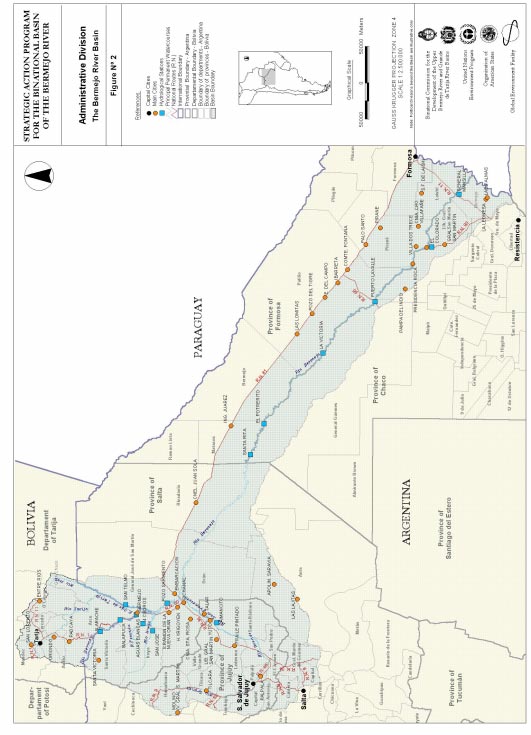
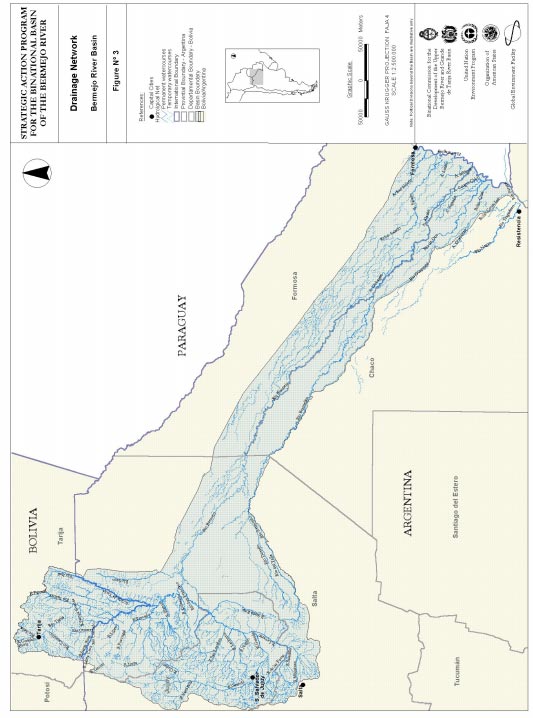
ANNEX I
GOVERNMENT AGENCIES RESPONSIBLE FOR MANAGING WATER AND OTHER NATURAL RESOURCES
IN THE RIO BERMEJO BASIN
NONGOVERNMENTAL ORGANIZATIONS UNDERTAKING ACTIVITIES IN THE RIO BERMEJO BASIN
SUMMARIZED LIST OF INSTITUTIONS THAT HAVE PARTICIPATED EITHER DIRECTLY OR INDIRECTLY IN
THE FORMULATION OF THE SAP
Table 1.2: GOVERNMENT AGENCIES RESPONSIBLE FOR MANAGING WATER AND OTHER NATURAL RESOURCES IN THE
RÍO BERMEJO BASIN
Agency / Institution
Country
Drinking Water
Flood Control
Pollution Control
Province
and Clean-up
Department
Upper Basin Binational Commission
Arg. and Bol.
·
·
Secretariat of Sustainable Development and Argentina
·
·
·
Environmental Policy
Regional Commission for the Río Bermejo Argentina
·
COREBE
Provincial Water Administration
Chaco
IA
IA
Under Secretariat of Natural Resources and the Chaco
Environment
SAMEEP
Chaco
·
Under Secretariat of Natural Resources and Formosa
·
IA
Ecology
Directorate of Water Resources
Formosa
IA
Provincial Drinking Water Service
Formosa
·
General Directorate of Renewable Natural Jujuy
·
Resources of Jujuy
Provincial Directorate of Water Resources
Jujuy
IA
·
Agua de los Andes S.A.
Jujuy
·
Superintendency of Public Services SUSEPU
Jujuy
IA
Secretary of Environment and Sustainable Salta
IA
Development
Infrastructure and Development Unit
Salta
IA
IA
IA
Municipalities1
Cuenca
·
Technical Office of the National Commission of the Bolivia
·
·
Pilcomayo and Bermejo Rivers (CONAPIBE)
Ministry of the President's Office (funding)
Bolivia
·
·
General Directorate of Border Development, Bolivia
Environmental Protection
General Directorate of Energy
Bolivia
General Directorate of Agriculture
Bolivia
·
·
General Directorate of Forestry and Sylviculture
Bolivia
General Directorate of Farm Land and Irrigation
Bolivia
General Directorate of the Environment
Bolivia
·
·
General Directorate of Biodiversity
Bolivia
Vice Ministry of Basic Services
Bolivia
·
National Meteorology and Hydrology Service
Bolivia
Prefecture
Tarija
·
·
·
Town Councils
Tarija
·
·
·
Water Service and Drainage Cooperative of Tarija Tarija
·
References:
IA
IA: Implementing Authority
·· : Involved
42
1. In Argentina, some first-class municipalities.
Hydroelectric
Irrigation
Soil
Flora, Wildlife,
Other
Power
Forests, NPAs
·
·
·
·
·
·
·
·
·
·
IA
·
·
IA
IA
·
IA
IA
IA
·
·
IA
·
IA
IA
·
·
·
IA
·
·
IA
IA
·
IA
IA
·
·
·
·
·
·
·
·
·
·
·
·
·
·
·
·
·
·
·
·
·
·
·
·
·
·
·
·
·
·
·
·
·
·
·
·
43
Table 1.3 NONGOVERNMENTAL ORGANIZATIONS UNDERTAKING ACTIVITIES IN THE BERMEJO RIVER BASIN
ORGANIZATION
Zone
Conservation Education
Production
Social
Others
Assistance
Association of Friends of the Aborigine (SAMAB) Argentina
R
R
Association of the Anglican Church (ASOCIANA)
Argentina
R
R
Agricultural Producer Defense Association
Argentina
R
Association for the Promotion of Culture and
Development
Chaco
L
L
L
L
Association for the Promotion and Defense of the
Environment (APROMA)
Argentina
R
R
Chaco Association of Promoters (APROCH)
Chaco
L
Cáritas
Argentina
N
N
Ce.Ca.Zo. (Zone Training Center)
Argentina
R
Palo Santo Agricultural Education Center
Argentina
R
R
Research Center for the Reconversion of the North
(CIRENOR)
Formosa
L
L
L
Center of the Old People of the Chaco
Argentina
R
Río Negro Recovery Commission
Chaco
L
ENDEPA
Argentina
N
N
EMPRENDER
Argentina
R
R
Argentine Federation of Evangelical Churches
(FAIE)
Argentina
N
FUDECHA (Chaco Ecological Foundation)
Argentina
R
R
Total Environment Foundation
Argentina
R
R
R
Geopuna Foundation
Argentina
R
R
Kallpa Foundation for Integrated Forest
Management
Salta
L
L
L
L
Big North Foundation
Argentina
R
R
PACHA MAMA Foundation
Salta
L
S.O.S Foundation
Argentina
R
Argentine Wildlife Foundation (FVSa)
Argentina
N
N
N
FUNDALES
Salta
L
FUNDAPAZ (Foundation for Development in
Justice and Peace)
Argentina
N
N
GREENPEACE
International
I
I
Chaco Ecologist Group
Argentina
R
Institute for Social Development and Human
Promotion (INDES)
Argentina
N
N
Institute of Popular Culture (INCUPO)
Argentina
N
N
United Committee of Missions (JUM)
Argentina
R
KHANANYE
Argentina
R
Yaguarete
Argentina
R
Argentine Ecologist Movement
Formosa
L
PIRCA
Argentina
R
Chaco Rural Society
Chaco
L
L
44
Table 1.3 Continuated
ORGANIZATION
Zone
Conservation Education
Production
Social
Others
Assistance
Formosa Rural Society
Formosa
L
L
Jujuy Rural Society
Jujuy
L
L
Salta Rural Society
Salta
L
L
UNAMBI
Argentina
R
ACLO Loyola Cultural Actino
Tarija
X
X
X
X
X
Tarija Regional Development Study Center
(CERDET)
Tarija
X
X
X
X
X
Education and Future (EdyFU)
Tarija
X
X
Cooperative for Foreign Remittances (CARE)
Bolivia
X
X
X
X
Agricultural Research and Training Center
(CICA)
Tarija
X
X
X
CARITAS, Tarija Diocese
Bolivia
X
X
X
X
Peasant Research and Support Center (CIAC)
Tarija
X
X
X
X
X
People's Research and Training Center (CICAP)
Tarija
X
X
X
X
Peasant Research and Training Institute (IICCA)
Tarija
X
X
X
X
Tarija Social Pastoral
Bolivia
X
X
X
X
Tarija International Plan
Bolivia
X
X
X
X
X
Green Life
Tarija
X
X
X
X
Church Social Assistance Office (OASI)
Tarija
X
X
X
Diogracio Vides Intercommune Peasant
Organization
Tarija
X
X
X
X
PROMUJER Programs for Women
Tarija
X
X
X
X
PDA Padcaya Area Development Project
Tarija
X
X
Environment Protection of Tarija (PROMETA)
Tarija
X
X
X
X
FADES Social Development Support Fund
Bolivia
X
X
Pro-Hábitat
Bolivia
X
X
X
Esperanza Bolivia
Bolivia
X
X
X
X
References
Scope of Action:
I = International
N = National
R = Regional
L = Local
45
SUMMARIZED LIST OF INSTITUTIONS THAT HAVE PARTICIPATED EITHER DIRECTLY OR INDIRECTLY IN
THE FORMULATION OF THE SAP
BINATIONAL AND INTERNATIONAL INSTITUTIONS
1.
Binational Commission for the Development of the Upper Basin of the Río Bermejo and the Río Grande de Tarija
2.
Organization of American States (OAS)
3.
United Nations Environment Programme (UNEP)
4.
Global Environmental Facility (GEF)
GOVERNMENTAL AND NONGOVERNMENTAL INSTITUTIONS IN ARGENTINA
1.
National Parks Administration, APN
2.
Center for Population Studies (CENEP)
3.
Regional Commission for the Río Bermejo (COREBE)
4.
CHACO, Provincial Water Administration, Directorate of Basic Studies
5.
CHACO, Provincial Water Administration
6.
CHACO, Directorate of Soils, Secretariat of Natural Resources and the Environment
7.
CHACO, Total Environment Foundation
8.
CHACO, Institute for Social Development and Human Promotion (INDES)
9.
CHACO, Provincial Settlement Institute
10.
NW Argentina Regional Technical Delegation, National Parks Administration
11.
EVARSA, Evaluación de Recursos, S.A.
12.
FORMOSA, Forestry Directorate, Secretariat of Natural Resources and Ecology
13.
FORMOSA, School No. 109, Bo. El Zapallito
14.
FORMOSA, School No. 404
15.
FORMOSA, School No. 43
16.
FORMOSA, Federation of NGOs / CIRENOR
17.
FORMOSA, Ministry of Education, General Directorate of Basic Education
18.
FORMOSA, Ministry of Production
19.
FORMOSA, Ministry of Production, Directorate of Water and Soil
20.
FORMOSA, Gral. Lucio V. Mansilla Municipality
21.
FORMOSA, Mayor Villafañe Municipality
22.
FORMOSA, Pozo del Tigre Municipality
23.
FORMOSA, Central Program Administration Unit
24.
Environment and Natural Resources Foundation (FARN)
25.
Argentine National Gendarmes, Environmental Division, Salta Group
26.
National Water and Environment Institute, Hydraulics and Environmental Laboratory
27.
National Water and Environment Institute, National Toxic Waste and Water Pollution Program
28.
National Water and Environment Institute, Hydrology Center
29.
INTA Ibarreta Agricultural Extension Center, Formosa
30.
INTA Chaco Regional Center Formosa
31.
INTA Salta Regional Center, Salta Station
32.
INTA Colonia Benítez Agricultural Experimental Station
33.
INTA El Colorado Agricultural Experimental Station, Formosa
34.
INTA Saénz Peña Agricultural Experimental Station
35.
INTA Climate and Water Institute, Castelar
36.
INTA Soil Institute, Castelar
37.
JUJUY, Aguas de los Andes S.A.
38.
JUJUY, General Directorate of Renewable Natural Resources
39.
JUJUY, Provincial Directorate of Hydraulics
40.
JUJUY, Superintendence of Public Services (SUSEPU)
41.
Las Yungas Ecological Research Laboratory (LIEY), Tucumán University
42.
Argentine Ecological Movement (El Colorado Base), Formosa
43.
SALTA, former General Water Administration of Salta (AGAS)
44.
SALTA, Association of Alternative Tourism Operators of Salta (ADOPTAS)
45.
SALTA, Environment Directorate, Ministry of Public Health
46.
SALTA, Directorate of the Environment and Natural Resources
47.
SALTA, Los Toldos Municipality
48.
SALTA, Provincial Tourism Secretariat
49.
University of Buenos Aires, Landscape and Environment Study Group (GEPAMA)
46
50.
University of Buenos Aires, Regional Ecology Study Group (GESER)
51.
National University of Formosa
52.
National University of Formosa, Sylviculture Institute
53.
National University of Jujuy
54.
National University of Jujuy, Geology and Mining Institute
55.
National University of Salta, Faculty of Natural Sciences, Soils Department
56.
National University of Salta, Faculty of Natural Sciences, Geomorphology Department
57.
National University of Salta, Sociodemographic Study Group (GREDES)
58.
National University of the Northeast, Faculties of Engineering and Humanities, Applied Geoscience Institute
59.
National University of the Northeast, Engineering Faculty, Hydraulics Department
GOVERNMENTAL AND NONGOVERNMENTAL INSTITUTIONS IN BOLIVIA
PUBLIC INSTITUTIONS
1.
Prefecture of Tarija Department:
Directorate of Economic Development
Basic Clean-up Unit
Agricultural Development Unit
Strategic Food Security Program
Directorate of Sustainable Development and the Environment
Forestry Development Unit
Social Development Directorate
Prefecture Action Program
National Governance Program
Subprefecture of Méndez Province
Subprefecture of Avilés Province
Subprefecture of Arce Province
Bermejo Town Council
Tarija Department Council
2.
General Directorate of Biodiversity, Vice Ministry of Sustainable Development and the Environment
3.
ZONISIG
4.
Tarija Executive Program for Land Recovery, PERTT
5.
San Jacinto Association
6.
National Meteorology and Hydrology Service, SENAMHI
7.
National Irrigation Program, PRONAR
8.
Bolivian Agricultural Technology Institute, IBTA
9.
Cercado Municipal Major's office
Cercado Province Municipal Council
Technical Unit for Planning
Technical Unit for Urban Development
Tarija Municipal Sanitation Corporation
10.
San Lorenzo Municipal Mayor's Office
11.
Padcaya Municipal Mayor's Office
12.
Bermejo Municipal Mayor's Office
13.
Uriondo Municipal Mayor's Office
14.
Entre Ríos Municipal Mayor's Office
15.
Juan Misael Saracho Autonomous University
Research Directorate
Faculty of Science and Technology
Civil Engineering School
Faculty of Forestry and Agronomic Science
Agronomic Engineering School
Forestry Engineering School
Faculty of Social and Legal Science
Law school
Bolivian Inter-University Water Resource Institute, INIBREH
16.
Social Investment Fund, FIS
17.
Campesino Development Fund, FDC
18.
National Agrarian Reform Institute, INRA
47
19.
Tarija Parliamentary Brigade
20.
Tarija District Court
PRIVATE INSTITUTIONS
21.
Drinking Water and Drainage Cooperative of Tarija, COSAAL
22.
Tarija Civic Committee
23.
Union Federation of Rural Workers of Tarija
24.
Union Federation of Rural Workers of Bermejo
25.
Volunteers of the Peace Corps
26.
Federation of Neighborhood Committees of Tarija
27.
College of Agronomic Engineers
NONGOVERNMENTAL ORGANIZATIONS
28.
Tarija Regional Development Study Center, CERDET
29.
Agricultural Research and Training Center, CICA
30.
Development and Environment Information Center, CIRDEMA
31.
Vida Verde
32.
Tarija Environmental Protection, PROMETA
33.
Loyola Cultural Action, ACLO
34.
Tarija Social Pastoral
35.
Tarija International Plan
36.
Church Social Assistance Office, OASI
37.
Tarija Environmental and Development Forum
38.
Campesino Research and Support Center, CIAC
39.
Campesino Research and Training Institute, IICCA
48
ANNEX II
LIST OF DOCUMENTS DRAWN UP DURING FORMULATION OF THE SAP
POLICY FRAMEWORK FOR EXECUTING SAP ACTIONS
LIST OF DOCUMENTS DRAWN UP DURING FORMULATION OF THE SAP
1.
PEA El. 1.1. 1999a. Instituto de Suelos. INTA (Coord.). Universidad Nacional de Jujuy, Universidad Nacional de Salta,
EEA Cerrillos- INTA. Digital Thematic Cartography of Argentine Territory in the Upper Bermejo River Basin; (base map,
geology, geomorphology, hidrology, soils, vegetation, population and infrastructure, land use). Elemento 1.1: Movi-
miento Transfronterizo de Contaminantes. Instituto Nacional de Tecnología Agropecuaria. Buenos Aires, Argentina.
2.
PEA El. 1.1. 1999b. Brea, D., et al. Analysis of the Sediment Production and Transport in the Upper Bermejo River
Basin and its Impact in the Paraná Waterway, Delta del Paraná and Río de la Plata. Instituto Nacional del Agua y del
Ambiente. Elemento 1.1.: Movimiento Transfronterizo de Contaminantes. Buenos Aires, Argentina.
3.
PEA El. 1.1. 1999c. Hopwood, H.J. Sediment Load of the Bermejo River and the Evolution of the Delta del Paraná and
Río de la Plata. Danish Hydraulic Institute. Elemento 1.1: Movimiento Transfronterizo de Contaminantes. Buenos Aires,
Argentina.
4.
PEA El. 1.1. 1999d. Peviani, M. Morphological Model of the Upper Bermejo River. Elemento 1.1: Movimiento
Transfronterizo de Contaminantes. Italia.
5.
PEA El. 1.1. 1999e. Universidad Autónoma Juan Misael Saracho (UJMS); Study of environmental clean-up of the Gua-
dalquivir River. Elemento 1.1 Movimiento Transfronterizo de Contaminantes. Volúmenes 4.110.1 a 4.110.5. Tarija,
Bolivia.
6.
PEA El. 1.1. 1999f. Zonificación Agroecológica y Socioeconómica con Sistemas de Información Geográfica (ZONISIG).
Digital Thematic Cartography of the Bermejo River Basin (Bolivia). Maps and Report. Elemento 1.1 Movimiento
Transfronterizo de Contaminantes. Tarija, , Bolivia.
7.
PEA El. 2.1. 1999. Benítez A. Criteria and Parameters for the Classification of Water Courses. El. 2.1. Classification of
water courses. Volúmenes 4.11.1 a 4.11.6. Tarija, Bolivia.
8.
PEA El. 2.2. 1999b. Integrated Management Plan of the Nature Resources of the Camacho River Basin. Elemento 2.2.
Control de Erosión, Santa Ana / Camacho. Volúmenes 4.90.1 a 4.90.11. Tarija, Bolivia.
9.
PEA El. 2.2. 1999c. Integrated Management Plan of the Nature Resources of the Santa Ana River Basin. Elemento 2.2.
Control de Erosión, Santa Ana / Camacho.Volúmenes 4.80.1 a 4.80.17. Tarija, Bolivia.
10. PEA El. 2.3 1999. IICCA. Soils Use, Legal Status and Land Ownership in the Central valley of Tarija and its relationship
with the erosion. Elemento. 2.3 Tenencia de la Tierra, Valle Central de Tarija. Volúmenes 4.60.1 a 4.60.6. Tarija,
Bolivia.
11. PEA 2.4. 1999. Alzérreca, H. Study of pasture lands (CANAPAS) of the Central Valley of Tarija. Elemento 2.4 Manejo de
Pasturas, Valle Central de Tarija. Volúmenes 4.70.1 a 4.11.6. Tarija, Bolivia.
12. PEA El. 2.5. 1998. Arrieta, J.; Pastor, C. Socio-economic and Environmental Survey of the Communities along the
Middle and Lower reaches of the Bermejo River. Informe y Anexos. Elemento: 2.5: Uso del Suelo en la Cuenca del Río
Inferior. Buenos Aires, Argentina.
13. PEA El. 2.5. 1999. Administración Provincial del Agua (Coord.), Centro de Geociencias Aplicadas (UNNE), Departamen-
to de Hidraúlica (UNNE), INTA E.E.R.A. Saénz Peña, INTA E.E.R.A. C. Benítez, Dirección de Suelos y Agua Rural de la
Subsecretaría de Recursos Naturales y Medio Ambiente de la Pcia. del Chaco. Digital Thematic Cartography of the
Lower Bermejo River Basin. Elemento 2.5: Uso de la Tierra en la Cuenca del Río Bermejo. Chaco, Argentina.
14. PEA El. 2.5. 1999b. Brea, D., et al. Study of fluvio-morphological dynamics in the lower reach of the Bermejo River.
Instituto Nacional del Agua y del Ambiente. Elemento 2.5: Uso del Suelo en la Cuenca Inferior del Río Bermejo. Buenos
Aires, Argentina.
15. PEA El. 2.6. 1999. Cardozo, J. et al. Increase of Forage Yields through Water Management in Marshlands and
Swamplands, and Productive Recovery of Land Infested with Vinal. Elemento 2.6: Manejo de Forrajes. Chaco Húmedo.
Formosa, Argentina.
16. PEA El. 3.1. 1999. Marconi, P. et al. Transition Forest in the Province of Salta: Identification of Sustainable Alternative
Practices of Ecotourism-type and Implementation of the Pilot Demonstration Project. Administración de Parques
Nacionales. Elemento 3.1. : Bosques de Transición Salta, Argentina.
17. PEA El. 3.2. 1999a. Sediment Control in the Tolomosa River Basin - Pilot Demonstration Project. Elemento 3.2 Manejo
de la Cuenca del río Tolomosa. Volúmenes 4.86.1 a 4.86.6. Documentos de Construcción. Tarija, Bolivia.
18. PEA El. 3.2. 1999b. Sediment Control in the Tolomosa River Basin - Pilot Demonstration Project. Elemento 3.2. Manejo
de la Cuenca del río Tolomosa. Volúmenes 4.87.1 a 4.87.7. Documentos de Prácticas Biológicas. Tarija, Bolivia.
51
19. PEA El. 3.3. 1999. Brown, A.; Grau, A. Strengthening of Sustainable Production Diversity (Community of Los Toldos,
Salta). Laboratorio de Investigaciones Ecológicas de las Yungas (LIEY). Elemento 3.3: Desarrollo Sustentable en las
Yungas. Tucumán, Argentina.
20. PEA El. 3.4. 1999. Vargas R. (coord.) et al. Socioeconomic and Environmental Constraints Restricting Sustainable
Development. Elemento 3.4: Remoción de Barreras Chaco Húmedo y Seco. Chaco, Argentina.
21. PEA El. 4.1. 1997. Rehabilitation and Improvement of the Hydrometeorological Network of the Upper Bermejo River and
Grande de Tarija River Basin. Elemento 4.1. Red Hidromeorológica. Volúmenes 3.13.1 y 4.13.2. Tarija, Bolivia.
22. PEA El. 4.1. 1999a. Carrizo, R. Proposal for the Water Quality Component. Environment Information System of the
Bermejo River Basin. Elemento 4.1: Red Hidrometeorológica. Buenos Aires, Argentina.
23. PEA El. 4.1. 1999b. Malinow, G. Proposal for the Hydrometeorological and Hydrosedimentological Network
of the Environment Information System of the Bermejo River Basin. Elemento 4.1: Red Hidrometeorológica.
Buenos Aires, Argentina.
24. PEA El. 4.2. 1998. Gabay, M; De Donatis, T. Analysis of legal environmental framework the Bermejo River Basin in
Argentine Territory. Elemento 4.2: Legislación Ambiental, COREBE. Buenos Aires, Argentina.
25. PEA El. 4.2. 1999. Rovere, M.; Cabrera, M. Strengthening and Harmonization of the Legal and Institutional Framework
for Environmental Management in the Bermejo River Basin. Elemento. 4.2: Legislación Ambiental. Fundación Ambiente
y Recursos Naturales. Buenos Aires, Argentina.
26. PEA El. 4.2. 1999. Darwich, E. Collection and Proposal of Environmental Laws in Bolivia. Elemento 4.2: Legislación
Ambiental, Volúmenes 4.95.1 a 4.95.2.. Tarija, Bolivia.
27. PEA El. 4.3. 1999. Protección del Medio Ambiente Tarija (PROMETA). Baritú - Tariquía Environmental Corridor Proposal.
Elemento 4.3 Corredor Biológico Baritú Tariquía. Volúmenes 4.100.1 a 4.100.6. Tarija, Bolivia.
28. PEA El. 5.1. 1999a. Lattes, A. Boleda, M. et al. Transboundary Migrations in the Bermejo River Basin. Volúmen I y II.
Elemento 5.1: Migraciones Transfronterizas. CENEP y GREDES. Buenos Aires- Salta, Argentina.
29. PEA El. 5.1. 1999b. Guevara J. OASI; Study of Transboundary Migration. Elemento 5.1 Migraciones Transfronterizas.
Volúmenes 4.110.1 a 4.110.5. Tarija, Bolivia.
30. PEA El. 5.2. 1999. Pérez, V. et al. Promoting Forestry Awareness in the Community through Schools and Municipalities.
Informe y Anexos. Elemento 5.2: Educación Ambiental. Formosa, Argentina.
31. PEA El. 6.1 1999a. Adámoli, J; Morello, J. et al. Ecological and Environmental Zoning of the Bermejo River Basin.
Elemento 6.1: Formulación del Programa Estratégico de Acción. Buenos Aires, Argentina.
32. PEA El. 6.1. 1999b. Laurelli E; Vaghi A. The Bermejo River Basin into the Regional Framework. Elemento 6.1: Formula-
ción del Programa Estratégico de Acción. Buenos Aires, Argentina.
33. PEA El. 6.1. 1999c. Manzanal M, Arrieta J. Socio-economic Analysis of the Bermejo River Basin in Argentine Territory.
Elemento 6.1: Formulación del Programa Estratégico de Acción. Buenos Aires, Argentina.
34. PEA El. 6.1. 1999d.. Regional Survey of Environmental and Development Projects and Initiatives. Elemento 6.1: Formu-
lación del Programa Estratégico de Acción. Buenos Aires, Argentina.
35. PEA El. 6.1. 1999e. Seoane, R.S.; Moyano, M.C. Analysis of the Impact of Climate Change on the Hydrology of the
Bermejo River Basin. Elemento 6.1 Formulación del Programa Estratégico de Acción para la Cuenca del Río Bermejo.
Instituto Nacional del Agua y del Ambiente. Buenos Aires, Argentina.
36. PEA El. 6.1. 1999f. Transboundary Diagnostic Analysis of the Bermejo River Basin in Argentina. El. 6.1 Formulación del
Programa Estratégico de Acción Ambiental. Buenos Aires, Argentina.
37. PEA El. 6.1. 1999g. Transboundary Diagnostic Analysis of the Bermejo River Basin in Bolivia. El. 6.1 Formulación del
Programa Estratégico de Acción Ambiental. Informe y Mapas. Tarija, Bolivia.
38. PEA El. 6.1. 1999h. Universidad Autónoma Juan Misael Saracho (UJMS). Flood Control in Tarija City. Elemento 6.1
Formulación del Programa Estratégico de Acción. Volúmenes 4.110.6 a 4.110.8. Tarija, Bolivia.
39. PEA El. 6.2. 1997. Programa Estratégico de Acción, First Regional Workshop for the Formulation of the Strategic Action
Program. Elemento 6.2: Participación Pública. Salta, Argentina.
40. PEA El. 6.2. 1998a. Programa Estratégico de Acción. Second Regional Workshop for the Formulation of the Strategic
Action Program. Elemento 6.2: Participación Pública. Formosa, Argentina.
41. PEA El. 6.2. 1998b. Programa Estratégico de Acción. Third Regional Workshop for the Formulation of the Strategic
52
Action Program. Elemento 6.2: Participación Pública. Jujuy, Argentina.
POLICY FRAMEWORK FOR EXECUTING SAP ACTIONS
The planning and implementation of the actions to be carried out as a part of the SAP will take the following into account:
·Integral water management plans, in the context of integrated basin-wide natural resource management, as a tool for
tackling environmental problems.
·Joint, integrated, comprehensive management of the quantity and quality of rainwater, surface water, and ground water
and of their spatial and temporal distribution, taking into account the repercussions upstream and downstream of the
management actions, sectoral and regional relations, and social equity.
·Systematic evaluations and forecasts of the quantity and quality of surface and ground water resources in order to esti-
mate the total volume of available resources and their future potential supply, to determine current quality levels, to
predict possible conflicts between supply and demand, and to supply a scientific database for the rational use thereof.
·Developing, agreeing on, and harmoniously implementing, with a basin-wide approach and within the corresponding juris-
dictions, the following measures as instruments for the sustainable management of natural resources:
·Classification of water courses. Guide levels and environmental quality targets.
·Pollutant emission limits.
·Rules governing access to and availability of water resources (system of permits and concessions).
·Environmental impact assessment procedures.
·Land use planning, environmental or territorial zoning.
·Economic and financial incentives and disincentives.
·Informed decision-making processes regarding development actions.
·Methods for participation and public consultation.
·Environmental education and community awareness programs.
·Systems for assessing and controlling natural resources and the use thereof.
·Environmental information systems, and decision support systems.
·Establishment of quality standards for all bodies of water (surface and underground), according to natural conditions and
usage, with a view toward progressive improvements in quality.
·Prevention and control of pollution through an appropriate combination of pollution reduction strategies at the source,
environmental impact assessments, and the effective implementation of standards for the most important localized
discharges and the dispersed releases that pose the greatest risk, in accordance with the possibilities for socio-economic
development.
·Clean-up of polluted water courses and the systematic assessment and monitoring of water resources as part of the water
quality improvement policies.
·Flood mitigation plans must include urban development provisions and the restoration of affected areas, together with the
construction of protective infrastructure in both urban and rural areas.
·Strengthening the institutions charged with managing natural resources in the basin, particularly those responsible for
managing water resources, environmental information and monitoring, compliance with environmental standards, and
environmental education.
·Conducting basic studies into natural resources to gain a better understanding of the potential that exists and the possi-
bilities for sustainable use.
·Nature conservation an essential task for maintaining the water supply involves redefining, connecting, and consoli-
dating the basin's areas that are currently protected and strengthening the institutions responsible for managing them.
·Promoting appropriate productive models and technologies in the fields of agriculture, livestock raising, and forestry.
·Promoting actions aimed at improving output and productivity, creating jobs, and increasing the coverage of basic ser-
vices, particularly those geared toward the most vulnerable population segments.
·Sustainable use of water resources, through regulation, irrigation, and other efforts.
·Free access to reliable information at all levels, using modern communications and network technologies to the extent
that is possible.
·Active involvement of communities and the private sector in all stages of natural resource management.
·Research, technological development, and access to suitable technologies for assessing, planning, using, and controlling
water resources and other related natural resources.
53
ANNEX III
PLANS AND PROGRAMS BEING EXECUTED:
INVESTMENTS IN THE BERMEJO RVER BASIN
DIRECTORY OF PLANS AND DEVELOPMENT PROGRAMS WITHIN THE BERMEJO RIVER BINATIONAL BASIN
PLAN OR PROGRAM AGENCY
FOCAL AREA
FINANCING (Million US $)
SCOPE
World
InterAmerican GEF
Govern- Provin-
Other
Bank
Develop-
ment
cial
ment Bank
Native Forests and Sec. of Natural
Natural resource
19.50
10.00
12.50
Argentina
Protected
Areas Resources and
management
Project
Sustainable Develop-
ment (SRNyDS)APN
PROSOFA
Secretariat of
Social develop-
3.00
22.00 10 Provinces
Social Develop-
ment
FONPLATA
ment
National drinking wa- Secretariat of
Infrastructure
200.00
25.00
25.00
20 Provinces
ter and clean-up pro- Public Works
gram, stage VI
PRISE Primary edu- Ministry of Culture Institutional
300.00
300.00
18 Provinces
cation reform and in- and Education
strengthening
vestment program
Institutional develop- Secretariat of
Institutional
210.00
90.00
14 Provinces
ment and social in- Social Develop-
Strengthening
vestment in munici- ment
palities
Sectoral highway National Highway Infrastructure
340.00
416.00
Argentina
maintenance and re- Directorate
pair program
PROMIN I Mother- Ministry of Health
Social assis-
100.00
30.00
30.00
9 Provinces
and-baby and nutri- and Social Action
tance
tion program I
Provincias II Second Ministry of the
Institutional
225.00
96.00
17 Provinces
provincial develop- Interior
strengthening
ment program
PASMA I & II Techni- Ministry of the
Technical assis-
69.60
17.00
Argentina
cal assistance mining Economy and
tance
sector development
Public Works and
Services
57
DIRECTORY OF PLANS AND DEVELOPMENT PROGRAMS WITHIN THE BERMEJO RIVER BINATIONAL BASIN
PLAN OR PROGRAM AGENCY
FOCAL AREA
FINANCING (Million US $)
SCOPE
World
InterAmerican GEF
Govern- Provin-
Other
Bank
Develop-
ment
cial
ment Bank
Forestry development Setariat of Agricul- Institutional
16.00
10.00
Argentina
project
ture, Livestock,
strengthening,
Fisheries, & Food
Research
(SAGPyA)
Preservation and im- Ministry of the
Infrastructure,
300.00
1,200.00
8 Provinces
provement of provin- Interior
Institutional
cial roads I
strengthening
PROMIN II Mother- Ministry of Health Social assistance
100.00
53.90
17.10
17 Provinces
and-baby and nutri- and Social Action
tion program II
Second loan for pro- Ministry of the
Institutional
75.00
vincial reform (PRL II) Economy and
strengthening
Public Works and
Services
PROSAP Provincial SAGPyA
Institutional
125.00 125.00
45.00
45.00
17.20
22 Provinces
agricultural services
strengthening
program
PRODERNEA Pro- SAGPyA
Institutional
57.50 (*)
4 Provinces
gram of credit and
strengthening,
technical support for
Small-scale
small-scale farmers in
farmers
NE Argentina
PROPASA
SRNyDS
Drinking water
17.00 (*)
NE Argentina,
and clean-up
NW Argentina
PRANI Children's Secretariat of
Social assistance
36.00 (*)
22 Provinces
nutrition and food pro- Social Develop-
gram
ment
PROHUERTA Or- Secretariat of
Self-manage-
10.00 (*)
Argentina
chards program
Social Develop-
ment
ment SAGPyA
National Agricul-
tural Technology
Institute (INTA)
58
DIRECTORY OF PLANS AND DEVELOPMENT PROGRAMS WITHIN THE BERMEJO RIVER BINATIONAL BASIN
PLAN OR PROGRAM AGENCY
FOCAL AREA
FINANCING (Million US $)
SCOPE
World
InterAmerican GEF
Govern- Provin-
Other
Bank
Develop-
ment
cial
ment Bank
FOPAR Participatory so- Secretariat of
Self-manage-
17.60 (*)
9 Provinces
cial investment fund
Social Develop- ment
ment
SIEMPRO Social pro- Secretariat of
Institutional
7.50 (*)
Argentina
grams information, moni- Social Develop- strengthening
toring, and assessment ment
system
Civil society strengthen- Secretariat of
Institutional
9.20 (*)
Argentina
ing plan
Social Develop- strengthening
ment
Social educational plan Ministry of
Education
104.00 (*)
Argentina
PSE I & II
Culture and
Education
6.00 (*)
Forestar
Ministry of
Job creation
Argentina
Labor and Social
Security
Community services II
Ministry of
Job creation
42.10 (*)
Argentina
Labor and Social
Security
300.00 (*)
Trabajar II & III
Ministry of
Job creation
Argentina
Labor and Social
Security
PRODISM -
Secretariat of
Institutional
57.00 (*)
Argentina
Program of funding for Social Develop- development
municipalities
ment
PSA - Social agricultural SAGPYA INTA Strengthening
9.40 (*)
21 Provinces
program
Productive ca-
pacity
ASOMA Solidarity with Secretariat of
Social assis-
29.20 (*)
Argentina
the elderly
Social Develop- tance
ment
59
DIRECTORY OF PLANS AND DEVELOPMENT PROGRAMS WITHIN THE BERMEJO RIVER BINATIONAL BASIN
PLAN OR PROGRAM AGENCY
FOCAL AREA
FINANCING (Million US $)
SCOPE
World
InterAmerican GEF
Govern- Provin-
Other
Bank
Develop-
ment
cial
ment Bank
Probienestar
INSSPJP
Social assistance
62.90 (*)
Argentina
FO.NA.VI National Secretariat of
Home construc-
970.00 (*)
Argentina
housing fund
Social Develop-
tion
ment
PREI Program for
Infrastructure
3.80 (*)
6 Provinces
flood victims; house Ministry of the
repairs
rebuilding subprogram Interior
Programs by the Chaco Secretariat of
Social assistance
2.90 (+)
Chaco
Secretariat of Social Social Develop-
Development
ment Chaco
POSOCO Community Secretariat of
Social assistance
92.40 (*)
Argentina
social policies
Social Develop-
ment
PROSONU Nutri- Secretariat of
Social assistance
106.30 (*)
Argentina
tional social program
Social Develop-
ment
CENOC National Cen- Secretariat of
Institutional
5.60 (*)
Argentina
ter for Community Or- Social Develop-
strengthening,
ganizations
ment
Organization
Strengthening
INAI Actions by the Secretariat of
Social develop-
6.60 (*)
Argentina
National Aborigine Af- Social Develop-
ment
fairs Institute
ment
Attention for priority Secretariat of
Social assistance
2.20 (*)
Argentina
groups
Social Develop-
ment
PAGV Attention for Secretariat of
Social assistance
1.20 (*)
11 Provinces
vulnerable groups
Social Develop-
ment
PFDJ Youth Develop- Secretariat of
Community
3.70 (*)
Argentina
ment strengthening Social Develop-
organization
plan
ment
60
DIRECTORY OF PLANS AND DEVELOPMENT PROGRAMS WITHIN THE BERMEJO RIVER BINATIONAL BASIN
PLAN OR PROGRAM AGENCY
FOCAL AREA
FINANCING (Million US $)
SCOPE
World
InterAmerican GEF
Govern- Provin-
Other
Bank
Develop-
ment
cial
ment Bank
EMPRENDER
Ministry of Labor Promoting em-
4.00 (*)
Argentina
and Social Security ployment
TOTAL
835.00 1,370.10 10.00 2,821.85 1,
150
5 6
0 .
600
0 39.20
PRO-RATED TOTAL FOR BERMEJO BASIN
160.75
275.52
1.5
461.00 181.27 11.38
RIPARIAN PROVINCES IN ARGENTINA
(*) Estimated program budgets based on 1997 figures. Source: SIEMPRO.
(+) Funds spent by different programs.
61
DIRECTORY OF PLANS AND DEVELOPMENT PROGRAMS WITHIN THE BERMEJO RIVER BINATIONAL BASIN
PLAN OR PROGRAM AGENCY
FOCAL AREA
FINANCING (Million US $)
SCOPE
World
InterAmerican GEF
Govern- Provin-
Other
Bank
Develop-
ment
cial
ment Bank
PRODIZAVAT - Inte-
Prefecture of Tarija Rural develop-
4.00
16.00
Tarija
gral development
ment
EEC
program in the
Andean zone and
high valley of Tarija
Erosion control
PERTT
Reforestation
1.00
3.80
Tarija
project in the El
and soil recla-
JICA
Monte and San
mation
Pedro subbasins
Roads program
National Roads
Surfacing trunk
13.00
33.00
Tarija
Service (SENAC)
highways
CAF
Water resources
Prefecture of Tarija Well drilling
0.80
2.00
Tarija
program, Phase 3
Popular
Republic of
China
Water supply pro-
National Fund for
Water supply
4.00
2.00
City of
gram
Regional Develop-
and sanitation,
Bermejo
ment
City of Bermejo
Urban development
National Fund for
Infrastucture
9.25
City of Tarija,
program
Regional Develop-
development
Tarija
ment
Participatory rural
National Fund for
Municipal
1.00
0.20
Tarija
investment project
Regional Develop-
strengthening
ment
Production support
Rural
Rural develop-
1.50
0.30
Tarija
program
DevelopmentFund
ment
(FDC)
Multisectoral
PRONAR, Prefec-
Regional devel-
5.30
0.80
Tarija
progam
ture of Tarija
opment
0.40
2.00
Tarija
Land use planning/
ZONISIG
NETHER-
GIS
LANDS
62
DIRECTORY OF PLANS AND DEVELOPMENT PROGRAMS WITHIN THE BERMEJO RIVER BINATIONAL BASIN
PLAN OR PROGRAM AGENCY
FOCAL AREA
FINANCING (Million US $)
SCOPE
World
InterAmerican GEF
Govern- Provin-
Other
Bank
Develop-
ment
cial
ment Bank
AUTAPO Support for Juan Misael
Institutional
0.10
2.00
Tarija
Tarija and Potosi
Saracho University, strengthening
NETHER-
Universities
Tomas Frias Uni-
LANDS
versity
Production support
Rural Develpoment Rural develop-
0.40
2.00
Tarija
program
Fund (FDC)
ment
GERMANY
(KFW)
Natural resources
Rural Development Rural Develop-
0.10
0.50
Tarija
and environment
Fund (FDC)
ment
GERMANY
program
(KFW)
Social Development
Social Invesment
Social
2.50
2.50
0.80
Program
Fund (FIS)
development
TOTAL
18.25
7.80
23.90
61.30
PRO-RATED TOTAL FOR BOLIVIA AND ITS
18.25
7.80
23.90
61.30
RIPARIAN PREFECTURES AND MUNICIPALITIES
63
ANNEX IV
PRIORITY ACTIONS, LOCATION AND SCOPE
P r i o r i t y A c t i o n s
Num. Location
STRATEGIC AREAS AND ACTIONS
A.
INSTITUTIONAL DEVELOPMENT
a.1
Adapting and Strengthening the Binational Commission
1
Basin
Institutional development for basin-wide
Establishment of an interjurisdictional mechanism for coordination, programming,
integrated, interjurisdictional, binational
and control within the arena of the Binational Commission.
management.
Extension of the BC's jurisdiction to the entire basin.
Design of a basin-wide interjurisdictional entity, and consensus-based
strategy for its introduction.
Trained personnel and technical equipment for operations.
2
Basin
Institutional development for basin-wide Consolidation of a basin-wide interjurisdictional entity in Argentina.
integrated, interjurisdictional management Trained personnel and technical equipment for operations.
in Argentina.
a.2
Development and Harmonization of the Regulatory Framework for the Sustainable Use and Conservation of Natural
Resources
3
Basin
Development and harmonization of legal Identification and recommendation of strategies for establishing common
frameworks for the sustainable management environmental quality goals and polices.
of water resources.
Joint technical proposals at the interjurisdictional level in Argentina and
at the binational level on basic issues for the sustainable management
of water resources.
4
Basin
Harmonization of the legal frameworks set Regional agreement on guidelines for harmonizing provinces' legal
by Argentina's provincial jurisdictions
frameworks, particularly their laws dealing with the environment, water
codes and laws, and environmental impact assessment provisions
a.3
Implementation of Mechanisms for Coordination and Sectoral and Jurisdictional Interconnections
5
Basin
Development and implementation of Interconnection of interest groups at the basin level.
networks and/or effective mechanisms for Two regional workshops for each interest group carried out.
sectoral and jurisdictional coordination and
interconnection in the Bermejo Basin.
a.4
Implementation and Strengthening of the Basin Environmental Information System
6
Basin
Integral environmental information system Implementation of an information system that will allow the status and use of
and database for the Basin.
the basin's natural resources to be established and publicized; Provision of
reliable information on different environmental parameters; Promotion of the
interinstitutional strengthening and coordination of the agencies responsible.
a.5
Formulation and Implementation of Integral Management Plans for Basins, Environmental Zoning, and Territorial Ordering
7
Basin
Environmental zoning and territorial ordering Provision of basic instruments to direct land occupation and economic
activities in terms of the suitability of natural resources.
a.6
Institutional Strengthening for Integrated Natural Resource Management
8
Basin
Strengthening institutions and the capacity of Institutional requirements at the regional level have been identified,
government and civil society organizations measured, and harmonized. Implementation strategies.
involved with the management of natural Organizational, technical, human, and operational requirements
resources in the Bermejo Basin.
have been identified, measured, and harmonized at the regional
level. Strategies for implementation.
Strengthening actions for agencies working with natural resources in the
basin completed.
a.5
Formulation and Implementation of Integral Management Plans for Basins, Environmental Zoning, and Territorial Ordering
9
Basin
Strengthening and development of economic Consensus-based strategies for the incorporation of instruments that reflect
instruments.
the economic, social, and environmental value of water. Analysis carried out
of pilot demonstration applications
10
Basin
Incorporation of environmental and social Strategies for the incorporation of environmental and social costs in the
costs into projects Equity accounts.
decision-making processes of the projects agreed upon. Consensus-based
guidelines for assessing natural resources and services. Pilot case developed.
11
Basin
Sustainability guidelines in financial Sustainability guidelines for investment projects at the regional level
assistance mechanisms.
identified and agreed upon. Strategies for applying them to financial assis-
tance mechanisms determined.
12
Basin
Evaluation of incremental costs.
Provision of guides or manuals for regional application. Examples of application to
base line projects. Strategies for implementation in project assessment.
1 Includes agencies, organizations, and institutions that are executing, proposing, participating in, or interested in the project.
66
2 BC** refers to the Binational Commission after implementation of the interjurisdictional coordination mechanism.
3 COREBE* refers to that regional agency after becoming the interjurisdictional entity for the basin in Argentina.
Participants1
Progress Status
Total Amount
Provinces. Prefecture of Tarija
PROFILE
570.000
BC*2 .For. Aff.
Provinces, COREBE, Nation
PROFILE
150.000
BC**, prov. WR and NR/Environ PROFILE
534.000
Org., reg. & nat. technicalinstitutes
COREBE*3 prov. WR and NR/ FD / P
180.000
Environ Org., Prov. Legislatures
BC** WR, NR/Env. Education, PROFILE
195.000
S&T, jurisdictional., Universities,
Educ. Estab., Civil Society Orgs.
BC**, WR, NR/Env., INTA, PROFILE
1.840.000
SENAMHI, S&T, Prod. Orgs.,
Users
BC**, Prefecture of Tarija, Prov. PROFILE
1.100.000
WR and NR/Environ Orgs.,
Municips., Civil Society Orgs.
Tarija, Provinces, WR & NR Orgs., PROFILE
1.900.000
S&T Orgs., Users, CSO
BC**; WR, NR, & Econ. Orgs.
PROFILE
91.000
BC**, WR & NR/Env. Orgs. from PROFILE
267.000
Tarija & Prov. Munic. & Orgs. from
selected case
BC**
FD / P
100.000
BC**
FD / P
100.000
67
P r i o r i t y A c t i o n s - C o n t i n u e d
Num. Location
STRATEGIC AREAS AND ACTIONS
B.
ENVIRONMENTAL PREVENTION, PROTECTION, AND REHABILITATION
b.1
Protecting Biodiversity and Natural Heritage
13
Chaco LB-A
Restoration of damaged forests.
Defining forestry management alternatives for the recovery of native forests
14
Salta UB-A
Ecotourism-type sustainable use in Repeating and assessing the tests of the Transition Forests project.
transition forest. Monitoring practices
carried out in the vicinity of El Rey N.P.
Repeat exercise in Calilegua N.P
15
Arce UB-B
Management and conservation of El Reforestation, conservation of forestry resources and soils, in order to prevent
Nueve gorge
silting of the city's drinking water supply and reduced soil fertility
16
Entre Ríos & Management and conservation of sub- Completing knowledge of the ecology and sustainable development of
C a r a p a r í Andean natural resources
the sub-Andean ecosystem; Promoting the integrated and rational use
UB-B
of natural resources; Restoring vegetation in the project area
17
Tarija UB-B
Biodiversity study
Studying the current situation of the biota and proposing actions for its
conservation and management; Discovering the status of the conservation
of ecoregions, identifying problems that affect them, and proposing solutions
18
Padcaya & Evaluation of sub-Andean pastureland Generating basic information and recommendations for drawing up a sustainable
O ' C o n n o r
management plan for the pastureland in the sub-Andean area. Classifying
UB-B
transhumance stockraising and the use of natural resources
b.2
Strengthening and Consolidating the Protected Areas System
19
Méndez & Zoning and management plan for the Sama Preparing (in agreement with the Directorate of Protected Areas) a proposal
Arce UB-B
and Tariquía biological reserves
for redefining, reclassifying, and zoning the Sama y Tariquía reserves in
accordance with their ecologies, economies, and political and social
realities, and designing a management plan
20
ArceUB-B& BaritúTariquía ecological corridor
Making functional continuity between the two protected areas a reality
Salta - UB-A
through the corridor, the integral management of natural resources, and
the administration of existing protected areas, in order to preserve a
representative portion of Bolivia's Tucuman forest
21
Basin
Binational trust fund for protected areas Establishing a financial mechanism to provide funds for the conservation and
in the Río Bermejo basin
sustainable development of the Tariquía, Sama and Baritú, Calilegua,
and El Rey protected areas and the other natural protected areas in the
basin. It is catalogued among the categories of biodiversity and inter-
national waters of the GEF
22
C h a c o Teuco National Park
Studies and proposal for the creation of the Park
F o r m o s a
LB-A
23
F o r m o s a Teuquito National Park
Preserving the natural values of the semi-arid Chaco and counteracting the
LB-A
effects of the transformation processes taking place in the west of Formosa
province, which imply clearances, the alteration of water courses, and
pressure on flora and wildlife.
24
Salta
Teuquito National Park
Establishing and implementing a conservation strategy for the foothill forests
Jujuy UB-A
25
Salta UB-A
Stabilization of microbasins and conservation Granting the area protected status as a Natural Reserve in order to permanently
of biodiversity in the Baritú subbasin
regulate the land use methods and their intensity and allow the development of
management projects, ensuring its continuity over time. I )Controlling erosion
in the Río Baritú basin by means of a large number of small projects. III)
Carrying out mechanical, biomechanical, and biological projects to stabilize
microbasins
b.3
Implementation of Plans to Mitigate the Effects of Floods and other Climatological Disasters
26
Arce UB-B
Program of defense construction in the Allowing recovery and consolidation of land, preventing human losses and
Bermejo urban area
material losses in the urban infrastructure of the city of Bermejo
27
Arce UB-B
Program of defense construction on the Río Controlling swelling of the Río Bermejo and the Río Tarija in order to protect
Bermejo and the Río Grande de Tarija:
farmland. The Project plans the construction of 1,500 m of gabions and the
· Talitadefenses· CampoGrandedefenses cladding of 2,100 m of embankments, to the benefit of 5,500 families.
·Naranjitos defenses · Porcelana defenses
· Candado Grande defenses
· Arrozales defenses
68
Participants
Progress Status
Total Amount
Forestry Directorate of Chaco
IDEA
126.000
APN DTRNOA
PROFILE
330.000
Prefecture, Municipality of FD / P
115.000
Bermejo
BC**, Municipalities
PROFILE
2.100.000
BC**
PROFILE
200.000
BC**
PROFILE
65.000
PROMETA
IDEA
1.000.000
BC**, PROMETA (Bolivia), APN AP/F
1.500.000
(Argentina)
Contrib. agencies, BC**, DP / F
25.000.000
PROMETA (Bolivia) APN (Argenti-
na)
APN DTRNEA FUNAT
IDEA
150.000
APN DTRNEA
PD / PF
100.000
APN DTRNOA
PD / PF
120.000
APN DTRNOA, INTA, UNSa
AP/F
388.000
Prefecture of Tarija, Municipality of DP / F
516.000
Bermejo
Prefecture, Municipality of DP / F
3.000.000
Bermejo
69
P r i o r i t y A c t i o n s - C o n t i n u e d
Num. Location
STRATEGIC AREAS AND ACTIONS
28
Arce UB-B
Channeling Cinco gorge
Helping improve the urban road infrastructure for smoother vehicle and
pedestrian traffic by preventing flooding and sources of infection. The project
plans to channel the gorge, benefiting 5,000 families
29
U r i o n d o , Program of defense construction in Uriondo: Protecting farmland and pastureland, allowing flooding to be controlled and
Avilés UB-B
· Calamuchita Muturayo defenses ·Alizos preventing the constant loss of productive land caused by strong, periodical
defenses · San Nicolás defenses ·La rains. The project will benefit 500 poor families who live in the program area
Ventolera defenses ·Colón Sud defenses
·Saladillodefenses · Huayriguanadefenses
·SanIsidroLaChozadefenses·ColónNorte
defenses
30
O ' C o n n o r Construction of defenses on the Río Pajonal, Protection and recovery of arable land on river banks, thus avoiding the destruction
UB-B
Río Santa Ana, and Río Salinas
of roads, homes, and other property. The construction of gabions is planned to
protect 150 ha of land that is currently farmed, directly benefiting 400 families.
31
C e r c a d o Programofdefenseconstruction,CercadoProv.: Allowing the recovery and consolidation of land and preventing the loss of
UB-B
·BellaVistadefenses ·SanAndrésdefenses natural resources caused by flood erosion; this will benefit 150 families
·Pantipampadefenses
32
C e r c a d o Flood control in the city of Tarija
Defining the areas of the city at risk from floods and implementing solutions
UB-B
to reduce their effects, including protection projects and urban zoning provisions
33
Tarija UB-B
Anti-hailstorm system Central valley of Implementing a hailstorm protection system to mitigate the damage caused
Tarija
by hail to vegetable, fruit, and vine crops in the central valley of Tarija, the
main agricultural area of Tarija Department
34
Chaco LB-A
Flood defenses system, Gral. San Martín Flood defense, management, and control projects. Drafting an outline of the
Department
agricultural and agribusiness productive project. Sustainable development
of the agricultural sector by improving its productive situation. Diversification
of regional productive structures through land recovery
35
Chaco LB-A
Clean-up and reactivation of Río Guaycurú Clean-up and reactivation of riverbeds. Improvements to their capacity and
riverbeds
drainage in order to prepare new areas for farming and forestry
36
F o r m o s a Protection of Lavalle Bridge against support Protection and maintenance work on the Lavalle bridge
LB-A
erosion
37
F o r m o s a Protection of banks from erosion of slopes Construction of slope protection structures, in order to prevent erosion and
LB-A
in El Colorado
landslides caused by the action of the Río Bermejo and affecting urban areas
of the city of El Colorado.
38
F o r m o s a Realignment of embankment against Survey of the current state and repair of the embankments
LB-A
overflowing, KM 503 NRB
39
F o r m o s a Realignment and extension of San Pedro General survey of current state. Topographic study of the current area of
LB-A
embankment
overflows. Reparation of embankments. Construction project for additional
embankment. Construction of embankment to protect against overflowing.
Construction projects
40
F o r m o s a Repair of drainage network in the southeast Adapting the hydraulics of riverbeds and channels to maximize efficiency
LB-A
region
and yield. Correction of the effluent evacuation deficit in the southeast area.
Repair and adaptation of existing engineering works and execution of additional
projects
41
Salta UB-A
Paisanidis Colonia Santa Rosa rainwater
Solving a serious flooding problems in summer months that damage a wide
drainage channel
farming sector and the population of Colonia Santa Rosa. Intercepting excess
rainwater and preventing its uncontrolled entry into farmland and the town
42
Salta UB-A
Drainage in the Río Pescado agricultural Conducting studies and designing projects to provide the area with a network
area
of rainwater channels, creating a rational surface drainage system to prevent the
floods that occur at present and conflicts among neighboring farmers
b.4
Prevention, Pollution Control, and Environmental Clean-up of Bodies of Water
43
M é n d e z Environmental clean-up of the Río Solving environmental clean-up and water quality sustainability in the Río
C e r c a d o Guadalquivir
Guadalquivir, thus reducing the environmental problems occurring at present
UB-B
44
Arce UB-B
Study for the environmental clean-up of Assessing the level of pollution and its main causes, and proposing solutions for
watercourses in the Bermejo Triangle
environmental clean-up and water quality sustainability of the El Nueve and El
Cinco gorges and the Río Grande de Tarija and Río Bermejo that have been
affected by industrial and organic pollution
70
Participants
Progress Status
Total Amount
Prefecture, Municipality
DP / F
150.000
Prefecture, Municipality of PD / PF
800.000
Uriondo
Prefecture, Municipality of Entre PD / PF
2.000.000
Ríos
Prefecture, Municipality of PD / PF
360.000
Cercado
BC**, and Municipality of DP / F
10.300.000
Cercado
Prefecture of Tarija, BC**
DP / F
1.600.000
APA
PD / PF
8.100.000
APA, Municipalities, Producers' PD / PF
5.940.000
Orgs
Directorate of WR
PD / PF
250.000
Directorate of WR, Direc. Water PD / PF
1.232.000
& Soil
Directorate of WR, Direc. Water PD / PF
135.000
& Soil
Directorate of WR, Direc. Water PD / PF
2.575.500
& Soil
Central Program Admin. Unit, FD / P
3.806.000
Municipalities, Producers' Orgs
AGAS Min. Prod & Empl
FD / P
1.061.000
AGAS Min. Prod & Empl
IDEA
100.000
BC**, and Municipalities
AP / P
9.823.000
BC**
PROFILE
57.000
71
P r i o r i t y A c t i o n s - C o n t i n u e d
Num. Location
STRATEGIC AREAS AND ACTIONS
45
F o r m o s a Installation of a sewerage system in the city Design of a project to provide the city of Pirané with a sewerage system,
LB-A
of Pirané
comprising a network of sewers and a treatment plant
46
Jujuy UB-A
Sewerage main, Villa Jardín de Reyes
Sewerage service covering Villa Jardín de Reyes
47
Jujuy UB-A
Reuse of sewage Finca El Pongo
Rational management of treated effluent in stabilizing ponds, its use for
industrial crops, reducing the possibility of polluting the Río Grande
48
Salta UB-A, Prevention of endemic illness in border areas
Exploring alternatives for overcoming the root causes of the expansion of
Arce UB-B
diseases along the border between Argentina y Bolivia. Experiments with a
crossborder health system. Improving habitats and cleanliness. Experiments
with alternative forms of production. Border integration
b.5
Prevention and Control of Erosion and Sedimentation
49
F o r m o s a Recovery of degraded grasslands and Development and application of a technological method for recovering
LB-A
control of erosion caused by water
pastureland. Drafting of management standards
50
Salta UB-A
Sustainable management of the basin of the Placing 140,000 ha of land degraded by over-pasturing under integrated
Río Blanco or Zenta
management and reestablishing hydrological balance
51
C e r c a d o Sediment control in the Río Tolomosa basin Control of transit sediments and soil erosion to reduce build-up at the San
UB-B
Jacinto dam; this will bring about a 25% reduction in the sediment reaching
the dam, increasing the useful life of this multipurpose infrastructure:
irrigation, electricity, drinking water, tourism, etc
52
Jujuy UB-A
Erosion control in the Arroyo del Medio basin Control of accelerated water erosion by managing pastureland and water
and forestry projects
C.
SUSTAINABLE DEVELOPMENT OF NATURAL RESOURCES
c.1
Development and Implementation of Integral Basin Management Plans
53
Basin
Program for the Integrated Management of Having consolidated a program framework for the integrated management
Water Resources (PMIRH-CRB).
of resources at a regionally consolidated basin-wide level, including
development initiatives in the context of preventing erosion and pollution and
preserving nature for protective purposes
54
Méndez , Integral Natural Resource Management Plan Controlling erosion and floods and managing natural resources on a sustainable
C e r c a d o for the Upper Basin of the Río Guadalquivir basis; Construction and improvement of hydraulic infrastructure for
UB-B
irrigation and sediment control; Encouraging the adoption of farming
technologies that help reduce erosion and the transportation of sediment;
Protecting the quality levels of rivers and restoring the environment
55
C e r c a d o Integral Natural Resource Management in Implementing a system for managing natural resources in the Río Santa
UB-B
the Río Santa Ana Basin
Ana Basin, with a view to environmental sustainability; Introducing practices
and carrying out projects to control erosion; Working for equality in these
undertakings with the participation of the basin's inhabitants and
stakeholders; Improving living standards for the population
56
Arce y Avilés Integral Resource Management in the Río Achieving a pattern of natural resource usage in the basin to ensure sustainable
UB-B
Camacho Basin
economic growth; Introducing practices and carrying out projects to
control erosion; Developing a rational natural resource management system in
the basin to improve the environment
57
Chaco LB-A
Study for the integral development of the Río Collection of background information. Socio-economic analysis.
Bermejito Basin
Basic studies of hydrology, hydraulics, climatology, topography
58
Salta UB-A
Integrated management of the Río Iruya Basin
Formulating a basin management program
c.2
Implementation of Basin-Wide Sustainable Natural Resource Management Programs
59
Jujuy UB-A
Management of the Río Grande Basin: Actions in the fields of forestry, farming, and small projects for controlling
Systematization of the Río Huasamayo Basin
flood erosion
c.3
Development, Validation, and Application of Appropriate Technologies and Sustainable Productive Models
60
F o r m o s a Evaluation of the quality and health of soils Information, awareness, and training in correct soil use geared toward organic
LB-A
used for farming and forage
production
61
Basin
Access to, validation of, and application of Providing technical, legal, institutional, and financial strategies for the definition
sustainable technologies
and validation of specialized productive models and sustainable practices in the
Bermejo Basin
62
Chaco
- Sustainable management alternatives in the Further and promote sustainable management techniques to make good
F o r m o s a humid and semihumid regions of the Río use of natural resources
LB-A
Bermejo Basin
63
Chaco LB-A
Forestry expansion plan
Recovery, conservation, and preservation of forests through management
72
practices
Participants
Progress Status
Total Amount
Municipality of Pirané
PD / PF
6.300.000
Agua de los Andes SA
IMP
367.000
Agua de los Andes SA
IMP
40.000
FLACAM Bermejo town council IMP
1.800.000
INTA El Colorado, Private PD / PF
220.000
producers
FUDECHA
FD / P
1.980.000
BC**, and San Jacinto Association DP / F
4.150.000
EEA INTA Salta, Municipalities, IDEA
440.000
Producers
BC**; local WR, NR, & Environ. PROFILE
2.570.000
Orgs.; techn. institutes; munici-
palities; civ. soc. orgs
BC**
DP / F
5.500.000
BC**
DP / F
4.200.000
BC**
DP / F
6.300.000
APA
PD / PF
1.000.000
COREBE*, UNSa, Municipalities IMP
520.000
DPRH Jujuy, Municip., Producers PROFILE
250.000
UNAF, Producers
DP / F
110.000
BC** , Prov. NR Orgs., S&T Orgs FD / P
150.000
INTA SRF SRCH UBA PROFILE
1.835.000
INDES Min. Production
IIFA, Producers
IMP
800.000
73
P r i o r i t y A c t i o n s - C o n t i n u e d
Num. Location
STRATEGIC AREAS AND ACTIONS
64
F o r m o s a Techniques to improve forestry management Developing systematized technologies for multiple usages, restoration,
LB-A
in the «parque Chaco Salteño
conservation, and improvement of forests
65
F o r m o s a Model nursery to produce species native to Providing forestation projects with native species; providing producers with
LB-A
the region.
training in production techniques and advice on native species
66
F o r m o s a Promotion native forest management
Sustainable forestry and livestock production models
LB-A
67
Jujuy UB-A
Survey and assessment of native forest Evaluation of those that exist and study of the behavior of different managed
management alternatives
surfaces
68
Salta UB-A
Productive entrepreneurship for social Promoting self-management, food production, and improved resource
development
management
69
Salta UB-A
Production and development of organic Establishing guidelines for farm work that preserve plots for organic
crops
production
70
Salta UB-A
Productive diversification of the Yungas Implementing and/or improving productive systems based on the ecologically,
using guidelines of sustainability
economically, and socially sustainable use of natural resources
71
Salta UB-A
Carbon fixation in the Río Bermejo Basin
Fixing atmospheric carbon by means of forest plantations (5,500 ha), the
management of native forests (72,500 ha), and the establishment of ecological
reserves (23,000 ha)
72
Basin
Cultural heritage related to management of Survey and dissemination of typical traditional cultural phenomena in
water resources
the basin region
73
C e r c a d o Implementation of natural resource Training for men and women in the management of natural resources on
UB-B
management practices at farms
small-scale property, by selecting and equipping farms in 14 communities
for the implementation of sustainable management practices for water,
soils, vegetation, and livestock
c.4
Implementation of Projects for the Sustainable Development and Use of Water Resources
74
Chaco LB-A
Expansion of the rice growing area in the Construction of pumping stations, irrigation channels, and drainage.
Cangüi Grande and Chico basin
Systematization and leveling of land, service roads. Technical assistance for
producers. 1st year: 1000 ha under irrigation. Transfer channel. 2nd year:
3000 ha under irrigation. Pumping station. 3rd year: 4000 ha under irrigation.
4th year: total of 7100 ha under irrigation
75
Chaco LB-A
Expansion of the rice growing area in the Construction of irrigation channels and drainage. Technical assistance for
Bermejo basin.
producers
76
Chaco LB-A
Northern aqueduct
Provision of water to settlements in the north, center, west, and southwest of
the Chaco. I) Puerto Lavalle Saenz Peña. II) S. Peña. Hso. Campo S. Peña
Los Frentones. III) Extension San Bernardo V. Berthet V. Angela S. Silvina.
Basic studies. Course of the aqueduct. Choice of materials. Alternative courses
77
Chaco LB-A
Supplying water to the center-west of Chaco Conducting preliminary technical and economic feasibility studies that will allow
province
the design and implementation of sustainable development actions in the
productive areas of Chaco Province, covering the following areas: Providing water to
the center-west of the province; agricultural and agribusiness production.
Proposals for the specific aspects of water management involved in the project
78
F o r m o s a Maintenance and adaptation of outlet of the Improving outlet capacity. Construction of feeder channels. Removal of sediment
LB-A
Laguna Yema channel
from outlet channels and gates. Construction of deflecting breakwaters
79
F o r m o s a Relocation and adaptation of the Santa Rita Adapting the outlet structure to the new location of the Río Bermejo
LB-A
water outlet station
drainage channel
80
Jujuy UB-A
Colorado stream project Santa Clara
The specific goals area: (i) unification of outlets, construction of a redirecting dam
and grid outlet that will allow irrigation on both sides of the Colorado stream; (ii)
improvement and repair of the guiding infrastructure in principal and secondary
channels; (iii) installation of the water measurement and control structures to allow
proper distribution of water; (iv) increased efficiency in irrigation to satisfy the
demand for water of the existing surfaces
81
Jujuy UB-A
San José del Bordo channel project
Construction of temporary works (caissons, detours, and temporary service
roads for the duration of work). Optimization of outlet work. Expansion of
the existing sand remover. Repair of the channel bridge over the El Malvar
stream. Repair of the siphon beneath the El Mollar stream. Preparing the
guard channel. Repairing the service road. Repairing the San José del Bordo
channel. Construction of works with reinforced concrete. Raising the
channel. Construction and repair of gates and surface drains
74
Participants
Progress Status
Total Amount
UnaF, Producers
FD / P
63.000
Dir. Forests
PD / PF
210.000
Dir. Forests, Municipalities, PD / PF
200.000
Producers
DGRNR
IDEA
89.000
IPA - Communities
IMP
85.000
IPA - Communities
PD / PF
100.000
LIEY, Communities, Producers
PROFILE
658.000
Agroftal Foundation, LIEY-LISEA, DP / F
2.500.000
Private Companies
BC** , Prov. Orgs., NGOs
PROFILE
280.000
Vida Verde (NGO)
DP / F
180.000
APA
IMP
16.500.000
APA
IMP
2.625.000
APA
PD / PF
152.000.000
COREBE UNPRE
PD / PF
803.000
Dir. WR
DP / F
1.900.000
Dir. Water & Soil
IMP
200.000
DPRH
DP / F
1.564.000
DPRH
DP / F
1.060.000
75
P r i o r i t y A c t i o n s - C o n t i n u e d
Num. Location
STRATEGIC AREAS AND ACTIONS
82
Jujuy UB-A
Tertiary channels "Integral use of the Perico Implementation of the tertiary irrigation network and appropriate management of
and Grande Rivers
infrastructure, avoiding water leaks and losses, increased production through opti-
mization of water resources, increased employment of rural workers
83
Jujuy UB-A
Drainage and irrigation project in Phase I: a) Development of irrigation and drainage infrastructure, b) training
Manantiales, Phase I.
and expansion, c) farm credits (soil cleaning).
84
Jujuy UB-A
Carahunco La Mendieta Aqueduct
Drinking water coverage in rural areas
85
Jujuy UB-A
Expansion of secondary channel capacity Design of a project to increase energy production at Las Maderas hydroelectric
SM8
plant. Possibility of providing water for human consumption to the San Pedro
de Jujuy drinking water processing plant (60,000 people).
86
Jujuy UB-A
Manantialesplan,PhaseII.Usagein irrigation Design and formulation of the 2nd phase of the project. 3rd study and
in Lobatón, Lavayen, Arechal
design of how recovered water is to be channeled into the usage area
87
Jujuy UB-A
Assistance program for livestock drinking Providing drinking water for animal consumption in the high plateau,
water
meeting conditions of sustainability and adequate sanitation
88
Jujuy UB-A
Irrigation board
Construction of the irrigation channel and improving the irrigation system to
provide the zone's inhabitants with a greater water flow for animals, plants,
crops, drinking water, and forage
89
Jujuy UB-A
Managing water and improving irrigation Reducing the degradation of the Río Grande basin through a more sustainable use
systems in the community of Maimará and management of natural resources. Promoting the sustainable use of natural
Quebrada de Humahuaca
resources, water, and soils to increase the efficiency with which the irrigation
systemisused. Constructing physical and forestry defenses to protect water
outlets and prevent subsidence and sediment deposits. Reducing water losses
caused by leaks by channelization. Enabling producers to use water more
rationally and efficiently on plowed fields
90
Salta UB-A
Colonia Santa Rosa outlet
Construction of 6 m3/sec outlet. 3 km of coated main channel
91
Salta UB-A
Colonia Santa Rosa drainage network
Construction of 20 km of drainage channels. Organization of irrigation and
drainage consortia
92
Salta UB-A
Las Maravillas irrigation network
Construction of an outlet and 10 km of channels for distributing irrigation water
93
Salta UB-A
La Quena Morillo outlet and channel
Construction of a 13 m3/sec outlet and 8 km of main channel for irrigation
consortia
94
Salta UB-A
Orán drainage collectors
Construction of 22 km of drainage collection channels. Providing the
city and its rural surroundings with the infrastructure necessary for rain
drainage and the clean-up of 500 affected hectares
95
Salta UB-A
El Angosto Río Mojotoro outlet and main Increase and improve farm output in the area by between some 30 and
channel
40%. Construction work and creation of the consortium
96
Salta UB-A
Repair of Campo Alegre dam
Repair of the Campo Alegre outlet, the dam that diverts the Río San Alejo
and the Río Santa Rufina, which has been partially broken by flooding. If the
repairs are not effected, there is a risk of total destruction, which would
have major repercussions for the Gral. Güemes irrigation zone
97
Salta UB-A
Río Dorado unifying irrigation channel
Unifying the outlets (nine in total) and current precarious channels, to achieve
greater efficiency in the collection and distribution of irrigation water in the
Apolinario Saravia farming region
98
Salta UB-A
Urundel Río de las Piedras siphon and channel Construction project to ensure equitable water distribution between
the provinces of Salta and Jujuy
99
Salta UB-A
Water supply for small settlements
Providing water for human consumption and, possibly, for livestock
100
Salta UB-A
Making use of dry riverbeds and water- Providing water for consumption by livestock
courses
101
Salta UB-A
Improvingirrigationsystemsinsmallsettlements Cladding of channels and construction of small siphons
102
Salta UB-A
Dry riverbeds and distribution by aquifers Studying the provision of drinking water to remote communities and
in the subsoil of the Río Bermejo Basin
defining the water-bearing potential of the dry riverbed
103
Salta UB-A
Aguas Blancas channel
Studies and design of the outlet project and 20 km of main channel;
socio-economic evaluation; organization of irrigation users
104
Salta UB-A
El Talar AGAS channel (right bank of the Project studies for the construction of a 3 m3/sec outlet. Main irrigation
Río San Francisco)
channel. Creating productive, self-sufficient farming areas in the Chaco of
Salta, using some 6,000 ha that are currently unproductive
105
Salta UB-A
Banda Sur project
Preliminary studies and feasibility studies of the project to provide Banda
Sur (Salta province) with water and to extend the Santiago del Estero channel
76
Participants
Progress Status
Total Amount
DPRH
DP / F
17.800.000
DPRH
DP / F
18.000.000
Agua de los Andes SA
IMP
1.408.000
DPRH
PD / PF
5.300.000
DPRH
PD / PF
500.000
DPRH
AP/F
40.000
DPRH
IMP
10.000
CAM - CAUQueVa
FD / P
90.000
AGAS
FD / P
4.311.000
AGAS
FD / P
19.199.000
AGAS
FD / P
1.069.000
AGAS
FD / P
15.600.000
AGAS
FD / P
5.113.000
AGAS
FD / P
750.000
AGAS
IMP
400.000
AGAS
FD / P
2.400.000
AGAS
FD / P
400.000
DPMAyRN
FD / P
170.000
DPMAyRN
PD / PF
100.000
DPMAyRN
PD / PF
85.000
DPMAyRN
PD / PF
430.000
AGAS
IDEA
8.100.000
AGAS
IDEA
7.100.000
COREBE - UNPRE
IDEA
700.000
77
P r i o r i t y A c t i o n s - C o n t i n u e d
Num. Location
STRATEGIC AREAS AND ACTIONS
106
Salta UB-A
Improving the irrigation system in Gral. Studies and designing projects to remodel 15 km of irrigation distribution
Güemes
channels, modifying part of their course and recladding them
107
B e r m e j o , Constructionprojectformicro-irrigationsystems Providing irrigation infrastructure for existing farmed areas and others suitable for
Arce UB-B
in Bermejo:
the purpose; diversifying production and improving agricultural yields. It involves
·Naranjitos ·Talita ·El Toro ·La Florida · the constructionofoutlets,channels,andancillaryequipment,suchassiphons,
Barredero ·Los Pozos ·Colonia Linares sand removers, etc., and will provide 580 ha with irrigation, benefiting 420 families
·Campo Grande ·Quebrada Chica
108
M é n d e z Constructionprojectformicro-irrigationsystems Providing irrigation infrastructure for existing farmed areas and others suitable for
UB-B
in San Lorenzo municipality:
the purpose. Diversifying production and improving agricultural yields. The
·Santa Bárbara ·Erquis Sud ·Tomatitas program will allow 155 ha to be irrigated, benefiting 185 families
·Coimata ·Sella
109
Arce UB-B
Constructionprojectformicro-irrigationsystems Providing irrigation infrastructure for existing farmed areas and others suitable for
in Padcaya municipality:
the purpose. Diversifying production and improving agricultural yields. The
·Padcaya ·ExtensionworkinCañasChaguaya program will allow 130 ha to be irrigated, benefiting 195 families
·AbraLaCruz ·ElCarmen·LaMerced
110
B e r m e j o , Irrigation in the Bermejo triangle.
Promoting the development of irrigated agriculture in the Bermejo triangle,
Arce UB-B
allowing the diversification of farming, improved production, increased incomes,
and the creation of jobs. The goal is to provide 5,175 ha with irrigation, benefiting
4,500 families
111
O ' C o n n o r El Pajonal irrigation system
Incrementing farmers' incomes by improving and expanding the irrigation
UB-B
system within a framework of sustainable development. The irrigation of
287 ha will be improved, and the area under irrigation will be expanded by
100 ha, benefiting 150 traditional farming families
112
O ' C o n n o r Naranjo Valle del Medio irrigation system, Increasing the output of farms under irrigation with high-yield crops and
UB-B
right bank
proper management of soil, water, and vegetation resources. The project
involves the construction of an outlet facility, channels, and associated
installations that will benefit 70 families and provide 120 ha with irrigation
113
O ' C o n n o r Chiquiacá irrigation system
Expanding farming in the borderland with self-sustaining production systems to
UB-B
provide 500 ha with irrigation and benefit 150 families; supporting the correct and
rational use of natural resources to enable increased agricultural production and
productivity
114
C e r c a d o Constructionprojectformicro-irrigationsystems Establishing irrigation infrastructure for the rational use of natural resources,
UB-B
in Cercado province:
increasing agricultural production in the five communities, and introducing
·Tolomosa ·San Andrés ·Bella Vista ·Yesera intensive production systems for the most profitable crops. The goal is to
Sud · Pantipampa-Churquis
irrigate 300 ha, benefiting 200 low-income families
115
A v i l é s , Systematizationoflandforagriculturalpurposes Optimizing land and water use in the irrigated areas of the San Jacinto multiple
Cercado UB- Irrigated areas, San Jacinto project
project, in order to increase productivity, control rivulets near to farmed areas, and
B
level out land along with the construction of the irrigation and drainage network
116
M é n d e z Construction of the Sella dam
Agriculturaldevelopmentof2,000haofirrigatedlandontheSellaandCarachimayo
Cercado UB-
plateaus; Providing the city of Tarija with drinking water; Sediment control
B
117
M é n d e z Construction of the Canasmoro dam.
Construction of a dam in order to irrigate 1,800 ha and involve them in
UB-B
agricultural development; Sediment control; Increased food supply
c.5
Research for Natural resource Management and Use
118
Chaco LB-A
Soil study and inventory
A 1:50,000 scale inventory of the Río Bermejo basin in Chaco
119
Chaco LB-A
Forestry inventory
Identifying and assessing forestry resources to develop productive and
environmental policies
120
Chaco LB-A
Evaluation of fishery resources
Updated knowledge about the resource for its management and conservation in
light of changes in water quality and quantities
121
Chaco LB-A
Partial census of Chaco wildlife
Obtaining scientific information about species that have declined
122
F o r m o s a Soil study and survey. Soil management and Drawing up 1:50,000 scale maps of the Río Bermejo basin region in Formosa
LB-A
conservation program
123
F o r m o s a Distribution of land holding and resource Conducting a survey of the distribution of land holding and productive economic
LB-A
usage methods in the Lower Bermejo Basin units in the Lower Bermejo Basin (Formosa). Systematizing the information on the
land holding distribution and on the regularization of the situations of Creoles and
indigenous communities with precarious holding. Constructing a classification of
types of usage made of the resources in the Lower Bermejo Basin part of the
Chaco in accordance with specific indicators. Creating a database by
computerizing this information
78
Participants
Progress Status
AGAS
IDEA
1.600.000
Prefecture, Municipality of DP / F
1.185.000
Bermejo
Municipality of San Lorenzo, Pre- FD / P
385.000
fecture of Tarija
Municipality of Padcaya, Prefec- DP / F
325.000
ture of Tarija
Prefecture of Tarija
DP / F
13.000.000
Prefecture of Tarija
FD / P
1.500.000
Prefecture, Municipality of Entre FD / P
250.000
Ríos
Prefecture, Municipality of Entre PD / PF
2.000.000
Ríos
Prefecture, Municipality of DP / F
750.000
Cercado
San Jacinto Association
DP / F
450.000
Prefecture of Tarija Dept
FD / P
17.200.000
Prefecture of Tarija Dept
DP / F
7.500.000
INTA - Dir. Soils
IMP
250.000
Dir. Soils
IMP
100.000
Directorate of Wildlife SRN
IMP
350.000
Dir. of Wildlife
IMP
120.000
Dir. Water & Soils
PD / PF
600.000
ACOIN, UBA
PD / PF
100.000
79
P r i o r i t y A c t i o n s - C o n t i n u e d
Num. Location
STRATEGIC AREAS AND ACTIONS
124
Salta UB-A
Geological risks and man-made influences Studies for identifying, assessing, and describing the natural geological and
man-made processes that affect the natural environment
125
C e r c a d o Adaptation of the studies of the Río Santa Taking the JICA's existing studies into the construction of the Santa
UB-B
Ana irrigation system and dam
Ana irrigation system and dam to the level of a final design
D.
PUBLIC PARTICIPATION AND AWARENESS
d.1
Strengthening Public Participation in Action Planning and Implementation
126
Basin
Public participation program
Promoting local awareness of environmental decay; Encouraging the population's
active involvement in planning and implementing projects for the management
and rational use of natural resources; Incorporating public participation as a work
method within the SAP's projects
127
Basin
Assessment and control mechanisms Exploring implementation strategies for the incorporation of the organized
involving civil society and the State
communityintheassessmentandcontrolofmanagement.Developingpilotproject
128
Jujuy UB-A
Thematic discussion and cooperation Raising awareness of the importance of making rational use of the
workshops
environment through workshops and participatory instruments
d.2
Environmental Education and Training Programs for Civil Society
129
Basin
Promotion of environmental education Promoting the training of human resources in environmental management and
activities in the basin
ecologically rational practices; Dissemination of knowledge on environmental
issues and provisions; Promoting a multisectoral approach to training; Encourag-
ing awareness of environmental issues
130
F o r m o s a Forestry awareness in schools and indigenous Promoting awareness of the environment and forestry among school
LB-A
communities
teachers and pupils and in indigenous communities
131
Basin LB-A
Training environmental operators
Training an interdisciplinary group to help preserve the ecosystem and work
for sustainable development
132
Chaco LB-A
Let's Plant the Future
Raising awareness about the value of natural resources, particularly trees
d.3
Dissemination of Sustainable Technologies for Production
133
Salta UB-A
Rural development of Creole and indigenous Raising awareness among producers regarding the importance of
communities
managing agricultural land, forests, and pastureland
134
Chaco LB-A
Training in soil management and conservation Training teachers, technicians, and producers about the sustainable use of
natural resources
135
Jujuy UB-A
Education and soil conservation
Training producers in conservationist practices
d.4
Public Access and Dissemination of Information for Supporting Decision-Making Processes
136
Basin
Access to information for participation
Identifying appropriate mechanisms for access to information by interested
members of the community. Development of a pilot project
Location:
UB-A:
Upper Basin, Argentina
UB-B:
Upper Basin, Bolivia
LB-A:
Lower Basin, Argentina
Progress Status:
IDEA:
IDEA PROPOSED
PD / PF:
PRELIMINARY DESIGN / PRE-FEASIBILITY
DP / F:
DRAFT PROJECT / FEASIBILITY
PROFILE:
PROJECT PROFILE
FD / P:
FINAL DESIGN / PROJECT
IMP:
IMPLEMENTATION / CONSTRUCTION
80
Participants
Progress Status
Nat. Univ. Salta
PD / PF
10.000
BC**
PD / PF
500.000
BC**, Provinces, Municipalities, PROFILE
850.000
NGOs
BC**, Provinces, Selected FD / P
250.000
municipality
CRVP
PROFILE
90.000
BC**, NR, Educ. Orgs., Civ. Soc. PROFILE
800.000
Orgs. from provinces and Tarija
Dir. Forests
PROFILE
290.000
FUNAT
IDEA
60.000
Dir. Soils
IMP
10.000
Tech. Sch. 5127
PROFILE
60.000
Dir. Soils
IMP
10.000
DGRNR
IDEA
900.000
BC**, Provinces
PROFILE
150.000
81
FIGURE INDEX
Figure 4
Priotity Actions. Location and Scope
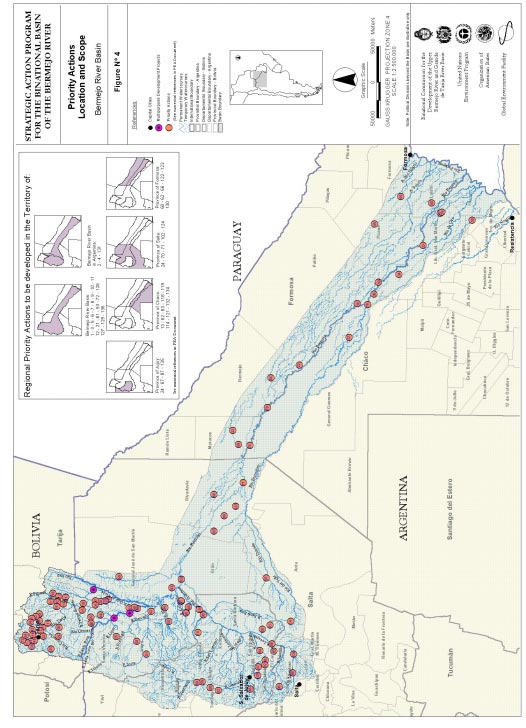
ANNEX V
OFFICIAL INSTITUTIONS OF ARGENTINA AND BOLIVIA TO BE INVOLVED IN SAP STRATEGIC ACTIONS
NONGOVERNMENTAL ORGANIZATIONS THAT COULD CARRY OUT SAP ACTIONS
PRINCIPAL ORGANIZATIONS OF INDUSTRIES AND WATER RESOURCE USERS IN THE BERMEJO
RIVER BASIN THAT COULD PARTICIPATE IN EXECUTING THE SAP
INDICATORS OF PUBLIC PARTICIPATION DURING FORMULATION OF THE SAP
Table 6.1: OFFICIAL INSTITUTIONS OF ARGENTINA AND BOLIVIA TO BE INVOLVED IN SAP STRATEGIC ACTIONS
Institutional
Environmental
Sustainable
Public
Agency, Institution
Area
Strengthening
Prevention, Protection, Development of
Participation and
and Development and Rehabilitation
Natural Resources Awareness
Binational Commission for the Development Basin
X
X
X
X
of the Bermejo Basin
Secretariat of Sustainable Development and RBB Arg
X
X
X
X
Environmental Policy
Regional Commission for the Río Bermejo RBB Arg
X
X
X
X
COREBE
National Agricultural Technology Institute RBB Arg
X
X
X
INTA
National Parks Administration
RBB Arg
X
X
Argentine National Gendarmes
RBB Arg
X
X
National Water and Environment Institute INA RBB Arg
X
X
X
National Science and Technology System
RBB Arg
X
X
Provincial Settlement Institute, Chaco
Chaco
X
X
National University of the Northeast UNNE
Chaco
X
X
X
X
Provincial Water Administration Chaco
Chaco
X
X
X
X
Under Secretariat of Natural Resources and Chaco
X
X
X
X
the Environment
Water Maintenance Service SAMEEP Chaco Chaco
X
X
X
Ministry of Education
Chaco
X
X
Under Secretariat of Natural Resources and Formosa
X
X
X
X
Ecology
Directorate of Water Resources
Formosa
X
X
X
X
Provincial Drinking Water Service of Formosa Formosa
X
X
X
X
Ministry of Education
Formosa
X
X
Secretariat for Renewable Natural Resources Jujuy
X
X
X
X
Provincial Directorate of Water Resources of Jujuy
X
X
X
X
Jujuy
Agua de los Andes S.A.
Jujuy
X
X
X
Superintendency of Public Services SUSEPU Jujuy
X
X
X
X
National University of Jujuy
Jujuy
X
X
X
X
Ministry of Education
Jujuy
X
X
National University of Salta
Salta
X
X
X
X
Secretariat of Tourism of Salta
Salta
X
X
Secretariat of Environment and Sustainable Salta
X
X
X
X
Development
Infrastructure Development Unit
Salta
X
X
X
X
87
Table 6.1: Continued
I n s t i t u t i o n a l
E n v i r o n m e n t a l
S u s t a i n a b l e
Public
Agency, Institution
Area
Strengthening
Prevention, Protection, Development of
Participation and
and Development and Rehabilitation
Natural Resources Awareness
Ministry of Education
Salta
X
X
Laboratory of Yungas Ecology Research - Uni- Salta
X
X
X
versity of Tucumán LIEY
National Commission of the Pilcomayo and RBB Bolivia
X
X
X
X
Bermejo Rivers (CONAPIBE)
General Directorate of Forestry Development RBB Bolivia
X
X
General Directorate of Biodiversity
RBB Bolivia
X
X
General Directorate of the Environment
RBB Bolivia
X
X
X
Bolivian Agricultural Technology Institute (IBTA) Tarija
X
Tarija Executive Program for Land Recovery Tarija
X
X
X
X
(PERTT)
Prefecture of Tarija Department
Tarija
X
X
X
X
Directorate of Sustainable Development Tarija Tarija
X
X
X
Prefecture
Juan Misael Saracho Autonomous University
Tarija
X
X
Departmental Directorate of Education Tarija Tarija
X
Prefecture
Peasant Development Fund (FDC)
RBB Bolivia
X
X
Social Investment Fund (FIS)
RBB Bolivia
X
X
National Regional Development Fund (FNDR) RBB Bolivia
X
X
Popular Participation Unit Tarija Prefecture Tarija
X
X
National Irrigation Program PRONARD
RBB Bolivia
X
San Jacinto Multiple Project
Tarija
X
X
X
INIBREH
Tarija
X
X
X
National Meteorology and Hydrology Service RBB Bolivia
X
X
SENAMHI
ZONISIG Project
RBB Bolivia
X
X
Municipalities in the basin
Basin
X
X
X
X
88
Table 6.2: NONGOVERNMENTAL ORGANIZATIONS THAT COULD CARRY OUT SAP ACTIONS
Institutional
Environmental
Sustainable
Public
ORGANIZATION
Strengthening
Prevention, Protection,
Development of
Participation and
and Development
and Rehabilitation
Natural Resources
Awareness
NGOs IN ARGENTINA
Association of Friends of the Aborigine (ASAMAB)
X
X
Association of the Anglican Church (ASOCIANA)
X
X
Agricultural Producer Defense Association
X
Association for the Promotion of Culture and Develop-
X
X
X
ment (APCD)
Association for the Promotion and Defense of the
X
X
Environment (APROMA)
Chaco Association of Promoters (APROCH)
X
Cáritas
X
X
Ce.Ca.Zo. (Zone Training Center)
X
Palo Santo Agricultural Education Center
X
X
Research Center for the Reconversion of the North
(CIRENOR)
X
X
X
Center of the Old People of the Chaco
X
Río Negro Recovery Commission
X
ENDEPA
X
X
EMPRENDER
X
X
Argentine Federation of Evangelical Churches (FAIE)
X
FUDECHA (Chaco Ecological Foundation)
X
Total Environment Foundation
X
X
X
Geopuna Foundation
X
X
Kallpa Foundation for Integrated Forest Management
X
X
X
Big North Foundation
X
X
X
PACHA MAMA Foundation
X
S.O.S Foundation
X
Argentine Wildlife Foundation
X
X
X
FUNDALES
X
FUNDAPAZ (Foundation for Development in Justice
X
and Peace)
X
GREENPEACE
X
X
Chaco Ecologist Group
X
INDES
X
X
Institute of Popular Culture (INCUPO)
X
X
United Committee of Missions (JUM)
X
KHANANYE
X
Yaguarete
X
Argentine Ecologist Movement
X
PIRCA
X
UNAMBI
X
X
NGOs IN BOLIVIA
Loyola Cultural Action (ACLO)
X
X
X
Tarija Regional Study Center (CERDET)
X
X
X
Cooperative for Foreign Remittances (CARE)
X
Cáritas, Tarija Diocese
X
Peasant Research and Support Center (CIAC)
X
X
Peasant Research and Training Institute (IICCA)
X
X
X
Tarija Social Pastoral
X
X
Church Social Assistance Office (OASI)
X
X
Intercommune Peasant Organization
X
X
Tarija Environmental Protection (PROMETA)
X
X
X
X
Vida Verde Association
X
X
X
Tarija International Plan
X
X
89
Table 6.3: PRINCIPAL ORGANIZATIONS OF INDUSTRIES AND WATER RESOURCE USERS IN THE BERMEJO RIVER BASIN
THAT COULD PARTICIPATE IN EXECUTING THE SAP
Institutional
Environmental
Sustainable
Public
INDUSTRIES AND USERS
Strengthening
Prevention, Protection,
Development of
Participation and
and Development
and Rehabilitation
Natural Resources
Awareness
ORGANIZATIONS IN ARGENTINA
Sugar mills (Ledesma, Tabacal, etc.)
X
X
Tobacco farms
X
X
Citrus fruit companies
X
X
Cotton companies
X
X
Rice companies
X
X
Yuto irrigation consortium
X
X
Irrigation board Juella
X
X
X
Valle de los Pericos Irrigation Consortium
X
X
X
Trópico de Capricornio Huacalera Irrigation board
X
X
X
Arroyo Santa Rita irrigation consortium
X
X
X
Tannin companies
X
X
X
Chaco Rural Society
X
X
X
Formosa Rural Society
X
X
X
Jujuy Rural Society
X
X
X
Salta Rural Society
X
X
X
ADOPTAS
X
X
ORGANIZATIONS IN BOLIVIA
Base Territorial Organizations (OTBs)
X
X
X
Association of milk producers
X
Bermejo sugar-cane associations
X
X
X
Vine-growers' association
X
Tarija Agricultural Chamber (CAT)
X
X
X
X
Tarija Federation of Cattlemen (FEGATAR)
X
X
Chamber of industry
X
X
Forestry chamber
X
X
Bermejo agricultural industries
X
X
Vintners
X
X
Tarija Drinking Water and Sewerage Cooperative
X
X
X
X
Bermejo Drinking Water and Sewerage Cooperative
X
X
X
X
Fruit-growers' association (AFRUTAR)
X
90
Table 7.1: INDICATORS OF PUBLIC PARTICIPATION DURING FORMULATION OF THE SAP
INDICATOR DESCRIPTION AND CONTENT
VALUE
First regional working meeting, Argentina, December 1995
Participants
176
Second working meeting, Bolivia, 1996
Participants
84
First regional workshop, Chocloca, Bolivia, August 1997
Participants
23
First regional workshop on the SAP, Salta, Argentina,
Participants
178
December 1997
Documents and discussion materials handed out to
14
each participant
Assessment forms filled out by participants
82
Regional seminar-workshop for the formulation of the SAP,
Participants
132
Tarija, Bolivia, May 1998
Second regional workshop on the SAP, Formosa, Argentina,
Participants
75
May 1998
Documents and discussion materials handed out to
10
each participant
Assessment forms filled out by participants
41
Seminar-workshop on environmental law, Tarija, Bolivia,
Participants
60
September 1998
Third regional workshop on the SAP, Jujuy, Argentina,
Participants
102
November 1998
Documents and discussion materials handed out to
13
each participant
Assessment forms filled out by participants
65
Seminar-workshop on erosion control experiences,
Participants
52
Tarija, Bolivia, December 1998
IV regional seminar-workshop for the formulation of the SAP,
Participants
79
Tarija, Bolivia, May 1999
V regional seminar-workshop for the formulation of the SAP,
Participants
80
Tarija, Bolivia, June 1999
VI regional seminar-workshop for the formulation of the SAP,
Participants
28
Tarija, Bolivia, July 1999
Contracts executed
Experts/consultants
80
Institutions
20
Contracted construction companies
4
Orders for major equipment
10
Compilation of plans, programs, projects, and initiatives
Project description files distributed
700
Projects and initiatives compiled
250
Plans and programs compiled
103
Preliminary compilation document of distributed projects and
Printed format
45
iniciatives
Diskette
120
Public communication
Electronic addresses
172
Registered with SAP-NET as of 6/99
31
Visits to website since 6/99
130
Active records in the mailing
731
Institutions participating in program elements
Specialists and technicians participating in the SAP
Individual and institutional contracts included (approx.)
30
Reports produced
Final reports and progress reports submitted by consultants
260
and executing agencies in charge of program elements
46
Terms of Reference
60
91
ANNEX VI
MULTI PURPOSE DEVELOPMENT PROJECT
LAS PAVAS, ARRAZAYAL Y CAMBARI
MULTIPLE DEVELOPMENT PROJECT LAS PAVAS, ARRAZAYAL AND CAMBARI DAMS
This program consists in the implementation of three multi-purpose water development projects, mainly aimed at
regulating water flows, located in the Upper Basin border sector in the international stretch of the Bermejo river and in
the Tarija river in Bolivia. Within the framework of the Orán Agreement of 1995 and its complementary Protocols, the
Binational Commission for the Development of the Upper Bermejo River and Grande de Tarija River Basins is charged
with the construction, operation, maintenance, utilization and administration of the "Las Pavas", "Arrazayal" and "Cambari"
dams.
The "Las Pavas" and "Arrazayal" dams are located in the course of the Bermejo River in the contiguous stretch 50
kilometers from the "Juntas de San Antonio", and the "Cambari" dam is located on the course of the Tarija river, in
Bolivian territory, approximately 5 kilometers from the border. Table VI-1 summarizes the main technical characteristics of
these projects.
The above-mentioned projects will act as a major stimulus to the development of the border area, with the
resulting binational integration; in addition, the projects will together help to promote the development process
in the Chaco region of Argentina, and southern Bolivia.
The project will provide Bolivia with access to electric energy in the southern region of the country. By regulating the
Bermejo River, these projects will basically allow Argentina to promote agricultural development in areas of the provinces
of Salta, Chaco, Formosa and Santiago del Estero, via the introduction of irrigation systems in extensive areas.
In 1997, via the Binational Commission, both governments initiated an international public tender process using the
"data room" format to grant a concession for the construction and operation of the development project to a private
operator.
Characteristics of the Binational Projects
DESCRIPTION
LAS PAVAS
ARRAZAYAL
CAMBARI
Location
Site
Las Pavas
Arrazayal
Cambarí
Province (Argentina)
Salta
Salta
---------
Department (Bolivia)
Tarija
Tarija
Tarija
River
Bermejo
Bermejo
Tarija
Priority use of the resource
Energy and Irrigation
Energy and Irrigation
Energy and Irrigation
Dam
Type
Concrete RCC gravity
Concrete RCC gravity
Concrete RCC gravity
Dam height
105 m
100 m
140 m
Gated spillway
4.500 m /s
4.500 m /s
4.500 m /s
Hydrologic and operational
characteristics
Maximum operating level
680 meters above sea level. 555 meters above sea level. 650 meters above sea level.
Minimum operating level
656 meters above sea level. 530 meters above sea level. 615 meters above sea level.
Reservoir area
2.074 ha
2.776 ha
3.800 ha
Reservoir capacity
589Hm
696Hm
1.675 Hm
Average annual flow
75m /s
82m /s
86 m m /s
Project flood level
6.000 m /s
6600m /s
8000m /s
Basin Area
4.050 km
4.414km
8.067 km
Production characteristics
Installed power
86 MW
86 MW
102 MW
Average annual energy
372 GWh/year
423 GWh/year
543 GWh/year
Cost
US$180.000.000
US$140.000.000
US$200.000.000
95
ACKNOWLEDGMENT
The development of this Project has been possible due to the collaboration of a large number of
professionals and specialists who have contributed to it through the compilation of information, studies
and analysis, elaboration and edition, geographic information systems development, public participation
activities, dissemination of the information, etc.
Many of them are stated as authors in the final reports elaborated along the Project, but unfortunately
not all. Therefore, the Execution Unit members would like express through the following names, their
acknowledgment to all who have contributed to the success of the Project.
Vartush Akaprahamyan, María Isabel Andrade, José Angeleri, Julio Antezama, José Arciénaga Echalar,
Luis Baruzzo, Manuel Bazán, Enrique Bello, Alberto Benítez Reynoso, Mónica Berardi, Roberto Bernal,
Roberto Bignone, Jorge Blanco, Roberto Campitelli, Javier Castellanos Vásquez, Carlos Castrillo Delgado,
Adel Cortez Maire, Oscar Costas Otero, Eduardo Darwich, Oscar Dean, Lucila Llado, Francisco López
Sastre, Dora Malamud, Jorge Marcuzzi, Mario Nina Ignacio, Roberto Ronchietto, Silvia Raffaelli, Jorge
Rucks, Jorge Ruiz Martínez, Liliana Simonini, Bruno Schwesig, Jeffrey Thorton, Isabelle Vanderbeck,
Ramón Vargas, Miriam Vassolo, Horacio Zambón,
97