HELCOM news
3 / 2 0 0 5 N e w s l e t t e r
HELCOM developing a Baltic Sea Action Plan, page 3
HELCOM EUTRO a pilot project aiming to develop new tools for assessing
eutrophication, page 6
HELCOM deletes three Lithuanian Hot Spots from the list of major polluters, page 10
Major new wastewater treatment plant opens in St. Petersburg, page 10
Baltic Sea Regional Project running at full steam ahead, page 12
HELCOM BSPA Project to strengthen and expand the network of
marine protected areas, page 13
HELCOM launches a common Baltic maritime traffi c monitoring system, page 13
HELCOM fl eet rehearses oil spill response off the Swedish coast, page 15
HELCOM
3/2005
Newsletter
Contents
Foreword, by the Executive Secretary, page 2
HELCOM developing a Baltic Sea Action Plan, page 3
Ecological Objectives to form the core of the Baltic Sea Action Plan, page 5
Ministers and parliamentarians on the HELCOM Action Plan, page 6
HELCOM EUTRO a pilot project aiming to develop new tools for
assessing eutrophication, page 6
Fewer chemical munitions found by Baltic fi shermen in 2004, page 7
At the 17th Meeting of the Heads of
HELCOM Indicator Fact Sheets: Latest assessments of riverine inputs of
Delegation, held on 14-15 June 2005
heavy metals and nutrients into the Baltic Sea, page 8
in Helsinki, Finland, the Helsinki Com-
mission resolved to develop a strate-
HELCOM deletes three Lithuanian Hot Spots from the list of
gic Baltic Sea Action Plan by 2007, to
major polluters, page 10
ensure that all possible measures are
Major new wastewater treatment plant opens in St. Petersburg, page 10
taken to reduce pollution in the Baltic
Sea and to repair the damage done
HELCOM to tackle dioxin pollution, page 11
to the marine environment.
Baltic Sea Regional Project running at full steam ahead, page 12
HELCOM's ongoing work developing
HELCOM BSPA Project to strengthen and expand the network of marine
Ecological Objectives for the Baltic
protected areas, page 13
will provide the foundation for this
HELCOM launches a common Baltic maritime traffi c monitoring system,
Action Plan. The Ecological Objectives
page 13
and their associated indicators will
be used to evaluate the effi ciency of
HELCOM fl eet rehearses oil spill response off the Swedish coast, page 15
existing environmental measures and
Illegal oil discharges in the Baltic Sea continue to decrease, page 16
to provide guidance for the develop-
ment of future management meas-
Swedish Coast Guard team wins HELCOM Trophy again, page 17
ures for the region. The development
HELCOM Youth Forum charts an environmentally-friendly course for
of the Action Plan will involve all the
the Baltic Sea region, page 18
Baltic Sea coastal countries. Input and
active participation from all major
stakeholder groups in the region will
also be required, to ensure that the
Action Plan is relevant and can be
effectively implemented in practice.
Anne Christine Brusendorff
Executive Secretary
HELCOM 3/2005 Newsletter
Published by: Helsinki Commission
d
Katajanokanlaituri 6 B
n
l
u
FI-00160 Helsinki, Finland
i
k
E-mail: info@helcom.fi
r
t
W
e
Internet: http://www.helcom.fi
:
B
t
o
o
Editor: Nikolay Vlasov
h
P
Helsinki Commission
Language revision: Fran Weaver
Latest HELCOM publications, page 19
Design and layout: Leena Närhi
Upcoming HELCOM Meetings, page 20
Cover photos: Agne Petrauskaite,
Visa Hietalahti, Mervi Kunnasranta
New staff at the HELCOM Secretariat, page 20
2
The Baltic Sea Action Plan
A new environmental strategy for the Baltic Sea region
Time for action
Progress towards these objectives
The Helsinki Commission (HELCOM),
will be assessed through measurable
the inter-governmental organisation
ecological indicators devised by
responsible for overseeing the protec-
HELCOM's scientifi c experts. Objec-
tion of the Baltic marine environment,
tives and indicators will be carefully
is preparing a Baltic Sea Action Plan to
selected to refl ect the needs and
ensure that every possible step is taken
wishes of everyone who has an inter-
to improve the state of the Baltic Sea.
est in the Baltic Sea.
To protect our common sea, the
active participation from stakeholders
countries around the Baltic have been
at many levels from international
working closely together for 30 years
organisations and governments;
to reduce pollution and repair the
through activities which pollute the
damage done to the marine environ-
sea or depend on the sea for their
ment. These efforts have led to notice-
livelihoods; right down to individual
able improvements, enabling people
citizens, whose choices can help to
to bathe on beaches that were once
reduce pollution.
polluted, and helping endangered
wildlife populations to recover.
The Baltic Sea Action Plan aims to
safeguard the Baltic's natural eco-
Key issues requiring action:
But there is still a lot to do, as many
systems while also allowing valuable
of the Baltic's environmental problems
marine resources to be used sustain-
Eutrophication
are proving diffi cult to solve, and it
ably in the future. The social and
The natural balance of the Baltic Sea
could take several decades for the
economic effects of the measures
has been seriously disrupted by exces-
marine environment to recover.
proposed for the plan will be carefully
sive nutrient inputs, which originate
assessed, as well as their environmen-
from diffuse sources like over-ferti-
The European Marine Strategy foresees
tal benefi ts.
lised farmland and air pollution, as
a regional approach to the protection
well as point sources like sewage
of the marine environment across Euro-
Setting targets
treatment plants and industrial
pean seas through the development of
The sensitive nature of the Baltic Sea
wastewater outlets. Symptoms of this
separate action plans. This gives extra
means that tailor-made measures
eutrophication process include abnor-
political momentum to co-ordinated
must be applied to limit all the kinds
mal algal blooms and lifeless areas on
international efforts to solve the prob-
of pollution that affect the sea.
the seabed.
lems affecting the Baltic. The Baltic
Sea Action Plan involves all the Baltic
The Baltic Sea Action Plan is to be
Objective
coastal states, including Russia as the
based on Ecological Objectives
A Baltic Sea undisturbed by exces-
only non-EU member, as well as other
defi ned to refl ect our common vision
sive inputs of nutrients
countries in the Baltic's catchment area.
of a healthy Baltic Sea, with bal-
No excessive nutrient concentra-
anced ecosystems able to support a
tions
Getting everyone
wide range of sustainable economic
Clear water
on board
activities.
Natural oxygen levels
The Baltic Sea Action Plan must be
No excessive algal blooms
based on our common understand-
This jointly agreed set of ambitious
Natural distribution of plants and
ing of what we want our sea to be
but realistic objectives will show how
animals
like in the future. This means that the
everyone around the Baltic Sea can
action plan should be drawn up with
work towards shared goals.
Continues on the following page
3
Actions
Reduce the amounts of nutrients
entering rivers from diffuse sources,
especially farmland
Reduce nutrient pollution from
the remaining "hot spots", such as
wastewater treatment plants
Maritime activities
Biodiversity
Reduce airborne nutrient pollution
The Baltic's crowded shipping lanes
The Baltic's unique conditions limit the
are becoming busier as the economies
diversity of life in the sea, and make
Hazardous substances
of the countries around the Baltic
ecosystems exceptionally sensitive to
In spite of efforts to reduce pollution,
Sea grow. This can lead to increased
pollution, the effects of commercial
concentrations of hazardous sub-
pollution and other pressures on the
fi sheries and offshore activities, and
stances remain abnormally high in the
marine environment. The risk of a
the introduction of non-native species.
Baltic Sea and its marine life. Levels
potentially disastrous oil spill is par-
of dioxins in fi sh, for instance, are still
ticularly rising as traffi c intensifi es.
Objective
above EU safety levels for foodstuffs.
Favourable conservation status of
Objective
biodiversity
Objective
Maritime traffi c and offshore acti-
Natural landscapes and seascapes
Concentrations of hazardous sub-
vities carried out in an environ-
Thriving and balanced communities
stances close to natural levels
mentally friendly way
of plants and animals
Concentrations near background
Accidents and the consequent harm
Natural species diversity
levels
to the marine environment mini-
Viable populations of species
No health problems among animals
mised
All fi sh safe for consumption
Maritime activities cause no harm
Actions
to the marine environment
Set up a representative network of
Actions
marine and coastal protected areas
Prevent the environmentally harmful
Actions
Prevent the introduction of non-
use of hazardous substances
Further reduce emissions and waste
native species
Further reduce the amounts of haz-
discharges
Curb inputs of nutrients and hazard-
ardous substances entering the sea
Improve maritime safety
ous substances
in rivers and from the air
Improve preparedness to respond
Safely dispose of old stocks of
to any accidents and pollution inci-
Building on 30 years of
chemicals or equipment containing
dents
experience
hazardous substances
HELCOM naturally plays a leading
role in the realisation of our vision of
a healthy Baltic Sea, by deciding on
internationally agreed protective meas-
ures. But the future ultimately lies in
the hands of everyone whose activities
affect the Baltic marine environment.
For this reason it is very important
that the responsibility for creating and
implementing the Baltic Sea Action
Plan is shared by all stakeholders in
both the private and the public sectors.
onen
i
n
HELCOM invites everyone intere-
i
He
sted in rescuing the troubled
mm
o
:
T
Baltic Sea to get actively involved
o
in drawing up and carrying out
Phot
4
the Baltic Sea Action Plan.
Ecological Objectives to form the core of
the Baltic Sea Action Plan
Healthy Baltic Sea
A set of draft Ecological Objectives
(EcoOs) and associated indicators make
Policy &
up the core of the innovative Baltic Sea
Research
Management
Action Plan. These are parts of the eco-
system assessment concept developed
Objectives
by the HELCOM EcoQO Project (Devel-
opment of Ecological Quality Objectives
Assessment
Indicators
for the Baltic Sea). The results of the
Good ecological status Target levels
recently fi nalised project will be scru-
tinised and revised by HELCOM expert
groups during autumn 2005.
Monitoring
The creation of Ecological Objec-
tives for the Baltic Sea has been part
of HELCOM's post-Bremen efforts
towards implementing an ecosystem
approach for the Baltic Sea. In order to
complete the task of defi ning "good
environmental status" for the Baltic
Sea in quantifi able terms HELCOM has
selected a stepwise approach.
The fi rst step is the joint setting of
general targets, embodied as Strategic
Goals and Ecological Objectives. These
"headlines" can then be used to com-
municate with a wider stakeholder
community ranging from scientists and
politicians to ordinary citizens. The aim
is to use the Ecological Objectives as a
tool to link environmental monitoring,
assessments, research and manage-
ment.
Photo: Czeslaw Kozlowski
The HELCOM EcoQO Project has also
ing the evaluation of the present state
and will continue for other param-
sown the seeds for the next step in the of the Baltic marine environment.
eters over the coming years. A new
process by drafting sets of measurable
HELCOM project "Marine ecological
indicators for each ecological objective, The fi nal and most crucial step
quality in the conceptual framework
thus also contributing to the ongoing
in implementing the ecosystem
for assessing eutrophication" will spe-
revision of the HELCOM monitoring
approach, defi ning exact target levels
cifi cally address biodiversity assess-
programs. Using a common system of
for the indicators, is a complex issue
ment issues. The project will run with
indicators will enable the monitoring
requiring intensive research and mod-
EU funding until 2007.
results obtained by individual coun-
elling work. This work has already
tries, agencies and scientists to be
been initiated for eutrophication
compared more easily, greatly facilitat-
within the HELCOM EUTRO Project,
5
Ministers and parliamentarians on
the HELCOM Action Plan
The HELCOM initiative to draw up
pean Marine Strategy, which foresees a
A resolution made by the 14th Baltic
a Baltic Sea Action Plan has already
separate action plan for each European
Sea Parliamentary Conference, held
received support from the Council of
sea.
in Vilnius, Lithuania, on 29-30 August
the Baltic Sea States (CBSS). A com-
2005, following the presentation of
muniqué from the 13th Ministerial
The 6th VASAB Conference of Minis-
the HELCOM Baltic Sea Action Plan,
Session of the CBSS, which was held
ters responsible for spatial planning
underlined the importance of the har-
on 9-10 June 2005 in Szczecin, Poland, and development of the Baltic Sea
monised implementation of the Euro-
reiterated the signifi cance of the
Region, held on 19 September 2005
pean Marine Strategy in the whole
work of the Helsinki Commission and
in Gdansk, Poland, also welcomed the
catchment area of the Baltic Sea by
welcomed the role of HELCOM in the
HELCOM Baltic Sea Action Plan, stating
making use of the established regional
development of the Action Plan. CBSS
that it should be duly considered when
cooperation within HELCOM.
underlined that the plan could also be
dealing with spatial planning issues
an important contribution to the Euro-
related to the marine environment.
HELCOM EUTRO a pilot project aiming to develop
new tools for assessing eutrophication
One of HELCOM's priority goals
develop practical tools for the harmo-
pristine conditions. Another aim of the
is to reduce eutrophication. This
nisation of eutrophication assessment
Project is to serve as a test case for the
requires a consensus on assessment
criteria and procedures all around
preliminary Pan-European guidance on
procedures as well as a subsequent
the Baltic. One important task of the
the assessment of eutrophication in
linking of effects and activities taking
Project is the establishment of refer-
European waters, adapted to suit the
place across the Baltic Sea drainage
ence conditions for different parts
specifi c features of the Baltic Sea.
basin. The HELCOM EUTRO Project
of the Baltic Sea. This is necessary in
was launched in November 2004 to
order to compare the present state to
The work of HELCOM EUTRO is closely
scheduled and coordinated with
a suite of related activities such as
the EU Water Framework Directive,
the European Marine Strategy, the
European Eutrophication Activity and
two other HELCOM Projects on Eco-
logical Objectives and the revision of
HELCOM's system of monitoring and
assessments.
A new trial tool named HEAT
(HELCOM Eutrophication Assessment
Tool) has already been developed
i
within the framework of HELCOM
l
aht
a
EUTRO. HEAT is to be tested in the
i
et
H
future assessment of the eutrophica-
i
s
a
tion status of the Baltic Sea. The new
:
V
o
tool also meets the requirements of
Phot
6
the EU Water Framework Directive.
Fewer chemical munitions found by Baltic
fi shermen in 2004
Only 4 small scale incidents of World
the chemical munitions caught in the
War II chemical munitions being
Baltic Sea since the mid-1990s. Over
caught by fi shermen in the Baltic
the period 1995-2002, about 3 -11
Sea were reported during last year,
incidents were reported annually, with
compared to 25 in 2003, accord-
the total weight of munitions involved
ing to annual statistics submitted
not exceeding 512 kg a year. The
by Denmark to HELCOM. This is the
highest number of incidents during
lowest fi gure for annual catches since
the last 20 years was in 1991 when
1999. However, experts are not yet
5,378 kg of munitions was netted in
attributing the decrease to any spe-
103 incidents.
solubility and slow degradability (e.g.
cifi c factors. The reason for the dra-
viscous mustard gas, Clark I and II,
matic decrease is unknown, as was
About 40,000 tonnes of chemical
and Adamsite). These compounds
the case for the dramatic increase in
munitions were dumped into the
cannot occur at higher concentrations
2003. The variations are probably due
Baltic Sea after the Second World War
in water, therefore, wide-scale threat
to a combination of different factors,
mostly in the area to the east of
to the marine environment from these
such as the intensity of fi shing activi-
Bornholm, southeast of Gotland and
dissolved chemical warfare agents can
ties in the areas close to the dumped
south of the Little Belt. It is estimated
be ruled out. HELCOM has carried out
chemical munitions, and the recom-
that these chemical munitions con-
extensive assessments and concluded
mendations issued by the authorities.
tained some 13,000 tonnes of chemi-
that any threat from residues of
cal warfare agents. Dumping areas are
warfare agents or chemical munitions
As the Lead Country for monitor-
marked as foul, with "anchoring and
to coastal areas is also unlikely.
ing dumped chemical munitions,
fi shing not recommended" on nauti-
Denmark prepared the report based
cal charts. However, fi shing in these
on information received as of 9th
waters is not prohibited, and commer-
of April 2005. Most of the netted
cial fi shing is continuing.
chemical munitions were completely
corroded and consisted of lumps of
Warfare agents are also discovered
mustard gas and sneeze gas. All the
outside the dumping areas from time
catches occurred east of Bornholm,
to time, especially near Bornholm.
near an area where large amounts
Fishermen in these waters regularly
of chemical munitions were dumped
fi nd bombs, shells or fragments of
after World War II. Three separate
munitions and even lumps of mustard
WWII chemical munitions
incidents involved mustard gas, with a
gas in their bottom trawl nets. The
dumping areas
total weight of approximately 140 kg
crews of fi shing vessels risk con-
of netted in clay-like lumps. The other
tamination from chemical warfare
episode involved a 20 kg lump of
agents if lumps of viscous mustard
sneeze gas caught by a fi shing vessel.
gas or chemical munitions caught in
Most of the catches were released by
bottom trawls are hauled on board.
fi shermen at sea, although one catch
Simply touching these chemical
was brought ashore for safe disposal.
agents or inhaling their vapours is very
dan ger ous.
The year 2003, when a total of 1,110
kg of gas-derived lumps was netted
Chemical warfare agents break down
in 25 incidents represented one of the
at varying rates into less toxic, water-
biggest increases in both the numbers
soluble substances. Some compounds,
of incidents and the total weight of
however, show an extremely low
7
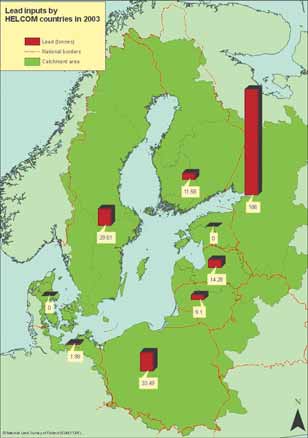
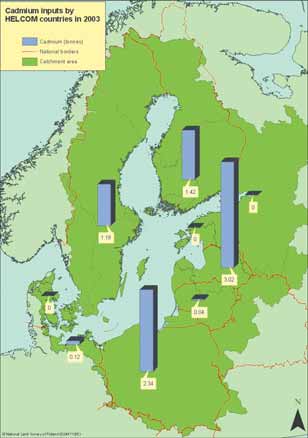
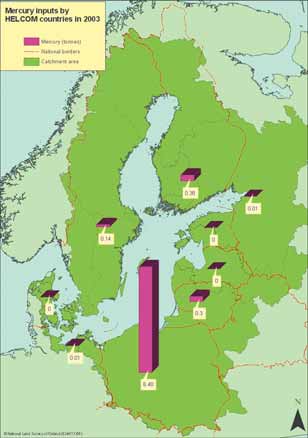
HELCOM Indicator Fact Sheets:
Latest assessments of riverine inputs of heavy metals
and nutrients into the Baltic Sea
Riverine heavy metal loads
were not obtained in many cases, or
concentrations of mercury, cadmium
decrease, but still no clear
that the methods used to estimate the
and lead have been measured in fi sh,
trend in total inputs
recorded loads are not fully harmo-
in birds' eggs and in seal tissue, for
During the period 1994-2003 riverine
nized. The data sets from small rivers
instance. Measured concentrations of
heavy metal loads (notably cadmium
and coastal areas are even more incom-
heavy metals have typically been as
and lead) seem to have decreased for
plete.
much as an order of magnitude higher
most of the Baltic Sea countries. In
than concentrations in the North Sea.
2003 the reported riverine (including
High concentrations of heavy metals
The main reason behind these high
coastal areas) mercury load entering
in biota of the Baltic Sea are mainly
concentrations in the Baltic Sea is
the Baltic Sea amounted to 7.3 tonnes,
caused by loading from land-based
intense industrial activity, high popu-
the lead load to 285.8 tonnes, and the
sources. About 50 % of mercury,
lations in the catchment area, and
cadmium load to 8.1 tonnes.
60-70 % of lead, and 75-85 % of
above all the long renewal time of the
cadmium enters the Baltic Sea via rivers seawater.
However, incomplete data from some
or as direct waterborne discharges.
countries makes it diffi cult to draw
Atmospheric deposition also signifi -
A few large rivers account for the
conclusions concerning the total heavy
cantly contributes to total heavy metal
major part of total riverine heavy
metal loads entering the Baltic Sea.
loads.
metal loads. Comparing the riverine
Shortcomings in national monitoring
inputs into different sub-basins, the
programmes and the lack of proper
Excessive heavy metal concentrations
Gulf of Finland received the highest
laboratory equipment in some coun-
may pose a health risk to marine biota
lead load, while mercury inputs were
tries meant that heavy metal fi gures
and to humans. In the Baltic Sea high
highest for the Baltic Proper. For
Figure 1. Riverine loads of Lead enter-
Figure 2. Riverine loads of Cadmium
Figure 3. Riverine loads of Mercury
ing the Baltic Sea in 2003 from the 9
entering the Baltic Sea in 2003 from
entering the Baltic Sea in 2003 from
coastal countries (tonnes).
the 9 coastal countries (tonnes).
the 9 coastal countries (tonnes).
8
cadmium reliable estimates cannot be
sources within a river's catchment
given, because of the inadequacy of
area, including discharges from indus-
the data.
try, municipal wastewater treatment
plants, scattered dwellings, losses from
Reports show lowest
agriculture and managed forests, as
riverine inputs of nitrogen
well as natural background losses and
and phosphorus
atmospheric deposition. According to
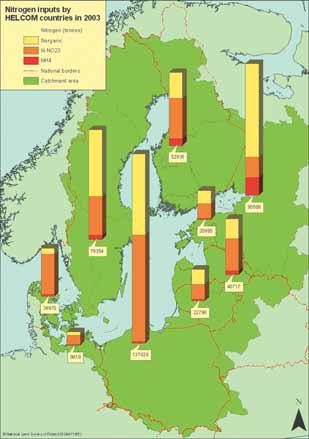
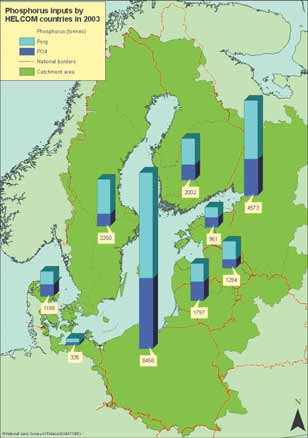
In 2003, the total riverine (includ-
the HELCOM Fourth Baltic Sea Pollu-
ing coastal) nitrogen load entering
tion Load Compilation (PLC-4) report,
the Baltic Sea amounted to 460,000
diffuse loads (mainly from agriculture)
tonnes, and the total phosphorus load
contributed almost 60% of waterborne
to 20,000 tonnes. Both fi gures were
nitrogen inputs and 50% of phospho-
the lowest recorded during the period
rus inputs. As a result of the improved
1994-2003.
treatment of industrial and municipal
wastewater, nutrient discharges from
Excessive nitrogen and phosphorus
point sources were reduced signifi -
loads coming from land-based sources
cantly between 1985 and 2000.
are the main cause of the eutrophica-
tion of the Baltic Sea. About 75% of
Nitrogen and phosphorus loads
the nitrogen load and at least 95% of
vary considerably from year to year,
the phosphorus load enter the Baltic
depending mainly on hydrological
Sea via rivers or as direct waterborne
conditions. In periods of high runoff,
discharges. About 25% of the nitro-
nutrients are abundantly leached from
gen load is coming as atmospheric
soil, increasing the loads originat-
deposition.
ing from diffuse sources and natural
leaching. The annual freshwater infl ow
to previous years, and the year 2003 in
Riverine nutrient loads consist of
(riverine runoff) during the period
particular was exceptionally dry.
discharges and losses from different
2000-2003 was quite low compared
This means that even though fi gures
for both nitrogen and phosphorus
loads for 2003 were the lowest during
the whole period 1994-2003, it
cannot be concluded that this trend is
a result of the effective implementa-
tion of measures to reduce nutrient
loads in the catchment area.
Figure 4. Riverine loads of Nitrogen
Figure 5. Riverine loads of Phospho-
(N
, NH -N, NO -N) entering the
rus (P
, PO -P) entering the Baltic
total
4
2,3
total
4
Baltic Sea during 2003 from the 9
Sea from the 9 HELCOM countries
HELCOM countries (tonnes).
(tonnes).
9
HELCOM deletes three Lithuanian Hot Spots
from the list of major polluters
The Helsinki Commission this summer
HELCOM Executive Secretary Anne
The "Hot Spots" list of the most signif-
deleted three Lithuanian Hot Spots
Christine Brusendorff. "Wastewater
icant point sources of pollution around
from the list of the Baltic Sea's most
treatment effi ciency in Vilnius, with its
the Baltic Sea was fi rst drawn up
signifi cant pollution sources.
population of over half a million, now
under the Baltic Sea Joint Comprehen-
meets the requirements of the relevant
sive Environmental Action Programme
The deleted Hot Spots are the capital
HELCOM Recommendations, and is
(JCP) in 1992. A total of 87 Hot Spots
Vilnius, which is also Lithuania's largest
also in compliance with the EU require-
and sub-Hot Spots remain on the list
city, and the municipalities of Alytus
ments."
today, following the deletion of 62 of
and Marijampole. The wastewater
the original 149 Hot Spots/sub-Hot
treatment plants in all three localities
HELCOM's experts also welcomed
Spots. Investment and remediation
have been thoroughly modernised in
the reduction of pollution loads from
projects carried out at pollution Hot
recent years.
the wastewater treatment plants in
Spots around the Baltic Sea have con-
Lithuania's third largest city, Klaipeda,
tributed substantially towards overall
"We very much welcome Lithuania's
but could not yet support the deletion
pollution load reductions in the Baltic
progress in the reduction of pollution
of this Hot Spot, since the HELCOM
Sea catchment area.
from point sources such as municipal
requirement for phosphorus is still being
wastewater treatment plants," said
exceeded in wastewater outfl ows.
Major new wastewater treatment plant
opens in St. Petersburg
The leaders of Russia, Finland and
the Swedish Prime Minister Göran
"The completion of the plant is
Sweden on 22nd September 2005 inau-
Persson and St. Petersburg's Governor
an extremely important and very
gurated the new St. Petersburg South-
Valentina Matvienko were among the
welcome development for the city of
west Wastewater Treatment Plant,
hundreds of dignitaries taking part in
St. Petersburg and the Baltic marine
which will greatly reduce the amount
an offi cial opening ceremony held at
environment as a whole," said Anne
of untreated sewage entering the Gulf
the new plant to mark the completion
Christine Brusendorff. "The plant will
of Finland from the largest city in the
of one of the largest environmental
drastically cut the effl uent loads that
Baltic Sea catchment area.
co-operation projects in the Baltic Sea
St. Petersburg is currently discharging
region in recent years.
untreated into the Gulf of Finland. This
The Russian President Vladimir Putin,
is one of the highest priority water
the President of Finland Tarja Halonen,
A delegation of the Helsinki Commis-
protection projects in the whole of the
sion Secretariat, led by the Executive
Baltic Sea region. At HELCOM we see
Secretary, Anne Christine Brusendorff,
the new plant as a major step towards
also attended the ceremony at the
a cleaner Baltic marine environment,
invitation of the Governor of St.
and we would like to congratulate
Petersburg.
the St. Petersburg authorities, the
municipal water utility Vodokanal and
everyone who has contributed to this
outstanding success."
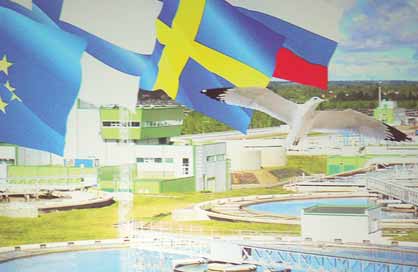
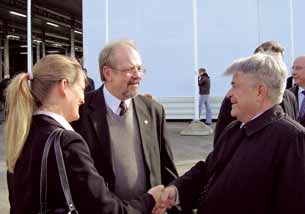
An artistic impression of St. Peters-
burg Southwest Wastewater Treat-
With its 4.6 million inhabitants, St
10
ment Plant
Petersburg is by far the largest city
in the Baltic's catchment area; and
from the city's central districts to the
wastewater from the city of St. Peters-
Northern Wastewater Treatment Plant.
burg is the Baltic Sea's single biggest
This will virtually eliminate the dis-
pollution point source. Reducing the
charge of untreated wastewater from
consequent effl uent load has been
St. Petersburg into the sea.
one of HELCOM priority objectives in
order to improve the condition of the
Begun in the days of the former Soviet
whole Baltic Sea.
Union, and then postponed due to
lack of funds, the construction of the
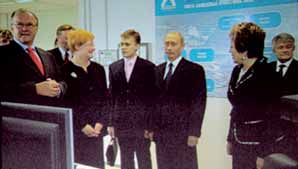
Swedish Prime Minister Göran
According to Vodokanal, the new
St. Petersburg Wastewater Treatment
Persson, Finnish President Tarja
plant has an average daily capacity of
Plant was resumed on 21 March 2003.
Halonen, Russian President
330,000m³ and will treat the waste-
The current project was fi nanced
Vladimir Putin, St. Petersburg's
water from the homes of 720,000
from a total of 15 different Russian,
Governor Valentina Matvienko,
residents of southwestern districts
Western European and Scandina-
and Vodokanal's Director General
of the city in line with the standards
vian sources, notably through bank
Felix Karmazinov touring the plant
recommended by the Helsinki Comm-
loans, government grants and dona-
isson. This will halve the total amount
tions. The fi nancing bodies involved
of untreated wastewater currently
have included the European Bank for
discharged from the city directly into
Reconstruction and Development, the
the sea. The plant will reduce nutrient
Nordic Investment Bank, the Euro-
inputs into the Gulf of Finland by some
pean Investment Bank, the Northern
2,200 tonnes of nitrogen and 360
Dimension Environmental Partner-
tonnes of phosphorus every year.
ship, NEFCO, Swedfund International
AB, the EU's TACIS Fund (Technical
Experts estimate that the St. Peters-
Assistance to the Commonwealth of
HELCOM Executive Secretary Anne
burg wastewater treatment system
Independent States), the Finnish Fund
Christine Brusendorff, with the
will now reduce the overall amount of
for Industrial Cooperation, the Finnish
Director General of the St. Peters-
untreated wastewater discharged from
Ministry of the Environment and the
burg Public Organization "Ecology
the city into the sea to about 15% of
Swedish International Development
and Business", Leonid Korovin,
the total. The next planned improve-
Agency. This project is the largest of
and Vodokanal's Director General
ment concerns the construction of a
its kind in Europe, with its total cost
Felix Karmazinov
drainage tunnel to take wastewater
estimated at around 180 million.
HELCOM to tackle dioxin pollution
Experts from the Helsinki Commission
HELCOM LAND strongly supported
dioxins, which are diffi cult to address,"
are planning to develop a new Recom-
the development of a new HELCOM
said Kaj Forsius, Professional Secretary
mendation for the Baltic Sea coastal
Recommendation on Environmen-
at the Helsinki Commission. "This is
countries to promote further reductions tally Friendly Practices to reduce and
why it is important to raise awareness
in dioxin pollution in the Baltic Sea. The prevent emissions of dioxins from
of good practices in combustion and
proposal to develop the new measures
small-scale combustion. The resultant
the importance of not burning waste
was discussed at the regular meeting
draft Recommendation is due to be
in domestic combustion appliances,
of the HELCOM Land-based Pollution
adopted at the next annual Helsinki
for instance." According to Forsius, the
Group (HELCOM LAND), which took
Commission Meeting in March 2006.
main aim of this Recommendation will
place in Bonn 31 May - 2 June, focuss-
be to disseminate information in the
ing on the need for further actions to
"Diffuse sources, such as combustion
coastal countries on environmentally
combat eutrophication and hazardous
appliances in households and small
friendly practices for small scale com-
substances in the Baltic Sea.
enterprises are signifi cant sources of
bustion.
11
Baltic Sea Regional Project running at full steam ahead
Monitoring agricultural
The BSRP brings much-needed addi-
A new assessment report on the
runoff
tional funding for efforts to improve
state of the coastal fi sh communities
Agriculture has been identifi ed as
the quality of monitoring in the whole
has been produced by a joint BSRP/
the biggest source of nutrient inputs
Baltic Sea region. It helps to upgrade
HELCOM Coastal Fish Expert Group
to marine waters in the eastern part
existing monitoring stations as well
As part of the HELCOM EUTRO
of the Baltic Sea. To address this
as to build completely new structures
Project, the BSRP has tested the draft
issue, one of the primary aims of the
to form a network covering selected
HELCOM Eutrophication Assessment
Land and Coast Component of the
rivers in the Baltic Sea catchment area.
Tool (HEAT)
Baltic Sea Regional Project (BSRP) is
Project investments will thus increase
The BSRP is developing Ecological
to estimate and reduce the fl ows of
the number of well-equipped refer-
Objectives and related indicators
nutrients from farmland into the sea.
ence sites able to provide accurate
together with the HELCOM EcoQO
In addition to the direct farm man-
data on nutrient runoff from agricul-
Project
agement activities discussed in issue
ture in the Baltic Sea basin.
The BSRP Coordination Centre for
1/2005 of HELCOM News, the BSRP
GIS, located at Vilnius University's
also incorporates monitoring activities
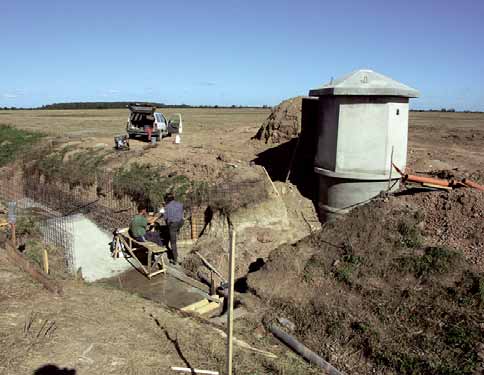
One of the new stations is the Grai-
Institute of Ecology, has created a
designed to identify complex cause-
supis stream monitoring post in
Baltic GIS portal (http://server.ekoi.
effect relationships.
Lithuania. This site will soon provide
lt/gis/), which will be further devel-
monitoring data about nutrient losses
oped along with other GIS products
using a continuous water fl ow moni-
to enhance HELCOM's assessment
toring method. Assessment of this
work
data will take into account geographi-
cal, geological and meteorological
conditions.
Assessing the state of the
marine ecosystem
The Large Marine Ecosystem Compo-
nent of the BSRP aims to introduce
ecosystem-based practices for the
management of marine resources.
To improve our understanding of the
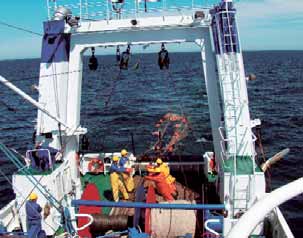
Research trawling on board R/V
interlinkages in the Baltic marine eco-
Baltica in May 2005. To demon-
system, essential concepts and prod-
strate the ecosystem approach to
ucts are being developed within the
resource assessment, scientists from
framework of the BSRP:
the BSRP joined the Sea Fisheries
The Graisupis stream monitor-
Institute in Gdynia and Latvian Fish
ing post under construction in
Resource Agency on this cruise,
Lithuania
which combined fi sh and zooplank-
ton surveys with nutrient and phy-
Phase I of the Baltic Sea Regional Project has established a network
toplankton surveys. This integrated
of scientifi c institutions, known as centres of excellence, and success-
survey provided a snapshot of all
fully introduced the ecosystem approach in the Eastern Baltic Sea
the major pelagic food web compo-
region. Phase I is due to run until June 2006. In view of the sustain-
nents in the Eastern Gotland basin.
ability of the project activities, the planning of Phase II has now been
In addition to its scientifi c value,
initiated. Phase II of the BSRP will continue working towards the
experience from this successful
goals and objectives outlined for Phase I, with an intensifi ed focus
pilot project is helpful in planning
on the policy-making level and on the practical application of sus-
future routine integrated ecosystem
tainable methods on farms, along the coast and in the sea.
surveys.
12
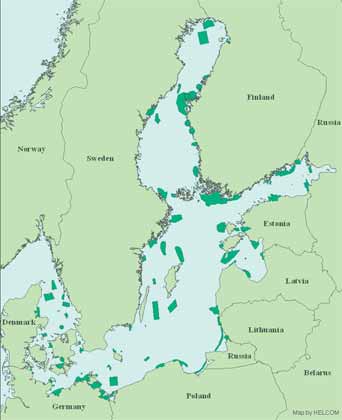
HELCOM BSPA Project to strengthen and expand the
network of marine protected areas
In line with the 2003 HELCOM/OPSPAR The Project has also started to evalu-
Ministerial Declaration, the HELCOM
ate the ecological coherence of the
BSPA Project has been working to
BSPA and Natura 2000 networks using
implement the joint Work Programme
information on how areas give par-
on Marine Protected Areas. The Project ticular protection to species, natural
has made an inventory of marine
habitats and biotopes to conserve
protected areas in the Baltic Sea to
biological and genetic diversity; how
identify gaps, and to build by 2010 a
the areas protect ecological processes
joint network of well-managed marine
and ensure ecological functions; and
protected areas that is ecologically
how the areas are replicated and con-
coherent.
nected.
The Project has created a comprehen-
The Project has also improved
sive database on the existing network
HELCOM's guidelines for the manage-
of Baltic Sea Protected Areas (BSPAs)
ment of the BSPAs, and for the moni-
and other protected areas such as
toring of the effectiveness of this man-
Natura 2000 sites. This database can
agement. It will also identify gaps and
be accessed via the Internet, and cur-
provide basic guidance for establishing
Marine Protected Areas in the
rently contains information on 97 sites. a dialogue between stakeholders in
Baltic Sea as of 2005
The database has been used in analys-
the BSPAs.
ing the implementation status of the
HELCOM Recommendation on BSPAs.
HELCOM launches a common Baltic maritime traffi c
monitoring system
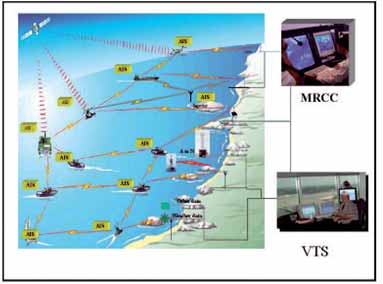
An Automatic Identifi cation System
sions on new measures to prevent col-
(AIS) for monitoring maritime traffi c in
lisions and improve navigational safety
the Baltic Sea was offi cially launched
in the Baltic Sea".
by the Helsinki Commission on 1st July
2005. The new automatic VHF radio-
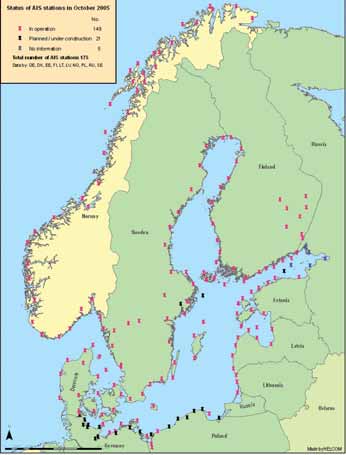
The system includes land-based sta-
based system enables the identifi ca-
tions established in all the coastal
tion of the name, position, course,
countries to receive information
speed, draught and cargo of every
from all vessels passing through
ship of more than 300 gross tonnes
their national waters. All stations are
sailing in the Baltic Sea, and displays
linked to a "HELCOM server", which
all available data over a common back-
combines all the data and provides a
ground map of the region.
comprehensive real-time picture of the
overall maritime traffi c situation in the
"The system is fully operational and
Baltic Sea to the competent authorities
covers the whole of the Baltic Sea and
in each HELCOM member state.
Norwegian waters," said HELCOM
Executive Secretary Anne Christine
In addition to providing shore stations
Brusendorff. "It will greatly improve
with information, the AIS also enables
risk management and facilitate deci-
Continues on the following page
HELCOM AIS stations
13

"Implementing the Automatic Identi-
Denmark, the double-hulled oil tanker
fi cation System was a challenging and
"Baltic Carrier" collided with the bulk
demanding task for all the HELCOM
carrier "Tern", resulting in the spillage
countries, but we met the deadline of
of 2,700 tons of heavy fuel oil, much
1st July 2005, as defi ned in the Copen-
of which eventually washed up along
hagen Declaration," said Benny Pet-
the Danish coast.
tersson, Chairman of the AIS Expert
Working Group.
The new system builds upon the
International Maritime Organisation's
The decision to establish a land-based
(IMO) requirements for all larger ships
monitoring system for ships, based
to be equipped with AIS. HELCOM's
on AIS signals, was taken during the
work will also contribute at European
HELCOM Extraordinary Ministerial
level to the implementation of the
Meeting in Copenhagen in 2001,
EU directive on traffi c monitoring
which followed one of the most
and information, under which AIS
serious oil spills in the Baltic in recent
exchange systems should be opera-
years. On 29th March 2001, close to
tional by the end of 2008.
the sea border between Germany and
Background: Maritime traffi c in the Baltic Sea
The issue of maritime safety is given the highest priority in the Baltic Sea
region. The Baltic is a relatively small sea, with many rocky shallows, narrow
straits and labyrinthine archipelagos, as well as harsh winter ice conditions.
The Baltic Sea is criss-crossed by some of the busiest shipping lanes in the
world. The intensity of shipping activities in the Baltic has been growing
ships to detect and identify each other
very rapidly during the last decade, and there is no sign of this trend slowing
at sea. The AIS messages contain
down. There are around 2,000 ships at sea at any time, accounting for 15 %
information on the identity, position
of the world's cargo transportation. All kinds of cargo are shipped in and out
and course of the vessel, as well as
of the Baltic Sea countries, including oil and hazardous substances. Every day
various additional data.
150-200 large tankers are fi lled with oil in 20 ports around the Baltic.
The primary task of the shore-based
The sizes of ships have been increasing, as well as their numbers. Some
AIS network is to provide the com-
tankers in the Baltic nowadays carry as much as 100,000 tonnes of oil. This
petent authorities with a monitoring
increases the risk of a major oil spill. Every year about 70 shipping accidents
tool for supervision, risk analyses,
occur in the Baltic Sea. Fortunately most of them do not cause any notable
search and rescue (SAR) operations,
pollution, but a single large-scale accident could seriously threaten the Baltic
port state control, security and other
marine environment.
safety-related tasks to ensure safe
navigation in the crowded waters of
Forecasts predict a further 40% increase in oil transportation by 2015 from
the Baltic Sea.
today's level of more than 160 million tonnes a year. Cost factors would
already favour the use of even larger tankers able to carry 100,000-150,000
The HELCOM AIS network will also
tonnes of oil.
make it possible to elaborate statistics
on the nature and extent of shipping,
as well as the amounts of cargo being
transported in the Baltic Sea area.
This will provide an improved basis
for future risk assessments and the
identifi cation of needs for additional
measures.
14
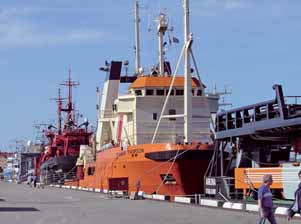
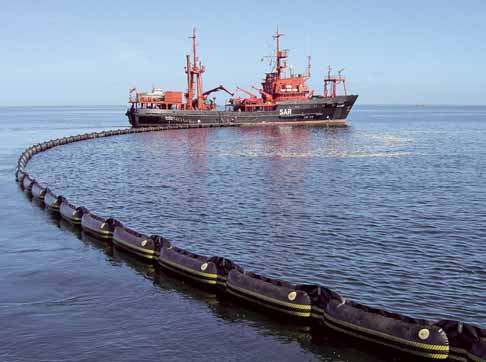
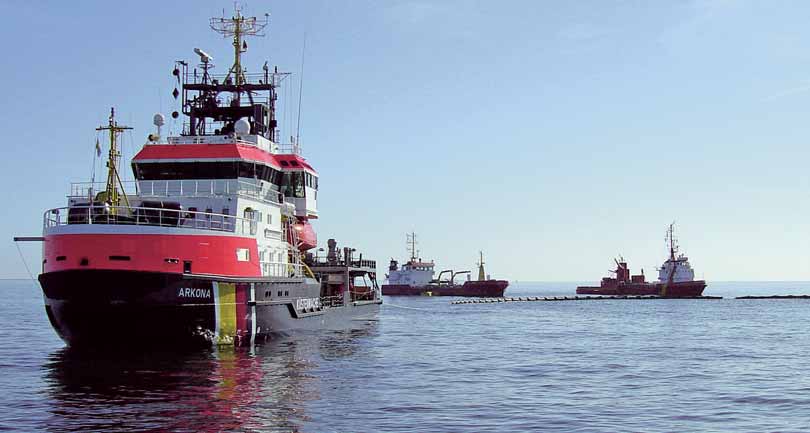
HELCOM fl eet rehearses oil spill response off
the Swedish coast
A total of 19 ships and smaller vessels
BALEX DELTA 2005 was organized by
countries around the Baltic to jointly
from the Baltic Sea countries partici-
the Swedish Coast Guard Headquar-
respond to an oil spill at sea. The
pated in HELCOM's annual pollution
ters and its Regional South Command.
HELCOM countries have more than 30
response exercise BALEX DELTA 2005,
Response vessels from 7 Baltic Sea
response vessels on standby located
held off Karlskrona, Sweden, on 31st
countries (Denmark, Finland, Germany,
around the Baltic Sea so that they are
August.
Latvia, Lithuania, Poland and Sweden)
able to reach any place in the Baltic
participated in this year's exercise.
Sea within 6 to 48 hours.
The main aim of the exercise was to
test the Baltic Sea countries' readiness
The exercise involved a scenario where
to respond to a major oil accident
a ferry collided with an oil tanker car-
at sea, particularly with regard to
rying a cargo of around 70,000 tonnes
response capability and co-operation
of heavy fuel oil south of Karlskrona. In
between response units from different
addition to its cargo, the oil tanker was
countries.
also carrying 6,000 tonnes of heavy
fuel oil and 150 tonnes of marine
"The exercise went very smoothly,"
diesel oil as bunker. After the collision
said Thomas Fagö, Chairman of the
the oil tanker had supposedly leaked
HELCOM Response Group. "All objec-
around 10,000 tonnes of its oil cargo,
tives were achieved. This exercise is
which was assumed to be drifting
invaluable for maintaining our readi-
towards Sweden's coastline. Units from
ness to effectively respond to a major
Sweden and other HELCOM countries
oil spill in the Baltic Sea. It gives us an
were tasked to jointly prevent the oil
opportunity to test common proce-
slick reaching the shore. The oil spill
dures for how to acquire assistance
was simulated using popcorn.
in case of a major oil spill, and how
to communicate and work together
BALEX DELTA operational response
under one command during a
exercises have been held annually since
response operation at the scene of an
1990. Over this period HELCOM has
accident."
steadily improved the readiness of the
15
Illegal oil discharges in the Baltic Sea
continue to decrease
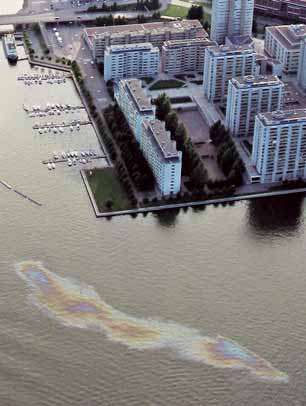
Illegal oil discharges from ships in the
equipment, illustrates the positive
Baltic Sea are continuing to become
results of the complex set of measures
less frequent, according to the latest
known as the Baltic Strategy, which has
data compiled by the Helsinki Commis-
been implemented by the Contracting
sion's Response Group.
Parties to the Helsinki Convention."
Last year, 293 oil spills were detected
Most of the illegal oil discharges were
during 5,534 hours of surveillance
detected along main shipping routes.
fl ights conducted by the coastal coun-
The ten most signifi cant spills, each
tries over the Baltic Sea. Although
containing more than 10 cubic metres
the number of observed illegal oil
of oil, were detected in the south-
discharges is slightly higher than it
western Baltic, the Kattegat, and the
was in 2003 (292), surveillance planes
Gulf of Finland. The largest spills of
fl ew 600 hours more last year, which
all were observed west of Bornholm
means that the number of illegal oil
(253.1 cubic metres) and east of Rügen
discharges detected per fl ight hour has
(111.5 cubic metres).
continued to decrease.
Deliberate illegal oil discharges from
of oil tankers. The prohibition stems
"We see a continuation of a positive
ships have been regularly observed
from the international designation
trend," said HELCOM Professional Sec-
during surveillance fl ights over the
of the Baltic Sea as a "special area"
retary Tadas Navickas. "The decrease
Baltic Sea since 1988. The number of
under the International Convention for
in the number of observed illegal dis-
observed illegal oil discharges has gradu- the Prevention of Pollution from Ships
charges, despite the rapidly growing
ally been decreasing every year, since
(MARPOL 73/78).
density of shipping, the increased
the peak year of 1989, when 763 spills
frequency of the surveillance fl ights
were detected during 3,491 fl ight hours.
To uphold this prohibition, the 1992
and improved usage of remote sensing
Helsinki Convention requires all ships,
8°
10°
12°
14°
16°
18°
20°
22°
24°
26°
28°
30°
32°
34°
36°
"Regular aerial surveillance fl ights
with a few exceptions, to deliver oil
68°
66°
HELCOM
Location of oil spillages observed in the Baltic Sea
contribute signifi cantly to the decrease
to reception facilities before leaving
area during aerial surveillance within the in 2004
67°
SYMBOLS
Quantity
Number
65°
in discharges as ships are aware that
port. To further encourage delivery,
^
_Category ? unknown
17
#
3
Category 1
> 0-1 m
244
"
)
3
Category 2
> 1-10 m
22
their illicit activities will not remain
the countries bordering the Baltic Sea
66°
3
#
!
( Category 3 > 10-100 m
8
Oulu
64°
3
!
X
WCategory 4 > 100 m
2
unseen," said Thomas Fagö, Chairman
have agreed that ships should not
TOTAL NUMBER OF OBSERVATIONS: 293
65°
Data by: DE, DK, EE, FI, LV, PL and SE
63°
of the HELCOM Response Group. "The
be charged for using such reception
Umea
64°
!
62°
HELCOM aerial surveillance fl eet today
facilities, under the "no-special-fee"
63°
consists of more than 20 airplanes and
system. Costs are instead recovered
#
61°
helicopters, many of them equipped
from general harbour fees or general
62°
#
#
#
St.Petersburg 60°
!
with remote sensing equipment such
environmental fees, for instance.
"
)
Turku
Helsinki
61°
#
!
##
! # #
## #
#
Mariehamn
###
"
)
^
_
##
as side looking airborne radar (SLAR),
!
^
_
59°
"
)
Tallinn
##
## #
#
!
(
60°
#^
_
"
)# #
# # !
#
#
Stoc #
"
)
infrared (IR) and ultraviolet (UV)
"The increased amounts of wastes
#
kholm
"
)
#
#
! #
#
##
###
##
#
58°
#
# #
#
#
Parnu
!
59°
cameras, photo and video equipment."
now being delivered to the Baltic Sea
#
# # #
#")
"
)#
#
#
# #
#
#
57°
ports illustrate that more and more
#
58°
#
#
#
Gothenburg
#
# Riga
#
!
( # !
!
Fr #
#
#ederikshavn
#
##
#")
#
! ##
#
# #
Today, any discharge into the Baltic Sea ships are delivering their oil wastes to
"
)#
#
#
56°
#
#
# #
57°
#
Liepaja
##
#
!
##")
#
##
of oil, or diluted mixtures containing
port reception facilities rather than ille-
# #
#
"
) ##
#
###
"
)
###
#
#
#
# ##
"
)
Klaipeda
55°
#
#
#
56°
#
#
#
"
)
!
Copenhagen
oil in any form including crude oil, fuel
gally discharging them into the Baltic
#
!
(
"
)
!
#
!
(
"
)#
# ##
#
# ##
#
#
#
##
# ##
# #
#
# #
#
# #")
##
#
#
#
#
# #
#
^
_ ###
!
(
#
#
Kaliningrad
54°
55°
# ##
#
#
!
oil, oil sludge, or refi ned products, is
Sea," said Tadas Navickas.
# X
W##
#
"
)
^
_
#
#
#
"
)
#
Gdynia
!#
#
^
_ #
"
)
#
X
W
^
_
##
#
^
_# ^
_ #
^
_
^
_
#
#
#
#
"
) #
#
#
##^
_
^
_
##
#!(
Kolobrzeg
Rostock ^
_
prohibited. This applies to oily water
!
!
53°
54°
#Lubeck
!
made by HELCOM
from the machinery spaces of any ship,
8°
10°
12°
14°
16°
18°
20°
22°
24°
26°
16
Exclusive Economic Zone
Territorial Waters
as well as from ballast or cargo tanks
Swedish Coast Guard team wins
HELCOM Trophy again
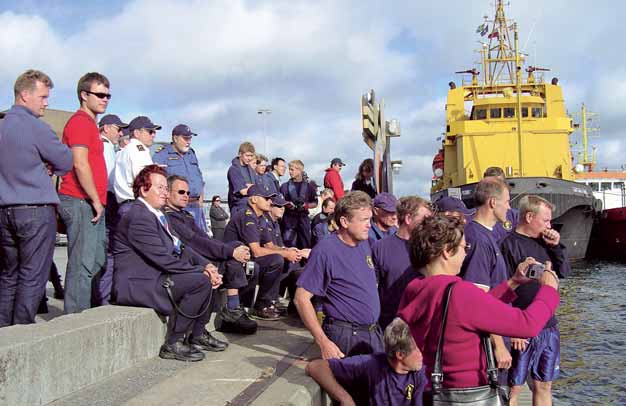
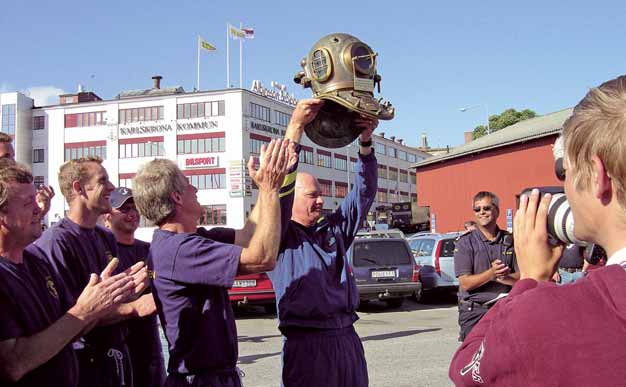
For the third year in a row, the
Swedish Coast Guard team has won
the HELCOM Trophy rowing competi-
tion. The race was held on 1st Septem-
ber in Karlskrona, Sweden, following
the Helsinki Commission's annual pol-
lution response exercise BALEX DELTA
2005.
Seven teams, representing response
vessels from Denmark, Finland,
Germany, Latvia, Lithuania, Poland
and Sweden, took part in this year's
competition.
Winners of the HELCOM
Trophy rowing competition:
2005 (Karlskrona) Sweden
2004 (Warnemünde) Sweden
2003 (Helsinki) Sweden
2002 (Liepaja) Lithuania
2001 (Rönne) Lithuania
2000 (St. Petersburg) Sweden
1998 (Gdynia) Finland
1996 (Karlskrona) Poland
1991 (Rönne) Sweden
1990 (Gdynia) Sweden
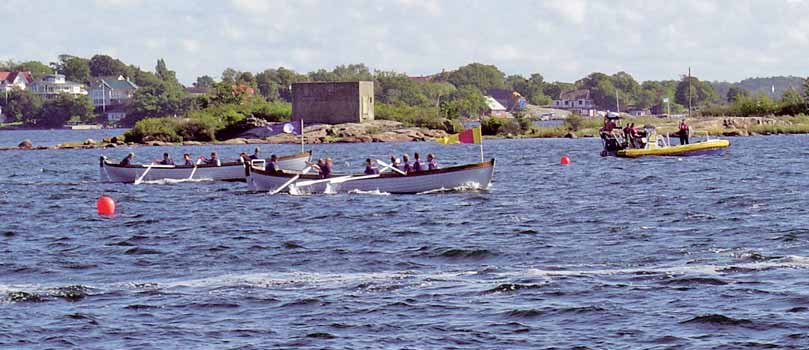
The teams were divided into two
groups. The Swedish and Polish teams
were the fi rst to fi nish in their groups,
followed by the Finnish and Danish
teams. The two best teams from each
group qualifi ed for the fi nal. In a dra-
matic fi nal race the Swedish boat fi n-
ished fi rst and the Finnish boat crossed
the fi nish line only seconds later. This
was the tenth HELCOM rowing com-
petition held since 1990. The race has
been won six times by the Swedish
team, twice by the Lithuanian team,
and once each by the Polish and
Finnish teams.
17
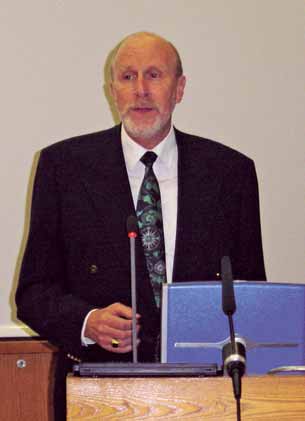
HELCOM Youth Forum charts an environmentally
friendly course for the Baltic Sea region
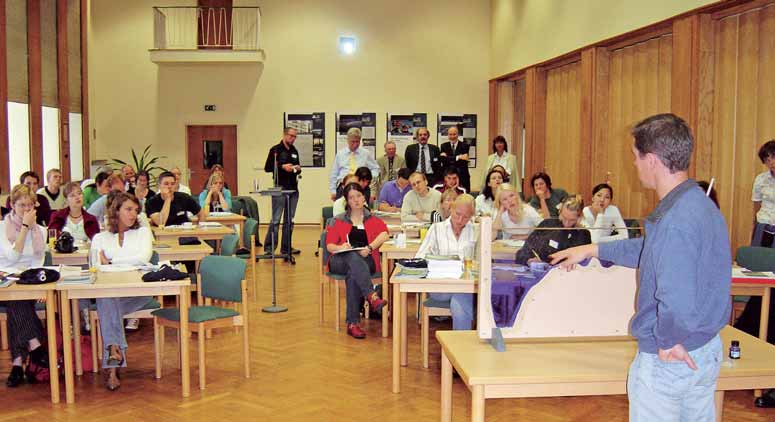
Policy formulation and the setting
who has twice served as the Chair of
This year's HELCOM Youth Forum
of priorities for actions designed to
the Helsinki Commission. "This Forum
was organised by the German Federal
protect the Baltic Sea marine envi-
brings together young people from
Ministry for Environment, Nature
ronment and ensure its sustainable
various parts of the Baltic Sea area
Conservation and Nuclear Safety,
use were the focus of the Second
to discuss regional environmental
in cooperation with the Baltic Sea
HELCOM Youth Forum, which was
concerns and to plan how they might
Research Institute in Warnemunde,
held under the motto "My Baltic Sea
participate in resolving environmental
the German Federal Maritime and
of tomorrow" on 9th 11th of August
problems".
Hydrographic Agency, the Landtag of
in Rostock, Germany.
Mecklenburg-Vorpommern and the
"We regard the HELCOM Youth
Baltic Sea Forum.
More than 40 students representing
Forum as a very important event. The
all nine Baltic Sea coastal countries
future of the Baltic Sea depends on
The First Youth Forum was held on
took part in this three-day event,
how the next generation will continue
1 March 2004 in Helsinki, Finland, in
considering ways to safeguard a
with the work so far done by our
connection with the 30th Anniversary
vibrant, healthy marine environ-
organisation," said Anne Christine
Jubilee Session of the Helsinki Com-
ment, improve maritime safety and
Brusendorff, Executive Secretary
mission. The Forum adopted a Youth
promote further dynamic economic
of the Helsinki Commission. "We
Declaration, which was handed over
and positive political developments in
also regard this year's Forum as an
to the President of the Republic of
the region. The students' visions and
important input to the strategic Baltic
Finland, Tarja Halonen.
concrete demands directed at politi-
Sea Action Plan, which is now being
cians and key players in the Baltic Sea
elaborated by HELCOM to further
region will serve as valuable input to
reduce pollution in the Baltic Sea and
the work of HELCOM.
repair the damage done to the marine
environment. The development of this
"The general idea of the Forum is
Plan calls for wide stakeholder partici-
to proactively involve a major stake-
pation at many levels from interna-
holder group university students
tional organisations and governments,
in the work of the Helsinki Com-
right down to the individual citizens,
mission," said Prof. Dr. Peter Ehlers,
whose choices can help to reduce pol-
Chair of the HELCOM Youth Forum,
lution," she added.
Prof. Dr. Peter Ehlers, Chair of the
HELCOM Youth Forum, President
of the German Federal Maritime
and Hydrographic Agency
18
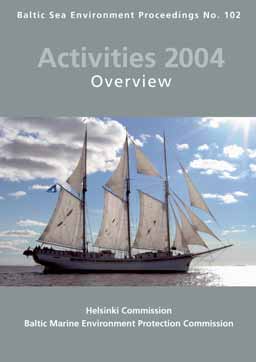
Latest HELCOM publications
HELCOM Activities 2004
for nutrients and selected heavy
tions into the Baltic Sea, however, do
Overview
metals. For this reason HELCOM has
not always correlate with reductions
This report summarises the activities
decided to strengthen its cooperation
in emissions, due to factors including
of the Helsinki Commission related
with Belarus, the Czech Republic and
meteorological conditions and the
to the protection of the Baltic Sea
Ukraine.
impact of distant sources.
marine environment over the period
from March 2004 to March 2005, also
Airborne nitrogen loads to
reviewing these activities together
the Baltic Sea
with current trends related to the main
This report presents an overview of
environmental issues.
the different sources contributing to
the deposition of airborne nitrogen to
the Baltic Sea. It also reviews existing
pollution reduction measures and their
status of implementation, and sets out
proposals for further developments for
the most signifi cant emission sources
such as agriculture and shipping.
These reports can all be viewed
on HELCOM's website at
www.helcom.fi . To order print
copies, please call the HELCOM
Evaluation of transboundary
Secretariat:
pollution loads
+ 358 (0)9 6220 220 or send
This publication contains compiled
an e-mail to info@helcom.fi .
information on the waterborne pollu-
tion loads that enter the Baltic having
originated from Belarus, the Czech
Republic and Ukraine. The report
shows that the inputs into the Baltic
Atmospheric supply of
from these countries are signifi cant
nitrogen, lead, cadmium,
mercury and lindane to the
Baltic Sea over
the period 1996 2000
This report presents the emission
levels of nitrogen, lead, cadmium,
mercury and lindane in the HELCOM
countries and the deposition to the
Baltic Sea during the fi ve-year period
1996-2000. The information is based
on monitoring results and modelling
estimates. The fi gures for emissions
of nitrogen, heavy metals and lindane
decreased during this period. Deposi-
19
Upcoming HELCOM Meetings
4 November 2005
12 13 December 2005
Extraordinary Meeting of the Heads
18th Meeting of the Heads of Delega-
of Delegation (HELCOM HOD EXTRA
tion (HELCOM HOD 18/2005), Helsinki,
2005), Bonn, Germany
Finland
9 11 November 2005
February 2006
3rd Meeting of ICES/BSRP Ecosystem
Third HELCOM/BSRP Coastal Fish Moni-
Health Study Group, Kaliningrad, Russia
toring Workshop, Helsinki, Finland
9 11 November 2005
21 23 February 2006
BSRP C2 Network Meeting, Kaliningrad,
Expert Workshop on the Development
Russia
of an Initial List of Threatened and/or
15 16 November 2005
Declining Marine Species and Biotopes/
Habitats, Helsinki, Finland
Sixth Meeting of the Expert Working
Group on Transit Routeing (TRANSIT
7 March 2006
ROUTE EWG 6/2005), Bonn, Germany
HELCOM Conference, Helsinki, Finland
21 25 November 2005
8 9 March 2006
Eighth Meeting of the Monitoring and
27th Meeting of the Helsinki Commission
Assessment Group (HELCOM MONAS
(HELCOM 27/2006), Helsinki, Finland
8/2005), Riga, Latvia
23 November 2005
8 12 May 2006
Informal Meeting of Ministers for the
Eighth Meeting of the Nature Conserva-
Environment from the Baltic Sea States,
tion and Biodiversity Group (HELCOM
Stockholm, Sweden
HABITAT 8/2006), [Lithuania]
23 November 2005
12th Meeting of the Expert Working
30 May 2 June 2006
Group for Mutual Exchange and Deliv-
11th Meeting of the Project Group for
eries of AIS data (AIS EWG 12/2005),
Monitoring of Radioactive Substances
Copenhagen, Denmark
in the Baltic Sea (HELCOM MORS-PRO
30 November 2 December 2005
11/2006), Monaco
Sixth Meeting of the Response Group
(HELCOM RESPONSE 6/2005), Klaipeda,
Lithuania
New staff at the HELCOM Secretariat
Ms. Hanna Paulomäki took up the posi-
on 20th June 2005. Also Mr. Hermanni
tion of the new Scientifi c Assistant at the
Backer, Ecological Objectives Project
Secretariat of the Helsinki Commission
Assistant has prolonged his contract.
www.helcom.fi