
HELCOM news
1 / 2 0 0 3 N e w s l e t t e r
Working together for our seas HELCOM meets OSPAR, page 2
HELCOM and the Nairobi Convention: Two heads are better than one, page 4
Progress in reducing nutrient pollution, page 5
Algal bloom forecast 2003, page 5
US $ 12 million for the Baltic
the Baltic Sea Regional Project fi nally starts, page 6
Campaigning for PSSA status for the Baltic, page 8
HELCOM
1/2003
Newsletter
Working together for
Published by:
our seas - HELCOM meets
Helsinki Commission
Katajanokanlaituri 6 B
OSPAR
FIN-00160 Helsinki, Finland
This June 23rd-27th the German city of
Bremen is hosting separate Ministerial
E-mail: helcom@helcom.fi
Meetings of both the Commission for
Internet: http://www.helcom.fi
the Protection of the Northeast-Atlan-
tic (OSPAR MMC) and the Baltic Sea
Environment Protection Commission
Editor:
(HELCOM MMC), and a special Joint
Ulrike Hassink
Ministerial Meeting involving both Com-
Helsinki Commission
missions (JMMC).
Observers from International govern-
mental and non-governmental organisa-
tions and International Financing Institu-
tions will participate in the meetings
together with representatives from all
the Contracting Parties to OSPAR and
HELCOM, including the Commission of
the European Community as well as all
the coastal countries around the North
East Atlantic and the Baltic Sea.
· discuss important issues related to
Wide-ranging issues
present and future policies
under review
· analyse the need for co-ordination
From May 2004 onwards, eight of the
The meetings aim to:
and co-operation between the two
nine countries around the shores of
· analyse the current status of policies
regional marine conventions and the
the Baltic Sea will be members of the
for the protection of the marine envi-
European Community, and determine
European Union. To help HELCOM
ronment in Europe
adapt to this new political situation,
Recent shipping accidents in the North-
the environment ministers from all
East Atlantic and the Baltic Sea have
the HELCOM countries are meeting
proven once more that the impact of
on 25 June 2003 to fi ne-tune the
Chair's
shipping on the marine environment is
organisation's working structures
a crucial issue for both commissions.
and set future priorities.
Corner
The designation of the Baltic Sea as a
Particularly Sensitive Sea Area is now
In our work protecting our unique
more urgently needed than ever.
sea, we benefi t greatly from close co-
operation with other regional marine
I believe one of the most important
Increasing shipping, marine installations
environmental protection commis-
items on the agenda of the forthcom-
and overfi shing all add to the pressure
sions. The co-ordinated measures
ing ministerial meeting is defi ning the
on marine ecosystems, and the com-
to be set up by the Joint OSPAR and
respective roles and contributions of
mitment of both commissions to apply-
HELCOM Ministerial Meeting on 26
the two marine commissions HELCOM
ing ecosystem approaches is another
June 2003 will represent a vital step
and OSPAR with regard to the European important step forward. This will
forward in the protection of both the
Marine Strategy. The involvement of
increase the involvement of other policy
non-EU countries like the Russian Feder- sectors in the vital task of ensuring that
Baltic Sea and the North East Atlantic.
ation is particularly vital in this context,
marine resources are used sustainably.
Mieczyslaw S. Ostojski
since a strategy is being shaped for the
Inese Vaidere
2
Executive Secretary
whole of Europe.
HELCOM Chair
how the relevant work should be
3. Programme for the More Detailed
Joint HELCOM-OSPAR
distributed among the key players.
Implementation of the OSPAR
Meeting
The following specifi c issues will
Strategy with regard to Radioactive
1. Co-operation with the European
also be discussed at the respective
Substances
Community on developing and imple-
meetings:
4. Application of an ecosystem
menting a comprehensive European
approach as a tool for implementing
Marine Strategy (also applicable to
OSPAR
the OSPAR-Convention.
the Mediterranean and Black Seas)
1. Results and further development of:
2. Conservation of biodiversity, with
· the Strategy with Regard to Haz-
HELCOM
specifi c regard to negative impacts
ardous Substances
1. Combating Eutrophication
from fi sheries
· the Strategy with Regard to
2. Nature conservation in marine envi-
3. Establishing a network of marine
Radio active Substances
ronments, the preservation of bio-
protected areas
· the Strategy to Combat Eutrophi-
diversity and the adoption of inte-
4. Harmonisation of the implementation
cation
grated coastal zone management
of international rules for shipping
· the Strategy on the Protection and
(ICZM)
5. Co-operation with the African Con-
Conservation of the Ecosystems
3. The future of the Baltic Sea Joint
ventions on the protection of the
and Biological Diversity of the
Comprehensive Environmental
marine environment, with the Nairobi
Maritime Area
Action Programme (JCP)
Convention as HELCOM's partner, and
· the Strategy on Environmental
4. Implementation of the Copenha-
the Abidjan Convention as OSPAR's
Goals and Management Mecha-
gen Declaration on the safety of
partner.
nisms for Offshore Activities
shipping
· the Joint Monitoring and Assess-
5. Compliance checking with regard
ment Programme
to the implementation of the
2. Disposal of Offshore Installations
Convention.
Timetable
Monday 23 June 2003
8:00 17:30 OSPAR Ordinary Meeting
Tuesday 24 June 2003
9:00 17:30 OSPAR Ordinary Meeting
Wednesday 25 June 2003
8:00 10:30 HELCOM Regular Meeting
11:00 14:00 HELCOM Ministerial Meeting
14:30 17:30 OSPAR Ministerial Meeting
17:45 18:30 JOINT Ministerial Meeting
Thursday 26 June 2003,
JOINT Ministerial Meeting continued
Friday 27 June 2003,
closing of Meetings
Organisers
Federal Ministry for the Environment, Nature
Conservation and Nuclear Safety of Germany
Heinrich-von-Stephan-Str. 1, 53175 Bonn, Germany
Internet: http://www.bmu.de
Parties of the HELCOM and OSPAR Ministerial
Meetings (indicated by green)
3
t
a
o
ilb
a
HELCOM and the Nairobi Convention:
n s
Two heads are better than one
f
r
i
c
a
:
A
e Joint Ministerial
By Dixon Waruinge
i
c
t
ur
Meeting:
A notable example of how the Nairobi
This exchange of knowledge is to be
P
Twinning
Convention has gained from the experi- continued and intensifi ed.
ences of HELCOM is the remodelling
agreements
of the Convention's Heads of Delega-
Preparations for the twinning agree-
tion and Experts Meetings by adapting
ment started back in 1996, when the
HELCOM's active participation in
organisational structures devised at
Contracting Parties of the Nairobi
UNEP's Regional Seas Programme
HELCOM. The new model is being used Convention chose HELCOM out of 17
expresses the importance of sharing
for the expert working groups of the
regional marine conventions worldwide
experiences from the Baltic Sea region
Conference of Parties (COP) to develop
as a twinning partner to help speed
with other regions around the world.
Work Programmes. Representatives of
up the implementation of the East
The twinning arrangement with the
civil society, NGOs, and scientifi c institu- African Regional Action Plan and other
Nairobi Convention has already made
tions are invited to experts' meetings
activities approved by the Conference
valuable practical contributions and
before the COP Heads of Delegations
of Parties.
helped to spread vital information
meetings.
among the growing global network
For the previous eleven years, slow rati-
of organisations working to protect
In recent years HELCOM has also
fi cation and ineffective co-ordination
regional seas. This twinning of Regional
actively transferred its experiences in:
had been hampering actions to curb
Seas agreements is a good example of
- monitoring and assessing the
the degradation of the coastal and
practical networking, and shows how
coastal and marine environment and marine environment of the East African
shared experiences can strengthen
resources
region. These environmental problems
regional programmes. It is hoped that
- preventing pollution from land-based are mainly due to the uncontrolled
the twinning agreement between
activities
development of tourism and industry,
OSPAR and the Abidjan Convention
- nature conservation and coastal zone the discharge of untreated sewage, and
will build on the useful experiences
management
other impacts related to increasingly
obtained through the HELCOM-
- increasing the involvement of the
rapid population growth.
NAIROBI twinning.
private sector and national fi nancial
Dixon Waruinge
institutions.
The Nairobi Convention
The Convention for the Protection,
Associated Protocols:
(Nairobi and Abidjan Conventions)
Management and Development of the
- Protocol concerning Protected Areas Division of Environmental Conventions,
Marine and Coastal Environment of
and Wild Fauna and Flora in the
Nairobi, Kenya
the Eastern African Region;
Eastern African Region;
Phone: +254 2 622025
- Protocol concerning Co-operation in Email: dixon.waruinge@unep.org
Adopted: June 1985
Combating Marine Pollution in Cases Internet: http://www.unep.org/
Entry into force: 1996
of Emergency in the Eastern African eastafrica/
Contracting Parties: Comoros,
Region;
France (La Reunion), Kenya, Mada-
- Action Plan for the Protection, Man-
and
gascar, Mauritius, Mozambique,
agement and Development of the
Regional Co-ordinating Unit of the
Seychelles, Somalia and the United
Marine and Coastal Environment of
Eastern African Region
Republic of Tanzania
the Eastern African Region
P.O. Box 487 Victoria, Mahé
Seychelles
N.B. South Africa has been invited
Contact details of
Tel.: +248 32 4525
to join the Nairobi Convention and
the regional offi ce:
Fax.: +248 32 4573
associated Protocols
UNEP Secretariat of the Nairobi Con-
Email: uneprcu@seychelles.net
4
vention and Action Plan Regional Seas
Progress in reducing nutrient pollution
The results of a recent study show that
widespread adoption of Best Available
signifi cantly to the nutrient loads
good progress has been made in reduc-
Techniques will also cut nutrient loads
entering the Baltic Sea, so there is
ing nutrient loads from point sources
from industrial sources.
also a need to reduce airborne inputs
such as municipal and industrial waste
of nitrogen both from shipping and
water treatment plants. Almost all of
Reducing nutrient loads in runoff from
from sources on land, as well as to cut
the countries around the Baltic Sea
farmland is much tougher than cutting
nutrient loads originating from small
have managed to reach the target of
point source loads. Existing load reduc-
municipalities and scattered settle-
a 50% reduction in loads from point
tion measures should eventually help
ments in rural areas.
sources for phosphorus, although
to curb nutrient loads from agriculture,
measures to cut nutrient loads originat-
but there is a considerable time lag
Nutrient pollution has been an impor-
ing from agricultural sources have fallen
before the effects of agricultural water
tant political issue around the Baltic
short of their 50% reduction target.
protection measures can be seen in
Sea ever since the late 1980s when the
water bodies. Agricultural produc-
region's environment ministers set the
Fortunately, nutrient loads from point
tion is also expected to rise after EU
50% reduction targets. Related prob-
sources should continue to fall as
enlargement, which will probably lead
lems such as intense algal blooms and
nitrogen and phosphorus removal
to increased nutrient discharges.
oxygen depletion still occur regularly
measures go on reducing emissions
in the Baltic Sea.
from municipal plants, especially in
It must be remembered that other
the EU accession countries. The more
diffuse pollution sources contribute
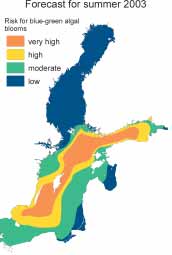
Algal blooms expected in the Baltic again this summer
Extensive blue-green algal
mats in the open sea will probably
since certain species are poisonous to
blooms are likely to form in
be observed around the end of June,
humans and domestic animals.
many parts of the Baltic Sea this
with blooming probably peaking in
year, particularly in the Northern
late July. If the summer is cool, the
Further information:
Baltic Proper, in the southern
peak will not be reached until August,
www.itameriportaali.fi
waters of the Archipelago
and blooms will be less extensive.
Finnish Environment Institute, algal
Sea, in the Åland Archipelago
Concentrations of blue-green algae
information, phone +358 10 808 898
and throughout the Gulf of
will remain low until midsummer even
Finnish Institute of Marine Research,
Finland, according to the sixth
if the weather is warm, due to the
Alg@line, phone +358 400 609 269
forecast issued by the Finnish
belated warming of the sea this year.
Environment Institute (SYKE)
and the Finnish Institute of
Blue-green algae mats typically form
Marine Research (FIMR)
in the open sea. Depending on the
wind conditions, some mats drift
The predictions are based on nutrient
towards the coast and the archipelago.
concentrations observed this spring at
Due to the uncertainty of long-term
180 locations throughout the Baltic
weather forecasts, these movements
Sea by the Finnish Institute of Marine
cannot be predicted for more than
Research, Finland's environmental
a couple of days ahead. The Finnish
authorities, the City of Helsinki Envi-
Environment Institute and the Finnish
ronment Centre, and research insti-
Institute of Marine Research provide
tutes in Sweden, Denmark, Poland,
two-day forecasts on the movements
Lithuania and Latvia.
of any extensive algal blooms in the
open sea, but information on localised
Intense blooms are quite likely, since
blooms in bays and in the archipelagos
nutrient concentrations in the sea
is more diffi cult to obtain.
increased considerably during the late
winter and spring. If the summer turns
Blue-green algae forecasts include pre-
out to be warm, the fi rst fl oating algal
dictions of the type of algae involved,
5
The Baltic Sea Joint Comprehensive
Environmental Action Programme
Getting rid of pollution Hot Spots
There has already been considerable
is only half-way through its 20-year
as less dramatic cuts in NOx and SOx
praise for the successful achievements
implementation period. The JCP aims
loads of 4% and 3%, respectively.
of the Baltic Sea Joint Comprehensive
to support both preventive and cura-
Environmental Action Programme
tive measures in the Baltic Sea drainage The key to these successes has been
(JCP), even though the programme
basin, and to restore the ecological
the wide-ranging support for the JCP
balance of the Baltic Sea by reducing
implementation from all the Members
8Ê
10Ê
12Ê
14Ê
16Ê
18Ê
20Ê
22Ê
24Ê
26Ê
28Ê
30Ê
32Ê
34Ê
36Ê
38Ê
pollution loads. The most prominent of and Observers of the Programme
69Ê
69Ê
HELCOM / PITF - JCP
the JCP's six main elements has been
Implementation Task Force (PITF),
68Ê
68Ê
the targeting and cleaning up of pollu-
which comprises representatives from
67Ê
67Ê
tion Hot Spots around the Baltic Sea.
International Financial Institutions and
international governmental and non-
66Ê
66Ê
Investment projects designed to
governmental organisations as well as
65Ê
65Ê
combat point-source and non-point
from the European Union and all the
64Ê
64Ê
source pollution are already well under
countries in the Baltic Sea drainage
63Ê
63Ê
way, largely focusing on the pollution
basin.
62Ê
62Ê
Hot Spots identifi ed at the beginning
61Ê
61Ê
of the JCP.
The impressive fi nancial support
60Ê
60Ê
obtained for the Programme of at
59Ê
59Ê
These activities have resulted in the
least 1.1 billion, not accounting for
58Ê
58Ê
formal deletion of 47 of the 132 Hot
investments at 20 Hot Spots which
57Ê
57Ê
Spots originally listed, the partial dele-
have not submitted investment reports
56Ê
56Ê
tion of another three, and considerable - demonstrates the effi cient linkage of
55Ê
55Ê
54Ê
54Ê
reductions in the overall pollution loads environmental priorities with a wide
Hot Spot Type
53Ê
Industrial
53Ê
originating from all the Hot Spots. The
range of fi nancial resources. The use
52Ê
Municipal
52Ê
deleted Hot Spots alone account for
of co-fi nancing, combining loans from
51Ê
Agricultural
51Ê
reductions of 21% in BOD loads, 25%
International Financial Institutions and
50Ê
National border
Coastal Lagoon/ Wetland
50Ê
49Ê
Catchment area
49Ê
in COD loads, 22% in the total nitro-
grants from the European Union and
made by S. Wilhelms, BSH
8Ê
10Ê
12Ê
14Ê
16Ê
18Ê
20Ê
22Ê
24Ê
26Ê
28Ê
30Ê
32Ê
34Ê
36Ê
38Ê
gen loads, 27% in the total phosphorus bilateral donors, has proven to be par-
Map of Hot Spots
load, and 89% in AOX loads, as well
ticularly effective.
US $ 12 million for the Baltic
the Baltic Sea Regional Project fi nally starts
Part of international efforts to combat
ment Finance Corporation (NEFCO)
urgently needed action to address
the environmental degradation of the
should bring the total funds available for transboundary environmental concerns
Baltic Sea, the World Bank, acting
the Project up to more than $12 million.
such as sustainable fi sheries, the con-
on behalf of the Global Environment
servation of living marine resources,
Facility (GEF), has provided a grant of
The long-term objective of the Baltic
and the curbing of pollution from
$5.5 million for the Baltic Sea Regional
Sea Regional Project (BSRP) is to intro-
diffuse sources on farmland. Measures
Project. Contributions from other co-
duce ecosystem-based assessments to
will also be taken to improve decision-
fi nanciers and project benefi ciaries
improve the management of coastal
making at the regional, national and
including Finland, Norway, Sweden, the
and marine environments around the
local levels by strengthening assess-
United States and the Nordic Environ-
Baltic Sea. The project will involve
ment and monitoring systems, and
6
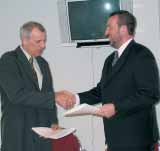
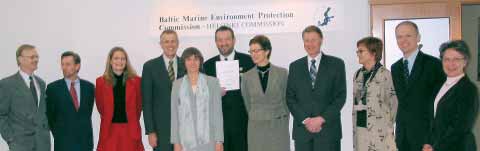
by supporting regional efforts for the
HELCOM will manage the project in
Mr Roger W.
development and implementation of
cooperation with the International
Grawe from
ecosystem-based management for
Council for the Exploration of the
the World Bank
the natural resources of the Baltic.
Sea (ICES), the Agricultural Univer-
and HELCOM
The project has been designed to help
sity of Stockholm, WWF, NEFCO and
Executive
improve the general environmental
the International Baltic Sea Fisheries
Secretary
situation in and around the Baltic Sea
Commission (IBSFC). The actions
Mr Mieczyslaw S.
through better integrated manage-
within the project will take place in
Ostojski signing
ment, based on the Large Marine Eco-
Estonia, Latvia, Lithuania, Poland
the GEF Grant
system approach.
and Russia. The BSRP is expected to
Agreement
be completed by June 30, 2006.
Offi cial start
of the Baltic
Sea Regional
Project
Curbing land-based pollution implementing
HELCOM Recommendations
More than forty HELCOM Recom-
general, but in spite of the measures
ipal waste water treatment plants and
mendations concern measures to limit
taken to address pollution from agri-
the decline in industrial production.
pollution originating from the land
culture, they are still lagging behind
The EU accession countries have also
from either point sources such as
in terms of signifi cant reductions in
improved their implementation of
industrial plants and municipal waste
nutrient loads, especially regarding
product control legislation, on pesti-
water treatment plants, or diffuse
phosphorus. The main reason for
cides, for instance.
sources including traffi c and farmland.
the stubbornly high phosphorus con-
Several more recommendations specify
centrations in runoff is the persistent
Despite the slower implementation in
product controls.
surplus of phosphorus in the soil, due
the EU accession countries and Russia
to the high usage of fertilisers in the
of recommendations on limiting pol-
Although the HELCOM countries
past.
lution from agriculture, nutrient loads
have improved their implementation
have generally fallen more than in the
of HELCOM Recommendations since
Conversely in the EU accession coun-
EU member countries, since a wide-
the previous reporting round in 1998,
tries and Russia, in spite of slower
spread decline in agricultural produc-
environmental regulations could still
progress on the formal implementa-
tion in the early 1990s involved drastic
be strengthened and better enforced.
tion of HELCOM Recommendations,
reductions in the use of fertilisers.
there have been signifi cant reduc-
The current EU member states have
tions in pollution, at least from point
done better in their implementation
sources, largely thanks to the con-
of HELCOM Recommendations in
struction and modernisation of munic-
7
Forthcoming
meetings
18-19 September 2003
Risky waters
Second Meeting of the Pilot Expert Working
Group (PILOT EWG)
The Baltic Sea is one of the world's
predicted, due to the construction and
busiest seas, with around 2,000 ships
expansion of Russian oil terminals.
23 September 2003
at sea at any time, accounting for 15%
Third Meeting of the Ice Expert Working
of the world's cargo transportation. All
The increasing numbers of ships plying
Group (ICE EWG), Gothenburg, Sweden
these ships and their often hazardous
their routes between more than 200
6-7 October 2003
cargoes are crowded into a relatively
Baltic ports all add to the risk of a
Sixth Meeting of the Expert Working Group
small area of water with many rocky
serious accident or a potentially
for Mutual Exchange and Deliveries of AIS
shallows, narrow straits and labyrin-
devastating oil-spill. Oil is transported
data (AIS EWG), Helsinki, Finland
thine archipelagos, as well as harsh
from 20 ports around the Baltic, with
20-24 October 2003
winter ice conditions.
150 to 200 oil-tankers serviced every
Sixth Meeting of the Monitoring and
day. On the basis of the increasing
Assessment Group (HELCOM MONAS)
Forecasts indicate that due to eco-
traffi c and the increasing size of the
nomic growth, especially in the
tankers, it has been estimated that the
27-28 October 2003
eastern part of the region, the
risk of a major oil spill of more than
HELCOM HOD 13/2003, Helsinki, Finland
amount of cargo shipped on the
1,000 tones will rise by 25%.
10-12 November 2003
Baltic will double by 2015 from 500
Eighth Meeting of the Land-based Pollution
million tonnes to 1,000 million tonnes
The environmental impacts of shipping
Group (HELCOM LAND), Stockholm, Sweden
annually.
are on the agenda of the HELCOM
Ministerial meeting in Bremen (25 June
3 December 2003
Oil transportation is particularly
2003) where decisions are expected
Fourth Meeting of the Ice Expert Working
expected to increase, especially in the
on measures to increase the safety
Group (ICE EWG), St. Petersburg, Russia
Gulf of Finland, where a four-fold rise
of navigation and improve regional
10-12 December 2003
in the annual transportation of oil
capacity to deal with emergencies.
Third Meeting of the Response Group
from 20 million to 90 million tonnes is
(HELCOM RESPONSE), St. Petersburg, Russia
Campaigning for PSSA status
2004
for the Baltic
20-22 January 2004
Dramatic increases in shipping traffi c
regulatory measures to complement
Second Meeting of the Maritime Group
in the Baltic Sea are compounding the
and toughen up the existing pollution
(HELCOM MARITIME), Stockholm, Sweden
risks of harmful environmental impacts
prevention and safety measures imposed
on sensitive marine ecosystems.
through HELCOM and the International
Maritime Organisation (IMO).
Offi cially designating the Baltic Sea
as a "Particularly Sensitive Sea Area"
PSSAs are administered by the IMO,
(PSSA) could raise environmental
and they are designated in marine areas
awareness in the shipping industry,
which are highly sensitive to the impacts
leading to changes in maritime prac-
of heavy sea traffi c. Five marine areas
tices that would help to protect the
have so far been designated as PSSAs,
fragile Baltic marine environment from
and the Baltic Sea is among several
ship-borne pollution.
other areas currently under considera-
tion. This issue will be discussed by the
PSSA status for the Baltic could also
HELCOM Ministers in Bremen in June
facilitate the introduction of additional
2003.
www.helcom.fi