PEAM KRASOP WILDLIFE SANCTUARY DEMONSTRATION SITE
1.
Site Name and Geographic Co-ordinates:
Site name: Peam Krasop Wildlife Sanctuary (PKWS) (including part of the Koh Kapik Ramsar Site)
Geographic Coordinates:
Latitude: 11o 25' N to 11o 35' N
Longitude: 102 o 57' E to 103 o 09' E.
2.
Country in Which the Site is Located: THE KINGDOM OF CAMBODIA
3.
State or Province in Which the Site is Located: Koh Kong Province
Local government approval [yes or no]
YES
if yes then date: 29th April 2003
Local government involvement [yes or no]
YES
Local government co-financing [yes or no]
YES
if yes then in-kind or in-cash? IN-KIND
4.
Linkage to National Priorities, Action Plans and Programmes:
· With reference to the Royal Decree of 1st November 1993, Peam Krasop is one of 23 protected areas
in Cambodia that were classified as wildlife sanctuaries and must be strictly protected and managed
due to their national, regional and global significance.
· International agreement of relevance for protected areas and biodiversity to which Cambodia is a
signatory: Ramsar Convention-Ratified on 23rd October 1999. The Koh Kapik Ramsar site was
designated as a Ramsar site with international importance on 23/06/1999, adopted by the national
assembly 1996 as national law with regards to Ramsar Convention.
· Existing National Strategies and Action Plans:
National Environmental Action Plan (NEAP 1998 to 2002), prioritized protected areas management
planning and implementation,
National Biodiversity Strategy and Action Plan (NBSAP): "Strengthening the on-going management
of designated protected areas",
Koh Kong Provincial Physical Framework for Environmental Coastal Zone Management.
The prioritised activities to be implemented in Peam Krasop Demonstration site included environmental
restoration scheme, public awareness and participation programmes.
Central government involvement (yes or no): YES
Central government co-financing: YES, if yes then in-kind or in-cash? IN-KIND AND IN-CASH.
5.
Date of NTWG Meeting, which Considered the Proposal and Recommendations:
In Sihanoukville, the 8th National Wetland Committee meeting was held from 17-18 March 2003 to discuss
on the prioritisation and ranking of the demonstration site; and decided that the highest prioritised site for
wetland and mangrove is Peam Krasop Wildlife Sanctuary, and for wetland is Koh Kapik Ramsar Site. The
two sites were therefore merged together into one demonstration site called "Peam Krasop Wildlife
Sanctuary Demonstration Site (or PKWS)".
6.
National Technical Focal Point Endorsement and/or Comments:
1. Peam Krasop is the most important one of marine wildlife sanctuary that is under national protected
areas system.
2. It is the highest priority for mangrove protection in Cambodia.
3. It is directly link to the South China Sea.
4. Trans-boundary issues with Thailand.
5. Several community-based organizations were formulated and established.
Signature:
Name and Designation: Mr. Koch Savath, Deputy Director General of Technical Affairs, Ministry of
Environment and National Technical Focal Point for the SCS Project.
Date: 20th February 2004
1
7.
Site Description (Full site Characterisation as in Annex 1):
The proposed demonstration site for mangrove and wetland represents the entire Peam Krasop Wildlife
Sanctuary, which is one of the 23 protected areas in Cambodia, was officially established on 1st November
1993 by the Royal Decree for the Creation and Designation of Protected Areas It is also one of the 10
Cambodian Wildlife Sanctuaries and of the 6 protected areas in Koh Kong Province. The map of Peam
Krasop demonstration site is attached as in Annex 1) the total area being around 25,897 ha.
The area has an elevation of 0 2 metres, a perimeter of around 61,050 metres and lies in a deltaic flood
plain bisected by numerous distributary channels and salt water inlets. The area lies about 15 km South-
east of Koh Kong Town near the border with Trat Province of Thailand.
7.1 Environment:
Peam Krasop is dominated by small alluvial islands immediately off the mainland of Koh Kong Province
many of which have been formed by the deposition of mud and sand eroded from the sandstone
catchments of the two main rivers, Peam Krasop estuary called Prek Peam Krasop (in Peam Krasop
commune) and Stung Kep estuary (in Koh Kapik commune). The catchments of these rivers are located on
the southern slope of the Cardamom Mountains. The soils consist of a thin organic mud or humus layer
overlying sand and sandy loam, hence they are predominantly alluvial and sandstone soils of red or yellow
podzol and coastal complex. Along the western coastline of the main island, there is well-developed
mudflat, while the northern coastline is sandy. The site is classified into two wetland types (estuarine
waters, and intertidal mud, sand, or salt flats) and is listed under old Criteria 1(b) and 1(c) of Ramsar
Convention as `good representative examples' and 2(c) for its special value with respect to endemic plant
or animal species (Ramsar Convention Criteria) (Annex 1)
The climate of the area is similar to the rest of Cambodia in terms of being a tropical monsoon climate with
two distinct seasons (wet and dry). The average temperature is 28°C; and the annual rainfall ranges from
2,800-3,000 millimetres. The area is strongly influenced by surface freshwater runoff from the two rivers.
The presence of intact mangrove areas contributes significantly to the stabilization of the coast against
erosion by storms and tides.
7.2. Habitat(s):
PKWS is the most intact mangrove forest in Cambodia and arguably in the whole Gulf of Thailand. The
mangroves in the RAMSAR site and wildlife Sanctuary are bisected by, many creeks. Within the area;
5,235 ha (38.85 %) consists of mangrove forest; 47 ha (0.35 %) is agricultural land; 725 ha (5.40 %) is
evergreen disturbed forest; 411 ha (3.1 %) is evergreen mosaic area; 108 ha (1%) is grassland; and the
open water surfaces total 6,957 ha (51.60 %). Due to the site's diverse geomorphology and habitats it is
considered to be a major important spawning and nursery ground for many fish, crustaceans, and molluscs
because the area is rich in zooplankton biomass.
In Peam Krasop Rhizophora apiculata and Rhizophora mucronata fronting the river margins and Ceriops
tagal, Xylocarpus granatum, Nypa fruticans, Brugiera gymnorrhiza, Lumnitzera littorea, Hibiscus tiliaceus
and Heritiera littoralis grow as back mangroves. The ground layer is characterised by Acrosticum
speciosum, Acanthus sp., Pandanus sp., and many epiphytes including orchids and Asplenium nidens.
Melaleuca trees occur mainly to the landward of the mangrove species but sometimes at elevations in
excess of 2 metres in the mangrove dominated zones. Melaleuca trees appear in uniform stands but
sometimes occur as a mixed assemblage consisting of Melaleuca leucadendron with Licula spinosa,
Pandanis, Acrosthicum aureum, A. speciosum, Hibiscus tiliaceus, Xylocarus granatum, Herutuera littoralis,
and Phonix paludosa. There are 43 true mangrove species in this sanctuary.
There are several sand beaches and mud flats along the coast of the mainland and of Koh Kong Island
with several large pristine beaches on Koh Kong Island. There are indications of extensive coral reefs
along the west coast of Koh Kong Island in water depth of more than 4 m. Corals at Koh Kong island
appear to be free from major threats such as dynamite fishing and coral collection. A variety of marine fish
are harvested in the area adjacent to the coral reefs include grouper, spine-foot fish, snappers, breams,
mullets, shark, dolphin-fish (black and white), rays, and others. The globally endangered Irrawaddy dolphin
(Orcaella brevirostris) has been seen near Lamdam northeast of Koh Kong Island.
Some 34 species of water birds, including 21 species of waders (Chararidae and Scolopacidae) and six
species of Terns and Gulls (Laridae), have been recorded. Of the 3,787 water birds counted on the western
2
shore of Peam Krasop, two species occur in internationally significant numbers: 13 Nordmann's
Greenshank (Tringa guttifer), and endangered species, and 190 Broad-billed Sandippers (Limicola
falcinellus). Six other species, including Bar-tailed Godwit (Limosa lapponica), Mongolian Sandplover
(Charadrius mongolus), Greenshank (Triga nebularia), and Grey Plover (Pluvialis squatarola); occurred in
numbers exceeding the minimum criteria for birds staging at a site, enabling the site to qualify as part the
new East Asia/Australasian Shorebird Reserve Network. Macaca fascicularis is global threatened primate
species that found within site.
7.3. Present
Use:
The population of Peam Krasop is around 9,000 people and about 90 percent of the population are
migrants from different provinces. In total, there are 10 villages in 6 communes (in 3 districts) located within
or adjacent to the demonstration site. The occupations of the population include fishing, charcoal
production and mangrove logging. Agricultural farming and livestock breeding are common activities on a
small scale; however, these agricultural activities are increasing significantly as a consequence of
population growth.
The site and its surrounding areas are owned by the state. As state common property, the areas are,
however, used by local communities in and around the reserve as a source of charcoal, firewood, timber,
fish, crustaceans and molluscs, for family consumption and small scale income generation. Fishing is the
most important activity for these local people. Presently, some families are benefiting from the introduction
of alternative livelihood activities through community development of Coastal Zone Management (CZM)
Project. There is also an environmental educational programme supported by CZM/DANIDA focusing on
many environmental activities including awareness of the values of wetland and mangrove resources and
ecosystems.
Presently, there is neither information nor facilities for tourism, but the area is easily accessible by boat and
given the rich avifauna it could possibly be developed as a potential eco-tourism destination. Overnight
stays are possible, but a day trip is the most recommended since it is very near to Koh Kong Town.
Information can be obtained from local villagers at the site.
7.4. Management
Regime:
The whole area is within the jurisdiction of the Department of Nature Conservation and Protection of the
Ministry of Environment. Specifically, the Office of Wetland, Watershed and Coastal Zone Management, is
directly responsible for planning, management and administration of the area.
The Cambodia Coastal Zone Committee, an inter-ministerial body, acts as the decision-making body for
coastal zone management in the country including making recommendations on policy and the
development strategy. Local people are encouraged by the central government to establish their own
communities that support wise/sustainable use and the protection/conservation of natural resources and
environment. Provincial authorities are the government entities that backstop all operations and
interventions in order to protect and conserve the site and wetland benefits.
8. Stakeholders:
The major stakeholders in the area include central government agencies, local government agencies
(provincial technical and non-technical departments), local communities and Non-governmental
organisations (NGOs), large and medium scale private sector enterprise is currently lacking in the area.
8.1.
Central Government Agencies:
Ministry of Environment Department of Nature Conservation and Protection is responsible for planning,
management and supervising of the Ramsar site and national protected areas.
Ministry of Agriculture, Forestry and Fisheries Department of Forestry and Wildlife and Department of
Fisheries are governmental collaborative partners for protecting and managing natural resources within the
whole country.
These central governmental agencies are responsible for providing authorisation and supervision to
provincial agencies. As members of the high level inter-ministry committee, these governmental agencies
guide local authorities and site manager in order to ensure that the implementation of activities are in
accordance with national priorities and strategies.
3
8.2.
Local Authorities and Communities:
Local authorities: Koh Kong Provincial and district governors and commune council are responsible for the
administration of activities and the local populations within the Koh Kong province. The main provincial
technical agencies include the Koh Kong Department of Environment, Department of Agriculture, Forestry
and Fisheries, Department of Rural Development, and the Department of Tourism. These local technical
agencies will support and participate in activities at the demonstration site and will play a key role as locally
based implementers and supporters in ensuring the activities are carried out smoothly and productively.
Local communities: There are six local communities within and around the PKWS who will be directly
involved in managing and conserving natural resources (mangroves and fisheries) within the area. The
community-based approach for natural resource management is applied to promote participation in
decision making for the use natural resources in a sustainable manner. The names of the six communities
are Beoung Kachhang, Koh Sralauv, Koh Kang, Koh Kapik, Toul Koki and Stung Veag.
These six communities, as direct resource users, are the main target groups of the demonstration site
project. These main stakeholders have to be encouraged to participate in the project.
8.3
Existing Projects and NGOs:
Participatory Management of Mangrove Resources (PMMR) is a project that focuses on mangrove
protection, and plantation via participation of the local community in Peam Krasop Wildlife Sanctuary. This
project has been supported by, the International Development Research Centre (IDRC) of CANADA, since
1998 and activities under the present project will complement those of this initiative.
Coastal Zone Management Unit called Coastal Coordinating Unit (CCU) supported by DANIDA, during its
second phase of work as the secretariat of Coastal Steering Committee, is focusing on the establishment of
environmental and socio-economical indicators for detecting the progress of pilot project's activities of
community-based natural resource management and livelihood improvement at district level.
These projects are considered as important contributors to project success in that the will provide training
and experience for project implementation and administration as well as locally community-based
mangrove resource management and restoration in PKWS.
9. Threats:
Based on the causal chain analysis conducted by the National Mangrove and Wetland Committees, major
threats to the habitats found at PKWS are summarised as follows:
1. Cutting Mangroves for charcoal production using charcoal kilns of between two and six metres in
diameter.
2. Fish catch has apparently reduced from 10-20 kg/night to 3-4 kg/night (small scale fishing gear),
this lowered catch suggesting problems resulting from over-fishing in the area. Increased fishing
effort stems from the use of modern fishing gear such as push nets and trawl nets, which destroy
the benthic biological resources and disturb the seabed.
3. In 1989, there were three shrimp farms in PKWS with total areas of 40.55ha; and these activities
seriously affected water quality and aquatic species. Shrimp disease occurred in the ponds, and
there was a big loss of production resulting in a cessation of activities. Tilapia species have been
introduced into these shrimp ponds as secondary options of aquaculture.
The most critical threats to the site are habitat loss and reduction of aquatic resources, which result from
direct use of mangrove for charcoal, over exploitation of marine resources, land clearance (land
encroachment), soil erosion and sedimentation, and inappropriate waste dumping and discharge (Annex
3).
The impacts from these threats are likely to increase as a consequence of population growth resulting from
in-migration from other parts of the country and locally high population growth rates. Of the total of 8,912
people living at PKWS the majority are dependent on marine resources for direct use. Poverty is a key
issue that is perceived as an underlying cause of environmental degradation in the area.
4
10.
Goals and Purpose:
The overall goal is to promote wise and sustainable uses of the natural resources in Peam Krasop Wildlife
Sanctuary.
11.
Rationale and Objectives:
Rationale:
Peam Krasop Wildlife Sanctuary is the only national protected area that consists of a pristine mangrove
forest area in Cambodia. Importantly, this Wildlife Sanctuary is associated with the Koh Kapik Ramsar Site,
which has been designated as an internationally important wetland for the migratory waterfowl. In spite of
national and international obligations to protect and manage the site, the interests of the very significant
numbers of people living and surviving upon the natural resources of site must be taken into consideration
in any long-term plans for sustainable use of the area. Conflicts between local communities, local
authorities, sanctuary authorities and others, with regard to natural resource use, have been increasing.
Although PKWS was designated as a National Wildlife Sanctuary with International Wetland Importance;
policy, strategy and management plan have not yet been put in place. Best practices in community-based
resource management and conservation have not been fully applied to date.
Objectives:
1. To develop; in full consultation with all stakeholders, government, private sector and civil society; a
management plan (including strategy, regulation and monitoring guideline) for the sustainable use
of the natural resources in PKWS;
2. To restore degraded mangrove and wetland areas;
3. To support local communities in improving their livelihoods through mechanisms including
partnership with private sector investors and NGOs;
4. To promote understanding of wetlands and mangroves among local communities and authorities;
5. To improve the knowledge and skills of government officials, local authorities and communities with
respect to wetland and mangrove management.
12. Outcomes:
The desired outcomes from the project intervention are as follows:
1. A comprehensive management plan (including strategy, regulation, and monitoring guideline) for
mangrove and wetland resources in PKWS will be in place,, drafted, accepted by the stakeholders
and approved by the government;
2. Degraded areas 2500 ha of mangrove will be restored;
3. Strong support from private sector and local NGOs, to alternative income generation;
4. Local communities and authorities will be aware of and understand the significance of mangrove
and wetland resources;
5. The capacity of local authorities will be built to enable them to manage the mangrove and wetland
resources in a sustainable manner following completion of the project.
13.
Planned Activities to Achieve the Outcomes:
In order to achieve the goal and objectives, activities have been grouped into six main components as
follows:
Component 1: Project Management
The purpose of this component is to develop and demonstrate the utility of a multi-stakeholder
management system that will continue to operate beyond the life of the GEF intervention, and which will
serve as a co-ordination mechanism between national and local government agencies, local communities,
private sector and even between Trat Province in Thailand and Koh Kong Province in Cambodia.
A Management Advisory Group (MAG) has been established by the National Mangrove and Wetland
Committee and approved by the Koh Kong Governor. This MAG is chaired by the Mangrove Focal Point
from DNCP, and will meet four times per year to discuss project execution and technical issues. A
Management Board (MB) had already been established by, the Koh Kong Governor (Annex 6). This MB is
5
chaired by the third deputy governor of Koh Kong Province, and will meet twice a year to provide oversight
to project implementation. The first national action will be the recruitment of a demonstration site manager
and an assistant by the SEA and Koh Kong Provincial Governor, and the establishment and equipping of a
project office. The site manager and the assistant (in consultation with the chair of each group) will
organise the regular MAG and MB meetings.
Project monitoring will be the responsibility of the Management Board, whilst mid-term evaluation will be
conducted by UNEP in consultation with the Ministry of Environment and a terminal evaluation will be
conducted by, independent evaluators from the region. Annual financial audits will be commissioned via an
international, reputable firm of public accountants.
Bilateral Actions:
In accordance with the proposed management framework (Annex 6), the Peam Krasop MAG will meet four
times with its counterpart organisation in Thailand (the Trat MB) to discuss the cooperative framework and
other technical issues such as indicator and monitoring methodology. Similarly, the Cambodian MB will
meet with Trat Senior Advisory Board on four occasions in order to discuss joint policy and agreement
regarding transboundary management actions. The venue for each meeting will alternate between the
countries, and meetings will be facilitated by, the Project Co-ordinating Unit of the UNEP/GEF SCS Project.
Component 2: Data and Information for Management Plan Purpose
A major requirement in order to develop plans for sustainable use of the area is a suitable base map and
associated information regarding habitat and ecotone distribution, use zones and other data and
information required to make rational management decisions. Reliable data and information are critical to
the development of a long-term sustainable management plan for mangrove and wetland resources and
ecosystem. A base map of the demonstration site will be initially prepared by, SEA START RC from
satellite imagery.
A field survey will be conducted for 10 days by, six people from a technical institution, to collect baseline
environmental and ecological data regarding mangrove and wetland resource distribution and abundance,
the results of this survey will be used for mapping and identifying zones in the site level GIS database.
At the same time, a socio-economic survey will be conducted for 10 days by, six people from a technical
institution in order to collect baseline data on socio-economics, resource use and value. These data will be
input to the GIS database for mapping and identifying use zones; and will be used in the analyses of
present and potential uses, values, net incomes, costs and potential user conflicts.
Once the baseline survey on resource distribution and use has been concluded, a monitoring protocol and
methodology for monitoring biological resources and their use will be developed jointly between the Trat
and Koh Kapik technical committees. Monitoring on biological resources and use will be conducted twice
during the course of the project.
Component 3: Development of Management Plan
When having completed the compilation of data for the site including field data, socio-economics, value,
uses, etc. a long-term management plan will be drafted covering all management issues including
designation of use zones, local regulations, management strategy, monitoring methodology, and
establishment of financial mechanisms for sustainability; will be drafted by Site Manager with consultation
by MB and MAG.
The draft management plan will be subject to a series of stakeholder discussions and reviews. The site
manager and the assistant will organise a total of 4 meetings in order to discuss the draft management
plan. The first three meetings will be conducted at village level; and the last one will be conducted for
higher level stakeholders such as, provincial technical officers, local managers, commune councils, and
people from private sector enterprises. At the end of all stakeholders' meetings, the site manager will
incorporate the results into the draft management plan, which will then be reviewed by MAG and MB during
their regular meetings.
When the plan has been finally reviewed and finalised it will be submitted to the Koh Kong Governor for
adoption and signature. This signing ceremony will be carried out in a big one-day workshop, which 150
participants from all levels of stakeholders attend the workshop. At the end of the workshop, the Koh Kong
6
Governor will sign the management plan. The adopted plan will be translated into English, and published in
Khmer for wide national distribution.
Component 4: Enforcement
When the plan has been approved, the first task will be zone demarcation. The site manager; with
accompany of members of MAG, commune councils and chiefs of villages; will mark the zones for different
levels of use, and agree upon the mechanisms for local level enforcement of the agreed rules and
regulations.
Component 5: Public Awareness and Training
Public Awareness:
The first activity will be the production of 500 copies of posters regarding mangrove and wetland
biodiversity and sustainable use. These posters will be distributed to communes and villages, hung in
public places such as commune halls, schools and pagoda. The site manager will be responsible to
creating the poster, organising printing and subsequent distribution.
Another activity is the production of 5,000 small-size leaflets in easy-read Khmer language with focussing
on the significance of mangrove and wetland biodiversity and how to use it sustainably. These leaflets will
be distributed to most relevant stakeholders such as fishers, school kids, monks, community leaders,
farmers. The site manager will be responsible to create the leaflets, contact a printing house for publishing,
and distribution to stakeholders (fishers and local communities).
Most local authorities do not understand about the mangrove and wetland resources and ecosystem;
therefore, a two-day seminar on mangrove and wetland biodiversity and sustainable use will be held at the
Provincial level with participation of 25 people from provincial government agencies; particularly technical-
relevant departments. This should be done by presentations and followed by a field trip to the mangrove
and wetland areas within the demonstration site.
The most important target group is local people or local fishers. They have to be well understood about the
mangrove and wetland and resources. Five workshops will be held in selected village halls within and/or
surrounding the demonstration site. Very simple and comprehensive presentations will be delivered to
these audiences. Demonstration in the field will also be conducted. The site manager with support from a
Technical Institution will organise the workshops.
A five-day study visit to Trat demonstration site will be conducted with participation of 10 selected
participants from commune councils, village leaders, and community leaders. Dealing with language
difficulty, an interpreter will accompany those participants in order to let them fully understand about the
management activities in Trat. The site manager in liaison with Trat counterpart will organise the study tour.
A seven-day study tour will be organised for 19 members of MB and MAG to the most successful mangrove
and wetland demonstration site in the SCS in order to expose them to the best experience of the
management strategy from that site. The site manager in liaison with that demonstration site manager will
organise the study tour.
Training:
In order to enhance the project's implementation, a training course on project administration and
management and another one on English and report writing course will be provided to the site manager
and 5 other appropriate members of the MB and MAG.
When research methodology is developed and adopted, 20 Cambodian researchers (including site
manager and some local communities) will be trained by an invited regional expert.
Three training courses on the significance of mangrove and wetland resources and their sustainable use
will be provided in three different years to officers of local authorities including district offices, commune
councils and village leaders; in each meeting 25 participants will attend. The training will be conducted by
Department of Environmental education and communication.
More importantly, 5 different training courses on livelihood skills for specifically poor local fishers and
mangrove cutters who voluntarily abandon their illegal fishing and/or cutting down mangrove in order to
7
change their jobs to the ones with environmental friendly such as livestock cultivation, bee keeping,
mushroom growing, motorbike and outboard engine maintenance, etc. Each course will be provided
specifically to 25 local fishers/people by Cambodian Development and Research Institute.
Component 6: Financial Mechanism and Alternative Livelihoods
Financial Mechanism:
The management plan will contain a section on financial sustainability. The site manager, with the
assistance of the MAG and under the direction of the MB will establish a financial mechanism, which may
be called a "Trust Fund". This will be initiated via a big meeting with the most relevant stakeholders and will
involve simultaneous establishment of a "Trust Fund", user fee system, involving payments from the main
users such as commercial fishers, shrimp farmers, tourist operators, and legal charcoal producers.
Alternative Livelihoods:
A portion of the Trust Fund will be allocated to establish a community's credit system. Local communities;
especially local fishers and charcoal producers who voluntarily abandon illegal activities and who have
received specific skill training courses, will be allowed to borrow from the credit system without or with very
low interest for a specified period of time. The site manager, MAG and MB together will be responsible to
implementation and operation of the credit system.
After receiving livelihood skill training course, the certified trainees will be provided with some initiative
support such as seeds and tools in order to allow them to be able to carry out their new livelihood activities.
The site manager will organise the supporting activity with supervising from the MB.
14.
Sustainability Analysis and Risk Assessment:
Sustainability Analysis:
The key to the success and sustainability of the project lies in fully active participation and cooperation of
all concerned stakeholders in project implementation and management. This is the first of all that the
government commitment for resource allocation namely "Prioritized Assemblage" package in year 2007 for
site operations that is an extra and significant cost. It is the national policy commitment for natural
resources and environmental management issued by the Council of Minister. Besides that, the normal
annual package budget of the government for protection and conservation of biodiversity are increasing.
Establishment and development of community-based natural resources management (CBNRM) play very
important roles in terms of sustainability and conservation of the habitats and resources at the site. From
our demonstration site the CBNRM will officially recognise the community role and responsibility for
management of the area. This is positively expected thanks to natural resource decentralized management
policy of the Government and to the decentralised structure of commune council which the CBNRM is the
member. Importantly the commune council has their own budget for commune development and
management of natural resources. This budget comes also from the central government but separately
from the budget of Ministry of Environment.
According to the environment and natural resource management law, commune council law and ongoing
piloting environment management namely "SEILA programme1", the environment trust funds can be
established within the community or commune council. This may imply the polluter/user-pay principle. In
addition the site has potential for ecotourism development, which was already studied and prioritized by
Thailand Tourism Authority. This is the added value for suitability of the project and potential for partnership
with private sector as long term consideration.
Risk Assessment:
Most likely risks anticipated in this project are as follows:
Local communities may show little interest in the co-management of their mangrove and wetland resource.
Workshops and awareness programme will demonstrate the benefits to local communities from their
participation in sustainable fisheries and mangrove resource management.
1 The Seila Programme is an aid mobilization and coordination framework for support to Cambodia's decentralization and de-concentration reforms
8
Illegal cutting mangrove and fishing activities.
Increasing public awareness on ecological significance of mangroves to fisheries production, regular
monitoring resources by local communities, and promoting alternative livelihood initiatives; should
contribute to the reduction of illegal cutting of mangrove, and destructive fishing activities in the PKWS.
Local government has inadequate numbers of trained staff for project implementation.
Training programmes (including on-the-job training) and workshops for local governmental agencies
incorporated in the project will ensure adequate numbers of skilled staff. Some staff (such as members of
national mangrove and wetland committees) are already aware, and understood the concept of, the project.
They have had some background and experience in working with the project.
Future development may potentially impact demonstration site.
The establishment of a Management Board and Management Advisory Group, which members are
representatives from both national and local governmental agencies, will ensure that the government is
aware of the ecological importance of the mangroves and wetland and their contribution to locally provincial
economy through fisheries and eco-tourism. Most of them are members of "National Coastal Steering
Committee", whose responsibility is to oversee coastal zone management and development in Koh Kong
Province. These, planners and policy makers will attend workshops and study tours in Trat Province to see
the importance of mangroves and wetland's ecosystem(s) and take into serious consideration of the
potential impacts of development on these fragile ecosystems. In this case, before any development being
taken place, it has to be carefully considered and advised by this committee to ensure the development is
environmentally sound.
Conflict between management agencies.
All decisions and processes will be undertaken in a transparent manner and will involve consultation with
all concerned parties, with tasks and obligations are clearly defined and outlined, to minimise any conflict
between involved parties. The involvement of other ministries and provincial departments in the
Management Board and Management Advisory Group will be a key factor in facilitating and co-ordinating if
issues and conflicts of interest arise between those institutions.
Project not financially sustainable.
The introduction of user-pay fee, which budget will go to a trust fund for managing the site, is crucial to
ensure financial sustainability after the project is completed. The development of tourism (mangrove eco-
tourism) in the future, the establishment of community fishery and continued support from the government
will ensure the management of the area is financially sustainable.
15. Estimated
Budget:
Total estimated budget for PKWS demonstration site project accounts for US$ 437,850, including:
GEF
funding:
US$
249,217
Government co-funding in-kind:
US$ 177,010
Government co-funding in-cash:
US$ 11,623
15.1
Summary Budget by Activities (Detailed budget as Appendix 5.1 & 5.3)
Sub-components/ Activities
Co-Funding
GEF
Total
Budget (US$)
In-cash In-kind
1.1. National Actions
47,338
546
25,780
73,664
1.2. Bilateral Actions
25,792
133
21,840
47,765
2.1. Data and Information for Management Plan (MP)
14,680
1,078 14,000 29,758
Development
2.2. Draft, Review and Approval of MP
7,200
420
30,100
37,720
3.1. Surveillance
21,195
80
4,180
25,455
3.2. Biological and Use Monitoring
7,272
322
4,540
12,134
3.3. Habitat Restoration
43,142
414
30,300
73,856
4.1. Public Awareness
24,144
4,874
39,690
68,708
4.2. Training
29,824
3,336
0
33,160
5.1. Financial Mechanism
1,630
420
6,580
8,630
5.2. Alternative livelihoods
27,000
0
0
27,000
Total 249,217
11,623
177,010
437,850
9
15.2
Summary Budget by Object of Expenditure (Detailed budget as Appendix 5.2)
Grand Total
Object of Expenditure
Co-funding
GEF
Total
Budget (US$)
In-cash In-kind
1000 Project Personal Component
1100 Project
Personnel
24,000
0
0 24,000
1200 Consultant
1,120
0
0 1,120
1300 Administration
support
0
0
0
0
1600 Travel on official business
0
0
0
0
2000 Sub-Contract Component
2200 Sub-Contract
Component 113,184
1,894
53,020
168,098
3000 Training Component
3200 Group
Training
46,573
8,210 39,690 94,473
3300 Meeting/Conference 35,600
1,519
69,300
106,419
4000 Equipment Component
4100 Expendable
Equipment
0
0
0
0
4200 Non Expendable Equipment
12,240
0
15,000
27,240
4300 Premises
0
0
0
0
5000 Miscellaneous component
5200 Reporting
Costs
15,500
0
0 15,500
5300 Sundry
1,000
0
0 1,000
Total
249,217
11,623 177,010 437,850
10
16. Implementation
Plan:
The implementation plan is organized based on the first priority of activities to be done to meet the objectives.
COMPONENTS
2006 2007
2008
ACTIVITIES
RESPONSIBLE
Sub-components
1 2 3 4 1 2 3 4 1 2
AGENCIES
1. Development of Sustainable
Management Framework for Peam
Krasop Wildlife Sanctuary (PKWS)
1.1. National Actions
1.1.1. Recruitment of a Site Manager (SM) and an Assistant Site
Koh Kong Governor,
Manager (ASM)
SEA
1.1.2. Purchase project office equipment and furniture
SM, ASM
1.1.3. Organisation of quarterly meetings for MAG (8 meetings)
SM, ASM, Chair of
x
x
x
x
x
x
x
x
MAG
1.1.4. Organisation of biannual meetings of the MB (5 meetings)
x
x
x
x
x
SM, ASM, Chair of MB
1.1.5. Project monitoring and evaluation, auditing
Au
Au
MB, auditor
1.2. Bilateral Actions
1.2.1. Joint meetings of Thai & Cambodian MAGs (3 meetings)
x
x
x
PCU
1.2.2. Joint meetings of MBs (3 meetings)
x
x
x
PCU
2. Development of Management
Plan (MP)
2.1. Data and Information for Management
2.1.1. SEA START RC to prepare a draft GIS base map from
SEA START RC
Plan (MP) Development
satellite image
2.1.2. Field survey for species distribution, density, composition,
SM, Department of
area, and key associated benthic resources
Natural Resource
Assessment and Data
Management
(DNRA&DM), local
communities
2.1.3. GIS Mapping and identification of ecotones (zones) based on
SM, DNRA&DM
field data
2.1.4. Survey on socio-economics, uses, value, incomes and costs
SM, Department of
Environmental
Planning and Legal
Affair (DEP&LA)
2.1.5. Analysis of present and potential uses, values, net incomes
DEP&LA and
and costs and GIS mapping of use zones
DNRA&DM
2.1.6. Analysis of potential use conflicts and future management
DEP&LA
needs costs
2.1.7. Development of methodology for monitoring (drafted by
DNRA&DM, MAGs
DNRA&DM, reviewed by MAGs)
2.1.8. Review national data, information and regulations for
DEP&LA
x
developing MP
11
Implementation Plan. Continued
COMPONENTS
2006 2007
2008
ACTIVITIES
RESPONSIBLE
Sub-components
1 2 3 4 1 2 3 4 1 2
AGENCIES
2.2. Draft, Review and Approval of MP
2.2.1. Prepare first order draft management plan in Khmer (zones,
SM in consultation with
regulations, monitoring methodology on biological resource and use,
Management Advisory
x
establishment of financial mechanisms for sustainability, etc.)
Group and Local
Community leaders
2.2.2. Review the management plan by stakeholders (in 3 meetings
MAG
x x
at village level, 1 at Provincial level)
2.2.3. Revision of MP by MAG and MB in periodic meetings
x
MAG, MB
2.2.4. Final Stakeholder Meeting for adopting and signing the plan
SM, ASM, Governor
x
by the Governor (mixed stakeholders at all levels, 1 day)
2.2.5. Translation of the Management Plan (drafts & Final) into
Consultant
English
(Department of
x
x
Fisheries; Ministry of
Agriculture)
2.2.6. Publication of the Management Plan in Khmer (100 copies)
x
Printing house
3. Implementation of the
Management Plan
3.1. Surveillance
3.1.1. Demarcation of zones (setting demarcated posts and boards)
Local communities,
MAG
3.1.2. Purchasing a small patrol boat and a motorcycle for rangers
SM, ASM
3.1.3. Daily patrolling with involvement of local community
Rangers, local
communities
3.2. Biological and Use Monitoring
3.2.1. Annual monitoring activity with involvement of local community
SM & local
(2 times)
communities
3.3. Habitat Restoration
3.3.1. Review method/technique of mangrove plantation
SM, DNRA&DM, Thai
counterparts
3.3.2. Experimental multi-species mangrove plantation (2 ha)
DNRA&DM, Local
Communities
3.3.3. Re-plantation of multi-species of mangroves (250 ha of 2,500
MB, MAG, Local
ha)
communities
3.3.4. Monitoring the growth and survival of the planted mangroves
DNRA&DM, Local
twice a year
Communities
12
Implementation Plan. Continued
COMPONENTS
2006 2007
2008
ACTIVITIES
RESPONSIBLE
Sub-components
1 2 3 4 1 2 3 4 1 2
AGENCIES
4. Public Awareness and Training
4.1. Public Awareness
4.1.1. Design & Print posters (500 copies) on mangrove and wetland
SM, MAG, Printing
importance and sustainable use
house
4.1.2. Development and publication of leaflets on mangrove and
SM, MAG, Printing
wetland biodiversity and sustainable use (5000 copies)
house
4.1.3. Production of short Video films on mangrove and wetland and
Department of
use (6 scenes, 15 minutes each)
Environmental
Education and
Communication
(DEE&C)
4.1.4. Broadcasting on Public Television (12 times for 15 minutes
Public Television
each)
4.1.5. Seminar on mangrove and wetland biodiversity and
DEE&C
sustainable use for policy makers at provincial and district levels (25
participants)
4.1.6. Workshops at village level about significant mangrove and
DEE&C
wetland resources (5 workshops)
4.1.7. Study tour of local leaders visiting Trat demonstration site (5
SM, Trat
days)
4.1.8. Study tour of MB and MAG to visit the most successful SCS
SM, MAG, MB
mangrove and wetland demonstration site (7 days)
4.2. Training
4.2.1. Training on project management and administration (including
DEE&C
financing) for site manager and 5 people from (MAG & MB) (1
course)
4.2.2. Training on English and report writing for site manager and 5
DEE&C
people from MAG & MB (1 course)
4.2.3. Training on mangrove and wetland monitoring for 20 most
DEE&C
relevant people (monitors, site manager, and local community).
4.2.4. Training on Community-based mangrove resource
DEE&C
management local authorities (3 courses for 25 participants each)
4.2.5. Training on skills for income generation for fishers/people who
Cambodian
abandon their illegal mangrove cutting and fishing (5 different
Development and
courses)
Research Institute
(CDRI)
5. Mechanisms for Financial
sustainability and Alternative
Livelihoods
5.1. Financial Mechanism
5.1.1. Support local government in establishment a "Trust Fund" in a
SM, MAG, MB
big meeting of MAG, MB, and concerned institutions
5.1.2. Guiding the application of user fee system
SM, MAG, MB
5.2. Alternative livelihoods
5.2.1. Develop a mechanism for effective use of credit's system
CDRI
5.2.2. Support the initiation of alternative livelihood income
Local Authority
generation
13
17. Proposed
Management
Activities:
Peam Krasop Demonstration Site involves joint management of wetland and mangrove habitats and direct
cooperation with the Mangrove Demonstration site in Trat Province Thailand through the joint declaration
Cambodia-Thailand; exchange of knowledge and skills, data and information; and assistance to each other
in addressing illegal activities. Joint cooperation between Cambodia-Thailand will be detailed in the annual
work plans and activities, during the regular meetings for policy or decision maker (MB), and for technical
decision making (MAG) within country and with Thailand. The meetings with Thailand will be twice in the
first year for the Management Board, and then once a year, and for the Advisory Group four times every
year.
At the national level, the supreme level is the National Steering Committee for Environmental Coordination
in Coastal Management chaired by the Ministry of Environment. Peam Krasop Demonstration site is one of
the 23 Cambodian protected areas, which are categorized as Wildlife Sanctuary. The protected areas are
under jurisdiction of the Department of Nature Conservation and Protection (DNCP) of the Ministry of
Environment. Hence the DNCP representing the SCS Specialized Executive Agency will directly monitor
and be responsible for reporting on technical as well as financial matters, and will continue to act as
secretariat to the national mangrove and wetland committees. The SEA will ensure that the implementation
is cost effective.
Local community, NGOs, Community-based Organisations (CBOs) and other authorities will be directly
involved in activities and site staff will be recruited from the local community in line with the principle of
ownership and capacity building.
18.
Information on Proposed Executing Agency:
Referring to the Royal Decree on Creation of Natural Resource Protection on 1 November 1993, the 23
protected areas in Cambodia are under direct management by the Department of Nature Conservation and
Protection, the Ministry of Environment. Therefore, Peam Krasop Wildlife Sanctuary demonstration site is
under the management and supervision of DNCP.
DNCP is one of the six departments of the Directorate General of Technical Affair of the Ministry of
Environment. It was established in 1993 to be responsible for protection and conservation of the natural
environment and natural resources throughout the Country, in particular Cambodian protected areas and
Ramsar sites.
19.
Executing Agency Contact Persons:
Mr. Koch Savath, Deputy General Director of Technical Affairs,
Focal Point for Wetland Sub-component of the SCS Project,
Ministry of Environment,
48, Samdach Preah Sihanouk, Tonle Bassac, Chamkarmon,
Phnom Penh, CAMBODIA.
Tel:
(855) 12 787 088
Fax:
(855) 23 215 925, 212 540
E-mail: ksavath@ncdproject.com;
kochsavath@yahoo.com.
Mr. Ke Vongwattana, Assistant to Minister
Focal Point for Mangrove Sub-component of the SCS Project,
Wetland Office, Department of Nature Conservation and Protection,
Ministry of Environment,
48, Samdach Preah Sihanouk, Tonle Bassac, Chamkarmon,
Phnom Penh, CAMBODIA.
Tel:
(855) 12 654 350
Fax:
(855) 23 213 908
E-mail: Kewattana@yahoo.com.
Mr. Sao Sinthuon, Chief of Koh Kong Provincial Environmental Department, and
14
Site Manager of Peam Krasop Wildlife Sanctuary Demonstration Site,
Koh Kong Province, Cambodia
Tel:
(855) 11 886320
Fax: (855 23) 213900
15
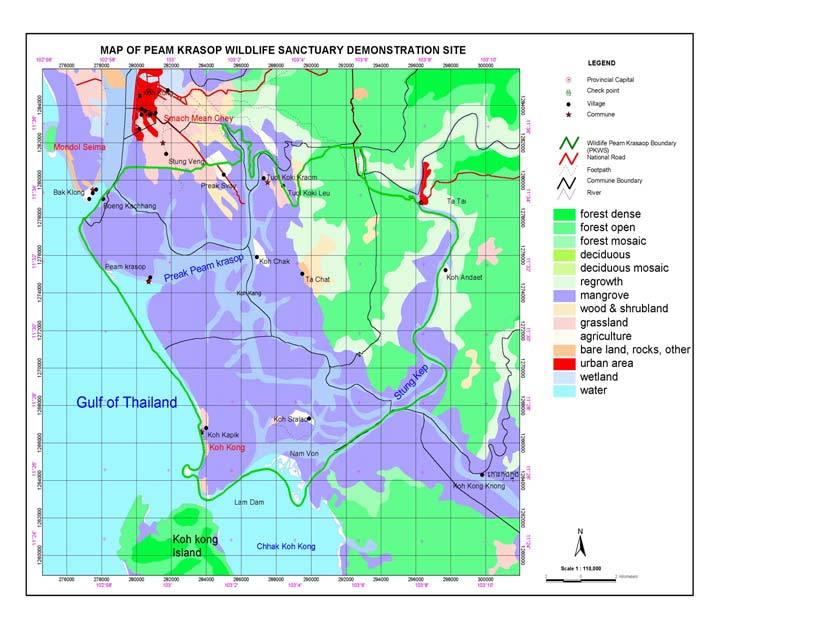
Annex 1. Site Characterisation of PKWS (and Koh Kapik Ramsar Wetland Site)
This Demonstration Site is a combination of two main important sites: Peam Krasop Wildlife Sanctuary and
Kokh Kapik Ramsar Wetland Site.
This site is different from what have described above thank to international wetland system registration was
created as the Wetland Ramsar Site into the Wetland International site. Thus it is internationally recognized
site as wetland site, numbered in the system as 1998. Cambodia's new designations, totalling 54,600 ha,
are the 1997th, (Boeng Chhmar, Tonle Sap lake freshwater), 998th (Koh Kapik Wetland Ramsar site,
Coastal area) and 999th (Stoeng Treng Wetland Ramsar Site, freshwater upper Mekong) Wetlands of
International Importance in the Ramsar List and bring worldwide totality of designated area to 71,220,794
hectares.
Figure 1
Map Peam Krasop Wildlife Sanctuary Demonstration Site covers the area of 25,897 ha,
of which Koh Kapik Ramsar Site covers 12,000 ha
· Geographic Information:
Koh Kong province covers an area of 11,160 km2 and borders Thailand to the west, Pursat province to the
north, Kampong Speu province to the northeast, Koh Kong and Kampong Speu province to the east and
southeast and the South China Sea and Thailand to the south and southwest. The coastline is
approximately 260 km long. The Cardamom Mountain range surrounds one side of the coast of Koh Kong
province while islands and ocean are on the other side. Koh Kong is divided into seven districts: Dongtung,
Mondulsema, Koh Kong, Kirisakor, Botumsakor, Tmar Bang, and Sre-Ambil. Koh Kong has the vast
majority of mangrove forests and important coastal wetland in Cambodia, with some of the last remaining
areas of pristine mangroves in Southeast Asia and a step stone site for Migratory birds.
This is situated in the south of Koh Kong provincial town, and comprises of all areas of mangrove forest on
Koh Kapik Island and associated coastal areas on the mainland. Koh Kapik and Associated Islets are
e
d signed as the international wetland site dated 23/06/1999. This site is defined in to the 1b, 1c an
c
d 2
Criteria with two cl
s of
asse
wetland types: 1 and 4.
16
· Co-ordinates:
Coordinates: 11°28'N 103°04'E with the elevation: 0 - 2 m
Location: The islands lie immediately off the mainland of Koh Kong Province on the Cambodian coast, near
e bord
th
er with Thailand, 15 km southeast of Koh Kong Town.
· Areas:
The total area
00 h
of Koh Kapik is 12,0
a with the perimeter about 61,050 meters.
· Physical Env ronment:
i
Koh Kapik and Associated Islets" (12,000 ha) are alluvial islands immediately off the mainland of Koh Kong
Province. The site is classified in two wetland types (Estuarine waters, and Intertidal mud, sand, or salt
flats) and listed under old Criteria 1(b) and 1(c) as `good representative examples' and 2(c) for its special
value to endemic plant or animal species. The Ramsar Information Sheet reports that "the site has been
chosen because of the representative status of the mangrove system which is common to the region but
under heavy threat in many parts of the country". The area plays a critical role in providing a nutrient source
supporting coastal fishery in the near-shore and offshore of Cambodian marine waters. The remaining
relatively-intact mangroves are said to have assumed increased importance in providing nursery and
feeding grounds for various invertebrate species since the substantial removal of mangrove forests in
nearby Thailand. The area of the site is state-owned and lies within the Peam Krasop Wildlife Sanctuary.
· Water Regime:
Two major rivers flowing into the area bring a freshwater influence and create sand flats in some places. In
particular this site is directly influenced by the sea level.
· Temperature:
Water is a very poor conductor of heat. Heat circulation of water is generally happened by convection as
warmer water moves upwards and cooler water mover downwards. The water temperature in site is around
28-30o C. Regarding the rainfall pattern is very high comparing to other area in Cambodi
nuall
a as an
y
etwe
b
en 2,800 mm to 3,000 mm.
· Soil Salinity:
The soil in the area is alluvial. The islands have been formed by depo
n of
sitio
mud and sand eroded from
the sandstone catchments of the two rivers on the southern slope of the Cardamom Mountains. There are
extensive sand an
me
d so
mud flats. The soil of the islands consists of a thin organic mud or humus layer
verlying san
o
d and sandy loam. The area is strongly influenced by the freshwater surface runoff of the two
rivers. The presence of intact mangrove areas contributes significantly to the stabilisation of the coast
against coastal erosion by storms and tides.
There is no information specifically for the soil salinity, but there is 3% salinity of the ater with
w
the PH 7.78
that can be used as benchmark for the soil salinity for the area as well. Usually the aquatic organisms thrive
in neutral PH to slightly alkaline (PH 8) of waters.
· Water Quality:
Many aquatic organisms need to obtain oxygen from water. Exceptions are animals that oxygen directly
from the air (some air-breathing fishes, turtles etc) and some micro-organisms which can live in the
absence of oxygen (anaerobic organisms). In addition there area usually many dissolved substances in
water, such as mineral salt, organic compounds.
Referred to the laboratory analysis, it is proved that Dissolved Oxygen equal to 4.69 mg/l. This means that
the quality of water is under acceptable condition. This site is in good in term of water quality thank to less
disturbance, remained good forest and especially the no direct in land-based pollution as other sites.
· Environmental State:
17
This is within the Wetland Types of "I, F and G". The site consists of islands with mangroves, and the
surrounding intertidal mudflats and waters in a delta formed by two rivers.
· Present Status:
The site was formulated by the Red or Yellow Podzol and coastal complex with the specific geology of the
Alluvium and sandstone. T
an
he m groves around Koh Kapik Island are bisected by many creeks. Along the
western coastline of the island, there are well developed mudflats, while the northern coastline is sandier.
There is a single village (Koh Kapik) on the island, where the main industry is fishing.
This area covers by water body more than 50 percent of the total area and mangrove forest around 40
percent
goof an
with
d pristine forest. Other is less than ten percent for the Agriculture, Evergreen disturbed,
evergreen mosaic and grassland.
The majority of population living and surrounding site is fishing, logging, charcoal production and
aquaculture. The potential and foundation job is fishing.
· Social and Cultural Use:
The site and the surrounding areas are owned by the state. The area is vital for the local community living
in and around the reserve, by providing charcoal and irewood, tim
f
ber, and fish, crustaceans and molluscs
for consumption. In general, the population of the entire catchment has a subsistence economy. There is a
general environmental education programme covering many environmental aspects including the
awareness of the values of wetlands. There are no information or tourism facilities, but the area is easily
accessible by boat. Overnight stays are possible and information can be obtained from local villagers at the
site.
In the PKWS there are 11 primary schools and a junior high school which located in the area with 17
teachers nd
a 180 school children; and next to the PKWS there are 3 primary schools with 5 teachers and
80 children (personal communication with NTFP). Therefore, 22 teachers and 260 school children are
teaching and learni
different sch
ng in 15
ools within/surrounding the demonstration site, respectively.
· Land Tenure/Ownership:
Land use issues actually become serious because of in-migration the newcomers not stop despite of
fishing job or non-land based dependant. The land title is not issuing because this site is the state
properties but the population have right to access and to make crop or agricultural family based support
system.
The right to access and family/community livelihood development supports were defined as important for
the population following the Royal Government policy such as socioeconomic development plan second
phase 2001-2005 and Strategy Paper for Poverty Reduction of the poverty reduction/eradication. Hence it
is allowable for the peoples living in the site but not for the new comer and additionally they have role to
protect and conserve the natural resources as called community based natural resources.
The forest cutting and other activities concerning the destruction of the natural resour
wi
ces ll be identified
and defined by the community leader before allowing.
· Current Land Use:
As described previously, more than 90 pe
nt
rce
of area is occupied by the water body and mangrove forest.
This is not important area for agriculture and/or land utilization.
Even though there are some small parcels happened for the cropping production system for family
supports.
· Biological Diversity:
Most members of the mangrove community are characteristic of areas which are inundat
r
ed only at fai ly
high tides an
r
d where the e is a large freshwater influence. The islands and creeks are typically fronted by
Rhizophora apiculata, one
n of the m
of the most commo
angrove species present, and stands of Nypa
fruticans. Immediately behind this
y
fairl narrow strip of Rhizophora there is an interesting mixture of other
18
mangrove species of which the following are most common: Bruguiera gymnorrhiza, B. sexangula, Ceriops
tagal, Lumnitzera littorea, Heritiera littoralis, Xylocarpus granatum, Hibiscus tiliaceus, Phoenix paludosa,
Acrosthicum speciosum, Aegialitis sp. and Acanthus sp. Avicennia and Sonneratia occur relatively
infrequently in the area, although Avicennia was tentatively identified from the air on accreting mudflats on
the west side of Koh Kapik and in some depressions slightly inland. Above the high tide mark, the
vegetation is dominated by Melaleuca leucodendron. Other plants typical of this community are Pandanus
sp., Licuala spinosa, Acrosthicum aureum, A. speciosum, Hibiscus tiliaceus, Xylocarpus granatum,
Heritiera littoralis, Phoenix paludosa, Melostoma sp. (in more disturbed areas) and Scleria sp.
There are also several rattan, epiphyte and fern species. At the south-western side of Koh
Kapik and on sandy spots on some of the islands there are small areas with typical beach vegetation
dominated by Casuarina equisetifolia with some Terminalia catappa. The site is also important because it
provides nursery, spawning and feeding grounds for a large variety of (commercially important) fish and
shellfish. It also harbours birds such as Tringa guttifer and Limicola falcinellus, and some endangered
aquatic mammal species such as dolphins.
The efforts have been made via the review all of the documents related to site biological feature,
consultations with the national and international experts and validated by the field verification of the project,
there are some species can be identifiable as following:
· Plant: there are 25 species existing within sites, David et al.
· Fish: 25 species were found, Department of fisheries.
· Bird: 30 species of the birds were clarified by the Wildlife Conservation Society (WCS) in Cambodia.
· Mammal: 5 species.
· Amphibian: 9 species.
· Migratory species: 6 species.
· Endemic species: 4 species.
· Endangered species: 5 species.
Importance: The site is a representative example of the mangrove systems that used to be common in the
region. There is a fully developed community of Rhizophora apiculata and other mangrove species.
Mangrove systems are seriously threatened in many parts of the country and in the region. This area has
remained relatively intact. The estuarine mangrove systems play a critical role in the lifecycles of many
organisms by providing substantial sources of nutrients.
19
Annex 2. Stakeholder Involvement Plan
1. Stakeholder
identification:
Stakeholders to be involved in the PKWS Demonstration Site project were identified during the period of
project development, are listed in the following table:
Stakeholders Role
Central Government Agencies:
DNCP (SEAs), MoE,
- Authorising and supervising the implementation of the
project,
- Participating in project's activities,
- Co-ordinating communications between site manager,
provincial authorities, NTWG, RWGs, IMC, RSTC, PSC and
PCU,
- Facilitating joint activities with Thailand.
Department of Forestry, Department of - Supporting activities of the project;
Fisheries of Ministry of Agriculture, - Consulting (sub-contracts) and guiding;
Forestry and Fisheries.
- Participating.
Local Authorities and Communities:
Koh Kong Provincial Department of - Sub-contracts for survey on biophysical and
Environment and other relevant technical
biodiversity, economic valuation,
and non-technical departments, District - Being members of MB and MAG;
Governors, Commune Councils, village - Supporting and participating in activities,
leaders and local communities.
- Supporting in law enforcement, field trip,
- Raising
awareness,
- Administrative
support,
- Attending training, study tours, workshops,
- Being target group.
Existing Projects and NGOs:
- Providing training courses and experiences;
PMMR (Canada), CCU/CZM (DANIDA)
- Participating in raising awareness,
- Supporting alternative job initiation.
2. Information
Dissemination and Consultation:
Information about the project's activities will be distributed to stakeholders using as many means as
possible in order to introduce approaches to the target group to let them actively involve in the project.
Communication at the management level will be done through the MB consisted of representatives of
concerned groups who will make decision and determination in planning and implementing the
Demonstration Site. Frequent communication will be taken place based on meetings and workshops.
The target group will be also informed about events and project activities through direct invitation for
participating in meetings and workshops, and through the distribution of publications. For general public,
information will be provided through personnel interview and focus group discussion; and at the same time
constructive feedback about the progress of project received from the public will be valuable for SEA as
guidance for better future implementing.
A six-monthly progress report will be prepared and used as basic information to inform the public about
project progress and help emphasize key progressive indication. Other public awareness materials will be
distributed via local authorities during special occasions such as beach cleaning campaign, environmental
day, or a traditionally Buddhism festival; are aiming at mangrove and wetland ecosystems and biodiversity
conservation and improving the quality of local population through best approaches of resource
management and conservation.
3.
Stakeholder Participation in Planning, Decision-making, and Executing Activities:
Public participation, especially from local authorities and communities, is priceless contribution to the
success of the project, which has characterized initiatives on mangrove and wetland resource management
20
and biological species conservation within the demonstration site. The project has to put as much effort as
possible in order to give confidence to and promote participation from various local people for the whole
project period, and beyond.
The project will be launched an "opening ceremony day", to celebrate the mangrove and wetland
ecosystem and biodiversity conservation work, in order to introduce the project team and probably target
group about the project objectives and planned activities. The ceremony day will be taken place as a big
workshop, in which all levels of stakeholders will be invited to participate. At the workshop, a discussion will
be carried out to ask participants to identify priorities, opportunities, and particular needs.
During the course of the project stakeholder meeting and consultation, which will be organized to plan the
way forward and make decision on the implementation of activities. Results from the discussion will be
used as synergy for consolidating with other meetings in order to improve the quality of project
management. An apparent implementing plan resulted from a series of discussion of all relevant
stakeholders, will be applied and replicated in other place of the country for the sake of sustainable
resource management and conservation.
4.
Social, Cultural and Participatory Issues:
· The SEA and Site Manager will need to be aware of gender issues during the implementation of the
project. Traditionally and remotely, Cambodian women are extremely inhibited and hesitated in
performing in the public activities. They have to be extremely persuasive as they are the most essential
stakeholders that contribute to the success of the project. Certain project activities will need to be
carefully worked out with gender roles in mind and in some cases activities should be specifically
targeted towards women. This is likely to be particularly important in work relating to substantive
income generation and awareness programmes.
· Majority of Cambodian remote population are Buddhism, and people are respect monk (as well as
elders in villages). In terms of conservation and protection Buddhism is supportive; the project activities
such as public awareness and capacity building should be introduced during publicly Buddhism
festivals. At the same time, elders and monks should be used as moderators or speakers for resource
conservative purposes.
· Economic aspects of this project will be most effective if they are targeted on the neediest in the
community particularly those on low income. However, it is usually very difficult to involve the people
with low income as they cannot afford to take time out from making a living, or because it is hard to
reach them to inform them about an initiative, or simply because they may lack the confidence to join
in. In order to reach those most needy communities, it is required a special effort and commitment from
the site manager and SEA. In this case, village leaders or village elders will be used as a facilitator for
communication and coordination with those local community groups, and a special effort will be used to
encourage them to joint the project.
21
Annex 3. Causal Chain Analysis of Threats to Peam Krasop Wildlife Sanctuary
Demonstration Site
Core problem
Immediate threats
Underlying threats
Interventions
Low income,
Livelihood support,
poor livelihood
community
business, financial
plan
Desire for
Illegal cutting
maximising
mangroves for
catch and profit
charcoal and
firewood
Zoning and
guidelines
Desire for land
and profit
Regulations and
Over-
enforcement
exploitation of
No clear zoning
Loss of
resources
and lack of
biodiversity and
enforcement
Capacity building
productive
and awareness
resources
raising
Land
encroachment
Lack of public
Participatory
understanding
approaches in
strategic planning, in
Land clearance
restoration
for aquaculture
(shrimp ponds)
Weak
Management
management
framework,
Coastal erosion
capacity
transboundary co-
(minor)
ordination
Waste dumping
Lack of baseline
Scientific survey and
and discharge
data
monitoring
(minor, potential)
Lack of means
and legislation
for waste
dumping
22
Annex 4. Monitoring and Evaluation Plan
Monitoring and evaluation is important to detect the progress of project implementation. Results of in
the past will be used for orientation and redirection of the project's activities. To achieve this purpose,
a transparent and logical procedure will be developed.
1.
Collecting and Reporting Data on Performance Indicators:
Monitoring and evaluation of the project will require a set of key indicators of success. Monitoring and
evaluation programmes will be conducted by certain assigned independent consultants. Participatory
evaluation at selected sites and questionnaire surveys will provide key information for monitoring and
evaluation activities. Methods and frequency of data collection will be determined by the assigned
evaluator to follow the donor requirements. The important indicators are as follows:
Improved management capacity of Koh Kong Province with the development of management
plan, expansion of GIS database and more information on biodiversity and resource use of
mangrove and wetland ecosystems.
Established appropriate coordinating mechanism for management of coastal resources in Koh
Kong Province and developed information exchange and management integration with
Thailand colleagues.
Established mangrove monitoring methodology and guidelines.
Annual monitoring of mangrove and wetland demonstration site.
Increased awareness on importance of coastal ecosystems and balance of development and
conservation.
Trained 15 local people to do monitoring of mangrove and wetland resources.
Reduction of litter on beaches.
Reduction in illegal fishing in mangrove and wetland areas.
Clear zoning of areas within demonstration site.
Present and potential future use, value net income and costs identified.
Alternative uses and potential conflicts identified.
Established financial management mechanisms to initiate financial sustainability.
Improved benefit for local communities with more resources in near-shore water for public
fishing.
2.
Schedule of Monitoring and Evaluation:
2006
2007
2008
Monitoring/Evaluation
3
4
1
2
3
4
1
2
3
4
Ecological monitoring
Mid-term review
Evaluation the Progress by
management board
Evaluation in the end of project
Formally independent evaluation of the project will be carried out at the mid point of the project, twelve
months after the start of the project, and at the end of the project, three months before the termination
date. Both reviews will be led by an external evaluator with experience in environmental conservation
and community development. Each study will take the form of a joint evaluation by project staff and
the evaluator into the management and environmental aspects of the project and an independent
review of community gains and stakeholder participation by the evaluator. Evaluation of the progress
of the project will be regularly carried out by the management board. Long-term ecological and socio-
economic monitoring programme will be also performed by the DNCP.
3.
Description of How Monitoring and Evaluation Activities will Involve Participants and
Stakeholders:
Monitoring and evaluation will be an integral part of the stakeholder participation element of the
project. For each project activity and event, participants will carry out a simple evaluation
23
activity, wherever possible to meet their own evaluation criteria. Stakeholders will be asked to
give their perceptions of the project as part of the formal independent evaluation activities.
4.
Resources that will be allocated for Monitoring and Evaluation:
An amount of budgetary provision has been allocated to the mid-term and terminal evaluations to
cover consultancy fees and expenses for external evaluators.
5.
Using Results from Monitoring and Evaluation for Future and Better Management
A six monthly monitoring report will be presented to the Project Management Board by the Site
Manager, who will highlight key issues for discussion at the meetings of management board. As far as
possible, reporting to the management board will be integrated with reporting to the UNEP/GEF/PCU
as well. The Management Advisory Group will also receive quarterly updates on key issues.
24
Annex 5. Estimated Budget (US$)
Table 1.
Estimated Budget by Components and Activities.
GEF Co-Fundin
g
TOTA
L
ACTIVITY
1000 200
0
300
0
400
0
500
0
100
0
2000 300
0
400
0
500
0
GE
F
in-cash
In-kin
d
Tota
l
1.1. National Actions
1.1.1. Recruitment of a Site Manager (SM) and an Assistant Site
24,000
Manager (ASM)
24,000
24,000
1.1.2. Purchase project office equipment and furniture, office renting
9,240
1,000
15,000
10,240
0
15,000
25,240
1.1.3. Organisation of quarterly meetings for MAG (8 meetings)
2,368
4,816
2,368
336
4,480
7,184
1.1.4. Organisation of biannual meetings of the MB (5 meetings)
1,730
6,510
1,730
210
6,300
8,240
1.1.5. Project monitoring and evaluation, auditing
9,000
9,000
0
0
9,000
1.2. Bilateral Actions
1.2.1. Joint meetings of Thai & Cambodian MAGs (3 meetings) (1 time
7,245
50.0
in Koh Kong, 2 times in Trat)
6,070
7,245
6,020 13,315
1.2.2.Joint meetings of MBs (3 meetings) (1 time in Koh Kong, 2 times in
18,547
Trat)
15,903
18,547
83
15,820
34,450
2.1. Data and Information for Management Plan (MP) Development
2.1.1. SEA START RC to prepare a draft base map from satellite image
2,000
2,000
0
0
2,000
2.1.2. Field survey for species distribution, density, composition, area,
4,321
and key associated benthic resources (sub-contact with DNRA&DM)
7,911
4,321
491
7,420
12,232
2.1.3. GIS Mapping and identification of ecotones (zones) based on field
500
data (sub-contact with DNRA&DM)
350
500
0
350
850
2.1.4. Survey on socio-economics, uses, value, incomes and costs (sub-
3,471
contract with DEP&LA)
5,111
3,471
491
4,620
8,582
2.1.5. Analysis of present and potential uses, values, net incomes and
600
costs and GIS mapping of use zones (sub-contract with DEP&LA and
DNRA&DM)
420
600
0
420
1,020
2.1.6. Analysis of potential use conflicts and future management needs
500
costs (sub-contract with DEP&LA)
350
500
0
350
850
2.1.7. Development of methodology for monitoring (drafted by
1,288
DNRA&DM, reviewed by MAG) (sub-contract with DNRA&DM)
936
1,288
96
840
2,224
2.1.8. Review national data, information and regulations for developing
2,000
MP (sub-contract with DEP&LA)
2,000
2,000
2.2. Draft, Review and Approval of MP
2.2.1. Prepare first order draft management plan in Khmer (zones,
regulations, monitoring methodology on biological resource and use,
establishment of financial mechanisms for sustainability, etc.)
0
0
2.2.2. Review the MP by stakeholders (in 3 meetings at village level, 1
1,320
at provincial level)
16,800
1,320
0
16,800
18,120
2.2.3. Revision of MP by MAG and MB in periodic meetings
2.2.4. Final Stakeholder Meeting for adopting and signing the plan by
2,760
the Governor (mixed stakeholders at all levels, 1 day)
13,720
2,760
420
13,300
16,480
2.2.5. Translation of the Management Plan (drafts & Final) into English
1,120
1,120
1,120
2.2.6. Publication of the Management Plan in Khmer (100 copies)
2,000
2,000
2,000
25
Table 1. Cont. Estimated Budget by Components and Activities.
GEF Co-Fundin
g
TOTA
L
ACTIVITY
1000 200
0
300
0
400
0
500
0
100
0
2000 300
0
400
0
500
0
GE
F
in-cash
In-kin
d
Tota
l
3.1. Surveillance
3.1.1. Demarcation of zones (setting demarcated poles and boards)
9,570
2,460
9,570
80
2,380
12,030
3.1.2. Purchasing a small patrol boat and a motorcycle for rangers
3,000
3,000
3,000
3.1.3. Daily patrolling with involvement of local community (sub-contract
8,625
with local community)
1,800
8,625
0
1,800
10,425
3.2. Biological and Use Monitoring
3.2.1. Annual monitoring activity with involvement of local community (2
7,272
times) (sub-contract with local community)
4,862
7,272
322
4,540
12,134
3.3. Habitat Restoration
0
0
3.3.1. Review method/technique of mangrove plantation (Sub-contract
2,000
with DNRA&DM)
2,000
2,000
3.3.2. Experimental multi-species mangrove plantation (2 ha)
3,989
5,808
3,989
288
5,520
9,797
3.3.3. Re-plantation of multi-species of mangroves (250 ha of 2,500 ha)
36,625
21,000
36,625
21,000
57,625
3.3.4. Monitoring the growth and survival of the planted mangroves
528
twice a year
3,906
528
126
3,780
4,434
4.1. Public Awareness
4.1.1. Design & Print posters (500 copies) on mangrove and wetland
2,000
importance and sustainable use
2,000
2,000
4.1.2. Development and publication of leaflets on mangrove and wetland
2,500
biodiversity and sustainable use (5000 copies)
2,500
2,500
4.1.3. Production of short Video films on mangrove and wetland and use
2,295
(6 scenes, 15 minutes each)
2,295
2,295
4.1.4. Broadcasting on Public Television (12 times for 15 minutes each)
600
600
600
4.1.5. Seminar on mangrove and wetland biodiversity and sustainable
use for policy makers at provincial and district levels (25 participants)
618
4,275
618
145
4,130
4,893
4.1.6. Workshops at village level about significant mangrove and
2,377
wetland resources (5 workshops)
22,543
2,377
143
22,400
24,920
4.1.7. Study tour of local leaders visiting Trat demonstration site (5 days)
4,537
5,363
4,537
1,513
3,850
9,900
4.1.8. Study tour of MB and MAG to visit the most successful SCS
9,217
mangrove and wetland demonstration site (7 days)
12,383
9,217
3,073
9,310
21,600
4.2. Training
4.2.1. Training on project management and administration (including
4,215
financing) for site manager and 5 people from (MAG & MB) (1 course)
405
4,215
405
0
4,620
4.2.2. Training on English and report writing for site manager and 5
4,215
people from MAG & MB (1 course)
405
4,215
405
0
4,620
4.2.3. Training on mangrove and wetland monitoring for 20 most
2,678
relevant people (monitors, site manager, and local community)
110
2,678
110
0
2,788
4.2.4. Training on Community-based mangrove resource management
6,508
local authorities (3 courses for 25 participants each)
734
6,508
734
0
7,242
4.2.5. Training on skills for income generation for fishers/people who
12,208
abandon their illegal mangrove cutting and fishing (5 different courses)
1,682
12,208
1,682
0
13,890
26
Table 1. Cont. Estimated Budget by Components and Activities.
GEF Co-Fundin
g
TOTA
L
ACTIVITY
1000 200
0
300
0
400
0
500
0
100
0
2000 300
0
400
0
500
0
GE
F
in-cash
In-kin
d
Tota
l
5.1. Financial Mechanism
5.1.1. Support local government in establishment a "Trust Fund" in a big
815
meeting of MAG, MB, and concerned institutions
3,500
815
210
3,290
4,315
5.1.2. Guiding the application of user fee system
815
3,500
815
210
3,290
4,315
5.2. Alternative livelihoods
5.2.1. Develop a mechanism for effective use of credit's system
2,000
2,000
2,000
5.2.2. Support the initiation of alternative livelihood income generation
25,000
25,000
25,000
Total
25,120 113,184 82,173 12,240 16,500
0 54,914 118,719 15,000
0 249,217 11,623 177,010 437,850
27
Table 2.
Budget Allocation by Object of Expenditure.
1st 2006
2nd 2006
1st 2007
2nd 2007
1st 2008
Grand Total
Co-funding Co-fundin
g
Co-fundin
g
Co-fundin
g
Co-fundin
g
Co-fundin
g
Object of Expenditure
GEF
In-
In-
Total GEF In-
In-
Total GEF In-
In-
Total GEF In-
In-
Total GEF In-
In-
Total GEF In-
In-
Total
cash
kind
cash
kind
cash kind
cash
kind
cash kind
cash
kind
1000 Project Personal Component
1100 Project Personnel
1101 Demonstration Site Manager (1.1.2)
3,600
3,600
3,600
3,600
3,600
3,600
3,600
3,600
3,600
3,600
18,000
0
0
18,000
1102 Assistant (1.1.2)
1,200
0
0
1,200
1,200
1,200
1,200
1,200
1,200
1,200
1,200
1,200
6,000
0
0
6,000
1199 Total
4,800
0
0
4,800
4,800
0
0
4,800
4,800
0
0
4,800
4,800
0
0
4,800
4,800
0
0
4,800
24,000
0
0
24,000
1200 Consultant
1201 Translation of the Management Plan (drafts & Final) into English
0
560
560
560
560
0
0
1,120
0 0
1,120
(2.2.5)
1299 Total
0
0
0
0
560
0
0
560
560
0
0
560
0
0
0
0
0
0
0
0
1,120
0
0
1,120
1300 Administration support
1301
1399 Total
0
0
0
0
0
0
0
0
0
0
0
0
0
0
0
0
0
0
0
0
0
0
0
0
1600 Travel on official business
1601 Travel
on
official
business
0
0
0
0
0
0
0 0
0
1699 Total
0
0
0
0
0
0
0
0
0
0
0
0
0
0
0
0
0
0
0
0
0
0
0
0
1999 Component Total
4,800
0
0
4,800
5,360
0
0
5,360
5,360
0
0
5,360
4,800
0
0
4,800
4,800
0
0
4,800
25,120
0
0
25,120
2000 Sub-Contract Component
2200 Sub-Contract Component
2201 SEA START RC to prepare a draft base map from satellite
2,000
2,000
0
0
0
0
0
0
0
2,000
0 0
2,000
image (2.1.1)
2202 Field survey for species distribution, density, composition, area, 4,321
491
7,420
12,232
0
0
0
0
0
0
0
4,321
491
7,420
12,232
and key associated benthic resources (2.1.2)
2203 GIS Mapping and identification of ecotones (zones) based on
0
500
0
350
850
0
0
0
500
0
350
850
field data (2.1.3)
2204 Survey on socio-economics, uses, value, incomes and costs
3,471
491
4,620
8,582
0
0
0
0
0
0
0
0
0
3,471
491
4,620
8,582
(2.1.4)
2205 Analysis of present and potential uses, values, net incomes and
0
1,020
0
0
0
600
0
420
0
0
0
600
0 420
1,020
costs and GIS mapping of use zones (2.1.5)
2206 Analysis of potential use conflicts and future management
0
850
0
0
0
500
0
350
500
0 350
850
needs costs (2.1.6)
2207 Development of methodology for monitoring (drafted by
0
2,224
0
0
0
1,288
96
840
1,288
96 840
2,224
DNRA&DM, reviewed by MAG) (2.1.7)
2208 Review national data, information and regulations for developing
0
2,000
0
0
2,000
0
0
0
2,000
0
0
2,000
MP (2.1.8)
2209 Demarcation of zones (setting demarcated poles and boards)
0
0
0
9,570
80
2,380
12,030
0
0
9,570
80
2,380
12,030
(3.1.1)
2210 Daily patrolling with involvement of local community (sub-
0
0
1,725
360
2,085
3,450
0
720
4,170
3,450
0
720
4,170
8,625
0
1,800
10,425
contract with local community) (3.1.3)
2211 Annual monitoring activity with involvement of local community
0
0
3,636
161
2,270
6,067
0
3,636
161 2,270
6,067
7,272
322
4,540
12,134
(2 times) (sub-contract) (3.2.1)
2212 Review method/technique of mangrove plantation (3.3.1)
2,000
2,000
0
0
0
0
2,000
0
0
2,000
2213 Experimental multi-species mangrove plantation (2 ha) (3.3.2) 1,994
144
2,760
4,898
1,995
144
2,760
4,899
0
0
0
3,989
288
5,520
9,797
2214 Re-plantation of multi-species of mangroves (250 ha of 2,500
0
5,232
3,000
8,232
10,464
6,000
16,464
10,464
6,000 16,464
10,465
6,000
16,465
36,625
0
21,000
57,625
ha) (3.3.3)
2215 Monitoring the growth and survival of the planted mangroves
0
132
31
945
1,108
132
31
945
1,108
132
31
945
1,108
132
33
945
1,110
528
126
3,780
4,434
twice a year (3.3.4)
2216 Production of short Video films on mangrove and wetland and
0
0
2,295
2,295
0
0
2,295
0 0
2,295
use (6 scenes, 15 minutes each) (4.1.3)
2217 Broadcasting on Public Television (12 times for 15 minutes
0
0
0
300
300
300
300
600
0 0
600
each) (4.1.4)
2218 Develop a mechanism for effective use of credit's system (5.2.1
0
0
666
666
1,334
1,334
0
2,000
0
0
2,000
2219 Support the initiation of alternative livelihood income generation
25,000
25,000
0 0
25,000
(5.2.2)
25,000
2299 Total
13,786
1,126 14,800
29,712
12,247
271
8,665
21,183
28,488
272 11,955 40,715
40,680
31
7,665 48,376
17,983
194 9,935
28,112 113,184 1,894
53,020 168,098
2999 Component Total
13,786
1,126 14,800
29,712
12,247
271
8,665
21,183
28,488
272 11,955 40,715
40,680
31
7,665 48,376
17,983
194 9,935
28,112 113,184 1,894
53,020 168,098
28
Table 2. Cont.
Budget Allocation by Object of Expenditure.
1st 2006
2nd 2006
1st 2007
2nd 2007
1st 2008
Grand Total
Co-funding Co-fundin
g
Co-fundin
g
Co-fundin
g
Co-fundin
g
Co-fundin
g
Object of Expenditure
GEF
In-
In-
Total GEF In-
In-
Total GEF In-
In-
Total GEF In-
In-
Total GEF In-
In-
Total GEF In-
In-
Total
cash
kind
cash
kind
cash kind
cash
kind
cash kind
cash
kind
3000 Training Component
3200 Group Training
3201 Study tour of local leaders visiting Trat demonstration site (5
0
0
4,537 1,513
3,850
9,900
0
0
4,537 1,513
3,850
9,900
days) (4.1.7)
3202 Study tour of MB and MAG to visit the most successful SCS
0
0
0
9,217 3,073
9,310 21,600
0
9,217 3,073
9,310
21,600
mangrove and wetland demonstration site (7 days) (4.1.8)
3203 Seminar on mangrove and wetland biodiversity and sustainable
0
618
145
4,130
4,893
0
0
0
618
145
4,130
4,893
use for policy makers at provincial and district levels (25
participants) (4.1.5)
3204 Workshops at village level about significant mangrove and
594
35
5,600
6,229
1,188
70
11,200
12,458
595
38 5,600 6,233
0
0
2,377
143 22,400
24,920
wetland resources (5 workshops) (4.1.6)
3205 Training on project management and administration (including 4,215
405
0
4,620
0
0
0
0
4,215
405 0
4,620
financing) for site manager and 5 people from (MAG & MB) (1
course) (4.2.1)
3206 Training on English and report writing for site manager and 5
4,215
405
4,620
0
0
0
0
4,215
405 0
4,620
people from MAG & MB (1 course) (4.2.2)
3207 Training on mangrove and wetland monitoring for 20 most
0
0
2,678
110
2,788
0
0
2,678
110 0
2,788
relevant people (monitors, site manager, and local community)
(4.2.3)
3208 Training on Community-based mangrove resource managemen 2,169
244
2,413
0
2,169
244
0
2,413
0
2,170
246
0
2,416
6,508
734 0
7,242
local authorities (3 courses for 25 participants each) (4.2.4)
3209 4.2.5. Training on skills for income generation for fishers/people
0
0
3,052
420
3,472
6,104
840
0
6,944
3,052
422
0
3,474
12,208 1,682 0
13,890
who abandon their illegal mangrove cutting and fishing (5
different courses) (4.2.5)
3299 Total
11,193
1,089
5,600
17,882
1,806
215
15,330
17,351
13,031 2,325 9,450 24,806
15,321 3,913
9,310 28,544
5,222
668
0
5,890
46,573 8,210
39,690
94,473
3300 Meeting/Conference
3301 Organisation of quarterly meetings for MAG (8 meetings) (1.1.3
296
42
560
898
592
84
1,120
1,796
296
42
560
898
592
84
1,120
1,796
592
84 1,120
1,796
2,368
336 4,480
7,184
3302 Organisation of biannual meetings of the MB (5 meetings)
346
42
1,260
1,648
346
42
1,260
1,648
346
42 1,260 1,648
346
42
1,260
1,648
346
42 1,260
1,648
1,730
210
6,300
8,240
(1.1.4)
3303 Joint meetings of Thai & Cambodian MAGs (3 meetings) (1 time 2,415
16
2,006
4,437
0
2,415
16
2,006
4,437
0
2,415
18 2,008
4,441
7,245
50
6,020
13,315
in Koh Kong, 2 times in Trat) (1.2.1)
3304 Joint meetings of MBs (3 meetings) (1 time in Koh Kong, 2 time 6,182
27
5,273
11,482
0
0
0
6,182
27
5,273
11,482
0
6,183
29 5,274
11,486
18,547
83
15,820
34,450
in Trat) (1.2.2)
3305 Review the MP by stakeholders (in 3 meetings at village level, 1
0
660
8,400
9,060
660
8,400
9,060
0
0
1,320
0
16,800
18,120
at provincial level) (2.2.2)
3306 Final Stakeholder Meeting for adopting and signing the plan by
0
0
2,760
420
13,300
16,480
0
0
2,760
420
13,300
16,480
the Governor (mixed stakeholders at all levels, 1 day) (2.2.4)
3307 Support local government in establishment a "Trust Fund" in a
0
0
815
210
3,290
4,315
0
0
815
210
3,290
4,315
big meeting of MAG, MB, and concerned institutions (5.1.1)
3308 Guiding the application of user fee system (5.1.2)
0
0
407
105 1,645
2,157
408
105
1,645
2,158
0
815
210
3,290
4,315
3399 Total
9,239
127
9,099
18,465
1,598
126
10,780
12,504
13,881
862 35,734 50,477
1,346
231
4,025
5,602
9,536
173 9,662
19,371
35,600 1,519
69,300 106,419
3999 Component Total
20,432
1,216 14,699
36,347
3,404
341
26,110
29,855
26,912 3,187 45,184 75,283
16,667 4,144 13,335 34,146
14,758
841 9,662
25,261
82,173 9,729 108,990 200,892
4000 Equipment
Component
4100 Expendable Equipment
4102 Support the initiation of alternative livelihood income generation
0
0
0
0
0
0
0
0
0
0
(5.2.2)
4199 Total
0
0
0
0
0
0
0
0
0
0
0
0
0
0
0
0
0
0
0
0
0
0
0
0
4200 Non Expendable Equipment
4201 Purchase project office equipment and furniture (1.1.2)
9,240
15,000
24,240
0
0
0
0
9,240
0
15,000
24,240
4202 Purchasing a small patrol boat and a motorcycle for rangers
0
0
3,000
3,000
0
0
3,000
0 0
3,000
(3.1.2)
4299 Total
9,240
0 15,000
24,240
0
0
0
0
3,000
0
0
3,000
0
0
0
0
0
0
0
0
12,240
0
15,000
27,240
4300 Premises
4301
4399 Total
0
0
0
0
0
0
0
0
0
0
0
0
0
0
0
0
0
0
0
0
0
0
0
0
4999 Component Total
9,240
0 15,000
24,240
0
0
0
0
3,000
0
0
3,000
0
0
0
0
0
0
0
0
12,240
0
15,000
27,240
29
Table 2. Cont.
Budget Allocation by Object of Expenditure.
1st 2006
2nd 2006
1st 2007
2nd 2007
1st 2008
Grand Total
Co-funding Co-fundin
g
Co-fundin
g
Co-fundin
g
Co-fundin
g
Co-fundin
g
Object of Expenditure
GEF
In-
In-
Total GEF In-
In-
Total GEF In-
In-
Total GEF In-
In-
Total GEF In-
In-
Total GEF In-
In-
Total
cash
kind
cash
kind
cash kind
cash
kind
cash kind
cash
kind
5000 Miscellaneous component
5200 Reporting Costs
5201 Project M&E, auditing (1.1.5)
0
3,500
3,500
0
3,500
3,500
2,000
2,000
9,000
0
0
9,000
5202 Publication of the Management Plan in Khmer (100 copies)
0
2,000
2,000
0 0
2,000
0
0
2,000
0
0
(2.2.6)
5203 Design & Print posters (500 copies) on mangrove and wetland 2,000
2,000
0 0
2,000
2,000
0
0
0
0
importance and sustainable use (4.1.1)
5204 Publication of leaflets on mangrove and wetland biodiversity and 2,500
2,500
0 0
2,500
2,500
0
0
0
0
sustainable use (5000 copies) (4.1.2)
5299 Total
4,500
0
0
4,500
3,500
0
0
3,500
2,000
0
0
2,000
3,500
0
0
3,500
2,000
0
0
2,000
15,500
0
0
15,500
5300 Sundry
5301 Purchase project office equipment and furniture (1.1.2)
200
200
200
200
200
200
200
200
200
200
1,000
0
0
1,000
5399 Total
200
0
0
200
200
0
0
200
200
0
0
200
200
0
0
200
200
0
0
200
1,000
0
0
1,000
5999 Component Total
4,700
0
0
4,700
3,700
0
0
3,700
2,200
0
0
2,200
3,700
0
0
3,700
2,200
0
0
2,200
16,500
0
0
16,500
9999 Project Total
52,958
2,342 44,499
99,799
24,711
612
34,775
60,098
65,960 3,459 57,139 126,558
65,847 4,175 21,000 91,022
39,741 1,035 19,597
60,373 249,217 11,623 177,010 437,850
Balance
249,217 11,623 177,010 437,850
30
Table 3.
Detailed Budget with Description.
Sub-components/Activities Co-Funding
GEF
Total
Budget (US$)
In-cash In-kind
1.1. National Actions
1.1.1. Recruitment of a Site Manager (SM) and an Assistant Site Manager (ASM)
24,000 0 0
24,000
Demonstration site manager (1 person, $600/month, 30 months)
18,000
18,000
Assistant (1 person, $200/month, 30 months)
6,000
0
0
6,000
1.1.2. Purchase project office equipment and furniture
10,240
0 15,000 25,240
Project Office rental in Koh Kong (US$500/month, 30 months)
15,000
15,000
Communication (internet, phone, fax, postage) (1set)
1,500
0
1,500
Computer (2 sets)
2,000
0
2,000
Photocopy (1 set)
3,600
0
3,600
Printer (1 set)
340
340
Tables and chairs (1 set)
300
300
Stationery
1,500
1,500
Miscel aneous
1,000
1,000
1.1.3. Organisation of quarterly meetings for MAG (8 meetings, 6 people)
2,368 336 4,480 7,184
Travel of people from Phnom Penh for official business (8 times x 2 peers)
360
120
480
Accommodation for people from Phnom Penh for domestic meeting (8 times
648 216 2,240 3,104
x 2 days x 2 pers)
Food for Local Participants (4 pers. x 1 day x 8 times)
160
2,240
2,400
Meeting room arrangement (8 times)
320
320
Meeting material (folders, paper, pens) (8 meetings)
240
240
Equipment for presentations (8 times)
480
480
Miscellaneous (8 meetings)
160
160
1.1.4. Organisation of biannual meetings of the MB (5 meetings)
1,730 210 6,300 8,240
Travel of people from Phnom Penh for official business (5 times x 2 pers)
225
75
300
Accommodation of people from Phnom Penh for meeting (5 timesx2 days x
405 135 1,400 1,940
2 pers.)
Food for Local Participants (14 persx1dayx 5 times)
350
4,900
5,250
Meeting room arrangement (5 times)
200
200
Equipment for presentations (5 meetings)
300
300
Meeting material (folders, paper, pens) (5 meetings)
150
150
Miscellaneous (5 meetings)
100
100
1.1.5. Project monitoring (by MB) and evaluation (by an independent institution),
9,000 0 0
9,000
auditing
Project Monitoring (to be done by MB in their regular meetings)
0
0
0
0
Project Evaluation (by an independent institution) (3 times)
6,000
6,000
Auditing (3 times)
3,000
3,000
1.2. Bilateral Actions
1.2.1. Joint meetings of Thai & Cambodian MAGs (3 meetings) (1 time in Koh
7,245 50
6,020
13,315
Kong, 2 times in Trat)
Travel to Trat for joint meetings (2 times x 6 pers.)
1,800
1,800
Accommodation for joint meetings in Trat (2 times x 5 days x 6 pers.)
4,800
4,200
9,000
Travel of people from Phnom Penh for meeting in Koh Kong (1 time x 2
45 15
60
pers.)
Accommodation of people from Phnom Penh for meeting in Koh Kong (1
100 35 700 835
time x 5 days x 2 pers.)
Food for Local Participants for provincial meeting (1 time x 4 pers. x 4 days)
80
1,120
1,200
Meeting room arrangement (4 days of 1 meeting)
200
200
Meeting material (folders, paper, pens) (1 meeting)
60
60
Equipment for presentations (1 meeting)
60
60
Miscellaneous (1 meeting)
100
100
1.2.2.Joint meetings of MBs (3 meetings) (1 time in Koh Kong, 2 times in Trat)
18,547
83 15,820 34,450
Travel to Trat for joint meetings (2 times x 16 pers.)
4,800
4,800
Accommodation for joint meeting in Trat (2 times x 5 days x 16 pers.)
12,800
11,200
24,000
Travel of people from Phnom Penh for joint meetings in Koh Kong (1 time x
45 15
60
2 pers.)
Accommodation of people from Phnom Penh for joint meeting in Koh Kong
202 68 700 970
(1 time x 5 days x 2 pers.)
Food for Local Participants for provincial meeting (1 time x 14 pers. x 4
280
3,920 4,200
days)
Meeting room arrangement (4 days x 1 time)
200
200
Meeting material (folders, paper, pens) (1 meeting)
60
60
Equipment for presentations (1 meeting)
60
60
Miscellaneous (1 meeting)
100
100
31
Table 3. Cont. Detailed Budget with Description.
Sub-components/Activities Co-Funding
GEF
Total
Budget (US$)
In-cash In-kind
2.1. Data and Information for Management Plan (MP) Development
2.1.1. SEA START RC to prepare a draft base map from satellite image
2,000 0 0
2,000
Draft base map by SEA START RC
2,000
2,000
2.1.2. Field survey for species distribution, density, composition, area, and key
4,321 491
7,420
12,232
associated benthic resources (sub-contact with DNRA&DM)
Designing, supervising field survey and report writing
2,000
2,000
Travel of six experts from DNRA&DM in Phnom Penh (1time x 6 pers.)
135
45
180
Accommodation for six experts from DNRA&DM in Phnom Penh (1 time x
1,336 446 4,620 6,402
11 days x 6 pers.)
Food for 4 local people (4 pers. x 10 days)
50
2,800
2,850
Boat hiring (2 small boats x 10 days)
800
800
2.1.3. GIS Mapping and identification of ecotones (zones) based on field data
500 0 350 850
(sub-contact with DNRA&DM)
Data input from 2.1.2, mapping and identification of ecotones (1per. x 5
500 0 350 850
days)
2.1.4. Survey on socio-economics, uses, value, incomes and costs (sub-contract
3,471 491 4,620 8,582
with DEP&LA)
Designing tool, supervising field survey and reporting
2,000
2,000
Travel of 6 researchers from DEP&LA in Phnom Penh (1 time x 6 pers.)
135
45
180
Accommodation for 6 researchers (1 time x 6 pers. x 11 days)
1,336
446
4,620
6,402
2.1.5. Analysis of present and potential uses, values, net incomes and costs and
600 0
420
1,020
GIS mapping of use zones (sub-contract with DEP&LA and DNRA&DM)
Data input from 2.1.4, analyse present and potential uses, values, net
600
420
1,020
incomes and costs and GIS mapping of use zones (2 pers. x 3 days)
2.1.6. Analysis of potential use conflicts and future management needs costs (sub-
500 0 350 850
contract with DEP&LA)
Analysing use conflicts and management needs costs by an expert (1 per. x
500
350 850
5 days)
2.1.7. Development of methodology for monitoring (drafted by DNRA&DM,
1,288 96 840
2,224
reviewed by MAG) (sub-contract with DNRA&DM)
Drafting monitoring methodology (10 person days)
1,000
0
0
1,000
Travel of 2 experts from DNRA&DM in Phnom Penh (1time x 2 pers.) for
45 15
60
reviewing methodology
Accommodation for two experts from DNRA&DM in Phnom Penh (1 time x 6
243 81 840
1,164
days x 2 pers.) for reviewing methodology
Review by MAGs (in their periodic
MAGs
meetings)
0 0 0 0
2.1.8. Review national data, information and regulations for developing MP (sub-
2,000 0 0
2,000
contract with DEP&LA)
Review existing data and information, regulation, field data and socio-
2,000
2,000
economic data for developing MP (20 person days)
2.2. Draft, Review and Approval of MP
2.2.1. Prepare first order draft management plan in Khmer (zones, regulations,
0 0 0 0
monitoring methodology on biological resource and use, establishment of financial
mechanisms for sustainability, etc.)
To be done by SM in consultation with Management Advisory Group and
0
0
Local Community leaders
2.2.2. Review the MP by stakeholders (in 3 meetings at village level, 1 at
1,320
0 16,800 18,120
provincial level)
Lunch for local participants (60 peoplex1dayx4 meetings)
1,200
16,800
18,000
Stationeries (4 meetings)
120
120
Results from discussion will be incorporated by the Site Manager
0
0
0
0
2.2.3. Revision of MP by MAG and MB in periodic meetings
0 0 0 0
The draft plan will be reviewed by MAG and MB in their regular meetings
0
0
0
0
2.2.4. Final Stakeholder Meeting for adopting and signing the plan by the
2,760
420 13,300 16,480
Governor (mixed stakeholders at all levels, 1 day)
Travel of 20 participants from Phnom Penh
450
150
600
Accommodation of participants from Phnom Penh (1 time x 20 pers. x 2
810 270 2,800 3,880
days)
Workshop
venue
150 0 0
150
Lunch for local participants (150 participants)
750
10,500
11,250
Stationeries (bag)
600
600
2.2.5. Translation of the Management Plan (drafts & Final) into English
1,120 0 0
1,120
Consultant for Translation the adopted Management Plan (about 70 pages x
1,120
1,120
2) (from DoF/MAFF)
2.2.6. Publication of the Management Plan in Khmer (100 copies)
2,000 0 0
2,000
The adopted Management Plan will be published in Khmer (100 copies)
2,000
2,000
32
Table 3. Cont. Detailed Budget with Description.
Sub-components/Activities Co-Funding
GEF
Total
Budget (US$)
In-cash In-kind
3.1. Surveillance
3.1.1. Demarcation of zones (setting demarcated poles and boards) (sub-contract
9,570 80
2,380
12,030
with local communities)
Travel of people from Phnom Penh (1 time x 2 pers.)
45
15
60
Accommodation of people from Phnom Penh (1 time x 5 days x 2 pers.)
205
65
700
970
poles and boards for setting core and community use zones for 3 pairs of
5,760
5,760
zones (3 x2 x 8 poles and boards)
Food for local participants (6 pers.x4days)
120
1,680
1,800
Boat renting (2 boatsx4 days)
3,200
3,200
A truck renting (1 truck x 4 days)
240
240
3.1.2. Purchasing a small patrol boat and a motorcycle for rangers
3,000 0 0
3,000
A small boat (fibber glass with two small petrol engines)
1,500
1,500
A mountainous motorcycle
1,500
1,500
3.1.3. Daily patrolling with involvement of local community (sub-contract)
8,625 0
1,800
10,425
Petrol (300 litres/month x 15 months)
3,825
3,825
Allowance for enforcement staff (2pers. x 15 months)
3,000
3,000
Food for local people (4 people x 6 times/month x15 months)
1,800
1,800
Labour cost of local participants in patrolling (US$5 x 4 people x 6
1,800
1,800
times/month x15 months)
3.2. Biological and Use Monitoring
3.2.1. Annual monitoring activity with involvement of local community (2 times)
7,272 322
4,540
12,134
(sub-contract)
Practical guiding fee for two expert for the 1st time of monitoring
3,200
3,200
Travel of two experts from Phnom Penh ( 2pers. x 1 time)
22
38
60
Accommodation for two experts ( 2 pers. x 16 days)
850
284
2,940
4,074
Boat hiring (1 small boat x 15 days x 2 times)
1,600
1,600
Food for local participants (2 times x 15 days x 8 people)
1,600
1,600
Labour cost of local participants in monitoring (US$5 x 2 times x 15 days x 8
1,600
1,600
people)
3.3. Habitat Restoration
3.3.1. Review method/technique of mangrove plantation (Sub-contract with
2,000 0 0
2,000
DNRA&DM)
Review method/technique of mangrove plantation by DNRA&DM (10 person
1,000
1,000
days)
Review by Expert from Trat/Thailand (10 person days)
1,000
1,000
3.3.2. Experimental multi-species mangrove plantation (2 ha)
3,989 288 5,520 9,797
Travel of 2 people from DNRA&DM in Phnom Penh ( 2 pers. x 3 times)
135
45
180
Accommodation of 2 people from DNRA&DM in Phnom Penh (2 pers. x 6
729 243 2,520 3,492
days x 3 times)
Food for local people (40 local people x 5 days x 3 times)
3,000
3,000
Mangrove seeds (multi-species) (US$0.025 x 2,500 seeds/ha x 2)
125
125
Labour cost of local participants in experimenting mangrove plantation
3,000
3,000
(US$5 x 40 local people x 5 days x 3 times)
3.3.3. Re-plantation of multi-species of mangroves (250 ha of 2,500 ha)
36,625
0 21,000 57,625
Food for local people (40 local people x 5 days x 1 time/month x 21 months)
21,000
21,000
Mangrove seeds (multi-species) (US$0.025 x 2,500 seeds/ha x 250 ha)
15,625
15,625
Labour cost of local participants in planting mangroves (US$5x 40 local
21,000
21,000
people x 5 days x 1 time/month x 21 months)
3.3.4. Monitoring the growth and survival of the planted mangroves twice a year
528 126 3,780 4,434
Travel of 2 people from DNRA&DM in Phnom Penh ( 2 pers. x 1day x 3
135 45
180
times)
Accommodation of 2 people from DNRA&DM in Phnom Penh (2 pers. x 2
243
81 1,680 2,004
days x 3 times)
Food for local people (10 local people x 1day x 3 times)
150
2,100
2,250
4.1. Public Awareness
4.1.1. Design & Print posters (500 copies) on mangrove and wetland importance
2,000 0 0
2,000
and sustainable use
Publication of posters (500 copies)
2,000
2,000
4.1.2. Development and publication of leaflets on mangrove and wetland
2,500 0 0
2,500
biodiversity and sustainable use (5000 copies)
Publication of 5,000 mangrove and wetland leaflets
2,500
2,500
4.1.3. Production of short Video films on mangrove and wetland and use (6
2,295 0 0
2,295
scenes, 15 minutes each)
Making Video film (6 scenes)
1,200
1,200
Video camera hiring, camera man, etc..
1,000
1,000
Distribution to 10 villages in 6 communes, 3 districts
95
95
4.1.4. Broadcasting on Public Television (12 times for 15 minutes each)
600 0 0
600
TV broadcasting (12 times x15 minutes)
600
600
33
Table 3. Cont. Detailed Budget with Description.
Sub-components/Activities Co-Funding
GEF
Total
Budget (US$)
In-cash In-kind
4.1.5. Seminar on mangrove and wetland biodiversity and sustainable use for
618 145 4,130 4,893
policy makers at provincial and district levels (25 participants)
Travel of people from Phnom Penh for official business (1 time x 3 pers.)
68
22
90
Accommodation of people from Phnom Penh (1 time x 3 days x 3 pers.)
120
123
630
873
Food for Local Participants (25 pers. x 2daysx1 time)
250
3,500
3,750
Seminar room arrangement (1 seminar)
80
80
Equipment for presentations (1 seminar)
60
60
Stationeries (1 seminar)
40
40
4.1.6. Workshops at village level about significant mangrove and wetland
2,377
143 22,400 24,920
resources (5 workshops)
Travel of people from Phnom Penh for the workshops
225
75
300
Accommodation for people from in Phnom Penh for the workshops (2 pers.
202
68 1,400 1,670
x 2 days x5)
Lunch for local participants (60 peoplex1dayx5
workshops)
1,500
21,000 22,500
Equipment for presentations (5
workshops)
300
300
Stationeries (5 workshops)
150
150
4.1.7. Study tour of local leaders visiting Trat demonstration site (5 days)
4,537 1,513 3,850 9,900
International Travel to Trat by land (10 leaders+1 Interpreter)
1,237
413
1,650
Accommodation in Trat (11 pers. x 5days)
3,300
1,100
3,850
8,250
4.1.8. Study tour of MB and MAG to visit the most successful SCS mangrove and
9,217 3,073 9,310 21,600
wetland demonstration site (7 days)
International Travel (19 members )
2,850
950
3,800
Accommodation in demonstration site area (19 pers. x 7days)
5,985
1,995
9,310
17,290
Local travel of provincial members from their hometown to P. Penh airport
382 128
510
(17 pers.)
4.2. Training
4.2.1. Training on project management and administration (including financing) for
4,215 405 0
4,620
site manager and 5 people from (MAG & MB) (1 course)
A training fee on project management and administration for the SM and 5
3,000
3,000
members of MAG and MB
Travel and accommodation of 6 trainees to Phnom Penh (3 times/month for
1,215 405
1,620
3 months)
4.2.2. Training on English and report writing for site manager and 5 people from
4,215 405 0
4,620
MAG & MB (1 course)
A training fee on English and Report Writing for the Site Manager and 5
3,000
3,000
members of MAG and MB
Travel and accommodation of 6 trainees to Phnom Penh (3 times/month for
1,215 405
1,620
3 months)
4.2.3. Training on mangrove and wetland monitoring for 20 most relevant people
2,678 110 0
2,788
(monitors, site manager, and local community)
Air fare for regional expert on mangrove and wetland monitoring (1 per. x 1
300
300
time)
Training fee (US$100x6days)
600
600
Travel of people from Phnom Penh for official business (1 times x 2 pers.)
45
15
60
Accommodation of people from Phnom Penh (1 time x 7 days x 2 pers.)
283
95
378
Food for Local Participants (20 pers. x 6days)
600
600
Training room
120
120
Boat and equipment hiring (US$80/day x 6 days)
480
480
Materials and equipment for training
250
250
4.2.4. Training on Community-based mangrove resource management local
6,508 734 0
7,242
authorities (3 courses for 25 participants each)
Invited trainers (2 pers. x 3 times x 5 days)
3,000
3,000
Travel of people from Phnom Penh for official business (3 times x 2 pers.)
135
45
180
Accommodation of people from Phnom Penh (3 times x 6 days x 2 pers.)
283
689
972
Food for Local Participants (25 pers. x 5 days x 3 times)
2,250
2,250
Training room
300
300
Boat and equipment hiring for field trip (US$40/dayx3 boats x 3 times)
360
360
Materials and equipment for training
180
180
4.2.5. Training on skills for income generation for fishers/people who abandon
12,208 1,682
0 13,890
their illegal mangrove cutting and fishing (5 different courses)
Invited trainers (2 pers. x 3 times x 5 days)
6,000
6,000
Travel of people from Phnom Penh for official business (5 times x 2 pers.)
225
75
300
Accommodation of people from Phnom Penh (5 times x 7 days x 2 pers.)
283
1,607
1,890
Food for Local Participants (25 pers. x 6days x 5 times)
3,750
3,750
Training room (5 times)
600
600
Equipment and materials hiring for practical work(US$70/daysx3daysx 5
1,050
1,050
times)
Stationeries
300
300
34
Table 3. Cont. Detailed Budget with Description.
Sub-components/Activities Co-Funding
GEF
Total
Budget (US$)
In-cash In-kind
5.1. Financial Mechanism
0
5.1.1. Support local government in establishment a "Trust Fund" in a big meeting
815 210 3,290 4,315
of MAG, MB, and concerned institutions
Travel of 10 people from Phnom Penh
225
75
300
Accommodation of 10 people from Phnom Penh (10 people x 2 days)
405
135
1,400
1,940
Food for Local Participants (27 pers. x 1day)
135
0
1,890
2,025
Stationeries
50 0 0 50
5.1.2. Guiding the application of user fee system
815 210 3,290 4,315
Travel of 10 people from Phnom Penh
225
75
300
Accommodation of 10 people from Phnom Penh (10 people x 2 days)
405
135
1,400
1,940
Food for Local Participants (27 pers. x 1day)
135
0
1,890
2,025
Stationeries
50 0 0 50
5.2. Alternative livelihoods
5.2.1. Develop a mechanism for effective use of credit's system
2,000 0 0
2,000
Development of mechanism for credit's system (sub-contract with CDRI)
2,000
2,000
5.2.2. Support the initiation of alternative livelihood income generation
25,000 0 0
25,000
Support seeds and tools for certified trainees
25,000
25,000
TOTAL
249,217 11,623 177,010 437,850
35
Annex 6. Management Bodies for Peam Krasop Wildlife Sanctuary Demonstration Site
Kingdom of Cambodia
Nation Religion King
------
Koh Kong Municipality
No.025
DK
Date:
05
July
2004
Day Ka (Provincial Declaration)
On
Establishment of Management Board and Advisory Group
for Peam Krasop Wildlife Sanctuary Demonstration Site
============
Koh Kong Provincial Governor
· Having seen the Royal Decree on the appointment of Town-Provincial Governor signed by
King Norodom Sihanouk on 18th August 2001, No. 0801/276;
· Having seen the Royal Decree on the designation and creation of protected areas
management signed by King Norodom Sihanouk on 1st November 1993;
· Having seen the declaration on the establishment of Cambodia Coastal Zone Committee on
11th October 2001, No. 33;
· Having seen the declaration on "Rights and Provincial/Municipal Administrative Structure"
signed by the Minister of Interior on15th February 1994, No. 031 Pror. Kor.;
· According to the spirit of the meeting on establishment of Management Board and Advisory
Group with Koh Kong Provincial Governor and his colleagues on 7th June 2004 at Koh Kong
Provincial Hall.
Decision
Article1. The establishment of Management Board (MB) for Peam Krasop Wildlife Sanctuary
Demonstration Site, which members are as follows:
1. Mr. Hing Sarin
Third Provincial Deputy Governor
Chair
2. Mr. Mon Phalla
Vice Chief of Environmental Unit
Vice Chair
3. Mr. Phol Leevira
Vice Chief of Agriculture Unit
Vice Chair
4. Mr. Hong Korn
Vice Chief of Land Management Unit
Vice Chair
5. Mr. Yauk Tev
Vice Chief of Tourism Unit
Member
6. Mr. Teak Kimseng
Vice Chief of Rural Development Unit
Member
7. Mr. Kong Roeur
Vice Chief of Women Affaire
Member
8. Mr. Keo Monysophear
Ship Deputy Commander
Member
9. Mr. Seen Sen
Deputy Commander of Provincial Police
Member
10. Mr. Seen Daro
Deputy Commander of Provincial Police
Member
11. Mr. Ik Ol
Chief of Fishery Unit
Member
12. Mr. Meas Sytha
Vice Chief of Forest Administration Unit
Member
13. Mr. U Mee
Vice Chief of Smach Meanchey District
Member
14. Mr. Koch Sam Ant
Vice Chief of Mundol Seimar District
Member
15. Mr. Prak Vicheat
Vice Chief of Koh Kong District
Member
16. Mr. Hun Maradee
Chief of Natural Conservation Office
Member
Article 2. The Project Management Board (MB) has roles and responsibilities as the following:
1.
Participate in establishment of management plan and strategy for project implementation,
2.
Organize discussion meeting and report to national technical group on output and the
process of project implementation in every 6 months,
3.
Advise on policy and project management plan to advisory group and project manager,
4.
Coordinate and provide problem solving to advisory group and project manager,
5.
Accept advise on policy and guideline by Cambodia Coastal Zone Committee,
36
Article 3. Establishment of Management Advisory Group (MAG) for Peam Krasop Demonstration Site
with members are listed in the following:
1. Mr. Ke Vongwattana
National Coordinator of Peam Krasop
Chair
2. Mr. Chey Pichrattana
Vice Chief of Environmental Unit
Vice Chair
3. Mr. Ik Ol
Chief of Fishery Unit
Member
4. Mr. Meas Sytha
Vice Chief of Forest Administration
Member
5. Mr. Hun Maradee
Chief of Natural Conservation Office
Member
6. Mr. Ol Runn
Deputy Director of Peam Krasop
Member
Article 4. The Management Advisory Group for Peam Krasop Wildlife Sanctuary Demonstration Site
has roles and responsibilities as the following:
1. Coordinate with management board in establishment of management plan and strategy for
project implementation,
2. Advise project manager on project implementation,
3. Monitor and evaluate the process of project implementation,
4. Organize discussion meeting and report to national technical group on output and the process
of project implementation in every 3 months,
5. Participate in establishment of management plan and mangrove resources conservation,
Article 5. The Management Board for Peam Krasop Wildlife Sanctuary Demonstration Site has the
right to use the official stamp from Provincial Municipality.
Article 6. Koh Kong Provincial Cabinet, Provincial General Secretary, Provincial line agencies, Smach
Meanchey District, Mundol Seimar District, Koh Kong District shall execute this Day Ka
mentioned in articles 1 to 3 effectively since it is signed.
Koh Kong Provincial Governor
37
Co-Management Structure for joint Thailand - Cambodia South China Sea Demonstration Activities.
Thailand
Cambodia
UNEP/GEF/SCS
National Steering Committee
Inter-Ministry Committee
Project Steering Committee
for Environmental Co-
ordination in Coastal Zone
Management
UNEP/GEF/SCS RSTC
National Technical Working Group
National Mangrove and
National Committee on
UNEP/GEF/SCS RWG-M
Wetland Committee
Mangrove Resources
Trat Provincial Governor's
Koh Kong Provincial
Office
Governor's Office
DMCR
DNCP
Management Board
Senior Advisory Board
ThailandCambodia Joint Policy Consultations
Convened in each country
Management Board
All stakeholders
Trat Management
Government
Thailand Cambodia Joint Technical Consultations
Peam Krasop Management
Board
Civil Society
Convened in each country
Advisory Group
NGOs
Site Manager and
Day to day communication on routine matters
Peam Krasop
Project Staff
Site Manager and Project Staff
National Committee on Mangrove Resources (Thailand): Multi-stakeholder group operating at national level to co-ordinate initiatives relating to mangroves.
DMCR: Department of Marine and Coastal Resources (Ministry of Natural Resources and Environment, Thailand).
DNCP: Department of Nature Conservation and Protection (Ministry of Environment, Cambodia).
38