UNEP/GEF/SCS/Ind/MoU 2a/Amendment.2/Add.
Page 1
ADDENDUM
TO
MEMORANDUM OF UNDERSTANDING
BETWEEN
THE UNITED NATIONS ENVIRONMENT PROGRAMME
AND
THE INSTITUTE OF MANGROVE RESEARCH AND DEVELOPMENT, IN ITS CAPACITY AS THE
SPECIALISED EXECUTING AGENCY FOR INDONESIA'S MANGROVE COMPONENT OF THE
UNEP/GEF PROJECT ENTITLED:
"REVERSING ENVIRONMENTAL DEGRADATION TRENDS IN THE SOUTH CHINA SEA AND
GULF OF THAILAND"
(Ref.: UNEP GEF/SCS/Ind/MoU 2a)
OPERATIONAL PLAN1 FOR THE EXECUTION OF
THE BATU AMPAR DEMONSTRATION SITE ACTIVITIES
This document is drafted under the terms of item xix of the Second Amendment to the original
Memorandum of Understanding, signed on 4th November 2004, between the United Nations
Environment Programme (UNEP) and the Institute of Mangrove Research and Development (IMReD)
in its capacity as the Specialised Executing Agency for the Indonesia Mangrove Sub-component of
the UNEP/GEF Project entitled
"Reversing Environmental Degradation Trends in the South China Sea and Gulf of Thailand"
I. TASKS
BY
DESIGNATED INSTITUTION. The Institute of Mangrove Research and
Development (IMReD) is responsible as the Specialised Executing Agency for the execution of the
activities at the Batu Ampar Demonstration Site, following the approved Operational Plan, which forms
part of this Addendum (Annex 1). The tasks and responsibilities are outlined as follows:
1. Direct the execution of the activities at the demonstration site in accordance with the
approved work plan, schedule of activities and budget approved by the Project Director;
2. Provide to the PCU by, the due dates (31st July and 31st January) all information
regarding progress of activities at the Demonstration Site, that will be included in the sixth
month and annual progress reports, expenditure reports, and cash advance requests
following the formats provided in Annex 2, 3 and 4 of this document;
3. Take full responsibility for the contents, including data and information in all reports and
publications regarding the substantive activities of the demonstration site; Provide the
PCU with five hard copies, and an electronic file in word, of all reports and publications
regarding the substantive activities of demonstration site;
4. Participate in the site exchange programmes organized by the Regional Working Group
on Mangroves;
5. The IMReD shall report the end year expenditure accounts at 31 December, certified by a
duly authorised official, but, in addition, UNEP requires that the end of year expenditure
account for cash advances received by the IMReD, should be reported in an opinion by a
recognised firm of public accountants, which shall be dispatched to UNEP by 31 March.
In particular, the auditors should be asked to report whether, in their opinion:
·
Proper books of account and records have been maintained;
·
All project expenditures are supported by vouchers and adequate documentation;
and,
·
Expenditures have been incurred in accordance with the objectives outlined in the
Operational Plan;
1 This document constitutes Annex 1 of Second Amendment to the Memorandum of Understanding between UNEP and
IMReD, as detailed in footnote # 4 of that amendment.
UNEP/GEF/SCS/Ind/MoU 2a/Amendment.2/Add.
Page 2
6. Ensure that all activities relating to the Batu Ampar Demonstration Site for Mangroves
under the framework of the UNEP/GEF Project entitled "Reversing environmental
degradation trends in the South China Sea and Gulf of Thailand" are conducted by
IMReD and/or its staff, and/or the third parties in accordance with Indonesia laws and
International Conventions/agreements that Indonesia has signed, or to which it is a party.
II.
TASKS BY UNITED NATIONS. UNEP agrees to perform the following tasks:
1. Provide the financial resources according, to the agreed schedule, detailed in the
Operational Plan attached to this document; and
2. Provide financial support to enable the Demonstration Site Manager to travel to such
regional meetings as may be agreed from time to time
______________________________ ________________________________
Mr. Nyoto Santoso
Dr. John Pernetta, Project Director
Institute of Mangrove Research & Development, UNEP/DGEF Project Co-ordinating Office
Jakarta, Indonesia
United Nations Environment Programme
Bangkok, Thailand
Date:__________________________
Date:________________________
Witness
-------------------------------------------------
Mr. H. Usman Jafar
Governor of West Kalimantan Province
UNEP/GEF/SCS/Ind/MoU 2a/Amendment.2/Add.
Page 3
ANNEX 1 - OPERATIONAL PLAN
DEMONSTRATION SITE SUMMARY
1. SITE NAME GEOGRAPHIC CO-ORDINATES
Batu Ampar Demonstration Site is located between 0.84 0.87 SL and 109.65 109.68 EL
2. COUNTRY IN WHICH THE SITE IS LOCATED
Indonesia
3. STATE OR PROVINCE (SUB-NATIONAL ADMINISTRATIVE UNIT) IN WHICH THE SITE IS
LOCATED
West Kalimantan Province
Local government approval (yes or no) yes, since March 18th, 2003
Local government involvement (yes or no) yes
Local government co-financing (yes or no) yes, in kind and cash
4. LINKAGE TO NATIONAL PRIORITIES, ACTION PLAN AND PROGRAMMES
According to the Law No.41/1999 on Forestry and Law No. 24/1992 on Spatial Land Used, the
Batu Ampar Mangrove Forest Area (65,585 ha) consists of 33,401 ha (Forest Protection) and
32,183 ha (Forest Production and Culture Area). The plans of both the Department of Forestry
and Local Government state that the Batu Ampar mangrove area will become a Sub Center of
Mangrove Information Center (MIC) in Indonesia. The management regime is designed to ensure
that the environmental condition of the Batu Ampar mangroves remains in its present state and
that use of the area should be on a sustainable basis.
As one demonstration site for South China Seas (SCS) project, all related stakeholders at the
both Local and Central Government will be involved in the execution of activities designed to
result in a model of Sustainable Mangrove Management based on local community based co-
management.
Central government involvement (yes or no) yes
Central government co-financing (yes or no) yes, in kind and cash
5. DATE OF NATIONAL TECHNICAL WORKING GROUP MEETING WHICH CONSIDERED THE
PROPOSAL AND RECOMMENDATIONS
March 18th, 2003
6. NATIONAL FOCAL POINT AND/OR NATIONAL TECHNICAL FOCAL POINT ENDORSEMENT
AND/OR COMMENTS
Comment: Batu Ampar mangrove forest is still natural/virgin conditions (primary forest). Local
community has used mangrove forest as charcoal material for more than 100 years and still in
good condition now. Beside the specific protected area, part of the are have been managed by
forest concession for wood (seed trees methods).
Physiographic condition of the area is unique where the traditional fisherman depend on
mangrove environment service. The mangrove location directly in front of South China Sea, so
Batu Ampar mangrove forest as a demonstration site will have higher role to restore environment
ecosystem in the South China Sea
Signature:
Dra. Masnellyarti Hilman., M.Sc
UNEP/GEF/SCS/Ind/MoU 2a/Amendment.2/Add.
Page 4
DEMONSTRATION SITE PROPOSAL
7. SITE DESCRIPTION (Site characterisation as appendix 1)
7.1 Location
Geographically, the Batu Ampar mangrove forest area is located between -0.84o 0.87o S and
109.65o 109.68o E in the Batu Ampar, Kubu, and Teluk Pakedai districts. It borders the Karimata
Strait to the West; Sanggau Regency to the East; Ketapang Regency, to the South and the Kakap
River district on the northern side. The area of the Batu Ampar mangrove forest is 65,585 ha or 36%
of the total area of the Pontianak Regency (Project of Coastal and Marine Resources Management,
Bappeda West Kalimantan, 2002)
7.2 Environment
In general, soil composition in the Batu Ampar mangrove area is 10.5% sand, 50.06% fines and
39.45% clay. The soils are generally acidic with a pH in the range of 5.50 6.70, due to the high
organic content and low oxygen concentration.
The climate type of the forest area is A (Schmidt and Ferguson, 1951). Annual rainfall is 3,887 mm
and there are on average 132 rainy days. Rainfall average in the dry season (March July) is 126
mm/month and during the rainy season (August February) 465 mm/month. Pontianak Regency is
located very close to the equator and has year round high air temperatures of 26.70C (31.80C
maximum and 24.500C minimum) mean monthly air temperatures range between 26.2 0C and 27.80C.
The Batu Ampar mangrove area encompasses the Kapuas and Mendawah catchments with:
Keluang, Lida, Jenu, Sapar, Kelabau, Bunbun, Kemuning, and Limau River sub-watersheds.
River water discharge in the Batu Ampar District area is around 120,0 278,0 during low tides and
95,0 382,5 m3/s at high tide. In general, water quality of the area is good, except for some marsh and
high-density settlement areas. The water is non-potable due to salinities ranging from brackish 7.6 o/o to
saline 22 o/o. The pH ranges from 7.4 7.9, with an average of 7.0 mg/l dissolved oxygen and 0.78
2.3 mg/l BOD, resulting from high rates of water exchange and high tidal amplitude reaching 2 m;
suspended solids range from 4.2 to 395mg/l.
The characteristic tidal regime in the Batu Ampar mangrove forest is diurnal; annual tidal range shows
an average difference between high and low tides of 0.94 m. Highest tidal height is 1.70 m, with an
average high tidal height of 1.41m; mean water level of 0.90 m; and average low tides are 0.46 m and
the lowest low tides reach 0.20 m
7.3 Habitats
The Batu Ampar District mangrove forest area forms part of the Kapuas river estuary with a low slope
and a few some small hills covering about 15 40% of the total area. Slopes range from 0 to 40%;
less than 15% in the South, and between 15-40% in the northern portion of the area. Soil types in the
mangrove forest area comprise grey alluvial hydromorf; grey alluvial association; and grey brown.
Mangrove vegetation consists of an Avicennia sp. zone; Sonneratia sp. zone; mixed Rhizophora
apiculata & Bruguiera sp. zone; mixed Rhizophora & Nypa fruticans zone; and Nypa fruticans
monospecific stands. There are 21 true mangrove species and 17 associate mangrove species,
including the endemic species (Kandelia candel). Rhizophora spp., Bruguiera spp. and Nypa fruticans
are the dominant tree species over most of the mangrove forest area extending further inland along
the watercourses.
The fauna identified from the Batu Ampar mangrove forest includes mammals, reptiles, birds and a
wide diversity of aquatic fauna (fish, crustacea, gastropods, bivalves, polychaetes, phytoplankton and
zooplankton). There are 11 species of mammals found in this area of which two are endemic (Nasalis
larvatus and Orcaela brevirostris) and two, Nasalis larvatus and Helarctos malayanus, are listed as
vulnerable species according to IUCN 1990. Total population of mammals in Batu Ampar mangrove
area (65,585 ha) is estimated at between 144,489 24,099 individuals giving a density of around
three individual/ha. There are 6 species of reptiles recorded, two of them being listed in Appendix I of
the Convention on Trade in Endangered Species (CITES 1995), namely the endangered hawksbill
turtle (Eretmocheles imbricata) and the vulnerable salt water crocodile (Crocodilus porosus). The
monitor lizard, Varanus salvator, is listed in Appendix II of CITES 1995 together with other species
such as the mangrove snake (Boiga dendrophylla), many-lined sun skink (Mabouya multifasciata) and
the south east Asian soft-shelled turtle (Trionyx chartilaginous). There are 46 bird species known to
occur in this area, comprising 35 resident and 11 migrant species. One species, Ptilocichla
UNEP/GEF/SCS/Ind/MoU 2a/Amendment.2/Add.
Page 5
leucogrammica is endemic to Kalimantan, eight species are protected and two species are listed in
Appendix II of CITES 1995 (Haliastur indus and Buceros rhinoceros). Bird numbers range from
1,190,400 1,413,506 individuals (mean 1,301,953 individuals) giving an average density of 20
individual/ha. The endemic bird population has been estimated at between 63,664 152,168
individuals (average 107,916 individuals) giving a density of 2 individual/ha. Migrant species range in
number from 242,067 349,727 individuals, with an average of 295,898 and a density of 5
individual/ha.
There are 108 fish species, 51 resident and 57 migrant; 11 crustaceans; 15 bivalves with an average
density of 13.5 individual/ha (IMReD, 2002); 17 species of gastropod with density of 39 individual/m2;
18 phytoplankton species and 3 zooplankton species have been recorded from the area.
7.4 Present
Use
Land use in the Batu Ampar District including Kubu and Teluk Pakedai Districts includes state forest
(60%); plantation (8%); rice field (9%); empty land (3%); yards (2%); gardens (1,5%); unplanted
swamp (1%); dry rice land (1%); ponds (0,5%); and others (4%) (Aprilwati, 2001).
The community depends directly and indirectly on the mangrove forest resources with the majority of
the population being farmers and fishermen. Total population of Batu Ampar District was 35,068
people in 2001 (18,029 males and 17,039 females), 18-ind/km2 density. Total population of Kubu
District is 32,955 people (16,879 male and 16,076 female), 27 ind/km2 density (IMReD, 2003) and of
Teluk Pakedai District 20,474 people (1997) (10,412 male and 10,062 female), 70 ind/km2. As
reported by Statistic Center Bureau, the population growth rate is about 4.45%/year in Batu Ampar
Sub District and 1.67% %/year in Kubu Sub District.
The Batu Ampar community uses charcoal and annual production was 422.7 tons from 134 kilns in
2000. The production capacity of individual kilns ranges from 1.5 6 tons and the process takes 30-
40 days. Potential future uses that could be developed include production of nipa salt, nipa sugar,
handicrafts, ecotourism, tannin, and alternative foods (api-api and pedada fruit, etc) to improve local
incomes and community welfare.
7.5
Management Regime
The Batu Ampar mangrove forest area is a state forest with mangrove vegetation (99.08%) and ponds
(0.14%). This forest area comprises a protected area of 33,401.50 ha; a production forest area of
31,940 ha and ponds covering 243.5 ha of which private sector interests manage 233.50 ha under
intensive mariculture and Koperasi Panter manages 10 ha under a joint silvo-fishery system.
Related institutions are the Office of Forestry (KPH Batu Ampar) which controls management and
utilization of mangrove forest especially the greenbelt (50 meter from riverside to west); PT. Inhutani
Unit II West Kalimantan as land owner; Office of Marine and Fisheries who control and direct
utilization of water biota and establish permission of jermal construction in coastal water area; the
Office of Industry that controls mangrove charcoal industries; IMReD and local community (Koperasi
Panter).
The Department of Forestry and local government have designated two management units in the
Batu Ampar mangrove ecosystem; protected forest, and production forest. Private sector companies
(PT. Inhutani II and PT. BIOS) and a community organization, Koperasi Panter manage the
production forest and fisheries resources. Management of Batu Ampar mangrove forest needs to be
reviewed and enhanced, if management is to be effective. It is necessary to review and strengthen
Batu Ampar mangrove area management because its biological diversity is high from a regional and
global perspective.
8. STAKEHOLDERS (Stakeholder Involvement Plan as Appendix 2)
The stakeholders involved in mangrove forest area management include the Department of Forestry,
Forestry Office of West Kalimantan (KPH Batu Ampar); Marine and Fisheries Office of West
Kalimantan; Koperasi Office of West Kalimantan; Industry Office of West Kalimantan; PT Bina
Mandah Pratama Idustries/PT.Kandelia; PT BIOS; and Koperasi Panter (assisted by IMReD) The list
of stakeholders is contained in appendix 2.
UNEP/GEF/SCS/Ind/MoU 2a/Amendment.2/Add.
Page 6
Prior to 1982 the Batu Ampar Mangrove forest area was operated as a forest concession of PT. Bumi
Indonesia Jaya and PT. Kalimantan Sari. However after the Indonesia Government promulgated its
new policy on restriction of log export, mangrove exploitation for logs ceased. In 1994 PT Inhutani II
and PT. Bina Mandah Pratama Chip Industries (PT. BMPCI) started to manage the mangrove
ecosystem in Batu Ampar. IMReD in collaboration with the Department of Forestry designed a project
on Natural Production Forest Management by the Traditional community in West Kalimantan (1997).
IMReD also cooperates with the Forestry Office of West Kalimantan and Estate Crops (1999) and
(2000) in undertaking trials of mangrove forest management by the Batu Ampar District community,
Pontianak Regency West Kalimantan. Based on IMReD facilitation, it was proposed to establish
Batu Ampar Mangrove Forest Management foundation as a low capital enterprise. The government
(Office of West Kalimantan Koperasi) legalized the Koperasi Panter low capital firm, No.
1119/BH/KwK 14/IX/2000 via official documents and IMReD continued to assist the development of
the community and proposed that permission to manage the mangrove forest management be
devolved to the co-operative. Pontianak Regency Decree No. 150/2001 on Exertion Licensing of
Forest Timber Utilization (IUPHHK) granted such rights to manage natural production forest of 6,000
ha in Batu Ampar to Koperasi Panter, whose development plan included integrated charcoal and fish
production.
9. THREATS (Causal Chain Analysis as Appendix 3)
Currently, the Batu Ampar mangrove ecosystem faces several threats to its sustainability such as
conversion, illegal logging and mangrove timber exploitation by community and private sector that
lead to the decline in the quality of the mangrove habitat in this area.
Conversion results from unclear land-use planning regarding mangrove management areas; high
demand for land for human activities and the lack of community understanding of the functions and
benefits of the mangrove ecosystem. Timber exploitation by the private sector is designed to meet the
demand for wood chips while that by the community is to provide the raw material for charcoal
production. In addition the silviculture system that has been promoted is inappropriate for the local
environmental conditions. Illegal logging of mangrove to meet international market demand for timber
is still widespread in this area.
A major factor affecting this situation is a lack of human resource capacity at the community level to
manage the resource in a sustainable manner; weak mangrove management institutions; and the lack
of coordination between stakeholders. This condition has been aggravated by the unavailability of
data and information regarding the significance of the mangrove natural resources (see Annex 1) (see
Annex 3).
10. GOALS AND PURPOSE
The long-term goals of the Batu Ampar demonstration site are to sustain the functions and benefits of
the mangrove ecosystem as the life support system for the local community and to sustain the
globally and regionally significant biodiversity of the area. Over the three years, the project aims to
establish a participatory management system involving all stakeholders in agreed actions to reduce
the rate of mangrove degradation and improve the benefits to the local community derived from the
mangrove ecosystem.
11. RATIONALE AND OBJECTIVE
Rationale:
Mangrove forests are unique inter-tidal ecosystems that serve as spawning and nursery grounds for a
variety of aquatic organisms; as a barrier to coastal erosion; and as a source of nutrients and energy
that supports the coastal food chain. Mangrove forests are susceptible to increased sedimentation,
and oil spills both of which interfere with mangrove respiration.
The fisheries productivity of the South China Sea has decreased due to over fishing, pollution and
conversion of nursery habitats such as mangroves. The Batu Ampar mangrove ecosystem located on
the southern margin of the South China Sea, plays an important role in sustaining aquatic biodiversity,
fishery production and water quality.
Total area of Batu Ampar mangrove ecosystem area is 65.585 ha. Its existence and potency have
contributed to local and international society. In term of position and condition, therefore, Batu Ampar
mangrove has a strategic value for recovery efforts.
UNEP/GEF/SCS/Ind/MoU 2a/Amendment.2/Add.
Page 7
The current threats to the mangroves reflect the weaknesses of the current management institutions
and arrangements and the lack of stakeholder understanding of the significance and fragility of the
mangrove ecosystem that results from the low levels of available data and information on the
mangrove resources.
To maintain the function of the mangrove ecosystem in Batu Ampar as a life support system for the
local community and as a regionally significant centre of biological diversity, it is necessary to
establish a comprehensive knowledge base, as the basis for sustainable mangrove management. It is
essential to improve the capacity of the human resources and management institutions, and enhance
cross-sectoral collaboration to support sustainable use and management of mangroves in Batu
Ampar.
This project will develop a model of sustainable use and management of the mangrove ecosystem
through multi-stakeholder participation to reduce the rate of habitat loss and degradation and improve
the benefits of the mangrove ecosystem to the local community.
This project forms part of the UNEP/GEF South China Sea Project to reverse the degradation trend in
the South China Sea, being one of the highest priority mangrove sites from the perspective of
regionally and globally significant biological diversity. This project responds to Indonesia's Biodiversity
Action Plan (IBSAP) i.e. conservation and sustainable use. The model of mangrove management
developed through this activity may serve as a model mangrove resources management for
multipurpose uses that accommodates all stakeholder interests. This model of community based
forest management will support the Republic of Indonesia, Department of Forestry program on
community forestry that provides opportunities for local communities to manage the forest around
their village in a sustainable manner and on their own initiative for their welfare.
Objectives:
To achieve the project purpose i.e. participation of all stakeholders with clear role to reduce
degradation rate and improve the benefits of mangrove ecosystem in Batu Ampar, this project
determine some targets to achieve. This project purpose will be achieved through 6 main objectives:
1. Establish an Institutional Framework for Sustainable Mangrove Management in Batu Ampar
2. Develop a database of baseline environmental and socio-economic information and a decision
support system
3. Develop a Business Plan in support of the implementation of the overall management plan
4. Implement a Programme for Training, Education and Public Awareness to improve the
understanding of local communities, regarding the status, functions, benefits and sustainable
management of mangrove ecosystems
5. Facilitate the development and approval of local regulations regarding Mangrove Management
12. OUTCOMES
The overall outcome of this project will be the establishment of a qualified Management Board
through participation of multi-stakeholders and community representatives from Batu Ampar that has
the capacity to manage the mangrove ecosystem in a sustainable manner. Based on this it is
anticipated that the model developed and tested in this project will be applied more widely by the
Department of Forestry in the community forestry programme.
13. PLANNED ACTIVITIES TO ACHIEVE OUTCOMES (Monitoring and Evaluation Plan as
Appendix 4)
Based on project purpose, the planned activities are classified into 5 components as described
bellow:
Component 1. Establish an Institutional Framework for Sustainable Mangrove Management in
Batu Ampar
1. Day-to-day Management of Site Level Activities
The purpose of this activity is to develop the management unit for implementation of the project
activities consisting of the site manager, assistant site manager and administrative support staff. This
activity will be implemented through establishment and operation of the Site Office in Batu Ampar and
Pontianak; appointment of staff on-site and preparation of work plans, as well as the detailed site and
project work plan (by week) for project personnel; meeting with the local government; and oversight
and advice with focal point regularly. Site manager will be help by the assistant site manager and
UNEP/GEF/SCS/Ind/MoU 2a/Amendment.2/Add.
Page 8
responsible for reporting all of the project activity to both focal point and management board. The
Focal Point will responsible for reporting the overall project activity to Inter Ministry Committee and
UNEP (Project Coordinator Unit, RSTC and RWG).
2. Establishment of Multi-sectoral, Multi-Stakeholder Management Board
This activity is designed to strengthen the capacity of the existing Mangrove Management Board by
improvement of human resources. The actions include preparation of ToR and rules of procedure for the
management board (MB); formal establishment of the MB by local government; monthly meetings of the MB;
publication of MB meeting reports via website & local press; preparation of detailed MB work plan; and
establishment and approval of work plan by all MB members. The Management Board will consist of
representatives of appropriate local and central government agencies, the private sector, NGOs and
communities that are directly or indirectly involved in mangrove ecosystem management and use in
Batu Ampar. It is expected that the Management Board will oversee the development and
implementation of the mangrove management plan.
Component
2.
Development of Mangrove Management Plan based on inventory of
environmental and socio-economic conditions and a decision support system
1. Development of Site-based, Open Access GIS database
The database will provide spatial information regarding mangrove resources in Batu Ampar. This is
required for developing both spatial plan and regulation in mangrove management. In addition it is
important for the local community to be aware of and understand changes in the mangrove
ecosystem in Batu Ampar. To implement this activity, it is necessary to purchase the software and
hardware; establish GIS system; hire technical assistant for evaluating changes in mangrove
ecosystem (1 month/year); procure Landsat Imagery; analyse Landsat imagery, and prepare baseline
GIS map of habitat distribution (mangrove resources and degraded areas); and establish Batu Ampar
Mangrove GIS-database and distribute initial habitat maps. IMReD, site manager and contractors will
take responsibility for implementation.
2. Field Surveys of Habitats, and Land Use
The surveys will provide inputs to develop the habitat and land use database for Batu Ampar. To
develop a basic open access GIS Database, IMReD in collaboration with site manager and experts
will develop ToR and technical working method for field surveys. Contractor under IMReD supervision
will take responsibility for conducting field surveys & ground truthing; overlay field data and remote
sensing data in order to prepare current habitat and resource map. IMReD and the site manager will
take responsibility for publishing maps and detailed reports of habitat resource distribution and
abundance.
3. Flora and Fauna Inventories
The purpose of this activity is to provide basic data for all mangrove resources (flora and fauna) in
Batu Ampar. These data will be entered into the local GIS database. Under this activity sampling and
data collecting method will be designed and flora and fauna surveys and inventory will be conducted
Contractors under supervision of IMReD will take responsibility for implementing this activity.
4. Inventory of Current Uses and Economic Values of Mangrove Resources
The economic valuation of mangrove ecosystem services is important in decision making with regard
to both development of the area and management of the resources. Contractor under IMReD
supervision will develop social and economic survey method, resource valuation techniques,
protocols and questionnaire for quantitative assessment of use and non use values; and implement
field surveys to collect data and information on current mangrove use and values, and compile
resource use data for processing and GIS entry. All activities will be conducted by sub-contractors
under the supervision of IMReD.
5. Develop draft of Silviculture System and Environment Management System (ISO 14,000) of
Batu Ampar Mangrove Forest
The purpose of this activity is to modify the existing silviculture system. To implement this activity,
contractor under IMReD supervision will review past practices and current silviculture methods in the
area, their effectiveness; develop draft of silviculture system of Batu Ampar mangrove forest; conduct
series of discussions with stakeholder groups; revise draft of silviculture system in Batu Ampar Site
manager, IMReD and MB members will finalize draft of silviculture system and submit to local
government. Environment management system will be develop and implemented on mangrove
Production Forest in Unit Management
UNEP/GEF/SCS/Ind/MoU 2a/Amendment.2/Add.
Page 9
6. Conflict Resolution in Mangrove Resource Use and Management (CRMRUM)
Conflict in mangrove resource use and management is one of the main problem in Batu Ampar
mangrove management. Conflict resolution is considered as a key factor for success of mangrove
management in the future. This activity will accommodate all stakeholder related to sustainable
mangrove management in Batu Ampar. A consultant will be asked to identify current conflicts and
prepare draft CRMRUM and revise draft for accommodating the stakeholders' suggestions/inputs.
Meanwhile, civil society and private sector will discuss and provide inputs; CRMRUM will be
socialized to all stakeholders (workshop) for approval and for inclusion in the management plan. This
action will be implemented by site manager in collaboration with IMReD, MB and consultant.
7. Preparation and Approval of Mangrove Management Plan (MMP)
Management plan will be developed through the process involving all stakeholders to solve conflicts
in mangrove management. The Plan will be approved by all stakeholders and socialized to all
stakeholders and legalized by management board. Site manager and consultant under supervision of
IMReD will prepare a draft MMP; deliver for discussion by civil society and private sector stakeholder
and revise the draft to accommodate the stakeholders' inputs. The MMP will be socialized to all
stakeholders; realized for formal approval by MB & local government; and published in hard copy and
via website and local press.
Component 3. Development of a Business Plan in support of the implementation of the overall
management plan
1. Identification of Alternative Livelihood and Business Opportunities Based on Use of Non-
timber Mangrove Forest Products
The purpose of this activity is to reduce the community dependency on mangrove timber and at the
same time provide new job opportunity for improving community welfare. The activity is important in
the light of population growth that could lead to increasing the demand for mangrove timber as raw
material for charcoal production and building materials, and conversion of mangrove area for other
economic activities.
Non-timber mangrove products have not yet been appreciated or developed by the local community in
Batu Ampar. Non-timber mangrove products will be identified with local community involvement. The
contractor under supervision of IMReD will be asked to identify potential mangrove resources; create
a programme of participatory planning for development of alternative income from non timber
mangrove forest products and enhancement of values of existing products; introduce required
technology for non-timber mangrove forest product use and/or existing product enhancement and
provide technical support to the programme. Study visits in Indonesia to see alternative non-timber
resource uses, will be implemented by IMReD, site manager and local community representatives.
2. Sustainable management of charcoal production and enhancement of community income
The purpose of this activity is to improve the charcoal quality and minimize the negative impacts to
mangrove ecosystem in Batu Ampar. Site manager and his staff in consultation with IMRed will
manage study visits on the improvement of charcoal quality; identify export opportunities and new
markets; improve marketing mechanism through strengthening existing community
organizations/institutions; establish a revolving fund for micro-credits to charcoal producers; monitor
revolving fund and provide support to strengthening local management of the fund
3. Management of Community - based Livelihood Development Programme
Capital aid and market building for non-timber mangrove product produced by local society should be
undertaken. To implement this activity, IMReD together with the site manager and staff will establish
and develop appropriate markets for new and existing products; establish a revolving fund for micro-
credits in order to establish new products; and monitor community activities and provide technical
assistance and advice to improve products and manage the fund.
Component 4. Training, Education and Public Awareness
1. Training
Initially a consultant will undertake a training needs assessment and identify the training needs and
requirements of different stakeholders and community groups; develop a programme for approval by
the MB; and prepare the training materials. Site manager and staff in consultation with IMReD will
conduct community level training regarding organization development and management in field,
training on techniques to improve charcoal quality in the field, training on management of mangrove
ecosystems. The target groups might include local NGOs; government institution, staff from private
UNEP/GEF/SCS/Ind/MoU 2a/Amendment.2/Add.
Page 10
sector, field researchers and staffs, graduate students; and site manager and his staff (field visit and
sort courses).
2. Develop and Implement an Education and Public Awareness Programme
The purpose of activity is to increase the community knowledge regarding mangrove ecosystem
resources and management. The implementation of environmental education should be based on the
environmental school level and field trip. While the public awareness activities will be implemented at
the village level in Batu Ampar mangrove area. For supporting the above activities, the basic material
will be produced (brochure and poster).
3. Establish Sustainable Mangrove Utilization Information Centre
The development of mangrove utilization information center will support and enhance awareness of
the public on the potential of mangrove resources and their functions. The contractor under
supervision of IMReD will be asked to collect photos/documentation, specimens, and sample of
products; plan the layout and displays for the sustainable mangrove utilization information centre;
establish information boards on site; ; and publish series of articles in local newspaper.
4. Establish and Publicise Website for Demonstration Site
Batu Ampar mangrove website will be established for direct access of communities. So the society
can participate to monitor their activity. IMReD will purchase equipments and page web design;
provide technical assistance for data monthly updating of website contents; and maintain equipment
Component 5. Facilitate the Development and Approval of Local Regulations Regarding
Mangrove Management
Development of regulations regarding community-based mangrove management is critical since the
mangrove ecosystem has been managed without legal clarification regarding the rights and
obligations of different stakeholder groups. Providing a legal basis for community-based mangrove
management is an imperative to safeguard traditional rights and ensure sustainable management in
the long-term. The proposed actions include review and evaluation of existing regulations regarding
community-based mangrove management; examination of community constraints to successful
management, in the light of the training needs assessment; current use and ownership rights; and
capacity for local enforcement; development of draft regulations on community-based mangrove
management; community level discussions on draft regulations; revision of draft regulations in the
light of stakeholder feedback; finalisation of regulations and submission for approval by local
government.
14. SUSTAINABILITY ANALYSIS AND RISK ASSESSMENT
Sustainability
This project will improve the capacity of local institutions and communities around the mangrove
ecosystem to sustainably manage the resources and provide a basis for local initiatives in mangrove
ecosystem management
This project will guarantee participation of all stakeholders in planning and management of the
mangrove ecosystem. This will raise the sense of ownership and moral responsibilities of all
stakeholders in mangrove management in Batu Ampar.
At the end of this project, a management board that is responsible for sustainable mangrove
ecosystem management at the district level will have been be established that will have developed an
integrated work plan that guarantees long-term mangrove management. The management board
including all relevant stakeholders will plan the allocation of resources to achieve sustainable
mangrove management in the district.
At the end of this project, the quality of charcoal produced by the community will be enhanced and
alternative business opportunities (non-timber mangrove forest product) will have been identified and
developed. This will be a basis for community economic improvement, which will encourage
community to manage mangrove ecosystem in sustainable way.
Financial sustainability for the development of post harvest activity will be created through
cooperation between stakeholders (government, private sector and local community organization) and
other funding sources.
UNEP/GEF/SCS/Ind/MoU 2a/Amendment.2/Add.
Page 11
Risks
Conflict of interests between government, private sector and community at the present time is a factor
that could potentially hamper the implementation of this project. Therefore, to counter this risk, the
project will implement an intensive approach to involve all stakeholders in planning and management
according to their capacity. This approach will build trust between stakeholder groups to resolve the
conflicts of interest between them.
15.
ESTIMATED BUDGET
Total estimated budget of the demonstration site project is US$ 757,504, including:
-
Total GEF Funding: US$ 367,546
-
Government (GOV) co-funding in-kind: $US 153,380
-
Government Co-funding in cash: $US 236,578
-
Total Government co-funding: US$ 389,958
Table 15.1
Summary budget by activity (Detailed budget by activity as Appendix 5.1).
Components/Activities
GEF
GOV
Total
Establish an Institutional Framework for Sustainable Mangrove
1.
Management in Batu Ampar
93,496
91,651 185,147
1.1 Day-to-day Management of site level activities
68,878
65,121
134,000
1.2 Establishment of Multi-sectoral, Multi-Stakeholder Management Board
24,618
26,529
51,147
Development of baseline environmental and socio-economic database
2.
and a decision support system
86,639
99,386 186,024
2.1 Prepare site-based, open access GIS database
14,555
17,915
32,471
2.2 Field surveys of habitats, and land use
11,459
7,819
19,276
2.3 Flora and Fauna Inventories
20,012
13,341
33,353
2.4 Inventory of current uses and economic values of Mangrove resources
8,612
5,741
14,353
Develop draft of Silviculture and Environment Management System of Batu
2.5 Ampar Mangrove Forest
9,207
34,304
43,512
Conflict Resolution in Mangrove Resources Using and Management
2.6 (CRMRUM)
8,043
7,133 15,176
2.7 Preparation and approval of Mangrove Management Plan (MMP)
14,751
13,132
27,882
Development of a Business Plan in support of the implementation of the
3.
overall management plan.
22,918
33,641
56,559
Identify alternative livelihood and business opportunities based on use of non-
3.1 timber mangrove forest products
11,327
10,761 22,088
Sustainable Management of Charcoal Production and enhancement of
3.2 community income
9,286
16,243 25,529
3.3 Management of community based livelihood development programme
2,305
6,636
8,941
4.
Training, Education and Public Awareness
136,488
144,463
280,951
4.1 Training
68,361
48,403 116,764
4.2 Develop and implement an education and public awareness programme
26,239
28,397
54,635
4.3 Establish Sustainable Mangrove Utilization Information Centre
33,100
59,981
93,082
4.4 Establish & Publicise website for demonstration site
8,788
7,682
16,471
Facilitate the development and approval of local regulations regarding
5.
Mangrove Management
19,006
20,817 39,824
6.
Monitoring and Evaluation for all activity (Midterm and Ending)
9,000
0
9,000
Total 367,546
389,958
757,504
UNEP/GEF/SCS/Ind/MoU 2a/Amendment.2/Add.
Page 12
Table 15.2
Summary budget by object of expenditure (Details as Appendix 5.2).
COMPONENTS
GEF GOV
TOTAL
PROJECT PERSONNEL COMPONENT
67,236
59,882
127,118
1100 Project Personal
32,254
29,746
62,000
1200 Consultants
17,438
13,798
31,235
1300 Administrative support
12,274
10,314
22,588
1600 Travel on Official Business
5,270
6,024
11,294
SUB-CONTRACT COMPONENT
98,627
77,544
176,171
2200 Sub-contract with non-profit organisations
98,627
77,544
176,171
TRAINING COMPONENT
142,591
139,919
282,511
3100 Fellowships (total stipend/fees, travel, costs, etc)
11,690
9,780
21,469
Group training (study tours, field trips, workshops,
3200 seminars, etc)
79,949
68,133
148,082
3300 Meeting/workshop/Conference
50,952
62,006
112,959
EQUIPMENT AND PREMISES COMPONENT
7,871
20,482
28,353
4100 Expendable equipment
5,224
3,482
8,706
4200 Non-expendable equipment
2,647
14,176
16,824
4300 Premises
0
2,824
2,824
MISCELLANEOUS COMPONENT
51,221
92,131
143,352
5100 Operation and Maintenance of Equipment
1,553
1,976
3,529
5200 Reporting
22,418
25,171
47,588
5300 Sundry
7,662
64,984
72,647
Total
367,546
389,958
757,504
UNEP/GEF/SCS/Ind/MoU 2a/Amendment.2/Add.
Page 13
16. IMPLEMENTATIONS PLAN
No
Components
Year 1
Year 2
Sub-components
Q1 Q2 Q3 Q4 Q1 Q2 Q3 Q4
Responsibility
Activities
Local
Executing
Agency
Sub-activities
1.
Establish an Institutional Framework for Sustainable Mangrove Management in Batu Ampar
1.1
Day-to-day Management of site level activities
Site
Manager
&
Staff
1.1.1
Establishment of the Site Office, Appointment of staff, and preparation of work plans
IMRED
a
Appointment of Site Manager (24 man-month)
b
Appointment of Assistant site Manager (24 man-month)
c
Appointment of Administrative support staff (24 man-month)
d
Office non expendable equipment
Site Manager & Staff in Collaboration
1.1.2
Preparation of detailed site and project work plan (by week) for project personnel
with IMReD
1.1.3
Meeting of the Site Manager and other project personnel by local government
Site Manager, IMReD and Government
1.1.4
Operation of the site Office
Site Manager & Staff
a
Travel on official Business (24 months, 2 persons, 12 times)
Office supplies expendables (Papers A4,72 rims; Papers A3, 8 rims; Ink of Colour Printers, 20 Sets;
b
Ink of Black Printer, 12 sets and Office Stationary, 24 packets)
c
Rent and Maintenance of the office
d
Communications
1.1.5
Oversight and advice from the Focal Point
Focal Point, IMRED
a
Travel on business of Focal point (12 times)
b
Technical assistance for:
b.1. Field assistance (24 man-month)
b.2. Administration assistance (24 man-month)
1.1.6
Reporting
IMRED, Site Manager
a
Preparation of Management Board Monthly Report
Site Manager & Staff
b
Preparation of semi-annual report to UNEP/GEF &publication
Focal Point, IMRED
Preparation of annual report to national mangrove sub-committee, regional working group on
Focal Point, IMRED in collaboration with
c
mangroves & publication
Site Manager
d
Preparation of Annual Audit Report for UNEP (Audit expenses)
Focal Point, IMRED
1.2
Establishment of Multi-sectoral, Multi-Stakeholder Management Board
1.2.1
Preparation of ToR and Rules of Procedure for the management board
IMRED
1.2.2
Formal establishment of the Management Board by local government
Local Government
1.2.3
Monthly Meetings of the Management Board
Site Manager & Staff
1.2.4
Publish Management Board meeting reports via website & local press
Site Manager & IMRED
Focal Point, Site Manager and
1.2.5
Preparation of detailed Management Board work plan for Management Board personnel
Management Board
1.2.6
Establishment and Approval of work plan by all Management Board members
Management Board
UNEP/GEF/SCS/Ind/MoU 2a/Amendment.2/Add.
Page 14
No
Components
Year 1
Year 2
Sub-components
Q1 Q2 Q3 Q4 Q1 Q2 Q3 Q4
Responsibility
Activities
Local
Executing
Agency
Sub-activities
2.
Development of baseline environmental and socio-economic database and a decision support system
2.1
Prepare site-based, open access GIS database
2.1.1
Purchase software and Hardware install at site office
IMRED
2.1.2
Establish GIS system (Baseline map and basic information) (1 man-month)
Site Manager & IMRED
2.1.3
Technical assistant to help GIS to evaluate changes in mangrove ecosystem (3 man-month)
Site Manager & IMRED
2.1.4
Procure Landsat Imagery
Contractor under supervision of IMRED
Analyse Landsat imagery, and prepare baseline GIS map of habitat distribution (mangrove
2.1.5
Contractor under supervision of IMRED
resources and degraded areas)
2.1.6
Establish Batu Ampar Mangrove GIS-database and distribute initial habitat maps
Contractor under supervision of IMRED
2.2
Field surveys of habitats, and land use
Focal Point, IMRED in collaboration with
2.2.1
Develop ToR for the contractor for field surveys to validate the GIS baseline map
Site Manager with expert
2.2.2
Preparing Technical Working Method for Field Survey
Contractor under supervision of IMRED
2.2.3
Field surveys & Ground Truthing of satellite image interpretation of land cover
Contractor under supervision of IMRED
Overlay field data and remotely sensed data on GIS base map to derive current habitat and
2.2.4
Contractor under supervision of IMRED
resource map
Publication of maps and detailed report of habitat resource distribution and abundance
2.2.5
IMRED, Site Manager
(English & Bahasa)
2.3
Flora and Fauna Inventories
2.3.1
Design field survey, and sampling protocols [data collecting method]
Contractor under supervision of IMRED
Conduct flora and fauna surveys, inventory (30 days, 6 persons; survey equipment rent for
2.3.2
Contractor under supervision of IMRED
28 days, travel cost (air plane and boat; field documentation)
Contractor under supervision of IMRED
2.3.3
Data compilation and entry into GIS system
& Site Manager
2.4
Inventory of current uses and economic values of Mangrove resources
Develop social and economic survey methods, protocols and questionnaire for quantitative
2.4.1
Contractor under supervision of IMRED
assessment of use and non use values
Field surveys to collect data and information on current mangrove use and values,
2.4.2
Contractor under supervision of IMRED
quantification and valuation
Contractor under supervision of IMRED
2.4.3
Resource use data compilation, processing and GIS entry
& Site Manager
Develop draft Silviculture System and Environment Management System of Batu Ampar Mangrove
2.5
Forest
Review past practices and silviculture methods currently in use in the area, and evaluate
2.5.1
Contractor under supervision of IMRED
their effectiveness
2.5.2
Develop draft of silviculture system of Batu Ampar mangrove forest
Contractor under supervision of IMRED
Site Manager, IMRED and Management
2.5.3
Series of discussions with stakeholder groups
Board & Contractor
2.5.4
Revision of draft of silviculture system in Batu Ampar (60 persons, 1 days)
Contractor under supervision of IMRED
Site Manager, IMRED and Management
2.5.5
Finalization draft of silviculture system in Batu Ampar and submission to local government
Board & Contractor
UNEP/GEF/SCS/Ind/MoU 2a/Amendment.2/Add.
Page 15
No
Components
Year 1
Year 2
Sub-components
Q1 Q2 Q3 Q4 Q1 Q2 Q3 Q4
Responsibility
Activities
Local
Executing
Agency
Sub-activities
Develop and Implementation Environment Management System (ISO 14.000) (2 person's, 2
2.5.6
man month for compile SOP System and 3persons, 3 man month for implementation
Environment Management System)
2.6
Conflict Resolution in Mangrove Resources Using and Management (CRMRUM)
2.6.1
Identification of current use conflicts and preparation of draft CRMRUM
Consultant under supervision of IMRED
Site Manager, IMRED and Management
2.6.2
Civil society & private sector stakeholder discussion, input to and agreement
Board & Consultant
2.6.3
Revision of draft to accommodate the stakeholders input (10 person, 2 times)
Consultant under supervision of IMRED
Socialization of CRMRUM to all stakeholders (workshop) for Approval and inclusion in the
Site Manager, IMRED and Management
2.6.4
Management Plan CRMUM by All Stakeholders (60 persons, 1 days)
Board & Consultant
2.7
Preparation and approval of Mangrove Management Plan (MMP)
2.7.1
Preparation of a draft MMP
Consultant under supervision of IMRED
Consultant under supervision of IMReD,
2.7.2
Civil society & private sector stakeholder discussion, input to and agreement with draft MMP
Site Manager and Management Board
2.7.3
Revision of the draft to accommodate the stake holder's inputs (5 persons, 15 days)
Consultant under supervision of IMRED
Socialization MMP to all stakeholders
Site Manager, IMRED and Management
2.7.4
(20 persons, 2 days, 1 times)
Board & Consultant
IMReD, Site Manager and Management
2.7.5
Formal approval of MMP by MB & local government (60 persons, 1 days)
Board
2.7.6
Publish Management plan in hard copy and via website & local press
Site
Manager
3.
Development of a Business Plan in support of the implementation of the overall management plan.
Identify alternative livelihood & business opportunities based on non-timber mangrove forest
3.1
products
Identification of potential mangrove resources to be developed in consultation with the local
3.1.1
Contractor under supervision of IMRED
community
3.1.2
Study visits (Indonesia) to see alternative non-timber resource uses
IMReD, Site Manager and staff
Create program on participatory planning of development of alternative income from non
3.1.3
Contractor under supervision of IMRED
timber mangrove forest products and enhancement of values of existing products)
Introduce required technology for non-timber mangrove forest product use and/or existing
3.1.4
Contractor under supervision of IMRED
product enhancement and provide technical support to the programme
3.2
Sustainable Management of Charcoal Production and enhancement of community income
3.2.1
Study visits on improvement of charcoal quality
IMReD, Site Manager & staff
In consultation with the community identify export opportunities and new markets for
3.2.2
IMReD, Site Manager & staff
charcoal
Improve marketing mechanism through strengthening existing community organizations
3.2.3
IMReD, Site Manager & staff
institution
3.2.4
Establish a Revolving fund for micro-credits to charcoal producers (5 units)
IMReD, Site Manager & staff
Monitoring revolving fund and provide support to strengthening local management of the
3.2.5
IMReD, Site Manager & staff
fund
UNEP/GEF/SCS/Ind/MoU 2a/Amendment.2/Add.
Page 16
No
Components
Year 1
Year 2
Sub-components
Q1 Q2 Q3 Q4 Q1 Q2 Q3 Q4
Responsibility
Activities
Local
Executing
Agency
Sub-activities
3.3
Management of community based livelihood development programme
Establish and develop appropriate markets for new and existing products
3.3.1
IMReD, Site Manager & staff
(10 persons, 1 day, 10 times)
3.3.2
Establish a Revolving fund for micro-credits to establish new product production (5 units)
IMReD, Site Manager & staff
Monitoring community activities and provide technical assistance and advice to improve
3.3.3
IMReD, Site Manager & staff
products and manage the fund
4.
Training, Education and Public Awareness
4.1
Training
Identification of stakeholder and community that relevant to mangrove management to be
4.1.1
Consultant with Imred and Site Manager
trained
4.1.2 Comprehensive training needs assessment for all stakeholders
Consultant with Imred and Site Manager
Finalize the programme for approval by the Management Board and Prepare training
4.1.3
Consultant with Imred and Site Manager
materials
4.1.4 Conduct Community level training on organization development and management in field
IMReD, Site Manager & staff
4.1.5
Conduct training of institution on mangrove management in field (20 person, 3 times)
IMReD, Site Manager & staff
4.1.6
Training for development of community alternative livelihood
a
Training on techniques to improve charcoal quality in field (20 person, 3 days, 2 times)
b
Conduct training on silvofishery technique (20 persons, 2 days, 2 times)
c
Conduct on techniques moulting crab culture (20 persons, 2 days, 2 times)
IMReD, Site Manager & staff
d
Conduct training on sea fish (Ephinephelus sp) cultivation (20 persons, 2 days, 2 times)
e
Conduct training on post harvest techniques (20 persons, 2 days, 2 times)
f
Conduct training on marketing techniques (20 persons, 2 days, 2 times)
Conduct community level training on management of mangrove ecosystems (20 person, 3
4.1.7
IMReD, Site Manager & staff
times) (management Board Members)
4.1.8
Conduct training for local NGOs (20 person, 3 times)
IMReD, Site Manager &staff
Conduct training for government institution (20 person, 3 times)(management Board
4.1.9
IMReD, Site Manager & staff
Members)
Conduct training for staff from private sector (20 person, 3 times) (management Board
4.1.10
IMReD, Site Manager & staff
Members)
4.1.11
Conduct training for field researcher and Staff, graduate students study
IMReD,
Site
Manager
&
staff
a
Training for young scientist/fresh graduate and staffs (10 persons,3 times@7 days)
IMReD, Site Manager & staff
b
Graduate students research in demo site 3 person per-year
IMReD, Site Manager & staff
Conduct training for Site Manager and staff via field visits and short courses(5 persons, 7
4.1.12
IMReD, Site Manager & staff
days, 3 times)
4.2
Develop and implement an education and public awareness programme
4.2.1
Collection and compilation of data, information, documentation, and photographic materials
IMReD, Site Manager & staff
4.2.2
Design, produce and print 4 posters x 2000 copies
IMReD, Site Manager & staff
4.2.3
Design and print 4 brochures x 2000 copies each
IMReD, Site Manager & staff
4.2.4
Distribution poster and brochures
Site Manager and staff
Initial discussions with target schools regarding curricular materials, school visits by project
4.2.5
staff and field visits for school children(3person, 1 day, 20 times)
Site Manager and staff
UNEP/GEF/SCS/Ind/MoU 2a/Amendment.2/Add.
Page 17
No
Components
Year 1
Year 2
Sub-components
Q1 Q2 Q3 Q4 Q1 Q2 Q3 Q4
Responsibility
Activities
Local
Executing
Agency
Sub-activities
4.2.6
School visit to implement environmental education (3 persons, 1 days, 9 times)
Site Manager and staff
Organization of school fieldtrips to mangrove ecosystem area (24 children, 3 schools, 4
4.2.7
Site Manager and staff
times)
4.2.8
Series discussion with key stakeholder in Sub-district and villages (3 persons,20 times)
Site Manager and staff
4.2.9
Conduct regular programme of awareness activities in local communities
Site Manager and staff
4.3
Establish Sustainable Mangrove Utilization Information Centre
4.3.1
Collect photos/documentation, specimens, and sample of products
Contractor under supervision of IMRED
4.3.2
Plan the layout and displays for the sustainable mangrove utilization information centre
Contractor under supervision of IMRED
4.3.3
Establish information boards on site (20 Boards)
Contractor under supervision of IMRED
4.3.4
Establish Sustainable Mangrove Utilization Information Centre
Contractor under supervision of IMRED
a
Mangrove information center building
b
Establish information in MIC (wall display, 20 units; chairs display, 20 units and market, 1 unit)
Contractor under supervision of IMRED
4.3.5
Maintenance of Mangrove Utilization Information Centre
Site Manager & Staff
4.3.6
Publish series of article in local newspaper (1 times/month)
Site Manager, Focal Point IMRED staff.
4.4
Establish & Publicize website for demonstration site
4.4.1
Purchase equipments and Page web design
IMReD
4.4.2
Technical assistance for data monthly updating of website contents (1week/month)
IMReD
4.4.3
Equipment maintenance & repair
IMReD
5.
Facilitate the development and approval of local regulations regarding Mangrove Management
5.1
Review and evaluate existing regulations regarding community base mangrove management
Contractor under supervision of IMRED
Examine community constraints to successful management, in the light of the training needs
5.2
Contractor under supervision of IMRED
assessment; current use and ownership rights; and capacity for local enforcement
5.3
Develop draft of regulation on community base mangrove management
Contractor under supervision of IMRED
Community level discussions on draft regulations with stakeholders (20 persons, 1 days, 6
Site Manager, IMRED and Management
5.4
times)
Board &Contractor
5.5
Revision of the draft regulations in the light of stakeholder feedback
Contractor under supervision of IMRED
Finalization of regulations on community based mangrove management and submission to
Site Manager, IMRED and Management
5.6
local government
Board &Contractor
6.
Evaluation and Monitoring
Ind. Evaluator& UNEP
UNEP/GEF/SCS/Ind/MoU 2a/Amendment.2/Add.
Page 18
17. PROPOSED MANAGEMENT OF THE ACTIVITIES (Arrangement for Coordination and
Management as Appendix 6)
National
Regional
SCS Project Steering
Committee
IMC (Inter-ministry Committee)
UNEP/
GEF
PCU
NTWG (National Technical Working Group)
RSTC
(Bangkok)
SEA of SCS Project
RWG-
National
Mangrove
Mangrove
(IMReD Jakarta)
Committe
Other National
Committees:
(Seagrass, Cora
l
Reef, Wetland,
Sustainable Mangrove Management Board in Pontianak
Pollution,
(chaired by the Head of Regional Environment Impact Mitigation of
Fisheries)
West Kalimantan Province)
Membership: Relevant Local Government Agencies (Forestry Office,
Agriculture and Estate Services, Marine and Fisheries, Coop Services,
Tourism Services, Industrial and Trade Services, Education Services),
Private Sectors, NGOs, University, Local Communities Organisation, etc.
Province an
d District
L evel
Steering Committee (SC): Governor (Chair), Head of District (Bupati),
(Local Government)
Regional Development and Planning (Bappeda) of the Province and
District.
Tech
nical and
PIU (Batu Ampar)
Scientific Advisors
(Site Manager, Assistance Site Manager, Administrative
(Consultants)
Support Staff)
Mangrove Cadres: Representatives of Villages,
Sub District
NGO, Local Community Organization (Fisherman,
And Village
Farmer, Trader, Charcoal industries community,
Level
Women Club, Youth Generation), Schools, Private
Sector, Informal Leader, Mass Media etc.
Notes:
Reporting
Reporting & Coordination
Members
PIU: Project Implementing Unit
UNEP/GEF/SCS/Ind/MoU 2a/Amendment.2/Add.
Page 19
Information on Proposed Executing Agency
Institute of Mangrove Research and Development (IMReD) was established in 1992 based on official
document No.2 with Warda Sungkar Alurmei as notary. The document has revised in 2002 as No. 1
with Notaris Dina Yulianti as the notary.
IMReD is the only NGO in Indonesia that particularly concern on mangrove conservation base on
integrated research. IMReD has experiences in conducting mangrove ecosystem rehabilitation in
Northern Coast of Java, Langkat - North Sumatra, Bengkalis, Lampung, Maros and West Kalimantan.
Currently, IMReD has two integrated sites in Batu Ampar West Kalimantan for community - based
mangrove forest management and in Muara Angke Wildlife Reserve DKI Jakarta for environmental
education activities. In implementing their program, IMReD developed collaboration with Government
in both central and local level, donor institutions and private sector.
More detailed information of IMReD can be found in website http//www.imred.org.
18. EXECUTING AGENCY CONTACT PERSONS:
Ir. Nyoto Santo, Ms., National Focal Point for Mangroves
Institute of Mangrove Research and Development (IMReD)
Head office :
Address : Kompleks IPB II, Jl Merkurius, C/4 Sindang Barang, Bogor. West Java, Indonesia.
Phone :
+66-0251-621672
Fax :
+66-0251-621672
Email :
imred@indo.net.id
Homepage : http//www.imred.org
Branch office :
Address : Multipiranti Graha Lantai Dasar, Jl.Radin Inten II/2. Jakarta Timur
Phone :
+66-021-8611710
Fax :
+66-021-8611710
Email :
imred@indo.net.id
Homepage : http//www.imred.org
Mr. Ahmad Faisal Siregar, Site Manager
Indonesian of Institute Mangrove Research & Development
Multi Piranti Graha It 3
JL. Radin Inten II No. 2
Jakarta 13440, Indonesia
Tel: (62 251) 621672; (62 21) 861 1710
Mobile: (62) 08128151790; 0811110764
Fax: (62 251) 621672; (62 21) 861 1710
E-mail: imred@indo.net.id; marucok@yahoo.com
Demonstration site office (Pontianak West Kalimantan Province)
Address : Governor Office, Jl. Ahmad Yani (Pos Code: 78124) Pontianak, West Kalimantan
Phone :
+66-0561-764616
Fax :
+66-0561-764616
Email :
marucok@yahoo.com
UNEP/GEF/SCS/Ind/MoU 2a/Amendment.2/Add.
Page 20
Appendix 1
ENVIRONMENT MANGROVE DATA IN THE BATU AMPAR DEMOSITE
PONTIANAK DISTRICT WEST KALIMANTAN PROVINCE
Location: - 0.84 0.87 SL and 109.65 109.68 EL
Table 1. Physical Environment
Category Unit
Data
Remark
Physical Environment
(Present Status)
1. Average Soil Texture
Primary forest = 8.58 10.68
Sand % Secondary forest = 6.82 15.91
Primary forest = 48.5650.95
Silt %
Secondary forest = 47.13 53.61
Primary forest = 40.0741.14
Clay % Secondary forest = 34.45 42.11
2. Average cross sectional slope
Degree
0 5%
3. Present area (Year 2000)
hectare
65,585
4. Average rate of change the last
Hectare/year
Not
available
data
decade area cover
Table 2. Vegetation
Category
Unit
Data
Remark
Vegetation
(Present status)
1. Number of zone (by dominant
Number
6
(1)
Avicennia,
species)
(2) Sonneratia,
(3) Rhizophora apiculata &
Bruguiera,
(4) Rhizophora & Nipah,
(5) Nipah, &
(6) Pandan & Nibung (ecoton).
2. Total number of tree species
Number
21
Include Nipah
3. Average height (all species)
(1) Primary Forest
(1) = 21
m
(2) Secondary Forest
(2) = 17.61
4. Average height of dominant
Primary Forest :
species (by species)
Rhizophora apiculata
m
21
Secondary Forest:
Rhizophora apiculata
17.77
Bruguiera gymnorrhiza
m
14.46
5. Average diameter (all species)
(1) Primary Forest
(1) = 31.29
cm
(2) Secondary Forest
(2) = 40.00
6. Average diameter of dominant
Rhizophora apiculata
22,52
species (by species)
Primary Forest:
(1) Rhizophora apiculata
(1) = 31,5
cm
(2) Bruguiera gymnorrhiza
(2) = 33
(3) Xylocarpus granatum
(3) = 28
Secondary Forest:
(1) Bruguiera gymnorrhiza
(1) = 42
(2) Rhizophora apiculata
Cm
(2) = 32.67
(3) Xylocarpus granatum
(3) = 36
7. Tree density (all Species)
(1) Primary Forest
Number/
(1) = 1303
(2) Secondary Forest
hectare
(2) = 3479
8. Density of dominant tree species 1. Primary forest:
(by species)
(a). PT Inhutani II
Rhizophora apiculata
Number/
186
Nipah Panjang
hectare
Rhizophora apiculata
1840
2.Secondary Forest
(a). 0 YAL - PT Inhutan II
Number/
YAL = year after logging
Rhizophora apiculata
hectare
615
UNEP/GEF/SCS/Ind/MoU 2a/Amendment.2/Add.
Page 21
(b). 1 YAL - PT Inhutani II
Number/
Xylocarpus granatum
hectare
100
Rhizophora apiculata
56
(c). 1 YAL - Ht.Mgrv P. Empat
Number/
Rhizophora apiculata
hectare
289
(d). 3 YAL - PT. Inhutani II
Number/
Xylocarpus granatum
hectare
343
Rhizophora apiculata
143
(e). 3 YAL - Ht. Mgrv. S. Kadir
Number/
Rhizophora apiculata
hectare
292
(f). 4 YAL - Ht. Mgrv. S. Limau
Number/
Rhizophora apiculata
hectare
340
(g). 5 YAL - PT Inhutan II
Number/
Xylocarpus granatum
hectare
1257
Bruguiera gymnorrhiza
86
(h). 7 YAL - PT Inhutani II
Number/
Rhizophora apiculata
hectare
2757
(i). 9 YAL - Ht. Mgrv. S. Aman
Number/
Rhizophora apiculata
hectare
210
(j). 14 YAL - P. Nipah Pjg
Rhizophora apiculata
251
(k). 20 YAL - S. Kemuning
Rhizophora apiculata
241
(l). 25 YAL - S. Belat
Xylocarpus granatum
89
Rhizophota apiculata
185
9. Present (year 2000) vegetation (1) Covered by vegetation
(1) = 99.86
%
canopy cover (all species)
(2) Pond
(2) = 0.14
10. Present (year 2000) vegetation Species (1) Nypa fruticans
15
%
canopy cover (by species)
Species
(2)
Bruguiera sp.,
85
Rhizopora sp.,
%
Xylocarpus Sp. dll
Species
(3)........................
%
Table 3. Other Organisms
Category Unit Data
Remark
1. Number of
Number&
18 / 18
phytoplankton's
number
genera & species
2. Density of
(1) Range
Number/m3 (1) = 24000 561420
phytoplankton's
(2) Average
(2) = 316547
3. Number of zooplanktons Number&
3 / 3
genera & species
number
4. Density of zooplanktons (1) Range
Number/m3 (1) = 4000 160000
(2) Average
(2) = 68000
5. Number of macrobenthos Number&
Not available data
genera & species
number
6. Density of
Number/m2 Not
available
data
mancrobenthos
7. Number of crustacean
Number&
7 / 11
genera & species
number
8. Density of crustacean
Primary Forest
Number/m2
3.75x10⁻²
Secondary Forest
(1) 0 year after logging
(1)= 5.00 x10⁻²
(2) 1 year after logging
(2)= 4.00 x10⁻²
(3) 3 year after logging
(3)= 1.50 x10⁻²
(4) 5 year after logging
(4)= 5.00 x10⁻²
Average = 3.88 x 10⁻²
9. Number of bivalve
Number&
5 / 6
genera & species
number
UNEP/GEF/SCS/Ind/MoU 2a/Amendment.2/Add.
Page 22
Table 3. cont.
Other Organisms
Category Unit Data
Remark
10.Density of bivalve
Primary Forest
Number/m2 6
Secondary Forest
Number/m2
(1) 0 year after logging
(1) = 8
(2) 1 year after logging
(2) = 12
(3) 3 year after logging
(3) = 13
(4) 5 year after logging
(4) = 16
(5) 7 year after logging
(5) = 55
Average = 21
11.Number of gastropods Number&
17 / 17
genera & species
number
12.Density of gastropods
Virgin Forest
Number/m2 20
Secondary
Forest
Number/m2
(1) 0 year after logging
(1) = 62
(2) 1 year after logging
(2) = 51
(3) 3 year after logging
(3) = 15
(4) 5 year after logging
(4) = 64
(5) 7 year after logging
(5) = 97
Average =58
13.Number of polychaete
Number&
2 / 2
genera & species
number
14.Density of polychaete
Number/m2 Not
available
data
15. Number of resident fish Number&
Not identified =
22 / 28
genera & species
number
24/27
16.Abundance of resident Ton
Not
available
data
fish
17.Number of transient fish Number&
28 / 53
genera & species
number
18.Abundance of transient Ton
Not
available
data
fish
19.Number of resident
Number&
reptiles/amphibian
number
5 / 5
genera/species
20.Density of resident
Number/
Not available data
reptiles/amphibian
hectare
21.Number of resident birds Number&
29 / 35
species
number
22.Abundance of resident (1) Range (ind)
Number
(1) = 1190400 1413506
bird
(2) Average (ind)
(2) = 1301953
= 0.05
(3) Density (ind/ha)
(3) = 20
23.Number of migratory
Number&
11 / 11
birds species
number
24.Abundance of migratory (1) Range (ind)
Number
(10 = 242067 349727
birds (at peak)
(2) Average (ind)
(20 = 295898
= 0.05
(3 )Density (ind/ha)
(3) = 5
25.Number of resident
Number&
10 / 10
mammals species
number
26.Abundance of resident (1) Range (ind)
Number
(1) = 144489 224099
mammals
(2) Average (ind)
(20 = 184294
= 0.05
(3) Density (ind/ha)
(3) = 3
Table 4. The value of Mangrove Ecosystem Services (approximate for year 2000)
Category Unit
Data Remark
1. Landuse type and area Aquaculture hectare
-
Agriculture hectare
-
Urbanization hectare
-
Other (1) Protection Forest
hectare
33401.5
Already converted
around 233.5 ha
Other (2) Production Forest
hectare
31850
Already converted
around 10 ha
Other (3) Fish/shrimp Pond
hectare
243.5
Other (4) .........
hectare
-
UNEP/GEF/SCS/Ind/MoU 2a/Amendment.2/Add.
Page 23
Table 4. cont.
The value of Mangrove Ecosystem Services (approximate for year 2000)
Category Unit
Data Remark
2. Values of direct use
Timber
IDR/years
98,685,998
$ US 1.00 = Rp.
8,500.00
Charcoal IDR/years
452,792.41
Living marine resources:
IDR/years
(1) Fish
(1) = 548,195.36
(2) Shrimp
(2) = 4,057,549.09
(3) Crab
(3) = 1,105,002.37
Nipah
IDR/years
19,145.80
Mangrove Seeds
IDR/years
41,790.13
3. Values of indirect use
Carbon sequestration
IDR/years
-
Ecotourism IDR/years
-
Nursery area for shrimp
IDR/years
-
Other (1) Physic
IDR/years
29,851,092.88
Other (2) Biology
IDR/years
6,544,942.60
4. Values from
Coastal protection
IDR/years
-
environmental services
Sediment stabilization
IDR/years
-
Water quality enhancement
IDR/years
-
Contaminant sink
IDR/years
-
Reduction of wave energy& erosion IDR/years
-
Other (1) Choose value
IDR/years
983,775
Other (2) Existence value
IDR/years
40,605,608
5.Avarage of investment
Restoration IDR/years
-
value
Replanting IDR/years
-
Other (1)............................
IDR/years
-
Other (2)............................
IDR/years
-
6. Average value of
IDR/years
-
potential or sustainable
use
7. Total economic value
IDR/years
182,895,892.4
Table 5. Management
Category Unit
Data
Remark
Management
1. Proportion of natural
Ratio
65.585
:
640
versus managed area
2. Ownership
Federal
Yes
State
x Yes As owner
Community
x Yes As organizer
Private
x Yes As organizer
Other (1)............................
Other (2)............................
3. Management regime
Landuse planning
X
Yes
Institutional framework
X
Yes
Stakeholder co-ordination
X
Yes
Forestry practice
X
Yes
Restoration replanting
X
Yes
Stakeholder investment
X
Yes
Fishery practices
X
Yes
Other (1)............................
Other (2)............................
4. Existing management
- Long term
Detail
X
Yes
plans (provide short
detail)
- Medium term
Detail
Yes
- Short term
Detail
Yes
UNEP/GEF/SCS/Ind/MoU 2a/Amendment.2/Add.
Page 24
Table 5. cont.
Management
Category Unit
Data
Remark
5. Existing international
Ramsar site
Established year
-
recognition
World heritage site
Established year
-
Other (1)............................
Established year
Other (2)............................
Established year
6. Commitment with
Specify
international
Yes
agreements/ issues
7. Existing international
- Strict nature reserve
Established year
-
recognition (IUCN
- Wilderness area
Established year
-
category)
- National park
Established year
-
www.iucn.org/themes/ - Natural monument
Established year
-
marine/pdf/mpaguid.pdf - Habitat/species management area Established year
-
- Protected landscape/seascape
Established year
-
- Managed resources protected area Established year
-
Other (1)............................
Established year
Other (2)............................
Established year
Table 6. Stress/pressure information
Category Unit
Data
Remark
Stress/pressure
information
1. Intrinsic/internal
Resident human
Number 88,497
source of change
population
Average
of
typhoon
Number/years -
frequency
Change of all
% / decade
+>100%
octoroons sediment
input over last
+50 to 100%
decade
+10 to 49%
X
-10 to +10%
-50 to -10 %
->50%
Average
marine
Number/
based flooding
year Not
detected
frequency
2. Extrinsic/external
Dam constructions in
Number
-
sources of change
the catchments
Water diversion
Number
project in the
-
catchments
Other (1) legal
Number
Not available data
logging
Other
Number
(2).....................
Other
Number
(3)..................
3. Social and economic Population growth
% year
Bt. Ampar = - 0,74
(-) Because of factory closing thus
drivers of change in
Kubu = - 0,28
indigenous and migrate people
environmental state
Teluk Pakedai = n.a
moved to other areas
over last decade
Immigration %
year
-
Average GDP growth
% year
10.80
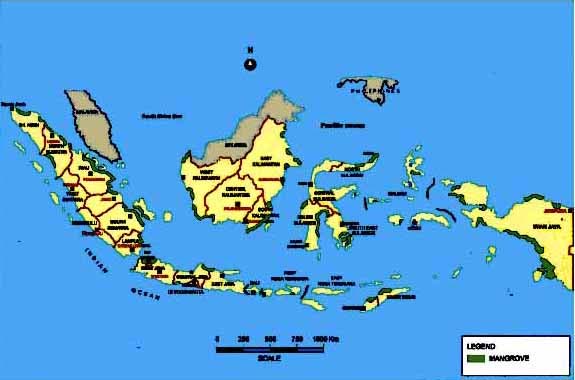
UNEP/GEF/SCS/Ind/MoU 2a/Amendment.2/Add.
Page 25
1.2. Maps of Demonstration Site
Figure 1
Location of Pontianak District, West Kalimantan Province.
UNEP/GEF/SCS/Ind/MoU 2a/Amendment.2/Add.
Page 26
Figure 2
Map showing Demonstration Site location (green and blue colours indicate the primary and secondary mangroves respectively)
UNEP/GEF/SCS/Ind/MoU 2a/Amendment.2/Add.
Page 27
Appendix 2
STAKEHOLDER INVOLVEMENT PLAN
No Institutions
Stakeholders
Role
1 Govern
-
ment
Department of Forestry
-
Take role as principal advisor for implementation project activities including
development of community based mangrove forest management
-
Take responsibility for creating Indonesian forest area including mangrove forest) as
life shelter and natural richness, to maintain, and to do natural protected with
community or institution coordination for in the national level.
-
Department of Marine Affairs
-
Take role as principal advisor for implementation project activities especially in fishery
and Fisheries
sector and coastal village community development
-
Coordinate, integrate, synchronism, and mutual sector synergy, institution and
foundation in the sustainable mangrove ecosystem management in the national level.
- Environmental
Impact
-
Take role in maintaining, protecting, conservation, and exploring mangrove ecosystem
Mitigation Office
management eternally to achieve society wealth in the local level.
(BAPEDALDA) of West
-
Take role for providing mangrove management rehabilitation activity, and maintain the
Kalimantan
association among the stakeholder involved in the project
-
Forestry office of West
-
Take role as information center, and management place that related in mangrove
Kalimantan
forest rehabilitation activities especially in West Kalimantan area.
-
Marine and Fisheries Office of
-
Coordinate and manage the mangroves rehabilitation project implemented especially
West Kalimantan
in West Kalimantan area.
-
Cooperative Office of West
-
Giving information to support project programme especially in developing the
Kalimantan and Industry Office
alternative livelihood
of West Kalimantan
2 Private
-
PT Inhutani II West
-
In general, the private companies take role in mangrove forest exploitation. They will
Kalimantan
provide information related to logging in Batu Ampar.
-
PT.Kandelia (produce wood
-
They are handling in wood chips production and market to outside.
chips)
-
They take role in maintain good corporation among them in developing sustainable
-
PT BIOS (produce wood
wood chips production.
chips)
3 Cooperative -
Koperasi Panter
-
Koperasi panter has experienced in sustainable charcoal production so that can
promote project program especially to minimize environmental impact.
-
They can take role in market the production and managing all the earnings from
mangrove forest.
UNEP/GEF/SCS/Ind/MoU 2a/Amendment.2/Add.
Page 28
No Institutions
Stakeholders
Role
4
Community
-
Farmer groups,
-
Take strong role for cultivating the mangrove resources and participate in the
rehabilitation
- Traders,
-
Take role for marketing and trading the mangrove production
- Fishermen
groups
-
Take role for managing the fishery resources directly in the coastal area.
- Woman
groups
-
Take role or support, and to participate alternative livelihood on the mangrove
rehabilitation
5
Groups
- Local
NGOs
-
Local NGOs is one of importance element for reform forest sector.
-
They can take role for giving correction and suggestion to the local government.
-
Take role to motivate local community and participate actively in the project
-
Support the mangrove cadres in monitoring and evaluation
6
NGO
-
University of Tanjungpura
-
Take role in conducting research and workshop related to mangrove ecosystem
University
management
-
Participate as experts in the project which is more understand about all fields that
related with mangrove ecosystem management.
-
Take role for assigning the fresh graduates of University of Tanjungpura into the
project activities.
-
Bogor Agricultural University
-
Take role for conducting research and survey based on their expertise in order to
obtain data and information about the mangrove ecosystem management
-
Provide the expert needed which is not provide in University of Tanjungpura
UNEP/GEF/SCS/Ind/MoU 2a/Amendment.2/Add.
Page 29
Appendix 3. CAUSAL CHAIN ANALYSIS
INTERVENTION
PROBLEMS
Training, education and
Unstable
public awareness
Low knowledge
regarding
silverculture
ecosystem
system
management
Conversion
Development of
High land demand
environment and
for business &
Lack of
socio-economic
work
database a decision
coordination
support system
among and clear
function of sectors
Development of
Mangroves
Illegal logging
Mangrove
Non-participatory
Management Plan
Degradation
process of development
Weak
of existing management
enforcement
Development and
approval of local
regulation regarding
mangroves management
Large demand of
Cutting for charcoal
charcoal by
and chip
community
Development of
business plan in
support on
implementation of
Low price of charcoal
management plan
UNEP/GEF/SCS/Ind/MoU 2a/Amendment.2/Add.
Page 30
Appendix 4. MONITORING AND EVALUATION PLAN
1.
Collecting and reporting data on performance indicators
A provisional list of Environmental State and Process Indicators is provided in the table below, which
includes indication of the methods to be used and the frequency of collection of information.
Parameter
Method and frequency of collection
Comments
INDICATORS OF ENVIRONMENTAL STATE
Biodiversity of mangrove
Formal surveys of flora and fauna to establish
forest
species diversity and numbers conducted at
beginning and end of survey using recognized
scientific methods.
Semi-formal surveys conducted by project
participants at six monthly intervals (including
enumeration of indicator species).
Social and economic well-
Survey of local communities conducted at
being
beginning and end of project using a mixture
of participatory methods and questionnaires.
Mid point evaluation using participatory
methods to establish how participants feel the
situation is changing as a result of the project.
Land use
Survey of areas of mangrove coverage and
Will need to differentiate
land uses in designated forest area.
between mature / young
mangroves and different
types of species
association.
PROCESS INDICATORS
Community satisfaction
Participatory evaluation activities with
Quantitative assessment
and degree to which
community members at the project mid-point
rather than qualitative
project meets community
and end.
indicators.
needs
At each project event there will be a brief
participatory evaluation activity to allow
participants to express their views on the
value of the event.
Participants will choose for themselves
factors, which they wish to assess.
Numbers of participants at each event will
also be recorded.
Availability of alternative
Appropriate markets for new and existing
livelihood
products
Availability technical assistance and advice to
improve products quality and manage the
fund
Project expenditure
Quarterly financial report by project manager to Format will depend upon
against budget
project team and reporting to the PCU as
the PCU requirements.
required under terms of agreement.
Achievement of key
Quarterly progress report by project manager
Format will depend upon
project milestones
to project team and reporting to the PCU as
the PCU requirements.
required under terms of agreement.
2.
Schedule of mid-term review, self evaluation, end-of project evaluation
Formal independent evaluations of the project will be carried out at the mid point of the project, twelve
months after the start of the project, and at the end of the project, three months before the termination
date. Both reviews will be led by, an external evaluator with experience in environmental conservation
and community development. Each study will take the form of a joint evaluation by project staff and the
evaluator into the management and environmental aspects of the project and an independent review of
community gains and stakeholder participation by the evaluator.
UNEP/GEF/SCS/Ind/MoU 2a/Amendment.2/Add.
Page 31
3.
Description of how monitoring and evaluation activities will involve participants and
stakeholders
Monitoring and evaluation will be an integral part of the stakeholder participation element of the project.
For each project activity and event, participants will carry out a simple evaluation activity, wherever
possible to meet their own evaluation criteria. Stakeholders will be asked to give their perceptions of the
project as part of the formal independent evaluation activities. Formal survey work will be conducted by,
project stakeholders, particularly the Ministry of Environment (wherever possible to integrate with their
own work programme and involve members of the local community) and universities and research
institutes. Local volunteers will be trained in survey techniques so that they are able to lead simple
community surveys on a more frequent basis.
4.
Resources that will be allocated to monitoring and evaluation
Budgetary provision of $US 9,000 has been allocated to the mid-term and terminal evaluations to cover
consultancy fees and expenses for external evaluators. It is estimated that monitoring and evaluation
(including preparation of reports required to be submitted to the UNEP/GEF/SCS Project Co-ordinating
Unit on behalf of UNEP and the GEF will take between 3-4 weeks per year (on average) of the project
manager's time and 3 days per year of management team time.
5.
How will monitoring and evaluation results be used in management?
A three monthly monitoring report will be presented to the project management team by the Site
Manager, who will highlight key issues for discussion at, management team meetings. As far as
possible, reporting to the management team will be integrated with reporting to the UNEP as well. The
Senior Advisory Group will also receive updates half yearly on key issues and the Specialised
Executing Agency will provide such periodic reports to the National technical Working Group.
As part of the mid term evaluation time will be set aside to allow the management team to review
progress themselves, and it is anticipated that the findings of the mid-term review will also be discussed
with the donor.
Following the final evaluation, an evaluation report will be published to help the donor, participants,
managers, and other interested parties such as the global mangrove network learn lessons from the
project.
In order to ensure that the project is carefully monitored and that the project derives the benefit of
evaluation reviews, it is essential that the project manager and the chair of the project management
team have a genuine commitment to evaluation and learning. This should be a factor in selecting
appropriate individuals for appointment to these posts.
UNEP/GEF/SCS/Ind/MoU 2a/Amendment.2/Add.
Page 32
Appendix 5a.
Budget by Activities
Component
GEF
Government (Central and Local)
Total
No
Sub-components Budget Code
1000 2000 3000 4000 5000 1000 2000 3000 4000 5000 USD
Activities
Sub-activities
Establish an Institutional Framework for Sustainable Mangrove
1.
43,093
0
20,538
1,694
28,171
41,613
0
21,079
7,482
21,477
185,147
Management in Batu Ampar
1.1
Day-to-day Management of site level activities
43,093
0
3,181
1,694
20,910
41,613
0
4,230
7,482
11,796
134,000
Establishment of the Site Office, Appointment of staff on-site, and
1.1.1
preparation of work plans
a
Appointment of Site Manager (24 man-month)
11,860
0
0
0
0
13,552
0
0
0
0
25,412
b
Appointment of Assistant site Manager (24 man-month)
7,550
0
0
0
0
6,568
0
0
0
0
14,118
c
Appointment of Administrative support staff (24 man-month)
6,136
0
0
0
0
5,158
0
0
0
0
11,294
d
Office non expendable equipment
0
0
0
0
0
0
0
0
3,529
0
3,529
Preparation of detailed site and project work plan (by week) for project
1.1.2
0
0
834
0
0
0
0
1,019
0
0
1,853
personnel (10 person, 3 times)
Meeting of the Site Manager and other project personnel by local
1.1.3
0
0
2,347
0
0
0
0
3,211
0
0
5,559
government (10 person, 9 times)
1.1.4 Operation of the site Office
a
Travel on official Business (24 months, 2 persons, 12 times)
2,635
0
0
0
0
3,012
0
0
0
0
5,647
Office supplies expendables (Papers A4,72 rims; Papers A3, 8 rims; Ink of
b
Colour Printers, 20 Sets; Ink of Black Printer, 12 sets and Office Stationary,
0
0
0
1,694
0
0
0
0
1,129
0
2,824
24 packets)
c
Rent and Maintenance of the office (in kind)
0
0
0
0
0
0
0
0
2,824
0
2,824
d
Communications
0
0
0
0
1,976
0
0
0
0
2,259
4,235
1.1.5 Oversight and advice from the Focal Point
a
Travel on business of Focal point (2 person, 12 times)
2,635
0
0
0
0
3,012
0
0
0
0
5,647
b
Technical assistance for:
b.1. Field assistance (24 man-month)
6,138
0
0
0
0
5,156
0
0
0
0
11,294
b.2. Administration assistance (24 man-month)
6,138
0
0
0
0
5,156
0
0
0
0
11,294
1.1.6 Reporting
a
Printing and translation of Management Board Monthly Report
0
0
0
0
3,953
0
0
0
0
4,518
8,471
b
Printing and translation semi-annual report to UNEP/GEF
0
0
0
0
2,196
0
0
0
0
2,510
4,706
Printing and translation of annual report to national mangrove sub-committee,
c
0
0
0
0
2,196
0
0
0
0
2,510
4,706
regional working group on mangroves
d
Preparation of Annual Audit Report for UNEP (Audit expenses 2 times)
0
0
0
0
10,588
0
0
0
0
0
10,588
1.2
Establishment of Multi-sectoral, Multi-Stakeholder Management Board
0
0
17,357
0
7,261
0
0
16,849
0
9,680
51,147
Preparation of ToR and Rules of Procedure for the management board (20
1.2.1
0
0
1,482
0
0
0
0
988
0
0
2,471
persons, 4 times)
Formal establishment of the Management Board by local government (20
1.2.2
0
0
4,553
0
0
0
0
3,035
0
0
7,588
persons, 6 times)
1.2.3Monthly Meetings of the Management Board (20 persons, 24 times)
0
0
6,402
0
0
0
0
9,010
0
0
15,412
UNEP/GEF/SCS/Ind/MoU 2a/Amendment.2/Add.
Page 33
Component
GEF
Government (Central and Local)
Total
No
Sub-components Budget Code
1000 2000 3000 4000
5000 1000 2000 3000 4000 5000 USD
Activities
Sub-activities
Publish Management Board meeting reports via website & local press
1.2.4
0
0
0
0
7,261
0
0
0
0
9,680
16,941
(24 months)
Preparation of detailed Management Board work plan for Management
1.2.5
0
0
1,112
0
0
0
0
741
0
0
1,853
Board personnel (10 persons, 3 times)
Establishment and Approval of work plan by all Management Board
1.2.6
0
0
3,808
0
0
0
0
3,074
0
0
6,882
members(20 persons, 6 times)
Development of baseline environmental and socio-economic database
2.
14,696
41,174
22,616
6,741
1,412
11,128
49,121
25,702
12,494
941
186,024
and a decision support system
2.1
Prepare site-based, open access GIS database
9,614
0
0
3,529
1,412
6,621
0
0
10,353
941
32,471
Purchase software and Hardware install at site office
2.1.1
0
0
0
0
0
0
0
0
8,000
0
8,000
(Computer 1 unit, digitizer 1 unit and software)
2.1.2Establish GIS system (Baseline map and basic information) (1 man-month)
0
0
0
0
1,412
0
0
0
0
941
2,353
Technical assistant to help GIS to evaluate changes in mangrove
2.1.3
2,118
0
0
0
0
1,412
0
0
0
0
3,529
ecosystem (3 man-month)
2.1.4Procure Landsat Imagery
0
0
0
3,529
0
0
0
0
2,353
0
5,882
Analyse Landsat imagery, and prepare baseline GIS map of habitat
2.1.5
3,685
0
0
0
0
2,668
0
0
0
0
6,353
distribution (mangrove resources and degraded areas)
Establish Batu Ampar Mangrove GIS-database and distribute initial
2.1.6
3,812
0
0
0
0
2,541
0
0
0
0
6,353
habitat maps
2.2
Field surveys of habitats, and land use
0
6,918
3,129
1,412
0
0
4,612
2,266
941
0
19,276
Develop ToR for the contractor for field surveys to validate the GIS
2.2.1
0
0
3,129
0
0
0
0
2,266
0
0
5,394
baseline map
2.2.2Preparing Technical Working Method for Field Survey
0
318
0
0
0
0
212
0
0
0
529
Field surveys & Ground Truthing of satellite image interpretation of land
2.2.3cover (20 days, 2 person; survey equipment rent for 20 days, travel cost
0
5,329
0
0
0
0
3,553
0
0
0
8,882
(air plane and boat; field documentation)
Overlay field data and remotely sensed data on GIS base map to derive
2.2.4current habitat and resource map (Mangrove Ecology Expert, 27 days;
0
1,271
0
0
0
0
847
0
0
0
2,118
GIS Experts, 27 days)
Publication of maps and detailed report of habitat resource distribution
2.2.5
0
0
0
1,412
0
0
0
0
941
0
2,353
and abundance (English & Bahasa)
2.3
Flora and Fauna Inventories
0
20,012
0
0
0
0
13,341
0
0
0
33,353
Design field survey, and sampling protocols [data collecting
2.3.1
0
353
0
0
0
0
235
0
0
0
588
method](Biodiversity Expert, 10 days; Fisheries Expert, 10 days)
Conduct flora and fauna surveys, inventory (30 days, 6 persons; survey
2.3.2equipment rent for 28 days, travel cost (air plane and boat; field
0
18,247
0
0
0
0
12,165
0
0
0
30,412
documentation)
Data compilation and entry into GIS system (Biodiversity Expert, 1 man
2.3.3
0
1,412
0
0
0
0
941
0
0
0
2,353
month and GIS Expert, 1 man-month)
UNEP/GEF/SCS/Ind/MoU 2a/Amendment.2/Add.
Page 34
Component
GEF
Government (Central and Local)
Total
No
Sub-components Budget Code
1000 2000 3000 4000 5000 1000
2000
3000 4000 5000 USD
Activities
Sub-activities
2.4
Inventory of current uses and economic values of Mangrove resources
0
8,612
0
0
0
0
5,741
0
0
0
14,353
Develop social and economic survey methods, protocols and
2.4.1 questionnaire for quantitative assessment of use and non use values
0
247
0
0
0
0
165
0
0
0
412
(1 person, 10 days)
Field surveys to collect data and information on current mangrove use and
2.4.2 values, quantification and valuation (30 days, 2 persons; survey
0
7,659
0
0
0
0
5,106
0
0
0
12,765
equipment rent, travel cost (car, boat); field documentation)
Resource use data compilation, processing and GIS entry
2.4.3
0
706
0
0
0
0
471
0
0
0
1,176
(Socio-Economic Expert, 1 man-month)
Develop draft of Silviculture and Environment Management System of
2.5
0
5,632
3,575
0
0
0
25,426
8,878
0
0
43,512
Batu Ampar Mangrove Forest
Review past practices and silviculture methods currently in use in the
2.5.1 area, and evaluate their effectiveness (2 person, 20 days; accommodation,
0
3,750
0
0
0
0
3,603
0
0
0
7,353
travel cost, survey equipment rent, questionary)
Develop draft of silviculture system of Batu Ampar mangrove forest (2
2.5.2
0
1,247
0
0
0
0
1,106
0
0
0
2,353
person, 1 man month)
2.5.3 Series of discussions with stakeholder groups
0
0
875
0
0
0
0
1,578
0
0
2,453
2.5.4 Revision of draft of silviculture system in Batu Ampar (60 persons, 1 days)
0
635
0
0
0
0
1,718
0
0
0
2,353
Finalization draft of silviculture system in Batu Ampar and submission to
2.5.5
0
0
2,700
0
0
0
0
7,300
0
0
10,000
local government
Develop and Implementation Environment Management System (ISO
2.5.6. 14.000) (2 persons 2 man month for compile SOP System and 3persons,
0
0
0
0
0
0
19,000
0
0
0
19,000
3 man month for implementation Environment Management System)
Conflict Resolution in Mangrove Resources Using and Management
2.6
1,964
0
6,079
0
0
1,742
0
5,391
0
0
15,176
(CRMRUM)
Identification of current use conflicts and preparation of draft CRMRUM
2.6.1
1,309
0
0
0
0
1,161
0
0
0
0
2,471
(10 person, 4 times)
Civil society & private sector stakeholder discussion, input to and
2.6.2
0
0
3,835
0
0
0
0
3,401
0
0
7,235
agreement (20 person, 6 times)2
Revision of draft to accommodate the stakeholders input (10 person,
2.6.3
655
0
0
0
0
581
0
0
0
0
1,235
2 times)
Socialization of CRMRUM to all stakeholders (workshop) for Approval and
2.6.4 inclusion in the Management PlanCRMUM by All Stakeholders(60 persons,
0
0
2,245
0
0
0
0
1,991
0
0
4,235
1 days)3
2 In Cash Co-funding for meeting room, consumption and half facilitator accommodation.
3 In cash Co-funding for room rental, equipment rental, consumption for participants, facilitator accommodation, and half for facilitator transportation.
UNEP/GEF/SCS/Ind/MoU 2a/Amendment.2/Add.
Page 35
Component
GEF
Government (Central and Local)
Total
No
Sub-components Budget Code
1000 2000 3000 4000 5000 1000 2000
3000
4000 5000 USD
Activities
Sub-activities
2.7
Preparation and approval of Mangrove Management Plan (MMP)
3,118
0
9,833 1,800
0
2,765
0
9,167
1,200
0
27,882
2.7.1 Preparation of a draft MMP (5 person experts, 0.5 man month)
1,559
0
0 0
0
1,382
0
0
0
0
2,941
Civil society & private sector stakeholder discussion, input to and
2.7.2
0
0
3,192 0
0
0
0
3,279
0
0
6,471
agreement with draft MMP (20 person, 4 times)4
Revision of the draft to accommodate the stakeholders inputs(5 persons,
2.7.3
1,559
0
0 0
0
1,382
0
0
0
0
2,941
15 days)
2.7.4 Socialization MMP to all stakeholders(20 persons, 2 days, 1 times)
0
0
1,216 0
0
0
0
1,078
0
0
2,294
2.7.5 Formal approval of MMP by MB & local government (60 persons, 1 days)
0
0
5,425 0
0
0
0
4,811
0
0
10,235
2.7.6 Publish Management plan in hard copy and via website & local press
0
0
0 1,800
0
0
0
0
1,200
0
3,000
Development of a Business Plan in support of the implementation of the
3.
0
6,442
16,476
0
0
0
6,822
17,407
0
9,412
56,559
overall management plan.
Identify alternative livelihood and business opportunities based on use of
3.1
0
6,442
4,885 0
0
0
6,822
3,939
0
0
22,088
non-timber mangrove forest products
Identification of potential mangrove resources to be developed in
3.1.1
0
1,023
0 0
0
0
859
0
0
0
1,882
consultation with the local community (training specialist, 1.5 man-month)
Study visits (Indonesia) to see alternative non-timber resource uses
3.1.2
0
0
4,885 0
0
0
0
3,939
0
0
8,824
( 10 person, 5 days, 2 times)
Create program on participatory planning of development of alternative
3.1.3 income from non timber mangrove forest products and enhancement of
0
2,243
0 0
0
0
1,727
0
0
0
3,971
values of existing products)
Introduce required technology for non-timber mangrove forest product
3.1.4 use and/or existing product enhancement and provide technical support to
0
3,176
0 0
0
0
4,236
0
0
0
7,412
the programme
Sustainable Management of Charcoal Production and enhancement of
3.2
0
0
9,286 0
0
0
0
10,361
0
5,882
25,529
community income
Study visits on improvement of charcoal quality (10 person, 5 days,
3.2.1
0
0
4,676 0
0
0
0
4,147
0
0
8,824
2 times)
In consultation with the community identify export opportunities and new
3.2.2
0
0
2,305 0
0
0
0
3,107
0
0
5,412
markets for charcoal (10 person, 10 times)
Improve marketing mechanism through strengthening existing community
3.2.3
0
0
2,305 0
0
0
0
3,107
0
0
5,412
organisations institution (10 persons, 10 times)
Establish a Revolving fund for micro-credits to charcoal producers
3.2.4
0
0
0 0
0
0
0
0
0
5,882
5,882
(5 units)
3.3
Management of community based livelihood development programme
0
0
2,305 0
0
0
0
3,107
0
3,529
8,941
Establish and develop appropriate markets for new and existing products
3.3.1
0
0
2,305 0
0
0
0
3,107
0
0
5,412
(10 persons, 1 day, 10 times)
Establish a Revolving fund for micro-credits to establish new product
3.3.2
0
0
0 0
0
0
0
0
0
3,529
3,529
production (5 units)
4 In cash Co-funding for room rental, consumption and half for the expert accommodation.
UNEP/GEF/SCS/Ind/MoU 2a/Amendment.2/Add.
Page 36
Component
GEF
Government (Central and Local)
Total
No
Sub-components Budget Code
1000 2000 3000 4000 5000 1000
2000
3000 4000 5000
USD
Activities
Sub-activities
4.
Training, Education and Public Awareness
9,448
36,908
78,058 4,200
7,874
7,140
12,056
64,458
4,624
56,185
280,951
4.1 Training
4,860
0
63,501 0
0
4,082
0
44,321
0
0
116,764
Identification of stakeholder and community that relevant to mangrove
4.1.1
1,023
0
0 0
0
859
0
0
0
0
1,882
management to be trained
Comprehensive training needs assessment of all stakeholders
4.1.2
1,918
0
0 0
0
1,611
0
0
0
0
3,529
(training specialist, 3 man month)
Finalise the programme for approval by the Management Board and
4.1.3
1,918
0
0 0
0
1,611
0
0
0
0
3,529
Prepare training materials
Conduct Community level training on organization development and
4.1.4
0
0
3,035 0
0
0
0
2,024
0
0
5,059
management in field (20 person, 3 days, 2 times)
Conduct training of institution on mangrove management in field
4.1.5
0
0
3,035 0
0
0
2,024
0
0
5,059
(20 person, 3 days, 2 times)
4.1.6Training for development of community alternative livelihood
Training on techniques to improve charcoal quality in field
a
0
0
2,047 0
0
0
0
1,365
0
0
3,412
(20 person, 3 days, 2 times)
bConduct training on silvofishery technique (10 persons, 2 days, 2 times)
0
0
2,047 0
0
0
0
1,365
0
0
3,412
cConduct on techniques moulting crab culture
0
0
2,047 0
0
0
0
1,365
0
0
3,412
Conduct training on seafish (Ephinephelus sp) cultivation
d
0
0
2,047 0
0
0
0
1,365
0
0
3,412
(10 persons, 2 days, 2 times)
eConduct training on post harvest techniques (10 persons, 2 days, 2 times)
0
0
2,047 0
0
0
0
1,365
0
0
3,412
fConduct training on marketing techniques (10 persons, 2 days, 2 times)
0
0
2,047 0
0
0
0
1,365
0
0
3,412
Conduct community level training on management of mangrove
4.1.7
0
0
6,424 0
0
0
0
4,282
0
0
10,706
ecosystems (20 person, 3 times) (management Board Members)
4.1.8Conduct training for local NGOs (20 person, 3 times)
0
0
6,424 0
0
0
0
4,282
0
0
10,706
Conduct training for government institution (20 person, 3 times)
4.1.9
0
0
6,424 0
0
0
0
4,282
0
0
10,706
(management Board Members)
Conduct training for staff from private sector (20 person, 3 times)
4.1.10
0
0
6,424 0
0
0
0
4,282
0
0
10,706
(management Board Members)
4.1.11Conduct training for field researcher and Staff, graduate students study
Training for young scientist/fresh graduate and staffs (10 persons,3 times@7
a
0
0
7,518 0
0
0
0
5,012
0
0
12,529
days)
b
Graduate students research in demo site 3 person per-year
0
0
4,172 0
0
0
0
4,768
0
0
8,940
Conduct training for Site Manager and staff via field visits and short
4.1.12
0
0
7,765 0
0
0
0
5,176
0
0
12,941
courses (5 persons, 7 days, 3 times)
4.2
Develop and implement an education and public awareness programme
0
11,047
14,557 0
635
0
7,365
20,137
0
895
54,635
Collection and compilation of data, information, documentation, and
4.2.1
0
1,024
0 0
0
0
682
0
0
0
1,706
photographic materials
4.2.2Design, produce and print 4 posters x 2000 copies
0
5,012
0 0
0
0
3,341
0
0
0
8,353
4.2.3Design and print 4 brochures x 2000 copies each
0
5,012
0 0
0
0
3,341
0
0
0
8,353
4.2.4Distribution poster and brochures
0
0
0 0
635
0
0
0
0
895
1,529
UNEP/GEF/SCS/Ind/MoU 2a/Amendment.2/Add.
Page 37
Component
GEF
Government (Central and Local)
Total
No
Sub-components Budget Code
1000 2000 3000 4000 5000 1000
2000
3000 4000 5000
USD
Activities
Sub-activities
Initial discussions with target schools regarding curricular materials,
4.2.5school visits by project staff and field visits for school children
0
0
1,447 0
0
0
0
1,976
0
0
3,424
(3person, 1 day, 20 times)5
School visit to implement environmental education
4.2.6
0
0
2,052 0
0
0
0
2,783
0
0
4,835
(3 persons, 1 day, 9 times)6
Organisation of school fieldtrips to mangrove ecosystem area
4.2.7
0
0
6,776 0
0
0
0
10,165
0
0
16,941
(24 children, 3 schools, 4 times)
Series discussion with key stakeholder in Sub-district and villages
4.2.8
0
0
1,447 0
0
0
0
1,976
0
0
3,424
(3 persons,20 times)7
Conduct regular programme of awareness activities in local communities
4.2.9
0
0
2,833 0
0
0
0
3,237
0
0
6,071
(100 person, 6 times)
4.3
Establish Sustainable Mangrove Utilization Information Centre
0
25,861
0 1,553
5,686
0
4,692
0
1,976
53,313
93,082
4.3.1Collect photos/documentation, specimens, and sample of products
0
4,885
0 0
0
0
3,256
0
0
0
8,141
Plan the layout and displays for the sustainable mangrove utilization
4.3.2
0
2,153
0 0
0
0
1,435
0
0
0
3,588
information centre
4.3.3Establish information boards on site (20 Boards)
0
0
0 0
4,365
0
0
0
0
3,871
8,235
4.3.4Establish Sustainable Mangrove Utilization Information Centre
Mangrove information center building
0
0
0 0
0
0
0
0
0
47,058
47,058
Establish information in MIC (wall display, 20 units; chairs display, 20 units
0
18,824
0 0
0
0
0
0
0
0
18,824
and market, 1 unit)
4.3.5
Maintenance of Mangrove Utilization Information Centre
0
0
0 0
1,322
0
0
0
0
2,384
3,706
4.3.6Publish series of article in local newspaper (1 times/month)
0
0
0 1,553
0
0
0
0
1,976
0
3,529
4.4
Establish & Publicise website for demonstration site
4,588
0
0 2,647
1,553
3,059
0
0
2,647
1,976
16,471
4.4.1Purchase equipments and Page web design
0
0
0 2,647
0
0
0
0
2,647
0
5,294
Technical assistance for data monthly updating of website contents
4.4.2
4,588
0
0 0
0
3,059
0
0
0
0
7,647
(1week/month)
4.4.3Equipment maintenance &repair
0
0
0 0
1,553
0
0
0
0
1,976
3,529
Facilitate the development and approval of local regulations regarding
5.
0
14,103
4,903
0
0
0
9,544
11,273
0
0
39,824
Mangrove Management
Review and evaluate existing regulations regarding community base
5.1
0
6,529
0 0
0
0
4,353
0
0
0
10,882
mangrove management
Examine community constraints to successful management, in the light
5.2
of the training needs assessment; current use and ownership rights; and
0
1,403
0 0
0
0
1,244
0
0
0
2,647
capacity for local enforcement
5.3
Develop draft of regulation on community base mangrove management
0
3,671
0 0
0
0
2,447
0
0
0
6,118
Component
GEF
Government (Central and Local)
Total
No
5 In cash Co-funding for transportation in land and water, also half of consumption.
6 In cash Co-funding for land and water transportation, also half for equipment rental.
7 In cash Co-funding for land and water transportation also half for equipment rental.
UNEP/GEF/SCS/Ind/MoU 2a/Amendment.2/Add.
Page 38
Sub-components Budget Code
1000 2000 3000 4000 5000 1000
2000
3000 4000 5000
USD
Activities
Sub-activities
Community level discussions on draft regulations with stakeholders
5.4
0
0
2,203 0
0
0
0
3,973
0
0
6,176
(20 persons, 1 day, 6 times)8
5.5
Revision of the draft regulations in the light of stakeholder feedback
0
2,500
0 0
0
0
1,500
0
0
0
4,000
Finalization of regulations on community based mangrove management
5.6
0
0
2,700 0
0
0
7,300
0
0
10,000
and submission to local government9
6.
Monitoring and Evaluation for all activity (Midterm and Ending)
0
0
0
0
9,000
0
0
0
0
0
9,000
67,236
98,627
142,591 12,635
46,456
59,881
77,544
139,919
24,600
88,014
757,504
Total
67,236
98,627
142,591 12,635
46,456
59,881
77,544
139,919
24,600
88,014
757,504
Appendix 5b. Budget by Object of Expenditure
= in kind co-funding
= in cash co-funding
Expenditure
Year 1
Year 2
Total Budget All Year
1st Half
2nd Half
Total
Grand
1st Half
2nd Half
Total
Grand
Total
GEF
GOV
GEF
GOV
GEF
GOV
Total
GEF
GOV
GEF
GOV
GEF
GOV
Total
GEF
GOV
Budget
PROJECT PERSONNEL COMPONENT
1100 Project Personal
1101Site Manager 24 man mths (activity 1.1.1.a)
3,558
2,710
3,558 2,710
7,116
5,421 12,537
2,372
4,066
2,372 4,066
4,744
8,131 12,875
11,860
13,552
25,412
1102Assistant site Manager 24 man mths (activity 1.1.1.b)
2,265
1,314
2,265 1,314
4,530
2,627
7,157
1,510
1,970
1,510 1,970
3,020
3,941
6,961
7,550
6,568
14,118
Technical assistance for Focal Point: Field assistance
1103
1,842
1,031
1,842 1,031
3,683
2,062
5,745
1,228
1,547
1,228 1,547
2,455
3,093
5,549
6,138
5,156
11,294
(24 man-month) (act 1.1.5.b1)
Technical assistance for data monthly updating of website
1104
0
0
918
612
918
612
1,529
1,835
1,224
1,835 1,224
3,671
2,447
6,118
4,588
3,059
7,647
contents (1 week/month) (activity 4.4.2)
Technical assistant to help GIS to evaluate changes in mangrove
1105
0
0
1,059
706
1,059
706
1,765
0
0
1,059
706
1,059
706
1,765
2,118
1,412
3,529
ecosystem (1 month/year)(3-man-month)(activity 2.1.3)
1199Total
7,664
5,055
9,641 6,373 17,305 11,428 28,733
6,945
8,806
8,004 9,512 14,949 18,318 33,267
32,254
29,746
62,000
1200 Consultants
Short term Consultant: Stakeholder Analysis Training Needs
1201
3,133
2,309
1,726 1,772
4,860
4,082
8,941
0
0
0
0
0
0
0
4,860
4,082
8,941
assessment (activity 4.1.1; 4.1.2; 4.1.3.)
Short term Consultant for prepare site based and open Access
1202
0
0
5,591 3,939
5,591
3,939
9,529
1,906
1,271
0
0
1,906
1,271
3,176
7,496
5,209
12,706
GIS Data Based (Activity 2.1.5; 2.1.6)
Consultant: Conflict resolution & Mangrove Management Plan
1203
1,559
1,382
0
0
1,559
1,382
2,941
2,868
2,544
655
581
3,523
3,124
6,647
5,082
4,506
9,588
(activity 2.6.1; 2.6.3; 2.7.1 ; 2.7.3.) (16 man month)
1299Total
4,692
3,692
7,317 5,711 12,009
9,403 21,412
4,774
3,814
655
581
5,429
4,395
9,824
17,438
13,798
31,235
8 In cash Co-funding for room rental, equipment, consumption and half accommodation for participants.
9 In cash Co-funding for room rental, equipment, document reduplication and half for consumption.
UNEP/GEF/SCS/Ind/MoU 2a/Amendment.2/Add.
Page 39
Expenditure
Year 1
Year 2
Total Budget All Year
1st Half
2nd Half
Total
Grand
1st Half
2nd Half
Total
Grand
Total
GEF
GOV
GEF
GOV
GEF
GOV
Total
GEF
GOV
GEF
GOV
GEF
GOV
Total
GEF
GOV
Budget
1300 Administrative support
1301Administration to Site Manager 24 man mths (activity1.1.1.c)
1,841
1,032
1,841 1,032
3,682
2,063
5,745
1,227
1,547
1,227 1,547
2,454
3,095
5,549
6,136
5,158
11,294
Technical assistance for Focal Point: Administration assistance
1302
1,842
1,031
1,842 1,031
3,683
2,062
5,745
1,228
1,547
1,228 1,547
2,455
3,093
5,549
6,138
5,156
11,294
(24 man-month) (act 1.1.5.b2)
1399Total
3,682
2,063
3,682 2,063
7,365
4,126 11,490
2,455
3,094
2,455 3,094
4,910
6,188 11,098
12,274
10,314
22,588
1600 Travel on Official Business
1601Travel on business of Focal point (activity 1.5.1.a)
790
602
790
602
1,581
1,205
2,786
527
904
527
904
1,054
1,807
2,861
2,635
3,012
5,647
1602Travel on official Business (Site Manager) (activity 1.4.1.a) 790
602
790
602
1,581
1,205
2,786
527
904
527
904
1,054
1,807
2,861
2,635
3,012
5,647
1699Total
1,581
1,205
1,581 1,205
3,162
2,410
5,572
1,054
1,807
1,054 1,807
2,108
3,615
5,723
5,270
6,024
11,294
1999Component Total
17,620
12,014
22,221 15,351 39,841 27,366 67,207 15,228 17,522
12,167 14,994 27,395 32,516 59,911
67,236
59,882
127,118
2200 Sub-contract with non profit organization
Sub Contract Field Survey of Habitat and Land Use
2201
1,916
638
2,398
640
4,315
1,278
5,592
2,603
3,334
0
0
2,603
3,334
5,937
6,918
4,612
11,529
(activity 2.2.2.; 2.2.3.; 2.2.4.)
2202Sub Contract Flora Fauna Inventory (Activity 2.3.1.; 2.3.2.; 2.3.3.)
13,126
3,885
6,886 9,456 20,012 13,341 33,353
0
0
0
0
0
0
0
20,012
13,341
33,353
Sub-contract: Public Awareness materials;
2203
21,342
4,317
15,567 7,740 36,908 12,056 48,965
0
0
0
0
0
0
0
36,908
12,056
48,965
(activity 4.2.1.; 4.2.2.,; 4.2.3.; 4.3.1.; 4.3.2.; 4.3.4b)
Sub-contract for assessment of current use and economic values
2205and development of the business plan
4,946
2,045
4,868 3,682
9,814
5,727 15,541
3,976
4,916
1,263 1,920
5,240
6,837 12,076
15,054
12,564
27,618
(activity 2.4.1; 2.4.2; 2.4.3; 3.1.1; 3.1.3.; 3.1.4)
Sub-Contract Legal matters & local regulation
2206
6,259
9,380
8,374 12,641 14,633 22,021 36,654
3,848
5,751
1,254 7,199
5,102 12,949 18,052
19,735
34,971
54,706
(activity 2.5.1; 2.5.2; 2.5.4.; 2.5.6; 5.1; 5.2; 5.3. 5.5.)
2299Total
47,590
20,265
38,092 34,159 85,682 54,423 140,105 10,427 14,001
2,517 9,119 12,945 23,120 36,065
98,627
77,544
176,171
2999Component Total
47,590
20,265
38,092 34,159 85,682 54,423 140,105 10,427 14,001
2,517 9,119 12,945 23,120 36,065
98,627
77,544
176,171
TRAINING COMPONENT
3100 Fellowships (total stipend/fees, travel, costs, etc)
Graduate students study in demo site (6 students, 2
3101
1,502
763
1,001 1,144
2,503
1,907
3,505
1,001
1,144
668 1,716
1,669
2,861
4,530
4,172
4,768
8,940
years@60days/person) ($25/day/peson)(act. 4.1.11.b)
Training courses for senior research and staff (10 persons,3
3102
0
0
2,481 1,002
2,481
1,002
4,962
2,518
2,005
2,518 2,005
5,037
4,009
9,046
7,518
5,012
12,529
times, 7 days@$60/ person/time/day) (4.1.11.a)
3199Total
1,502
763
3,482 2,147
4,984
2,910
8,466
3,520
3,149
3,186 3,721
6,706
6,870 13,576
11,690
9,780
21,469
3200 Group training (study tours, field trips, workshops, seminars, etc) (give title)10
Conduct Community level training on organization development
3201and management (20persons, 3 days,
0
0
1,821
809
1,821
809
2,631
1,214
1,214
0
0
1,214
1,214
2,428
3,035
2,024
5,059
2times@$42/person/day/time)(act 4.1.4)
Conduct training of institution on mangrove management in field
3202
1,062
405
1,062
405
2,125
809
2,934
911
1,214
0
0
911
1,214
2,125
3,035
2,024
5,059
(20persons, 3 days, 2 times@$42 /person/day/time) (act. 4.1.5)
Training on techniques to improve charcoal quality
3203
1,024
682
1,024
682
2,047
1,365
3,412
0
0
0
0
0
0
0
2,047
1,365
3,412
(20persons, 3 days, 2 times,@$28/person/day/time) (act 4.1.6a)
Conduct training on silvofishery technique
3204
0
0
1,024
682
1,024
682
1,706
1,024
682
0
0
1,024
682
1,706
2,047
1,365
3,412
(20 persons, 2 days, 2 times@$43/person/day/time) (act 4.1.6.b)
Conduct on techniques moulting crab culture (20 persons, 2 days,
3205
0
0
1,024
682
1,024
682
1,706
1,024
682
0
0
1,024
682
1,706
2,047
1,365
3,412
2 times @$43/person/day/time) (act 4.1.6. c)
Conduct training on seafish (Ephinephelus sp) cultivation (20
3206
1,024
682
0
0
1,024
682
1,706
1,024
682
0
0
1,024
682
1,706
2,047
1,365
3,412
persons, 2 days, 2 times@$43/person /day/time) (act.4.1.6.d)
Conduct training on post harvest techniques (20 persons, 2 days,
3207
0
0
0
0
0
0
0
1,024
682
1,024
682
2,047
1,365
3,412
2,047
1,365
3,412
2 times @43/person/day/time) (act. 4.1.6.e)
10 The government or other institutions will share the budget for room rental, training equipment rental, coach payment, accommodation for committee, and accommodation for coach
UNEP/GEF/SCS/Ind/MoU 2a/Amendment.2/Add.
Page 40
Year 1
Expenditure
Year 2
Total Budget All Year
1st Half
2nd Half
Total
Grand
1st Half
2nd Half
Total
Grand
Total
GEF
GOV
GEF
GOV
GEF
GOV
Total
GEF
GOV
GEF
GOV
GEF
GOV
Total
GEF
GOV
Budget
Conduct training on marketing techniques (20 persons, 2 days, 2
3208
0
0
0
0
0
0
0
1,024
682
1,024
682
2,047
1,365
3,412
2,047
1,365
3,412
times @$43/person/day/time)) (act. 4.1.6.f)
Conduct community level training on management of mangrove
3209ecosystems (20 person, 3 times@$178/person/time)
2,120
728
2,120
728
4,240
1,456
5,696
2,184
2,826
0
0
2,184
2,826
5,010
6,424
4,282
10,706
(management Board Members) (act 4.1.7.)
Conduct training for local NGOs
3210
2,120
728
2,120
728
4,240
1,456
5,696
2,184
2,826
0
0
2,184
2,826
5,010
6,424
4,282
10,706
(20 person, 3 times@$178/person/time) (act 4.1.8)
Conduct training for government institution
3211 (20 person, 3 times@$178 /person/time)
0
0
2,184 1,456
2,184
1,456
3,640
2,120
1,413
2,120 1,413
4,240
2,826
7,066
6,424
4,282
10,706
(management Board Members) (act. 4.1.9)
Conduct training for staff from private sector (20 person, 3
3212times@$178/ person/time) (management Board Members)
0
0
0
0
0
0
0
2,184
1,456
4,240 2,826
6,424
4,282 10,706
6,424
4,282
10,706
(act. 4.1.10)
Conduct training for Site Manager and staff via field visits and
3213short courses
3,727
828
2,485 1,242
6,212
2,071
8,282
0
0
1,553 3,106
1,553
3,106
4,659
7,765
5,176
12,941
(5persons, 7 days, 3 times@$123/ person/day/time)(act . 4.1.12)
School visit to implement environmental education
3214
0
0
677
918
677
918
1,596
687
932
687
932
1,375
1,865
3,240
2,052
2,783
4,835
(3persons, 1 day, 9 times@$179/person/time) (act. 4.2.6)
Organisation of school fieldtrips to mangrove ecosystem area (24
3215
0
0
0
0
0
0
0
3,388
5,082
3,388 5,082
6,776 10,165 16,941
6,776
10,165
16,941
children, 3 schools, 4 times@$59/child/school /time)(act 4.2.7.)
Conduct regular programme of awareness activities in local
3216
1,139
427
759
641
1,898
1,068
2,967
561
868
374 1,301
935
2,169
3,104
2,833
3,237
6,071
communities (100persons, 6 times @$15/person/time)(act 4.2.9.)
Study visit on improvement of charcoal quality (10pesons, 5days,
3217
0
0
0
0
0
0
0
2,338
2,074
2,338 2,074
4,676
4,147
8,824
4,676
4,147
8,824
2 times@$88/ person/day/time) (activity 3.2.1)
Together with community seeking export opportunities of charcoal
3218
0
0
0
0
0
0
0
1,152
1,553
1,152 1,553
2,305
3,107
5,412
2,305
3,107
5,412
(10persons, 10 times @$54/person/time)(activity 3.2.2.)
Together with community improving market mechanism through
3219existing institution (10persons, 10 times@$54/person/time)
0
0
0
0
0
0
0
1,152
1,553
1,152 1,553
2,305
3,107
5,412
2,305
3,107
5,412
(activity 3.2.3)
Study visit on development of Alternative Business on Mangrove
3220Utilization (10 persons, 5 days, 2 times@$88/person /day/time)
2,931
2,363
1,954 1,576
4,885
3,939
8,824
0
0
0
0
0
0
0
4,885
3,939
8,824
(activity 3.1.2)
Seeking market for products (10persons, 1 day, 10 times@$54/
3221
0
0
0
0
0
0
0
1,152
1,553
1,152 1,553
2,305
3,107
5,412
2,305
3,107
5,412
person/day/time) (activity 3.3.1)
3299Total
15,146
6,844
18,253 10,551 33,398 17,395 50,793 26,346 27,978
20,204 22,760 46,551 50,738 97,289
79,949
68,133
148,082
3300 Meeting/workshop/Conference
Preparation of ToR and Rules of Procedure for the management
3301
1,482
988
0
0
1,482
988
2,471
0
0
0
0
0
0
0
1,482
988
2,471
board (20persons, 4times@$31/person/time) (act 1.2.1)
Formal establishment of the Management Board by local
3302
911
607
3,642 2,428
4,553
3,035
7,588
0
0
0
0
0
0
0
4,553
3,035
7,588
government (20persons, 4times,@$63/person/time) (act. 1.2.2)
Monthly Meetings of the Management Board (MB) (20persons,
3303
2,497
1,442
1,665 2,162
4,161
3,604
7,765
1,344
2,162
896 3,243
2,241
5,406
7,647
6,402
9,010
15,412
24times@$32 /person/time)(1.2.3)
Preparation of detailed Management Board work plan for
3304Management Board personnel (10persons, 3times,@$62/
778
222
334
519
1,112
741
1,853
0
0
0
0
0
0
0
1,112
741
1,853
person/time(act 1.2.5)
Establishment and Approval of work plan by all Management
3305Board members (20persons, 6times@ $57 /person/time) (act
0
0
3,808 3,074
3,808
3,074
6,882
0
0
0
0
0
0
0
3,808
3,074
6,882
1.2.6)
Develop ToR for the contractor for field surveys to validate the
3306
3,129
2,266
0
0
3,129
2,266
5,394
0
0
0
0
0
0
0
3,129
2,266
5,394
GIS baseline map (act 2.2.1)
Civil society & private sector stakeholder discussion, input to and
3307
0
0
0
0
0
0
0
1,917
1,700
1,917 1,700
3,835
3,401
7,235
3,835
3,401
7,235
agreement (20pesons, 6 times@$60/person/time) (activity 2.6.2)
UNEP/GEF/SCS/Ind/MoU 2a/Amendment.2/Add.
Page 41
Year 1
Expenditure
Year 2
Total Budget All Year
1st Half
2nd Half
Total
Grand 1st Half
2nd Half
Total
Grand
Total
GEF
GOV
GEF
GOV
GEF
GOV
Total
GEF
GOV
GEF
GOV
GEF
GOV
Total
GEF
GOV
Budget
Socialization CRMRUM to all stakeholders (workshop)& Approval
3308CRMUM by All Stakeholder (60 persons, 1 day@$71/person/day)
0
0
0
0
0
0
0
0
0
2,245 1,991
2,245
1,991
4,235
2,245
1,991
4,235
(activity 2.6.4)
Civil society & private sector stakeholder discussion, input to and
3309agreement with draft MMP(20persons, 4times@$81/ person/time)
1,915
1,311
1,277 1,967
3,192
3,279
6,471
0
0
0
0
0
0
0
3,192
3,279
6,471
(activity 2.7.2)
Socialization MMP to all stakeholders (20persons, 2days,
3310
0
0
0
0
0
0
0
1,216
1,078
0
0
1,216
1,078
2,294
1,216
1,078
2,294
1time@$171/ person/daytime)(activity 2.7.4)
Formal approval of MMP by MB & local government
3311
0
0
0
0
0
0
0
5,425
4,811
0
0
5,425
4,811 10,235
5,425
4,811
10,235
(60persons, 1 day@$171/ person/day)(activity 2.7.5)
Initial discussions with target schools regarding curricular
materials, school visits by project staff and field visit for school
3312
0
0
478
652
478
652
1,130
485
662
485
662
970
1,324
2,294
1,447
1,976
3,424
children (3pesons, 1 day, 20 times@$57/person/day/time)
(activity 4.2.5)
Series discussion with key stakeholder in Sub-district and villages
3313
608
237
405
356
1,013
593
1,606
261
553
174
830
434
1,383
1,817
1,447
1,976
3,424
(3persons, 20times,@$57/person/time) (activity 4.2.8)
Community level discussions on draft regulations with
3314stakeholders (20 persons, 1 day, 6times@$51/person
0
0
0
0
0
0
0
2,203
3,973
0
0
2,203
3,973
6,176
2,203
3,973
6,176
/day/time)(act. 5.4)
Finalization draft of regulation on community base mangrove
3315
0
0
0
0
0
0
0
0
0
2,700 7,300
2,700
7,300 10,000
2,700
7,300
10,000
management and submission to local government (activity 5.6)
3316Series discussion with stakeholders (activity 2.5.3)
0
0
175
631
175
631
806
350
473
350
473
700
947
1,647
875
1,578
2,453
Finalization draft of silviculture system in Batu Ampar
3317
0
0
0
0
0
0
0
0
0
2,700 7,300
2,700
7,300 10,000
2,700
7,300
10,000
(activity 2.5.5)
Preparation of detailed site and project work plan (by week) for
3318project personnel (10 person, 3 times@$62 /person/time))
834
1,019
0
0
834
1,019
1,853
0
0
0
0
0
0
0
834
1,019
1,853
(act 1.1.2)
Meeting of the Site Manager and other project personnel by local
3319
0
0
704
642
704
642
1,347
822
1,285
822 1,285
1,643
2,569
4,212
2,347
3,211
5,559
government (10persons, 9times@$52/person/time) (act. 1.1.3)
3399Total
12,154
8,092
12,487 12,432 24,641 20,524 45,165 14,023 16,698
12,289 24,784 26,311 41,482 67,793
50,952
62,006
112,959
3999Component total
28,801
15,700
34,222 25,129 63,024 40,829 104,425 43,889 47,825
35,679 51,265 79,568 99,091 178,658 142,591
139,919
282,511
EQUIPMENT AND PREMISES COMPONENT
4100 Expendable equipment
4101Office expendable supplies for Site Manager (Activity 1.1.4.b)
1,694
1,129
0
0
1,694
1,129
2,824
0
0
0
0
0
0
0
1,694
1,129
2,824
4104Procurement Landsat Imagery (activity 2.1.4) 0
0
3,529 2,353
3,529
2,353
5,882
0
0
0
0
0
0
0
3,529
2,353
5,882
4199Total
1,694
1,129
3,529 2,353
5,224
3,482
8,706
0
0
0
0
0
0
0
5,224
3,482
8,706
4200 Non-expendable equipment
4201Office non expendable for Site Manager (activity 1.1.1.d) 0
882
0
882
0
1,765
1,765
0
882
0
882
0
1,765
1,765
0
3,529
3,529
4202Purchase equipments and Page Web design (activity 4.4.1)
2,647
2,647
0
0
2,647
2,647
5,294
0
0
0
0
0
0
0
2,647
2,647
5,294
4203Purchase software and Hardware (activity 2.1.1)
0
8,000
0
0
0
8,000
8,000
0
0
0
0
0
0
0
0
8,000
8,000
4299Total
2,647
11,529
0
882
2,647 12,412 15,059
0
882
0
882
0
1,765
1,765
2,647
14,176
16,824
4300
Premises
4301Rent and Maintenance office (Demosite office) (activity (1.1.4.c)
0
706
0
706
0
1,412
1,412
0
706
0
706
0
1,412
1,412
0
2,824
2,824
4399Total
0
706
0
706
0
1,412
1,412
0
706
0
706
0
1,412
1,412
0
2,824
2,824
4999Component Total
4,341
13,365
3,529 3,941
7,871 17,306 25,176
0
1,588
0 1,588
0
3,176
3,176
7,871
20,482
28,353
UNEP/GEF/SCS/Ind/MoU 2a/Amendment.2/Add.
Page 42
Year 1
Expenditure
Year 2
Total Budget All Year
1st Half
2nd Half
Total
Grand 1st Half
2nd Half
Total
Grand
Total
GEF
GOV
GEF
GOV
GEF
GOV
Total
GEF
GOV
GEF
GOV
GEF
GOV
Total
GEF
GOV
Budget
MISCELLANEOUS COMPONENT
5100 Operation and Maintenance of Equipment
5101Equipment maintenance &repair (activity 4.4.3) 0
0
518
666
518
666
1,184
517
655
517
655
1,035
1,310
2,345
1,553
1,976
3,529
5199Total
0
0
518
666
518
666
1,184
517
655
517
655
1,035
1,310
2,345
1,553
1,976
3,529
5200 Reporting
Printing and translation of Management Board Monthly Report
5201
1,186
903
1,186
903
2,372
1,807
4,179
791
1,355
791 1,355
1,581
2,710
4,292
3,953
4,517
8,471
(activity 1.1.6.a)
Printing and translation of semi-annual report to UNEP/GEF and
5202
659
502
659
502
1,318
1,004
2,322
439
753
439
753
878
1,506
2,384
2,196
2,510
4,706
publications (activity 1.1.6.b)
Printing and translation of annual report to national mangrove
5203sub-committee, SEPA, regional working group on mangroves and
0
0
1,318 1,004
1,318
1,004
2,322
0
0
878 1,506
878
1,506
2,384
2,196
2,510
4,706
publications (activity (1.1.6.C)
Publish Management Board activity via website & local press
5204
2,614
1,936
1,743 1,936
4,357
3,872
8,229
1,743
2,904
1,162 2,904
2,904
5,808
8,713
7,261
9,680
16,941
(activity 1.2.4)
5205Distribution poster and brochures (activity 4.2.4)
0
0
127
295
127
295
422
254
300
254
300
508
600
1,107
635
895
1,529
Establish GIS system (Baseline map and basic information)
5206
0
0
1,412
941
1,412
941
2,353
0
0
0
0
0
0
0
1,412
941
2,353
(activity 2.1.2)
Publication of maps and detailed report of habitat resource
5207
0
0
0
0
0
0
0
1,412
941
0
0
1,412
941
2,353
1,412
941
2,353
distribution and abundance (English & Bahasa) (2.2.5)
Publish Management plan in hard copy and via website & local
5208
0
0
0
0
0
0
0
0
0
1,800 1,200
1,800
1,200
3,000
1,800
1,200
3,000
press (2.7.6)
Publish series of article on local news paper (1 times/month)
5209
466
395
466
395
932
791
1,722
311
593
311
593
621
1,186
1,807
1,553
1,976
3,529
(activity 4.3.6)
5299Total
4,925
3,737
6,910 5,977 11,834
9,714 21,548
4,949
6,846
5,635 8,611 10,583 15,457 26,040
22,418
25,171
47,588
5300 Sundry
5301Communication (activity 1.1.4.d)
711
361
474
542
1,186
904
2,089
474
542
316
813
790
1,355
2,146
1,976
2,259
4,235
5302Establish information boards in Field (20 Board) (activity 4.3.3)
0
0
0
0
0
0
0
4,365
3,871
0
0
4,365
3,871
8,235
4,365
3,871
8,235
5303Mangrove information center building (act 4.3.4.a)
0
47,058
0
0
0 47,058 47,058
0
0
0
0
0
0
0
0
47,058
47,058
Maintenance of Mangrove Utilization Information Centre
5304
0
0
0
0
0
0
0
0
0
1,322 2,384
1,322
2,384
3,706
1,322
2,384
3,706
(activity 4.3.5)
5305Establish a Revolving fund for charcoal production (activity 3.2.4)
0
0
0
0
0
0
0
0
5,882
0
0
0
5,882
5,882
0
5,882
5,882
5306Establish Revolving fund for alternative business (activity 3.3.2)
0
0
0
0
0
0
0
0
3,529
0
0
0
3,529
3,529
0
3,529
3,529
5399Total
711
47,420
474
542
1,186 47,962 49,148
4,839 13,825
1,638 3,198
6,477 17,022 23,499
7,662
64,984
72,647
5500 Evaluation
5501Audit expenses (activity 1.1.6.d) 0
0
5,294
0
5,294
0
5,294
0
0
5,294
0
5,294
0
5,294
10,588
0
10,588
5502Monitoring and Evaluation for all activity (Midterm and Ending)
0
0
4,500
0
4,500
0
4,500
0
0
4,500
0
4,500
0
4,500
9,000
0
9,000
5599Total
0
0
9,794
0
9,794
0
9,794
0
0
9,794
0
9,794
0
9,794
19,588
0
19,588
5999Component Total
5,636
51,156
17,696 7,185 23,332 58,342 81,674 10,305 21,326
17,584 12,464 27,889 33,789 61,678
51,221
92,131
143,352
9999Grand Total
103,988 112,500 115,762 85,766 219,750 198,266 418,588 79,849 102,262
67,948 89,430 147,797 191,692 339,489 367,546
389,958
757,504
UNEP/GEF/SCS/Ind/MoU 2a/Amendment.2/Add.
Page 43
Appendix 6 - ARRANGEMENT OF COORDINATION AND MANAGEMENT
The demonstration site will be executed by, the Institute of Mangrove Research and Development
(IMReD) based in JAKARTA. This agency signs Addendum to the existing MoU with the Project
Coordinating Unit (PCU) of the UNEP GEF Project "Reversing Environment Degradation Trends in the
South China Sea and Gulf of Thailand". The IMReD as the Specialised Executing Agency for Mangrove
Sub-component of Indonesia (SEA) is the co-ordinating body to develop relationship among regional,
national, provincial and site levels. Project Management Board will be established and supported by
Technical Scientific Advisors to implement activities of the demonstration site. The tasks of
management bodies are designed as follows:
Specialised Executing Agency
Specialised Executing Agency (SEA) takes responsibility for:
-
Developing demonstration site proposal;
- Preparing TOR for BAPEDALDA who will authorise the Project Management Board (PMB) in
implementing activities of the demonstration site.
-
Preparing project implementation plan (i.e. Project Operational Guidelines), which is subject to
the subsequent decisions by the PMB and to be operated by the Project Implementation Unit
(PIU) which consists of Site manager, Assistance manager and Administrative supporting
staffs;
-
Submitting reports including the flowing, according to an agreed schedule, with suitable quality,
to UNEP/GEF and the SCS-PCU:
o Six-monthly expenditure report, six-monthly progress reports and cash advance
requests; and
o Technical reports in accordance with the defined outputs.
The Focal Point of the SEA is responsible for:
-
Providing scientific and technical advice and guidance to the management body regarding the
execution of demonstration site activities;
- Liaison between the Demonstration Site Manager and the SCS-PCU, as well as UNEP-GEF,
regarding the dissemination of experiences, and personnel exchange between sites;
- Liaison between the Site Manager and National Technical Working Group (NTWG), Regional
Working Group (RWG) for mangrove established under the SCS Project.
Project Management Board (PMB)
The PMB, namely "Sustainable Mangrove Management Board in Pontianak" is chaired by the Head of
Regional Environment Impact Mitigation Office (BAPEDALDA) of West Kalimantan Province. The Head
of Pontianak District BAPEDALDA is appointed as the Vice Chair of the PMB. The PMB shall play a key
role in the management of the Batu Ampar resources (including mangrove and associated ecosystems)
both during and beyond the life of the project. It acts as a forum for all stakeholders to collaborate in
managing and using the Batu Ampar coastal resources in sustainable way.
In general, responsibilities of the PMB are as follows:
- Selection of the demonstration site manager and providing an approval for the establishment of
Project Implementation Unit (PIU).
- Review and approval of the stakeholder analysis, and financial plans regarding the generation of
revenue streams;
- Development and implementation of a Business plan for the site designed to result in financial
independence and sustainability following expenditure of the GEF grant funds;
-
Development and implementation of a management plan for the site
- Review of the existing legislation regarding conservation and management of mangrove
resources, and submit to the appropriate authority for approval;
- Proper financial control and oversight of income and expenditures in accordance with the
approved business plan
- Approval of the draft of program of public awareness, education and training activities, to be
conducted at the site, and clearance for publication of appropriate educational and awareness
materials;
UNEP/GEF/SCS/Ind/MoU 2a/Amendment.2/Add.
Page 44
- Approval of the draft proposed program of activities that will be provided at the site for exchange
personnel over a defined time frame of between two and six months;
- Timely reporting on activities of project, through the Specialized Executing Agency to the National
Technical Focal Point for the UNEP/GEF South China Sea Project to the National Committee or
Sub-committee responsible for the relevant sub-component of the Authorised by Head of Governor
and hosted by BAPEDALDA
- More specifically, the PMB will be responsible and ensure the collaboration among all
stakeholders
Membership of PMB
Members of PMB include relevant Local Government Agencies (Forestry Office, Agriculture and Estate
Services, Marine and Fisheries, Coop Services, Tourism Services, Education Services, Industrial and
Trade Services), Private Sectors, NGOs, University, Local Communities Organisation.
The PMB will report to the Steering Committee, which is led by the Governor of West Kalimantan
Province (Chairperson) and Head of Pontianak District (Vice Chairperson), and includes provincial and
district Regional Development and Planning Office (BAPPEDA), provincial Forestry Office, and
provincial Marine and Fisheries Office.
Project Implementation Unit (PIU) will be established with staff including Site manager, Assistance
site manager and Administration support staffs to conduct day to day management of the demonstration
site project. The office of PIU is located in Batu Ampar (BAPEDALDA Office of Kabupaten Batu
Ampar). Responsibilities of the PIU include:
-
Executing the implementation plan based on the demonstration site proposal prepared by the SEA
and the subsequent decisions of the PMB;
- Planning, and managing on a day to day activities identified in the implementation plan, including
annual work plan and timetables;
- Financial responsibility for the approved budget within clearly defined limits set by the
management body, including keeping proper books of account and preparing financial reports for
the PMB and SEA of the SCS project;
- Responsibility for execution of the activities in accordance with the work plan and schedule of
expenditures, initially defined by the demonstration site proposal and amended from time to time
by the PMB;
- Responsibility for acting as Secretary to the monthly meetings of the PMB, as recommended in the
guidelines provided by the SCS project;
- Reporting on activities and outcomes, to the PMB, the focal point of the SEA, and the National
Technical Working Group according to an agreed schedule;
- Preparing inputs to the six-monthly expenditure reports, six monthly progress reports and cash
advance requests to be submitted to the SCS-PCU, through the focal point of the responsible
SEA;
- Preparing and submitting to the SCS-PCU, through the focal point of the EA (SEA), technical
reports in accordance with the defined outputs of the demonstration site; and
- Attending such national and regional meetings as shall be determined on an individual basis in the
SCS Project.
Technical and Scientific Advisors (Consultants)
There will be at least 4 experts designated for key project components/activities, on various issues
below: · Expert for Mangrove Biodiversity
· Mangrove
Ecologist
· Expert of Mangrove Management and Policy
· Experts of social and Institution
· Expert for Fishery
· GIS and Web Specialist
· Resource economist
· Training
Specialist
UNEP/GEF/SCS/Ind/MoU 2a/Amendment.2/Add.
Page 45
Advisors have responsible and tasks to:
· Develop TOR for conducting research and surveys
· Coordinate research and surveys related their expertise
· Provide data and information that is needed by PIU to prepare reports
· Make technical report to PIU and SEA/IMReD.
Consultants will be selected by SEA/IMReD from NGOs, Universities, related agencies or individual
experts and their activities will be under supervision of SEA/IMReD. All consultants should stay in Batu
Ampar or Pontianak
Mangrove Cadres will be recruited by Site Manager from representatives of villages, NGO, local
community organization (fisherman, farmer, trader, charcoal industries community, women club, youth
generation), school teachers, private sector, informal leader, mass media, etc in the target villages.
These persons will support the demonstration site activities in:
-
Motivation of local community to participate the project
- Coordination of community group's activities in preparing and implementing integrated
mangrove management plan.
-
Support the field facilitator in monitoring and evaluation
-
Dissemination of information to local community
- Taking active role in preparing draft of the Mangrove Management Plan (MMP) include work
plan/time tables,
-
Implementation of the MMP
-
Monitoring and evaluating the implementation of the MMP
Mangrove Cadres will report all their activities to Field Facilitator(s)
UNEP/GEF/SCS/Ind/MoU 2a/Amendment.2/Add.
Page 46
ANNEX 2
UNITED NATIONS ENVIRONMENT PROGRAMME
REVISED FORMAT
SIX MONTHLY PROGRESS REPORT
SECTION 1 - BACKGROUND INFORMATION
1.1
Project Title: Reversing Environmental Degradation Trends in the South China Sea and
Gulf of Thailand.
1.2 MoU
Number:
UNEP/GEF/SCS/Ind/MoU 2a/Amendment.2/Add.
1.3
Responsible Office:
South China Sea Project Co-ordination Unit, Bangkok
1.4 Specialised
Executing
Agency (Supporting Organization):
Name of Institution
1.5 Reporting
Period: Insert dates of reporting period
1.6
Focal Point Name:
SECTION 2 - PROJECT STATUS
2.1
Status of the Implementation of the Activities and Outputs Listed Under the Work plan in
the Memorandum of Understanding (check appropriate box)
Project activities and outputs listed in the Project work plan for the reporting period have
been materially completed and the responsible Office is satisfied that the project will be
fully completed on time (give reasons for minor variations as Section 3 below).
Project activities and outputs listed in the Project Work plan for the reporting period have
been altered (give reasons for alterations: lack of finance; project reformulated; project
revisions; other at Section 3 below).
Project activities and outputs listed in the Project Work plan for the reporting period have
not been fully completed and delays in project delivery are expected (give reasons for
variations in Section 3.1 and new completion date in Section 3.2 below).
Insufficient detail provided in the Project Work plan.
2.2
List Actual Activities/Outputs Achieved in the Reporting period: (check appropriate box)
(a) MEETINGS (Duplicate this box for each meeting individually)
Inter-Ministry mtg
Expert Group Mtg.
Training Seminar/Workshop
Others
Title:______________________________________________________________________________
________________________________________________________________________________
Venue and dates___________________________________________________________________
Convened by __________________________ Organized by _______________________________
Report issued as doc. No/Symbol____________ Languages ___________ Dated _______________
Please indicate: No. of participants _____________and attach annex giving names, nationalities of
participants and meeting summary.
Please indicate co-financing as follows:
Source__________________________________
Cash (US$)____________________________________
In-Kind (person days)___________________________________
UNEP/GEF/SCS/Ind/MoU 2a/Amendment.2/Add.
Page 47
(b) PRINTED MATERIALS (Duplicate this box for each printed item)
Report to IG Mtg.
Technical Publication
Technical Report
Others
Title: ____________________________________________________________________________
Author(s)/Editor(s) _________________________________________________________________
Publisher ________________________________________________________________________
Symbol (UN/UNEP/ISBN/ISSN) _______________________________________________________
Date of publication ___________________
(When technical reports/publications have been distributed, attach distribution list)
Please indicate co-financing as follows:
Source__________________________________
Cash (US$)____________________________________
In-Kind (person days)___________________________________
(c)
TECHNICAL INFORMATION
PUBLIC INFORMATION (posters, leaflets, broadcasts
etc.) (Duplicate this box for each item)
Description _______________________________________________________________________
__________________________________________________________________________________
__________________________________________________________________________________
____
Dates _____________
Please indicate co-financing as follows:
Source__________________________________
Cash (US$)____________________________________
In-Kind (person days)___________________________________
(d) SERVICES (Duplicate this box for each item)
Description
_________________________________________________________________________
_________________________________________________________________________________
_________________________________________________________________________________
Dates _____________________
Please indicate co-financing as follows:
Source__________________________________
Cash (US$)____________________________________
In-Kind (person days)___________________________________
(e) OTHER OUTPUTS (Duplicate this box for each item)
Description
_________________________________________________________________________________
__________________________________________________________________________________
________________________________________________________________________________
Dates ___________________________
Please indicate co-financing as follows:
Source__________________________________
Cash (US$)____________________________________
In-Kind (person days)___________________________________
UNEP/GEF/SCS/Ind/MoU 2a/Amendment.2/Add.
Page 48
(f) OTHER IN-KIND AND CASH CO-FINANCING (Do not include Co-financing listed in the boxes
above)
Sources of co-financing
In-kind Contribution (in person days) Cash Contribution (in US$)
SECTION 3 - PROJECT DELIVERY
3.1
Summary of the Problems Encountered in Project Delivery (if any)
_________________________________________________________________________________
_________________________________________________________________________________
_________________________________________________________________________________
_________________________________________________________________________________
_________________________________________________________________________________
__________________________________________________________________________________
________________________________________________________________________________
_________________________________________________________________________________
_________________________________________________________________________________
_________________________________________________________________________________
_________________________________________________________________________________
3.2
Actions Taken or Required to Solve the Problems (identified in Section 3.1 above)
_________________________________________________________________________________
__________________________________________________________________________________
__________________________________________________________________________________
__________________________________________________________________________________
__________________________________________________________________________________
__________________________________________________________________________________
__________________________________________________________________________________
___________________________________________________________________________
__________________________________________________________________________________
__________________________________________________________________________________
__________________________________________________________________________________
________________________________________________
Signed: _____________________________
Name:
Designation:
UNEP/GEF/SCS/Ind/MoU 2a/Amendment.2/Add.
Page 49
ANNEX 3
SIX MONTHLY PROJECT EXPENDITURE ACCOUNT FOR SUPPORTING ORGANIZATION
Project Statement of allocation (Budget), expenditure and balance (Expressed in US$) covering the period
from insert Month to insert Month and year
Supporting Organization: Institute of Mangrove Research & Development, Indonesia
Project Number:
GF/2730-02-4340
MoU Number:
UNEP/GEF/SCS/Ind/MoU 2a/Amendment.2/Add.
Project Title:
Reversing Environmental Degradation Trends in the South China Sea and Gulf of Thailand
Project commencing:
January 2002
Project ending:
December 2007
NB: The expenditures should be reported in line with the specific object of Project budget allocation Expenditure incurred
Unspent balance of
Co-financing
expenditures as per project budget
for the half-year
for the half-year
budget for the half-year (Co-financing should be included in this
(Insert dates)
(Insert dates)
(Insert dates)
table, in line with the approved budget)
Object of Expenditure in accordance with UNEP Budget codes
Amount (1)
Amount (2)
Amount (1-2)
Cash (US Dollars)
In-Kind (days)
1000
PROJECT PERSONNEL COMPONENT
1200 Consultants w/m Give description of activity/service
1201
0.00
0.00
0.00
1299 Total
0.00
0.00
0.00
1300 Administrative support w/m (Show title/grade)
1301
0.00
0.00
0.00
1399 Total
0.00
0.00
0.00
1999 Component Total
0.00
0.00
0.00
2000 SUB-CONTRACT
COMPONENT
2200 Sub-contracts - non-profit supporting organizations
2215
0.00
0.00
0.00
2299 Total
0.00
0.00
0.00
2999 Component Total
0.00
0.00
0.00
3000 TRAINING
COMPONENT
3300 Meetings/conferences (give title)
3313
0.00
0.00
0.00
3399 Total
0.00
0.00
0.00
3999 Component Total
0.00
0.00
0.00
5000 MISCELLANEOUS
COMPONENT
5200 Reporting costs - publications, maps, newsletters, printing.
5213
0.00
0.00
0.00
5299 Total
0.00
0.00
0.00
5300 Sundry - communications, postage, freight, clearance, etc
5303
0.00
0.00
0.00
5399 Total
0.00
0.00
0.00
5999 Component Total
0.00
0.00
0.00
9999 Total
0.00
0.00
0.00
Signed________________________
Designation:___________________________
Duly authorized officials
NB: The expenditures should be reported in line with the specific object of expenditures as per the approved project budget.
UNEP/GEF/SCS/Ind/MoU 2a/Amendment.2/Add.
Page 50
ANNEX 4
CASH ADVANCE REQUEST
Statement of cash advance as at Insert terminal date of the reporting period
And cash requirements for the six month period ending
Insert terminal date of the current period
Name of supporting organization
Institute of Mangrove Research & Development
MoU No.
UNEP/GEF/SCS/Ind/MoU 2a/Amendment.2/Add..
Project no.
GF/2730-02-4340
Project title
Reversing Environmental Degradation Trends in the
South China Sea and Gulf of Thailand
I. CASH
STATEMENT
1. Opening Cash Balance as at insert date
US$
2. Add : cash advances received
US$
Date: insert date of first advance
US$
Date: insert date of second advance
US$
Date: insert date of third advance
US$
Date: insert date of fourth advance
US$
Date: insert date of fifth advance
US$
3. Total cash advanced to date
4. Total cumulative expenditures incurred to:
insert terminal date of the first period
US$
insert terminal date of the second period
US$
insert terminal date of the third period
US$
insert terminal date of the fourth period
US$
insert terminal date of the fifth period
US$
5. Total expenditure as at December 31, 2004
6. Closing cash balance as at Insert terminal date of the reporting period US$
II. CASH REQUIREMENTS FORECAST
7. Estimated disbursements for period ending
Insert terminal date of the current period
US$
8. Less : closing cash balance (item 5, above)
9. Total cash requirements for the period ending
Insert terminal date of the current period
US$
Prepared by _______Insert Name______Request approved by :_________________________
Date: Date:
Remarks: