



UNEP/GEF Project: Reversing Environmental Degradation Trends in the South China Sea and Gulf of Thailand
Mu Koh Chang Coral Reef Demonstration Site, Trat, Thailand
Sustainable Tourism Based on Coral Reefs at Mu
Raising Awareness on the Ecological Importance of
Koh Chang Island
Coral Reefs
Project Summary
Public awareness activities have included training for
students, tourism operators, government staff and local
The aim of the Mu Koh Chang coral reef demonstration
people on the ecology of coral reefs and how to use
site is to remove or reduce the causes of coral reef
these sustainably. Activities to encourage and
degradation at Mu Koh Chang through: the application
empower volunteer groups in coral reef conservation
of a new model of co-management in the area;
were initiated and all activities emphasised stakeholder
restoring certain degraded areas for education and
participation since a high level of public participation is
tourism purposes; and assessing the carrying capacity
crucial to successful sustainable management.
of the reefs for marine based tourism. The project
outcomes have highlighted the importance of
Information has been disseminated using a wide range
coordination between and amongst government
of methods including radio and television broadcasts,
institutions, the private sector, and local communities in
posters and 20 permanent notice boards featuring the
order to promote sustainable tourism development.
coral reefs and coastal resources of Koh Chang. A
manual concerning fisheries management and coral
Naturally occurring coral fragments placed in concrete blocks
Issues and Challenges
reef conservation and a handbook of coral reef and
to enhance survival
During preparatory meetings with stakeholders in the
related marine organisms of Mu Koh Chang have also
Developing Sustainable Tourism
area, the causes of coral reef degradation at Mu Koh
been published. A quarterly Thai Coral Reef Newsletter
Chang were identified as being: infrastructure
has been launched and copies are distributed to all
Tourism development projects in tropical coastal areas
development, leading to soil erosion and coastal
stakeholders involved in coral reef conservation both at
frequently result in significant coral reef degradation.
sedimentation; unplanned expansion of tourism
Mu Koh Chang and throughout Thailand. The webpage
Studies on carrying capacity of tourism sites are critical
businesses resulting in rapid increase in tourist
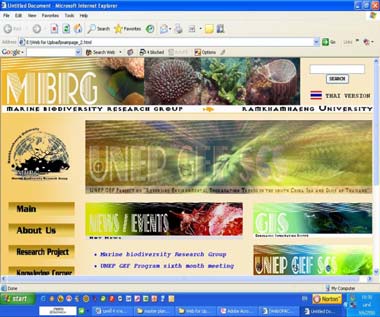
www.thaicoralreef.in.th provides background to the
in order to undertake sustainable tourism planning.
numbers; unskilled SCUBA divers and snorkelers
project; basic knowledge concerning coral reef ecology;
Although designated in 1982 as a National Park, Mu
damaging coral colonies in shallow water; use of
and a calendar of upcoming events related to coral reef
Koh Chang was designated in 2002 as an area having
anchors by boat operators in reef areas; lack of
conservation and management.
special or unique tourism features and identified as a
awareness of the local community of the importance of
new tourism destination in Thailand. Most tourists who
Using Coral Restoration as a Means of Raising
marine ecosystem to community income from tourism;
visit Mu Koh Chang are involved in marine aquatic
Awareness
illegal fishing using chemicals and nets of illegal mesh
sports and activities such as snorkelling and SCUBA
size and collecting of sea cucumbers and abalone; lack
To raise community and tourist awareness of coral reef
diving. The number of visitors in 2007 was
of co-ordination among management agencies; and a
restoration a small demonstration site for coral
approximately one million, four times the number
lack of manpower and poor law enforcement.
restoration was established at Koh Kra. Site size was
visiting in 2003.
small for ease of control and management for the
In order to develop guidelines and measures to control
benefit of tourism, education, public awareness, and
the number of visitors and prevent tourism damage to
research. Natural coral fragments were used in order to
the natural environment, a study was undertaken to
increase the survival rate of such fragments that might
determine the ecological, physical, facility, and
otherwise be buried. The techniques and methods used
psychological carrying capacity of Mu Koh Chang. For
were kept simple, using cheap materials available from
the ecological carrying capacity the national park
local suppliers and those that provided a hard substrate
conservation targets were taken as relative impact
for coral recruitment. Four methods are displayed at the
indicators, and existing visitor use correlated with
site: provision of substrate in the form of pyramids of
existing ecological impacts. The study identified the
concrete pipes; attaching branching Acropora spp. with
carrying capacity type that limited the recreation use of
screws to PVC pipe frames in the coral nursery area;
each site and the recommendations have been taken
provision of additional substrate using clusters of
into account in planning further development. This
concrete blocks to encourage natural coral recruitment;
enabled identification of an appropriate tourist user fee
and, attaching coral fragments to dead branching
for visitors to the site. These fees are being used to
corals by means of plastic straps.
The Mu Koh Chang Website - www.thaicoralreef.in.th
support and sustain coral reef conservation
interventions at the site.


UNEP/GEF Project: Reversing Environmental Degradation Trends in the South China Sea and Gulf of Thailand
Mu Koh Chang Coral Reef Demonstration Site, Trat, Thailand
Changing Past Practices and Developing
funding being spent on tourism infrastructure
Alternative Income Sources for Fishermen
development and establishing new management
frameworks but the local community was involved only
In order to reduce the overall pressure from fishing and
in implementation.
use of illegal gear, local fishermen were trained in more
sustainable livelihoods such as mariculture and as
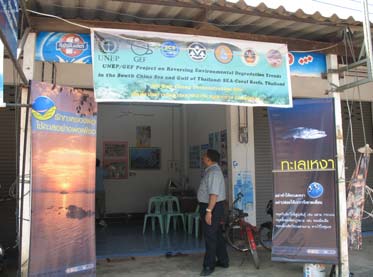
diving guides and tour boat operators. A local guide
centre was established enabling visitors to contact and
directly engage local boat and dive operators and this
has increased significantly the income of small boat
operators. At the same time visitors have gained insight
into sustainable management activities being
undertaken in the area.
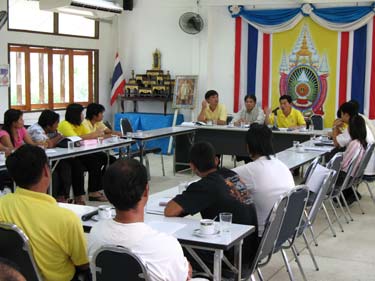
Meeting of all stakeholders for finalisation of the management
plan and guidelines for sustainable utilisation of coral reefs
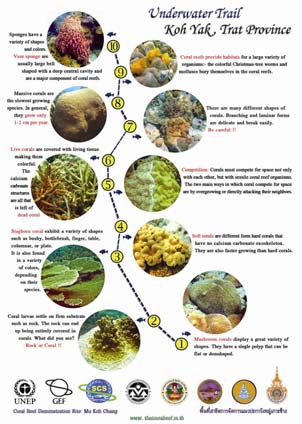
Underwater guide to the snorkel trail
Potential for Replication
Natural resource management in Thailand tends to be
In 2007 and 2008 Mu Koh Chang has been visited by
through centralised management by government
several study groups consisting of government officers,
agency with little decentralisation of authority or control.
researchers, site managers, scientists, mayors and
Management of sustainable tourism at Mu Koh Chang,
governors from this region. The most important
Tour guide centre on Koh Chang Island
falls under the responsibility of several government
objective of those study tours has been to share
A mooring buoy committee has been established as
entities each of which has their own management body,
experiences gained from implementation of the
demonstration sites. A group of 20 senior government
a sub-committee under the Mu Koh Chang National
with little co-ordination between them and a resultant
officials from Viet Nam's coastal provinces visited Koh
Park Committee to agree on the location of mooring
over-lapping of activities. The Mu Koh Chang
Chang in 2008 and have already commenced
buoys. The committee is composed of boat and dive
Demonstration Site objective, of developing a
implementing some of the innovations in Viet Nam.
operators and encourages use of such buoys to
management plan and guidelines for sustainable
The success of the management model in Mu Koh
prevent anchor damage to sensitive corals. Mooring
utilization of coral reef resources required the
participation of all related stakeholders from both local
Chang can be applied to other areas in Thailand and
buoys were installed at sensitive sites. An
and national levels. This plan indicates appropriate
other countries in the South China Sea.
underwater snorkel trail has been established and
activities, decided by the meetings of all stakeholders
mapped with a plastic guide highlighting points of
Contact Details
that should be implemented in the area and has now
interest along the trail. Underwater guides to the
been accepted for implementation by all responsible
Marine Biodiversity Research Group,
corals, fish and marine benthos of Mu Koh Chang
agencies. The process has facilitated co-operation
Department of Biology, Faculty of Science
have also been produced.
between the various government agencies.
Ramkhamhaeng University, Huamark,
Bangkok 10240 THAILAND
Networking Among Government Institutions,
Rationale for Approach Taken
E-mail: thamasakyeemin@yahoo.com
Private Sector and Local Communities
At the time of its designation as a National Park in 1982
The project has sought to encourage collaboration and
few resources were made available to implement
coordination among government agencies, private
management measures. The creation in 2002 of a
sector enterprises, NGOs, and local communities
public organisation to maintain a balance between
during planning, operation and evaluation of all
nature conservation and tourism development in Mu
activities in order to strengthen co-management.
Koh Chang resulted in a relatively large amount of