UNEP/GEF Project: Reversing Environmental Degradation Trends in the South China Sea and Gulf of Thailand
Belitung Coral Reef Demonstration Site, Bangka-Belitung, Indonesia
Integration of Traditional Wisdom and Practices in the
Education activities took place in cooperation with the
Development and Implementation of a Coral Reef
Education Service of Belitung District, and a syllabus was
Management Plan and Legislation
prepared and 1,400 guide books "Pesisir dan laut kita"
(The Coast and Our Sea) were produced and distributed
Project Summary
to all elementary school children in the Sub-District. Local
teachers were also trained in using the guide book.
Selat Nasik Sub-District of Belitung District was selected
as a demonstration site within the coral reef component of
Control of activities on the coral reefs was undertaken
the UNEP/GEF South China Sea project. The objective of
through regular patrols by 20 volunteer reef watchers. The
this demonstration site was to develop a community
reef watchers received training on: map reading; how to
based management system that would ensure
undertake patrols; the preparation of reports; and basic
sustainability of the coral reef ecosystem in order to
training on how to evaluate the state of coral reefs in a
increase community welfare and to reduce poverty.
simple way. The reef watcher programme was managed
at the village level with each village responsible for the
Activities at the demonstration site of Selat Nasik involved
selection of reef watchers and the programme was
numerous stakeholders from local government and
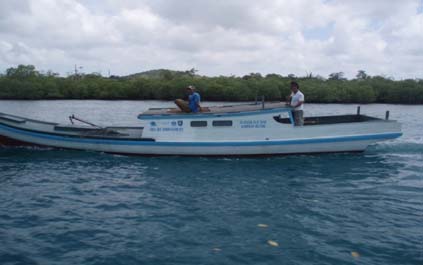
provided with two boats each equipped with binoculars
Product development for enhanced community income
communities. A Management Board was established at
and life jackets.
the district level with members drawn from local
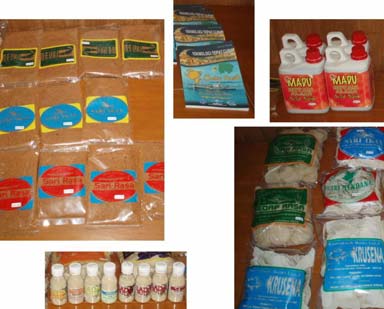
Two ways of enhancing community income were
institutions such as the Department of Marine Affairs and
identified. The first involved enhancing production and
Fisheries, Bappeldada, Education Services, Tourism
quality of locally produced fish crackers, and the second
Services and NGOs. The management board conducted
the preparation of new products including jerked fish
regular meetings to discuss the implementation of
(dendeng ikan) and durian toffee (dodol durian). One
activities with the site manager.
hundred and thirty five trainees took part in training on
these alternative livelihoods.
Issues and Challenges
Current actions resulting in degradation of reef state in
Selat Nasik waters include the "mining" of live coral for
house foundations. Reef watchers report however, that
the intensity of mining has decreased significantly
following the public awareness campaigns.
Reef watcher patrol
The Research Center for Oceanography LIPI conducted
The use of cyanide to catch ornamental fish by fishermen
an initial survey of coral reef condition and determined
from outside Selat Nasik Sub-District is ongoing.
that the coral reefs in this area were still in good condition.
Unregulated mangrove cutting to obtain fuel wood is still
The percentage of living coral cover varied from 46.9% to
common in Selat Nasik Sub-District, and is mainly done
91.5%, and economically valuable benthic species such
by individuals engaged in collecting and processing
as the giant clams Tridacna spp. were still abundant.
beche-de-mer. The use of trawl nets (Pukat Kongsi) by
fishermen from outside Selat Nasik Sub-District is still
Activities to increase the volume and availability of
common in the areas where this fishing practice is
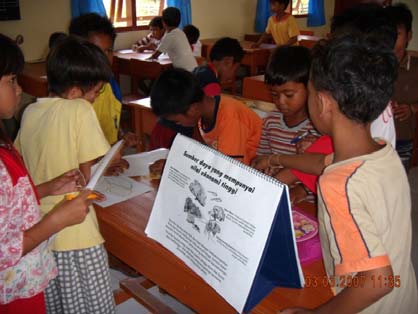
Using the guide books "The Coast and Our Sea" in primary
information involved socio-economic and ecological
potentially destructive to coral reefs.
schools
surveys, which showed that community understanding of
Activities at the Sub-District and Village levels involved:
the importance of coral reefs developed during the
Incorporating Traditional Knowledge and Practices
promoting community awareness and education;
project. The socio-economic surveys also provided
into Local Management Regulations
consideration of local regulations; development of a
information on activities that could be undertaken to
The development of the resource management plan and
resource management plan; information and public
develop alternative sources of income, and the results of
local regulations, proceeded quite slowly initially due to
awareness activities; and evaluation of alternative
the ecological surveys showed that coral reef condition in
the need to compile all relevant information and to consult
livelihoods. Public awareness activities included several
Selat Nasik was still good. The results of these surveys
with the legal section of the local government of Belitung,
community meetings, production and distribution of T-
together with the outcome of previous studies were
shirts and calendars to the Selat Nasik community.
posted on the project website: www.selatnasik.org.


UNEP/GEF Project: Reversing Environmental Degradation Trends in the South China Sea and Gulf of Thailand
Belitung Coral Reef Demonstration Site, Bangka-Belitung, Indonesia
the head of the sub-district, village chiefs and prominent
· Weir (rumpon) located close to the operational area of
Gersik agreements were considered by the Local
figures in the community, including fishermen.
purse seine (paying) must be marked with a 2m pole;
Government of Belitung District.
· Fish traps (bagan) may not be operated in the area of
the weir;
Potential for Replication
· Fishermen using fish traps are to report to the Village
Head or community chief before fishing;
Development of local regulations (Perda) on the
· In the wet season the waters surrounding Bakau Island,
management of coral reefs has been done by several
Karang Gading, Karang Air, Karang Delapan and
other districts in Indonesia. Therefore the potency of
Karang Berekam are open for both paying and bagan
replication would be quite high. Nonetheless the phasing
fishermen; and,
and the necessary timing for replication for each locality is
· In cases of violation the offender will be prosecuted
quite different.
according to the existing laws.
The principles adopted at the site for dispute resolution
between fishermen have potential for replication in other
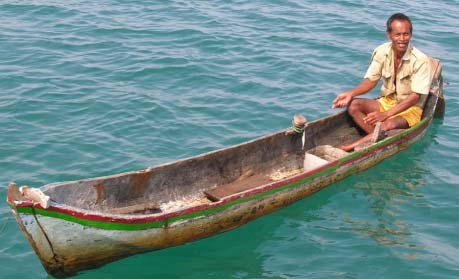
Artisanal fisherman from Selat Nasik Sub-District
areas of Indonesia's South China Sea coast. Particularly
These discussions took place against a background of
in the Riau Islands area and coastal waters of West
previous actions by the community of Gersik village that
Kalimantan province where similar fishing methods are
had agreed internally in 1970 on preventing the use of
used and conflicts exist.
certain fishing gear. The community agreement outlines a
number of "rules" including the fact that anyone fishing in
The experiences at the Belitung site have been used to
Gersik waters must use the same gear as local fishermen;
plan a future fisheries initiative in Indonesia aimed at
and banning the use of light fishing. The community of
improving the management of important fisheries habitats.
Gersik village, specialise in line-fishing for mackerel,
The success in integrating local wisdom in local
snapper and other pelagic species. In addition they also
management plan development has potential for up-
own "weir" or fish fences in the water near their houses.
scaling to the sub-region level as part of this initiative.
They believe that if all fishermen follow their rules, the
catch will be sustainable and believe that the use of lift
The community awareness and education materials have
nets and light fishing will adversely affect their catch.
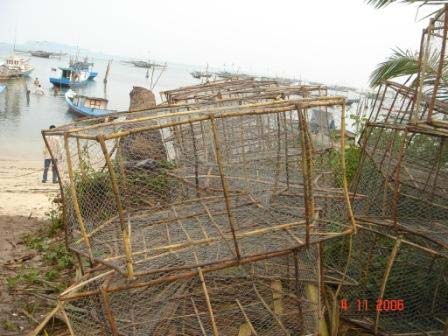
Small scale fish traps, bubu
potential for direct use in adjacent sub-districts and
districts and efforts are being made to make these
Up to the present time 6 quarrels have occurred with
Integration of Local Wisdom in the Management Plan
accessible via the Selat Nasik website. Translated
outside fishermen, resulting initially in warnings to the
and Regulations
versions of the training materials developed for the site
fishermen to cease, followed by more drastic actions
could also be used in other South China Sea countries in
including stoning and impounding fishing boats and gear.
To integrate the existing agreements initiated by the
the design of awareness building activities.
In the 1990s an agreement was reached between the
fishing community of Gersik village into the Resource
Local Government of Belitung District and the Local
Management Plan for the entire Selat Nasik Sub-District
Contact Details
Government of South Bangka according to which
required a series of activities including widespread
fishermen from South Bangka catching fish in the waters
consultations followed by preparation of a draft Resource
Research Center for Oceanography LIPI
of Gersik village, must follow the regulations that have
Management Plan incorporating zones of use throughout
Puslit OSEANOGRAFI LIPI
been developed by the Gersik fishermen.
the Selat Nasik Sub-District. "Red" zones were designated
as areas that are completely protected; "yellow" zones are
Pasir Putih 1 Ancol Timur
Some years later, a disagreement between the fishermen
areas of defined and limited use; while "green" zones
Jakarta UTARA, Indonesia
E-mail: ndhewani@coremap.or.id
of Gersik, Belitung District and Pongok, Bangka District
represent areas that are open for all kinds of activities.
arose in which the latter were accused of violating this
The community's aspirations and desires were taken fully
agreement. A meeting was convened on April 30, 2003 in
into account in defining these zones. Once the draft plan
Belitung to resolve the dispute and agreed to adopt the
had been prepared public consultations were organised
following principles:
with the communities of the Selat Nasik Sub-District, after
which the draft was revised and presented to the local
· All disputes be settled in an amicable manner through
government for comment and discussion. At the same
discussion and not by force;
time drafts of local regulations on coral reef management
and fishing activities and the use of gear based on the