




United Nations
UNEP/GEF South China Sea
Global Environment
Environment Programme
Project
Facility
Reversing Environmental Degradation Trends
in the
South China Sea and Gulf of Thailand
REPORT
Third Meeting of the Regional Working Group for
the Coral Reef Sub-component
Kota Kinabalu, Malaysia, 24th 27th March 2003
__________________________________________________________________________________
UNEP/GEF
Bangkok, March 2003
UNEP/GEF/SCS/RWG-CR.3/3
Table of Contents
1. OPENING OF THE MEETING................................................................................................ 1
1.1 WELCOME ADDRESS ....................................................................................................... 1
1.2 INTRODUCTION OF MEMBERS ............................................................................................ 1
2. ORGANISATION OF THE MEETING ..................................................................................... 1
2.1 ELECTION OF OFFICERS .................................................................................................. 1
2.2 DOCUMENTS AVAILABLE TO THE MEETING ........................................................................... 1
2.3 ORGANISATION OF WORK ................................................................................................. 2
3. ADOPTION OF THE MEETING AGENDA .............................................................................. 2
4. OPENING REMARKS FROM THE FOCAL POINTS FOR CORAL REEFS FROM EACH
PARTICIPATING COUNTRY ................................................................................................. 2
5. REPORTS FROM THE PROJECT CO-ORDINATING UNIT (PCU) REGARDING
OVERALL PROGRESS TO DATE......................................................................................... 3
5.1 STATUS OF END-YEAR PROGRESS REPORTS, EXPENDITURE REPORTS, AND BUDGETS ................ 3
5.2 STATUS OF PLANNED SUBSTANTIVE OUTPUTS FROM THE NATIONAL LEVEL ACTIVITIES ................. 4
6. REVIEW AND EVALUATION OF COUNTRY REPORTS ........................................................ 5
6.1 PAST AND ON-GOING ACTIVITIES INCLUDING ECONOMIC VALUATION......................................... 5
6.2 REVIEW OF NATIONAL DA TA AND INFORMATION, CREATION OF NATIONAL META-DATABASE
AND NATIONAL INPUTS TO THE REGIONAL GIS DATABASE...................................................... 5
6.3 REVIEW OF NATIONAL LEGISLATION, INSTITUTIONAL AND ADMINISTRATIVE ARRANGEMENTS......... 6
7. CHARACTERISATION OF NATIONAL CORAL REEF SITES AND THEIR REGIONAL
PRIORITISATION ................................................................................................................. 7
8. PREPARATION OF SITE SPECIFIC PROPOSALS FOR DEMONSTRATION SITES
INCLUDING THE REVIEW OF THREATS AT SITE LEVEL AND IDENTIFICATION OF
THE PROXIMATE AND ULTIMATE CAUSES OF DEGRADATION......................................... 9
9. REVISION OF THE WORKPLAN AND ACTIVITIES FOR THE REGIONAL WORKING
GROUP ON CORAL REEFS ............................................................................................... 11
10. DATE AND PLACE OF THE FOURTH MEETING OF THE REGIONAL WORKING
GROUP ON CORAL REEFS ............................................................................................... 12
11. ANY OTHER BUSINESS..................................................................................................... 13
12. ADOPTION OF THE REPORT OF THE MEETING................................................................ 13
13. CLOSURE OF THE MEETING ............................................................................................. 13
ii
UNEP/GEF/SCS/RWG-CR.3/3
List of Annexes
ANNEX 1
List of Participants
ANNEX 2
List of Documents
ANNEX 3
Agenda
ANNEX 4
Tabulation of Raw Data Relating to Identified Coral Reef Sites Bordering the
South China Sea
ANNEX 5
Dendrograms Resulting from the Preliminary Cluster Analyses Conducted
During the Third Meeting of the Regional Working Group on Coral Reefs
ANNEX 6
Ranking Indicators and Weights for Determination of Priority within Clusters of
Potential Demonstration Sites
ANNEX 7
Results of Preliminary Ranking of Coral Reef Sites Bordering the South China
Sea
ANNEX 8
Schedule of Meetings, for 2003
iii
UNEP/GEF/SCS/RWG-CR.3/3
Page 1
Report of the Meeting
1.
OPENING OF THE MEETING
1.1
Welcome address
1.1.1 The Project Director opened the meeting on behalf of the Dr. Klaus Töpfer, Executive Director
of the United Nations Environment Programme (UNEP), and Dr. Ahmed Djoghlaf, Director, Division of
Global Environment Facility Co-ordination (UNEP/DGEF). He welcomed members to the meeting, and
highlighted some of the achievements over the past year, including: the significant co-financing
received from the Government of China. He noted that the Project Steering Committee had during its
second meeting in December 2002 made a number of significant decisions including: the decision to
adopt a portfolio of 24 demonstration sites by the end of the year; the decision to include the Focal
Ministry and Specialised Executing Agency Logos on the Project website; and their agreement to
adopt the approach and guidelines for selection of demonstration sites proposed by the Regional
Scientific and Technical Committee.
1.1.2 He noted that other key decisions for the longer term included the agreement to develop a
strategy for long-term sustainable financing; the approval of the processes for engaging a wider range
of institutions and stakeholders in project activities and the agreement to establish two regional task
forces, one composed of legal experts and one composed of environmental economists to advise the
Regional Working Groups and provide a regional overview of these matters.
1.1.3 Dr. Pernetta advised the group of the importance of the work before the present meeting
which sets the foundation for successful completion of the planned adoption of a regional portfolio of
demonstration sites by the Project Steering Committee in December. He noted that following
agreement by the Project Steering Committee of the process it was the responsibility of the Regional
Working Group to finalise the detail of the selection procedures during the course of this week and
thus provide guidance to the Focal Points from participating countries on priorities for the
development of demonstration site proposals.
1.2
Introduction of members
1.2.1 Members were invited to introduce themselves to the meeting, and the list of participants is
attached as Annex 1 to this report.
2.
ORGANISATION OF THE MEETING
2.1
Election of Officers
2.1.1 The Project Director noted that the Rules of Procedure state that, the Regional Working Group
shall elect, from amongst the members, a Chairperson, Vice-Chairperson and Rapporteur to serve for
one year. The rules state further that, officers shall be eligible for re-election no more than once.
Dr. Pernetta noted that Mr. Kim Sour, Dr. Suharsono, and Dr. Porfirio Alino who have served, as
Chairperson, Vice-Chairperson and Rapporteur during 2002 were therefore all eligible for re-election.
2.1.2 Members were invited to nominate members as Chairperson, Vice-Chairperson and Rapporteur
for 2003. Dr. Suharsono nominated the Focal Point from Malaysia, Mr. Abdul Khalil bin Abdul Karim, as
Chairperson, Mr. Khalil nominated Dr. Vo Si Tuan as Vice Chair, and Dr. Suharsono nominated
Dr. Thamasak Yeemin as Rapporteur. Mr. Khalil, Dr. Tuan and Dr. Yeemin were elected by
acclamation.
2.2
Documents available to the meeting
2.2.1 Mr. Khalil expressed his appreciation at being elected Chairperson, and invited the Project
Director to introduce the documentation available to the meeting. Dr. Pernetta introduced the
documents, available in both hard copy and on CD-ROM. He noted that the published reports of the
second round of regional meetings were also made available and that all the documentation for the
UNEP/GEF/SCS/RWG-CR.3/3
Page 2
meeting had been circulated by e-mail and posted on the website, in advance of the meeting. Additional
documents tabled by Focal Points at the commencement of the meeting were noted and added to the
list of documents (UNEP/GEF/SCS/RWG-CR.3/INF.2). The revised list of documents is attached as
Annex 2 to this report.
2.3
Organisation of work
2.3.1 Dr. Pernetta briefed participants on the administrative arrangements for the conduct of the
meeting, and the proposed organisation of work (UNEP/GEF/SCS/RWG-CR.3/INF.3). Formal
sessions of the meeting would be conducted in plenary although it was envisaged that, sessional
working groups would need to be formed to complete the various reviews and analyses required
under agenda item 7. A joint session will also be held together with the Regional Working Group on
Seagrass to consider jointly, matters relating to the selection of demonstration sites. The meeting was
to be conducted in English.
2.3.2 Dr. Ridzwan Abdul Rahman advised the group of the options available for a field trip, and also
extended an invitation to the group on behalf of the Borneo Marine Research Institute to lunch or
dinner at the campus at a time and date of convenience to the group. Dr. Ridzwan's kind offer was
accepted with appreciation.
3.
ADOPTION OF THE MEETING AGENDA
3.1
The Chairperson invited members to consider the provisional agenda prepared by the
Secretariat as document UNEP/GEF/SCS/RWG-CR.3/1, propose any amendments or additional
items for consideration, and adopt the agenda. The agenda was adopted without change and is
attached as Annex 3 to this report.
4.
OPENING REMARKS FROM THE FOCAL POINTS FOR CORAL REEFS FROM EACH
PARTICIPATING COUNTRY
4.1
The Chairperson invited the focal points from the Specialised Executing Agencies (SEAs) to
provide a short overview of their progress subsequent to the second meeting of the RWG-CR and to
highlight any additional documentation tabled at the meeting.
4.2
Dr. Yeemin briefed the group on the activities of the Thailand Coral Reef Committee since the
last meeting of the Regional Working Group and informed the meeting of the progress in finalising the
various outputs including the reports on: Past and Ongoing Activities; Economic Valuation; the site
characterisations; Review of National Legislation; the development of the meta-database, and the
report on national criteria and prioritisation of coral reef sites.
4.3
Dr. Porfirio M. Alino informed the meeting that he had convened a National Coral Reef
Committee meeting in December 2002, to organise the tasks of members in relation to outputs to be
completed. These included resource valuation, meta-database development, demonstration site
characterisations, and the legislation review. Another meeting had been held in February 2003, where
members had reviewed their progress. He referred the meeting to the report of the 4th meeting of the
National Steering Committee on Coral Reefs, tabled at the meeting in which the progress was
documented.
4.4
Dr. Alino also informed the group that the Philippines coral reef atlas had been recently
launched, and that monitoring information on coral reefs was also available. Philippines Coral Reefs
Through Time will be launched, at the ITMEMS-2 meeting in Manila. He also noted that the activities
under the SCS project had been incorporated into the Philippines Integrated Marine Policy.
4.5
In reply to a question from Mr. Yihang Jiang, Dr. Alino advised that the economic valuation
review was still draft, but there was some progress that will be presented at this meeting. Mr. Jiang
stated that a summary of economic valuation work that has been completed for the Philippines would
be very useful to the Task Force on Economic Valuation that was to be formed to review the
economic valuation outputs of the SCS project.
UNEP/GEF/SCS/RWG-CR.3/3
Page 3
4.6
Dr. Suharsono asked whether economic valuation work, conducted by Herman Caesar for
parts of Indonesia not associated with the South China Sea, should be included in a review of the
economic valuation. In response, Mr. Jiang stated that the methodology used would be very useful,
and therefore should be included. Dr. Pernetta added that as economic valuation data is sparse, any
available information considered useful should be included, especially where national data for the
South China Sea is lacking.
4.7
Dr. Alino suggested that data from other areas outside the South China Sea can also be
useful as relative benchmarks for scaling and comparison with any valuation conducted under the
project. Mr. Jiang noted that economic valuation would be needed for the proposals to be prepared for
sites to be selected as demonstration sites under the project. This topic would be further discussed
under agenda item 8.
4.8
Mr. Kim Sour gave a brief presentation on the achievements and outputs of the Cambodian
Coral reef sub-component. The Review of Past and Ongoing Activities, Natural Resources
Management, Review of Social Economics of Coral Reef and Seagrass, Review of Legislation and
Institutional Framework, characterisations of seven sites and the meta-database had all been
completed. In response to a question from Mr. Jiang, Mr. Sour said that the Koh Kong sites surveyed
in cooperation with the Singapore International Foundation were included in the seven sites for which
site characterisations were provided.
4.9
During discussion Dr. Pernetta noted that to assist the PCU with filing and compiling the
inventory of electronic files, it would be useful to indicate in the covering e-mail when an attached
report represented a revision of a previous submission or submission of a new item. He also noted the
need to ensure that the files were appropriately and consistently named.
4.10
Dr. Vo Si Tuan advised the meeting of the progress of the Viet Nam Coral Reef Committee
since the last meeting. They had completed the reviews of: National Legislation; Past and Ongoing
Activities; site characterisations of 9 sites, with supporting text for 5 of those sites. Other reports have
also been completed on coral reef monitoring, produced under other projects. The activities on
economic valuation had not yet been included in the review of past and on-going projects.
4.11
Dr. Suharsono informed the group on progress for Indonesia since the last meeting. The
committee has completed characterisation for 3 sites, and the reviews of Past and Ongoing Activities,
of National Legislation, a policy and strategic plan for coral reefs, and the meta-database, which has
been converted from an existing meta-database prepared under the COREMAP project. They have
also completed a Review of Natural and Anthropogenic Threats to Indonesia's Coral Reefs. He noted
that the economic valuation has not yet been completed, as there are no data specifically relevant to
the South China Sea areas of Indonesia. He noted further that the National Technical Working Group
had convened a meeting of local government officials, in order to develop support for any
demonstration site proposals.
4.12
Mr. Khalil advised the meeting that as Malaysia has only recently signed the MoU, they have
no reports ready at this stage though they have made progress.
5.
REPORTS FROM THE PROJECT CO-ORDINATING UNIT (PCU) REGARDING OVERALL
PROGRESS TO DATE
5.1
Status of end-year progress reports, expenditure reports, and budgets
5.1.1 Mr. Jiang presented document UNEP/GEF/SCS/RWG-CR.3/4, containing a summary of the
current status of budgets and reports from the Specialised Executing Agencies in the participating
countries. He highlighted the difficulties of the PCU and problems consequent upon the failure of the
Focal Points to meet agreed deadlines and submission dates.
5.1.2 Mr. Jiang, referred to table 1 of the document, and in particular to the number of days by
which delivery of reports was overdue. He explained that the timing of the meetings is scheduled to
allow sufficient time to deal with these reports in the inter-sessional period but that where delivery was
delayed it conflicted with the organisation and preparation of the regional working group meetings
making it difficult for the PCU to allocate the required time to correct and approve these reports and
process cash advances promptly.
UNEP/GEF/SCS/RWG-CR.3/3
Page 4
5.1.3 He then referred to tables 2 and 3, and explained that the blank columns regarding actual co-
financing in 2002 would be completed after the six-month reports had all been received, and
calculations of the time spent on committee meetings would then be used to determine the in-kind
contribution of each country. In referring to table 4, which provided an estimation of the costs of
outputs based on their volume, he noted that this was an audit procedure that could be used to
assess the overall "value for money" but that this took no account of the amount of work involved nor
of the quality which would be evaluated through the independent review process.
5.2
Status of planned substantive outputs from the national level activities
5.2.1 In introducing this agenda item the Project Director noted that Annex 8 of the first meeting report
(UNEP/GEF/SCS/RWG-CR.1/3) and Annex 11 of the second meeting report (UNEP/GEF/SCS/RWG-
CR.2/3) detailed the outputs that were to have been prepared by the Focal Points in advance of the
second and third meetings, as follows:
1.
Review of past & ongoing activities:
1st draft June; final draft November 2002
2.
Review of national data and information:
Final draft December 2002
3.
Identification & characterisation of "sites"
1st draft October, Final December
4.
Review National legislation
1st draft October, Final December
5.2.2 Dr. Pernetta noted that documentation received by the Secretariat from the Focal Points up to
the end of January has been circulated by e-mail and members were requested to print and bring their
own copies to the meeting. The list of reports so dispatched is contained in the appendix to document
UNEP/GEF/SCS/RWG-CR.3/INF.2 and electronic copies were provided on the CD-ROM. Hard copies
of the site characterisations had been provided for reference of each member during discussions under
agenda item 7.
5.2.3 Dr. Pernetta then proceeded to brief members on the decisions of the Project Steering
Committee regarding the implementation of the independent peer review of the country reports. He
further noted that the Project Steering Committee had agreed to establish two Regional Task Forces,
one for legal matters and one covering issues relating to the economic evaluation of coastal
resources.
5.2.4 Dr. Suharsono stated that he was waiting for the audit report, due at the end of March, before
sending in the reports for the second half of 2002. Dr. Pernetta noted that the audit report was not due
until the end of March and that focal points should not delay their reports for the period July to
December 2002, but submit them as soon as they were completed. He noted that if the audit report
were not received prior to July 2003 then this would impact on the disbursement of the final tranche of
funds for 2003. He urged focal points to submit outstanding reports as soon as possible, and if they
had electronic copies with them, they could be finalised during this meeting.
5.2.5 Mr. Sour requested clarification regarding a statement in paragraph 5 of the document, for
which Mr. Jiang apologised, stating that this had been included in error and referred to another sub-
component.
5.2.6 In reply to a question from Dr. Alino on the implications of the cost per page estimate in the
table 4, Dr. Pernetta replied that this was just a very crude indicator of "value for money", but that this
was the kind of indicator an internal UN auditor might use in trying to determine whether or not the
costs were reasonable.
5.2.7 Referring to paragraph 7.4.8 of the PSC 2 report, Dr. Pernetta explained the rationale for and
procedures to be followed in conducting the peer review of the national reports on data and
information, and past and ongoing projects, produced under the project. He also explained how the
review of economic valuation, and the review of legislation, would be to be undertaken by the two
regional task forces.
UNEP/GEF/SCS/RWG-CR.3/3
Page 5
5.2.8 Extensive discussion followed on the review process, in particular with respect to any
independent reviewer's knowledge of the context in which the reports are produced. Dr. Pernetta
stated that any independent reviewers contracted would be selected on the basis of possessing
sufficient expert knowledge to understand the context in which each country produced the outputs.
Mr. Jiang added that the reports will be reviewed in relation to the agreed format, and to ensure that
the information was reasonably comprehensive. The review will be sent back to the Focal Points for
consideration and necessary actions. The review was not meant to validate the information provided
but to provide the GEF and UNEP with an independent assurance of the quality of the products.
5.2.9 Dr. Ridzwan commented that the reviewers should be asked not merely to review the quality
but also all aspects of the report including both quality and quantity and that the process will provide a
better indication of the value for money of the outputs, than the simplistic calculation of cost per page
contained in the table 4 of the document UNEP/GEF/SCS/RWG-CR.3/INF.2.
6.
REVIEW AND EVALUATION OF COUNTRY REPORTS
6.1
Past and on-going activities including economic valuation
6.2
Review of national data and information, creation of national meta-database and
national inputs to the regional GIS database
6.2.1 At the request of the Chairperson the focal points reported on both sub-agenda item 6.1 and
6.2 in a single report. He invited the focal points from the SEAs to provide a short overview of their
reports following which there would be an opportunity for discussion and comments from the floor.
6.2.2 Dr. Suharsono stated that the Indonesian review of past and ongoing activities was complete,
but that a report on economic valuation was not included. He noted further that as reported under a
previous agenda item the national meta-database, GIS format for the site characterisations had been
completed and that at a national level they had prioritised 3 sites from a national perspective as
proposed demonstration sites.
6.2.3 Dr. Tuan stated that Viet Nam has 30 projects listed in their past and ongoing activities. Nine
sites have been characterised and the data entered into the GIS format. In addition, further
information for 2 sites, was being compiled though not enough information was available to
characterise these sites. Production of the national meta-database is underway, but not complete,
with about 30 metadata entries prepared to date.
6.2.4 Dr. Ridzwan noted that in the case of economic data information, on such aspects as catch
per unit effort (CPUE) change for particular areas could perhaps be assessed. He noted if information
on such measures could be obtained from fishermen, then it would be valuable to include this within
the economic valuation in the site characterisation. Dr. Tuan said there is no information available
from Viet Nam for reef fish catches from specific sites, though provincial data were available.
6.2.5 Following a general discussion on the available information on CPUE for particular sites,
where it was acknowledged that some areas do have some reasonable data, Mr. Jiang commented
that the data to be used for ranking should be available from all countries for reasons of comparison.
Dr. Alino responded that it may not be easy because figures of a particular site are not readily
available.
6.2.6 Mr. Kim Sour stated that Cambodia has prepared the Review of Past and Ongoing activities,
in which they have combined all coastal zone management and coastal resource management
projects. They have 2 major projects at present, the Coastal Zone Management project, and the
Singapore International Foundation assisted research on biological and socio-economic surveys in
Koh Kong. For the economic valuation, a review was conducted of coastal people through analysis of
survey results. The national meta-database consists of 162 files, which have been submitted to the
PCU this month. For the national data and information on coral reef, they are trying to relate this to
each site.
UNEP/GEF/SCS/RWG-CR.3/3
Page 6
6.2.7 Dr. Alino said that GIS format site characterisations for the Philippines have been submitted
and are linked to a web based engine. The report on past and ongoing activities will include the
review of economic valuation. Monitoring information will be also available from the web, and there
will be text files that contain socio economic information, and text background to the meta-database.
6.2.8 Dr. Yeemin noted that Thailand has up-dated the list of past and ongoing activities and that in
the case of economic valuation one study in a Chumporn area had been conducted. The Thai
committee has 14 sites characterised in GIS format, which have been submitted to SEA-START RCU,
along with about 15 meta-database forms.
6.2.9 Mr. Khalil stated that in Malaysia the collection of National Data and Information has been
initiated and that a remote sensing database is available in Malaysia, but it has yet to be determined
whether this is suitable for SEA-START RC.
6.3
Review of national legislation, institutional and administrative arrangements
6.3.1 The Chairperson invited the Focal Points from the SEAs to provide a short overview of their
reports on national legislation. Members noted the decision of the Project Steering Committee to
create a Regional Task Force on legal matters and members were invited to discuss the manner in
which this group might assist in finalising these reports.
6.3.2 Malaysia noted that there is an existing report on the review of national legislation, and the
project provided the opportunity to update it.
6.3.3 Dr. Yeemin informed the meeting that the national legislation review for coral reefs and the
institutional framework in Thailand had been submitted.
6.3.4 Dr. Alino informed the meeting that his institution has been tasked with reviewing the national
marine policy and legislation, much of which is not specific enough and that the outputs of this review
would constitute the basis of their report submitted under this project.
6.3.5 Kim Sour stated that all involved agencies have been included in the report of legislation from
Cambodia, and that this also included international conventions.
6.3.6 Dr. Tuan stated that the previous legal review submitted by Viet Nam had been revised, and
includes environmental protection, fisheries, transportation, and tourism and that the review contains
information from the provincial level.
6.3.7 Dr. Suharsono noted that the review of national legislation has been submitted and that now
some autonomy existed at the local level. The Indonesian committee for coral reefs was trying to
determine if local sub-regulations were available. He noted that there are no specific laws on coral
reef in Indonesia.
6.3.8 Dr. Pernetta said that there appeared to be some confusion about the purpose of particular
tasks. The national meta-database was a part of the MoU and its compilation at the regional level
would provide a basis for an overall regional review to make information available to policy and
decision makers. These would then make up the regional meta-database. The regional GIS database
was meant to put a lot of information into a format where it was more easily available and understood,
and to make it more accessible
6.3.9 From the discussion that followed, it was clear that there was considerable confusion
concerning the purpose of the various reports which were essentially all linked steps leading to the
completion of demonstration site proposals. Dr. Pernetta noted that the regional GIS database was an
essential decision making tool and that inputs to this from the national level were urgently required.
UNEP/GEF/SCS/RWG-CR.3/3
Page 7
7.
CHARACTERISATION OF NATIONAL CORAL REEF SITES AND THEIR REGIONAL
PRIORITISATION
7.1
The Project Director made two presentations, introducing to the meeting the principles and
procedures agreed and approved by the Regional Scientific and Technical Committee and the Project
Steering Committee concerning the nature of proposed demonstration sites, their description and
ranking for determination of regional priorities. For the first presentation he referred to document
UNEP/GEF/SCS/RSTC.2/10/Amend.1.
7.2
Dr. Pernetta explained that the development of full proposals for demonstration sites will
involve considerable effort and it is unlikely that proposals can be properly developed for more than
three to five sites in each country. He said that it was necessary therefore, to complete a preliminary
ranking of sites during this meeting, in order to provide guidance to the national committees on those
sites for which concrete proposals should be prepared by the beginning of October 2003.
7.3
Following the first presentation, a number of general questions on GEF funding and
government co-financing were received from the meeting. Dr. Suharsono asked about the percentage
of co-financing of demonstration sites that would be required, for example if the Indonesian
Government were to co-finance a demonstration site. Dr. Pernetta informed the meeting that it was
usual for co-financing to be provided on a 1 to 1 basis. However, in the case of an already existing
site being selected as a demonstration site, the co-financing ratio might be considerably higher.
7.4
Dr. Ridzwan informed the meeting of an ongoing activity in developing a marine protected
area in North Borneo, which, based on the information reported above would qualify as a site with co-
financing. Since it had been recently gazetted as a Marine Park and plans for initial activities were
being developed.
7.5
Dr. Tuan asked how one might deal with a large existing project that was broader than the
present project to determine the percentage of financing that might be considered co-financing. Dr.
Pernetta responded by saying that in such a case the proportion of funds allocated towards the goal
of the present project could be taken as the co-financing.
7.6
In response to a query regarding what would happen when a single site was selected
nationally as high priority demonstration site meeting the requirements of two sub-components. Dr.
Pernetta noted that when a demonstration site is proposed for 2 different sub-components, it would be
ranked independently in each sub-component at the regional level but the group might wish to include
assignment of an additional score thus giving the site potentially higher ranking overall.
7.7
Dr. Pernetta then made the second presentation, introducing the meeting to the concept of
cluster analysis and regional ranking. This presentation was based on document
UNEP/GEF/SCS/RSTC.2/8, which was originally presented at the second meeting of the Regional
Scientific and Technical Committee and the content of which had been agreed by the Project Steering
Committee.
7.8
In order to demonstrate what was required of the current meeting Dr. Pernetta presented the
raw data compiled at the third meeting of the mangrove group held in Bali in early March. This
presentation was based on the annexes 4, 5, 6, and 7 of the meeting report, document
UNEP/GEF/SCS/RWG-M.3/3, which was included in the meeting documents. He explained the
rationale for removing some columns of data based on an absence of data, and also explained that
columns for some of the data that were not included in the initial analysis were to be filled for the final
analysis on April 7th.
7.9
Following an extensive discussion of the merits of the proposed cluster procedure Mr. Jiang
presented a draft table containing the data and information from the coral reef GIS questionnaire for
the participants to complete overnight. It was agreed that each of the participants would enter their
site characterisation data, for consideration and analysis during the first session of the next day.
UNEP/GEF/SCS/RWG-CR.3/3
Page 8
7.10
Based on the data and information assembled by the Focal Points of the Specialised
Executing Agencies from the participating countries, a table containing all data and information was
produced overnight, as input to the regional cluster analysis. Due to the fact that: the Focal Point for
coral reefs from Indonesia did not bring the site characterisation data with him to the meeting; the
general lack of site data and information in Cambodia; and the delay of implementation of the coral
reef component in Malaysia, the meeting agreed to carry out the cluster analysis on 26 sites proposed
by the Philippines, Thailand and Viet Nam.
7.11
The compilation of national site data resulted in a spreadsheet containing data for 10
parameters and a total of 26 sites. Gaps in the data were filled using estimates based on expert
knowledge, and on the understanding that these will be corrected by the focal points when they return
to their own countries. The data table assembled for the cluster analysis is attached as Annex 4 to
this report.
7.12
The data table was imported into SPSS, and three cluster analyses were performed during
the meeting:
(i)
Case one, no transformation;
(ii)
Case two, transformations were done for the number of hard coral species and
number of coral fish species; and
(iii)
Case three, transformations were done for the number of hard coral species number
of algae species and number of coral fish species;
7.13
The resultant dendrograms were printed and distributed to the participants for detailed
consideration. Participants were asked to examine the dendrograms and based on their knowledge
and experience, determine whether the results reflect reality and were acceptable, or whether
additional analyses should be conducted using additional characters or transformations. The resultant
dendrograms are included in Annex 5 of this report.
7.14
The members of the Regional Working Group felt that the analyses reflected, in general, the
reality of the coral reef situation in the region, and that case three should be used in the final analysis.
The group noted that the results from cases 1 and 3 were quite similar. Dr. Tuan indicated that the
reason for sites 5 and 6 being less similar than the others is that these two sites are located in
upwelling areas with more algae species.
7.15
Dr. Alino explained that site 15 is very diverse in terms of coral reef fish species. Therefore it
was clear from the result of cluster analysis that site 15 was different from the other sites.
7.16
The meeting agreed that the approach provided a useful tool for the prioritisation and ranking
process, and agreed that the same analysis should be carried out by PCU when all data and
information for site characterisation were received. The meeting further agreed to a deadline, of 20
April 2003, for submission of all final data sets to the PCU. The PCU will carry out cluster analysis and
perform the site ranking according to the criteria agreed by the Regional Working Group. The PCU will
transmit the outcome of these analyses to the Focal Points for coral reefs in the participating countries
and advise on which sites should be further developed into demonstration site proposals.
7.17
The meeting proceeded to consider the ranking of sites within the same cluster. Mr. Jiang
prepared a draft table format of ranking criteria during the lunch and presented this to the meeting at
the opening of the afternoon session. The meeting carefully discussed the parameters included in the
ranking table, the ranges for each parameter, and the weighting scheme to be used in the ranking.
The ranking criteria agreed by the Regional Working Group, are presented in Table 1 of Annex 6.
7.18
A similar procedure was adopted during the discussion and agreement of the "subjective"
indicators, and their weights, which were not included in the cluster analysis. The ranking parameters
and weights agreed by the Regional Working Group, are presented in Table 2 of Annex 6.
7.19
It was agreed that participants would enter their data into the tables, and these completed
tables would be reviewed during the next session.
UNEP/GEF/SCS/RWG-CR.3/3
Page 9
7.20
Following completion of the scoring of individual sites according to the agreed parameters
and weights a preliminary ranking table was assembled in order to evaluate the criteria prepared by
the Regional Working Group during their previous session in order to evaluate the outcome.
7.21
The meeting agreed that scores for the parameter of national priority should be given to only
one site as the first priority in each country, one site as the second, and one as the third. The
remainder of the sites should not receive any score for national priority in the ranking process.
7.22
The meeting agreed that the criteria prepared during the meeting were acceptable for ranking
the demonstration sites, and should be used in the ranking and prioritisation of potential coral reef
demonstration sites to be adopted by the Project. The comparative rank score for all sites included at
this stage of the analysis is presented in Annex 7 of this report.
8.
PREPARATION OF SITE SPECIFIC PROPOSALS FOR DEMONSTRATION SITES
INCLUDING THE REVIEW OF THREATS AT SITE LEVEL AND IDENTIFICATION OF THE
PROXIMATE AND ULTIMATE CAUSES OF DEGRADATION
8.1
The Chairperson invited Mr. Jiang to introduce this agenda item. Mr. Jiang informed the
meeting that the document prepared for this agenda item (document UNEP/GEF/SCS/RWG-CR.3/6)
was in two parts: the format and guidelines for the preparation of demonstration site proposals and
guidelines for the conduct of the causal chain analysis. He noted that the second part of the document
had been submitted to, and approved by the RSTC and PSC during their December meetings.
8.2
The guidelines for the preparation of demonstration sites were discussed section by section.
Following some questions and clarification, the Regional Working Group agreed to adopt the format
and proposed guidelines in preparation of the site proposals.
Special Joint Session of the Regional Working Groups on Coral Reefs and Seagrass
8.3
On the morning of 26th March a joint session between the Regional Working Groups for Coral
Reefs and Seagrass was convened. The Project Director opened the special joint session, and stated
that during the second round of regional working group meetings various members had expressed the
desire to have such a joint session for collaboration and discussion of issues of mutual interest. He
noted that the programme for the session was flexible and that the purpose was to share experiences
between the two groups and to perhaps discuss the overlap in coverage of site characterisations at the
national level and implications for the choice of demonstration sites. In particular, the group might wish
to discuss how to handle sites that contain multiple habitats, and how these should be developed with
regard to the agreed site selection process.
8.4
Following this, Dr. Pernetta invited, Dr. Miquel Fortes and Mr. Abdul Khalil, the Chairs of the
Regional Working Groups for seagrass and coral reefs respectively to co-chair the session.
8.5
Dr. Fortes and Mr. Khalil assumed the joint chair and following a brief round of introductions Dr.
Fortes invited participants to identify issues for discussion and opened the floor for any suggestions or
proposals that members felt required joint discussion. He noted that, it would be useful for the group to
hear an overview of the experiences of the coral reefs working group with the application of the cluster
analysis and perhaps hear from the secretariat regarding the outcome of the joint mangrove wetlands
discussions. It was agreed that any additional issues would be dealt with, if and when, they arose.
During discussion it was noted that the RWG-Cr had given primary importance to indicators of biological
diversity, rather than to connectivity of habitats although allowance was made in the ranking scheme for
including scores reflecting the diversity of habitats at a particular site.
8.6
Dr. Alino suggested that transboundary sites, as well as sites that covered more than one
habitat should be discussed and Dr. Fortes asked what criteria the coral reef group had identified as
indicators of regional priority. In the ensuing discussion, the SSME area, Philippines/Sabah area, and an
area around Batam adjoining Singapore, Malaysia, and Indonesia were mentioned as examples of
transboundary areas that may be considered for development of demonstration proposals. It was also
noted that seagrass and coral reefs often occupy adjacent areas, and that there would be advantages in
UNEP/GEF/SCS/RWG-CR.3/3
Page 10
having sites covering both habitats. Dr. Huang mentioned that the 2 habitat types are very different in
terms of appropriate management regimes, and that it was too early to discuss the connectivity between
these two habitat types in the case of China.
8.7
The Batam area connecting Malaysia, Indonesia, and Singapore was noted as having important
stocks of globally threatened species including dugong, and turtles and that these animals were
dependent on the seagrass beds in the area.
8.8
Dr. Tuan suggested not to separate biodiversity, connectivity, management, and other
parameters in order to meet the objectives of the project. Dr. Hutomo noted that as this was a GEF
project, biodiversity needed to be given prominence amongst the criteria for site selection. A number of
countries indicated that they were looking at sites common to two or more habitats.
8.9
Dr. Pernetta noted that it was the role of the National Technical Focal Point and National
Technical Working Group to ensure coordination between national activities in each component and
sub-component of the project, so that confusion and conflicts do not arise. Dr. Pernetta reminded the
participants as to how the choice of habitats had been decided, noting that the Transboundary
Diagnostic Analysis had concluded that mangroves were the most threatened habitat bordering the
South China Sea whilst the biological and socio-economic importance of seagrass habitats were least
understood.
8.10
He noted that although the site characterisation process was focussed on individual habitats,
once a decision had been taken to develop a demonstration site proposal this should be based on a
functional management unit that would reflect administrative boundaries since it should involve directly
both the local communities and local government in developing the proposal and managing the site.
Consequently it would be necessary to develop an overall management framework that took account of
all habitats within the area to be managed.
8.11
Dr. Fortes enquired about the transboundary area between the Philippines and Sabah that had
been mentioned earlier. This prompted Dr. Ridzwan to present an overview of the North Borneo Islands
Marine Managed Area (NBIMMA) that had been recently gazetted as a marine park by the Sabah
government. Dr. Pernetta sought clarification regarding the status of the boundary between the two
EEZ's and for clarification regarding management initiatives on the Philippines side of the boundary. It
was the consensus of participants that this particular boundary was accepted by both parties, and was
not a matter for dispute. The Philippines participants noted that although they had originally intended to
include this area amongst their sites it had not been included to date due to the security concern.
8.12
Mr. Kamarrudin then showed some slides of satellite tracking studies of turtle migration from
Redang Island in West Malaysia to the area around the NBIMMA, 2000km in 36 days from Thailand to
Sulu Sea. Professor Ridzwan concluded that potentially this would be a valuable site, which if adopted
in the framework of the project could focus initially on management activities in the Malaysian areas that
might serve as a platform for development of Philippines activities and then joint management.
8.13
Dr. Tuan asked if anybody in the group had any experience in transboundary management of
sites. Mr. Khalil noted that the Turtle Islands Heritage Protected Area represented such a joint
programme designed to manage turtles and had demonstrated the transboundary importance of
national management of some resources and habitats.
8.14
Dr. Pernetta stated that he was not aware of any transboundary ecosystem that was managed
through a single management mechanism but that the normal mode was for each country to manage
the area under their own jurisdiction and then to include some bilateral mechanism for joint discussion
and agreement of individual actions and priorities.
8.15
Dr. Fortes, informed the meeting of several transboundary management examples of which he
was aware, including the Antarctic treaty; a bilateral agreement on joint management of disputed islands
between Russia and Japan; and the joint management programme between the Philippines and
Indonesia for yellowfin tuna stocks. Dr. Ridzwan informed the meeting of joint arrangements that
UNEP/GEF/SCS/RWG-CR.3/3
Page 11
permitted the sale of a limited number of turtle eggs in Malaysia harvested on the Philippines side of this
area under a joint agreement that included arrangements for setting quotas.
8.16
Dr. Tuan mentioned an area nearby Cambodia that Viet Nam was proposing, which would have
obvious transboundary significance, whilst Mr. Sour mentioned the Koh Kong sites, where Cambodia is
considering a joint site including both habitats, which would have transboundary significance with
Thailand. They had also considered Kampot and kep sites close to Viet Nam that might be selected and
the following discussion suggested that a joint proposal could be developed including both Viet Nam and
Cambodia. In response to a query from Dr. Tuan, Dr. Pernetta advised that a proposal for a
transboundary demonstration site from two countries would be looked upon very favourably.
8.17
Dr. Pernetta noted the urgent need for simple national maps indicating the site locations, in
order to determine if sites are in or outside of the SCS and the possibilities for aggregating proposals.
8.18
Professor Huang indicated that there was a seagrass area in China close to Viet Nam that is
very important for turtles and dugongs.
8.19 Prof. Chou pointed out that consideration could be given to a site that did not transcend national
boundaries but play an important role in connectivity to the region or harbours biological diversity of
regional or global significance (possible example is the Natunas).
8.20
Dr. Fortes sought clarification as to how funds would be disbursed where a site encompassed
two habitats or was a transboundary site. Dr. Pernetta noted that there were no hard and fast rules or
any decisions regarding the magnitude of funds, which should be dispersed to individual sites. He noted
that expensive sites would be disadvantaged given the limited budget but that this should not result in
proponents cutting the budgets to unrealistically low levels. In the case of transboundary sites he
suggested that it would be simpler to disburse money to a single entity in each country rather than
attempting to establish joint funds.
8.21
In response to a question on how funds would be disbursed if a site were across 2 habitats
managed by different Government Departments, Dr. Pernetta said that UNEP would prefer to disburse
funds to a single entity, which would then be responsible for sub-contracting appropriate stakeholders
according to the activities envisaged and the contributions of each set of stakeholders.
8.22
A question was raised regarding the required co-financing ratio, and how to approach
government to ask for co financing. In response Dr. Pernetta stated that the minimum level of cash co-
financing would be one to one but that the overall co-financing ratio should be higher since there was
the additional in-Kind contribution reflected in the proportion of the governments regular budgets that
were applied to the envisaged activities.
8.23
There being no further issues raised by the participants, Dr. Fortes and Mr. Khalil thanked the
participants for their useful contributions to the discussions and the session was concluded at 1145 on
26th March.
9.
REVISION OF THE WORKPLAN AND ACTIVITIES FOR THE REGIONAL WORKING
GROUP ON CORAL REEFS
9.1
The meeting reviewed the workplan agreed by the Regional Working Group during the
previous two meetings, and discussed and agreed on a revised workplan for the Regional Working
Group, which is presented in the following table.
UNEP/GEF/SCS/RWG-CR.3/3
Page 12
Table 1
Details of Tasks and activities and their associated deadlines
Tasks
Deadline
Malaysia
Review of past & ongoing project including Economic valuation
7-April
15-May
independent review
25-May
finalisation
30-July
Review of national data & info.
15-April
15-May
input to GIS database
15-May
Creation of National meta-database
30-May
Identification and characterisation of sites
20-Apr
National criteria & Priorities
30-Apr
30-Apr
Review National legislation
30-April
15-May
review by the Regional Task Forces
mid 2003
Site data
submit data
20-Apr
a.s.a.p.
Cluster analysis
5-May
a.s.a.p.
feedback to SEAs
5-May
a.s.a.p.
Demonstration site proposal
first draft
1-Sep
final draft
1-Oct
9.2
It was suggested by Dr. Suharsono, and agreed by the meeting that the review of economic
valuation should be part of the review of past and on-going projects. The meeting further agreed the
deadline for submission of the final version to the PSC as being 7th April and agreed that there would
be a clear indication in the file name of the date the document was prepared to avoid confusion with
earlier versions.
9.3
The meeting recognised that in order to fi nalise the regional ranking and prioritisation
process, it would be essential that the focal point for Coral Reefs from Malaysia catch up with the
other countries in the process. Respective deadlines were discussed and agreed by the Regional
Working Group.
10.
DATE AND PLACE OF THE FOURTH MEETING OF THE REGIONAL WORKING GROUP
ON CORAL REEFS
10.1
The meeting recalled its decision during the second meeting of the Regional Working Group,
which decided that the Fourth Meeting would be organised in the Philippines. Taking into
consideration the proposed dates for the meeting and the fact that the next meeting should be
organised in one of the proposed demonstration sites in the Philippines, the meeting agreed to hold
the Fourth Meeting on the dates proposed, namely, 29 September 2 October 2003. The venue will
be decided by the Focal Point for the Coral Reef sub-component in the Philippines, in consultation
with PCU. The revised schedule of meetings for 2003 is attached as Annex 8 to this report.
10.2
The meeting considered the conflict of dates between the Regional Science Conference and
Fourth Meeting of the Regional Scientific and Technical Committee of the project, and the East Asian
Seas Congress, being organised by PEMSEA. It was noted that most members have not received
information regarding the Congress, and that there is no commitment by members at this moment to
attend the Congress. The meeting requested the Project Director to take the necessary action to
avoid the conflict if at all possible.
UNEP/GEF/SCS/RWG-CR.3/3
Page 13
11.
ANY OTHER BUSINESS
11.1
Dr. Tuan commented that in order to prepare the necessary inputs for the Regional Science
Conference from the coral reef sub-component, it would be appropriate that earlier action be taken by,
the Regional Working Group.
11.2
The meeting agreed to the suggestion made by Dr. Tuan, and agreed to discuss this matter
through an e-discussion group. The meeting further agreed that Dr. Tuan will take the lead in this e-
discussion, with assistance from the PCU member of the Regional Working Group.
12.
ADOPTION OF THE REPORT OF THE MEETING
12.1
The report was presented to the meeting by the Rapporteur, and considered, amended and
approved by the Regional Working Group as it appears in this document.
13.
CLOSURE OF THE MEETING
13.1
The members of the Regional Working Group expressed their gratitude to Dr. Ridzwan and
Mr. Khalil for their generous hosting of the meeting and organisation of the field trip for the Regional
Working Group during the meeting.
13.2
The members also thanked the Chairperson of the Regional Working Group for his excellent
leadership that had ensured the success of the meeting.
13.3
The chairperson thanked all members for their hard work during the meeting, and expressed
the hope that all member will visit this city again. The meeting was closed by, the Chairperson at
13:30, 27 March 2003.
UNEP/GEF/SCS/RWG-CR.3/3
Annex 1
Page 1
ANNEX 1
List of Participants
Focal Points
Cambodia
Indonesia
Mr. Kim Sour
Dr. Suharsono
Department of Fisheries
Research Center for Oceanography LIPI
Ministry of Agriculture, Forestry, and Fisheries
Puslit OSEANOGRAFI - LIPI
186 Norodom Boulevard
Pasir Putih 1 Ancol Timur
PO Box 582, Phnom Penh
Jakarta UTARA
Cambodia
Indonesia
Tel: (855 23) 215796
Tel: (62 21) 683 850 ext 202; 3143080 ext 102
Fax: (855 23) 212540, 215925
Fax: (62 21) 681 948; 327958
E-mail: catfish@camnet.com.kh
E-mail: shar@indo.net.id
Malaysia
Philippines
Mr. Abdul Khalil bin Abdul Karim
Dr. Porfirio M. Alino
Marine Parks Branch
Marine Science Institute
Department of Fisheries, Malaysia
University of the Philippines
Jalan Sultan Salahuddin
Diliman, Quezon City 1101
50628 Kuala Lumpur Malaysia
Philippines
Tel:
(60 3) 2698 2500; DL: 26982700
Tel: (63 2) 922 3949; 922 3921
Fax: (60 3) 2691 3199
Fax: (63 2) 924 7678
E-mail: abkhalil@hotmail.com
E-mail: pmalino@upmsi.ph
Thailand
Viet Nam
Dr. Thamasak Yeemin
Dr. Vo Si Tuan
Marine Biodiversity Research Group
Institute of Oceanography
Department of Biology, Faculty of Science
01 Cau Da Street
Ramkhamhaeng University
Nha Trang City
Huamark, Bangkok 10240
Viet Nam
Thailand
Tel: (66 2) 319 5219 ext. 240, 3108415
Tel: (84 58) 590 205; 871134; 0914017058
Fax: (66 2) 310 8415
Fax: (84 58) 590 034
E-mail: thamsakyeemin@yahoo.com
E-mail: thuysinh@dng.vnn. vn
Expert Members
Dr. Chou Loke Ming
Dr. Ridzwan Abdul Rahman
Department of Biological Sciences
Borneo Marine Research Institute
Faculty of Science
Universiti Malaysia Sabah
National University of Singapore
Sepangar Bay, Locked Bag 2073
Block 22, 14 Science Drive 4
88999 Kota Kinabalu
Singapore
Sabah, Malaysia
Tel:
(65) 874 2696
Tel:
(60 88) 320 266
Fax:
(65) 779 2486
Fax: (60 88) 320 261
E-mail: dbsclm@nus.edu.sg
E-mail: ridzwan@ums.edu.my
UNEP/GEF/SCS/RWG-CR.3/3
Annex 1
Page 2
Project Co-ordinating Unit Member
Mr. Yihang Jiang
Senior Expert
UNEP/GEF Project Co-ordinating Unit
United Nations Environment Programme
9th Floor, Block A, United Nations Building
Rajdamnern Avenue
Bangkok 10200, Thailand
Tel:
(66 2) 288 2084
Fax:
(66 2) 281 2428; 288 1094
E-mail: jiang.unescap@un.org
Project Co-ordinating Unit
Dr. John Pernetta, Project Director
Mr. Kelvin Passfield, Expert - Fisheries
UNEP/GEF Project Co-ordinating Unit
UNEP/GEF Project Co-ordinating Unit
United Nations Environment Programme
United Nations Environment Programme
9th Floor, Block A, United Nations Building
9th Floor, Block A, United Nations Building
Rajdamnern Avenue
Rajdamnern Avenue
Bangkok 10200, Thailand
Bangkok 10200, Thailand
Tel:
(66 2) 288 1886
Tel:
(66 2) 288 1116
Fax:
(66 2) 281 2428; 288 1094
Fax:
(66 2) 281 2428; 288 1094
E-mail: pernetta@un.org
E-mail: passfield@un.org
Ms. Unchalee Kattachan
Secretary, UNEP/GEF Project Co-ordinating Unit
United Nations Environment Programme
9th Floor, Block A, United Nations Building
Rajdamnern Avenue
Bangkok 10200, Thailand
Tel:
(66 2) 288 1670
Fax: (66 2) 281 2428; 288 1094
E-mail: kattachan.unescap@un.org
UNEP/GEF/SCS/RWG-CR.3/3
Annex 2
Page 1
ANNEX 2
List of Documents
Discussion documents
UNEP/GEF/SCS/RWG-CR.3/1
Provisional agenda
UNEP/GEF/SCS/RWG-CR.3/2
Provisional annotated agenda
UNEP/GEF/SCS/RWG-CR.3/3
Draft report of the meeting (to be prepared during the
meeting)
UNEP/GEF/SCS/RWG-CR.3/4
Current status of budgets and reports from the
Specialised Executing Agencies in the participating
countries.
UNEP/GEF/SCS/RWG-CR.3/5
Preliminary Coral Reef site characterisations for
consideration during the 3rd meeting of the Regional
Working Group for Coral Reefs.
UNEP/GEF/SCS/RWG-CR.3/6
Guidelines for the preparation of demonstration site
proposals and format for use in their presentation.
UNEP/GEF/SCS/RWG-CR.3/7
Schedule of meetings and current workplan for the
Regional Working Group on Coral Reefs.
CD-ROM
National reports and site characterisations for Coral
Reefs and Seagrasss (see the Appendix 1 for the list of
Coral Reef related reports).
UNEP/GEF/SCS/RSTC.2/8
Draft proposal for regional criteria and procedures to be
used in ranking and selecting demonstration sites in the
framework of the UNEP/GEF Project entitled: "Reversing
Environmental Degradation Trends in the South China
Sea and Gulf of Thailand."
UNEP/GEF/SCS/RSTC.2/10/Amend.1
Guidance to the PSC on the nature and types of
potential demonstration sites to be established within the
Framework of the UNEP/GEF Project
Information documents
UNEP/GEF/SCS/RWG-M.3/INF.1
Provisional list of participants
UNEP/GEF/SCS/RWG-M.3/INF.2
Provisional list of documents (this document)
UNEP/GEF/SCS/RWG-M.3/INF.3
Draft programme
The following documents are supplied on CD-ROM and in hard copies.
UNEP/GEF/SCS/RWG-M.2/3
Second Meeting of the Regional Working Group on the
Mangrove Sub-component for the UNEP/GEF Project
"Reversing Environmental Degradation Trends in the
South China Sea and Gulf of Thailand". Report of the
meeting. UNEP/GEF/SCS/RWG-M.2/3 Ho Chi Minh City,
Viet Nam, 10 - 13 September 2002.
UNEP/GEF/SCS/RWG-W.2/3
Second Meeting of the Regional Working Group on the
Wetland Sub-component for the UNEP/GEF Project
"Reversing Environmental Degradation Trends in the
South China Sea and Gulf of Thailand". Report of the
meeting. UNEP/GEF/SCS/RWG-W.2/3 Shenzhen, China,
4 - 7 September 2002.
UNEP/GEF/SCS/RWG-CR.3/3
Annex 2
Page 2
UNEP/GEF/SCS/RWG-LbP.2/3
Second Meeting of the Regional Working Group on the
Land-based Pollution Component for the UNEP/GEF
Project "Reversing Environmental Degradation Trends in
the South China Sea and Gulf of Thailand". Report of the
meeting.
UNEP/GEF/SCS/RWG-LbP.2/3 Batam,
Indonesia, 18 - 21 September 2002.
UNEP/GEF/SCS/RWG-F.2/3
Second Meeting of the Regional Working Group on the
Fisheries Component for the UNEP/GEF Project
"Reversing Environmental Degradation Trends in the
South China Sea and Gulf of Thailand". Report of the
meeting. UNEP/GEF/SCS/RWG-F.2/3 Phuket, Thailand,
7 - 11 October 2002.
UNEP/GEF/SCS/RWG-CR.2/3
Second Meeting of the Regional Working Group on the
Coral Reef Sub-component for the UNEP/GEF Project
"Reversing Environmental Degradation Trends in the
South China Sea and Gulf of Thailand". Report of the
meeting. UNEP/GEF/SCS/RWG-CR.2/3 Sihanoukville,
Cambodia, 23 - 26 October 2002.
UNEP/GEF/SCS/RWG-SG.2/3
Second Meeting of the Regional Working Group on the
Seagrass Sub-component for the UNEP/GEF Project
"Reversing Environmental Degradation Trends in the
South China Sea and Gulf of Thailand". Report of the
meeting. UNEP/GEF/SCS/RWG-SG.2/3 Hue, Viet Nam,
28 - 31 October 2002.
UNEP/GEF/SCS/RSTC.2/3
Second Meeting of the Regional Scientific & Technical
Committee for the UNEP/GEF Project "Reversing
Environmental Degradation Trends in the South China
Sea and Gulf of Thailand". Report of the meeting.
UNEP/GEF/SCS/RSTC.2/3 Nha Trang, Viet Nam, 11 - 13
December 2002.
UNEP/GEF/SCS/PSC.2/3
Second Meeting of the Project Steering Committee for the
UNEP/GEF Project
"Reversing Environmental
Degradation Trends in the South China Sea and Gulf of
Thailand". Report of the meeting. UNEP/GEF/SCS/
PSC.2/3 Hanoi, Viet Nam, 16 - 18 December 2002.
UNEP/GEF/SCS/RWG-CR.3/3
Annex 2
Page 3
Appendix 1
List of Substantive Reports Relating to the Coral Reef Sub-Component,
Received by the Project Co-ordinating Unit as of March 12, 2003.
Supplied to the Third Meeting of the Regional Working Group on Coral Reefs,
as pdf files on CD-ROM
Cambodia
Reports
1.
Overview of On-Going Projects related to coral reef and seagrass in Cambodia (First Draft
Report), 7pp.
2.
Draft Report on Past and On-going Activities on Coral Reefs in Cambodia, 2pp.
3.
Review of environmental legislation (draft), 4pp.
4.
Table of Legal framework related to sea grass and coral reef management in Cambodia,
9pp.
5.
Natural Resource Management in the Cambodia Coastal lines: Socio-economic of coral reef
and seagrass, 24pp.
Site Characterisations
· Koh Sdach group, 9pp.
· Koh Rong, 9pp.
· Koh Takiev Group, 9pp.
· Koh Tang Group, 9pp.
· Koh Tunsay Group, 9pp.
Reports tabled during the meeting
1.
Ministry of Agriculture, Forestry and Fisheries, Department of Fisheries: Natural Resource
Management in Cambodia: Legal and Institutional Framework Coral Reef and Seagrass
Component, January 2003, 39pp.
2.
Natural Resource Management in the Cambodia Coastline: Socio-economic of Coral Reef
and Seagrass, 18pp.
3.
Review of the Past and On-going Activities of Coral Reef and Seagrass in Cambodia, 15pp.
4.
The Revised Questionnaire for the Survey of Data and Information of Coral Sites: SHVCR2
(Kok Takiev Group), 11pp.
5.
The Revised Questionnaire for the Survey of Data and Information of Coral Sites: SHVCR3
(Koh Tang Group), 9pp.
6.
The Revised Questionnaire for the Survey of Data and Information of Coral Sites: SHVCR1
(Group of Islands), 11pp.
7.
The Revised Questionnaire for the Survey of Data and Information of Coral Sites:
KAMCRI1(Kampot province), 9pp.
8.
The Revised Questionnaire for the Survey of Data and Information of Coral Sites: KEPCR
(Kok tunsay Groups), 11pp.
9.
The Revised Questionnaire for the Survey of Data and Information of Coral Sites: KKCR2
(Kok Sdach Group), 10pp.
10. The Revised Questionnaire for the Survey of Data and Information of Coral Sites: KKCRI1
(Kok Kong), 9pp.
Indonesia
Reports
1.
The Past and On Going Projects, 14pp.
2.
Review National Legislation, 27pp.
Site Characterisation
·
Identification And Characterisation Of Site (There Is No Site Data According To The Format
Agreed), 36pp.
UNEP/GEF/SCS/RWG-CR.3/3
Annex 2
Page 4
Reports tabled during the meeting
1.
Review of Past On Going Project, 14pp.
2.
Natural and Anthropogenic Threats to Western Indonesia's Coral Reefs, 17pp.
3.
Identification and Characterization of Site, 35pp.
4.
Review National Legislation, 26pp.
5.
Policy and Strategies Management Plans of Coral Reefs in Indonesia, 37pp.
6.
Metadata for the South China Sea Project, 141pp.
Malaysia
-
Philippines
Reports
1.
Coral Reef Points Facing The South China Sea Culled From Reefbase, 4pp.
2.
Review of National Legislation in the Philippines, 22pp.
3.
Site description - Bolinao, 4pp.
4.
Site description - Batong Ungot, 3pp.
5.
Site description - Batangas-Maricaban, 7pp.
6.
Site description - Puerto Galera, 4pp.
7.
Site description - Telbang, 4pp.
Site Characterisations
· Status of available data and information for Palawan Province (El Nido and other areas),
Philippines, 23pp.
· Status of available data and information for Lingayen Gulf, Philippines, 12pp.
· Status of available data and information for Puerto Galera, Philippines, 16pp.
· Status of available data and information for Zambales, Philippines, 20pp.
Reports tabled during the meeting
Report of National Steering Committee on Coral Reefs 4th Meeting and Workshop
Thailand
Reports
1.
Review of National Data and Information: Coral Reef: Thailand, 23pp.
2.
Review of Past and Ongoing Projects: Coral Reefs Thailand, 29pp.
3.
Review of National Legislation Coral Reefs: Thailand, 33pp.
4.
Review of National Criteria and Priorities: Coral Reefs: Thailand, 23pp.
5.
Review of National Level Management Regimes Coral Reefs Thailand, 25pp.
6.
Meta database - Sexual Reproduction of a Scleractinian Coral, Acropora hyacinthus, in the
Gulf of Thailand, 3pp.
7.
Meta database - Department of Marine and Coastal Resources, 3pp.
8.
Meta database - Department of Marine and Coastal Resources, 3pp.
9.
Meta database - Natural Recovery of Coral Communities in Tourism Areas of Koh Tao
Group, Surat Thani Province, 3pp.
10. Meta database - Map of Coral Reefs in Thai Waters, 3pp.
11. Meta database - Natural Recovery of Coral Communities in Tourism Areas of Koh Tao
Group, Surat Thani Province, 3pp.
12. Meta database - Community Structure and Biological Diversity of Scleraxtian Coral at Koh
Ram Ra, Prachuab Khiri Khan Province, 3pp.
13. Meta database - Recruitment of Scleractinian Corals in the Gulf of Thailand, 3pp.
14. Meta database - Monitoring, 3pp.
15. Meta database - Reproduction of a Sponge, Petrosia sp., 3pp.
16. Meta database - Reproduction of Soft Coral, 3pp.
17. Meta database - (Suraphol), 3pp.
18. Meta database - MANTHA, 3pp.
19. Meta database - Dive Sites in Thailand, 3pp.
UNEP/GEF/SCS/RWG-CR.3/3
Annex 2
Page 5
Site Characterisations
· Srichang Group (Chonburi Province), 13pp.
· Sattaheep and Samaeasrn Group (Chonburi Province), 13pp.
· Lan and Phai Group (Chonburi Province), 13pp.
· Samet Group (Rayong Province), 13pp.
· Chao Lao (Chanthaburi Province), 13pp.
· Koh Chang, Kud and Mark (Trad Province), 13pp.
· Prachaub Khiri Khan Group (Prachaub Khiri Khan Province), 13pp.
· Chumporn Group (Chumporn Province), 3pp.
· Ang Thong Group (Surat Thani Province), 3pp.
· Samui and Phangan Group (Surat Thani Province), 3pp.
· Tao Group (Surat Thani Province), 3pp.
· Koh Nhu and Maew (Song Khla Province), 3pp.
· Koh Kra (Nakorn Srithamarat Province), 3pp.
· Koh Losin (Narathiwat Province), 13pp.
Reports tabled during the meeting
1.
Review of National Criteria and Priorities: Coral Reefs: Thailand, 20pp.
2.
Metadata: Coral Reefs, Thailand, 37pp.
3.
Review of National Level Management Regimes Coral Reefs, Thailand, 20pp.
4.
Review of National Legislation Coral Reefs: Thailand, 32pp.
5.
Review of Past and Ongoing Projects: Coral Reefs: Thailand, 26pp.
6.
Review of National Economic Valuation Coral Reefs: Thailand, 7pp.
7.
The Revised Questionnaire for the Survey of Data and Information of Coral Reef Sites,
21pp.
Viet Nam
Reports
1.
Review on Legal and Institutional Concerning to Coral Reef Protection in Vietnam, 6pp.
2.
Draft Report of identification and Characterization of Coral Reefs in Con Dao Islands, 13pp.
3.
Draft Report of identification and Characterization of Coral Reefs in Nha Trang Bay, 15pp.
Site Characterisations
· Con Dao Islands, 18pp.
· Hon Mun Marine Protected Area, 18pp.
Reports tabled during the meeting
1.
Review of National Information, 7pp.
2.
Past and Ongoing Projects concerning with Coral Reef in Vietnam, 5pp.
3.
Review on Legislation and Institutional Framework concerning to Coral Reef Management
in Vietnam, 10pp.
4.
Description and Characterization of Coral Reefs of Cu Lao Cham Islands, Quang Nam
Province, 12pp.
5.
The Revised Questionnaire for the Survey of Data and Information of Coral Reef Sites: Cu
Lao Cham Islands, Quang Nam Province, 11pp.
6.
Description and Characterization of Coral reefs of Nha Trang Bay, Khanh Hoa Province,
17pp.
7.
The Revised Questionnaire for the Survey of Data and Information of Coral Reef Sites: Nha
Trang Bay, Khanh Hoa Province, 12pp.
8.
Identification and Characterization of Coral Reefs of Con Dao Islands, Ba Ria Vung Tau
Province, 14pp.
9.
The Revised Questionnaire for the Survey of Data and Information of Coral Reef Sites: Con
Dao Islands, Ba Ria Vung Tau Province, 13pp.
10. Description and Characterization of Coral Reefs of Phu Quoc Islands, Kien Giang Province,
14pp.
UNEP/GEF/SCS/RWG-CR.3/3
Annex 2
Page 6
11. The Revised Questionnaire for the Survey of Data and Information of Coral Reef Sites: Phu
Quoc Islands, Kien Giang Province, 12pp.
12. Description and Characterization of Coral Reefs of Ninh Hai District, Ninh Thuan Province,
13pp.
13. The Revised Questionnaire for the Survey of Data and Information of Coral Reef Sites: Vihn
Hai Nhon Hai Communes, Ninh Thuan Province, 12pp.
14. The Revised Questionnaire for the Survey of Data and Information of Coral Reef Sites: Ca
Na Bay, Binh Thuan Province, 11pp.
15. The Revised Questionnaire for the Survey of Data and Information of Coral Reef Sites:
Halong Catba, Quang Ninh Province and Hai Phong City, 13pp.
16. The Revised Questionnaire for the Survey of Data and Information of Coral Reef Sites:
Haivan Soncha, Thua Thien Hue Province, 13pp.
17. The Revised Questionnaire for the Survey of Data and Information of Coral Reef Sites:
Bach Long Vi, Hai Phong City, 12pp.
UNEP/GEF/SCS/RWG-CR.3/3
Annex 3
Page 1
ANNEX 3
Agenda
1.
OPENING OF THE MEETING
1.1
Welcome address
1.2
Introduction of members
2.
ORGANISATION OF THE MEETING
2.1
Election of Officers
2.2
Documents available to the meeting
2.3
Organisation of work
3.
ADOPTION OF THE MEETING AGENDA
4.
OPENING REMARKS FROM THE FOCAL POINTS FOR CORAL REEFS FROM EACH
PARTICIPATING COUNTRY
5.
REPORTS FROM THE PROJECT CO-ORDINATING UNIT (PCU) REGARDING OVERALL
PROGRESS TO DATE
5.1
Status of end-year progress reports, expenditure reports, and budgets
5.2
Status of planned substantive outputs from the national level activities
6.
REVIEW AND EVALUATION OF COUNTRY REPORTS
6.1
Past and on-going activities including economic valuation
6.2
Review of national data and information, creation of national meta -database
and national inputs to the regional GIS database
6.3
Review of national legislation, institutional and administrative arrangements
7.
CHARACTERISATION OF NATIONAL CORAL REEF SITES AND THEIR REGIONAL
PRIORITISATION
8.
PREPARATION OF SITE SPECIFIC PROPOSALS FOR DEMONSTRATION SITES
INCLUDING THE REVIEW OF THREATS AT SITE LEVEL AND IDENTIFICATION OF THE
PROXIMATE AND ULTIMATE CAUSES OF DEGRADATION
9.
REVISION OF THE WORKPLAN AND ACTIVITIES FOR THE REGIONAL WORKING
GROUP ON CORAL REEFS
10.
DATE AND PLACE OF THE FOURTH MEETING OF THE REGIONAL WORKING GROUP
ON CORAL REEFS
11.
ANY OTHER BUSINESS
12.
ADOPTION OF THE REPORT OF THE MEETING
13.
CLOSURE OF THE MEETING
UNEP/GEF/SCS/RWG-CR.3/3
Annex 4
Page 1
ANNEX 4
Tabulation of Raw Data Relating to Identified Coral Reef Sites Bordering
the South China Sea
Background
Focal Points in the Specialised Executing Agencies were requested to assemble data and information
relating to coral reef sites bordering the South China Sea in GIS format and/or using the agreed lists
of data and information requirements developed during the first two Regional Working Group
meetings. These were brought to the third meeting of the Regional Working Group for use in the
preliminary cluster analysis and these data are presented in Table 1.
Review of the data
It was recognised that :
(i)
there were very limited data available from Cambodia; and
(ii) the data from Indonesia and Malaysia were not available to the meeting.
The meeting agreed to use the coral reef data from the Philippines, Thailand and Vietnam for the
preliminary cluster analysis.
In reviewing the data it became apparent that certain parameters which had originally been identified
as being critical to site characterisation were in fact not readily available. For instance there were very
limited data on the number of polychaete genera and species available. These parameters were not
used in the subsequent analyses and are shaded in grey in Table 1.
Transformations and estimations of data
In the case of columns in Table 1, where less than 50% of the cells contained real data it was decided
to eliminate these parameters from further consideration at this stage. Therefore the parameters
relating to numbers of soft coral genera and species, number of crustacean genera, number of
crustacean species number of echinoderm genera and species, echinoderm density, coral reef fish
density, and number of mammal species, were eliminated from further consideration. The data used
for the preliminary cluster analysis are shown in Table 2. The shaded cells contain estimated values
based on the expert opinion of the group.
UNEP/GEF/SCS/RWG-CR.3/3
Annex 4
Page 2
Table 1
Raw data compiled from site characterisations and GIS questionnaires for coral reef sites bordering the South China Sea
live
Number Number
Number Number of
Hard
Hard
Soft
change in no.of
no of Number of Number of Number of Number of
Number of Number of
endangered
Site Name
Soft Coral coral
Echinoderm
of coral of coral Coral reef fish
of
coral
coral
Coral
Spp.
cover live coral algae
algae crustacean crustacean echinoderm echinoderm density polychaete polychaete reef fish reef fish
density
mammal
and
Genera
Spp.
Genera
(%)
cover
genera spp.
genera
Spp.
genera
species
genera
species
genera species
species threatened
species
Viet Nam
Cu Lao Cham
39
131
1
2 33.9
-1.9
122
61
52
84
1
4
0
76
178
485
4
Nha Trang bay
64
351
5
24 26.4
-21.2
35
55
34
69
20
27
91.3
164
339
102
222
576
3
7
Con Dao
50
147
1
4 23.3
-31.3
44
84
69
110
37
44
20.6
84
125
80
202
502
2
8
Phu Quoc
37
89
1
19 42.2
-3.3
51
98
4
9
23
32
396
60
135
1,495
2
8
Ninh Hai
49
197
36.9
86
190
19
24
8
13
7.3
19
22
81
147
740
6
Ca Na bay
48
134
6
28 40.5
57
163
23
46
24
26
25
44
87
211
346
3
Ha Long - Cat Ba
48
170
21
33
43
-7.1
51
94
20
25
4
7
34
45
27
34
330/ha
2
4
Hai Van - Son Tra
49
129
5
5 50.5
1
41
103
50
60
12
12
0.3/m2
24
33
62
132
4
Bach Long Vi
31
99
21.7
-35
28
46
14
16
6
8
6
6
31
46
2
Philippines
Batanes, Basco
tbd
37.00
tbd
47
50
86 5,930-17,240
1
Bolinao/Lingayen
Gulf
250
15-40 -20.00
tbd
tbd
tbd
126
328
420-9,000
Masinloc,
tbd
29-33
0.00
tbd
tbd
97
249 1,560-13,680
2
Zambales
Batangas
bay/Maricaban
tbd
~ 300
32-48
0.10
tbd
tbd
85
155 2,680-68,450
3
Puerto Galera,
Mindoro
tbd
~ 300
14-33
0.00
tbd
tbd
122
333 2,981-65,906
El Nido, Palawan
tbd
~ 250
16-40 -20.00
tbd
tbd
169
480 480-171,012
4
UNEP/GEF/SCS/RWG-CR.3/3
Annex 4
Page 3
Table 1 continued.
Raw data compiled from site characterisations and GIS questionnaires for coral reef sites bordering the South China Sea
live
Number Number
Number Number of
Hard
Hard
Soft
change in no.of
no of Number of Number of Number of Number of
Number of Number of
endangered
Site Name
Soft Coral coral
Echinoderm
of coral of coral Coral reef fish
of
coral
coral
Coral
cover live coral algae
algae crustacean crustacean echinoderm echinoderm
polychaete polychaete reef fish reef fish
mammal
and
Genera
Spp.
Genera
Spp.
density
density
(%)
cover genera spp.
genera
Spp.
genera
species
genera
species
genera species
species threatened
species
Thailand
Mu Koh Chumporn
31
93
55
71
304
21
21
7
53
81
5
4
Mu Koh Chang
39
63
40
2
36
43
125
250
17
20
10
60
113
5
8
Mu Koh Ang Thong
38
70
50
7
7
74
136
19
21
5
62
106
6
4
Mu Koh Samui
37
70
40
7
7
74
136
19
21
6
62
106
6
9
Mu Koh Samet
20
41
35
33
38
70
134
10
11
7
51
74
6
10
Sichang Group
38
90
40
33
40
145
304
11
12
17
26
26
41
86
3
4
Sattaheep Group
38
90
33
33
40
145
304
12
15
1
44
75
3
4
Lan and Phai
Group
20
72
18
33
40
145
304
12
15
44
75
3
4
Chao Lao
28
33
66
123
11
12
3
4
Prachuab
35
74
50
15
18
57
106
15
16
1
27
27
78
162
5
7
Koh Tao Group
38
79
45
7
7
74
136
19
21
62
106
7
6
Song Khla
8
12
30
2
2
17
30
2
2
Koh Kra
2
Losin
1
2
UNEP/GEF/SCS/RWG-CR.3/3
Annex 4
Page 4
Table 2
Untransformed data set, for coral reef sites, selected for cluster analysis, including
estimates for missing data, shaded cells.
Number of
Hard
Hard
change in no.of
no of Number Number Number endangered
Site Name
coral
coral live coral live coral algae
algae of coral of coral
of
and
Genera species cover (%) cover genera spe. reef fish reef fish mammal
genera species species threatened
species
1 Cu Lao Cham
39
131
33.9
-1.9
61
122
76
178
1
4
2 Nha Trang bay
64
351
26.4
-21.2
35
55
102
222
3
7
3 Con Dao
50
147
23.3
-31.3
44
84
80
202
2
8
4 Phu Quoc
37
89
42.2
-3.3
51
98
60
135
2
8
5 Ninh Hai
49
197
36.9
0
86
190
81
147
2
6
6 Ca Na bay
48
134
40.5
-10
57
163
87
211
1
3
7 Ha Long - Cat Ba
48
170
43
-7.1
51
94
27
34
2
4
8 Hai Van - Son Tra
49
129
50.5
1
41
103
62
132
0
4
9 Bach Long Vi
31
99
21.7
-35
28
46
31
46
2
2
10 Batanes, Basco
40
200
37.00
0.00
20
47
50
86
1
1
11 Bolinao/Lingayen Gulf
45
250
40.00 -20.00
30
70
126
328
1
2
12 Masinloc, Zambales
40
225
33.00
0.00
30
60
97
249
2
2
13 Batangas
bay/Maricaban
50
300
48.00
10.00
35
70
85
155
3
3
14 Puerto Galera,
50
300
33.00
0.00
35
80
122
333
3
3
Mindoro
15 El Nido, Palawan
45
250
40.00 -20.00
40
80
169
480
4
4
16 Mu Koh Chumporn
31
93
55
0
10
20
53
81
5
4
17 Mu Koh Chang
39
63
40
2
36
43
60
113
5
8
18 Mu Koh Ang Thong
38
70
50
-5
7
7
62
106
6
4
19 Mu Koh Samui
37
70
40
-5
7
7
62
106
6
9
20 Mu Koh Samet
20
41
35
-10
33
38
51
74
6
10
21 Sichang Group
38
90
40
0
33
40
41
86
3
4
22 Sattaheep Group
38
90
33
0
33
40
44
75
3
4
23 Lan and Phai Group
20
72
18
-5
33
40
44
75
3
4
24 Chao Lao
25
60
30
0
28
33
40
70
3
4
25 Prachuab
35
74
50
-5
15
18
78
162
5
7
26 Koh Tao Group
38
79
45
-10
7
7
62
106
7
6
UNEP/GEF/SCS/RWG-CR.3/3
Annex 5
Page 1
ANNEX 5
Dendrograms Resulting from the Preliminary Cluster Analyses Conducted During the
Third Meeting of the Regional Working Group on Coral Reefs
Introduction
The purpose of the cluster analysis is to group sites on the basis of their similarities, thus enabling
selection of demonstration sites from different groups and hence encompassing as wide a range of
conditions as possible within the final selection of demonstration sites, subject to limitations of
available opportunities and financial resources.
Results
Table 2 of Annex 4 presents the data selected for inclusion in the preliminary analyses. The cluster
programme from the SPSS package was utilised and Figure 1 presents the outcome using average
between groups linkage, for the data contained in this table.
It can be seen that sites cluster into several groups, which partially reflect the situation of coral reefs in
the region. In order to reduce the influence of certain parameters whose range are numerically greater
than others, data transformations and associated analyses were carried out during the meeting.
The transformed data are presented in Tables 2 and 3, and the resultant dendrograms are contained
in Figures 2 and 3. It can be seen from Figure 2 that two sites, number 5 & 6, formed an outlying
group reflecting the greater number of algal species at these sites, since they are located in areas of
upwelling. Figure 3, in which the number of algal species has been log transformed, suggests that site
number 15 was the least similar to the other sites, perhaps reflecting the very high diversity of Fish
genera at this site.
Conclusions
It was apparent that the data needed to be carefully verified prior to the conduct of the final cluster
analysis. It was also agreed that the Figures 1 and 3 display similar clusters and reflect the situation of
the coral reefs in the region.
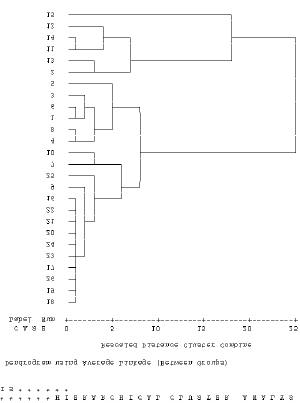
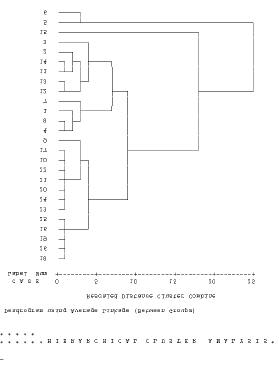
UNEP/GEF/SCS/RWG-CR.3/3
Annex 5
Page 2
Figure 1
Dendrogram using average linkage between groups based on the untransformed data
presented in Table 2 of Annex 4
Figure 2
Dendrogram using average linkage between groups based on the logarithmic
transformation of the number of hard coral species and number of coral reef fish species
UNEP/GEF/SCS/RWG-CR.3/3
Annex 5
Page 3
Table 2
Data table with logarithmic transformation of number of hard coral species and number
of coral reef fish species
Number of
Hard
Hard live coral change no.of
no of Number Number Number endangered
Site Name
coral
coral
cover
in live
algae
algae of coral of coral
of
and
Genera species (%)
coral
genera spe. reef fish reef fish mammal
cover
genera species species threatened
species
1 Cu Lao Cham
39
2.12
33.9
-1.9
61
122
76
2.25
1
4
2 Nha Trang bay
64
2.55
26.4
-21.2
35
55
102
2.35
3
7
3 Con Dao
50
2.17
23.3
-31.3
44
84
80
2.31
2
8
4 Phu Quoc
37
1.95
42.2
-3.3
51
98
60
2.13
2
8
5 Ninh Hai
49
2.29
36.9
0
86
190
81
2.17
2
6
6 Ca Na bay
48
2.13
40.5
-10
57
163
87
2.32
1
3
7 Ha Long - Cat Ba
48
2.23
43
-7.1
51
94
27
1.53
2
4
8 Hai Van - Son Tra
49
2.11
50.5
1
41
103
62
2.12
0
4
9 Bach Long Vi
31
2
21.7
-35
28
46
31
1.66
2
2
10 Batanes, Basco
40
2.3 37.00
0.00
20
47
50
1.93
1
1
11 Bolinao/Lingayen Gulf
45
2.4 40.00 -20.00
30
70
126
2.52
1
2
12 Masinloc, Zambales
40
2.35 33.00
0.00
30
60
97
2.4
2
2
13 Batangas bay/Maricaban
50
2.48 48.00 10.00
35
70
85
2.19
3
3
14 Puerto Galera, Mindoro
50
2.48 33.00
0.00
35
80
122
2.52
3
3
15 El Nido, Palawan
45
2.4 40.00 -20.00
40
80
169
2.68
4
4
16 Mu Koh Chumporn
31
1.97
55
0
10
20
53
1.91
5
4
17 Mu Koh Chang
39
1.8
40
2
36
43
60
2.05
5
8
18 Mu Koh Ang Thong
38
1.85
50
-5
7
7
62
2.03
6
4
19 Mu Koh Samui
37
1.85
40
-5
7
7
62
2.03
6
9
20 Mu Koh Samet
20
1.61
35
-10
33
38
51
1.87
6
10
21 Sichang Group
38
1.95
40
0
33
40
41
1.93
3
4
22 Sattaheep Group
38
1.95
33
0
33
40
44
1.88
3
4
23 Lan and Phai Group
20
1.86
18
-5
33
40
44
1.88
3
4
24 Chao Lao
25
1.78
30
0
28
33
40
1.85
3
4
25 Prachuab
35
1.87
50
-5
15
18
78
2.21
5
7
26 Koh Tao Group
38
1.9
45
-10
7
7
62
2.03
7
6
UNEP/GEF/SCS/RWG-CR.3/3
Annex 5
Page 4
Table 3
Data table with logarithmic transformation of number of hard coral species, number of
algal species and number of coral reef fish species
Number of
Hard live coral change no.of
no of Number Number Number endangered
Site Name
Hard coral
in live
of coral of coral
of
Genera
coral
cover
algae
algae
and
species (%)
coral
genera spe. reef fish reef fish mammal
cover
genera species species threatened
species
1 Cu Lao Cham
39
2.12
33.9
-1.9
2.09
2.09
76
2.25
1
4
2 Nha Trang bay
64
2.55
26.4 -21.2
1.74
1.74
102
2.35
3
7
3 Con Dao
50
2.17
23.3 -31.3
1.92
1.92
80
2.31
2
8
4 Phu Quoc
37
1.95
42.2
-3.3
1.99
1.99
60
2.13
2
8
5 Ninh Hai
49
2.29
36.9
0
2.28
2.28
81
2.17
2
6
6 Ca Na bay
48
2.13
40.5
-10
2.21
2.21
87
2.32
1
3
7 Ha Long - Cat Ba
48
2.23
43
-7.1
1.97
1.97
27
1.53
2
4
8 Hai Van - Son Tra
49
2.11
50.5
1
2.01
2.01
62
2.12
0
4
9 Bach Long Vi
31
2
21.7
-35
1.66
1.66
31
1.66
2
2
10 Batanes, Basco
40
2.3 37.00
0.00
1.67
1.67
50
1.93
1
1
11 Bolinao/Lingayen Gulf
45
2.4 40.00 -20.00
1.85
1.85
126
2.52
1
2
12 Masinloc, Zambales
40
2.35 33.00
0.00
1.78
1.78
97
2.4
2
2
Batangas
13 bay/Maricaban
50
2.48 48.00 10.00
1.85
1.85
85
2.19
3
3
Puerto Galera,
14 Mindoro
50
2.48 33.00
0.00
1.9
1.9
122
2.52
3
3
15 El Nido, Palawan
45
2.4 40.00 -20.00
1.9
1.9
169
2.68
4
4
16 Mu Koh Chumporn
31
1.97
55
0
1.3
1.3
53
1.91
5
4
17 Mu Koh Chang
39
1.8
40
2
1.63
1.63
60
2.05
5
8
18 Mu Koh Ang Thong
38
1.85
50
-5
0.85
0.85
62
2.03
6
4
19 Mu Koh Samui
37
1.85
40
-5
0.85
0.85
62
2.03
6
9
20 Mu Koh Samet
20
1.61
35
-10
1.58
1.58
51
1.87
6
10
21 Sichang Group
38
1.95
40
0
1.6
1.6
41
1.93
3
4
22 Sattaheep Group
38
1.95
33
0
1.6
1.6
44
1.88
3
4
23 Lan and Phai Group
20
1.86
18
-5
1.6
1.6
44
1.88
3
4
24 Chao Lao
25
1.78
30
0
1.52
1.52
40
1.85
3
4
25 Prachuab
35
1.87
50
-5
1.26
1.26
78
2.21
5
7
26 Koh Tao Group
38
1.9
45
-10
0.85
0.85
62
2.03
7
6
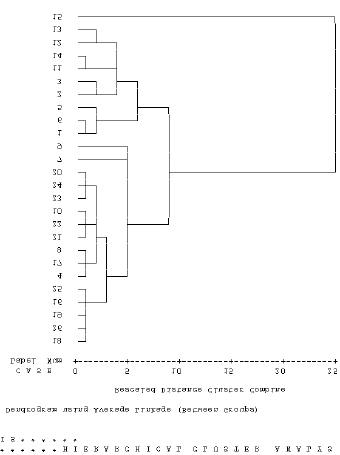
UNEP/GEF/SCS/RWG-CR.3/3
Annex 5
Page 5
Figure 3
Dendrogram using average linkage between groups based on the logrithmic
transformation of data for hard coral species, number of algae species and number of
coral reef fish species
UNEP/GEF/SCS/RWG-CR.3/3
Annex 6
Page 1
ANNEX 6
Ranking Indicators and Weights for Determination of Priority within Clusters of
Potential Demonstration Sites
Background
The Focal Points in each Specialised Executing Agency assembled, in advance of the third Regional
Working Group meeting data and information required to characterise coral reef sites bordering the
South China Sea. These data and information were based on the needs identified during the first
regional Working Group meeting.
Examination of Table 1 in Annex 4 clearly indicates that the range of data and information, envisaged
to be assembled, in characterising coral reef sites, was both comprehensive and overlapping in terms
of various aspects of each major class of parameter. In considering the indicators to be used in
ranking the priority of sites within each cluster, two major considerations were applied; the first, the
over-riding need for transparency in the process of site selection; and secondly the need to ensure
that, data were comparable for all sites considered by the focal points in each country. The indicators
used in ranking sites must be simple, and non-overlapping in terms of the inherent characteristics
covered by each indicator type. Hence the use of multiple indicators such as genera and species of
the same larger taxon should be avoided, as should the use of any indicator, however important it
might theoretically be, if such data cannot be supplied for the majority of sites.
Choice of Indicators
Table 1 lists the environmental indicators selected by the Regional Working Group as being indicative
of biological diversity, transboundary, regional and global significance.
The weighting to be assigned to the classes of indicator reflects the consensus view of members
concerning the relative importance of each class. Hence the indicators of biological diversity were
considered to merit greater weight than either transboundary, regional or global significance. It should
be recognised that in reality the indicators of transboundary, regional and global significance are in
fact indicators of biological diversity, hence the environmental class of indicators is strongly weighted
towards the biological characteristics of the sites concerned.
Within each class of indicator a series of one or more specific indicators were identified on the basis
of the outcome of the initial site characterisations, hence indicators were not included when it was
apparent that the information and/or data were difficult to assemble as evidenced by the frequency of
missing data in the preliminary set.
Following a careful analysis of the range of values demonstrated by the site data available to the
meeting, the Regional Working Group then considered the number of divisions and weighting that
would be appropriate to assign to any individual site value.
UNEP/GEF/SCS/RWG-CR.3/3
Annex 6
Page 2
Table 1
Indicators and weight for environmental characteristics including, biological diversity,
transboundary, regional and global significance
Indicators
Scale of Indicators
1
2
3
4
5
biological diversity, 60 points
Number of hard coral genera
< 30
31-40
41-50
51-60
> 60
Maximum score, 8
1
3
4
6
8
Number of hard coral species
< 100
101-150
151-200
201-300
> 300
Maximum score, 10
2
4
6
8
10
Percentage live coral cover
0-10
11-25
26-50
51-75
> 75
Maximum score, 6
1
2
3
4
6
Percentage algal cover
< 10
11-40
> 40
Maximum score, 3
3
2
1
Number of coral reef fish genera
< 20
21-30
31-50
51-60
> 60
Maximum score, 8
1
3
4
6
8
Number of coral reef fish species
< 100
101-250
251-400
401-600
> 600
Maximum score, 10
2
4
6
8
10
Number of mammal species, 5
< 5
5-10
> 10
Maximum score, 5
1
3
5
Number of other ecosystems, 10
< 1
1-2
> 3
Maximum score, 10
0
6
10
Transboundary Significant. 20 points
Number of Migratory Species
< 5
5-10
> 10
Maximum score, 8
3
6
10
Tourism (yes or no)
no
yes
Maximum score, 5
0
5
Cross-boundary Fishing (yes or no)
no
yes
Maximum score, 5
0
5
Regional/Global Significant. 10 points
Number of endangered and
threatened species
< 5
5-10
> 10
Maximum score, 10
3
6
10
Area 10, points
Area of coral reefs (ha)
< 100
101- 500
> 500
Maximum score, 10
3
6
10
Table 2 lists the indicators selected by the Regional Working Group as being indicative of socio-
economic conditions, including indicators of national priority, stakeholder involvement and threats. As
in the case of the environmental indicators the Regional Working Group discussed and agreed the
comparative weight that should be assigned to each class of indicator, then to individual indicators
within each class, finally deciding on the divisions and weights that should be assigned to the
observed values at any one site.
UNEP/GEF/SCS/RWG-CR.3/3
Annex 6
Page 3
Table 2
Indicators for socio-economic considerations including indicators of national priority,
stakeholder involvement and threats to be used in the ranking of coral reef sites
bordering the South China Sea
Indicators
Scale of Indicators
1
2
3
Threats, 15 points
Fishing impact
Low
Medium
High
Maximum score, 3
1
2
3
Development impact
Low
Medium
High
Maximum score, 3
1
2
3
Coral mining, 3
Low
Medium
High
Maximum score, 3
1
2
3
Land-based pollution
Low
Medium
High
Maximum score, 3
1
2
3
Natural impact (typoon, bleaching and COT star fish)
Low
Medium
High
Maximum score, 3
1
2
3
National significance, 25 points
Identified as a national priority
Rest
3
2
1
Maximum score, 10
0
3
6
10
Level of direct stakeholder involvement in management, 5
Low
Medium
High
Maximum score, 5
1
3
5
Socio-economic value, 10
Low
Medium
High
Maximum score, 10
3
6
10
Finance consideration - cofinancing, 20 points
Potential cofinancing
< 1:1
1:1
> 1:1
Maximum score, 20
10
15
20
Local stakeholder/ community involvement, 20 points
Local stakeholder/community involvement,
Low
Medium
High
Maximum score, 20
10
15
20
Transboundary management, 20 points
Potential transboundary management
no
yes
Maximum score, 20
0
20
Conclusion
Having agreed on the weighting and indicators the Regional Working Group agreed on the use of this
selection in a two tier process with the indicators in Table 1 being used as the primary means of
ranking regional importance of sites within the clusters and the indicators in Table 2 being applied at a
later stage when final decisions are being made.
UNEP/GEF/SCS/RWG-CR.3/3
Annex 7
Page 1
ANNEX 7
Results of Preliminary Ranking of Coral Reef Sites Bordering the South China Sea
Background
The second meetings of the Regional Scientific and Technical Committee and the Project Steering
Committee agreed to a three-step process of selecting demonstration sites based on, an initial
clustering of similar sites followed by, ranking and determination of priority of sites within clusters.
Having agreed upon the nature of the indicators and the weight to be assigned to them the site
characterisations available to the third meeting of the Regional Working Group on Coral Reefs were
scored according to the agreed indicators and weights, presented and discussed in Annex 6 of this
report.
Results
Table 1 presents the outcome of this exercise for all twenty-six, site characterisations and the 7 areas
in Cambodia with respect to the environmental indicators of biological diversity, transboundary,
regional and global significance. Due to the incomplete nature of the data sets, resulting in the
inclusion of individual focal point opinions regarding rank scores for missing data, together with
differences in the definitions of the indicators used by each focal point, it is not possible to combine
the outcome of this preliminary ranking at a regional scale.
Table 2 presents the rank scores for the socio-economic classes of indicator and it is apparent that
the scores assigned within each national grouping display little, cross-group comparability. It was also
noted by the Regional Working Group that as these indicators are "subjective" ones, since there were
different ways to assign the scores, for a number of the parameters.
Conclusions
The assignment of rank according to the agreed classes of indicators and their respective weighting
can be finalised promptly provided that the focal points submit the missing data to the PCU by the due
date.
UNEP/GEF/SCS/RWG-CR.3/3
Annex 7
Page 2
Table 1 Comparative rank score for coral reef sites bordering the South China Sea based on site
characterisations available to the third Regional Working Group meeting, March 2003.
Indicators of biological diversity, transboundary, regional, and global significance are included
together with their total
live
No.
Hard
Hard
Present No. of coral No. of
No. of
No. of
Cross endangered
Site Name
coral
No. of other
coral
coral
Tourism
Area
Total
cover
algae
reef fish coral reef mammal
Migratory
boundary
and
Genera species
ecosystems
(%)
cover
genera
fish Spp.
Spp.
Spp.
fishing
threatened
Spp.
Cambodia 1
KKCR1
3
4
4
3
3
6
3
10
6
5
5
6
10
68
KKCR2
1
2
3
3
3
2
1
6
6
5
5
6
10
53
SHVCR1
3
2
3
2
3
6
3
10
6
5
0
6
10
59
SHVCR2
1
4
4
2
1
2
3
6
6
5
0
6
10
50
SHVCR3
3
2
3
3
4
2
3
6
6
0
5
6
6
49
KAMPCR
3
4
4
3
3
4
3
10
6
5
5
6
6
62
KEPCR
1
2
3
3
3
4
3
6
6
5
5
6
6
53
Viet Nam
Cu Lao Cham
3
4
3
3
8
4
1
6
3
5
5
3
6
54
Nha Trang bay
8 10
3
3
8
4
1
6
3
5
5
6
6
68
Con Dao
4
4
2
3
8
4
1
6
3
5
5
6
10
61
Phu Quoc
3
2
3
3
6
4
1
6
3
5
5
6
10
57
Ninh Hai
4
6
3
3
8
4
1
6
3
5
5
6
10
64
Ca Na bay
4
4
3
3
8
4
1
6
3
5
5
3
10
59
Ha Long - Cat Ba
4
6
3
3
3
2
1
6
3
5
5
3
6
50
Hai Van - Son Tra
4
4
3
3
8
4
1
6
3
0
0
6
3
45
Bach Long Vi
3
2
2
3
4
2
1
0
3
0
5
3
6
34
Philippines
Batanes, Basco
3
4
3
3
3
2
1
6
6
5
5
3
3
47
Bolinao/Lingayen Gulf
6
8
3
3
8
6
1
6
3
5
0
3
10
62
Masinloc, Zambales
4
8
3
3
8
4
1
6
6
5
5
6
10
69
Batangas bay
6
8
3
3
8
6
1
6
6
5
0
3
10
65
Maricaban
Puerto Galera,
6 10
3
3
8
6
1
6
6
5
0
3
6
63
Mindoro
El Nido, Palawan
8
8
3
3
8
8
1
6
6
5
5
6
10
77
Thailand
Mu Koh Chumporn
3
4
4
3
6
4
3
10
10
5
0
6
10
68
Mu Koh Chang
4
4
3
3
8
4
3
10
10
5
5
6
10
75
Mu Koh Ang Thong
3
4
4
3
8
4
3
10
10
5
0
6
10
70
Mu Koh Samui
4
4
3
3
8
4
3
10
10
5
0
10
10
74
Mu Koh Samet
1
2
3
3
6
2
3
10
6
5
0
10
6
57
Sichang Group
3
2
2
3
4
2
1
10
6
5
0
3
3
44
Sattaheep Group
3
2
3
3
4
2
1
10
10
5
0
3
6
52
Lan and Phai Group
1
2
2
3
4
2
1
6
6
5
0
6
6
44
Chao Lao
4
2
3
3
4
4
1
0
6
5
0
3
3
38
Prachuab
3
2
3
3
8
4
3
6
10
5
0
6
6
59
Koh Tao Group
3
2
3
3
8
4
3
6
10
5
0
6
6
59
Song Khla
0
Koh Kra
0
Losin
0
1 Due to lack of coral reef data from Cambodia, the ranking for Cambodia was just a exercise, based on values estimated by
the focal point.
UNEP/GEF/SCS/RWG-CR.3/3
Annex 7
Page 3
Table 2
Comparative rank score for coral reef sites bordering the South China Sea, based on site
characterisations available to the third Regional Working Group meeting, March 2003.
Indicators of national priority, stakeholder involvement and threats are included together
with their total and the grand total of both environmental and socio-economic indicators
Level of
land-
typoon,
direct
socio-
Potential
Local
Potential
Site Name
fishing development coral
based bleaching national stakeholder economic
for
community
transboundary
impact
impact
mining
Total
pollution and COT priority involvement
value cofinancing involvement management
star fish,
in
management
Cambodia
KKCR1
3
3
1
2
2
6
3
10
10
15
20
75
KKCR2
3
1
1
1
1
3
3
10
10
20
0
53
SHVCR1
3
2
2
2
2
0
5
10
10
20
0
56
SHVCR2
3
3
2
3
2
0
5
10
10
20
0
58
SHVCR3
3
1
2
1
3
0
1
6
10
10
20
57
KAMPCR
3
2
1
3
2
0
5
10
10
20
0
56
KEPCR
3
3
2
3
3
10
5
10
10
20
20
89
Viet Nam
Cu Lao Cham
3
1
1
1
1
0
3
6
20
15
0
51
Nha Trang bay
3
2
1
2
3
6
3
10
20
15
0
65
Con Dao
2
2
1
1
3
10
3
6
10
15
0
53
Phu Quoc
2
2
1
2
2
3
1
10
15
10
20
68
Ninh Hai
3
2
2
1
1
0
3
6
15
20
0
53
Ca Na bay
3
2
1
1
1
0
3
10
10
10
0
41
Ha Long - Cat Ba
3
3
1
3
1
0
1
6
10
10
0
38
Hai Van - Son Tra
2
1
1
1
1
0
1
3
10
10
0
30
Bach Long Vi
3
1
1
1
2
0
3
6
10
10
0
37
Philippines
Batanes, Basco
2
1
1
1
3
0
5
6
15
15
20
69
Bolinao/Lingayen Gulf
3
3
1
2
3
3
5
6
15
20
0
61
Masinloc, Zambales
3
3
1
3
3
0
5
10
15
20
0
63
Batangas
bay/Maricaban
3
3
1
3
3
0
5
10
15
20
0
63
Puerto Galera,
Mindoro
2
3
1
2
2
6
5
6
15
15
0
57
El Nido, Palawan
2
2
1
2
3
10
5
10
20
20
20
95
Thailand
Mu Koh Chumporn
2
2
1
2
3
10
5
10
20
20
0
75
Mu Koh Chang
3
3
1
2
3
3
5
10
20
20
20
90
Mu Koh Ang Thong
2
1
1
1
3
6
5
10
20
20
0
69
Mu Koh Samui
2
3
1
2
3
0
5
10
20
20
0
66
Mu Koh Samet
2
3
1
2
3
0
5
10
20
20
0
66
Sichang Group
3
3
1
3
2
0
5
10
20
20
0
67
Sattaheep Group
2
2
1
2
2
0
3
6
15
15
0
48
Lan and Phai Group
2
3
1
3
3
0
3
10
20
20
0
65
Chao Lao
2
2
1
2
2
0
5
10
20
20
0
64
Prachuab
3
3
1
2
3
0
5
10
15
20
0
62
Koh Tao Group
2
2
1
1
3
0
3
10
20
20
0
62
Song Khla
0
Koh Kra
0
Losin
0
UNEP/GEF/SCS/RWG-CR.3/3
Annex 8
Page 1
ANNEX 8
Schedule of Meetings, for 2003
Table 1
Schedule of meetings for 2003
M T W T F S S M T W T
F
S
S M T
W T
F
S
S
M T
W T
F
S
S
M T
W T
F
S
S
M
January
1
2
3
4
5
6
7
8
9
10
11
12 13
14
15
16
17 18
19
20
21
22 23
24
25
26
27 28
29
30
31
February
1
2
3
4
5
6
7
8
9
10
11
12
13
14 15
16
17
18
19 20
21
22
23
24 25
26
27
28
Chinese N.Y.
March
1
2
3
4
5
6
7
8
9
10
11
12
13
14 15
16
17
18
19 20
21
22
23
24 25
26
27
28
29 30
31
RWG-M-3
RWG-S-3
RWG-W-3
RWG-CR-3
April
1
2
3
4
5
6
7
8
9
10
11
12
13 14
15
16
17
18 19
20
21
22
23 24
25
26
27
28 29
30
RWG-F-3
Thai N.Y.
RWG-LbP-3
May
1
2
3
4
5
6
7
8
9
10
11 12
13
14
15
16 17
18
19
20
21 22
23
24
25
26 27
28
29
30
31
RSTC-3
June
1
2
3
4
5
6
7
8
9
10
11
12
13 14
15
16
17
18 19
20
21
22
23 24
25
26
27
28 29
30
July
1
2
3
4
5
6
7
8
9
10
11
12
13 14
15
16
17
18 19
20
21
22
23 24
25
26
27
28 29
30
31
August
1
2
3
4
5
6
7
8
9
10 11
12
13
14
15 16
17
18
19
20 21
22
23
24
25 26
27
28
29
30 31
RWG-LbP-4
September 1
2
3
4
5
6
7
8
9 10
11
12
13
14 15
16
17
18
19 20
21
22
23
24 25
26
27
28
29 30
RWG-F-4
RWG-S-4
RWG-CR-4
October
1
2
3
4
5
6
7
8
9
10
11
12 13
14
15
16
17 18
19
20
21
22 23
24
25
26
27 28
29
30
31
Cont.
RWG-W-4
RWG-M-4
Ramadan
November
1
2
3
4
5
6
7
8
9
10
11
12
13
14 15
16
17
18
19 20
21
22
23
24 25
26
27
28
29 30
Ramadan
December
1
2
3
4
5
6
7
8
9 10
11
12
13
14 15
16
17
18
19 20
21
22
23
24 25
26
27
28
29 30
31
Regional
Sci. Mtg
RSTC-4
PSC-3
Xmas