
United Nations
UNEP/GEF South China Sea
Global Environment
Environment Programme
Project
Facility
Reversing Environmental Degradation Trends
in the
South China Sea and Gulf of Thailand
REPORT
Fifth Meeting of the Regional Working Group for
the Land-Based Pollution Component
Shenzhen, China, 24th 27th November 2004
__________________________________________________________________________________
UNEP/GEF
Bangkok, November 2004

First published in Thailand in 2005 by the United Nations Environment Programme.
Copyright © 2005, United Nations Environment Programme
This publication may be reproduced in whole or in part and in any form for educational or non-profit
purposes without special permission from the copyright holder provided acknowledgement of the
source is made. UNEP would appreciate receiving a copy of any publication that uses this publication
as a source.
No use of this publication may be made for resale or for any other commercial purpose without prior
permission in writing from the United Nations Environment Programme.
UNEP/GEF
Project Co-ordinating Unit,
United Nations Environment Programme,
UN Building, 2nd Floor Block B, Rajdamnern Avenue,
Bangkok 10200, Thailand
Tel.
+66 2 288 1886
Fax.
+66 2 288 1094
http://www.unepscs.org
DISCLAIMER:
The contents of this report do not necessarily reflect the views and policies of UNEP or the GEF. The
designations employed and the presentations do not imply the expression of any opinion whatsoever
on the part of UNEP, of the GEF, or of any cooperating organisation concerning the legal status of
any country, territory, city or area, of its authorities, or of the delineation of its territories or boundaries.
Cover Photo: Environmental risk caused by Algae Bloom in Ca Na Bay, Viet Nam by DOST Binh
Thuan.
For citation purposes this document may be cited as:
UNEP, 2005. Reversing Environmental Degradation Trends in the South China Sea and Gulf of
Thailand. Report of the Fifth Meeting of the Regional Working Group on Land-Based Pollution.
UNEP/GEF/SCS/RWG-LbP.5/3.
UNEP/GEF/SCS/RWG-LbP.5/3
Table of Contents
1.
OPENING OF THE MEETING ......................................................................................................1
1.1 WELCOME ADDRESS ON BEHALF OF UNEP .............................................................................1
1.2 OPENING STATEMENT BY THE REPRESENTATIVE OF THE BAO'AN LOCAL GOVERNMENT.............1
1.3 INTRODUCTION OF PARTICIPANTS ...........................................................................................2
2.
ORGANISATION OF THE MEETING...........................................................................................2
2.1 ELECTION OF OFFICERS .........................................................................................................2
2.2 ADMINISTRATIVE ARRANGEMENTS ..........................................................................................2
3.
ADOPTION OF THE MEETING AGENDA ...................................................................................2
4.
REPORTS REGARDING OVERALL PROGRESS TO DATE .....................................................3
4.1 BRIEF REPORTS FROM THE FOCAL POINTS AND PROJECT CO-ORDINATING UNIT
REGARDING THE STATUS OF THE PREPARATORY PHASE OUTPUTS ..........................................3
4.2 STATUS OF THE ADMINISTRATIVE REPORTS FOR 2003/2004: PROGRESS REPORTS;
EXPENDITURE REPORTS; AUDIT REPORTS; AND MOU AMENDMENTS .......................................4
4.3 CONSIDERATION OF PROGRESS IN FINALISING THE PILOT ACTIVITIES .......................................5
5.
OVERVIEW OF THE OUTCOMES OF PREVIOUS MEETINGS OF THE REGIONAL
WORKING GROUP AND OUTSTANDING ACTIONS.................................................................6
6.
EVALUATIONS OF THE PROJECT DURING 2004....................................................................7
6.1 MID-TERM EVALUATION..........................................................................................................7
6.2 SPECIALLY MANAGED PROJECT REVIEWS ...............................................................................8
6.3 IW-PORTFOLIO REVIEW 2004 ................................................................................................9
6.4 EVALUATION OF THE OPERATION OF THE FINANCIAL INSTRUMENTS ..........................................9
7.
CONSIDERATIONS REGARDING THE DETERMINATION OF CARRYING CAPACITY .......10
7.1 CIRCULATION MODELS OF SURFACE CURRENTS IN THE SOUTH CHINA SEA ............................10
7.2 DETERMINATION OF CARRYING OR ASSIMILATIVE CAPACITY...................................................10
7.3 CASE STUDY ESTIMATING CARRYING CAPACITY OF GUANGHAI BAY FOR BOD, COD,
S2-, C 6+
R ............................................................................................................................. 11
7.4 CARRYING CAPACITY AND ECOLOGICAL RISK ASSESSMENT IN THE INNER GULF OF THAILAND .11
8.
REVIEW OF THE NATIONAL ACTION PLANS AND THEIR RELATIONSHIP TO THE
REGIONAL STRATEGIC ACTION PROGRAMME ...................................................................13
8.1 COMPARATIVE REVIEW OF THE CONTENT OF THE NATIONAL ACTION PLANS ...........................13
8.2 CONSIDERATION OF THE GOALS AND TARGETS OF THE FRAMEWORK STRATEGIC ACTION
PROGRAMME AND RECOMMENDATIONS REGARDING AMENDMENTS AND FURTHER
ELABORATION......................................................................................................................14
9.
REVIEW OF THE FIRST DRAFT OF THE REGIONAL OVERVIEW OF LAND-BASED
POLLUTION IN THE SOUTH CHINA SEA ................................................................................15
10. CONSIDERATION OF THE DRAFT BIBLIOGRAPHY OF ECONOMIC VALUATION
OF LAND-BASED POLLUTION.................................................................................................15
11. REVISION OF THE WORK PLAN AND ACTIVITIES FOR THE REGIONAL WORKING
GROUP ON LAND-BASED POLLUTION 2004 - 2007..............................................................16
12. DATE AND PLACE OF THE SIXTH MEETING OF THE REGIONAL WORKING GROUP
ON LAND-BASED POLLUTION ................................................................................................16
13. ANY OTHER BUSINESS............................................................................................................17
14. ADOPTION OF THE REPORT OF THE MEETING ...................................................................17
15. CLOSURE OF THE MEETING ...................................................................................................17
UNEP/GEF/SCS/RWG-LbP.5/3
List of Annexes
ANNEX 1
List of Participants
ANNEX 2
List of Documents
ANNEX 3
Agenda
ANNEX 4
Substantive Reports Received by the PCU from the Specialised Executing
Agencies
ANNEX 5
Circulation Models of Surface Currents in the South China Sea
ANNEX 6
Case Study--Estimating Carrying Capacity of Guanghai Bay for BOD, COD, S2-,
Cr6+
ANNEX 7
Carrying Capacity and Ecological Risk Assessment in the Inner Gulf of
Thailand
ANNEX 8
Comparative Analysis of Contents of Draft National Action Plans for Land-
based Pollution
ANNEX 9
Work Plan for Land-based Pollution Component to June 30th 2007 and Schedule
of Meeting for 2005
ANNEX 10
Proposed Budgets for Estimating Carrying Capacity in the South China Sea
UNEP/GEF/SCS/RWG-LbP.5/3
Page 1
Report of the Meeting
1.
OPENING OF THE MEETING
1.1
Welcome Address on behalf of UNEP
1.1.1
The Project Director, Dr. John Pernetta, warmly welcomed participants and observers to the
fifth meeting of the Regional Working Group on Land-based Pollution (RWG-LbP) on behalf of
Dr. Klaus Töpfer, the Executive Director of the United Nations Environment Programme (UNEP) and
Dr. Ahmed Djoghlaf, Assistant Executive Director, and Director, Division of Global Environment
Facility Co-ordination (UNEP/DGEF). Dr. Pernetta noted that, the meeting was privileged to have
Mr. Liu Jiabao, the Director of Bao'an District Environment Protection Bureau, and Mr. Chen
Qiaonian, the Chief Engineer of the Shenzhen Municipal Environment Protection Bureau, present and
expressed his appreciation to the local government for their support to the pilot activity on urban
waste-water treatment though development of an artificial wetland.
1.1.2 He noted that the meeting had a very full agenda with various important issues for
consideration, and that as the project entered the operational phase, it was important to clarify and
programme future activities. He further highlighted an important key task, which was the estimation of
the carrying capacity of the South China Sea. It was noted that the work in the preparatory phase of
the project had mainly focused on reviews of data and information that could contribute to, the
estimation of the carrying capacity.
1.1.3 Dr. Pernetta noted that Mr. Yihang Jiang had left the project to take up the post of Chief
Technical Officer in the Yellow Sea Project, where the main issues were fisheries and pollution. The
project involved China and South Korea and Dr. Pernetta expressed the hope that close collaboration
would be developed between the Yellow Sea Project and UNEP/GEF South China Sea Project.
1.2
Opening Statement by the Representative of the Bao'an Local Government
1.2.1 The Project Director invited the local government representatives, Mr. Liu Jiabao and
Mr. Chen Qiaonian to address the meeting. Mr. Liu Jiabao welcomed participants in the fifth meeting
of the Regional Working Group on Land-based Pollution to Bao'an District, and expressed his
appreciation to the members of the Working Group in supporting environment protection in Bao'an
District. Mr. Liu pointed out that, Bao'an had achieved continuous economic growth over the past two
decades. In 2003, the annual GDP growth rate of Bao'an District was 19.7%. In developing the
economy, the Bao'an local government had also paid attention to environmental protection and had
made considerable investments in environment protection, for example in 2004, Bao'an had invested
around US$20 million in reducing pollution.
1.2.2 Mr. Liu further informed the meeting that the local government had developed basic
infrastructure for environmental protection and gained some experience in waste water treatment
through the construction of artificial wetlands. He informed the meeting that Bao'an planned to
establish its waste-water treatment system by the end of 2005, with seven waste-water treatment
plants constructed. Furthermore, Bao'an had also constructed artificial wetlands in Shiyan River and
Liaokeng River, additionally four more artificial wetlands would be constructed in Maozhou River and
Shiyan River. Despite the achievements already made by Bao'an District, he considered Bao'an
environment protection needed to be further improved and strengthened under guidance of the
Working Group. Finally he wished members of the Working Group a pleasant stay in Bao'an and a
successful meeting.
1.2.3 On behalf of the Shenzhen Municipal Government, the Chief Engineer, Mr. Chen Qiaonian,
warmly welcomed the participants to Shenzhen. He pointed out that Shenzhen had achieved an
economic miracle in the past two decades with an average annual GDP growth rate of 28%. At the
same time, he noted the fast economic development had generated serious pollution of coastal
waters, and had placed a tremendous pressure on the environment. He expressed his hope that the
international expertise of the Working Group would be helpful to Shenzhen government's efforts in
reconciling economic development with environment protection.
UNEP/GEF/SCS/RWG-LbP.5/3
Page 2
1.3 Introduction
of
Participants
1.3.1 Members of the Regional Working Group for Land-based Pollution (RWG-LbP), alternates
and observers were invited to introduce themselves to the meeting and provide a brief outline of their
experience, expertise, and involvement in the implementation of the project. The list of participants is
attached to this meeting report as Annex 1.
2.
ORGANISATION OF THE MEETING
2.1 Election
of
Officers
2.1.1 The Project Director reminded the working group that the Rules of Procedure state that, the
Regional Working Group shall elect, from amongst the members, a Chairperson, Vice-Chairperson
and Rapporteur to serve for one year. The Rules further state that members shall be eligible for
re-election no more than once.
2.1.2 Members recalled that at the third meeting convened in Phuket in July 2003 Mr. Han Baoxin,
Mr. Vincente Diaz and Mr. Mohamad bin Jaafar were elected as Chairperson, Vice-Chairperson and
Rapporteur and that Mr. Han Baoxin and Mr. Vincente Diaz had served as Chairperson and Vice-
Chairperson during the fourth meeting held in March 2004. Due to the absence of Mr. Jaafar,
Ms. Carol Hoh Mui Ling was elected Rapporteur. Mr. Baoxin and Mr. Diaz had therefore served for 15
months and Ms. Hoh for 7 months.
2.1.3 Dr. Pernetta noted that in the view of the PCU the current officers were eligible for re-election
and pointed out that the Chairperson would be required to report on the outcomes of the work of the
Regional Working Group on Land-based Pollution to the fifth meeting of the Regional Scientific and
Technical Committee, which was scheduled to take place in Fangchenggang, China from 9th to 11th
December 2004.
2.1.4 Members were invited to nominate members as Chairperson, Vice-Chairperson and
Rapporteur for the period to the next meeting in 2005. Dr. Pham Van Ninh proposed that Professor
Han Baoxin be re-elected as Chairperson, that Mr. Dasminto be elected Vice-Chairperson, and Ms.
Carol Hoh Mui Ling continue as the Rappporteur. This proposal was seconded by Mr. Boonyong
Lohwongwatana and there being no objection, Dr. Han, Mr. Dasminto and Ms. Hoh were duly elected
as officers for the meeting.
2.2 Administrative
Arrangements
2.2.1 The Project Director briefly introduced the documentation available to the meeting. The list of
documents is contained in Annex 2 to this meeting report.
2.2.2
The Project Director briefed participants on the administrative arrangements for the conduct
of the meeting, and the proposed organisation of work (UNEP/GEF/SCS/RWG-LbP.5/Inf.3). Formal
sessions of the meeting would be conducted in English, and in plenary, although it was envisaged
that, sessional working groups might be formed to complete the various reviews and analyses of
substantive agenda items as appropriate.
3.
ADOPTION OF THE MEETING AGENDA
3.1
The Chairperson introduced the provisional agenda prepared by the Project Co-ordinating Unit
(PCU) as document UNEP/GEF/SCS/RWG-LbP.5/1, and the annotated provisional agenda,
document UNEP/GEF/SCS/RWG-LbP.5/2, and invited members to propose any amendments or
additional items for consideration, prior to the adoption of the agenda.
3.2
Dr. Pornsook proposed to add a case study on the carrying capacity and ecological risk
assessment in the Gulf of Thailand under agenda item 7 and Dr. Pernetta indicated that a document
would be circulated for consideration under this agenda item concerned with the carrying capacity in
Guanghai Bay. The meeting agreed to add two sub-items under agenda item 7 to cover these case
studies.
UNEP/GEF/SCS/RWG-LbP.5/3
Page 3
3.3
There being no other proposal for amendment or addition, the meeting proceeded to adopt the
meeting agenda with the additions proposed by Dr. Pornsook and Dr. Pernetta. The adopted,
amended agenda is attached as Annex 3 to this meeting report.
4. REPORTS
REGARDING
OVERALL PROGRESS TO DATE
4.1
Brief Reports from the Focal Points and Project Co-ordinating Unit Regarding the
Status of the Preparatory Phase Outputs
4.1.1 The National Focal Points for the Land-based Pollution Component from the participating
countries were invited to provide the meeting with a brief report regarding the status of the
preparatory phase outputs, including national reports and national action plans.
4.1.2 Document UNEP/GEF/SCS/RWG-LbP.5/4 "Status of the Substantive Reports of the
Specialised Executing Agencies (SEAs) for the Land-based Pollution Component from the
Participating Countries" was up-dated and electronic copies of missing reports were provided to the
PCU. The up-dated list is attached as Annex 4 to this report.
4.1.3 It was noted that during the fourth meeting, reviews from the PCU and the regional expert, of
the drafts of the substantive reports had been presented (document UNEP/GEF/SCS/RWG-Lbp.4/61)
and that focal points were expected to have reviewed these comments and amended and expanded
their drafts appropriately.
4.1.4 Professor Han informed the meeting that a draft NAP had been completed and distributed to
Guangdong, Guangxi and Hainan local governments for their consideration and comments.
Additionally, the development of the NAP was integrated into the process of developing the local
"Blue Sea Action Plan", which would be implemented by the local governments.
4.1.5 Regarding the national reports, Professor Han indicated that China had submitted all required
national reports to the PCU, and reported to the meeting that China had published in Chinese the
Pearl River estuary report, Daya Bay hotspot report and Beihai City hotspot report. The published
reports had been submitted to the State Environment Protection Agency (SEPA), and the concerned
local governments.
4.1.6 Dr. Pornsook informed the meeting that Thailand had completed all the reports required in the
preparatory phase of the project, and revised all the reports based on the regional experts' comments.
Currently, the reports were in the process of publication in Thai language.
4.1.7 Mr. Diaz informed the meeting that the Philippines land-based pollution component had
experienced difficulty in gathering together the information and had not yet published the national
report.
4.1.8 Ms. Hoh indicated that she had only recently been assigned as the focal point for the land-
based pollution component in Malaysia and indicated that no electronic copy of the national report
had been sent to the PCU although a hard copy of the report was made available. She apologised for
the delay in finalising the report and indicated that an electronic copy would be sent to the PCU.
4.1.9 With regard to the national action plan, Ms. Hoh requested clarification as to whether all the
participating countries should develop a national action plan, or only those with pilot activities. In
response it was pointed out that the requirement to develop a National Action Plan was included in
the original MoUs and that this was integral to the development of the regional Strategic Action
Programme.
4.1.10 Mr. Pak Sokharavuth, Mr. Dasminto and Dr. Pham Van Ninh informed the meeting that
Cambodia, Indonesia and Viet Nam had completed all required reports anticipated in the first phase of
the project, and submitted these to the PCU.
1 Included in the information documents for this meeting.
UNEP/GEF/SCS/RWG-LbP.5/3
Page 4
4.1.11 Noting that the latest versions of some of national reports held by the PCU were dated prior to
the convening of the fourth RWG-LbP meeting Dr. Gullaya expressed concern regarding whether
countries had made efforts to revise the reports according to the regional experts' comments, as the
original drafts contained many mistakes. Members' attention was again drawn to the comments on the
national reports, contained in document UNEP/GEF/SCS/RWG-Lbp.4/6.
4.1.12 It was noted that there were inconsistencies between versions of national reports produced by
the SEAs and those held by the PCU. Considering the communication problems resulting from the
regular breakdowns of the UN email system and the disruption of communications following Mr.
Yihang Jiang's departure, the Project Director requested each of the members to complete a list of
updated national reports completed in the first phase of the project, and provide the PCU with an
electronic version of the most up-to-date version. In addition, Dr. Pernetta requested that any
documents published at the national level, carrying the logos of the UNEP, UNEP/GEF Project logo,
and GEF logos be sent to the PCU for the records of the Project.
4.2
Status of the Administrative Reports for 2003/2004: Progress Reports; Expenditure
Reports; Audit Reports; and MoU Amendments
4.2.1
The Chairperson invited the Project Director to introduce document UNEP/GEF/SCS/RWG-
LbP.5/5, "Current status of budgets and reports from the Specialised Executing Agencies in the
participating countries" and draw to the attention of the meeting any outstanding issues or matters
requiring the attention of the working group.
4.2.2
Dr. Pernetta drew the attention of participants to Table 1, which presents a summary of the
status of administrative reports. It was noted that China and Indonesia had not submitted the draft
administrative reports for the period January to June 2004, which were overdue by more than four
months. The Project Steering Committee (PSC) in its second meeting had instructed the SEAs to
submit administrative and financial reports within 10 days of the closure of the reporting periods.
Despite the experience in financial and administrative reporting in the past two and half years, the
SEAs continued to delay submission.
4.2.3 In addition to the routine reports, UNEP required an annual audit of expenditures by a
recognised firm of public accountants, which should be dispatched to the PCU by 31 March 2004 for
expenditures in 2003. The Project Director informed the meeting, that following a recent visit to
Nairobi, the SEAs would be exempt from annual auditing if the annual cash advance was less than
US$10,000, which would be applied to all SEAs with no pilot activities in the next phase of the project.
4.2.4
The Project Director noted that the delays by the SEAs in submitting routine financial and
administrative reports had caused tremendous administrative burdens on the PCU, resulting in
disruption to the overall work plan and schedules not only of the PCU but also of the project as a
whole. Without expenditure reports, budgets for the next phase of the project could not be finalised,
hence the second amendment to the MoUs could not be finalised and signed, which prevented any
further transfer of funds and also prevented the activities being implemented in a timely manner in the
second phase.
4.2.5 Members with outstanding financial and administrative reports were invited to clarify the
status of these reports, and indicate when they would be submitted. Professor Han indicated that
China had drafted a six-monthly progress report, and would submit the draft at the end of the meeting.
Prof. Han indicated he had participated in a special training in Beijing from May to August 2004,
resulting in the delay in submitting the required routine reports. Mr. Dasminto submitted the six-
monthly reports during the course of the meeting.
4.2.6
Members' attention was drawn to Table 2 of the document, and the Project Director noted
that some SEAs continue to hold large amounts of cash in hand, which not only causes auditing
problems, but also prevents the PSC from reallocating unspent funds. Members were reminded that
interest from any unspent funds should be spent on project activities and should be reported in the
expenditure reports.
4.2.7
Dr. Pernetta drew attention to the tabulation of co-financing, calculated in terms of meeting
participation at the national level using the cost coefficient (US$70 per person/day) agreed by the
UNEP/GEF/SCS/RWG-LbP.5/3
Page 5
PSC. He also noted that the GEF Council had recently adopted a policy document that required GEF
funded projects to track and report the co-financing with the same due diligence as the GEF grant. In
accordance with this newly adopted policy, the SEAs should formally report future national co-
financing to the PCU.
4.2.8 On the basis of a comparison of national co-financing across components and sub-
components, it was noted that land-based pollution was the only component which had failed to meet
the estimated co-financing, suggesting that this component had received less support from the focal
points compared with the others.
4.2.9 Members' attention was drawn to document UNEP/GEF/SCS/RWG-LbP.5/6 "Proposed draft
amendments to the memoranda of understanding to cover the period July 2004 to June 30th 2007",
which contained a proposed draft amendment to the Memoranda of Understanding for consideration
of members. It was noted that this had been approved in principle by the fourth meeting of the RSTC
and it was again noted by, the Project Director that, without expenditure reports the budget could not
be completed and the amendment not signed.
4.2.10 The Project Director proposed to discuss during the course of the meeting with each
individual focal point any problems that had held up the process of preparing the second amendment
to the Memoranda. It was hoped that the second amendments to the Memoranda could be finalised
and signed during the course of the meeting.
4.3
Consideration of Progress in Finalising the Pilot Activities
4.3.1 The Chairperson recalled that the Executive Committee of the Regional Scientific and
Technical Committee had met in May 2004, in Bangkok, Thailand to consider the proposals for pilot
activities in the land-based pollution component. The main decisions of the Executive Committee
were: that:
(ii)
The Executive Committee recommended to the PSC to approve the 3 pilot
activities recommended by the RWG-LbP;
(iii)
It was agreed by the Executive Committee to recommend to the PSC to set a
budget ceiling for each proposed activity of US$100,000;
(iv)
The SEAs responsible for the three proposals should revise the documents in line
with this ceiling, without substantial change in functions and activities. These
revisions will likely require additional co-financing and should be completed within
one month of the approval by the PSC of these recommendations, in accordance
with the procedures agreed during the third meeting of the PSC;
(v)
In the event that one or more projects cannot be executed with the reduced budget
then consideration should be given to withdrawing the proposal and the funds
should be re-allocated during subsequent consideration of a second round of
proposals;
4.3.2 Members should note that, these decisions were circulated to the members of the PSC for
approval on a no objections basis. Since no objections were received within the agreed time frame
the decisions were deemed to have been approved by the PSC and have been acted upon. The
Chairperson invited the focal points of China, Indonesia and Thailand to brief the meeting on the
current status of the pilot activities.
4.3.3 Dr. Pornsook informed the meeting that after receiving the recommendations of the Executive
Committee of the RSTC regarding the selection of pilot activities in the land-based pollution
component, Thailand had tried to revise the proposal to adjust the budget of the Thailand pilot activity
under the US$100,000, ceiling set by the RSTC and the PSC. It was not possible to meet the project
goal with the limited grant allocated by the GEF project. Dr. Pornsook indicated that a letter had been
sent to the PCU in June 2004 requesting additional funding, with an implied intent to withdraw the
project proposal due to insufficient funding.
UNEP/GEF/SCS/RWG-LbP.5/3
Page 6
4.3.4 In response Dr. Pernetta pointed out that the letter received in June 2004 was equivocal, and
did not in fact state clearly the intention to withdraw the proposal, and that the PCU was only recently
informed of Thailand's intention to withdraw the pilot activity proposal. He noted that the Regional
Working Group might wish to consider options for reallocating the available funding during the course
of the meeting and such recommendations could then be placed before the Project Steering
Committee for their consideration.
4.3.5 Dr. Pornsook then officially informed the meeting of Thailand's decision to withdraw the pilot
activity proposal, due to late approval of GEF funding and Thailand co-financing was allocated for
2004 which could not be postponed to 2005 and limited GEF funding available to execute the
proposed activities contained in the proposal. Accepting Thailand's withdrawal of its proposal, the
meeting decided to consider options for re-allocation of the available US$100,000.
4.3.6 Mr. Boonyong proposed to re-allocate the available funding to another pilot activity and
Dr. Pernetta noted that there would need to be a re-prioritisation of all pilot activities proposed by the
participating countries, for such a reallocation. Dr. Ninh was asked whether the Vietnamese proposed
pilot activities had been funded by, the government and it was noted that these had not been
executed to date.
4.3.7 Dr. Pernetta noted further that additional activities, if prepared in an appropriate format could
be submitted and supported by the PCU to external donors with a view to raising the required
additional co-financing. However in the absence of properly formatted and budgeted proposals it
would be difficult for the PCU to approach potential donors. During the Regional Scientific
Conference, in February 2004, funds had been raised to support additional demonstration site
activities in the habitat sub-components. In this connection, Dr. Pernetta inquired whether there were
any proposals that needed additional co-financing. No focal point had any existing proposal that could
be submitted to potential donors.
4.3.8 Dr. Pornsook proposed to re-allocate the funds to activities such as the estimation of the
carrying capacity of the South China Sea. This was further supported by Mr. Boonyong, and the
meeting agreed to defer the decision to Agenda item 13, any other business, after completion of all
major agenda items of the meeting.
4.3.9 Mr. Dasminto informed the meeting that a draft budget of around US$130,000 had originally
been proposed but that the focal point would revise the budget in line with the decision made by the
RSTC, reducing it to under US$100,000.
4.3.10 Professor Han briefed the meeting regarding the status of China's pilot activity proposal, and
informed the meeting that China had revised the proposal and reduced the budget under the ceiling
set by the RSTC. A revised proposal was submitted to the PCU on 12 July 2004 and comments had
been received from the PCU. He noted that there still existed some small problems in the budget,
which he aimed to revise in the immediate future. Another difficulty encountered by China in finalising
the proposal was the need to integrate consideration of sources and impacts. He indicated that the
revision in accordance with the PCU comments would be finalised within a week following the
conclusion of the meeting.
4.3.11 Professor Han further informed the meeting that, in the past half year, the Bao'an local
government had contracted China's land-based pollution component SEA to complete a feasibility
study on waste treatment in Bao'an district. Furthermore, the local government had set up a special
management committee on waste water treatment facilities, including the use of artificial wetlands in
treating waste water.
5.
OVERVIEW OF THE OUTCOMES OF PREVIOUS MEETINGS OF THE REGIONAL
WORKING GROUP AND OUTSTANDING ACTIONS
5.1
The Chairperson invited the Project Director to introduce document UNEP/GEF/SCS/RWG-
LbP.5/7 "Review of previous decisions of the Regional Working Group on Land-based Pollution and
proposals for further action". Dr. Pernetta drew members' attention to Table 1 of the document
summarising major issues discussed and agreements reached in previous meetings of this Working
Group. It was noted that a number of decisions taken in past meetings had not been followed up in
UNEP/GEF/SCS/RWG-LbP.5/3
Page 7
subsequent meetings. For example, a major task identified in the first meeting, which was not
mentioned or followed up by the Working Group was the estimation of the carrying capacity of sub-
regions and sensitive ecosystems with respect to pollution load. The failure to carry out this task had
been pointed out by the mid-term evaluators.
5.2
The Project Director further pointed out, that one of the main purposes of this project was to
strengthen regional cooperation on environmental management in the South China Sea, hence it was
important that the Working Group should consistently follow up issues. He noted that three major
tasks in the next phase of the project included the development of national action plans and the
regional Strategic Action Programme, estimation of the environmental carrying capacity of the South
China Sea and economic valuation of the impacts of land-based pollution.
5.3
Members were invited to consider solutions to ensure activities were followed up in
accordance with meeting decisions. Ms. Hoh suggested that the meeting should identify the
individuals responsible for coordination of each agreed activity. Mr. Boonyong suggested that an
automatic agenda item should be "matters arising from the previous meeting" that should keep the
issues in front of members. From her experience in coordinating the preparation of the Regional
Overview of land-based pollution, Dr. Gullaya noted that although every focal point should have
actively participated some had been extremely slow to contribute. Hence the Working Group could not
complete its work even when a member was designated to coordinate certain activities.
5.4
In sharing his experience in compiling the regional GIS and meta databases, Dr. Anond noted
that the SEAs were the bottlenecks in the process of developing the regional GIS and meta
databases. Recognising the SEAs had other obligations and responsibilities, he proposed that it
would facilitate the process if the SEAs could identify individuals at the national level who would be
responsible for certain tasks.
5.5
In response to a query raised by Dr. Gullaya regarding the purpose of the meta-data and GIS
databases, Dr. Anond stated there were dual purposes to creating the GIS and meta-databases. First
was to support the preparation of regional overviews of the status of land-based pollution in the South
China Sea and second to serve as a resource for regional reference. In response to a question raised
by Dr. Pernetta on when the interactive database would be linked and accessed through the project
website, Dr. Anond stated that the GIS database was currently interactive and could be accessed
through the SEA START RC website, he would ensure the linkage of the GIS and meta-databases
with the project web site.
5.6
Noting the difficulties of communications, it was proposed that the SEAs be authorised to
update their data and information through the internet. It was also suggested that an interface be
created in the SEA START RC website so that SEAs could submit updated data and information
through internet. Dr. Anond agreed to create a function on the web so that the SEAs could submit the
data directly.
5.7
In conclusion, the meeting agreed that communication among members of the Working Group
should be improved and strengthened. Dr. Pernetta noted, that in the second meeting, the Working
Group had called for the establishment of strong linkage and communication among members of the
Working Group to ensure proper coordination and cooperation. In this regard, he proposed and the
meeting agreed that communications on substantive issues or the submission of substantive reports
to the PCU should be copied via e-mail to all other members of the RWG-LbP.
6.
EVALUATIONS OF THE PROJECT DURING 2004
6.1 Mid-term
Evaluation
6.1.1 The Chairperson invited the Project Director to introduce this agenda item. The Project
Director noted that the mid-term evaluation of the project was conducted between February and July
2004 by two independent evaluators Dr. Mike Bewers and Professor Su Jilan. The Mid-term
Evaluation Report had been finalised and accepted by the Monitoring and Evaluation Unit of the
Office of the Executive Director of UNEP and had been formally published. An electronic copy had
been lodged on the Project Website and was included in the information documents for this meeting.
UNEP/GEF/SCS/RWG-LbP.5/3
Page 8
6.1.2 Dr. Pernetta drew members' attention to the fact that the mid-term evaluation report,
considered the project objectives were likely to be fully met, and only one recommendation had been
made namely to increase the staffing of the PCU. He noted in this regard that the PCU had operated
since 2002, 30% under-staffed. He informed the meeting that the GEF division in UNEP had agreed
to fund half of the salary of the senior expert hence, Mr. Jiang's replacement would work full-time for
the project rather than half time for the project and half time for COBSEA, and this would have no
financial implications for the project budget.
6.1.3 Members noted that the overall rating of the project was "highly successful" and the Project
Director noted that this rating reflected not only the work of the PCU, but also the strong commitment
and inputs from the SEAs and focal points participating in the project. In connection with this, Dr.
Pernetta congratulated the members of the Working Group for contributing to the high rating of the
project.
6.1.4 In reviewing the mid-term evaluation report, Mr. Boonyong indicated his agreement with, and
acceptance of the rating, together with the comments and recommendation made by the mid-term
evaluators. He urged the PCU to recruit more staff to follow up the recommendation made by the mid-
term evaluators. In the next three years, the land-based pollution component should follow up the
estimate of the carrying capacity of the South China Sea and the transboundary movement of
contaminants in the South China Sea.
6.1.5 It was noted by Dr. Pornsook that the economic valuation of the impacts of land-based
pollution was included in the original MoU, and inquired whether the mid-term evaluators had made
further comments in addition to their comments on the work of the Regional Task Force on Economic
Valuation.
6.1.6 In response to Dr. Pornsook's inquiry, the Project Director pointed out that the Project
Steering Committee had created the Regional Task Force on Legal Matters and the Regional Task
Force on Economic Valuation in December 2002, after realising the lack of expertise in economic
valuation and legal matters amongst the members of the national committees. The mid-term
evaluators had reviewed the work of the Task Forces, without making further comments on the
economic valuation work undertaken by the land-based pollution component.
6.1.7 It was further noted by the Project Director, that following the RWG-LbP members' request to
develop a framework for the economic valuation of the impacts of land-based pollution, the Task
Force on Economic Valuation had recommended hiring a consultant to conduct a review of the state
of knowledge regarding valuation of land-based pollution and that this was before the meeting for
consideration.
6.1.8 The importance of economic valuation of the impacts of land-based pollution, was highlighted
as it is closely related to the development of national action plans, and the updating of the Strategic
Action Programme. In this context, Mr. Dasminto requested an economic valuation framework to be
followed by countries in conducting future economic valuation of the impacts of land-based pollution.
6.2
Specially Managed Project Reviews
6.2.1 The Chairperson invited the Project Director to introduce this agenda item and the Project
Director outlined the purpose, process and initial outcomes of the Specially Managed Project Reviews
(SMPR). He noted that the UNEP/GEF South China Sea project had been selected as one of two
International Waters projects from the GEF portfolio, to be included in the Specially Managed Project
Review for 2004. This process is managed by the independent, GEF Monitoring and Evaluation
Office, in consultation with the GEF Secretariat. The outputs were reported directly to the GEF
Council, hence this process was of significance from the perspective of the profile of the South China
Sea project within the GEF, but perhaps more importantly it provided country focal points with an
opportunity to provide directly, their views regarding the GEF, in general and this project in particular.
6.2.2 The SMPR process involved both desk review of documentation and field visits and
consultations with participating stakeholders and governments. The evaluators completed a
specifically designed questionnaire, which has been lodged on the project web site together with the
UNEP/GEF/SCS/RWG-LbP.5/3
Page 9
implementation plan for the SMPR process in 2004. These documents are provided in document
UNEP/GEF/SCS/RWG-LbP.5/Inf.4 entitled "Specially Managed Project Reviews (SMPR) 2004".
6.2.3 The SMPR evaluation team consisted of the Senior Evaluator of the GEF M&E Unit; an
International Waters Program Manager from the GEF Secretariat; and a Senior Evaluator from the
UNDP/GEF, M & E Unit; together with an observer from UNEP/DGEF, Nairobi. The team visited
Bangkok on 21st September and talked with the PCU and Thai National authorities; they then
accompanied the Regional Working Group on Mangroves to Trat Province to observe the work of a
Regional Working Group and talk to the Provincial authorities responsible for implementation of the
Trat demonstration site. On 29th September the team split, with two people going to Indonesia to meet
the National Focal points for all components, and two going to China again to meet the National Focal
Points and also to visit the Fangchenggang mangrove site. The team also conducted telephone
interviews with focal points in those countries that they could not visit.
6.2.4 Members who were met and interviewed by the SMPR team were invited to brief the meeting
on the SMPR evaluation. Professor Han, Dr. Pornsook, and Mr. Dasminto from the Working Group
met with the SMPR team, and Mr. Pak, was interviewed via telephone, by an SMPR team member.
Each member briefly reported on their discussions with the SMPR team. It was the impression of the
Working Group that the SMPR team had managed to meet a large number of individuals involved in
the project.
6.2.5 In considering the questionnaire, included as documentUNEP/GEF/SCS/RWG-LbP.5/Inf.4,
prepared by the SMPR, several members pointed out that this appeared to have been designed to
evaluate single-country projects, rather than a complex multi-country project like the South China Sea
Project, hence it would be difficult to fill in the questionnaire.
6.2.6 The Project Director informed the meeting that a draft report had been received by the PCU,
and inputs and comments were provided by the PCU. On the basis of the review, the SMPR had rated
the project highly satisfactory, and highlighted some good experiences that could be replicated by
other projects, including the management framework and the process for selecting demonstration
sites. As soon as the final report was available, it would be lodged on the website, and made available
to the third meeting of the PSC. If members disagreed with the content of the report, responses and
comments should be directed to the SMPR team members or the Project Director.
6.3
IW-Portfolio Review 2004
6.3.1 The Project Director noted that as one of the requirements for GEF replenishment, a thematic
review of achievements is undertaken for all GEF focal areas every four years. The international
waters programme review had examined the whole international waters portfolio, and as part of this
review the South China Sea Project, had been visited by Professor Laurence Mee.
6.3.2 The programme review had highlighted three elements of the South China Sea projects as
good practices that could be applied to other similar projects, including the management framework,
the process of demonstration site selection, and the benefits accrued which were not anticipated at
project outset. An example of the latter was the compilation of data and information related to
seagrass distribution and diversity in China. As members were aware, the Chinese government had
provided cash co-financing to the SEAs from the start of the project, and part of this co-financing had
been used for satellite image analysis providing a GIS database of the distribution of seagrass beds,
an output which had not been originally anticipated by the Project Document.
6.3.3 The final IW portfolio review report would be made available online as soon as the PCU
received a final version of the report.
6.4
Evaluation of the Operation of the Financial Instruments
6.4.1 As members are aware the use of Memoranda of Understanding with ceilings greater than
US$50,000 represents a departure from normal UNEP practice which requires completion of a sub-
project document and quarterly rather than six monthly reporting. At the time that the South China
Sea Project was approved by the Bureau of Fund Management Services, UNON, Nairobi, waivers
were acquired to enable the use of MoUs having a financial ceiling greater than US$50,000.
UNEP/GEF/SCS/RWG-LbP.5/3
Page 10
UNEP/DGEF Fund and Administrative services had decided to undertake a performance review of the
operation and oversight of the Memoranda of Understanding originally commencing 15th November,
but this had been postponed to January 2005.
7.
CONSIDERATIONS REGARDING THE DETERMINATION OF CARRYING CAPACITY
7.1
Circulation Models of Surface Currents in the South China Sea
7.1.1 The Chairperson invited Dr. Anond Snidvongs, Director of the SEA START RC and expert
member of the RSTC to present models of the surface circulation in the South China Sea and to
discuss the implications of oceanic circulation patterns for the determination of the carrying or
assimilative capacity of the sea with respect to major contaminants. Dr. Anond's presentation is
attached as Annex 5 to this meeting report.
7.1.2 Dr. Anond outlined the importance of modelling circulation in the UNEP/GEF South China
Sea Project for the purposes of identifying transboundary movement of contaminants. Most hotspots
and pilot activities of the land-based pollution component deal with pollution (nutrient, BOD and heavy
metals) loading from land via rivers into coastal shelf seas. The Working Group should explore
whether reduction of land-based pollution loads in one location could benefit the whole South China
Sea region, and which pollutants were transboundary.
7.1.3 Circulation models can be used to provide estimates of advection and dispersion. Most
operational models take into account only wind, tide and (less often) thermohaline circulation, none of
them address surface undulation processes. Additionally, resolution is limited by topography and
atmospheric forcing. Two models were available for the UNEP/GEF South China Sea Project:
Princeton Ocean Model (POM) with a 0.1 degree resolution; and Surfacewater Modelling System
(SMS) at varying mesh sizes. Catchment models provide information regarding water flux at river
mouths. An existing model for Southeast Asia, including the Pearl River, was the variable infiltration
capacity (VIC) model.
7.1.4 Dr. Anond noted that in order to set up a circulation model, information and data regarding
bottom topography, atmospheric forcing, riverine inputs, and temperature/salinity were required. He
further outlined the requirements for establishing a geochemical mass balance model in the South
China Sea, including the definition of sub domains, identification of ecological functions, calibration
and verification. Dr. Anond, suggested that the South China Sea could be divided into nine sub-basin
areas.
7.1.5 It was pointed out by Dr. Ninh that due to financial and time limitations it was not possible, nor
in fact necessary, to model circulation in the South China Sea as there existed some comprehensive
models of circulation in the South China Sea.
7.1.6 Dr. Pernetta noted that the basis for dividing the South China Sea into nine sub-basin areas
mainly focused on the inputs of pollution, rather than circulation and biological processes. It was
further noted that pollution inputs, circulation and biological production should be fully taken into
account in dividing the South China Sea into sub-basin areas.
7.1.7 Dr. Gullaya outlined the work of LOICZ in modelling carbon flux in the coastal zone of
Southeast Asia, and the use of box models noting that, a number of these had been completed for
coastal areas bordering the South China Sea. She further indicated that the box models were mainly
descriptive rather than quantitative in evaluating carrying capacity.
7.2
Determination of Carrying or Assimilative Capacity
7.2.1 The chairperson invited Mr. Mingqing Liu to present the document UNEP/GEF/SCS/RWG-
LBP.5/8 entitled "Possible procedures for estimating the environmental carrying capacity of coastal
water bodies with respect to Priority contaminants nutrients and heavy metals." A case study
conducted by Mr. Liu and his colleagues was provided to members of the Working Group during the
meeting.
UNEP/GEF/SCS/RWG-LbP.5/3
Page 11
7.2.2 Mr. Liu started his presentation by reviewing the definition of the "ecological carrying capacity"
and "environmental carrying capacity". Accordingly, ecological carrying capacity refers to maximum
ability of the environmental system to assimilate increased loading of contaminants resulting from
human activity without deleterious or unacceptable levels of change (impacts). The "environmental
carrying capacity" of a coastal water body with respect to a defined contaminant could be measured in
terms of the maximum load of the contaminant that can be introduced without observable,
unacceptable impact on the biological and physico-chemical systems that define the natural state of
the water-body concerned.
7.2.3 Mr. Liu outlined the major elements that needed to be quantified, including environmental
factors and social economic factors, in determining the environmental carrying capacity of specific
coastal water bodies. He summarised two possible approaches to the determination of the ecological
carrying capacity: the first being an active approach involving modelling and systematic research to
determine thresholds; and the second a more passive or adaptive approach, where threshold levels
are presumed and subsequently readjusted in response to feedback from management interventions.
7.2.4 Mr. Liu proposed general procedures for calculating the carrying capacity: 1)
collecting/assembling the historical data to establish the baseline water quality, and making use of
archival information to reconstruct historical baselines; 2) establishing the hydrology and
oceanography; 3) identifying limiting conditions or constraints such as initial dilution and mixing zone
size; 4) testing the models; 5) applying the models to estimate the carrying capacity. He further noted
that taking into account the errors inherent in the models, allocation of acceptable carrying capacity
should be less than the estimated carrying capacity.
7.3
Case Study Estimating Carrying Capacity of Guanghai Bay for BOD, COD, S2-, Cr6+
7.3.1 After presenting the proposed general procedures to estimate carrying capacity, Mr. Liu
proceeded to present a case study of the estimation of carrying capacity in Guanghai Bay, using the
general procedures (Annex 6). Mr. Liu gave a brief introduction on the environmental and socio-
economic conditions of the Guanghai Bay. He then outlined the main steps undertaken to estimate
the carrying capacity in Guanghai Bay for major pollutants: 1) establishing the hydrodynamic model,
2) developing the water quality model, 3) defining targeted water quality--planned water quality, 4)
selecting discharge site; 5) estimating carrying capacity; and 6) determining acceptable pollution
loads.
7.3.2 Following Mr. Liu's presentation, Dr. Ninh raised various comments and questions seeking
clarification of the technical aspects of China's procedures and methodologies in estimating carrying
capacity. He noted, that wind was an important factor influencing circulation. Mr. Liu responded that
wind was actually included and considered in the hydrological models.
7.4
Carrying Capacity and Ecological Risk Assessment in the Inner Gulf of Thailand
7.4.1 The Chairperson invited Dr. Pornsook to present a case study conducted by the Thai
government to assess ecological risk and carrying capacity of the coastal seas adjacent to Samut
Prakarn and Mab Tapud, Rayong (Annex 7). Dr. Poonsook outlined the necessity to assess the
ecological risk level and carrying capacity of coastal seas and indicated that the study had been
conducted to assess carrying capacity with respect to mercury, and the level of risk posed by
continued discharge of contaminants.
7.4.2 Dr. Pornsook presented the flowchart used in undertaking the assessment, which included
ecological studies, toxicological studies, chemical oceanographic studies, hydrodynamic and water
quality modelling. Based on experience from this project, Dr. Pornsook made some recommendations
for future activities. Firstly the need to conduct toxicological studies in marine habitats and maintain a
toxicity database; secondly the need to organize assessment workshops with local authorities; thirdly
the need to extend the assessment to other coastal areas; and fourthly, the need for surveillance
systems for surface water circulation in the Gulf of Thailand.
7.4.3 It was noted by the meeting that the Thailand case study was a comprehensive, and
expensive study (approximately US$125,000). The data and information belonged to the Department
of Pollution Control, and these could be shared with members of the RWG-LbP.
UNEP/GEF/SCS/RWG-LbP.5/3
Page 12
7.4.4 Following the presentations of Dr. Anond, Mr. Liu and Dr. Pornsook, there ensued a lengthy
discussion on possible approaches to estimating the carrying capacity of the South China Sea. Dr.
Gullaya noted that to decide on which of the two approaches proposed by Mr. Liu should be adopted
it was necessary to see what data were needed for each approach.
7.4.5 Dr. Pornsook noted that it was necessary to decide which parameters should be used, and it
was agreed by the meeting that the focus should be on nutrients and heavy metals. Dr. Anond noted
that some data from 1996-1997 regarding oceanographic parameters and contaminant levels,
collected by SEAFDEC were available.
7.4.6 Dr. Ninh noted that the parameters and models should be agreed and used by all countries,
and suggested that the group should follow the procedures used by China in the Guanghai Bay case
study, with due attention to wind and not to tide. He noted that rather than attempting to define
environmental carrying capacity it was perhaps better to determine maximum loads for defined
contaminants in relation to identified sources of pollution. He noted further the need to define the
boundary conditions for each area and the need for verification and validation of the models.
7.4.7 Dr. Anond noted that allied to the estimation of carrying capacity was the need to define and if
possible quantify the transboundary transport of contaminants. He noted that in the China and
Thailand, case studies the main objectives were to manage the local water quality. Dr. Ninh noted that
it was difficult if not impossible to calculate carrying capacity for each parameter and that determining
transboundary movement should be based on a qualitative description using well established
oceanographic circulation models. He noted that each country should undertake the assessment of
carrying capacity with respect to agreed water quality criteria using water quality models and that
each focal point should provide the PCU with information regarding the capacity of the countries to
undertake such work.
7.4.8 Dr. Pernetta noted that carrying capacity involved consideration of threshold levels beyond
which a change in ecological state would occur. He noted that whilst consideration of carrying
capacity with respect to agreed water quality criteria was probably appropriate in the case of heavy
metals he was concerned that such an approach might not be appropriate for estimating carrying
capacity with respect to nutrients, since nutrient inputs resulted in increased primary production but
that excessive nutrients resulting in eutrophication could cause major change in ecosystem functions
and productivity.
7.4.9 He noted further that carrying capacity in ecological terms was normally defined as the
maximum number of individuals of a species that could be supported in a defined area without
unalterable changes in the ecosystem. He noted that the collapse of the Black Sea ecosystem had
occurred over a comparatively short period of time but had resulted from continuous high levels of
nutrient inputs over several decades. In this connection it was noted that the water quality criteria
relating to heavy metals were based on the toxicology of the contaminants and reflected individual
species responses to contaminant loadings whereas in the case of nutrients the impacts were system
level responses.
7.4.10 Dr. Pornsook noted that eutrophication problems were increasing in the Gulf of Thailand as
evidenced by the fact that there were now more than 10 red tide events per year compared with past
levels of occurrence of 3-4 per year. Dr. Gullaya suggested, that in the case of nutrients, the LOICZ
approach, should be used.
7.4.11 Dr. Anond suggested that an attempt should be made to develop and run a water quality
model at the regional level since national estimates would not encompass the entire South China Sea
marine basin and without this it would be difficult to decide whether land-based inputs of contaminants
represented a significant proportion of the total loading compared with inputs from neighbouring seas
and internal cycling of existing loads.
7.4.12 In conclusion it was agreed that each focal point should organise modelling of carrying
capacity of nutrients and heavy metals for national coastal waters; that the LOIZC approach of
developing box models, in conjunction with other models should be used to estimate nutrient carrying
capacity; and that for the purposes of this work the definition of carrying capacity should be related to
the ambient concentration of the contaminants concerned. Dr. Gullaya volunteered to explore the
UNEP/GEF/SCS/RWG-LbP.5/3
Page 13
approaches and models used in the North Sea and Baltic Sea and it was noted that in the past the
LOICZ modelling had been applied to enclosed or semi-enclosed bays and estuaries and would need
to be modified for application in open shelf systems.
7.4.13 It was further agreed that each country will investigate the capacity of their institutions or
agencies in undertaking modelling of water quality, and submit the information regarding their
capacity to the PCU by the end of December 2004. Following this, those countries, which have high
capacity, should help those with low capacity.
8.
REVIEW OF THE NATIONAL ACTION PLANS AND THEIR RELATIONSHIP TO THE
REGIONAL STRATEGIC ACTION PROGRAMME
8.1
Comparative Review of the Content of the National Action Plans
8.1.1 The Chairperson invited the Associate Expert, Ms. Sulan Chen, to introduce document,
UNEP/GEF/SCS/LbP.5/9, "Comparative review of the content of the national action plans", which
provided an overview and initial comparison of the national action plans. Ms. Chen noted, that the
purpose of the national action plans was to provide a concrete, operational plan for execution at the
national level, it should therefore contain clear statements regarding what should be done, where it
should be done, why it should be done, when it would be done, who would do it and how much the
costs would be. A major failing of many action plans was that they lack specificity regarding the areas
where interventions should be undertaken, they failed to identify the specific actions, and the costs
and often failed to set realistic or achievable management goals.
8.1.2 It was proposed that the meeting should consider adopting some basic elements to be
included in the next draft of the national actions plans. These elements included goals, objectives,
justification for the objectives; targets and necessary actions; timeframes for the actions; prioritisation
of the actions; milestones to measure the success of the action plan; costs of the actions; and
institutional and other responsibilities for the actions. Additionally, Ms. Chen outlined some common
problems of the first drafts of the NAPs received by the PCU, including a lack of site-specific actions,
lack of measurable and quantifiable targets, and the absence of cost-benefit analyses.
8.1.3 Each focal point was invited to present their draft action plans, and plans for their further
development and implementation. Copies of all the plans received to date were included in the
meeting documents as UNEP/GEF/SCS/RWG-LbP.5/10.Cam; 10.Chi; 10.Ind et sequitor.
· Philippines. Mr. Diaz indicated that the Philippines' draft national action plan had not been
completed. As the Philippines had a national action plan addressing land-based pollution nation-
wide, a sub-plan for the area bordering the South China Sea would be produced. Mr. Diaz
indicated that he would submit the sub-action plan before the end of December 2004.
· Malaysia. Ms. Hoh indicated that it was unclear to Malaysia whether a national action plan
should be developed, as she originally understood that national action plans were required only
for countries with pilot activities. She stated she would organise the development of an action
plan for land-based pollution in areas bordering the South China Sea upon return to Malaysia.
· Cambodia. Mr. Pak informed the meeting that Cambodia's NAP was still an initial draft, which
needed further elaboration. The NAP included actions, concerned with the collection of scientific
data and information; cooperation at various levels regarding marine water quality and pollution;
establishment of policy related to marine water quality management; strengthening national
capacity; establishing and implementing measures for preventing and combating marine
pollution; and strengthening diversification of funding for the programme implementation.
· Indonesia. Mr. Dasminto noted that the Indonesian NAP had not been fully developed, and he
indicated Indonesia would update the NAP following the meeting. The NAP contained four
components, i.e. project management, capacity building and public awareness raising of local
government, preparation of an integrated coastal and marine environmental management plan
for Batam, implementation of priority actions through a pilot project.
UNEP/GEF/SCS/RWG-LbP.5/3
Page 14
· Thailand. Dr. Pornsook outlined the current status and problems related to land-based pollution
in Thailand's coastal areas. Thailand's NAP included pollution management by area, and by
source. Management procedures, strategies or measures were developed to prevent or control
land-based pollution from various sources. Furthermore, the Thailand land-based pollution
component had developed an action plan for pollution prevention in the Ta-chin River Basin;
draft of action plans for municipal wastewater management, draft action plans to restore the
existing central wastewater treatment facilities, draft national municipal solid waste management
plans, best management practices to minimize agricultural based, non-point sources of pollution,
environmental management plan and action plan for coastal aquaculture, draft of action plan for
management of wastewater disposed from fishing piers and similar activities, and draft of action
plans to prevent and mitigate problems from waste disposed from ships and other marine
sources.
· Viet Nam. Dr. Ninh noted that Viet Nam's NAP had been adopted by the national government
and that it was based on an overview of socio-economic trends and the current status of marine
environment pollution. The NAP aimed to establish a synchronised government management
system from national to local (coastal provinces) levels, improved legal mechanisms,
strengthened capacity in marine pollution control, and improved marine environmental
management. Measures to implement the NAP included: investment diversification, international
cooperation, strengthening of management capacity, and promoting community participation.
The NAP also identified priority actions and areas in marine pollution control, and a list of priority
marine pollution control programmes.
· China. Ms. Peng Haijun presented China's NAP, and outlined the main actions included in the
NAP which was presented as separate action plans for each of the coastal provinces of
Guangdong, Guangxi and Hainan. Actions were specified for each province including industrial
waste-water treatment, urban sewage water treatment, domestic waste treatment, ecological
protection, and development of environmental management capacity. She further informed the
meeting that the action plans for Guangdong and Guanxi, had been already adopted by, the
local governments concerned.
8.1.4 Members' attention was drawn to Table 1 of the overview document, in which a preliminary
analysis suggested that the following main categories of actions were included in most of the NAPs:
1) national policy, legislation, legal and institutional arrangement and coordination; 2) public
awareness, communication and education; 3) capacity building and sustainability; 4) research and
monitoring; 5) pollution control and management. The meeting collectively reviewed and prioritised
the actions for each country, contained as Annex 8 to this report.
8.2
Consideration of the Goals and Targets of the Framework Strategic Action Programme
and Recommendations Regarding Amendments and Further Elaboration
8.2.1 The Chairperson invited the Project Director to introduce this agenda item, with reference to
the "Strategic Action Programme for the South China Sea (1999)", included as an information
document for the meeting. The Project Director provided background information regarding the
development of the SAP, and outlined the major targets and goals contained in the SAP. Members
were invited to consider the targets and goals contained in the draft SAP, and, in light of the work they
had completed over the past two and a half years, decide whether these were achievable, or needed
to be revised.
8.2.2 The meeting collectively reviewed each target contained in the Strategic Action Programme.
It was noted that some of the targets were outdated, and some had already been achieved during the
first phase of the project. Following a lengthy discussion, the meeting agreed to revise the targets, as
follows:
Proposed revised targets:
·
By 2006, review recommended national water quality criteria in the light of regionally agreed
criteria;
·
By 2007, develop regional guidelines for mitigation measures for non-point sources of
pollution and for specific activities such as aquaculture and intensive animal husbandry;
·
By 2007, estimate the carrying/assimilative capacity of coastal waters with respect to
nutrients and heavy metals;
UNEP/GEF/SCS/RWG-LbP.5/3
Page 15
·
By 2007, develop land-based pollution activities in the Strategic Action Programme to meet
regional water quality objectives;
·
By 2007, develop and/or implement plans for appropriate mitigation activities at the
identified hotspots;
·
By 2007, develop a sustainable financing mechanism for regional cooperation and
collaboration for land-based pollution;
·
By 2008, develop criteria for sediment and biological samples at the regional level.
8.2.3 The meeting further considered the relationships between the proposed revised targets of the
Strategic Action Programme and goals/targets contained in the national action plans. It was agreed
that the goals and targets of the national action plans should be in line with the proposed revised
targets in the Regional Strategic Action Programme, so that national level actions could contribute to
meeting agreed regional targets.
9.
REVIEW OF THE FIRST DRAFT OF THE REGIONAL OVERVIEW OF LAND-BASED
POLLUTION IN THE SOUTH CHINA SEA
9.1
The chairperson invited Dr. Gullaya Wattayakorn to introduce the initial draft regional
overview of land-based pollution in the South China Sea (UNEP/GEF/SCS/RWG-LbP.5/11) and
highlighted those areas of weakness that require further action.
9.2
Dr. Gullaya recalled that one of the decisions made in the fourth meeting of the Working
Group was to collectively produce a regional overview of land-based pollution in the South China Sea.
During the meeting, responsibilities had been assigned to members of the Working Group to provide
information related to certain sections, and submit to Dr. Gullaya for compilation. Dr. Gullaya noted
that the draft regional overview was still not completed as no inputs were provided by Mr. Diaz and
Mr. Yihang Jiang.
9.3
The meeting reviewed, discussed and considered the draft, and it was agreed that revisions
and additional inputs would be provided to Dr. Gullaya by 15 January 2005.
10.
CONSIDERATION OF THE DRAFT BIBLIOGRAPHY OF ECONOMIC VALUATION OF
LAND-BASED POLLUTION
10.1 The Chairperson invited the Secretary to introduce document, UNEP/GEF/SCS/RWG-
LbP.5/12 "Annotated Bibliography of Land-based Pollution in the South China Sea" prepared by a
consultant at the request of the Regional Task Force on Economic Valuation. This review provides an
overview of the current literature together with summaries of the conclusions and a proposed
framework for economic valuation of the impacts of land-based pollution in the region. Participants
were invited to review the contents of this document, provide additional information where possible
and comment on the utility of the proposed frameworks.
10.2
It was noted that the purpose of determining the economic value of the impacts of land-based
pollution was to develop regionally applicable values that could be used in the SAP, for determining
the costs of action and non-action.
10.3 Members' attention was drawn to the summary of values of the impacts of land-based
pollution, obtained from existing literature. It was noted by several members that economic valuation
of the impacts of land-based pollution was a complicated task, because values varied depending on
the activities and sites; hence it would be difficult to calculate the economic value of land-based
pollution in the South China Sea.
10.4 Recognising the complexity of undertaking economic valuation of land-based pollution
impacts, Dr. Gullaya suggested that a first step for the Working Group would be to itemise the impacts
of land-based pollution as an input to the Regional Task Force on Economic Valuation that could
serve as the basis of identifying appropriate economic valuation techniques. Where values for the
impacts of the land-based pollution were available within the region, they could be used to estimate
the economic values of the impacts of land-based pollution. The Working Group proceeded to
categorise and itemise the main impacts of land-based pollution, which are listed in Table 1.
UNEP/GEF/SCS/RWG-LbP.5/3
Page 16
Table 1
Itemised Impacts of Land-Based Pollution for Economic Valuation.
Impacts
Coastal Community and Social/Economic Impacts
Human Health impacts
Loss of employment/income
Population and migration
Food safety
Living conditions
Decrease of land value
Quality of salt produced
Industrial relocation
Ecosystems and Environmental Impacts
Loss or degradation of mangroves
Loss or degradation of coral reefs
Loss or degradation of seagrass
Degradation of wetlands
Deterioration of water quality and sediment
Loss or change of living marine organisms
Loss of endangered species
Fisheries & Aquaculture
Decrease of fishery catch
Decrease of fish reproduction
Contaminated fishery products
Increase of disease in aquaculture
Decrease of aquaculture productivity
Recreation and Tourism
Loss of income from recreation and tourism
Loss of aesthetic value
11.
REVISION OF THE WORK PLAN AND ACTIVITIES FOR THE REGIONAL WORKING
GROUP ON LAND-BASED POLLUTION 2004 - 2007
11.1 The Chairperson invited the Secretary to introduce document UNEP/GEF/SCS/RWG-
LbP.5/13, "Proposed work plan and timetable for the Regional Working Group on Land-based
Pollution to June 2007". The main activities in the next phase of the project include: development or
implementation of national action plans, provision of inputs to the updating of the Strategic Action
Programme, and estimation of the carrying capacity in participating countries' coastal waters.
11.2
In the light of discussion under earlier agenda items, members considered, reviewed and
revised the future activities and work plan for the next phase of the project. The final agreed work plan
till June 2007 is attached as Annex 9 to this meeting report.
12.
DATE AND PLACE OF THE SIXTH MEETING OF THE REGIONAL WORKING GROUP ON
LAND-BASED POLLUTION
12.1
Members recalled that the PSC decided at its second meeting that future RWG meetings
could only be convened at potential demonstration sites. It should be noted that this ruling did not
specify that meetings must be held in demonstration sites relating to the specific component or sub-
component of the project, hence the working group was at liberty to propose a meeting at any other
demonstration site where land-based pollution was considered a threat to the habitat which formed
UNEP/GEF/SCS/RWG-LbP.5/3
Page 17
the focus of the demonstration site. Members should further note that meetings in this second phase
of the project were to be held once per year.
12.2
Members were then invited to consider and agree upon the proposed time and place for the
sixth meeting of the regional working group. Members considered possible locations for the sixth
meeting. After a lengthy discussion, Dr. Ninh agreed to convene the sixth meeting in Ninh Hai, Viet
Nam, subject to the approval of the Vietnamese government during the week commencing 18th July
2005. The meeting noted that the dates for the meeting might slightly change depending on the
availability of flights.
13.
ANY OTHER BUSINESS
13.1
The Chairperson recalled that the meeting needed to consider the reallocation of funds saved
as a result of Thailand's withdrawal of its pilot activity proposal. It was agreed to recommend to the
RSTC and PSC to reallocate the funding to the activities related to the estimation of the carrying
capacity of the coastal waters. Members were requested to prepare costings for these activities and
these are contained in Annex 10 of this report.
14.
ADOPTION OF THE REPORT OF THE MEETING
14.1
The Rapporteur, Ms. Hoh presented the draft report of the meeting which was considered,
amended and adopted as it appears in this document.
15.
CLOSURE OF THE MEETING
15.1
The Chairperson thanked the meeting participants for their hard work. On behalf of member
countries, Dr. Pornsook expressed her appreciation to the PCU members, officers of the meeting and
Professor Han and his colleagues.
15.2
The Chairperson called for a motion to close the meeting at 15:30 on 27 November 2004.
UNEP/GEF/SCS/RWG-LbP.5/3
Annex 1
Page 1
ANNEX 1
List of Participants
Focal Points
Cambodia
People's Republic of China
Mr. Pak Sokharavuth, Deputy Director
Mr. Han Baoxin, Deputy Director
Department of Pollution Control
South China Institute of Environmental Sciences,
Ministry of Environment
SEPA
48 Samdech Preah Sihanouk
7 West Street, Yuancun
Sangkat Tonle Bassac, Khan Chamkarmon
Guangzhou, 510655
Phnom Penh, Cambodia
Guangdong Province, China
Tel: (855 23) 222 439; 855 12 962 103
Tel: (86 20) 8554 1616; (86) 139 0240 8273
Fax: (855 23) 987 880
Fax: (86 20) 8552 5658; 8553 8243
E-mail: sokharavuth@online.com.kh
E-mail: hbx@scies.com.cn; bxhan@21cn.com
Indonesia
Malaysia
Mr. Dasminto (Alternate)
Ms. Carol Hoh Mui Ling
Staff of Coastal and Marine Ecosystem Unit
Department of Environment
Ministry of Environment
Level 3-7, Block C4, Parcel C
JL D.I. Panjaitan Kav 24, Gd A
Federal Government Administrative Centre
Jakarta 13410, Indonesia
62662 Putrajaya, Malaysia
Tel:
(62 21) 8590 5638
Tel:
(603) 8885 8262
Fax:
(62 21) 8590 4929
Fax:
(603) 8889 1975
E-mail: pkepl@menlh.go.id
E-mail: chml@jas.sains.my
Philippines
Thailand
Mr. Vicente R. Diaz
Dr. Pornsook Chongprasith, Director
Section Chief, Pollution Research Section
Marine Environment Division
Research and Development Division
Water Quality Management Bureau
Environmental Management Bureau (EMB)
Pollution Control Department
DENR Compound Visayas Avenue
Ministry of Natural Resources and Environment
Dilman, Quezon City
92 Soi Pahonyothin 7, Samsen Nai, Phaya Thai
Philippines
Bangkok 10400, Thailand
Tel:
(632) 426 4332; 426 4337
Tel:
(66 2) 298 2239
Fax:
(632) 426 4340
Fax:
(66 2) 298 2240
E-mail: vr_diaz@hotmail.com;
E-mail: marinepollution_pcd@yahoo.com
vdzv@icqmail.com
Pornsook_chongprasith@yahoo.com
Viet Nam
Dr. Pham Van Ninh, Director
Center for Marine Environment Survey
Research and Consultation
Institute of Mechanics, NCST
264 Dai Can Street
Hanoi, Viet Nam
Tel:
(844) 832 6136; 832 6195
Fax: (844) 832 7903
E-mail: pvninh@im01.ac.vn
UNEP/GEF/SCS/RWG-LbP.5/3
Annex 1
Page 2
Expert Members
Dr. Gullaya Wattayakorn
Mr. Boonyong Lohwongwatana
Marine Science Department
1129/90 Sahakorn Keha Satan Building
Chulalongkorn University
Nakorn Chai Sri Road, Dusit District
Phayathai Road
Bangkok 10300, Thailand
Bangkok 10330, Thailand
Tel:
(66 2) 243 1438
Mobile: (66) 07 054 0272
Tel:
(66 2) 218 5407; 218 5409
Fax:
(66 2) 243 1438
Fax:
(66 2) 255 0780
E-mail: fenblw@eng.chula.ac.th
E-mail: gullaya@chula.ac.th
Dr. Anond Snidvongs, Director
Southeast Asia START Regional Center
SWU Pathumwan 5 Building, 5th Floor
Henri Dunant Road
Bangkok 10330, Thailand
Tel:
(662) 218 9464-7
Fax: (662) 251 9416
E-mail: anond@start.or.th
Shenzhen Local Government
Mr. Liu Jiabao, Director
Mr. Joe Qiaonian Chen, Chief Technology Officer
Environmental Protection Bureau of Shenzhen
Shenzhen Municipal Environmental Protection
Baoan
Bureau
No. 96 2nd Road Xinan Baoan Zone
Rm.C2056, Civic Center
Shenzhen City 518101, China
Fuzhong 3rd Shenzhen, 518026, China
Tel:
(86 755) 2775 4939
Tel:
(86 755) 8210 5358
Mobile: (86) 13802572339
Fax:
(86 755) 8200 2406
Fax:
(86 755) 2775 4939
E-mail: joe@szepb.gov.cn
E-mail: ljb@baoan.gov.cn
Dr. Chunhong Peng
Environmental Protection Bureau of Shenzhen
Baoan
No. 96, Xinan 2nd Road, Baoan District
Shenzhen City, 518101, China
Tel:
(86 755) 2787 5553
Mobile: (86) 13380316704
Fax:
(86 755) 2787 5553
E-mail: seawindboat2000@yahoo.com
Observers
Mr. Mingqing Liu, Senior Engineer
Dr. Deng Xiong
South China Institute of Environmental Sciences,
South China Institute of Environmental Sciences,
(SCIES), SEPA
SEPA
7 West Street, Yuancun
7 West Street, Yuancun
Guangzhou, 510655
Guangzhou, 510655
Guangdong Province, China
Guangdong Province, China
Tel: (86 20) 8553 8223; 8555 7064
Tel: (86 20) 8555 7930
Mobile: (86) 13 600451184
Fax: (86 20) 8552 4439
Fax: (86 20) 8553 8217
E-mail: donald@scies.com.cn
E-mail: mqliu@scies.com.cn
UNEP/GEF/SCS/RWG-LbP.5/3
Annex 1
Page 3
Ms. Peng Haijun
Ms. Yang Jing
South China Institute of Environmental Sciences,
South China Institute of Environmental Sciences,
SEPA, 7 West Street, Yuancun
SEPA, 7 West Street, Yuancun
Guangzhou, 510655
Guangzhou, 510655
Guangdong Province, China
Guangdong Province, China
Tel: (86 20) 8553 8220
Tel: (86 20) 8555 7930
Fax: (86 20) 8552 4439
Fax: (86 20) 8552 4439
E-mail: hjpeng@scies.com.cn
E-mail: yangjing@scies.com.cn
Mr. Yang Dayong
South China Institute of Environmental Sciences,
SEPA, 7 West Street, Yuancun
Guangzhou, 510655
Guangdong Province, China
Tel: (86 20) 8553 2915
Fax: (86 20) 8552 4439
E-mail: ydy@scies.com.cn
Project Coordinating Unit Member
Dr. John Pernetta, Project Director
UNEP/GEF Project Co-ordinating Unit
United Nations Environment Programme
2nd Floor, Block B, United Nations Building
Rajdamnern Nok Avenue
Bangkok 10200, Thailand
Tel:
(66 2) 288 1886
Fax:
(66 2) 288 1094
E-mail: pernetta@un.org
Project Co-ordinating Unit
Ms. Sulan Chen, Associate Expert
Ms. Unchalee Rodsomchit, Programme Assistant
UNEP/GEF Project Co-ordinating Unit
UNEP/GEF Project Co-ordinating Unit
United Nations Environment Programme
United Nations Environment Programme
2nd Floor, Block B, United Nations Building
2nd Floor, Block B, United Nations Building
Rajdamnern Nok Avenue
Rajdamnern Nok Avenue
Bangkok 10200, Thailand
Bangkok 10200, Thailand
Tel:
(66 2) 288 2279
Tel:
(66 2) 288 1670
Fax: (66 2) 288 1094
Fax:
(66 2) 288 1094
E-mail: chens@un.org
E-mail: kattachan.unescap@un.org
UNEP/GEF/SCS/RWG-LbP.5/3
Annex 2
Page 1
ANNEX 2
List of Documents
Discussion documents
UNEP/GEF/SCS/RWG-LbP.5/1 Agenda
UNEP/GEF/SCS/RWG-LbP.5/2 Annotated
Agenda
UNEP/GEF/SCS/RWG-LbP.5/3 Report of the Meeting
UNEP/GEF/SCS/RWG-LbP.5/4
Status of the Substantive Reports of the Specialised
Executing Agencies (SEAs) for the Land-based Pollution
Component from the Participating Countries
UNEP/GEF/SCS/RWG-LbP.5/5 Current
Status of Budgets and Reports from the
Specialised Executing Agencies in the Participating
Countries
UNEP/GEF/SCS/RWG-LbP.5/6 Proposed
Draft Amendments to the Memoranda of
Understanding to Cover the Period July 2004 to June 30th
2007
UNEP/GEF/SCS/RWG-LbP.5/7
Review of Previous Decisions of the Regional Working
Group on Land-based Pollution and Proposals for Further
Action
UNEP/GEF/SCS/RWG-LbP.5/8 Possible
Procedures for Estimating the Environmental
Carrying Capacity of Coastal Water Bodies with Respect to
Priority Contaminants Nutrients and Heavy Metals
UNEP/GEF/SCS/RWG-LbP.5/9 Comparative Review of the Content of the National Action
Plans
UNEP/GEF/SCS/RWG-LbP.5/10Cam National
Action Plan for Land-based Pollution Cambodia
UNEP/GEF/SCS/RWG-LbP.5/10Chi National
Action Plan for Land-based Pollution China
UNEP/GEF/SCS/RWG-LbP.5/10Ind National
Action Plan for Land-based Pollution Indonesia
UNEP/GEF/SCS/RWG-LbP.5/10Thai National
Action Plan for Land-based Pollution Thailand
UNEP/GEF/SCS/RWG-LbP.5/10Viet National
Action Plan for Land-based Pollution Viet Nam
UNEP/GEF/SCS/RWG-LbP.5/11
Draft Regional Overview of Land-based Pollution in the
South China Sea
UNEP/GEF/SCS/RWG-LbP.5/12 Annotated
Bibliography of Land-based Pollution in the
South China Sea
UNEP/GEF/SCS/RWG-LbP.5/13 Proposed
Work
Plan and Timetable for the Regional
Working Group on Land-based Pollution to June 2007
Information documents
UNEP/GEF/SCS/RWG-LbP.5/Inf.1
List of Participants
UNEP/GEF/SCS/RWG-LbP.5/Inf.2
List of Documents
UNEP/GEF/SCS/RWG-LbP.5/Inf.3 Programme
for the Fifth Meeting of the RWG-LbP
UNEP/GEF/SCS/RWG-LbP.5/Inf.4 Specially Managed Project Reviews (SMPR) 2004
UNEP/GEF/SCS/RWG-LbP.4/6 Reviews
Comments from Regional Expert and the PCU on
the Substantive Reports Produced by the Specialised
Executing Agencies in the Participating Countries.
UNEP EAS/RCU
Strategic Action Programme for the South China Sea (Draft
Version 3, 24 February 1999) East Asian Seas Regional
Coordinating Unit. 69pp.
UNEP/GEF/SCS/RWG-LbP.5/3
Annex 2
Page 2
J. Michael Bewers and Su Jilan
Mid-Term Evaluation of GEF Project No. GF/2730-02-4340
Entitled "Reversing Environmental Degradation Trends In
the South China Sea and Gulf of Thailand" July 2004.
UNEP/GEF/SCS/RSTC/ExComm.1/3 First
Meeting
of the Executive Committee of the Regional
Scientific and Technical Committee. Report of the Meeting.
Bangkok, Thailand 19th 20th May 2004 UNEP/GEF/SCS/
RSTC/ExComm.1/3.
The following documents are supplied in published form.
UNEP/GEF/SCS/RTF-E.2/3
Second Meeting of the Regional Task Force on Economic
Valuation for the UNEP/GEF Project "Reversing
Environmental Degradation Trends in the South China Sea
and Gulf of Thailand". Report of the Meeting. Siem Reap,
Cambodia, 31st May 2nd June 2004 UNEP/GEF/SCS/
RTF-E.2/3.
UNEP/GEF/SCS/RTF-L.2/3
Second Meeting of the Regional Task Force on Legal
Matters for the UNEP/GEF Project "Reversing
Environmental Degradation Trends in the South China Sea
and Gulf of Thailand". Report of the Meeting. Phu Quoc
Island, Viet Nam, 3rd 6th May 2004 UNEP/GEF/SCS/
RTF-L.2/3.
UNEP/GEF/SCS/RWG-F.4/3 Fourth Meeting of the Regional Working Group on the
Fisheries Component for the UNEP/GEF Project "Reversing
Environmental Degradation Trends in the South China Sea
and Gulf of Thailand". Report of the Meeting. Manila,
Philippines, 26th 29th April 2004 UNEP/GEF/SCS/
RWG-F.4/3.
UNEP/GEF/SCS/RWG-LbP.4/3 Fourth Meeting of the Regional Working Group on the Land-
based Pollution Component for the UNEP/GEF Project
"Reversing Environmental Degradation Trends in the South
China Sea and Gulf of Thailand". Report of the Meeting.
Guangzhou, China, 30th March 2nd April 2004 UNEP/GEF/
SCS/RWG-LbP.4/3.
UNEP/GEF/SCS/PSC.3/3
Third Meeting of the Project Steering Committee for the
UNEP/GEF Project "Reversing Environmental Degradation
Trends in the South China Sea and Gulf of Thailand".
Report of the Meeting. Manila, Philippines, 25th 27th
February 2004 UNEP/GEF/SCS/PSC.3/3.
UNEP/GEF/SCS/RSTC.4/3
Fourth Meeting of the Regional Scientific and Technical
Committee for the UNEP/GEF Project "Reversing
Environmental Degradation Trends in the South China Sea
and Gulf of Thailand". Report of the Meeting. Pattaya,
Thailand, 15th 17th February 2004 UNEP/GEF/SCS/
RSTC.4/3.
UNEP/GEF/SCS/RWG-W.4/3 Fourth
Meeting
of the Regional Working Group on the
Wetlands Sub-component for the UNEP/GEF Project
"Reversing Environmental Degradation Trends in the South
China Sea and Gulf of Thailand". Report of the Meeting.
Kuala Lumpur, Malaysia, 15th 18th December 2003
UNEP/GEF/SCS/RWG-W.4/3.
UNEP/GEF/SCS/RWG-LbP.5/3
Annex 2
Page 3
UNEP/GEF/SCS/RWG-SG.4/3 Fourth
Meeting of the Regional Working Group on the
Seagrass Sub-component for the UNEP/GEF Project
"Reversing Environmental Degradation Trends in the South
China Sea and Gulf of Thailand". Report of the Meeting.
Guangzhou, China, 29th November 2nd December 2003
UNEP/GEF/SCS/RWG-SG.4/3.
UNEP/GEF/SCS/RWG-CR.4/3
Fourth Meeting of the Regional Working Group on the Coral
Reefs Sub-component for the UNEP/GEF Project
"Reversing Environmental Degradation Trends in the South
China Sea and Gulf of Thailand". Report of the Meeting.
Guangzhou, China, 27th 30th November 2003
UNEP/GEF/SCS/RWG-CR.4/3.
UNEP/GEF/SCS/RWG-M.4/3 Fourth
Meeting
of the Regional Working Group on the
Mangroves Sub-component for the UNEP/GEF Project
"Reversing Environmental Degradation Trends in the South
China Sea and Gulf of Thailand". Report of the Meeting.
Beihai, China, 14th 17th October 2003 UNEP/GEF/SCS/
RWG-M.4/3.
List of the documents received during the 5th RWG-LbP Meeting in Shenzhen, China
HARD COPIES.
China:
1. National Action Plan (book), 10/2004 in Chinese Language, 44pp.
Indonesia:
1. Report of the Implementation Activities Period January June 2004 on Land-
based Pollution included:
-
Format Six Monthly Project Expenditure Accounts for Supporting
Organisations
-
United Nations Environment Programme-Six Monthly Progress Report
-
Cash Advance Request
-
MoU (English Language)
-
MoU (Indonesian Language)
1. Final Report (Natural Coastal Resources of Indonesian Waters Bordering The
South China Sea in Supporting the Land-based Pollution), Ministry of
Environment Republic of Indonesia, 2004, 41pp.
Malaysia:
1. Reversing Environmental Degradation Trends in the South China Sea and the
Gulf of Thailand: Land-based Pollution Malaysia, 10 November 2004, 121pp.
2. Agreement for Project on Land-based Pollution Component UNEP/GEF:
Reversing Environmental Degradation Trends in the South China Sea and the
Gulf of Thailand between The Government of Malaysia and for this purpose is
represented by Department of Environment, Ministry of Natural Resources and
Environment and Maritime Institute of Malaysia B-06-08, 6th Floor, Megan Avenue
II, 12 Jalan Yap Kwan Seng, 50450 Kuala Lumpur, 30th August 2004.
3. United Nations Environment Programme Six Monthly Progress Report, period:
January 30 June 2004.
4. Six Monthly Project Expenditure Accounts for Supporting Organizations from
January 2004 to June 2004.
5. Table 1. Amend Operational Budget for the Pollution Specialised Executing
Agency Malaysia.
Viet Nam:
1. Land-based Pollution Publication in Viet Nam Language, Hanoi 2004, 136pp.
(2 copies)
UNEP/GEF/SCS/RWG-LbP.5/3
Annex 2
Page 4
List of the documents received during the 5th RWG-LbP Meeting in Shenzhen, China
ELECTRONIC FILES.
Cambodia: 1.
DRAFT
REPORT,
A focus on hotspot areas in Cambodia, Department of
Pol ution Control, Ministry of Environment, February 2004, 68pp.
2.
DRAFT
REPORT,
A focus on causal chain analysis of Sihanoukville,
Department of Pol ution Control, Ministry of Environment, May 2004, 38pp.
3. DRAFT REPORT, A focus on causal chain analysis of Kampot Province,
Department of Pol ution Control, Ministry of Environment, May 2004, 36pp.
4. DRAFT
REPORT,
A focus on causal chain analysis of Koh Kong Province,
Department of Pol ution Control, Ministry of Environment, May 2004, 38pp.
5. Draft Strategic Plan for Land-Based Pollution for 2004-2006 and Beyond
prepared by Department of Pollution Control with UNEP/GEF Support, MOE-
DPC, Phnom Penh, July 2003 Last revision on 05 August 2003, 17pp.
6. Review on National Legislation and Institutional Arrangements, Department of
Pol ution Control, Ministry of Environment, Last Revision, April 2004, 35pp.
UNEP/GEF/SCS/RWG-LbP.5/3
Annex 3
Page 1
ANNEX 3
Agenda
1.
OPENING OF THE MEETING
1.1 Welcome Address on behalf of UNEP
1.2 Opening Statement by the Representative of the Bao'an Local Government
1.3 Introduction of Participants
2.
ORGANISATION OF THE MEETING
2.1 Election of Officers
2.2 Administrative
Arrangements
3.
ADOPTION OF THE MEETING AGENDA
4. REPORTS
REGARDING
OVERALL PROGRESS TO DATE
4.1 Brief Reports from the Focal Points and Project Co-ordinating Unit Regarding the Status
of the Preparatory Phase Outputs
4.2 Status of the Administrative Reports for 2003/2004: Progress Reports; Expenditure
Reports; Audit Reports; and MoU Amendments
4.3 Consideration of Progress in Finalising the Pilot Activities
5. OVERVIEW OF THE OUTCOMES OF PREVIOUS MEETINGS OF THE REGIONAL
WORKING GROUP AND OUTSTANDING ACTIONS
6.
EVALUATIONS OF THE PROJECT DURING 2004
6.1 Mid-term
Evaluation
6.2 Specially Managed Project Reviews
6.3 IW-Portfolio Review 2004
6.4 Evaluation of the Operation of the Financial Instruments
7.
CONSIDERATIONS REGARDING THE DETERMINATION OF CARRYING CAPACITY
7.1 Circulation Models of Surface Currents in the South China Sea
7.2 Determination of Carrying or Assimilative Capacity
7.3 Case Study Estimating Carrying Capacity of Guanghai Bay for BOD, COD, S2-, Cr6+
7.4 Carrying Capacity and Ecological Risk Assessment in the Inner Gulf of Thailand
8.
REVIEW OF THE NATIONAL ACTION PLANS AND THEIR RELATIONSHIP TO THE
REGIONAL STRATEGIC ACTION PROGRAMME
8.1 Comparative Review of the Content of the National Action Plans
8.2 Consideration of the Goals and Targets of the Framework Strategic Action Programme
and Recommendations Regarding Amendments and Further Elaboration
9.
REVIEW OF THE FIRST DRAFT OF THE REGIONAL OVERVIEW OF LAND-BASED
POLLUTION IN THE SOUTH CHINA SEA
10. CONSIDERATION OF THE DRAFT BIBLIOGRAPHY OF ECONOMIC VALUATION OF
LAND-BASED POLLUTION
11. REVISION OF THE WORK PLAN AND ACTIVITIES FOR THE REGIONAL WORKING
GROUP ON LAND-BASED POLLUTION 2004 - 2007
12. DATE AND PLACE OF THE SIXTH MEETING OF THE REGIONAL WORKING GROUP ON
LAND-BASED POLLUTION
13. ANY OTHER BUSINESS
14. ADOPTION OF THE REPORT OF THE MEETING
15. CLOSURE OF THE MEETING
UNEP/GEF/SCS/RWG-LbP.5/3
Annex 4
Page 1
ANNEX 4
Substantive Reports Received by the PCU from the Specialised Executing Agencies
No. of
Report Title
Date
Pages
Cambodia
Review of National Transboundary Diagnostic Analysis and Information
05/07/03 35
Update
Review on National Legal Framework and Institution Arrangement 01/06/04
35
Data and Information for Preparation of a Regional Synthesis and Overview
31/03/03 61
of Land-based Pollution in the South China Sea Marine Basin
Hotspots Review (in Khmer)
31/03/03
92
A Focus on Hotspot Areas in Cambodia
18/06/04
68
A Focus on Causal Chain Analysis of Sihanoukville
26/08/04
38
Draft Strategic Plan for Land-based Pollution for 2003-2006 and Beyond
05/08/03
17
Data and Information Needs for the Land-based Pollution Component
19/03/03
23
A Focus on Causal Chain Analysis of Koh Kong Province
26/08/04
38
A focus on Causal Chain Analysis of Kampot Province
15/07/04
36
China
Land-based Pollution in the Costal Region of South China Sea
29/06/04 44
(Reviews of national data and information relating to land-based pollution)
Report on the Pollution Hotspot in Pearl River Estuary Catchment
23/06/03
86
Daya Bay Pollution Hotspot Report
23/06/03
110
Beihai City Coastal Zone Pollution Hotspot Report
23/06/03
36
Review on National Legal Framework and Institution Arrangement 19/04/04
42
Review on the Currently Executive Criteria for National Decision Making in
01/06/04 17
South China Coastal Region
Past and On-going Projects Related to Land-based Pollution in South China
29/04/04 13
Coastal Region
Proposal for Pilot Activities in Land-based Pollution from China (Pearl River
30/04/04 42
Lingdingyang Catchment)
Daya Bay Catchment Pilot Activity Proposal on Land-based Pollution
22/03/04
29
Beihai Coast Catchment Pilot Activity Proposal on Land-based Pollution
22/03/04
28
Indonesia
Review of National Water Quality Data and Evaluate the Transboundary
11/02/04 189
Fate of Pollutants in the South China Sea
Conduct a Preliminary Evaluation of the Costs and Benefits of Alternative
20/04/03 25
Mitigation Measures and Conduct Pre-feasibility Studies for Three Selected
Priority Pollution "Hotspots" (Pollution)
Indonesia National Action Plan
2004
6
Malaysia
National Report for the Land-based Pollution
19/04/04
82
Philippines Land-based Pollution Component Report--Philippines
12/06/03
35
Site Characterisation for Bantangas Bay, Lingayen and Manila Bay
12/06/03
26
Thailand
National Report of Thailand on Land-based Pollution in the Upper Gulf and
08/06/04 70
East Coast of Thailand and Songkhla Lake Basin
Past and Ongoing Projects Related to Land-based Activities in Thailand
05/09/03
13
Criteria for Site Selection: Land-based Pollution Component
09/06/03
14
Review of National Legislation, Institutional and Administrative
06/09/04 127
Arrangements
Thailand National Action Plan
07/02/04
52
Viet Nam
Country Report on Land-based Pollution in Viet Nam
03/06/04
129
Data and Information Needs for the Land-based Pollution Component
03/06/04
Site Characterisation for Red River Estuary, Vung Tau-Ganh Rai, Da Nang-
03/06/04
Dung Quat, Quang Ninh-Hai Phong, and Mekong River Estuary
Viet Nam National Action Plan
2004
UNEP/GEF/SCS/RWG-LbP.5/3
Annex 5
Page 1
ANNEX 5
Circulation Models of Surface Currents in the South China Sea
Some Considerations
Reversing Environmental Degradation Trends in the South China Sea and Gulf of Thailand
GEF projects should benefit the global environment and promote sustainable livelihoods in local
communities.
Most hotspots (and pilot activities) of the SCS LbP Component deal with pollution (nutrient/BOD and
heavy metals) loading from land via rivers into coastal shelf seas.
A logical question:
How can we justify whether an initiative to control/reduce pollution from land-based source will
effectively benefit the `international waters' concerned?
An application of geochemical mass balance to a coastal system production as an example
I
Limit.Nut
v·N
(N)
K
N
max
+
N
N
0.5
Biomass
v·B
(B)
S·B
Sed
UNEP/GEF/SCS/RWG-LbP.5/3
Annex 5
Page 2
8
4
N
7
B
3 .5
E x p o r t
Case 1: v = 0.1
6
3
N0.5 = 0.5
5
2 .5
Kmax = 1
s = 0.3
4
2
I B
Ex
3
1 .5
4 2.46
3.26
Export (mass/time)
2 2.39 (-3%) 1.28 (-61%)
2
1
1 2.00 (-16%) 0.40 (-69%)
1
0 .5
0
0
0
0 . 5
1
1 . 5
2
2 . 5
3
3 . 5
4
L o a d ( m a s s / t im e )
8
4
N
7
B
3 .5
Case 2: v = 0.1
E x p o r t
N
6
3
0.5 = 0.5
Kmax = 3
5
2 .5
s
s
s = 0.3
I B
Ex
nt Ma
4
2
4 7.18
1.85
Nutrie
2 4.78 (-33%) 0.57 (-69%)
3
1 .5
Export (mass/time)
1 2.44 (-49%) 0.23 (-53%)
2
1
1
0 .5
0
0
0
0 . 5
1
1 .5
2
2 .5
3
3 . 5
4
L o a d ( m a s s /tim e )
If this is so simple, why did anyone had done this for the South China Sea regional
scale?
· Parameterization of transfer coefficients/transfer functions
· Engineering vs oceanographic approach
· Limited access to relevant observation data
How can numerical circulation and catchments hydrologic models help with the
ecosystem mass balance
Circulation models:
· Provide estimates of advection and dispersion
· Most operational models take into accounts only wind, tide and (less often) thermohaline circulation,
none of them address surface undulation process such as Kelvin (trapped) wave, etc.
· Resolution is limited mainly by topography data and atmospheric forcing
Some readily available models for SCS
1. Princeton Ocean Model (POM) at 0.1 degree
2. Surface water Modelling System (SMS) at varying mesh sizes
UNEP/GEF/SCS/RWG-LbP.5/3
Annex 5
Page 3
Catchment Models
· Provide water flux at river mouth, regardless effect of tide
Some available Model
· Variable Infiltration Capacity (VIC) Model for SE Asia (including Pearl River)
SCS subdivided by sub-basins
SCS subdivided by national jurisdictions
UNEP/GEF/SCS/RWG-LbP.5/3
Annex 5
Page 4
Setting up a circulation model at SCS scale1. Bottom topography (e.g., SEA START, USGS,
ETOPO2, ...)
2. Atmospheric forcing (e.g., ECMWF, NOGAPS, ...)
3. Rivering water input (e.g., VIC, ...)
4. Temperature/salinity (e.g., GTSPP, IOC, Levitas)
Model calibration and verification (base year 1960-2000?)
1. Advective circulation, u,v (national observation, WDC shipdrift, ...)
2. Dispersion, S and other non-conservative (national observation, WDC, ...)
Setting up a geochemical mass balance model1. Define subdomains (national inputs?)
2. Identify ecological dynamic functions (expert inputs?)
3. Calibration (national data, inverse problem analysis, ...)
4. Verification
UNEP/GEF/SCS/RWG-LbP.5/3
Annex 6
Page 1
ANNEX 6
Case Study--Estimating Carrying Capacity of Guanghai Bay for BOD, COD, S2-, Cr6+
Case Study--estimating carrying capacity of Guanghai Bay for BOD, COD, S2-, Cr6+
· Introduction
· estimating carrying capacity of Guanghai Bay for BOD,COD,S2-,Cr6+
estimating carrying capacity of Guanghai Bay for BOD, COD, S2-, Cr6+
· establishing the hydrodynamic model
· developing the water quality model
· defining targeted water quality--planned water quality
· selecting discharge site
· estimating carrying capacity with different pollutants
· determining acceptable pollution loads
establishing the hydrodynamic model
· collecting the hydrodynamic data from historical archives.
· measuring and recording on site the tidal level, tidal current, temperature, salinity, wind field
etc.(see fig. 2)
· establishing the hydrodynamic model by calibration the parameters in the model, on the basis of
above mentioned data on hydrology and oceanography
2-D tidal current equations
H (Hu) (Hv)
+
+
= 0
t
x
y
u
u
u
u
u
s
b
+ u
+ v
- fv = -g
+
+
- F - F
x
y
x
x
t
x
y
x
x
x
y
y
v
v
v
v
v
s
b
+ u
+ v
+ fu = -g
+
+
- F - F
x
y
y
y
t
x
y
y
x
x
y
y
developing the water quality model
· collecting the water quality data from historical archives
· sampling and analysing on site the water quality as baseline data
· establishing the water quality model by calibration the parameters in the model, on the basis of
above mentioned data on present water quality.
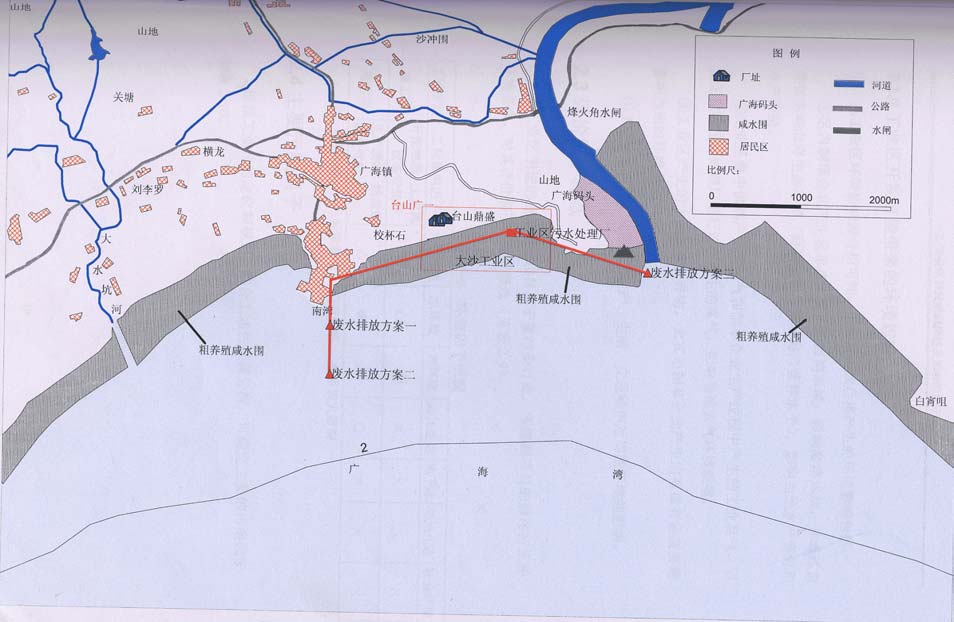
UNEP/GEF/SCS/RWG-LbP.5/3
Annex 6
Page 2
2-D water quality equation
( )
cH + (
)
cuH + (
)
c
c
cvH = K H +
K H
+S
t
x
y
x
x
x
x y
y
My i,j
Ky i,j
Hi,j
Mx
Mx
i,j
i+1,j
S
Kx
Kx i+1,j
i,j
Ci,j
My i,j+1
Ky i,j+1
S
discrepancy grids
selecting discharge site
UNEP/GEF/SCS/RWG-LbP.5/3
Annex 6
Page 3
estimating carrying capacity with different pollutants
· initially defining mixing zone size for pollutant discharge according to "Standard for pollution control
of sewage marine disposal engineering. (GWKB 4-2000 )."
· getting the scenarios of water quality response to pollutant loads by repeatedly applying the models
to the different pollutant loads.
· determining the carrying capacity --choosing from all the scenarios the one in which the calculated
water quality meet the target but the load is the maximum.
determining acceptable pollution loads with respect to different pollutants
· defining mixing zone size for all the pollutants
· getting the new scenarios according to new mixing zone size chosen and obtaining the maximum
loads with different pollutants.
· determining the acceptable discharge loads with respect to different pollutants by taking into
account an safety coefficient( 70%) to the maximum loads
UNEP/GEF/SCS/RWG-LbP.5/3
Annex 7
Page 1
ANNEX 7
Carrying Capacity and Ecological Risk Assessment in the Inner Gulf of Thailand
Assessing Ecological Risk and Carrying Capacity of Coastal Seas:
The Cases in Samut Prakarn Province and Mab Tapud Industrial Estate, Rayong Province
Rational
· Why did we assess RISK and CARRYING CAPACITY?
· Where are the study sites?
· How did we assess?
· What are the results?
Why did we assess RISK and CARRYING CAPACITY?
· Conventional regulations, water quality standards, are averaged approximation of polluted limits
showing that the environment is healthy, or can be kept healthy, to some certain aspects.
· They do not consider the dynamic and ecological diversity of the environment.
· Coastal seas are not static nor ecological homogeneous ponds.
· If you want to know, under various hydrodynamic conditions:
how the pollutants in a coastal sea behave (they disperse and decay)
how much capacity the sea can receive pollutants before it becomes severely damaged (either
permanently or temporarily).
· Then, you may want to know the CARRYING CAPACITY of the coastal sea.
· If you want to know, under various hydrodynamic conditions, whether the ecological system is
under threat from pollutants to a certain degree, i.e.,
under a stressful concentration for too long so that its key species are in an abnormal stage, or
being killed, etc.
· Then, you may want to know the RISK LEVEL that the coastal sea is under.
Where are the study sites?
The first area
Samut Prakarn
· Discharge from Chao Phraya and
Bangpakong Rivers
· Largest catchment --
agricultural domestic and industrial areas
· Mangrove - mud flat - coastal sea with
clayey bottom
UNEP/GEF/SCS/RWG-LbP.5/3
Annex 7
Page 2
The second area
Mab Tapud, Rayong
· Two industrial estates (Mab Tapud, Pa Daeng)
· Petrochemical industries
· Sandy beach - coastal sea with sandy bottom
How did we assess?
Chemical
Hydrodynamic and
Oceanographic
Water Quality
Ecological
Toxicological
Studies
Modeling
Study
Study
Considering
Considering
Considering
Ecosystems of
pollution effects on
pollutant fates
the areas
the ecosystems
Pollution
Distribution patterns
concentrations
Distribution patterns
of the ecosystems
affecting marine
of pollutants
organisms
Identifying
stressor-response
relations
Assessing
Level of
concentration with
Assessing
no adverses effects
RISK
MANAGEMENT
RISK
CARRYING
CAPACITY
organisms
UNEP/GEF/SCS/RWG-LbP.5/3
Annex 7
Page 3
Effective Concentrations
Plankton in water column
=
C
C
wtot
dw
-6
1+ Kd TSS 10
sw
Organisms in sediments
Kd
d + d
bs
wc
bs
C
= f C
sed
bs
wtot + Kd BS
d
bs
bs
bs
1
( + Kd TSS 10-6) d /(d + d )
f
= 1
sw
wc
wc
bs
-
bc
1
( + Kd TSS 10-6) d / d + ( + Kd BS) d /(d + d )
sw
wc
z
bs
bs
bs
wc
bs
Organisms in higher order of the food chain
DD = (IR C P F ) + (IR C P )
F
i
i
i
M
M
M
C = C
BCF
i
wtot
The quotients
· Hazard quotients
Estimated Exposure Level
HQ = Toxicity Reference Value
· Capacity quotients
Treshold Concentrat ion - Observed Concentrat ion
CQ =
Treshold Concentrat ion
UNEP/GEF/SCS/RWG-LbP.5/3
Annex 7
Page 4
Samut Prakarn study area
(Chao Phraya to Bangpakong Rivers)
Chemical oceanography stations
Ecological study stations
Chemical oceanography stations
Ecological study stations
What are the results?
The immediate results
UNEP/GEF/SCS/RWG-LbP.5/3
Annex 7
Page 5
Food web at Samut Prakarn
· classical food web
· microbial loop
Food web at Mab Tapud
· grazing food web
UNEP/GEF/SCS/RWG-LbP.5/3
Annex 7
Page 6
Effects of Hg on Chaetoceros sp.
y)
(
division/da
th rate
Grow
Hg concentration (mg/l)
Effects of Hg on shrimp
m)
t
(g
Weigh
)
(
%
Survival rate
Time (days)
UNEP/GEF/SCS/RWG-LbP.5/3
Annex 7
Page 7
Hg in water
Hg in sediment
UNEP/GEF/SCS/RWG-LbP.5/3
Annex 7
Page 8
Hg in organisms
Hg in sediment vs in water
UNEP/GEF/SCS/RWG-LbP.5/3
Annex 7
Page 9
Finite Elements
Tide B.C.
UNEP/GEF/SCS/RWG-LbP.5/3
Annex 7
Page 10
Wind
Currents and elevations
UNEP/GEF/SCS/RWG-LbP.5/3
Annex 7
Page 11
The assessment results
Organism-dependent HQ
UNEP/GEF/SCS/RWG-LbP.5/3
Annex 7
Page 12
Organism-dependent CQ
UNEP/GEF/SCS/RWG-LbP.5/3
Annex 7
Page 13
Levels of RISK to be considered
Concentration levels for Risk Criteria
Risk Level
SAMUT PRAKARN area
MAB-TAPUD area
Warning Level
Cwtot > 0.04 microgram/litre
Cwtot > 0.03 microgram/litre
1st Degree Level
Cwtot > 0.05 microgram/litre
Cwtot > 0.04 microgram/litre
2nd Degree Level
Cwtot > 0.05 microgram/litre
Cwtot > 0.04 microgram/litre
HQ = {A x Cwtot} / TRV where
A = 300.74 and TRV = 15.46 microgram/litre for Samut Prakarn area
A = 51.63 and TRV = 2.20 microgram/litre for Mab Tapud area
Recommendations
(1) Carry out TOXICOLOGICAL STUDIES in marine habitat and maintain the TOXIC DATABASE for
the nation.
(2) Assessment WORKSHOPS for local authorities.
(3) Extend the assessments to other coastal areas.
(4) Set up surveillance systems for surface water circulation in the Gulf and in the Andaman sea.
On going and future activities
(1) Carry out CC in Ko Chang, Trad Province and Ko Lanta, Krabi Province.
(2) Carry out CC for some rivers to reduce pollution load to the sea and manage the river quality for
the beneficial use.
(3) Propose for CC in the whole Gulf for Hg loadings from the oil and gas platform activities.
(4) Extend the assessments to other coastal areas.
UNEP/GEF/SCS/RWG-LbP.5/3
Annex 8
Page 1
ANNEX 8
Comparative Analysis of Contents of Draft National Action Plans for Land-based Pollution2
Plan of Actions
Cambodia
China Indonesia Malaysia Philippines Thailand Viet Nam
1.
National Policy, Legislation, Legal and Institutional Arrangement and Coordination
M M H
M H
Enactment, revision, updating and improvement of laws, legislative, legal and regulatory documents
1.1 and framework
M M M
H H
1.2 National, regional and sectoral environmental planning
M M
H
1.3 Coordination and cooperation between and among national and international agencies/ institutions
H M
M
1.4 Community
participation/empowerment
H H
H
Investment/fund diversification - sources and forms of investments; Establishment of pollution funds
1.5 and financing channels
M H
M H
1.6 Decentralization of pollution control and management
H L
M
H
1.7 Creation of sea and coastal zone master plan including industrial layouts
H H
M
M
Improvement of water resources, energy usages and soil quality including practicing soil
1.8 conservation measures
H H
1.9 Development of waste and pollution management facilities and technologies
M H
1.10 Enforcement of laws
H M M
M
1.11 Establishment and implementation of Standard Operating Procedures (SOPs)
H M M
1.12 Establishment and institutionalisation of a management office
M
- National Committee for Land-Based Pollution
M
Completed
- National and local project management office
M M M
1.13 Development and application of marine water quality standards
H H
2.
Public Awareness, Communication and Education
H M M
H M
2.1 Development and implementation of a national plan on awareness raising
H M
M
2.2 Mobilization of community participation, community watch and volunteer action
H M M
M
M
Establishment and implementation of public consciousness and participation campaigns through
2.3 active and in-depth public relations and mass media involvement
H M L
M
3.
Capacity Building and Sustainability
H L H
M
H
3.1 Institutional building and strengthening
H L
M
H
3.2 Development of human resources and organizations
H M
3.3 Creation of network involving all sectors including improve collaboration
H M
3.4 Training on environmental management, protection and regulations
M L H
M
2 The focal points prioritised actions contained in the national action plans. H--high priority, M--medium priority, L--low priority.
UNEP/GEF/SCS/RWG-LbP.5/3
Annex 8
Page 2
Plan of Actions
Cambodia
China Indonesia Malaysia Philippines Thailand Viet Nam
4.
Research and Monitoring
H M M
M
M
4.1 Systematic water quality, coastal and marine pollution control and monitoring
H M M
H M
4.2 Scientific research and technological development and innovation
H M
M
4.3 Information technology and database development
H L H
M
M
4.4 Upgrading of monitoring station equipment and instruments
H M
M
4.5 Environmental impact assessment
H L
M
M
5.
Pollution Control and Management
M H M
H H
5.1 Cleaner
production
M M
M M
5.2 Improvement in collection and treatment of wastewater and solid waste
M H
M H
5.3 Reduction of point and non-point source of pollution
H M
M
Develop and promote mechanisms, instruments and measures on waste management - waste water
5.5 and solid waste, including provision of incentives
H M L
M
5.6 Construction or expansion of waste disposal and wastewater treatment facilities
M H
H
5.7 Promotion of industrial wastes exchange
M M
5.8 Implement various ecological environment protection and rehabilitation programs and projects
M H
Notes: National Action Plan of Cambodia and Indonesia is more of an outline, and needs further elaboration. No National Action Plan is received from Malaysia and Philippines.
National Action Plan of China is divided into three provinces, with different plan of actions.
UNEP/GEF/SCS/RWG-LbP.5/3
Annex 9
Page 1
ANNEX 9
Work Plan for Land-based Pollution Component to June 30th 2007 and Schedule of Meeting for 2005
Table 1
Preliminary Work plan for the Land-based Pollution Component to June 30th 2007.
Year
2004 2005
2006
2007
Quarter
1
2
3 4 1 2 3 4 1 2 3 4 1 2 3 4
Month
Jan
Feb
Mar
Apr
May
Jun J-S O-D J-M
A-J J-S O-D J-M A-J J-S O-D J-M A-J J-S O-D
NATIONAL ACTIVITIES
National Committee meetings
National Technical Working Group
RWG-LbP meetings
X
X
X
Provide data to RWG-LbP and RSTC
Preparation of National Reports
Revise Revise Review Translate Translate
Print
Create and maintain of National metadata base
X
Provide data in GIS format to regional Database
X
Further Elaboration of SAP
Provide guidance to IMC on the pollution component
input to SAP
With stakeholders, review/revise plan to implement
Dependent
on
SAP
development
the Strategic Action Plan
Development of NAPs
Malaysia
1st X
Philippines
1st X
Other countries
2nd X
Estimate carrying capacity and transboundary
effects
Review of capacity to conduct carrying capacity
X
Collect information on nutrient budgeting in North
Sea and Baltic Sea
X
Transboundary pollution consideration (circulation)
Estimate the carrying capacity of coastal waters in
each country
X
UNEP/GEF/SCS/RWG-LbP.5/3
Annex 9
Page 2
Table 2
Schedule of Meetings for 2005. (RWG = Regional Working Group; -M = Mangroves; -CR = Coral reefs; -SG = Seagrass; -W = Wetlands; -F= Fisheries;
LbP = Land-based Pollution; RTF-E = Regional Task Force on Economic Valuation; RTF-L = Regional Task Force on Legal Matters) (H = United Nations Holidays)
S
M T W T F S
S
M T W T F S
S
M T W T F S
S
M T W T F S
S
M T W T F S
S
M
January
1
2
3 4 5 6 7 8
9
10 11 12 13 14 15
16
17 18 19 20 21 22
23
24 25 26 27 28 29
30
31
H
H
February
1 2 3 4 5
6
7 8 9 10 11 12
13
14 15 16 17 18 19
20
21 22 23 24 25 26
27
28
RSTC
Chinese NY
H
EXCOM
March
1 2 3 4 5
6
7 8 9 10 11 12
13
14 15 16 17 18 19
20
21 22 23 24 25 26
27
28 29 30 31
RTF-L-3
April
1
2
3
4 5 6 7 8 9
10
11 12 13 14 15 16
17
18 19 20 21 22 23
24
25 26 27 28 29 30
H
H
RTF-E-3
May
1
2 3 4 5 6 7
8
9 10 11 12 13 14
15
16 17 18 19 20 21
22
23 24 25 26 27 28
29
30 31
H
June
1 2 3 4
5
6 7 8 9 10 11
12
13 14 15 16 17 18
19
20 21 22 23 24 25
26
27 28 29 30
July
1
2
3
4 5 6 7 8 9
10
11 12 13 14 15 16
17
18 19 20 21 22 23
24
25 26 27 28 29 30
31
RWG-LbP-6
August
1 2 3 4 5 6
7
8 9 10 11 12 13
14
15 16 17 18 19 20
21
22 23 24 25 26 27
28
29 30 31
RWG-M-6
H
RWG-CR-6
September
1 2 3
4
5 6 7 8 9 10
11
12 13 14 15 16 17
18
19 20 21 22 23 24
25
26 27 28 29 30
RWG-F-6
RWG-W-6
RWG-SG-6
October
1
2
3 4 5 6 7 8
9
10 11 12 13 14 15
16
17 18 19 20 21 22
23
24 25 26 27 28 29
30
31
Ramadan
November
1 2 3 4 5
6
7 8 9 10 11 12
13
14 15 16 17 18 19
20
21 22 23 24 25 26
27
28 29 30
Ramadan
H
RSC-2
December
1 2 3
4
5 6 7 8 9 10
11
12 13 14 15 16 17
18
19 20 21 22 23 24
25
26 27 28 29 30 31
H
RSTC-6
PSC-5
Xmas
H
UNEP/GEF/SCS/RWG-LbP.5/3
Annex 10
Page 1
ANNEX 10
Proposed Budgets for Estimating Carrying Capacity in the South China Sea
Introduction
During the fifth meeting of the RWG-LbP, the focal point of land-based pollution component officially
informed the meeting of Thailand's decision to withdraw the pilot activity proposal, due to late
approval of GEF funding and Thailand co-financing was allocated for 2004 which could not be
postponed to 2005 and limited GEF funding available to execute the proposed activities contained in
the proposal.
Accepting Thailand's withdrawal of its proposal, the meeting decided to consider options for re-
allocation of the available US$100,000. After consideration of various options, the meeting decided to
reallocate the available funding to undertake activities to estimate carrying capacity in the South
China Sea, taking note that the first phase did not pay due attention to the activities.
Proposed Budgets from Participating Countries
Members of the meeting were requested to estimate the budgets needed in each country to undertake
studies to estimate the carrying capacity of the South China Sea, and propose the following estimated
budgets for the consideration of the fifth meeting of the Regional Scientific and Technical Committee
and the fourth meeting of the Project Steering Committee. The meeting further took note that these
budgets should be further refined.
China
Reporting,
Activity Salary/Travel
Contract
Training/Meeting
Equipment
Total
mis
Review of capacity to conduct carrying capacity
Technical assistance
200
200
Collection of information
200
200
Reporting
300
300
Sub-total
700
Transboundary pollution consideration (circulation)
Technical assistance
300
300
Collection of information
300
300
Data inputs
1,000
1,000
Analysing and
700
700
Reporting
Sub-total
2,300
Estimate the carrying capacity of coastal waters in China
Technical assistance
500
500
Software development
2,000
2,000
& improvement
Data inputs
500
500
Running the models
6,000
500
6,500
Analysing and
800
800
Reporting
Sub-total
10,300
Total
13,300
UNEP/GEF/SCS/RWG-LbP.5/3
Annex 10
Page 2
Thailand
1. Compile existing data needed for model
$1,500
2. Run model for nutrients (N, P) and heavy metals (seven parameters)
$9,000
3.
Verify
with
two
seasons
$4,000
4.
Write
report
$500
Total:
$15,000
Philippines
1. Contract (project consultant):
$3,000
2. Review of literature:
$500
3.
Data
collection/consolidation:
$2,000
4.
Training/meeting:
$3,000
5.
Modelling:
$3,000
6. Estimation of carrying capacity for nutrients and heavy metals:
$2,000
7.
Reporting:
$1,000
One and half year to complete.
Total:
$14,500
Cambodia
1. Data collection and processing
$1,500
2. Modelling running
--establishing
model
$5,000
--calibrating
and
verifying
models
$2,000
--running
models
for
carrying
capacity
$3,000
3. Results analysis and reporting
$1,000
4. Training two people in use of models, including lectures
$8,000
Remark: The models are given by the PCU
Total:
$20,500
Indonesia
1. To collect data and observation in the field
$3,000
2.
To
analyse
data
$3,000
3. Meeting for coordination with some experts and local government
(exchange of information)
$3,000
4. To determine criteria of the model for carrying capacity
$5,000
5.
Writing
the
report
$1,000
Total:
$15,000
UNEP/GEF/SCS/RWG-LbP.5/3
Annex 10
Page 3
Viet Nam
1.
Objectives: Evaluation of the pollution carrying capacity of the sea surrounding Viet Nam
from the land-based sources.
2.
Outputs: Good modelling and maximal loads of the following parameters: NO2, NO3, NH4,
TN, PO4, TP and Cu, Zn, Pb, Hg, As, Cd
3.
Methodologies: Modelling by using the well developed b y CMESRC softwares on marine
hydrodynamics and water quality with calibration and verification for calculation the maximal
loads of each mentioned parameters which makes concentration equal to the standard
combient value.
4.
Activities:
-
Data collection: (morphology maps, wind, water level, discharge of rivers; water
quality, site and load of pollutants, water current, both for calibration and verification
as well as for definition of carrying capacity)
-
Data processing (choice appropriate data sets for calibration and verification,
statistical analysis of wind, water level and river discharge)
-
Establishment of the numeral models (determining the calculated area, bathymetrying
the chosen area, giving boundary and initial conditions, experimental running the
numerical models for the stability consideration)
-
Calibration of the models to choice appropriate model parameters
-
Verification of the models to be sure that the numerical models work well
-
Running the calibrated and verified models for 12 monthly averaged wind fields and
the polluting load options to reach the standard value of each mentioned chemical
parameters
-
Reporting the findings and their scientific base
-
Submission to PCU and correction
5.
Estimated cost: This estimated cost does not include the cost of developing the marine
hydrodynamics and water quality software and is limited to the minimal expenditure:
-
To hire 2 specialists of Dr. degree qualification, each is responsible for one model
2 X 12 months X 600 US$
=
$14,400.-
-
To hire 1 person for data collection and processing
1 X 2 months X 400 US$/month/man
=
$800.-
-
Results analysis and reporting
1 X 600 US$/month/man
=
$600.-
-
Communication and office facilities
=
$200.-
(Sixteen
thousands
US$) =
$16,000.-