
Reduction of
"This technology potentially reduces our
catch of juvenile species, and I can only laud
Environmental Impact
the efforts to involve us in activities like this
and enable us to appreciate and see for
from Tropical Shrimp
ourselves its benefits. In return, what I can
Trawling, through the
offer is our cooperation and do our share to
protect and sustain our fish resources."
Introduction of Bycatch
Ms. Marisa Lakindanum, owner-
Reduction Technologies
operator of six trawlers in the Philippines
and Change of
Management
TED, BRD AND JTED
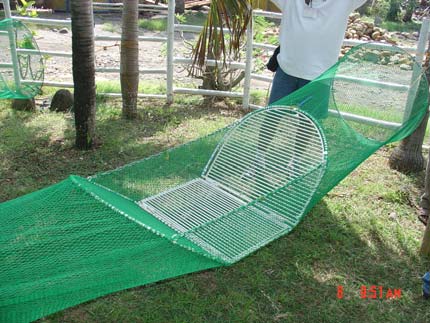
A TED or `turtle excluder device' is any
modification to a shrimp trawl designed to
reduce the capture of turtles. These devices are
sometimes called "trawl efficiency device'
because they can also prevent the capture of
other large animals including sharks, stingrays,
jellyfish and some large fish.
A BRD is any modification designed
principally to exclude fish bycatch from a
shrimp trawl. These devices may also exclude
other animals and non-living material (debris),
but because fish usually dominate the bycatch,
most BRD research has attempted to exclude
Contact persons:
these animals from the trawl.
Janne Fogelgren
Thomas Moth Poulsen
Food and Agriculture Organization of the United Nations
JTED stands for `juvenile and trash excluder
Viale delle Terme di Caracalla
00100 Rome, Italy
device'. This device is designed to exclude
Phone: (+39) 06 570 52377; (+39) 06 570 55034
small fish usually juvenile or trash fish
Fax: (+39) 06 570 55188
E-mail: Janne.Fogelgren@fao.org;
REBYC
from the trawl and maintain the catch of
Thomas.MothPoulsen@fao.org
shrimp and large fish.
SHRIMP TRAWLING,
OBJECTIVE
in each fishery at the end of the project
period.
BYCATCH AND
The overall objective of the project is to
reduce discards of fish captured by shrimp-
An additional expected outcome is the
DISCARDS
trawlers, primarily by introducing
improvement in national capacities for the
technologies that reduce the catch of
sound management of the shrimp-trawler
juvenile food-fish and other bycatch. The
fisheries and increased cooperation among
Shrimp exploitation by tropical trawl
participating countries have themselves
countries at the regional and global levels.
fisheries generates significant amounts of
identified the capture of juvenile food-fish
All of which would not be achievable
non-shrimp bycatch. Bycatch is anything
and discards as a non-sustainable practice
without the framework provided by this
that a fisherman does not mean to catch,
and have therefore assigned priority to
project.
whereas discards is that part of the catch
reducing the problem nationally. These
that is returned dead to the sea.
countries will therefore contribute through
PARTICIPATING COUNTRIES
research and management in the fields of
AND ORGANIZATION
In some countries, bycatch has become an
marine biology and fishing-gear technology.
important source of income and contributes
Asia: Indonesia, the Philippines, and the
to food supply. In others, bycatch of fish,
OUTPUT
Southeast Asian Fisheries Development
particularly small-sized, is discarded at sea.
The ultimate output of the project will be
Center (SEAFDEC)
the adoption by the participating countries
West Africa: Cameroon, Nigeria
The capture of juveniles of valuable food
of fishing technologies and practices that
fish constitutes a threat to the sustainable
Gulf Region: Bahrain1, Iran
are environmentally friendly, so that their
production of fish from an area. Extensive
shrimp-trawling fisheries will be enhanced
Latin America and the Caribbean:
removal of non-target fish is also a threat to
in terms of their environmental
Colombia, Cuba, Costa Rica, Mexico,
the biodiversity in a fishing area.
performance and reduction of biological
Trinidad and Tobago, Venezuela
impacts, and will be more sustainable in the
If the introduction of fishing technologies
future.
and practices that reduce the capture of
The project is funded by the Global Environment
Facility (GEF), coordinated by the United Nations
juveniles is successful in a few selected
A direct outcome of the project will be a
Environment Programme (UNEP) and executed
countries in various regions, it can be
reduction in number of juvenile species
by the Food and Agriculture Organization (FAO)
assumed that such technology and practices
caught by shrimp trawlers using bycatch
of the United Nations.
would be adopted by other shrimp fishing
reduction devices (BRDs) compared to
More information at:
countries also experiencing problems with
trawlers not using such devices. This can be
bycatch. In addition to the expected
http://www.fao.org/fi/gefshrimp.htm
verified when a successful BRD has been
increased fish production and conservation
developed and introduced in a shrimp-
of biodiversity as a result of project
fishery and a comparison made between a
intervention, shrimp trawling will earn an
trawl equipped with BRD and one without.
improved reputation and so continue to
Another indicator of project success will be
produce needed export income for several
1 Since Bahrain is not GEF-eligible, financial support is obtained
the number of shrimp trawlers using BRDs
from other sources.
poor developing countries.