
R
EBYC
Reduction of Environmental Impact from Tropical Shrimp Trawling, through the introduction of By-catch
Reduction Technologies and Change of Management
(EP/GL
O/201/GEF)
Mexico
Progress report to the project coordinator
EP/GLO/201/GEF
July-December 2005
___________________________________________________________
FOOD AND AGRICULTURE ORGANIZATION OF THE UNITED NATIONS
REBYC
Reduction of Environmental Impact from Tropical Shrimp Trawling, through the introduction of By-catch
Reduction Technologies and Change of Management
(EP/GLO/201/GEF)
Progress Report to the Project Coordinator EP/GLO/201/GEF
Country: MEXICO
Reporting period (6-months from...JULY to DECEMBER 2006).
Reporting Officer = National Coordinator (name /title): DR. GUILLERMO A. COMPEAN
JIMENEZ/DIRECTOR EN JEFE DEL INSTITUTO NACIONAL DE LA PESCA
1. List the meetings of the National Steering Committee held: (gives dates, places):
a)
The Comite Consultivo Nacional de Normalizacion de Pesca Responsable (National
Steering Committee of Mexican Project), have met at Mazatlán and Mexico City during the
period to inform stockholders of results of monitoring of shrimp ban and to decide the starting
dates of fishing season for both artisanal and industrial shrimp fisheries. Also the stockholders
were informed that during the fishing season wil be carried out assessment of three projects
(Sonora, Sinaloa and Oaxaca) to substitute traditional shrimp trawls and introduction RS-INP-
MEX dyneema designs with Fish Eyes.
b)
The Committee submitted a draft project to COFEMER (from Economy Ministry) to
implement Official Technical Standard PROY-NOM-061-PESC-2005, which contains
modification of technical specifications for the use of Turtle Excluder Devices on shrimp trawl
fishing.
summarize the main points from these meeting, and please provide separately a copy of the
minutes, including names/titles of the participants:
a)Described above
b)
etc
2. Describe the progress of each national project activity
(as listed in the project document, section 4.5 General Workplan and Timetable)
a) Instal ation of electronic equipment had not been done according to schedule, research
vessels were on dry-dock facilities and blister transducers were constructed and instal ed
by INP on time. This delay had caused postponement of training basic course and starting
of experimental cruises.
b) Since October 2005, INP started a program to transfer to 5 Stockholders of Oaxaca State
the prototype RS-INP-MEX for the Gulf of Tehuantepec, the complete set includes
construction/training of three trawls with single fish eyes of 230 x 475 mm, training,
calibration/testing at sea and technical assistance.
3. Describe briefly any workshops, training, or demonstration activities undertaken.
Indicate location, and number of participants and days.
a) On July took place the 2nd World Meeting of National Coordinators in Manzanil o, Colima,
Mexico; during which participated countries from al regions involved in EP/GLO/201/GEF
project. Agreements were made between countries for joint research, training and
technical assistance, particularly for Latin American region.
b) From 16th of August to September 5th a joint program Costa Rica-Mexico was carried out
in order to observe traditional fishing trawl operation at Punta Arenas, Costa Rica and to
recommend technical improvement of fishing system to reduce by-catches; during that
period was observed that shrimp trawls used had some technical design problems and
was decided to design and construct a new net. Preliminary results observed during
operation of new trawl show increase of shrimp catches and commercial by-catch, as wel
as fuel consumption; since time was not enough to continue with more testing days at sea
it was not possible to assess properly the improvement of by-catch reduction with the
introduction of fish eyes.
c) From 27th to 31st of October a group (3) of Stockholders from Costa Rica were attended at
Mexico to show them the way Mexico's management of shrimp fisheries; during the visit
they also participated in a short fishing trip onboard a commercial trawler to observe
fishing operations with the use of new prototypes being used at the North-Western
Mexican Pacific, they also were taken to 3 trawl construction workshops and other related
fishing industries.
d) On November (13 to 29th), derived from agreements made during 2nd World Meeting, two
Mexican fishing gear technologist participated on joint research works in the framework of
Cuba's National Project, during which double footrope and fish eye were tested.
Preliminary results show that reduction of by-catch reach slightly more than 50%, but there
were also some shrimp loss, especial y of juvenile shrimp. On general it was observed that
the addition of a second footrope can be a good technical solution to reduce by-catch of
smal fishes, as wel as the use of fish eye for reduction of viajaiba (Lutjanus spp) main
indicator specie.
e) From the 14th to 29th of December the first set was transferred to a trawler by means of an
initial cruise for calibration, training y commercial fishing with a RS-INP-MEX shrimp trawl
of 27 m headrope and 2.0 m2 High-Lift trawl doors. Preliminary results show a by-catch
reduction of 40%, 53% reduction of fuel consumption and increase of 20% of shrimp
catch.
f) Late December started the construction of next set to be transferred, with participation of
beneficiary trawler's crew; it is expected to be completed during January 2006 including
initial fishing cruise.
4. Give other general comments on the current status of the shrimp-trawling industry.
As stated on previous report (January-June), since 2004 until present time, Mexican Federal
Government jointly with some States have invested over $1'000,000.00 USD to introduce RS-
INP-MEX prototype (including the mandatory use Fish Eye) in commercial shrimp trawlers.
Assessment of program wil be completed at the end of fishing season 2006-2007. Although
there have been some problems to get enough Observers Onboard, preliminary operation
results show a overal by-catch reduction of 30 to 60% onboard commercial vessels.
Also, due to improvement of shrimp quality and catches, durability of nets, as wel as fuel
consumption reduction, Stockholders are very keen to use the new prototypes and the
number of vessels that use trawls of new design, materials and fish eye are increasing
(without complaining for the increment of initial cost of trawls).
At present report only preliminary landings of January-March 2005 were available, which were
already stated in previous report (January-June). As soon as the information is updated it wil
be send to FAO Project Coordinator.
5. List the financial inputs (in-kind, in US$)
a) by government, for this reporting period:
professional staff:
$33,000.00
support staff:
$ 500.00
travel expenses:
$ 5,600.00
operating expenses:
$ 3,800.00
equipment:
other
b) by government, from the beginning of the project:
professional staff:
$ 93,000.00
support staff:
$ 3,300.00
travel expenses:
$ 16,800.00
operating expenses:
$ 12,700.00
equipment:
$ 1,000.00
other:
$1'067,000.001
c) by the industry, for this reporting period:
professional staff:
$1,200.00
support staff:
$ 500.00
travel expenses:
operating expenses:
$4,000.00
equipment:
other:
d) by the industry, from the beginning of the project:
professional staff:
$ 22,200.00
support staff:
$ 9,000.00
travel expenses:
operating expenses:
$103,000.00
equipment:
other
Items b) and d) only consider expenses since January 2004.
6. Estimation of by-catch reduction:
a) Total Number of shrimp trawlers:
Total number of trawlers is in process of actualization since the program to reduce fishing
effort by means of buying-out commercial shrimp trawlers is stil going on.
b) Number of shrimp-trawlers that used BRDs when the project started: 2 (only research
vessels of INP
c) Number of shrimp-trawlers currently using BRDs: (expand by major-type of shrimp-trawler,
if possible):
shrimp trawlers:
Approximately 140, mainly in the Pacific coast.
fish trawlers:
None
pair trawlers:
There are not pair trawlers
1 Amount invested by Mexican Government for transfer of prototype RS-INP-MEX to Stockholders
from Sonora, Sinaloa and Oaxaca.
7. List all equipment purchased, indicating date of purchase, serial number, quantity,
cost in US$, and any remarks (for vehicles, give mileage report).
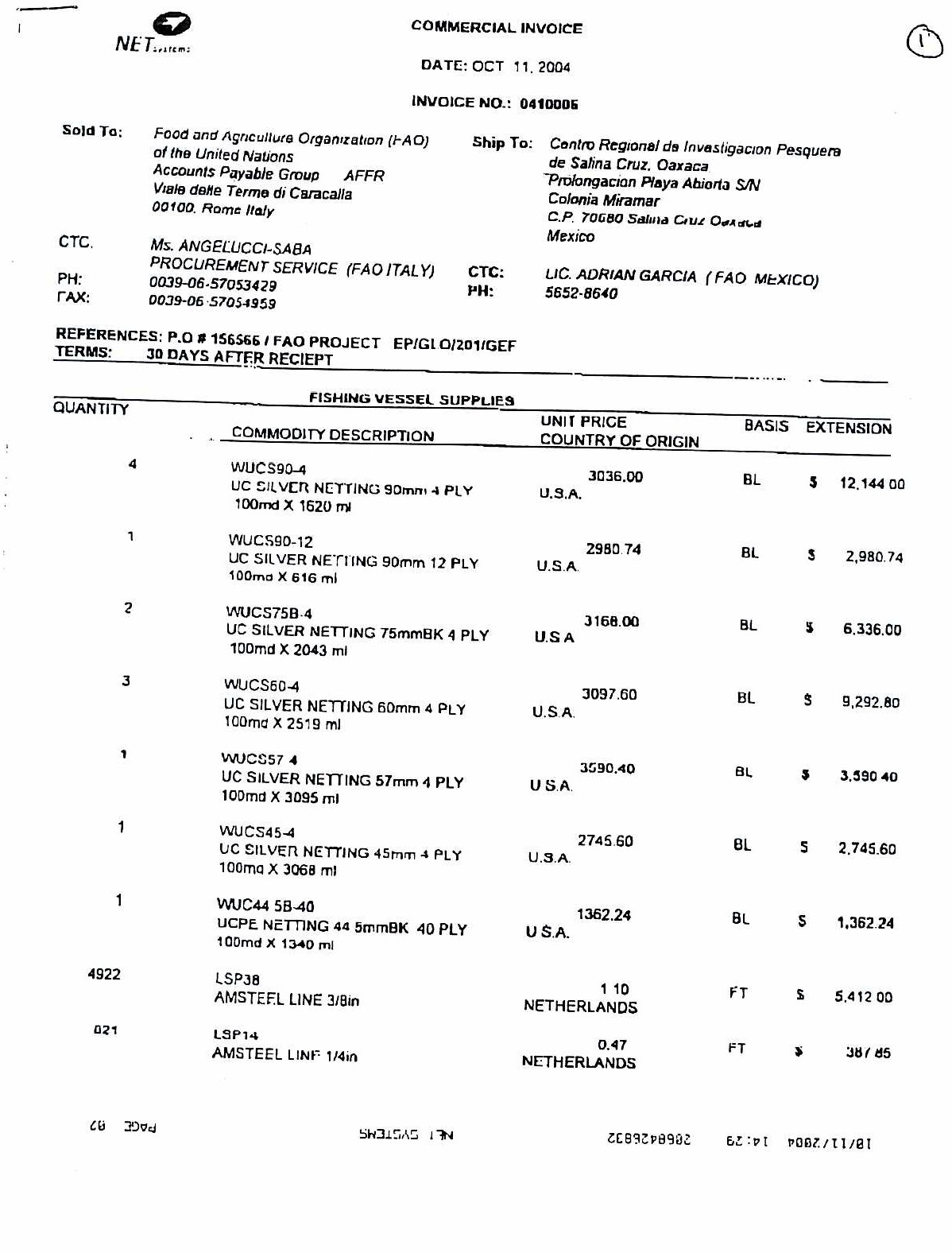
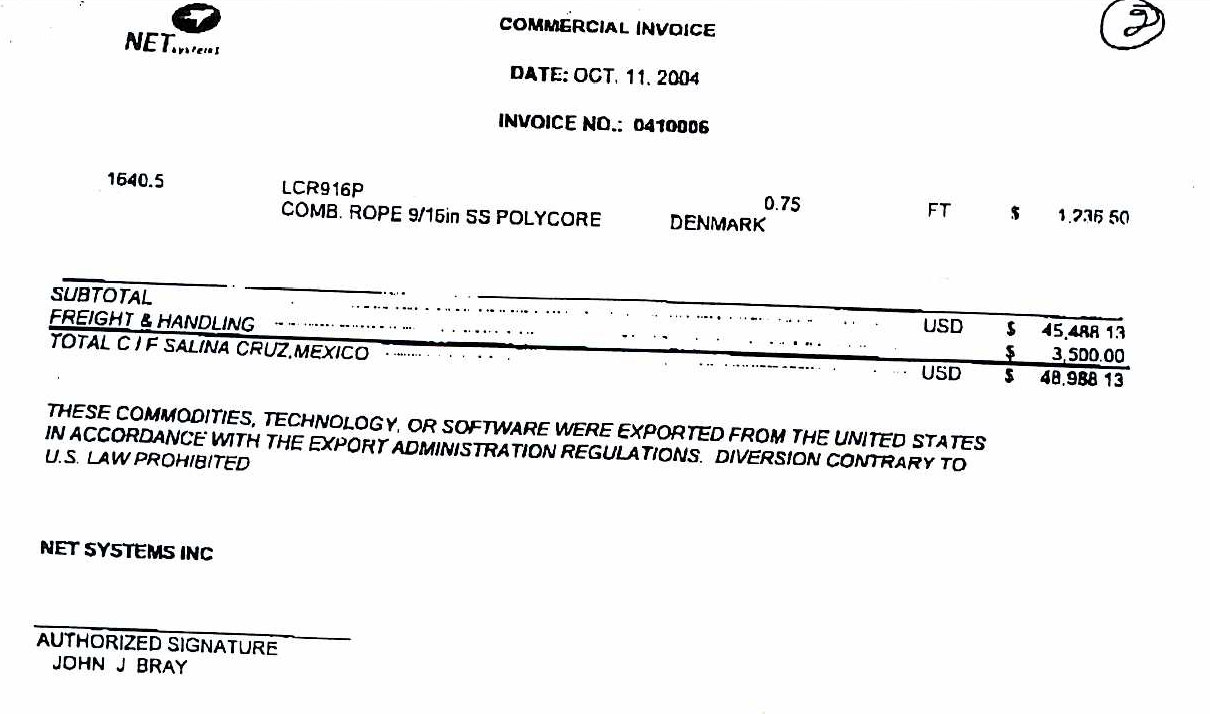
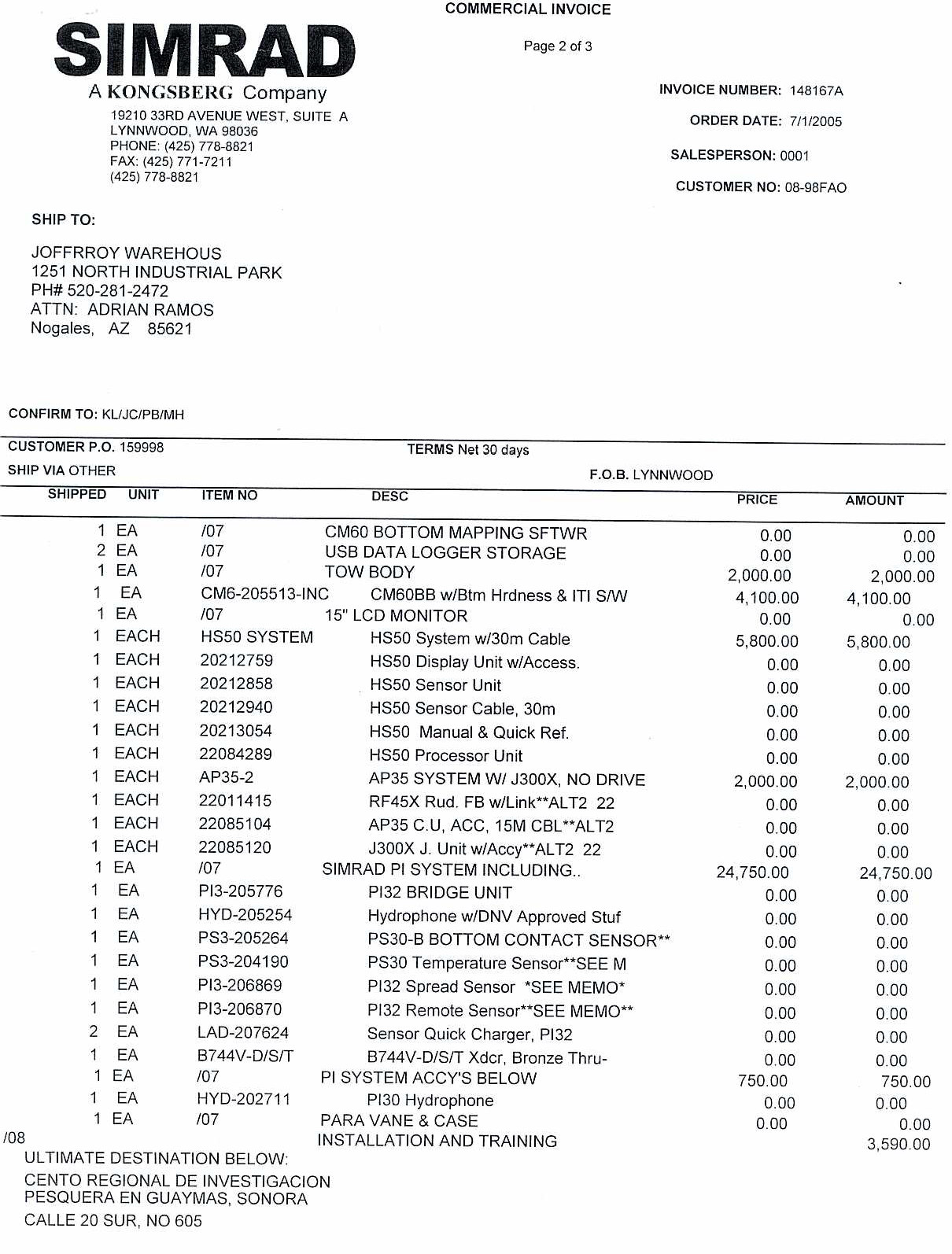
See invoices attached
a) Netting and other materials (It has bee partial y distributed in INP facilities
at Mazatlan, Guaymas and Salina Cruz; most of it has been used for
construction of prototypes for different fishing zones)
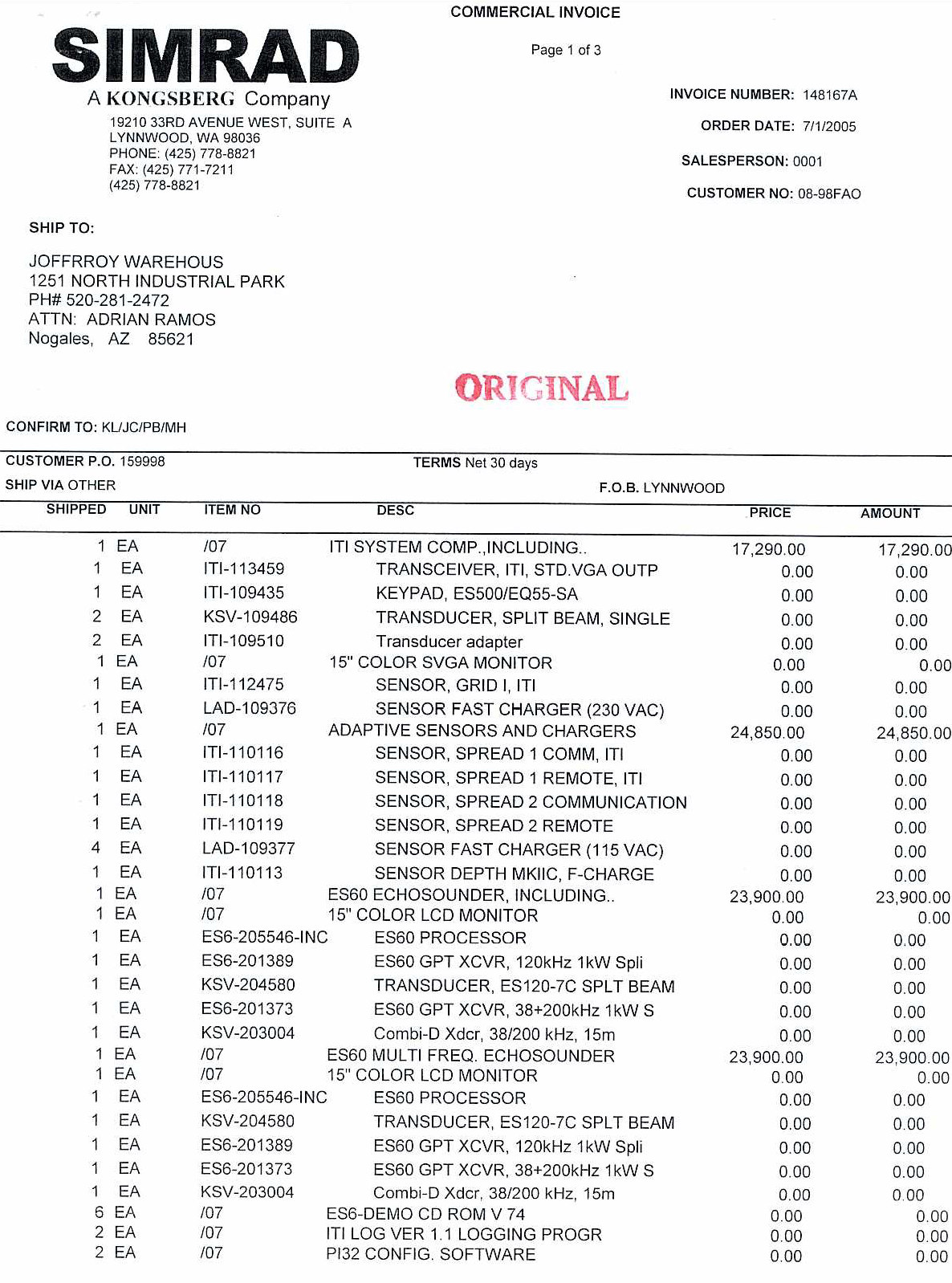
b) Electronic Equipment (al equipment is in Guaymas waiting to be instal ed
on INP research vessels by Simrad).

c) Computers2
c.1).- Desktop DELL, Model DHM, Serial Number: JB8PY41 (At present in
Salina Cruz).
c.2).- Notebook DELL, Model PP02X, Serial Number: H8Y8Y41 (At
present in Salina Cruz).
c.3).- Notebook DELL, Model PP02X, Serial Number: 29Y8Y41 (At
present in Guaymas).
2 Final cost of each computer is unknown since INP did not received copy of invoices when they were
delivered.