Chapter 7
7.4. PTS levels in blood of the general adult indigenous population
7.4.2. Polychlorinated dibenzo p dioxins/furans
(PCDD/F) in blood of the general adult indigenous
population
Because of the small volume of the blood samples
taken in the delivery departments of hospitals, and the
extremely low concentrations present, it was not feasi-
ble to determine chemical compounds such as diox-
ins/furans (PCDD/Fs) and polybrominated diphnyl
ethers (PBDEs) in maternal and cord blood. Studies of
these compounds were, however, executed by analysis
of pooled samples from the general adult indigenous
population (Table 7.5.).
Table 7.5 includes the results of measurements of con-
centrations of PCDD/F in plasma samples from adults
living in the Russian Arctic. Sums for the 17 most toxic
dioxin and furan congeners are presented as interna-
tional toxic equivalent (TEQ) values, in ng/L of plas-
ma and pg/g lipids. The highest TEQ values were
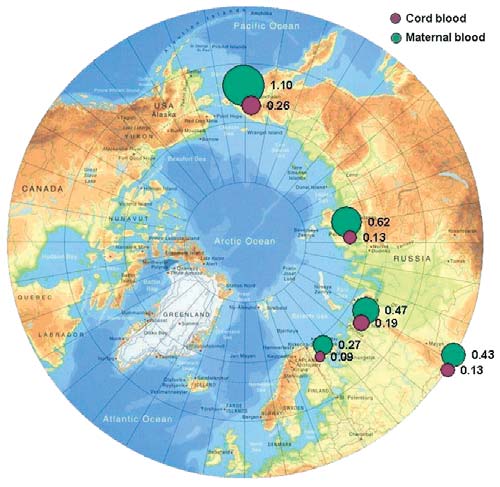
Figure 7.17. Levels of cadmium in maternal and cord blood in the Russian Arctic
detected in the populations of Uelen (Chukchi AO)
(geometric means, µg/L plasma).
and Khatanga District (Taymir AO), with levels in the
range 0.004-0.03 TEQ ng/L.
transfer of pollutants from the mother to fetus
through the placenta, although results obtained in
Results of PCDD/F analyses in blood samples are more
this study clearly suggest that the placenta barrier
illustrative when normalized to lipid content. Dioxin
inhibits, to varying extents, the free transport of cer-
concentrations (as geometric means) in blood samples
tain pollutants to the fetus.
from adults of both genders in these regions are within
the range 0.39.4 pg/g TEQ lipids. The highest con-
It should be noted that in the Chukchi AO, mean con-
centrations detected in individual samples from the
centrations of POPs in the blood of inland indigenous
Chukchi and Taymir AOs are as much as 18.7 and
peoples, from the Kanchalan area, are significantly
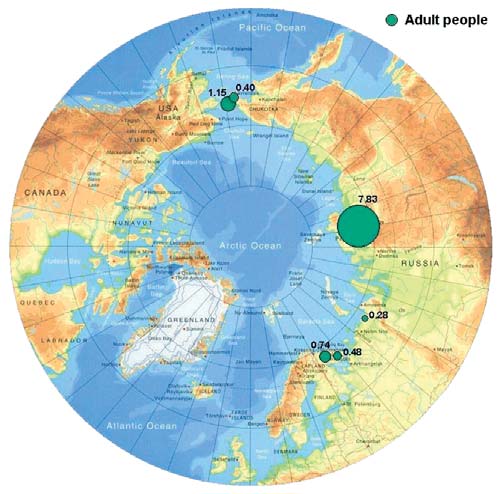
18.1 pg/g TEQ of lipids, respectively. Figure 7.18(a)
lower than levels in the blood of coastal residents from
illustrates the spatial distribution of PCDD/Fs in the
the Uelen area. This serves as an additional argument
areas of Russian Arctic under study.
that traditional foodstuffs, based on the higher trophic
levels of marine food chains, are an important source
In earlier studies, workers at facilities producing chlo-
of PTS intake for indigenous peoples.
rine-containing pesticides were found to have diox-
Table 7.5 Concentrations (geometric mean and range; µg/L unless otherwise indicated) in plasma and whole blood of indigenous adults from the Russian Arctic.
* For analyses of PCDD/Fs and PBDEs in plasma, n = 9, 6, 3, 4, 6, and 10 for Kanchalan, Uelen, Krasnoschel'e, Lovozero, Nelim Nos, and Khatanga area, respectively.
n. d. not detected; n. a. not availiable.
141
7.4. PTS levels in blood of the general adult indigenous population
Chapter 7
in/furan levels ranging from 128-465 pg/g TEQ of
ples. The single exception was one sample which
lipids (Neuberger et al., 1999; Amirova and Kruglov,
showed the presence of pentachlorofuran, although
1998); firemen working in situations where chlorine-
only at the detection limit level.
containing materials have been burnt were reported to
have 12.9 pg/g TEQ of lipids (Schecter et al., 1999a);
In all pooled samples, the sum of dioxins was more
and incinerator workers, 11.3-831.9 pg/g TEQ of
than 1 pg/g TEQ of lipids (1.515.4 pg/g TEQ of
lipids (Watanabe et al., 1999).
lipids) due to dibenzofurans detected in blood.
For comparative purposes, dioxin levels for populations
7.4.3. Polybrominated diphenyl ethers
of various towns in Russia, as well as for some other
in blood of the general adult indigenous population
countries, are provided below. The highest levels of
PBDE and PCDD/F were determined using the same
dioxins in blood were observed in women living near to
pooled blood samples taken from the adult population as
a pesticide plant in Chapaevsk. Here, mean values of
those analyzed for dioxins/furans. Results of blood analy-
dioxins in blood were 2775 pg/g TEQ (Revich et al.,
sis for PBDE (showing the geometric mean and range of
1996). Recorded dioxin levels in Bashkiria rural areas
concentrations) in adults are presented in Table 7.5.
were 24.8 and 39.8 pg/g TEQ of lipids, respectively
(Amirova & Kruglov, 1998). In the Irkutsk Oblast, levels
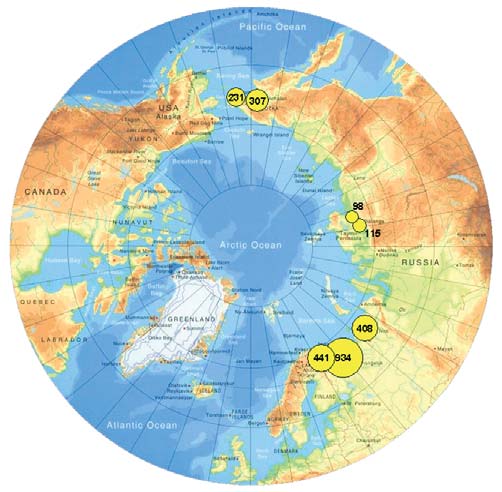
Maximum mean concentrations of PBDE were found
of 14.837.3 pg/g TEQ of lipids were found (Schecter et
in blood samples from adults from Krasnoshchelie on
al., 1999a), whilst residents of the Sverdlovsk region were
the Kola Peninsula (with a mean of 934 pg/g lipids
found to have 21.764.4 pg/g TEQ of lipids (Amirova
and range of 3751747 pg/g lipids). The lowest con-
and Kruglov, 1998). Mean concentrations of dioxins in
centrations were associated with blood samples from
blood from residents of other countries have been
populations within the Taymir AO.
reported as follows: 16 pg/g TEQ of lipids in Furuoka,
Japan (Matsueda et al., 1999), 17-57 pg/g of TEQ of
Comparing concentrations of PBDEs and PCDD/F in
lipids in Vietnam (Schecter et al., 1999b), and 18.2 pg/g
blood samples of the adult population in the four
of TEQ of lipids in Germany (Papke et al., 1999).
regions of the Russian North, reveals a significant differ-
ence in the distribution of these contaminants. This is
The highest concentrations of PCDD/Fs recorded in
especially so when considering the Taymir region, the
human blood in the northern regions of Russia (about
Nenets AO (Nelmin-Nos), and the Kola Peninsula
25 pg/g TEQ of lipids) are, therefore, close to the min-
(Krasnoshchelie). Whereas dioxin concentrations
imum concentrations observed for residents of indus-
detected in blood samples of populations from Taymir
trial regions elsewhere. Furthermore, the most toxic
were the highest, ranging from 9.45.0 pg/g of lipids in
dioxins (the tetra- and penta-substituted dioxins)
Khatanga district and in coastal settlements of
which are typically detected in the blood of workers at
Khatanga, PBDE concentrations in those regions were
hazardous facilities, were not detected in people living
the lowest. Conversely, where dioxin concentrations
in the Russian North. Compounds that were detected
were lowest, in blood samples from the adult population
include primarily the octa- and hepta-dioxins, which
of Krasnoshchelie (0.5 pg /g lipids) and the Nenets AO
are normally found in background environmental sam-
(0.3 pg/g of lipids), PBDE concentrations were greatest.
a
b
Figure 7.18. Levels of (a) PCDD/F (geometric means; pg/g TEQ of lipids), and (b) PBDE (geometric means; pg/g of lipids) in plasma of adults in Russian Arctic.
142
Chapter 7
7.4. PTS levels in blood of the general adult indigenous population
Table 7.6.
Concentrations (µg/L) of PCB
congeners in breast milk
in the Chukchi AO.
n.d. not detected
PBDEs have only been identified as an environmental
samples from populations in Norway from 19901999,
contaminant relatively recently and, therefore, infor-
were detected in individual blood samples. Individual
mation regarding human contamination by PBDEs,
samples from Kanchalan (Chukotka), had levels of
epecially in remote areas, is limited. Concentrations of
2800 pg/g lipids, from Krasnoshchelie (Kola
PBDE in pooled blood samples of people aged 40-50
Peninsula), 1747 pg/g lipids, and from Lovozero
years from Norway (based on the sum of BDE-28, -47,
(Kola Peninsula),1155 pg/g lipids.
-100, -99, -153 and -154) (Thomsen et al., 2001) show
values of 500 pg/g lipids in 1977, 1000 pg/g lipids in
The spatial distribution of PBDEs in the Russian Arctic
1981, approximately 2000 pg/g lipids in 1990, and
Figure 7.18(b) suggests that contamination levels are
over 3000 pg/g lipids in 1995-1999.
determined by trans-boundary transport. Higher con-
centrations are observed in the easternmost (Chukchi
Compared to the PBDE levels provided by Thomsen et
AO) and westernmost (Kola peninsula) areas of the
al. (2001), maximum PBDE concentrations in blood
Russian Arctic, closest to the source areas of North
samples of the adult population in Krasnoshchelie, on
America and Europe, respectively. PBDE levels meas-
the Kola Peninsula (934 pg/g lipids), correspond to
ured in blood samples in the central regions are either
those found in Norway in 1981. However, levels
below, or close to the detection limit. Taking into
approaching the PBDE concentrations found in blood
account that PBDEs are relatively recent contaminants
Table 7.7.
Concentrations (µg/L) of
chlorinated pesticides
in breast milk
in the Chukchi AO.
n.d. not detected
143
7.5. POPs in breast milk
Chapter 7
Table 7.8.
Concentrations (ng/g lipids)
of PCB in breast milk in the
Chukchi AO.
n.d. not detected
of anthropogenic origin, and that information on their
(7 samples). Samples were from the same mothers who
production and use in Russia is not yet available, it has
participated in the blood study at delivery. 5 control sam-
been suggested that PBDEs, used mainly in the indus-
ples from St. Petersburg were also collected and analyzed
trial developed countries as flame retardants, have the
(Tables 7.67.9 and Figure 7.19a-d). Samples in which no
potential to become a new PTS representing a circum-
POPs were detected were not included in tehdata res-
polar hazard, if urgent measures are not taken to limit
ened, but represented less than 1% of all cases.
their production and use.
The highest levels of almost all POPs occur in the breast
7.5. POPs in breast milk
milk of women living in Chukotsky District. Compared
to other areas of the Chukchi AO, concentrations were
7.5.1. POPs levels in breast milk
higher in Chukotsky by 36 times for HCB; 1080 times
and their correlation with blood levels
for oxychlordane; up to 10 times for mirex, trans- and
A total of 60 samples of breast milk were analyzed for
cis-nonachlor, and toxaphene; and 45 times for the
POPs. The samples were collected from different areas
sum of PCB congeners. Only for the DDT group of com-
of the Chukchi AO: Chukotsky District (27 samples),
pounds were concentrations in breast milk similar in all
Anadyrsky District (21 samples), and the town of Anadyr
areas studied within the Chukchi AO. It seems reason-
Table 7.9.
Concentrations (ng/g lipids)
of chlorinated pesticides
in breast milk
in the Chukchi AO.
n.d. not detected
144
Chapter 7
7.5. POPs in breast milk
Figure 7.19a.
Levels of PCB and HCH (ng/g
lipid) in breast milk of
women from various areas of
the Chukchi AO.
able to suggest, therefore, that women living in all areas
Canada (386 ng/g lipid in Canada compared to
in the Chukchi AO are exposed to a common source of
521 ng/g lipid in breast milk from Chukotsky District).
intake for DDT and related compounds.
The concentrations of individual PCB congeners (118,
138, 153, and 180) detected in breast milk in the towns
The results obtained were also compared with levels of
of Kargopol, Severodvinsk, Arkhangelsk, and Naryan-
breast milk contamination reported for women from
Mar, occur at levels intermediate to those found in
Nunavik, Canada (19962000), and the Russian Arctic
breast milk in Chukotsky District and those reported
(AMAP, 2002, 2003a; Chashchin et al., 2002).
for other areas of the Chukchi AO.
PCBs
HCB
Concentrations of the sum of 14 congeners of PCB in
Concentrations of hexachlorobenzene (HCB) in breast
breast milk of women from Chukotsky District are com-
milk from Chukotsky District, not only exceed those in
parable or slightly higher than those in Nunavik,
other areas of the Chukchi AO, but are also 25 times
Figure 7.19b.
Levels of HCB
and DDT (ng/g lipid) in
breast milk of women from
various areas of the Chukchi
AO.
145
7.5. POPs in breast milk
Chapter 7
Figure 7.19c.
Levels of Chlordanes (ng/g
lipid) in breast milk of
women from various areas of
the Chukchi AO.
higher than levels reported in Nunavik, Canada, and
milk from Chukotsky rayon (with a mean value of
other northern towns of Russia (AMAP, 2002).
370 ng/g lipids). Levels are lower, although still relative-
Elsewhere in the Russian North, Norilsk (with a ly high, in the town of Anadyr (198 ng/g lipids). Similar
geometric mean of 123 ng/g lipids, and range of 29-
values for -HCH concentrations in milk are found in
387 ng/g lipids) shows the closest concentrations of
Anadyr district (94 ng/g lipids), and also in the control
HCB in breast milk to those found in Chukotsky District.
site, St. Petersburg (98 ng/g lipids), however, the range
is greater for samples from Anadyrsky District.
-HCH
Levels of -HCH in breast milk of women from the
Concentrations of -HCH in breast milk from
Chukchi AO are distributed in a similar pattern to
Chukotsky District exceed levels detected in other
HCB. Specifically, the highest levels occur in breast
areas of the Chukchi AO and other northern towns of
Figure 7.19d.
Levels of Mirex and
toxaphene (ng/g lipid)
in breast milk of women
from various areas of the
Chukchi AO.
146
Chapter 7
7.5. POPs in breast milk
a
b
d
c
Figure 7.20. Relationships between concentrations of selected POPs
in breast milk and plasma of indigenous women of the Chukchi AO.
Russia, as well as levels in Nunavik, Canada (by 30
times). The closest -HCH breast milk concentra-
DDT
tions to those in Chukotsky District, were those
As discussed above, concentrations of DDT and its
found in Arkhangelsk (arithmetic mean of 401 ng/g
metabolites in breast milk in different areas of the
lipids) and Norilsk (geometric mean of 142 ng/g
Chukchi AO are very similar; DDE concentrations
lipids).
range from 245334 ng/g lipids) and are lower than
levels reported in northern Canada (Nunavik;
Data from 1984 (Bobovnikova, 1987), include mean
420 ng/g lipids) (AMAP, 2002). The DDE/DDT ratio
levels of total HCH in breast milk samples for various
ranges from 6 to 18, with the ratio found in samples of
regions of the USSR. For example, total HCH in
breast milk in the town of Anadyr, and in Anadyrsky
breast milk was 46 µg/L in Moscow, 66 µg/L in
District of the Chukchi AO, being close to those of
Rostov-on-Don, and 53 µg/L in Baikalsk; mean values
industrial cities of the Russian North (e.g., Norilsk,
were 51 µg/L for Uzbekistan; 136 µg/L for Djam-
Salekhard, and Dudinka); the ratio found in
baisky District (an area subject to intense OCP appli-
Chukotsky District, and the control samples are close
cation), and 86 µg/L in `clean' areas of Uzbekistan.
to those of non-industrial regions of Taymir and Yamal.
By comparison, total HCH concentrations in breast
milk samples from the Chukotka area, found in the
The 2003 UNEP/GEF global PTS assessment (UNEP,
current study are much lower, at 2.511.8 µg/L 2003) presents data on concentrations of DDT and its
(Table 7.7).
metabolites in breast milk for different regions of the
world. The highest reported levels are those fo China
Oxychlordane
(DDE concentrations of 2850 ng/g lipids, and DDT
Oxychlordane is the dominant component in total
concentrations of 700 ng/g lipids), which may be
chlordanes in breast milk. Oxychlordane concentra-
explained by continuing use of large amounts of DDT
tions in breast milk from Chukotsky District (203 ng/g
in the region.
lipids) are higher than those found in breast milk from
northern Canada (Nunavik; 81 ng/g lipids), and
The concentrations of total DDT and its metabolites
exceed concentrations in breast milk from other towns
reported previously for various regions of the USSR are
of the Russian North and other districts of the Chukchi
as follows: 87 µg/L in Moscow, 128 µg/L in Rostov-on-
AO by 10-100 times.
Don, 45 µg/L in Baikalsk, 191 µg/L in areas of
Uzbekistan where pesticides are actively used, and
Distributions of mirex and trans- and cis-nonachlor are
84 µg/L in the `clean' areas of Uzbekistan (Bobovni-
similar. Highest levels of these compounds were also
kova,1987). By comparison, total DDT in the areas of
found in breast milk from women in northern Canada
the Chukchi AO studied were 5.1 to 13.6 µg/L
(Nunavik) and in Chukotsky District.
(Table 7.7).
147
7.5. POPs in breast milk
Chapter 7
Table 7.10.
Concentrations (ng/L)
of polychlorinated dibenzo p
dioxins and dibenzofurans
in breast milk
in the Chukchi AO.
n.d. not detected
As breast milk and blood samples were collected from
(3.47 pg/g). Maximum values of PCDD/F concentra-
the same women, it was possible to investigate the cor-
tions were equal to 21.3 pg/g lipids in Chukotsky
relation between POP concentrations in these two
District, 9.65 pg/g
in Anadyrsky District, and
body fluids. Figures 7.20 (a)-(d) show the associated
5.24 pg/g in control samples.
relationships for a number of POPs.
In other studies, low levels of mean PCDD/F concen-
As seen from Figure 7.20, statistically significant corre-
trations in breast milk were detected in Bulgaria at
lations exist between POP concentrations in breast
6.14 pg/g of lipids (range: 5.087.11), and highest lev-
milk and plasma, which can be used in dose and risk
els in the Netherlands, at 18.3 pg/g (range: 17.121.3)
assessment when only one of these characteristics is
(UNEP, 2003). In other European countries, reported
measured. In general, POP concentrations in breast
values were 7.30 pg/g lipids (range: 7.167.43) in
milk are about 4 to 6 times higher than in plasma. This
Norway, and 6.91 pg/g (range: 6.198.54) in Ireland.
difference corresponds reasonably well to the differ-
ence in lipid content of breast milk and plasma.
Mean concentrations of dioxin in breast milk in Russia
(20012002) were equal to 8.88 pg/g lipids, with a
7.5.2. PCDD/F and PBDE levels in breast milk
range of 7.4612.93 pg/g (UNEP, 2003). The highest
of indigenous women from the Chukchi AO
concentrations were detected in the breast milk of
A total of 20 samples of breast milk were analyzed for
women living in towns involved with the production of
PCDD/Fs and PBDEs. Samples were collected from
organochlorine pesticides. For example, breast milk
Chukotsky District (10 samples), Anadyrsky District (7
contamination by dioxins at levels of 43.3 pg/g lipids
samples), and Anadyr town (1 sample), as well as 2
were determined in Chapaevsk (Revich et al., 1996).
control samples from St. Petersburg (Tables 7.10-
7.13). The highest average concentrations of total
From these figures, mean dioxin and furan concentra-
PCDD/Fs were found in breast milk samples from
tions detected in the breast milk of women from the
Chukotsky District (Figure 7.21), up to 7.66 pg/g,
Chukotsky District, and in women from Norway and
using the international toxic equivalent (TEQ) of
Ireland appear very similar and are lower than concen-
lipids, i.e, 22.5 times higher than in samples from
trations detected in northern and southern Quebec in
Anadyrsky District (2.70 pg/g) or the control area
Canada (CACAR,1997).
Table 7.11.
Concentrations (ng/L)
of polybrominated diphenyl
ethers in breast milk
in the Chukchi AO.
n.d. not detected
148
Chapter 7
7.6. Conclusions
Table 7.12.
Concentrations (pg/g lipids)
of polychlorinated dibenzo p
dioxins and dibenzofurans
in breast milk
in the Chukchi AO.
n.d. not detected
PBDE levels in breast milk of women from the
order of magnitude lower than values found for breast
Chukotsky District are more than 3 times higher than
milk in Germany, whilst control samples of breast milk
levels detected in Anadyrsky District (307 and from St. Petersburg contain PBDE in amounts
112 pg/g lipid, respectively). However, average con-
(1.06 ng/g lipids) comparable with levels found in
centrations of PBDE in control samples of breast milk
Germany. In all cases, congener BDE-47 is the main
from St. Petersburg exceeded those found in both
component in breast milk samples.
Chukotsky District (by 3 times), and Anadyrsky District
(by 10 times).
7.6. Conclusions
1. As the occurrence of PTS in human blood in the
There are a number of publications in the scientific lit-
Russian North is explained to a large extent by the
erature that indicate that PBDE contamination in
intake of contaminated fish (marine and freshwa-
breast milk has increased by a factor of 2 every 5 years
ter), marine mammals, sea birds, and reindeer
during recent years (e.g. Meironyte et al.,1999). The
meat, it follows that PTS concentrations in the
USA is one of main producers of PBDE flame retar-
blood of women giving birth, and of their children,
dants (UNEP, 2002), and there is evidence that PBDE
are also affected by the traditional diet of indige-
contamination in the breast milk of women in America
nous people. The highest concentrations of PTS in
may exceed that of women in Sweden by 40 times.
maternal and umbilical cord blood were detected in
Average PBDE concentrations of approximately
Chukotsky District of the Chukchi AO. These high
200 ng/g lipids have been reported for breast milk
levels of PTS in blood in this particular area may be
from the United States (Papke et al., 2001), with 60% of
associated with high levels of consumption of
this value accounted for by one congener, BDE-47.
species occupying the upper trophic levels in
Furst (2001) reports average concentration of PBDEs
marine food webs, as part of the traditional diet.
in the breast milk of women from Germany at 1.5 ng/g
Further work is still needed, however, to confirm
lipids. Overall, however, there available data on PBDE
and further elucidate this.
contamination in breast milk are still very limited.
2. Concentrations of organochlorine pesticides in cord
Given the information above, it can be concluded that
blood of newborns are normally somewhat lower than
PBDE concentrations detected in breast milk samples
in maternal blood, which leads to the conclusion that
from the Chukchi AO (0.10.3 ng/g lipids) are an
the placental barrier acts to reduce the transfer of
Table 7.13.
Concentrations (pg/g lipids)
of polybrominated diphenyl
ethers in breast milk
in the Chukchi AO.
n.d. not detected
149
7.6. Conclusions
Chapter 7
Figure 7.21a.
Levels (ng/g lipid)
of PCDD/F in breast milk
of women from various areas
of the Chukchi AO.
toxic substances from mother to fetus; this is more
4. A comparison with results obtained during the 2002
effective for some contaminants than others. This fea-
AMAP circumpolar maternal blood survey shows
ture was reflected in blood samples from all regions,
that, on the whole, levels of organochlorine pesti-
except for the Kola Peninsula, and the control area,
cides in human blood samples from the Russian
where the difference between maternal and cord
Arctic are similar to those found in coastal areas of
blood concentrations was not statistically significant.
Greenland and northern Canada, although for
some POPs, such as toxaphene and mirex, the lev-
3. Among the DDT group of compounds, DDE is the
els found in the Russian Arctic are much lower.
most prevalent in human blood, the ratio of
DDE/DDT concentrations in blood in the various
5. Geometric mean concentrations of dioxins in
regions ranging from 3-8, although a ratio of 30 was
blood samples from adults of both sexes and for all
found in the Aral control area.
regions, are within the range 0.39.4 pg/g TEQ of
Figure 7.21b.
Levels (ng/g lipid) of PBDE
in breast milk of women
from various areas of the
Chukchi AO.
150
Chapter 7
7.6. Conclusions
lipids. The highest concentrations in individual
9. Average concentrations of dioxin and furans detect-
samples were 18.7 and 18.1 pg/g TEQ of lipids (in
ed in breast milk of women from Chukotka are the
the Chukchi and Taymir AOs, respectively). The
same as levels detected in breast milk of women
highest concentration of PCDD/PCDFs in human
from Norway and Ireland, and are lower than levels
blood from the northern areas of Russia (18.7 pg/g
found in Northern Canada (northern and southern
TEQ of lipid) is close to the lowest concentrations
Quebec).
found in residents of industrial regions.
10.Comparison of concentrations of PBDE and
6. Among the samples of breast milk from the
PCDD/F in blood samples of the adult population
Chukchi AO, the highest levels of nearly all POPs
reveals a marked difference in the distribution of
were found in breast milk from Chukotsky District.
these PTS in the Russian North, with low levels of
Levels here, exceed those found in other areas of
PCDD/Fs coinciding with high levels of PBDEs,
the Chukchi AO by 3-6 times for HCB, 10-80 times
and vice versa. The difference is most obvious in the
for oxychlordane, 10 times for mirex, trans- and cis-
Taymir AO, the Nenets AO (Nelmin-Nos), and the
nonachlor, and toxaphene, and 4-5 times for the
Kola Peninsula (Krasnoshchelie). There is not yet
sum of 15 congeners of PCBs. Concentrations of
sufficient data to ascertain the reasons for the dif-
DDT and its metabolites in breast milk did not dif-
ference in dioxin and PBDE distribution, but it is
fer significantly in samples from different areas of
clear that the sources of pollution and contamina-
the Chukchi AO.
tion pathways for these groups of substances differ
from each other. PBDEs occur at higher levels in
7. With respect to levels of compounds such as PCBs,
areas close to the industrialized source regions of
oxychlordane, DDT, DDE and trans-nonachlor,
Europe and North America.
Chukotsky District is similar to Nunavik in north-
ern Canada. However, concentrations of b-HCH
11.Maximum PBDE concentrations (of 934 pg/g
and HCB in breast milk from Chukotsky District
lipids) in blood samples of populations from the
are 30 and 5 times higher, respectively, than values
Russian Arctic regions were found on the Kola
found in Canada. Concentrations of PCBs, HCBs,
Peninsula (Krasnoshchelie), and correspond to
b-HCH, and oxychlordane in breast milk from
those observed in sampled populations in Norway
other areas of the Chukchi AO are comparable to
in 1981.
those occurring in the breast milk of women from
Kargopol, Severodvinsk, Arkhangelsk, and Naryan-
12.PBDE concentrations in breast milk samples of
Mar.
women from the Chukchi AO (0.1-0.3 ng/g of
lipids) are an order of magnitude lower than con-
8. Maximum levels of breast milk contamination, like
centrations measured in Germany. Control samples
human blood samples, for all PTS determined,
of breast milk from St. Petersburg contained PBDE
including PCDD/Fs and PBDEs, were found in the
in amounts (1.06 ng/g of lipids) comparable with
Chukotsky District, which is situated in the coastal
those from Germany. The predominant congener
area of the Chukotka peninsula.
in all samples is BDE-47.
151