1860
oodcut by Aron of Kangeq,
WNuuk,
HRENSTR╓M
E
FREDRIK
STEFAN LUNDGREN
Svalbard
Off Ilulissat, Greenland
KUBUS
35
Polar Ecology
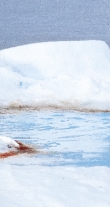
The polar bear is hungry. Using her sensitive nose,
she searches for a seal. She spots one lying on the ice,
and as she creeps closer, her steps become careful.
The seal has good hearing, good eyesight, and a good
sense of smell. It is ready to dive into the water as
soon as it senses danger nearby. So, very stealthily, the
polar bear puts one paw in front of the other in the
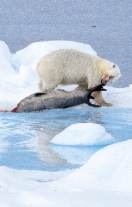
snow until she is only 30 meters from her prey. Her
final rush is an explosion of energy, and she pounces
on the seal. This time, luck is with her, and she enjoys
a good meal of seal blubber, her favorite food. The
rest of the seal is left behind when she moves on over
the ice, but close behind comes the Arctic fox, like a
shadow waiting for its share.
This meal on the ice illustrates two key points in
discussing contaminants in the Arctic. Predation is the
pathway by which contaminants move from animal
to animal in Arctic food webs. Moreover, it is no
coincidence that the polar bear is a picky eater when
hunting is good, choosing only the blubber and leav-
ing the rest of the seal. Energy is important for sur-
vival in cold environments and a preference for fatty
foods is one of many adaptations shown by Arctic
animals.
This chapter discusses plant and animal life in the
Arctic, with a focus on adaptations that can make
Arctic ecosystems especially vulnerable to contami-
nants. It also describes food webs on land, in
lakes and rivers, and in the sea, including
brief life histories of some species that appear
throughout this report.
Faroe Islands
36
Arctic conditions
The cold creates a lack of nutrients
Polar ecology
A cold climate and long, dark winters have
Reduced microbial activity also limits the rate
profound effects on the environment in which
at which nutrients can cycle in Arctic ecosys-
animals and plants try to survive. In addition,
tems. In cold, continental regions it has been
the productive season is short, which means
estimated that a 95 percent turn-over of organic
that there is limited time to reproduce and to
matter takes more than 300 years. Carbon
gather stores of energy. Climatic conditions are
thus accumulates in the soil, and many nutri-
most severe in the northern parts of the AMAP
ents remain bound and unavailable. The slow
region, while some of its southern areas are
degradation processes lead to deficiencies in
better described as subarctic or even northern
many key nutrients in both terrestrial and lake
temperate, having fewer of the limitations typi-
ecosystems. Plant growth is often limited by
cal of the polar region.
lack of nitrogen and phosphorus, along with
the low temperatures.
Low temperatures
Low temperatures also limit the chemical
slow down biological processes
weathering of bedrock, a process which sup-
plies nutrient ions to the soil. Slow weathering
The Arctic is synonymous with cold. The effects
rates can be compounded by permafrost.
of low air temperatures are increased by the
The ecosystems of the marine surface layer
fact that, in spring, the sun has to melt snow
are characterized by large variations in nutri-
and ice before it can start to warm the ground.
ent availability, both regionally and seasonally.
Most biochemical processes are tempera-
A substantial portion of the nutrients avail-
ture-dependent, and the rate of biological
able to Arctic ecosystems comes from upwel-
activity slows down at temperatures below a
ling of water from water masses of southern
certain level. Although adapted to a cold cli-
origin, inputs from large rivers, and aerial
mate, many plants and some animals in the
deposition. These pathways tend to carry
Arctic grow more slowly than they would else-
organic matter, nutrients, and contaminants.
where. For example, in Davis Strait, the transi-
tion from male to female in northern shrimp,
Snow and ice limit available light
which is part of normal development, takes
four to five years, in contrast to two to three
Low temperatures also create conditions for
years in the North Sea. Microbial life in soil
extensive ice cover on seas and lakes and for
and in the waters and bottom sediments of
snow cover on land. Even if summer brings
lakes, rivers, and the ocean is similarly re-
24-hour daylight to the area north of the Arc-
stricted by low temperatures, slowing the
tic Circle, ice and snow limit the amount of
breakdown of organic material.
light that can reach plants and plankton. As
This slow degeneration is apparent in well-
much as half of the total annual input of solar
preserved artifacts from ancient Arctic cultures
energy arrives before the end of snowmelt, so
as well as in the long life of garbage left on the
that much of it is reflected back into space.
tundra or of oil spills. It also makes the envi-
Some organisms, such as ice algae, live in
ronment slow to recover from physical de-
crevices in the snow and ice and can quickly
struction connected with exploitation of re-
The ice alga Melosira
take advantage of the light in spring. Other
arctica in old ice.
sources, human settlement, and overgrazing.
organisms are adapted to low-light conditions
under the ice. Generally, however, solar energy
has to melt snow and ice before it can be uti-
lized by plants. Therefore, in spite of the long
days and midnight sun, the growing season in
the Arctic is short. In the High Arctic, snow-
melt is usually not completed until the end of
June, after the summer solstice, and fresh snow
may come in August, leaving a growing season
as short as one to two-and-a-half months. In
the Low Arctic, the growing season can last
three to four months.
For Arctic lakes, the open water period is
also short. Lakes might be ice-free for only one
to two months, and in cold years, the ice may
not disappear at all. In the subarctic, the ice-
free season for freshwater ecosystems can be
four to six months.
In the marine environment, sea ice and
snow on top of the ice also limit energy input.
Even before all the ice has melted, however,
enough light penetrates to initiate phytoplank-
BJ╪RN GULLIKSEN
ton production. The sea ice starts to break up
in May and June, and begins to form again in
them for several months with little food. The
37
September. In some inlets and straits of the
most efficient way to store energy is by produ-
Polar ecology
high-latitude regions, ice can remain unbroken
cing fats, and Arctic organisms have an unusual
for several years and vast areas of the Arctic
propensity to produce and accumulate fat.
Ocean are always covered by pack ice, limiting
Such dependence on fats has negative conse-
biological productivity. In the subarctic, sea-ice
quences when environmental toxins enter the
cover varies greatly depending on ocean cur-
scene. Many organic toxins, such as pesticides
rents, as described in the chapter The Arctic.
and PCBs, are highly fat-soluble and therefore
accumulate in the fat reserves of animals, such
as the blubber of seals. When food becomes
Freshwater comes in one short spurt
scarce, these fat reserves are used but the cont-
Most precipitation in the Arctic falls as snow,
aminants remain, and their concentrations
and most water becomes available during the
increase in the remaining fat.
two-to-three week snowmelt period. The cold
In freshwater systems, spring runoff carries
air does not allow much moisture to evaporate
both nutrients and contaminants into streams,
and permafrost often keeps it from draining
ponds, and lakes. In the marine environment,
into the ground. The water from snowmelt
the melting sea ice plays a similar role. Thus,
and summer rains therefore creates extensive
the burst of productivity in the spring, when
wetlands on the tundra of the Low Arctic.
nutrients and energy are available, can provide
In the High Arctic, soils are often thin and
an efficient uptake route for contaminants.
can hold little moisture. Snowmelt ends
abruptly and small streams often run dry later
Perennial plants save their nutrients
in the summer. In High Arctic desert areas,
lack of water can limit biological productivity.
The lack of nutrients in the terrestrial land-
scape has favored plants that preserve their
nutrients from one season to the next. In con-
Glaciers have created
trast to the numerous annual species of south-
an evolutionary frontier
ern ecosystems, Arctic vegetation consists
Parts of the polar region have undergone
mostly of perennial plants. Many keep their
numerous glaciations over the past 1.8 million
leaves over winter. Those that do not, with-
years. The most recent of these ended only
draw nutrients to their stems and roots before
10000 years ago. Plants and animals, there-
winter comes. This makes it possible for them
fore, came to these areas fairly recently, and
to begin developing shoots the following spring
many of them are opportunistic, invading
before the surrounding soil thaws, which is an
species adapted to survive under a range of
advantage in a short growing season.
conditions. Many animals can adjust their
Not shedding leaves can be a disadvantage
feeding habits, growth rates, and reproduction
if a plant is damaged by contaminants or other
in response to variations in climate or food
environmental stresses, such as ultraviolet
availability.
radiation. Damage in one year will affect
This recent colonization by plants and ani-
growth for years to come, and even a small
mals, together with low ecosystem productiv-
change can lead to large losses in productivity.
ity, can explain the low diversity of species typ-
ical of the Arctic. Often, few species are found
Slow growth gives long life
in a particular area. Even if populations are
large, some levels in the food chain may be
The short growing season for plants and the
occupied by only one or two species. Threats
paucity of food allows little room for growth
to such key species can endanger the ecosystem
each season. It often takes many years before
as a whole.
an organism has been able to store enough
Even though Arctic ecosystems are young,
energy to reproduce. Both plants and animals
they are considered to be in equilibrium under
compensate by having long life spans. A low
current climatic conditions.
alpine bush can easily be 50 years old. Many
fish caught in the Arctic are much older than
fish of the same size caught in warmer regions.
Strategies for survival
A long life also means that there is ample
time to accumulate environmental contami-
The harsh living conditions of the Arctic have
nants. The ability of plants to draw material
led to many unique adaptations, some of
from the air is especially pronounced in long-
which make plants and animals especially vul-
lived lichens and in mosses that depend on leaf
nerable to contaminants in their environment.
surfaces rather than roots to take up nutrients.
Animals feeding on perennial plants can there-
fore ingest more contaminants than those eat-
Energy is stored in fat
ing mostly annual herbs.
The long winter makes it important for animals
For animals, the burden of contaminants
to store energy during the productive summer
stored in the body usually increases with age,
season since this energy might have to sustain
unless they have some mechanism to get rid of
the chemicals. Older animals are thus likely to
available. One example is high plankton pro-
38
have higher levels of persistent organic com-
ductivity at the ice edge, which supports large
Polar ecology
pounds and some heavy metals. In the food
populations of animals, especially sea birds.
web, this age effect is further pronounced by
Another example is the gathering of sea mam-
the fact that prey animals in the Arctic are
mals and birds at open patches of water, called
likely to be older than those in more southern
polynyas, within the pack ice. If contaminants
climates.
enter these hot spots of biological productivity,
they will efficiently enter the food web.
Moreover, because populations are often
Environmental fluctuations are the norm
sparse elsewhere, a high proportion of Arctic
Arctic summers are variable, and plants and
animals will be affected.
animals have had to adapt to large fluctuations
The patchy availability of food has also
in temperature and soil moisture, as well as
made migration an important strategy for
large seasonal fluctuations in light. In some
Arctic animals. Many birds move north only
areas, the snow might not melt at all one year,
to breed during the most productive season,
and there are many lakes that do not become
returning south before winter arrives. Some
ice-free every summer. The key to survival
mammals and fish shift feeding grounds within
under these varying conditions is to be able
the Arctic in response to changing ice and
take advantage of favorable times while also
snow conditions. Contaminants or destruction
being able to survive the years when summer
of the physical environment along any parts of
never comes.
their migration routes are therefore of concern
One example of such an adaptation is that
in an assessment of the Arctic.
plants often reproduce vegetatively, by creating
clones rather than only producing seeds. A mat
of low brush can thus be one single plant. In
Life on land
such cases, genetic variation is low, making the
plants potentially more vulnerable to new
The Arctic terrestrial landscape can be divided
stresses.
into two biogeographical zones, each with its
Generally, adaptations to a harsh and unpre-
own typical vegetation: the High Arctic, which
dictable environment are an advantage. Most
roughly corresponds to the polar desert, and
plants and animals have a certain tolerance
the Low Arctic, which corresponds to the tun-
range and can probably accommodate moder-
dra. The tundra gradually turns into the sub-
ate changes in climate.
arctic zone, with richer vegetation and wildlife.
The fluctuating conditions of the Arctic
affect the number of animals in certain years,
as exemplified by the rise and fall of lemming
populations. Their fecundity is also mirrored
in the sizes of the populations of birds and
mammals that feed on lemmings. Another
example is the severe crash of a population of
muskox in Canada after a winter when the
ground was covered by ice for a long period,
leaving the animals without access to their
normal forage. However, enough animals sur-
vived to produce a new, viable herd.
The dynamics of such extreme fluctuations
are poorly understood. An optimistic interpre-
tation is that populations can recover, even
when few animals remain. However, if there
Low Arctic vegetation
Low Arctic and subarctic
Treeline
are other environmental stresses, such as tox-
Subarctic vegetation
vegetation zones.
ins that affect reproductive capacity, the popu-
lation might be even more vulnerable during
years with few animals.
The boreal forest also extends into the AMAP
In the past, overharvesting and habitat
region. The map above shows the different
destruction have reduced populations of many
zones. In mountainous landscapes, the vegeta-
large Arctic mammals. In some cases, the
tion zones are similar but depend on altitude
remaining populations are small, and stressors
rather than latitude.
that affect their reproduction could threaten
their survival.
The High Arctic is a desert
The High Arctic growing season lasts for only
Animal life is concentrated in rich areas
one to two-and-a-half months. Mean July air
The general lack of nutrients in the Arctic en-
temperatures range from 4 to 8░C. Large parts
vironment leads to an accumulation of plants
of the ground do not support any vegetation at
and animals in areas where food is readily
all. The cold leads to a lack of weathering of
Predatory birds
Terrestrial food web
Snowy owl
Raven
Jaeger
Sedges
Lemming
Arctic fox
Grasses
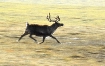
Reindeer/caribou
Arctic hare
Wolf
First level predators
Weasel
Lichens
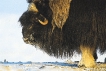
Muskox
Ptarmigan
Dwarf shrubs
Predatory
Small grazers
Vegetation
Large grazers
Predatory
Grazers
mammals
mammals
Primary producers
Examples of organisms at different levels in terrestrial food webs in the AMAP area.
нннннннннннннннннннннннннннннннннннннннннннннннннннннннннннннннннннннннннн
Common English name
Latin name
нннннннннннннннннннннннннннннннннннннннннннннннннннннннннннннннннннннннннн
Plants
Lichen
Mosses
Sedges
Grasses
Cushion and rosette plants
Labrador tea
Ledum spp.
Lingonberry (Lowbush cranberry)
Vaccinium vitis-idaea
BRY
Cranberry (Bog cranberry)
Vaccinium spp. (e.g V. oxycoccus)
KNUT
High-bush cranberry
Viburnum edule
Cloudberry (Salmonberry)
Rubus spp.
Blueberry
Vaccinium spp.
Eskimo potato (Indian potato, masu)
Hedysarum alpinum
Dock (Sorrel)
Rumex arcticum
Willow
Salix spp.
Aspen
Populus tremula
Birch
Betula spp.
Firs
Abies spp.
Spruces
Picea spp.
Pines
Pinus spp.
Animals feeding on plants
WIDSTRAND
Caribou, reindeer
Rangifer tarandus
Moose (Elk)
Alces alces
STAFFAN
Kolyma moose
Alces americanus
Muskox
Ovibos moschatus
Dall sheep (Bighorn sheep)
Ovis dalli (O. canadensis)
Snow sheep
Ovis nivicola
Bison
Bison bison
Siberian ibex
Capra ibex sibirica
Black bear
Ursus americanus
Hares
Lepus spp.
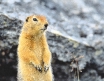
Parka squirrel (Arctic ground squirrel)
Citellus parryii
Red squirrel
Sciurus vulgaris
Ptarmigan
Lagopus spp.
Spruce hen (Spruce grouse)
Canachites canadensis
Ruffed grouse
Bonasa umbellus
Sharp-tailed grouse
Pedioecetes phasianellus
Voles
Microtus spp.
WIDSTRAND
Lemmings
Dicrostonyx groenlandicus,
Lemmus sibericus
STAFFAN
Lapland bunting and snow bunting
Calcarius lapponicus,
Plectrophenax nivalis
Common redpoll and Arctic redpoll
Carduelis flammea, C. hornemanni
First-level predators
Wolf
Canis lupus
Arctic fox
Alopex lagopus
Red fox
Vulpes vulpes
Wolverine
Gulo gulo
Lynx
Lynx canadensis
Brown bear
Ursus arctos
Stoat (Ermine)
Mustela erminea
Least weasel
Mustela nivalis
Marten
Martes americana
Snowy owl
Nyctea scandiaca
Raven
Corvus corax
Rough-legged hawk (Rough-legged buzzard)
Buteo lagopus
Golden eagle
Aquila chrysaetos
Gyrfalcon
Falco rusticolus
HUNTINGTON
HENRY
the rock, and there is not much soil. Water
Plants cover most of the ground and alter the
40
comes in one short spurt during the snowmelt.
microclimate at the ground surface. If the veg-
Polar ecology
These factors, combined with the lack of soil
etation is damaged, conditions might change
that would have been able to retain some of
enough to make it difficult for the same plants
the moisture, make conditions for colonizing
to grow back. A scar in the landscape easily
plants very harsh.
becomes permanent.
Lichens and mosses are the most prominent
Permafrost restricts water drainage, so that
colonizers. Arctic vegetation also includes
extensive areas become waterlogged during
tightly growing cushion plants and willow
snowmelt and when it rains. The amount of
shrubs that hunch close to the ground. Sedges
water in the ground has a profound effect on
and grasses are also typical. Meadow commu-
tundra plant life. In waterlogged areas, the
nities cover about 40 percent of the land area
decomposition of plant matter is very slow,
in the southern part of the High Arctic. In the
which leads to an accumulation of dead plant
far north, meadows appear only in scattered
matter and the build-up of peat.
Arctic oases amid the polar desert, covering as
little as 2 percent of the area.
Many animals, but short food chains
Prominent grazers of the High Arctic are
muskox and Peary caribou in North America
The Low-Arctic tundra vegetation is rich
and some subspecies of reindeer in Eurasia.
enough to support a number of mammals and
These large herbivores are protected from the
birds. Large grazers include caribou/reindeer
cold Arctic winter by thick insulating fur. They
and muskox.
graze intensively during the brief summer to
Small herbivorous mammals are also abun-
store up fat reserves for the winter, when only
dant on the tundra, of which the lemming is
poor-quality forage is found on windswept
known best. Lemmings and voles seek shelter
slopes or by digging through the snow.
under the snow during the Arctic winters,
Smaller mammals include the Arctic hare,
keeping themselves protected from the cold,
which is adapted to the cold Arctic environ-
and gaining access to grass and other food on
ment, but seeks protection in snow dens or
the ground surface.
natural shelters in extreme weather. Some in-
Insect life is more abundant in the Low
vertebrates, such as the widespread mites and
Arctic than in the High Arctic, and warm tun-
spiders, also survive the harsh conditions.
dra areas can support beetles, moths, butter-
A few true terrestrial birds, such as the rock
flies, and bumblebees as well as parasitic war-
ptarmigan, thrive year-round, even in the High
ble flies that lay their eggs under the skin of
Arctic zone. Most birds, however, only come
caribou and reindeer. Visitors to the Arctic are
north for the summer. About 20 species nest in
all too familiar with the sometimes dense pop-
the High Arctic. They include migratory water-
ulations of biting flies and mosquitoes.
fowl such as geese and ducks, and smaller seed-
A number of birds take advantage of the
eaters, such as buntings and redpolls. Preda-
productive tundra. A few stay year-round,
tory birds, such as snowy owls and ravens,
such as the Lapland bunting, snow buntings,
hunt small mammals and young birds. Thick
and redpolls. They survive by maintaining
plumage and subcutaneous fat protects these
high metabolic rates and by eating continu-
High Arctic birds from the cold.
ously. Two species of ptarmigan, rock and wil-
Wolves are the major predator of caribou
low, are well adapted to their year-round stay
and muskox. The Arctic fox also makes its
on the tundra. During the winter, their feath-
home in the High Arctic. It is an opportunistic
ers, which also cover their feet, are white, and
feeder, hunting small mammals and birds, or
the birds blend extremely well into the land-
feasting on prey left behind by wolves and
scape. They eat buds, leaves, berries and the
bears. Foxes living near the sea often follow
stems of shrubs and trees.
polar bears to scavenge seal kills, thus becom-
The predators of the Low Arctic, represent-
ing part of the marine food web.
ing the upper levels of the tundra food web,
include mammals and birds of prey. The most
important terrestrial predatory animals are the
The Low Arctic is a region of rich tundra
wolf and the wolverine, which prey on small
The Low Arctic or tundra region supports a
mammals, birds, and caribou/reindeer. Arctic
much richer biological system than the High
fox hunt small mammals and birds. They also
Arctic. The growing season is longer, three to
scavenge kills made by wolves and bears.
four months, and the mean July air tempera-
People are also top predators in the food chain
ture ranges from 4 to 11░C.
involving reindeer/caribou. Brown and black
Permafrost governs life on the tundra. The
bears feed mainly on plants, but also eat fish,
roots of plants are restricted to the shallow
small mammals, and birds.
active layer that thaws in the summer, keeping
Arctic birds of prey include a few year-
trees from growing well.
round dwellers, the snowy owl, the raven, and
Mosses, lichens, cushion plants, sedges, and
the gyrfalcon. The migratory predators include
grasses dominate the vegetation, along with
the long-tailed jaeger and the peregrine falcon.
heath shrubs such as dwarf willow and birch.
The peregrine falcon feeds mostly on migra-
Predatory birds
Tundra-pond food web
Gulls
Peregrine falcon
Sedges
Arctic fox
Geese
Cranes
Grasses
Ducks
Plovers
Duckweed
Predatory
Plant-eating
Birds
Second level
mammals
birds
Vegetation
predators
Herbivorous
Insect larvae
Carnivorous
Benthic
zooplankton
zooplankton
microalgae
First level predators
Grazers
and filter feeders
Primary producers
Exampes of organisms at different levels in wetland/tundra pond food webs
in the AMAP area.
нннннннннннннннннннннннннннннннннннннннннннннннннннннннннннннннннннннннннн
Common English name
Latin name
нннннннннннннннннннннннннннннннннннннннннннннннннннннннннннннннннннннннннн
Plants/primary producers
Sedges
Grasses
Duckweed
Horsetail
Water smartweed
WIDSTRAND
Mosses
Birds and mammals feeding mainly on plants
STAFFAN
Whistling swan
Olor buccinator
Canada goose
Branta canadensis
White-fronted goose
Anser albifrons
Snow goose
Chen caerulescens
Brant
Branta bernicla
Ducks
Somateria spp., Anas spp., Bucephalus spp.
Muskrat
Ondatra zibethica
Decomposers and grazing zooplankton
Chironomids (midge larvae)
WIDSTRAND
Daphnia
Fairy shrimp
STAFFAN
Zooplankton feeding on other zooplankton
Copepods
Cyclops spp., Heterocope spp.
Birds feeding mainly on benthic invertabrates, insects, zooplankton
Plovers
Eufromias morinellus, Pluvialis dominica,
Squatarola squatarola,
Charadrius semipalmatus
Cranes
Grus spp.
Long-tailed duck (Oldsquaw)
Clangula hyemalis
Spoon-billed sandpiper
Eurynorhynchus pygmeus
Predators and scavanagers
Peregrine falcon
Falco peregrinus
Gyrfalcon
Falco rusticolus
WIDSTRAND
Herring gulls
Larus argentatus
Arctic fox
Alopex lagopus
Lesser weasel
Mustela nivalis
STAFFAN
ROSING
MINEK
tory waterfowl, which can accumulate conta-
that builds up due to poor decomposition of
42
minants in their overwintering areas, and is
Sphagnum also supports sedges and, in the
Polar ecology
therefore highly exposed to persistent contami-
subarctic, trees.
nants. There are also Arctic populations of
Fens, in the subarctic or southern Arctic, are
several eagle and hawk species.
covered by sedges and sometimes by grasses
In spite of the apparent abundance of tun-
and reeds, Sphagnum is unimportant or even
dra wildlife, the number of forage species can
absent. There is often a low to medium shrub
be low and the food chains short. Thus, if one
cover together with sparse trees.
or two foods are lacking in a given summer,
In swamps, the ground is saturated with
replacements may be scarce, making it difficult
water and is periodically flooded. Herbs and
to obtain the energy needed to raise young.
mosses cover the ground along with woody
For example, fluctuations in the populations of
plants (coniferous and deciduous shrubs and
lemmings can severely limit the number of
sometimes trees). Peat does not build up in a
owls and jaegers.
swamp.
Marshes develop on wet but non-peaty
soils. There are emergent non-woody plants
Wetlands are typical of the tundra
such as rushes, reeds, reed grasses, and sedges.
Wetlands cover vast areas of the Arctic tundra,
Open water can be overgrown by submerged
about 1.5 million square kilometers north of
and floating aquatic plants, while trees and
60o N. Permafrost hinders drainage, and the
shrubs form the border of the marshes.
resulting waterlogged conditions, along with
Shallow open waters, such as small ponds
cold ground temperatures, limit decomposition
and sloughs within bogs, fens, and marshes are
and productivity. In many wetlands, dead plant
usually less than 2 meters deep without much
matter and animal waste accumulate, and
vegetation.
leached humic acids color the water brown.
The large amounts of organic material in the
Summer growth supports migratory birds
wetlands are important for the fate of organic
compounds and metals, whether they be nat-
The wetlands are covered by ice and snow for
ural or anthropogenic, as they dissolve poorly
most of the year, but are not devoid of life.
in water and instead bind to organic matter.
Once the growing season starts, many shallow
The amount of water in the ground influen-
lakes are rapidly overgrown by horsetail,
ces what will grow in a particular wetland. The
water smartweed, duckweed, and pondweed.
dominant plant species will in turn have a great
Somewhat dryer areas support mosses, cotton
effect on the rest of the ecology. There are five
grass, and lichen.
basic types of wetland: bogs, fens, swamps,
The rich vegetation attracts an immense
marshes, and shallow open water, of which bogs
number of migratory birds. Waterfowl, geese,
and fens are the most common in the Arctic.
ducks, swans, and gulls arrive soon after
Bogs usually have a surface carpet of mos-
snowmelt. Many arrive with fat reserves for
ses, mainly Sphagnum. The wet and acid peat
breeding and thus their contaminant levels
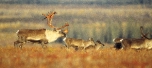
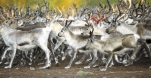
Caribou
Caribou/reindeer
Caribou and reindeer are the North American and
Eurasian representatives of the same species. There are
several different subspecies. The Peary caribou, which
makes its home in the Canadian High Arctic, is smaller
than the barren-ground caribou that roams the Low
Arctic tundra of North America.
The wild reindeer of the European mainland can be
divided into several subspecies. The Svalbard reindeer
inhabits the High Arctic environments of the Svalbard
archipelago and another subspecies occupies a similar
WIDSTRAND
environment on Novaya Zemlya. A few herds of wild for-
est reindeer live on the Kola Peninsula and south of the
STAFFAN
Arctic in Finland. The wild Scandinavian mountain rein-
Reindeer
deer still exists in southern Norway and as a small popu-
lation in the Murmansk region of Russia, both of which
interbreed with domesticated reindeer. There is also a
herd of wild Scandinavian mountain reindeer in Iceland.
Herding of domesticated or semidomesticated popula-
tions of reindeer is important throughout the Saami
region and in most of northern Russia. A few herds of
domesticated reindeer have also been introduced into
Alaska and Greenland.
Most caribou and reindeer migrate between summer
and winter range lands, from the tundra or mountains to
the forest, or from the coast to further inland. The sum-
mer diet consists mainly of grasses while the animals
depend on lichen and mosses during the winter.
BRY
Domesticated reindeer are sometimes fed hay to supple-
KNUT
ment their natural diet.
largely reflect uptake in overwintering areas;
43
see the box to the right. They stay in the Arctic
only long enough to mate, hatch their eggs,
and molt before they start their gradual migra-
tion south. Some of the birds are herbivorous,
while others depend heavily on mosquitoes
and midge larvae during the brooding period.
Bird life is richest on wooded mire margins
and on the wettest tundra, but poor in treeless
areas without open water.
Muskrats also feed on aquatic vegetation and
are found as far north as 72░N in Russia. Small
wetland areas within boreal forests have wild-
life similar to the surrounding boreal forest.
The top trophic level in wetland food webs
includes predatory birds and foxes, which feed
on eggs and young birds.
Tundra ponds are small and acidic
Tundra ponds are small, about 30 to 40 meters
across, and less than half a meter deep. Water
flow within the lake is minimal as the sur-
rounding ground is saturated with water. The
ponds do not dry up, in spite of low rainfall.
In winter, the water and bottom sediments
freeze completely. The water is naturally acidic
Migratory birds
from the surrounding ground.
Many birds spend only part of the year in the Arctic. During the winter, they migrate
The short ice-free season limits productivity
south to less hostile climates and better supplies of food. The map shows some of the
in the ponds even if daily productivity during
major migratory routes. Their overwintering areas are often much more contaminated
the growing season is quite high. Sedges and
than the Arctic, which has two important consequences.
First, the body burden of contaminants in a migratory animal will not reflect the
grasses are the dominant primary producers.
environment of one particular area. For example, high levels in bird eggs probably
Grazing food chains are of lesser importance
say more about overwintering habitat, where the birds build up their reserves, than
in tundra ponds, while life thrives in the bot-
about the conditions around Arctic nesting sites. Many overwintering sites are
tom sediments. Bacteria and fungi feed on the
extremely polluted, including sewage lagoons, garbage dumps, and bodies of water
roots and leaves of the plants, and in turn
that receive agricultural and industrial runoff.
Second, migratory animals bring contaminants to the Arctic, carrying them in
serve as food for midge larvae.
their bodies. The further fate of these substances will depend on what happens to the
There are also benthic diatoms and blue-
birds, their eggs, or the young chicks that hatch from contaminated eggs. If they are
green algae that serve as food for grazing zoo-
preyed upon or scavenged in the Arctic, southern environmental toxins will enter the
plankton. These herbivores are in turn preyed
Arctic food webs.
on by other zooplankton. By different behav-
ioral and physiological adaptations, the zoo-
and alder, thrive in warmer, more oceanic cli-
plankton can tolerate the complete freezing of
mates. The scattered trees in these areas let
a lake. For example, the eggs of some zoo-
through enough light to support an understory
plankton can tolerate a long period of frost
vegetation that is made up, depending on the
before they hatch in spring.
amount of soil moisture, of lichens, mosses,
Birds form the upper levels of the food web.
low brush, grass, herbs, and willows.
There are no fish in these shallow ponds.
Subarctic and boreal forest ecosystems have
a longer growing season that can support rich
wildlife. In addition to the reindeer/caribou
Warmer climate can support forests
that migrate into the forest for winter, plant
As one moves southward away from perma-
eaters include rodents, hares, squirrels, moose,
frost, or downhill in a mountainous area, trees
muskrat, and numerous bird species. Predators
appear in the landscape. In the subarctic,
include foxes, martens, minks, wolves, wolve-
stands of black spruce are common in North
rines, and lynx. The food webs in the forest
America, while Scots and stone pine are typical
ecosystem are often more complex than on the
of Eurasia. The trees closest to the treeline or
tundra.
the edge of the tundra are likely to be low and
Many Arctic dwellers depend on subarctic
stunted. As temperature and snow conditions
regions for part of the year, and this environ-
grow more favorable, treeline vegetation is
ment is an integrated part of their yearly life
gradually replaced by the typical boreal forest
cycle. For example, the forest provides winter
of spruce, pine, and fir. Under the single-layer
habitat for migrating reindeer. People living on
canopy, dwarf shrubs of heather occupy the
the tundra often use the forest for protection
ground, along with crowberry, mosses, and
in wintertime and for access to firewood and
lichens. Deciduous trees, such as birch, aspen,
fur-bearing animals.
44
Lakes and streams
there is no photosynthesis and no mixing of
the water, and the resulting lack of oxygen can
Polar ecology
The lakes in the AMAP region range from typ-
become critical for aquatic animals. If the oxy-
ical temperate lakes in boreal and subarctic
gen concentration drops too far, fish in the
regions to High-Arctic lakes that are ice-cov-
lake will die. Most such winter kills occur in
ered for most of the year. The typical temper-
shallow lakes.
ate lowland and coastal lakes have a long ice-
free season, become warm in the summer, and
Food webs carry nutrients
can thus be highly productive with complex
from algae to fish and birds
food webs. In contrast, High-Arctic lakes are
extremely poor in nutrients and often have
Lake food webs are based on the photosynthe-
very few species in simple food webs.
sis carried out by free-floating and bottom-
dwelling algae. Small single-celled algae pre-
dominate. Their activity depends on the
Freezeнthaw cycle
amount of light. In lakes where winds sweep
governs lake environments
away most of the snow from the ice surface,
Lake ecology is dominated by ice-cover and
some light is able to penetrate, and photosyn-
the timing of the spring melt. In the High Arc-
thesis can start under the ice from April to
tic, water temperatures rarely exceed a few de-
June. In some clear lakes, mosses and benthic
grees Celsius. Surface water in Low-Arctic lakes
algae cover the bottom sediments and add to
may reach 15 to 25░C, but the heat quickly dis-
primary productivity.
sipates in fall when high winds mix the water.
The algae serve as food for zooplankton,
Lakes freeze over when the temperature of
such as copepods and rotifers. The number of
surface water drops to 0░C, and the ice thick-
species is low and in some Arctic lakes, zoo-
ens continuously until early May. Depending
plankton are completely lacking. Their growth
on latitude, snow cover, and the severity of the
rates depend on temperature. In general, the
winter, ice thickness typically ranges from one
biomass is comparable to winter levels in tem-
to three meters.
perate lakes. In the southern area of the AMAP
When ice forms, it efficiently excludes dis-
region, including Iceland, northern mainland
solved gases and chemicals, leaving the ice 95
Fennoscandia and Russia, both the diversity of
to 98 percent purer than the water from which
species and the total number of zooplankton
it was formed, and clean enough to be used as
increase drastically. In the subarctic region,
distilled water. The remaining lake water con-
crustaceans play a major role in lake ecology,
sequently becomes enriched with oxygen as
serving as food for many fish species.
well as with contaminants that are present.
In some lakes, benthic food webs, i.e. those
In May and June, the ice melts, both from
on the lake bottom, are more important than
the top and from the bottom. The ice crystals
those in the water column. Plankton that fall
disintegrate and even if the ice is a meter thick,
to the bottom, decaying organic matter, and
it can be treacherous to walk on. The melt
bacteria support many insect larvae. Midge
water floats on top of the rest of the lake water
larvae are the most abundant. In several High-
and usually flows out of the lake before it
Arctic lakes, midge larvae are the only food
mixes with the deeper water.
source for Arctic char. In addition to fish, the
Productivity in Arctic lakes is limited by low
third level in the aquatic food web includes
temperatures and also by the lack of light and
insect-eating birds, which link the aquatic and
nutrients. Most of the nutrients come in one
terrestrial food webs.
short spurt during snowmelt. During winter,
Fish populations have wide regional varia-
tions, depending on immigration opportunities
after the last glaciation. Coastal and high moun-
tain lakes of Iceland, the Faroe Islands, north-
west Scandinavia, and the Kola Peninsula have
been cut off from other freshwater ecosystems
and normally host only three to five species.
Atlantic salmon, stickleback, brown trout, and
Arctic char are the most common. In Green-
land, three-spined stickleback occurs in many
lakes, and open lake-river systems often have a
HARALD WELCH
mixture of sea-run and lake-bound char.
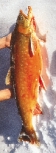
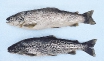
Arctic char
In the lowland tundra and in the forest and
The Arctic char is the northernmost freshwater fish in the world and occurs through-
wetland areas of Fennoscandia, the Kola
out the Arctic. Some populations have been locked into lakes where they feed on
midge larvae and grow very slowly. A few individuals grow larger, probably because
Peninsula, and western Russia, rivers and lakes
they are cannibalistic. Many stocks of Arctic char migrate to the sea in summer, where
connect to more southern regions, and the fish
they have a larger resource base to exploit and thus are able to grow faster. While at
fauna is richer and the food webs more com-
sea, they feed on crustaceans and small fish. Before winter, these migrants return to
plex. Freshwater ecosystems in the western
rivers and lakes to avoid the low winter temperatures in the ocean. In extreme condi-
tions, they hardly feed at all during the winter. Despite these regional and behavioral
part of this region have up to 10 species,
variations, all Arctic char belong to the same species.
increasing to 20 in the region of the large
Predatory birds
Peregrine falcon
Lake food web
Eagle
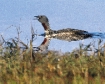
Loons
Mergansers
Otter
Mink
Birds
Predatory
mammals
Third level predators
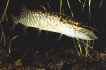
Pike
Carnivorous
Phyto-
Algae
zooplankton
Second level
plankton
Whitefish
Fish-eating fish
Mosses
Arctic char
predators
Herbivorous
zooplankton
Bottom
Fish
First level predators
vegetation
Grazers
and filter feeders
Insect larvae,
mysids, amphipods
Primary producers
Exampes of organisms at different levels in lake food webs
in the AMAP area.
нннннннннннннннннннннннннннннннннннннннннннннннннннннннннннннннннннннннннн
Common English name
Latin name
нннннннннннннннннннннннннннннннннннннннннннннннннннннннннннннннннннннннннн
Primary producers
Chrysophytes (golden algae)
Cryptophyta
Diatoms
Dinoflagellates
Green algae
Bluegreen algae
HRENSTR╓M
E
Mosses
Grazing zooplankton
FREDRIK
Rotifers (wheel animacules)
Cladocerans (water fleas)
Copepods
Predatory zooplankton
Copepods
Bottom-dwelling invertebrates feeding mostly on plant matter and detritus
Chironomids (midge larvae)
Cladocerans (water fleas)
Chydorids
ROSSELAND
Ostracods (musselshrimps)
Oligochaetes (ringed worms)
OLAV
Amphipods (sandhoppers)
Copepods
BJ╪RN
Nematodes (roundworms)
Fish feeding mainly on plankton or insect larvae
Brown trout
Salmo trutta
Arctic char
Salvelinus alpinus
Whitefish
Coregonus spp.
Cisco
Coregonus spp.
Grayling
Thymallus spp.
Lake trout (Lake char)
Salvelinus namaycush
Fish, mammals and birds feeding mainly on fish
Burbot (Lingcod, Loche)
Lota lota
Northern pike
Esox lucius
Lake trout (larger individuals)
Salvelinus namaycush
EHRENSTR°OM
Otter, Eurasian otter
Lutra lutra
European mink
Mustela lutreola
FREDRIK
American mink
Mustela vison
Arctic tern
Sterna paradisaea
Loons
Gavia spp.
Mergansers (diving ducks)
Mergus spp.
Bald eagle
Haliaeetus leucocephalus
Osprey
Pandion haliatus
WIDSTRAND
STAFFAN
Pechora River in Russia. Different species of
46
Life in the ocean
whitefish dominate, but perch, pike, and bur-
Polar ecology
bot are also important.
The Arctic Ocean and its surrounding seas are
In North America, there is a similar increase
unique marine ecosystems because of the cold,
in the number of species as one moves from
the extreme variation in light conditions, and
north to south. Arctic char is the main High-
extensive ice cover. Melting and freezing of ice
Arctic fish species, whereas trout, stickleback,
create rich habitats close to the sunlit surface.
and grayling appear farther south. In the west-
The wide continental shelves provide large
ern and Low Arctic, the fauna is as diverse as
shallow areas, where freshwater from north-
in the Russian rivers.
flowing rivers creates estuarine conditions. Life
Most fish feed on benthic invertebrates and
in the ocean occupies three major environ-
surface insects, and pike is the only species
ments: ice, open water, and bottom sediments.
that feeds strictly on other fish.
Fish fall prey to birds, such as white-tailed
The pack ice has a unique food web
sea eagle, bald eagle, osprey, and loons, and to
fish-eating mammals such as mink, bears, and
The central Arctic Ocean is covered by con-
otters. Freshwater fish, especially Arctic char,
stantly moving multi-year ice. It is a cold envi-
are an important food source for people.
ronment in which little sunlight reaches the
water. In spite of these limiting conditions, the
Streams are unstable environments
pack ice is not devoid of life. In fact, recent
measurements show a productivity that is
Most streams in the High Arctic are short and
much higher than most people thought only a
fed by glaciers. They freeze or dry up during
few years ago. Plants and animals which live in
the winter. Almost all the water comes during
the ice are referred to as epontic.
snowmelt, scouring the bottom with its violent
Among the epontic life forms are colony-
flow. These extreme fluctuations make the
building diatoms and blue-green algae that uti-
stream environment very unstable. Unless
lize the scant light that penetrates the ice. They
plants and animals maintain their hold against
can support a few species of zooplankton. Most
the turbulent runoff, the streams are stripped
numerous are small crustaceans. Some zooplank-
of life during the spring melt. Deeper streams
ton species rise from the bottom sediments to
support larvae of midges and gnats, which feed
reproduce. The young zooplankton feed and
on diatoms and organic material in the bottom
store lipids during summer before they descend
sediment. The deeper glacier-fed streams are
several hundred meters to the bottom sediments,
also important spawning sites for Arctic char.
where they overwinter in an inactive stage.
Spring-fed streams have a more even flow
The algae-grazing zooplankton serve as
over the seasons. Mosses are abundant along
food for predatory plankton and for Arctic
the banks, while sun-nourished diatoms form
cod, one of the few species of fish that survives
a film on the bottom. The bottom sediment
in the conditions of the polar basin.
supports many insect larvae, which are food
Away from the Arctic continental shelves,
for Arctic char and insect-eating birds.
most plankton primary production is con-
In the southern area of the AMAP region,
sumed by animals in the water column. There-
diversity in river ecosystems increases. In
fore, the benthic ecosystem tends to be low in
Fennoscandia, streams fed by glaciers and
biomass and has only a few species. On the
melting snow often grow into large rivers
continental shelves, however, a high propor-
extending more than 200 kilometers and con-
tion of plankton productivity is consumed by
necting to extensive lake systems. Where the
bottom-dwelling animals. An important point
current slows, there are often rich bottom-
is that Arctic marine ecosystems tend to con-
dwelling communities of plants and animals.
tinuously re-use organic carbon. Therefore,
The flat landscape of the Russian tundra is
contaminants that are strongly associated with
crossed by several large rivers, some of which
organic matter also re-circulate. Consequently,
have vast flood plains. Constant erosion and
bottom-dwelling animals that scavenge the
build-up of new material along the river bed
remains of surface animals often carry appre-
limit plant and animal life in the lower reaches
ciable loads of such contaminants.
of the rivers. Even the deltas can only support
a poor fauna of zooplankton. However, the
Life is most abundant along the ice edge
upper reaches of the rivers feature 15 to 20
different species of fish, including omul and
The richest marine areas in the Arctic occur at
Atlantic salmon. Many of the rivers freeze
the edge of the ice and in the shelf seas, where
solid during the winter, even if they become
the interaction of water currents and ice cre-
warm in the summer. The water is often acidic
ates ideal conditions for high productivity.
and rich in organic material from the sur-
Some of the shelf seas are among the most pro-
rounding landscape.
ductive ecosystems in the world, providing
In Iceland, the rivers are similar to other
food for immense populations of migratory
Arctic areas, but with a poor fauna because of
birds as well as an economic base for several
their geographic isolation.
large fishing fleets.
Predatory birds
Gulls
Jaeger
Predatory
mammals
Marine food web
Polar bear
Arctic fox
Guillemot
Murre
Eider
Kittiwake
Seabirds
Bottom-feeding
Bearded seal
seabirds
Narwhal
Walrus
Beluga
Phyto-
Bottom-feeding
Toothed
plankton
mammals
whales
Third and higher level
Ringed
Herbivorous
predators
seal
zooplankton
Second level
Capelin
predators
Herring
Carnivorous
Arctic cod
zooplankton
Fish
First level predators
Atlantic cod
Halibut
Grazers
Bivalves
Fish-eating
and filter feeders
fish
Bottom invertebrates
Primary producers
Carcass-eating amphipods
Exampes of organisms at different levels in marine food webs in the AMAP area.
нннннннннннннннннннннннннннннннннннннннннннннннннннннннннннннннннннннннннн
Common English name
Latin name
нннннннннннннннннннннннннннннннннннннннннннннннннннннннннннннннннннннннннн
Primary producers
Diatoms in the ice
Nitzschia frigida, Melosira arctica
Diatoms in the water mass
Prymnesiophytes
Phaeocystis pouchetii
Ice fauna and grazing zooplankton
Amphipods
Copepods
Calanus spp.
Small krill
Zooplankton feeding mostly on other zooplankton
Larger krill
`Gelatinous' plankton,
including jellyfish and hydras
Animals feeding mainly on zooplankton or filter feeders
Capelin
Mallotus villosus
Herring
Clupea spp.
Arctic cod (Polar cod)
Boreogadus saida
Redfish
Sebastes spp.
Sculpin
Myoxocephalus spp.
Little Auk (Auklet, Dovekie)
Alle alle
Great shearwater
Puffinus gravis
Eider
Somateria spp.
Bowhead whale (Greenland right whale)
Balaena mysticetus
WIDSTRAND
Humpback whale
Megaptera novaeangliae
Bearded seal
Erignathus barbatus
STAFFAN
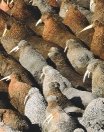
Walrus
Odobenus rosmarus
Animals feeding mainly on fish and other predators
Cod
Gadus spp.
Atlantic halibut
Hippoglossus hippoglossus
Long rough dab (American plaice)
Hippoglossoides platesoides
Greenland halibut
Reinhardtius hippoglossoides
Salmon (Pacific)
Onchorynchus spp.
Salmon (Atlantic)
Salmo salar
Black guillemot (Tystie)
Cepphus grylle
Thick-billed murre (Br№nnich's guillemot) Uria lomvia
Common murre (Atlantic guillemot)
Uria aalge
Atlantic puffin
Fratercula arctica
Northern fulmar
Fulmaris glacialis
Black-legged kittiwake
Rissa tridactyla
Beluga (White whale)
Delphinapterus leucas
WIDSTRAND
Narwhal
Monodon monoceros
Ringed seal
Phoca hispida
Harbor seal (Common seal)
Phoca vitulina
STAFFAN
Fur seal
Callorhinus ursinsus
Harp seal
Phoca groenlandica
Gray seal (Ranger seal)
Halichoerus grypus
Hooded seal
Cystophora cristata
Third-level predators
Arctic fox
Alopex lagopus
Polar bear
Ursus maritimus
Glaucous gull
Larus hyperboreus
Herring gull
Larus argentatus
Jaegers
Stercorarius spp.
Bottom-dwelling animals (predators and filter feeders)
Cnidarians, including sea anenomes
Crustaceans, including Northern shrimp
Pandalus borealis
Molluscs, including mussels and clams
EHRENSTR╓M
Echinoderms
(e.g. sea stars, sea cucumbers, and sea urchins)
FREDRIK
This high productivity is a result of the sea-
At the top level of the marine food web are
48
sonal cycle of growing and melting sea ice,
polar bears and humans. Polar bears feed
Polar ecology
which allows nutrient-rich water to reach the
mostly on ringed seals. By way of the marine
sunlit surface of the ocean. In the spring, fresh
food web, seals, toothed whales, polar bears,
meltwater from the ice forms a stable lens on
and people may ingest contaminants that have
top of more saline ocean water, keeping the
entered the water via deposition from the
phytoplankton in this lens near the surface
atmosphere, the melting of ice, or by river
where there is plenty of light. Algae that over-
runoff in coastal areas, or in the case of heavy
winter in crevices in the sea ice make effective
metals from naturally-occurring minerals in
use of the returning light in spring. In many
sediments and water
areas, the food web connected to the ice-edge
The marine food webs are complex, and
bloom follows the retreat of the ice margin as
some paths are longer than in many other
it moves northward during summer.
ecosystems. This accentuates the role of bio-
magnification (see box left), and makes top
Contaminants enter the biota
predators especially prone to accumulating
The processes by which persistent contaminants enter and remain in plants and ani-
high levels of environmental contaminants.
mals and their food webs can be summarized by three terms: bioconcentration, bioac-
The AMAP region also covers areas of sub-
cumulation, and biomagnification.
arctic marine waters, such as the Barents Sea
Bioconcentration refers to the process by which plants and animals take up conta-
and the Nordic Seas (the Norwegian, Iceland,
minants directly from air, water, or soil. The uptake is determined by the chemical and
physical characteristics of the contaminant. For example, many organic compounds
and Greenland Seas). The mixing of water
dissolve well in lipids and will preferentially end up in the lipid components of the
masses at the polar front, along with more
biota. Water-soluble contaminants can enter aquatic organisms through the gills or
moderate water temperatures than in the
membranes in the gut.
Arctic, makes these waters highly productive
Bioaccumulation is a broader term. It includes bioconcentration as well as the
uptake of contaminants from the food an animal eats. The body burden due to bioac-
with many commercially important fish stocks.
cumulation will thus depend on contaminant concentrations in air, water, and soil, as
These include zooplankton feeders, such as
well as in the animal's diet. The body burden will also depend on an organism's ability
capelin and herring, and fish eaters, such as
to rid itself of contaminants. Some compounds will be excreted or broken down into
cod and haddock.
less toxic components, while others will accumulate.
Biomagnification occurs when a contaminant is not broken down or excreted, but
accumulates as it passes up the food web. Biomagnification is the major reason that
Shallow waters have a rich bottom fauna
persistent environmental contaminants reach high concentrations in top predators
even when levels in air, soil, and water are low. The Arctic marine environment has
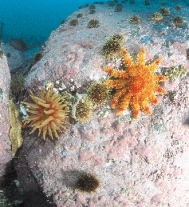
Sediments in shallow seas and along coasts teem
long food chains compared with many ecosystems, making it especially vulnerable to
with life. Crustaceans, sponges, and mollusks
biomagnification. The role of fat in the diet of many Arctic animals further promotes
biomagnification of lipid-soluble organic contaminants.
are some of the animals that take advantage of
dead plankton and other organic material that
The melting ice itself may act as a vehicle
for contaminants. These can be incorporated
into the ice along with sediments at the mouth
of a polluted river or be deposited directly on
the ice surface from the air. These contami-
nants can then be carried over long distances
as the ice makes its trans-polar voyage. They
may be released in highly productive areas
when the ice melts in spring and summer, just
when plants and animals enter their peak
growth period.
In the Bering and Chukchi Seas, most of the
nutrients come from the cold Pacific water
flowing north through the Bering Strait. Up-
welling of nutrient-rich bottom water, such as
in Lancaster Sound, can also create favorable
conditions for photosynthesizing plankton.
Zooplankton and fish provide links
from algae to mammals
Zooplankton, the grazers of the sea, take
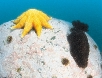
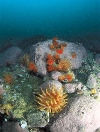
Tealia and Psolus
from Disko Bay.
immediate advantage of the productivity of
FREDRIK EHRENSTR╓M
marine plant life. They become a rich food
fall to the sea floor from productive surface
source for various crustaceans, such as krill
waters. Some fish, eider ducks, bearded seals,
and prawns. These, in turn, serve as food for
and walrus feed mostly on this benthic fauna.
fish, some seabirds, and baleen whales.
Benthic feeders are likely to ingest contami-
Important fish species at this level of the
nants if bottom sediments have been polluted.
marine food web are capelin and Arctic cod,
This is an important pathway into biota as
on which Atlantic cod, fish-eating sea birds,
many contaminants will follow sediments and
and marine mammals depend for food.
settle on the bottom. Benthic feeders can also
stir up contaminants which are then carried
49
away by water currents.
Polar ecology
The benthic food chain is shorter than that
at the ice edge, which limits the potential for
biomagnification. Walrus that only feed on the
bottom can thus be expected to have lower
levels of contaminants than, for example, seals
that feed on fish or walrus that eat seals. Ani-
mals feeding on bottom fauna provide a link
that can transport contaminants from sedi-
ments to predators at the surface.
Benthic organisms that feed on carcasses of
dead animals such as fish and sea mammals
are at a very high level in the food web.
The shelves provide an estuarine
environment
WIDSTRAND
The continental shelf seas, including the Kara,
STAFFAN
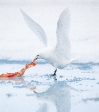
Gull with seal blubber.
Laptev, East Siberian, and Beaufort, differ
Along Arctic shores, conditions for plants
from the rest of the marine environment in
and animals vary. In areas with ice, the bottom
that freshwater from north-flowing rivers
is usually scraped bare so often that very few
plays a central role. These seas are covered by
species manage to survive. Along the ice-free
coasts, on the other hand, bottom-dwelling
communities can be very rich. Kelp forests and
seaweed become nursing grounds for many
fish species.
Summary
Low temperatures and extreme seasonal varia-
tions in light are some physical characteristics
that limit the productivity of Arctic ecosystems
and can make them more vulnerable to conta-
minants in the environment. In terrestrial
ecosystems, lack of nutrients, waterlogged
conditions on the tundra, and the lack of
water in the Arctic desert areas also limit pro-
ductivity.
The ability to gather and store energy is a
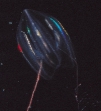
The jellyfish Merten-
FREDRIK EHRENSTR╓M
prime concern for survival during the dark and
sia ovum from Green-
landfast ice for most of the year, the edge of
cold winter. Therefore, fat plays a more impor-
landic waters.
which can extend as far as 400 kilometers
tant role in animal metabolism in the Arctic
from the coast. Rivers flowing into these seas
than in temperate regions. The importance of
bring large amounts of particles, including
fat increases biomagnification of fat-soluble
organic matter, that are an energy source for
contaminants. Bioaccumulation of contami-
bacteria in the water.
nants is also accentuated in many Arctic ani-
In the estuarine zones where the rivers meet
mals by long lives.
the sea, this bacteria-based food web is the
Seasonal fluctuations are the norm in the
most important. It supports small crustaceans
Arctic, and many species migrate north to take
and fish that migrate from freshwater ecosys-
advantage of the productive summer season.
tems during the summer. In the Beaufort Sea,
This includes large numbers of migratory birds
Arctic cod is the dominant fish species. Seals
that concentrate in wetland areas in the terres-
and bowhead whales take advantage of the
trial environment and along the marginal ice
rich supply of bottom-dwelling crustaceans.
zone in the marine environment.
The estuarine waters of the Mackenzie River
Terrestrial food webs in the Arctic are gen-
attract beluga during the summer.
erally short, though long-lived lichens gather
Water-column productivity is restricted to
contaminants very efficiently and transfer
open-water areas between the landfast ice and
these to grazing animals, such as caribou and
the pack ice, many of which occur at the same
reindeer. Freshwater food webs are also short,
place year after year. The offshore ecosystem is
and predatory fish occur mostly in Low Arctic
high in productivity of diatoms, which serve as
to subarctic ecosystems. Arctic marine food
food for grazing zooplankton that in turn sup-
webs can be very complex but with only a few
port fish, jellyfish, and other predators.
key species connecting the different levels.