


ELANDER
NUS
AG
M
Y R B
T U N K
IDSTRAND
W
STAFFAN
ELANDER
NUS
AG
M
S T A F F A N W I D S T R A N D
WIDSTRAND
K N U T B R Y
S T A F F A N W I D S T R A N D
STAFFAN
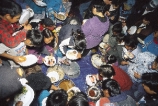


In mid-April, when the weather is warming and
open leads are forming in the sea ice, the bow-
head whales start to appear in the dark waters
off the northern coast of Alaska. The I๑upiat
whalers have been preparing for this since the
previous summer, catching caribou, fish, seals,
and birds for food, clothing, and the skin cover
of the umiaq, the six-meter-long whaling boat.
They have scouted the ice to gauge where the
leads would form, prepared all their equipment,
and headed out onto the floating sea ice to make
a camp. Hiding behind
blocks of snow, they
Peoples of the North look for the sleek black
back of the bowhead and the puff of spray it
exhales, waiting for one that swims close to the
ice edge.
The hunt is successful today, and the crew
can haul back a large whale, cut it up, and make
piles of meat and maktak to be shared among
all those who helped with the hunt. Women
serve coffee, doughnuts, and boiled maktak to
sustain the workers, and amid all the hard work
is laughter and joy, the joy of being I๑upiat.
Everything from the whale is brought back to
the village, and the captain holds a feast in his
house. Soon, he will be preparing for the large
feast at the end of the season. He and his crew
will serve hundreds of people, sharing the whale
and its gifts, renewing communal ties, and danc-
ing to show their gratitude to the whale.
These scenes from Alaska give a glimpse of
the role of catching, preparing, and sharing
food in one Arctic native community, but food
is at the heart of people's lives everywhere. We
eat to get energy and nourishment. We share
our meals with family and friends to strengthen
ICKLEN
social ties. With food, we celebrate our cultures
N
and reaffirm our sense of community.
PAUL
In recent years, food has also become an is-
sue in the discussion about contaminants. A cru-
cial question for many Arctic peoples is whether
their traditional foods are safe to eat. Public
health officials struggle to weigh risks against
benefits, whereas the communities themselves
also see how environmental threats from an
outside world may hasten the pace of cultural
change. Therefore, an assessment of the impact
of contaminants on Arctic environments must
consider the context of northern cultures.
This chapter describes the people living in the
Arctic, with a focus on indigenous populations.
The goal is to provide information about the
role of different foods, both as sources of nutri-
tion and as cultural ties, and about other factors
that are important for people's health. Together
with data on the specific contaminants, this in-
formation will form a basis for the assessments
made in the concluding chapter on human health.
A second, equally important goal is to provide a
brief description of how northern people live,
because an accurate understanding of this is
K N U T B R Y
crucial when communicating information about
Y
RB
contaminants in the Arctic.
T
U
N
K
52
United States: Alaska
Alutiiq
Peoples of the North
Alaska is the northwestern-most of the United
The Alutiiq, or Sugpiaq, live in southwestern
States and the only state that extends into the
and south-central Alaska, on the Alaska
Arctic. Most of the state is included in the
Peninsula, Kodiak Island, the southern Kenai
AMAP assessment, the exception being the
Peninsula, and the areas surrounding Prince
southeastern `panhandle.' It is a wider area
William Sound. They share cultural attributes
than the US definition of Arctic Alaska; see the
with both the Aleut and the Yup'ik. Alutiiq
figure opposite.
communities are situated along the coast. Fish
There are three groups of Alaska Natives,
(mainly salmon) and terrestrial animals (mainly
commonly called Aleut, Inuit (or Eskimo), and
caribou) are the most important food sources,
Indian. About 73000 of them live in the area
but birds, plants, and marine mammals are
of AMAP's responsibility, where they make up
also part of the diet. Commercial fishing is the
about 15 percent of the population. In many
primary economic activity.
rural areas, they are in the majority.
All native cultures of Alaska are in the
Athabascan
midst of change as people are trying to adapt
The Athabascans live in the boreal forest of
to a wide variety of modern influences. Politi-
interior Alaska and parts of the Yukon Terri-
cally, the Alaska Native Claims Settlement Act
tory and the Northwest Territories of Canada.
of 1971 established regional and village corpo-
Traditional activities include salmon fishing,
rations. These corporations are to protect na-
caribou and moose hunting, and trapping.
tive interests and encourage economic, social,
Birds, other terrestrial mammals, and some
and political integration, but their success has
plants are also taken, and coastal communities
been hotly debated. Several questions sur-
hunt marine mammals, such as beluga. Barter-
rounding subsistence rights and traditional
ing with I๑upiat and Yup'ik neighbors has
hunting practices are also unsettled.
brought seal oil and other marine products to
Many people are moving from region to
inland communities.
region and from villages to urban centers.
However, traditional customs and activities
Central Yup'ik
remain a common tie and are important
The Central Yup'ik, also known as Yup'ik and
sources of identity, even for people who live
including the Cup'ik, live on the coast and
outside the core areas described below.
tundra of the Yukon-Kuskokwim Delta in
southwest Alaska. They are the most numer-
ous of Alaska's Inuit groups. Most children
Peoples of Alaska
still speak the native language. Subsistence
Aleut
activities center on fish. Marine and terrestrial
The Aleut inhabit the islands of the Aleutian
mammals, birds, bird eggs, and plants also
chain, including the Kommandor Islands of
play significant roles in the diet. The customs
Russia, the Pribilof Islands of the Bering Sea,
of Central Yup'ik remain strong in the villages
and the Alaska Peninsula of the North Ame-
of southwest Alaska, and include many tradi-
rican mainland. Primarily a sea-going people,
tions and beliefs around hunting and sharing.
the Aleut depend mostly on fish, marine mam-
mals, and birds for food. Commercial fishing
Eyak
is the most important economic activity along
The Eyak are linguistic relatives of the Atha-
the Aleutian chain. Military activity during
bascans. They live on the southern coast of
and after World War II forced many Aleut vil-
Alaska, to the east of Prince William Sound.
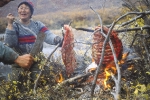
Roasting caribou at
lages to relocate, and it has also influenced the
Although Eyak are the least numerous of
hunting camp, Alaska.
economy of the region.
Alaska's indigenous groups and only one elder
speaks the language, many Eyak are working
to revive their culture.
I๑upiat
The I๑upiat live in the coastal and tundra re-
gions of Alaska north of Norton Sound in the
Bering Sea. Although their language is related
to the Siberian Yupik and Central Yup'ik, the
I๑upiat are more closely related to Inuvialuit,
Inuit, and Kalaallit of Canada and Greenland.
Coastal I๑upiat depend on marine mammals,
caribou, birds, and fish, while the inland peo-
ple concentrate on caribou, fish, and birds.
Plants play a very minor role in the diet. Tra-
ditional trade and bartering extend hundreds
HUNTINGTON
of miles. This trade, like many other customs,
HENRY
remains strong today.
53
Total and Indigenous population of Arctic Alaska
ญญญญญญญญญญญญญญญญญญญญญญญญญญญญญญญญญญญญญญญญญญญญญญญญญญญญญญญญ
Peoples of the North
Region
Total
Indigenous
% indigenous
ญญญญญญญญญญญญญญญญญญญญญญญญญญญญญญญญญญญญญญญญญญญญญญญญญญญญญญญญ
Arctic Circle
Arctic Slope
Athna
3047
564
18.5
Aleut
11942
2167
18.1
Arctic Slope
5979
4366
73.0
Bering Straits
8288
6173
74.5
Northwest Arctic
Bristol Bay
7028
4646
66.1
Bering
Calista
19447
16701
85.9
Straits
Chugach
11446
1553
13.6
Cook Inlet
302517
18911
6.3
Donyon
91938
10772
11.7
Doyon
Koniag
13309
2141
16.1
Northwest Arctic
6113
5241
85.7
Calista
US delineation
Total
481054
73235
15.2
A
L
A
S
K
A
of Arctic Alaska
Cook Inlet
Athna
Bristol Bay
Aleut
Chugach
Koniag
AMAP boundary
Siberian Yupik
shared, and anything that threatens the shar-
The Siberian Yupik in Alaska inhabit St. Law-
ing of food is seen as very damaging to native
rence Island in the Bering Sea, and are some-
societies. This could, for example, be the pres-
times called the St. Lawrence Island Yupik.
ence of contaminants in the food, or even fear
They are the same group as the Yupik of Chu-
of contaminants, since hunters may be reluc-
kotka, Russia, and share language, customs,
tant to give away tainted meat.
Total and indigenous
and kinship ties across the international bor-
Understanding the importance of sharing is
populations in Arctic
der. Today, the major subsistence resources are
also essential when looking at what people
Alaska by Native
marine, primarily walrus and bowhead whale.
eat. Production numbers, showing how many
Corporation region.
Fish, shellfish, seals, and birds are also part of
animals have been killed or how many fish
the diet. Plants play a minor role. Traditional
have been caught, might say more about the
customs remain strong on St. Lawrence Island,
amount of certain foods that are available in
and the renewed ties to Chukotka have re-
the region than what people in a particular vil-
vived traditional trade and intermarriage.
lage might eat. For example, beluga harvests
in Point Lay on the North Slope are high, but
The time is almost here.
beluga is shared throughout the region, and
The season of the deep blue sea . . .
might be exchanged for bowhead whale, which
Bring good things from the deep blue sea.
is not hunted at Point Lay. Inland communities
Whale of distant ocean . . .
may use furs and caribou to trade for marine
May there be a whale.
products such as seal and whale. Nevertheless,
May it indeed come . . .
production figures indicate which foods are
Inside the waves.'
the most important when looking at the impact
St. Lawrence Island Prayer Song
of contaminants on people.
Fairbanks, Alaska.
Non-indigenous residents of Alaska
The non-indigenous residents of Alaska are
most likely to live in urban areas, of which
Anchorage and Fairbanks are the largest.
Most of them are new arrivals to the state.
Hunting and fishing are popular activities, but
in general these residents rely much less on
country foods than most indigenous people.
Sharing resources links cultures together
Hunting, fishing, and gathering are deeply
rooted sources of identity in all of the native
cultures, but just as important are sharing and
trading. They represent ways to establish and
maintain family and community ties, as well
as ties between communities. For certain game,
SHAW
customs dictate that the animal has to be
GLENN
nities are located in places that the animals
54
Fish and marine mammals
pass on their migrations. In northern and
Peoples of the North
are the most common foods
northwest Alaska, marine mammals account
The left graph in the figure opposite shows the
for 42 percent of the subsistence harvest, or
harvest of different subsistence foods for rural
almost one hundred kilograms per person per
Alaska. Fish account for the largest share by
year. The right graph opposite shows the catch
weight, with salmon as the most important
by an average I๑upiat household in Barrow,
species. Whitefish, burbot, and trout are also
Alaska. In southwestern Alaska and the Aleu-
caught.
tian chain, the harvest of marine mammals is
The fish are typically caught by net, both
not as important by weight, but the hunting
in the ocean and in rivers and lakes. Families
has great cultural significance. The most im-
and extended families often spend several
portant species are walrus, harbor seal, beard-
months at fishing camps, living in tents and
ed seal, sea lion, and fur seal.
wooden cabins.
Individual hunters and single boats can catch
For coastal communities, marine mammals
polar bear and sometimes beluga, while the
are a highly valued resource, including bow-
hunting of large mammals is usually a coopera-
head whales, beluga, walrus, bearded seal,
tive effort. To catch bowhead whales, people
ringed seal, and polar bear. Often the commu-
establish camps on the sea ice or on the shore
near open water. The crews often spend more
than a month at these camps, living in tents on
the ice or in small cabins. The animal is shared
according to certain rituals. If the hunt is suc-
cessful, there will be a festival celebration. The
marine mammals thus become a cultural re-
source as well as an important part of the diet.
Caribou is the major food from the land
Both coastal and inland communities have ter-
restrial animals as part of their subsistence
diet. Caribou is most important, but moose,
Dall sheep, muskox, brown and black bear,
HUNTINGTON
and a variety of smaller animals are also
taken. Reindeer herding, which was intro-
HENRY
duced in the early part of the century, contin-
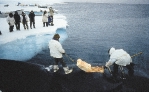
Cutting bowhead-whale
ues in some parts of Alaska.
maktak for cooking.
Point Barrow, Alaska.
As with the marine mammals, there are
cultural and religious customs surrounding
the use of terrestrial animals. For example, a
moose is an important part of Athabascan
funeral potlatches.
Birds make up only a small part of the diet,
but are significant in the seasonal hunting
HUNTINGTON
cycle. They are often the first source of fresh
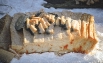
Maktak ready for
meat available after the winter.
cooking.
HENRY
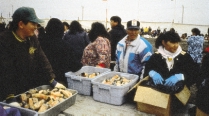
Serving maktak at
HUNTINGTON
whaling festival. Point
Barrow, Alaska.
HENRY
Harvest of subsistence food,
Composition of subsistence production,
55
small and mid-size communities, Alaska,
I๑upiat households, Barrow, Alaska,
kg /person /year
kg /person /year
Peoples of the North
300
Birds
Plants
50
Terrestrial mammals
Marine mammals
Fish
Shellfish
200
40
30
100
20
Left: Harvest of subsis-
tence foods in small and
mid-sized communities
in Alaska.
10
0
Right: Subsistence pro-
duction in I๑upiat
Barrow
households, Barrow,
Arctic
Alaska.
0
Western
Interior
Arctic
A L A S K A
Circle
Walrus
Moose
Caribou
Salmon
GeeseEiders
Whitefish
Polar bear
Southcentral /
Southwestern /
Bearded seal
Prince William Sound
Aleutian
Bowhead whale
Other freshwater fish
Kodiak Island
Ringed and spotted seal
Traditionally, women and children gather
for the United States population as a whole. In
berries, roots, and greens, both for food and
certain areas, botulism reaches its highest inci-
for medicine. Berries are often combined with
dence worldwide. The age-adjusted mortality
fat into `akutuq' or Eskimo ice cream.
for some types of cancer is higher than for the
United States population as a whole, even if
Smoking and poor medical care
contribute to ill health
Making akutuq
Akutuq is an Inuit food made by warming fat, then whipping air in by hand so that it
Subsistence foods are important sources of
slowly cools into a foam. This recipe is from a detailed description in Nauriat nigi๑aq-
vitamins, minerals, and energy for Alaska
tuat. Plants we eat by Anore Jones.
Natives, and a shift away from traditions
Of the usual ingredients, fat, oil, liquid, sweetener, and berries, only fat is essential.
The type of fat determines how the akutuq will taste and feel, and each animal has a dif-
would probably be detrimental for people's
ferent type of fat. I๑upiat often prefer well-aged yellow fat which has more flavor and
social, spiritual, and physical health.
whips up fluffier than does fresh fat. Regarding the oil, some people think that seal oil
However, health involves many other fac-
ruins the flavor while others would not eat akutuq without it. The akutuq can be sweet-
tors than food, and there are several problems
ened with sweetener or with fruits. Meat and fish akutuq are not usually sweetened.
1 pound of hard fat (qaunnaq, or back fat)
among native communities that contribute to
1/2 pound of soft fat (itchauraq, or belly fat)
high rates of disease and early death. One is
1 cup seal oil. You can use vegetable oil, or less oil, but it helps hard fat soften while
poor housing, lacking both adequate insula-
you mix
tion and plumbing. Poor sewage disposal and
1/2 cup water or other liquid
4-12 cups berries, drained and at room temperature
lack of access to clean drinking water are also
1/4-1 cup sweetening
common in rural villages. Alaska Natives
Prepare the fat by trimming away all the bloody, dirty, tough and stringy parts. Chop
smoke more than the population at large, and
fine on a heavy board, a small amount at a time. This cuts all the fibers. Pound with a
alcohol abuse is a significant risk factor.
rock or hammer on the board. As you pound each little pile of fat out flat and thin, fold
Moreover, health care facilities are not ade-
it back over and pound again several times. Pounding breaks apart the fat globules. A
meat grinder can also be used. Put fat in a large bowl and warm on low heat until it
quate to meet peoples' needs. In 1993, the leg-
becomes a liquid. The fat should never get hotter than it is comfortable to your hand.
islature of Alaska concluded that `by all mea-
Add some seal oil, approximately 1/3 by volume. Keep mixing until it is all liquid.
sures, the health status of Alaska Natives is
Remove from heat to a table or comfortable place where you can set the bowl while you
significantly lower than other Alaskans. The
stir the fat. Stir in big circles, not fast but briskly and steadily. Stirring is what making
akutuq is all about and your arm must be strong to keep it up. Keep mixing and adding
health needs of Alaska Natives far outstrip the
water, then oil, as the fat slowly cools and gets fluffy and white. Like some other fine
resources available . . . Many villages do not
things in the north, the success of akutuq depends on the sensitive manipulation of tem-
have basic water and sanitation services which
perature, of the room, your hand, and what you add. Add berries after the akutuq is as
are essential to the control of disease.'
white and fluffy as you can make it. Put it into the shape in which you want it to
Statistics support this conclusion. Among
harden. Cover, and freeze or refrigerate.
Eat it any time as a dessert, a meal, a snack or a spread. Traditionally it was made
some groups of native people in Alaska, pneu-
for funerals, potlatches, and when a boy got his first of any kind of animals and on
monia is up to 60 times more common than
other special occasions. Sometimes is was just made as a special food, or for traveling.
the incidence of cancer is comparable. Many
56
cancer deaths are tobacco-related. The overall
Peoples of the North
leading cause of death in Alaska is cancer fol-
lowed by heart disease, unintentional injury,
and suicide. Diabetes, breast cancer, suicide,
chronic obstructive pulmonary disease, lung
cancer, and neoplasms are increasing among
native people.
In the midst of this worrying picture, there
are also some positive developments. The over-
all death rate has been declining for some time
and life expectancy for indigenous newborns
increased from 46.84 years in 1950 to 66.60
years in 1980-84. Deaths from injuries, acci-
dents, water/drowning, and homicide declined
significantly between 1980 and 1990.
Canada
Arctic Canada includes the land north of 60oN
plus the adjacent areas of Northern Quebec
and Labrador and comprises about 40 percent
of the land area of Canada; see figure below.
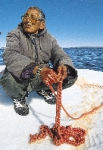
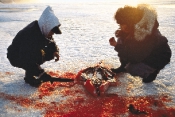
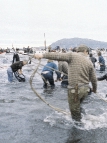
A Repulse Bay hunter
braiding whale intestines
The Canadian constitution recognizes three
NICKLEN
into a rope.
groups of indigenous peoples: the Inuit, the
PAUL
M้tis, and the Indian, who in the Arctic in-
west Territories will soon become a new politi-
clude Dene and Yukon First Nations. Together,
cal jurisdiction known as Nunavut. In this new
the indigenous groups make up 47 351 people
territory, comprising the northern and eastern
or about half the population in the area.
portion of the current Northwest Territories,
Inuit will be in the majority and will have con-
Peoples of Canada
siderable autonomy over their affairs.
Inuit
Dene and M้tis of Northwest Territories
The ancestors of present-day Inuit probably
and Yukon First Nations
traveled from Eurasia eastwards across northern
The Dene include several different groups
Canada to Greenland. Most, but not all, of to-
with their own languages: Chipewyan, Tetlit
day's Inuit communities are located on the tun-
Gwich'in, Dogrib, and a number of distinct
dra north of the treeline, and along the coast.
Slavey groups. The M้tis are descended from
The Inuit of Canada reside in northern La-
French fur traders and Indians.
brador, Nunavik, and the Northwest Territo-
The Dene and M้tis communities are in the
ries. A large portion of the present-day North-
western region of the Northwest Territories,
and within the northern extent of the treeline.
Total and Indigenous population of Arctic Canada
ญญญญญญญญญญญญญญญญญญญญญญญญญญญญญญญญญญญญญญญญญญญญญญญญญญญญญญญญญญญญญ
The Dene make up 29 percent of the popula-
Region
Total
Indigenous
% indigenous
tion in the western Northwest Territories and
ญญญญญญญญญญญญญญญญญญญญญญญญญญญญญญญญญญญญญญญญญญญญญญญญญญญญญญญญญญญญญ
Labrador
2519
1860
73.8
M้tis 12 percent of the population in this
Nunavik
7690
6825
88.8
Baffin
11139
8970
80.5
region. The total number of indigenous resi-
Keewatin
5832
5170
88.6
dents is 12 780.
Kitikmeot
4018
3526
87.7
Inuvialuit
5666
3850
68.0
The indigenous peoples of the Yukon include
Fort Smith
26970
10262
38.1
fourteen First Nations, each with its designat-
I๑uvik
3127
2448
78.3
Yukon
26024
4440
17.6
ed historic and current harvesting territories.
Total
92985
47351
50.9
Non-indigenous residents
The non-indigenous residents of Arctic Canada
Inuvialuit
are more likely to live in territorial or regional
Arctic Circle
Baffin
centers, such as Yellowknife, Whitehorse, and
I๑u-
Kitikmeot
Yukon
Iqaluit.
vik
Labrador
Keewatin
Fort Smith
Nunavik
Hunting and fishing
are important for providing food
C
A
N
A
D
A
Hunting, fishing, and gathering are important
Total and indigenous
activities in the economy of indigenous soci-
populations in different
regions of Arctic
eties, but people also participate in the wage
Canada.
economy as opportunity arises. Harvesting
said that they had lived on the land in the pre-
57
vious twelve months. An estimate of the per-
Peoples of the North
capita harvest suggests that the communities
are self-sufficient in their protein requirements.
Yukon First Nations also rely heavily on
subsistence activities. About one third of the
people in the 1991 Aboriginal People's Survey
said that they had lived on the land in the pre-
vious year and 30 percent support their fami-
lies with activities that are not part of the cash
economy.
Among non-indigenous residents of Arctic
Canada, hunting and fishing are popular activ-
ities, but rarely as extensive as for the indige-
nous communities of the region
The diet includes a variety of country foods
Dietary studies support the picture of a high
reliance on subsistence production. Even if
store-bought foods are also common, country
foods contribute a significant portion of the
daily nutrient intake.
The traditional diets are more balanced
WIDSTRAND
than a diet of foods imported from southern
Seal hunting, Canada.
STAFFAN
Average annual indigenous subsistence production,
practices are a mixture of traditional technolo-
Canadian regions,
gies, developed from what was available from
tonnes /year
the land, and new materials. Guns are used for
2000
hunting, for example, but so are harpoons and
spears. In the eastern Arctic, the blinds that
are used during seal hunts on the ice are now
made of cloth instead of skins.
Birds
and small game
The harvests are shared among people on
Caribou
the basis of kinship and other ties, and shar-
Marine mammals
ing, gift-giving, and exchange are all elements
Fish
of the country-food economy. Recently, there
have also been efforts to commercialize spe-
cialty northern foods, such as Arctic char, out-
side the Arctic.
1000
A wide range of plant and animal species
are used in the Canadian Arctic. The figure
No data
right shows the harvest level in the different
Other terrestrial
Inuit regions and in the Yukon Territory. In
mammals
than caribou
1989, the total harvest in the Northwest Terri-
tories was estimated to be about 5 million
kilograms, or 232 kilograms per person per
year, excluding commercial fish catches.
There is very little information about the
harvesting activities of the Dene and M้tis
communities, with the exception of fur-bearer
0
species and commercially significant fish. The
general picture is that marine mammals are
less important in the Yukon and Dene/M้tis
regions and that people rely more on terres-
Inuvialuit
trial mammals and freshwater and anadro-
Arctic
Baffin
Circle
mous fish.
Yukon
Employment figures indicate that subsis-
Labrador
tence activities are important, as almost 40
Keewatin
Nunavik
percent of the indigenous population in Dene
communities were not part of the labor force
according to a survey in 1991. Almost 38 per-
C
A
N
A
D
A
Average annual indige-
cent of people over 15 years of age answered
nous subsistence pro-
that they used non-cash activities to provide
duction in Arctic
for their families. A slightly larger percentage
Canada.
Canada, which have higher levels of sugar and
The types of food eaten also depend the
58
more saturated fats. Country foods are more
time of year. In Aklavik, fall is the season for
Peoples of the North
economical than purchasing food in the store,
hunting caribou, Dall sheep, and moose, as
which becomes especially important in com-
well as ducks and geese. Winter brings trap-
munities where many people are not employed
ping of small fur bearers and fishing. When
or have incomes below the poverty line. Coun-
the ice breaks up in April, muskrat are caught
try foods are also important for reinforcing
for their pelts as well as their meat. The water-
fowl return, and are used as food until they
begin to nest. Fishing resumes after ice break-
up. Spring is the time for gathering roots.
Summer is whaling time, and people travel out
to the Yukon coast to hunt beluga. Willow
tops, bird eggs, and wild rhubarb supplement
the diet. As fall approaches again, it is time to
dry fish and caribou meat and to pick berries.
Among the Dene, a few diet studies have
been done specifically to be able to estimate
the load of contaminants. These surveys show,
for example, that women in Fort Good Hope
eat moose in summer, barrenland caribou in
winter, and ducks in the spring. Other impor-
tant foods are inconnu, whitefish, cisco, and
blueberries. In the winter, moose, rabbit, white-
fish, and loche were part of the diet, and in the
spring woodland caribou. Men had similar
WIDSTRAND
eating habits, but with less seasonal variation.
Another studied community is Colville
STAFFAN
Lake. Women reported eating large quantities
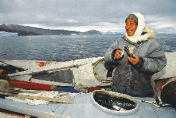
Seal dinner,
social relationships that are central to culture
of whitefish, barrenland caribou, and ducks in
Baffin Island, Canada.
and the subsistence economy.
the summer. Trout, barrenland caribou, duck,
The diet varies between communities and
and loche were the typical spring foods. The
between families, but detailed studies provide
Colville residents ate a much higher propor-
some examples of what people eat. In Aklavik
tion of country foods than at Fort Good Hope.
in the Northwest Territories, more than half of
In general, men ate more country foods than
the Inuit households consumed caribou, belu-
women, and older people more than younger.
ga, hare, muskrat, whitefish, cisco, burbot,
A third study, of the communities of Fort
inconnu, Arctic char, ducks, geese, cloud ber-
Smith, Northwest Territories, and Fort Chipe-
ries, cranberries, and blueberries. Caribou was
wyan, Alberta, showed that people ate country
the most common food.
foods six times per week and that animals
from the land made up one-third of the diet.
Four Yukon First Nation communities have
been studied extensively to look at what people
eat: Haines Junction in the traditional territory
of the Champagne-Aishihik First Nation, Old
Crow, which is a remote community on the
Porcupine River relying heavily on the caribou
herds that migrate through their land, Teslin at
Teslin Lake, and Whitehorse, which is the ter-
ritorial capital with a more diverse population.
Virtually all households in the survey used
moose and salmon, as well as berries and
other plant foods. Many also used caribou,
hare, ground squirrel, beaver, ducks, grouse,
chinook salmon, sockeye salmon, coho sal-
mon, whitefish, lake trout, and Labrador tea.
In total, mammals accounted for about half of
the traditional food, fish for one fifth, berries
for one-fifth, other plants for one-tenth and
birds for one-twentieth. People got most of
their food from hunting and fishing.
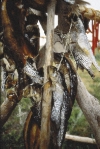
HUNTINGTON
Drying fish.
HENRY
tary system, mineral and hydrocarbon explo-
59
Health is improving
ration and exploitation, and some aspects of
Peoples of the North
Health conditions for Canadian Natives have
the judicial system.
improved dramatically in the past half a cen-
tury, but mortality rates are still higher in the
Kalaallit are the people of Greenland
north than for Canada as a whole, and life
expectancy is lower. For example, life expect-
Kalaallit (plural of Kalaaleq) is the collective
ancy among Inuit doubled between the early
name for Greenland's indigenous people, who
1940s and the 1980s, when it reached 66
are Inuit and belong to three groups: the Kitaa-
years. Life expectancy has continued to im-
miut (the West Greenlanders), the Tunumiut
prove but is still four to five years lower than
(the East Greenlanders), and the Inughuit (or
the Canadian average. In the Northwest Terri-
Polar Eskimos in North Greenland).
tories, infant mortality was 28 per thousand
In 1994, the population of Greenland was
births in 1981-85 compared to 144 two de-
55 419, of whom 87 percent were born in
cades earlier. However, infant mortality is still
Greenland. Most of the non-indigenous popu-
three times as high as for Canada as a whole.
lation comes from Denmark. The relationship
Major problems include poor water and
between indigenous and non-indigenous peo-
sewage disposal systems and crowded housing.
ple is good, and the two groups treat each
One of the serious threats to health is the
other with mutual respect. The introduction of
Total and indigenous
extremely high percentage of smokers. By age
Home Rule in 1979, and the improvement in
populations of munici-
palities in Greenland,
19, 63 percent of Indians and Inuit smoke,
Greenland's educational system, have reduced
shown as: total popula-
compared with 43 percent for non-natives.
the number of non-indigenous people working
tion (town population)
Smoking is the most likely explanation for a
and living in Greenland.
indigenous population.
recent increase in lung cancer among Inuit in
the Northwest Territories.
The heavy reliance on country food seems
to reduce the risk for certain health problems.
Indigenous groups in the Canadian Arctic
have among the lowest age-standardized pre-
valences of diabetes in the country. Diabetes is
one of the most prominent health risks associ-
ated with changes to a more `western' diet.
The Inughuit
Much of the improvement in health has
Qaanaaq
come with better health care, such as the nurs-
Avanersuaq
ing stations that are now available in many
879(639) 823
communities. Hospitals are centralized in
major cities, but traveling clinics provide some
specialty care that would otherwise not be
locally available.
Upernavik
2794(1131) 2671
Denmark: Greenland
The Greenlandic name for Greenland is Ka-
G
R
E
E
N
L
A
N
D
laallit Nunaat, `Land of the Greenlanders.'
Uummannaq
The first pre-Eskimo immigrants came to Green-
2708(1497) 2599
Ittoqqortoormiit
land from North America approximately 4500
Qeqertarsuaq
506(474) 468
years ago. The last major Inuit immigration
1162(1095) 1086
Ilulissat
4548(4086) 4127
took place in the centuries after the first Nor-
Aasiaat
dic immigration came from Iceland in 982 ad.
3306(3039) 3022
Kangaasiaq
The first Nordic immigrants probably died
Qasigiannguit
1518(668) 1444
1620(1515) 1517
out in the Middle Ages, but Europeans return-
Sisimiut
ed to colonize the island in 1721 and Green-
Arctic Circle
5365(5117) 4745
land became a colony of Denmark. Colonial
Maniitsoq
3866(3000) 3550
status ended in 1953, when Greenland was
Ammassalik
The Kitaamiut
Tassiilaq
recognized as one of three countries within the
The Tunumiut
2966(1684) 2763
Kingdom of Denmark.
In the 1970s, a political movement oppos-
Nuuk
13286(12882) 10061
ing the European Economic Community led to
the establishment of the first Home Rule Gov-
ernment, and eventual withdrawal from the
Narsaq
Paamiut
2077(1737) 1861
EEC. In 1992, the Home Rule assumed respon-
2320(2040) 2124
sibility for the last of its potential fields, health
Qagortoq
Stations and other installations
care, and has responsibility for all matters
3550(3181) 3126
603 393
Nanortalik
except foreign and security policy, the mone-
2605(1527) 2468
Using materials from animals for equipment and clothing
has always been an integral part of Arctic indigenous cul-
tures. In East Greenland, the use of seal intestines for mak-
ing the traditional water-proof anorak continued until this
century. The same material and sewing techniques were used
in the oldest known Greenlandic clothing found on frozen
mummies. The depicted anorak was made in Ammassalik in
1935. The owner, Jens Rosing, has drawn the pictures and
described how it was made.
Seal intestines were cut in one-meter long piece, turned
inside out, cleaned, and ดwind-cured', which makes the skin
turn white. When ready, the material was cut lengthwise
into strips, which were sews into a pattern with double-lay-
ered ornamental strips for strength.
The ornaments resemble polar-bear features that have
also been found on a Dorset bear figure from 500 BC. Seen
from the side, the hood resembles the head of the polar bear,
with the triangular ornament symbolizing the ear and eye.
The opening is the mouth, while the pattern on top is the
ridge of the nose.
ringed seal and harp seal, but a variety of
species are taken. Whaling is part of the hunt-
Fishing industry and hunting
ing tradition and still very important in Green-
are major occupations
landic society. The focus is on fin whale, minke
Almost 80 percent of Greenlanders live in
whale, narwhal, and beluga. Hunting and fish-
towns, and the remainder reside in smaller vil-
ing practices differ from location to location,
lages. The largest city and capital of Green-
but most hunters use modern equipment such
land is Nuuk.
as rifles. Traditional hunting methods are rare
Commercial fishing and the fishing industry
outside of Avanersuaq, where kayak and har-
is the most important business. The focus has
poon are still used, especially in connection
been on shrimp, cod, and halibut, but in re-
with the narwhal hunt.
cent years the catches of cod have been poor.
The hunting areas and the species vary by
About 20 percent of the population is
location and season, and traveling far from the
Hunter, Qaanaaq,
directly or indirectly dependent on hunting
villages is not uncommon. For example, cari-
Greenland.
activities. The most important resources are
bou are usually hunted in August and Septem-
ber in deep fjords far from the villages. Wal-
rus, minke whales, and fin whales may only be
available at sea or in the mouths of fjords,
whereas certain seals, fish, and birds can be
hunted much closer to home. Polar bear are
hunted regularly in Avanersuaq, Ittoqqortoor-
miit, and Ammassalik.
Subsistence foods are shared between the
participants of a certain hunt, and also traded
and distributed via outdoor markets and to
local processing plants. Fish are sold to the
major processing plants.
Most people eat local foods
several times a week
Forty-four percent of hunters and fishermen
WIDSTRAND
eat their own products daily. For the Inuit
population as a whole, 31 percent eat local
STAFFAN
products daily, 22 percent three to four times a
week, and 25 percent at least once or twice a
cent and whale 9.5 percent of Faroese dinner
61
week. According to another survey, 63 percent
meals. Cod is the major fish species consumed.
Peoples of the North
of the residents of villages eat Inuit food daily
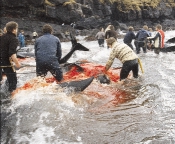
Faroese pilot-whaling, known as grind, is
during the summer, compared with 26 percent
an integral part of Faroese culture. Long-
of the people in towns.
finned pilot whales are driven into shallow
In the south, sheep farming provides a local
waters to be killed, butchered, and distributed
supply of lamb meat, even if some lamb is also
equally among residents of the district. The
imported. Beef, pork, and chicken are import-
traditional measures of whale shares are still
ed from Denmark.
used. Grind provides the majority of meat pro-
duction in the Faroes, and accounts for one-
quarter of the meat consumption. Despite
Health
pressures from anti-whaling groups, grind
Disease patterns in Greenland include a high
continues today as a significant activity in the
mortality from natural causes and a relatively
Faroese culture, diet, and community.
low mortality from heart disease. Furthermore,
The Faroese economy is overwhelmingly
there is a high incidence of injuries from acci-
dependent on fisheries, including processing
dents and suicide. The average life expectancy
and fish farming. About half the catch is taken
in Greenland is 68.4 years for women and
in Faroese waters.
60.7 years for men. Smoking is very common
Public health is generally good. Life expect-
among all age groups. 84 percent of Inuit men
ancy is 72.8 years for men and 79.6 years for
and 78 percent of Inuit women are currently
women.
smokers.
Iceland
Denmark: Faroe Islands
Iceland, located just south of the Arctic Circle,
The Faroe Islands are a mountainous archipel-
was settled by Norse Vikings in the late ninth
ago. The Faroese are descended from Norwe-
and early tenth century ad. After a few cen-
gian settlers, who replaced an Irish settlement
turies as an independent commonwealth, it
around 800 ad. Since 1380, the Faroese have
came under Norwegian and later Danish rule.
been associated with Denmark. A nationalist
In 1944, Iceland declared itself independent
movement to protect the Faroese language and
from Denmark. Today, Iceland is a republic
culture led to an agreement about Home Rule
with a parliamentary government.
within the Kingdom of Denmark in 1948.
Icelanders are both of Norwegian and Cel-
In 1995, the population of the Faroe Islands
tic origin and the population is culturally and
was 43 700. There are about a hundred towns
socially homogeneous. The country is sparsely
and villages, of which the largest is the capital
populated, with a total population of 266 783
T๓rshavn, with a population of 15 000.
in 1994. More than 90 percent of the popula-
The sea is central to both the economy and
tion lives in towns or villages with more than
the diet of the Faroese. Fish constitute 44 per-
200 people.
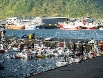
Grind, Faroe Islands.
KUBUS
KUBUS
62
Fishing is cornerstone of Iceland economy
In 1751, the civil rights of the Saami were
recognized in the Saami Codicil. This supple-
Peoples of the North
Fisheries are the cornerstone of the economy,
ment to a new border treaty between Norway
but employ only slightly more than a tenth of
and Sweden was written to solve problems of
the work force. Cod is by far the most impor-
double taxation for the Saami, whose tradi-
tant species. The catch also includes redfish,
tional migration routes had little to do with
saithe, shrimp, haddock, Greenland halibut,
administrative boundaries. Today, the Saami
ocean catfish, scallops, Norway lobster, cape-
parliaments in Norway, Sweden, and Finland
lin, and herring. All whaling has ended, and
are exploring a common platform across
seal hunting is not profitable and thus likely to
national borders. People who perceive them-
end as well.
selves as Saami and who also speak Saami as
Agriculture is mostly limited to potatoes,
their first language or have a parent or grand-
turnips, grass cultivation, and animal hus-
parent who speaks Saami as a first language
bandry of sheep and dairy cattle. Hot springs
are eligible to vote for the Saami parliaments.
are used for extensive greenhouse cultivation
of tomatoes, cucumber, and flowers.
Nation states
The diet is typically western, but with more
have steered living conditions
fish than other European nations. Fish, meat,
and milk are the main foods.
The Saami homeland is divided by national
borders. Both historically and today, lives of
Saami people are heavily influenced by the dif-
ferent nation states. In all countries, the Saami
homelands have been colonized by the major-
ity populations. In Sweden, for example, set-
tlers and miners used Saami land and labor to
develop the northern part of the country. Con-
flicts over land use are still common, especially
in connection with development of hydroelec-
tric power and the right to use forest areas for
reindeer grazing in winter. Increased recreatio-
HUNTINGTON
nal hunting is also seen as competition for tra-
ditional Saami resources.
Heimaey harbor, Iceland.
HENRY
Saami populations,
Western ailments but long lives
number of individuals and percent of total population
10 000
Health standards and health services are simi-
Coast
lar to other Scandinavian countries. Lifestyle-
9%
Fjord
related diseases, such as cancer and cardio-
30%
Inland
vascular diseases, are the biggest killers. The
Urban
greatest social ailment is probably alcoholism.
Icelanders have the prospect of a life span
longer than that enjoyed by most other nations.
Life expectancy at birth is 77.8 years. The
infant mortality rate is 6 per 1 000 live births.
5000
2%
2%
Saami
The Saami live in northern Fennoscandia and
2%
on the Kola Peninsula of northwest Russia.
<0.3%
The Saami homeland is located in four differ-
ent countries, Russia, Sweden, Finland, and
Norway, but their shared culture and history
0
Finnmark
Troms
Nordland
makes it natural to describe all Saami together.
Norway
Sweden Finland
Russia
There are no completely reliable estimates
Finnmark
>1 0 % S a a m i p o p u l a t i o n
of the number of Saami people, both because
Troms
of different definitions of who is Saami and
Nordland
Arctic Circle
because ethnicity is not included in recent
R U S S I A
national census figures. Furthermore, some
S W E D E N
people with Saami ancestry choose not to
N O R W A Y
identify themselves as Saami. Adjusted older
F I N LA N D
data puts the figure at about 85 000 people.
Of these, approximately 50 000 live in the
Saami population in
Fennoscandia and the
Arctic, where they make up about 2.5 percent
Kola Peninsula.
of the region's population.
closing of the Soviet border, forced further
63
alterations to migratory patterns. Economic
Peoples of the North
policies and a policy of assimilation, especially
during the Soviet period, led to additional dis-
ruptions in the traditional way of life. Today
there are 11 Saami villages, of which Lovozero
is the largest.
Reindeer herding, fishing, and farming
are parts of Saami life
BRY
Reindeer slaughtering,
KNUT
The Saami way of life today varies depending
Lovozero, Kola, Russia.
The Saami poet Ingahilda Tapio has written
on where people live; see figure on opposite
about land that has been lost to hydroelectric
page. In Norway, the majority live in fjord soci-
dams.
eties, combining farming with fishing in local
waters. Over the whole Saami area, fjord Saa-
long, long ago
mi make up more than a third of the total Saa-
there were small lakes here
mi population. In Norway, there are also some
rapids, sounds, bays
coastal societies, based on sea fishing. Almost
small rivers
one third of the Saami belong to inland soci-
now all is under water
eties, engaged in farming, reindeer husbandry,
long, long ago
and some freshwater fishing. The rest make a
there were cloudberries here
living in the regular cash economy, often in
Sแmi tents by the lakes
combination with traditional activities.
now all is under water
The Saami diet reflects the natural resources
in the region. Coastal Saami have a diet high
long, long ago
in fish, especially cod, and marine products.
this was a peaceful place
Fjord Saami eat some fish, most likely from
with fawning reindeer cows
local stocks, and also farm produce. Inland
now all is under water
Saami consume large amounts of reindeer meat,
In Norway, the traditional Saami area ex-
as well as some freshwater fish. Farmers con-
tends from Finnmark west and south to Hed-
sume large amounts of lamb meat.
mark. The Saami in this region were originally
Most hunting in the Saami areas today is
nomadic. They were forced to change their
recreational, and is usually done by urban resi-
system of migration and resource use because
dents visiting the area. While bringing some
game populations were declining and because
economic benefits, sport hunting for ptarmi-
Norse settlements were increasing along the
gan also conflicts with traditional Saami hunt-
coast. Some became small farmers, combining
ing and other occupations.
fishing and trapping along the fjords. Others
Today reindeer herding is increasingly car-
became reindeer herders or settled on the coast.
ried out with the help of modern technology,
The different groups continue to interact.
such as snowmobiles, all-terrain vehicles, and
Today, Saami in Sweden live primarily in
helicopters, and in many cases as a business
Norrbotten and Vไsterbotten and in the
enterprise rather than as a subsistence activity.
mountain fields of Jไmtland and Hไrjedalen.
Only 15 percent of the Saami are engaged in
reindeer herding, the rest in occupations simi-
Norway
lar to the rest of the population. There are a
total of 523 reindeer owners among the Saami
The population of Arctic Norway is 379 461.
of the region, of whom about half are engaged
After a period of people leaving the north,
in reindeer breeding.
young people are becoming more likely to stay
The Saami in Finland were originally settled
in the area in which they were raised, and also
hunting and trapping societies. Finns moving
to return after education in the south.
north forced them northwards where they de-
The non-indigenous population has a pri-
veloped a combination of reindeer herding and
marily urban lifestyle. The diet is similar to the
fishing. Today, most Saami in Finland live in
rest of Norway but with higher consumption
four municipalities: Inari, Enonteki๖, Utsjoki,
of potatoes and fish, and lower consumption
and northern Sodankylไ. Saami have no spe-
of fruits, vegetables, and alcohol.
cial rights, but improvement in regulations of
Fishing and mining form the economic base
reindeer herding have allowed living condi-
of the region. The average income is lower
tions for Saami to approach those of the gen-
than for Norway as a whole, but unemploy-
eral population.
ment is similar to the national level.
In Russia, immigrant populations pushed
The health situation in Arctic Norway lags
the migratory Saami northwards, beginning in
behind the rest of the country. The northernmost
the 17th century. Later changes, such as the
counties have the highest mortality rates, espe-
demarcation of national boundaries and the
cially in the fishing communities along the coast.
activities. People are more likely to work in
mining, electricity, water services, forestry, or
public services. Dairy farming is the main agri-
cultural activity, but farming has declined dras-
tically since earlier in this century.
Dietary surveys have shown that people in
northern Sweden eat less vegetables and drink
less wine, but eat more fat and drink more
beer and spirits than other Swedes. They also
eat more reindeer meat.
Life expectancy is half a year lower than for
Sweden as a whole. Relative mortality is high-
er, mostly because of more accidents, more
alcohol-related diseases, more circulatory
organ diseases, including heart disease, and
WIDSTRAND
more stomach cancer.
STAFFAN
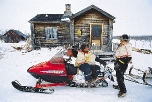
Utsi family, Kautokein0,
Life expectancy for men in the region is five
Norway.
years below the national average of 74.0 years.
For women, it is three years below the natio-
nal average of 80.9 years. The trend for young-
er people is more optimistic, partly because
dietary changes have led to reduced rates of
heart disease. Infant mortality, which recently
was much higher than in the rest of Norway, is
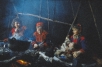
Cooking marrow bone,
BRY
from reindeer, Lawo,
now at the national level.
Norway
Accidental deaths are more common in the
KNUT
north, including for example snowmobile acci-
dents connected with alcohol consumption.
Finland
Smoking is more common than in the south,
and is increasing among women. In S๘r-Varan-
The northernmost province of Finland, Lap-
ger, contact allergies in school children, mostly
land, covers one-third of the country. Conifer-
to nickel, are much more common than in the
ous forests dominate the landscape, but there
rest of Norway.
are also substantial areas of marsh land and
Health care is available, but the sparse pop-
treeless highlands. Lapland is sparsely popu-
ulation and small isolated communities cannot
lated with slightly above 200 000 inhabitants,
support full-service hospitals. Education levels
of whom half live in the largest cities in the
have increased drastically, and may become
south. There are nearly 7000 Saami in Fin-
one of the most effective means of improving
land, of whom 4000 live in northern Lapland.
the health of people in the region.
Although unemployment is higher, the stan-
dard of living in Lapland equals that of the
rest of Finland. Government assistance and
Sweden
development measures have an important role
in the economy. Essential infrastructure, such
The AMAP area of Sweden includes the area
as water supply and waste treatment, and ser-
north of the Arctic Circle. It is a forest, wet-
vices, such as education and health care, reach
land, and tundra landscape, of which about
all population groups.
one-half percent is used for agriculture or hu-
Service and tourism are the most rapidly
man settlement. The population has increased
growing industries in Lapland, often connect-
during this century, when Sweden started to
ed to natural attractions and winter sports. In
exploit the forest, hydroelectric power, and
rural areas, traditional ways of life include a
mineral resources of its north. Currently, the
mixture of livelihoods, such as reindeer herd-
population is stable. In 1990, there were
ing, animal husbandry, small-scale agriculture,
263 735 people in the county of Norrbotten,
forestry, fishing, and service. Heavy industry is
which is the northernmost in Sweden. Of these,
concentrated in the Kemi-Tornio area on the
approximately 64 000 lived north of the Arctic
coast of Bothnian Bay, with forest-product and
Circle. More than 80 percent of the people of
metal factories, and in southeastern Lapland,
Norrbotten live in towns.
with the forest industry.
Aside from the Saami, the Arctic part of
The diet is similar to that in other parts of
Sweden is mostly populated by Swedes, with a
Finland, although local products such as rein-
sizable Finnish-speaking minority. The way of
deer, fish (river trout, brown trout, and white-
life has a stronger emphasis on the use of nat-
fish), and a variety of natural berries and mush-
ural resources than in southern Sweden. For
rooms play a large role. Fish are imported from
example, hunting and fishing are important
the Gulf of Bothnia and the Arctic Ocean.
Housing, with air-tight buildings, is con-
people of northern Russia. The consequences
65
nected to some health problems. In rural
have been severe. State enterprises have ignor-
Peoples of the North
areas, housing standards are lower than else-
ed traditional knowledge and patterns of land
where in Finland.
use, and many people have been forced into
Age-adjusted mortality is higher in Lapland
collectives. Private ownership is now being
than in the rest of Finland. Leading causes of
reintroduced, but it is too early to determine
death are circulatory diseases, cancer, acci-
what effects it will have.
dents, and violence.
Industrialization has damaged the land.
Land and rivers that were once used for rein-
deer herding, fishing, and hunting have been
Russia
lost to industrial expansion and pollution. The
upheaval has also carried high social costs as
The Arctic area of the Russian Federation
traditional cultures have been shattered. Diffi-
stretches from the Norwegian border in the
culties in taking advantage of higher education
west to Ostrov Ratmanova in the east, nearly
have kept most indigenous people from any
halfway around the world.
real opportunity to participate in the industrial
According to the 1989 census, the total
economy.
population of Arctic Russia is approximately
2 million people, of whom approximately
Economic crisis has worsened the plight
67 000 are indigenous minorities. An addi-
of northerners
tional 260 000 non-indigenous residents live in
the Norilsk mining area in northern Siberia.
The predicament of the north is accentuated
Seventy-five percent of the indigenous popula-
by the recent economic changes in Russia.
tion live in rural areas.
Supply lines have been disrupted and many
The indigenous minorities of Arctic Russia
people have less to eat, especially of imported
are the Dolgan, Nganasan, Nenets, Saami,
foods. Moreover, reorganization of collectives
Khanty, Chukchi, Evenk, Even, Enets, Eskimo
and state farms along with depletion of fish
(or Yupik), and Yukagir. Another five groups
stocks, closure of forest plots, and reduced
live close to or within the Arctic region: the Sel-
investments have led to increased unemploy-
kup, Chuvan, Mansi, Ket, and Koryak; see table
ment among indigenous people, reversing a
Total and indigenous
to the right. Another indigenous group, the Ya-
previous upward trend in employment. Unem-
population in different
kut, live in the Sakha Republic (Yakutia). They
ployment is now between 25 and 30 percent,
regions of Arctic Russia.
are too numerous to be considered a minority
Populations by region and ethnicity in the Arctic area of Russia, 1989 census
in Russia, but their traditional way of life in-
ญญญญญญญญญญญญญญญญญญญญญญญญญญญญญญญญญญญญญญญญญญญญญญญญญญญญญญญญญญญญญญญญญญญญญญญญญญญญญญญญญญญญญญญญญญญ
cludes reindeer herding and activities common
Yamalo-
Sakha
Nenets
Nenets
Taimyr
Republ. Chukotka
to the other indigenous groups in the area.
People/
Murmansk Auton.
Auton.
Auton.
Arctic
Auton.
Russian
Most immigrants have arrived in the past
Region
Oblast
Okrug
Okrug
Okrug
area
Okrug
Arctic
Russia
ญญญญญญญญญญญญญญญญญญญญญญญญญญญญญญญญญญญญญญญญญญญญญญญญญญญญญญญญญญญญญญญญญญญญญญญญญญญญญญญญญญญญญญญญญญญ
century and are engaged in industrial enter-
Saami
1615
0
0
2
0
0
1617
1835
prises and related activities. They live in cities
Enets
4
0
2
103
0
0
109
198
Nenets
176
6423
20 917
2446
0
10
29 972
34 190
and large towns. In the western areas of the
Khanty
10
5
7247
3
0
4
7269
22 283
Nganasan
5
0
3
849
0
0
857
1262
Russian Arctic, ethnic Russians known as
Dolgan
18
0
14
4939
0
4
4975
5363
Pomors have lived in the area for five centuries
Even
10
1
46
34
1793
1336
3220
17 055
Evenk
20
27
78
311
1285
54
1775
29 901
and have a traditional lifestyle similar to that
Chukchi
2
0
11
1
428
11 914
12 356
15107
of indigenous people. Other `old settlers' live
Yupik
3
6
7
0
0
1452
1468
1704
Yukagir
3
0
3
0
476
160
642
1112
in other areas of the Russian Arctic.
Selkup
1
1
1530
8
0
0
1540
3564
Traditions vary in the different regions of
Chuvan
9
0
0
4
0
944
957
1384
Koryak
5
1
31
16
0
95
148
8942
the vast Russian Arctic. However, the lives of
Ket
0
3
6
11
0
0
20
1084
all Arctic peoples are closely connected to the
Mansi
18
1
216
1
0
3
239
8279
history of Russian exploitation of the north.
Total indigenous
1899
6468
30 111
8728
3982
15 976
67 164
Total population 1164586
53 912
494 844
55 803
66 632
163 934
1999 711
% indigenous
0.16 %
12.00 %
6.08 %
15.64 %
5.98 %
9.75 %
3.36 %
Resource exploitation
has disrupted traditional lifestyles
Arctic Circle
Chukotka
Murmansk
Auton.
Okrug
The Russian north contains large amounts of
Oblast
natural resources, including timber, oil, gas,
Nenets
Auton.
coal, and minerals. For centuries the resources
Okrug
Taimyr
have been exploited, and today they provide
Auton.
Okrug
Sakha
one-fifth of Russia's gross national product.
Yamalo-
Nenets
Republic
The growth in this development has been tre-
Auton.
Okrug
mendous during the past century and is ex-
pected to continue, especially considering large
R
U
S
S
I
A
hydrocarbon reserves in the Naryan-Mar re-
gion and offshore near Novaya Zemlya.
This resource exploitation has taken place
in the traditional homelands of the indigenous
and is higher among young people and wo-
concern. They strike at the heart of traditional
66
men. Most indigenous people work with tradi-
ways of life as they affect both the food supply
Peoples of the North
tional activities, such as reindeer herding, fur
and opportunities to make a living off the land.
trapping and farming, hunting, fishing, and
making handicrafts.
Reindeer provide food and employment
Housing is in short supply and most build-
across Russian north
ings are overdue for improvements. Over 30
percent of the indigenous population lives in
The following description highlights diets and
substandard housing or traditional tents, often
employment opportunities in various parts of
because housing in rural areas and along mi-
Arctic Russia.
gration routes is not available.
Murmansk Oblast
Most people in the Murmansk Oblast live in
Sickness and social distress
urban areas. The primary indigenous group is
lead to shorter lives
the Saami. Reindeer meat is an important food
Statistics on mortality and the incidence of
source for all residents because it is relatively
various diseases bear witness to a dismal
inexpensive and is available in the region. Other
health situation. In the north, the mortality
important foods are mountain hare and moose.
rate in 1989 for the indigenous minorities was
In the traditional lifestyle, fish and birds
10.4 per thousand, compared to 6.6 per thou-
add to the summer diet. Salmon and trout
sand for other residents of the area.
were customarily taken in large numbers, but
At the end of the 1980s, life expectancy was
there is currently a quota system limiting the
54 years for men and 65 for women, which is
salmon harvest to 25-30 kilograms per person
10 to 20 years lower than the Russian average.
per year.
Trauma, infectious diseases, especially tuber-
The major industry is metal processing. It is
culosis, cardiovascular disease, parasites, and
also the largest polluter.
respiratory disease are common causes of
Among indigenous people, reindeer herd-
death. Many health problems are related to
ing, hunting, fishing, and producing reindeer
alcoholism. Infant mortality is very high, at 30
fur for handicrafts are the most common occu-
per 1000 among indigenous people. Among
pations. The herding teams include Saami,
Koryak, the infant mortality rate is as high as
who are joined by Nenets and Komi from
52.6 per thousand and among Eskimos 47.6
neighboring regions, and Russians. The rein-
per thousand.
deer are driven on to the Kieva Plateau in the
Certain diseases are particularly common.
summer and south in the winter. The migra-
One is `northern lung', a suite of respiratory
tion routes cannot support more animals and
diseases that are widespread among indige-
thus limit the growth of the herds.
nous people. Chronic ear infections are also
common. The incidence of tuberculosis is 2.5
Nenets Autonomous Okrug
to 3 times higher than among newcomers to
About ten percent of the Okrug's population
the region. Dietary changes, including more
are Nenets, of whom most live on the tundra.
carbohydrates compared with traditional
Reindeer meat is the primary food source in
foods, may in part be responsible for the high
the Okrug. Additional sources include moose,
incidence of gastrointestinal disorders. Up to
brown bear, bighorn sheep, and alpine hare.
95 percent of the population suffers from vita-
Lesser sources are seal, beluga, ptarmigan,
min deficiencies or dental diseases.
ducks and geese, and snowy owl.
The risk for disease reflects lifestyle pat-
The main occupations of indigenous people
terns. A study in the Nenets Autonomous
are reindeer herding, hunting, fishing, and fur
Okrug showed that the rates of disease were
and leather craftsmanship.
50 percent higher in the settled population
The tundra and forest-tundra have exten-
compared with those living on the tundra.
sive marshes with excellent summer ranges for
Psychological disorders were 2.5 times higher
reindeer, and the Okrug is the major reindeer
among the settled populations.
breeding area in Russia. In the fall, the herds
The incidence of disease, as well as trau-
move south along strictly defined passages to
mas, has increased several hundred percent
the southern tundra, forest tundra, and taiga.
since 1970.
The availability of reindeer moss limits the size
The future of the indigenous peoples of the
of reindeer populations in the Okrug.
Russian Arctic is unclear. The Russian Federa-
tion has passed some laws to protect minority
Yamalo-Nenets Autonomous Okrug
interests, but implementing the new legislation
The indigenous population of Yamalo-Nenets
will take time and effort. One hope is that tra-
include the Nenets, the Khanty, and the Selkup.
ditional practices connected to economic activ-
Together with other indigenous peoples, they
ities such as reindeer herding and fur farming
make up about 6 percent of the population.
can provide some opportunities.
Reindeer and fish are the most important
Environmental contaminants are not the
staples in the diet. Additional sources are simi-
greatest threat but are nonetheless a serious
lar to the neighboring Nenets Autonomous
67
Peoples of the North
LEHMUSKALLIO
PEKKA
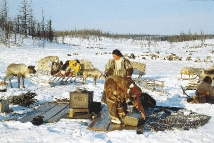
Nenets, Russia.
Okrug. The traditional occupations are also
inaccessible. Hunting of wild reindeer is
similar.
important for Nganasans.
The main industries are oil and gas produc-
tion, which have had a major impact on the
Sakha Republic (Yakutia)
local environment, reducing the productivity
The Arctic zone of the Sakha Republic (Yaku-
of the reindeer industry. For example, 6.8 mil-
tia) includes a large population of Yakuts plus
lion hectares of reindeer rangeland have been
Even, Yukagir and Chukchi, who make up
polluted by oil seepage and other spills, destroy-
about six percent of the population.
ed by vehicles, or otherwise lost to the herders.
Reindeer meat, fish, ringed and common
seal, and birds are the main sources of food.
Taimyr (Dolgan-Nenets) Autonomous Okrug
The emphasis is on fish in coastal areas and on
The Taimyr (Dolgan-Nenets) Autonomous
meat inland. Secondary food sources include
Okrug includes vast range land for reindeer,
moose, Kolyma moose, alpine hare, ptarmi-
which surrounds the administratively separate
gan, brown bear, whitefish, ducks and geese,
mining complex and city of Norilsk. The indi-
Siberian sturgeon, pike, berries, roots, nuts,
genous people of the region are the Dolgan,
and herbs.
Nenets, Nganasan, Evenk, and Enets. They
The main occupation for the indigenous
make up about 16 percent of the population.
minorities is reindeer herding, but commercial
As in neighboring Okrugs, reindeer meat is
hunting and fur trapping are also important.
the main source of food. Fish and birds are
Northern Sakha produces one third of Russia's
also significant. One of the specialties in the
Arctic fox pelts. On the inland forest-tundra,
traditional diet is sliced frozen fish (stroga-
several villages are located at good fishing
nina) during the winter. The major fish species
sites, while coastal people are involved in
are cisco, whitefish, herring, Siberian sturgeon,
marine mammal hunting and fishing.
Arctic char, nelma, muksun, Arctic grayling,
pike, perch, and smelt. Secondary food sources
Chukotka Autonomous Okrug
include moose, common seal, beluga, bearded
The Chukotka Autonomous Okrug includes
seal, ducks, geese, snowy owl, and ptarmigan.
the Chukchi as its largest indigenous minority
Marine mammals are a relatively small food
group and also has Eskimo (or Yupik), Even,
source, however.
Chuvan, and Koryak communities.
Mining and metal processing is the main
Thirty percent of the indigenous Chukot-
industry in the area, and also a major polluter.
kans live in sedentary villages along the coast.
Small enterprises, including reindeer herding,
They eat marine mammals, as well as reindeer
account for less than 10 percent of the econ-
meat from inland. The inland dwellers eat
omy. The migration routes from the tundra to
mostly reindeer in winter, while fish and
the tundra-forest have been overgrazed, limit-
marine mammals from trade with the coastal
ing the growth of the herds. Year-round navi-
people add to their summer diet.
gation of the Yenisey River and the construc-
The main occupations are reindeer herding,
tion of a pipeline between Messoyakha and
terrestrial and marine hunting, and producing
Norilsk have made large areas of rangeland
ivory and fur for handicrafts. For Yupiks, fur
Life expectancy is lower for most Arctic
populations than elsewhere in each country.
The pattern in causes of death is also different.
Death from accidents is much more common
than among the general population. In Russia
and North America, diseases associated with
poor living conditions and poor access to
health care are also more common. Alcohol
and tobacco use is high in many Arctic com-
munities, and alcoholism is a serious concern.
Health care in most of the Arctic is improv-
ing, but sparse populations and long distances
limit capacity, especially for getting advanced
care. In Russia, disruption of supply lines and
removal of incentives to move north have
reduced health care capacities below their lev-
els in the 1980s.
In general the Arctic populations are young.
In many regions, birth rates are high and infant
mortality is much lower than a few decades
ago. Again, the one exception is Russia, where
the economic situation has caused extensive
emigration, and declining health care has led
to increased mortality of all age groups. Russia
is also the only country in which infant mor-
WIDSTRAND
WIDSTRAND
tality is not declining.
Living standards vary by country. The living
STAFFAN
STAFFAN
standards of native people in North America
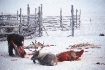
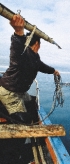
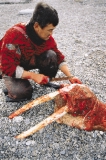
Grey-whale and walrus
farming, marine hunting, and fishing are the
are higher than among native people in Rus-
hunting, Chukotka,
chief occupations. The large state farms for
sia. Nevertheless, the Arctic average is sub-
Russia.
reindeer are currently being dismantled and
stantially lower than elsewhere in each coun-
are being replaced by individual farms and
try. For Greenland, the same applies in a
smaller ventures, a transition which has de-
comparison with Denmark. Housing is often
creased the production of the herds.
crowded, and many dwellings lack modern
The figure below on the opposite page gives
conveniences such as running water. In the
a picture of the importance of different foods
Nordic countries, this distinction is not as
in Arctic Russia.
apparent.
Jobs are often scarce in the north, and ad-
vanced schooling is usually only available out-
Similarities and differences
side the region. However, employment and
income statistics should be treated with cau-
Arctic people live in a diversity of landscapes
tion as they do not include the extensive and
and cultures, with different diets, economic
often very productive subsistence economy
opportunities, and living standards. Some of
that exists outside the better documented cash
this diversity is also apparent among geo-
economy.
graphically close groups or even within com-
A common problem in almost all Arctic
munities. In spite of this diversity, there are
countries is in the communication between
some similarities across the countries and
majority populations and indigenous people.
regions that provide an important background
For example, many scientists as well as public
for understanding how changes in the environ-
health authorities lack the necessary cultural
ment will affect people's well-being.
and linguistic skills to communicate about
The Arctic population as a whole lives close
contamination. Moreover, many indigenous
to the environment. This is especially true for
people lack education in the majority lan-
indigenous people, but also applies to many
guages in their countries and might therefore
other inhabitants of the region. Using local
be unable to use information that is available
resources is common, and what can be har-
in the public debate.
vested or caught is often the most important
Some of the native languages have been
source of food. A threat to resources such as
under threat throughout the period of colo-
reindeer or caribou, marine mammals, and fish
nization. Historically, national authorities or
is thus not only a threat to Arctic cultures but
schools have often discouraged or even forbid-
also to people's ability to obtain nutritious
den people to speak their mother tongue.
foods. Some communities also rely on local
Today, there is no such overt discrimination,
sources of drinking water, and lack of water
but for some groups the languages have suf-
treatment makes the water supply vulnerable
fered enough that older and younger people
to contamination.
within the same group can have trouble com-
municating with each other. Other languages
Average consumption,
69
have always thrived while some, such as
g /person /day
Peoples of the North
Saami, are experiencing a revival connected to
2500
a renewed cultural awareness.
There are also some similarities at the po-
litical level. Many indigenous groups are more
active than ever in working towards self-gov-
ernance, and in asserting native rights. The
2000
Greenland Home Rule and the Nunavut
Local plants
Government in Canada are two examples. In
Freshwater
Russia, the Association of Indigenous Peoples
fish
of the North, Siberia, and the Far East of the
Marine fish
Russian Federation (AIPON) is working to
unite the common interests of 30 indigenous
1500
Marine
mammals
peoples and cooperates with indigenous groups
in other countries. Native groups are also
Bird meat
renewing contact across national borders, for
Local and
example in the Saami Council and the Inuit
wild meat
Circumpolar Conference. This cultural and
Imported
1000
political revival is a positive force at a time
meat
when many communities are suffering greatly
Fruits and
from disintegrating social and cultural ties.
vegetables
Generalizations about Arctic peoples can be
Potatoes
useful in looking at patterns and similarities,
but they can also hide important information.
500
Cereals
and flour
On a practical level, statistical averages about
food habits or living conditions can conceal
Milks and
cheeses
widely ranging figures among individuals, even
within the same community. Also, statistics do
not reveal the vitality and resilience of the cul-
tures of the Arctic, nor do they make clear the
0
Arctic
Circle
dynamics of the cultural changes most com-
munities are going through. In the context of
Chukotka
contaminants, daily decisions today often in-
Auton.
Okrug
Murmansk
clude such previously arcane questions as the
Oblast
Nenets
levels of industrial chemicals in local foods.
Auton.
Okrug
Taimyr
Moreover, the statistics do not put any
Auton.
Yamalo-
Okrug
Sakha
emphasis on the fragility of the links between
Nenets
Republic
Auton.
people and their environment. These links can
Okrug
be disrupted by contaminants, and also when
R
U
S
S
I
A
researchers or health authorities raise concerns
about whether indigenous foods are fit to eat.
The fear that food is contaminated can itself
be destructive, since what was nourishing now
appears tainted, whether contaminants are
actually present or not. The future of Arctic
factors complicate any assessment of the real
Average consumption of
peoples depends on preventing the degrada-
and potential impact of contaminants to Arc-
selected foods in Arctic
tion of the Arctic environment. The connec-
tic people. Specifically, experiences and results
Russia.
Left columns: indigenous
tions between cultures and the environment
from lower latitudes cannot be directly trans-
population.
may be intangible, but they nevertheless lie at
ferred.
Right columns: general
the heart of the debate about pollution, global
Moreover, great differences between coun-
population.
change, and sustainable development.
tries, between cultural groups, and between
individuals within a community point to the
importance of understanding local contexts
Summary
when making assessments connected with con-
taminants and people's well-being.
The lives of indigenous and other Arctic peo-
Communication is crucial in the continued
ples are closely linked to local resources that
work in this area. Not only do Arctic residents
provide nourishing foods and spiritual connec-
have the right to good information about their
tions to the environment.
environment and themselves, they also have
Food habits, living conditions, employment
knowledge that may assist our overall under-
or subsistence activities, and access to health
standing of environmental damage.
care are some of the characteristics in which
Arctic populations differ from those farther
south in the Arctic countries. Together, these