Chapter 2
Lifestyle, social
and economic status
of indigenous peoples
2.1. Background
Chapter 2
of the last glaciation. This was the beginning of a peri-
2.1. Background
od of migration by ancient tribes across the Arctic
Russian legislation defines indigenous populations of
zones of Eurasia, and by northward migration of tribes
the Russian Federation as follows:
from the south. This mixing between the new immi-
grants and the ancient indigenous tribes started a new
"The numerically small indigenous populations of the Russian
page in the ethnic history of the North.
Federation (hereafter referred to as Indigenous Peoples) are
those residing in the areas of the traditional settlements of their
In fact, northern ethnic groups were continuing to
forefathers, preserving their traditional lifestyle, economy and
develop up until the 19th century and it was only when
trades, who perceive themselves as an independent ethnic enti-
the original inhabitants of `Siberia' came in contact
ty, and whose population in the Russian Federation does not
with `European civilization', that they were considered
exceed 50000. The Common Register of the Indigenous Peoples
to be `indigenous peoples', as this term is understood
of the Russian Federation is approved by the Government of the
today. Prior to this they were considered `disintegrated
Russian Federation based on information provided by the
ethno-linguistic communities, characterized by unsta-
authorities of the administrative territories of the Russian
ble population density, dispersion, ethno-cultural het-
Federation where the indigenous populations reside."
erogeneity and weak intra-ethnic communication'
(National Report, 2000).
The law further clarifies that:
The features which characterise the northern indige-
"... the traditional lifestyle of Indigenous Peoples is the strategy
nous peoples are determined by their environment.
of survival which has been developed throughout their history,
Their small population size also results from external
based on the experience of their forefathers in nature manage-
factors and does not indicate either under-develop-
ment, original social structure, accommodation, original cul-
ment or inherent population decline. On the con-
ture, and the preservation of customs and beliefs." (Federal
trary, for their specific geographic environment and
Law, 1999).
economy type, a small population size represents an
optimal solution (Gumilev and Kurkchi, 1989).
Currently these charcteristics provide the main criteria
However the same factors which ensured the high
for the identification of the indigenous peoples in
degree of adaptability of northern populations to
Russia. To date, this definition has applied to 40 indige-
their extreme living conditions, also made it difficult
nous minorities, who are listed in the Common
for them to integrate with other cultures, especially
Register, mentioned in the Law1. Individuals belong-
those which were more `developed'. The resulting
ing to these indigenous minorities are eligible for spe-
conflicts have affected all aspects of their life, includ-
cial targeted programs and a number of privileges to
ing social, cultural and spiritual integrity.
ensure their security.
Before conversion to Christianity, the indigenous pop-
The indigenous peoples included in the Register share
ulations of northern Russia were animists, believing all
many common characteristics and problems. At the
creatures and objects of the world to possess souls.
same time they also differ significantly from each
This allowed them to explain the world around them,
other, which makes the framing of a single concept of
including many natural phenomena, and also created
sustainable development a difficult task.
a need for communicating with spirits. Such beliefs
led to the emergence and development of shamanism.
Based on their original settlement patterns, the indige-
Shamanism and shamanistic practices provided faith
nous peoples of Russia can be classified into several
in one's own abilities in the face of fears aroused by
groups. One of these groups comprises the indigenous
the incomprehensibility of nature and mans inability
peoples of Northern Russia, Siberia and the Far East, a
to influence it. This was the shaman's role and
group that are are distinguished by extreme living condi-
explains his influence on his fellow-tribesmen
tions, prolonged isolation from other cultures, their dis-
(Kasavin, 1990).
tinctive material and spiritual culture and migratory
habits, in addition to other traits. One important feature
The arrival of Europeans in the northern regions
shared by this group of indigenous peoples is a more
brought significant changes to the world of the indige-
deep overall social and economic crisis than that encoun-
nous populations especially in connection with the
tered in other minority population groups in Russia.
discovery and development of mineral deposits. It was
during this period that the various indigenous ethnic
The group of indigenous peoples of Northern Russia,
groups were defined and assigned their modern
Siberia and the Far East is a sub-group, comprising 11
names (generally different from those used by the
indigenous peoples whose residence in the Arctic
indigenous people themselves). This occurred as a
region (i.e. in the coastal and northern areas of the
result of various political and legal decisions, reforms
Arctic Ocean catchment) is a determining characteris-
and government activities, including the introduction
tic. It is generally believed that the forefathers of these
of the census and passports, administrative and terri-
contemporary Arctic indigenous peoples came to the
torial division, and deliberate elimination of dialects
Arctic region 10-12000 years ago, during the final stage
and even some ethnicities.
1
18
There also exist other definitions of the term 'indigenous minorities' which are not considered here.
Chapter 2
2.1. Background
The expanding `Register of Indigenous Peoples of
It is clear that the northern indigenous peoples have
Northern Russia', established by law, currently iden-
undergone significant changes, which have dis-
tifies 30 indigenous peoples who reside within the
tanced them from their forefathers in economic,
five Republics, four Krais, ten Oblasts, and eight
social, cultural, and even anthropometrical respects.
Autonomous Okrugs which comprise almost the
However, certain groups of the contemporary
whole area of the Russian North, Siberia (including
indigenous population still preserve both the cultur-
Southern Siberia) and the Russian Far East. The
al identity and the economic activities which are
total population of northern indigenous peoples is
considered to determine a traditional lifestyle and
less than 200000 people, and constitutes less than
pattern of settlement (nomadic or semi-nomadic
2% of the total population of the northern regions
lifestyle, etc.).
of Russia.
Table 2.1.
Indigenous peoples of
Northern Russia, Siberia
and the Far East. Indigenous
groups and administrative
territories studied within the
project are highlighted in
grey.
19
2.2. Traditional lifestyle
Chapter 2
Table 2.1 provides general information on the indige-
longer to develop their primary economies than other
nous peoples of Northern Russia, Siberia and the Far
indigenous populations. Up until the 20th century,
East, their main areas of habitation, and occupations
most of the indigenous peoples predominantly prac-
followed.
ticed primitive forms of hunting (including sea-hunt-
ing), fishing, and gathering. Whilst some of the indige-
2.2. Traditional lifestyle
nous peoples also mastered, to varying degrees, the
By definition, the indigenous peoples of northern
practice of nomadic reindeer-breeding, for many this
Russia (including the indigenous peoples of the Arctic
also took a rudimentary form.
area) occupy remote regions of Eurasia, including the
northern polar areas and islands in the Arctic Ocean.
In general, by the time the Russians arrived in Arctic
The proximity of the Pole and the Arctic Ocean deter-
Eurasia, the indigenous peoples of the area were still
mine the climate and nature of these areas, and also
evolving their economic and cultural systems. Their sur-
their landscape, which mostly consists of tundra and
vival strategies, especially those relating to everyday life,
forest-tundra. Vast areas are covered by mountains and
have been classified as a `traditional lifestyle'. Later,
bogs, and there are many lakes and rivers. Fog, strong
however, during the Soviet and post-Soviet periods, the
winds, long winters (lasting from September/October
lifestyle of the northern indigenous peoples underwent
until June), permafrost, and scanty vegetation are only
radical changes. When speaking of `preservation of the
a few of geographic features that illustrate the chal-
traditional lifestyle' under modern conditions, there-
lenges faced by any creatures living in these areas.
fore, it is necessary to take account of these differences.
Thus, the lifestyle as well as type and seasonal character
of the economy of the northern indigenous peoples
Research has shown that in some areas of northern
has been mainly determined by the extreme conditions
Russia the `traditional lifestyle' and `traditional trades'
and the associated severe constraints imposed on
have survived and are still developing. However, in
human communities.
most regions, the traditional economy and associated
way of life have either been eliminated or are in crisis.
The severe climate and limited natural resource base
makes it impossible to use the agricultural and subsis-
Nevertheless, even in those areas where the tradi-
tence practices commonly found in more southern
tional lifestyle and economy are considered to be in
areas. As a result, northern indigenous peoples took
crisis, there are still some traditional communities
20
Chapter 2
2.3. Traditional economic activities
trying to overcome their difficulties and seeking to
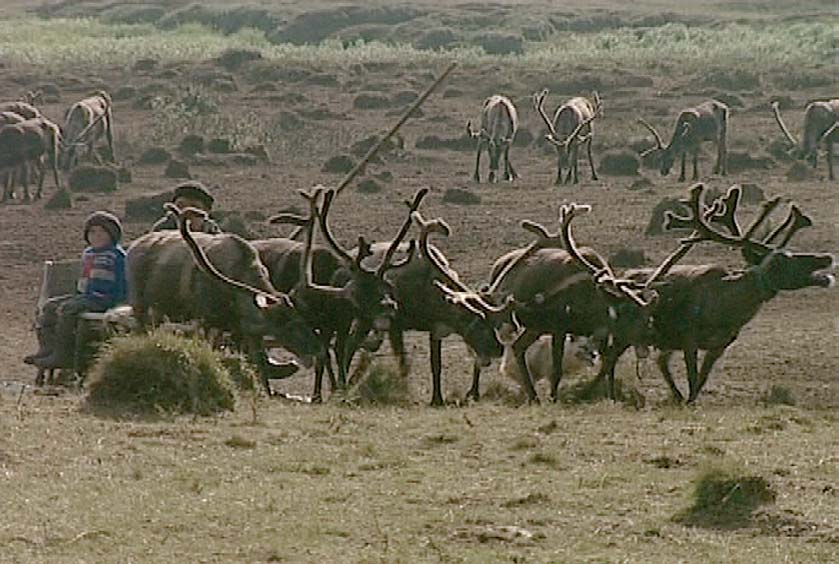
el across tundra, nomadic herders use sleds pulled by
adapt their households to modern life, whilst at the
teams of one to four, and occasionally even up to seven
same time retaining or reviving the knowledge of pre-
reindeer. The types of sleds and teams differ. The
vious generations.
Saami use one-runner sleds without stanchions; Nenets
use high-stanchion sleds, and Chuckchi use low sleds
2.3. Traditional economic activities
with seven or eight stanchions. There are a range of dif-
The main traditional activities undertaken by the
ferent sleds for women, men, children and transporta-
northern indigenous peoples include reindeer-breed-
tion of goods, as well as covered sleds.
ing, hunting, fishing, sea-hunting, and gathering.
The nomads traditionally live in yarangas or chooms,
2.3.1. Reindeer breeding
wooden frame tents covered by reindeer skins that
The reindeer is a unique animal that can find food
have been sewn together (in winter, in two layers are
where other domestic animals are unable to survive.
used), which can be easily dismantled and put up at a
The European (or Lapponian), Novaya Zemlya,
new location. Curtains made of skins are often put
Siberian, Tundra, Siberian Woodland, Okhotian,
inside to give added protection from cold. The
Barguzin, and Spitsbergen reindeer are all sub-species
nomads' clothing normally has no fastenings and is
of reindeer found in Russia.
made of deer skins. Winter clothing has two layers,
with fur both inside and outside.
Reindeer-breeding is still the main economic activi-
ty for most indigenous peoples of the Russian
To the south, within the subArctic forest-tundra and
Arctic. It is primarily practiced by Nenets, inland
taiga (where hunting is better developed), reindeer
Chukchi, Koryaks, Nganasans, Dolgans, northern
breeding differs. Reindeer are larger but the herds are
Khanty, Saami, Mansi, and some Evens, Evenki and
less numerous and the animals are mainly used for
Enets. Domestic reindeer breeding began mainly in
transportation. In woodlands, as the use of sleds is dif-
the 18th century, through the domestication of wild
ficult, the reindeer are usually used with pack-saddles
reindeer, and represents a form of nomadic stock-
or ridden astraddle. Also, migration routes in wood-
breeding.
lands are shorter and depend upon the season.
Therefore, reindeer-breeding in forest-tundra is usual-
During the Soviet period, reindeer-breeding under-
ly combined with hunting.
went significant change and was developed as an
agricultural industry, with the family communities
In modern life the traditional dwellings and clothes
being transformed into production teams. At that
of reindeer-breeders begin to be replaced by tarpau-
time, Russia had up to 2.3 million domestic rein-
lin and synthetic tents, rubber boots, warm textile
deer, which constituted three-quarters of the world's
clothing and other artificial materials. Whilst being
stock. Reindeer breeding as an industry was very
convenient and easy to handle, these materials are
profitable.
not altogether suitable for people following a tradi-
tional lifestyle. Reindeer-breeders, fishermen and
For deer breeding, a herd is normally maintained by
hunters are always working outside. Thin tarpaulin
one extended family or a group of relatives. In the
does not protect from the cold as well as reindeer
Arctic zone, herds are usually large, migration routes
skins, and synthetic clothes can prevent normal
are long and reindeer breeding is oriented towards
exchange of heat and moisture which can increase
production. One of the main functions of reindeer is to
likelihood of illness.
provide people with food and clothing. Meat, blood,
marrow, intestines and other tissues are consumed,
2.3.2. Sea hunting
both fresh and processed. The skin is used for clothing
Sea-hunting is a traditional activity of the indigenous
and shoes, and for the construction of lodgings and
peoples of coastal areas of the Arctic and Pacific
other accessories.
Oceans. These are primarily Eskimos, Aleuts, coastal
Chukchi and Koryaks, and to a lesser extent Nenets,
In winter, reindeer eat mainly lichen, fallen leaves and
Evens, and some other indigenous groups. The object
grass, which they find under the snow. The summer
of this type of hunt are whales, walruses and seals
diet consists of grass, leaves, mushrooms, berries and
(including Ringed seals), which provided indigenous
even birds' eggs and nestlings. Reindeer herds con-
communities with meat, fat and skins. Meat and fat
stantly migrate in search of new pastures and to escape
from marine mammals, both fresh and processed, as
blood-sucking insects.
well as preserved in traditional ways, were the main
food sources for some coastal communities.
The life of reindeer-herders is largely determined by
the biological cycle of the reindeer. Reindeer herders
Whaling had special importance for the indigenous
have to move constantly, following the reindeer migra-
population of Chukotka. A team of 8-10 people took
tion. In summer they migrate towards the ocean or
part in the hunt, and one bowhead (Greenland right
mountainous areas, whilst in autumn, they return
whale) or grey whale could provide enough food for a
inland to river valleys, forest-tundra and taiga. To trav-
whole village.
21
2.4. Social impact of recent political and economic reforms
Chapter 2
Sea-hunters built their settlements on higher parts of
The main quarry were wild deer, moose, brown and
the coast, where they had a good view of the sea to assist
polar bears, snow sheep, hare, and various birds,
in searching for whales. When a whale appeared, the
including geese, ducks and partridges among others.
hunters would rush to the sea in several kayaks. They
The main fur animals were sable, squirrel, marten,
would first throw harpoons with floats to keep the
wolverine and otter.
whale from diving, and then kill it with spears. Later
on, guns were also used in whale hunting. Koryaks used
In some areas, for example the Taymir, wild reindeer
belt nets to catch and kill whales.
hunting was a traditional activity, performed during
the short period of time when reindeer herds were
During the Soviet period, independent indigenous
crossing rivers. On these occasions, hunters killed the
hunting was prohibited and whales were hunted by a
animals from boats. This short hunt provided suffi-
special state-owned whaling fleet. Whaling ships would
cient food to support the neighbouring villages for a
bring their catch to the villages where the role of the
long time. Later this activity was commercialized, using
indigenous community was to transport carcasses
new technology and fire-arms and was mainly under-
from the ships to the coast and to process them. All vil-
taken by non-indigenous workers for commercial
lagers were involoved in this work. The first whale was
enterprises. The carcasses were also processed along
always a feast and all meat and fat was shared among
the river banks, causing environmental damage. This
the families. The whaling ships were in use until the
form of commercial `hunt' differs in form and mean-
early-1990s. It was during the Soviet period that the
ing from the traditional one. Furthermore, the indige-
most important traditional skills were lost and the
nous population was forced away from the reindeer
lifestyle of sea-hunters threatened. In the post-Soviet
crossings and deprived of the means of sustaining
period, economic problems prevented the lease of
itself. Other forms of reindeer hunting involve the use
whaling ships and a slow revival of traditional skills
of domestic reindeer to entice wild reindeer.
took place.
The main hunting tools used originally were various
Walrus were traditionally hunted in open sea in spring
traps, but later on guns came into widespread use.
and autumn, either while in the water or on ice-floes.
Indigenous hunters traditionally lived a semi-nomadic
In summer, walrus were caught on the coast at their
or semi-settled life, moving to several different locations
rookeries. At sea, hunters used boats, made from a
throughout the year. They lived in different kinds of
frame covered with walrus and seal skins. Previously,
dwellings: the simplest being log houses, mud huts, or
animals at sea were hunted using a rotary harpoon with
chooms, covered with bark and tree branches. Hunters
special detachable tip. Hunting of Ringed seal and
travelled on reindeer or on foot, and also at times used
other seals species took place throughout the year,
special skis and small sleds. Their clothing was made
usually by individual hunters in kayaks in the open sea
mainly from deer fur and fastened down the back.
and using both weapons and traps on the ice.
2.3.4. Fishing
Sea-hunters were settled. They travelled with dog
Fishing has always been one of the most important tra-
teams from permanent dwellings built from a frame of
ditional activities of the northern indigenous peoples.
whale bones, covered with turf and skins to form a
Until the present day, fish has been the most important
spacious hut. Stone lamps filled with sea mammal fat
food product for both people and dogs. The most
provided heating and lighting. Their clothing was
active fishing takes place in spring and autumn during
made from sea mammals skins and intestines of and
the seasonal migration of anadromous fish. Fishing has
had no fastenings.
traditionally been the main activity of the Ob Khanty,
Mansi, southern Selkups, some Kets, Nivkhs, Ulchis,
The hunting practices were reflected in the culture
Nanais, Negidals, Orochis, Oroks, Itelmens, some
and spiritual beliefs of indigenous populations,
Koryaks and Chukchi. Fishing also provides materials
which developed over millennia. Some traditions
for clothing and shoes.
were lost during the Soviet period, but in recent years
some noticeable efforts have been made to restore
2.3.5. Gathering wild plants
them.
Gathering wild plants and berries has been widely prac-
ticed since the earliest times and contributes to the
2.3.3. Hunting and trapping
provision of food and other needs of the indigenous
Historicaly, hunting was very important for indige-
peoples, for example, products to assist in tanning and
nous peoples, especially for the Khanty, Mansi, Kets,
dyeing of skins for clothing.
Yukaghir, Udeghes, some Orochis, Nanais, Negidals,
Itelmens and some other groups. The purpose of the
2.4. Social impact of recent political
hunt was determined by the prevailing environmen-
and economic reforms
tal, ethnical and historical situation. Originally
The State policy towards northern indigenous peoples
the primary aim of the hunt was to provide meat,
has changed at various times. From the very beginning
later, hunting animals for the fur trade also became
of colonization, the Tsarist government faced the prob-
important.
lem of the formalization of citizenship of the colonized
22
Chapter 2
2.4. Social impact of recent political and economic reforms
indigenous peoples and their lands. The problem
of alcohol to areas of permanent migrations of north-
arose because at the when the Russians came to
ern indigenous peoples, and also introduced a state
Siberia, the indigenous peoples had not yet formed
monopoly on the fur trade, and other measures.
integral ethnic communities with an administrative
structure. Social networks and administration were
During this period, scholars and politicians proposed
restricted to families, and tribal or clan communities.
two alternative concepts for the further development
This was due to a certain extent to their geographical
of the northern indigenous peoples:
isolation and also to the nature of a subsistence family
·
The `Traditionalist' or `Native' concept implied the
economy.
preservation of the culture of the northern indige-
nous peoples. This concept proposed that contacts
The archaic economic and social relations of the north-
with the newly arrived population be minimized
ern indigenous peoples also influenced their spiritual
and the creation of `reserved' areas similar to those
life, culture, behavioural standards and law. This intro-
existing in Western countries (Bogoraz-Tan, 1923).
duced certain complications during the integration of
the northern indigenous peoples and their lands into
·
The `Innovative' or `Integrative' concept was based
Russia, as the indigenous communities had no recog-
on the need for the rapid and radical integration of
nized leaders to sign the contracts and documents,
the northern indigenous peoples into the culture of
confirming their consent to join the Empire and to
other peoples of Russia and their adoption of
ensure the legal formality of colonization.
socialist values.
The key strategy used to solve this problem was the intro-
Originally the `traditionalist' policy was followed, char-
duction of `yasak' a tribute paid by the indigenous peo-
acterized by a partnership approach and very slow, lim-
ples as a symbol of their obedience to Russia and of their
ited reforms to the indigenous lifestyle. Later, the poli-
Russian citizenship. The main goods paid as yasak were
cy of radical change prevailed. New administrative and
sable skins and other furs, as well as tusks from mammoth
territorial divisions were introduced, whereby some
remains and walrus, and other luxury items. The yasak
indigenous peoples were assigned their `own' national
commitments and the introduction of new commodity-
(later renamed `autonomous') administrative territo-
money relations and trade led to the development of fur
ries, known as Autonomous Oblasts or Autonomous
trading, which had not been very widespread amongst
Okrugs. Such `autonomy' did not in fact imply any form
northern indigenous peoples until then. This change in
of self-administration. On the contrary, the indigenous
activities led to an alteration in the traditional lifestyle.
communities were increasingly subjected to total and
radical transformation. Reforms and standardization
Colonization was not, of course, easy and bloodless,
were imposed on nearly all aspects of life. New produc-
however it is generally accepted that the main inten-
tion associations emerged rapidly, such as artels, coop-
tion of the Russian state towards newly colonized
erative societies, collective farms (Kolkhozes), etc.
indigenous populations was not to cause their dis-
Later on, kolkhozes in the northern areas were replaced
placement or extermination, but rather their natural-
by Soviet farms (Sovkhozes) and almost all the property
ization. The peaceful nature of colonization is reflect-
of indigenous population was nationalized2.
ed in the legal documents of the time, for example the
first legal document the `Code of Law of 1649', which
There were continuous efforts to eliminate nomadic
recognized the right of the indigenous populations to
habits and to introduce a settled lifestyle. To achieve
preserve their customs and beliefs and traditional law
this aim, the state established centralised estates in
system. Later on, during the period 1819-1822, the
kolkhozes and sovkhozes. Originally these were tiny set-
`Statute on the Administration of Foreigners' was
tled bases, which later developed into large villages,
approved, which until the Revolution remained the
accommodating administration and service personnel.
most important document relating to the northern
indigenous peoples. The Statute introduced a different
The main strategy used to eliminate the nomadic life-
approach to different indigenous peoples and estab-
style was to transform reindeer-herding and other tra-
lished a structure that best suited the characteristics of
ditional activities into production activities, and to
various indigenous communities.
remove aspects of the traditional lifestyle from the
everyday routine life of the indigenous peoples. For
After the Revolution, in December 1917, the
this purpose, children, women and the elderly popula-
Declaration of the Peoples of Russia was adopted. This
tion were moved from reindeer herding camps, and
proclaimed the right of all national minorities and eth-
fishing and hunting sites, to the newly-built villages.
nic groups living in Russia to independent develop-
ment. This was confirmed by the Constitution of 1918.
The transition to a settled way of life was a complicated
Thus, the indigenous peoples of the Russian North
and painful process, because it involved crucial changes
acquired equal rights with other ethnic groups of
of the whole lifestyle and the wholesale destruction of
Russia. Also worth noting is the `Decree of the
traditional values. The result was the following: men
Government On the Preliminary Protection of
nomaded in the tundra, women were moved to villages,
Indigenous Tribes' of 1923, which banned the import
and children sent to boarding schools.
2 Statistical data: By 1934, 37% of all households of northern indigenous populations and 10% of the deer population were
23
collectivized. By 1943, 97% of all households of northern indigenous populations and 89% of the deer population were col-
lectivized (of which 18% were given to Sovkhozs) and only 11% remained privately owned.
2.4. Social impact of recent political and economic reforms
Chapter 2
It was the total collectivization and the mass forced sep-
resented one of the most important changes. This cam-
aration of children from their parents that led to the
paign led to a change of ownership of property where-
most destructive changes in the traditional lifestyle.
by former state farms were converted into various pri-
The traditional lifestyle, which had developed over the
vate, family-owned, joint-stock and commercial
long course of history, was rapidly transformed into a
agricultural, hunting and processing enterprises.
modern form of society, with changes occurring in all
spheres of material and spiritual life. Villages acquired
Theoreticians of the market economy forecasted the
health centres and schools, secondary education
revival and the development of private farms and
became obligatory, literacy and proficiency in Russian
enterprises, but in practice the changes actually result-
language increased, and indigenous peoples got pro-
ed in the destruction of the remaining economic,
fessional education. Ideology was a very important
social and cultural foundations of many northern com-
component of life and representatives of the indige-
munities. However, practical reorganization of agricul-
nous peoples, in common with the rest of the USSR
tural enterprises in fields traditional northern indige-
population were actively recruited to the Communist
nous activities, which operated in the Soviet times,
Party and the Youth Communist League.
often led to their destruction. Some of the reasons for
this are briefly outlined below.
At the same time, however, traditional skills, customs
and native language were gradually being lost. Detary
Although both hunting and fishing were traditional
habits also underwent radical changes and the diet
activities of the indigenous peoples, they had largely
came to consist mainly of imported food products, pre-
been forced away from rich hunting and fishing
serves, sugar, dairy products and other non-traditional
grounds to poorer and more remote locations by
food.
newcomers. These new hunters had the advantage of
contacts with the town markets, allowing them to sell
Despite the negative impacts of the socialist state, prob-
furs for higher prices. As the result, indigenous fur
lems relating to unemployment, the health service,
trade has significantly decreased since the introduc-
education, provision of acceptable living conditions
tion of a market economy due to a reduction in price
and food provision for the indigenous populations,
of wild animal skins and the increasing price of
were however alleviated.
ammunition. Skins of white fox have effectively lost
their value and most of the hunting sites in the tun-
During and after the second World War, massive indus-
dra have been abandoned. The price of squirrel skin
trial development of northern areas commenced. This
currently approximates to the price of a cartridge.
included intensive geological research and the devel-
Only sable now remains profitable for hunters, but
opment of mineral deposits, which resulted in the
even in this domain, profits have fallen significantly
reduction of areas available for use as pasture, and
(Klokov, 2002).
hunting and fishing grounds.
Fishing is also in crisis for economic reasons - lack of
During the post-Soviet period, there was a further rad-
capital for investment and the high cost of transporta-
ical change in State policy. After the dissolution of the
tion make commercial fishing impossible. At best it
USSR, Russia entered a period of political, economic
now serves to supply food to local trade network, but
and social change, affecting both state and society. At
even here there are some problems. The interests of
the beginning of the 1990s, some Autonomous Okrugs
the indigenous peoples are contrary to those of large
populated by northern indigenous peoples attempted
fishing enterprises and distribution of fishing licences
to follow the general trend of the Russian `struggle for
and quotas results in conflicts, which are seldom
independence' and to change their status. Such move-
resolved to the benefit of the indigenous population.
ments were, however, initiated mainly by the (usually
non-indigenous) leaders of the relevant administrative
Similarily, gathering activities are unable to provide a
territories rather than the indigenous peoples them-
reliable source of prosperity in the northern areas. The
selves. At the same time, the leaders of the administra-
sale of berries brings only a small profit, as there is no
tive territories were opposed to the creation of nation-
established system of marketing in villages, no equip-
al districts, national village councils, communities and
ment for processing and preservation, and the market
other forms of aboriginal self-administration, even at a
price is paltry.
basic level.
In conclusion, these traditional activities are currently
The turning point of this period occurred when the
not capable to stimulate the economic prosperity of
State rejected the policy of `paternalism', which had
the indigenous population, and at best, can serve as a
allegedly existed before, and granted the northern
local food supply.
indigenous peoples the `freedom' of self-sufficiency
within a declared policy of `partnership'.
Marine mammal hunting and reindeer-breeding are
more promising in all respects, being economic activi-
Economic reforms and transition to a market economy
ties where the indigenous populaitons have encoun-
were followed by the reorganization of sovkhozes in
tered less competition from imported labour. These
areas populated by the indigenous peoples, which rep-
activities (and especially reindeer-breeding since it is
24
Chapter 2
2.5. Industrial pollution
more widespread) could, therefore, establish the eco-
A third characteristic of the northern regions is the
nomic foundations for sustainable development of. the
absence of any real self-administration, and a lack of
indigenous peoples. In most regions, however, rein-
the means to influence or control the industrial devel-
deer-breeding is currently in decline. Only the Yamal-
opment of natural resources, or, to at least obtain real-
Nenets and the Nenets Autonomous Okrugs show def-
istic compensation for the areas affected.
inite improvement, which can be explained by the fact
that, in some areas, private herds, together with the
During the Soviet period, when military and industrial
appropriate traditions, were preserved during the
development of the North began and numerous work
Soviet period.
camps occupied by prisoners were established, a policy
of secrecy and restricted access was instituted and has
Local stability, however, will not save domestic reindeer
been followed since. The Arctic, in particular, was clas-
production in Northern Russia as the whole.
sified as a restricted region and remained a closed area
According to statistics, the total population of domes-
with an enforced frontier. Development of the Arctic
tic reindeer in the Russian Federation halved between
has, therefore, been regulated by confidential resolu-
1991 and 2001. Table 2.2 uses the example of Chukotka
tions and directives of the party authorities and the
to illustrate the changes in the reindeer population.
government. For this reason, it has always been diffi-
Other social indicators in reindeer-breeding regions
cult and sometimes impossible to obtain information
have also shown a deterioration. There is a massive
relating to the environment.
migration of indigenous people from the areas associ-
ated with traditional activities, to villages and cities,
Currently the Ministry of Natural Resources relies on
where many of them are unemployed. Among some
the mass media to keep the northern indigenous peo-
indigenous peoples, more than half the population
ples informed. However, problems arise because the
number is now considered as an urban one.
mass media have little or no access to areas of tradi-
tional nature management, and furthermore, the
Ministry and other authorities themselves lack the nec-
essary information about the land and sites which are
of concern to the indigenous population. Ecological
maps available at the present time only provide cover-
Table 2.2 Changes in the reindeer population of Chukotka
age of small areas within some regions.
between 1988 and 2001.
Some quotes from local indigenous people:
The main negative consequence of the transition to a
"Since 1995, there is gold extraction in the upper reaches
market economy and the subsequent financial and eco-
of the Peledon river. Although we have been informed that
nomic crises which have arisen is the reduction of
the environmental impact assessment has been made and
social activity amongst the indigenous population.
approved, people do not believe this. Unhealthy water flows
This, together with a lack of money, the collapse of the
downstream of the mines, and dead fish can be often seen.
traditional economy and loss of familiar values has led
Peledon river enters Anadyr river, which is the largest
to a mass expansion of alcohol consumption amongst
spawning river in Chukotka, and which feed a lot of peo-
the indigenous population.
ple. And these people are strongly concerned."
Fedor Ugyansky, Lamutskoe village, Chukchi
2.5. Industrial pollution
Autonomous Okrug
A main feature of the northern regions of the Russian
Federation is the co-existence of two diametrically
"The situation arose that the Oblast has no environmen-
opposed types of economy in a very vulnerable and
tally pristine areas. The nature of Murmansk Oblast was
fragile environment. One is the traditional indigenous
used for dozens of years without considering negative con-
lifestyle, attuned with the environment, and the other
sequences. Neither large, nor small industrial enterprises
is the contemporary industrial economy which often
or the Northern Fleet make any attempts to improve the sit-
leads to the destruction of the environment.
uation. These is no independent control, or penalties to
Frequently, mineral deposits coincide with reindeer
violators of environmental legislation."
pastures, hunting and fishing grounds and other areas
Lyubov Vatonena, Settlement Lovozero,
of traditional nature management.
Murmansk Oblast
Another feature is that, historically, the Far North has
The development of the natural resources of the Far
been the supplier of raw materials to the central part of
North led to a radical reduction in the areas used by
the country. Originally these materials were furs, but
the northern indigenous peoples for traditional nature
now the products are silver, gold, diamonds, wood,
management, both through direct requisitioning and
coal, oil, gas, and other goods. Raw material exploita-
destruction of these areas, and also through their pol-
tion effectively provides prosperity for other parts of
lution. Vast areas of industrial devastation exist across
the country, but to the detriment of the environment
the whole territory of Far North, including some areas
in the northern regions, and with little benefit to
of environmental destruction due to anthropogenic
norhtern indigenous peoples.
activities. As a result, in many regions, large areas of
25
2.6. Biological and anthropological features of Arctic indigenous peoples
Chapter 2
reindeer pasture, rivers and lakes are no longer in use.
ticularly significant in the adaptive responses demon-
Industrial sites represent dangerous sources of chemi-
strated by the northern indigenous populations to the
cal pollution, affecting large areas well beyond the
evolving natural and social environment. Research
actual boundaries of industrial acivites or of the
described below supports this hypothesis.
deposits under development.
The extreme climate, hard living and working condi-
This has resulted in irreversible transformations and
tions, overcrowding and poor hygiene within dwel-
far-reaching changes in the activities of the indigenous
lings, high level of infection among the older popula-
population. Of particular concern is that fact that pol-
tion, late disease detection and lack of medical
lution of the environment leads to pollution of the
supplies all contribute to the high incidence of tuber-
natural food resources used by the indigenous popula-
culosis amongst the northern indigenous peoples.
tion. These food resources constitute an important ele-
Other factors, such as the change to non-traditional
ment not only of physical survival, but also the preser-
foodstuffs, with associated immune system impacts, are
vation of the traditional culture. It is not surprising
also very important. Reduced disease resistance is relat-
that pollution and environmental degradation, togeth-
ed to specific metabolic characteristics of northern
er with the extreme northern climate, has led to an
indigenous peoples. About 90% of subjects belong to a
increase in both the morbidity and mortality of indige-
group of `fast acetylators' who cannot fully assimilate
nous peoples (See Chapter 8).
nutrients from important food products. Furthermore
it has been shown that the degradation of pulmonary
2.6. Biological and anthropological features
tissues occurs faster in the `fast acetylators', leading to
of Arctic indigenous peoples
a greater variety of destructive forms of tuberculosis
Regardless of their ethnicity, the indigenous peoples of
even at early detection (Sulejmanov, 1996).
the Arctic share many common features, both in the
social and cultural domain, and also in anthropologi-
Respiratory diseases also play an important role in the
cal-biological characteristics. The shared features show
morbidity structure of northern indigenous peoples.
themselves both in the constitution of the people and
One specific feature, which promotes the emergence of
also in a number of psycho-physiological parameters.
such diseases, is the functional characteristics of the res-
This suggests that these features represent `standard
piratory system of indigenous population. As a result of
characteristics' evolved under the influence of the geo-
long exposure to the severe northern climate, the
graphic and climatic conditions of the Far North.
indigenous peoples have developed a special respirato-
These `standard characteristics' seem to have become a
ry `defence mechanism' in which the inhalation phase
permanent feature for northern indigenous peoples,
is shortened, whilst the exhalation phase is prolonged.
as opposed to some area adaptation features observed
This reduces contact between cold air and the respira-
among more recent immigrants (Alekseeva, 1998).
tory tracts. Air that is retained in the lungs ensures the
dilution and warming of new portions of air as they
Some characteristic features are briefly summarized as
enter the lungs. Under modern conditions, this adap-
follows:
tive reaction becomes harmful as it contributes to oxy-
·
constitution is solid, with well developed musculo-
gen deficiency and accumulation of the toxic sub-
skeletal systems and a mainly cylindrical chest
stances inhaled from the atmosphere. This promotes
shape;
pulmonary diseases, including cancer (Sedov, 1998).
·
[bone] marrow occupies a relatively large area;
·
lungs demonstrate a high ventilation capacity;
The change in traditional dietary habits has had a greater
·
blood serum contains an increased gamma-globulin
impact on the health of indigenous population than it is
fraction;
generally believed. A distinctive feature of nutrition in
·
blood haemoglobin content is increased;
the Arctic is the amount of protein consumed. According
·
blood serum contains a high content of proteins
to calculations, an adult Eskimo in the early 20th century
and lipids;
normally consumed, on a daily basis, 1.8-2.2 kg of meat
·
fat oxidation capacity is increased;
from sea mammals (Krupnik, 1987). Meat and fat are
·
energetic and heat regulatory processes are
essential components in the diet of the northern indige-
enhanced;
nous peoples because, together with plants, they are
·
metabolism levels are very stable.
main source of energy, vitamins and micro-elements.
It is noticeable that, for certain parameters, the vari-
This diet led to genetic adaptations and the develop-
ability range between individuals in the general popu-
ment of adaptive mechanisms, including a reduced
lation is smaller compared to populations who live
level of hormones in the thyroid glands and pancreas,
under moderate climatic conditions with a more opti-
specific biochemical processes, whereby the break-
mal geochemical balance. This loss of upper and lower
down of fat takes precedence over its synthesis, and the
extremes in such characteristics contributes to the sta-
utilisation of protein as the main source of energy
bility of the complex of morphological and functional
rather than carbohydrates. Figure 2.1 compares the
characteristics found in the extreme conditions of
recommended and actual nutritional pattern of north-
northern regions. It appears that these features are par-
ern populations in some Russian regions.
26
Chapter 2
2.7. Traditional food and dietary habits
unaware that dairy products and sugar could not be
properly metabolised by some children. It should also
be noted that, until recently, prolonged breast-feeding,
(sometimes until the child is 6-7 years old), has been
important in the development of immunity to diseases.
Disruption of lipid metabolism in people, affects the
oxygen balance in tissues, which is aggravated by a lack
of iron. The failure in supply of essential micro-ele-
ments is a result of both changes in dietary habits (for
example, deer previously acted as a kind of `repository
and carrier' of biologically integrated micronutrients),
and also from changes to lifestyle, in particular the
reduction and discontinuance of migrations, which
had previously ensured the enrichment of food with
micro-elements derived from different geological envi-
Figure 2.1. Recommended and actual nutritional pattern of northern indigenous
peoples in some Russian regions, according to data of the State Statistics
ronments (Kozlov and Vershubskaya, 1999).
of the Russian Federation (compiled from Pika and Prokhorov, 1994).
It is clear that various adaptive changes were previous-
Over past decades, the fat metabolism of northern
ly useful and helped ensure the survival of indigenous
indigenous peoples has been subjected to a radical
peoples in an extreme climate. However under mod-
`modernization' due to the aggressive promotion of `sovi-
ern conditions, many of these adaptations have
et', and more recently 'western' lifestyles and food habits.
become useless or even harmful. Mechanisms that
This has affected the balance of lipids and sugars in
evolved to protect health may now contribute to its
blood, which, together with an overall decrease in physi-
decline, encourage a range of diseases and impede
cal activity, has led to the development of various dis-
general development, including that of higher mental
eases, in particular atherosclerosis and insular diabetes.
functions. For the Arctic and subArctic populations, a
well-known saying could be re-phrased as follows: `neg-
The major change in dietary habits began during the
ative factors occurred in the wrong place in the wrong
Soviet period, when the reindeer-breeders nomadic
time' (Kozlov and Vershubskaya, 1999).
herding routes were changed, followed by the virtual
cessation of traditional activities. Fishermen and
Furthermore, negative dietary and lifestyle changes
hunters, both on land and sea, were affected by various
affect different aspects of the physiological system.
restrictions introduced by the government, and by the
Carbohydrate and lipid metabolism, which are closely
falling populations of fish and animals. This was
connected to each other, are both affected, making
accompanied by the spreading influence of imported
adaptation processes more complicated.
food products and a greater orientation towards `ready-
made' or `European' food.
Examination of the range of traditional food products
consumed, and traditional cooking methods of north-
The overall result was a reduction in the amount of
ern indigenous populations can provide further insight.
meat, fat and local plants in the diet of northern
indigenous people, as they adopted an unfamiliar diet.
2.7. Traditional food and dietary habits
According to data provided by the State Committee for
The indigenous peoples of the Arctic have traditional-
Statistics for the Republic of Sakha (Yakutia), con-
ly shared the same nutritional base (which is one of the
sumption of wheat bread is 146% of the recommended
criteria used to classify northern indigenous people).
norm and sugar and candies 492%, while the con-
This similarity and peculiarity in diet derives from both
sumption of meat is only 82% of the recommended
food products used and cooking methods. The diet has
physiological norm, fish is 39%, and vegetables less
developed through a combination of geographical
than 50%. It is no accident that obesity, and endocrine
location and the traditional activities pursued (i.e.
diseases have increased, and that there is high level of
hunting, fishing, reindeer-breeding and gathering)
anaemia among pregnant women and children.
and consists mainly of animal products, sometimes
combined with local wild plants.
Increased content of carbohydrates in the diet has
made mechanisms of food assimilation less effective.
Historically, the Arctic indigenous peoples consumed
This particularly affected children in nurseries and
only what they were able to obtain themselves locally.
schools, where carbohydrates and dairy products
Although imported products, such as flour, pasta, cere-
formed a significant part of their diet. Menus in these
als, butter, sugar, salt, tea and preserves became
institutions were compiled to match those in central
increasingly available in historically recent time, peo-
and southern regions, without taking the peculiarities
ple living in areas, where traditional activities were fol-
of the metabolism of indigenous children into account.
lowed, continued to use traditional foodstuffs. In
Until recently, staff in educational institutions were
recent years, however, this has changed.
27
2.8. Environmental challenges
Chapter 2
The traditional diet of the northern indigenous peo-
The main natural food products used include:
ples is also characterized by the consumption of raw
·
Terrestrial mammals: reindeer, hare, elk.
products and the restricted use of forms of heat pro-
·
Marine mammals: whale, walrus, seals
cessing, as introduced via the European culture.
·
Birds: geese, ducks, partridges
Popular means of cooking food included baking using
·
Fish: freshwater and anadromous whitefish, loach,
stones, sand and open fires. Boiling was used only
smelt, trout, grayling, salmon (Siberian salmon,
occasionally, pickling not at all, and oil-frying only
hunchback salmon, and other kinds), pike, burbot,
became popular due to the influence of other cultures.
perch; marine - herring, navaga, pollock.
·
Plants: leaves or fresh shoots from polar willow, wild
Traditional cooking methods were a practical response
leek, several kinds of sorrel, laminaria (seaweed),
to a lack of metalware, ovens, salt, and other factors.
mushrooms, berries (cloudberries, crowberries, bil-
berries, cowberries, blueberries, cranberries and
As described above, through prolonged use of animal
currants).
products as a source of food, the northern indigenous
peoples have developed a genetically fixed pattern of
2.8. Environmental challenges
metabolism to utilise the protein-fat rich nutrition,
Changes in the environment (both ecological systems
which helps protect their health.
and social relations, including those between ethnic
groups) always require an adequate feedback response.
In the recent past, when the traditional diet was still
Stress symptoms are frequently caused by exposure to
widespread, many indigenous peoples from the vari-
extreme experiences, and in such circumstances an indi-
ous Arctic regions actively consumed raw meat; fat and
vidual can lose control of social aspects of their life.
fresh blood (from reindeer, walrus, seal, and whale).
Rapid changes in the environment, which overwhelm
These products were consumed immediately following
previously developed adaptive responses can aggravate
slaughter while they still maintained their excellent
the stress. The most destructive `environmental changes'
taste properties and proteins.
experienced by the northern indigenous peoples were
forced separation of children and parents, prevention of
Blood was consumed not only fresh but virtually `live',
family nomadic lifestyles, and the decline of traditional
from a cut made in a reindeer's artery while the animal
economic activities and self-administration in communi-
was still alive. Blood was often mixed with other prod-
ties. Natural disasters and anthropogenic upheavals can
ucts (pieces of liver, kidney, marrow, or reindeer milk,
both have a seriously deleterious effect on human health.
and also fresh fish). Reindeer or sea mammal meat, was
used to make a broth, which provided a quick restora-
It is health (in the broadest sense of the word) that is
tive of physical strength and also acted as medicinal
the most important factor in survival, both for an indi-
agent.
vidual and for the whole community. This is a critical
issue for the indigenous peoples of Arctic Russia, who,
The excellent taste properties of meat from reindeer
under the pressure of increasing social and health
and other hoofed animals was partially due to the
problems, now collectively feel a deep sense of crisis.
unstressed state of the animal when killed, quick
slaughter, and special ways of exsanguination.
Environmental problems, including both destruction
and pollution of the natural environment are of special
Until recently, raw animal products were generally
concern. Sources of pollution can be both in the imme-
frozen while still fresh, and then served sliced, chipped
diate vicinity of indigenous communities, and also far
or broken into small pieces. Raw meat or fish was usu-
distant from the Arctic. Chemical substances accumu-
ally served with berries (bilberries, cowberries, cloud-
late in traditional foods, such as plants and animals, and
berries, crowberries), wild leek, and other pickled or
thus enter the bodies of northern indigenous people.
frozen plants. Other popular dishes were meat and fish
dried in the open or smoked over open fires in the tra-
The northern indigenous peoples are effectively
ditional lodge. These traditional foodstuffs were com-
caught in a dilemma: on one hand, rejection of tradi-
plemented by poultry, including partridges (all year
tional food and lifestyle threatens both their commu-
long), geese, ducks (in summer) and also eggs. Apart
nity and individual well-being and cultural identity,
from berries, various parts of plants, wild roots, mush-
and on the other hand, the same traditional foods have
rooms and moss were also eaten.
become suspect as a result of chemical pollution.
28