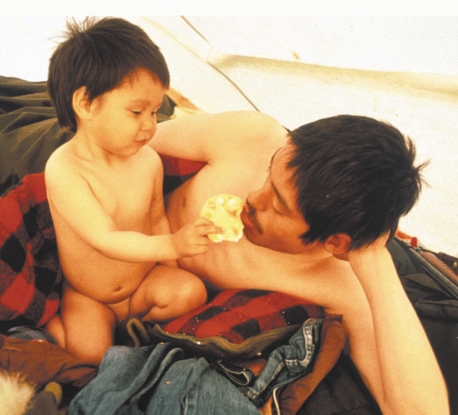
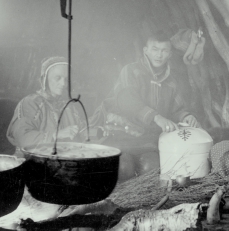
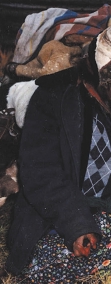
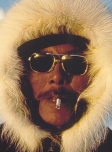
At the nomad camp
POLFOTO / EUGENE FISCHER
Human Health
In some Arctic populations, contaminant levels
ment. Of highest priority is the need to lower
are high enough that they can affect children's
emissions of mercury and POPs. The situation
mental development. Contaminants may also
also poses a challenge at the local level. How
be affecting children's resistance to infections.
should public health officials and community
In addition, there are concerns about effects on
leaders advise people about their eating habits?
hormones that are important for growth and
How should the cultural and health benefits of
sexual development. The major source of these
traditional foods be weighed against the health
contaminants is from eating marine mammals.
risks of the contaminants they contain?
These are the same foods that provide impor-
This chapter examines human health and
tant nutrients, energy in a harsh climate, and
contaminants in the Arctic in the context of
also a sense of identity in a time of rapid cul-
changing cultures, lifestyle, and food habits.
tural change.
The focus is on persistent organic pollutants
This situation challenges the international
and heavy metals. The effects of radioactivity
community to prevent further input of persis-
on human health are discussed in the chapter
tent contaminants into the global environ-
Radioactivity.
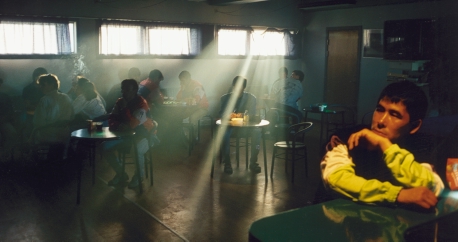
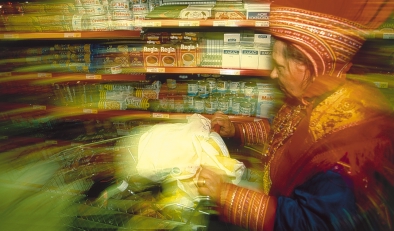
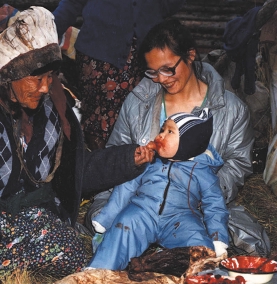
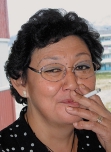
At the youth club
PER FOLKVER / BAM
effects. Moreover, changes in smoking, drink-
78
ing, and dietary habits can make it difficult to
Human Health
single out contaminants as the cause of an
observed change in health.
Finally, knowledge about the broader health
perspective is important when the results of
contaminants studies are used, for example by
public health officials communicating with, or
giving advice to, local communities.
A starting point in creating a context for
contaminants and human health is to learn
about Arctic cultures and how cultures and the
lives of people are changing. The previous
AMAP assessment gave a detailed presentation
of different population groups in the Arctic.
Among great diversity of culture, there are
some common themes. For example, most
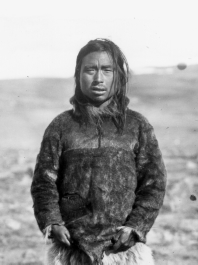
Inuit boy, Greenland,
indigenous communities still live close to their
1909.
ARCTIC INSTITUTE / STEENSBY
environment and use local resources for food.
Over the past 50 years, the population in
Health and culture
most regions of the Arctic has increased dra-
matically. The main reasons are decreases in
AMAP has a mandate to evaluate the com-
infant mortality and fewer people dying of
bined effects of pollutants in the Arctic. But
infectious diseases. Safer water supplies, better
human health is much broader than just pol-
sewage disposal, the development of rural hos-
lutants. From a public health perspective, the
pitals, and community-based health care have
human environment is the sum of physical,
helped prevent and improve the treatment of
chemical, biological, social, and cultural fac-
injuries and illness.
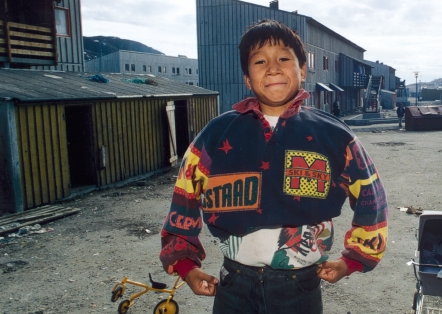
Inuit boy, Greenland,
tors that affect people's well-being. Aside from
Better transportation infrastructure has also
1994.
data on levels and effects of pollutants, any
brought major changes. Imported foods are
now readily available and accepted.
Tobacco and alcohol reach the Arc-
tic on a scale not previously possi-
ble. Modern communications have
made western culture visible even in
the most remote settlements, spur-
ring further cultural change.
In most regions, government poli-
cies and modern lifestyles encourage
indigenous peoples to reside in fixed
locations instead of moving with the
seasons. Survival often depends on a
complex web of government-funded
economic support combined with
employment in various community
service jobs. Cash incomes have be-
come increasingly important, as the
lifestyle has become more similar to
western society.
Traditional activities such as
hunting and gathering still play an
important social role, tying people
in a community together at a time
when both culture and social net-
works are stressed by the influences
of western culture. In some areas,
evaluation of combined effects thus has to
and for some groups of people, traditional
include information about nutritional status
activities also play a role in the local economy.
and socio-economic context, among other
A common theme across the Arctic is the
things.
extremely rapid pace of change. This has had a
This knowledge is also directly relevant for
major impact on people's health, both positive
understanding the effects of contaminants on
and negative. A case history of life among
human health. For example, lifestyle factors
Inuit in North America and Greenland gives
such as smoking and health indicators such as
a glimpse of the social and cultural changes
obesity may influence contaminant levels and
among one group of Arctic people.
A case history of changes
in Inuit culture and health
The Inuit of Alaska, Canada, and
Greenland are descended from people
who migrated from northeastern Asia
across the Bering land bridge between
4500 and 20 000 years ago. The first
contact between Inuit and Europeans
was at the end of the 10th century.
By the late 15th century, European
whalers had started hunting in the
Baffin Bay area and, a century later,
several European countries started
to explore and colonize parts of the
Arctic. The central Canadian Arctic
and Northern Greenland, however,
remained isolated until the early 20th
century. Contact and colonization
was accompanied by cultural change.
Christianity replaced traditional beliefs, and
even if the first extremely disruptive years after
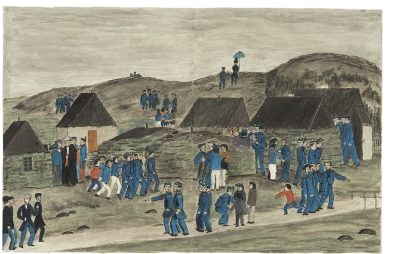
Naval visit by HMS
the Inuit adopted some of the tools brought
colonization were followed by periods of rela-
Bulldog and USS Nau-
by the Europeans, even if traditional hunting
tive tranquility. Aside from a number of dis-
tilus at Nuuk, Green-
land, 1860. Painted by
methods were used until the early part of the
ease epidemics, starvation and chronic malnu-
Aron from Kangeq.
20th century in most regions.
trition were common.
Reproduced by permis-
The colonizers also brought new infectious
The changes brought by the colonizers had
sion from Her Majesty
diseases to the Arctic, with devastating conse-
a large impact on population numbers. In the
the Queen's Reference
quences. Only a few years after colonization,
16th-18th centuries, the population of North
Library, Amalienborg,
Copenhagen.
there was an epidemic of smallpox in Green-
American and Greenland Inuit was probably
land. In 1800, another epidemic wiped out
around 75 000. By 1900, it had declined to
whole districts. During the following centuries,
35 000. During the 20th century, the popula-
respiratory infections, influenza, smallpox,
tion slowly recovered as mortality decreased
and typhoid fever killed a substantial part of
and fertility increased. By 1970, the Inuit pop-
Greenland's population.
ulation had reached its pre-contact level again.
The new diseases hit Alaska particularly
hard. Russian and European explorers intro-
From isolated self reliance to integration
duced syphilis, which became epidemic in the
Aleutians and southeastern Alaska during the
The colonization of the Arctic had a profound
18th and 19th centuries. In 1900, an influenza
impact on the way of life in Inuit communities.
epidemic, `The Great Sickness', killed thou-
Before contact, they were relatively isolated,
sands of people and destroyed entire villages.
self-reliant societies based on fishing and hunt-
By the late 18th century, tuberculosis was well
ing. In the past 50 years, many Inuit communi-
established. It remained common for 150 years,
ties have become partially integrated into the
with very high death rates.
economy of their respective national states, and
These and other infectious diseases remained
the world. Village economies have become
a serious threat to people's health until the 1950s,
based more and more on wage earning, even if
Saami life, 1930 and 1997.
A N N I E G I Æ V E R
S T A F F A N W I D S T R A N D

R C T I C I N S T I T U T E / J E T T E B A N G
P E R F O L K V E R
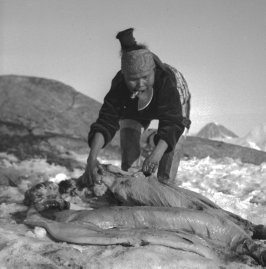
Carving up a seal, 1939
unemployment is still common. Infrastructure
risk factor for many cancers and also for car-
and 1994.
and housing have changed, often with local
diovascular diseases and chronic lung disease,
people merely watching as outside workers do
which are important health problems among
the construction. Travel, radio, television, and,
modern Inuit. Many communities have pro-
lately, the internet have increased contact with
hibited alcohol, but in others alcohol is re-
the rest of the world. The population has grown
sponsible for the majority of health problems.
and many people have moved to larger com-
It is a factor in many accidents with all-terrain
munities. In the process of modernization,
vehicles and snowmobiles. It is also the largest
non-Inuit people have moved into the commu-
contributor to a high prevalence of violence
nities, where they often hold well-paid jobs
and suicide among Inuit. Since the 1970s, sui-
and influential positions.
cide has become a major cause of death, espe-
Modernization has also affected aspects of
cially among young men in Greenland.
people's lifestyles that are closely connected to
The influx of non-Inuit, rapid growth in
health. On the positive side, fewer people are
population, and the increasing concentration
killed in accidents. Traditional Inuit life was
of people in larger settlements have profoundly
extremely perilous. Many hunters died young,
altered the social structure of Inuit communi-
leaving their wives and children behind in
ties. Together with other socio-cultural changes,
poor social conditions. Another positive devel-
stress and psychological problems have become
opment is that most people now have better
more common.
access to health care. Housing conditions, san-
In summary, social changes have increased
itation, and food security have also improved,
physical survival in all age groups among the
which has led to decreased transmission of
Inuit. However, this increase has probably
infectious diseases. Seasonal starvation has
come at the expense of mental and social
disappeared, improving overall resistance to
health. The disease pattern in the future will
infections.
depend on whether current lifestyle trends can
On the downside, the transition to more
be turned in a more healthy direction.
store-bought food has brought changes in eat-
ing habits, which in combination with a more
Statistics reflect health status
sedentary lifestyle have increased the risk of
obesity. This in turn has led to an increased
Many of the themes in Inuit history appear
risk of diabetes. Together with smoking habits,
throughout the Arctic, but there are also dif-
obesity is also connected to cardiovascular dis-
ferences. Some of these similarities and differ-
eases. There is some evidence that Inuit have a
ences are reflected in population and health
genetic predisposition an inherited sensitivity
statistics. The statistics also gives a basis for
to arteriosclerosis (clogged blood vessels),
comparing the health status of groups of peo-
but that their traditional diet of marine mam-
ple and for monitoring changes over time.
mals and fish offers protection against this and
The recent regrowth of the population in
related heart diseases.
parts of the Arctic is reflected in a high propor-
Travel and migration have brought new in-
tion of young people compared with the aver-
fectious diseases, including HIV. Tuberculosis
age European population. This is particularly
is again on the rise after having been a seldom-
true for Alaska, Canada, Greenland, and the
seen disease.
Saami regions.
Increased access to alcohol and tobacco is
In most parts of the Arctic, life expectancy
closely connected to ill health. Smoking is a
has improved. However, in many areas it is
still low compared with respec-
Life expectancy
tive national rates. For example,
Females
Alaska Natives 1997
in Russia, life expectancy
Males
among indigenous peoples is 10-
Females
Canada, NWT 1999 Males
20 years lower than the Russian
Females
average.
Greenland 1991-95 Males
In most countries, the largest
Females
Iceland 1998/99 Males
single contributor to an improve-
Females
ment in life expectancy is that
Faroe Islands 1996-2000 Males
fewer children die soon after
Females
Norway 1999
birth. Other factors include an
Males
overall improvement in health
Females
Sweden 1999 Males
status as a result of safer drink-
Females
Finland 1999
ing water, control of infectious
Males
disease, and access to health
Females
Russia 1994-96 Males
care. Infant mortality has de-
creased in recent decades, but in
0
10
20
30
40
50
60
70
80
90
Age, years
Greenland, Canada, and Alaska,
it is still more common than the respective nat-
Deaths per 1000 live births
ional rates. Infant mortality is also very high
20
Life expectancy in the
1990s.
among Russian indigenous groups.
Throughout the Arctic, injuries, for exam-
15
ple in accidents, and suicide are the most com-
mon causes of death in adults under 45.
10
Suicide is a major problem, especially among
1-28 days old
29-365 days old
men. Wide variations exist and may reflect dif-
ferences in cultural stress, economy, or rates of
5
depressive illness. Injuries and infections are
Infant mortality rate in
the most common causes of ill health.
0
the mid 1990s.
For people over 45, heart disease, strokes,
T
W
ay
and cancer are the most common causes of
eden
ussia
atives
orw
w
Iceland
N
S
Finland R
both disease and death, with some regional
, all races
reenland
A
G
anada, N
variation. These lifestyle-related diseases
laska N S
Faroe islands
A
U
C
reflect a new trend with connections to a
more sedentary lifestyle and to smoking.
Suicides per 100 000 inhabitants
Obesity and diabetes have increased from very
250
Greenlanders
low levels and are now as common in the
Alaska Natives
Canada, NTW, Inuit
Arctic as they are in most developed western
200
Denmark
countries. In Russia, injuries, infectious dis-
USA, all races
Canada, all races
ease, especially tuberculosis, cardiovascular
150
disease, parasites and respiratory disease are
common. Many health problems are related
100
to alcoholism.
Infections kill far fewer people than in ear-
50
Suicide mortality rates in
lier times. However, respiratory infections in
different age groups dur-
infants are still much more common than
0
ing the 1980s.
among other population groups. For adults,
0-14
15-24
25-34
35-44
45-54
55-64
65+
Age group
some sexually transmitted diseases are more
common. Among Canadian and Greenland
Adult mortality rates
Cause-specific mortality per 100 000 inhabitants
Inuit, the rates of gonorrhea and chlamydia
from different diseases.
300
are 10 to 100 times higher than in southern
Canada and Denmark.
Cancer
250
Heart
disease
Stroke
Food
200
Injury
and other lifestyle factors
Suicide
150
The way we live our lifestyle can have a
great impact on health. It includes the every-
100
day activities of work and leisure, our relation-
ships to the people around us, and our food
habits. The different components of a life style
50
are often difficult to separate from one
another. For example, eating together and
0
Alaska
Canada, Greenland Iceland
Faroe
Norway
Sweden
Finland
Russia
sharing food provide not only nutrients and
Natives
NWT
Islands
energy, but also play a role in affirming social
because of restrictions associated with fish and
82
and cultural ties. Our everyday activities of
game laws, better availability of market food,
Human Health
work and leisure influence whether we eat
and increasing employment that left less time
country foods, such as game and wild plants,
for traditional harvesting. In Baker Lake,
or groceries bought with money earned in
Northwest Territories, where caribou is a key
employment.
component of the traditional diet, consump-
Among Arctic indigenous people, country
tion decreased from over 250 grams per day in
foods still play an important role in nutrition
the late 1960s to less than 70 grams by 1989.
and well-being. For many people, these tradi-
Among Baffin Inuit, teenagers eat less than
tional foods are also a source of community
half the traditional foods that middle-age peo-
spirit, pride, and self-respect, and are a way to
ple consume. Among Greenland Inuit, people
educate children about a culture. In Green-
older than 60 ate more than 40 meals a month
land the word used for traditional Inuit food
of seal, whale, wild fowl, or local fish, whereas
Kalaalimernit literally means little pieces
18-24 year-olds had half as many traditional
of Greenlanders, as opposed to the word for
meals. In general, men eat traditional food
imported food Qallunaamernit which
more often than women.
means little pieces of Danes. The traditional
Inuit foods are thus considered the necessary
Country foods
building blocks of Inuit. They can provide
are still important in Russia
health, bodily warmth to withstand the cold
climate, strength, and well-being in a way that
In Russia, the trend toward more
imported foods simply cannot.
market food is not as clear. More
The role of traditional foods has also re-
market foods are transported to
ceived increasing attention because food is the
rural settlements, but high prices
major source of contaminants for people in
in combination with low incomes
the Arctic. Knowing dietary habits is therefore
and strong traditions still make
important in estimating exposure.
people rely heavily on country
The use of tobacco, alcohol, and drugs are
foods. For example, the indige-
other major aspects of lifestyle that have direct
nous people of the Taymir Pen-
implications for health. Smoking is also a
insula still eat 400 grams of rein-
source of contaminants.
deer meat per day. A recent diet-
ary survey of pregnant women
from northern Siberia showed
Food habits are changing
that indigenous mothers ate 320
in Greenland and Canada
grams of reindeer per day, which
In spite of the many benefits of traditional
is ten times higher than non-
foods, eating habits have changed over the
indigenous mothers in nearby
past 50 years. This is illustrated by the fact
towns. The indigenous women
that people get a larger share of their energy
also ate twice as much fish and
Coagulated blood is a
traditional Chukchi food.
requirements from store-bought food than in
three to five times as much game.
P A V E L A B R Y U T I N
the past. In North America and Greenland,
indigenous peoples get between 60 and 90%
Scandinavia, Iceland,
of their food from the store.
and the Faroe Islands have western diets
The changing times can also be illustrated
with local influences
by differences between young and old people.
Interviews with three generations of adult
In Scandinavia, Iceland, and the Faroe Islands,
women in Nulax, British Columbia (outside
the diet is typically western, but with an em-
the Arctic), showed that there had been a
phasis on local resources. For example, fish is
steady decline in the use of traditional foods
often on the dinner table in Iceland and in the
coastal areas of northern Norway. In the Faroe
Polar bear
23 g/d
Islands, meat and blubber from pilot whales
Seal
41 g/d
are still important foods and many people eat
Walrus
Imported food
14 g/d
them several times a month. For women of
638 g/d
Whale
childbearing age, there have been food advi-
37 g/d
sories based on the heavy load of contami-
Fish
nants in the whales, and recent research fol-
78 g/d
lowing pregnant women indicates that they
have drastically decreased their consumption.
Game
In northern Scandinavia, local products such
50 g/d
as reindeer meat, lamb in some areas, fish,
berries, and mushrooms are more common
Estimated daily intake of
foods than in the rest of Scandinavia. A recent
traditional and imported
foods in East Greenland
dietary survey of Norwegian Saami showed
in 2001.
that their diet was changing toward a more
typical Norwegian diet.
are important sources of calcium for many
Changes affect health
83
Inuit. Fish fillets from the store lack this
Human Health
The gathering and hunting as well as the
needed nutrient. Calcium is especially impor-
preparation of traditional foods are activities
tant in the context of contamination, since
that require a lot of energy, particularly as they
deficiencies may increase the body's uptake of
often involve hard physical exercise in low
heavy metals. Traditional Inuit foods, espe-
temperatures. An early dietary survey, from
cially muktuk (whale skin and blubber), meat,
1926, showed that a traditional Inuit hunter
and liver from whales, seals, and seabirds, are
in East Greenland could have an energy intake
also rich in selenium. This trace nutrient is
one and a half times that which is normal today.
thought to play a role in protecting against
The energy came almost exclusively from meat
some of the damage from mercury.
and fat from marine mammals. As wage earn-
ing and the market economy have gradually
Marine fatty acids
replaced the local economy, these physical
protect against heart disease
activities have been replaced by the much less
energy-demanding tasks of picking up and
One of the most important benefits of a mar-
preparing food from the supermarket. If energy
ine diet is the high content of certain fatty
acids that can protect against reduced flow of
blood to the heart muscle and related heart
diseases. These are the n-3-fatty acids, which
are produced by plankton in the sea and
passed along to fish and marine mammals in
the marine food web. They are also present in
high proportions in the fat of game animals
such as hare, deer, caribou, and muskox that
graze on plants in the wild. The fat from farm
animals derives from feed that contains fatty
acids that are less healthy.
Lower intake of the healthy fatty acids and
a higher proportion of other fats may also play a
role in increasing the risk for diabetes. This dis-
ease has been relatively rare among Inuit, but
has become more common in the past 30 years.
The high intake of marine fatty acids may
contribute to strokes caused by bleeding in the
brain, a cause of death that is relatively com-
mon among some Inuit groups. However, the
benefits from protection against heart disease
probably outweigh this increased risk.
The composition of lipids in the blood
intakes are not reduced accordingly, people are
depends not only on what a person eats, but
likely to get fat and increase the risk for dis-
also on inherited abilities to convert lipids
eases that are associated with being over-
from one form to another. There are differ-
weight. In some cultures, such as the Dene/
ences among population groups in this inher-
Métis in Canada, the problem is compounded
ited ability. Inuit as a group seem to be less
by store-bought food having higher energy
able to create some very important fatty acids
content than traditional food. The traditional
from other fatty acids in the diet. This makes
foods are often high in protein and fats and
it extra important to get these nutrients via
low in carbohydrates, whereas the imported
animal foods, emphasizing the health value
foods often have high fat and sugar content
of the traditional diet.
but may have low nutritional value.
The n-3 fatty acids are also important in
brain development in the growing fetus and
Market foods lack important nutrients
for the proper development of vision.
Dietary changes can also lead to specific nutri-
Food is a source of contaminants
tional deficiencies. For example, local fish
products are usually not replaced by the equi-
It is well known that many contaminants accu-
valent products from the store but by cheaper
mulate in the animals that Arctic people eat.
alternatives that do not provide the same
Persistent organic pollutants accumulate espe-
amounts of calcium, vitamin D, and iodine.
cially in fatty tissues, such as the blubber of
In Nuuk, the capital of Greenland, the average
marine mammals. Birds can also have high lev-
iodine intake is only half of the recommended
els, especially in the liver. Heavy metals, such
value. In Greenland villages, where people eat
as cadmium and mercury, accumulate in mus-
more country foods, iodine intake is sufficient.
cle, kidney, and liver of both marine and ter-
Another example is that fish skin and bones
restrial animals.
84
Beta-HCH
Chlordanes
DDTs
1.9 %
Human Health
Fish
Birds
2.2 %
1.6 % 1.0 %
7.2 % 0.6 %
Seal blubber
3.8 %
9.9 %
44.2 %
7.0 %
85 %
Whale meat
14.6 %
63.0 %
19.9 %
4.5 %
Whale blubber
29.1%
Seal meat, liver and kidney
4.3 %
Hexachlorobenzene
PCBs
7.7 %
9.2 %
3.8 %
13.5 %
30.5 %
16.1 %
50.6 %
27.1 %
The contribution of different tradi-
tional foods to dietary exposure to
POPs in southwestern Greenland.
32.4 %
3.9 %
5.0 %
Knowing dietary habits and the contami-
Inuit, mean intake of chlordanes and toxa-
nant levels in various foods, it is possible to
phene in the late 1980s exceeded Canadian
estimate exposure. The picture will differ both
dietary guidelines. Recent studies, from 1998-
among individuals and among population
99, show that Baffin Inuit mean intakes con-
groups depending on what people eat.
tinue to exceed the dietary guidelines for chlor-
Most Canadian Dene/Métis fall well below
danes and toxaphene, to say nothing of the
the Canadian guidelines for exposure to persis-
most highly exposed individuals. Preliminary
tent organic pollutants. However, for toxa-
results from dietary studies in West Greenland
phene and chlordanes, average intakes are
show that the traditional diet leads to an in-
much closer to guideline values, which some
take of chlordanes and PCBs that exceeds the
individuals exceed.
tolerable daily intake. It is thus clear that a
The picture for Inuit of Baffin Island and
substantial number of Inuit have higher expo-
Greenland raises more concern. For Baffin
sures than are considered acceptable.
Provisional
tolerable weekly intake
Estimated weekly intake, ug
0
500
1000
15 00
Lead
Canada, Inuit
Canada, Dene/Métis
Canada, Caucasian
Greenland, Inuit
Denmark, caucasian
Finland, Saami
0
100
200
300
420
500
600
Cadmium
Canada, Inuit
Canada, Dene/Métis
Canada, Caucasian
Greenland, Inuit
Denmark, caucasian
Finland, Saami
0
50
100
150
200
250
300
400
Mercury
Canada, Inuit
Canada, Dene/Métis
Estimated weekly intakes
Greenland, Inuit
of lead, cadmium, and
Denmark, Caucasian
Finland, Saami
mercury as they relate to
WHO public health
0
1000
2000
3000
4000
guidelines for provisio-
Selenium
nal tolerable weekly
intake. Selenium may
Greenland, Inuit
protect against mercury
Denmark, Caucasian
toxicity.
Finland, Saami
Similar calculations have been made for
The nicotine in cigarette smoke is broken
85
heavy metals (see diagram at bottom of this
down by the same enzymes in the body that
Human Health
spread). Some populations with a high intake
take care of organochlorine contaminants.
of meat from marine mammals exceed dietary
There are studies showing that the levels of
guidelines for mercury and cadmium. The lev-
these contaminants are higher in the blood of
els of metals vary tremendously between ani-
smokers than in blood of non-smokers among
mals and among the various organs in an ani-
Arctic population groups.
mal. Moreover, some forms of the metals are
more easily taken up than others.
In general, the liver and kidney of
large marine and terrestrial animals
Pujortarnerup
and the liver of fish have the high-
peqqiillissutaasinnaanera
est metals concentrations. Caribou
and moose liver can contain high
SORLUK
concentrations of lead, cadmium,
Tupap pujua ilummoorunneqaraangat akui ajoqu-
illussi-
siisartut ingerlaannaq puannut pisarput. M
and mercury. Because the mercury
ninnit sekundit arfiniliinnaat qaangiunneranni
timi sunnerneqalersarpoq: Taqqat eqikkartarput,
QANEQ
in these organs is not readily taken
aap iltimik milluaasinnaanera millisarpoq, aner-
tikkajanerulerputillu, tassa kulilti aap akuinut
up by the body, however, the most
aappaluttunut akuliummat ilti aqqutissaasuaneru-
important sources of mercury are
lersillugu. Ammillu kissarnera minnerulissaaq.TORLUUP AVALEQQUI
TORLUK
meat from seals and toothed whales.
Pujortartarneq imaaliallaannaq nappar-
PUAAT
Kræftip Kalaallit-Nunaanni toqussutaa-
simalersitsisanngilaq. Taamaattumik ajo-
sarnera, inuit 100.000-ikkuutaarlugit ag-
For some population groups, fresh-
qutaanera ukiorpassuarni uppernarsaru-
guaqatigiissillugu nunanut allanut naleq-
minaatsinneqarsimavoq. Ullumikkulli,
qiukkaanni, Kalaallit-Nunaat puatsigut
water fish, especially predatory spe-
tupap misissugaalerneranit ukuit 20-t
kræfteqarnermik toqussuteqarfiusarner-
qaangiunneranni, tupap peqqinnissamut
paat ilagaat, tamatuminnga toqussuteqar-
cies such as northern pike, can be an
navianassusia uppernarsineqarpoq.
fiunerpaasartut tallimat ilagalugit.
Ilisimaneqalersut ilagaat sikaritsitortar-
important dietary source of mercury.
tut puammikkut kræfteqalersinnaanerat
Kalaallit-Nunaanni sikaritsitortarneq
pujortartanngitsunut naleqqiullugu
ukuit kingullilliit qulit ingerlaneranni inga-
Seabirds and bird liver are impor-
qulariaammik aarlerinarnerusoq.
sannerulersimaqimmat, pujortartartullu
amerlimmata taava ukuit 20-30-t qaa-
tant sources of lead. The use of lead
Puatsigut kræfteqarneq
ngiuppata takulerrumaarparput puatsigut
Puatsigut kræfteqalersarneq nunarsuarmi
kræfteqarnermik toqussuteqartartut amer-
shot in hunting adds to the lead bur-
kræftinut allanut naleqqiullugu nalingin-
leriarujussuarnerat. Tassaimaakkami
naanerpaavoq, kræftillu assigiinngitsut
puatsigut kræfteqalerneq ukiut 20-30-t
den in human food. One boiled murre
Kalaallit-Nunaanni toqussutaanerpaar-
taraat. 1990-irmi arnat qulingiluat angutillu
served as soup can yield as much as 50
19-it, tassa katillugit 28-t, toqussutigaat.
micrograms of lead, which is about a
quarter of the provisional daily intake
proposed by WHO. A Russian study of metal
In many Arctic populations, smoking is
Advice against smoking,
levels showed that children in some remote
very common and is one factor behind the
Greenland.
areas of the Kola Peninsula had high enough
increasing prevalence of heart diseases, chronic
lead levels to cause concern for their health.
lung disease, and many cancers. Lung cancer,
The lead most probably comes from lead shot.
which is closely related to smoking, is at least
as common among indigenous people in the
Smoking is extremely common
Arctic as among other groups of people.
High levels of smoking among pregnant
Tobacco smoke contains a number of sub-
women are a particular concern as smoking is
stances that are well known to affect people's
a well-known risk factor for the health of the
health. They include more than 50 cancer-
child. In a survey in Greenland, about 60%
causing substances. Smoking is also known to
of the pregnant women answered that they
cause lower birth weight. Tobacco smoke is a
smoked daily. The numbers are somewhat
major source of cadmium, a contaminant that
lower in Russia, Norway, and Finland but still
has been linked to kidney dysfunction, brittle
high. In northern Russia and Norway, approx-
bones, and reduced fertility.
imately one in five pregnant mothers smoked
daily. In Finland, 12% of the women giving
birth said they smoked daily.
The numbers from Russia are from the mid-
700
800
900
1000
1990s, and there are signs that smoking among
pregnant women has increased considerably in
the past few years. This development parallels
500
600
700
800
900
4500


T O R B E N L A R S E N
P E R F O L K V E R / B A M
T O R B E N L A R S E N
S T A F F A N W I D S T R A N D
documented fetal alcohol syndrome at a rate
A R C T I C I N S T I T U T E / H E L G E B A N G S T E D
T O R B E N L A R S E N
the increase in western contacts and western-
of 4.2 per thousand live births, a much higher
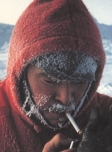
Smokers 1922-2002.
style advertising. Women with university-level
rate than in the US population (0.3-1 per 1000).
education and high socio-economic status
It is quite possible that fetal alcohol syndrome
smoked the most, indicating that smoking has
is common in other Arctic populations, but
become associated with high status. This is in
there is no documentation. In Scandinavia and
contrast with the situation in Western Europe,
Russia, alcohol abuse during pregnancy is for-
where women who smoke often have only
tunately scarce in most indigenous cultures.
lower education.
An ongoing project by AMAP's Human Health
group will add new knowledge on this issue.
Alcohol causes problems
Cocaine and marijuana represent large prob-
in many communities
lems in many Alaskan and Canadian Arctic com-
munities. Their use has a seasonal variation
Trying to estimate alcohol and drug consump-
and there may be links to seasonal depression,
tion or illegal drug use is notoriously difficult.
which is common in countries with very short
However, there is no doubt that alcohol and
winter days. Injection drugs seem to be as com-
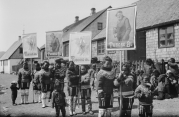
Young Inuit girls in a
drugs have caused health and social problems
mon in northern areas as they are farther south.
Tuborg beer marketing
campaign at Qaqortoq,
in many Arctic communities. Surveys of Green-
Greenland, 1906.
land residents have shown that 39% of the
men and 12% of the women meet the
Environmental contaminants
criteria for binge drinking or high
and their effects
alcohol consumption. Among Inuit in
Arctic Canada, between 13 and 29%
A large number of environmental contaminants
have problems with alcohol. In a sur-
can potentially affect people in the Arctic.
vey among Alaska Natives, 29% of
Most of them can be included in the broad
the men and 21% of the women re-
categories of persistent organic pollutants,
port binge drinking. This can be com-
heavy metals, and radionuclides. Descriptions
pared with a national US rate of
about the sources, pathways, and general bio-
14%. In the Russian Arctic, alcohol
logical effects of these substances are given in
use has increased since Perestroika.
the previous chapters. This chapter focuses on
It is especially a problem among men.
how persistent organic pollutants and heavy
One study has looked at the effects
metals may influence the health of people liv-
of alcohol in terms of deaths from dis-
ing in the Arctic. The emphasis is on sensitive
ease and accidents. The picture varied
targets, such as the brain, hormones important
considerably among regions. The risk
for sexual development, and the body's defense
of vehicle accidents was much higher
against infections. The effects are likely to be
in Canada than in the Nordic coun-
subtle and it is difficult to establish a cause
tries and higher still in Alaska and
effect relationship with contaminants. Never-
Russia. Alaska, Russia, and Finland
theless, new results since the previous AMAP
had the highest mortality from homi-
assessment show that the mercury levels pres-
cide. Most problems were more seri-
ent in some Arctic populations can cause subtle
ous in northern areas than farther
effects on fetal brain development. The grow-
south. Greenland, the Faroe Islands,
ing brain of a fetus is also sensitive to PCBs.
and Iceland were not part of the
PCBs are also implicated in effects on young
study.
children's defense against infections.
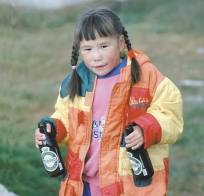
Inuit girl collecting
Alcohol abuse poses a special problem in con-
empty beer bottles for
nection with pregnancy as alcohol can affect
recycling, 1996.
The growing brain
the growing fetus. The result can be lower birth
is very vulnerable to mercury
weight and brain dysfunction. In severe cases,
growth is impaired and the child develops char-
Many toxic chemicals can affect the nervous
acteristic facial features. These severe effects
system. Especially sensitive is the growing
are called fetal alcohol syndrome. From 1988
brain of a fetus. Mercury is one of the pollu-
to 1994, the Alaska Native health care system
tants that raises concern. The risks are con-

nected with a chemical form of mercury called
considered `safe' can affect the brain develop-
87
methylmercury, which accumulates in marine
ment of a child in its mother's womb. The indi-
Human Health
and aquatic food webs.
vidual may never be aware of any effects as
The effects of methylmercury first became
there are no apparent symptoms, but even
apparent in children whose mothers had eaten
small changes in brain development can have
foods that were contaminated with very high
implications for daily life. In the Faroe Island
levels of methylmercury. Recently it has be-
study, it was calculated that a doubling in pre-
come clear that much lower exposure to meth-
natal exposure to mercury corresponded to a
ylmercury may also have effects, though they
delay in child development of 1-2 months dur-
are much more subtle. The new knowledge
ing the first seven years of life. It is not known
comes from three epidemiological studies, one
how significant such a delay will be when the
in the Faroe Islands, one in the Seychelles, and
child grows up.
one in New Zealand. In none of the studies did
the children have any apparent signs of mer-
Several Arctic populations
cury poisoning. The average hair mercury con-
exceed mercury guidelines
centrations in these studies varied between 4.3
and 8.8 micrograms per gram, with a signifi-
AMAP's circumpolar survey of contaminants
cant number of infants having levels above 10
in maternal blood shows that the mercury lev-
micrograms per gram.
els in the Faroe Islands are not unique in the
In the Faroe Islands study, the children's
Arctic, and that some other groups are ex-
performance in neurobehavioral tests showed
posed to similarly high or higher levels.
that mercury levels had an effect on fine motor
There is no international agreement on a
function, attention, language, visual-spatial
new `safe' level, or reference dose for mercury,
abilities, and verbal memory. The New Zea-
below which there are no known effects and
land study also found some adverse effects
which can thus be used to justify public health
from mercury exposure, whereas no correla-
actions. One point of departure has been 12 mi-
tion between mercury exposure and neurobe-
crograms per gram in the mother's hair, which
havioral effects was found in the Seychelles
is in the same range as WHO's recommenda-
study. Interpreting these somewhat conflicting
tion of 10-20 micrograms per gram. The US
results has been a major challenge, but it ap-
Environmental Protection Agency applies a
pears that mercury levels that are currently
safety factor of ten, which results in a reference
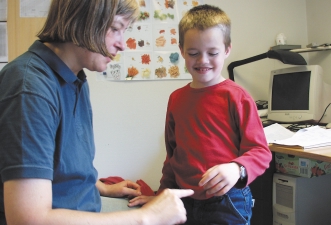
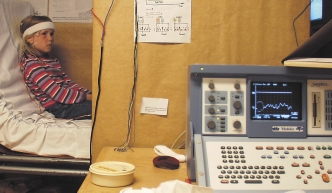
Measuring neurobehavioral effects
Measuring subtle changes in neurobehav-
ioral development is a challenge. There is
a battery of different tests looking at coor-
dination, reaction time, and memory.
The pictures show two of the tests that
were used to study Faroese children in an
epidemiological study looking for effects
of mercury. Test scores were compared
with the mercury exposure the children
had while they were still in their mother's
womb.
In the upper picture, the doctor exam-
ines the fine motor skills and coordination
abilities of a Faroese boy by asking him
to move his arm forward so that his finger-
tips will touch hers. He will next have to
L WEIHE
Á
do the same task with closed eyes, to see
P
how well he remembers the movement he
did before.
The lower picture shows what is called
the evoked potentials examination.
The girl is watching a screen with a chang-
ing chessboard pattern. This will create
well-defined nerve impulses to the visual
cortex in the brain. The electrodes on her
head measure how fast these impulses
travel, and an amplified signal shows up
on the measuring device. Mercury is
known to have an effect on this signal.
L WEIHE
Á
P
Mercury in blood, % exceedance
Faroe
Alaska
Canada
Greenland
Finland
Siberian Russia
Islands
100
90
80
70
60
50
40
30
20
10
0
T
T
T
iit
iit
ir
al
'ik
tis
eot
upiat
NW
NW é
NW
Inuit
Inuit
Inuit
Inuit
Inuit
NuukInuit
Other
BaffinInuit
BethelYup
/M
Iñ
Inuuvik
Kivalliq
Norilsk
Taym
Yam
Nunavik
Ilullissat
Lapland
Dudinka
Kitikm
Caucasian Dene
Salekhard
Indigenous Indigenous
Barrow 2001
IttoqqortoormIttoqqortoorm
Non-indigenousNon-indigenousNon-indigenous
% of samples
Pregnant Inuit women
exceeding US EPA 1999
mercury guideline
Non-pregnant Inuit women
dose of 1.2 micrograms per gram in maternal
% of samples
Mercury mechanism
exceeding
hair. This is equivalent to a cord blood concen-
Health Canada
stresses protective role of marine foods
mercury guideline
tration of 5.8 micrograms per liter. Health
Canada has guidelines that a maternal blood
The mechanisms behind the effects of methyl-
Mercury levels in blood
level between 20 and 100 micrograms of mer-
mercury on the central nervous system are not
of women of reproduc-
cury per liter indicates increasing health risks,
well understood. One possible explanation
tive age as they relate to
and that levels above 100 micrograms per liter
could be that mercury increases the production
US EPA and Canadian
constitute a health risk.
of reactive oxygen in the body. This oxygen
guidelines for increasing
risk range.
A large proportion of Greenlandic women
has a chemical form that is different from the
exceed the stricter US EPA guideline, and
oxygen in air It is produced in several natural
many women also exceed the Canadian guide-
processes in the body. While there are natural
Selenium/mercury ratio
line of 20 micrograms per liter. Among Cana-
defenses against this aggressive form of oxy-
in hair of humans and
dian Inuit, a few women exceed the Canadian
gen, mercury might diminish some of these
animals from Greenland.
guideline whereas about a third exceeded the
defense mechanisms. Other factors might en-
stricter US EPA levels. Among the Yup'ik in
hance the defenses. They include beneficial
Mercury concentrations
in hair of humans and
western Alaska, almost half of the mothers
nutrients such as selenium, which together
animals from Greenland.
exceeded the stricter US EPA levels.
with marine fatty acids is known to decrease
In Siberia, none of the mercury levels ex-
oxidative stress. Traditional marine diets are
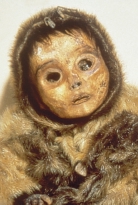
Mummies from 15th and
ceeded the 20 microgram per liter guidelines,
thus both the source of harmful methylmer-
16th century graves in
but in two regions (Taymir and Yamal) some
cury and of beneficial nutrients.
Greenland have provided
women exceeded the stricter limit.
Mercury can be measured in hair from peo-
hair which can be ana-
In summary, high mercury levels appear to
ple or animals, and preserved hair samples have
lyzed for mercury to
show historical levels of
pose a threat to children's development in some
been used to determine a time trend for this
this metal in people and
Arctic populations.
contaminant. The human hair samples show
their diet.
Mercury concentration in hair, ug /g
Selenium/ mercury ratio in hair
10
10
Animals
9
9
8
8
7
7
6
6
5
5
4
Humans
4
Humans
3
3
2
2
Animals
1
1
0
0
H N L E E / G R E E N L A N D N A T I O N A L M U S E U M
15 th century
16 th century
20 th century
15 th century
16 th century
20 th century
that mercury levels in Inuit are three-fold
lations. Comparing the results from the circum-
89
higher in the 20th century compared with the
polar study of contaminant levels in maternal
Human Health
15th and 16th centuries. In animal hair from
blood with public health guidelines again pro-
seal and reindeer, similar increases are seen.
vides a disturbing picture, especially for Inuit
At the same time, selenium levels in human
who rely heavily on marine mammals in their
hair have decreased because of changing eating
diet as well as for some non-indigenous groups.
habits. In animal hair, there is no similar de-
Health Canada's maternal blood guideline
crease in selenium. Selenium may counteract
for PCBs sets the level of concern at 5 micro-
the toxic effects of mercury. However, the lower
grams per liter and the action level at concen-
levels of selenium may not be adequate to pre-
trations above 100 micrograms per liter.
vent the effects of the higher levels of mercury.
In the Canadian Arctic, the proportion of
Thus, there may now be an impact on human
the samples from Inuit women from North-
health that was not as likely in the past.
west Territories and Nunavut that exceeded
the level of concern ranges from 16 to 73%,
although none exceeded the action level. In
Some POPs
Greenland, a high proportion (50-95%) of
can also affect brain development
women of child-bearing age exceeded the level
Some organic pollutants can also affect the
of concern. In one area, Ittoqqortoormiit, 12%
development of children's brains. Most knowl-
of the pregnant women also exceeded the Can-
edge about low exposure through the food
adian action limit. More than half of the non-
web comes from studies outside the Arctic.
pregnant women exceeded this limit. There is
The focus has been on PCBs. The effects that
no apparent explanation for the differences
have been linked to PCB exposure in the
among different groups of women.
womb include lower birth weight, slower
Although the situation is worst in Green-
growth, poorer visual recognition memory,
land and among Canadian Inuit, a number of
deficiences in psychomotor development, and
women in other population groups also exceed
poorer intellectual functioning. Some of these
the level of concern. They include non-indige-
effects appear to be irreversible. Although much
nous women in Russia, Iceland, Norway, and
larger quantities of PCBs are transferred to
Sweden.
nursing infants by breast feeding than across
the placenta in the womb, virtually all the
Hormone mimics
neurobehavioral effects have been linked
may disturb reproduction
specifically to exposure before birth. This
indicates that the embryo and fetus are partic-
It is well known that high levels of organic
ularly vulnerable to these substances.
pollutants can lead to reproduction problems
PCBs were measured in the same Faroese
in wildlife. The causes range from the animals
study that looked at the effects of mercury.
having gross changes in the reproductive tract
PCB levels in blood of
In this case, however, it has been difficult to
to changes in mating behavior. During the
women of reproductive
specifically pinpoint PCBs as the cause of the
1990s, it has become clear that there is a com-
age; percentage of sam-
ples exceeding public
effects on behavior. There were some indica-
mon link between many of the reproductive
health guidelines for
tions that both contaminants had the same
problems. Many organic pollutants can disrupt
levels of concern and
effect on the nervous system, potentially mak-
the endocrine system, the hormones in the body.
action.
ing the effect worse when both mercury and
Some of the endocrine disruptors mimic the
PCBs are present.
female sex hormone estrogen, whereas others
% of samples
100 ug / liter
The levels of exposure in the epidemiological
block its action. Other compounds interfere
(action level)
studies looking specifically at PCBs are lower
with the male sex hormone testosterone, and
% of samples
than for the most highly exposed Arctic popu-
some chemicals interfere with both systems.
5.0 ug / liter and
100 ug /liter
(level of concern)
PCBs in blood, measured as Aroclor, % exceedance
100 Canada
Greenland
Iceland
Siberian Russia
Faroe
Norway
Sweden
Islands
90
80
70
60
50
40
30
20
10
0
T
T
T
iit
iit
y
ir
eot
ö
g
Inuit
Inuit
Inuit
Inuit
Inuit
Inuit
Inuit
NW
NW
NWOther
NuukInuit
Baffin
Total
å
Inuuvik
Kivalliq
Taym
Yamal
tis/Dene
Norilsk
Nunavik
Ilullissat
é
Olafsvik
Dudinka
Caucasian
Kitikm
M
Disko Bay
Reykjavikannaeyjar
Vestv
Salekhard
Indigenous Indigenous
Kiruna area
Arkhangelsk
Saudarkrokur
Non-indigenous
Non-indigenous
Non-indigenous
Non-indigenous
Ittoqqortoorm
Ittoqqortoorm
Pregnant Inuit women
Vestm
Non-pregnant Inuit women
Experiences from a synthetic estrogen that
as bacteria and viruses that enters the body.
90
was used to treat threatening miscarriage in
The immune system also plays a role in recog-
Human Health
pregnant women (diethylstilbestrol, DES)
nizing cancer cells. An overactive immune sys-
show that the effects of endocrine disruptors
tem is involved in allergic reactions.
do not always appear in the adults who have
There are a number of contaminants that
been exposed, but may only be seen in the next
affect the immune system. In almost all animal
generation. Often, a fetus in the womb is much
species that have been tested, PCBs, dioxins,
more sensitive. In the growing body, the chem-
and furans suppress various components of it.
icals disturb the fine-tuned interaction of hor-
The effects may be more severe in unborn or
mones steering the development of the repro-
very young children, when the immune system
ductive system, causing irreversible damage.
is still maturing, than later in life. Other con-
The picture of endocrine disruption as a
taminants suspected to have such effects are
toxic mechanism has focused attention on
dioxin-like compounds, chlordanes, hexa-
diseases that might be connected with such
chlorobenzene, PAHs, and possibly also other
mechanisms. For men in the western world
endocrine disruptors such as DDTs.
they include increases in the incidence of testic-
Another way the immune system may be
ular cancer, prostate cancer, and possibly also
disturbed is via vitamin A deficiency. The im-
the number of newborn boys with undescended
mune system needs a certain level of vitamin A
testes or malformed penises. For women, a rise
to function properly. But vitamin A metabo-
in breast cancer has been discussed in this con-
lism can be altered by contaminants, specifi-
text, but the connection to contaminants is not
cally by PCBs and dioxins.
very clear.
In addition to the animal studies, evidence
There are, as yet, no completed studies from
for effects on the immune system comes from
the Arctic reporting contaminant effects on re-
studies showing an increased rate of infection
productive health, but such studies may be ap-
among people who have been exposed to or-
propriate considering the high levels of some
ganic pollutants. From the Arctic, there is a
contaminants that are known to cause repro-
study from Nunavik that shows a connection
ductive problems in animals. Recent results
between high levels of organochlorine contam-
from biomarker studies also emphasize the
inants and increased incidence of ear infections
need for further studies. Using cell cultures,
early in life. A recent study of children in North-
it has been possible to look at the hormone-
ern Quebec has looked at immune effects of
disrupting effect of the actual mixture of con-
PCBs and DDTs. The preliminary results sup-
taminants that is present in human blood in
port the hypothesis that the high incidence of
the Arctic. Results from East Greenland show
respiratory infections observed in Inuit chil-
that the blood sample, after being stripped of
dren is due in part to high prenatal exposure
all natural hormones, is able to affect normal
to persistent organic pollutants.
hormone processes in cultured human cells.
Metals can also be toxic to the immune sys-
It is too early to say anything about the signifi-
tem. Both mercury and lead have been shown
cance of these findings for health of the Green-
to affect various immune cells. Inorganic mer-
landers in the study areas.
cury can also induce allergies and hypersensi-
tivity. Lead seems to promote hypersensitivity,
rashes, and autoimmune response.
Weakened defenses against disease
The immune system has been increasingly rec-
Mercury may increase the risk
ognized as a sensitive target for environmental
for cardiovascular diseases
contaminants. The cells of the immune system
help identify and destroy foreign material such
There are some indications that mercury can
increase the risk for cardiovascular diseases.
A Finnish report has noted a correlation in
Mechanism behind PCB effects
fish-eating Finnish men between high levels
raises concern about other contaminants
of mercury and the risk of coronary heart
One mechanism behind the effects of PCBs on the developing nervous
diseases. The mechanism could be that the
system could be that some of these compounds interfere with thyroid
mercury promotes the breakdown, or oxida-
hormones in the body. Thyroid hormones regulate the growth of nerve
cells and the way that nerve cells develop different specific functions.
tion, of lipids, creating forms that are known
In the fetus, the thyroid is essential for growth and for the brain and
to initiate clogged arteries. N-3 fatty acids in
central nervous system to develop normally. The PCBs as manufactured
combination with selenium and other antioxi-
may not cause detrimental effects themselves. In the body, they are
dants may counteract this effect of mercury.
changed into new forms, for example hydroxylated metabolites, or
Among Inuit who get large amounts of these
OH-PCBs. The OH-PCBs bind strongly to the special protein that nor-
nutrients in their traditional diet, death from
mally transports thyroid hormones from the blood to the brain.
heart disease is much less common than among
Several compounds that are chemically related to PCBs can also affect
other people.
the thyroid system. They include dioxins, brominated flame retardants,
In the Faroe Island study, low-level prenatal
phthalates, and some pesticides. Phenolic compounds, such as pentachloro-
mercury exposures have been associated with
phenols, are known to bind strongly to the blood-brain transport protein.
higher blood pressure in 7-year-old children.
This can also be important because high blood

pressure is a risk factor for heart disease later
Combined effects are difficult to evaluate
91
in life. Although insufficient for risk assess-
Human Health
ment purposes, this evidence suggests that the
Arctic populations are exposed to a mixture
cardiovascular system is a potential target for
of contaminants. Some of them may affect the
mercury and even a slight negative impact
same sensitive systems in the body, through
could have a major effect on public health.
similar or different mechanisms. A key con-
cern, therefore, is the possibility of interactive
effects. If these occur, health risks may be un-
Cadmium can damage the kidneys
derestimated if the contaminants are looked at
Cadmium accumulates in the kidneys and
one at a time.
liver. Even at modest exposure, the kidney
There are laboratory studies showing that
can be irreversibly damaged. This leads to the
mixtures of contaminants can cause combined
body losing proteins and essential minerals.
effects. These effects can be additive, where
Recent research has also linked cadmium to
each contaminant adds its effects to the others,
the development of osteoporosis (brittle skele-
or antagonistic, where contaminants actually
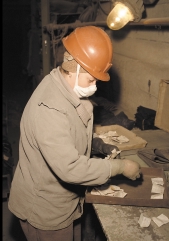
A female worker at the
ton). Women deficient in iron are especially
counteract each other's effects. In a few cases,
October Mine at
at risk. The new data from outside the Arctic
laboratory studies have shown synergistic
Norilsk.
on cadmium toxicity have led to the conclu-
effects between contaminants,
sion that the guideline for maximum recom-
where the different substances
mended intake is too high to protect against
enhance each other's effects.
harmful effects.
As a further complication, some
Cadmium accumulates in the fluid around
contaminants may have one
the egg and can reduce fertility. It has also been
effect at low concentrations and
related to early menopause, the age when a wo-
completely different effects at
man can no longer get pregnant. The growing
higher concentrations.
fetus is partially protected against cadmium.
The effects of contaminants
The metal accumulates in the placenta. How-
are also influenced by the per-
ever, at high enough levels, some of the cad-
son's general health. Inherited
mium passes through this barrier.
characteristics, nutritional status,
For people, the major source of cadmium is
and lifestyle factors such as
tobacco smoke. Significant dietary sources are
smoking can thus play a major
the kidney and liver from caribou/reindeer and
role in sensitivity to contami-
whale. In some areas of the Arctic, such as
nants. Age also plays a role, and
Greenland, cadmium intake via the diet is
young children are often more
higher than dietary guidelines, in addition to
sensitive than adults.
exposure from heavy smoking. Dietary intake
Epidemiological studies can
of iron is also high, which might protect against
provide information about com-
BRYAN & CHERRY ALEXANDER
cadmium from food being absorbed in the body.
bined effects that include both
Nevertheless, there is a need to look more
contaminants and other factors.
closely at the connection between cadmium
This can be the case even when
intake and the occurrence of effects on the
the intention is to study a single
kidneys and skeleton.
contaminant. The overall situa-
tion usually varies from one
group of people to another, and
Focus on the Kola Peninsula
contradictory findings can some-
On the Kola Peninsula of Russia, there has
times be explained by looking
been a fear that pollution from the mining
at the situation as a whole.
and smelting industry has an adverse effect
It may also be too simplistic
on health of newborns, especially those born
to look at only one effect of a
to women working in these industries. To in-
specific contaminant. The same
vestigate the risks, a study looked closely at
substance or one of its break-
the concentrations of nickel and various nutri-
down products may act on other,
ents in the women of Archangelsk, Nikel, and
even more sensitive systems in
Monchegorsk in Russia, and Kirkenes, Ham-
the body. Any risk assessment
merfest, and Bergen in Norway. Although
thus has to take into account
BRYAN & CHERRY ALEXANDER
nickel concentrations were higher among the
which system in the body would be most sensi-
Health check at the
Russian women, there was no connection to
tive, along with an evaluation of which indi-
Norilsk hospital.
birth weight. However, birth weights overall
viduals in a group would be most sensitive.
were lower for the Russian women, and there
At this point, it is impossible to evaluate the
were signs that insufficient nutrition may play
combined effects of all contaminants and other
a role.
factors that influence human health in the
Another finding was that high levels of lead
Arctic. AMAP's Human Health Program is
could cause low birth weight. Lead is also
designed to gather information from a number
known to be neurotoxic and can affect chil-
of different areas to make better assessments
dren's mental development.
of combined effects in the future.
times higher among Inuit than in other popula-
Aleutian-Pribilof Islands
tion groups. The most likely explanation for
this pattern is that oxychlordane is concen-
Bethel
Yup'ik
trated in traditional marine mammal foods.
People who rely heavily on these foods have
U S A
Alaska
higher levels.
Using other studies, it is possible to in-
Barrow
Dene / Métis
Iñupiat
Other groups
clude Russia in the comparison. The re-
Inuvik
Caucasian
Inuit
sults show that levels in the non-indige-
nous population of the Archangelsk
C A N A D A
R U S S I A
region of Russia are higher than among
non-indigenous people of Norway,
Kitikmeot
Taymir
Kivalliq
Inuit
Indigenous
Iceland, Finland, and Canada. This
Inuit
Norilsk
indicates that chlordanes are used
Non-indigenous
either in the Archangelsk region or in
Qaanaq
Baffin
Dudinka
Inuit
Island
Yamal
Non-indigenous
Russian agriculture.
Inuit
Indigenous
Salekhard
Similar patterns can be seen for DDE,
Nunavik
Disko
Upernavik
Non-indigenous
Inuit
BayInuit Inuit
which is a breakdown product of DDT,
G R E E N L A N D
Ilulissat
and for beta-HCH. Beta-HCH is a com-
Inuit
Nuuk
Inuit
ponent of technical HCH. It is very persis-
Ittoqqortoormiit
Finnish
Tassiilaq
Inuit
Lapland
Arkhangelsk
tent. Levels of DDE and beta-HCH are
Inuit
Nanortalik
Vestvågøy
Kiruna
Non-indigenous
Isafjördur
Inuit
Saudarkrokur
area
higher among non-indigenous people in Sibe-
Olafsvik
Akureyri
Reykjavik
FINLAND
Vestmannaeyjar
ICELAND
rian Russia and in Archangelsk compared with
NORWAY
the indigenous groups. It is thus likely that
FAROE ISLANDS
SWEDEN
DDT and HCH-based pesticides are still used
in Russian agriculture or to control insects in
the local environment.
DDT and beta-HCH levels are also 5-12
The locations of sampling
in AMAP's phase II
times higher among people in the category
circumpolar blood
`other groups' in Canada than in specified
monitoring study.
groups. The `other groups' category includes
Spatial trends
people from Africa and East Asia, regions
in maternal blood
where these pesticides are still in use. They
may have been exposed while living in those
In 1994, AMAP initiated a circumpolar study
areas, or perhaps via food imported directly
of contaminant levels in maternal blood.
from their home countries.
A few early results were presented in the pre-
Among indigenous peoples, DDT and
vious AMAP assessment. In this report these
beta-HCH levels are higher among most
results are combined with new, much more
Inuit groups in Canada and Greenland than
complete data. As they relate to public health
among the Dene/Métis of Canada, who rely
guidelines, the data are discussed in the previ-
more on fish and terrestrial animals, or indi-
ous section Contaminants and Human Health.
genous peoples of Russia, who rely heavily
This section presents geographical trends and
on reindeer.
their possible explanations.
A number of other pesticides are included
A general picture that emerges is that levels
in the AMAP Human Health program, such as
of persistent organic pollutants and mercury
toxaphene, mirex, and hexachlorobenzene.
are higher in people who rely heavily on food
The general pattern is that levels are higher
from marine mammals, such as the Inuit of
among people who rely heavily on marine
Greenland and Arctic Canada. In Russia, levels
mammals in their traditional diet.
of DDTs and HCHs (hexachlorocyclohexanes)
are higher in non-indigenous people, which
PCB and mercury levels
could indicate that these pesticides are still
are connected to marine diet
being used in Russia.
PCB levels in human blood are best explained
Some pesticide levels reflect current use
by people's food habits. Indigenous people
who rely heavily on marine mammals have
Several organochlorine pesticides or their
the highest levels. PCB levels are highest in
breakdown products are included in the cir-
Greenland, especially in communities on
cumpolar survey.
the east coast. Seal consumption is common
Oxychlordane is a component and break-
throughout Greenland but in the northern
down product of technical chlordane. Its levels
and eastern regions of Greenland, polar
are higher among Inuit in Canada and Green-
bear is also part of the traditional diet,
land and Aleuts in Alaska compared with the
and the contaminant levels are higher in
Nordic countries, and highest on the east coast
polar bear than in seals. In southern Green-
of Greenland. In Canada, levels are 4 to 15
land and in the bigger towns, people eat
Oxychlordane
DDE
93
n.a.
n.a.
Oxychlordane
DDE
1.50
7.50
n.a.
1.00
5.00
n.a.
0.75
3.75
n.a.
0.50
2.50
n.a.
n.a.
0.25
1.25
0.05
0.25
ug/ liter
ug/ liter
n.a.
Beta-HCH
Hexachloro-
benzene
n.a.
n.a.
n.a.
Beta-HCH
n.a.
n.a.
3.00 Hexachloro-
benzene
2.50
1.50
2.00
1.00
1.50
0.75
0.50
1.00
0.25
0.75
0.05
0.50
ug/ liter
0.25
n.a.
0.05
ug/ liter
Toxaphene
PCB
n.a.
n.a.
n.a.
n.a.
PCB
n.a.
n.a.
n.a.
Toxaphene
35.0
30.0
1.50
25.0
n.a.
1.00
20.0
n.a.
0.75
15.0
n.a.
0.50
n.a.
0.25
10.0
n.a.
n.a.
0.05
7.5
5.0
ug/ liter
2.5
0.5
n.a.
n.a.
ug/ liter
n.a.
n.a.
n.a.
n.a.
n.a. n.a.
relatively more fish and imported foods.
are still two to three times higher than in other
POP concentrations in
In Canada, levels are higher among Inuit liv-
Nordic countries.
human blood.
ing on Baffin Island than among other Inuit
Among non-indigenous populations, the
n.a. indicates not avail-
able.
groups.
highest levels are in mothers from Norway,
In the Faroe Islands, blubber from pilot
Sweden, and Russia. The levels are in the same
whale is the main source of PCBs. Pilot whale
range as for Inuit from western and northern
consumption has decreased due to public
Canada. The most likely sources are a high
health advice. So far there is very little change
intake of PCB-contaminated marine fish and
in PCB blood levels, however, and the levels
the common commercial food supply.
Do contaminants pose a risk
50.0
to human health?
45.0
The previous AMAP assessment raised con-
40.0
cern that contaminant levels in some groups of
35.0
Arctic people were high enough to affect their
health. Since then, more data has been gathered
30.0
and epidemiological studies have provided
25.0
more knowledge about the potential effects of
20.0
low-level chronic exposure, as discussed in the
n.a.
previous sections. To summarize the data pre-
15.0
sented earlier in the chapter, these studies show
10.0
subtle neurotoxic effects of methylmercury in
7.5
5.0
some regions of the Arctic where meat from
2.5
0.5
marine mammals is an important part of the
ug/ liter
diet. The severity of the effects is related to the
dose the child receives in the womb, before it is
born. Exposures to mercury in the Arctic vary
Mercury concentrations
The highest levels of mercury are found in
widely. In communities where exposures are
in human blood.
Inuit of Canada and Greenland plus the Yup'ik
high enough to cause health concerns, AMAP
in western Alaska. For Inuit, the mercury
considers the evidence strong enough to war-
comes mainly from the muscle of marine mam-
rant public health strategies to reduce the mer-
mals. In western Alaska, the levels can proba-
cury exposure of women of child-bearing age,
bly be explained by high intake of northern
especially pregnant women.
pike. In the Faroe Islands the major source of
For persistent organic pollutants, emerging
mercury is pilot whale.
epidemiological evidence suggests a negative
influence on human health in both Arctic and
Other metals
non-Arctic regions. Again, the main risk is for
the child being exposed in its mother's womb.
Cadmium levels are higher among Inuit in
So far, the major concerns have been for
Canada and Greenland than in other popula-
effects on the growing brain. However, it ap-
tion groups in the Arctic. The most important
pears that the developing immune system is
source of cadmium for people is cigarette
also sensitive to contaminants. Moreover,
smoke, and the high levels can be explained by
there are health effects that have not yet been
the high smoking rates along with high cad-
well investigated but that will be important to
mium content in Canadian tobacco.
look at in the future. They include the role of
For lead, levels are moderately elevated
contaminants in fertility problems, cardiovas-
among some of the Inuit groups and for Dene/
cular diseases, and osteoporosis.
Métis compared with other groups in Canada.
For contaminants, mercury and PCBs have
The most likely source of the lead is lead shot
been in focus. Based on high intake, AMAP
used for hunting. Some Inuit and Dene/Métis
concludes that there is also a need to look closely
in Canada, along with some women in Green-
at potential effects of toxaphene, chlordanes,
land, exceed the public health action guideline
and all substances with dioxin-like effects.
for lead.
Most health problems are caused by a combi-
In Russia and northern Finland, there has
nation of factors. Compared with the role of life-
been concern that pollution from the metal
style and inheritance, contaminants alone may
Lead levels in women of
smelters could lead to elevated metal levels in
play a modest role but are likely to be important
reproductive age: per-
people working at these smelters or in their
in combination with other factors. The only way
centage of samples
near vicinity. The data in the AMAP survey do
to reduce exposure to environmental contami-
exceeding blood guide-
line action level
not indicate that women living close to the
nants in the long-term is through national and
(100 µg/liter).
smelters have higher metal levels.
international controls on emissions and use.
Lead in blood, % exceedance
20
Faroe
Alaska
Canada
Greenland
Finland
Siberian Russia
Islands
10
0
T
T
T
iit
iit
ir
al
'ik
tis
upiat
NW
NW é
NW
Inuit
Inuit
Inuit
Inuit
Inuit
NuukInuit
Other
BethelYup
/M
BaffinInuit
Iñ
Inuuvik
Kivalliq
Norilsk
Taym
Yam
Nunavik
Ilullissat
Lapland
Dudinka
Kitikmeot
Caucasian Dene
Salekhard
Indigenous Indigenous
Barrow 2001
IttoqqortoormIttoqqortoorm
Non-indigenousNon-indigenousNon-indigenous
Pregnant Inuit women
Non-pregnant Inuit women
all until they have given birth to their children,
95
Dietary advice may be necessary
to limit exposure to PCBs, which remain in the
Human Health
Several international conventions and protocols
body for a long time. Biologically available
address emissions of POPs and heavy metals.
mercury leaves the blood within a couple of
When ratified and implemented, they should
months, and women who plan to become preg-
reduce new releases of some of the most dan-
nant within three months as well as pregnant
gerous POPs to which Arctic populations are
and nursing women are recommended to ab-
exposed. However, these substances are persist-
stain from eating pilot whale meat. People
ent in the environment and it will take in the
seem to follow the recommendations and levels
order of 20 years before there are significant
of mercury in Faroese women have declined
reductions in levels in the fish and wildlife that
approximately 80% in the past nine years.
Arctic people eat. In the meantime, there is a
Similar declines have not been seen for PCBs.
need to consider local risk reduction strategies
Another example of dietary recommendations
in the regions of the Arctic where contaminant
leading to reduced contaminant levels is from
levels are high enough to cause health concern.
the lower north shore of the St. Lawrence River
This is not an easy task. The main source
in Canada, where people traditionally consume
of the contaminants is traditional foods, such
seabird eggs. Advice about reducing consumption
as marine mammals. These foods provide ben-
of seabirds eggs, along with declining conta-
eficial nutrients as well as cultural and spiritual
minant levels in the eggs, have reduced the level
identity, and are known to promote health.
of persistent organic pollutants in newborns
A switch away from these foods can thus have
between 25 and 69% over a seven-year period.
negative effects on health. On the other hand,
Other communities have chosen not to issue
the evidence of subtle effects of contaminants
any dietary recommendations. In Canada, high
in traditional foods is emerging. This under-
POP levels in marine mammals raised concern
lines the necessity of dietary recommendations
and a committee comprised of representatives
that carefully weigh risks against benefits.
of northern indigenous groups, government
In the previous assessment, AMAP con-
health and research agencies, and national
cluded that it may be prudent to consider some
Inuit organizations met to evaluate the options
dietary advice. In communities where expo-
and consider how to best communicate the
sures are high enough to cause health con-
issues. The result was that the Inuit Tapirisat
cerns, the updated scientific assessment con-
of Canada coordinated the message to regional
firms the need for balanced dietary advice for
leaders with a basic statement that `So far as
young women and pregnant women to help
we are aware, the risks to public health from
them reduce exposure levels prior to preg-
continuing to eat beluga and seal blubber are
nancy. Dietary advice may also be needed for
very small and are outweighed by the benefits
children to limit accumulation of POPs from
to you of these foods. However, Inuit must
an early age and for men of reproductive age
judge for themselves what is acceptable risk
because of possible effects on male fertility.
for themselves and their families'.
Also in Canada, high mercury levels in
waterfowl livers and an initial recommenda-
A need for local involvement
tion by Health Canada to limit consumption
The specifics of weighing risks and benefits
of liver of some waterfowl species started a
of traditional foods vary between different
discussion that involved a wide range of or-
groups of people. Any dietary advice therefore
ganizations. The discussions took into account
has to take the local situation into account.
not only contaminant levels but also informa-
In general, risk-benefit discussions have been
tion about how often people ate duck livers
most fruitful when local public health authori-
and the economic, spiritual, cultural, and
ties have worked in concert with the commu-
social benefits of this food. The group made a
nity at risk and also with experts from a var-
risk management decision not to issue advice
iety of disciplines. These local strategies are
to limit consumption of waterfowl livers, but
able to take account of the nature of the prob-
to update current communication materials
lem, the exposure route, the level of education
and to provide fact sheets discussing the ele-
and understanding, and the social and cultural
vated levels of mercury.
needs of the community.
Promoting healthy foods is an alternative to
There are some examples of successful pro-
restrictive dietary recommendations. In Nuna-
grams to reduce exposure to contaminants.
vik, Canada, this approach is currently being
In the Faroe Islands, new knowledge about the
evaluated in three communities. The program
effects of mercury and possibly of PCBs on
promotes Arctic char as a fish of choice for
children's development led to new, stricter diet-
pregnant women. Arctic char contains rela-
ary recommendations in 1998. Previous diet
tively few contaminants and is nutritious. The
advice, from 1977 and 1989, had some restric-
aim is to reduce intake of mercury.
tions. Now, adults are recommended not to eat
The health consequences of using lead shot
meat or blubber from pilot whales more than
in hunting are an issue in many parts of the
once or twice a month. Girls and women are
Arctic. Current actions to limit exposure range
recommended not to eat pilot whale blubber at
from banning lead shot to discussions with
hunter associations as a preparation for future
portant source of cadmium exposure. Smoking
96
bans. In some places, retailers are asked to
also seems to be connected to levels of POPs in
Human Health
provide only steel shot.
people. Lead is present in birds that are hunted
in areas where lead shot has been used in the
past or is still being used.
Breast feeding should continue
Since the previous AMAP assessment, knowl-
Breast milk can contain almost all of the persis-
edge about the effects of contaminants on hu-
tent organic pollutants and there has been con-
man health has increased in terms of both indi-
cern how this affects children who breast feed.
vidual and population-level effects. Moreover,
However, breast feeding also has many benefits.
the human health monitoring program has pro-
They include enhanced bonding between mother
vided information about the levels of contami-
and child, providing the baby with nutrients,
nants in people, in particular in women giving
and boosting the child's immune system. The
birth. The main conclusion of this report is
previous AMAP assessment therefore concluded
that we are even more certain than before that
that breast feeding should continue since the
the current exposure of some Arctic popula-
benefits outweighed the currently known risks.
tions to the existing mixture of contaminants
This recommendation to continue breast
is inducing some subtle adverse effects.
feeding is re-emphasized in the updated scien-
One of the main concerns is the damage
tific assessment. The health benefits are sub-
contaminants can do to the developing brain,
stantial. Moreover, dietary advice may help
while a child is still in the womb. Epidemio-
women of child-bearing age bring down conta-
logical studies show that mercury levels in
minant levels in the milk. In addition, the epi-
parts of the Arctic are high enough to cause
demilogical studies of effects of contaminants
subtle neurobehavioral effects. The people at
suggest that the health risks for the child are
increased risk live in areas with high intake of
mostly associated with exposure in the womb,
marine mammals, such as Inuit in Greenland
rather than through breast milk. This exposure
and Canada, or people with high intake of
can only be prevented by bringing down the
some fish species. such as Yup'ik in western
contaminant levels in the environment and by
Alaska. Moreover, PCB levels in blood exceed
dietary advice to girls and women. Even if
public health guidelines, indicating a risk for
restrictions in breast feeding are not currently
similar neurobehavioral effects in some groups
recommended, this may need to be reevaluated
of people in Greenland and Canada. Emerging
if contaminant levels increase or if other infor-
evidence from Arctic epidemiological studies
mation indicates increased risk.
suggests that PCBs may also decrease resist-
ance to infections in the first year of life.
In addition to the main focus on neurobe-
havioral and immune effects, contaminants are
Summary
known to affect hormone systems in the body
From a public health perspective, the environ-
that are important for sexual development and
ment is the sum of physical, chemical, biologi-
the ability to have children. A new concern is on
cal, social and cultural factors that affect peo-
the role of mercury in cardiovascular diseases.
ple's well being. In the Arctic, the rapid pace
For other contaminants, there is a need to look
of cultural change is having a large impact on
more closely at the potential effects of toxaphene,
human health. On the positive side, infectious
chlordanes, and all dioxin-like substances,
diseases and accidents have become less com-
where intake via traditional food is high and
mon. But there are less positive aspects, too.
in some cases exceeds public health guidelines.
As lifestyles become more western, the rates of
In the long run, international conventions or
obesity, cardiovascular diseases, and diabetes
protocols are the only ways to reduce the con-
have increased. Many people smoke, and high
taminant load in Arctic traditional foods and
consumption of alcohol is common in many
thus in people. However, it will take many years
Arctic communities. Suicide is an important
before levels decrease, and in the short-term diet-
cause of death among young men.
ary advice may also be prudent. Such advice
Food habits in the Arctic are changing and
has to recognize the importance of traditional
store-bought food is becoming more important.
foods for people's health and well-being, and
However, local resources still play an impor-
to weigh risks against benefit. The advice has
tant role, both in supporting cultural and
to be developed locally and must take into ac-
social ties and in providing important nutri-
count the needs of the communities involved.
ents, some of which protect against diseases.
At the international level, the highest prior-
Some traditional foods have high levels of
ity has to be ratifying and implementing the
contaminants. The fat of marine mammals and
Stockholm Convention on Persistent Organic
birds contains many persistent organic pollu-
Pollutants and the protocols on POPs and
tants, while their meat and that of some preda-
heavy metals in the UN ECE Convention on
tory freshwater fish can contain high levels of
Long-range Transboundary Air Pollution
mercury. The kidney and liver of caribou/rein-
(LRTAP). In addition, the public health threat
deer and whale can have high levels of cad-
supports continued work toward a global
mium, although cigarette smoke is a more im-
agreement on mercury.