Arctic Oil and Gas 2007
Contents
Preface. . . . . . . . . . . . . . . . . . . . . . . . . . . . . . . . . . . . . . . . . . . . . . . . . . . . . . . . . . . . . . . . . . . . . . . . . . i i
OGAExecutiveSummaryandRecommendations. . . . . . . . . . . . . . . . . . . . . . . . . . . . . . . . . . . . . . . . . . v
I.
Introduction. . . . . . . . . . . . . . . . . . . . . . . . . . . . . . . . . . . . . . . . . . . . . . . . . . . . . . . . . . . . . . . . . . . . . . . . 1
PurposeoftheAssessment
ScopeoftheAssessment
TheArctic
Oilandgasactivities
Lifecyclephases
Thechemicalsassociatedwithoilandgasactivities
Typesofeffectsfromoilandgasactivities
ImplicationsofclimatechangeforoilandgasimpactsintheArctic
I .
OilandGasActivitiestothePresent. . . . . . . . . . . . . . . . . . . . . . . . . . . . . . . . . . . . . . . . . . . . . . . . . . . . . .13
Extensiveoilandgasactivityhasoccurred,withmuchoilandgasproducedandmuchmoreremaining
Naturalseepsarethemajorsourceofpetroleumhydrocarboncontaminationinthearcticenvironment
Petroleumhydrocarbonconcentrationsaregeneral ylow
Onland,physicaldisturbanceisthelargesteffect
Inmarineenvironments,oilspil sarethelargestthreat
Impactsonpeople,communities,andgovernmentscanbebothpositiveandnegative
Humanhealthcansufferfrompol utionandsocialdisruption,butrevenuescanimprovehealthcare
andoveral wel -being
Respondingtomajoroilspil sremainsachal engeinremote,icyenvironments
Technologyandregulationscanhelpreducenegativeimpacts
I I.
OilandGasActivitiesintheFuture. . . . . . . . . . . . . . . . . . . . . . . . . . . . . . . . . . . . . . . . . . . . . . . . . . . . . . .31
Moreoilandgasactivityisexpected
Seasonalpatternsdeterminevulnerabilityinarcticecosystems
Manyrisksremain
Planningandmanagementcanhelpreducerisksandimpacts
KeyFindings. . . . . . . . . . . . . . . . . . . . . . . . . . . . . . . . . . . . . . . . . . . . . . . . . . . . . . . . . . . . . . . . . . . . . . 38
AMAP
ArcticMonitoringandAssessmentProgramme
Oslo2007
ii
Arctic Oil and Gas 2007
ISBN 978-82-7971-048-6
© Arctic Monitoring and Assessment Programme, 2007
Published by
Arctic Monitoring and Assessment Programme (AMAP), P.O. Box 8100 Dep., N-0032 Oslo, Norway (www.amap.no)
Ordering
AMAP Secretariat, P.O. Box 8100 Dep, N-0032 Oslo, Norway
This report is also published as electronic documents, available from the AMAP website at www.amap.no
AMAP Working Group:
John Calder (Chair, USA), Per Døvle (Vice-chair, Norway), Yuri Tsaturov (Vice-chair, Russia), Russel Shearer (Canada), Ruth McKechnie
(Canada), Morten Olsen (Denmark), Outi Mähönen (Finland), Helgi Jensson (Iceland), Erik Syvertsen (Norway), Yngve Brodin (Sweden),
Tom Armstrong (USA), Jan-Idar Solbakken (Permanent Participants of the Indigenous Peoples Organizations).
AMAP Secretariat:
Lars-Otto Reiersen, Simon Wilson, Yuri Sychev, Inger Utne.
ACKNOWLEDGEMENTS
Author:
Henry P. Huntington (Huntington Consulting, hph@alaska.net).
Contributing experts:
R. Aanes
J. Christian
A.V. Goncharov
M. Kandiah
J. Meyer
G. Reinson
T. Stubbs
P.J. Aastrup
D. Cobb
I. Goudie
J. Klungsøyr
M. Meza
J.D. Reist
O.I. Suprinenko
P.-A. Amundsen
R. Connel y
W. Greenal
C. Knoechel
G. Morrel
C. Reitmeier
V.V. Suslova
J.M. Andersen
N. Cournyea
S. Haley
V. Krykov
A. Mosbech
G. Robertson
E.E. Syvertsen
S. Andresen
J. Cowan
A.B. Hansen
E. Kvadsheim
S. Munroe
G. Romanenko
A. Taskaev
T. Anker-Nilssen
R.P Crandal
J. Hansen
R. Lanctot
H. Natvig
D. Russel
J. Tate
M. Baffrey
W.E. Cross
T. Haug
T. Lang
H. Nexø
V. Savinov
C. Thomas
T. Baker
S. Dahle
T. Heggberget
A. Lapteva
M. Novikov
T. Savinova
D. Thomas
A. Bambulyak
W. Dal mann
D. Hite
A. Lis
D. Nyland
Yu. Seljukov
D. Thurston
A. Banet
M. Dam
A.H. Hoel
L. Lockhart
B. Olsen
I.N. Senchenya
P. Bates
I. Davies
V. Hoffman
C. Macdonald
A.Yu. Opekunov
G. Shearer
G. Timco
M. Bender
G. Einang
D. Housenecht
R. Macdonald
V.I. Pavlenko
L. Sheppard
A. Tishkov
S. Blasco
A. Elvebakk
K. Hoydal
C. Macktans
J.F. Pawlak
T. Siferd
O. Titov
V. Bobrovnikov
H. Engel
A.M.J. Hunter
P. Makarevich
A.Ø. Pedersen
H.R. Skjoldal
J. Traynor
D.M. Boertmann D. Faulder
H.P. Huntington
C. Marcussen
O.L. Pedersen
D. Smith
T. Tuisku
S. Boitsov
R. Fisk
G. Ivannov
M. Markarova
A. Petersen
A. Solovianov
G. Ulmishek
R. Bolshakov
B. Forbes
M. Jankowski
A.M. Mastepanov S. Petersen
S. Sørensen
K.G. Viskunova
P.J. Brandvik
E. Fuglei
H. Jensson
F. McFarland
V. Petrova
P. Spencer
T. Warren
B. Buchanan
M. Gavrilo
S.R. Johnson
R. McKechnie
N. Plotitsina
F. Stammler
Ø. Wi g
D.M. Burn
G. Gilchrist
V. Johnston
T.Yu. Medvedeva
E. Pospelova
F. Steenhuisen
T. Wil iams
D. Cantin
A. Gilman
V. Jouravel
H. Mel ing
M. Pritchard
D.B. Stewart
S.J. Wilson
F. Carmichael
R. Glenn
S. Kalmykov
S. Melnikov
B. Randeberg
F. Straneo
L. Ystanes
G. Chernik
A. Glotov
V.D. Kaminsky
H. Meltofte
O. Raustein
H. Strøm
A. Zhilin
Indigenous peoples organizations, AMAP observing countries, and international organizations:
Aleut International Association (AIA), Arctic Athabaskan Council (AAC), Gwitch'in Council International (GCI), Inuit Circumpolar
Conference (ICC), Russian Association of Indigenous Peoples of the North (RAIPON), Saami Council.
China, France, Germany, Italy, Netherlands, Poland, Spain, United Kingdom.
Advisory Committee on Protection of the Sea (ACOPS), Arctic Circumpolar Route (ACR), Association of World Reindeer Herders (AWRH),
Circumpolar Conservation Union (CCU), European Environment Agency (EEA), International Arctic Science Committee (IASC), International
Arctic Social Sciences Association (IASSA), International Atomic Energy Agency (IAEA), International Council for the Exploration of the Sea
(ICES), International Federation of Red Cross and Red Crescent Societies (IFFCRCS), International Union for Circumpolar Health (IUCH),
International Union for the Conservation of Nature (IUCN), International Union of Radioecology (IUR), International Work Group for Indigenous
Affairs (IWGIA), Nordic Council of Ministers (NCM), Nordic Council of Parliamentarians (NCP), Nordic Environment Finance Corporation
(NEFCO), North Atlantic Marine Mammal Commission (NAMMCO), Northern Forum (NF), OECD Nuclear Energy Agency (OECD/NEA),
OSPAR Commission (OSPAR), Standing Committee of Arctic Parliamentarians (SCAP), United Nations Development Programme (UNDP),
United Nations Economic Commission for Europe (UN ECE), United Nations Environment Programme (UNEP), University of the Arctic
(UArctic), World Health Organization (WHO), World Meteorological Organization (WMO), World Wide Fund for Nature (WWF).
Graphical production of Arctic Oil and Gas 2007
Lay-out and technical production management:
John Bel amy (johnbel amy@swipnet.se).
Design and production of computer graphics:
Simon Wilson and John Bel amy.
Cover design:
John Bel amy.
Printing and binding:
Narayana Press, Gyl ing, DK-8300 Odder, Denmark (www.narayanapress.dk).
Copyright holders and suppliers of photographic material reproduced in this volume are listed on page 40.
iii
Preface
This assessment of oil and gas activities in the Arctic is prepared
the preparation of this assessment. AMAP would also like to thank
in response to a request from the Ministers of the Arctic Council.
IHS Incorporated for contributing information that was vital to
The Ministers cal ed for engagement of al Arctic Council Working
the preparation of this assessment. A list of the main contributors
Groups in this process, and requested that the Arctic Monitor-
is included in the acknowledgements on the previous page of this
ing and Assessment Programme (AMAP) take responsibility for
report. The list is based on identified individual contributors to
coordinating the work.
the scientific assessment, and is not comprehensive. Specifical y, it
The objective of the 2007 `Assessment of Oil and Gas Ac-
does not adequately reflect the contribution of the many national
tivities in the Arctic' is to present an holistic assessment of the
institutes, laboratories and organizations, and their staff, which
environmental, social and economic, and human health impacts
have been involved in the various countries. Apologies, and no
of current oil and gas activities in the Arctic, and to evaluate the
lesser thanks, are given to any individuals unintentional y omitted
likely course of development of Arctic oil and gas activities and
from the list.
their potential impacts in the near future.
Special thanks are due to the lead authors responsible for the
The assessment updates information contained in the AMAP
preparation of the scientific assessments that provide the basis for
1997/98 assessment reports, including several aspects not covered
this report, and also to the author of this report, Henry Huntington.
in the earlier assessments regarding impacts of oil and gas activities,
The author worked in close cooperation with the scientific experts
aiming to offer a balanced and reliable document to decision mak-
and the AMAP Secretariat to accomplish the difficult task of distil -
ers in support of sound future management of oil and gas activities
ing the essential messages from a wealth of complex scientific infor-
in the Arctic. The assessment also includes recommendations to
mation, and communicating this in an easily understandable way.
the Ministers for their consideration.
The support of the Arctic countries is essential for the produc-
This `State of the Arctic Environment Report' is intended to
tion of assessments such as this, with much of the information
be readable and readily comprehensible, and does not contain
presented being based on ongoing activities within the Arctic
extensive background data or references to the scientific literature.
countries. The countries also provide the necessary support for
The complete scientific documentation, including sources for all
most of the experts involved in the preparation of the assessments.
figures reproduced in this report, is contained in a related report,
In particular, AMAP would like to express its appreciation to
`Assessment 2007: Oil and Gas Activities in the Arctic - Effects and
Norway and the United States for undertaking the lead role in
Potential Effects', which is ful y referenced. For readers interested
supporting the Assessment of Oil and Gas Activities in the Arctic.
in the scientific background to the information presented in this
Special thanks are also offered to the Nordic Council of Ministers
report, we recommend that you refer to the scientific report. This
for their financial support to the AMAP parts of the work on this
report is the fifth `State of the Arctic Environment Report' that has
assessment, and to sponsors of other bilateral and multilateral
been prepared by AMAP in accordance with its mandate.
projects that have delivered data for use in this assessment. Fi-
A large number of experts from the Arctic countries (Canada,
nances from the Nordic Council of Ministers and some countries
Denmark/Greenland/Faroe Islands, Finland, Iceland, Norway,
also support the participation of indigenous peoples' organizations
Russia, Sweden, and the United States), together with experts from
in the work.
indigenous peoples' organizations, from other organizations, and
The AMAP Working Group is pleased to present this State of
from other countries have participated in the preparation of this
the Arctic Environment Report, the fourth in the series, for the
assessment. AMAP would like to express its appreciation to al of
consideration by governments of the Arctic countries. This report
these experts, who have contributed their time, effort, and data for
is prepared in English, which constitutes the official version.
Oslo, November 2007
iv
v
OGA Executive Summary and
Recommendations
The Arctic Council's assessment of oil and gas activities in the Arctic is prepared in response to a request from Ministers of the eight Arctic coun-
tries. The Ministers cal ed for engagement of al Arctic Council Working Groups in this process, and requested that the Arctic Monitoring and
Assessment Programme (AMAP) take responsibility for coordinating the work. 1
This Executive Summary is in three parts. Part A presents the main findings of the assessment and related recommendations. Part B is struc-
tured in the same manner as Part A and provides additional information for those interested in examining the basis for the conclusions and rec-
ommendations that are presented in Part A. Part C presents information on `gaps in knowledge' and recommendations aimed at fil ing these gaps.
PARTA:ConclusionsandRecommendations2
neering practice can greatly reduce emissions, discharges, and the
risk of accidents. Physical impacts and disturbance are likewise
Arctic Petroleum Hydrocarbon Resources and Oil
inevitable wherever industry operations occur; their effects can,
and Gas Activities
however, be minimized. Increased activity may extend these im-
pacts and effects into additional areas of the Arctic.
The importance of oil and gas development to the economy of the
It is therefore recommended that:
Arctic means that, with the possible exception of climate change,
· Oil and gas activities and their consequences for the environment
this activity wil pose the most significant chal enges to balancing
and humans should be given increased priority in the future work
resource development, socio-cultural effects, and environmental
of the Arctic Council, focussing in particular on:
protection in the Arctic in the next few decades.
Extensive oil and gas activity has occurred in the Arctic, with
- research, assessment and guidelines to support prevention of oil
much oil and gas produced and much remaining that could be
spil s and reducing physical disturbances and pol ution;
produced. More activity is expected in the next two decades, how-
- research, as es ment and guidelines leading to improved manage-
ever projections farther into the future become increasingly specu-
ment of social and economic effects on local communities; and
lative since the pace of activity is affected by a number of factors
- research, assessment, and guidelines in relation to the interac-
including economic conditions, societal considerations, regulatory
tions between oil and gas activities and climate change. 3
processes, and technological advances. Global climate change may
Specific recommendations in this respect are included under the
introduce additional factors that need to be taken into account.
heading `Managing Oil and Gas Activities', below.
Activities in the early decades of Arctic oil and gas exploration
and development typical y had larger impacts than corresponding
· Arctic oil and gas activities should be conducted in accordance with
activities today. Reduced impacts today are the result of improved
the precautionary approach as reflected in Principle 15 of the Rio
technology, stricter regulations, and a better understanding of
Declaration as wel as in Article 3, paragraph 3 of the UN Frame-
environmental effects of human activity in the region. Technological
work Convention on Climate Change; and with the pol uter pays
advances are likely to continue to change the way oil and gas activi-
principle as reflected in Principle 16 of the Rio Declaration.
ties are conducted. Even so, the presence of oil and gas activities
· Recognizing the trans-boundary context of pol ution hazards
both onshore and offshore is substantial in many parts of the Arctic.
associated with certain oil and gas activities, the Arctic Council
The history of oil and gas activities, including recent events,
should support improvements in bilateral (and multilateral)
indicates that risks cannot be eliminated. Tanker spil s, pipeline
cooperation among the Arctic countries to institute or improve
leaks, and other accidents are likely to occur, even under the most
coordination of preparedness and response measures across the
stringent control systems. Transportation of oil and gas entails risk
circumpolar region, in particular cooperation in the Barents,
to areas beyond production regions. Pol ution cannot be reduced
to zero, although adherence to strict regulations and sound engi-
Chukchi and Bering Seas.
1Ministers representing the eight Arctic States, convening in Reykjavík, Iceland, for the Fourth Ministerial meeting of the Arctic Council. Request AMAP, in cooperation with the other relevant Arctic
Council working groups, to continue work to deliver the assessments of oil and gas in the Arctic ... and propose effective measures in this regard, (Ministerial Declaration, Reykjavik 2004).
2Some Arctic governments are already implementing some or al of the activities described in the recommendations in this document.
3A focus on climate change should address both climate change effects on oil and gas activities in the Arctic and the influence of development of Arctic oil and gas resources on climate change, given the
special, and sometimes local, sensitivity of the Arctic climate to emissions of methane, nitrous oxides, formation of tropospheric ozone and other pol utants and agents affecting climate change in the Arctic.
vi
Social and Economic Effects
This assessment confirms AMAP's previous findings that
petroleum hydrocarbon concentrations are general y low in the
Oil and gas activities provide a significant contribution to the
Arctic environment. Furthermore, this assessment indicates that the
regional and national economies of the countries that currently
majority of petroleum hydrocarbons in the Arctic environment come
produce oil and gas from their Arctic territories.
from natural sources. From human activity, oil spil s are the largest
Effects on individuals, communities, and governments can be
contributor of petroleum hydrocarbons in the Arctic environment,
both positive and negative. Detriments and benefits are unlikely to
fol owed by industrial activity. The oil and gas industry is responsible
reach everyone in the same way. Some people wil receive greater
for some spil s but other sources such as shipping, fishing fleet opera-
benefits and others wil experience greater negative effects. The de-
tions, and spil s at local storage depots also account for much of the
velopment and construction lifecycle phases of oil and gas activity
oil spil ed. With the exception of spil s, oil and gas activities are, at
typical y have the largest social and economic effects, but they are
present, relatively modest contributors to overal petroleum hydro-
also the most rapid and transient.
carbon levels found in the Arctic. Although human inputs comprise
Oil and gas are non-renewable resources and, as such, are finite
a smal proportion of the total petroleum hydrocarbons in the Arctic
resources that wil eventual y be exhausted; however the benefits
environment, they can create substantial local pol ution.
resulting from oil and gas development may be sustainable if
If oil and gas activities in the Arctic reach levels projected by some
properly managed. Setting aside part of the revenue from oil and
countries, these activities may contribute an increasingly significant
gas production, for example in long-term support or investment
proportion of the input of petroleum hydrocarbons to the Arctic dur-
funds, or through provisions of land claims settlements can pro-
ing the next few decades.
vide means of securing benefits for communities over the longer
Oil spil s and other pol ution arising from oil and gas activities
term, including when oil and gas activity declines or ceases.
can damage ecosystems, but the extent of the impact depends on
Society in general has a responsibility to manage the positive
many factors. Seabirds and some marine mammals are particularly
and negative effects that oil and gas activities have on people.
sensitive if oil fouls the feathers or fur they depend on for insulation,
Involvement of local people in al stages of the decision-making
frequently resulting in death. Animals living under cold Arctic condi-
process, and planning for the longer-term are key elements in this
tions are particularly vulnerable in this respect. Seasonal aggregations
process. In some parts of the Arctic, the political influence of local
of some animals such as seabirds, marine mammals, and spawning
and indigenous peoples is a driving force in modern oil and gas
fish make them particularly vulnerable to a spil at those times and
industry supervision.
places. Leads, polynyas, and the marginal ice zones are particularly
It is therefore recommended that:
important habitats where such aggregations occur.
· Prior to opening new geographical areas for oil and gas explora-
Arctic plants and animals may be exposed to a large number of
tion and development, or constructing new infrastructure for
compounds released by oil and gas activities in a number of ways. In
transporting oil and gas, local residents including indigenous
general, Arctic plants and animals may be expected to exhibit effects
communities should be consulted to ensure that their interests are
from petroleum hydrocarbon exposure similar to those shown by
considered, negative effects are minimized and advantage is taken
plants and animals elsewhere in the world. For most of the Arctic,
of opportunities afforded by the activity, especial y during the
with the exception of local spil situations, petroleum hydrocarbon
early, intensive phases of development and construction.
levels are below known thresholds for effects. Aquatic animals may be
· Consideration should be given to securing lasting benefits from
sensitive to exposures to crude and refined oils and to numerous pure
petroleum hydrocarbons, with larval stages of fish among the most
oil and gas activities for Arctic residents, for example through the
sensitive. Experience from the Exxon Valdez oil spil has shown that
establishment of infrastructure and health-care facilities, so that
such effects can persist for decades. To date, no major oil spil s have
northern economies and people benefit over the longer-term and
occurred in the Arctic seas.
so that infrastructure and services are maintained in the period
Human health can suffer from pol ution and disturbance. Expo-
after the activity has declined or ceased.
sure to petroleum hydrocarbons at levels high enough to cause adverse
health effects is rare outside of occupational situations or accidental
Effects on the Environment and Ecosystems
releases such as spil s. Spil s can also lead to changes in the quality,
The Arctic surface environment is one of the most easily impacted
quantity or availability of traditional foods. Oil and gas revenues can
on Earth. On land, physical disturbance has the largest effect. In
also improve health care and overal wel -being. Demonstrating a con-
marine environments, oil spil s are the largest threat.
nection between petroleum hydrocarbons and human health in the
In some areas, the tundra has been damaged by tundra travel
Arctic is complex at best. Many factors contribute to overal health.
and construction of infrastructure related to oil and gas explora-
It is therefore recommended that:
tion and development. Direct physical impacts and disturbances
· Measures should be adopted to enforce stringent controls on activities
from oil and gas activities contribute to habitat fragmentation.
in sensitive areas, especial y during periods when vulnerable species
New technology and methods have significantly reduced damage
are present, and in particular on activities that involve a risk of
caused by operations, but the impacts may be cumulative.
impacts from spil s. Governments need to play an active role in this.
vii
· Where relevant, consideration should be given to staged opening of
increasingly common. There is, however, scope for making these
areas for oil and gas exploration and development or application of
types of assessment more relevant and useful.
seasonal restriction on activities to minimize effects on ecosystems.
Responding to major oil spil s remains a major chal enge in
· Consideration should be given to the need for additional protected
remote, icy environments. This is especial y true for spil s in waters
areas and areas that are closed for oil and gas activities, to ensure
where ice is present. Many areas along Arctic coasts that are vulner-
protection of vulnerable species and habit; the need for such areas
able to spil s from oil and gas activities, especial y transportation,
should also be considered in areas already designated as appropriate
do not have spil response equipment stationed nearby. Most oil
for oil and gas development.
combating equipment that is currently stored in Arctic depots was
· Improved mapping of vulnerable species, populations, and habi-
designed for use in non-ice-covered waters and may be inadequate for
tats in the Arctic should be carried out, also taking into account
combating spil s under typical Arctic conditions. Research on oil spill
seasonal, annual and longer-term changes, in order to facilitate
response technology and techniques has progressed in recent years,
oil spil contingency planning.
resulting in new technology and techniques with improved potential,
however, these have yet to be ful y-tested. For these reasons, spill
Managing Arctic Oil and Gas Development
prevention should be the first priority for al petroleum activities.
Experiences with leakages from older pipelines underline the
Economic benefits have accrued in those regions where oil and
necessity to use the highest engineering and environmental stand-
gas activities have occurred, but with some negative social and
ards, including right-of-way selection, inspection and maintenance,
environmental effects as wel . The benefits tend to be widespread
monitoring, and environmental studies.
(geographical y and across society), whereas the negative effects
Tanker transport of oil in the Arctic seas, especial y from Norwe-
tend to be more local.
gian and Russian fields, has increased and is likely to increase further.
It is difficult, however, to balance tangible (economic) benefits
Differences exist in the laws, regulations, and regulatory regimes
against risks of damage to the environment or ecosystems that, until
and their implementation among oil and gas producing countries
a major spil occurs, remain essential y `potential' or `hypothetical'.
in the Arctic. Some countries have enacted and enforced laws and
The regulatory process in most Arctic countries is modern and re-
regulations providing a robust regulatory regime for oil and gas
sponsive. However, in many cases it is also complex, involving many
activities. However, further measures may be warranted in areas with
agencies and jurisdictions. The continued improvement of regula-
vulnerable ecosystems and low accessibility.
tory systems, including the use of adaptive management, is necessary
It is therefore recommended that:
to ensure adequate control and enforcement as conditions and
Laws and regulations
technology change, and as new areas are explored and developed.
· Laws and regulations in al Arctic countries and their regional and
When oil and gas activities cease, the final steps in environmen-
local subdivisions should be enacted, periodical y reviewed and
tal protection are appropriate decommissioning and remediation.
evaluated and where neces ary strengthened and rigorously enforced,
Because these activities take place after revenues from production
in order to minimize any negative effects and maximize any posi-
have ended, it may be necessary to establish the respective respon-
tive effects of oil and gas activity on the environment and society.
sibilities of government and industry in regard to such activities.
· The requirement to use best industry and international standards
One option is for industry to contribute to a government-man-
should be addres ed in laws and regulations. Management systems
aged fund, to be used for decommissioning and remediation.
and regulations should be clear and flexible, and reviewed regularly
Offering incentives to operators to clean-up old sites in areas
to ensure that they are effective, adequate, consistently applied, and
of their current operations may represent a cost-efficient way to
accommodate changes in technology in a timely manner.
facilitate remediation in some remote areas.
· Monitoring of compliance and implementation of regulations
The environmental and negative social effects of oil and gas
should be improved in the Arctic countries, and appropriate au-
activities in the Arctic can only be minimized if existing regula-
thorities acros the Arctic should be encouraged to adhere to and to
tions are effectively implemented and new regulations addressing
enforce compliance with regulations.
current weaknesses are developed. Enforcing regulations requires
commitment by governments, which can be aided by strong pub-
· An as es ment of the oil and gas industry's degree of compliance with
lic pressure and industry cooperation.
applicable domestic regulations and monitoring programmes should
In the United States (Alaska) and Canada, land claim settlements
be undertaken.
and agreements have given, and continue to give indigenous people
· Guidelines for oil and gas activities in the marine environment,
a role in environmental assessment, permitting, and regulation of oil
and the legal framework for planning and control ing oil spil re-
and gas activities.
sponse operations in the Arctic, should be improved where neces ary
Planning can help reduce risks and impacts. Preparation of
to reduce risks and minimize environmental disturbances.
environmental impact assessments and risk assessments prior to new
· Oil and gas companies should be responsible for the costs as ociated
development is a standard and required procedure; strategic environ-
with risk reduction, spil response, remediation and decommis ion-
mental assessments that have a more holistic approach are becoming
ing activities, and be prepared to share in the costs for studies and
viii
for monitoring of effects on the environment and on society as oci-
· Emergency preparednes should be of the highest levels, including
ated with oil and gas development
continued review of contingency plans, training of crews to operate
· Environmental impact as es ments, strategic environmental as es -
and maintain equipment, and conducting regular (and unsched-
ments, and risk as es ments should continue to be rigorously applied
uled) response dril s. Cooperation and emergency communications
and streamlined to increase their relevance and usefulnes for all
between operators and local, regional, national and international
stakeholders.
authorities on routes and schedules of transport and response capa-
· The ways in which local and indigenous knowledge has been and
bilities need to be established and maintained.
can be used in project planning, environmental as es ment and
· Oil spil response capabilities should be maintained and, where
monitoring, and regulatory decision-making should be evaluated to
neces ary, strengthened. Spil response technology should be further
determine how best to involve such knowledge and its holders.
developed, especial y technology or techniques for dealing with spil s
Technology and practices
in water where ice is present. More (modern) combating equipment
4
· Oil and gas industry should adopt the best available Arctic technol-
should be deployed in the Arctic, and distributed more widely to en-
ogy and practices currently available in al phases of oil and gas
able a rapid and effective response to the chal enges as ociated with
activity when undertaking such activities in the Arctic.
an acute spil in the Arctic environment.
· Oil and gas industry should take action to reduce the physical
· Countries should evaluate current funding levels to ensure full
impacts and disturbances as ociated with oil and gas activities, in-
support for oil spil prevention, preparednes and response measures,
cluding, where appropriate: using `road-les' development techniques
including enforcement of these measures.
to reduce physical impacts of roads; conducting as much activity as
Remediation
pos ible in winter months to avoid effects on tundra, permafrost,
· Oil and gas industry should be encouraged to continue their efforts
streams, and water bodies.
to reduce emis ions and discharges to the environment, including
· Where appropriate, real-time monitoring should be used to mini-
as appropriate: consideration of `zero discharge' policies for harmful
mize disturbances and impacts on wildlife, and scientifical y-based
substances; reducing the amounts of produced water discharged to
best practices used to avoid adverse effects on marine mammals
surface waters or the terrestrial environment; improved treatment
during seismic operations.
of wastes prior to discharge; use of materials and chemicals that are
les harmful to the environment; employment of closed-loop dril ing
· Tanker operations in Arctic waters should employ the strictest
practices for waste management; reducing the use of sumps and
measures for spil prevention and response, including improved
ensuring safe disposal of spent muds and cuttings; and discontinua-
communication, training, and cargo handling techniques and the
tion of flaring of as ociated solution-gas except in emergencies or for
use of ice-strengthened and double-hul ed ves els. International
safety reasons.
coordination of oil transport information should be improved.
International standards and national legislation for ships engaged
· The benefits and costs of decommis ioning and removing aban-
in oil transportation in seas with potential for ice problems should
doned oil and gas facilities and remediation of affected areas should
be reviewed for adequacy and strengthened as appropriate.
be evaluated on a case-by-case basis. Action is required to remediate
sites that are pol uted or severely contaminated in order to signifi-
· Al pipeline projects should use the best available Arctic engineering
cantly reduce or prevent threats to the environment and the health
and environmental standards, including right-of-way selection, in-
of affected local populations.
spection using state-of-the-art leak and corrosion detection systems,
monitoring and environmental studies. Arctic design, engineering,
· Where not already defined, countries should ensure that the respec-
construction and monitoring standards, and response capabilities,
tive responsibilities of government and industry for undertaking
should be strictly adhered to and, if neces ary, improved. Existing
appropriate actions for decommis ioning and remediation of all
pipelines should be properly maintained and, if neces ary, replaced.
sites and infrastructure as ociated with ongoing and new oil and gas
activities are clearly defined, and that measures are implemented to
Spil prevention and response
ensure that these obligations are met.
· Consideration should be given to whether Arctic areas should be
opened for oil and gas activities or transportation where the meth-
· Where neces ary, a mechanism should be put in place for the
ods of dealing with a spil or other major accident are lacking.
clean-up of sites stil seriously pol uted as a result of past oil and gas
activities where the operators of the sites can no longer be identified.
· Actions should be evaluated and applied to reduce risks of marine
and terrestrial oil spil s, especial y aiming to prevent the occurrence
· Facilities for handling wastes from the oil and gas industry, includ-
of marine spil s in the presence of sea ice.
ing port reception facilities for transportation and ancil ary ves els,
should be extended to reduce environmental pol ution, including
pol ution resulting from il egal discharges.
4Different definitions of Best Available Technology (BAT) and Best Available Practices (BAP) exist. In the context of this assessment, these terms are used to imply the most advanced technology
and practices currently available that are appropriate to Arctic operations.
ix
PARTB:SupplementaryInformation
decline to shut down. Exploiting Arctic oil and gas resources
is difficult and expensive, as is transporting the products to
Arctic Petroleum Hydrocarbon Resources and Oil and
markets; much of the region currently lacks the necessary infra-
Gas Activities
structure to transport oil and gas to the major markets.
4. With rising global demand, and the desire for stable and
1. Oil and gas are among the most valuable non-renewable
secure supplies, oil and gas activity in the region is expected
resources in the Arctic today. The Arctic is known to contain
to increase. Plans for new pipelines and for evaluation and
large petroleum hydrocarbon reserves, and is believed to con-
development in new areas are underway. A major discovery
tain (undiscovered) resources that constitute a significant part
could transform the prospects for oil and gas development
of the World's remaining resource base.
in offshore areas around Greenland and the Faroese Shelf.
2. Unique characteristics of the Arctic mean that development
These areas, together with offshore areas in northern Norway,
of oil and gas activities within the region faces a number
northern Russia, the United States (Alaska) and Canada,
chal enges or considerations that do not apply in other parts
are of particular interest to both government and indus-
of the World.
try. During the next two decades, the construction of new
3. Since the 1970s, Arctic regions of the United States (Alaska),
infrastructure for development and particularly transporta-
Canada, Norway and, in particular, Russia have been pro-
tion wil likely extend into wilderness areas. The depletion of
ducing large volumes of both oil and (with the exception of
existing reserves worldwide may also lead to greater inter-
Alaska) gas. With over 75% of known Arctic oil and over 90%
est in unconventional resources such as heavy oil, coal-bed
of known Arctic gas resources and vast estimated undiscovered
methane, and potential y vast methane hydrate deposits that
oil and gas resources, Russia wil continue to be the dominant
exist both onshore and offshore in the Arctic. The many
Arctic producer of oil and gas. In some Arctic areas, activities
factors involved in development decisions, and their complex
have peaked and in others they are increasing or are changing
interactions, make it difficult to project future activity levels
phase from exploration to development or from production
with confidence.
SelectedkeycharacteristicsoftheArcticrelevanttooilandgasactivitiesandtheireffects
Characteristic
Relevance
Physical environment
Cold
Difficultworkconditions,especial yinwinter
Slowweatheringofoilcompounds
Light/darkregime
Difficultworkconditionsinwinter
Extremeseasonalityofbiologicalproduction
Permafrost
Surfaceeasilydisturbed,withlong-lastingeffectsandslowrecoveryofsurfacevegetation
Seaice
Difficultaccess;difficulttorespondtooilspil s
Biological environment
Seasonalaggregationsofanimals
Majorimpactspossibleevenfromlocalizedoilspil sorotherdisturbance
Migration
EffectsintheArcticimpactotherpartsoftheworld
EffectselsewhereimpacttheArctic
Intacthabitats
Landscapesandwide-rangingspeciessusceptibletomajordevelopmentsandto
incrementalgrowth
Short,simplefoodchains
Disruptiontokeyspecies(lichen,polarcod)canhavemajorimpactstomanyotherspecies
Human environment
Remote,largelyroadless
Difficulttoreach,especial yinresponsetodisaster
Expensivetodevelop,transportoilandgas
Majorimpactspossiblefromnewroads
Improvedaccess
Fewpeople
Majordemographicchangespossiblefromindustrialactivities
Limitedhumanresourcestosupportindustry;manyworkersrequiredfromelsewhere
Manyindigenouspeoples
Alreadychangingculturessusceptibletofurtherimpactsonsociety,environment
Indigenousrightsandinterests,includinglandownership
Businessandemploymentopportunities
Accesstoservices(healthcarefacilities,schools)
x
5. Climate change is expected to increase access to Arctic resources.
household for extended periods due to employment in the oil
Tanker shipment is increasing rapidly in Arctic waters. Initial
and gas industry can also chal enge traditional lifestyles.
plans for possible north-east and north-west trans-Arctic ship-
12. As oil and gas resources are exhausted, activity in a region
ping lanes are under development due to expected decreases in
wil eventual y close down. Closure of an oil or gas operation
sea-ice cover. Permafrost melting, however, may reduce access
means the loss of employment and of public revenue. Public
for development on land and wil present new chal enges with
or private investment funds may al ow some benefits to persist
respect to infrastructure and pipeline construction.
past the life of the operation. In some areas where oil and
6. Oil and gas activities include several `lifecycle stages'. In some
gas operations have declined, populations have decreased as
oil and gas regions, several phases may be taking place at the
has overal economic activity. The long-term effects of such
same time.
declines are as yet unknown for Arctic regions.
7. Early prospecting and resource delineation were conducted
13. Some degree of risk to people and society is unavoidable.
using methods that have unacceptable levels of environmental
Increased awareness of, and protection against, potential effects
impact under modern standards. Improved technology and
to the environment and people living and working in the
practices have reduced, and in some cases eliminated, the `foot-
Arctic remain important considerations in whether deposits are
print' of oil exploration and extraction activities in the Arctic
developed. An essential part of reducing negative effects and
compared with that of previous times.
capturing benefits is effective governance, which entails clear
8. Regulatory systems in the Arctic have evolved in recent decades.
decision-making, public involvement, and an effective regula-
Since 1992, Russia has been constructing a new system of
tory regime.
regulatory control. Greenland, the Faroe Islands, and Iceland
14. Oil and gas activities can lead to higher standards of living,
are in the early stages of regulatory development, while the ma-
including better health care and public health services and
ture systems used in Canada, the United States, and Norway
infrastructure. However, introduction and spread of diseases
have undergone and are stil undergoing changes. Regulations
through worker movements can occur at oil and gas activity
and the use of best available technology (BAT) are, however,
centres and in other industrial areas, and exposure of humans
not consistent across the Arctic. Despite comprehensive regula-
to oil and petroleum hydrocarbons fol owing spil s may result
tory systems and considerable public scrutiny, incidents such as
in a variety of reversible chemical-mediated health effects. Psy-
spil s and fires stil occur.
chological y, the trauma of an oil spil or other major accident
Social and Economic Effects
can be profound, especial y if ways of life are undermined.
Stress and il ness can lead to sociological effects when family
9. In the regions where they occur, oil and gas activities are major
and community networks are overburdened or disrupted.
contributors to regional and national economies. Oil and gas
activities are drivers of social and economic change. Oil and
Effects on the Environment and Ecosystems
gas activities have both positive and negative effects on people
15. Although anthropogenic inputs are a smal proportion of the
within the Arctic; populations outside of the Arctic general y
total petroleum hydrocarbon pol ution in the Arctic environ-
benefit from Arctic oil and gas activities.
ment, they can create substantial local pol ution. Some areas
10. Industrial activity creates employment opportunities and can
around oil facilities are pol uted by petroleum hydrocarbons
also stimulate local businesses leading to higher standards of
and other substances. Chronic spil s along some pipelines have
living. Public revenues from taxes and royalties can be used
led to severe local pol ution. Even where stringent regulations
to pay for improved public services, including schools and
and maintenance regimes exist, the costs to the environment
health care. The Arctic has relatively few inhabitants, and thus
and to the economy can be considerable if these regimes are
a smal potential labour pool; as a consequence, oil and gas
not strictly adhered to.
industry workers are typical y brought in from other regions,
16. Although many oil- and gas-related sources and unacceptable
in particular during the early, intensive stages of development
practices have been greatly reduced or eliminated, a complete
and construction. While providing many new opportunities,
and balanced assessment of the extent and significance of oil
this influx of people and industrial activity has the potential to
and gas activity impacts and oil field pol ution has been ham-
disrupt traditional ways of life cause social disruption, and also
pered by a lack of detailed information from some countries.
introduce or increase the spread of diseases.
Other countries have considerable information available, but
11. Many different indigenous peoples live in the Arctic. The
often in forms that make it difficult to access and evaluate.
subsistence hunting, fishing, herding, and gathering activities
17. Arctic plants and animals may be exposed in a number of
practiced by Arctic indigenous peoples extend over large areas
ways to a large number of compounds released by oil and gas
of land and sea. Environmental effects of oil and gas activities
activities. One of the greatest effects on birds and other animals
within these areas can be disruptive to traditional ways of life.
comes from physical coating by oil in the event of an oil spil .
A sudden increase in income or absence of adults from the
Even smal amounts of oil on part of an organism may cause
xi
death. Seals and whales that use blubber for insulation appear
24. The largest effect of oil and gas activities on land in the Arctic
relatively insensitive to being coated with oil; baleen whales
has been physical disturbance. Because Arctic landscapes typi-
could be vulnerable if their baleen plates become fouled with
cal y recover slowly, decades-old effects are stil visible. Notwith-
oil, although this effect has not been found to date.
standing the major improvements in industry practices in recent
18. Fish readily take up oil, but they metabolize most hydrocar-
decades, recent improvements cannot change the fact that large
bons quickly. In the aftermath of an oil spil , however, fish
areas of tundra have been damaged by tundra travel and con-
may retain sufficient quantities of hydrocarbons to affect their
struction of infrastructure related to oil and gas exploration and
quality as food for people. Even the suspicion of tainting can
developments. In addition to these direct physical `footprints' on
result in refusal to eat fish and wildlife products, affecting local
the terrestrial environment, there are also more diffuse physi-
consumers as wel as potential y damaging valuable markets
cal near-zone impacts. Dust from roads may have an effect on
for Arctic food products. Many organisms are adapted to the
physical conditions and vegetation out to a few hundred meters.
natural environmental occurrence of petroleum hydrocarbons
Roads and other infrastructure may influence the hydrology
and show no major biological effects from exposure to small
of flat tundra landscapes. Pipelines and roads may represent
amounts of many hydrocarbons.
impediments to migrations of animals, and traffic and human
19. For most of the Arctic, petroleum hydrocarbon levels are below
presence cause avoidance in some species. Other species may be
known thresholds for effects. In areas of local contamina-
attracted to human infrastructure and habitation.
tion, including contamination from natural sources, however,
25. The direct physical impacts and disturbances from oil and
concentrations are high enough to expect effects. In the Arctic,
gas activities contribute to habitat fragmentation, along with
low temperatures usual y mean that hydrocarbons wil persist
impacts and disturbances from other human activities. Habitat
longer in the environment, thus having more time to be taken
fragmentation can affect wildlife, disrupt traditional migration
up by plants and animals.
or herding routes, and reduce the aesthetic value; fragmenta-
20. The Arctic is considered to be general y vulnerable to oil spil s
tion of habitat may adversely affect many species, particularly
due to increased environmental persistence of petroleum hy-
large predators. Even without pol ution or incidents, oil and gas
drocarbons, slow recovery, highly seasonal ecosystems, and the
activities can reduce the wilderness character of a region.
difficulty of clean up in remote regions. Ice-edge communities
26. Although new technology and methods have significantly
are particularly vulnerable.
reduced damage caused by operations, the changes are cumula-
21. Oil spil s in aquatic environments, and in particular in marine
tive, and as activities overlap or expand the ultimate impact may
areas, have the potential to spread and affect animal life over
in some cases be increasing.
large areas and distances from the spil site.
27. Many affected areas, especial y in Russia, appear not to have
22. At sea, large oil spil s are general y considered to be the largest
been characterized with respect to the risks they pose.
environmental threat, though smal er, diffuse releases of oil
28. Arctic ecosystems experience high variability from year to year,
can also have substantial impacts. Seabirds and mammals
including large swings in population sizes. Some species and
depending on fur for insulation are particularly at risk from
populations wil recover more quickly from population effects
spil s. Due to the sensitivity of fish larval stages to exposures
than others. Smal changes in population are likely to remain
to crude and refined oils, an oil spil in a major spawning area
undetected. Even large changes may be the result of other
could severely reduce that year's recruitment to the population.
factors, including natural population cycles. In the event of
If a species or stock is already depleted, the impact of such a
significant population-level effects, ruling out other factors may
loss could adversely affect its recovery. A smal er spil in a time
be difficult or impossible.
and place with congregations of fish, birds, or mammals (for
Managing Arctic Oil and Gas Development
example during wintering, breeding, feeding, and migrations)
could have greater impacts on populations than a larger spil in
29. With Arctic oil and gas activity likely to increase risk is unavoid-
a time and place where animals are dispersed. Residual oil and
able. Sound planning and management can nonetheless help
other ecosystem effects may be as significant to seabird popula-
reduce negative effects and increase the benefits of oil and gas
tions as the initial oiling. Ecosystems are also vulnerable to
activity in the Arctic. Effective governance does not occur by
chronic pol ution, as contaminants or their effects may persist
chance.
and accumulate.
30. The gain in influence by indigenous groups can prove advanta-
23. Oil and gas activities that have the potential to cause impacts
geous for industry and governments, for example in settling
in the marine environment include seismic exploration and
land claims. In many cases, local residents desire not so much
dril ing and production operations that make loud noises that
to slow or stop development as to have a hand in determin-
are carried far underwater. Avoiding dril ing and seismic testing
ing how it occurs. Generating lasting benefits from oil and gas
during migratory and other sensitive periods can reduce effects
activity, while at the same time reducing major disruptions, is a
on sensitive species such as whales.
common goal for both national and local governments.
xii
31. While accidents such as oil spil s cannot be eliminated, plan-
Monitoring and Research:
ning and preparedness can reduce the likelihood of a disaster
and the impacts if and when a disaster occurs. Prevention is
Overal , knowledge about effects on the environment and human
the best approach and best practises and technologies should
health of oil and gas activities is limited, either because consist-
always be employed when oil and gas activities are undertaken
ent information has not been col ected, because incidents are
in the Arctic.
relatively few, or because information is not standardized across
scientific disciplines, regions or countries.
32. Stricter regulations and better operating practices have
More research is needed into the many (positive and negative)
reduced, and can further reduce, environmental and social
factors influencing human health if the net effect of oil and gas
impacts. However, in order for these measures to be effective,
industry on human health is to be determined in different areas of
strict enforcement of existing regulations and adherence by in-
the Arctic.
dustry to accepted international standards are essential. Better
Comparative studies should address the effectiveness of socio-
understanding of the nature and scope of effects can improve
economic mitigation and opportunity measures.
the ability to plan effectively. Resources need to be al ocated to
ensure that necessary monitoring and research are conducted.
Assessments:
33. Responding to a marine spil in the Arctic is particularly chal-
The oil and gas assessment has provided a number of valuable
lenging. Many oil and gas activities are in locations far from
lessons for the conduct of similar future assessments and possible
population centres. Detection of oil or gas leaks is vital in re-
fol ow-up assessments.
ducing the likelihood of environmental damage or health risks.
Employment of the best technology and practices for flaw
Recommendations
detection al ows defective or corroded pipelines to be replaced
To fil information gaps:
before an accident happens. Many oil and gas pipelines in Rus-
· Governments and industry should develop better reporting
sia need reconstruction and repair using up-to-date technolo-
procedures for compiling and reporting in a consistent man-
gies. Despite stringent engineering and environmental regula-
ner, appropriate data on releases from oil and gas operations at
tions, smal oil spil s are a common occurrence. Pipelines leak,
al instal ations and facilities, including data on waste disposal
accidents happen, and chronic and acute pol ution is the result.
and contamination around these facilities. Similar information
34. Although environmental clean-up (decommissioning) is
should be compiled for harbours.
required, it is not yet clear how much actual work wil be
· Governments and industry should be encouraged to provide better
done once an oil or gas instal ation is closed down. In some
information on infrastructure related to oil and gas activities, and
areas, sites of previous (historical) oil and gas activities urgently
as ociated physical disturbances.
require remediation and clean-up.
· Countries should be encouraged to continue and where neces ary
PARTC:GapsinKnowledge
implement new monitoring programmes to obtain baseline informa-
tion neces ary to detect pos ible population-level effects for both key
Information:
species and species at risk from oil and gas activities.
Arctic ecosystems experience high variability from year to year,
· Countries should be encouraged to col ect and compile comparable
including large swings in population sizes. Baseline information is
Arctic oil- and gas-related socio-economic statistics, including de-
often inadequate or unavailable. Such information is necessary if
velopment of a set of key social and economic indicators (relating to
population-level effects are to be identified and the effects of oil and
income, employment, revenue, social infrastructure, and health and
gas activities distinguished from other possible contributing factors.
safety) to measure effects of oil and gas activities on a circumpolar
There is a lack of detailed information about pol ution in the vicin-
basis and to al ow meaningful comparisons to be made regarding the
ity of oil and gas facilities and instal ations, including information
role of oil and gas or its proportional contribution to specific effects.
on practices used for waste handling and amounts of chemicals
· Comprehensive baseline investigations should be undertaken by gov-
emitted or discharged to the environment. This prevented a thor-
ernment and industry to al ow detection of potential adverse effects
ough assessment of the extent and significance of local pol ution
on ecosystems, and to identify existing seafloor hazards or archeologi-
associated with Arctic oil and gas activities, especial y in Russia.
cal sites, before petroleum activities commence.
The Arctic petroleum hydrocarbon budget represents a useful tool
· Governments and industry should provide the Arctic Council with
for investigating current sources of contamination and considering
improved acces to relevant and appropriate data to enable the Arc-
future scenarios and potential effects of Arctic oil and gas activities.
tic Council to establish an inventory of facilities and infrastructure
However, key components of the budget are based on assumptions
with potential for releases or spil s as ociated with oil and gas and
due to lack of relevant information.
compile and maintain an updated inventory of accidental releases
from oil and gas activities in the Arctic as a basis for conducting
periodic risk as es ments.
xiii
· A fol ow-up effort should be undertaken to obtain data from long-
· Continue existing research and where necessary, conduct new
term monitoring efforts in regions that have experience with large
research and monitoring to better understand short- and longer-
oil spil s.
term effects on the ecosystem, focusing on risks associated with oil
· Spil s under Arctic conditions should be used as an opportunity
spil s, including prevention, clean-up, and response.
to test and validate experience from experimental, e.g. laboratory
· Conduct further research on indicators of the cumulative effects
studies, and from spil s outside of the Arctic. Preparations should be
of activities, which can be applied across the Arctic in the next
made to al ow rapid mobilization of neces ary personnel and equip-
twenty years to help document the extent of changes.
ment to undertake such studies in the event of a future Arctic spil .
· Continue research to improve or develop new technologies for
· Monitoring programmes should be developed to improve the compat-
dril ing and seismic operations to reduce potential impacts.
ibility and comparability of the data, including bridging the gap
· Conduct comparative research on social and economic effects to
between the more persistent, high-molecular components currently
evaluate the effectivenes of various measures for mitigating negative
monitored and specific compounds of petroleum hydrocarbons
effects and achieving positive benefits with regard to economic op-
that elicit most of the toxicological effects (e.g., volatile aromatic
portunity, cultural traditions and practices, and social wel -being.
compounds) that are general y not included in monitoring pro-
· Conduct research to develop better approaches to document
grammes but which are recorded in laboratory experiments, to al ow
population-level and ecosystem-level effects of oil- and gas-related
as es ment of the environmental concentrations of these more toxic
activities and oil spil s.
compounds.
· Enhance research on ecosystem and social vulnerability to oil and
To fil knowledge gaps:
gas activities, with particular emphasis on cumulative effects.
· Undertake new research and continue existing research to provide
· Undertake health studies in communities affected or likely to be
better information on the behaviour and fate of oil in ice-covered
affected by oil and gas activities taking into account multiple
water.
determinants of health.
· Continue existing research necessary for developing effective tech-
· Institute monitoring of infectious disease among the work force
niques for dealing with oil spil s in areas of sea ice, and with large
at oil and gas facilities to enable more prompt and effective treat-
spil s on land.
ment of the occupational cohort and reduce the transfer of disease
· Better integrate environmental monitoring and toxicological stud-
from workers to communities as oil and gas activities expand in
ies so that results from these two fields can be compared.
the Arctic.
· Continue existing research and where necessary conduct more
· Expand research on the sensitivity of Arctic flora and fauna to oil
studies using oil spil trajectory models to determine areas most
and gas activities and oil spil s.
at risk from oil spil s and set priorities for response strategies, in
· Support continued research into unconventional resources to de-
particular in sensitive areas.
termine their economic viability, to develop technology to extract
· Continue existing monitoring and, where necessary undertake
them safely, and to determine the environmental consequences of
new monitoring to provide the necessary data for improving the
their development.
petroleum hydrocarbon budget of the Arctic, in particular to
· Increase research on the link between ozone reduction, associated
al ow better estimates of inputs associated with natural seeps, riv-
UV increase, and toxicity of released oil.
erine transport, and produced waters (disposal methods, location,
volumes, and composition).
To address future assessment needs:
· Conduct research into natural petroleum seeps especial y offshore
· Consideration of the effects of climate change on oil and gas
and quantify their output volumes.
activities and associated infrastructure as wel as the longer-term
effects of Arctic oil and gas activities and their impact on the
· Use natural seeps for research purposes.
Arctic environment and climate should be included in any future
· Before petroleum activities commence, monitoring should be insti-
fol ow-up to the Arctic Climate Impact Assessment (ACIA).
tuted in a programme designed to document the effects of oil and
· Consideration should be given to conducting a further assessment
gas activities and distinguish these from other sources of contami-
of information on contamination around oil and gas instal ations
nation or disturbance, including clear identification of methods
and facilities, and in harbours; waste management procedures;
utilized to assure quality control for al aspects of the monitoring
and the status of oil and gas pipeline infrastructure in the cir-
process. The monitoring programme should continue through
cumpolar region.
the decommissioning and reclamation phase. Prior to initiating
oil and gas activities, Arctic States should ensure that funding is
· An assessment should be made of the extent to which plans exist
available within government and/or industry for monitoring.
for decommissioning unused infrastructure and rehabilitating the
environment.
· Continue existing monitoring and where necessary conduct new
monitoring of groundwater reservoirs and water systems near
onshore wel s and pipelines.

I
n
t
r
o
d
u
c
t
i
o
n
Introduction
Oil and gas are among the most
valuable non-renewable resources in
the Arctic today. Oil seeps have been
known and used for thousands of
years in northern Alaska, Canada, and
Russia. Commercial oil extraction
started in the 1920s and expanded
greatly in the second half of the 20th
century. More activity is expected in
the future. Oil and gas activities will
remain a major economic driver in
E
R
D
the Arctic, extending across many
regions and ecosystems, affecting
many peoples and communities, both E R R Y A L E X A N H C &
inside and outside of the Arctic. The
B
R
Y
A
N
effects of these activities should be
assessed, both to establish a baseline
Nenetsreindeer
herderscampby
against which future changes can be
gasdril ingriginthe
measured, and to help understand the
Bovanenkovofield,
consequences of oil and gas develop-
Yamal,WesternSiberia,
ment over time.
Russia
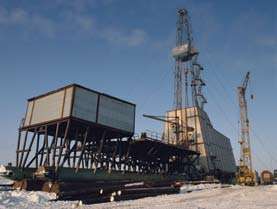
Gasdril ingplatform
PurposeoftheAssessment
onthetundrainthe
In 1997/98, the Arctic Monitoring and Assessment
Bovanenkovofield,
Programme produced its first assessment, Arctic
Yamal,WesternSiberia,
Pol ution Issues (see Box). That report included a
Russia.
chapter on petroleum hydrocarbon contamination in
E
R
D
the Arctic. The new assessment, Oil and Gas Activi-
ties in the Arctic: Effects and Potential Effects, updates
and expands upon the 1997/98 report. In addition to
E
R
R
Y
A
L
E
X
A
N
H
covering petroleum hydrocarbon pol ution in greater
C
&
detail, the new assessment addresses additional topics
B
R
Y
A
N
related to oil and gas activities in the Arctic. A detailed
history of each country's oil and gas operations
where sea ice is present. Seasonal aggregations of
and possible future activities has been added. Also
some animals such as seabirds, marine mammals, and
included is a chapter on social and economic effects,
spawning fish make them particularly vulnerable to a
which were not previously considered by AMAP.
spil at those times and places. Oil spil s and industrial
Furthermore, the assessment examines effects at levels
activities excluding oil and gas activities remain the
of biochemistry, individual organisms, populations,
largest human sources of petroleum hydrocarbons in
and the ecosystem, the last of which has not previ-
the Arctic. Routine oil and gas operations currently
ously been done. The assessment does not address
contribute a very smal fraction of the total input.
contributions of the use of arctic fossil fuels to climate
Natural sources, particularly natural seeps, are larger
change, nor does it address pol ution issues such as
than human sources.
heavy metals and radionuclides, which are associated
One motivation for producing this report is
with oil and gas activities in addition to other human
the increasing demand for oil and gas worldwide
activities. AMAP has already produced assessments on
combined with more interest in and access to arctic
climate, persistent organic pol utants (POPs), metals,
resources. Since the 1970s, arctic regions have been
and radionuclides.
producing bil ions of dol ars worth of both oil and gas.
The main findings of the 1997/98 report have
There is considerably more that could be developed.
been confirmed and extended. Petroleum hydrocar-
In arctic Alaska, offshore oil and gas activity is likely
bon contamination is not a widespread problem in
to increase. In Canada, natural gas field development
the Arctic, apart from areas where human activity
and pipeline construction may begin in the Mackenzie
has been intensive. The Arctic is general y considered
Delta, subject to approval, with oil and gas exploration
to be vulnerable to oil spil s due to slow recovery of
and development expected to fol ow in the nearshore
cold, highly seasonal ecosystems, and the difficulty of
Beaufort Sea. In Norway, Barents Sea gas production
clean up in remote, cold regions, especial y in waters
is about to begin, while exploration and development
The1997/98AMAPAssessmentofpetroleum andsummarizedhere.The1997/98assessmentrecommendedac-
hydrocarbon
tiontoreducetheriskofoilspil sandfurtherstudytoidentifyareas
ofparticularvulnerabilitytosuchoilpol ution.Thisrecommendation
hasbeenactedon(seepages34-35).
In1998,theAMAP Assessment Report: Arctic Pol ution Issuesawaspub-
lished,presentingthefirstAMAPscientificassessmentofcontami-
nantsintheArctic.Theresultsofthisassessmentwerealsopresented
inaplain-languageversionoftheassessment,Arctic Pol ution Issues:
A State of the Arctic Environment Reportb,releasedin1997.Thepub-
licationsaddressedanumberofdifferentcontaminantsandrelated
issues,includingpersistentorganicpol utants,heavymetals,radioac-
tivity,acidification,climatechange,andpetroleumhydrocarbons.
ThefindingsfromAMAP'sfirstassessmenthaveledtoaseriesof
furtherinvestigationsofmostofthetopicscoveredatthattime.For
petroleumhydrocarbons,theresultsofthelatestassessmentarepre-
sentedinOil and Gas Activities in the Arctic: Effects and Potential Effects
aAMAP, 1998. AMAP Assessment Report: Arctic Pol ution Issues. Arctic Monitoring and Assessment Programme (AMAP), Oslo, Norway. xi +859 pp.
bAMAP, 1997. Arctic Pol ution Issues: A State of the Arctic Environment Report. Arctic Monitoring and Assessment Programme (AMAP), Oslo, Norway. xi +188 pp.
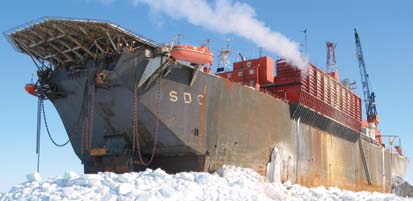
continue. In Russia, onshore and offshore develop-
I
n
t
r
ment and production is already ongoing or is on the
Assessment2007: Oil and Gas Activities in the Arctic:
o
d
horizon in many regions, including some without
u
c
Effects and Potential Effects
t
previous oil and gas activity. Tanker shipment is also
i
o
n
increasing rapidly in Russian and Norwegian arctic
Chapter1providestherationaleforandlimitationsofthe2007oilandgas
waters. Greenland and the Faroe Islands continue to
assessment.Chapter2reviewsthehistoryofoilandgasactivitiesintheArc-
explore for offshore oil and gas, and exploration activi-
tic,includingtechnology,regulation,monitoring,andoilspillpreparedness
ties are starting around Iceland.
andresponsecapabilities,aswellasotherfactorsthatinfluencethecourse
As oil and gas activities continue, society must
ofindustryactivity.Chapter3presentsseveralcasestudiesonsocialand
respond to the positive and negative impacts that they
economiceffects,coveringlocal,regional,andnationalperspectives.Chapter
have on people and the environment. The purpose of
4describesthesourcesandconcentrationsofpetroleumhydrocarbonsin
the assessment is to document what is known about
theArctic,includingthefirstpetroleumhydrocarbonbudgetfortheregion.
the effects of past and current oil and gas activities, to
Italsoaddressesinputsofotherchemicalsusedintheoilandgasindustry.
project the likely course of such activities and impacts
Chapter5discusseseffectsofpetroleumhydrocarbonsandoilandgas
for the years to come, and to make recommendations
activityonterrestrialandaquaticenvironmentsandhumanhealth.Chapter
based on the assessment. Such information can then be
6examinesenvironmentalimpactassessmentsandvulnerabilityofspecies
used by al concerned with the decisions that are to be
andhabitatswithinthearcticecosystem,includingthemappingofvulner-
made about if and how oil and gas activities proceed.
abilitytooilandgasimpacts.Chapter7givesthekeyfindingsoftheentire
As is the nature of assessments, there is insufficient
assessment,andisthebasisforthisoverviewreport.
information to ful y answer al questions or address all
topics of concern. Nonetheless, a great deal of mate-
rial has been compiled and assessed in the scientific
background report, Oil and Gas Activities in the Arctic:
findings accessible beyond the scientific community.
Effects and Potential Effects, which draws on more than
Al statements in this overview are supported by Oil
a thousand studies to investigate many aspects of oil
and Gas Activities in the Arctic: Effects and Potential
and gas activities and their effects on the environment
Effects. The lead authors of the scientific report and
and people. Teams of scientists with expertise in the
the members of the AMAP, in consultation with the
many different fields required to undertake a com-
other Arctic Council Working Groups and Perma-
prehensive assessment of al the effects of oil and gas
nent Participants, have reviewed and approved the
activities in the Arctic have worked on each chapter.
contents of this report.
Their work has been subjected to national and inter-
The overview is organized differently than the
national peer review. In addition to drawing together
scientific report. To help provide context and some
the available information, chapter teams have prepared
understanding of oil and gas activities, the introduc-
new analyses of the role of oil and gas activities in the
tion includes a description of the various activities
Arctic. These include the first estimates for the inputs
related to oil and gas in the Arctic. Then the assess-
of petroleum hydrocarbons to the arctic environment
ment's main findings are presented in two sections,
and their subsequent redistribution (a hydrocarbon
the first considering past activities and impacts up
"budget" for the Arctic), an assessment of ecological
to the present, the second looking to the future. Key
vulnerability across the entire circumpolar region, and
findings are summarised at the end of the report.The
assessment of socio-economic and health impacts.
Executive Summary to the overview report contains
SDC(SteelDril ing
recommendations that were developed on the basis
Caisson)rigandrubble
ScopeoftheAssessment
of the findings of the scientific assessment.
field,ArcticCanada.
AMAP's assessment of arctic oil and gas activities has
been produced in two parts. The scientific report, Oil
and Gas Activities in the Arctic: Effects and Potential
Effects, contains a comprehensive assessment of al the
effects of oil and gas activities in the Arctic. In addi-
tion, a plain-language overview (this report) presents
the main findings of the scientific assessment in a
concise and accessible form, providing a distil ation
of the current state of knowledge about oil and gas
H
I
T
activities in the Arctic. This overview is intended not
S
M
to replace the scientific report, but to make its key
M
O
T
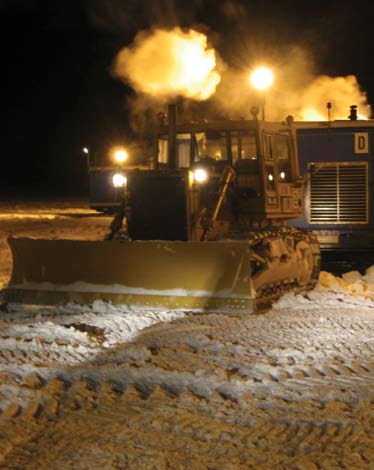
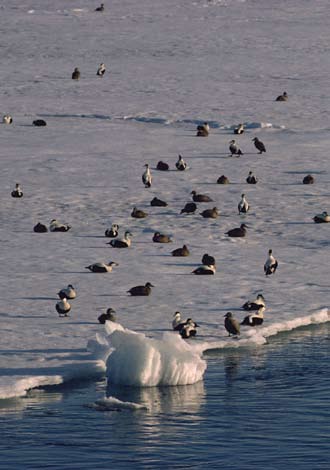
TheArctic
pool, so most workers are typical y brought in from
other regions, especial y during the labor-intensive
The Arctic centers on the deep, in part permanently
construction phase. Despite low numbers, arctic
and in part seasonal y ice-covered Arctic Ocean,
residents comprise over two dozen different indig-
nearly surrounded by the lands of North America
enous peoples. Their subsistence hunting, fishing
and Eurasia. The Arctic is characterized by ice: sea
and gathering activities occupy extensive areas of
ice, ice sheets, glaciers, and permafrost. But it also
land and sea. The influx of people and industrial
contains considerable variation in terrain, climate,
activity has the potential to disrupt traditional ways
ecology, and human presence, as wel as seasonal
of life while also providing many new opportunities.
extremes of light and darkness. More extensive de-
A detailed discussion can be found in the Arctic Hu-
scriptions of the Arctic can be found in many places,
man Development Report.c
including AMAP's 1997 State of the Arctic Environ-
The Arctic experiences large seasonal variation, in-
ment Report. The current assessment focuses on the
cluding extended periods of darkness and cold in win-
Arctic oil and gas regions as indicated on the map on
ter and sunlight in summer. A burst of productivity in
page 5. The scientific report on which this overview
the short spring and summer has to sustain resident
is based also includes descriptions of the marine and
plants and animals through the rest of the year. This
terrestrial ecosystems of the Arctic, covering their
burst of productivity also attracts vast numbers of mi-
ecological characteristics and the species that inhabit
gratory species, especial y birds, from throughout the
or migrate to them.
world. The marginal ice zone is particularly produc-
Eiderducksresting
With regard to oil and gas, several aspects of the
tive and seasonal. Arctic ecosystems experience high
atthefloeedge.
Arctic are noteworthy. Depending on where the
variability from year to year, including large swings in
boundary is drawn, the Arctic has between 2 mil ion
population sizes. The Arctic has relatively few species,
Steeltrackeddozers, and 4 mil ion inhabitants, most of whom live in
but considerable variation within species to fil various
suchasthisonepul ing
cities or large towns. Arctic oil and gas reserves are
ecological roles. There are several types of Arctic char,
acamptraininAlaska,
a long distance from major markets. Conducting
for example, which can exist even in the same lake or
arebeingphasedout
oil and gas operations in the region is difficult and
river system. Many species, especial y birds, migrate
andreplacedbyrubber
expensive, as is transporting the products to market.
annual y back and forth between arctic and temperate
trackedtractors.
Few inhabitants also means a smal potential labor
or tropical regions.
A
E
R
D
S
A
L
A
S
K
M
E
R
R
Y
A
L
E
X
A
N
E
A
R
E
R
,
M
H
C
S
H
&
E
R
A
L
D
B
R
Y
A
N
G
cAHDR, 2004. Arctic Human Development Report. Stefansson Arctic Institute. 249 pp.





I
n
t
r
o
d
u
c
t
i
o
n
MajorOilandGas
Provinces(OGP)and
basinsaroundtheArctic.
The projected effects in the Arctic from global
vary greatly by time of year and weather conditions, as
climate change indicate major changes in sea ice,
wel as the volume and characteristics of the oil spil ed.
permafrost, and other physical characteristics of the
Spil s in broken sea ice and under ice remain the most
region. Population sizes and distributions of plants
difficult to respond to.
and animals are expected to change significantly,
Final y, the Arctic contains some of the world's
including the introduction to Arctic regions of
largest remaining areas of wilderness. Fragmentation of
species now found farther south, and possible disap-
habitat may adversely affect many species, particularly
pearance of some species. Oil and gas activities, too,
highly mobile species such as reindeer and caribou and
may have to change in response to climate effects.
sparsely populated species such as brown or grizzly
Oil and gas operations, too, must cope with swings
bears and other large predators. Many animals have
in temperature, light, and accessibility. On land, many
dense seasonal aggregations on breeding grounds, along
operations today take place in winter, when the tundra
migratory pathways, or along the ice edge and in open-
is frozen. Equipment can be moved more easily in off-
water polynyas in the sea ice, making them temporarily
road areas and precautions can be taken to minimize
vulnerable to even a localized event. Aesthetical y, the
impacts. At sea, by contrast, much activity is concen-
Arctic is a symbol of pristine nature. Its protection is an
trated in the ice-free summer months, including seis-
important goal for many people. Even without pol u-
mic surveys as wel as shipments of fuel and supplies
tion or accidents such as spil s, oil and gas activities can
by barge or tanker. The ability to cope with spil s will
reduce the wilderness character of a region.


























































Oilandgasactivities
Oil and gas operations comprise many activities.
These activities are in turn connected to their envi-
ronmental and social surroundings in many ways.
The schematic diagram shown here il ustrates how oil
and gas activities fit into the landscape and how they
can affect the environment and people.
Generalizedsche-
maticdiagramofoil
andgasactivities.
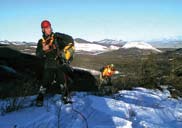
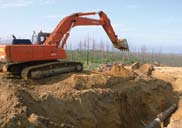
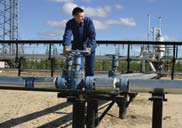
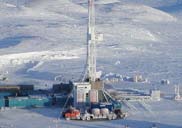
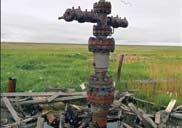
I
n
Lifecyclephases
t
r
o
Oil and gas activities include several phases and
d
u
c
many distinct steps. The fol owing diagram il ustrates
t
i
o
the main sequence and the specific activities that take
n
place within each phase. In oil and gas regions with
multiple fields, several phases may be taking place at
the same time.
LifecyclePhase
ActivitiesIncluded
Evaluation
Leasing/licensing,resourcestudies,
seismicstudies,exploratorydrill-
ing,environmentalstudies,public
consultation
S
E
G
Development
Delineationdril ing;3-Dseismic;
costanalysis;technicalstudies;
environmentalfieldwork;public
consultation;regulatoryapplica-
tionandreview,includingenvi-
ronmentalimpactassessment
Construction
Detaileddesignoffacilities;
E
R
D
productiondril ing;construction
offacilitiesandpipelines
E
R
R
Y
A
L
E
X
A
N
H
C
&
B
R
Y
A
N
Production
Wasteinjection;wastemanage-
E
R
ment;spil prevention,prepared-
D
ness,andresponse;environmen-
talmonitoring;transport,storage
andrefining
E
R
R
Y
A
L
E
X
A
N
H
C
&
B
R
Y
A
N
Enhanced
Satel itefielddevelopment;
Development
enhancedoilrecovery
E
R
R
N
U
T
A
R
D
H
R
I
C
Decommissioning
Plugwel s;rigremovalandde-
E
R
commissioning;landreclamation
D
andrestoration
E
R
R
Y
A
L
E
X
A
N
H
C
&
B
R
Y
A
N
Thechemicalsassociatedwithoiland
Hydrocarbons are often associated with oil and gas
gasactivities
reserves and with human use of fossil fuels. They can also
be created or released in various other ways. Living organ-
Crude oil and natural gas are composed primarily of
isms can produce some hydrocarbons, as can burning
organic compounds, made of hydrogen and carbon
in industry, agriculture, and natural events such as forest
and thus known as hydrocarbons. Hydrocarbons
fires. The decay of plant material to form peat is a major
associated with oil and gas are known as petroleum
source of hydrocarbons in some areas. Coal deposits can
hydrocarbons, though they can also be found in coal
also release large quantities of hydrocarbons. The mere
and peat. Petroleum hydrocarbons are natural in
presence of petroleum hydrocarbons, therefore, is not
origin, though as described in the next section, they
necessarily linked to the presence of human activities or
stil have the potential for harm. They tend to be bio-
petroleum. Furthermore, volatile hydrocarbons can move
degradable, unlike persistent compounds associated
long distances with moving air masses.
with other forms of industrial pol ution.
Oil and gas activities also involve other chemical
Smal er, lighter molecules such as methane are
compounds. These can be placed in two main catego-
gaseous at room temperature. Natural gas, therefore,
ries: substances used to help in dril ing operations and
is made up primarily of a few simple hydrocarbon
other phases of oil and gas production, and natural
molecules, though other compounds such as hydro-
substances produced along with oil.
gen sulfide are sometimes present, too. Larger and
The term dril ing mud refers to a mixture of clay,
more complex molecules are liquids or solids at room
base fluid, and chemical additives, used to control pres-
temperature. Because of the many ways that carbon
sure in the borehole, lubricate and cool the dril ing bit,
and hydrogen atoms can combine, often together
flush out the dril cuttings, and strengthen the sides of
with other elements such as oxygen and sulfur, the
the hole. Oil-based dril ing muds contain significant
number of compounds found in oil is in the thou-
amounts of hydrocarbons (in the range of one or more
sands. Although the concentrations of the various
percent), whereas the hydrocarbon content of water-
compounds vary from field to field, the composition
based muds is usual y in the range of hundreds of parts
of crude oil is broadly consistent around the world.
per mil ion. Dril ing muds account for the largest vol-
Class of compounds Description
Examples
Alkanes
Alkanesarecompoundswithoneormorecarbonatoms
joinedbysinglebondsinachain,whichmayinclude
branches.Hydrogenatomsareattachedtothecarbon
backbone-likestructure.Thesimplestalkanes,withoneto
fourcarbonatoms,aregases.Alkaneswithmorethantwelve
carbonatomstendtobesolidsatroomtemperature.
Cycloalkanes
Acycloalkaneisanalkaneformedinoneormorerings.
Cycloalkanescomeinmanydifferentconfigurations,
fromshortringswithonlythreecarbonatomstolarger
cycloparaffinsandthosewithtwoormorerings.
Aromatics
Carbonatomscanalsoformringsofsixatomsthathave
bondsthatareone-and-a-halftimesthestrengthofasin-
glebond.Thesechemicalsareknownasarenesoraromat-
ics.Iftheyhavemorethantworingsjoinedtogether,they
areknownaspolycyclic aromatic hydrocarbons,orPAHs.
Sulfur compounds
Inadditiontohydrocarbons,oilandgasreservesmaycon-
tainsulfurcompounds.Some,suchashydrogensulfide,can
belethalandposeathreattoworkersatdril andproduc-
tionsites.Others,suchassulfurdioxide,arepol utantsboth
duringproductionandduringburningofoilandgas.Other
compoundshaveanatomofsulfurincorporatedintothe
hydrocarbonstructure.
ume of chemicals used in oil and gas activities. Smal er
in recent years. Water-based fluids are far less harmful to
I
n
t
r
amounts of chemicals such as herbicides, anti-fungal
the environment. While in some cases they may be dis-
o
d
agents, anti-corrosion compounds, lubricants, and
charged offshore, in onshore dril ing they are contained
u
c
t
paints are used in other stages of oil and gas extraction,
or reinjected.
i
o
n
processing, and transportation.
When oil is brought to the surface, water and
Base fluids used to be primarily oil-based, and their
other materials come with it. This produced water may
discharges made up a substantial part of the pol ution
contain petroleum hydrocarbons, acids, various metals,
from oil and gas activities in some regions. Due to
production chemicals, and radionuclides. Disposing of
technological advances and stronger regulatory regimes,
large volumes of produced water and its contaminants
water-based fluids have largely replaced oil-based fluids
can be a major environmental chal enge.
Toxicologyofpetroleumhydrocarbons
tifyingotherpotentialimpacts.Geneticeffectshavebeendetected
fromPAHexposure,forexample,buttheirsignificanceisnotyetclear.
Onereasonforconcernaboutoilandgasactivitiesistheimpactof
Impactstohumansarediscussedfurtheronpage28.
toxiccompoundsontheenvironmentandonpeople. Thediverse
typesofarcticplantsandanimalsmaybeexposedinanumber
Measuringthetoxicityofpetroleumhydrocarbonsisoftencomplex.
ofwaystoalargenumberofcompoundsreleasedbyoilandgas
Theacutetoxicityofachemicalisusual ydeterminedinlaboratory
activities.Exposurecanoccurfromoilingofskin,fur,orfeathers,
studies.Forexample,fishmaybeexposedtoarangeofconcentra-
byuptakeacrossgil membranes,fromtheinhalationofgases,or
tionsofachemicaltodeterminethelevelatwhichhalfthefishdie
theingestionofreleasedoil.Thebiologicaleffectsofhydrocarbon
withinagivenperiod.Forpetroleumhydrocarbons,thisapproach
exposurecanrangefromnon-detectabletodeath,dependingon
canbedifficult.Manycompoundseitherdonotdissolveinwateror
theamountandtypeofhydrocarbonstakeninandthedura-
evaporatequicklysothattheconcentrationlevelchangesoverthe
tionofexposure.Numerousresponsesshortofdeathhavebeen
courseoftheexperiment.Acutelethaltoxicitycanthereforebediffi-
observed,fromthesub-cel ularleveltothepopulationlevel(see
culttomeasure,thoughitisthemostcommonlystatedmeasureof
Box).Vertebrates,includinghumans,areabletorapidlymetabolize
toxicity.Othermeasures,suchasthe"lowestobservableeffectlevel"
certaingroupsofhydrocarbons,suchasPAHs,butthebyproducts
andothernon-lethalresponsesarebecomingmorecommon.These
areoftenmoreharmfulthantheoriginalPAHs.Someoftheseare
approachesstil facetheproblemofestablishingtheconcentration
carcinogenic.Ontheotherhand,somemicroorganismsareableto
levelsatwhichtheeffectsoccurred.
usehydrocarbonsasacarbonsourceandfoodsupply.
Intheenvironment,otherfactorscanaffectchemicaltoxicity,too.
Fishandaquaticinvertebratesaresensitivetoexposurestocrudeand
UltravioletlightfromthesuncaninteractwithPAHsalreadyabsorbed
refinedoilsandtonumerouspurepetroleumhydrocarbons.Larval
intosomeanimals.Thisisparticularlyofconcernforanimalsthatare
stagesoffishareamongthemostsensitive,withexposureoftenlead-
somewhattranslucentandthatinhabitshal owwater,suchaslarval
ingtomortality,partlybecausethemanydevelopmentalprocesses
fish.Themechanismisnotclearlyunderstoodbutthecombinationof
inearlylifestagesareparticularlysensitive,andpartlybecausethey
ultravioletlightandpriorexposuretoPAHsismanytimesmoretoxic
cannotmoveawayfromoil.Forexample,Balticherringembryos
thaneitherthelightorthePAHsalone.Inhumans,skinreddening
sufferedphysiologicalimpairmentandanatomicaldeformitieswhen
maybeworsenedbythecombinationofexposuretopetroleum
exposedtooilinlaboratoryexperiments.Invertebratesappeartobe
hydrocarbonsandsunlight.FortheArctic,wheredecreasinglevels
moretolerantthanfish,eventhoughtheyaccumulatehigherlevels
ofozoneinthestratosphereareleadingtoincreasedexposureto
ofpetroleumhydrocarbonsbecausetheycanneithermetabolizenor
ultravioletlight,researchisneededtodetermineifexposuretothese
excretethemaswel asvertebratescan.Continuingresearchisiden-
chemicalsmayfurtherincreasethedangerfromultravioletexposure.
Routesofexposure
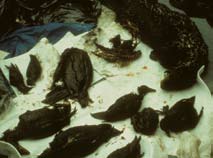
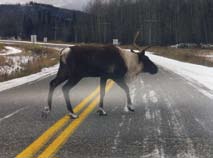
0
Typesofeffectsfromoilandgas
of streams and rivers to the fragmentation of wildlife
activities
habitat. The slow recovery of disturbed areas in the
Arctic suggests that the footprint of oil and gas activi-
Oil and gas activities can affect the natural environ-
ties wil remain for several decades. Humans can be
ment and people in many ways. Petroleum hydro-
affected through pol ution and also through social
carbons are toxic to plants and animals, sometimes
and economic changes resulting from the scale and
at very low concentrations. While routine oil and
scope of oil and gas activities.
gas activities have produced relatively little hydro-
Sections II and III of this report describe the major
carbon contamination, accidents such as oil spil s
findings of the assessment with regard to these various
are a different story. Oil spil s can kil large num-
types of effects in the Arctic (see Table below). Ad-
bers of animals by covering them in oil, and create
ditional background information on certain effects is
long-term contamination that can affect popula-
provided here in the Introduction. Toxicological effects
tions and ecosystems for decades. On land, physical
and the difficulties of measuring them are described
disturbance through industrial-scale activity can
on the previous page (see Box). The chal enges of
have impacts from the scale of individual gravel pads
detecting population-level effects from oil and gas
covering sections of tundra to changes in water flow
activities are described on the next page (see Box).
Where different types of effects are discussed
Toxicological
Significanceoflevelsofpetro-
Pages20-21-Petroleum hydrocarbon
effects
leumhydrocarbonsintheArctic,
concentrations are general y low
andsignificanceofcoldon
toxicologicaleffects.
Toxicologicalimpactsonpeople.
Page28-Human health can suffer from
pol ution and social disruption, but
A
R
T
H
revenues can improve health care and
K
C
overal wel -being
L
Y
L
E
L
O
Oil spills
Impactsofspil sonland,includ-
Pages22-23-On land, physical
ingadescriptionofthe1994
disturbance is the largest effect
KomiRepublicpipelinerupture.
Effectsofmarinespil s,including
Pages24-25-In marine environments,
thosefromsubarcticspil ssuch
oil spil s are the largest threat
astheExxon Valdez.
Potentialforimpactsfromarctic
Pages34-35-Seasonal patterns
C
spil s.
determine vulnerability in arctic
S
T
O
ecosystems
E
V
Physical
Impactsofinfrastructureand
Pages22-23-On land, physical
disturbance
activityonlandsurfaceand
disturbance is the largest effect
habitats.
Effectsofoffshoreactivity
Pages24-25-In marine environments,
throughnoiseandoffshore
oil spil s are the largest threat
construction.
E
E
N
Significanceoffurtherhabitat
Pages34-35-Seasonal patterns
L
T
U
fragmentationanddisruption.
determine vulnerability in arctic
H
ecosystems
E
R
I
C
Social and
Waysinwhichpeopleareaf-
Pages26-27-Impacts on people,
economic
fected.
communities, and governments can be
effects
both positive and negative
Implicationsforhealthcareand
Page28-Human health can suffer from
relatedservices.
pol ution and social disruption, but
S
E
N
H
revenues can improve health care and
I
C
N
overal wel -being
N
A
R
Y
S
O
G
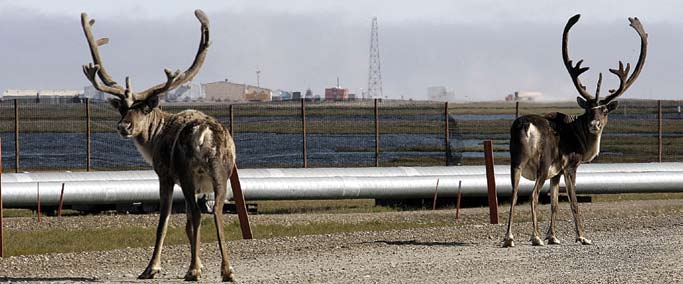
I
n
t
r
Detectingpopulation-leveleffects
o
d
u
Oilandgasactivitieshavemanytypesofeffects,butwhatdothey
c
t
i
meanforentirepopulations?("Population"referstoagroupof
o
n
animalsthattendtoreproducewithinthegroup,ratherthanwith
animalsfromothergroups.Examplesincludebirdcolonies,caribou
herds,orfishstocks.Foreffectsonhumanpopulations,seepage28.)
Severalfactorsmakeitdifficulttoanswerthisquestion.
First,populationparametersarepoorlyknownformanyArcticspe-
cies.Estimatesofpopulationsizeusual yinvolveconsiderablemar-
ginsoferrorbecauseofthedifficultyinconductingroutinesurveys
andthelargegeographicalexpansesinvolved.Also,measurement
ofthereproductivehealthofthepopulation,suchasbirthanddeath
PopulationchangesovertimeintheCentralArcticcaribou
rates,thenumberofbreedingadults,andratesthatyounganimals
herd,Alaska
areenteringthebreedingpopulationaredifficulttoobtaininremote
populations.Evenwheredataexist,smal changesinpopulationare
thefattyinvertebratesthebirdspreyon.Onland,somepredatorsare
likelytoremainundetected.Evenlargechangesmaybetheresultof
attractedtoinfrastructureandhumanactivity,resultinginimpactsto
otherfactors,includingnaturalpopulationcycles.
localpreyortheneedfornuisanceanimalstoberemoved.
Second,evenwhendeclinesarefound,determiningaspecificcause
Somespeciesandpopulationswil recovermorequicklythan
andrulingoutotherfactorsmaybedifficultorimpossible.Forex-
others(seeBoxonpage35onseabirds).Othercausesofmortality,
ampleinthecaseofpol ution,al theindividualsinthepopulationare
reproductiverate,andlong-termpopulationtrendsareamongthe
unlikelytohavethesameexposure,andthemosthighlyexposedmay
factorsthatwil determinetheabilitytorecoverquickly.Vulnerable
havediedasaresult.Survivinganimalsmaythushavelowerlevels
specieswil requiregreaterprotectionduringrecovery,possibly
ofcontaminants,especial yforpetroleumhydrocarbons,whichare
includingrestrictionsonharvests.
usual ymetabolizedquickly.Formigratoryspecies,impactsfrompe-
troleumhydrocarbonsmayoccuroutsideaswel aswithintheArctic.
Non-lethalimpactscanbemoredifficulttodemonstrate.Evenwel
studiedcasesofcaribou-industryinteractionssuchastheCentral
Third,baselineinformationisoftenunavailable.Thisisespecial ytrue
ArcticCaribouHerdinAlaskaareinconclusive.Thecaribouhave
foroilspil s,whichcandisruptanentireecosystem.Before-and-after
changedtheirdistributionandshowsignsofdisturbance,butthe
comparisonscannotbestartedafterthefact.Forregularopera-
populationactual yshowedasubstantialincreaseduringthefirst
tions,somestudiescanbeundertakenaheadoftimetoestablisha
twodecadesofoilactivityontheNorthSlope(seeFigure).The
baseline,buteventheseareunlikelytomeasureal relevantvariables.
increase,however,doesnotruleoutlong-termnegativeeffects.A
Furthermore,changealoneisnotsufficienttoindicateeffects,as
morerecentdeclineinpopulationmayindicatedelayedeffectsor
otherfactorsintheecosystemmayplayarole.
maybetheresultofotherfactorsincludingnaturalcycles.Thestudy
Predictingimpactsisalsodifficult.Differentspeciesmayreactto
ofcumulativeimpactsfromseveralstresses,includingchangesin
oilandgasactivitiesindifferentways.Someseabirdsavoidspil ed
preferredhabitat,changingclimate,andman-madestressessuchas
oil,whereasothersareattractedtoit,perhapsbecauseitcalmsthe
noiseanddust,isanimportantareaofresearch,especial ywiththe
waterorperhapsbecauseitresemblesthesheenfromadie-offof
expectedincreaseinoilandgasactivityintheArctic.
P
I
X
A
N
/
A
P
/
S
C
R
I
L
L
O
A
L
G
Caribouontheroad,PrudhoeBay,Alaska.
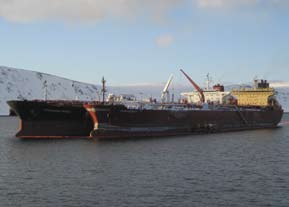
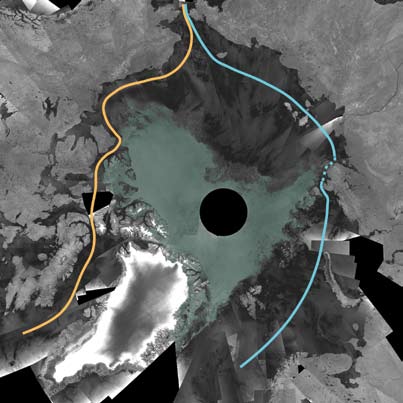
Implicationsofclimatechangeforoil permafrost as a solid foundation for buildings, pipe-
andgasimpactsintheArctic
lines, and roads, or for containing waste materials.
Considerable care is often given to maintaining the
The Arctic Climate Impact Assessment d, another large-
integrity of the permafrost to avoid costly damage
scale assessment produced by the Arctic Council,
to infrastructure if the underlying ground melts and
describes changes in climate and ecosystems that are
gives way. Warming may degrade permafrost, harm-
projected over the coming decades in the Arctic. The
ing existing facilities, releasing waste materials, and
report also discusses implications for various human
making future development on land more compli-
activities, including construction and infrastructure.
cated and expensive. The season for ice roads may
While Oil and Gas Activities in the Arctic: Effects and
shorten, restricting exploration activities as wel as
Potential Effects does not examine climate change
construction. Whether climate change wil make the
in detail, it is nonetheless clear that environmental
Arctic more or less attractive for oil and gas activities
change wil affect oil and gas activities in the Arctic,
remains to be seen.
positively and negatively, in various ways.
In addition to direct impacts on infrastructure and
The most striking change that is projected is the
industry activity, climate change wil have indirect ef-
retreat of sea ice around the Arctic. Less sea ice may
fects as wel . As ecosystems respond to climate change,
improve access to ports and thus some onshore areas
the distribution and abundance of many species may
Arcticseaice
as wel as to parts of the offshore. Transportation by
change. Some species may become threatened or en-
conditions,summer
vessel, including tanker, wil be aided by a longer
dangered. If oil and gas activities are predicted to have
2007,showingopen
shipping season, although changes in ice patterns
an impact on such species, environmental regulations
NorthwestPassage.
may create new problems. More open water is likely
and requirements may become stricter. It is also possi-
to create larger waves and more coastal erosion.
ble that shifts in the distribution of fish stocks may at-
Transferofconden-
Facilities on the coast and offshore may need to be
tract commercial fisheries to arctic waters, where they
satebetweentankers
stronger to withstand additional wave stress. Icebergs,
may overlap with offshore oil and gas activities. The
inSarnesfjord,Norway.
too, may become more common if calving of glaciers
same is true for traditional indigenous practices such
in Greenland especial y increases, threatening off-
as marine mammal hunting, if climate change leads
R
ecentobservations
shore platforms and tanker traffic.
to shifts in the areas where those activities are carried
ofsummersea-ice
Another major change is the thawing of per-
out. Here, too, the implications of climate change for
extent.
mafrost on land. Many arctic facilities today use
oil and gas activities are not yet clear.
L
Y
A
K
B
U
/
A
L
E
X
E
I
B
A
M
S
E
N
A
N
A
R
H
E
I
N
S
T
Extent (mil ions of square kilometers)
9
8
7
6
5
2007
4
3
2
E
S
A
1
01978 1982 1986 1990 1994 1998 2002 2006
dACIA, 2004. Impacts of a Warming Arctic: Arctic Climate Impact Assessment (ACIA), Cambridge University Press. 139 pp.
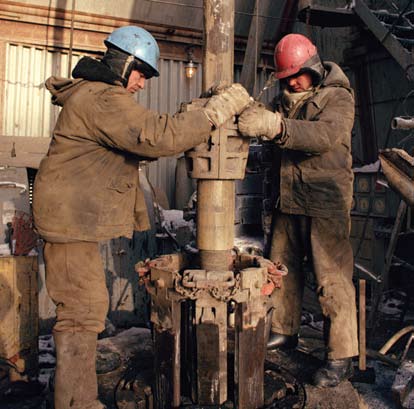
Oil and Gas Activities to the Present
Commercial oil and gas activities
O
i
l
have been taking place in the Arctic
a
n
d
for over eighty years. More wide-
G
a
spread and intensive operations have
s
A
c
occurred in several places since the
t
i
v
i
t
1960s. There is a great deal of experi-
i
e
s
t
ence on which to draw in assessing the
o
t
h
effects of oil and gas activities. This
e
P
r
e
section presents key findings concern-
s
e
n
ing the history, extent, and social and
t
environmental effects of oil and gas
activities in the region to the present.
E
R
These findings are the foundation for
D
the next section, which examines the
likely course of oil and gas activities in E R R Y A L E X A N H C
the next decade or so.
&
B
R
Y
A
N
Workersona
gasdril ingriginthe
Bovanenkovafield,
Yamal,WesternSiberia,
Russia
dACIA, 2004. Impacts of a Warming Arctic: Arctic Climate Impact Assessment (ACIA), Cambridge University Press. 139 pp.
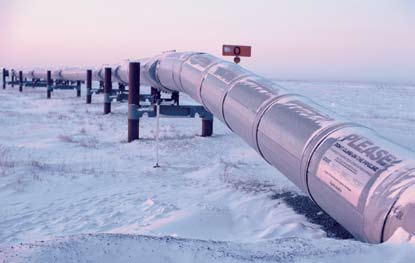
Extensiveoilandgasactivityhasoccur ed,withmuchoilandgasproduced
andmuchmoreremaining
In some arctic areas, oil seeps have been known and
By the 1960s, large oil and gas reserves had been
used by indigenous peoples for centuries or longer.
discovered in the Yamalo-Nenets Autonomous
Commercial oil activities in the Arctic started in
Okrug and the Nenets Autonomous Okrug in Rus-
the 1920s at Norman Wells, Northwest Territories,
sia, on Alaska's North Slope, and in the Mackenzie
Canada. In 1933, a refinery was built there to pro-
Delta. All four areas are remote from potential mar-
vide fuel for local use. In the 1920s and 1930s, oil
kets, requiring the construction of long pipelines.
and gas exploration was also carried out in northern
Production in arctic Russia began in 1972 from
Russia and in Alaska. During World War Two,
the Yamalo-Nenets region, extending to the Nenets
a 925-kilometer pipeline was built to transport
region in the 1980s. The Trans-Alaska Pipeline Sys-
oil from Norman Wells to the newly built Alaska
tem was completed in 1977, allowing production
Highway to provide fuel for the military. Although
to begin from Prudhoe Bay and nearby fields. The
this pipeline was abandoned in the 1940s, even-
Mackenzie Delta and Beaufort Sea, by contrast, still
tual expansion of the field took place in the early
await the construction of a gas pipeline. Plans were
Themilemarker
1980s with a pipeline being built south to Alberta.
developed in the 1970s, but costs were too high,
Ozeroatthestartof
Following World War Two, extensive oil and gas
land claims unsettled, and social impacts uncertain.
theAlaskaOilPipeline
exploration started in northern Alaska, northern
The plans were put on hold at that time, although
PrudhoeBay,Alaska
Russia, and the Mackenzie Delta area of Canada.
construction is being proposed again.
A large barrier to arctic oil and gas operations
is the cost of transporting the product to markets.
Once a pipeline or tanker facilities have been built,
however, the development of additional fields can
become more attractive. The spatial extent of oil
and gas activities can expand over time, as roads
and feeder pipelines are built to connect new drill-
ing sites. The incentive for such growth can be high
E
R
D
when production at the original fields declines,
leaving excess transportation capacity. One result is
that a region may experience several lifecycle phases
E
R
R
Y
A
L
E
X
A
N
H
at the same time. Production and enhanced devel-
C
&
opment continue in the core area, with construc-
tion on the margins, and exploration farther out.
B
R
Y
A
N
(1930s) Early interest in
(1940s-50s) Extensive
oil and gas reserves of
exploration in NPRA
the YNAO
(1922) First industry-
(1923) Federal petroleum
sponsored exploration of reserve (NPRA) designated
North Slope
on Alaska's North Slope
Russia
Alaska
Canada
1
9
2
5
1
9
3
0
1
9
3
5
1
9
4
0
1
9
4
5
Oil discovered at Nor-
(1933) Smal refinery
(1942-44) Norman
man Wel s, Northwest
built at Norman Wel s
Wel s-Alaska Highway
Ter itories
oil pipeline constructed























pre-1960
1960-1979
O
i
l
a
n
d
G
a
s
A
Explorationwel s
c
t
i
v
Discoveries
i
t
i
Stratigraphicwel s
e
s
t
o
1980-1989
1990-2004
t
h
e
P
r
e
s
e
n
t
Expansionofexploration
dril ingactivityinarcticoiland
gasprovinces.Locationsofdril -
ingduringdifferentperiods.
(1968) First exploration
(1972) Gas production
(1976) Exploration in the
wel in Mackenzie Delta
begins from Pointed
Mackenzie Delta ceases
Mountain
due to pipeline uncertainty
(1966-7) Oil, gas
(1972) Gas production
(1977) Oil starts flowing
discovered in the NAO
begins in the YNAO
through the Alaska
Pipeline
(1950s) Large-scale
(1958) First federal lease
(1960s) Major discover-
(1968) Oil discovered at
(1972) Statoil, state-
(1979) First offshore
exploration in the NAO
sale on North Slope
ies of gas and oil in the
Prudhoe Bay
owned petroleum
lease sales in the
and Komi Republic
YNAO
company, is established
Beaufort Sea
Norway
1
9
5
0
1
9
5
5
1
9
6
0
1
9
6
5
1
9
7
0
1
9
7
5
(1958) Exploration
(1962) Exploration
FaroeIslands
begins in Mackenzie
begins in the High Arctic
Greenland
Delta
(1970s) Limited seismic (1970s) First exploration (1975) Five offshore
data col ected
licenses issued
wel s dril ed, one
discovery
(1973) Offshore
(1976) Oil discovered at
exploration begins off Bent Horn, High Arctic
Mackenzie Delta
Annualandcumula-
The level of activity or production, however,
Field production
Cumulative total
(million m3 )
(million m3 )
tiveoilproductionin
does not necessarily follow a simple curve or trend.
500
12000
arcticareas,bycountry.
As the graphs of arctic oil and gas production show,
Russia
Cumulative Total
(Timan-Pechora and
production typically begins with a steep rise once
400
10000
TP and WS (N of 60 deg N)
West Siberia N of
60 degrees)
8000
Annualandcumula-
transportation infrastructure is built. Over time,
300
6000
tivegasproductionin
additional fields are brought into production, which
200
4000
arcticareas,bycountry.
may sustain overall production levels or at least
100
2000
reduce the speed of decline as in northern Alaska.
Note:Scalesonthe
0
0
Other factors play a role, too. The break-up of the
120
2500
graphsdifferconsider-
Soviet Union led to a period of low production in
Alaska
100
(North Slope)
Cumulative Total
ably.Forcomparison,
2000
the 1990s, though levels have since risen again.
80
Alaska (North Slope)
theuppergraphs
By the 1980s and 1990s, oil and gas activities had
1500
60
(Russia)alsoincludethe
extended farther in the Arctic. Canada had developed
1000
40
productioncurvesfor
Bent Horn, a smal field in the islands of the High
20
500
othercountriesshown
Arctic, which produced oil for over a decade before
0
0
onthesamescale.
decommissioning. In Alaska, exploration extended
2.0
40
Cumulative Total
offshore, leading to development and production
Canada
35
(N of 60 degrees)
Canada (N of 60 deg N)
of nearshore fields. Norway's oil and gas activity
1.5
30
25
reached the Barents Sea, identifying major gas fields
1.0
20
from which production will soon begin. Explora-
15
0.5
10
5
0.0
0
Oil/gasproduction
50
400
Cumulative Total
areasintheArctic.
Norway
350
Norway (Norwegian Sea)
40
(Norwegian Sea)
300
30
250
200
20
150
100
10
50
0
0
1960 1965 1970 1975 1980 1985 1990 1995 2000 2004
tion activities in the Russian offshore have also
identified large potential resources. In the 2000s,
tankers began to deliver oil from arctic Russia to
Europe. Exploration in the Mackenzie Delta and
Beaufort Sea has begun again in anticipation of
a pipeline through the Mackenzie River Valley.
Alaska, too, may see a gas pipeline built in the near
future, allowing extensive North Slope gas reserves
Oil/gasproductionareas
to enter production alongside its oil.
Pipelines
(1980s) Exploration
licenses first issued for
Barents Sea
(1980) Exploration
(1980s-90s) Oil and
(1982-86) Renewed oil (1984) Snøhvit field
(1985) Oil production
(1989-1990) First
(1991) Break-up of the (1992) Private petro-
begins in Norwegen Sea gas production begin in and gas exploration in
discovered in Barents
begins at Bent Horn
exploration wel s dril ed
Soviet Union
leum industry begins to
the NAO
Arctic Canada
Sea
in Chukchi Sea
develop
Nor
Rus
Ala
Can
1
9
8
0
1
9
8
5
1
9
9
0
Far
Gre
Iceland
(1980s-1990s) Ad-
(1981) First outer
(1982) Exploration well (1984) Ikhil gas field
(1989) Exxon Valdez
(1989-1991) Low
(1992) Faroes gain
ditional fields discovered, continental shelf
dril ed
discovered near Inuvik,
oil spil
prices halt exploration in
authority for subsurface
developed on North Slope exploration wel
NWT
Mackenzie Delta
resources
(1982-85) Major expan-
(1985-1992) Limited
sion at Norman Wels,
seismic data col ection
including oil pipeline
to south
Field production
Cumulative total
(billion m3 )
(billion m3 )
Measuringoilandgas
600
12000
Russia
Cumulative Total
500
(Timan-Pechora and
10000
Quantitiesofoilandgasaremeasuredinvariousways.Unitsof
TP and WS (N of 60 deg N)
West Siberia N of
400
60 degrees)
8000
volumecanbeconvertedeasily,forexamplefrombarrelstocubic
300
6000
meters,orcubicfeettocubicmeters.Otherconversionsaremore
200
4000
complex.Differentreservoirshavecrudeoilwithdifferentdensities.
100
2000
Atonne(1000kg)ofoneoilmayhaveadifferentvolumethana
0
0
tonneofoilfromanotheroilfield.
2.0
25
Cumulative Total
Canada
Onemeasureforgasisthepetroleum equivalent,ortheamount
(N of 60 degrees)
20
Canada (N of 60 deg N)
1.5
ofgasrequiredtoproduceasmuchheatasagivenquantityof
O
15
petroleum.Inthiscase,thecompositionofthegas,especial ywater
i
l
1.0
a
10
n
vaporcontent,affectstheamountofheatproducedandthusthe
d
0.5
G
5
petroleumequivalent.Differentcountriesmaymeasureheatcontent
a
s
differently,makingdirectcomparisonsdifficult.
0.0
0
A
c
15
50
t
C
S
umula o
ti m
ve e
T ap
otal proximateconversions:
i
v
Norway
i
Norway (Norwegian Sea)
t
12
(Norwegian Sea)
40
i
e
Oil
s
9
30
t
o
t
Cubic meter
6.29barrels
h
6
20
e
0.855tonnes
P
3
10
r
1000liters
e
s
e
0
0
1960 1965 1970 1975 1980 1985 1990 1995 2000 2004
n
Barrel
0.159cubicmeters
t
0.136tonnes
42U.S.gal ons
Gas
Cubic meter
35.3cubicfeet
Cumulative production from the Arctic to date
is in the bil ions of cubic meters of both oil and
Cubic foot
0.0283cubicmeters
gas. Today, the Arctic produces about a tenth of
Cubic meter petro-
1008cubicmetersofgas
the world's oil and a quarter of its gas. Of these
leum equivalent
35600cubicfeetofgas
amounts, about 80% of the oil and 99% of the gas
currently come from the Russian Arctic. As dis-
Barrel petroleum
5660cubicfeetofgas
cussed later (see pages 32-33), considerable resources
equivalent
160cubicmetersofgas
remain to be exploited in the Arctic, both in areas
where activity is currently taking place, and perhaps
in new areas such as Greenland, Iceland, and the
Faroe Islands. Oil and gas activities wil remain part
of the Arctic for many decades to come.
(1996) First licenses for
(2000) Goliat oil field
(2002) Production plans
(2007) Snøhvit begins
deep-sea dril ing are
discovered to east of
for Snøhvit approved
producing gas
issued
Snøhvit
(1994) Komi Republic
(1996) Production ends (1999) Ikhil pipeline
(2000-04) Exploration (2002) Tanker transport
(2005-06) Exploration (2006) New Barents Sea
pipeline rupture and spil
at Bent Horn
supplies natural gas
starts again in Macken- from northern Russia to
dril ing restarts in
licenses issued
to Inuvik
zie Delta
Europe begins
Beaufort Sea
1
9
9
5
2
0
0
0
2
0
0
5
(1994) Open-door
(1996) First onshore
(1998-2001) Regula-
(2000-2001) Limited
(2001) Three exploration (2003) New policy aims
(2005) Seven explora-
licensing policy begins
exploration wel dril ed tions developed for oil seismic data col ection
wel s dril ed for oil and to spur interest in West
tion licenses issued
on Nuussuaq peninsula and gas activities
gas activities
Greenland
(1994-present) Offshore
(1999) Boundary
(2001) Oil production
seismic data acquisition
Agreement signed with
begins from ofshore wel,
United Kingdom
Northstar Chukchi Sea
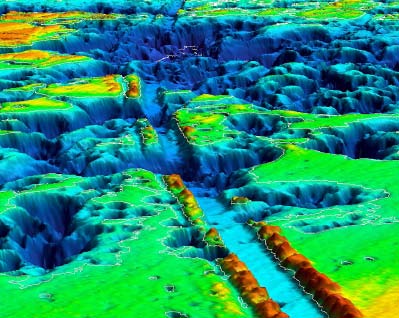
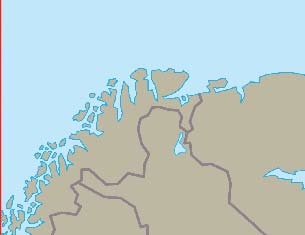

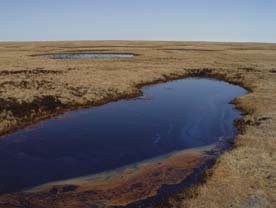
Naturalseepsarethemajorsourceof required fil ing in several data gaps with expert opin-
petroleumhydrocarboncontamina-
ion and informed conjecture.
Eighty to ninety percent of petroleum hydrocar-
tioninthearcticenvironment
bons entering the arctic environment at present are
thought to come from natural seeps. For example, oil
Petroleum hydrocarbons found in the environment
seeps are found along the Mackenzie River, Northwest
have a number of sources. They are transported from
Territories, Canada, in the intertidal zone along the
these sources by air and water. To assess the rela-
Alaska coast, and undersea in Scott Inlet and Bu-
tive magnitude of various sources and the fates of
chan Gulf in the eastern Canadian Arctic. Methane
petroleum hydrocarbons in the arctic environment,
is released from submarine "mud volcanoes" in the
a petroleum hydrocarbon budget was created (see
southern Beaufort Sea. Oil spil s are the largest hu-
Figure). This budget compiles what is known from
man source, fol owed by industrial activity excluding
the best available information about sources, move-
oil and gas activities in the region, and then the use
ments, and eventual fate of petroleum hydrocarbons
of petroleum products such as fuel and lubricating
in the arctic environment. Completion of the budget
oils, some of which escape as exhaust or from leaks.
PAHcontamination
Excluding oil spil s, oil and gas activities themselves are
(mg/kgdryweight)in
a relatively minor contributor of petroleum hydro-
bottomsedimentsfrom
carbons. Long-range transport of petroleum hydro-
harboursinnorthern
carbons from industrial areas to the south is another
NorwayandRussia,
input, although relatively minor and dispersed.
Wood burning
Other
Even if human inputs are a smal proportion of
Diesel soot
Crude oil
showingthecontri-
Wood burning
Other
Diesel soot
Crude oil
Russia
butionsfromvarious
the total, they can create substantial local pol ution.
Wood burning
Other
Diesel soot Norway
Crude oil
sources.
Some areas with high human activity, such as harbors,
Wood burning
Other
have sediment levels of petroleum hydrocarbons and
Diesel soot
Crude oil
Finland
other substances that are several times higher than in
sediments from more remote areas. A lack of detailed
Wood burning
Other
information about oilfield pol ution in many areas,
W
Diesel soot
ood burning
Crude oilOther
Diesel soot
Crude oil
particularly from northern Russia, prevents a more
thorough assessment of its extent and significance.
Seepinpondnear
Transport and spil s from general use of refined petro-
CapeSimpson,Alaska.
leum products also account for a significant part of the
petroleum hydrocarbon pol ution. Even on Alaska's
North Slope, only half of reported oil spil s between
1995 and 2002 were from the petroleum industry
itself. Many non-industry spil s are not reported.
Today, many industrial sources have been greatly
reduced or eliminated. For example, from the 1970s
A
until their discharge was banned in the 1990s, oil-
A
L
A
S
K
based dril ing muds were the main pol utant from
B
L
M
offshore dril ing.
Echosoundercross-
sectionoftheKopanoar
mudvolcanowith
methaneventingfrom
crest,centralCanadian
BeaufortShelf.
Seabedmultibeam
imageoftheKugmal it
O
Baypockmarks(active
methanevents),Central
E
B
L
A
S
C
CanadianBeaufortShelf.
E
V
S
T


O
i
l
a
n
d
G
a
s
A
c
t
i
v
i
t
i
e
s
t
o
t
h
e
P
r
e
s
e
n
t
SchematicdiagramofthepetroleumhydrocarbonbudgetoftheArctic;inputsviatheatmosphereareprimarilynon-petrogenic.
Units:tonnesperyear.
ThepetroleumhydrocarbonbudgetoftheArctic · Naturalseepstothemarineenvironmentarebasedonrough
estimatesfortheglobeandfornorthernAlaska.Therearefewif
ThepetroleumhydrocarbonbudgetoftheArcticdevelopedforthis
anydirectmeasurementsofmarineseepageratesanywhere.
assessmentisthefirstofitskind.Itattemptstoquantifyamountsof
petroleumhydrocarboncompoundsassociatedwithdifferentsources
· Naturalseepsonlandhavebeenestimatedatapproximately
andtheirmovementbetweendifferentenvironmentalcompart-
thesameasmarineseeps.
ments.Notal thedataneededforthebudgetareavailable,andso
· WithlittleevidencefornaturalseepsinRussianrivers,the
severalassumptionshavebeenmade.Theresultisthatthebudget
compoundsmeasuredtherewereconsideredtobeeitherfrom
shouldbetreatedasqualitativeratherthanquantitative.Thebudget
sourcesotherthanpetroleum,orassociatedwithspil sinthe
alsocoverstheentireArctic.Theproportionsofeachsourceormove-
watershedsandthusplacedinthe"spil s"category.
mentarelikelytovaryconsiderablyfromonelocalareatoanother.
· Someofthequantitiesusedforspil sarebasedonusingan
Thebudgetusesselectedpetroleumhydrocarbons.Manyofthe
chemicalsthatmakeupcrudeoilarenotmeasuredintheenviron-
averagespil lossrateforvarioustypesoftransportation(ship,
ment.Manyofthesechemicalsalsohavesourcesotherthanpetro-
rail,pipeline,andothermeans).
leum.ThebudgetusesselectedalkanesandPAHs,whichtogether
Althoughthisapproachresultsinlargeuncertaintieswithrespect
makeupabouttenpercentofcrudeoil.Theratiosofparticular
tosomeoftheinputs,thebudgetnonethelessprovidesinsightinto
compoundsinthesegroupscanhelpidentifywhethertheirpresence
relativemagnitudesofthemainsourcesofpetroleumhydrocarbons
isasignalofpetroleumoranothersource.Theyarealsopersistent
totheArcticoverthepastdecadeorso.Projectionsofpeakactivity
andubiquitous.Final y,datasetsforthesecompoundsareamongthe
twotothreedecadesinthefutureshowthatincreasingoilandgas
mostcomprehensiveforpetroleumhydrocarbonsintheArctic.
activitymayresultinthatsectorprovidinginputsgreaterthanhalfof
Manyassumptionshavebeenmadetofil gapsintheavailabledata.
thosefromnaturalsources.Furtherworkonthebudget,especial y
Theseassumptionsarebestestimates,buttheyarestil estimatesand
withnewandbetterdata,wil createamoreaccuratepictureofthe
notmeasures.Themajoronesare:
sourcesandfateofpetroleumhydrocarbonsintheArctic.






0
Petroleumhydrocarbon
Siberian rivers are believed to be similar to those in
concentrationsaregeneral ylow
smaller rivers in Canada.
There is less information about petroleum hy-
Hydrocarbons are natural y occurring compounds,
drocarbons on land and in freshwater systems. Low
and are found throughout the world. The Arctic is
levels of PAHs have been found in fish and sediments
no exception. Away from areas of human activity,
in isolated lakes in Svalbard, Greenland, and Canada,
PAHconcentration
petroleum hydrocarbon levels are general y low on
presumably as a result of atmospheric transport from
(ng/gdryweight)in
land, in rivers, and in the ocean, confirming the
distant or nearby sources. Only in Russia has long-
bottomsedimentsof
results reported by AMAP in 1997/98. The levels of
term monitoring been conducted on land and in
theBarentsSea.Fine
PAHs in the air in the Canadian Arctic, for example,
freshwater systems. In other regions, relatively little
structureandhotspots
are a thousand times lower than levels in British
work has been done. Many living organisms tend to
shownoninterpo-
cities, and ten to a hundred times lower than in rural
metabolize hydrocarbons quickly. Measurements in
latedmaps,suchasthis,
Britain. Recent studies of sediments in the Barents
vertebrates thus tend to reflect very recent exposures
shouldbeviewedwith
Sea confirm results from the 1990s showing low
rather than cumulative exposure over their lifespan.
caution,howeverthe
levels of petroleum hydrocarbons, although two- and
The significance of exposure to various concentra-
generaltrends,suchas
three-ring PAHs have increased in some areas.
tions of petroleum hydrocarbons depends on the
thehighconcentrations
Some areas, however, show greater concentra-
levels at which biological and health effects can be
aroundSvalbardare
tions. Svalbard, for example, has coal-rich geologi-
expected in the species inhabiting an area. For most
clear.Individualdata
cal structures that weather and erode, releasing
of the Arctic, petroleum hydrocarbon levels are below
areshowninmapon
hydrocarbons into the surrounding waters. Water in
known thresholds for effects. In areas of local con-
nextpage.Greyshades
the Mackenzie River has ten times the PAH levels
tamination such as harbors or high background levels
indicatewaterdepth
of smaller rivers nearby, due to the presence of oil
such as the Mackenzie River, however, concentrations
(seefigurenextpage).
seeps in the Mackenzie River basin. The levels in
are high enough to expect effects. In the Arctic, low
Sum PAH (ng/g)
"
"
"
"
"
"
"
"
"
"
"
"
"
"
"
"
"
"
"
"
"
"
"
"
"
"
"
"
"
"
"
"
"
"
"
"
"
"
"
"
"
"
"
"
"
"
"
"
"
"
"
"
"
"
"
"
"
"
"
"
"
"
"
"
"
"
"
"
"
"
"
"
"
"
"
"
"
"
"
"
"
"
"
"
"
"
"
"
"
"
"
"
"
"
"
"
"
"
"
"
"
"
"
"
"
"
" "
"
"
"
"
"
"
"
"
"
"
"
"
"
"
"
"
"
"
"
"
"
"
"
"
"
"
"
"
"
"
"
"
"
"
"
"
"
"
"
"
"
"
"
"
"
"
"
"
"
"
"
"
"
"
"
"
"
"
"
"
"
"
"
"
"
"
"
"
"
"
"
"
"
"
"
"
"
"
"
"
"
"
"
"
"
"
"
"
"
"
"
"
"
"
"
"
"
"
"
"
"
" "
"
"
"
" " "
"
"
"
"
"
"
" "
"
" "
"
"
"
"
"
"
"
"
"
"
"
"
"
"
"
"
"
"
"
"
"
"
"
"
"
"
"
"
"
"
"
"
"
"
"
"
"
"
"
"
"
"
"
"
"
"
"
"
"
"
"
"
"
"
"
"
"
"
"
"
"
"
"
"
"
"
"
"
"
"
"
"
"
"
"
"
"
"
"
"
"
"
"
"
"
"
"
"
"
"
"
"
"
"
"
"
"
"
"
"
"
"
"
"
"
"
"
"
"
"
"
"
"
"
"
"
"
"
"
"
"
"
"
"
"
"
"
"
"
"
"
"
"
"
"
"
"
"
"
"
"
"
"
"
"
"
"
"
"
"
"
"
"
"
"
"
"
"
"
"
"
"
"
"
"
"
"
" "
"
" ""
"
"
" "
"
"
"
"
"
"
"
"
"
" " "
"
"
"
"
"
"
"
"
"
"
"
"
"
"
""
"
"
"
"
"
"
"
"
"
"
"
"
"
"
"
"
"
"
"
"
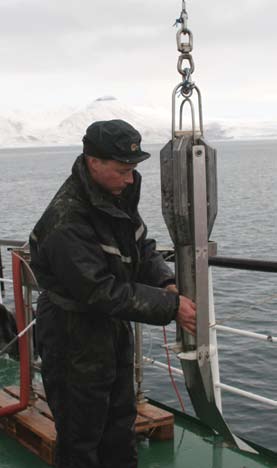
O
i
l
a
n
d
G
a
s
A
c
t
i
v
i
t
i
e
s
t
o
t
h
e
P
r
e
s
e
n
t
PAHconcentration
(ng/gdryweight)in
bottomsediments
aroundtheArctic,
temperatures usual y mean that hydrocarbons will
2001-2005.Dataare
persist longer in the environment, thus having more
fromvarioussources
time to be taken up by plants and animals.
compiledbyAMAPfor
In general, arctic plants and animals may be
thisassessment.
expected to have similar sensitivity to petroleum
hydrocarbon exposure as that of plants and animals
elsewhere in the world. Arctic conditions, however,
may have implications for toxicological effects that
are not yet understood. Spil s in permafrost may per-
sist for a long time, kil ing plants via their roots. In
these conditions, the most toxic compounds may not
degrade or evaporate, but remain to cause damage.
Little is known about how petroleum hydrocarbon
toxicity might be affected by ecological, physiologi-
cal and behavioral traits that are unique to arctic
species and al ow them to survive under extreme
climatic conditions. Thus, more research is required
to determine if arctic animals are likely to be more or
less sensitive to petroleum hydrocarbons. Further-
more, little research has been done with cold-adapted
animals to examine the effects of temperature on tox-
icity. This information is necessary to determine the
S
E
T
E
N
risk posed by the levels of petroleum hydrocarbons
A
E
V
Sedimentcore
currently detected in various areas of the Arctic.
I
T
sampling,Svalbard.
A
N
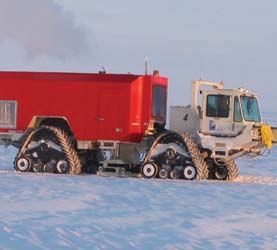
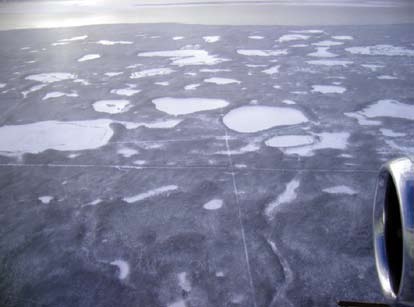
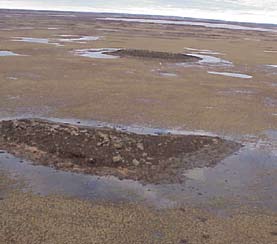
Dril siteandsewage
Onland,physicaldisturbanceisthe
sump,northernCanada.
largesteffect
The largest effect of oil and gas activities on land
in the Arctic has been physical disturbance. The
physical footprint of oil and gas activities includes
land covered by gravel pads, roads, and airstrips.
In Alaska, Canada, and Russia, pipelines extend
for thousands of kilometers. Roads and off-road
vehicle tracks may impede water flow or cause
E
R
permafrost to thaw. Debris and other material left
on the land can affect migrating reindeer and attract
foxes, bears, and wolverines. Construction typically
E
R
R
Y
B
A
K
T
Moderntracked
includes the use of large quantities of gravel, often
seismicexploration
extracted from deposits or riverbeds. All of these
vehiclewithvibrator
activities may leave scars on the tundra that can per-
platedown,Alaska.
sist for decades and disturb freshwater habitats.
Infrastructure can also influence a larger area
than just the physical footprint. Dust from roads
can affect vegetation a few hundred meters down-
A
wind. Animals such as caribou and reindeer have
S
A
L
A
S
K
been shown to avoid or change behavior around
M
pipelines and roads, with associated vehicle traffic,
an effect that may extend for several kilometers.
E
A
R
E
R
,
M
S
H
These disturbances, especially in places where
industry activity is intensive such as around pro-
E
R
A
L
D
G
duction facilities, can affect reindeer herders and
hunters in particular by forcing animals away from
configuration of infrastructure influences the severity
their usual migration paths or preferred feeding
of the impacts from fragmentation. Long, linear
and calving areas.
structures such as roads or pipelines have particularly
An even more widespread impact is habitat
extensive effects. Some measures, such as elevating
fragmentation. Networks of roads, rail lines, pipe-
or burying pipelines, al ow animals to pass and thus
Tracksonthetudra
lines, settlements, and human presence can inhibit
reduce impacts. Continuous vehicle traffic, on the
leftbyseismicexplora-
the animal movements, particularly for migratory
other hand, increases the impact of a road. Even the
tionvehicles,Mackenzie
species, such as caribou and reindeer, and other
use of ice roads instead of permanent roads can result
Val ey,northernCanada.
wide-ranging species, such as wolves and bears. The
in increased aircraft traffic and associated impacts
from noise in summer when ice roads have melted.
Extensive infrastructure can also reduce the aesthetic
values that people place on undisturbed wilderness.
In assessing the significance of physical distur-
bance, major improvements in industry practices
in recent decades need to be recognized. Newer
approaches, including avoiding summer exploration
on land, the use of seasonal ice roads rather than per-
manent gravel roads, and the use of extended-reach
dril ing to reduce the size and number of dril ing
pads, result in fewer physical impacts. This wil be
especial y noticeable in areas where oil and gas activi-
ties occur for the first time. In areas where activities
S
E
N
H
have long taken place, evidence of disturbance often
I
C
N
comes from old sites where practices were designed
N
on the basis of limited understanding of the arctic
A
R
Y
S
O
environment and the capabilities of now-outdated
G
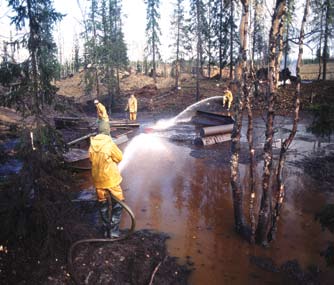
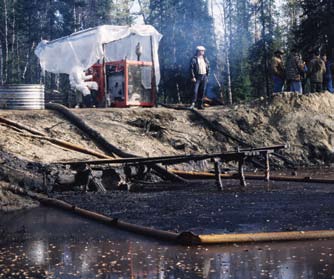
technology. Such disturbance can nonetheless con-
successfully, whereas in others the new vegetation
tinue to cause problems.
dies when watering and fertilization are stopped.
Recent improvements cannot change the fact
Another concern for land areas is the risk of oil
that large areas of tundra have been affected by past
spil s. Pipelines leak, accidents happen, and the
oil and gas activity, particularly in Russia. Tundra
results may include both chronic and acute pol u-
vegetation and the underlying permafrost are highly
tion. A number of oil spil experiments in Canada,
sensitive to disturbance. A vehicle track can remain
Greenland, and Alaska have shown that plants are
visible for decades. Removal of plant cover and the
directly impacted by spil ed oil. Many plants die
organic soil layer can lead to thawing of permafrost,
immediately upon contact. Some long-term experi-
turning land into a swamp or pond. Such impacts
ments have shown that the oil can continue to affect
can be seen in and around many major oil instal-
plants directly if it moves into the root zone. Studies
O
i
lations, such as older exploration sites on Alaska's
have shown that the most toxic components in the
l
a
n
North Slope or older facilities in northern Russia.
spil ed oil can remain in soils for decades, and do not
d
G
Their effects are likely to persist for a long time. At-
degrade unless exposed to the atmosphere. In cold
a
s
tempts at revegetation of disturbed areas in Alaska,
conditions, spil s take a long time to degrade. To
A
c
t
Canada, and Russia have generally met with varied
date, however, most spil s on land appear to have had
i
v
i
success, depending on the vegetation type and se-
relatively modest environmental impacts, particularly
t
i
e
s
verity of damage. Some areas have been revegetated
at any distance from the spil site (see Box).
t
o
t
h
e
P
r
e
The1994KomiRepublicoilspil
s
e
n
In1994,a52-kilometersectionofpipelineintheKomiRepublic,Rus-
t
sia,rupturedin23places.Adambuilttocontainthespil edoilfailed,
releasingprobablymorethan100,000tonnesofoil.Theoilcontami-
nated116hectares,andanadditional164hectaresweredamaged
duringtheresponseeffort.Nearlythreesquarekilometersofland
andmanykilometersoftheKolvaandUsariverwaterwayswere
contaminatedfromthissingleevent.Extractionofsandandgravelto
makeroadsanddamsduringthespil responsestrippedvegetation
fromthesurface,leavingonlybarrensubsoils.Similarly,siteswhere
heavyequipmentorfirewasusedtocontainorremoveoilwere
N
heavilyaffected.Intheend,muchoftheoilwasrecoveredorburned.
O
T
G
Alongstreamswhereoilwaspresentforonlyashorttime,plants
I
N
T
N
werealreadygrowingagaininthespringof1995.Areasthatwere
U
coveredinoilforlongerperiodstooklongertorecover.By2003,
R
Y
H
E
N
H
14hectareswerestil damaged.Whereoilhadbeencleanedup
in1995,petroleumhydrocarbonlevelsinthesoilweremoderate
andvegetationwasgrowing.Inplaceswhereoilhadnotbeen
removed,noplantsweregrowing,eventhoughtheoilhadlargely
disappeared.TheecologyoftheKolvaRiverchangedaswel .For
example,theabundanceofEuropeangraylingdecreasedby90%
between1995and1998,thoughhadincreasedslightlyby2000.
Theoveral effectsontheecosystemremainpoorlyunderstood.
The1994pipelinerupturewasnotanisolatedincident.Aswith
manypipelinesbuiltduringtheperiodpriortothebreak-upofthe
formerSovietUnion,leakswerecommonandmaintenancewas
N
O
T
minimal.A1999studyofpipelinesintheregionfoundthatchronic
G
I
N
T
leakshadseverelycontaminated745hectareswithover130,000
N
U
tonnesofoil.Morerecently,Russiahasundertakenmajoroverhaul
R
Y
H
ofitspipelinesystem,replacingandrepairingmanyoftheolder
E
N
H
pipewithmodernsystems.
Cleaning-upoilaftertheKomispil .
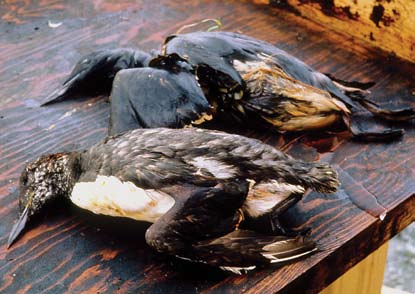
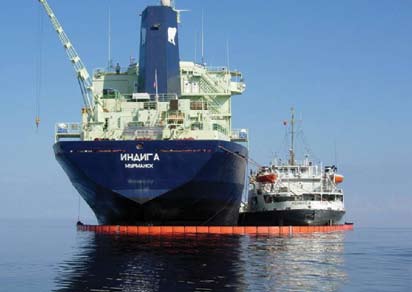
Inmarineenvironments,oilspil sare spil in the Gulf of St. Lawrence, Canada, in 1969
thelargestthreat
as ice was breaking up affected thousands of young
harp seals as they migrated from their whelping sites
At sea, large oil spil s are general y considered to be
on the ice. Based on these and other experiences, the
the largest environmental threat, though smal er, dif-
potential impacts of an arctic spil are likely to be
fuse releases of oil can also have substantial impacts.
severe for arctic species and ecosystems. In the Arctic,
In contrast to spil s on land, large marine spil s are
seasonal aggregations of animals, such as marine
difficult to contain and may spread over hundreds if
mammals in open water areas in sea ice, seabirds at
not thousands of kilometers. Nearshore facilities and
breeding colonies or feeding sites, or fish at spawning
tanker routes near land pose a greater risk of coastal
time, may be particularly vulnerable, regardless of
damage than offshore facilities from which spil s may
the size of the spil . This risk includes smal er, diffuse
disperse more widely in the ocean. Large spil s are
spil s that might occur from increased shipping in the
fortunately rare events, but their impacts can be last-
Arctic. Oil can be picked up on the breast feathers
ing and substantial.
of adult birds and transported to the nest and cover
Rivertankertransfer-
To date, there have been no large oil spil s in the
the eggs, the most sensitive stage to oil toxicity, and
ringoiltoicereinforced
arctic marine environment from oil and gas activities.
fledgling birds in the nest.
tanker,ObBay,Russia.
Large spil s in southern Alaska (Exxon Valdez) and
One of the greatest effects on birds and other
Oiledseabirds,Exxon the North Sea in Europe give some indication of the animals comes from physical coating by oil. This can
Valdezspil ,Alaska.
likely impacts should such a spil occur. A smal er
interfere with many physiological processes. Stressed
animals can also be more susceptible to toxic effects
of petroleum hydrocarbon exposure. For seabirds
and fur-bearing animals such as sea otters, oil reduces
the insulating qualities of feathers and fur. Particu-
larly in cold environments, these animals can suffer
hypothermia and die, as happened to nearly 1000
sea otters and more than 100,000 seabirds fol owing
the Exxon Valdez oil spil in Alaska in 1989. Animals
can also ingest oil while preening their feathers or
licking their fur, leading to death or other biological
effects in both the short- and the long-term. While
L
Y
A
K
B
U
fish metabolize hydrocarbons quickly, they may
retain enough to affect their quality as food. Tainting
of fish products has been reported in several spil s in
/
A
L
E
X
E
I
B
A
M
subarctic seas and even in the Cameron River in the
Canadian Arctic. Such tainting has led to the clos-
B
E
S
D
M
ing of fisheries, decline in consumption of fish, and
reduced sales of fish.
In the aftermath of an oil spil , chronic seepage
from residual oil can keep petroleum hydrocarbon
levels elevated in bottom-dwel ing invertebrates,
some of which are prey for seabirds and other ani-
mals. Recent studies from the subarctic suggest that
this lingering effect is the reason that five of the nine
seabird species injured by the Exxon Valdez spil have
not yet recovered. Black oystercatchers and harle-
quin ducks continue to show signs of exposure to oil
nearly two decades after the spil .
Whales and most seals, which rely on blubber
rather than fur for insulation, are general y less
vulnerable to oiling. However, seals that form large
C
S
T
groups during pupping may be more vulnerable, as
O
E
V
are the pups themselves. Oil may affect the eyes and
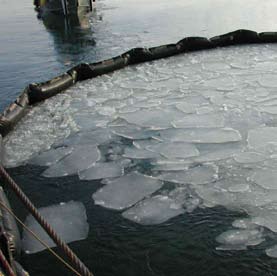
Evaporation
Absorption by snow
Oil on meltwater pools
Snow
in spring
Lead
Oil pool under snow
First-year
ice
Oil migration up brine channels
Multi-year ice
Fissure
Pumping
under ice
Oil trapped
Encapsulated oil
in ice rubble
Dissolution and
O
Oil pool
mousse formation
i
Mobile drops of oil
l
Drift with current
a
mobile or being
n
encapsulated in ice
d
G
a
s
A
c
t
i
v
Fish and marine mammals avoid sources of un-
i
Schematicdiagram
t
i
e
dersea noise such as seismic exploration or offshore
ofthebehaviorofoilin
s
t
o
drilling. However, no long-lasting effects on fish
icecoveredwater.
t
h
stocks or marine ecosystems have been found. Most
e
P
animals seem to revert to normal behavior when
r
e
s
e
the noise ceases. The effects of noise can extend tens
n
t
of kilometers from the source. In the Beaufort Sea
off Alaska, bowhead whales have been observed to
A
change swimming direction in response to noise
S
A
L
A
S
K
sources up to 30 kilometers away. In fact, sound
M
has been suggested as a means of diverting bowhead
L
,
M
H
whales from oil spills. Whale hunters in northern
Y
B
O
Alaska report having to travel farther offshore to
R
I
S
T
find whales, which they attribute to the whales' dis-
H
Boomandice.
C
placement from nearshore areas by industrial noise.
breathing in the vapors of a spil may be harmful.
Animals that cannot move away from the noise may Fateofspil edoil
Baleen whales could be especial y vulnerable if their
be harmed by noise. Limitations on noise-produc-
-themostimportant
baleen plates, used to trap prey, become fouled with
ing activities when species are concentrated or
weatheringprocesses
oil, although this effect has not been found to date.
unable to move far can help reduce impacts.
andtheirtimewindows.
Some northern fish species, such as polar cod, arc-
tic cod, saffron cod, and navaga, spawn under sea ice
in winter. Their eggs incubate there and hatch when
the ice begins to melt in spring, a time when plank-
ton blooms occur and the larvae wil have food to
eat. An oil spil in such spawning areas could severely
reduce that year's recruitment to the population.
In addition to spil s, oil and gas activities have
other impacts in the marine environment. Physical
disturbance includes the construction of gravel is-
lands and causeways, many of which have been built
on the northern coast of Alaska. They can impede
fish migrations and nearshore water flow. Plumes
of mud, trenches and holes, and piles of excavated
material can disturb bottom-dwel ing animals. The
use of icebreakers can affect ice habitats and create
considerable noise.
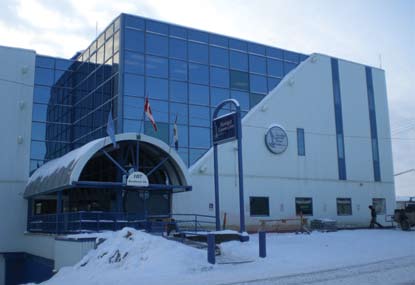
Alaskaquarterlyoil
Impactsonpeople,communities,
andgasemployment,
1968-2004,showingthe
andgovernmentscanbeboth
sharpspikeinconstruc-
positiveandnegative
tionemploymentdur-
In the regions where they occur, oil and gas activi-
ingthebuildingofthe
ties are major contributors to regional and national
AlaskaPipelineinthe
economies. As such, they are also drivers of social and
mid-1970sfol owedby
economic change. Industrial activity creates employ-
morestable,butlower,
ment opportunities and can also stimulate local
employmentduringthe
businesses. Public revenues from taxes and royalties
productionphase.
can be used to pay for improved public services,
including schools and health care. At the same time,
the magnitude and pace of development can mean
more money to handle and the absence of one or
more adults from the household during work peri-
ods. The arrival of large numbers of new workers can
GDPinArcticregions cause social and cultural disruption in smal , remote 50000
comparedwithnational
communities. Impacts to the environment can be
averages(2002),show-
disruptive, too, if they affect traditional practices. An
40000
ingthecontributionof
essential part of reducing negative impacts and cap-
oilandgasextraction
turing benefits is effective governance, which entails
30000
andpipelinetransport
clear decision-making, public involvement, and an
totheregionalGDP.
effective regulatory regime.
20000
The lifecycle of oil and gas operations typical y
means that a great deal of activity occurs in early
10000
stages, particularly during construction. Employ-
ment opportunities come quickly but for many
0
positions may not last long. There is relatively little
time to train local residents, so that many workers
them. Where oil facilities expand over time to satel-
are brought in from elsewhere, either to live or to
lite fields, opportunities may last longer and al ow
commute for rotational jobs. In the production stage,
GdP-Artic
local residents to adapt better.
jobs are more stable but there are fewer of them. The
Public revenues, on the other
GDP-allhand, tend to be
potential for disruption is thus higher at the begin-
more evenly distributed throughout the life cycle. For
ning, precisely when local communities are learning
regions that can plan accordingly, oil and gas activi-
InuvialuitDevel-
to adapt to industry presence. Furthermore, the need
ties can form the basis for major improvements in
opmentCorporation
for adaptive activities such as training often occurs
public services and standards of living. Norway's oil
Centre,Inuvik,Canada.
prior to the flow of revenues that might finance
and gas policy, for example, is to develop its reserves
to provide lasting benefit to the nation as a whole.
The creation of public and private trust funds, put
in practice in several regions and countries, is one
means of capturing revenues for long-term use.
The involvement of arctic peoples in oil and gas
activities is one way of harnessing the potential for
benefit while also providing ways to anticipate and
thereby reduce negative impacts. In Alaska and
Canada, indigenous-owned businesses have become
involved, particularly through oilfield services and
related enterprises. The desire to develop petroleum
reserves has also led to the settlement of indigenous
I
A
K
K
land claims in Alaska and Canada. The public
P
O
K
regulatory process also al ows indigenous and other
concerns to be heard during the decision-making
F
R
A
N
process. In Russia by contrast, resources have been
Distributionofbusi-
extracted without regard for land claims and with
Vadsø
nessactivityaround
modest opportunity for local involvement (see Box).
Hammerfest
Finnmark
Norwayfromoiland
Despite considerable progress in local involve-
Alta
gas,showninrelative
ment in some parts of the Arctic, oil and gas activities
Tromsø
levelsofspendingby
remain capable of creating dislocation and chal enges
Troms
area.
from the rapid changes to people and communities
Narvik
from development. Handling the rapid and often
temporary transition to a highly technical working
Bodø
environment was a chal enge for many individuals
Nordland
in the Mackenzie Delta fol owing the renewal of
O
i
exploration activities there in 2000. . Such family
l
a
n
and money-management chal enges typical y occur at
d
G
transition times, when activity levels go up or down
a
s
sharply, and not just during boom periods.
A
c
t
Residents of regions with oil and gas potential have
i
v
i
typical y shown interest in developing those resources,
t
i
e
s
along with caution about impacts and concern for eq-
t
o
uitable sharing in economic benefits. With the benefit
t
h
e
of experience elsewhere, Greenland is planning care-
Oslo
P
r
ful y to develop service sector capacity and to develop
e
s
e
resources at a pace that al ows local involvement to re-
Stavanger
n
t
main high. Canada's Mackenzie Delta region benefited
from Alaska's North Slope experience to the west.
Industry-indigenousrelationsinRussia
TheYNAO,aselsewhereinRussia,hasseengrowingindig-
enousempowermentinrecentyears.TheorganizationYamal
IntheUnionofSovietSocialistRepublics,centralplanningdic-
Potomkam!("Yamalforourdescendants!")wasfoundedin
tatedwhereoilandgasactivitiestookplaceandwhatmeasures
1989.Beforelandistransferredforoilandgasextraction,this
wouldbetakentoreduceconflictswithreindeerherdersand
organizationmustbeconsulted.Ithasalsohelpedpushfor
othersintheregionsinquestion.InRussiasince1991,however,
recognitionofherders'communitiesandtheirtraditionaluse
industryandindigenouspeopleshavedevelopedanumber
areas.TheYNAOhaspassedanumberoflawsprotectingindig-
ofinformalandformalarrangements.Despitesomefederal
enouseconomies,includingprovisionsforself-governmentas
legislationintendedtorecognizeandprotectindigenousrights,
wellasreindeerherding.
onlytheregionalgovernmentshavebeeninvolvedinthear-
rangementsmadesofar.Implementingnationalstandardsand
practicescouldhelpensurethateffectivemeasuresareapplied
everywhere.Twoexamplesshowthepotentialandalsothe
challengeforeffectiveaccommodationofbothindustryand
indigenousinterests.
InthevillageofSabetta,intheYamal-NenetsAutonomous
Okrug(YNAO),herdersrentaslaughterhousefromtheoilcom-
pany,whichinturnbuysthemeatproducts.Personalrelation-
shipsbetweenherdersandoilcompanypersonnelareakey
partofthisarrangement.Whenitcomestolanduse,however,
herdersfearthatoilandgasactivitiesandinfrastructurewill
harmtheherds.IntheneighboringNenetsAutonomous
Okrug,herderscreatedtheirownunioncalledYerv.Although
eachherderistheofficialuserofaspecificplotofland,the
herdersdecidedtoactasagroupinnegotiationswiththeoil
andgascompanyintheirarea.
TheYNAOcrestincludespolarbears,oil,andreindeer.
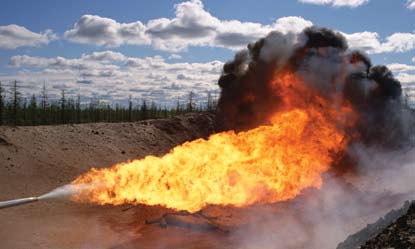
Holisticapproachto
Humanhealthcansufferfrom
assessmentofhealthof
thegeneralpopulation.
pol utionandsocialdisruption,but
revenuescanimprovehealthcare
andoveral wel -being
Another area of concern for people is human health.
Petroleum hydrocarbons can be toxic and can lead to
a number of reversible health problems, depending
on concentrations. Oil and refined petroleum prod-
ucts can affect skin through contact and lungs from
inhalation of vapors. Chemicals such as benzene and
other volatile petroleum hydrocarbons can affect
the nervous system. Long-term exposure to some
subtle changes difficult to detect. The relatively small
petroleum hydrocarbons at moderate concentra-
human population in the Arctic, and the diversity of
tions can cause cancer and death. Flaring or release
the peoples of the region, make it difficult to conduct
of wel gases can spread petroleum hydrocarbons
epidemiological studies to identify smal effects and
and sulfur compounds, which are a threat if inhaled
connect those effects to specific causes.
at high enough concentrations or over long enough
Demonstrating a connection between petroleum
periods. Exposure at levels high enough to cause
hydrocarbons and human health in the Arctic is thus
adverse health effects, however, is rare outside of
complex at best, requiring careful study. In addition
occupational exposure or accidental releases such as
to the chal enges noted in the previous paragraph,
oil spil s. There is as yet no reliable evidence for wide-
many factors contribute to overal health. Social
spread human health impairment from exposure to
wel -being, adequacy of health care, sanitation, and
petroleum hydrocarbon pol utants as a result of arctic
diet are among the many factors influencing health.
oil and gas operations. This is consistent with the
On one hand, oil and gas activities can lead to social
relatively low concentrations of petroleum hydrocar-
disruption and pol ution exposure. Lifestyles and
bons found in most areas of the Arctic.
diets can change, likely leading to increases in obesity
It is nonetheless important to remember that
and diabetes. On the other hand, health care and
studying human population effects is difficult. Expo-
sanitation can improve if public revenues are invested
sure is often hard to measure and may change signifi-
in facilities, training, and public awareness. Economic
Burningoffimpure
cantly over time depending on the nature of the oil
wel -being can enhance personal satisfaction and edu-
gasinGazprom'sYam-
or gas release, the weather conditions, and whether
cational opportunity, which can lead to better overall
saveygasfieldsnear
the release is on land or water. Routes of exposure
health. The net effects of oil and gas activity--envi-
Nadym,Yamal,Western
(by eating, breathing, or touching the chemicals) and
ronmental and social disruption versus economic and
Siberia,Russia.Gas
the specific chemicals involved affect relative toxicity.
social benefit--require careful evaluation in each case.
flarescanreleaselarge
Susceptibility may be different within the population
One effect that has been demonstrated clearly,
quantitiesofharmful
due to genetic factors, gender, and age. Few base-
however, is that of psychological damage fol owing
pol utants.
line data exist for many arctic populations, making
an oil spil . Fol owing the 1989 Exxon Valdez oil
spil , some residents of the spil region suffered from
post-traumatic stress disorder as wel as generalized
anxiety disorder. Such stress and il ness can also lead
to sociological effects when family and community
networks are overburdened or disrupted. Both were
consequences not only of petroleum hydrocarbon
E
R
exposure, but also of disruption to lives and cultural
D
traditions centering on their relationship with the
natural environment of the area. For example, con-
sumption of traditional foods decreased sharply due
E
R
R
Y
A
L
E
X
A
N
to fears of tainting by oil. Similar findings have been
H
C
reported in other subarctic areas where spil s have
&
occurred and people have been exposed or had their
B
R
Y
A
N
livelihood threatened.
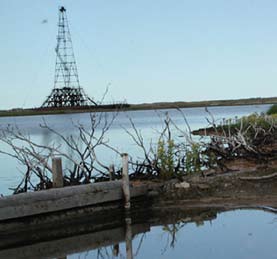
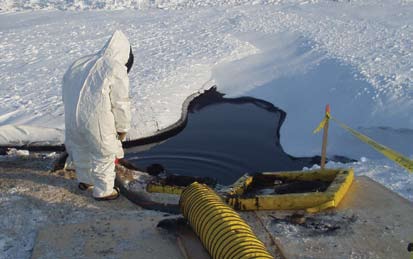
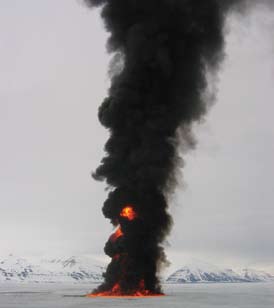
Respondingtomajoroilspil s
of condensate spewed out of the wel . In May 1981,
remainsachal engeinremote,
the authorities detonated an underground nuclear
explosion to try to stop the flow of gas and condensate.
icyenvironments
This approach failed, in part because the wel for the
nuclear device was dril ed in the wrong direction. The
The counterpart to preventing or reducing impacts
explosion left a crater that is separated from the river by
is preparedness for a major oil spil . Responding to a
a dam. Erosion of the dam could release oil and other
spil in the Arctic is particularly chal enging. Many oil
contaminants col ected in the crater. Other attempts to
and gas activities are in locations far from population
stop the blowout final y succeeded in 1987.
centers. In winter especial y, reaching a spil site and
In March 2006, internal corrosion made a hole in
taking action may be difficult, when weather may be
a pipeline on Alaska's North Slope. Although the spill
O
severe and daylight is limited. On the other hand, small
i
was much smal er in scale than the previous two ex-
l
a
winter spil s on the surface of land or ice can often
n
amples, some 800 cubic meters of oil were spil ed onto
d
be contained more easily and cleaned up before most
G
snow-covered tundra. The corrosion was not detected
a
biological activity begins in spring. Oil spil s under
s
because routine inspections that could have revealed
A
c
ice or in ice-covered waters are the most chal enging,
t
the thinning wal s had not been carried out. Detection
i
v
simply because they cannot be contained or recovered
i
of and response to the leak were slowed by winter con-
t
i
e
effectively with current technology. New techniques
s
ditions, as the company placed highest priority on the
t
o
such as the use of ice rather than booms to contain
safety of its workers. One consequence of the problem
t
h
spil s and concentrate oil for recovery by skimmers,
e
was reduced oil production from the North Slope dur-
P
however, have shown some promise. Dispersants and
r
ing containment and repairs. This reduction cost the
e
s
in-situ burning may also be used, although both have
e
State of Alaska mil ions of dol ars a day in lost revenue.
n
t
drawbacks that may be made worse in arctic condi-
tions. Most response techniques require prompt action,
Experimental
which may not be possible in remote areas without
in-situburningofoil
prior staging of equipment and personnel.
inice.
A few arctic examples demonstrate some of the dif-
ficulties. In the 1994 Komi Republic pipeline rupture
(see page 23), the initial response was to build contain-
ment dams around the rupture site. This worked until
the dams broke in spring, releasing oil over a much
Cleaning-uptheoil
larger area. Subsequent containment efforts prevented
spillfromthePrudhoe
oil from reaching the Pechora River, but oil had already
Baytransit-lineleak
spread in waterways and over land. Spring flooding
in2006,NorthSlope,
carried the oil farther stil .
E
F
T
Alaska.
In 1980, the gas and gas-condensate wel Kumzha-9
/
S
I
N
I
K
in the Pechora Delta suffered a blowout that lasted six-
V
D
TheKumzha-9
and-a-half years. Every day during that period, some
drillingrig,Pechora
2 mil ion cubic meters of gas and hundreds of tonnes
P
E
R
B
R
A
N
Delta,Russia.
I
A
C
,
N
V
O
A
K
L
S
H
B
O
S
L
A
N
R
U
B
P
X
A
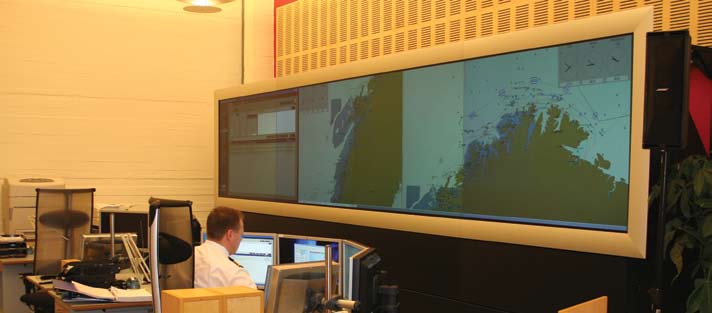
0
Technologyandregulationscanhelp cal governments, shareholder concerns, and pressure
reducenegativeimpacts
from within the oil industry have added to the push
for better performance in the Arctic as elsewhere.
Early arctic oil and gas exploration and development
Accepted industry standards for reporting, safety, and
used equipment and techniques that had been de-
environmental protection are increasingly applied
veloped for use in temperate areas. At that time, well
throughout the world in response to the require-
dril ing technology was limited to vertical holes and
ments of financial and other institutions.
therefore required many more wel s sites to produce
Regulatory systems are also evolving. Russia has
an oil or gas field. Because the wel s had to be dril ed
constructed a new, modern system over the last 15
directly above the target geological formations, dril -
years. Greenland, the Faroe Islands and Iceland
ing sites were sometimes located in critical habitats
are developing regulatory systems as their activities
or dangerous terrain. Construction techniques at
evolve. Norway's regulatory system underwent major
that time also caused major physical and biologi-
changes in the 1980s to a predominantly perfor-
cal impacts to tundra and permafrost, which made
mance-based system that focuses on outcomes. The
operations less efficient as wel as more damaging.
United States and Canada are incorporating more
Over the past several decades, lessons from
outcome-based rules in their systems.
experience, public pressure, regulatory requirements,
Compared with many other oil-producing regions
and economic concerns have combined to spur the
of the world, the arctic nations are political y stable.
development of new technology to meet arctic condi-
Transparent regulatory systems provide additional
tions and reduce impacts. Three-dimensional seismic
consistency, reducing uncertainty for industry. In
surveys provide better information about sub-surface
turn, this can make large, long-term investments in
formations, meaning fewer exploratory and develop-
exploration and infrastructure comparatively more
ment wel s need to be dril ed. Production wel s can
attractive in much of the Arctic, despite its remote-
be dril ed in several directions from a single platform
ness and harsh weather.
or pad, reaching as far as 20 kilometers away, reduc-
Transparent regulatory systems can also mean a
ing the number of production facilities required (see
greater degree of public information and oversight.
Figure on page 6). Sub-sea facilities (see Figure this
The major oil companies operating in the Arctic are
page) can reduce surface presence and risk of infra-
large and publicly traded. They are expected to meet
structure damage. Ice roads al ow access in winter
standard accounting requirements and to provide
without lasting damage to vegetation or permafrost.
information to regulators and shareholders. This can
Bans on the discharge of oil-based dril ing muds,
also mean greater public awareness of problems, for
better containment of wel -head releases, and similar
example the pipeline leaks from corrosion in Russia's
regulatory controls have also helped reduce pol ution.
Komi Republic in 1994 and on Alaska's North Slope
Themarinetraffic
Regulations and the use of best available technol-
in the summer of 2006. Such problems occur despite
controlcentreatVadsø,
ogy, however, are not consistent across the Arctic.
complex and comprehensive regulatory systems and
Norway.
International agreements, action by national and lo-
considerable public scrutiny.
I
K
V
E
I
N
F
R
E
D
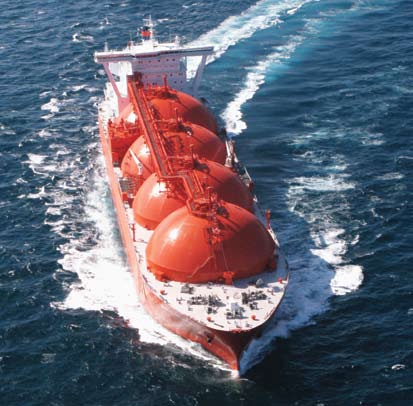
Oil and Gas Activities in the Future
Oil and gas activity in the Arctic
is expected to increase in the next
decade. Projections farther into the
future become increasingly specula-
tive. Many factors wil influence what
actual y happens, and the past is only
an imperfect guide to what we can
anticipate. Nonetheless, our under-
standing of the patterns, trends, and
O
consequences of past activity shed
i
l
a
n
some light on what we are likely to
d
G
a
see in the coming decades. If sea ice
s
A
continues to diminish, access to arctic
c
t
i
v
i
regions may become easier and less
t
i
e
G
s
costly, perhaps increasing the attrac-
L
N
i
n
H
t
tiveness of the region for develop-
E
G
h
Ö
e
H
F
ment. Thawing of permafrost, on the
u
t
u
r
other hand, may complicate develop-
Liquifiednaturalgas
e
ment on land. Technological advances
(LNG)tanker,expected
are also likely to continue to change
tobecomemorecom-
the way oil and gas activities are
monintheBarentsSea
conducted. This section outlines the
projected levels and areas of activity,
the risks entailed, and the potential
for planning to reduce those risks and
attendant impacts.
Moreoilandgasactivityisexpected
as a quarter of the world's undiscovered oil and gas
lies in the Arctic. With rising global demand, oil
More than five percent of the world's known oil
and gas activity in the region is expected to increase.
reserves and over 20 percent of its known gas
Indeed, plans for new pipelines and for evaluation
reserves are in the Arctic, the vast majority of both
and development in new areas are underway.
in arctic Russia. There are estimates that as much
In Russia, oil and gas production activities will
grow in Timan-Pechora and West Siberia provinces
and in the Kara and Barents seas. This develop-
ment is likely to include construction of major oil
pipelines from the West Siberian Basin and Timan-
Pechora to a western arctic port, a Far East pipeline
for arctic oil transport to the Pacific Rim, and
Schematicil ustra-
several new marine terminals and subsequent arctic
tionofthecomponents
tanker traffic to markets.
distinguishedwhen
In Canada, the construction of the Mackenzie
consideringresources
Val ey gas pipeline would be a major stimulus to fur-
andreserves;undis-
ther development and production in the Mackenzie
coveredresourcesare
Delta and the Beaufort Sea. In Alaska, a gas pipeline
subjecttogreatest
from the North Slope to southern markets is also
uncertainty.
Arctic Canada (CP = 2% of OGIP)
Arctic Norway (CP = 3% of OGIP)
Piechartsshow-
ingoriginaloilinplace
(OOIP,)andgas
inplace(OGIP,)in
theArcticareasofthe
fourArcticproducing
countries,andthecu-
Arctic Russia
mulativeproductionto
date(partindicatedby
lightershading,or%).
(2000s-2010s) Projected
(2007 and 2011) Lease sales (2010s) Construction
construction of gas pipeline
planned for Chukchi, Beaufort of new pipelines,
from North Slope
and pos ibly Bering seas
including one to the
(2000s) Tanker traffic to (2000s-) Increased ofshore
(2000s-2010s) Development (2007-) More satel ite
Pacific Rim and one to
(2014) Projected con-
(2020s-) Extension of
increase sharply
activity in the Beaufort and
of offshore gas reserves in the fields developed
an arctic port for tanker
struction of Mackenzie
activity to the Beaufort
pos ibly Chukchi Seas
Barents, Pechora, and Kara seas
shipment to Europe
Val ey gas pipeline
Sea shelf
Nor
Rus
Ala
Can 2000
2
0
1
0
2
0
1
5
2
0
2
0
2
0
0
5
Far
Gre
Ice
(2000s-2010s) Continued (2000s-2010s) Continued
(2007-2008) More
(2000s-2010s) Development of
licensing opportunities,
licensing opportunities,
seismic, possible
additional oil and gas fields in
seismic, exploration wel s seismic, exploration wel s
licensing
the Norwegian and Barents seas
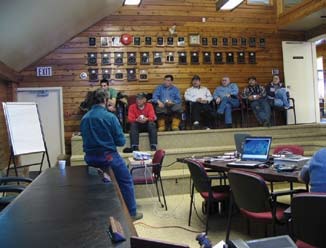
anticipated, al owing production from large known
try. The depletion of existing reserves worldwide
reserves. Oil activity is expected to expand offshore
may also lead to greater interest in unconventional
and also to the west onshore.
resources such as heavy oil, coalbed methane, and
Farther into the future, discoveries of new reserves
potential y vast methane hydrate deposits both on-
wil likely lead to further development and produc-
and offshore. The construction of new infrastructure
tion. Offshore areas in Greenland, Iceland, and the
for development and particularly transportation will
Faroe Islands, Arctic Russia, and Arctic Alaska are of
likely extend into areas currently without such hu-
particular interest to both government and indus-
man presence.
Fluctuationsin
thepriceofoil(ad-
justedto2005dol ar
equivalents),showing
responsetoWorld
events,andnumbersof
explorationwel sdril ed
onshoreandoffshore
indifferent5-year
intervals.
O
i
l
a
n
d
G
a
s
A
c
t
i
v
i
t
i
e
s
i
n
t
h
e
F
u
t
u
r
e
Factorsinvolvedindevelopmentdecisions
Together,thesefactorsandtheirevenmorecomplexinteractions
makeitdifficulttoprojectfutureactivitylevelswithconfidence.
Manyfactorsultimatelycontrolwhetherandwhenoilandgasdevel-
Theyalsomakeitdifficultforgovernmentsandotherdevelop-
opmentactivitieswil takeplaceintheArctic.Theyincludeinterna-
mentproponentstodeterminewhatincentivesareappropriateto
tionalpoliticalfactorssuchasenergydemand,includingdemand
encourageoilandgasactivityinaparticularregion.
fromemergingeconomies,andenergysecurityfordevelopedcoun-
tries.Otherbasicfactorsincludetheresourcepotentialofvarious
areas,thegeologicnatureofthedeposit,long-termtrendsinoiland
gasprices,theregulatoryenvironment,andinfrastructurecapacity.
OperatingcostsofactivitiesintheArcticaretypical ymuchhigher
thanthoseoftemperateregions.Workingconditionsareharshand
chal enging.Infrastructureisoftenlimitedornon-existentpriorto
thestartofoilandgasactivities.Environmentalconditionsinclude
extremelylowtemperaturesandextendeddarknessinwinter,per-
mafrost,seaice,andchangingclimate.Theregulatoryandmanage-
S
E
N
mentprocessescanalsobecomplex.Thelead-timefromdiscovery
H
I
C
todevelopmentisusual ymuchlongerthanforotherpartsofthe
N
N
world.Adedicatedprogramforonshoredevelopmentmaytaketen
yearsormorebetweendiscoveryandproduction.
A
R
Y
S
O
G











Seasonalpatternsdetermine
ducks, and geese move to coastal habitats where they
vulnerabilityinarcticecosystems
feed and stage while preparing for the southbound
migration. At this stage they may be very vulnerable
Arctic habitats are characterized by extreme seasonal
both to oil spil s and to disturbances.
change, which drives extensive animal migrations on
Bowhead, beluga, narwhal, walrus, and several spe-
land and at sea. The seasonal patterns of movement to,
cies of seals spend the winter in the southern areas of
from, and within the Arctic determine to a large extent
pack ice. In spring, they migrate northwards as the ice
the vulnerability of arctic ecosystems. These patterns
retreats. Prior to or during these migrations, these mam-
must be taken into account in reducing or avoiding
mals give birth to their young. When they are confined
environmental impacts from oil and gas activities.
in ice during wintering and migrations, dependent on
Seabirds of many species arrive in the hundreds of
the openings for breathing, these marine mammals
thousands or mil ions to northern breeding colonies in
could be vulnerable to oil spil s and disturbances.
spring. These colonies are located where there is access
Harp and hooded seals in the Atlantic sector and
to abundant food in the form of zooplankton and
ribbon and spotted seals in the Pacific aggregate on
smal fish like sandlance, capelin, and polar cod. After
sea ice in late winter to give birth to their pups. A
breeding, some seabirds and seaducks like eiders ag-
common feature of the location of these areas is that
gregate for molting, a time when they are flightless. In
they are in southern extensions of winter ice, general y
autumn, seabirds move south to winter in areas where
outside the reach of polar bears that would not be able
there is access to food. When they are concentrated at
to get back to the polar pack when the ice disintegrates
their breeding colonies, moulting and wintering areas,
in spring. After pupping, the seals aggregate for a
seabirds are particularly vulnerable to oil spil s.
second time sometime later in spring or early summer,
Shorebirds and waterfowl typical y breed scattered
when they spend much time hauled out on the ice
over the vast arctic tundra and wetland habitats
during their annual moult. The young pups have fur
where they feed on the seasonal burst of insects,
to keep them warm when they are on the ice, when
other invertebrates, and aquatic and terrestrial vegeta-
they are particularly sensitive to oiling. The concen-
tion. Dispersed breeding means that they general y
trated whelping and moulting areas for these seals are
have low vulnerability to oil and gas activities. After
vulnerable to oil spil s and disturbances.
breeding, however, many species of shorebirds,
On land, reindeer or caribou perform migra-
TheBarentsSea
TheBarentsSeaismoderatelyproductive,butbe-
inglarge,itsupportslargefishpopulations.Walrus,
bowheadsandotherlargewhaleswereseriously
depletedbythisprevioushunting,andhavebeen
slowtorecover.Despitethistheregioncontinuesto
supportabundantmarinelifeandactivefisheries.
Now,oilandgasactivityisincreasingintheBarents
Sea.Offshoredril ingandproductionaswel as
tankertrafficareexpectedtorise.Whilenormal
operationsmayposelittleadditionalthreat,the
consequencesofanoilspil couldbesevere.
SimplifiedBarentsSeafood-web.
TheBeringSea
birdsandmammalsfromtheBeaufort,Chukchi,andEastSiberianSeas
spendthewinterinpolynyasandthemarginalicezone.
TheBeringSeaisaveryproductiveecosystem,particularlytheconti-
OilandgasactivitiesmaysoonoccurintheBeringSea.Disturbance
nentalslopeandnorthernshelfregionswherenutrient-richwatersflow
tomarinemammalsandseabirdsispossible,andtheconsequences
upwardsfromthedepths.Commercialfisheriesarehighlyvaluable,and ofanoilspil couldposeseriousrisktomanycommercialfisheries.
traditionalhuntingandfishingcontinuetosustainindigenouscultures
Indeed,thetaintingoffishproducts,oreventheperceptionthatthey
alongthecoastsandontheislandsoftheBeringSea.Thenorthern
aretainted,coulddamagetheregion'sreputationandmarketingfor
BeringSeaisanespecial yconcentratedregionofmarinelife,where
wild,naturalfish.
Il ustrativemapofareas
intheArcticwhereselected
birds,mammals,andfishform
majoraggregationstobreed,
stage,migrate,oroverwinter.
Whenoilandgasactivities
includingtransportation
occurinsuchareas,such
aggregationsarevulnerable
to disturbancesandoilspil s.
O
i
l
a
n
d
G
a
s
A
c
t
i
v
i
t
i
e
s
i
n
t
h
e
F
u
tions similar to those of the arctic marine mammals.
specific areas as calving grounds in summer that offer
t
u
r
Several large herds winter in the boreal forest or taiga,
suitable feeding conditions for the calves and their
e
migrating in spring onto the arctic tundra and even
mothers. These calving areas are particularly vulner-
across sea ice onto islands. Reindeer or caribou use
able areas with respect to disturbances.
Seabirdpopulationsandoilspil s
Thebiologicalcharacteristicsofaseabirdspeciesarealsocriticalin
determiningitsabilitytorecover.Someseabirdsreproduceslowly.
Seabirdsareamongthemostvulnerablespeciestoanoilspil .This
Thick-bil edmurres,forexample,donotbreeduntiltheyarefouror
istruebothforimmediateimpactsand,insomespeciesatleast,for
fiveyearsold,andeachfemalelaysonlyoneeggperyear.Suchspe-
long-termimpacts.Marineoilspil scandepleteseabirdpopula-
ciestakemanyyearstoproduceenoughyoungforthepopulation
tions,leavingentirecoloniesdeserted.Oiledbirdsarethefocusof
togrow. Acatastrophicevent,suchasextremeweather,disease,or
muchmediaattentionafteraspil .Thelong-termconsequencesof
anoilspil ,canthushavelong-lastingeffects.
theseeffectsare,however,anotherandmorecomplicatedmatter.
Notsurprisingly,theshort-andlong-termimpactsdependinpart
Theeffectsofchronic,diffuseoilpol utiononseabirdcoloniesis
onthestatusofthecolonyorpopulationpriortocatastrophe.A
alsostil uncertain.
colonythatisthrivingmayhavemorebirdsthancanfindspace
Manyfactorsinfluencewhathappenstoaseabirdpopulationafter
orfoodtosupportreproduction.Ifsomebirdsarekil ed,alarger
ithasbeenexposedtoanoilspil .Ifacolonyiswipedout,itmust
percentageofthesurvivorsmaybeabletobreed,thusspeeding
bere-colonized.Thiscanberelativelyrapid,ifabundantcolonies
recovery.Conversely,acolonythatisdecliningorotherwiseunder
arelocatednearby.Itcanbeslowifothercoloniesaredistantor
stressisunlikelytoberesilient.Managementandpreventionef-
alreadydecliningforotherreasons,andthusunabletoproduce
fortsshouldthereforetakeaccountofsuchriskswhenidentifying
extrabirdsforre-colonization.
vulnerablepopulationsandareas.
Manyrisksremain
The history of oil and gas activities, including recent
events, indicates that risks cannot be eliminated. Tanker
Relationship
spil s, pipeline leaks, and other accidents are likely to
betweenfrequency
occur, even under the most stringent control systems.
andvolumeofreleases
Transportation of oil and gas entails risk to areas
tothemarineenviron-
beyond production regions. Containing or cleaning up
mentfromdifferent
an oil spil in sea ice remains difficult at best. Pol ution
sources(worldwide).
cannot be reduced to zero, although adherence to strict
regulations and sound engineering practice can greatly
reduce emissions. Physical disturbance is likewise inevi-
table wherever industry operations occur, although the
and regions. The results of such an exercise can be used
extent and impacts of disturbance can be reduced.
in planning the oil and gas activities and appropriate
Some degree of risk to people and society is also
mitigation measures and restrictions.
unavoidable. Dislocation, stress, crime, substance
The termination of oil and gas operations is a
abuse, the introduction of diseases, and other problems
process with which there is minimal experience in the
are likely to appear or increase as development moves
Arctic. Decommissioning involves varying degrees of
into previously isolated areas. They may be offset
removing equipment and infrastructure and repairing
by other social, economic, and health-care benefits,
any damage done to the surrounding area. Depending
but that judgment is likely to vary by individual, by
on regulatory requirements, some things may simply be
circumstance, and by region, and cannot be predicted
left in place, whereas others are removed. Both options
accurately. Furthermore, detriments and benefits are
involve the potential for release of pol ution and further
unlikely to reach everyone in the same way. Some
disturbance. Although environmental cleanup is re-
people wil receive greater benefits and some wil expe-
quired, it is not yet clear how much actual work wil be
rience negative impacts.
done once an oil or gas instal ation is closed down.
Assessing vulnerability is one way of anticipating
Social y, closure of an oil or gas operation means
where problems are most likely to occur. Ecosystem
the loss of employment and of public revenue. Public
vulnerability is the degree to which an event or change
or private investment funds may al ow some benefits
would cause serious disruption. Risk is the size of the
to persist past the life of the operation. In some areas
impact combined with the probability that it wil hap-
where oil and gas operations have declined, however,
pen. An attempt to map ecological vulnerability has
populations have gone down as has overal economic
been made as part of this assessment. Further work is
activity. The long-term effects of such declines are as yet
needed to calculate respective risks for various activities
unknown for arctic regions.
Mapofmainoiland
gastransportroutes
fromRussianArctic
productionareas.
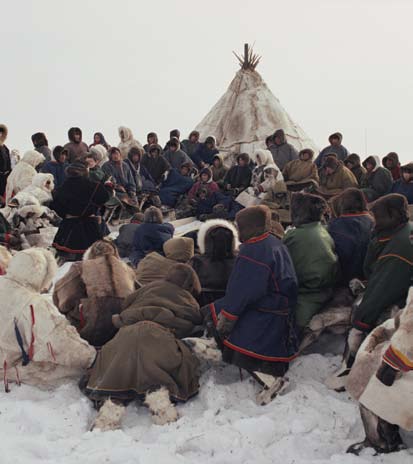
Planningandmanagementcanhelp
reducerisksandimpacts
With activity likely to increase and risk unavoidable,
sound planning and management can nonethe-
less help reduce negative impacts and increase the
benefits of oil and gas activity in the Arctic. Indeed,
better planning and management have helped reduce
impacts since the early years of industry activity in
most parts of the Arctic. But more can be done.
The learning curve is readily apparent in plan-
ning societal responses. Canada learned from Alaska,
Norway has studied both countries, and Greenland
and the Faroe Islands are acting on lessons learned
elsewhere. In Russia, more attention is being given
now to environmental and social and economic ef-
fects. The key lesson is that effective governance does
E
R
D
not occur by chance. Learning from experience is
not confined to national governments, but includes
regional and local governments as wel as indigenous
organizations, which now have better networks and
E
R
R
Y
A
L
E
X
A
N
H
O
wider experiences to draw on.
C
i
&
l
a
The gain in influence by indigenous groups is not
n
d
necessarily a loss to industry or government. Many
B
R
Y
A
N
G
a
land claims in Canada and Alaska have been settled,
s
A
providing land and resource ownership to indigenous
requires commitment by governments, which can
c
Meetingbetween
t
i
peoples while al owing development to proceed. In
be aided by strong public pressure and industry
v
Nenetsreindeerherd-
i
t
i
many cases, local residents desire not so much to
cooperation. When industry is the major contribu-
e
ersandgascompany
s
i
slow or stop development as to have a hand in deter-
tor to public revenue, stringent enforcement may
n
officials.Yamal.Siberia.
t
mining how it occurs. Public processes and greater
be difficult to sustain. The alternative, however, is
h
Russia
e
increased risk.
F
involvement have made progress towards this goal,
u
t
reducing legal and other disagreements over develop-
The basis for regulations, likewise, can be
u
r
e
ment. Nevertheless, disagreements and disputes will
strengthened by sound research and monitoring
continue. Their management wil be a key chal enge
for impacts as well as compliance with regulations.
as oil and gas activities move into new areas.
Detecting pollution or other impacts early can help
Generating lasting benefits from oil and gas activ-
identify damaging activities. Better understanding
ity while reducing major disruptions is a common
of the nature and scope of impacts can also improve
goal for both national and local governments. The
the ability to plan effectively. Monitoring and
creation of funds, public and private, is one ap-
research must be undertaken, as must engineering
proach that has been used to harness revenues for
development and other innovations required to re-
long-term benefit. Large public funds can help avoid
duce impacts and risks. Such expenditures are often
large economic swings while providing for the future.
easy to cut for short-term gain, but as with relaxing
Avoiding extensive pol ution, damage, and major oil
enforcement, the result is likely increased risk and
spil s is the counterpart to securing benefits. While
long-term cost.
incidents such as oil spil s cannot be eliminated,
Future exploitation of arctic oil and gas resources
planning and preparedness can reduce the likeli-
depends in part on global markets and geopolitics,
hood and the impacts if and when a disaster occurs.
and in part on continued support within the region.
Stricter regulations and better operating practices
Tangible benefits have accrued in those regions where
and compliance monitoring have reduced, and can
oil and gas activities have occurred, but with tangible
further reduce, environmental and social impacts.
negative impacts as wel . The authors of this assess-
The regulatory process in most countries is com-
ment hope that their work provides a firm founda-
prehensive and complex, involving many agencies
tion for decisions about if and how to proceed with
and jurisdictions. Enforcing regulations, however,
future oil and gas activity in the Arctic.
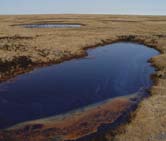
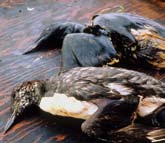
KeyFindings
1. Extensiveoilandgasactivityhasoccur edin
sia,andNorway.Bil ionsofdol arsworthofoil
theArctic,withmuchoilandgasproduced
andgashavebeenproducedtodate,andnew
andmuchremainingtobeproduced
fieldsareunderdevelopmentinseveralcoun-
tries.Russiahashadanorderofmagnitude
CommercialoilandgasactivitiesintheArctic
moreactivitiesandproductionthanal other
beganinthe1920sinCanadaandincreased
Arcticcountriescombined.
greatlyinthe1970s,particularlyinAlaska,Rus-
2. Naturalseepsarethemajorsourceof
largesthumansources.Excludingoilspil s,oiland
petroleumhydrocarboncontaminationin
gasactivitiesarecurrentlyresponsibleforavery
thearcticenvironment
smal fractionofpetroleumhydrocarboninputs
totheArctic,althoughthisisexpectedtorisewith
Petroleumhydrocarbonsarenatural yoccurring
increasedoilandgasactivity.Theseseepsare
A
compounds.TheirmajorsourceintheArcticis
excel entresearchopportunitiesforunderstand-
naturalseeps.Humanactivitycontributespetro-
ingthephysicalchemistryandenvironmental
A
L
A
S
K
leumhydrocarbons,too.Oilspil sandindustrial
consequencesofoilreleases.
B
L
M
activitiesexcludingoilandgasactivitiesarethe
Sum PAH (ng/g)
"
"
"
"
"
"
"
"
"
"
"
"
"
"
"
"
"
"
"
"
"
"
"
"
"
"
3. Petroleumhydrocarbonconcentrationsare
thewaterssurroundingSvalbard.Theselevels
"
"
"
"
"
"
"
"
"
"
"
"
"
"
"
"
"
"
"
"
"
"
"
"
"
"
"
"
"
"
"
"
"
"
"
general ylow
arestil relativelylow.Afewcontaminatedsites
"
"
"
"
"
"
"
"
"
"
"
"
"
"
"
"
"
"
"
"
"
"
"
"
"
"
"
"
"
"
andareasofextensiveindustrialactivity,such
"
"
"
"
"
"
"
"
"
"
"
"
"
"
"
"
"
"
"
"
"
"
"
"
"
"
"
"
"
"
"
"
"
"
"
"
"
"
"
"
"
"
"
"
"
"
"
"
"
"
"
"
"
"
"
"
"
"
"
"
"
"
"
"
"
"
"
"
"
"
"
"
"
"
"
"
"
"
Thehighestbackgroundlevelsofpetroleum
"
"
"
"
"
"
"
"
"
"
"
"
"
"
"
"
"
"
"
assomeoilfacilitiesandharbors,havehigh
"
"
"
"
"
"
"
"
"
"
"
"
"
"
"
"
"
"
"
"
"
"
"
"
"
"
" " "
"
"
"
"
"
"
"
"
"
"
"
"
"
"
"
"
"
"
"
"
"
"
"
"
"
"
"
"
"
"
"
"
"
"
"
"
"
"
"
"
"
"
"
"
"
"
"
"
"
"
"
"
"
"
"
"
"
"
"
"
"
"
"
"
"
"
"
"
"
"
"
"
"
hydrocarbonsarefoundinareaswithnatural
"
"
"
"
"
"
"
"
levelsofpetroleumhydrocarbons.
"
"
"
"
"
"
"
"
"
"
"
"
"
"
"
"
"
"
"
"
"
"
"
"
"
"
"
"
"
"
"
"
"
"
"
"
"
"
"
"
"
"
"
"
"
"
"
"
"
"
"
"
"
"
"
"
"
"
"
"
"
sources,suchastheMackenzieRiverareaand
"
"
"
"
"
"
"
"
"
"
"
"
"
"
"
"
"
"
"
"
"
"
"
"
"
"
"
"
"
"
"
"
"
"
"
"
"
"
"
"
"
"
"
"
"
"
"
"
"
"
"
"
"
"
"
"
" "
"
"
"
"
"
"
"
"
"
"
"
"
"
"
"
"
"
"
"
"
"
"
"
"
"
"
"
"
"
"
"
"
"
"
"
"
4. Onland,physicaldisturbanceisthelargest
atedwithnewdevelopmentshavedecreased
effect
asindustrypracticeshaveimprovedand
regulationshavebecomemorestringent.Ice
Exploration,construction,andinfrastructure
roadseliminatelastingtransportationcorridors.
havedamagedsomeareasoftundraandother
Directionaldril ingreducesthenumberofplat-
E
E
N
terrestrialecosystems.Oilspil shavealsohad
formsused.Effects,however,canbecumulative
L
T
U
localimpacts.Overtime,theimpactsassoci-
andlastfordecades.
H
E
R
I
C
5. Inmarineenvironments,oilspil sarethe
consequencescouldbesevere.Aspil that
largestthreat
occurredinatimeandplacethatanimalswere
aggregatedcouldbeespecial ydisastrous.The
Todate,nomajoroilspil shaveoccurredin
frequencyoflargespil sislow,buttheoveral
arcticseas.Experiencesfromelsewhere,includ-
riskincreaseswithincreasedactivity.
ingthesubarctic,showthattheenvironmental
C
S
T
O
E
V
6. Impactsonindividuals,communities,and
harnessedforlong-termusetosustainben-
governmentscanbebothpositiveand
efitsafteroilandgasactivitieshaveended.
negative
Thearrivalofsuddenwealth,newmigrants,
andenvironmentalimpactscanalsodisrupt
Oilandgasactivitiesbringincomeand
socialpatterns,creatingavarietyofprob-
I
A
K
K
employmenttoindividualsandregions.This
lems.Effectivegovernanceisacrucialpartof
P
O
K
revenuecanimprovelivingstandards,support
maximizingbenefitsandminimizingnegative
publichealthandculturalprograms,andbe
impactsonsociety.
F
R
A
N
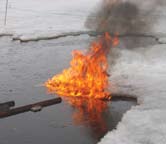
KeyFindings
7. Humanhealthcansufferfrompol utionand
ofhealthimpactsdirectlyassociatedwithoil
socialdisruption,butrevenuescanimprove
andgasactivitieshavebeenfoundintheArctic.
healthcareandoveral wel -being
Increasedgovernmentrevenuescansupport
betterhealthcare,andimprovedeconomic
Oilandgasactivitiesproducepol utionand
statuscanalsoleadtobetterhealthandwel -
otherformsofenvironmentalandsocialdisrup-
beingforindividuals.
tion,whichcanleadtohealtheffects.Fewsigns
8. Technologyandregulationscanhelpreduce
overthepastseveraldecades. Theapplication
negativeimpacts
ofbestpracticesacrosstheregioncanhelp
further.Complianceiscriticalifthesegainsare
Improvedtechnologyandmorestringent
toberealized.
regulationshavegreatlyreducedtheenviron-
I
K
V
mentalimpactsofarcticoilandgasactivities
E
I
N
F
R
E
D
9. Respondingtomajoroilspil sremainsa
Preventionremainsthebestmeansoflimitingthe
chal engeinremote,icyenvironments
impactsofaspil ,butfurtherworkisneededon
O
responsetechniques,particularlyforoilunderice
E
F
i
l
T
a
Therearenoeffectivemeansofcontainingand
orinbrokenice,suchasinsituburningandthe
n
/
S
I
N
d
cleaningupoilspil sinbrokenseaice.Respond-
useoficetocontainspil saswel astheeffective-
I
K
G
V
D
a
ingtosuchspil sinwinterwouldbeevenmore
nessofdispersantsinextremecold.Prepared-
s
A
difficult,giventhelikelihoodofharshweather
nesscanalsobeenhancedbyimprovedtraining
c
t
i
P
E
R
B
R
A
N
andthelimiteddaylight.Onlandandunbroken
ofresponsecrewsandbystationingresponse
v
i
t
seaice,smal winterspil smayinfactbeeasierto
i
equipmentatappropriatelocationsintheArctic.
e
s
cleanup,iftheworkcanbedonebeforespring.
i
n
t
h
MackenzieRiverVal eyinCanadaandfrom
e
10. Moreoilandgasactivityisexpected
F
u
Alaska'sNorthSlope.Newoilandgaspipelines
t
u
Withperhapsasmuchasaquarterofthe
andincreasedtankertrafficwil carryRussian
r
e
world'sremainingoilandgasandgeneral y
oiltomarket.Inthelongerterm,otherareas,
stablepoliticalenvironments,theArcticislikely
suchasGreenland,theFaroes,andIceland,may
toremainattractiveforoilandgasactivity.The
movefromexplorationtodevelopmentand
nextdecademayseenewgaspipelinesinthe
construction.
11. Manyrisksremain
evenwiththebesttechnologyandpractices.
Preparingforworst-casescenarioscanhelp
Exploringforandproducingoilandgasinthe
identifyareas,species,andtimesofparticular
Arcticentailsrisk.Accidentscannotbeentirely
vulnerability,al owingextraprecautionstobe
prevented.Someimpactsareinevitable,
taken.
12. Planningandmonitoringcanhelpreduce
includingimpactsonnortherncommunities
risksandimpacts
andtraditionalwaysoflife,canbeavoidedor
S
E
N
minimizedandpositiveeffectscanbebetter
E
N
Thelikelyimpactsfromoilandgasactivities
achieved.Environmentalmonitoringcantrack
R
I
S
T
H
canbeanticipatedbasedonexperienceto
effectsandhelpevaluatenewapproaches.
C
date.Learningfromthoseexperiencescan
Compliancemonitoringandenforcementcan
R
M
O
T
helpimproveplanningsothatnegativeeffects,
ensurethatbestpracticesareindeedused.
T
U
G
0
Sourcesofphotographyinthisreport
Höegh LNG (www.hoegh.com) page 31
Photographersandsuppliersofphotographicmaterial
Eric Hulteen (eric@hulteen.com) pages 10 (#3), 38 (#4)
Bryan and Cherry Alexander (www.arcticphoto.com) cover, pages 1,
Henry Huntington (hph@alaska.net) page 23
2, 4 (left), 7 (#3, #4, #6), 13, 14, 28, 37
Lyle Lockhart (l ockhart@shaw.ca) page 10 (#1)
Terry Baker (bakert@ainc-inac.gc.ca) page 22 (upper)
MBESD: Murmansk Basin Emergency and Salvage Department;
Christy Bohl, Minerals Management Service (MMS), Alaska - page 25
photo supplied by Alexei Bambulyak (ab@akvaplan.niva.no) page 24
Per Brandvik/SINTEF (Per.Brandvik@sintef.no) pages 29, 39 (#9)
Frank Pokiak (igc-js@jointsec.nt.ca) pages 26, 38 (#6)
BLM: Bureau of Land Management, Alaska (2003) pages 18
SEG: Society of Exploration Geophysisis (www.seg.org) page 7 (#1)
(middle), 38 (#2)
Gerald Shearer, Minerals Management Service (MMS), Alaska pages
Steve Blasco (SBlasco@nrcan.gc.ca) page 18 (lower)
4 (right), 22
Guttorm Christensen (gc@akvaplan.niva.no) page 39 (#12)
Tom Smith; photo supplied by Lois Harwood (Lois.Harwood@dfo-
mpo.gc.ca) page 3
Fred Einvik (fred.einvik@kystverket.no) pages 30, 39 (#8)
Gary Sonnichsen (gsonic@nrcan.gc.ca) pages 10 (#4), 22 (lower), 33
ESA: European Space Agency (www.esa.int) - page 12
Richard Turner (rturner@neb-one.gc.ca) page 7 (#5)
Anita Evenset (anita@akvaplan.niva.no) page 21
Ruslan Bolshakov, NIAC (2003) page 29 (lower left)
EVOSTC: Exxon Valdez Oil Spil Trustee Council (www.evostc.state.
ak.us/) pages 10 (#2), 24 (lower), 38 (#5)
Steinar Hansen (Nordkapp havn FK); photo supplied by Alexei Bam-
Sourcesofdatausedonil ustrationsinthisreport
bulyak (ab@akvaplan.niva.no) page 12
Russian basin, pipeline, field and production data presented on
Al Gril o/AP/Scanpix (www.scanpix.se) page 11
graphics on pages 5, 15, 16, 17, 35, 36 is by permission of IHS Inc.
(www.ihs.com, © 2007, al rights reserved)