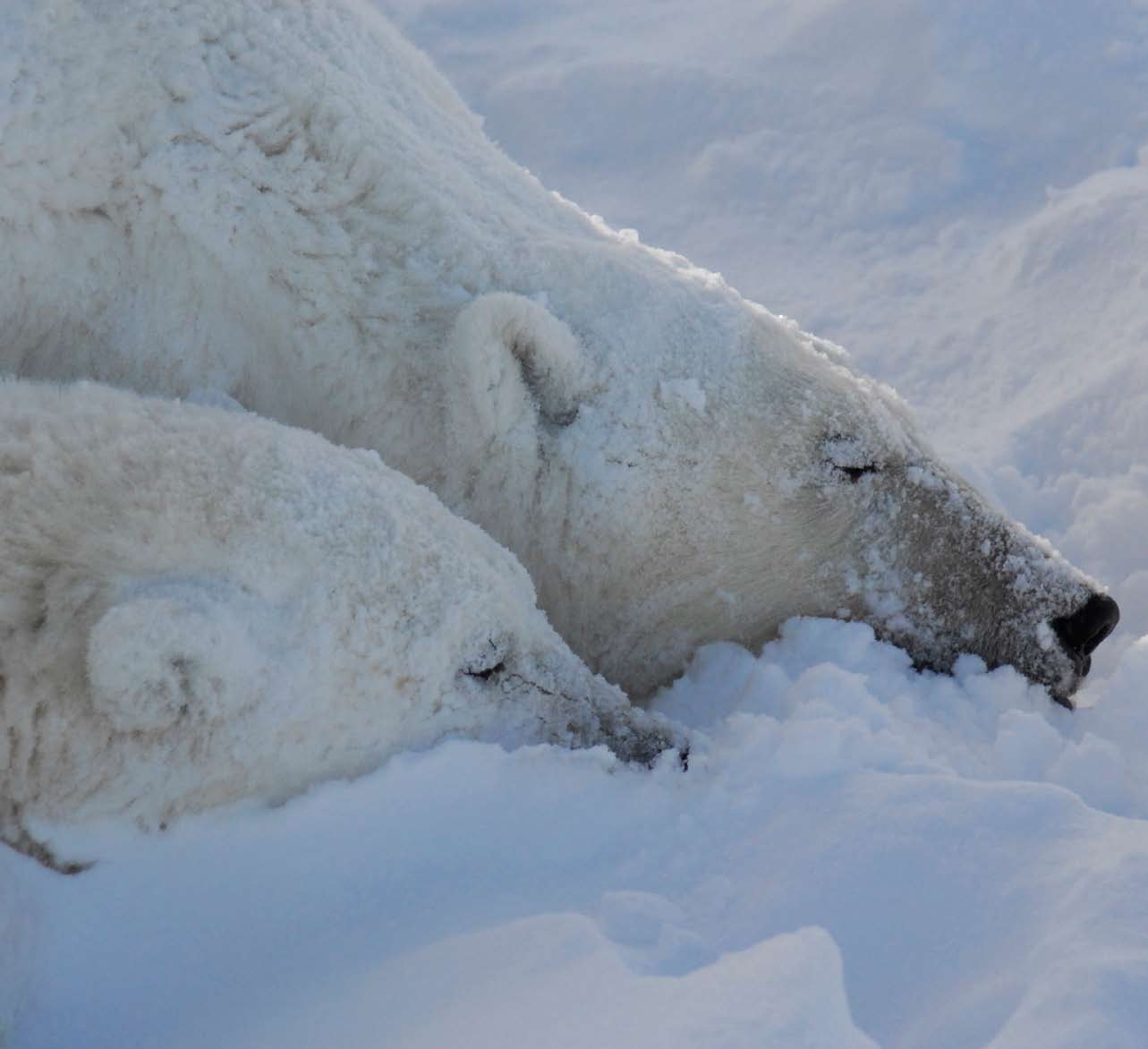
Arctic P
ollution 2009
Arctic Pollution 2009
Arctic Monitoring and Assessment Programme (AMAP)
ISBN 978-82-7971-050-9
Arctic Pollution 2009
Contents
Preface .................................................................................................................................................... i i
Executive Summary ................................................................................................................................. v
I.
Introduction ................................................................................................................................................ 1
Climate patterns affect contaminant transport
II.
Persistent Organic Pollutants ...................................................................................................................... 5
Introduction
Brominated flame retardants
Fluorinated compounds
Polychlorinated naphthalenes (PCNs)
High-volume chemicals with POP characteristics
Endosulfan and other current use pesticides
Legacy POPs
Effects in Arctic wildlife
Chapter summary
III.
International treaties and actions to limit the use and emission of POPs and heavy metals .................... 34
IV.
Contaminants and Human Health ............................................................................................................. 37
Factors influencing human exposure to contaminants
Food, diet, nutrition, and contaminants
Levels and trends
Contaminants and metabolism
Effects and public health
Demographic data show different patterns for many Arctic populations
Risk communication
Summary
V.
Radioactivity ............................................................................................................................................... 65
Introduction
Sources: update based on actions and climate change
Protection of the Arctic environment
Summary
AMAP
Arctic Monitoring and Assessment Programme
Oslo 2009
ii
Citation: AMAP, 2009. Arctic Pollution 2009. Arctic Monitoring and Assessment Programme, Oslo. xi+83pp
ISBN 978-82-7971-050-9
© Arctic Monitoring and Assessment Programme, 2009
Published by
Arctic Monitoring and Assessment Programme (AMAP), P.O. Box 8100 Dep., N-0032 Oslo, Norway (www.amap.no)
Ordering
AMAP Secretariat, P.O. Box 8100 Dep, N-0032 Oslo, Norway (amap@amap.no)
This report is also published as electronic documents, available from the AMAP website at www.amap.no
AMAP Working Group:
John Calder (Chair, USA), Per Døvle (Vice-chair, Norway), Yuri Tsaturov (Vice-chair, Russia), Russel Shearer (Canada), Mikala Klint (Den-
mark), Henrik Larsen (Denmark), Morten Olsen (Denmark), Outi Mähönen (Finland), Helgi Jensson (Iceland), Erik Syvertsen (Norway),
Yngve Brodin (Sweden), Tom Armstrong (USA), Jan-Idar Solbakken (Permanent Participants of the Indigenous Peoples Organizations).
AMAP Secretariat:
Lars-Otto Reiersen, Simon Wilson, Yuri Sychev, Inger Utne.
ACKNOWLEDGEMENTS
Authors:
Annika E. Nilsson (annika.nilsson@sei.se) and Henry P. Huntington (Huntington Consulting, hph@alaska.net).
Contributing experts:
M. Alaee
C.M. Butt
H. Gunnlaugsdóttir H. Kiviranta
S. Meakin
D. Rawn
J. Strand
L. Alexeeva
L. Camus
Ö. Gustafsson
J. Klungsøyr
T. Messner
L-O. Reiersen
Y. Su
P. Ayotte
A. Carlsen
B. Hackett
A. Kochetkov
L. Moseholm
F. Rigét
E. Sverko
P.R. Becker
J. Carroll
C.J. Halsall
A.V. Konoplev
D.C.G. Muir
J. Rodhe
L. Tarrason
I. Bergdahl
G.N. Christensen
J.C. Hansen
M. Krahn
G. Mulvad
B. Salbu
C. Teixeira
U. Berger
A. Covaci
A. Heinrich
E. Kruemmel
L. Needham
T. Sandanger
C. Tikhonov
J. Berner
S. Dahle
H.E. Heldal
J. Kucklick
B. Nexø
T. Savinova
G.T. Tomy
A. Bersamin
M. Dam
P.A. Helm
H. Kylin
E. Nieboer
T. Seppälä
B.L. Tracy
T.F. Bidleman
C. de Wit
M. Hermanson
S. Leppänen
S.P. Nielsen
M. Sickel
Y. Tsaturov
A. Bignert
B. Deutch
D. Herzke
R.J. Letcher
A. Nikitin
J.U. Skåre
A. Vaktskjold
P. Bjerregaard
E. Dewailly
L. Hoferkamp
E. Lie
T. Nygård
H-R. Skjoldal
B. van Bavel
S. Boitsov
R. Dietz
I. Holoubek
A. Liland
T. O'Hara
H. Skov
J. Van Oostdam
E.C. Bonefeld-
S.G. Donaldson
L. Hubbard
J. Lindgren
J.Ø. Odland
L. Skuterud
Jørgensen
J. Verreault
A. Dudarev
H. Hung
G. Lindström
K. Olafsdottir
J. Small
K. Borgå
M. Verta
R.P. Eganhouse
K. Hylland
B. Luick
M. Olsson
L. Soininen
R. Bossi
M. Evans
T. Ikäheimonen
C. Macdonald
S. Orre
D. Solatie
K. Vorkamp
B. Braune
A. Evenset
B.M. Jenssen
R. Macdonald
J. Paatero
K. Solomon
J-P. Weber
K. Breivik
P. Fellin
P.K.A. Jensen
J. Mannio
R. Paltemaa
C. Sonne
J. Weber
D. Broman
G.W. Gabrielsen
H. Joensen
S. Manø
A. Parkinson
G. Stern
P.M. Weihe
E. Brorstrøm-
S. Gerland
P. Johansen
E. Mariussen
H.S. Pedersen
D. Stone
S.J. Wilson
Lunden
A. Gilman
E.H. Jorgensen
V. McClelland
L.H. Pettersson
J. Stow
K. Young
J-O. Bustnes
N. Green
R. Kallenborn
M. McLachlan
A. Rautio
P. Strand
M.A. Ytre-Eide
Indigenous peoples organizations, AMAP observing countries, and international organizations:
Aleut International Association (AIA), Arctic Athabaskan Council (AAC), Gwitch'in Council International (GCI), Inuit Circumpolar
Conference (ICC), Russian Association of Indigenous Peoples of the North (RAIPON), Saami Council.
France, Germany, Netherlands, Poland, Spain, United Kingdom.
Advisory Committee on Protection of the Sea (ACOPS), Arctic Circumpolar Route (ACR), Association of World Reindeer Herders (AWRH), Cir-
cumpolar Conservation Union (CCU), European Environment Agency (EEA), International Arctic Science Committee (IASC), International Arc-
tic Social Sciences Association (IASSA), International Atomic Energy Agency (IAEA), International Council for the Exploration of the Sea (ICES),
International Federation of Red Cross and Red Crescent Societies (IFFCRCS), International Union for Circumpolar Health (IUCH), International
Union for the Conservation of Nature (IUCN), International Union of Radioecology (IUR), International Work Group for Indigenous Affairs (IW-
GIA), Nordic Council of Ministers (NCM), Nordic Council of Parliamentarians (NCP), Nordic Environment Finance Corporation (NEFCO),
North Atlantic Marine Mammal Commission (NAMMCO), Northern Forum (NF), OECD Nuclear Energy Agency (OECD/NEA), OSPAR
Commission (OSPAR), Standing Committee of Parliamentarians of the Arctic Region (SCPAR), United Nations Development Programme
(UNDP), United Nations Economic Commission for Europe (UN ECE), United Nations Environment Programme (UNEP), University of the
Arctic (UArctic), World Health Organization (WHO), World Meteorological Organization (WMO), World Wide Fund for Nature (WWF).
Graphical production of Arctic Pollution 2009
Lay-out and technical production:
John Bellamy (johnbellamy@swipnet.se).
Design and production of computer graphics:
Simon Wilson and John Bellamy.
Printing and binding:
Narayana Press, Gylling, DK-8300 Odder, Denmark (www.narayanapress.dk); a Swan-labelled printing company, 541 562.
Copyright holders and suppliers of photographic material reproduced in this volume are listed on page 83.
iii
Preface
The Arctic Monitoring and Assessment Programme (AMAP)
tic monitoring, have participated in the preparation of this assessment.
is a Working Group of the Arctic Council. The Arctic Council
AMAP would like to express its appreciation to all of these
Ministers have requested AMAP to:
experts, who have contributed their time, effort, and data; espe-
·produceintegratedassessmentreportsonthestatusandtrends
cially those who were involved in the further development and
of the conditions of the Arctic ecosystems, including humans;
implementation of the AMAP Trends and Effects Monitoring
Programme, and related research. A list of the main contributors
·identifypossiblecausesforthechangingconditions;
is included in the acknowledgements on the previous page of this
·detectemergingproblems,theirpossiblecauses,andthe
report. The list is based on identified individual contributors to the
potential risk to Arctic ecosystems including indigenous peoples
AMAP scientific assessments, and is not comprehensive. Specifi-
and other Arctic residents; and to
cally, it does not include the many national institutes, laboratories
·recommendactionsrequiredtoreduceriskstoArctic
and organizations, and their staff, which have been involved in the
ecosystems.
various countries. Apologies, and no lesser thanks, are given to any
These assessments are delivered to Ministers at appropriate
individuals unintentionally omitted from the list.
intervals in the form of `State of the Arctic Environment Reports'
Special thanks are due to the lead authors responsible for the
on pollution and climate related issues. These reports are intended
preparation of the scientific assessments that provide the basis for
to be readable and readily comprehensible, and do not contain
this report. Special thanks are also due to the authors of this re-
extensive background data or references to the scientific literature.
port, Annika Nilsson and Henry Huntington. The authors worked
The complete scientific documentation, including sources for all
in close cooperation with the scientific experts and the AMAP
figures reproduced in this report, is contained in a series of related
Secretariat to accomplish the difficult task of distilling the essential
reports - the AMAP Assessment 2009 reports - or papers specially
messages from a wealth of complex scientific information, and
prepared for publication in the scientific literature, all of which are
communicating this in an easily understandable way.
peer reviewed and fully referenced. For readers interested in the
The support of the Arctic countries is vital to the success of
scientific background to the information presented in this report, we
AMAP. AMAP monitoring work is essentially based on ongo-
recommend that you refer to the AMAP Assessment 2009 reports,
ing activities within the Arctic countries, and the countries also
or the articles prepared for publication in scientific journals, as listed
provide the necessary support for most of the experts involved in
on page 83 of this report.
the preparation of the assessments, including the participation of
This report is the sixth `State of the Arctic Environment Report'
indigenous peoples organizations in the work of AMAP. Canada
that has been prepared by AMAP in accordance with its mandate.
and Sweden, Canada and Denmark, and Norway and Russia acted
It presents the results of work conducted during AMAP's third
as the (co-)lead countries for, respectively, the persistent organic
phase (2002-2008) in relation to three priority areas: persistent
pollutants, human health, and radioactivity components of the
organic pollutants, human health, and radioactivity. The assessment
assessment. Furthermore, this assessment could not have been
described in this report builds upon the previous AMAP assessments
delivered without the additional financial support received from
that were presented in 1997 and 2002. It updates information pre-
Canada and Norway; and from the Nordic Council of Ministers.
sented in the previous assessment reports and addresses new issues
The AMAP Working Group, who are responsible for the
and contaminants that were not covered in the earlier assessments.
delivery and content of the AMAP State of the Arctic Environ-
A large number of experts from the Arctic countries (Canada,
ment Reports, are pleased to present this State of the Arctic
Denmark/Greenland/Faroe Islands, Finland, Iceland, Norway, Russia,
Environment Report, the sixth in the series, for the consideration
Sweden, and the United States), from indigenous peoples organiza-
by governments of the Arctic countries. This report is prepared in
tions, from other organizations, and countries with an interest in Arc-
English, which constitutes the official version.
Tromsø, April 2009
John Calder
Lars-Otto Reiersen
AMAP Chair
AMAP Executive Secretary
iv
v
Executive Summary
Preamble
reduce pol ution of the Arctic as a direct fol ow-up to address
the concerns raised by AMAP. AMAP information is also used
The Arctic Monitoring and Assessment Programme (AMAP)
in establishing priorities for the Arctic Council/PAME Regional
was established in 1991 to monitor identified pollution risks and
Programme of Action for the Protection of the Arctic Marine
their impacts on Arctic ecosystems. The first AMAP report, Arc-
Environment from Land-based Activities (RPA). A number of
tic Pollution Issues: A State of the Arctic Environment Report1
activities have been initiated to fol ow-up on the Arctic Climate
and its update Arctic Pollution 20022 were published in 1997
Impact Assessment.
and 2002, respectively. Three further reports have been published
The current assessment report updates to the information
on specific topics: the Arctic Climate Impact Assessment3 (pro-
presented in the AMAP 1997 and 2002 assessment reports with
duced by AMAP in cooperation with the Conservation of Arctic
respect to three subject areas: persistent organic pollutants, con-
Flora and Fauna working group and the International Arctic
taminants and human health, and radioactivity. The POPs update
Science Committee in 2004), and reports on Acidification and
has a particular emphasis on `emerging' and current use POPs. The
Arctic Haze4 (2006) and Arctic Oil and Gas5 (2008).
human health update addresses health effects of POPs, mercury,
These assessments show that the Arctic is closely connected
and lead exposure.
to the rest of the world. The Arctic receives contaminants from
The information presented in the Arctic Pol ution 2009 report
sources far outside the Arctic region; Arctic climate influences the
is based on scientific information compiled for AMAP by scien-
global climate and vice versa. The AMAP assessment reports have
tists and experts, as listed on page 83. The background docu-
been welcomed by the Arctic governments, who have agreed to
ments to this assessment have been subject to peer review and are
increase their efforts to limit and reduce emissions of contami-
in the process of being published in AMAP scientific assessment
nants into the environment and to promote international coop-
reports or scientific journals. All of these documents are made
eration in order to address the serious pollution risks and adverse
available on the AMAP website, www.amap.no.
effects of Arctic climate change reported by AMAP.
This Executive Summary provides the main conclusions and
AMAP information assisted in the establishment, and contin-
recommendations of the 2009 AMAP assessments.
ues to assist the further evaluation and development of the pro-
tocols on persistent organic pol utants (POPs) and heavy metals
Persistent Organic Pollutants (POPs)
to the United Nations Economic Commission for Europe's (UN
ECE) Convention on Long-range Transboundary Air Pollution
Legacy POPs
(LRTAP Convention) and the Stockholm Convention on Persist-
P1. Levels of many POPs have declined in the Arctic environ-
ent Organic Pol utants. Information from AMAP is useful in
ment. This is a consequence of past bans and restrictions on
documenting trends and in showing whether persistent substanc-
uses and emissions in Arctic and other countries. `Legacy' POPs
es are accumulating in the Arctic, which is relevant with respect
that contaminate the Arctic mainly as a result of past use and
to the screening criteria for persistence, long-range transport, and
emissions include PCBs, DDTs, HCB, chlordane, dieldrin,
bioaccumulation that are applied to proposals to add substances
toxaphene, and dioxins.
to the above international agreements.
P2. National policy efforts to reduce the use and emissions of
The Arctic Council's Arctic Contaminants Action Program
these POPs have been extended regional y and global y through
(ACAP) was established to undertake cooperative actions to
the UN ECE LRTAP POPs Protocol and Stockholm Conven-
1AMAP, 1997. Arctic Pollution Issues: A State of the Arctic Environment Report. Arctic Monitoring and Assessment Programme, Oslo. xii+188 pp
2AMAP, 2002. Arctic Pollution 2002. Arctic Monitoring and Assessment Programme, Oslo. xii+112 pp
3ACIA, 2004. Impacts of a Warming Arctic. Arctic Climate Impact Assessment. Cambridge University Press. 139 pp
4AMAP, 2006. Arctic Pollution 2006: Acidification and Arctic haze. Arctic Monitoring and Assessment Programme, Oslo. xii+112 pp
5AMAP, 2008. Arctic Oil and Gas 2007. Arctic Monitoring and Assessment Programme, Oslo. xiii+40 pp
vi
tion, respectively. These initiatives made extensive use of the
the international Conventions regulating POPs; Deca-BDEs
information presented in AMAP assessments. The Stockholm
are now restricted in the EU.
Convention on POPs explicitly acknowledges that "... Arctic
HBCD is ubiquitous in the Arctic. It undergoes long-range
ecosystems and indigenous communities are particularly at risk."
transport and accumulates in animals. It has also been
The occurrence of chemicals in the Arctic can be evidence of their
proposed as a candidate for inclusion under international
ability for long-range transport and environmental persistence.
regulations.
P3. Firm conclusion about the impact of policy decision on envi-
There is some evidence that environmental levels of Penta-
ronmental levels wil require continued monitoring of `legacy POPs'
BDE are now starting to level off or decline due to national
in both abiotic environments and in key biota. AMAP information
regulations and reductions in use and production.
on temporal trends in the Arctic has contributed to the evaluation
TBPPA is present at low levels in several Arctic animals and
of the `effectiveness and sufficiency' of the UN ECE LRTAP Con-
plants, but more data are needed to assess its potential to
vention Protocol on POPs, and the Stockholm Convention.
undergo long-range transport.
P4. Additional years of monitoring are needed to increase
statistical power of existing time series in order to verify temporal
Some BFRs that are used as substitutes for phased-out
trends. This wil al ow examination of the response to efforts to
substances have been detected in occasional Arctic samples.
reduce global emissions and how this may be affected by climate
Their presence in the Arctic is a warning sign that they may
variability and possible changes in contaminant pathways.
have some POP characteristics.
P5. Despite these reductions, concentrations of some legacy
· Fluorinatedcompounds
POPs, such as PCBs in some top predators in the marine food web,
Fluorinated compounds reach the Arctic both via the
are stil high enough to affect the health of wildlife and humans.
atmosphere and via ocean currents. They are extremely
persistent and accumulate in animals that are high in the
Emerging and current-use POPs
marine food web.
P6. Many chemicals in commercial use today have the poten-
Production of products containing perfluorooctane
tial to transport to and accumulate in the Arctic but are not yet
sulfonate (PFOS) was substantial y reduced in 2001, but
regulated by international agreements. Although knowledge
PFOS continues to be produced in China. Products that
about these chemicals in the Arctic remains much more limited
contain PFOS and other fluorinated compounds can still
than for legacy POPs, new monitoring efforts have extended the
serve as sources to the environment. PFOS and related
information concerning their presence in the Arctic. This infor-
compounds are currently subject to review for both interna-
mation is relevant to ongoing consideration of new chemicals for
tional and national regulation.
inclusion under existing national, regional and global agreements
Perfluorooctanate (PFOA) and other perfluorocarboxylates
to regulate use and emissions of POPs.
(PFCAs) continue to be produced. Fluorinated substances
P7. Many of these compounds transport over long distances
can also degrade to PFOA and other PFCAs. Canada is the
and accumulate in Arctic food webs. New knowledge highlights
only Arctic country so far to ban some import and manufac-
the potential importance of ocean transport pathways. In contrast
ture of several products that are suspected to break down to
to atmospheric pathways ocean currents are slow. This may delay
PFOA and PFCAs.
the environmental response to regulations.
P8. Compounds that have some POP characteristics and that
Precursors of PFOS and PFCAs have been detected in Arctic
are documented in the current AMAP assessment include:
air and may be a source of PFOS and PFCAs in Arctic wild-
· Brominatedflameretardants(BFRs)
life. Concentrations in Arctic air are one order of magnitude
lower than in more southern, urban regions.
The current AMAP assessment includes new information on
three groups of chemicals used as flame retardants: polybro-
Time trends of PFOS in wildlife show an initial increase
minated diphenyl ethers (PBDEs) (including Penta-, Octa-
starting in the mid-1980s. In recent years, some studies show
and Deca-BDEs), Hexabromocyclododecane (HCBD) and
a continuing increase while others show a sharp decline. The
tetrabromobisphenol-A (TBBPA). The assessment shows that:
declines fol ow reduction in PFOS production.
Penta-BDE transports over long distances and bioaccumulates
PFCAs have increased in Arctic wildlife since the 1990s,
in biota. Penta-BDE and Octa-BDEs have been banned/re-
reflecting continued production of their precursors.
stricted in Europe, parts of North America. They are no longer
· Polychlorinatednaphthalenes
produced in Russia and use there is very limited. Penta-BDE
Polychlorinated naphthalenes (PCNs) are no longer manu-
and Octa-BDEs are under consideration for inclusion under
factured and levels in the environment peaked almost half a
vii
century ago. However, PCNs are still present in the Arctic
Contaminants and Human Health
with indications of further input from a combination of
combustion sources and emission from old products. There
Population health and effects of contaminants
are no studies to assess their temporal trends in the Arctic.
H1. In light of current studies, many indigenous populations
They contribute to dioxin-like toxicity in Arctic animals but
in the Arctic region have poorer health than national averages.
are general y much less important than PCBs.
While socioeconomic conditions and lifestyle choices are major
· Endosulfan
determinants of health, contaminants may also have a contribut-
Endosulfan is a pesticide that is stil in use in many parts of
ing effect. Toxicological studies show that contaminants, at the
the world. Endosulfan and its breakdown products appear
levels found in some parts of the Arctic, have the potential for ad-
to be persistent in the environment. The presence of en-
verse health effects in people. Epidemiological studies, looking at
dosulfan in the Arctic confirms its ability to transport over
Arctic residents directly, provide evidence for subtle immunologi-
long distances. There is clear indication of bioaccumula-
cal, cardiovascular, and reproductive effects due to contaminants
tion in fish but there is no evidence for biomagnification by
in some Arctic populations. These results indicate that POPs,
marine mammals.
mercury, and lead can affect health of people and especially chil-
Long-term trend analysis of samples taken at Alert (Elles-
dren at lower levels of exposure than previously thought. Genetic
mere Island, Canada) indicates that endosulfan concen-
characteristics of the various Arctic populations also affect their
trations have remained unchanged in the remote Arctic
response to contaminants and susceptibility to certain diseases.
atmosphere, unlike most legacy POPs. Calculations based
H2. A major dietary shift from traditional to store-bought
on air and seawater concentrations suggest that endosulfan
food is underway in most of the Arctic, with important health
enters open (i.e. ice-free) waters of the Arctic Ocean.
implications. In addition to environmental concentrations of
the contaminants in traditional foods, lifestyle factors and social
The limited information available in wildlife indicates that
and cultural practices play a large role in determining human
concentrations of endosulfan and its breakdown product
exposure to contaminants in Arctic areas. Despite changes in
endosulfan sulphate in blubber of marine mammals are an
lifestyle and diet that are resulting in increasing consumption of
order of magnitude lower than those of major legacy POPs
store-bought foods, traditional foods remain important to Arctic
such as DDT and chlordane.
indigenous peoples for social, cultural, nutritional, economic,
Endosulfan is currently under discussion for inclusion
and spiritual reasons. Store-bought foods are increasingly the
under the UN-ECE LRTAP POPs Protocol and the Stock-
main source of dietary energy, but traditional foods provide
holm Convention.
many nutrients and are stil a major contributor to healthy diets
· Othercurrent-usepesticides
in many communities. Some traditional foods can also carry po-
Previous AMAP assessments have highlighted lindane
tential risks from contaminants. The combination of high prices
(gamma-hexachlorocyclohexane [HCH]) as a current-use
for store-bought foods and the work, risks, and costs associated
pesticide that is ubiquitously present in the Arctic. Several
with obtaining traditional foods has made food security a large
other current use pesticides (including chlorpyrifos, chlo-
concern for many Arctic residents.
rothalonil, dacthal, diazinon, diclofol, methoxychlor, and
H3. Recent studies have found a number of mechanisms by
trifluralin) have been detected in the Arctic. The levels are
which contaminants can affect metabolism. Obesity is associated
often low, but their presence shows that they can transport
with an increased risk of cardiovascular disease and of develop-
over long distances and accumulate in the food web.
ing diabetes; as in other parts of the world, obesity is increasing
in Arctic communities. POPs, even at low concentrations, also
Biological effects
increase the risk of diabetes. These new findings emphasize the
P9. Recent studies of biological effects of POPs have been able
need to consider the interactions between contaminants and
to confirm the causal link between POPs and observations of
other health conditions.
adverse health effects in Arctic top predators. These controlled
Trends in exposure and contaminant levels
experiments on sled-dogs and captive Arctic foxes show effects on
hormone, immune and reproductive systems.
H4. Human exposure to most legacy POPs and mercury is
P10. The observed effects are mainly due to the breakdown
decreasing in many Arctic populations. This reflects changes in
products, indicating that these may be more important than the
diet, changing levels of environmental contamination, and health
original POP compounds.
advice to critical groups in some areas concerning consumption
of certain foods; however, exposure remains high in some popula-
viii
tions. The proportion of women of childbearing age who exceed
Potential sources
blood level guidelines for PCBs, mercury, and lead is decreasing.
R2. In parts of the Arctic, there is a very high density of sources
For PCBs and lead, in particular, there is evidence that this re-
of radionuclides. The risk of accidents combined with the vulner-
flects the declines in environmental levels of these contaminants.
ability of the Arctic environment to radioactive contamination
H5. Marine mammals remain a major dietary source of POPs
raises a need for continued actions to reduce risks.
and mercury, so that people who eat large quantities of marine
R3. Partly as a result of national and international actions ad-
mammals have higher POPs and mercury levels than those who
dressing concerns highlighted by AMAP, significant progress has
do not.
been made with respect to actions to reduce risks of radioactive
H6. Emerging compounds such as brominated flame retard-
contamination from several of these potential sources. Previous
ants and fluorinated compounds are a concern for three reasons:
AMAP assessments recommended actions to address potential
they are present in Arctic people and biota, levels global y have
sources of radioactive contamination of the Arctic including
increased over the last 15 years, and their toxic effects have not
nuclear powered vessels that were poorly maintained or being de-
been studied in detail. There is little information on the routes of
commissioned; dumped and stored radioactive wastes, including
exposure or trends of these contaminants in Arctic populations.
wastes stored under inadequate conditions; radioisotope thermo-
H7. Reliable interpretation of information on trends and
electric generators (RTGs) used as energy sources in northern re-
inter-regional differences is critically dependent on an ability to
gions; and nuclear power plants and reprocessing facilities located
compare data from different studies and different laboratories.
close to the Arctic. Many of these potential sources are located in
Laboratory performance testing procedures initiated by AMAP
northwest Russia. Other issues remain a source of concern:
and others, including the AMAP inter-laboratory comparison
· Asof2008,164ofthe198obsoletenuclearsubmarinesof
programme for analysis of contaminants in human tissue have
the Russian northern fleet had been defueled and disman-
markedly improved analytical co-operation, data comparability,
tled; work to safely decommission these vessels continues.
data reliability and data accuracy in studies using the participat-
Similar plans exist for dealing with nuclear icebreakers and
ing laboratories, and have led to more reliable data on con-
their associated facilities, including the Lepse storage vessel.
taminant levels in human tissues. Further improvements can be
· ThefacilitiesatAndreevaBayandGremikhaareusedas
achieved through continued efforts in this respect.
temporary storage sites for radioactive wastes, spent fuel,
H8. Increased industrial activity in parts of the Arctic is likely
and reactors from decommissioned submarines. Progress has
to lead to an increase in local sources of contaminants. Anticipat-
been made in improving the physical infrastructure and the
ed changes in global and Arctic climate may also result in changes
legal arrangements to manage these sites. However, much
in contaminant transport to the Arctic. Such changes may affect
remains to be done, including transport of spent fuel and
exposure patterns to some contaminants.
waste to safer storage sites.
Communication
· Abouthalfoftheradioisotopethermoelectricgenerators
H9. Communicating the results of studies concerning contami-
(RTGs) in northern Russia have been removed or will be in
nants and people is important in helping Arctic residents make
the near future.
informed food choices. Health advisories issued in response to
R4. Some risk reduction has been achieved through significant
findings reported in past AMAP assessments have succeeded in
joint Russian-international action. This includes a regulatory
reducing exposure to contaminants in some Arctic population
framework for handling the clean-up actions. Moreover, a long-
groups.
term strategic master plan has been developed, which could be-
H10.Risk communication must be carried out with great care
come an important tool for further management of radiation risks.
and respect for culture at a community-level. The involvement of
community members and organizations, regional health officials,
New potential sources
and indigenous organizations is the key to developing and dis-
R5. Russian plans for building floating nuclear power plants raise
seminating messages that are appropriate and relevant.
issues about how waste wil be handled and about increased marine
transport of spent fuel in the Arctic. These power plants would
Radioactivity
represent new potential sources and may increase risks of radioac-
R1. Radioactivity in the Arctic is a concern because contamina-
tive contamination.
tion can persist for long periods in soils and some plants and
R6. Technological y enhanced natural y occurring radioactive
because pathways in the terrestrial environment can lead to high
material (TENORM) can become a radiation risk in context of
exposures of people.
mining of uranium and other minerals, phosphate production,
oil- and gas extraction, coal mining and the use of geothermal en-
ix
ergy. Several of these activities are likely to increase in the Arctic
nationalmechanismsbecausetheyundergolong-rangetransport
and more knowledge about waste streams and releases are needed
andbioaccumulationinhumantissuessimilartootherPOPs.
in order to assess human and environmental risks.
(P2,P3,H6)
Historical contamination
· Supportthedevelopmentofaglobalagreementtolimitmercury
emissionstocomplementregionalandnationaleffortsthat
R7. Previous AMAP assessments documented fal out from past
reduceenvironmentallevelsandlowerhumanexposuretomer-
nuclear weapons tests, the 1986 Chernobyl accident, and releases
curyintheArctic.(H1)
from reprocessing plants close to the Arctic as the three major
sources of anthropogenic radioactive contamination in the Arctic.
Recommendations for actions to promote healthy diets and
Evidence from long-term monitoring in the European Arctic
reduce human exposure to contaminants:
shows that levels of radioactivity in the environment are declin-
· Continuetoencouragepublichealthofficialstorecommend
ing. However, monitoring and mapping activities have decreased
breastfeedingamongArcticpopulationsasahealthpracticethat
in recent years and documentation is therefore lacking for much
optimizesinfantgrowthanddevelopment.(H2,H9)
of the Arctic. Unless environmental pools are re-mobilized, this
historical contamination wil continue to decrease as sediments
· Recommendtohealthauthoritiestopromotehealthydiets
are buried and radionuclides decay.
throughimprovedaccesstoandconsumptionoflocaltradi-
R8. Application of new technology has reduced routine re-
tionalfoodsthatarehighinnutrientsbutrelativelylowin
leases of radionuclides to the marine environment from Europe-
contaminantsalongwithimprovedavailabilityandconsump-
an reprocessing plants, including releases of technetium-99 from
tionofstore-boughtfoodswithhighnutritionalvalue.(H2)
Sellafield that were highlighted in the 2002 AMAP assessment.
· Evaluatepastcommunicationeffortsinordertoimproveand
refinecommunicationstrategies.(H9)
Climate change and radioactivity
R9. The current assessment identifies the potential of climate
Recommendations to address potential sources of
change to mobilize radionuclides in the Arctic terrestrial environ-
radioactivity:
ment and in glaciers. This may also affect radon emission from
· Continueworktodecommissionremainingobsoletenuclearves-
the ground, which is a major contributor to human exposure to
sels,removeremainingRTGs,andtomanagespentnuclearfuel
radiation.
andwasteatsitesinorclosetotheArctic.(R3)
R10. Changes in permafrost, erosion, precipitation and
· Implementadditionalactionstoaddresscontinuedconcerns,
extreme weather events may also affect infrastructure related to
especial ythestoragefacilitiesatAndreevaBayandGremikha,
nuclear activities.
andtheLepsestoragevessel(R3)
Protecting the environment
· Strengthenplanstoensuresafeandsecuretransportofspentfuel
R11. Following recommendations of previous AMAP assess-
andwastetostoragefacilities.(R3)
ments, a framework for protecting Arctic ecosystems from radia-
· Considertheneedtofurtherdevelopregulatorysystems,espe-
tion effects has been developed as a complement to the previous
ciallyforaddressingclean-upoperationsandimprovedsafetyof
focus on protecting human health. It also opens for assessing
nuclearfacilities.(R4)
combined effects with other environmental stressors. There is a
· Increaseattentiontotechnologicallyenhancednaturallyoccurring
need for more data that are relevant for Arctic conditions and
radioactivematerials(TENORM)infutureassessments,includ-
organisms to provide the basis for a comprehensive application of
inginformationfromal countriesengagedinorplanningArctic
this framework.
oilandgasextractionanduraniumandothermining.(R6)
Recommendations for actions to reduce contaminant levels
Recommendations for actions to address gaps in knowledge
and effects through international agreements:
concerning combined effects:
· Encouragecountriesthathavenotyetdonesotosignandratify
theStockholmConventionandLRTAPPOPsProtocol(P2,
Monitoring
H2,H4,H5).
· Continueandenhancethegeographicalcoverageofmonitoring
· Supporttheadditionofpolybrominatedcompoundsand
programsto:
fluorinatedcompoundstotheStockholmConventionandthe
- Documenttheeffectivenessofcontrolsontheuseandemis-
regulationofthesecompoundsunderotherinternationaland
sionsofPOPs(P2,P3,P4)
x
- InvestigatethepossibleeffectsofclimatechangeonArctic
Recommendations to address gaps in knowledge concern-
contaminantslevels,includingchangesintransportandre-
ing human health:
mobilization(P4,H8,R9,R10)
- Detecthealththreatsrelatedtoclimatechangeandcontami-
Monitoring
nants(H8)
· Continueandextendthelaboratoryintercomparisonandtesting
- Identifynewsourcesofcontaminantsandnewcontaminants
schemesintroducedandpromotedbyAMAPforlaboratories
thatmayposeathreattoArcticresidentsandtheenviron-
engagedinanalysisofArctichumanmediatocoveremerg-
ment(P6,H6,R7)
ingPOPs.Thequalityassurancegroupforthehumanhealth
programshouldbeprovidedwithadequateresourcestoensure
Research
qualityassurance/qualitycontrolonanongoingbasis.Onlydata
· Investigatetherespectiveandcombinedrolesofchangingcon-
thathavebeenapprovedbythisgroupshouldbeusedinAMAP
taminantemissions,changingpathwaysduetoclimatechange,
humanhealthassessments.(H7)
localsourcesofcontamination,anddietarychangetodetermine
· ContinuetomonitorfortrendsinlegacyPOPs,mercury,and
thecausesofchangingenvironmentallevelsandhumanexpo-
leadinhumantissuesandtraditionalfooditems.Dietaryas-
sures.(P4,H8,R9,R10)
sessmentsshouldcombinecontaminantandnutrientanalysesin
· Improvepredictivemodelsofcontaminanttransportand
traditionalfoodsasconsumed.(H2,H4)
behaviourintheArctictobetterunderstandthelikelyimpacts
· Conductfurtherstudiescombiningdietaryassessmentswith
ofclimatechangewithrespecttocontaminantlevelsandhuman
contaminantandnutrientanalysesinthetraditionalfoodsas
exposures.(P4,H8)
consumed.(H2)
· Conductfurtherstudiestobetterunderstandthecombined
· ContinueandexpandmonitoringforemergingPOPsinhuman
effectsofcontaminantsandotherstressorsonArcticwildlifeand
tissuesandtraditionalfooditems,includingdevelopmentof
humans.(P5,P9,H8,R11)
analyticalmethods(H6)(H7)
· IncludeinfutureassessmentsthecombinedeffectsofPOPs,
· Continuegatheringbasichealthstatisticsonaregularbasis
radioactivity,andotherstressorsonhumanhealthandtheenvi-
byallcircumpolarjurisdictionsatappropriateregionallevels,
ronmentintheArctic(P5,P9,H8,R11)
includingonesnotcurrentlygatheredinal areas(e.g.,neonatal
Recommendations to address gaps in knowledge
vs.post-neonataldeathratesinRussia).(H2)
concerning POPs:
Research
Monitoring
· Maintainandexpandcurrenthumanpopulationcohortsin
theArcticinordertoprovidetheinformationneededtotrack
· Continuemonitoringofoccurrenceandtrendsofbrominated
adversehealthoutcomesassociatedwithcontaminantsand
flameretardants(includingalternativesbeingintroducedto
changingconditionsrelatedtoclimatechange,socio-cultural
replacephased-outBFRs)andfluorinatedcompounds.(P8)
conditions,anddiet.(H1,H2,H3)
· Increasemonitoringofcurrent-usepesticidesandtheirbreak-
· Conductfurtherresearchoncontaminanteffectsinhumans,
downproductsintheArcticenvironment.(P7)
includinginteractionbetweenPOPsandmercuryandother
Research
factorssuchasgeneticsusceptibility,diet,andlifestyle,andthe
resultinghealthimpactsonthecardiovascular,reproductive,
· Examinethemanyotherchemicalsincommerce,suchasthe
neurologicalormetabolicsystems.(H1)(H2)(H3)
cyclicsiloxanesforpotentialArcticaccumulationpotential
anddesignprogramstosearchforthesechemicalsandtheir
· Conductfurtherstudiestodeterminecausesofregionalvariations
breakdownproducts(toavoidpastsurprisessuchasdetectionof
anddiscrepanciesinexposuretocontaminants(e.g.,lowmercury
PFOS).(P8)
levelsinChukotkaincontrastwithhighPOPslevels).(H2)(H8)
· ConductfurthertoxicologicalstudiesofPOPsmixtures,and
emergingcompoundswherealackofinformationislimiting
humanhealthriskassessment.(H1)
· Conductfurtherstudiesonriskperception,dietarypatterns,
anddeterminantsoffoodchoicetoimproveriskcommunica-
tion.(H9)
xi
Recommendations to address gaps in knowledge
concerning radioactivity:
Monitoring
· Improvecoverageandimplementationofmonitoringofradioac-
tivityintheArctictomeetAMAPobjectivesand/ortohighlight
specificregionalneeds.(R7)
· ImprovecollectionandreportingofdatarelevanttoArcticspe-
ciesandconditionstoal owimprovedradiationprotectionof
Arcticecosystems.(R11)
1
Introduction
This report is the sixth `State of the Arctic Environ-
pollutants (POPs), human health, and radioactiv-
ment' report addressing environmental contami-
ity. For these subject areas, new AMAP scientific
nants and related matters in the Arctic that has been
assessments have been conducted, with results being
produced by the Arctic Monitoring and Assessment
published in AMAP reports or as papers in the
Programme (AMAP). The first AMAP scientific as-
scientific literature. The scientific products and pub-
sessment report, AMAPAssessmentReport:ArcticPol-
lications upon which this report is based have been
lutionIssues, was published in 1998. An accompany-
subject to rigorous peer review to make sure they
ing plain-language summary, ArcticPollutionIssues:
are accurate, thorough, and up-to-date. From these
AStateoftheArcticEnvironmentReport, was released
materials, this plain-language summary has been
the year before. In 2002, AMAP published a series
written to capture the main messages and make
of scientific updates on specific topics (persistent or-
them accessible to general readers. The summary
ganic pol utants (POPs), heavy metals, radioactivity,
has been reviewed by the authors of the scientific
human health, and changing pathways), which were
reports, by the members of the AMAP Working
also summarized in plain-language format in Arctic
Group, and through national review processes in
Pollution 2002. Further scientific assessments were
each Arctic country. These reviews have ensured that
summarized in the reports ArcticClimateImpact
the summary is an accurate representation of the
Assessment:ImpactsofaWarmingArctic,ArcticPollu-
scientific reports.
tion2006:AcidificationandArcticHaze, and Arctic
Because this sixth assessment is an update and
OilandGas that were published in 2005, 2006 and
extension of previous assessments (in particular
2007, respectively, each expanding what had been
those reported in the 1997 and 2002 AMAP
one chapter in the first AMAP Assessment.
reports), its contents emphasize new material rather
The current report provides new and updated
than general or introductory descriptions of the top-
information in three areas: persistent organic
ics that are addressed.
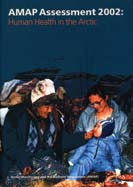
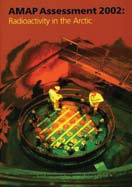
Previous AMAP Assessments of POPs, Human Health and Radioactivity
This report updates previous AMAP assessments published in 1997 and 2002.
2
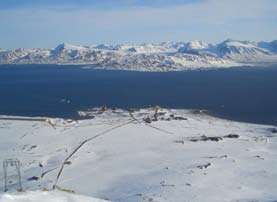
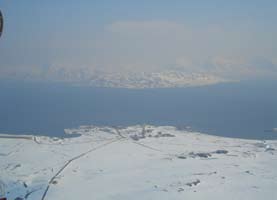
During the winter,
in the range of actual and potential sources and
periods of low pre-
highlights that non-nuclear industrial activities may
cipitation and strong
increase the release of naturally occurring radioac-
winds contribute to
tive substances to the environment. While previous
the formation of Arctic
assessments have mainly addressed the risks of ra-
haze. Pollution events
dioactivity related to human health, this assessment
can also occur at other
also addresses the impacts on Arctic ecosystems and
times of the year as
non-human biota. In addition, it includes a discus-
illustrated by these
sion of how climate change may affect radioactive
photos from Svalbard
contamination in the environment.
showing the results of
Common to al chapters is that climate change
pollution from agricul-
provides a new context for assessing the transport,
tural burning in Eastern
trends and potential impacts of contaminants in the
Europe combined with
an extreme weather
Arctic. This introduction therefore provides some
situation.
general comments about contaminant pathways
and climate change based on previously published
all
information.
ngv
Climate patterns affect contaminant
Ann-Christine E
transport
For POPs, this assessment provides some up-
In recent decades, much of the Arctic has experienced
dated information about changes in levels in the
a warming trend. In northwestern Canada, central
Arctic environment of persistent organic pol utants
Alaska, and eastern Siberia, the warming has been as
that are classified as `legacy' contaminants. The em-
much as 3.5°C during winter months. The eastern
phasis, however, is on persistent chemicals that are
Canadian Arctic and southern Greenland have seen
stil in use and new chemicals that have been added
a modest cooling trend, but the overal pattern in the
to the list of substances that may be of environmen-
Arctic has been warming. Permafrost has warmed
tal concern in the Arctic. They include brominated
and even thawed, sea ice has retreated, the treeline
flame retardants, fluorinated compounds, polychlo-
has moved northwards, and other ecosystem changes
rinated naphthalenes, and endosulfan along with
have taken place on land and at sea. The factors driv-
some discussion of other current-use pesticides and
ing climate change in the Arctic are the same as those
high-volume chemicals. The chapter also provides
acting globally: greenhouse gases, solar variability,
an update on the implications of POP exposure on
ocean processes, and volcanoes.
effects in Arctic wildlife.
Weather in the Arctic varies greatly on short and
For human health, new information is available
long time scales. Over the North Pole, there is a per-
about the levels of contaminants in humans and
manent wind pattern that creates the Arctic Polar
the impacts of contaminants on various aspects of
Vortex. Strongest in winter, this circulation pattern
human physiology and disease. The interaction of
produces high pressure areas over Siberia, the Yu-
lifestyle factors with contaminants is an emerging
kon, and Baffin Island, and low pressure areas over
topic of research, as is the potential role of genetic
the Aleutian Islands and the North Atlantic. These
characteristics in determining susceptibility to ef-
weather systems transport airborne contaminants
fects. Risk communication is examined in greater
to the Arctic. Some contaminants are removed
detail than has been done previously.
from the air by precipitation or deposition. Ocean
For radioactivity, this assessment provides an up-
currents also transport contaminants, though much
date on sources and potential sources of radioactiv-
more slowly than air currents.
ity to the Arctic environment, including the results
The Arctic Oscil ation Index reflects the relative
of efforts to reduce the risks associated with waste
air pressure at sea level in the High Arctic compared
handling and decommissioning of old nuclear-
with the mid-latitude North Atlantic, relative to a
powered equipment. It also discusses changes
50-year norm. A positive index indicates lower pres-
3
sure in the Arctic and higher pressure in the North
Atlantic. This changes winds and the circulation of
Contaminants transport pathways
seawater and ice in the Arctic Basin. More warm,
Contaminants reach the Arctic via a number of different pathways.
wet air is carried into the Arctic from the North
Winds provide a fast route for volatile contaminants and for substances
Atlantic. The waters from Russian rivers are carried
that adhere to small particles. Air transport is especially pronounced in
towards the Canadian Arctic Archipelago. Contami-
the winter. With rain and snow many contaminants are washed from the
nants from those rivers thus reach northern Canada
air and deposit on on the sea ice, open water, or on the ground, where
under a positive Arctic Oscil ation.
some of them end up in meltwater and rivers. Rivers carry contaminants
When the index is negative, Arctic air is colder,
and process them through sedimentation and resuspension of particles.
and cold air flows towards the mid-latitudes of
Lakes, deltas and estuaries can serve as sinks for contaminants in sedi-
North America and Eurasia. Russian river discharge
ment. Ocean currents are slow but important pathways for contami-
and sea ice are carried towards Fram Strait and the
nants that partly dissolve in water. In addition to the physical pathways,
North Atlantic, increasing contaminants exposure
migratory animals also play a role for contaminant transport in the
in East Greenland. The Arctic Oscil ation Index was
Arctic, and locally this pathway can be very important.
low and variable from the 1950s through the late
1980s, when it became strongly positive for about a
decade. Since 2000, the index has generally returned
a strong positive Arctic Oscillation. The result-
to its earlier pattern.
ing impacts on contaminant levels, trends, and
Other regional and global climate patterns and
geographical patterns are difficult to predict because
events can affect contaminant transport to the
many physical, chemical, and biological factors are
Arctic. In the North Atlantic, ocean currents carry
involved. Human exposure, for example, may be
warm, salty water northeast across the Atlantic to
affected by changes in the distribution of species
Scandinavia and the Barents Sea, producing rela-
that are hunted, resulting in different pathways of
tively warm weather for the latitude. Water from the
exposure. The release of contaminants from human
North Pacific flows northwards through the Bering
activity, too, is likely to change, with increases in
Strait, where water temperatures have been rising
some contaminants and decreases in others. Fur-
over the past three decades. Further to the south,
thermore, some effects of climate change will take
upwelling of warm water off the western coast of
place quickly, and others slowly. The fol owing are
South America produces an El Niño event. One
some examples of how climate change may affect
result of an El Niño is greatly increased wind trans-
contaminant pathways:
port towards Baffin Island, carrying contaminants
Higher temperatures at lower latitudes will
from southern latitudes to that region.
increase the volatilization of contaminants. Com-
Projections of future climate change in the
bined with increased air transport to the Arctic that
Arctic indicate that conditions are likely to resemble
occurs during strongly positive phases of the Arctic
The island of
Bjørnøya (Bear Island)
mid-way between the
Norwegian mainland
and Svalbard receives
contaminants trans-
ported by winds, ocean
currents and by biota.
teenhuisen
F
rits S
4
Oscil ation, the delivery of contaminants to the
Climate change may also make contaminants less
Arctic will increase. If precipitation increases, many
likely to remain in the Arctic. For examples, higher
contaminants will be taken from the air and depos-
temperatures and less sea ice can result in more re-
ited on the ground or in the water. Reduced sea ice
emissions of contaminants to the air where they can
increases the exchange of contaminants between the
be transported out of the Arctic more readily than in
ocean and the atmosphere. Deposition of airborne
the past. Changes in the flow of ocean water and sea
contaminants into the Arctic Ocean could increase,
ice may also increase contaminant transport south-
whereas other contaminants that have are currently
wards. The net influence of climate change on con-
stored in the ocean water may more readily be
taminant levels cannot therefore be easily predicted.
emitted from the ocean to the air.
Biological processes add further complexity.
As precipitation increases over land, river
Higher temperature wil affect the biological activity
flow wil increase, resulting in greater delivery of
but different processes can act in different direc-
contaminants to coasts. Depending on suspension
tions. For example, warmer water and ground will
processes close to the coast some of these wil reach
increase microbial activity, which could reduce the
the Arctic Ocean. The ocean circulation regime in
lifespan of some substances. However, as Arctic
the Arctic Basin could carry contaminants either
ecosystems become more productive in response to
through the Canadian Archipelago or via Fram
warming, the uptake of contaminants may increase,
Strait, exposing different parts of the Arctic to the
which could result in higher levels in biota.
increased contaminant burden.
5
Persistent Organic Pollutants
Introduction
Convention on Persistent Organic Pollutants. In
fact, the Stockholm Convention highlights the risk
When AMAP presented its first major assessment
that POPs pose to Arctic ecosystems and indigenous
of pol ution in the Arctic in 1997/98, available
people. It also emphasizes the Arctic as a region that
data showed that persistent organic pol utants
can serve as an indicator of chemicals being persist-
were ubiquitous throughout the Arctic, also in
ent and able to transport to the Arctic over long dis-
areas where they had never been used. As the name
tances from more southerly regions. In addition to
indicates, persistent organic pollutants (POPs) have
the Stockholm Convention, the data compiled for
chemical properties that make them very long-lived
the 1997/98 AMAP assessment played an impor-
in the environment. The presence of POPs in parts
tant role for the 1998 POPs Protocol of the United
of the Arctic where there are no human activities to
Nations Economic Commission for Europe (UN
explain the contamination showed that the northern
ECE) Convention on Long-range Transboundary
polar region served as a sink for pol utants that had
Air Pollution. At a regional level, the Arctic Council
been transported over long distances. Many of these
Action Plan to Eliminate Pollution of the Arctic was
chemicals accumulate in wildlife and people, where
launched and has led to a range of specific activities
they can reach levels that are much higher than in
to address sources in the Arctic. It has since evolved
the surrounding water or air.
into a working group within the Arctic Council:
Many POPs are also toxic and can harm both
the Arctic Contaminants Action Program.
people and wildlife when levels in the environment
For POPs that are classified as legacy contami-
are high enough. Data in the 1997/98 AMAP as-
nants because their use has been mainly in the past,
sessment showed the levels of POPs in the Arctic
this assessment provides updated information about
were high enough to cause concern for human
the levels in the Arctic environment, including some
health among some indigenous populations and
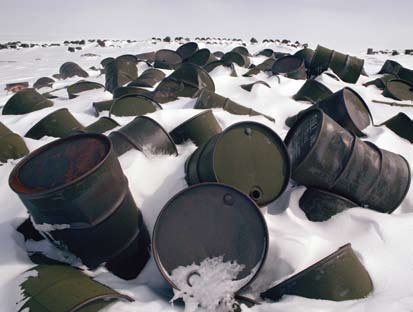
Oil drums discarded
good news about declining levels of substances that
by the U.S. military on
for the health of some marine mammals and birds.
have been regulated or banned. However, many
the Melville Peninsula,
This general picture was confirmed in AMAP's 2002
persistent chemicals are still in use and new chemi-
Nunavut, Canada.
assessment, where the authors presented a tentative
conclusion that POPs might be affecting the ability
of polar bear populations to reproduce. The 2002
assessment also highlighted that levels of POPs were
high enough to affect the ability of polar bears to
fight infections and influence the reproductive be-
havior of some seabirds. Concerns for human health
were also confirmed, leading to discussions about
the need to find ways to reduce the intake of con-
taminants. However, the only long-term solution to
the high levels of POPs in the Arctic is to reduce the
emission of POPs into the environment.
The increased knowledge about the POPs in the
Arctic has had political impact. The 1997/98 assess-
y Alexander
ment and the data it presented played an important
role in negotiations resulting in the Stockholm
B
r
yan and Cherr
6
As old BFR-
cals have been added to the list of substances that
containing products
may be of environmental concern. Among these,
are discarded, wastes
AMAP's 2002 assessment highlighted brominated
may continue to be a
chemicals that impart fire resistance and fluorinated
source to the environ-
compounds that provide stain and water repel ency.
ment long after use of
Other chemicals that raise concern include pesti-
specific BFRs in new
cides that are still in wide-spread use. This chapter
products has been
provides a thorough assessment of levels and trends
restricted or banned.
in the Arctic of brominated flame retardants, fluori-
uir
nated compounds, polychlorinated naphthalenes,
ek M
and endosulfan along with some discussion of other
er
D
current-use pesticides and of high-volume chemi-
into the framework of international regulation. A
cals. It also provides an update on trends of legacy
key concern is to identify those substances that are
POPs and a discussion of the implications of POP
persistent, can travel far in the environment, accu-
exposure on effects in Arctic wildlife in the context
mulate in plants, animals and their ecosystems, and
of other environmental stressors. Major conclu-
are toxic. Based on past experience and increased
sions are presented in a summary at the end of the
knowledge about the physical pathways and behav-
chapter. Implications for people living in the Arctic
ior of POPs in the environment, the Arctic has been
are discussed in the chapter Human Health.
highlighted as an indicator region for the persist-
Conventions provide policy context
ence of chemicals and their ability for long-range
transport. The presence of chemicals in the Arctic
Several global and regional conventions are relevant
environment is thus a warning signal to policy mak-
for POPs. The Stockholm Convention on Persistent
ers that there is a need for regulation. This chapter
Organic Pol utants addresses twelve priority POPs,
highlights several groups of chemicals where new
while the POPs protocol of the UN ECE Conven-
data indicate a need for further action.
tion on Long-range Transboundary Air Pol ution
(UN ECE LRTAP) covers an additional four. The
Brominated flame retardants
overall aim is to phase out deliberate production and
Brominated flame retardants (BFRs) are chemi-
use and to reduce or eliminate inadvertent emis-
cals used in materials to make them fire resistant.
sions from industrial processes. The North-American
They are organic compounds containing bromine
Commission for Environmental cooperation initia-
atoms. BFRs have been used in a range of products
tive on the Sound Management of Chemicals is an-
including polyurethane foam, plastics for electronic
other relevant treaty for international POPs manage-
equipment, circuit boards and extruded plastic
ment. For details on these conventions see page 34.
(Styrofoam), textile used for furniture, carpets and
As the production and use of regulated POPs
curtains, rubber for coating wire, etc. Many coun-
declines, new input into the environment will even-
tries have legislated high fire safety standards, which
tually cease. However, because of their characteris-
has led to an increased use of flame retardants. The
tics, POPs wil remain in the environment for many
different technical products are presented in more
decades as a legacy of past use. POPs that have been
detail on the next page.
banned are sometimes referred to as legacy POPs.
The previous AMAP reports have thoroughly as-
Similarities to POPs
sessed the distribution and impacts of legacy POPs.
BFRs have many chemical characteristics that
The growing knowledge about POPs and how
make them behave in ways that are similar to legacy
they behave in the environment have raised concern
POPs. Some BFRs transport over long distances and
about several groups of chemical that are stil in
accumulate in aquatic food webs. BFR exposure in
use but have not been studied for as long as the
wildlife can lead to similar as wel as different effects
legacy POPs. The Stockholm Convention and the
compared to legacy POPs, where the effect depends
POPs Protocol of UN ECE LRTAP Convention
on the chemical structure and which biochemical
have defined procedures for adding new substances
processes are "disrupted." Monitoring levels in the

7
environment and possible adverse effects on wildlife
the Stockholm Convention for consideration in in
have therefore been a high priority and indications of
2009 and the UN ECE POPs Protocol.
potential problems have led to bans on some BFRs.
DecaBDE is used in plastics such as high impact
The understanding of biological effects of BFRs
polystyrene in electrical equipment, in coating for
is not as developed as for legacy POPs. How-
wiring as wel as in textile back coating for furniture.
ever, for some compounds, studies on laboratory
In most countries, there are currently no restriction
rodents have shown toxic effects. For PBDEs, these
on the production and use of DecaBDE. However,
include effects on the immune system, neurotoxic
a recent court ruling on the EU directive on the
effects, and effects on thyroid and sex hormones
restriction of certain hazardous chemicals has led to
and reproduction. Other BFRs affect the liver and
its ban within the European Union as of July 2008.
thyroid hormone systems, and cause neurobehav-
HBCD: Hexabromocyclododecane
ioral changes (HBCD and TBBPA) or effects on
reproduction (TBBPA).
Technical HBCD is used in expanded and extruded
polystyrene foams (EPS and XPS respectively). Such
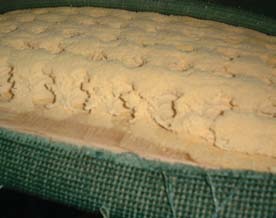
Consumer products are sources to the
foams are used for insulation in buildings and in
environment
roads to prevent frost-heaving. HBCD is also used
Most BFRs are added into products during manu-
in textile back-coating of furniture. As of 2008,
facture and are not chemical y bound to the material.
there were no restrictions on the production and
These may migrate out into the environment. Others
use of HBCD. A risk assessment is currently being
react chemical y with the material. For these BFRs,
completed within the European Union. HBCD
the risk of migration into the environment is mainly
has been proposed for inclusion in the Stockholm
connected to the chemical reactions not being com-
Convention but is only at the proposal stage and a
plete thus leaving a residue that can migrate. BFRs
risk profile will not be prepared before 2010.
can also enter the environment when the material
TBBPA: tetrabromobisphenol A
is destroyed, for example when it is burned as trash
or left on dumps where it is exposed to sunlight and
TBBPA is used primarily as a reactive flame retard-
other factors that break down plastics. The long life
ant in printed circuit boards, and is thus chemi-
time of products with BFRs wil lead to continued
cally bound to material in electrical and electronic
release into the environment several decades after
equipment such as TVs, computers, printers, fax
the production and use of a certain BFR has ceased.
machines, cell phones, videos, washing machines
Some BFRs have for example been found at relatively
etc. It is also increasingly being used as an additive
high levels in sewage sludge.
flame retardant in hard plastics, as a replacement for
banned BFRs. As of 2008, there were no restric-
Technical products and their regulatory status
tions on the production or use of TBBPA. A risk
HBCD is used as a
assessment has recently been performed within the
fire retardant in building
Polybrominated diphenyl ethers: PBDEs
European Union with the conclusion that, gener-
insulation materials.
There are three technical PBDE products: PentaBDE,
OctaBDE and DecaBDE. The major difference is the
number of bromines in the major compounds in the
mixture of brominated diphenyl ethers. PentaBDE
has been used in polyurethane foams (mattresses, fur-
niture, pil ows) and in adhesives, while OctaBDE has
been used in hard plastics such as computer casings
and monitors. Penta- and OctaBDE were banned in
the European Union and in Norway in 2004, includ-
ing a ban on import and export of products contain-
ing these BFRs. The sole manufacturer of Penta/
OctaBDE in the United States voluntarily discontin-
ued production at the end of 2005. Both compounds
are on a list of chemicals proposed for inclusion in
S
hutterstock
8
ally, no health and environmental risks were identi-
Transport and pathways to the Arctic
fied with TBBPA when used reactively but that
there is a need for specific measures to limit risks
The atmosphere provides a route for long-range
when TBBPA is used as an additive flame retardant.
transport
Moreover, there is a need for further information to
Knowledge about the transport of BFRs to the Arctic
determine whether TBBPA can break down by los-
comes mainly from air samples, where information
ing bromine atoms and eventually form bisphenol
about the levels and how they change over short time
A, which is a hormone-disrupting compound.
spans can be used to model how these compounds
Other BFRs
move in the atmosphere. Results from such studies
show that several BFRs are capable of long-range air
In addition to the brominated compounds that have
transport. In many cases the composition is similar
been subject to policy discussions, a range of other
to the technical PBDE products. Models for the
brominated flame retardants have been used or are
transport of PBDEs show that characteristic travel
still in use. Some of them have already been banned.
distances in air vary from below 500 to wel over
Others are considered possible substitutes for prod-
2000 kilometers.
ucts that are known to have POP characteristics.
Compared to PCBs, the Penta- and OctaBDEs
The following are some examples:
appear to have slightly less potential to contaminate
· polybrominatedbiphenyls(PBB),production
the Arctic. The reasons are that they degrade more
has also ceased;
efficiently in sunlight in the atmosphere during
· decabromodiphenylethane(DBDPE),consid-
their transport. PBDEs are less volatile mak-
ered an alternative to DecaBDE;
ing them bind to particles. When there are large
· 1,2-Bis(2,4,6-tribromophenoxy)ethane
numbers of particles in Arctic air, which is the case
(BTBPE), Hexabromobenzene (HxBBz);
during Arctic haze events, the transport of PBDEs
Pentabromoethylbenzene (PBEB); Pentabro-
does take place. Therefore, periods of strong winds
motoluene (PBT); and 1,2-Dibromo-4-(1,2-di-
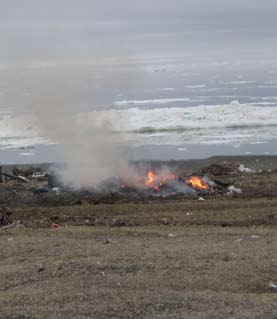
Open burning is
bromoethyl)cyclohexane (TBECH), considered
common in Arctic and
alternatives for Penta- and OctaBDE.
sub-Arctic communi-
ties where municipal
Production, import and export
waste is not recycled
The United States is the only Arctic country that is
and cannot be placed
in control ed landfil s or
currently producing BFRs. An inventory in 2002 of
burned in a control ed
the use of BFRs in the Arctic countries showed that all
manner. Such open
countries that took part the inventory (all except Ice-
burning can cause local
land) imported BFRs to use in manufacturing of vari-
emission of BFRs from
ous products. In turn, the Arctic countries exported
the products that are
goods that contained BFRs to other countries. There
burned.
were many uncertainties in import/export numbers
but in general Scandinavian countries and Russia have
lower use of BFRs than Canada and the United States.
uir
ek M
The table below shows the annual world-wide market.
er
D
Estimated annual worldwide market demand of BFRs in 2001 by region, and total estimated demand in 2002 and 2003
(metric tonnes).
PentaBDE
OctaBDE
DecaBDE
TBBPA
HBCD
Americas
7100
1500
24500
18000
2800
Europe
150
610
7600
11600
9500
Asia
150
1500
23000
89400
3900
Total (2001)
7500
3790
56100
119700
16700
Total (2002)
-
-
65700
150600
21400
Total (2003)
-
-
56400
145100
22000
9
and no precipitation may lead to longer transport
Concentration
distances than the models predict for PBDEs. This
in air, pg/m
PBDEs
includes DecaBDE, which is entirely found on
25
BDE-209
particles and may be capable of long-range trans-
20
port with Arctic haze aerosols. This behavior could
other BDEs
15
possibly explain episodes of higher PBDE levels
10
BDE-99
in air at Alert in northern Canada, but this needs
5
BDE-47
to be further verified. The highest air concentra-
0
tions of PentaBDE at the Tagish and Alert sites in
10
passive air sampler
Canada were associated with local trash burning.
5
PBDE measurements
(winter 2004-2005)
0
BFRs enter terrestrial food webs
HBCD
06
10
BFRs that are not degraded in the atmosphere will
07
5
eventual y be deposited. PBDEs as wel as TBBPA
0
and PBBs have been found in soil and vegetation
far from emission sources. The concentrations are
quite low compared to legacy POPs. For PBDEs, the
composition is similar to the technical PentaBDE
PBDEs in Arctic air.
product. The presence of these compounds in Arctic
Particles in Arctic haze
vegetation is further evidence that not only the
allow BFRs to transport
PentaBDEs undergo long-range transport in air but
to the Arctic from more
also components of the DecaBDE product, TBBPA
southerly source re-
and PBB.
gions. This may include
BFRs can enter the Arctic food web when ani-
DecaBDE, which was
mals eat contaminated vegetation. At lower levels
previously thought not
in the terrestrial food web, BFRs have been low
to transport over long
distances.
in the few species that have been studied (frogs,
reindeer, grouse, moose and hares from either
Recent screening
northern Norway, Sweden or Russia). For PBDEs,
studies have found
the composition is similar to the technical Penta-
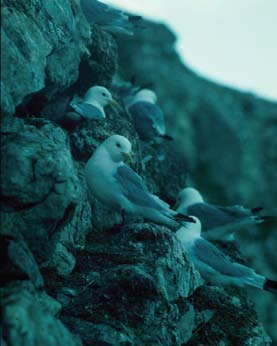
siloxanes in kittiwakes
BDE product. Terrestrial mammals that feed on
from Svalbard.
the herbivores (e.g. lynx from Norway) and birds of
Seabirds are respon-
prey (peregrine falcon from Sweden, Norway and
sible for local contami-
Greenland, golden eagles and merlins from Nor-
nation of some Arctic
way) have higher levels. HBCD, TBBPA, and some
abrielsen
lakes where contami-
PBBs have also been found in birds of prey. The
ing G
nants are deposited in
W
presence of these contaminants in predatory birds
eir
G
seabird guano.
shows that BFRs can enter the terrestrial food web.
Lake sediment and freshwater fish provide varied
picture
Lakes and rivers can potential y receive BFRs from
air as wel as from local sources, such as landfil s,
and from seabird guano. Like most POPs, BFRs
nstitute
tend to associate with particles rather than the water.
olar I
Measurements of lake sediment show that a few lakes
egian P
in the remote Arctic have higher concentrations than
w
or
lakes in industrial areas. A likely explanation for these
tr
øm/N
very elevated concentrations is that these lakes receive
d S
ar
BFRs from seabird guano. General y, however, data
allv
H
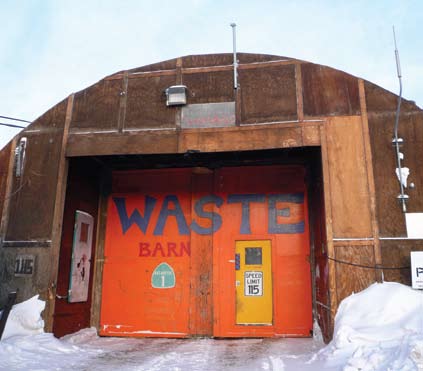
10
from Arctic lakes showed higher input at more south-
the river water. The composition indicates techni-
erly sites in Alaska than in northern Alaska, Canada
cal PentaBDE as the major source. The levels are
and Greenland. This may be an effect of the relative
general y low. The estimated fluxes of sumPBDEs to
proximity to densely populated areas.
the Kara Sea were 1.92 kilograms per year from the
The BFR load in lakes is also reflected in fresh-
Yenisey and 1.84 kilograms per year from the Ob.
water fish, with variations in levels across the Arctic.
The data confirm suspicions that rivers can serve as
PBDE concentrations were highest in fish from
sources to the Arctic basin.
lakes in the Yukon and much lower in fish from
Several BFRs have reached the marine environment
northern Norway and Alaska. Lake El asjøen on
Bjørnøya is a hot spot for PBDE because of input
Sediment data for the marine environment are avail-
of seabird guano. High levels have also been found
able from the Canadian, Norwegian and Russian
in fish from one site in the Canadian Arctic near an
Arctic. Levels of PentaBDEs range from low at many
airport. The chemical signature in fish from Canada,
background sites to higher levels at a site with suspect-
Norway, and Alaska confirms technical Penta-BDE
ed local contamination at Polyarnyy, Russia. Com-
as the most likely source.
pared to legacy POPs the background levels are low
Lake sediment provides an archive of previous
but higher than in freshwater sediment. HBCD was
emissions to the environment. Studies of sediment
also detected in sediments outside of Tromsø, Norway
cores from lakes in Arctic Canada and Greenland
(Tromsøflaket) and in the Barents Sea. DecaBDE was
indicate an increasing input of PBDEs over time. The
found only in the Tromsø area sediments, while levels
maximum signal of PentaBDE occurred earlier than
of TBBPA were below detection limits.
the signal for DecaBDE, which was increasing up un-
For marine zooplankton, earlier reviews have
til the most recent layer (representing the late 1990s).
reported very low levels of BFRs. New results indi-
cate that some invertebrate species that scavenge on
Rivers are sources to the Arctic Ocean
dead animals in the water may be exposed to higher
Rivers are known to be important sources of
concentration, probably because they feed high in
contaminants to the Arctic Ocean. Measurement of
the food web. These BFR levels are more similar to
BFRs upstream in the Ob and Yenisey in Russia as
mammals and birds high in the marine food web,
wel as measurements in their estuaries and further
such as ringed seals and glaucous gul s. The levels
out in the Kara Sea show that BFRs are present in
in marine zooplankton still are about ten times
The use of BFRs is reflected in the immediate
environment. An illustrative example is a study of
untreated sewage sludge, marine sediment, inver-
tebrates and fish close to two research stations in
Antarctica. At the US base McMurdo, the levels of
PentaBDEs in fish were as high as in urbanized ar-
eas of North America and decreased with distance
from the sewage outfall. Levels at McMurdo were
much higher than at a nearby New Zealand base,
reflecting the lower use of BFRs in equipment
and furnishings at the New Zealand station. Such
influence of local use along with measurements
showing high levels in sewage sludge indicate
that use of material and equipment treated with
flame retardants can potentially be a significant
local source of BFRs from release of untreated sew-
age sludge in Arctic communities to local waters.
There is no such detailed study for the Arctic but
ding, NSF
ar
some measurements indicate higher levels closer
Lisa H
to settlements.
The McMurdo Station waste barn.
11
lower than PCB concentrations in the same species.
Concentration in
Relatively high levels of BFRs have also been found
eggs of alcids,
ng/g lw
in bottom-dwelling invertebrates as well as in ice-
range
200
50
associated amphipods.
BFRs have also been measured in marine fish,
160
40
including several species of cod, tusk, Greenland hali-
120
30
but, shorthorn sculpin, starry ray, sea-run char, and
80
20
salmon from different regions. PBDE levels range
40
10
from 2 to 480 nanogram per gram (lipid weight),
0
0
which is much lower than for legacy POPs, such as
PBDEs
HBCD
PCBs. Species differences reflect where the fish live
and their position in the food web, with the highest
levels found in Atlantic cod from southwest Green-
land. The low levels in wild salmon were similar to
those found in farmed salmon. The composition of
BFRs in fish indicates technical PentaBDE as the ma-
jor source, but there are also some data showing that
HBCD and TBBPA have reached marine fish. In a
study from Greenland, levels were general y higher
near human settlements, indicating they may serve as
direct local sources in the Arctic.
Seabird eggs are often used to monitor levels of
contaminants in the marine environment. They
reflect the contaminants col ected by the female
birds. Eggs col ected from Prince Leopold Island,
Lancaster Sound, Canada, show that levels of PBDEs
high in the Arctic context, they are about ten times
PBDEs and HBCD in
in thick-bil ed murre and northern fulmar increased
lower than those found in ringed seals from the Baltic seabirds.
rapidly from 1975 to 2003. The highest levels are still
Sea. Compared to East Greenland, levels are much
an order of magnitude lower than those reported for
lower in West Greenland where they are similar
marine birds in the pol uted Baltic Sea in 1999 and
to the western Canadian Arctic and Alaska. The
may now be decreasing. Levels in eggs col ected in
Alaskan samples also have a different composition of
Greenland are similar to the Canadian Arctic, while
PBDEs in the blubber that probably reflects the long
levels in eggs from Svalbard and northern Norway
distances from PBDE sources and that some PBDEs
are higher. The highest levels were found in glaucous
degrade during long-range transport.
gulls. Compared to legacy POPs such as PCBs, the
Even in the areas with relatively high PBDE lev-
PBDE levels in the eggs are much lower, but the pres-
els, the contamination is much less than for PCBs.
ence of PBDEs shows that they have the potential to
For example samples from East Greenland showed
accumulate in the marine food web. Other BFRs that
15-60 times lower concentrations of sumPBDEs
have been found in Arctic seabirds are PBBs, HBCD,
than sum of ten PCBs in the same sample.
DecaBDE and BTBPE. The Figure above provides
There are fewer measurements of other BFRs
an overview of the levels of BFRs in seabirds across
compared to the PBDEs and the only compound
the Arctic.
that has been detected in ringed seals is HBCD. The
Ringed seals occur across the Arctic and are often
difference between East and West Greenland that
used for investigating how levels of contaminants
was seen in PBDE levels is also apparent for HBCD
differ geographically in the Arctic marine ecosystems.
but is less pronounced.
Most studies have focused on PBDEs. The high-
Whales from Alaska, a number of sites in Canada,
est concentrations are found in ringed seals from
Greenland, Svalbard, and northern Norway have also
Svalbard and, slightly lower but in the same order of
been analyzed for BFRs, mainly PBDEs. The species
magnitude, East Greenland. Although these levels are
include beluga, narwhal, kil er whale and minke
12
Concentration in
whale. The levels of PBDEs are highest in popula-
beluga, ng/g lwrange
tions of off-shore kil er whales off the coast of Alaska.
100
5
PBDEs and HBCD in
80
4
blubber
These killer whales migrate south to California in the
beluga.
60
3
liver
winter. They also feed high in the food web and the
40
2
combination of these factors exposes them to more
20
1
contaminants than kil er whales that remain in the
0
0
Arctic or feed lower in the food web. Similarly high
PBDEs HBCD
concentrations have previously been found in long-
finned pilot whales from the Faroe Islands, which is
also a migratory species.
Similar to the picture for seals, the PBDE levels
in beluga are higher in Norway compared to the
Canadian Arctic. Also, the levels of PBDEs in the
Arctic beluga are much lower than in locally pol-
luted areas such as the St. Lawrence estuary. Other
BFRs found in whales are HBCD, BTBPE and
TBECH.
Concentration in
ringed seal blubber,
Polar bears are the top predators in the Arctic
ng/g lipid weightrange
marine food web. For some legacy POPs (i.e.
50
PBDEs in ringed
PCBs), contaminant levels are higher in polar
40
seals.
bears than any other species and high enough
30
20
to affect their health. In contrast to for example
10
PCBs, levels of PBDEs do not increase with the
0
age of the animal.
PBDEs
Measurements of PBDEs in polar bear are avail-
able from a range of sites including Alaska, Canada,
Greenland, and Svalbard. In general, bears from
East Greenland and Svalbard seem to be exposed
to higher concentrations compared to bears from
North America, which is the same geographical pat-
tern that has been seen in other marine animals and
for legacy POPs. Another BFR that has been found
in polar bears is HBCD, with the same geographical
pattern as for PBDEs.
Concentration in
polar bears,
ng/g lw
Spatial trends follow common POP pattern
100
range
PBDEs and HBCD in
When looking at data from air, sediment, and
80
polar bears.
60
several animal species, certain patterns emerge
40
that can give information about source regions for
20
contaminants and how the compounds travel over
0
PBDEs HBCD
long distances.
In general, the air concentrations of PBDEs
decline from south to north. For example, measure-
ments show higher levels in mid-latitude East Asia
compared to the Northern Pacific and even lower
levels into the Bering Sea. PBDE concentrations also
decline from south to north in lake sediments in
Alaska and Canada (excluding hot spots). This shows
that the major source regions are south of the Arctic.
13
The levels in top predators from the marine envi-
were narwhal > redfish clams > shrimp > beluga >
ronment are generally higher than in the terrestrial
zooplankton > walrus > arctic cod.
environment. This difference is most likely due to
In conclusion, although there are differences in
longer food chains in the marine environment and
the magnitude of biomagnification of single PBDE
subsequent increased biomagnification.
congeners, both PBDEs and HBCDs have consider-
For the animals that have been studied, the
able potential to biomagnify in both marine and
Arctic region that is most contaminated is the East
terrestrial environments.
Greenland-Svalbard area, with lower concentrations
in the Russian and Canadian Arctic and the lowest
Time trends with mixed messages
concentrations in Alaska. The same pattern is seen
Are BFR levels increasing or declining? This simple
for HBCD although the data are more limited.
question does not currently have a simple answer.
This is in spite of much higher use of PentaBDE
Air samples from Alert, Nunavut, from 2002 to
in North America than in Europe. The geographic
2004 show that the levels for eight different PBDE
pattern of PBDE contamination in seabirds and
congeners were increasing. PBDEs were still found
in the marine mammals in the Arctic appear to
to be increasing in 2005 at Alert.
fol ow what has previously been shown for PCBs
Sediments generally cover a much longer time pe-
and other legacy POPs. They reflect dominating
riod. Sediment from Lake El asjøen on Bjørnøya shows
pathways for these contaminants, where winds and
that PBDEs are present in the sediment layer repre-
ocean currents from Europe and eastern North
senting the years 1946-1959. Signals of HexaBDE
America converge in the Eastern Greenland and
only appears in the surface sediment (1987-2001). The
Svalbard regions.
summed concentrations represent a more than five-
fold increase in PBDE levels over the past 50 years.
PBDEs and HBCD biomagnify
This historic increasing trend in sediment is
The data from marine animals show that PBDEs
reflected in some animals from which there are time
accumulate in the marine food web and that con-
trends available. These include Arctic char, lake
centrations magnify between some trophic levels, es-
trout, burbot, seabird eggs, ringed seal, and beluga
pecially from fish (e.g. polar cod) to fish-eating seal.
from Canada, ringed seal from Greenland, cod from
However, polar bears seem to be able to break down
the Barents Sea, and seabird eggs from Svalbard.
many PBDEs so that biomagnification is low from
However, the picture that emerges for more recent
seals to polar bears, except for hexaBDE. In general,
years is more complicated. Most studies report
the body burden of marine animals high in the food
increases of PBDEs in the Arctic, but in some stud-
web consists of PentaBDEs. For example, tissues of
ies the most recent data points are below previous
polar bears generally contain high proportions of
maximum concentrations. This may be an early
PentaBDEs with no detectable PBDEs higher than
indication that PBDE concentrations have stagnated
hepta-brominated.
or declined in the past two to five years.
Some studies have used models to estimate the
An example of the uncertainty in recent trends
biomagnification factors for PentaBDEs. Assuming
is that studies of ringed seal in eastern and western
that the animals cannot break these compounds
Canada and East Greenland and northern fulmar
down, seabirds, marine mammals and terrestrial
in Canada indicate a recent decline, while PBDE
carnivores have the highest biomagnification factors,
levels in ringed seal from Hudson Bay and West
almost up to 100. Components of DecaBDE are
Greenland have continued to increase. Another
modeled to biomagnify in marine mammals and
example of mixed messages is that land-locked char
terrestrial carnivores with factors up to 8.
from Resolute Bay in the Canadian Arctic showed a
For HBCD, the pattern of bioaccumulation/bi-
marked increase in 2006 while samples from Char
omagnification is similar to PBDE but the data are
Lake from 1999 to 2005 show constant concen-
too scarce to assign numeric values to the biomagni-
trations and results from Lake Amituk show an
fication potential. It is mainly the alpha-isomer that
increase from 2005 to 2007 but at lower levels than
biomagnifies. In a food-web study in Arctic Canada,
for the years 2001-2003. In the marine environ-
the overal rank order of HBCD concentrations
ment, levels in ivory gul eggs from Seymour Island
14
PBDE in burbot liver, ng/g lipid weight
PBDE in beluga, ng/g lipid weight
HBCD in beluga, ng/g lipid weight
35
35
3.5
Fort Good Hope
Hendrickson Island
Hendrickson Island
30
30
3.0
25
25
2.5
20
20
20
15
15
1.5
10
10
1.0
5
5
0.5
0
0
1980 1985 1990 1995 2000 2005
0
1980 1985 1990 1995 2000 2005
1980 1985 1990 1995 2000 2005
PBDE in ringed seals, ng/g lipid weight
PBDE in ringed seals, ng/g lipid weight
35
35
Holman Island
Western Greenland
30
30
25
25
20
20
15
15
10
10
5
5
0
0
1980 1985 1990 1995 2000 2005
1980 1985 1990 1995 2000 2005
PBDE in seabird eggs, ng/g lipid weight
PBDE in beluga, ng/g lipid weight
HBCD in beluga, ng/g lipid weight
35
35
3.5
Prince Leopold Island
Pangnirtung
Pangnirtung
30
30
3.0
Thick-billed murre
25
25
2.5
Northern fulmar
20
20
2.0
15
15
1.5
10
10
1.0
5
5
0.5
0
0
0
1980 1985 1990 1995 2000 2005
1980 1985 1990 1995 2000 2005
1980 1985 1990 1995 2000 2005
Time series of PBDEs
in the Canadian Arctic indicate a steady increase in
Environmental levels of PBDEs and HBCDs
and HBCD in Arctic
PBDE from 1976 to 2004, while concentrations
have followed the production and use of BFRs
wildlife.
of HBCD decreased during the same period. In
with increasing levels up until the early 2000s,
ringed seals from western Hudson Bay and the cen-
which are now starting to level off or decline, at
tral Canadian archipelago both PBDEs and HBCD
least in some areas.
increased from 1992 to 2005.
For TBBPA more data are needed to assess its
In summary, environmental levels of PBDEs
potential to undergo long-range transport, but it
and HBCDs have fol owed the production and use
does show up in Arctic wildlife at very low levels.
of BFRs with increasing levels up until the early
PBB is only included in a few studies. It may be
2000s. They may now be starting to level off or
prevalent but the methods for measuring it make it
decline, at least in some areas.
difficult to separate this technical product from one
of the PBDE congeners.
Conclusions for brominated flame retardants
Other BFRs that have been detected in occa-
The accumulating evidence from air samples and
sional samples include BTBPE, HxBBz, PBEB and
measurements in vegetation and animals shows
PBT. The scarce measurements that are available
that Penta- Octa- and DecaBDE can transport
indicate that they may reach the Arctic and ac-
over long distances and accumulate in Arctic biota.
cumulate in animals high in the food web. This is
Similar to the PBDEs, it is now clear that HBCD is
a warning sign that they also undergo long-range
ubiquitous in the Arctic, that it undergoes long-
transport and that levels in the environment may
range transport, that it accumulates in animals and
increase over time. However, more data are needed
that some components biomagnify.
to assess whether they qualify as POPs.
15
Fluorinated compounds
used by various companies since the 1970s to
make fluorotelomer-based chemicals. The bulk of
Poly- and perfluorinated compounds (PFCs) are
products from these processes have been used in
organic molecules with fluorine atoms attached. They
the manufacture of fluoropolymers, which are used
have gained attention as potential POPs only recently,
for making materials repel oil, stains, grease, and
although they were commercialized over 40 years
water, and as non-stick surfaces on cookware.
ago. Environmental concerns were initial y raised
The major fluorinated compounds that have
when one of the major compounds perfluorooctane
sulfonate (PFOS) was detected at relatively high
been measured in the environment are the
levels in wildlife in 2001. Since then, PFOS and the
perfluorinated sulfonates, of which PFOS is the
related compounds have been detected global y, even
best known, and the perfluorinated carboxylates
in remote regions such as the Arctic.
(PFCA), of which PFOA (perfluorooctanoic acid)
The recognition of fluorinated compounds as
is a well known example.
Arctic contaminants was the result of advances
PFOS and other perfluorinated sulfonates (PFSAs)
in chemical analysis in the late 1990s. Studies of
archived wildlife samples and sediment cores have
From the 1950s to 2002, the 3M Company was
since then shown that these substances have been
the main manufacturer of perfluorooctane sulfonate
present in the Arctic since at least the 1970s and
(PFOS) and some related compounds. Manufac-
possibly earlier. Many fluorinated compounds are
turing of PFOS has continued in China, which is
extremely persistent in the environment.
believed to be the world's leading producer. The
primary use of PFOS was as a surfactant in fire
Use and production
fighting foams. However, PFOS represented only a
There are two major production processes for
smal amount of the compounds manufactured in
manufacturing fluorinated compounds. One
the chemical process that 3M used. The bulk of the
came into use in 1949 and has mainly been used
products were used in the manufacture of stain repel-
by the 3M Company. The other process has been
lents in carpets, textiles, and food packaging.
The chemical terminology of fluorinated compounds
The fluorinated compounds are named based on the lengths of the carbon chain and the functional group
that has been attached.
One common class of fluorinated compounds is the perfluorinated sulfonates (PFSAs) which are signified
by "S" in the final letter of the acronym (e.g. PFHxS, PFOS, PFDS). PFOS which is the major perfluorinated
sulfonate is built on an eight-carbon skeleton with a sulfonate group at one end and fluorine atoms at
all other carbon bonds. Fully fluorinated compounds such as PFOS are referred to as perfluorinated. Other
perfluorinated sulfonates have longer or shorter carbon chains, e.g. perfluorohexane sulfonate (PFHxS, with 6
carbons) and perfluoroheptane sulfonate (PFHpS, with 7 carbons).
There are several additional perfluorinated compounds that have a similar structure but have other functional
groups. These include the perfluorinated sulfonamides (acronym = FOSA) and the sulfonamide alcohols (acro-
nym = FOSE).
Another group of compounds are the perfluorocarboxylates (PFCAs). Examples are PFOA, PFNA, PFDA.
Analogous to the sulfonates, the third letter indicates the length of the carbon chain (octa/eight, nano/nine
and deca/ten carbons respectively). The last letter A signifies that the compound has a carboxylic acid
functional group.
A third group of compounds is the fluorotelomer alcohols (abbreviated FTOHs). As the name implies, these
compounds have an alcohol functional group.The FTOHs are known to degrade in the atmosphere, microbi-
ally, and in animals to the PFCAs.
16
PFOS can directly enter the environment through
PFOA and other perfluorocarboxylates (PFCAs)
impurities in commercial products and as emissions
Perfluorinated carboxylates (PFCA) are a class of
during the manufacturing process. Further, PFOS
fluorinated compounds with a carboxylate function-
can be formed through the degradation of other
al group, of which PFOA is the best known. PFOA
fluorinated compounds in the atmosphere and by
and the related compound perfluorononanoate
wildlife and humans.
(PFNA) are produced in large quantities. They are
Despite the recent reductions in production,
used as aids in the production of some fluoropoly-
PFOS is the most common of the perfluorinated
mers (e.g. Teflon®) Several other compounds from
sulfonates in the environment. In addition to the
the same chemical process are incorporated into
eight-carbon PFOS, low concentrations of 6-carbon
commercial products, such as stain repel ents, from
and 10-carbon fluorinated sulfonates are occasional y
which they may be released to the environment.
found. The precursor compounds are prominent in
The PFCAs in the environment have two
the atmosphere and have been detected in a small
sources: the direct production and the degradation
number of wildlife samples.
(atmospheric or biological) of other fluorinated
At the end of the 1990s, the US Environmental
chemicals that are released from the products in
Protection Agency started investigating the need to
which they are used (e.g. from treated carpets).
regulate PFOS based on the fact that it was present in
The PFCA that has received most attention is the
human blood samples from the general population.
eight-carbon PFOA. PFOA is detected in only very
In addition, there were concerns about its persistence,
low levels in Arctic wildlife. In general, it is the longer-
bioaccumulation, and potential toxicity. In 2001, the
chain PFCAs 9 to 11 carbons that dominate.
3M Company announced a voluntary phase out of
its PFOS-based chemicals. The 3M Company has
National and international regulations are
been using compounds based on a four-carbon chain
discussed
as a replacement to the previous chemistry based on
Regulation of fluorinated compounds is being dis-
eight carbons. However, since 2003 China has been
cussed in both international and national contexts.
manufacturing PFOS in increasing amounts.
PFOS has recently been nominated as a candidate
Sources of PCFAs
Direct sources
Indirect sources
in the environment.
Pies represent relative
PFCA manufacture
POSF-based products
magnitudes of different
Ammonium
per uorononanoate
sources; values are in
Aqueous re ghting
(APFN)
foams (AFFF)
tonnes.
Ammonium
per uorooctanoate
Degradation
(APFO)
470-900
PFCA
24-190
impurities
PCFAs in the
Industrial, consumer uses
environment
Fluorotelomer-based
Other consumer,
products
AFFF products industrial products
Fluoropolymer
processing
6-160
(APFN)
3200-6900
Fluoropolymer
manufacture
(APFN)
Fluoropolymer
dispersions
Fluoropolymer
manufacture (APFO)
Units for blue values = tonnes (estimated total global; historical PFCA emissions
1950-2004; estimated total global production in period is 4400-8000 tonnes (3600-5700 PFO/APFO and
800-2300 PFN/APFN); source Prevedouros et al es&t 2006
17
POP to the Stockholm Convention and to the
The effects of PFCs on the health of Arctic wildlife
LRTAP POPs Protocol. In 2006, the European
are not known. Generally, PFCAs and PFSAs do not
Union decided to restrict the use of PFOS as well as
appear to be acutely toxic, but high concentrations
products that can degrade to PFOS, starting June
can cause a "wasting" syndrome because the chemicals
2008. However many uses are exempted, and dis-
disrupt lipid metabolism and cause enlargement of
cussions are on-going about how these exemptions
the liver. PFCAs can cause developmental and other
are to be phased out.
adverse effects in laboratory animals. They appear to
Since 2004, Environment Canada has banned the
remain in the human body for a long time, which has
import and manufacture of four products that are
raised concerns about potential risks for human health
suspected to break down to PFOA and other PFCAs.
if more PFCAs are released into the environment.
In January 2006, the US Environmental Protection
Studies of the Arctic marine environment show
Agency and the eight major companies in the industry
that fluorinated compounds accumulate in species at
created the 2010/15 PFOA Stewardship Program.
the top of the food web. This is particularly true for
The companies committed to reduce facility emissions
PFOS and some long-chain PFCAs. Some stud-
and product content of PFOA and related chemicals
ies indicate biomagnification of PFOS, i.e. that the
by 95 percent by 2010, and to work toward eliminat-
compound is enriched with increasing trophic level,
ing emissions and product content by 2015.
e.g. from zooplankton to Arctic cod and from Arctic
As alternatives to PFOS, the industry is currently
cod to fish-eating whales and seabirds. There are as
producing fluorinated compounds with shorter
yet no relevant food web studies of Arctic terrestrial or
carbon chains. The goal is to make the compounds
freshwater environments.
less persistent in the environment. This assessment
includes measurement of some of new products,
How do fluorinated contaminants reach the
which have been found in the Arctic, and also
Arctic?
discusses their role as possible sources of PFOS and
Unlike other POPs, the two main classes of fluorinat-
PFOA in the environment.
ed compounds detected in the environment are not
volatile. However, their appearance in Arctic animals
Properties in the environment and
indicates that they can be transported over long dis-
accumulation in wildlife
tances. Therefore their transport pathways have gener-
The chemical bond between carbon and fluorine is
ated considerable scientific interest. Since the 2002
among the strongest chemical bonds known, mak-
AMAP assessment, two major pathways have been
ing ful y fluorinated organic compounds extremely
proposed. One pathway focuses on volatile precursors
Transport pathways
persistent in the environment. PFCAs and PFOS
that have been detected in the Arctic atmosphere and
for fluorinated com-
are not known to degrade in the environment.
shown to degrade to PFCAs in the atmosphere.
pounds.
However, several "precursor" compounds that are
used in the production process and in commercial
applications do degrade readily in the environ-
ment, ultimately forming the persistent PFSAs and
Temperate regions
Polar regions
INDIRECT long-range
PFCAs. There is clear evidence that PFSAs and
atmospheric transport
PFCAs are global y distributed, including in the
Atmospheric oxidative
Airborne
transformation
Arctic. In fact, polar bears from the Arctic contain
precursors
some of the highest PFC levels measured in wildlife.
Studies on laboratory animals show that PFSAs
Di use
Biotrans-
sources
and PFCAs can be taken up by the digestive system
formation
and are not broken down. They accumulate in the
Point
Waterborne
sources
ionic PFAS
blood, liver and the kidney, with liver concentrations
Riverine
typical y being the highest. This is different from most
transport
other POPs, which accumulate in fatty tissues. They
have also been found in human blood from people in
Sewage
DIRECT long-range
treatment
oceanic transport
the Arctic, although studies are very limited.
plants
18
The second pathway is aquatic and involves
sufficient atmospheric lifetimes to permit long-
emissions from the manufacturing of fluorochemi-
range transport and have been detected in the Arctic
cals, degradation of fluoropolymers in sewage treat-
atmosphere. Moreover, degradation products have
ment plants, and direct leakage from domestic and
been detected on atmospheric particles. PFOS and
industrial use to the environment. In the environ-
some PFCAs have been found in snow cores from
ment, PFOS and PFCAs are very water soluble
ice caps that are mainly influenced by atmospheric
and such emissions would eventual y reach the
deposition. Changes in levels in some Arctic wildlife
Arctic via rivers and ocean currents.
also point to fairly fast delivery pathways, which is
For PFOA and the other PFCAs in the Arctic
more consistent with atmospheric transport.
marine environment, modeling studies suggest
Some measurements from Resolute Lake
that ocean transport is one to two orders of magni-
(Canadian Arctic) also point to the possibility of
tude more important than atmospheric transport.
local Arctic sources. In this case the contamination
PFOA-precursors released to the atmosphere could
may have come from runoff from a local airport.
also be degraded and deposited in the oceans
Such local sources are not wel investigated and it is
near where they are emitted and then transported
unclear to what extent they contribute to the more
via the ocean currents. In either case, changes
general contamination of the Arctic environment.
in seawater concentrations in the Arctic Ocean
Geographic patterns and source regions
would be slow and response to declining emissions
delayed due to slow transport via ocean currents.
Data on fluorinated compounds in air, water and
No models have yet been developed for the other,
other compartments of the Arctic environment
Total air concentra-
more predominant PFCAs.
can be used for understanding geographic variation
tions of fluorinated
For PFOS-related compounds, there is currently
in levels across the Arctic and assessing where the
compounds, fluorote-
lomer alcohols (FTOH)
a lack of modeling studies that address the role of
contaminants originate. The Figure (left) shows air
and perfluorooctane
different pathways. However, the same processes of
concentrations. In general there are very limited data
sulfonamido alcohols
indirect transport via precursors and ocean transport
from the abiotic environment, with the majority of
(FOSE).
are thought to apply. The PFOS precursors have
measurements from the Canadian Archipelago and
the North Atlantic. Current studies show that precur-
sors are ubiquitous in the Arctic atmosphere. They
Concentration
confirm that these compounds are subject to long-
in air, pg/m
FTOH + FOSE
range transport and are therefore potential sources of
100
PFCAs and PFOS-related compounds to the Arctic
80
FTOH
environment. Moreover, these compounds have been
60
found on atmospheric particles. This supports theo-
40
ries that precursors in the atmosphere can be a source
FOSE
of these compounds in the Arctic.
20
The concentrations of the precursors in Arctic
0
air are one order of magnitude lower than in air
collected in more southern, urban regions. These
urban regions are likely sources to the Arctic. There
is variation in the relative abundance of the various
compounds across the Arctic, which may be a con-
sequence of differences in emission patterns between
Toronto
North America and Europe, but the data are too
limited to draw definite conclusions.
There are as yet few measurements in precipita-
tion, seawater, lakes and sediment, and not enough
data to reliably assess geographic variation. In
general, levels are low compared to similar measure-
ments in more southern environments. Levels in
19
seawater confirm that ocean transport to the Arctic
PFOS in polar bear liver, ng/g wet weight
occurs, although the importance of this transport
3000
Barrow
pathway is stil unknown. Time trend data from
2500
Arviat Resolute Bay
the Canadian Devon Island ice cap show increasing
Northern Ba n Island
2000
Qeqertarsuaq
PFCAs and declining PFOS levels.
Ittoqqortoormitt
Also for wildlife, there is a paucity of information
1500
about the geographic distribution of fluorinated com-
1000
pounds in the circumpolar Arctic, and the few studies
500
that exist only cover the marine environment. Studies
from Greenland looking at fish, birds and mammals
01970 1975 1980 1985 1990 1995 2000 2005
show higher PFOS levels in East Greenland than
West Greenland. A study of polar bears, covering a
PFUnA in ringed seal liver, ng/g wet weight
20
range of populations from Alaska to Svalbard, showed
higher levels in East Greenland and Hudson Bay as
15
compared to the western North American Arctic. In
Norway some studies suggest higher concentrations
10
in seabirds in more southern locations than further
north, possibly mirroring proximity to source regions
5
in Europe. Studies from North America show some
Temporal trends of
differences between populations but with no appar-
fluorinated compounds
0
ent explanations. However, ringed seal populations
1970 1975 1980 1985 1990 1995 2000 2005
in marine mammals.
show higher PFCA and PFOS levels at locations with
greater freshwater influence. Because the fluorinated
production of PFCA precursors and the decline in
compounds have different transport pathways and
PFOS-based chemicals.
different biological properties than other POPs, it is
The explanation for the geographic differences in
also difficult to draw conclusions from their spatial
time trends might be that Greenland and the Canadi-
distribution.
an Arctic are influenced by air and ocean currents from
In general there are not enough data to interpret
different source regions. For example, surface water in
circumpolar spatial trends. In particular almost
the Canadian Arctic archipelago and northern Hudson
nothing is known about levels in the Russian Arctic.
Bay originate from the Pacific whereas the European
Arctic is influenced by Atlantic Ocean water.
Time trends show initial increase and some
Studies in seabirds from northern Norway show
recent declines
different time trends depending on the specific
An increasing number of temporal trend studies in
compound. There are very few data from the abiotic Fluorinated com-
wildlife have been published in the past five years.
environment, but sediment cores from lakes in the
pounds in sediments
So far they have focused almost exclusively on the
Canadian Arctic show a general increase in levels
from Resolute lake,
marine food web, using measurements from mam-
over the past 50 years.
Canada.
mals and seabirds. Most measurements come from
the North American Arctic, Greenland, and Norway.
Concentration, ng/g dry weight
In general, time trend studies show an initial increase
0
20
40
60
80
100
120
in fluorinated compounds from the early data in the
mid 1980s. For more recent developments the pic-
0-1
1997-2003
ture is less consistent. Some studies show a continu-
PFHxS
PFOS
PFHpA
PFNA
ous or accelerating increase. They include ringed seals
PFOA
8:2 FTUCA
from East and West Greenland and East Greenland
1-2
1990-1996
polar bear. In contrast, declining levels of PFOS have
been noted in sea otter from Alaska and in ringed seal
and beluga from the Canadian Arctic. These trends
2-3
1983-1989
are consistent with the known trend of increasing
Sediment depth, cm
20
Conclusions for fluorinated compounds
Polychlorinated naphthalenes (PCNs)
In general, the knowledge about fluorinated com-
Polychlorinated naphthalenes (PCNs) are a group of
pounds in the Arctic is based on relatively few studies
persistent chemicals that were produced as indus-
compared to legacy POPs. Since these compounds
trial compounds and also released in combustion
have only recently been recognized as Arctic contami-
processes. They were first patented as flame retard-
nants, the data sets are expected to grow rapidly. Most
ants and dielectric fluids in the early 1900s but
of the present studies are from the marine environ-
have since found uses in a wide range of industrial
ment and cover only some of the potential problem
applications, including fungicides in wood, textile
chemicals. Transport pathways and bioaccumulation
and paper industries, plasticizers, oil additives, cast-
are different from the legacy POPs, but it is clear that
ing material for alloys, and lubricants for graphite
they reach the Arctic both via the atmosphere and
electrodes. They also occur as trace contaminants in
via ocean currents. Some fluorinated compounds ac-
commercial PCBs.
cumulate in animals that are high in the marine food
web and levels in polar bears are among the highest
Production and sources to the environment
concentrations measured. Although production of
Production figures for PCNs are not wel known,
the major technical product PFOS and PFOS-
but are estimated to be about 10 percent of global
based compounds has been dramatical y reduced
PCB production tonnages. The largest PCN manu-
there are current sources that may contribute to
facturer ceased production in the late 1970s and they
continued input into the environment. They include
are supposedly no longer made. However, illegal
products from which these chemicals can migrate,
import of PCNs into Japan has been reported after
environmental degradation of compounds that are
2000. Although use has declined, in most countries
stil in use, and emissions from manufacturing of
PCNs are not banned.
various fluorinated compounds. The fluorinated
Sources to the environment include combustion
compounds are currently subject to review for both
as wel as evaporation from products that contain
international and national regulation.
PCNs. According to a study of sources in Europe,
about 80 percent of the estimated PCN emissions
came from combustion. The PCNs originate from
PFOS
Log [PFOS], ng/g wet weight
n
waste that is being burned or from denovo synthesis
biomagnification in the
in the combustion process. Another study, from
eastern Canadian Arctic
Toronto, pointed to evaporation as the major source
marine foodweb.
4
of PCNs in air within the downtown area while
combustion also contributed to PCN levels in subur-
Glaucous
ban air. A third study looking at patterns that were
Beluga
gulls
representative of a range of specific sources pointed
Narwhal
2
to technical PCB mixtures as a significant source.
Black-legged
kittiwakes
PCNs are chemical y similar to PCBs and are
Walrus
thought to be toxic via a similar mechanism to diox-
Zooplankton
Arctic cod
ins and dioxin-like PCBs.
PCNs are currently not covered by the Stockholm
0
Red sh
Convention or the UN ECE LRTAP POPs proto-
col. However, The UN ECE Task force on POPs
Shrimp
has supported that PCNs be considered a POP in
context of this convention.
-2
Levels in air highlight importance of Eurasian
Clams
sources
Like other persistent organic pol utants, PCNs are
-4
spread around the globe. Investigations of PCNs in
1
2
3
4
5
6
7
Trophic level
the Arctic are few but have increased in recent years.
21
The Figure (right) shows levels in Arctic air. The most
Concentration
pronounced spatial pattern is that PCN levels are
in air,
pg/m
much higher at most European Arctic and subarctic
PCNs
locations than in Siberia, Iceland, Alaska and the
50
Canadian Arctic. High concentrations in the Barents
40
Sea have been connected to parcels of air that have
30
travel ed from Europe, while the lowest levels could
20
be traced to air masses that had originated over the
open ocean, northern Scandinavia or Greenland.
10
Levels of PCNs at Dunai (Siberia) were correlated
0
with air coming from eastern and western Russia and
at Alert from the North Atlantic and Europe.
Attempts to identify the sources indicate that
PCNs at Alert (Canada) come from PCN-contain-
ing products while combustion influence was more
apparent at Ny Ålesund, Svalbard. One study notes
that PCN levels at Siberian and high Canadian Arc-
tic stations tend to follow the trend for Arctic haze,
which is wel known to carry combustion pol utants
from Eurasia into the high Arctic in winter-spring.
The contribution of dioxin-like toxicity from
PCNs varies depending on location and sample
type. At Arctic-subarctic sites where air studies have
been conducted, PCNs accounted for 13-98 percent
PCNs do not biomagnify much in the aquatic
Concentrations
of the toxic potential of PCNs and dioxin-like PCBs
food chains in which they have been studied, with
of total PCNs in air of
combined, with a general y higher contribution
the exception of marine birds where some congeners Arctic and subarctic
from PCNs during winters.
regions.
appear to biomagnify. Some animals appear to be
able to break down certain congeners.
Levels in biota are lower than for PCBs
In Arctic and subarctic animals, PCNs are found in
Poor picture of patterns and trends
invertebrates, fish, marine mammals, and seabirds.
The data on PCNs in Arctic animals are too scarce to
However, the database is smal , especial y for the
determine any spatial patterns of how this pol utant
Arctic Ocean, and for whales and polar bear. The
is spread throughout the circumpolar region. The
available data suggest that among marine mammals,
data on PCNs in the Arctic are also too scarce to
the concentrations fol ow the order: harbor seals ~
pilot whales > ringed seals ~ Weddell seals (from
PCNs, ng/g lipid weight
Range of arithmetic
Antarctica). The levels in birds vary over two orders
100
mean concentrations
of magnitude with the highest concentrations in
30
of total PCNs in biota
glaucous gull from Bjørnøya and northern fulmar
of Arctic, subarctic and
10
from the eastern Canadian Arctic. The lowest
Antarctic regions.
concentrations were in glaucous gul s from Svalbard
3
B = blubber, F = fat,
and black-backed gulls from the Faroe Islands.
1
L = liver, E = eggs,
Measured as toxic equivalents, the PCN levels
P = plasma. Red lines
0.3
in seals, polar bear and seabirds are much lower
indicate geometric
means.
than for PCBs, general y less than a few tenths of
0.1
a percent although up to 9 percent in some harbor
0.03
seals. Whales appear to be an exception, where
0.01
PCNs can contribute up to 10-20 percent of the
toxic equivalents.
invertebrates
sh
seals (B) whales (B)seabirds (E)seabirds (L,F,P)polar bear (L,F)
22
determine any time trends. However, sediment cores
Since the previous AMAP assessment of POPs
from lakes outside the Arctic, including the United
in the Arctic, a number of peer reviewed scientific
Kingdom, Switzerland and Japan, indicate that PCN
papers have focused specifically on the Arctic ac-
levels in the environment peaked around 1960.
cumulation potential of chemicals in commerce.
A recent report identified 120 high-production-
Conclusion for polychlorinated naphthalenes
volume (>1000 tonnes per year) industrial organic
Although PCNs are no longer produced and levels
chemicals and pesticides with POP characteristics,
in the environment of temperate regions peaked
i.e. potential to undergo long-range atmospheric
almost half a century ago, PCNs are still present in
transport, along with predicted persistence and
the Arctic with indications of further input from a
bioaccumulation. Of these, about 65 were predicted
combination of combustion sources and emissions
to have the ability to biomagnify into the Arctic
from old products. However there are no studies
indigenous peoples' traditional food supply, i.e.
to assess their temporal trends in the Arctic. PCNs
marine mammals. The same study noted that about
contribute to dioxin-like toxicity in Arctic animals,
4300 organic chemicals, most with low or unknown
particularly whales but for other animals PCNs are
production, had Arctic accumulation properties
generally less important than dioxin-like PCBs.
based on the similar structure to known POPs or
predicted physical-chemical properties and biomag-
High-volume chemicals with POP
nification. The study did not take into account
characteristics
the potential for metabolism of the chemicals in
The POPs that have been regulated by international
animals, i.e. it assumed no biodegradation.
conventions or have been considered for policy action
A recent alert about high-volume chemicals con-
represent only a small fraction of the chemical sub-
cerns siloxane, see details in box (next page).
stances that have been registered for commercial use.
Endosulfan and other current use pesticides
Some of the lessons learned about POP characteristics
are also relevant for assessing chemicals that have been
Endosulfan is a pesticide that has been used since
in use for a long time but are currently not regulated.
the 1950s and is stil in use in many parts of the
In the 1970s and early 1980s, legislation in Eu-
world. It is effective against a broad number of
rope, the USA and Japan and some smaller econo-
insects and mites and is applied to many crops,
mies required registration of all chemicals produced
including cotton, cereals, fruit trees, tea, and coffee.
above certain production thresholds. Chemicals that
Major producers are India and the United States.
had been produced prior to that time were often
Endosulfan is acutely toxic and in other parts of
registered with little or no additional requirements
the world it has been responsible for killing people
for information on their physical and chemical
and fish when used incorrectly. For the Arctic, it is
properties or toxicity. Separate pesticide legislation
a concern because it has some POP characteristics.
in the same countries required more detailed infor-
Unlike many other organochlorine pesticides, the
mation when a chemical was applied as a pesticide
levels of endosulfan in the environment are not
and banned many older, chlorinated insecticides.
declining, probably because of its continued use.
Virtually all of the organic chemicals currently de-
Transport over long distances
tected in the Arctic were already in use in the 1970s.
Endosulfan is semi-volatile and persistent enough to
Scientific understanding of the properties of chem-
enable it to transport over long distances, with phys-
icals that influence their accumulation in the Arctic
ical-chemical properties similar to other organochlo-
has improved in the past 30 years and models have
rine pesticides such as chlordanes. Despite its reputa-
been developed to predict long-range transport and
tion for being less persistent than conventional POPs,
bioaccumulation potential. It is now accepted that the
it occurs ubiquitously in the environment. Previous
combination of ability to exchange between water and
studies, using tree bark to survey the distribution of
air, and between air and soil or plant surfaces, com-
endosulfan, indicated that long-range transport of
bined with the presence of multiple chlorine, fluorine
endosulfan would be limited compared to more vola-
or bromines on the molecule are the basic characteris-
tile chemicals. However, a more recent global survey
tics that make some chemicals POPs.
23
Siloxane
Cyclic siloxanes are chemicals with POP-like characteristics that have come into increasing use during the past
20 years to enhance the qualities of other products. They are used in a number of applications, such as personal
care products, fuel additives, car polish, cleaners, and anti foaming agents. Cyclic siloxanes are also formed dur-
ing thermal degradation of silicone polymers. Large quantities are produced globally (>4.1x10⁵ tonnes per year
in the United States and >1000 tonnes per year in the European Union). The cyclic siloxanes have been identi-
fied as possible persistent and bioaccumulative and toxic chemicals in a number of chemical screening studies
in Canada and Europe because of their ability to bioconcentrate in fish and predictions of long atmospheric
persistence. There are only a few studies that have investigated the levels of cyclic siloxanes in free ranging
animals. Cyclic siloxanes have been detected outside the Arctic in marine fish (Denmark and Norway), freshwa-
ter fish (Finland and Norway), and marine mammals (Denmark). In the Arctic, siloxanes have been detected in
marine mammals from Faroe Islands and in glaucous gulls from Svalbard and Bjørnøya. No measurements have
been made in the rest of the Arctic. The concentrations in liver samples from Bjørnøya ranged from 32 to 69
nanogram per gram wet weight, which is comparable to concentrations of some brominated flame retardants.
This level is 3-4 times lower than the level detected in liver samples from cod collected in the Oslo fjord. The
presence in remote environments was unexpected because they were anticipated to degrade in the atmos-
phere and not be able to accumulate in warm blooded animals.
using passive air sampling devices showed endosulfan
ent and able to transport over long distances. In
to be the most abundant organochlorine pesticide in
addition, there has to be evidence that it accumu-
the global atmosphere. Furthermore, long-term air
lates in the environment and biota and possesses
monitoring in the Canadian Arctic reveals that en-
toxic characteristics, with the potential to adversely
dosulfan is one of the most abundant organochlorine
affect human health and/or the environment. In the
pesticides in the remote atmosphere, after hexachlo-
review process under the Stockholm Convention,
robenzene and the hexachlorocyclohexanes (HCHs).
degradation products are also considered. This sec-
Levels of total endosulfan in air are highest
tion assesses endosulfan's potential to accumulate in
closest to source regions and general y the levels in
soil, water and sediment and discusses the implica-
the Arctic are one order of magnitude lower. How-
tions for its potential toxic effect and environmental
ever alpha-endosulfan the major component of the
impact. Like other organochlorine pesticides with
technical endosulfan product, appears to travel easily
similar properties, the highest levels of endosulfan
and concentrate in higher elevations. Thus, regional
are usual y found in sediments within freshwater
atmospheric levels of alpha-endosulfan are comparable
systems and in soil. The semi-volatile nature of
to those near sources, which indicates a potential for
endosulfan allows it to volatilize from soil and other
regional or medium-range transport. In the Arctic,
surfaces into the overlying atmosphere during the
levels of alpha-endosulfan are about ten times higher
warmer parts of the year. Therefore, endosulfan
than beta-endosulfan. Long-term trend analysis reveals
has the right combination of physical properties to
that endosulfan is not declining in the remote Arctic
enable it to be atmospherical y transported to and
atmosphere, unlike some of the legacy pesticides;
deposited to remote regions such as the Arctic.
presumably reflecting ongoing use of this pesticide.
Given the physical-chemical properties of
endosulfan, it wil adhere to organic particles and
Accumulation in water bodies and sediment
over time most likely end up in the sediment.
Endosulfan is nominated for possible regulation
Riverine transport of sediment may thus be source
under the Stockholm Convention and in the UN
of endosulfan to coastal areas. For the Arctic Ocean,
ECE LRTAP POPs protocol. Within the expert
direct deposition from the atmosphere to the water
committee under the Stockholm Convention, a
appears to be a more important pathway. This is
decision has been made to prepare a risk profile for
because suspended particle levels are low in regions
2009. To qualify for consideration as a POP under
of open cold water. A recent review of endosulfan in
these conventions, it must be shown to be persist-
Arctic seawater demonstrated the widespread distri-
24
bution of this chemical in surface waters. However,
tions to top predators. However, there is variability
the concentrations in surface water were lower than
between similar food webs and therefore greater
those for lindane, which is another current use
uncertainty about some biomagnification steps, e.g.
organochlorine pesticide.
from fish to mammals.
Though data on the flux of endosulfan between
Additional data on bioaccumulation (uptake and
air and water are scarce, it has been demonstrated
storage in biota) come from outside the Arctic and
that over areas of ice-free open water, endosulfan is
partly from areas with intensive use of endosulfan.
still loading into marine waters. This is in contrast
They suggest some but limited bioaccumulation
to some of the legacy organochlorine pesticides that
potential. Overal , in terms of enrichment in biota,
are now re-volatilizing out of Arctic Ocean water
endosulfan partly shows POPs characteristics.
due to declining levels in the atmosphere.
However, there is a shortage of data, especial y on the
With direct deposition from air to water as a
major degradation product endosulfan sulfate which
major pathway to the marine environment, seasonal
has been detected in selected marine mammals such
climate fluctuations affecting the sea ice cover
as the beluga. The maximum body concentrations
becomes a major factor for the fate of endosulfan
of endosulfan in various species of animals in the
in Arctic seas. This raises concerns that in a warmer
Arctic display a wide range in values but these are
Arctic there will be increased loading of endosulfan
considerably less than toxicity thresholds observed in
from the atmosphere to ice-free ocean surfaces.
laboratory studies.
Degradation products may be toxic to water
Conclusion: Endosulfan partly fulfil s POPs
insects
criteria
Even if endosulfan is considered persistent, it can
The classification of POPs is based on toxicity, the
degrade once it is in the environment due to a
tendency to undergo long-range transport, persist-
combination of biological and physical processes.
ence, bioaccumulation characteristics and the pres-
The main product of this degradation is endosulfan
ence in remote environments. Endosulfan partly
sulfate. Endosulfan sulfate is in itself persistent and
fulfils these criteria due to its persistence, bioac-
has been shown to remain in soil for many months.
cumulation tendency, toxicity and occurrence in
It generally shows a lower acute toxicity in laborato-
remote environments. In particular, the occurrence
ry studies than the alpha- and beta-endosulfans, but
of endosulfan in the Arctic, as wel as in remote
its longer lifetime results in a notably higher chronic
mountain regions, confirms its ability to transport
exposure. One study suggests that it can contribute
over long distances. The parent compound and the
to changes in population densities of water insects.
degradation products appear to mainly be persist-
ent in soils. There is some evidence of bioaccumu-
Endosulfan's potential to biomagnify
lation in field studies conducted in remote regions,
Many legacy POPs become toxic to Arctic biota
but there is still uncertainty regarding endosulfan's
because they biomagnify. This means that animals
ability to biomagnify.
cannot break down the compound very wel and
Nevertheless, the actual problem compound
that the chemical therefore passes between each level
may be the breakdown product endosulfan sulfate.
in the food web and reaches high concentrations in
Its slow degradation may result in high chronic
top predators. For endosulfan, the data on food web
exposure. Moreover, it enriches in remote aque-
uptake is limited because of analytical uncertainties,
ous environment, where it may pose a substantial
but there is sufficient evidence from both Arctic and
hazard to water-living organisms. However, the
temperate freshwater studies to show that alpha-
shortage of data on endosulfan sulfate does not
endosulfan can bioaccumulate in the lower food web,
allow for definitive recommendations.
with bioaccumulation factors akin to other legacy
POPs. Moreover, the data show that residues of endo-
Other current use pesticides
sulfan (and sulfate) are present in higher trophic level
Many current use pesticides have been introduced
organisms (such as marine mammals). It appears that
to replace legacy POPs. They are designed to be less
such higher level organisms can break down endo-
persistent in the environment. However, some per-
sulfan, which reduces the potential for biomagnifica-
sistence is necessary for their function in agriculture
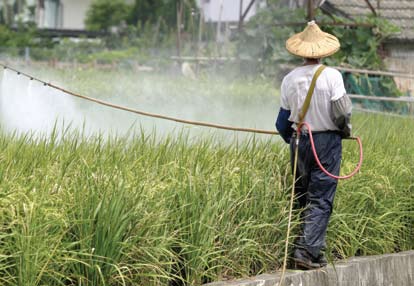
25
Current use pesticides
Chlorpyrifos is an organophosphate insecticide that is also marketed as Dursban and Lorspan. It has been found in fish samples in Alaskan
parks, in surface water, ice and fog from the Bering and Chukchi seas, snow samples from Alaska, in air in the eastern Canadian archipelago,
and in subarctic and Arctic lakes in Canada.
Dacthal is an organochlorine herbicide. It is also called DCPA or chlorthaldimethyl. It has been found in snow from the Alaskan coast, in air,
seawater and invertebrates from the Canadian Arctic, in subarctic and Arctic lakes in Canada, and in Russian river sediment. It has also been
found in fish and seals from the Canadian Arctic and in fish from Alaskan parks.
Diazinon is an organophosphate insecticide (also called Spectricide and Sarolox). It has been found in subarctic and Arctic lakes in Canada.
Dicofol is an organochlorine pesticide (also called Kelthane, Carbax and Decofol). Dicofol has been detected in Arctic air samples and a
chemical signature of DDT contamination indicates dicofol products from China as the source.
Methoxychlor is an organochlorine insecticide (also called methoxcide, dimethoxy-DDT and methoxy-DDT). It has been detected in air sam-
ples from several stations, in Russian rivers, in fish from Alaskan parks, in a range of terrestrial, freshwater and marine biota from Greenland,
and in seabirds from Svalbard.
Trifluralin is a dinitroaniline herbicide (also called Treflan). It is a candidate POP for the UN ECE LRTAP Convention. It has been detected in air
samples from several sites, and in sediment, zooplankton and Arctic char from Bjørnøya.
Chlorthalonil is an organochlorine fungicide, also marketed as Nopocide and Daconil. It has been found in water and air in the eastern
Canadian archipelago and in subarctic and Arctic lakes in Canada.
Other current use pesticides that have been detected at low concentrations in subarctic and Arctic lakes and snow are atrazine, desethylatrazine
(degradation product), alachlor, disulfoton, flutrafol, terbufos, fenitrothion, metolachlor, and methyl parathion.
and they are known to deposit in regions removed
snow/ice horizons but deposition in the 1960s was
from the site of application. Moreover, many of
apparent for some chemicals. The likely source re-
these chemicals are used in large quantities and
gions for these agricultural chemicals were northern
there is some concern that they wil stil transport
Europe and Russia because of their proximity to
over long distances and end up in remote environ-
Svalbard and the frequent movement of air masses
ments such as the Arctic.
from continental Europe to this area.
Previous AMAP assessments have highlighted
In addition to the current use pesticides that
lindane (gamma-HCH) as a current use pesticide
have been detected in the Arctic, the screening of
that is ubiquitously present in the Arctic. Several
potential POP chemicals discussed in the previ-
other current use pesticides have been detected
ous section predicts that several other current-use
Farmer spraying
in Arctic air, soil, water or animals. The levels are
pesticides may reach the Arctic.
pesticide on rice field.
often low, sometimes too low to quantify, but the
presence of these chemicals in environments where
they have never been used nevertheless shows that
they can transport over long distances. In addition
to gamma-HCH mentioned above and endosulfan,
which has been discussed separately, the current-use
pesticides that have been reported as detected in
the Arctic are listed in the box above.
A study of an ice core from the Austfonna ice
cap in Svalbard found about 20 current use pesti-
cides that had been deposited in snow since 1970
to about 2000. These included the organophos-
phate insecticides and herbicides that are widely
used in cultivation of corn (maize). Maximum
concentrations were typically in the most recent
S
hutterstock
26
Legacy POPs
identify where the pol utants come from. Of the 12
POPs that were initial y identified in the Stockholm
Legacy POPs is a term applied to chemicals that
Convention, continuous monitoring data are only
are banned or restricted. However, because they
available for PCBs, HCB and DDT. Three stations
are persistent, they remain in the environment and
also report data for chlordane.
may do so for a long time. Monitoring the levels of
As might be expected from their discontinued
legacy POPs in the Arctic is of interest because it
use, levels of legacy POPs in air are generally declin-
provides information about environmental degrada-
ing. The apparent half-lives (indicating the rate of
tion and fate and the impact of policy decisions. It
decline) vary for different compounds and different
may also give an indication of how other factors,
including climate change, may influence the levels
in the environment. Moreover, information about
Log [CB-31], pg/m3
n
legacy POPs is important in assessing the combined
3
2.5
effects of different pol utants on wildlife and human
2
health. Legacy POPs have been reviewed in detail
1.5
in previous AMAP assessments. This report focuses
1
0.5
on how the levels of legacy POPs have changed over
0
time. It also presents an update on biological effects.
Log [CB-153], pg/m3
The main compounds of concern are presented in
1 n
the box on the next page.
0.5
0
Levels in air and time trends
-1.5
-1
-1.5
Air is a rapid long-range transport route for POPs
-2
from the areas where they are used to the Arctic.
-2.5
Pol uted air masses only take a few days to travel
Log [HCB], pg/m3
n
several thousand kilometers. They reach even the
4.8
most remote parts of the Arctic and provide a
4.6
4.4
major pathway for pol ution into the region. Since
4.2
the early 1990s, AMAP has systematically moni-
4
tored levels of pol utants in Arctic air. The data are
3.8
used for evaluating time trends. These results have
contributed to effectiveness and sufficiency evalu-
Log [cis-chlordane], pg/m3
n
0.4
ations of the Stockholm Convention and the UN
0.2
ECE LRTAP POPs Protocol. They are also used
0
-0.2
to validate models of air transport that can help
-0.4
-0.6
-0.8
-1
POPs have been
Log [alpha-HCH], pg/m3
monitored at several
5 n
locations around the
4.5
Tagish
Valkarkai
4
Arctic; however, long-
Little Fox Lake
3.5
Barrow
term monitoring has
Dunai
3
only been conducted at
-2.5
a few sites. The graphs
2
show examples of
Alert
Kinngait
Log [p,p' -DDT], pg/m3
n
trends of legacy POPs
Zeppelin
1
Amderma
in air over time from
0
Nuuk
Pallas
the Zeppelin station on
-1
Stórhöfdi
Svalbard.
-2
-3
Long-term monitoring stations
Satellite stations
-4 1993 1995 1997 1999 2001 2003 2005 2007
27
Legacy POPs
PCBs
Polychlorinated biphenyls (PCBs) are a group of chemicals that have been used in a number of applications including transformer and ca-
pacitor oils, hydraulic and heat-exchange fluids, lubricating and cutting oils, and as plasticizers and joint sealants. The manufacture and use
of PCBs are banned under the Stockholm Convention but they are still present in some existing products, such as old electrical equipment.
Countries have until 2025 to take action to phase out use of existing equipment with PCBs and have to eliminate or treat the recovered
PCBs by 2028. The Convention also requires that countries take steps to limit emission of PCBs with the aim to eventually eliminate releases
into the environment. PCBs have a range of toxic effects. The most significant is that they affect the immune system and disturb behavior
and reproduction in birds, fish and mammals. In the Arctic, they affect the polar bear population in particular. As one of the most ubiqui-
tous pollutants, they also play a major role in impact of POPs on human health.
DDT and DDE
DDT has been used widely to kill insects and is still used against mosquitoes to control malaria in some parts of the world. The Stockholm
Convention limits the production and use of DDT to controlling disease. It also allows DDT as an intermediate in production of the pesti-
cide dicofol in countries that have registered this exemption. Measurements often refer to DDE which is a toxic and persistent breakdown
product of DDT. DDT-DDE affects sex hormones and thus reproduction. It has been identified as the major cause of egg-shell thinning and
decline of populations of predatory birds such as the peregrine falcon. The decreasing levels in the environment have been important for
the recovery of bird populations although the previous AMAP assessment (2002) concluded that egg-shell thinning was still a concern for
several bird populations. This assessment includes reports on 7-17 percent eggshell thinning in ivory gulls in four colonies in Svalbard and
Russia compared to pre-DDT levels. This is approaching a degree of eggshell thinning that is known to cause declines in bird populations.
Chlordane
Chlordane is used to control termites and is also used as a broad-spectrum insecticide for agricultural crops. The Stockholm Convention
limits the production and use to narrowly prescribed purposes and to countries that have registered for exemptions. Chlordane affects
reproduction and the immune system.
HCB
Hexachlorobenzene (HCB) is a past-use fungicide and has also been emitted to the environment as a by-product from the production of
chlorinated pesticides, incineration, and metallurgical processes. The Stockholm Convention limits the production and use to narrowly
prescribed purposes and to countries that have registered for exemptions.
HCHs
Hexachlorocyclohexane (HCH) comes in several different chemical forms (isomers). The gamma-isomer (-HCH ) is the same as the insecti-
cide lindane. Mixtures containing the alpha (-) and beta (-) isomers were banned or its use was phased-out in the 1980s. Use of lindane
has declined from the 1980s and 1990s. Canada, a major North American user, deregistered use of lindane in agriculture in 2004. Lindane
has a range of toxic effects including effects on the nervous system, reproduction, and the immune system.
Dioxins and furans
Dioxins and furans are created as by-products in high-temperature processes, such as waste burning and metallurgical industries, and as
trace contaminants in some herbicides and in PCB mixtures. The Stockholm Convention and the UN ECE LRTAP POPs Protocol regulate
emissions. The toxic mechanism is the same as for dioxin-like PCBs and includes effects on reproduction, the immune system and increased
risk of cancer.
Toxaphene
Toxaphene is an insecticide that was widely used until the 1990s. It is regulated by the Stockholm Convention and the UN ECE LRTAP POPs
Protocol.
Mirex
Mirex was used as insecticide and fire retardant until 1978. It is regulated by the Stockholm Convention and the UN ECE LRTAP POPs Protocol.
28
stations. However, most PCBs decline with a half-
Another anomaly is episodes of increased levels
life of less than 10 years. Some intermediate weight
of PCBs in air at Zeppelin in July 2004 and spring
PCB congeners show longer halflives (~20 years)
2006. These were possibly caused by boreal forest
at some locations in the Arctic. This mirrors the
fires in Yukon/Alaska and agricultural fires in East-
historical decline rates of PCB emission estimates
ern Europe, respectively, where the biomass burning
derived from production and consumption data of
enhanced volatilization of previously deposited or-
PCBs from 1930 to 2000. The emission of lighter
ganic chemicals, such as PCBs, from soil. Similarly,
and heavier PCB congeners declines faster than
episodes of chlordane and DDE were observed at
intermediate congeners in the polar region. This in-
Alert and Zeppelin in 2004, which may also be the
dicates that the rates of decline in air concentrations
result of biomass burning. Thus, changes in local
of PCBs were mostly driven by declines in primary
climate regimes, such as that at Zeppelin (Svalbard),
emission. A modeling study indicates that when
may already be affecting temporal trends. Increased
primary emission stops, soil becomes the major
frequencies of forest fire events at northern latitudes
global PCB reservoir and the rate of decline in air
due to climate change may also result in enhanced
wil depend solely on that in soil.
input of pollutants to the Arctic.
The half-lives of organochlorine pesticides (i.e.
The general message in terms of temporal trends
DDT, HCHs, chlordane) in Arctic air general y
is that the legacy POPs are declining in air but that
range from 3 to 16 years. Trans- and cis-nonachlor
this decline may be complicated by climate change
(minor components of the technical chlordane for-
via e.g. decreasing sea-ice coverage and an increase
mula), which have extremely low air concentrations,
in forest fire events. Change in pesticide use, such as
have very long half-lives at Zeppelin, 26 and 94
an increase of use of chlorothalonil and quintozene
years respectively. This indicates that their concen-
which are contaminated with HCB (a legacy POP),
trations are leveling off at this location. The figures
may be another complicating factor.
on page 26 give some examples of time trends.
Levels in wildlife are declining
Climate change may affect time trends
Legacy POPs in air and water are likely to end up
For some POPs, there are local variations in pat-
in wildlife, but the levels in various animals reflect
terns over time which may have important policy
more factors than the concentrations in the sur-
implications. The most significant finding, and in
rounding environment. Factors such as changing
contrast to the general declining trends, is that the
feeding habits and the age of the animals have to be
levels of PCB, HCB and DDT have increased at
considered when trying to elucidate time trends. To
the Zeppelin station during the last four years of
draw reliable conclusions, there is a need to assess
the time series (2002-2006). A possible explana-
a number of different studies covering different
tion is that climate change, along with changes in
regions and different species and to do so in a sta-
ocean currents, has led to declining ice cover and an
tistical y robust manner. For this assessment, a time
ice-free western coast of Spitsbergen (Svalbard, Nor-
trend analysis was performed based on 319 different
way) during the winters of 2003 to 2006. The open
time series of legacy POPs. Only time series with at
water has possibly allowed POPs that have previ-
least six years of data and having years both before
ously been trapped in the ocean water to escape to
and after 2000 included. The figure on the next
the air. For some POPs, the Arctic Ocean has been
page shows the distribution of species and countries
a sink for global emissions. If, or when, the sea ice
where the individual studies were conducted.
disappears, this store of old POPs may become an
In addition, literature for the past four to five
important source to the atmosphere long after direct
years dealing with time trend analysis was reviewed.
releases into the environment have ceased. This is
The conclusions from this time trend assessment are
suspected to be happening for alpha-HCH, which
summarized on the next page.
shows higher levels in Arctic air when the ice breaks
up. Its chemical signature confirms that the "extra"
More time series data are needed
alpha came from the sea, not from long-range trans-
Statistical y significant conclusions from time
port. Climate change may thus delay the impact in
series require data from a certain number of years,
the environment of policy actions against POPs.
especial y in situations with large variation between
29
PCBs
Many time trend analyses (40% of the time series analysed) show a significantly decreasing trend of PCB-153. This is found
throughout the western Arctic species belonging to both terrestrial, freshwater and marine ecosystems (no time series for
the Russian Arctic were available). A literature review of the recent publications supports the decreasing trend of PCBs in
Arctic biota. The mean of 40 time series was an annual decrease of 1.4%. The studies pointed to very few increasing trends.
-HCH
Many time trend analyses show a significant decreasing trend of -HCH, especially in freshwater fish, seabirds and marine
mammals. No significantly increasing trends were found. The mean of 32 time series was an annual decrease of 7.4%, the
highest found among legacy POPs.
-HCH
While there are consistent decreasing trends in marine biota from Greenland and Iceland, the picture for Canada is more
complicated with many time series showing no trend and some showing increasing trends in marine mammals and sea-
birds. The mean of 21 time series was an annual decrease of 2.9%.
-HCH
Most time series from Canada and Greenland (including freshwater and marine fish, seabirds and marine mammals) show
decreasing trends, and none a significant increasing trend. The mean of 11 time series was an annual decrease of 7.3%.
DDE and DDTs
Many time trend analyses show a significant decreasing trend of DDE and DDTs al over the Arctic, especial y in seabirds
and marine mammals. Also the majority of recently published temporal trend studies report decreasing trends. The mean
of all time series was an annual decrease of 1.9 and 4.4% for DDE and DDTs, respectively.
HCB
Decreasing trends are observed in many countries. However, the trend in marine mammal populations was less apparent
than for other legacy POPs. The mean of 40 HCB time series was an annual decrease of 2.5%.
Chlordane and trans-nonachlor
Decreasing trends are observed from many Arctic countries. However, in seabirds and marine mammals from Canada the
trend is less apparent and there are only few reports of significant decreases. The mean of 17 chlordane and 29 trans-non-
achlor time series was an annual decrease of 1.8 and 1.0%, respectively.
Heptachlor epoxide
No firm conclusion can be drawn because of the limited number of time series available that only cover Canada. The mean
of 6 time series, all from Canada, was an annual decrease of 0.7%.
Dieldrin
Decreasing trends are observed from Canada and Greenland. No or very limited knowledge exist in other parts of the
Arctic. The mean of 11 time series deriving from Canada and Greenland was an annual decrease of 2.1%.
Mirex
No firm conclusion can be given as both increasing and decreasing trends were found in Canada and time series outside
Canada were very limited. The mean of 12 time series from Canada and Faroe Island was an annual decrease of 1.6%.
Toxaphene
Decreasing trends are found in one freshwater fish population in Canada and one seabird population in Greenland. The
mean of 10 time series (freshwater fish, seabirds and marine mammals) deriving from Canada, Greenland and Faroe Island
was an annual decrease of 0.8%.
Dioxin, furans, and
Levels of dioxins, furans and dioxin-like PCBs are often reported as toxic equivalents: TEQs. Decreasing trends are found in
dioxinlike PCBs
Canada and Greenland. No knowledge is available from other Arctic countries. Only two time series were available; both of
seabirds from Canada, with an annual decrease of approximately 4%.
Sweden
Alaska
19
4
Norway
3
Blue
mussels
55
Marine
Iceland
Canada
mammals
78
120
Fresh water
118
sh
53
Faroe
Islands
Terrestrial
Greenland
Marine
28
Sea birds
mammals
64
sh
48
7
35
Killer whale
Killer whale
Fulmar / k
F
ittiw
ulmar / k
ake
ittiwake
Mur
M r
ure / guillemot
re / guillemot
Polar bear
Polar bear
Available time-series
Beluga / pilot whale
Beluga / pilot whale
of legacy POPs in Arctic
Cod / sculpin
Cod / sculpin
Mussels
Mussels
biota. These time-series
Ringed seal
Ringed seal
generally show decreas-
Pike / bur
P
bot
ike / burbot
Char
Char
ing trends over the past
Reindeer
Reindeer
two- to three-decades.
30
different years. In these temporal trend analyses
in the animals' physiology or anatomy that can be
only few studies (less than 10) fulfilled the statisti-
measured and are known to be affected by specific
cal requirements. To draw firmer conclusions in the
POPs. Examples are changes in liver enzymes.
future will therefore require continued monitor-
A weakness of such studies is that the researchers
ing of legacy POPs in key biota. This is especial y
often have limited knowledge of the life history and
important for time series that wil obtain sufficient
general condition of randomly-captured animals.
statistical power in the near future as additional
There are always many factors that affect the health
years of data are added.
on an animal, for example infections, predation,
climate change and food scarcity. This makes it very
Effects in Arctic wildlife
difficult to prove cause-effect relationships for one
Since the 2002 AMAP assessment, knowledge about
specific stressor.
the effect of POPs on mammals and birds at the top
Biological effects on polar bears have been confirmed
of the Arctic marine food web has increased sub-
stantially. This includes better understanding of how
Polar bear feed on top of the Arctic marine food
POPs influence the animals. Moreover, controlled
web and are exposed to high levels of several legacy
experiments have been able to confirm that current
POPs. Previous AMAP assessments have concluded
levels of POPs in the Arctic affect the health of top
that this exposure put the health of polar bears at
predators, such as polar bears.
risk because it affected their ability to fight infec-
A major challenge for understanding the impacts
tions and to reproduce. Moreover, there were some
of POPs in wildlife is to link the effects seen in
signs that contaminants affected the vitality of the
the animals to a specific cause, such as the load of
polar bear populations around Svalbard.
contaminants. Many studies rely on correlations be-
One way to confirm that these effects are actual y
tween high loads of contaminants and effects, along
caused by POPs is experiments where the animals
with the use of biomarkers. Biomarkers are changes
are fed contaminated food, which is neither practi-
Animals such as
polar bears are exposed
to a number of stressors
that can lead to adverse
health effects.
Parasites
Hunters
Food supply
Contaminants
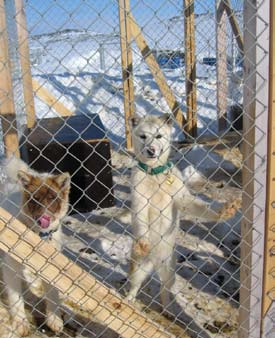
31
cal y feasible, nor ethical y justifiable. An alternative
Sled dogs have
to experiments on wild animals is to use a surrogate
been used as surro-
species that can be studied in captivity and/or under
gates for polar bears
more controlled conditions. Recently studies have
in studies looking into
been published where sled dogs and Arctic foxes
the effects on wildlife
have been used as potential surrogates for polar
of dietary exposure to
bears and other Arctic top predators. In the sled
contaminants.
dog study, juvenile dogs in West Greenland were
fed either blubber from minke whale (including its
environmental load of contaminants) or pork fat for
two years. The West Greenland minke whale has a
similar load of contaminants as ringed seals and was
considered representative of the diet of polar bears.
Compared to the control animals (on a diet of
d
pork fat), the sled dogs who were fed blubber had
kegaar
altered liver and kidney functions, reduced immune
aja Kir
response and impaired cel ular immunity. These
M
toxicological effects are similar to those that have re-
kidneys that could be linked to POPs. Studies of
cently been reported in East Greenland polar bears.
the skeletal system in East Greenland polar bears
A similar study has been done on farmed Nor-
showed reduction in bone mineral connected to POP
wegian Arctic foxes. Like the sled dogs, they were
exposure. However, they did not see any changes in
fed minke whale blubber or pork fat. For one group
immunological organs such as lymph nodes, spleen,
of animals, the researchers simulated starvation of
thymus and thyroid gland.
polar bears by reducing the food to the fox, so that
Taken together, these observations and control-
POPs that had been stored in the foxes' fat were re-
led experiments show that POP-contaminated food
leased to the blood where it can expose sensitive or-
causes similar changes in polar bears, Arctic foxes
gans. The results show that especially the cells in the
and sled dogs.
kidneys have changes in size and shape, which may
cause changes in the function of the kidneys. Some
Whales and seals
changes were also apparent in the thyroid, which is
The levels of POPs in whales depend on the eat-
important for the animal's temperature control and
ing habits of different species. Bowhead and gray
for brain development and reproduction.
whales, which are low in the food web, have low
Looking at the mechanism behind the effects,
levels of contaminants. Recent studies have con-
they appear to be linked to changes in liver enzymes
firmed the very low POP levels in blubber of these
that can transform POPs such as PCBs and PBDEs
species, with no signs of effects on the biology on
into break-down products. Based on these studies
the animals.
of polar bears and on studies of glaucous gul s in
Beluga feed at a higher level in the food web and
the Canadian High Arctic, Eastern Greenland and
populations in the highly pol uted St. Lawrence
Bjørnøya, biotransformation into these break-down
estuary are known to show adverse effects, including
products may be more important for the toxic effect
impacts on the immune system and tumors. Arctic
than the levels of the original compound.
beluga are less contaminated. At present, it is not
New observations have been made on effects in
known whether they may show more subtle effects,
polar bears in East Greenland, where reduced size of
but a previous AMAP assessment that made compari-
reproductive organs has been documented in both
son to known effect levels in other animals concluded
male and female bears. However, previous observa-
that levels of PCBs in toothed whales are high
tions on pseudohermaphroditism (female animals
enough to raise concerns. Further studies of biologi-
with male characteristics) in a few female polar bears
cal impacts on beluga would therefore be warranted.
from Svalbard were not verified. The polar bears in
Seals present a similar picture to beluga with
East Greenland also had changes in their livers and
wel documented toxic effects on highly exposed
32
population outside the Arctic, in this case the Baltic
of contaminants from guano from a nearby seabird
Sea. There are no new studies of biological effects
colony and the POP levels are much higher than
on seals in the Arctic, but based on comparisons to
in another lake on the island. The effects that have
known effect levels in other species, the previous
been observed in Lake Ellasjøen char include indica-
AMAP assessment concluded that contaminant lev-
tions that the liver is affected as wel as hormones
els at some sites were high enough to raise concerns
related to stress reactions.
about effects on the immune system, on their levels
In addition to these observations, there are
of vitamin A, and reproduction.
experiments showing that environmentally relevant
Marine birds
levels of POPs can affect the immune system and
hormone systems of Arctic char.
Some species of Arctic seabirds feeding at the top of
the marine food web are exposed to high levels of
Summary of biological effects
POPs. Previous AMAP assessments have concluded
New studies and observation confirm that POPs
that levels were high enough to cause concern for a
cause biological effects in some Arctic species in
number of physiological and ecological effects. At
some areas. Polar bears with high levels of con-
Bjørnøya, observations were made in the early 1970s
taminants are particularly at risk for effects on their
that breeding glaucous gul s behaved strangely and
reproduction and their defense against infections.
also had alarmingly high levels of PCBs and DDE.
Regions of special concern are East Greenland, Sval-
Since then, dead or dying glaucous gul s have also
bard and the Kara Sea area. Some glaucous gul s and
been recorded sporadically. This island is a known hot
ivory gulls that are highly exposed to POPs are also
spot for PCBs as wel as numerous other POPs. New
at risk for effects on their reproduction, especial y in
studies have confirmed or established a link between
the context of various other environmental stressors.
specific POPs and effects on the liver enzymes,
Breakdown products of POPs may be more
hormones and the immune system and that these
important for the toxic effect on animals that the
changes are linked to survival and reproduction. For
original compound. New evidence shows that the
example, some POPs affect how the birds regulate
effect of POPs on the health of Arctic seabirds can
their body temperature and transfer heat to the eggs,
be enhanced by other stressors.
which in turn influence how they tend the nest.
Observations of glaucous gul s at Bjørnøya and
Chapter summary
great black-backed gulls from the northern Norwe-
Recent years have seen increased international policy
gian coast have shown that the effects of some POPs
efforts to reduce the use and emission of a number of
are worse when the birds are exposed to additional
persistent organic pol utants and many of the most
stressors such as infections, predation, climate
persistent and toxic chemicals have been banned.
change and/or food scarcity. This suggests that a
The levels of many such legacy POPs are now declin-
changing environment with an increased stress
ing in the Arctic environment. This includes levels
on birds may change (e.g., increase) the impact
of PCBs, DDTs, HCHs, HCB, chlordane, dieldrin,
of pol utants. POPs may also affect the health of
toxaphene, and substances with dioxin-like toxicity.
Arctic marine bird at other locations in the Arctic,
However, concentrations of POPs in some wildlife
such as the highly contaminated ivory gul and skua
are still high enough to affect the health of several
at Svalbard, Franz Josef Land (Russia), the Faroe
groups of animals, especial y top predators in the
Islands, Iceland, and northern Norway.
marine food web. There are also some signs that
Fish
climate change may affect contaminant pathways
and distribution in the future, for example turn the
In general, the POP levels in fish are low enough to
Arctic Ocean into a source to the atmosphere or
not raise concerns about biological effects. There are
increase forest fires that can remobilize POPs in the
some exceptions among long-lived fat marine fish
soil. The database for time trends is growing but
(e.g. Greenland shark) and populations of freshwa-
remains limited and firmer conclusions about the
ter fish that live at local hot spots. For Arctic char,
impact of policy decisions on environmental levels
there is new evidence of biological effects at Lake
wil require continued monitoring of legacy POPs in
Ellasjøen on Bjørnøya. This lake receives a high load
33
both the abiotic environment and in key biota.
ocean currents. They accumulate in animals that are
Since the previous AMAP assessment, new in-
high in the food web in the marine environment.
formation has become available about several classes
Although production of the major technical prod-
of man-made chemicals that are not yet regulated
uct PFOS has declined sharply, products that
by international agreements. Similar to the legacy
contain PFOS and other fluorinated compounds
POPs, they are also present in Arctic environments
can still serve as sources to the environment. The
where most have never been used, which indicate
fluorinated compounds are currently subject to re-
that they can transport over long distances and may
view for both international and national regulation.
accumulate in food webs that are remote from the
Polychlorinated naphthalenes (PCNs) are no
source regions. They include brominated flame
longer produced and levels in the environment
retardants, fluorinated compounds, polychlorinated
peaked almost half a century ago. However, PCNs
naphthalenes and some current use pesticides, such
are stil present in the Arctic with indications of
as endosulfan. Based on assessments presented in
further input from a combination of combustion
this report, the following conclusions can be drawn.
sources and emissions from old products. They
The brominated compounds in the technical
contribute to dioxin-like toxicity in Arctic animals
products Penta-, Octa- and DecaBDE (PBDEs) can
but are generally less important than PCBs.
transport over long distances and accumulate in bio-
The pesticide endosulfan partly fulfils the criteria
ta. They therefore have POP characteristics. Similar
of a POP due to its toxicity and its occurrence in
to these PBDEs, it is also clear that HBCD is ubiq-
remote environments. Its presence in the Arctic
uitous in the Arctic, that it undergoes long-range
confirms its ability to transport over long distances.
transport, that it accumulates in animals and that
Endosulfan and its degradation products appear to
some components biomagnify. National regulations
persist, yet there is no clear indication of significant
and changes in use and production appear to have
bioaccumulation or biomagnification. The actual
had some effect. At least in some areas, environmen-
problem compound is the breakdown product
tal levels of PBDEs and HBCDs are now starting
endosulfan sulfate. Its slow degradation results in
to level off or decline. TBBPA has been measured
potential for high chronic toxicity. Moreover, it en-
at low levels in several animals, but more data are
riches in aquatic environments, where it may pose a
needed to assess its potential to undergo long-range
hazard to water-living organisms. The data on other
transport. Other brominated flame retardants that
current use pesticides are very limited, but several
have been detected in occasional samples are PBB,
compounds have been found in the Arctic.
BTBPE, HxBBz, PBEB and PBT. These latter four
Screening of high volume chemicals indicate
are used as substitutes for PBDEs and their pres-
that many current-use organic compounds have
ence in the Arctic is a warning sign that they also
chemical characteristics that make them similar to
undergo long-range transport and that levels in the
POPs and thus potential to transport to the Arctic.
environment may increase over time.
Characteristics that signal potential environmental
The knowledge about fluorinated compounds
concerns are ability to exchange between water
in the Arctic is based on limited data but available
and air, and between air and soil or plant surfaces,
information shows that the fluorinated compounds
combined with the presence of multiple chlorine,
reach the Arctic both via the atmosphere and via
fluorine or bromines on the molecule.
34
International treaties and actions to limit the use and emission of POPs and heavy metals
Under the auspices of the United Nations Environmental Programme
mium. The protocols identify bans and restrictions, some emission limits,
(UNEP), the Stockholm Convention is the major international, legal y
and codes of best practice related to POPs and metals. Both were signed
binding instrument for managing POPs on a global scale. Signed in 2001, it
in 1998 and came into force in 2003. Each has been ratified by 29 coun-
came into force in May 2004, and by March 2008 had been ratified by 153
tries, though both Russia and the United States have yet to ratify them.
countries. Among Arctic countries, only the United States and Russia have
Under environmental cooperation related to the North American Free
yet to ratify the convention. At present, twelve POPs are governed by the
Trade Agreement, Canada, Mexico, and the United States have success-
convention, but eleven more have been proposed for addition to that list.
fully eliminated the use of all twelve chemicals in the original list of the
Of those eleven, nine have been found to meet the definition of `persistent
Stockholm Convention. In addition, they have developed a North Ameri-
organic pol utant.' Risk management evaluations have been completed for
can environmental monitoring and assessment plan. In 2006, the initia-
five of these, which have been recommended for addition to the conven-
tive was reoriented to foster tri-national collaboration on chemicals of
tion's list.
concern, to provide consistent data to decision makers, and to increase
monitoring and assessment capacity.
The Aarhus Convention on the Long-Range Transport of Air Pol utants,
under the auspices of the United Nations Economic Commission for
The European Union has introduced a number of measures targeting
Europe developed two protocols in the mid-1990s the POPs and Heavy
harmful chemicals in the environment. Important measures adopted in
Metals protocols. The POPs protocol addresses sixteen chemicals and the
recent years include legislation concerning the Registration, Evaluation,
Heavy Metals Protocol covers three heavy metals mercury, lead and cad-
Authorisation and Restriction of Chemicals (REACH; EC/1907/2006), which
Addressed by North
Type of
UN ECE Protocols on
American Regional Action
chemical
Stockholm Convention
POPs (UN ECE, 2008a)
Plan
Aldrin
Pesticide
Listed under Annexes
No production or use
Not in use in NA
as of 2008
permitted
Chlordane
Pesticide
Listed under Annexes
No production or use
Production and use eliminated
as of 2008
permitted
Dieldrin
Pesticide
Listed under Annexes
No production or use
Production and use eliminated
as of 2008
permitted
Endrin
Pesticide
Listed under Annexes
No production or use
Not in use in NA
as of 2008
permitted
Heptachlor
Pesticide
Listed under Annexes
No production or use
Not in use in NA
as of 2008
permitted
Hexachlorobenzene (HCB)
Pesticide
Listed under Annexes
No production or use
Not in use in NA
Industrial chemical
as of 2008
permitted; limits on
emissions
Mirex
Pesticide
Listed under Annexes
No production or use
Not in use in NA
as of 2008
permitted
Toxaphene
Pesticide
Listed under Annexes
No production or use
Not in use in NA
as of 2008
permitted
Dichloro-diphenyltrichloroethane
Pesticide
Listed under Annexes
No production or use
Production and use
(DDT)
as of 2008
permitted
eliminated
Polychlorinated biphenyls (PCB)
Industrial chemical
Listed under Annexes
No production or use
Production ended, no new uses,
as of 2008
permitted
phase-out and destruction
Polychlorinated dibenzo-p-dioxin
Industrial
Listed under Annexes
Limits on emissions
Best practices and waste
(PCDD)
by-product
as of 2008
management
Polychlorinated
Industrial
Listed under Annexes
Limits on emissions
Best practices and waste
dibenzofuran (PCDF)
by-product
as of 2008
management
Polyaromatic
Industrial
Limits on emissions
hydrocarbons
by-product
Chlordecone
Pesticide
Considered a POP and risk No production or use
management evaluation
permitted
complete
Hexabromobiphenyl (HBB)
Industrial chemical
Considered a POP
No production or use
and risk management
permitted
evaluation complete
Lindane (gamma-
Pesticide
Considered a POP and risk Restrictions on use
Production and use eliminated
hexachlorocyclohexane)
management evaluation
complete
Perfluorooctane sulfonate (PFOS)
Industrial chemical
Considered a POP and risk Considered a POP and
management evaluation
undergoing assessment of
complete
management options
35
requires manufacturers and importers to identify the dangers from their
Russia has undertaken several domestic steps to reduce pol ution, centered
substances, assess potential risks and stipulate measures to rule out any
on a national policy that entails over fifteen federal laws and codes. It has
damage to health and the environment; the restriction of the use of cer-
also participated in the development of five international agreements,
tain hazardous substances in electrical and electronic equipment (RoHS;
though has only ratified one of them to date.
2002/95/EC); and legislation on waste electrical and electronic equipment
AMAP assessments have extensively used in the development and imple-
(WEEE; 2002/96/EC).
mentation of the Stockholm Convention and the UN ECE LRTAP Protocols
UNEP established its `mercury programme' in 2003. In 2005 UNEP's
on Heavy Metals and POPs, and continue to be used in evaluating the
Governing Council called for the development of a report on supply,
`effectiveness and sufficiency' of these instruments and as an important
trade and demand for mercury on the global market and facilitated
source of information on new candidate substances. The Arctic regional
the establishment of partnerships between governments and other
monitoring strategy has contributed to the development of UNEP global
stakeholders as one approach to reducing risks to human health and
monitoring programme for POPs. AMAP's 2002 recommendations on
the environment from mercury. In 2007, UNEP's Governing Council
the need for action on mercury were taken up by the UNEP Governing
requested further reports on mercury emissions to the atmosphere and
Council in initiating its mercury programme.
options for reducing mercury releases to the environment. Following
In addition to ensuring implementation of global and regional agreements,
review of this information, in 2009, UNEP's Governing Council decided
further monitoring is required to determine whether national, regional, and
to begin negotiations aimed at developing a legally-binding instrument
international actions are achieving the desired goals of reducing contami-
on mercury by 2013.
nant levels in the environment and in humans.
Addressed by North
Type of
UN ECE Protocols on
American Regional Action
chemical
Stockholm Convention
POPs (UN ECE, 2008a)
Plan
Hexabromocyclododecane
Industrial chemical
Proposed for inclusion;
Under consideration
(HBCD)
risk profile will not be
prepared until 2010
Pentabromodiphenylether
Industrial chemical
Considered a POP and risk Considered a POP and
(PentaBDE)
management evaluation
undergoing assessment
complete
of management options
Octabromodiphenyl ether
Industrial chemical
Considered a POP
Considered a POP and
(OctaBDE)
and risk management
undergoing assessment
evaluation underway
of management options
Pentachlorobenzene (PeCB)
Industrial chemical
Considered a POP and risk Restrictions on use
management evaluation
complete
Short chain chlorinated
Industrial chemical
Under consideration
Considered a POP and
paraffins (SCCP)
undergoing assessment
of management options
alpha-hexachlorocyclohexane
Pesticide
Considered a POP and risk Restrictions on use
Not in use in NA
(alpha-HCH)
management evaluation
underway
beta-hexachlorocyclohexane
Pesticide
Considered a POP and risk Restrictions on use
Not in use in NA
(beta-HCH)
management evaluation
underway
Endosulfan
Pesticide
Under consideration
Under consideration
Polychlorinated
Industrial chemical
UN-ECE Task force on POPs
naphthalenes (PCNs)
and byproduct
has supported that PCNs
be considered a POP
Hexachlorobutadiene
Industrial
Considered a POP and
(HCBD)
Chemical and
undergoing assessment
byproduct
of management options
Trifluralin
Pesticide
Considered a POP and
undergoing assessment
of management options
Pentachlorphenol
Pesticide
Considered a POP and
undergoing assessment
of management options
Dicofol
Pesticide
Considered a POP and
undergoing assessment
of management options
36
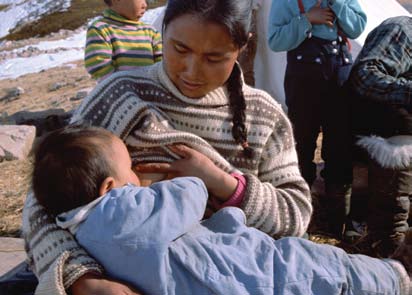
37
Contaminants and Human Health
Factors Influencing Human Exposure to
ers three heavy metals. The protocols identify bans
Contaminants
and restrictions, some emission limits, and codes of
best practice related to POPs and metals. Both were
Many factors influence human exposure to contami-
signed in 1998 and came into force in 2003. Each
nants. The release of contaminants into the environ-
has been ratified by 29 countries, though both Russia
ment is just the starting point. As described in the
and the United States have yet to ratify them.
Introduction, air circulation, ocean currents, and
Under environmental cooperation related to the
rivers carry contaminants from their sources through-
North American Free Trade Agreement, Canada, Mex-
out the world. Contaminants move from one part of
ico, and the United States have successful y eliminated
the environment to another, and are taken up in the
the use of al twelve chemicals in the original list of the
food web. Most human exposure is through diet, so
Stockholm Convention. In addition, they have devel-
the human position in the food web is crucial. This
oped a North American environmental monitoring
section describes two aspects of exposure that have
and assessment plan. In 2006, the initiative was reori-
received less attention in the past: human activity
ented to foster trinational col aboration on chemicals of
within the Arctic and social and cultural influences.
concern, to provide consistent data to decision makers,
International agreements affect contaminant emis-
and to increase monitoring and assessment capacity.
sions and, ultimately, exposure. Major agreements
Russia has undertaken several domestic steps to re-
relevant to the Arctic are summarized here.
duce pollution, centered on a national policy that entails
Global and regional treaties help reduce
over fifteen federal laws and codes. It has also participat-
contaminant emissions
ed in the development of five international agreements,
though has only ratified one of them to date.
The main international agreements limiting use
The development and implementation of global
and emissions of POPs and heavy metals are listed
and regional agreements is a promising step, but
Mother breast-feed-
on pages 34-35. The Stockholm Convention is the
further monitoring is required to determine whether ing infant at summer
major international, legal y binding instrument for
they are achieving the desired goals of reducing con-
camp, Qaanaaq, north-
managing POPs. Signed in 2001, it came into force
taminant levels in the environment and in humans.
west Greenland.
in May 2004, and by March 2008 had been ratified
by 153 countries. Among Arctic countries, only
the United States and Russia have yet to ratify the
convention. At present, twelve POPs are governed by
the convention, but eleven more have been proposed
for addition to that list. Of those eleven, nine have
been found to meet the definition of "persistent or-
ganic pol utant." Risk management evaluations have
been completed for five of these, which have been
recommended for addition to the convention's list.
The Aarhus Convention on the Long-Range
Transport of Air Pol utants, under the auspices of
the United Nations Economic Commission for
y Alexander
Europe, developed two protocols in the mid-1990s.
One addresses sixteen chemicals and the other cov-
B
r
yan and Cherr
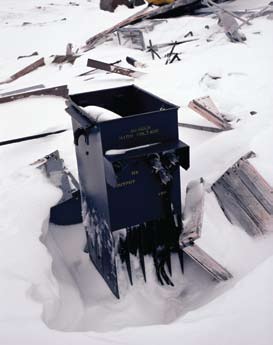
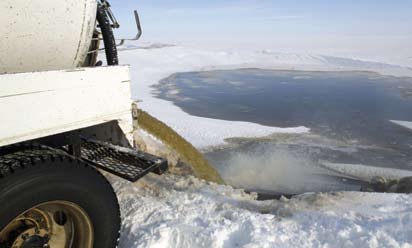
38
Discarded trans-
Industrial activity in the Arctic may become a
former at old DEW Line
larger local source
site on the Melvil e
Mining has taken place in the Arctic for over a cen-
Peninsula, Nunavut,
tury. In some areas of northern Russia, particularly
Canada.
the Kola Peninsula and the Norilsk region, local
impacts of pollution have been severe. In Canada,
mining activity is increasing for many minerals, but
no smelting takes place and only localized environ-
mental impacts been found. The situation is similar
in Alaska, where large-scale mining consists of one
coal mine and one open-pit lead-zinc mine, in
addition to many smal gold mines. Testing to date
has revealed no health problems associated with
mining pol ution. Mining is expected to increase in
y Alexander
Greenland, too, in the near future.
Oil and gas activity has been underway in many
B
r
yan and Cherr
parts of the Arctic for decades. Current practices ap-
pear to pose relatively little threat to human health
of the sites. Other military sites pose similar threats.
through the release of contaminants. Petroleum
The containment of municipal waste and sewage in
exploration and production are expected to increase
rural Alaska often relies on permafrost. As perma-
in coming years, likely leading to increased releases
frost thaws, pathogens and contaminants are more
of petroleum hydrocarbons, but even a large oil spill
likely to be released to the surrounding environ-
is not expected to add substantial y to POPs and
ment. So far, however, no systematic evaluation of
heavy metals levels in the Arctic. The social impacts
this potential problem has been undertaken.
of oil and gas activity include increased income
In Russia, one estimate indicates that as many
as well as social disruption from immigration and
as 12 mil ion drums of waste were left in the Arctic
other causes. These can lead to both positive and
at the end of the Soviet era. The contents of these
negative impacts on human health, potentially af-
drums are not known, but likely include waste oils,
fecting health outcomes related to contaminants.
lubricants, contaminated water, and other substances.
There are many waste sites in the Arctic that have
Many are located near communities and may be
the potential to become sources of contaminants,
major sources of local pol ution. Remediation efforts
Raw sewage being
particularly as permafrost thaws. The Distant Early
are underway, led by indigenous communities in co-
dumped into the sew-
Warning (DEW) Line sites across northern North
operation with the Arctic Council. Another effort has
age lagoon on Igloolik
America have considerable amounts of hazardous
inventoried and safely disposed of over 1300 tonnes
Island, Nunavut,
chemicals, including PCBs, paints, and oil. The
of obsolete pesticides in the Russian Arctic.
Canada.
costs of clean up are made higher by the remoteness
Social and cultural practices influence
contaminant exposure
Among Arctic indigenous peoples, eating tradi-
tional foods is seen as healthful, both physical y
and spiritual y. Sharing of food has great cultural
significance, also generating a sense of individual
and community wel -being. Sharing ensures that
families and individuals are provided for in times
of need, and also influences the type and amount
of food that people eat. Traditional foods are also
y Alexander
an important source of many nutrients. At the
same time, traditional foods are the main avenue
for exposure to contaminants. Social factors that
B
r
yan and Cherr
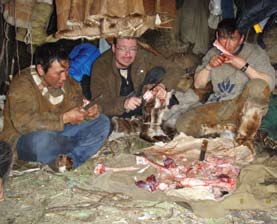
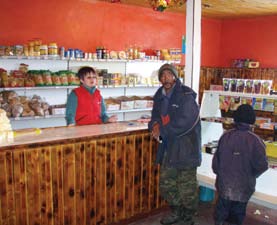
39
influence dietary and other lifestyle choices are thus
of store-bought foods al contribute to a shifting diet.
important influences on contaminant burdens.
Overall, studies of food choice in Arctic Canada have
In addition to food consumption, smoking and
shown that accessibility, convenience, and personal
breast feeding are both subject to social and cultural
preference are the main factors determining the
influences and are routes of human exposure to
extent of traditional food consumption.
environmental contaminants. In the case of breast
Contaminants appear to play a lesser, but often
feeding, the benefits to mother and infant are well
important, role in food choice. In some studies,
documented, though many contaminants are carried
respondents indicated that information about
in breast milk. Smoking, on the other hand, carries
contaminants did not affect the decision to eat
no known health benefit, though it may be undertak-
traditional foods. In another study, 40% of women
en as a social activity in some settings. Tobacco smoke
surveyed in western Canada indicated that concern
carries cadmium and other contaminants.
about contaminants led them to serve traditional
foods less often.
Food, Diet, Nutrition, and Contaminants
Access to traditional food often depends on
Exposure to contaminants in the Arctic is largely
social networks. In strong networks with active
through food. Since food also provides energy and
hunters and fishermen, traditional foods are com-
nutrients, contaminants must be considered in light
monly shared and thus readily accessible. Within
of the whole dietary system. Harvesting, sharing,
such a network, most individuals fol ow the general
and eating traditional foods provide many benefits
dietary pattern of the group. These results indicate
to Arctic peoples. This section describes the relation-
that health advice to change diets may not be effec-
ships between traditional foods, nutrition, and
tive because traditional food freely available through
exposure to contaminants.
sharing networks is likely to remain more attractive
than expensive food from a store, despite the health
Traditional food is important for many reasons
implications. Developing other choices that are
Indigenous peoples of the Arctic recognize many
cultural y appropriate but carry fewer contaminants
health benefits from traditional food. Its use is often
is likely to be more effective.
important to identity. Sharing of food maintains
Further studies are needed for regions other than
interpersonal relationships and community cohesion.
the Canadian Arctic to determine if similar patterns
Traditional food is often cheaper to obtain than store-
are found elsewhere in the circumpolar North.
bought food (i.e., food produced outside the Arctic),
which is important where costs of living are high.
Most dietary energy comes from store-bought
Traditional food nourishes the body and the spirit,
food
both through consumption and also through spend-
Several studies of food consumption have been car-
ing time on the land and sea to obtain those foods.
ried out around the Arctic. Except for some areas of
Today, many other factors influence consumption
northern Russia, most dietary energy comes from
levels of traditional foods as wel as overal wel -being
store-bought foods. In the Canadian Arctic, for
of Arctic peoples. The influence of non-indigenous
example, traditional food contributed 11.4-29.9% of
society, industrial development, and the availability
dietary energy for women and 16.0-28.5% for men
Shifts from tradi-
tional to store-bought
foods may reduce
exposure to contami-
nants, but at the same
time it reduces intake
of some nutrients that
are beneficial to a
healthy diet.
illerslev
illerslev
W
W
Rane
Rane
40
Comparison of tra-
among Dene/Métis adults surveyed in 1997. In the
Traditional food consumption, %
60
ditional food consump-
same region, children age 10-12 surveyed in 2001
tion in Inuvik, Canada
were found to obtain less than 5% of their dietary en-
Follow-up study (05/06)
in 1998/1999 and
ergy from traditional foods. Studies of mothers in the
50
2005/2006.
Inuvialuit region showed an increase in traditional
Baseline (98/99)
food consumption between the periods 1997-2000
40
and 2003-2006. This increase may be the result of
differences between surveys, but it also may reflect
30
health advice to continue eating traditional foods.
In Uummannaq, Greenland, the contribution of
20
dietary energy from traditional food declined from
41% in 1976 to 13.4% in 2004. Another study in
10
Greenland found that increasing age and economic
status were more closely linked with obesity (being
0
overweight to the point of affecting one's health)
High
Medium
Low
than the composition of an individual's diet. In
Norway, younger coastal Saami eat few local fish,
among Inuit may carry lower risk than it does for
unlike older persons and those living inland. Inland
Caucasians. For example, cholesterol levels among
Saami continue to consume reindeer, whereas Nor-
Inuit of all body types were lower than among cor-
Traditional food
wegians in the same area eat mostly store-bought
responding southern Canadians and Europeans.
consumption among
foods. In Alaska, several studies have found that tra-
Russia is an exception to the general trend,
Inuvialuit and Dene/
ditional foods contribute 15-22% of dietary energy,
particularly after the end of the Soviet Union and
Métis in Canada in
though this appears to be lower for younger people.
the consequent decline of government services and
2003-2006 compared
In al regions, the contribution of many nutrients
support in remote areas. Fish and land mammals,
with that in 1997-2000;
freshmilk
from traditional foods is higher than the energy
and traditional food
primarily reindeer, are the main components of local
consumptions in two
contribution. For younger persons eating less tradi-
diets. Between 1985 and 2000 in Chukotka, the con-
communities in Chukot-
tional food, overal nutrient intake is typical y lower,
tribution of traditional foods to meat intake increased
ka, Russia in 2001-2002
too. The prevalence of obesity appears to be rising
from 55% to 89%. Furthermore, younger people
on-site vegetables
(numbers are amounts
in Greenland, Canada, and Alaska. Although still
were more likely to prefer traditional food than older
in kg/person/year).
associated with chronic health problems, obesity
people who grew up during the Soviet era.
Plants
mushrooms
Fish / seafood
Bird meat
Marine
fat
Terrestrial mammals
mammals
meat
berries
Mushrooms
Vegetables
Inuvialuit
Dene/Metis
Fresh-milk
NWT (1997-2000)
NWT (1997-2000)
Berries
(51.3)
(52.2)
all plant
bird meat
Inuvialuit
Dene/Metis
NWT (2003-2006)
NWT (2003-2006)
Coastal Chukchi/Yupik
Inland Chukchi
(84.7)
(58.5)
Uelen (2001-2002)
Kanchalan (2001-2002)
(227.5)
(221.7)
marine mammal fat
marine mammal meat
terrestrial mammal meat
all sh / seafood

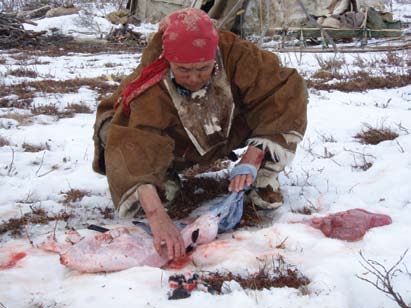
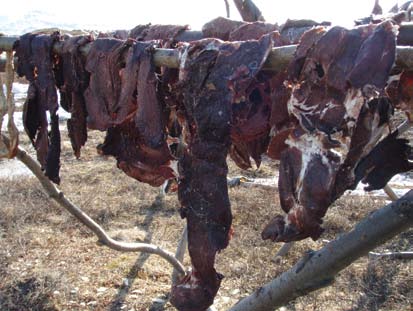
41
Traditional foods provide many nutrients
While most dietary energy comes from store-bought
foods, nutrients are another matter. Traditional
foods are the main sources nutrients associated with
meat and fish: protein, fat, most minerals, vitamin
D, and long chain omega-3 fatty acids. Store-
bought foods, on the other hand, provide most of
the carbohydrates, water-soluble vitamins, vitamin
A, and calcium. The diversity of traditional foods
and the wide range of consumption levels, however,
make generalizations difficult. Comparisons of spe-
cific nutrients and also of specific locations provide
more details. Seasonal variation in diets means that
nutrient intake can vary considerably during the
illerslev
W
year. Further research is needed to understand the
Rane
significance of such variation.
Omega-3 fatty acids are found in marine foods
and provide health benefits. Not surprisingly, their
consumption is higher among coastal people,
particularly those with higher consumption of tra-
ditional foods. Unfortunately, the same traditional
foods that provide many nutrients often also carry
contaminants, a dilemma addressed in more detail
later in this report. Because traditional foods are
high in some nutrients and low in others, a dietary
shift towards store-bought foods can have some nu-
tritional benefit while also creating deficits. Many of
the store-bought foods that are eaten, however, are
high in sugars and fats and thus do not contribute
illerslev
W
to a healthy overal diet. Because younger people
Rane
tend to eat fewer traditional foods, and also eat
high-sugar store-bought foods, nutrient deficits are
a big concern for children and youth. Alcohol con-
sumption, too, is often high in the Arctic, leading to
nutritional and other health and social problems.
Intake of contaminants reflects environmental
levels, dietary patterns
As with nutritional data, comparisons of dietary
exposure to contaminants must take many factors
into account. Geographic variability in contaminant
levels in the environment mean that the same eating
patterns in different areas may produce very different
contaminant burdens. Of course, eating patterns tend
illerslev
W
to vary greatly from place to place, which must also
Rane
be taken into account. Existing studies of dietary ex-
Traditional food consumption, and
posure have used different approaches and methods,
al the activities that are associated with
so that direct comparisons must be treated with cau-
it, remains important to indigenous
tion. Nonetheless, some patterns are apparent. Public
communities throughout the Arctic.
42
Average daily intakes of key contaminants (micrograms/day) compared with tolerable daily intake (TDI) values from studies undertaken in
different countries. Information on the proportion of the study populations that exceed blood level guidelines is given on pages 48 and 49.
PCB
Arochlor-1260
DDTs
Chlordanes
Hg
Tolerable daily intakea, micrograms/day
60
1200
3
12.2
Study group, year
Canada
Whitehorse, Yukon (1998)
-
0.36
0.06
-
Finland
4 cities, 4000 persons (1998)
1.2
-
-
-
Greenlandb
Uummannaq, NW Greenland (1976)
36.8
22.5
9.4
83.8
Uummannaq, NW Greenland (2004)
12.1
8.8
7.1
33.6
Narsaq, SW Greenland, (2006)
5.4
1.8
1.3
8.6
Sweden
4 cities, 4000 persons (1998)
0.62
0.52
0.12
-
- Not available; aBased upon TDI microgram/kg bodyweight/day PCB=1.0; DDT =20, chlordanes =0.05; bThe three sample years represented different compositions and percentages of local food.
health advice needs to reflect local patterns and
southwestern Greenland, intakes of PCBs, chlor-
habits, but can draw on data from around the Arctic.
dane, and toxaphene were found to be higher than
In Greenland, marine mammal consumption
recommended.
was the main source of POPs and mercury. Intake
In Canada, no trends were apparent for mercury
levels in Uummannaq were lower in 2004 than in
intake or environmental level. POPs, on the other
1976, though much of the difference is a result of
hand, were general y decreasing in the environment.
lower consumption of traditional foods. Lead and
Chlorobenzene, endosulfan, and PBDEs, however,
total PCBs showed real declines in concentrations
have been increasing substantial y since the 1980s.
in food, whereas DDT, mercury, and chlordane
As in Greenland, marine mammals appear to be a
were unchanged. Hexachlorobenzene, mirex, and
major route of exposure. Inuit had levels of most
Local food percent-
toxaphene had all increased significantly. Interest-
POP pesticides that were eight to ten times higher
age, contaminant and
nutrient content mea-
ingly, blood plasma levels of POPs in smokers were
than those of Dene, Métis, and Caucasians. Inuit
sured in duplicate meal
up to double those of non-smokers with similar
exceeded dietary intake guidelines for several POPs
portions from Uum-
diets. Since tobacco smoke is not a source of POPs,
and for mercury. Intake levels for most POPs de-
mannaq 1976 and 2004
it must create another physiological response that
clined from the late 1980s to the late 1990s, though
and Narsaq 2006.
affects metabolism to increase uptake. In a study in
toxaphene increased five-fold in that period.
A study in northern Alaska found that bowhead
and beluga whale blubber had the highest levels of
Local food, contaminant and nutrient content of diet
POPs of foods examined. Daily intake was recom-
250
mended to be no higher than 300g of bowhead
maktak (skin and blubber) and 78g of beluga maktak.
Vitamin A, micrograms/MJ
The same study found that some store-bought foods,
200
such as sardines, salmon, and beef tongue, had higher
levels of POPs than some local foods, such as white-
150
fish and Arctic char. The study did not examine actual
Selenium, micrograms/day
consumption levels, so it is not clear whether intake
Mercury,
guidelines were exceeded or not. For mercury, another
100
micrograms/day
local food
study found that people who ate fish had higher levels
in diet, %
of mercury, but only northern pike were found to
PCB, micro-
50
grams/day
exceed action levels for human consumption.
n-3 fatty
Compared with official food safety limits in Rus-
acids, g/day
sia, POP levels were general y low, though DDT and
0
Uummannaq (1976)
Uummannaq (2004)
Narsaq (2006)
HCH exceeded the limits slightly in marine mammal
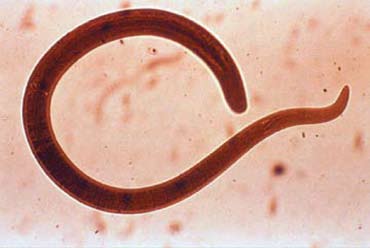
43
blubber. Food prepared indoors, however, was found
inability to buy food, to shortages of food supplies,
to have higher levels of POPs than the same food
to poor quality of the food itself. Concern about
tested when it was harvested or prepared outdoors.
contaminants can undermine food security if people
This phenomenon has not been observed in other
feel the food is not safe to eat. In the Arctic, there is
Arctic countries, but appears to reflect indoor sources
also a cultural dimension in that traditional foods
of pol utants such as DDT and PCBs. Pesticide use
are closely associated with cultural continuity and
and chemicals used to treat building materials are the
vitality. Loss of traditional foods or an unwil ingness
likely sources. In Chukotka, food prepared by ex-
to eat those that are available may contribute to food
tended burial in the ground was often contaminated
insecurity even if store-bought foods are widely avail-
by contact with pol uted soils.
able. Food safety and hygiene are rising concerns in
Unlike POPs, metals in the Russian Arctic ex-
the Arctic, stemming from food-borne il nesses and
ceeded food safety limits for many species and tissues.
diseases spread from animals to humans.
Fish and reindeer meet were below the limits, but
Few studies have been done of food secu-
reindeer kidney and liver were high in mercury and
rity in the Arctic, mostly in Canada and Alaska.
cadmium. Waterfowl exceeded the limits for mercury
Isolated communities in northern Canada report
by a factor of two or three. Seals had higher levels of
that 40-83% of residents are insecure about food,
mercury than terrestrial mammals, birds, and fish.
compared with 9% among non-indigenous persons.
Seal meat exceeded the limits by 3-10 times, kidney
Among Alaska Natives and Native Americans,
by 10 times, and liver by 20-100 times. Whales and
the figure is 30%, twice the national average. The
walrus meat were below the limit, but walrus kidney
high costs of both store-bought food and of going
and liver were two to four times higher. Cadmium
hunting were major factors in food insecurity in
was double the limit in reindeer meat, kidney,
northern Canada. The lack of a hunter in the family
and liver. In marine mammals, meat had levels of
also tended to increase food insecurity.
cadmium lower than the limit, but liver of all marine
Arctic animals can carry parasites. Trichinel a is
mammals exceeded the limit.
found in bears, walrus, and other animals (includ-
In Finland and Sweden, fish were the major
ing domesticated pigs), and can cause the parasitic
sources of POPs for the general population. Analyses
disease trichinosis in humans unless the meat is thor-
of typical "market baskets" of food showed that con-
oughly cooked or deep frozen. In Greenland, the risk
taminant levels were general y below levels of concern,
of trichinel a exposure is higher in hunting districts
though 10% of the Swedish population exceeded total
and with higher consumption of traditional foods,
toxic equivalent intakes for combined POPs. Mercury
especial y polar bear. In Nunavik, Canada, public
intake in Finland, on the other hand, was only about
health measures, including communication and also
15% of the recommended maximum intake.
free testing of walrus meat, have helped reduce the
In Norway, gul eggs were found to be high in
incidence of trichinosis. In West Siberia, over half of
POPs. A 60 kilogram adult eating eight eggs per
some human populations carry the helminth parasite, The parasitic worm,
year would exceed the intake levels. A 20 kilogram
spread through certain types of fish.
trichinella.
child would need to eat only three gul eggs per
year to exceed intake levels. Fulmar eggs are part of
the traditional Faroese diet, and are high in POPs.
Overal fulmar egg consumption is wel below one
egg per person, but for those who do eat eggs and
fulmar meat, the resulting exposure to PCBs can be
noteworthy.
Food security is a concern for many Arctic
residents
"Food security" refers to confidence that food is avail-
able, accessible, safe, and nutritious. There are many
reasons for concern about food security, ranging from
44
Changes over time
Levels and Trends
Oxychlordane in blood, micrograms/kg lipid
80
in levels of legacy POPs
POPs and metals levels in humans in the Arctic have
and metals in blood of
been monitored for more than a decade. Most studies
60
pregnant women from
have looked at maternal blood levels, but there are
three communities in
40
also data for adults in many areas. These studies show
Greenland and Canada.
trends over time in contaminant levels, geographical
20
patterns, and also the effects of changing diets and life-
0
styles. This section provides a circumpolar overview of
p,p'DDE in blood, micrograms/kg lipid
contaminant levels, including the first-ever examina-
16
tion of trends. The comparisons are made possible by
14
Denmark
rigorous quality-assurance/quality-control standards in
12
10
the laboratory analyses used here (see QA/QC Box).
8
6
Levels of legacy POPs and metals are general y
4
decreasing in humans
2
0
Where data are available, levels of nearly al POPs and
CB-153 in blood, micrograms/kg lipid
metals are decreasing in mothers in the Arctic. Most
250
of the results are from Arctic Canada and Greenland,
200
where studies have been conducted in the 1990s and
150
again the following decade. But most other stud-
ies elsewhere in the Arctic show similar declines.
100
One exception is Nuuk, Greenland, where levels of
50
mercury and oxychlordane have been more variable.
0
This community, however, was not as dependent on
Lead in blood, micrograms/L
traditional foods as the other Greenland communi-
60
ties, where marked decreases in contaminant levels
50
were seen. Slight increases and modest declines in
40
contaminant levels are within the range of analytical
30
error, and so may not actual y indicate true changes.
20
For many contaminants, however, the declines have
10
been dramatic, almost certainly showing a real change
0
in exposure and body burden.
Mercury in blood, micrograms/L
In the Inuvik region of Canada's Northwest Ter-
16
ritories, a comparison of results from 1998 with those
14
12
from 2005-06 shows a decline in al six contaminants
10
analyzed in three population groups (Dene-Métis,
8
Inuvialuit, Caucasian). Because the study examined
6
pregnant women or new mothers, different individu-
4
2
als took part in the two studies. The details should
01990 1992 1994 1996 1998 2000 2002 2004 2006
thus be treated with some caution, but the overall
results are clear.
Nuuk,
Disko Bay,
Nunavik,
Greenland (Inuit)
Greenland (Inuit)
Canada (Inuit)
Declines in environmental levels may be the cause
of declines in some contaminants, whereas changes
in prepared foods are needed to shed more light on
in diets may be responsible for others. Public health
this apparent anomaly.
advice to eat traditional foods with lower contaminant
In the Baffin Island region of Nunavut, maternal
burdens are one reason for dietary change. One sur-
blood levels of the same contaminants also declined
prise in these findings is that mercury levels decreased,
over the same time period. Studies in Nunavik,
despite higher consumption of foods expected to carry
Quebec, from 1992 to 2007 show the same trends.
more mercury. Further studies of actual mercury levels
The Inuit Health Survey conducted in Canada and
45
Quality Assurance/Quality Control
Environmental contaminants are typically found in minute quantities. Careful laboratory analyses are required to detect concentrations in
the parts per million or parts per billion. A small error can give an inaccurate impression of risk, or misleading information about trends over
time. Rigorous testing of the laboratories involved is the only way to determine if reported results are reliable. The most reliable approach is
intercomparison, in which various laboratories analyze identical samples. The results are then compared to assess quality of results and to
determine if there are any systematic errors.
For heavy metals, several national and international intercomparison procedures exist, providing a high degree of confidence in the results
from laboratories that participate in these exercises. In this case, AMAP should continue to require that metals data come from laboratories that
participate in one or more intercomparisons.
For POPs in human tissues, AMAP has instituted an intercomparison since 2001, known as the AMAP Ring Test. With 28 labs participating, the
Ring Test involves analyses of 32 compounds. The results of the test have been good, with general improvement over time. The test data have
been examined in several ways, providing a high degree of confidence that trends in analytical data do indeed reflect trends in the real world.
One important finding is that gravimetric meth-
ods for lipid analysis were not as reliable as enzy-
Percentage of laboratories in di erent groups
matic methods, which has important implications
100
Laboratories
for future contaminant analyses. Because the Ring
achieving
excellent, good
Test is the only one of its kind for human tissues,
or acceptable
80
performance
its continuation is important for AMAP and those
who use AMAP results.
60
Emerging compounds present a new challenge.
Levels in animals are typically extremely low, near
the detection limits of current analytical tech-
40
niques. Many laboratories lack the equipment
needed to analyze some substances, such as
20
PFOS. A lack of reference materials for testing and
Laboratories
needing to
the expense of doing so are among the obstacles
improve
0
to conducting laboratory intercomparisons for
2002-12002-22003-12003-22003-32004-12004-22004-32005-12005-22005-32006-12006-22006-3
many of these chemicals. With growing concern
Laboratory test round
about these compounds, however, evaluating the
Excellent
Good
Acceptable
Need improvement
reliability of laboratory results is a priority.
Greenland from 2004 to 2008 examined Inuit men in
the northernmost district, likely the result of higher
Nunavik and found the same declines as were seen in
consumption of traditional foods and possibly higher
pregnant Inuit women.
localized contaminant levels.
In Greenland, maternal contaminant levels in the
Certain POPs have been monitored in maternal
Disko Bay region declined sharply, similar to Canada.
blood in Iceland in 1995, 1999, and 2004. Study
In Nuuk, however, while levels were much lower than
participants were al pregnant women in their third
in Disko Bay, there was no trend over time except
trimester. The 1995 study included only Reykjavik,
for lead. The difference in overal levels reflects much
but fol ow-up studies took place in other areas as wel .
higher marine mammal consumption in Disko Bay,
In al areas, levels of PCB 153 and DDE declined
where the declines in contaminants may be related
over time. Oxychlordane did not change, but was low
to changes in diet. In Nuuk, the diet may not have
to start with. A dietary study in 2002 found that fish
changed as much, resulting in lesser or no change
consumption had declined about 30% since 1992.
in contaminant levels. Another study examined
This seems the most likely explanation for the decline
contaminants in about 600 women 20-50 years old
in contaminant levels in maternal blood.
and adult men in eight districts in Greenland. Levels
Similar results appear in monitoring studies from
of POPs and mercury were highest in Qaanaaq, in
northern Norway. Maternal blood samples col ected
46
in Kirkenes in 1996 had higher levels of POPs than
POPs levels are higher in those who eat marine
samples taken in Bodø in 2004. These results should
mammals
be treated as preliminary, since there are only two
The available data on contaminant levels also show
points in time, and the communities were different. A
regional patterns, both within countries and also
larger maternal blood monitoring study is underway,
among the circumpolar nations. For POPs, the high-
and should be able to confirm or reject the apparent
est levels tend to be found among groups that con-
decrease in contaminant levels.
sume marine mammals. Among men in Greenland,
In Sweden, much the same trend was found in
for example, those in the northern municipality of
maternal blood studies in Kiruna in 1996 and 2007.
Qaanaaq had the highest levels of al POPs studied.
In addition to showing sharp declines in DDE and
Women of reproductive age from the same district
PCB 153, the Kiruna studies included mercury and
had the highest levels of al POPs except DDE, which
lead. Levels of both metals went down, mercury by
was slightly higher in the southern municipality of
nearly half and lead by more than half.
Narsaq. Qaanaaq is a hunting district, with high
Monitoring in Finland has used breast milk instead
harvests of marine mammals.
of maternal blood. Studies in southern and central
In the Inuvik region of Canada, a similar differ-
Finland were conducted in 1987, 1993-94, 2000,
ence can be seen in POPs levels between Inuvialuit,
and 2005. Over that time, PCB 153 levels dropped
who hunt seals and beluga whales, and both Dene/
dramatical y in both regions. The study in 2005
Métis and Caucasians, who general y do not. Inuit
included mothers from northern Finland as wel . Of
from Baffin Island and Nunavik had stil higher
the three regions, the highest levels of most POPs were
levels. In Alaska, Yupik have higher POPs levels than
found in southern Finland, perhaps because of higher
Iñupiat. While Iñupiat have high consumption rates
consumption of fish from the Baltic Sea.
for marine mammals, this is dominated by bowhead
In Russia, too, data to assess changes in contami-
whale, which feeds at a lower trophic levels than
nant levels is available for breast milk from ethnic
seals and belugas and thus has lower POPs levels.
Russian women from Murmansk and Arkhangelsk.
The Yupik, in addition to consuming relatively more
The former was studied in 1993 and 2000, and the
seals, also eat more fish and fewer caribou than the
latter in 1996 and 2000. The short time span and
Iñupiat. In Russia, coastal residents of Chukotka had
relatively low sample size in Murmansk especial y
much higher levels of chlordane, HCH, and PCBs
means that any changes should be interpreted with
than were found in other regions. These residents also
caution. Nonetheless, the results show declines in
consume far more marine mammals than people in
oxychlordane, DDE, and PCB 153. This apparent
the other regions that were studied. Some contamina-
trend may be the result of lower levels of contami-
tion of foods may also result from burial of meats in
nants in Russian food products, or perhaps lower use
contaminated soils. In some cases, barrels and other
of the chemicals in the two areas.
containers that previously held various chemicals may
Time trend data in Alaska are available for
be used to store or prepare food, brew alcohol, or
metals and POPs among the Yupik of the Yukon-
hold drinking water.
Kuskokwim Delta, based on studies in 1999-2003
Another pattern was seen in Russia as wel . Levels
and 2004-2006. Mercury, lead, and cadmium levels
of DDT and DDE were high for all regions and eth-
declined, with lead declining more than 90%. The
nic groups, with the highest levels found in pregnant
differences may reflect seasonal variations in diets, if
women of Russian ethnicity from the Norilsk region.
the blood was drawn at different times of the year.
These levels are likely to be the result of agricultural
This factor and possible differences in dietary habits
use of DDT, which then enters the food supply
among the participants in the two studies have yet
system, or residential use as pest control. The ratio
to be analyzed. The change in POPs levels between
of DDE to DDT is an indicator of local use versus
these two time points is much more variable. Some
long-range transport. The ratio in Russia suggests
contaminants such as oxychlordane and DDE have
local uses and sources, which in some regions may
decreased, whereas others such as transnonachlor and
reflect availability of pesticides imported from China.
HCB have increased. This variability may be due to
Although recent levels of some POPs are high-
the short time span between these two time points
est in Russia, the levels seen there are nonetheless
and the persistence of many of these POPs.
47
PCB, DDE, oxychlor-
Aleuts
dane and toxaphene-
Koryaks & Evens
concentrations in blood
Yup'ik
Chukchi
plasma (Alaska: serum)
Chukchi & Yupik
Dene-Métis
of mothers, pregnant
400
Inuit Iñupiat
women and women
Non-indigenous
300
of child-bearing age
Dolgans
during different time
200
periods.
Inuit
Non-indigenous
150
100
75
Non-
Nenets
50
Inuit
25
indigenous
5
Saami, Nenets & Komi
PCB (CB-153),
Non-indigenous
micrograms/kg lipid
Non-indigenous
800
Time period
600
1990-1994
1995-1999
400
2000-2004
300
2005-2007
200
150
100
50
10
p,p' DDE,
micrograms/kg lipid
160
120
80
60
40
30
20
105
Oxychlordane,
micrograms/kg lipid
80
Time period
60
1990-1994
1995-1999
40
2000-2004
30
2005-2007
20
15
1051
Toxaphene (Parlar-50),
micrograms/kg lipid
48
similar to or lower than the levels recorded in the
Fewer women are exceeding blood level guide-
eastern Canadian Arctic and in Greenland in the
lines for PCBs, mercury, and lead
1990s. The ability to make comparisons across both
Monitoring results for certain contaminants
time and space is a major advance made possible
have also been compared with established health
by coordination of research and by rigorous quality
guidelines. Canada and the United States have pub-
assurance/quality control standards.
lished levels of concerns or action levels for various
Mercury levels remain highest among Inuit
contaminants. Examining levels found in Arctic
in eastern Canada and Greenland, though recent
women of reproductive age against these guidelines
declines are encouraging. The fact that mercury
shows that some women in some regions exceed
levels are low among groups in Russia that have
the guidelines, but the percentage of those who do
high POPs levels indicates that further dietary and
appears to be declining over time. This finding is
related research is needed to explain the divergence
consistent with the overall decline in most con-
between the mercury-POPs ratio in wildlife and
Mercury and lead
taminants described earlier.
the corresponding ratio in humans. Lead levels
concentrations in blood
For PCBs, there are two guideline levels in Can-
of mothers, pregnant
remain relatively high, particularly in Russia,
ada. The Canadian Action Level is 100 micrograms
women and women
where the source is not clear. The use of lead shot
per liter. The Canadian Level of Concern for preg-
of child-bearing age
in some regions of the Arctic is likely to remain a
nant women is 5 micrograms per liter. No women
during different time
substantial source, though steel shot is becoming
in Canada, Iceland, or Russia exceeded the Action
periods. Mercur
more common.
y and lead concentrations in blood of mothers, pregnant women
Level. In Greenland, 8% of women exceeded this
and women of child-bearing age during di erent time periods
(micro-gram/L whole blood)
level. Except among Saami women in the Kola Pe-
ninsula of Russia, some women exceeded the Level
Aleuts
of Concern in al regions studied. Nonetheless, a
Yup'ik
Koryaks & Evens
Chukchi
comparison with results from earlier studies shows
Chukchi & Yupik
that the percentage of women exceeding either level
Dene-Métis Inuit Iñupiat
is declining.
40.0
Non-indigenous
Mercury shows a similar pattern, with Green-
Dolgans
30.0
land having the highest percentages of women
Non-indigenous
20.0
exceeding the various guideline levels. More than
Inuit
15.0
three-quarters of Greenlandic women exceeded the
10.0
Inuit
Nenets
7.5
5.0
US evaluation level of 5.8 micrograms per liter, and
Saami, Nenets & Komi
2.5
0.5
over a third exceeded the Canadian increasing risk
Non-indigenous
Mercury, micrograms/L
range threshold of 20 micrograms per liter. The
percentages were considerably lower in Canada,
Time period
though Nunavik and Baffin Island had higher
1990-1994
1995-1999
proportions than did Inuvik. In Russia, none of
2000-2004
the women exceeded the Canadian level. On the
2005-2007
Taimyr Peninsula, 12% of women exceeded the US
evaluation level, which was the highest percentage
of any of the Russian regions.
80.0
For lead, the regions with the highest percent-
60.0
ages above the current US and Canadian guideline
level of 100 micrograms per liter were the coastal
40.0
30.0
areas of Chukotka and the Taimyr Peninsula. (The
20.0
15.0
guideline levels are currently under review.) No
10.0
5.0
1.0
other areas in Russia had any results above the
Lead, micrograms/L
guideline, as was also the case in Canada. In Green-
land, relatively few women exceeded the guideline,
and only in some regions.
49
Mercury in blood, % of samples exceeding limits
% of samples > 5.8 g /L
% of samples 20 g /L
100
Canada
Greenland
Iceland
Russia
Alaska
80
Nunavut
Ba n Inuit
Nunavik
Inuit
60
40
Nuuk
Inuit
Inuvik
20
0
0
0 00 00 00
0
00 00 00
0 00
0
0
0
Lead in blood, % of samples exceeding limits
% of samples > 100 g /L
40
Canada
Greenland
Iceland
Russia
Alaska
Nunavut
Inuvik
Nunavik
Ba n Inuit
Inuit
20
Nuuk
Inuit
0
0
0
0
0
0
0
0
0
0 0
0
0 0
PCBs (measured as Aroclor) in blood, % of samples exceeding limits
% of samples 5-100 g /L
% of samples > 100 g /L
(only exceeded in Qaanaaq)
100
Canada
Greenland
Iceland
Russia
Alaska
80
Nunavut
Ba n Inuit
Nunavik
Inuit
60
40
Inuvik
20
0
0
0
0
0
0
0
i (2001-2003)
i (2001-2003)
etis (1998-1999)
etis (2005-2006)
annaeyjar (2004)
Al Iceland (2004)
Nunavut, Inuit (1997)
iut, Inuit (2002-2003)
Qaanaaq, Inuit (2003)
Nunavut, Inuit (2005-2007)
Inuvik, Inuit (1998-1999)
Inuvik, Inuit (2005-2006)
Quegertarsuaq, Inuit (2006)
Narsaq, Inuit (2006) Reykjavik (2004)
Akureyri (2004)
Vestm
Pechora, Nenets (2001-2003)
Inuvik, Dene-M
Inuvik, Dene-M
Inuvik, non-aboriginal (1998-1999)
Inuvik, non-aboriginal (2005-2006)
Nunavik, Inuit (1992-1999)
Nunavik, Inuit (2000-2007)Nuuk, Inuit (1999-2005)
Nuuk, Inuit (2005)
Sisim
Kola Peninsula, Saam
Kola Peninsula, Kom
yr Peninsula, Dolgans (2001-2003)
Norilsk, non-indigenous (2001-2003)
Taim
Chukotka (inland), Chukchi (2001-2003)
Chukotka (coastal), Chukchi/Yupik (2001-2003)
Alaska, Inuit/Yu'pik (2003-2006)
Exceedance of blood guideline values for mercury, lead and PCBs
in mothers and women of child-bearing age in different populations
in Canada, Greenland, Iceland, Russia and the United States (Alaska).
50
Emerging compounds are a growing concern in
humans have not been addressed in previous AMAP
assessments. The highest levels of brominated fire
the Arctic
retardants found in the Arctic are in Yupik from
The "traditional" POPs have been monitored for
Alaska, whereas other regions report relatively low
many years in the Arctic, as described above. But
levels. These high concentrations in Yupik mothers
many more compounds are made, released, and later
are similar to values elsewhere in the U.S., which are
found in the environment around the world (see the
higher than concentrations elsewhere in the world
POPs chapter for descriptions of these chemicals).
due to the widespread use of brominated fire retard-
Some of these compounds have been examined in
ants in the U.S. There are no firm data to determine
samples from Arctic residents. While traditional
time trends in the Arctic, but some compounds are
POPs are largely declining, many emerging com-
decreasing in southern Sweden and Norway, which
pounds give new reasons for concern about human
is likely related to the earlier phase out of various
health impacts. Monitoring in the Arctic can shed
brominated compounds in these countries. Dif-
light on the persistence of these chemicals as wel as
ferent compounds in this class need to be studied,
PBDEs (sum of
the threat they pose in the region itself.
as their use and longevity vary. Some longer-lived
BDE-47, -99, -100 and
Brominated fire retardants are used on some
compounds may become relatively more significant
-153) and PFOS in blood
clothes and many other household materials to
in future years in the Arctic, particularly those that
plasma (Alaska: serum)
reduce risks from fire. Some of these compounds
are more likely to accumulate in the food web and
of mothers and women
have the characteristics of POPs, in terms of persist-
expose humans through diet.
of child-bearing age.
ence and long-range distribution. Their lev
PBDEs and PFOS in blood of mothers and w
els in
omen of child-bearing age
(sum of BDE-47, -99, -100 and -153 micro-gram/kg lipid in serum (Alaska) and plasma (all others))
Fluorinated compounds are resistant to stains and
(micro-gram/L in serum (Alaska) and plasma (all others))
to sticking. They are used to coat cooking equip-
ment and some cloth products. They are also very
Yup'ik
difficult to analyze. One of these compounds, PFOS,
has been found in slightly higher levels in blood
Dene-Métis
plasma in men from Nunavik than elsewhere in
Inuit
40.0
the Arctic. There remain many uncertainties about
Non-indigenous
PFOS, including the pathways by which it reaches
30.0
Dolgans
humans. The lack of standard analytical methods
20.0
Inuit
makes comparisons of data difficult. There is not
15.0
10.0
enough data on PFOS to al ow any firm conclusions
Nenets
7.5
Inuit
5.0
2.5
on trends. There are also limited data on another
0.5
chemical in this class, PFOA, but levels appear high
Non-indigenous
PBDEs, micrograms/kg lipid
enough to warrant further study. Both PFOS and
PFOA need to be included in future monitoring of
arctic populations.
Halogenated phenolic compounds include PCP
and metabolites of PCBs. At present, there are no
certified reference materials or laboratory intercom-
parisons to determine the reliability of data for this
class. Further assessment is needed to confirm initial
results indicating concern in some regions, such as
20.0
15.0
coastal areas of the Chukotka Peninsula.
10.0
7.5
Short-chain chlorinated paraffins and siloxanes
5.0
2.5
0.5
are among the additional classes for which no Arctic
PFOS, micrograms/L
data are available. All appear to have the charac-
teristics needed to be present in the Arctic, includ-
ing high production volumes. Screening of these
substances is needed to assess their presence and
potential harm in the Arctic.
51
Contaminants and Metabolism
Genes, macronutri-
ents, and contaminants
The prevalence of obesity is increasing around
may have synergistic
the globe. With obesity come several other health
effects on the develop-
problems, including metabolic syndrome, dia-
Genetics
ment of diseases. The
betes, and cardiovascular disease. As discussed
probability for il ness is
earlier, these trends are apparent in the Arctic, too.
increased when several
Changes in diet and lifestyle are usually blamed,
predisposing factors are
but may not be the whole story. Interactions
simultaneously present
between lifestyle factors and contaminants is a new
Xenobiotics
Nutrients
in the same individual.
area of research. If effects are additive, contami-
nants exposure thought to be "safe" may in fact
contribute to disease. Contaminants and lifestyle
factors are thus inseparable, scientifically and in
terms of public health. This section describes the
ways in which even low levels of contaminants can
contribute to metabolic disturbance.
suggests a higher proportion of energy from fat,
but less than 10% from saturated fats.
Fat, protein, and carbohydrates provide energy
Dietary advice has also recommended reducing
and also regulate metabolism
the intake of simple carbohydrates such as refined
Fats are a normal component of diet. Polyunsatu-
sugars. In particular, high consumption of fructose,
rated fatty acids are essential nutrients, produc-
a sugar found in fruits and products such as corn
ing metabolites that the body cannot synthesize
syrup, can cause a number of metabolic problems.
in other ways. Some metabolites are needed for
Fructose produces a number of health effects, from
development of the retina and central nervous
high levels of triglycerides in blood to hyperten-
system. The fatty acids also help produce key hor-
sion and insulin resistance. These conditions lead
mones, regulating blood pressure, blood coagula-
to diabetes and cardiovascular disease. Contami-
tion, and inflammatory responses of the immune
nants may exacerbate the bodily processes that lead
system. They also play vital roles in regulating
to such effects. The role of fructose is especial y
metabolism, including the deposition and burning
worrisome because it is a common manufactured
of body fat.
sweetener in many foods such as sodas, which in
Body fat does more than store energy. It is also
turn are consumed in large quantities in many
an endocrine organ, producing some compounds
Arctic regions.
that have anti-inflammatory effects and others
that have pro-inflammatory effects. The balance
between these effects depends in part on the ratio
Genetic and
between omega-3 and omega-6 polyunsaturated
Genetic
Epigenetic
environmental factors
disposition
programming
fatty acids. Omega-3 fatty acids are typical y
increase in concert the
found in fish and marine mammals, so Arctic
susceptibility of an indi-
coastal peoples general y have a comparatively
vidual for public health
Positive
n-6/n-3
problems such as, type2
high intake of this class of fatty acids. A higher
energy
Obesity
balance
too high
diabetes and metabolic
proportion of omega-3 fatty acids appears to be
syndrome. Al these
related to a stronger anti-inflammatory effect.
conditions may have
Although much dietary advice has focused on
complications involv-
the total amount of fat that is eaten, the quality of
Metabolic
Contaminants
Fructose
Syndrome
POPs
intake high
ing the cardiovascular
the fat is a more important factor. Diets high in
system.
saturated fats are more likely to produce metabolic
disorders, whereas polyunsaturated fats (particu-
Cardiovascular
larly omega-3s) are both necessary and have a
Diabetes I
disease
number of health benefits. Recent dietary advice
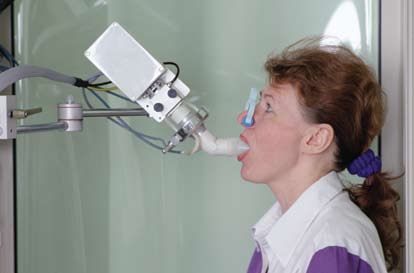
52
Effect of mercury
Contaminants can disturb the metabolism in
Mercury
Dioxin-like
and dioxin-like com-
several ways
compounds
_
_
pounds on the patho-
Several POPs cause oxidation in the body. Oxida-
genesis of diabetes and
tion reactions can produce free radicals (an atom
HDL
PPAR-
its complications. (HDL:
or molecule with an unpaired electron, making it
PON-1
+
high density lipoprotein.
especially chemically reactive) that can lead to a se-
+
LDL: low densitiy lipo-
+
protein. TNF-: tumor
ries of reactions that cause damage to cel s. Among
necrosis factor. NF-:
other things, oxidation can lead to an inflammatory
LDL-ox
NF-B
nuclear factor, PON-1:
response. Some PCBs, for example, produce oxida-
+
+
paraoxonase-1.
tive stress in cells. Anti-oxidants such as Vitamins C
+
TNF-
and E, however, can counteract that effect. Among
Foam cel
LDL-ox
Insulin
Inuit, some evidence of oxidation from contami-
LDL-ox
+
resistance
LDL-ox
nants was found, but at a modest level, probably
+
+
because a relatively high intake of omega-3 fatty
Diabetes
acids provided some protection.
Cardiovascular
disease
Type I
Methylmercury is also an oxidant and affects
calcium regulation. It can therefore act together with
PCBs, which is a problem because both contami-
nants are often found in the same foods. The increase
low levels of exposure are unclear. These and other
in oxidation from contaminants can be compounded
POPs can also affect the balance of sex hormones,
by some aspects of the non-traditional diet, such as
though this too requires further study as some
the reduction of omega-3 fatty acid intake.
compounds strengthen sex hormone effects and
PCBs also affect the body's ability to metabolize
some weaken them. The exact combination of con-
fat. One result is an increase in triglyceride levels in
taminants, including industrial compounds that are
the blood, which is associated with increased risk of
ignored in many studies, wil have a major effect on
cardiovascular disease. Another is an increase in the
the net impacts to sex hormones.
inflammatory response. The role of PCBs in this
Of primary concern, in the context of increasing
regard may exacerbate similar effects from consump-
obesity rates in the Arctic and around the world,
tion of saturated and trans-fatty acids prevalent in
are effects that can increase risks associated with
foods imported to the Arctic. In addition, some
obesity. The fact that some POPs increase the risk
PCBs interfere with the enzymes that metabolize the
of diabetes is particularly worrisome, since obesity
A woman having her PCBs themselves, thus inhibiting the body's ability to
is also associated with increased diabetes risk. The
lung function tested at
react to the very compound causing the disruption.
interactions of POPs and obesity with regard to dia-
the hospital in Norilsk,
Dioxins and similar compounds can increase the
betes and other diseases are not yet ful y understood
western Siberia, Russia.
risk of diabetes, although the long-term effects of
and are a priority for research.
Effects and Public Health
Determining the effects of contaminants on
public health in the Arctic requires three strands of
information. First, basic information about human
populations in the region. Second, an understand-
ing of the toxicological effects of different contami-
nants, separately and in combination, at the levels
found in humans. Third, analysis of whether those
effects can be detected in human populations in the
Arctic. This section presents the available informa-
y Alexander
tion on al three strands, including descriptions for
emerging compounds that have not been addressed
in previous AMAP reports on human health.
B
r
yan and Cherr
53
Demographic data show different pat-
expectancy, with few disruptions over time. The Rus-
terns for many Arctic populations
sian Arctic, by contrast, has seen relatively few births
in the past decade, high mortality among adults,
At the most basic level, demographic data indicate
low survival into old age, and a relatively low life
broad patterns of overal health and wel -being.
expectancy. Economic and other impacts in the Rus-
Several indicators can be used, including life
sian Arctic undoubtedly contribute to the shape of
expectancy, birth rate, death rate, infant mortal-
the age distribution, with many people having moved
ity, and fertility rate. The relative proportions of
away from the region fol owing the end of the Soviet
males and females in a population, as wel as the age
Union, and associated losses of services and reduction
distribution of a population, can indicate disrup-
of standard of living. The apparent absence of young
tions to "normal" patterns from various causes. In
adults in Alaska and Greenland may be the result
many countries, data on indigenous people are not
of temporary migration away from Arctic areas, for
available to support comparisons with national or
example to seek education or employment opportu-
non-indigenous Arctic populations.
nities, with individuals returning later in life.
Population structure
The age distribution of Iceland's population, for
Birth rates in the Arctic are not high relative to
in Arctic countries and
example, indicates high infant survival and long life
global patterns. Nunavut has by far the highest birth regions.
USA (Alaska), 2004
Arctic Canada, 2004
Greenland, 2004
85+
85-89
85+
80-84
Males
Females
80-84
Males
Females
80-84
Males
Females
75-79
75-79
75-79
70-74
70-74
70-74
65-69
65-69
65-69
60-64
60-64
60-64
55-59
55-59
55-59
50-54
50-54
50-54
45-49
45-49
45-49
40-44
40-44
40-44
35-39
35-39
35-39
30-34
30-34
30-34
25-29
25-29
25-29
20-24
20-24
20-24
15-19
15-19
15-19
10-14
10-14
10-14
5-9
5-9
5-9
0-4
0-4
0-4
5
4
3
2
1
0
1
2
3
4
5
6 5 4 3 2 1 0 1 2 3 4 5
6 5 4 3 2 1 0 1 2 3 4 5 6
Percentage of total population
Percentage of total population
Percentage of total population
Iceland, 2004
Faroe Islands, 2004
Norway, 2004
85+
85+
85+
80-84
Males
Females
80-84
Males
Females
80-84
Males
Females
75-79
75-79
75-79
70-74
70-74
70-74
65-69
65-69
65-69
60-64
60-64
60-64
55-59
55-59
55-59
50-54
50-54
50-54
45-49
45-49
45-49
40-44
40-44
40-44
35-39
35-39
35-39
30-34
30-34
30-34
25-29
25-29
25-29
20-24
20-24
20-24
15-19
15-19
15-19
10-14
10-14
10-14
5-9
5-9
5-9
0-4
0-4
0-4
5
4
3
2
1
0
1
2
3
4
5
5% 4% 3% 2% 1% 0% 1% 2% 3% 4% 5%
5
4
3
2
1
0
1
2
3
4
5
Percentage of total population
Percentage of total population
Percentage of total population
Sweden, 2004
Finland, 2004
Northern Russian, 2002
85+
85+
Males
Females
Males
Females
85+
80-84
80-84
80-84
Males
Females
75-79
75-79
75-79
70-74
70-74
70-74
65-69
65-69
65-69
60-64
60-64
60-64
55-59
55-59
55-59
50-54
50-54
50-54
45-49
45-49
45-49
40-44
40-44
40-44
35-39
35-39
35-39
30-34
30-34
30-34
25-29
25-29
25-29
20-24
20-24
20-24
15-19
15-19
15-19
10-14
10-14
10-14
5-9
5-9
5-9
0-4
0-4
0-4
5
4
3
2
1
0
1
2
3
4
5
5
4
3
2
1
0
1
2
3
4
5
5
4
3
2
1
0
1
2
3
4
5
Percentage of total population
Percentage of total population
Percentage of total population of 14 regions
54
Trends in infant
rate in the Arctic, followed by other parts of north-
Infant deaths per 1000 live births
mortality rate of
ern North America and the North Atlantic islands.
250
Alaska Natives
Greenlanders, NWT
A few regions of the Russian Arctic approach the
Canadian Inuit
200
Greenlanders
Inuit and Alaska Natives
same ranges. Northern Sweden and Finland and
USA
Canada
compared to Denmark,
northwestern Russia are the areas with the lowest
Denmark
150
Canada and USA.
birth rates in the Arctic.
Life expectancy in the Arctic is generally lower
100
than for the overal population of each country. But
there are exceptions, such as women in Alaska and
50
the Oulu region of Finland, and both men and wom-
en in the Nordland region of Norway, as wel as the
0
Yamal-Nenets and Khanty-Mansi regions of Russia.
1955 1960 1965 1970 1975 1980 1985 1990
The Nordic countries have long life expectancy, with
the exception of Greenland, though northern regions
death rate fel from nearly one in four live births to
of Norway, Sweden, and Finland are slightly lower
fewer than one in fifty.
than the countries as a whole. Russia has the lowest
Despite this improvement, infant mortality rates in
life expectancy, as wel as the greatest discrepancies
Arctic regions remain higher than national averages. In
between men and women. Iceland, with the longest
Nunavut, the rate of 15.3 deaths per 1000 live births
life expectancy, also has the lowest difference between
is almost three times the national average. The highest
men and women in this regard. Regions with higher
rate in the Arctic is in the Chukotka region of Russia,
proportions of indigenous residents also have lower
at 28.9 deaths per 1000 live births. The great variation
average life expectancies.
in infant mortality rates across the Russian Arctic
Infant mortality rates shed light on overal living
likely reflects differences in socio-economic condi-
conditions and wel -being, in addition to basic health.
tions and provision of health care services. The Nordic
Life expectancy
Dramatic evidence for improved living conditions in
countries are among the top ten countries worldwide
at birth in Arctic
the North American Arctic can be seen in the trend of
in terms of lowest infant mortality, but Greenland's
countries and regions
infant mortality over the second half of the twentieth
rate more closely matches that of Nunavut.
(2000-2004).
century. Among Canadian Inuit in particular, the
In Alaska, the overall infant mortality rate is com-
Life expectancy at birth (2000-2004)
Males
USA
Alaska
Females
Alaska Natives
Canada
National average
Yukon
Northwest Territories
Nunavut
Greenland
Iceland
Faroe Islands
Norway
Nordland
Troms
Finnmark
Sweden
Västerbotten
Norrbotten
Finland
Oulu
Lapland
Russian Federation
Murmansk Oblast
Kareliya Republic
Arkhangelsk Oblast
Nenets AO
Komi Republic
Yamalo-Nenets AO
Khanty-Mansi AO
Taymyr AO
Evenky AO
Sakha Republic
Magadan Oblast
Koryak AO
Chukchi AO
0
20
40
60
80
100
Life expectancy at birth (2000-2004), years
Crude Birth Rate (2000-2004) per 1000 population
55
USA
Birth rate in Arctic
Alaska
Alaska Natives
countries and regions
Canada
Yukon
(2000-2004) per 1000
Northwest Territories
Nunavut
population.
Greenland
Iceland
Faroe Islands
Norway
Nordland
Troms
Finnmark
Sweden
Västerbotten
Norrbotten
Finland
Oulu
Lapland
Russian Federation
Murmansk Oblast
Kareliya Republic
Arkhangelsk Oblast
Nenets AO
Komi Republic
Yamalo-Nenets AO
Khanty-Mansi AO
Taymyr AO
Evenky AO
Sakha Republic
Magadan Oblast
Koryak AO
Chukchi AO
0
5
10
15
20
25
30
Birth rate (2000-2004) per 1000 population
Infant mortality (2000-2004) per 1000 population
USA
Infant mortality in
Alaska
Alaska Natives
Arctic countries and
Canada
Yukon
regions (2000-2004) per
Northwest Territories
Nunavut
1000 population.
Greenland
Denmark
Iceland
Faroe Islands
Norway
Nordland
Troms
Finnmark
Sweden
Västerbotten
Norrbotten
Finland
Oulu
Lapland
Russian Federation
Murmansk Oblast
Kareliya Republic
Arkhangelsk Oblast
Nenets AO
Komi Republic
Yamalo-Nenets AO
Khanty-Mansi AO
Taymyr AO
Evenky AO
Sakha Republic
Magadan Oblast
Koryak AO
Chukchi AO
0
5
10
15
20
25
30
Infant mortality (2000-2004) per 1000 population
parable to the national average, which likely masks a
of trends in health. Among Arctic indigenous peoples,
substantial difference between largely non-indigenous
deaths from suicide and injuries remain far more com-
urban populations and largely indigenous rural
mon than for general populations of Arctic countries.
populations.
At the same time, deaths from chronic il nesses such
Overal death rates offer some insight into health
as heart disease and cancer are rising to become more
and living conditions, too. In Arctic North America,
like national averages. The two-pronged chal enge has
crude death rates are substantial y lower than national
major impacts. In Greenland, for example, if suicides
averages, likely reflecting a dearth of older people in
and tobacco-related deaths are removed from the
the populations, as seen in the age distribution dis-
statistics, life expectancy increases by eight years for
cussed earlier. Causes of death provide further details
men and six years for women.
56
Most Arctic indigenous peoples are less healthy
In Russia, indigenous peoples in northern
than national populations
regions have far lower life expectancy than the
general Russian population. Indigenous men can
There are many distinct indigenous peoples in the
expect to live only 45 years, compared with 58.8
Arctic. Combining them all into one category to
years for al Russians. Among women the difference
assess health status may conceal many specific dif-
is even greater, 55 years versus 72.1 years. Violent
ferences and patterns. Nonetheless, most if not all
deaths are much higher, too, with alcohol involved
indigenous groups have experienced economic and
in a quarter to a half of all suicides among northern
social marginalization, rapid cultural change, and
indigenous peoples.
major shifts from traditional ways of life. Some of
Assessing the health status of Saami is made
these changes have led to advances such as the sharp
difficult by the lack of statistics that distinguish
reduction in infant mortality. Others have resulted
ethnicity in Finland, Sweden, and Norway. None-
in exposure to new diseases, especial y sexual y
theless, some recent studies have focused on Saami
transmitted diseases.
health in comparison with the rest of the popula-
Overall, indicators of health among most Arctic
tion. In Finland, Saami men had lower mortality
indigenous peoples point to lower health status than
from disease than Finnish men, perhaps due to
for national populations. Life expectancy is lower,
diet, lifestyle, or genetics. This was offset, however,
infant mortality is higher, certain infectious diseases
by a higher death rate from causes such as suicide.
are more common, and injury and suicide rates are
In northern Norway, mental health among chil-
much higher. At the same time, lifestyle patterns
dren and youth was similar among Saami and non-
such as tobacco use, poor diets, and lack of physical
Saami. The prevalence of various types of cancer
activity are increasingly common among the same
showed a different pattern among Saami compared
groups. The Saami are one exception to the general
with general populations, and even among various
pattern found elsewhere in the Arctic.
Saami groups. Different dietary and lifestyle habits
In Alaska, Arctic Canada, and Greenland, the
may be at least part of the reason. The more thor-
gap between indigenous health indicators and those
ough integration of Saami into national popula-
of the general population has been decreasing over
tions, together with a high standard of living in
time. Nonetheless, substantial deficits still exist, es-
those countries, may help explain why Saami show
pecially for deaths from suicide and injuries. Among
few health deficits compared with other indig-
Alaska Natives, the overall mortality rate is higher
enous peoples.
than for non-Natives, and is higher for many causes
such as cancer, heart disease, and violent deaths.
Toxicological studies show the potential for
effects at levels found in the Arctic
Age-standardised mortality rate per 100 000 persons
Toxicological studies are experiments designed to
Age-standardized
450
mortality rates for
determine whether compounds cause effects and
Infectious diseases
selected causes.
400
Al neoplasms
at what levels, typically using animals or human
Circulatory diseases
Al injuries
Suicide
tissue samples. Epidemiological studies, described
350
later, are observational studies designed to assess
300
whether such effects are seen in a human popula-
250
tion. Because effects may be subtle at low levels of
contaminants, and because experiments using hu-
200
mans are rarely possible, toxicology and epidemiol-
150
ogy are often used together to evaluate whether
100
effects are occurring in people.
Biomarkers are indicators of response to
50
contaminants. They are typically a first sign of re-
0
sponse, found before broader health effects would
Alaska
appear in a population. Biomarkers can be found
at various stages in the pathway from exposure to
Northern Canada
Northern Norway
Northern Finland
Northern Sweden
Greenland
Faroe Islands Iceland
57
Different types
Genetic susceptibility
of biomarkers in the
pathogenic sequence
between exposure and
Biologically
Early
Altered
disease.
Exposure
Internal
dose
e ective
biological
structure
Disease
dose
e ect
/function
Lifestyle
disease. Cytochrome P450 enzymes, for example,
Inuit blood samples elicited hormonal effects
are involved in transforming various chemicals that
that were different from the effects produced by
enter the body. A study in the Faroe Islands found
mixtures from European blood samples. Genetic
that the activity of one of these enzymes changed
factors may influence the actual effects of exposure
in relation to levels of PCBs and other POPs. In
in two ways. First, the uptake and metabolism of
Nunavik, on the other hand, POPs levels among
contaminants may be affected, so that individuals
women did not appear to alter the activity of this
with the same exposure have different mixtures of
enzyme, whereas smoking did.
contaminants in their blood. Second, the effects of
Another study in Nunavik found that the activ-
contaminants on genetic and physiological systems
ity level of Paraoxonase 1, an enzyme that appears
may vary by individual, resulting in different out-
to help prevent heart disease, was lower in Inuit
comes from the same blood levels. Further research
who had high levels of methylmercury. Conversely,
is needed to examine the interactions among
Inuit with high levels of selenium had higher activ-
contaminant mixtures, genetic characteristics, and
ity levels of the enzyme. Further study is needed to
other influences such as lifestyle and diet that may
determine if these biomarkers also indicate changes
differ between individuals and populations (see
in disease outcomes. Similarly, POPs may cause ge-
Genetics Box on next page).
netic effects that are linked with cancer and other
In addition to studying "traditional" POPs and
health impacts. This, too, requires further study in
metals, some recent toxicology studies have exam-
Arctic populations.
ined emerging compounds such as brominated fire
Another type of toxicology research examines
retardants and fluorinated compounds. Results to
the effects of mixtures of compounds in addition
date do not indicate a risk of human health effects,
to individual contaminants. Arctic peoples are
but further monitoring is required.
exposed to a variety of chemicals at various levels.
These compounds include some that are the result
Agonistic serum xenoestrogenic
Agonistic serum xandrogenic
Serum biomarkers
of transformation in the body or the food chain,
activity (XER), XER/mL serum
activity (XAR), XAR/mL serum
respond differently in
in addition to the original contaminants that were
Inuit
3.1
3.8
Inuit and European
transported to or releases in the region. In piglets,
Europeans
populations, likely
a mixture of contaminants similar to that seen in
3.0
3.7
due to differences in
the Arctic led to reduced immune system function.
2.9
3.6
genetic or lifestyle
The same mixture harmed the reproductive and
2.8
3.5
factors. Differences in
neurological systems of rats. Together, the results
contaminant mixtures
show that mixtures of contaminants may be more
Serum AhR activity, AhR-TEQ
pg/g serum lipid
Sperm DNA damage, %
may also play a role.
harmful than assessment of individual contami-
14
300
12
nants would suggest.
10
To assess potential impacts on humans, labora-
200
8
6
tory research has examined POPs mixtures taken
100
4
from human blood samples. The mixtures from
2
0
0
58
Genetics and Contaminants
Different human groups have different genetic patterns. Most of these differences are thought to be random and neutral, in the sense that
they provide no advantage or disadvantage. Some differences, however, are the product of selective pressures. In other words, they confer
some advantage with respect to environmental or other factors that have influenced one group of people more than another.
Genetic diversity in a population is an important form of resilience. Groups with a greater variety of genes are more likely to have one that is
adaptive to a given stress. A disaster or catastrophe that kills off a high percentage of a population can leave the survivors with lower overall
genetic diversity. Even though the population may recover in overall number of persons, the genetic diversity will remain low.
Chemicals, including many environmental contaminants, can cause genetic mutations. Some genetic mutations can affect an individual's
health or reproductive ability. If not fatal, such mutations may be passed on to subse-
Xenobiotics
quent generations.
In the Arctic, few genetic studies have been published. Among the limited work that has
taken place, the genetics of Inuit have been studied far more than other indigenous peo-
Activating
ples. Some of their genetic patterns show connections with populations in Asia, where
CYP450's, NAT's
Protective
GST's, NAT's
Inuit and other New World peoples are believed to have originated. Other patterns may
reflect adaptations to the Arctic climate, including the ability to thrive on a diet com-
prised mainly of protein and fat. Like most non-European peoples, Inuit lack the ability
Activation
Elimination
to digest milk, which is linked to a specific gene. A tendency for alcohol abuse may also
have a genetic basis.
DNA Damage
Genetic characteristics can affect the uptake and impacts of contaminants, too. For
example, one study found that the toxic equivalence of dioxin-like activity in persons
from West Greenland was linked to the consumption of dairy products. Either the dairy
products carry dioxin and related contaminants, or they increase the toxicity of dioxins
from other sources. Those who are lactose intolerant are less likely to suffer this effect
because they are less likely to consume dairy products.
Damage Detection
Other genetic patterns can reduce susceptibility to different diseases. For example, Inuit
and many Asian populations are less likely to get prostate cancer. The same genetic
Apoptosis
pattern may make Inuit and others less susceptible to lower sperm counts resulting from
exposure to contaminants, although the link is speculative at this point. Genetic factors
Repair
can also affect the uptake, fate, and toxic effects of contaminants in the human body.
Normal
De cient
The degree to which genetic patterns are relevant to contaminants exposure and health
outcomes requires further study. Examining other Arctic populations may help identify
Corrected
Mutation
common characteristics or other factors. Health advice, including dietary recommenda-
sequence
tions, may best be tailored to the specific genetic patterns of a given group of people.
Genetic variability in susceptibility to toxicants.
Epidemiological studies reveal effects in the Arctic
of some contaminants, and other factors such as
Epidemiology seeks patterns and correlations
lifestyle, access to health care, and genetics may
among observed health phenomena. Many such
affect responses to contaminants as well.
patterns are only apparent when large numbers
Despite these obstacles, some contaminants
of individuals can be studied. In the Arctic, low
effects have been found in Arctic populations. The
population size makes it difficult to find large
growing fetus and newborn children are particular-
enough groups with shared characteristics, such as
ly vulnerable to the toxic effects of many contami-
lifestyle, ethnicity, or diet. In addition, the mix-
nants found in the environment. Studies in Russia
ture of contaminants found in the Arctic makes
have found that high POPs levels were associated
it harder to distinguish effects from one or more
with an increase in general health deficits among
compounds, especial y when those effects may be
newborns, including low birth weight, premature
combined. Nutrients, too, can reduce the impacts
births, and stil births. The sex ratio of newborns
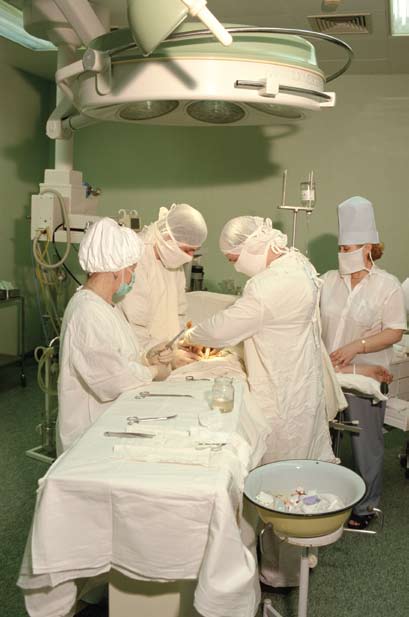
59
(boys to girls) may also be affected, but this finding
The immune, cardiovascular, and metabolic
requires confirmation. Mercury may be associ-
systems can also be affected
ated with increased risk of spontaneous abortion.
Several studies in Nunavik have examined con-
Nickel, however, was not associated with any health
taminants and infectious diseases among children.
deficits, despite high levels of exposure in mining
The results, consistent with other studies elsewhere,
districts in the Russian Arctic.
show that higher exposure to POPs leads to higher
Little epidemiological work has been done to
rates of infections such as middle ear infections and
date in the Arctic on reproductive function and
lower respiratory infections. Although the studies
contaminants. There are some suggestions of
were not always able to control for all factors, the
changes in proportions of X and Y chromosomes
results have been consistent and show a clear cor-
in sperm from Greenlandic and Scandinavian men,
relation between level of exposure and frequency of
but more research is needed.
infection. Vitamin A deficiency may play a role, but
Neurotoxicity, by contrast, has been studied in
requires further study. A study in the Faroes found
relation to PCBs, mercury, lead, and nutrients. In
that prenatal exposure to PCBs lowered a child's im-
Nunavik and the Faroe Islands, prenatal exposure
mune response to tetanus and diphtheria vaccines.
to PCBs is associated with a specific set of cognitive
Cardiovascular disease is increasing among Arctic
deficits, resulting among other things in slightly
The hospital at
populations, as noted earlier. Studies elsewhere in
Norilsk, western Siberia,
lower performance on IQ tests. Methylmercury
the world have found links between POPs and heart Russia.
exposure reduced verbal ability, hand-eye coordina-
tion, and attention span in the Faroes, similar to re-
sults from other parts of the world. Despite health
guidelines implying a lowest-effects level for lead,
recent studies have found that there may be no safe
exposure level. Even low levels of lead exposure
in infants and children were found in Nunavik to
result in behavioral and motor skill deficits.
Studies of selenium and fatty acids were designed
to determine the extent to which these nutrients
counteracted the effects of contaminants. Selenium
is known through experiments to bind with mer-
cury and render it biologically harmless. Its effect on
methylmercury has been unclear, but recent studies
in Greenland and Nunavik indicate that selenium
offers little protection against chronic exposure to
methylmercury, as is typical in many Arctic diets.
To the contrary, a study of selenium in Nuna-
vik found that the trace metal was associated with
negative impacts to the vision system. Selenium,
although a necessary nutrient, can be toxic in
high levels. Indeed, levels in Nunavik were found
to be higher than guidelines for adults, though
less is known about selenium toxicity in children.
Omega-3 fatty acids were associated with improved
mental function, but were not found to offset nega-
tive impacts from contaminants. While nutrients
need to be studied in conjunction with contami-
nants, the evidence so far suggests that there are
y Alexander
no simple ways to prevent negative impacts from
contaminants exposure.
B
r
yan and Cherr
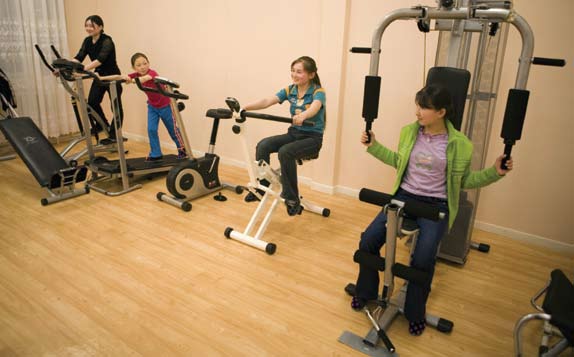
60
disease. A study in Nunavik found no clear con-
Risk Communication
nection between contaminants and cardiovascular
Assessments of human health and contaminants
disease, although the links are complex and affected
in the Arctic have generated a great deal of infor-
by nutrients in diet, lifestyle, and other factors that
mation and knowledge. Communicating results
may mask the role of contaminants.
to Arctic residents, however, is another matter. A
Mercury appears to cause higher blood pressure.
major complication is the "Arctic dilemma," which
Although other factors may be involved, stud-
is that people are generally exposed to contaminants
ies comparing adults in Greenland and Denmark
through traditional foods, which are also cultural y,
found that higher mercury levels were associated
nutritionally, economically, spiritually, and socially
with higher pulse pressure (the difference between
vital. Thus, the message is complex. Effects and risks
systolic and diastolic pressure). Children in the
also vary by region, age, sex, and other factors. This
Faroes were found to have higher blood pressure
section describes the need for a sound communica-
with higher methylmercury levels. These and other
tion strategy, with messages designed for specific
results indicate that methylmercury is likely to cause
audiences in each country, region, or area.
cardiovascular disease. This outcome of mercury
exposure may be more significant, from a public
Communication involves many factors and poor
health standpoint, than neurological effects that
communication can increase anxiety
have been found.
Communication requires the involvement of at least
Diabetes, too, is a serious and increasing public
two people. There are many opportunities, on both
health concern for Arctic indigenous peoples. Al-
ends, for misunderstanding to develop. When the
though lifestyle and dietary factors are usually recog-
subject is complex, the difficulty becomes larger as
nized as the causes of diabetes and related metabolic
too much information may be overwhelming but
dysfunction, the role of POPs has received more
too little can omit crucial knowledge. If the subject
attention in recent years. This link is discussed in
involves people's wel being, emotions may run
more detail in the next section.
high, perhaps magnifying the perception of risk.
If these preliminary findings are confirmed
When many individuals from various backgrounds
regarding contaminants and various diseases, the
are involved on al sides, the chal enge becomes
effects attributable to POPs and metals in the Arctic
greater still. Each person may understand the infor-
may increase substantial y. Particularly for common
mation differently, may talk a little differently, or
diseases, a smal increase in risk can lead to a larger
may bring his or her own biases to the discussion.
increase in the number of individuals affected.
Nenets children
working out in the
school fitness room,
Yamal, north western
Siberia, Russia.
y Alexander
B
r
yan and Cherr
61
Communicating about contaminants and human
1970s, Faroese first became aware of the high levels
health in the Arctic has al of these features and
of mercury found in pilot whales. Subsequent stud-
more. Getting the message out is important but not
ies have found neurological deficits in children from
simple. Merely mentioning contaminants can cause
mercury and also, to a lesser extent, from PCBs.
stress and anxiety. Miscommunication can exacer-
Recommendations to eat less pilot whale, and for
bate the situation, leading people to change their
women to avoid it until after they had had children,
behavior in ways that may be worse than the original
went against cultural practices and also a renewed
risk. If people learn that traditional foods are con-
local importance given to whaling in response to
taminated, they may stop hunting and fishing. This
international pressure to stop hunting pilot whales.
may undermine community cohesion that develops
Fortunately, pilot whales were the main route of
through sharing and working together and may lead
contaminant exposure on the Faroes. Islanders eat a
to poorer dietary habits through decreased consump-
lot of fish, but the fish had comparatively low levels
tion of traditional foods. Poor risk communication
of mercury and PCBs and were not considered a
may cost community members more money if
threat. In addition, fish confer many health benefits,
people buy food at the store instead of providing
so a dietary adjustment posed no nutritional dilem-
their own. These changes may harm health. If those
mas. Fol ow-up studies have shown that pilot whale
impacts are blamed on having followed scientific ad-
consumption has indeed declined considerably, espe-
vice, distrust of research and researchers may result.
cial y among young women. The fact that the health
There have been many attempts around the Arctic
advice focused on one food, and that many Faroese
to communicate information about contaminants
had already been involved in the studies examining
and associated risks to human health, as discussed
effects from mercury and PCBs in pilot whale, helped
below. One common challenge is understanding how
make the communication effort simpler.
risks will be perceived by members of the target audi-
In Canada, considerable attention has been
ence. That perception of risk is influenced by individ-
given to communicating the results of the Northern
ual characteristics, such as age, sex, level of education,
Contaminants Program to residents of Arctic com-
and culture. It is also influenced by whether the risk
munities. There have also been fol ow-up studies
is voluntary, when the effects are likely to be seen, the
to determine how wel that information has been
degree of uncertainty about the risks, and other fac-
understood. The results indicate that Northerners are
tors. Another key factor is the degree to which people
generally familiar with the idea of contaminants, but
feel they can take action to avoid the risks, in contrast
that the ful message does not reach many people.
to feeling helpless or without alternatives.
Consumption of traditional foods remains high in
In the Arctic, discussing traditional foods in
most areas, with some people saying that they will
connection with health risks is a great chal enge.
not change their diets in response to contaminants.
Many people may feel they have few good alterna-
In part, this appears to stem both from cultural at-
tives to traditional food, particularly if part of the
tachment to traditional foods and from an expecta-
public health message is that store-bought foods also
tion that unsafe foods would be visibly affected.
carry considerable risks. A sense of trust between the
Knowledge of specific contaminants was lowest
person providing information and those receiv-
among young women and girls, which is a matter
ing it is also crucial to addressing differences in
of some concern since women of childbearing age
risk perception so that the risk is neither over- nor
are one of the main targets of much public health
under-estimated. In other words, the full context
advice. A likely cause of this knowledge gap is a
of communication must be considered, not just the
lack of understanding among researchers and health
wording of a report or layout of a poster.
professionals of the individual and collective charac-
teristics of young women in the region in relation to
Communication efforts to date have had mixed
risk perception.
results
Contaminants tend to rank low on lists of
In the Faroe Islands, in contrast, risk communica-
health concerns among Canadian Northerners.
tion appears to have been largely effective with
Other environmental concerns, such as garbage,
respect to consumption of pilot whales. In the
rank higher. Personal behaviors, such as smoking
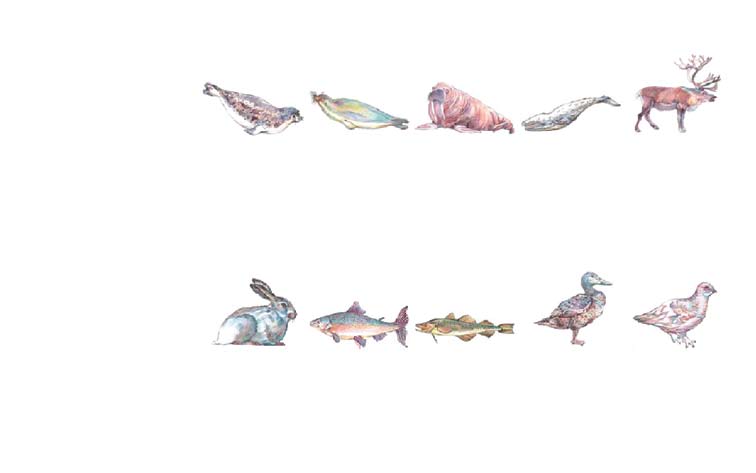
62
and alcohol consumption, are also recognized as
Arctic territory. New legislation is needed to reflect
major health risks. In one study of four communi-
a growing awareness of the importance of proper
ties, residents' responses showed an understand-
waste management and recycling. Many Arctic
ing of the basic message of the risks associated
residents are also increasingly aware of their role
with environmental contaminants. Nonetheless,
in disposing of garbage in environmental y sound
few reported having modified their behavior in
ways. Once the legislation is in place, then commu-
response. This may be due to a perceived lack of
nications and other strategies can be developed to
alternatives, to an acceptance of the risk in light of
promote human health and other goals.
social and other benefits of traditional foods, or to
In Norway, health communications are typi-
the message not being fully accepted despite the
cal y handled through local public health officers
information having been conveyed.
or through the media. The media is clearly a more
powerful vehicle, but messages in an official report
Other countries are developing communications may not be the same as those in the media story
programs
about that report. Expert panels convened by the
Contaminants have already produced negative health
government to assess a particular health topic may
effects in Greenland. Health experts there have rec-
issue a plain-language report for public and media
ommended that contaminants be addressed as part of
consumption, but most publicity will be via media
an overal health policy. This is particularly important
rather than directly from the report.
with rising obesity, since obesity and contaminants
A more consistent and rigorous approach is
can compound the effects of each. The recommenda-
tions for a health policy with regard to contaminants
needed for risk communication
include international action to reduce the release
To date, AMAP has conducted three assessments of
of contaminants, increased attention to identifying
human health and environmental contaminants in
healthful foods available in Greenland, increased
the Arctic. Each has been characterized by care-
Dietary advice on
consumption of tradi-
physical activity to help combat obesity, and avoid-
ful data collection, analysis, and interpretation. A
tional foods for com-
ance of foods with the highest contaminant levels.
great deal of attention has been given to topics such
munities in Chukotka,
Russia has considerable quantities of contami-
as quality assurance/quality control for laboratory
Arctic Russia.
nants in waste sites and pol uted areas across its
analyses to ensure that trends and patterns are real.
63
Studies of effects have looked at obvious and subtle
economic, and spiritual reasons. A major dietary
physiological disruptions to see what contaminants
shift is underway across much of the Arctic. Most
are doing to people. Comparatively less attention
dietary energy now comes from store-bought foods,
has been given to the effective communication of
although traditional foods provide many nutrients
the result of these extensive and intensive research
and are a major contributor to healthy diets in
and monitoring programs.
many communities. Some traditional foods can
The various communications efforts around the
also carry risks from contaminants. The intake of
Arctic have one thing in common: they have not
contaminants is determined by environmental levels
relied upon communications professionals. Despite
and dietary patterns of individuals and communi-
some successes, such as in the Faroes, no clear
ties. The combination of high prices for store-
strategies have been developed for a communication
bought foods and the work, risks, and costs associ-
program. It is not even clear whether the intended
ated with obtaining traditional foods has made food
audience is the general public, health officials, or
security a large concern for many Arctic residents.
others. Each group has different characteristics, as
The levels of mercury, lead, and most POPs
do the residents of different countries, members of
are decreasing in most parts of the Arctic. Marine
different ethnic groups, and so on.
mammals remain a major source of POPs, so that
In the future, a communication strategy should
people who eat marine mammals have higher POPs
be developed to address these and other chal enges.
levels than those who do not. Reflecting the declines
It should identify various target audiences, develop
in environmental levels of many contaminants,
clear terminology, and define its goals. In addition,
the proportion of women of childbearing age who
the communication effort should be evaluated
exceed blood level guidelines for PCBs, mercury,
carefully to determine how well it is working and
and lead is decreasing. At the same time, emerging
what can be improved. Because contaminants come
compounds such as brominated flame retardants
largely from outside the Arctic, the communica-
and fluorinated compounds are a concern in the
tion strategy should also identify how best to reach
Arctic because levels have increased over the last
decision-makers who can influence the production
15 years and their toxicology has not been studied
and release of contaminants around the world. For
in detail. Careful laboratory procedures, including
example, Arctic findings can be used in internation-
rigorous quality control and quality assurance, pro-
al negotiations concerning contaminants. This was
vide analytical results with high levels of confidence,
done successful y in the creation of the Stockholm
supporting the assessment of trends over time and
Convention, where Arctic data continue to provide
space. Testing procedures initiated by AMAP and
justification for adding new chemicals under the
others have led to more reliable data, and continued
convention.
efforts will result in further improvements.
Recent studies have found a number of mecha-
Chapter summary
nisms by which contaminants can affect metabo-
The transport of contaminants to the Arctic is affected
lism. Obesity is increasing worldwide due to lifestyle
by climate patterns. Anticipated changes in global and
changes and dietary shifts, and the Arctic is no ex-
Arctic climate are likely to result in increased contami-
ception. Obesity is associated with an increased risk
nant transport to and from the Arctic. International
of cardiovascular disease and of developing diabetes.
actions such as global and regional treaties lead to
POPs, even at low concentrations, also increase the
reduced emissions, which in turn result in decreases in
risk of diabetes. These new findings indicate that
contaminant levels in the Arctic. Increased industrial
future studies need to consider the interactions
activity in the Arctic, however, would lead to an in-
between contaminants and other health conditions.
crease in local sources. In terms of human exposure to
The characteristics of different Arctic populations
contaminants, social and cultural practices play a large
vary in many respects. In general, indigenous popu-
role, in addition to environmental concentrations of
lations in the region are less healthy than national
the contaminants themselves.
averages. While socioeconomic conditions and
Traditional foods are very important to Arctic
lifestyle choices are major determinants of health,
indigenous peoples for social, cultural, nutritional,
contaminants may also have a contributing effect.
64
Toxicological studies show that contaminants, at
of sharing such information is to help Arctic resi-
the levels found in some parts of the Arctic, have
dents make informed choices regarding the benefits
the potential for adverse health effects in people.
and risks associated with dietary choices. Mes-
Epidemiological studies, looking at Arctic residents
sages concerning contaminants are often complex,
directly, provide evidence for subtle immunologi-
with many factors shaping how they are given and
cal, cardiovascular, and reproductive effects due to
received. Communication efforts to date have had
contaminants in some Arctic populations. Genetic
mixed results. Effective approaches have involved
characteristics of the various Arctic populations
communities in the development of communica-
may also affect their response to contaminants and
tion materials, which helps avoid messages that are
susceptibility to certain diseases, a topic requiring
unclear, appear contradictory, or do not reach the
further investigation.
intended audience. Rigorous evaluation of commu-
Communicating the results of studies concerning
nication efforts can help identify problems and suc-
contaminants and people is important. A chief goal
cesses, leading to better strategies and approaches.
65
Radioactivity
Introduction
Past fallout remains in the terrestrial
Previous AMAP assessments of radioactivity in the
environment
Arctic have highlighted that the Arctic terrestrial envi-
From a circumpolar perspective, fal out from past
ronment is more vulnerable to radioactive contamina-
nuclear weapons testing has historical y been the
tion than many other parts of the world. Moreover,
most important source of human and environmental
they have shown that past sources such as fal out from
exposure to anthropogenic radioactive contamina-
nuclear testing in the 1950s and 1960s and the 1986
tion. Other past significant emissions include fallout
accident at the Chernobyl nuclear power plant still
from the 1986 accident in the Chernobyl nuclear
contribute to human exposure. The 2002 assessment
power plant, which affected the European Arctic. Al-
also highlighted continued releases to the marine envi-
though the fal out spread al over the globe, the Arctic
ronment from European reprocessing of nuclear waste
is particularly vulnerable because Arctic vegetation
and the risks associated with handling spent nuclear
has very efficient uptake of radionuclides.
fuel and radioactive waste in northwest Russia.
Monitoring of radionuclides in the atmosphere
This assessment provides an update of sources of
in Finland and ocean water near Greenland and the
radioactivity to the Arctic environment, including the
Faroe Islands shows that traces of atmospheric weap-
results of efforts to reduce the risks associated with
ons tests in the 1950s and `60s are stil detected but
waste handling and decommissioning of old nuclear-
with declining levels over time. Air monitoring data
powered equipment. It also discusses changes in the
from Canada highlight how some of the fal out that
range of actual and potential sources and highlights
has been incorporated in vegetation can be re-released
that non-nuclear industrial activities may increase the
into the environment in connection with forest fires,
release of naturally occurring radioactive substances
where cesium levels exceeding the detection limit
to the environment. While previous assessments have
coincide with summer forest fires. Other data show
mainly addressed the risks of radioactivity related
that in spite of the peak of weapons testing being
to human health, this assessment also addresses the
over 50 years ago, the radiocesium from the fal out
impacts on non-human biota due to the vulnerability
remains in the top layer of the soil, the reason being
of Arctic ecosystems. In addition, it includes a discus-
that processes that would normal y favor mobility
sion of how climate change may affect radioactive
are slower in colder environments. Past fal out is thus
contamination in the environment.
likely to remain a source of radioactive contamination
for grazing wildlife and for people.
Sources: Update based on actions and
climate change
Strontium-90 in seawater, Bq/m
Strontium-90
100
The sources of radioactive contamination in the
Faroe Islands
measurements in
Arctic can be divided into past contamination sources
West Greenland
seawater demonstrate
East Greenland
and potential future sources. This section provides
the decline in con-
10
an update of different sources of radioactivity to the
tamination from fallout
from historical nuclear
Arctic, including their role for human and ecosystem
weapons testing.
exposure. It addresses the impact of actions to reduce
0.1
risks as well as other changes to sources since the pre-
vious assessment. In addition, it addresses how climate
0.01
change may impact the risks linked to these sources.
1960
1970
1980
1990
2000
2010
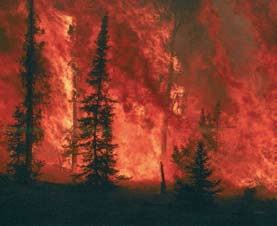
66
137Cs concentration in atmosphere, Bq/m3
10 000
Ecological half-life
Ivalo
Ecological half-life is a parameter that tells how
Kevo
Seutula
long it takes radioactive contamination to leave
Nurmijärvi
1000
a specific system during a specific time period.
Rovaniemi
Karhutunturi
It depends on the chemical properties of the
radionuclide, how radionuclides interact with the
soil and vegetation, and how the land is managed
Atmospheric moni-
100
(e.g. plowing).
toring for radioactivity
is conducted at sites
Effective ecological half-life combines ecological
around the Arctic. The
10
half-life with the physical half-life of the radionu-
graph shows measure-
clide in question.
ments at some Finnish
stations. The gener-
the Faroe Islands, which found ecological half-lives
1
ally decreasing levels
for cesium-137 of up to 21 years in soil, up to 16
increased again in
years in grass, and up to almost ten years in lamb
1986 as a result of the
meat. In Finland similar studies have been done
Chernobyl accident.
0.1
with the soilgrassmilk food chain where the
1960
1970
1980
1990
2000
2010
ecological half-life of cesium-137 in milk after the
Chernobyl accident was about 2.2 years, increasing
The legacy of Chernobyl wil remain for a long
to 11 years for the period 1993-2008.
time
A food chain of major importance in the Arctic
In the European Arctic, fallout from the 1986 ac-
is lichenreindeer/cariboupeople. It has been
cident in the Chernobyl nuclear power plant added
studied extensively as it has been a major source of
further radicesium to the environment, even if the
radionuclide intake to people. Lichen effectively
fal out in the Arctic was much less than further
absorb nutrients and contaminants from the air, in-
south in Fennoscandia and close to Chernobyl. The
cluding radioactive fallout, and were thus more con-
additional contamination is observable as small
taminated than green plants after the atmospheric
peaks in the atmospheric record (see figure above) as
tests and the Chernobyl accident. Long-term studies
wel as in the monitoring records of deposition and
in Scandinavia after the Chernobyl accident show
levels in vegetation and food products such as milk
that the effective ecological half-life is about three
and meat.
years. Previous AMAP assessments have presented
Monitoring data have been used to understand
overviews of contamination in reindeer and caribou
the effective ecological half-lives of radionuclides in
with details for Russia, Norway and Iceland. The
different environments and food webs. An example
figure below shows some recent data from Canada
Levels of
is studies of deposition, grass and lamb meat from
and Greenland with fal ing levels since a peak in the
cesium-137 in Canadian
caribou reflect deposi-
137Cs in deposition, Bq/m2
tion which has declined
137Cs in caribou muscle, Bq/kg
since its peak in the
1600
1960s.
Caribou (measured)
1400
Levels of cesium-137
1200
in the air can increase
1000
when forest fires release viceer
800
cesium that was taken
est S
up by trees fol owing
or
600
Caribou (calculated)
fallout from atmospher-
400
ic nuclear weapons test-
Deposition
200
ing and the Chernobyl
tocks / Canadian F
0
accident.
B
rian J. S
1955 1960 1965 1970 1975 1980 1985 1990 1995 2000
67
1960s. The effective ecological half-life is calculated
and to some extent in perch and trout, compared
at about six years, and levels are now less than 100
to non-predatory fish, such as whitefish and roach.
becquerels per kilogram of meat. A major difference
In the first eight years after the accident, the effec-
compared to the data from Norway, Russia and
tive ecological half-lives were similar in two differ-
Iceland is that Canada and Greenland were much
ent lakes that were studied in Finland, one clear
less affected by fallout from the Chernobyl accident.
lake with low nutrient levels and one eutrophic lake
The levels are similar to areas of northern Finland
with high nutrient levels. Since then, the half-lives
that were only slightly affected by Chernobyl
in the eutrophic lake have increased and are now
fal out. In northern Finland, the effective ecological
close to the physical half-life of cesium-137, prob-
half-lives in the post-Chernobyl period are slightly
ably because cesium from the surroundings fol ows
longer than in Canada ranging from 8 to 9.5 years
the flow of nutrients into the lake. In both lakes,
in different areas. In Chernobyl-affected areas in
the levels in fish are much lower now than they
Norway and Sweden the current effective ecological
were in the 1960s when they were most affected by
half-life has been estimated at approaching 30 years.
nuclear fallout.
Lessons about the ecological behavior of
The declining levels of radioactivity in the
environment are also reflected in people. However,
radionuclides
the levels in people in Chernobyl-affected areas
A general conclusion from the behavior of radio-
who consume large quantities of reindeer meat and
cesium in the environment after Chernobyl is
other products from the wild, than in other parts of
that lichen are more contaminated than green
Fennoscandia. For example, in the year 2000, the
plants immediately following a fallout event but
mean body content was ten times higher in a group
that cesium remains for a longer time in green
of Finnish consumers of wild products than in the
plants than in lichen. Following the Chernobyl
general Finnish population. In central Sweden and
accident, this led to seasonal differences in levels
Norway, there is stil a need for actions to limit the
in reindeer meat, with higher levels in late winter
intake of cesium-137 by reindeer herders. Using
after the reindeer had fed mainly on lichen than
stricter countermeasures, the levels in these groups
during summer and in the fall after the reindeer
could have been comparable to levels in the general
had fed on green plants. The difference was
population. However, these were not implemented
enhanced by slower metabolism of the reindeer in
because the changes in lifestyle that those counter-
the winter. With time, these seasonal differences
measures would have required was so great that the
have diminished.
total consequences were assessed to be negative.
For berries and mushrooms, the levels and eco-
logical half-lives can vary greatly depending on the
Cesium-137 in freshwater sh, Bq/kg fresh weight
Levels of cesium-137
species. For example, for the fungi of the genus Lec-
400
in various freshwater
cinium there has been no significant change in the
Lake Apukka, roach
Lake Apukka, perch
fish species in two
cesium levels in the past 20 years, and in the species
350
Lake Apukka, pike
Lake Inari, white sh
Finnish lakes.
Suillusluteus, levels have increased rather than
Lake Inari, trout
Lake Inari, vendace
decreased, contrary to other Suillus species. For
300
Lake Inari, perch
Lake Inari, pike
years with high abundance of mushrooms on the
pastures, mushrooms can be an important source of
250
radiocesium for reindeer and other grazing animals.
Measurement of wild berries in Finland show much
200
higher levels in cloudberries (a typical Arctic spe-
cies) than in bilberry, lingonberries and cranberries.
150
The activity levels for al berries are, however, below
international recommendations.
100
The levels in freshwater fish depend on the
50
ecosystem in which they live and their food habits.
Directly after the Chernobyl accident the highest
0
levels were found in predatory fish, such as pike
1965 1970 1975 1980 1985 1990 1995 2000 2005
68
Marine discharges from spent fuel reprocessing have
ing exposure of people in the Arctic has nevertheless
declined
been relatively low.
In the Arctic marine environment, discharges to
Today, the main concern in relation to Sellafield
the sea from reprocessing of spent nuclear fuel at
is the tanks on land for temporary storage of Highly
Sel afield (United Kingdom) and Cap de la Hague
Active Liquor. There are currently 21 large tanks,
(France) have historical y been a major source of
with a total storage volume of 2360 cubic meters. In
radioactive contamination, especially cesium-137
2004, they held 1000-1500 cubic meters of waste
but also other radionuclides. These contaminants
with a very large inventory of cesium-137, stron-
can be transported over long distances and follow the
Seaweed is an excel-
99 Tc in seaweed (F. vesiculosus), Bq/kg dry weight
Atlantic current to the Norwegian Sea and further
99
lent bioindicator for
Tc discharge, TBq/year
99 Tc in seawater, Bq/m3
along the Norwegian coastline into the Barents
210
2.0 400
technetium-99 in the
Sea on a route that takes four to five years. These
Tc discharge
1.8
marine environment.
180
350
contaminants wil eventual y reach the Arctic Ocean.
Tc in seaweed
1.6
Seaweed accumulates
300
150
Routine releases from the European reprocessing
1.4
technetium from the
Tc in seawater
250
1.2
plants declined drastical y in the 1970s. However, the
120
seawater and is eas-
1.0 200
ily accessible in most
previous AMAP assessment reported increasing levels
90
0.8 150
coastal areas. It has
of technetium-99 and iodine-129 and raised discus-
60
0.6 100
therefore been used
sion about the need for new assessments of potential
0.4
30
50
for routine monitor-
impacts of these releases.
0.2
ing. The figure shows a
Since a peak in 1995, the discharges of techne-
0
0
0
1993 1995 1997 1999 2001 2003 2005 2007
peak in technetium-99
tium-99 have dropped considerably. The increase
in 2000-2001 in brown
in discharges from Sellafield was associated with
algae from Hil esøy near
a new facility for treating a backlog of stored
Sella eld Cs, Sr, Tc and
Sella eld
Tromsø in northern
beta-emitter discharges,
tritium discharges,
medium-level radioactive waste. This was designed
TBq/year
TBq/year
Norway about five
200
4000
to remove some contaminants (mainly actinides),
years after the peak in
however some radionuclides, including techne-
Tritium
3500
discharge of this radio-
tium-99 remained in the discharges to the Irish
150
nuclide from Sel afield
beta-
3000
Sea. This explains the increased levels reported
emitters
in 1995. In seawater, the
2500
in the previous AMAP assessment. In 2004, a
activity peaked in 1999
100
2000
at Hillesøy.
new purification technology was implemented
at Sellafield, designed to extract technetium-99.
1500
Technetium
Discharges to the Irish Sea of technetium-99 have
50
1000
since dropped considerably.
Strontium
500
Because of the wide dispersion and massive dilu-
Cesium
tion of these contaminants in the water, the result-
0
0
1994 1996 1998 2000 2002 2004 2006
Climate change may release contaminants stored in the environment
Low mobility of radionuclides in the cold environment in combination with high content of organic matter has made the Arctic tundra a
large sink for both anthropogenic and naturally occurring radionuclides. When the climate changes - with warmer temperatures, changes
in precipitation and shifts in the presence of snow, ice and water - these contaminants may become more mobile. For example, radionu-
clides are often associated with dissolved organic matter. In recent years, elevated levels of dissolved organic matter, which makes the water
brownish in color, have been observed in a number of countries and this is generally regarded as a climate-related phenomenon.
Glaciers have also served as sinks for fallout from nuclear weapons testing. Glaciers grow or shrink depending on the amount of precipita-
tion and the temperature. With climate change, Arctic glaciers are currently shrinking, and their ice, including its load of contaminants, is
released via meltwater and calving. Calculation based on the two glaciers and fjords on Svalbard show that the inventory of radioactive
contamination in glaciers can serve as a significant source for local contamination. However, the impacts are neither well understood nor
have they been subject to enough research to make any assessment of risks to ecosystems or people.
69
tium-90 and other radionuclides. The UK Nuclear
Arctic
Instal ation Inspectorate has required Sel afield to
Ocean
reduce the amount of stored High Active Liquor but
until that is done the storage tanks remain a potential
Fram
Strait
source to the Arctic environment. If they were to fail,
Barents
Sea
they could release a considerable amount of radioac-
tive substances to the marine environment and even-
Greenland
Labrador
tually to the Barents Sea. A rise in cesium-137 would
Sea
Sea
be apparent after two to three years with a peak that
would be far beyond the highest levels of the 1980s.
Even after 20 years, the cesium concentration would
be well above today's levels.
North
Sea
Sella eld
Climate change is likely to affect marine
pathways
Cap de la Hague
Climate change is likely to affect the transport of con-
Arctic Water
Mixed Arctic and Atlantic Water
taminants in the marine environment. For example,
Atlantic Water
Coastal Water
movement both into and out of the Barents Sea may
become more rapid than today. We may also expect
transport in the Arctic. With declining multi-year ice,
Main current
an increased exchange of water (including its load of
it is less likely that contaminated sediment carried by
systems in the North
contaminants) between the surface layer of the ocean
sea ice from the Russian coast and continental shelf
Sea, Norwegian Sea,
and the so-cal ed Atlantic layer below. The circulation
wil reach Fram Strait where it would otherwise melt
Greenland Sea and
in the Atlantic layer is slower than the surface water
and release its load. Instead, the sediment is more
Barents Sea area.
and the consequence would be that contaminants
likely to be released on the continental shelf, where it
that enter the Arctic marine environment may stay in
can be reincorporated in ice during the next winter.
the Arctic longer than they do today. These processes
Changes in temperature may affect how radio-
would affect radionuclide transport from the Euro-
nuclides are taken up and retained by animals in the
pean reprocessing plants and also outflow from the
water. The knowledge base is too poor to make any
Baltic Sea, which carries contaminants from the Cher-
new assessments of risks, but in general, changes in
nobyl accident to the Arctic marine environment.
temperature may lead to changes in turnover rates of
Changes in the sea ice may also affect contaminant
contaminants in cold-blooded animals such as fish.
Iodine-129 is used for mapping ocean transport
129 I discharge,
TBq/year
Iodine-129 has an extremely long half-life (16 million years). It has been
2.0
released from nuclear facilities, mainly from nuclear fuel reprocessing
plants, and has been used as a tracer of long-term ocean circulation pat-
1.5
terns. Between 1990 and 2000, annual discharges from Cap de la Hague
and Sellafield increased drastically. The `leading edge' of the contamination
associated with this increase has now entered the Labrador Sea, with a
1.0
transit time of about seven to nine years. After first entering the North Sea,
it flowed northward along the Norwegian coast towards Spitzbergen. From
there, it flowed into the Arctic Ocean via the Fram Strait and the Barents
0.5
Sea. It also circulated counterclockwise around the Greenland Sea passing
southward along the east coast of Greenland. It entered the Labrador Sea
0
at depths of 3000 meters with Denmark Strait Overflow water. The levels
1968
1974
1980
1986
1992
1998
2004
of iodine-129 are too low to be of health or environmental concern but
they show that radionuclides and other contaminants that enter the North
Iodine-129 discharges from the Cap de la Hague
Atlantic can quickly spread over large areas.
reprocessing plant, France.
70
Declining levels of
Updates on radioactive material in Abrosimov
329,240 Pu in sediment, kBq/m2
plutonium-239,240 in
Bay and Thule
1000
marine sediments at
Previous AMAP assessments have addressed the
100
Thule, with distance
issue of radioactive waste dumped at the bottom of
from the crash site.
the sea in the Russian north, with the conclusion
10
that the major risks are long term and connected to
the corrosion of the containment. A 1994 survey of
1
Abrosimov Bay concluded that there was a need to
0.1
monitor the situation. In 1998, the International
0
2
4
6
8
10
12
14
16
18
Distance, km
Atomic Agency (IAEA) concluded that the dump-
ing sites should be monitored on a regular basis.
Information concerning the crash of an Ameri-
Thule
Unfortunately, there have been no joint Russian/
can B-52 at the Thule airbase in northeast Green-
Abrosimov
Norwegian expeditions to the dump sites in the
land in 1968 was reported in both previous AMAP
Bay
Kara Sea since 1994. However, there has been a
assessments. The latest investigation of this site was
joint Russian/Norwegian programme with yearly
conducted in 2003. It showed that plutonium from
measurement in the open Barents Sea and along
the nuclear weapons that were on the American
the coast of Finnmark and the Kola starting in
B-52 persists in the environment. The highest con-
2002. The new data show decreasing inputs from
centrations are in the sediment under the location
remote sources such as global fal out, European
where the plane crashed on the ice. The distribution
Distributions of
reprocessing plants and the Chernobyl accident.
cesium-137 in Abro-
is very uneven and associated with "hot" particles.
The data also show that in the Barents Sea, so far,
simov Bay surface
The new data (with an estimated inventory of 2.9
sediments in 1994 and
there is no signal of radioactive leakage from the
x1012 becquerels of plutonium) support the 1997
2002.
submerged objects.
AMAP conclusion that earlier investigations may
have underestimated the inventory on the seabed.
137
1994
Cs, Bq/kg
Concentrations of plutonium in surface sediments
dry weight
137
1994
Cs, Bq/kg
are generally elevated due to biological mixing with
dry weigh
60t
deeper more contaminated layers. Concentrations in
40
60
20
seawater, seaweed and bottom-dwelling animals are
40
10
low but above the background level. The radioactive
20
5
10
material does not present a risk to human health,
0
10m
5
even if people were to eat shellfish with the highest
0
20m
concentrations. Plutonium from the accident has
10m
also created elevated activity levels in soil around
20m
10m
20m
Narssarssuk. For people visiting the site, this could
10m
20m
constitute a smal risk if radioactive particles were
resuspended and inhaled.
Dealing with obsolete submarines, spent fuel
2002
and radioactive waste
2002
The previous AMAP assessment highlighted the
poor situation surrounding decommissioning of
submarines of the Russian Northern fleet and stor-
age of spent fuel and radioactive waste from these
submarines and other nuclear-powered vessels.
10m
These storage sites pose a major potential risk to
20m
10m
the local and regional environment. Although some
20m
activities had been initiated to improve the situa-
10m
20m
tion, the previous assessment concluded that much
1 mile
10m
20m
remained to be done.
1 mile
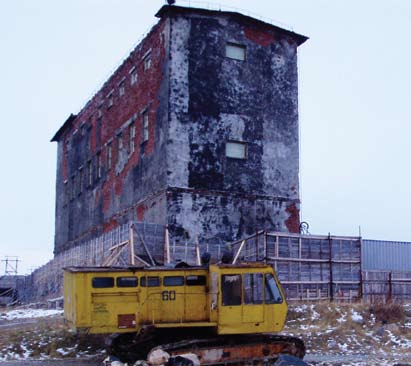
71
Dismantling and decommissioning of submarines
successful
A total of 198 Russian nuclear submarines have been
taken out of service by the Russian navy. As of March
2008, 164 are decommissioned. This is a result of
comprehensive efforts by Russia and contributions
by donor countries, especially from G8 countries
following the 2002 Kananaskis G8 Global Partner-
ship commitments. Of the remaining 34 nuclear
submarines, 11 are under decommissioning and 20
are waiting to be decommissioned (9 in northwest
and 11 in the far east of Russia).
uthority
Operations to remove spent fuel from liquid
metal reactors, previously identified as a major is-
r
otection A
sue, have begun. Other activities are the processing
of several hundred tonnes of low-level radioactive
waste and preparing casks for transport and storage
egian Radiation P
w
or
of spent nuclear fuel.
N
Further activities are in advanced stages of plan-
to service nuclear submarines and to store nuclear
Building #1 at
ning. They include defueling and decommissioning
waste. They were used intensively in the late 1980s
Andreeva Bay, used
of the Lepse Floating Maintenance Base, which has
and early 1990s. Since then support has ceased
for dry storage for
been used for storing spent fuel and radioactive waste
and the sites have become temporary storage sites.
spent nuclear fuel, was
and which is in a very poor condition. Plans also
Maintenance was not kept up according to plan
demolished in 2008.
include defueling of a Papa Class nuclear powered
and the facilities have degraded. In 1982, failure in
submarine with management of spent fuel and
the containment in one building of Andreeva Bay
radioactive waste. In addition, enhanced radiation
resulted in leakage of radioactive water and forced
monitoring and emergency response in the Archan-
the relocation of the spent fuel. There are currently
gelsk region has been commissioned.
3000 containers of spent nuclear fuel in Andreeva
Dismantling of submarines is not a risk free activ-
Bay holding 1.3x10¹⁷ becquerel, in addition to large
ity. The Norwegian-Russian efforts have been well
amounts of solid and liquid radioactive waste, com-
documented and include improved environmental
prising 6.0x10¹⁴ becquerels and 2.2x10¹² becquerels,
monitoring and impact assessments. In general, these
respectively. Gremikha was mainly used for reactors
efforts have been successful without radiological
from decommissioned submarines but also holds
incidents or accidents.
control rods and extracted parts from old subma-
There are not many submarines left to be dis-
rines. It holds about 1.3x10¹⁶ becquerel of spent fuel
mantled. The spent nuclear fuel from the decommis-
and 3.3 x10¹³ becquerels of radioactive waste.
sioned submarines has been successful y transported
In addition to both sites having areas containing
to a dedicated facility at the Mayak reprocessing
highly radioactive material, parts of the sites are severe-
plant. If left unattended, it would have posed a
ly contaminated. Doses exceed 1mil isievert per hour
potential threat to people and the environment. The
in some places (compared to recommended limits of
remaining submarines are mainly of specific types
that are more difficult and expensive to dismantle.
The location of the
Norway
A majority of these are expected to be dismantled by
Barents Sea
Andreeva Bay and
funding from the Russian federal budget by 2010.
Andreeva Bay
Gremikha nuclear
waste handling and
Poor conditions at Andreeva Bay and Gremikha are
storage sites on the
slowly improving
Russia
Kola Peninsula.
Kola Peninsula
Gremikha
In the 1960s, the Soviet Navy developed bases at
Andreeva Bay and Gremikha on the Kola Peninsula
Finland
0
200 km
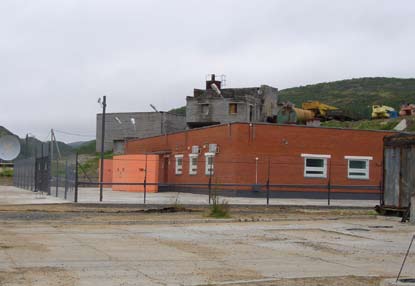
72
and climate on infrastructure is wel known for
Andreeva Bay, where freeze-thaw actions contributed
to loss of integrity of the fuel storage facility and
extensive contamination of the Andreeva Bay site.
Further degradation combined with precipitation has
contributed to radioactive material being washed out
into the marine environment. A number of factors
other than climate contribute to the degradation,
uthority
but assessing the impact of climate change, in similar
ways as has been done for nuclear infrastructure
r
otection A
outside the Arctic, is nevertheless warranted.
Mayak update
egian Radiation P
w
or
Mayak is a facility that was built in 1948 for pro-
N
ducing weapons-grade plutonium. Since 1987 it has
Improvements to
1 mil isievert per year for exposure of the public from
been used mainly for reprocessing of spent nuclear
buildings and infra-
nuclear activities/contamination and 20 mil isieverts
fuel and for producing MOX fuel from weapons-
structure at Andreeva
per year for people working with radiation). Monitor-
grade plutonium. The facility has generated large
Bay have increased the
ing of the coastal strip indicates than radionuclides
amounts of radioactive waste. The environmental
security and reduced
can move from the contaminated sites to the sur-
risks of Mayak for the Arctic were assessed in 1997
risks of releases of radio-
rounding environment via groundwater flow. There
and further discussed in the 2002 AMAP assess-
activity at this storage
have also been discussions about the possibility that
ment. The conclusion was that major risks concern
facility.
the stored waste would set off a spontaneous nuclear
potential accidents and leakage into tributaries to
chain reaction. Current assessments show that, even
the river Ob, but that even worst-case scenarios pose
though conditions are worse than expected, a chain
little hazard to the Arctic environment. The current
reaction could not be initiated without an external
assessment provides an update on levels in the rivers
influence. There remains uncertainty about what the
Irtysh (a tributary to Ob) and Tobol (a tributary to
consequences of such an accident would be for the
Irtysh). Measurements show that the concentrations
nearby area and surrounding region.
of strontium-90 are greater in the Tobol by an order
In 2002, a Russian federal enterprise was estab-
of magnitude compared to background levels for
lished to manage the Andreeva Bay and Gremikha
Russian rivers while they are close to background in
sites and some work has been carried out with assist-
Irtysh. The elevated levels were below intervention
ance from the international community (Norway,
levels for drinking water.
United Kingdom, Sweden, Italy and France). It
Data from the Ob estuary are contradictory
includes constructing equipment and infrastructure
regarding the importance of Mayak as a source of
for removing spent nuclear fuel, building roofs to
contamination. One study points to atmospheric fall-
prevent rainwater from entering the building, decon-
out as the main source of plutonium whereas a study
tamination of buildings and material, and securing
of water in the Ob River, Ob estuary and the Kara
the area. The present plan suggests that transport
Sea points to the Mayak facility as a key source. The
of spent nuclear fuel and radioactive waste from
new data do not change previous assessments that
Andreeva Bay can start in 2013-2014. For Gremikha,
Mayak is currently not a major source for radioactive
feasibility studies have started and some urgent action
contamination of the Arctic. Nevertheless, climate
has been taken to secure infrastructure and to prepare
change could influence the transport of radionuclides
for transport of spent nuclear fuel. The removal of
from Mayak to the Arctic areas. Further studies are
fuel to the Russian reprocessing plant in Mayak was
needed to assess this. The risk of accidents is stil a
scheduled to start at the end of 2008.
concern, especially any releases to the air. Previous
Possible climate change impacts on facilities
assessments indicate that leakage into the river system
from failure of current containment would only
Climate change may pose new challenges regarding
lead to very low doses to humans in the Arctic from
Andreeva Bay and Gremikha. The impact of weather
exposures via the marine environment.
73
New strategic plan aims for long-term management
Radioisotope thermoelectric generators: thefts
In addition to the specific ongoing activities to
and decommisioning
reduce risks from potential sources in Russia, a long-
Radioisotope thermoelectric generators (RTGs) use
term strategic plan has been developed by the Rus-
radioactive decay to produce heat that is then used for
sian Ministry for Atomic Energy jointly with the
producing electricity. They are self-contained devices
Northern Dimension Environmental Partnership
with a long service life and have been used for power-
Support Fund. It is a step towards the implementa-
ing various devices, such as lighthouses, in remote areas
tion of the Global Partnership Programme approved
of the Arctic. RTGs pose a threat to human health if
by the G8 leaders in Canada in 2002 and wil serve
the casing is breached. The radioactive fuel is in the
as a reference point for further work, including
form of hockey-puck sized pieces of ceramic material.
needs for environmental monitoring.
If handled directly, the very high radiation dose rates
The strategic program covers the majority of
would result in the death of those concerned after
facilities in northwest Russia related to scrapped
only a short period of exposure. The half-life of the
military and civilian nuclear naval vessels together
commonly used radioactive source, strontium-90, is 29
with their supporting infrastructure. It wil span
years and the fuel sources remain dangerously radioac-
the time interval necessary to decommission and
tive for hundreds of years. As of February 1, 2008, 519
remediate all facilities, which is longer than for pre-
RTGs were in operation in Russia.
vious short-term 5-10 year programs. Since March
Most RTGs have no form of security, like fences
2008 the plan has been managed by the Centre for
or warning signs, and there have been thefts and
Nuclear and Radiation Safety of Rosatom.
break-ins. The previous AMAP assessment raised
A major chal enge identified in the strategic
concern about RTGs because some devices had been
plan is the need for improved storage facilities for
dropped during helicopter transport or vandalized. In
radioactive waste. A new facility for long-term
the wrong hands, RTGs could potential y be used as
interim storage of reactor compartments has been
"dirty bombs" where conventional explosives are used
developed at Sayda Bay, while a repair workshop is
for spreading radioactive material. The following list
under construction and will be complete by April
of incidents in the Arctic has been compiled by the
2009. The current storage facility wil soon be
Norwegian Radiation Protection Authority:
extended. In addition, the design of a long-term
· Duringthesummerof2001,fourpeoplewere
storage site has started.
brought to the hospital after being exposed to
Coordinated with Russian-led activities,
radiation when trying to disassemble the beacon
Norway has an action plan for cooperation on
light near Kandalaksha in the Murmansk area.
nuclear safety and radiation protection in relation
to nuclear activities in northwest Russia. The plan
Radioisotope ther-
includes technical support and regulatory coopera-
moelectric generator.
tion, such as development of norms for monitor-
ing and workers' safety, the practice of improved
inspection procedures, improved emergency
preparedness and response, and enhanced safety
culture.
A general conclusion from the on-going work
on improving nuclear safety in the Russian north-
west is that the regulatory framework has im-
proved, as have communication and coordination
between authorities in different countries. This
uthority
includes arrangement for emergency preparedness
and response and better supervision of remediation
r
otection A
activities. Continued national and international ef-
forts are however required to assure that the work
will proceed in a timely and safe manner.
egian Radiation P
w
or
N
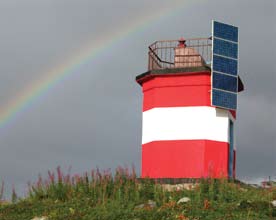
74
· InSeptember2003,supervisionpersonnelfrom
the Barents Sea were removed as part of a bilat-
the Northern fleet stopped an attempted theft of
eral agreement between Norway and Russia. The
an RTG beacon light at the Golets Island in the
remaining 11 devices, located in the Archangelsk
White Sea. The beacon light had a particularly
and Nenets regions, will be removed in 2009. The
strong RTG with six strontium cores.
RTGs are replaced by solar panels. Discussions are
· InNovember2003,twobeaconlightsfromthe
also on-going for Finland and France to contribute
Kola Bay were found disassembled and everything
to removing RTGs and creating safe storage of the
except the strontium cores were taken. A third
radioactive material. The United States, with contri-
theft was discovered south of the mouth of Nerpa.
butions also from Canada, funds a support program
· Inadditiontopreviousincidentsofdropped
that has recovered 87 RTGs along the Northern Sea
RTGs outside the Arctic, two accidental RTG
Route and will recover the remaining 10 devices
drops from helicopters happened in September
along the Northern Sea Route and 11 devices in the
2004, where the RTGs dropped onto rocks
far east of Russia. Moreover, by the end of 2008, 24
from an altitude of 100 meters. No release of
RTGs were recovered from Bilibino. The program
radioactive strontium was registered.
also includes enhanced regulatory processes with
better safety supervision during decommissioning
So far, thieves have been interested in the metal
and transport.
shielding rather than the radioactive fuel but the
thefts show how easily such material may go astray.
Nuclear power plants: climate change and float-
The number of incidents has led to joint Russian-
ing nuclear power plants raise new concerns
international efforts to safely decommission RTGs
As reported in earlier AMAP assessments, there are
along the Russian coastline. For example, in 2007
two nuclear power plants situated within the Arctic,
the last RTG was removed from the Murmansk re-
the Kola power plant on the Kola Peninsula and the
gion. By the end of 2008, 169 of 180 RTGs around
Bilibino power plant in northeastern Russia. The
concerns that have been raised previously related to
Radioactivity
Total activity, PBq
potential accidents, with cal s for effective emergency
associated with RTG
500
preparedness and response systems. A new concern,
operating RTGs
sources in different
especially relating to the Bilibino power plant, is cli-
400
parts of northern Rus-
mate change. Bilibino is situated in a permafrost area
sia is being reduced
300
other sources
where the thawing of this permafrost is likely to cause
as these sources are
(for comparison)
ground movements, which can threaten the structural
decommissioned and
200
stability of buildings. Previous incidents from other
replaced.
100
nuclear facilities, e.g. Andreeva Bay, show that such
freeze-thaw actions can contribute to structural insta-
0
i
t
h
bility that can lead to release of radioactive material
e
n
t
s
o
r
t
h
-
i
n
i
s
t
ry
e
f
e
n
c
e
o
r
t
h
e
r
n
to the surrounding environment. There is thus a need
N Sea Route
F
a
r
E
a
s
t
a
r
i
n
e
w
s
p
e
n
t
f
u
e
l
A
n
d
r
e
e
v
a Bay
o
f
D
R
u
s
s
i
a
c
o
a
s
t
t
h
e
r
M
to conduct risk assessments also for Bilibino that take
O
d
e
p
a
r
t
m
1
n
u
c
l
e
a
r
s
u
b
-
m
R
u
s
s
i
a
n
N
E
u
r
o
p
e
a
n
c
o
a
s
t
B
a
l
t
i
c
c
o
a
s
t
climate change, including changes in the permafrost,
into account.
Radioactive energy
A major new development regarding nuclear
sources in lighthouses
power plants is Russia's intention of developing
along the Murmansk
floating nuclear power plants for use in the Arctic
coast have been
region. Russia's nuclear industry has undergone
replaced by solar
and continues to undergo a major restructuring in
cells.
connection with large-scale expansion of nuclear
k
power. In 1991, there was a competition for the
innmar
best design of low capacity nuclear power plants.
The winning design was a floating nuclear power
o
v
ernor of F
plant. In 1996, a report announced the inten-
County G
75
tion of locating floating nuclear power plants in a
Potential locations
number of places in the Russian North. In April
of floating nuclear
Vilyuchinsk
2008, the keel of the floating nuclear power plant
Pevek
power plants in the
AcademicianLomonosov was laid in the Sevmash
Arctic. Grey shaded
shipyear at Severodvinsk, and the plant is due to
areas indicate locations
be completed by 2010.
of oil or gas exploration
The floating power plants are developed at least
areas where the may
be employed as power
partly as commercial products and estimates of
Dudinka
sources. Arrows indicate
planned units are difficult to make. They range
potential routes from an
from one per year to 15 over an unspecified period
assumed manufactur-
of time. The power plants are marketed inter-
Murmansk
Severodvinsk
ing/servicing centre in
nationally and there are indications that other
the Arkhangelsk region
countries, such as China, are interested in the
to international custom-
project. The locations that have been discussed for
ers or Russian locations
Russian plants include 33 towns in the Russian far
outside of the Arctic.
north and far east. Russia has also indicated that
uranium-238 will, through several steps, decay to
such plants could be used to supply energy for oil-
radon gas, radon-222 with a half-life of only 3.8
and gas extraction in the Barents Sea. It is probable
days. Because of its inert chemical properties, radon
that the infrastructure for construction, fuelling
can escape relatively easily from the matrix in which
and servicing such plants would be built around
it is formed and reach the open air where it can
the Kola Peninsula/Archangelsk region. Should
be inhaled by people. Radon, with its short lived
the plans proceed, there will be more nuclear
radioactive decay products, is the main contributor
power plants in the Arctic and also increases in the
to radiation dose to people.
transport of fresh as well as spent nuclear fuel and
Climate change is likely to affect both the release
radioactive waste.
of radon and the behavior of its decay products in
Climate change will affect exposure to natural
the environment. Currently permafrost acts as a
barrier to radon release from the ground. When the
radioactivity
permafrost thaws, emissions of radon are likely to
Radioactive elements are found naturally every-
increase, potentially increasing indoor radon levels
where in the environment. Some radionuclides,
by up to two orders of magnitude. The impact on
cal ed primordial radionuclides, are extremely
human exposure is however difficult to assess as a
long-lived and have been present on Earth since
number of different factors affect the behavior of
it was formed. Others are formed from the decay
radon decay products. Building practices, dwel ing
of the primordial radionuclides. For example,
design and ventilation are also important.
Potential marine transport of spent fuel
In Norway, public concerns have been raised about the possibility of sea transport of spent nuclear fuel to the Russian north and along the
Norwegian coastline as climate change reduces the ice cover in the Arctic. In Norway, large economic and cultural interests are connected
to production and export of marine food products, and past experiences have shown that only rumors of radioactive contamination of sea-
food can have economic consequences for producers. In 2007, a report estimated the radioecological consequences of potential accidents
during transport of spent nuclear fuel along Norway's coastline, based on a worst-case scenario. This scenario involved a ship loaded with
100 fuel packages of standard fuel assembly sinking at an accident location that was particularly vulnerable for radioactive contamination
and where the consequences of the accident would be highest.
In spite of the very unlikely worst case assumptions, the assessed dose to the most highly exposed individual humans would not be higher
than 1 millisievert per year. Health consequences due to the elevated radiation doses to humans would thus be of minor concern. Results
did indicate however, that concentrations of radionuclides in some marine organisms exceeded guideline levels for sea food. Elevated levels
of radionuclides in marine food products may have economic consequences in a market that is very sensitive to reports of contamination.
Potential impacts on the environment were not assessed.
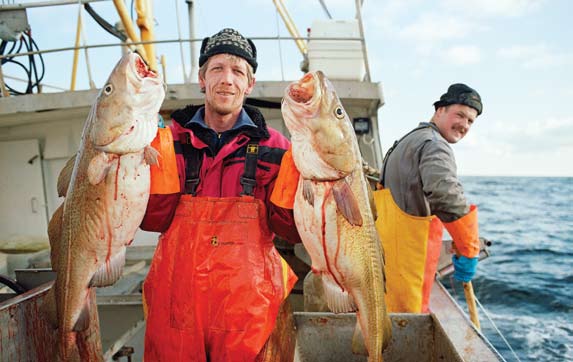
76
The risk of radio-
active contamination
of the marine environ-
ment along Norway's
coast has raised
concern mainly due
to the financial risk to
food producers if their
products are perceived
as contaminated.
ey Arnold
Cor
Although most of the dose from natural radia-
activities, these and other industrial activities can
tion comes from inhaling radon and its decay prod-
potential y contribute to the dose that affects
ucts, some of the dose is ingested via food and thus
people's health. This can occur, for example, where
reaches people via the food webs on which they rely.
materials containing natural radioactivity are used in
Arctic terrestrial food webs are especial y efficient
building construction and fertilisers. Therefore, this
in concentrating radionuclides, which explains the
assessment includes an initial survey of non-nuclear
high exposure of some Arctic populations. Some
technical activities that may enhance the natural y
of this natural radiation comes from long-range
occurring radioactivity, the so-cal ed TENORM
transport via air that has crossed continents, while
(Technological y Enhanced Natural y Occurring
some emanates from the local ground. There is
Radioactive Materials) industries.
often a build-up of radon in the snow cover during
Uranium mining
winter, which is rapidly released during snow melt
in the spring. If the soil is frozen for a shorter period
Uranium mining is one of the most important
because of climate change, and if the depth of the
TENORM activities. During mining operations,
snow cover changes, the flux of natural radioactivity
large amounts of waste rock are generated, with higher
from the rocks and soils within the Arctic is likely to
levels of uranium compared to other types of rock.
change. However, there is not sufficient knowledge
Waste rock can cause radiological problems if radionu-
at this stage about the relative roles of long-range
clides are leached into the surrounding environment,
transport and internal Arctic emission to assess how
because of the dust created, and because it emanates
human and environmental exposure in the Arctic
radon. In addition, the uranium ore is mil ed and
will change over time.
treated to extract the uranium from the ore. After
most of the uranium has been extracted, about 85
Extraction of fossil fuels and mining can en-
percent of the activity is stil left in the so-cal ed mill
hance natural radioactivity
tailings. These tailings are often disposed of in ponds
Industrial activities can enhance exposure to natural
or piles where they can contaminate the surrounding
radioactivity. This happens in mining and process-
water and also serve as a local source of gamma radia-
ing of ores that contain natural radioactivity and
tion, dust and radon emanation.
in the extraction of oil and gas. These processes
Canada has a long history of uranium mining,
often involve the extraction and movement of large
including at sites in the Arctic. Although the mining
amounts of material. Even if the concentrations
activity has ceased, renewed interest in nuclear power
of radionuclides in these materials are very low
may lead to renewed interest in exploiting this resource
compared to nuclear fuel or waste from nuclear
in Arctic Canada as wel as elsewhere in the Arctic.
77
Historic Canadian uranium mining has resulted
niobium) with 1000 becquerels uranium-238 and
in local contamination problems that have been
80000 becquerels thorium-232 per kilogram. Other
addressed in recent years. One such site is Port
metal ores that are relatively rich in natural radioactiv-
Radium on the east shore of Great Bear Lake in
ity include tin, ilmentie (titanium), rutile (titanium)
the Northwest Territories of Canada. This site was
and bauxite (aluminium). Radionuclides can escape
used for extracting radium, uranium, and silver
from waste and by-products such as tailings, mine wa-
during different periods from 1932 to 1982, after
ter, scale and slag. With chemical and heat treatments,
which the site was covered with waste rock. An
they can also be emitted to the air.
environmental survey conducted by the Canadian
Phosphate extraction
government in partnership with the Déline First
Nation from 2001 to 2004 showed some elevation
Another example of technological y enhanced
of background radiation levels resulting in a recom-
natural radioactivity is phosphate mining and
mendation to remediate the site. Transport of ore
processing. The radioactive content is not as high
from Port Radium along waterways and land has
in the igneous phosphate ores that are common in
also led to contamination in connection with spil s
the Arctic as they are in sedimentary rock. However,
during loading and reloading of the material. These
there is still concern about the large amount of ra-
sites are also to be remediated. Indigenous people
dium-226 that is incorporated in phosphogypsum,
working in these industries have raised concerns
and other radionuclides in phosphoric acid from
about the health risks from handling ore. As part of
the production process. The concern with phospho-
the joint plan, the doses to 35 of these workers have
gypsum includes radon emanation and leaching of
been reconstructed. The cumulative doses during
radionuclides into the groundwater.
the period of employment ranged from 27 to 3015
Fossil fuels and other energy production
mil isieverts. The numbers can be placed in relation
to 20 millisieverts, which is the internationally
Extraction of fossil fuels is another potential source
recommended annual dose limit for people working
of technologically enhanced naturally occurring ra-
with radioactivity, and 2.4 mil isieverts as an average
dioactive material. For coal, the radioactive material
annual dose to the public from natural radiation.
ends up in the ash when the coal is burnt, especial y
Another historic Canadian mining site is the
in fly ash that can result in emissions to the air. The
Rayrock mine, 145 kilometers northwest of Yellow-
radiological hazard from emissions to the air have
knife. It operated from 1957 to 1959. Radioactive
been evaluated in a number of studies from the
tailings were deposited on land and partly flowed
1970s and 1980s with the conclusion that emisisons
into three smal lakes. Measurements from 1985
from coal burning contribute only a smal amount
showed mildly elevated levels of radioactivity but
to the radiological dose to people living close to
below Canadian drinking water guidelines. In 1996
coal-fired power plants (1-5 percent above normal
and 1997, the mine was sealed and the dumped
background levels.)
material was relocated and capped with silt clay. The
During oil and gas production, large volumes of
monitoring program that was put in place has since
water are co-extracted with the hydrocarbons from
showed that fish and caribou from the area are safe
the reservoirs. This produced water is a potential
to eat, that the water quality meets drinking water
source of TENORM in the Arctic. Produced water
standards, and that there is very little risk to humans
has been shown to have elevated concentrations of
from radionuclide exposure.
radium isotopes in particular, with activity concen-
trations from less than one to several hundred bec-
Mining for other minerals
querels per liter. If discharged to the sea, this activity
Mining for other resources can also enhance natu-
wil be rapidly diluted, although some material can
ral radioactivity, especial y if the ore is enriched in
precipitate and end up in the nearby sediments.
uranium or thorium that can enter the processing
Another concern is that radium may co-pre-
industries. The content of natural radioactivity varies
cipitate with other metals inside pipes and valves,
greatly in different ore type, with examples ranging
where it becomes incorporated in so-called scale.
from iron ore with less than 5 becquerels uranium per
The activity concentration in scale can vary from
kilogram to pyrochlor (a mineral rich in the rare metal
very low to several hundred thousand becquerels
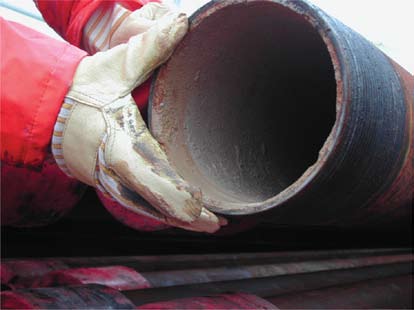
78
tivity and comparing this to dose rates known to
have specific biological effects, in order to judge the
increased risks.
At the international level, the initial work on
developing methods for the assessments has been
carried out in two European col aborative projects:
Framework for Assessment of Environmental
Impact (FASSET) and Environmental Protection
from Ionizing Contaminants in the Arctic (EPIC).
uthority
These studies have been superseded by the project
Environmental Risks from Ionizing Contaminants:
r
otection A
Assessment and Management (ERICA). In addi-
tion, the International Commission of Radiologi-
cal Protection (ICRP) has begun to formulate a
egian Radiation P
w
or
framework for protecting the environment, which
N
is to be harmonized with approaches to protect
Exposure to natu-
per kilogram. Procedures are commonly in place
human health. The suggested environmental impact
rally occurring radioac-
for protection of workers. Controls for the manage-
assessment for the Arctic environment follows a
tivity can be enhanced
ment of the waste arising, e.g. from pipe-cleaning
flow from problem formulation (e.g. selecting the
as a result of TENORM
operations, are necessary to protect the environment
radionuclides and the regions of interest) to collect-
industries, including oil
from contamination.
ing information on relevant species to assessing the
and gas development.
Geothermal energy is minor in most countries
exposure and evaluating possibly increased risks.
Scale on the inside of
except Iceland. In the production of geothermal
So far, the EPIC environmental assessment has
pipes can reach high
energy hot water and steam is pumped from deep
focused on 13 radionuclides that broadly represent
levels and pose a hazard
boreholes to the surface. Radium-containing scale
routine releases from power plants and reprocessing
to workers.
can form in pipes, production equipment and
facilities, accidental releases, and natural y occurring
ponds. It can also be released to the atmosphere
or technologically enhanced naturally occurring
with locally elevated radon levels. The potential risks
radionuclides (TENORM). In addition, a number
depend on the local geology. Current knowledge
of reference organisms have been identified that
does not allow any quantification of the risks. Expe-
are typical or representative of the environments
rience from dril ing for water in Norway, where the
of interest. The next step involves estimating the
bedrock typically has high level of natural radioac-
exposure to radionuclides, including calculating
tive substances, suggest that it may be a major con-
the transfer of radionuclides from the surround-
tributor to elevated radon levels in houses, at least if
ing environment into the organism in question,
the water comes into contact with the indoor air.
either directly or via food. The estimates are based
on information available in the scientific literature,
Protection of the Arctic environment
but often data are lacking for a particular organism.
AMAP's assessments of radioactivity as wel as
Such cases are managed by a systematic approach
radiological protection frameworks in general have
choosing interalia data from other organisms as a
traditional y only focused on human health and
surrogate and making the choices transparent for
environmental issues of direct relevance to human
the assessor.
health. Inspired by the environmental focus for
The current approach has some built in limita-
other contaminants, e.g. persistent organic pollut-
tion. For example, it assumes that organisms come
ants, the AMAP radioactivity group has played an
into instant equilibrium with their surrounding
important role in initiating international efforts to
environment, whereas in reality organisms will
assess the environmental impact of radioactive con-
retain radionuclides in their bodies and return them
tamination. They include formulating a framework
to the surrounding over timescales that can range
for making environmental assessments by estimat-
from days to years. Here, knowledge about biologi-
ing the exposure of plants and animals to radioac-
cal half-lives provides additional information.
79
The next step is to calculate the radiation
Problem formulation, e.g.
The stages in the
Selection of radionuclides
exposure of different organisms. The dose rate is
EPIC assessment meth-
Selection of ecosystems
expressed in microgray per hour and is the sum of
odology, an approach
internal and external dose rates. The calculations
that is now being used
currently do not take into consideration the type
to assess environmental
Selection of reference
impacts of radioactive
organisoms
of radiation, although provisional weighting factors
have been applied. In making dose estimates for
contamination.
humans, a weighing factor is often used to account
Col ate life history
for the larger damage by alpha particles compared
information for
representative species
to beta- and gamma-radiation, but these weighing
factors are likely to vary depending on the organ-
isms and endpoints in question.
Estimated dose rates for a specific organism are
Are activity
No
related to dose rates of known biological effects and
concentration data
available for
Derive concentrations
natural background radiation.
representative
in reference media
species and
The effects of concern in environmental assess-
media?
ment may be different from assessments of risks to
people. For people, the increased risk for cancer has
Yes
Derive concentrations
guided dose limits. For other species and ecosys-
in reference biota.
Use transfer factor.
tems, effects on reproduction and mortality are
Dosimetry - Col ate
Look up tables
information for:
important as are ecological effects such as impact
Internal and external DCCs
Occupancy factors
on biodiversity and predator-prey relationships.
Decide upon application of
Changes in hormone signals or in the immune
radiation weighing factors
system may be important for survival and reproduc-
tion. An additional end point is adaptation effects,
Apply exposure
i.e. changes in response to conditions of chronic
assessment methodolgy
irradiation. Reproduction is a particularly important
endpoint as it may affect not only the individual
organism but the long-term survival of a popula-
Absorbed dose rate
Background dose levels
tion. There are now databases available pertaining
(weighted or unweighted)
Dose-e ects relationships
to radiation effects in wild organisms that includes
forreference organisims
for reference organisms
data from field studies in northern Russia as well as
Chernobyl-contaminated areas. A preliminary scale
that illustrates observed biological effects is pre-
Evaluation of dose rates to reference biota
sented in the table below. In general, the threshold
Relationship between absorbed dose rates and effects.
Absorbed dose rate, Gray/day
Effect
10-6 -- 10-5
Natural radiation background for Arctic/northern organisms.
0.0001 -- 0.0005
Minor cytogenetic effects. Stimulation of the most sensitive species.
0.0005 -- 0.001
Threshold for minor effects on morbidity in sensitive vertebrate animals.
0.002 -- 0.005
Threshold for effects on reproductive organs of vertebrate animals, decrease of embryo's survival.
0.005 -- 0.01
Threshold for life shortening of vertebrate animals. Threshold for effects in invertebrate animals. Threshold
for effects on growth of coniferous plants.
0.01 -- 0.1
Life shortening of vertebrate animals; chronic radiation sickness. Considerable damage to coniferous trees.
0.1 -- 1
Acute radiation sickness of vertebrate animals. Death of coniferous plants. Considerable damage to eggs
and larva of invertebrate animals.
>1
Acute radiation sickness of vertebrate animals, lethal dose received within several days. Increased mortality
of eggs and larva of invertebrate animals. Death of coniferous plants, damage to deciduous plants.
80
for deterministic effects in wildlife lies somewhere
which could make these populations more vulner-
in the range of 0.5-1 mil igray per day for chronic
able. Long-lived species, which are common in the
low-dose radiation.
Arctic, may also receive a higher total dose. In the
A major challenge is to extrapolate data on
event of elevated exposure, this could also damage
individual organisms to higher levels of biological
their reproductive cells, which could decrease fertil-
organisation, e.g. effects on the populations. For
ity or pass on damage to the next generation. Many
example, animal populations with high reproduc-
Arctic animals use fat as an energy reserve. The high
tive rate such as mice and ubiquitous fish species
concentration of fat could increase sensitivity to ra-
may be still viable at dose rates in the order of 10
diation because the radiation affecting fats produce
milligray per day, even if there are effects on the
toxic lipid peroxides.
health of individual animals. The dose limit will
Many Arctic animals are under stress from other
therefore depend on the type of organism that
contaminants, such as heavy metals and organic pol-
needs protection and the type of protection that
lutants, which raises the issue of potential combined
is desirable, i.e. protection of populations versus
effects that could make Arctic animals more vulner-
protection of individuals.
able. Unfortunately research on combined effects
Based on the data that have been gathered so
of environmental pol utants and radiation are rare.
far, there are now computer software tools for
A review of such effects in people has concluded
making environmental assessments. For selected
that there is little evidence for this at levels typical y
scenarios, these tools can also be applied to Arctic
encountered in the environment. At the same time,
environments but there is also a need for more
there are studies of interactions that indicate that ac-
data that better reflect Arctic reference organisms.
tion of one agent can be influenced by simultaneous
Is the Arctic different?
exposure to other agents, at least at high exposure.
Future studies of combined effects need to take a
Only some of the data that have been gathered
range of issues into account, including the types of
for environmental assessments of radiation come
exposure and their sequence and timing. They need
from the Arctic. Questions have therefore been
to consider how the different contaminants affect
raised about whether Arctic ecosystems and animals
the behavior of each other in the bodies of animals
may be more vulnerable to radioactive contamina-
and how they might modify the biological effects.
tion than their non-Arctic relatives. One reason
A general conclusion about the methodology for
for such added vulnerability could be the natural
assessing radiation effects on vegetation, animals
environmental stress that is caused by harsh climatic
and ecosystems is that the hypothesis that the Arctic
conditions and the low biodiversity in many Arctic
could be more sensitive than other environments
ecosystems.
has not yet been adequately tested. Moreover, the
At the species level, cold-blooded and hiber-
collection of relevant data lags behind for the Arctic
nating animals may have different sensitivities
compared to temperate regions, and the data that
in the Arctic than in temperate environments
do exist do not always lend themselves to the sys-
because radiation effects develop more slowly at
tematic approaches that have been used in the wider
low temperatures. In this case, climate change
context. Even if the conceptual frameworks that
with increasing ambient temperatures might make
have been developed are a step forward, some basic
Arctic animals more vulnerable. However, repair
work still remains to be done before it is possible to
of the damage is also less effective in cold condi-
assess the impact of radiation on Arctic biota and
tions. Sometimes, the lesions in cold-blooded and
ecosystems in a robust manner.
hibernating organisms may not appear during the
winter period but manifest themselves intensively
Chapter summary
during the summer.
In areas from which there are monitoring data, the
Eggs and fish in early developmental stages are
levels of radioactivity in the Arctic environment
more sensitive to radiation than adult animals.
are declining. A major source of contamination
In some Arctic fish species the roe takes longer
is still fallout from atmospheric testing of nuclear
to develop and is thus exposed to radiation for a
weapons in the 1950s and 1960s. In the European
longer period of time than in temperate climates,
81
Arctic, fal out from the 1986 Chernobyl accident is
The scope of this assessment is wider than previ-
stil present in the environment. After rapid initial
ous AMAP assessments of radioactivity in the Arctic.
declines, radioactive contamination persists in soil
New issues include an initial review of technological y
and some plants.
enhanced natural y occurring radioactive material
Routine releases of radionuclides to the marine
(TENORM) in the Arctic. TENORM can become
environment from European reprocessing plants
concentrated in connection with the mining of
have decreased thanks to the application of new
uranium and other minerals, phosphate production,
technology.
oil- and gas extraction, coal mining and the use of
Previous AMAP assessments have highlighted
geothermal energy. Several of these activities are likely
risks associated with potential sources in north-
to increase in the Arctic. The current and potential
west Russia and recommended actions to improve
impacts have not yet been fully assessed.
safety surrounding nuclear installations and waste
Another new issue is climate change, where
handling. This assessment reports significant joint
there are major uncertainties about how this will
Russian-international action to reduce the risks.
affect radiation exposure conditions in the Arctic.
An example is that about half of the radioisotope
Identified potential impacts include mobilization
thermoelectric generators (RTGs) have been
of natural and artificial radioactivity in the Arctic
removed or will be so in the near future. Another
tundra environment and in glaciers. Climate change
example is that 164 of 198 obsolete nuclear sub-
is likely to affect radon emission from the ground,
marines have been defueled and dismantled and
which is the major contributor of exposure of
that this work continues. Substantial progress has
people to radiation. Changes in permafrost, erosion,
also been made in improving the physical and legal
precipitation and extreme weather events may affect
infrastructure to manage spent nuclear fuel and
infrastructure related to nuclear activities and will
radioactive waste at sites in the Arctic, notably An-
require further assessments. Changes in ocean circu-
dreeva Bay and Gremikha. Plans for dealing with
lation and in the sea ice may affect the pathways of
nuclear icebreakers and their associated facilities
contaminants in the marine environment.
are in place, where the very poor condition of the
Previous radioactivity assessments have focused
Lepse storage vessel remains a major problem. As
on human health. This assessment also describes a
part of the international effort, Russia has decided
framework for assessing the impact of radiation on
on a strategic plan that spans the time necessary to
vegetation, animals and ecosystems, to be used in
decommission and remediate all facilities.
the larger context of environmental protection and
New potential risks include Russian plans for
management. Work on protection of the environ-
building floating nuclear power plants and the pos-
ment from radioactive substances is in progress and
sibility of increased marine transport of radioactive
highlights the need for more data that are relevant for
material in the Arctic.
Arctic conditions and species.
82
83
Background scientific documentation for this report
Sources of photography in this report
Persistent Organic Pollutants:
Photographers and suppliers of photographic material:
The following review articles, constituting the 2009 AMAP assessment
Bryan and Cherry Alexander (www.arcticphoto.com) pages 5, 37,
of Persistent Organic Pollutants in the Arctic are being submitted for
38, 52, 59 and 60.
publication in a Special Issue of the Science of the Total Environment:
Corey Arnold (www.coreyfishes.com) page 76.
Bidleman, T.F., P.A. Helm, B. Braune and G.W. Gabrielsen. Polychlo-
Ann-Christine Engvall (anki@misu.su.se) page 2.
rinated Naphthalenes in Polar Environments - A Review.
County Governor of Finnmark (http://fylkesmannen.no/) page 74.
Butt, C.M., U. Berger, R. Bossi and G.T. Tomy. Levels and Trends of
Perfluorinated Compounds in the Arctic Environment.
Rune Dietz (rdi@dmu.dk) cover.
Polar bears tranquilized during tagging operations in East
Hung, H., R. Kal enborn, K. Breivik, Y. Su, E. Brorstrøm-Lunden, K.
Greenland, 2008.
Olafsdottir, S. Leppanen, R. Bossi, H. Skov, S. Manø, G. Stern, E.
Sverko and P. Fellin. Atmospheric Monitoring of Organic Pollutants
Lisa Harding, National Science Foundation (http://photolibrary.usap.
in the Arctic under the Arctic Monitoring and Assessment Pro-
gov) page 10.
gramme (AMAP): 1993-2006.
The waste barn at McMurdo Station is where the station's refuse
Hoferkamp, L., D. Muir and M. Hermanson. Levels of Current-use
is col ected, sorted and prepared for shipment off the continent. The
Pesticides in Arctic Media; 2000 2007.
US Antarctic Program recycles approximately 65% of its waste.
Letcher, R.J., G.W. Gabrielsen, J.-O. Bustnes, R. Dietz, B.M. Jenssen,
Maja Kirkegaard (mki@dmu.dk) page 31.
E.H. Jorgensen, T. O'Hara, C. Sonne, J. Verreault and J. Strand. A
Derek Muir (derek.muir@ec.gc.ca) pages 6 and 9.
State-of-the-science Assessment of the Effects and Implications of
Open-burning of rubbish at Resolute, Arctic Canada.
Persistent Organic Pollutants in Circumpolar Arctic Wildlife.
Norwegian Radiation Protection Authority (www.nrpa.no) pages
Rigét, F., A. Bignert, B. Braune, J. Stow and S. Wilson. Temporal
71, 72, 73 and 78.
Trends of Legacy POP's in Arctic Biota, an Update.
Shutterstock (www.shutterstock.com) pages 7 and 25.
Weber, J., C.J. Halsal , D.C.G. Muir, C. Teixeira, J. Smal , K.
Frits Steenhuisen (f.steenhuisen@rug.nl) - page 3.
Solomon, M. Hermanson, H. Hung and T. Bidleman. Endosulfan,
a Global Pesticide: A Review of its Fate in the Environment and Oc-
Brian J. Stocks / Canadian Forest Service
currence in the Arctic.
(brianstocks@sympatico.ca) page 66.
de Wit, C., D. Herzke and K. Vorkamp. Brominated Flame Retar-
Hallvard Strøm/Norwegian Polar Institute (strom@npolar.no) page 9.
dants in the Arctic Environment Trends and New Candidates.
Rane Willerslev (rane@mail.dk) pages 39 and 41.
Geir Wing Gabrielsen (geir.wing.gabrielsen@npolar.no) page 9.
Contaminants and Human Health:
AMAP Assessment 2009: Human Health in the Arctic. Arctic Moni-
toring and Assessment Programme (AMAP), Oslo, Norway.
Radioactivity:
AMAP Assessment 2009: Radioactivity in the Arctic. Arctic Monitor-
ing and Assessment Programme (AMAP), Oslo, Norway.