|
 |
|
|
|
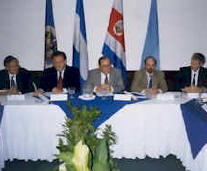
PDF-Block B Phase Final Report The first meeting of the Steering Committee was held in Managua, Nicaragua, on November 19 and 20, 1998. During the meeting, the Steering Committee approved the staffing for the project (numbers and types of specialists), the TORs for Technical Coordinators and consultants, and the work plan and timetable.
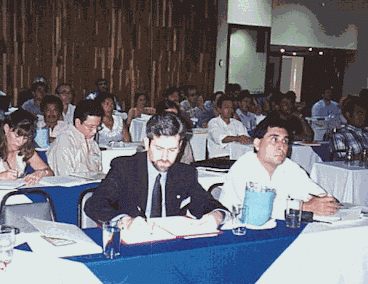
As of May 15, 1999, all contracts has been signed as planned. By June 15, Activity 2, Review of Environmental Issues; Activity 3, Review of Transboundary Problems; and Activity 4, Review of Institutional Issues, were completed. In preparation for two national workshops, held during the week of May 10-14, the Technical Coordinators and consultants, in close coordination with the National Directors, worked with civil institutions, non-governmental organizations, and indigenous and coastal communities to identify initiatives and priority actions and formulate proposals to be included in the project brief. A preliminary evaluation of the two national workshops indicated that they were very successful. Both had a high attendance (approximately 50 participants each) and a good and balanced representation of the different sectors. Those present participated actively and effectively in all the sessions, particularly in those specifically designed by the Technical Units for that purpose: the working group and proposal presentation sessions. On June 3 and 4, 1999, the first binational workshop was held in San José. Its main objective was to present a first draft of the Transboundary Diagnostic Analysis (TDA) and discuss a proposal for local, national, and binational institutional arrangements for the formulation of the Strategic Action Program (SAP). As at the two national workshops, there was very high attendance and a very good and balanced representation of the different sectors. On June 22, the second and last binational workshop was held in Managua. During the event, a first draft of the GEF Project Brief was presented and discussed with the participants. That same week, on June 24 and 25, the second meeting of the Steering Committee was held, with the participation of high-ranking officials of the Governments of Costa Rica and Nicaragua and local government authorities; representatives of UNEP, UNDP and the OSDE were also present. The event was opened by Mr. Enrique Bolaños Geyer, Vice-President of Nicaragua. On September 23 and 24, 1999, the third and last meeting for this phase of the Steering Committee was held in Washington, D.C. Mr. Roberto Stadthagen, Minister of MARENA, and Mr. Carlos Manuel Rodríguez, Vice-Minister of MINAE, chaired the meeting and were accompanied by representatives of the Ministries of Foreign Affairs and local governments of their countries. Representatives of UNEP and GEF were also present. Dr. Richard A. Meganck, who at the time was the Director of the OSDE, opened the meeting and was accompanied by OSDE staff responsible for the coordination of the project at GS/OAS headquarters, in Washington, D.C. Like the second meeting, this third meeting of the Steering Committee was characterized by excellent technical presentations made by the two Technical Coordinators and an active participation of the members of the Steering Committee. On the first day, the two Technical Coordinators, Mr. Juan José Castro of Costa Rica and Mr. Javier López of Nicaragua, presented the proposed project for consideration by the Steering Committee. The Project Brief, whose main objective is "the formulation of a Strategic Action Program for the Integrated Management of the Water Resources and the Sustainable Development of the San Juan River Basin and its Coastal Zone", identifies five distinct action areas: (1) the generation of basic up-to-date, basin-wide information and consolidation of a binational information system; (2) the creation of a well-coordinated bilateral planning process for the SJRB; (3) the implementation of a gender-oriented public participation process; (4) the strengthening of public institutions and private organizations; and (5) the formulation and implementation of environmental education activities for the incorporation of innovative production techniques and sustainable social habits. By November of 1999, the two Technical Units located in San José and Managua, with the technical assistance of the OSDE, completed the preparation of the final version of the Project Brief and its annexes. Recommendations and agreements reached at the third meeting of the Steering Committee were evaluated and incorporated. Later, the governments submitted the Project Brief to UNEP, through their Operational Focal Points. At its regular meeting May 19, 2000, the GEF Council approved the funding request for US$3.93 million.
| | |||||||||||||||||
|
|
|
|
|
|
|
|
|
|
| Home | About PROCUENCA | Calendar of Events | Executing Agency | ||
| ||


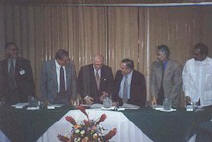 In January of 1999, project activities began. The
core of the technical group was already working, and during the first two
months of 1999 efforts were focused on Activity 2 of the project, Review
of the Major Present and Emerging Environmental Issues in the Project
Area. Particular attention was given to the marine-coastal zone, since
this area had not been included in the previous study.
In January of 1999, project activities began. The
core of the technical group was already working, and during the first two
months of 1999 efforts were focused on Activity 2 of the project, Review
of the Major Present and Emerging Environmental Issues in the Project
Area. Particular attention was given to the marine-coastal zone, since
this area had not been included in the previous study.