
GEF
UNDP/GEF PROJECT ENTITLED "REDUCING ENVIRONMENTAL STRESS IN THE
YELLOW SEA LARGE MARINE ECOSYSTEM"
UNDP/GEF/YS/PSC.2/3
Date: 20 December 2005
English only
Second Project Steering Committee Meeting
for the UNDP/GEF Yellow Sea Project
Kunming, China, 19-20 December 2005
Report of the Meeting
TABLE OF CONTENTS
1. OPENING OF THE MEETING ........................................................................................ 1
1.1 WELCOME ADDRESSES.............................................................................................. 1
1.2 INTRODUCTION OF THE MEMBERS .............................................................................. 2
2. ORGANISATION OF THE MEETING............................................................................. 2
2.1 ELECTION OF OFFICERS ............................................................................................ 2
2.2 DOCUMENTATION AVAILABLE TO THE MEETING .......................................................... 2
2.3 ORGANISATION OF WORK.......................................................................................... 2
3. ADOPTION OF THE MEETING AGENDA ..................................................................... 2
4. PROJECT MANAGER'S REPORT ON THE IMPLEMENTATION OF PROJECT
ACTIVITIES .................................................................................................................... 3
IMPLEMENTATION OF PROJECT ACTIVITIES............................................................................. 3
FINANCIAL REPORT............................................................................................................... 3
REPORT ON THE PROJECT MANAGEMENT OFFICE (PMO) ...................................................... 3
CO-OPERATION WITH OTHER ORGANISATIONS AND PROJECTS ............................................... 3
PUBLIC AWARENESS AND PARTICIPATION .............................................................................. 3
5. REPORT FROM THE CHAIRPERSON OF THE RSTP ON THE OUTCOMES OF THE
1ST AND 2ND MEETING OF THE REGIONAL SCIENTIFIC AND TECHNICAL
PANEL (RSTP) ............................................................................................................... 4
6. PROPOSED BUDGET AND WORKPLAN FOR 2006 AND ONWARS ......................... 5
7. NGO AND PRIVATE SECTOR'S MEMBERSHIP IN PSC............................................. 6
8. APPROVAL OF TERMS OF REFERENCE (TOR) FOR THE REGIONAL WORKING
GROUPS (RWGS), NATIONAL PROJECT CO-ORDINATOR (NPC), AND INTER-
MINISTERIAL CO-ORDINATING COMMITTEE (IMCC)................................................ 6
9. ANY
OTHER
BUSINESS................................................................................................ 7
10. VENUE FOR NEXT PROJECT STEERING COMMITTEE MEETING ........................... 7
11. ADOPTION OF THE MEETING REPORT...................................................................... 7
12. CLOSURE OF THE MEETING ....................................................................................... 7
ANNEXES
Annex I
List of Participants
Annex II
Agenda
Annex III
Project Manager's Report on the Implementation of Project Activities
Annex IV
Second RSTP Meeting Chairperson's Report
Annex V
Approved Budget for 2006 and Onwards
Annex VI
Approved Workplan for 2006 and Onwards
Annex VII
Terms of Reference for the Regional Working Groups (RWGs)
Annex VIII
Revised Terms of Reference for the National Project Co-ordinators (NPCs)
Annex IX
Revised Terms of Reference for the Inter-ministerial Co-ordinating Committee
(IMCC)
UNDP/GEF/YS/PSC.2/3
Page 1
1.
OPENING OF THE MEETING
1.1 Welcome
addresses
1.1.1 On behalf of the United Nations Development Programme (UNDP), Mr. Zhe YANG
opened the Meeting and welcomed all participants. Describing the latest major
progress and achievements of the Project, Mr. Yang applauded the efforts made by
the Governments of People's Republic of China (China) and Republic of Korea
(ROK). He also emphasised that regional co-operation is crucial for further
development and success of the Project. Mr. Yang stated further that the
participation of Democratic People's Republic of Korea (DPRK) to this meeting as
observers was one of the major accomplishments of the Project, and he expressed
his strong hope that DPRK would participate in the Project as a full member in the
near future.
1.1.2 On behalf of the Government of China, Mr. Haiqing LI extended a warm welcome to
all participants. He especially extended his welcome to the Delegation of Democratic
People's Republic of Korea (DPRK). Mr. Li commented on the Project's immense
progress over the past year that had been achieved to the high satisfaction of the
Government of China. With the co-operation between the participating countries,
UNOPS, UNDP, and PMO, the Project has made great progress, and Mr. Li was
confident that this level of momentum will be maintained throughout the Project. Mr.
Li informed the Meeting that in the recent development of China's eleventh five-year
plan for science-based activities, the YSLME Project is listed as a priority field of
action. Therefore, the State Oceanic Administration (SOA), as national focal point for
the Project, will continue and increase its support to project implementation. In
closing, Mr. Li wished the meeting full success.
1.1.3 On behalf of the Government of Republic of Korea (ROK), Mr. Heung-Kyeong PARK
expressed his sincere appreciation to all participants who had committed their time to
attend this meeting, and their efforts to assist with Project implementation. The
Republic of Korea believes that the Project is being implemented at an opportune
time. As countries in the region have a moral obligation to protect and enjoy a clean
marine environment, ROK is fully committed to support the Project, and ROK truly
hopes the PSC Meeting will bring about the successful conclusion of implementation
in 2005 and successful implementation in future years. ROK is committed to
continuing its co-operation with China. Mr. Park extended a warm welcome to State
Hydrometeorological Administration (SHMA), DPRK, and stated that the full
participation of the three coastal countries in the Project will ensure the preservation
of the Yellow Sea. He attached particular significance to DPRK's presence at this
meeting as observers, and emphasised that ROK is ready to give support to DPRK's
full participation. Mr. Park encouraged the Project Management Office (PMO) and
UNDP to facilitate DPRK's involvement in the Project.
1.1.4 On behalf of SHMA, Mr. Jong Chol RI expressed his thanks to the PMO and the
Government of China for inviting and supporting the participation of DPRK as
observers. Mr. Ri stated that he was very pleased with this opportunity to attend the
PSC Meeting and better understand the Project.
1.1.5 On behalf of the United Nations Office for Project Services (UNOPS), Mr. Andrew
MENZ felt encouraged that in the 12 month's since the Project's inception, the DPRK
has been brought on as observers within such a short time. Mr. Menz congratulated
all affiliated governments and research institutions for bringing the project to its
current stage of implementation which is reflected in many of the Project's
documents and other forms of outputs. The Project Manager was congratulated for
UNDP/GEF/YS/PSC.2/3
Page 2
stepping up to meet the tasks of facing the challenges, and finding solutions to
resolve the many issues the Project has faced. Finally, Mr. Menz thanked the
Government of China, and in particular, SOA for hosting the Meeting.
1.2
Introduction of the members
1.2.1 The participants were invited to give self-introductions. A list of participants is
attached as Annex I to this report.
2.
ORGANISATION OF THE MEETING
2.1
Election of Officers
2.1.1 Mr. Yang invited the participants to nominate the Chairperson for the meeting. Mr.
Dong-sik WOO nominated Mr. Haiqing LI, the National Project Co-ordinator from
China, to be the Chairperson of the Meeting. The Meeting agreed with the
nomination, and Mr. Li was duly elected.
2.1.2 Mr. Wenxi ZHU nominated Mr. Heung Kyeong PARK, the Head of ROK delegation,
to be the Vice Chairperson of the Meeting. The Meeting agreed with this nomination,
and Mr. Park was elected as Vice Chairperson.
2.1.3 The PMO served as Rapporteur and Secretariat.
2.2
Documentation Available to the Meeting
2.2.1 The Chairperson invited the PMO to introduce the documents prepared for the
Meeting.
2.2.2 Mr. Isao ENDO explained the two kinds of documents available for the meeting:
working documents and information documents (Document UNDP/GEF/YS/
PSC.2/inf.1), noting that the working documents were for the Meeting to consider and
approve, while the information documents were for reference.
2.3
Organisation of Work
2.3.1 The Chairperson invited the Secretariat to introduce this agenda item. Mr. Endo
explained and proposed the working programme for the meeting (Document
UNDP/GEF/YS/PSC.2/inf.3).
2.3.2 The Meeting agreed on the proposed programme, and the meeting was
organised in plenary.
2.3.3 The meeting was conducted in English.
3.
ADOPTION OF THE MEETING AGENDA
3.1
The Chairperson introduced the Provisional Agenda (Document UNDP/GEF/YS/
PSC.2/1) and the Provisional Annotated Agenda (Document UNDP/GEF/YS/
PSC.2/2), and invited participants to provide comments on them.
UNDP/GEF/YS/PSC.2/3
Page 3
3.2
Mr. Endo suggested to amend Agenda 6 to "Proposed Budget and Workplan for
2006 and Onwards," since this agenda item considers the relevant issues not only
the year of 2006 but also the years afterwards.
3.3
The Meeting agreed on this amendment and approved the Agenda. The
approved agenda is attached as Annex II to this report.
4.
PROJECT MANAGER'S REPORT ON THE IMPLEMENTATION OF PROJECT
ACTIVITIES
Implementation of Project Activities
Financial Report
Report on the Project Management Office (PMO)
Co-operation with other Organisations and Projects
Public Awareness and Participation
4.1
Referring to Document UNDP/GEF/YS/RSP.2/4, Mr. Yihang JIANG presented the
Project Manager's report that included the following topics:
· the Project's inception history;
· establishment of the PMO;
· preparation and approval of the Implementation Plan;
· planning for the co-operative study cruises;
· regional co-operations and involvement of additional countries and
organisations in this Project;
· public awareness and participation;
· expenditure report for 2005;
· challenges to implementation; and
· recommendations to improve implementation.
4.2
Following the presentation, Mr. Wenxi ZHU, on behalf of the Delegation of China,
commended the Project Manager and PMO on the achievements-to-date, and noted
with satisfaction that the implementation mechanisms had been established as
scheduled. Mr. Zhu noted that continuous efforts and several partnerships built upon
mutual understanding will ensure that the successful implementation will be forth into
the future. Finally, Mr. Zhu noted the historic moment of this Meeting, with DPRK's
attendance, and active participation in the discussions of the meeting.
4.3
The representative of UNDP and Delegation of ROK joined Mr. Zhu in congratulating
the Project Manager and his staff on the achievements in the implementation of the
project activities. The representatives also supported a suggestion on the need for
enhancing local government participation. In order for the participating countries to
have better understanding of UN project implementation procedures and financial
rules, necessary training is deemed necessary, so that implementation of the Project
may proceed smoother at national level.
4.4
The representatives of UNDP/UNOPS offered to seek necessary arrangements,
together with PMO, to organise a workshop to provide more information on the UN
financial and contracting procedures to the participating countries.
4.5
During the discussion on the Project Manager's report, various questions were raised
about local government involvement, project activities, co-financing, the budget, and
management issues which were all duly answered by the PMO. Representatives
UNDP/GEF/YS/PSC.2/3
Page 4
from China and ROK stated that national co-financing is mostly in-kind contribution,
and confirmed that it will be provided until the end of the Project. The Meeting noted,
with appreciation, the in-cash contribution of ROK through the provision of office
space and equipment from ROK to the PMO.
4.6
The Meeting expressed its appreciation to SHMA, DPRK for inviting Mr. Yihang
JIANG, the Project Manager of the YSLME and Mr. Wenxi ZHU, Representative of
SOA, China to SHMA to explain the Project and to explore the possibility of DPRK's
participation, and for sending a delegation to attend the meeting as observers. The
PSC instructed the PMO to continue working with the relevant national authorities of
DPRK to facilitate its full participation in the YSLME Project.
4.7
Members noted that some of the discussion issues had been raised and discussed at
the 2nd RSTP Meeting that was convened immediately before this Meeting.
Members also noted that the follow-up actions suggested at the 2nd RSTP and this
Meeting will be taken into consideration. The Meeting reached the consensus that
the logistic issues needing further actions will be addressed by the relevant parties
for further discussion and action in the appropriate manner.
4.8
Both Mr. Yihang JIANG and Mr. Huming YU of PEMSEA recalled the collaboration
between the YSLME project and PEMSEA. The collaboration includes in particular
the organisation of a session by the YSLME on its activities in conjunction with EAS
Congress 2006 for knowledge sharing and development of Yellow Sea SAP within
the framework of Sustainable Development Strategy-South East Asia (SDS-SEA).
Both expressed interest to further strengthen partnership for the benefit of the
participating countries.
4.9
The Meeting expressed satisfaction with the Project's progress, given the short
lifetime of the Project thus far time and heavy workload. The PMO was
congratulated on its achievements.
4.10 Following the discussions and clarifications, the Meeting approved the Project
Manager's report, which is included as Annex III.
5.
REPORT FROM THE CHAIRPERSON OF THE RSTP ON THE OUTCOMES OF
THE 1ST AND 2ND MEETING OF THE REGIONAL SCIENTIFIC AND TECHNICAL
PANEL (RSTP)
5.1
Mr. Haiqing Li, the Chairperson of the First and Second Meetings of the Regional
Scientific and Technical Panel (RSTP) introduced the outcomes and agreements of
these meetings. He first briefly presented the outcomes of the First Meeting of the
RSTP, and informed participants of some of the agreements of the First Meeting that
were already implemented during the intersessional period, and the remaining ones
to be considered by the Second Meeting of RSTP.
5.2
Mr. Li went on to present the discussions and agreements of the Second Meeting
organised prior to the 2nd PSC meeting, highlighting the following major agreements:
· Project Manager's report on the implementation of project activities during
2005;
· The reports of the National Co-ordinators and the Chairpersons of the Regional
Working Groups on the implementation of project activities in the respected
areas;
UNDP/GEF/YS/PSC.2/3
Page 5
· New activities proposed for 2006 and onwards;
· The proposed budget and workplan for 2006 and onwards;
· Revised Terms of Reference for IMCC, NPC, and RWGs; and
· The date and venue for the Third RSTP Meeting.
5.3
The meeting expressed appreciation to the Chairperson of the RSTP meetings for his
hard work, and guidance provided to these meeting.
5.4
With the understanding that the Project Manager started his job in mid September
2004, the PSC recommended that the ending date for the project will be 31
December 2009 with no additional cost to the project.
5.5
With regard to the discussion at the Second Meeting of the RSTP on the issue of
data and information sharing, the delegation of ROK expressed their wish to modify
the relevant section (paragraph 7.1.19) of the report to indicate "the data and
information generated within the project, including the cruise data and samples
should be shared by the participating countries".
5.6
The Project Manager informed the meeting that the list of data and samples to be
shared was sent to the National Project Co-ordinator of China for the approval by the
government. Several options on the data and sample sharing were discussed. It
was agreed that the NPC of China will further investigate the possibilities of these
options after the PSC meeting. The PMO will be informed of the results of the
investigation.
5.7
Following the clarifications provided by the PMO, the meeting adopted the
meeting reports of the First and Second Meetings of the RSTP. The
Chairperson's report is attached as Annex IV to this report.
6.
PROPOSED BUDGET AND WORKPLAN FOR 2006 AND ONWARS
6.1
The Chairperson invited the PMO to introduce the budget and workplan for 2006 and
onwards.
6.2
Referring to Document UNDP/GEF/YS/RSP.2/13, the Project Manager presented the
revised Project budget, explaining the factors and new activities that required the
amendments on the original budget. Mr. Jiang informed the meeting that the
proposed budget and workplan were presented to the second meeting of the RSTP,
and the meeting focused on the technical consideration of the budget, and agreed to
submit the proposed budget and workplan to the PSC for consideration and approval.
6.3
After a few questions were raised about the revised budget which the PMO duly
answered, the Meeting approved the revised budget for 2006 and onwards. The
approved budget is attached as Annex V.
6.4
The Project Manager also presented and proposed the Project Workplan for 2006
and onwards (UNDP/GEF/YS/RSP.2/14).
6.5
After some questions raised by the participants, PMO provided clarifications. The
Meeting agreed on and approved the workplan for the year of 2006 and
onwards. The approved workplan is attached to this report as Annex VI.
UNDP/GEF/YS/PSC.2/3
Page 6
7.
NGO AND PRIVATE SECTOR'S MEMBERSHIP IN PSC
7.1
The Chairperson invited the Secretariat to introduce the proposal on the NGO and
private sector's membership in the PSC.
7.2
Explaining the background and rationale, Mr. Endo introduced the proposal to invite
NGOs and the private sectors to be members of the PSC (UNDP/GEF/YS/PSC.2/4).
The procedure consists of the following three steps:
(1) Invite NGOs and private sectors to the PSC as observers;
(2) Establish the partnership with NGOs and private sectors in implementing the
Project activities; and
(3) Select representatives of NGOs and private sectors to serve the PSC as its
members.
7.3
Mr. Endo emphasised the benefits from these stakeholders' participation, including
securing more transparency in project implementation, political support, ownership,
and financial and human resources.
7.4
Raising a question about a possible role and responsibility of the NGOs and private
sectors in the PSC as members, the participants requested the PMO to further
investigate similar projects on this issue.
7.5
The members also requested the PMO to produce guidelines on how to involve
NGOs and private sectors in the PSC, and to devise the criteria for selecting the
representatives of these stakeholders.
7.6
The Meeting noted the importance to invite participation from NGOs and private
sectors not only to secure a wide range of knowledge and expertise to protect and
improve the Yellow Sea ecosystem, but also to reach out to more stakeholders. The
meeting instructed the PMO to further investigate this issue, and report back to
the next PSC meeting. In the meantime, the Project should continue to invite the
NGOs and private sectors to participate in the PSC as observers.
8.
APPROVAL OF TERMS OF REFERENCE (TOR) FOR THE REGIONAL WORKING
GROUPS (RWGS), NATIONAL PROJECT CO-ORDINATOR (NPC), AND INTER-
MINISTERIAL CO-ORDINATING COMMITTEE (IMCC)
8.1
Highlighting the major modifications, Mr. Jiang provided the meeting with a brief
explanation about the revised terms of reference (TOR) for the Regional Working
Groups (RWGs) (UNDP/GEF/YS/RSP.2/15), the National Project Co-ordinator (NPC)
(UNDP/GEF/YS/RSP.2/16), and the Inter-Ministerial Co-ordinating Committee
(IMCC) (UNDP/GEF/YS/RSP.2/17).
8.2
The meeting discussed this issue extensively. The Chairperson of the PSC invited
the Chairpersons of the RWGs to provide their comments on this issue, and it was
confirmed by the Chairpersons of RWGs that the proposed TORs for RWGs reflect
the current and expected situations for each component, and therefore these TORs
were acceptable to them.
8.3
With the understanding that these TORs may need to be revised in the future
as situations change, the Meeting adopted these TORs. The approved TORs for
RWGs, NPC, and IMCC are included in this report as Annex VII, VIII, and IX,
respectively.
UNDP/GEF/YS/PSC.2/3
Page 7
9. ANY
OTHER
BUSINESS
9.1
The Chairperson invited the participants to propose any other business to be
considered at the Meeting. No additional items were raised.
10.
VENUE FOR NEXT PROJECT STEERING COMMITTEE MEETING
10.1 The Chairperson invited participants to offer to host the Third PSC Meeting. On
behalf of ROK, Mr. Woo proposed to host the next PSC Meeting from 20-21
November 2006 in Jeju, ROK.
10.2 The Meeting appreciated the generous offer from ROK, and agreed on the
dates and venue for the next PSC Meeting, as proposed.
11.
ADOPTION OF THE MEETING REPORT
11.1 The Chairperson invited the participants to review the draft meeting report prepared
by the Secretariat. The draft report was discussed, amended and adopted by the
Meeting.
12.
CLOSURE OF THE MEETING
12.1 Having summarised and highlighted the major agreements made during the meeting,
on behalf of China, Mr. Haiqing LI expressed his appreciation to all the participants
for their efforts to achieve such great success. He expressed special thanks to Mr.
Zhe YANG of UNDP Korea Office and Mr. Andrew MENZ of UNOPS for their
contribution to the meeting. Mr. Li expressed appreciation to Mr. Yihang JIANG and
his team to support, facilitate, and ensure the success of the meeting. Mr. Li also
thanked the delegations from ROK for their hard work to produce the fruitful results
from the meeting. He appreciated the participants from DPRK to provide the meeting
with constructive opinions and suggestions. Mr. Li showed gratitude to the active
participation and contributions from PEMSEA and Wetlands International. He
expressed thanks to Mr. Mingyuan ZHU and Ms. Wenqi WANG for providing
logistical assistance to hold the meeting.
12.2 On behalf of ROK, Mr. Heung Kyeong Park was grateful that the meeting made a
number of achievements. He thanked Mr. Zhe YANG of UNDP and Mr. Andrew
MENZ of UNOPS for their support and contribution to the meeting. Mr. Park
expressed his strong gratitude toward Mr. Haiqing LI for hosting and leading the
meeting to a successful conclusion. Mr. Park also appreciated Mr. Yihang JIANG
and the PMO to provide hard work and support to achieve substantial outcomes. Mr.
Park expressed his hope that further progress would be made in the coming years
through the implementation of the Project. He also hoped to see more organisations
at the next RSTP and PSC meetings to be held in ROK, in which he believed the
Project will take many steps forward with all three Yellow Sea bordering countries
and many organisations participating.
12.3 On behalf of UNDP, Mr. Zhe YANG expressed his gratitude to Mr. Haiqing LI for
leading and moderating the meeting successfully so as to have fruitful discussions
and results. Mr. YANG expressed appreciation to the PMO for their hard work to
UNDP/GEF/YS/PSC.2/3
Page 8
support the meeting. He thanked the Governments of China and ROK for their
strong commitments and contributions to the Project. Mr. YANG also thanked DPRK
for participating in the meeting as observers and providing useful comments and
suggestions. Lastly, Mr. Yang emphasised that regional co-operation is crucial for
the success of the Project, and he was confident that the sprit of strong co-operation
among participating countries existed and that the goal of the Project would be
achieved.
12.4 The Chairperson declared the closure of the meeting. The meeting was closed at
11:15 am on 20th December 2005.
UNDP/GEF/YS/PSC.2/3
Annex I
Page 1
Annex I
List of Participants
PSC MEMBERS
People's Republic of China
Mr. LI Haiqing
Mr. ZHU Wenxi
Director-General
Deputy Director
Department of International Co-operation
Department of International Co-operation
State Oceanic Administration
State Oceanic Administration
1 Fuxingmenwai Avenue Beijing 100860
1 Fuxingmenwai Avenue
Tel: 86-10-6804-2695
Beijing 100860 China
Fax: 86-10-6803-0799
Tel: 86-10-6804-8051(2)
Email: hqli@soa.gov.cn
86-10-6801-9791(1)
Fax: 86-10-6803-0799
Email: wxzhu@soa.gov.cn
Mr. ZHU Mingyuan
Mr. JIN Xianshi
Professor
Director, Fishable Resources & Ecosystem
First Institute of Oceanography, SOA
Management Division
6 Xianxialing Road Hi-Tech Industrial Park
Yellow Sea Fisheries Research Institute
Qingdao, Shandong 266001
106 Nanjing Road
Tel: 86-532-8896-7447
Qingdao 266071
Fax: 86-532-8896-7548
Tel: 86-532-8584-9430
Mobile: 86-136-0898-3422
Fax: 86-532-8581-1514
Email: myzhu@public.qd.sd.cn
Email: jin@ysfri.ac.cn
Mr. WEN Quan
Chief Scientist
SOA Key Lab of Coastal Ecosystem and
Environment Research
National Marine Environmental Monitoring
Center
42 Linghe Street
Dalian 116023 China
Tel: 86-411-8478-2522
Fax: 86-411-8478-2522
Email: qwen@nmemc.gov.cn
UNDP/GEF/YS/PSC.2/3
Annex I
Page 2
Republic of Korea
Mr. PARK Heung Kyeong
Mr. WOO Dong Sik
Director
Deputy Director
Environment and Science Division
Marine Environment Division
Ministry of Foreign Affairs and Trade Marine Policy Bureau
(MOFAT)
Ministry of Maritime Affairs and Fisheries
95-1 Doryum Dong, Jongro-Gu
140-2 Gye-Dong, Jongno-Gu
Seoul 110-787
Seoul, 110-793
Tel: 82-2-2100-7745
Tel: 82-2-3674-6544
Fax: 82-2-2100-7991
Fax: 82-2-3148-6545
Email: hkpark89@mofat.go.kr
Email: dwoo0047@momaf.go.kr
Mr. HUH Hyung-Tack
Mr. HONG Sun-Bae
Dept. of Oceanography
Assistant Director
Sr. Scientist Emeritus, KORDI
Marine Environment Division
Fellow, Korean Academy Of Science &
Marine Policy Bureau
Technology
Ministry of Maritime Affairs and Fisheries
Chairman, IOC/WESTPAC
140-2 Gye-Dong, Jongno-Gu
253, Yonghyun-Dong, Nam-Gu
Seoul, 110-793
Incheon 402-751
Tel: 82-2-3674-6544
Republic of Korea
Fax: 82-2-3674-6546
Tel: 82-31-400-6201
Email: hong0610@momaf.go.kr
Fax: 82-31-408-5934
Email: hthuh@kordi.re.kr
United Nations Development Programme
(UNDP)
Mr. YANG Zhe
Ms. LEE Hyun-Shin
Resident Representative
UNDP Korea Office
UNDP Korea Office
Hannam Tower
Hannam Tower
730, Hannam 2-Dong, Yongsan-ku, Seoul
730, Hannam 2-Dong, Yongsan-ku, Seoul
Republic of Korea
Republic of Korea
Tel: 82-2-790-9565
Tel: 82-2-790-9562/5
Fax: 82-2-749-1417
Fax: 82-2-749-1417
E-mail: hyun-shin.lee@undp.org
Email: zhe.yang@undp.org
UNDP/GEF/YS/PSC.2/3
Annex I
Page 3
United Nations Office for Project Services
(UNOPS)
Mr. Andrew MENZ
Senior Portfolio Manager
Global & Interregional Division
UNOPS
11-13 Chemin des Anemones
1219 Chatelaine, Geneva
Switzerland
Tel: 41-22-917-8556
Fax: 41-22-917-8062
Email: AndrewM@unops.org
PROJECT MANAGEMENT OFFICE (PMO)
Mr. Yihang JIANG
Ms. Connie CHIANG
Project Manager
Environment Officer
UNDP/GEF Yellow Sea Project
UNDP/GEF Yellow Sea Project
Korea Ocean Research and Development
Korea Ocean Research and Development
Institute
Institute
1270 Sa-dong Sangnok-gu Ansan-si
1270 Sa-dong Sangnok-gu Ansan-si
Gyeonggi-do 426-744
Gyeonggi-do 426-744
Republic of Korea
Republic of Korea
Tel: 82-31-400-7825
Tel: 82-31-400-7833
Fax: 82-31-400-7826
Fax: 82-31-400-7826
email: yihang@yslme.org
email: connie@yslme.org
Mr. Isao ENDO
Mr. Sungjun PARK
Environmental Economics Officer
Finance & Administrative Officer
UNDP/GEF Yellow Sea Project
UNDP/GEF Yellow Sea Project
Korea Ocean Research and Development
Korea Ocean Research and Development
Institute
Institute
1270 Sa-dong Sangnok-gu Ansan-si
1270 Sa-dong Sangnok-gu Ansan-si
Gyeonggi-do 426-744
Gyeonggi-do 426-744
Republic of Korea
Republic of Korea
Tel: 82-31-400-7793
Tel: 82-31-400-7828
Fax: 82-31-400-7826
Fax: 82-31-400-7826
Email: isao@yslme.org
Email: sungjun@yslme.org
Ms. Kyungsuk LEE
Administrative Assistant
UNDP/GEF Yellow Sea Project
Korea Ocean Research and Development
Institute
1270 Sa-dong Sangnok-gu Ansan-si
Gyeonggi-do 426-744
Republic of Korea
Tel: 82-31-400-7827
Fax: 82-31-400-7826
Email: kyungsuk@yslme.org
UNDP/GEF/YS/PSC.2/3
Annex I
Page 4
OBSERVERS
State Hydrometeorological Administration
DPR Korea
Mr. RI Jong Chol
Mr. JANG Hyon Chol
Director, Department of Oceanography
Official, Department of International
State Hydrometeorological Administration
Relations
Pyongyang, DPR Korea
State Hydrometeorological Administration
Pyongyang, DPR Korea
Fax: 850-2-381-4416
E-mail: shma@co.chesin.com
Mr. HAN In Dok
Official
Hydrometeo-Oceanographic Information
Center
State Hydrometeorological Administration
Pyongyang, DPR Korea
Partnership in Environmental Management Wetlands International
of the Seas of East Asia (PEMSEA)
Mr. YU Huming
Mr. CHEN Kelin
Senior Programme Officer
Director of Wetlands International-China
PEMSEA
Room 501, No.3A Beisanhuanzhong Lu
DENR Compound, Visayas Avenue
Beijing 100029, China
Diliman, Quezon City
Tel: 86-10-6237-7031
Philippines
Fax: 86-10-6207-7900
Tel: 63-2-426-3849, 920-2211
Email: ckl@wetwonder.org;
Fax: 63-2-926-9714
klchen@public.bta.net.cn
Email: humingyu@pemsea.org
SECRETARIAT
Ms. WANG Wenqi
Vice Director of Foreign Affairs Office
First Institute of Oceanography, SOA
6 Xianxialing Road Hi-Tech Industrial Park
Qingdao, Shandong 266001 China
Tel: 86-532-8896-3909
Fax: 86-532-8896-7548
Email: wangwq@fio.org.cn
UNDP/GEF/YS/PSC.2/3
Annex II
Page 1
Annex II
Agenda
1
OPENING OF THE MEETING
1.1 Welcome
addresses
1.2
Introduction of the members
2
ORGANISATION OF THE MEETING
2.1 Election
of
Officers
2.2
Documentation Available to the Meeting
2.3
Organisation of Work
3
ADOPTION OF THE MEETING AGENDA
4
PROJECT MANAGER'S REPORT ON THE IMPLEMENTATION OF PROJECT
ACTIVITIES
4.1
Implementation of the Project Activities
4.2 Financial
Report
4.3
Report on the Project Management Office (PMO)
4.4
Co-operation with other Organisations and Projects
4.5
Public Awareness and Participation
5
REPORT FROM THE CHAIRPERSON OF THE RSTP ON THE OUTCOMES OF
THE 1ST AND 2ND MEETING OF THE REGIONAL SCIENTIFIC AND
TECHNICAL PANEL (RSTP)
6
PROPOSED BUDGET AND WORKPLAN FOR 2006 AND ONWARDS
7
NGO AND PRIVATE SECTOR'S MEMBERSHIP IN PSC
8
APPROVAL OF TERMS OF REFERENCE (TOR) FOR THE REGIONAL
WORKING GROUPS (RWGs), NATIONAL PROJECT CO-ORDINATOR (NPC),
AND INTER-MINISTERIAL CO-ORDINATING COMMITTEE (IMCC)
9 ANY
OTHER
BUSINESS
10
VENUE FOR NEXT PROJECT STEERING COMMITTEE MEETING
11
ADOPTION OF THE MEETING REPORT
12
CLOSURE OF THE MEETING
UNDP/GEF/YS/PSC.2/3
Annex III
Page 1
Annex III
Project Manager's Report on the Implementation of Project Activities
1. Introduction
The year of 2005 has been a remarkable period for the UNDP/GEF Project entitled,
"Reducing Environmental Stress in the Yellow Sea Large Marine Ecosystem (YSLME)" After
several years' negotiation and preparation, the project has finally reached the
implementation phase.
Table 1 shows the situation at the beginning of 2005, and the current situation with regard to
several aspects of project implementation. It is apparent that with close co-operation
between the participating countries, United Nations Development Programme/Global
Environment Facility (UNDP/GEF), UNDP Korea Office, United Nations Office for Project
Services (UNOPS), and all the institutions involved in the project, the inception and
implementation of the project have been successful.
Special appreciation should be extended to the government of Korea, in particular the Korea
Ocean Research and Development Institute (KORDI) for its generous support in hosting the
Project Management Office (PMO) within the KORDI compound, providing furniture and
basic equipment, and allowing the PMO to use all facilities in KORDI.
Table 1. Situation of project implementation.
Beginning of 2005
Current Situation (end 2005)
National Co-ordination
Not formally established
IMCC, NPCs National Working Groups,
etc. established and fully functioning
Regional Co-ordination Not formally established
PSC, RSTP, RWGs established, and
fully operational.
Implementation
No action
Implementation plan approved, including
budget
Implementation mechanism established
TDA preparation started
agreements on data & info collection
guidelines prepared (pollution
monitoring, environment valuation)
Co-operative cruises planned & agreed
Historical & existing data collected
GIS database designed
Financial operation
Through UNDP Korea
Fully operational by the PMO according
Office
to imprest account, and following
UNOPS rules
Staff in PMO
Project Manager only
Fully-staffed PMO and functioning
Co-operation No
co-operati
MOU -
on
WWF Japan/YSEPP
MOU WWF Hong Kong/China in initial
stages
MOU - WI signed
UNDP/GEF/YS/PSC.2/3
Annex III
Page 2
Beginning of 2005
Current Situation (end 2005)
MOU - NOWPAP discussed
MOU - FAO discussed
MOU MSC in final stages
`Yellow Sea Partnership' in public
awareness - established
IOC/WESTPAC discussed
MOU Sundosoft, Inc. in initial stages
The relationship between the various components of the Project is shown in Appendix I.
2.
Implementation of Project Activities
2.1
Official Inception of the Project
The UNDP/GEF Yellow Sea Project Document was approved by the governments of
People's Republic of China in 2004 and Republic of Korea in 2003. In September 2004, the
Project Manager was hired and the Project officially began its implementation phase.
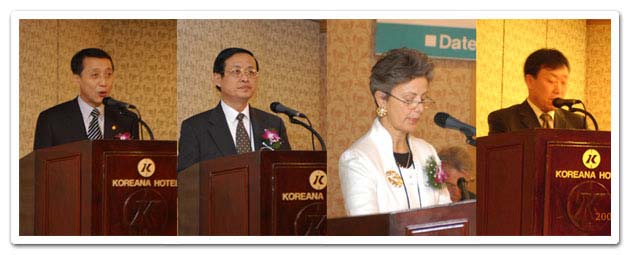
The Official Launching Ceremony for the Project was held on 7th March 2005 in Seoul,
Republic of Korea, at the Koreana Hotel. High-level officers from China and Korea and
representatives from UNDP attended the Ceremony, and delivered congratulatory
addresses. The speakers for the Ceremony were:
· Mr. KANG Moo-Hyun, Vice-Minister of Ministry of Maritime Affairs and Fisheries,
Republic of Korea;
· Mr. SUN Zhihui, Deputy Administrator of the State Oceanic Administration of the
Peoples' Republic of China;
· Ms. Anne-Isabelle Degryse-Blateau, Resident Representative of UNDP Korea
Office; and
· Dr. JE Jong-Geel, Member of the National Assembly of Republic of Korea.
Figure 1. Keynote speakers at Project Official Launching Ceremony.
UNDP/GEF/YS/PSC.2/3
Annex III
Page 3
The Ceremony was broadcasted on Arirang TV News (The Korea International Broadcasting
Foundation). Reporter, Ms. Kim Duyeon, interviewed the contributing players, two country
government representatives, and resident representative of UNDP Korea Office. During the
interview, both high-level government officials, and the UNDP Resident Representative in
Korea emphasised the importance of the Yellow Sea marine environment for the
participating countries, and key roles the project can play.
Mr. Kang Moo-Hyun: "The Yellow Sea is bordered by land on three sides, which has led to
much contamination over the years due to rapid increases in population and economic
development. That is why we need to protect this vital resource."
Mr. Sun Zhihui: "This project is important for both China and Korea because of our tradition
of friendship, and because we are both faced with common problems and demands in the
Yellow Sea area."
Ms. Anne-Isabelle Degryse-Blateau: "I think this is very significant to show the importance
and the political implications of this project, and we do hope that this will become one of the
tools for both countries' national strategies, to address this issue of the Yellow Sea."
2.2
Approval of the Implementation Plan
After the Official Launching Ceremony, the First Project Steering Committee (PSC) Meeting
was held in Seoul, Korea. The PSC reviewed and approved the Project Implementation
Plan which serves as a guide for the project's course. The Implementation Plan was
developed by regional experts and the PMO staff over the course of two regional technical
meetings held in Beijing, China, in December 2004, and in Ansan, Korea, in March 2005.
The Plan includes the background, objectives, implementation mechanisms, list of agreed
activities, budget, workplan, expected outputs, and monitoring and evaluation procedures.
One of the main activities at the beginning of the Project is to collect data and information to
determine the transboundary problems in the Yellow Sea, the causes and impacts of the
problems, and the governance issues related to the problems. This activity will illustrate the
trends of each problem, the available data and information in the region, the gaps in
knowledge, and what additional work is needed to provide a more complete picture of the
status of the Yellow Sea. The results of the activity will provide a clearer picture on how the
remaining aspects of the Implementation Plan should be accomplished over the next four
years, particularly the development of the Transboundary Diagnostic Analysis (TDA) and
Strategic Action Programme (SAP).
2.3
Regional and National Co-ordination
Since the first PSC meeting in March 2005, various institutional arrangements have been
made in both China and Korea to facilitate the national co-ordinations for implementing the
YSLME project. Additionally, the YSLME project has sought co-operation and co-ordination
with relevant regional programmes. This section describes the latest developments in the
regional and national co-ordinations among concerned countries and programmes.
2.3.1 Regional
Co-ordination
The YSLME project has sought co-operation dynamically with relevant international
organisations and NGOs such as the World Wide Fund for Nature (WWF). For example, to
strengthen co-operation and share information, the YSLME project signed a Memorandum of
Understanding (MOU) with the Yellow Sea Eco-Region Planning Programme (YSEPP)
UNDP/GEF/YS/PSC.2/3
Annex III
Page 4
which was implemented jointly by WWF, Korea Environment Institute (KEI), and KORDI.
The YSLME project also drafted the "Public Awareness and Communication Strategy" based
on the co-operation with WWF Japan, WWF China, WWF Hong Kong, Wetlands
International (WI), the Marine Stewardship Council (MSC), and the United Nations
Environment Programme-Northwest Pacific Action Plan (NOWPAP). The YSLME project
further pursues a co-operation with other regional programmes, such as IOC/WESTPAC and
NEAR-GOOS, for mutual benefit and effective implementation of the project.
2.3.2 National
co-ordinations
The Inter-ministerial Co-ordinating Committee (IMCC) and National Working Groups (NWGs)
for the five project components (Biodiversity, Ecosystem, Fisheries, Investment, Pollution)
were established in both China and Korea. A National Project Coordinator (NPC) for each
country was designated by the respective National Focal Point.
In China, in addition to the above entities, a National Project Management Office was
established in the Department of International Co-operation at the State Oceanic
Administration (SAO) which is headed by the NPC. The Local Project Management Offices
were also established.
In Korea, the NWG meetings have regularly been held to discuss, co-ordinate, and prepare
for the Regional Working Group meetings and the Regional Scientific and Technical Panel
(RSTP) meeting.
For better co-ordination and successful project implementation, as discussed in the Second
Regional Working Group Investment Meeting, the following activities are necessary:
· Inviting more institutions to participate in the activities of the national working groups,
including local governments, local communities, and NGOs;
· Securing a relatively stable participation of the members to the respective meetings
of the regional working groups; and
· Enhancing national co-ordination of relevant ministries in the implementation of the
project.
2.4
Activities of the Regional Working Groups (RWGs)
For the effective planning and implementation of the project activities, ten meetings of the
Regional Working Groups (RWG), two regional technical meetings and one special technical
meeting for the co-operative study cruises were organised during the period of October 2004
December 2005.
Discussions and agreements of these regional technical meetings provided solid bases for
the implementation of the project, and outcomes and outputs of the meetings provided useful
and effective mechanisms to implement the project activities as approved by the PSC.
UNDP/GEF/YS/PSC.2/3
Annex III
Page 5
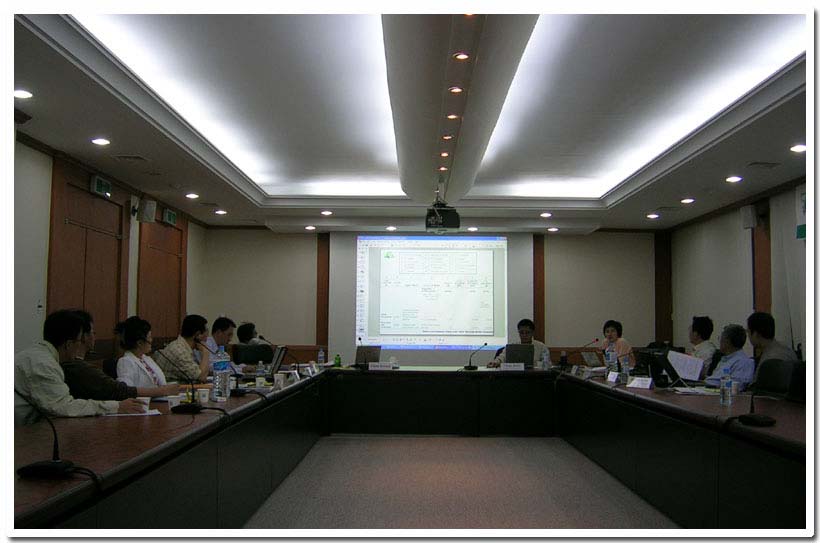
Figure 2. 1st RWG-E Meeting, Goeje Island, Korea.
2.4.1 Fisheries
Component
Over the past few months, members of the Fisheries Component have been engaged in
activities to acquire data and information related to fisheries to provide a contemporary
diagnosis for the status of fisheries, fisheries resources and mariculture of the Yellow Sea for
input to the Fisheries section of the TDA.
The West Sea Fisheries Research Institute (WSFRI), of the National Fisheries Research and
Development Institute, Korea, and the Yellow Sea Fisheries Institute (YSFRI), China, were
contracted to undertake activities to collate existing data and information relating to
perceived fisheries and mariculture issues, to support or refute the Yellow Sea's fisheries
problems as identified by the members at the 1st RWG-F meeting.
The 2nd RWG-F meeting reviewed, and initiated the synthesis of the newly acquired data and
information and identified the gaps, difficulties and barriers to data and information collection
and began discussion on the preparation of data and information for input to the TDA,
namely synthesising data and information to provide a region-wide diagnosis of the condition
and trends in fisheries, fisheries resources and mariculture, describing the current status and
patterns-of-change in benthic and pelagic resources, biodiversity, biomass, trophic structure,
carrying capacity, abundance and distribution, and production levels of fisheries resources in
the Yellow Sea; and including a review of the national laws and regulations governing
fisheries and mariculture.
The meeting also examined how the contemporary information related to the list of
`perceived problems', `causal chain and governance' analysis agreed at the first RWG-F
meeting are modified as a result.
Other important outcomes of the 2nd RWG-F Meeting were: an understanding of the
Fisheries Component's role in the upcoming Co-operative Study Cruises of the Yellow Sea
Marine Basin; activities to be implemented during 2005 to 2006, and the role of consultants
and members of the RWG-F in the process.
UNDP/GEF/YS/PSC.2/3
Annex III
Page 6
Over the next two years, one of the responsibilities of the RWG-F is to provide technical
guidance for the implementation of activities under this project component. Several activities
falling under the four major activity categories for the Fisheries Component are: 1) Regional
Stock Assessment; 2) Carrying Capacity; 3) Sustainable Mariculture; and 4) Laws,
Regulations and Fisheries Management Plans. The products of these activities will
contribute either to the TDA or to the development of SAP. The successful completion of the
activities will ultimately produce:
· Regionally agreed methods for data and information collection and sharing in the
Yellow Sea;
· An enhanced co-operative mechanism for regional data and information collection;
· Upgraded knowledge of the state of the Yellow Sea, in terms of its fisheries, fisheries
resources and mariculture industry; and
· Increased mutual understanding and trust amongst the participating institutions.
2.4.2 Biodiversity
Component
Over the past few months members of the Biodiversity Component have also been engaged
in activities to acquire detailed biodiversity-related data and information to provide a
contemporary diagnosis, or statement on the state-of-the-ecosystem of the Yellow Sea for
input to the Biodiversity Chapter of the TDA. The National Fisheries Research and
Development Institute (NFRDI), Korea, and the First Institute of Oceanography (FIO), China,
were contracted to undertake acquisition activities for existing data and information relating
to perceived biodiversity issues.
The objectives of these activities were to gather necessary data and information in the
region to support or refute the Yellow Sea's biodiversity problems as identified by the
Regional Working Group-Biodiversity (RWG-B) members in their first meeting, and for
synthesis and analysis into a regional summary.
The task included the reviewing and collection of existing data and information that was
agreed by the 1ST RWG-B Meeting according to the temporal and spatial scales. The review
attempts to cover the data and information existing in all institutions in both countries and
also includes relevant data and information sources external to the region (e.g. the GIS
database prepared by YSEPP. It is anticipated that this data and information will allow the
Project to describe the changes in species composition, gene diversity, conservation areas,
and habitat availability in the Yellow Sea over time, and identify gaps in data and information
in order to show information should be collected for better management of biodiversity
problems in future. It will also allow the Project to update the original causal chain analysis
and initiate some areas of the governance analysis which were developed at the 1st RWG-B
Meeting.
The expected outputs of these activities are:
(i)
A compilation of the best available data and information regarding the status and
trends in biodiversity, in the format and scales agreed by the Regional Working
Group for the Biodiversity component;
(ii)
A list of data and information sources to indicate the sources of the data and
information collected in item (i), location of these data and information centres,
conditions of access to data and information by different users;
UNDP/GEF/YS/PSC.2/3
Annex III
Page 7
(iii)
A report on the changes in species composition, gene diversity, conservation
areas, and habitat availability; and
(iv)
A report on the biodiversity problems in the Yellow Sea coastal and marine areas
of the country, including major problems, the priorities of the problems,
preliminary causal chain and governance analysis.
The 2nd RWG-B Meeting reviewed, and began a synthesis of the biodiversity data and
information for the Yellow Sea acquired through the recent data collection exercise to
analyse the gaps, identify difficulties and barriers to data and information collection, and to
discuss the preparation of data and information for input to the TDA. The major outcomes of
the meeting were:
· An awareness of the quality, gaps, difficulties and barriers to collecting data and
information on Biodiversity, and an understanding of mechanisms to address these
issues.
· An awareness of the region-wide status and patterns-of-change in biodiversity, habitats
and vulnerable species, and their protection in the Yellow Sea;
· A revised list of `perceived problems' and Causal Chain Analysis agreed at the first
RWG-Biodiversity (RWG-B) meeting.
· An improved state-of-knowledge of the existing national laws and regulations on
biodiversity, habitat protection and vulnerable species and how these may contribute to
potential governance issues.
· An agreement on Biodiversity Component inputs for the preparation of the Draft TDA.
· Understanding of the Biodiversity Component's role in the upcoming Cooperative
Surveys of the Yellow Sea Marine Basin.
· Agreement on activities to be implemented during 2005 to 2006 including the
objectives of the body-of-work that is required to be implemented prior to the next
RWG-B meeting, the role of consultants and members of the RWG-B in the process.
· Agreement on list and schedule of activities for the RWG-B for 2005 to 2006.
One of the on-going responsibilities of the RWG-B over the next phase of the project is to
provide technical guidance for implementation of activities under this project component. A
number of activities have previously been identified for implementation during the first two
years of the Project which requires the technical input of the RWG members or the
involvement of consultant contracts. The results of these activities will contribute to the TDA,
to the development of strategic action plans and prioritisation of project interventions, and
will enhance capacity to manage biodiversity-related problems on a regional scale.
Successful completion of the activities will ultimately produce:
· Regionally agreed methods for the observation, monitoring and sampling of biological
and environmental parameters relating to biodiversity in the Yellow Sea;
· An enhanced co-operative mechanism for regional monitoring, observation and
protection of biodiversity;
· Upgraded skills in the observation and monitoring of parameters for the protection
and management of biodiversity; and
· And ultimately, a better scientific understanding of biodiversity in the Yellow Sea
ecosystem.
UNDP/GEF/YS/PSC.2/3
Annex III
Page 8
2.4.3 Pollution
Component
The Pollution Component embarked on its first activity to collect historical data and
information to determine the pollution-related problems in the Yellow Sea. The types of data
and information to collect were agreed upon at the First Regional Working Group Pollution
(RWG-P) Meeting. At this meeting, RWG-P members also carried out a preliminary causal
chain and governance analysis based on what they perceived to be the transboundary
pollution problems in the Yellow Sea. The members also revised the list of activities for the
Pollution Component, which set the stage for the activities to be implemented over the
coming years.
Contracts for the historical data collection activity were issued to the National Marine
Environmental Monitoring Center (NMEMC), China, and KORDI to implement the activity.
Some of the information collected-to-date was presented at the Second RWG-P Meeting.
During this meeting, members agreed on how to present their data in a standardised format
for the regional synthesis and the TDA. Members will continue to collect additional data and
information over the next 3 months, analyse the data, and present them in a final report.
The data and information collected will be housed in the Project database at the China-
Korea Joint Ocean Research Center.
An activity that will soon be completed is the preparation of regional pollution monitoring
guidelines. The objective of the activity is to provide a regional plan for better monitoring
and understanding of pollutants that affect the Yellow Sea. It is expected that the guidelines
can be used for any future joint or separate monitoring activities in the Yellow Sea.
A consultant was hired to carry out the following tasks:
1) Provide a list of the vital chemical, physical and biological parameters to detect
pollution problems in the Yellow Sea;
2) Prepare guidelines for sampling the parameters in different media (water, sediment,
biota, etc.);
3) Propose numbers and siting of monitoring stations;
4) Suggest reporting procedures to national and international agencies;
5) List recommendations and justifications regarding acceptable contaminant levels;
and
6) List recommendations for each parameter when a threshold level is exceeded.
The progress report was presented at the 2nd RWG-P Meeting, and participants gave
suggestions to the consultant for preparation of the final report. It is anticipated that the
guidelines will contain information on the above items, as well as:
· How to co-ordinate existing monitoring programmes into the regional guidelines,
including how to use remote sensing as a monitoring tool;
· Linking the guidelines with existing monitoring programmes and geographic areas.
Providing recommendations on how to link existing data systems and exchange of
information gathered from future monitoring programmes; and
· Incorporating into the guidelines, existing inter-governmental agreements on data
exchange.
The Pollution Component has also been examining the pollutant parameters that labs in the
region should inter-calibrate. This exercise will assist with the analysis of samples collected
from the co-operative study cruises, in that labs from China and Korea carrying out the
analyses will produce comparable results.
UNDP/GEF/YS/PSC.2/3
Annex III
Page 9
In the first half of 2006, contracts will be issued to consultants and institutes to carry out
more activities whose results will contribute to the writing of the TDA and SAP.
2.4.4 Ecosystem
Component1
The Ecosystem Component also embarked on its first activity to collect historical data and
information to determine the ecosystem-related problems in the Yellow Sea. The types of
data and information to collect were agreed upon at the First Regional Working Group-
Ecosystem (RWG-E) Meeting. Like at the previous RWG meetings, RWG-E members also
carried out a preliminary causal chain and governance analysis based on what they
perceived to be the transboundary ecosystem problems in the Yellow Sea. The members
also revised the list of activities for the Ecosystem Component, which guides the activities to
be implemented over the coming years.
Contracts for the historical data collection activity were issued to FIO and WSFRI to
implement the activity. Some of the data and information collected-to-date were presented
at the Second RWG-E Meeting. Members agreed on the format to present the data for
regional synthesis and the TDA.
The Ecosystem Component has finalised its team members, equipment, and budget for the
winter co-operative study cruise where plankton samples will be collected and analysed to
complement the historical data collection activity.
Early in 2006, contracts will be issued to consultants and institutes to carry out additional
activities whose results will contribute to the writing of the TDA and SAP. Some of these
activities include: regional synthesis of national data, assessing carrying capacity, identifying
stresses to the ecosystem, and workshops on monitoring the ecosystem.
2.4.5 Investment
Component
The major activities of the Regional Working Group Investment (RWG-I) consist of: (i)
stakeholders, (ii) regional coordination, (iii) national institutions, (iv) financial instruments, (v)
data and information management, and (vi) public awareness and participation.
Stakeholders
This activity, closely linked with public awareness and participation, identifies the
stakeholders and strengthens their capacity of environmental management and decision-
making. The RWG-I explored the Governance Analysis as a tool for identifying all relevant
stakeholders in the Yellow Sea as well as for contributing to the TDA development. As a
result, the execution plan for the Governance Analysis was devised. This draft plan will be
submitted to the PSC meeting for approval.
Regional co-ordination
The activity of regional co-ordination proceeds with the preparation of the TDA and SAP. To
incorporate the socioeconomic aspects of the Yellow Sea ecosystem into the SAP, the
Investment Component considered the implementation of Environmental Valuation. The
1 This report was prepared prior to the 2nd RWG-E Meeting. The results of the 2nd RWG-E Meeting can be found in the RWG-E
Chairperson's report (Document UNDP/GEF/YS/RSP.2/7) and 2nd RWG-E Meeting Report (Document UNDP/GEF/YS/RWG-
E.2/3).
UNDP/GEF/YS/PSC.2/3
Annex III
Page 10
Component examined the guideline for valuation studies, which was drafted by the PMO.
The Investment group also discussed the execution plan for the Environmental Valuation;
the plan will be submitted to and assessed by the RSTP/PSC.
National institutions
The third activity of the Investment Component includes establishing National Co-ordination
Units to secure intersectoral co-ordination in the TDA/SAP process. For the national co-
ordination as well as the regional co-ordination activities, consult section 2.3, "Regional and
National Co-ordinations," in this report.
Financial instruments
This activity contributes to the financial sustainability of the environmental conservation
activities for the YSLME after the project is completed. The RWG-I explored a number of
activities to secure the sustainability, including the training programmes for environmental
project identification and preparation. The members also considered the regional strategy
for financial sustainability; as a result, the implementation structure for developing the
strategy was determined. The PMO will prepare a draft strategy for further consideration.
Data and information management
The data and information management (DIM) includes the development and implementation
of the regional DIM strategy. The China-Korea Joint Ocean Research Center will host the
meta database and the GIS database of the YSLME project, and establish and maintain
these databases. The RWG-I assessed both the technical considerations and the specific
activities / schedules for the database development.
Public awareness and participation
The final activity of the RWG-I includes encouraging public participation to induce broad
support and expertise to conserve the Yellow Sea ecosystem. The Investment Component
examined the "Public Awareness and Communication Strategy" which was jointly drafted
with members of the Yellow Sea Partnership. The RWG-I also discussed and agreed on
holding the Partnership Workshop for better co-operation and co-ordination. For further
information on the strategy and partnership, consult section 3, "Public Awareness and
Participation," in this report.
During the two RWG-I Meetings, the above activities were extensively discussed. Based on
the agreement of these meetings, the contracts will be issued to consultants to implement
the Governance Analysis, the Environmental Valuation, and the Data and Information
Management.
2.5 Planning for the Co-operative Study Cruises
Based on the discussion and agreements during the preparation phase of the project,
regional cooperative study activities for the Yellow Sea marine basin were included in the
Project Document. These were to the form of two cooperative or `joint' cruises of the Yellow
Sea marine basin. The objectives of the study cruises are to:
1. Provide basin-wide data and information for the Yellow Sea covering all
components identified in the Implementation Plan of the project, and based on
the data and information gaps identified by the Regional Working Groups;
UNDP/GEF/YS/PSC.2/3
Annex III
Page 11
2. Provide data and information that will be used, together with other existing data
and information, in the preparation of the TDA, in particular the data and
information covering the entire Yellow Sea; and
3. Prepare necessary baselines of the status of the Yellow Sea environment at start
of project implementation, when combined with all other data and information
available to the project. The baseline information will be used in the later stage
as one of the indicators for the evaluation of the project.
During the 1st PSC Meeting, the original number of cruises planned in the Project Document
was reduced from 6 to 2, due to changes in the financial environment within, and external to
the Project over the past 5 years. Following the decisions of the PSC, the RWGs and the
RSTP further discussed the details of co-operative monitoring cruises, and two cruises, a
`winter' and a `spring' cruise, were subsequently planned to be undertaken in the Yellow Sea
marine basin,
The survey plan and workplan for the cruise were further discussed and finalised at a
separate "Technical Meeting for the Cooperative Study Cruise." During this meeting the
expected outcomes and outputs of the cruise were detailed, technical issues were
addressed and logistical arrangements planned.
Outcomes and Outputs from the Survey
The overall outcomes and outputs of the cooperative survey were finalised at the Technical
Meeting, and include:
· the better understanding of the status and conditions of the Yellow Sea Marine basin
ecosystem; and
· the condition and quality of the Yellow Sea marine basin habitat and the biological
and physical dynamics of the Yellow Sea marine basin system.
More specifically, the data/information collected from both surveys will allow the project to
determine status and changes in benthic and pelagic resources, quality and availability of
bottom and pelagic habitats, abundance and distribution of organisms in the Yellow Sea
marine basin, status of marine pollution and water quality in the Yellow Sea marine basin;
and provide us with basic basin-wide information on the marine environment of the Yellow
Sea. The resultant data/information will allow the Project to identify trends, and/or predict
changes under prevailing ecosystem conditions and identify or prioritise interventions for the
SAP phase of the project. The ultimate outcomes of the cooperative cruise include:
· regionally agreed methods for the observation, monitoring and sampling of marine
environmental parameters in the Yellow Sea;
· an enhanced co-operative mechanism for regional marine environment monitoring
and observation;
· upgraded skills in basin-wide observation and monitoring;
· a better scientific understanding of the basin-wide marine environment/ecosystem
status;
· identification of data/information and knowledge gaps; and
· an increased mutual understanding and trust amongst the participating institutions.
The expected outputs of the winter survey include the resultant data and reports from the
survey activities, recommendations and items to be addressed for the next survey in spring,
and a preliminary analysis of collected data.
UNDP/GEF/YS/PSC.2/3
Annex III
Page 12
Finalisation of Survey Plan
Cruise Dates
The first cruise will take place from the 4th to 25th January, 2006 (As per the agreement of the
1st RSTP Meeting), with participation of experts from both the People's Republic of China
and the Republic of Korea. This cruise is known as the `winter' survey.
The second `spring' cruise is planned for May 2006, although the exact start dates and
duration times are yet to be determined.
Observation Stations, Transects and Ships Route
The initial survey plan for the winter survey, proposed at the first RSTP meeting, was re-
modified during the Technical Meeting for the Co-operative Study Cruises.
The initial plan included 52 discrete sampling stations for bottom trawl, phytoplankton &
zooplankton sampling, and 27 environmental stations (for CTD deployment) and 15 stations
for pelagic trawl (based on acoustic echogram). The survey will start from the southern
sampling area and proceed northwards, and it was agreed that station points could be
adjusted according to weather and sea conditions. Sampling stations were arranged in such
a way as to respect the territorial waters of each country.
During the Technical Meeting for the Co-operative Study Cruises, a new survey plan for
winter and summer was developed, based largely upon a proposal by the Korean members
using a modified version of the initial plan. (See Document UNDP/GEF/YS/RSP.2/8 for the
survey routes).
There are 50 stations in the new plan for the winter survey and up to 71 stations planned for
the spring survey cruise, with the position of transect lanes changing slightly. The winter
survey continues to concentrate on the sampling of the Yellow Sea cold water mass, and
both surveys continue to respect the territorial waters of each country.
Logistical Arrangements
Government Approval
In accordance with the relevant regulations of the People's Republic of China, approval of
the co-operative study cruise is required 6 months before the initiation of the activity.
According to the NPC for China, the approval process has been initiated with the relevant
ministries. In lieu of this, it was agreed that the spring cruise would be considered
concurrently with the winter cruise, with government approvals for both sought
simultaneously. Korea has a similar approval policy and the urgency to finalise the cruise
plan expeditiously and without major modification was highlighted to all relevant persons.
Workplan and Schedule
The Technical Meeting in finalised a schedule and workplan for the winter study cruise. The
plan comprises of activities and responsibilities leading up to, during, and after the cruise, for
each participating component. An equipment and personnel manifest was also finalised,
identifying the equipment lacking/needing to be acquired and the personnel responsible for
its purchase and/or handling and operation during the cruise.
UNDP/GEF/YS/PSC.2/3
Annex III
Page 13
Post-Cruise Sample & Data Handling
The difficulties associated with division and handling of samples for analysis at the
conclusion of the study surveys was discussed at the Technical Meeting. Members agreed
to develop detailed lists of sample types required to be relocated to Korea from Qingdao at
the end of the study cruises and provide them to the PMO in order to seek the appropriate
government approvals.
It was agreed that the newly acquired survey cruise data would become the property of the
GEF with the principle and understanding that data will be shared equally between the
participating countries. However, in order to implement this principle, and in particular to
allow the relocation of the samples to Korea, there was a need to obtain approval from the
respective governmental agencies, which shall be on a case-by-case basis.
The PMO has prepared a policy paper on the handling and sharing of data (as requested by
the RSTP at its first meeting), to be presented to the next Project Steering Committee for
consideration and approval (refer Document UNDP/GEF/YS/RSP.2/11).
Considerations for the Spring Survey
It was requested that an extra Technical Meeting for the Co-operative Survey Cruises be
held at the completion of the first cruise and before the initiation of the next cruise to facilitate
the organisation and quality of output of the second co-operative study cruise. The months of
March to April were agreed as a suitable time for such a meeting.
2.6 Involvement of DPR Korea in the project
As instructed by the Project Steering Committee at its first meeting in Seoul, Korea, March
2005, the Project Manager visited the Democratic People's Republic of Korea (DPRK), 12-
16 July 2005, together with a representative (Mr. Wenxi Zhu) from one of the project's
participating countries.
The purposes of the visit were:
(i)
Introducing the UNDP/GEF Yellow Sea Project to the relevant organisation(s)
in DPR Korea;
(ii) Exploring possibility to get DPR Korea involved in the Project; and
(iii) Establishing communication mechanisms with DPR Korea, if they are
interested in participating in the project activities.
The visit in the framework of bilateral relationships between State Hydrometeorological
Administration (SHMA) DPR Korea and State Oceanic Administration (SOA) China, as an
initiative, was approved by the National Co-ordinating Committee for Environment in DPR
Korea, and the discussion was organised with the SHMA, which is a governmental
organisation responsible for hydrology (including underground water), meteorology, and
oceanography, including marine environment monitoring.
Following the presentation of the project activities by the Project Manager, the discussions
were focused on the issues of the interests and possibilities of the DPR Korea to participate
in the project. Following the extensive discussions on several policy and practical issues,
and exchange views, SHMA expressed its interests in participating in the project activities.
The final decision should be made by the National Co-ordinating Committee for the
Environment in DPR Korea.
UNDP/GEF/YS/PSC.2/3
Annex III
Page 14
The major outcomes of the visit were:
(i)
It was confirmed and agreed that the exchange of data and information is required for
the project to understand better the marine environment status and trends, but it
would not be the pre-condition for DPR Korea's participation in the project;
(ii)
Co-operative cruises organised by the project will exclude the territorial sea areas of
the participating countries. This is not only for the DPR Korea, but for all the
participating countries as agreed in the Project Document, and by the Project
Steering Committee; and
(iii)
The representatives of DPR Korea should be invited to participate in the second
meetings of the RSTP and PSC, as full members if the approval for project
participation was obtained, or as observers if the approval was not yet obtained.
During the visit, the Project Manager visited the UNDP Pyongyang Office and had a meeting
with staff of the office. Information about the project was provided, and brief discussion
about the involvement of the DPRK took place.
2.7 Cross component issues
The interdisciplinary nature of the Yellow Sea Project and wide-encompassing ecological
characteristics of any large marine ecosystem such as the Yellow Sea ecosystem, have led
to the development of an environmental management project that will address the most
critical aspects of the ecosystem, as identified by regional experts. However, as the
ecosystem does not function in discrete packets, many of the issues that the Project will
address, do overlap with each other. Some examples of cross-component issues include,
inter alia:
· redundancy in identified transboundary problems related to each component;
· redundancy in data and information to be collected to address the perceived
problems;
· governance analysis to be done by each component or one for all components;
· storage, maintenance, and accessibility of data and information collected under
each project component; and
· assessing carrying capacity of the ecosystem.
Some of the activities of the Project's five main focal areas Fisheries, Biodiversity,
Ecosystem, Pollution and Investment are cross-component in nature, and were addressed
and discussed during the 1st RSTP Meeting with the following conclusions:
· The Fisheries Component generally focuses its carrying capacity assessment on
higher trophic levels, while the Ecosystem Component prefers to focus on lower
trophic levels. A special working group at the 1st RSTP Meeting agreed that carrying
capacity assessment will focus on fisheries resources, namely the highest possible
fish biomass in the Yellow Sea from surveys, with the output from Ecosystem
Component's primary and secondary production assessment serving as input for the
estimation of carrying capacity in the Fisheries Component. The group reported that
it would pursue the goal in two ways: 1) population dynamics approach; and 2) lower
trophic productivity-higher trophic level model (possibly ECOPATH) approach.
· The
1st RSTP Meeting agreed that social economic and governance analysis would
be carried out separately by each component, and the integrated analysis would be
UNDP/GEF/YS/PSC.2/3
Annex III
Page 15
carried out after receiving the results from the Regional Working Groups. Guidelines
for implementing socio-economic analysis and economic valuation of natural
resources would be prepared by the Project Management Office (PMO), with
guidance from the Regional Working Group for Investment.
· For data management, the 1st RSTP Meeting agreed that:
1. The meta database and GIS database will be hosted in the China-Korea Joint
Ocean Research Center.
2. The PMO will take a leading role in the development of the databases, with input
from database development experts.
3. The members of the regional working groups should be involved in the
development of the databases.
4. The host will be responsible for the daily maintenance of the databases. China
and Korea will have equal responsibility for the joint facility, and management of
the data in the future.
As it was particularly difficult to obtain an overall picture of the data and information that
overlap, the 1st RSTP Meeting requested the PMO to produce three matrices to show the
areas of overlap more clearly:
1. perceived transboundary problems;
2. historical data review; and
3. co-operative study cruises data collection.
The three matrices are shown in Appendix II.
The Second RSTP Meeting will review the tables, improve them, discuss how to share the
data amongst the various components, and agree on the responsible group(s) to collect any
remaining overlapping data.
3.
Public Awareness and Participation
A "Public Awareness and Communications Strategy" was devised by the PMO in conjunction
with other collaborating bodies, to produce a comprehensive and straightforward framework
for coordinated actions of the numerous groups involved in the Yellow Sea Partnership. The
partnership is open and available for participation by any organisation interested in the
activities identified in this strategy.
The Strategy is a `work in progress,' the contents of which will be built-upon over time,
particularly as more stakeholders are identified, partnerships made, and lessons learned. It
will be executed and evolved on a continual basis.
Purposes of the Public Awareness and Communication Strategy
The purpose of this strategy is to create a strong awareness of the problems faced by the
Yellow Sea by informing the wider stakeholder-ship of the impacts of unsustainable
activities, and how the Yellow Sea ecosystem can be improved by the mitigation or
elimination of the impacts, or stressors, for the benefit of humankind; namely, the strategy
aims to:
· Establish a partnership for joint activities in the public awareness and participation in
the Yellow Sea;
UNDP/GEF/YS/PSC.2/3
Annex III
Page 16
· Produce a regional list of the stakeholders using the Yellow Sea coastal and marine
resources as a major targeted group;
· Inform stakeholders of the roles of the Yellow Sea in the global scenario;
· Report to stakeholders of the perceived problems faced by the Yellow Sea;
· Warn how these problems can and do affect local and global communities;
· Inform how remediation of perceived problems can benefit all stakeholders;
· Inform stakeholders of the current efforts of various projects, the focus and rationale
of each;
· Inform of the outcomes and benefits of the various projects to both the stakeholders
and the coastal and marine environment;
· Inform stakeholders and funding agencies of the status of the projects and
incremental levels of achievements;
· Inform stakeholders of their roles and responsibilities in stewardship of the
ecosystem;
· Inform all stakeholders, including governmental, intergovernmental and non-
governmental bodies, of their functions in improving the status of the environment in
the Yellow Sea; and
· Encourage greater stakeholder contributions to environmental management and the
decision-making process.
Overall messages delivered by the Strategy
The overall messages that this Public Awareness and Communications Strategy strives to
convey are:
· The status of the Yellow Sea the problems and the trends;
· How environmental problems affect local communities, adjacent countries, the global
community and global environmental systems;
· What is currently being done to monitor and remediate these problems;
· How remediation of environmental problems can benefit stakeholders; and
· The role that each partner plays in the Yellow Sea partnership.
These are broken down into more specific messages in separate sub-strategies which target
specific stakeholder groups to maximise information transfer (see Document
UNDP/GEF/YS/RSP.2/5).
Expected Outcomes of the Strategy
The expected outcomes of this strategy are to create a strong public awareness of the
problems faced by the Yellow Sea, how the ecosystem is currently affected by the activities
of humans and how the ecosystem can be improved by the mitigation or elimination of these
problems. As a result, develop strong public support and participation in actions leading to
the mitigation or elimination of these problems, as a major element in the management plan
of the Yellow Sea.
Initial Implementing Entities of the Strategy
· YSEPP
· WWF Hong Kong
· WWF
China
· Wetlands International
· Marine Stewardship Council
· YSLME
UNDP/GEF/YS/PSC.2/3
Annex III
Page 17
Target Audiences of the Strategy
· Community-based
Organisations
· Scientific
Community
· National and Local Government Agencies
· Legislative
Bodies
· Non-government Organisations including Religious Groups
· General
Public/Media
· Donor
Community
· Industry/Consumers
· Youth
Groups
Schedule for Implementing the Strategy
Implementation of the Public Awareness and Communication Strategy consists of four
phases along with the major developments of the Project: (i) preparation, (ii) TDA, (iii) SAP,
and (iv) demonstration/pilot activities. The relevant information on implementation is
available in Document UNDP/GEF/YS/RSP.2/5.
Public awareness materials
In line with the Public Awareness and Communications Strategy, the PMO has embarked on
an exercise to develop its own range of promotional items. Based on a master list of items
developed in the strategy, the PMO has selected a small number of items to be produced by
the end of 2005.
Figure 3. Left: Project poster. Right: Project brochure.
UNDP/GEF/YS/PSC.2/3
Annex III
Page 18
All items will sport the YSLME Project's dynamic logo and website URL address. Items to
be developed in the short-term include hats/caps, business card holders, ornamental
magnets, computer mouse pads, writing pens, posters and brochures. At present, the
Project brochure and posters have been completed, with the designs for the caps, business
card holders, pens and mouse pads being finalised.
4.
Financial Report
A brief overview of the financial aspects of the Project is reported here to provide Project
partners with a general understanding of the basic fiscal aspects of implementing the
Project.
4.1
Financial rules applied to the project
Period for project budget
To provide for continuity in the programming and implementation of UN assistance to
projects, the financial period for the purpose of the proposed utilization of resources
entrusted to the charge of UNOPS and of entering into obligations in such respect shall be
the duration of each project as defined in the project document.
The financial period for the purpose of incurring and accounting for expenditures in respect
of projects shall consist of a single calendar year.
Format of the Project Budget
In the approved Implementation Plan of the project, the project budget was presented using
the format known as "IMIS codes." An example is shown below in Table 2.
Table 2. Example of Project Budget shown by IMIS codes.
Budget Description
Year 1
Year 2
Year 3
Year 4
Year 5
Total
m/m
$ m/m $ m/m $ m/m $ m/m
$ m/m $
10.00
Personnel
11.00
International
Experts
11.01 CTA
1/12
171,919
1/12 180,515 1/12 189,541 1/12 191,364
1/12
200,932 1/60 934,271
11.02
Economist 1/12
109,200
1/12 114,660 1/12 120,393 -
-
1/36 344,253
11.03
Scientific
Officer
1/12
109,200
1/12 114,660 1/12 120,393 -
-
1/36 344,253
11.04 Public Advisor 1/12 80,000 1/12 84,000 1/12 88,200
-
-
1/36 252,200
Short-term
Consultants
11.51 Carrying
1/1
17,900
1/1
17,900
-
-
-
1/2
35,800
Capacity
Consultant (IB)
Currently, the financial management system in UNDP and UNOPS has changed to the Atlas
format. In order to:
UNDP/GEF/YS/PSC.2/3
Annex III
Page 19
(i)
follow the changes in the financial management system in UNDP and UNOPS;
and
(ii)
provide easy understanding of project planning and implementation.
The new budget format is prepared based on the Atlas format, which is a clearer way to
show the activities and budget of each project component. Refer to Document
UNDP/GEF/YS/RSP.2/13 for the new budget format.
Revision of project budgets
(a)
Whenever a project budget ceases to reflect actual circumstances or current
expectations in any significant respect, it shall be revised accordingly.
(b) Revisions primarily made to reflect expenditures of the previous year and other
appropriate changes shall be prepared annually for each project budget. Such mandatory
revisions shall be submitted by the executing agency, immediately following its issuance of
year-end delivery reports.
There have been some unspent money and changes in priority of activities, thus, a budget
revision has been prepared by the PMO, and presented to the RSTP Meeting for review.
ADMINISTRATION OF RESOURCES
Procurement
The basic principles are transparency and fairness, economy and best value. The following
general principles shall be given due consideration in carrying out the procurement functions
of UNDP under these Rules:
(a) Economy and efficiency;
(b) The interests of the UNDP programme;
(c) International soliciting of proposals and competitive bidding to allow prospective
proposers and bidders fair and equal opportunities to provide those goods,
services and other requirements being sought by UNDP;
(d) The utilisation of currencies available to UNDP and which require special
management;
(e) Preferential treatment to be accorded to sources of those supplies indigenous
either to the country being assisted or to other developing countries; and
(f) Equitable geographical distribution consistent with maximum effectiveness.
Advance and progress payments: When the advance payment for USD 50,000 or more is
required and subsequently approved, UNOPS will normally require a bank guarantee or
other suitable security arrangement.
Security: All contracted personnel have to pass the "Basic Security in the Field Staff
Safety, Health and Welfare" test.
4.2
Expenditures and balance of the project
Appendix III shows the expenditures and balance for the project, as of 25th November 2005.
The expenditures for January to October 2005 reflect real expenditures, while expenditures
UNDP/GEF/YS/PSC.2/3
Annex III
Page 20
for November to December 2005 are estimated, as the detailed expenditure information was
not received from UNOPS.
It should be noted that the five-year project period will be from 1st January 2005 - 31
December 2009. There was no budget in 2004 although the Project Manager reported to
duty on 15th September 2004.
It should also be noted that the supporting staffs' salaries were affected by the exchange
rate between Korean Won and US Dollar because their contracts are based on Korean Won,
but should be reflected in the budget as US Dollar. International staffs' post adjustment was
changed from 77.2% to 49.2% of net salary starting in November 2005, which is reflected in
the budget total for 2005.
Finally, the reasons for the relatively large un-spent balance in 2005 are: 1) This year was
the project inception year (1st year of the project); there have been a lot of preparation work;
and 2) Slow response from some RWGs and contractors.
5.
Report on the Project Management Office
5.1
Office & Facilities
Since the UNDP/GEF Yellow Sea Project was approved and established in the KORDI
compound, KORDI has generously provided a wide range of support to the Project and the
PMO. The MOU between PMO and KORDI was signed on 10th December 2004 to agree on
the necessary logistic support and services KORDI would provide. In July 2005, KORDI
provided the PMO with office space in the No. 1 Research Building for the PMO staff with
additional space for interns, office furniture, computers, printers and standard office
equipment. The PMO is now fully operational. On behalf of the Project, the PMO expresses
its sincere gratitude to KORDI for her gracious support and assistance that continue to
ensure that project implementation proceeds smoothly.
5.2
Staff Recruitment and Intern Programme
One of most important tasks during the first year of the project implementation was to recruit
the necessary project staff and form a management team for effective implementation of the
project activities.
With support of the UNDP/GEF, UNDP Korea Office and UNOPS, the recruitment process
was carried out transparently and effectively. A total nine staff, from five different countries,
were recruited and form a project team for the implementation of the project activities. It
should be noted that the speedy recruitment of the project staff has provided the basic
mechanism for the effective implementation of the project activities approved by the Project
Steering Committee.
It is a pleasure of the Project Manager to report to the Project Steering Committee and
participating countries that the project staff recruited has shown effective operational skills
and initiatives to accomplish their work, are hard working, have a high level of ability to
complete the tasks at hand, and strong team-work spirit.
5.3 Information
Dissemination
UNDP/GEF/YS/PSC.2/3
Annex III
Page 21
The Project's homepage (http://www.yslme.org) provides background information about the
project, the staff and partners, the latest news on implementation, project reports and
meeting documents, and relevant stories about the Yellow Sea. The first page is designed
to show the site's categories and contents for easy understanding and access. The visual
design of the front page is changed at regular 6-month intervals.
To accomplish the information delivery mission, the homepage has a link to an E-Discussion
forum (http://www.yslme.org/forum/). The PMO will initiate discussion topics and
continuously update the forum. Anyone can join and post messages.
One of the success indictors for this project will be regional communication and mutual
understanding The E-Discussion forum can be a solution for communication. Even though
the usage rate is currently low, if the forum becomes more active, it can be a good indicator
of the project's regional communication and co-ordination objective.
The E-Newsletter is issued at regular 3-month intervals. The newsletter includes PMO
inside news, various meeting's news, and Yellow Sea news. The newsletter is sent by e-
mail to project partners, and can also be accessed from the website. Anyone may contribute
news to the newsletter, by e-mailing his article to info@yslme.org.
Finally, the PMO is planning to establish a GIS webpage for the general public to understand
the Yellow Sea environment.
The PMO continues to seek better ways to communicate with the public and transmit
information. Suggestions in this regard are welcome.
5.4
Operation of the Office
Operation on project implementation
As this is first year of project implementation, the operation of this function has special
characteristics: new project, new project office, new staff, and new project management
structure.
As a new project, it is essential to establish the project operation system within the UNOPS
framework. With assistance of UNOPS staff, the operation system has been established in
the Project Management Office according to the rules and regulations of UNOPS. The
following operational structure was set up:
(i)
The Project Manager has been authorised by the Executive Director of UNOPS on
the operation of imprest account and management of the project activities;
(ii)
Imprest account, in both US dollar and Korean won, has been set up with assistance
of UNOPS technical staff, and necessary training was carried out in the PMO for
operating the accounts;
(iii)
A training workshop was organised by UNOPS for the project operation and
management in Geneva, September 2005. Three project staff participated in the
training workshop, and shared experiences and lessons with the staff from other
projects. The newly acquired knowledge was transferred to the rest of the PMO staff;
and
UNDP/GEF/YS/PSC.2/3
Annex III
Page 22
(iv)
Daily management of the project activities has been operated by the PMO with a total
of 14 contracts negotiated and concluded. There have been a total of 15 meetings
organised by the PMO, including PSC, RSTP, RWGs and technical meetings.
From the operation of the first year of the project implementation, the Project Manager is
confident that with the assistance of UNOPS and UNDP country offices, and with the co-
operation of the participating countries, the operation of the PMO will improve, and become
more smooth and effective in the years to come.
6.
Co-operation with other Organisations and Projects
To enhance the effectiveness of its conservation and communications activities, the Project
YSLME has pursued co-operation with a number of relevant international organisations and
NGOs.
During the First RSTP Meeting, members of the RSTP and representatives from potential
"partners" explored the possibility and mechanisms for successful co-operation.
Considerable mutual benefit was realised and this formed the impetus for partnerships
among a number of interested parties. As a result, an MOU was signed between YSLME
and YSEPP, laying the foundation stone for the "Yellow Sea Partnership" (see Section 3).
Since then, co-operation with other organisations has been pursued leading to the
development of MOUs with at least three other major partners including WI, MSC and
NOWPAP. All of these MOUs are currently at the signature stage.
All parties share the common objective of conserving and using the coastal and marine
resources of the Yellow Sea in a sustainable manner and will mutually benefit from this
cooperation through maximising the use of human and financial resources and avoiding
overlaps and duplication of work.
The purpose of the MOUs is to set out principles and the practical basis to cooperate in
promoting conservation and sustainable use of marine and coastal resources of the Yellow
Sea. The MOUs describe agreements for the exchanging of data and information, and
discussion of potential areas and mechanisms for co-operation and co-financing in
promoting protection of the marine and coastal environment, and sustainable use of marine
and coastal resources in the Yellow Sea. They also provide a framework for cooperation
and facilitate the collaboration between the parties in areas related to global environmental
issues of concern to each party, including promoting the "identification, formulation,
implementation, and monitoring and evaluation on issues of mutual interest." It is noted that
the activities and potential areas for collaboration identified under the MOUs represent
significant contributions towards meeting national commitments under such international
agreements such as the Convention on Biological Diversity, Ramsar Convention on
Wetlands and FAO Code of Conduct for Sustainable Fisheries in the Yellow Sea areas. In
particular, the proposed activities will help answer the urgent need to address the under-
representation of protection of the marine and coastal ecosystem and will contribute to
building national frameworks of marine and coastal protection.
Currently, the PMO is developing a comprehensive workplan that integrates the
considerations and input (physical and financial) of all partners, detailing the agreed
activities, the schedule for each item and their cost requirements. A `Yellow Sea
Partnership' workshop is planned to be held in late February to formally initiate the activities
that will take place over the next 4 years.
UNDP/GEF/YS/PSC.2/3
Annex III
Page 23
7.
Challenges to implementation of project activities
National co-ordination needs to be further strengthened
From the experiences of the implementation of the project activities during the first year, it
was apparent that effective co-ordination and co-operation at national level will not only
provide necessary support to the implementation of the project activities as agreed by the
PSC, but also ensure the quality of project outcomes. In order to ensure successful
preparation, and more importantly, approval of the TDA and SAP, the national co-ordination
and co-operation should be further ensured.
(i)
Enhancing the roles of the IMCC
During the first year, the Inter-Ministry Co-ordinating Committees were established in the
participating countries. However, due to various reasons and constraints, the meeting of
IMCC has not been organised, although communications between the relevant ministries
were well established.
(ii)
Enlarging participation in the national working groups, including NGOs
The national working groups for the project components have been well established in
the participating countries, and are playing key roles in project implementation.
Considering the tasks faced by the project, it would be more effective and beneficial to all
participating countries if more institutions, including NGOs, could be involved in the
project. It should be noted that by enlarging participation of more institutions, it would
not only bring more expertise and human resources to the project, but also bring more
attention to the environmental problems faced by the Yellow Sea.
(iii)
Involvement of local governments and communities in project activities
The involvement of local governments and communities has been well recognised by the
project during the PDF-B phase, and relevant activities were planned in the project
document. It should be noted that in order to obtain support from the local governments
and local communities in preparation, approval and implementation of the Strategic
Action Programme, and the National Strategic Action Plan, it would be more beneficial if
the local government and local communities could be involved in the project activities,
the earlier the better.
Better understanding of the UN and GEF financial rules and operational mechanisms
will assist with implementation
During the first year of implementing project activities, UN and GEF financial rules and
operational mechanisms have been understood better by the experts and relevant
institutions that are participating in the project. Some difficulties have been solved with
assistance from, and support of, the participating governments. Due to the complexities of
the project activities, better understanding of the rules and mechanisms is necessary and
beneficial to the project's success. For instance, in the case of participation of experts to the
project meetings, the project will only cover the travel costs at the most economic prices, and
would cover full or partial DSA according to UN rate. It is not possible for the project to
provide "consultancy fees" for the experts who participate in the meetings.
Prompt actions to adhere to the overall workplan for the implementation of the project
Due to the efforts of all institutions and experts involved in the project, the implementation of
the project activities have been successful in keeping to the overall schedule and workplan
UNDP/GEF/YS/PSC.2/3
Annex III
Page 24
of the project. As this is the first year of the project, some delays have happened during the
implementation of the project activities in the first year.
· Contracts
Some contracts were delayed due to lack of understanding of the procedure, and the
calculation of the project costs. Although some institutions and experts started the
work before the contracts were formally established, it is worthwhile to note the
technical requirements and procedures to establish contracts between the
institutions/experts and PMO/UNOPS. PMO has used all the possible occasions to
introduce the relevant procedures.
· Meetings
During the first year, there were a number of meetings that were organised. It has
been a challenge to all the project partners that the agreed meeting dates changed
too often with various reasons. With understanding of the busy schedule for the
experts involved in the project, it is critical to keep to the agreed meeting dates as
much as possible to avoid unnecessary further conflicts in meeting dates. It has
been a great difficulty to arrange the second round meetings of the RWGs, as four of
five meetings changed the originally agreed dates.
Communication between the national experts and PMO needs to be strengthened
Communication between the experts involved in the project and the PMO were satisfactory
in most cases. However, for some individuals, the communication should be strengthened,
also between "national project leaders" and their national team members. From the project
management point of view, we are expecting the responses from:
· Confirmation of participating in meetings (in case the decision can not be made
immediately, an acknowledgement of receipt of invitation, and possible date to
confirm the participation is needed);
· Responses according to various deadlines for implementing activities (in case the
deadlines cannot be kept, a notification would help with understanding the delay, and
new arrangements can be made);
· Responses on reminders; and
· Other communications require response to exchange views, and necessary actions.
Additionally, the "national project leaders" should transfer all information gleaned from RWG,
technical, RSTP, and PSC meetings to their national colleagues. This would ensure that all
parties are kept up-to-date with the implementation progress, and may discuss the issues
when required, without having to be informed about the developments.
Logistic arrangement will assist smooth implementation of the project activities
There were also some logistic challenges that affected the implementation of the project. If
solutions could be obtained, it would assist future implementation of the project.
(i) Stable
membership
During the first year, the members in some Regional Working Groups changed too often.
Consistent membership leads to better understanding of the project for the individual,
and also for the whole component. In this regard, stable membership would largely help
the implementation of project;
UNDP/GEF/YS/PSC.2/3
Annex III
Page 25
(ii) Re-entry
visa
Applications of necessary entry visa for both countries required a lot of effort of all the
persons concerned, including the experts attending the meetings, the PMO staff, and
National Focal Points. For instance, some of the PMO staff has undertaken 4 or 5
international trips this year to the same country, and each time, has had to apply for an
entry visa.
It would be much more helpful if the NPCs could consult with relevant national authorities
to issue re-entry visas to the project staff and experts concerned.
Recommendations for future implementation
Following a lengthy preparation phase, the UNDP/GEF Yellow Sea project has finally
reached its implementation phase, with a successful inception period. Thanks to the efforts
made by all the partners of the project, the first year's implementation has been completed
according to the workplan approved by the first meeting of the Project Steering Committee.
Based on the experiences and lessons learnt during the first year's implementation, the
Project Manager and his staff in the Project Management Office would like to make the
following recommendations to the PSC for better and more effective implementation of the
remainder of the project.
Recommendation 1. The momentum generated within the framework of the project
should be maintained and increased.
The participating countries have fully realised the importance of protecting the marine
environment and sustainable use of marine and coastal resources in the Yellow Sea, which
has been listed as priorities on the national agendas of sustainable development. Through
the co-operations under this project and other activities, the governments of the participating
countries recognise that the tasks in protecting Yellow Sea marine environment and rational
use of coastal and marine resources can only be fulfilled through co-operation with all the
coastal countries involved. The support from GEF and UNDP has generated strong
momentum in the region. In order to keep the political and scientific momentum, and
enhance more effective co-operation, the following actions are very important for the future
implementation of the project activities:
· Generating more political support by IMCC within the participating countries;
· Continuing to build up stronger and more stable national teams in implementing the
approved project activities; and
· Enhancing more effective regional co-operating mechanism, not only within the
project framework, but through the "Yellow Sea Partnership" developed by the
project.
Recommendation 2. Mutual understanding and mutual trust among the participating
countries should be built up based on better understanding through improved co-
operation.
Based on the experiences of various activities in the Yellow Sea, the participating countries
realised that effective co-operation in solving marine environmental problems in the Yellow
UNDP/GEF/YS/PSC.2/3
Annex III
Page 26
Sea rely on mutual understanding and mutual trust. Currently, the general co-operation
atmosphere has been developed by all the partners involved in the Yellow Sea region. In
the meantime, it is the willingness of all the partners that the mutual understanding and
trusts are still critical for the success of the project. In particular, the following
recommendations are essential:
· More open policy on marine environment data and information sharing and
exchange; and
· More joint activities should be organised along the line of the co-operative study
cruises planned under the project.
Recommendation 3. Enhanced national co-ordination will ensure the success and
sustainability of the project.
One of the objectives of the project is to enhance national co-ordination in protecting the
Yellow Sea. Effective co-ordination will not only ensure smooth implementation of the
project, and ensure the successful preparation and approval of the regional Strategic Action
Programme, but will also contribute to the sustainability of the project's benefits to the
region. To achieve this goal, the following activities are recommended:
· Establishing a multi-ministry IMCC, and use the IMCC as the mechanism for
nationally co-ordinating implementation of project activities; and
· Establishing appropriate linkages and co-operation with all relevant national projects
in the Yellow Sea, which will assist with YSLME project implementation, as well as
assist with all the co-operative projects to achieve their individual goals.
Recommendation 4. Clearly defined usage of national co-financing resources
During the project inception phase, national co-financing from the participating countries has
increased dramatically from about US$ 8 million to US$ 13 million, which has provided a
much stronger support to the project activities. During the first year of implementation, there
were a number of cases that needed clear indication on the usage of national co-financing.
Therefore, it is recommended that clearer indications on the use of national co-financing
resources are necessary and urgent.

UNDP/GEF/YS/PSC.2/3
Annex III - Appendix I
Page 1
Appendix I
Project Organisational Chart
Project Steering Committee (PSC)
IMCC
Reg. S & T
IMCC
NFP-NPC
NFP-NPC
RWG-F
Net'I CU
RWG-P
Net'I CU
NPC
RWG-E
NPC
NWGs
RWG-B
NWGs
RWG-I
PMO
UNDP/GEF/YS/PSC.2/3
Annex III - Appendix II
Page 1
Appendix II
Cross Component Data Matrices
Overlaps in perceived problems
RWG
PROBLEM
Biodiversity
Ecosystem
Fisheries
Pollution
Decline in Many Commercially Important Fishery Species
^ ^ X
Lack of knowledge of Carrying Capacity
X
Unsustainable Mariculture
^ ^ X ^
Environmentally Destructive aquaculture practices
^ ^ X
Socio-economic Data Required
X
Change in ecosystem structure
^ X ^
Change in ecosystem productivity
^ X ^
Habitat modification
^ X ^
Deteriorating water quality (rivers, lakes, seas)
^ ^ ^ X
Decline in fish and other marine species
^ ^ ^ X
Deteriorating human health quality
X
Deteriorating beaches and coastal areas
X
Habitat Loss
X ^ ^
Habitat Conversion
X ^ ^
Introduced Species (includes natural and human-related)
X ^ ^
Loss of Species
X ^ ^
Degradation of Bio-Diversity
X ^ ^
X = RWG identified
^ = overlap of problem
UNDP/GEF/YS/PSC.2/3
Annex III - Appendix II
Page 2
Overlaps in historical data review.
Type of Data Required
Problem
Type, Unit: Fisheries Ecosystem Biodiversity Pollution
to detect problem
F1. Decline in
Landings
Tonnes, by species
X
Many
Commercially
Important Fishery
Species
Fishing Effort
No. Boats, by fishery
X
HP of boats, by fishery
X
Composition of Catch
% Species of catch
X
^ ^
Biological data
Growth pattern, by
X
species
Reproduction, by Species
X
^ ^
Spawning Season, by
X
Species
Survey Result
Species Composition
X
^ ^
Biomass X
Environmental
X
^
Characteristics
Icthyoplankton
counts
X
New Survey Result
Species Composition,
X
Biomass, Environmental
^ ^ ^
Characteristics and
Icthyoplankton, etc.
Ecological
Migration pattern by
X
Characteristics
species, spawning and
^ ^
nursery areas by species
UNDP/GEF/YS/PSC.2/3
Annex III - Appendix II
Page 3
Type of Data Required
Problem
Type, Unit: Fisheries Ecosystem Biodiversity Pollution
to detect problem
F2. Lack of
Basin-Scale survey,
Estimated from survey
X
knowledge of
Existing methods/models data
Carrying Capacity
F3. Unsustainable
Change in extent of
ha per region (province,
X
^ ^
Mariculture
marine farms
habitat) per annum
Tonnes per species (or
X
Change in production of
kinds of organisms) per
^ ^
marine farmed species
annum
F4.
X
Environmentally
Destructive
Change in the condition
Abundance and
^ ^ ^
aquaculture
of habitats in the vicinity
distribution of important
practices
of aquaculture facilities
species
F5. Socio-
X
economic Data
Required
Vessels by Fishery
Number of Fisherman
X
by Region
Fisheries Income
X
Fishery Consumption
X
Per Capita
Fishery Export and
X
Import
Economic Importance
X
of Fisheries (e.g.
Employment, GDP
Contribution)
UNDP/GEF/YS/PSC.2/3
Annex III - Appendix II
Page 4
Type of Data Required
Problem
Type, Unit: Fisheries Ecosystem Biodiversity Pollution
to detect problem
E1. Change in
X
ecosystem
composition
^
structure
zooplankton
(biodiversity) species
list
abundance
# per volume
X
^
ash-free dry weight per
X
biomass volume
composition
X
^
phytoplankton (biodiversity) species
list
abundance
# per volume
X
^
biomass chlorophyll
a
X
benthic
composition
X
^
community
(biodiversity)
species list
abundance
# per area
X
^
ash-free dry weight per
X
biomass area
HAB events
species
species list
^
X
^
density
# per volume
^
X
^
area
sq
km
^
X
^
# events
events per year
^
X
^
duration days
^
X
^
damage to fisheries
money lost
^
X
^
X
jellyfish events species
species list
density
# per sq km
X
distribution
# per volume
X
duration days
X
UNDP/GEF/YS/PSC.2/3
Annex III - Appendix II
Page 5
Type of Data Required
Problem
Type, Unit: Fisheries Ecosystem Biodiversity Pollution
to detect problem
composition
X
^
trophic levels
(biodiversity) species
list
abundance
# per area
X
^
phytoplankton pigment wt
X
HPLC
per wt predator
gut content
preys per stomach
X
phytoplankton pigment wt
X
per wt predator, fatty acid
lipid
analysis
wt per wt predator
fish
composition
^ ^
community
(biodiversity) species
list
X
abundance
# per area
X
^ ^
marine
^ ^ X
mammals
species species
list
distribution
# per area
^ ^ X
population
size
population
^ ^
birds
species,
species list
^ X
distribution
# per area
^ X
population
size
population
^ X
composition
^ X
macro algae
(biodiversity)
species list, % coverage
abundance
# per area
^ X
ash-free dry weight per
^ X
biomass volume
seagrass species
species
list
X
^
distribution areal
coverage
X
^
area
dry wt per sq m
X
^
UNDP/GEF/YS/PSC.2/3
Annex III - Appendix II
Page 6
Type of Data Required
Problem
Type, Unit: Fisheries Ecosystem Biodiversity Pollution
to detect problem
biomass
wet /dry wt per unit area
X
^
E2. Change in
X
ecosystem
primary
Carbon weight per sq m
productivity
productivity primary
production
per day
chlorophyll a
chl a wt per vol
X
secondary
Carbon weight per sq m
X
productivity secondary
production per mth or yr
benthic
X
production
community production
C wt per sq m per yr
microbial loop bacterial / micro
Carbon weight per sq m
X
production
zooplankton production
per day
sediment
X
profiles for
ON, OC per depth of
POC PON
profiles
sediment column
sediment dating
Pb-210 dating
X
change in
X
E3. Habitat
habitat areas
aereal coverage and
^ ^
modification
and types
type
sq km, types
X
physical
^
characteristics
of habitat
temperature
deg C
salinity
psu
X
^
current
cm per sec, direction
X
^
UNDP/GEF/YS/PSC.2/3
Annex III - Appendix II
Page 7
Type of Data Required
Problem
Type, Unit: Fisheries Ecosystem Biodiversity Pollution
to detect problem
transparency
m
X
^
X
chemical
characteristics
^
of habitat
nutrients
wt per vol
DO
%
saturation
^ X
pH
pH
^ X
SS
mg per vol
^ X
X
sedimentary
characteristics
of habitat
sediment types
types
redox
potential
mvolt
X
grain
size
mm
X
B1. Habitat Loss
Change in extent (Area
Reclamation Data
X
and Length) of selected
(includes developing and
^
marine and coastal
approved)
habitats
Artificial
vs.
Natural
X
Coastline (define artificial)
^
Habitat Type (e.g. using
X
RAMSAR Classification
^
System for Wetland
types)
Percentage change in
International Registered,
X
marine and coastal
National (all relevant
habitats under protection departments), Provincial,
^
County (local), by
protection type.
UNDP/GEF/YS/PSC.2/3
Annex III - Appendix II
Page 8
Type of Data Required
Problem
Type, Unit: Fisheries Ecosystem Biodiversity Pollution
to detect problem
Percentage change in
Zoning Plans, National
X
marine and coastal
(all relevant
habitats utilised for
departments), Provincial,
^
sustainable use (e.g. to
County (local).
encourage Ecotourism)*
B2. Habitat
Change in extent (Area)
Habitat Type before and
X
Conversion
of selected marine and
after, by utilisation (salt
coastal habitats. e.g
pan, mariculture, estuary
^ ^
mariculture, salt pans
barrages, etc) and by
non-utilisation
B3. Introduced
List of all species
Species, Origin and date
X
Species (includes
introduced for culture
of introduction
^ ^
natural and
human-related)
All species introduced to Species, location, date of
X
^ ^
the wild through culture
introduction
Abundance of introduced Species, abundance and
X
^ ^
species
distribution
B4. Loss of
Endemic Species
Species
X
^ ^
Species
IUCN Threat Categories,
X
National Vulnerable
^ ^
Vulnerable
Species
Species Listings
Changes in genetic
X
B5. Degradation of
diversity of important
^ ^
Bio-Diversity
bio-resources
Gene Pool Analysis
UNDP/GEF/YS/PSC.2/3
Annex III - Appendix II
Page 9
Type of Data Required
Problem
Type, Unit: Fisheries Ecosystem Biodiversity Pollution
to detect problem
P1. Deteriorating
X
water quality
^ ^ ^
(rivers, lakes,
water quality
seas)
characteristics dissolved oxygen
% saturation
NO2 - µg/L
^ ^ ^ X
NO3 - µg/L
^ ^ ^ X
ammonium - µg/L
^ ^ ^ X
total dissolved N - µg/L
^ ^ ^ X
total particulate N
^ ^ ^ X
total dissolved P - µg/L
^ ^ ^ X
orthophosphate
^ ^ ^ X
total particulate P
^ ^ ^ X
N:P
ratios ^ ^ ^ X
silicates ^ ^ ^ X
chlorophyll a - µg/L
^ ^ ^ X
carbon
total particulate C
^ ^ ^ X
fecal coliform
colonies/100 ML
^ ^ ^ X
COD mg/L
^ ^ ^ X
SS mg/L
^ ^ ^ X
Cd, Cr, Cu, Pb, Hg, Zn,
X
^ ^ ^
Heavy
Metals
As
Organic
Pollutants
Organotin ^ ^ ^ X
Phenolic
Compounds
^ ^ ^ X
Oil
X
physical
X
^ ^ ^
characteristics salinity
ppt
temperature
C
^ ^ ^ X
pH
^ ^ ^ X
transparency
m
^ ^ ^ X
circulation
^ ^ ^ X
UNDP/GEF/YS/PSC.2/3
Annex III - Appendix II
Page 10
Type of Data Required
Problem
Type, Unit: Fisheries Ecosystem Biodiversity Pollution
to detect problem
Cd, Cr, Cu, Pb, Hg, Zn,
X
^
biota
Heavy Metals
As
Organic
Pollutants
Organotin ^ X
PCBs
^ X
Dioxins and Furans
^ X
OCPs (9):
^ X
Aldrin, chlordane, DDT &
X
metabolites, dieldrin,
endrin, heptachlor,
^
hexachlorbenzene,
hexachlorocyclohexanes,
mirex
PAHs (16):
^ X
Naphthalene,
X
acenaphthylene,
acenaphthene, fluorine,
phenanthrene,
anthracene, pyrene,
bezo[a]anthracene,
chrysene,
^
benzo[b]fluoranthene,
benzo[k)fluoranthene,
benzo[a] pyrene,
indeno[1,2,3-
cd]anthracene,
benzo[ghi]perylene
Other Substances of
X
^
Concern
PBDE
PBB
^ X
Phenolic
Compounds
^ X
lipid
^ X
biomarker
^ X
UNDP/GEF/YS/PSC.2/3
Annex III - Appendix II
Page 11
Type of Data Required
Problem
Type, Unit: Fisheries Ecosystem Biodiversity Pollution
to detect problem
Cd, Cr, Cu, Pb, Hg, Zn,
X
^
sediment
Heavy
Metals
As
Organic
Pollutants
Organotin ^ X
PCBs
^ X
Dioxins and Furans
^ X
^
OCPs (9):
^ X
Aldrin, chlordane, DDT &
X
metabolites, dieldrin,
endrin, heptachlor,
^
hexachlorbenzene,
hexachlorocyclohexanes,
mirex
^
PAHs (16):
^ X
Naphthalene,
X
acenaphthylene,
acenaphthene, fluorine,
phenanthrene,
anthracene, pyrene,
bezo[a]anthracene,
chrysene,
^
benzo[b]fluoranthene,
benzo[k)fluoranthene,
benzo[a] pyrene,
indeno[1,2,3-
cd]anthracene,
benzo[ghi]perylene
Other Substances of
X
^
Concern PBDE
PBB
^ X
UNDP/GEF/YS/PSC.2/3
Annex III - Appendix II
Page 12
Type of Data Required
Problem
Type, Unit: Fisheries Ecosystem Biodiversity Pollution
to detect problem
Phenolic
Compounds
^ X
TPH
X
organic
C
X
grain
size
X
sulphide
X
Inputs (atm)
Heavy Metals
Pb, Hg
X
PCBs
X
OCPs (9):
X
Aldrin, chlordane, DDT &
X
metabolites, dieldrin,
endrin, heptachlor,
hexachlorbenzene,
hexachlorocyclohexanes,
mirex
PAHs (16):
X
Naphthalene,
X
acenaphthylene,
acenaphthene, fluorine,
phenanthrene,
anthracene, pyrene,
bezo[a]anthracene,
chrysene,
benzo[b]fluoranthene,
benzo[k)fluoranthene,
benzo[a] pyrene,
indeno[1,2,3-
cd]anthracene,
benzo[ghi]perylene
Other Substances of
PBDE
X
UNDP/GEF/YS/PSC.2/3
Annex III - Appendix II
Page 13
Type of Data Required
Problem
Type, Unit: Fisheries Ecosystem Biodiversity Pollution
to detect problem
Concern
PBB
X
Cd, Cr, Cu, Pb, Hg, Zn,
X
Inputs
Heavy Metals (river)
As
X
Organic Pollutants
(ship/port) Organotin
OCPs (9):
X
Aldrin, chlordane, DDT &
X
metabolites, dieldrin,
endrin, heptachlor,
hexachlorbenzene,
hexachlorocyclohexanes,
river
input
mirex
Phenolic
Compounds
X
Oil (river input)
Dredging and
X
^
Dumping Dredged
Material MT/Y
Sewage
Sludge
MT/Y
^ X
Litter
X
Land
X
^
Reclamation Land
Reclamation
Km2
Oil and Gas
X
Industry
discharge
production
X
Shipping
Traffic
and
Cargo
X
Spill
Accidents
MT
^ X
Coastal
X
Industries
Location
Map
UNDP/GEF/YS/PSC.2/3
Annex III - Appendix II
Page 14
Type of Data Required
Problem
Type, Unit: Fisheries Ecosystem Biodiversity Pollution
to detect problem
disease and
X
P2. decline in fish
death in
^ ^ ^
and other marine
marine
species
organisms
harmful algal bloom
# occurrences
duration ^ ^ ^ X
month of occurrence
^ ^ ^ X
areal size of occurrence
^ ^ ^ X
parasites
#
occurrences
^ ^ ^ X
duration ^ ^ ^ X
month of occurrence
^ ^ ^ X
areal size of occurrence
^ ^ ^ X
gross annual income per
X
^
fisherfolk
income
household
P3. deteriorating
death and
X
human health
disease in
# of able-bodied persons
quality
humans
loss of labour pool
not employed
nat'l/individual insurance average insurance
X
costs
premium costs in USD
hospitalization /
X
outpatient fee
fee in USD
introduced human-
X
affected diseases
#, type of new diseases
P4. deteriorating
quality of
X
beaches and
recreational
coastal areas
areas
fecal coliform
colonies/100 ML
enterococcus
colonies/100
ML
X
litter
X
transparency
m
X
sewage
X
income from tourism
USD
X
UNDP/GEF/YS/PSC.2/3
Annex III - Appendix II
Page 15
Type of Data Required
Problem
Type, Unit: Fisheries Ecosystem Biodiversity Pollution
to detect problem
activities
X = will collect data
^ = can use/ need / benefit from data
UNDP/GEF/YS/PSC.2/3
Annex III - Appendix II
Page 16
Overlaps in joint cruise data collection.
Variables for joint cruise survey
provide
Ecosystem
Fisheries
Pollution
Biodiversity
(sediment)
Pollution (water)
Pollution (biota)
Wetland Int'l can
E1. oceanographic variables
CTD with PAR, beam-transmission, fluorescence
X
Nutrients (by Pollution Group) - see P2
^
X X
E2. Phytoplankton
Phytoplankton species counts
X
^
Size-fractionated biomass (chl-a) and primary production
X
Pico-phytoplankton cell counts and primary production
X
Bio-optics (down-welling and upwelling spectral radiance,
attenuation, HPLC, particulate absorption, pigment X
absorption, etc)
E3. zooplankton
Zooplankton species abundance
X
^
Meso-zooplankton
biomass
X
Meso-zooplankton fecal pellet production
X
[Meso-zooplankton
egg
production]
-
[Vertical distribution of fecal pellets from water sample]
-
[Zooplankton vertical distribution, in selected station(s),
-
using MOCNESS (or MPS)]
UNDP/GEF/YS/PSC.2/3
Annex III - Appendix II
Page 17
Variables for joint cruise survey
provide
Ecosystem
Fisheries
Pollution
Biodiversity
(sediment)
Pollution (water)
Pollution (biota)
Wetland Int'l can
Grab sample for benthos species diversity, abundance, and
E4. benthos
X
^
^
biomass
Grain size of the bottom sediment
X
Sediment organic content
X
^
[sediment coring sample (<1m length)]
-
[bottom Temperature, Salinity, and Oxygen content] - see
-
X
P1
E5. Bacteria
Bacterial abundance & biodiversity
X
^
Heterotrophic bacterial production
X
[Limiting resources for bacterial growth (potential impact by
-
yellow sand)]
[Heterotrophic bacterial respiration]
-
Protistan (flagellate & ciliates, etc.) abundance and
E6. Protozoa
X
^
composition
[Protozoan grazing on the picoplankton]
-
F1. Experimental trawl survey
Species composition
^ X ^
^
Size composition of dominant species
^ X ^
Geographical distribution, abundance
^ X ^
UNDP/GEF/YS/PSC.2/3
Annex III - Appendix II
Page 18
Variables for joint cruise survey
provide
Ecosystem
Fisheries
Pollution
Biodiversity
(sediment)
Pollution (water)
Pollution (biota)
Wetland Int'l can
Stomach contents (foods): about 30 specimens for each
^ X
dominant species
Ages (if necessary)
X ^
F2. Ichthyoplankton
Density of early stage by dominant species
X ^
F3. Acoustic survey: follow the survey Abundance by dominant pelagic species and zoo plankton ^ X ^
stations
F4. Fishing ground condition: depends Water temperature and salinity by depth
X
^
on the other components' survey items
Food (chlorophyll, Zoo plankton)
^ X ^
F5. Carrying capacity: depends on the
pollution component's survey items (If Water temperature, salinity, DO, COD, Nutrients (N, P),
they don't cover all of the items as
POC, DOC by depth (surface, mid and bottom) at each
X
X
follows, it is necessary to sample about 2 survey station
litres of water as well as temperature,
salinity and DO)
B1. Saltpan Extent
^
^ ^ ^
X
UNDP/GEF/YS/PSC.2/3
Annex III - Appendix II
Page 19
Variables for joint cruise survey
provide
Ecosystem
Fisheries
Pollution
Biodiversity
(sediment)
Pollution (water)
Pollution (biota)
Wetland Int'l can
B2. Mariculture Extent
^ ^ ^ ^ ^ X
temp, pH, salinity, transparency, DO, COD, SS, chlorophyll
P1. routine parameters
^
X
a
P2. nutrients
nitrate, nitrite, ammonium, phosphate, silicate
^
X X
P3. organic pollutants
TOC, oil, PAH, PCB, OCP
X X X
P4. heavy metals
Cd, Cr, Cu, Pb, Hg, Zn, As
X X X
X = will collect
^ = need data or can benefit from data
- = optional to collect
UNDP/GEF/YS/PSC.2/3
Annex III - Appendix III
Page 1
Appendix III
Expenditures and Balance of the Project (as of 25 November 2005)
Yr2004
FY2005
Exp
Expenditure
Yr2005
Est.Exp
Total
IMIS
Original
Yr 2005
Est. Yr1
IMIS Code Description
2004
2005 Jan-
Bal Jan-
2005
Expenditures
Code
Budget
Budget
Bal
Jul~Dec
Oct
Oct
Nov~Dec
2005 Jan-Dec
1000 Personnel
1100 International
Experts
1101 Programme Manager
-88,170
171,919
-158,979
12,940
-27,910
-186,889
-14,970
934,271
1102 Environ Officer
0
109,200
-110,185
-985
-16,263
-126,448
-17,248
603,399
1103 Fisheries Officer
0
109,200
-84,212
24,988
-16,159
-100,371
8,829
603,399
1104 Economist
0
109,200
0
109,200
-44,649
-44,649
64,551
603,399
1199
Sub Total
-88,170
499,519
-353,375
146,144
-104,981
-458,356
41,163
2,744,468
1200 Short-term
Consultants
Stock assessment (tasks:1.1-1.5) (1.5
1201
0
14,000
0
14,000
-14,000
-14,000
0
w/m)
14,000
1202 Carry capacity (tasks: 2.1-2.2) (2 w/m)
0
10,500
0
10,500
-10,500
-10,500
0
10,500
1203 Mariculture (tasks: 3.1-3.4) (1.5 w/m)
0
10,500
0
10,500
-10,500
-10,500
0
10,500
Feasibility study on the regional
1204
0
7,000
0
7,000
-7,000
-7,000
0
agreement, i.e. FAO code of conduct
7,000
1205 Legislation (task:4.1-4.3)
0
7,000
0
7,000
0
0
7,000
21,000
1206 SAP-fisheries
0
0
0
0
0
0
0
UNDP/GEF/YS/PSC.2/3
Annex III - Appendix III
Page 2
Yr2004
FY2005
Exp
Expenditure
Yr2005
Est.Exp
Total
IMIS
Original
Yr 2005
Est. Yr1
IMIS Code Description
2004
2005 Jan-
Bal Jan-
2005
Expenditures
Code
Budget
Budget
Bal
Jul~Dec
Oct
Oct
Nov~Dec
2005 Jan-Dec
14,000
1207 Habitats review (tasks: 1.1-1.4) (1.5 w/m)
0
0
0
0
0
0
-
Vulnerable Species (tasks: 2.1-2.4) (2
1208
0
7,000
0
7,000
-7,000
-7,000
0
w/m)
14,000
1209 Genetic Diversity (tasks: 3.1-3.3) (1 w/m)
0
0
0
0
0
0
-
Invented species (tasks: 4.1-4.5) (1.5
1210
0
0
0
0
0
0
w/m)
-
1211 Contaminant Inputs (tasks: 1.1-1.4)
0
10,500
0
10,500
-10,500
-10,500
0
10,500
1212 Contaminant monitory (tasks: 2.1-2.3)
0
14,000
-1,000
13,000
-13,000
-14,000
0
14,000
1213 Hot spot (tasks (4.1-4.5)
0
0
0
0
0
0
14,000
Emergency Planning and Preparedness
1214
0
0
0
0
0
0
(tasks (5.1-5.3)
-
1215 Legal and Regulatory (tasks 6.1-6.4)
0
0
0
0
0
0
14,000
Prepare state-of-ecosystem reviews and
1216
0
14,000
0
14,000
-14,000
-14,000
0
reports (tasks 1.1-1.5)
14,000
Carrying Capacity of Ecosystem
1217
0
7,000
0
7,000
-7,000
-7,000
0
(tasks:consultant 2.1-2.7)
7,000
Identify and rank stresses on the
1218
0
0
0
0
0
0
ecosystem
10,500
Review preliminary TDA, and suggest
1219 improvements (Tasks:consutant 1.1-1.3
0
17,500
0
17,500
0
0
17,500
17,500
(2.5 w/m)
UNDP/GEF/YS/PSC.2/3
Annex III - Appendix III
Page 3
Yr2004
FY2005
Exp
Expenditure
Yr2005
Est.Exp
Total
IMIS
Original
Yr 2005
Est. Yr1
IMIS Code Description
2004
2005 Jan-
Bal Jan-
2005
Expenditures
Code
Budget
Budget
Bal
Jul~Dec
Oct
Oct
Nov~Dec
2005 Jan-Dec
Reg. SAP consultant (Consultant 3.1-3.4
1220
0
0
0
0
0
0
(3 w/m)
21,000
Prepare proposal on continuation of the
project preparation and feasibility studies
1221
0
0
0
0
0
0
for long-term environmental investment
-
(tasks:consultant 5.1-5.2 (1.5 w/m)
1222 Data & info. Management system
0
7,000
0
7,000
0
0
7,000
7,000
1223 Consultants unspecified
0
30,000
-2,072
27,928
0
-2,072
27,928
140,000
1299
Sub Total
0
156,000
-3,072
152,928
-93,500
-96,572
59,428
360,500
1300 Supporting
staff
1301 Secretary
0
28,614
-24,004
4,610
-5,216
-29,220
-606
158,112
1302 Driver
0
24,029
-22,173
1,856
-4,381
-26,554
-2,525
123,770
1303 Adm. Asst.
0
28,614
-26,400
2,214
-5,216
-31,616
-3,002
143,532
1304 Adm. Officer
-4,016
48,194
-44,462
3,732
-8,785
-53,247
-5,053
227,922
1305 IT supporting staff
0
28,614
-25,234
3,380
-5,216
-30,450
-1,836
143,532
1399
Sub Total
796,868
-4,016
158,065
-142,273
15,792
-28,814
-171,087
-13,022
1500 Duty
Travel
1501 PCU/International Expert Travel
-4,163
77,800
-72,556
5,244
-28,178
-100,735
-22,935
397,040
1599
Sub Total
397,040
-4,163
77,800
-72,556
5,244
-28,178
-100,735
-22,935
UNDP/GEF/YS/PSC.2/3
Annex III - Appendix III
Page 4
Yr2004
FY2005
Exp
Expenditure
Yr2005
Est.Exp
Total
IMIS
Original
Yr 2005
Est. Yr1
IMIS Code Description
2004
2005 Jan-
Bal Jan-
2005
Expenditures
Code
Budget
Budget
Bal
Jul~Dec
Oct
Oct
Nov~Dec
2005 Jan-Dec
1600 Mission
Costs
1601 Annual Tri Part Review (IVB)
0
8,000
0
8,000
0
0
8,000
40,000
1602 Interviews/Travel (CTA Prospects) (IVB)
-10,879
20,000
0
20,000
-9,121
-9,121
10,879
20,000
1699
Sub Total
60,000
-10,879
28,000
0
28,000
-9,121
-9,121
18,879
(Nat'l Project Professional Personnel)
1700
NPPP
1701 Mariculture Advisor
0
11,000
0
11,000
0
0
11,000
83,000
1702 Biodiversity Advisor
0
0
0
0
0
0
76,800
1703 Ecosystem Advisor
0
0
0
0
0
0
30,000
1704 NCU Coordinator (K)
0
60,000
0
60,000
-45,000
-45,000
15,000
300,000
1705 NCU Coordinator (C)
0
34,800
0
34,800
-26,100
-26,100
8,700
174,200
1706 TDA NPPP
0
0
0
0
0
0
50,000
1707 DIM Consultants
0
40,000
0
40,000
0
0
40,000
160,000
1799
Sub Total
874,000
0
145,800
0
145,800
-71,100
-71,100
74,700
1999
COMPONENT TOTAL
5,232,876
-107,228
1,065,184
-571,276
493,908
-335,695
-906,971
158,213
2000 Contracts
2100 Subcontracts
2101 Stock assessment (tasks:1.1-1.5)
0
90,000
0
90,000
-89,242
-89,242
758
UNDP/GEF/YS/PSC.2/3
Annex III - Appendix III
Page 5
Yr2004
FY2005
Exp
Expenditure
Yr2005
Est.Exp
Total
IMIS
Original
Yr 2005
Est. Yr1
IMIS Code Description
2004
2005 Jan-
Bal Jan-
2005
Expenditures
Code
Budget
Budget
Bal
Jul~Dec
Oct
Oct
Nov~Dec
2005 Jan-Dec
90,000
Revise natl stock assessment (tasks:2.1
2102
0
5,000
0
5,000
0
0
5,000
- 2.3)
5,000
2103 Perform reg. stock assessment
0
80,000
0
80,000
-80,000
-80,000
0
240,000
2104 Annual carrying capacity determination
0
0
0
0
0
0
0
120,000
2105 Implement mariculture techniques.
0
0
0
0
0
0
0
190,000
Implement Reg Fisheries and ecosystem
2106
0
0
0
0
0
0
0
Management / Implementation Plans
180,000
2107 Ship rental
0
210,000
0
210,000
-232,453
-232,453
-22,453
610,000
Review existing national practices of
2108 coastal habitat use, conservation, &
0
60,000
-14,900
45,100
-41,800
-56,700
3,300
100,000
restoration (tasks: 1.1-1.3)
Implement Regional Strategy for
2109
0
0
0
0
0
0
Conservation Areas
225,000
Implement regionally coordinated
2110 strategies for protection of vulnerable
0
0
0
0
0
0
-
species
Review national info (tasks: contract 1.1-
2111
0
90,000
0
90,000
-89,975
-89,975
25
1.9)
90,000
Environmental Survey with other working
2112
0
120,000
0
120,000
-99,150
-99,150
20,850
groups
240,000
UNDP/GEF/YS/PSC.2/3
Annex III - Appendix III
Page 6
Yr2004
FY2005
Exp
Expenditure
Yr2005
Est.Exp
Total
IMIS
Original
Yr 2005
Est. Yr1
IMIS Code Description
2004
2005 Jan-
Bal Jan-
2005
Expenditures
Code
Budget
Budget
Bal
Jul~Dec
Oct
Oct
Nov~Dec
2005 Jan-Dec
2113 Intercalibration exercise
0
22,000
0
22,000
-22,000
-22,000
0
22,000
Develop funding mechanism to
2114
0
0
0
0
0
0
implement the regional strategy
300,000
Practice & Intercalibration of the
2115
0
0
0
0
0
0
procedure
25,000
ICM actions for controlling of discharge
2116
0
0
0
0
0
0
of contaminants and nutrients
40,000
Facilitate implementation of procedures
2117
0
0
0
0
0
0
for re-mediation and prevention.
40,000
2118 National reviews (tasks: contract 1.1-1.4)
0
90,000
-18,000
72,000
-71,268
-89,268
732
90,000
Demonstration of new and innovative
2119
0
0
0
0
0
0
technologies for monitoring
45,000
Develop strategy to identify long-term
2120
0
0
0
0
0
0
sustainable investments
60,000
Conduct a basin-scale survey on lower-
2121
0
90,000
0
90,000
-90,000
-90,000
0
trophic level ecosystem
270,000
Stakeholders activities (Tasks: contract
2123
0
10,000
0
10,000
0
0
10,000
1.1-1.4)
24,000
2124 The Yellow Sea and Youth
0
0
0
0
0
0
32,000
2125 regular stakeholders conference (1/yr)
0
0
0
0
0
0
16,000
2126 Contact for NYSAP
0
0
0
0
0
0
29,000
UNDP/GEF/YS/PSC.2/3
Annex III - Appendix III
Page 7
Yr2004
FY2005
Exp
Expenditure
Yr2005
Est.Exp
Total
IMIS
Original
Yr 2005
Est. Yr1
IMIS Code Description
2004
2005 Jan-
Bal Jan-
2005
Expenditures
Code
Budget
Budget
Bal
Jul~Dec
Oct
Oct
Nov~Dec
2005 Jan-Dec
Strengthen national institutions (tasks:
2127
0
14,000
0
14,000
0
0
14,000
contract 3.1-3.3)
35,000
Provide matched funds for the approved
2128
0
0
0
0
0
0
projects (contracts)
-
Demonstration projects on sustainable
2129
0
0
0
0
0
0
investment
1,100,000
2130 Organise public awareness conferences
0
0
0
0
0
0
14,000
Preparation of public awareness
2131
0
12,000
0
12,000
0
0
12,000
materials
22,000
2132 Produce project pins, mouse pads etc.
0
15,000
0
15,000
-5,000
-5,000
10,000
15,000
2133 National co-ordinating mechnism (C)
0
35,580
0
35,580
-26,400
-26,400
9,180
177,900
2134 National co-ordinating mechnism (K)
0
10,420
0
10,420
-7,500
-7,500
2,920
52,100
2135 Other contracts
0
114,000
0
114,000
-4,200
-4,200
109,800
573,000
2199
Sub Total
0
1,068,000
-32,900 1,035,100
-858,988
-891,888
176,112
5,072,000
2999
COMPONENT TOTAL
0
1,068,000
-32,900 1,035,100
-858,988
-891,888
176,112
5,072,000
3000
Training & meeting
3100 Fellowship
3101 Intern programme
0
24,000
0
24,000
0
0
24,000
120,000
3102 Other fellowships
0
10,000
0
10,000
0
0
10,000
UNDP/GEF/YS/PSC.2/3
Annex III - Appendix III
Page 8
Yr2004
FY2005
Exp
Expenditure
Yr2005
Est.Exp
Total
IMIS
Original
Yr 2005
Est. Yr1
IMIS Code Description
2004
2005 Jan-
Bal Jan-
2005
Expenditures
Code
Budget
Budget
Bal
Jul~Dec
Oct
Oct
Nov~Dec
2005 Jan-Dec
50,000
3199
Sub Total
0
34,000
0
34,000
0
0
34,000
170,000
3200 Group
training
3201 Reg. training on carrying capacity
0
0
0
0
0
0
0
-
3202 Reg. training on mariculture techniques
0
0
0
0
0
0
0
20,000
Reg training on disease diagnosis,
3203
0
0
0
0
0
0
0
prevention and control
20,000
3204 Training Course on genetic techniques
0
0
0
0
0
0
-
Reg. training on regulation and control of
3205
0
0
0
0
0
0
exotic species.
-
3206 Training on contaminant monitoring
0
20,000
0
20,000
0
0
20,000
20,000
3207 training & intercalbration on assessment
0
0
0
0
0
0
-
Reg training on carrying capacity of
3208
0
0
0
0
0
0
ecosystem
20,000
3209 Training course on monitoring HAB
0
0
0
0
0
0
-
3210 Training for decision makers (Training 1)
0
0
0
0
0
0
20,000
Training for community trainers (Training
3211
0
0
0
0
0
0
2)
20,000
Training for local governmental officers
3212
0
0
0
0
0
0
(training 3)
20,000
UNDP/GEF/YS/PSC.2/3
Annex III - Appendix III
Page 9
Yr2004
FY2005
Exp
Expenditure
Yr2005
Est.Exp
Total
IMIS
Original
Yr 2005
Est. Yr1
IMIS Code Description
2004
2005 Jan-
Bal Jan-
2005
Expenditures
Code
Budget
Budget
Bal
Jul~Dec
Oct
Oct
Nov~Dec
2005 Jan-Dec
Training on Project document
3213
0
0
0
0
0
0
preparation
20,000
3214 Training on Fund raising
0
0
0
0
0
0
20,000
3215 Training on DIM
0
0
0
0
0
0
20,000
3216 Public awareness training-1
0
20,000
0
20,000
0
0
20,000
40,000
Public awareness training-2
0
0
0
0
0
0
-
3217 Other trainings
0
80,000
-1,438
78,562
0
-1,438
78,562
400,000
3299
Sub Total
0
120,000
-1,438
118,562
0
-1,438
118,562
640,000
3300 Meetings
Conference
3301 Project Steering Committee meetings
0
18,000
-13,060
4,940
-11,960
-25,020
-7,020
90,000
3302 Technical Working Group meetings
-9,767
25,000
-23,687
1,313
-18,916
-42,603
-17,603
125,000
3303 Regional scientific conference
0
0
0
0
0
0
0
240,000
3304 Reg WG-F (meeting 1; tasks: 1.1.-1.4)
0
17,500
-4,164
13,336
0
-4,164
13,336
17,500
3305 Reg WG-F (meeting 2; tasks: 2.1 - 2.5)
0
17,500
0
17,500
-11,504
-11,504
5,996
17,500
3306 Reg WG-F (meeting 3; tasks: 3.1 - 3.10)
0
0
0
0
0
0
0
22,500
3307 Reg WG-F (meeting 4; tasks: 4.1)
0
0
0
0
0
0
0
17,500
3308 Reg WG-F (meeting5; tasks: 5.1 - 5.6)
0
0
0
0
0
0
0
20,000
UNDP/GEF/YS/PSC.2/3
Annex III - Appendix III
Page 10
Yr2004
FY2005
Exp
Expenditure
Yr2005
Est.Exp
Total
IMIS
Original
Yr 2005
Est. Yr1
IMIS Code Description
2004
2005 Jan-
Bal Jan-
2005
Expenditures
Code
Budget
Budget
Bal
Jul~Dec
Oct
Oct
Nov~Dec
2005 Jan-Dec
3309 Reg WG-F (meeting 6; tasks: tbd)
0
0
0
0
0
0
0
20,000
3310 Reg WG-B (meeting 1; tasks: .1.1-1.6)
0
17,500
-3,436
14,064
0
-3,436
14,064
17,500
3311 Reg WG-B (meeting 2; tasks: 2.1-2.6)
0
17,500
0
17,500
-13,057
-13,057
4,443
17,500
3312 Reg WG-B (meeting 3; tasks: 3.1-3.3)
0
0
0
0
0
0
0
17,500
3313 Reg WG-B (meeting 4; tasks: 4.1-4.4)
0
0
0
0
0
0
0
17,500
3314 Reg WG-B (meeting 5; tasks: 5.1)
0
0
0
0
0
0
0
17,500
3315 Reg WG-B (meeting6; tasks: tbd)
0
0
0
0
0
0
0
17,500
3316 WG-P meeting 1 (tasks: meeting 1.1-1.5)
0
15,000
-8,017
6,983
0
-8,017
6,983
15,000
3317 WG-P meeting 2 (tasks: meeting 2.1-2.7)
0
17,500
0
17,500
-9,552
-9,552
7,948
17,500
3318 WG-P meeting 3 (tasks: meeting 3.1-3.5)
0
0
0
0
0
0
0
17,500
3319 WG-P meeting 4 (tasks: meeting 4.1-4.6)
0
0
0
0
0
0
0
17,500
3320 WG-P meeting 5 (tasks: meeting 5.1-5.2)
0
0
0
0
0
0
0
17,500
3321 WG-P meeting 6 (tasks: tbd)
0
0
0
0
0
0
0
15,000
WG-Eco meeting 1(tasks: meeting 1.1-
3322
0
15,000
-10,902
4,098
0
-10,902
4,098
1.3)
15,000
WG-Eco meeting 2(tasks: meeting 2.1-
3323
0
17,500
0
17,500
-17,500
-17,500
0
2.5)
17,500
3324 WG-Eco meeting 3(tasks: meeting 3.1-
0
0
0
0
0
0
0
UNDP/GEF/YS/PSC.2/3
Annex III - Appendix III
Page 11
Yr2004
FY2005
Exp
Expenditure
Yr2005
Est.Exp
Total
IMIS
Original
Yr 2005
Est. Yr1
IMIS Code Description
2004
2005 Jan-
Bal Jan-
2005
Expenditures
Code
Budget
Budget
Bal
Jul~Dec
Oct
Oct
Nov~Dec
2005 Jan-Dec
3.2)
17,500
WG-Eco meeting 4(tasks: meeting 4.1-
3325
0
0
0
0
0
0
0
4.3)
17,500
WG-Eco meeting 5(tasks: meeting 5.1-
3326
0
0
0
0
0
0
0
5.7)
15,000
3327 WG-Eco meeting 6(tasks: tbd)
0
0
0
0
0
0
0
17,500
3328 WG-I meeting 1(tasks: meeting 1.1-1.4)
0
15,000
-5,634
9,366
0
-5,634
9,366
15,000
3329 WG-I meeting 2(tasks: meeting 2.1-2.3)
0
12,500
0
12,500
-11,826
-11,826
674
12,500
3330 WG-I meeting 3(tasks: meeting 3.1-3.3)
0
0
0
0
0
0
0
17,500
3331 WG-I meeting 4(tasks: meeting 4.1-4.2)
0
0
0
0
0
0
0
17,500
3332 WG-I meeting 5(tasks: meeting 5.1)
0
0
0
0
0
0
0
17,500
3333 WG-I meeting 6(tasks: tbd)
0
0
0
0
0
0
0
17,500
3334 Regional workshop on remote sensing
0
0
0
0
0
0
20,000
3335 Other meetings
0
40,000
-5,712
34,288
0
-5,712
34,288
200,000
3399
Sub Total
-9,767
245,500
-74,612
170,888
-94,315
-168,927
76,573
1,192,500
3999
COMPONENT TOTAL
-9,767
399,500
-76,050
323,450
-94,315
-170,365
229,135
2,002,500
EQUIPMENT & PREMISES
4000
COMPONENT
Expendable equipment -items under
4100
($1,500 each, for example)
UNDP/GEF/YS/PSC.2/3
Annex III - Appendix III
Page 12
Yr2004
FY2005
Exp
Expenditure
Yr2005
Est.Exp
Total
IMIS
Original
Yr 2005
Est. Yr1
IMIS Code Description
2004
2005 Jan-
Bal Jan-
2005
Expenditures
Code
Budget
Budget
Bal
Jul~Dec
Oct
Oct
Nov~Dec
2005 Jan-Dec
4101 Office supplies
-913
18,000
-4,820
13,180
-3,000
-7,820
10,180
54,000
4102 Library acquisitions
0
2,000
0
2,000
0
0
2,000
5,000
4103 GIS Software
0
8,000
0
8,000
0
0
8,000
8,000
4104 Computer Software
-640
5,000
-4,995
5
-2,855
-7,850
-2,850
11,000
4199
Sub Total
-1,553
33,000
-9,815
23,185
-5,855
-15,670
17,330
78,000
Non-expendable equipment
4200
(computers, office equip, etc)
4201 Computers
-5,399
15,000
-3,467
11,533
-1,875
-5,342
9,658
50,000
4202 GIS workstation
0
3,000
0
3,000
0
0
3,000
3,000
4203 Printers
0
2,000
0
2,000
0
0
2,000
3,000
4204 Copy machine (small size)
0
3,500
-550
2,950
0
-550
2,950
3,500
4205 PowerPoint OHP
-3,459
6,200
0
6,200
0
0
6,200
6,200
4206 Automobile
-22,881
25,000
0
25,000
0
0
25,000
25,000
4207 Equipment for regional survey (f)
0
20,000
0
20,000
0
0
20,000
60,000
4208 Sea-going equipment
0
300,000
0
300,000
-200,000
-200,000
100,000
360,000
4209 Equipment for DIM
0
30,000
0
30,000
-18,220
-18,220
11,780
44,000
4210 Equipment unspecified
0
12,000
-1,215
10,785
-4,230
-5,445
6,555
UNDP/GEF/YS/PSC.2/3
Annex III - Appendix III
Page 13
Yr2004
FY2005
Exp
Expenditure
Yr2005
Est.Exp
Total
IMIS
Original
Yr 2005
Est. Yr1
IMIS Code Description
2004
2005 Jan-
Bal Jan-
2005
Expenditures
Code
Budget
Budget
Bal
Jul~Dec
Oct
Oct
Nov~Dec
2005 Jan-Dec
84,000
4299
Sub Total
-31,739
416,700
-5,232
411,468
-224,325
-229,557
187,143
638,700
Premises (office rent, maintenance,
4300
of premises, etc)
4301 Office rent
0
0
0
0
0
0
0
-
4302 Furniture
-6,123
12,000
-4,796
7,204
0
-4,796
7,204
18,000
4303 unspecified costs
0
5,000
0
5,000
0
0
5,000
25,000
4399
Sub Total
-6,123
17,000
-4,796
12,204
0
-4,796
12,204
43,000
4999
COMPONENT TOTAL
-39,414
466,700
-19,844
446,856
-230,180
-250,024
216,676
759,699
5000 MISCELLANEOUS
COMPONENT
5100
Operation and maintenance of equip.
5101 Rental & maint. of computer equip.
0
3,000
0
3,000
0
0
3,000
15,000
5102 Rental & maint. of copiers
0
1,500
0
1,500
0
0
1,500
7,500
5103 Repair & maint. of vehicles & insurance
0
8,000
-2,992
5,008
-2,000
-4,992
3,008
40,000
5104 Rental & maint. of other office equip
0
2,500
0
2,500
0
0
2,500
12,500
5105 Rental of meeting rooms & equip.
0
2,000
-1,209
791
-1,530
-2,739
-739
10,000
5199
Sub Total
0
17,000
-4,200
12,800
-3,530
-7,730
9,270
85,000
UNDP/GEF/YS/PSC.2/3
Annex III - Appendix III
Page 14
Yr2004
FY2005
Exp
Expenditure
Yr2005
Est.Exp
Total
IMIS
Original
Yr 2005
Est. Yr1
IMIS Code Description
2004
2005 Jan-
Bal Jan-
2005
Expenditures
Code
Budget
Budget
Bal
Jul~Dec
Oct
Oct
Nov~Dec
2005 Jan-Dec
Reporting costs (publications, maps,
5200
newsletters, printing, etc)
5201 Stock assessment report
0
0
0
0
0
0
0
4,000
5202 Carrying capacity report
0
0
0
0
0
0
0
3,000
5203 Existing laws & regulation
0
0
0
0
0
0
0
4,000
Review national practices of coastal
5204 habitat use, conservation, and
0
0
0
0
0
0
3,000
restoration.
Review of status of vulnerable species
5205
0
0
0
0
0
0
and vulnerable trophic linkages.
3,000
5206 Regional contaminant inputs
0
0
0
0
0
0
3,000
5207 Investment strategy
0
0
0
0
0
0
3,000
Strategies for rapid & long-term regional
5208 responses to catastrophic causes of
0
0
0
0
0
0
-
pollution
Review report of national legislation on
5209
0
0
0
0
0
0
pollution
3,000
Review of fate and transport of
5210
0
0
0
0
0
0
contaminants
3,000
5211 Regional carrying capacity of ecosystem
0
0
0
0
0
0
3,000
UNDP/GEF/YS/PSC.2/3
Annex III - Appendix III
Page 15
Yr2004
FY2005
Exp
Expenditure
Yr2005
Est.Exp
Total
IMIS
Original
Yr 2005
Est. Yr1
IMIS Code Description
2004
2005 Jan-
Bal Jan-
2005
Expenditures
Code
Budget
Budget
Bal
Jul~Dec
Oct
Oct
Nov~Dec
2005 Jan-Dec
Ecosystem stresses-national & regional
5212
0
0
0
0
0
0
status
3,000
5214 printing newsletters
0
1,000
0
1,000
0
0
1,000
5,000
5215 Printing the final TDA
0
0
0
0
0
0
3,000
5216 Printing NYSAP
0
0
0
0
0
0
3,000
5217 Printing regional SAP
0
0
0
0
0
0
3,000
5219 Other reportings
0
8,000
-489
7,511
-5,500
-5,989
2,011
68,000
5220 Publication (other than reports)
0
5,000
-4,955
45
0
-4,955
45
53,000
5221 Webpage designee and updating
0
3,000
-356
2,644
0
-356
2,644
5,000
5299
Sub Total
0
17,000
-5,800
11,200
-5,500
-11,300
5,700
175,000
Sundry (communications, postage,
5300
freight, clearance charges, etc)
5301 Communication
-6,139
12,000
-2,311
9,689
-1,545
-3,855
8,145
77,000
5302 postage/freight
0
1,250
-1,239
11
0
-1,239
11
6,250
5303 unspecified
-67
9,000
-6,992
2,008
-1,000
-7,992
1,008
45,000
5399
Sub Total
-6,206
22,250
-10,542
11,708
-2,545
-13,087
9,163
128,250
5400
Hospitality and entertainment
5401 Hospitality and entertainment
0
4,000
-301
3,699
0
-301
3,699
28,000
UNDP/GEF/YS/PSC.2/3
Annex III - Appendix III
Page 16
Yr2004
FY2005
Exp
Expenditure
Yr2005
Est.Exp
Total
IMIS
Original
Yr 2005
Est. Yr1
IMIS Code Description
2004
2005 Jan-
Bal Jan-
2005
Expenditures
Code
Budget
Budget
Bal
Jul~Dec
Oct
Oct
Nov~Dec
2005 Jan-Dec
5499 Sub
Total
0
4,000
-301
3,699
0
-301
3,699
28,000
Evaluation (consultants
5500
fees/travel/DSA, admin support, etc.
internal projects)
5501 Evaluation (consultants fees/travel/DSA)
0
0
0
0
0
0
0
96,000
5599
Sub Total
0
0
0
0
0
0
0
96,000
5600
UNOPS Project Supporting Cost
5699 Sub
Total
0
0
0
0
0
0
0
-
5999
COMPONENT TOTAL
-6,206
60,250
-20,844
39,406
-11,575
-32,418
27,832
512,250
-
TOTAL
-162,616
3,059,634
-720,914 2,338,720
-2,251,666
807,968
13,579,326
1,530,752
5600-5 UNOPS Project Supporting Cost (6%)
-9,757
183,578
-43,255
140,323
-91,845
-135,100
48,478
814,760
-
GRAND TOTAL
-172,373
3,243,212
-764,169 2,479,043
-2,386,766
856,446
14,394,086
1,622,597
UNDP/GEF/YS/PSC.2/3
Annex III - Appendix IV
Page 1
Appendix IV
List of Meetings Convened by Project: 2004 to 2005
14-16 Dec 2004
First Regional Technical Meeting, Beijing, China
3-5 March 2005
Second Regional Technical Meeting, Ansan, Korea
7 March 2005
Project Launching Ceremony, Seoul, Korea
7-8 March 2005
1st Project Steering Committee Meeting, Seoul, Korea
6-9 April 2005
1st Regional Working Group Meeting Pollution, Qingdao, China
11-14 April 2005
1st Regional Working Group Meeting Fisheries, Qingdao, China
18-22 April 2005
1st Regional Working Group Meeting Biodiversity, Qingdao, China
10-13 May 2005
1st Regional Working Group Meeting Ecosystem, Geoje Island,
Korea
17-20 May 2005
1st Regional Working Group Meeting Investment, Yantai, China
4-6 July 2005
1st Regional Science and Technical Panel Meeting, Dalian, China
7-10 Nov 2005
2nd Regional Working Group Meeting Pollution, Busan, Korea
9-12 Nov 2005
2nd Regional Working Group Meeting Biodiversity, Jeju, Korea
14-19 Nov 2005
2nd Regional Working Group Meeting Investment, Jeju, Korea
17-20 Nov 2005
2nd Regional Working Group Meeting Fisheries, Busan, Korea
29 Nov2 Dec 2005 2nd Regional Working Group Meeting Ecosystem, Shanghai, China
15-17 Dec 2005
2nd Regional Science and Technical Panel Meeting, Kunming, China
19-20 Dec 2005
2nd Project Steering Committee Meeting, Kunming, China
UNDP/GEF/YS/PSC.2/3
Annex III - Appendix V
Page 1
Appendix V
List of Acronyms
DIM
Data and information management
FAO
Food and Agricultural Organisation
FIO
First Institute of Oceanography
GEF
Global Environment Facility
GIS
Geographic Information System
GOOS
Global Ocean Observing System
IMCC
Inter-ministerial Co-ordinating Committee
IOC
Intergovernmental
Oceanographic
Commission
KORDI
Korea Ocean Research and Development Institute
MOU
Memorandum of Understanding
MSC
Marine Stewardship Council
NEAR-GOOS
Northeast Asian Regional Global Ocean Observing System
NFRDI
National Fisheries Research and Development Institute - Korea
NGOs
Non-Governmental
Organizations
NMEMC
National Marine Environmental Monitoring Center - China
NOWPAP
Northwest Pacific Action Plan
NPC
National Project Co-ordinator
NWG
National Working Group
PMO
Project Management Office
PSC
Project Steering Committee
RSTP
Regional Scientific and Technical Panel
RWG
Regional Working Group
RWG-F, E, B, P, I Regional Working Group Fisheries, Ecosystem, Biodiversity, Pollution,
Investment
SAP
Strategic Action Programme
SHMA
State Hydrometeorological Administration DPR Korea
SOA
State Oceanic Administration - China
TDA
Transboundary Diagnostic Analysis
UNDP
United Nations Development Programme
UNEP
United Nations Environment Programme
UNOPS
United Nations Office for Project Services
WI
Wetlands
International
WSFRI
West Sea Fisheries Research Institute - Korea
WWF
World Wide Fund for Nature
YSEPP
Yellow Sea Eco-region Planning Programme
YSLME
Yellow Sea Large Marine Ecosystem
UNDP/GEF/YS/PSC.2/3
Annex IV
Page 1
Annex IV
Second RSTP Meeting Chairperson's Report
Executive Summary
Of the Second Meeting of the Regional Scientific and Technical Panel
The second meeting of the Regional Scientific and Technical Panel was organised in
Kunming, China, 15-17 December 2005, with participation of experts from the participating
countries, China and Republic of Korea. The experts from DPR Korea attended the meeting
as observers. Representatives from WWF, Wetlands International, UNEP/NOWPAP, and
EAS/RCU also attended the meeting as observers. The meeting elected Mr. Haiqing Li as
the Chairperson and Dr. Hyung-Tack Huh as Vice Chairperson.
The meeting discussed and agreed on following major issues:
The meeting considered the Project Manager's report on the implementation of project
activities during 2005. The meeting expressed its satisfaction on the implementation
and expressed appreciation to Project Management Office (PMO) for their hard work:
(i)
With emphasis on the importance of regional co-operation and co-ordination, the
meeting adopted the "Strategy for Public Awareness and Participation,"
understanding that the Strategy will be improved during the implementation.
(ii)
The meeting welcomed the efforts of the Project Manager in involving DPRK in
the project, with assistance from the NPC, China, and was pleased about the
fact that DPRK representatives attended this meeting as observers. The
meeting encouraged that the actions should be taken along a similar direction, to
get DPRK involved in the project as soon as possible.
(iii)
The meeting approved the expenditure report for 2005, as presented by the
PMO; and
(iv)
The challenges during the first year of implementation and recommendations for
future implementation were considered by the meeting, and the necessary
actions to address the major problems were considered and agreed upon.
2. The meeting considered the reports of the National Co-ordinators and the Chairpersons
of the Regional Working Groups on the implementation of project activities in the
respective areas. Relevant discussions and agreements were presented in the final
report of the meeting.
3. For the future implementation of the project, the meeting considered the new activities
proposed by the regional working groups, in particular the meeting agreed on the
following activities:
Following careful consideration of the approval of the co-operative cruises in the
participating countries, the meeting agreed to postpone the winter cruise. Options in
re-organising the cruises was discussed and agreed upon.
The meeting considered the location of the observation stations, and agreements
were reached on the spring cruise stations.
The meeting recognised the importance of environmental valuation, and agreed to
allocate financial resources to this activity.
UNDP/GEF/YS/PSC.2/3
Annex IV
Page 2
The meeting welcomed the proposal of the Project Manager on organising a
regional seminar on the parliamentary roles in protection of marine environment,
and agreed that this activity should be organised in 2006. The meeting further
stated the importance of the parliamentary roles, and invited the Project Manager to
give a presentation to the relevant groups of the National Assembly in ROK and
People's Congress in China.
The meeting approved the Small Grants Project for enhancing wider participation of
all communities in the project.
With modifications to the document prepared by the PMO, the meeting adopted the
data policy on data sharing and management.
4. The meeting carefully examined the proposed budget and workplan for 2006 and
onwards, and approved the proposed budget and workplan. The meeting agreed to
submit the budget to the Project Steering Committee for consideration and approval.
5. The meeting considered the revised Terms of Reference for IMCC, NPC and RWGs and
adopted the revised TORs. The meeting agreed to submit the TORs to the Project
Steering Committee for consideration and approval.
6. The meeting decided to have its next meeting in Jeju, ROK, November 2006.
UNDP/GEF/YS/PSC.2/3
Annex V
Page 1
Annex V
Approved Budget for 2006 and Onwards
Revised
Sub_Act_
Original
Expenditure
Activity
Sub_Act
IMIS
IMIS Description
Yr 2004
Yr 2006
Yr 2007
Yr 2008
Yr 2009
Budget
Description
Budget
Yr 2005
Total
Programme
0.PMO 0.PMO
1101
934,271
-88,170
-186,889 181,783 185,021 193,260 200,260 1,035,383
Manager
1102
Environ Officer
603,399
0
-126,448 112,536 115,237 123,336 134,641 612,198
1103
Fisheries Officer
603,399
0
-100,371 112,307 115,081 123,248 134,783 585,790
1104
Economist 603,399
0
-44,649 109,830 112,536 120,701 132,936 520,652
0A Salary
1301
Secretary 158,113
0
-29,220 32,340 33,957 35,656 37,438 168,611
1302
Driver 123,771
0
-26,554 27,162 28,520 29,946 31,443 143,625
1303
Adm. Asst.
143,533
0
-31,616 32,340 33,957 35,656 37,438 171,007
Finance & Adm.
1304
227,922
-4,016
-53,247 54,467 57,191 60,050 63,053 292,024
Officer
1305
IT specialist
143,533
0
-30,450 32,340 33,957 35,656 37,438 169,841
Sub total
3,541,340
-92,186
-629,443
695,105
715,457
757,509
809,430
3,699,130
0D Premises
4101
Office supplies
54,000
-913
-7,820 14,180 9,000 9,000 9,000 49,913
4102
Library
acquisitions 5,000
0
0 3,000 1,000 1,000
0 5,000
4104
Computer Software
11,000
-640
-7,850 2,500 2,500 500 500 14,489
4201
Computers 50,000
-5,399
-5,342 5,000 5,000 25,000
0 45,740
UNDP/GEF/YS/PSC.2/3
Annex V
Page 2
Revised
Sub_Act_
Original
Expenditure
Activity
Sub_Act
IMIS
IMIS Description
Yr 2004
Yr 2006
Yr 2007
Yr 2008
Yr 2009
Budget
Description
Budget
Yr 2005
Total
4203
Printers
3,000
0
0 0
1,000 0 0
1,000
Copy machine
4204
3,500 0 -550 0 0 0 0 550
(small size)
4205
PowerPoint OHP
6,200
-3,459
0 0 0 0 0
3,459
4206
Automobile 25,000
-22,881
0 0 0 0 0
22,881
4301
Office
rent
0
0
0 0 0 0 0 0
4302
Furniture 18,000
-6,123
-4,796 4,000 2,000
0
0 16,920
4303
Premises
costs
25,000
0
0 10,000 5,000 5,000 5,000 25,000
Rental & maint. of
5101
15,000
0
0 3,000 3,000 3,000 3,000 12,000
computer equip.
Rental & maint. of
5102
7,500
0
0 1,500 1,500 1,500 1,500 6,000
copiers
Repair & maint. of
5103
40,000 0 -4,992 8,000 8,000 8,000 8,000 36,992
vehicles & insurance
Rental & maint. of
5104
12,500
0
0 2,500 2,500 2,500 2,500 10,000
other office equip
Rental of meeting
5105
10,000 0 -2,739 2,000 2,000 2,000 2,000 10,739
rooms & equip.
Publication (other
5220
53,000 0 -4,955 12,045 12,000 12,000 12,000 53,000
than reports)
Webpage design
5221
5,000 0 -356
3,144 500 500 500 5,000
and updating
UNDP/GEF/YS/PSC.2/3
Annex V
Page 3
Revised
Sub_Act_
Original
Expenditure
Activity
Sub_Act
IMIS
IMIS Description
Yr 2004
Yr 2006
Yr 2007
Yr 2008
Yr 2009
Budget
Description
Budget
Yr 2005
Total
5301
Communication 77,000
-6,139
-3,855 17,500 17,500 17,500 12,500 74,994
5302
Postage/freight 6,250
0
-1,239 1,261 1,250 1,250 1,250 6,250
5303
Operation cost
45,000
-67
-7,992 10,008 9,000 9,000 9,000 45,067
Sub total
471,950
-45,620
-52,487
99,638
82,750
97,750
66,750
444,995
0.PMO_Cross
1501
Project Staff Travel
397,040
-4,163
-100,735 85,800 77,800 77,800 77,840 424,138
Component
Annual Tri Part
1601
40,000
0
0 8,000 8,000 8,000 8,000 32,000
Review (IVB)
0B Travel
Interviews/Travel
1602
(CTA Prospects)
20,000
-10,879
-9,121 0 0 0 0
20,000
(IVB)
Project Steering
3301
90,000 0
-25,020 18,000 18,000 18,000 18,000 97,020
Committee meetings
3302
RSTP meetings
125,000
-9,767
-42,603 25,000 25,000 25,000 25,000 152,371
0C Meeting
Regional scientific
3303
240,000
0
0 120,000
0 120,000
0 240,000
conferences
Sea-going
4208
360,000 0
-200,000 120,000 20,000 20,000
0 360,000
equipment
0D Premises
Equipment
4210
84,000 0 -5,445 26,555 20,000 20,000 12,000 84,000
unspecified
Other consultant
0E Contingencies 1223
140,000 0 -2,072 57,928 30,000 25,000 25,000 140,000
contracts
Other institutional
2135
573,000 0 -4,200 133,800 115,000 115,000 115,000 483,000
contracts
UNDP/GEF/YS/PSC.2/3
Annex V
Page 4
Revised
Sub_Act_
Original
Expenditure
Activity
Sub_Act
IMIS
IMIS Description
Yr 2004
Yr 2006
Yr 2007
Yr 2008
Yr 2009
Budget
Description
Budget
Yr 2005
Total
Short term
3102
fellowship for
50,000
0
0 10,000 10,000 10,000 10,000 40,000
training
Additional training
3217
400,000 0 -1,438 80,000 80,000 80,000 80,000 321,438
activities
Additional meetings
3335
200,000 0 -5,712 40,000 40,000 40,000 40,000 165,712
required
Printing cost for the
5219
68,000 0 -5,989 14,011 12,000 12,000 24,000 68,000
additional reports
5401
Exigency costs
28,000
0
-301 9,699 6,000 6,000 6,000 28,000
Evaluation
5501
(consultants
96,000
0
0 0
48,000 0
48,000
96,000
fees/travel/DSA)
UNOPS Project
5600
Supporting Cost
415,460
-9,757
-65,074 92,612 78,480 85,924 81,901 413,748
(6%)
Sub total
3,326,500
-34,566
-467,710
841,405
588,280
662,724
570,741
3,165,427
0.PMO Total
7,339,790 -172,373
-1,149,641
1,636,148
1,386,487
1,517,983
1,446,921
7,309,553
Development of
Joint Stock
Stock
1.Fishery 1.Fishery 1A
1201
Assessment
14,000 0
-14,000 0 0 0 0
14,000
assessment
Guidelines-
Consultant
Institution Contracts
for Data &
2101
90,000 0
-89,242 0 0 0 0
89,242
Information
collection
Institution Contracts
to Revise National
2102
5,000
0
0
5,000 0 0 0
5,000
Stock Assessment
Data
UNDP/GEF/YS/PSC.2/3
Annex V
Page 5
Revised
Sub_Act_
Original
Expenditure
Activity
Sub_Act
IMIS
IMIS Description
Yr 2004
Yr 2006
Yr 2007
Yr 2008
Yr 2009
Budget
Description
Budget
Yr 2005
Total
Institution Contract
to Perform Regional
2103
240,000 0
-80,000
160,000 0 0 0
240,000
Stock Assessment
(Cooperative Cruise)
Stock assessment
5201
4,000
0
0
4,000 0 0 0
4,000
report
Developing
Guidelines for
1202
10,500 0
-10,500 0 0 0 0
10,500
Carrying Capacity
Analysis-Consultant
Carrying
Institution Contracts
1B
capacity
for Annual carrying
2104
120,000
0
0
0 60,000 60,000
0 120,000
capacity
determination
Carrying capacity
5202
3,000
0
0
3,000 0 0 0
3,000
report
Development of
Mariculture
Sustainable
1C
1203
10,500 0
-10,500 0 0 0 0
10,500
Production
Mariculture-
Consultant
1701
Mariculture
Advisor
83,000
0
0 24,000 24,000 24,000
0 72,000
Institution Contracts
to Implement
mariculture
2105
190,000
0
0
0 70,000 60,000 60,000 190,000
techniques
(Demonstration
Projects).
Reg. training on
3202
mariculture
20,000
0
0
20,000 0 0 0
20,000
techniques
UNDP/GEF/YS/PSC.2/3
Annex V
Page 6
Revised
Sub_Act_
Original
Expenditure
Activity
Sub_Act
IMIS
IMIS Description
Yr 2004
Yr 2006
Yr 2007
Yr 2008
Yr 2009
Budget
Description
Budget
Yr 2005
Total
Reg training on
disease diagnosis,
3203
20,000
0
0
20,000 0 0 0
20,000
prevention and
control
Feasibility study on
the regional
1204
7,000 0 -7,000 0 0 0 0
7,000
agreement, i.e. FAO
code of conduct
Prepare regional
Agreement on
1205
21,000
0
0 7,000 7,000
0
0 14,000
Fisheries
Legislation-
Management -
Consultant
Regional
Agreements,
SAP-fisheries-
1D
1206
14,000
0
0
0 7,000 7,000
0 14,000
National Laws
Consultant
& Management
Plan for
Institution Contracts
Fisheries
to Implement Reg
Fisheries and
2106
ecosystem
180,000
0
0 0 0
100,000
80,000
180,000
Management /
Implementation
Plans
Publication of
5203
regional fisheries
4,000
0
0
4,000 0 0 0
4,000
agreement
1E Meetings
3304
RWG-F Meeting 1
17,500
0
-4,164 0 0 0 0
4,164
3305
RWG-F Meeting 2
17,500
0
-11,504 0 0 0 0
11,504
3306
RWG-F
Meeting
3
22,500
0
0
22,500 0 0 0
22,500
3307
RWG-F
Meeting
4
17,500
0
0 0
17,500 0 0
17,500
UNDP/GEF/YS/PSC.2/3
Annex V
Page 7
Revised
Sub_Act_
Original
Expenditure
Activity
Sub_Act
IMIS
IMIS Description
Yr 2004
Yr 2006
Yr 2007
Yr 2008
Yr 2009
Budget
Description
Budget
Yr 2005
Total
3308
RWG-F
Meeting
5
20,000
0
0 0 0
20,000 0
20,000
3309
RWG-F
Meeting
6
20,000
0
0 0 0 0
20,000
20,000
Sub total
1,151,000
0
-226,910
269,500
185,500
271,000
160,000
1,112,910
2107
Ship rental
610,000
0
-232,453
377,547 0 0 0
610,000
Equipment for
Stock
4207
60,000
0
0
40,000 0 0 0
40,000
1A
regional survey (f)
assessment
2nd Technical
New
Meeting for the
12,000 0 0 0
12,000
1.Fishery_Cross
Activity
Cooperative Cruise
Component
UNOPS Project
UNOPS Project
1F
Supporting
5601
Supporting Cost
109,260 0
-27,562 41,943 11,130 16,260 9,600 106,495
Cost
(6%)
Sub total
779,260
0
-260,015
471,490
11,130
16,260
9,600
768,495
1.Fishery Total
1,930,260
0
-486,925
740,990
196,630
287,260
169,600
1,881,405
Habitat
Review of National
Conservation
Practice of Coastal
(Activity 1 to 3)
2.Biodiversity
2A
1208
Habitats and
14,000 0 -7,000
7,000 0 0 0
14,000
& Vulnerable
Vulnerable Species-
Species
Consultant
(Activity 2 to 5)
Institution Contracts
to review existing
national practices of
2108
100,000 0
-56,700
40,000 0 0 0
96,700
coastal habitat use,
conservation &
restoration
UNDP/GEF/YS/PSC.2/3
Annex V
Page 8
Revised
Sub_Act_
Original
Expenditure
Activity
Sub_Act
IMIS
IMIS Description
Yr 2004
Yr 2006
Yr 2007
Yr 2008
Yr 2009
Budget
Description
Budget
Yr 2005
Total
Institution Contracts
to Implement
2109
Regional Strategy
225,000
0
0
0 75,000 75,000 75,000 225,000
for Conservation
Areas
Review national
practices of coastal
habitat use,
5204
3,000
0
0
3,000 0 0 0
3,000
conservation, and
restoration-Printing
costs
Review of status of
vulnerable species
5205
and vulnerable
3,000
0
0 0
3,000 0 0
3,000
trophic linkages-
Printing costs
Genetic
2B
1702
Biodiversity
Advisor
76,800
0
0 25,500 25,500 25,800
0 76,800
Diversity
2C Meetings
3310
RWG-B Meeting 1
17,500
0
-3,436 0 0 0 0
3,436
3311
RWG-B Meeting 2
17,500
0
-13,057 0 0 0 0
13,057
3312
RWG-B
Meeting
3
17,500
0
0
17,500 0 0 0
17,500
3313
RWG-B
Meeting
4
17,500
0
0 0
17,500 0 0
17,500
3314
RWG-B
Meeting
5
17,500
0
0 0 0
17,500 0
17,500
UNDP/GEF/YS/PSC.2/3
Annex V
Page 9
Revised
Sub_Act_
Original
Expenditure
Activity
Sub_Act
IMIS
IMIS Description
Yr 2004
Yr 2006
Yr 2007
Yr 2008
Yr 2009
Budget
Description
Budget
Yr 2005
Total
3315
RWG-B
Meeting
6
17,500
0
0 0 0 0
17,500
17,500
Sub total
526,800
0
-80,192
93,000
121,000
118,300
92,500
504,992
UNOPS Project
UNOPS Project
2D
Supporting
5602
Supporting Cost
31,608 0 -4,812 6,180 7,260 7,098 5,550 30,900
Cost
(6%)
2.Biodiversity_Cros
s Component
Cross Component
New
Conference (RSTP
10,000 0 0 0
10,000
Activity
3?)
Sub total
31,608
0
-4,812
16,180
7,260
7,098
5,550
40,900
2.Biodiversity Total
558,408
0
-85,004
109,180
128,260
125,398
98,050
545,892
Regional data
Status of
3.Ecosystem 3.Ecosystem 3A
1216
synthesis -
14,000 0
-14,000 0 0 0 0
14,000
Ecosystem
Consultant
1703
Ecosystem
Advisor
30,000
0
0
0 10,000 10,000 10,000 30,000
Institution Contracts
2118
- Nat'l data & Info
90,000 0
-89,268 0 0 0 0
89,268
collection
Institution Contracts
for Demonstration of
2119
new and innovative
45,000
0
0
45,000 0 0 0
45,000
technologies for
monitoring
UNDP/GEF/YS/PSC.2/3
Annex V
Page 10
Revised
Sub_Act_
Original
Expenditure
Activity
Sub_Act
IMIS
IMIS Description
Yr 2004
Yr 2006
Yr 2007
Yr 2008
Yr 2009
Budget
Description
Budget
Yr 2005
Total
Institution Contracts
for cooperative
2121
270,000 0
-90,000
120,000 0 0
50,000
260,000
study cruise -
ecosystem
Regional workshop
on remote sensing
3334
20,000
0
0
20,000 0 0 0
20,000
for monitoring
ecosystem
Spring cruise,
New
benthos and
4,683 0 0 0
4,683
Activity
sediment core
New
Intercalibration
20,000 0 0 0
20,000
Activity
Prepare guidelines
for ecosystem
1217
7,000 0 -7,000 0 0 0 0
7,000
carrying capacity-
Consultant
Carrying
Reg training on
3B
Capacity of
3208
carrying capacity of
20,000
0
0
20,000 0 0 0
20,000
Ecosystem
ecosystem
Publish report on
5211
carrying capacity-
3,000
0
0
3,000 0 0 0
3,000
Printing costs
Stressors to
ID and rank stresses
3C
Ecosystem
1218
to ecosystem-
10,500
0
0
10,500 0 0 0
10,500
Consultant
UNDP/GEF/YS/PSC.2/3
Annex V
Page 11
Revised
Sub_Act_
Original
Expenditure
Activity
Sub_Act
IMIS
IMIS Description
Yr 2004
Yr 2006
Yr 2007
Yr 2008
Yr 2009
Budget
Description
Budget
Yr 2005
Total
Institution Contracts
to develop long-term
sustainable
2120
60,000
0
0 0
60,000 0 0
60,000
investments &
lessen stress to
ecosystem
Publish reports-
Stresses to
5212
3,000
0
0 0
3,000 0 0
3,000
ecosystem-Printing
costs
3322
RWG-E Meeting 1
15,000
0
-10,902 0 0 0 0
10,902
3323
RWG-E Meeting 2
17,500
0
-17,500 0 0 0 0
17,500
3324
RWG-E
Meeting
3
17,500
0
0
17,500 0 0 0
17,500
3D Meetings
3325
RWG-E
Meeting
4
17,500
0
0 0
17,500 0 0
17,500
3326
RWG-E
Meeting
5
15,000
0
0 0 0
15,000 0
15,000
3327
RWG-E
Meeting
6
17,500
0
0 0 0 0
17,500
17,500
Sub total
672,500
0
-228,670
260,683
90,500
25,000
77,500
682,353
UNOPS Project
UNOPS Project
3E
Supporting
5603
Supporting Cost
40,350 0
-13,720 15,641 5,430 1,500 4,650 40,941
3.Ecosystem_Cros
Cost
(6%)
s Component
Sub total
40,350
0
-13,720
15,641
5,430
1,500
4,650
40,941
3.Ecosystem Total
712,850
0
-242,390
276,324
95,930
26,500
82,150
723,294
UNDP/GEF/YS/PSC.2/3
Annex V
Page 12
Revised
Sub_Act_
Original
Expenditure
Activity
Sub_Act
IMIS
IMIS Description
Yr 2004
Yr 2006
Yr 2007
Yr 2008
Yr 2009
Budget
Description
Budget
Yr 2005
Total
Regional data
4.Pollution 4.Pollution
1211
synthesis -
10,500 0
-10,500 0 0 0 0
10,500
consultant
Institution Contracts
2111
- nat'l data & info
90,000 0
-89,975 0 0 0 0
89,975
Contaminant
collection
4A
Inputs (Critical
Spots)
Publish report-reg'l
5206
data synthesis-
3,000
0
0
3,000 0 0 0
3,000
Printing costs
New
Visiting Scientist
5,000 0
5,000 0
10,000
Activity
Programme
Reg'l monitoring
guidelines;
indicators to assess
1212
14,000 0
-14,000 0 0 0 0
14,000
convention
implementation-
consultant
Institution Contracts
2112
for cooperative
240,000 0
-99,150
140,850 0 0 0
240,000
study cruise
Institution Contracts
2113
for Intercalibration
22,000 0
-22,000 0 0 0 0
22,000
Contaminant
4B
exercise
Levels
Training on
3206
contaminant
20,000
0
0
20,000 0 0 0
20,000
monitoring
Training Course
New
assessing marine
0
15,000 0 0
15,000
Activity
environment quality
Level 2 Training
New
Courses (Joint with
10,000 0 0 0
10,000
Activity
AMETEC)
UNDP/GEF/YS/PSC.2/3
Annex V
Page 13
Revised
Sub_Act_
Original
Expenditure
Activity
Sub_Act
IMIS
IMIS Description
Yr 2004
Yr 2006
Yr 2007
Yr 2008
Yr 2009
Budget
Description
Budget
Yr 2005
Total
Institution Contracts
for Practice &
2115
Intercalibration - fate
25,000
0
0
25,000 0 0 0
25,000
& transport of
contaminants
Analysis of the
Fate and
Institution Contracts
Transport of
4C
for ICM actions for
Contaminants
2116
controlling discharge
40,000
0
0 0 0
40,000 0
40,000
to Facilitate
of contaminants and
SAP Analysis
nutrients
Publish report-Fate
and transport of
5210
3,000
0
0 0
3,000 0 0
3,000
contaminants-
Printing costs
Regional
Reg'l synthesis
Strategy
contaminant fate
4D
1213
14,000
0
0 0
14,000 0 0
14,000
Pollution
and transport-
Control
Consultant
Reg'l investment
strategy & imp. plan
1215
14,000
0
0 0
14,000 0 0
14,000
pollution control -
Consultant
Institution Contracts
to implement
2114
300,000
0
0
0 60,000 120,000 120,000 300,000
regional pollution
control strategies
Institution Contracts
to implement
2117
contaminant
40,000
0
0 0 0
40,000 0
40,000
remediation/preventi
on
Publish regional
5207
invest. strategy-
3,000
0
0 0 0 0
3,000
3,000
Printing costs
UNDP/GEF/YS/PSC.2/3
Annex V
Page 14
Revised
Sub_Act_
Original
Expenditure
Activity
Sub_Act
IMIS
IMIS Description
Yr 2004
Yr 2006
Yr 2007
Yr 2008
Yr 2009
Budget
Description
Budget
Yr 2005
Total
Publish reg'l strategy
5209
activity results-
3,000
0
0 0 0
3,000 0
3,000
Printing costs
3316
RWG-P Meeting 1
15,000
0
-8,017 0 0 0 0
8,017
3317
RWG-P Meeting 2
17,500
0
-9,552 0 0 0 0
9,552
3318
RWG-P
Meeting
3
17,500
0
0
17,500 0 0 0
17,500
4E Meetings
3319
RWG-P
Meeting
4
17,500
0
0 0
17,500 0 0
17,500
3320
RWG-P
Meeting
5
17,500
0
0 0 0
17,500 0
17,500
3321
RWG-P
Meeting
6
15,000
0
0 0 0 0
15,000
15,000
Sub total
941,500
0
-253,194
221,350
123,500
225,500
138,000
961,544
UNOPS Project
UNOPS Project
4F
Supporting
5604
Supporting Cost
56,490 0
-15,192 13,281 7,410 13,530 8,280 57,693
4.Pollution_Cross
Cost
(6%)
Component
Sub total
56,490
0
-15,192
13,281
7,410
13,530
8,280
57,693
4.Pollution Total
997,990
0
-268,386
234,631
130,910
239,030
146,280
1,019,237
Stakeholders &
Institution Contracts
5.Investment 5.Investment 5A Public
2123
for Governance
24,000
0
0
40,000 0 0 0
40,000
Awareness
analysis
Institution Contracts
2124
for The Yellow Sea
32,000
0
0 8,000 8,000 8,000 8,000 32,000
and Youth
UNDP/GEF/YS/PSC.2/3
Annex V
Page 15
Revised
Sub_Act_
Original
Expenditure
Activity
Sub_Act
IMIS
IMIS Description
Yr 2004
Yr 2006
Yr 2007
Yr 2008
Yr 2009
Budget
Description
Budget
Yr 2005
Total
Institution Contracts
to Organize regular
2125
16,000
0
0 4,000 4,000 4,000 4,000 16,000
stakeholders
conference (1/yr)
Institution Contracts
to Organize public
2130
14,000
0
0 3,500 3,500 3,500 3,500 14,000
awareness
conferences
Institution Contracts
2131
to Prepare public
22,000
0
0
22,000 0 0 0
22,000
awareness materials
Institution Contracts
to Produce multi-
2132
media, e.g., project
15,000 0 -5,000
10,000 0 0 0
15,000
pins, mouse pads,
posters, etc.
3101
Intern
programme 120,000
0
0 24,000 24,000 24,000 24,000 96,000
Training for decision
3210
20,000
0
0
20,000 0 0 0
20,000
makers
Training for
3211
20,000
0
0 0
20,000 0 0
20,000
community trainers
Training for local
3212
governmental
20,000
0
0
20,000 0 0 0
20,000
officers
Public awareness
3216
40,000
0
0
20,000 0 0 0
20,000
training
5214
Print
newsletters
5,000
0
0 2,000 1,000 1,000 1,000 5,000
UNDP/GEF/YS/PSC.2/3
Annex V
Page 16
Revised
Sub_Act_
Original
Expenditure
Activity
Sub_Act
IMIS
IMIS Description
Yr 2004
Yr 2006
Yr 2007
Yr 2008
Yr 2009
Budget
Description
Budget
Yr 2005
Total
New
Partnership
10,000 0 0 0
10,000
Activity
Workshop
EAS Congress
New
Workshop and Joint
13,933 0 0 0
13,933
Activity
Session
New
Parliamentary
20,000 0 0 0
20,000
Activity
Workshop
Prepare TDA-
1219
17,500
0
0
30,000 0 0 0
30,000
Consultant
Prepare regional
1220
21,000
0
0 0
21,000 0 0
21,000
SAP-Consultant
1706
TDA NPPP
50,000
0
0
25,000
13,933
0
0
38,933
Institution Contracts
2126
29,000
0
0
0 14,500 14,500
0 29,000
TDA & SAP
to Prepare NYSAP
5B
(Regional
Coordination)
5215
Print the final TDA
3,000
0
0
3,000
0
0
0
3,000
5216
Print
NYSAP
3,000
0
0 0 0
3,000 0
3,000
5217
Print
regional
SAP 3,000
0
0 0
3,000 0 0
3,000
Valuation Studies for
New
Tourism and
30,000
30,000 0 0
60,000
Activity
Mariculture
National
NCU Coordinator
5C
1704
300,000 0
-45,000 60,000 60,000 60,000 60,000 285,000
Coordination
(K)
(Institutions)
NCU Coordinator
1705
174,200 0
-26,100 34,800 34,800 34,800 35,000 165,500
(C)
UNDP/GEF/YS/PSC.2/3
Annex V
Page 17
Revised
Sub_Act_
Original
Expenditure
Activity
Sub_Act
IMIS
IMIS Description
Yr 2004
Yr 2006
Yr 2007
Yr 2008
Yr 2009
Budget
Description
Budget
Yr 2005
Total
Institution Contracts
to analyse
2127
35,000
0
0 0 0 0 0 0
institutional
arrangements
National co-
2133
ordinating
177,900 0
-26,400 35,580 35,580 35,580 35,580 168,720
mechanism (C)
National co-
2134
ordinating
52,100 0 -7,500 10,420 10,420 10,420 10,420 49,180
mechanism (K)
Training on Project
3213
document
20,000
0
0 0 0
20,000 0
20,000
preparation
Training on Fund
3214
20,000
0
0 0 0 0
20,000
20,000
raising
Develop regional
1222
data & info systems-
7,000
0
0
7,000 0 0 0
7,000
Consultant
1707
DIM
Consultants
160,000
0
0 20,000 20,000 40,000
0 80,000
3215
Training
on
DIM
20,000
0
0
20,000 0 0 0
20,000
Data and
5D
Information
4103
GIS
Software
8,000
0
0
8,000 0 0 0
8,000
Management
4202
GIS
workstation 3,000
0
0
3,000 0 0 0
3,000
4209
Equipment for DIM
44,000
0
-18,220
25,780 0 0 0
44,000
Maintenance of
New
Meta and GIS
10,000 10,000 10,000 10,000 40,000
Activity
Databases
5E Meetings
3328
RWG-I Meeting 1
15,000
0
-5,634 0 0 0 0
5,634
3329
RWG-I Meeting 2
12,500
0
-11,826 0 0 0 0
11,826
3330
RWG-I
Meeting
3
17,500
0
0
17,500 0 0 0
17,500
UNDP/GEF/YS/PSC.2/3
Annex V
Page 18
Revised
Sub_Act_
Original
Expenditure
Activity
Sub_Act
IMIS
IMIS Description
Yr 2004
Yr 2006
Yr 2007
Yr 2008
Yr 2009
Budget
Description
Budget
Yr 2005
Total
3331
RWG-I
Meeting
4
17,500
0
0 0
17,500 0 0
17,500
3332
RWG-I
Meeting
5
17,500
0
0 0 0
17,500 0
17,500
3333
RWG-I
Meeting
6
17,500
0
0 0 0 0
17,500
17,500
Sub total
1,593,200
0
-145,680
557,513
331,233
286,300
229,000
1,549,726
Demonstration
projects on
2129
1,100,000
0
0 0 0
350,000
750,000
1,100,000
sustainable
Financial
investment
5F
Sustainability
(Instruments)
New
Small Grants
5.Investment_Cros
50,000
50,000 0 0
100,000
Activity
Projects
s Component
UNOPS Project
UNOPS Project
5G
Supporting
5605
Supporting Cost
161,592 0 -8,740 36,451 22,874 38,178 58,740 164,983
Cost
(6%)
Sub total
1,261,592
0
-8,740
86,451
72,874
388,178
808,740
1,364,983
5.Investment Total
2,854,792
0
-154,420
643,964
404,107
674,478
1,037,740
2,914,709
Grand Total
14,394,090 -172,373
-2,386,766
3,641,237
2,342,324
2,870,649
2,980,741
14,394,090
UNDP/GEF/YS/PSC.2/3
Annex VI
Annex VI
Approved Workplan for 2006 and Onwards
ID
Task Name
Duration
Start
Finish
2005, Half 1
2005, Half 2
2006, Half 1
2006, Half 2
2007, Half 1
2007, Half 2
2008, Half 1
2008, Half 2
2009, Half 1
2009, Half 2
J F M A M J J A S O N D J F M A M J J A S O N D J F M A M J J A S O N D J F M A M J J A S O N D J F M A M J J A S O N D
1
OBJECTIVE I: FISHERIES COMPONENT
1167 days?
Mon 05-04-11
Wed 09-09-23
2
IA: STOCK ASSESMENT
1167 days?
Mon 05-04-11
Wed 09-09-23
3
ACT 1: Review of existing data
228 days
Mon 05-04-11
Mon 06-02-20
4
Regional Working Group (WG) Meeting 1
4 days
Mon 05-04-11
Thu 05-04-14
5
Contract to relevant national institutions (contract)
101 days
Tue 05-10-04
Mon 06-02-20
6
Revise national data and info (contract)
101 days
Tue 05-10-04
Mon 06-02-20
7
ACT 2: Diagnosis of Stock Conditions
8 days
Tue 06-08-01
Thu 06-08-10
8
Finalisation of data and info at WG Meeting 3
4 days
Tue 06-08-01
Fri 06-08-04
9
Inputs to final TDA
4 days
Mon 06-08-07
Thu 06-08-10
10
ACT 3: Develop Common methodology of regional stock
430 days?
Tue 06-01-03
Thu 07-08-23
assessement
11
Gathering existing methods, prepare suggested methods
152 days
Tue 06-01-03
Tue 06-08-01
(consultant)
12
Discuss the methods (WG Meeting 3)
4 days?
Tue 06-08-01
Fri 06-08-04
13
Revise regional methods (consultant)
95 days
Mon 06-08-07
Fri 06-12-15
14
Discuss and modify the methods (WG Meeting 4)
4 days
Mon 07-08-20
Thu 07-08-23
15
Finalise the method (WG Meeting 4)
4 days
Mon 07-08-20
Thu 07-08-23
16
ACT 4: Perform Demonstration of Joint-Regional Survey
564 days
Wed 05-10-19
Wed 07-12-12
17
Winter Survey
564 days
Wed 05-10-19
Wed 07-12-12
18
Prepare guidelines for survey (consultant)
80 days
Thu 07-08-23
Wed 07-12-12
19
Accept guidelines (Technical Meeting 1 - Qingdao)
2 days
Wed 07-10-17
Thu 07-10-18
20
Obtain and Assemble Equipment
54 days
Wed 05-10-19
Fri 05-12-30
21
Ship Rental for first Joint Survey
16 days
Wed 06-01-04
Wed 06-01-25
22
Analyse survey result (participants of survey)
67 days
Fri 06-01-27
Sun 06-04-30
23
Publish survey result (printing)(PMO)
65 days
Mon 06-05-01
Fri 06-07-28
24
Spring Survey
178 days
Thu 06-01-26
Fri 06-09-29
25
Prepare guidelines for survey (consultant)
1 day
Thu 06-01-26
Thu 06-01-26
26
Accept guidelines (Technical Meeting 2 - ?)
2 days
Mon 06-03-27
Tue 06-03-28
27
Obtain and Assemble Equipment
25 days
Wed 06-03-29
Mon 06-05-01
28
Ship Rental for Second Joint Survey
30 days
Mon 06-05-01
Sat 06-06-10
29
Analyse survey result (participants)
80 days
Mon 06-06-12
Fri 06-09-29
30
Publish survey result (printing)
22 days
Mon 06-10-02
Tue 06-10-31
31
ACT 5: Perform Initial Joint Regional Stock Assessment
773 days
Tue 06-10-10
Wed 09-09-23
32
Prepare a plan for stock assessment (Consultant)
212 days
Tue 06-10-10
Tue 07-07-31
33
Technical discussion on the plan (WG Meeting 4)
4 days
Wed 07-08-01
Mon 07-08-06
34
Implement regional stock assessment
155 days
Tue 07-08-07
Mon 08-03-10
35
Discuss results of assessment (WG Meeting 5)
4 days
Fri 08-08-01
Wed 08-08-06
36
Additional assessment if necessary (contracts)
261 days
Thu 08-08-07
Thu 09-08-06
37
Accept the assessment result (WG Meeting 6)??
4 days
Fri 09-08-07
Wed 09-08-12
38
Publication of assessment results (printing)
30 days
Thu 09-08-13
Wed 09-09-23
39
ACT 6: Create mechanism for regional multispecies stock
470 days
Thu 05-11-17
Fri 07-08-31
assessment
40
Identify major barriers in stock assessment (WG Meeting 2)
4 days
Thu 05-11-17
Mon 05-11-21
41
Identify the species to be assessed (WG Meeting 2)
4 days
Thu 05-11-17
Mon 05-11-21
42
Prepare draft mechanism for annual assessment (Consultant)
131 days
Mon 06-01-02
Fri 06-06-30
43
Discuss the draft mechanism (WG Meeting 3)
4 days
Tue 06-08-01
Fri 06-08-04
44
Revise the draft mechanism (consultant)
280 days
Tue 06-08-08
Fri 07-08-31
45
Finalisation of the mechanism (WG Meeting 4)
4 days
Wed 07-08-01
Mon 07-08-06
46
IB: CARRYING CAPACITY
827 days
Thu 05-09-01
Mon 08-10-27
47
ACT 1: Review of existing state of knowledge
245 days
Thu 05-09-01
Fri 06-08-04
48
Contract to relevant national institutions for assessing
101 days
Mon 05-10-03
Fri 06-02-17
information (contract)
49
Present at WG Meeting 2
4 days
Thu 05-11-17
Mon 05-11-21
50
Revise national state of knowledge
184 days
Sat 05-11-19
Tue 06-08-01
51
Finalisation of report (WG Meeting 3)
4 days
Tue 06-08-01
Fri 06-08-04
52
Inputs to final TDA
30 days
Thu 05-09-01
Tue 05-10-11
53
ACT 2: Fill in knowledge gaps for carrying capacity analysis
131 days
Mon 06-01-02
Fri 06-06-30
ID
Task Name
Duration
Start
Finish
2005, Half 1
2005, Half 2
2006, Half 1
2006, Half 2
2007, Half 1
2007, Half 2
2008, Half 1
2008, Half 2
2009, Half 1
2009, Half 2
J F M A M J J A S O N D J F M A M J J A S O N D J F M A M J J A S O N D J F M A M J J A S O N D J F M A M J J A S O N D
54
Prepare guidelines for carrying capacity (consultant)
131 days
Mon 06-01-02
Fri 06-06-30
55
Act 3: Perform iterative series of analysis of carrying capacity
283 days
Mon 06-08-07
Tue 07-09-04
59
ACT 4: Annual carrying capacity determination
299 days
Wed 07-09-05
Mon 08-10-27
60
Gathering the results of the analysis (PMO)
14 days
Wed 07-09-05
Mon 07-09-24
61
Scientific seminar (togethor with WG Meeting 5)
5 days
Fri 08-08-01
Thu 08-08-07
62
Annual carrying capacity determination (scientific seminar)
5 days
Mon 08-10-20
Fri 08-10-24
63
Publication of regional carrying capacity
1 day
Mon 08-10-27
Mon 08-10-27
64
IC: MARICULTURE PRODUCTION
707 days
Mon 05-04-11
Wed 07-12-19
65
ACT1 : Review existing status and trends of mariculture
103 days
Mon 05-04-11
Wed 05-08-31
66
Regional Working Group Meeting 1
4 days
Mon 05-04-11
Thu 05-04-14
67
Contract to relevant national insitutions for assessing informatio
98 days
Mon 05-04-18
Wed 05-08-31
68
ACT 2: Develop joint applied research programme for
648 days
Fri 05-07-01
Wed 07-12-19
sustainable mariculture
69
Prepare a draft joint research plan (consultant)
21 days
Fri 05-07-01
Fri 05-07-29
70
Present draft to the WG Meeting 3
4 days
Tue 06-08-01
Fri 06-08-04
71
Revise the draft according to the agreement
150 days
Mon 06-08-07
Fri 07-03-02
72
Finalise the plan in WG Meeting 4
5 days
Wed 07-08-01
Tue 07-08-07
73
Prepare technical guidelines (consultant)
30 days
Wed 07-08-08
Tue 07-09-18
74
Training course on mariculture techniques
66 days
Wed 07-09-19
Wed 07-12-19
75
ACT 3: Pilot in demonstration projects in mariculture
285 days
Tue 06-08-01
Fri 07-08-31
76
Selection sites for pilot demonstration projects WG Meeting 3
5 days
Tue 06-08-01
Mon 06-08-07
77
Implementation of the pilot activities (contract)
244 days
Tue 06-08-08
Thu 07-07-12
78
Present results to WG Meeting 4
4 days
Wed 07-08-01
Mon 07-08-06
79
Publication of the results (printing)
19 days
Tue 07-08-07
Fri 07-08-31
80
ACT 4: Facilitate communications about new diseases ,
328 days
Tue 06-08-08
Wed 07-11-07
diagnoses and control techniques
81
Develop mechanism regional network on information sharing an
258 days
Tue 06-08-08
Wed 07-08-01
82
Agreement at WG Meeting 4
5 days
Thu 07-08-02
Wed 07-08-08
83
Prepare technical guidelines (consultant)
64 days
Thu 07-08-09
Tue 07-11-06
84
Training course on disease diagnosis , prevention and control
1 day
Wed 07-11-07
Wed 07-11-07
85
ID: REGIONAL AGREEMENTS AND NATIONAL LAWS &
777 days
Sat 05-10-01
Wed 08-09-17
MANAGEMENT PLAN
86
ACT 1: Review existing national laws and regulations on
132 days
Sat 05-10-01
Fri 06-03-31
fisheries and mariculture, and pretinent international
87
Contract to relevant national institutions to assess information
102 days
Sat 05-10-01
Fri 06-02-17
on laws and regulation and national responsibility of regional
88
Publication of the existing knowledge togethor with analysis
30 days
Mon 06-02-20
Fri 06-03-31
and suggestions
89
ACT 2: Develop regional agreement for sustainable use of
710 days
Mon 06-01-02
Wed 08-09-17
fisheries resources
90
Feasibility study on regional managment (in particular to
173 days
Mon 06-01-02
Tue 06-08-29
implement the FAO Code of Conduct for Responsible Fisheries)
91
Prepare draft regional managment proposal
30 days
Thu 07-06-21
Wed 07-08-01
92
Discuss the draft regional management proposal (WG Meeting 4
4 days
Thu 07-08-02
Tue 07-08-07
93
Revise the draft (Consultant)
30 days
Wed 07-08-08
Tue 07-09-18
94
Discuss draft proposal at WG Meeting 5 (repeat if necessary)
4 days
Fri 08-08-01
Wed 08-08-06
95
Finalise the proposal and provide to NPCs for delivery to the
30 days
Thu 08-08-07
Wed 08-09-17
respective governments
96
ACT 3: Propose measures for strengthening laws and regulatio
173 days
Mon 06-01-02
Tue 06-08-29
97
Enforcement will be considered together with Activity 2
173 days
Mon 06-01-02
Tue 06-08-29
98
ACT 4: Development of regional fisheries
404 days
Sat 07-03-03
Wed 08-09-17
management/implementation plans, including regional
99
Identify regional requirements and target for regional SAP (con
65 days
Sat 07-03-03
Thu 07-05-31
100
Prepare national SAP (contract to focal points)
65 days
Fri 07-06-01
Thu 07-08-30
101
Discuss draft national SAP (WG Meeting ?)
4 days
Fri 07-08-31
Wed 07-09-05
102
Revise national SAP
30 days
Thu 07-09-06
Wed 07-10-17
103
Finalise national SAP
30 days
Thu 07-10-18
Wed 07-11-28
104
Discuss framework of regional SAP (WG Meeting ?)
4 days
Thu 07-11-29
Tue 07-12-04
105
Prepare draft regional SAP (consultant)
30 days
Wed 07-12-05
Tue 08-01-15
106
Discuss and revise (WG Meetings ? and ? if necessary)
4 days
Fri 08-08-01
Wed 08-08-06
107
Implement reg'l management plan
30 days
Thu 08-08-07
Wed 08-09-17
ID
Task Name
Duration
Start
Finish
2005
2006
2007
2008
2009
Q1
Q2
Q3
Q4
Q1
Q2
Q3
Q4
Q1
Q2
Q3
Q4
Q1
Q2
Q3
Q4
Q1
Q2
Q3
Q4
1
OBJECTIVE II: BIODIVERSITY PROTECTION COMPONENT
1155 days?
Tue 05-04-19
Tue 09-09-15
2
IIA: HABITAT CONSERVATION AND VULNERABLE SPECIES
986 days?
Tue 05-04-19
Wed 09-01-21
3
ACT 1: Review existing national practices of coastal habitat use, co
394 days?
Tue 05-04-19
Mon 06-10-16
4
WG Meeting 1 (Qingdao)
4 days
Tue 05-04-19
Fri 05-04-22
5
Contract to relevant national institution(s) (Contract)
155 days
Tue 05-08-30
Fri 06-03-31
6
WG Meeting 2
4 days
Wed 05-11-09
Sat 05-11-12
7
Finalise national outputs and synthesis
23 days
Mon 06-05-01
Wed 06-05-31
8
Consider cross- component meeting with other WGs to discuss troph
2 days?
Sun 06-10-15
Mon 06-10-16
9
Prepare a regional synthesis (consultant)
113 days
Wed 06-03-01
Fri 06-08-04
10
Present outcomes of national assessment in WG Meeting 3
4 days
Tue 06-08-08
Fri 06-08-11
11
Publish the outcomes (printing)
44 days?
Sat 06-08-12
Tue 06-10-10
12
Inputs to final TDA
4 days
Fri 06-09-01
Wed 06-09-06
13
ACT 2: Develop regionally coordinated strategies of conservation a
397 days?
Mon 06-05-01
Thu 07-11-01
14
Prepare draft regional strategy (Consultant)
66 days?
Mon 06-05-01
Mon 06-07-31
15
Discuss and modify the draft (WG Meeting 3)
4 days
Tue 06-08-08
Fri 06-08-11
16
Revise the draft accordingly
90 days
Sat 06-08-12
Tue 06-12-12
17
Finalise strategy (WG Meeting 4)
4 days
Mon 07-09-03
Thu 07-09-06
18
Inputs to regional SAP
4 days
Mon 07-10-29
Thu 07-11-01
19
ACT 3: Implement regional strategy for conservation areas and the
30 days
Fri 07-09-07
Thu 07-10-18
20
Prepare draft implementation plan (consultant)
30 days
Fri 07-09-07
Thu 07-10-18
21
ACT 4: Implement regional strategy for conservation areas
4 days
Fri 08-08-01
Wed 08-08-06
22
Adopt implementation plan (WG Meeting 5)
4 days
Fri 08-08-01
Wed 08-08-06
23
ACT 5: Implentation of regionally coordinated strategies for protect
120 days
Thu 08-08-07
Wed 09-01-21
24
Implement the strategy (contract to national focal points)
120 days
Thu 08-08-07
Wed 09-01-21
25
IIB: GENETIC DIVERSITY
538 days
Mon 05-12-19
Fri 08-01-04
26
ACT 1: Determine situations of genetic degradation of important bi
89 days
Mon 06-05-08
Wed 06-09-06
27
Meeting to discuss Genetic Diversity at end of RWG3
1 day
Sat 06-08-12
Sat 06-08-12
28
Prepare draft of current status of genetic degradation of important bi
70 days
Mon 06-05-08
Fri 06-08-11
29
Discuss and finalise current status (WG Meeting 3)
4 days
Tue 06-08-08
Fri 06-08-11
30
Inputs to TDA
4 days
Fri 06-09-01
Wed 06-09-06
31
ACT 2: Develop regional concensus on the requirements for conse
443 days
Mon 06-05-01
Fri 08-01-04
32
Prepare draft list on conservation of genetic diversity (consultants)
23 days
Mon 06-05-01
Wed 06-05-31
33
Training course on genetic techniques [delete this]
44 days
Thu 06-06-01
Tue 06-08-01
34
Agree list on genes (WG Meeting 2 delete) (during addition working
1 day
Wed 06-06-14
Wed 06-06-14
35
Prepare a plan for the conservation (consultant)
140 days
Thu 06-06-15
Fri 06-12-22
36
Finalise the plan (WG Meeting 3)
4 days
Mon 06-12-25
Thu 06-12-28
37
Input to SAP
4 days
Tue 08-01-01
Fri 08-01-04
38
ACT 3: Prepare recommendations for conservation measures
25 days
Mon 05-12-19
Fri 06-01-20
39
The activities will be incorporated into activity 2
25 days
Mon 05-12-19
Fri 06-01-20
40
IIC: EXOTIC (INTRODUCED) SPECIES
768 days?
Tue 05-04-19
Fri 08-03-21
41
ACT 1: Document introduced exotic species and their pathways, as
364 days
Tue 05-04-19
Wed 06-09-06
42
WG Meeting 1
4 days
Tue 05-04-19
Fri 05-04-22
43
Contract to relevant national institution(s) (Contract)
155 days
Tue 05-08-30
Fri 06-03-31
44
Discuss and modify the draft (WG Meeting 2)
4 days
Mon 06-04-03
Thu 06-04-06
45
Revise the draft accordingly
80 days
Fri 06-04-07
Thu 06-07-27
46
Finalise the strategy (WG Meeting 3)
4 days
Tue 06-08-08
Fri 06-08-11
47
Inputs to TDA
4 days
Fri 06-09-01
Wed 06-09-06
48
ACT 2: Develop proposals for regulation and control of exotic spec
378 days?
Fri 06-07-28
Thu 08-01-03
49
Prepare draft regulation to control exotic species (consultant)
60 days
Fri 06-07-28
Mon 06-10-16
50
Discuss the draft (WG Meeting 3)
4 days
Tue 06-10-17
Fri 06-10-20
51
Training course on the implementation of the regulation
105 days
Mon 06-10-23
Fri 07-03-16
52
Revise the draft accordingly
120 days?
Mon 06-10-23
Fri 07-04-06
53
Finalise strategy (WG Meeting 4)
4 days
Wed 07-08-08
Mon 07-08-13
54
Submit for approval of governments
99 days
Tue 07-08-14
Fri 07-12-28
55
Inputs to regional SAP
4 days
Mon 07-12-31
Thu 08-01-03
56
ACT 3: Implement strategies for regulation and control of introduct
60 days?
Mon 07-12-31
Fri 08-03-21
57
Upon approval, prepare an implementation plan (consultant)
30 days
Mon 07-12-31
Fri 08-02-08
58
Implement the regulation
30 days?
Mon 08-02-11
Fri 08-03-21
59
Inputs to regional SAP
30 days
Mon 08-02-11
Fri 08-03-21
60
IID: SYNTHESIS OF REVIEWS AND DEVELOPMENT OF COORDINATED
387 days
Mon 08-03-24
Tue 09-09-15
61
ACT 1: Synthsize reviews from IIA, B and C
34 days
Mon 08-03-24
Thu 08-05-08
62
Consultant to synthesize output from activity HIGH of IIA, IIB, IIC (co
30 days
Mon 08-03-24
Fri 08-05-02
63
Inputs to final TDA
4 days
Mon 08-05-05
Thu 08-05-08
64
ACT 2: Develop coordinated strategy for biodiversity protection
387 days
Mon 08-03-24
Tue 09-09-15
65
Synthesize 3 regional strategies and 3 implementation plans to prep
65 days
Mon 08-03-24
Fri 08-06-20
66
Discuss and prioritise actions in regional SAP (WG Meeting 5)
4 days
Fri 08-08-01
Wed 08-08-06
67
Revsie the draft accordingly
30 days
Thu 08-08-07
Wed 08-09-17
68
Finalize strategy (WG Meeting 6?)
4 days
Fri 09-05-01
Wed 09-05-06
69
Inputs to regional SAP
30 days
Thu 09-05-07
Wed 09-06-17
70
Accept the Regional SAP
30 days
Thu 09-06-18
Wed 09-07-29
71
Submit for approval of governments
30 days
Thu 09-07-30
Wed 09-09-09
72
73
TDA COMPLETE
4 days
Fri 08-05-09
Wed 08-05-14
74
SAP COMPLETE
4 days
Thu 09-09-10
Tue 09-09-15
ID
Task Name
Duration
Start
Finish
2005
2006
2007
2008
2009
Q1
Q2
Q3
Q4
Q1
Q2
Q3
Q4
Q1
Q2
Q3
Q4
Q1
Q2
Q3
Q4
Q1
Q2
Q3
Q4
1
OBJECTIVE III: ECOSYSTEM
1227 days? Mon 05-01-03
Tue 09-09-15
2
IIIA: STATUS OF ECOSYSTEM
650 days? Mon 05-01-03
Sat 07-06-30
3
ACT 1: Prepare state-of-ecosystem reviews and reports (incl. long-term
245 days? Mon 05-10-03
Fri 06-09-08
and recent changes)
4
Contract (1) to relevant national institution(s) - collect data & info
130 days Mon 05-10-03
Fri 06-03-31
5
Processing existing raw data
65 days? Mon 06-01-02
Fri 06-03-31
6
Establish a regional editorial group /or use the WG
4 days?
Tue 05-11-29
Fri 05-12-02
7
Prepare a draft report (consultant 1)
152 days?
Thu 05-12-01
Fri 06-06-30
8
Discuss the draft (WG meeting 2)
4 days?
Tue 05-11-29
Fri 05-12-02
9
Revise the draft report (consultant 1)
152 days?
Thu 05-12-01
Fri 06-06-30
10
Finalise the draft report (WG meeting 3)
4 days?
Tue 06-09-05
Fri 06-09-08
11
ACT 2: Identify data and information gaps and develop strategies for
393 days?
Thu 05-12-01 Mon 07-06-04
monitoring changing status of ecosystem and its transboundary impacts
12
Prepare synthesis of the national assessment, and identify the info gaps
152 days?
Thu 05-12-01
Fri 06-06-30
(consultant 1)
13
Prepare draft strategy, including: parameters, analysis, intercalibration, data
152 days?
Thu 05-12-01
Fri 06-06-30
exchange etc. (consultant 1)
14
Discuss the draft (WG meeting 3)
4 days?
Tue 06-09-05
Fri 06-09-08
15
Revise the draft
152 days?
Thu 05-12-01
Fri 06-06-30
16
Finalise the strategy (WG meeting 4)
2 days
Fri 07-06-01 Mon 07-06-04
17
ACT 3: Demonstration of new and innovative technologies for monitoring
650 days? Mon 05-01-03
Sat 07-06-30
18
Contract (2) to relevant national institution(s)
152 days?
Thu 05-12-01
Fri 06-06-30
19
Application of remote sensing
151 days?
Fri 06-12-01
Sat 07-06-30
20
Ship-of-opportunities monitoring.
22 days?
Tue 07-05-01 Wed 07-05-30
21
Molecular probes
1 day? Mon 05-01-03 Mon 05-01-03
22
IIIB: CARRYING CAPACITY OF ECOSYSTEM
216 days? Mon 05-10-03 Mon 06-07-31
23
ACT 1: Establish the logistical and data requirements of estimating
216 days? Mon 05-10-03 Mon 06-07-31
carrying capacity
24
Contract (1) to relevant national institution(s)
130 days? Mon 05-10-03
Fri 06-03-31
25
Discuss and coordinate with fisheries WG (joint workshop)
4 days?
Tue 05-11-29
Fri 05-12-02
26
Decide on the assessment methods of carrying capacity
4 days?
Tue 05-11-29
Fri 05-12-02
27
Training on carrying capacity
43 days?
Thu 06-06-01 Mon 06-07-31
28
ACT 2: Conduct a basin-scale survey on lower-trophic level ecosystem
16 days? Wed 06-01-04 Wed 06-01-25
29
Conduct a basin-scale survey on lower-trophic level ecosystem (contract 4)
13 days? Wed 06-01-04 Wed 06-01-25
30
ACT 3: Assess the carrying capacities of the ecosystem under changing
152 days?
Thu 05-12-01
Fri 06-06-30
human-induced and natural variability
31
Prepare a regional synthesis (consultant 2)
152 days?
Thu 05-12-01
Fri 06-06-30
32
Finalisation national outputs and synthesis
152 days?
Thu 05-12-01
Fri 06-06-30
33
IIIC: STRESSORS TO THE ECOSYSTEM
1032 days? Mon 05-10-03
Tue 09-09-15
34
ACT 1: Identify and rank stresses on the ecosystem; identify data and
325 days? Mon 05-10-03
Fri 06-12-29
information gaps
35
Contract (1) to relevant national institution(s)
130 days? Mon 05-10-03
Fri 06-03-31
36
Present outcomes of ranking, data and info in WG meeting 2
4 days?
Tue 05-11-29
Fri 05-12-02
37
Prepare a regional synthesis (consultant 3)
4 days?
Tue 06-09-05
Fri 06-09-08
38
Finalization of national outputs and synthesis (WG Meeting 3)
4 days?
Tue 06-09-05
Fri 06-09-08
39
Publish the outcomes (printing)
44 days? Mon 06-10-02
Thu 06-11-30
40
Inputs to final TDA
110 days? Mon 06-07-31
Fri 06-12-29
41
ACT 2: Identify corrective measures to minimize human-induced stress
391 days? Mon 05-10-03 Mon 07-04-02
42
Identify major human induced stresses (contract)
66 days? Mon 07-01-01 Mon 07-04-02
43
Causal chain analysis (contract 1)
130 days? Mon 05-10-03
Fri 06-03-31
44
Identify measures to address the root causes (WG meeting 3)
4 days?
Tue 06-09-05
Fri 06-09-08
45
Inputs to final TDA
110 days? Mon 06-07-31
Fri 06-12-29
46
ACT 3: Develop strategy for intercalibration and data exchange
175 days? Mon 07-01-01
Fri 07-08-31
47
Prepare draft strategy, including: parameters, analysis, intercalibration, data
130 days? Mon 07-01-01
Sat 07-06-30
exchange etc.
48
Discussion the draft (WG meeting 4)
44 days?
Fri 07-06-01 Wed 07-08-01
49
Revise the draft
45 days? Mon 07-07-02
Fri 07-08-31
50
Finalise the strategy (WG meeting4)
44 days?
Fri 07-06-01 Wed 07-08-01
51
ACT 4: Develop strategy to identify long-term sustainable investments to
793 days?
Fri 06-09-01
Tue 09-09-15
improve the YSLME
52
Prepare a format for nat'l strategy-PMO
65 days? Mon 07-09-03
Fri 07-11-30
53
Prepare national strategy (contract 3)
109 days?
Tue 08-01-01
Sat 08-05-31
54
Discussing national stratgey (WG Meeting 5)
4 days Wed 08-10-01 Mon 08-10-06
55
Revise national strategy (contract 3)
66 days? Wed 08-10-01 Wed 08-12-31
56
Prepare regional draft strategy (consultant 3)
65 days?
Fri 06-09-01
Thu 06-11-30
57
Finalise natl strategy (WG mtg 5)
4 days Wed 08-10-01 Mon 08-10-06
58
Discuss reg. strategy (WG mtg 5)
4 days Wed 08-10-01 Mon 08-10-06
59
Finalise reg strategy (WG meeting 6)
4 days
Tue 09-03-31
Sat 09-04-04
60
Inputs to natl & reg SAP
588 days? Mon 06-10-02 Wed 08-12-31
61
Implement SAP
184 days?
Thu 09-01-01
Tue 09-09-15
ID
Task Name
Duration
Start
Finish
2005
2006
2007
2008
2009
Q1
Q2
Q3
Q4
Q1
Q2
Q3
Q4
Q1
Q2
Q3
Q4
Q1
Q2
Q3
Q4
Q1
Q2
Q3
Q4
1
OBJECTIVE IV: POLLUTION
1227 days? Mon 05-01-03
Tue 09-09-15
2
IVA: CRITICAL SPOTS
456 days?
Fri 05-04-01 Sun 06-12-31
3
ACT 1: Determine and rank critical spot sources of water quality degradatio
456 days?
Fri 05-04-01 Sun 06-12-31
4
Review previous and ongoing monitoring system and assess methodologies
261 days?
Fri 05-04-01
Fri 06-03-31
and/or technical guidelines (including target contaminants, QA/QC,
intercalibration exercises, data exchange, etc.) (contract 1)
5
Develop technologies for monitoring contaminants and nutrients (contract 1)
261 days?
Fri 05-04-01
Fri 06-03-31
6
Present outcomes of ranking, data and info in WG meeting 2
4 days? Mon 05-11-07
Thu 05-11-10
7
Prepare a regional synthesis (consultant 1)
188 days? Mon 06-01-02 Wed 06-09-20
8
Finalise national outputs and synthesis (WG meeting 3)
4 days? Mon 06-08-28
Thu 06-08-31
9
Publish the outcomes (printing)
22 days?
Thu 06-06-01
Fri 06-06-30
10
Inputs to final TDA
282 days?
Thu 05-12-01
Sun 06-12-31
11
IVB: CONTAMINANT LEVELS
520 days? Mon 05-01-03
Fri 06-12-29
12
ACT 1: Develop baseline data and summarize contaminant and nutrient
456 days?
Fri 05-04-01
Fri 06-12-29
levels in the YSLME
13
Review existing data & info on contaminant levels (contract 1)
261 days?
Fri 05-04-01
Fri 06-03-31
14
Data quality control for baseline data WG meeting 2
4 days? Mon 05-11-07
Thu 05-11-10
15
Present outcomes of ranking, data and info in WG meeting 2
4 days? Mon 05-11-07
Thu 05-11-10
16
Environmental Survey with other working groups (if not, need ship time)
59.5 days? Wed 06-01-04 Wed 06-05-31
17
Prepare a regional synthesis (consultant 1)
188 days? Mon 06-01-02 Wed 06-09-20
18
Finalise national outputs and synthesis (WG meeting 3)
4 days? Mon 06-08-28
Thu 06-08-31
19
Inputs to final TDA
325 days? Mon 05-10-03
Fri 06-12-29
20
ACT 2: Develop regional monitoring newtwork strategy
364 days? Mon 05-04-11 Thu 06-08-31
21
Establish a monitoring network / or use the existing ones (PMO)
103 days? Mon 05-04-11 Wed 05-08-31
22
Draft monitoring guidelines / standards (consultant 2)
175 days? Mon 05-05-02
Sat 05-12-31
23
Agree on the guidelines / standards (WG Meeting 3)
4 days? Mon 06-08-28
Thu 06-08-31
24
Intercalibration exercise of participating labs (Contract 3)
152 days?
Tue 05-11-01 Wed 06-05-31
25
Development of indicators to assess the implementation of relevant
152 days?
Thu 05-12-01
Sat 06-07-01
international conventions (consultant 2)
26
ACT 3: Develop funding mechanism to implement the monitoring strategy
520 days? Mon 05-01-03
Fri 06-12-29
27
Prepare format for data & info collection (PMO), no need to rank the spots
70 days? Mon 05-01-03
Fri 05-04-08
28
Identification of hot spots (contract 1)
261 days?
Fri 05-04-01
Fri 06-03-31
29
Contract to relevant national institution(s) to collect hot spots data and
261 days?
Fri 05-04-01
Fri 06-03-31
information (contract 1)
30
Discussion & further requirements (WG meeting 2)
4 days? Mon 05-11-07
Thu 05-11-10
31
Revise the hot spots data & info (contract 1)
261 days?
Fri 05-04-01
Fri 06-03-31
32
Inputs to final TDA
325 days? Mon 05-10-03
Fri 06-12-29
33
IVC: Analysis of the Fate and Transport of Contaminants to Facilitate SAP Anal
631 days?
Fri 05-04-01
Fri 07-08-31
34
ACT 1: Review existing understanding of fate and transport of
541 days?
Fri 05-04-01
Fri 07-04-27
contaminants and nutrients
35
Review existing understanding (contract 1)
261 days?
Fri 05-04-01
Fri 06-03-31
36
Present outcomes of reviewing from national outputs in WG meeting 2
4 days? Mon 05-11-07
Thu 05-11-10
37
Prepare a regional synthesis (consultant 3)
85 days? Mon 07-01-01
Fri 07-04-27
38
Finalise national outputs and synthesis (WG meeting 3)
4 days? Mon 06-08-28
Thu 06-08-31
39
Practice & intercalibration of the procedure (contract 4)
153 days? Wed 06-03-01
Fri 06-09-29
40
Publish the outcomes (printing)
22 days? Mon 06-10-02
Tue 06-10-31
41
Inputs to final TDA
325 days? Mon 05-10-03
Fri 06-12-29
42
ACT 2: Perform fate and transport analyses of contaminants and nutrients
435 days? Mon 06-01-02
Fri 07-08-31
for management and policy development, including EIA process, ICZM
43
Analysis for fate and transport of contaminants and nutrients (contract 4)
195 days? Mon 06-01-02
Sat 06-09-30
44
Impact prediction of impact of discharged contaminants and nutrients on the
66 days?
Fri 07-06-01
Fri 07-08-31
environment (contract 7)
45
ACT 3: Pollution prevention and management
63 days? Wed 07-01-03
Sat 07-03-31
46
ICM actions for controlling discharge of contaminants and nutrients
63 days? Wed 07-01-03
Sat 07-03-31
(contract 6)
47
IVD. Regional Strategy for Pollution Control
1163 days?
Fri 05-04-01
Tue 09-09-15
48
ACT 1: Review and compare national regulations and laws on water
630 days? Mon 07-01-01
Fri 09-05-29
quality and pollution control, develop proposals
49
Contract (5) to relevant national institution(s)
630 days? Mon 07-01-01
Fri 09-05-29
50
Regional review (WG meeting 4)
4 days
Tue 07-05-01
Fri 07-05-04
51
Regional analysis and suggestion on harmonisation (consultant 4)
65 days? Mon 07-01-01
Fri 07-03-30
52
Publish review report
109 days?
Tue 07-05-01
Sun 07-09-30
53
Inputs to national and regional SAP
480 days?
Thu 07-03-01 Wed 08-12-31
54
ACT 2: Develop investment strategies
523 days? Mon 07-01-01 Wed 08-12-31
55
Economic valuation of hot spots, & identify the opportunities (Consultant 4)
65 days? Mon 07-01-01
Fri 07-03-30
56
Identify hot spots in both source, and impact (WG meeting 4)
4 days?
Tue 07-05-01
Fri 07-05-04
57
Prepare draft strategy (consultant 4)
65 days? Mon 07-01-01
Fri 07-03-30
58
Discuss the draft (WG meeting 4)
4 days?
Tue 07-05-01
Fri 07-05-04
59
Revise the draft (Consultant 4)
79 days?
Tue 07-05-15
Fri 07-08-31
60
Finalise the investment strategy (WG meeting 5)
23 days Wed 08-10-01
Fri 08-10-31
61
Publish the investment strategy
20 days? Mon 08-11-03
Sun 08-11-30
62
Inputs to regional SAP
480 days?
Thu 07-03-01 Wed 08-12-31
63
ACT 3: Develop funding mechanism to implement the regional strategy
707 days? Mon 07-01-01
Tue 09-09-15
64
Prepare an implementation plan (consultant 4)
65 days? Mon 07-01-01
Fri 07-03-30
65
Agree on the implementation plan (WG meeting 5)
23 days? Wed 08-10-01
Fri 08-10-31
66
Contracts for implementation (contract 5)
184 days?
Thu 09-01-01
Tue 09-09-15
67
ACT 4: Develop regional priorities and strategies to reduce contaminant
979 days?
Fri 05-04-01 Wed 08-12-31
and nutrient levels
68
Root cause analysis for contaminants (contract 1)
109 days?
Fri 05-04-01 Wed 05-08-31
69
Discuss the draft (WG meeting 3)
4 days? Mon 06-05-01
Thu 06-05-04
70
Revise the draft
79 days? Mon 06-05-15
Thu 06-08-31
71
Finalise the strategy (WG meeting 4)
4 days?
Tue 07-05-01
Fri 07-05-04
72
Input to SAP
480 days?
Thu 07-03-01 Wed 08-12-31
ID
Task Name
Duration
Start
Finish
2005
2006
2007
2008
2009
Jan e
a Apr a Jun Jul u e Oct o e Jan e
a Apr a Jun Jul u e Oct o e Jan e
a Apr a Jun Jul u e Oct o e Jan e
a Apr a Jun Jul u e Oct o e Jan e
a Apr a Jun Jul u e Oct o e
1
OBJECTIVE V: DEVELOPMENT OF REGIONAL INSITUTIONS AND CAPACITIES
1307 days?
Fri 04-12-31
Fri 10-01-01
2
VA. Stakeholders
1305 days?
Mon 05-01-03
Thu 09-12-31
3
ACT 1: Identify stakeholders and assess their capacities for contributing
130 days?
Mon 06-01-02
Fri 06-06-30
to environmental management and decision-making
4
Contract to institutions(experts)(Contract Code: ) Governance Analysis
108 days?
Mon 06-01-02
Wed 06-05-31
5
Produce a regional list (PMO)
22 days?
Thu 06-06-01
Fri 06-06-30
6
ACT 2: Strengthen stakeholder capacities
1034 days?
Mon 06-01-16
Thu 09-12-31
7
Prepare training materials for all stakeholders (contract Code: )
125 days?
Mon 06-07-03
Fri 06-12-22
8
Training for decision makers (Training 1)
22 days?
Tue 07-01-02
Wed 07-01-31
9
Training for community trainers (Training 2)
22 days?
Thu 07-03-01
Fri 07-03-30
10
Training for local governmental officers (Training 3)
20 days?
Thu 07-02-01
Wed 07-02-28
11
Intern programme
1034 days?
Mon 06-01-16
Thu 09-12-31
12
The Yellow Sea and Youth
80 days?
Mon 06-08-07
Fri 09-08-28
13
Site visits by government officials
20 days
Mon 06-08-07
Fri 06-09-01
14
ACT 3: Encourage routine and effective involvement of stakeholders in
1305 days?
Mon 05-01-03
Thu 09-12-31
environmental and resource management and decision-making
15
publish newsletters of the project
1305 days?
Mon 05-01-03
Thu 09-12-31
16
printing newsletters
1305 days?
Mon 05-01-03
Thu 09-12-31
17
regular stakeholders conference (1/yr)
80 days?
Fri 06-12-01
Thu 09-12-24
18
VB. Regional Coordination
1305 days?
Mon 05-01-03
Thu 09-12-31
19
ACT 1: Create a functioning regional coordination mechanism to carry out
65 days?
Mon 05-01-03
Fri 05-04-01
the YSLME Project
20
Programme Coordinator
65 days?
Mon 05-01-03
Fri 05-04-01
21
Economist
65 days?
Mon 05-01-03
Fri 05-04-01
22
Scientific Officer
65 days?
Mon 05-01-03
Fri 05-04-01
23
Public Awareness Advisor
65 days?
Mon 05-01-03
Fri 05-04-01
24
Local Staff at PMO:
65 days?
Mon 05-01-03
Fri 05-04-01
25
Secretary
65 days?
Mon 05-01-03
Fri 05-04-01
26
Driver
65 days?
Mon 05-01-03
Fri 05-04-01
27
Administrative Assistant
65 days?
Mon 05-01-03
Fri 05-04-01
28
Administrative Officer
65 days?
Mon 05-01-03
Fri 05-04-01
29
IT Supporting staff
65 days?
Mon 05-01-03
Fri 05-04-01
30
ACT 2: Prepare TDA
281 days?
Mon 06-01-02
Mon 07-01-29
31
Review preliminary TDA, and suggest improvements (consultant Code: )
20 days?
Mon 06-01-02
Fri 06-01-27
32
Gathering data & info from national review report on the project components
152 days?
Wed 06-02-01
Thu 06-08-31
(PMO)
33
Discuss draft, and decide new format (WG meeting 3)
20 days?
Mon 06-09-04
Fri 06-09-29
34
Second draft of TDA (consultant Code: )
195 days?
Wed 06-02-01
Tue 06-10-31
35
2nd discussion on the draft (correspondence, and WG meeting 4)
22 days?
Wed 06-11-01
Thu 06-11-30
36
Revise the TDA
239 days?
Mon 06-01-02
Thu 06-11-30
37
Finalise TDA (RSTP, PSC)
16 days?
Fri 06-12-01
Fri 06-12-22
38
Printing the final TDA
20 days?
Tue 07-01-02
Mon 07-01-29
39
Act 3: Prepare Regional SAP
673 days?
Mon 06-01-02
Wed 08-07-30
40
Valuation studies for Tourism and Mariculture
174 days
Mon 06-01-02
Thu 06-08-31
41
Prepare a draft regional SAP (consultant Code: )
109 days?
Mon 07-01-01
Thu 07-05-31
42
Discuss the draft at the WG meeting
21 days
Fri 07-06-01
Fri 07-06-29
43
Revise the draft SAP & prepare version #2
85 days?
Thu 07-07-05
Wed 07-10-31
44
Discuss version #2
22 days
Thu 07-11-01
Fri 07-11-30
45
Revise the draft SAP, & prepare version #3
109 days?
Tue 08-01-01
Fri 08-05-30
46
Discuss version #3, & finalise the regional SAP (RSTP, PSC )
21 days
Mon 08-06-02
Mon 08-06-30
47
Printing regional SAP
22 days?
Tue 08-07-01
Wed 08-07-30
48
Act 4: Prepare nat'l SAP
284 days?
Tue 08-01-01
Fri 09-01-30
49
Assess all national information & prepare for a framework of NYSAP (contract
109 days?
Tue 08-01-01
Fri 08-05-30
Code: )
50
National meetings-1 on NYSAP
21 days?
Mon 08-06-02
Mon 08-06-30
51
Revise NYSAP
89 days?
Tue 08-07-01
Fri 08-10-31
52
Finalise NYSAP
38 days?
Mon 08-11-03
Wed 08-12-24
53
Print NYSAP
21 days?
Fri 09-01-02
Fri 09-01-30
54
Act 5: Partners of the Yellow Sea
1305 days?
Mon 05-01-03
Thu 09-12-31
55
Create partnerships with other organisations and projects
1305 days?
Mon 05-01-03
Thu 09-12-31
56
VC: NATIONAL INSTITUTIONS
1305 days?
Mon 05-01-03
Thu 09-12-31
57
ACT 1: Review and assess national institutions to support YSLME
127 days?
Fri 05-07-01
Fri 05-12-23
58
Contract to institutions (Contract Code: )
87 days?
Fri 05-07-01
Mon 05-10-31
59
Finalise the review report (WG meeting )
39 days
Wed 05-11-02
Fri 05-12-23
60
ACT 2: Facilitate national institutions to be effective stewards of the
1305 days?
Mon 05-01-03
Thu 09-12-31
YSLME
ID
Task Name
Duration
Start
Finish
2005
2006
2007
2008
2009
Jan e
a Apr a Jun Jul u e Oct o e Jan e
a Apr a Jun Jul u e Oct o e Jan e
a Apr a Jun Jul u e Oct o e Jan e
a Apr a Jun Jul u e Oct o e Jan e
a Apr a Jun Jul u e Oct o e
61
Enhance communications
1305 days?
Mon 05-01-03
Thu 09-12-31
62
Provide technical trainings
125 days?
Mon 06-07-03
Fri 09-08-14
63
Seminars for research community
1305 days?
Mon 05-01-03
Thu 09-12-31
64
Local project office, Provision of necessary equipment
520 days?
Mon 05-01-03
Thu 06-12-28
65
Study tours for govt officials 1/yr (local govt)
30 days?
Mon 06-05-22
Fri 06-06-30
66
Act 3: Establish National Coordination Unit within existing framework to
230 days?
Mon 05-02-14
Thu 05-12-29
assure intersectoral coordination in TDA/NYSAP/SAP process
67
Establish IMCC (meeting to decide)
65 days?
Mon 05-10-03
Thu 05-12-29
68
Appoint NPC
65 days?
Mon 05-02-14
Fri 05-05-13
69
Establish NCU (need equipment, staff)
65 days?
Mon 05-10-03
Thu 05-12-29
70
Establish NWGs
65 days?
Mon 05-10-03
Thu 05-12-29
71
Act 4: Develop proposals to strengthen national institutions to enhance
425 days?
Tue 05-05-10
Fri 06-12-22
their ability to contribute to environmental management and
decision-making
73
VD: FINANCIAL INSTRUMENTS
1081 days?
Mon 05-11-14
Fri 10-01-01
74
ACT 1: Review status and potential for financial sustainability of YSLME
130 days?
Mon 06-01-02
Fri 06-06-30
regional institutional framework
75
Contract to institution (contract Code: ) Governance Analysis
108 days?
Mon 06-01-02
Wed 06-05-31
76
Discuss & finalise the review report (RSTP, PSC)
22 days?
Thu 06-06-01
Fri 06-06-30
77
ACT 2: Provide training in environmental project identification and
37 days?
Mon 05-11-14
Mon 06-01-02
preparation
78
Identify the training needs (WG meeting2)
4 days
Mon 05-11-14
Thu 05-11-17
79
Training #1 Project document preparation
1 day?
Mon 06-01-02
Mon 06-01-02
80
Training #2 Fund raising
1 day?
Mon 06-01-02
Mon 06-01-02
81
ACT 3: Assist and encourage the continuation of project preparation and
127 days?
Tue 08-07-01
Wed 08-12-24
feasibility studies for long-term environmental investment to implement
the SAP and NYSAPs
82
Prepare draft proposal (consultant Code: )
89 days?
Tue 08-07-01
Fri 08-10-31
83
PSC to discuss
38 days
Mon 08-11-03
Wed 08-12-24
84
ACT 4: Provide matched fund for small grant project
1 day?
Mon 06-01-02
Mon 06-01-02
85
Identify the topics of small grant project (PMO)
1 day?
Mon 06-01-02
Mon 06-01-02
86
Provide matched funds for the approved projects (contracts Code: )
1 day?
Mon 06-01-02
Mon 06-01-02
87
Matched grants
1 day?
Mon 06-01-02
Mon 06-01-02
88
ACT 5: Provide funding for pre-feasibility studies of promising
394 days?
Tue 08-07-01
Fri 10-01-01
technologies and industries to help achieve the goals of the YSLME, to
create an investment portfolio (Priority Investment Portfolio)
89
Prepare pre-feasibility studies (consultant Code: )
89 days?
Tue 08-07-01
Fri 08-10-31
90
Discuss & finalise pre-feasibility study(WG meeting, RSTP)
20 days?
Mon 08-11-03
Fri 08-11-28
91
Submit to PSC for approval
18 days?
Mon 08-12-01
Wed 08-12-24
92
Demonstration projects (contracts Code: )
262 days
Thu 09-01-01
Fri 10-01-01
93
VE: DATA AND INFORMATION MANAGEMENT
1307 days?
Fri 04-12-31
Fri 10-01-01
94
ACT 1: Determine regional data and information management capabilities
216 days?
Mon 05-01-03
Mon 05-10-31
95
Review regional data & info systems, i.e. regional data centre, NEAR-GOOS,
129 days?
Mon 05-01-03
Thu 05-06-30
NOWPAP DINRAC, (consultant Code: )
96
Prepare a proposal for DIM (consultant Code: )
87 days?
Fri 05-07-01
Mon 05-10-31
97
ACT 2: Develop an effective regional DIM strategy to help achieve the
1307 days?
Fri 04-12-31
Fri 10-01-01
goals of the YSLME
98
Decide where database should be hosted
130 days?
Fri 04-12-31
Thu 05-06-30
99
Discuss and approve DIM proposal, including guidelines (WG meeting 2, RSTP)
25 days
Tue 05-11-15
Sat 05-12-17
100
Equipment (GIS software, hardware)
17 days?
Mon 05-12-19
Tue 06-01-10
101
Training on DIM
20 days?
Wed 06-02-01
Tue 06-02-28
102
Operation of DIM
1003 days?
Wed 06-03-01
Fri 10-01-01
103
ACT 3: Implement the regional DIM strategy, including equipment,
260 days?
Mon 07-01-01
Fri 07-12-28
facilities, and communications
104
To identify sustainable means for the DIM
260 days?
Mon 07-01-01
Fri 07-12-28
105
VF: Public Awareness and Participation
1306 days?
Mon 05-01-03
Fri 10-01-01
106
ACT 1: Develop a public awareness campaign
251 days?
Mon 05-01-03
Sat 05-12-17
107
Preparation of public awareness campaign (PMO)
216 days?
Mon 05-01-03
Mon 05-10-31
108
Agree on the campaign (WG meeting 2)
26 days
Mon 05-11-14
Sat 05-12-17
109
ACT 2: Demonstrate regional public awareness/participation campaign
1242 days?
Fri 05-04-01
Fri 10-01-01
110
Organise public awareness conferences (contracts Code: )
1 day
Mon 06-01-02
Mon 06-01-02
111
Prepare public awareness materials (Contracts Code: )
174 days?
Wed 05-11-02
Fri 06-06-30
112
Produce multi-media, e.g. project pins, mouse pads, posters, etc.
174 days
Wed 05-11-02
Fri 06-06-30
113
Public awareness training-twice
30 days
Tue 06-08-08
Fri 07-08-31
114
Provide multi-language information through public media
1242 days?
Fri 05-04-01
Fri 10-01-01
115
ACT 3: Encourage ongoing public awareness and participation activities
1305 days?
Mon 05-01-03
Thu 09-12-31
to help achieve the goals of the YSLME
116
1305 days?
Mon 05-01-03
Thu 09-12-31
UNDP/GEF/YS/PSC.2/3
Annex VII
Page 1
Annex VII
Terms of Reference for the
Regional Working Groups (RWGs)
Background: In order to achieve the project overall goals and objective, five Regional
Working Groups (RWGs) shall be established in accordance with the approved Project
Document of the UNDP/GEF Project entitled, "Reducing Environmental Stress in the Yellow
Sea Large Marine Ecosystem (YSLME)." These five RWGs are responsible for five project
components: fisheries, biodiversity, ecosystem, pollution and environment investment. The
RWGs shall be established with overall responsibility for ensuring effective implementation
and management of project activities.
Membership: Each RWG shall consist of one Chairperson in accordance with the
agreement in the approved Project Document, and three experts from each participating
country. Each of the 5 RWGs will include:
· 4 social and natural scientists - 2 from each country;
· 2 experts from the legal, regulatory, investment, and/or environmental management
fields 1 from each country; and
· One additional expert will be elected and serve as the Chairperson.
The Chairpersons of the RWGs will represent the respective Regional Working Groups on
the Regional Scientific and Technical Panel (RSTP), and will attend the meetings of the
Panel.
Secretariat
The Project Management Office (PMO) shall act as Secretariat to the Regional Working
Groups, and shall prepare the meeting reports of the RWG meetings. The meeting reports
shall be circulated to all members of the RWGs and RSTP and project partners.
Meetings
In consultation with the Chairpersons of the RWGs, the PMO shall convene meetings of the
RWGs according to the agreed schedules.
Tasks:
The RWGs shall:
· Provide technical direction and guidance to the National Working Groups for the
project components in implementing the project activities at national levels;
· Prepare annual work plans and implement agreed activities in respective responsible
components, and ensure regional co-ordination in implementing the project activities;
· Develop relevant regional technical recommendations, guidance and strategy within
area of competency, supporting the implementation of project activities;
· Participate in and contribute scientific knowledge in the area of expertise to the
preparation of the regional Transboundary Diagnostic Analysis (TDA);
UNDP/GEF/YS/PSC.2/3
Annex VII
Page 2
· Assist in preparation of the regional Strategic Action Programme (SAP) and National
Yellow Sea Action Plans (NYSAP), and implementation of the identified
demonstration and/or pilot activities;
· Identify regional needs on capacity building and trainings to assist with
implementation of the project;
· Review and evaluate the progress achieved in the respective project components,
and provide recommendations for improvement when necessary; and
· Report, through the Chairpersons of the RWGs, to the Regional Scientific and
Technical Panel.
MAJOR RESPONSIBILITIES OF REGIONAL THEMATIC WORKING GROUPS
1. Regional Working Group for Fisheries (RWG-F)
Location of WG Chair: People's Republic of China
Tasks:
· Provide guidance to develop common methodology for regional stock assessment
strategy and region-wide monitoring; perform initial joint stock assessment; elaborate
an effective mechanism for regional stock assessment.
· Provide guidance to perform re-iterative series of regional analyses of carrying
capacity, and provide recommendations for regional carrying capacity determination.
· Develop joint applied research programmes for sustainable mariculture. Pilot
demonstration project(s) in mariculture to assist the participating countries in
implementing sustainable mariculture techniques that are suitable for the Yellow Sea
region.
· Coordinate joint efforts in developing and demonstrating technical methods for
diagnosis, prevention, and control of disease in mariculture. Develop a regional
communication network about diseases to reduce transboundary implications.
· Facilitate preparation and endorsement of regional agreement for sustainable use of
fisheries resources.
2. Regional Working Group for Biodiversity (RWG-B)
Location of WG Chair: Republic of Korea
Tasks:
· Facilitate conservation of marine and coastal habitats of global and regional
significance. Establish regional network of protected areas as a part of global
scenario.
· Facilitate implementation of regionally co-ordinated activities for protection of
vulnerable species. Develop approaches for conservation of global and regional
significant species.
· Facilitate implementation of identified actions to mitigate threats from possible
introduction of exotic species to the Yellow Sea.
UNDP/GEF/YS/PSC.2/3
Annex VII
Page 3
· Co-ordinate efforts in preparing relevant sections of the Transboundary Diagnostic
Analysis (TDA) and Strategic Action Programme (SAP).
3. Regional Working Group for Pollution (RWG-P)
Location of WG Chair: People's Republic of China
Tasks:
· Co-ordinate the regional monitoring system for better understanding of the status and
trends of marine pollution in the Yellow Sea, and facilitate the establishment of
regional data quality assurance and quality control (QA/QC) system.
· Identify marine pollution hot spots in the Yellow Sea, and provide technical guidance
in preparing regional procedures for remediation and prevention of pollutants in
marine and coastal environments of the Yellow Sea.
· Co-ordinate efforts in preparing relevant sections of the Transboundary Diagnostic
Analysis (TDA) and Strategic Action Programme (SAP).
· Prepare workplan of the Pollution Component with detailed costed actions for
consideration and approval by the Project Steering Committee (PSC).
4. Ecosystem Working Group
Location of WG Chair: Republic of Korea
Tasks:
· Assess the status and trend of the Yellow Sea ecosystem. Identify data and
information gaps and develop strategies for better assessment.
· Establish regional scientific and technical framework for monitoring the changing
status of the Yellow Sea ecosystem.
· Assess the carrying capacities of the Yellow Sea ecosystem under changing human-
induced and natural variabilities.
· Identify stressors to the Yellow Sea ecosystem, and recommend corrective measures
to minimize the human-induced stresses to the ecosystem. Facilitate development
and implementation of regional policies and legal measures.
5. Investment Working Group
Location of WG Chair: People's Republic of China
Tasks:
· Facilitate effective involvement of stakeholders in project activities.
· Enhance regional and national co-operation and co-ordination mechanisms in
protection of marine and coastal environment and sustainable use of marine
resources in the Yellow Sea.
· Identify needs for, and assist in governance analysis and socio-economic analysis of
Yellow Sea ecosystem.
UNDP/GEF/YS/PSC.2/3
Annex VII
Page 4
· Assist in, and facilitate establishment of data information management for the project,
and provide guidance in potential linkages with other regional data and information
management systems.
· Promote public awareness and participation.
· Facilitate the strengthening of national institution's capacities for environmental
management and decision making.
· Provide guidelines in preparing long-term financial sustainability mechanisms for SAP
/ NYSAP implementation.
UNDP/GEF/YS/PSC.2/3
Annex VIII
Page 1
Annex VIII
Revised Terms of Reference for
the National Project Co-ordinators (NPCs)
Background: The National Project Co-ordinator will serve as secretary to the Inter-
ministerial Co-ordinating Committee (IMCC), and report to the National Focal Point (NFP).
The NPC will serve as the primary national contact with the Regional & National Working
Groups and the Project Management Office (PMO), and will be the lead national for
operational purposes. The NPC will assure ful participation of needed resources in each
country, and control the timeliness and quality of the products provided during the project.
Therefore, this individual must have the broad recognition as a high level expert in the
Yellow Sea, and cognizance of the various Ministries. This is a full-time position.
Tasks:
(1)
In the IMCC:
· As the secretary to the IMCC, works with national central and local
government agencies to bring necessary human and other resources to the
Project;
· Assists the NFP by coordinating the IMCC meetings, and keeping detailed
reports of their outcomes; and
· Supervises the activities of the national co-ordinating office.
(2)
At the national level:
· Ensures national contracts and other project-funded activities implemented by
national partners are undertaken in a timely fashion and good quality, and in
accordance with the national quarterly work plans;
· Monitors the progress of national working groups and helps assure timely
completion of activities;
· Serves as lead national individual for co-ordinating national inputs into the
Transboundary Diagnostic Analysis (TDA), Strategic Action Programme
(SAP) and the National Yellow Sea Action Plans (NYSAP);
· Assists in identifying relevant national partners for the required technical
work;
· Promotes wide stakeholder participation in the project (government, Private
Sectors, NGOs, CSOs);
· Generally ensures full coordination of national inputs; and
· Liaises continuously with, and supports the CTA (Project Manager) on
matters regarding the conduct of the project, including early warning of
potential deviations from quarterly workplans and implementation difficulties.
UNDP/GEF/YS/PSC.2/3
Annex VIII
Page 2
(3)
In the Regional Scientific and Technical Panel (RSTP):
As a member of RSTP, prepares, reports, reviews/discusses quarterly national
workplans and budgets, in line with the regional project workplan.
UNDP/GEF/YS/PSC.2/3
Annex IX
Page 1
Annex IX
Revised Terms of Reference for
the Inter-ministerial Co-ordinating Committee (IMCC)
Background: In order to achieve the project overall goals and objective, each participating
country shall, in accordance with the approved Project Document of the UNDP/GEF Project
entitled, "Reducing Environmental Stress in the Yellow Sea Large Marine Ecosystem
(YSLME)," establish an Inter-ministerial Co-ordinating Committee (IMCC) with overall
responsibility to co-ordinate relevant project activities of national ministries and institutions;
to ensure timely provision of national inputs to the regional working groups for the respective
project components; and to ensure national level agreement with the interventions and
actions under the Strategic Action Programme (SAP). After discussion within the Project, it
was agreed the name of "Inter-ministerial Co-ordinating Function" should be changed to
"Inter-ministerial Co-ordinating Committee (IMCC)."
Membership: The IMCC shall consist of high level representatives from all the relevant
ministries within the countries who have responsibilities in protecting the marine
environment and sustainable use of marine and coastal resources in the Yellow Sea, as
necessary. . The IMCC shall elect a Chairperson and Vice-Chairperson for the Committee.
The Chairperson of the IMCC will be the member of the Project Steering Committee (PSC)
representing the Government of the participating country, and will attend the annual
meetings of the PSC.
Secretariat
The National Project Co-ordinator (NPC) shall act as Secretary to the IMCC, and shall
prepare meeting reports for every IMCC meeting. The reports should be circulated to all
members of the IMCC, and copied to the Project Management Office (PMO).
Meetings
The Chairperson shall convene regular meetings of the IMCC. A special meeting shall be
convened before the annual meeting of the Project Steering Committee.
Tasks:
The IMCC shall:
· Provide direction and guidance to the National Working Groups for the project
components in implementing the project activities at national levels, as approved by
the Project Steering Committee, and in accordance with the requirements and format
agreed by the Regional Scientific and Technical Panel and the Regional Working
Groups;
· Ensure necessary co-operation and co-ordination of implementation of project
activities at the national level amongst and between the participating institutions;
· Co-ordinate and prepare, on behalf of the Government, national positions on policy
issues to be considered by the Project Steering Committee;
UNDP/GEF/YS/PSC.2/3
Annex IX
Page 2
· Co-ordinate and facilitate national contributions to, and approval of the
Transboundary Diagnostic Analysis (TDA) and SAP and preparation of National
Yellow Sea Action Plans (NYSAP);
· Review and evaluate the progress of implementing project activities at national level,
and provide guidance for improvement when necessary; and
· Through the NPC, report the progress of project implementation at the national level,
to the RSTP Meetings.
Document Outline
- þÿ
- þÿ
- þÿ
- þÿ
- þÿ
- þÿ
- þÿ
- þÿ
- þÿ
- þÿ
- þÿ
- þÿ
- þÿ